Military reference books and manuals (2009-2023, Volume 8) - page 45
NWP 3-05
LIST OF ACRONYMS AND ABBREVIATIONS
ADCON
administrative control
AFO
advanced force operations
AFSB
afloat forward staging base
AOR
area of responsibility
ARSOF
Army special operations forces
ATC
Advance Training Command
BPLAN
base plan
BSU
boat support unit
BTC
Basic Training Command
BUD/S
basic underwater demolition/SEAL team
C2
command and control
C4ISR
command, control, communications, computers and intelligence,
surveillance, and reconnaissance
CCDR
combatant commander
CDRSOCPAC
Commander, Special Operations Command Pacific
CDRUSAFRICOM
Commander, United States Africa Command
CDRUSCENTCOM
Commander, United States Central Command
CDRUSEUCOM
Commander, United States European Command
CDRUSPACOM
Commander, United States Pacific Command
CDRUSSOCOM
Commander, United States Special Operations Command
CDRUSSOUTHCOM
Commander, United States Southern Command
CENSEALSWCC
Center for SEAL Team and Special Warfare Combatant Craft-Crewman
CEU
cultural engagement unit
CNO
Chief of Naval Operations
CNT
counternarco-terrorist training
LOAA-1
MAY 2013
NWP 3-05
CNSWG
Commander, Naval Special Warfare Group
CNSWTF
commander, naval special warfare task force
CNSWTF-PAC
Commander, Naval Special Warfare Task Force, Pacific
CNSWTG
commander, naval special warfare task group
CO
commanding officer
COA
course of action
COCOM
combatant command (command authority)
COIN
counterinsurgency
COMM
communications
COMNAVCENT
Commander, United States Naval Forces, Central Command
COMNAVSPECWARCOM
Commander, Naval Special Warfare Command
COMSEVENTHFLT
Commander, Seventh Fleet
COMSIXTHFLT
Commander, Sixth Fleet
COMSOCAFRICA
Commander, Special Operations Command, Africa
COMSOCCENT
Commander, Special Operations Command, United States Central
Command
COMSOCEUR
Commander, Special Operations Command, Europe
COMSOCSOUTH
Commander, Special Operations Command, United States Southern
Command
COMUDU
commander, underwater demolition unit
COMUSNAVSO
Commander, United States Naval Forces, Southern Command
COMUSPACFLT
Commander, United States Pacific Fleet
CONPLAN
concept plan
CP&I
coastal patrol and interdiction
CQT
crewman qualification training
CRRC
combat rubber raiding craft
CRE
contingency response element
CS
combat support
CSAR
combat search and rescue
MAY 2013
LOAA-2
NWP 3-05
CSS
combat service support
CT
counterterrorism
CTG
commander, task group
DA
direct action
DDS
dry deck shelter
DEPORD
deployment order
Det
detachment
DEVGRU
development group
DEVRON
development squadron
DIRLAUTH
direct liaison authorized
DOD
Department of Defense
DSCA
Defense Security Cooperation Agency
EOD
explosive ordnance disposal
F3EA
find, fix, finish, exploit, and analyze
F3EAD
find, fix, finish, exploit, analyze, and disseminate
FID
foreign internal defense
FST
female support technician
GCC
geographic combatant commander
GFM
Global Force Management
GMV
ground mobility vehicle
GRU
group
HM
helicopter mine countermeasures squadron
HQ
headquarters
HSC
helicopter sea combat (USN)
HSM
helicopter maritime strike squadron
HVI
high-value individual
IDTC
interdeployment training cycle
IED
improvised explosive device
LOAA-3
MAY 2013
NWP 3-05
IO
information operations
ISR
intelligence, surveillance, and reconnaissance
IT
information technology
JCET
joint combined exchange training
JCF
Joint Chiefs of Staff
JFC
joint force commander
JSOTF
joint special operations task force
JSOTF-GCC
Joint Special Operations Task Force, Gulf Cooperation Council
JTAC
joint terminal attack controller
JTF
joint task force
LOGSU
logistics support unit
LRE
language and regional expert
LTATV
light tactical all-terrain vehicle
LTJG
lieutenant junior grade
MARSOF
Marine Corps special operations forces
MCAD
maritime craft aerial delivery system
MEATS
maritime external air transportation system
METL
mission-essential task list
METOC
meteorological and oceanographic
MIO
maritime interception operations
MISO
military information support operations
MSC
mission support center
MST
mobile support team
MTT
mobile training team
NAVSCIATTS
Naval Small Craft Instruction and Technical Training School
NAVSOF
Navy special operations forces
NAVSPECWARCOM
Naval Special Warfare Command
NCDU
naval combat demolition unit
MAY 2013
LOAA-4
NWP 3-05
NEO
noncombatant evacuation operation
NSW
naval special warfare
NSWC
Naval Special Warfare Center
NSWG
naval special warfare group
NSWTE
naval special warfare task element
NSWTF
naval special warfare task force
NSWTG
naval special warfare task group
NSWTG EUR
Naval Special Warfare Task Group, Europe
NSWTU
naval special warfare task unit
NSWU
naval special warfare unit
OCE
officer conducting the exercise
OIC
officer in charge
OPCON
operational control
OPLAN
operation plan
PB
patrol boat
PE
preparation of the environment
PLT
platoon
PTF
patrol torpedo fast (naval attack craft)
RFF
request for forces
RIB
rigid inflatable boat
S&R
scouts and raiders
SBU
special boat unit
SCUBA
self-contained underwater breathing apparatus
SDV
SEAL delivery vehicle
SDVTU
SEAL delivery vehicle task unit
SEAL
sea-air-land
SecDef
Secretary of Defense
SERE
survival, evasion, resistance, and escape
LOAA-5
MAY 2013
NWP 3-05
SFA
security force assistance
SIPRNET
SECRET Internet Protocol Router Network
SOCCENT
Special Operations Component, United States Central Command
SOC-R
special operations craft-riverine
SOF
special operations forces
SPECBOAT
special boat
SPECBOATDET
special boat detachment
SPECBOAT TE
special boat task element
SPECBOAT TU
special boat task unit
SQT
SEAL qualification training
SR
special reconnaissance
SSGN
nuclear-powered guided missile submarine
SSN
nuclear-powered attack submarine
SUPPACT
support activity
SWCC
special warfare combatant-craft crewman
TAC D&E
tactical development and evaluation
TACON
tactical control
TF
task force
TIO
tactical information operations
TPFDD
time-phased force and deployment data
TRADET
training detachment
TSCP
theater security coordination plan
TSOC
theater special operations command
TTP
tactics, techniques, and procedures
UAS
unmanned aircraft system
UCS
undersea combat support
UCSS
undersea combat service support
UDT
underwater demolition team
MAY 2013
LOAA-6
NWP 3-05
USAF
United States Air Force
USAFRICOM
United States Africa Command
USCENTCOM
United States Central Command
USEUCOM
United States European Command
USMC
United States Marine Corps
USN
United States Navy
USNORTHCOM
United States Northern Command
USPACOM
United States Pacific Command
USSOCOM
United States Special Operations Command
USSOF
United States special operations forces
USSOUTHCOM
United States Southern Command
UUV
unmanned underwater vehicle
UW
unconventional warfare
WWII
World War II
LOAA-7
MAY 2013
NWP 3-05
INTENTIONALLY BLANK
MAY 2013
LOAA-8

NWP 3-05
LIST OF EFFECTIVE PAGES
Effective Pages
Page Numbers
MAY 2013
1 thru 16
MAY 2013
EX-1, EX-2
MAY 2013
1-1 thru 1-8
MAY 2013
2-1 thru 2-12
MAY 2013
3-1 thru 3-16
MAY 2013
4-1 thru 4-14
MAY 2013
A-1 thru A-12
MAY 2013
Reference-1, Reference-2
MAY 2013
Glossary-1 thru Glossary-6
MAY 2013
LOAA-1 thru LOAA-8
MAY 2013
LEP-1, LEP-2
LEP-1
MAY 2013
NWP 3-05
INTENTIONALLY BLANK
MAY 2013
LEP-2

NWP 3-05
MAY 2013
1
1
HANDLING INSTRUCTIONS FOR JOINT CIVIL INFORMATION MANAGEMENT PRODUCTS
2
The Office of the Secretary of Defense (OSD) authorizes official use of this product for operational and institutional
3
purposes that contribute to the overall success of United States (US) and Allied efforts.
4
The information contained in this product is provided for informational purposes only and is not intended to
5
replace or supersede existing joint, Service, and interagency doctrine, policies, and regulations.
6
This product is designed for widest possible distribution among the stakeholder community and is UNCLASSIFIED
7
in accordance with Department of Defense (DoD) Regulations.
8
This product results from a collaborative effort between Joint Civil Information Management Joint Test (JT) and the
9
Joint Test and Evaluation Program (JT&E) under the Director, Operational Test and Evaluation (DOT&E), OSD. The
10
JT&E Program seeks nominations from the Services, Combatant Commands, and National Agencies for projects
11
that develop test products to resolve joint operational problems. The objective of the program is to find ways for
12
warfighters to improve mission performance with current equipment, organization, and doctrine. Please visit
13
14
Program Participants
15
The OSD, DOT&E determined that the publication of this manual is necessary for the standardization of joint civil
16
information management procedures. The procedures provide guidance for executing each of the steps in the joint
17
civil information management process to enable decision making by the JFC, facilitate planning by staff members,
18
and support execution of civil-military operations. The following commands and agencies participated in the
19
development and revision of this publication:
20
Joint
DOT&E, Air Warfare Division
OSD
Assistant Secretary of Defense, Network
US Special Operations Command (USSOCOM) (J6,
Integration Interoperability/Chief Information
J7/9, J33)
Operations
US Africa Command (USAFRICOM) (J5)
US Joint Forces Command (USJFCOM) (J8)
US Pacific Command (USPACOM) (J3)
US Southern Command (USSOUTHCOM) (J7)
21
Marine Corps
Marine Corps Combat Development Command
HQ, USMC, Plans, Policies, and Operations (PP&O)
(MCCDC)
22
Army
95th CA Brigade (Airborne), US Army Special
US Army Civil Affairs and Psychological Operations
Operations Command (USASOC)
Command (USACAPOC) (Airborne)
US Army War College, Department of National
Security and Strategy
23
Navy
Maritime Civil Affairs and Security Training
Naval Expeditionary Combat Command (NECC)
Command (MCAST)
i
24
Interagency
25
US Agency for International Development (USAID)
26
Publication Information
27
We encourage recommended changes for improving this publication. Identify comments to the specific page and
28
paragraph and provide a rationale for each recommendation. Send comments and recommendations directly to:
29
Chief, Civil Affairs Branch (J7/9-JIC)
30
United States Special Operations Command
31
7701 Tampa Point Blvd
32
MacDill AFB, Tampa 33621
33
For more information on this JT, please contact the Joint Program Office (JPO) at www.jte.osd.mil.
ii
1
PREFACE
2
1. Scope
3
The Joint Civil Information Management User’s Manual provides joint tactics, techniques and procedures (TTP) as a
4
standard for planning, collection, consolidation, analysis, production, and sharing civil information to supplement
5
how commanders, senior leaders, and staff plan and execute operations. This document establishes an organized
6
and disciplined approach for joint civil information management at the Joint Task Force (JTF) level and below. The
7
focus of the Joint Civil Information Management Joint Test (JT) was Chapters 4, 5, and 8 (collection, consolidation,
8
and sharing, respectively), and the assessment forms located in Annex B. The considerations, procedures, and best
9
practices presented for each of the six steps of the joint civil information management process include current civil
10
information management (CIM) standards employed by each Service with assigned civil affairs (CA) forces.
11
2. Purpose
12
The purpose of this manual is to:
13
a. Provide standardized joint civil information management assessments.
14
b. Provide a structured joint civil information management process to conduct CIM.
15
c. Enable commanders and staffs to better plan and execute operations.
16
d. Define the two primary roles and responsibilities in executing CIM: staff supporting their commander and
17
CIM coordinators supporting the staff with visible, accessible, and understandable civil information.
18
e. Enable cooperation and collaboration between the stakeholder community and the joint force
19
commander (JFC).
20
The need for a publication on this topic arose from the joint CA force, but extends beyond that community. Each
21
Service has experienced similar challenges when managing civil information and difficulty collaborating with
22
civilian stakeholders without a standard methodology.
23
Operational challenges for all services and interagency partners include:
a. No common language defining the civil domain
b. No common reporting standards
c. No common graphic symbols
d. No common naming convention
e. No common data collection procedures
f. No common data storage procedures and standards
g. No interoperable systems for storing and
h. No common system for Relief in Place (RIP)/Transfer
transmitting civil information,
of Authority (TOA) data/information transfer
i. No common education or training for managing
civil information
24
These challenges degrade the JFC’s ability to achieve unity of effort among military, government, humanitarian
25
assistance (HA), and development communities. Standardized TTP for collecting, consolidating, and sharing civil
26
information mitigates some of these challenges and supports decision-making and unity of effort. The impact of
27
these challenges on stakeholders in the operating environment includes:
a. Incomplete situational awareness of civil domain b. Redundant efforts and wasted resources
28
This User’s Manual is not intended to address the conduct of CMO or Civil Affairs Operations (CAO) outside the
29
task of CIM. While current limitations in training, force development, and acquisition are being addressed by
iii
30
multiple joint, Service, and COCOM initiatives this manual provides a framework to accomplish the difficult task of
31
managing civil information to better inform these developmental efforts. Considerations, procedures, and best
32
practices in this User’s Manual have been collected from multiple units and agencies that have managed civil
33
information, and provide a way to accomplish CIM with available equipment and mitigate constraints that impede
34
a unit or agency accomplishing CMO.
35
3. Applicability
36
This publication serves as a source document for developing joint and Service manuals, publications, and curricula,
37
or as a stand-alone document at the JTF and component levels. It expands on several joint publications, providing
38
insight into the procedures for effectively managing civil information. While written for a JTF-level audience, this
39
publication applies to any organization managing civil information.
40
The stakeholder community referenced throughout this manual consists of the supported JFC and military or non-
41
military entities partnering with it. This community can include:
a. US military consisting of higher, adjacent, and
b. US Government (USG) agencies such as country
supporting elements
teams, resident offices, or Headquarters (HQ)
c. Host and partnering nation militaries
d. Host and partnering nation agencies
e. International Organizations
f.
Non governmental organizations (NGO)
g. Private volunteer organizations (PVO)
h. Private sector entities such as business,
education, and medical
42
4. User Information
43
This publication reflects current joint and Service doctrine, command and control organizations, facilities,
44
personnel, responsibilities, and procedures. Changes in Service protocol, appropriately reflected in joint and
45
Service publications, will likewise be incorporated in revisions to this document. Unless stated otherwise,
46
masculine nouns and pronouns in this publication do not refer exclusively to men.
iv
1
TABLE OF CONTENTS
2
EXECUTIVE SUMMARY
ES-1
3
CHAPTER 1 INTRODUCTION TO JOINT CIVIL INFORMATION MANAGEMENT
1-1
4
1.0 Introduction
1-1
5
1.1 Context
1-2
6
1.1.1 Understanding the Operating Environment
1-2
7
1.1.2 Civil Environment
1-3
8
1.1.3 Focused Attention and Enhanced Perception
1-4
9
1.1.4 Command, Control, and Decisions
1-6
10
1.1.5 Command, Control, and Planning
1-7
11
1.2 Joint Civil Information Management Process
1-8
12
1.2.1 Joint Civil Information Management Roles
1-10
13
1.3 Understanding Civil Information
1-11
14
1.3.1 Echelon Appropriate Information
1-11
15
1.3.2 Aggregation
1-11
16
1.3.3 Cognitive Hierarchy
1-12
17
1.4 Conclusion
1-13
18
CHAPTER 2 ORGANIZATION FOR JOINT CIVIL INFORMATION MANAGEMENT
2-1
19
2.0 Introduction
2-1
20
2.1 Context
2-1
21
2.2 Staff Organization for Joint Civil Information Management
2-1
22
2.2.1 Service Approaches to Civil Information Management
2-2
23
2.3 The Joint Civil Information Management Coordination Section
2-2
24
2.3.1 Skills Required in the Joint Civil Information Management Coordination Section
2-4
25
2.3.2 Joint Civil Information Management Coordinator Maxims
2-4
26
2.3.3 Relationship to Information Management
2-5
27
2.3.4 Considerations for Organizing Joint Civil Information Management Coordinators in the Staff
2-5
28
2.4 Joint Civil Information Management Support to Interagency Operations
2-5
29
2.5 Conclusion
2-5
30
CHAPTER 3 JOINT CIVIL INFORMATION PLANNING
3-1
31
3.0 Introduction
3-1
32
3.0.1 Key Terms
3-2
33
3.1 Context
3-3
34
3.2 Considerations
3-3
35
3.2.1 Joint Civil Information Management Coordinator Collaboration
3-4
36
3.2.2 Civil Information Architecture
3-4
37
3.2.3 Nesting Tactical Missions under Operational and Strategic Objectives
3-6
38
3.2.4 Interagency Operations
3-8
39
3.2.5 Planning for Requirements
3-9
40
3.3 Planning Procedures
3-9
41
3.4 Best Practices
3-11
42
3.5 Conclusion
3-13
vi
43
CHAPTER 4 JOINT CIVIL INFORMATION COLLECTION
4-1
44
4.0 Introduction
4-1
45
4.0.1 Key Terms
4-2
46
4.1 Context
4-2
47
4.2 Information Search
4-3
48
4.2.1 Information Search Considerations
4-3
49
4.2.2 Information Search Procedures
4-3
50
4.2.3 Information Search Best Practices
4-5
51
4.3 Civil Reconnaissance
4-6
52
4.3.1 Civil Reconnaissance Considerations
4-6
53
4.3.2 Civil Reconnaissance Procedures
4-6
54
4.3.3 Civil Reconnaissance Best Practices
4-8
55
4.4 Civil Engagement
4-8
56
4.4.1 Civil Engagement Considerations
4-9
57
4.5.2 Civil Engagement Procedures
4-10
58
4.4.3 Civil Engagement Best Practices
4-12
59
4.5 Collection for Project Data
4-13
60
4.6 Conclusion
4-13
61
CHAPTER 5 JOINT CIVIL INFORMATION CONSOLIDATION
5-1
62
5.0 Introduction
5-1
63
5.0.1 Key Terms
5-1
64
5.1 Context
5-2
65
5.2 Collate Civil Data
5-2
66
5.2.1 Collate Civil Data Considerations
5-3
67
5.2.2 Collate Civil Data Procedures
5-3
68
5.2.3 Collate Civil Data Best Practices
5-5
69
5.3 Process Civil Data
5-6
70
5.3.1 Process Civil Data Considerations
5-6
71
5.3.2 Process Civil Data Procedures
5-7
72
5.3.3 Process Civil Data Best Practices
5-10
73
5.4 Project Data during Consolidation
5-10
74
5.5 Conclusion
5-10
75
CHAPTER 6 JOINT CIVIL INFORMATION ANALYSIS
6-1
76
6.0 Introduction
6-1
77
6.0.1 Key Terms
6-1
78
6.1 Context
6-1
79
6.2 Considerations
6-2
80
6.2.1 Civil Information Architecture
6-2
81
6.2.2 Echelon Appropriate Analysis
6-2
82
6.3 Analysis Procedures
6-2
83
6.4 Best Practices
6-14
84
6.4.1 Maintain Thorough Notes
6-14
85
6.4.2 Conduct Multiple Analyses
6-14
86
6.4.3 Be Predictive
6-14
vii
87
6.4.4 Maintain Relevancy
6-15
88
6.5 Conclusion
6-15
89
CHAPTER 7 JOINT CIVIL INFORMATION PRODUCTION
7-1
90
7.0 Introduction
7-1
91
7.1 Context
7-1
92
7.2 Considerations
7-1
93
7.3 Procedures
7-2
94
7.4 Best Practices
7-12
95
7.4.1 Answering RFIs
7-12
96
7.4.2 Common Operating Picture Production
7-13
97
7.4.3 Production as a Driver of Planning
7-13
98
7.5 Conclusion
7-13
99
CHAPTER 8 JOINT CIVIL INFORMATION SHARING
8-1
100
8.0 Introduction
8-1
101
8.1 Context
8-2
102
8.2 Push Civil Information and Reports
8-2
103
8.2.1 Push Civil Information and Reports Considerations
8-3
104
8.2.2 Push Civil Information Procedures
8-4
105
8.2.3 Push Reports Procedures
8-5
106
8.2.4 Push Civil Information Best Practices
8-7
107
8.2.5 Best Practices to Report Civil Data
8-7
108
8.3 Pulling
8-8
109
8.3.1 Pulling Considerations
8-8
110
8.3.2 Procedures to Enable Stakeholders to Pull From the Supported Unit
8-9
111
8.3.3 Pulling Best Practices
8-10
112
8.4 Populate the Civil Common Operational Picture
8-11
113
8.4.1 Populate the Civil Common Operational Picture Considerations
8-11
114
8.4.2 Populate the Civil Common Operational Picture Procedures
8-12
115
8.4.3 Populate the Civil Common Operational Picture Best Practices
8-12
116
8.5 Sharing Project Information
8-13
117
8.6 Conclusion
8-14
118
APPENDIX 1 JOINT DATA SHARING WORKING GROUP
APPENDIX-1-1
119
1.0 Introduction
APPENDIX-1-1
120
1.1 Joint Data Sharing Working Group Data Sharing With The UNAMI
APPENDIX-1-2
121
1.2 Joint Data Sharing Working Group Charter
APPENDIX-1-5
122
1.3 Information Identified for Sharing
APPENDIX-1-6
123
1.4 Data Request Form
APPENDIX-1-9
124
1.5 Data Transfer Process
APPENDIX-1-10
125
APPENDIX 2 REFERENCES
APPENDIX-2-1
126
ANNEX A QUICK REFERENCE CIM RESOURCE GUIDE AND WEBSITES
A-1
127
A.1 Country Information:
A-1
128
A.2 Foreign Language Tools:
A-2
129
A.3 General Reference:
A-2
viii
130
A.4 Imagery and Maps:
A-2
131
A.5 Training:
A-3
132
ANNEX B CIVIL DATA COLLECTION FORMS
B-1
133
B.1 Table of Contents
B-1
134
B.2 Symbology
B-2
135
Assessment Form A: Mandatory
B-3
136
Assessment Form B: Building
B-4
137
Assessment Form C: School / Orphanage
B-5
138
Assessment Form D: Warehouse
B-7
139
Assessment Form E: Store / Market
B-8
140
Assessment Form F: Arts / Historical / Cultural / Religious
B-9
141
Assessment Form G: Fuel Point
B-10
142
Assessment Form H: Police / Security
B-11
143
Assessment Form I: Fire Station
B-13
144
Assessment Form J: Trash Removal
B-14
145
Assessment Form K: Sewage System
B-15
146
Assessment Form L: Hospital
B-16
147
Assessment Form M: Road / Route Recon
B-19
148
Assessment Form N: Bridge
B-21
149
Assessment Form O: Railway
B-22
150
Assessment Form P: TCAPF
B-24
151
Assessment Form Q: NGO
B-25
152
Assessment Form R: Subject Matter Expert Exchange (SMEE)
B-26
153
Assessment Form S: Key Leader Engagement
B-27
154
Assessment Form T: Civilian Engagement
B-29
155
Assessment Form U: Contractor
B-31
156
Assessment Form V: Mass Engagement
B-32
157
Assessment Form W: Fishery/Hatchery
B-33
158
Assessment Form X: Ports and Harbors
B-35
159
Assessment Form Y: Airfield / Airstrip
B-38
160
Assessment Form Z: Farm
B-39
161
Assessment Form AA: Veterinary
B-41
162
Assessment Form BB: Dislocated Civilian / Humanitarian Assistance
B-43
163
Assessment Form CC: Village
B-45
164
ANNEX C JOINT CIVIL INFORMATION MANAGEMENT COORDINATOR MANUAL
C-1
165
C.0 Introduction
C-1
166
C.0.1 Key Terms
C-2
167
C.1 Context
C-2
168
C.2 Considerations
C-3
169
C.2.1 Principles of Joint Civil Information Management
C-4
170
C.3 Procedures
C-6
171
C.3.1 Monitor the civil information environment
C-6
172
C.3.2 Coordinate Civil Information Organization and Access
C-9
173
C.3.3 Execution
C-9
174
C.3.4 Joint CIM Coordinator Techniques
C-11
ix
175
C.4 Planning
C-12
176
C.5 Collection
C-12
177
C.5.1 Assess and Identify
C-13
178
C.6 Consolidate and Analyze
C-17
179
C.6.1 Design and Organize
C-17
180
C.7 Analyze and Produce
C-21
181
C.7.1 Develop and Apply
C-22
182
C.8 Sharing
C-26
183
C.8.1 Implement and Transfer
C-27
184
C.9 Best Practices
C-28
185
C.10 Conclusion
C-30
186
APPENDIX 1 TO ANNEX C SAMPLE JOINT CIVIL INFORMATION MANAGEMENT PROGRAM
C-1-1
187
C.1.0 Introduction
C-1-1
188
ANNEX D SUMMARY OF THE DISTRICT STABILITY FRAMEWORK
D-1
189
D.0 Introduction
D-1
190
D.1 District Stability Framework Overview
D-2
191
D.2 Situational Awareness
D-3
192
D.3 Analysis
D-4
193
D.4 Design
D-5
194
D.5 Monitoring & Evaluation
D-7
195
D.6 Conclusion
D-7
196
APPENDIX 1 TO ANNEX D DISTRICT STABILITY FRAMEWORK TOOL KIT
D-1-1
197
D.1.0 Introduction
D-1-1
198
D.1.1 ASCOPE-PMESII Matrix
D-1-1
199
D.1.2 Cultural Matrix
D-1-2
200
D.1.3 Factors of Stability/Instability
D-1-2
201
D.1.3.1 Instability Factors
D-1-2
202
D.1.3.2 Stability Factors
D-1-3
203
D.1.4 Collection Planning
D-1-3
204
D.1.5 Sources of Instability Matrix
D-1-9
205
D.1.6 Tactical Stability Matrix
D-1-9
206
D.1.6.1 Design Components of the Tactical Stability Matrix:
D-1-10
207
D.1.6.2 Analysis Components of the Tactical Stability Matrix:
D-1-10
208
D.1.7 Activity Design Worksheet
D-1-11
209
D.1.8 Synchronization Matrix
D-1-12
210
D.1.9 Monitoring and Evaluation Matrix
D-1-12
211
D.1.10 Overall Stability Index
D-1-13
212
ANNEX E RELIEF IN PLACE/TRANSITION OF AUTHORITY CHECKLIST
E-1
213
E.0 Relief in Place/Transfer of Authority
E-1
214
E.1 Outgoing Unit Relief in Place Checklist
E-2
215
E.2 Incoming Unit Relief in Place Checklist
E-4
216
GLOSSARY
GL-1
217
Part I - Abbreviations And Acronyms
GL-1
x
218
Part II - Terms and Definitions
GL-7
219
220
221
TABLE OF FIGURES
222
Figure ES-1. Joint Civil Information Management Cycle
ES-1
223
Figure
1-1. Components of the Operating Environment
1-2
224
Figure
1-2. Scope of Civil Factors within the Operating Environment
1-4
225
Figure
1-3. Operating Environment and Information Requirements Categories
1-5
226
Figure
1-4. Planning in the Context of C2 and Operations
1-8
227
Figure
1-5. Joint Civil Information Management Process
1-9
228
Figure
1-6. Interactive View of the Joint Civil Information Management Process
1-10
229
Figure
1-7. Cognitive Hierarchy
1-13
230
Figure
3-1. Emphasis in the Full Range of Military Operations by Phase and Level of Effort
3-2
231
Figure
3-2. Systems Perspective of the Operating Environment
3-5
232
Figure
3-3. Assessment Levels and Measures
3-6
233
Figure
3-4. Tactical Mission Linked to LOO through MOP and MOE
3-8
234
Figure
3-5. Joint Operation Planning Activities, Functions, and Products
3-12
235
Figure
4-1. Collection Process
4-1
236
Figure
4-2. Information Search Procedures
4-3
237
Figure
4-3. Example Tasker Forms
4-4
238
Figure
4-4. Means of Conveyance
4-4
239
Figure
4-5. Civil Reconnaissance Procedures
4-6
240
Figure
4-6. Troop Leading Procedures
4-7
241
Figure
4-7. Civil Engagement Procedures
4-10
242
Figure
5-1. Consolidation Process
5-1
243
Figure
5-2. Collate Civil Data Procedures
5-3
244
Figure
5-3. Process Civil Data Procedures
5-7
245
Figure
5-4. Comparison Criteria
5-8
246
Figure
6-1. Analysis Process
6-3
247
Figure
6-2. Systems Analysis Showing Nodes and Links
6-5
248
Figure
6-3. Stakeholder Matrix
6-9
249
Figure
6-4. Sample Stakeholder Map Formats
6-10
250
Figure
6-5. Root Cause Analysis
6-11
251
Figure
6-6. Pattern Analysis Plot
6-14
252
Figure
7-2. Production Process Model
7-2
253
Figure
7-1. Stability Tasks and Corresponding DOS Sectors
7-2
254
Figure
7-3. Quad Chart
7-4
255
Figure
7-4. Civil Layer of the Common Operating Picture
7-5
256
Figure
7-5. Population Support Overlay
7-6
257
Figure
7-6. Drought Effects Trend Timeline
7-7
258
Figure
7-7. Drought, Famine, Food Distribution, and Foraging Timeline
7-7
xi
259
Figure 7-9. Interpersonal Relationship Diagram
7-8
260
Figure 7-8. Djibouti-Senior Level of Government Link Diagram
7-8
261
Figure 7-10. Association Matrix
7-9
262
Figure 7-11. Activities Matrix
7-9
263
Figure 7-12. Health Care-Access
7-10
264
Figure 7-13. Infrastructure-Wells and Clinics
7-11
265
Figure 7-14. Project Management Link Diagram
7-12
266
Figure 8-1. Share Civil Information
8-2
267
Figure 8-2. Push Civil Information and Reports
8-4
268
Figure 1-1. Data Transfer Process
APPENDIX-1-10
269
Figure C-1. Joint CIM Cycle
C-1
270
Figure C-2. Joint CIM Coordinator Maxims
C-3
271
Figure C-3. Joint CIM Process and Content Management Process
C-6
272
Figure C-4. Range of Joint CIM Coordinator Techniques
C-11
273
Figure D-1. DSF Implementation Methodology
D-2
274
Figure D-2. DSF Local Perceptions Data by Neighborhood
D-4
275
Figure D-1-1. ASCOPE/PMESII Matrix
D-1-1
276
Figure D-1-2. Cultural Matrix
D-1-2
277
Figure D-1-3. Factors of Instability/Stability Matrix
D-1-3
278
Figure D-1-4. Sources of Instability Analysis Matrix
D-1-9
279
Figure D-1-5. Tactical Stability Matrix (Analysis and Design)
D-1-10
280
Figure D-1-6. Activity Design Worksheet
D-1-11
281
Figure D-1-7. Synchronization Matrix
D-1-12
282
Figure D-1-8. Monitoring & Evaluation Matrix
D-1-13
283
Figure D-1-9. Overall Stability Index
D-1-14
284
285
286
TABLE OF TABLES
287
Table 1-1. Notional Emphasis of Joint Civil Information Management at Each Echelon
1-9
288
Table 1-2. Examples of Categorical and Analytical Systems
1-11
289
Table 4-1. Source Reliability
4-4
290
Table 4-2. Data Credibility
4-5
291
Table 4-3. Questions for Planning
4-5
292
Table 5-1. Sample Metric System
5-9
293
Table 8-1. Community of Interest Key Attributes and Primary Responsibilities
8-10
294
Table 1-1. Identified Sources, Types and Details of Information to be Shared by UN
APPENDIX-1-6
295
Table 1-2. Identified Sources, Types and Details of Information to be Shared by MNF-I
APPENDIX-1-7
296
Table 1-3. Identified Actors, Locations and Focal Points for Data Sharing
APPENDIX-1-8
297
Table 1-4. Data Request Form
APPENDIX-1-9
298
Table C-1. Sample Evaluation Criteria
C-14
299
Table C-1-1. Tactical Level Joint Civil Information Management Program
C-1-2
xii
300
Table C-1-2. Tactical Level to Low Operational Level Joint Civil Information Management Progaram
C-1-3
301
Table C-1-3. Operational Level Joint Civil Information Management Program
C-1-4
302
Table D-1. Example Tactical Stability Matrix
D-6
303
Table D-1-1. TCS Collection Planner: Operational Considerations
D-1-5
304
Table D-1-2. TCS Collection Planner: Cultural Considerations
D-1-6
305
Table D-1-3. TCS Collection Planner: TCS Considerations
D-1-7
306
Table D-1-4. Tactical Conflict Survey
D-1-8
307
xiii
1
EXECUTIVE SUMMARY
2
Joint Civil Information Management User’s Manual
The Joint Civil Information Management User’s Manual presents
tactics, techniques, and procedures (TTP) for managing civil
information using a six-step cycle, depicted in Figure ES-1, Joint
Civil Information Management Cycle, consisting of planning,
collection, consolidation, analysis, production, and sharing. Civil
Information Management (CIM) is the process where civil
information is collected consolidated in a central information
system and shared with supported elements, JTF, higher
headquarters, Department of Defense (DoD), United States
interagency and coalition partners, nongovernmental
organizations, and the private sector to ensure the timely
availability of information for analysis and the widest possible
dissemination of raw and analyzed civil information to military
Figure ES-1. Joint Civil Information
Management Cycle
and nonmilitary partners.
17
Joint civil information management is applicable to the full range of military operations, but is particularly
18
important to civil-military operations (CMO). The TTP in this User’s Manual enable commanders and staff to better
19
plan, execute, and assess operations. They help facilitate cooperation and collaboration between the stakeholder
20
community and the joint force.
21
Introduction to Joint Civil Information Management
22
The goal of joint civil information management is to provide visible, accessible, and understandable civil
23
information to decision makers. Joint civil information management occurs at all levels and requires an
24
information management organization to support the information management plan. Joint civil information
25
management coordinators are an important part of that organization, and specialize in monitoring the information
26
environment in the unit. The process enhances command and control by changing raw data into information,
27
knowledge, and situational understanding of the civil components of the operating environment. It is a collective
28
task for the entire joint command including the staff, maneuver forces, supporting elements, and military or non
29
military stakeholders operating in the area of operations and among its population. All of these must interact to
30
attain unity of effort. The joint civil information management process provides structure to aggregate information
31
as it moves through the organization, making it useable for the echelon that needs it.
32
Organization for Joint Civil Information Management
33
The CMO staff section (J9) is normally the lead for managing civil information and must identify and work with all
34
stakeholders who execute any component of the joint civil information management process. Each staff section
35
manages information within its field of interest. Supporting elements enable the process as they manage
36
information within their fields. The J9 coordinates moving the most relevant civil information into the decision
37
making process and injects it into the common operating picture (COP). Civil information management
38
coordinators in the J9 may be from Army CIM cells, Navy CIM coordinators, or Marines tasked to conduct CIM. Two
ES-1
39
elements are required to successfully manage civil information: staff and a joint civil information management
40
coordination section. This section of the J9 performs content management and integrates the joint civil
41
information management process into the information management plan. The J9 must task organize a section for
42
this purpose if not supported by CA assets with a CIM capability.
43
Planning for Joint Civil Information Management
44
Staffs have specific procedures for managing information about friendly and enemy forces. The robust information
45
architectures in command, control, communications, computers, and intelligence (C4I) systems to manage that
46
information provide poor support for managing civil information. The joint civil information management process
47
provides staff a method to develop a situation-specific civil information architecture that links tactical conditions to
48
strategic objectives for the civil components of the operating environment. It provides structure to measure
49
effectiveness and performance, based on effects. Planning to manage civil information is modeled on the
50
principles of targeting, joint intelligence preparation of the operating environment, and joint operation planning. It
51
relies on civil information architecture for identifying centers of gravity and strengths, weaknesses, opportunities,
52
and threats in the civil environment. This helps develop a collection plan that identifies and prioritizes information
53
requirements to satisfy identified gaps.
54
Civil Information Collection
55
Collection can take the form of one or more of the following activities: information search, civil reconnaissance,
56
and civil engagement. Information Search is collecting data and information from the internet, printed media, or
57
other non-first person sources. Civil Reconnaissance is planned collection by direct observation of the operating
58
environment. Civil Engagement is actively engaging individuals in dialogue or cultural exchange. Examples are key
59
leader engagement, mass engagement, and surveys of the people and organizations in the operating environment.
60
Collection must be executed for a purpose, with direction, and have the necessary authority. Source reliability and
61
data credibility must be validated to avoid misrepresenting conditions. Finally, project management is a special
62
environment where collection is conducted and affords opportunities to influence the operating environment.
63
Civil Information Consolidation
64
The purpose of consolidation is to organize and filter civil data into civil information. It provides decision-quality
65
information to support command and control. During consolidation raw data is progressively transformed into the
66
more useful state of information. Consolidation is accomplished by collating and processing data into concise
67
groups of relevant information in formats that are visible, accessible, and understandable.
68
Civil Information Analysis
69
nalysis provides the “so what” to information, making sense of it for a decision maker. Analysis separates a
70
complex topic into its basic elements to study the parts and their relationships. It can only be conducted with
71
processed information and is done to form conclusions to use as the basis for products that satisfy requirements.
72
Analysis helps commanders understand the operating environment and enables planning, execution, and
73
assessment of operations. Analysis provides situational awareness about operational conditions which decision
74
makers synthesize with operational requirements, commander’s guidance, and direction from higher to achieve
75
situational understanding. Understanding provides the basis for timely and effective decision making.
ES-2
76
Civil Information Production
77
Production of civil information uses various media and formats to help commanders visualize conditions in the
78
operating environment. The end state is products that accurately and completely present the civil components of
79
the operating environment. Content for the various products is found in numerous formats throughout the staff.
80
One of the tasks during production is to select the best format with which to present the information. The product
81
formats used in a military staff are information papers, assessments, area studies, running estimates, orders,
82
annexes, surveys, overlays, matrices, charts, white papers, and others. This chapter provides context,
83
considerations, procedures, and best practices for selecting an existing product or creating a new product with
84
which to convey civil information.
85
Civil Information Sharing
86
Sharing is the delivery or exchange of information between users in a usable form for application to appropriate
87
missions, tasks, and functions, and occurs in three ways: pushing, pulling, and populating. Pushing is the active
88
dissemination of civil information to stakeholders that have a requirement for it. Pulling uses direct electronic
89
access to databases, files, or other repositories by military organizations and provides select stakeholders similar
90
access. Populating is adding civil information to the civil COP, expressed as either the civil layer to a COP or a CMO
91
COP, to support organizational requirements. Sharing is a coordinating mechanism that promotes unity of effort
92
between stakeholders by continually providing relevant civil information they can use to further the objectives of
93
their organization.
94
Annexes
95
The annexes to the User’s Manual provide tools to enhance understanding of the concepts presented and to
96
execute the steps of the joint civil information management process. There are four annexes that cover the
97
following topics:
98
A. Civil Information Management Quick Reference Guide
99
B. Civil Data Collection Forms
100
C. Joint Civil Information Management Coordinators Manual
101
D. District Stability Framework Overview
102
E. Relief in place/Transition of authority checklist
103
Supporting Publications
104
This User’s Manual is supported by a Joint Civil Information Management Tactical Handbook (TACHAN).
105
The TACHAN is written for tactical collector working in any unit routinely operating in and among the civil
106
populace. It is a pocket size guide covering the details of collection and reporting taken from Chapter 4, Collection,
107
and Chapter 8, Sharing, of the User’s Manual.
108
ES-3
1
2
3
4
5
6
7
8
9
10
11
12
13
14
15
16
17
18
19
20
21
22
INTENTIONALLY BLANK
23
24
25
26
27
28
1
CHAPTER 1 INTRODUCTION TO JOINT CIVIL INFORMATION MANAGEMENT
2
1.0 Introduction
3
There is an almost insatiable demand for information that
“It is essential for the *Joint Force Commander+
4
provides greater operational success across the range of
JFC to ensure that subordinate commanders,
staff principals, and leaders of [command and
5
military operations. Both Service and combatant
control] C2 nodes understand their authorities,
6
command resources are expended to gain a greater
their role in decision-making and controlling,
7
understanding of the civil environment. A disciplined
and their relationship with others. Control and
8
approach is urgently required for an effective civil
appropriate sharing of information is a
9
information exchange that meets joint, interagency, and
prerequisite to maintaining effective C2.
10
multi-national requirements.
Identifying, requesting, receiving, tracking and
sharing the needed information ensures that
11
The scale to develop and implement this disciplined
decision makers make informed, timely
12
approach is substantially greater than a single Service or
decisions.”
13
command database, information system, or tool. As the
Joint Publication 1, Doctrine for the Armed Forces of
14
demand for civil information increases, civil information
the United States
15
management (CIM) becomes more imperative.
16
Joint civil information management is the process where civil information is collected, consolidated in a central
17
information system, and shared with supported elements, joint task force (JTF), higher headquarters, Department
18
of Defense (DoD), United States government (USG) interagency and coalition partners, nongovernmental
19
organizations (NGO), and the private sector. This ensures the timely availability of information for analysis and the
20
widest possible dissemination of the raw and analyzed civil information to military and nonmilitary partners. Joint
21
civil information management is executed through a six step process designed to support command and control
22
(C2) by providing situational awareness of the civil environment. This is accomplished by consistently transferring
23
information to key decision makers.
24
Transferring information effectively, like moving people (by foot,
In the aftermath of several years of
25
bicycle, car, bus, etc.), is made possible by “infrastructure”. There is
less than successful counter
26
more to infrastructure than roads; there are signs, traffic rules,
insurgency operations, it is not
difficult to make the case for
27
enforcement, etc. Infrastructure is comprised of the whole system of
collecting, consolidating and sharing
28
people, process, and technology required to meet the joint force
civil information. These three
29
commander’s (JFC) information needs. Directing the control and use of
activities are essential to moving
information while planning, analysi30
civil data requires consistent joint doctrine; focused and understood
and production determine what is
31
processes and procedures; and associated information systems and
needed at various levels of decision
32
technologies. Today, computer programs, repositories, computational
making. So the Civil Information
Management process incorporates33
modeling, and communication devices define the control of data and
six main steps necessary for informed
34
information rather than people, processes and technology. Adequate
decision making.
35
“infrastructure” is necessary for moving and using civil information.
36
JFCs require infrastructure1 that provides them visible, accessible, and understandable2
civil information.
37
Managing civil information requires a family of mutually reinforcing disciplines designed to support a tested
38
process3
as the baseline for requirements generation. Joint civil information management is the formalization of a
1-1
39
process historically performed ad hoc to fulfill the decision makers’ need to understand the civil environments in
40
which they operate. Joint civil information management tactics, techniques, and procedures do not add tasks or
41
requirements, but rather establishes standards and methods for the tasks that units and staffs already execute.
42
1.1 Context
43
Control of civil information is a multidisciplinary endeavor, rooted in command, control, computers,
44
communications and intelligence (C4I) functions that facilitate command and control (C2) of joint operations,
45
actions and activities. Information management and situational awareness (SA) are components of C2, and civil
46
Information management is a component of information management.
47
C2 is fundamental to controlling civil information and
48
executing civil information management. “C2 is as much a
49
problem of information management as it is of carrying out
50
other warfighting tasks.”4
Joint C2 is thoroughly addressed in
51
joint doctrine, and Joint Publication (JP) 1, Doctrine for the
52
Armed Forces of the United States, states: “C2 is the means by
53
which the JFC synchronizes and/or integrates joint force
54
activities in order to achieve unity of command and unity of
55
effort.”5
56
Joint application of C2 is maturing.6
The Command and
57
Control Research Program (CCRP) is focused on improving
58
both the state of the art and practice of C2 to help the DoD
59
take full advantage of opportunities afforded by emerging
60
technology. Understanding Command and Control, published
61
in 2006 by CCRP, establishes the foundation for C2 in an era of
62
complex coalition civil-military operations (CMO). The
63
operating environment for joint civil information management
64
is nested within this application of joint C2.
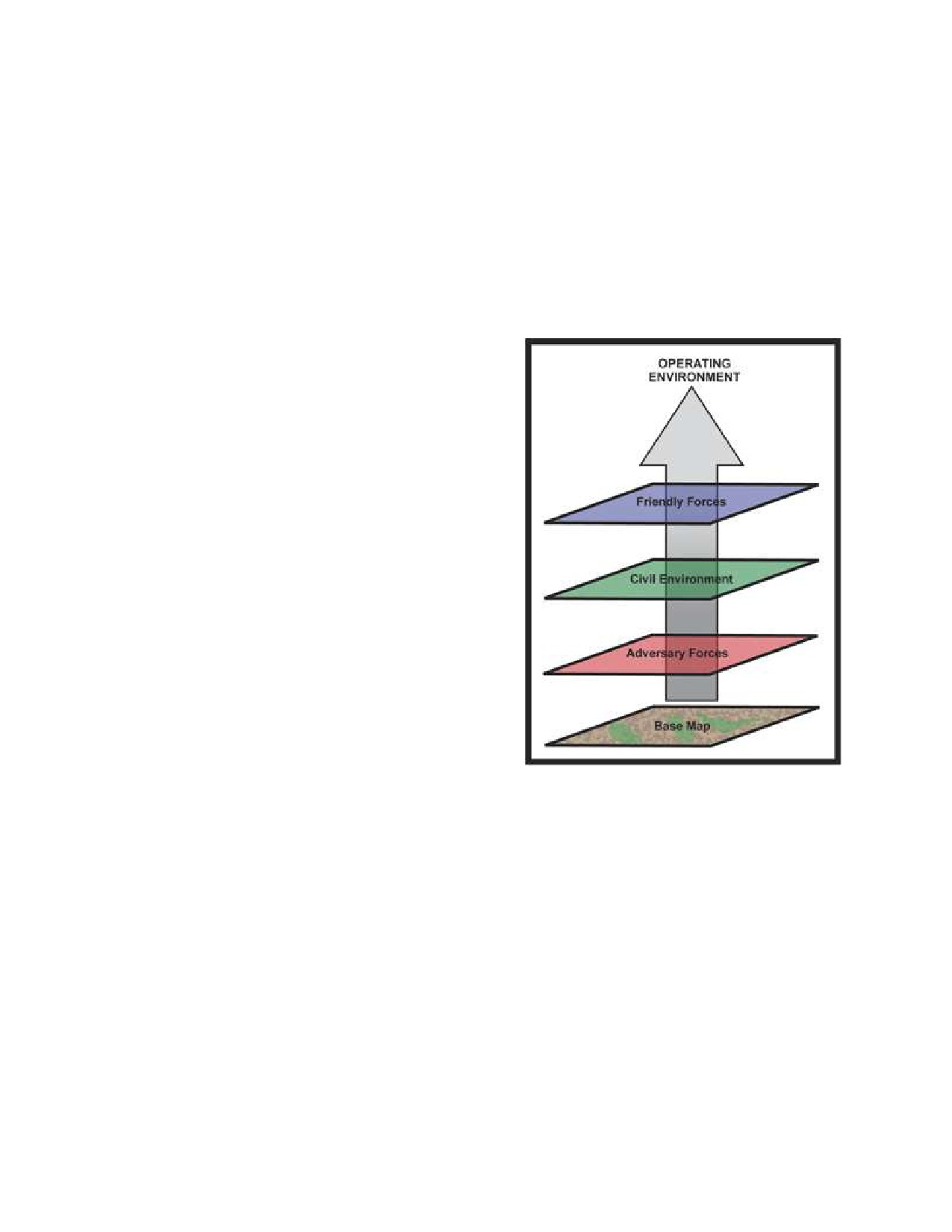
Figure 1-1. Components of the Operating
Environment
65
1.1.1 Understanding the Operating Environment
66
The JFC’s operating environment consists of three layers or components of information that are arrayed in time
67
and space. These are depicted in Figure 1-1, Components of the Operating Environment. Joint civil information
68
management focuses on the civil environment, and was developed to assist the JFC obtain and control civil
69
information during the range of military operations, especially CMO. These include stability, security, transition
70
and reconstruction operations (SSTRO), irregular warfare (IW), counterinsurgency (COIN), and antiterrorism (AT),
71
where civil populations are the center of gravity (population-centric warfare). Control of civil information is a
72
component of joint information management policies, procedures, architecture, and guidelines.
73
Current joint doctrine and C2 constructs provide definitions, frameworks, models, and cognitive processes for joint
74
information management. The policies, architecture, and guidelines for joint information management enable C2.
75
Situational awareness is important to C2 and the execution of joint civil information management at tactical,
76
operational, and strategic levels.
1-2
77
Situational awareness is “the perception of elements in the environment within time and space, the
78
comprehension of their meaning, and the projecting of their status in the near future. Situational awareness is
79
about the knowledge state that is achieved - either knowledge of current data elements, or inferences drawn from
80
these data, or predictions that can be made using these inferences.”7
This framework defines three levels of
81
situational awareness: perception, comprehension, and projection. Situational assessment is the process of
82
achieving the first level of situational awareness.8
The first level, perception, is being aware of relevant elements
83
or factors present in the environment (within time and space).
84
The second level of situational awareness is comprehension. It is often identified as situational understanding,
85
and refers to comprehending the meaning of information and applying analysis and judgment to the unit’s
86
situational assessment to determine the relationship of factors present to form conclusions about threats,
87
opportunities, and gaps in information.9
Situational understanding comprehends of the meaning of data and
88
information as they interrelate and directly apply to the commander’s intent or goals. Sensemaking is the term
89
used to describe the process that achieves comprehension.10
Sensemaking is the motivated, continuous effort to
90
understand connections between people, places, things, and events to anticipate their trajectories and act
91
effectively.11
It is looking at past and present information to form explanations and understanding, and is the
92
process used to form a systems perspective.
93
The third level of situational awareness is projection, which involves perceiving information about the
94
environment, comprehending the meaning, then integrating and comparing it with goals to provide projected
95
future states that are valuable for decision making. This level uses situational understanding to project what may
96
occur in the near future to inform decision making. This is thought of in military terms as predictive analysis.
97
1.1.2 Civil Environment
98
The first step toward situational awareness is to identify the status,
“The tendency to overemphasize
99
attributes, dynamics, and relationships of relevant elements to other
detailed information about the
enemy at the expense of the political,
100
points of reference in the operating environment.12
The scope of
economic, and cultural environment
101
these elements is represented in Figure 1-2, Scope of Civil Factors
that supports it becomes even more
102
within the Operating Environment. At the most basic level, civil
pronounced at the brigade and
regional command levels”.
103
situation assessment involves observation, monitoring, cue
104
detection, and simple recognition of multiple civil elements for their
Fixing Intel: A Blueprint for Making
Intelligence Relevant in Afghanistan
105
current status. These elements can be objects, events, people,
JANUARY 2010
106
systems and other factors. Current status can be conditions, forms,
107
manner of expression, and actions. Together, these express the situation in the civil environment that is assessed
108
during Joint Intelligence Preparation of the Operational Environment (JIPOE), to develop a systems perspective.13
109
Regardless of the mission, current organizational capabilities lack means and methods to focus attention and
110
accurately perceive what is occurring in a vast portion of the JFC’s operating environment. This manual provides
111
collection, consolidation and sharing procedures to achieve situational awareness.
1-3

112
113
Figure 1-2. Scope of Civil Factors within the Operating Environment
114
Requirements for achieving situational awareness of the civil components of the operating environment include:
Common procedures for relief in place
Common data collection, consolidation and
(RIP)/transfer of authority (TOA)
sharing procedures
Common graphics and symbols
Common file naming conventions
Common reporting standards
Common data storage methodology
Common language defining the civil environment
Interoperable civil information architecture
Civil information education and training
Civil information system program of record
115
1.1.3 Focused Attention and Enhanced Perception
116
Informed, echelon appropriate decisions require situational assessment and situational understanding; neither is
117
possible apart from purposeful collection, consolidation and sharing of civil information. Figure 1-3, Operating
118
Environment and Information Requirements Categories, illustrates the relationship between the operating
119
environment14 and information requirements categories15. It demonstrates how the civil components of the
120
operating environment relate to the commander’s critical information requirements (CCIR) to produce situational
121
awareness. Information requirements categories (adversary forces, civil environment, and friendly forces) direct
122
attention and focus.
1-4

123
124
Figure 1-3. Operating Environment and Information Requirements Categories
1-5
125
There are two aspects of information necessary to understand the situation and make sound decisions. Military
126
and civilian practitioners who work to enhance situational awareness, at any one of the three levels in section
127
1.1.1 will often manage these two aspects of civil information differently. They are:
128
What is going on? This is information that helps to scope a problem in the operating environment. The
129
information shapes informed decision-making related to complex problems. It is seeking to first
130
understand conditions and events in the operating environment. Answering this question is similar to
131
framing the problem, which is often one of the initial steps before proceeding to operational design.
132
What are we doing or what is being done? This information captures what the organization is doing, or
133
what actions and activities are taking place to address a problem or concern. This captures the quality,
134
performance, and results of actions. For ongoing efforts, this information is often associated with
135
measures of performance (MOP) and measures of effectiveness (MOE). This information begins with and
136
further focuses operational design, planning and analysis.
137
Both aspects correlate with the two basic uses of information identified in JP 6-0, Joint Communications Systems:
138
the first is to help create situational awareness as the basis for a decision while the second is to direct and
139
coordinate actions in the execution of the decision.16
Focusing attention on civil information and making sense of it
140
are the only means to know what is occurring and how joint force and stakeholder activities impact the operating
141
environment. Clear comprehension of the civil environment must occur before integrating and comparing goals to
142
project future events in the operating environment. Mission success depends on focused comprehension and
143
projection of events and actions using civil components of the operating environment.
144
1.1.4 Command, Control, and Decisions
145
Joint doctrine defines Joint Force Commander “as a general term applied to a combat commander, sub-unified
146
commander, or joint task force commander authorized to exercise combatant command or operational control
147
over a joint force.”17
His means to manage activities are command and control. “The purpose of command and
148
control is to bring all available information and all available assets to bear.”18
149
The connection between C2 and decisions is established in the following definition: command and control
150
encompasses decisions directly associated with goals or collective actions and the control of activities and actions
151
that carry out these decisions. Decisions relate directly to identified command goals or the commander’s intent. In
152
other words, they are mission related. They do not encompass all of the decisions made by individuals or
153
organizations nor decisions that emerge from collective behavior.19
154
Command identifies or decides a desired outcome - intent or goal [Art].
155
Control specifies the orders given (direction). Control consists of decisions linked to action (execution of
156
the intent) [Science].
157
The JFC produces decisions. The following C2 model identifies three specific processes that demonstrate how the
158
JFC’s decisions become actions. They are:
159
Information processing, which accepts information from and about the operating environment and
160
converts it into situational awareness;
161
The sensemaking process by which situational awareness is converted into understanding and decisions
162
at either the individual or some shared level;
163
Implementation processes by which decisions are converted into actions.20
1-6
164
The variables of mission success are as diverse as the factors that dominate the situation. Even so “the
165
effectiveness of the leader [commander] is proportional to the effectiveness of the decisions the leader makes and
166
the cascading impacts as decisions turn into action, both good and bad.” 21
167
There is a simple control loop where information is processed as part of focused situational awareness.
168
Sensemaking leads to situational understanding that enables decisions. Through control mechanisms, decisions
169
are converted into actions. These actions and their effects are observed to form updated situational awareness.
170
This simple loop represents the link between joint force actions and effects in the civil environment. However,
171
events occur outside of this control loop, which prompt the question: “What is going on?” This can happen in an
172
environment of ongoing activity or someplace altogether new. In either case, initial effort and focus may be
173
applied to collect information leading to situational awareness. Answering this question may require situational
174
awareness of events and actions in the civil environment occurring outside of the JFC’s control.
175
The cases identified above include situations where questions, information processing, and making sense of the
176
operating environment must do more than simply consider the civil components. Civil considerations must become
177
civil imperatives to achieve situational awareness, satisfy the CCIRs, identify decision points, and support echelon
178
appropriate decisions.
179
1.1.5 Command, Control, and Planning
180
Defining CCIRs, identifying decision points, and decision making are conducted during planning. C2 determines the
181
conditions that shape that process.22
Figure 1-4, Planning in the Context of C2 and Operations, illustrates the
182
relationship between command, control, sensemaking, planning, and execution.23
Planning is an integral part of
183
the sensemaking process.24
Making sense of the operating environment begins with factors in the civil
184
environment. The JFC and his staff determine roles and responsibilities, allocate resources, determine the nature
185
of interactions that take place among participants, and define how information is shared among stakeholders. This
186
is done for each information requirements category. The level of effort applied to each category reflects the JFC’s
187
priorities and operational capability.
188
Civil information planning, collection, consolidation, analysis, production and sharing enable units and staffs to
189
more effectively accomplish missions they are already tasked to execute. Standards and methods for managing
190
civil information enhance collaborative processes and support joint operational planning. Figure 1-4, Planning in
191
the Context of C2 and Operations, shows collection, consolidation, and sharing in the operating environment and
192
collaborative planning space. They enhance the movement of information by information processing and sharing.
193
Plans inform both the sensemaking and execution processes because they are updated interactively. Similarly, civil
194
information planning is part of sensemaking and informs the JFC’s situational understanding and projection.
195
Sharing is both internal (sharing of plans within the collaborative process) and external to stakeholders in the
196
operating environment. The decision about what to collect, consolidate and share from the civil environment is
197
determined by command priority (decision) based on situational awareness (planning, analysis and production)
198
and carried out (control) through the execution of plans.
1-7
199
200
Figure 1-4. Planning in the Context of C2 and Operations
201
1.2 Joint Civil Information Management Process
202
The joint civil information management process supports planning and execution by incorporating civil information
203
into the JFC’s C2 and decision processes. Without civil information, the JFC operates with incomplete situational
204
awareness, as illustrated in Figures 1-1, 1-2, and 1-3. Figure 1-5, Joint Civil Information Management Process,
205
illustrates the iterative nature of civil information management, where information flows conditionally from
206
analysis and production to consolidation, and how the exchange of information from sharing leads to further
207
collection, consolidation and planning. The process steps are:
208
1. Planning develops plans to collect, consolidate and share. The collection plan considers what data and
209
information are necessary. The plan to consolidate informs how the collected data will be organized. The
210
dissemination plan identifies what to share, and with whom.
1-8
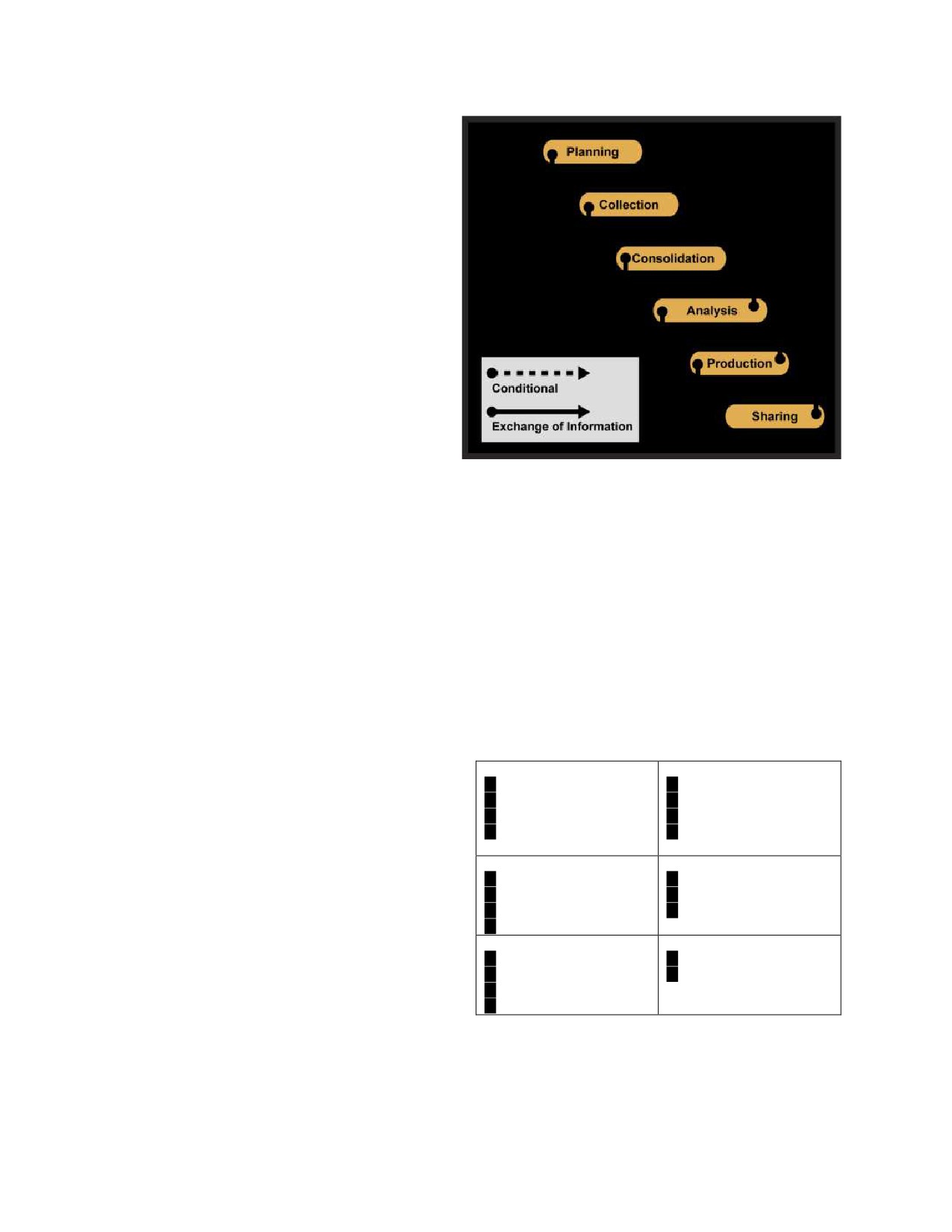
211
2. Collection provides civil data to support the
212
JFC’s civil information requirements
213
through information search, civil
214
reconnaissance and civil engagement.
215
3. Consolidation is the process of collating
216
and processing data to produce civil
217
information to support planning, analysis,
218
and sharing.
219
4. Analysis is situational assessment,
220
sensemaking, and projection. It supports
221
the development of products requested by
222
the joint force command.
223
5. Production organizes analyzed civil
224
information, event logs, status trackers,
225
etc. into products that satisfy requirements.
Figure 1-5. Joint Civil Information Management
Process
226
6. Sharing: Pushing, pulling, and populating
227
civil information supports the external and internal exchange of information to increase JFC and
228
stakeholder situational assessment and situational understanding.
229
NOTE: This Manual focuses specifically on information management tactics, techniques, and procedures for
230
managing civil information. Additional operational and administrative aspects involved with managing civil
231
information fall under the authority of Joint and Service doctrine, and are beyond the scope of this Manual.
232
The joint civil information management process is executed at all echelons (tactical through strategic). It is
233
applicable across the military, USG agencies, and other participating partners. The process is collective: each
234
organization integrates infrastructure (people, process, and technology) based on their capabilities and missions.
235
As a result each step of the process will be emphasized
Table 1-1. Notional Emphasis of Joint Civil
Information Management at Each Echelon
236
in a different way by echelon and organization. This is
Tactical emphasis:
Tactical Echelon elements:
237
demonstrated by a notional view of four of the
80% Collection
Team/Squad/Platoon
5% Consolidation
Company/Detachments
238
process steps in Table 1-1, Notional Emphasis of Joint
5% Analysis
Battalion
239
Civil Information Management at Each Echelon. The
10% Sharing (mostly with
Brigade
supported commander)
240
process or a procedure is not restricted to a particular
Operational emphasis:
Operational Echelon elements:
20% Collection
Brigade/Task force
241
echelon or organization. For example, analysis occurs
30% Consolidation
Component Commands
242
at the tactical level, but is conducted differently than
30% Analysis
Corps/Joint Task Force
20% Sharing
243
analysis at other levels just as situational assessment
Strategic emphasis:
Strategic Echelon elements:
244
is different from sensemaking (section 1.1.1).
5% Collection
Combined Joint Task Force
25% Consolidation
Combatant Command
245
Figure 1-6, Interactive View of the Joint Civil
30% Analysis
40% Sharing
246
Information Management Process, illustrates
247
planning, analysis and production using the data and information that are obtained and moved through collection,
248
consolidation and sharing. Essentially, planning, analysis and production determine what is needed at various levels
249
or echelons of decision making. Sharing determines what is externally needed by stakeholders.
1-9

250
251
Figure 1-6. Interactive View of the Joint Civil Information Management Process
252
1.2.1 Joint Civil Information Management Roles
253
The roles discussed, and the instructions throughout the chapters, are collective. Groups of individuals accomplish
254
the process steps that support collaboration within and outside the JTF. In addition to the role of the JFC, there are
255
three other roles required to execute the CIM process:
256
1. The supported unit is the joint force command and any other supported unit that uses and manages civil
257
information during the course of their duties, including maneuver unit staffs, CMO staff (J9), force
258
enablers (civil affairs teams, military police, surgeons, chaplains, legal officers, engineers, etc) and other
259
elements. This manual provides considerations, procedures, and best practices for the staff of the
260
supported unit to integrate civil information into the planning and execution process.
261
2. Joint civil information management coordinators facilitate the movement of civil information and act as
262
the liaison for staff and managers of civil information. This requires executing content management
263
functions in conjunction with the joint civil information management process to ensure civil information is
264
visible, accessible, and understandable25
between echelons and areas of operation (AO). These tasks are
265
performed by US Army (USA) CIM cells, US Navy (USN) CIM coordinators, US Marines (USMC) task
266
organized to conduct CIM, and all other service members tasked to perform equivalent responsibilities.
267
NOTE: Chapter 2 provides guidance for organizing a joint civil information management coordinator section,
268
and Annex C describes the activities joint civil information management coordinators execute.
269
3. Stakeholders are any group of individuals who have legitimate interest in, knowledge of, can affect, or are
270
affected by USG operations in the civil environment. They can be military and non-military entities with
1-10
271
information, information requirements or interest in the operating environment, and include, but are not
272
limited to:
Higher, adjacent, and subordinate units
USG agencies
Host nation (HN) military and agencies
Partnering nation military and agencies
Intergovernmental organizations (IGO)
NGOs
Indigenous populations & institutions (IPI)
Private sector entities such as business,
education, and medical conglomerates.
273
1.3 Understanding Civil Information
274
The JFC’s comprehension of conditions, circumstances, and influences affects the employment of capabilities. C4I
275
systems oriented toward friendly and enemy forces information requirements categories do not generally address
276
civil factors, nor do they include echelon appropriate, aggregated, and layered civil information.
277
1.3.1 Echelon Appropriate Information
278
Echelon appropriate information defines the different information needs at each echelon of command and
279
decision making. Visible and accessible information does not contribute to sensemaking for every echelon. For
280
example, the JFC uses information to achieve situational understanding of national or regional conditions, and
281
does not benefit from reports developed for battalion level situational awareness. Tactical echelon civil
282
information does not relate to operational and strategic level requirements until it is consolidated and analyzed for
283
those echelons. Echelon appropriate information mitigates information overload, by replacing distracters with
284
information analyzed to support decision making at the appropriate echelon.26
285
1.3.2 Aggregation
286
Civil information is aggregated together from separate sources. Aggregation describes bringing together [fusing]
287
only the information relevant to a commander’s mission or current information requirements to enable quick and
288
accurate decision making. The output of consolidation, analysis, and production is echelon appropriate,
289
aggregated information. Staffs routinely aggregate friendly and enemy forces information using established C4I
290
infrastructure, however the lack of civil information architecture in C4I systems requires staffs to manually nest
291
categorical systems applied at the tactical level, under analytical systems implemented at operational and strategic
292
levels, to achieve situational awareness.
Table 1-2. Examples of Categorical and
293
1.3.2.1 Categorical and Analytical Systems
Analytical Systems
294
Systems are designed to model the operating environment.
Categorical Systems:
Analytical Systems:
Mission, enemy, terrain
Interagency Conflict
295
These systems are one of two types: categorical or
and weather, troops and
Assessment Framework
296
analytical. Implementing these systems enables analysis and
support available, and
(ICAF)
297
planning of the operating environment by organizing
time available (METT-T)
PMESII
298
information into related groups. The systems listed in Table
District Stability
Lines of operation (LOO)
Framework (DSF)
299
1-2, Examples of Categorical and Analytical Systems,
Macroeconomic models
ASCOPE
300
facilitate sensemaking.
SWEAT-MSO
301
Categorical systems organize information about the
302
operating environment based on physical characteristics or functions of the components being identified, and are
303
generally more useful at lower echelons. They are comprised of concrete categories like sanitation, water, electric,
1-11
304
academics, transportation, medical, security, and other considerations (SWEAT-MSO), or areas, structures,
305
capabilities, organizations, people, and events (ASCOPE). Categorical systems nest under analytical systems the
306
same way tactical missions nest under operational objectives. Categorical systems generally support tactical
307
planning and analysis of smaller AO.
308
Analytical systems organize information based on processes, roles, or related ideas, and are the composite of
309
abstract concepts, events, and interactions. They aggregate categorical systems, and often other analytical
310
systems, into a single display to facilitate operational and strategic situational understanding and projection. The
311
systems approach27
aggregates analytical systems into the PMESII system of systems, often with the ASCOPE
312
categorical system nested within each PMESII system. This is used as information architecture for civil information.
313
Additional examples of analytical systems include agriculture, macroeconomics, political science, and the applied
314
ethics behind human rights protection. For example, agriculture is the composite of interactions between farming,
315
climate, infrastructure, irrigation, and often culture. Joint operation planning identifies effects that link missions to
316
objectives.28
Staffs plan to influence components of analytical systems to produce effects on the overall system.
317
1.3.2.2 Layers of Visualization
318
Tactical level commanders require real-time, granular operational pictures; while JFCs require operational pictures
319
that capture changes in complex and interconnected operating environments.29
Subordinate operating pictures
320
comprise elements of higher echelon operating pictures. Regardless of echelon, all COPs contain the elements
321
depicted in Figures 1-1, 1-2, and 1-3. Categorical and analytical systems generally provide the information
322
architecture for placement of aggregated echelon appropriate information to develop the COP. When properly
323
fused, civil information informs friendly and enemy forces layers of a COP.
324
1.3.3 Cognitive Hierarchy
325
Human sensemaking is captured in the cognitive hierarchy model. Cognitive hierarchy is comprised of four
326
information levels illustrated in Figure 1-7, Cognitive Hierarchy: data, information, knowledge and
327
understanding.30
The cognitive hierarchy describes the underlying process of command, control, and decision
328
making. The four information levels correspond to consolidation, analysis, and production. The result is situational
329
understanding leading to echelon appropriate decisions.
1-12

330
331
Figure 1-7. Cognitive Hierarchy
332
1.4 Conclusion
333
The operating environment is large and complex. Traditionally, military commanders operated in this space
334
focused on enemy and friendly formations. Today, command and control recognizes new technologies, new
335
challenges and the imperative for a capability and means to identify relevant information from the civil
336
environment.
337
Civil information management is nested within C2 and information management. The need for civil information
338
exchange is on a scale never before experienced by the United States (US) military. This scale can be expressed by
339
comparing the difference between designing a building and urban planning. The former is the discipline of an
340
architect and the latter incorporates many mutually supporting disciplines. This scale requires the appropriate
341
“infrastructure”. city (joint civil information management) is not just a bigger house (Service CIM); it is
342
meaningfully different in both quality and diversity. Like urban planning, joint civil information management is
343
heavily interdependent and requires applicability across echelons, domains and theaters. It provides the necessary
344
operational support to Service CIM, which is scaled for maneuver element execution.
345
Collecting, consolidating and sharing are formalized to fulfill the decision maker’s need to move civil information in
346
order to make operational sense of it. However, infrastructure and training for civil information exchange remain
347
incomplete, limiting joint and interagency use. The remaining chapters of this manual will illustrate the joint civil
348
information management process and highlight TTP for effective movement of civil information, ultimately
349
creating a foundation for joint civil information infrastructure and training.
1 Joint Publication 6-0, Joint Communications Systems, 10 June 2010, page III-28. The collaborative information
environment requires infrastructure. This includes information systems, tools, communications and procedures.
2 Department of Defense Directive (DoDD) 8320.02, Data Sharing in a Net-Centric Department of Defense, page 2.
3 Joint Publication 6-0, Joint Communications Systems, 10 June 2010,The procedures must be “based on accepted
theory and practice and established to meet joint force needs͙The full benefit of these capabilities is realized only
with a fourth component - users͙”
4 Joint Publication 6-0, Joint Communications System, 10 June 2010, page I-2.
1-13
5 Joint Publication 1, Doctrine for the Armed Forces of the United States. Washington: Joint Chiefs of Staff, 20
March 2009, page 18.
6 There are “major discontinuities between Command and Control concepts and practices taught and practiced
today and those of tomorrow.” Alberts, David S. & Hayes, Richard E. (2006). Understanding Command and Control.
Command and Control Research Program Publication Series, Assistant Secretary of Defense, Networks and
Information Integration/Chief Information Officer, 2006, page vii.
7 This definition, by Dr. Mica Endsley, is established and broadly accepted for application across multiple domains.
Endsley, M.R. (1995b). Toward a Theory of Situation Awareness in Dynamic Systems. Human Factors, 37(1), 32-37.
8 [Endsley 36]
9 Major Dostal, Brad C., USA. (2001). Enhancing Situational Understanding through the Employment of Unmanned
Aerial Vehicles. Center for Army Lessons Learned Newsletter, July 2001, 71.
10 Endsley, M.R. (1995b). Toward a Theory of Situation Awareness in Dynamic Systems. Human Factors, 37(1),
32-37.
11 Klein, G., Moon, B, & Hoffman, R.R. (2006). Making Sense of Sensemaking 1: Alternative Perspectives. IEEE
Intelligent Systems Journal, Volume 21 (Issue 4), 70-73.
12 Endsley, M.R. (1995b). Toward a Theory of Situation Awareness in Dynamic Systems. Human Factors, 37(1),
32-37
13 Joint Publication 2-01.3, Joint Intelligence Preparation of the Operational Environment, 16 June 2009, page II-44.
14 Ibid, page I-3.
15 Joint Publication 3-0, Joint Operations, 17 September 2006: Incorporating Change 2 22 March 2010, page III-12.
16 Joint Publication 6-0, Joint Communications Systems, 10 June 2010, page I-2.
17 Joint Publication 1-02, Department of Defense Dictionary of Military and Associated Terms. Washington, GPO, 12
April 2001 (as amended through 7 May 2002).
18 Alberts, David S. & Hayes, Richard E. (2006). Understanding Command and Control. Command and Control
Research Program Publication Series, Assistant Secretary of Defense, Networks and Information Integration/Chief
Information Officer, 2006, page 67
19 ibid page 8
20 ibid, page 176
21 Effective Decision-Making Processes for the Joint Force Commander, Air Land Sea Bulletin, Air Land Sea
Applications (ALSA), Issue 2003-1, March 2003.
22 Command initially, and control during the course of an endeavor, determines the conditions that shape the
sense making process. Alberts, David S. & Hayes, Richard E. (2007). Planning: Complex Endeavors. Command and
Control Research Program Publication Series, Assistant Secretary of Defense, Networks and Information
Integration/Chief Information Officer, April 2007, page 122.
23 This representation is drawn from the body of research in the CCRP that integrates planning with C2. This figure
differs from the original because it focuses on how the joint civil information management process complements
C2 and collaborative staff processes to enhance sensemaking and projection during operation planning. Ibid, page
123.
24 Ibid, page 126.
25 DoDD 8320.02, Data Sharing in a Net-Centric Department of Defense, page 2.
26 Counterinsurgency Advisory and Assistance Team, RC-West, Herat, Afghanistan. The Stability Operations
Information Center (SOIC): Comprehensive Understanding for Comprehensive Operations, page 2-3.
27 Joint Publication 5-0, Joint Operation Planning, 26 December 2006, page III-16.
28 Ibid, page III-12.
29 Ibid, page III-17.
30 Field Manual 6-02.85/Marine Corps Reference Publication 3-40.2A/Naval Warfare Publication 3-13.1.16/Air
Force Tactics, Techniques, and Procedures (Interim) 3-2.22, Multi-Service Tactics, Techniques, and Procedures for
Joint Task Force Information Management, page I-6.
1-14
1
CHAPTER 2 ORGANIZATION FOR JOINT CIVIL INFORMATION MANAGEMENT
2
2.0 Introduction
3
A joint force must task organize to enable effective C2
“Transforming to a network centric force requires
4
and achieve unity of effort. To reach these desired end
fundamental changes in processes, policy, and
culture. Change in these areas will provide the
5
states, information management must occur. The primary
necessary speed, accuracy, and quality of decision-
6
roles in civil information management identified in
making critical to future success. Beyond battlefield
7
Chapter 1, Section 1.2.1, are elements in joint forces.
applications, a network centric force can increase
efficiency and effectiveness across defense
8
These elements consist of the JTF staff, attached and
operations, intelligence functions, and business
9
supporting force enabler staffs, and joint civil information
processes by giving all users access to the latest,
10
management coordinators.
most relevant and accurate information.”
11
2.1 Context
National Defense Strategy, March 2005
12
The joint force is comprised of many elements that
13
interact with the civil population and observe civil components of the operating environment. These elements
14
include maneuver units and force enablers such as military police (MP), engineers, chaplain, judge advocate
15
general (JAG), medical service, civil affairs (CA), and military information support operations (MISO). All elements
16
that use civil information play a role in managing it.
17
2.2 Staff Organization for Joint Civil Information Management
18
The optimum organization to manage civil information consists of staff and force enablers within an established
19
civil information management and C4I infrastructure. The J9 is normally the lead for managing civil information.
20
Regardless of mission or task organization, the requirement to effectively manage civil information is constant. The
21
responsible staff directorate must identify and work with all stakeholders who execute planning, collection,
22
consolidation, analysis, production, or sharing of civil information.
23
Each directorate in a joint staff has the implied task of managing information within their field. Enablers and
24
special staff manage information within their field: MPs manage civil law enforcement information; the JAG
25
manages civil courts and rule of law information; the surgeon’s office manages information about civil medical
26
capabilities; chaplains manage information about the religious and ideological environment; and so forth. Each
27
provides functional area expertise when managing information about the civil components of the operating
28
environment.1
29
NOTE: Staff sections with topical responsibility for a subject, enablers with specialized knowledge, and subject
30
matter experts (SME) are referred to as functional area specialists throughout the this Manual.
31
The J9 or responsible staff section coordinates moving civil information into the decision making process and
32
provides it to the operations section (J3) for depiction in the COP. They accomplish this through extensive
33
coordination with functional area specialists and other stakeholders, ensuring that any organization that requires
34
civil information manages it effectively. The J9’s primary capability to manage civil information is the joint civil
35
information management coordination section. Joint civil information management coordinators can be organized
36
within a civil-military operations center (CMOC), within the J9, or as directed by the joint force commander. CIM is
37
a CA core task, therefore CA forces are best suited to perform joint civil information management. Civil information
2-1
38
management is not solely the task of CA personnel in the CIM section or cell. It is an essential task for all
39
components of a unit.2
“The goal of common understanding of
40
Managing civil information requires a collaborative information
information and appropriate sharing of the
41
environment consisting of “personnel, equipment, facilities, and
same is achieved through the proper
42
procedures”3, that provides the people, process, and technology to
management of personnel, equipment,
facilities, and procedures. This management is
43
plan, execute, and assess operations. It provides commanders and
conducted by a viable information
44
staffs the capacity to plan and operate with unity of effort by
management organization.”
45
providing the right information to the right people at the right
Joint Publication 3-33, Joint Task Force
46
time in an understandable format.
Headquarters, 16 February 2007
47
2.2.1 Service Approaches to Civil Information Management
48
The civil information management coordination task fits differently into each Service CA force structure based on
49
mission specialization. Army CIM coordinators are organic to some CA units, while Navy CIM coordinators have a
50
continental United States (CONUS) reach-back capability, and Marines task organize to fulfill CIM coordinator
51
functions within each mission.
52
USA. Army CIM cells are organic to CA CMOCs at the battalion level and higher. CIM cells are organized the same at
53
all levels and comprised of Soldiers from three military occupational specialties (MOS). The CIM cell consists of:
1 x 38A Civil Affairs Officer
2 x 25B Information Technology Operator/Analysts
1 x 21Y Geospatial Engineer
54
USN. Navy CIM coordinators have two organizational capabilities. The first is a CONUS-based reach-back resource
55
supporting maritime CA. The second is the communications expert of the five-man maritime CA team being trained
56
and tasked to provide the forward-deployed CIM coordinator capability.
57
USMC. Currently the Marine Corps has no organic CIM coordinators resident within active or reserve component
58
CA units. They typically task-organize a CMO cell, located within the operations section (S-3 or G3/G9) that
59
includes MOS 0530 CA officers and 0531 CA noncommissioned officers (NCO). Working groups are used by putting
60
a CA Marine with MISO, fires, logistics, engineer, or other appropriate staff representation to conduct civil analysis
61
and COA development.
62
2.3 The Joint Civil Information Management Coordination Section
63
Joint civil information management coordinators are typically organized as a section under the J9, or in a CMO cell
64
in J3. They are managers of information with limited capability for analyzing the civil environment. Civil analysis is
65
accomplished either by CA functional specialty cells (FSC) or functional area specialists. The role of the joint civil
66
information management coordination section is to:
67
Understand the civil information environment within the organization.
68
o Assess how each element of the organization manages civil information.
69
Coordinate the organization of and access to civil information among stakeholders.
70
o Determine whether civil information is available, in usable formats, to consumers.
71
Joint civil information management coordinators collect civil information, consolidate it into a central information
72
system, and share it with a wide community of stakeholders. These stakeholders can be within the unit; other joint
2-2
73
or combined military organizations; or US and non-US civilian organizations operating in the AO. The joint civil
74
information management coordinators receive or have access to raw and analyzed information in diverse forms
75
from many sources. They interact with people, observing their reporting and information systems to ensure the
76
visibility, accessibility, and understandability of civil information.
77
Joint civil information management coordinators are the conduit to repositories where civil information is stored,
78
and provide a coordinating mechanism for sharing information among stakeholders. They function as reference
79
librarians who facilitate the handling, retrieval, and distribution of data: not its generation and use. This is
80
accomplished by managing the joint civil information management process and finding appropriate information to
81
best satisfy civil IRs.
82
The coordinator(s) should have access to all reports and assessments about the civil components of the operating
83
environment from partnering stakeholders, and can assist in outreach to other resources. They ensure that
84
consolidated civil information is available for sharing in usable formats to the entire stakeholder community. To
85
accomplish this, coordinators focus on two major tasks: monitor the unit civil information environment and
86
coordinate civil information organization and access. These tasks consist of the following subtasks:
87
1.
Monitor the unit civil information environment:
88
Maintain SA of efforts to manage civil information by military and civil stakeholders.
89
Act as the primary interface between civil data collectors and analysts.
90
Collate information so the staff can provide analyzed civil input to the COP.
91
Ensure that after action reviews are completed and documented.
92
Ensure civil information can be partitioned from military intelligence systems and remain visible and
93
accessible to the staff.
94
Maintain the capability to geo-reference and interface pertinent civil data.
95
Identify procedural shortcomings that impact the quality of available civil information.
96
Help J9 manage civil knowledge products.
97
Build and maintain relationships with stakeholder information managers.
98
2.
Coordinate civil information organization and access:
99
Establish a working relationship with the information management officer (IMO) and
100
Communications Directorate (J6).
101
Develop a CIM program to support the information management plan (IMP).
102
Establish a CIM working group with a core team drawn from all staff sections to resolve civil IR.
103
o The core team consists of representatives from the intelligence section (J2), J3, and J9.
104
o Provide the capability for effective integration of civil information with JTF operations.
105
o Provide readily understandable products.
106
o Get the right information to the right people at the right time.
107
Analyze new information technology for potential application to joint civil information management.
108
Develop organization and access procedures that enhance search and retrieval.
109
Conduct quality control checks for duplication, accessibility, and understandability.
110
Advise the JTF on joint civil information management processes and tools.
111
NOTE: For more information about joint civil information management coordinators, refer to Annex C.
2-3
112
2.3.1 Skills Required in the Joint Civil Information Management Coordination Section
113
When CA CIM coordinators are not available, the JFC may task organize to internally form a joint civil information
114
management coordination section. The joint civil information management coordination cell must have the ability
115
to monitor the civil information environment and coordinate civil information organization and access. The
116
optimum skills required in a joint civil information management coordination section are:
117
Strong analytical and problem solving skills.
118
Basic project management skills.
119
Information technology skills:
120
o Proficient in Microsoft (MS) Office applications.
121
o Network configuration and security.
122
o Capacity to plan and coordinate large scale data management.
123
o Experience using and programming handheld geographic positioning system (GPS) units and
124
familiarity with the interoperability between hardware and software.
125
o Basic understanding of content management in relational databases.
126
Excellent verbal and written communication skills required for documentation, training, and reporting.
127
Strong geographic information system (GIS) skills.
128
o Able to manage GIS databases, conduct GIS assessments, and generate maps.
129
o Knowledge of coordinate systems and coordinate transformations.
130
o Tailoring GIS solutions based on dialog with individual stakeholders.
131
o Familiarity with joint, interagency, and multinational operational terms, graphics and symbols.
132
Team-building experience in collaboration and outreach.
133
Training the joint civil information management process, and its supporting software and hardware.
134
NOTE: For more information about geospatial support to operations, refer to JP 3-34, Joint Engineer
135
Operations and JP 2-03, Geospatial Intelligence Support to Joint Operations.
136
2.3.2 Joint Civil Information Management Coordinator Maxims
137
Joint civil information management coordinators manage the joint civil information management process, not
138
communications architectures, C2 of joint forces, task organizations, or stakeholder activities. The following
139
maxims guide their efforts:
140
1. There is never enough bandwidth.
141
2. There will never be a single database.
142
3. Stakeholders may each have their own database. Identifying points of integration is the key to success.
143
4. Outside-the-wire warfighters are highly trained and very well resourced: problems receiving civil
144
information from them result from unclear requirements being conveyed to them.
145
5. Time is precious to Outside-the-wire warfighters: don’t waste it trying to fix problems that originate above
146
their level with them.
147
6. Staff personnel (inside-the-wire) receive less training and have fewer resources to perform staff functions:
148
problems receiving civil information from staff are often caused by poor training and discipline, poorly
149
defined expectations and standards, and insufficient command emphasis.
2-4
150
2.3.3 Relationship to Information Management
151
Joint civil information management is a component of information management, and both use similar processes.
152
Joint civil information management coordinators work closely with and are subordinate to the joint information
153
management board (JIMB) regarding information management policy and the IMP. The JIMB is responsible for
154
designing and implementing information management solutions for the JTF.4
Joint civil information management
155
coordinators must facilitate the IMP by conducting civil information management to support the JIMB or IMO.
156
NOTE: For more information about the JIMB, IMO, and command IMP, refer to JP 3-33, JTF Headquarters (HQ).
157
2.3.4 Considerations for Organizing Joint Civil Information Management Coordinators in the Staff
158
The J9 maintains responsibility for managing and sharing civil information, regardless of the availability or
159
disposition of CA forces with a CIM capability. Identifying J9 personnel with information management expertise
160
and tasking them as joint civil information management coordinators for the JTF is the most effective means for
161
executing joint CIM in the absence of organic joint civil information management coordinators in a CA CMOC.
162
These identified joint civil information management coordinators perform information and content management
163
functions in support of joint staff. They assist the J3 in defining reporting standards, ways, and means; quality
164
checking subordinate reports; and engaging subordinate, adjacent, and supported military units with training and
165
expertise to improve their CMO reporting and management of civil information.
166
2.4 Joint Civil Information Management Support to Interagency Operations
167
Joint civil information management supports all stakeholders needing information about the civil components of
168
the operating environment. During CMO, such as SSTRO, COIN, IW, and humanitarian assistance/disaster relief
169
(HA/DR), there may be many interagency and other partners either supporting or supported by the joint force
170
depending on the mission. Joint civil information management coordinators must adapt to changing requirements
171
of multiple organizations to provide situational understanding of the civil components of the operating
172
environment.
173
2.5 Conclusion
174
This chapter summarized the task organization necessary for executing joint civil information management and the
175
importance of establishing a CIM coordination capability with varying levels of CA force structure. Responsibility to
176
manage civil information should be broadly tasked so that all elements of the JTF are aware that they influence the
177
COP and facilitate the joint intelligence preparation of the operational environment (JIPOE) process. “The goal of
178
CIM is to enhance SA and understanding to achieve decision superiority.”5
Managing civil information is the
179
responsibility of every warfighter.
1 Rand Corporation CA Capabilities and Way Forward not yet published
2 Joint Publication 3-57, Civil-Military Operations, 8 July 2008, page B-20.
3 Joint Publication 3-33, Joint Task Force Headquarters, 16 February 2007, page xv.
4 Ibid, page, IV-2
5 Joint Publication 3-57, Civil-Military Operations, 8 July 2008, page B-20.
2-5
1
2
3
4
5
6
7
8
9
10
11
12
13
INTENTIONALLY BLANK
14
15
16
17
18
19
20
1
CHAPTER 3 JOINT CIVIL INFORMATION PLANNING
2
3.0 Introduction
3
Planning is the first step of the joint civil information
“Plans are nothing; planning is everything.”
4
management process. It is complex and changes based
General of the Army Dwight D. Eisenhower
5
on the nature and phase of warfare and operational
6
requirements. Planning for CMO is more complicated than planning for combat operations.1
In combat operations
7
direct effects are attainable through performance-based operations such as conduct of offense and defense. Their
8
effects are usually clear and expressed in terms like destroy, delay, and deny and can generally be assessed in
9
hours, days and weeks through quantitative measures. Direct effects during CMO are consistent with the effects
10
achieved during combat operations.
11
During CMO, many desired effects are more ambiguous and are described in relative terms like indirect, cascading,
12
and cumulative, and they are generally assessed in weeks, months, and years through qualitative measures.
13
Indirect effects are usually assessed by measuring indicators.2
Indicators can be nodes and links related to a center
14
of gravity (COG) or desired effect, and are used to assess effects of operations, actions, and activities that cannot
15
be directly measured. Changing focus from direct to indirect effects during shaping and influencing operations can
16
complicate planning, and requires more controlled and effective information management.
17
The systems perspective3
is civil information architecture that identifies relevant nodes and links in the operating
18
environment. It also enables COA development; targeting; identifying analytical frameworks for analyzing the civil
19
components of the operating environment; development of MOEs and MOPs that link missions to higher level
20
objectives; and definition of mission success. During population-centric warfare, most desired effects in the
21
operating environment are indirect effects.4
Without mature, mission-specific civil information architecture, staffs
22
have no systematic methods for assessing whether decisive points and desired indirect effects are being achieved.
23
Executing performance-based operations without effects-based planning generally does not achieve broad
24
objectives such as economic development, nor provide a means to identify and mitigate unintended effects.
25
NOTE: “Indirect effects” and effects-based planning are derived from the Principles of Targeting in JP 3-60.
26
NOTE: Civil information architecture is similar to the intelligence architecture discussed in JP 2-0.
27
Joint forces execute the joint operations planning process (JOPP) and
During civil-military operations, civil
information is an absolute
28
use the joint operations planning and execution system (JOPES) to
requirement for understanding the29
establish unity of effort among military and non-military stakeholders.5
operating environment; planning and
30
This manual does not explore JOPP or JOPES, but identifies how civil
executing operations; defining
termination and transition criteria;31
information management supplements joint operation planning
and determining mission success.
32
A component of joint operation planning is acquiring and exploiting the
During combat operations, civil
3
information necessary to conduct population-centric warfare. SA begins
information is a secondary input th3
informs commanders of the presen34
with identifying the objectives of the operation and the phase. Figure 3-
and status of civilians in the
35
1, Emphasis in the Range of Military Operations by Phase and Level of
environment and provides guidance
6
Military Effort6, depicts the relationship between CMO and the phases
for operations, actions and activitie3.
37
of military operations. CMO may occur prior to, during, or after other
38
military actions, regardless of the phase of the operation.7
3-1
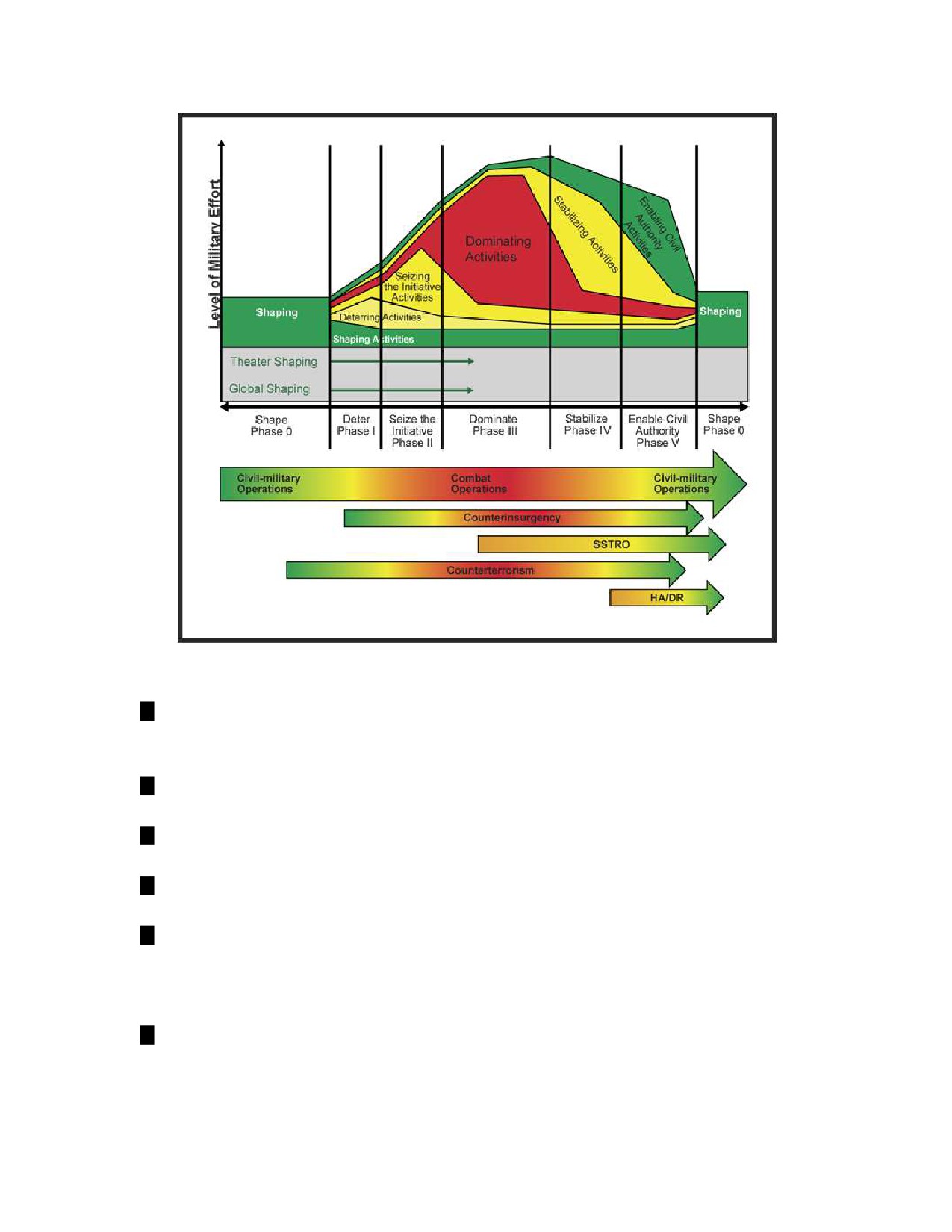
39
40
Figure 3-1. Emphasis in the Full Range of Military Operations by Phase and Level of Effort
41
3.0.1 Key Terms
42
Collection Management involves the establishment, prioritization, and monitoring of civil information
43
collection requirements and tasking through a civil information collection plan. For more information
44
about collection management refer to JP 2-01.
45
Critical Capability. A means that is considered a crucial enabler for a center of gravity to function as such
46
and is essential to the accomplishment of the specified or assumed objective(s). (JP 5-0)
47
Critical Requirement. An essential condition, resource, and means for a critical capability to be fully
48
operational. (JP 5-0)
49
Critical Vulnerability. An aspect of a critical requirement which is deficient or vulnerable to direct or
50
indirect attack that will create decisive or significant effects. (JP 5-0)
51
The Collection Plan is the representation in time of a continuous activity that coordinates and integrates
52
the efforts of all collection units and agencies. Information requirements are matched with appropriate
53
collection capabilities and expressed in tasks and requests for information (RFI). Collection planning
54
synchronizes the timing of collection with the operational scheme of maneuver (JP 2-0).
55
An effect is the physical or behavioral state of a system that results from an action, a set of actions, or
56
another effect. The result, outcome, or consequence of an action. A change to a condition, behavior, or
57
degree of freedom. (JP 3-0)
3-2
58
Effects-Based Planning is used to achieve a desired indirect effect on COGs, which cannot be directly
59
engaged, by engaging critical vulnerabilities of related nodes and links with all available capabilities to
60
achieve the effect with the least risk and expenditure of time and resources.8
61
An Indicator is a variable with characteristics of quality, quantity, and time used to measure, directly or
62
indirectly, changes in a system, and to assess progress made toward related objectives. It also provides a
63
basis for planning.
64
Indirect effects are the delayed or displaced second, third, and higher-order consequences of actions
65
created through intermediate events or mechanisms. The outcomes may be physical or behavioral in
66
nature. Indirect effects may be difficult to recognize because subtle changes in system behavior are
67
difficult to perceive. Indirect effects have real benefits, but are difficult to assess and measure. (JP 3-60)
68
Information Architecture: A model depicting complex systems of facts, data, institutions, instructions and
69
the interrelationships among its components. Information architecture is a technical architecture9
that
70
focuses on key nodes and links in the operating environment, and requires three components:
71
People: Personnel who execute a process, including leaders providing resources and training. Also,
72
persons identified as nodes and centers of gravity in the operating environment.
73
Process: A course of action intended to achieve a result; procedure. Also, functions of systems, such
74
as economics or governance, which can be identified as links or nodes in the operating environment.
75
Technology: Tools, machines and materiel used to enhance or support executing processes. Also,
76
equipment, infrastructure and other means used to execute processes at individual, local, regional,
77
national or higher levels that can be identified as links or nodes in the operating environment.
78
Measure of Effectiveness: A criterion used to assess changes in system behavior, capability, or operating
79
environment that is tied to measuring the attainment of an end state, achievement of an objective, or
80
creation of an effect. (JP 5-0)
81
Measure of Performance: A criterion used to assess friendly actions, which is tied to measuring task
82
accomplishment. (JP 5-0)
83
Line of Operations: 1. A logical line that connects actions on nodes and decisive points related in time and
84
purpose with an objective(s). 2. A physical line that defines the interior or exterior orientation of the force
85
in relation to the enemy or that connects actions on nodes and decisive points related in time and space
86
to an objective(s). (JP 5-0)
87
3.1 Context
88
Planning to manage civil information enhances operational planning by identifying relevant civil IR that must be
89
provided to the staff, stakeholders, and other actors, including functional area specialists. Staffs do not plan to
90
conduct civil information management; they execute it during the course of their duties. There are three joint
91
planning functions enhanced by the joint civil information management planning step:
Situational Awareness (SA)
Operations planning
Event response
92
3.2 Considerations
93
Operations, Intelligence, CMO, and functional area specialists (staff) at all levels have mature processes for
94
planning and managing the collection, reporting, and analysis of operational information, such as intelligence
3-3
95
reports and staff estimates, which are extensible to civil information, but there are additional activities necessary
96
to manage civil information. These activities are necessary because the information architecture, doctrine, training,
97
and force structure required to support civil information is not as well-developed as the architectures for managing
98
information about friendly and enemy forces. Friendly and enemy forces information architectures are embodied
99
in C4I systems under the GCCS infrastructure. No similar infrastructure exists to represent the civil components of
100
the operating environment, so staffs preparing to integrate civil information into planning, sensemaking, and
101
decision making will benefit from the following considerations that describe the additional tasks necessary for
102
managing civil information:
103
3.2.1 Joint Civil Information Management Coordinator Collaboration
104
A primary consideration for any part of the staff that is planning to manage civil information includes collaboration
105
with the joint civil information management coordinator section. This can occur through civil information
106
management working groups and data sharing working groups that identify deficiencies in the IMP. Joint civil
107
information management coordinators synchronize the flow of information established in the IMP with staff needs
108
for civil information. The IMP contains the commander’s dissemination policy (CDP), CCIR and RFI policies and
109
procedures, and the battle rhythm.10
The CDP identifies routine information products that must be sent to users
110
based on their function and role, and prioritizes information flow within an AO. Joint civil information management
111
coordinators refine and update the IMP in accordance with (IAW) the guidance established in the CDP. This
112
ensures civil information is visible, accessible, and understandable for the staff.
113
Collaborating with joint civil information management coordinators simplifies planning to manage civil
114
information, because they are force enablers that leverage the civil information management process to ensure
115
civil information is visible, accessible, and understandable to staff and warfighters at all levels. They are a critical
116
capability during population-centric warfare for enabling C2 by providing coordinating mechanisms between the
117
elements of the joint force and non-military stakeholders for managing and sharing civil information. Joint CIM
118
coordinators are the only personnel in the JTF tasked to identify where civil data is stored, who the points of
119
contact (POC) are, and how it is organized. They identify the people, process and technology required to
120
disseminate civil information vertically and horizontally within the JTF in understandable forms.
121
NOTE: For more information about the command IMP, refer to JP 3-33 JTF HQ.
122
3.2.2 Civil Information Architecture
123
The second consideration for planning to manage civil information is gaining understanding the operational
124
environment. This is accomplished through the implementation of civil information architecture. This architecture
125
identifies the components, functions, roles, critical capabilities, critical requirements, and critical vulnerabilities of
126
each PMESII system, and the interrelationship(s) of these factors with other components within the same system,
127
and between other systems. Refining PMESII systems into operation-specific information architecture provides
128
clear standards for IRs, desired effects, and mission termination criteria.
129
Commanders are disadvantaged when planning and executing population-centric warfare because they lack robust
130
civil information architecture. Chapter 1 described how nesting categorical systems under analytical systems
131
contributes to aggregation of data from tactical reporting into strategic understanding. Information architectures
132
structure IRs at each level so that tactical reporting on local conditions is aggregated into strategic understanding.
133
The systems perspective described in JP 2-01.3, and pictured in Figure 3-2, Systems Perspective of the Operating
3-4

134
Environment, highlights how civil information
135
architecture facilitates identifying components and
136
interrelationships in each PMESII subsystem.
137
Civil information architecture can be simple or
138
complex, based on the phase of operation,
139
echelon, and operational requirements. A simple,
140
widely implemented civil information architecture
141
is PMESII/ASCOPE. It is effective tactical level civil
142
information architecture, and should be used
143
tactically to enable populating more mature and
144
detailed, operation-specific information
145
architectures at higher levels that identify system-
146
specific components and relationships tailored to
147
the operating environment. Higher level civil
148
information architecture is developed from
149
Appendix C, Section B: Typical PMESII Systems and
Figure 3-2. Systems Perspective of the Operating
Environment
150
Subsystems, of JP 2-01.3, JIPOE.
151
Coordination with functional area specialists and other staff sections is necessary to develop operation-specific
civil information architecture. Civil information architectures
EXAMPLE: Understanding the Economy of a
incorporating specialized analytical frameworks from functional
country entails knowing the economic system
area specialists enable planners and analysts to identify COGs and
at national, regional, provincial, and local or
critical capabilities they can influence to achieve decisive points
district levels. This may mean assigning
and desired effects.
responsibility for monitoring relevant aspects
or indicators of the economy to the
Sensemaking of the operating environment requires analytical
appropriate command echelon. An example of
frameworks to identify COGs and their interrelationships across
this model may include: JTF monitors national
categorical and analytical systems. Frameworks that facilitate
level, task forces monitor provinces, and
sensemaking of civil the components identify people, such as
subordinate units monitor districts.
Information requirements at each level are
ministry officials, religious leaders, contractors, etc; process, such
built to identify relationships between farming
as political process, economic system, ways of corruption, etc; and
and agriculture; markets and transportation
technology, such as critical infrastructure, communications
infrastructure; monetary policy, lending and
networks, and production facilities. These components are nodes
economic development; etc. Defining
and COGs that can be acted upon to exploit or mitigate critical
components of an economic system provides
vulnerabilities of critical capabilities, and maximize civil strengths
meaningful tactical collection requirements
and opportunities through proper planning to address critical
that build to strategic economic objectives.
requirements. Existing analytic frameworks, like those employed
169
by social scientists, economists, political scientists, civil engineers, and other civil disciplines, should be used to
170
analyze and describe civil conditions during population-centric warfare.11
171
NOTE: Annex D for District Stability Framework presents tools and methods for identifying civil conditions.
3-5

172
3.2.3 Nesting Tactical Missions under Operational and Strategic Objectives
173
The third consideration for staffs planning to manage civil information is determining how to nest tactical missions
174
under operational/strategic objectives. Staffs nest missions under objectives to synchronize operations and
175
achieve progress along LOOs toward mission success criteria. Synchronizing actions can help attain unity of effort.
176
Methods for assessing achievement of desired effects defined during planning must be established. JP 5-0 presents
177
two tools for assessing effects (MOEs and MOPs), and defines the assessment process and the related measures as
178
relevant, measurable, responsive, and resourced. Figure 3-4, Assessment Levels and Measures, relates MOPs and
179
MOEs to objectives, effects, and tasks.
180
MOEs are a planning and
181
assessment tool for measuring
182
achievement of desired effects.
183
Desired effects define progress
184
along LOOs, and are usually
185
defined and assessed at the
186
operational level and higher.
187
Desired effects nest under LOOs,
188
and a single LOO can have
189
several supporting desired
190
effects, such as the LOO:
191
Establish Effective and
192
Sustainable Economic
193
Development. There could be
194
MOEs evaluating effects for each
195
subsystem of the ASCOPE
196
categorical system.
197
MOEs evaluate operational
198
outcomes and are developed to
Figure 3-3. Assessment Levels and Measures
199
identify criteria for determining if desired effects are being achieved. MOEs often assess indicators to measure
200
progress toward desired effects, especially desired indirect effects related to non-physical structures such as
201
governance, rule of law, economic development, socio-cultural factors, education and information, and other
202
components of both JIPOE and the PMESII analytical system. MOEs must be specific, measurable, achievable,
203
relevant, and time-bound (SMART)12, and directly address one or more component(s) of a single desired effect:
204
Specific: Clear and concise statement of the desired effect. How do we achieve progress along LOO(s)?
205
Measurable: Concrete, observable criteria such as cost, quality, quantity, cycle time, and revenue to
206
describe what will be different once the objective is achieved. What are the standards used to determine
207
achievement of the desired effect?
208
Achievable: Feasible for the unit based on organic or supporting capabilities, challenges or obstacles, and
209
available time to accomplish the effect. Is the effect appropriate in scope for the echelon, resources
210
available, operation, and LOO?
3-6
211
Relevant: Clear guidance directly relating desired effect to LOO and mission success criteria. Is the effect
212
relevant to the supported LOO?
213
Time-Based: Timetable for completion. What is the timeframe for achieving the effect?
214
MOEs developed using the SMART system are nested under a LOO and are resourced with time, materiel, training,
215
and knowledge to achieve the effect. Specific, achievable and time-based criteria define how and when desired
216
effects are resourced, and make MOEs responsive by clearly defining current conditions and desired effects in the
217
operating environment, as well as how to determine if conditions are changing.
218
MOPs evaluate performance based operations, and are developed during operation planning to identify what tasks
219
achieve conditions in the operating environment identified by MOEs. Every task requires at least one MOP nested
220
under a related MOE. MOPs measure collective task performance to determine mission success. MOPs assess task
221
and mission success by determining if the task or mission was action-centered, incremental, measurable, and
222
scheduled (AIMS). AIMS assesses the action executed - and is nested under the “Specific” criteria of a MOE.
223
Supporting tasks that must be successfully executed, resources gathered, criteria for mission and supporting task
224
success, and deadline for completion are all identified and measured using AIMS. AIMS is:
225
Action-Centered: Identify performance-based operations and tasks required to achieve objectives
226
identified in MOEs. What is the mission - what is being done?
227
Incremental: Create task lists to clarify order of operations and to measure mission progress. What tasks
228
must be performed to execute the mission (troop leading procedures (TLP), conduct a convoy, conduct
229
area security, conduct an assessment, and so forth) - how is the mission being executed?
230
Measurable: Reportable, verifiable standards for executing tasks - how to determine if it was done right?
231
Scheduled: Time to complete the action centered task. When is the mission - what are the time checks
232
and deadlines?
233
CAUTION: AIMS is not a mission-planning tool. Planners use it to link mission performance to desired effects.
Example: A JTF is conducting SSTRO. One of the JTF LOOs is: Establish Effective and Sustainable Economic Development. The
desired effects identified to achieve the JTF’s mission termination criteria for that LOO are:
1.
Employment level increased
2.
Exports increased
3.
National business growth
4.
Improved lending to businesses
5.
Skilled labor growth
The desired effect of skilled labor growth is the JFC’s main effort because mitigating the lack of skilled HN labor is a critical
requirement to achieve sustainable economic growth. The JTF assigns its subordinate task forces several objectives to support
the JTF main effort:
1.
Assess demand for skilled labor
2.
Assess vocational training facilities
3.
Conduct necessary renovations
4.
Implement and transition job placement programs
The JTF MOEs assess whether operations are achieving the effect of increasing the availability of skilled labor in the HN.
Subordinate task force MOPs assess whether assessments were properly conducted, renovations meeting critical requirements
were conducted, and job placement programs were properly implemented and effectively transitioned to the HN.
WARNING: Achieving success at all MOPs may not achieve the desired effect because other conditions in the operating
environment also influence the availability of skilled labor. Skilled labor growth is an indirect effect that cannot be achieved
through operations only addressing labor and the local economy.
3-7
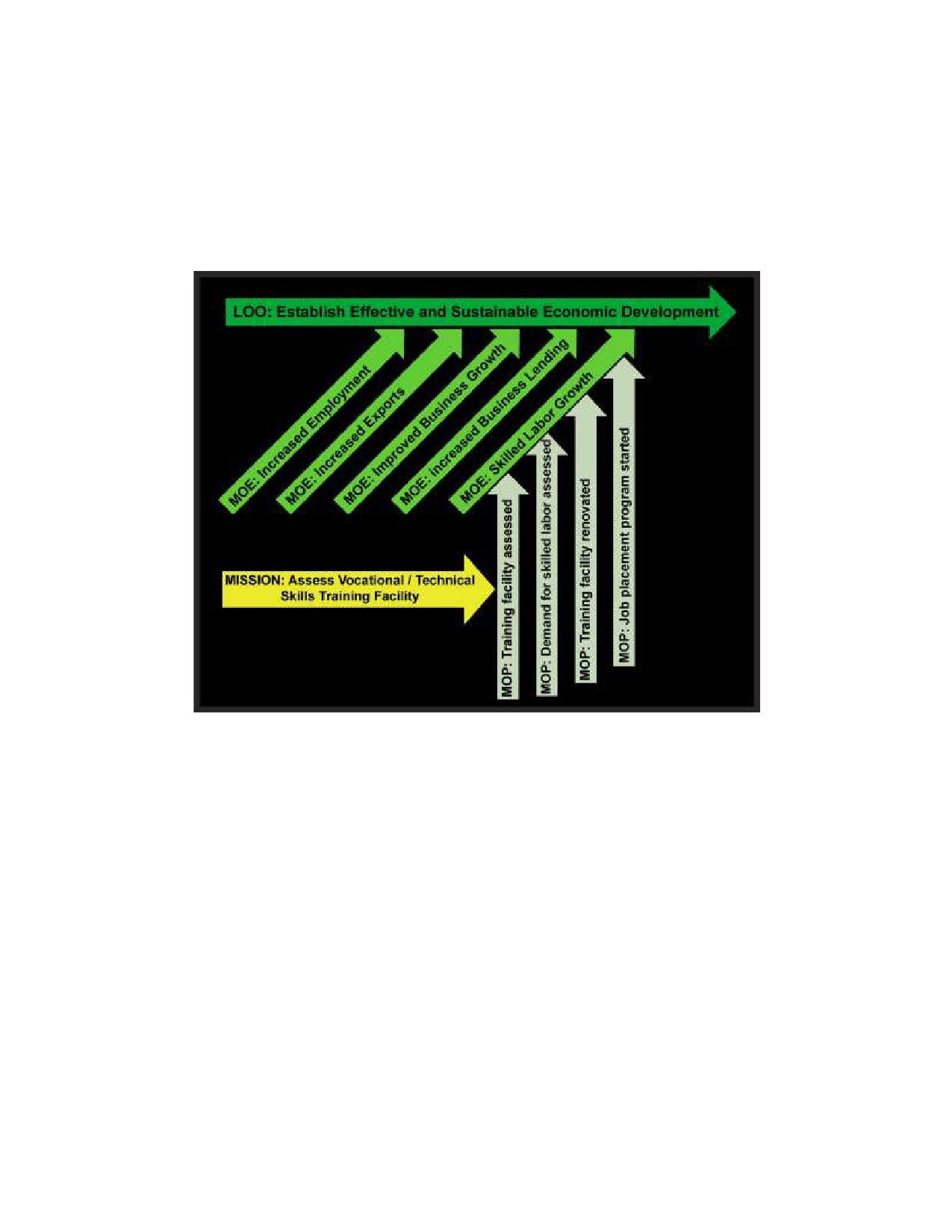
234
Effectively nesting tactical level missions under operational/strategic level objectives requires defining a MOE for
235
each desired effect that specifies how COGs and other conditions in the operating environment are influenced to
236
achieve that effect. When requirements for achieving effects are defined, performance based operations are
237
identified to achieve the requirements. MOPs evaluate whether the missions to achieve these requirements are
238
conducted to standard. Figure 3-5, Tactical Mission Linked to LOO through MOP and MOE, depicts a notional
239
operational level LOO with supporting MOEs, MOPs, and a tactical level mission.
240
241
Figure 3-4. Tactical Mission Linked to LOO through MOP and MOE
242
3.2.4 Interagency Operations
243
The fourth consideration for planning to manage civil information is the involvement of host and foreign
244
government agencies, IGO, NGO, private volunteer organizations (PVO), IPIs, and USG agencies. National Security
245
Presidential Directive 44, Management of Interagency Efforts Concerning Reconstruction and Stabilization, and
246
Department of Defense Directive (DoDD) 3000.5, Military Support for Stability, Security, Transition, and
247
Reconstruction Operations direct that the Department of State (DoS) will be the lead agency in coordinating
248
reconstruction and stabilization. In some instances, joint forces may have the role of lead agency, and must be
249
prepared for the responsibilities and command climate of working with civilian agencies.
250
NOTE: More detailed information for interagency operations can be found in JP 3-08, Volumes I and II.
251
Chapter 4, Collection, and Chapter 8, Sharing, provide considerations, procedures and best practices for collecting
252
and sharing civil information with interagency and other stakeholders. The following considerations can help joint
253
forces planners develop interagency operations, potentially as the lead agency:
254
1. Command, as it is known in the armed forces, does not exist. Interagency relationships must be
255
established through collaboration and negotiation:
3-8
256
a. Military leaders cannot give orders to inter-agency stakeholders; instead, they participate in
257
consensus-building as one voice among equals.
258
b. Combining convincing views with a spirit of cooperation increases the chances of acceptance among
259
other agencies.
260
2. Anticipate the commander devoting attention to host government other foreign government agencies.
261
Keep in mind the role of IGOs, NGOs, and PVOs. The key to success is liaison:
262
a. Commanders at all levels must bridge military operations and interagency requirements.
263
b. Identifying participating agencies and establish regular liaison early in the operation, particularly
264
during the shaping phase.
265
c. Key personnel include:
The US Ambassador or Chief of Mission
Heads of USG agencies
Political advisors (POLAD)
Foreign government agencies
Host nation agencies and local civic,
Heads of IGOs, NGOs, PVOs, etc within
economic, and political leaders
the operating environment
Cultural advisors
266
3. Agreements must be in writing, such as memoranda of understanding, memoranda of agreement, terms
267
of reference, or administrative procedural agreement, to ensure understanding and avoid confusion.
268
3.2.5 Planning for Requirements
269
Planning for requirements begins by defining the product(s) necessary to satisfy the requirement, and then
270
identifies what each step of the joint civil information management process, in reverse order, must yield to
271
support developing the specified product. Planning for requirements identifies the desired end state (product that
272
satisfies the requirement), and what is necessary to achieve it, and occurs in this order:
1.
273
Produce - Identifies the product(s) necessary to satisfy the requirement [the end state].
2.
274
Analyze - Preliminary identification (ID) of analyses required to develop product(s).
275
a. Consolidate - Preliminary determination for how to organize data.
3.
276
Collect - Preliminary determination of data required.
277
Planning for requirements is a key aspect of developing a collection plan because it specifies the information
278
required to provide the JFC SA based on current conditions and objectives. Requirements for products that support
279
situational understanding and decision making drive execution of the joint civil information management process.
280
Knowing what product is required informs what analysis may be required, how data must be consolidated, and
281
data must be collected.
282
3.3 Planning Procedures
283
1. Identify USG strategic objectives and higher unit objectives (what must be accomplished). Read and
284
understand the mbassador’s Mission Strategic Plan or the US ID Mission’s Country Plan and be able to
285
explain and illustrate how your LOOs and objective are nested within or support their plans.
a. Nature of operation
b. Phase of operation
286
2. Understand the operating environment:
287
a. Develop baseline (historical events/traditions/cultures/etc) (what was)
288
b. Establish current conditions in running estimates for the operating environment (what is)
3-9
289
c. Implement civil information architecture that links current conditions to operational objectives
290
through analytical systems, such as PMESII or LOOs. (what subjects to compare)
291
d. Compare the historical baseline to current conditions in the operating environment using the civil
292
information architecture to define gaps between operational objectives and current conditions. (what
293
must be accomplished)
294
(1) Identify decisive points and desired effects
295
(2) Define MOEs for each desired effect
296
e. Identify stakeholders:
(1) Mission
(2) Core capabilities (institutional purpose)
(3) IRs
(4) Information possessed
297
3.
Synchronize civil information architecture with conditions and assign priority for collection and analysis:
298
a. Assess:
(1) Conditions or events IPIs expect
(2) Conditions or events IPIs require
(3) Conditions or events IPIs desire
299
b. Identify strengths, weaknesses, opportunities, and threats (SWOT) of IPI expectations, requirements,
300
and desires compared to operational objectives to determine which conditions:
301
(1) Facilitate USG and operational objectives (strengths)
302
(2) Undermine USG and operational objectives (weaknesses)
303
(3) Can be leveraged to achieve or undermine operational objectives (opportunities and threats)
304
c. Identify IRs:
305
(1) Gaps between baseline and operational conditions requiring more information
306
(2) Gaps between current conditions and populations expectations, requirements and desires
307
(3) Gaps between operational conditions and mission success criteria, using population
308
expectations, requirements and desires to define decisive points, COGs, and desired effects that
309
promote progress along LOOs.
310
d. Map IRs into civil information architecture:
311
(1) Identify key nodes and links
312
(2) Identify information gaps about key nodes and links requiring more information
313
4.
Develop collection management plan:
314
a. Plan IRs:
315
(1) What do we need to know?
316
(a) Higher unit requirements, operational needs, commander’s guidance
317
(b) Identified information gaps
318
(c) IPI expected, required, and desired conditions
319
(2) How are we going to get what we need?
(a) Identify sources and their reliability
(b) Identify collection methods and assets
320
b. Develop a collection plan that establishes priority and sequencing (MOPs):
(a) Priority - order of importance
(b) Sequence - when required
321
c. Synchronize collection plan with IMP:
322
(2) Where does information need to go and what is it used for?
3-10
323
(3) What classified information guidance must be met?
324
(4) How does information need to be packaged?
(a) Push
(b) Pull
325
(5) When must the information be received? (Battle rhythm)
326
(6) Leverage with CIM coordinators and other organizations or entities:
(a) Identify stakeholders (who)
(b) Define civil information grid (where)
(c) Define communications plan (how)
(d) Identify C4I infrastructure (what)
327
d. Convert IRs to collection requirements and assign to appropriate collection assets.
328
5.
Implement collection management:
329
a. Execute collection plan:
330
(1) Updating running estimates, situational awareness, and understanding of the operating
331
environment based on newly collected information
332
(2) QA/QC collection:
333
(a) Determine if collection requirements met (did we get what we wanted?) (MOP)
334
(b) Determine if IRs satisfied (Did we ask for what we need?) (MOE)
335
b. Execute distribution plan:
(1) Staff coordination
(2) Liaison
(3) CIM working groups
(4) Data sharing working groups
(5) Stakeholder collaboration
336
c. Consolidate and analyze data collected and compare it to the baseline and operational conditions to
337
update SA and satisfy IRs and gaps by repeating steps 2, b through 5, e of the planning procedures as
338
necessary to maintain relevant, actionable running estimates.
339
d. Continually adjust collection plan based on newly acquired information and operational objectives
340
e. Monitor and re-task as appropriate.
341
3.4 Best Practices
342
Civil information has at times been undervalued and overlooked in military decision making, but has become a
343
necessity for the diverse set of overseas contingency operations the US now faces. Civil information has become a
344
decisive factor in planning and execution of COIN and AT. Staff must inject relevant, actionable civil information
345
into their commander’s decision making process. Developing operating environment-specific civil information
346
architecture is a valuable best practice when planning population-centric warfare.
347
JP 5-0 identifies the elements of joint operations planning, including three broad operational activities, four
348
planning functions and a number of related products that are illustrated in Figure 3-6, Joint Operation Planning
349
Activities, Functions, and Products. When staffs understand the USG strategic end state, the commander’s mission,
350
and the SWOT of the operating environment they develop a concept of the operation that links decisive points and
351
desired effects, through the appropriate components of PMESII subsystem(s) identified in the civil information
352
architecture, to LOOs and mission termination criteria.
353
Providing information about PMESII systems, socio-cultural factors, neutral IPI, and civil components to physical
354
areas is the primary purpose of CIM. Because C4I systems lack frameworks for civil information, staffs leverage
355
their understanding of the operation and use the elements of operational design to develop operating
3-11