Military reference books and manuals (2009-2023, Volume 8) - page 44

NWP 3-05
Commander, Naval Special Warfare Group ONE is designated as the executive agent for NSW support to
USCENTCOM and USPACOM. Subordinate commands are SEAL Teams ONE, THREE, FIVE, and SEVEN
and LOGSU-1. Subordinate detachments are Mobile Communications Team ONE (MCT-1) and TRADET-1.
CNSWG-1 also exercises ADCON of NSWU-1 and NSWU-3.
Commander, Naval Special Warfare Group TWO is designated as the executive agent for NSW support to
USAFRICOM, USEUCOM, United States Northern Command (USNORTHCOM), and USSOUTHCOM.
Subordinate commands are SEAL Teams TWO, FOUR, EIGHT, and TEN and LOGSU-2. Subordinate
detachments are MCT-2 and TRADET-2. CNSWG-2 also exercises ADCON of NSWU-2, NSWU-4, and
NSWU-10.
2.4.1 SEAL Teams
There are eight active duty SEAL teams. The SEAL team mission is to organize, man, train, equip, deploy, and
employ SEALs and other forces to plan and conduct special operations in support of GCCs. A SEAL team is an
echelon IV command subordinate to an NSWG (figure 2-2).
A SEAL team is organized into seven SEAL platoons consisting of three officers and 18 enlisted each. The
platoons are organized into three SEAL task units with a small C2 element and two or three SEAL platoons.
2.4.2 Logistics Support Units ONE and TWO
LOGSUs 1 and 2 are subordinate commands of NSWG-1 and NSWG-2. LOGSUs organize, man, train, equip,
and deploy personnel and equipment to provide both in-garrison and deployed CSS to SEAL teams and
SPECBOAT teams.
Figure 2-2. SEAL Team (Active Duty)
2-3
MAY 2013
NWP 3-05
Specific logistics support functions include supply; medical; equipment management and maintenance, including
air operations, dive operations, special operations forces personal equipment advanced requirements gear, and
weapons systems (weapons, visual acuity systems, and munitions); transportation (vehicle dispatch, line haul, and
maintenance/repair); facilities management (base camp, range, and training facility support, including logistics,
messing, maintenance, and scheduling); and military construction.
LOGSUs 1 and 2 are organized into an HQ element, administrative departments, and four deployable CSS teams.
An 86-person CSS team is led by a lieutenant (O-3) or lieutenant commander (O-4) supply corps officer. Each
SEAL team is augmented with a dedicated CSS team as they enter the unit-level training phase of the
interdeployment training cycle (IDTC) and receives dedicated supply support throughout the remainder of the
IDTC and deployment.
A CSS team can be disaggregated into three CSS detachments. CSS detachments or smaller elements can be
assigned to deploy with NSWTUs, special boat detachments (SPECBOATDETs), or other task organizations.
Deployed NSW LOGSU CSS teams:
1. Coordinate with the appropriate GCC component commands for support of forward-deployed NSW forces
2. Provide limited contingency contracting capability and expertise, including small purchases and leases, as
authorized by the theater executive agent and in coordination with the GCC logistics staff section
3. Conduct force embarkation, transportation, equipment maintenance, combat cargo handling, in-theater
logistics, construction, contingency engineering, camp development, and maintenance services
4. Assist with equipment maintenance, facilities management, combat systems support, ordnance
management, and hazardous materials handling
5. Provide limited force protection and perimeter defense
6. Assist with chemical, biological, radiological, nuclear, and high-yield explosives decontamination
operations.
A CSS detachment may require augmentation to fully perform its mission. In addition to organic CSS, NSW
forces generally receive basing support from conventional forces either afloat or ashore. Details are available in
NWP 3-05.41, Naval Special Warfare Logistics.
2.4.3 Mobile Communications Team
NSWGs 1 and 2 each have an MCT. The MCT mission is to organize, man, train, equip, and deploy personnel
and communications equipment to operate and maintain communications for SEAL teams and SPECBOAT
teams.
MCTs provide rapidly deployable mobile communications teams that can be employed in austere environments
(figure 2-3). Mobile communications teams deploy with the equipment and skills for a variety of voice and data
services for communicating with joint and fleet units. This includes man-portable and modular systems
(high frequency, ultrahigh frequency, very high frequency, super high frequency, and extremely high frequency)
adequate to support an NSWTG battle staff.
For routine deployments, an MCT is attached to a SEAL team 6 months prior to deployment and supports SEAL
platoons and SPECBOATDETs assigned to that team. The MCT can be disaggregated to form multiple mobile
communications detachments or elements.
MAY 2013
2-4

NWP 3-05
Figure 2-3. Mobile Communications Team
2.5 NAVAL SPECIAL WARFARE GROUP THREE
NSWG-3, as the undersea proponent for NSW, mans, trains, equips, deploys, sustains, and provides command
and control for NSW forces conducting undersea special operations worldwide in support of CCDRs and
interagency partners. Undersea special operations include activities initiated undersea that continue above the
waterline and into the hinterland.
Subordinate commands are SDVT-1, TRADET-3, and LOGSU-3. NSWG-3 also maintains a detachment at
Joint Expeditionary Base Little Creek-Fort Story, VA, with an attached dry deck shelter (DDS) platoon.
Detachment Little Creek’s primary mission is maintenance of and deployment with east coast DDSs.
2.5.1 SEAL Delivery Vehicle Team ONE
SDVT-1, based in Pearl Harbor, HI, conducts operations involving undersea mobility platforms. The command
supports national taskings, contingency plan execution, exercises, and other global operations as directed by
USSOCOM.
SDVT-1 is organized around five SDV platoons. An SDV platoon is a variation of a SEAL platoon that
specializes in SDV operations. It consists of two SDV-qualified SEAL officers, 14 SDV-qualified SEAL enlisted
men, and two SDVs. SDV-qualified SEALs have completed the basic SDV school and are certified SDV pilots or
navigators.
SDV platoons are organized under SDV task units (SDVTUs). An SDVTU consists of a two-man HQ element
and an SDV platoon (figure 2-4). When deploying aboard a DDS-capable submarine, the SDVTU is augmented
with a UCSS team and a DDS platoon.
2-5
MAY 2013

NWP 3-05
A DDS platoon consists of 26 DDS-qualified Navy divers who operate a DDS. The SDV and DDS are described
in appendix A.
2.5.2 Logistic Support Unit THREE
LOGSU-3 has the same mission and functions as LOGSUs 1 and 2 but is unique in that it also has maintenance
and material support responsibilities for maritime undersea systems, including SDVs, DDSs, other combat
submersibles, and surface support craft. LOGSU-3 deploys UCSS elements to support DDS and SDV operations.
Figure 2-4. SEAL Delivery Vehicle Team
MAY 2013
2-6
NWP 3-05
2.5.3 Training Detachment THREE
TRADET-3 has the same function and missions as TRADETs 1 and 2 in training SEAL skill sets but is unique in
that it also trains SDV and DDS personnel for undersea missions.
2.6 NAVAL SPECIAL WARFARE GROUP FOUR
NSWG-4—as the surface mobility proponent—organizes, trains, and equips assigned personnel to deploy
combat-ready forces and maritime mobility systems in support of fleet and joint commanders and conducts
security force assistance (SFA) to build foreign security force small-craft capabilities and capacities in accordance
with USSOCOM priorities. Responsibilities include the exercise of operational control and administrative control
of Special Boat Teams TWELVE (SBT-12), TWENTY (SBT-20), and TWENTY TWO (SBT-22); and Naval
Small Craft Instruction and Technical Training School (NAVSCIATTS); and advising
COMNAVSPECWARCOM on combatant craft and other designated combat development areas.
2.6.1 Special Boat Teams
The mission of an SBT is to organize, man, train, equip, and deploy SPECBOATDETs to conduct maritime
special operations in riverine, littoral, and open-ocean maritime environments.
NSW special operations craft are categorized as combatant craft-light (CCL), combatant craft-medium (CCM),
and combatant craft-heavy (CCH). Craft selection is tailored to the mission and environment. The craft most
frequently employed are high-speed combatant craft designed for delivery of SOF in littoral and riverine
environments. Lightly armed and armored NSW combatant craft employ stealth, surprise, speed, and agility in the
conduct of special operations.
An SBT is organized into an HQ element, administrative and logistics support elements, and deployable
SPECBOATDETs. A SPECBOATDET generally consists of two craft, SWCC boat crews, and CSS personnel
that accompany the combatant craft for boat maintenance. An exception to the two-craft guideline is a CCH
detachment, which may consist of one boat. Boat detachments are organized into teams led by a SEAL O-3 or an
SWCC chief warrant officer.
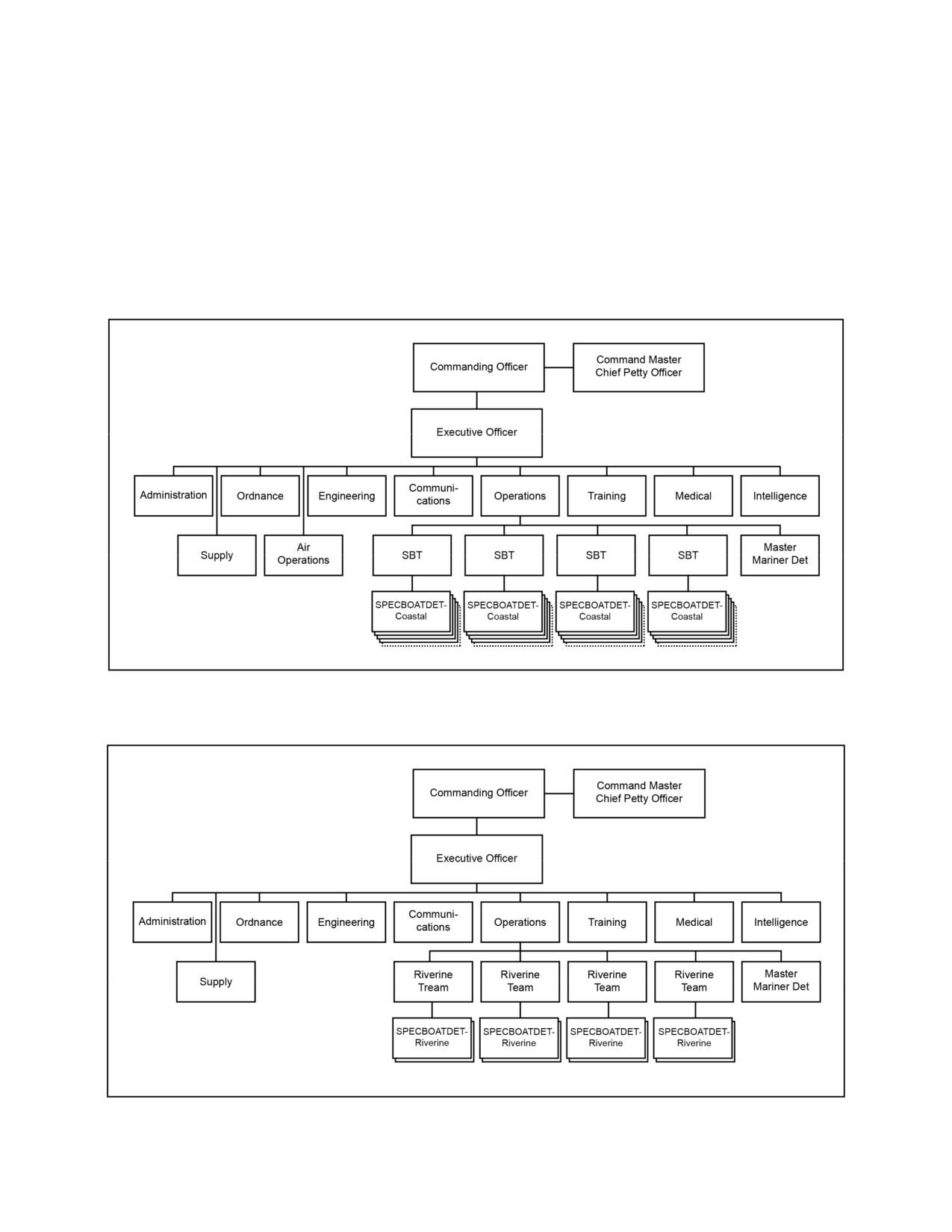
Special Boat Teams TWELVE and TWENTY have 20 and 16 SPECBOATDETs-Coastal, respectively,
organized into four special boat teams. Each team consists of four to five SPECBOATDETS-Coastal plus an HQ
element (figure 2-5). A SPECBOATDET-Coastal conducts maritime special operations in an open-ocean and
littoral environment with a variety of craft. Select coastal detachments are maritime craft aerial delivery system
(MCADS)-capable and can be inserted by paradrop. An MCADS detachment is unique in that it has four boats:
two boats for routine operations and two boats rigged for paradrop for rapid response. SBTs 12 and 20 also
deploy master mariner detachments, four-man detachments trained to operate civilian vessels of any size.
SBT-22 is organized around the special operations craft-riverine (SOC-R). It is organized into four riverine
teams with two SPECBOATDETs-Riverine per team. Each SPECBOATDET-Riverine has two SOC-Rs plus an
HQ element (figure 2-6). A SPECBOATDET-Riverine conducts maritime special operations in a riverine and
littoral environment.
2.6.2 Naval Small Craft Instruction and Technical Training School
The Naval Small Craft Instruction and Technical Training School is an NSWG-4 subordinate command located at
the Stennis Space Center in Mississippi.
The mission of NAVSCIATTS is to conduct SFA and foreign internal defense in support of CCDRs using mobile
training teams (MTTs) and in-resident training to prepare partner nation forces to conduct small-craft operations
in riverine or littoral environments.
2-7
MAY 2013
NWP 3-05
2.7 NAVAL SPECIAL WARFARE GROUP TEN
NSWG-10 organizes, trains, equips, deploys, and sustains specialized ISR and PE capabilities through
subordinate commands, units, and detachments: SUPPACTs 1 and 2, the mission support center, the NSW
cultural engagement unit, and NSW anchor teams.
2.7.1 Support Activity ONE and TWO
SUPPACTs 1 and 2 man, train, equip, organize, and deploy forces to conduct ISR, PE, special technical
operations, and combat support in support of NSW forces and GCCs.
Figure 2-5. Special Boat Teams TWELVE and TWENTY
Figure 2-6. Special Boat Team TWENTY-TWO
MAY 2013
2-8
NWP 3-05
This capability is provided through cross-functional teams, so named because they combine capabilities from a
cross-section of intelligence and operational PE. Cross-functional teams are focused on intelligence collection and
analysis to provide support for the find, fix, finish, exploit, analyze, and disseminate (F3EAD) targeting cycle.
Personnel come from a cross-section of special operations (SEAL and SWCC) and Navy Information Dominance
Corps personnel (intelligence, meteorological and oceanographic (METOC), cryptologists, and electronics and
information technicians).
The cross-functional team is organized into a five-person C2 element, a UAS detachment, a METOC detachment,
and three cross-functional detachments of two squads each. Each 10-man cross-functional squad includes a
human intelligence operations element, analysis and targeting element, tactical information operations (TIO)
element, and a technical surveillance element. Cross-functional team personnel are cross-trained in multiple
special operations and intelligence disciplines (figure 2-7).
To best satisfy mission requirements, cross-functional teams are often disaggregated into small task-organized
elements with the most appropriate mix of skill sets for a given deployment or operation.
2.7.2 Naval Special Warfare Mission Support Center
The NSW mission support center does not deploy forces but provides reachback capability from its operations
center in Coronado, CA, to supply mission-planning support to deployed NSW units through broadband networks.
The MSC collects, organizes, and disseminates mission-essential information in a form specifically tailored to the
mission commander's need. Services provided include custom tactical and environmental mission-planning
products, information technology (IT) help desk services, and friendly force tracking device registration and
support. Aided by the MSC, mission commanders are able to focus a larger percentage of the operator's limited
time on the execution phase of operations, gear preparation, and rehearsal, thereby enhancing the chance for
mission success while reducing the forward footprint of NSW forces.
2.7.3 Cultural Engagement Unit
The NSW CEU provides deployable language and regional experts (LREs) and female support technicians
(FSTs). It is organized into an HQ element, a training department, and six regionally aligned detachments
(figure 2-8). The LREs and FSTs are embedded with deployed NSW forces to provide cultural advice and
expertise and to accompany SEAL or SWCC operators to the target to assist in translation, tactical interrogation,
and intelligence collection.
2.7.4 Naval Special Warfare Anchor Teams
NSW anchor teams build stability through sustained engagement within or adjacent to critical or sensitive
countries. Anchor teams are organized by geographic region in which each team specializes. Anchor teams
provide persistent presence and establish enduring relationships in high-priority regions by rotating the same
personnel into the same locations with the same partner force.
The deploying element of the anchor team is the NSW anchor detachment—a two-man, forward-based
detachment consisting of one officer and one enlisted SEAL or SWCC who conduct multiple deployments to a
specific region in support of a specific host nation partner force.
2.8 NAVAL SPECIAL WARFARE GROUP ELEVEN
Commander, Naval Special Warfare Group ELEVEN is responsible for organizing, manning, training, educating,
equipping, and deploying NSW Reserve Component units and personnel in support of NSW and joint special
operations commanders worldwide. NSWG-11 exercises OPCON and ADCON of SEAL Teams SEVENTEEN
and EIGHTEEN and advises COMNAVSPECWARCOM on NSW Reserve force matters. SEAL Teams
SEVENTEEN and EIGHTEEN are a unique amalgam of both a Navy Reserve activity and a SEAL team
(figure 2-9).
2-9
MAY 2013

NWP 3-05
Figure 2-7. Naval Special Warfare Group TEN
Figure 2-8. Cultural Engagement Unit
MAY 2013
2-10

NWP 3-05
Figure 2-9. SEAL Teams SEVENTEEN and EIGHTEEN
2-11
MAY 2013
NWP 3-05
SEAL Teams SEVENTEEN and EIGHTEEN man, train, equip, and deploy SEAL platoons, CS, and CSS in
support of NSW and joint special operations commanders worldwide. SEAL Team EIGHTEEN also deploys
Reserve SPECBOATDETs. They exercise ADCON of subordinate NSW Reserve units and perform
administrative functions for Commander, Navy Reserve Forces Command and assigned Reserve units.
2.9 NAVAL SPECIAL WARFARE UNITS
There are five NSWUs, not to be confused with an NSWTU (naval special warfare task unit). An NSWU is a
permanent forward-based NSW command and control headquarters. The NSWU has no combatant forces
permanently assigned but exercises control over forces that deploy from the United States. The mission of an
NSWU is to plan, coordinate, deconflict, and execute NSW operations and exercises in support of theater special
operations command (TSOC) and fleet staffs. NSWU organization is discussed in chapter 4.
2.10 NAVAL SPECIAL WARFARE CENTER
Naval Special Warfare Center is the NSW proponent for training. It conducts special operations training to
educate U.S. and foreign armed forces and other designated personnel in NSW tactics, techniques, procedures,
and equipment. Subordinate commands are the BTC and the ATC.
2.10.1 Basic Training Command
The Basic Training Command mission is to conduct special operations training and education for U.S. and foreign
armed forces and other designated personnel in basic NSW tactics, techniques, procedures, and equipment. The
BTC conducts basic underwater demolition/SEAL team (BUD/S) training and SWCC basic crewman training
course.
Basic Training Command also conducts SEAL qualification training for BUD/S graduates and combatant-craft
crewman qualification for SWCC basic crewman training graduates. Graduates of these courses are qualified as
SEAL or SWCC operators. SEAL and SWCC qualifications are discussed in chapter 4.
2.10.2 Advanced Training Command
Advanced Training Command provides standardized and accredited individual training and education for NSW
operators, NSW support personnel, other USSOF, partner nation SOF, and other personnel as required, in the art
and science of NSW operations. SEAL, SWCC, and support personnel attend these courses during predeployment
training. Selected personnel from outside of the NSW community also attend courses when appropriate.
2.11 NAVAL SPECIAL WARFARE DEVELOPMENT GROUP
The mission of the naval special warfare development group is to provide centralized management for the test,
evaluation, and development of NSW equipment and tactics, techniques, and procedures.
2.12 CENTER FOR SEAL TEAM AND SPECIAL WARFARE COMBATANT-CRAFT CREWMAN
The Center for SEAL Team and Special Warfare Combatant-Craft Crewman is a Navy echelon III command
under Naval Education Training Command. CENSEALSWCC coordinates with NAVSPECWARCOM for career
management, leader development, and professional military education of NSW forces.
MAY 2013
2-12
NWP 3-05
CHAPTER 3
Command and Control
3.1 GLOBAL FORCE MANAGEMENT
Deployed forces are either assigned, attached, or allocated to a GCC who exercises COCOM, OPCON, or tactical
control (TACON). When appropriate, supporting relationships, coordinating authority, and direct liaison
authorized (DIRLAUTH) between forces will be specified.
The process through which forces are assigned, attached, or allocated is the Joint Chiefs of Staff (JCS) Global
Force Management (GFM) process. GFM provides GCCs with tools to develop, submit, and track resourcing
plans that support operational and strategic goals. GFM also supplies planners with a mechanism to input data to
assignment and apportionment tables which are used in designing time-phased force and deployment data
(TPFDD). Assignment and apportionment tables are part of the GFM Implementation Guidance, which the JCS
release annually to provide guidance on COCOM and availability of forces.
GFM events include persistent and episodic requirements, JCS exercises, contingency plan execution, and
counterterrorism (CT) execute order (EXORD) operations.
3.1.1 Persistent and Episodic Requirements
Persistent and episodic requirements are submitted by the GCCs to the joint staff as a request for forces (RFF),
request for support, or as an annual baseline submission request. When there is a request for special operations
forces, USSOCOM is tasked to develop a sourcing solution. In the case of requests for naval special warfare
forces, USSOCOM directs NAVSPECWARCOM to conduct a feasibility assessment and recommendations for
sourcing (to include an “if forced to source” solution). This analysis is presented to the Secretary of Defense
(SecDef) for approval. With the exceptions of JCS exercises and CT EXORD operations, only SecDef can direct
deployment of forces. If the recommended sourcing solution is approved, NSW force requirements are included in
the annual SecDef-approved JCS deployment order (DEPORD) with operational control transferred to the
receiving GCC. The order flows down the chain of command through a USSOCOM SOF deployment order and a
NAVSPECWARCOM NAVSOF deployment order. The NAVSOF DEPORD includes the sourcing command,
period of the exercise, and the number of personnel required.
The SOF DEPORD is broken into tabs, three of which are of interest to SOF: Tab B for rotational forces, Tab C
for theater security cooperation plan (TSCP) events, and Tab D for joint individual requirements. Each
requirement specifies, at a minimum, the requested force (e.g., naval special warfare task element (NSWTE) with
one SEAL platoon), the not-to-exceed number of personnel, the earliest arrival date and latest arrival date in
theater, and command relationships. Whenever forces are transferred between combatant commands, the
command relationship the gaining commander will exercise (and the losing commander will relinquish) over
these forces must be specified by SecDef. NSW persistent and episodic requirements include:
1. Routine force rotations. These persistent requirements include routine deployments to support the GCCs.
Deployed NSW forces participate in GCC theater campaign plans and are available for crisis response.
Note that, in this context, the term “crisis response” refers to an unanticipated crisis, while the term
“contingency” refers to an event for which prior planning has been completed and a contingency plan
exists.
3-1
MAY 2013
NWP 3-05
2. Named operations. Named operations may be filled by forward-deployed forces or other forces provided
from the United States. Examples of named operations include: ENDURING FREEDOM-Afghanistan,
ENDURING FREEDOM-Philippines, and ENDURING FREEDOM-Trans Sahara.
3. Theater security cooperation plan support. These requirements can be filled by forward-deployed forces or
forces provided from the United States. Examples include joint combined exchange training (JCET),
counternarco-terrorism training (CNT), SFA (including NAVSCIATTS MTTs), subject matter expert
exchanges, etc.
4. Joint individual augmentees. These requirements are for individuals to deploy to forward-based joint staffs
to fill joint manning document billets.
3.1.2 Joint Chiefs of Staff Exercises
Requests for forces for JCS exercises fall under a separate mechanism. They are controlled by the Joint Training
Information Management System and do not require SecDef approval. The chairman of the JCS is the approval
authority for these exercises. Orders for NSW forces to participate in JCS exercises are received via tasking
messages from COMNAVSPECWARCOM.
JCS exercise requirements may be filled by forward-deployed forces or other forces. Examples include Exercises
FOAL EAGLE, ULCHI FOCUS GUARDIAN, RIMPAC, UNITAS, EMERALD WARRIOR, PANAMAX,
TEMPEST WIND, JACKAL STONE, and others.
3.1.3 Contingency Plan Execution
The next category of GFM events is execution of contingency plans. The contingency plan description from
JP 5-0, Joint Operation Planning, is quoted below. Note the distinction between the general term contingency plan
(no acronym) and the specific term concept plan (CONPLAN).
Contingency plans are developed in anticipation of a potential crisis outside of or prior to crisis conditions. There
are four levels of planning detail for contingency plans with an associated planning product for each level.
3.1.3.1 Level 1 Planning Detail—Commander’s Estimate
This level of planning involves the least amount of detail and focuses on producing multiple courses of action
(COAs) to address a contingency. The product for this level can be a COA briefing, command directive,
commander’s estimate, or a memorandum.
3.1.3.2 Level 2 Planning Detail—Base Plan
A base plan (BPLAN) describes the concept of operations, major forces, concepts of support, and anticipated
timelines for completing the mission. It normally does not include annexes or TPFDD.
3.1.3.3 Level 3 Planning Detail—Concept Plan
A CONPLAN is an operation plan (OPLAN) in an abbreviated format that may require considerable expansion or
alteration to convert it into an OPLAN or operation order (OPORD). It may also produce a TPFDD, if applicable.
3.1.3.4 Level 4 Planning Detail—Operation Plan
An OPLAN is a complete and detailed joint plan containing a full description of the concept of operations, all
annexes applicable to the plan, and a TPFDD. It identifies the specific forces, functional support, and resources
required to execute the plan and provide closure estimates for their flow into the theater.
MAY 2013
3-2
NWP 3-05
In the case of OPLAN and CONPLAN execution, SecDef will issue an execution order that sets C-day
(commence deployment) and D-day (commence operations), establishes supplemental rules of engagement, and
provides direction on mobilization and TPFDD execution.
3.1.4 Counterterrorism Execute Order
Another exception to the requirement for SecDef approval is the CT EXORD. Operations in support of the CT
EXORD can be directed by CDRUSSOCOM through an EXORD or the SOF DEPORD.
3.2 DEFINITIONS
3.2.1 Assigned Forces
The term “assigned” refers to those forces and resources that have been placed under the COCOM of a unified
commander by the direction of SecDef in a Forces for Unified Commands memorandum. Forces are assigned or
reassigned when the transfer of forces will be permanent or for an unknown period of time or when the broadest
level of command authority is required or desired. All NSW forces are assigned to and under the COCOM of
USSOCOM.
3.2.2 Attached Forces
The term “attached” refers to those forces and resources that have been placed under the OPCON or TACON of a
GCC or other joint force commander (JFC) for a temporary situation (e.g., a 6-month deployment). This is
normally accomplished through a deployment order. A DEPORD is a planning directive from SecDef, issued by
the chairman of the JCS, which authorizes and directs the transfer of forces between GCCs by assignment or,
more commonly, attachment.
3.2.3 Allocated Forces
Allocation is distribution of limited forces and resources for employment among competing requirements. In the
GFM process, forces are allocated in the Global Force Management Allocation Plan, which is used to develop the
SOF DEPORD.
3.2.4 Geographic Combatant Commander Authority
In accordance with the Forces for Unified Commands memorandum and the Unified Command Plan, except as
otherwise directed by the President of the United States or SecDef, all forces operating within the geographic area
assigned to a specific GCC shall be assigned or attached to and under the command of that GCC. Transient forces
do not come under the chain of command of the GCC solely by their movement across operational area
boundaries, except when the GCC is exercising TACON for the purpose of force protection. Unless otherwise
specified by SecDef, a GCC has tactical control for exercise purposes whenever forces not assigned to that GCC
undertake exercises in that GCC’s area of responsibility (AOR). Note the USSOCOM exception below.
3.2.5 United States Special Operations Command Authority
To increase flexibility and agility of SOF, in 2013 changes were made to the Unified Command Plan to give
USSOCOM formal responsibility to synchronize the planning, coordination, deployment, and, when directed and
with the approval of the GCCs, the employment of SOF globally. COCOM of all SOF was assigned to
USSOCOM through the Forces for Unified Command memorandum and assignment tables and a global SOF
employment order delegated limited authority from SecDef to CDRUSSOCOM to manage and deploy special
operations forces across GCC’s areas of responsibility.
3-3
MAY 2013
NWP 3-05
3.2.6 Combatant Command
COCOM is the eponymously named authority vested in the nine combatant commanders to perform all those
functions of command contained in OPCON (see below) plus planning, programming, budgeting, and execution
process input; assignment of subordinate commanders; relations with DOD agencies; and directive authority for
logistics. COCOM cannot be delegated or transferred and is exercised exclusively by:
1. USAFRICOM
2. USCENTCOM
3. USEUCOM
4. USNORTHCOM
5. USPACOM
6. USSOUTHCOM
7. USSOCCOM
8. United States Strategic Command
9. United States Transportation Command.
3.2.7 Operational Control
OPCON is the command authority that may be exercised by commanders at any echelon and may be delegated
within the command. OPCON is inherent in COCOM and is the authority to perform those functions of command
over subordinate forces involving organizing and employing commands and forces, assigning tasks, designating
objectives, and giving authoritative direction necessary to accomplish the mission. OPCON includes authoritative
direction over all aspects of military operations and joint training necessary to accomplish missions assigned to
the command.
Operational control of U.S.-based NSW forces is exercised by COMNAVSPECWARCOM. Operational control
of deployed NSW forces is exercised by the GCC, normally through a TSOC, which typically delegates
operational control to an naval special warfare unit or to another special operations headquarters in that theater.
3.2.8 Tactical Control
TACON is the command authority over assigned or attached forces or commands, or military capability or forces
made available for tasking, that is limited to the detailed direction and control of movements or maneuvers within
the operational area necessary to accomplish assigned missions or tasks. TACON is inherent in OPCON and may
be delegated to and exercised by commanders at any echelon.
3.2.9 Administrative Control
ADCON is the direction or exercise of authority over subordinate or other organizations in respect to
administration and support, including organization of Service forces, control of resources and equipment,
personnel management, unit logistics, individual and unit training, readiness, mobilization, demobilization,
discipline, and other matters not included in operational missions. ADCON may be delegated to and exercised by
commanders of forces assigned to a combatant commander at any echelon at or below the level of Service
component. ADCON of all NSW forces is exercised by COMNAVSPECWARCOM.
MAY 2013
3-4
NWP 3-05
3.2.10 Support Relationships
A support relationship is established by a superior commander between subordinate commanders when one
organization should aid, protect, complement, or sustain another force. This includes the Secretary of Defense
designating a support relationship between GCCs as well as within a combatant command. The designation of
supporting relationships is important as it conveys priorities to commanders and staffs that are planning or
executing joint operations. The support command relationship is, by design, a somewhat vague but very flexible
arrangement. The establishing authority (the common superior commander) is responsible for ensuring that both
the supported commander and supporting commanders understand the degree of authority that the supported
commander is granted. There are four defined categories of support that a GCC may direct over assigned or
attached forces to ensure the appropriate level of support is provided to accomplish mission objectives. These are:
general support, mutual support, direct support, and close support (see glossary for definitions).
3.2.11 Coordinating Authority
Coordinating authority is the authority delegated to a commander or individual for coordinating specific functions
and activities involving forces of two or more military departments or two or more forces of the same Service.
The commander or individual has the authority to require consultation between the agencies involved but does not
have the authority to compel agreement. The common task to be coordinated will be specified in the establishing
directive without disturbing the usual organizational relationships in other matters.
3.2.12 Direct Liaison Authorized
Direct liaison authorized is authority granted by a commander (any level) to a subordinate to directly consult or
coordinate an action with a command or agency within or outside of the granting command. DIRLAUTH is more
applicable to planning than operations and always carries with it the requirement of keeping the commander
granting DIRLAUTH informed. DIRLAUTH is a coordination relationship, not an authority through which
command may be exercised.
3.3 NAVAL SPECIAL WARFARE DEPLOYMENT ROTATION
For routine deployments, NSW forces use a 2-year, four-phase training and deployment cycle during which an
18-month interdeployment training cycle is followed by a 6-month deployment. The IDTC consists of three
phases: professional development, unit-level training, and interoperability training. On successful completion of
IDTC, forces are certified as ready to deploy and commence their deployment. After completion of a 6-month
deployment, the cycle recommences. Details on the IDTC are available in COMNAVSPECWARCOM
Instruction 3500.1, Naval Special Warfare Force Training Manual.
Contingency response and JCS exercise requirements that cannot be met by deployed forces are assigned to forces
that are in IDTC, beginning with those forces in the final phase of training and working back.
3.4 NAVAL SPECIAL WARFARE TASK ORGANIZATION CHAIN OF COMMAND
Deploying NSW force packages task organized: tailored and scaled for the particular mission, situation, and
conditions so that the size, seniority, and composition of the force is matched to the requirement. Depending on
size and seniority, the task organization is commonly referred to as an NSWTF, NSWTG, NSWTU, or NSWTE.
Because naming conventions are determined by the GCC, these organizations may be referred to by different
titles depending on the operation (e.g., special operations task force, JSOTF, etc.).
Whatever the naming convention, the NSW task organization is generally assigned as the naval component of a
special operations joint task force (SOJTF) or the special operations component of a Navy task force (figure 3-1).
NSW also supports nonstandard chains of command in which NSW elements may be assigned to an embassy,
other Government agencies, or other military organizations. In those cases where a joint special operations force
is employed in a maritime area of operations, or if NSW represents a large proportion of the joint SOF capability,
the senior NSW commander may be designated as the joint SOF commander (e.g., commander, JSOTF).
3-5
MAY 2013

NWP 3-05
When working with naval forces, there are two common chains of command. The NSW task organization may be
assigned as the supporting force under a Navy chain of command, e.g., an NSWTU of one or more SEAL
platoons with supporting forces assigned to a ship in support of maritime interception operations (MIO) or an
SDVTU assigned to support submarine operations.
Alternatively, ships, submarines, or aircraft may be assigned as a supporting force for an NSW operation under a
special operations chain of command. Examples are a submarine supporting SDV operations or an afloat forward
staging base (AFSB) (figure 3-1). An AFSB is a maritime platform, generally a Navy or civilian ship. When
embarked, the NSW commander is designated as AFSB commander and is responsible for command and control
of embarked forces and is considered the supported commander. The ship’s captain, whether civilian or military,
will serve as the supporting commander and is responsible for force protection, maintenance, and safety of
navigation.
Figure 3-1. Naval Special Warfare Task Force Structure Example
MAY 2013
3-6
NWP 3-05
3.5 THEATER SECURITY COOPERATION EVENTS
The greatest employment of NSW forces is participation in theater security cooperation events to train and assist
partner nations. SEAL platoons, SPECBOATDETs, and other small specialized NSWTEs work with partner
military units sharing skills and knowledge and strengthening relationships. There is not normally a requirement
for a full battle staff HQ and CS and CSS requirements may be minimal. OPCON of these forces is usually
assigned to the TSOC but may be delegated to other commands on a case-by-case basis.
3.6 NAVAL SPECIAL WARFARE TASK ORGANIZATION COMPONENTS
Deploying NSW force packages are built around four elements: C2, CS, CSS, and combat elements (figure 3-2).
Planners must recognize that RFFs with only combat elements (e.g., SEAL platoons) result in incomplete force
packages with partial capability and increased risk to mission. Most NSW operations also require
Service-provided capabilities that are not organic to NSW in order to execute missions and sustain the force.
3.7 COMMAND AND CONTROL
The NSW task organization commander and headquarters are responsible for making recommendations on the
proper employment of NSW forces. Details on operations of an NSW task organization HQ are available in
NTTP 3-05.1, Naval Special Warfare Battle Staff Operations. Headquarters element tasks include:
1. Organizing the force. The NSW TF/TG/TU/TE commander has the authority to organize forces over which
he has operational control in order to meet mission requirements. In addition to key decisions, such as
basing of the HQ and subordinate units, he is also responsible for organizing the battle staff in a manner to
effectively control and support subordinate NSW units. This includes coordinated communications and
computer networks and administrative support and logistics support, including coordinating movement,
force protection, and sustainment of forces. He may also provide liaison officers to other staffs.
2. Coordinate operational areas and control measures. The NSW commander may use a variety of means to
deconflict and coordinate conventional and special operations with U.S. and Allied forces and interagency
partners. There must be a well-structured process that flows between the NSW headquarters and joint and
conventional force staffs and their components. This often entails use of liaison officers between staffs and
emphasis on over-communication to ensure that all units have a common operational and intelligence
picture. Coordination with conventional forces, establishment of procedures for support, deconfliction, and
battlespace turnover require this continuing close liaison.
3. Provide operational direction and guidance. The NSW commander develops a plan for integrated
employment of assigned and attached forces based on an assessment of the situation. He provides the joint
commander’s intent, guidance, and objectives to subordinate commanders. He provides timely and concise
missions or tasks together with the role of each subordinate and supervises targeting, mission planning,
integration of attached forces, and execution of operations. Using the mission command approach, tasks
must be realistic and allow the subordinate as much freedom of execution as possible.
3.7.1 Naval Special Warfare Task Force
For large operations or exercises, an NSWTF HQ is established. It is commanded by a SEAL captain, often an
NSWU CO or an NSWG commodore, and is sourced primarily from the NSWU or NSWG, although the exact
composition varies with the requirement. The NSWTF provides command and control of two or more NSWTGs
or other subordinate units.
3-7
MAY 2013
NWP 3-05
Title
Description
Source
Headquarters Command and Control
NSWTF C2
HQ command element
NSWG, NSWU
NSWTG C2
HQ command element
SEAL team
NSWTU C2
HQ command element
SEAL team
NSWTE C2
HQ command element
SEAL team
SDVTU C2
SDV HQ command element
SDVT-1
SPECBOAT Task Unit
SPECBOAT TU HQ command element
(SPECBOAT TU) C2
SPECBOAT team
Combat Support
Mobile communications team
Communications support
NSWG 1 and 2
DDS platoon
Submarine launch and recovery operations
SDV team 1
Cross-functional team
Intelligence gathering and analysis and UAS Det
SUPPACTs 1 and 2
Language and regional expert
Regional, cultural, and language expert
NSWG-10 CEU
Female regional expert to engage partner
FST
females
NSWG-10 CEU
Combat Service Support
Combat service support troop
Logistics, maintenance, force protection
LOGSUs 1 and 2
Undersea logistics, maintenance, and
Undersea CSS team
communications
LOGSU-3
SEAL
SEAL platoon
21-man SEAL tactical element
SEAL team
Multi-Purpose Canine Det
Dog and handler
NSWGs 1 and 2
Special Boat
Two coastal craft (CCL, CCM, CCH) with crew
Special Boat Det-Coastal
and support
SBTs 12 and 20
Special Boat Det-MCADS
Two CCM rigged for paradrop (four total craft)
SBT-20
Special Boat Det-Riverine
Two riverine craft with crews and support
SBT-22
Special Boat Det-Master
Boat crew to operate commercial and other craft
Mariner
SBTs 12 and 20
SEAL Delivery Vehicle
SDV platoon
Undersea SEAL tactical element with two SDVs
SDVT-1
Figure 3-2. Naval Special Warfare Task Organization Components
MAY 2013
3-8
NWP 3-05
3.7.2 Naval Special Warfare Task Group
An NSWTG is commanded by a SEAL commander, generally a SEAL team CO. Although the exact composition
varies with the requirement, the baseline NSWTG is a SEAL team with seven SEAL platoons, a C2 element from
the same SEAL team, an MCT, a cross-functional team, a CSS team, combatant craft, tactical vehicles,
rotary-wing support, NAVSOF EOD platoon, Multi-Purpose Canine, and other attachments as necessary. Six
months prior to deployment, the SEAL team CO assumes operational control of the forces with which he will
deploy and the task organization conducts integration training to enhance cohesion and combat effectiveness. On
deployment, the SEAL team CO is designated as the NSWTG commander. The NSWTG can disaggregate its
forces, typically into three or more NSWTUs at different locations to increase tactical reach. An alternative
NSWTG is based around one or more SDV platoons.
Sample deployable task organizations shown in figure 3-3 give a representative number of personnel assigned to
each NSW component. Note that these numbers will vary based on the requirement. For example, in a large
contingency operation, an NSWTF battle staff based ashore may have 152 personnel as shown in figure 3-3, while
an NSWTF based afloat may have only a dozen personnel, and a submarine-based NSWTG command and control
headquarters can be as small as two people.
3.7.3 Naval Special Warfare Task Unit
An NSWTU consists of a small HQ element, one or more SEAL platoons, other operational forces as required,
and CS and CSS elements for intelligence, communications, mobility, and logistics. An NSWTU is normally
commanded by a SEAL task unit commander, who is a SEAL O-4. Alternatively, NSWTUs can be based around
SDV platoons or boat detachments and referred to as an SDVTU or special boat task unit.
3.7.4 SEAL Delivery Vehicle Task Unit
The SDVTU, when task-organized for deployment aboard a DDS-equipped submarine, is made up of the
two-man HQ element led by a SEAL lieutenant commander, one SDV platoon, one DDS platoon, and a UCSS
team. An SDVTU plans and conducts undersea special operations.
3.7.5 Special Boat Task Element
When combatant craft operate independently from other NSW forces, or when there are multiple
SPECBOATDETs assigned to an NSWTG, a special boat task element (SPECBOAT TE) may be designated. A
SPECBOAT TE is typically subordinate to an NSWTG, although it may be assigned directly to a naval or SOF
commander. It includes a small command and support element and, typically, two or more SPECBOATDETs.
When necessary, the SPECBOATDET can be disaggregated into smaller maneuver elements, although—with the
exception of the CCH—craft normally operate in pairs. When operating independently as an NSWTU or NSWTE,
a SPECBOATDET is augmented with communications, intelligence, logistics, and mobility support.
3.7.6 Naval Special Warfare Task Element
An NSWTE is based around a small SEAL or SWCC maneuver element, generally a SEAL platoon, a
SPECBOATDET, or smaller force which may be supplemented with communicators, translators, cross-functional
team personnel, combat service support team personnel, or other specialists. It is commanded by a Navy
lieutenant or below, warrant officer, or senior enlisted.
3.8 COMBAT SUPPORT AND COMBAT SERVICE SUPPORT
NSW provides much of its own CS and CSS support. Due to the conditions in which NSW operates, CS and CSS
personnel that are assigned to NSW from fleet organizations require combat skills training prior to deployment.
Most of these personnel serve in HQ support positions; other personnel accompany SEAL patrols and select
personnel are trained to actively participate in combat operations.
3-9
MAY 2013

NWP 3-05
Title
Pax
Sample NSWTU
Sample NSWTG
Sample NSWTF
Headquarters Command Group
NSWTF C2
152
—
—
TF C2
NSWTG C2
26
—
1 TG C2
>1 TG C2
NSWTU C2
5
1 TU C2
>1 TU C2
>3 TU C2
SDVTU C2
2
SPECBOAT-Coastal TE C2
7
As required
As required
As required
SPECBOAT-Riverine TE C2
3
Combat Support
MCT HQ
15
—
1 mobile comm team
>1 mobile comm
Mobile communications detachment
9
1 mobile comm Det
(42 pax: HQ plus three Det)
team
DDS platoon
28
As required
As required
As required
Cross-functional team HQ
5
—
1 cross-functional
Cross-functional Det
20
1 cross-functional Det
team
>1 cross-functional
(84 pax: HQ plus three
METOC Det
4
As required
team
Dets
UAS detachment
15
As required
plus METOC plus UAS)
Language and regional expert
1
As required
As required
As required
FST
5
As required
As required
As required
Combat Service Support
CSS team HQ
29
—
1 CSS team
(86 pax: HQ plus three
>1 CSS team
CSS Det
19
1 CSS Det
Dets)
UCSS team
14
As required
As required
As required
SEAL
SEAL platoon
21
2-3 SEAL platoons
4-7 SEAL platoons
>7 SEAL platoons
Multi-Purpose Canine
1
As required
As required
As required
Special Boat
SPECBOATDET-Coastal (RIB)
14
SPECBOATDET-Coastal (MCADS)
16
As required
As required
As required
SPECBOATDET-Riverine
17
SPECBOATDET-Master Mariner
4
SEAL Delivery Vehicle
SDV platoon
16
As required
As required
As required
Navy and Other Service-provided Attachments
Helicopter sea combat (USN) (HSC)
75
detachment
NAVSOF EOD platoon
10
As required
As required
As required
TB
Additional attachments
D
*Personnel numbers may vary
Legend:
PAX passengers
RIB rigid inflatable boat
Figure 3-3. Sample Naval Special Warfare Task Unit/Group/Force
MAY 2013
3-10
NWP 3-05
3.8.1 Headquarters Support
Those personnel who deploy with NSW forces but are not intended to accompany SEAL or SWCC patrols, nor
participate in combat operations other than base or convoy defense, are considered HQ support. This includes
personnel assigned to the NSWTF or NSWTG C2 element, CSS team personnel, and members of the MCT and
cross-functional team whose primary assignment will keep them within the force protection confines of a base,
ship, or submarine. Their duties may include base support, administration, logistics, maintenance, master at arms,
intelligence analysis, METOC analysis, detainee operations, and communications. These personnel receive basic
soldiering skills training so that they are able to participate in base or convoy defense.
3.8.2 Indirect Support
Indirect support personnel are those individuals whose skills are required at some point during a mission but who
are not intended to participate in offensive combat operations. Their primary function is technical or intelligence
support alongside combat elements outside the force protection confines of submarines, ships, or forward
operating bases. They are integrated into SEAL or SWCC patrols and must be prepared to provide security and
participate in defense. NSW indirect support personnel include select UAS personnel, language and regional
experts, FSTs, and other personnel who regularly accompany combat elements as part of their primary function.
Because these personnel must be integrated into a patrol formation, they receive soldiering, basic patrolling, and
survival, evasion, resistance, and escape (SERE) training. During mission execution, indirect support personnel
are accompanied by a SEAL or SWCC operator at all times.
3.8.3 Direct Support
Direct support are those personnel whose particular skills are necessary in the immediate proximity of the target
and require them to accompany SEALs during high-risk insertions, infiltration, and final approach to the target.
Direct support personnel are expected to be able to participate in offensive combat operations.
Due to the extensive training requirements necessary to accompany SEALs in offensive operations, the direct
support category is limited to specialized skill sets, e.g., TIO. Direct support personnel receive additional training
in physical fitness, swimming, weapons, and small-unit tactics. Training may include any facet of NSW
operations, to include diving or parachute operations.
3.8.4 Undersea Combat Service Support
A variation of NSW CS and CSS are undersea combat support (UCS) and UCSS sourced from LOGSU-3. NSW
UCS personnel are dive-qualified individuals whose primary mission is to provide assistance to SOF combat
elements conducting dry deck shelter, lockout trunk, and lockout chamber operations. Due to the risks associated
with exposure to the underwater environment, divers who conduct underway DDS operations outside the
submarine hull are considered indirect support personnel.
NSW UCSS personnel are those individuals whose primary mission is to support SDV platoon training and
deploy as part of an NSW task organization without actually diving or accompanying SEALs on missions. They
are categorized as headquarters support personnel.
3.8.5 Service-provided Support
Navy and other Services provide additional support to the NSW task organization. This includes habitual Navy
relationships with NAVSOF EOD platoons and HSC detachments and may include a wide variety of other forces.
3-11
MAY 2013
NWP 3-05
3.9 COMBAT ELEMENTS
The combat elements of an NSW task organization are SEAL platoons, SDV platoons, SPECBOATDETs, and
Multi-Purpose Canine detachments. These units are often disaggregated into smaller components (e.g., a SEAL
squad) in which case, C2, CS, and CSS elements are also disaggregated into small, tailored support elements to
form an NSWTE.
3.10 OTHER DEPLOYABLE NAVAL SPECIAL WARFARE FORCES
NSW deploys capabilities that are not components of an NSWTG. These forces are dedicated to train and assist
operations or to preparation of the environment. This includes the NAVSCIATTS mobile training teams, NSW
anchor teams, and military liaison elements.
3.11 GEOGRAPHIC COMBATANT COMMANDER ORGANIZATION
The GCC normally exercises operational control of theater SOF through a TSOC. There are currently five GCC
TSOCs plus a Korean TSOC. As a JFC, the TSOC plans and conducts joint operations directed by the GCC and
exercises of assigned and attached forces. For an operation or exercise, the TSOC may be designated as the joint
force special operations component commander or as the SOJTF. The TSOC may establish subordinate joint task
forces, such as a JSOTF, to plan and execute operations.
There is an NSWU assigned to each of the five GCC TSOCs:
1. NSWU-1, Apra Harbor, Guam: Assigned OPCON to USPACOM exercised through Special Operations
Command, Pacific.
2. NSWU-2, Stuttgart, Germany: Assigned OPCON to USEUCOM exercised through Special Operations
Command, Europe.
3. NSWU-3, Manama, Bahrain: Assigned OPCON to USCENTCOM exercised through Special Operations
Component, United States Central Command (SOCCENT).
4. NSWU-4, Joint Expeditionary Base Little Creek-Fort Story, VA: Assigned OPCON to USSOUTHCOM
exercised through Special Operations Component, United States Southern Command.
5. NSWU-10, Stuttgart, Germany: Assigned OPCON to USAFRICOM exercised through Special Operations
Component, United States Africa Command.
In 2013, combatant command of NSWUs, which had formerly been exercised by the GCCs, was assigned to
USSOCOM, although operational control is retained by the GCC and normally exercised through the commander
of the TSOC. In most cases, the theater GCC will transfer operational control of deployed NSW forces to the
NSWU commander in that theater. Administrative control of NSW forces is retained by parent NSWGs.
The following description of theater chains of command is limited to permanently established headquarters.
Temporary task organizations not listed here include special operations organizations for named operations
(e.g., SOF HQ for Operation ENDURING FREEDOM-Afghanistan); task organizations for specific operations
(e.g., SDVTU or task group aboard submarines); execution of contingency plans which generally include
establishment of a joint special operations HQ; and other provisional task organizations.
MAY 2013
3-12
NWP 3-05
3.11.1 United States Pacific Command
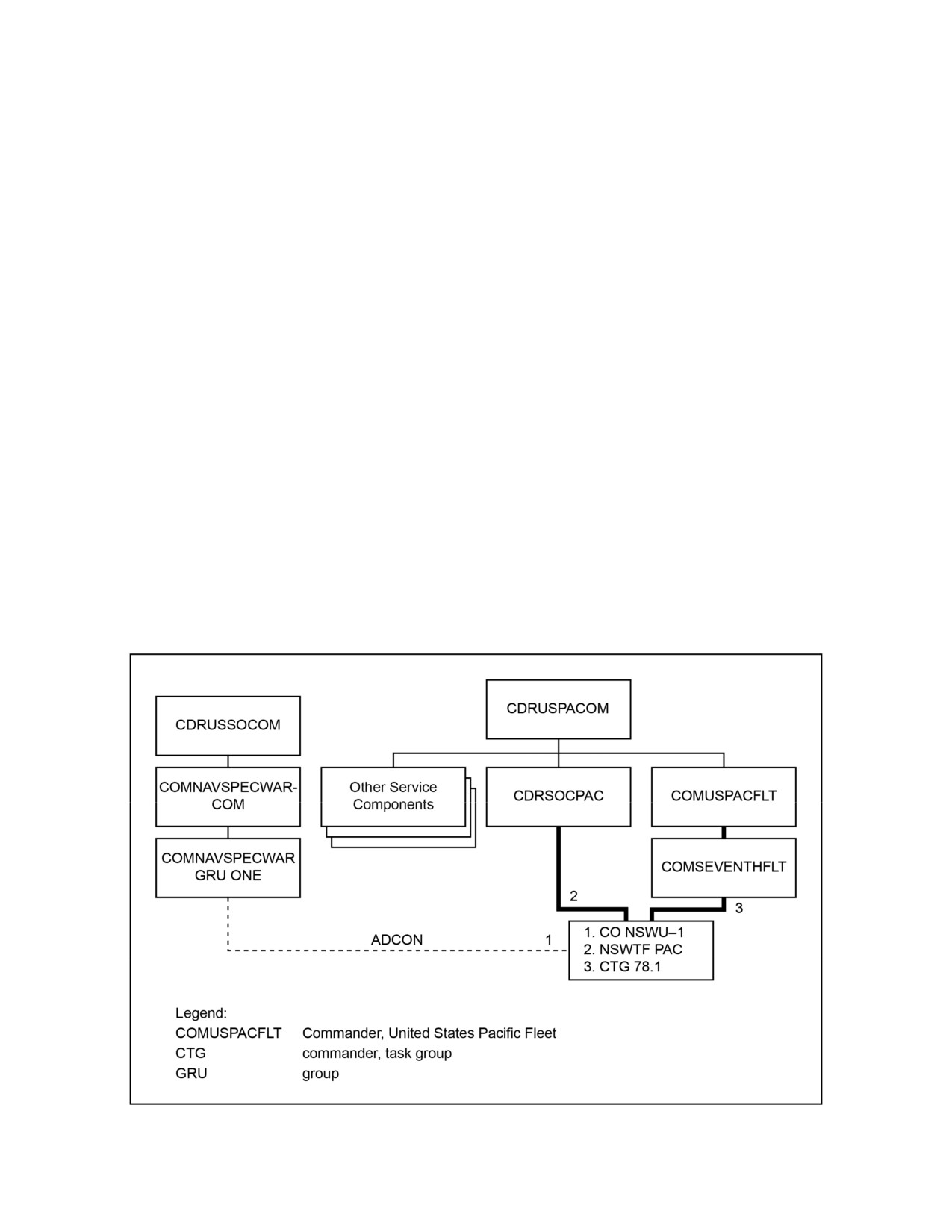
NSW forces deploying to USPACOM are normally attached to NSWU-1. The CO, NSWU-1, based in Agana,
Guam, has three hats.
1. CO NSWU-1.
2. Commander, Navy Special Warfare Task Force, Pacific (CNSWTF PAC). CNSWTF PAC is Commander,
Special Operations Command Pacific’s (CDRSOCPAC’s) Navy SOF component.
3. Commander, Task Group (CTG) 78.1. CTG 78.1 is the Navy SOF component commander for Commander,
SEVENTH Fleet (COMSEVENTHFLT).
Commander, United States Pacific Command (CDRUSPACOM) exercises OPCON of NSWU-1 through
CDRSOCPAC. NSWU-1 is under the administrative control of CNSWG-1 and receives support from United
States Pacific Fleet (figure 3-4).
3.11.2 United States European Command
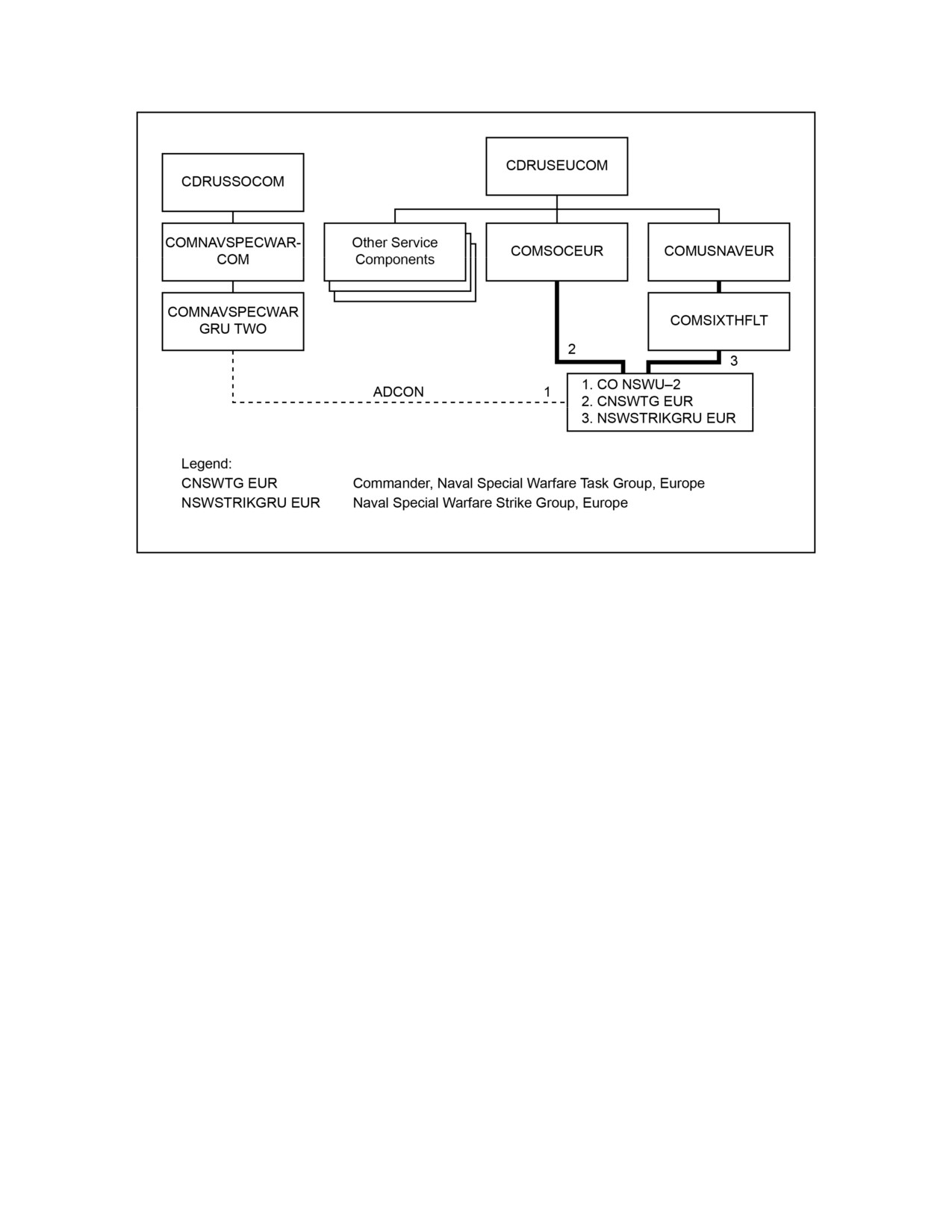
NSW forces deploying to Europe are normally attached to NSWU-2. Commanding officer NSWU-2, based in
Stuttgart, Germany, is designated as both Naval Special Warfare Task Group, Europe, in which capacity he is
Commander, Special Operations Command, Europe’s (COMSOCEUR’s) naval component; and as Naval Surface
Warfare Strike Group, Europe, the NSW component commander for Commander, Sixth Fleet (COMSIXTHFLT)
(figure 3-5).
Commander, United States European Command (CDRUSEUCOM) exercises operational control of NSWU-2
through COMSOCEUR. NSWU-2 is under the administrative control of CNSWG-2 and receives some Service
support from United States Naval Forces, Europe.
Figure 3-4. Naval Special Warfare Task Organization in Pacific Command
3-13
MAY 2013
NWP 3-05
Figure 3-5. Naval Special Warfare Task Organization in European Command
3.11.3 United States Central Command
In USCENTCOM, the commanding officer of NSWU-3, based in Manama, Bahrain, serves as Commander, Joint
Special Operations Task Force, Gulf Cooperation Council (JSOTF-GCC). Commander, JSOTF-GCC
synchronizes all SOF TSCP engagements, partner nation SOF capability building efforts, and facilitates USSOF
access and placement in the United Arab Emirates, Kuwait; Bahrain; Qatar; Oman; and the Kingdom of Saudi
Arabia through persistent relationship development and key leader engagements. Commander, United States
Central Command (CDRUSCENTCOM) exercises operational control of NSWU-3 through Commander, Special
Operations Command, United States Central Command (COMSOCCENT) (figure 3-6). NSWU-3 is under the
administrative control of CNSWG-1.
At the time of this writing, a second chain of command, the CENTCOM contingency response element (CRE), is
also predominantly NSW forces. The CENTCOM CRE is a joint command based on an NSWTG and commanded
by a deployed SEAL team commanding officer. The CRE’s mission is to conduct special operations in support of
CDRUSCENTCOM, specifically providing a rapid response force in order to prevent or counter a crisis
throughout the CENTCOM AOR. Particular CRE mission sets consist of DA, SR, MIO, personnel recovery, FID,
and support of contingency operations in USCENTCOM. The CRE is subordinate to SOCCENT for operational
control and coordinates with the JSOTF-GCC for TSCP events.
3.11.4 United States Southern Command
Officer in charge NSWU-4, based at Joint Expeditionary Base Little Creek-Fort Story, VA, is designated as
Commander, Special Operations Command, United States Southern Command’s (COMSOCSOUTH’s) naval
component and as CTG 40.4, the NSW component commander for Commander, United States Naval Forces,
Southern Command (COMUSNAVSO). Commander, United States Southern Command (CDRUSSOUTHCOM)
exercises operational control of NSWU-4 through COMSOCSOUTH. NSWU-4 is under the administrative
control of CNSWG-2 (figure 3-7).
MAY 2013
3-14

NWP 3-05
Figure 3-6. Naval Special Warfare Task Organization in Central Command
Figure 3-7. Naval Special Warfare Task Organization in Southern Command
3-15
MAY 2013

NWP 3-05
3.11.5 United States Africa Command
Commanding officer, NSWU-10 based in Stuttgart, Germany, is Commander, Special Operations Command,
Africa’s (COMSOCAFRICA) Navy SOF component. USAFRICOM exercises operational control of NSWU-10
through COMSOCAFRICA. NSWU-10 is under the administrative control of NSWG-2 (figure 3-8).
Figure 3-8. Naval Special Warfare Task Organization in Africa Command
MAY 2013
3-16
NWP 3-05
CHAPTER 4
Naval Special Warfare Characteristics and
Employment
4.1 STRATEGIC CONTEXT FOR EMPLOYMENT
While state-on-state warfare is hugely important when it occurs, it is infrequent. Meanwhile, U.S. interests are
increasingly challenged by modern threats. In addition to historic competition for influence and resources
(especially water and oil), there is rising volatility in the Middle East, spread of violent extremism, nuclear
proliferation, threat of mass-casualty terrorism, diffusion of advanced military technologies, and increasing
sophistication of transnational criminal organizations. These diverse threats may:
1. Be networked; adept at social media and cyber warfare
2. Originate from nonstate or transstate actors and can be widely—even globally—dispersed
3. Operate in or from weak or failing states exploiting under-governed spaces
4. Seek to win through psychological and political exhaustion rather than military force
5. Favor sensational violent attacks against civilian targets to foment chaos
6. Seek concealment and generate resources by blending into and operating within the population.
Strikes against these adversaries may require substantial intelligence effort to locate elusive targets, precision to
limit collateral damage, stealth to achieve surprise and minimize political impact, and high confidence of success
due to high political and military costs of mission failure.
The NSW force—a versatile, DA-oriented, maritime-focused organization that emphasizes innovation and
flexibility, integration of intelligence, a versatile portfolio of insertion and extraction techniques, rapid response,
attention to detail, and a strike capability featuring stealth, precision, and aggressive action—is well suited to
these targets.
Success of military campaigns often depends less on traditional military operations and more on influencing the
population and, for many modern threats, unilateral military strikes are an inappropriate or inadequate response.
The future will see an emphasis on strategic partnerships to improve stability, lessen the likelihood of conflict,
and prepare the United States to respond more effectively should conflict emerge. The United States will need to
rely on small, politically acceptable, and regionally oriented forces operating with partner nations to proactively
address challenges and mitigate threats. Strategic opportunities can be exploited in several ways.
1. Shaping. Continued presence and recurring small-scale visits to the same locations in countries with shared
security interests foster enduring relationships by building trust, confidence, and understanding of critical
populations. Relationships established and maintained at multiple echelons of command improve
communication and information sharing, improve acceptance of U.S. presence and activities, project
power, empower our allies, and strengthen security and rule of law.
4-1
MAY 2013
NWP 3-05
2. Collaboration with partner forces. In addition to economy of force considerations, collaborative
relationships enable operations that might otherwise be impossible or imprudent. This is true regardless of
whether it is an independent operation conducted by a partner force with U.S. support, a combined partner-
enabled operation, or a U.S. unilateral operation that is abetted by relationships with a partner country.
3. Coordination. Knowledgeable, well-connected, regionally oriented forces are able to establish relationships
with theater commanders, U.S. embassy country teams, other Government agencies, and regional allies.
This enhances familiarity with and access to key staff members and decision makers throughout the region
in order to coordinate policies and operations.
To meet these requirements, the majority of the time and effort of deployed NSW forces is consumed by
peacetime engagement and combined operations. Combined exercises, small-unit exchanges, subject matter
expert exchanges, and key leader engagements contribute to a globally networked, intelligence-intensive,
human-focused, regionally aware, cost-effective, and consistent influence in key locations throughout the world.
NSW forces are continuously deployed and locally engaged in USCENTCOM, USPACOM, USEUCOM,
USAFRICOM, and USSOUTHCOM, and are regularly employed in USNORTHCOM operations.
NSW is a relatively small force consisting of approximately 9,250 personnel: 2,700 SEALs, 700 SWCC, 750
Reserves, 4,000 CS and CSS personnel, and more than 1,100 civilians. NSW constitutes 11 percent of USSOF
and less than 2 percent of Navy forces. This force costs approximately 3/10ths of a cent of every U.S. defense
dollar (0.3 percent). In the context of fiscally constrained defense budgets, NSW and other USSOF have emerged
as perhaps the most cost-effective U.S. weapons system.
4.2 NAVAL SPECIAL WARFARE OPERATORS
4.2.1 Navy SEAL Operator
NSW is built around a number of special skills, but the foundation of NSW operational capability and the thread
that ties NSW together is the SEAL operator. The individual SEAL is a product of a selection and training process
centered around basic underwater demolition/SEAL training; a rigorous, all-volunteer, 25-week course which
emphasizes mental and physical toughness. Completion of BUD/S training requires proficiency in swimming,
combat diving, across-the-beach operations, small-unit tactics, weapons, communications, and underwater
demolitions and inculcates an enduring commitment to initiative, team work, and mission completion.
In addition to vetting of candidates prior to the commencement of training, physical and academic testing
throughout the course screen out unqualified students. Moreover, there is attrition of candidates who voluntarily
withdraw from the course due to arduous physical training, sleep deprivation, prolonged cold water exposure, and
leadership and team work challenges. After completion of BUD/S, students move on to SEAL Qualification
Training (SQT).
SQT is a 28-week sequential series of courses, including SERE; tactical air operations (static-line and freefall
parachuting); helicopter rope suspension technique (rappel, fast rope, and cast and recovery); tactical combat
medicine; communications; advanced special operations; language training; cold weather/mountaineering;
maritime operations (small-boat operations, over-the-beach insertion); combat swimmer (closed-circuit diving,
underwater ship attack); land warfare (small-unit tactics, light and heavy weapons, demolitions), combatives
(military martial arts), close-quarters combat (precision close-range marksmanship, tactical decisionmaking, and
ship and building clearance); and operations in a chemical, biological, radiological, and nuclear environment. The
emphasis in SQT is on building and developing an individual operator capable of joining a SEAL or SDV platoon
with minimal deviation in the platoon’s capability.
On completion of SQT, students are awarded the Navy enlisted classification (code) of Special Warfare Operator
or the officer designator of Naval Special Warfare Officer, authorized to wear the SEAL designation device
(Navy SEAL trident), and assigned to a SEAL or SDV team. This selection and training process, with attrition
rates exceeding 65 percent, yields SEAL operators with proven resilience, tenacity, and fortitude.
MAY 2013
4-2
NWP 3-05
4.2.2 SEAL Platoon
On arrival at SEAL or SDV teams, SEALs are assigned to a platoon and commence 18 months of predeployment
training. The 21-man SEAL platoon is the basic NSW maneuver element. Enlisted platoon personnel are assigned
one or more specialties: intelligence, diving, communications, boat and vehicle operation and maintenance,
ordnance, air operations, and medical. Additionally, each platoon contains specialists trained as breachers,
snipers, stand-off weapons operators, advanced special operations technicians, joint terminal attack controllers
(JTACs), UAS operators, tactical ground mobility operators, jumpmasters, diving supervisors, language and
cultural experts, and other specialties so that each platoon is self-sufficient with all SEAL capabilities. The SEAL
platoon can be disaggregated into three by seven-man SEAL squads, although each squad may not have the
complete portfolio of SEAL platoon capabilities. Squads can be further divided into three- or four-man fire teams
or into pairs as required.
SEAL platoon predeployment training emphasizes submerged, combatant craft, ground, and air insertion and
extraction methods; patrolling and small-unit tactics; coordinated movement of maneuver elements; precision
shooting and demolitions; special operations urban combat; close-quarters combat, including ship and building
clearance; mission planning and rapid, decentralized, tactical decisionmaking and tactical communications; hide
site selection and construction; data compression and transmission for reconnaissance missions; and sensitive site
exploitation to capitalize on intelligence found on the objective and to support criminal prosecution. In addition to
training in core proficiencies, SEAL platoons train in other areas of specialization to meet requirements for their
deployment, e.g., advanced mountaineering and cold weather emphasis for platoons deploying to cold
weather/mountainous areas. SEAL platoon operations are described in NTTP 3.05.2, SEAL Land Warfare, and
NTTP 3-05.24, Naval Special Warfare-Urban Combat, Shipboarding, and Gas and Oil Platform Operations, and
other references listed in References section.
4.2.3 SEAL Delivery Vehicles
A variation of the SEAL platoon is the 16-man SDV platoon in which each SEAL is a qualified SDV pilot or
navigator. SDV platoons retain all of the SEAL platoon’s capabilities but specialize in undersea operations. The
SDV platoon can be disaggregated into two by eight-man SEAL squads, although each squad may not have the
complete portfolio of SEAL platoon capabilities. SDVs are discussed in appendix A and in NTTP 3-05.42, SEAL
Delivery Vehicle Tactics Handbook.
SDV operations provide more than just an alternative clandestine insertion platform. This unique capability
allows planning and execution of reconnaissance and DA operations that would not be attempted by other means.
4.2.4 Special Warfare Combatant Craft-Crewman
The other specialized combatant in NSW is the SWCC, specially selected and trained personnel who operate
NSW combatant craft and other craft in maritime, coastal, and riverine environments. SWCCs must complete the
7-week SWCC basic crewman training, which emphasizes physical conditioning, water competency, seamanship,
navigation, boat tactics, team work, and mental toughness. The course includes a 51-hour navigation, boat tactics,
and swimming evolution with little sleep and constant exposure to the elements. Completion of basic SWCC
training requires proficiency in coxswain skills, over-the-horizon navigation, small-craft tactics, weapons,
communications, maritime insertion and extraction, and coastal patrol and interdiction. On completion of SWCC
BCT, students advance to crewman qualification training (CQT).
CQT is a 21-week course covering weapons, seamanship, first aid, navigation, communications, waterborne
patrolling, marksmanship, engineering, small-unit tactics, close-quarters combat, combatives, SERE Level C,
language training, and an introduction to NSW mission planning. Graduates of CQT are designated as NSW boat
operators, authorized to wear the SWCC insignia, and assigned to a special boat team.
4-3
MAY 2013
NWP 3-05
4.2.5 Versatility
In addition to screening for physical and psychological stamina, the NSW selection and qualification process
fosters a self-motivated, self-reliant, problem-solving culture with an inclination to search for creative and
unorthodox approaches to ambiguous problems in uncertain environments. Although tactical principles do not
change, the application of those principles is in constant evolution to respond to changes in weapons, equipment,
conditions, and enemy tactics. To encourage tactical and intellectual versatility and to make operations less
predictable, NSW is not dogmatic about tactics. Standard tactics are used as a starting point and they are added to
and expanded upon in a search for methods that are safer, faster, and simpler, developing new variations of
equipment and procedures. NSW strives for creative, clever, unexpected, simple, and safe plans. Creative does not
mean complex; contrarily, simplicity is the most important quality of a plan. NSW mission planning is described
in NTTP 3-05.1 and NTTP 3-05.2.
Because of the inclination to improvise and the flexibility of the task organization, NSW forces have the ability,
agility, and willingness to quickly task-organize into scaled and tailored force packages with a high density of the
correct specialized capabilities and C2 options to plug into any size or type of operation.
4.2.6 Multi-purpose Canine
SEAL platoon capability is enhanced by the Multi-Purpose Canine, a carefully selected dog who has completed a
20-week Multi-Purpose Canine training course. Each dog is assigned a handler. The handler is a SEAL operator
who trains the dog prior to deployment and remains with that dog throughout a deployment. In addition to
accompanying foot, boat, or vehicle patrols, Multi-Purpose Canines can be inserted with their handler by tandem
parachute, helicopter fast rope, or rappel.
The Multi-Purpose Canine’s primary mission is explosive detection to provide warning of improvised explosive
devices (IEDs). On indication from the dog of possible explosives, the handler marks the area where the item was
found and EOD is notified to handle the threat. The Multi-Purpose Canine also possesses the ability to work on or
off leash while performing other tasks, including search, locate, and apprehend enemy combatants as a nonlethal
force option. In the event the target is barricaded, the dog is trained to bark alert until recalled by the handler.
Multi-Purpose Canines are unable to target-discriminate, so care is used and escalation of force guidance
considered prior to releasing the dog against a target.
The Multi-Purpose Canine is also employed to detect enemy weapons caches.
4.3 DIRECT ACTION ORIENTATION
NSW’s organization, training, equipment, and warfighting philosophy are oriented around precision strikes that
emphasize speed, stealth, and aggressive actions. A SEAL assault is characterized by clandestine approach by sea,
air, or land to achieve surprise; rapid, controlled, aggressive maneuvers facilitated by clear, quick communication
and decentralized command to achieve and maintain the initiative; and careful target discrimination, tactical
patience, fire discipline, and precise shot placement to prevent civilian casualties and limit collateral damage.
One of the characteristics of this eyes-on, hands-on target prosecution is a degree of precision that allows
commanders to exercise a measured and nuanced application of military power. This facilitates a wide range of
scenario-dependent branch plans, a reasoned response to unanticipated contingencies, and allows various goals
(e.g., emphasis or de-emphasis of U.S. presence) to be accentuated during mission execution.
These capabilities have been employed against a wide variety of targets and in many situations: train tunnels and
bridges (Korea); radio station (Grenada); underwater boat attack (Panama); boat and oil platform assaults
(Persian Gulf); enemy-held island (Persian Gulf); personnel recovery (Vietnam, Grenada, Iraq, Afghanistan);
enemy supply caches (Vietnam, Afghanistan); noncombatant evacuations; ship attacks; at-sea hostage recovery;
and many others. One of the mission types which capitalizes on NSW capabilities and was the predominant
employment of SEALs in Vietnam, Iraq, and Afghanistan, and that has been employed in several other locations,
is capture or kill missions against high-value individuals. This capability is likely to remain prominent in future
irregular warfare scenarios.
MAY 2013
4-4
NWP 3-05
4.4 MARITIME FOCUS
NSW is an extreme-environment force operating under the sea, in the open ocean, through the surf, from the air,
in jungles, deserts, or high mountains; in all weather, day or night. NSW operates in all terrain but is uniquely
trained and equipped to operate in maritime and riverine areas. Training and equipment emphasizes maritime
insertion from aircraft, ships, submarines, SDVs, and combatant craft. All SEALs and selected SWCC, as well as
certain combatant craft and other NSW equipment, are water paradrop-qualified.
Maritime attack capabilities include across-the-beach operations; near-simultaneous underway nighttime ship
boarding from combatant craft and helicopter fast rope; underwater attack against ships or other targets employing
closed-circuit (no bubbles) self-contained underwater breathing apparatus (SCUBA); harbor attack; and gas and
oil platform assault.
This capability is significant in light of the fact that maritime nations make up 80 percent of the international
community, 90 percent of trade by volume travels by sea, and there is limited access to land bases in key parts of
the world.
4.4.1 Seabasing
Given the freedom of navigation laws for surface ships and the stealth of submarines, sea-based NSW forces are
able to operate throughout the oceans and along the littorals of the world with few restrictions—lower profile and
less intrusive presence, no reliance on host nation support, no diplomatic clearance, minimal political risk, and
often without detection—to enable persistent, unobtrusive, mobile SOF presence in locations where conflict is
most likely and most consequential. NSW provides special operations forces with access to the global, sustained,
forward presence of the Navy.
Seabasing allows the force to position and maneuver, approach inside the horizon or retreat over it, to reposition
along a coastline, to move beyond the reach of sensors, or to move to a different area as situations change. The
inherent mobility increases options compared to land-based assaults from a known point, improves operational
security, and mitigates an adversary’s ability to evade U.S. operations. Another key value that Navy or other
sea-based platforms bring is persistent presence for enduring missions such as ISR and long-term “be prepared to”
missions. Seabasing can offer this presence in remote littoral areas where land bases are not available for reasons
of politics, geography, or lack of supporting infrastructure. Even when land basing may be an option, sea-based
platforms reduce the land-based footprint, may decrease strategic airlift requirements, and improve force security.
Seabasing support can be provided by conventional naval forces (carrier strike group, expeditionary strike group,
surface strike group, missile defense surface action group, or submarines) as well as Military Sealift ships and
commercial vessels. Suitable naval and United States Coast Guard (USCG) ships include guided-missile cruiser,
guided-missile frigate, guided-missile destroyer, littoral combat ship, amphibious ships, submarines, joint
high-speed vessel, and USCG national security cutters.
There are a variety of logistical, administrative, and C2 challenges when operating from a sea base. NSW support
requirements include messing and berthing, access to planning and briefing spaces, adequate SECRET Internet
Protocol Router Network (SIPRNET), Nonsecure Internet Protocol Router Network, other network connections
and permissions, antenna connections, frequency management, and extra bandwidth. There may also be
requirements for video feeds from airborne ISR platforms, including P3 variants and UASs. Strike groups have
robust command, control, communications, computers and intelligence, surveillance, and reconnaissance (C4ISR)
systems; however, these systems vary from ship to ship and may not be compatible with NSW or other SOF
networks.
Other support requirements may include Judge Advocate General, public affairs, logistics, and force protection
support from naval or joint forces. To maintain required on-station time during mission execution, support
requirements may include at-sea resupply. Non-Navy support vessels may not have organic force protection, thus
requiring defensive support.
4-5
MAY 2013
NWP 3-05
In the history of NSW seabasing, UDT platoons and later, SEAL platoons, deployed aboard amphibious ready
groups to provide hydrographic reconnaissance, advanced force operations (AFOs), and special operations
support to the amphibious task force prior to amphibious landings. Since that time, the USMC has taken over
routine hydrographic reconnaissance and advance force missions. In the event that a clandestine hydrographic
reconnaissance is required, GCCs should request NSW support.
SEAL platoons have also deployed aboard carrier strike groups during routine 6-month deployments. These
deployments, during which Navy ships spent the majority of their time on transit and training, forward presence,
and sea-control missions, inhibited training and employment of NSW forces. To better employ NSW, seabasing
aboard Navy ships is now limited to those periods when ships are operating in support of NSW or conducting
operations (e.g., maritime interception) for which NSW capabilities may be required. Embarkation of NSW forces
is arranged either in port or rendezvous at sea by boat, helicopter, or paradrop.
4.4.2 Sea-based Command and Control
When conducting operations with a carrier strike group or expeditionary strike group, a SEAL liaison officer will
be assigned to the strike group staff. Whenever possible, the NSWTG or TU providing command and control of
NSW forces afloat should be embarked in the same ship or submarine hosting the assault force. Pre-embarkation
coordination should include planning and mission preparation space requirements (to include security
requirements); C4ISR requirements; ordnance requirements; boat support (launch and recovery, fuel, deck space,
maintenance space); supporting forces desired; berthing; and other requirements. Details are available in
NTTP 3-07.11.1, Surface Ships in Support of Naval Special Warfare Operations; NTTP 3-07.11M, Maritime
Interception Operations; NWP 3-62M, Seabasing; and NTTP 3-05.4, Naval Special Warfare Submarine
Operations Manual.
4.4.3 Afloat Forward Staging Base
When a surface ship is assigned as the supporting force to SOF (SOF is the supported force), it is referred to as an
afloat forward staging base.
AFSBs can range from relatively small platforms with limited ability to support an NSWTU with combat rubber
raiding craft (CRRC) to larger platforms that can support a JSOTF HQ with robust combatant craft and helicopter
support capabilities. Capabilities provided by the AFSB, which may consist of more than one vessel, are scaled to
mission-specific requirements based on mission type and duration, threat, operational security considerations, and
environmental conditions.
4.5 TARGET ACCESS
Access to a wide variety of targets is based on NSW’s intelligence capability, tactical mobility, and combined
action with partner forces.
4.5.1 Intelligence
Intelligence capabilities are integrated into all deployed NSW forces and include SUPPACT cross-functional
teams with UAS detachments, language and regional experts, FSTs, and the NSW mission support center.
Additional intelligence support is provided by individual subject matter experts and analysts from the Office of
Naval Intelligence, embedded analysts on NSWTF/TG/TU staffs, and SEAL and SDV platoon intelligence
personnel. Because these intelligence collection and analysis personnel are integrated into the NSW C2
organization, participate in operations working alongside SEAL and SWCC operators, and answer to the same
commander, intelligence efforts are highly focused and responsive to operational needs.
There are many technical specialties included in cross-functional teams. The combined qualifications of the 84
personnel assigned to a typical team include dozens of intelligence, analysis, and technical courses and
certifications in addition to basic Navy Information Dominance Corps qualifications.
MAY 2013
4-6
NWP 3-05
The organic NSW airborne ISR capability is based on runway-independent, small-, short-, and medium-endurance
UAS, including both manpack and rail-launched/cable-recovered systems. The UAS are operated primarily by
UAS detachments from cross-functional teams but also by SEAL platoons and SPECBOATDETs. UAS payloads
can include a variety of signals, communications, visual and infrared sensors, as well as weapons. These sensors
provide real-time information, data, and full-motion video to assist in targeting, mission planning, force
protection, and tactical decisionmaking during operations. Organic UAS, along with platforms provided by other
forces, are employed extensively during the targeting and mission-planning process, in some cases spending
hundreds of hours monitoring a single target. P-3C, MQ-1, MQ-9, and Global Hawk are particularly valuable
platforms that augment organic NSW ISR. During mission execution, airborne ISR is employed tactically to
monitor enemy activity and improve situational awareness.
The cross-functional team and other specially trained forces within the NSW organization conduct human
intelligence, TIO (tactical electronic warfare and tactical linguists), technical surveillance, UAS operations, and
gather geospatial, meteorological, oceanographic, and other information. From this information, the intelligence
force conducts all-source analysis to produce tailored intelligence for NSW targeting and mission planning. In
addition to traditional intelligence collection efforts emphasizing tactical information, NSW forces—particularly
anchor teams and LREs—emphasize the human domain, understanding the social and cultural conditions that
influence the population’s attitudes and behavior.
The benefits of close integration of intelligence and operations is highlighted when targeting HVIs. The
methodology to find and engage an HVI is described as an F3EAD targeting cycle. Once an HVI has been
identified, multisource intelligence is used to find his general location. Over days or weeks, these data are used to
build a picture of the HVI’s pattern of life. With sufficient data, it may be possible to predict where the HVI will
be hours or days in advance. A key part of “fixing” the HVI is finding him in a location where the risk of
collateral damage is low. If this can be done, a finish operation can be conducted. The “exploit” in F3EA is the
gathering and exploiting of data available immediately after the finish operation. This is referred to as sensitive
site exploitation and includes biometrics, tactical questioning, and exploitation of electronic equipment. Analysis
of the data and forensic investigations may lead to identification of another HVI, which begins the cycle over
again. Dissemination is ensuring that the intelligence gained is properly fed back into the intelligence network.
Operations in Iraq and Afghanistan since 9/11 provided a catalyst for refinement of this targeting technique. At
the beginning of the Iraq War, targeting yielded sporadic and inconsistent results. During years of missions in Iraq
and Afghanistan, intelligence synthesis improved so that a jackpot became routine. In Afghanistan from May
2010 thru April 2011, special operations forces captured or killed the intended target and/or his associates 1,862
out of 2,245 times, an 83 percent success rate. The precision of this system has allowed NSW and other SOF to be
highly discriminate in operations and is critical against those fleeting targets that are only rarely and briefly
vulnerable.
To enhance intelligence capabilities, the NSW mission support center provides 24-hour reachback intelligence
support to deployed NSW units. Services provided through the SIPRNET and other networks include
sophisticated, custom-built tactical and environmental mission-planning products; IT help desk services; and
friendly force tracking device registration and support. Aided by the MSC, mission commanders are able to focus
a larger percentage of the operator's limited planning time on the execution phase of operations, thereby
enhancing the chance for mission success. The MSC is best viewed as an extension of deployed NSW forces and
reduces the number of CSS personnel required forward.
In addition to the NSW mission support center, the Navy’s Office of Naval Intelligence and numerous other
organizations and agencies assist with NSW target development. Sensors which may be utilized include national
intelligence sensors, maritime patrol and reconnaissance aircraft, other shore-based surveillance aircraft, and
tactical data from other sources. The four major conventional Navy platforms used to collect intelligence in
support of special operations are ships (including ship-based UAS), submarines, P-3 variants, and land-based
long-endurance UAS.
4-7
MAY 2013
NWP 3-05
4.5.2 Tactical Mobility
Starting from a forward base, a mission can be broken down into insertion, infiltration, actions at the objective,
exfiltration, and extraction. Insertion refers to the beginning of the transit up to the point where forces disembark
from an insertion platform—submarine, combatant craft, helicopter, fixed-wing aircraft, or tactical vehicle—at an
insertion point. Infiltration refers to the final transit to the objective—diving, swimming, combatant craft, foot
patrol, mounted patrol, or helicopter. The process is reversed for exfiltration and extraction. A hallmark of NSW
capabilities is its portfolio of tactical mobility, which provides seamless integration of sea, air, and land methods
of insertion, infiltration, exfiltration, and extraction. The ability to operate clandestinely over, under, on, and from
the sea—as well as in the air and on land—allows access to targets that may be inaccessible to other forces and is
whence the acronym SEAL originates.
The ability to attack at times and locations that are unexpected is a fundamental requirement for most successful
special operations. In addition to good intelligence to locate the target, this requires the ability to surreptitiously
swim, dive, fly, drive, patrol, climb, or stalk in all conditions of terrain and weather and arrive at the correct
location at the appointed time. This capability relies partially on tactical mobility assets that are integral to the
NSW organization—combatant craft, SDVs, DDSs, and tactical ground vehicles—but also requires support from
ships, submarines, and rotary- and fixed-wing aircraft. Tactical mobility is discussed in appendix A.
4.6 OTHER SUPPORT
Navy and other Services provide additional support that is not available within the NSW organization. Some of
these capabilities are based on habitual Navy relationships, including NAVSOF EOD platoons and HSC
detachments that are attached to the NSW task organization. Support is mission-specific and can include afloat or
ashore basing, ships, submarines, rotary-wing aircraft, ISR, fire support, information operations (IO), detainee
operations, interpreters, and staff support. Additional support may be provided by contractors and other
Government agencies.
4.6.1 Explosive Ordnance Disposal Platoon
As part of the Navy support to naval special warfare, NAVSOF EOD platoons routinely supplement deploying
NSW forces. EOD personnel accompany SEAL and SWCC operators on patrol to counter IEDs by locating,
identifying, and disposing of ordnance that impedes maneuver. NAVSOF EOD platoons also provide diving
support, intelligence collection, aircraft and ordnance recovery, range clearance, underwater clearance, shore
detachment augmentation, and riverine operations support. Normal manning for an NAVSOF EOD platoon
supporting an NSWTG is 10 men: two officers and eight enlisted.
4.6.2 Fires
NSW relies heavily on conventional forces for fire support. In addition to land-based missiles, rockets, air,
artillery, and mortars, NSW employs sea-based naval fire support, including tactical air sorties from both nuclear
carriers and amphibious carriers (F/A-18, AV-8B, rotary-wing), Tomahawk land-attack missiles from surface
ships and SSNs, UAS, and naval surface fire support.
NSW fire support officers, ground force commanders, and JTAC plan, integrate, and execute fire support,
including airborne ISR. Fire support is executed at the tactical level by the SEAL JTAC assigned to each platoon
who is able to synchronize and coordinate multiple assets. Further information is available in NTTP 3-09.2.2,
Naval Special Warfare Fires Supplement to MTTP for the Joint Application of Firepower.
4.6.3 Shore Basing
In many cases, deployed NSW forces require basing support. Land basing of NSW forces varies from highly
developed support infrastructure to operating in austere environments with limited to nonexistent host nation or
DOD support. In accordance with JP 3-05, “The logistic support of SOF units is the responsibility of their parent
Service. When a theater Service component cannot satisfy its Service SOF support requirements, the GCC will
MAY 2013
4-8
NWP 3-05
determine if another Service component can do so.” In practice, deployed logistics support is coordinated and
provided by a combination of joint, SOF, Service, NSW organic, contractor, and commercial service providers.
Missions and theaters of operation dictate the roles each of these support providers play in supporting NSW
operating forces.
For rapid response or austere circumstances, NSW forces have the ability to support themselves for the first 15
days of an operation or can be self sustaining indefinitely by relying on host nation support. Normally, “Services
or executive agents should be prepared to support special operations as soon as possible but not later than 15 days
after SOF are employed” (JP 4-0, Joint Logistics).
4.7 COMBINED ACTION
Although the majority of NSW training is DA oriented, the majority of effort of deployed NSW forces is
combined action with partner forces. The greatest contribution that can be made to a partner force is sharing
knowledge and skills. Knowledge and skills taught by SEAL and SWCC operators are based on the philosophy
that, rather than sending teachers who understand warfare, we send warriors who understand teaching. This
enhances credibility and aids in establishing relationships. Sustained relationships with face-to-face engagements
and shared experiences promote open communication and cooperation. Increased cooperation may allow
information sharing and facilitate target access. When U.S. presence on target is not prudent, these relationships
can facilitate judicious intelligence sharing and inconspicuous support to allow partner forces to conduct
unilateral operations that further U.S. interests.
4.7.1 Combined Action Programs
Geographic combatant commander TSCPs can include several categories of U.S. Government capacity building
operations: foreign military sales, foreign military finance, international military education training, FID, SFA,
National Defense Authorization Act Section 1206 programs, Counterterrorism Fellowship Program, and others.
Although the Department of State provides oversight and guidance for these programs, the DOD’s Defense
Security Cooperation Agency (DSCA) is usually responsible for implementing foreign security forces capacity
building. Responsibilities and authorities for most DOD-implemented operations are coordinated by the DSCA
security assistance officers who manage the programs and are located in U.S. embassies. Because the overlapping
categories can be confusing, planners should consult with TSOCs and security assistance officers.
NSW and other SOF also participate in two exceptions to Department of State responsibility: joint combined
exchange training (JCET) and CNT, which fall under the purview of the DOD.
4.7.2 Joint Combined Exchange Training
The JCET program is a SOF-specific training program designed to: 1) develop and enhance U.S. FID capabilities
(instructional skills, foreign language proficiency, area and cultural orientation); 2) develop core mission-essential
task list (METL) capabilities; and 3) support GCC theater campaign plans by training with partner nation military
or paramilitary forces. The purpose of JCETs is USSOF training for FID, not to conduct FID. Accordingly, there
must be a clear link between the training provided and the USSOF units’ METL and USSOF must receive at least
51 percent of the benefit of the training. The JCET program is unique in that its requirements are based on SOF
METLs, shaped by the theater strategy, orchestrated by theater SOCs and the U.S. ambassador, approved by
SecDef in coordination with Secretary of State, and executed by the individual unit.
TSOCs working through GCCs establish JCET requirements. The host nation unit receiving the training should
have SOF-like responsibilities in their country or support the host nation SOF. JCETs are episodic events, usually
2-8 weeks in duration.
The training must occur overseas unless an exception to policy is granted, referred to as a reverse JCET. When the
foreign nation is a developing nation, Commander, USSOCOM may fund that nation’s incremental expenses to
conduct the JCET.
4-9
MAY 2013
NWP 3-05
4.7.3 Counternarco-Terrorism Training
Counterdrug activity is focused on training host nation counterdrug forces and law enforcement agencies to
detect, monitor, and interdict the cultivation, production, and trafficking of illegal drugs to the United States.
GCCs in coordination with the American embassy staff in country establish CNT requirements. In contrast to a
JCET, the partner force receives 100 percent of the benefit of a CNT. CNTs are episodic events, usually limited in
duration. However, there are CNTs that are 365 days in length when funding and force availability permit.
Direct action is important, not decisive; indirect action is decisive.
—Admiral Eric Olson
4.7.4 Regional Specialists
Partner capacity building operations are supported by NSW forces with cultural expertise, language ability of
native speakers, and regional backg5round that provide otherwise unattainable access and placement. Regional
alignment improves understanding of the human domain—the local culture and how it affects behavior—and
enhances relationships that improve communication, coordination, and U.S. influence. Additionally, these forces
provide permanent, well-connected points of coordination with U.S. forces, U.S. embassy country teams, and
other U.S. agencies in theater.
NSW area specialists include regionally oriented NSWUs, anchor team detachments, MLEs, LREs, and FSTs.
Anchor team detachments and MLEs operate semi-independently, while the LREs and FSTs deploy with and are
collocated with an NSWTG, TU, or TE.
Anchor team detachments and MLEs are one- to two-man elements that maintain a presence—an anchor—in
select partner countries. Anchor team detachments are attached to a specific partner unit so that solid relationships
are developed and maintained. They are supplemented intermittently by other NSW forces, including SEAL,
SWCC, and SUPPACT cross-functional elements. Anchor team and MLE personnel are carefully screened and
trained in language, regional expertise, and culture (LREC); antiterrorism/force protection and operational
security; and general area preparation.
The LREs and FSTs are embedded with deployed SEAL and SWCC operators to provide cultural advice and
expertise, enhance understanding of the population, and improve interface between NSW operators and local
populations. LREs are Sailors who are native-born in the region of interest and are accessed into the CEU through
either the Military Accessions Vital to the National Interest program or the U.S. Navy Heritage Language
program. They are educated on NSW operations and operating environments and trained to function in the field
next to SEAL and SWCC operators.
Female support technicians are individual female Sailors who are selected and trained to provide access to
inaccessible or under-accessed female populations in partner nations who, in many targeted cultures, are isolated
from exposure to male NSW personnel. This softens the operational signature and makes U.S. presence more
acceptable.
4.7.5 Small-craft Training
Military to military contact is also fostered by NSW’s Naval Small Craft Instruction and Technical Training
School at Stennis Space Center in Mississippi. NAVSCIATTS mobile training teams and in-resident training
programs prepare partner nation forces to conduct small-craft operations in riverine and littoral environments.
NAVSCIATTS is well suited to provide training to and build relationships with Allied countries whose naval
forces are primarily coastal.
MAY 2013
4-10
NWP 3-05
4.8 NAVAL SPECIAL WARFARE TASKS
NSW core tasks are delineated in USSOCOM Directive 10-1, Terms of Reference for Component Commanders:
Execute DA, SR, COIN, CT, SFA, and FID as primary core tasks and execute IO and UW as secondary core
tasks. In accordance with USSOCOM Directive 525-16, Preparation of the Environment (PE), NSW forces also
conduct PE. Many missions involve more than one of these tasks.
4.8.1 Direct Action
Direct action is defined as, “Short-duration strikes and other small-scale offensive actions conducted as a special
operation in hostile, denied, or diplomatically sensitive environments and which employ specialized military
capabilities to seize, destroy, capture, exploit, recover, or damage designated targets.” (JP 1-02. Source: JP 3-05)
The majority of NSW combat operations are based on DA. DA can be part of FID or UW. SR missions are based
primarily on DA skills and are often in support of DA. IO and PE operations are also generally conducted in
conjunction with or in support of DA missions.
Direct action consists of capture or kill missions against high-value individuals; capture, neutralize, or destroy
high-value or politically sensitive targets; and recovery of persons or critical items from enemy controlled areas.
This includes maritime DA operations to board and seize hostile ships and gas and oil platforms and attacks
against naval order of battle, ports, harbors, and supporting infrastructure. It includes sniper operations. It may
include application of demolitions with precisely targeted effects in such a way as to minimize collateral damage.
Demolition operations also include underwater demolitions. It may involve terminal guidance operations for air-
launched munitions, naval surface fire support, artillery, and close air support. Recovery operations may include
hostage or prisoner recovery, CSAR, and NEOs. Selected NSW units also conduct
counterweapons-of-mass-destruction operations.
4.8.2 Special Reconnaissance
Special reconnaissance is defined as, “Reconnaissance and surveillance actions conducted as a special operation
in hostile, denied, or politically sensitive environments to collect or verify information of strategic or operational
significance, employing military capabilities not normally found in conventional forces.”
(JP 1-02. Source: JP 3-05)
Intelligence gathering is part of all NSW missions but in the case of SR, intelligence is the primary objective and
enemy contact is avoided with the intent that the presence of U.S. forces is not revealed. Technological advances
have developed options that include greater employment of UAS, unmanned underwater vehicles (UUVs), sensor
implants, and other technical means of information collection. In addition to these systems, NSW continues to
provide the option for eyes-on-target reconnaissance enhanced by advanced optics, still and video photography,
and digital transmission of data which may provide information and insight about enemy activities unavailable
through unmanned sensor systems. All SEALs are trained for SR, which includes clandestine tactical mobility,
patrolling, hide site selection and construction, and data compression and transmission, but SEAL sniper teams
are specifically trained to gather and transmit information while remaining undetected.
Maritime SR can include coastal patrol with NSW combatant craft and hydrographic reconnaissance by SEAL
swimmers or SDVs. The NSW legacy mission of hydrographic reconnaissance in advance of an amphibious
landing has been taken over by the USMC.
4.8.3 Counterinsurgency
Counterinsurgency is defined as “those military, paramilitary, political, economic, psychological, and civic
actions taken by a government to defeat insurgency” (JP 1-02). A key aspect of COIN is the development of host
nation security forces. NSW COIN operations are based on the ability to teach combat skills, regional expertise,
language skills, and the ability to work among indigenous populations. COIN can include combined operations
with partner forces and may include planning, ISR, mobility, communications, logistics, and other support.
4-11
MAY 2013
NWP 3-05
4.8.4 Counterterrorism
Counterterrorism operations include actions taken directly against terrorist networks and indirectly to influence
and render global and regional environments inhospitable to terrorist networks. NSW forces conduct CT
operations through clandestine or low-visibility means. NSW activities within CT include, but are not limited to:
capture or kill high-value individuals, intelligence operations, attacks against terrorist networks and infrastructure,
hostage rescue, recovery of sensitive material, and nonkinetic activities to counter ideologies hospitable to
terrorism.
4.8.5 Preparation of the Environment
PE is a term for actions to alter or shape the operational environment to create conditions favorable to the success
of military operations. PE consists of operational preparation of the environment, AFOs, and intelligence
operations. Refer to NTTP 3-05.5, Naval Special Warfare-PE, for more information.
4.8.6 Security Force Assistance
Security force assistance is defined as, “The Department of Defense activities that contribute to unified action by
the US Government to support the development of the capacity and capability of foreign security forces and their
supporting institutions.” (JP 1-02). SFA supports the professionalization and the sustainable development of the
capacity and capability of foreign forces, supporting institutions of host countries, and international and regional
security organizations. By law, SFA operations must directly increase the capacity and/or capability of foreign
security forces and/or their supporting institutions. SFA activities assist host countries to defend against internal
and transnational threats; defend against external threats; contribute to coalition operations; or organize, train,
equip, and advise another country’s security forces or supporting institutions.
4.8.7 Foreign Internal Defense
Foreign internal defense is defined as “Participation by civilian and military agencies of a government in any of
the action programs taken by another government or other designated organization to free and protect its society
from subversion, lawlessness, and insurgency” (JP 3-07.1). The focus of FID efforts is to support the host nation’s
program of internal defense and development. FID fosters internal solutions and crosses into the nonmilitary
aspects of national development with the aim of improving security and reducing instability within a nation’s
borders. FID can encompass any foreign entity (military, police, government, social organizations) as long as the
effort is directed to internal threats (crime, terrorism, insurgency). Comparing SFA to FID, SFA is limited to
military and police-type organizations but may be directed toward any threat. FID can be with any organization
but must be directed against internal threats.
4.8.8 Information Operations
NSW forces do not conduct IO as a primary core activity but coordinate with naval and other forces. IO support to
NSW operations consists primarily of coordinated operational security, military deception, electronic warfare,
computer network operations, and military information support operations which affect enemy perceptions of
friendly forces while protecting U.S. information.
NSW IO is supported by the SOF information environment, a robust and agile collection of information
infrastructure, systems, processes, and knowledge that supports information dominance and provides a common
environment for command, control, support, intelligence, and business functions.
4.8.9 Unconventional Warfare
NSW forces conduct UW as a secondary core activity. Often referred to as guerilla warfare, UW enables
“a resistance movement or insurgency to coerce, disrupt, or overthrow a government or occupying power by
operating through or with an underground, auxiliary, or guerrilla force in a denied area.” (JP 1-02). UW can be
conducted as part of an overall theater campaign or as an independent, subordinate campaign. When conducted
MAY 2013
4-12
NWP 3-05
independently, the primary focus of UW is on political-military and psychological objectives. When UW
operations support conventional military operations, the focus shifts to primarily military objectives; however, the
political and psychological implications remain. UW includes military and paramilitary aspects of resistance
movements and represents the culmination of a successful effort to organize and mobilize the civil populace
against a hostile government or occupying power. From the U.S. perspective, the intent is to develop and sustain
these supported resistance organizations and to synchronize their activities to further U.S. national security
objectives. Special operations forces assess, train, advise, and assist indigenous resistance movements to conduct
UW and, when required, accompany them into combat.
4.9 GUIDELINES FOR EMPLOYMENT
NSW operations are not limited to the aforementioned tasks; in any scenario in which U.S. interests are at stake
—peacetime to limited conflict to war—NSW forces can be the preferred option.
In the case of peacetime or limited conflict, NSW train and assist operations can be employed as a bulwark
against instability by increasing partner capacity and improving relationships. For combat operations, decisions on
employment of NSW forces are driven by target characteristics. If one or more of the following factors is
significant to an operation, consideration should be given to employment of NSW.
1. Access. For hard-to-locate, hard-to-get-to targets, NSW provides intelligence capability and a broad
portfolio of clandestine insertion and infiltration techniques. In situations where collaboration furthers U.S.
goals, NSW can affiliate with a partner force unit giving the United States combined action alternatives.
When appropriate, NSW can provide judicious intelligence sharing and other support to inconspicuously
assist partner forces to conduct independent DA operations. Intelligence and strike capabilities combined in
a small, agile, versatile force allow NSW to take advantage of fleeting opportunities to engage elusive
targets.
2. Maritime. NSW is organized, trained, and equipped for special operations in maritime and riverine
environments.
3. Stealth. NSW provides a small U.S. signature for political purposes and small tactical signature for military
purposes. Stealth preserves the element of surprise.
4. Precision. NSW provides eyes-on, hands-on target discrimination as well as accuracy and judgment in
target engagement. Precise, flexible, and measured application of force provides the option to emphasize
nuances in mission execution to meet the commander’s preferences and to respond to changes in the
political and tactical situation. Precision maneuvers and shot placement increase probability of success and
allow a smaller force to engage a larger force. The low risk of failure allows consideration of missions in
which the political or strategic cost of failure may be high.
4-13
MAY 2013
NWP 3-05
4.10 LIMITATIONS
Employment of NSW should also consider whether the mission is appropriate, feasible, and supportable.
1. Conservation of forces. SEAL and SWCC operators require extensive investment in selection, training, and
equipment; provide unique capabilities; and are relatively few in number. They cannot be replaced quickly,
nor expanded rapidly. NSW should not normally be substituted for general-purpose forces in situations
where conventional forces are suitable.
2. Sustained engagement. NSW forces can deliver a high volume of weapons fire relative to their size and are
designed to strike when and where least expected, employing stealth to gain surprise or use other
techniques to engage the enemy with a tactical advantage. However, the small size of NSW tactical
elements and limited organic supporting arms and logistics constrain their effectiveness as a static defense
force or for use in sustained engagement with enemy main force units. NSW forces are well suited to seize,
but often require support to hold, an objective for an extended period. NSW forces are neither trained, nor
equipped to conduct sustained combat operations involving main force enemy units.
3. Timing. SEALs are a rapid-response force and can normally respond more quickly than other forces.
However, preparation and rehearsal time varies with each situation. Some operations require assembly of a
significant support package (submarine, ships, aircraft, etc.), extensive planning, and rehearsal. Planners
should consult with the TSOC and NSW forces in theater to form a realistic timeline for mission execution.
4. Support. Support requirements may include basing, medical support, detainee operations, IO, fire support,
ship, submarine, aircraft, or other attachments. Support considerations include:
a. Transit to target area. Timely delivery of SEALs and equipment, which could include SDVs, boats, and
helicopters, to a forward base.
b. Air support. There may be a requirement for fixed-wing or rotary-wing platforms for insertion, ISR, and
fire support. NSW forces have organic ISR but often require additional support from the local
commander.
c. Fire support. Planning often includes armed airborne ISR or on-call fire support for critical portions of
the mission.
d. Medical. Medical plan must include casualty evacuation to a treatment facility, often by rotary-wing.
e. Quick reaction force. There may be a requirement for a quick reaction force or other supporting force to
respond to unanticipated contingencies.
f. Target security. There may be a requirement for general-purpose forces to provide security or to relieve
NSW forces after the target is secure.
MAY 2013
4-14
NWP 3-05
APPENDIX A
Tactical Mobility
A.1 NAVAL SPECIAL WARFARE TACTICAL MOBILITY
NSW tactical mobility encompasses the three environments of the Navy SEAL: sea, including subsurface and
surface operations; air, including fixed-wing and rotary-wing operations; and land, including tactical ground
mobility vehicles and foot patrol.
A.2 SUBSURFACE
Submarine lockout of an SDV or other combat submersible from a DDS followed by insertion and closed-circuit
SCUBA infiltration is the most clandestine approach available and may be the only viable option to infiltrate
high-threat, politically sensitive environments. Undersea insertion supports critical aspects of the national security
strategy.
Submerged launch requires a submarine modified to accommodate a DDS. Large-volume SSGNs provide the
ability to deploy dual DDSs and have the berthing and support facilities to sustain a large contingent of SOF
operators conducting continuous operations over an extended period of time. The SSGN has storage volume for
equipment and ordnance to support multiple mission profiles and the communication and C2 ability to support a
small and focused JSOTF. This provides the capability to conduct a special operations undersea campaign with
multiple mission sorties over an extended period of time.
With a DDS mated to the hull, a submarine can conduct a mass swimmer lockout, which is the ability to
simultaneously launch a large number of SOF and CRRC while submerged. When not employing a DDS,
submarines can conduct submerged lockout of SEALs and CRRC through the lockout chamber. An SSGN
lockout chamber has the ability to lock out seven personnel per cycle. The SSN (Virginia class) lockout trunk can
lock out 11 personnel per cycle. Alternatively, SEALs and CRRCs can be launched by briefly surfacing the
submarine.
When conducting submarine lockout/-in operations, the NSWG-3 commodore is designated officer conducting
the exercise (OCE). The NSWG-3 commodore can designate in writing a SEAL officer as OCE representative to
assume OCE duties.
A.2.1 Dry Deck Shelter
The DDS is a submersible hangar attached to modified submarines to launch a wide variety of items, to include
but not limited to: SDVs, SOF personnel, CRRC, and UUVs (figure A-1).
The DDS consists of three modules constructed as an integral unit. The first module is a hangar in which an SDV
or CRRC is stowed. The second module is a transfer trunk to allow passage between the modules and the
submarine. The third module is a hyperbaric recompression chamber. The interior of the DDS provides a dry
working environment for mission preparations. In a typical operation, the DDS hangar module is flooded,
pressurized to the surrounding sea pressure, and the hangar door opened to allow for launch and recovery. A DDS
can be transported by USAF C-5/C-17 aircraft, rail, highway, or sealift to rendezvous with a submarine in port.
A-1
MAY 2013

NWP 3-05
Figure A-1. Dual and Single Dry Deck Shelter
MAY 2013
A-2

NWP 3-05
A.2.2 SEAL Delivery Vehicle
The SDV MK VIII MOD 1 is a “wet” submersible designed to carry combat swimmers and their cargo in fully
flooded compartments (figure A-2). The SEAL pilot, navigator, and passengers are sustained by individually
worn underwater breathing apparatus. Operational scenarios for the vehicle include underwater mapping and
terrain exploration, location and recovery of lost or downed objects, reconnaissance missions, and DA missions.
The SDV is propelled by an all-electric propulsion subsystem powered by rechargeable silver zinc batteries.
Buoyancy and pitch attitude are controlled by a ballast and trim system; control in both the horizontal and vertical
planes is provided through a manual control stick to the rudder, elevator, and bow planes. A computerized
Doppler navigation sonar displays speed, distance, heading, altitude, and other piloting functions. SDVs can
operate from forward operating sites, some surface ships (properly configured small combatants or indigenous
vessels), and DDS-equipped submarines.
Current efforts are underway to replace the aging MK VIII MOD 1 with the shallow water combat submersible
and to develop a dry combat submersible capability.
Figure A-2. SEAL Delivery Vehicle Launch from Dry Deck Shelter
A-3
MAY 2013
NWP 3-05
A.3 SURFACE
Combatant craft are integral to maritime special operations. The primary mission of NSW combatant craft is to
insert, extract, and support SEALs and other SOF. They are also employed in a variety of other operations:
waterborne guard post, MIO, coastal patrol and interdiction, SR, master mariner operations, SFA, and FID.
Combatant craft may be used to transport limited numbers of detainees from SOF objectives to afloat or ashore
temporary holding facilities and for personnel recovery and noncombatant evacuation.
The primary combatant craft, NSW RIB and SOC-R, can be transported over land by vehicle line haul or organic
prime movers or by sea- or airlift. NSW combatant craft may operate from any sea base or land base that is able to
refuel, rearm, launch, and recover craft. Some NSW combatant craft can be paradropped.
A.3.1 Special Boat Detachments
Within the SPECBOATDET, SWCC are assigned one or more specialties: intelligence, navigation,
communications, engineering, ordnance, tactical ground mobility, medical, or military freefall and air operations.
Additionally, each SPECBOATDET contains specialists trained for crew-served weapons, stand-off weapons,
advanced SO, master mariner, JTAC, UAS operators, tactical ground mobility, and language and cultural experts.
Each SPECBOATDET is trained and proficient with all SWCC capabilities.
A.3.2 Combatant Craft-Heavy
The Sea Lion is a 77-foot stealth craft which is presently the only craft in the combatant craft-heavy (CCH) class
(figure A-3).
A.3.3 Combatant Craft-Medium
The primary combatant craft-medium (CCM) is the 11-meter NSW rigid inflatable boat, a high-speed,
high-buoyancy, extreme weather craft (figure A-4). The RIB is constructed of glass-reinforced plastic with an
inflatable tube gunwale made of a hypalon neoprene/nylon-reinforced fabric. The 11-meter NSW RIB can carry
up to an eight-man SOF element and one CRRC along with a crew of four. The RIB can be launched from land
base, AFSB, or paradropped. It can be sea-lifted or air-lifted in a C-5A, C-17, or C-130.
The RIB is the workhorse of NSW but is nearing the end of its service life. Planned replacements include a
60-foot CCM and 41-foot combatant craft-assault (figure A-5).
A CCM for riverine operations and light-weather coastal operations is the 33-foot SOC-R, which can carry up to
eight SEALs with seven SWCC. The SOC-R is a quick, maneuverable craft that can traverse shallow, restricted
waterways while carrying large payloads. The SOC-R is designed to withstand the forces generated by operating
the boat at maximum attainable speed in Sea State 2 (1 to 3-foot significant wave height) and with judicious
handling in Sea State 3 (4 to 5-foot significant wave height). Characteristics of the craft include its low noise
signature (virtually undetectable at idle), extreme maneuverability, and shallow draft (figure A-6).
The primary mission of the SOC-R is clandestine insertion and extraction of SEALs into a low-to-medium threat
environment in a riverine arena. Secondary mission capabilities include providing fire support, serving as a
staging area and reconnaissance platform, acting as a waterborne guard post, and operating as an interdiction or
search and rescue craft.
MAY 2013
A-4

NWP 3-05
Figure A-3. Sea Lion
Figure A-4. 11-meter Rigid Inflatable Boat
A-5
MAY 2013
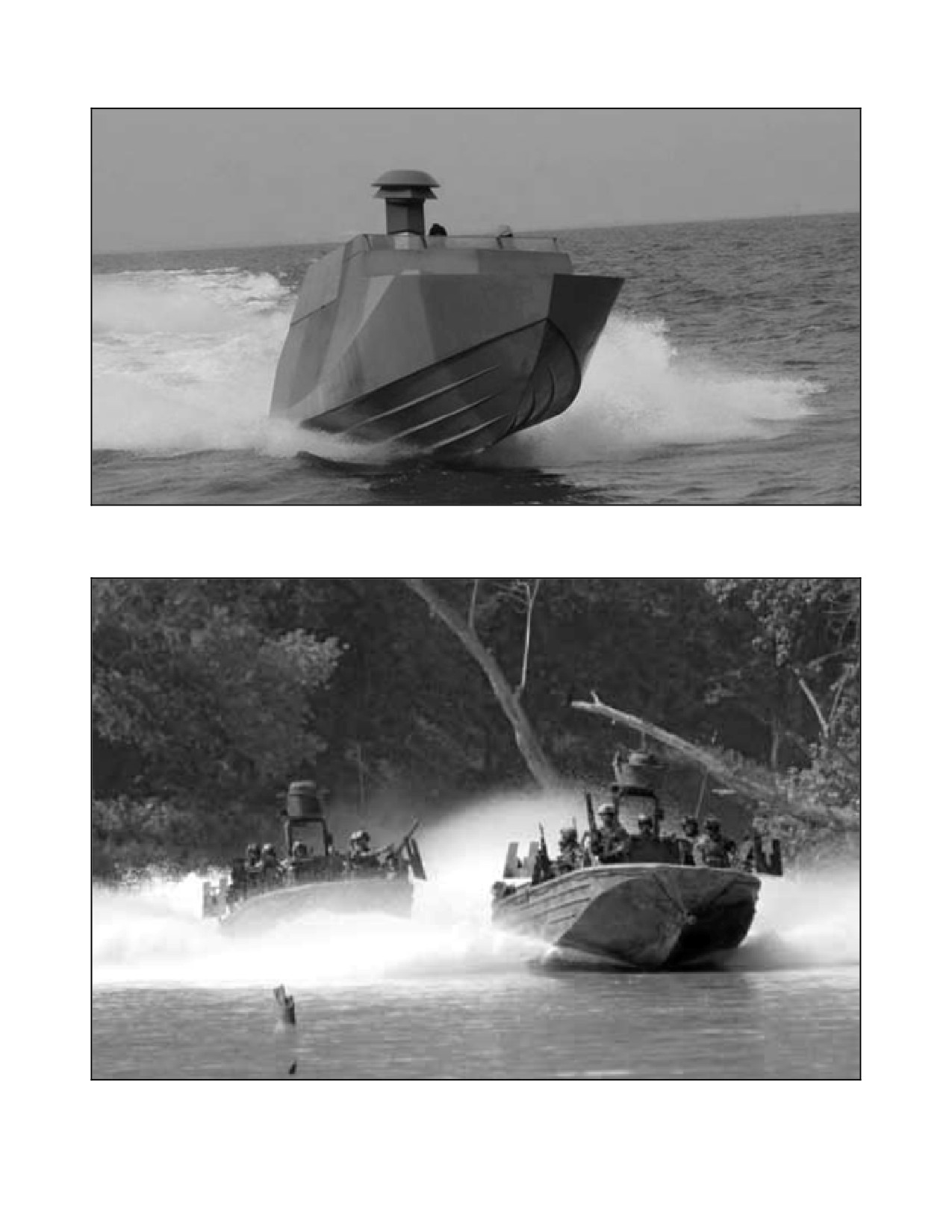
NWP 3-05
Figure A-5. Combatant Craft-Assault
Figure A-6. Special Operations Craft-Riverine
MAY 2013
A-6
NWP 3-05
The SOC-R water-jet propulsion allows for shallow water operations at full throttle, providing quick extractions
if the situation warrants. The large bow and stern gunwale flats are designed for quick embarkation and
debarkation. The 1/4-inch aluminum-hull bottom, coupled with zero appendage drag of the water jet, allows for
operating in debris-congested waters. Narrow waterways of just over 26 feet can be operated in effectively
because of the craft’s ability to spin about a pivot point. The SOC-R has been certified for low-velocity airdrop,
internal air transport, and maritime external air transportation system (MEATS).
A.3.4 Combatant Craft-Light
The CCL is any craft that could be operated by a single operator and carry two to four passengers. The CRRC
(average 15 feet in length) is an inflatable CCL capable of carrying four or five combat-equipped SEALs or other
personnel for landing and recovery (insertion/extraction) on a beach/shore over short distances. It may be
deck-launched/recovered from surface vessels, parachuted from various aircraft (referred to as a rubber duck
drop), or cast or lowered from H-53, H-47, and H-60 helicopters. The cast technique of strapping the CRRC to
the bottom of an H-60 is referred to as a Kangaroo Duck (figure A-7). CRRCs are also locked out/-in from a
submarine escape trunk or DDS for launch and recovery from a submerged submarine. In a low-threat
environment, a submarine may surface to launch a CRRC.
A.3.5 Master Mariner Program
A master mariner detachment is a four-man element composed of selected, mature, SWCC trained to operate a
wide variety of commercial and other civilian vessels of any size. This capability can be employed overtly or
clandestinely and expands flexibility of the force to operate where military craft are not available or with a
negligible U.S. signature.
A.4 AIR INSERTION
Air insertion can be the quickest method to deliver SEALs and equipment to an objective area for a time-sensitive
target. Water parachute drop of personnel and combatant craft can be used as an insertion method or for
rendezvous with a ship or submarine at sea. All SEALs and designated SWCC and CS personnel are qualified for
static line and freefall water parachute drops.
A.4.1 Maritime Craft Aerial Delivery System
MCADS is a rapid deployment and insertion method used by NSW to deliver combat-ready SEALs with RIBs
quickly and safely to a water drop zone (figure A-8). In an MCADS drop, two to four RIBs and crews parachute
from C-130s (one RIB each) or C-17s (two RIBs each) with SEALs and equipment. Once on the water, the boats
can rendezvous with an AFSB or other ship, transit to a port or operating base, or, for a time-sensitive situation,
proceed directly to the target. If refueling support is unavailable, the RIB can be refueled from an air-dropped fuel
blivet.
A.4.2 Rotary Wing
Rotary-wing support can be provided by many sources from various Services and agencies and include
SOF-dedicated as well as conventional fleet and other Service helicopters. Rotary-wing platforms provide
precision over-land and over-water insertion and extraction, ISR, and fire support. Rotary-wing aircraft are also
used by SEAL snipers as over-watch platforms for fire support and to assist in guiding tactical movement of
forces during assaults.
Rotary-wing insertion techniques include parachuting, rappelling, fast roping, cast and recovery of CRRCs and
SEALs, air-land insertion, and MEATS of combatant craft and SDVs (figure A-9).
Air-land refers to an operation in which the aircraft momentarily touches down to disembark SEALs and
equipment, which may include vehicles.
A-7
MAY 2013

NWP 3-05
Figure A-7. Kangaroo Duck
Figure A-8. Maritime Craft Aerial Delivery System
MAY 2013
A-8

NWP 3-05
Figure A-9. H-60 Fast Rope Insertion
MEATS is a rapid deployment and insertion method used by NSW to deliver combat-ready SPECBOATDETs or
SDV platoons into forward positions for a tactical advantage. In MEATS operations, a combatant craft can be
slung beneath a CH-53 or a CH-47 for transits of up to 100 miles to a forward insertion point. Once released
from the helicopter, boats can proceed directly to the objective.
The Navy’s primary NSW rotary-wing forces are SO-dedicated helicopter sea combat (HSC) squadrons that train
and deploy specifically in support of SOF. HSC’s HH-60H and MH-60S helicopters have cabin space for
assaulters, multispectral sensors for ISR, and can be configured with a variety of automatic weapons and
AGM-114 Hellfire missiles for close air support. Other Navy rotary-wing assets employed by NSW include
MH-60Rs flown by Navy helicopter maritime strike (HSM) squadrons to provide ISR, over-water targeting
sensors, and communications packages. Best used in an airborne mission commander role, sniper platform, or
antisurface strike platform, the MH-60R is limited in lift capability due to weight and space restrictions. Mine
countermeasures (HM) squadrons fly the Navy’s MH-53E and can provide NSW with heavy lift capability when
required.
A.5 TACTICAL GROUND MOBILITY
Historically, NSW forces have employed boats, submarines, small submersibles, parachute, air-land, or foot patrol
for insertions and extractions. In the 1980s, NSW first developed a tactical vehicle capability, and the capability
evolved quickly in the first decade of the 2000s to deal with the threat in Iraq and Afghanistan.
NSW forces now maintain an organic tactical vehicle capability to travel long distances over land unassisted.
Tactical vehicles increase the mobility, survivability, lethality, and flexibility of NSW forces. The primary
mission of NSW tactical mobility assets is to transport SEAL patrols to and from insertion and extraction points
A-9
MAY 2013

NWP 3-05
in support of direct action and special reconnaissance missions. In addition to transiting to the target, vehicles can
contribute fire support, security forces, quick reaction forces, casualty evacuation, and tactical convoy
capabilities.
Compared to SEAL foot patrols, vehicles have greater range, speed, and payload, which allows for more fire
power and longer-duration missions. Compared to air insertion, vehicles provide greater on-station time, are not
restricted to landing zones or drop zones, and are generally stealthier than a helicopter. Because they are organic
to NSW, these tactical vehicles are more available and more responsive to requirements than aircraft or vehicles
controlled by other forces which require extra coordination and may have competing priorities. In the inland
deserts and mountains of Iraq and Afghanistan, there were many cases where NSW ground mobility platforms
were the only short-notice insertion method available. From 2001 to 2010, more than 90 percent of NSW missions
in Iraq and Afghanistan relied, to some extent, on NSW tactical vehicles.
NSW ground mobility platforms are based on USSOCOM’s family of SO vehicles and include individual, light,
medium, and heavy vehicles. Individual vehicles include the mobile over snow transport, a militarized
snowmobile; motorcycles; and the light tactical all-terrain vehicle (LTATV), which has been used extensively in
Afghanistan (figure A-10). Light vehicles include modified commercial vehicles and the internally transportable
vehicle, which is internally transportable in CH-47 and CV-22 (figure A-11). Medium vehicles include the
ground mobility vehicle (GMV); and heavy vehicles include variations of the mine-resistant ambush-protected
vehicle (MRAP) (figure A-12).
Makeup of a tactical ground mobility element will vary with the conditions and the requirements. A typical
Afghanistan tactical ground mobility-light element supporting two SEAL platoons was four GMV and nine
LTATV accompanied by two maintenance personnel. An Afghanistan tactical ground mobility-heavy element
included the vehicles from the light element plus two RG33 MRAPs, two armored utility variant MRAPs, and six
MRAP all-terrain vehicles with three maintenance personnel. Further information is available in NTTP 3-05.9,
Naval Special Warfare Tactical Ground Mobility.
Figure A-10. Light Tactical All-terrain Vehicle
MAY 2013
A-10

NWP 3-05
Figure A-11. Internally Transportable Vehicle
Figure A-12. RG31 A3 Mine-resistant Ambush-protected Vehicle
A-11
MAY 2013
NWP 3-05
INTENTIONALLY BLANK
MAY 2013
A-12
NWP 3-05
REFERENCES
JOINT
JP 3-05, Special Operations
JP 4-0, Joint Logistics
JP 5-0, Joint Operation Planning and Execution System
Secretary of Defense Letter of 11 Feb 2013. Subj: FY 2013 Forces for Unified Commands Memorandum
USSOCOM Capability Development and Programming Guidance 2015-2019 of 31 Oct 2012
USSOCOM Directive 10-1, Terms of Reference for Component Commanders
USSOCOM Directive 350-12, Joint Special Operations Task Force
USSOCOM Directive 525-16, Preparation of the Environment
USSOCOM Pub 1, Doctrine for Special Operations
U.S. NAVY
COMNAVSPECWARCOM Instruction 3500.1, NSW Force Training Manual.
Memorandum of Agreement between Department of the Navy and USSOCOM of 30 April 2010
NTTP 3-05.1, Naval Special Warfare Battle Staff Operations
NTTP 3-05.1.3, Naval Special Cold Weather/Mountain Operations
NTTP 3-05.14, Naval Special Warfare Noncombatant Evacuation Operations
NTTP 3-05.15, Naval Special Warfare Unmanned Aircraft System Operations
NTTP 3-05.2, SEAL Land Warfare
NTTP 3-05.2.1, Naval Special Warfare-Breaching Operations
NTTP 3-05.21, Naval Special Warfare Combat Swimmer Operations
NTTP 3-05.23, SEAL Demolition Manual
NTTP 3-05.24, Naval Special Warfare Urban Combat, Shipboarding, and Gas and Oil Platform Operations
NTTP 3-05.3.1, Naval Special Warfare-Sniper Operations
NTTP 3-05.4, Naval Special Warfare Submarine Operations Manual
Reference-1
MAY 2013
NWP 3-05
NTTP 3-05.42, SEAL Delivery Vehicle Tactics Handbook
NTTP 3-05.5, Naval Special Warfare-PE
NTTP 3-05.7, Naval Special Warfare Foreign Internal Defense
NTTP 3-05.9, Naval Special Warfare Tactical Ground Mobility
NTTP 3-06.5, Naval Special Warfare Riverine Operations
NTTP 3-07.11M, Maritime Interception Operations
NTTP 3-07.11.1, Surface Ships in Support of Naval Special Warfare Operations
NTTP 3-09.2.2, Naval Special Warfare Fires Supplement to MTTP for the Joint Application of Firepower
NWP 3-05.41, Naval Special Warfare Logistics
NWP 3-62M, Seabasing
MAY 2013
Reference-2
NWP 3-05
GLOSSARY
administrative control. Direction or exercise of authority over subordinate or other organizations in respect to
administration and support. (JP 1-02. Source: JP 1)
allocation. Distribution of limited forces and resources for employment among competing requirements.
(JP-02. Source: JP 5-0)
apportionment. In the general sense, distribution of forces and capabilities as the starting point for planning.
See also allocation. (JP 2. Source: JP 5-0)
assigned forces. Those forces and resources that have been placed under the combatant command (command
authority) of a unified commander in the Forces for Unified Commands Memorandum. Forces and resources so
assigned are available for normal peacetime operations of that command. (NTRP 1-02)
clandestine operation. An operation sponsored or conducted by governmental departments or agencies in
such a way as to assure secrecy or concealment. A clandestine operation differs from a covert operation in that
emphasis is placed on concealment of the operation rather than on concealment of identity of the sponsor. In
special operations, an activity may be both covert and clandestine and may focus equally on operational
considerations and intelligence-related activities. (JP 1-02. Source: JP 3-05.1)
close support. That action of the supporting force against targets or objectives which are sufficiently near the
supported force as to require detailed integration or coordination of the supporting action with the fire,
movement, or other actions of the supported force. (JP 1-02. Source: JP 3-31)
combatant command (command authority). Nontransferable command authority, which cannot be
delegated, of a combatant commander to perform those functions of command over assigned forces involving
organizing and employing commands and forces; assigning tasks; designating objectives; and giving
authoritative direction over all aspects of military operations, joint training, and logistics necessary to
accomplish the missions assigned to the command. (JP 1-02. Source: JP 1)
combat service support (CSS). The essential capabilities, functions, activities, and tasks necessary to
sustain all elements of operating forces in theater at all levels of war. Within the national and theater logistic
systems, it includes but is not limited to that support rendered by service forces in ensuring the aspects of
supply, maintenance, transportation, health services, and other services required by aviation and ground combat
teams to permit those units to accomplish their missions in combat. Combat service support encompasses those
activities at all levels of war that produce sustainment to all operating forces on the battlefield.
(JP 1-02. Source: JP 4-0)
combat support (CS). Fire support and operational assistance provided to combat elements.
(JP 1-02. Source: JP 4-0)
combined. (DOD) Between two or more forces or agencies of two or more allies. (When all allies or services
are not involved, the participating nations and services shall be identified, e.g., combined navies.) (JP 1-02.)
coordinating authority. The commander or individual who has the authority to require consultation between
the specific functions or activities involving forces of two or more Services, joint force components, or forces
of the same Service or agencies, but does not have the authority to compel agreement. (JP 1-02. Source: JP 1).
Glossary-1
MAY 2013
NWP 3-05
counterinsurgency. Comprehensive civilian and military efforts taken to defeat insurgency and to address any
core grievances. (JP 1-02. Source: JP 3-24)
counterterrorism. Actions taken directly against terrorist networks and indirectly to influence and render
global and regional environments inhospitable to terrorist networks. (JP 1-02. Source: JP 3-26)
covert operation. An operation that is so planned and executed as to conceal the identity of or permit plausible
denial by the sponsor. See also clandestine operation; overt operation. (JP 1-02. Source: JP 3-05)
cross-functional team. An NSWG-10 ISR/PE-centric element focused on the fusion of intelligence
collection and analysis functions to provide organic NSW support for the find, fix, finish, exploit, analyze, and
disseminate (F3EAD) targeting cycle. (NTRP 1-02)
deconflict. To prevent a hostile encounter between forces, usually between friendly forces in the same area of
operations. (NTRP 1-02)
direct action. Short-duration strikes and other small-scale offensive actions conducted as a special operation in
hostile, denied, or diplomatically sensitive environments and which employ specialized military capabilities to
seize, destroy, capture, exploit, recover, or damage designated targets. (JP 1-02. Source: JP 3-05)
direct liaison authorized. That authority granted by a commander (any level) to a subordinate to directly
consult or coordinate an action with a command or agency within or outside of the granting command.
(JP 1-02. Source: JP 1)
direct support. A mission requiring a force to support another specific force and authorizing it to answer
directly to the supported force's request for assistance. (JP 1-02. Source: JP 3-09.3)
exfiltrate. The movement of personnel or units from areas under enemy control by stealth, deception, surprise,
or clandestine means. (NTRP 1-02)
extraction. The removal, by some type of platform, of personnel or units from areas under enemy control.
(NTRP 1-02)
female support technicians. Specially vetted and trained Navy female combat support personnel.
foreign internal defense (FID). Participation by civilian and military agencies of a government in any of the
action programs taken by another government or other designated organization to free and protect its society
from subversion, lawlessness, insurgency, terrorism, and other threats to its security. (JP 1-02. Source: JP 3-22)
general support. That support which is given to the supported force as a whole and not to any particular
subdivision thereof. (JP 1-02. Source: JP 3-09.3)
global force management. A process that provides near-term sourcing solutions while providing the
integrating mechanism between force apportionment, allocation, and assignment. (JP 1-02. Source: JP 3-35)
infiltration.
1. The movement through or into an area or territory occupied by either friendly or enemy teams or
organizations. The movement is made, either by small groups or by individuals, at extended or irregular
intervals. When used in connection with the enemy, it implies that contact is avoided. 2. In intelligence usage,
placing an agent or other person in a target area in hostile territory. Usually involves crossing a frontier or other
guarded line. Methods of infiltration are: black (clandestine); gray (through legal crossing but under false
documentation); white (legal). (JP 1-02. Source: JP 3-05.1)
information operations. The integrated employment during military operations, of information-related
capabilities, in concert with other lines of operation, to influence, disrupt, corrupt, or usurp the decisionmaking
of adversaries and potential adversaries while protecting our own. (JP 1-02. Source: JP 3-13)
MAY 2013
Glossary-2
NWP 3-05
insertion. 1. Placement of teams and equipment into an operational area in air assault operations. 2. Placement
of observation posts, patrols, or raiding parties by helicopter, parachute, watercraft, or other means. Stealth is
normally desired in the execution of an insertion. (NTRP 1-02)
insurgency. The organized use of subversion and violence by a group or movement that seeks to overthrow or
force change of a governing authority. Insurgency can also refer to the group itself. (JP 1-02. Source: JP 3-24)
intelligence. The product resulting from the collection, processing, integration, evaluation, analysis, and
interpretation of available information concerning foreign nations, hostile or potentially hostile forces or
elements, or areas of actual or potential operations. The term is also applied to the activity which results in the
product and to the organizations engaged in such activity. (JP 1-02. Source: JP 2-0)
joint. Connotes activities, operations, organizations, etc., in which elements of two or more Military
Departments participate. (JP 1-02. Source: JP 1)
joint force commander. A general term applied to a combatant commander, subunified commander, or joint
task force commander authorized to exercise combatant command (command authority) or operational control
over a joint force. (JP 1-02. Source: JP 1)
joint special operations task force. A joint task force composed of special operations units from more than
one Service, formed to carry out a specific special operation or prosecute special operations in support of a
theater campaign or other operations. (JP 1-02. Source: JP 3-05)
logistics support unit. Provides administrative, maintenance, logistical, and medical support to a naval
special warfare group and its subordinate sea-air-land teams. Abbreviated as LOGSU.
low visibility operations. Sensitive operations wherein the political-military restrictions inherent in covert
and clandestine operations are either not necessary or not feasible; actions are taken as required to limit
exposure of those involved and/or their activities. Execution of these operations is undertaken with the
knowledge that the action and/or sponsorship of the operation may preclude plausible denial by the initiating
power. (JP 1-02. Source: JP 3-05.1)
maritime interception operations. Efforts to monitor, query, and board merchant vessels in international
waters to enforce sanctions against other nations such as those in support of United Nations Security Council
Resolutions and/or prevent the transport of restricted goods. (JP 1-02. Source: JP 3-0)
military information support operations. Planned operations to convey selected information and indicators
to foreign audiences to influence their emotions, motives, objective reasoning, and ultimately the behavior of
foreign governments, organizations, groups, and individuals in a manner favorable to the originator’s
objectives. (JP 1-02. Source: JP 3-13.2)
mobile training team. A team consisting of one or more U.S. military or civilian personnel sent on temporary
duty, often to a foreign nation, to give instruction. The mission of the team is to train indigenous personnel to
operate, maintain, and employ weapons and support systems, or to develop a self-training capability in a
particular skill. The Secretary of Defense may direct a team to train either military or civilian indigenous
personnel, depending upon host-nation requests. (JP 1-02)
mutual support. That support which units render each other against an enemy, because of their assigned tasks,
their position relative to each other and to the enemy, and their inherent capabilities. (JP1-02. Source: JP 3-31)
naval special warfare. A naval warfare specialty that conducts operations with emphasis on maritime, coastal,
and riverine environments using small, flexible, mobile units operating under, on, and from the sea.
(JP 1-02. Source: JP 3-05)
Glossary-3
MAY 2013
NWP 3-05
naval special warfare group (NSWG). A permanent Navy echelon III major command to which most naval
special warfare forces are assigned for some operational and all administrative purposes. It consists of a group
headquarters with command and control, communications, and support staff; sea-air-land teams; and sea-air-
land team delivery vehicle teams (JP 1-02. Source: JP 3-05.1)
naval special warfare task element (NSWTE). A temporary, task-organized operational component of a
naval special warfare task unit, tailored to a specific operational requirement (e.g., all or part of a SEAL team
platoon and all or part of a special boat detachment, etc.) (NTRP 1-02)
naval special warfare task force (NSWTF). A provisional naval special warfare organization that plans,
conducts, and supports special operations in support of joint special operations task force commanders and
fleet commanders. It may be the naval component of a joint special operations task force, or its commander
may command the joint special operations task force. It is normally commanded by a naval special warfare unit
commanding officer or a naval special warfare group commander. It provides command and control of one or
more naval special warfare task groups. Within a theater, this may be a standing organization, an organization
created to address a unique, emergent operational requirement, or an organization activated only for planning,
exercises, or contingencies. (NTRP 1-02)
naval special warfare task group (NSWTG). A provisional naval special warfare organization that plans,
conducts, and supports special operations in support of joint force special operations component commanders
and/or fleet commanders. It comprises a command and control element and one or more subordinate naval
special warfare task units. It is often commanded by a SEAL team commander (O-5), normally the
commanding officer of a deployed naval special warfare squadron. (NTRP 1-02)
naval special warfare task unit (NSWTU). A provisional naval special warfare organization and
subordinate unit of a naval special warfare task group. Normally commanded by a SEAL team lieutenant
commander (O-4), a naval special warfare task unit consists of a command and control element, an operational
element, and other attachments, e.g., mobility element. (NTRP 1-02)
naval special warfare unit (NSWU). A permanent Navy organization under the combatant command
(command authority) of a geographic combatant commander that provides for command and control and
support of designated naval special warfare forces under the operational control of that geographic combatant
commander. (NTRP 1-02)
noncombatant evacuation operations. Operations directed by the Department of State or other appropriate
authority, in conjunction with the Department of Defense, whereby noncombatants are evacuated from foreign
countries when their lives are endangered by war, civil unrest, or natural disaster to safe havens as designated
by the Department of State. See also evacuation; geospatial-intelligence contingency package; noncombatant
evacuees; operation; safe haven. (JP 1-02. Source: JP 3-68)
operational control (OPCON). The authority to perform those functions of command over subordinate forces
involving organizing and employing commands and forces, assigning tasks, designating objectives, and giving
authoritative direction necessary to accomplish the mission. (JP 1-02. Source: JP 1)
preparation of the environment. An umbrella term for operations and activities conducted by selectively
trained special operations forces to develop an environment for potential future special operations. Also called
PE. (JP 1-02. Source: JP 3-05)
reconnaissance. A mission undertaken to obtain, by visual observation or other detection methods,
information about the activities and resources of an enemy or adversary or to secure data concerning the
meteorological, hydrographic, or geographic characteristics of a particular area. (JP 1-02. Source: JP 2-0)
SEAL delivery vehicle platoon (SDV PLT). The deployable, operational entity of a SEAL delivery vehicle
team. A SEAL delivery vehicle platoon consists of a SEAL delivery vehicle, an operational (SEAL) element,
and support personnel. (NTRP 1-02)
MAY 2013
Glossary-4
NWP 3-05
SEAL delivery vehicle team (SDVT). US Navy special operations command, normally commanded by a
SEAL team commander (O-5), that organizes, trains, and equips Navy special operations forces to operate
SEAL delivery vehicle platoons, dry deck shelter platoons, and advanced SEAL delivery system task units.
(SEAL delivery vehicle team ONE only). (NTRP 1-02)
SEAL team. US Navy special operations unit or command, normally commanded by a SEAL team commander
(O-5), that organizes, trains, and equips Navy special operations force to conduct special operations with a
focus on operations in maritime, littoral, and riverine environments. (NTRP 1-02)
security assistance. Group of programs authorized by the Foreign Assistance Act of 1961, as amended, and
the Arms Export Control Act of 1976, as amended, or other related statutes by which the United States
provides defense articles, military training, and other defense-related services, by grant, loan, credit, or cash
sales in furtherance of national policies and objectives. Security Assistance is an element of Security
cooperation funded and authorized by Department of State to be administered by Department of
Defense/Defense Security Cooperation Agency. (JP 1-02. Source: JP 3-22)
security cooperation. All Department of Defense interactions with foreign defense establishments to build
defense relationships that promote specific US security interests, develop allied and friendly military
capabilities for self-defense and multinational operations, and provide US forces with peacetime and
contingency access to a host nation. (JP 1-2. Source: JP 3-22)
security force assistance. The Department of Defense activities that contribute to unified action by the US
Government to support the development of the capacity and capability of foreign security forces and their
supporting institutions. Also called SFA. (JP 1-02. Source: JP 3-22)
special boat team (SBT). US Navy special operations command, normally commanded by a SEAL team
commander (O-5), that organizes, trains, and equips Navy special operations forces to conduct or support
special operations employing combatant and other craft. (NTRP 1-02)
special boat team (SBTP). The deployable, operational entity of a special boat team normally commanded by
a SEAL team lieutenant (O-3) and consisting of a small command and control element, combat service support
and other capabilities, and one or more special boat detachments. (NTRP 1-02)
special operations. Operations requiring unique modes of employment, tactical techniques, equipment, and
training often conducted in hostile, denied, or politically sensitive environments and characterized by one or
more of the following: time sensitive, clandestine, low visibility, conducted with and/or through indigenous
forces, requiring regional expertise, and/or a high degree of risk (JP 1-02. Source: JP 3-05)
special operations forces. Those active and Reserve Component forces of the Military Services designated
by the Secretary of Defense and specifically organized, trained, and equipped to conduct and support special
operations. (JP 1-02. Source: JP 3-05.1)
special reconnaissance. Reconnaissance and surveillance actions conducted as a special operation in hostile,
denied, or politically sensitive environments to collect or verify information of strategic or operational
significance, employing military capabilities not normally found in conventional forces.
(JP 1-02. Source: JP 3-05)
special warfare combatant-craft crewman (SWCC). US Navy special operations personnel that operate
combatant and other craft to conduct special operations. (NTRP 1-02)
support. An element of a command that assists, protects, or supplies other forces in combat.
(JP 1-02. Source: JP 1)
Glossary-5
MAY 2013
NWP 3-05
tactical control. Command authority over forces that is limited to the detailed direction and control of
movements or maneuvers within the operational area necessary to accomplish missions or tasks assigned.
(JP 1-02. Source: JP 1)
unconventional warfare. Activities conducted to enable a resistance movement or insurgency to coerce,
disrupt, or overthrow a government or occupying power by operating through or with an underground,
auxiliary, and guerrilla force in a denied area. (JP 1-02. Source: JP 3-05)
MAY 2013
Glossary-6