Military reference books and manuals (2009-2023, Volume 8) - page 42
NWP 2-01
November 2010
PUBLICATION NOTICE
ROUTING
1. NWP 2-01 (NOV 2010), INTELLIGENCE SUPPORT TO NAVAL
OPERATIONS, is available in the Navy Warfare Library. It is effective upon
receipt.
2. Summary. NWP 2-01 (NOV 2010), INTELLIGENCE SUPPORT TO NAVAL
OPERATIONS, is a complete rewrite of NWP 2-01 (JAN 1997),
INTELLIGENCE SUPPORT TO OPERATIONS AFLOAT. NWP 2-01 (NOV
2010), INTELLIGENCE SUPPORT TO NAVAL OPERATIONS, is a
comprehensive reference detailing the intelligence support available to the
operational commander. It also serves as a ready resource for the Information
Dominance Corps intelligence professionals, information warfare officers, and
cryptologic technicians.
Navy Warfare Library Custodian
Navy Warfare Library publications must be made
readily available to all users and other interested
personnel within the U.S. Navy. Classified Navy
Warfare Library publications are to be treated in the
same manner as other classified information.
Note to Navy Warfare Library Custodian
This notice should be duplicated for routing to cognizant personnel to keep them informed of changes to this publication.
5
NOV 2010
NWP 2-01
INTENTIONALLY BLANK
NOV 2010
6
NWP 2-01
CONTENTS
Page
No.
CHAPTER 1 — INTRODUCTION
1.1
GENERAL
1-1
1.2
PURPOSE
1-1
1.3
SCOPE
1-1
1.3.1
Chapter 1 — Introduction
1-1
1.3.2
Chapter 2 — Navy Intelligence Enterprise
1-2
1.3.3
Chapter 3 — Navy Intelligence Operations
1-2
1.3.4
Chapter 4 — Support to Navy Intelligence Forward
1-2
1.4
A COOPERATIVE STRATEGY FOR 21ST CENTURY SEAPOWER
1-2
1.4.1
Forward Presence
1-2
1.4.2
Deterrence
1-2
1.4.3
Sea Control
1-2
1.4.4
Power Projection
1-3
1.4.5
Maritime Security
1-3
1.4.6
Humanitarian Assistance and Disaster Response
1-3
1.5
INFORMATION DOMINANCE
1-3
1.6
MARITIME DOMAIN AWARENESS
1-4
CHAPTER 2 — NAVY INTELLIGENCE ENTERPRISE
2.1
INTRODUCTION
2-1
2.2
ROLES AND RESPONSIBILITIES
2-1
2.2.1
Fleet Commander N2/N39
2-1
2.2.2
Director of Fleet Intelligence
2-1
2.2.3
Numbered Fleet N2
2-2
2.2.4
Numbered Fleet Cryptologist
2-2
2.2.5
Carrier Strike Group
2-2
2.2.6
Expeditionary Strike Group/Amphibious Squadron
2-5
2.2.7
Destroyer Squadron N2
2-8
2.2.8
Collateral Duty Intelligence Officer/Independent Duty Intelligence Specialist
2-8
2.2.9
Shipborne Unmanned Aerial Vehicle Intelligence Detachment Officer in Charge
2-8
2.2.10
Intelligence Specialist
2-9
2.2.11
Cryptologic Technician
2-9
2.2.12
Patrol and Reconnaissance Group N2
2-11
2.2.13
Naval Special Warfare Command N2/N39
2-12
2.2.14
Navy Expeditionary Combat Command N2
2-13
2.2.15
Mine Warfare Staff N2
2-13
2.2.16
Naval Strike and Air Warfare Center N2
2-13
7
NOV 2010
NWP 2-01
Page
No.
2.3
FLEET INTELLIGENCE DETACHMENT
2-13
2.4
FLEET INTELLIGENCE ADAPTIVE FORCE
2-14
2.5
CRYPTOLOGIC DIRECT SUPPORT
2-15
2.6
CRYPTOLOGIC CARRY-ON PROGRAM
2-15
CHAPTER 3 — NAVY INTELLIGENCE OPERATIONS
3.1
INTRODUCTION
3-1
3.2
LEVELS OF INTELLIGENCE
3-1
3.2.1
Strategic Intelligence
3-1
3.2.2
Operational Intelligence
3-1
3.2.3
Tactical Intelligence
3-2
3.3
INTELLIGENCE PROCESS
3-2
3.3.1
Planning and Direction
3-3
3.3.2
Collection
3-4
3.3.3
Processing and Exploitation
3-4
3.3.4
Analysis and Production
3-4
3.3.5
Dissemination and Integration
3-4
3.3.6
Evaluation and Feedback
3-5
3.4
INTELLIGENCE PREPARATION OF THE OPERATIONAL ENVIRONMENT
3-5
3.4.1
Define the Operational Environment
3-6
3.4.2
Describe the Impact of the Operational Environment
3-6
3.4.3
Evaluate the Adversary
3-6
3.4.4
Determine and Describe Adversary Courses of Action
3-6
3.4.5
Special Considerations
3-6
3.5
INTELLIGENCE ORGANIZATION
3-7
3.5.1
Joint Task Force/Joint Force Maritime Component Commander/Navy Component
Commander
3-7
3.5.2
Maritime Intelligence Operations Center
3-11
3.5.3
Carrier Strike Group
3-11
3.5.4
Expeditionary Strike Group/Amphibious Ready Group/Marine Expeditionary Unit
3-13
3.5.5
Destroyer Squadron
3-14
3.5.6
Maritime Patrol and Reconnaissance
3-15
3.5.7
Naval Special Warfare
3-16
3.5.8
Navy Expeditionary Forces
3-16
3.6
INTELLIGENCE AND THE RANGE OF MILITARY OPERATIONS
3-16
3.6.1
Major Operations and Campaigns
3-17
3.6.2
Crisis Response and Limited Contingency Operations
3-17
3.6.3
Military Engagement, Security Cooperation, and Deterrence
3-18
3.7
CORE NAVAL MISSION AREAS
3-18
3.7.1
Composite Warfare Commander Concept
3-18
3.7.2
Strike Warfare/Targeting
3-19
3.7.3
Surface Warfare
3-23
NOV 2010
8
NWP 2-01
Page
No.
3.7.4
Air Warfare
3-23
3.7.5
Amphibious Warfare
3-24
3.7.6
Antisubmarine Warfare
3-24
3.7.7
Mine Warfare
3-24
3.7.8
Naval Special Warfare
3-25
3.7.9
Expeditionary Warfare
3-25
3.7.10
Irregular Warfare
3-25
3.7.11
Information Operations
3-26
CHAPTER 4 — SUPPORT TO NAVY INTELLIGENCE FORWARD
4.1
INTRODUCTION
4-1
4.2
NATIONAL LEVEL SUPPORT
4-1
4.2.1
Department of Defense Intelligence and Combat Support Agencies
4-1
4.2.2
Nonmilitary Members of the Intelligence Community
4-3
4.3
THEATER-LEVEL SUPPORT
4-5
4.3.1
Combatant Command J2
4-5
4.3.2
Combatant Command Joint Intelligence Operations Center
4-5
4.3.3
Cruise Missile Support Activity
4-5
4.3.4
Joint Warfare Analysis Center
4-6
4.3.5
Missile and Space Intelligence Center
4-6
4.3.6
Joint Information Operations Warfare Center
4-6
4.3.7
Joint Personnel Recovery Agency
4-6
4.4
JOINT TASK FORCE SUPPORT
4-6
4.4.1
Joint Task Force J2
4-7
4.4.2
Joint Intelligence Support Element
4-8
4.4.3
Joint Force Counterintelligence and Human Intelligence Staff Element
4-8
4.4.4
National Intelligence Support Team
4-8
4.5
SERVICE COMPONENT SUPPORT
4-9
4.5.1
United States Navy
4-9
4.5.2
United States Marine Corps
4-14
4.5.3
United States Air Force
4-14
4.5.4
United States Army
4-15
4.6
INTELLIGENCE SHARING AND COOPERATION
4-16
4.7
NEW CHALLENGES IN THE NAVAL INTELLIGENCE COMMUNITY
4-16
9
NOV 2010
NWP 2-01
LIST OF ILLUSTRATIONS
Page
No.
CHAPTER 2 — NAVY INTELLIGENCE ENTERPRISE
Figure 2-1.
Fully Implemented Intelligence Manpower Alignment, Carrier Strike Group/Amphibious
Ready Group
2-14
CHAPTER 3 — NAVY INTELLIGENCE OPERATIONS
Figure 3-1.
The Intelligence Process
3-2
Figure 3-2.
Relationship Between Intelligence Requirements and Information Requirements
3-3
Figure 3-3.
Intelligence Preparation of the Operational Environment — The Process
3-5
Figure 3-4.
Possible Joint Task Force Organization
3-7
Figure 3-5.
Typical Joint Task Force Staff Organization
3-8
Figure 3-6.
Notional Subordinate Joint Task Force Intelligence Organization
3-9
Figure 3-7.
Notional Joint Force Maritime Component Commander Functional Organization
3-10
Figure 3-8.
Carrier Strike Group Operational Organization
3-12
Figure 3-9.
Destroyer Squadron N2 Organization
3-15
Figure 3-10.
Maritime Patrol and Reconnaissance N2 Organization
3-15
Figure 3-11.
The Joint Targeting Cycle
3-20
NOV 2010
10
NWP 2-01
PREFACE
Unless otherwise stated, masculine nouns and pronouns do not refer exclusively to men.
Report administrative discrepancies by letter, message, or e-mail to:
COMMANDER
NAVY WARFARE DEVELOPMENT COMMAND
ATTN: DOCTRINE
1528 PIERSEY STREET BLDG O-27
NORFOLK VA 23511-2723
NWDC_NRFK_FLEETPUBS@NAVY.MIL
ORDERING DATA
Order printed copies of a publication using the Print on Demand (POD) system. A command may requisition a
publication using standard military standard requisitioning and issue procedure (MILSTRIP) procedures or the
Naval Supply Systems Command website called the Naval Logistics Library (https://nll1.ahf.nmci.navy.mil). An
approved requisition is forwarded to the specific DAPS site at which the publication’s electronic file is officially
stored. Currently, two copies are printed at no cost to the requester.
CHANGE RECOMMENDATIONS
Procedures for recommending changes are provided below.
WEB-BASED CHANGE RECOMMENDATIONS
Recommended changes to this publication may be submitted to the Navy Doctrine Library System, accessible
through the Navy Warfare Development Command website at: http://ndls.nwdc.navy.smil.mil or
URGENT CHANGE RECOMMENDATIONS
When items for changes are considered urgent, send this information by message to the Primary Review
Authority, info NWDC. Clearly identify and justify both the proposed change and its urgency. Information
addressees should comment as appropriate. See accompanying sample for urgent change recommendation format
on page 13.
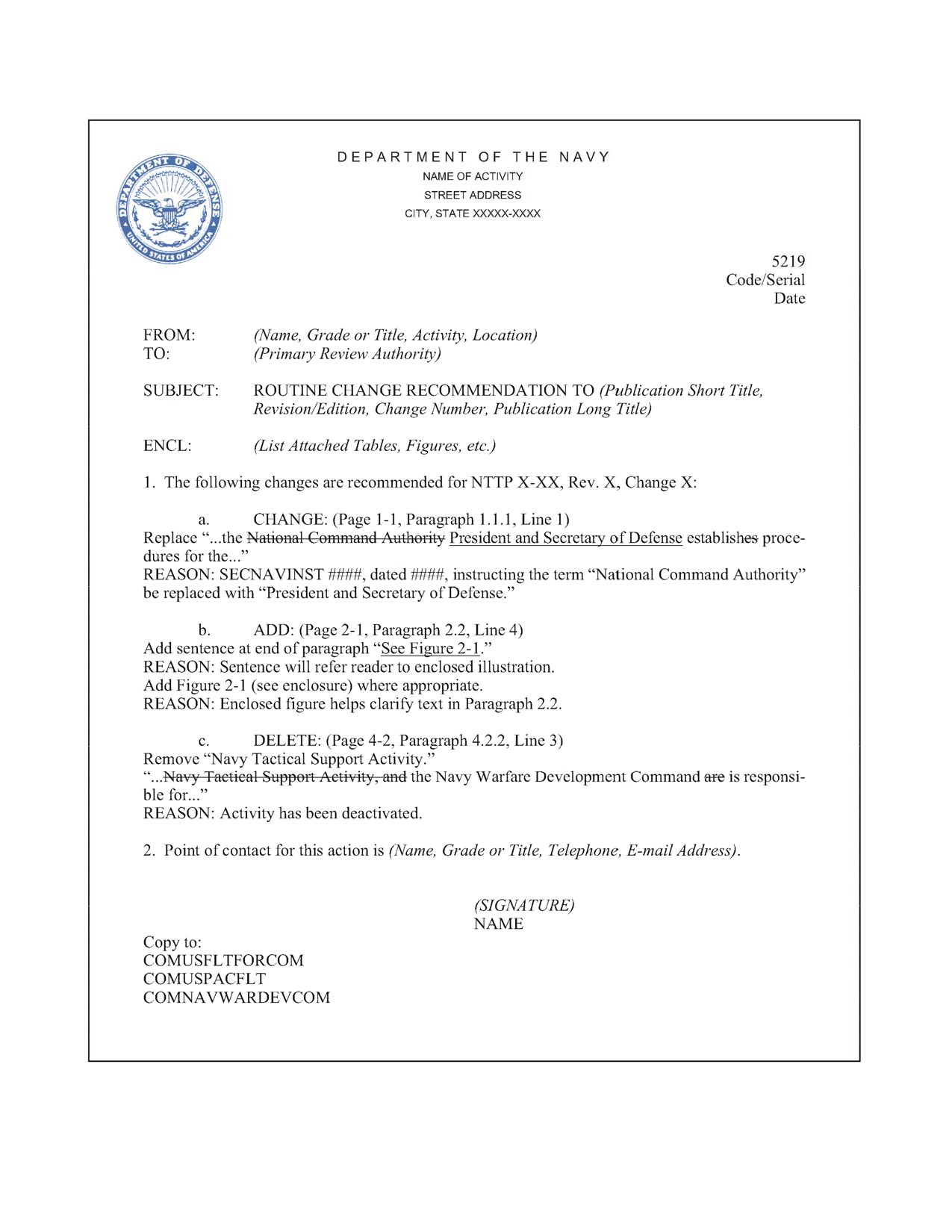
ROUTINE CHANGE RECOMMENDATIONS
Submit routine recommended changes to this publication at any time by using the accompanying routine change
recommendation letter format on page 14 and mailing it to the address below, or posting the recommendation on
the Navy Doctrine Library System site.
COMMANDER
NAVY WARFARE DEVELOPMENT COMMAND
ATTN: DOCTRINE
1528 PIERSEY STREET BLDG O-27
NORFOLK VA 23511-2723
11
NOV 2010
NWP 2-01
CHANGE BARS
Revised text is indicated by a black vertical line in the outside margin of the page, like the one printed next to this
paragraph. The change bar indicates added or restated information. A change bar in the margin adjacent to the
chapter number and title indicates a new or completely revised chapter.
WARNINGS, CAUTIONS, AND NOTES
The following definitions apply to warnings, cautions, and notes used in this manual:
An operating procedure, practice, or condition that may result in injury or death if not
carefully observed or followed.
An operating procedure, practice, or condition that may result in damage to equipment
if not carefully observed or followed.
Note
An operating procedure, practice, or condition that requires emphasis.
WORDING
Word usage and intended meaning throughout this publication are as follows:
“Shall” indicates the application of a procedure is mandatory.
“Should” indicates the application of a procedure is recommended.
“May” and “need not” indicate the application of a procedure is optional.
“Will” indicates future time. It never indicates any degree of requirement for application of a procedure.
NOV 2010
12
NWP 2-01
FM ORIGINATOR
TO (Primary Review Authority)//JJJ//
INFO COMNAVWARDEVCOM NORFOLK VA//N-5//
COMUSFLTFORCOM NORFOLK VA//JJJ//
COMUSPACFLT PEARL HARBOR HI//JJJ//
(Additional Commands as Appropriate)//JJJ//
BT
CLASSIFICATION//N03510//
MSGID/GENADMIN/(Organization ID)//
SUBJ/URGENT CHANGE RECOMMENDATION FOR (Publication Short Title)//
REF/A/DOC/NTTP 1-01//
POC/(Command Representative)//
RMKS/ 1. IAW REF A URGENT CHANGE IS RECOMMENDED FOR (Publication Short Title)
2. PAGE ______ ART/PARA NO ______ LINE NO ______ FIG NO ______
3. PROPOSED NEW TEXT (Include classification)
4. JUSTIFICATION.
BT
Message provided for subject matter; ensure that actual message conforms to MTF requirements.
Urgent Change Recommendation Message Format
13
NOV 2010
NWP 2-01
Routine Change Recommendation Letter Format
NOV 2010
14
NWP 2-01
CHAPTER 1
Introduction
1.1 GENERAL
Fourteen years have elapsed since Navy Warfare Publication (NWP) 2-01, Intelligence Support to Operations
Afloat (January 1997), was disseminated to the fleet. This introduction cannot begin to convey the changes that
have occurred in the global security environment and the elevation of information to a “main battery” of the
United States Navy’s (USN’s) arsenal.
Naval Intelligence has a proud and rich history extending well over 100 years; however, it is just a part of the
entire Intelligence Community (IC), military and civilian, supporting America’s forces. Naval forces are proud to
be at the forefront of joint and combined operations, and the events of the recent decade further illustrate the
indispensable role of intelligence across the range of military operations (ROMO). The success of these
operations depended upon the delivery of accurate and timely intelligence to the President, the Secretary of
Defense (SECDEF), the combatant commanders (CCDRs), and the aircrews and ships operating around the
world.
The attacks of September 11, 2001 substantially changed the strategic landscape and shaped our national security
strategy. Today, combatant commands plan for a wide range of operations against a similarly wide range of
threats. The Navy continually refines its core capabilities to support those plans, and correspondingly, the IC
anticipates, identifies, and seeks to understand those threats in detail. The range of threats facing planners and
their executors today has grown exponentially and in an asymmetrical fashion. Decision makers rely on
intelligence to provide them an operational advantage by enabling the selection of optimal courses of action
(COAs) in a time-sensitive maritime environment.
1.2 PURPOSE
NWP 2-01 is a comprehensive reference detailing the intelligence support available to the naval commander in the
successful planning and execution of operations.
1.3 SCOPE
NWP 2-01 is by nature a refresher and ready resource for the Information Dominance Corps (IDC) intelligence
professionals, information warfare officers, and cryptologic technicians; however, the target audience is the
operational commander. The publication’s length and content are specifically tailored to ensure a practical and
valuable reference for the operational decision maker. NWP 2-01 is the foundation for a series of proposed
follow-on Navy tactics, techniques, and procedures (NTTP) publications.
1.3.1 Chapter 1 — Introduction
Chapter 1 addresses the role of intelligence within the six core capabilities of our current maritime strategy. The
Navy’s recent focus on information dominance (ID) and the standup of the IDC is presented. Finally, maritime
domain awareness (MDA) as an outcome of intelligence gathering, production, and sharing is introduced.
1-1
NOV 2010
NWP 2-01
1.3.2 Chapter 2 — Navy Intelligence Enterprise
Chapter 2 delineates the naval afloat and ashore billets and organizations providing direct intelligence support to
the operational commander.
1.3.3 Chapter 3 — Navy Intelligence Operations
Chapter 3 defines the levels of intelligence and describes the processes by which the intelligence team optimally
accomplishes the majority of its tasks. Next, the intelligence composition and organization of afloat and
deployable naval assets is provided. The remainder of the chapter describes the ROMO in which the Navy must
be prepared to participate.
1.3.4 Chapter 4 — Support to Navy Intelligence Forward
Chapter 4 reports on the various national, theater, joint task force (JTF), and Service intelligence organizations
that make up the IC and reveals how these organizations may assist afloat and deployed naval assets. The chapter
concludes by addressing interagency and multinational intelligence sharing considerations.
1.4 A COOPERATIVE STRATEGY FOR 21ST CENTURY SEAPOWER
The October 2007 Maritime Strategy of the United States (U.S.) sea services stresses an approach that integrates
seapower with other elements of national power, as well as those of U.S. friends and allies. It describes the
application of seapower around the world to protect the American way of life, as the United States joins with
other like-minded nations to guard and sustain the global environment in which we operate. Successful
implementation of this strategy assuredly requires robust intelligence integrated with maritime operations. “A
Cooperative Strategy for 21st Century Seapower” calls for an expanded portfolio of six core capabilities.
1.4.1 Forward Presence
Maritime forces are forward deployed, especially in an era of diverse threats to the homeland. Operating forward
enables familiarity with the environment, as well as the personalities and behavior patterns of regional actors.
Should peacetime operations transition to war, environmental and adversarial understanding developed by
intelligence personnel enables the warfighter to quickly engage in combat operations.
1.4.2 Deterrence
Preventing war is preferable to fighting war. Deterring aggression is viewed in global, regional, and transnational
terms via conventional, unconventional, and nuclear means. The United States uses forward-stationed and
rotationally-deployed forces, space-based assets, sea-based strategic deterrence, and other initiatives to deter those
who wish the United States harm. Theater security cooperation (TSC), maritime ballistic missile defense, and the
United States’ advantages in space and cyberspace must be protected and extended. Intelligence is crucial to the
realization of these goals. For example, the intelligence team is a critical enabler in the effort to protect the force
from weapons of mass destruction (WMD), providing decision makers with timely, actionable intelligence to
shape appropriate actions against WMD threats. Intelligence provides warning of WMD attacks and is vital to the
identification, tracking, and interdiction of adversary proliferation attempts.
1.4.3 Sea Control
The ability to operate freely at sea is one of the most important enablers of joint and interagency operations. Sea
control requires capabilities in all aspects of the maritime domain as well as space and cyberspace. This combined
arms approach to sea control leverages robust intelligence capabilities in order to achieve local and regional sea
control and exploit the maritime domain as maneuver space. The Office of Naval Intelligence (ONI) is the
reachback center of excellence on submarine proliferation, acting collaboratively with maritime intelligence
operations centers (MIOCs) and operational forces.
NOV 2010
1-2
NWP 2-01
1.4.4 Power Projection
The ability to project power ashore at the place and time of our choosing is the basis of U.S. combat credibility. It
is the core capability of combat power that the Navy provides to the joint force commander (JFC). The
operational intelligence team is involved in every facet of the planning, execution, and evaluation of operations
that define power projection. From the intelligence specialist (IS) interpreting satellite imagery to the carrier air
wing targeting officer (CVW TO) exercising every step of the joint targeting cycle, intelligence is grafted into this
core competency.
1.4.5 Maritime Security
The creation and maintenance of security at sea is essential to mitigating threats short of war, including piracy,
terrorism, weapons proliferation, drug trafficking, and other illicit activities. Countering these irregular and
transnational threats protects our homeland, enhances global stability, and secures freedom of navigation for the
benefit of all nations. U.S. maritime forces enforce domestic and international law at sea through established
protocols and also join navies and coast guards around the world to police the global commons. Intelligence
activities supporting this pillar of U.S. maritime strategy are very similar to those backing the forward presence
capability.
1.4.6 Humanitarian Assistance and Disaster Response
Building on relationships forged in times of peace and stability, naval forces mitigate human suffering as the
vanguard of interagency and multinational efforts, both in a deliberate, proactive fashion and in response to crises.
The expeditionary character of maritime forces uniquely positions them to provide assistance during times of
humanitarian assistance or disaster. Foreign humanitarian assistance is generally planned and executed under
normal and routine conditions. Disaster response events, especially those occurring in fragile nations or
ungoverned areas, require the IC to address many factors, including whether the environment is permissive,
uncertain, or hostile.
1.5 INFORMATION DOMINANCE
The United States has entered into a new era that opens alternative paths to grand strategy and combined arms
warfighting. Globalization and exponential growth in computing and communications capabilities have
transformed the information environment from an enabling medium to a nexus of commercial, social, political,
and intellectual activity. Evolution of space and cyberspace from niche warfare support applications to key
domains for competition and combat reflects the increasing prominence and militarization of the information
environment. While the nature of warfare endures, warfare modes are evolving to fit the unique characteristics of
information age power, competition, and conflict. The globalization and explosion of information technology (IT)
capabilities are making data an inexpensive commodity and leveling the playing field for command and control
(C2), information access, and knowledge management.
ID is defined as superiority in the generation, manipulation, and employment of information sufficient to afford
its possessors military dominance. ID reduces uncertainty, informs risk assessment, and uncovers hidden
competitive options and opportunities. It aims to apply information power better than any adversary to amplify
traditional naval combat capabilities and expand options for our operational commanders.
The need for a new strategy and roadmap focused on attaining ID was realized as the Navy decidedly placed
information on par with platforms, treating information as a weapon across the full ROMO. As a result,
information no longer represents a mere enabler of operations: it is elevated in status as a primary competitive
advantage and core capability of the Navy.
The Navy must transform its strategic concepts, organizations, processes, and culture to remain a dominant force
in this information age. To achieve success in 21st century warfare, the Navy created a fully integrated
intelligence, information, cyberspace, C2, and network operations capability and wields it as a weapon. The Chief
of Naval Operations (CNO) directed the melding of intelligence, information and network management,
1-3
NOV 2010
NWP 2-01
communications, electronic warfare (EW), cyberspace, meteorology, and oceanography to establish an IDC ready
to navigate the course ahead.
A clear course has been set to align Navy organizations to effectively operationalize cyberspace and information
operations (IO) by establishing Fleet Cyber Command/Tenth Fleet (FLTCYBERCOM/COMTENTHFLT) and
realigning the Office of the Chief of Naval Operations (OPNAV) staff to achieve integration and to foster
innovation. The establishment of the Deputy CNO for Information Dominance (N2/N6) represents a landmark
transition in the evolution of naval warfare.
The IDC was created to more effectively and collaboratively lead and manage a cadre of officers, enlisted, and
civilians who possess extensive skills in information intensive fields. The naval intelligence professional is a key
pillar of the IDC. The following Navy personnel comprise the IDC:
1. Information professional officers (182x, 642x, 742x designators)
2. Information warfare officers (181x, 644x, 744x designators)
3. Naval intelligence officers (183x, 645x, 745x designators)
4. Oceanography officers (180x, 646x designators)
5. Cyber warfare engineers (184x designator)
6. Space cadre (5500x, 6206x subspecialty codes or VSx AQD)
7. Aerographer’s mate (AG) enlisted personnel
8. Cryptologic technician (CTN, CTM, CTR, CTI, CTT) enlisted personnel
9. Intelligence specialist (IS) enlisted personnel
10. Information technician (IT) enlisted personnel
11. Navy civilians assigned to positions in the fields of intelligence, information, counterintelligence (CI),
human-derived information (HDI), meteorology, and oceanography.
The common goal of the IDC is assuring the commander and the warfighter get the right information at the right
time in order to optimize perceptions and understandings which support and make more effective the processes of
decisionmaking and C2.
1.6 MARITIME DOMAIN AWARENESS
The National Plan to Achieve MDA defines MDA as “the effective understanding of anything associated with the
maritime domain that could impact the security, safety, economy, or environment of the United States.” The
National Plan also states that the purpose of MDA is to facilitate timely, accurate decisionmaking that enables
actions to defend against threats to U.S. national security interests. Effective understanding occurs when a
decision maker’s comprehension of relevant information allows appropriate action. The National Plan
acknowledges that information requirements vary depending upon the mission or task at hand; therefore, MDA
equates to a holistic understanding of the maritime environment, enabling the commander to successfully execute
his assigned mission(s).
MDA for the Navy results when mission-relevant data, information, and intelligence from the United States and
partners is collected, processed, exploited, shared, fused, analyzed, and disseminated to planners, watchstanders,
and decision makers at the strategic, operational, and tactical levels. MDA is necessary across the full ROMO in
all phases of conflict, both for routine and contingency operations. MDA includes understanding all activities
NOV 2010
1-4
NWP 2-01
above, on, and beneath the sea, from the littoral to the open ocean. MDA is not confined to vessel tracking,
anomaly detection, discovery of illicit cargo shipments, or identifying smugglers. It includes developing a deep
understanding of political, social, economic, and physical trends within geographic regions and human networks.
MDA is not an end unto itself, but rather an enabler of all Navy core capabilities as described by the unified
maritime strategy of the United States. It is both a physical and virtual extension of the commander’s senses and
is the means by which his critical information requirements are satisfied.
1-5
NOV 2010
NWP 2-01
INTENTIONALLY BLANK
NOV 2010
1-6
NWP 2-01
CHAPTER 2
Navy Intelligence Enterprise
2.1 INTRODUCTION
The basic elements of the Navy are the fleets, strike groups, individual ships, aircraft squadrons, and
expeditionary force units. The senior intelligence officer (SIO) assigned to each unit has responsibility for the
intelligence support provided to his commander and is also accountable for the training and readiness of the
intelligence team. This afloat and forward-deployed cadre of naval intelligence professionals is just the tip of an
elaborate support structure extending back to the CNO and the Director of Naval Intelligence. This chapter
provides a description of the organic naval afloat and ashore billets and organizations providing direct intelligence
support to the operational commanders.
2.2 ROLES AND RESPONSIBILITIES
2.2.1 Fleet Commander N2/N39
Commander, United States Fleet Forces Command (COMUSFLTFORCOM) and Commander, United States
Pacific Fleet (COMUSPACFLT) N2/N39s are responsible for providing trained and combat ready naval forces to
United States Joint Forces Command (USJFCOM) and United States Pacific Command (USPACOM),
respectively. In collaboration with the Navy Cyber Forces (CYBERFOR) Assistant Chief of Staff for
Intelligence/Director of Fleet Intelligence (DFI), they establish policies, set training standards, resolve manning
and readiness issues, develop intelligence system requirements, and oversee fleet intelligence systems
installations. The fleet commander N2/N39s validate subordinate unit requests for information (RFIs) and
requests for forces (RFFs), and establish priorities and foreign disclosure policy. Additionally, COMUSPACFLT
N2/N39 provides oversight of operations, establishes collection policies, provides planning and operational
support to USPACOM, and maintains Navy-to-navy exchange programs with foreign intelligence organizations.
COMUSPACFLT N2/N39, as well as the other Navy component commander (NCC) N2s (Commander, United
States Naval Forces, Southern Command (COMUSNAVSO); Commander, United States Naval Forces, Central
Command (COMUSNAVCENT); Commander, United States Naval Forces, Europe (COMUSNAVEUR)/United
States Naval Forces, Africa (COMUSNAVAF); and FLTCYBERCOM) also establish within the AOR maritime
intelligence priorities, Navy intelligence reporting policy, and subordinate and staff RFI procedures. NCC N2s
also validate subordinate RFIs and RFFs and provide planning and intelligence operations support to their
respective geographic combatant commander (GCC). Additionally, many NCC staff N2s are dual-hatted as
numbered fleet N2s (e.g., COMUSNAVSO/Fourth Fleet N2).
2.2.2 Director of Fleet Intelligence
The DFI is tasked with the mission of optimizing intelligence readiness across all Navy mission areas and serving
as the operating forces’ advocate in the development, integration, and fielding of intelligence, surveillance, and
reconnaissance (ISR) systems. The DFI’s primary responsibility is assisting and advising all fleet commanders,
NCCs, and Navy type commanders (TYCOMs) on ISR readiness issues as well as working to ensure intelligence
readiness for maritime operations centers (MOCs). In addition, the DFI oversees intelligence operations at
CYBERFOR, which includes three primary responsibilities: performing the intelligence TYCOM mission of man,
train, and equip (MT&E) of afloat intelligence forces; acting as fleet advocate for ISR capability and readiness;
and executing the CNO-directed Intelligence Manpower Distribution Plan (IMDP).
2-1
NOV 2010
NWP 2-01
2.2.3 Numbered Fleet N2
Second, Third, Fourth, Fifth, Sixth, Seventh, and Tenth Fleet N2s are responsible for supporting the intelligence
requirements of forces assigned in their areas of operation (AOs). Like the fleet commander N2/N39s, the
numbered fleet N2s conduct liaison with their foreign counterparts, provide guidance on foreign disclosure of
intelligence, validate subordinate RFIs, and establish fleet collection policies and guidance. Fourth, Fifth, Sixth,
and Seventh Fleet release a series of predeployment support messages outlining AO-specific guidance for
operations, intelligence, and IO. Numbered fleet commanders are candidates for the role of JTF commander or as
the JTF’s NCC or functional component commander (FCC) (joint force maritime component commander
(JFMCC)).
2.2.4 Numbered Fleet Cryptologist
The numbered fleet cryptologist, a special assistant to the numbered fleet N2, is responsible for assigning, tasking,
prioritizing, and maintaining cryptologic resources in support of the numbered fleet commander’s mission.
Focused on the operational level of war, the numbered fleet cryptologist supports the MOC through the technical
direction of subordinate task force cryptologic resource coordinators (CRCs) ensuring their organic cryptologic
collection plans satisfy the numbered fleet commander’s priority intelligence requirements (PIRs). The numbered
fleet cryptologist liaises with the fleet commander and theater and national agencies to coordinate cryptologic
support not attainable through the use of organic resources. The numbered fleet cryptologist also leverages several
subordinate staff officers in the performance of his duties, including the fleet CRC, fleet assistant CRC, and fleet
signals intelligence warfare officer (SIWO). Additionally, the numbered fleet cryptologist ensures IO core
capabilities are integrated into fleet planning efforts.
2.2.5 Carrier Strike Group
A carrier strike group (CSG) is typically comprised of one CSG staff, one aircraft carrier (CVN), one air wing
(CVW), and one destroyer squadron (DESRON). Each of these organizations maintains its own intelligence
structure. This section discusses the duties and responsibilities of each intelligence component, except the
DESRON N2, which is discussed in section 2.2.7.
2.2.5.1 CSG N2
The CSG N2 is responsible to the strike group commander for all intelligence and cryptologic personnel assigned
to CSG subordinate units. When deployed, the N2 coordinates all intelligence support to operations within the
strike group. Key areas of responsibility include: administrative and functional control of fleet intelligence
detachment (FID) personnel; generation of operational task (OPTASK) intelligence and cryptology supplements;
PIR evaluation; support to operational planning; oversight of strike group indications and warning (I&W) and
reporting; and development of the strike group’s intelligence integration plan. Most of these functions are
performed at lower levels, either within the CSG staff or by N2 personnel of subordinate units.
When not deployed, the CSG N2 oversees the intelligence readiness and training of the units assigned to the strike
group commander.
2.2.5.2 CSG Assistant N2
The CSG assistant N2 is responsible to the N2 for the orchestration of the supplementary plot (SUPPLOT) watch.
Additionally, the CSG assistant N2 is responsible for coordination of intelligence production to support warfare
commanders and strike group operations, intelligence inputs to the strike group commander’s daily intentions
message, and intelligence inputs to the warfare commander’s coordination board. The CSG assistant N2 also
provides coordination and intelligence support as required for all staff planning activities.
NOV 2010
2-2
NWP 2-01
2.2.5.2.1 Collection Management
The assistant N2 and the CRC are responsible for collection management functions. One of the FID officers
assigned to a strike group is trained in collection management to assist as directed by the assistant N2.
2.2.5.2.2 Supplementary Plot
SUPPLOT is the all-source intelligence fusion center onboard the CVN monitoring the geopolitical situation and
foreign military operations within the AO to which a CSG is assigned. SUPPLOT provides I&W and updated
situational information to the tactical flag command center (TFCC), the ship’s combat direction center (CDC),
and other warfare commanders via voice reports and chat in order to support warfare commanders’
decisionmaking. SUPPLOT operations are the responsibility of the CSG N2; however, responsibility for the
function, manning, and training of SUPPLOT is often delegated to the assistant N2.
2.2.5.3 Carrier Strike Group Cryptologic Resource Coordinator
The CSG CRC is responsible to the strike group commander for all aspects of cryptologic operations within the
CSG. The CRC issues specific tasking under the cryptologic coverage plan to cryptologic units to support I&W
for the strike group and meet the commander’s PIRs. The CRC manages nonorganic cryptologic support from a
variety of agencies. The CRC also requests and manages cryptologic direct support (DS) personnel embarked for
operational training and deployment. DS personnel include a variety of CTs and information warfare officers that
conduct operations in the ship’s signals exploitation space (SSES) and the cryptologic analytical support element
(if established).
2.2.5.4 Carrier Strike Group Deputy Information Operations Warfare Commander
The CSG deputy information operations warfare commander (DIWC) is assigned as the principal assistant to the
information operations warfare commander (IWC) on all matters related to strike group IO. The DIWC is
responsible for the management of the IO staff and for assisting the IWC in the coordination and planning of IO.
Additionally, the DIWC ensures that strike group computer networks are defended adequately and effectively to
prevent exploitation and corruption of sensitive information.
2.2.5.5 CVN Intelligence Officer
The intelligence officer assigned to an aircraft carrier, referred to as the “ship’s IO,” is responsible for providing
intelligence support and services to the commanding officer (CO), key C2 nodes, the embarked carrier group
staff, the air wing commander and his staff, and other warfare commanders as established in each strike group’s
integrated intelligence plan.
The intelligence organization varies by ship, with some ship’s IOs acting as department heads (N2), while others
are subordinate to the operations officer. The ship’s IO directly supervises at least two divisions, OZ (ISs) and OS
(CTs) divisions, each headed by a ship’s company division officer. The ship’s IO is responsible for the MT&E of
assigned personnel and the materiel condition of spaces. Additionally, the ship’s IO is assigned duties as the
ship’s special security officer (SSO) and may also perform duties as the ship’s special access program control
officer (SAPCO) managing programs for the type and fleet commander. More specifically, the ship’s IO supports
the CSG N2 by providing the following: access to available intelligence files within the carrier intelligence center
(CVIC), briefing assistance, intelligence data in support of tactical operations (including ISR planning), and
special intelligence briefs as required. Priorities are set by the CSG commander.
Whenever the air wing and group staff are embarked, the ship’s IO supervises and manages a diverse team of
intelligence professionals (ship’s company and air wing personnel) tasked with meeting the intelligence
requirements of the strike group commander, the strike group staff, the warfare commanders and coordinators,
and the critical operational nodes aboard the ship (e.g., CDC, tactical action officer (TAO), and strike ops). In
order to meet these requirements and those of the theater and national agencies, the ship’s IO organizes the
intelligence team into five functional cells:
2-3
NOV 2010
NWP 2-01
1. SUPPLOT. Conducts all-source I&W in support of the strike group staff, the warfare commanders, and the
ship’s C2 nodes.
2. Strike intelligence analysis cell (SIAC). Conducts detailed all-source analysis of threat countries where
missions and operations are planned/conducted and is comprised of both the target intelligence cell (TIC)
and the target analysis cell (TAC).
3. Mission briefing/debriefing. Conducts briefings/debriefings of aircrews and performs combat assessments.
4. SSES. Conducts exploitation of foreign signals.
5. Multisensor interpretation (MSI). Conducts exploitation of organic and non-organic imagery.
During the early phases of the fleet readiness training plan (FRTP), the ship’s IO manages the individual and team
training programs of assigned intelligence and cryptologic personnel. Later, the ship’s IO manages the integration
of the staff, ship, air wing, and FID intelligence team to ensure proper operation of the CVIC’s functional cells.
2.2.5.6 CVN OZ Division Officer/Carrier Intelligence Center Officer
The OZ division officer/CVIC officer is responsible for the oversight and management of the ISs. This includes
manning and training matters, security clearance issues, and watch-standing requirements. During the training
cycle, the OZ division officer monitors each division’s training plan and ensure spaces and equipment are
maintained at a high state of readiness. Additionally, if so designated by the ship’s IO, the OZ division officer
also acts as the CVN intelligence systems officer. The systems officer is CVIC’s resident expert on the operation,
management, and maintenance of all intelligence data processing and communications systems. This officer
normally does not supervise any maintenance personnel or administrators and must maintain close coordination
with the ship’s IT personnel to ensure CVIC equipment is properly maintained.
2.2.5.7 CVN OS01 Division Officer/Ships Signals Exploitation Space Officer
The OS01 division officer serves as the ship’s SIWO for the CVN. The OS01 division officer is responsible for
the materiel condition readiness of SSES, training of assigned personnel, and all facets of cryptologic operations.
These duties may include sensitive compartmented information facility accreditation, SAP/special technical
operations programs, special communications systems, adjudication of special clearance issues, and operational
actions as directed by the IWC and the CRC.
2.2.5.8 CVN OS02 Division Officer/Electronic Warfare Officer
The OS02 division officer serves as the EW officer ensuring the ship is prepared to execute force EW. He ensures
the EW operators are supporting the correlation and fusion of organic EW data in support of the information
warfare watch team. During the training cycle, the OS02 division officer monitors the division’s training plan, is
responsible for spaces, and ensures equipment is maintained at a high state of readiness. On many platforms,
OS01 and OS02 merged, placing all CT rates under the SIWO for efficiencies in training and management within
one division.
2.2.5.9 CVW Intelligence Officer
The CVW intelligence officer, more commonly known as the “CAG AI”, is the SIO on the CVW staff and is
directly responsible for all intelligence support to the strike warfare commander (STWC) and the CVW. The CAG
AI is well versed in all aspects of intelligence support to strike aviation and has normally completed an initial tour
as a squadron air intelligence officer (AI). In addition to providing direct intelligence support, the CAG AI
mentors and oversees the professional development of CVW staff intelligence officers, squadron AIs, and CVW
enlisted intelligence personnel to ensure readiness and training, both ashore and afloat. Additionally, the CAG AI
may also perform duties as the CVW SSO, CVW command security manager, and CVW SAPCO.
NOV 2010
2-4
NWP 2-01
During workups, the CAG AI coordinates with CVN staff on workspace and equipment issues and liaises with
both the CSG N2 and CVN intelligence staff to maintain a close working relationship. While underway, the CAG
AI provides executive supervision of those CVIC work centers providing direct support to the air wing and
STWC. These work centers include mission briefing/debriefing and SIAC, comprised of both the TIC and the
TAC.
2.2.5.10 CVW Targeting Officer
The CVW TO is the CSG/CVN/CVW intelligence staff’s resident expert on intelligence support to strike mission
planning, targeting, and weaponeering and is one of two CVW staff intelligence officers directly supervised by
the CAG AI. The CVW TO manages the CVIC TIC work center which provides target intelligence products (e.g.,
mission planning folders, weaponeering solutions, etc.) to CVW strike planners. The CVW TO also oversees
CVW weapon system video (WSV) download, analysis, and dissemination in support of poststrike bomb hit
assessment (BHA) that feeds the battle damage assessment (BDA) process. To carry out these responsibilities, the
CVW TO closely coordinates with the applicable theater joint intelligence operations center (JIOC), numbered
fleet MOC targeting personnel, and with specialized targeting intelligence agencies at the national level. For day-
to-day support to the STWC, the CVW TO collaborates with the CVW strike operations officer to ensure CVW
assets tasked by the air tasking order or integrated tasking order (ITO) are fully supported.
With the exception of the CVW TO assigned to forward deployed naval forces in the U.S. Seventh Fleet AO, all
CVW TOs are based at Naval Strike and Air Warfare Center (NSAWC) within the NSAWC Targeting Cell for
formal and on-the-job training to earn the 3A1 additional qualification designator (AQD) for targeting.
Homebasing at NSAWC during the postdeployment and early predeployment periods allows CVW TOs to
collaborate on lessons learned and hone their expertise in targeting, weaponeering, and strike mission planning
while maintaining situational awareness of the latest carrier aviation operations.
2.2.5.11 CVW Assistant Targeting Officer
The CVW assistant targeting officer (ATO) works directly for the CVW TO in the TIC. The ATO assists the
CVW TO by providing target development and weaponeering support to strike planning, ensuring that relevant
data from the mission briefing/debriefing cell is integrated into the planning process. Additionally, the ATO is
responsible for WSV debrief to include BHA capture, production, and dissemination. The ATO also provides
reachback targeting and weaponeering support for CSG, fleet, and combatant command requirements on a not-to-
interfere basis with CVW tasking and requirements. As with the CVW TO billet, the ATO is based at NSAWC
within the targeting cell to receive prerequisite training and mentorship in order to qualify for the 3A1 AQD.
2.2.5.12 Squadron Air Intelligence Officer
Squadron AIs are responsible for providing their squadron CO and aircrew with intelligence support needed to
complete their assigned missions. Duties include maintaining an intelligence documents library, establishing and
maintaining a squadron recognition and threat weapon systems training program, serving as the assistant
command security manager, ensuring that squadron SSO requirements are coordinated with CVW SSO personnel,
and providing intelligence support to squadron-specific missions and functions. In most cases, a squadron AI
supervises at least one IS assigned to their squadron and is responsible for their professional development and
training, day-to-day operations, and administrative control. Squadron AIs are typically assigned to the squadron
operations department and work directly for the squadron operations officer while ashore. When afloat, squadron
AIs are normally assigned to one of the CVIC work centers by the CAG AI and function under the direction of the
ship’s IO.
2.2.6 Expeditionary Strike Group/Amphibious Squadron
An amphibious squadron (PHIBRON) usually consists of three amphibious ships: one landing helicopter dock
(LHD) or landing helicopter assault (LHA) ship, one dock landing ship (LSD), and one landing platform dock
(LPD) ship. When these ships are loaded with the forces of a Marine expeditionary unit (MEU) and accompanied
2-5
NOV 2010
NWP 2-01
by associated naval support elements, the PHIBRON is designated an amphibious ready group (ARG)/MEU. The
ARG/MEU, commanded by the PHIBRON staff, is the standard rotational amphibious force deployment package.
If a requirement exists that a flag or general officer command an ARG/MEU, the formation is referred to as an
expeditionary strike group (ESG), which includes an embarked flag or general officer and their associated
command element (CE) staff. Regardless of the Service orientation of the commander, the CE consists of both
Navy and Marine Corps personnel. Additional surface combatants may or may not be assigned to an ARG/MEU
or ESG.
2.2.6.1 Expeditionary Strike Group N2
When deployed, the assigned ESG N2 is responsible for coordinating all aspects of intelligence support to
operations within the group or force. Since group commanders are prime candidates for assignment as JTF
commanders or as the NCC for a JTF, the N2 must be well versed in joint doctrine and procedures. When not
deployed, the ESG N2 is responsible for monitoring the intelligence readiness and training of all assigned
intelligence/cryptologic personnel assigned to amphibious forces on their respective coast.
2.2.6.2 Expeditionary Strike Group Assistant N2
When deployed, the ESG assistant N2 is normally assigned as the operational intelligence officer for the group.
As such, the assistant N2 liaises with LHD/LHA intelligence work centers, tactical flag plot, and other composite
warfare commander (CWC) C2 nodes to maintain force situational awareness.
2.2.6.3 Expeditionary Strike Group Cryptologic Resource Coordinator
When deployed, the assigned ESG CRC is responsible for coordinating all aspects of cryptologic support to
operations within the group or force. When not deployed, the ESG CRC is responsible for monitoring the
cryptologic readiness and training of all assigned cryptologic personnel assigned to amphibious forces on their
respective coast.
2.2.6.4 Amphibious Squadron N2
PHIBRON N2s provide the ARG/MEU commander and staff with intelligence and cryptologic support necessary
to carry out their assigned missions. Additionally, the N2 sets policy for and monitors the functions of the
ARG/MEU’s intelligence/cryptologic team to ensure the timely flow of intelligence information among the
ARG/MEU units and that organically-collected intelligence is promptly and accurately reported to fleet, theater,
and national agencies.
Additionally, PHIBRON N2s are responsible for the intelligence readiness and training of the units assigned to
their ARG/MEU. The N2 monitors the ARG/MEU’s intelligence/cryptologic training plans to ensure personnel
receive required training prior to deployment. The N2 performs duties as the staff SSO. Since the PHIBRON
commander is a candidate for selection as the JTF NCC or functional component commander (JFMCC) for a
humanitarian relief or NEO operation, the N2 must be well versed in joint doctrine and procedures.
2.2.6.5 Amphibious Squadron Assistant N2
The PHIBRON assistant N2 is normally assigned as the ARG/MEU collection manager. As such, the assistant N2
liaises with the MEU collection manager to track and prioritize collection requirements and to task organic and
nonorganic collection assets in support of the ARG/MEU commander. Additionally, dependent on the staff, the
assistant N2 may stand watches in expeditionary plot (EXPLOT) or conduct the daily briefing to the ARG/MEU
commander.
NOV 2010
2-6
NWP 2-01
2.2.6.6 Amphibious Squadron Cryptologic Resource Coordinator
When deployed, the assigned PHIBRON CRC is responsible for coordinating all aspects of cryptologic support to
operations within the ARG/MEU. When not deployed, the PHIBRON CRC is responsible for ensuring the
cryptologic readiness and training of all assigned cryptologic personnel assigned to the ARG.
2.2.6.7 LHD/LHA Intelligence Officer
The intelligence officer assigned to the LHD/LHA, referred to as the “ship’s IO,” provides intelligence and
cryptologic support/services so that the embarked PHIBRON staff, the embarked Marines, and his own CO and
C2 cells can accomplish their assigned missions. In order to provide this support, the ship’s IO manages a cadre of
professional intelligence personnel, officer and enlisted, from the ship’s intelligence and cryptologic divisions and
the embarked tactical air control squadron (TACRON). Additionally, the ship’s IO provides equipment, space,
and materiel to the embarked PHIBRON N2 and MEU intelligence (S2) staffs.
When deployed, the ship’s IO is responsible for the manning and management of EXPLOT, the joint intelligence
center (JIC), and SSES and ensures the proper flow of information between these spaces and other C2 nodes
belonging to the ship, the embarked staff, and the MEU.
During the FRTP, the ship’s IO is responsible for the training of his assigned personnel and the installation of
equipment and systems in his assigned spaces. The ship’s IO receives support and direction in these matters from
the PHIBRON N2, the TYCOM, and the fleet commander N2/N39. The ship’s IO also operates as the ship’s SSO
and ensures all security regulations are adhered to and material is safeguarded.
2.2.6.8 LHD/LHA OZ Division Officer/Joint Intelligence Center Officer
The OZ division officer/JIC officer is responsible for the oversight and management of the ISs. This includes
manning and training matters, security clearance issues, and watch-standing requirements. During the training
cycle, the OZ division officer monitors the training plan and ensures spaces and equipment are maintained at a
high state of readiness. Additionally, if so designated by the ship’s IO, the OZ division officer also acts as the JIC
intelligence systems officer. The systems officer is the JIC’s resident expert on the operation, management, and
maintenance of all intelligence data processing and communications systems. This officer normally does not
supervise any maintenance personnel or administrators and must maintain close coordination with the ship’s IT
personnel to ensure JIC equipment is properly maintained.
2.2.6.9 CG, DDG, LHD, LHA, LPD Signals Warfare Officer
SIWOs are assigned aboard cruisers, flight II destroyers, and amphibious assault and docking ships. They are
tasked with such duties as collecting, analyzing, exploiting, and disseminating information and intelligence as
directed by the IWC, CRC, and ship’s IO. The SIWO’s primary responsibility is to employ communication IO
systems to detect, classify, and track all targets as directed and coordinate with the ship’s combat information
center (CIC) to ensure their inclusion into the common operating picture. Other activities include providing
equipment status to the CRC, managing the ship’s emission control (EMCON)/river city bill, and providing I&W
for own ship and strike group self defense. If an electronic warfare officer is assigned to the unit or strike group,
he assumes the duties and responsibilities for matters pertaining to EW and works in conjunction with the ship’s
IO, SIWO, and collateral duty intelligence officer (CDIO) or independent duty intelligence specialist (IDIS) to
optimize collection efforts.
In the event a surface strike group or a surface action group is established without a previously assigned CRC, the
SIWO, as the only cryptologic support available to the DESRON staff, must be prepared to join the DESRON
staff as the CRC.
2-7
NOV 2010
NWP 2-01
2.2.6.10 Tactical Air Control Squadron Intelligence Specialist
The TACRON IS is responsible for providing the squadron CO and other squadron personnel with the
intelligence support needed to complete their assigned missions. Duties include maintaining an intelligence
library, establishing and maintaining a threat recognition training program, establishing a squadron security
training program, and providing intelligence support to squadron evolutions.
When the TACRON is embarked, the squadron IS is assigned additional duty to the LHD/LHA ship’s IO and is
fully integrated into all JIC/EXPLOT evolutions.
2.2.7 Destroyer Squadron N2
The DESRON N2 is responsible for coordinating intelligence support to the DESRON commodore as the sea
combat commander and is supported by the numbered fleet/CSG/ESG/ARG N2 organization. When separated
from the strike group, the DESRON N2 can act as the task force intelligence officer; however, without an organic
intelligence staff, the DESRON N2 relies upon reachback support to provide situational awareness to the
commodore and DESRON staff.
When not deployed, the DESRON N2 is responsible for managing the readiness and training of the intelligence
and cryptologic personnel assigned to ships subordinate to the commodore and works with the DESRON staff, the
afloat training group, CYBERFOR N2, COMUSPACFLT Intelligence/Information Warfare Readiness Cell, and
the CSG/ESG/ARG N2s to mentor and train these personnel.
2.2.8 Collateral Duty Intelligence Officer/Independent Duty Intelligence Specialist
IDISs are Chief and First Class Petty Officers assigned to cruisers, destroyers, and amphibious transport dock
ships. In the case of afloat units without an IDIS assigned, the CO designates a CDIO. IDISs and CDIOs are
responsible for timely and accurate intelligence collection and processing to support their commander’s
requirements. Activities include exploiting intelligence collection opportunities as they occur, responding to the
commander’s tasking for time sensitive information necessary to achieve objectives, and comprehending the
specific collection requirements and essential elements of information (EEIs) contained in operation orders,
operation plans (OPLANs), and OPTASKs. The IDIS/CDIO understands collection programs, standing and ad
hoc collection requirements, and reporting procedures.
The IDIS/CDIO provides tailored intelligence information to the CO, TAO, warfare coordinators, and training
teams. The IDIS/CDIO also trains and supports every warfare area while serving as a technical advisor on the war
council and doctrine review board. Additionally, the IDIS/CDIO trains and leads the SNOOPY team. IDISs are
not authorized to perform SSO or assistant SSO functions and are not qualified for duties and responsibilities of a
special security assistant.
2.2.9 Shipborne Unmanned Aerial Vehicle Intelligence Detachment Officer in Charge
Three intelligence personnel are attached to ships carrying a tactical unmanned aerial vehicle (UAV) in order to
conduct exploitation and dissemination of collected intelligence. The detachment consists of one officer in charge
(OIC) (E-7 to O-3 intelligence officer/specialist) and two imagery analysts (E-4 to E-6) with experience
exploiting full-motion video. The detachment OIC attends the Naval Collection Management Course and carries
the collection management AQD. The imagery analysts hold the 3910 Navy enlisted classification (NEC) code
and receive additional full motion video exploitation training through the National Geospatial-Intelligence
Agency (NGA) and the Navy and Marine Corps Intelligence Training Center (NMITC).
The detachment normally works for the ship’s operations officer and operates as an integral part of the ship’s
intelligence team, coordinating collection operations with the ship’s CDIO/IDIS and CTs. Detachment personnel
are assigned to the ship through individual augmentation (IA) orders and report five days prior to deployment.
Subject to individual availability and scheduled training dates, the intelligence detachment embarks the ship as
often as possible during the FRTP in order to maximize afloat training and integration opportunities.
NOV 2010
2-8
NWP 2-01
2.2.10 Intelligence Specialist
Navy ISs analyze the complete spectrum of intelligence information and are a key to the successful execution of
operations. They serve on afloat, deployed, and shore installations. ISs receive initial “A” (apprentice) school
training and immediate follow-on “C” (classification) school training at NMITC, Dam Neck, VA. Depending
upon the needs of the Navy, first tour ISs are assigned to an operational billet (e.g., squadron, ship, deployable
staff, FID, etc.), a shore staff supporting the fleet, or to numerous joint commands or other intelligence
organizations. ISs attend various “F” (fleet) courses to provide specialized systems and applications training
during various times throughout their career. An NEC code designates an IS as a trained professional in one of
five specialized areas to support the warfighter:
1. IS-3910, naval imagery interpreter. The 3910 interprets all-source imagery intelligence, operates digital
imagery systems to interpret imagery, analyzes full-motion video, identifies and measures objects of
intelligence interest found in imagery, prepares imagery interpretation reports, and maintains files related
to imagery interpretation.
2. IS-3912, expeditionary warfare intelligence specialist. This IS provides comprehensive intelligence support
to special operations forces (SOF) and expeditionary warfare operations and is specially trained to support
naval and joint force operations ashore. The 3912 performs analytical assessments, all-source fusion,
mission planning, and threat analysis using standardized procedures in support of special operations and
expeditionary forces.
3. IS-3913, Navy tactical human intelligence (HUMINT) specialist. The 3913 supervises and conducts
tactical HUMINT collection operations that include debriefings, interrogations, and elicitations in English
and foreign languages for positive intelligence and force protection information; screening of HUMINT
sources and documents to establish priorities for exploitation; under CI supervision, plans and participates
in CI and force protection operations; coordinates the translation and exploitation of captured enemy
documents, foreign language, and foreign open-source publications; and conducts liaison and coordination
in foreign language with host nation (HN) agencies.
4. IS-3923, strike planning applications. The 3923 conducts tactical- and operational-level research, analysis,
and dissemination in support of strike operations. He fuses multisource data into textual and graphical
presentations of the battlefield and operational area to support power projection planning. This IS provides
aimpoint geopositioning utilizing the Joint Service Imagery Processing System - Navy/Distributed
Common Ground Systems - Navy, integrated operational and environmental intelligence information to
strike planners, and target intelligence to tactical mission planners.
5. IS-3924, operational intelligence (OPINTEL) analyst. The OPINTEL analyst’s core function is to provide
an integrated and fused all-source intelligence picture using the Global Command and Control System -
Maritime as their primary tool.
2.2.11 Cryptologic Technician
CTs perform critical missions in multiple warfare areas to support U.S. national defense and dynamic USN
combat roles. The CT force is comprised of five ratings: cryptologic technician - interpretive (CTI), cryptologic
technician - maintenance (CTM), cryptologic technician - networks (CTN), cryptologic technician - collection
(CTR), and cryptologic technician - technical (CTT) specializing in foreign language interpretation, cryptologic
system maintenance, network operations and management, signals collection and analysis, and electronic
protection and attack, respectively.
1. Cryptologic technician - interpretive. CTIs conduct IO using foreign language skills and advanced
computer systems; collect, analyze, and exploit foreign language communications signals of interest to
identify, locate, and monitor worldwide threats; transcribe, translate, and interpret foreign language
materials; prepare time-sensitive tactical and strategic reports; and provide cultural and regional guidance
2-9
NOV 2010
NWP 2-01
in support of joint, fleet (special operations, air, surface, and subsurface), national, and multinational
consumers.
Basic linguist NECs, depending on language, are CTI-9192 through CTI-9216.
2. Cryptologic technician - maintenance. CTMs perform preventive and corrective maintenance on electrical
and electronic cryptologic and ancillary systems, to include cryptologic carry-on program (CCOP)
equipment, used for communications, analysis, monitoring, tracking, identification, electronic attack, and
physical security; install, test, troubleshoot, repair or replace cryptologic networks, physical security
systems, electronic equipment, antennas, personal computers, auxiliary equipment, digital and optical
interfaces, and data systems; configure, monitor, and evaluate IO systems in support of national and fleet
tasking; coordinate repair of command, control, communications, computer, and intelligence systems; and
prepare reports and inventories of equipment.
The following NECs comprise the CTM community:
a. CTM-9224, AN/SQQ-124(V) Tactical Exploitation System maintenance technician. Performs
organizational level maintenance on the AN/SQQ-124(V) (COBLU 1).
b. CTM-9225, AN/SSQ-137 Ship’s Signals Exploitation Equipment (SSEE) maintenance technician. The
9225 performs mobile cryptologic maintenance duties. Maintains the SSEE Increment E cryptologic
system installed on U.S. naval combatants.
c. CTM-9229, Submarine carry-on equipment technician. The 9229 performs organizational-level
maintenance on submarine cryptologic carry-on equipment.
d. CTM-9289, SRS-1 Combat Direction Finding System maintenance technician. The 9289 performs
organizational-level maintenance on the SRS-1.
3. Cryptologic technician - networks. CTNs monitor, identify, collect, and analyze network information;
provide data for digital network products; and conduct computer network operations worldwide to support
Navy and Department of Defense (DOD) national and theater level missions. Duties include network target
development; I&W; attack sensing and warning; network, software, and forensic analysis; and computer
network defense (CND) operations.
The following NECs comprise the CTN community:
a. CTN-9308, Navy interactive ON-NET (ION) operator. Navy ION operators use advanced software
applications for network navigation and tactical forensic analysis.
b. CTN-9309, Navy ION operator trainer. Navy ION operator trainers mentor ION operators and prepare
them to used advanced software applications for network navigation and tactical forensic analysis.
4. Cryptologic technician - collection. CTRs operate state-of-the-art computer systems to conduct IO; collect,
analyze, and exploit signals of interest to identify, locate, and report worldwide threats; and provide tactical
and strategic signals intelligence (SIGINT), technical guidance, and IO support to surface, subsurface, air,
special warfare units, and national consumers to maintain ID.
The following NECs comprise the CTR community:
a. CTR-9150, AN/SSQ-137 SSEE operator. The 9150 operates the SSEE Increment E cryptologic system
installed on U.S. naval combatants.
b. CTR-9131, SRS-1 Combat Direction Finding System operator. The 9131 operates the SRS-1 equipment
as an integral part of electronic warfare support (ES).
NOV 2010
2-10
NWP 2-01
c. CTR-9147, intermediate signals analyst. The signals analyst conducts and supervises SIGINT signals
search, analysis, target identification, and reporting operations. The 9147 uses cryptologic mission
databases, computer-based analysis techniques, advanced modulation and multiplexing techniques, and
coding theory to acquire, display, and demodulate high data rate communication systems while
protecting sensitive methods and sources.
d. CTR-9138, journeyman analysis and reporting specialist. Reporters identify major SIGINT producers
and consumers, perform indepth current and term analysis, report real time or historical activities for
fleet or national mission support, and produce finished summary reports by integrating multisource
analysis of raw or semiprocessed information and tactical analytic products.
5. Cryptologic technician - technical. CTTs operate and maintain electronic sensors and computer systems;
collect, analyze, exploit, and disseminate electronic intelligence (ELINT) in accordance with fleet and
national tasking; provide I&W and technical and tactical guidance to warfare commanders and national
consumers in support of surface, subsurface, air, and special warfare operations.
The following NECs comprise the CTT community:
a. CTT-1702, AN/SLQ-32B(V)2 technician. The 1702 performs preventive and corrective maintenance on
the AN/SLQ-32B(V)2 ES system.
b. CTT-1733, AN/SLQ-32(V)2 technician. The 1733 performs preventive and corrective maintenance on
AN/SLQ-32A(V)2 and the AN/SLQ-32(V)2 ES system.
c. CTT-1734, AN/SLQ-32(V)3 technician. The 1734 performs preventive and corrective maintenance on
the AN/SLQ-32A(V)3 and the AN/SLQ-32(V)3 Deceptive Electronic Countermeasures System.
d. CTT-9141, intermediate technical ELINT analysis technician. The 9141 performs measurements on
noncommunications signals using analog equipment and determines required noncommunications
collection and analysis procedures and priorities.
e. CTT-9102, national operational ELINT analyst. The 9102 performs analysis and reporting of all-source
information for tactical and strategic commanders in support of battle force and national intelligence
objectives. Analysts operate general service and sensitive compartmented information (SCI) processing,
transmission, analysis, and storage systems. Although analysts primarily use ELINT data, they are
trained in fusing ELINT with other intelligence disciplines.
2.2.12 Patrol and Reconnaissance Group N2
Commander, Patrol and Reconnaissance Group (CPRG) is located in Norfolk, VA and serves as the executive
agent for maritime patrol force TYCOM functions, reporting directly to Commander, Naval Air Forces on
TYCOM matters. The CPRG N2 is responsible for overseeing intelligence aspects of MT&E responsibilities for
all maritime patrol and reconnaissance (MPR) family of system (FOS) aircraft and squadrons. The FOS is
comprised of maritime patrol squadron (VP) and fleet air reconnaissance squadron (VQ) aircraft and squadrons,
and beginning in 2016, the broad area maritime surveillance UAV. Additionally, the N2 provides CPRG and his
staff with OPINTEL and force protection support to accomplish the force’s assigned missions.
2.2.12.1 Patrol and Reconnaissance Wing Intelligence Officer
The commander, patrol and reconnaissance wing (CPRW) intelligence officers are responsible for the day-to-day
supervision, training, administrative, and SSO support to assigned FOS squadron intelligence personnel. There is
one O-4 and one ISC assigned per wing. There are three wings: CPRW-11 in the Atlantic (Jacksonville, FL) and
two in the Pacific (CPRW-2 in Kaneohe, HI and CPRW-10 in Whidbey Island, WA). In concert with the CPRG
N2, the CPRW intelligence officers develop and execute the FRTP to prepare the squadron personnel for
deployment.
2-11
NOV 2010
NWP 2-01
2.2.12.2 Maritime Patrol and Reconnaissance Squadron Intelligence Officer
The VP squadron AI is normally a first tour junior officer with three ISs assigned. The AI provides the squadron
CO and squadron personnel with intelligence support and training enabling them to complete their assigned
missions. Additionally, the AI supervises the ISs assigned to the squadron and ensures that they receive
professional development and training.
The VQ SIO is normally an O-4 with five first tour junior officers, eight ISs, and thirteen CTs assigned. The SIO
supervises three divisions to execute the personnel security, IT, and intelligence support functions.
Under the FOS concept, the VP and VQ squadron intelligence officers and enlisted personnel integrate into the
tactical operations center and mobile tactical operations center to provide OPINTEL and photographic support to
all FOS squadrons.
2.2.13 Naval Special Warfare Command N2/N39
The Naval Special Warfare Command (NSWC) N2 is responsible to the Commander, NSWC for all operational
intelligence issues as well as worldwide personnel, training, and materiel matters affecting intelligence
professionals within the command. NSWC is operationally subordinate to United States Special Operations
Command and administratively reports directly to the CNO.
The NSWC N39 is responsible to the Commander, NSWC for all tactical IO and SIGINT issues as well as
worldwide personnel, training, and material matters affecting all information warfare officers and CTs within the
command.
2.2.13.1 Naval Special Warfare Group N2/N39
The naval special warfare group N2 is responsible for intelligence personnel issues, training, and materiel matters
related to supporting sea, air, and land (SEAL) teams, special boat teams (SBTs), and/or SEAL delivery vehicle
(SDV) teams within the echelon III claimancy. Naval special warfare (NSW) groups are force provider
organizations, operationally aligned to support designated combatant commands, but under the command and
control of NSWC.
The NSW Group N39 is responsible for information warfare officer and CT issues, training, and materiel matters
related to supporting SEAL teams and SBTs within the echelon III claimancy.
2.2.13.2 SEAL Team/Squadron Intelligence Officer
The SEAL team intelligence officer provides tailored intelligence support to their CO and team members while in
the continental United States (CONUS). When deployed, the team is designated as a naval special warfare
squadron (NSWRON). While in the CONUS, SEAL teams are operationally and administratively subordinate to
the NSW group. When deployed, NSWRON operational command passes to the NSW unit based in the supported
CCDR’s AOR.
2.2.13.3 Naval Special Warfare Support Activity Information Warfare Officer
The NSW support activity (SUPPACT) information warfare officer provides tactical IO consisting primarily of
EW, computer network operations, and SIGINT support to the CO and SEAL team members.
2.2.13.4 Naval Special Warfare Unit Intelligence Officer
The NSW Unit intelligence officer provides intelligence and cryptologic support to the unit’s CO and members
and supports NSWRON units under the operational command of the unit. Operationally, NSW units are
subordinate to the theater special operations command (TSOC). Administratively, units are subordinate to the
NSW group.
NOV 2010
2-12
NWP 2-01
2.2.14 Navy Expeditionary Combat Command N2
The Navy Expeditionary Combat Command (NECC) serves as a single functional command to centrally manage
the current and future readiness, resources, and MT&E of the Navy expeditionary force. Intelligence capabilities
within the NECC force are aligned to provide tactically-focused force protection and I&W intelligence
information to operating expeditionary forces. The NECC N2 is responsible for providing force-wide policy and
guidance to ensure integration and interoperability of expeditionary intelligence and tactical IO capabilities.
NECC N2 interacts with intelligence and IO community managers to optimize force manpower for IS-3912s, IS-
3913s, CTs specially trained for expeditionary missions, naval intelligence officers, and information warfare
officers.
Each of these specializations require particular skills and equipment training, some within intelligence and IO
training pipelines, and some available only through other Service or commercial sources. NECC N2 coordinates
with various resource sponsors and NECC components to ensure the greatest possible commonality of
intelligence and IO equipment and training for the expeditionary force.
2.2.15 Mine Warfare Staff N2
The Naval Mine and Anti-Submarine Warfare Command (NMAWC) sources the mine warfare commander
(MIWC) and is prepared to deploy and assume duties as the mine warfare (MIW) commander, task force (CTF) or
commander, task group (CTG) to the numbered fleets. The MIWC N2 performs the functions of a CTF N2 in
addition to supporting NMAWC as the Navy’s center of excellence for MIW planning and analysis and
developing TTPs for mine operations and countermeasures. The Mine Countermeasures Squadron (MCMRON)
FIVE and SEVEN staff N2s are responsible for providing the staff and the CDIO with information on the mine
and general threat information about their operating area, force protection information, and knowledge of
intelligence collection and reporting requirements. Additionally, the MCMRON staff N2 reviews OPLANs
involving mine operations and assists the staff in operational planning.
2.2.16 Naval Strike and Air Warfare Center N2
NSAWC is the Navy’s center of excellence for aviation strike warfare training including strike intelligence
training and air combat tactics development. The NSAWC N2 provides full spectrum strike intelligence training
to CVW intelligence teams and supports intelligence and targeting activities related to integrated strike warfare,
maritime/overland air superiority, strike fighter employment, airborne battle management, combat search and
rescue, close air support, and associated support missions. The NSAWC N2 hosts the strike FID, providing
precise aimpoint geopositioning training, certification, and administrative support to deploying NEC code 3923
ISs. The NSAWC Targeting Division (N22), which consists of CVW TOs and aimpoint geoanalysts, including
the FID, is responsible for providing reachback targeting, weaponeering, and aimpoint graphic support to CSG
and fleet commanders. The NSAWC N2 also maintains oversight over the reserve targeting officer program
which provides additional trained targeting personnel to support CVW and fleet targeting requirements.
2.3 FLEET INTELLIGENCE DETACHMENT
The FIDs provide operationally ready intelligence professionals to the fleet in the critical, high demand skill areas
of imagery interpretation and strike support to CSG/ESG/ARGs. The CNO-approved concept moved those ship’s
company intelligence billets holding the most perishable skill sets from CVN/LHA/LHDs to intelligence centers
where the skills are applied daily. The FID at the ONI Nimitz Operational Intelligence Center provides 1630
officer and IS-3910 support, and the FID at NSAWC provides IS-3923 support. FID augmentation is event-
focused and driven by specific skill sets for validated operational requirements levied by numbered fleet, CSG,
and ARG commanders. When not embarked, FID personnel provide remote real time intelligence support to
deployed operating forces, receive sustainment training/qualifications, and share lessons learned. CYBERFOR
reviews requirements ensuring permanent manning plus FID augmentation achieve an intelligence complement as
indicated in Figure 2-1.
2-13
NOV 2010

NWP 2-01
Permanent Manning
FID
Deploying
Basic Allowance
Complement
Complement
Officer
ISCS
NEC 3924
Officer
NEC
NEC
Officer
IS
Total
O-1 to O-3
3910
3923
O-1 to O-3
CVN
1 x O-5
1
9
2
4
4
4
18
22
1 x O-3
LHD/LHA
1 x O-4
1
8
4
2
2
15
17
1 x O-2
Figure 2-1. Fully Implemented Intelligence Manpower Alignment,
Carrier Strike Group/Amphibious Ready Group
FID personnel are ordered temporary additional duty (TAD) to the CSG/ESG/ARG N2 no later than five working
days prior to the first scheduled event/underway period. Approved events and waiver processes will be
promulgated via message and instruction. Once a FID is assigned, replacement of personnel is not authorized
without DFI approval. Gaining commands are responsible for providing fitness report and evaluation inputs in the
form of performance information memorandums to the FID directors and integrating FID personnel into
professional development programs to the greatest extent possible.
2.4 FLEET INTELLIGENCE ADAPTIVE FORCE
The Fleet Intelligence Adaptive Force (FIAF) provides the Navy with the ability to rapidly redistribute resources
between MOCs and address in-theater crisis/emergent intelligence demand signals. The FIAF provides a ready
pool of Navy intelligence professionals to support combatant command IA requirements, enhance intelligence
capabilities at the MOCs, provide support to FRTP events and exercises, and respond to emergent Navy
intelligence requirements.
The FIAF consists of seven CYBERFOR detachments collocated at six numbered fleets and Pacific Fleet MOCs
manned with 140 billets (19 x 1630s and 121 x ISs) aligned administratively to CYBERFOR and operationally to
the MOC to which they are collocated. The majority of the FIAF billets are aligned to COMUSPACFLT, Second
Fleet, Third Fleet, and Fourth Fleet against the following priority order requirements: validated joint and Navy-to-
Navy IAs, federated MOC OPINTEL support, CVN/LHA/LHD exercise/surge augmentation, and VP surge
support. Alignment of the majority of the FIAF billets to CONUS-based MOCs is designed to relieve intelligence
personnel IA sourcing from aircraft carriers and large deck amphibious ships. Smaller numbers of FIAF billets are
aligned to Fifth Fleet, Sixth Fleet, and Seventh Fleet against the following priority order requirements: increasing
number of analytical subject matter experts capable of filling emergent Navy assignments in theater, building and
maintaining intelligence readiness, and augmenting command ship exercise/surge requirements in theater.
The DFI chairs, at least on an annual basis, a fleet intelligence augmentation planning board to develop, maintain,
and articulate future FIAF requirements. Board participants include fleet stakeholders involved in the
requirements process such as NCCs, numbered fleet N2s, and affected TYCOMs. The board identifies and
prioritizes anticipated FIAF requirements, reviews the FIAF concept of operations (CONOPS) for currency and
return on investment, and makes recommendations for changes in manpower or training requirements across the
seven FIAFs. Effective management of FIAF personnel requires the designation of two CONUS-based
employment categories. The employment categories are defined by their eligibility for IA deployment under
COMUSFLTFORCOM IA business rules. Specifically, employment category I personnel are eligible for IA
deployment whereas employment category II personnel are not. MOC N2s provide daily tasking for all FIAF
personnel regardless of employment category; however, decisions regarding TAD, deployment, and IA
management are divided as follows: CYBERFOR N2/DFI approves deployments, TAD/temporary duty (TDY),
NOV 2010
2-14
NWP 2-01
and IA for employment category I, and the MOC N2 approves deployments and TAD/TDY for employment
category II. To maintain accurate accountability and employment of FIAF personnel, the DFI publishes a monthly
report designating the employment dategory status of all FIAF personnel.
The FIAF is a flexible capability enabling Naval Intelligence to respond to validated current and emergent IA
requirements, provide forward MOCs onsite expertise to increase intelligence readiness of deploying naval forces,
and enhance enterprise-wide intelligence readiness by delivering remote support from multiple locations.
2.5 CRYPTOLOGIC DIRECT SUPPORT
IO and cryptologic DS is a flexible system based on operational requirements whereby personnel and equipment
are managed in centralized pools and allocated to forward deployed units based on validated numbered fleet and
CCDR requirements. Cryptologic and IO personnel are concentrated at the fleet information operations centers
(FIOCs). These activities are collocated with National Security Agency (NSA) activities to leverage national
systems and training, providing personnel an environment that allows them to maintain currency and proficiency
when not deployed. Tailored support teams are nominated and provided to tactical and operational-level units
based on procedures set forth in the COMUSFLTFORCOM global augmentation policy.
The FIOCs are responsible for providing trained augmentees in response to fleet requirements. FIOC support
continues for the duration of the deployment through a system of reachback support, managed by the nondeployed
FIOC DS personnel. This reachback support allows the DS system to leverage the expertise resident at regional
FIOCs and decrease the manning footprint at sea.
Requests for DS are initiated by the CRC, validated by numbered fleets, approved by fleet commanders, and then
tasked to the FIOC for sourcing.
For further information on DS manning, refer to the annual IO and cryptologic global augmentation policy
message. For 2009, the PLA, DTG, and subject are: COMUSFLTFORCOM NORFOLK VA, 232017Z OCT 09,
SUBJ: INFORMATION OPERATIONS AND CRYPTOLOGIC GLOBAL AUGMENTATION POLICY.
2.6 CRYPTOLOGIC CARRY-ON PROGRAM
In addition to permanently installed IO systems, CRCs and numbered fleet N2s can request temporary equipment
installations through the CCOP. CCOP systems and services provide an invaluable force multiplier to the fleet
through timely and accurate I&W data and threat geolocation information which are vital to the time-sensitive
targeting process as well as maintaining situational awareness during peacetime and conflict. CCOP capabilities
range from complete suites designed to augment tactical cryptologic platforms without a permanent cryptologic
system installed to unique, and sometime ad hoc, hardware and/or software applications that enhance or fill a gap
in the permanent system capabilities. CCOP allows for the rapid insertion of both software and hardware
capabilities as necessary to sustain IO support and keep pace with emerging technologies. COMUSFLTFORCOM
is the executive agent for the CCOP program. CCOP equipment requests are initiated by the CRC, validated by
numbered fleets, approved by fleet commanders, and sent to the respective platform TYCOM for tasking to Navy
information operations commands (NIOCs) for installation.
For further information on CCOP, refer to the annual IO and cryptologic global augmentation policy message. For
2009, the PLA, DTG, and subject are: COMUSFLTFORCOM NORFOLK VA, 232017Z OCT 09, SUBJ:
INFORMATION OPERATIONS AND CRYPTOLOGIC GLOBAL AUGMENTATION POLICY.
2-15
NOV 2010
NWP 2-01
INTENTIONALLY BLANK
NOV 2010
2-16
NWP 2-01
CHAPTER 3
Navy Intelligence Operations
3.1 INTRODUCTION
As demonstrated during Operations Enduring Freedom and Iraqi Freedom, deployed naval forces predominantly
operate for a JFC’s maritime commander. Naval forces are usually the first to arrive at the scene of any world
crisis and are prepared to conduct a broad range of military and humanitarian assistance operations.
This chapter first defines the levels of intelligence and the processes used to assess an adversary’s capabilities and
COAs. Next, the intelligence structure of our major deployable naval forces and the joint organization they may
support or manage is described. The chapter concludes with the types of naval warfare and joint operations that
the naval intelligence professional supports.
3.2 LEVELS OF INTELLIGENCE
The three levels of war are strategic, operational, and tactical, providing a doctrinal perspective that clarifies the
links between strategic objectives and tactical actions. Each level of war has a corresponding level of intelligence
operations. This construct of strategic, operational, and tactical levels of intelligence aids the commander and the
intelligence team in visualizing the flow of intelligence from one level to the next. As a tool for the naval
commander, NWP 2-01 firmly resides in the realm of tactical intelligence; however, familiarity with strategic and
operational intelligence is essential.
3.2.1 Strategic Intelligence
National strategic intelligence is produced for the President, Congress, SECDEF, senior military leaders, and the
CCDRs. It is used to develop national strategy and policy, monitor the international situation, prepare military
plans, determine major weapon systems and force structure requirements, and conduct strategic operations.
Strategic intelligence operations also produce the intelligence required by CCDRs to prepare strategic estimates,
strategies, and plans to accomplish missions assigned by higher authorities.
Theater strategic intelligence supports joint operations across the ROMO and determines the current and future
capabilities of adversaries that could affect the national security and U.S. or allied interests. Theater strategic
intelligence includes determining when, where, and in what strength the adversary will stage and conduct theater
level campaigns and strategic unified operations.
3.2.2 Operational Intelligence
Operational intelligence is used to describe intelligence support to theater operational forces. It is primarily used
by CCDRs and subordinate JFCs and their component commanders. Operational intelligence focuses on
adversary military capabilities and intentions. It helps the JFC and component commanders keep abreast of events
within their area of interest and helps commanders determine when, where, and in what strength the adversary
might stage and conduct campaigns and major operations. During counterinsurgency and counterterrorism
operations, operational intelligence is increasingly concerned with stability operations and has a greater focus on
political, economic, and social factors.
Within the operational arena, operational intelligence addresses the full ROMO, facilitates the accomplishment of
theater strategic objectives, and supports the planning and conduct of joint campaigns and subordinate operations.
3-1
NOV 2010

NWP 2-01
It focuses on providing the JFC information required to identify adversary centers of gravity (COGs) and provides
relevant, timely, and accurate intelligence and assessments. Operational intelligence also includes monitoring
terrorist incidents and natural or manmade disasters and catastrophes.
3.2.3 Tactical Intelligence
Tactical intelligence focuses on combat intelligence, which is used by commanders, planners, and operators for
planning and conducting battles, engagements, and special missions. Relevant, accurate, and timely combat
intelligence allows tactical units to achieve positional and informational advantage over their adversaries. Precise
threat and target status reporting, in particular, is essential for success during actual mission execution.
Tactical intelligence addresses the threat across the ROMO. Tactical intelligence operations identify and assess
the adversary’s capabilities, intentions, and vulnerabilities, as well as describe the physical environment. It seeks
to identify when, where, and in what strength the adversary will conduct tactical-level operations. Tactical
intelligence is the mainstay of the naval intelligence professional, and this is why naval intelligence personnel are
assigned to individual ships, squadrons, and units. They are in place to provide direct intelligence support to the
warfighter.
3.3 INTELLIGENCE PROCESS
The intelligence process provides the basis for common intelligence terminology and procedures and consists of
six interrelated categories of intelligence operations. Intelligence operations are wide ranging activities conducted
by the intelligence team for the purpose of providing the commander with relevant, accurate, and timely
intelligence. The six categories of intelligence operations are: planning and direction, collection, processing and
exploitation, analysis and production, dissemination and integration, and evaluation and feedback. This
intelligence process (see Figure 3-1) greatly simplifies a dynamic and complex process, and in many situations,
the various intelligence operations occur simultaneously with one another or may be bypassed altogether. For
example, a request for imagery generates planning and direction but this may not involve new collection,
processing, or exploitation if the request is satisfied from archival imagery.
THE INTELLIGENCE PROCESS
DISSEMINATION
PLANNING
AND
AND
INTEGRATION
DIRECTION
MISSION
ANALYSIS
AND
COLLECTION
PRODUCTION
PROCESSING
AND
EXPLOITATION
Figure 3-1. The Intelligence Process
NOV 2010
3-2

NWP 2-01
3.3.1 Planning and Direction
During mission analysis for naval operations, the force staff identifies significant gaps in what is known about the
adversary and other relevant aspects of the operational environment and formulates intelligence requirements. All
staff sections may recommend intelligence requirements for designation as PIRs - a priority for intelligence
support that the commander and staff need; however, the N2 has overall staff responsibility for consolidating PIR
nominations and for making an overall staff recommendation to the commander regarding their approval.
Ultimately, the commander designates PIRs, which together with friendly force information requirements
constitute the commander’s critical information requirements (CCIRs). Based on identified intelligence
requirements (to include PIRs), the intelligence staff develops more specific questions known as information
requirements (those items of information that must be collected and processed to develop the intelligence required
by the commander). A subset of information requirements that are related to and would answer a PIR are known
as EEIs. Figure 3-2 illustrates how information requirements (including EEIs) are formulated from, and are
intended to answer, intelligence requirements (including PIRs).
RELATIONSHIP BETWEEN INTELLIGENCE
REQUIREMENTS AND INFORMATION REQUIREMENTS
PIRs
EEFIs
INTELLIGENCE REQUIREMENTS
e.g., Will the
adversary attack
“Any subject, general or specific, upon
within the next
which there is a need for the collection of
72 hours?
information, or the production of intelligence.”
e.g., Has the artillery
EEIs
subordinate to the
INTELLIGENCE REQUIREMENTS
XX Corps deployed
forward?
“In intelligence usage, those items of
information regarding the adversary and other
relevant aspects of the operational environment
Have all naval
that need to be collected and processed in order
combatants sortied?
to meet the intelligence requirements of a
commander.”
Have combat aircraft
redeployed to
forward airfields?
PIR . Priority Intelligence Requirement
CCIR. Commander’s Critical Information Requirement
EEI. Essential Element of Information
EEFI . Essential Element of Friendly Information
RFI. Request for Information
Requirements Flow
Response Flow
Figure 3-2. Relationship Between Intelligence Requirements and Information Requirements
3-3
NOV 2010
NWP 2-01
Once intelligence requirements and information requirements are established, intelligence personnel review
existing intelligence databases for answers to the requirements. If the intelligence does not already exist, they
issue RFIs and initiate the development or revision of a collection plan. An RFI is a specific time-sensitive ad hoc
requirement for information or intelligence products and is distinct from standing requirements or scheduled
intelligence production. An RFI is initiated at any level of command and is validated in accordance with the
higher echelon’s procedures. An RFI leads to either a production requirement if the request is answered with
information on hand or a collection requirement if the request demands collection of new information. Collection
planning and requirement management are major activities during planning and direction.
3.3.2 Collection
Collection involves tasking organic and supporting collection resources to gather information. The collection
process determines what is available to support decisionmaking. Since few collection requirements are met fully
by organic assets alone, collection resources available at the theater and national level are normally tasked as well.
To do this effectively, the intelligence staff must know the capabilities and limitations of available collection
resources, must understand the requirements validation process to obtain desired collection approval, and must
identify the collection resources that can contribute to fulfilling mission requirements. Collected data is
distributed via appropriately classified channels to processing and exploitation elements.
3.3.3 Processing and Exploitation
During processing and exploitation, raw collected data is converted into forms that can be readily used by
commanders, intelligence analysts, and other consumers. Processing and exploitation includes first phase imagery
exploitation, data conversion and correlation, document translation, and signal decryption, as well as reporting the
results of these actions to analysis and production elements. Processing and exploitation may be performed by the
same element that collected the data.
An example of processing and exploitation occurs when the technical parameters (frequency, pulse repetition
frequency, and bandwidth) detected by an ELINT collection system are compared and associated with the known
parameters of a particular radar system. Rather than having to deal with raw ELINT data, the analyst is provided
with the identity of the radar.
3.3.4 Analysis and Production
During analysis and production, intelligence is produced from the information gathered by the collection
capabilities assigned or attached to the force and from the refinement and compilation of intelligence received
from subordinate units and external organizations. All available processed information is integrated, evaluated,
analyzed, and interpreted to create products that satisfy the commander’s PIRs or RFIs. Intelligence products are
presented in many forms such as oral presentations, hard copy publications, or electronic media. Intelligence
production for joint operations is accomplished by units and organizations at every echelon. Whereas collection,
processing, and exploitation are primarily performed by specialists from one of the major intelligence disciplines,
analysis and production is done primarily by all-source analysts that fuse together information from all
intelligence disciplines. The product resulting from this multidiscipline fusion effort is known as all-source
intelligence.
3.3.5 Dissemination and Integration
The goal of dissemination and integration is to provide the right amount of appropriately classified intelligence
when, where, and how it is needed to ensure its use by the commander or warfighter. Dissemination is carried out
through a variety of means. The means are determined by the needs of the user and the implications and criticality
of the intelligence. Briefings, video teleconferences, telephone calls, facsimile transmissions, electronic messages,
web pages, and network access to computer databases are all means of dissemination. The diversity of
dissemination paths reinforces the need for communications and computer systems interoperability among joint
and multinational forces, component commands, DOD organizations, and the interagency community.
NOV 2010
3-4

NWP 2-01
The dissemination process should not overwhelm the tactical user with massive amounts of data. Instead,
intelligence dissemination should follow established procedures designed to push time-sensitive, threat warning
data to the commander, while allowing him to pull less time-sensitive intelligence required for his mission.
3.3.6 Evaluation and Feedback
During evaluation and feedback, intelligence personnel at all levels assess how well each of the various types of
intelligence operations are performed. Commanders and operational staff elements must provide feedback. When
areas are identified that need improvement, the necessary changes are made. Evaluation and feedback may also
serve to refine collection requirements and priorities in phased operations. Evaluation and feedback are
continuously performed during each step of the intelligence process. Intelligence planners, collectors, analysts,
and disseminators coordinate and cooperate to determine if any of the various intelligence operations require
improvements.
For further information on the intelligence process, refer to JP 2-0, Joint Intelligence.
3.4 INTELLIGENCE PREPARATION OF THE OPERATIONAL ENVIRONMENT
Intelligence preparation of the operational environment (IPOE) is the analytical process used by intelligence
organizations to produce intelligence assessments, estimates, and other intelligence products in support of the
commander’s decision-making process. It is a continuous process that involves four major steps: defining the total
operational environment, describing the impact of the operational environment, evaluating the adversary, and
determining and describing adversary potential COAs. The IPOE process assists commanders and their staffs in
achieving information superiority by identifying adversary COGs, focusing intelligence collection at the right
time and place, and analyzing the impact of the operational environment on military operations.
The IPOE process provides a disciplined methodology for applying a holistic view of the operational environment
to the analysis of adversary capabilities and intentions. The process is both continuous and cyclical in that IPOE is
conducted both prior to and during an operation as well as during planning for follow-on missions. The most
current information available regarding the adversary situation and the operational environment is continuously
integrated throughout the IPOE process. Although some aspects of the IPOE process may require adjustment
depending on the type of mission, the basic process remains the same throughout the ROMO. Figure 3-3
graphically depicts the basic IPOE process.
INTELLIGENCE PREPARATION OF
THE OPERATIONAL ENVIRONMENT
--THE PROCESS--
STEP FOUR
DETERMINE
DEFINE
STEP ONE
ADVERSARY
THE
COURSES
OPERATIONAL
OF ACTION
ENVIRONMENT
HOLISTIC
VIEW OF THE
OPERATIONAL
ENVIRONMENT
EVALUATE THE
DESCRIBE THE
ADVERSARY
IMPACT OF THE
STEP THREE
OPERATIONAL
STEP TWO
ENVIRONMENT
Figure 3-3. Intelligence Preparation of the Operational Environment — The Process
3-5
NOV 2010
NWP 2-01
3.4.1 Define the Operational Environment
In the first step of the IPOE process, the force staff assists the commander and component commanders in
defining the operational environment by identifying those aspects and significant characteristics that are relevant
to the force’s mission. The N2 staff works with other force and component command staff elements to formulate
an initial survey of adversary and other relevant characteristics that may impact both friendly and adversary
operations. Successfully defining the command’s operational environment is critical to the outcome of the IPOE
process. Failure to focus on the relevant characteristics of the operational environment leads to wasted time and
effort.
3.4.2 Describe the Impact of the Operational Environment
The second step of the IPOE process evaluates the impact of the operational environment on adversary, friendly,
and neutral military capabilities and broad COAs. All relevant physical and nonphysical aspects of the operational
environment are analyzed by IPOE analysts, command personnel, and geospatial intelligence (GEOINT) analysts
to produce a geospatial perspective. Likewise, a systems perspective is developed through the analysis of relevant
sociocultural factors and system/subsystem nodes and links. Products developed during this step might include
overlays and matrices that depict the military impact of geography, meteorological and oceanographic factors,
demographics, and the information environment. Other products include assessments of sociocultural factors and
network analysis diagrams associated with adversary and neutral political, military, economic, social, information,
and infrastructure systems.
3.4.3 Evaluate the Adversary
Evaluating the adversary identifies and evaluates the adversary’s capabilities and limitations, current situation,
COGs, and the doctrine, patterns of operation, and TTP employed by adversary forces, absent those constraints
identified during step two. During this step, models are developed that portray how adversary forces normally
execute military operations or how they reacted to specific military situations in the past. The IPOE analyst must
take care not to evaluate the adversary’s capabilities by mirror imaging U.S. joint and Service doctrine. In many
cases the doctrine of potential adversaries is embryonic or nonexistent.
3.4.4 Determine and Describe Adversary Courses of Action
The first three steps of the IPOE process help to provide commanders, subordinate commanders, and their staffs
with a holistic view of the operational environment by analyzing the impact of the operational environment,
assessing adversary doctrine and capabilities, and identifying adversary COGs and decisive points. The fourth
step in the IPOE process, determining adversary COAs, builds upon this holistic view to develop a detailed
understanding of the adversary’s probable intent and future strategy. The process provides a disciplined
methodology for analyzing the set of potential adversary COAs in order to identify the COA the adversary is most
likely to adopt, and the COA that is most dangerous to the friendly force or to mission accomplishment.
3.4.5 Special Considerations
Naval forces conduct IPOE to develop a holistic view of the operational environment and assess adversary
potential COAs in a wide variety of situations across the ROMO. Within the context of IPOE, the commander and
N2 must apply the term “adversary” broadly, to refer to those organizations, groups, decision makers, or even
physical factors that can delay, degrade, or prevent the joint force from accomplishing its mission. For example,
during some crisis response and limited contingency operations, such as homeland defense, disaster relief, and
civil support, the IPOE “adversary” may actually be a condition or situation, such as a hurricane with its related
flooding, the outbreak of a disease pandemic with its associated vectors, or the starvation faced by famine-struck
refugees. During military engagement, security cooperation, and deterrence operations, the “adversary” may range
from smugglers and drug cartels to insurgents and terrorists. Identifying and conducting an IPOE analysis of these
types of nontraditional adversaries presents a far greater challenge than the analysis of the more conventional
“force-on-force” adversary normally associated with major operations and campaigns.
NOV 2010
3-6

NWP 2-01
For further information on IPOE, refer to JP 2-01.3, Joint Intelligence Preparation of the Operational
Environment.
3.5 INTELLIGENCE ORGANIZATION
When naval units deploy or conduct an operation, the individual ship, squadron, staff, and air wing intelligence
personnel must coalesce to become part of a larger intelligence organization. In most cases, these intelligence
professionals provide vital Service-specific intelligence and analysis to a JFC and J2. In some instances, however,
they are called upon to support operations as the nucleus of a J2 organization or as a single Service. This section
describes the structure of these intelligence organizations and how they align themselves to most optimally
support the operational decision maker.
3.5.1 Joint Task Force/Joint Force Maritime Component Commander/Navy Component
Commander
A JTF is a joint force that is constituted and so designated by a JTF-establishing authority (e.g., the SECDEF, a
CCDR, a subordinate unified commander, or an existing commander, joint task force (CJTF)) to conduct military
operations or support to a specific situation. It usually is part of a larger national or international effort to prepare
for or react to that situation. In most instances, the JTF-establishing authority is a CCDR. The JFC is ultimately
responsible to the establishing authority for JTF actions. Figure 3-4 illustrates a possible JTF organization.
POSSIBLE JOINT TASK FORCE ORGANIZATION
JOINT
TASK FORCE
ARMY
AIR FORCE
NAVY
MARINE CORPS
COMPONENT
COMPONENT
COMPONENT
COMPONENT
JOINT FORCE
JOINT FORCE
JOINT FORCE
JOINT FORCE
SPECIAL
AIR
LAND
MARITIME
OPERATIONS
COMPONENT
COMPONENT
COMPONENT
COMPONENT
JOINT CIVIL-
MILITARY
MILITARY
INFORMATION
OPERATIONS TASK
SUPPORT
FORCE
OPERATIONS
Notes:
1. A joint force always contains Service components (because of administrative and
logistic support and training responsibilities).
2. A joint force composition can be a mixture of the above. (Navy and Marine Corps forces
alone will not constitute a joint force.)
3. There also may be a Coast Guard component in a joint force.
Figure 3-4. Possible Joint Task Force Organization
3-7
NOV 2010

NWP 2-01
The preferred option for organizing a JTF headquarters (HQ) is to form it around a combatant command’s Service
component HQ or the Service component’s existing subordinate HQ (such as a numbered fleet, numbered air
force, marine expeditionary force, or army corps) that includes an established command structure. In some cases,
the CCDR may designate the standing joint force HQ (core element) as the core HQ element and augment it with
additional Service functional experts. As a third option, a CCDR may initially deploy a combatant command
assessment team, or like organization, as the JTF core element. This third option is likely employed in a location
where no military presence currently exists. Figure 3-5 depicts a typical JTF staff organization.
The primary role of the joint force J2 is to provide intelligence support to the JFC. The J2 additionally acts as a
broker of intelligence support for those in subordinate commands as well as the executive agent for intelligence
support tasks that may be required by the JFC CONOPS or directed by higher authority. The J2 has primary
responsibility for coordinating the intelligence effort across the force. Based on JFC guidance, the J2 develops
TYPICAL JOINT TASK FORCE STAFF
ORGANIZATION
Joint Medical
Operations Center
Surgeon
Joint Information
Joint Blood
Public Affairs
Bureau
Provost
Program Office
Marshal
Comptroller
CJTF
Joint Patient Movement
Staff Judge
Requirements Center
Advocate
Chaplain
Inspector
General
Safety
DCJTF
Joint Network
Joint
Operations
J6
J1
Reception Center
Control Center
Joint Intelligence
Support Element
Joint Document
Chief
Joint Planning
Exploitation Center
J5
of
J2
Group
Staff
Joint Interrogation
and Debriefing Center
National Intelligence
Support Team
Joint Visitors
Joint Captured Material
J4
Bureau
J3
Exploitation Center
Joint Operations Center
Joint Logistics
Operations Center
Joint Personnel Recovery Center
Joint Movement Center/Deployment
Rules of Engagement/Rules for the
Distribution Operations Center
* This functionality may be
Use of Force Working Group
assigned to a subordinate
Information Operations Cell
Subarea Petroleum Office
commander.
*Civil-Military Operations Center
Contracting Office
*Joint Targeting Coordination Board
Joint Facilities
Joint Fires Element
Utilization Board
Joint Mortuary
Joint Security Coordination Center
Affairs Office
CJTF Determines Staff
Recommended
As Required
Relationships
CJTF commander, joint task force
DCJTF deputy commander, joint task force
J1
manpower and personnel directorate of a joint staff
J2
intelligence directorate of a joint staff
J3
operations directorate of a joint staff
J4
logistics directorate of a joint staff
J5
plans directorate of a joint staff
J6
communications systems directorate of a joint staff
Figure 3-5. Typical Joint Task Force Staff Organization
NOV 2010
3-8

NWP 2-01
intelligence and reconnaissance plans for component operations and provides feedback to the JFC on intelligence-
related issues affecting joint operations. The J2 defines intelligence responsibilities and PIRs of tactical forces.
The size and composition of the joint force J2 staff is dependent upon the joint force organization and scope of the
operation. Normally, the J2 requires access to national, theater, and tactical intelligence systems/data. The joint
force J2 staff also requires the ability to conduct core analysis, I&W, collection management, targeting, and
systems and administrative support.
When a Service component commander is activated as a JFC, the core intelligence staff normally becomes
responsible for operational-level intelligence matters. Because such responsibility can be a significant expansion
of the scope and depth normally executed, augmentation of the J2 staff is likely required. The J2 and staff must
understand the intelligence requirements of the JFC and the subordinate component commands so they can focus
on the timely integration and synchronization of relevant all-source intelligence into joint force operations. The
overall objective is to provide the JFC with accurate, timely, and relevant knowledge about the threat and the
surrounding environment. Figure 3-6 portrays a notional subordinate JTF intelligence organization. Additional
information concerning the JTF J2 support to the JFC is available in section 4.4.1.
NOTIONAL SUBORDINATE JOINT FORCE
INTELLIGENCE ORGANIZATION
Joint Force
Intelligence Staff
National Intelligence
Support Team
Administration
Cryptologic
Services Group
Joint Intelligence
Intelligence
Intelligence
SSO/
J2X
Systems
Support Element
Operations
Plans
Security
Task Force
Air
Watch
Order of Battle
Counterintelligence
Coordinating
Authority
Ground
Collection
Order of Battle
Management
Human
Missile and Space
Intelligence
Targets
Order of Battle
Operations
Cell
Naval
Request for
Order of Battle
Information
Information
Terrorism/WMD
Operations Support
Analysis
J2X joint force counterintelligence and
Coordination/Consultation
human intelligence staff element
SSO special security officer
WMD weapons of mass destruction
Figure 3-6. Notional Subordinate Joint Task Force Intelligence Organization
3-9
NOV 2010

NWP 2-01
The JFC conducts maritime operations through either a Service component construct (NCC) or an FCC (JFMCC).
Joint doctrine establishes the advantages for each model; however, examination of the last 20 years reveals that in
most cases the JFC opts for the FCC and designates a JFMCC.
The JFMCC is the JFC’s maritime warfighter. The JFC normally designates a JFMCC to command and control
joint maritime operations. As a functional component commander, the JFMCC has command authority over
assigned and attached forces and forces/assets made available for tasking to perform operational missions.
JFMCC responsibilities include planning, coordination, allocation, tasking, and synchronization of joint maritime
operations based on the JFC’s CONOPS and maritime apportionment decisions. The authority and command
relationships of the JFMCC are established by the JFC. The JFMCC typically exercises operational control over
assigned and attached forces. Additionally, the JFMCC may exercise tactical control over other military
capabilities/forces made available for tasking. The JFC may also establish a support relationship between
components to facilitate operations. The JFMCC executes or contributes to the operational functions supporting
JFC goals. These operational functions apply in varying degrees across the ROMO, including those that involve
multinational forces and interagency support. Figure 3-7 depicts a notional JFMCC functional organization.
A typical JFMCC J2 organization consists of an intelligence watch, intelligence plans, intelligence analysis,
collections, cryptology, CI, and intelligence systems cells. Augmentation requirements are determined by the
nature of the contingency, specific skills required to execute the mission, and the depth of intelligence capability
in the existing staff. Numbered fleet and CSG/ESG/ARG N2s should be prepared to function as a JTF/JFMCC J2.
The JFC may conduct operations through Service component commanders or, at lower echelons, Service force
commanders. This relationship is appropriate when stability, continuity, economy, ease of long-range planning,
and the scope of operations dictate organizational integrity of Service forces for conducting operations. An NCC
assigned to a CCDR consists of the NCC and the Navy forces that are assigned to that CCDR.
JOINT FORCE MARITIME COMPONENT COMMANDER
Deputy Joint Force Maritime Component Commander
Communications
Maritime Intelligence
Fleet Command
Logistics Readiness
and
Special Staff
Operations Center
Center
Center
Information Systems
Support
Center
Intelligence
Administration
Current
Operations
Manpower &
Operations
Cell
Personnel
Intelligence
Future
Public Affairs
Plans
Operations
Staff Judge
IPOE
Fires
Advocate
Intelligence
Information
Support
Chaplain
Operations
Element
Meteorology
CI/HUMINT
and
Surgeon
Oceanography
Figure 3-7. Notional Joint Force Maritime Component Commander Functional Organization
NOV 2010
3-10
NWP 2-01
When a command is designated as the NCC to multiple CCDRs, the NCC and only that portion of the NCC’s
assets assigned to a particular CCDR are under the command authority of that particular CCDR. The JFC may
provide NCCs command authority over Navy forces assigned or attached to the JFC. In addition to fulfilling any
designated command authorities, Service component commander responsibilities derive from their Service’s
support function.
For further information on JTF, JFMCC, and NCC, refer to NWP 3-32, Maritime Operations at the Operational
Level of War; NTTP 3-32.1, Maritime Operations Center; JP 3-32, Command and Control for Joint Maritime
Operations; and JP 3-33, Joint Task Force Headquarters.
3.5.2 Maritime Intelligence Operations Center
The primary intelligence support mechanism for the MOC is the MIOC. The MIOC is responsible for attaining,
maintaining, and sharing intelligence-related situational awareness. The MIOC is an all-source intelligence
organization whose operations and schedule are driven by the needs of the commander and the established MOC
battle rhythm. Its primary function is to satisfy the commander and staff’s requirements by planning, conducting,
collecting, analyzing, and disseminating reliable and timely intelligence. These actions are centered on adversary
intentions, I&W, IO, targeting, and assessment. Intelligence must perform as an operational element in the
monitoring, assessing, planning, and directing processes. While intelligence is an operational function in and of
itself, it also has a supporting role in the planning and execution for all other operational functions.
The most visible component of the MIOC is an I&W watch that is charged with building situational awareness of
the adversaries’ disposition and activities, conducting predictive analysis of his impending operations, and
communicating that intelligence through reports and continuous input to the common operational picture. A
successful I&W watch is one that can both communicate intelligence to the rest of the staff and communicate staff
requirements back to the rest of the MIOC and intelligence staff.
The MIOC maintains elements that provide support to both the cells within the MIOC as well as the staff
members and functions throughout the MOC organization, such as the special security functions and foreign
disclosure functions. The MIOC may also include staff that provides support specifically to the functioning of the
MIOC, such as intelligence administration support and intelligence systems support.
The MIOC organization and location differ at each command and vary between operations. Locating the I&W
watch in the fleet command center is considered best practice, but when that is not possible, there is a greater
requirement on watchstanders to achieve the necessary level of information exchange.
For further information on MIOC, refer to NTTP 3-32.1, Maritime Operations Center.
3.5.3 Carrier Strike Group
The CSG intelligence organization provides accurate and timely intelligence support to the strike group
commander, the embarked staff, the air wing, and critical warfighting centers of the ship. The intelligence
organization is composed of staff, air wing, DESRON, and ship personnel synthesized into functional work
centers providing I&W, intelligence collection requirements management, strike planning, and OPINTEL support
to sea control, air and missile defense, IO, special operations, MIW, noncombatant evacuation operations (NEO),
and other mission areas.
3-11
NOV 2010
NWP 2-01
1. See Figure 3-8 - Carrier Strike Group Operational Organization.
2. Process. The carrier intelligence organization is a composite organization composed of staff, air wing,
DESRON, and ship’s personnel. The CSG N2 is the SIO and manager of the organization. Throughout the
FRTP, the N2 ensures air wing, ship, DESRON, and other strike group intelligence personnel receive
necessary training, that work center procedures are established, and that personnel are trained in their
underway positions. Once underway, the N2 sets the organization’s priorities, establishes overarching
policy and procedures, and ensures that CVIC’s numerous internal and external customers receive the
intelligence support they need to accomplish their assigned missions.
The ship’s IO is primary overseer of the group N2’s guidance and priorities. With the primary assistance of
the CAG AI, the ship’s IO supervises the overall MT&E of the personnel and systems assigned to the ship.
Two CVIC work centers, MSI and SSES, are supervised by the ship’s IO. The CSG assistant N2 is in
charge of SUPPLOT, and the CAG AI is responsible for SIAC and mission briefing/debriefing operations.
One of the intelligence team’s major functions is to ensure that CVIC work centers maintain a coherent
flow of intelligence information between CVIC, CSG, CVN, CVW, DESRON, and other internal C2
nodes.
3. Coordination. The carrier conducts numerous intelligence activities such as imagery interpretation and
reporting, intelligence production, strike planning, and providing I&W to other U.S., coalition, and allied
operational units. As such, CVIC needs to maintain close liaison with other fleet assets, naval shore
commands, and joint intelligence and operational commands.
As the strike group intelligence officer, the N2 is responsible for providing intelligence support to all strike
group assets, including those without assigned intelligence personnel. The CSG N2 must establish formal
and informal strike group RFI procedures so that intelligence personnel operating independently—CDIOs,
IDISs, and DESRON N2s—can receive tailored support from CVIC. If CVIC is unable to provide the
desired assistance, then established theater RFI procedures can be initiated.
Depending on the mission, CVIC must also maintain close liaison with fleet and theater I&W watches,
naval intelligence reachback agencies, and specialized national or theater targeting/analytical centers.
Normally, informal data exchanges can be easily conducted between CVIC watches and these other sites;
however, care must be exercised to adhere to established theater RFI procedures.
4. Work centers.
a. SUPPLOT. This cell is an all-source I&W center supporting the battle watch officer in the TFCC, the
TAO in CIC or CDC, and the assigned CWCs. SUPPLOT fuses organic and nonorganic SIGINT,
imagery intelligence (IMINT), and HUMINT information, analyzes this data, and provides the decision
makers with a detailed all-source assessment on the threat faced by strike group assets. SUPPLOT
maintains close contact with the ship’s SSES, CIC or CDC (air, surface, subsurface, and EW modules),
Ship’s IO
CSG N2
CAG AI
CSG CRC
CSG N21
DESRON N2
Coordination
Figure 3-8. Carrier Strike Group Operational Organization
NOV 2010
3-12
NWP 2-01
bridge watchstanders, lookouts, and the embarked staff and warfare commanders/coordinators.
SUPPLOT is led by the CSG assistant N2 and manned by a combination of ship, air wing, and DS
personnel.
b. SIAC. SIAC is comprised of two cells, the TIC and the TAC. SIAC TIC is responsible for conducting
target development, weaponeering, electronic and hardcopy target material production, target list
management, and STWC coordination in support of CVW deliberate/dynamic targeting, contingency
planning, and maritime interdiction. SIAC TIC is comprised of the CVW TO, the CVW ATO, and a
cross section of ship, squadron, and NSAWC FID personnel.
SIAC TAC is an all-source analytical cell supporting the STWC. SIAC personnel analyze organic and
nonorganic imagery, SIGINT, HUMINT, open source reports, and postmission and in-flight reports to
provide aircrew with the most current and accurate information and assessments. SIAC is led by a
squadron AI and manned by a combination of NSAWC FID and air wing ISs and CTs.
c. Mission briefing/debriefing. This cell provides two major functions. First, it provides a detailed
intelligence, weather, and operational briefing for all missions prior to launch. The briefing is normally
conducted while the crews are in their ready room via the ship’s secure closed-circuit television
(SCCTV) system.
Second, the cell conducts a detailed debrief of all returning missions. This debrief includes operational
and intelligence-related information such as an initial assessment of strike damage, ordnance
performance, observed adversary activity, observed merchant ships and neutral combatants, the
functioning of all systems, and fuel/weapons status. The cell incorporates most of this information into a
mission report required by the joint air operations center (JAOC). Additionally, the debriefing cell
internally coordinates with SUPPLOT, SIAC, and SSES to ensure that relevant debrief information is
included in their assessments. The mission briefing/debriefing cell is normally manned entirely by
squadron AIs/ISs and 1-2 SCCTV technicians.
d. MSI. MSI performs imagery analysis of organic (shared reconnaissance pod (SHARP) and handheld
photography) and nonorganic (national, coalition, and commercial) imagery. In addition to general
imagery analysis, MSI is heavily involved in strike warfare planning, to include target analysis,
aimpoint geopositioning, and initial BDA. These activities are conducted for tactical aircraft and cruise
missiles. MSI is normally manned by a combination of ONI, FID, and air wing personnel.
e. SSES. SSES provides real time SIGINT tactical support using organic and nonorganic resources in
response to national, theater, and fleet cryptologic requirements. Operationally, SSES responds to
cryptologic tasking from the CRC/IWC providing tactically relevant time-sensitive I&W data extending
beyond the horizon.
3.5.4 Expeditionary Strike Group/Amphibious Ready Group/Marine Expeditionary Unit
The amphibious intelligence organization provides accurate and timely intelligence support to the group
commander, the embarked staff, and critical warfighting centers of the command ship. The intelligence
organization provides I&W, intelligence collection requirements management, strike planning, and OPINTEL
support to sea control, air and missile defense, special operations, MIW, NEO, and other mission areas.
1. Process. The amphibious intelligence organization is a composite organization composed of staff, MEU,
PHIBRON, IDISs, and ship’s company personnel. When embarked, the ESG/ARG N2 is the SIO and
manager of the organization. The ESG/ARG N2 sets the organization’s priorities, establishes overarching
policy and procedures, and ensures the numerous internal and external customers receive the intelligence
support they need to accomplish their assigned missions.
The LHD/LHA ship’s IO supervises the overall MT&E of the personnel and systems assigned to the ship.
The PHIBRON N2 and MEU S2 are in charge of EXPLOT, SSES, the imagery processing interpretation
3-13
NOV 2010
NWP 2-01
center (IPIC), and the United States Marine Corps (USMC) intelligence watch, while the ESG/ARG N2 is
in charge of the JIC. One of the intelligence team’s major functions is to ensure that all work centers
maintain a coherent flow of intelligence information between external and internal C2 nodes.
2. Coordination. The ESG/ARG/MEU conducts numerous intelligence activities such as imagery
interpretation and reporting, intelligence production, strike planning, and providing I&W to other U.S.
coalition and allied operational units. As such, the JIC needs to maintain close liaison with other fleet
assets, naval shore commands, and joint intelligence and operational commands.
As the amphibious group SIO, the N2 is responsible for providing intelligence support to all strike group
assets, including those without assigned intelligence personnel. The ESG/ARG N2 must establish formal
and informal strike group RFI procedures so that intelligence personnel operating independently can
receive tailored support from the JIC. If the JIC is unable to provide the desired assistance, then established
theater RFI procedures can be initiated.
Depending on the mission, the JIC must also maintain close liaison with fleet and theater I&W watches,
naval intelligence agencies, and specialized national or theater targeting/analytical centers. Normally,
informal data exchanges can be easily conducted between JIC watches and these other sites; however, care
must be exercised to adhere to established theater RFI procedures.
3. Work centers.
a. EXPLOT. This cell is an all-source I&W center supporting the battle watch officer and the CWCs.
EXPLOT constantly monitors organic and nonorganic SIGINT, IMINT, and HUMINT information,
analyzes this data, and provides the decision makers with a detailed all-source assessment on the threat
faced by strike group assets.
b. JIC. The JIC conducts long-term intelligence analysis, production, and dissemination in support of
ESG/ARG/MEU requirements. Additionally, the JIC provides aircrew mission brief/debrief support for
Navy air assets and the embarked MEU air combat element. The JIC is normally augmented during
C2X, JTFEX, and deployment by an embarked CYBERFOR FID consisting of two IS-3923 strike
analysts.
c. IPIC. IPIC performs imagery analysis of organic and nonorganic imagery. In addition to general
imagery analysis, IPIC is heavily involved in strike warfare planning, to include target analysis,
aimpoint geopositioning, and initial BDA. These activities are conducted for tactical aircraft and cruise
missiles. IPIC is normally manned during C2X, JTFEX, and deployment by an embarked CYBERFOR
FID consisting of four IS-3910 imagery interpreters and sometimes augmented by MEU personnel.
d. SSES. SSES provides real time SIGINT tactical support using organic and nonorganic resources in
response to national, theater, and fleet cryptologic requirements. Operationally, SSES responds to
cryptologic tasking from the CRC/IWC providing tactically relevant time-sensitive I&W data extending
beyond the horizon.
3.5.5 Destroyer Squadron
The DESRON N2 provides intelligence support to the DESRON staff and the squadron’s IDISs and CDIOs.
CDIOs are normally junior surface warfare officers or senior enlisted and have limited formal intelligence training
or experience. The DESRON intelligence organization receives most of its support from the CSG/ESG/ARG. In
NOV 2010
3-14

NWP 2-01
some instances, CSGs establish specialized MIO support cells to assist the DESRON commander in assigned
missions. When the DESRON operates independently of the CSG/ESG/ARG, the CSG/ESG/ARG N2 coordinates
with the DESRON’s numbered fleet N2 to establish policy guidelines on the support process for the DESRON
N2. Figure 3-9 depicts the standard DESRON intelligence organization.
CSG/ESG/ARG N2
DESRON N2
Various surface units
IDIS
CDIO
Figure 3-9. Destroyer Squadron N2 Organization
3.5.6 Maritime Patrol and Reconnaissance
Administratively, MPR squadrons and their intelligence personnel report to their respective wing commander. A
VP squadron has one junior intelligence officer and three ISs. A VQ squadron has one O-4, five first tour junior
officers, eight ISs, and 13 CTs assigned. The MPR wing N2 provides day-to-day intelligence mentoring and
training, as well as SSO and administrative support to squadron intelligence personnel. The CPRG serves as the
executive agent for TYCOM (Commander, Naval Air Forces) maritime patrol functions and also schedules and
coordinates global deployment of maritime patrol platforms. The CPRG N2 oversees the intelligence aspects of
MPR MT&E, essentially functioning as a TYCOM N2.
Operationally, deployed MPR squadrons fall under a task force commander (e.g., CTF 57, CTF 67, and CTF 72).
These staffs are responsible for planning and executing MPR missions in a specific AO or functional role.
When deployed, operational and intelligence support is provided by an AO-specific tactical operations center
(TOC). TOCs are command, control, communications, computers, intelligence, surveillance, and reconnaissance
(C4ISR) centers manned by a combination of permanently assigned and deployed personnel. Deployed squadron
intelligence personnel integrate themselves into the TOC organization.
1. See Figure 3-10 - Maritime Patrol and Reconnaissance N2 Organization.
ADMINISTRATIVE
DEPLOYED
CPRG N2
CTF N2
CPRW N2
TOC
VP AI
VQ AI
VP AI
VQ AI
Figure 3-10. Maritime Patrol and Reconnaissance N2 Organization
3-15
NOV 2010
NWP 2-01
2. Process. TOCs provide tactical-level C4ISR and mission support to aircrew. They are the MPR equivalent
to the CVN’s CDC and CVIC. Congruent to its planning and execution role, TOCs perform correlation of
mission and sensor data for each of the FOS platforms. The TOCs supply fleet and JFCs, via the MOC,
with synthesized information required to inform decisions. TOCs simultaneously publish raw sensor data
to the MOC and interagency databases for further analysis and dissemination within the IC. The TOC
monitors theater intelligence summaries, event-by-event reporting, and specialized reports from the ONI
merchant watch to provide mission-specific information to flight crews. The TOC also transfers MPR
imagery reports and OPINTEL to theater and national customers for use in further analysis to satisfy PIRs.
3. Coordination. The TOC maintains close coordination with its respective CTF operations cell. The CTF
provides mission assignments in response to fleet, theater, and national requirements. The TOC
intelligence personnel maintain close liaison with the numbered fleet N2, the theater JIOC, and the ONI
watch/merchant shop.
3.5.7 Naval Special Warfare
NSW forces deploy to theaters as NSW squadrons (e.g., a SEAL team augmented with NSW mobility and
logistics capability, a mobile communications team, explosive ordnance disposal, and a tailored intelligence cross
functional team). The organic SEAL team intelligence department and cross functional team, in conjunction with
the Naval Special Warfare Mission Support Center (NSW MSC), ONI’s Kennedy Irregular Warfare Center, and
theater NSW units, provide intelligence support to the deployed force. In CONUS, the organic team intelligence
department, in conjunction with the NSW group N2 and SUPPACT, provide the team with intelligence support.
NSW forces rely on intelligence support from the NSW MSC, the field support team, and augmentation from
Kennedy Irregular Warfare Center. Additional support can also be obtained from a CCDR’s JIOC and the Special
Operations Command Global Mission Support Center. Deployed NSW forces request and receive intelligence
support directly from the NSW MSC via reachback communications or from supporting theater intelligence
capabilities such as the TSOC or a subordinate TSOC combined joint special operations task force. CONUS
forces request and receive theater-related intelligence support from theater JIOCs via the TSOC. Intelligence
support for CONUS-based exercises or nontheater deployments is requested through the NSW MSC, the Kennedy
Center, or NSW SUPPACTs.
3.5.8 Navy Expeditionary Forces
NECC provides highly adaptive, tailored forces to CCDRs and NCCs in the following areas: riverine forces,
explosive ordnance disposal, naval construction forces, maritime civil affairs, maritime security forces,
expeditionary logistics, mobile diving and salvage, expeditionary training, and combat camera. These forces
operate in close proximity to HN forces and populaces and hold specific intelligence and IO requirements to
support their unique missions. Most expeditionary units are assigned organic intelligence resources and are
augmented by Navy Expeditionary Intelligence Command (NEIC) capabilities. These forces are generally
supported by specially trained 1610s, 1630s, IS-3912s, IS 3913s, and specialized CT personnel.
3.6 INTELLIGENCE AND THE RANGE OF MILITARY OPERATIONS
The ROMO is divided into three major categories: major operations and campaigns; crisis response and limited
contingency operations; and military engagement, security cooperation, and deterrence. Intelligence is critical in
all naval and joint operations. During major operations and campaigns, intelligence identifies enemy capabilities,
helps identify the COGs, projects probable COAs, and assists in planning friendly force employment. In crisis
response and limited contingency operations, intelligence provides assessments that help the JFC decide which
forces to deploy; when, how, and where to deploy them; and how to employ them in a manner that accomplishes
the mission. Finally, during military engagement, security cooperation, and deterrence activities, intelligence
operations seek to provide the national leadership with the information needed to realize national goals and
objectives while providing military leadership with the information needed to accomplish missions and implement
the national security strategy.
NOV 2010
3-16
NWP 2-01
The most important role of intelligence in military operations is to assist commanders and their staffs in
understanding and visualizing relevant aspects of the operational environment. This includes determining
adversary capabilities and will, identifying adversary critical links, key nodes, high-value targets and COGs, and
discerning adversary probable intentions and likely COAs. Visualization of the operational environment requires
a thorough understanding of the characteristics of the operational area and the current dispositions and activities
of adversary and neutral forces. It requires knowing the adversary’s current and future capability to operate
throughout the operational environment based on a detailed analysis of the impact of weather, geography, and
other relevant considerations. Most important, visualization requires understanding the adversary’s objectives,
identifying how the adversary might fulfill those objectives, and determining the adversary’s readiness to achieve
the objectives. Together, all these factors make a critical contribution to the JFC’s capability to achieve
information superiority; however, intelligence must also enable the JFC to know the potential and probable future
state of events well in advance of the adversary. This knowledge allows the JFC to better predict the adversary’s
future COA and scheme of maneuver and to anticipate adversary actions and plan detailed countermeasures.
3.6.1 Major Operations and Campaigns
When required to achieve national strategic objectives or protect national interests, the United States’ national
leadership may decide to conduct a major operation or campaign involving large-scale combat, placing the United
States in a wartime state. In such cases, the general goal is to prevail against the enemy as quickly as possible,
conclude hostilities, and establish conditions favorable to the HN and the United States and its multinational
partners. Establishing these conditions often requires naval and joint forces to conduct stability operations to
restore security, provide essential services and humanitarian relief, and conduct emergency reconstruction. Major
operations and campaigns typically include multiple phases (e.g., Operations DESERT SHIELD and DESERT
STORM [1990-1991] and Operation IRAQI FREEDOM [2003]). Some specific crisis response or limited
contingency operations may not involve large-scale combat but could be considered major operations or
campaigns depending on their scale and duration (e.g., Tsunami relief efforts in Indonesia or Hurricane Katrina
relief efforts in the United States, both in 2005).
Major operations and campaigns are almost exclusively joint endeavors and usually employ multiple naval
mission areas. Section 3.7 describes those major mission areas of naval operations and briefly introduces how
naval intelligence supports them.
3.6.2 Crisis Response and Limited Contingency Operations
A crisis response or limited contingency operation can be a single small-scale, limited-duration operation or a
significant part of a major operation of extended duration involving combat. The associated general strategic and
operational objectives are to protect U.S. interests and/or prevent surprise attack or further conflict. A limited
contingency operation in response to a crisis includes all of those operations for which joint operation planning is
required and an OPLAN or operation order is developed. The level of complexity, duration, and resources
depends on the circumstances. Included are operations to ensure the safety of American citizens and U.S. interests
while maintaining and improving the United States’ ability to operate with multinational partners to deter the
hostile ambitions of potential aggressors (e.g., JTF SHINING HOPE in the spring of 1999 to support refugee
humanitarian relief for hundreds of thousands of Albanians fleeing their homes in Kosovo). Many of these
operations involve a combination of military forces and capabilities in close cooperation with other government
agencies (OGAs), intergovernmental organizations, and nongovernmental organizations.
Intelligence provides assessments that help the JFC decide which forces to deploy; when, how, and where to
deploy them; and how to employ them in a manner that accomplishes the mission. The intelligence requirements
in support of crisis response and limited contingency operations such as NEOs; peace operations; foreign
humanitarian assistance; recovery operations; consequence management actions associated with chemical,
biological, radiological, nuclear, and high-yield explosives; strikes and raids; homeland defense; and civil support
are similar to those required during major operations. During disaster relief operations, intelligence can play an
important role in surveying the extent of damage and can assist in planning for the deployment of relief forces.
Intelligence is essential to protect joint forces participating in these operations. While intelligence efforts are
supporting peacekeeping operations, intelligence must also provide the JFC with I&W of any possible escalation
3-17
NOV 2010
NWP 2-01
of violence and a firm basis upon which to develop necessary OPLANs. Intelligence professionals providing
support for homeland defense and civil support shall comply with intelligence oversight policies and regulations.
Intelligence activities carried out as part of civil support operations should be reviewed by competent legal
authority.
3.6.3 Military Engagement, Security Cooperation, and Deterrence
These ongoing and specialized activities establish, shape, maintain, and refine relations with other nations and
domestic civil authorities. The general strategic and operational objective is to protect U.S. interests at home and
abroad. Military engagement is the routine contact and interaction between elements of the Armed Forces of the
United States and those of another nation’s armed forces, or between foreign and domestic civilian authorities or
agencies to build trust and confidence, share information, coordinate mutual activities, and maintain influence.
Security cooperation involves all DOD interactions with foreign defense establishments to build defense
relationships that promote specific U.S. security interests, develop allied and friendly military capabilities for
multinational operations, and provide U.S. forces with peacetime and contingency access to an HN. Security
cooperation is a key element of global and theater shaping operations and a pillar of WMD nonproliferation.
Deterrence helps prevent adversary action through the presentation of a credible threat of counteraction.
Maintaining a forward presence enables U.S. forces to gain regional familiarity and develop a common
understanding of important cultural, historical, interpersonal, and social differences. Activities such as
professional military exchanges, forward basing, and cooperative relationships with multinational partners
enhance U.S. forces’ ability to shape potential military engagement, security cooperation, and deterrence
operations, gain an understanding of multinational tactics and procedures, enhance information sharing, and
establish mutual support with host country nationals. Intelligence support is essential to activities such as
emergency preparedness, arms control verification, combating terrorism, counterdrug operations, enforcement of
sanctions and exclusion zones, ensuring freedom of navigation and overflight, nation assistance, protection of
shipping, shows of force, and support to insurgency and counterinsurgency operations.
3.7 CORE NAVAL MISSION AREAS
3.7.1 Composite Warfare Commander Concept
The officer in tactical command (OTC) of any naval task organization can create a composite warfare
organization whenever and to whatever extent required, depending upon the composition and mission(s) of the
force, the environment in which the force is operating, and the nature and severity of the threat. The OTC may
retain CWC command functions; however, the OTC and CWC are always separate and distinct even when the
same commander fills both roles. The OTC may assign CWC command functions to a subordinate commander. In
the case of a widely disbursed force, the OTC may designate sector CWCs. The CWC controls warfare
commanders by providing guidelines for operational conduct and using command by negation.
The composite warfare construct allows the OTC to assign some or all of the command functions associated with
warfare commander and coordinator duties and supports the execution of a decentralized command philosophy.
The OTC and/or CWC may choose to activate all commanders and coordinators or activate only a few of them.
Flexibility of implementation, reinforced by clear guidance to subordinates, and use of command by negation is
key to decentralized control of the tactical force. The composite warfare organization enables offensive and
defensive combat operations against air, surface, undersea, electronic, and land-based threats.
The CWC is the officer to whom the OTC has assigned all of his authority and assigned functions for the overall
direction and control of the force. The OTC retains the power to negate any particular action by the CWC.
Subordinate to the CWC are five warfare commanders: air missile defense commander (AMDC), antisubmarine
warfare commander (ASWC), information operations warfare commander (IWC), strike warfare commander
(STWC), and the surface warfare commander (SUWC).
The warfare commanders are responsible for collecting and disseminating information and, in certain situations,
are assigned authority to respond to threats with assigned assets.
NOV 2010
3-18
NWP 2-01
For further information on the CWC concept, refer to NWP 3-56, Composite Warfare Commander’s Manual.
3.7.2 Strike Warfare/Targeting
Targeting has not changed in its basic form for centuries; however, the transformation of warfighting doctrine and
tactics has drastically altered how the targeting end state is reached. Targeting is defined as “the process of
selecting and prioritizing targets and matching the appropriate response to them, taking into account operational
requirements and capabilities.” Effective targeting is distinguished by the ability to generate the type and extent of
effects necessary to facilitate the realization of the commander’s objectives. Joint Publication 3-60, Joint
Targeting, serves as the overarching guidance for developing AO and fleet-specific targeting doctrine and TTPs.
Targeting encompasses many disciplines. The application of military power is primarily an operations function,
yet the extensive intelligence support required means that both operations and intelligence must work together to
focus on achieving the commander’s objectives. It is the function of targeting to efficiently achieve those
objectives within the parameters set by the OPLAN, rules of engagement (ROE), and law of armed conflict
(LOAC). TTPs for targeting span the full range of lethal, nonlethal, kinetic, and nonkinetic applications of force.
In achieving the commander’s objectives, targeting is concerned with producing specific effects (effects-based
targeting). Targeting analysis considers all possible means to achieve desired effects, drawing from any available
forces, weapons, and platforms.
3.7.2.1 Effects-Based Targeting
The ability to rapidly collect, share, access, and manipulate information is essential in achieving superiority over
an adversary. Understanding the adversary’s operational objectives, intentions, decision cycle, expectations, and
needs through observation and analysis enable the use of varied means to produce effects against the enemy’s
critical vulnerabilities. The diligent application of the IPOE process by the intelligence team allows the
commander to achieve critical battlespace awareness. Targeting effects are the cumulative results of actions taken
to engage geographical areas, complexes, installations, forces, equipment, leadership, functions, perception, or
information by lethal and nonlethal means. Targeting effects are categorized as either direct or indirect. Direct
effects are the immediate, first-order consequences of action unaltered by intervening events or mechanisms; they
are usually immediate and easily recognizable. Indirect effects are the delayed and/or displaced second and third-
order consequences of action.
3.7.2.2 Joint Targeting Cycle
The purpose of the joint targeting process is to provide the commander with a methodology linking objectives
with effects throughout the battlespace to reach a desired end state. It provides a logical progression and ensures
consistency with the commander’s objectives. The targeting process seeks to achieve effects in a systematic
manner and is delineated by the targeting cycle as shown in Figure 3-11.
3-19
NOV 2010

NWP 2-01
1. End State &
Commander’s Objective
6. Assessment
6
1
2. Target Development
& Prioritization
5
2
5. Mission Planning
& Force Execution
4
3
3. Capabilities Analysis
4. Commander’s Decision
& Force Assignment
Figure 3-11. The Joint Targeting Cycle
Commanders must understand joint targeting in order to comply with senior level of command objectives,
guidance, and intent; focus on adversary’s COGs; coordinate, synchronize, and deconflict attacks; rapidly respond
to time-sensitive targets (TSTs); minimize duplication of effort; expeditiously assess executed operations; and
fully integrate all capabilities available.
The targeting cycle is an iterative process that methodically analyzes, prioritizes, and assigns forces against
adversary targets systematically to achieve the appropriate effects. The targeting cycle is not time dependent, and
steps may occur concurrently. It provides a helpful metric to describe the steps that must be satisfied to
successfully conduct targeting. Though often reduced to a flowchart, it is important to acknowledge that targeting
is also an art. The art of targeting seeks to achieve desired effects with the least risk, time, and expenditure of
resources.
3.7.2.2.1 Phase 1 — End State and Commander’s Objectives
The objectives support the President and SECDEF’s desired end state for the conduct of military actions, while
the guidance provided with the objectives stipulates particular conditions related to the execution of operations
(e.g., limitations on collateral damage). Taken together, the end state and objectives embody the commander’s
intent for military operations. End state and objectives drive the subsequent phases of the targeting cycle. Clear,
quantifiable, and achievable end state and objectives enable the successful realization of national security goals
through a targeting solution.
3.7.2.2.2 Phase 2 — Target Development and Prioritization
Critical to the entire targeting process is the establishment of intelligence requirements. Targeting professionals
must work closely with collection managers to ensure that target development, pre- and poststrike requirements,
and any changes that occur throughout the targeting cycle are integrated into the collection plan. It is vitally
NOV 2010
3-20
NWP 2-01
important to understand that target development always approaches adversary capabilities from the perspective of
how those capabilities are supported by target systems. A target system is most often considered as a collection of
assets directed at performing a specific function (e.g., air defense system) and being broadly geographically
bounded. Target development reveals the relationship between these multiple target systems and their components
(targets). This process is referred to as “nodal analysis.”
Integral to target development is target validation. Target validation determines whether a target is a viable
element of the target system. Equally important in target validation is determining whether it is a lawful target
under the LOAC and ROE. Once potential targets are identified and validated, they are nominated through the
proper channels. The net result of target development is to produce from the approved targets a target nomination
list (TNL) that identifies those elements that most closely support the JFC’s objectives and were vetted through all
associated commanders and agencies. The nomination list also includes specific functional outcomes that must be
created at each target to achieve objectives as well as any stipulations that may affect how those functional
outcomes may be created (e.g., collateral damage). This is critical in order to frame the force estimation
performed in the next phase and to facilitate the assessment of success achieved at the conclusion of operations.
The following are the varying authorities, groups, and products related to the validation, nomination, and
prioritization processes:
1. Coalition command authority. If the United States is operating as a member of a coalition force, other
members of the coalition may have political, economic, military, or informational concerns that also affect
targeting operations.
2. Joint targeting steering group (JTSG). The JTSG assists the commander in developing targeting guidance
and reconciling competing requests for assets. If a commander has more than one JTF operating in theater
requiring targeting support resources, the JTSG can assist the commander and/or the J3/J5 in deciding how
limited assets and resources are deployed.
3. JIOC/joint intelligence support element (JISE). The JIOC/JISE forwards from the JFC targets deemed to be
critical, high payoff targets of strategic military or political importance. The JIOC/JISE develops targets
based on the JFC’s targeting guidance and priorities and consolidates them with targets received from
higher HQ.
4. Service and/or functional components. Components submit their target nominations to the JFC’s
designated representative, usually the J3. The components are represented on the joint targeting
coordination board (JTCB).
5. Joint fires element (JFE). If assigned, the JFE is the principal joint fires advisor to the JFC. It serves as the
focal point for fires planning, coordination, synchronization, and execution. The JFE compiles and
publishes the JFC’s no-strike/protected target list. The JFE also serves as the executive agent for the JTCB
and coordinates with component representatives and JFC staff members as well as provides administrative
support to run the JTCB.
6. JAOC. The JAOC is the hub for air-delivered joint fires for the JFC. The JAOC, through the targeting
effects team (TET), generates a recommended joint integrated prioritized target list (JIPTL). The JIPTL
serves as the basis for the targeting efforts of the joint force air component commander (JFACC), his staff,
and supporting commanders. The TET also recommends an apportionment of air assets to use for
executing the JIPTL on a daily basis. Both the recommended apportionment and JIPTL go to the JTCB for
review and discussion before they are sent forward for JFC approval.
7. TET. This may be a standing cell where component representatives reside to provide input to the targeting
process, or it may be a meeting that convenes on a periodic basis (at least once daily). The board links
targets to commander’s guidance, deconflicts and coordinates target nominations, prioritizes targets into a
JIPTL, makes a recommendation for apportionment of air assets to engage targets, and provides other
3-21
NOV 2010
NWP 2-01
targeting support requiring component input at the JFACC level. The TET is usually chaired by the deputy
JFACC and comprised of representatives from plans, operations, and intelligence.
8. JIPTL. The JIPTL is a prioritized listing of targets based on component and JTF target priorities. The
number of available strike assets is estimated along with the ability to service the targets on the list so a
“cut line” may be established. The cut line delineates which targets will most likely be struck with
projected resources. The cut line is an important concept since targets below the line are not serviced.
Components must be ready to justify and/or reprioritize target nominations relative to the cut line.
9. Naval and amphibious liaison element (NALE). The NALE represents the JFMCC in the JAOC. Maritime
component requests for actions involving air forces under control of the JFACC are coordinated through
this element.
10. JTCB. The focus of the JTCB is on the operational level of war. The primary concern is the employment of
operational fires and shaping the JTF battlespace in the joint operating area.
3.7.2.2.3 Phase 3 — Capabilities Analysis
Coincident with the determination of targets and desired outcomes for those targets, it is necessary to select the
most appropriate forces to apply against them. The purpose of this phase in the cycle is to weigh the relative
efficacy of the available forces as an aid to achieving the objectives. These estimates build upon the analysis
performed in target development and may be generated using mathematical models such as those embedded
within the Joint Munitions Effectiveness Manuals. It is critically important to stress that all estimates generated
during this phase are situational, reflecting the pairing of particular forces against particular targets, under
particular conditions of employment.
3.7.2.2.4 Phase 4 — Commander’s Decision and Force Alignment
A TNL and associated forces are vetted through the appropriate coordinating bodies representing the joint force
components to ensure that the commander’s objectives, guidance, and intent are met and that the chosen
application of effort results in minimal operational conflict. This TNL comprises targeting recommendations
compiled by the commander’s designated targeting representative. The commander then approves the JIPTL, or
elements thereof, and tasking orders are prepared and released to the executing components and forces.
3.7.2.2.5 Phase 5 — Mission Planning and Force Execution
Upon receipt of tasking orders, detailed planning must be performed for the execution of operations. The joint
targeting process supports this planning by providing tactical-level planners with direct access to detailed
information on the targets, supported by the nominating party’s analytical reasoning that linked the target with the
desired effect during Phase 2. During execution, the battlespace changes as the adversary responds and deviates
from friendly force predictions. The joint targeting process monitors these changes in order to allow commanders
to maintain the initiative through flexibility.
3.7.2.2.6 Phase 6 — Assessment
The goal of assessment is to determine the poststrike status of a target. If the desired effect is not reached, then a
reattack recommendation, which requires immediate action, may be warranted. Conversely, it may be decided to
fold the target back into the targeting process for reevaluation. These determinations are accomplished through
BDA and a munitions effectiveness assessment (MEA).
BDA considers three aspects: physical damage assessment, functional damage assessment, and target system
assessment. First phase BDA is usually derived from a single source based on visual observation of the target or
from weapons monitoring equipment. Every ship’s intelligence center is capable of performing first phase BDA;
however, in some operating environments, senior levels of command do not authorize BDA reporting from
tactical units. When this is the case, the tactical unit instead makes a BHA rather than BDA. Second phase BDA
NOV 2010
3-22
NWP 2-01
reviews initial BDA reports and draws on all-source ISR and operational data to assess functional damage to a
target. Third phase BDA requests and fuses supplemental BDA to provide an estimate of the extent and expected
duration of degradation to the capabilities of the targeted system.
Conducted concurrently and interactively with BDA, MEA is the assessment of the military force applied in terms
of the weapon system and munitions effectiveness to determine and recommend any required changes to the
methodology, tactics, weapon system, munitions, fusing, and/or weapon delivery parameters to increase force
effectiveness. MEA is primarily the responsibility of operations with required inputs and coordination from the
intelligence team.
3.7.2.3 Time-Sensitive Targeting Cycle
The TST cycle is a slight variation of the joint targeting cycle. All six phases of the joint targeting cycle
contribute to the process; however, TST is executed in a shortened turnaround cycle iteratively between Phases 5
and 6 of the joint targeting cycle. The key to successful TST prosecution is frontloading as much of the target
development and commander’s decision process as possible to enable speedy force execution. This dynamic
process is illustrated through studying the time-sensitive strike kill chain: find, fix, track, target, engage, and
assess.
For further information on the joint targeting cycle, refer to JP 3-60, Joint Targeting.
3.7.3 Surface Warfare
Surface warfare operations are conducted to neutralize enemy naval surface forces and merchant vessels. The
SUWC is usually located on a vessel fitted with a robust intelligence, cryptologic, and communications capability.
The SUWC employs aircraft, surface forces, and subsurface forces to accomplish surface warfare operations.
These forces may fall under the direct control of the SUWC or may be under the control of another warfare
commander.
The principal role of intelligence in support of the SUWC is to characterize the threat and classify all threat
targets that may enter the detection range of the U.S. or coalition naval force. Intelligence correlates and fuses all-
source data, including intentions, to determine the threat, threat direction, and operational characteristics of the
threat platform before the threat platform is detected by own forces. Intelligence organizations supporting the
STWC and the air resource element coordinator must ensure that the SUWC is aware of the results from all strike
and surveillance missions.
3.7.4 Air Warfare
Air warfare (AW) operations are conducted with the intention to destroy or neutralize enemy aircraft or missiles
in the atmosphere, including nullifying or reducing their effectiveness. The Navy’s role in AW is dynamic,
reflecting shifts in operating environment, mission, potential enemies, and the threat. Assured access to the
maritime domain is one of the key pillars of the U.S. maritime strategy. As the Navy adapts to an increasingly
lethal and complex set of threats, resources and efforts must be focused to achieve maximum effect. It is in this
complicated domain that the Navy must operate to assure access and project power. The AMDC is responsible for
those measures taken to defend a maritime force against attack by air and ballistic missile threats launched from
aircraft, ships, submarines, and land-based sites.
Increasingly, sea-based forces operate near shore, projecting air and missile defense overland in order to defend
critical assets ashore. The previous AW environment that relied on distances to separate and deconflict operations
has been replaced by a complex, overlapping, and time-constrained battlespace. The threat has also evolved
rapidly and now includes continually improving manned and unmanned aircraft as well as large numbers of
sophisticated cruise and ballistic missile systems. Proliferation of these systems combined with advances in
adversary technology, operational sophistication, and ISR employment could challenge the Navy’s ability to
ensure access and project power. The mission has expanded to meet the increased threat, and in addition to
3-23
NOV 2010
NWP 2-01
defending maritime forces, Navy AW assets must now defend the sea base, joint forces ashore, our global allies,
and the homeland.
Ensuring an integrated joint and maritime ISR effort is a critical requirement, but it is also challenging. Long
range aircraft, antiship cruise missile, and ballistic missile threats to maritime forces can be launched against
maritime forces hundreds of miles from the coast. A critical challenge for the fleet is ensuring that joint ISR
priorities reflect the threat these weapons pose to fleet and joint operations. MOC ISR planners develop ISR
requirements based on the mission and operational environment. They then determine which requirements fleet
assets can accomplish and which to submit to the JFC as PIR recommendations. Those that are retained are issued
in the form of tasks to specific fleet units.
3.7.5 Amphibious Warfare
An amphibious warfare (AMW) operation is launched from the sea against a hostile or potentially hostile shore.
An AMW operation is directed by a CCDR, a subunified commander, or a JTF commander. An AMW operation
requires extensive air participation and is characterized by closely integrated efforts of forces trained, organized,
and equipped for different combat missions. The salient features of an AMW operation are mobility and
flexibility, exploiting the element of surprise and capitalizing on enemy weaknesses by projecting and applying
combat power at the most advantageous location and time. The mere threat of an amphibious landing can induce
enemies to divert forces, build defensive positions, allocate major resources to coastal defense, or disperse forces.
AMW operations are designed to achieve one or more of the following objectives: prosecute further combat
operations; obtain an advanced naval, land, or air base site; deny use of an area or facilities to the enemy; and fix
enemy forces and attention, providing opportunities for other combat operations.
Forces assigned to conduct an AMW operation are organized as an amphibious task force (ATF), or when the
criteria for a JTF are met, a joint amphibious task force. Successful accomplishment of the ATF mission is
dependent on timely and accurate intelligence. The ATF N2 coordinates the collection process up, down, and
across echelons to ensure integration of effort, expeditious collection, and rapid processing, analysis, and
dissemination of intelligence to the afloat and landing force commanders.
3.7.6 Antisubmarine Warfare
Antisubmarine warfare (ASW) operations are conducted with the intention of denying the enemy effective use of
submarines. Under the CWC concept, the OTC is responsible for the defense of maritime forces. The CWC/OTC
may delegate those responsibilities pertinent to ASW to the ASWC. The ASWC is responsible for the protection
of the force against hostile submarines, for planning and managing the employment of ASW forces (air, surface,
and subsurface), and for collecting, evaluating, and disseminating ASW surveillance information to the CWC and
the force. In a CSG, the ASWC is normally located in the ASW module of the CDC. Intelligence support to the
ASWC is provided by the DESRON N2. The DESRON N2 works closely with the CSG intelligence team.
Operational and tactical intelligence support is designed to detect, classify, target, and engage all hostile
subsurface threats before they reach maximum effective weapons release range. This multisource information is
normally provided by SUPPLOT. Intelligence must define the capabilities, operating ranges, patterns, and force
sustainability of enemy submarines.
3.7.7 Mine Warfare
Intelligence support to MIW is fundamentally no different than intelligence support to any other warfare
discipline. It involves all-source, fused assessment, timely I&W, IPOE, etc. At the same time, owing to the
particular requirements of this warfare area, it embraces some specific considerations. Transformation of Navy
doctrine, planning, and staff organization are driving an increased requirement for mine-related intelligence. Chief
among these are elevation of the MIWC within the CWC CONOPS, approaching introduction of a family of
organic mine countermeasures (MCM) capabilities into the CSG/ESG/ARG (projected incremental IOC 2012-
2017), and an improving ROE climate geared toward accommodating the potentially enormous value of mining as
a warfighting option. Intelligence support to the strike group MIWC is provided by the DESRON N2. The
NOV 2010
3-24
NWP 2-01
DESRON N2 works closely with the CSG/ESG/ARG intelligence team. Intelligence support to NMAWC’s
deployable (CTF-level) MIWC is provided by the NMAWC/MIWC battle staff N2.
MIW encompasses three segments: MCM, mining, and countermining. Each of these areas poses intelligence
requirements, yet common threads run through each of these segments. For example, the value of careful IPOE
work cannot be understated.
3.7.8 Naval Special Warfare
NSW operations are typically performed independently; however, they are increasingly conducted in conjunction
with conventional military operations. The primary goal is to achieve a political or military objective where a
conventional force requirement does not exist or might adversely affect the overall strategic outcome. NSW
operations are usually conducted in a low-profile manner that typically aim to achieve the advantages of speed,
surprise, and violence of action against an unsuspecting target. NSW operations are typically carried out with
limited numbers of highly trained personnel that are able to operate in all environments, utilize self-reliance, are
able to easily adapt and overcome obstacles, and use unconventional combat skills and equipment to complete
objectives. NSW operations are supported by specific, tailored intelligence.
The NSW MSC provides the reachback capability to collect, process, and disseminate intelligence products that
respond to specific information requirements of forward deployed NSW forces engaged in operations across the
ROMO. The mission support center is designed to operate from CONUS and support the NSWRON, SBT, and
SDV team commanders. Special Operations Mission Planning Environment-Maritime (SOMPE-M) is forward
deployed with the NSW forces and connects to SOF or Service communications systems. SOMPE-M provides
connectivity between deployed NSW forces and the NSW MSC via the SECRET Internet Protocol Router
Network (SIPRNET) and Joint Worldwide Intelligence Communications System (JWICS) connectivity.
3.7.9 Expeditionary Warfare
Expeditionary warfare (EXW) operations are conducted by maritime forces in the littoral, riparian, or coastal
environments. They are conducted at the very edge of the maritime environment or ashore which bridge the
critical gap between the maritime component and the land component. EXW operations can include any or all of
the following capabilities: riverine operations, explosive ordnance disposal, mobile diving and salvage, naval
construction, expeditionary security (ports and harbors), maritime civil affairs, foreign military training,
expeditionary logistics, expeditionary intelligence, and combat camera.
EXW operations can span all phases of operations at any level of warfare. Expeditionary forces are typically
present in an area during the earliest stages of engagement providing training and assistance to HN militaries and
civilian populaces. Expeditionary forces are deployed across the globe and can provide access very rapidly and
for sustained periods. In addition to their warfare capabilities, expeditionary forces posses extensive capabilities
to support humanitarian assistance and disaster relief (HA/DR).
3.7.10 Irregular Warfare
The USN counters irregular challenges through a flexible, agile, and broad array of multi-mission capabilities that
are employed across the full ROMO in concert with joint, other government organizations (OGOs), and
international partners. The USN will enhance proficiency and effectiveness in security force assistance, maritime
security, stability operations, ID, and other force applications as necessary to support U.S. and partner
counterinsurgency, counterterrorism, and foreign internal defense. These operations enhance regional security and
stability and serve to dissuade, deter, and when necessary, defeat irregular threats.
Irregular threats in the maritime theater include terrorism, insurgency, and illicit activities which weaken
governance and eventually, regional security. Intelligence support to confronting irregular challenges includes
persistent ISR and assessments of operational areas and environments that may serve as safe havens for irregular
threats.
3-25
NOV 2010
NWP 2-01
The Navy Irregular Warfare Office works closely with the USN, other Services, DOD, OGOs, and the United
States Special Operations Command to integrate intelligence, plans, strategy, and programs for irregular warfare
and confronting irregular challenges.
3.7.11 Information Operations
IO are actions taken to affect adversary information and information systems while defending one’s own
information and information systems. IO is described as the integrated employment of EW, computer network
operations, psychological operations, military deception, and operations security to influence, disrupt, corrupt, or
usurp adversarial human and automated decisionmaking while protecting our own. In its broadest sense, IO is the
coordinated use of information in support of national security objectives.
Intelligence support is vital to IO planning. Effective execution also depends on intelligence to provide measures
of effectiveness. Fundamental to achieving an effective IO strategy is the ability to develop detailed, usable
knowledge of the strengths and vulnerabilities of potential adversaries. This ability requires the best intelligence
available to friendly forces, including not only information on adversary weapons, C2 systems, and combat and
information systems, but also an understanding of how potential adversaries think and plan for conflict and how
friendly IO efforts might shape such thinking and planning.
Provision of primary sources of information rests heavily on defense and national intelligence agencies. At the
operational level, naval forces must be trained, equipped, and employed with surveillance and reconnaissance
assets that provide the force commander a clear, accurate, and timely picture of the battlespace. Intelligence
support is critical to coordinate IO requirements and to effectively task organic, theater, and national assets.
At the CSG staff level, the IWC may be the senior information warfare officer, while at the ESG/ARG staff level,
the IWC is the senior information warfare officer. The IWC plans, monitors IO threats, directs IO assets, and
keeps operational commanders informed. The IWC identifies intelligence requirements and issues RFIs via the
same procedures used by other warfare commanders.
For further information on IO, refer to JP 3-13, Information Operations.
NOV 2010
3-26
NWP 2-01
CHAPTER 4
Support to Navy Intelligence Forward
4.1 INTRODUCTION
With the deliberate increase in “jointness” following the Goldwater-Nichols Act of 1986 and the 15 March 1991
SECDEF Memorandum, Strengthening Defense Intelligence, the establishment of the JICs resulted in Naval
Intelligence disestablishing its extensive support structure centered on the fleet intelligence centers and Ocean
Surveillance Information System nodes. Those organizations were specifically manned with resident intelligence
and cryptologic personnel to provide intelligence support to afloat and deployed forces. The JIC (now referred to
as JIOC) concept fuses the main support capabilities of all Service, combat support agency, and combat units into
a one stop shopping center for intelligence support. Establishment of the JIOC replaced a maritime-focused Navy
watch floor with a joint facility responsible for intelligence support to all areas of warfare. JIOCs provide all-
source analysis, collection management, and targeting support for all forces in the GCC’s AOR. Afloat and
deployed naval forces rely on these organizations and the structure behind them to satisfy their intelligence
requirements. In reality, a particular JIOC is not expected to resolve every RFI, so it coordinates support from
other intelligence organizations above and below its echelon. To effectively operate in today’s information-rich
environment, the commander must understand the national, theater, JTF, and Service intelligence support
available to his organic intelligence team.
4.2 NATIONAL LEVEL SUPPORT
Backing up the theater JIOCs is a vast array of organizations and agencies that conduct intelligence activities
considered necessary for the protection of the national security of the United States. At the core of this structure is
the U.S. IC. The IC is defined in the National Security Act of 1947, amended by the Intelligence Reform and
Terrorism Prevention Act (IRTPA) of 2004, and guided by Executive Order 12333, as updated in 2008. It refers
to those Executive Branch agencies and organizations that are funded in the National Intelligence Program (NIP).
The IC consists of 16 member organizations. These organizations employ specialized resources and dedicated
personnel to gain information about potential adversaries, events, and other worldwide intelligence requirements.
The national intelligence organizations routinely provide support to the JFC while continuing to support national
decision makers. Included in the IC are the Service intelligence organizations; however, they are detailed in
section 4.5 of this chapter.
The IRTPA established the office of the Director of National Intelligence (DNI) to oversee IC budgeting,
appointment of IC agency heads, IC personnel policies, tasking for collection and analysis, foreign liaison, and
protection of intelligence sources and methods.
4.2.1 Department of Defense Intelligence and Combat Support Agencies
4.2.1.1 National Joint Operations and Intelligence Center
The National Joint Operations and Intelligence Center (NJOIC) is an integrated Joint Staff J2/3/5 element that
monitors the global situation on a 24/7 basis and provides the Chairman of the Joint Chiefs of Staff (CJCS) and
the SECDEF a DOD planning and crisis response capability. The intelligence component of the NJOIC maintains
an alert center that consists of the Deputy Director for Intelligence, regional desks corresponding to each GCC,
and representatives from each Service intelligence staff element, the intelligence combat support agencies, and the
Central Intelligence Agency (CIA). The Alert Center is an all-source, multidiscipline intelligence center providing
defense intelligence situational awareness, I&W, and crisis management intelligence support to the President, the
4-1
NOV 2010
NWP 2-01
SECDEF, the Joint Chiefs of Staff (JCS), combatant commands, deployed forces, the Services, and other
intelligence consumers during peace, crisis, and war. It provides planning, management, and infrastructure for
intelligence working groups and intelligence task forces which provide direct intelligence support during major
conflicts. The Defense Intelligence Agency (DIA) maintains a direct support element at the NJOIC tailored to the
current global situation and operations tempo. In conjunction with the Defense Intelligence Operations
Coordination Center (DIOCC), the NJOIC coordinates the intelligence response to immediate crises and
contingencies.
4.2.1.2 Defense Intelligence Agency
DIA is an intelligence combat support agency. The Director, DIA reports to the SECDEF through the CJCS.
DIA’s mission is to satisfy the military and military-related intelligence requirements of the SECDEF, the CJCS,
and the DNI, and provide the military intelligence contribution to the National Foreign Intelligence Program
(NFIP) and CI. DIA serves as the DOD lead for coordinating intelligence support to meet combatant command
requirements. DIA also leads efforts to align ISR activities, and links and synchronizes national, defense, and
military intelligence. DIA also provides analytical and operational support in areas such as CI, counterterrorism,
counterdrug operations, computer network operations, personnel recovery, proliferation of WMD, United Nations
peacekeeping and coalition support, MASINT, NEO efforts, I&W, targeting, BDA, current intelligence, collection
management, intelligence architecture and systems support, and document and media exploitation capability. The
Director, DIA is dual-hatted as the Director, DIOCC and also serves as the Commander, Joint Functional
Component Command for Intelligence, Surveillance, and Reconnaissance (JFCC-ISR) under the United States
Strategic Command (USSTRATCOM).
4.2.1.3 Defense Intelligence Operations Coordination Center
The DIOCC is responsible for integrated intelligence operations and collection. The DIOCC’s primary functions
are serving as the DOD lead for collection management and intelligence planning and providing support to
combatant command JIOCs and JTFs. The Director, DIOCC serves concurrently as the Director, DIA and the
JFCC-ISR. The DNI established the National Intelligence Coordination Center (NIC-C) at the DIOCC. This is the
DNI’s central node for deconflicting U.S. and DOD intelligence activities.
4.2.1.4 National Security Agency/Central Security Service
NSA is an intelligence combat support agency under the SECDEF and is also a member of the IC under the DNI.
The Director, NSA, exercises operational control over the United States Cryptologic System (USCS). The
Director is the principle SIGINT advisor to the SECDEF, the DNI, and the JCS, and is designated as the national
manager responsible for securing the government’s national security telecommunications and information
systems. USCS is the term that describes both the SIGINT and information assurance activities of the U. S.
Government.
The Central Security Service (CSS) is comprised of the Service cryptologic elements of the military Services.
NSA/CSS is a unified organization structured to provide for the SIGINT mission of the United States and to
ensure the protection of national security systems for all departments and agencies of the U.S. Government. The
Director, NSA is also Commander, United States Cyber Command, a sub unified command subordinate to
USSTRATCOM. NSA provides direct support to the combatant command JIOCs through the CSS.
4.2.1.5 National Geospatial-Intelligence Agency
NGA is an intelligence combat support agency under the SECDEF and is dual-tasked as a member of the IC under
the DNI. The Director, NGA serves as the functional manager for GEOINT and is the principle GEOINT advisor
to the DNI, SECDEF, CJCS, and the CCDRs. As functional manager, NGA develops strategic guidance and
procedures, sets tradecraft standards, and ensures coordination across intelligence disciplines and IC elements.
NGA conducts GEOINT analysis to combine IMINT and geospatial information to produce tailored, actionable
intelligence to support customers across a broad range of the DOD and the U.S. Government. NGA provides
direct support to the combatant command JIOCs and the DIOCC.
NOV 2010
4-2