Military reference books and manuals (2009-2023, Volume 8) - page 12
Chapter 5
5-36. Each evacuee must have documentation that provides positive identification. Normally,
documentation includes any of the following:
z
Passport.
z
Consular report of birth.
z
DOD dependent identification card.
z
Seaman’s papers.
5-37. Unless the Embassy specifies otherwise, the search team should not delay operations because of a
lack of documentation. The search team should identify, segregate, and transport questionable individuals
to the processing center with other evacuees. Processing center personnel may delay individuals or separate
families if they cannot provide positive identification.
5-38. Evacuees wishing to go with the search team must act quickly. While evacuees are preparing their
belongings for departure, the search team leader records their names so that the team has a record of
evacuees returning to the assembly area.
5-39. U.S. citizens wishing to evacuate may travel without escort to the ECC. U.S. citizens that drive
personal vehicles to the ECC will turn the keys over to an Embassy official. However, for security reasons,
the search team leader should discourage evacuees from using personal vehicles. If an evacuee drives a
personal vehicle, the search team leader notes the individual’s name and indicates the evacuee’s intent to
report directly to the ECC. The search team commander reports this information to the processing center
officer in charge (OIC) when the marshalling team returns to the ECC.
5-40. The search team leader asks each evacuee if he knows of other U.S. citizens in the area. If evacuees
identify citizens who are not on the list the Embassy provides, the team leader notes the names and
addresses and reports them to the marshalling team commander, who reports them to the operations center.
5-41. Evacuees may ask the search team leader or marshalling team commander to evacuate alien or HN
personnel, such as servants or close friends. These requests may come from U.S. citizens speaking on their
behalf or directly from the individuals seeking evacuation. Regardless of the source of the request, the
marshalling team commander only has the authority to evacuate U.S. citizens or those on the Embassy list.
The marshalling team commander must refer any questionable individuals to an Embassy official.
5-42. U.S. policy is that no one may grant asylum within the territorial jurisdiction of another power. The
on-site commander, regardless of grade, may grant temporary refuge under conditions of urgency to save a
person from imminent danger. Because such an action may result in retribution against U.S. forces or
citizens, he must weigh his decision to grant refuge against the potential danger the action may cause. U.S.
Embassy representatives must assume responsibility for these individuals as soon as possible.
5-43. The search team proceeds, in turn, to each assigned location and then returns to the assembly area.
To preclude infiltration at the assembly area, the search team leader vouches for each evacuee. He then
turns the evacuee over to the marshalling team command group for in-processing. The commander may
send the search team on another search mission or incorporate it into the perimeter security force.
Processing Evacuees
5-44. While the security force prepares positions and search teams deploy, the marshalling team command
group prepares to take in evacuees. Members of the marshalling team command group must not spend
significant amounts of time compiling administrative data. However, they must identify each individual
entering the area and document and address evacuee medical problems (for example, administer first aid or
arrange for medical evacuation [MEDEVAC]). Personnel conducting in-processing must provide evacuees
arriving at the assembly area unaccompanied with the same information that the search teams provided
their groups.
5-45. The marshalling team command group conducts the processing at the assembly area. A senior
noncommissioned officer (NCO) and several assistants can easily accomplish this while the remainder of
the marshalling team secures the area.
5-6
FM 3-05.131
16 November 2009

Evacuation Force Operations
5-46. The security team must positively identify each individual from a passport or other official
document. The security team should not allow anyone into the assembly area that does not have positive
identification. The marshalling team commander resolves any discrepancies by having the individual
provide reasonable proof that he is a U.S. citizen. U.S. Embassy personnel make the final decisions in
disputes. Personnel must segregate individuals in question and return them to the ECC where the
marshalling team commander turns them over to Embassy personnel.
5-47. Embassy-designated wardens can provide immense aid to the marshalling team commander.
Wardens are personnel who have knowledge of the individuals in the area and can verify their status. To
accelerate processing, the wardens may have already prepared processing packets for each evacuee.
Unfortunately, the warden system is not foolproof. Wardens may arrive at the assembly area too late to be
of help.
5-48. Personnel can avoid some problems with identifying U.S. citizens if each marshalling team has a
complete list of the names of evacuees. The marshalling team commander can then check to see if an
evacuee from another area reported to his location. The marshalling team commander must remember,
however, that Embassy personnel must make the final decision to deny evacuation to anyone who is not on
the list. The only exception will be someone posing a direct threat. Figure 5-2 shows a marshalling area.
Figure 5-2. Marshalling area
5-49. Evacuees must submit to individual inspections before entering the assembly area. This inspection
ensures the safety of the evacuees and marshalling team. Personnel may provide amnesty boxes for
evacuees. The marshalling team commander should avoid strip-searching or other physically intrusive
forms of search unless he determines that such procedures are necessary for security and safety. He may
want to use metal detectors (for personnel and baggage) and dogs (for baggage only) to speed up the
16 November 2009
FM 3-05.131
5-7
Chapter 5
inspection, but the process should not demean the evacuees. All personnel should treat evacuees with the
utmost courtesy.
5-50. Conflicts may occur between individual evacuees and members of the marshalling team. Disputes
may arise over the amount of baggage, speed of the operation, confiscation of contraband, or deportment of
specific individuals. Marshalling team members must remember they have no legal jurisdiction or control
over U.S. citizens. They cannot force any civilian to do anything against his or her will unless the civilian
is threatening them with bodily harm.
5-51. The relationship between the military escort and the civilian evacuees is one of voluntary
cooperation. If a citizen becomes disruptive, the team commander gives him the choice of conforming to
the rules or departing to fend for himself. The marshalling team commander should make allowances for
the despair felt by the evacuees, but he cannot endanger the welfare of the other evacuees or his command.
He should document all incidents and obtain written statements from witnesses.
5-52. The marshalling team command group should inform evacuees arriving with more than the allowed
baggage of the baggage restrictions and that, depending upon the available transportation, the evacuees
may have to leave some baggage behind. As long as enough transportation is available, the search team
should allow evacuees to carry baggage with them to the processing center. At the processing center, the
Embassy can arrange for the disposition of excess baggage. This would be an ideal time for the marshalling
team command group to mark or tag all baggage for future identification. If personnel must separate
evacuees from their baggage during transport, the marshalling team commander may want to inventory
pieces and provide receipts to evacuees. One method to accomplish this is the simple two-piece tag system
used by airlines. Unless an evacuee declares a high-value item in his baggage, the marshalling team
commander should not be concerned about contents beyond inspections already discussed. Personnel
should warn evacuees with high-value items that under no circumstances will the government assume
responsibility for the items. The marshalling team commander may obtain a written statement to this effect.
5-53. The next step for inprocessing evacuees is to record the requisite information on each evacuee. A
detailed history is not necessary, but the information personnel record must be scrupulously accurate. The
marshalling team command group enters the individual’s name, age, sex, citizenship, identification type
and document number, and next of kin or permanent home address in an alphabetically tabbed logbook.
Figure 5-3, page 5-9, shows a sample logbook. The marshalling team command group handwrites all
entries accurately and legibly. The laptop or notebook computer is an alternative for inputting evacuee
information into a database for quick retrieval upon return to the ECC. Computer users must back up
information to ensure they can retrieve it later.
5-54. Once the marshalling team command group makes the proper entries in the logbook, the marshalling
team commander briefs the evacuees by—
z
Giving the evacuees an updated SITREP, the anticipated schedule for the remainder of the
evacuation, and any other useful information.
z
Cautioning the evacuees against distracting the security personnel by engaging them in
conversation.
z
Asking the evacuees to remain in the most protected portion of the assembly area.
z
Portraying the team’s intent to make the evacuees feel as comfortable as possible.
5-55. The marshalling team attends to evacuees with special needs first. Medical personnel determine if
medical problems require immediate evacuation or special transportation. If so, the commander reports the
emergency and acts to move the ill or injured evacuee to the ECC.
5-56. Once the marshalling team accounts for the evacuees on its list, its commander requests permission
from the marshalling element commander to close out the assembly area and return to the ECC. When
returning to the ECC, the marshalling team usually follows the same procedures that it followed when it
conducted its earlier movement. Helicopter or vehicular transportation is more desirable than foot
marches—especially with a large number of civilians with varying physical capabilities.
5-8
FM 3-05.131
16 November 2009
Evacuation Force Operations
Name
Age/Sex
Citizenship
Permanent Home
Tab
Last, First, MI
Address
City, State
A
B
C
D
E
F
Figure 5-3. Sample evacuee logbook
5-57. When the marshalling team arrives at the ECC, it moves directly to the processing center. The
commander turns the evacuees and logbook over to the reception station OIC for final processing and
embarkation. If JTF assigns the commander another assembly area, he obtains another logbook.
SECURITY ELEMENT
5-58. The security element has two missions. First, it secures the ECC perimeter, evacuation sites, LZs,
staging or parking areas, and landing sites for naval craft. Second, it may serve as a reaction force in the
event the marshalling element or other units require assistance. The following factors determine the size of
the security element necessary to support the evacuation:
z
The enemy threat to evacuation operations.
z
The anticipated response of HN police, military forces, and other friendly forces in and around
the evacuation objective area.
z
The crowd-control requirements at each site.
z
The number of evacuees.
z
The number of marshalling and search teams necessary to search for evacuees.
z
The number of evacuation sites.
z
The size of the ECC.
z
The transportation available to cover the assigned areas.
z
The personal security of the Ambassador.
z
The type of resources personnel will use to evacuate individuals.
LOGISTICS ELEMENT
5-59. The logistics element should limit its support to the minimum essential support necessary for the
evacuation. The logistics element commander should consider the following factors in determining
requirements for logistical support to the JTF:
z
Characteristics. The characteristics of the evacuation area.
z
Resources available. What are the existing and potential facilities for support to the JTF, such as
facilities for the storage and distribution of supplies, transportation means, airfields, fuel points,
medical facilities, medical supplies, and other facilities? What food, water, fuel, and
consumables are available?
z
Environment. What are the weather and terrain like?
z
Magnitude. How many evacuees are there? What are their needs?
z
Threat identification. What are the potential threats to the evacuation?
z
Threat level. What is the adversary’s or potential adversary’s level of strength and activity?
z
Threat area. What is the disposition and location of the threat?
16 November 2009
FM 3-05.131
5-9
Chapter 5
z
Task force. What is the strength and composition of the JTF?
z
Troops. What is the total troop strength?
z
Task force composition. What is the composition of the JTF in terms of ground, air, and naval
combat forces, combat support, and combat service support units?
z
Logistical capability. What are the logistical support capabilities of each component and
separate unit?
z
Time. What are the time constraints and duration of operation?
z
Logistical support. What logistical support will the Embassy and evacuees need?
z
Host-nation support (HNS). What is the availability and suitability of HNS as an alternative to
deploying U.S. military logistical support?
z
HNS experience. What experience does the HN have in conducting NEOs?
z
Support agreements. What prearranged HNS or inter-Service support agreements, as
appropriate, are in place?
z
Transportation. What are the capabilities and dependability of the HN transportation system to
provide rapid evacuation of combat and noncombat casualties?
WITHDRAWAL OF THE EVACUATION FORCE
5-60. Once all marshalling teams return to the ECC and the ECC processes and departs all evacuees, the
evacuation force commander notifies the tasking headquarters that the evacuation phase is complete. The
evacuation force commander asks the senior DOS representative remaining in the HN if he may conclude
the evacuation. Once the DOS representative grants permission, evacuation force commander conducts his
withdrawal.
5-61. The situation in the HN may rapidly deteriorate. In addition, locals may know that U.S. citizens are
withdrawing. These two factors, along with the possibility of looters, may heighten the possibility of an
armed attack on the remaining U.S. forces. Once the civilians leave, the evacuation force adopts a
defensive position until the last unit departs.
5-62. In a hostile or uncertain environment, support elements should depart first with all equipment not
essential to the withdrawal. Once this is accomplished, the evacuation force commander moves his force to
the least exposed portion of the airfield or port. He deploys a mobile security team to protect aircraft on
final approach from any attempts by hostile forces to destroy the aircraft. Pilots should be aware of the
danger and use deception tactics as long as possible before landing and as soon as possible after taking off.
5-63. The last security element to withdraw should be of a size that a single lift using available aircraft or
ships could extract it. With this method, no unit remains on the ground without the capacity to temporarily
withstand hostile action. Leaving a smaller force might tempt some unfriendly element to inflict casualties
on the last group to leave.
5-64. If the situation deteriorates, the evacuation force commander can decide to leave nonessential items
of equipment on the ground and evacuate the force. He must recognize the propaganda value this
precipitous action has for forces that can accuse the United States of withdrawing in disorder. Because
such an action might have awkward repercussions, the evacuation force commander takes this action only
in dire circumstances.
5-65. In a permissive environment, the commander may reverse the withdrawal sequence for units.
Initially, combat elements may withdraw while the support elements, along with a small security element,
may remain in the HN and redeploy last.
5-66. Once the entire evacuation force departs, the JTF or JSOTF commander notifies the GCC that the
evacuation is complete. He gives similar notification when the last aircraft or ship leaves the airspace or
territorial waters of the HN.
5-67. During the initial planning process, the tasking headquarters determined the destination of the
evacuation force. If there is no reason for the evacuation force to go to a safe haven, it returns to its home
5-10
FM 3-05.131
16 November 2009
Evacuation Force Operations
base as soon as possible. If another mission exists for the evacuation force, the commander adjusts
accordingly.
EVACUATION CONTROL CENTER ORGANIZATION
5-68. The ECC staff, supporting the DOS, conducts processing and screening associated with NEOs. It
also performs selected NEO logistical functions. However, the JTF or JSOTF should be prepared to
perform or augment these functions, if necessary. The number of evacuees, environment of the evacuation,
and location of the evacuation area will determine size and composition of the ECC.
5-69. The three guiding principles for any ECC are as follows:
z
Accuracy. Every individual that evacuation personnel should account for are accounted for.
z
Security. Personnel are safeguarding evacuees and the JTF from all threats.
z
Speed. Personnel are processing evacuees quickly and efficiently.
5-70. As the marshalling teams bring the evacuees to the ECC, the processing center assumes control of
the evacuees. The ECC’s purpose is to prepare the evacuees for eventual overseas movement to a
temporary safe haven in another country or the United States. The ECC screens all evacuees to certify
identification, ensure that documentation is accurate, and verify all information provided is current.
Representatives from the consular affairs section should be in the ECC to help determine the eligibility of
questionable evacuees. If an evacuee arrives without an escort, processing personnel should verify the
identity and evacuation eligibility of the individual before allowing him to enter the ECC. The processing
center performs the necessary screening, registration, medical, and transportation functions to ensure an
orderly evacuation. The processing center consists of the following:
z
Headquarters section. Personnel in the headquarters section perform the following:
Plan, organize, and supervise the operation of the ECC.
Maintain liaison with local representatives of the DOS and other agencies involved in the
evacuation.
Advise the JTF on the progress of the evacuation.
Maintain communications with all elements of the evacuation force, to include ships,
control aircraft, remote sites, evacuation vehicles, DOS personnel, and HN security.
z
Reception station. Reception station personnel collect all available information from the
marshalling teams that escort the evacuees. Information from the marshalling team’s logbook is
valuable because it may reduce the processing time.
z
Security screening station. Personnel assigned to the security screening station will search all
evacuees and their baggage for restricted items. Personnel will separate and individually screen
evacuees suspected of possible criminal or enemy agent activity.
z
Registration station. Registration station personnel should complete all administrative
paperwork before evacuees leave the country.
z
Debriefing station (optional, depending on the situation and the time available to conduct the
evacuation). Human intelligence and counterintelligence personnel should staff the debriefing
station. Personnel debrief each evacuee to obtain information that may affect the evacuation
force, its mission, the evacuees, or other USG activities in the country.
z
Medical station. Medical station personnel provide emergency medical treatment and
immunizations required by the safe haven country. As necessary, injured or ill evacuees may
proceed through the medical station to receive first aid and to identify medical conditions that
may affect the evacuation process. Serious medical cases receive top priority for evacuation.
However, the medical officer ensures that any seriously ill, injured, or wounded individuals
complete processing.
z
Transportation station. Transportation station personnel prepare each group of evacuees for
embarkation aboard aircraft, ships, or surface vehicles.
16 November 2009
FM 3-05.131
5-11
Chapter 5
z
Comfort station. Comfort station personnel provide a temporary waiting area for evacuees until
they board evacuation aircraft.
z
Temporary refugee holding area. While the OIC of the ECC cannot grant requests for asylum,
he can provide temporary refuge for persons in imminent physical danger, if such measures do
not compromise the security of the ECC, in a temporary refugee holding area. DOS
representatives must handle all requests for asylum.
EVACUATION CONTROL CENTER PROCEDURES
5-71. ECC personnel process evacuees through the stations discussed above. The following paragraphs
discuss each station’s processing procedures.
RECEPTION STATION
5-72. Upon arrival at the reception station, personnel move the evacuees into a holding area. In the holding
area, personnel receive and brief the evacuees. Senior officials should give the initial briefing. The briefing
should provide enough information to ease fears about the evacuation process. The briefing should include
the following:
z
A summary of the reasons for the evacuation.
z
The stations through which the evacuees will process.
z
An explanation of the need for an inspection of personnel and baggage.
z
The support evacuees can expect at the temporary safe haven.
z
The general process evacuees will experience upon arrival in the United States.
z
The support the repatriation center will provide the evacuees.
5-73. Reception station personnel will perform the following:
z
Organize evacuees into groups (maintain family integrity whenever possible).
z
Maintain a roster of each evacuee. Roster information should include nationality; date of birth;
evacuation classification; profession; destination; and name, address, or phone number of a POC
in the United States for notification.
z
Collect evacuee information from marshalling and search teams.
z
Ensure each evacuee proves his identify through, dependent identification cards, seaman’s
papers, or anything that unquestionably establishes U.S. citizenship. Check evacuee’s
identification against the list of potential evacuees provided by the Consulate.
z
Provide an escort for groups of personnel going through the processing center. The reception
station should provide very important persons (VIPs) and emergency medical cases individual
guides, if available.
SECURITY SCREENING STATION
5-74. Security screening station personnel search evacuees and their baggage for restricted items.
Personnel separately screen evacuees suspected of being enemy agents or criminals. Personnel should
escort foreign diplomats, VIPs, and emergency medical cases and their families through the security
station. Security station personnel will perform the following:
z
Inspect for restricted items. Personnel should inspect each evacuee and bag at the conclusion of
the briefing. They must also screen areas they are using for individual inspections. Handheld
metal detectors can expedite the inspections. Security personnel must confiscate all restricted
items. They must remember that many foreign countries sell drugs over the counter that the
Unites States requires a prescription to obtain. Medical personnel on the inspection team can aid
in identifying these drugs.
z
Impound all weapons, excluding those of USG personnel, and issue receipts to the owners.
Personnel should consult Embassy or customs officials about the disposition of these weapons.
Unless the weapons are illegal in the United States, the USG will return the weapons to the
owners at the repatriation center.
5-12
FM 3-05.131
16 November 2009
Evacuation Force Operations
z
Refrain from searching the persons, property, papers, and families of foreign ambassadors or
diplomats without specific direction from the DOS.
z
Refrain from searching diplomatic pouches.
z
Prohibit searched evacuees from returning to the reception holding area and vice versa.
z
Separate evacuees suspected of being enemy agents or criminals and escort them to the
screening and interrogation station. Personnel should ensure these individuals understand that
the screening is voluntary and is a prerequisite to evacuation. At the conclusion of the
interrogation, these evacuees will be allowed to continue the processing, set free, or placed in a
detainee area.
Note: Security personnel can deny passage of personal baggage that they suspect of containing
restricted items. Based on reasonable belief, the ECC OIC may refuse to evacuate any baggage
suspected of containing weapons, explosives, or restricted items.
REGISTRATION STATION
5-75. At the registration station, foreign nationals must either be on the Embassy or post list of potential
evacuees or be approved by the U.S. Embassy staff before they can continue processing. The Ambassador
or designated representative is the final authority on the acceptability of evacuee identification. Personnel
maintain a roster of each evacuee, with nationality; date of birth; evacuation classification; profession;
destination; and name, address, or phone number of a POC in the United States for notification. Personnel
complete this roster in duplicate. The Ambassador or designated representative is the final authority on
acceptability of evacuee identification. If there are doubts about a person’s identity, registration station
personnel should turn the matter over to the DOS and evacuate the person.
5-76. Registration station personnel should ensure that there is supervision of all foreign nationals until
they receive a clearance for evacuation or an escort outside the ECC. Security personnel should be
available to react to any hostile incidents.
5-77. Each evacuee should do the following:
z
Prove identity by using passports, dependent identification cards, seaman’s papers, or anything
that unquestionably establishes U.S. citizenship.
z
Sign a Waiver of Evacuation Opportunity when refusing evacuation assistance.
z
Provide information concerning background and personal history to the registration clerks. The
DOS’s Emergency Planning Handbook (EPH) provides for Optional Form (OF) 28, (Evacuation
Documentation). The OF 28 is a standard one-page form that has three carbon copies. The form
contains critical information, such as personal data, citizenship status, a privacy warning, and a
promissory note. The original of the form remains at the ECC while the evacuees can use the
copies as boarding passes for evacuation transportation and for in-processing at the temporary
safe haven.
z
Receive a copy of Department of Defense (DD) Form 2585, (Repatriation Processing Center
Processing Sheet). Evacuees should complete the DD Form 2585 before they arrive at the
repatriation center.
DEBRIEFING STATION
5-78. The debriefing station is optional, depending on the situation and the time available to conduct the
evacuation. Human intelligence and counterintelligence personnel should staff the debriefing station.
Debriefing station personnel interview each evacuee to obtain information that may affect the evacuation
force, the evacuation force mission, the evacuees, or other USG activities in the country. Information that
might be of interest to the debriefing station personnel includes the following:
z
Locations of other potential evacuees.
z
Changes in the political situation.
16 November 2009
FM 3-05.131
5-13

Chapter 5
z
Movements and activities of indigenous groups, entities, and parties that might oppose the
evacuation.
z
Intent of a threatening third party, to include considering the following:
What is the capability and likelihood of the third party carrying out a threat?
Can the third party be influenced?
Can the potential threat be stopped or countered?
MEDICAL STATION.
5-79. As necessary, injured or ill evacuees may proceed through the medical station for first aid
(Figure 5-4) and identification of medical conditions that affect the evacuation process. Serious medical
cases receive top priority for evacuation. However, the medical officer ensures that any seriously ill,
injured, or wounded persons complete processing. Medical personnel should—
z
Determine if any evacuee requires emergency medical treatment or evacuation.
z
Verify inoculations necessary for the safe haven country, if necessary.
z
Prepare to treat trauma injuries should the situation deteriorate.
z
Perform emergency treatment, as necessary.
z
Isolate evacuees with infectious diseases.
Figure 5-4. Evacuee screening at a medical station
TRANSPORTATION STATION
5-80. Personnel assigned to the transportation station should—
z
Prepare each group of evacuees for embarkation aboard aircraft, ships, or surface vehicles.
z
Coordinate surface or air transportation
(Figure
5-5, page
5-15) to include movement of
personnel to the evacuation area, transportation of evacuees to designated aircraft or landing
craft, and internal evacuation site requirements.
z
Provide loading control personnel to supervise loading of personnel aboard vehicles, aircraft, or
landing craft.
z
Maintain a roster of all embarked personnel, showing destination and identification information.
z
Organize evacuees into transportation groups (chalks), issue boarding passes for aircraft, and
verify baggage tags.
5-14
FM 3-05.131
16 November 2009

Evacuation Force Operations
z
Verify that information on the passenger manifest agrees with information on the evacuee
register.
z
Ensure there are enough transportation assets to transport evacuees and their baggage to the
POE.
Figure 5-5. Evacuation by air transport
COMFORT STATION
5-81. The comfort station is a temporary waiting area for evacuees until they board evacuation aircraft.
Comfort station personnel should make the evacuees’ stay as untroubled as possible and provide some
degree of privacy.
5-82. If possible, comfort stations should provide evacuees with the following:
z
Sufficient shelter, cots, blankets, food, water, and infant supplies.
z
Senior personnel, medical personnel, unit ministry teams, and assistants available to counsel
evacuees, especially families with young children.
z
Male and female personal items.
z
Restroom or latrine facilities.
TEMPORARY REFUGEE HOLDING AREA
5-83. The USG can provide a temporary refugee holding area for personnel who are ineligible for
evacuation but are in imminent physical danger. The ECC can choose not to provide this area if resources
16 November 2009
FM 3-05.131
5-15
Chapter 5
are not available or if it might compromise the security of the operation. The temporary refugee holding
area personnel will perform the following:
z
Ensure the refugees are kept secure and separate from actual evacuees.
z
Search all refugees for restricted items, especially weapons.
z
Brief the refugees on the following items:
The temporary refugee holding area is only for individuals in immediate physical danger.
The qualifications for admission to this station do not constitute asylum.
The only agency that can consider and grant requests for asylum is the DOS.
The DOS handles requests for asylum on an individual basis.
The DOS will brief evacuees on the criteria for asylum.
z
Release, retain, or evacuate the refugees in accordance with instructions given by the COM.
CLASSIFICATION, PRIORITIES, AND CONSIDERATION
FOR EVACUEES
5-84. For organizational purposes, all evacuees receive a number priority and classification designator.
These categorizations are critical to the smooth execution and success of the operation. ECC personnel use
them when identifying, moving, and locating evacuees. The staff should keep abreast of changes in the
total numbers of potential evacuees through updates from the Embassy staff. These updates include the
total number for all evacuees and a number for each evacuee category.
CLASSIFICATION
5-85. The evacuee classification system shown in Figure 5-6 governs priorities of evacuations. A priority
designator includes a combination of a Roman numeral and a capital letter, indicating major and minor
priorities of each individual. If the USG accepts responsibility for an alien, personnel afford him the same
major and minor category consideration as other U.S.-sponsored evacuees.
Major Categories
I—American citizens.
II—Alien immediate family members of American citizens.
III—Foreign-service national and TCN employees of the USG.
IV—Eligible non-U.S. citizens who are seriously ill or injured or whose lives are in imminent peril (but who do not qualify for a
higher priority.
V—Others eligible (as directed by the Ambassador of JFC).
Minor Categories
A—Pregnant women.
B—Unaccompanied children under 18.
C—Aged and infirm.
D—Adults with children.
E—Adults 18 or older.
Figure 5-6. Classification of evacuees
FIRST PRIORITY
5-86. In NEOs, the first priority is U.S. citizens. The USG evacuates individuals in the following order:
z
Those with current identification, such as passports, birth certificates, DOD identification cards,
seaman’s papers, and aircrew cards, and individuals the Ambassador designates as first priority,
regardless of national affiliation. The Ambassador is the final authority.
5-16
FM 3-05.131
16 November 2009
Evacuation Force Operations
z
Those with expired U.S. passports that have been expired for less than 10 years.
z
Those with expired U.S. passports that have been expired for over 10 years.
GUIDELINES
5-87. Some guidelines for interaction with evacuees are as follows:
z
Evacuees are not enemy prisoners of war (EPWs).
z
Personnel should use the minimum force.
z
Evacuation can be an unsettling experience—especially for separated children and families. As a
rule, a patient, courteous, and professional attitude will calm both the situation and the evacuees.
z
Personnel should exercise limitations on baggage dependent upon the situation.
z
Personnel must ensure evacuees remain with their baggage.
z
Personnel must search baggage for firearms, explosives, ammunition, or restricted items. ECC
personnel should be considerate but firm; safety of personnel is paramount.
z
JTF or JSOTF leaders should establish a policy concerning pets. Whenever possible, ECC
personnel should allow pets to accompany evacuees unless doing so jeopardizes health or
security conditions. If pets arrive for evacuation, ECC personnel should establish a pet-control
facility.
z
ECC personnel should not accept gifts, tips, or bribes. All personnel must be aware of this
prohibition.
z
Personnel should refer all questions pertaining to evacuees to the DOS representative in the
ECC.
z
Personnel should allow higher-priority evacuees elect lower-priority evacuation to avoid
separating families. If it is necessary to MEDEVAC a member of a family, the USG will
medically evacuate the entire family.
z
Personnel must have well-established liaison with local airport security and ambulance services.
z
Medical personnel should consider wearing distinctive clothing or markings to aid in
identification.
z
Medical personnel should provide patients with written instructions for medical care, when
possible—especially for children.
REQUEST FOR ASYLUM OR TEMPORARY REFUGE
5-88. International law and custom have long recognized the humanitarian practice of providing temporary
refuge to any person, regardless of nationality, in imminent physical danger. It is U.S. policy to grant
temporary refuge in a foreign country to nationals of that country or to TCNs solely for humanitarian
reasons when exceptional circumstances place their lives and safety in imminent danger. The OIC of an
aircraft, ship, station, or activity decides what measures are prudent to take when providing temporary
refuge.
5-89. ECC personnel will not release information to the media concerning requests for asylum until the
DOS clears the information for release. ECC personnel must report any requests by foreign governments
for the return of an individual to the DOS representative.
5-90. The ECC safeguards evacuees seeking refuge or asylum until the Ambassador makes a determination
of status. ECC personnel should not release personnel against their will to a third-party force. ECC
personnel must consider the safety of JTF personnel and the security of the unit. In addition, ECC
personnel must—
z
Grant temporary refuge to individuals in imminent danger, regardless of whether they ask for
asylum or temporary refuge.
z
Allow DOS representatives handle asylum requests through the appropriate channels.
z
Establish procedures to notify the GCC of all actions relating to requests for asylum.
16 November 2009
FM 3-05.131
5-17
This page intentionally left blank.
Chapter 6
Temporary Safe Haven Operations
The DOS designates safe havens. A temporary safe haven is a location in an area or
country that the USG can move evacuees to quickly and easily. Ideally, the safe
haven is in the United States; however, circumstances may exist that require an
intermediate or temporary safe haven.
TEMPORARY SAFE HAVEN SITE
6-1. Adequate transportation may not be available to move all evacuees directly from the evacuation sites
to the United States. An intermediate safe haven may be a U.S. Navy ship; however, personnel should
move the evacuees from the ship to land-based safe havens (in the United States or a third country) as
quickly as possible. If a temporary safe haven is necessary, the DOS coordinates with the government
where it will be located. Coordination for the use of facilities, customs requirements, security,
transportation, and billeting is necessary.
CONSIDERATIONS FOR SAFE HAVEN SITES
6-2.
The DOS considers the following factors when selecting a site:
z
Presence of OPSEC before and during the evacuation operation to ensure mission success and
prevent undue pressure against the temporary safe haven government.
z
Capability to communicate with the ECC, JSOTF headquarters, and local Embassy.
z
Suitability of airfield or port capacity for the aircraft or ships the USG will use for both the
evacuation and later the onward movement for the evacuees. The DOS considers the following
suitability factors:
Capability of port or airfield for 24-hour operations.
Availability of HN controllers to staff the airfield and the requirement for JTF controllers.
Balance of airflow restrictions against anticipated dates and timing of anticipated airflow.
Numbers and types of aircraft involved in the operation and the total number of aircraft.
Condition of aircraft parking areas.
Dimension and condition of runways and taxiway.
Availability of logistical airfield search and rescue, security, fire fighting, and logistic
support.
Availability of airfield maintenance support.
Capabilities of airfield facilities.
Channel and harbor depth.
Berthing space, pier information, and location of anchorages.
Capabilities and types and of tugs.
Availability of equipment to load or offload ships, if necessary.
Climatological, meteorological, and oceanographic conditions.
Proximity of major transportation hubs.
Availability of adequate billeting, rations, and potable water for evacuees and the temporary
safe haven force.
6-1
FM 3-05.131
16 November 2009
Chapter 6
6-3. Although temporary safe haven personnel operate under the authority of the host government, the
local population may not extend their goodwill. The temporary safe haven may be a prime target for
terrorism and riots. The JSOTF should plan for such situations to protect both evacuees and JSOTF
personnel.
ORGANIZATION AND FUNCTIONS
6-4. The temporary safe haven force, organized similarly to the ECC’s processing section, operates under
the control of the JSOTF. It should deploy no later than the evacuation force; however, logistic
requirements to support a large number of evacuees may require that it deploy earlier. A limited security
force can provide necessary internal and perimeter security. The force may consist of the following
elements:
z
Command group.
z
Reception team.
z
Processing team.
z
Comfort team.
z
Scheduling team.
z
Security team.
COMMAND GROUP
6-5. The command group coordinates the overall operation. The command group consists of the
commander, executive officer, staff noncommissioned officer in charge (NCOIC), communications officer,
family center staff, chaplain, liaison officers, and interpreters. The family center staff provides and
coordinates human and social service support for evacuees. The chaplain ministers to the spiritual needs of
the safe haven force and evacuees and helps them deal with the stress and hardship created by the
evacuation. The liaison officers and interpreters maintain contact with the U.S. Embassy and the host
government. The command group is responsible for the following:
z
Planning, organizing, and supervising the operation of the temporary safe haven.
z
Maintaining liaison with local representatives of the DOS and other agencies involved with the
operation.
z
Advising the CDRJTF on the progress of the temporary safe haven operations.
z
Establishing procedures for government officials and TCNs, if not previously established by the
JTF.
z
Establishing provisions for searching women, children, disabled persons, and injured persons.
RECEPTION TEAM
6-6. This team consists of a briefing section and a PA section. The briefing section should brief the
evacuees upon their arrival concerning the following:
z
The current political situation in the HN.
z
The description and operation of the temporary safe haven.
z
The travel options and arrangements.
z
The customs requirements in the temporary safe haven.
z
The projected departure times for flights to the United States.
6-7. The PAO, working with HN personnel, releases accurate and timely information to the media.
However, release of information on the NEO or temporary safe haven operations within each country is the
responsibility of the Ambassador. Temporary safe haven PAO responsibilities are as follows:
z
Advise the temporary safe haven commander on all aspects of PA.
z
Coordinate and supervise all PA and command information functions to include planning and
production of bulletins, newsletters, and other information media.
z
Keep the JTF PAO advised on all aspects of PA.
6-2
FM 3-05.131
16 November 2009
Temporary Safe Haven Operations
z
Distribute information pertaining to the temporary safe haven and its operations to the news
media according to JTF policies.
z
Escort civilian and military news media representatives.
z
Prohibit the news media from entering evacuee billeting areas.
z
Ensure that both the CDRJTF and the individual both give permission before the media
conducts an interview.
z
Determine and disseminate JTF guidance on the release of information to the public.
PROCESSING TEAM
6-8. The processing team should not duplicate the ECC processing, but the team should verify that all
information from the ECC is complete and correct. The administration, transportation, intelligence, and
medical sections are part of the processing team.
Administrative Section
6-9. The administrative section registers and tracks all evacuees and ensures that the appropriate sections
collect all DOS- or JTF-required information. The administrative section should have legal personnel
advise evacuees on claims procedures and assist in relations between evacuees, safe haven personnel, and
host-country nationals. Appendix H provides legal considerations in the event of a NEO. The
administrative section should—
z
Receive and register incoming evacuees in conjunction with DOS representatives.
z
Maintain a roster of each evacuee who passes through the temporary safe haven. The roster
should list the following:
Nationality.
Date of birth.
Evacuation classification.
Profession.
Destination.
Name, address, or phone number of a POC in the United States for notification.
z
Provide escorts for groups of personnel. Very important personnel and emergency medical cases
should receive individual guides, if available.
z
Provide for the safekeeping and security of valuables while evacuees wait for onward
transportation to the United States.
z
Provide assistance in locating separated family members.
Transportation Section
6-10. The transportation section is responsible for assisting in the onward movement of evacuees to their
final destination. The USG does not provide for the movement of persons other than U.S. employees and
family members. Nongovernmental employees evacuated by U.S.-funded charter, whether commercial or
military, sign promissory notes to cover the cost of transportation. To ensure an orderly movement, the
transportation section should—
z
Coordinate surface or air transportation for the movement of evacuees to the United States.
z
Coordinate movement flow of evacuees with the joint reception coordination center.
z
Provide loading-control personnel to supervise the loading of personnel aboard aircraft, ships, or
vehicles.
z
Maintain a roster of all embarked personnel. The roster should include destination and
identification information.
z
Expedite the departure of all evacuees who are sick, injured, or wounded.
16 November 2009
FM 3-05.131
6-3
Chapter 6
Intelligence Section
6-11. The intelligence section may debrief each evacuee if the evacuees did not receive a debriefing at the
JTF ECC. If the temporary safe haven is also acting as a temporary ISB, intelligence section personnel
should arrange to pass information gained from evacuees to those forces that are returning to a threat area
for follow-on operations. Intelligence section personnel should also report information to the joint
intelligence center.
Medical Section
6-12. The medical section provides support to the temporary safe haven force. In addition, if the ECC did
not conduct medical screening, the medication section will need to conduct evacuee medical screening.
Medical section services may include any or all of the following:
z
Determining if an evacuee requires emergency medical treatment.
z
Performing emergency treatment or coordinating with a local hospital to perform the treatment.
z
Advising the temporary safe haven OIC on hygiene and preventive medicine.
z
Inspecting food and water obtained from local sources.
z
Evaluating the general health of the evacuees, particularly in regard to pregnancies and the
possibility of communicable diseases.
COMFORT TEAM
6-13. The comfort team provides logistical support for the operation. It is responsible for supplies,
billeting, sanitation facilities, food, and local transportation. The comfort team’s contracting or purchasing
officer coordinates services with the HN. Some considerations are as follows:
z
Shelter. Ideally, billeting is accomplished through facilities or hotels provided by or contracted
from the temporary safe haven country. However, the JTF may need to establish a tent city. In
this event, the temporary safe haven force arrives early enough to accomplish this before
evacuees begin arriving. The CDRJTF may consider contracting locally for the labor and
sanitation facilities.
z
Food. Because evacuees will normally leave the HN with little or no food supplies, the comfort
team may use meals, ready to eat as a temporary solution to the evacuees’ lack of food.
However, the temporary safe haven OIC should be prepared to establish a food service section
to provide special diets to foreign nationals or TCNs involved in the evacuation.
z
Climate. If the climate of the country is substantially different from the evacuee’s former area or
residence, the team may need to provide adequate clothing.
z
Hygiene. Evacuees may not have been able to pack personal, comfort, or hygiene items before
arriving at the evacuation site. The following is a partial list of items the evacuees may need:
Baby formula.
Trash bags.
Baby food or juice.
Diapers.
Toilet paper.
Feminine hygiene supplies.
Toothpaste and toothbrush.
Soap.
Shampoo.
Razors.
Washing powder.
Sheets.
Towels.
Blankets.
6-4
FM 3-05.131
16 November 2009
Temporary Safe Haven Operations
Candy.
Wash bucket.
Note: Logistical support for NEOs has historically been the most prevalent challenge.
Thousands of civilians, personnel, pets, babies, and elderly or ill evacuees complicate the
logistical requirements for food and support. In addition, the military supply system does not
provide for many of the types of necessary items that evacuees need.
SCHEDULING TEAM
6-14. The scheduling team coordinates and plans the departure of evacuees from the temporary safe haven.
The scheduling team should do the following:
z
Coordinate with the transportation section for the turnover of the temporary safe haven upon
embarkation of the final chalk.
z
Coordinate with the comfort team to transport evacuees to the POEs.
z
Create a manifest for authorized passengers aboard military or commercial charter flights.
SECURITY TEAM
6-15. This team provides or arranges for adequate security at the temporary safe haven site. The security
team should provide the following:
z
Personnel to safeguard any aircraft located at the site.
z
A processing team and related facilities.
z
A perimeter security element to prevent unauthorized entry into the safe haven.
z
A reaction force to respond to possible emergencies within the safe haven.
16 November 2009
FM 3-05.131
6-5
This page intentionally left blank.
Appendix A
Historical Noncombatant Evacuee Operations
The DOD has conducted NEOs to assist the DOS in evacuating civilian
noncombatants and nonessential military personnel many times over the years.
ARSOF or another Service’s SOF participated in most of these operations in some
manner. The study of past operations allows planners and operators to gain
knowledge from lessons learned. This appendix provides a general composition of
past NEO forces (Table A-1) and a summary of specific operations.
Table A-1. Past noncombatant evacuation operations
Operation
Forces
1990
JTF: 22nd MEU
Operation SHARP EDGE
Supporting Forces: USMC
Liberia
JSOTF: None
1991
JTF: 13th USAF
Operation FIERY VIGIL
Supporting Forces: Navy
Philippines
JSOTF: None
1991
JTF: MAGTF*
Supporting Forces: SOF
Operation EASTERN EXIT
Somalia
JSOTF: None
and USMC
1994
JTF: USAF
Operation TIGER RESCUE
Supporting Forces: USAF
Yemen
JSOTF: None
1996
Operation ASSURED
JTF: SOCEUR
Supporting Forces: SOF,
Liberia
RESPONSE
JSOTF: SOCEUR
SETAF**, USMC
1996
JTF: 22nd MEU
Operation QUICK RESPONSE
Supporting Forces: USMC
Central African Republic
JSOTF: None
1997
JTF: MEU (SOC)
Operation NOBLE OBELISK
Supporting Forces: USMC
Sierra Leone
JSOTF: None
1997
JTF: Unknown
Supporting Forces:
Operation FIRM RESPONSE
Congo-Brazzaville
JSOTF: Unknown
Unknown
1997
Operation GUARDIAN
JTF: SETAF
Supporting Forces: SOF &
Congo & Zaire
RETRIEVAL
JSOTF: SOCEUR
SETAF
1997
JTF: MEU (SOC)
Operation SILVER WAKE
Supporting Forces: USMC
Albania
JSOTF: None
1998
JTF: MEU (SOC)
Supporting Forces: Navy
Operation SAFE DEPARTURE
Eritea
JSOTF: None
and USMC
1998
Operation SHEPHERD
JTF: SOCEUR
Supporting Forces: SOF
Guinea-Bissau
VENTURE
JSOTF: SOCEUR
2002
JTF: USEUCOM
Supporting Forces:
Operation SHEPHERD SENTRY
Central African Republic
JSOTF: None
SOCEUR
2002
JTF: USEUCOM
Supporting Forces: SOF
Operation AUTUMN RETURN
Cote d’Ivoire
JSOTF: SOCEUR
and USAF
* Marine Air-Ground Task Force (MAGTF)
** Southern European Task Force (SETAF)
16 November 2009
FM 3-05.131
A-1

Appendix A
NAMED OPERATIONS AND COMPOSITION
OF EXECUTING FORCES
A-1. Operation FIERY VIGIL (Figure A-1) became the largest peacetime evacuation of active duty
military personnel and family members in history. The USG diverted a strike group led by the USS
Abraham Lincoln en route to the Indian Ocean in response to Operations DESERT SHIELD and DESERT
STORM to assist the humanitarian effort. The 23-ship armada sealifted nearly 45,000 people from the
Subic Bay Naval Station to the Visayas Province port of Cebu.
Figure A-1. Children aboard the United States Ship Merrill during Operation FIERY VIGIL
OPERATION ASSURED RESPONSE
A-2. In early April 1996, the fighting between two warring factions—the Patriotic Front of Liberia and
the ethnic Krahn elements—tore Liberia apart. United Nations observers and the Economic Community of
West African States Cease-Fire Monitoring Group (ECOMOG) were unable to stop the fighting. Over a
4-day period,
10,000 Liberians engaged in intense fighting and surrounded the U.S. Embassy. The
Ambassador requested additional security and evacuation assistance. In this appendix, the History and
Research Office of the United States Special Operations Command describes this particular NEO.
Figure A-2, page A-3, shows the timeline of this NEO, and Figure A-3, page A-4, shows the organization
of this NEO.
A-2
FM 3-05.131
16 November 2009
Historical Noncombatant Evacuee Operations
Timeline
June-September 1990
Liberian
rebels
lay
siege
to
Monrovia
to
oust
President
Samuel K. Doe.
ECOMOG peacekeeping force enters Liberia to end the siege. Rebels break into ethnic warlord militias. Seven
years of civil war begin.
August 1995
Leaders sign the 13th peace plan since 1989. This plan establishes a ruling council and mandates that the
presidency rotate among council members until elections determine the president.
6 April 1996
Fighting erupts between warlord factions in and around Monrovia after the ruling council attempts to oust
Roosevelt Johnson.
9 April 1996
Special Operations Component, European Command (SOCEUR) security elements secure the U.S. Embassy.
United States Air Force (USAF) SOF helicopters begin evacuating the first of 2,200 personnel to Freetown,
Sierra Leone.
11 April 1996
Elements of an Army airborne company based in Italy augment SOCEUR forces.
12 April 1996
CONUS-based ARSOF and Army special operation aviation begin air evacuation operations from Monrovia.
Personnel are conducting air-refueling operations.
19 April 1996
Factions declare a cease-fire, but sporadic fighting continues.
ECOMOG leaders meet to refocus the peace process.
20 April 1996
Approximately 250 Marines relieve SOF security, air evacuation elements, and Army security forces at the
Embassy.
The Marines begin evacuating the remaining 750 civilians.
The Marine commander assumes command of the Operation ASSURED RESPONSE task force.
Figure A-2. Monrovia and Liberia timeline
A-3. On 7 April 1996, U.S. Ambassador William B. Milam requested additional security forces. Because
of this request, the National Command Authorities officially notified the Commander, United States
European Command (CDRUSEUCOM) to prepare for a NEO. The CDRUSEUCOM assigned this mission
to the SOCEUR. The commander gave the mission the code name Operation ASSURED RESPONSE.
A-4. When the CDRUSEUCOM notified the SOCEUR of the NEO, the command was supporting
ongoing operations in Bosnia-Herzegovina and the recovery mission for personnel killed in the crash of a
USAF CT-43. Fortunately, the SOCEUR staff and its components had previously developed NEO plans.
A-5. Limited options were available for the insertion of the evacuation force and for the removal of
evacuees. Warring factions had surrounded the two existing airports in Monrovia. These airports were also
in poor condition. The lack of airfields and time available affected the possible COAs. One possible COA
involved an MC-130 flying off the coast of Monrovia US Navy SEALs (sea-air-land) and parachuting into
the ocean. The aircrew would also drop two combat, rubber, raiding crafts into the ocean. The other COA
involved deployed SOF helicopters reassembling at Freetown, Sierra Leone, and then inserting security
forces at the Embassy (a 90-minute insertion flight). Both COAs involved the use of helicopters for the
exfiltration of evacuees.
16 November 2009
FM 3-05.131
A-3

Appendix A
Figure A-3. Organization of Operation ASSURED RESPONSE
A-6. The USEUCOM operations director authorized the deployment of an ESAT to Monrovia. The ESAT
would review the security situation and provide SOCEUR an evaluation of the situation. On 7 April 1996,
NAVSOF and the initial forward command element departed on two MC-130 aircraft for the ISB
(Freetown). The SOCEUR FCE established the Operation ASSURED RESPONSE JTF headquarters while
the NAVSOF prepared to reinforce the Embassy.
A-7. The JTF headquarters element ran the ISB operation at Freetown. The ISB was responsible for the
following:
z
Conducting helicopter operations to and from the Embassy.
z
Resupplying the Embassy with food, water, and medical provisions.
z
Handling the aircraft bringing supplies, equipment, and personnel.
z
Managing the transfer of evacuees to aircraft for the flight to the safe haven.
A-8. MH-53J helicopters deployed from Brindisi, Italy, and Mildenhall, England, by C-5 transport to the
ISB. They arrived on 8 April. Personnel reassembled one of the helicopters on 9 April. The ESAT and 12
NAVSOF departed for the U.S. Embassy in Monrovia. They were to provide the JTF with a situational
update and the Embassy with increased security.
A-9. On
9 April
1996, a portion of the JTF staff, additional NAVSOF, and an element from
1-10th SFG(A) arrived in Monrovia
(Figure A-4, page A-5). The JTF staff established the JTF
headquarters in the Embassy while the 1-10th SFG(A) assumed responsibility for the ECC and Embassy
security. Over the next two days, additional SF personnel arrived. On 10 April 1996, the ECC became
operational.
A-10. Members of the
1-10th SFG(A) established and maintained reception, registration, medical
screening, and transportation stations (Figure A-5, page A-5). From 10 to 14 April, the ECC processed
around 1,800 evacuees. On 15 April 1996, elements of the 3-325th Infantry relieved the SEALs and SF,
who returned to the ISB. The MH-53Js and MH-47s continued to support evacuation flights through
19 April 1996, completing 98 sorties and evacuating over 2,126 individuals (436 U.S. citizens) from 76
different countries.
A-4
FM 3-05.131
16 November 2009

Historical Noncombatant Evacuee Operations
Figure A-4. A helicopter landing at the Embassy in Monrovia
Figure A-5. Special Forces Soldiers escort evacuees from a transportation station
A-11. On 20 April 1996, the Commander, Task Force 62, (USS GUAM Amphibious Ready Group relieved
the Commander, Special Operations Command, United States European Command (CDRSOCEUR) as the
commander of the Operation ASSURED RESPONSE JTF. In only a few days, SOF successfully
accomplished a complex mission using a variety of in-theater and CONUS units. Task Force 62 continued
Operation ASSURED RESPONSE until it was relieved in late June. A Special Purpose Marine A-ground
task force relieved the ARG and completed the mission in August 2006. A USSOCOM History and
Research Office document contains more information on the operation including detailed tactical
information, such as placement of security positions within the Embassy, lessons learned, and TTP for
coordination of airframe flow into the evacuation area.
16 November 2009
FM 3-05.131
A-5
Appendix A
OPERATION AUTUMN RETURN
A-12. In the late 1990s, Cote d’Ivoire, a prosperous West African nation, began to unravel politically
(Figure A-6, pages A-6 and A-7). In December 1999, the military overthrew the government for the first
time in Cote d’Ivoire’s history. In late 2000, Junta leader Robert Guei overtly rigged elections and
proclaimed victory. Popular protest forced him to step down and placed Laurent Gbagbo in power. Ivorian
dissidents and disaffected members of the military launched a failed coup attempt in September 2002. The
political and military crisis led to fighting, which threatened hundreds of TCNs and a significant number of
U.S. citizens, most notably students at the International Christian Academy located in Bouake. In response
to the crisis, the U.S. Ambassador to Cote d’Ivoire requested an evacuation of U.S. citizens. From
24 September to 4 October 2002, USEUCOM directed the evacuation of over 300 U.S. citizens and TCNs.
Timeline
1993
Henri Konan Bedie becomes president following the death of Houphouet-Boigny.
October 1995
A disputed election puts Bedie back in power.
July 1999
Alassane Ouattara leaves his job at the International Monetary Fund and returns to run for president. His plan
to face Bedie divides the country along ethnic and religious lines.
1999
The military overthrows Bedie in a coup led by Robert Guei. Bedie flees to France.
October 2000
Guei declares that he won the elections and claims the presidency. Guei flees in the wake of a popular revolt
against the alleged rigging of the election.
January 2001
The attempted coup fails.
March 2001
After Alassane Ouattara’s party gains the majority at local polls, the public calls for new presidential and
legislative elections.
June 2001
Amnesty International criticizes the government’s human rights record over the alleged killings of 57 civilians
during the 2000 election campaign. However, in August, investigations clear eight gendarmes accused of the
killings.
October 2001
President Gbagbo sets up a national reconciliation forum. General Guei refuses to attend in protest against his
aide’s arrest.
November 2001
Opposition leader Alassane Ouattara returns to the country, ending his yearlong exile in France and Gabon.
1993
Henri Konan Bedie becomes president following the death of Houphouet-Boigny.
October 1995
A disputed election puts Bedie back in power.
July 1999
Alassane Ouattara leaves his job at the International Monetary Fund and returns to run for president. His plan
to face Bedie divides the country along ethnic and religious lines.
Figure A-6. Cote d’Ivoire timeline of events
A-6
FM 3-05.131
16 November 2009
Historical Noncombatant Evacuee Operations
Timeline (continued)
1999
The military overthrows Bedie in a coup led by Robert Guei. Bedie flees to France.
October 2000
Guei declares that he won the elections and claims the presidency. Guei flees in the wake of a popular revolt
against the alleged rigging of the election.
January 2001
The attempted coup fails.
March 2001
After Alassane Ouattara’s party gains the majority at local polls, the public calls for new presidential and
legislative elections.
June 2001
Amnesty International criticizes the government’s human rights record over the alleged killings of 57 civilians
during the 2000 election campaign. However, in August, investigations clear eight gendarmes accused of the
killings.
October 2001
President Gbagbo sets up a national reconciliation forum. General Guei refuses to attend in protest against his
aide’s arrest.
November 2001
Opposition leader Alassane Ouattara returns to the country, ending his yearlong exile in France and Gabon.
August 2002
The forum grants Ouattara’s party four ministerial posts in new government.
September 2002
A mutiny in Abidjan by demobilizing soldiers grows into a full-scale rebellion, with rebels from the Ivory Coast
Patriotic Movement seizing control of the north.
October-December 2002
A short-lived cease-fire in October gives way to further clashes and a battle for the key cocoa-industry town of
Daloa. Previously unknown rebel groups seize towns in the west.
January 2003
President Gbagbo accepts an invitation to peace talks in Paris. A peace proposal is made
involving power-sharing.
Figure A-6. Cote d’Ivoire timeline of events (continued)
OTHER OPERATIONS
A-13. Operation AUTUMN RETURN is not the most well-known or well-documented operation.
Operation NOBLE OBELISK is well-known in the ARSOF community and is often used as an example or
case study in institutional training. After action reports at the JTF and operational detachment level, unit
histories, and monographs written for these cover many of the operations listed in this appendix. Each of
these operations can provide important operational lessons that aid in the successful execution of the next
NEO that ARSOF supports.
16 November 2009
FM 3-05.131
A-7
This page intentionally left blank.
Appendix B
Guidelines for Rules of Engagement
NEOs are not strictly under the control of either the GCC or the CDRJTF. These
commanders are responsible for the conduct of military operations in support of the
NEO. The chief of mission is responsible for the NEO and the final ROE.
OVERVIEW
B-1. The ROE for NEOs should reflect the limited military objective that the USG wants to accomplish.
The ROE are positive restrictions on the use of military force to prevent a commander and his Soldiers
from violating the national policy of the USG or the law of land warfare. The ROE for NEOs limit the use
of military force to the level necessary to complete the mission successfully, to provide for self-defense of
the military force, and to defend evacuees. Figure B-1 shows a sample ROE card.
Rules of Engagement for Soldiers
ROE Before Hostilities
1. If you are operating as a unit, squad, or other formation, follow the orders of your leaders.
2. As a sentry, follow challenge procedures and the orders of the officer or sergeant of the guard and these
ROE.
3. If you are not operating as a unit or other formation, you may use deadly force when necessary to—
a. Defend yourself from serious injury or death. Do not use deadly force to protect yourself from the
threat of mere harassment, such as someone throwing rocks at you, or minor injury.
b. Defend other U.S. and multinational Soldiers and U.S. citizens from life-threatening attack.
c. Defend critical buildings, supplies, and equipment. Your leaders will point out critical areas and
outline challenging procedures.
Note: Leaders refer to complete ROE in the OPLAN or operation order (OPORD).
ROE During Hostilities
4. If you are operating as a unit, squad, or other formation, follow the orders of your leaders.
5. As a sentry, follow challenge procedures and the orders of the officer or sergeant of the guard and these
ROE.
6. If you are not operating as a unit or other formation, you may use deadly force when necessary to—
a. Defend yourself from serious injury or death.
b. Defend other U.S., allied, and coalition Soldiers and U.S. citizens from life-threatening attack.
c. Defend critical buildings, supplies, and equipment.
d. Use indirect fire only when the task force commander approves the use of such fire.
7. Avoid injuring innocent civilians or their property, medical personnel, and chaplains; they are protected
targets. An individual attacking you is not a protected target. You should—
8. Avoid firing into a crowd of apparent noncombatants because you may start a riot or injure innocent
people.
9. Refrain from firing automatic weapons into a crowd unless ordered to do so or unless doing so is
absolutely necessary to save your life or the lives of other U.S., allied, and coalition Soldiers and U.S.
citizens.
10. Your leaders may change these ROE; follow their orders.
Note: Leaders refer to complete ROE in OPLAN or OPORD.
Figure B-1. Sample rule of engagement card for Soldiers
16 November 2009
FM 3-05.131
B-1
Appendix B
B-2. The commander may coordinate these ROE with HN authorities and disseminate them to the
indigenous population as part of the CA and PSYOP programs. This will inform the population of the
reasons for U.S. actions and help minimize civilian interference with the operation. Commanders and
Soldiers have an inherent right to protect the force from attack. The ROE do not diminish this
responsibility. However, the ROE do enable the commander to determine the line between aggressive or
offensive actions and defensive actions.
B-3. Soldiers conduct defensive actions only as aggressively as necessary to protect U.S. lives, property,
and equipment. Defensive actions may include pursuit only until the attacker is no longer in a position to
inflict casualties upon U.S. personnel, property, or equipment. Subordinate commanders will thoroughly
indoctrinate all personnel in the need for minimum force, humane treatment of evacuees, and good order
and discipline when conducting NEOs. Commanders at all echelons will use the minimum force necessary
for each situation and will take no action that the local population might interpret as initiating hostilities.
B-4. Ideally, the ROE should allow for centralized control at the JTF level and decentralized execution of
fire support, close air support, and employment of riot control agents. If possible, the evacuation force
commander should have the authority to employ supporting arms to ensure the safety of the force and the
accomplishment of the mission. However, national strategic policy and political considerations are the
usual basis for the ROE, not tactical considerations. If directed by the commander, the ROE may include
prohibitions from The Hague and Geneva Conventions. The following are prohibitions from the Hague and
Geneva conventions:
z
Personnel cannot declare that they will give no quarter.
z
Personnel cannot kill or wound an enemy who lays down his weapon or surrenders. If an enemy
cannot defend himself, personnel cannot kill or wound him.
z
Personnel will not shoot small arms, crew-served weapons, or artillery into undefended
populated areas or buildings.
z
Personnel will not fire on religious, social, civic, and historic monuments or facilities. Personnel
will not fire on hospitals or places where the sick or wounded are, unless the enemy is using
them for military purposes. In this instance, the definition of military purpose is a threat to the
accomplishment of the NEO. Attack on any of the aforementioned facilities is only warranted if
the enemy is using the facility to initiate hostile, aggressive acts; endanger the lives of evacuees
or members of the task force; or prevent mission accomplishment.
z
Personnel cannot loot.
z
Personnel will not destroy or seize any property unless such destruction or seizure is
operationally necessary within the above parameters. Personnel will not destroy medical
supplies and equipment.
z
In addition to the above, personnel will ensure that—
All money, effects, and articles of personal property, except arms, military equipment, and
military documents, remain in the possession of the prisoners and detainees.
All captured or detained individuals are afforded humane treatment.
SUGGESTED RULES OF ENGAGEMENT
B-5. In permissive and uncertain environments, unarmed hostile forces may attack or threaten
U.S. personnel. The on-site commander may reduce or overcome the threat with the following:
z
Verbal. The commander may issue warnings to the demonstrators.
z
Show of force. The commander may demonstrate a show of force, including the use of crowd or
riot control formations.
z
Force. The commander may order additional force, as necessary, to meet and overcome the
threat. Commanders may authorize additional force to prevent the loss of life or major damage
to property and equipment. Firing on unarmed personnel is a last resort. The commander will
discontinue the use of force when it is no longer necessary to accomplish its immediate purpose.
z
Riot control agents. The commander may authorize riot control agents. The commander only
utilizes these after authorization by the President and the GCC. Use of riot control agents is
B-2
FM 3-05.131
16 November 2009
Guidelines for Rules of Engagement
subject to the effective ROE. Personnel may only use riot control agents defensively to protect
U.S. personnel and installations. If the GCC has not previously granted use of these agents, the
CDRJTF should request approval for use during the NEO planning phase.
B-6. If an armed, hostile force attacks U.S. personnel in a hostile environment, the following rules govern
the on-site commander:
z
Use adequate force to control the situation.
z
Respond to hostile fire directly threatening U.S. personnel or equipment with timely fire
directed only at the source of the hostile fire. Exercise restraint to avoid escalation. If possible,
use sniper or marksman fire to reduce the threat.
z
Use air attack only when it is the only means of protecting U.S. personnel.
z
Return fire across the boundaries or territorial waters of a third country only if a hostile force
continues to commit hostile acts after crossing that boundary.
z
Discontinue the use of force when it is no longer necessary to accomplish its purpose. After
hostilities cease, institute necessary measures to control the situation and assist the injured.
B-7. For aircraft operations, suggested ROE in permissive and uncertain environments are to report any
threatening actions to the higher authority by the fastest means available. Threatening actions include—
z
Small arms aimed at or following the aircraft.
z
Medium-caliber or antiaircraft weapons aimed at or following the flight path of the aircraft.
z
Electronic indications that fire-control radar is tracking aircraft.
z
Low passes or simulated gun runs by fixed- or rotary-wing aircraft.
B-8. In a hostile environment, suggested ROE for aircraft operations are as follows:
z
Limit actions to those necessary to reduce the threat to an acceptable level.
z
Report any fire to the next-higher authority. Personnel may return fire to reduce the threat to
acceptable levels and to protect the aircraft and aircrew.
z
Return fire immediately to protect the aircraft and aircrew if fired upon by radar-controlled guns
or missiles.
z
Report threatening action by fixed-wing aircraft against helicopters immediately.
CHAIRMAN OF THE JOINT CHIEFS OF STAFF
STANDING RULES OF ENGAGEMENT
B-9. The current instructions from the CJCS apply to all U.S. forces responding to all military attacks
within the United States and to all military operations outside the United States, with limited exceptions,
the most prominent being for multinational force operations.
ORGANIZATION OF STANDING RULES OF ENGAGEMENT
B-10. The standing rules of engagement (SROE) are organized as follows:
z
Enclosure A (SROE). This unclassified enclosure includes classified appendixes and details the
general purpose, intent, and scope of the SROE, which emphasize a commander’s right and
obligation to use force in self-defense. Enclosure A also addresses critical principles, such as
unit, individual, national, and collective self-defense; hostile act and intent; and the
determination to declare forces hostile, as foundational elements of all ROE.
z
Enclosures B through H and M through O. These classified enclosures provide general
guidance on specific types of operations, such as maritime, air, land, and space operations;
information operations; NEOs; counterdrug support operations; and operations conducted in US
territories.
z
Enclosure I
(supplemental measures). Classified supplemental measures found in this
enclosure enable a commander to obtain or grant those additional authorities necessary to
accomplish an assigned mission. Supplemental measures are divided into actions requiring
SecDef approval, actions requiring GCC approval, and actions delegated to subordinate
16 November 2009
FM 3-05.131
B-3
Appendix B
commanders (though the delegation may be withheld by higher authority). Supplemental ROE
relate to mission accomplishment, not self-defense, and never limit a commander’s inherent
right and obligation of self-defense.
z
Enclosure J (ROE process). This unclassified enclosure provides guidelines for incorporating
ROE development into military planning processes.
z
Enclosure K. This unclassified enclosure contains ROE references.
z
Enclosure L (Standing Rules for the Use of Force for U.S. forces). This unclassified enclosure
covers standing rules for the use of force for U.S. forces and includes classified appendixes. The
unclassified portion covers purpose and scope and provides content that cancels previous CJCS
instructions and the DOD Civil Disturbance Plan (Garden Plot), and supersedes DODI 5210.56.
It requires unit commanders at all levels to teach and train personnel how and when to use
nondeadly and deadly force in self-defense.
z
Enclosure P. This unclassified enclosure describes the rules for the use of force message
process.
z
Enclosure Q. This unclassified enclosure lists rules for the use of force references.
B-4
FM 3-05.131
16 November 2009
Appendix C
Notification Forms
This appendix contains NEO notification forms. Figures C-1 through C-5, pages C-1
through C-3, provide samples of NEO notification forms.
Stand Fast Notice
NAME OF POST:_____________________________________ DATE:__________________
Because of the current local situation, this office recommends that U.S. citizens remain in their homes. U.S.
citizens should only conduct essential outside activities, and they should avoid public areas until the situation
improves. Since there is always the possibility that the situation will deteriorate and U.S. citizens will need to
relocate, this office recommends that U.S. citizens take the following precautions:
1. Without hoarding, try to keep on hand a reasonable supply (7 to 10 days) of food, water, and fuel.
2.
If you have a personal automobile, ensure it is ready for immediate use. Fill the gas tank, and check the
oil, water, tires, and battery.
3.
If your passport, exit visa, or registration with this office is not current, contact us immediately at
telephone________.
4.
Collect all important papers and documents, such as passports; birth, marriage, divorce, and
naturalization certificates; inoculation cards; insurance policies; bankbooks; and U.S. and local currency.
5.
Make or update a complete inventory of your household effects in duplicate.
6.
Prepare one suitcase (66 pounds or less) for each family member. The suitcase should contain, as
applicable, warm clothing (regardless of season), eyeglasses, supplies for babies and children, and
special medications.
7.
Listen to the local media, Voice of America, U.S. Armed Forces Radio, or the British Broadcasting
Company closely for announcements from the local government or this office.
Your warden is ________________. You can reach your warden at_______________.
This office is monitoring the situation. It will provide further guidance when necessary. Please pass the
contents of this notice to other U.S. citizens, and keep it handy for reference.
Figure C-1. Example stand fast notice
Leave Commercial Notice
NAME OF POST:_____________________________________ DATE:__________________
In view of the gravity of the current local situation, this office recommends that nonessential U.S. citizens
depart by commercial transportation as soon as possible. If adult U.S. citizens have compelling reasons for
remaining in the area, this office suggests that their dependents depart with their pets while commercial
facilities are available.
1. U.S. citizens with valid passports and foreign dependents with valid passports or visas should not come
to this office for travel arrangements. Rather, they should make their own arrangements directly with
transportation companies or travel agents.
2. Departing individuals should inform this office by telephone (___________) or mail of their departure
plans, providing their name, date, and place of passport issuance; probable date and mode of
transportation; and names and addresses of next of kin; other POC in the United States; and travel
agents.
Figure C-2. Example leave commercial notice
16 November 2009
FM 3-05.131
C-1
Appendix C
Leave Commercial Notice (continued)
3. This office cannot accept personal or real property for protection. This office will accept copies of
inventories of property left in the country and attempt to arrange for protection of such property through
the local authorities.
4. U.S. citizens without valid passports or those unable to arrange transport for themselves or their
dependents because of financial or other reasons should report to this office as soon as possible. They
should bring the following items with them:
5. U.S. passports or other proof of U.S. citizenship.
6. Passports or identification cards for non-U.S. spouses and dependents and proof of relationship (birth or
marriage certificates).
Please pass the contents of this notice to other U.S. citizens, and keep it handy for reference.
Figure C-2. Example leave commercial notice (continued)
Evacuation Notice
NAME OF POST:_____________________________________ DATE:__________________
Because of the situation in this country, the Ambassador is recommending the evacuation of all U.S. citizens.
This office may terminate operations with little or no advance warning. U.S. citizens wishing USG assistance
should immediately contact their wardens or this office telephone (_________). The Embassy or Consulate is
arranging chartered transportation to the United States or another safe haven. The issuance of tickets is not
feasible. All evacuees will sign promissory notes to cover the cost of their transportation. The DOS will bill
evacuees later for the costs evacuees incur. (USG personnel and their dependents travel on official orders;
therefore, the DOS will bill their respective agencies.) To provide proper protection and to help citizens leave
safely, this office asks evacuees to note the following:
1. Your warden is _______________. You can reach your warden at_____________.
2. Your assigned assembly area is at______________________. The following apply:
3.
_____ Arrive at the assembly area at _____.
4.
_____ Remain alert because this office will inform you when to report to the assembly area.
5.
_____ Refrain from bringing your vehicle to the assembly point.
6.
_____ Bring enough food for each family member to have meals.
7.
_____ Bring ready-to-eat food (canned items, sandwiches, and so on) because the assembly area does
not have cooking facilities.
8.
_____ Bring an unbreakable container with _____ quarts of water per person.
9.
_____ Bring pets to the assembly area for transport. The DOS is allowing pets the transport of pets
during this NEO.
10.
_____ Refrain from bringing pets to the assembly area. The DOS is not authorizing the transport of pets
during this NEO. Make arrangements for the care of your pets during your absence.
Note: Only checked items apply.
11. Bring important personal papers (passports, inoculation cards, cash, credit cards, and checkbooks) and
one suitcase (66 pounds or less) per person containing clothing suitable for the local climate and a
change of climate. Remember eyeglasses, special medicines, and any supplies for infants or children
needed. Do not bring firearms or liquor. If authorized by the DOS, bring your pets.
12. Family members should consider the possibility of temporary separation. Adults can avoid problems by
exchanging data concerning bank accounts, addresses, and telephone numbers of relatives in the
United States, and powers of attorney.
Figure C-3. Example evacuation notice
C-2
FM 3-05.131
16 November 2009
Notification Forms
Embassy or Post Closing Notice
NAME OF POST:___________________________________________ DATE:_______________________
The situation in this country is such that the USG is closing its offices here effective___________________.
The Embassy located at _________________will protect U.S. interests until further notice. This office
recommends that U.S. citizens leave the country immediately. Until this office ceases operations, it will make
every effort to assist U.S. citizens wishing to depart. Citizens planning to remain should provide their names,
addresses, and next of kin to this office so that it can pass the information to the DOS and to the Embassy.
Please pass the contents of this notice to other U.S. citizens, and keep it handy for reference.
Figure C-4. Example Embassy or post closing notice
Waiver of Evacuation Opportunity
Agreement made, this________________day of______________, 20__, between _____________________
and the military forces of the United States.
Whereas the military forces of the United States agree to evacuate_________________________________
________________________________________________________________________________________
Said offer of evacuation is declined by the above-named individual(s) with the understanding that the offer will
not be repeated.
Evacuee Signature:________________________________________________
Evacuee Signature:________________________________________________
Evacuee Signature: ________________________________________________
Figure C-5. Example waiver of evacuation opportunity
16 November 2009
FM 3-05.131
C-3
This page intentionally left blank.
Appendix D
Emergency Action Plan Checklists
This appendix contains sample checklists (Figures D-1 through D-5, pages D-1
through D-5) from 12 FAH-1 EPH. Embassy EAPs normally contain checklists
similar to these. The U.S. Department of State Bureau of Administration Web site
contains additional information on this topic.
Checklist for Evacuation Assisted by the United States Military
1.
What is the name and title of the U.S. official in charge of the evacuation?
2.
What are the names of U.S. officials remaining behind? (Attach a list with names and means of contact.)
3.
What are the names of post officials available to assist in the processing and evacuation? (Attach list of
officials. See DOS Emergency Planning Handbook, Exhibit 120. Update the list to show name, probable
location, means of identification, and contact information of officer performing each relevant function).
4.
What are the locations of the number of military screening stations for evacuees? How many are there?
What groups will assist the military?
5.
Is the environment permissive, uncertain, or hostile?
6.
What are the security need for the perimeter, assembly areas, and embarkation points?
7.
What security will the host government or controlling authority provide?
8.
Are alternate evacuation, assembly, or reception sites available? Are alternate evacuation, assembly, or
reception sites available? Where are the GIBCO products located, and who has custody of them?
9.
Could unauthorized individuals forcibly join the evacuation? If so, what action does the post OIC
recommend?
10. What action does the post OIC propose if someone asks for political asylum?
11. Will the post OIC of the post vouch for the baggage and personal property of all or some evacuees or
should the evacuation force search for weapons and explosives?
12. Does the post OIC want the military to conduct a physical search of the evacuees that the post cannot
vouch for?
13. Which personnel can conduct physical searches of female evacuees if such a search is necessary?
14. What is the modified priority if the evacuation priority is different than the one stated in the post plan?
15. Will food be necessary? If yes, what is the total number of meals?
16. Is potable water available? What quantity of bottled water is necessary?
17. Does the post anticipate any U.S. citizens refusing evacuation?
18. What is the policy on evacuees taking pets? If the DOS authorizes evacuees to transport pets, has the
evacuation force commander considered the requirements, such as customs and quarantine
restrictions, to ensure the pets can enter the safe haven? If pets the DOS disallows the transport of
pets, what will happen to the pets evacuees bring with them to the evacuation processing centers?
19. Does the post OIC anticipate that military personnel will need to search for missing evacuees? If so, where
will evacuees be likely to be located? (Personnel should give radio call sign frequencies, if known.)
20. What is the likelihood that search operations will meet armed resistance?
21. Will post personnel need assistance destroying sensitive materials or equipment?
22. Will portable radios be available to assist in the assembly, movement, and control of evacuees? How
many sets? What frequencies? Additional needs?
23. Who will prepare manifests of evacuees, post personnel, and military personnel?
Figure D-1. Example checklist for evacuation assisted by the United States military
16 November 2009
FM 3-05.131
D-1
Appendix D
Checklist for Evacuation Assisted by the United States Military (continued)
24. What are other items that may affect the NEO?
25. What are local travel restrictions, curfews, and roadblocks?
26. What are local military activities?
27. How will local political or security factors affect the evacuation?
28. Public affairs considerations?
29. Can the Embassy provide interpreters if necessary?
30. Can the post OIC provide updated copies of the post’s—
31. Emergency Planning Handbook, Section 1540, with exhibits?
32. Communications annex?
33. Logistics annex?
34. Transportation annex?
35. F-77 Potential Evacuees Report?
36. GIBCO products?
37. What is the number of—
• Litterbound wounded, injured, or ill evacuees?
• Ambulatory wounded, injured, or ill evacuees?
• Pregnant evacuees?
38. What medical assistance (to include special equipment) will evacuees need?
39. What is the breakdown of evacuees?
_____ 0-7 years
M
F
_____ 8-16 years
M
F
_____ 17-20 years
M
F
_____ 21 years and older
M
F
40. Will there be doctors and nurses among the evacuees?
41. Will any influential religious or community leaders be among the evacuees?
42. What is the weight and volume of any sensitive materials or equipment requiring evacuation by pounds
and cubic feet?
Note: Personnel must attach an intelligence estimate of the local situation and HN military status.
Figure D-1. Example checklist for evacuation assisted by the United States Military (continued)
Checklist for Assembly Area
Location:
Date:
Assembly Area:
Primary:
Alternate:
Embarkation Point:
1. Grid coordinates:
2. Reference points:
3. Size:
4. Estimated capacity:
5. Shelter:
6. Water:
7. Cooking facilities:
8. Food stocks:
Figure D-2. Example checklist for assembly area
D-2
FM 3-05.131
16 November 2009
Emergency Action Plan Checklists
Checklist for Assembly Area (continued)
9. Estimated people and days on hand:
10. Latrine and shower:
11. Control point:
12. Telephone:
13. Radio call sign:
14. Access and choke points:
15. Alternates:
16. Nearest police station:
17. Nearest medical facility:
18. Distances to embarkation points:
19. Identify helicopter LZ (if applicable):
This report prepared by:
Sketch attached:
Video attached:
Photo attached:
Figure D-2. Example checklist for assembly area (continued)
Helicopter Landing Zone
Location:
Date:
1. Designator:
2. Locations:
3. Grid and latitude and longitude:
4. Reference point(s):
5.
*Dimensions:
6. Surface:
7. Obstacles:
8. Recommended air approach(es):
9. Recommended ground approach(es):
10. Distance(s) to assembly area(s):
11. Comments:
Sketch attached:
Video attached:
Photo attached:
*The minimum size for an MH-47 LZ and MH-60 is 100 feet by 100 feet.
Figure D-3. Example checklist for helicopter landing zone
Airfield Survey
Location:
Date:
1. Name of airfield:
2. Location (map coordinates):
3. Fuel (type and availability):
4. Materiels-handling equipment:
5. Elevation:
6. Runway length:
Figure D-4. Example checklist for airfield survey
16 November 2009
FM 3-05.131
D-3
Appendix D
Airfield Survey (continued)
7. Runway width:
8. Surface composition and estimated single-wheel loading factor:
9. Available parking area:
10. Largest aircraft accommodated:
11. Instrument approach facilities and navigation aids:
12. Aircraft obstacles:
13. Runway and taxiway lighting:
14. Communications (frequencies and call signs used):
15. Physical security:
16. Airfield control:
Civilian
Military
17. Status of commercial air traffic into and out of the airfield during the period in issue:
18. Airfields status according to International Civil Aviation Organization standards for signs, markings, and
other applicable requirements:
19. Availability of FAA-certified air traffic controllers:
20. Key contacts:
21. Distance from assembly area to airport:
Primary:
Secondary:
22. Conditions of roads leading to airport:
23. Conditions and weight limits of bridges leading to airports:
24. On-site assembly areas and capacity:
25. Latrine and shower facilities:
26. Feeding facilities and capacities:
27. Text or copy of description in Airfield and Seaplane Stations of the World.
Report prepared by:
Sketch attached:
Video attached:
Photo attached:
Note: Complete a separate form for each airfield considered feasible for use during an evacuation.
Figure D-4. Example checklist for airfield survey (continued)
Seaport Survey
Location:
Date:
1. Name of seaport:
2. Location (map coordinates):
3. Entrance restrictions and minimum anchorage:
4. Channel depth, depending on season:
5. Tide, depending on season:
6. Pilots necessary or available:
7. Navigational aids:
8. Port or beach obstacles:
9. Wharf (description and capabilities):
10. Materials-handling equipment:
Figure D-5. Example checklist for seaport survey
D-4
FM 3-05.131
16 November 2009
Emergency Action Plan Checklists
Seaport Survey (continued)
11. Fuel (type and availability):
12. Physical security available and in use:
13. Distance from post to seaport:
14. Conditions of roads leading to seaport:
15. Conditions and weight limits of bridges leading to seaport:
16. On-site assembly areas and capabilities:
17. Dining facilities and capacities:
18. Latrine and shower facilities:
19. Location of nearest medical facility:
20. Key contacts and key personnel:
Report prepared by:
Sketch attached:
Video attached:
Photo attached:
Figure D-5. Example checklist for seaport survey (continued)
16 November 2009
FM 3-05.131
D-5
This page intentionally left blank.
Appendix E
Noncombatant Evacuation Operation
Staff-Planning Considerations for Noncombatant
Evacuation Operation Guidance
This appendix provides questions that personnel may use for evacuation planning and
operations. These questions may serve as focus for the detailed planning and
operational dialog between diplomats and military forces that must precede any
successful evacuation operation.
PERSONNEL STAFF QUESTIONS
E-1. The personnel staff section should consider the following questions:
z
Who will screen the evacuees?
z
Will the Embassy assign its personnel to screen?
z
Are there any evacuees (for example, wardens) who can help process and screen evacuees?
z
What are the JTF requirements for screening?
z
Has the appropriate authority verified the screening and processing areas?
z
Do personnel know what actions to take if an evacuee seeks political asylum?
z
Will personnel need to search the baggage and personal property of all evacuees for weapons or
explosives?
z
Who will physically search female evacuees?
z
What proof of U.S. citizenship is acceptable?
z
Are there any changes in the standard priorities for evacuation?
z
Will the U.S. Embassy be able to assign evacuation priorities before it schedules the evacuation?
z
What animals (pets) are prohibited from traveling on the designated transportation? Has the
appropriate authority identified restrictions concerning animals at the safe haven location?
INTELLIGENCE STAFF QUESTIONS
E-2. The intelligence staff section should consider the following questions:
z
What is the current situation in the country, in the Embassy, and near the U.S. citizens?
z
Are there any members of the JTF, or anyone reasonably available, who have been in the HN
recently?
z
Is there any immediate intelligence that the JTF needs from the evacuees?
z
What discipline problems can the JTF expect from the evacuees? Who are the potential
troublemakers?
z
Is there any sensitive equipment or material the JTF will need to evacuate or destroy? Will
personnel with requisite clearances need to help evacuate or destroy sensitive equipment or
material?
z
Who are the key HN personnel, and what are their attitudes toward the evacuation?
z
Where are the HN police forces located? Are they available and capable? Are they loyal to the
host government? Are they hostile to the United States? Is there factional infighting?
z
What is the location of HN fire services? Are they available and capable?
16 November 2009
FM 3-05.131
E-1
Appendix E
z
What is the location of HN military forces? Are they available and capable? Are they loyal to
the host government? Are they hostile to the United States? Is factional infighting present?
z
Will the host government provide any security for the assembly areas of evacuation sites? What
are the locations of the assembly areas? Which unit will provide security? What will be the size
of the security force?
z
What is the potential threat? What are the strength, composition, disposition, weapons
capability, and probable tactics of the potential threat?
z
Will the Embassy or HN provide interpreter support?
z
What organization will provide the JTF with country studies that contain requisite evacuation
information, such as landing zones, concentration of U.S. citizens, port facilities, and landing
beaches? By what method will that organization transmit this information to the JTF?
z
Who will provide the JTF with climatological, meteorological, and oceanographic information?
z
Are map products of the joint operations area and the Embassy compound available? What are
the sources?
z
Who is in control of and ensures familiarity with GIBCO products and other geographic
information?
OPERATIONS AND PLANS STAFF QUESTIONS
E-3.
The operations and plans staff section(s) should consider the following questions:
z
Will this be a permissive, uncertain, or hostile NEO? If the evacuation is permissive, should the
JTF expect unarmed hostilities? If the evacuation is uncertain or hostile, will the JTF need
pursuit forces? What is the likelihood of terrorist activities?
z
What multinational forces will be operating in the area? Will the CDRJTF integrate
multinational forces into the JTF plan? If the JTF is not incorporating multinational forces, how
are the separate forces deconflicting separate plans?
z
Who is the senior U.S. official in charge of the evacuation operation?
z
Who will give the JTF permission to complete the evacuation and to leave the evacuation site?
z
What is the chain of command for U.S. military forces?
z
What is the relationship between the CDRJTF and the Ambassador?
z
Will all U.S. mission or Embassy officials be leaving? If not, who will remain? What action
should the CDRJTF take when an Embassy official refuses evacuation?
z
Who makes the final determination of evacuee accounting before final evacuation departure?
z
Is the Embassy’s EAP available? Is it current?
z
Who is the CDRJTF’s primary POC at the Embassy for details of the operation?
z
What steps are being taken by the Embassy to get the evacuees ready for evacuation?
z
Has the JTF verified and surveyed the primary and alternate assembly areas, evacuation sites,
and routes?
z
What is the total number of U.S. personnel the JTF will evacuate?
z
What actions should personnel take with individuals not on the list of evacuees (for example,
TCNs)? What is the total number of TCNs the JTF will evacuate, and what is their total number
per priority category? What identification is necessary for TCNs?
z
What is the composition of the evacuees? Will there be a cross section of those listed in the
EAP?
z
What action should the JTF take if there is an outbreak of violence among evacuees?
z
Will the CDRJTF send search teams after missing evacuees?
z
What are the ROE for the JTF?
z
What is the guidance on the use of PSYOP?
z
What is the role of CA in NEO?
z
Does the JTF have permission to drop sensors?
E-2
FM 3-05.131
16 November 2009
Noncombatant Evacuation Operation
Staff-Planning Considerations for Noncombatant
Evacuation Operation Guidance
z
Has the appropriate party sent all requirements for the strategic transportation system to the
United States Transportation Command center or crisis action team?
z
What is the best means of transportation to evacuate personnel? Can commercial airlift provide
more timely evacuation than deploying U.S. military assets? Has the JTF commander identified
air requirements for units and equipment in the Joint Operation Planning Execution System? Are
U.S. naval assets readily available to stage off the coast?
z
What are the appropriate command and control arrangements if the JTF conducts the NEO as a
combined operation?
z
What support is available from other U.S. sources?
z
What support is necessary by other U.S. agencies?
z
What support is available from other participating nations?
z
What support is necessary by other participating nations?
z
Are trained explosive ordnance disposal personnel available through the HN?
z
Is an ISB available? Where? How extensive are its facilities and support capabilities?
z
Will the Ambassador allow an FCE to deploy?
LOGISTICS STAFF QUESTIONS
E-4. The logistics staff section should consider the following questions:
z
What are the arrangements for evacuee housing, security, and transfer? Where should the JTF
locate evacuee housing? How much housing will the evacuees need? If necessary, what type and
quantity of clothing will evacuees need? What type and quantity of food evacuees need? Will
evacuees be in the area long enough to need food? Will evacuees need protective clothing?
z
Are there procedures to handle claims against U.S. civilians?
z
Who will provide an emergency resupply of ammunition for the advance party, if necessary?
z
Will the Embassy or HN be available to provide transportation support? Where is transportation
located, and what condition is it in? What type of transportation will the JTF need, and what
type is available? How many people can the available transportation carry? Are operators
needed?
CIVIL-MILITARY OPERATIONS STAFF QUESTIONS
E-5. The civil-military operations staff section should answer the following questions:
z
What is the attitude of the local population toward U.S. personnel? Will the local population
help or hinder U.S. operations?
z
What support is available from HN civil authorities?
z
What support is available from international organizations represented in the area?
z
What cultural nuances and customs should the JTF evacuation force know to avoid
confrontation?
COMMUNICATIONS STAFF QUESTIONS
E-6. The communications staff section should consider the following questions:
z
What communications support will the Embassy provide, and how will the communication
architecture be constructed to support the operations (that is, networks, frequencies, secure
equipment, or relays)?
z
Can the JTF send portable communications equipment to the Embassy in advance to create
higher quality, secure communication?
z
How will outstations (safe haven site, marshalling elements, and security elements) talk to
headquarters JSOTF?
16 November 2009
FM 3-05.131
E-3
Appendix E
MEDICAL QUESTIONS
E-7. The medical officer should consider the following questions:
z
Will the Embassy and HN provide medical support? Has the Embassy or JTF coordinated
MEDEVAC procedures with the HN? Where are HN health services? What are the capabilities
of the HN and Embassy health services?
z
What is the policy concerning seriously wounded evacuees? Should the JTF give them
precedence over all other evacuees? What is the physical condition of all evacuees? Are
aeromedical evacuation assets necessary? If so, does the CDRJTF need to pre-stage those assets
nearby? What are the MEDEVAC procedures?
z
Which evacuees have special medical needs, such as pregnancy, infectious disease, exceptional
family member, or pediatric health care problems?
PUBLIC AFFAIRS OFFICE QUESTIONS
E-8. The PAO should consider the following questions:
z
Who will prepare the PA plan? How often will the responsible party update it? Who is the lead
PA director? Will the PAO evacuate media representatives?
z
Are there that the PAO will restrict media access to? Is there a media support plan?
z
What coordination has PAO made with the HN media to support the NEO or the NEO PSYOP
plan?
z
Will the HN media provide support for the NEO or the NEO PSYOP plan?
POSSIBLE DILEMMAS
E-9. Because each NEO is unique, situations may arise that require special considerations. The CDRJTF
should brief personnel and prepare them to deal with the following:
z
Questions concerning use of deadly force or a given weapon system in a given situation.
z
Use of deadly force.
z
Interpretation of the ROE.
z
Hostile detainees who present themselves to the JTF or who the JTF capture.
z
Civil disturbance, from passive resistance or civil disobedience to violence.
z
Terrorism.
z
Bomb threats.
z
Snipers.
z
Nonambulatory evacuees.
z
Language problems.
z
Religious problems.
z
Evacuees that do not appear on the Embassy list but appear to be bona fide evacuees.
z
Deaths of evacuees and the evacuation of their remains.
z
Evacuees (listed or unlisted) with unknown IDs.
z
Evacuees carrying contraband and the disposition of the contraband.
z
Civilians in overwhelming numbers coming to assembly areas or evacuation sites to request
evacuation.
z
Evacuees on the Embassy list refusing evacuation.
z
Evacuees trying to give bribes to gain favor.
z
Inaccurate evacuation lists.
z
International journalists converging on the area in large numbers.
E-4
FM 3-05.131
16 November 2009
Appendix F
Notional Combatant Command Public Affairs Plan for a
Noncombatant Evacuation Operation (Host Nation)
This appendix includes a sample notional combatant command PA plan for a NEO
(HN) that provides PA guidance. Figure F-1, pages F-1 through F-8, shows a sample
plan.
Section I. Situation, Mission, Execution, and Security
A.
Situation.
1. General. This plan provides specific PA guidance, PA tasking, and overall concept of operations for
in-theater U.S. military PA activities conducted in support of the evacuation of U.S. citizens, TCNs,
and selected host-country nationals from a foreign nation. The COM has authority over media
coverage of the NEO in the HN. He may authorize coverage contrary to the desires of the
commander.
2.
Policy. Leaders should pursue a vigorous PA program to keep U.S. and international audiences
informed of NEOs to the maximum level possible that is also consistent with OPSEC and personnel
safety. The mission of PA is to allow the CDRJTF to conduct the mission in a manner that safeguards
personnel and OPSEC while using the media to keep the U.S. public informed.
3.
Assumptions.
a. News media pools will not deploy for this operation.
b. Media coverage and PA notification is authorized.
c.
Open media coverage in HN is possible.
B.
Mission.
1. To contribute to public confidence in U.S. procedures for the operation by providing the media access
to unclassified, timely, and accurate accounts of the operation.
2. To describe the operations accurately as the effective use of flexible U.S. military force for an
evacuation of noncombatants endangered by a hostile environment.
3. To characterize U.S. military involvement in the operation as nonconfrontational and humanitarian.
4. To illustrate the capabilities, readiness, and professionalism of U.S. forces.
5. To promote accurate media coverage of NEOs.
C.
Execution.
1. Concept of operations. This plan outlines PA support for any COA. Because the situation can rapidly
deteriorate from a permissive to a hostile environment, the command must prepare to support each
COA separately, sequentially, and concurrently.
a. General. A PAO deploys with theater military forces and serves as the CDRJTF’s spokesperson
when there is on-scene media coverage of the operation.
b. Media coverage and opportunities. Commanders can anticipate that initial media coverage will
focus on evacuees and their reaction to departing individuals. The media will eventually shift its
focus to the effectiveness of a military NEO to the treatment of evacuees. The senior on-scene
DOS PA representative will authorize all access to and interviews of evacuees. The JTF PAO
and commanders will authorize any interviews with U.S. military personnel. The following media
opportunity list is not exhaustive. The list should not limit additional coverage in any way.
Leaders should anticipate additional opportunities under each COA.
Figure F-1. Example notional combatant command Public Affairs
plan for noncombatant evacuation operation
16 November 2009
FM 3-05.131
F-1
Appendix F
Section I. Situation, Mission, Execution, and Security (continued)
(1)
Media opportunities for permissive and uncertain evacuation include—
• Interviews, as appropriate, and photo opportunities of evacuees awaiting transport from
assembly areas to the ECC and POE.
• Interviews and photo opportunities with military personnel at ECC and POE.
• Photo opportunities of evacuees departing assembly areas en route to and arriving at
the ECC, preparing to depart and departing, and arriving at the safe haven.
• Photo opportunities of aircrews conducting NEOs and interviews with aircrews about the
operation and their preparations for the operation.
• Photo opportunities of military personnel as they prepare to secure and secure the
assembly areas or the ECC and POE.
• Photo opportunities of U.S. Embassy evacuees preparing to depart and departing the
Embassy and interviews with senior Embassy spokespersons or officials.
(2)
Media opportunities for hostile evacuation include—
• Interviews and photo opportunities with the military personnel that secured assembly
areas and the POE.
• Interviews and photo opportunities with evacuees at assembly areas, awaiting transport
to the ECC and POE while en route to, arriving at, and departing the POE, and en route
to and arriving at the safe haven.
• Photo opportunities of Embassy evacuees preparing to depart and departing the
Embassy and interviews with senior Embassy spokespersons or officials.
(3)
The commander will provide the media with the opportunity to cover all aspects of the NEO.
The commander will not exclude the media from areas of ongoing operations for reasons of
their personal safety. The commander’s goal, as far as possible, is to treat reporters as
members of the units, allowing them to move with the units without recklessly exposing them
to hostile fire. Security at source applies. Personal safety and OPSEC for U.S. forces and
evacuees are paramount.
(4)
All forces participating in the operation will cooperate with media representatives on a not-to-
interfere basis to keep the U.S. public informed of the activities of the U.S. Armed Forces.
This will include reasonable access to key command and staff personnel for briefings and
interviews.
(5)
If feasible, the CDRJTF will give media representatives needed military support to facilitate
reporting on the operation. He will help media representatives file their stories and products,
including granting access to military communications facilities, where feasible, when
commercial facilities are not available.
c.
SITREP requirement. JTF PAO will provide daily PA input, as appropriate, to the JTF SITREP
and ensure combatant command PA, Secretary of State, Office of the Assistant Secretary of
Defense for Public Affairs (OASD-PA), Joint Staff, and component PAs are in the message plain
language address dictionary (PLAD). SITREP should include assessment of media coverage,
number of news media representatives present, text of communiqués, and any other significant
issues or events.
d.
After-action report. The combatant command PA submits a written after-action report with
lessons learned to the OASD-PA within 60 days of completion of the operation. This report
outlines successful, defines problem areas, and provides proposed solutions.
Figure F-1. Example notional combatant command Public Affairs
plan for noncombatant evacuation operation (continued)
F-2
FM 3-05.131
16 November 2009
Notional Combatant Command Public Affairs Plan for a
Noncombatant Evacuation Operation (Host Nation)
Section I. Situation, Mission, Execution, and Security (continued)
2.
Tasks. The commands and agencies indicated will complete the following tasks:
a. OASD-PA will do the following:
(1) Confirm that information and combat camera visual documentation release authority resides
with combatant command PA.
(2) Provide ongoing changes to approved PA guidance to combatant command PA.
b. Combatant command PA will do the following:
(1) Retain theater PA responsibility for NEOs.
(2) Carry out an active PA program, in collaboration with the HN Embassy and DOS
representatives, consistent with personnel safety and OPSEC.
(3) Coordinate initial announcement, questions, and answers with appropriate the U.S.
Embassy representatives and the OASD-PA.
(4) Provide the JTF PAO.
(5) Provide the combatant command PA representative to direct and coordinate PA operations
at the POE.
c. Component commands will implement the internal information program in support of this
operation.
d. Component PA will provide PA and VIDOC support to combatant command PA representatives,
as necessary, to facilitate media coverage of evacuees arriving at the POE.
e. The HN Embassy will provide coordination and assistance to the JTF PAO, as feasible and
appropriate.
f.
JTF PA will do the following:
(1) Provide comprehensive, unclassified operational briefings for media representatives in the
HN if operationally feasible.
(2) Direct local JTF PA activities in coordination with the HN Embassy press officer.
(3) Provide copies or text of unclassified PA news releases or operational summaries to the
combatant command PA.
3.
Coordinating instructions for release of information.
a. The HN Embassy, combatant command PA, and at their discretion, appropriate national
authorities in Washington, D.C., will make the initial public release of information.
b. Until the appropriate offices make the initial release, no military command is to release
information about the operation. Unless the GCC or combatant command PA directs otherwise,
all supporting commands involved in the NEO forward all queries and proposed responses to the
combatant command PA or the JTF PAO for clearance before public release. The combatant
command PA or the JTF PAO may delegate release authority to subordinate commands, if
requested.
c. Security classification of information will be in accordance with current DOD and DOS security
directives. All interviews are on the record.
d. If the GCC delegates release authority, component commanders may issue statements and
news releases within the context of approved PA guidance and information previously released.
The GCC may delegate original release authority to the JTF. The JTF PA maintains records of
releases, press conferences, and responses to queries and provides significant information to
the GCC by the fastest available means. Personnel will record news conferences and interviews
on tape.
e. Personnel will protect the right and privacy of individuals according to applicable directives. The
media will not interview or photograph any evacuee without the evacuee’s consent.
f.
The media will coordinate all requests for interviews with military personnel through the
combatant command PA, its representatives, or the JTF PAO.
g. Personnel will forward transcripts or accurate accounts of news conferences and interviews to
the combatant command PA and the OASD-PA by the fastest available means.
Figure F-1. Example Notional Combatant Command Public Affairs
plan for noncombatant evacuation operation (continued)
16 November 2009
FM 3-05.131
F-3
Appendix F
Section I. Situation, Mission, Execution, and Security (continued)
D.
Security of Operations and Personnel.
1. Hostile evacuation. In a hostile evacuation, implementing the PA plan may present a variety of
problems. It may be difficult for personnel to maintain a balance between security and release of
information to the public. This does not preclude providing all possible assistance to the media to
support their coverage of the operation.
2. Guidelines to follow in the presence of correspondents.
a. Personnel must not allow media access to intelligence centers or other classified areas or
information.
b. Personnel must not make off the record statements in briefings or discussions with members of
the media. Public or media knowledge of any classified activity associated with an operation
does not imply that the information is unclassified. It also does not imply that personnel may
release or confirm it.
c. Personnel must apply security at the source.
3. OPSEC. All PA activities will comply with OPSEC.
E.
Combat Documentation (COMDOC) or VIDOC. COMDOC and VIDOC are operations functions.
1. During an operation, COMDOC or VIDOC is necessary for use in official briefings, for service to visual
and audio media that are not in the area, for internal information programs, and for later PA use, such
as stock footage. The following guidelines apply to providing coverage of the operation:
• Combatant command operations arrange to deploy a combat camera team before executing
NEOs.
• The JTF PAO provides the VIDOC team guidance on PA VIDOC requirements.
• The VIDOC team dispatches its material in a timely manner to the combat camera center (CCC)
at the POE.
2. The deploying teams ensure all personnel adhere to the following dispatch procedures:
• Personnel must address shipments containing videotape, unprocessed film, and audiotapes with
captions to the CCC. Personnel must ship VIDOC products to and from the POE via military
transport. Initial VIDOC products must be on the first and fastest transport.
• The CCC will quickly process, edit, and reproduce VIDOC products and then forward them to the
combatant command PA representative. The combatant command PA representative releases the
VIDOC products locally and forwards copies to the OASD-PA, as appropriate. The JTF PAO
ensures that an aircrew member, by name, is responsible for the material en route for delivery to
the combatant command PA representative. The shipment must be marked “EXPOSED FILM—
DO NOT X-RAY.” Complete caption data is included.
F.
Internal Information. Commanders and PA officers make maximum use of command information
resources to explain the NEO within the bounds of what is releasable to the external public.
Section II. General Ground Rules for the Media
G.
General.
1. PAO personnel are to follow the principle of maximum information flow to the public, consistent with
OPSEC and personnel safety. However, situations may arise where correspondents gain possession
of information not yet officially released under the rules of this section. Personnel must not allow
members of the media to transmit or publicly release such information until the JTF PAO officially
coordinates and clears the information for release.
2. At certain times and in certain areas, personnel will restrict the movements of correspondents. While
the JTF or PAO will keep these restrictions to a minimum, he will apply them when the security of the
operation warrants. The JTF PAO will advise correspondents of restrictions.
3. The JTF or PAO will regard any violation of the conditions or ground rules by a correspondent as a
basis for withdrawal of support.
Figure F-1. Example notional combatant command Public Affairs
plan for noncombatant evacuation operation (continued)
F-4
FM 3-05.131
16 November 2009
Notional Combatant Command Public Affairs Plan for a
Noncombatant Evacuation Operation (Host Nation)
Section II. General Ground Rules for the Media (continued)
H.
Ground Rules.
1.
Releasing authority. The GCC’s PA or JTF PAO will make available information concerning the
protection and evacuation of noncombatants cleared for official release to the media through one of
the following means:
a. Press releases.
b. Press briefings or conferences.
c. Special press handouts.
d. Interviews.
2.
Categories of releasable information following initial official release.
a. Confirmation that U.S. forces are participating in the emergency protection and evacuation of
U.S. citizens, TCNs, and selected HN nationals.
b. Confirmation of evacuation vehicles, ships, or aircraft plainly visible to the media.
c. Nonsensitive, unclassified details of the operation.
d. Approximate number of noncombatant evacuees.
e. Approximate friendly force strength figures.
f.
Casualty figures, if any. Personnel will not release the names of casualties or fatalities until
confirmation of next of kin notification.
3.
Categories of unreleasable information.
a. Information regarding classified aspects of the NEO plan or the operation.
b. Information on the vulnerabilities, weaknesses, or shortfalls of operational command, control,
personnel, or support.
c. Details of ROE for military and civilian security personnel assigned to the operation.
d. Information on intelligence-collection activities, methods, targets, and results.
e. Information on missing or downed aircraft or ships while the command is planning or conducting
search-and-rescue operations during hostile action.
f.
Listings of all U.S. elements involved in the operations.
Section III. Media Statements for COAs
I.
Proposed Statements, Questions, and Answers. Proposed statements, questions, and answers for
each COA are outlined below. The USG declassifies statements, questions, and answers upon public
release.
J.
COA 1 PA Guidance. PA guidance for COA 1 includes the statement for release in paragraph A
concurrent with initiation of the COA and OASD-PA approval.
1.
“In view of the military coup and continued unrest in this country and the potential danger to U.S.
citizens, the USG has authorized evacuation of U.S. and other third-country personnel desiring to
leave the country. To assist with the evacuation, the combatant command has dispatched military
aircraft and personnel at risk. As a result of the unrest, voluntary evacuation at this time is prudent.”
2. Questions and answers for overall use are as follows:
Q1. How many people is the United States evacuating?
A1. Because it is a voluntary evacuation, assessing exactly how many people may desire to leave is
difficult. There are approximately (to be determined [TBD]) private U.S. citizens, TBD USG
employees, and TBD USG dependents living and working in the country. There are also TBD
Peace Corps volunteers. The Unites States plans to evacuate other people as well, including
personnel from other countries.
Q2. Are there any indications of threats of violence specifically directed against U.S. citizens in the
country?
Figure F-1. Example Notional Combatant Command Public Affairs
plan for noncombatant evacuation operation (continued)
16 November 2009
FM 3-05.131
F-5
Appendix F
Section III. Media Statements for COAs (continued)
A2.
No, there are not. The situation is strictly an internal matter that is not threatening any citizens
of other countries now living in the country.
Q3.
Are U.S. military personnel supporting the government forces?
A3.
No, U.S. military personnel are only supporting the evacuation of U.S. and third-country
personnel.
Q4.
Are U.S. military personnel armed?
A4.
U.S. forces are prepared to defend themselves. They carry arms to provide security to
evacuees and assembly and departure points, such as the airport.
Q5.
How are U.S. forces evacuating U.S. citizens?
A5.
U.S. forces are flying evacuees out on military aircraft from the TBD airport near TBD.
Q6.
Where are the evacuees going?
A6.
Evacuees flying on C-141 aircraft will relocate to airport TBD. Evacuees flying on C-130 aircraft
will first fly to the TBD airport in TBD and then to TBD.
Q7.
Was the action coordinated with the government of this country?
A7.
TBD by the DOS.
Q8.
Why has the USG issued a travel advisory for this country?
A8.
TBD.
Q9.
Is this an evacuation?
A9.
Yes.
Q10.
Is the local airport open?
A10.
The airport is closed to regular traffic.
Q11.
Are you taking private U.S. citizens out with the diplomats?
A11.
Yes. The staff at the U.S. Embassy in this country will assist private U.S. citizens in this
country who wish to leave. We are urging U.S. citizens in this country to contact the Embassy.
We are using our warden system to advise all U.S. citizens in the country to consider leaving
and to apprise them of all developments.
Q12.
What about TCNs?
A12.
Obviously, our first obligation is to U.S. citizens and their immediate family members. We have
asked other embassies to coordinate efforts on behalf of their own citizens.
Q13.
Have you received any requests from other countries to take their people out?
A13.
We have received a few requests.
Q14.
Is the United States coordinating with other countries?
A14.
Yes. The United States is in close contact with other embassies in this country.
Q15.
What happens to private U.S. citizens once they get to TBD?
A15.
We will help evacuees make onward travel plans to their final destination.
Q16.
Are they on their own from there on?
A16.
Yes.
Q17.
Who pays for the departure of private U.S. citizens and TCNs?
A17.
As in all such evacuations, evacuees will need to sign promissory notes to cover the cost of
their transportation.
Q18.
What about Peace Corps members? Is the United States ordering them out, too? Would they
leave with our diplomats and dependents?
A18.
Yes. The Peace Corps volunteers will depart with other U.S. citizens.
Q19.
Is this a one-time effort or are there contingency plans if further needs arise?
A19.
We are planning to evacuate all U.S. citizens who desire to depart the country. The United
States has no plans at this time for future contingencies. We urge all U.S. citizens to depart
now.
Figure F-1. Example Notional Combatant Command Public Affairs
plan for noncombatant evacuation operation (continued)
F-6
FM 3-05.131
16 November 2009
Notional Combatant Command Public Affairs Plan for a
Noncombatant Evacuation Operation (Host Nation)
Section III. Media Statements for COAs (continued)
Q20. How many Embassy employees will remain in the country?
A20. Approximately TBD Embassy employees will remain.
Q21. What is the U.S. Ambassador’s name?
A21. The Ambassador’s name is TBD.
Q22. Does this operation have a nickname?
A22. Yes, it is operation TBD.
Q23. Do you anticipate any problems removing the U.S. citizens from this country?
A23. No.
Q24. Who is the commander of the JTF?
A24. The commander of the JTF is TBD.
Q25. What units are conducting the NEO?
A25. Elements from TBD.
J.
COA 2 PA Guidance. PA guidance for COA 2 includes the following statement for release concurrent
with initiation of the operation.
1.
“Seizure of the airfield is necessary to allow for evacuation of U.S. citizens and third-country
noncombatants from this country. Rebel and government forces in this country have not specifically
targeted U.S. citizens. However, fighting has prevented those desiring to leave from doing so. The
USG ordered this military action to save lives, protect endangered U.S. citizens, and ensure
evacuation to safe havens.”
2. Additional questions and answers to COA 2 are as follows:
Q26. Why is the USG using SOF in this country?
A26. These forces provide the combatant commander with the flexibility needed to provide security
for U.S. citizens during this unstable situation.
Q27. How long will the deployment of U.S. forces be?
A27. Only as long as necessary.
Q28. Were any additional combat forces brought from TBD?
A28. No.
Q29. Can the media accompany the SOF or interview individuals?
A29. The command will take requests on a case-by-case basis and, if possible, accommodate them.
K.
General. This section outlines the responsibilities of the JIB during the employment of a U.S. JTF or other
major U.S. force to conduct contingency NEOs within the combatant command AOR.
L.
Objectives. The objectives of the JIB are—
• To provide a balanced PA program that supports the policies and objectives of the USG.
• To coordinate PA activities at all levels under the guidance of the GCC.
• To keep the public informed of contingency NEOs by providing the media with timely, unclassified
information to the maximum extent possible consistent with OPSEC and personnel safety.
M.
JIB Responsibilities. The responsibilities of the JIB are—
• To verify media correspondents’ credentials and operate a badging system.
• To support the on-scene commander’s briefings and press conferences, as necessary.
• To escort media to PA activities, such as photo opportunities, briefings, and press conferences.
• To request official still photo and video COMDOC coverage of evacuation operations for PA
purposes.
• To serve as a clearinghouse for news releases, photographs, and audiovisual and visual information
products.
Figure F-1. Example Notional Combatant Command Public Affairs
plan for noncombatant evacuation operation (continued)
16 November 2009
FM 3-05.131
F-7
Appendix F
Section IV. Joint Information Bureau (JIB)
• To produce news analyses and summaries and to issue consolidated reports to the OASD-PA,
combatant command, and appropriate COM, as necessary, and to produce transcripts of all media
briefings, interviews, press conferences.
• To quickly respond to media queries (the goal is within 2 hours) and maintain logs of media queries
and responses.
• To ensure all speakers or briefers are fully informed on PA policy and guidance.
• To provide guidance concerning PA requirements to assigned military audiovisual and combat
camera teams.
N.
Service Component Tasks. The JIB provides public information personnel, as requested.
O.
JTF PAO and JIB Director Responsibilities. The responsibilities of the JTF PAO and JIB director are—
• To review, update, and prepare appropriate plans for the employment phases, including the request
for PA augmentation, if necessary.
• To deploy with the CDRJTF or ADVON.
• To establish the JIB in the final staging or forward operating area and conduct an active information
program based on guidance from the DOD, DOS, and GCC.
• To serve as the principal PA advisor to the CDRJTF.
• To coordinate PA matters with the appropriate U.S. diplomatic or U.S. information service
representative in the HN.
• To supervise all military PA activities in the area of operations and schedule, as appropriate, press
briefings and news conferences. Support an active command or internal information program.
Section V. Principles of Information for News Media Coverage of DOD Operations
P.
Coverage.
1. Open and independent reporting is the principal means of coverage of U.S. military operations.
2. Pools are not the standard means of covering U.S. military operations. However, they may provide
the only feasible means of early access to a military operation.
3.
Pools should be as large as possible. Pools should disband at the earliest opportunity—within 24 to 35
hours, when possible. The arrival of early access pools will not cancel the principle of independent
coverage for journalists already in the area. Even under conditions of open coverage, pools may be
appropriate for specific events, such as those at extremely remote locations or in which space is limited.
Q.
Combat Zone. The U.S. military will provide journalists in a combat zone with credentials. Journalists
must abide by a clear set of military security ground rules that protect U.S. forces and their operations.
Violation of the ground rules can result in suspension of credentials and expulsion from the combat zone
of the journalist involved. News organizations will make every effort to assign experienced journalists to
combat operations and to familiarize them with U.S. military operations.
R.
Access. The commander will provide journalists with access to all major military units. Special operations
restrictions may limit access in some cases. Military PA officers should act as liaison but should not
interfere with the reporting process.
S.
Transportation and Facilities.
1. Under conditions of open coverage, field commanders should permit journalists to ride on military
vehicles and aircraft whenever feasible. The military is responsible for the transportation of pools.
2. Consistent with its capabilities, the military will supply PAOs with facilities to enable timely, secure,
compatible transmission of pool material and will make these facilities available whenever possible
for filing independent coverage. When government facilities are unavailable, journalists will file by any
other means available. The military will not ban communications systems operated by news media
organizations, but electromagnetic OPSEC in operational environments may require limited
restrictions on the use of such systems.
Note: The principles discussed in Section V also apply to the operations of the standing DOD National Media Pool system.
Figure F-1. Example notional combatant command Public Affairs
plan for noncombatant evacuation operation (continued)
F-8
FM 3-05.131
16 November 2009
Appendix G
Evacuee Processing Training and Evaluation Outline
This appendix contains evacuee processing training and evaluation outlines (T&EOs)
for ECC processing (Figures G-1 through G-4, pages G-2 through G-11). The
following T&EOs are a composite of NEO evacuee processing T&EOs that the
1-10th SFG(A),
2-3d SFG(A), and
75th Ranger Regiment produced. These
organizations produced the evacuee processing T&EOs to support critical collective
tasks of ECC operations. Evacuee processing T&EOs are the foundation of collective
training. Units tasked to conduct a NEO should also consult their unit METL,
training documents, and SOPs. The evacuee processing T&EOs in this appendix are
listed in Table G-1, page G-2.
STRUCTURE
G-1. Evacuee processing T&EOs include training objectives for collective tasks necessary to perform
evacuee processing. Each evacuee processing T&EO contains the following:
z
Element. This identifies the unit that performs the task.
z
Task. This is a description of the work or action the unit is to perform. The task number is in
parentheses following the task title. The number identifies the task throughout the mission
training plan.
z
References. The references for each task are in parentheses following the task number. The
primary reference is underlined. The underlined reference contains the most information
concerning the task. If there is only one reference, it is not underlined.
z
Iteration. This identifies how many times the unit performs the task and the trainer evaluates the
task during training.
z
Commander/leader assessment. The unit leadership uses this to assess the proficiency of the
unit in performing the task to standard. Leaders circle a rating each time they assess the task and
then use the ratings to establish future training strategies for that task. The ratings are as follows:
T—Trained. The unit’s training is sufficient. The unit proficiently accomplishes the task.
Sustainment training every 6 months is a sufficient training strategy for units at this rating.
P—Needs practice. The unit’s training is not yet sufficient. The unit achieves the standard
with some difficulty or fails to perform some of the task steps to standard. Practicing the
task is the training strategy for units at this rating.
U—Untrained. The unit’s training is not sufficient. The unit cannot demonstrate an ability
to achieve proficiency. The commander should include the task in the next quarter training
program and develop a comprehensive strategy to address the deficiency as a training
strategy for the unit.
z
Condition. This statement describes the contingency environment in which the unit performs the
task. It also lists the equipment, manuals, or supervision necessary to perform the task. The
condition begins with an initiating cue.
z
Training notes. This statement informs the unit that in some cases conditions can significantly
change the way the unit performs a task (night, day, or limited visibility).
z
Task standard. This statement prescribes the overall task criteria the unit must meet to receive
credit for successful task execution.
16 November 2009
FM 3-05.131
G-1
Appendix G
z
Task steps. Task steps are actions or events that the unit performs sequentially. Each task step
identifies the leader, individuals, unit, or element responsible for performing that step. An
asterisk identifies leader task steps.
z
Performance measures. Performance measures identify how well the unit must perform the task
for the desired outcome. Each task step lists detailed measures.
z
GO and NO-GO columns. The commander or evaluator uses these columns to record the results
of each task step.
USE
G-2. The unit commander can use an evacuee processing T&EO to train a single task. However, he can
use a single evacuee processing T&EO in sequence with other evacuee processing T&EOs to train and
evaluate a larger group of tasks, such as a field training exercise or situational training exercise.
Table G-1. Noncombatant evacuee processing training and evaluation outline
tasks and task numbers
Task Title
Task Number
NEO-001
Establish and Operate a NEO Processing Center
Establish and Operate a Reception Station
NEO-002
Establish and Operate a Security Screening Station
NEO-003
Establish and Operate a Registration Station
NEO-004
Establish and Operate a Medical Screening/Treatment Station
NEO-005
Establish and Operate a Transportation Station
NEO-006
Establish and Operate a Debriefing Station (Optional)
NEO-007
Establish and Operate a Holding Area
NEO-008
Establish and Operate a Temporary Refugee Holding Area
NEO-009
Establish and Operate a Comfort Station
NEO-010
Conduct Security Element Activities in Support of a Processing Center
NEO-011
Establish and Operate a NEO Processing Center
ELEMENT: Evacuation Control Center (ECC)
TASK: Establish and Operate a NEO Processing Center (NEO-001) (FM 3-05.131)
ITERATION:
1
2
3
4
5
(Circle)
COMMANDER/LEADER ASSESSMENT: T P U
(Circle)
CONDITIONS: Given an order from higher headquarters requiring establishment of a processing center within
a specified time and provided a designated center location with or without permanent facilities.
TASK STANDARDS: The element establishes an operational reception station, registration station, medical
screening/EMT station, transportation station, and security element within a specified time of receipt of order
or upon arrival at the center location. The element establishes requisite outer security measures. The
operational environment is permissive to uncertain.
Figure G-1. Example evacuee processing training and evaluation outline for establishing and
operating a noncombatant evacuation operation processing center
G-2
FM 3-05.131
16 November 2009
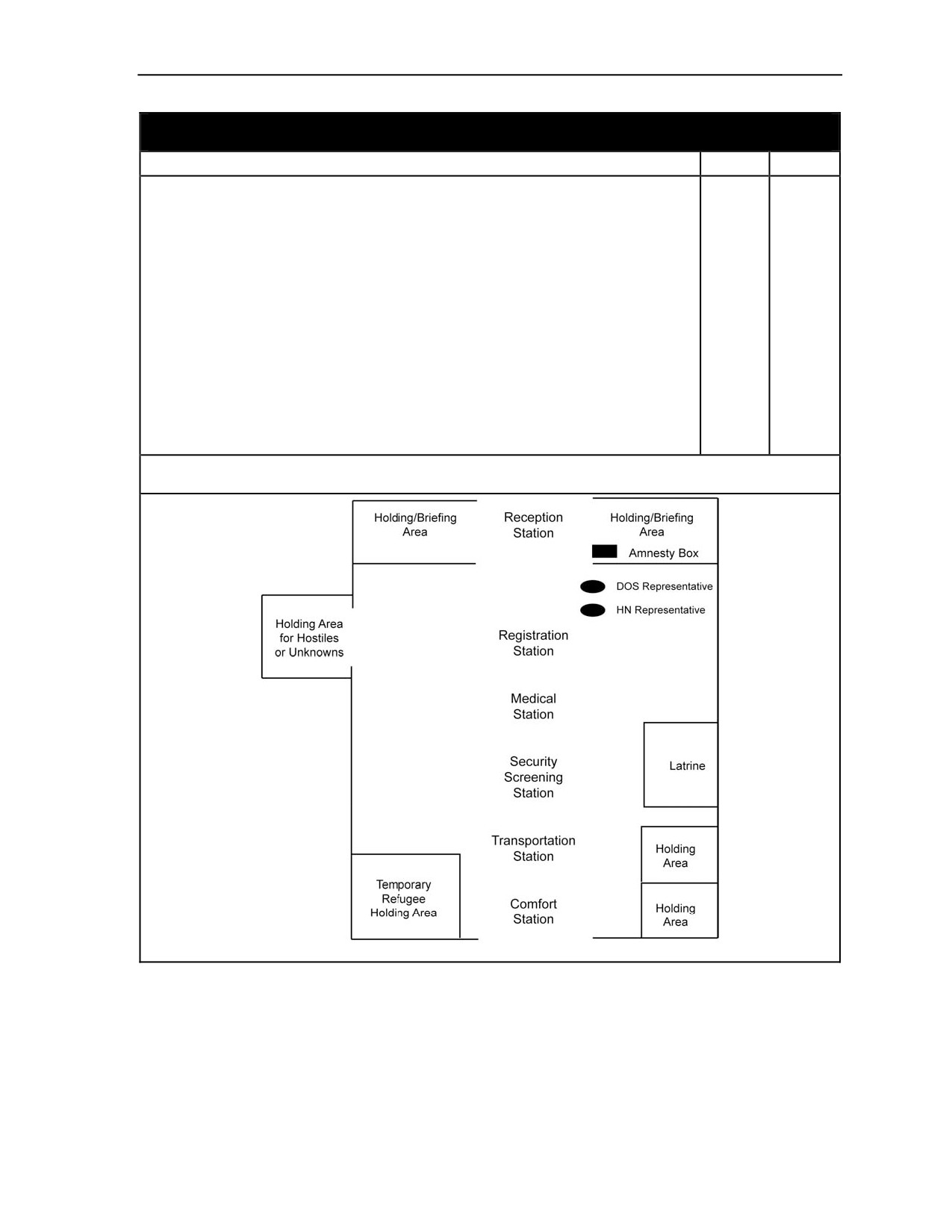
Evacuee Processing Training and Evaluation Outline
Establish and Operate a NEO Processing Center (continued)
TASK STEPS AND PERFORMANCE MEASURES
GO
NO-GO
*1. The processing team OIC develops the plan for the layout of the processing center.
The schematic below shows a generic processing center. Each processing station
is positioned to support an orderly and logical flow similar to the preboarding
procedures of a civilian airline. The plan includes the following:
a. Reception station (NEO-002).
b. Security screening station (NEO-003).
c. Registration station (NEO-004).
d. Medical station (NEO-005).
e. Transportation station (NEO-006).
f.
Debriefing station (NEO-007).
g.
Holding areas—hostile, unknown, and evacuees (NEO-008).
h.
Temporary refugee holding area (NEO-009).
i.
Comfort station (NEO-010).
j.
Security element (NEO-011).
Processing Center Schematic
Figure G-1. Example evacuee processing training and evaluation outline for establishing and
operating a noncombatant evacuation operation processing center (continued)
16 November 2009
FM 3-05.131
G-3
Appendix G
Establish and Operate a NEO Processing Center (continued)
TASK STEPS AND PERFORMANCE MEASURES
GO
NO-GO
*2.
The ECC OIC orders stations to establish a processing center. Personnel at the
stations perform the following tasks before processing:
a.
Physically secure the ECC.
b.
Erect physical barriers.
c.
Implement crowd-control measures.
d.
Establish linkup with the ECC tactical operations center
(TOC), security
element, and marshalling force.
e.
Prepare signs to identify routes and stations.
f.
Mark station boundaries (using engineer tape, for example).
g.
Check and ready equipment for processing.
h.
Brief processors and escorts on the responsibilities and responses to possible
dilemmas (see Possible Dilemmas below).
i.
Establish amnesty boxes and sites.
j.
Place control or guards at all access point to the center.
k.
Ensure a female is available, if possible, for searches of female evacuees
(MPs or USAF security forces are recommended).
l.
Assign guards or guides for evacuee latrine usage.
m.
Locate an explosive ordnance pit near the inspection area.
n.
Ensure an interpreter or language cards at are each station.
o.
Ensure refreshments and food are available.
p.
Ensure handcuffs and restraints are available.
q.
Ensure the public address system is operational.
r.
Ensure limited comfort items for evacuees (for example, supplies for women
and children (are available).
s.
Ensure travel comfort items
(for example, motion sickness bags,
antinauseants, and hearing protection) are available.
t.
Establish a special holding area for persons requiring thorough inspections,
special handling, detention, and so on.
u.
Establish and monitor secure frequency modulation
(FM) voice
communications with the ECC and the TOC.
POSSIBLE DILEMMAS
When is deadly force authorized? Review the following situations:
• Use of weapon system (Mark-19 or mortar).
• Hostile detainee who presents himself or is captured by the evacuation force.
• Civil disturbance from passive resistance or civil disobedience through violence.
• Terrorism.
• Snipers.
How will the force handle the following:
• Nonambulatory evacuees.
• Evacuees with special medical needs, such as pregnancy, infectious disease, exceptional family
members as pediatric health care problems.
• Evacuees suffering from trauma resulting from the current situation.
• Language problems.
• Religious problems.
Figure G-1. Example evacuee processing training and evaluation outline for establishing and
operating a noncombatant evacuation operation processing center (continued)
G-4
FM 3-05.131
16 November 2009
Evacuee Processing Training and Evaluation Outline
Establish and Operate a NEO Processing Center (continued)
POSSIBLE DILEMMAS
How will the force handle the following:
• The absence of the names of what appear to be bona fide potential evacuees the Embassy list.
• The deaths of evacuees, and the removal of their remains.
• Evacuees carrying contraband, and the disposition of contraband.
• Pets.
• Overwhelming numbers of civilians arriving at the assembly areas or evacuation site to request
evacuation.
• Listed evacuees refusing evacuation.
• Listed non-U.S. Government evacuees refusing to sign waivers.
• Classified couriers requiring segregation.
• Treatment of VIPs versus other evacuees, both U.S. and HN.
• Disruptive evacuees.
• Evacuees attempting to give bribes to gain favor.
• Inaccurate evacuation lists.
Note: Dilemma response will be mission-specific.
TASK STEPS AND PERFORMANCE MEASURES
GO
NO-GO
*3. Processing team OIC orders stations to conduct processing. The following tasks are accomplished during
evacuee processing:
a. Establish and operate a reception station (NEO-001).
b Establish and operate a security screening station (NEO-003).
c. Establish and operate a registration station (NEO-004).
d. Establish and operate a medical station (NEO-005).
e. Establish and operate a transportation station (NEO-006).
f.
Conduct security element activities in support of a processing center (NEO-011).
g.
Protect force and evacuees from direct and indirect fire.
h.
Complete prioritized roster of all evacuees.
i.
Treat all evacuees with courtesy—maintain strict control, high military appearance, and a
nonaggressive attitude to evacuees but maintain a strict military bearing.
Note: The DOS representative or the representative from the Embassy’s consular affairs office must be prepared to decide
what to do with unauthorized evacuees (for example, turn custody of them over to HN police or paramilitary forces).
TASK PERFORMANCE/EVALUATION SUMMARY BLOCK
ITERATION
1
2
3
4
5
TOTAL
TOTAL TASK STEPS EVALUATED
TOTAL TASK STEPS “GO”
TRAINING STATUS GO/NO-GO
*Indicates a leader task step.
Figure G-1. Example evacuee processing training and evaluation outline for establishing and
operating a noncombatant evacuation operation processing center (continued)
16 November 2009
FM 3-05.131
G-5