Military reference books and manuals (2009-2023, Volume 3) - page 7

UNCLASSIFIED
Figure 3 - MCMPS Tracking/Processing Screen
4. Marine Corps Mobilization Processing System (MCMPS). MCMPS is used
throughout the process to 1) provide Marine Corps wide visibility on
recalled Marines; 2) entering transportation information to track the
Marines movement from I-DPC to DPC and to their gaining command; 3)
ensure all administrative, medical/dental, legal, uniforms, equipment,
etc., tasks have been completed; and 4) track those Marines who have
been granted a delay or deferment. Users of MCMPS are CMC (MP),
COMMARFORs, bases/stations, I-DPCs, DPCs and gaining commands.
5. Marine IRR Orders Approval Process. CMC (MPP-60) coordinates with
ASN (M&RA), via DASN (RA), for approval to order Marines IRRs to active
duty.
6. IA Deactivation. CMC (MP) will publish deactivation policy based
on USD (P&R) deactivation guidance and operational requirements. All
activated Marine IRRs, less those killed or wounded, shall be
deactivated via the DPC that processed the Marine to active duty. This
also includes AC Marines processed via a DPC filling an IA requirement.
7. Sanctuary
a. CMC (MP) reviews/adjudicates operational sponsors’ requests to
activate RC individual (i.e., IMA and IRR) members with greater than 16
years of active service or those RC members that will attain 18 or more
years of active duty upon completion of orders.
b. CMC (MP) manages all RC Marines who exceed 18 years of active
service in accordance with current manpower policy.
C-3-4
UNCLASSIFIED
UNCLASSIFIED
8. Reports. CMC (MP) provides:
a. Numbers of personnel activated by grade, MOS and contingency to
CMC (P&R) to establish funding requirements.
b. Daily Personnel Status Report to JCS (J-1) from information
shown in MCTFS.
c. Oversight of IRR pool available for assignment to meet Total
Force manpower requirements.
C-3-5
UNCLASSIFIED
UNCLASSIFIED
MCO P3000.19
PLN
22 April 2005
APPENDIX 4 TO ANNEX C TO USMC MAID-P
RETIREE RECALL/DEACTIVATION
Reference:
(a) Title 10 U.S.C. Sections 688
(b) SECNAVINST 1811.4E, Voluntary Recall/Retention of
Retired Officers To/On Active Duty, 24 Jun 1993
1. Background. The references provide legal and policy when retirees may be
ordered involuntarily to active duty.
a. Reference (a) authorizes the Secretary SecNav to involuntarily recall
retired members of the Regular Marine Corps and members of the Retired
Reserve who were retired under 10 U.S.C. Sections 1293 and 6323 (warrant
officers and officers, respectively, with more than 20 years of active
service) at any time. Retired members are called to active duty under 10
U.S.C. 688 and may be assigned duties the Service Secretary considers
necessary in the interest of national defense as outlined in reference (b).
b. All retirees, including those not covered by 10 U.S.C. 688, may be
ordered involuntarily to active duty during time of war or national emergency
declared by Congress, or when otherwise authorized by law, pursuant to 10
U.S.C. 12301(a). However, a member in a reserve retired status may not be
ordered to active duty under 10 U.S.C. 12301(a) unless the Secretary
concerned, with the approval of the SECDEF, in the case of the Secretary of a
military department, determines that there are not enough qualified Reserves
in an active status who are readily available.
2. By Name Request and Approval Process
a. Below process outlines two methods for requesting a retiree - by-name
or identified retiree manpower requirement.
(1) Retiree By-Name Request Process. Requesting command/agency
identifies a by-name request for a retiree to CMC (MP) via the Requirements
Tracking Module (RTM) of the Marine Corps Mobilization Processing system
(MCMPS). CMC (MP) forwards requirement/name to CMC (MMSR) for approval.
(2) Sourcing Retiree Manpower Requirement - Not By-Name. Requesting
command/agency identifies a retiree manpower requirement via MCMPS (MRTM) to
CMC (MP). CMC (MP) staff's requirement to CMC (MMOA/EA) to source with
either a retiree or AC/RC Marine. If CMC (MMOA/EA) determines no AC/RC
manpower inventory is available, then retiree population is screened for
possible fill. Following actions occur:
b. CMC (MMSR) staffs/screens the request to ensure member meets
parameters for retiree recall per reference (b).
(1) If yes, package is routed to D/C, M&RA for approval.
C-4-1
UNCLASSIFIED
UNCLASSIFIED
(2) If no, CMC (MP) informs requester and appropriate action is
taken.
c. If the request is for greater than 179 days, the package requires
approval by Secretary of the Navy. If the request if for less than and up to
179 days the request can be approved by D/C, M&RA.
d. CMC (MMSR) issues the Retired Marine orders and informs CMC (MP) for
tracking purposes.
e. Requesting command is informed by CMC (MP) upon approval/disapproval
of the request.
f. Retirees are tracked via MCMPS to gaining command.
3. Sourcing Requirement with Retiree
a. Requesting command identifies requirement in MRTM and informs
CMC (MP). CMC (MP) staffs requirement to CMC (MMOA/EA) to source with AC/RC
Marine. If CMC (MMOA/EA) determines no AC/RC manpower inventory is
available, then retiree population is screened for possible fill. If a
suitable retiree is identified, then CMC (MMSR) reviews package to ensure
member meets the parameters for retiree recall per reference (b) resulting:
(1) If yes, then Marine is issued orders by CMC (MMSR).
(2) If no, notification to the requester is provided to requester.
b. If the request is for greater than 179 days, the package requires
approval by Secretary of the Navy. If the request if for less than and up to
179 days the request can be approved by D/C, M&RA.
c. CMC (MMSR) issues the Retired Marine orders and informs CMC (MP) for
tracking purposes.
d. Requesting command is informed by CMC (MP) upon approval/disapproval
of the request.
e. Retiree is tracked via MCMPS to gaining command.
4. Deactivation. CMC (MP) published reference (c) deactivation policy based
on USD (P&R) deactivation guidance and operational requirements.
5. Reports. CMC (MP) provides:
a. Numbers of personnel activated by grade, MOS and contingency to D/C,
CMC (P&R) to establish funding requirements.
b. Personnel Status (PERSTAT) reports to JCS (J-1).
C-4-2
UNCLASSIFIED
UNCLASSIFIED
MCO P3000.19
PLN
22 April 2005
APPENDIX 5 TO ANNEX C TO USMC MAID-P
NAVY RC ACTIVATION/DEACTIVATION AND NAVY AC IN SUPPORT OF USMCR UNITS
Reference: (a) MCO 100012, Naval Reserve Program Nine Personnel Support To
U.S. Marine Corps, 4 JUN 1998
(b) OPNAVINST 1001.21, Total Force Policy, 10 Jun 1998
(c) OPNAVINST 3060.7A, Navy Mobilization Guide, 1 Oct 1997
(d) COMNAVRESFORINST 3060.5A, Commander, Naval Reserve Force
Manpower Mobilization Support Plan (MMSP), 3 Apr 2000
(e) BUMEDINST 6440.5B, Medical Augmentation Program (MAP),
30 May 2000
1. Purpose. The US Navy supports the Marine Corps Reserve with
approximately 1,600 AC/RC personnel. Reference (a) establishes Marine Corps
policy for the administration of these assigned unit personnel. References
(b) through (d) provide additional Navy activation/deactivation processes,
policies, and procedures for recall of Navy personnel to active duty (other
than for training) in support of USMCR units identified for activation during
a contingency.
2. Navy Reserve Activation Process. Following provides step-by-step
process:
a. Step 1. Begins when the supported COMMARFOR builds his Annex A (Task
Organization) during course of action (COA) development. USMCR units
selected to source Annex A force requirements are directed by COMMARFORLANT,
via message, to report for planning (RFP) to the gaining force commander
(GFC). At this time, the USMCR unit commanding officer is authorized to
inform unit members (Marine and Navy) of this action. This serves as the
unit/member's official notification/alert, but not authorization for
activation.
b. Step 2. MARFORRES (G4/HSS) uses the supported COMMARFOR's approved
Annex A and/or RFP message to identify Navy billets in MCMPS (MRTM) showing:
1) Navy RC personnel requiring orders from NAVPERSCOM, 2) Navy AC Medical
Augmentation Personnel (MAP) that require orders, and 3) unfilled Navy
billets requiring sourcing from outside Claimant 27 (COMMARFORRES). Other
concurrent actions include:
(1) CMC (MP) coordinates with NAVPERSCOM to establish complimentary
manpower policies (i.e., delay, exemption, separation, etc) issued via
MARADMIN and NAVADMIN to ensure unit integrity and to maintain equity between
Sailors and Marines.
(2) CMC (MP), COMMARCORBASESLANT/PAC (CO, DPCs) and MARFORRES (G4/HSS)
coordinate with NAVPERSCOM (Pers 492) to establish Navy Mobilization
Processing Site (NMPS) locations where Navy RC personnel will be processed
and joined to active duty. CMC (PO) requests CNO (N3/5) to authorize
activation of a COMNAVPERSCOM Navy Personnel Mobilization Team (PMT) to
support CG, MCB Camp Pendleton and/or CG MCB Camp Lejeune.
c. Step 3. CMC (PO) coordinates with CNO (N3/5) and COMMARFORRES
(G4/HSS) to establish the activation and report date of AC/RC Navy personnel.
C-5-1
UNCLASSIFIED
UNCLASSIFIED
This should be the same date shown in MCMPS (MRTM). CMC (PO) issues message
to CNO (N3/5) requesting orders to be issued to AC/RC Navy personnel. This
action facilitates:
(1) Navy RC personnel to be ordered to active duty prior to the
activation date of the USMCR units. This action allows activated Navy
personnel to report to the USMCR unit CO prior to the unit's departure from
the Reserve Training Center (RTC). Early activation of Navy RC personnel is
required to provide sufficient time to establish an active duty pay account
in the Navy's pay and personnel system, ensure the member is medically,
dentally fit for deployment and provide uniforms and equipment for the member
from the DPC.
(2) Access to TRICARE at the 60th day prior to their active duty date
(i.e., the day the member reports for active duty). This satisfies the
intent to notify the member 30 days prior to their activation date.
(3) Identification of Navy personnel who require Delay, Deferment or
Exemption (DD&E) action.
(4) Navy MAP personnel receive TAD "In-excess" orders from their
Health Support Office (HSO).
(5) USMCR units' unfilled Navy billets are forwarded by CNO (N3/5) to
appropriate Navy claimants for sourcing. Once a Sailor is identified to
source an unfilled billet, orders are issued by either NAVPERSCOM (PERS 492)
for RC sailors or appropriate command for AC sailors.
d. Step 4. Activated sailor reports to the Naval Reserve Activity (NRA)
for initial screening, transportation to designated NMPS and orders
endorsement. Following initial screening at the NRA, the member is sent to
the NMPS for activation and processing. See TAB A of this Appendix for NMPS
locations. Navy RC personnel requesting DD&E at the NRA have their request
forwarded to NAVRESFORCOM's DD&E board for adjudication. MARFORRES (G4/HSS)
is informed of DD&E actions via NMCMPS and other collaborative means.
MARFORRES in turn notifies USMCR unit commander. Members requiring no DD&E
action are forwarded to the NMPS within 48 hours after reporting to the NRA.
Figure 2 shows a sample NRA screening checklist.
C-5-2
UNCLASSIFIED

UNCLASSIFIED
Figure 2. --NRA Sample Screening Checklist.
e. Step 5. Upon arrival at the NMPS, the RC sailor is activated (i.e.,
an active duty pay account is created by the Personnel Support Detachment
(PSD)) and the sailor completes medical, dental, legal, records, travel and
clothing and equipment processing. Figure 3 below shows how the NMCMPS is
used to support these processing functions. The activation and processing of
these personnel should be accomplished within 5 to 7 days. Once the member
has completed activation and processing, he/she is directed to report to the
CO of the USMCR unit. The goal is to have the sailor complete activation and
processing and arrive at the USMCR unit prior to the unit departing the RTC.
Figure 3. --N/MCMPS Processing Screen.
C-5-3
UNCLASSIFIED

UNCLASSIFIED
f. Step 6. The Sailor reports to the CO of the USMCR unit.
Figure 4
is a pictorial representation of the activation process. As required, CMC
(PO) will revalidate, in conjunction with the appropriate MARFOR, Navy AC/RC
manpower requirements assigned to activated USMCR units as prescribed by CNO
(N3/5).
USMCR/Navy Notional
Force Activation Timeline
CMC DIR COMMARFORRES
UNIT
TO ACTIVATE UNITS.
REPORT/ACTIVATION
TRAVEL
RLD/ALD
COMMARFORRES
USMCR UNIT
TO & ARR AT
AT APOE
NOTIFIES UNIT TO ACTIVATE
DAY
GFC
(1 DAY)
COMMARFORLANT/RES
(RFP) MSG ISSUED = ALERT.
USMCR
UNIT RDD
CMC REQUESTS CNO (N3/5)
SECNAV DIR
UNIT CONDUCTS PREDEPLOYMENT
TO AUTHORIZE RECALL OF
USMCR
IN THEATER
72 HR DELAYPROCESSING
TRAINING (IF REQUIRED)
NAVY AC/RC PERSONNEL
EAD/LAD
AT RTC
WINDOW
X
(5 DAYS)
~
EAD LAD RDD
C-Day ?
EQUIPMENT SAIL TIME
SECNAV DIR
72 HR DELAY
EQUIPMENT
EQUIPMENT
HOME
ARRIVES SPOE
ARRIVES SPOD
OF
NRA NMPS
(5 DAYS)
RECORD
(2 DAYS)
UPON COMPLETION,
SAILOR REPORTS
TO THE USMCR CO.
FOR OFFICIAL USE ONLY
Figure 4. --USMCR/Navy Synchronized Activation Timeline.
3. Deactivation. Upon mission completion, the unit will be directed to
redeploy for deactivation, unless it is redeploying to another operation.
Following is the step-by-step process for the redeployment for deactivation:
a. Step 1. Supported COMMARFOR identifies USMCR units no longer required
for assigned mission to CMC (PO) and COMMARFORLANT (G3/5), and TPFDD USMCR
unit for redeployment and subsequent deactivation.
b. Step 2. COMMARFORLANT (G3/5) requests deactivation authority of USMCR
units from CMC (PO). CMC (PO) issues deactivation authorization message that
establishes redeployment support relationships between appropriate MARFORS to
support deactivation of USMCR units and establishes the USMCR unit
deactivation date. COMMARFORLANT is the supported MARFOR and COMMARFORRES
and COMMARFORPAC are supporting COMMARFORs. CMC (PO) issues message to CNO
(N3/5) identifying the "requirement end date" for Navy personnel assigned to
USMCR units. This message will facilitate CNO (N3/5) coordination with
NAVPERSCOM (PERS 492) to issue redeployment for deactivation orders.
Specific actions these orders will support:
(1) Instructions to allow Navy personnel to deactivate with their
USMCR unit prior to reporting to the NMPS.
(2) Settlement of accrued leave.
C-5-4
UNCLASSIFIED
UNCLASSIFIED
(3) Completion of medical and dental examinations and screening.
(4) Identification of authorized benefits.
c. Step 3
(1) COMMARFORLANT
(a) Resumes operational control (OPCON) of USMCR unit upon
departure from the supported commander’s AOR.
(b) Issues redeployment Reception, Staging & Onward Movement (RSO)
message. COMMARFORPAC/COMMARCORBASESPAC supports the redeployment of USMCR
forces flowing via Southern California (SOCAL) Marine Corps installations.
(c) Commands USMCR unit until the unit is deactivated (i.e., last
day of active duty) at Reserve Training Center (RTC).
(2) Navy Personnel
(a) AC MAP personnel detach USMCR unit, at the RTC or other
designated location, and return to parent command.
(b) Assigned RC Navy personnel detach USMCR unit, at the RTC or
other designated location, out process at a NMPS and report back to the
designated NRA.
(b) RC Navy personnel, who sourced USMCR manning shortfalls,
detach USMCR unit, at the RTC or other designated location, out process at a
NMPS and report back to their parent NRA.
d. Step 4
(1) COMMARFORRES resumes command of USMCR unit post de-activation.
(2) The CO, NRA resumes command of appropriate Navy Reserve
personnel.
e. Figure 5 provides a pictorial representation of the redeployment and
deactivation process.
C-5-5
UNCLASSIFIED

UNCLASSIFIED
USMCR/Navy Notional
Redeployment & Deactivation Timeline
(Based on USMCR units on active duty for 1 year)
XX
~
65
60
~ 46
~ 30
0
5 day EAD/LAD
window
Depart
Arrive
Arrive
End/Change
Begin
End Active
Theater
CONUS
RTC
of Mission
Terminal
Duty
Leave
EQUIPMENT SAIL TIME
Final Deactivation Actions at Origin
- Final out processing to include
administrative actions and equipment
SPOE
SPOD
recovery.
- Begin terminal leave.
Redeployment from Theater
Deactivation Actions at ILOC
- Travel to home of record.
- MARFOR TPFDDs unit.
-Conduct personnel actions
- CMC issues redeployment & deactivation
and conduct medical/dental
msg.
(full exams).
- Unit completes medical assessment
- COMMARFORRES commands unit upon
- Receipt of unit equipment.
unit deactivation.
prior to redeployment.
-MARFORLANT resumes OPCON of
Active Duty Parent Command
unit upon departure from AO.
HOME
NMPS NRA
OF
UPON COMPLETION,
RECORD
SAILOR REPORTS
TO CO, NRA.
FOR OFFICIAL USE ONLY
Figure 5. --USMCR/Navy Redeployment and Deactivation Notional Timeline.
TAB:
A - Navy Mobilization Processing Sites (NMPS)
C-5-6
UNCLASSIFIED

UNCLASSIFIED
MCO P3000.19
PLN
22 April 2005
TAB A TO APPENDIX 5 TO ANNEX C TO USMC MAID-P
NAVY MOBILIZATION PROCESSING SITES (NMPS)
Reference: (a) OPNAVINST 3060.7A Navy Mobilization Guide, 1 Oct 1997
1. Purpose. The below figure shows the locations of Navy Mobilization
Processing Sites (NMPS) less NMPS, Pearl Harbor, HI and NMPS, London,
UK as shown in the reference.
2. Mission. The mission of the NMPS is to process and join to active
duty (other than for training) members of the Navy Reserve to include
Navy Reserves assigned to USMCR units. NMPS Camp Pendleton and Camp
Lejeune have been designated specifically to process Navy Reserve
personnel to active duty with assigned to USMCR units.
Navy Mobilization Processing Sites
(NMPS)
BANGOR, MA
NTC GREAT LAKES, IL
GROTON, CT
WASHINGTON, DC
PORT
NORFOLK, VA
HUENEME, CA
NSA MID SOUTH
MILLINGTON, TN
CAMP
PENDLETON, CA
CAMP
LEJEUNE, NC
NAVBASE
JACKSONVILLE, FL
SAN DIEGO, CA
GULFPORT, MS
Red - USMC sites
Green - Sea Bees sites
Blue - Navy sites
NAS
PENSACOLA, FL
Figure 1. --Navy Mobilization Processing Sites.
C-5-A-1
UNCLASSIFIED
FOR OFFICIAL USE ONLY
MCO P3000.19
PLN
22 April 2005
APPENDIX 6 TO ANNEX C TO USMC MAID-P
INDIVIDUAL COMBAT REPLACEMENTS AND LIKE-TYPE UNIT REPLACEMENT
REF:
(a) MCWP 5-1, W/Ch1, Marine Corps Planning Process,
5 Jan 2000
(b) Marine Corps Casualty Estimation Model (CASEST),
30 Sep 2001
(c) Mailgram Orders System, 5 Sep 2002
(d) Marine Corps Mobilization Processing System (MCMPS),
30 Sep 02
(e) School of Infantry (SOI) Program of Instruction
(POI) for Combat Refresher Training (CRT)
1. Purpose. To provide USMC individual combat replacement methodology
beginning with the supported COMMARFOR conducting a casualty estimate
during Course of Action (COA) development and selection per references
(a) and (b). Following COA approval, D/C, M&RA identifies AC/RC
Marines to source combat replacements. The Marine Corps IRR is the
primary source HQMC will use to source combat replacements. Processing
and equipping of combat replacements is conducted by DPC MCB Camp
Pendleton and DPC, MCB Camp Lejeune. Schools of Infantry East/West
(SOI E/W), conduct Combat Refresher Training (CRT) prior to the Marines
reporting to their gaining unit commander.
2. Initial Planning. During COA development, the supported MARFOR
develops casualty estimates for each campaign phase based on USMC
forces engaged, enemy capabilities and assumed combat intensity. This
activity is accomplished using the D/C, M&RA sponsored and Marine Corps
Combat Development Command (MCCDC) approved Marine Corps Casualty
Estimation Model (CASEST). CASEST is an automated tool used by
MARFOR/MEF/Wing (G-5, 4, 3, and 1) planners to 1) evaluate combat
scenarios and 2) assist with COA analysis, 3) assist MEF manpower
planners to identify numbers of replacements required by grade/MOS and
element of the MAGTF by phase of the operation to CMC (MPP-60), 4)
facilitates CMC (PL, PO, and MPP-60planning to determine the number of
I-DPCs, DPCs and SOIs required to process and train Marine IRRs.
CASEST has the capability to model conventional, NBC and Disease Non-
Battle Injury (DNBI) casualties. This model was first used during
Operation Desert Shield/Storm (1990-1991) and subsequently has been
used through Operation Iraqui Freedom (OIF). CASEST information is
located on the DC, PP&O (PLN) siprnet home page.
a. Identifies the number of combat replacements required by phase
of the campaign/operation. Combat replacements are shown in the
supported COMMARFOR's Time Phased Force Deployment Data (TPFDD).
b. Provides the combat replacements requirement shown in Appendix
5 of Annex A of the supported COMMARFOR's operation plan.
c. Provides a data set used by CG, MCCDC (TFS) to capture manpower
requirements in the Wartime Authorized Strength Requirement (WASR)
model. At execution, this information is used by D/C, M&RA to source
C-6-1
FOR OFFICIAL USE ONLY

FOR OFFICIAL USE ONLY
AC/RC combat replacement requirements by grade and MOS. CMC (MM) and
CMC (MP) are tasked with sourcing this requirement.
d. Allows CMC (MP) to coordinate with the supported COMMARFOR, CGs
of MCBs Camp Pendleton and Camp Lejeune and CG, TECOM to establish flow
of combat replacements per the GFC's TPFDD. Throughput is established
by using the Mailgram Order Model per reference (c).
e. Supports CG, TECOM (SOI E/W) to plan for and conduct combat
refresher training. Planning includes determining ammunition
requirements, instructors, range requirements and medical support
commensurate with projected throughput.
f. Supports CG, MCB Camp Pendleton and CG, MCB Camp Lejeune to
conduct throughput planning such as: administration support, messing
and billeting, and equipping (i.e., uniforms and weapons).
g. Supports D/C, PP&O to identify individual RC requirement to the
Joint Staff, which is used to determine appropriate recall authority to
be requested from the President and/or Congress.
3. Combat Replacement Planning
a. Initial Planning. CMC (MP) and supported COMMARFOR (MEF)
collaborate during COA development to determine the combat replacement
requirement (by grade and MOS by element of the MAGTF) based on type of
combat (intense, medium, low) by geographic location, time of year, and
enemy capability that would prevent the MAGTF from accomplishing its
mission. Figure 1 provides a snap shot of modeled MOS 0121 and 0151
casualties for a given scenario. Each type of casualty requires a
replacement to maintain the MAGTF's combat effectiveness.
Figure 1. --Casualty Estimation Model.
C-6-2
FOR OFFICIAL USE ONLY

FOR OFFICIAL USE ONLY
Figure 2 below shows the initial planning process to determine combat
replacements supported by reference (b).
Determining Combat Replacement
Requirements
PLAN
Information used by
HQMC, Bases, and
TECOM to conduct
Supported MARFOR
TPFDD
support planning.
identifies combat
replacement
Approved
requirements during
COA development.
CASEST
Not
File
Approved
CMC (MP) conducts analysis
to determine availability
of population to support
Returned for
requirement. Feedback is
further refinement.
provided to MARFOR (MEF).
IRR
Population
Figure 2. --Combat Replacement Planning.
b. Execution Phase. During this phase, CASEST is re-run based
on current situation and other known planning factors - see Figure 3
below.
Figure 3. --CASEST Scenario Screen.
C-6-3
FOR OFFICIAL USE ONLY
FOR OFFICIAL USE ONLY
Once the refined CASEST requirement is approved by the COMMARFOR, the
CMC determines, based on recommendation by D/C, M&RA, whether AC or RC
Marines will be used to source initial combat replacements. If AC
Marines are used, the following actions occur:
(1) CMC (MM) will allocate individual grade and MOS fill
requirements to the operating forces and support establishment for
sourcing.
(2) Losing AC command/agencies will issue by-name orders to
identified AC Marines to report to either DPC MCB Camp Lejeune or MCB
Camp Pendleton for training prior to reporting to their gaining
command. AC Marines found non-deployable will be returned to their
parent command unless otherwise directed by the CMC (MM).
(3) If the formation of Combat Replacement Pools (CRPs) are
required, CMC (MP) will staff DPCs MCB Camp Pendleton and MCB Camp
Lejeune with AC/RC Marines to process, train (via the School of
Infantry (SOI) East/West) these Marines prior to them reporting to
their gaining command. A CRP is an administrative grouping of Marines
to facilitate processing and CRT. Staffing of the DPCs will be based
on projected combat replacement throughput.
(4) Losing command will:
(a) Provide individual equipment such as, but not limited
to, T/O weapon, gas mask.
(b) Will ensure medical and dental screening is completed.
(c) Will issue Marine(s) TAD orders as directed by CMC
(MM).
(d) By exception, if the losing command is unable to
provide individual equipment and/or provide medical/dental exams, the
DPC will complete administrative and logistical processing of the
Marine. DPC funding for equipping these AC Marines is provided by D/C,
P&R via the base comptroller.
(5) When D/C, M&RA is authorized to source combat replacements
from the Individual Ready Reserve (IRR), I-DPCs, DPCs (MCBs Camp
Pendleton and Camp Lejeune, less MCB Quantico) and SOI East/West will
be manned appropriately by CMC (MP) to process, equip and train
projected number of combat replacements in addition to IAs. CMC (MP)
establishes the combat replacement throughput using reference (c).
Figure 4 provides a Mailgram screen shot showing how throughput will be
governed by DPC per day per week.
C-6-4
FOR OFFICIAL USE ONLY

FOR OFFICIAL USE ONLY
Figure 4 - Mailgram Model
(6) DPC Planning Throughput Options. See Appendix 8 of Annex C
for combat replacement throughput options.
(7) Combat Replacement Timeline. In conjunction with
establishing the combat replacement flow, CMC (MP and PO) coordinates
with the gaining COMMARFOR to select either a 7- or -15 day Combat
Refresher Training (CRT) Program of Instruction (POI). Figure 5 shows
when week 1 combat replacements will be available to the gaining
employing commander using a 7-day CRT POI. Figure 6 shows when week 2
combat replacements will be available to the gaining employing
commander using a 15-day CRT POI.
IRR Combat Replacement
Timeline w/7 Day POI
Movement to
Marine
theater
Marine arrives
Marine
receives
(3 day TPFDD
At DPC
returns to
Mailgram
DPC
window)
0
2
16 18
22 23
30
33
36
RSO&I is
DELAY(*)
DPC (5 days)
SOI
(7 days)
conducted -
Marine joins unit
Marine
departs
Marine Arrives
IMPC
in theater
Marine
Marine undergoes
reports
Combat Refresher
to
Training (CRT)
VARIABLES:
IDPC
SecNav directed delay (*)
Mailgrams
Delay between MPC and SOI
authorized
Additional DoD directed requirements
and sent
such as shots, etc
(2 days)
Travel to theater delays
Figure 5. --IRR Combat Replacement Timeline with 7-Day CRT POI.
C-6-5
FOR OFFICIAL USE ONLY
FOR OFFICIAL USE ONLY
IRR Combat Replacement
Timeline w/15 Day POI
Movement to
Marine
Marine arrives
Marine
theater
receives
(3 day TPFDD
At DPC
returns to
Mailgram
DPC
window)
0
2
16 18
22 23
30
33
43
RSO&I is
DELAY(*)
MPC (5 days)
SOI
(15 days)
conducted -
Marine joins unit
Marine
departs
Marine Arrives
IDPC
in theater
Marine
Marine undergoes
reports
Combat Refresher
to
Training (CRT)
VARIABLES:
ID PC
SecNav directed delay (*)
Mailgrams
Delay between MPC and SOI
authorized
Additional DoD directed requirements
and sent
such as shots, etc
(2 days)
Travel to theater delays
Figure 6 - IRR Combat Replacement Timeline with 15-Day CRT POI
(8) DPC Quantico will process individual Marines as required -
less combat replacements. DPC Quantico supports the National Capitol
Region (NCR), which includes HQMC, other Marine Corps commands and
agencies, and the Joint Staff.
4. Tracking Combat Replacements. Replacements will be tracked using
Marine Corps Mobilization Processing System (MCMPS) per reference (d).
5. Initial Deployment Personnel Center (I-DPC) Mission and Tasks. See
Appendix 7 of Annex C.
6. Deployment Personnel Command (DPC) Mission and Tasks. See Appendix
8 of Annex C.
7. School of Infantry’s Combat Refresher Training Mission and Tasks.
Conducts combat refresher training (CRT) per reference (e). CRT POI’s
are available at following web-site:
http://www.tecom.usmc.mil/g3/rmt.htm.
8. Supported MARFOR. Develops concept of combat replacements and
requests (or “pulls”) combat replacements into theater.
(Annex U,
Appendixes 21 and 22)
9. Like Type Unit Replacement. This section addresses situations
dealing with replacement of AC or activated USMCR units, in support of
a contingency, that have been attrited due to combat losses or as a
result of non-hostile action (e.g., in March 1982 an airplane crash
killed 248 members of the 101st Air Assault Division assigned to a six-
month Sinai peace keeping mission). Following planning options are
provided for replacing AC/RC units attrited during combat operations:
C-6-6
FOR OFFICIAL USE ONLY
FOR OFFICIAL USE ONLY
a. Employing MAGTF commander replaces attrited unit(s) with other
unit(s) within the MAGTF’s force list. Attrited unit is reconstituted
with manpower, equipment and training.
b. HQMC recommends to the Joint Staff to globally source AC
replacement unit(s). This effort is coordinated with OSD, JCS and
appropriate combatant commanders.
c. HQMC recommends and coordinates with the Joint Staff to
activate USMCR units to augment (i.e., provide same capability)
employing GFC at the company or platoon level or equivalent with
aviation units replacing down to the aircrew level. If this option is
used, D/C, PP&O will identify USMCR units, via COMMARFORRES, to
sufficiently source unit replacement requirements. USMCR activations
will be directed by the D/C, PP&O and coordinated with D/C, M&RA,
COMMARFORRES, COMMARFORLANT and the gaining/employing Marine force
commander. Once activated, USMCR units will be manned via the HQMC
manpower process.
d. Catastrophic loss of capability/combat effectiveness will be
determined by the MAGTF commander or the supported combatant
commander's COMMARFOR. Unit replacement will be at the company and
platoon or equivalent with aviation units replacing down to the aircrew
level. In the case of mass casualties, the threshold of unit
replacement will be 80 percent of the aggregate peacetime T/O based on
the deployment guidance. For example, USMC AC/RC units in support of
an operation deploy at 90 percent of peacetime T/O. Once that unit
falls below 80 percent of the 90 percent deployment T/O, this unit
would be replaced.
T
1
C-6-7
FOR OFFICIAL USE ONLY
UNCLASSIFIED
MCO P3000.19
PLN
22 April 2005
TAB A TO APPENDIX 6 TO ANNEX C TO USMC MAID-P
SCHOOL OF INFANTRY (SOI) COMBAT REFRESHER TRAINING (CRT)
Reference: (a) Program of Instruction (POI) for Combat Refresher
Training (CRT) - East, 7 Feb 2003
(b) Program of Instruction (POI) for Combat Refresher
Training (CRT) - West, 7 Feb 2003
(c) 15 Day Program of Instruction (POI) for Combat Refresher
Training, 1996
1. Purpose. To provide the Schools of Infantry (SOI) mission and
tasks for the conduct of individual Combat Refresher Training (CRT).
SOI is not responsible for conducting activated USMCR unit training.
This is the responsibility of the gaining force commander.
2. Planning Factors
a. Expect combat replacement flow as shown in Appendix 8 of Annex
C of this document.
b. Marines will arrive for CRT equipped by the Deployment
Personnel Center (DPC) ready to conduct training.
c. The DPC retains administrative control of Marines undergoing
CRT.
d. Appropriate numbers of Navy Corpsman will be available to
support CRT.
e. CRT will not interfere with regular SOI E/W accession training.
f. Marine nstructors (i.e., pre-assigned by CG, MOBCOM or sourced
from the IRR by CMC (MP)) will be ordered to active duty prior to
Marine Reservists that will source the combat replacement pools.
Instructors sourced from the IRR should be activated at a minimum four
weeks prior to arrival of first combat replacement.
g. Current base infrastructure will support CRT.
h. Officers and SNCOs will not be required to attend all CRT.
Officer and SNCO CRT should be based on future billet assignment.
2. Mission. When directed, SOI E/W conduct Combat Refresher Training
(CRT) for individual AC/RC Marines in order to re-familiarize them with
selected Marine Corps common skills required to function in a combat
environment.
C-6-A-1
UNCLASSIFIED
UNCLASSIFIED
3. Tasks
a. D/C, M&RA. As coordinated with CMC (PO), CMC (MP) issue orders
to Marine Reserves pre-assigned as CRT POI instructors and trainers in
sufficient time to ensure these Marine are in place and ready to
conduct CRT.
b. D/C, I&L. Be prepared to support SOI training requirements, as
required.
c. CG, TECOM (COs, School of Infantry East/West)
(1) Coordinate with CMC (RAP) and COMMARFORRES (G-3 Training)
to provide accelerated training for USMCR unit members requiring
initial 03XX MOS training who’s units have been identified for
activation. Upon completion of training, these unit members will
return to their parent organization. See Annex W (Fiscal) for funding
responsibilities.
(2) Be prepared to conduct IA and Combat replacement CRT, when
directed, IAW reference (a) and (b).
(3) Conduct seven or 15 day CRT for combat replacements
without regard to grade and MOS per reference (a) and (b). CRT will
focus on the following areas:
(1) First Aid
(2) NBC
(3) Individual Weapons
(4) Coordinate with COMARCORSYSCOM for additional ammunition
requirements to support CRT.
d. COMMARCORBASESLANT/PAC (Marine Corps Base Camp Pendleton and
Camp LeJeune)
(1) Provide training ranges for CRT.
(2) Provide other assistance as required.
4. Administration
a. Administration for SOI permanent or gained personnel is
conducted by organic administrative capability.
b. Administration for Marines undergoing CRT is the
responsibility of the DPC.
C-6-A-2
UNCLASSIFIED
UNCLASSIFIED
Exhibits:
1 - CRT Battle Rhythm - 7 Day CRT POI
2 - CRT Battle Rhythm - 15 Day CRT POI
C-6-A-3
UNCLASSIFIED

UNCLASSIFIED
MCO P3000.19
PLN
22 April 2005
EXHIBIT 1 TO TAB A TO APPENDIX 6 TO ANNEX C TO USMC MAID-P
CRT BATTLE RHYTHM - 7 DAY CRT POI
Purpose. To provide an overview of CRT battle rhythm using a 7-day
POI. SOI will “pick-up” Marines requiring CRT from the DPC each Monday
as shown below.
CRT Battle Rhythm
Pick-Up/Begin Training on Mon (Day 1) & Depart
On following Sun (Day 7)
Sun Mon Tues Wed Thurs Fri Sat
1
2
3
4
5
6
7
8
9
10
11
12
13
14
15
16
17
18
19
20
21
22
23
24
25
26
27
28
29
30
31
CRC departs SOI
CRT begins
1
C-6-A-1-1
UNCLASSIFIED
UNCLASSIFIED
MCO P3000.19
PLN
22 April 2005
EXHIBIT B TO TAB A TO APPENDIX 6 TO ANNEX C TO USMC MAID-P
CRT BATTLE RHYTHM - 15 DAY CRT POI
Purpose. To provide an overview of CRT battle rhythm for the 15 day
POI. SOI will “pick-up” Marines requiring CRT from the DPC each Monday
as shown below.
CRT Battle Rhythm
Pick-Up/Begin Training on Mon (Day 1) & Depart
On Sun (Day 15)
Sun Mon Tues Wed Thurs Fri Sat
1
2
3
4
5
6
7
8
9
10
11
12
13
14
15
16
17
18
19
20
21
22
23
24
25
26
27
28
29
30
31
CRC departs SOI
CRT begins
1
C-6-A-2-1
UNCLASSIFIED
UNCLASSIFIED
MCO P3000.19
PLN
22 April 2005
APPENDIX 7 TO ANNEX C TO USMC MAID-P
INITIAL DEPLOYMENT PROCESSING CENTER (I-DPC) OPERATIONS
REF:
(a) Intraservice Support Agreement between Commander, Marine
Forces Reserve and Commanding General, Marine Corps
Recruiting Command (MCRC), May 2003
(b) 10 U.S.C. Section 12319, Ready Reserve Muster Duty
(c) DoD Instuction 1200.7, Screening the Ready Reserve, 18 Nov
1999
(d) MCO P1001R.1J, Marine Corps Reserve Administrative Management
Manual (Short Title: MCRAMM), 10 Mar 1999
(e) MCO P6100.12 w/Ch1, Marine Corps Physical Fitness Test and
Body Composition Program Manual (Short Title: MCPFTBCP), 10
May 2002
(f) NAVMED P-117; Manual of the Medical Deportment, 29 Oct 1992
(U)
(g) MCO P1900.16F, Marine Corps Separations Manual, 30 May 2001
1. Background. COMMARFORES (CG, MOBCOM) maintains I-DPCs geographically
dispersed throughout CONUS based on IRR population1. Each I-DPC is manned by
IMAs and preassigned Marine IRRs on T/O 5135 (i.e., MOBCOM). During declared
contingencies, I-DPCs will be utilized based on the number of Marine IRRs to
be recalled by CMC (MPP-60). Marines manning I-DPCs may be issued ADSW
orders, involuntary orders or execute drill and/or annual training (AT) to
support the IRR recall. This scaled activation approach provides PP&O and
M&RA decision-makers the flexibility to rapidly and efficiently process
Marine IRRs back to active duty during a contingency.
2. Mission. When directed, COMMARFORRES (CG, MOBCOM) initially processes
Marine IRRs, members of the Standby Reserve, and retirees to active duty to
meet additional manpower requirements during a contingency.
3. Tasks
a. CMC (MP)
(1) Determine number of Marine IRR and retirees to be recalled to
active duty to support total Marine Corps manpower requirements.
(2) Request authorization from SecDef, via ASN (M&RA), to order
members of the IRR, Standby Reserve and retirees to active duty.
(3) Coordinate with COMMARFORRES (CG, MOBCOM) to support the manning
of I-DPC based on number of individual Marines to be recalled to active duty
during a declared contingency.
b. CG, Marine Corps Recruiting Command (MCRC). Supports COMMARFORRES
(CG, MOBCOM) per reference (a):
1 Demographics are based on the first three numbers of the Marine’s zip code shown in
MCTFS.
C-7-1
UNCLASSIFIED
UNCLASSIFIED
(1) Pre-contingency, provides and conducts Reserve Obligations and
Opportunities Brief during IRR Musters.
(2) During contingencies provides personnel support, as required,
based on the number of I-DPCs to be manned.
c. COMMARFORRES (CG, MOBCOM)
(1) Pre-Contingency. Conduct IRR muster per references (b) and (c).
This task includes the following:
(a) Update Mandatory Screening Questionnaire.
(b) Update Dependency Application form.
(c) Update Service Member Group Life Insurance (SGLI).
(d) Provide Family Readiness Brief.
(e) Issue muster stipend payment as authorized.
(f) Per reference (d), report to CMC (RA), info CMC (MPP-60),
results of annual IRR muster using format found in DoD Instruction 1235.14 no
later than 15 October annually.
(g) POM for IRR muster.
(2) Contingency. As directed and authorized by CMC (MP),
COMMARFORRES (CG, MOBCOM) issues orders to assigned RC Marines to staff I-
DPCs necessary to support Marine IRR recall. I-DPCs accomplish the
following:
(a) Complete Dependency Application as required. This ensures
the Marine reports with supporting documentation required by the Deployment
Personnel Command (DPC) to complete activation.
(b) Require member to sign new Privacy Act Statement, as
required.
(c) Assist recalled Marines to update their Record of Emergency
Data (RED) by accessing Marine On Line (MOL). See figure (1).
C-7-2
UNCLASSIFIED

UNCLASSIFIED
Figure 1. --Marine On Line.
(d) Screen member per Appendix 3 of Annex C of this order and
code appropriately, in MCMPS, per Tab C of this Appendix.
(e) Provide messing and billeting to the member, as required.
(f) Provide air/ground transportation of the member to the DPC.
Transportation information is recorded in MCMPS to provide arrival visibility
to the DPC. If I-DPCs are not utilized by CMC (MP), MOBCOM will load
activated Marines' travel information into MCMPS to provide the DPC with the
arrival date, arrival time and airline carrier.
(g) Informs the Marine that he/she is automatically covered by
$250,000 of SGLI unless they have elected reduced coverage.
(h) Following policy is provided regarding height/weight
screening:
1 If a Marine IRR is categorized as obese, per Article 15-62
of reference (f), request CMC (MPP-60) authorization to modify the Marine’s
orders and order the Marine home. The Marine’s Delay and Exemption record in
MCMPS will be coded with the code “HW” as shown in the figure 2 above. This
policy will be followed unless modified by CMC (MPP-60) by separate
correspondence.
C-7-3
UNCLASSIFIED

UNCLASSIFIED
Figure 2. --MCMPS Screen Showing Delay and Exemption.
2 If a Marine is exempted from activation for not meeting
height and weight standards, CG, MOBCOM will convene the Activation Potential
Screening Board (APSB) to determine the Marine’s future recall potential.
3 If a Marine is exempted from activation for being obese,
CG, MOBCOM will discharge the Marine from the Marine Corps per paragraph
3200.1B of reference (e).
(3) I-DPC Continuum of Use. CMC (MP) and COMMARFORRES (CG, MOBCOM)
collaborate to ensure I-DPCs are manned to support the projected recalls.
4. Tracking. Marines are tracked/processed via the web-based Marine Corps
Mobilization Processing System (MCMPS) to provide real-time visibility of
Marines being processed to CMC (MP, PO), DPCs and the Marine’s gaining
command.
5. Requests for Delay, Deferment or Exemption (DD&E). OICs of I-DPCs will
follow instructions found in Annex E to process DD&E requests. All Marine
IRRs will be authorized a prescribed number of calendar days delay as
directed by the SecNav and/or DoD policy. The period of delay will be
contingency specific. The report date shown in the recall orders reflects
the inclusion of the SecNav directed delay.
6. Policy
a. The Marine is in on active duty status upon receipt of the
involuntary orders from CMC (MP), is entitled to SGLI and subject to the
UCMJ.
b. MOBCOM maintains administrative responsibility of the Marine until
joined to active duty by the DPC for further duty with the Marine’s gaining
command.
C-7-4
UNCLASSIFIED
UNCLASSIFIED
c. If a Marine is screened and found not qualified to execute orders,
the orders are modified (i.e., canceled) by CMC (MP). MOBCOM will then issue
ADSW-RC orders to the Marine and fund for travel back to where the Marine was
ordered to active duty. Upon arrival at their Place Entered Active Duty
(PLEAD), de-activated/discharged Marines will submit a travel claim to MOBCOM
for final disbursement of pay, allowances and travel while on active duty.
d. Marines found not qualified for active duty will have their cases
referred to CG, MOBCOM's Activation Screening Board (ASB) to determine their
future recall potential.
e. If a Marine fails to report after 24 hours of the report date, the
Marine will be considered in an Unauthorized Absence (UA) status and reported
as such in MCTFS and MCMPS to provide visibility to CMC (MP). On the thirty-
first day, the Marine’s status will be changed to deserter.
This
information is used by CMC (MP) to inform the CMC and JCS (J1) via the daily
PERSTAT Report.
TABS
A - I-DPC Locations
B - IDPCs MCCs
C - MCMPS Delay and Exemption Codes - IRR Recall and IRR Muster
C-7-5
UNCLASSIFIED

UNCLASSIFIED
MCO P3000.19
PLN
22 April 2005
[TAB A] TO APPENDIX 7 TO ANNEX C TO USMC MAID-P
I-DPC LOCATIONS
1.
Purpose. Illustration below depicts I-DPC CONUS locations based on
IRR demographics.
30 x Initial DPC (I-DPC) Locations
Ft. Lewis, WA
Ft Devens, MA
Rochester, NY
Twin Cities, MN
Ft Devens, MA
Detroit, MI
Cincinnati, OH
Philadelphia, PA
MCRSC,
Pittsburgh, PA
Salt Lake City, UT
Belton, MO
Sacramento, CA
St Louis, MO
Quantico, VA
Aurora, CO
Cincinnati, OH
Dam Neck, VA
Kansas City, MO
Encino, CA
Long Beach, CA
MCB, Camp Pendleton
Charlotte, NC
Oklahoma City, OK
Memphis, TN
Phoenix, AZ
MCB, Camp Lejeune, NC
San Diego, CA
Marietta, GA
Ft. Worth, TX
Savannah, GA
San Antonio, TX
Houston, TX
Orlando, FL
MARFORRES,
New Orleans, LA
C-7-A-1
UNCLASSIFIED
UNCLASSIFIED
MCO P3000.19
PLN
22 April 2005
[TAB B] TO APPENDIX 7 TO ANNEX C TO USMC TF MAID PLAN
I-DPC MONITORED COMMAND CODES (MCCs)
Number
I-DPC
MCC
1
Brooklyn, NY
SFQ
2
Fort Devens, MA
SFL
3
Rochester, NY
SEC
4
Cincinnati, OH
SEX
5
Dam Neck, VA
SFO
6
Philadelphia, PA
SFT
7
Pittsburgh, PA
SFI
8
Quantico, VA
SEH
9
Charlotte, NC
SED
10
Marietta, GA
SEV
11
Orlando, FL
SBG
12
Savanna, GA
SEE
13
Aurora, CO
SFA
14
Fort Worth, TX
SEZ
15
Houston, TX
SFB
16
Memphis, TN
SEN
17
Oklahoma City, OK
SFH
18
San Antonio, TX
SFJ
19
St Louis, MO
SFK
20
Chicago, IL
SFS
21
Detroit, MI
SFW
22
Kansas City, MO
SFD
23
Twin Cities, MN
SFE
24
Encino, CA
SFR
25
Fort Lewis, WA
SFP
26
Long Beach, CA
SFY
27
Phoenix, AZ
SFU
28
Sacramento, CA
SCA
29
Salt Lake City, UT
SES
30
San Diego, CA
SFZ
C-7-B-1
UNCLASSIFIED
FOR OFFICIAL USE ONLY
MCO P3000.19
PLN
22 April 2005
TAB C TO APPENDIX 7 TO ANNEX C TO USMC MAID-P
MCMPS DELAY AND EXEMPTION CODES
Ref:
(a) MCO P1080.20 w/Ch 2, Marine Corps Total Force System
Codes Manual (MCTFSCODESMAN), 16 Sep 2003
1. Purpose. Per the reference, the following codes will be entered
into MCMPS to report the status of RC Marines, unit members and
individuals members, recalled to active duty. HQMC, MARFORRES, MOBCOM,
I-DPCs and DPC are directed to used these codes:
Code
Description
Code
Description
AA
CMC directed cancellation of
L0
Student
recall orders
A0
Member is a minister
M0
Medical Delay
BB
Recall orders re-issued by
N0
Member lives OCONUS
MOBCOM
B0
Member enrolled in medical
P0
Joined other Service
school
CC
Recall orders returned to
Q0
Member has joined USMCR unit or
MOBCOM
IMA
C0
Member is a doctor
R0
Member is over age 60
DD
Member is pregnant
S0
Member is found medically unfit at
I-DPC
D0
Member is Key Employee or
T0
Member is unavailable for duty
member of Congress
EE
Member unqualified for duty
U0
Member has fulfilled MSO
E0
Member is sole surviving
V0
Member has submitted for
son/daughter
retirement
FF
Conscientious Objector
W0
Member on active duty with other
Service
F0
Personal hardship
X0
Member is AC USMC
GG
Medically unqualified for
Y0
Member is disabled
duty at DPC
G0
Granted deferment by I-DPC
Z0
Member is deceased
HH
Members requests to “Drop”
A1
Individual USMCR unit member on
to IRR
ADSW-CO orders.
H0
Granted deferment by MOBCOM
A2
Individual USMCR unit member on
ADSW-CO orders filling an IA
billet
II
Granted deferment by USMCR
A3
IMA member on ADSW-CO orders
Unit CO/OIC
filling an IA billet
I0
Placed in Inactive Status
A4
IRR on 3rd year ADSW-CO orders
List (ISL)
JJ
Separated at the DPC
A4
IRR on 4th year ADSW-CO Orders
J0
Identified at Key Employee
A5
Involuntarily activated Marine IRR
in legal hold status
KK
Granted deferment by DPC
A6
Involuntarily activated USMCR unit
member in legal hold status
K0
Hardship (Community)
C-7-C-1
FOR OFFICIAL USE ONLY

UNCLASSIFIED
MCO P3000.19
PLN
22 April 2005
APPENDIX 8 TO ANNEX C TO USMC MAID-P
COMMARCORBASESLANT/PAC AND MCB QUANTICO DEPLOYMENT PROCESSING COMMANDS (DPC)
REF:
(a) OPNAVINST 3060.7A, Navy Manpower Mobilization Guide,
1 Oct 1997
1. Background. Commanders, MarCorBasesLant/Pac (COMMARCORBASESLANT/PAC) are
tasked to support deployment of operational forces, processing AC/RC
Individual Augments (IAs) and activating individual Marine Reserves and
retirees as directed by D/Cs PP&O and M&RA. This appendix focuses on
Deployment Processing Command (DPC) and/or Personnel Processing Center (PPC)
organization and their responsibilities for activation/deactivation and
processing individual Marine Reservists, AC Marines, and Navy RC personnel
assigned to USMCR units. Per reference (a), MCB Camp Pendleton and MCB Camp
Lejeune have been designated as Navy Mobilization Processing Sites (NMPS) to
activate, clothe and equip activated Navy Reserve personnel assigned to USMCR
units.
2. Mission. When directed by D/C, M&RA, DPC processes and joins to active
duty individual RC Marines and Navy RC personnel assigned to USMCR units
involuntarily recalled to active duty.
3. DPC. Figure 1 shows notional DPC organization.
Deployment Personnel Command
Notional Organization
COMMARCORBASE
D/C, M&RA
CG, MCB
DIR, MP
CG, MCCDC
MARFORRRES
CO
RSU/DPC
CO, SOI
RSU
DPC/NMPS
PMT
S-1
S-3
S-4
PPC
PCC
PLCC
(S-1)
(S-3)
S-4
Casual
Admin Training
Company
Companies
Command
Responsible for activation of individual
Coordination
Marine Reservists and AC IA’s.
Technical
Direction
FOR OFFICIAL USE ONLY
Figure 1. --Notional DPC Organization.
C-8-1
UNCLASSIFIED
UNCLASSIFIED
a. Deployment Processing Command (DPC)
(1) The DPC is formed around the Reserve Support Units (RSU) aboard
Camp Pendleton and Camp Lejeune with additional activated Marine RC
personnel. RSUs MCAS Miramar and MCAS Cherry Point form Personnel Processing
Centers (PPC) to in-process/out process individual RC Marines to active
duty/release from active duty who have received recall orders from CMC (MP)
and are assigned to their respective air stations. Tabs A and B of this
Appendix provide an overview of the activation/deactivation process. Reserve
Affairs Department, MCB Quantico Va, forms a PPC to in-process/out-process
individual RC Marines reporting to the National Capital Region (NCR) who have
received recall orders from CMC (MP). The two DPCs and three PPCs are
staffed with Reserve (i.e., Active Reserve (AR), IMA, pre-assigned IRR),
civilian, regular, and retiree manpower identified on its T/O to allow for
scalable manning of the DPCs/PPCs, as necessary, to meet the projected
processing requirements.
(Note: RSU MCAS Cherry Point will process and join
to active duty individual RC Marines reporting for duty at MCAS Cherry Point.
MCB Quantico will process and join to active duty individual Reserve Marines
assigned to the National Capitol Region (NCR). Individual RC Marines
activated for duty with MCABWA (i.e., MCAS Miramar, MCAS Camp Pendleton and
MCAS Yuma) will be processed by MCABWA Total Force PPC located at the Joint
Reception Center (JCR), Miramar). Following table provides information on
the DPC/PPC:
Command
T/O
RUC
MCC
RSU/DPC Camp Lejeune1
7581
31015
013
RSU/DPC Camp Pendleton2
7615
33103
014
RSU/PPC Quantico
7411
59252
XJ1
RSU/PPC MCAS Cherry
8340
02002
022
Point
RSU/PPC MCAS Miramar
8365, 8361 and 8362
02201
023
TABLE.-PPC/PPC.
RSU/DPC Camp Pendleton web site: www.pendleton.usmc.mil
RSU/DPC Camp Lejeune web site: www.lejeune.usmc.mil
b. Following paragraphs depict the various sections within the DPC:
(1) Personnel Processing Center (PPC)/S-1
a Responsible for activation/deactivation, via the unit diary,
activated individual Marine Reserves.
b Responsible for in-processing/out-processing individual AC
Marines as directed using MCMPS. Upon deactivation, issues DD-214 to
individual Marine.
c Responsible for in-processing/out-processing Navy Reserve
personnel assigned to USMCR units. Navy Reserves are gained to active duty
via the local Personnel Support Detachment (PSD), which creates an active
duty pay and personnel account in the active duty Navy pay and personnel
system.
d Endorses AC/RC Marines orders to reflect
activation/deactivation and to/from TAD in excess.
e Provides Service Member's Civil Relief Act briefings.
C-8-2
UNCLASSIFIED
UNCLASSIFIED
f Schedules dental/medical activation/deactivation appointments,
in MCMPS, with the supporting base/station medical treatment facility for all
AC/RC Marines and activated Navy Reservists.
(See Annex C, Appendix 5)
g Establishes a Casual Company to "hold" Marines determined
unqualified for active duty or until the Marine becomes qualified for further
assignments, deferred, or is discharged.
h Establishes capability from within organic assets to provide an
in-theater DPC liaison team to support the redeployment for deactivation of
AC/RC Marines processed to active duty by that DPC.
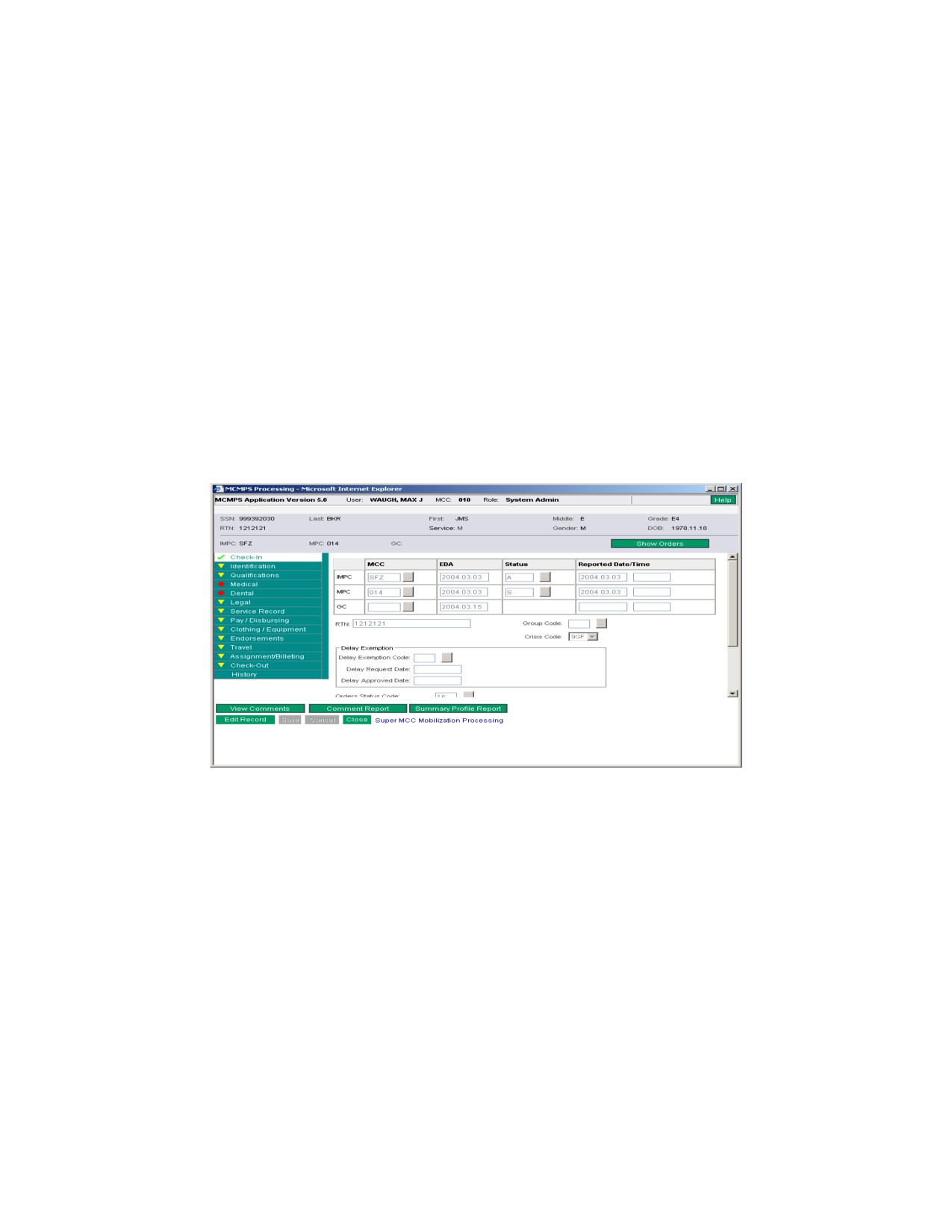
i Reports arrival and processing of AC/RC Marines, Navy
Reservists and civilian DoD employees (i.e., civil service and contractors)
via MCMPS as shown in Figure 3 below. Coordinates with CMC (MPP-60)
regarding RC Marines not found qualified for active duty for orders
resolution/determination. Appropriate DD&E code is entered into MCMPS.
Figure 2 - MCMPS Processing Screen
(2) Personnel Coordination Center (PCC)/S-3
a Coordinates with supporting SOI for CRT
b Establishes administrative holding "companies" of Marines who
have completed processing and CRT, and are awaiting transfer to their GFC.
The term "company" is used here to show an administrative grouping of Marines
and not to indicate an employable organization such as a rifle company.
C-8-3
UNCLASSIFIED
UNCLASSIFIED
(3) Personnel Logistics Coordination Center (PLCC)/S-4. Responsible
for the coordination, in conjunction with base logistics and facilities
departments, of the following functions:
a Messing and billeting through appropriate base/camp
organization. Billeting locations for individual Marines will be tracked via
MCMPS.
b Coordinate with appropriate base organizations the issue and
recovery of uniforms, individual equipment and T/O weapons to activated
Marines, AC Marines and Navy personnel. Following table represents cost in
FY 2004 dollars to equip an IA or a combat replacement.
Items Per AC/RC Marine and or
Unit Price (Rounded up
AC/RC Sailor
to nearest dollar)
Total Price Per
Individual
1 x Gas Mask
$202
$202
3 x Canister
$13
$39
2 x Chemical Suit
$218
$436
2 x Boots
$17
$34
2 x Gloves
$26
$52
1 x DECON Kit
$17
$34
Camouflage Uniform
2 x Trousers
$26
$52
2 x Coat
$27
$54
1 x Boots
$72
$72
2 x Hat, Camouflage
$6
$12
1 x Cover, Helmet
$5
$5
1 x Cover Field Pack
$15
$15
1 x Cover Body Armor
$40
$40
1 Set 782 Equipment
$2,000
$2000
1 x M16A2 w/SL-3 Components
$77
$77
1 x M9 9MM Pistol w/SL-3 Components
$50
$50
Total:
$3,174
Table-.Fy 2004 DOLLARS
c In and about local transportation to support AC/RC processing
as required. Establishes and maintains airport liaison team, as required, to
meet arriving personnel.
4. CG MCB Camp Pendleton and CG MCB Camp Lejeune Designated as Local Area
Coordinator for Mobilization (LACMOB) and Bases Designated as Navy
Mobilization Processing Sites (NMPS)
a. Per reference (a), D/C, M&RA designated MCB Camp Pendleton and MCB
Camp Lejeune as NMPSs to process to active duty Navy reserves assigned to
activated USMCR units. Each base's Personnel Support Detachment (PSD) has
the capability to process to active duty up to 50 Navy reservists per day.
Other actions include:
(1) The base commanding general appoints a LACMOB and forwards a copy
of the appointment letter to CMC (MPP-60 and PL). The LACMOB shall be an O-6
and is normally the CO of the RSU. The LACMOB is responsible for, and
C-8-4
UNCLASSIFIED
UNCLASSIFIED
exercises operational control over, the NMPS and reports the Navy personnel
processed through the site to CNO (N3/5), NAVPERSCOM (49), CMC (PO/PL) and
CMC (MPP-60) via the NMCMPS.
(2) The DPC is augmented by a Personnel Mobilization Team (PMT), a
Navy SELRES unit, as provided by NAVPERSCOM (49) when requested by CMC (PO).
The PMT provides:
a Advice and guidance to the LACMOB regarding Navy recall policy
and procedures.
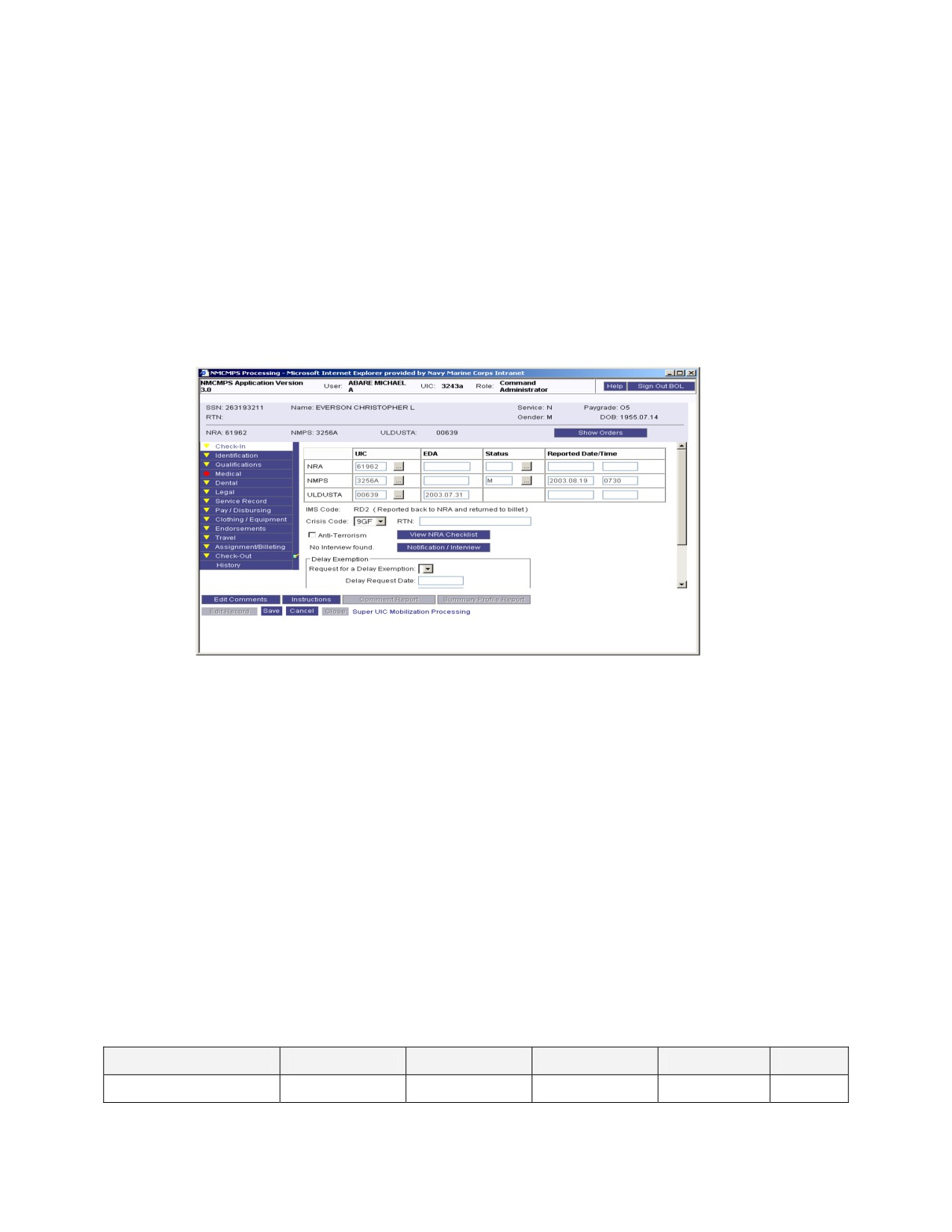
b Uses NMCMPS to track, record and report the
activation/deactivation of Navy RC personnel as shown in Figure 3 below.
Figure 3.--
c Assists the local PSD with creating the active duty pay record
for activated RC Navy personnel.
5. Throughput Processing and DPC Manning. Initially, the DPC must be
prepared to process/return to active duty AC/RC IAs and Navy RC personnel
assigned to activated USMCR units. For planning purposes, scalable manning
of the DPC is based on the following throughput factors:
a. Manning Option 1; 0 to 50 IAs Per Week (Pre-Contingency Steady
State). Manning is that portion of force structure, within manpower and
budgetary constraints, that is authorized to be filled, in accordance with
MCO 5311.11, "total Force Structure Process (TFSP)". Each DPC should plan to
receive and process (administratively and logistically) 25 IAs per week. For
planning purposes, option 1 requires CMC (MP) to issue orders to 44 RC
Marines, in addition to the Camp Pendleton and Camp Lejeune RSUs' permanently
assigned personnel, to process steady-state IA requirement. This number is
stratified as follows:
Throughput
PPC/S-1
PPC/S-3
PLCC/S-4
S-6
Total
0-25 IAs Per Week
12
5
25
2
44
Table--
C-8-5
UNCLASSIFIED

UNCLASSIFIED
The following table shows number of IAs (less combat replacements and unit
fillers) that can be processed in 8 weeks at gross numbers of 150 Marines per
week.
Month 1
Month 2
Week/days
1/7
2/14
3/21
4/28
5/35
6/42
7/49
8/56
days
days
days
days
days
days
days
days
DPC - CLNC
0-50
0-50
0-50
0-50
0-50
0-50
0-50
0-50
DPC - CPCA
0-50
0-50
0-50
0-50
0-50
0-50
0-50
0-50
Running Total:
100
200
300
400
500
600
700
800
Quantico
0-50
0-50
0-50
0-50
0-50
0-50
0-50
0-50
Gross Total:
150
300
450
600
750
900
1,050
1,200
Table.—
b. Manning Option 2 (Declared Contingency). Each DPC should plan to
receive and process (administratively and logistically) 51 to 100 IAs per
week and 50 Navy RC personnel assigned to USMCR units. For planning
purposes, option 2 requires CMC (MP) to issue orders to an additional
assigned 20 RC Marines (for a total of 54 Marines) and a Navy PMT to support
this level of effort. COMNAVPERSCOM (PERS 49) will issue orders to
appropriate PMT. Cumulative manning is stratified as follows:
Throughput
PPC/S-1
PPC/S-3
PLCC/S-4
S-6
Total
51-100 IAs Per Week
22
9
35
3
64
50 Navy RC Per Week
PMT
Table.-
The below table shows number of IAs that can be processed in 8 weeks at a
gross number of 250 per week:
Month 1
Month 2
Week
1/7
2/14
3/21
4/28
5/35
6/42
7/49
8/56
days
days
days
days
days
days
days
days
DPC - CLNC
51-100
51-100
51-100
51-100
51-100
51-100
51-100
51-100
DPC - CPCA
51-100
51-100
51-100
51-100
51-100
51-100
51-100
51-100
Running Total:
200
400
600
800
1,000
1,200
1,400
1,600
Quantico
50
50
50
50
50
50
50
50
Gross Total:
250
500
750
1,000
1,250
1,500
1,750
2,000
Table.-
c. Manning Option 3 (Declared Contingency) 100 IAs Plus 100 Combat
Replacements Per Week. DPCs Camp Pendleton and Camp Lejeune should plan to
receive and process (administratively and logistically) 100 IAs and 100
combat replacements per week. MCB Quantico is not tasked with processing
combat replacements. For planning purposes, option 3 would require CMC (MP)
to issue orders to an additional assigned 63 RC Marines (for a total of 127
C-8-6
UNCLASSIFIED

UNCLASSIFIED
Marines and 10 Navy personnel plus permanently assigned RSU personnel) to
support this level of effort. This number is stratified as follows:
Throughput
PPC/S-1
PPC/S-3
PLCC/S-4
S-6
Total
1-100 IAs & 100 Combat
Replacements Per Week
43
15
54
5
127
50 Navy RC Per Week
PMT
Table-.
The I-DPCs should plan to screen and transport to the DPC, on average, 14
Marines per week. The following table shows number of IAs and combat
replacements that can be processed in 8 weeks: (Note: First number represents
IAs and the second number are combat replacements). In this option, USMC
decision-makers could direct processing of all combat replacements at one DPC
and one SOI to conduct CRT.
Month 1
Month 2
Week/
1/7
2/14
3/21
4/28
5/35
6/42
7/49
8/56
days
days
days
days
days
days
days
days
days
DPC -
100/100
100/100
100/100
100/100
100/100
100/100
100/100
100/100
CLNC
DPC -
100/100
100/100
100/100
100/100
100/100
100/100
100/100
100/100
CPCA
Running
200/200
400/400
600/600
800/800
1K/1K
1.2K/1.2K
1.4K/1.4K
1.6K/1.6K
Total:
DPC-
50/0
50/0
50/0
50/0
50/0
50/0
50/0
50/0
Quantico
Gross
250/200
450/400
650/600
850/800
1,050/1K
1,250/1.2K
1,450/1.4K
1,650/1.6K
Total:
Table.--
To support CRT at each SOI, both will be manned with an additional 67
assigned RC Marines. CMC (MP) will issue orders to these pre-assigned RC
Marines at a minimum of three weeks prior to the first combat replacements
reporting for training from the DPC. This will support the training fo 300
combat replacements per SOI per week.
d. Manning Option 4 (Declared Contingency); 100 IAs plus 500 Combat
Replacements Per Week. Each DPC should plan to receive and process
(administratively and logistically) 100 IAs and 500 combat replacements per
week. MCB Quantico is not tasked with processing combat replacements. The
30 I-DPCs should plan to screen and transport to the DPC, on average, 20
Marines per week. The following table shows number of IAs and combat
replacements that can be processed in 8 weeks: [Note: the first number
represents IAs and the second number are combat replacements]. In this
option, USMC decision-makers could direct processing all combat replacements
at one DPC and one SOI to conduct CRT.
C-8-7
UNCLASSIFIED

UNCLASSIFIED
Month 1
Month 2
Week/
1/7
2/14
3/21
4/28
5/35
6/42
7/49
8/56
days
days
days
days
days
days
days
days
days
DPC - CLNC
100/500
100/500
100/500
100/500
100/500
100/500
100/500
100/500
DPC - CPCA
100/500
100/500
100/500
100/500
100/500
100/500
100/500
100/500
Running
200/1K
400/2K
600/3K
800/4K
1K/5K
1.2K/6K
1.4K/7K
1.6K/8K
Total:
DPC-
50/0
50/0
50/0
50/0
50/0
50/0
50/0
50/0
Quantico
Gross
250/1K
450/2K
650/3K
850/4K
1,050/5K
1,250/6K
1,450/7K
1,650/8K
Total:
Table.--
SOI East and West will be augmented with approximately 180 Marines each to
facilitate CRT training. CMC (MP) will issue orders to these pre-assigned
Marines at a minimum of three weeks prior to the first combat replacements
reporting for training from the DPC. This will support the training of 1,000
combat replacements per SOI per week.
e. Manning Option 5a (Declared Contingency); 100 IAs Per Week and 1,000
Combat Replacements Per Week with a 7 Day CRT POI. Each DPC should plan to
receive and process (administratively and logistically) 100 IAs and 1,000
combat replacements per week. MCB Quantico is not tasked with processing
combat replacements. The 30 I-DPCs should plan to screen and transport to
the DPC, on average, 35 Marines per week. The following table shows number
of IAs and combat replacements that can be processed in 8 weeks (Note: first
number represents IAs and the second number are combat replacements).
Month 1
Month 2
Week/
1/7
2/14
3/21
4/28
5/35
6/42
7/49
8/56
days
days
days
days
days
days
days
days
days
DPC - CLNC
100/1K
100/1K
100/1K
100/1K
100/1K
100/1K
100/1K
100/1K
DPC - CPCA
100/1K
100/1K
100/1K
100/1K
100/1K
100/1K
100/1K
100/1K
Running
200/2K
400/4K
600/6K
800/8K
1K/10K
1.2K/12K
1.4K/14K
1.6K/16K
Total:
DPC -
50/0
50/0
50/0
50/0
50/0
50/0
50/0
50/0
Quantico
Gross
250/2K
450/4K
650/6K
850/8K
1,050/10K
1,250/12K
1,450/14K
1,650/16K
Total:
Table.--
f. Option 5b (Declared Contingency); 100 IAs Per Week Plus 1,000 Combat
Replacements with a 15 Day CRT POI. Each DPC should plan to receive and
process (administratively and logistically) 100 IAs per week and 1,000 combat
replacements every other week. MCB Quantico is not tasked with processing
combat replacements. The following table shows number of IAs and combat
replacements that can be processed in 8 weeks (Note: first number represents
IAs and the second number are combat replacements).
C-8-8
UNCLASSIFIED

UNCLASSIFIED
Month 1
Month 2
Week/
1/7
2/14
3/21
4/28
5/35
6/42
7/49
8/56
days
days
days
days
days
days
days
days
days
DPC - CLNC
100/1K
100/0
100/1K
100/0
100/1K
100/0
100/1K
100/0
DPC - CPCA
100/1K
100/0
100/1K
100/0
100/1K
100/0
100/1K
100/0
Running
200/2K
400/0
600/4K
800/0
1K/6K
1.2K/0
1.4K/8K
1.6K/0
Total:
DPC -
50/0
50/0
50/0
50/0
50/0
50/0
50/0
50/0
Quantico
Gross
250/2K
450/-
650/4K
850/-
1,050/6K
1,250/-
1,450/8K
1,650/-
Total:
In option 5b, every other week no combat replacements report to the DPC to
avoid building a backlog of Marines awaiting CRT. This option requires 40
weeks to process and train 16,000 Marines with 1 week of processing and 2
weeks of CRT with a 1-week overlap.
6. Combat Replacement Pools (CRP)
a. As the deployment of forces continues and prior to combat operations,
there will be a requirement to establish a personnel sustainment base to
ensure manpower requirements for the supported MARFOR(s) and other global
commitments are met. To provide for the immediate response of combat trained
and MOS proficient individual replacements, D/C M&RA in coordination with D/C
PP&O will direct the establishment of combat replacement pools whose grades
and MOSs are most likely needed. CRPs will be established as follows:
Location
MCC
Title
RUC
MCB Camp Pendleton, CA
XN1
DPC CAMPEN SPT AUGM
59254
XN2
DPC CAMPEN CBT REPL
33052
PROC
XN3
CAMPEN AT/FP
59254
XN4
CAMPEN CBT REPL STAGING
33052
MCB Camp LeJeune, NC
XM1
DPC CLNC SPT AUGM
59253
XM2
DPC CLNC CBT REPL PROC
31052
XM3
CLNC AT/FP
59253
XM4
CLNC CBT REPL STAGING
31052
b. Appendix 6 to Annex C shows the process to determine/source combat
replacements and establishes the throughput per Marine Corps Base. The CMC's
intent is to source initial combat replacements from the AC then the IRR.
Once trained, combat replacement movement to theater is directed and
validated by the supported MARFOR(s), via their combatant commander, to
CDRUSTRANSCOM.
C-8-9
UNCLASSIFIED
UNCLASSIFIED
7. Schools Of Infantry. Concurrent with the scaled manning of the two DPCs
and MCB Quantico's PPC, CMC (MP) will authorize, via CG, MCCDC, additional
manning for the SOIs East/West to support CRT. SOIs must be manned prior to
the activation of Marine IRRs so CRT trainers are ready and in-place to
support a seven or 15 day CRT package. For planning purposes, SOI will
conduct the seven-day CRT unless directed otherwise by CMC (PO). Similar to
the DPCs, the SOIs will be manned based on the projected combat replacement
throughput and time required to perform CRT. Following table provides SOI
East/West information:
Command
T/O
RUC
MCC
SOI (East) Camp Lejeune
7561A
31340
013
SOI (West) Camp Pendleton
7661A
33350
014
Table.--
8. Naval Hospital/Dental Clinic, MCB Camp Pendleton and MCB Camp Lejeune.
Pre-contingency mission of the Naval hospital is to meet the needs of the
local MEF and surrounding military retiree and dependant population. Upon
declaration of a contingency leading to the recall of the RC, the Naval
hospital/dental clinic in addition to meeting the deployment needs of the MEF
supports the local DPC by providing physicals, required immunization, dental
exams, and other mandated tests to activated Marine and Navy reserve members.
This will include requirements for pre-deployment health assessments (DD form
2795) submitted to Army Medical Surveillance Activity (AMSA). Upon
redeployment/deactivation the Naval hospital/dental clinic ensures that all
returning AC/RC personnel are physically qualified for release from active
duty as established by DoD. This will include requirements for post-
deployment health assessments (DD form 2796) submitted to AMSA.
TAB
A- Deployment Processing Command Activation Processing Overview
B- Deployment Processing Command Deactivation Processing Overview
C-8-10
UNCLASSIFIED

UNCLASSIFIED
MCO P3000.19
PLN
22 April 2005
TAB A TO APPENDIX 8 TO ANNEX C TO USMC MAID-P
DEPLOYMENT PROCESSING COMMANDS (DPC) ACTIVATION OVERVIEW PROCESS
1. Purpose. To provide an overview of the individual activation
process conducted by the DPC. Yellow circles show the order of activation
and processing of Marines prior to joining them by the gaining command.
DPC Notional Activation Process
(~5 Days)
2
I-DPC
3
I-DPC
Ground
(MCMPS)
Travel
(MCMPS)
Arrive DPC
Mode
After Hrs
Yes
Rpt to DPC
Air
Ck-in
Duty
Ground
APOE
No
1
OR
2
transport to DPC
Marine receives
DPC
Sent to
orders.
Check-in
Billeting
(MCMPS)
Gaining
- Check-in (via MCMPS)
Command
Check-out
Issue
& Reception
DPC
Admin
7
Uniforms &
-- Orders endorsement
Follow-up
6
Weapons
- Baggage Check-in
- Military Police screening
To GFC
Or CRT
4
- In Briefings (legal, etc)
- Admin Action (unit diary)
5
Med/Den
-- Join to active duty
Supply
Combat Refresher
Exam
Training
- Medical/Dental Screening
(CRT)
[Actions do not
- ID Cards
SOI E/W: 7 or 15 DAY POI
occur sequentially]
Activation supported by Marine Corps Mobilization Processing System (MCMPS) (Web Based)
C-8-A-1
UNCLASSIFIED

UNCLASSIFIED
MCO P3000.19
PLN
22 April 2005
TAB B TO APPENDIX 8 TO ANNEX C TO USMC MAID-P
DEPLOYMENT PROCESSING COMMAND (DPC) DEACTIVATION OVERVIEW PROCESS
1. Purpose. To provide an overview of the deactivation process conducted by
the DPC for individual sailors and marines. Yellow circles show the
order of deactivation, starting with departure from the gaining command
and ending with the Marine returning to the place ordered to active duty.
DPC Notional Deactivation Process
(~5 Days)
2
Travel
Ground
Arrive
Gaining
1
Mode
DPC
Command
(Reported &
After Hrs
Yes
Rpt to DPC
Air
tracked via
Ck-in
Duty
MCMPS)
Ground
APOE
Marine’s mission
transport to DPC
No
completed. Marine
DPC
Sent to
reports back to DPC
Check-in
Billeting
for deactivation.
(MCMPS)
5
Return Travel
Return Travel
- Check-in (via MCMPS)
Member
Claim to
returns
Claim to
DPC
6
Issue
& Reception
DPC
Admin
home
Uniforms &
Follow-up
-- Orders endorsement
Weapons
- Baggage Check-in
4
- Military Police screening
Check-out
DPC
3
- Out briefings (legal, etc)
- Admin action (unit diary)
Member is
Med/Den
-- Released from active duty
Supply
released/discharged
Exam
- Medical/Dental Screening
from active duty
- ID Cards
[Actions do not
occur sequentially]
De-activation supported by Marine Corps Mobilization Processing System (MCMPS) (Web Based)
C-8-B-1
UNCLASSIFIED
UNCLASSIFIED
MCO P3000.19
PLN
22 April 2005
APPENDIX 9 TO ANNEX C TO USMC MAID-P
HQMC FDP&E Working Group
REF: (a) MARADMIN 293.03, dated May 2003, Change One to MCO
P3000.18, Marine Corps Planners Manual
1. Purpose. Per reference (a), the HQMC FDP&E Working Group exists to
facilitate and resolve Force Deployment Planning and Execution (FDP&E)
issues. FDP&E includes the Reserve activation and integration process
as a key supporting function. The FDP&E Working Group replaces the
HQMC Mobilization Working Group. The FDP&E Working Group exists at two
levels - Executive Level and Working Group.
2. Representation
a. Executive Level Membership. Chaired by D/C PP&O, with
permanent members consisting of D/C M&RA, D/C I&L, D/C AVN, D/C P&R,
CG, MCCDC, and COMMARCORLOGCOM.
b. Working Group Membership. Co-chaired by the PP&O Directors of
Plans Division (PL) and Operations Division (PO). Core group includes
representation from CMC (PL, PO, PR, LPO, AVN, C4, AND M&RA) MCCDC, AND
MARCORLOGCOM. Adjunct working group members to the core HQMC working
group include CNO (N1, N3, N5), BUPERS, MARFORs, MARCORBASESLANT/PAC,
and other command/agencies as required.
3. Meetings. Meets as required, but not less than twice annually when
not executing a contingency operation. Prior to each meeting, briefing
topics/materials will be posted to the FDP&E SIPRNET website at
WWW:HQMC.SMIL,MIL/PLN/PLN HOME/HTM. Meetings are focused to resolve
force deployment issues such as (but not limited to):
a. Pre-Contingency
(1) Develops and recommends Marine Corps FDPE exercise
schedules and goals, to include the CJCS directed Exercise Positive
Force.
(2) Provides updates/informational briefings regarding RC
activation to senior leadership and USMC formal schools.
b. Contingency
(1) Based on size and scope of the declared contingency,
recommends activation actions/policy to the Executive Committee/Joint
Staff.
(2) Develop recommendations for the staffing/manning of deploying
AC/RC Marine Corps units.
C-9-1
UNCLASSIFIED
UNCLASSIFIED
c. Post-Contingency
(1) Recommends changes to Marine Corps or Joint Publications as
appropriate.
(2) Returns to pre-contingency activities.
4. D/C, Manpower and Reserve Affairs (M&RA) Manpower Working Group
a. Purpose. To facilitate and resolve Force Deployment Planning
and Execution (FDP&E) manpower issues.
b. Representation.
Chaired by the Head MPP-60 with
representation from PO, PL, L, RA, MM, MI, MR, MPO, TFSD, and BUPERS.
c. Functions. Coordinates manpower actions principally within
M&RA and disseminates AC/RC manpower implementation policy and guidance
to the Marine Corps.
d. Meetings. During pre-contingency, meets as required but not
less than quarterly. Upon escalation leading to a potential
contingency, this group convenes as required.
e. POC Listing. CMC (MPP-60) maintains copy of M&RA
representatives with copy provided to CMC (PL).
C-9-2
UNCLASSIFIED
UNCLASSIFIED
MCO P3000.19
PLN
22 April 2005
APPENDIX 10 TO ANNEX C TO USMC MAID-P
MARINE CORPS RESERVE AND THE STAFFORD ACT
REF: (a) The Robert T. Stafford Disaster Relief and Emergency
Assistance Act, Public Law 93-288, 42 U.S.C. 5121
1. Background. Per the reference, as amended (the Stafford Act) was
enacted to support state and local governments and their citizens when
disasters overwhelm them. This law establishes a process for
requesting and obtaining a Presidential disaster declaration, defines
the type and scope of assistance available under the Stafford Act, and
sets the conditions for obtaining that assistance. Presidential
disaster declarations and any subsequent amendments are published as
Federal Register Notices. Based on customer feedback to the FEMA web
site, disaster and emergency -related Federal Register Notices are also
posted here beginning with declarations dated October 1, 2000.
(See
Tab A)
Appendix (1)
2. Action. Per Chapter 68 of the reference the following actions are
required prior to commitment of Federal forces, i.e., Marine Corps
Reserve:
a. Procedure for Presidential Declaration
(1) All requests for a declaration by the President that a
major disaster exists, shall be made by the Governor of the affected
State. This request is based on a finding that the disaster is of such
severity and magnitude that effective response is beyond the
capabilities of the state and the affected local governments and that
Federal assistance is necessary.
(2) Based on the request of a Governor under this section, the
President may declare under this chapter that a major disaster or
emergency exists.
b. Federal Assistance. In any major disaster, the President may
direct any Federal agency, with or without reimbursement, to utilize
its authorities and the resources granted to it under Federal law
(including personnel, equipment, supplies, facilities, and managerial,
technical, and advisory services) in support of State and local
assistance efforts; coordinate all disaster relief assistance
(including voluntary assistance) provided by Federal agencies, private
organizations, and State and local governments.
c. Utilization of DOD resources. As a general rule, during the
immediate aftermath of an incident which may ultimately qualify for
assistance under this title or title V of this Act [42 U.S.C. 5170 et
seq. or 5191 et seq.], the Governor of the State in which such incident
occurred may request the President to direct the SecDef to utilize the
resources of the DOD for the purpose of performing on public and
private lands any emergency work which is made necessary by such
incident and which is essential for the preservation of life and
property. If the President determines that such work is essential for
C-10-1
UNCLASSIFIED
UNCLASSIFIED
the preservation of life and property, the President shall grant such
request to the extent the President determines practicable. Such
emergency work may only be carried out for a period not to exceed 10
days.
3. CMC Authorization. As directed by the SecDef, the CMC, via the
SecNav, will direct and/or authorize USMC units (AC/RC) to support
appropriate states.
appendix
1 - Governor Request for Federal Assistance
2 - Presidential Authorization
C-10-2
UNCLASSIFIED
UNCLASSIFIED
MCO P300.19
PLN
22 April 2005
TAB A TO APPENDIX 10 TO ANNEX C TO USMC MAID-P
GOVERNATORIAL REQUEST FOR FEDERAL ASSISTANCE
1. Purpose. To provide an example of governoratorial action
requesting Federal assistance following a state declared emergency.
“For Immediate Release
Office of the Press Secretary
November 14, 2002
SAMPLE
BREDESEN REQUESTS FEMA DECLARATION
Nashville, TN - Gov. Phil Bredesen has asked President Bush to declare
28 Tennessee counties a federal disaster area in the wake of last
month’s flooding.
Today’s request is in addition to an earlier request of the U.S. Small
Business Administration, which was granted last week. The new request
is for a presidential declaration that would authorize assistance from
the Federal Emergency Management Agency (FEMA).
The flooding caused millions of dollars’ worth of damage and claimed at
least two lives, both children. Middle and East Tennessee were hit with
four to eight inches of rain in just 36 hours beginning February 14,
and there was rainfall somewhere in Tennessee every day through
February 26. Coupled with snowmelt from a recent winter storm, severe
flooding resulted across the eastern two-thirds of the state.
February’s rainfall in Tennessee was more than twice the normal total
for the month.
In his request letter, Bredesen states, “I have determined that this
incident is of such severity and magnitude that effective response is
beyond the capabilities of the State and the affected local governments
and that supplementary Federal assistance is necessary. Both state and
local governments are experiencing a large shortfall in revenue which
is causing extreme financial hardships.”
Preliminary assessments conducted jointly by FEMA, TEMA and local
governments indicate the most severe impacts were to roads and bridges,
utilities, and public buildings. Some of the counties are very rural
and the damage is widespread making it very difficult to identify all
the damage locations during the PDA.
Bredesen’s letter also points out that some areas are still underwater
and the damages cannot be determined at this time.
The counties listed in Bredesen’s letter are: Anderson, Bledsoe,
Campbell, Cannon, Carter, Claiborne, Cumberland, Decatur, Fentress,
Grainger, Hancock, Houston, Humphreys, Jackson, Johnson, Knox, Lewis,
Loudon, Marion, Meigs, Rhea, Roane, Scott, Sequatchie, Stewart, Unicoi,
Union, and Van Buren.”
C-10-A-1
UNCLASSIFIED
UNCLASSIFIED
C-10-A-1
UNCLASSIFIED
UNCLASSIFIED
MCO P3000.19
PLN
22 April 2005
TAB B TO APPENDIX 10 TO ANNEX C TO USMC MAID-P
PRESIDENTIAL AUTHORIZATION FOR FEDERAL ASSISTANCE (DOD) TO A STATE
1. Purpose. To provide an example of Presidential action authorizing
Federal assistance to a state.
“For Immediate Release
Office of the Press Secretary
November 14, 2002
SAMPLE
President Orders Federal Aid for Tennessee
The President has declared a major disaster exists in the State of
Tennessee and ordered Federal aid to supplement state and local
recovery efforts in the area struck by a series of storms and tornados
on November 11, 2002.
Federal funding is available to eligible individuals in the counties of
Anderson, Bedford, Carroll, Coffee, Crockett, Cumberland, Gibson,
Henderson, Madison, Marshall, Montgomery, Morgan, Rutherford, Scott,
Sumner and Tipton.
The assistance, to be coordinated by the Federal Emergency Management
Agence (FEMA), can include grants to help pay for temporary housing,
home repairs and other serious disaster related expenses. Federal
funding is also available on a cost share basis for hazard mitigation
measures.
Joe M. Allbaugh, FEMA Director, named Gracia Szczech as the Federal
Coordinating Officer for Federal recovery operations in the affected
area.
The Agency said that damage surveys are continuing in other areas, and
additional jurisdictions may be designated after the assessments are
completed.
FOR FURTHER INFORMATION CONTACT: FEMA (202) 646-4600.”
SAMPLE
A - FEMA Web Site
C-10-B-1
UNCLASSIFIED

UNCLASSIFIED
MCO P3000.19
PLN
22 April 2005
EXHIBIT 1 TO TAB B TO APPENDIX 10 TO ANNEX C TO USMC MAID-P
FEMA WEB SITE
1. Purpose. To provide an example of FEMA Web Site
(http://www.fema.gov) once the President has declared an national/state
emergency:
SAMPLE FEMA WEB SITE.
C-10-B-1-1
UNCLASSIFIED
UNCLASSIFIED
MCO P3000.19
PLN
22 April 2005
ANNEX D TO USMC MAID-P
LOGISTICS
REFERENCES:
(a) MCO P4400.150, Consumer-Level Supply Policy Manual,
21 June 99 (U)
(b) MCO P4400.39, War Reserve Materiel Policy Manual,
12 March 2002 (U)
(c) MCO P4790.2 w/Ch 1, MIMMS Field Procedures Manual,
8 Dec 1994 (U)
(d) Defense Transportation Regulations
(e) CJCSI 4110.01B, Uniform Material Movement and Issue Priority
System-Force Activity Designators, 18 Jan 02
(f) MCO 4400.16G w/Ch 3, Uniformed Material and Issue System
(UMMIPS), 22 Aug 1994
1. Situation. This Annex codifies logistics responsibilities within the
Marine Corps to support the activation, deployment, redeployment and
deactivation of USMCR forces, Marines in the Individual Mobilization
Agumentee (IMA) program, Marines in the Individual Ready Reserves (IRR),
retirees, active duty Marine augments and Navy AC/RC personnel assigned to
USMCR units who are supporting Marine Corps component commander(s).
a. Assumptions
(1) USMCR Units
(a) That USMCR forces will report to the Gaining Force
Commander (GFC) with on-hand unit training allowance (T/A) organic equipment
and individual equipment including individual combat clothing and equipment
(ICCE). For the purpose of this order, ICCE is defined as any combat
clothing or equipment intended for issue to individuals to include ICCE gear,
Type 3 contingency equipment, NBC Individual Protective Equipment (IPE) and
individual T/0 weapons.
(b) That USMCR units may deploy through coastal ILOC’s
(Intermediate Locations). Supporting Marine commands will provide deployment
support at appropriate ILOCs, equipment to source T/E deficiencies and
medical/dental support; and from Aerial Ports of Embarkation (APOEs) located
nearby the unit’s Reserve Training Center (RTC) locations (this will be
aviation units who self deploy and/or units scheduled to employ with Maritime
Prepositioning Force assets).
(c) That Commander, Marine Corps Logistics Command
(COMMARCORLOGCOM) will source USMCR unit critical equipment deficiencies if
not already sourced via the gaining COMMARFOR or a subordinate MARFOR’s plan
for equipment distribution.
(2) Individuals - Marines and Sailors
(a) Activated Navy Reservists will receive all combat clothing
support from either the gaining USMCR unit or via the Deployment Personnel
Command (DPC).
Navy personnel will receive their T/O weapon from their
assigned USMCR unit.
D-1
UNCLASSIFIED
UNCLASSIFIED
(b) Activated Marine IRRs and retirees will receive clothing
support and T/O weapon from the DPC that process the Marine to active duty.
(c) Marine IRRs will redeploy, administratively out-process, and
deactivate through the DPC through which they were activated. This will
allow the DPC to recover issued items from the individual AC/RC Marine and
Navy personnel.
b. Planning Factors
(1) USMCR Table of Equipment (T/E) Delta. USMCR units maintain a
training allowance (T/A) to support SORTS C-1 training readiness and not
their complete allowances of equipment as prescribed in their T/E. The scale
and scope of Unit T/A - T/E delta varies primarily due to the unit’s organic
maintenance capability.
(2) Upon activation and within 30 days of deployment, USMCR units
route Force Activity Designator (F/AD) upgrade requests to the gaining
COMMARFOR for approval. F/AD criteria are outlined per reference (f) and
(g). Redeploying USMCR units will remain at a higher F/AD category for 90
days upon completion of their deployment in order to maintain readiness.
(3) At a minimum, USMCR unit personnel are able to embark aboard
strategic transportation (i.e., meet available-to-load dates (ALDs) within
seven days of activation. USMCR unit equipment may be required, and is
allowed, to move prior to the unit’s activation date to meet strategic
airlift or sealift movement windows.
(4) Individual Navy Reserve activation process requires approximately
seven days to complete by the Naval Reserve Activity (NRA) and Navy
Mobilization Processing Site (MNPS), culminating with the Sailor’s arrival at
the RTC and integration by the unit prior to the unit’s departure.
(5) USMCR units may require externally provided administrative,
medical, dental, deployment, and logistic support at RTCs, ILOCs, ports of
embarkation (POEs), and ports of debarkation (PODs), based on the
circumstances and requirements requisite to a given OPLAN or contingency.
Supporting agencies will be shown in the CMC (PO) activation message.
(6) The first 3,750 combat replacements should deploy with all of
their issued ICCE.
2. Mission. CMC provides logistic resources and services necessary to
activate, deploy, redeploy and deactivate USMCR units, individual Marine
Reservists, discharged or retired Marines and AC augments in support of
Marine Corps component commanders’ requirements.
3. Execution
a. Concept of Logistics Support
(1) USMCR Unit Activation, Deployment, Redeployment and Deactivation
(a) Pre-activation. COMMARFORRES is responsible for USMCR units’
logistic support until activation.
D-2
UNCLASSIFIED
UNCLASSIFIED
1 COMMARFORRES provides supply support via such logistic
resources as Defense Logistics Agency (DLA), General Services Administration
(GSA), or civilian third parties. COMMARFORRES does not possess wholesale,
or intermediate supply activities, nor do units retain accompanying supplies
or combat loads of material for use once activated. These supplies will be
provided by the GFC.
2 USMCR units do not possess their complete T/E allowance for
unit organizational equipment. As such, USMCR units will require sourcing of
critical MCGERR Class VII equipment prior to deployment.
3 USMCR units possess an organizational level maintenance
capability for all types of equipment and very limited intermediate level
capabilities at selected units.
4 Intermediate-level maintenance support is provided by 4th
Maintenance Battalion, 4th Force Service Support Group unless otherwise
directed by COMMARFORRES. Equipment requiring intermediate-level maintenance
is evacuated to a number of different sites throughout CONUS depending upon
the type of equipment.
5 COMMARFORRES manages and oversees centralized equipment
programs designed to provide NBC unit and individual equipment, AMALs/ADALs,
as well as special mission equipment.
6 USMCR force requirements are identified by the supported
COMMARFOR during deliberate and crisis action planning. These requirements
are identified in the supported COMMARFOR’s Operational Plan (OPLAN) in Annex
A, Appendix 5. Additionally, the supported COMMARFOR identifies force
requirements in the supported combatant commander’s Time Phased Force
Deployment Data (TPFDD). These requirements are validated by the supported
combatant commander and sourced by COMMARFORRES, through the Marine Corps
component commander to Commander, U.S. Joint Forces Command (CDRUSJFCOM),
specifically, Commander, U.S. Marine Corps Forces, Atlantic (COMMARFORLANT).
7 During planning phases, COMMARFORRES assists deploying
USMCR unit commanders to identify critical unit equipment shortfalls, and
assists the supported COMMARFOR in the development of logistic estimates for
sustainment (accompanying supplies and resupply) as well as a reception and
force integration (R&FI) plan to support the seamless integration of AC/RC
forces. The supported COMMARFOR validates USMCR unit equipment shortfalls
and submits them to D/C, I&L for sourcing, via COMMARCORLOGCOM, if unable to
source T/R requirements from non-TPFDD remain behind equipment (RBE).
(b) Activation. Upon activation, USMCR units are under the
combatant command authority (COCOM) of CDRUSJFCOM. CDRUSJFCOM exercises
COCOM of activated gained USMCR units through Commander, U.S. Marine Corps
Forces Atlantic (COMMARFORLANT).
1 COMMARFORRES is a supporting commander to COMMARFORLANT
during the activation of USMCR units, and for other support as specified in
the CMC (PO) activation order.
2 Prior to issuance of activation directive by CMC (PO), and
upon warning and indication of a potential activation, the supported and
supporting MARFORs establish a report for planning relationship between
subordinate commanders in order to exchange information. At this time, USMCR
D-3
UNCLASSIFIED
UNCLASSIFIED
unit commanders receive mission orders, analyze assigned tasks, and determine
whether they possess required unit equipment to accomplished their assigned
mission. Shortfalls are identified to the GFC for sourcing.
3 Upon CMC (PO) order to activate an USMCR unit, COMMARFORRES
coordinates with COMMARFORLANT and D/C, I&L to obtain fiscal appropriation
data to fund the transportation of USMCR unit personnel and equipment during
deployment operations.
4 Simultaneously, COMMARFORRES coordinates the distribution
of force-held materiel such as NBC unit and individual equipment, special
allowance equipment, and AMALs/ADALs that are shipped from MARFORRES
centralized storage/readiness facilities to either the RTC, or to ILOCs or
POEs, consistent with the supported COMMARFOR’s concept of deployment.
5 The supported COMMARFOR directs and coordinates the
utilization of non-TPFDD RBE to mitigate USMCR unit T/E equipment shortfalls
to the greatest extent possible. All remaining deficiencies will be
validated and forwarded expeditiously to D/C, I&L for sourcing.
6 D/C, I&L directs COMMARCORLOGCOM to source validated USMCR
unit equipment deficiencies (not sourced from RBE) from service-held
resources, consistent with time phasing expressed in the supported combatant
commander’s TPFDD.
(c) Deployment. During deployment execution, USMCR units remain
under the command of COMMARFORLANT until integration with GFC and/or arrival
in theater. At that time, the GFC will exercise OPCON or TACON as directed,
of gained USMCR units. Deployment from RTCs is initiated by a COMMARFORLANT
deployment order (DEPORD). Activated USMCR units deploy on their strategic
leg via two primary methods: 1) directly from their RTC’s as a self deploying
unit (from a nearby APOE) or from large SMCR sites that can adequately
support deployment ops, and 2) via ILOC’s where deployment support is
provided by the active component.
1 COMMARFORRES continues to provide direct support to
COMMARFORLANT for the purpose of transporting USMCR units from their RTC to a
location designated by the supported MARFOR commander in the TPFDD (these
locations can be ILOCs where USMCR units may train and/or aggregate with
active component (AC) forces, or directly to POEs for strategic
transportation to the area of operations).
2 Depending upon the size of the unit, and the distance
between the RTC and ILOC/POE, USMCR passengers will initially move via
commercial surface or air transportation. All USMCR unit cargo will
initially move via commercial ground or organic unit transportation to POE.
3 COMMARFORRES executes appropriate supply transactions to
transfer unit equipment from the MARFORRES supply domain to the appropriate
deployed supply domain designated by the supported MARFOR commander.
4 Consistent with the supported MARFOR commander’s concept of
deployment and/or taskings in the CMC (PO) activation order, COMMARFORLANT/
COMMARCORBASESLANT may direct his major subordinate commanders (CG II MEF, CG
MCB Camp Lejeune, and COMCABEAST) or request COMMARFORPAC/COMMARCORBASESPAC
or COMMARFORRES (as supporting COMMARFOR) to conduct embarkation and
strategic deployment of activated USMCR forces, commensurate with their
D-4
UNCLASSIFIED
UNCLASSIFIED
capability limitations, from the ILOC/POE to the supported combatant
commander’s AOR. As the command directing strategic deployment,
COMMARFORLANT retains sole fiscal authority to include funding support of
administrative and logistic assistance generally described as billeting,
impact card purchases, local transportation, and other housekeeping
requirements conducted in support of USMCR unit deployment.
5 Once USMCR unit personnel and equipment arrive at the GFC’s
ILOC or POE, the commander responsible for conducting the strategic
deployment of USMCR forces receives them, integrates them with his own forces
(when applicable) and exercises an appropriate level of command authority to
execute strategic deployment/employment.
6 At the ILOC/POE, USMCR units receive and integrate Class
VII material sourced by COMMARCORLOGCOM, and any accompanying supplies or
materiel prescribed by the supported MARFOR commander for deployment that was
not available prior to departing the RTC. Additionally, any health service
support requirements that could not be conducted at the RTC are performed
prior to strategic deployment. Units that self-deploy must coordinate the
receipt of any additions of Class VII end-items and Class II supplementary
clothing items as well as NBCD equipment and AMAL’s/ADAL’s and incorporate
this into their embarkation plans.
7 Once USMCR forces complete strategic deployment and arrive
in the supported combatant commander’s AOR, the supported combatant commander
(supported COMMARFOR) gains OPCON of the deployed USMCR forces from
COMMARFORLANT. The supported COMMARFOR conducts reception, staging and
onward movement (RSO) of USMCR forces in the same manner as AC forces, and
completes any remaining distribution of equipment and other materiel to
deployed forces per his distribution plan.
(d) Redeployment and Deactivation. USMCR units redeploy to their
RTCs in accordance with the supported COMMARFOR redeployment TPFDD. Once
USMCR units begin their redeployment from the supported combatant commander’s
AOR, they revert back to OPCON of COMMARFORLANT.
1 Redeployment requires detailed coordination of logistic
support for AC and USMCR forces, COMMARFORLANT/COMMARCORBASESLANT will issue
a standing RSO Order to appropriately task or request such support from
subordinate or supporting commanders. As with strategic deployment,
COMMARFORLANT directed, COMMARFORRES conducted RSO of redeploying USMCR
forces directly to RTCs for deactivation are desirable and appropriate to
minimize impacts on AC operating forces and the supporting establishment, but
are subject to COMMARFORRES capabilities and limitations, based upon the
size/scope of the redeployment and post-deployment deactivation processing
requirements for personnel administration, health service support, equipment
maintenance, etc.
2 Upon arrival at the POD, the commander responsible for RSO
of forces assumes a direct support relationship per COMMARFORLANT DEPORD over
USMCR units for movement to RTCs and deactivation processing. Deactivation
processing of SMCR personnel consists of those personnel administrative tasks
and health service support tasks required to release a RC member from active
duty. Deactivation processing of USMCR unit equipment consists of any
maintenance required to achieve a level of equipment readiness prescribed by
CMC (POR).
D-5
UNCLASSIFIED
UNCLASSIFIED
3 When USMCR forces cannot effectively or efficiently conduct
deactivation processing tasks at their RTCs, COMMARFORLANT, in coordination
with direct support per COMMARFORLANT DepOrd, will direct them to appropriate
ILOCs and task/request necessary support to accomplish those processing tasks
prior to movement to the RTCs. USMCR force movement through ILOCs for
redeployment RSO will be limited to those portions of units/detachments
requiring such support. For example, if ILOC support is necessary for
equipment maintenance for an USMCR unit but not for personnel processing,
then only the equipment and attendant personnel move to the ILOC while the
remainder of the unit moves directly to the RTC.
4 Once ILOC deactivation processing is complete, unit
personnel and/or equipment complete movement to RTCs at which point
COMMARFORRES resumes direct support to COMMARFORLANT until the unit is
deactivated.
(2) IRR Activation/Deactivation (See Annex C, Appendix 3)
b. Tasks
(1) D/C, I&L
(a) When requested, provides transportation of things (ToT)
funding to COMMARFORRES to support the movement of USMCR unit equipment to
meet strategic transportation timelines.
(b) Directs and authorizes COMMARLOGBASES to source AC/RC
equipment shortfalls.
(2) D/C, M&RA (MP). Will issue orders to individual Marine IRRs and
Retirees ordering the member to active duty. Included in the orders will be
directions for the member to report with uniform items - serviceable and/or
unserviceable as shown in Appendix 1 of this Annex.
(3) Gaining COMMARFOR
(a) Develops plan to source gained activated USMCR unit
equipment/materiel requirements per reference (d).
(b) Develops USMCR reception, force integration (R&FI) plans.
(c) Identifies USMCR units’ activation-related logistical
shortfalls to D/C, I&L that cannot be source from force held stocks or non-
TPFDD RBE.
(d) Approves upgraded F/AD requests from activated USMCR units.
(e) Provides individual ICCE equipment to activated assigned
Marine IMAs upon activation and recovers equipment upon deactivation.
(4) COMMARFORLANT/PAC
(a) Coordinates planning for logistic, deployment/redeployment
RSO support of assigned activated USMCR forces with
COMMARCORPAC/COMARCORBASESPAC. Provided support is not limited to
containerization, administration, billeting, messing, MHE, etc. (Annex P)
D-6
UNCLASSIFIED
UNCLASSIFIED
(b) Capture, record and report clothing and individual equipment
costs to D/C, P&R (RFO) for reimbursement.
(5) COMMARCORBASESLANT/COMMARCORBASESPAC
(a) Provide facilities and base operating support to
COMMARFORLANT for USMCR force during all phases of activation/deactivation.
(b) Provide all logistic requirements for DPC processing of
contractors, activated Marine IRRs, retirees and Navy AC/RC personnel
assigned to USMCR units. Recover issued individual equipment during
deactivation.
(c) Capture, record and report clothing and individual equipment
costs to D/C, P&R (RFO) for reimbursement.
(6) Commander, Marine Forces Reserve (COMMARFORRES)
(a) Plans and provides logistics support required to support
activation and deployment of USMCR forces from RTCs, to locations required by
the supported COMMARFOR.
(b) Requests D/C, I&L to provide ToT appropriations data allowing
movement of USMCR unit equipment to meet strategic transportation timelines.
(c) Coordinates distribution of force-held materiel such as NBC
unit and individual equipment, special allowance equipment, and AMALs/ADALs
that are shipped from the MARFORRES centralized storage/readiness facilities
to either the unit’s RTC, ILOCs or POEs, consistent with the supported
COMMARFOR’s concept of deployment.
(d) Non-TPFDD USMCR RBE will be retained by COMMARFORRES to
support non-activated USMCR units training requirements, or TOT to either GFC
or COMMARCORLOGCOM as required.
(e) Conduct supply transactions to transfer USMCR unit equipment
to the supply domain of the supported COMMARFOR
(f) Capture, record and report clothing and individual equipment
costs to D/C, P&R (RFO) for reimbursement.
(g) Provides uniforms and individual ICCE equipment to USMCR unit
members. Recovers issued individual equipment during deactivation.
(7) Commanding General, Marine Corps Base, Quantico
(a) Provide all logistic requirements for PPC processing of
contractors, activated Marine IRRs, retirees and by exception Navy AC/RC
personnel assigned to USMCR units. Recovers issued individual equipment
during deactivation.
(b) Capture, record and report clothing and individual equipment
costs to D/C, P&R (RFO) for reimbursement.
(8) Commander, Marine Corps Logistics Command (COMMARCORLOGCOM)
D-7
UNCLASSIFIED
UNCLASSIFIED
(a) Sources materiel as required by supported and supporting
COMMARFORs during USMCR unit activation/deactivation per references.
(b) Report activation expenditures to D/Cs, I&L and P&R.
4. Administration and Logistics
a. Administration
(1) Funding
(a) Uniform Clothing.
Issues and allowances identified in this
Annex are funded by either Military Personnel Marine Corps (MPMC) or Reserve
Personnel Marine Corps (RPMC) appropriations, per reference (e). The
functional account number (FAN) used to specify uniform clothing expenditures
on forms NAVMC 604/604B during mobilization/activation is “72060.” The FAN
is critical in capturing costs associated with mobilization/activation for
future reimbursement.
(b) ICCE. Requisitions will be funded locally using Operations
and Maintenance Marine Corps (O&MMC) appropriations. The appropriate project
code (PC) and special interest code (SIC) assigned to the specific
contingency must also be used for ICCE requisitions. The project code (PC)
and/or SIC are critical to capturing costs associated with activation for
future reimbursement.
(2) Reporting. Units will report activation/deactivation
expenditures via their chain of command.
b. Logistics
(1) Uniform Clothing. Unless otherwise indicated, uniform clothing
will be issued via the closest military clothing sales store (MCSS) or retail
clothing outlet (RCO). Stores will requisition directly from the source of
supply.
(2) ICCE. Unless otherwise indicated, ICCE will be requisitioned
directly from the source of supply.
5. Command and Control. Logistics policy for uniform clothing and ICCE
during activation/deactivation is provided by CMC (I&L, LPC).
Appendixes
1 - Uniform Clothing Policy for Activated
2 - Individual Equipment Issue Policy During Activation
3 -
Individual Equipment Issue Policy During Deactivation
D-8
UNCLASSIFIED
UNCLASSIFIED
MCO P3000.19
PLN
22 April 2005
APPENDIX 1 TO ANNEX D TO USMC MAID-P
UNIFORM CLOTHING POLICY FOR ACTIVATED PERSONNEL
References:
(a) MCO P10120.28F, Individual Clothing Regulations
(b) MCBul 10120, FY Individual Clothing Allowances
(c) DoD 7000.14R, DoD Financial Management Regulation
1. Purpose. To provide uniform clothing policy for activated Marine Corps
Reserve personnel, contractors and activated Navy RC personnel assigned to
USMCR units.
Enlisted
Officers
IMA, IRR,
1) Conduct an inventory of uniform clothing
MARINES ONLY
Recalled
items and record on form NAVMC 631/631A.
Retirees
Compare to existing NAVMC 631/631A in
Provide Additional
individual’s SRB; SRB inventory is list of
Active Duty Allowance
Navy
required maintenance items. If no
via UD entry, per
Reservist
inventory was found in SRB, the new
references (b) and (c).
assigned to
inventory becomes the list of required
Particular restrictions
USMCR units
maintenance items.
as follows:
(SIUUA Only)
2) Replace in-kind those items found
1) Must remain on
unserviceable for form, fit, or function.
Active Duty beyond
Unserviceability due to form or fit does
90 Days
not apply to IMAs who must maintain weight
standards.
And
3) Determine whether there is fault or
2) Must be more than 2
negligence for any missing or
years since last on
unserviceable items and authorize issue of
Active Duty (for a
deficiencies. If fault is determined,
period of more than
direct cash sales or checkage for
90 days).
deficient items.
4) Issue difference between list of required
maintenance items and minimum combat load
(list provided following this chart).
Additional clothing items up to the
minimum requirements list (MRL), per
reference (b), may be issued by the GFC,
if required.
5) GFC CO may authorize same supplemental
allowances that are currently in effect
for unit, per reference (b). Medium Dress
Blue Supplemental Allowance is also
authorized for those assigned to Casualty
Assistance Teams for funeral details.
Sailors activated for service with Marine
units are authorized the Special Initial
Utility Uniform Allowance (SIUUA), per
references (a) and (b).
Table:
Figure:
D-1-1
UNCLASSIFIED
Uniform Clothing Policy for Activated Personnel (continued)
ENLISTED
OFFICERS
IMA, IRR,
6) Authorize issues by completing and
Recalled
signing form NAVMC 604/604B. Direct
Retirees
individuals to the closest Military
Clothing Sales Store (MCSS) or Retail
Navy
Clothing Outlet (RCO) to draw clothing
Reservist
items. The store will mark the NAVMC
assigned to
604/604B with “Due to Individual” for
USMCR units
any items not in stock (NIS). Issue
(SIUUA Only)
must then be documented on NAVMC
631/631A in SRB, per reference (a).
7) Initiate Basic CRA, per reference (b),
via UD entry to accrue commencing with
the day following the completion of 6
months continuous active duty, without
regard to time lost from the date of
last authorization to the initial
clothing allowance.
8) Upon deactivation, complete exit
inventory and counseling and document on
NAVMC 631/631A, per reference (a).
Ensure that those personnel with
obligated service are advised that they
must bring these uniform clothing items
with them if they are recalled to active
duty.
If IRR “non-obligor” (no obligated service
remaining), retiree, or dischargee that has
been off of obligated service more than 90
days:
1) Issue minimum combat load, but only once
during 4 consecutive years and only once
during any period of continuous active
duty. A complete Initial Clothing
Allowance issue is authorized by the
GFC, if required.
Table:
Figure:
D-1-2
UNCLASSIFIED
Uniform Clothing Policy for Activated Personnel (continued)
ENLISTED
OFFICERS
IMA, IRR,
2) Initiate Basic CRA via UD entry to
Recalled
accrue commencing with the day following
Retirees,
the completion of 6 months continuous
active duty, without regard to time lost
Navy
from the date of last authorization to
Reservists
the initial clothing allowance.
assigned to
USMCR units
3) Upon deactivation, complete exit
(SIUUA Only)
inventory and counseling and document on
(continued)
NAVMC 631/631A, per reference (a). IMAs
and IRRs must maintain their clothing if
they are ever reactivated and bring it
with them. IRR “non-obligors” (no
obligated service remaining), retirees,
and dischargees must maintain their
clothing and bring it with them if they
are reactivated within 90 days.
SMCR
1) Issue difference between Reserve MRL and
Provide Additional
Active MRL.
Active Duty Allowance
via UD entry, per
2) Provide in-kind replacement of
references (b) and
unserviceable clothing (SMCR unit
(c). Particular
responsibility).
restrictions as
follows:
3) Determine whether there is fault or
negligence for any missing or
1) Must remain on
unserviceable items and authorize issue
Active Duty beyond
of deficiencies. If fault is
90 Days
determined, direct cash sales or
checkage for deficient items.
And
4) If assigned to a GFC, GFC CO may
2) Must be more than 2
authorize same supplemental allowances
years since last
that are currently in effect for unit,
service on Active
per reference (b). Medium Dress Blue
Duty (for a period
Supplemental Allowance is also
of more than 90
authorized for those assigned to
days).
Casualty Assistance Teams for funeral
details.
5) Issues must be documented on NAVMC
631/631A in SRB, per reference (a).
D-1-3
UNCLASSIFIED
Uniform Clothing Policy for Activated Personnel (continued)
Minimum Combat Load (MCL)
Bag, Duffel (1)
Belt, Web, Khaki (2)
Boot, Marine Corps Combat, Temperate or Hot Weather, pair (1)
Buckle, for Belt, Web, Khaki (2)
Cap, Marine Corps Combat Utility, Woodland MARPAT (2)
Coat, Marine Corps Combat Utility, Woodland MARPAT (2)
Name & Service Tapes, Woodland MARPAT, set (2)
Socks, Cushion Sole, Black, pair (4)
Trousers, Marine Corps Combat Utility, Woodland MARPAT (2)
Undershirt, Cotton, Coyote Brown or equivalent (per MCCUU) (6)
D-1-4
UNCLASSIFIED
MCO P3000.19
PLN
22 April 2005
APPENDIX 2 TO ANNEX D TO USMC MAID-P
INDIVIDUAL EQUIPMENT ISSUE POLICY DURING ACTIVATION
REFERENCES:
(a) MCO 8300.1, Marine Corps Serialized Control of Small Arms
System, dated 27 Mar 1984 (U)
1. Purpose. To provide individual equipment issue policy upon activation of
RC members and AC Marines.
TYPE OF
COMMAND RESPONSIBLE
SOURCE OF
PROCEDURES, ETC.
AUGMENTEE
SUPPLY
IMA
GFC
782 Gear - CIF
COMMARCORBASES
NBC PPE - GFC
Unit has non-
LANT/PAC (as
Unit
chargeable T/O line
required if IMA
numbers for IMAs;
directed to process
contingency billets
via MCB)
coded with “A” or “C”
in the “STA” column.
Type 3 -
CTEP/TAP
T/O Weapon -
Unit has non-
GFC Unit
chargeable T/O line
numbers for IMAs;
contingency billets
coded with “A” or “C”
in the “STA” column.
USMCR unit
COMMARFORRES
782 Gear -
Will maintain custody
member
USMCR Unit
of 782-gear, NBC IPE,
GFC (as required)
and Type 3 equipment
NBC IPE - USMCR
upon reporting to GFC;
Unit
will not formally
transfer this
Type 3 -
equipment.
Reserve CTAP
Additional support may
be required from
COMMARFORLANT/PAC.
T/O Weapon -
Accountability
USMCR Unit
transfer procedures
published by the GFC
IAW the reference.
Procedures will vary
depending on concept
of logistical support.
D-2-1
UNCLASSIFIED
TYPE OF
COMMAND
RESOURCES
PROCEDURES, ETC.
AUGMENTEE
RESPONSIBLE
IRR,
COMMARCORBASES
782 Gear - CIF
MCB to provide
Recalled
LANT/PAC
additional funding to
Retirees,
COMMARCORLOGCOM (PM,
Released from
CG, MCB QUANTICO
CIF) until R/R funds
Active Duty,
(as required on
have been transferred
Navy
a limited basis)
to COMMARCORLOGCOM.
Reservist
assigned to
NBC IPE - MCB
USMCR units,
Waiver to requisition
or Civilians/
without submitting
Contractors
LOSING
formal T/O&E change may
COMMAND
be authorized by CMC
Active Duty
(provide Active
(LPC). MCB will not
Augments or
Duty Augments
Type 3 - CTEP
formally transfer NBC
VIPs
with as much
IPE or Type 3 equipment
individual
to GFC, unless
equipment as
coordinated during
possible prior
demobilization. MCB
to sending
may be required to
Marine “in-
provide additional
excess” TAD
funding to MEF for Type
reporting to the
T/O Weapon - DPC
3 equipment (per
DPC.
COMMARFOR direction).
Request allowance
increases to MCCDC
(TFSD) and submit off-
line requisition for
additional weapons to
COMMARCORLOGCOM. Must
formally transfer
weapons to GFC, using
Z2M (if same supply
domain) or D7P (if
different supply
domains) transaction.
D7P also appropriate
when GFC is unknown.
Crane reporting is
required, per reference
(a). GFC accepts
weapon via D6A/DAD
transaction and
completes Crane
reporting, per
reference (a).
D-2-2
UNCLASSIFIED
MCO P3000.19
PLN
22 April 2005
APPENDIX 3 TO ANNEX D TO USMC MAID PLAN
INDIVIDUAL EQUIPMENT RETURN POLICY DURING DEACTIVATION
References:
(a) MCO P4400.150, Consumer-Level Supply Policy Manual, dated
21 June 99 (U)
1. Purpose. To provide individual equipment return policy upon deactivation
of RC members or return of AC Marines to their parent command.
COMMAND
PROCEDURES, ETC.
RESPONSIBLE
GFC
1) All ICCE that was issued to individuals must be returned
or
to the issuing facility (i.e., SMCR unit, MCB, CIF,
Other
etc.) prior to deactivation or other means to formally
Detaching
transfer supply accountability records must be
Organization
coordinated and inducted (Z2M transfer transaction).
The GFC’s Detaching Organization must coordinate with
owning organization (COMMARFORRES, COMMARCORBASESLANT,
COMMARCORBASESPAC, CG MCB QUANTICO, or other local
support activity; i.e., CIF, CTEP, etc.) to establish
detailed turn-in/transfer procedures.
2) Coordinate formal transfer of weapons back to original
owning unit, if not returned with deactivating
personnel. If transferred, induct a Z2M (if same supply
domain) or D7P (if different supply domains)
transaction. Crane reporting is required, per reference
(a). Gaining unit accepts weapon via D6A/DAD
transaction and completes Crane reporting, per reference
(a).
3) Include in the remarks of the detaching endorsement on
the individual’s order, the following:
(a) List of ICCE collected by GFC/Detaching Organization
(if list is lengthy, it may be attached). If no gear
has been collected, the remarks must state “No ICCE
Collected."
(b) List any known lost, missing, or damaged ICCE
(including serial number for any serialized equipment).
4) Complete and sign a Missing Gear Statement, per
reference (a), identifying any lost, missing, or damaged
items.
5) The GFC is responsible for any lost, missing, or damaged
equipment not identified on the detaching endorsement
and supported by a Missing Gear Statement.
D-3-1
UNCLASSIFIED
UNCLASSIFIED
P3000.19
PLN
22 April 2005
ANNEX E TO USMC MAID-P
MANPOWER
REFERENCE: (a) MARADMIN 465/01, Guidance for Partial Mobilization,
28 Sep 2001
(b) MARADMIN 440/01, Initial Total Force Manpower Guidance for
Partial Mobilization
(c) MARADMIN 565/01, Update Number One Initial Total Force
Manpower Guidance for Partial Mobilization
(d) CJCSM 3150.13, Joint Reporting Structure, Personnel
Manual, 1 Aug 1999
(e) MCO 1000.8, Fleet Assistance Program (FAP), 12 Jul 1994
(f) MCO 1001R.57, Individual Mobilization Augmnetee (IMA)
Program, 23 Sep 1993
(g) MCO 1001.60, Pretrained Individual Manpower (PIM)
Assignment Program, 16 Jun 1998
(h) MCO 1001.61 W/Ch1, Policy and Procedures for Sourcing
Personnel to Meet Individual Augmentation (IA)
Requirements, 5 May 2000
(i) MCO 1306.16E, Contentious Objectors, 21 Nov 1986
(j) MCO 1620.3, Marine Corps Absentee and Deserter
Apprehension Program, 29 Jan 2001
(k) MCO P1050.3H W/Ch1-2, Regulations for Leave, Liberty,
and Administrative Absence, 4 Feb 2000
(l) MCO P1080.40C, Marine Corps Total Force System Personnel
Instructions Manual, 7 Jun 2001
(m) MCO P1300.8, Marine Corps Assignment Policy, 4 Oct 1994
(n) MARADMIN 257/03, Total Force Manpower Guidance for
Deactivation
(o) MCO P1001R.1J, Marine Corps Reserve Administration Management
Manual (MCRAMM), 10 Mar 1999
(p) MCO 1771.1A, Collection off Deoxyribonucleic Acid (DNA)
Reference Specimens to Aid in Remains Identification,
15 Jun 99 (U)
(q) DoD Inst 1404.10, Emergency-Essential (E-E) DoD U.S. Citizen
Civilian Employees, 10 Apr 1992
(r) DoD Inst 3020.37, Continuation of Essential DoD Contractor
Services During Crisis, 6 Nov 1990
(s) Contractor Support in the Theater of Operations Deskbook
Supplement, 28 Mar 2001
1. General
a. Mission. Upon declaration of a national emergency/contingency and
receipt of Reserve recall authority, D/C M&RA will execute manpower processes
to source Marine Corps contingency manpower requirements with personnel from
the Total Force (i.e., active, reserve, and retired Marines) as directed by
the CMC. Marine Corps T/Os provide the framework on which AC/RC manpower
resources are allocated. In a crisis, as in peacetime, D/C M&RA will meet
staffing requirements using the Individual Ready Reserve (IRR), retirees, and
global sourcing active duty Marines. Assignment decisions for individuals
are the responsibility of CMC (MMOA/MMEA). Those decisions will take into
E-1
UNCLASSIFIED
UNCLASSIFIED
account: authorized T/O requirements as reflected in the Authorized Strength
Report (ASR) and Joint Manning Documents (JMD); actual availability of
specific grades/skills; the effect of stop-loss actions; and potential Marine
Corps manpower requirements to support declared contingency operation(s).
b. Planning Factors. Reference (a) provided CMC guidance for priorities
to expand the USMC AC Component to insure capability of meeting and
sustaining operational requirements:
(1) Crisis Command and Control.
(2) Security Operations.
(3) Sustained Operations.
2. Personnel Policies and Procedures
a. The gaining force commander (GFC) assumes responsibility for
administration of gained activated USMCR units and individuals. The
COMMARFORLANT deployment and transfer order, along with the CMC (PO)
activation message, show command relationships. The GFC performs
administrative/personnel transactions for gained activated USMCR units via
their consolidated administration (CONAD) center.
b. References (b) through (o) provide current USMC policy for various
manpower actions. Below chart provides additional quick reference for
manpower planners:
Subject
Action
Remarks
Civil Office
Members of the Marine Corps Reserve
U. S. Code Title 10,
Holders
(officer and enlisted) ordered to active
Section 973 and MCO
duty for more than 270 days are
P1001R.1J.
prohibited from holding or exercising,
by election or appointment, the
functions of a civil office in the
government of the US, a US territory or
possession, a state, or any political
subdivision of any such government.
DNA Samples
DNA specimens will be collected from all
See reference (p)
members of the Selected Reserve (units and
Para 4.f, g and
individuals). COMMARFORRES is responsible
5.a.(c).
for ensuring all Reserve Marines have a
sample on file. Additionally, COMMARFORRES
is responsible for ensuring DNA specimens
have been collected from all Reserve
Personnel prior to their deployment into a
hostile fire or imminent danger zone.
Civilian
Civilian contractors and government
Pay for government
Contractors
employees should be process via a Deployment
contractors is
Personnel Command (DPC) located at either
and
covered by the
MCB Camp Pendleton/Lejeune. This ensures
Government
statement of work
these members have been medically screened,
Employees
(SOW). See
equipped, and received a theater briefing as
references (q), (r)
specified by the requesting gaining force
commander.
and (s) above.
Remainder of this Annex will focus on manpower actions not addressed in above
references.
E-2
UNCLASSIFIED
UNCLASSIFIED
3. Fiscal. See Annex W.
Appendixes
1 - Implementation of Stop Loss
2 - Implementation of Stop Move
3 - Activation and Delay, Deferment and Exemption (DD&E)
4 - USMC TF Personnel Status Report
5 - Extension Beyond 24 Months for RC Individual Augmentees (IA)
6 - Pay, Orders and Entitlements
E-3
UNCLASSIFIED
UNCLASSIFIED
MCO P3000.19
PLN
22 April 2005
APPENDIX 1 TO ANNEX E TO USMC MAID-P
IMPLEMENTATION OF STOP LOSS
REFERENCES: (a) Title 10 U.S.C. Section 123
(b) Title 10 U.S.C. Section 12305
(c) MCO P1900.16F, Marine Corps Separations Manual (MARCORSEPMAN)
(d) MCO P1080.40D, The Marine Corps Total Force System Personnel
Reporting Instructions User Manual (MCTFSPRIM),
26 Feb 2004 (U)
(e) MARADMIN 156/03, Policy for Applying Stop Loss to Members of
the Marine Corps Reserve, 011600ZAPR03 (U)
1. Background
a. When requested by the CMC, the Secretary of the Navy may authorize
“Stop Loss” for all AC/RC Marine Corps personnel or subcategories of
personnel depending upon operational manpower requirements. The Secretary of
the Navy will also establish the effective date for USMC “Stop-Loss.”
Normally “Stop Loss” policy will address/encompass “Stop Move” and Unit
deployment Program (UDP). When “Stop Loss” is authorized and implemented, it
involuntarily extends the date of separation (i.e., EAS, EOS, ECC, RESECC,
and Mandatory Drill Participation Stop Date) for all AC/RC Marine Corps
personnel per references (a) and (b). References (a) and (b) are commonly
referred to as Stop Loss.
b. Stop Loss is designed as a manpower tool to source personnel
requirements that stabilize unit personnel and support future operations.
2. Action
a. Stop Move. When directed by CMC (MM/RAM), all orders for Marines
with the established “Stop Move” effective date will be held in abeyance.
Exceptions to this policy (MOSs and SDAs) will be published separately by CMC
(MM).
b. Stop Loss. Upon receipt of the MARADMIN, Commanders apply Stop
Loss provisions to Marines who have identified EAS, EOS, ECC, and Mandatory
Drill Participation Date. Additional following steps are provided:
(1) First General Officer in the Marine’s chain of command
determines if it is in the best interest of the Service for the Marine to
separate. This decision may be weighed against the possibility that a
separation must be considered with the understanding that CMC (MM) may not
provide a replacement due to manpower constraints.
(2) Commanders may be authorized to continue to separate or retire
Marines per reference (c). Additionally, CMC (MM) will provide to Commanders
instructions to process and separate Marines for reasons of hardship,
physical disability, involuntary administrative separation, or violation of
the UCMJ. Any request to allow Marines to continue service in the categories
listed above shall be forwarded to CMC (MMSR) for Regular Component Marines
and by COMMARFORRES for Reserve Component Marines.
E-1-1
UNCLASSIFIED
UNCLASSIFIED
c. Retirement
(1) Commanders will be provided with following specific information
by CMC (MM):
(a) Effective date not to Stop Loss a Marine.
(b) How to cancel or delay a Marine’s approved voluntary
retirement with supporting justification.
(c) How to process a retirement request by the first GO in the
Marine’s chain of command.
(d) If Commanders are authorized to recall to duty Marines who
have departed on permissive TAD and/or Terminal Leave in conjunction with
separation or retirement.
3. Administrative Instructions
a. Active Component. Reporting units will report involuntary extensions
via naval message to (CMC (MMSR-3)) for officers and via unit diary for
enlisted Marines. Reference (d) provides detailed information.
b. Reporting. CMC (MP) provides Stop Loss and Stop Move plans to CMC
(P&R - RFM) for each year, and updates monthly with actual numbers. Stop
Loss of AC personnel represents increased costs to the MPMC account, which
requires a supplemental request for funding. Conversely, Stop Move
represents a savings during the Stop Move period.
b. Reserve Component
(1) Stop Loss is used to involuntarily extend Marine Reservist who
are filling IMA billets, Selected Reserve billets, or Individual Ready
Reservist (IRR) who have been ordered to active duty (other than training)
per 10 U.S.C. Section 12304, 12302 or 12301 (a). Upon implementation of Stop
Loss, all interservice transfers are suspended. Other Stop Loss actions, per
reference (e), include:
(a) Prohibits all SMCR and IMA members (both obligors and non-
obligors) from voluntarily transferring to IRR status.
(b) Reserve accessions to the AR program or to the Active
Component, or transferring members from the IRR to the SMCR are not
prohibited.
(c) Extends the mandatory drill participation stop date of all
obligor Reservists. Non-obligor Marine Reservists who request transfer or
resignation may be extended in a drill status for up to 12 months beyond
their requested transfer/resignation dates.
(2) IMA and IRR. The Gaining Force Commander (GFC) must request
modifications from the CG, MOBCOM to adjust the Marines’ EAS/ECC dates.
Marines may not be extended beyond the legal recall period.
(3) USMCR Unit Members. COMMARFORRES, as authorized by CMC (PP&O),
may selectively extend EAS/ECC dates for Marines in units that are extended
E-1-2
UNCLASSIFIED
UNCLASSIFIED
beyond their initial active duty. Marines may not be extended beyond the
legal recall period.
E-1-3
UNCLASSIFIED
UNCLASSIFIED
MCO P3000.19
PLN
22 April 2005
APPENDIX 2 TO ANNEX E TO USMC MAID-P
IMPLEMENTATION OF STOP MOVE
REFERENCES: (a) Title 10 U.S.C. SECTION 123
(b) Title 10 U.S.C. SECTION 12305
1. Background. The Marine Corps, when required, implements “Stop Move” and
“Stop Loss” policies to address and provide guidance for those Marines who
are expecting to change duty stations. Implementation of this policy
involuntarily extends the date of separation for all Marine Corps personnel
under the authority of the references to adequately staff special duty
assignments (SDA).
2. Action
a. D/C, M&RA (MP) issues policy and guidance to implement Stop Move
regarding SDA commands. SDA commands include: MSG, DI, SOI, and recruiting
duty. Marines assigned to MCSF will be considered on a case by cases basis.
b. D/C, M&RA (MP) maintains SDA school pipeline. Marines assigned to
school will continue to execute their orders unless otherwise directed.
c. Commanding generals of SDA commands will be given the authority to
waive Stop Moves and allow SDA Marines to PCS as their replacements report or
as the SDA staffing situation stabilizes.
d. Stop Move also applies to Marines in the Active Reserve (AR) Program.
E-2-1
UNCLASSIFIED
UNCLASSIFIED
MCO P3000.19
PLN
22 April 2005
APPENDIX 3 TO ANNEX E TO USMC MAID-P
ACTIVATION AND DELAY, DEFERMENT AND EXEMPTION (DD&E)
Reference: (a) USD (PR) Memorandum, Change Mobilization/Demobilization
Personnel and Pay Policy for Reserve Components Members
Ordered to Activated Duty in Response to the World Trade
Center and Pentagon Attacks, 30 Oct 2001
(b) DoD Directive 1315.7, “Military Personnel Assignments”,
9 Jan 1987
1. Purpose. To provide activation planning guidance for RC members (i.e.,
members of USMCR units and individuals) to be involuntarily ordered to active
duty (other than for training):
Area
Member is:
Then:
Report to
Within 24 hours unless other
active duty:
wise directed by the Military
Service Department
Medical
Hospitalized, convalescing, or
Delay or Separate if condition
being evaluated for retention
cannot be corrected in 12
weeks.
HIV positive
Do not activate
Schooling
Enrolled in high school and
Defer until graduated High
under 20 years old
School.
Has not yet completed Initial
Exempt
Active Duty for Training (IADT)
or equivalent per 10 USC 671
Enrolled in college or
Activate
professional school
Enrolled in theology or
Delayed or exempted. Members,
divinity school
once identified, will be
deferred. Member is required
to apply for exemption. If
exemption is authorized, place
member on Stand-by Reserve.
Judicial
Under arrest or confinement
Delay or Separate
Pending civilian criminal
Delay or separate based on
charges
MARFORRES SJA recommendation.
Pending UCMJ criminal charges
Activate w/USMCR unit and
transfer to I&I RUC/MCC for
final disposition from either
MARFORRES SJA or CMC (JA).
E-3-1
UNCLASSIFIED
UNCLASSIFIED
Personal
Sole surviving son or daughter.
Activate per reference (b).
Defined as an only remaining
Members will not be deployed
son or daughter in a family
unless they waive their
status.
where a parent or one or
more siblings was killed in
the line of duty, listed as
missing in action, or has
been determined by the VA or
military to be 100 percent
disabled and is hospitalized
and not employed
Pending Separation Action
Military spouse
Activate
Sole parent
Activate but may seek
exemption.
Extreme personal hardship
Exempt if hardship can not be
resolved within 12 weeks.
Member’s case will be
reviewed by MOBCOM Screening
Board for future military
potential. Member is either
retained or discharged.
Pregnant Marines
Will not be activated
New or natural mothers/parents
Deferred for 16 weeks from
date of adoption, birth, or
in-home placement.
Conscientious Objector (CO)
Activated unless member
requests exemption prior to
notification (i.e., receipt of
orders). Marines identified
as CO after reporting for duty
will be assigned to an I-DPC,
DPC USMCR unit, or gaining
command until their case is
adjudicated per current Marine
Corps regulations.
2. Operation Name - Orders. All orders shall specify that the call to
active duty is in “support of a contingency operation.” Also the operation
name and executive order are included in the orders that each AC/RC Marine
recieves.
TAB:
a - USMC Delay, Deferment and Exemption (DD&) Policy and Procedures for
Reserve and Retirees Recalled to Active Duty
E-3-2
UNCLASSIFIED
UNCLASSIFIED
MCO P3000.19
PLN
22 April 2005
TAB A TO APPENDIX 3 TO ANNEX E TO USMC MAID-P
DELAY, DEFERMENT AND EXEMPTION (DD&E) POLICY AND PROCEDURES FOR RESERVE
AND RETIREES RECALLED TO ACTIVE DUTY
1. Purpose. This appendix provide guidance for requesting and
approving delay deferment and exemption (DD&E) made by members of the
Ready Reserve and retirees who have been involuntarily ordered to
active duty. This TAB is not intended to be used as guidance in
determining the fitness or suitability of members to be activated.
Furthermore, the DD&E policies and processes outlined in this TAB are
not to be used to circumvent humanitarian transfer procedures. All
DD&E actions will be reported in Marine Corps Mobilization Processing
System (MCMPS) for all members, units and individuals, of the Marine
Corps Reserve recalled to active duty.
2. Definitions
a. Delay. A situation that requires modification to a member’s
initial report date/orders, but does not warrant or require
cancellation of their activation orders
b. Deferment. A situation which requires cancellation of a
member’ initial set of activation orders.
c. Exemption. A situation which necessities cancellation of a
member’s activation orders under current partial mobilization
authority, but does not warrant the member’s separation.
d. Separation. A situation that warrants a member’s administrative
discharge from the Marine Corps Reserve, per Ref J, or other applicable
directives.
3. Policy. USMCR unit members and individual Marine
involuntarily activated will be permitted a mandatory minimum delay of
three full calendar days (72 hours) following the day prior to
reporting for duty.
Marine IRRs and retirees will be permitted a
mandatory minimum of 14 full calendar days of delay following the day
of notification, prior to reporting for active duty. Accordingly, the
report date identified in activation orders/MAILGRAMS issued to Ready
Reservists and retirees will reflect the inclusion of these mandatory
minimum delay days. For example, USMCR unit/IMA members officially
notified on Monday (1 May), will not be required to report until at
least 2359 on Thursday (4 May) - this example includes one day of
travel authorized. Orders/mailgrams delivered to Marine IRRs and
retirees on 1 May will not require them to report until at least 2359
on May 15th - this example includes one day travel authorized. If a
member is authorized POV travel, their report date will be modified to
accommodate travel time requirements shown in the Joint Federal Travel
Regulations (JFTR) per the maximum miles allowed per day, but will
still allow the member their mandatory minimum delay. Reservists and
retirees will be required to execute their orders in accordance with
their initial report date if they have not received formal notification
that they have been approved for a delay, deferment or exemption prior
E-3-A-1
UNCLASSIFIED
UNCLASSIFIED
to their report date for active duty (i.e., other than for training).
4. Delay, Deferment and Exemption Authorities (DD&E). Below table
provides DD&E authorities and maximum time delay or deferment, less
exemption, can be authorized.
Command
Delay
Deferment
Exemption
HQMC
CMC (MP) will publish Delay, Deferment, and Exemption (DD&E)
policy, via MARADMIN, per contingency operation and
modifications to the below policy as required.
COMMARFORRES
Authorized to Delay
Authorized to grant
See Appendix 3 to
a Marine Reservist
Deferment to Marine
Annex E for
12 days or 16
unit members, IRRs
authorized
weeks. CMC (MP)
and retirees who
Exemptions.
adjudicates
are unable to
requests for more
report within 112
than 112 days.
days
USMCR Unit
14 days from the
Not authorized.
Not authorized to
CO/OIC
member’s report
Requests for
grant Exemption.
date for active
deferment will be
duty.
forwarded to
MARFORRES for
adjudication.
CG, MOBCOM
IMAs: 14 days from
IMA. Not
Not authorized to
report date for
authorized. All
grant Exemption.
active duty.
requests for
deferment will be
IRR 28 days from
forwarded to
report date for
MARFORRES, info CMC
active duty.
(MP) for
adjudication.
5. Procedures to Request DD&E
a. General
(1) Members reporting for activation with obvious
permanent and/or debilitating physical problems (e.g., missing or
broken limbs, blinded, etc.), will not be “initially joined” to active
duty. The site support (in case of USMCR unit personnel), AC gaining
commander (in case of Marines drilling in IMA billets), and I-DPC and
DPC (in case or Marine IRRs and retirees) will immediately notify the
member’s parent command (USMCR unit members, MOBCOM for IRR/IMA members
and retirees) of their condition, endorse their orders, make
appropriate return travel arrangements, and direct the member to
immediately return to the place ordered to active duty. Listed
commands/organizations will provide members with necessary forms to
complete a travel claim and will assist members with submission of
these travel claims. Upon receipt of the completed travel claim, the
parent unit will then complete necessary actions for payment of the
member’s entitlements under activation orders, and initiate appropriate
separation actions (if required). Note, members are automatically
provided SGLI during this time.
b. Members that do not have obvious permanent debilitating
physical problems, or are not specifically prohibited from being
activated will be “initially joined”. If after being joined, members
E-3-A-2
UNCLASSIFIED
UNCLASSIFIED
are found to be not physically qualified or unsuitable to be retained
on active duty, then their GFC will initiate separation actions per
applicable directives.
(1) Preparation of Requests. Ready Reservists and retirees
seeking DD&E or separation will be responsible for preparing and
submitting their own requests, to include obtaining and preparing
requisite supporting documentation and evidence. Requests should be
submitted as soon as practical after receipt of orders or notification
they will be receiving orders to ensure adequate time (i.e., a minimum
of 1 week) for processing and adjudication. Requests will be submitted
in a letter format and must contain (at a minimum):
(a) Date of request,
(b) Grade, first name, middle initial, last name,
(c) Social security number,
(d) Home mailing address,
(e) Home and work phone numbers,
(f) Training category (USMCR, IMA, IRR, Retiree),
(g) Unit address and phone numbers (if USMCR/IMA),
(h) Nature of request (delay w/# of days requested
exemption or separation),
(i) Report date and basis of the request,
(j) Detailed statement explaining basis of request,
(k) Signature,
Encl (l) Copy of activation orders
Encl (2) Copies of supporting documentation,
birth/adoption certificates, evidence of confinement or pending
criminal matter, evidence of school enrollment, personal affidavits and
supporting statements (to include address and phone numbers of those
providing statements), or anything else that would help expedite
processing and adjudication of a request.
c. Submission of Request
(1) USMCR Unit Members. Submit their request to their unit
commander’s.
(2) IMA, IRR and retired Marines. Submit their request to CG
MOBCOM.
(3) Requests should be submitted by the most expeditious means
possible (fax, overnight mail or hand-delivered). E-mail may be used
only if scanned documents are attached with appropriate signatures. If
requests are faxed or e-mailed, original signed requests (with signed
E-3-A-3
UNCLASSIFIED
UNCLASSIFIED
statements) must be immediately mailed to the delay authority. Members
are advised to call their delay authority to verify receipt of
requests.
d. Processing of Requests. Requests will be evaluated and
adjudicated based on guidance contained herein, the completeness and
validity of supporting documentation, and all applicable directives.
Those adjudicating requests may require/request additional information
from members, as necessary, to make a decision.
(1) USMCR Unit Commanders. Overnight mail or e-mail requests
that exceed their authority to COMMARFORRES with an
approval/disapproval recommendation.
(2) IRR, IMA and Retirees. Submit requests directly
to CG, MOBCOM, who will overnight mail, fax, or email requests that
exceed his authority to COMMARFORRES with an approval/disapproval
recommendation. CG, MOBCOM will update the Marine's record in MCMPS
with the appropriate DD&E code.
(3) Commanders with delay authority may grant any number of
days of delay up to the limit of their authorized delay authority,
consistent with operational requirements. Conversely, commanders may
also deny any requests made within authority. Requests that are denied
cannot be appealed and members will be required to report as initially
ordered or last ordered (if a previous delay was authorized).
e. Adjudicated Requests
(1) Members submitting DD&E requests will be notified, in
writing by the approving authority, of the requests approval or
disapproval. If a delay is approved, the written notification will
specify the number of days that have been approved with the members new
report date.
(2) Formal approval notifications from approval authorities
will be used as the source documentation required for the
appropriate orders modifications or cancellations.
(3) The approving authority will notify HQMC (MPP-60) and the
DPC/GFC in any case where a delay, deferment, or exemption is
authorized.
(4) DD&E requests will be maintained on file for a period of
two years by the final adjudicating authority.
(5) COMMARFORRES will process requests via DD&E board. The
DD&E board will be conducted per procedures outlined and
shall be undertaken in a manner that will withstand the strict
scrutiny and review that such proceedings may bring.
E-3-A-4
UNCLASSIFIED
UNCLASSIFIED
6. Coordinating Instructions. Points of contact for DD&E requests are
as following:
(a) COMMARFORRES
(ATTN: G-7)
4400 Dauphine Street
New Orleans, LA 70146-5400
Phone Com (504) 678-1367; DSN 678-1367
Fax Com (504) 678-6635; DSN 678-6635
(b) CG, MOBCOM
(ATTN: COC)
15303 Andrews Road
Kansas City, MO 64147-1207
Phone Com (800) 255-5082; 816-843-3295/3296/3297/3298;
DSN 894-3295
Fax Com 816-843-3299; DSN 894-3299
E-3-A-5
UNCLASSIFIED