Military reference books and manuals (2009-2023, Volume 3) - page 6
Domestic Operational Law Handbook 2010
evidence,46 use of restraints, reports of firearm discharge,47 or other use of deadly force,
accountability of weapons and ammunition, and a prohibition against use of non-issued weapons
and ammunition should be considered.
C. Specific RUF Issues
1.
RUF in Interstate (Cross Border) Operations
National Guard forces have for many years crossed state borders both for training in a Title 32
status for their federal mission and for assisting neighboring states in SAD status. Naturally, for
many of these operations, especially training missions, the units carry their organic weapons. In
some states, however, state code or constitutions complicate this practice. For example, § 33 of the
Montana Constitution provides that no “armed persons . . . shall be brought into this state for the
preservation of the peace . . . except upon application of the legislature. . .” and section 431.011 of
Texas Statutes provides that a “military force from another state . . . may not enter the state without
the permission of the governor.” Statutes or constitutional provisions like these can impede the
timely flow of National Guard forces from one state to another.
Federal Supremacy Clause immunity48 may be a viable defense available to a National Guard force
crossing a state border for Federal training purposes in violation of a proscription like that in Texas
statutes referred to above. If Federal Supremacy Clause immunity is successful in defense of a
violation of state law , then State RUF would not appear to be an issue in cross-border operations
(unless the RUF themselves are unconstitutional),49 except for those operations undertaken in an
SAD status. 50
Cross-border operations by state National Guard units in an SAD status for the purposes of disaster
relief or other state emergencies within a second state have typically been accomplished pursuant to
the several disaster-related or “National Guard-only” interstate compacts.51 The latest adopted or
enacted of these compacts available for use in disaster relief or other state emergencies by the
National Guard, and the one most recently approved by Congress, is the Emergency Management
be that National Guard members are in those cases provided with state immunity from civil or criminal prosecution.
See, e.g., UTAH CODE ANN. § 76-2-404 and CONN. GEN. STAT. § 53a-22(d)-(e).
46 DA Form 3316R (Detainee Turnover Record) may be used to inventory items taken from detainees.
47 ARNG Airport Security Instruction, supra note 44, para. 3-17a(3), required that the discharge of firearms, among
other matters, by National Guard personnel serving in that mission be reported to the National Guard Bureau as a
serious incident.
48 See text infra subparagraph C.2.
49 For an example of unconstitutional RUF, see Harris v. Roderick, 126 F.3d 1189 (9th Cir. 1997).
50 It is even more likely that an armed National Guard force would be seen as a threat if entering the state in an SAD
status to control civil unrest than in a purely training mission under 32 U.S.C. § 502(f). Some MSCA missions
undertaken for state purposes may be counted as training; however, under NGR 350-1, supra note 13, para. 2-1a(9), and
federal Supremacy Clause, immunity may be available to protect that mission or part of that mission.
51 American Law Source On-line at http://www.lawsource.com/also/usa.cgi?usi provides a fairly comprehensive listing
of all interstate compacts, including those of most direct concern to the National Guard, the Emergency Management
Assistance Compact (EMAC); the Interstate Civil Defense and Disaster Compact; the Interstate Emergency
Management Compact; the Interstate Mutual Aid Compact; and the National Guard Mutual Assistance Compact. This
on-line list does not include the Massachusetts Compact with New York for Military Aid in an Emergency nor the New
England States Emergency Military Aid Compact.
Chapter 12
189
RUF for the National Guard
Domestic Operational Law Handbook 2010
Assistance Compact (EMAC).52 All states now have codified the EMAC, most without change.
Since its approval by Congress in 1996, many states have used EMAC for various state emergencies
and the possibility of its use in situations where the use of force may be necessary is clearly great.53
EMAC, like all Congressionally-approved interstate compacts, now has the status of Federal
law54and is applied in the same manner as Federal statute.55 That means not only that objections by
persons of one state, based upon law like Montana’s Constitution section 33, to the entry of another
state’s National Guard unit into that first state can be overcome,56 but also that any peace officer
powers (and the attendant use of force to enforce those powers) granted by the requesting state’s
statutes only to the National Guard forces of that state57 may be granted to the National Guard
forces of the sending state by the use of one or more EMAC supplemental agreements.58
Finally, National Guard JAs advising the State Adjutant General or Task Force commander for the
sending and/or receiving state in cross border operations for law enforcement-type operations in an
SAD or Title 32 status under EMAC should take note of Art. XIII (“Other Provisions”) of that
compact.59 This provision is untested in the courts60 but its apparent intent is to apply the PCA to
52 The Emergency Management Assistance Compact (EMAC) was approved by Congress in October of 1996, see PUB.
L. NO. 104-321, 110 Stat. 3877 (1996) [hereinafter EMAC]. At the time of the 11 September 2001 terrorist attacks,
New York was not a member of the EMAC. New York did, however, have a 1951 Mutual Aid Compact with New
Jersey, Vermont, and Massachusetts. A major issue was what state would have command and control over service
members from other states. NYARNG Transcript, supra note 12, at 35-6.
53 The Emergency Management Assistance Compact Guidebook & Standard Operating Procedures manual of the
National Emergency Management Association notes that EMAC has been used for several large-scale emergencies,
such as Hurricane Andrew, and notes that it was used in response to the 11 September 2001, terrorist attacks on the
World Trade Center in New York. MUNRO, DOUGLAS P., THE EMERGENCY MANAGEMENT ASSISTANCE COMPACT
GUIDEBOOK & STANDARD OPERATING PROCEDURES (Diane Pub. Co., 1997) [hereinafter EMAC SOP manual].
54 See, e.g., Texas v. New Mexico, 462 U.S. 554 (1983).
55 See, e.g., Skamania County v. Woodall, 16 P.3d 701 (Wash. 2001).
56 The EMAC provides that a request by one party state for mutual aid from a second state is mandatory in that the
request must be honored, subject only to the second state’s right to retain within that state those resources as are
necessary for self protection. EMAC, supra note 56, art. IV, para.1.
57 See ARK. CODE ANN. § 12-61-112(a).
58 The EMAC provides that the power of arrest is granted to the emergency forces of the sending state if that power is
“specifically agreed to” by the receiving state. EMAC, supra note 52, art. IV, para. 2. If the statutes of the receiving
state grant only the National Guard forces of that state the authority of a peace officer, that limitation might be
overcome by providing for the expanded authority of those forces from the sending state into one or more
supplementary agreements pursuant to EMAC Article VII. Including this authority in a supplemental agreement could
overcome the limitations to a state’s own National Guard units because an agreement implementing an interstate
compact that has been approved by Congress has been held also to have the force and effect of federal law. See Tahoe
Reg’l Planning Agency v. McKay, 769 F.2d 534, 536 (9th Cir. 1985). A related issue is whether the executive branch
emergency forces of two states whose legislative branches have granted no peace officer authority to either of their
respective National Guard forces can nevertheless give themselves those powers and their supporting RUF by the
inclusion of those powers in an EMAC Article VII supplementary agreement.
59 See EMAC, supra note 52, art. XIII (providing that “[n]othing in this compact shall authorize or permit the use of
military force by the National Guard of a state at any place outside that state if any emergency for which the President is
authorized by law to call into federal service the militia or for any purpose for which the use of the Army or Air Force
would in the absence of express statutory authorization be prohibited under Section 1385 of title 18, United States
Code”).
Chapter 12
RUF for the National Guard
190
Domestic Operational Law Handbook 2010
National Guard operations, by denying the use of EMAC to the National Guard61 in situations
where the PCA would prevent the active components of the Army and Air Force from providing
direct law enforcement services. Under most situations, this proscription will have little impact on
National Guard cross border operations and the RUF because National Guard activities are usually
limited to providing law enforcement support to civil authorities, rather than providing direct law
enforcement service.62 National Guard JAs should be mindful of this limitation, however, so that if
EMAC is relied upon for any aspect of a cross border operation to which Art. XIII might apply,
National Guard authorities will be advised appropriately.
2. State Criminal Liability of National Guard Members for Use of Force
Immunity from state criminal charges for wrongful use of force by National Guard personnel was a
topic addressed by some National Guard RUF for the airport security mission.63 The subject is
addressed here in the context of National Guard personnel on active duty for the purpose of federal
domestic law enforcement support or Federal security mission64 and both Title 32 status65 and SAD
status for the purposes of a state emergency. As discussed at the beginning of this chapter, state
criminal law and therefore state RUF apply to both missions in Title 32 and SAD statuses. The
focus of criminal liability under state law while in Federal active duty status or in a state status is on
the doctrine of Federal Supremacy Clause immunity.66
a. Active Duty Federal Mission
Although the early history of the doctrine of Federal Supremacy Clause immunity67 began
somewhat before the case was decided,68 the opinion of the Supreme Court in In Re Neagle, 135
U.S. 1 (1890), is regarded as the seminal case establishing the theory that the employees of the
United States cannot be limited, by prosecution under state criminal laws, by the states in their good
60 Telephone Interview with Ms. Amy Hughes, Policy Analyst for the National Emergency Management Association
(NEMA), Lexington, KY (June 2003), which administers the NEMA website and provides support for the
administration of EMAC.
61 In other words, not prohibiting the National Guard from crossing a state border in a particular case but only
prohibiting the use of EMAC as the authority to do so, so that if another interstate compact exists upon which to rely, or
in the event that use of such a compact is considered unnecessary, the National Guard force may still cross the border in
an SAD status for the purposes of an armed law enforcement mission.
62 See NGR 500-1, supra note 8, para. 4-2. The National Guard instruction governing the airport security mission
contemplated cross border operations but provided that National Guard forces were not to participate in law
enforcement operations unless in exigent circumstances. ARNG Airport Security Mission Instruction, supra note 46,
paras. 2-1e, 2-8.
63 See, e.g., Airport security mission RUF for the states of Nevada, New Jersey, and New York (on file with CLAMO).
64 Such as during the 2002-2003 Air Force security mission, in which approximately 8100 Army National Guard
Soldiers were mobilized under 10 U.S.C. § 12302 for the purposes of providing security at U.S.A.F. and Air National
Guard installations.
65 This was the case in the airport security mission.
66 Since National Guard Soldiers performing security duties may be subject to both criminal and civil liability based on
both state and federal law for use of force incidents, the concepts of federal Supremacy Clause immunity and
governmental qualified immunity under both state and federal law will be critical. For simplicity, this discussion is
limited to federal Supremacy Clause immunity.
67 See U.S. CONST. ART. VI, cl. 2 (Supremacy Clause).
68 A U.S. Supreme Court case predating Neagle is Tennessee v. Davis, 100 U.S. 257 (1880).
Chapter 12
191
RUF for the National Guard
Domestic Operational Law Handbook 2010
faith, rightful, and proper execution of their federal duties. Mr. David Neagle, who served as a
Deputy U.S. Marshal and body guard to Mr. Justice Stephen Field, then a sitting member of the
United States Supreme Court, was charged with murder by the state of California after killing a Mr.
David Terry, whom Neagle thought was reaching for a weapon in an attempt to kill Mr. Justice
Field. Neagle successfully argued that in killing Mr. Terry, he (Neagle) did no more than was
required of him by his federal position as Deputy Marshal and body guard and that California
should not be allowed to proceed in its prosecution lest that state by implication be allowed to
control the proper execution of his federal duties. Since the Neagle case, the defense that proved so
valuable to Mr. Neagle has been applied successfully numerous times in judicial opinions on behalf
of federal employees and other persons carrying out federal missions, including federal military
personnel carrying out federal military missions. Those federal active duty military defendants
have successfully employed the “Neagle defense” of Federal Supremacy Clause immunity against
state criminal charges for improper operations of a motor vehicle,69 defamation,70 assault,71 and
murder in the course of guarding prisoners of the U.S. Army.72 There is no limitation expressed in
any of those opinions as to the type or character of the state offense to which the doctrine might be
applied on a service member’s behalf.73
In only one reported military-related case has anything like federal military RUF been clearly the
subject of a Federal Supremacy Clause defense to state criminal charges. In United States v.
Lipsett, 156 F. 65 (W.D. Mich. 1907), a case involving the shooting of an innocent by-stander by a
military guard, the court examined the manual of guard duty used for training guards assigned to
military prisoners. The Court found that per the manual, the guard’s duty in response to an
attempted escape was to first call for the escapee to halt, and if the escapee did not halt, to then fire
upon the prisoner.74 In this case, based largely on the court’s understanding of the guard’s federal
duties, the guard was acquitted of manslaughter.
The only reported case found involving federal RUF is a non-military civil case involving the RUF
used by the FBI in the shootings and standoff between alleged weapons trafficker Randy Weaver
and the FBI at Ruby Ridge, Idaho, in 1992. In Harris v. Roderick, 126 F.3d 1189 (9th Cir. 1997),
the court held the “shoot any armed male” FBI RUF to have been overly broad and to have deprived
the plaintiff of his constitutional rights under the Fourth Amendment to the U.S. Constitution.
Thus, not only may a federal officer, in the performance of his duties unlawfully deny the victim his
constitutional rights, but the RUF may be subject to the same Fourth Amendment Constitutional
standard as the actions of the federal officer or agent.
69 Montana v. Christopher, 345 F. Supp. 60 (D. Mont. 1972) (operating a vehicle without lights) and Commonwealth v.
Thomas, 612 F. Supp. 14 (W.D. Pa. 1984) (violation of state weight limits).
70 Howard v. Sikula, 627 F. Supp. 497 (S.D. Ohio 1986).
71 Lima v. Lawler, 63 F. Supp. 446 (E.D. Va. 1945) and Commonwealth v. Johnson, 297 F.Supp. 877 (W.D. Pa. 1969).
72 In re Fair, 100 F. 149 (C.C.D. Neb. 1900) and United States v. Lipsett, 156 F. 65 (W.D. Mich. 907).
73 The only limitation is that the act in question be taken in good faith and that the act be truly necessary for the
purposes of the federal mission. Thus, the defense has not been judicially applied in defense to state charges of
unintentional death where the particular maneuver of a government vehicle was not required by the federal military
mission. See State v. Ivory, 906 F.2d 999 (4th Cir. 1990).
74 Lipsett, supra note 76, 68.
Chapter 12
RUF for the National Guard
192
Domestic Operational Law Handbook 2010
b. Title 32 or SAD Status and Mission
The beginning of this chapter discussed the holding of Perpich75 that National Guard personnel in a
Federal training or “other duty” status under 32 U.S.C. 502 are a state military force, and
consequently, their RUF are derived from state criminal and civil law. Under this analysis, the best
defense to the possibility of a state criminal charge76 resulting from good faith compliance with
state RUF include:
• A state statute providing criminal immunity for National Guard personnel.77
• An agreement with the State Attorney General (possibly at the time the state Attorney General
gives any approval of the RUF78) that National Guard personnel will not be prosecuted
criminally for good faith compliance with the National Guard RUF.79
• Extension of the doctrine of Federal Supremacy Clause immunity to National Guard personnel
if acting under Federal control.
The application of Federal Supremacy Clause immunity to a state military force may rest upon the
accumulation of indicia of a federal mission such as: federally-funded orders, use of federal
equipment, governance by federal regulations, execution of the mission on a federally-owned or
governed facility, application of the state RUF through execution of supplemental agreements under
EMAC,80 execution of the mission details at the direction of federal authorities such as Department
of Homeland Security personnel, contracts or memoranda of agreement (MOAs) with federal
officials, or activation to Title 32 duty at the request of federal government officials. Case law
clearly indicates that Federal Supremacy Clause immunity should be applied to cases involving a
federal mission whether or not the subject of that protection is a federal employee.81
75 Perpich v. Department of Defense, 496 U.S. 334 (1990).
76 Of course, because the subject is the possibility of state criminal charges, there is no value to tort law hold harmless
agreements or the possible application of both the Federal Tort Claims Act and the state tort claims laws.
77 New York, for example, has a statute that grants civil and criminal immunity to members of the New York National
Guard ordered into active service of the state for “any act or acts done by them in the performance of their duty.” N.Y.
PENAL LAW § 235. See also, NEV. REV. STAT. 412.154(1). In the case of the statutory immunity predicate for National
Guard missions for which firearms are issued, the most basic statute providing for use of force may be a statute
providing for immunity for the carrying of firearms. See, e.g., N.J. REV. STAT. § 2C: 39-6(1).
78 The ARNG airport security instruction required the National Guard RUF used for that mission be reviewed by the
state Attorney General. ARNG Airport Security Instruction, supra note 47, para. 3-6a
79 This type of agreement would have to be predicated upon the approval of the National Guard RUF by the state
Attorney General. It also must be based upon the Attorney General’s statutory or common law powers of supervision
over county or district prosecutors; the more independent the local prosecutor, the less value of any agreement with the
state Attorney General. Where local prosecutors are mostly independent, assurance can only come from the
agreement(s) of the local prosecutor(s).
80 Thus making the supplemental agreement and the RUF contained therein a matter of federal law. See, e.g., Tahoe
Regional Planning Agency v. McKay, 769 F.2d 534, 536 (9th Cir. 1985).
81 For cases in which defendants, who had no federal employee status, were subject to state criminal charges
successfully argued the application of federal Supremacy Clause immunity based upon a federal mission, see, e.g., West
Virginia v. Lang, 133 F. 887 (4th Cir. 1904) (member of U.S. Marshal’s posse made of ordinary citizens charged with
murder); Connecticut v. Marra, 528 F. Supp. 381 (D. Conn. 1981) (informer cooperating with FBI charged with
attempting to bribe a city policeman).
Chapter 12
193
RUF for the National Guard
Domestic Operational Law Handbook 2010
3. RUF in Mixed National Guard and Active Component Operations
Given the doctrine of Federal Supremacy Clause immunity, federal active duty Soldiers have less
reason to consider themselves bound by the exact restrictions of a state’s criminal law and more
reason to follow the requirements of the SRUF than do National Guard personnel in Title 32 or
SAD status. For this reason, in domestic law enforcement support or security operations involving
both active component and National Guard personnel JAs must pay close attention to the RUF if
active duty and National Guard Soldiers have similar duties. The RUF applicable to National
Guard personnel must respect state limitations on law enforcement-type activities by the National
Guard (such as searches and seizures) and the use of force to support those activities.82
D. ROLE OF THE NATIONAL GUARD JUDGE ADVOCATE
1.
Drafting RUF
While RUF are an S-3/G-3 and commander responsibility, judge advocates should assist in drafting
them. In addition, JAs should be directly involved in the production of RUF related documents,
such as information papers, memoranda of law, and memoranda of agreement with supported civil
authorities.83 Some MOA may contain hold harmless provisions84 which the JA should review,
negotiate and advise upon. If the RUF used by the National Guard in a law enforcement, law
enforcement support, or security mission refers the reader to, or adopts the RUF currently used by a
state law enforcement agency, JAs must review the documents relied upon for the RUF. The
documents should be carefully reviewed to ensure compatibility with Soldiers’ skills, training,
capabilities, weapons, and mission. It may be necessary to add provisions specifically applicable to
the National Guard.
2. Negotiating RUF with State Agencies
Judge advocates will want to determine whether the RUF, MOA, OPLAN/OPORD, training
documents, and other matters relating to the RUF are comprehensive, legally accurate, and well
understood by the drafters and commanders. At times, other state officers or agencies, such as the
Attorney General, district attorneys, or state law enforcement agencies may be involved in drafting
or approving the RUF. In such cases, JAs may find it necessary to educate and negotiate issues that
meld legal requirements with operational imperatives. For example, in New York September 11th,
82 This does not necessarily imply that state RUF will always be more restrictive than the SRUF. For example, in civil
disturbance support operations in which NGR 500-1 applies, when federal equipment is used the RUF provides that
deadly force may be used for the prevention of the destruction of “property vital to public health and safety”
(undefined). See NGR 500-1, supra note 8, paras. 4-6 and 4-6b(3)(c). Some states followed this authorization for the
purposes of the airport security operation, even though that operation was not a civil disturbance operation, but was an
airline security operation. See, e.g., Missouri RUF for airport security mission (“Commander’s Guidance on Use of
Force”), Force Continuum Deadly Force, para. 3c (on file with CLAMO). In contrast, the analogous provision of the
draft SRUF, supra note 5, para. 5c(2), authorizes the use of deadly force to protect president-designated assets vital to
national security, which by definition is property the theft or sabotage of which must create an “imminent threat of
death or serious bodily harm.”
83 The National Guard Bureau Instruction governing the airport security mission required that states execute memoranda
of understanding or memoranda of agreement (MOU/MOA) with supported airports for missions longer than 30 days.
See ARNG Airport Security Mission Instruction, supra note 47, para. 2-8a.
84 See, e.g., Memorandum of Understanding with the Kansas National Guard and supported airports, para. 11 (on file
with CLAMO).
Chapter 12
RUF for the National Guard
194
Domestic Operational Law Handbook 2010
New York Army National Guard JAs assisted in drafting the Governor’s airport security plan,
including RUF. The plan and RUF were staffed through the Adjutant General and the Governor’s
Counsel Office, and approved by the Governor on 29 September 2001.85
3. Providing Legal Advice on Liability
Counseling decision makers on the legal requirements necessary to protect Soldiers from civil and
criminal liability can be a complicated task. The primary focus of the JA’s counseling will be the
state Adjutant General; the Deputy Chief of Staff for Operations; the Plans, Operations, and
Training Officer; and the Task Force or other commanders.
4.
Training
Judge advocates should seek opportunities to assist trainers responsible for ensuring that individual
Soldiers learn and apply the correct standards for force. In this role, JAs can write or assist in
writing information papers, training vignettes, and legal memoranda. Also, the use of a training
certification process may be useful.86
85 NYARNG Transcript, supra note 12, 184.
86 See, e.g., State of Nevada Military Department Legal Annex to Rules of Engagement, para. VI 10 and Rhode Island
Task Force Green Security Detail, App. A (Rules for the Use of Force) (copies on file with CLAMO).
Chapter 12
195
RUF for the National Guard
Domestic Operational Law Handbook 2010
Chapter 12
RUF for the National Guard
196
Domestic Operational Law Handbook 2010
CHAPTER 13
FUNDING DOMESTIC SUPPORT OPERATIONS
KEY REFERENCES:
•
18 U.S.C. § 1385 - Posse Comitatus Act
•
10 U.S.C. §§ 371-382, ch. 18 - Military Support For Civilian Law Enforcement Agencies
•
10 U.S.C. §§ 331-334, ch. 15 - Insurrection Act
•
10 U.S.C. § 2012 - Innovative Readiness Training
•
10 U.S.C. § 2551 - Equipment and other services: National Veterans’ Organizations
•
10 U.S.C. § 2552 - Equipment and other services: American Red Cross
•
10 U.S.C. § 2554 - Equipment and other services: Boy Scout Jamborees
•
10 U.S.C. § 2555 - Equipment and services: Girl Scouts of America
•
10 U.S.C. § 2556 - Equipment and services: Homeless
•
10 U.S.C. § 2558 - Equipment and services: National Military Associations
•
10 U.S.C. § 2562 - Prohibition on Transfer of construction of firefighting equipment in FMS
•
10 U.S.C. § 2564 - Provision of Support for Certain Sporting Events
•
10 U.S.C. § 2576 - Sale or Donation of Military Equipment
•
10 U.S.C. § 2667 - Lease of DoD Property
•
31 U.S.C. § 1535 - Economy Act
•
31 U.S.C. § 3302 - Miscellaneous Receipts
•
32 U.S.C. § 112 - Drug Interdiction and Counter-Drug Activities
•
42 U.S.C. § 5121, et seq., as amended - Stafford Act
•
50 U.S.C. § 2311 - Response to Threats of Terrorist Use of Weapons of Mass Destruction
•
National Defense Authorization Act for Fiscal Year 1991, Pub. L. No. 101-510, § 1004 (as
amended, Additional Support for Counter-Drug Activities)
•
National Defense Authorization Act for Fiscal Year 1994, Pub. L. No. 103-139, § 8131
(Emergency Response Fund, Defense)
•
National Defense Authorization Act for Fiscal Year 1996, Pub. L. No. 104-208, § 5802 (Support
to International Sporting Competitions - Defense)
•
National Defense Authorization Act for Fiscal Year 1997, Pub. L. No. 104-201, § 1031, (as
amended, Authority to Provide Additional Support for Counter-Drug Activities of Mexico)
•
National Defense Authorization Act for Fiscal Year 1998, Pub. L. No. 105-85, § 1033
(Authority to provide Additional Support for Counter-Drug Activities of Peru and Colombia)
•
National Defense Authorization Act for Fiscal Year 2002, Pub. L. No. 107-107, § 1021
(Extension and Restatement of Authority to Provide Department of Defense Support for
Counter-Drug Activities of other Governmental Agencies)
•
National Defense Authorization Act for Fiscal Year 2002, Pub. L. No. 107-107, § 302
•
National Defense Authorization Act for Fiscal Year 2003, Pub. L. No. 107-248, Title II
Operation and Maintenance
•
National Defense Authorization Act for Fiscal Year, 2009, Pub. L. No 110- 417, § 1022
(Extension and Restatement of Authority to Provide Department of Defense Support for
Counter-Drug Activities of other Governmental Agencies)
•
DoDD 1100.20 - Support and Services for Eligible Organizations and Activities Outside the
Department of Defense, 12 Apr 04
•
DoDD 2000.15 - Support to Special Events, 8 Dec 03
Chapter 13
197
Funding Domestic Support Operations
Domestic Operational Law Handbook 2010
•
DoDD 3025.15 - Military Assistance to Civil Authorities, 18 Feb 97
•
DoDD 3025.1 - Military Support to Civil Authorities, 15Jan 03
•
DoD 3025.1M - Manual for Civil Emergencies, Jun 94
•
DoDD 3025.12 - Military Assistance for Civil Disturbances, 4 Feb 94
•
DoDD 5200.31E - Single Manager for DoD Military Working Dog Program, 29 Mar 06
•
DoDD 5525.5 - DoD Cooperation With Civilian Law Enforcement Officials, 15 Jan 86 (with
Chg. 1, 20 Dec 89)
•
DoD Financial Management Regulation (FMR) 7000.14-R, vol. 12, ch. 6
•
NGR 500-1/ ANGI 10-8101 - Military Support to Civil Authorities (13 Jun. 2008)
•
NGB 500-2/ ANGI 10-801 - National Guard Counterdrug Support, 29 Aug 08
•
CJCSI 3710.01B, DoD Counterdrug Support, 26 JAN 07
•
AR 75-14/OPNAVINST 8027.1G/MCO 8027.1D/AFR 136-8 - Interservice Responsibilities for
Explosive Ordinance Disposal (14 Feb. 1992)
•
AR 75-15 - Responsibilities and Procedures for Explosive Ordinance Disposal (22 Feb. 2005)
•
AR 190-12, Military Working Dogs (4 Jun. 2007)
•
AR 700-131, Loan and Lease of Army Material (23 Aug. 2004)
•
AR 725-1, Special Authorization and Procedures for Issues, Sales, and Loans (17 Oct. 2003)
•
SECNAVINST 5820.7C - Cooperation With Civilian Law Enforcement Officials (26 January
2006)
•
OPNAVINST 3440.16C - Navy Civil Emergency Management Program, 10 Mar 05
•
AFI 10-801 - Air Force Assistance to Civilian Law Enforcement Agencies, 15 Apr 94
•
AFI 10-802 - Military Support to Civil Authorities, 19 Apr 02
•
AFI 31-202 - Military Working Dog Program, 16 May 09
•
Commander Jim Winthrop, The Oklahoma City Bombing: Immediate Response Authority and
Other Military Assistance to Civil Authority (MACA), ARMY LAWYER, July 1997
A.
Introduction: Basic Fiscal Law Framework
The principles of federal appropriations law permeate all federal activity. Fiscal issues arise
frequently during domestic operations, and the failure to understand fiscal nuances may lead to the
improper expenditure of funds and administrative and/or criminal sanctions against those
responsible for funding violations. There are several sources that define fund obligation and
expenditure authority: (1) Title 10, U.S. Code; (2) Title 31, U.S. Code; (3) Department of Defense
(DoD) appropriation acts; (4) DoD authorization acts; (5) agency regulations; and (6) Department of
Justice Office of Legal Counsel opinions (7) Comptroller General decisions (8) other executive
agencies’ authorities.
Under the Constitution, Congress raises revenue and appropriates funds for federal agency
operations and programs. See U.S. CONST., art. I, § 7. Courts interpret this constitutional authority
to mean that Executive Branch officials, e.g., commanders and staff members, must find affirmative
authority for the obligation and expenditure of appropriated funds.1 See, e.g., U.S. v. MacCollom,
1 An obligation arises when the government incurs a legal liability to pay for its requirements, e.g., supplies, services, or
construction. For example, a contract award normally triggers a fiscal obligation. Commands also incur obligations
when they obtain goods and services from other U.S. agencies or a host nation. An expenditure is an outlay of funds to
satisfy a legal obligation. Both obligations and expenditures are critical fiscal events. See 31 U.S.C., § 1501.
Chapter 13
Funding Domestic Support Operations
198
Domestic Operational Law Handbook 2010
426 U.S. 317, at 321 (1976) (“The established rule is that the expenditure of public funds is proper
only when authorized by Congress, not that public funds may be expended unless prohibited by
Congress.”) Likewise, in many cases, Congress has specifically limited the ability of the Executive
to obligate and expend funds, in annual authorization or appropriations acts or in permanent
legislation.
Because DoD functions primarily in a support role in domestic operations, most military assistance
to civil authorities is provided on a reimbursable basis. In the case of some authorized activities
such as counter-drug support, Congress annually appropriates money for DoD to provide support.
For other authorized activities, Congress has established special no year accounts (such as the
Defense Emergency Response Fund (DERF) and the Support for International Sporting
Competitions (SISC) account) into which DoD can transfer part of its annual appropriation of
Operation and Maintenance (O&M) funds. Once O&M funds are transferred into such an account
they shall be available for the same purposes and for the same time period, as the appropriation to
which transferred. In providing some types of support such as Military Assistance to Safety and
Traffic (MAST), DoD has the authority to act directly and expend O&M funds. As a result of these
various types of situations, it is important to understand that the purpose, time, and amount rules
apply in domestic support operations.
B. Basic Fiscal Controls
Congress imposes fiscal controls through three basic mechanisms, each implemented by one or
more statutes. The controls are as follows: (1) Obligations and expenditures must be for a proper
purpose; (2) Obligations must occur within the time limits applicable to the appropriation (e.g.,
O&M funds are available for obligation for one fiscal year); and (3) Obligations must be within the
amounts authorized by Congress.
1.
Purpose
Although each fiscal control is important, the “purpose” control is most likely to become an issue
during military operations. The Purpose Statute provides that “[a]ppropriations shall be applied
only to the objects for which the appropriations were made except as otherwise provided by law.”
See 31 U.S.C. § 1301(a). Thus, expenditures must be authorized by law (permanent legislation or
annual appropriations act) or be reasonably related to the purpose of an appropriation. Judge
advocates should ensure, therefore, that an expenditure fits an appropriation (or permanent statutory
provision), or is for a purpose that is necessary and incident to the general purpose of an
appropriation; the expenditure is not prohibited by law; and the expenditure is not provided for
otherwise, i.e., it does not fall within the scope of some other appropriation.
A corollary to the “purpose” control is the prohibition against augmentation. See Nonreimbursable
Transfer of Admin. Law Judges, B-221585, 65 Comp. Gen. 635 (1986); cf. 31 U.S.C. § 1532
(prohibiting transfers from one appropriation to another except as authorized by law). Appropriated
funds designated for a general purpose may not be used for another purpose for which Congress has
appropriated other funds. Secretary of the Navy, 20 Comp. Gen. 272 (1940). If two funds are
equally available for a given purpose, an agency may elect to use either, but once the election is
made, the agency must continue to charge the same fund. See Funding for Army Repair Projects,
Comp. Gen. B-272191, Nov. 4, 1997, 97-2 CPD P141. The election is binding even after the
chosen appropriation is exhausted. Honorable Clarence Cannon, B-139510, May 13, 1959 (unpub.)
Chapter 13
199
Funding Domestic Support Operations
Domestic Operational Law Handbook 2010
(Rivers and Harbors Appropriation exhausted; Shipbuilding and Conversion, Navy, unavailable to
dredge channel to shipyard).
If an agency obligates funds outside the normal appropriation process, then the agency is
augmenting the funds that Congress has appropriated. In addition retaining those funds violates the
Miscellaneous Receipts Statute. See 31 U.S.C. § 3302(b); see also Interest Earned on Unauthorized
Loans of Fed. Grant Funds, B-246502, 71 Comp. Gen. 387 (1992). In addition, when the retained
funds are expended, this also violates the Constitutional requirement for an appropriation. See Use
of Appropriated Funds by Air Force to Provide Support for Child Care Centers for Children of
Civilian Employees, B-222989, 67 Comp. Gen. 443 (1988); Bureau of Alcohol, Tobacco, and
Firearms--Augmentation of Appropriations--Replacement of Autos by Negligent Third Parties, B-
226004, 67 Comp. Gen. 510 (1988).
There are, however, statutory exceptions to the miscellaneous receipts statute. For example intra-
and intergovernmental acquisition authorities allow agencies to retain and use funds from sources
other than those appropriated by Congress. See, e.g., Economy Act, 31 U.S.C. § 1535. The
Economy Act authorizes a federal agency to order supplies or services from another federal agency.
For these transactions, the requesting agency must reimburse the performing agency fully for the
direct and indirect costs of providing the goods and services. See Washington Nat’l Airport; Fed.
Aviation Admin., B-136318, 57 Comp. Gen. 674 (1978) (depreciation and interest); Obligation of
Funds Under Mil. Interdep’tal Purchase Requests, B-196404, 59 Comp. Gen. 563 (1980); see also
DoD 7000.14-R, vol. 11A, ch. 1, para. 010201.J. (waiving overhead for transactions within DoD).
JAs may wish to consult agency regulations for order approval requirements. See, e.g., Federal
Acquisition Regulation Subpart 17.5; Defense Federal Acquisition Regulation Subpart 217.5; and
the Army Federal Acquisition Regulation Supplement Subpart 17.5.
Congress also has authorized certain expenditures for military support to civil law enforcement
agencies (CLEAs) in counter-drug operations. Support to CLEAs is reimbursable unless it occurs
during normal training and results in DoD receiving a benefit substantially equivalent to that which
otherwise would be obtained from routine training or operations. See 10 U.S.C. § 377. Another
statutory provision authorizes operations or training to be conducted for the sole purpose of
providing CLEAs with specific categories of support. See § 1004 of the 1991 Defense
Authorization Act, codified at 10 U.S.C. § 374, note. In 10 U.S.C. § 124, Congress assigned DoD
the operational mission of detecting and monitoring international drug traffic (a traditional CLEA
function). By authorizing DoD support to CLEAs at essentially no cost, Congress has authorized
augmentation of CLEA appropriations.
2. Time
The “time” control has two major elements: Appropriations have a definite life span; and
appropriations normally must be used for the needs that arise during their period of availability.
Most appropriations are available for a finite period. For example, Operation and Maintenance
(O&M) funds, the appropriation most prevalent in an operational setting, are available for one year;
procurement appropriations are available for three years; and construction funds have a five-year
period of availability. If funds are not obligated during their period of availability, they expire and
are unavailable for new obligations (e.g., new contracts or changes outside the scope of an existing
contract). Expired funds may be used, however, to adjust existing obligations (e.g., to pay for a
price increase following an in-scope change to an existing contract). The “bona fide needs rule”
provides that funds are available only to satisfy requirements that arise during their period of
Chapter 13
Funding Domestic Support Operations
200
Domestic Operational Law Handbook 2010
availability, and will affect which fiscal year appropriation you will use to acquire supplies and
services. See 31 U.S.C. § 1502(a).This is commonly referred to as using current year funds for
current needs.
The bona fide need for supplies normally exists when the government actually will be able to use
the items. Thus, a command would use a currently available appropriation for computers needed
and purchased in the current fiscal year. Conversely, commands may not use current year funds for
computers that are not needed until the next fiscal year. Year-end spending for computers that will
be delivered within a reasonable time after the new fiscal year begins is proper, however, as long as
a current need is documented. Note that there are “lead-time” and “stock-level” exceptions to the
general rule governing purchases of supplies. See Defense Finance and Accounting Service Reg.
Indianapolis 37-1 [DFAS-IN 37-1], ch. 8. In any event, “stockpiling” items is prohibited. See Mr.
H.V. Higley, B-134277, Dec. 18, 1957 (unpub.).
Normally, severable services are bona fide needs of the period in which they are performed.
Grounds maintenance, custodial services, and vehicle/equipment maintenance are examples of
recurring services considered severable. Use current year funds for recurring services performed in
the current fiscal year. As an exception, however, 10 U.S.C. § 2410a permits funding a contract (or
other agreement) for severable services using an appropriation current when the contract is
executed, even if some services will be performed in the subsequent fiscal year. Conversely,
nonseverable services are bona fide needs of the year in which a contract (or other agreement) is
executed. Nonseverable services are those that contemplate a single undertaking, e.g., studies,
reports, overhaul of an engine, painting a building, etc. Fund the entire undertaking with
appropriations current when the contract (or agreement) is executed. See DFAS-IN 37-1, ch. 8.
3. Amount
The Anti-Deficiency Act (ADA) prohibits any government officer or employee from making or
authorizing an expenditure or obligation in advance of or in excess of an appropriation (31 U.S.C. §
1341); making or authorizing an expenditure or incurring an obligation in excess of a formal
subdivision of funds, or in excess of amounts permitted by regulations prescribed under 31 U.S.C. §
1514(a) (31 U.S.C. § 1517); or accepting voluntary services, unless authorized by law (31 U.S.C. §
1342).
Commanders must ensure that fund obligations and expenditures do not exceed amounts provided
by higher headquarters. Although over obligation of an installation O&M account normally does
not trigger a reportable ADA violation, an over obligation locally may lead to a breach of a formal
O&M subdivision at the Major Command level. See 31 U.S.C. § 1514(a) (requiring agencies to
subdivide and control appropriations by establishing administrative subdivisions); 31 U.S.C. 1517;
DFAS-IN 37-1, ch. 4.
Commanders must investigate suspected violations to establish responsibility and discipline
violators. Regulations require “flash reporting” of possible ADA violations. DoD 7000.14-R,
Financial Management Regulation, vol. 14; DFAS-IN 37-1, ch. 4. If a violation is confirmed, the
command must identify the cause of the violation and the senior responsible individual.
Investigators file reports through finance channels to the office of the Assistant Secretary of the
Army, Financial Management & Comptroller (ASA (FM&C)). Further reporting through Office of
the Secretary of Defense (OSD), Office of Management and Budget (OMB), Government
Chapter 13
201
Funding Domestic Support Operations
Domestic Operational Law Handbook 2010
Accountability Office (GAO), President, and Congress if ASA (FM&C) concurs with a finding of
violation.
By regulation, commanders must impose administrative sanctions on responsible individuals.
Criminal action also may be taken if a violation was knowing and willful (31 U.S.C. § 1349, §
1350). Lawyers, commanders, contracting officers, and resource managers all have been found to
be responsible for violations. Common problems that have triggered potential ADA violations
include the following:
• Without statutory authority, obligating (e.g., awarding a contract) current year funds for the
bona fide needs of a subsequent fiscal year. This may occur when activities stockpile supply
items in excess of those required to maintain normal inventory levels.
• Exceeding a statutory limit (e.g., funding a contingency construction project in excess of
$750,000 with O&M; acquiring investment items with O&M funds).
• Obligating funds for purposes prohibited by annual or permanent legislation.
• Obligating funds for a purpose for which Congress has not appropriated funds (e.g., personal
expenses where there is no regulatory or case law support for the purchase or where Congress
has placed a funding prohibition).
C. Military Assistance to Civil Authorities
The military’s mission is to fight and win the nation’s wars. DoD will cooperate with civil
authorities, but the relationship is generally one of support—the civilian authorities retain primary
responsibility. The starting point for all DoD support is DoD Directive (DoDD) 3025.15. The
Posse Comitatus Act (18 U.S.C. § 1385) provides limitations on the types of support that the
military may provide to civil authorities. The following consist of allowable military support to
domestic operations.
• Civil disasters and emergencies. Stafford Act (42 U.S.C. §§ 5121, et seq.), DoDD 3025.1.
• Civil disturbances; Insurrection Act. 10 U.S.C. §§ 331-34, DoDD 3025.12.
• Support to civilian law enforcement:
• Loan of equipment. 10 U.S.C. § 372, DoDD 5525.5;
• Expert advice and training. 10 U.S.C. § 373, DoDD 5525.5;
• Sharing information. 10 U.S.C. § 371, DoDD 5525.5; and
• Maintenance and operation of equipment. 10 U.S.C. § 374, DoDD 5525.5.
• Counterdrug support:
• Detection and monitoring. 10 U.S.C. § 124; and
• Training and other support. Section 1004, Fiscal Year (FY) 91 NDAA as amended by
Section 1021, FY 02, NDAA; CJCSI 3710.01B.
• Individual Readiness Training. 10 U.S.C. § 2012, DoDD 1100.20.
• Department of Defense Support to Special Events to include support to International Supporting
Events. 10 U.S.C. § 2564(a)-(c), DoDD 2000.15.
• Support to Private Organizations. 10 U.S.C. § 2554 (Boy Scouts of America), 10 U.S.C. § 2555
(Girl Scouts of America), 10 U.S.C. § 2551 (National Veterans’ Organizations), 10 U.S.C. §
Chapter 13
Funding Domestic Support Operations
202
Domestic Operational Law Handbook 2010
2552 (American Red Cross), 10 U.S.C. § 2558 (National Military Associations), and 10 U.S.C.
§ 2556 (Homeless).
• Loan or Lease of Non-Excess Property of a Military Department. 10 U.S.C. § 1535 (to other
federal agencies), 10 U.S.C. § 2667 (to anyone), and Army Regulation (AR) 700-131, Loan and
Lease of Army Material.
• Military Assistance to Safety and Traffic (MAST). DoDD 3025.1M..
• Explosive Ordinance Disposal (EOD): AR 75-14, AR 75-15.
• Military Working Dogs. DoDD 5200.31, AR 190-21.
• Miscellaneous support:
• Sensitive support. DoDD S-5210-36;
• Law enforcement detachments. 10 U.S.C. § 379; and
• Emergencies involving chemical or biological weapons. 10 U.S.C. § 382.
D. DoDD 3025.15
This Directive governs all DoD military assistance provided to civil authorities within the 50 States,
District of Columbia, Puerto Rico, and U.S. possessions and territories. It provides six criteria
against which all requests for support shall be evaluated. Commanders at all levels should use these
criteria in providing a recommendation up the chain of command.
• Legality - compliance with the law.
• Lethality - potential use of lethal force by or against DoD forces.
• Risk - safety of DoD forces.
• Cost - who pays and the impact on DoD budget.
• Appropriateness - whether conducting the requested mission is in the interest of DoD.
• Readiness - impact on DoD’s ability to perform its primary mission.
The directive changes the approval authority, in certain cases, from that set forth in older directives,
but the older directives have not been changed and are otherwise applicable. The Secretary of
Defense (SECDEF) is the approval authority for civil disturbances, responses to acts of terrorism,
and support that will result in a planned event with the potential for confrontation with specifically
identified individuals or groups, or which will result in the use of lethal force.
When Combatant Command-assigned forces are to be used, there must be coordination with the
Chairman of the Joint Chiefs of Staff (CJCS). CJCS will determine whether there is a significant
issue requiring SECDEF approval, after coordination with the affected Combatant Command.
Immediate response authority in the local commander is not affected.
Chapter 13
203
Funding Domestic Support Operations
Domestic Operational Law Handbook 2010
E. Disaster and Emergency Relief2
The Stafford Act provides four means by which the federal government may become involved in a
disaster and relief effort: the President may declare the area a major disaster (42 U.S.C. § 5170); the
President may declare the area an emergency (42 U.S.C. § 5191) (same criteria as for a major
disaster, except also requires that the governor define the type and amount of federal aid required,
and total federal assistance may not exceed $5 million); the President may send in DoD assets on an
emergency basis to “preserve life and property” (42 U.S.C. § 5170b(c)); and the President may send
in federal assets where an emergency occurs in an area over which the federal government exercises
primary responsibility by virtue of the Constitution or federal statute (42 U.S.C. § 5191(b)).
The Department of Homeland Security, through the Federal Emergency Management Agency
(FEMA) directs and coordinates the federal response on behalf of the President. DHS has prepared
the National Response Framework, which defines fifteen Emergency Support Functions (ESF’s) for
which certain federal agencies have either a primary or supporting role. The Corps of Engineers is
the primary agency for ESF #3, Public Works and Engineering. DoD is a supporting agency for all
others.
The Federal Emergency Management Agency appoints a Federal Coordinating Officer (FCO),
typically the senior FEMA official on-scene. Because of the likelihood of DoD involvement, a
Defense Coordinating Officer (DCO) is assigned to the FCO. The DCO, an O-6 or above, is
identified from a Training Support Brigade (TSB). Training Support Brigades are located
throughout the continental United States (CONUS). Training Support Brigade commanders are
dual-hatted as DCOs. The DCO will be the FCO’s single point of contact for DoD support. The
FCO issues Mission Assignments, defining the task and maximum reimbursement amount, to the
federal agencies.
The Department of Defense is reimbursed by FEMA for the incremental costs of providing support
pursuant to the DCO’s tasking in response to the FEMA mission assignment. Incremental expenses
are reimbursed, or those incurred by the agency providing the military assistance that—but for the
request for assistance—would not otherwise have incurred these expenses. The Department of
Defense Financial Management Regulation (FMR) 7000.14-R, vol. 12, ch. 6., para. 060204, lists
the following costs as eligible for reimbursement:
• Overtime, travel, and per diem of permanent DoD civilian personnel.
• Wages, travel, and per diem of temporary DoD civilian personnel assigned solely to
performance of services directed by the Executive Agent.
• Travel and per diem of active duty military, and costs of reserve component personnel called to
active duty by a federal official who is assigned solely to the performance of services directed
by the Executive Agent.
2 Disaster Relief Statutes (Stafford Act), 42 U.S.C. § 5121; U.S. DEP’T OF DEFENSE, DIR. 3025.1, MILITARY SUPPORT TO
CIVIL AUTHORITIES (MSCA) (15 Jan. 1993); U.S. DEP’T OF DEFENSE, MAN. DOD 3025.1-M, DOD MANUAL FOR CIVIL
EMERGENCIES (Jun. 1994); NATIONAL GUARD BUREAU, REG. 500-1/ANGI 10-8101, MILITARY SUPPORT TO CIVIL
AUTHORITIES (13 Jun. 2008) [hereinafter NGR 500-1]; CHIEF OF NAVAL OPERATIONS, INSTR. 3440.1C; NAVY CIVIL
EMERGENCY MANAGEMENT; U.S. DEP’T OF AIR FORCE, INSTR. 10-802, MILITARY SUPPORT TO CIVIL AUTHORITIES (19
Apr. 2002).
Chapter 13
Funding Domestic Support Operations
204
Domestic Operational Law Handbook 2010
• Cost of work, services, and material procured under contract for the purposes of providing
assistance directed by the Executive Agent.
• Cost of materials, equipment and supplies (including transportation, repair and maintenance)
from regular stocks used in providing directed assistance.
• All costs incurred which are paid from trust, revolving, or other funds, and whose
reimbursement the law requires.
• Other costs submitted with written justification or otherwise agreed to in writing by the Joint
Director of Military Support or appropriate Service representative.
Requests for reimbursement may be made through use of the SF 1080, Voucher for Transfers
between Appropriations or Funds. It is important to note that Federal agencies which exceed the
reimbursement amount, or execute tasks not within the Mission Assignment, may not be
reimbursed.
For the DoD response, the Assistant Secretary of Defense for Homeland Defense and Americas’
Security Affairs (ASD(HD&ASA)) is the DoD lead for disaster relief operations. As such, they are
the approval authority for all such support, unless it involves Combatant Command-assigned forces
(see discussion of DoDD 3025.15, above). The Joint Director of Military Support (JDOMS) is the
ASD(HD&ASA) agent. The JDOMS coordinates and monitors the DoD effort. The JDOMS
normally produces the Execute Order and obtains the SECDEF’s signature for a given mission.
USNORTHCOM (CONUS, Puerto Rico, and the Virgin Islands) and USPACOM (Alaska, Hawaii,
and Pacific possessions and territories) are responsible for developing disaster response plans and
for the execution of those plans. They may form a Joint Task Force for this purpose.
1. Immediate Response Authority
Immediate response authority permits local military commanders to act immediately to save lives,
prevent human suffering, and mitigate great property damage in imminently serious conditions
when time does not permit approval from higher headquarters. Types of support authorized include
rescue, evacuation, and emergency treatment of casualties; emergency restoration of essential public
services; emergency removal of debris and explosive ordnance; and recovery and disposal of the
dead. This type of support is provided on a reimbursable basis, but assistance should not be denied
because the requester is unable or unwilling to commit to reimbursement.
Immediate response authority is very limited and should be invoked only for bona fide emergencies.
Contemporaneous coordination with JDOMS and ASD(HD&ASA) should always occur in these
scenarios, and in any other case potentially involving this type of assistance to civil authorities. The
JDOMS has indicated that this assistance should not exceed 72 hours. To obtain reimbursement for
costs incurred as a result of an immediate response, DoD should request reimbursement from the
state or local government to whom assistance was provided. Often, the state and local governments
do not have the available funding to reimburse. As a result, in the past DoD has looked to the
Defense Emergency Response Fund (DERF) for reimbursement.
2. DERF
The DERF was created in the FY90 National Defense Appropriation Act, Pub. .L. 101-165, in
response to Hurricane Hugo. Under this provision, “the Fund is available for providing
reimbursement to currently applicable appropriations of the Department of Defense for supplies and
services provided in anticipation of requests from other Federal Departments and agencies and State
Chapter 13
205
Funding Domestic Support Operations
Domestic Operational Law Handbook 2010
and local governments for assistance on a reimbursable basis to respond to natural and manmade
disasters.”
In FY94, § 8131 of the National Defense Appropriation Act, Pub. L. No. 103-139, amended the
FY90 provision giving DoD the ability to request reimbursement from the DERF for its own
disaster response efforts. Specifically, the language provides: “the Fund may be used, in addition to
other funds available to DoD for such purposes, for expenses of DoD which are incurred in
supplying supplies and services furnished in response to natural or manmade disasters.”
Prior to November 2003, if the state and local government failed to reimburse, the command would
forward reimbursement to the DERF. DoD Financial Management Regulation 7000.14-R, vol. 12,
ch. 6. This fund is available for providing reimbursement to currently applicable appropriations of
DoD for supplies and services provided in anticipation of requests from other federal departments
and agencies and from state and local governments for assistance on a reimbursable basis to respond
to natural or manmade disasters.
Since November 2003, the DERF has been closed out (§ 1105 of the FY04 Emergency
Supplemental Appropriations Act). This section provides that, effective 1 Nov. 2003, adjustments
to obligations that before such date would have been properly chargeable to the DERF shall be
charged to current appropriations available for the same purpose. If the DERF does not cover the
costs, the request should be forwarded to FEMA. On rare occasions, FEMA has provided
reimbursement to the DoD for Immediate Response assistance by “ratifying” the DoD action after
the fact. Such ratification, however, is done on a case-by-case basis. Commanders cannot rely on
FEMA doing so in every case. FEMA is under no obligation to reimburse the DoD for response
actions taken prior to a Presidential Declaration and in some case may not have the legal authority
to reimburse DoD if no Presidential declaration occurs. If no one reimburses the affected
command, the costs of the Immediate Response assistance are funded through unit O&M, which is
the most likely outcome. In some rare circumstances, such as man-made disasters, funding
available under OPERATION NOBLE EAGLE may provide a solution.
3. Disaster Support Involving Law Enforcement Authorities
The Stafford Act is not an exception to the Posse Comitatus Act (PCA) (18 U.S.C. § 1385).
Therefore, any support that includes direct involvement in the enforcement of the civil law must
undergo the PCA analysis discussed below. Typical areas of concern include directing traffic,
guarding supply depots, and patrolling. National Guard personnel, acting in their Title 32 (State)
status, should be used whenever possible. Law enforcement duties that involve military functions
may be permissible (e.g., guarding a military supply depot).
F. Civil Disturbances3
The maintenance of law and order is primarily vested in state and local officials. Involvement of
military forces will only be appropriate in extraordinary circumstances. Use of the military under
3 U.S. CONST. art. IV, § 4: “The United States shall guarantee to every State in this Union a Republican Form of
Government, and shall protect each of them against Invasion; and on Application of the Legislature, or of the Executive
(when the Legislature cannot be convened), against domestic Violence”; Insurrections, 10 U.S.C. §§ 331-335; U.S.
DEP’T OF DEFENSE, DIR. 3025.12, MILITARY ASSISTANCE FOR CIVIL DISTURBANCES (MACDIS) (4 Feb. 1994).
Chapter 13
Funding Domestic Support Operations
206
Domestic Operational Law Handbook 2010
these authorities to conduct law enforcement activities is a specific exception to the PCA. The
probable order of employment of forces in response to a certain situation will be (1) Local and state
police; (2) National Guard in their state status; (3) Federal civil law enforcement officials; and (4)
Federal military troops, to include National Guard called to active federal service.
The insurrection statutes permit the President to use the armed forces domestically under certain
circumstances. The Attorney General coordinates all federal government activities relating to civil
disturbances. If the President decides to respond to the situation, he must first issue a proclamation
to the insurgents, prepared by the Attorney General, directing them to disperse within a limited
time. 10 U.S.C. § 334. At the end of that time period, the President may issue an Executive Order
directing the use of armed forces. The Attorney General appoints a Senior Civilian Representative
of the Attorney General (SCRAG) as his action agent.
For the DoD response, SECDEF has reserved to himself the authority to approve support in
response to civil disturbances (DoDD 3025.15). Although the civilian authorities have the primary
responsibility for civil disturbances, military forces shall remain under military command and
control at all times. Military forces shall not be used for civil disturbances unless specifically
directed by the President (pursuant to 10 U.S.C. §§ 331-334), except for emergency employment of
military forces in the following limited circumstances:
• To prevent the loss of life or wanton destruction of property or to restore governmental
functioning, in cases of civil disturbances, if the duly constituted authority local authorities are
unable to control the situation and circumstances preclude obtaining prior Presidential
authorization.
• When duly constituted state or local authorities are unable or decline to provide adequate
protection for Federal property or functions.
Although employment under these authorities permits direct enforcement of the law by military
forces, the military’s role in law enforcement should be minimized as much as possible. DoD’s role
is to support the civilian authorities, not replace them. Once the President directs the employment
of military forces (federal), then this is a DoD mission and O&M funds are used to cover the cost.
G. Support to Civilian Law Enforcement.4
Although certain activities could be considered law enforcement type activities, they do not violate
the PCA because they do not involve use of military personnel to provide direct assistance. With
proper approval, DoD activities may make equipment (including associated supplies and spare
parts), base facilities, or research facilities available to federal, state, or local law enforcement
officials for law enforcement purposes. (This authority is expanded for chemical or biological
incidents.)
4 10 U.S.C. §§ 372-374, 377; U.S. DEP’T OF DEFENSE, DIR. 5525.5, DOD COOPERATION WITH CIVILIAN LAW
ENFORCEMENT OFFICIALS, Encl. 3 (15 Jan. 1986) [hereinafter DoDD 5525.5]; NGR 500-1, supra note 2; U.S. DEP’T OF
NAVY, SEC’Y NAVY INSTR. 5820.7C, COOPERATION WITH CIVILIAN LAW ENFORCEMENT OFFICIALS, para. 8 (26 Jan.
2006) [hereinafter SECNAVINST 5820.7C]; U.S. DEP’T OF AIR FORCE, INSTR. 10-802, MILITARY SUPPORT TO CIVIL
AUTHORITIES, Attachment 4 (18 Apr. 2002)[hereinafter AFI 10-802].
Chapter 13
207
Funding Domestic Support Operations
Domestic Operational Law Handbook 2010
Under 10 U.S.C. § 374(a), SECDEF may make DoD personnel available for the maintenance of
equipment provided, to include equipment provided pursuant to 10 U.S.C. § 372. Under 10 U.S.C.
§ 374(b)(1), SECDEF may, upon a request from the head of a Federal law enforcement agency,
make DoD personnel available to operate equipment with respect to criminal violations of the
Controlled Substances Act, the Immigration and Naturalization Act, the Tariff Act of 1930, the
Maritime Drug Law Enforcement Act, and any law, foreign or domestic, prohibiting terrorist
activities; a foreign or domestic counter-terrorism operation; or a rendition of a suspected terrorist
from a foreign country to the United States to stand trial.
Under 10 U.S.C. § 374(b)(2), DoD personnel made available to a civilian law enforcement agency
may operate equipment for the following purposes.
• Detection, monitoring, and communication of the movement of air and sea traffic.
• Detection, monitoring, and communication of the movement of surface traffic outside of the
geographic boundary of the United States and within the United States not to exceed 25 miles of
the boundary if the initial detection occurred outside the boundary.
• Aerial reconnaissance.
• Interception of vessels or aircraft detected outside the land area of the United States for the
purposes of communicating with and directing said vehicle to a specific location.
• Operating equipment to facilitate communications.
• Subject to joint approval by SECDEF and Attorney General:
• Transportation of civilian law enforcement personnel along with any other civilian or
military personnel who are supporting, or conducting, a joint operation with civilian law
enforcement personnel;
• Operation of a base of operations; and
• Transportation of suspected terrorists from foreign countries to the U.S. for trial (so long as
the requesting Federal law enforcement agency provides all security for such transportation
and maintains custody over the suspect through the duration of the transportation).
1. Economy Act
Pursuant to 10 U.S.C. § 377, the support provided between federal agencies under these authorities
is reimbursable under the Economy Act, unless the support is provided in the normal course of
training or operations, or the support results in a substantially equivalent training value. Under 31
U.S.C. § 1535, an Economy Act Order may be placed by the head of an agency (delegable down to
a warranted contracting officer) with another agency. The order may be a Military
Interdepartmental Purchase Request (MIPR) , a Memorandum of Understanding (MOU) for
support, or an interagency agreement. Form is not the key—content is the critical matter. The
definition of “agency” includes military departments. (Federal Acquisition Regulation (FAR)
2.101) The content defines the type of support to be rendered and the reimbursement to be provided.
2.
Miscellaneous Receipts
The Miscellaneous Receipts Statute, 31 U.S.C. § 3302(b), requires that any dollars received by an
agency must go into the general treasury, without any deduction for any charges or claims, unless
there is a positive authority like the Economy Act that allows an agency to retain the money.
Although the language in 10 U.S.C. § 372 et seq. authorizes support to state and local civilian law
Chapter 13
Funding Domestic Support Operations
208
Domestic Operational Law Handbook 2010
enforcement agencies, the reimbursement provision in 10 U.S.C. § 377 provides no mechanism for
reimbursement except for support between federal agencies. If commanders loan equipment to state
or local CLEAs under this authority, any reimbursement obtained would go into Miscellaneous
Receipts. It is important to note that reimbursement is required, unless the law allows a waiver.
The only way to avoid this problem is for the commander to lease the equipment under 10 U.S.C. §
2667. The Leasing Statute provides a mechanism for reimbursement. If a loan is authorized, there
must be no adverse impact on national security or military preparedness. (Specific details regarding
the Leasing Statute are in Section L of this Chapter)
The SECDEF is the approval authority for any requests for potentially lethal support, including
loans of arms, combat and tactical vehicles, vessels, aircraft, or ammunition. For the Army, HQDA
(DALO-SMS) may approve requests for non-lethal equipment in excess of sixty days. The
installation commander may approve all other equipment requests if loan/lease is for sixty days or
less. The HQDA (DAMO-ODS) may approve requests for use of installation or research facilities.
For the Navy and Marine Corps, the Assistant Secretary of the Navy (SECNAV) (Manpower and
Reserve Affairs) may approve requests for non-lethal equipment for more than sixty days. All other
requests may be approved as specified in SECNAVINST 5820.7C. For the Air Force, Assistant
Secretary of the Air Force (SECAF) for Manpower, Reserve Affairs, Installations, and Environment
may approve requests for all non-drug related requests (AFI 10-801, Attachment 4). For the
National Guard (NG), the loan of weapons, combat/tactical vehicles, vessels and aircraft require
approval of the service secretary or their designee. Requests for loan/lease of NG equipment, which
require HQDA or HQAF approval, will be reviewed by National Guard Bureau (NGB) (NGB 500-
1/ANGI 10-8101).
3. Excess Property
In addition to loan/lease authority, The National Defense Authorization Act of 1997 added a new
section to Title 10. Section 2576a, “Excess Personal Property; Sale or Donation for law
enforcement activities,” permits DoD to provide excess personal property suitable for use in
counter-drug and counter-terrorism activities to federal and state agencies. 10 U.S.C. § 2576
authorizes the surplus sale of military equipment to state and local law enforcement and firefighting
agencies. 10 U.S.C. § 2576a authorizes the surplus sale or donation of military equipment to
federal and state agencies for law enforcement. The primary focus is to support counter-drug or
counter-terrorism activities. Recipient takes equipment on an as-is, where-is basis at no cost to
DoD, and equipment must be drawn from current stocks.
10 U.S.C. § 2576b authorizes the surplus sale or donation of military property to any firefighting
agency in a state. Additionally, the same conditions concerning as-is and where-is, as noted above,
apply to this provision. Authority to furnish small arms and ammunition is included. As of 1 Oct.
1995, the Defense Logistics Agency manages this program (Memorandum of the Secretary of
Defense for the Under Secretary of Defense for Acquisition and Technology, 26 June 1995). The
four Regional Logistics Support Offices (Buffalo, Miami, El Paso, and Los Angeles) actually
provide this excess property.
Chapter 13
209
Funding Domestic Support Operations
Domestic Operational Law Handbook 2010
4.
Expert Advice and Training5
Military personnel may be used to train civilian law enforcement personnel in the use of equipment
that the military provides. Large scale or elaborate training programs are prohibited, as is regular or
direct involvement of military personnel in activities that are fundamentally civilian law
enforcement operations. The Deputy Secretary of Defense has provided policy guidance in this
area, which limits the types of training U.S. forces may provide. The policy is based on prudent
concerns that advanced training could be misapplied or misused by CLEAs, resulting in death or
injury to non-hostile persons.
The memorandum permits basic military training such as basic marksmanship, patrolling,
medical/combat lifesaver, mission planning, and survival skills. It prohibits what it terms “advance
military training,” which is defined as “high intensity training which focuses on the tactics,
techniques, and procedures (TTPs) required to apprehend, arrest, detain, search for, or seize a
criminal suspect when the potential for a violent confrontation exists.” Examples of such training
are sniper training, Military Operations in Urban Terrain (MOUT), Advanced MOUT, and Close
Quarter Battle/Close Quarter Combat (CQB/CQC) training. A single general exception exists to
provide this advanced training at the U.S. Army Military Police School. In addition, Commander,
U.S. Special Operations Command may approve this training, on an exceptional basis, by special
operations forces personnel.
Military personnel may also be called upon to provide expert advice to civilian law enforcement
personnel. However, regular or direct involvement in activities that are fundamentally civilian law
enforcement operations is prohibited. A specific example of this type of support is military working
dog team support to civilian law enforcement. The dogs have been analogized to equipment, and
their handlers to providers of expert advice (DoDD 5525.10, Using Military Working Dog Teams to
Support Law Enforcement Agencies in Counterdrug Missions, 17 Sept. 1990; Military Working
Dog Program, AFI 31-202).
The SECDEF is the approval authority for training or expert advice to law enforcement in which
there is a potential for confrontation between the trained law enforcement and specifically identified
civilian individuals or groups, for assignments of fifty or more DoD personnel, or for a period of
assignment of more than thirty days. The Assistant Secretary of Defense (Manpower, Reserve
Affairs, and Logistics) is the approval authority for any other assignment. For the Army, Joint
Director of Military Support (JDOMS) is the approval authority. For the Navy and Marine Corps, it
is the Secretary of the Navy (SECNAVINST 5820.7C, para. 9.e).
Support provided under these authorities to a federal agency is reimbursable under the Economy
Act, unless the support is provided in the normal course of training or operations, or the support
results in a substantially equivalent training value. It is important to note that pursuant to 31 U.S.C.
§ 6505, the “Intergovernmental Cooperation Act,” authorizes federal agencies to provide to state
and local governments “statistical and other studies and compilations, development projects,
technical tests and evaluations, technical information, training activities, surveys, reports, and
documents and other similar services that an executive agent is especially competent and authorized
by law to perform.”
5 10 U.S.C. §§ 373, 375, 377; 50 U.S.C. §§ 2312, 2315; DoDD 5525.5, supra note 4, Encl. 4; SECNAVINST 5820.7C,
supra note 4, paras. 9.a.(4)-(5); AFI 10-802, supra note 4.
Chapter 13
Funding Domestic Support Operations
210
Domestic Operational Law Handbook 2010
This list is very specific and really does not include the type of operational assistance that state and
local governments request from DoD. Two common requests are for the provision of “technical
information and training activities.” OMB Circular A-97 defines these two as follows: 1) training of
the type which the federal agency is authorized by law to conduct for federal personnel and others
or which is similar to such training; and 2) technical information, data processing, communications,
and personnel management systems services which the federal agency normally provides for itself
or others under existing authorities.
What 31 U.S.C. § 6505 does provide for is a reimbursement mechanism between the federal and
state/local level because reimbursements received by the federal agency for the costs of services
provided will be deposited to the credit of the principal appropriation or other account from which
the costs of providing the services have been paid or are to be charged. It is important to remember
that these reimbursed dollars do not go into the Miscellaneous Receipts account.
5.
Sharing Information6
Any information collected in the normal course of military operations may be provided to
appropriate civilian law enforcement agencies. Collection must be compatible with military
training and planning. To the maximum extent practicable, the needs of civilian law enforcement
officials shall be taken into account in planning and execution of military training and operations
(10 U.S.C. § 371(b)).
H. Counterdrug Support7
Counterdrug support operations have become an important activity within DoD. All DoD support is
coordinated through the Office of the Defense Coordinator for Drug Enforcement Policy and
Support (DEP&S), which is located within the Office of the Assistant Secretary of Defense for
Special Operations and Low Intensity Conflict (ASD (SO/LIC)). DoD support to counterdrug
operations is funded through annual DoD appropriations unlike other support provided by DoD,
which must be reimbursed by the agency receiving support. For FY04, Congress appropriated
nearly $836 million for DoD counterdrug support. The Office of the Defense Coordinator for Drug
Enforcement Policy and Support channels that money to the providers of counterdrug support.
1.
Detection and Monitoring
DoD is the lead federal agency for detection and monitoring (D&M) of aerial and maritime transit
of illegal drugs into the United States (10 U.S.C. § 124). D&M is therefore a DoD mission.
Although a military mission, D&M is to be carried out in support of federal, state, and local law
enforcement authorities. Note that the statute does not extend to D&M missions covering land
transit (i.e., the Mexican border). Interception of vessels or aircraft is permissible outside the land
area of the United States to identify and direct the vessel or aircraft to a location designated by the
6 10 U.S.C. § 371; DoDD 5525.5, supra note 4, Encl. 2; SECNAVINST 5820.7C, supra note 4, para. 7; AFI 10-802,
supra note 4, ch. 4.
7 10 U.S.C. § 124; 32 U.S.C. § 112; sec. 1004, FY91 NDAA as amended by sec. 1021, FY02 NDAA; sec. 1031, FY97
NDAA; sec. 1033, FY98 NDAA; DEP&S Policy of 26 Jan. 1995; CHAIRMAN JOINT CHIEFS OF STAFF, INSTR. 3710.01B,
DOD COUNTERDRUG SUPPORT (26 Jan. 2007) [hereinafter CJCSI 3710.01B]; NATIONAL GUARD BUREAU, REG. 500-
2/ANGI 10-801, NATIONAL GUARD COUNTERDRUG SUPPORT (28 Aug.2008).
Chapter 13
211
Funding Domestic Support Operations
Domestic Operational Law Handbook 2010
supported civilian authorities. Detection and monitoring missions involve airborne (Airborne
Warning and Control Systems (AWACS), aerostats), seaborne (primarily U.S. Navy (USN)
vessels), and land-based radar (to include Remote Over The Horizon Radar (ROTHR)) sites.
Federal funding for National Guard counterdrug activities, to include pay, allowances, travel
expenses, and operations and maintenance expenses is provided pursuant to 32 U.S.C. § 112. The
State must prepare a drug interdiction and counter-drug activities plan. The Office of the Defense
Coordinator for Drug Enforcement Policy and Support reviews each State’s implementation plan
and disburses funds.
2. Additional Support
Congress has given DoD additional authorities to support federal, state, local, and foreign
governments that have counterdrug responsibilities. These are in addition to the authorities
contained in 10 U.S.C. §§ 371-377 (discussed above). These have not been codified, however, so it
is necessary to refer to the public laws instead. Many of these are reproduced in the notes following
10 U.S.C. § 374 in the annotated codes. Section 1004, as amended by § 1021, is the primary
authority used for counterdrug operations. The statute permits broad support to federal, state, and
local as well as foreign authorities (when requested by a federal counterdrug agency, typically the
Drug Enforcement Agency (DEA) or a member of the State Department country team that has
counterdrug responsibilities). These authorities are not exceptions to the Posse Comitatus Act, and
any support provided must comply with the restrictions of the PCA. Additional, any domestic
training provided must comply with the Deputy Secretary of Defense policy on advanced training.
Types of permitted support include maintenance and repair of equipment; transportation of
personnel (U.S. and foreign), equipment, and supplies CONUS/OCONUS; establishment of bases
of operations CONUS/OCONUS; training of law enforcement personnel, to include associated
support and training expenses; detection and monitoring of air, sea, surface traffic outside the
United States, and within twenty-five miles of the border if the detection occurred outside the
United States; construction of roads, fences, and lighting along U.S. border; linguist and intelligence
analyst services; aerial and ground reconnaissance; and establishment of command, control,
communication, and computer networks for improved integration of law enforcement, active
military, and National Guard activities.
Approval authorities are contained in CJCSI 3710.01B. Non-operational support—that which does
not involve the active participation of DoD personnel—including the provision of equipment only,
use of facilities, and formal schoolhouse training, is requested and approved in accordance with
DoDD 5525.5 and implementing Service regulations, discussed above. For operational support, the
Secretary of Defense is the approval authority. The approval will typically be reflected in a CJCS-
issued deployment order.
The SECDEF has delegated approval authority for certain missions to Combatant Commanders,
with the ability for further delegation, but no delegation lower than a flag officer. The delegation
from SECDEF depends on the type of support provided, the number of personnel provided, and the
length of the mission. See CJCSI 3710.01B. Example: For certain missions along the southwest
border of the U.S., the delegation runs from SECDEF to NORTHCOM to Joint Task Force SIX
(JTF-6). Requests for DoD support must meet the following criteria:
• Support request must have a clear counterdrug connection;
Chapter 13
Funding Domestic Support Operations
212
Domestic Operational Law Handbook 2010
• Support request must originate with federal, state or local agency having counterdrug
responsibilities;
• Request must be for support DoD is authorized to provide;
• Support must clearly assist with counterdrug activities of agency;
• Support is consistent with DoD support of the National Drug Control Strategy;
• DEP&S Priorities for the provision of support;
• Multi-jurisdictional, multi-agency task forces that are in a high intensity drug trafficking area
(HIDTA);
• Individual agencies in a HIDTA;
• Multi-jurisdictional, multi-agency task forces not in a HIDTA;
• Individual agencies not in a HIDTA;
• All approved CD operational support must have military training value.
Under § 1206, of the FY 1990 NDAA, Congress directed the armed forces, to the maximum extent
practicable, to conduct training exercises in declared drug interdiction areas. In § 1031 of the FY
1997 NDAA, Congress authorized and provided additional funding specifically for enhanced
support to Mexico. The support involves the transfer of certain non-lethal specialized equipment
such as communication, radar, navigation, and photo equipment. Under § 1033, FY 1998 NDAA,
Congress authorized, and provided additional funding specifically for, enhanced support to
Colombia and Peru. Section 1021 of the FY 2004 NDAA, expands the list of eligible countries to
include Afghanistan, Bolivia, Ecuador, Pakistan, Tajikistan, Turkmenistan, and Uzbekistan. This
authority was extended by § 1021of the FY 2009 National Defense Authorization Act. This
authority has been is subject to extension by the annual National Defense Authorization Act, and
you must refer to the latest NDAA to determine
I.
Innovative Readiness Training8
Innovative Readiness Training (IRT) is primarily a guard and reserve program and is similar in
appearance to 10 U.S.C. § 401, Humanitarian and Civic Assistance (HCA) for overseas operations.
IRT is defined as military training conducted off base in the civilian community that utilizes the
units and individuals of the armed forces under the jurisdiction of the Secretary of a military
department or a combatant commander, to assist civilian efforts in addressing civic and community
needs of the United States, its territories and possessions, and the Commonwealth of Puerto Rico as
provided for within 10 U.S.C. § 2012.
Examples of IRT activities include constructing rural roads and aircraft runways, small building and
warehouse construction in remote areas; transporting medical supplies, equipment and material to
medically underserved areas of the country; and providing medical and dental care to Native
Americans, Alaska Natives, and other medically underserved communities.
Any federal, regional, state, or local governmental entity is eligible to receive the assistance, as are
youth and charitable organizations specified in § 508 of Title 32, and any other entity as may be
approved by SECDEF on a case-by-case basis. There must be a relationship to military training.
8 10 U.S.C. § 2012; U.S. DEP’T OF DEFENSE, DIR. 1100.20, SUPPORT AND SERVICES FOR ELIGIBLE ORGANIZATIONS AND
ACTIVITIES OUTSIDE THE DEPARTMENT OF DEFENSE (12 Apr. 2004); DoD Policy Memoranda dated July 1999, Aug.
2000, and Apr. 2002.
Chapter 13
213
Funding Domestic Support Operations
Domestic Operational Law Handbook 2010
Assistance may be provided only if: (1) the assistance provided accomplishes valid unit training
requirements; or (2) the assistance provided by an individual involves tasks that directly relate to the
specific Military Occupational Specialty (MOS) of the military member.
An exception exists if the unit assistance consists primarily of military manpower and the total
amount of such assistance on a particular project does not exceed 100 man-hours. For most
projects, the requests will be fulfilled by volunteers and any assistance other than manpower will be
extremely limited. Government vehicles may be used, but only to provide transportation to and
from the work site. The use of Government aircraft is prohibited.
Operations and Maintenance funding expenditures are authorized for expendable readiness training
items only. These may include, but are not limited to, the following: fuel; equipment lease; travel;
training supplies; and incidental costs to support the training not normally provided for a
deployment. Innovative Readiness Training O&M are not authorized for the payment of civilian
manpower contracts, e.g., contracting a civilian labor force to perform duties related to IRT
activities (19 July 1999, DoD policy memorandum). DoD policy memorandum dated 24 Aug.
2000 provides guidance that annual National Defense Authorization and Appropriation Acts will
authorize the transfer of a certain amount of defense-wide O&M funds ($20 million in FY03) to be
transferred to fund pay and allowances for personnel working on IRT program projects. In April
2002, DoD issued additional guidelines to include the requirement for a Certification of Non-
Competition with other public or private sector organizations. This comports with the statutory
language that “the assistance is not reasonably available from a commercial entity.” Innovative
Readiness Training assistance is not authorized in response to natural or man-made disasters or in
support of civilian law enforcement.
J. DoD Support to Special Events9
Upon the request of a federal, state, or local government agency responsible for providing law
enforcement services, security services, or safety services, the SECDEF may authorize the
commander of a military installation or other DoD facility or a Combatant Commander to provide
assistance for special events, including international sporting events such as World Cup Soccer
Games, the Goodwill Games, the Olympics, and any other civilian sporting event. The Attorney
General must certify that such assistance is necessary to meet essential security or safety needs.
Additional conditions are that such assistance cannot reasonably be met by another source or
agency, that there is no adverse impact on military readiness, and that the requesting agency agrees
to reimburse DoD. It is important to note that this statutory provision does not apply to Special
Olympics and The Paralympics because these events are authorized and funded under a different
authority, the Support for International Sporting Competitions (SISC) account that funds support of
International Sporting Competitions. Support provided under 10 U.S.C. § 2564 is reimbursable
under the Economy Act, unless the support is provided in the normal course of training or
operations, or the support results in a substantially equivalent training value.
The SISC account established in 1996 pursuant to Pub. L. No. 104-208, § 5802 is a “no year”
account that consolidated appropriations of previous events. As noted earlier, DoD transfers O&M
9 10 U.S.C. § 2564; U.S. DEP’T OF DEFENSE, DIR. 2000.15, SUPPORT TO SPECIAL EVENTS (8 Dec. 2003)(hereinafter
DoDD 2000.15).
Chapter 13
Funding Domestic Support Operations
214
Domestic Operational Law Handbook 2010
into this account. Because the account is set up as a “no year use until expended account,” that rule
applies to any money transferred into the account. The account authorized the funding of logistical
and security support (other than pay and non-travel-related allowances of members of the Armed
Forces of the United States, except for members of the reserve components thereof called or ordered
to active duty in connection with providing such support).
In the NDAA FY2002, Pub. L. No. 107-107, § 302, Congress amended the law to include state
active duty and full-time National Guard to be included in the definition of “active duty.” Under this
change, the SISC account could fund the pay and non-travel-related allowances of these two groups
of individuals when they provided essential security and safety support during the 2002 Winter
Olympic Games and the 2002 Paralympic Games. In the same provision, Congress waived the
requirement that the Attorney General had to certify that support was necessary for the 2002 Winter
Olympic Games. It is important to note that this waiver was event-specific, and ordinarily
certification by the Attorney General is required.
K. Support to Private Organizations and Individuals
1.
Boy Scouts of America
10 U.S.C. § 2554 allows DoD to provide equipment and transportation to Boy Scouts for National
and World Jamborees. Support is provided on a no-cost basis to the U.S. government and requires
bonding to ensure reimbursement.
2. Girl Scouts of America
10 U.S.C. § 2555 allows DoD to provide transportation only to Girl Scouts to support international
Girl Scout events. Support is provided on a no-cost basis to the U.S. government and requires
bonding to ensure reimbursement.
3.
National Veterans’ Organizations
10 U.S.C. § 2551 allows DoD to provide equipment and barracks to national veterans’ organizations
to support state and national conventions or national youth athletic tournaments. Support is
provided on a no-cost basis to the U.S. government and requires bonding to ensure reimbursement.
4.
American Red Cross
10 U.S.C. § 2552 allows DoD to provide equipment for instruction and practice to the American
Red Cross. Support is provided on a no-cost basis to the U.S. government and requires bonding
(twice value of equipment loaned) to ensure reimbursement.
5. National Military Associations
DoD is allowed by 10 U.S.C. § 2558 to provide specified support to designated “National Military
Associations” for their national conventions. Specified support includes limited air and ground
transportation, communications, medical assistance, administrative support, and security support.
Support is provided under the following conditions: (1) the Service Secretary concerned has
approved the support in advance; (2) the support is provided in conjunction with training in
appropriate military skills; and (3) support can be provided within existing funds otherwise
available to the Service Secretary concerned, i.e., O&M.
Chapter 13
215
Funding Domestic Support Operations
Domestic Operational Law Handbook 2010
6.
Homeless Individuals
10 U.S.C. § 2556 allows DoD to provide incidental services to shelter homeless individuals. These
incidental services include utilities, bedding, security, transportation, renovation of facilities, minor
repairs to make facility available, and property liability insurance. Support is on a non-
reimbursable basis and may not have an adverse impact on military readiness or interfere with
military operations.
L. Loan or Lease of Non-Excess Property of a Military Department10
1. Authorized loan or lease of non-excess property
Generally, the Economy Act, 10 U.S.C. § 1535, governs the loan of DoD material to other federal
agencies. DoD may provide supplies and equipment to other federal agencies on a reimbursable
basis. The leasing statute, 10 U.S.C. § 2667, governs the lease of DoD property to organizations
outside the government when a determination has been made that: (1) for the period of the lease, the
material is not needed for public use; (2) it is not excess property; and (3) the lease will promote the
national defense or be in the public interest.
The Army is the only service that has a regulation governing the loan or lease of its material: AR
700-131. Army Policy is that Army materiel is intended for the Army mission. Army material will
only be loaned or leased under compelling circumstances and when the material sought is not
otherwise needed for mission requirements. Agencies loaning or leasing materiel from an Army
activity are responsible for all costs associated with the loan or lease to include shipping, return, and
repair of the materiel. Loans and leases are primarily approved on the basis of their purpose and
duration. The following factors will be considered in determining whether to approve a loan or
lease:
• Military requirements and priorities;
• Stocks and programmed Army requirements;
• Type classification with pending changes;
• Minimum diversion of Army stocks;
• The adequacy of the borrower’s resources; and
• The availability of commercial resources such as commercial lessors.
The approval authority for a loan or lease of Army materiel varies based on the category of
equipment being requested. Table 2-1, AR 700-131 provides a comprehensive list of the categories
of equipment that may be loaned or leased, and the proper approval authority. Army material
loaned or leased in response to a natural or manmade disaster will be reported to JDOMS as soon as
possible. The property officer who is accountable for the equipment loaned or leased will keep all
records of loans of DoD material. Loans are made at no additional cost to the government.
Borrowers are responsible for all incremental costs (costs above the normal Army operating
expenses) and these will be identified and added into the loan agreement.
10 10 U.S.C. § 2667; U.S. DEP’T OF ARMY, REG. 700-131, LOAN, LEASE, AND DONATION OF ARMY MATERIEL (23 Aug.
2004); U.S. DEP’T OF ARMY, REG. 725-1, SPECIAL AUTHORIZATION AND PROCEDURES FOR ISSUES, SALES, AND LOANS
(17 Oct. 2003).
Chapter 13
Funding Domestic Support Operations
216
Domestic Operational Law Handbook 2010
Agencies loaning or leasing materiel from an Army activity are responsible for all costs associated
with the loan or lease to include shipping, return, and repair of the materiel. Reimbursable
incremental costs include the following:
• Any overtime pay and pay of additional civilian personnel required to accompany, operate,
maintain, or safeguard borrowed equipment;
• Travel and per diem expenses of Army personnel (military and civilian);
• Packing, crating, handling, and shipping from supply source to destination and return, to include
port loading and off loading;
• All transportation, including return for repair and renovation;
• Hourly rate for the use of Army aircraft;
• Petroleum, oils, and lubricants (including aviation fuel);
• The cost of material lost, destroyed, or damaged beyond economical repair;
• Utilities (gas, water, heat, and electricity);
• Any modification or rehabilitation or real property that affects its future use by the Army;
• Overhaul of returned material;
• Repair parts used in maintenance and renovation;
• Price decline of borrowed stock fund material at which returned property can be sold;
• Issue and turn-in inspection labor costs;
• Charges for the use of vehicles, except POL and per diem costs; and
• Use of real property.
It is important to note that in addition to the above reimbursable costs, leases require the borrower
to pay a lease fee equal to the fair market value of the lease interest in the property.
2.
Emergency Exceptions
Emergency loans or leases are those made to prevent “loss of life, grave bodily harm, or major
destruction of property, and when the lack of communications facilities prevent the use of normal
procedures.” Emergency loans and leases will not be withheld because a formal reimbursement
agreement has not been negotiated and concluded. Additionally, loans or leases that would
otherwise be permitted by service regulations may be approved under emergency conditions at the
local level, vice the approval level designated in Table 2-1 of AR 700-131. Emergency requests for
the loan or lease of Army materiel may be made verbally or electronically. The borrower must send
a formal written request to the lending agency as soon as possible, and must complete a loan or
lease agreement within five days of the original transaction.
Leases carry additional requirements under AR 700-131. Army materiel will not be leased if a
reasonable counterpart can be purchased or leased in the commercial market. Leases are limited to
a maximum five-year term unless the Secretary of the Army (SECARMY), or one of his designees,
approves an extended lease term. The SECARMY also has the authority to revoke a loan or a lease
at any time. Lessees must post a surety bond to cover damage or loss of the leased property and, if
necessary, show proof of either vehicular or hull insurance. In an emergency a lease may be made
without a bond, but the bond must be posted within five days of the lease. FAR Part 28 governs the
bonding requirements. The SECARMY must approve any bond forfeiture. Bonds are normally
forfeited when the materiel is not returned at the end of the lease period or the lessee refuses to pay
for damage or other lease expenses.
Chapter 13
217
Funding Domestic Support Operations
Domestic Operational Law Handbook 2010
Once a loan or lease is approved, a loan or lease agreement will be entered into before the materiel
is delivered. The agreement will reflect the statutory basis for the loan or lease, and will describe in
detail all terms of the loan or lease and the responsibilities of both parties. The official accountable
for the property of the borrowing activity must sign the loan or lease agreement. The loan or lease
agreement will be held by the activity that issues the material until final settlement. When DoD has
made a lease of personal property, the costs associated with the lease are placed into a special
account established for the respective defense agency whose property is subject to the lease.
Amounts in the account are available solely for maintenance, repair, restoration or replacement of
leased personal property.
M. Military Assistance to Safety and Traffic11
Under the MAST program, DoD provides aerial MEDEVAC to civilian communities who have no
comparable services or until such time as they can be established. The participating command pays
for the funding of the program, i.e., it comes out of unit O&M funds. Also, participation in the
MAST program shall not cause an increase in the funding required to operate the unit. The
appropriate state or local officials will provide special equipment and/or radios necessary to
participate in the program at no cost to the U.S. government. U.S. government officials will provide
supervision and technical assistance for the installation of radio equipment. Non-DoD physicians,
nurses, and emergency medical personnel may be transported in conjunction with a MAST mission.
Normally, one next-of-kin may be transported if necessary for the best interests of the patient. Any
other transportation of non-DoD personnel is governed by service regulations.
N. Explosive Ordnance Disposal12
Explosive Ordnance Disposal (EOD) is the detection, identification, field evaluation, rendering-
safe, recovery, and final disposition of unexploded explosive ordnance (UXO). AR 75-14, para. 3f.
Explosive Ordnance Disposal operations outside of DoD installations are primarily the
responsibility of civil authorities. The Department of Defense may provide EOD assistance, in the
form of EOD actions and/or advice, upon request from federal agencies or civil authorities at any
level, when the service concerned determines that such assistance is required or desirable in the
interest of public safety. AR 75-14, para. 7b(3). Each service is responsible for all self-caused
Explosive Ordnance contamination on its own installations and operation basses. AR 75-14, para.
7d(3)(a). EOD assistance involving formerly used defense sites (FUDS) will be funded from the
Environment Restoration Accounts. AR 75-14, para. 7d(3)(e). Services must request
reimbursement for EOD services rendered for non-DoD incidents from the requesting agency. AR
75-15, para. 3-2d.
11 U.S. DEP’T OF DEFENSE, DIR. 3025.1-M, DOD MANUAL FOR CIVIL EMERGENCIES (Apr. 2001).
12 U.S. DEP’T OF ARMY, REG. 75-14/U.S. DEP’T OF NAVY, INSTR. 8027.1G/MARINE CORPS ORDER 8027.1D/U.S. DEP’T
OF AIR FORCE, REG. 136-8, INTERSERVICE RESPONSIBILITIES FOR EXPLOSIVE ORDNANCE DISPOSAL (14 Feb. 1992); U.S.
DEP’T OF ARMY, REG. 75-15, RESPONSIBILITIES AND PROCEDURES FOR EXPLOSIVE ORDNANCE (1 Nov. 1978).
Chapter 13
Funding Domestic Support Operations
218
Domestic Operational Law Handbook 2010
O. Military Working Dogs13
Military working dogs include patrol dogs, and patrol dogs with specialized training in either
narcotic/contraband detection, or explosive detection. Explosive Detector Dogs team assistance
may be provided to federal agencies or civil authorities. Upon a request from a federal agency or
state or local civilian authority at any level, the installation commander concerned makes a
determination that such assistance is required in the interest of public safety. AR 190-12, para. 4-
11a(1). Requests for assistance may only be honored from civilian authorities, not private citizens.
AR 190-12, para. 4-11b(1). Requesting agencies must agree to meet reimbursement requirements
and utilize DD Form 1926 (Explosive Ordnance Disposal Civil Release and Reimbursement
Agreement). AR 190-12, para. 4-11b(2).
P. Miscellaneous Support14
U.S. Coast Guard personnel shall be assigned to naval vessels operating in drug interdiction areas.
Such personnel have law enforcement powers, and are known as Law Enforcement Detachments
(LEDETs). When approaching a contact of interest, tactical control (TACON) of the vessel shifts to
the Coast Guard. As a “constructive” Coast Guard vessel, the ship and its crew are permitted to
participate in direct law enforcement. However, to the maximum extent possible, the law
enforcement duties should be left to the Coast Guard personnel. Military members should offer
necessary support.
To respond to an emergency involving biological or chemical weapons of mass destruction that is
beyond the capabilities of the civil authorities to handle, the Secretary of the Department of
Homeland Security may request DoD assistance directly. Available assistance would include
monitoring, containing, disabling, and disposing of the weapon. Regulations required by the
statute, which would implement this authority, have not yet been promulgated. For weapons of
mass destruction, federal funding is provided to DoD to develop and maintain domestic terrorism
rapid response teams to aid federal, state, and local officials and responders. There are currently
thirty-seven response teams, composed of full time Army and Air National Guard members. These
teams are federally resourced, trained, evaluated, and operating under federal doctrine. They
perform their missions, however, primarily under the command and control of state governors. If
the teams are federalized, they fall under the command and control of Joint Task Force, Civil
Support (JTF-CS).
Q. Miscellaneous Exceptions
DoDD 5525.5, Encl. 4, para. E,4.1.2., contains a list of situations containing express authorization
for the use of military forces to enforce the civil law. Among them are protection of the President,
Vice President, and other dignitaries, assistance in the case of crimes against members of Congress,
foreign officials, or involving nuclear materials.
13 U.S. DEP’T OF DEFENSE, DIR. 5200.31E, SINGLE MANAGER FOR DOD WORKING DOGS PROGRAM (29 Mar. 2006); U.S.
DEP’T OF ARMY, REG. 190-12, MILITARY WORKING DOGS (4 Jun Sep. 2007).
14 10 U.S.C. §§ 379, 382; Defense Against Weapons of Mass Destruction Act (Nunn-Lugar-Domenici Act); Pub. L.
104-201; DoDDS-5210.36.
Chapter 13
219
Funding Domestic Support Operations
MCO P3000.19
U.S. Marine Corps
Total Force
Mobilization, Activation
Integration, and Deactivation
Plan
(Short Title: MAID-P)
DISTRIBUTION STATEMENT B: Distribution authorized to U.S. Government
agencies; for Operational Use only 17 Sep 2004. Other requests for this
publication must be referred to CMC (PL), Headquarters, U.S. Marine Corps,
2 Navy Annex (Pentagon Room 4B337), Washington, DC 20380-1775.
UNCLASSIFIED
yes
P3000.19
PLN-7
22 April 2005
U.S. MARINE CORPS TOTAL FORCE MOBILIZATION, ACTIVATION, INTEGRATION, AND
DEACTIVATION PLAN (SHORT TITLE: USMC MAID-P)
TABLE OF CONTENTS AND LIST OF EFFECTIVE PAGES
CONTENTS
PAGE
RECORD OF CHANGES
I
TABLE OF CONTENTS
II
BASIC PLAN
1
ANNEX A. MARFORRES ORGANIZATION
A-1
ANNEX B. RESERVED FOR FUTURE USE.
ANNEX C. MARINE CORPS RESERVE ACTIVATION/DEACTIVATION
C-1
APPENDIX 1. USMCR UNIT AND DETACHEMENT ACTIVATION/DEATIVATION
C-1-1
APPENDIX 2. INDIVIDUAL MOBILIZATION AUGMENTEE (IMA) AND
INDIVIDUAL AUGMENTATION (IA) ACTIVATION/DEACTIVATION...C-2-1
APPENDIX 3. INDIVIDUAL READY RESERVE (IRR) ACTIVATION/DEACTIVATION C-3-1
APPENDIX 4. RETIREE RECALL/DEACTIVATION
C-4-1
APPENDIX 5. NAVY RC ACTIVATION/DEACTIVATION AND NAVY AC IN
SUPPORT OF USMCR UNITS
C-5-1
TAB A. NAVY MOBILIZATION PROCESSING SITES (NMPS)
C-5-A-1
APPENDIX 6. INDIVIDUAL COMBAT REPLACEMENTS AND LIKE-TYPE UNIT
REPLACEMENT
C-6-1
TAB A. SCHOOL OF INFANTRY (SOI) COMBAT REFRESHER
TRAINING (CRT)
C-6-A-1
EXHIBIT 1. CRT BATTLE RHYTHM - 7 DAY CRT POI
C-6-A-1-1
EXHIBIT 2. CRT BATTLE RHYTHM - 15 DAY CRT POI
C-6-A-2-1
APPENDIX 7. INITIAL DEPLOYMENT PROCESSING CENTER (I-DPC) OPERATION.C-7-1
TAB A. I-DPC LOCATIONS
C-7-A-1
TAB B. I-DPC MONITORED COMMAND CODES (MCC)
C-7-B-1
TAB C. MCMPS DELAY AND EXEMPTION CODES
C-7-C-1
APPENDIX 8. COMMARCORBASESLANT/PAC AND MCB QUANTICO
DEPLOYMENT PERSONNEL COMMANDS (DPC)
C-8-1
APPENDIX 9. HQMC FDP&E WORKING GROUP
C-9-1
APPENDIX 10. MARINE CORPS RESERVE AND THE STAFFORD ACT
C-10-1
TAB A. GUBERNATORIAL REQUEST FOR FEDERAL ASSISTANCE
C-10-A-1
TAB B. PRESIDENTIAL AUTHORIZATION FOR FEDERAL
ASSISTANCE (DOD) TO A STATE
C-10-B-1
EXHIBIT 1. FEMA WEB SITE
C-10-B-1-1
ANNEX D. LOGISTICS
D-1
APPENDIX 1. UNIFORM CLOTHING POLICY FOR ACTIVATED PERSONNEL
D-1-1
APPENDIX 2. INDIVIDUAL EQUIPMENT ISSUE POLICY DURING ACTIVATION
D-2-1
APPENDIX 3. INDIVIDUAL EQUIPMENT RETURN POLICY DURING DEACTIVATION.D-3-1
i
UNCLASSIFIED
UNCLASSIFIED
ANNEX E. MANPOWER
E-1
APPENDIX 1. IMPLEMENTION OF STOP LOSS
E-1-1
APPENDIX 2. IMPLEMENTION OF STOP MOVE
E-2-1
APPENDIX 3. ACTIVATION AND DELAY, DEFERMENT AND EXEMPTION (DD&E)
E-3-1
TAB A. DELAY, DEFERMENT AND EXCEMPTION (DD&E) POLICY AND PROCEDURES
FOR RESERVE AND RETIREES RECALLED FOR ACTIVE DUTY
E-3-A-1
APPENDIX 4. USMC TOTAL FORCE PERSONNEL JCS (J-1) STATUS REPORT
E-4-1
APPENDIX 5. EXTENSION BEYOND 24 MONTHS FOR RC INDIVIDUAL
AUGMENTEES (IA)
E-5-1
APPENDIX 6. PAY, ORDERS AND ENTITLEMENTS
E-6-1
ANNEXES F - I. RESERVED FOR FUTURE USE
ANNEX J. COMMAND RELATIONSHIPS
J-1
APPENDIX 1. COMMAND RELATIONSHIPS DURING USMCR UNIT
ACTIVATION/DEACTIVATION AND DEPLOYMENT
J-1-1
APPENDIX 2. COMMAND RELATIONSHIPS DURING AC/RC INDIVIDUAL
ACTIVATION/DEACTIVATION AND DEPLOYMENT
J-2-1
ANNEXES K - O. RESERVED FOR FUTUTRE USE.
ANNEX P. DEPLOYMENT, RECEPTION AND FORCE INTEGRATION (R&FI) AND REDEPLOYMENT,
RECEPTION, STAGING AND ONWARD MOVEMENT (RSO) OF USMCR UNITS
P-1
APPENDIX 1. USMCR UNIT EQUIPMENT REDEPLOYMENT FROM POD TO RTC
P-1-1
ANNEXES Q - S. RESERVED FOR FUTURE USE.
ANNEX T. FORCE DEPLOYMENT PLANNING AND EXECUTION (FDP&E) TRAINING
T-1
ANNEX U. MESSAGES AND REPORTS
U-1
APPENDIX 1. PRESIDENTIAL RESERVE RECALL AUTHORITY
U-1-1
APPENDIX 2. SECRETARY OF DEFENSE RESERVE RECALL AUTHORITY DELEGATION
TO MILITARY DEPARTMENTS
U-2-1
APPENDIX 3. SECRETARY OF THE NAVY RESERVE RECALL AUTHORITY DELEGATION
TO THE CMC
U-3-1
APPENDIX 4. SECRETARY OF THE NAVY RESERVE DELAY IN REPORTING
GUIDANCE
U-4-1
APPENDIX 5. USMC TOTAL FORCE MANPOWER GUIDANCE
U-5-1
APPENDIX 6. COMMARFORLANT REPORT FOR PLANNING
U-6-1
APPENDIX 7. COMMARFORLANT REQUEST TO ACTIVATE USMCR UNITS
U-7-1
APPENDIX 8. CMC STAFFING PACKAGE REQUESTING AUTHORITY TO ACTIVATE
USMCR UNITS
U-8-1
APPENDIX 9. CMC UNIT ACTIVATION DIRECTIVE TO COMMARFORRES
U-9-1
APPENDIX 10. CONGRESSIONAL NOTIFICATION
U-10-1
APPENDIX 11. COMMARFORRES USMCR UNIT ACTIVATION DIRECTIVE
U-11-1
APPENDIX 12. USMCR COMANDING OFFICER ACTIVATION REPORT
U-12-1
APPENDIX 13. COMMARFORRES CHANGE OF USMCR UNIT COMMAND
RELATIONSHIP DIRECTIVE
U-13-1
APPENDIX 14. COMMARFORLANT DEPLOYMENT ORDER TO ACTIVATED ASSIGNED
CDRUSJFCOM USMCR UNITS
U-14-1
APPENDIX 15. CMC DEACTIVATION MANPOWER GUIDANCE
U-15-1
ii
UNCLASSIFIED
UNCLASSIFIED
APPENDIX 16. COMMARFORLANT REQUEST TO DEACTIVATE ACTIVATED
ASSIGNED CDRUSJFCOM USMCR UNITS
U-16-1
APPENDIX 17. CMC REDEPLOYMENT AND DEACTIVATION DIRECTIVE
U-17-1
APPENDIX 18. COMMARFORLANT RESUMPTION OF OPERATIONAL CONTROL FOR
REDEPLOYING ACTIVATED ASSIGNED CDRUSJFCOM USMCR UNITS..U-18-1
Appendix 19. CMC IRR/RETIREE INVOULANTARY ORDER TO ACTIVE DUTY
MAILGRAM ORDERS
U-19-1
APPENDIX 20. MCMC IRR INVOULANTRY ORDER TO ACTIVE DUTY ORDERS
U-20-1
APPENDIX 21. COMMARFOR COMBAT REPLACEMENT AND PERSONNEL MANAGEMENT
CONOPS
U-21-1
APPENDIX 22. COMMARFOR REQUEST FOR DEPLOYMENT OF COMBAT
REPLACEMENTS
U-22-1
ANNEX V. RESERVED FOR FUTURE USE.
ANNEX W. FISCAL MANAGEMENT
W-1
ANNEXES Y AND Z. RESERVED FOR FUTURE USE.
iii
UNCLASSIFIED
MCO P3000.19
LOCATOR SHEET
Subj: U.S. MARINE CORPS TOTAL FORCE MOBILIZATION, ACTIVATION,
INTEGRATION, AND DEACTIVATION PLAN (SHORT TITLE: USMC MAID-P)
LOCATION:
_____________________________________________________
(Indicate the location(s) of the copies(s) of this manual)
ENCLOSURE (1)
UNCLASSIFIED
RECORD OF CHANGES
Log completed change action as indicated.
Change Number
Date of Change
Date Entered
Signature of
Person
Incorporating
Change
i
UNCLASSIFIED
UNCLASSIFIED
P3000.19
PLN-7
22 April 2005
U.S. MARINE CORPS TOTAL FORCE MOBILIZATION, ACTIVATION, INTEGRATION, AND
DEACTIVATION PLAN (SHORT TITLE: USMC MAID-P)
BASIC PLAN
REFEREN
(a) Title 10 United States Code
(b) The National Security Strategy of the United States,
17 Sep 2002
(c) Secretary of Defense Memo Assignment of Forces,
6 Sep 1996
(d) DoD 3020.38-P, May 1988
(e) CJCSI 3100.01E, Joint Strategic Capabilities Plan
(JSCP) FY02, 1 Oct 2002 (TS)
(f) CJCSI 3110.13A, Mobilization Guidance for the Joint
Strategic Plan (JSCP), 14 Feb 2003 (S)
(g) Marine Corps Capabilities Plan (MCCP) Vol II,
26 Jun 1992
(h) Joint Pub 5-0, Doctrine for Joint Operations,
13 Apr 1995
(i) Joint Pub 4-05, Joint Doctrine for Mobilization
Planning, 22 Jun 1995
(j) Joint Pub 4-05.1, Joint Tactics, Techniques, and
Procedures for Manpower Mobilization and
Demobilization Operations: Reserve Component (RC)
Call-up, 11 Nov 98
(k) MCDP 1-0.1, Componency, 20 June 2001
(l) MCO P3000.18
1. Situation
a. General
(1) This manual establishes Service policy and tasks that support
references (a) through (e), and outlines procedures to conduct Marine Corps
Reserve Component (RC) call-up as described in references (f) through (j).
This manual is designed to support contingency planning leading to rapid
augmentation and/or reinforcement of the Active Component (AC) of the U.S.
Marine Corps. As such, this manual is directive in nature.
(2) The Department of Defense (DoD) will establish specific policy
for each contingency requiring the activation and deployment of RC units and
individuals.
b. Potential Areas of Operations. As the Nation’s premier
expeditionary total force in readiness, Marine Corps AC/RC forces are
prepared to operate anywhere our National interests require per reference
(b). Marine Corps forces operate as Marine Air-Ground Task Forces (MAGTF),
which are integrated, combined-arms forces that include air, ground, and
combat service support units under a single commander. MAGTFs are organized,
trained, and equipped from operating forces assigned to Marine Corps Forces
Pacific (MARFORPAC), Marine Corps Forces Atlantic (MARFORLANT), and Marine
Corps Forces Reserve (MARFORRES). Commander, Marine Forces Reserve
(COMMARFORRES) ensures that USMCR units are trained and equipped prior to
1
UNCLASSIFIED
UNCLASSIFIED
their activation and assignment to Commander, Joint Forces Command
(COMJTFORCMD) who provides these forces to the MAGTF commander via the
appropriate combatant commander. The MAGTF, with gained and integrated AC/RC
units and individual augments (IA), deploys to meet any combatant commander’s
Time Phased Force Deployment Data (TPFDD) Required Delivery Date (RDD) for a
declared contingency or National emergency. (See Figure 1.)
Figure 1 - Areas of Potential Operations.
c. Enemy Forces. See enclosure (2) (Intelligence) of the appropriate
supported combatant commander’s operation plan or order.
d. Friendly Forces
(1) Higher
(a) President Of The United States And Secretary Of Defense
(SECDEF). The President and the SecDef are the highest authorities that
direct the Nation’s military, including RC unit and individual activations.
The National Security Council (NSC), at the direction of the President,
establishes national security emergency preparedness policy. The President
will normally publish an Executive Order (EO) that assigns emergency
preparedness responsibilities, including required mobilization authority, to
the DoD and other Federal departments and agencies. Per reference (a)
section 113 (b), the SecDef is the principal assistant to the President in
all matters relating to the DoD.
(b) Department Of Defense (DoD). Per reference (d), during times
of declared contingency and/or war, Office of the SecDef (OSD) assists the
2
UNCLASSIFIED
UNCLASSIFIED
SecDef in managing force activation by developing guidance for issuance by
the SecDef to the Joint Staff, military departments, and Defense agencies.
DoD also captures, records and reports cost data of contingency operations,
as required by law, for submission to Congress to support the department’s
request for supplemental funding.
1 Under Secretary Of Defense, Personnel And Readiness (USD
(P&R))
a Establishes activation/deactivation personnel and pay
policy for Reserve members involuntarily or voluntarily recalled to active
duty.
b Establishes delay and exemption policy.
c Publishes instructions to implement RC
activations/deactivations.
d Publishes guidance for reporting data on personnel
supporting contingencies.
e Publishes guidance to each military department to
implement a civilian employment information (CEI) Program to assist activated
Reserve members with employment related factors per reference (a) section
10149 (a).
f Publishes to each military department requirements to
capture data on RC units and individuals recalled under provisions of
reference (a).
g Reviews RC activations every 6 months per 10 U.S.C.,
section 12302.
h Provides other guidance and policy as required.
(c) Chairman, Joint Chiefs Of Staff (CJCS). The CJCS functions
under the authority, direction, and control of the President and SecDef;
transmits communications between the SecDef and combatant commanders; and
oversees activities of combatant commanders as directed by the SecDef. CJCS
is responsible for the following actions:
1 Prepares integrated plans for RC activation/deactivation.
2 Issues RC activation guidance per reference (e).
3 Prepares and submits RC activation options and
recommendations to the SecDef for Presidential approval.
4 Prepares and submits national level industrial mobilization
programs required to support declared contingency/war to the SecDef.
5 Monitors RC activations/deactivations and prepares
required reports for SecDef to submit to Congress.
6 Designates Director of Logistics (J4) to be the focal
point for the Joint Staff to coordinate RC activations/deactivations during
crisis and war.
3
UNCLASSIFIED
UNCLASSIFIED
7 Establishes Global Force Management (GFM) implementing
procedures and recommends GFM processes in the “Forces For Unified Commands”
memorandum in conjunction with the USD (P&R), the Under Secretary Defense for
Policy, the combatant commanders, secretaries of the military departments and
the Chief of the National Guard Bureau.
(d) Combatant Commanders. Combatant commanders are tasked by
reference (e) to prepare specific plans for their respective areas of
responsibility (AOR). These plans specify the level of RC activation
required to support their plan - to include RC forces needed for
reinforcement, combat replacements, deployment and movement of the force, and
for replacement of deployed AC/RC units. This planning establishes the
requirements for AC/RC forces, including individual augments and sustainment
upon which various supporting plans are based. During crisis action
planning, the supported combatant commander(s) request, via the CJCS and
SecDef, appropriate RC activation authority be authorized by the President
prior to or during the execution of an operation.
(2) Adjacent
(a) Commander, U.S. Joint Forces Command (CDRUSJFCOM)
1 Serves as the Joint Force Provider (JFP) of assigned CONUS-
based forces and is responsible for the deployment of these assigned forces,
as authorized by the SecDef, to the appropriate supported and supporting
combatant commander(s).
2 Serves as the primary JFP to develop recommended global
sourcing solutions for forces and capabilities worldwide, less designated
forces sourced by Commander, U.S. Special Operation Command; Commander U.S.
Transportation Command (CDRUSTRANSCOM); and Commander, Strategic Command
(CDRUSSTRATCOM).
3 Exercises combatant command (COCOM) authority of CDRUSJFCOM
assigned activated USMCR units.
4 COMMARFORLANT is the Marine Corps component commander to
CDRUSJFCOM. COMMARFORLANT’s assigned tasks are shown in reference (k).
COMMARFORLANT exercises command of assigned, activated USMCR units and
transfers the force to the appropriate gaining commander, as directed by
CDRUSJFCOM.
(b) Commander, U.S. Transportation Command (CDRUSTRANSCOM)
1 Provides common-user air, land, and sea transportation for
the DoD during operations, force rotations, and CJCS directed exercises.
2 Provides intra-CONUS/OCONUS transportation to move/deploy
personnel, unit equipment, and non-unit related cargo. Movement priorities
are derived from the required delivery dates (RDD) established in the
supported combatant commander’s validated TPFDD/force flow.
(3) Service Branch Chain of Command
(a) Secretary Of The Navy (SECNAV)
4
UNCLASSIFIED
UNCLASSIFIED
1 Promulgates additional guidance affecting the recall
of RC members of the Department of the Navy (DoN).
2 May delegate to the Commandant of the Marine Corps
authority to involuntary activate units and individual members of the RC of
the Marine Corps.
3 Authorizes Stop Loss of members within the DoN.
4 Authorizes the recall of retirees per Section 688 of
reference (a).
5 May suspend fiscal year end strength for AC/RC components
as authorized by the SecDef, per reference (a), Section 123a.
6 Authorizes delay of RC members to report for active duty
after initial notification of activation. This delay may be less than or
equal to the established delay authorized by USD (P&R).
(b) Chief Of Naval Operations (CNO). Responsible for planning,
recruiting, training, equipping and activating/deactivating the Navy Reserve.
Supports all Marine Corps units with appropriate medical, dental and other
occupational specialties.
1 CNO (N3/5). Manpower approval authority for the
activation of Navy RC personnel assigned to USMCR units as requested by
COMMARFORRES (G4(HSS))via CMC (PP&O). Additional CNO (N3/5) actions:
a Establishes OPNAV Augmentation Cell to serve as the
single focal point for all Navy RC activation/deactivation actions. This
cell reviews, prioritizes requirements, and assigns Requirement Tracking
Numbers (RTNs) for each validated requirement.
b Coordinates with appropriate Navy manpower claimants to
source Marine Corps Navy manpower requirements.
2 CNO (N1)
a Provides funding, entitlement, and manpower
policy to support the recall of Navy RC personnel as established by OSD P&R.
b Coordinates Stop-Loss actions for the RC with
Commander, Naval Reserve Forces Command (CNRFC).
3 Commander, Naval Personnel Command (COMNAVPERSCOM)
a Acting for the CNO (N1), coordinates and manages
activation processing at appropriate Navy mobilization processing sites
(NMPS) to support the activation of recalled Naval Reserve personnel for USMC
support. CNO has designed Marine Corps Base Camp Pendleton, CA and Marine
Corps Base Camp Lejeune, NC as NMPS to process RC Sailors assigned to USMCR
units to active duty. However, RC sailors assigned to USMCR units can be
processed to active duty via any NMPS, as required by the circumstances of
each contingency.
b Issues orders to the individual member directing
5
UNCLASSIFIED
UNCLASSIFIED
drilling members to report to the CO/Officer in Charge of the USMCR
unit/detachment after Navy processing at the assigned Naval Reserve Activity
(NRA) and NMPS.
4 Bureau Of Medicine (BUMED). As directed by CNO, issues
orders to deploy medical augmentation personnel (MAP) in support of both
AC/RC Marine Corps units, activates Program 49 (field hospitals) and Program
32 (military treatment facilities (MTF)) personnel.
5 Commander, Naval Reserve Force Command(COMNAVRESFORCOM).
When authorized, directs and coordinates the activation of subordinate units,
individuals through subordinate regional and other commands, and NRAs. Other
tasks include:
a Conducts initial notification and field activation
screening of drilling members per CNO (N1) RC activation policy and
procedures.
b Delivers formal Bureau of Personnel (BUPERS)
implementation orders to recall Naval Reserve Program 9 (NRP9) personnel
assigned to activated USMCR units and drilling Naval Reserve personnel from
other programs as authorized by CNO (N3/5).
c Prepares drilling members’ service health and dental
records for activation processing at the NMPS.
d Enters appropriation data into Navy-Marine Corps
Mobilization Processing System (N/MCMPS) to support processing, tracking,
accounting and reporting requirements by other commands.
e Coordinates with CMC (PP&O), via CNO (N3/5) to
synchronize the activation of assigned RC Navy personnel to meet USMCR unit
activation timelines. Normally, Navy RC activation should occur at least 14
pays prior to the USMCR unit’s activation date.
f Ensures delay, deferment and exemption (DD&E) issues
are communicated to and coordinated with USMCR unit commander by the NRA
commander.
g Provides family support and benefits administration for
authorized dependants of activated RC Naval personnel.
(c) Commandant Of The Marine Corps (CMC)
1 Responsible for recruiting, training, equipping and
activation/deactivation of the U.S. Marine Corps Reserve.
2 Coordinates with CNO (N3/5) for synchronized activation of
Navy Reserve personnel and temporary active duty (TAD) of AC Navy personnel
assigned to USMCR units. This includes the identification of sourced and
unsourced billets.
e. Attachments and Detachments. None.
f. Activation Assumptions
6
UNCLASSIFIED
UNCLASSIFIED
(1) Declared contingencies will require AC/RC individual augmentation
(IA). During the first 15 days of a declared contingency, IA requirements
will be sourced from the AC. Either volunteer or involuntarily activated
Marines from the Individual Ready Reserve (IRR) will be used to source IA
requirements beginning on day 16 of the contingency.
(2) Declared contingencies will require USMCR unit and RC individual
activations.
(3) The USMC will continue to use Marine IRRs to provide additional
manning to AC and activated USMCR units, and source supported COMMARFOR
projected combat replacement requirements.
(4) USMCR units will be apportioned for planning in emerging Swiftly
Defeat The Efforts (SDTE) and Win Decisive (WD) plans.
(5) USMCR units will continue to the Maritime Pre-positioned Force
(MPF) Fly-in Echelon (FIE) during execution.
(6) Individual Mobilization Augmentees (IMAs) will be activated, as
requested by their gaining command, to fill their assigned billets.
g. Title 10 Authorities. The table below provides a recap of
appropriate Title 10 authorities relating to RC activation (units and
individuals) and Retiree recall during a declared contingency1.
Authority
Authorization
Reserve Component
Numbers
Duration
Category
Involuntary Activation
Civilian Reemployment
By Law
Voluntary and
All
5 years
Rights and Benefits;
involuntarily
38 U.S.C. Chap. 43.
recalled members.
Contingency
SecDef
Retirees and Ready
N/A
No specific
10 U.S.C. (13), (a)
Reserve
time limit
and (b)
Presidential Reserve
President via
Selective Reserve
200,000
270 Days
Call-Up;
an Executive
(SELRES) category
10 U.S.C. 12304
Order (EO)
and Individual
Ready Reserve (IRR)
Ready Reserve
President via
Ready Reserve:
1,000,000
24
(Partial Mob);
an EO
SELRES and IRR
consecutive
10 U.S.C. 12302
months
Reserve Components
Congress
- Ready Reserve:
N/A
Duration of
Generally (Total Mob)
SELRES and IRR
emergency
10 U.S.C 12301(a)
plus 6
10 U.S.C. 12306 -
- Standby Reserve
months.
Standby Reserve
10 U.S.C. 12307 -
- Retired Reserve
Retired Reserve
Retired Members
Service
10 U. S. C. 688
Secretary
Volunteer
Active Duty for
Service
Volunteer -
N/A
Length of
Special Work (ADSW)2
Individual Reserve
orders as
10 U.S.C 12301(d)
member.
required.
1 Designated by the SecDef as an operation in which members of the Armed Forces are or
may become involved in military actions, operations, or hostilities against an enemy
of the U.S. or against an opposing military force.
7
UNCLASSIFIED
UNCLASSIFIED
MCO 1001.59
Table 1. Title 10 authorities…cont.
h. Categories of Reserve and Retired Marines
(1) Ready Reserve. This category consists of units and Reserves
(i.e., individuals). This category is further divided as follows:
a SelRes. This category consists of units and as designated by
the secretary concerned, of Reserves, trained as prescribed in Title 10,
Section 10147(a)(1) or Section 502(a) of Title 32.
Within the Marine Corps,
the SelRes consists of USMCR units, Marines in the Active Reserve (AR)
Program and (IMA) program. Less Marines in the AR Program, USMCR units and
IMAs are subject to involuntary recall to active duty (other than for
training) per 10 U. S. C. Section 12301(a), 12303 and 12304.
b IRR). Consists of members of the Ready Reserve who are not in
the SelRes. Marine IRRs are a HQMC manpower asset. These members are
subject to involuntary recall to active duty (other than for training) per
Title 10, sections 12301(a), 12302 and 12304. Priority for recalling Marine
IRRs is as follows:
1 Volunteers that meet billet, grade, and MOS requirement.
2 Marines released from active duty within last 12 months.
These Marines are considered current in their MOS, less specific aviation
specialties requiring yearly re-certification.
3 Marines released from active duty within last 24 months.
4 Marines released from active duty within last 36 months.
5 Marines released from active duty beyond 36 months. CMC
(MP), based on mission requirements, will recall these Marines to active duty
on a case-by-case basis.
(2) Standby Reserve. This category consists of members other than
those in the Ready Reserve per reference 10 U.S.C Section 12306. These
members are subject to involuntary recall to active duty (other than for
training) per reference 10. U.S.C. Section 12301(a).
(3) Retired Marines
a Retired Reserve. This category consists of Reserves who have
been retired under Section 8911 subsection (b). Members in this category may
be recalled to active duty per reference 10. U.S.C. Section 688.
b Regular Retirees. This category consists of Marines who
retired from the Regular Marine Corps. Members in this category may be
recalled to active duty per reference 10. U.S.C. Section 688.
2 Civilian reemployment rights and benefits under Title 38 U.S.C. Chapter 43, Section
4312 (c)(1)(4), are identical for both members called to active duty involuntary under
10 U.S.C Section 12302 and under 10 U.S.C Section 12301(d) when supporting a declared
contingency operation per 10 U.S.C. 101 (13) subsections (a) and (b).
8
UNCLASSIFIED
UNCLASSIFIED
c Fleet Marine Corps Reserve (FMCR). This category consists of
enlisted Marines of the Regular Marine Corps or the Marine Corps Reserve who
have completed 20 or more years of active service. Members in this category
may be recalled to active duty per reference 10. U.S.C. Section 688.
2. Mission. CMC trains, equips, organizes, and provides U.S. Marine Corps
Reserve forces, via CDRUSJFCOM, to the regional combatant commanders as
directed by the President of the United States, in order to achieve success
in contingency operations.
3. Execution
a. CMC’s Intent. To support gaining force commanders (GFC)
with the rapid activation of required USMCR units and individuals to support
operational requirements. The COMMARFORES provide trained and equipped units
able to promptly and efficiently activate and deploy from their Reserve
Training Center (RTC) and report to their GFC in 5 - 7 days. To conduct
prompt activation of IMAs when requested by their parent AC units. To
coordinate with CNO for the timely activation of AC/RC Navy personnel
assigned to those units. To use Marine IRRs to source (1) validated Marine
Corps commands/agencies IA requirements, (2) joint IA requirements, (3)
external Marine Corps IA requirements, (4) man AC and activated USMCR units
to a higher staffing level as required, and (5) to provide combat
replacements.
b. Concept of Operations
(1) Force Deployment Planning/Contingency Planning3. This phase is
guided by the Joint Strategic Capabilities Plan (JSCP), which provides for
apportionment of AC/RC forces to satisfy the supported combatant commander’s
strategic concept/plan with associated TPFDD. HQMC and MARFOR actions during
this phase include:
(a) Apportion USMCR units per reference (g).
(b) Participate in supported combatant commander’s Operation Plan
and CONPLAN TPFDD planning conferences.
(c) Develop appropriate supporting plans and identify Marine
Corps requirements.
(d) When required, direct apportioned USMCR units to report for
planning to their GFC.
(e) Coordinate USMCR units and RC personnel participation in
appropriate CJCS directed OPLAN/CONPLAN exercises, as directed.
(f) Establish conditions to support rapid USMCR activation (to
include assigned Navy personnel) and movement from their RTC to GFC.
(g) Coordination between Commander, material command and gaining
MARFOR to develop USMCR unit equipment sourcing plan based on mission
analysis. The unit’s equipment requirement (i.e., authorized allowance) may
3 Contingency Planning is used to develop operational plans for a broad range of
potential contingencies per Joint Operations and Execution System (JOPES) Vol I, CJCSM
3122.01.
9
UNCLASSIFIED
UNCLASSIFIED
be less than, equal to, or greater than the unit’s peacetime Table of
Equipment (T/E). Reference (l) contains instructions for sourcing this
equipment.
(2) Force Deployment Execution/Crisis Action Planning. Crisis action
planning is based on a CJCS Alert Order and Execution Order. Five planning
and execution sub-functions are important to the GFC and the USMCR units
gained:
(1) command relationships, (2) movement and marshalling from origin
to POE, (3) GFC reception and Force Integration (R&FI), (4) deployment, and
5) Redeployment.
(a) Command Relationships. See Enclosure 10.
(b) Movement and Marshalling. This phase includes the
activation of USMCR units, intra-CONUS movement or OCONUS deployment of USMCR
units moving directly into theater, and movement of USMCR unit personnel and
equipment from their RTC to an intermediate location (ILOC) to support the
supported COMMARFOR's concept of deployment.
(c) R&FI. This phase is the process of receiving, offloading,
and marshalling of USMCR unit personnel and equipment by the gaining
commander. The gaining commander also sources USMCR units’ authorized
allowance (A/A) delta from the GFC's remain behind equipment (RBE) or from
equipment sourced from Commander, Marine Corps Logistic Bases
(COMMARLOGBASES). R&FI also includes transfer of USMCR units’ equipment and
force structure to the GFC.
(d) Deployment. This phase encompasses GFC activities required
to support movement/deployment of USMCR units.
(e) Redeployment. This phase is the same as paragraphs 3(b),
3(c) and 3(d) (above) with the emphasis on redeployment and deactivation of
USMCR units and individuals.
c. Tasks
(1) Commandant Of The Marine Corps (CMC)
(a) Per reference (a), section 10173, CMC “…shall assign to the
Marine Forces Reserve the forces of the Marine Corps Reserve stationed in the
continental United States pursuant to reference (a) Section 162 except those
forces assigned to carry out functions of the Secretary of the Navy per
reference (a), Section 5013.”
(b) CMC may be delegated authority by SecNav to involuntarily
recall USMCR members and units to active duty (other than for training).
(c) CMC will execute involuntary activation and deactivation of
USMCR units via Deputy Commandant for Plans, Policies, and Operations (D/C,
PP&O), and RC individuals via Deputy Commandant for Manpower and Reserve
Affairs (D/C, M&RA).
(2) Headquarters, Marine Corps (HQMC). Per reference (a), Section
5042, HQMC shall furnish:
10
UNCLASSIFIED
UNCLASSIFIED
(a) Professional assistance to the Under Secretary (SECNAV) and
the Assistant Secretaries of the Navy, and to the Commandant of the Marine
Corps (CMC);
(b) Under the authority, direction, and control of the SecNav, the
HQMC, shall - “(1) subject to subsections (c) and (d) of section 5014 of
Title 10, prepare for such employment of the Marine Corps, and for such
recruiting, organizing, supplying, equipping (including research and
development), training, servicing, mobilizing, demobilizing, administering,
and maintaining of the Marine Corps, as will assist in the execution of any
power, duty, or function of the Secretary or the Commandant;” The six deputy
commandants perform HQMC functions as follows:
1 Deputy Commandant, Plans, Policies and Operations (D/C PP&O)
a Supports the CMC by serving as focal point for the
interface between the USMC and joint and combined activities of the Joint
Chiefs of Staff (JCS), and combatant commanders.
b Coordinates, develops, and executes Service plans and
policies related to the deployment (to include activation) and employment of
Marine Corps forces (AC/RC) in general. D/C, PP&O executes these
responsibilities via the following directors:
(1) Director, Strategy and Plans Division (PL). Per
reference (l), conducts oversight of JSCP apportionment of Marine Corps AC/RC
forces to support deliberate planning; participates in all JCS Positive Force
exercises; coordinates with Director, Operations Division (PO), Under SecDef
for Personnel and Resources (USD (P&R)), JCS (J-4), Assistant SecNav (Reserve
Affairs) (AsstSecNav (RA)) and Marine component commander(s) during a
declared contingency to ensure USMC RC requirements are identified to support
Marine GFCs/agencies; chairs the Force Deployment Planning and Execution
(FDP&E) working group during pre-contingency and co-chairs with PP&O(PO)
during a declared contingency; and establishes the Marine Corps force
activation policy for Marine Corps Reserve units and individuals as follows:
Category
Report to GFC
Remarks
IMAs
72 hours from receipt of
Verbal orders can only
orders (verbal/written)
be given if authorized
by CMC (MP).
MEF augmentation units
5 - 7 days from
activation4
USMCR combat and combat
5 - 7 days from
service support (CSS)
activation
units
USMCR ground aviation, F/W
5 - 7 days from
and R/W level units
activation
- Individual Augments
Approx 15 days.
Time may vary depending
(IRR)
on SecNav authorized
delay policy.
4 Activation is the date the unit members report for active duty (other than for
training).
11
UNCLASSIFIED
UNCLASSIFIED
- Combat Replacements and
45 days from activation
Time may vary depending
unit fillers (IRR)
on SecNav authorized
delay policy and
required combat
refresher training.
(2) Director, PO. When authorized by SecNav and directed
by CMC, directs COMMARFORRES to activate/deactivate USMCR units; activates
the HQMC Crisis Response Center (CRC); monitors Status of Resources and
Training System (SORTS) of deploying AC/RC units; maintains situational
awareness for the CMC; and provides HQMC connectivity to the National
Military Command Center (NMCC).
2 Deputy Commandant, Manpower and Reserve Affairs (D/C,
M&RA)
a Supports CMC by exercising staff cognizance over all
manpower systems, manpower policy, and manpower processes to support manning
and staffing of AC/RC units and various Marine Corps commands and agencies.
b Serves as the focal point involving manpower for
external agencies.
c Serves as a permanent member of the Executive Level
FDP&E Working Group. These functions are executed by the below responsible
Directors:
(1) Director, Manpower Plans and Policies (Dir, MP)
(a) Authorizes individual IMA and IRR activations.
(b) Issues total force manpower guidance messages
and coordinates Navy manpower guidance with COMNAVRESCOM regarding Navy
personnel assigned to USMCR units.
(c) Requests Stop Loss (AC/RC) from the SecNav.
(d) Assists the supported MARFOR to develop combat
replacement requirements.
(e) Establishes manning levels for AC/RC deploying
units and commands.
(f) Exercises oversight of the Preassignment
Program.
(g) May delegate order-writing authority to
COMMARFORRES (CG, Marine Corps Mobilization Command (MOBCOM)). Exercises
Technical Direction over COMMARFORRES (CG, MOBCOM) when order-writing
authority is delegated.
(h) Submits daily manpower report to JCS (J1).
(i) Provides to Deputy Commandant for Programs and
Resources (D/C, P&R) the number of Marines activated by grade and contingency
as reported in the Marine Corps Total Force System (MCTFS).
12
UNCLASSIFIED
UNCLASSIFIED
(j) Plans and executes the Mailgram Model
that supports the voluntary and involuntary recall of Marine IRRs to active
duty.
(k) Responsible for the Marine Corps Casualty
Estimation Model (CASEST) and assists the supported MARFOR with developing
casualty estimations.
(l) Responsible for the Marine Corps portion of the
Navy and Marine Corps Mobilization Processing System (NMCMPS).
(2) Director, Reserve Affairs (Dir, RA)
(a) Issues RC individual manpower guidance in
coordination with Director, MP.
(b) Exercises oversight of IRR Musters conducted
by COMMARFORRES (CG, MOBCOM).
(c) Supports COMMARFORES to maintain the readiness
of non-activated units.
(d) Provides other support as directed.
(3) Director, Manpower Information (MI)
(a) Establishes mobilization monitored command code
(MOBMCC) to support Peacetime/Wartime Support Team (PWST) and USMCR unit
activations.
(b) Disestablishes USMCR unit’s MOBMCC within 30 to
45 days after the USMCR unit deactivation date established by CMC (PO).
(c) Provides other support as required.
(4) Director, Manpower Management (MM). Executes the
officer and enlisted assignment models, identifies IRR involuntary
assignments, and issues orders for activation of retirees.
3 D/C For Installations And Logistics (D/C, I&L)
a Supports the CMC by exercising staff cognizance over
all logistics policy and logistic planning guidance.
b Assesses the capability to equip and sustain deploying
AC/RC units and personnel.
c Assists gaining COMMARFOR and Commander, Marine Corps
Logistics Command (COMMARCORLOGCOM) with sourcing USMCR equipment shortfalls
per reference (l).
d Serves as a permanent member of the Executive Level
FDP&E Working Group.
13
UNCLASSIFIED
UNCLASSIFIED
4 D/C, P&R
a Captures, records, and calculates Total Force manpower
and equipment funding requirements during all contingencies and reports to
the DoD Comptroller.
b Prepares service supplemental budget request to
Congress (see enclosure 23)
c Provides appropriation data to COMMARCORBASES to
support Deployment Personnel Command (DPC) operations.
(3) Commanding General, Marine Corps Combat Development Command (CG,
MCCDC)
(a) Maintains Total Force Structure Management System (TFSMS) and
provides TFSMS access to Marine commands/agencies to allow identification of
validated manpower requirements.
(b) Builds computer generated wartime authorized strength report
(WASR) for D/C M&RA that identifies AC/RC manpower requirements to support
contingencies.
(c) Coordinates with D/C, PP&O (PL) and supported COMMARFOR to
develop a combat refresher training (CRT) Program of Instruction (POI).
(d) Conducts CRT, via Schools of Infantry (SOI) East and
West, as directed by D/C PP&O.
(e) Changes activated USMCR units’ T/O&Es to match active
duty units’ TO&Es.
(f) Assists CMC (PO/PL) to coordinate with CNO (N3/5) for the
concurrent activation/deactivation of assigned Navy Reserve and Medical
Augmentation Program (MAP) personnel assigned to USMCR units.
(4) Commanding General, Marine Corps Recruiting Command (CG, MCRC).
Provides prior service recruiters to augment the Initial Deployment Personnel
Centers (I-DPC) when requested by COMMARFORRES.
(5) Inspector General Of The Marine Corps (IGMC). Coordinates,
conducts, and evaluates inspections of afloat and shore-based commands,
units, and activities of the operational forces assigned to the combatant
commander, and Marine Corps programs which impact readiness.
(6) Medical And Dental Officers Of The Marine Corps. Ensure the
medical and dental support processes for activated RC units, individuals and
retirees reflect guidance contained in the Manual of the Medical Department
(MANMED).
(7) Commanders, Marine Component Commands (including COMMARFORRES).
Component planning responsibilities are outlined in reference (k). In
addition to tasks found in references (k) and (l), Marine component
commanders are responsible for:
14
UNCLASSIFIED
UNCLASSIFIED
(a) Developing plans for both CONUS and O/CONUS Reception and
Force Integration (R&FI) of gained AC/RC units' personnel and equipment.
(b) Developing and providing projected throughput of arriving
gained AC/RC units' personnel and equipment to supporting bases/stations.
(c) Providing weapons and individual equipment to assigned IMAs.
(d) Developing plans for sourcing gained AC/RC unit equipment
from non-Time Phased Force and Deployment Data (TPFDD) remain behind
equipment (RBE), MARCORLOGCOM and Maritime Propositioning Equipment (MPE).
(e) Assisting with deployments/redeployments of AC/RC non-gained
units e.g., force deployment enabling forces.
(f) Building and validating deployment/redeployment TPFDD of
gained AC/RC forces as appropriate.
(g) Assimilating gained AC/RC units into gaining COMMARFOR force
structure.
(h) Reporting Status of Resources and Training System (SORTS) on
all gained AC/RC units.
(i) Identifying non-TPFDD RBE to source gained activated USMCR
unit equipment requirements.
(j) Assisting redeploying USMCR units with medical/dental out-
processing. Medical/dental out-processing should occur while the unit is
still in theater waiting for redeployment transportation, if possible.
(8) Commander, U.S. Marine Forces Atlantic (COMMARFORLANT).
Component planning responsibilities are outlined in reference (k). In
addition to tasks per references (k) and (l), the following are USMCR unit
specific activation/deactivation tasks:
(a) As the U.S. Marine Corps component commander to CDRUSJFCOM,
COMMARFORLANT, commands activated assigned USMCR units. COMMARFORLANT is
supported by COMMARFORRES to activate, deploy, and deactivate CDRUSJFCOM
activated assigned USMCR forces. Coordination between COMMARFORLANT and
COMMARFORRES is fundamental to ensure these tasks are accomplished.
(b) Funds all activated assigned USMCR units. Funding for
activated 4th MAW flying squadrons will be via COMNAVAIRLANT.
(c) Certifies TPFDD of activated assigned USMCR units deploying
to the supported commander’s AOR.
(d) Issues a Deployment Order (DO) to activated assigned USMCR
units. The DO authorizes movement and deployment, articulates command
relationships, and provides coordinating instructions.
(e) Resumes operational control (OPCON) of all CDRUSJFCOM
assigned AC/RC units upon their redeployment from designated AORs.
(f) Exercises command of activated assigned USMCR units until
those units are released from active duty per the CMC deactivation directive.
15
UNCLASSIFIED
UNCLASSIFIED
(g) COMMARFORLANT is the supported commander during activation
and deactivation of assigned activated USMCR units. COMMARFORRES,
COMMARFORPAC, COMMARCORPBASESLANT/PAC, COMMARCORLOGCOM, and other designated
commands/agencies are supporting commands during activation/deactivation.
(9) Commander, Marine Forces Reserve (COMMARFORRES). In addition to
tasks shown in reference (l), the following are specific pre-
activation/activation/deactivation tasks:
(a) Conducts Individual Ready Reserve (IRR) Muster, via CG,
MOBCOM, to ensure Marine IRR availability for involuntary recall by CMC,
(MP) or voluntary duty (i.e., other than for training) as authorized by CMC
(MP).
(b) Conducts Mobilization Operational Readiness Deployment Tests
(MORDT) to ensure USMCR unit readiness for activation.
(c) When directed by CMC (MP), issues active duty orders to
Individual Mobilization Augmentees (IMA) and Marine IRRs. MARFORRES (MOBCOM)
is designated as the CMC (MP) alternate command for issuing orders to
individual Marine Reservists.
(d) Coordinates with CMC (MP) for appropriate manning of Initial
Deployment Personnel Centers (I-DPC) and issuing of orders to Marines
assigned to the I-DPC.
(e) May request I-DPC augmentation from Marine Corps Recruiting
Command per MOU.
(f) When directed by CMC(PO), activates/deactivates USMCR units.
(g) Certifies TPFDD unit line numbers (ULN) to COMMARFORLANT for
certification to supported MARFOR.
(h) COMMARFORRES is the supporting commander to COMMARFORLANT
during activation/deactivation of USMCR units.
(10) Commander, Marine Corps Logistics Command (COMMARCORLOGCOM)
(a) Sources identified USMCR unit A/A equipment delta, as
requested, which cannot be sourced by the gaining COMMARFOR per reference
(l).
(b) Confirms sustainment requirements from I, II, and III MEF’s
War Reserve Withdrawal Plans filed, less equipment required to source USMCR
unit A/A delta, in support of relevant OPLAN/CONPLAN and provides sourcing
information to appropriate MARFOR(s) during execution.
(c) Coordinates with USTRANSCOM, via the appropriate supported
COMMARFOR, the movement of sustainment requirements to theater or final
destination.
(d) Identifies supported MARFOR sustainment shortfalls to D/C,
I&L and Defense Logistics Agency (DLA) for sourcing.
(e) Accepts RBE generated by MARFORRES.
16
UNCLASSIFIED
UNCLASSIFIED
(11) Commanders, Marine Corps Bases (COMMARCORBASES). Planning
responsibilities are outlined in reference (l). The following are additional
tasks:
(a) As authorized by D/Cs PP&O and M&RA, staffs deployment
processing commands (DPC) structure with RC Marines to process individual
augmentees (IA) and combat replacements. RC Marines staffing the DPC will
receive orders to active duty from CMC (MP).
(b) Coordinates with and supports tenant commands, as required,
during deployment/redeployment planning and execution.
(c) Funds for DPC operations supporting AC/RC IA/combat
replacement training, equipping, and other associated activities. The
MARFORRES comptroller will continue funding the Reserve Support Unit (RSU)
day-to-day operations.
d. Military Reference Times
(1) C-day. The unnamed day on which a deployment operation commences
or is to commence. The deployment may be a movement of troops, cargo,
weapons systems, or a combination of these using any and all types of
transport.
(JP 1-02)
(2) D-day. The unnamed day on which a particular operation
commences or is to commence.
(JP 1-02)
(3) F-hour. The effective time of announcement by the Secretary of
Defense to the military departments of a decision to activate reserve units.
(JP 1-02)
(4) H-hour. The specific hour at which a particular operation
commences or is due to commence. (JP 1-02)
(5) L-hour. The specific hour at which a deployment operation
commences or is due to commence on C-day. (JP 1-02)
(6) M-day. The unnamed day on which full Mobilization [per 10 U.S.
Code, Section 12301] commences or is to commence. (JP 1-02)
(7) N-day. The unnamed day an active duty unit is notified for
deployment or redeployment. (JP 1-02)
(8) S-day. The day the President authorizes Selected Reserve callup
(not more than 200,000). (JP 1-02)
(9) T-day. The effective day coincident with the Presidential
declaration of national emergency and authorization of partial mobilization
(not more than 1,000,000 personnel exclusive of 200,000 callup). (JP 1-02)
4. Administration and Logistics. Refer to Enclosure (1) through Enclosure
(23).
17
UNCLASSIFIED
UNCLASSIFIED
5. Command and Signal
a. CMC Operations Center, Washington, DC: DSN 225-7366, commercial: 703-
695-7366.
b. COMMARFORLANT, Command Center, Norfolk, VA: DSN, 836-1644,
commercial: 757-836-1644.
c. COMMARFORRES, Command Center, New Orleans, LA, DSN: 678-8701,
commercial: 504-678-8701
ANNEXES:
1
- MARFORRES Organization
3
- Marine Corps Reserve Activation/Deactivation
4
- Logistics
5
- Manpower
10 - Command Relationships
16 - Deployment, Reception and Force Integration (R&FI) and
Redeployment, Reception, Staging and Onward Movement (RSO) of
USMCR Units
20 - Force Deployment Planning and Execution (FDP&E) Training
21 - Force Deployment Messages and Reports
23 - USMC Fiscal Management
26 - Distribution
18
UNCLASSIFIED
UNCLASSIFIED
MCO P3000.19
PLN
22 April 2005
ANNEX A TO USMC MAID-P
MARFORRES ORGANIZATION
REFERENCE:
(a) Secretary of Defense Memorandum “Assignment of Forces,
19 May 1996
(b) 10 U.S.C, Section 10173, Marine Forces Reserve
1. Assignment of USMCR Units
a. Reference (a) Secretary of Defense directed the secretaries of the military
departments to assign AC/RC forces under their jurisdiction (except those forces
specifically assigned to carry out the functions of the military department
(such as recruiting, organizing, supplying, equipping (to include research and
development) training, servicing, activating/deactivating, administering,
maintaining and construction) to a combatant commander. To satisfy this task,
the CMC has assigned all USMCR forces, less those exempted by [10 U.S.C. Section
5013] which reference are MARFORRES, Headquarters Battalion, MARFORRES;
Headquarters, 4th Marine Division (MARDIV), Headquarters, 4th Marine Aircraft
Wing (MAW), Headquarters, 4th Force Service Support Group (FSSG), and
Mobilization Command (MOBCOM) to CDRUSJFCOM.
b. Per [reference (b)], the CMC has assigned all forces of the Marine Corps
Reserve stationed in the continental United States to Commander, Marine Forces
Reserve (COMMARFORRES), who exercises command over these units until their
activation. Subsequent to their activation, assigned USMCR units fall under the
combatant command (COCOM) authority of CDRUSJFCOM and are commanded by
COMMARFORLANT.
2. Mission. When authorized, the CMC will direct the activation of U.S. Marine
Corps Reserve units/detachments and individuals to reinforce or augment the
active component during time of national emergency, or at other times as
directed.
3. MARFORRES Organization
a. MARFORRES Units Under The Staff Cognizance Of The AC/S G-2: are the
Following:
OIC, Intelligence Battalion Counter Intelligence/Human Intelligence
(CI/HUMINT) (-)1
OIC, Detachment 1, CI/HUMINT Co2
OIC, Det 2, CI/HUMINT Co
OIC, Det 3, CI/HUMINT Co
OIC, Det 4, CI/HUMINT Co
OIC, Det 5, CI/HUMINT Co
OIC, Det 6, CI/HUMINT Co
OIC, Det 7, CI/HUMINT Co
1
10th and 12th Counter-Intelligence Teams (CIT) have been consolidated into the
Intelligence Battalion CI/HUMINT Co (-).
2
14th CIT, and 30th, 31st, 32d, 33d, 34th, and 35th Interrogator-Translator
Teams (ITT) have been renamed Det 1, 2, 3, 4, 5, 6, and 7, CI/HUMINT Co,
respectively.
A-1
UNCLASSIFIED
UNCLASSIFIED
OIC, Det, Production and Analysis (P&A) Co (-)3
OIC, Det, Intelligence Battalion Headquarters Company4
b. MARFORRES Units Under The Staff Cognizance Of The AC/S G-3
CO, 3d Civil Affairs Group (3d CAG)
CO, 3d Air-Naval Gun Fire Liaison Company (ANGLICO)
CO, 4th Civil Affairs Group (4th CAG)
CO, 4th ANGLICO
OIC, NBC Single Site Storage Facility
c. MARFORRES Units Under The Staff Cognizance Of The AC/S G-4
OIC, Special Training Allowance Platoon (STAP) (not assigned)
d. CG, 4th Marine Division (4th MARDIV)
CO, Headquarters Battalion
CO, 23d Marine Regiment
CO, 24th Marine Regiment
CO, 25th Marine Regiment
CO, 14th Marine Regiment
CO, 4th Tank Battalion
CO, 8th Tank Battalion
CO, 4th Light Armored Reconnaissance Battalion (4th LAR)
CO, 4th Combat Engineer Battalion (4th CEB)
CO, 4th Reconnaissance Battalion (4th RECON Bn)
CO, 4th Assault Amphibious Battalion (4th AAV)
CO, 3d Force Recon Company
CO, 4th Force Recon Company
e. CG, 4th Marine Aircraft Wing (4th MAW)
CO, Marine Air Group - 41 (MAG-41)
CO, Marine Air Group - 42 (MAG-42)
CO, Marine Air Group - 46 (MAG-46)
CO, Marine Air Group - 49 (MAG-49)
CO, Marine Wing Support Group - 47 (MWSG-47)
CO, Marine Air Control Group - 48 (MACG-48)
CO, 4th Low Altitude Air Defense Battalion (-) (4th LAAD)
f. CG, 4th Force Service Support Group (4th FSSG)
CO, Headquarters and Service Battalion (HQSVC Bn)
CO, 4th Medical Battalion (4th Med Bn)
CO, 4th Dental Battalion (4th Den Bn)
CO, 6th Communications Battalion (6th Comm Bn)
CO, 6th Engineer Support Battalion (6th ESB)
CO, 4th Supply Battalion (4th Sup Bn)
CO, 4th Maintenance Battalion (4th Maint Bn)
3
4th Force Intelligence Interpretation Unit (FIIU) has been renamed in the TMR
to Det, P&A CO (-) effective Nov 2000.
4
4th Sensor Control and Management Platoon (SCAMP) has been renamed in the TMR
to Det, Intel Bn Hq Co effective Nov 2000.
A-2
UNCLASSIFIED
UNCLASSIFIED
CO, 6th Motor Transport Battalion (6th MT Bn)
CO, 4th Landing Support Battalion (4th LSB)
g. CG, Marine Corps Reserve Mobilization Command (MOBCOM)
Command Section
Headquarters Company
AC/S, G-1
AC/S, G-3
AC/S, G-4
AC/S, G-6
AC/S, G-7
AC/S, G-8
Housing
Billeting
Facilities
Contracting
MCCS
A-3
UNCLASSIFIED

UNCLASSIFIED
MCO P3000.19
PLN
22 April 2005
ANNEX C TO USMC MAID-P
MARINE CORPS RESERVE ACTIVATION/DEACTIVATION
Reference:
(a) Joint Publication 4-05.1, Joint Tactics, Techniques, and
Procedures for Manpower Mobilization and Demobilization
Operations: Reserve Component (RC) Callup, dated
11 Nov 1998 (U)
(b) 10 U. S. C. Section 101(a)(13), Contingency Operation
1. General
a. Purpose. This Annex shows national and Marine Corps actions once the
decision has been made to activate the Reserve Component. The figure below
illustrates National level actions described in reference (a) requiring
combatant commander, Service Headquarters, Joint Staff, DoD, and Presidential
coordination to gain Presidential authority to involuntarily recall RC
members to active duty (other than for training). Example below shows length
of time (i.e., 3 days) between attacks on the World Trade Center/Pentagon and
the President ordering the Ready Reserve to active duty1. This process is
event driven.
UNCLASSIFIED
National Level Actions
(Post Sept 11, 2001)
1.
11 Sep 01 - Event occurred.
POTUS
2.
12 Sep 01 - Combatant commander requested
forces. Simultaneously, JCS asked Services
5
to identify initial Reserve Component (RC)
4
requirement to support contingency.
3.
13 Sep 01 - CJCS approved & provided AC/RC
requirements and level of Title 10 authority
SECDEF
6
required to support operation to SecDef.
1
OSD
(P&R)
4.
13 Sep 01 - SecDef took RC recall package to
Incident
the President for approval.
3
5.
14 Sep 01 - President approved request and
7
authorized 10 USC 12302..
Combatant
2
JCS
6.
14 Sep 01 - SecDef authorized Service
Commander
Secretaries to involuntary order to active duty
MARFOR
RC units and individuals.
2
7.
20 Sep 01 - Concurrent with SecDef memo to
Service Secretaries, OSD (P&R) established
Sec of
force AC/RC personnel policies.
2
Navy
8.
SecNav authorized CNO/CMC to involuntary
8
order RC members to active duty.
CMC
CNO
1
“Ordering the Ready Reserve of the Armed Forces to Active Duty” is the legal title
used in the Presidential Executive Order.
C-1
UNCLASSIFIED
UNCLASSIFIED
b. Information. A Presidential Executive Order (EO) is issued
authorizing the SecDef to order the Ready Reserve to active duty (other than
for training). The EO will also include a declaration of a national
emergency (Annex U, Appendix 1). Following the Presidential EO, the SecDef
invokes reference (b) Section 101 (13) subsections (a) and (b) declaring a
contingency operation for the period of the declared war or national
emergency declared by the President or Congress per reference (b). Pursuant
to 10 U. S. C. Section 101(a)(13), additional entitlements are authorized per
Titles 10 and 38 for service members participating in the contingency
operation. RC members who volunteer and receive orders to active duty in
support of a contingency operation are also authorized to prescribed
entitlements as they apply to their individual situations. Orders shall
specifically state that an individual is on active duty, for a specified
period of time, in support of the named contingency operation. D/C, M&RA, as
authorized, may extend the recalled member to the full extent of the legal
recall authority during Stop Loss.
2. Mission.
On order, the CMC orders to active duty Marine Corps Reserve
trained and qualified units and individuals in time of war, national
emergency, and at such other times as national security may require.
3. Activation. The below matrix shows responsibility for
activating, pre-deployment training of Marine Corps Reserve units and
individuals to include assigned Navy Reserve personnel:
Who
Responsible for
Who Commands and
Who Funds Upon
Authorizes/
Pre-Deployment
Administers Upon
Activation
Activates
Training
Activation
USMCR Units
Gaining Force
COMMARFORLANT2 per
COMMARFORLANT3
D/C, PP&O/
Employing
reference (a)
COMMARFORRES
Commander
Marine IRRs
DPC then Gaining
CMC (P&R) via
D/C,
CG, TECOM via SOI
Command4
MPMC and O&MMC
M&RA/DPC
East/West
account
Marine Retirees
DPC then Gaining
CMC (P&R) via
SECNAV or
Gaining Commander
Commander
MPMC account
D/C, M&RA
Individual
Gaining Commander
CMC (P&R) via
D/C, M&RA/
Mobilization
Operational
MPMC account
Operational
Augmentees
Sponsor
Sponsor
(IMA)
Navy Reserve
CNO (N3/5)/
Gaining USMCR
Gaining USMCR unit
Navy
Program 9
Navy
unit commander
commander
Mobilization
Processing
Site (NMPS)
Medical
Gaining USMCR
Appropriate Navy
Navy (parent
Augmentation
BUMED (931)
unit commander
commander
Command)
Program (MAP)
2 CMC will establish a supporting and supported relationship between COMMARFORLANT and
COMMARFORRES during the activation and deactivation of USMCR units.
3 COMNAVAIRRESFOR transfers 4th MAW aircraft (FW/RW) bureau numbers, from activated
squadrons, to COMNAVAIRLANT who assumes responsibility for their funding.
4 Marine Reserves designated as combat replacements are initially under the
administrative control of the Deployment Personnel Command (DPC) while undergoing
return to active duty administration, medical/dental and refresher training.
C-2
UNCLASSIFIED
UNCLASSIFIED
4. Deactivation. The below table shows responsibility for
deactivating Marine Corps Reserve units and individuals to include assigned
Navy Reserve personnel:
Who
Who
Who
Who Funds
Authorizes
Commands/Administers
Commands/Administers
Upon
Deactivation
Through Deactivation
Upon Deactivation
Deactivation
USMCR Units
D/C, PP&O
COMMARFORLANT
COMMARFORRES
COMMARFORRES5
Marine IRRs
D/C, M&RA
Marine IRRs are
Return to IRR status
CMC (RA) via
and
deactivated via
and administered by
RPMC account
DPC
activating DPC
MOBCOM
Retirees
Marine retirees are
Member returns to
Marine Corps
D/C, M&RA
deactivated via
retired status.
and DPC
activating DPC
Individual
D/C, M&RA
Operational Sponsor
Operational Sponsor
CMC (RA) via
Mobilization
and
who is supported by
RMPMC/O&MMCR
Augmentees
Operational
MOBCOM for IMA
(IMA)
Sponsor
administration.
Navy Reserve
NMPS/NRA upon
CNO
detachment from
COMNAVRESFORCOM
Navy
(N3/5)/NMPS
USMCR unit.
Medical
Members returns to
Parent Command
Augmentation
parent command upon
Navy
BUMED (931)
Program (MAP)
completion of TAD
“In Excess” orders
Appendixes
1 - USMCR Unit Activation/Deactivation
2 - Individual Mobilization Augmentee (IMA) and Individual Augmentation
(IA) Activation/Deactivation
3 - Individual Ready Reserve (IRR) Activation/Deactivation
4 - Retiree Activation/Deactivation
5 - Navy RC Activation/Deactivation and Navy AV in support of USMCR Units
6 - Combat Replacements and Like-Type Unit Replacement
7 - Initial Deployment Personnel Centers (I-MPC) Operations
8 - COMMARCORBASESLANT/PAC Deployment Personnel Centers (DPC)
9 - HQMC FDP&E Working Group
10 - Marine Corps Reserve and the Stafford Act
5 COMNAVAIRLANT transfers 4th MAW aircraft (FW/RW) bureau numbers, from de-
activated squadrons, back to COMNAVAIRRESFOR who re-assumes responsibility
for their funding.
C-3
UNCLASSIFIED
UNCLASSIFIED
MCO P3000.19
PLN
22 April 2005
APPENDIX 1 TO ANNEX C TO USMC MAID-P
USMCR UNIT AND DETACHMENT ACTIVATION/DEACTIVATION
Reference:
(a) CJCSM 3122.01A, Joint Operation Planning System (JOPES)
Volume 1 (Planning Policies and Procedures), 14 Jul 2000
(b) DoD Instruction 1235.12, Accessing the Ready Reserve,
19 Jan 1996
(c) JP 0-2, Unified Action Armed Forces (UNAAF), 10 July 2001
(d) MCO P3000.18 w/Ch 1
(e) MCO P3000.13D
1. General
a. Purpose. The purpose of this Appendix is to describe actions/tasks to
1) support the rapid and efficient activation and movement of activated USMCR
units and their associated equipment and 2) describe actions/tasks to
deactivate USMCR units. Figures 1 and 2 provide pictorial representation of
activation and deactivation steps shown below.
b. Mission. On order, the CMC, via COMMARFORRES, provides trained and
qualified USMCR units to be available for active duty in time of war, national
emergency, and at such other times as national security may require.
2. Planning Factors
a. USMCR forces report to the gaining force commander (GFC) with on-
hand unit equipment, individual equipment including ICCE, 782 Gear, TAMCN type
3 equipment, NBC individual protective equipment (IPE), and individual T/0
weapons.
b. USMCR units will typically deploy via a designated East/West coast
Intermediate Locations (ILOC) where supporting commands provide deployment
support, equipment to source A/A deficiencies and medical support.
c. Self-deploying 4th MAW aviation units may deploy directly to the
supported commander’s AOR from their Reserve training Center (RTC).
d. USMCR ground units scheduled to employ with Maritime Pre-positioning
Force assets may deploy from aerial ports of embarkation (APOEs) located near
the USMCR unit’s RTC directly to the supported commander’s AOR.
e. As directed by the gaining commander, USMCR units may deploy from
(APOEs) located near the USMCR unit’s RTC directly to the supported commander’s
AOR. For example, Company B (-), 1st Battalion, 23d Marines, deployed from
Barksdale Air Force Base, located near the unit’s RTC, directly to Guantanamo
Bay, Cuba in November 2001.
f. Commander, Marine Corps Logistics Command (COMMARCORLOGCOM) will source
USMCR unit critical equipment deficiencies if they are not already sourced
under the supported MARFOR commander’s or a subordinate GFC’s plan for
equipment distribution.
g. USMCR units do not possess their complete Table of Equipment (T/E).
C-1-1
UNCLASSIFIED
UNCLASSIFIED
USMCR units typically retain on-hand minimal organic equipment required to
maintain a C-1 training readiness. This allocation of equipment is referred to
as the training allowance (T/A).
h. Upon activation, USMCR unit Force Activity Designator (FAD) code will be
upgraded to FAD II.
i. USMCR units are able to embark aboard strategic transportation (i.e.,
meet available-to-load dates (ALDs)) within 6 to 10 days of activation.
j. USMCR forces may require externally provided administrative, medical,
dental, deployment, and logistic support at RTCs, ILOCs, ports of embarkation
(POEs), and ports of debarkation (PODs), based on the circumstances and
requirements.
3. Activation. Definition of Activation: Order to active duty (other than
training) in Federal Service (JP 1-02). The following is the sequence of
actions required to activate a USMCR unit: (steps shown below correspond to
Figure 1 circled numbers)
a. Step 1. CJCS issues warning order per reference (a). The warning
order follows crisis assessment by a combatant commander and decision by the
President to have military options developed for possible use. The Warning
Order establishes command relationships, states mission, objectives, and known
constraints. Concurrently, once RC requirements have been identified, the
SecDef requests from the President the legal authority to activate USMCR units
and members. Below steps reflect actions once the CJCS Warning Order has been
issued and RC recall authority has been authorized.
b. Step 2
(1) Supported COMMARFOR issues a Report for Planning (RFP) message to
supporting COMMARFORs and other commands and agencies as appropriate.
This
message is classified SECRET or higher.
(2) Supported COMMARFOR identifies USMCR unit and individual
requirements and shortfalls in Appendix 5, Annex A (Reserve Component
Requirements Summary) of his supporting plan. During the Request for Forces
(RFF) process, the combatant commander submits requirements to the JCS for
sourcing. The JCS send the RFF to CDRUSJFCOM to coordinate the source of force
requirements. COMMARFORLANT, as the Marine Component to CDRUSJFCOM, staffs the
Marine Corps portion of the RFF to CMC (PO), COMMARFORPAC and COMMARFORRES for
appropriate action. Upon completion of CDRUSJFCOM’s sourcing action and
approval by the CJCS, the RFF Deployment Order (DepOrd) is submitted to the
SecDef for approval.
c. Step 3
(1) CMC (MP)
(a) Issues USMC Total Force Manpower Guidance message that
establishes specific manpower reporting/unit diary instructions and other
manpower information to support activation of USMCR unit members and
individuals. (Annex U, Appendix 5)
(b) Requests authority to implement Stop Loss and/or Stop Move as
required. Stop Loss may target specific MOSs or it could be a blanket
C-1-2
UNCLASSIFIED
UNCLASSIFIED
authority. The SecNav is the approving authority for USMC AC/RC Stop Loss/Stop
Move. (Annex E, Appendix 1, and Appendix 2)
(2) COMMARFORLANT issues a report for planning message (RFP) to
CG, II MEF and to assigned CDRUSJFCOM USMCR units. COMMARFORRES readdresses
COMMARFORLANT’s message to its major subordinate commands and to appropriate
USMCR units1 sourcing force requirements (Annex U, Appendix 6). The RFP
message serves three major purposes:
(a) Satisfies requirement to “alert” unit members per reference
(b).
(b) Authorizes USMCR unit commanders to provide written
documentation to unit members that the unit has been alerted
- not activated.
(c) Informs unit members and their families’ of specific
medical/dental benefits they are entitled. CMC (MP) will issue appropriate
MARADMIN with additional information per contingency.
(3) Other actions linked to the RFP message are:
(a) CMC (PO), referencing COMMARFORLANT’s message, requests CNO
(N3/5) and BUPERS (Pers 4923) to alert appropriate Navy AC/RC personnel as
shown in the Requirements Tracking Module (RTM) of the Marine Corps
Mobilization Processing System (MCMPS). Navy AC Medical Augmentation Program
(MAP) personnel are alerted that they will receive TAD “In-Excess” orders from
their parent command. (Annex C, appendix 5)
(b) COMMARFORRRES completes sourcing supported COMMARFOR’s force
requirements in conjunction with the supported COMMARFOR. MARFORRES (G3/5)
conducts sourcing by using MAGTF II/JFRG II. The USMCR unit embarkation
officer sources the unit’s equipment requirement from the Garrison Unit
Deployment List (GUDL) based on commanding officer guidance. Simultaneously,
the operations officer adds number of personnel and movement data into the
appropriate unit line numbers (ULN). Once the unit equipment requirement is
sourced, the embarkation clerk will export the data back to the organization’s
MAGTF planner for upload into MAGTF II/JFRG II ULNs. Once completed, the
operations officer provides TPFDD to MARFORRES (G3/5), who uploads the data
into JOPES for visibility and subsequent force and transportation validation.
(c) COMMARFORRES identifies USMCR unit manning deficiencies to CMC
(MP) for sourcing. USMCR unit equipment deficiencies are identified to the
employing GFC, CMC (I&L) and COMMARCORLOGCOM for sourcing per reference (d).
The difference between the USMCR unit’s required A/A (based on mission,
employment, task organization, etc.,) and T/A are reflected in the TPFDD.
(d) CMC (PO) establishes a COMMARFORLANT and COMMARFORRES
supported/supporting relationship, via the CMC (PO) activation message, to
ensure post-activation tasks are accomplished. For example, MARFORRES
supporting actions include assisting the gaining commander with reception and
integration of USMCR unit personnel and equipment at the designated GFC’s ILOC,
assisting with transfer of service record books to the appropriate consolidated
administration (CONAD) facility and other actions as required.
1 The term unit is used to denote both units and detachments.
C-1-3
UNCLASSIFIED
UNCLASSIFIED
(e) Gaining COMMARFOR issues guidance to subordinate commanders for
reception and force integration (R&FI) of apportioned USMCR units. This
procedure is accomplished during the RFP process. This action includes
exchange of combat SOPs, appropriate directives, and identification of theater
specific training requirements to be conducted. (Annex P)
(f) MARFORRES (G4), via CG, MCCDC (TFS) and CMC (PO), identifies to
CNO (N3/5) USMCR assigned AC/RC personnel requiring notification and USMCR unit
Navy manning shortfalls via MCMPS (RTM). (Annex C, Appendix 5)
d. Step 4
(1) CMC (PO)
(a) Prepares USMCR units’ activation package(s) for the CMC, SecNav
and SecDef approval. Basis for this request is the combatant commander’s RFF
that supports appropriate SecDef deployment order (Annex U, Appendix 8).
(b) Prepares USMCR unit activation message to direct COMMARFORRES
to activate (i.e., order to active duty) SecDef approved USMCR units. (Annex U,
Appendix 9)
(2) CG, MCCDC (TFS). Coordinates with CNO (N3/5), CMC (PO),
COMMARFORRES (HSS), BUMED, and NAVPERSCOM for Navy AC/RC activation/orders.
(3) COMMARFORLANT. Requests CMC (PO) activate allocated USMCR units.
(Annex U, appendix 7)
(4) COMMARFORRES
(a) Coordinates with CMC (RA and OLA) to accomplish Congressional
notification and issue appropriate news releases. (Annex U, Appendix 10)
(b) Provides USMCR unit roster of Marines to be activated to
Defense Manpower Data Center (DMDC) to enroll the member and their dependants
into TRICARE.
(5) CMC (MI). Establishes a Mobilization Monitored Command Code
(MOBMCC) for the unit/detachment being ordered to active duty. The MOBMCC is
loaded to GFC force structure for SORTS reports and in Marine Corps Total Force
System (MCTFS) for unit dairy pay and personnel purposes.
(6) CMC (RFO). Transfers all funding responsibilities for activated
USMCR units to COMMARFORLANT. COMMARFORLANT as the Marine Corps component
commander to Commander, U.S. Joint Forces Command (CDRUSJFCOM) commands
assigned activated USMCR units subsequent to their activation.
COMMARFORLANT
funds USMCR unit personnel and equipment transportation costs to their GFC.
This is accomplished by requesting a Type Address Code (TAC), from CMC
Installation and Logistics (LFT), to track transportation costs of all
activated USMCR units.
(7) CG, MCCDC (TFS). Establishes T/O&E for the USMCR unit being ordered
to active duty (i.e., activated).
e. Step 5
(1) CMC (PO) issues activation message to COMMARFORRES and informs
C-1-4
UNCLASSIFIED
UNCLASSIFIED
other commands and agencies as appropriate.
(Annex U, Appendix 9)
(2) AsstSecNav (RA) issues “delay” in reporting policy for Selected
Reserves. Delay time historically has been 3 days from receipt of
notification. Notification of unit members may occur with the receipt of the
RFP message.
The RFP message is usually issued between 30 to 60 days prior to
the unit reporting for duty.
(Annex U, Appendix 4)
(3) COMMARFORRES directs USMCR unit(s) to report for activation as
shown in the CMC (PO) activation message.
(Annex U, Appendix 11)
(4) COMMARFORLANT and COMMARFORRES initiate supported/supporting
actions to effect a rapid activation, movement and R&FI by the GFC of activated
USMCR units.
f. Step 6
(1) USMCR unit personnel report to their RTC on date ordered to active
duty. Unit members are joined to active duty (AD) via MCTFS. Unit conducts
administrative, medical, and logistics tasks. Unit commander directs
transfers/reassigns Non-Deployable personnel to appropriate Site Support (SS)
Reporting Unit Code (RUC). Unit reports SORTS readiness per reference (e).
(2) Unit reports activation complete to COMMARFORRES, via message or
JOPES newsgroups, and informs COMMARFORLANT, gaining commander, and CMC (PP&O,
PO, PL, M&RA, MPP-60, RA, LPO and LF).
(Annex U, Appendix 12)
(3) COMMARFORRES directs the assigned activated USMCR commanding officer
or officer in charge (OIC) to report to CDRUSJFCOM. The USMCR unit now falls
under CDRUSJFCOM’s command authority as described in reference (Annex U,
Appendix 13). COMMARFORLANT, as the Marine Corps component to CDRUSJFCOM,
commands the activated USMCR unit and issues movement and deployment orders to
USMCR units authorizing movement from their RTC to the appropriate gaining
force commander’s AOR - see Annex U, Appendix 14. Once a USMCR unit is
activated, the only unit members that are authorized to be ordered to active
duty post-unit activation are RC Marines participating in the Initial Active
Duty for Training (IADT), Incremental IADT and Prior Service Training
Assignment (PSTA) programs. RC Marines that are recruited to an activated
USMCR unit are not authorized to be activated based on the original USMCR unit
activation authority. Post-activation manning of USMCR units will be conducted
in the same manner as for deployed AC units.
(4) COMNAVRESFORCOM. Transfers funding for 4th MAW bureau
aircraft numbers to COMNAVAIRLANT. COMNAVAIRLANT, subsequently transfers
funding to COMNAVAIRPAC if the gaining commander of the activated USMCR flying
squadron is CG, 1st MAW or CG, 3d MAW as shown in the CMC (PO) activation
message.
g. Steps 7 and 8
C-1-5
UNCLASSIFIED
UNCLASSIFIED
(1) USMCR unit T/E delta is sourced from either CG, MARCORLOGCOM or
employing GFC Initial Remain Behind Equipment (I-RBE) per reference (d). Non-
TPFDD/force flow USMCR unit equipment is transported to either the GFC or
turned into MARCORLOGBASES.
(2) USMCR unit issues SITREP every 24 hours after activation until
Reception and Force Integration (R&FI) with GFC is completed. Upon completion
of GFC R&FI, the GFC assumes responsibility for reporting.
(See Annex U for
message format)
(3) Unit members and cargo are prepared for movement from origin (i.e.,
RTC) to designated Intermediate Location (ILOC) to conduct pre-deployment
theater training, to embark unit equipment at POE or to await strategic lift to
final destination. Note: Movement of unit personnel and cargo can be
independent of each other.
h. Step 9
(1) Unit embarks organic unit equipment for movement to GFC’s
ILOC or port of embarkation (POE) per the TPFDD.
(2) Units may deploy (ground and air) directly from origin (i.e., RTC)
directly to their final O/CONUS destination, as required.
(3) Unit CO/OIC issues a Unit Departure Report to CMC (CRC,
LRCC) COMMARFORLANT, COMMARFORRRES and the GFC within 1 hour of departing RTC.
i. Step 10
(1) Unit CO/OIC submits Unit Arrival Report upon arrival to CMC
(CRC, LRCC) COMMARFORLANT, COMMARFORRRES and the GFC within 1 hour of arriving
at the GFC.
(2) GFC accepts the transfer of the force, OPCON, via message, of gained
USMCR units and conducts R&FI. (Annex P)
(3) Unit submits SORTS report upon arrival at GFC per reference (e).
GFC assumes responsibility for all further SORTs reporting until USMCR unit
redeploys for deactivation.
C-1-6
UNCLASSIFIED

UNCLASSIFIED
USMCR Notional
Activation Timeline
CJCS WARNING
ORDER
1
UNIT
TRAVEL
9
4&5
REPORT/ACTIVATION
RLD/ALD
USMCR UNIT
TO & ARR AT
USMCR
AT APOE
CMC DIR
GFC
DAY
MPS FIE
COMMARFORRES
(1 DAY)
USMCR
TO ACTIVATE UNITS.
UNIT RDD
COMMARFORRES
SECNAV DIR
IN THEATER
NOTIFIES UNIT
72 HR DELAY
UNIT CONDUCTS PREDEPLOYMENT
TO ACTIVATE
TRAINING (IF REQUIRED)
EAD/LAD
WINDOW
0
1
2
3
4
5
6
7
8 9
10 11
~
EAD LAD RDD
?
EQUIPMENT SAIL TIME
C-Day
2
SUPPORTED MARFOR
6-8
ISSUES REPORT FOR
USMCR
PLANNING MSG AND
PROCESSING
EQUIPMENT
EQUIPMENT
COMMARFORRES
AT RTC
ARRIVES SPOE
ARRIVES SPOD
(RFP) MSG
(5 DAYS)
3
ISSUED = ALERT
Unit conducts all administrative, medical, dental,
embarkation, and etc at origin. Smaller units may not
GAINING FORCE COMMANDER (GFC)
# DAYS OF
require 5 days at origin to complete all activation
CONDUCTS RECEPTION
NOTIFICATION (I.E.,
tasks.
AND
ALERT) PRIOR TO T-DAY
10
FORCE INTEGRATION &
DEPENDS ON DTG OF
ACCEPTS OPCON OF UNIT
CJCS WARN/DEP ORD
UPON UNIT ARRIVAL
Note: USMCR forces are fully trained and prepared to deploy within established activation timelines.
Figure 2 - USMCR Unit Notional Activation Timeline
j. Step 11. Upon mission completion, USMCR units are 1) directed to
redeploy to a subsequent theater for follow-on operations or 2) directed to
redeploy for deactivation.
4. Deactivation (i.e., release or discharge from active duty). CMC’s intent
during deactivation is to return the USMCR unit to CONUS approximately 60 days
prior to the unit’s release from active duty date. This concept supports 30
days to conduct release from active duty physicals, recover unit equipment from
Sea Ports of Debarkation (SPOD), conduct administration out processing, and
allow unit members to take accrued leave. Steps shown below correspond to
Figure 3 - circled numbers outlining the deactivation process.
a. Step 1
(1) CMC (MP) issues Total Force Manpower Guidance for Deactivation
message providing guidance to support the release from active duty of USMCR
unit members. (Annex U, Appendix 15)
(2) Supported COMMARFOR identifies USMCR units to CMC (PO) for
redeployment for follow-on operations or for redeployment for deactivation.
Below are supported COMMARFOR tasks:
(a) Devekp/TPFDD to flow USMCR units to either new operation areas or
redeployment to RTC. The supported COMMARFOR may be augmented by a MARFORRES
LNO cell to assist with redeployment and initial deactivation actions. USMCR
unit personnel may be included in TPFDD to flow to APOD closest to their RTC or
C-1-7
UNCLASSIFIED
UNCLASSIFIED
to a designated supporting Marine Corps Base, as required. USMCR unit
equipment normally redeploys to port(s) designated to support return of all
USMC equipment. USMCR units embarked upon amphibious shipping will return to
designated SPOD then move to their RTC via air/ground transportation.
(b) The supported MARFOR assists USMCR unit to conduct initial
redeployment medical and dental screening using in-theater assets.
(c) USMCR unit CO and supported COMMARFOR conduct a joint limited
technical inspection (LTI) prior to the equipment embarkation. Appropriate
equipment repair orders (ERO) are opened based on joint LTI results. ERO
funding is provided by gained force commander - the Marine component commander
who employed the unit.
b. Step 2
(1) COMMARFORLANT requests from CMC (PO) authority to deactivate
activated USMCR units redeploying for deactivation, whether from OCONUS or
CONUS. (See Annex U, Appendix 16)
(2) CMC (PO) issues redeployment and deactivation message. (See Annex U,
Appendix 17)
(3) CMC (PO) previously directed COMMARFORLANT and COMMARFORRES
supported/supporting relationship, via the initial CMC activation message,
remains in effect to support pre-deactivation tasks.
c. Step 3
(1) Unless otherwise directed, COMMARFORLANT resumes operational
control (OPCON) of activated II MEF and activated CDRUSJFCOM assigned USMCR
units upon departure from supported combatant commander’s AOR. COMMARFORLANT
commands assigned activated USMCR units by the nature of their assignment in
the Forces For Unified Command (Forces For) document. This command
relationship only changes if the SecDef authorizes re-assignment of the USMCR
unit to a different combatant commander other than CDRUSJFCOM. This is
important to note for deactivation, if a USMCR unit conducts part of its
deactivation processing onboard MCB Camp Pendleton, there is no command
relationship between the USMCR unit, I MEF or the base even though the USMCR
unit may have been part of I MEF while employed. COMMARFORLANT is the
supported commander for the deactivation of assigned USMCR units and is
supported by COMMARFORPAC/COMMARCORBASESPAC, COMMARFORRES, COMMARCORBASESLANT
and COMMARCORLOGBASES. This relationship will be articulated in the CMC
deactivation message. COMMARFORLANT issues Reception, Staging and Onward
Movement (RSO) message outlining specific actions required by supporting
MARFORs and other USMC agencies to effectively deactivate USMCR units.
COMMARFORLANT commands the USMCR unit until the directed CMC (PO) deactivation
date (i.e., last day of active duty)
(2) USMCR unit redeploys to its RTC to complete deactivation
process/tasks such as medical, dental, unit equipment recovery, administration,
and leave.
C-1-8
UNCLASSIFIED

UNCLASSIFIED
d. Step 4
(1) COMMARFORRES resumes command of activated USMCR unit on/or
about 0001 of the day following the specified CMC (PO) deactivation date. For
example, CMC deactivation date is 6 March 2004. COMMARFORRES resumes command
of the unit at 0001, 7 March 2004.
(2) USMCR unit returns to a Training Readiness Oversight (TRO)
status with CDRUSJFCOM (COMMARFORLANT).
(3) COMMARFORRES commands and funds deactivated USMCR unit.
(4) USMCR unit CO report SORTS per reference (e).
(5) Deactivated USMCR unit members will be authorized contingency
specific TRICARE benefits. Specific benefits will be published by separate
correspondence by D/C, M&RA.
(6) CMC (MI) disestablishes the USMCR unit’s MOCMCC within 30 to 45
days after the unit’s CMC (PO) established deactivation date.
Unit members
that have been categorized as patients and prisoners will be transferred to the
appropriate HQMC MCC for tracking and required action.
USMCR Notional
Redeployment & Deactivation Timeline
(Based on USMCR units on active duty for 1 year)
XX
~
65
60
~ 46
~ 30
0
5 day EAD/LAD
window
Depart
Arrive
Arrive
End/Change
End Active
Begin
Theater
CONUS
RTC
of Mission
Duty
Terminal
Leave
1
EQUIPMENT SAIL TIME
Unit equipment returned
SPOE
SPOD
to RTC
Redeployment from Theater
-MARFOR TPFDDs unit.
Final Deactivation Actions at Origin
- CMC issues redeployment & deactivation
2
- Final out processing to include
msg.
administrative actions and equipment
- Unit completes medical assessment prior to
recovery.
redeployment.
- Begin terminal leave.
-MARFORLANT resumes OPCON of unit upon
3
- Travel to home of record.
departure from AO.
Deactivation Actions at ILOC
- COMMARFORRES commands unit upon
-Conduct personnel actions and conduct
unit deactivation.
medical/dental (full exams).
- Receipt of unit equipment.
4
FOR OFFICIAL USE ONLY
Figure 2. -USMCR Unit Notional Deactivation Timeline.
C-1-9
UNCLASSIFIED
UNCLASSIFIED
MCO P3000.19
PLN
22 April 2005
APPENDIX 2 TO ANNEX C TO USMC MAID-P
INDIVIDUAL MOBILIZATION AUGMENTEE (IMA) AND INDIVIDUAL AUGMENTATION (IA)
ACTIVATION/DEACTIVATION
Reference:
(a) DoD Directive 1235.11, Management of Individual
Mobilization Augmentees (IMAs), 6 May 1996
(b) MCO 1001R.57A
(c) MCO 1001.61
(d) CJCSI 1301.01C, Individual Augmentation Procedures,
1 Jan 2004
(e) USMC Marine Corps Mobilization Processing System (MCMPS)
(f) Marine Corps Manual
1. Background. References (a) and (b) established and provide DoD and
Marine Corps policy and procedures for the IMA Program. References (c) and
(d) establish policy and procedures for requesting and sourcing Individual
Augmentee (IA) requirements. Reference (e) is the authoritative Marine Corps
system used by requesting Marine Corps commands/agencies to request
activation of their IMAs or to identify and validate an IA requirement to the
CMC (MP). Reference (f) defines Technical Direction (TECHDIR).
2. Individual Augmentees (IAs)
a. Definition. Per reference (d), an IA is an unfunded temporary duty
position (or a member filling an unfunded temporary duty position) identified
on a Joint Manning Document (JMD) by a supported combatant commander or an
internal USMC requirement, not on the T/O or an unstaffed contingency billet,
to augment staff operations during contingencies. This includes positions at
permanent organizations required to satisfy a “heightened” mission posture in
direct support of contingency operations. Either AC/RC personnel can fill IA
requirements. An Individual Mobilization Augmentee (IMA) is a Reservist
filling, or activated to, their IMA billet - this fill is not considered an
IA. IAs are not used to increase a unit’s manning beyond CMC guidance for
mission requirements. Also, the Request For Forces (RFF) process is not
authorized to source IA or unit T/O shortfalls.
[Note: USMCR units are not
activated to source IA requirements.]
b. Requesting IAs. IA sourcing beings with the COMMARFOR (G1) first
using assigned personnel to source IA requirements. If the MARFOR cannot
source IA requirement(s), the shortfall IA requirements are forwarded to the
appropriate combatant commander for sourcing from one of its other Service
components. If the combatant commander cannot source the IA requirement(s),
they are forwarded to the JCS (J1) per reference (d). JCS (J1) coordinates
with CMC (M&RA) for sourcing. If the Marine Corps is identified as the
Service that will source the IA requirement(s), the requesting MARFOR submits
IA requirements to CMC (MPP-60) via the Manpower Requirements Tracking Module
(MRTM) of the Marine Corps Mobilization Processing System (MCMPS). MCMPS
(MRTM) is used to request, approve and manage all AC/RC IA requirements
provided by D/C, M&RA. MCMPS (MRTM) is located at https:www.US-Marine-
C-2-1
UNCLASSIFIED

UNCLASSIFIED
Corps.Net/MCMPS/. Commands requiring access to this system should contact
CMC (MPP-60).
MCMPS (MRTM) exclusions:
(1) MCMPS (MRTM) does not relieve appropriate COMMARFOR responsible for
developing and validating casualty estimates using the CG, MCCDC approved and
D/C, M&RA sponsored Casualty Estimation (CASEST) Model to forecast combat
replacement requirements (Annex C, Appendix 6). The Marine Corps CASEST
Model can be downloaded from PP&O (PLN - National Plans Branch) SIPRNET
homepage.
(2) MCMPS (MRTM) does not replace current policy and procedures
regarding updating or submitting a T/O change to MCCDC (TFS).
(3) Figure 1 provides MCMPS (MRTM) “requestor’s” screen.
Figure 1.
-MRTM Requestor’s Screen.
3. Initial IA Sourcing Matrix. Once a contingency has been declared by the
SecDef, the below IA sourcing matrix is provided to facilitate HQMC decision
makers sourcing decisions using AC/RC and/or Retiree manpower.
Requirement
AC
RC
Remarks
Billet fills required
X
Allows for rapid “limited” global AC sourcing.
< 30 days
C-2-2
UNCLASSIFIED
UNCLASSIFIED
Billet fills required
X
X
Allows fills by either AC/RC based on time,
> 30 days
grade/MOS and billet qualification requirements.
Travel Requirements
X
AC Marines are better able to meet short fuse travel
requirements.
Special Billet
X
X
Security clearances, special access programs, etc.
Requirements
a. Sourcing. CMC (MP) in conjunction with CMC (MM) determines AC/RC
sourcing based on sourcing decision matrix shown above. If AC option is
selected, CMC (MM) directs appropriate USMC command/agency to source the IA
requirement. AC fills are tracked by CMC (MP), using MCMPS (MTRM), to avoid
double sourcing the IA requirement. If RC option is selected, CMC (MP) can
source, or delegate IA requirements, to include gaining command reporting
instructions, to COMMARFORRES (CG, MOBCOM) to source with an IRR volunteer.
MARFORs and other Marine Corps commands/agencies are not authorized to
directly task MARFORRES to source any IAs or to provide unit fillers. AC
unit T/O shortfalls will be addressed to and by CMC (MM). The following
concurrent actions occur if the IA requirement is tasked to an AC command or
COMMARFORRES by CMC (M&RA):
(1) AC Command. AC losing command/agency issues TAD “in-excess”
orders to the Marines. Orders include gaining command’s prescribed equipment
(i.e., T/O weapon and individual equipment) and authorizes the Marine “delay-
in-route” at one of the Deployment Processing Centers (DPCs) located at MCBs
Camp Pendleton/Lejeune or PPC MCB Quantico, VA (which services the National
Capitol Region (NCR)). If the losing command is unable to provide equipment,
T/O weapon, etc, the DPC will issue required items. Upon completion of the
TAD orders, AC Marines will out-process via the DPC that initially processed
them, for equipment recovery and to complete directed out-processing actions
applicable to AC Marines. Finally, CMC (MB), via CMC (RF), provides
appropriation data to the appropriate AC command via CMC (MP). Marines are
tracked and processed using MCMPS (MRTM).
(2) Marine IRRs and Retirees. CMC (MP) will include in recalled RC
and retiree Marines’ orders information regarding access to TRICARE as
authorized for a specific contingency. Marine IRRs and Retirees receive
activation orders at their home of record (HOR) or Place Last Entered Active
Duty (PLEAD), via Mailgram or FEDEX, as shown in MCTFS. These Marines will
be directed to report to either an Individual Deployment Center (I-DPC) for
initial screening or report directly to a Deployment Personnel Command (DPC).
If I-DPCs are used, the CMC (MP/PL/PO) based on the projected IA requirement
will direct COMMARFORRES (CG, MOBCOM) to staff appropriate number of I-DPCs
to support projected throughput. Upon completing initial screening at the I-
DPC, the Marine reports to a designated DPC to be joined to active duty and
complete administrative, medical/dental, etc., processing prior to reporting
to their gaining command. I-DPC operations are shown in Annex C, Appendix 7.
DPC operations are shown in Annex C, Appendix 8. To ensure proper tracking,
activation and processing of IAs, CMC (MP) exercises Technical Direction over
COMMARFORRES (CG, MOBCOM) per reference (f). COMMMARFORRES (CG, MOBCOM) is
not authorized to change the Marine’s billet assignment without prior
coordination with CMC (MP). CMC (MB), via CMC (RF), provides appropriation
data to COMMARFORRES (CG, MOBCOM) via CMC (MP).
C-2-3
UNCLASSIFIED
UNCLASSIFIED
(3) Sourcing USMCR Units T/O Deficiencies. The IA process will be
used to source USMCR unit “shortfalls” to activated USMCR units at the
direction of CMC (MP) in coordination with MFL.
(4) USMCR Unit Members Requesting to Remain on Active Duty Post Unit
Deactivation. SMCR members who request to remain on active duty past the
unit’s end active duty date will be allowed to volunteer for a IA assignment
as long as they meet the IA screening an billet qualifications. If the
member does not meet or wish to accept the IA assignment, the member will be
released from active duty upon out-processing prior to or on the prescribed
CMC unit deactivation/release from active duty date.
4. IMA Activation Process/Orders Request Format. Per reference (c),
Operational Sponsors request CMC (MP) to activate their assigned IMAs. Upon
approval, CMC (MP) issues orders to IMA ordering them to active duty. Types
of orders include:
a. All Marines will receive activation orders in accordance with
appropriate section of 10 U. S. C. Section 12031(a), 12302 or 12304 per the
specific contingency at its Reserve recall authority.
b. Once a Marine reaches the legal limit of their activation orders,
CMC (MP) will issue ADSW-CO orders to the Marine per 12031(d), if the Marine
is approved for orders. This applies to Marines initially ordered to active
duty under 12304 or 12302.
5. Marine IRR Orders Approval Process. CMC (MPP-60) coordinates with ASN
(M&RA), via DASN (RA), to gain approval to order Marine IRRs to active duty.
6. IA Training. If an IA requires specific training related to the
performance of the IA billet, the gaining command/agency will develop a
Program of Instruction (POI) for that billet. The POI will be provided to
MCCDC (TECOM) and the DPCs. The gaining command/agency is also responsible
to coordinate or provide for instructors/mobile training team (MTT) to the
DPC to teach the POI(s).
POIs should be loaded to the gaining command’s web
site for review by TECOM and access by MTT. Instructors/MTT will be provided
limited administrative and logistical support by the DPC.
7. IA Deactivation. CMC (MP) will publish deactivation policy based on
USD (P&R) deactivation guidance and operational requirements.
All activated
Marine IRRs, less those killed or wounded, shall be deactivated via the DPC
that processed the Marine to active duty. This also includes AC Marines
processed via a DPC filling an IA requirement.
8. Sanctuary
a. CMC (MP) reviews/adjudicates operational sponsors’ requests to
activate RC individual (i.e., IMA and IRR) members with greater than 16 years
of active service or those RC members that will attain 18 or more years of
active duty upon completion of orders.
b. CMC (MP) manages all RC Marines who exceed 18 years of active service
in accordance with current manpower policy.
C-2-4
UNCLASSIFIED
UNCLASSIFIED
9. Reports. CMC (MP) provides:
a. Numbers of personnel activated by grade, MOS and contingency to CMC
(P&R) to establish funding requirements.
b. Daily Personnel Status Report to JCS (J-1) from information extracted
from MCTFS.
c. Oversight of IRR pool available for assignments to meet Total Force
manpower requirements.
C-2-5
UNCLASSIFIED
UNCLASSIFIED
MCO P3000.19
PLN
22 April 2005
APPENDIX 3 TO ANNEX C TO USMC MAID-P
INDIVIDUAL READY RESERVE (IRR) ACTIVATION/DEACTIVATION
Reference:
(a) DoD Instruction 1235.10, Activation, Mobilization and
Demobilization of the Ready Reserve, 1 July 1995
(b) DoD Instruction 1235.12, Accessing the Ready Reserve,
19 Jan 1996
(c) DoD Instruction 1235.13, Management of the Individual
Ready Reserve and the Inactive National Guard, 19 Nov
1997
(d) Marine Corps Manual
1. Background. References (a) through (d) establish DoD policy for
ordering members of the Ready Reserve to active duty (other than for
training).
2. IRR Activation Process. This process is initiated when the
President authorizes involuntary activation of the Ready Reserve and
delegates this authority to the SecDef. The SecDef in turn delegates
this authory to the SecNav. This authority is executed by the D/C,
M&RA, on behalf of the CMC, to source Total Force USMC individual
augmentation (IA) requirements, increase manning levels of deploying
AC/RC units, provide AC1/RC combat replacements and support other
internal/external USMC manpower requirements. CMC (MP) will issue
orders, via the Mailgram process, to Marine IRRs to be activated unless
this task is delegated to COMMARFORRES (CG, MOBCOM). When
COMMARFORRES (GC, MOBCOM) is tasked to provide activation orders on the
behalf of CMC (M&RA), CMC (MP) exercises technical direction
per
reference (d). Figure 1 provides a pictorial overview of this process.
Note that the chart is focused on Marine’s required delivery date (RDD)
rather than activation date. Numbers in circles represent numbers of
days required to process/train (yellow circles) or authorized delay
that can be granted prior to the Marine reporting for duty (red
circle). The SecNav will authorize a set number of days of delay prior
to the Marine reporting to active duty (i.e., the report date). Upon
reporting to an Initial - Deployment Processing Center (I-DPC), Marines
are screened to ensure they are qualified for active duty and have
transportation arranged to send them to a Deployment Personnel Command
(DPC) for final activation/processing. Average time a Marine stays at
an I-DPC is 48 hours (Appendix 7, Annex C). The DPC, Camp Pendleton or
Camp Lejeune, provides administration, medical/dental exams, and
cloths/equip each Marine prior to the Marine reporting to their gaining
command. Marine IRRs ordered to COMCABWEST/EAST will be processed and
joined to active duty by the local base Personnel Processing Center
(PPC) and assigned to the appropriate base T/O. If the Marine requires
Combat Refresher Training (CRT), this will add an additional seven to
15 days before the Marine reports to their gaining command (i.e.,
normally the Marine will report to the appropriate MEF Rear and then be
1 CMC intent is to source initial combat replacements from the AC.
C-3-1
UNCLASSIFIED
UNCLASSIFIED
assigned to a final gaining organization such as CO A, 1st Battalion,
8th Marines). While waiting for transportation to deploy to theater,
the MEF may conduct additional training using MEF school assets.
Figure 1 provides an overview of the activation/deactivation process.
Individual AC & RC
Activation Process
REQUESTER
REDEPLOYMENT
(GFC)
SECNAV
INFO
RC
M&RA
MCCDC
7-15
(MP/MM)
(TFS)
SOI
AC
CRTB
AC
LOSING
(WASR)
CMD
MARINE
GFC
2
OR
1
MOBCOM
THEATER
APOE
GFC
DPC
IDPC
?
5
RC MARINE
RDD
TPFDD
HOR
(ADSW FOR
DOT
DISQUALIFIED
MEF
MARINES)
TRNING
CIF
DEPLOYMENT
5-14
P&R - FUNDS
I&L - ADVOCATE
MATCOM - MGR
Figure 1. --IRR Activation/Deactivation Process.
3. Manpower Models Supporting IRR Activation. CMC (MP), MCCDC (TFS)
in conjunction with CMC (PO/PL) at the beginning of a declared
contingency identify “gross” manpower requirements using the following
manpower automated tools:
a. Wartime Authorized Strength Report (WASR). CG, MCCDC (TFS)
builds a WASR, which identifies the total AC/RC manpower requirements
for units and individuals by grade/MOS within each MCC and expands the
peacetime Authorized Strength Report (ASR) by adding authorized RC and
other structure required to support the contingency. Additional
structure includes activated USMCR units, Contingency billets, Joint
Manning Documents (JMD), combat replacements and modified manning
levels of existing chargeable billets.
b. Personnel File. Concurrent with MCCDC (TFS) building a WASR,
CMC (MPP-60) identifies total AC/RC manpower available to source WASR
manpower requirements such as unit fillers, combat replacements and
Individual Augmentees (IA). CMC (MPP-60) provides this file to CMC
(MM) to facilitate assignments of AC/RC Marines to billets shown in the
WASR. CMC (MM) uses below models to make these assignments.
C-3-2
UNCLASSIFIED
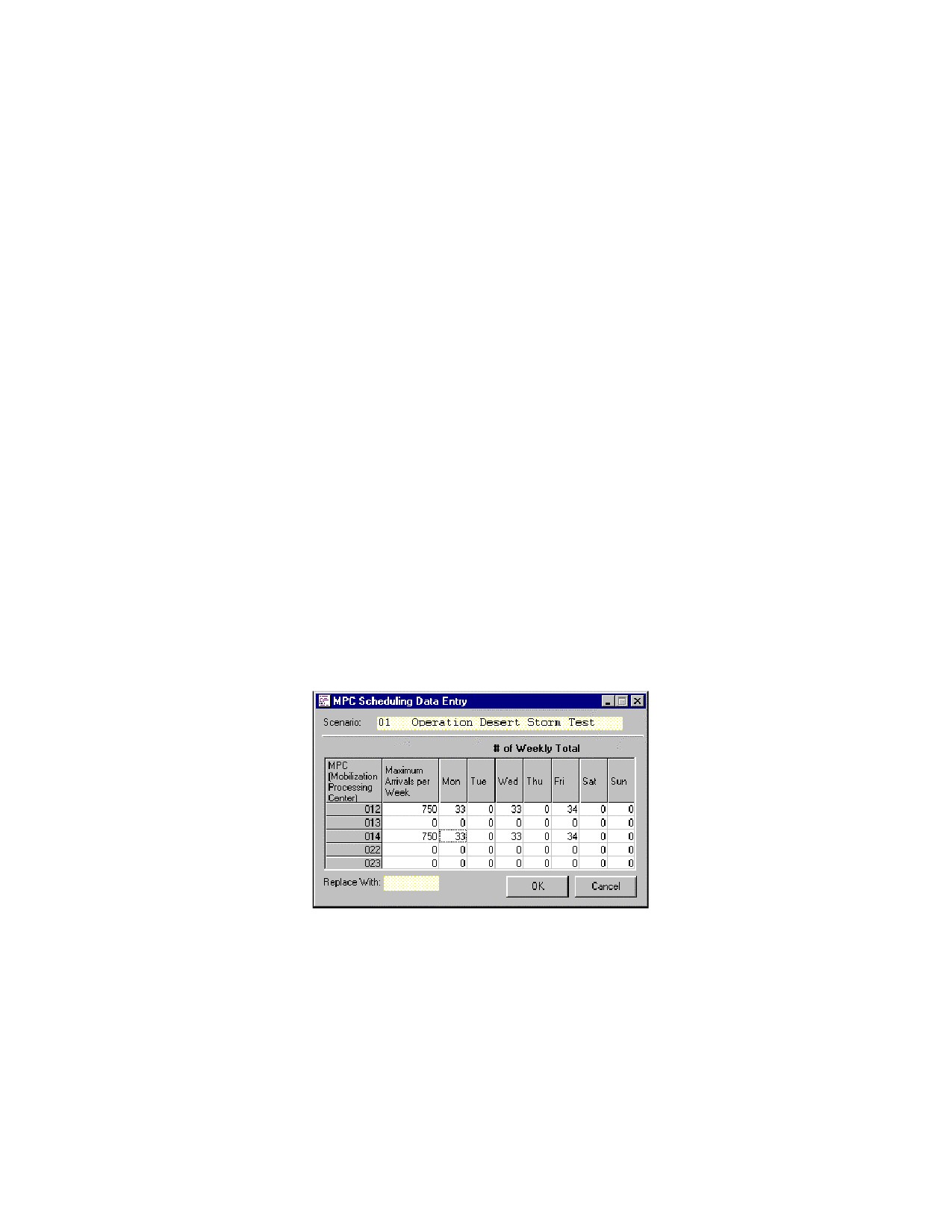
UNCLASSIFIED
c. Officer Staffing Goal Model and Enlisted Assignment Model
(OSGM/EAM). CMC (MM) uses these models to make officer and enlisted
assignments to manpower requirements shown in the WASR provided by
MCCDC (TFS) using AC/RC manpower pool identified by CMC (MP). The
output from this process is provided to CMC (MP) to issue activation
orders to the IRR using the Mailgram Model.
d. Officer Mobilization Model (OMM). CMC (MMOA) maintains and
manages this automated model, which identifies potential Marine Reserve
officers to fill billet vacancies as identified by CMC (MPP-60). The
OMM uses an algorithmic approach to determine the best-qualified
officers based on the available non-assigned Marine Reserve population
in MCTFS. Once the proposed assignments are approved by D/C, M&RA, the
OMM output generated file is provided to CMC (MPP-60) to generate
mailgram orders to appropriate Marine Reserve officers.
e. Mailgram Model. The CMC (MPP-60) uses this model to 1)
establish reporting priority to support gaining commanders manpower
requirements, 2) establish flow of Marine IRRs reporting to the the I-
DPC and one of the three processing sites located at MCB Quantico, MCB
Camp Pendleton and MCB Camp Lejeune, 3) issue Mailgram orders to the
individual Marine (Annex U, Appendix 19); and 4) load personnel
information to MCMPS used for tracking and processing these Marines.
Once Marines selected for orders are approved, CMC (MP) provides this
information to Western Union who has 24 hours to deliver certified
Mailgram orders to individual members. Figure 2 provides a screen shot
from the Mailgram Model, and figure 3 provides a processing screen shot
from MCMPS.
Annex (21), Appendix (s)
Figure 2 - Mailgram Model
C-3-3
UNCLASSIFIED