Military reference books and manuals (2009-2023, Volume 1) - page 29

threat response and incident support. The JFO enables the effective and efficient coordination
of federal incident-related prevention, preparedness, response, and recovery actions. The JFO
combines the traditional functions of the joint operations center, the FEMA disaster field officer,
and the joint information center (JIC) within a single federal facility. Typical ESF management is
executed by the respective ESF coordinator assigned to the JFO. Figure II-4 illustrates a typical
JFO ESF organization.
Figure II-4. Sample JFO ESF Management Organization
(4) The JFO uses the ICS structure to execute operations, planning, logistics, and
finance/administration. The JFO may also incorporate a sixth element focused on intelligence
and information. This element may be included as a position in the coordination staff, a unit
within the planning section, a branch within the operations section, or as a separate general
staff section. The JFO differs from the ICP in that the JFO does not manage on-scene
operations. Instead, the JFO focuses on providing support to on-scene efforts and conducting
broader support operations that may extend beyond the incident site. The JFO staff comprises
the following:
20
FM 3-28.1/NTTP 3-57.2/AFTTP(I) 3-2.67
3 December 2007
(a) Emergency Response Team (ERT). The ERT is the principal interagency group
that staffs the JFO. The size and composition of the ERT is scalable depending on the scope
and magnitude of the event.
(b) Emergency Response Team-advanced (ERT-A). The ERT-A deploys during the
early stages of an incident to work directly with the state to obtain information on the impact of
the event and to identify specific state requests for federal incident management assistance. It is
composed of program and support staff and representatives from selected ESF primary
agencies. It coordinates for location of the JFO.
(c) Emergency Response Team-national (ERT-N). The ERT-N deploys for large-
scale, high-impact events, or as required. It includes staff from DHS, Emergency Preparedness
and Response, FEMA, and other federal agencies as required. Three ERT-N teams are
available on-call status, on a 1 month rotating basis; a fourth standing team is on call year-round
exclusively to manage incidents in the National Capital region.
(d) Federal Incident Response Support Team. This team is a forward component of
an ERT-A. It is designed to be a quick and readily deployable resource to support the federal
response to incidents of national significance. It provides on-scene support to the local incident
command or area command. It deploys within 2 hours of notification and is required to be on-
scene within 12 hours of notification.
(e) Urban Search and Rescue Teams. These teams are specially-trained personnel
equipped to conduct operational activities that include locating, extricating, and providing on-site
medical treatment to victims trapped in collapsed structures.
(f) Initial Response Resources Team. This team is capable of immediately
providing incident victims the most urgently needed life-saving and life-sustaining resources. It
is resourced to support up to 30,000 victims for 72 hours. It provides an immediate federal
presence and supplements state capabilities with concurrence of state leadership.
9. Defense Coordinating Officers (DCOs) and Entities
a. DCOs are military officers in the grade of O-6 (or their Civil Service equivalents) who
represent DOD at the joint field office (JFO). The DCO is the single DOD POC at the JFO.
(1) The DCO is under operational control (OPCON) to the designated supported
combatant commander or designated JTF commander.
(2) The DCO assists in planning and coordinating the delivery of all DOD disaster
response assets and resources provided to a state through the federal coordinating officer
(FCO). Requests for MSCA originating at the JFO are coordinated with and processed through
the DCO to the SecDef for approval, and then on to the Joint Director of Military Support
(JDOMS) for transmission to one of the unified combatant commands. DCOs are designated by
FEMA regions and are assigned one per state disaster. All DCOs and their associated defense
coordinating elements (DCEs) undergo periodic, externally evaluated readiness exercises to
ensure they are trained and ready to perform MSCA missions.
b. Defense Coordinating Element (DCE). The DCE is the DCO staff. It consists of staff
and military liaison officers responsible for facilitating DOD coordination and support. The DCE
processes requirements for military support; forwards mission assignments through the DOD
channel; tracks expenditures; assists with reception, staging, onward movement, and integration
(RSOI) of DOD resources; and assigns military liaisons to activated emergency support
functions (ESFs).
3 December 2007
FM 3-28.1/NTTP 3-57.2/AFTTP(I) 3-2.67
21
c. Emergency Preparedness Liaison Officer (EPLO). EPLOs are reserve component
officers in the pay grade of O-6 (Army, Air Force, and Marine colonels, and Navy captains) who
represent their respective Service component at the state EOCs and the JFO. They serve as
the military liaison at the FEMA region level. They identify potential DOD support requirements
and function as Service representatives and advisors to the DCO under the DCE staff.
d. Joint Entities
(1) Combatant commanders are responsible for homeland defense and CS. They
incorporate plans for CS by task organizing their commands to accomplish CS missions.
(a) US Northern Command (USNORTHCOM), headquartered at Peterson Air
Force Base, Colorado, is responsible for providing resources for domestic disaster relief to the
48 contiguous United States and Alaska.
(b) US Southern Command (USSOUTHCOM), headquartered at Miami, Florida, is
responsible for providing resources for domestic disaster relief to Puerto Rico and the US Virgin
Islands.
(c) US Pacific Command (USPACOM), headquartered at Camp H. M. Smith,
Hawaii, is responsible for providing resources for Hawaii, American Samoa, the Commonwealth
of the Northern Mariana Islands, Guam, and the Freely Associated States of Federated States
of Micronesia, the Republic of the Marshall Islands, and the Republic of Palau.
(2) Joint Task Force-Civil Support (JTF-CS). JTF-CS is a standing military headquarters
without assigned forces, located at Fort Monroe, Virginia, that studies city and state emergency
plans to evaluate the potential needs of these cities in order to support a LFA managing the
consequences of a chemical, biological, radiological, nuclear, or high-yield explosives (CBRNE)
attack. JTF-CS plans and integrates DOD’s support to FEMA for weapons of mass destruction
(WMD) events in the continental United States (CONUS) and draws on DOD capabilities
including detection, decontamination, medical, and logistical assets. Once the SecDef
authorizes MSCA, JTF-CS deploys to the incident site to serve as the C2 headquarters for
responding DOD units.
(3) Joint Task Force (JTF). The JTF is a joint force that is constituted and so designated
by the SecDef and consists of a combatant commander, a sub-unified commander, or an
existing JTF commander.
e. Service Entities
(1) United States Army
(a) US Army North, headquartered at Ft. Sam Houston, Texas, is responsible for C2
of Army DSCA efforts throughout the entire CONUS.
(b) US Army, Pacific, headquartered at Schofield Barracks, Hawaii, is responsible for
C2 of Army DSCA operations throughout the USPACOM AOR.
(c) US Army South, headquartered at Ft. Sam Houston, Texas, is responsible for C2
of Army CS operations throughout the USSOUTHCOM AOR.
(2) United States Air Force
(a) 1 AF (AFNORTH), headquartered at Tyndall AFB, Florida, is responsible for C2
of Air Force DSCA efforts throughout the entire CONUS.
(b) 12 AF (Air Forces Southern [AFSOUTH]), headquartered at Davis-Monthan AFB,
Arizona, is responsible for C2 of Air Force DSCA efforts throughout the USSOUTHCOM AOR.
22
FM 3-28.1/NTTP 3-57.2/AFTTP(I) 3-2.67
3 December 2007
(c) Headquarters, Pacific Air Force, headquartered at Hickam AFB, Hawaii, is
responsible for C2 of Air Force DSCA efforts throughout the USPACOM AOR.
(3) United States Navy
(a) Commander, Fleet Command, headquartered at Naval Station Norfolk, Virginia,
is responsible for C2 of Navy DSCA efforts throughout the entire CONUS.
(b) Commander, US Naval Force Southern, headquartered at Mayport Naval
Station, Florida, is responsible for C2 of Navy DSCA efforts throughout the USSOUTHCOM
AOR.
(c) Commander, Pacific Fleet, headquartered at Naval Station Pearl Harbor, Hawaii,
is responsible for C2 of Navy MSCA efforts throughout the USPACOM AOR.
f.
US Army Corps of Engineers (USACE)
(1) USACE is an Army major command assigned mission responsibilities in major
construction and other engineering support to the Army and the Air Force, in nationwide water
resource management, in engineering research and development, and in real estate services
for the Army and DOD. USACE employs approximately 34,600 civilians and has approximately
650 military members assigned. The Corps is organized geographically into eight divisions in
the US and 41 subordinate districts throughout the US, Asia, and Europe. Divisions and
districts are defined by watershed boundaries, not by states.
(2) USACE conducts its emergency response activities under two basic authorities: the
Flood Control and Coastal Emergency Act (P.L. 84-99, as amended) and the Robert T. Stafford
Disaster and Emergency Assistance Act (P.L. 93-288, as amended). Under the Stafford Act,
the Corps supports FEMA in carrying out the NRP, which calls on 26 federal departments and
agencies to provide coordinated disaster relief and recovery operations. Under this plan, the
Army has the lead responsibility for public works and engineering missions (ESF 3, public works
and engineering).
g. United States Navy
(1) The Navy Surface Warfare Enterprise (NSWE) would provide afloat forces for DSCA
missions. Commander, Fleet Forces Command, or Commander, Pacific Fleet, would exercise
OPCON. They would respond to validated FEMA mission assignments (MA). Typically,
USNORTHCOM is the combatant commander (CCDR) for CONUS disasters and USPACOM
for OCONUS disasters. A common mission is search and rescue (SAR) utilizing rotary wing
carrier-based aircraft. In a JTF environment, a joint force maritime component commander
(JFMCC) would be established and would report directly to NORTHCOM.
(2) The Navy Expeditionary Combat Enterprise (NECE) would provide ashore forces for
DSCA missions. Commander, Fleet Forces Command, and Commander, Pacific Fleet, would
exercise OPCON. They would respond to validated FEMA mission assignments (MA).
Typically, USNORTHCOM is the CCDR for CONUS disasters and USPACOM for OCONUS
disasters. Missions often involve extensive use of the Naval Construction Force (the
“Seabees”) in a variety of disaster recovery roles (dewatering, road clearing, debris removal,
construction of temporary emergency shelters). Other component commands of the NECE that
could expect to be involved would be the Maritime Civil Affairs Group, the mobile security
squadrons, and mobile diving and salvage units. If a JTF is established, it may be appropriate
that the JFMCC would be from an engaged NECE component command.
(3) The Naval Facilities Engineering Command (NAVFAC), a Navy Systems command,
would provide engineering and construction expertise via its Contingency Engineering
Response Teams (CERTs). Commander, Fleet Forces Command, and Commander, Pacific
3 December 2007
FM 3-28.1/NTTP 3-57.2/AFTTP(I) 3-2.67
23

Fleet, would exercise OPCON. They would respond to validated FEMA MAs. Typically,
USNORTHCOM is the CCDR for CONUS disasters and USPACOM for OCONUS disasters.
Missions would typically involve damage assessment and courses of action for recovery and
repair.
10. Requests for Military Support
a. Initial requests for military support are made to the Office of the Secretary of Defense,
Executive Secretariat. See figure II-5. If approved by the SecDef, DOD designates a supported
combatant commander for the response, either USNORTHCOM or USPACOM. The supported
combatant commander determines the appropriate level of C2 for each response and usually
directs a senior military officer to deploy to the incident site. Under most circumstances, the
senior military officer at the incident site is the DCO. The DCO serves as DOD’s single POC in
the JFO.
Figure II-5. Request for Assistance (RFA)
b. Requests for assistance originating at the JFO is coordinated and processed through the
DCO with the exception of requests for USACE support, National Guard forces operating in
SAD or Title 32 status (i.e., not in federal service), or in some circumstances, DOD forces in
support of the FBI. Specific responsibilities of the DCO are subject to modification by the
supported combatant commander based on the situation. In general, the DCO:
(1) Is collocated with the PFO, FCO, federal resource coordinator (FRC), and the senior
federal law enforcement official (SFLEO) in the JFO.
(2) Coordinates and processes applicable requests for assistance from the PFO, FCO,
FRC, SFLEO, or designated representatives.
24
FM 3-28.1/NTTP 3-57.2/AFTTP(I) 3-2.67
3 December 2007
(3) Orchestrates the accomplishment of approved mission assignments utilizing
available resources.
(4) Assigns military liaison officers as appropriate to ESF agencies at the JFO to provide
technical assistance or facilitate timely coordination.
(5) Refers problematic or contentious issues through the appropriate military chain of
command to the Office of the Assistant Secretary of Defense for Homeland Defense.
c. Based on the magnitude, type of disaster, and anticipated level of resource involvement,
the supported combatant commander may utilize a JTF to consolidate and manage supporting
military activities. A JTF commander exercises OPCON of all allocated DOD resources
(excluding USACE resources; National Guard forces operating in SAD or Title 32 status; and in
some circumstances, DOD forces in support of the FBI). In the event that a JTF is utilized, the
DCO may continue to perform all duties set forth above.
d. Requests for military support originating at the JFO are coordinated and processed
through the DCO; however, requests for DOD/USACE support, National Guard forces operating
in SAD or Title 32 status, and DOD forces in support of the FBI, are processed differently.
e. USACE is a public engineering organization within DOD providing engineering support
and services to DOD activities around the globe, as well as to the nation’s civil works flood
protection and navigation infrastructure. USACE provides support as a primary agency and
coordinating agency for ESF 3 and as a support agency to other ESFs. USACE performs
emergency support activities under separate authorities, to include Public Law 84-99. USACE
may also leverage contingency engineering support from NAVFAC or Air Force Civil Engineer
Support Agency (AFCESA).
f.
Army and Air National Guard forces employed under SAD or Title 32 status provide
support to the governor of their state and are not part of federal military response efforts.
g. Support to the FBI in support of law enforcement and domestic counterterrorism
activities is provided in limited circumstances consistent with applicable laws and, in some
circumstances, independent of the DCO.
h. Federal-to-federal Support
(1) DOD response can be in the form of federal-to-federal support assistance or direct
assistance. Federal-to-federal support refers to the circumstance in which a federal department
or agency requests federal resource support under the NRP that is not addressed by the
Stafford Act or other mechanisms (e.g., executive orders, memorandums of understanding,
memorandums of agreement, etc.).
(2) The SecDef must authorize DOD support for any domestic incident when consistent
with military readiness operations and appropriate under the circumstances and the law. In
accordance with the NRP the following are response options:
(a) Immediate Response
1. Imminently serious conditions resulting from any civil emergency may require
immediate action to save lives, prevent human suffering, or mitigate property damage. When
such conditions exist and time does not permit approval from higher headquarters, local military
commanders and responsible officials from DOD components and agencies are authorized by
DOD directive and pre-approval by the SecDef, subject to any supplemental direction that may
be provided by their DOD component, to take necessary action to respond to requests of civil
authorities consistent with the Posse Comitatus Act (18 U.S.C. § 1385). All such necessary
actions are referred to as “Immediate Response.”
3 December 2007
FM 3-28.1/NTTP 3-57.2/AFTTP(I) 3-2.67
25
2. In addition to direct support for incident response, DOD possesses
specialized capabilities employed in support of federal, state, local, and tribal government
agencies, to include their first responder communities. Included among these specialized
capabilities are test and evaluation facilities and capabilities; education and exercise expertise;
explosive detection; technical escort; medical services; the transfer of applicable technologies,
including those developed through DOD science and technology programs; and the expertise of
DOD personnel. The DOD Homeland Defense Coordination Office established at DHS
headquarters facilitates interdepartmental cooperation and transfer of these capabilities to the
emergency responder community.
(b) State and Local Response. The governor is the executive authority over state
capabilities in any disaster response. Governors have the unique authority to issue a state
emergency declaration, mobilize the state National Guard, and redirect state resources to
emergency response. Incidents are handled at the lowest jurisdictional level possible.
Command authority is vested in the incident commander, whether a single incident commander
or an area commander. Every local jurisdiction has authority within its own boundaries.
(3) The National Guard. The National Guard provides support to the local incident
commander but does not take charge of the response operation. National Guard soldiers
operating in either SAD or Title 32 status can exercise the same law enforcement authority as a
state police officer. The law enforcement environment can be complicated by the existence of
multiple versions of RUF.
i.
Emergency Management Assistance Compacts (EMACs). EMACs are legal
agreements between two or more states. EMACs enable National Guard personnel from other
states to be deployed across state lines to assist disaster response efforts.
j.
Federal Response. The governor may request federal assistance from the President
when state capabilities prove insufficient. All DOD support to disaster response is temporary
with the end state being transfer of all emergency functions back to civilian authorities.
26
FM 3-28.1/NTTP 3-57.2/AFTTP(I) 3-2.67
3 December 2007
Chapter III
COMMUNICATIONS SUPPORT OPERATIONS
1. Background
Hurricane Katrina caused significant damage to the communication infrastructure in Louisiana
and Mississippi, which further contributed to a lack of situational awareness for military and
civilian officials. Katrina destroyed or severely degraded many commercial landline and cellular
telephone systems. As a result, it was difficult for officials to gain situational awareness. Even
when local officials were able to conduct damage assessments, the lack of communications
assets caused delays in the transmitting of the results of the assessments.
GAO 06-643 Report to the Congressional Committees
Communications support is critical to successful disaster assistance operations. When
disasters strike, local communications systems are typically disabled or worse, completely
destroyed. Recent disaster operations highlight this fact and further illustrate that our nation’s
rapidly expanding cellular capabilities may even be disrupted during major natural disasters.
Military organizations should plan to fully satisfy their organizational communications
requirements and should be prepared to extend that communication capability to each of their
non-DOD disaster response task force partners.
2. Communications Architectures
a. DSCA Operations. DSCA operations demand immediate action and interoperability of
diverse groups (military, federal, and civilian). The Incident Command System (ICS) requires
unclassified communications in clear text. Priority is given to clarity over security when
employing traditional military communications security paradigms and jargon.
b. Voice Communication Planning. Voice communications planning is divided into three
main levels: C2 nets (SATCOM/HF), tactical C2 nets (UHF/VHF), and tactical operational nets
(FM). Frequency plans are promulgated via OPORD and special instructions (SPINS) to
support participants. To ensure maximum interoperability, the airspace control plan (ACP)
assigns frequencies. The ACP coordinates the frequencies utilized by personnel on the surface
so that communications can be conducted between surface and air assets. In the sample
communications plan shown in table III-1 (tailored to a SAR mission), air rescue assets
communicate with the Air Rescue Group via VHF-FM Channel 83A (157.175 MHz marine band)
and surface rescue assets communicate with each other via VHF-FM Channel 21A (157.05
MHz marine band). Given that air rescue assets and surface rescue assets have limited radio
capability and will likely not monitor both frequencies at all times, air rescue assets should
switch to the surface rescue asset operating frequency to initiate contact and vice versa. Once
initial contact is established, the two assets are free to shift to another, less congested, VHF-FM
frequency.
3 December 2007
FM 3-28.1/NTTP 3-57.2/AFTTP(I) 3-2.67
27
Table III-1. Sample Communication Plan (Nonsecure)
Platform
Frequency
419.8375 MHz (transmit)
Incident Command Network
410.8375 MHz (receive)
Air Rescue Group and C3 air platform
345.0 MHz
345.0 MHz (military)
C3 air platform and air rescue assets
123.1 MHz (civilian)
Air Rescue Group and air rescue assets
157.175 MHz (83A)
As charted on standard air chart -
Air rescue assets and air rescue assets
or -
(deconfliction)
122.9 MHz (east sector)
123.1 MHz (west sector)
Land Rescue Group and ground rescue
155.16 MHz
personnel
155.16 MHz
Ground rescue personnel and ground rescue
700 MHz
personnel
800 MHz
Maritime Rescue Group and surface rescue
157.075 MHz (83A)
assets
Surface rescue assets and surface rescue assets
157.05 MHz (21A)
Air rescue assets and ground rescue personnel
123.45 MHz
Air to surface (21A)
Air rescue assets and surface rescue assets
Surface to air (83A)
Surface rescue assets and ground rescue
21A
personnel
EMS Group and EMS field units
155.34 MHz
Medical Support (facility to facility)
155.34 MHz
3. Organizational Level and Responsibility
a. Command and Control (C2). Large-scale C2 communication architecture should be
developed to maximize operational flexibility. Tactical C2 systems will be the fundamental
communication mode between planners and operators. The communication architecture should
be structured to allow maximum tactical control with an emphasis on operational flexibility.
b. Aviation
(1) Tasking from incident command network via SATCOM/HF net; return
SITREP/MISREP information.
(2) Airborne C2 receives emergent tasking via UHF/VHF and passes the requirements
to airborne and ground units based on capabilities and proximity to the requirement.
(3) Primary communication is receiving the mission tasking from airborne C2 and return
the situation report (SITREP)/mission report (MISREP) data following the completion of the
tasking. Most airborne assets are limited to VHF frequencies, although UHF can be considered
to separate military assets in a communications-intensive environment.
28
FM 3-28.1/NTTP 3-57.2/AFTTP(I) 3-2.67
3 December 2007
c. Ground
(1) Land rescue groups receive tasking from the incident command network (FM/Data)
(2) Ground personnel engaged in tactical operations primarily receive tasking locally via
various networks of handheld radios. Integration with airborne assets is primarily via FM.
d. Maritime. Networks support tasking from incident command via (SATCOM/HF/DATA).
4. Battle Rhythm
Battle rhythm events facilitate communications success. In CS many factors help
determine and establish a staff’s battle rhythm. Some of these factors are the type and
scale of the situation, the staff’s state of training, the battle rhythm of higher
headquarters and the complexity scale of civil response. The battle rhythm must remain
flexible and able to quickly react to changing conditions and perceptions as they evolve.
The type and scale of the disaster / emergency will determine the number of ESF
enacted and the amount of support required from DOD. While standing staffs are
designated, the inevitable turnover of personnel will dictate the state of readiness. The
region’s economic maturity will determine the rate and complexity of the civil response.
De-conflicting important communications events such as VTC from various higher
authorities will be a key issue in developing an effective battle rhythm. Unavoidable
conflicts require senior credible representation with immediate relay back to the
commander in CS types of operations given the speed of civilian, local, and national
media information flow.
5. Data Communications Planning
a. The communications unit prepares and implements the incident communication plan
(ICS-205), distributes and maintains communications equipment, supervises the incident
communications center, and establishes adequate communications over the incident. Upon
deployment, communications should be established with the LFA or JTF command and local
area authorities (LAA). The C2 systems should support immediate information exchange for:
(1) Coordinating communications.
(2) Local law enforcement response.
(3) Medical support.
(4) Disseminating higher headquarters directives.
(5) LFA or JTF phone numbers/frequencies.
(6) Coordinating reports.
b. C2 architecture planning considerations identify the following:
(1) Required reports and reporting frequency.
(2) Classification levels.
(3) Communications services, SECRET Internet Protocol Router Network (SIPRNET),
non-secure internet protocol router network (NIPRNET), cell.
(4) Available public communications capability.
(5) Required special JIC and JTF PAO requirements.
(6) Sharing SA and updating operational information.
3 December 2007
FM 3-28.1/NTTP 3-57.2/AFTTP(I) 3-2.67
29
(7) Media plans to review for briefing back to the command structure.
(8) Required local/national media coordination through the media coordination center
(MCC) at the JTF level or the JIC and PIO at the National Incident Management System (NIMS)
Incident Command System (ICS).
(9) Unique employment challenges communications units have in the CS environment.
(10) Defense support of civil authorities communications challenges non-
communications units need to understand with regard to communications support in the CS
environment.
c. Data communications planning should have as an overarching goal ease of operability
and availability of information to all participants.
d. The goal of information management (IM) for CS operations is to provide a timely flow of
quality information, enabling the commanders of any CS force to anticipate and understand the
consequences of changing conditions.
6. Communication Support Teams
The communications support team is responsible for establishing the communications
equipment shown in table III-2. The video teleconferencing (VTC) team is responsible for
setting up, enabling, and operating all VTC equipment and systems.
Table III-2. Communications Support Team Networks
CST Networks
Voice Networks
Data Networks
UHF Tactical Satellite (UHF TACSAT)
NIPR
HF Radio
SIPR
KU Satellite
Servers
VHF Radio
Switches
Public Switch Telephone Network
Printers
Defense Switched Network (DSN)
Video Teleconference
Defense Red Switch Network (DRSN)
Technical Support
Voice over internet protocol (VOIP)
Internet relay chat (IRC)
7. Generalized Information Flow
a. ICS. Incident command system follows the NIMS process under the NRP. To support
the incident commander, scalable communications support packages are formed and allocated
to local, tribal, state, and federal response teams. Large scale catastrophic incidents require
common interagency C2 platforms to maintain efficient tactical coordination. Airborne C2
platforms coordinating with ground-based C2 centers enable the most effective employment of
aircraft, maritime, and ground assets in catastrophic disaster areas.
b. Liaisons (LNOs). The local, tribal, state EOCs, National Guard JTF-State, FEMA JFO
with the federal, state, and defense coordinating officers, and DOD JTF should integrate
operations. In addition to sharing liaisons between operations centers, operations planners
collaborate telephonically and through physical presence at the state EOC or JFO ESF 9.
c. SAR. SAR communications planning includes all agencies participating with aircraft,
maritime, and ground assets.
30
FM 3-28.1/NTTP 3-57.2/AFTTP(I) 3-2.67
3 December 2007
d. Forward Operating Base (FOB) C2. Should additional FOBs be required for large-scale
operations, C2 of these bases will occur by the state EOC, JFO ESF 9, or as designated by
agency policy (i.e., DOD retains C2 of DOD forces and bases). Integration of SAR and damage
assessment operations from FOBs are monitored by the state EOC and JFO ESF 9.
e. Airborne C2. Airborne C2 will be alerted and deployed on-station overhead the incident
site immediately to coordinate air, land, and maritime rescue and emergency medical services
through the ICS. USCG, Air National Guard (ANG), USAF, and USN fixed-wing capabilities
support airborne C2 mission requirements. Airborne C2 assets relay orders to rescue units to
ensure expeditious life saving operation.
3 December 2007
FM 3-28.1/NTTP 3-57.2/AFTTP(I) 3-2.67
31
This page intentionally left blank.

Chapter IV
AIRPORT AND SEAPORT OPERATIONS
The US Navy (USN) Austin Class Amphibious Transport Dock USS SHREVEPORT (LPD 12)
(rear), the IWO JIMA, and two other Navy ships, head to areas off the Gulf Coast as part of the
Hurricane Katrina relief effort. The group provided C2, port operations, and Disaster Relief
Team (DRT) support that included amphibious construction equipment, medical personnel, and
associated supplies to assist with the relief effort. The Navy's involvement in the Hurricane
Katrina Humanitarian Assistance Operations was led by FEMA, in coordination with DOD.
1. Background
a. During the initial stages of disaster recovery, locally based port handling equipment and
terminal facilities are likely dysfunctional. Effectively deployed DOD capabilities ensure rapid
access to the disaster area. Federal responders will be dependent on this access to initiate and
sustain timely relief operations. As such, DOD expertise providing access to seaports and
airfields is a critical relief operation capability.
b. Airport, harbor, and marine channel support operations may involve clearing or
salvaging ships, aircraft, piers, marine railways, bridges, or other damaged structures blocking
runways, air terminal access, harbors, and/or marine shipping channels. Depending upon the
magnitude of the disaster and other factors, a single ship or item could block a strategic access
point or hundreds of wrecks and other marine debris could affect a substantial geographic area.
Units tasked in these operations could include mobile air traffic control units and Navy salvage
3 December 2007
FM 3-28.1/NTTP 3-57.2/AFTTP(I) 3-2.67
33
assets, such as mobile diving and salvage units, salvage ships, and associated commercial
salvage contractors.
c. During the initial assessment, Service components will be required to identify and
resolve air and sea transportation capability gaps in an emergency situation. Service
components should focus on the immediate response support requirements that involve major
transportation into and out of the affected area by identifying, prioritizing, and restoring logistics
and personnel flow.
(1) Identify area geography/topography (natural and man-made features, such as
terrain, roads, ports, and airfields) and how they have been affected by the situation, i.e.,
damage to power grids, environmental waste/pollution, navigation aids, and runways.
(2) Identify and inform commanders on factors affecting area access to include supply
and re-supply of material (e.g., positioning of the sea base to maximize air routes and water
routes).
(3) Identify federal, state, and local limitations on activities driven by national policy,
public affairs guidance, or legal restrictions.
(4) Assist in restoring damaged infrastructure according to designated priorities. Use
information obtained to establish guidance in support of short-term seaport and airport traffic
control operations as required.
(5) Carry out air traffic control and harbor master duties when directed.
2. Airport Operations
a. Disaster relief operations involve numerous aircraft from military and civilian
organizations. Local and wide area air traffic control procedures are needed to provide
guidance for safe air traffic routing within the relief area to and from landing zones and fixed-
wing airports. Rules should specify standard communication procedures and frequencies,
checkpoints, altitude guidance, and air routes.
b. Additionally, FAA approval is required to operate unmanned aircraft systems in the
disaster area.
c. Helicopter operations and military/relief agency flight operations have priority for air
traffic control rules and routes in the affected area.
d. Depending on equipment capabilities at airports, it may be necessary for ship-borne
systems to close within territorial waters to assist dead reckoning (DR) aircraft in collision
avoidance and navigation in bad weather. Shipboard radars may be affected by land-sea
interface and other terrain factors.
e. Commanders shall establish an air terminal operations center (ATOC) to manage the
site’s air logistic support operations. The ATOC acts as an interface between the advanced
logistic support site (ALSS) and the battle force logistics coordinator (BFLC), Air Mobility
Command (AMC), and the naval air logistics office (NALO), independently operating ships
requiring air logistic support, as well as flight crews for weather briefings, flight plans, and load
planning. The ATOC is in charge of all ramp services and flight line operations. The ATOC is the
information fusion point through which all information relating to air logistics is received,
processed, and dispatched to each functional area at the ALSS.
f.
Flight operations consist of ground handling of aircraft, passenger service, and
unloading and loading of cargo and mail. The ramp controller is the primary interface between
the flight line and the ATOC. The ramp controller’s primary duties are to ensure ATOC guidance
34
FM 3-28.1/NTTP 3-57.2/AFTTP(I) 3-2.67
3 December 2007
and all personnel working on the ramp adhere to directions. Other ramp controller duties
consist primarily of:
(1) Meeting all inbound aircraft and collecting necessary traffic documentation.
(Exception may be made for cargo/mail requiring signature service and passenger
documentation.)
(2) Ensuring sufficient copies of registered main manifests remain on the aircraft to
facilitate the transfer of accountability by special handling personnel.
(3) Checking aircraft for passenger capability and cargo pallet configuration.
(4) Coordinating all ground handling activities with ATOC.
(5) Relaying information concerning load changes to ATOC.
(6) Giving the load master a briefing to include the number of passengers, deportees,
special category passengers, handicapped passengers, prisoners and guards, couriers, number
of pallets, load characteristics (i.e., overhang, rolling stock, etc.), total tonnage, hazardous
material, and cargo that prohibits passengers from being on board (i.e., hazardous material
(HAZMAT) that can only be carried on cargo aircraft only).
(7) Providing the ATOC with the necessary information to ensure the completion of
ground handling services prior to scheduled departure time.
(8) Parking inbound aircraft.
(9) Directing the loading and unloading of aircraft by Navy overseas air cargo terminal
(NOACT) personnel.
g. Prioritizing the movement of passengers, mail, and cargo is an extremely important
issue that shall have the concurrence of the site commanding officer. The Navy component
commander's (NCC) senior logistician, BFLC, or supply officers of ships operating
independently normally promulgate prioritization guidelines. All units or organizations being
served by the site should be informed of these movement priorities. Other FLS and ALSS sites
in the area of responsibility (AOR) should be informed of them as well. Notwithstanding any
limitations imposed on site commanding officers by the chain of command, site commanding
officers may reprioritize the movement of passengers, mail, and cargo when necessary. When
prolonged variances to pre-established and promulgated movement priorities are anticipated,
new movement priorities should be re-promulgated. The movement priority of passengers, mail,
and cargo will be situational, determined, and promulgated by the NCC when required.
h. Figure IV-1 provides typical airfield operations checklist details.
3 December 2007
FM 3-28.1/NTTP 3-57.2/AFTTP(I) 3-2.67
35

Figure IV-1. Sample Airfield Survey Checklist
36
FM 3-28.1/NTTP 3-57.2/AFTTP(I) 3-2.67
3 December 2007
3. Seaport Operations
a. Harbor and marine channel clearance disaster/emergency situations often require
harbor and marine channel clearance operations. These operations may involve natural
obstruction clearance, salvage of ships, aircraft, piers, marine railway, bridges, or other
damaged structural repair affecting the marine shipping channel operation. Depending upon the
type and scale of the situation, wrecks and other marine debris at a strategic access point could
affect a substantial geographic area. Units tasked in these operations could include Navy
salvage assets, such as Navy Supervisor of Salvage, salvage ships, mobile diving and salvage
units, and associated commercial salvage contractors. Prior to performing clearance or salvage
operations, hydrographic survey operations may be required in the area of operations. The
Navy has hydrographic survey teams that can deploy to disaster areas and conduct these
operations. Hydrographic surveys provide the commander with a detailed understanding and
visualization of the underwater area of concern and provide the operator with information about
the bathymetry, bottom type, position, size, and disposition of the underwater obstruction.
b. Navy cargo handing battalions (NCHB) can accomplish port control, loading and
unloading. The NCHB has C2 for handling operations and providing support personnel to
discharge/load ships either pier side or in-stream, for all classes of cargo, including HAZMAT.
They can conduct port terminal operations in developed or undeveloped ports, which include
discharging/loading containers, cargo, and vehicles from ships by using shipboard heavy lift
pedestal and gantry cranes, mobile hydraulic cranes, yard and stay rigs, and jumbo booms.
NCHB is capable of performing heavy lift crane operations in support of maritime pre-positioning
force (MPF) squadrons, container ships, fast sealift ships (FSS) or fast logistics ships (T-AKR),
and auxiliary crane ships (T-ACS). For ocean terminal operations, it can provide the following:
(1) Managerial, clerical, and cargo handling personnel to operate a limited ocean
terminal.
(2) Transit warehouse operations for processing cargo.
(3) Documentation via the Worldwide Port System (WPS).
(4) Controlling and handling ship discharging/loading.
(5) Pier operations.
c. NCHB delivers material to/from transit warehouses in proximity to the piers. When
necessary, the NCHB operates two 12-hour shifts on a continuous 24-hour basis. NCHBs are
self sustaining units (up to 30 days), capable of erecting, maintaining, and operating a tent
camp, field mess, and field dispensary. NCHBs normally do not deploy with a large amount of
heavy equipment unless specific needs dictate.
d. Figure IV-2 provides typical seaport operations checklist details.
3 December 2007
FM 3-28.1/NTTP 3-57.2/AFTTP(I) 3-2.67
37
Figure IV-2. Sample Seaport Survey Checklist
e. Military Sealift Command maritime pre-positioning ships squadrons (MPSRONs) are not
always fully authorized even though they are on scene. These ships require an additional DOD
authorization in order for commanders to utilize their assets. Consideration must be given to
deep draft requirements in channel survey and clearance prioritization as well as vendor and
fuel support arrangements or barges required to support operations from anchorage. Lack of
potable water can be a critical factor in the early aftermath of a disaster. Where potable water
demand exceeds damaged infrastructure capacity, MPSRON ships can provide the capability to
purify water and transfer it ashore from anchorage. The need for dock space to configure relief
supply offloads must be considered with these types of ships. MPSRON ships are not
configured for selective offload. With the exception of bulk fuel or water provision, they require a
38
FM 3-28.1/NTTP 3-57.2/AFTTP(I) 3-2.67
3 December 2007
port with dock space to reconfigure. Explosive safety quantity distance (ESQD) event waivers
can cause delays for MPSRON ships. Commanders should check with the Pacific Fleet
explosive safety officer for the status on these waivers. In contrast to MPSRON ships, combat
logistics force (CLF) ships are capable of selective offload, however; they require approximately
24 hours notice to reconfigure material in the hold. Embarked air detachments are required to
assist CLF ships in supporting other ships, otherwise, non-organic air assets or alongside
replenishment is required. Since diverting air and surface assets from the direct relief effort can
negatively impact response times, air detachments assigned as organic assets to the ship
should be considered to significantly increase logistics throughput and flexibility. While the
hospital ships are not generally used as first responders due to lead time required to arrive on
scene. The ships have routinely been used in the later phases of major relief efforts, focusing
more on public and environmental health support than trauma care and serving as a
military/civilian agency C2 node.
f.
Amphibious Ships and Other Surface Vessels Well deck ships and associated landing
craft, such as landing craft, utility (LCUs) and landing craft, air cushion (LCACs), provide
significant heavy lift capability from the sea base. LCACs and LCUs can deliver up to 72 and
180 tons of relief supplies respectively. LCACs equipped with a personnel transport module
(PTM) can transport 180 personnel as opposed to 23. Additionally, lighter, amphibious re-
supply, cargo (LARC), landing craft, mechanized (LCM), and amphibious assault vehicles
(AAVs) have played a vital part in SAR and seaborne support in relief operations. An
amphibious transport dock (LPD) may serve as host platform, utilizing its internal motor gas
system to fuel these craft. Other large deck vessels can serve as receiving, assembly, and
staging areas to break bulk shipments of relief supplies and build them into deliverable (e.g.,
palletized) sets. Large deck vessels can also host aviation mine countermeasures (MCM)
assets, anchoring in the immediate vicinity of survey areas to maximize on station time. The
following list provides additional considerations for amphibious ships other surface vessels.
(1) Consider personnel transport module suitability for extended transits when high heat
and humidity conditions are expected due to limited air conditioning capacity. LCUs and LCMs
may be most suitable under these conditions.
(2) Leverage speed, personnel, and cargo carrying capabilities of the various landing
craft through carefully planning sea echelon assignments.
(3) Determine requirement for organic fendering capability based on port service
availability. Fenders or camels are required for LPD ballasting operations pier side due to the
ship’s configuration (e.g., catwalks and other obstructions that may be damaged or cause
damage).
(4) Deploy landing craft with a repair parts kit if possible, particularly if they will be
operating away from their assigned ships for extended periods.
(5) Coordinate amphibious ship on-loads with the ship’s combat cargo officer at the
earliest opportunity. Use the integrated computerized deployment system (ICODES) software to
assist in this process.
(6) Consider tradeoffs with naval lighterage on-loads. Naval lighterage on-load impacts
ship’s capabilities precluding landing craft launch and recovery and vehicle and cargo off-load
and therefore should be the last item brought aboard.
(7) Reflect pallet sizing for standard cargo restrictions such as weight and height
restrictions for each aircraft type.
3 December 2007
FM 3-28.1/NTTP 3-57.2/AFTTP(I) 3-2.67
39
(8) Consider maximizing deck landing spots for rotary wing operations. This may entail
additional certifications for aircraft elevators to be used as landing spots.
(9) Anticipate requirements for Naval Air Training and Operating Procedures
Standardization (NATOPS) program waivers and additional manning to maximize flight
operations.
(10) Maximize capacity for material and personnel transfer while minimizing the risk of
collateral damage. Removal of selected mission equipment, like sonobuoy launchers and
magnetic anomaly detectors, will assist in this process.
g. Large capacity high speed vessels (HSVs) can transport large numbers of people and
large amounts of material quickly while operating in an austere environment. The shallow draft
and speed of response also make HSVs an effective operating platform for hydrographic survey
teams. HSVs can support helicopter operations and they have C2 facilities suitable to support
an embarked squadron or company-sized ground force. HSV maneuverability enables it to moor
without tugs and its vehicle ramp enables vehicles to be driven on and off to and from a pier. An
HSV's high speed makes it an effective intra-theater lift platform. HSVs operate at a high
operational tempo for in-theater lift and can be managed best under a 72-hour tasking order
process. Consider HSV use for initial survey and delivery of material to damaged or unimproved
ports. An HSV can be quickly reconfigured to meet additional requirements, including personnel
evacuation. Installation of refrigerated container express (CONEX) boxes enables it to carry
frozen and chill foods while retaining the ability to carry a large volume of dry stores. While
normal personnel carrying capacity is 250, the Navy’s HSV can transport up to 500 personnel if
reconfigured with LCAC PTMs, or by simply driving on buses. Finally, the combat rubber raiding
crafts (CRRCs), which require only 2-3 feet of water to operate, have been used effectively for
SAR, survey, and delivery of supplies in flooded areas.
h. In large disaster/emergency operations, several beach detachments may be required.
Commanders must ensure sufficient support for the beach detachment (e.g., force protection
lodging, meals, electric power, fuel, radios, personal protective equipment and supplies, etc.).
The beach detachment should also have mobile communications (e.g., cellular/satellite
telephone or radio) and radio frequency identification (RFID) capability, such as the inventory
tagging and interrogation devices provided in early entry deployable support kits (EEDSKs).
4. Recent Lessons Learned
a. Large capacity joint high speed vessels (JHSV), such as the Navy’s experimental JHSV,
and commercial vessels can transport large numbers of people and large amounts of material
quickly while operating in an austere environment. Shallow draft and speed of response also
make JHSVs an effective operating platform for hydrographic survey teams. JHSVs can
support helicopter operations and they have C2 facilities suitable to support an embarked
squadron or company-sized ground force. JHSV maneuverability enables it to moor without
tugs and its vehicle ramp enables vehicles to be driven on and off, to and from a pier. JHSVs
are effective intra-theater lift platforms. JHSVs operate at a high operational tempo for in-
theater lift and can be managed best under a 72-hour tasking order process.
b. JHSVs can be quickly reconfigured to meet additional requirements, including personnel
evacuation. Installation of refrigerated CONEX boxes enables it to carry frozen and chilled
foods while retaining the ability to carry a large volume of dry stores.
40
FM 3-28.1/NTTP 3-57.2/AFTTP(I) 3-2.67
3 December 2007
Chapter V
PUBLIC SAFETY AND SECURITY
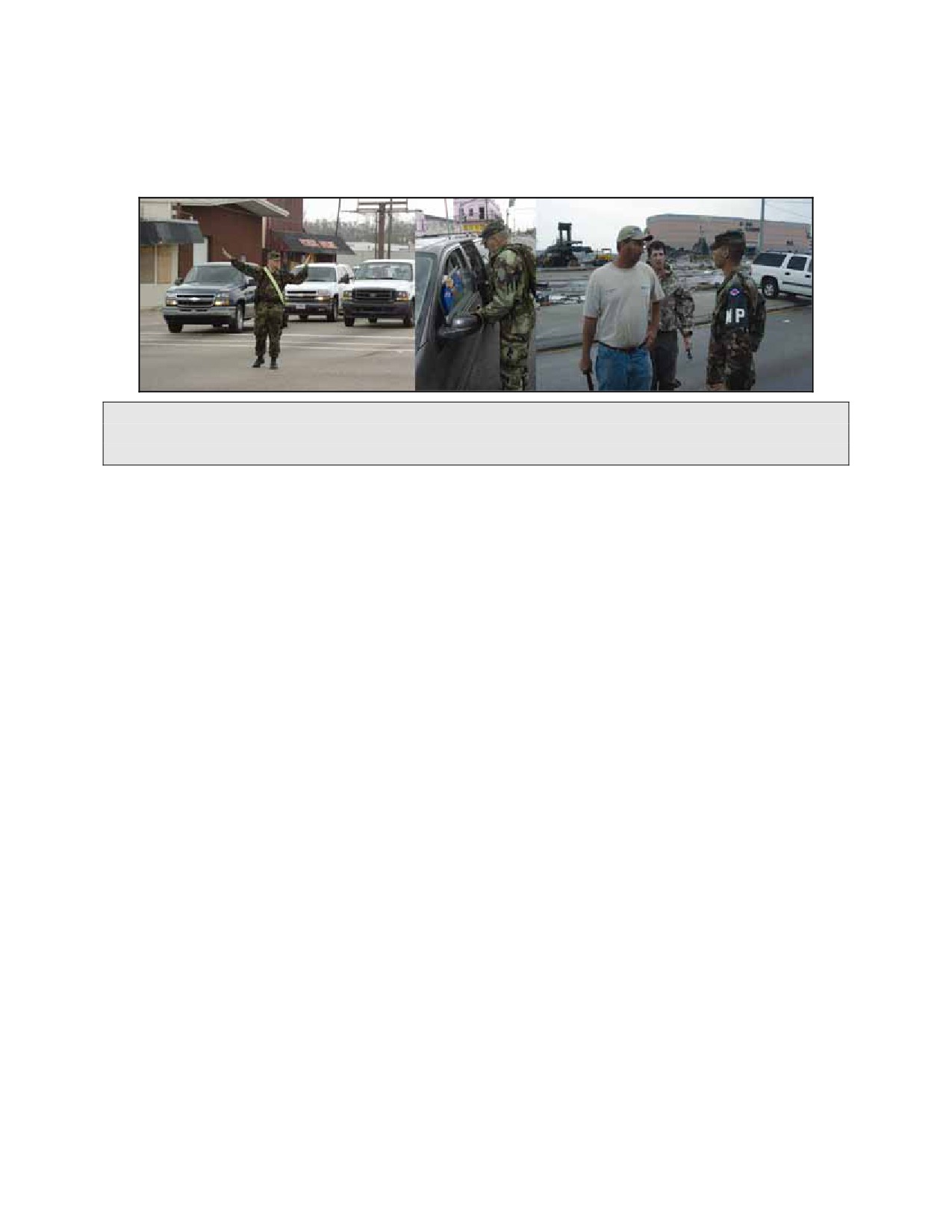
Military units are fully capable of executing tasks aimed at ensuring freedom of action and safety
of people within an area of operations. Illustrated above are some of the tasks military units
performed while assisting civilian agencies during the Hurricane Katrina disaster.
1. Background
a. DOD capabilities may be utilized to protect and secure the public from hazards and
conditions associated with domestic disasters, although the types of support the DOD may
provide are limited by law and policy (see appendix A). Effective CS operations will proactively
establish and sustain public safety. As a first priority, DOD should establish civilian risk
limitations and ensure that no CS operation negatively impacts public safety. While DOD is not
primarily responsible for public safety, all types of DOD CS operations impact people within the
operating area. The public depends on its military for assistance during domestic disasters and
emergencies. Assistance contributes to stability and order and commanders should strive to
ensure that concern for public safety and security is at the heart of all relief operations.
b. Often no single local, state, federal, or private agency possesses the capabilities to
respond to threats to public safety and security associated with major disasters and
emergencies. Major disaster events like hurricanes, earthquakes, man-made disasters, and
acts of terrorism, particularly when impacting large population centers produce consequences
that overwhelm the capabilities of most local governments. DOD representatives should
consider the unique characteristics of the event and tailor response requirements and control
processes necessary to effectively support maintenance of public safety and security.
c. DHS Homeland Security National Operations Center maintains a database of
information describing first response capabilities available by DHS and FEMA by region
throughout the US. This information identifies DOD assets that may be required to augment
incident response activities conducted by civil and federal authorities.
2. Public Safety and Security Response
a. Under ESF13, DOJ has primary responsibility for ensuring public safety and security
within the federal government. During disasters, ESF13 prescribes facility and resource
security, security planning and technical resource assistance, public safety and security
resource support, and support to access, traffic, and crowd control as primary tasks.
b. DOD capabilities are typically employed to support immediate requirements to reduce
the impact or consequences stemming from a disaster incident by assisting in securing the
3 December 2007
FM 3-28.1/NTTP 3-57.2/AFTTP(I) 3-2.67
41
affected area and supporting law enforcement, HAZMAT, and fire/rescue agencies as part of an
immediate response team.
c. DOD CS operating forces should be prepared to provide immediate support for the
following response requirements to the extent permitted by law and DOD policy (see appendix
A).
(1)
Maintain public order.
(2)
Maintain quarantine.
(3)
Establish and maintain traffic control.
(4)
Secure key facilities.
(5)
Contain and mitigate hazardous materials release.
(6)
Rescue, decontaminate, and treat victims.
(7)
Protect responders and at-risk populations.
(8)
Support containment activities.
(9)
Support decontamination activities.
(10) Secure contamination sources and affected areas.
(11) Monitor responders for exposure to hazardous materials.
(12) Assist in decontamination of affected facilities and equipment.
(13) Assist with hazardous material disposal.
(14) Provide mass casualty treatment.
(15) Support directed evacuations.
42
FM 3-28.1/NTTP 3-57.2/AFTTP(I) 3-2.67
3 December 2007

Chapter VI
SEARCH AND RESCUE
Military capabilities enhance all categories of civilian SAR operations. Illustrated are some of
the tasks military units performed while assisting civilian agencies during the Hurricane Katrina
disaster.
1. Background
Military expertise in search and rescue techniques and its organizational capabilities remain
critical to effective disaster relief operations. In the aftermath of hurricane Katrina, DOD and
DHS have made significant progress reorganizing to support major disaster operations. While
these recent lessons learned focused on hurricane incidents, enduring catastrophic SAR
principles derived from these lessons apply across the DHS all hazards response methodology.
This chapter outlines some of the key considerations supporting integrated DOD and
interagency SAR operations.
2. SAR Operations
a. SAR Planning Considerations.
(1) Prioritizing SAR assets ensures that distress alerts and associated data are made
available as quickly, comprehensively, and reliably as possible. Prioritization provides
communications systems which are highly reliable, simple, problem-free, interoperable, and as
functionally effective as possible. In addition, providing SAR personnel with the training,
equipment, procedures, facilities, information, and other tools necessary to carry out their
planning and operational duties enables them to be as highly effective in those duties as
possible.
(2) FAA temporary flight restriction(s) (TFRs), notice to airmen (NOTAM) information,
and FAA regulations are taken into consideration throughout SAR operations. This information
is designed to ensure continuous air safety and adherence to it is a priority. To ensure efficient
operations, aircraft supporting disaster relief should be capable of VHF FM land mobile radio
(LMR) communications.
3 December 2007
FM 3-28.1/NTTP 3-57.2/AFTTP(I) 3-2.67
43
b. SAR Categories. There are four categories of SAR: SMART SAR, Hasty SAR, Primary
SAR, and Secondary SAR.
(1) Special medical augmentation response team (SMART) SAR are teams employed
when the incident commander has identified specific evacuation requirements necessary to limit
loss of life for special needs victims. Specific SAR resources should be reserved to investigate
facilities that are likely to require evacuation assistance. These facilities include but are not
limited to:
• Hospitals
• Nursing homes
• Shelters/marshalling points
• Critical facilities
• Areas of last refuge (location of local first responders)
(2) Hasty SAR. A hasty search is a rapid visual, audible search of likely spots and is
focused on finding responsive subjects able to participate in their rescue. It involves fast-paced
visual inspection of the area to be searched accompanied by vocal or audio hailing for victims.
Likely spots for search are population centers, safe refuge areas, high ground, areas isolated by
road damage where people are stranded and any area where people are most likely to be
found.
(3) Primary SAR. A primary search is a ground or water born search of every structure
in the impacted area looking for survivors who may or may not be responsive and deceased.
Search includes door to door visual and audible search and cursory investigation of clues such
as odor, visual evidence of occupancy, neighbor reports. Entry of structures is allowed if
circumstances support the need for entry. The structures are marked when the search is done
and documentation is made regarding the search results.
(4) Secondary SAR. This is the highest standard and involves thorough systematic
search of every room in every building (including debris for human remains) to be covered
within the area to be searched. It requires extensive debris removal and movement. Forced
entry, according to locally negotiated rules of engagement, is expected to accomplish thorough
Secondary SAR.
c. Standard 5-line SAR Mission Brief. Figure G-3 in appendix G illustrates a sample SAR
reporting format. The five items on this brief are:
• Number of personnel needing rescue.
• Condition of personnel (ambulatory, litter, etc.).
• Location (geographic coordinates and physical description).
• Type of pickup (land or hoist).
• Hazards in the area.
d. Follow-on Evacuation. Lily pads are established for each geographic area. Each lily
pad will have triage, limited shelter, food, and water. Aircrews ensure a positive handoff of
victim to qualified medical or EMT transport personnel. Designated lily pads are established for
special needs personnel from SMART SAR pickups.
44
FM 3-28.1/NTTP 3-57.2/AFTTP(I) 3-2.67
3 December 2007
e. Clear Debriefing/Documentation. After each search team returns, a thorough debrief will
occur to include damage assessment. The debrief format will be IAW NIMS but should include
at a minimum:
(1) Location of primary search (via grid, latitude/longitude or universal transverse
mercator [UTM]).
(2) Number of homes/facilities visited.
(3) Number of personnel rescued/evacuated.
(4) Number of personnel deceased.
(5) Thoroughness/efficiency of search.
(6) Additional resources needed to complete search of area.
(7) Areas not searched due to hazards, risk, and accessibility.
(8) Number of personnel refusing to leave.
(9) Location of drop-off.
(10) Medical condition of personnel.
(11) Condition of the facility.
(12) Facility marked (yes or no).
f.
Communications Frequencies. See table VI-1 for a sample list of standard
communications frequencies.
3 December 2007
FM 3-28.1/NTTP 3-57.2/AFTTP(I) 3-2.67
45

Table VI-1. Sample Communications Frequencies
SAR Platforms
Frequency
419.8375 MHz (transmit)
Incident Command Network
410.8375 MHz (receive)
Air Rescue Group and C3 Air Platform
345.0 MHz
Air Rescue Group and Air Rescue Assets
157.175 MHz (83A)
345.0 MHz (military)
Air Rescue Assets and C3 Air Platform
123.1 MHz (civilian)
As charted on standard air chart
Air Rescue Assets and Other Air Rescue Assets
or
(deconfliction)
122.9 MHz (east sector)
123.1 MHz (west sector)
Air Rescue Assets and Ground Rescue
123.45 MHz
Personnel
Air to Surface (21A)
Air Rescue Assets and Surface Rescue Assets
Surface to Air (83A)
Land Rescue Group and Ground Rescue
155.16 MHz
Personnel
155.16 MHz
Ground Rescue Personnel and Other Ground
700 MHz
Rescue Personnel
800 MHz
Maritime Rescue Group and Surface Rescue
157.075 MHz (83A)
Assets
Surface Rescue Assets and Other Surface
157.05 MHz (21A)
Rescue Assets
Surface Rescue Assets and Ground Rescue
21A
Personnel
EMS Group and EMS Field Units
155.34 MHz
Medical Support (facility to facility)
155.34 MHz
3. Air Traffic Control (ATC)
a. Airspace is considered “uncontrolled airspace” whenever FAA ATC service is
unavailable. The common traffic advisory frequency (CTAF) procedures are applied. When
CTAF is used for airspace control, all aircraft transiting the area (not actively involved in SAR, or
proceeding to pickup or drop-off point) are at an altitude of 500 feet or greater. All aircraft
actively searching or engaged in SAR operations should operate at altitudes specified in the
ACP for the specific area.
b. All pilots report their altitudes along with their position when checking in to the area of
operations (AO), as well as reporting any changes made in flight attitude (i.e., a transiting
aircraft descending to conduct hoist operations should make a call).
4. SAR Incident Command
a. Incident command follows the NIMS process under the NRP. To support the incident
commander, a scalable SAR branch under the SAR coordinator leadership is formed under
local, tribal, or state ESF 9 depending upon the nature of the incident. Agencies share SAR
46
FM 3-28.1/NTTP 3-57.2/AFTTP(I) 3-2.67
3 December 2007
operations planners and assets with the SAR coordinator to ensure asset/force visibility and
efficient scheduling of assets.
b. When incidents are large-scale or catastrophic in nature, a common interagency
airborne C2 platform should maintain a tactical partnership to effectively coordinate and direct
agency platforms for timely emergency disaster relief operations. This airborne C2 platform
coordinates with ground-based C2 centers to apply the proper utilization of aircraft, maritime, or
ground assets, especially during a catastrophic incident.
c. SAR C2 operations
(1) Formal C2 relationships are maintained by local, tribal, state, and federal
organizations during CS operations. Informal or ad hoc C2 relationships are established by
each JFO and EOC as required by the response operation. DOD, National Guard, JTF-State,
FEMA, and HLS all provide necessary control measures as determined by the type of CS
operation. Within the JFO each activated ESF is represented. These organizations provide
their respective C2 systems and resource capabilities. The JFO directs and coordinates all
supporting operations.
(2) Procedural Control. Procedural control is exercised by rescue incident commanders
through local and state procedures to manage the incident response efforts. It is imperative that
air crews understand and adhere to these prior to entering the air space.
(3) SAR C2. Tactical calls and mission assignments are executed by rescue incident
commanders at forward operating locations. Real-time tracking of mission assignments and
overall C2 is executed by the Current Operations SAR Branch under the SAR coordinator at the
state EOC.
3 December 2007
FM 3-28.1/NTTP 3-57.2/AFTTP(I) 3-2.67
47
This page intentionally left blank.

Chapter VII
MEDICAL RESPONSE
Military capability augments all facets of medical assistance from trauma to prophylactic
preventive medicine during disaster relief operations. Illustrated above are some of the tasks
military medical units performed while assisting civilian agencies during the Hurricane Katrina
disaster.
1. Background
a. Medical responses in CS operations focus on disaster/emergency type situations in
which local and state health resources have been overwhelmed. Within the NRP, the delivery
of public health and medical services falls under ESF 8. This ESF's primary agency is the
Secretary of the Department of Health and Human Services (DHHS). ESF 8 is the mechanism
for coordinated federal assistance to supplement state, local, and tribal resources in response to
public health and medical care needs (to include veterinary and/or animal health issues when
appropriate). As a supporting agency, USNORTHCOM’s joint regional medical planner’s office
(JRMPO) and the DCO coordinate these services. DOD employs and integrates medical
response through the capabilities of care: first responder, forward resuscitative care, en route
care, theater hospitalization, and in some cases definitive care. The focus of DOD medical
support is to restore essential health services in collaboration with the state and local health
authorities. The scope of the medical response will vary with the type and scale of emergency.
However, a clear focus should remain on transition to other medical support organizations,
particularly if taking a lead role during the initial stages of the response. The Military Health
System (MHS) will, in most cases, have a dual response to CS emergencies: first under
immediate response from local/regional installations and facilities and the National Disaster
Medical System (NDMS), and secondly through JTF-CS assigned missions.
b. Acute situations may require response prior to detailed DOD and DHHS coordination.
Imminently serious conditions resulting from any civil emergency may require immediate action
“to save lives, prevent human suffering, or mitigate property damage” and is covered under the
‘Immediate Response” provision in the NRP. Medical "Immediate Response" is usually
coordinated locally through NDMS FCCs of which nearly half are DOD military treatment
facilities (MTFs). Federal, state, and local health systems regularly train and exercise disaster
preparedness with emergency services as a part of certification and licensing. In civil
emergencies that escalate into incidents of national significance and JTF involvement is
pending, FCC and representative MHS installations can often be valuable sources for situational
awareness.
3 December 2007
FM 3-28.1/NTTP 3-57.2/AFTTP(I) 3-2.67
49
2. JTF-CS Department of Health and Human Services (DHHS) Operations
a. Responsibilities: The JTF surgeon advises the commander on medical issues, medical
plans, policies, and procedures for assigned units. The JTF surgeon staff is comprised of three
divisions: operations, plans, and support. The JTF surgeon’s cell provides the central location
for medical planning and operations. The staff monitors current and future operations and
conducts required planning support. The JTF medical staff should maintain close contact with
JRMPO and the DCO in order to carry out ESF 8. LNO placement is critical to the
commander’s medical SA and his ability to solve common health problems associated with
major disasters and mass casualties. Some of the obstacles JTF personnel will face are:
(1) Inappropriate Care Distribution. Often the first casualties presented for care are the
least injured, who then consume all available resources, leaving the most injured without access
to life-saving care. To ensure that medical resources are appropriately allocated across the
affected area, care delivery should be prioritized at both the local level and area-wide.
Casualties tend to concentrate locally and then surge to the nearest health treatment facility.
This may result in unequal distribution which overwhelms some local facilities while others
remain underutilized.
(2) Multiple Casualty Entry Points. Emergency medical services (EMS) typically route
casualties into the health care system. In mass casualty (MASCAL) situations, casualties
access the system through non-EMS entry points (e.g., private means, police transport, and
SAR). This results in multiple, uncontrolled demands for health care and concentrates the
demands at non-typical locations. Also, non-local responders arrive to help but are not familiar
with the local health system, adding to the overall confusion.
b. Medical Fusion Cell (MFC). In order to facilitate and provide responsive health services
to JTF operations, medical resources should be effectively organized and synchronized to
support joint operations. The MFC is organized to plan, coordinate, and harmonize the JTF’s
DHHS assets. The major functions of the MFC are to:
(1) Provide a central location for medical planning and operations.
(2) Monitor current and future operations and conduct required support planning.
(3) Determine medical sustainment requirements.
(4) Apprise the JFO on the status of DHHS.
(5) Coordinate support requirements with the supported combatant commander.
(6) Maintain visibility of medical unit locations, capabilities, logistic status, and overall
DHHS system readiness.
(7) Coordinate closely with the JTF staff in all areas to include J-1 thru J-6, Public Affairs
Office (PAO), and SJA.
(8) Provide situation reports regarding JTF DHHS operations.
(9) Characterize disease and environmental threats within the JOA/AOR.
(10) Develop medical concepts and countermeasures to mitigate disease and
environmental threats.
(11) Ensure force health protection within the area of operations.
50
FM 3-28.1/NTTP 3-57.2/AFTTP(I) 3-2.67
3 December 2007
3. Medical Threat
a. Overall Estimate of the Situation. During disaster/emergency situations, the acute
demand for care often results in a rapid deployment of resources to the most critical and closest
casualties, without an overall estimate of the situation. The medical estimate identifies health
service support requirements. Because there are so many variables that affect the need for
DHHS, an up-front analysis of multiple sources of intelligence or information, including
information gathered by trained medical personnel on scene, is required. Medical personnel
need to evaluate the safety and vulnerability of local food and water sources and local medical
capabilities, perform an environmental RA and a vector-pest RA and determine the adequacy of
hygiene in local billeting and public facilities as early as possible. It is critical to have medical
personnel on all survey teams or advance party detachments. Identifying critical health risk
factors and short term primary and emergent care along with the magnitude of the disaster’s
impact and potential health consequences for military forces and the population at risk are
critical elements to developing an appropriate course of actions for the commander.
b. Healthcare Infrastructure. In CS operations, the level of damage to the healthcare
infrastructure level of involvement of the other organizations is a starting point when developing
situational awareness for the commander’s estimate. In the dual response model of the MHS,
CC/MTF may be able to provide initial estimates of the situation based on local health system
contacts and a memorandum of understanding. In general, requirements depend on population
health issues and the impact on local health service capabilities.
c. Population at Risk. Highest priority health services include the most appropriate and
effective interventions to reduce death and disease as determined by health estimates. Usually,
the same groups who are most vulnerable in normal times are at most risk during emergencies
and disasters. They include people whose health is already compromised (e.g., people with
pre-existing illness, serious chronic diseases, or the elderly). In situations where injuries are
high, the elimination of on-scene health hazards along with search and rescue and emergent
surgical services, may be the highest priority. This type of support is generally short in duration,
due to patient survivability time limitations and the ability to rapidly build appropriate force levels
for these tasks. In situations where casualties are low but displaced persons are high,
preventive medicine measures will likely be the highest priority health services required (e.g.,
control of infectious or communicable diseases).
4. Force Health Protection
a. Preventive Medicine. Initiate preventive medical treatments. Personnel will likely be
working in a contaminated environment. In addition to prophylactic/immunization measures,
providers collect, monitor, and share information with other participants. Often these
environments are contaminated and have high risk disease vectors present. Ensure forces
have access to proper personal protective equipment (PPE) (e.g., insect repellents with DEET
or picaridin, permethrin spray, mosquito netting, battle dress utility uniforms, gloves, respirators,
etc.).
b. Personnel Protective Equipment. Take necessary precautions for personnel involved in
physical labor to prevent exposure and heat-related illnesses. Ensure proper sanitation
measures (e. g., latrine construction and maintenance) and trash/medical waste disposal
procedures are followed.
c. Mental Health Casualties. Consider deployment of mental health teams to prepare
personnel for the conditions they will likely be exposed to and to provide counseling afterwards.
Send medical teams ashore to monitor personnel for signs of illness and stress.
3 December 2007
FM 3-28.1/NTTP 3-57.2/AFTTP(I) 3-2.67
51
5. First Response
a. Triage. To deal with the range of medical priorities, medical forces need standardized
triage procedures and treatment timelines to guide health care providers on patient assessment,
prioritization, basic resuscitation, and referral. Standardized protocols are also required for
advanced care referral of injured patients (e.g., surgery) and to make arrangements for suitable
patient transportation to the referral MTF/civilian facility.
b. Preventive Medicine. Preventive medicine measures include ensuring water quality and
sanitation, hygiene promotion, vector control, and secure food supplies. Additionally, health
education messages are needed on how to prevent common communicable diseases and how
to access relevant services. More specific prevention measures, such as vaccination and
immunization campaigns, are conducted to the extent practical.
c. Logistics. Logistics provides available logistical support to health/medical disaster relief
operations. It provides available DOD medical supplies for distribution to mass care centers
and medical care locations being operated for incident victims with reimbursement to DOD. It
provides available blood products in coordination with DHHS.
d. Forward Resuscitative Care and Hospitalization. With the focus on transition back to
local area capabilities, hospitalization should be closely coordinated under the JTF CS mission
area. Coordinating patient transfer/evacuation into the local healthcare and supporting NDMS
systems will limit the need for extended holding capability normally found in theater
hospitalization and definitive care capabilities. Communication with local hospitals to determine
capacities and capabilities is necessary in order to properly direct casualty flow from ground
zero to higher levels of care. This requires instituting a systematic plan for allocation of medical
care at ground zero and across the area.
e. Patient Movement/En route Care. It is critical for the JTF surgeon to coordinate all
missions through the JRMPO, who will also coordinate with DHHS and all other medical assets
in the area. At the request of DHHS, DOD coordinates with personnel ESF 1 LFA to provide
support for the evacuation of seriously ill or injured patients to locations where hospital care or
outpatient services are available.
f.
SAR. Ensure coordinated and controlled delivery of casualties located by SAR into the
established triage system. Coordinate with law enforcement to maintain crowd and traffic control
around medical triage entry points facilities.
6. National Disaster Medical System (NDMS)
a. The NDMS is a federally coordinated system that augments the nation’s medical
response capability. The overall purpose of the NDMS is to establish a single integrated
national medical response capability for assisting state and local authorities in dealing with the
medical effects of major peacetime disasters. The NDMS may be activated for:
(1) Natural disasters.
(2) Technological disasters.
(3) Major transportation accidents.
(4) Acts of terrorism including WMD events.
b. Its mission is to design, develop, and maintain a national capability to deliver medical
care to the victims and responders of a domestic disaster. NDMS provides medical care at a
disaster site, in transit from the impacted area, and at participating definitive care facilities.
52
FM 3-28.1/NTTP 3-57.2/AFTTP(I) 3-2.67
3 December 2007

c. Figure VII-1 illustrates the geographical US DHHS regions and their associated regional
headquarters locations. Table VII-1 lists the addresses of each regional office.
Figure VII-1. US Department of Health and Human Services (DHHS) Region Map
Table VII-1. DHHS Regional Offices
Region
Address
Region
Address
1
99 High Street, 5th Floor
6
800 North Loop 288
Boston, MA 02110
Denton, TX 76209
2
26 Federal Plaza, 13th Floor
7
2323 Grand Boulevard, Suite 900
New York, NY 10278
Kansas City, MO 64108-2670
3
One Independence Mall, 6th Floor
8
Denver Federal Center
615 Chestnut Street
BLDG 710, Room 239
Philadelphia, PA 19106-4404
P.O. Box 25267
Denver, CO 80225-0267
4
3003 Chamblee-Tucker Road
9
50 United Nations Plaza, Rm 329
Atlanta, GA 30341
San Francisco, CA 94102
5
536 S. Clark Street, 6th Floor
10
130 228th Street, SW
Chicago, IL 60605
Bothell, WA 98021-9796
National
500 C Street, SW
National
Department of Homeland Security
Capital
Room 709O
Office
National Disaster Medical System
Region
Washington, DC 20472
Section
500 C Street, SW, Suite 713
Washington, DC 20472
3 December 2007
FM 3-28.1/NTTP 3-57.2/AFTTP(I) 3-2.67
53
d. FCCs recruit hospitals; maintain local hospital participation in the NDMS; and during
system activation, coordinate the reception and distribution of patients being evacuated from the
disaster area. In most cases, patients are evacuated out of the disaster area by the DOD
aeromedical evacuation system (AES), which is operated by the Global Patient Movement
Requirements Center (GPMRC), of US Transportation Command (USTRANSCOM). GPMRC
determines to which FCCs the patients will be moved based on the victims’ needs, beds
available, and transportation availability.
e. There are specialized NDMS teams that perform the following duties:
(1) Disaster Mortuary Operational Response Team (DMORT). DMORTs are composed
of private citizens, each with a particular field of expertise related to mortuary affairs (e.g.,
funeral directors, medical examiners, forensic scientists, etc.). During an emergency response,
DMORTs work under the guidance of local authorities by providing technical assistance and
personnel to recover, identify, and process deceased victims and by providing mortuary
services. DMORT responsibilities include:
(a) Temporary morgue facilities.
(b) Victim identification.
(c) Forensic dental pathology.
(d) Forensic anthropology methods.
(e) Processing.
(f) Preparation.
(g) Disposition of remains.
(2) Disaster Medical Assistance Team (DMAT). A DMAT is a group of professional
medical personnel designed to provide medical care during a disaster or other event. Each
team has a sponsoring organization, such as a major medical center, which assembles and
coordinates the team. DMATs are designed to be a rapid-response element to supplement
local medical care until other federal or contract resources can be mobilized, or the situation is
resolved. DMATs are principally a community resource available to support local, regional, and
state requirements. However, as a national resource they can be federalized to provide
interstate aid. DMATs deploy to disaster sites with sufficient supplies and equipment to sustain
themselves for up to 72 hours of operations. In mass casualty incidents, their responsibilities
include triaging patients, providing medical care at the disaster site, and preparing patients for
evacuation. In other types of situations, DMATs provide primary medical care and serve to
augment overloaded local health care staffs. In the circumstance where disaster victims are
evacuated to a different locale to receive definitive medical care, DMATs may be activated to
support patient reception and disposition to hospitals. To supplement the standard DMATs,
there are highly specialized DMATs that deal with specific medical conditions such as crushing
injuries, burns, and mental health emergencies.
(3) Veterinary Medical Assistance Team (VMAT). VMATs are composed of clinical
veterinarians, veterinary pathologists, animal health technicians (veterinary technicians),
microbiologist/virologists, epidemiologists, toxicologists, and various scientific and support
personnel. VMAT responsibilities include:
(a) Assessing the medical needs of animals.
(b) Medical treatment and stabilization of animals.
54
FM 3-28.1/NTTP 3-57.2/AFTTP(I) 3-2.67
3 December 2007

(c) Animal disease surveillance.
(d) Zoonotic disease surveillance and public health assessments.
(e) Technical assistance to assure food and water quality.
(f) Hazard mitigation.
(g) Animal decontamination.
7. Triage
a. Triage Process. The key to managing disaster situations is triage. Triage is the process
of sorting casualties based on the severity of injury and assigning priorities of care and
evacuation in a situation with limited resources. The goal is to provide the greatest good for the
greatest number of casualties. Medical providers, at all levels of care, should institute a
uniformed system to classify casualties and assign treatment priorities.
b. Triage Categories. Triage categories were originally developed for MASCAL
management in combat environments. The same principles apply to the civilian disaster setting,
with the major differences being primarily terminology and priority assignment. Table VII-2
depicts triage categories used in combat and natural disasters.
Table VII-2. Triage Categories
Combat Triage Category
Civilian Triage Category
Triage Description
These casualties include those
who require lifesaving surgery.
The surgical procedures in this
Immediate
Critical
category should not be time-
consuming and should concern
only those patients with high
chances of survival.
These casualties include those
who are badly in need of time-
consuming surgery, but whose
Delayed
Urgent
general condition permits delay
in surgical treatment without
unduly endangering life.
Sustaining treatment will be
required.
These casualties have relatively
minor injuries and can effectively
care for themselves or be helped
Minimal
Minor
by nonmedical personnel. Care
can be delayed for hours to days.
These casualties have wounds
that are so extensive that even if
they were the sole casualty and
Expectant
Catastrophic
had the benefit of optimal
medical resource application
their survival would be unlikely.
3 December 2007
FM 3-28.1/NTTP 3-57.2/AFTTP(I) 3-2.67
55

c. Triage Management. Medical personnel should rapidly assess casualties and assign
triage categories. A systematic process should be in place to ensure proper identification
occurs. A simple algorithm is suggested in figure VII-2 to assist with this process.
Figure VII-2. Triage Management
d. Treatment Priorities. When assigning treatment priorities, the first to receive care are
those in most critical need (where there is an expectation that an intervention will prevent loss of
life, limb, and/or eyesight) with minimal expenditure of time, personnel, and/or other resources.
In the combat setting, triage principles dictate treating casualties in the “expectant” category
after all other wounded; thus “expectant” casualties have a high likelihood of dying. Civilian
medical personnel, especially in the United States, view this as an unreasonable approach. It is
unlikely that resources would be so constrained such that the seriously wounded should have
care delayed for any significant amount of time. It is unreasonable to expect rescuers to
“condemn” expectant casualties when not in a tactical combat environment. Table VII-3 outlines
treatment priorities for the different triage categories in the combat and civilian settings.
Table VII-3. Triage Prioritization
Priority
Combat Causalities
Civilian Causalities
1st
Immediate
Critical
2nd
Delayed
Catastrophic
3rd
Minimal
Urgent
4th
Expectant
Minor
8. Management and Treatment
a. Every medical unit or facility that responds to a disaster situation requires a MASCAL
plan appropriate to their unique operational needs and situation.
b. Common MASCAL operational characteristics are as follows:
(1) All casualties should flow through a single triage area.
56
FM 3-28.1/NTTP 3-57.2/AFTTP(I) 3-2.67
3 December 2007
(2) The triage should be close to the receiving area (landing zone, ground routes,
decontamination site).
(3) A one-way flow should be employed and have clearly marked routes to the treatment
areas.
(4) Ideally the triage officer is a surgeon, but should be a person with clinical experience
in evaluating casualties. The triage officer performs a rapid evaluation of every casualty,
assigns them an appropriate category, and directs them to the proper treatment area. The
triage officer is assisted by personnel dedicated to identifying, tagging, and recording triage
assignments and disposition.
(5) An immediate treatment area is set up close to and with direct access to the triage
area and is composed of the staff and supplies necessary to administer immediate, life-saving
aid.
(6) A non-immediate treatment area is set up for all minor and delayed injuries. This
area is staffed and supplied to treat all non-immediate injuries and to hold casualties awaiting
evacuation to a higher level of care (i.e., a hospital).
(7) A morgue area should be set aside, climate controlled (if possible), and secured from
view and interference.
(8) No significant treatment should occur in the triage area until casualties are sent to
the appropriate treatment area for interventions.
(9)
An administrative recorder should walk with the triage officer to properly document
all casualties by using a log and by using an indelible marker to mark the triage category on the
casualty’s forehead.
(10) Post an administrative person at the entry of the treatment areas to document and
regulate casualty flow.
(11) Dedicate someone to re-triage casualties as they enter each treatment area.
(12) Have as many non-medical augmentees as possible available to assist with
casualty transport (i.e., litter bearers).
(13) Shift resources from the triage and emergent area to the non-emergent areas as
the casualty flow lessens.
(14) Ensure proper rest cycles for personnel, especially if operations continue beyond
24 hours.
(15) Be prepared to divert casualties to another facility as resources are exhausted or
overwhelmed.
3 December 2007
FM 3-28.1/NTTP 3-57.2/AFTTP(I) 3-2.67
57
This page intentionally left blank.

Chapter VIII
EVACUATION OPERATIONS
Military units enable the full spectrum of evacuation operations. Special needs victims are
especially vulnerable in times of disaster. Illustrated above are some of DOD’s special
capabilities exercised to facilitate crisis evacuation operations performed assisting civilian
agencies during the Hurricane Katrina disaster.
1. Background
a. The NRP defines evacuation as the ordered or authorized departure of personnel from a
specific area, caused by unusual or emergency circumstances. Evacuation order authority rests
with civilian authorities.
b. DOD involvement in civilian evacuation demands a clear understanding of the specific
operational requirements and legal ramifications.
2. Mission Execution
a. Evacuation. Designated lily pads are areas established for special needs personnel
during rescue operations. These lily pads have appropriate medical, food, water, and shelter
supplies and rescue personnel. They are established in an area where evacuees can be
transported to a better care facility (normally an airfield). Rescue personnel ensure a positive
handoff of evacuees to medical or transportation personnel.
b. Pre-identify Evacuation Areas and Collection Points. During pre-incident planning, areas
for drop off of evacuees are identified in coordination with ESF 1 LFA and 8 (lily pads through
final transportation). Evacuation areas and collection points should be geographically separated
within pre-determined boundaries or sectors and in an area where further transportation (air or
ground) can be used.
c. Triage, Medical, Food, Water, and Shelter. Evacuation areas and collection points are
coordinated with the appropriate agencies to ensure proper medical care (ESF 8), food, water,
and shelter are available (ESF 6). In the case of a mass SAR, NDMS would be activated.
Once rescue personnel drop evacuees at the lily pad, the evacuees would be triaged and
entered into the transportation command regulating and command and control evacuation
system (TRAC2ES) or similar database for medical requirements. If evacuees require further
medical attention or hospitalization, USTRANSCOM would designate them for the GPMRC.
d. Security. Security forces ensure proper security for evacuees and their belongings at
the collection point as well as en route to the final destination. Security forces are used as
necessary at the evacuation sites, evacuation control point (ECC) perimeter, landing zones,
aircraft staging and parking areas, and landing sites for naval landing craft. Security forces can
3 December 2007
FM 3-28.1/NTTP 3-57.2/AFTTP(I) 3-2.67
59
also provide a reaction force if a marshalling team or other unit encounters difficulty or requires
assistance. To determine the size of the security force, consider the following:
(1) Threat to evacuation operations.
(2) Anticipated response of local personnel in and around the evacuation objective area.
(3) Crowd control requirements at each site.
(4) Number of evacuees.
(5) Number of search teams required to search for evacuees.
(6) Number of evacuation sites.
(7) Size of the evacuation control center.
(8) Transportation available to cover the assigned areas.
(9) Type of resources used to evacuate personnel.
e. Documentation (at collection points). Designate personnel to document evacuees’
names and destinations. This information should be passed to the JFO to be fully tracked and
sent in the daily SITREP. This information will also be passed and verified by ESF 8 LFA for
transfer of tracking. Currently there are several types of databases to track evacuees. All
personnel delivered to the lily pad are tracked by the unified commander’s staff until entered in
TRAC2ES (global patient tracking system for the military) or a database established by the
state. Once the evacuee has been processed at the lily pad or aeromedical staging facility, ESF
8 LFA notifies the unified commander so the evacuee will be listed as transferred. ESF 1
provides identification (ID) bracelets for SAR evacuees and pets. See figure VIII-1 for
evacuation operations checklist details.
f.
Pets. Unfortunately, many evacuees will not leave unless they can bring their pets. The
evacuation authority should ensure all evacuees know the pet policy. Currently, pets are
permitted as long as they do not put human evacuation at risk.
g. Evacuation Team Operations. The evacuation team locates evacuees and moves them
to assembly areas and eventually to the ECC. The evacuation team may have several search
squads under the control and direction of the team’s official in charge. The following should be
considered during evacuation operations:
(1) Transportation. There should be sufficient transportation for the search and/or
security squads and evacuees. All evacuees should be prepared to evacuate by helicopter,
small boat or craft, and by tracked or wheeled vehicles. Other considerations include: (a) the
use of local drivers, if available, because of their experience and familiarity with the local road
network; (b) availability of sufficient mechanics for emergency repairs; and (c) briefing drivers on
the local area traffic laws.
(2) Movement Control. Movement control requires: (a) identifying primary and alternate
routes and check points; (b) having local road maps available for each driver; (c) planning for
convoy control and security; (d) identifying temporary shelters or designated areas for vehicles
that break down or become separated or lost; and (e) ensuring that adequate communications
equipment is available for convoys.
(3) Assembly Area of Operations. Assembly area operations include: (a) establishment
of perimeter security, even in a permissive environment; and (b) sufficient transportation
available to move evacuees to the ECC. Vehicles belonging to the evacuees may be used to
transport personnel to the ECC.
60
FM 3-28.1/NTTP 3-57.2/AFTTP(I) 3-2.67
3 December 2007
(4) Search Squad Operations. Search squad operations include: (a) obtaining a list of
potential evacuees (b) obtaining copies of the instructions given to each potential evacuee; (c)
briefing each evacuee on the baggage limitations set.
Figure VIII-1. Sample Checklist for Military-assisted Evacuation
3 December 2007
FM 3-28.1/NTTP 3-57.2/AFTTP(I) 3-2.67
61
Figure VIII-2. Sample Assembly Area Checklist
62
FM 3-28.1/NTTP 3-57.2/AFTTP(I) 3-2.67
3 December 2007

Figure VIII-3. Sample Helicopter Landing Zone Checklist
3 December 2007
FM 3-28.1/NTTP 3-57.2/AFTTP(I) 3-2.67
63
This page intentionally left blank.
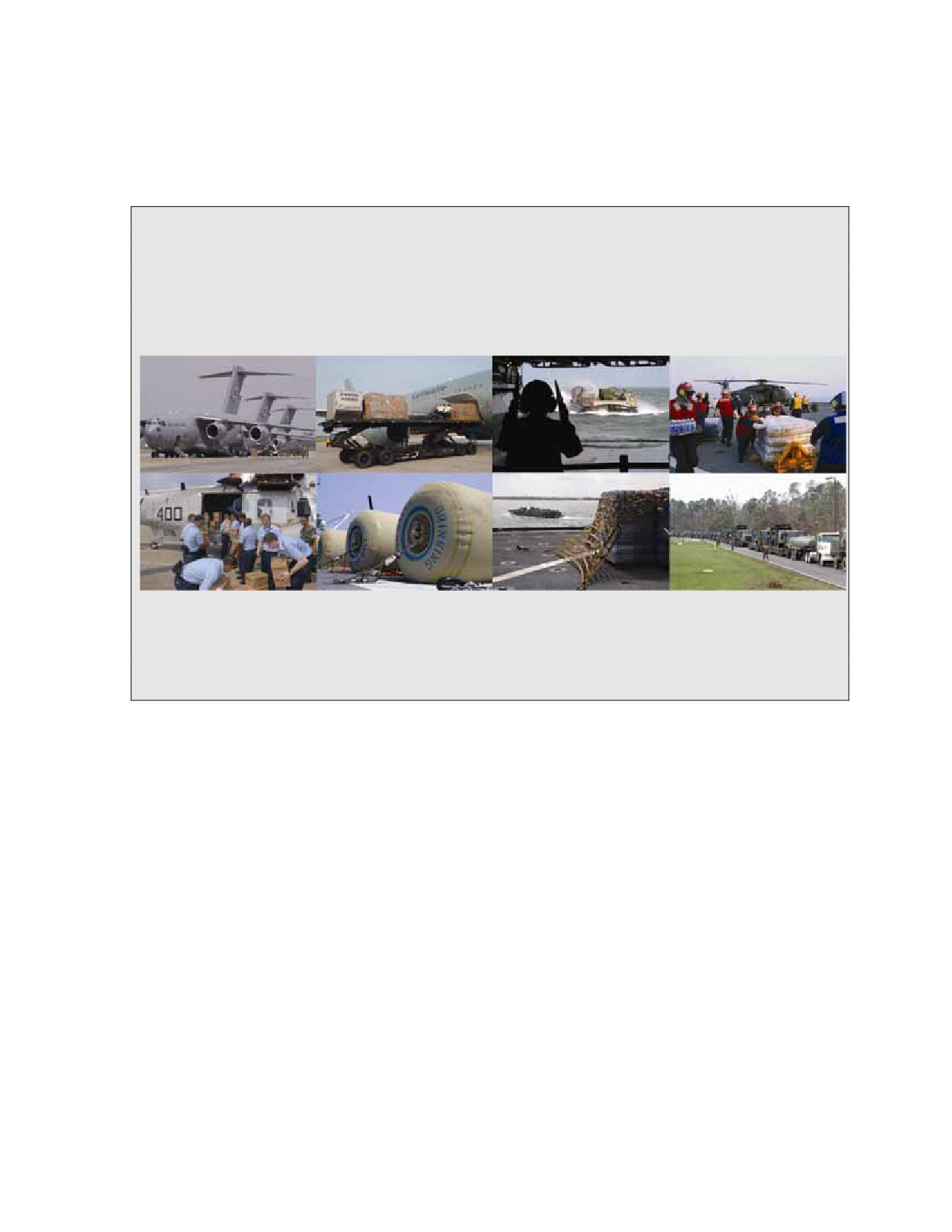
Chapter IX
LOGISTICS
Under the NRP, FEMA is responsible for coordinating logistics during disaster response
efforts but during Hurricane Katrina, FEMA quickly became overwhelmed. Supplies that had
been positioned prior to Katrina’s landfall were quickly exhausted. As a result, FEMA placed
orders for more than 9 million meals-ready-to-eat and then, 4 days after landfall, asked DOD
to assume a significant portion of its logistics responsibilities.
GAO 06-643 Report to the Congressional Committees
All successful operations depend on logistic and transportation capabilities. Major disasters
render local capabilities dysfunctional. DOD’s ability to deploy supplies anywhere at any
time and by any means ensures the effectiveness of HLS disaster relief operations.
Illustrated above are some of the logistics tasks military units performed while assisting
civilian agencies during the Hurricane Katrina disaster.
1. Background
a. Joint forces should understand the ICS and be prepared to integrate seamlessly into
both the civilian incident command as well as the traditional military chain-of-command.
DOD forces providing support to civil authorities may obtain logistics support directly from
the incident commander (via the incident command post logistics section), the JFO logistics
branch, or the JTF.
b. The incident commander determines if there is a need for a logistics section at the
incident and designates an individual to fill the position of the logistics section chief. If no
logistics section is established, the incident commander performs all logistical functions.
The size of the incident, complexity of support needs, and the incident length determine
whether a separate logistics section is established. Additional staffing is the responsibility of
the logistics section chief.
c. The logistics section is responsible for all of the services and support needs,
including ordering, obtaining, maintaining, and accounting for essential personnel,
equipment, and supplies; providing communication planning and resources; setting up food
services; setting up and maintaining incident facilities; providing support transportation; and
providing medical services to incident personnel.
3 December 2007
FM 3-28.1/NTTP 3-57.2/AFTTP(I) 3-2.67
65
d. The logistics section can also be divided into units. Not all units may be required and
should be established based on need. The following six units are possible:
(1) Communication Unit. The communication unit prepares and implements the
incident communication plan (ICS-205), distributes and maintains communications
equipment, supervises the incident communications center, and establishes adequate
communications over the incident.
(2) Medical Unit. The medical unit develops the medical plan (ICS-206), provides
first aid and light medical treatment for personnel assigned to the incident, and prepares
procedures for a major medical emergency.
(3) Food Unit. The food unit supplies the food and potable water for all incident
facilities and personnel and obtains the necessary equipment and supplies to operate food
service facilities at bases and camps.
(4) Supply Unit. The supply unit determines the type and amount of supplies
needed to support the incident. The unit orders, receives, stores, and distributes supplies,
and services nonexpendable equipment. All resource orders are placed through the supply
unit. The unit maintains inventory and accountability of supplies and equipment.
(5) Facilities Unit. The facilities unit sets up and maintains required facilities to
support the incident and provides managers for the incident bases and camps. It is also
responsible for facility security and facility maintenance services: sanitation, lighting, and
cleanup.
(6) Ground Support Unit. The ground support unit prepares the transportation plan.
It arranges for, activates, and documents the fueling, maintenance, and repair of ground
resources. Furthermore, it arranges for the transportation of personnel, supplies, food, and
equipment.
2. Tasks/Responsibilities
Logistics organizations should establish coordination with civilian authorities at the local
level. The regional EOC should be identified as quickly as possible in a post disaster event.
The military liaison needs to be identified, contacted, and immediately informed of unit
capabilities. Logistics organizations should:
(1) Make contact with local entities that may be beneficial in providing logistical or
informative assistance in return for support rendered in kind.
(2) ind a suitable centralized area from which to base and support operations and
establish the layout/footprint in that area.
(3) Be proactive in seeking out civil authorities needing assistance or coordinating
relief efforts, and render help in getting organized if needed.
(4) Document important actions and decisions in a daily journal to recall past
information more accurately.
(5) Restore personnel, equipment, facilities, and community functions as rapidly as
possible. This will help reduce contamination on personnel, equipment, material, and/or
working areas. Keeping contamination to the lowest levels possible will permit the total
removal of individual protective equipment so military and civilian operations can be
maintained.
66
FM 3-28.1/NTTP 3-57.2/AFTTP(I) 3-2.67
3 December 2007
(6) Emplace equipment or supplies at or near the point of planned use or at a
designated location to reduce reaction time and to ensure timely support of a specific force
during the initial phases of an operation.
(7) Prior to commencement of movement, any hazardous
materials/samples/unexploded ordnance (UXO)/casualties will be assessed by the
transporting unit using acceptable devices or methods to ensure the load is secure and does
not pose a contamination danger. Upon arrival at the designated end site an additional
assessment should be completed using the previously stated methods to ensure the
integrity of the load. Both samples should be recorded and passed on to the receiving
parties/personnel. All routes traveled should be documented and monitored for inadvertent
contamination. The level of monitoring will be based on minimum available assets. Strict
control of the chain of custody should be constantly maintained throughout the entire
transportation process.
(8) Coordinate the movement of forces and materiel into, within, or out of an area
affected by an incident.
(9) Conduct emergency and routine actions to maintain personnel and materiel in a
safe and serviceable condition prior to, during, and after an incident. This includes
inspection, testing, repair, and rebuilding.
(10) Measures taken by specialists before, during, or after incidents to reduce the
probability of damage, minimize its effects, and initiate recovery of personnel and the
surrounding community. Efforts include those Red Cross type functions not covered in other
areas of the response (e.g., billeting, messing, comfort/counseling, access to emergency
funds, etc.).
(11) Implement triage processes and systems to effectively allocate resources.
These are designed to produce the greatest benefit from limited treatment facilities for
casualties by giving full treatment to those who may survive and not to those who have no
chance of survival or will survive without treatment.
(12) Perform casualty care post attack to include medical post exposure treatments
and personal exposure measuring devices. Measures should also include contaminated
casualty triage, handling, and treatment.
(13) Remove contamination from personnel, equipment, and facilities.
(14) Lessen the severity or intensity of the contamination. This is similar to
operational decontamination.
3. Mortuary Affairs
a. The mortuary affairs assistance mission is focused on the prevention or containment
of the spread of disease and the promotion of public confidence, morale, and recovery.
Military resources will only be used when requested through the mission assignment
process to supplement civil requirements.
b. Mortuary affairs support to civil authorities may include:
(1) Assistance in coordinating and integrating DOD assets into the CS operation.
(2) Assistance in providing search and recovery in both contaminated and non-
contaminated environments.
(a) Assistance in the local transport and storage of remains.
3 December 2007
FM 3-28.1/NTTP 3-57.2/AFTTP(I) 3-2.67
67
(b) Assistance in providing victim identification and other specialized mortuary
services skills.
(c) Assistance in general administrative and logistics activities.
(d) Assistance in disposition operations in accordance with state and local laws
and as directed by the LFA.
(3) Within these tasks, there are a variety of conditions that may influence
operations. Remains always pose normal biological risks requiring situational appropriate
protective measures. In a CBRNE environment additional protective measures and
monitoring equipment may be necessary. Other factors that will also need to be taken into
consideration may include the agent used (CBRNE), weather conditions, condition of the
remains, location, state and local laws, and public expectations.
(4) Mortuary affairs should coordinate air transportation and receive support from the
JTF.
(a) Air transportation for the return of DOD remains and personal effects is via
military airlift coordinated with USTRANSCOM through the joint movement center (JMC).
(b) JTF support will accept OPCON of mortuary affairs teams or units and
provide operating space for advisory mortuary affairs officials.
(5) Mortuary affairs should be aware of the following special guidance:
(a) The DOD has no authority for establishing permanent cemeteries for the
burial of US dead. Approval authority for the establishment of temporary cemeteries lies
with the LFA.
(b) Military chaplains generally provide spiritual comfort and religious services
for DOD personnel only.
(c) Storage of non-military deceased personnel at the base support installation
(BSI) or any military installation is strongly discouraged and should be approved by the JTF
commander.
(d) Universal medical precautions are conducted at a minimum while handling
remains. Additional personal precautions and increased protection is established and strictly
enforced based on the agent type and conditions.
(e) The mission assignment specifically identifies DOD roles and
responsibilities. On-the-ground instructions that deviate from the approved mission tasking
are reported to the joint logistics coordination center (JLCC).
(f) Remains of civilian personnel are cared for with the utmost respect in
keeping with the same high standards of the military Services.
(g) The DOD current death/concurrent return program remains in force for DOD
personnel as long as local conditions allow. If necessary a graves registration program is
implemented at the direction of USNORTHCOM.
(h) Units coordinate with the JLCC prior to conducting burial, cremation, or other
remains disposition operations.
(i)
Mission assignments are under the guidance/supervision of civilian mortuary
affairs personnel. The transport of remains is with civilian escort/accompaniment and in
coordination with civilian mortuary affairs office directives.
68
FM 3-28.1/NTTP 3-57.2/AFTTP(I) 3-2.67
3 December 2007
4. Convoy Procedures
a. Convoys are organized into serials by load, vehicle capability, and destination.
Serial grouping vehicle limits are set to minimize road hazards present by the convoy.
Vehicles are grouped by type and cargo. Serials are assigned appropriate recovery assets,
and are grouped and positioned for departure. Large slow moving convoys present a
hazard in high traffic areas; therefore, appropriately sized convoy serials are scheduled to
depart at time intervals sufficient to ensure smooth integration with local traffic.
b. Pre-departure vehicle inspections ensure serviceability for long trips. Disaster
incidents will limit the availability of local recovery and fueling capabilities. Units must plan
to fully support convoy operations. The following are minimum pre-convoy vehicle
inspections.
(1) Ensure all vehicles drivers complete equipment check-off list.
(2) Ensure maintenance trucks have complete tool kits and common use spare
parts (i.e., various fan belts, hoses, etc.) to handle minor roadside repairs to convoy
vehicles.
(3) Ensure vehicles and trailers are not overloaded.
(4) Issue safety briefs prior to deployment and as necessary during convoy stops.
(5) Ensure sufficient functional communications assets to meet mobility and
communications requirements.
(6) Use collapsible temporary fuel storage capability for fuel support. This allows
for the storage of multiple fuel types and ensures fuel availability for use in quick-response
deployment operations.
3 December 2007
FM 3-28.1/NTTP 3-57.2/AFTTP(I) 3-2.67
69
This page intentionally left blank.
Appendix A
STATUTORY AND LEGAL RAMIFICATIONS
1. Background
a. This appendix provides a synopsis of legal principles to consider in CS operations.
Planners and judge advocates (JAs) must work together closely to ensure operations do not
violate federal law, state law, or international treaties. Detailed legal guidance may be found
in the Center for Law and Military Operations (CLAMO) publications; Domestic Operational
Law Handbook for Judge Advocates, Volume I; and at the CLAMO website
b. The primary responsibility for protecting life and property and maintaining law and
order in the civilian community is vested in the state and local governments. Supplementary
responsibility is vested by statute in specific agencies of the federal government other than
the DOD. The operational use of federal military personnel and units within the US to assist
the state and federal authorities in such responses is generally classified as “domestic
support operations.” The federal military’s role in CS operations is well defined and is
limited by federal law and regulation in scope and duration. Based on the limited authorities
and express limitations placed on the scope of the federal military’s role, all Service
members should be aware of the legal considerations.
2. Posse Comitatus Act (PCA)
a. PCA Background. In common law, the Latin phrase “posse comitatus” refers to the
authority wielded by the county sheriff to deputize any able-bodied male over the age of
fifteen to assist in keeping the peace or to pursue and arrest a felon. US Federal Marshals
were also known to form a posse of able-bodied males to enforce federal law. Due to
friction of the use of posse comitatus during the reconstruction era in the South after the
American Civil War, Congress passed the PCA. PCA remains the primary federal statute
restricting military support to civilian law enforcement agencies (MSCLEA). The PCA, found
at 10 U.S.C. § 1385, states:
"Whoever, except in cases and under circumstances expressly authorized
by the Constitution or Act of Congress, willfully uses any part of the Army or
Air Force as a Posse Comitatus or otherwise to execute the laws shall be
fined not more than $10,000 or imprisoned not more than two years or both."
b. PCA Applicability
(1) Although a plain reading of the PCA reflects that it only applies to the Army and
Air Force, 10 U.S.C. § 375 requires the SecDef prescribe regulations restricting the use of
equipment and the direct participation of Army, Navy, Air Force, or Marine Corps personnel
in supporting civilian law enforcement agencies unless otherwise authorized by law. The
statute defines direct participation as “search, seizure, arrest, or similar activity.”
Consequently, through 10 U.S.C. § 375 and resulting DOD directives, the PCA applies to all
members of the federal armed forces, as well as each of their respective Reserve
components serving in a federal status. The applicable DOD directives are as follows:
(a) 3025.1, Military Support to Civil Authorities (MSCA).
(b) 3025.12, Military Assistance for Civil Disturbances (MACDIS).
(c) 3025.15, Military Assistance to Civil Authorities (MACA).
3 December 2007
FM 3-28.1/NTTP 3-57.2/AFTTP(I) 3-2.67
71
(d) 5525.5, DOD Cooperation with Civilian Law Enforcement Officials.
(2) The PCA does not apply to the Coast Guard (Title 14) except during times of war
when under the C2 of the Navy.
(3) Whether the PCA applies to Army or Air National Guard (NG) personnel depends
upon the Soldier’s/Airman’s duty status. NG personnel may be ordered to duty under one of
the following three statutory frameworks:
(a) Title 10. When in a Title 10 status, NG personnel are federally funded and
under federal C2; consequently, they are subject to the PCA.
(b) Title 32. When in a Title 32 status, NG personnel are federally funded and
typically perform training for their federal mission, but remain under the control of the state.
Although federally funded, because NG members in a Title 32 status fall under state control,
they do not fall under PCA restrictions and may perform those law enforcement duties
authorized by state law.
(c) State Active Duty (SAD). NG personnel performing SAD missions are state
funded and under state control. This is typically the status in which NG perform duties when
a governor “calls out the National Guard” to respond to emergencies, civil disturbances,
disasters, or to perform other duties authorized by state law. Costs associated with a SAD
response may be reimbursed by the federal government pursuant to a Presidential major
disaster or emergency declaration. NG personnel on SAD status do not fall under PCA
restrictions and may perform those law enforcement duties authorized by state law.
(4) Civilian employees of the military are only subject to the prohibitions of the PCA if
they are under the direct C2 of a Service member in a Title 10 status.
c. PCA Restrictions. PCA restrictions applying to the federal military personnel through
Title 10 U.S.C. § 375 and implementing DOD Directives (DODDs) (see DODD 5525.5)
prohibit the following forms of direct assistance:
(1) Interdiction of a vehicle, vessel, aircraft, or other similar activity.
(2) Search or seizure.
(3) Arrest, apprehension, and stop and frisk.
(4) Surveillance or pursuit of individuals or as undercover agents, informants,
investigators, or interrogators.
3. Permitted Assistance
a. Indirect Assistance. Title 10 U.S.C. §§ 371-382 and DODDs allow various forms of
indirect assistance to civilian law enforcement agencies such as the following:
(1) Sharing information collected during the normal course of military training or
operations.
(2) Using military equipment.
(3) Training and advising on using equipment.
(4) Providing personnel for maintenance and operation of equipment.
(5) Providing WMD support.
b. Direct Assistance. DODD 5525.5, enclosure 4, states that the following forms of
direct assistance are not prohibited by the PCA; therefore, they are considered exceptions
to the PCA:
72
FM 3-28.1/NTTP 3-57.2/AFTTP(I) 3-2.67
3 December 2007
(1) Action taken for the primary purpose of furthering a military or foreign affairs
function of the United States; also known as the “military purpose doctrine.” Such actions
include:
(a) Investigations and other actions related to the commander’s inherent
authority to maintain law and order on a military installation or facility.
(b) Protection of classified military information or equipment.
(c) Protection of DOD personnel, DOD equipment, and official guests of the
DOD.
(2) Actions taken under inherent right of the US Government to ensure preservation
of public order and carry out governmental operations within its territorial limits. This
authority may be used in two circumstances:
(a) In an emergency to prevent loss of life or wanton destruction of property and
to restore governmental functioning and public order when sudden and unexpected civil
disturbances occur to such an extent that duly constituted local authorities are unable to
control the situation and circumstances preclude obtaining prior authority from the President.
(b) Protection of federal property and functions when need exists and duly
constituted local authorities are unable or decline to provide adequate protection.
(3) Actions taken pursuant to insurrection statutes (Title 10 U.S.C. §§ 331-334).
These statutes permit the President to use the armed forces to enforce the law when:
(a) There is an insurrection within a state and the state legislature (or governor, if
the legislature cannot be convened) requests assistance from the President.
(b) Whenever the President considers that unlawful obstructions, combinations,
or assemblages, or rebellion against the authority of the US make it impracticable to enforce
the laws of the US by the ordinary course of judicial proceedings.
(c) An insurrection or domestic violence opposes or obstructs federal law, or so
hinders the enforcement of federal or state laws that residents of the state are deprived of
their constitutional rights and the states are unable or unwilling to protect these rights.
(4) Other actions taken under express statutory authority to assist officials in
executing the laws, subject to applicable limitations.
c. Disaster Relief. The Robert T. Stafford Disaster Relief and Emergency Assistance
Act (Title 42, U.S.C §§ 5121-5204c et seq, as amended) is the statutory authority for
federal disaster assistance within the United States and its territories. The Stafford Act
authorizes the President to provide DOD assets for relief efforts, once the President formally
declares an emergency or a major disaster; however, DOD assets for emergency work may
be provided on a limited basis prior to the Presidential declaration. Disaster relief pursuant
to the Stafford Act is not an exception to the PCA; therefore, only indirect assistance is
authorized unless direct assistance is otherwise authorized by the Constitution or statute.
DOD policy for providing disaster assistance (as related to the Stafford Act) is contained in
DODD 3025.15, Military Assistance to Civil Authorities (MACA), and DODD 3025.1, Military
Support to Civil Authorities (MSCA).
4. Rules of Engagement (ROE) and Rules for the Use of Force (RUF)
The standing ROE (SROE) and standing RUF (SRUF) assist federal military personnel
in determining the appropriate level of force that should be applied in a given situation.
3 December 2007
FM 3-28.1/NTTP 3-57.2/AFTTP(I) 3-2.67
73
SROE/SRUF guidance is located in CJCSI 3121.01B, Standing Rules of Engagement
(SROE), 13 June 2005.
(1) The SROE apply domestically only to air and maritime homeland defense
functions conducted within the US territory or territorial seas. Otherwise, it applies during all
military operations and contingencies and routine Military Department functions occurring
outside US territory and outside US territorial seas.
(2) The SRUF are located at enclosures L-Q of CJCSI 3121.01B. The SRUF apply
during all DOD CS and routine Military Department functions occurring within US territory
and territorial seas. The SRUF also apply to land homeland defense missions occurring
within the US territory and to DOD forces, civilians, and contractors performing law
enforcement duties at all DOD installations (and off-installation while conducting official DOD
security functions), within or outside US territory, unless otherwise directed.
(3) A commanders' authority to modify the SROE/SRUF is limited to making them
more restrictive.
(4) National Guard (NG). The RUF/ROE of the NG serving in a state-controlled Title
32 or SAD status are governed by state laws. The various states’ laws vary in the NG’s
authority to take actions requiring RUF in a law enforcement, law enforcement support, or
security operation. Depending on the language of the state statutes involved these grants of
or limitations on the NG’s authority to act as peace officers may apply to NG personnel
conducting operations in a Title 32 status, SAD status, or both. Some states grant NG
members (in a Title 32 or SAD status, or both) the authority of peace officers, while others
only authorize those powers enjoyed by the population at large, such as "citizen's" arrest. It
is the duty of the NG judge advocate (JA) to tailor the RUF to the particular mission and
policies of the state.
74
FM 3-28.1/NTTP 3-57.2/AFTTP(I) 3-2.67
3 December 2007
Appendix B
LIASION OFFICER (LNO) REQUIREMENTS
1. Background
a. Liaison officers (LNOs) must have the authority to speak for their parent agencies or
organizations on all matters. One of the principal duties of the LNO is to facilitate the
integration of the local, tribal, state EOCs, National Guard JTF-State, and FEMA JFO with
federal, state, and defense coordinating officers and DOD JTF operations. Liaisons
between operations centers should be established and operations planners should
collaborate daily, virtually either by telephone or by physical presence at the state EOC or
JFO ESF 9. Every effort should be made to ensure face-to-face coordination through the
use of LNOs. The number and location of LNOs is driven by the type and magnitude of the
incident which determines the level of C2 required.
b. The LNO is the POC for representatives of other governmental agencies,
nongovernmental organizations, and/or private entities. Representatives from assisting or
cooperating agencies and organizations coordinate through the LNO.
c. State emergency preparedness/disaster relief plans vary and military liaison teams
are not preplanned at all county/parish EOCs. In the event there is a natural disaster, such
as a hurricane, affected counties/parishes stand up an EOC to coordinate relief efforts in the
area. The EOC is the central coordinating organization and location for recovery operations.
Typically, when activated, EOCs provide round-the-clock service during an actual or
threatening large-scale emergency. The EOC is the focal point for coordination of
emergency response and recovery activities throughout a county. An EOC is staffed with
key personnel from public safety agencies, emergency relief organizations, county
departments, municipalities, utility companies, media, and other essential entities. EOC
functions include collection, analysis, and communications of pertinent information with
involved agencies; coordination of emergency actions with local, state, and federal
agencies; and direction of emergency preparedness, response, and recovery operations for
the county. If military forces are activated as a response to a disaster, they should be
represented at the EOC level. Initially, this is where they will be the most responsive and
provide assistance.
(1) In Mississippi, in accordance with the State Disaster Relief Plan, NG units
established liaison at county EOCs, if they were activated. Commanders of units along the
coast most affected established liaison as soon as weather and safety considerations
permitted. In some cases, the teams were required to “clear” their way to the EOCs. In most
cases, this liaison occurred as the EOCs were setting up. NG units were already embedded
in the communities and known to local officials. Close coordination was conducted between
the State Emergency Management Agency, the county administrators and the NG, in some
cases, using Army tactical FM communications as local communications repeaters were
inoperative. The overarching guidance by the NG commanders was to get out and help
wherever necessary. In many cases, the NG acted as reconnaissance teams throughout the
counties to identify work and report it through the EOCs. The LNOs at the EOCs provided a
real-time operational picture to both the military commanders and the EOC commander.
(2) In Louisiana, the US Army Engineer School assigned captains as military
augmentees in some EOCs. The US Army Corps of Engineers (USACE) serves the armed
forces and the nation by providing vital engineering services and capabilities, as a public
3 December 2007
FM 3-28.1/NTTP 3-57.2/AFTTP(I) 3-2.67
75
service, across the full spectrum of operations—from peace to war—in support of national
interests. USACE missions include five broad areas: water resources, environment,
infrastructure, homeland security, and warfighting. Based on its mission, USACE was a key
responder during recent hurricane relief efforts along the Gulf of Mexico. As the HQ agency
for the Engineer School, USACE asked for assistance in the form of liaison assistance at
select, severely damaged counties/parishes. The US Army Engineer School responded by
sending Army engineer captains to five parish EOCs most affected by flooding in Louisiana.
These LNOs established a link between USACE emergency response personnel and
military forces working in the parishes. The LNOs provided additional augmentation, where
USACE personnel were overwhelmed and at the division engineer staff section, where
information and status of work was needed to track and adjust effort.
d. Insights/Lessons Learned
(1) For the military to be effective in support to disaster relief, it must be
represented at the EOC. EOCs are the local coordinating location for support in a
county/parish. Military liaison is essential at EOCs to ensure information flow.
(2) Timely liaison at the Mississippi EOCs by LNOs led to responsive initiation of
work in the communities.
(3) Resource LNOs from outside sources when required.
2. LNO Considerations
a. Units tasked to execute CS operations have the responsibility to ensure effective
integration of their organizational capabilities. These units should provide LNOs that are
fully knowledgeable on capability employment techniques and sustainment requirements.
(1) The DCO tasks for military LNOs as appropriate to ESF agencies at the JFO to
provide technical expertise and coordination with a defense coordinating element (DCE).
(2) JTF components with aviation elements should have an LNO at 1st Air Force,
Tyndall AFB, Florida. Wings should establish their own standing operating procedures
(SOPs) for deployment of LNOs.
b. Units tasked to lead specific CS relief missions should request and prepare to
receive and resource, if required, the following LNOs:
(1) SAR LNOs—Coast Guard, Navy, Marine Corps tactical recovery of aircraft and
personnel (TRAP), AFSOC, Civil Air Patrol C2—to include: E-3(USAF)/ E-2(Navy)/ P-3
(customs) surveillance aircraft (manned/ unmanned).
(2) Multinational support LNOs- LNOs empowered to provide aid from a foreign
government or liaison services or technical oversight of capabilities provided by a private
corporation licensed in the foreign country; e.g., the technical support provided by a foreign
industrial pump manufacturer to repair the New Orleans flood pumping units.
(3) Multistate support LNOs- LNOs from other state agencies responding as
directed through mutual support agreements.
(4) Relief organizations LNOs- Private and charitable organizations typically
associated with humanitarian assistance operations, e.g., the Red Cross.
(5) Civilian agencies (EOC LNOs) to include: police, fire, medical, private aircraft, and
media.
76
FM 3-28.1/NTTP 3-57.2/AFTTP(I) 3-2.67
3 December 2007
Appendix C
PUBLIC COMMUNICATION
1. Media Engagement
a. Local, national, and international media are present during CS operations after a
domestic incident.
b. Federal military personnel have no authority to restrict the movement of media
representatives through the streets or air space of a civilian community in the US.
c. Expect all types of media contact—from scheduled, escorted, credentialed,
registered media to nonscheduled, unescorted, noncredentialed, unregistered media.
2. Public Affairs (PA) Considerations
a. The Public Affairs Office (PAO) must understand what their unit’s operation has to do
with larger issues nationally and internationally. PAOs should wargame possible questions
based on current news, their unit’s mission, and their unit’s history. The PAO should share
appropriate sections of PA guidance with all personnel and make certain that all personnel
know the command messages and talking points.
b. The PAO is the voice of information, but leaders are the voices of authority. Military
members have the right not to speak to the media; however, those who refuse send a
message that the unit is hiding something or that the operation is going badly. This is
especially true when leaders avoid the media.
3. Interview Considerations
a. Don’t be a passive interviewee. Tell the public what you want them to know about
your unit and its mission.
b. Don’t wait for the reporter to ask the right question; use the technique of bridging: “I
think what you’re really asking is...”
“That speaks to a larger issue...” “What’s really
important here is…”
c. If requested for a "no-notice" or "drive-by" interview, it’s completely acceptable for
you to set a time limit right at the beginning: “I can speak with you for 1 minute but then I
have to get back to work.” Reporters understand that you are here to work. But don’t use
“too busy” as an all-purpose smokescreen to avoid speaking to reporters.
d. Don’t give simple yes or no answers. Don’t use the phrase “No comment.” If you
can’t talk about something, explain why (operations security, not in my lane, I don’t know).
Use the technique of blocking and bridging: “It’s our policy not to discuss ___, but I can tell
you about____.”
e. Beware of responding to false assumptions, erroneous conclusions, and hypothetical
questions.
f.
Be alert to multiple questions and answer them one at a time.
g. Avoid answering questions that call for speculation on your part.
h. Don’t repeat inaccurate information offered by the reporter—answer in positive,
accurate statements without reinforcing the inaccuracy.
3 December 2007
FM 3-28.1/NTTP 3-57.2/AFTTP(I) 3-2.67
77
i.
Don’t get trapped; if a reporter asserts that he got his information from your higher
headquarters or federal agency refer him back to those sources for more details.
j.
Watch out for characterizations of “terrorism.” The Department of Justice and
Department of State will speak to the issue. If you are asked about the incident that brought
your unit to the area, refer the reporter to the FBI liaison at the Interagency Joint Information
Center.
k. Respond to “bad news” questions about your unit as readily as you respond to “good
news” questions. This will establish your credibility with the media. Appreciate this
opportunity to tell your side of the story. However, refer requests for details about deaths,
serious incidents, accidents, investigations, etc. to PAO. DOD may want to be the sole
release authority in these situations. Remember: If you don’t tell your story, the story will still
run. The media will simply find a “military expert” who will be happy to speak for you. Get
involved!
78
FM 3-28.1/NTTP 3-57.2/AFTTP(I) 3-2.67
3 December 2007
Appendix D
ASSESSMENT TEAMS
1. Background
Assessment teams (ATs) are assigned on the basis of ESF assessment and should be
task-organized accordingly. They are utilized to determine the disaster conditions and
operational status of equipment, infrastructure components, and other areas of concern
effecting overall ESF disaster relief operations. ATs provide the chain of command SA with
respect to CS mission requirements. Given this, AT taskings should take into account the
necessary qualifications and resource support required to ensure effective AT operations.
ATs should be made aware of the imagery dissemination architecture that is available to
them. (See appendix F.)
2. AT Composition
The composition of ATs varies according to the task. Determining the traffic ability of a
road with fallen trees and determining the strength of a railroad track following major erosion
from flooding are two examples of assessment. The tasks however require two very
different degrees of specialization. In one instance, only basic observation and accurate
reporting are required to provide the necessary assessment. In the other, highly specialized
engineering knowledge is required to ensure accurate assessment. It is imperative that
agencies task appropriately and take into account the degree of specialization an
assessment team requires.
3. Security
Given certain situations, it may be necessary for an agency to provide an armed escort
for an AT. Proper ROE should be established and understood.
4. Equipment
Equipment requirements for the AT depend on the means by which they will conduct
damage assessment. Dedicated vehicle support for AT operations is virtually mandatory;
however, the possibility exists that assessment may have to be accomplished on foot if
many vehicles are destroyed or roads seriously blocked. In such a case, the ATs will be
severely limited in what they can perform in the way of utility isolation, and their assessment
time will be greatly lengthened. The following is the recommended equipment for AT support
that should be assembled during the pre-deploy phase:
• Writing implements, radios, and spare batteries.
• Global positioning system.
• Data recording and reporting equipment including base grid maps, utility drawings,
damage assessment forms, clipboards.
• Utilities isolation tools such as electrical hot sticks, fuse pullers, valve keys, etc.
• Binoculars and night vision devices.
• Chemical protective equipment.
• Other miscellaneous equipment such as explosion-proof, plastic cased flashlights;
nonmetallic measuring tapes; flags; utility shut-off markers; hand tools; and first aid
kit.
5. Assessment Technique
There are two phases of assessment: Phase 1, initial, and Phase 2, detailed. In
Phase 1, an initial assessment of the area of interest (AOI) is made to quickly identify areas
of concern pertaining to the AT's mission. The results of this preliminary assessment are
3 December 2007
FM 3-28.1/NTTP 3-57.2/AFTTP(I) 3-2.67
79
used to update the preplanned assessment tasks and to obtain a general idea of overall
area impact. In Phase 2, detailed damage assessment, the teams follow directed travel
routes focusing on determining detailed status of specific items pertaining to the assessment
mission. Detailed assessment provides accurate location and description of problems
reported to determine the scope of necessary relief operations and to prioritize efforts.
6. Types of Assessments
While basic assessment is merely a method for gaining SA, when dealing with CS and
disaster relief, there are certain infrastructure assessments that can be essential to efficient
response options. The following is a list of essential assessments:
(1) People: This assessment is to determine the composure and condition of the
victims. Are they cooperative, non-cooperative, injured, trapped, or separated?
(2) Provisions: Is there food and potable water? What is the condition of the
provisions? Is ice/refrigeration required? Is it in jeopardy of being damaged or
misappropriated?
(3) Sanitary: Are there basic facilities for the processing of human waste?
(4) Transportation Capability: This assessment can be a simple determination that a
road is clear or as involved as determining if a train rail will support the weight of a train.
(5) Structural: This will establish basic answers regarding the building's structural
integrity for follow on tasking or utilization.
(6) Utility: This assessment is to determine the operational status of electricity, water,
telecommunications, heating, ventilation, and air conditioning (HVAC), and supporting
facilities.
(7) Security: This assessment is to determine if there are any perceivable threats to
relief personnel or victims. What is the security condition of the area of concern? If there
are threats to security, what is the size and composition of the threat?
(8) Figure G-4 illustrates a sample assessment report format.
80
FM 3-28.1/NTTP 3-57.2/AFTTP(I) 3-2.67
3 December 2007

Appendix E
GEOGRAPHICAL REFERENCE SYSTEMS
1. Background
In today’s global positioning system (GPS) capable environment, both civilian and
military operations can be completely coordinated. Position location information systems
exist and provide universal transverse mercator (UTM) and United States National Grid
(USNG) [the military grid reference system (MGRS) equivalent] coordinate information for all
US locations. The traditional UTM / USNG and MGRS datum are readily accessed by both
civilian and military hand-held navigation systems. When interfacing with USNG datum it is
essential that civilian users access North American Datum (NAD) 83 series map data.
2. Global Area Reference System (GARS)
a. DOD Global Area Reference System. GARS is the standardized area reference
system across DOD. It is based on lines of longitude and latitude to provide an integrated
common frame of reference for joint force SA to facilitate air-to-ground coordination,
deconfliction, integration, and synchronization. This area reference system provides a
common language between the military components and simplifies communications.
b. GARS Worldwide Map. GARS provides a unique labeling methodology for all global
geography. To identify global geographic locations when viewing the GARS worldwide map
(figure E-1) read:
• West to East 1-720
• South to North AA-QZ
Figure E-1. Global Area Reference System (GARS) Worldwide Map
c. GARS Labeling Methodology
(1) GARS divides the surface of the earth into 30-minute by 30-minute cells. See
figure E-2. Each cell is identified by a five-character designation (e.g., 006AG). The first
3 December 2007
FM 3-28.1/NTTP 3-57.2/AFTTP(I) 3-2.67
81

three characters designate a 30-minute wide longitudinal band. Beginning with the 180-
degree meridian and proceeding eastward, the bands are numbered from 001 to 720, so
that 180 E to 179 30-minute W is band 001; 179 30-minute W to 179 00-minute W is band
002; and so on. The fourth and fifth characters designate a 30-minute wide latitudinal band.
Beginning at the south pole and proceeding northward, the bands are lettered from AA to
QZ (omitting I and O) so that 90 00-minute S to 89 30-minute S is band AA; 89 30-minute S
to 89 00-minute S is band AB; and so on.
(2) Each 30-minute cell is divided into four 15-minute by 15-minute quadrants. The
quadrants are numbered sequentially, from west to east, starting with the northernmost
band. Specifically, the northwest quadrant is “1,” the northeast quadrant is “2,” the
southwest quadrant is “3,” the southeast quadrant is “4.” Each quadrant is identified by a
six-character designation (e.g., 006AG3). The first five characters comprise the 30-minute
cell designation. The sixth character is the quadrant number.
(3) Each 15-minute quadrant is divided into nine 5-minute by 5-minute areas. The
areas are numbered sequentially, from west to east, starting with the northernmost band.
The graphical representation of a 15-minute quadrant with numbered 5-minute by 5-minute
areas resembles a telephone keypad. Each 5-minute by 5-minute area, or keypad “key,” is
identified by a seven-character designation. The first six characters comprise the 15-minute
quadrant designation. The seventh character is the keypad “key” number (e.g., 006AG39).
Figure E-2. GARS Labeling Methodology
d. The following figures tie the GARS methodology to position navigation data for New
Orleans, Louisiana.
82
FM 3-28.1/NTTP 3-57.2/AFTTP(I) 3-2.67
3 December 2007

(1) Figure E-3 details the unique 30-minute by 30-minute GARS global area
designations for New Orleans (180KZ) and the surrounding vicinities within Louisiana.
(2) Figure E-4 details the 30-minute by 30-minute GARS cell for the immediate New
Orleans area divided into four 15-minute by 15-minute quadrants. It further highlights the
15-minute size quadrant's division into nine 5-minute keypad areas.
(3) Finally figure E-5 shows the nine 5-minute keypad areas overlaid with the USNG
designations for the New Orleans metropolitan area.
Figure E-3. GARS US Gulf Coast Designators
3 December 2007
FM 3-28.1/NTTP 3-57.2/AFTTP(I) 3-2.67
83

Figure E-4. GARS New Orleans Designators
Figure E-5. New Orleans GARS Designators with USNG Overlay
84
FM 3-28.1/NTTP 3-57.2/AFTTP(I) 3-2.67
3 December 2007
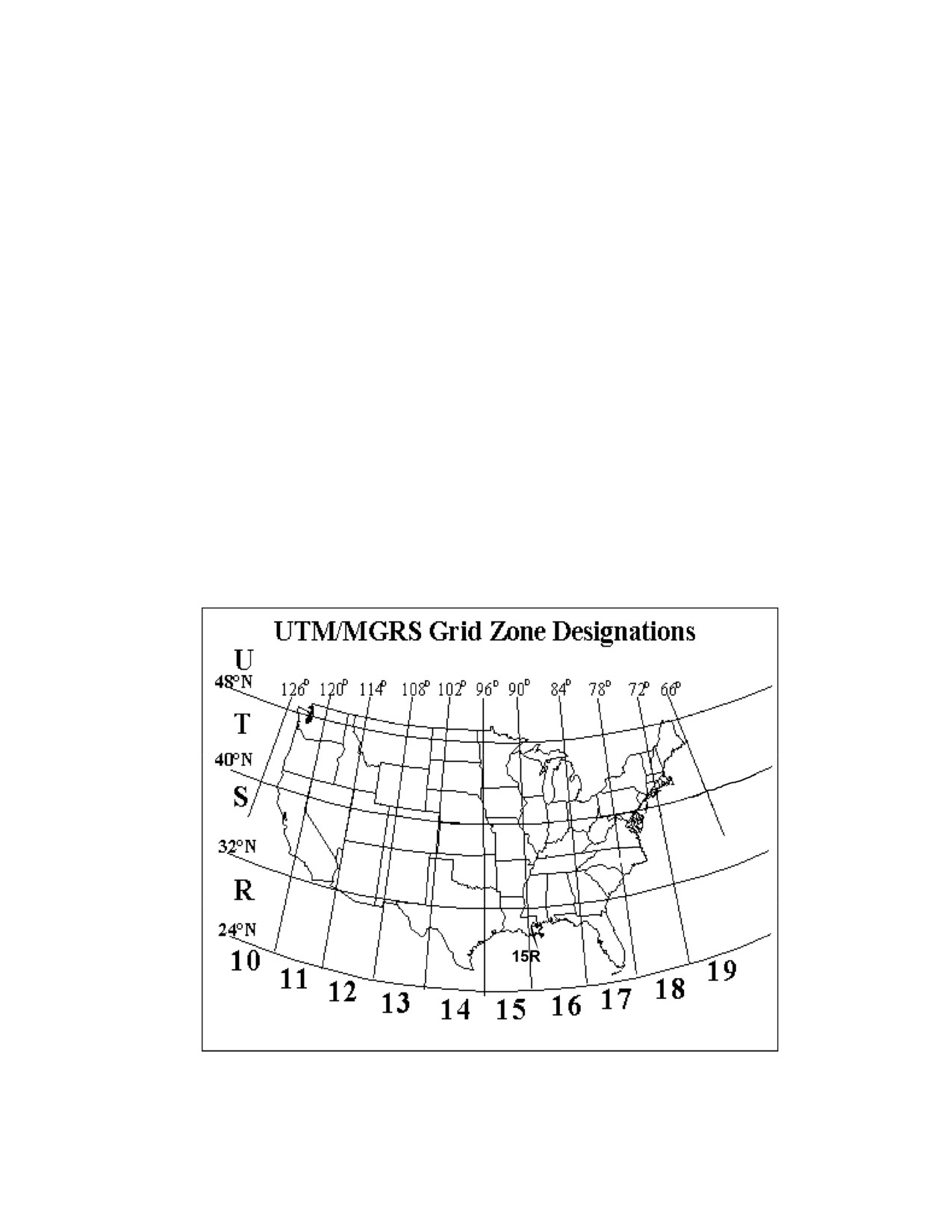
3. United States National Grid (USNG)
a. The Federal Geographic Data Committee’s (FGDC) consensus-based USNG
standard provides a nationally consistent language of location—optimized for local
applications—for maps, GPS receivers, and mapping web portals. It is an alpha-numeric
point reference system overlaid on the UTM numerical grid. Truncated USNG coordinates
(geoaddresses) range in precision from 1,000 to 1-meter and provide universal map index
values for streets and other features. USNG and MGRS values are identical when
referenced to WGS 84 or NAD 83 datum. USNG only uses a single 100,000-meter square
identification scheme regardless of datum. Access the US national map viewer at:
b. A USNG spatial address is broken down into three parts:
• Grid zone designation for a worldwide unique address.
•
100,000-meter square identification for regional areas.
•
Grid coordinates for local areas.
c. Grid Zone Designation. Figure E-6 depicts the USNG zone designation overlay of the
US using worldwide unique values for the UTM/MGRS grid zone designations. Working out
from a local area, through regional areas, the last level of definition in a spatial address is
the grid zone designation. The world is divided into 60 UTM zones, each 6 degrees of
longitude wide. The numbering scheme for these begins at 180 degrees longitude and
counts east. The conterminous US is covered by zones 10 through 19. In a northing
direction, the world is divided into 8 degree belts of latitude. The conterminous US for
example is covered by belts R, S, T, and U. Thus the city of New Orleans lies within grid
zone designation 15R.
Figure E-6. USNG Zone Designation Overlay of the US Using UTM/MGRS Grid Zone
Designations
3 December 2007
FM 3-28.1/NTTP 3-57.2/AFTTP(I) 3-2.67
85

d.
100,000-meter Square Identification Regional Area. The USNG further divides the
world into 100,000-meter squares and identifies them with two letter values. Figure E-7
shows the 1000,000-meter square identification regional areas for the Gulf Coast. The
metropolitan area of the city of New Orleans is located within zone 15R and 100,000-meter
region YP, thus the initial position location for map sheet reference of the city of New
Orleans is 15R YP.
Figure E-7. USNG 100,000-meter Square Identification for US Gulf Coast Regional Areas
e. Grid Coordinates for Local Area. While the USNG is referred to as an alpha-numeric
reference system for the UTM coordinate system, it is the designation scheme for the
100,000-meter square identification designed in such a manner that any two-letter
combination will not repeat itself no less than every 18 degrees of longitude and latitude.
Thus any two-letter prefix to a grid coordinate will provide a unique value within a very large
area.
(1) Grid coordinates are used to define a particular place within a local area (within a
100 by 100 kilometer area). Coordinates are written along the sides of a map designating
specific grid lines.
(These grid lines are based on UTM values.) The two larger numbers
identify a grid line and are known as principal digits.
•
4 digits—2306—locates a point with a precision of 1,000-meters (a
neighborhood size area).
•
6 digits—234064—locates a point with a precision of 100-meters (a soccer
field size area).
•
8 digits—23480647—locates a point with a precision of 10-meters (the size of
a modest home).
•
10 digits—2348306479—locate a point with a precision of 1-meter (within a
parking spot).
86
FM 3-28.1/NTTP 3-57.2/AFTTP(I) 3-2.67
3 December 2007
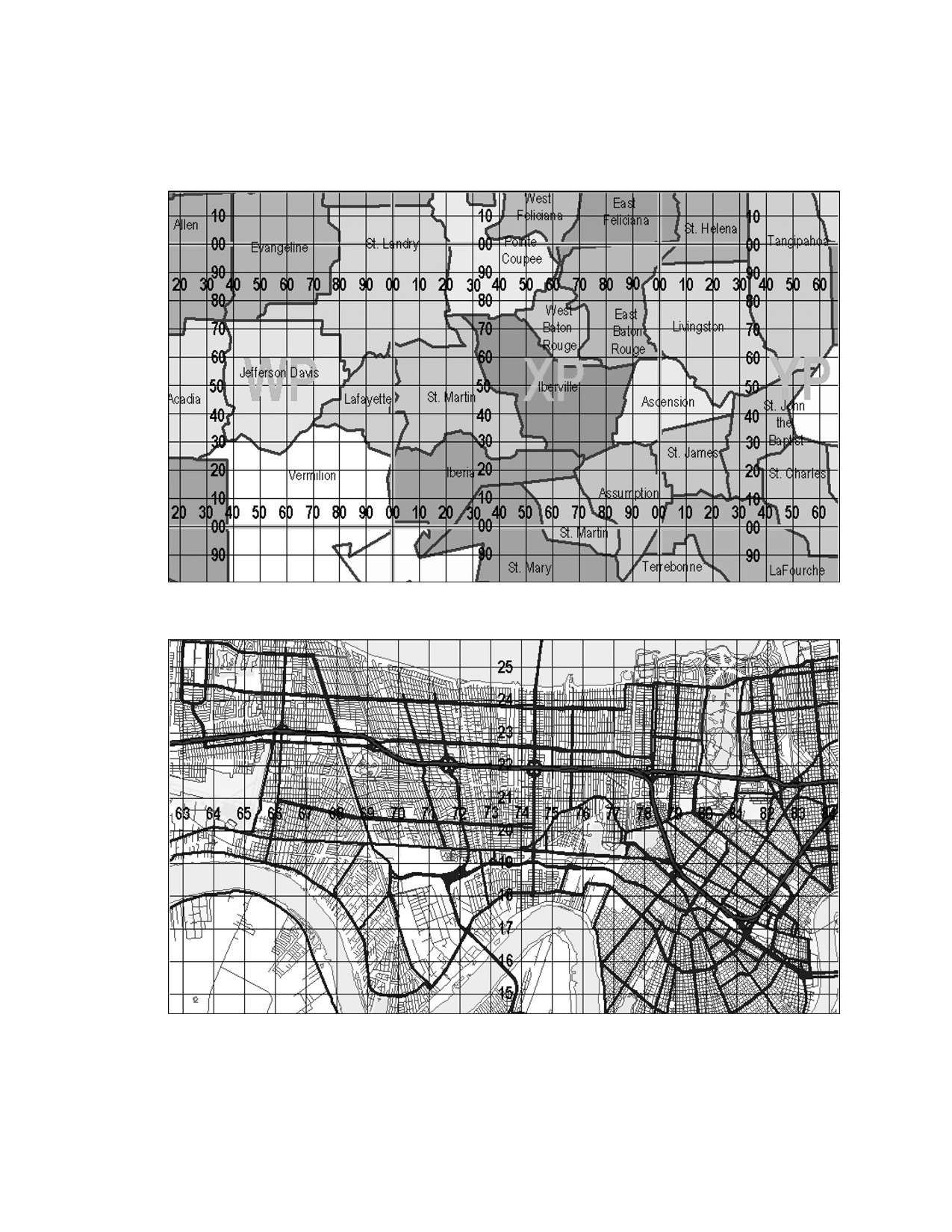
(2) Figure E-8 shows the 1,000-meter square identification of the Louisiana parishes
and figure E-9, shows 1,000-meter square identification of the New Orleans metropolitan
area.
Figure E-8. USNG 1,000-meter Square Overlay of Louisiana Parishes
Figure E-9. USNG 1,000-meter Square Overlay of New Orleans
3 December 2007
FM 3-28.1/NTTP 3-57.2/AFTTP(I) 3-2.67
87

(3) Looking at all the figures of the square meter identifications provides an
understanding of the unique USNG designation for a specific location of a specific size area.
Using as an example the location of the intersection of Interstate 10 and North Causeway
Boulevard, an area of approximately 1,000 square meters, the zone is 15R, the 100,000
meter region is YP, and now the grid coordinate using 6 digits for the required precision is
744 219 as shown in figure E-10 below.
Figure E-10. USNG 1,000-meter Square View of Interstate 10 and North Causeway
Boulevard Intersection
88
FM 3-28.1/NTTP 3-57.2/AFTTP(I) 3-2.67
3 December 2007
Appendix F
IMAGERY DISSEMINATION ARCHITECTURE
DOD’s unique damage assessment capabilities, especially air- and space-
borne, are important additive factors in the initial assessment of a disaster.
GAO 06-643 Report to the Congressional Committees
1. Imagery Dissemination Architecture
Comprehensive imagery dissemination architecture is available to users at the lowest
possible level. These capabilities are available through National Geospatial-Intelligence
Agency (NGA) Earth website: http://www.nga-earth.org.
2. National Geospatial-Intelligence Agency (NGA)
NGA can collect key infrastructure-related information (i.e., on airports, hospitals, police
stations, emergency operations centers, highways, schools, etc.) well in advance of a storm
landfall and can get that information into the hands of federal, state, and local first
responders in the affected region. As the storm or other disaster is tracked, NGA can pre-
deploy analysts and mobile systems to the affected areas to provide expertise and
information on the ground and facilitate the delivery of additional information from NGA
offices elsewhere. Because they have assets in place and focused on the region, NGA can
provide the first comprehensive overview of the damage resulting from the disaster. NGA
merges imagery with other information, creating hundreds of intelligence products per day
that could be used and applied by response professionals to aid in decision making. NGA
assessments are multi-dimensional, timely, relevant, and continuous. They address many
issues, including but not limited to: recovery planning and operations, transportation
infrastructure, critical and catastrophic damage, dike and dam stability and breaches,
industry damage, and hazard spills. The NGA World Wide Navigational Warning Service
also provides navigation information to the US Navy, Merchant Marine, and Coast Guard
and can relay messages from the National Weather Service to personnel at sea. NGA also
can aid in the location and recovery of oil platforms. The imagery activities of NGA are
essential to the restoration of critical infrastructure.
3. DOD Resources
a. DOD has at its disposal unparalleled resources for supporting civilian authorities in
the time of a national disaster. In particular, intelligence, surveillance, and reconnaissance
(ISR) assets can provide imagery and video products which are invaluable to federal
agencies, first responders, local law enforcement, and even private citizens. Air Combat
Command (ACC), as the principal operator of these US-based assets, has an important role
in ensuring ISR products get to customers who need them, as quickly as possible, and in
the most appropriate format, while keeping in mind legal and policy restriction on the proper
use and dissemination of intelligence data. The imagery dissemination architecture outlined
below consists of three tiers, defined by the source of the associated imagery, the nature of
imagery products, available visualization / manipulation tools, and the accessibility of this
data to potential customers.
(1) Tier 1: Restricted Imagery Product Library (IPL). An IPL or similar centralized
imagery server is accessible via web browser on a restricted unclassified network accessible
to DOD personnel (such as NIPRNET). Other federal, state, and local government officials
3 December 2007
FM 3-28.1/NTTP 3-57.2/AFTTP(I) 3-2.67
89
can request access on a need-to-know basis, or receive products via e-mail as required.
Access requests are handled in a timely manner; and once authenticated, users are able to
access all available imagery from a single web portal without additional restrictions or logins.
Products which are controlled within this framework include imagery-derived products
obtained by national technical means; measurement and signatures intelligence products or
other imagery not obtained by visual or electro-optical means; imagery of critical
infrastructure or other sensitive sites; annotated imagery revealing DOD ISR capabilities and
collection priorities; and commercial imagery whose distribution is restricted by copyright
and licensing agreements. Imagery products are appropriately annotated and formatted in
accordance with established collection / production requirements. Imagery should be
consolidated onto as few servers as possible to facilitate discovery and access.
(2) Tier 2: Global Image Viewer. All Air Force imagery which is not otherwise
restricted, to include imagery collected by U-2 Optical Bar Camera (OBC) and RC-26B, are
made available to the general public via a government-controlled web portal such as NGA
Earth (www.nga-earth.org). Before releasing this data, imagery analysts ensure that image
resolution does not exceed that available from commercial vendors, and that coverage of
sensitive sites is “blacked out” or otherwise restricted. This imagery is not annotated nor
orthorectified when possible. Tools are provided to allow users to manipulate each image
(zoom, pan) and quickly navigate to the desired location. Users with appropriate privileges
may also be able to view imagery from other sources, including the restricted IPL servers
discussed above, via the NGA site. Where copyright and licensing agreements permit, DOD
provides public access to commercial satellite imagery to guarantee free and timely access
to relevant imagery products.
(3) Tier 3: Support to Disadvantaged Users. The solutions outlined above assume
that potential customers have access to computers with internet access. However, in the
immediate aftermath of a disaster, first responders and local officials at the scene of a
disaster may not have the means to receive data electronically. Methods which are used to
get relevant imagery and imagery-derived data to these customers include CD-ROM and
hard-copy imagery delivered by mail or commercial courier, and voice reports provided over
the phone. Furthermore, Remotely Operated Video Enhanced Receiver (ROVER) terminals
can be tactically deployed with Army units to downlink full-motion video from airborne ISR
assets within line of site of the receiver. One final means to get data to disadvantaged users
would be to deploy communications packages to designated locations to reestablish satellite
phone service and potentially to internet connectivity. The incorporation of ROVER
terminals or Global Broadcast System (GBS) receivers as part of these packages would
provide a means of viewing real-time video feeds (where available), and imagery could also
be broadcast over satellite television channels to disadvantaged users on a “pay-per-view”
basis. Finally, Eagle Vision and the Mobile Integrated Geospatial-Intelligence System offer
the capability of receiving and exploiting still imagery from forward-deployed locations.
(a) ROVER. The ROVER III is a portable receive-only terminal that provides
the capability to receive sensor data from multiple airborne platforms. ROVER III provides
real-time full motion video for SA, targeting, assessments, surveillance, and other situations
where eyes on areas of interest are required. ROVER III can be used as an aid to search
and rescue victims in a domestic disaster.
(b) Eagle Vision. Eagle Vision is an Office of the Secretary of Defense (OSD)-
sponsored effort that was designed as an organic commercial satellite imagery collection
asset and is designed to be deployable via one C-17 aircraft. Eagle Vision consists of a 3.6
meter tracking antenna, a data acquisition segment and a data integration segment. Eagle
Vision can downlink imagery from Indian Remote Sensing, Canadian Radarsat, and the
90
FM 3-28.1/NTTP 3-57.2/AFTTP(I) 3-2.67
3 December 2007
French Spot systems and has a visibility circle consisting of a 2,500 km radius. Once
imagery has been collected, geographic information—to include latitude, longitude, and
elevation—is then applied to or embedded in this information creating a usable controlled
image base (CIB). These products can then be used for force protection, animated “fly-
through” simulations, civil/urban planning, terrain studies, and geographic reference
products.
b. Various airborne ISR platforms can provide significant imagery support to natural
disasters. The U-2, OC-135 Open Skies, C-130 Scathe View, DC-3, RC-26B, Customs P-3,
several Civil Air Patrol (CAP) assets, and unmanned aircraft systems (UAS) such as the
Predator can be tasked to provide this support. (See table F-1.)
(1) FAA issued a certificate of authorization (COA) which permits a MQ-1 or MQ-9
to operate in direct support of disaster relief within the dimensions of a disaster relief
temporary flight restriction (TFR) issued in accordance with 14 CFR 91.137, temporary flight
restrictions in the vicinity of disaster/hazard areas.
(2) The COA places responsibility on the air component commander (AFNORTH) to
ensure MQ-1/9, and other aircraft, operate safely within the TFR. The vertical and lateral
aircraft separation requirements defined within the COA special provisions are standard for
UAS operations and facilitate MQ-1/9 support for disaster relief.
4. Media Access
a. DOD permits limited access to technical imagery collection and management centers
during disaster assistance operations to allow information sharing of overhead collection
asset products.
b. The units listed in table F-1 can either support media presence on-board aircraft, at
the ground mission control stations of unmanned aircraft or at intelligence production
centers of ISR aircraft that cannot accommodate media personnel on board.
3 December 2007
FM 3-28.1/NTTP 3-57.2/AFTTP(I) 3-2.67
91

Table F-1. DOD ISR Platform Media Access
ISR
Media Access
Unit
POC Information
Platform
Location
U2
Processing
9 IS
DSN 368-3158/ 3046
center at unit or
Beale AFB CA
at deployed
ACC/A3YR
DSN 574-8021
location
Langley AFB VA
Predator
Ground Control
57 WG
DSN 384-3201
UAV
Station
Nellis AFB NV
15 RS
DSN 682-9368
Creech AFB NV
11 RS
DSN 682-0177
Creech AFB NV
ACC/A3YU
DSN 574-2989
Langley AFB VA
JSTARS
On board
116 OSS
DSN 241-2649
aircraft
Warner-Robbins AFB GA
ACC/A3YU
DSN 574-8321
Langley AFB VA
OC-135B
On board
55 WG, 45RS
DSN 271-6078/5757
(Open
aircraft
Offutt AFB NE
Skies)
ACC/A3YR
DSN 574-7935
Langley AFB VA
USAF
Ground Control
480 IW
DSN 575-0666/3079
DCGS
Station (AD and
Langley AFB VA
ANG)
ACC/A2YD
DSN 575-4857
Langley AFB VA
Eagle
Ground Control
Air Force Combat
703-695-8568
Vision
Station
Support Office
703-693-1200
Pentagon
703-693-2000
92
FM 3-28.1/NTTP 3-57.2/AFTTP(I) 3-2.67
3 December 2007
Appendix G
REPORTS
1. General Task Force Reporting Procedures
a. Military organizations provide unit situation reports (SITREPs) through traditional
channels to the JTF headquarters. The routing and method of communications that JTFs
establish may be unique to specific task forces and should follow their OPLANs and
OPORDs.
b. Task forces organizations send formal reports to the DCO (or JTF when established)
as directed.
c. Units authorized DIRLAUTH and tasked to support specific ESF missions send
informal mission status reports to the respective ESF LFA coordinating officer usually
located in the JFO.
2. Situation Reporting
a. The SITREP keeps the JTF commander and/or the DCO informed of significant
activities. Significant changes are reported as they occur. The JTF/DCO maintains a
personnel data base which lists all DOD personnel participating in the response effort.
b. The SITREP is a semi-narrative report designed to keep addressees informed of
accomplishments and any problems or shortfalls. (See figure G-1.) It enables all concerned
to anticipate and prepare for potential effects derived from the latter as they affect overall
mission accomplishment.
c. Every DOD unit that is under OPCON of the JTF/DCO forwards a SITREP as
directed. SITREPS are normally sent twice daily.
d. Unit SITREP paragraphs may be subdivided to any extent necessary by the
originator. The following guidelines may be used to determine the type of information
required by the JTF/DCO.
(1) Situation. Provide an overall assessment of the situation, including events,
circumstances, or conditions that increase or detract capability and readiness of forces. List
units involved in operations by name and location. List assigned/OPCON units not involved
with operations and when units will be available for mission assignment. Identify problems
that hamper mission completion, corrective actions taken, and the date or time of anticipated
resolution of the problems.
(2) Operations. Provide an operations summary for the previous 24 hours. Provide
a plans summary for the next 24 hours and any deviations from existing plans. Identify any
planned major unit deployments/redeployments. Use the remarks section for narrative
amplification. In that section place a matrix containing information on mission assignments
(MAs) [only the identified task force (TF) lead for each MA reports their respective MA data].
This may be an attached spreadsheet.
(3) Logistics. Identify significant deficiencies affecting support for planned
operations and problem areas beyond the unit commander's capability to overcome or
alleviate them in a timely manner. This would include construction or Disaster Recovery
TEAM (DRT) assets and activities related to construction efforts.
3 December 2007
FM 3-28.1/NTTP 3-57.2/AFTTP(I) 3-2.67
93
(4) Medical. Report DOD deaths in the past 24 hours; DOD casualties in the past 24
hours; force health protection measures taken in the past 24 hours; medical asset status to
include occupied/available beds, available patient movement, medical logistics status;
DHHS concerns; casualty/duty status changes in the past 24 hours; patients (ambulatory
and litter); available/total versus occupied beds; medical logistics status for days of supply of
class VIII and blood; status of key medical personnel; and the equipment in the AO.
(5) Personnel. Identify any factors affecting readiness of forces.
(6) Public Affairs. Report any significant political/military/diplomatic events or
incidents that could affect US and/or local public reaction, such as results or decisions of
key government meetings, events emphasizing interests of key segments of society, and
task force public affairs activities.
(7) Commander's Comments. Cover key points from previous paragraphs
highlighting areas requiring action or decision.
3. Serious Incident Reporting
a. The serious incident reporting requirements are stipulated in operations orders. The
JTF Commander will establish criteria for these immediate notifications
b. The serious incident report has no specific reporting frequency. It is rendered in
accordance with reporting timeliness criteria directed in the operations order.
c. Figure G-2 gives sample serious incident reporting information.
4. SAR Reporting
a. The SAR report is a measure of ongoing mission progress. Missions are issued by
the lead SAR coordinating official for immediate action.
b. SAR reports are rendered at the conclusion of each mission tasking and as required
if changes to mission occur.
c. Figure G-3 gives sample SAR reporting information.
5. Assessment Reporting
a. The assessment report measures initial assessment progress. Assessment teams
may be allocated to multiple ESFs. Specific assessment missions are issued by the lead
ESF coordinating official.
b. Assessment reports are rendered at the conclusion of each assessment mission
tasking and as required if changes to mission occur.
c. Figure G-4 gives sample assessment reporting information.
94
FM 3-28.1/NTTP 3-57.2/AFTTP(I) 3-2.67
3 December 2007

Figure G-1. Sample SITREP
3 December 2007
FM 3-28.1/NTTP 3-57.2/AFTTP(I) 3-2.67
95

Figure G-1. Sample SITREP (continued)
96
FM 3-28.1/NTTP 3-57.2/AFTTP(I) 3-2.67
3 December 2007

Figure G-2. Sample Serious Incident Report
3 December 2007
FM 3-28.1/NTTP 3-57.2/AFTTP(I) 3-2.67
97

Figure G-3. Sample Standard 5 Line SAR Report
Figure G-4. Sample Standard 7 Line Assessment Report
98
FM 3-28.1/NTTP 3-57.2/AFTTP(I) 3-2.67
3 December 2007
REFERENCES
Joint Publications
JP 1-02, Department of Defense Dictionary of Military and Associated Terms, 12 April 2001.
JP 1-06, Joint Tactics, Techniques, and Procedures for Financial Management Support in
Joint Operations, 22 December 1999.
JP 2-0, Joint Intelligence, 22 June 2007.
JP 3-0, Joint Operations, 17 September 2006.
JP 3-08, Interagency, Intergovernmental Organization and Nongovernmental Organization
Coordination during Joint Operations, (Vols I and II), 17 March 2006.
JP 3-26, Homeland Security, 2 August 2005.
JP 3-27, Homeland Defense, 12 July 2007.
JP 3-28, Civil Support, 14 September 2007.
JP 3-33, Joint Task Force Headquarters, 16 February 2007.
JP 3-41, Chemical, Biological, Radiological, Nuclear, and High Yield Explosives,
Consequence Management, 2 October 2006.
JP 3-61, Doctrine for Public Affairs in Joint Operations, 9 May 2005.
JP 4-0, Doctrine for Logistic Support of Joint Operations, 6 April 2000.
JP 4-02, Doctrine for Health Service Support in Joint Operations, 31 October 2006.
JP 4-06, Mortuary Affairs in Joint Operations, 5 June 2006.
JP 5-0, Joint Operation Planning, 26 December 2006.
JP 6-0, Joint Communications System, 20 March 2006.
Multi-Service Publications
FM 3-07.31/MCRP 3-33.8/AFTTP(I) 3-2.40, Peace Operations Multi-Service Tactics,
Techniques, and Procedures, 26 October 2003.
FM 3-22.40/MCRP 3-15.8/NTTP 3-07.3.2/AFTTP(I) 3-2.45/USCG Pub 3-07.31, Multi-
Service Tactics, Techniques, and Procedures (MTTP) for Tactical Employment of
Nonlethal Weapons (NLW), 24 October 2007.
FM 3-100.12/MCRP 5-12.1C/NTTP 5-03.5/AFTTP(I) 3-2.34, Risk Management for
Multiservice Tactics, Techniques, and Procedures, 15 February 2001.
FM 3-52.3/ MCRP 5-25A/NTTP 5-26.3/AFTTP(I) 3-2.23, Multi-Service Procedures for Joint
Air Traffic Control, 17 July 2003.
Army
Center for Army Lessons Learned, Catastrophic Disaster Response Staff Officer’s
Handbook, January 2006.
AR 385-10, Army Safety Program, 23 August 2007.
FM 3-0, Operations, 27 February 2008.
FM 3-05.40 (FM 41-10), Civil Affairs Operations, 29 September 2006.
FM 3-06, Urban Operations, 26 October 2006.
FM 3-19.4, Military Police Leaders’ Handbook, 4 March 2002.
FM 3-19.15, Civil Disturbance Operations, 18 April 2005.
FM 4-0, Combat Service Support, 29 August 2003.
FM 4-01.011, Unit Movement Operations, 31 October 2002.
FM 4-01.30, Movement Control, 1 September 2003.
FM 4-02, Force Health Protection in a Global Environment, 13 February 2003.
FM 4-02.1, Combat Health Logistics, 28 September 2001.
3 December 2007
FM 3-28.1/NTTP 3-57.2/AFTTP(I) 3-2.67
99
FM 4-02.4, Medical Platoon Leader's Handbook Tactics, Techniques, and Procedures,
24 August 2001.
FM 4-02.6, The Medical Company, Tactics, Techniques, and Procedures, 1 August 2002.
FM 4-02.7, Health Service Support in a Nuclear, Biological, and Chemical Environment
Tactics, Techniques, and Procedures, 1 October 2002.
FM 4-02.17, Preventive Medicine Services, 28 August 2000.
FM 4-02.18, Veterinary Services Tactics, Techniques, and Procedures, 30 December 2004.
FM 4-02.19, Dental Service Support in a Theater of Operations, 1 March 2001.
FM 4-02.21, Division and Brigade Surgeons' Handbook (Digitized) Tactics, Techniques, and
Procedures, 15 November 2000.
FM 4-02.24, Area Support Medical Battalion Tactics, Techniques, and Procedures,
28 August 2000.
FM 4-02.25, Employment of Forward Surgical Teams Tactics, Techniques, and Procedures,
28 March 2003.
FM 5-19, Composite Risk Management, 21 August 2006.
FM 19-10, The Military Police Law and Order Operations, 30 September 1987.
FM 27-100, Legal Support to Operations, 1 March 2000.
PAM 385-1, Small Unit Safety Officer/NCO Guide, 29 November 2001.
Navy
Navy Warfare Publication 4-01, Naval Transportation, May 2007.
Navy Warfare Publication 4-01.1, Navy Advanced Base Logistics Operations, May 2007.
Navy Warfare Publication 4-02, Naval Expeditionary Health Service Support Afloat and
Ashore, September 2004.
Navy Warfare Publication 4-02.2, Patient Movement, September 2004.
Navy Warfare Publication 4-02.4, Expeditionary Medical Facilities, August 2007.
Navy Warfare Publication 4-04, Naval Civil Engineering Operations, September 2004.
Navy Warfare Development Command TACMEMO 3-07.7-06, Domestic Disaster Relief
Operations Planning, May 2006.
Other
CJCS CONPLAN 0500-98, Military Assistance to Domestic Consequence Management
Operations in response to a Chemical, Biological, Radiological, Nuclear or High-Yield
Explosives Situation, February 2002.
CJCS, Domestic Operational Law Handbook for Judge Advocates, June 2007.
CJCSI, 3110.16, Military Capabilities, Assets, and Units for Chemical, Biological,
Radiological, Nuclear, and High Yield Explosive Consequence Management Operations,
(FOUO), 10 January 2007.
CJCSI 3125.01A, Defense Support of Civil Authorities (DSCA) For Domestic Consequence
Management (CM) Operations in Response to a Chemical, Biological, Radiological,
Nuclear, or High-Yield Explosive (CBRNE) Situation (FOUO), 16 March 2007.
CJCSI 3217.01A, Military Assistance to the US Postal Service, 1 October 1999.
CJCSI 3710.01B, DOD Counterdrug Support, 26 January 2007.
CJCSI 4120.02A, Assignment of Movement Priority, 25 October 2007.
DOD Civil Disturbance Plan: Garden Plot, March 1984.
DODD 1100.20, Support and Services for Eligible Organizations and Activities Outside the
Department of Defense, 12 April 2004.
DODD 2000.15, Support to Special Events, 21 November 1994.
DODD 3000.3, Policy for Non-Lethal Weapons, 9 July 1996.
100
FM 3-28.1/NTTP 3-57.2/AFTTP(I) 3-2.67
3 December 2007
DODD 3003.01, DOD Support to Civil Search and Rescue (SAR), 20 January 2006.
DODD 3020.36, Assignment of National Security Emergency Preparedness (NSEP)
Responsibilities to DOD Components, 2 November 1988.
DODD 3020.40, Defense Critical Infrastructure Program (DCIP), 19 August 2005.
DODD 3025.1, Military Support to Civil Authorities (MSCA), 15 January 1993.
DODD 3025.12, Military Assistance for Civil Disturbances (MACDIS), 4 February 1994.
DODD 3025.15, Military Assistance to Civil Authorities, 18 February 1997.
DODD 3025.16, Military Emergency Preparedness Liaison Officer (EPLO) Program,
18 December 2000.
DODD 5200.27, Acquisition of Information Concerning Persons and Organizations Not
Affiliated with the Department of Defense, 7 January 1980.
DODD 5410.18, Public Affairs Community Relations Policy, 20 November 2001.
DODD 5525.5, DOD Cooperation with Civilian Law Enforcement Officials, 15 January 1986.
DODD 3025.dd, Processing Requests for Defense Support of Civil Authorities, January
2006.
Executive Order (EO) 12333, United States Intelligence Activities, 4 December 1981.
EO 12656, Assignment of Emergency Preparedness Responsibilities, 18 November 1988.
Homeland Security Presidential Directive (HSPD)-5, Management of Domestic Incidents,
28 February 2003.
HSPD-7, Critical Infrastructure Identification, Prioritization, and Protection,
17 December 2003.
HSPD-8, National Preparedness, 17 December 2003.
Notice of Change to the National Response Plan
National Strategy for Homeland Security, October 2007
Strategy for Homeland Defense and Civil Support, June 2005.
United States Code can be found at http://www.gpoaccess.gov/uscode/browse.html—
Title 10, USC, Armed Forces.
Title 14, USC, Coast Guard.
Title 18, USC, Part I, Chapter 67, Section 1385, The Posse Comitatus Act, 1878.
Title 31, USC, Chapter 15, Subchapter III, Section 1535, The Economy Act.
Title 32, USC, National Guard.
Title 42, USC, Chapter 68, Subchapter I, Section 5121, The Stafford Act.
The National Defense Authorization Act of 1991.
3 December 2007
FM 3-28.1/NTTP 3-57.2/AFTTP(I) 3-2.67
101
This page intentionally left blank.
GLOSSARY
PART I - ABBREVIATIONS AND ACRONYMS
A
AAV
amphibious assault vehicle
ACC
Air Combat Command
ACO
airspace control order
ACP
airspace control plan
AES
aeromedical evacuation system
AFB
Air Force base
AFCESA
Air Force Civil Engineer Support Agency
AFI
Air Force Instruction
AFDDEC
Air Force Doctrine Development and Education Center
AFNORTH
Air Forces North
AFSOC
Air Force Special Operations Command
AFSOUTH
Air Forces Southern
AFTTP (I)
Air Force Tactics, Techniques, and Procedures (Interservice)
ALSA
Air Land Sea Application
ALSS
advanced logistic support site
AMC
Air Mobility Command
ANG
Air National Guard
AO
area of operations
AOI
area of interest
AOR
area of responsibility
ARC
American Red Cross
AT
assessment team
ATC
air traffic control
ATO
air tasking order
ATOC
air terminal operations center
B
BFLC
battle force logistics coordinator
BSI
base support installation
C
C2
command and control
C3
command, control, and communications
CAE
command assessment element
CAP
Civil Air Patrol
CBRNE
chemical, biological, radiological, nuclear, and high-yield
explosives
CCDR
combatant commander
CCIR
commander’s critical information requirement
CERCLA
Comprehensive Environmental Response, Compensation, and
Liability Act
CERT
computer emergency response team
CFR
Code of Federal Regulations
CIB
controlled image base
3 December 2007
FM 3-28.1/NTTP 3-57.2/AFTTP(I) 3-2.67
103
CLAMA
Center for Law and Military Operations
CLF
combat logistics force
COA
Certification of Authorization
CONEX
container express
CONUS
continental United States
COP
common operational picture
CRRC
combat rubber raiding craft
CS
civil support
D
DCE
defense coordinating element
DCO
defense coordinating officer
DHHS
Department of Health and Human Services
DHS
Department of Homeland Security
DMAT
disaster medical assistance teams
DMORT
disaster mortuary operational response team
DOC
Department of Conservation
DOD
Department of Defense
DODD
Department of Defense directive
DOE
Department of Energy
DOI
Department of Interior
DOJ
Department of Justice
DOT
Department of Transportation
DR
dead reckoning
DRSN
Defense Red Switched Network
DRT
dead reckoning tracer
DSCA
defense support of civil authorities
DSN
Defense Switched Network
DTG
date-time group
DWI
disaster welfare information
E
ECC
evacuation control center
EEFI
essential elements of friendly information
EMAC
emergency management assistance compacts
EMS
emergency medical services
EMT
emergency medical technician
EOC
emergency operations center
EPR
Emergency Preparedness and Response
EPLO
emergency preparedness liaison officer
ERT
emergency response team
ERT-A
emergency response team advance element
ERT-N
emergency response team national
ESF
emergency support function
ESQD
explosive safety quantity distance
F
FAA
Federal Aviation Administration
FBI
Federal Bureau of Investigation
FCC
federal coordinating center
FCO
federal coordinating officer
104
FM 3-28.1/NTTP 3-57.2/AFTTP(I) 3-2.67
3 December 2007
FEMA
Federal Emergency Management Agency
FGDC
federal geographic data committee
FLS
forward logistic site
FM
field manual; frequency modulation
FOB
forward operating base
FRC
federal resource coordinator
FSS
fast sealift ship
G
GARS
Global Area Reference System
GBS
Global Broadcast System
GSA
General Services Administration
GPMRC
Global Patient Movement Requirements Center
GPS
global positioning system
H
HAZMAT
hazardous material
HD
Homeland Defense
HF
high frequency
HQ
headquarters
HSPD
Homeland Security Presidential Directive
HSV
high speed vehicle
HUD
Department of Housing and Urban Development
HVAC
heating, ventilation, and air conditioning
I
IAW
in accordance with
IC
incident commander
ID
identification
ICODES
integrated computerized deployment system
ICP
incident command post
ICS
Incident Command System
IDN
Initial Distribution Number
IM
information management
IPL
imagery product library;
IS
information system
ISR
intelligence, surveillance, and reconnaissance
IST
incident support team
J
JA
judge advocate
JAG
Judge Advocate General
JDOMS
Joint Director of Military Support
JFACC
joint force air component commander
JFMCC
joint force maritime component command
JFO
joint field office
JHSV
joint high speed vessel
JIC
joint information center
JLCC
joint logistics coordination center
JMC
joint movement center
JOA
joint operations area
3 December 2007
FM 3-28.1/NTTP 3-57.2/AFTTP(I) 3-2.67
105
JP
joint publication
JRMPO
joint regional medical planner’s office
JTF
joint task force
JTF-CS
Joint Task Force-Civil Support
L
LAA
local area authorities
LARC
light amphibious resupply cargo
LCAC
landing craft air cushion
LCM
landing craft mechanized
LCU
landing craft utility
LFA
lead federal agency
LMR
land mobile radio
LNO
liaison officer
LOC
lines of communication
LOG
logistics
LPD
amphibious transport dock
M
MA
mission assignment
MACA
military assistance to civil authorities
MACDIS
military assistance for civil disturbances
MASCAL
mass casualty
MCC
media coordination center
MCCDC
US Marine Corps Combat Development Command
MCM
Manual for Courts-Martial
MCPDS
Marine Corps Publication Distribution System
MCRP
Marine Corps reference publication
MED
medical
MFC
meteorological and oceanographic forecast center
MGRS
military grid reference system
MHS
Military Health System
MILSTRIP
Military Standard Requisition and Issue Procedure
MISREP
mission report
MOE
measure of effectiveness
MOP
measure of performance
MPF
maritime pre-positioning force
MPSRON
maritime pre-positioning ships squadrons
MSCA
military support to civil authorities
MSCLEA
military support to civilian law enforcement agencies
MTF
medical treatment facility
MTTP
multi-Service tactics, techniques, and procedures
N
NAD
North American Datum
NALO
Naval air logistics office
NATOPS
naval air training and operating procedures standardization
NAVFAC
Naval Facilities Engineering Command
NAVSUP
Navy Supplement
NCC
Navy component commander
NCHB
Navy cargo handling battalion
106
FM 3-28.1/NTTP 3-57.2/AFTTP(I) 3-2.67
3 December 2007
NDMS
National Disaster Medical System
NDMSOSC
NDMS Operation Support Center
NECE
Navy Expeditionary Combat Enterprise
NG
National Guard
NGA
National Geospatial-Intelligence Agency
NGB
National Guard Bureau
NGO
nongovernmental organization
NIMS
National Incident Management System
NIPRNET
non-secure internet protocol router network
NOACT
Navy overseas air cargo terminal
NOTAM
notice to airmen
NRP
National Response Plan
NRP-ICEPP
National Response Plan and Incident Communications Emergency
Policy and Procedures
NSWE
Navy Surface Warfare Enterprise
NTSP
National Telecommunications Support Plan
NTTP
naval tactics, techniques, and procedures
NWDC
Navy Warfare Development Command
O
OBC
optical bar camera
OCONUS
outside the continental United States
OES
office of emergency services
OIC
officer in charge
OPCEN
operations center
OPCON
operational control
OPNAVINST
Chief of Naval Operations instruction
OPR
office of primary responsibility
OSD
Office of the Secretary of Defense
P
PA
Public Affairs
PAO
Public Affairs Office
PCA
Posse Comitatus Act
PCN
publication control number
PFO
principal federal officer
POC
point of contact
PPE
personal protective equipment
PTDO
prepare to deploy order
PTM
personnel transport module
R
RA
risk assessment
RFA
request for assistance
RFF
request for forces
RFID
radio frequency identification
ROE
rules of engagement
ROVER
Remotely Operated Video Enhanced Receiver
RUF
rules for the use of force
RSOI
reception, staging, onward movement, and integration
3 December 2007
FM 3-28.1/NTTP 3-57.2/AFTTP(I) 3-2.67
107
S
SA
situational awareness
SAD
state active duty
SAR
search and rescue
SATCOM
satellite communications
SBA
Small Business Administration
SCO
state coordinating officer
SecDef
Secretary of Defense
SFLEO
senior federal law enforcement official
SIPRNET
SECRET Internet Protocol Router Network
SITREP
situation report
SJA
staff judge advocate
SMART
special medical augmentation response team
SME
subject matter expert
SOP
standard operating procedure
SPINS
special instructions
SROE
standing rules of engagement
SRUF
standing rules for the use of force
STOLS
System to Locate Survivors
SUPSALV
Supervisor of Salvage and Diving
T
TACON
tactical control
T-ACS
auxiliary crane ship
TAG
The Adjutant General
T-AKR
fast logistics ship
TF
task force
TFR
temporary flight restriction
TTP
tactics, techniques, and procedures
TRAC2ES
transportation command regulating and command and control
evacuation system
TRADOC
US Army Training and Doctrine Command
U
UAS
unmanned aircraft system
UHF
ultrahigh frequency
US
United States
US&R
urban search and rescue
USACE
United States Army Corps of Engineers
USAF
United States Air Force
USAFR
United States Air Force Reserve
U.S.C.
United States Code
USCG
United States Coast Guard
USDA
US Department of Agriculture
USMC
United States Marine Corps
USNG
United States National Grid
USNORTHCOM
United States Northern Command
USPACOM
United States Pacific Command
USSOUTHCOM
United States Southern Command
USTRANSCOM
United States Transportation Command
UTM
universal transverse Mercator
108
FM 3-28.1/NTTP 3-57.2/AFTTP(I) 3-2.67
3 December 2007
UXO
unexploded ordnance
V
VA
Veterans Affairs
VHF
very high frequency
VMAT
veterinary medical assistance team
VTC
video teleconferencing
W
WMD
weapons of mass destruction
WPS
Worldwide Port System
WX
weather
PART II - TERMS AND DEFINITIONS
civil emergency—Any occasion or instance for which, in the determination of the President,
federal assistance is needed to supplement state and local efforts and
capabilities to save lives and to protect property and public health and
safety, or to lessen or avert the threat of a catastrophe in any part of
the United States.
(JP 1-02)
civil support—DOD support to US civil authorities for domestic emergencies, and for
designated law enforcement and other activities. Also called CS. (JP
1-02)
[DOD support to US civil authorities for emergencies and for
designated law enforcement and other activities. Civil support (CS)
missions are undertaken by the Department when its involvement is
appropriate and when a clear end state for the Department’s role is
defined. Civil Support includes military assistance to civil authorities
(MACA), military support to civilian law enforcement agencies
(MSCLEA), and military assistance for civil disturbances (MACDIS).
Also called CS. (DOD, Homeland Security, Joint Operating Concept)]
defense support of civil authorities—Refers to DOD support, including federal military
forces, DOD civilians and DOD contractor personnel, and DOD
Agencies and components, for domestic emergencies and for
designated law enforcement and other activities. Also called DSCA.
(NRP)
Note: Defense support of civil authorities is conducted in the US
(domestic) only, while CS includes assistance to the Department of
State (DOS).
domestic emergencies—Emergencies affecting the public welfare and occurring within the
50 states, District of Columbia, Commonwealth of Puerto Rico, US
possessions and territories, or any political subdivision thereof, as a
result of enemy attack, insurrection, civil disturbance, earthquake, fire,
flood, or other public disasters or equivalent emergencies that
endanger life and property or disrupt the usual process of
3 December 2007
FM 3-28.1/NTTP 3-57.2/AFTTP(I) 3-2.67
109
government. The term "domestic emergencies" includes any or all of
the emergency conditions defined below: a. civil defense emergency -
A domestic emergency disaster situation resulting from devastation
created by an enemy attack and requiring emergency operations
during and following that attack. It may be proclaimed by appropriate
authority in anticipation of an attack. b. civil disturbances - Riots, acts
of violence, insurrections, unlawful obstructions or assemblages, or
other disorders prejudicial to public law and order. The term "civil
disturbance" includes all domestic conditions requiring or likely to
require the use of Federal Armed Forces pursuant to the provisions of
10 USC 15. c. major disaster - Any flood, fire, hurricane, tornado,
earthquake, or other catastrophe which, in the determination of the
President, is or threatens to be of sufficient severity and magnitude to
warrant disaster assistance by the Federal Government under Public
Law 606, 91st Congress (42 USC 58) to supplement the efforts and
available resources of state and local governments in alleviating the
damage, hardship, or suffering caused thereby. d. natural disaster -
All domestic emergencies except those created as a result of enemy
attack or civil disturbance. (JP 1-02)
domestic emergencies—Emergencies affecting the public welfare and occurring within the
50 states, District of Columbia, Commonwealth of Puerto Rico, US
possessions and territories., or any political subdivision thereof, as a
result of enemy attack, insurrection, civil disturbance, earthquake, fire,
flood, or other public disasters or equivalent emergencies that
endanger life and property or disrupt the usual process of
government. Domestic emergencies include civil defense
emergencies, civil disturbances, major disasters, and natural
disasters.
(JP 1-02) See also, "civil emergency."
emergency management assistance compact—The emergency management assistance
compact is a congressionally ratified organization that provides form
and structure to interstate mutual aid. Also called EMAC.
emergency support function—A grouping of government and certain private-sector
capabilities into an organizational structure to provide the support,
resources, program implementation, and services that are most likely
to be needed to save lives, protect property and the environment,
restore essential services and critical infrastructure, and help victims
and communities return to normal, when feasible, following domestic
incidents of domestic emergency, disaster, or catastrophe. The
emergency support functions serve as the primary operational-level
mechanism to provide assistance to state, local, and tribal
governments or to federal departments and agencies conducting
missions of primary federal responsibility. Also called ESFs. (JP 1-
02)
[A grouping of government and certain private-sector capabilities into
an organizational structure to provide the support, resources, program
implementation, and services that are most likely to be needed to
110
FM 3-28.1/NTTP 3-57.2/AFTTP(I) 3-2.67
3 December 2007
save lives, protect property and the environment, restore essential
services and critical infrastructure, and help victims and communities
return to normal, when feasible, following domestic incidents. The
emergency support functions (ESFs) serve as the primary
operational-level mechanism to provide assistance to local, state and
tribal governments or to federal departments and agencies conducting
missions of primary federal responsibility. The NRP employs a
functional approach that groups under 15 ESFs the types of direct
federal assistance that a state is likely to need (e.g., mass care,
health and medical services), as well as the kinds of federal
operations support necessary to sustain federal response actions
(e.g., transportation, communications). ESFs support one another in
carrying out their respective missions. For example, a large-scale
natural disaster or massive terrorist event may require the activation
of all ESFs. A localized flood or tornado might only require activation
of a select number of ESFs. Each ESF is headed by a primary
agency designated on the basis of its authorities, resources and
capabilities in that functional area. (NRP)]
immediate response—Any form of immediate action taken to assist civil authorities or the
public to save lives, prevent human suffering, or mitigate great
property damage under imminently serious conditions when time does
not permit approval from a higher authority. (JP 1-02)
incident—An occurrence, either human caused or by natural phenomena, that requires
action by emergency service personnel to prevent or minimize loss of
life or damage to property or natural resources. Incidents can, for
example, include major disasters, emergencies, terrorist attacks,
terrorist threats, wild land and urban fires, floods, hazardous materials
spills, nuclear accidents, aircraft accidents, earthquakes, hurricanes,
tornadoes, tropical storms, war-related disasters, public health and
medical emergencies, and other occurrences requiring an emergency
response. (NRP)
incident command system (ICS)—A standardized on-scene emergency management
organization that reflects the complexity and demands of single or
multiple incidents, without being hindered by jurisdictional boundaries.
The incident command system is the combination of facilities,
equipment, personnel, procedures, and communications operating
with a common organizational structure, designed to aid in the
management of resources during incidents. The incident command
system is used for all kinds of emergencies and is applicable to small
as well as large and complex incidents. The incident command
system is used by various jurisdictions and functional agencies, both
public and private, or organized field-level incident management
operations. Also called ICS. (JP 1-02)
[A standardized on-scene emergency management construct
specifically designed to provide for the adoption of an integrated
organizational structure that reflects the complexity and demands of
single or multiple incidents, without being hindered by jurisdictional
boundaries. The incident command system (ICS) is the combination
of facilities, equipment, personnel, procedures, and communications
3 December 2007
FM 3-28.1/NTTP 3-57.2/AFTTP(I) 3-2.67
111
operating with a common organizational structure, designed to aid in
the management of resources during incidents. ICS is used for all
kinds of emergencies and is applicable to small as well as large and
complex incidents. ICS is used by various jurisdictions and functional
agencies, both public and private, or organized field-level incident
management operations. (NRP) Note: The national standard for ICS
is provided by NIMS.]
incident management—All actions taken to prepare for, prevent, respond to, or recover
from any event impacting lives or property. It includes pre-event,
during, and post-event activities. It can be associated with attack,
natural, or manmade situations involving disasters or other
catastrophic occurrences. It includes military support to civil
authorities, military assistance to civil authorities, military assistance
during civil disturbances, and military assistance to law enforcement
agencies programs under the umbrella of defense support of civil
authorities. It includes both domestic and foreign support operations.
It includes humanitarian aid and relief missions. Actions include
measures to protect public health and safety, restore essential
governmental services, and provide emergency relief to governments,
businesses, and individuals affected by the incident. (JP 1-02)
[ A national comprehensive approach to preventing, preparing for,
responding to and recovering from terrorist attack, major disasters
and other emergencies. HSPD-5 states that the US Government shall
establish a single, comprehensive approach to domestic incident
management that treats crisis and consequence management as a
single integrated function. Incident management includes measures
and activities performed at the national level and includes both crisis
and consequence management activities. (NRP)]
incident of national significance—An actual or potential high-impact event that requires a
coordinated and effective response by and appropriate combination of
federal, state, local, tribal, nongovernmental, and/or private-sector
entities in order to save lives and minimize damage, and provide the
basis for long-term community recovery and mitigation activities. (JP
1-02)
major disaster—Any natural catastrophe (including any hurricane, tornado, storm, high
water, wind-driven water, tidal wave, tsunami, earthquake, volcanic
eruption, landslide, mudslide, snowstorm, or drought) or, regardless of
cause, any fire, flood, or explosion, in any part of the United States,
which in the determination of the President causes damage of
sufficient severity and magnitude to warrant major disaster assistance
under this act to supplement the efforts and available resources of
states, local governments, and disaster relief organizations in
alleviating the damage, loss, hardship, or suffering caused thereby.
(The Stafford Act)
operational control—Command authority that may be exercised by commanders at any
echelon at or below the level of combatant command. Operational
control is inherent in combatant command (command authority) and
112
FM 3-28.1/NTTP 3-57.2/AFTTP(I) 3-2.67
3 December 2007
may be delegated within the command. When forces are transferred
between combatant commands, the command relationship the gaining
commander will exercise (and the losing commander will relinquish)
over these forces should be specified by the Secretary of Defense.
Operational control is the authority to perform those functions of
command over subordinate forces involving organizing and employing
commands and forces, assigning tasks, designating objectives, and
giving authoritative direction necessary to accomplish the mission.
Operational control includes authoritative direction over all aspects of
military operations and joint training necessary to accomplish
missions assigned to the command. Operational control should be
exercised through the commanders of subordinate organizations.
Normally this authority is exercised through subordinate joint force
commanders and Service and/or functional component commanders.
Operational control normally provides full authority to organize
commands and forces and to employ those forces as the commander
in operational control considers necessary to accomplish assigned
missions; it does not, in and of itself, include authoritative direction for
logistics or matters of administration, discipline, internal organization,
or unit training. Also called OPCON. (JP 1-02)
response—Activities that address the short-term, direct effects of an incident. Response
includes immediate actions to save lives, protect property, and meet
basic human needs. Response also includes the execution of
emergency operations plans and of incident mitigation activities
designed to limit the loss of life, personal injury, property damage, and
other unfavorable outcomes. As indicated by the situation, response
activities include: applying intelligence and other information to lessen
the effects or consequences of an incident; increased security
operations; continuing investigations into the nature and source of the
threat; ongoing public health and agricultural surveillance and testing
processes; immunizations, isolation, or quarantine; and specific law
enforcement operations aimed at preempting, interdicting, or
disrupting illegal activity, and apprehending actual perpetrators and
bringing them to justice. (NRP)
tactical control—Command authority over assigned or attached forces or commands, or
military capability or forces made available for tasking, that is limited
to the detailed direction and control of movements or maneuvers
within the operational area necessary to accomplish missions or tasks
assigned. Tactical control is inherent in operational control. Tactical
control may be delegated to, and exercised at any level at or below
the level of combatant command. When forces are transferred
between combatant commands, the command relationship the gaining
commander will exercise (and the losing commander will relinquish)
over these forces should be specified by the Secretary of Defense.
Tactical control provides sufficient authority for controlling and
directing the application of force or tactical use of combat support
assets within the assigned mission or task. Also called TACON. (JP
1-02)
3 December 2007
FM 3-28.1/NTTP 3-57.2/AFTTP(I) 3-2.67
113
unified command—A command with a broad continuing mission under a single
commander and composed of significant assigned components of two
or more Military Departments that is established and so designated by
the President, through the Secretary of Defense with the advice and
assistance of the Chairman of the Joint Chiefs of Staff. Also called
unified combatant command. (JP 1-02)
[In the context of this publication, unified command is defined as "At
the heart of the Incident Command System (ICS) is the concept
unified command. Unified command is founded in the leadership
principle of unity of command; wherein each person within an
organization reports to only one designated person. Consider that
whenever multiple jurisdictions and/or multiple agencies from within a
jurisdiction become involved in an incident each has its own chain of
command. The ICS concept calls for responding agencies to join
together in a unified command for the duration of the incident."
(NRP)]
114
FM 3-28.1/NTTP 3-57.2/AFTTP(I) 3-2.67
3 December 2007
INDEX
ESF 7, 10
ESF 8, 11
A
ESF 9, 11
aeromedical evacuation system, 58
ESF1, 9
AFNORTH, 24
evacuation, 63
air terminal operations, 36
Airport, 35
F
assessment, 83
Assessment Team, 83
FAA, 36, 95
Assessment teams, 83
Facilities Unit, 70
FCC, 58
FCO, 19
C
Federal Bureau of Investigation, 17
Center for Law and Military Operations, 75
Federal Geographic Data Committee, 89
chaplains, 72
Federal Incident Response Support Team, 23
Combatant commanders, 24
FEMA, 9, 15, 21
Command and Control, 30
Fleet Command, 25
Communications, 29
Food Unit, 70
communications center, 31
communications support team, 32
G
Convoy, 73
Coordinates, 90
GARS, 85
CS, 3
Global Image Viewer, 94
global positioning system, 85
Ground Support Unit, 70
D
DCO, 23
H
Defense Coordinating Element, 23
Department of Health and Human Services, 53
harbor, 35
DHS, 15, 17
Hasty SAR, 48
Direct Assistance, 77
high speed vessels, 43
Disaster Medical Assistance Team, 58
HSPD-5, 16
Disaster Mortuary Operational Response Team, 58
HSV, 43
Disaster Relief, 77
DOJ, 45
I
domestic disasters, i, 3, 45
DSCA, 7
ICS, 18
Immediate Response, 27
incident command, 18
E
Indirect Assistance, 76
Eagle Vision, 94
information management, 32
EMAC, 18
Initial Response, 7
Emergency medical services, 54
ISR, 93, 94, 95
Emergency Preparedness Liaison Officer, 24
Emergency Response Team, 23
J
EOC, 7, 20
ESF, 9, 32
Joint field office, 21
ESF 10, 12
joint regional medical planner, 53
ESF 11, 12
Joint Task Force, 24
ESF 12, 12
Joint Task Force-Civil Support, 24
ESF 13, 13
JTF surgeo, 53
ESF 14, 13
ESF 15, 13
L
ESF 2, 9
ESF 3, 9
Lead Federal Agency, 17
ESF 4, 10
Liaison officers, 79
ESF 5, 10
Lillypads, 48
ESF 6, 10
lily pads, 63
3 December 2007
FM 3-28.1/NTTP 3-57.2/AFTTP(I) 3-2.67
115
Logistics organizations, 70
logistics section, 70
M
S
MASCAL, 60
SAR, 32
mass casualties, 54
SAR Categories, 48
media, 81
SAR report, 98
media contact, 81
Secondary SAR, 48
Medical Fusion Cell, 54
Secretary of Defense, 17
Medical Unit, 70
Secretary of Homeland Security, 17
mortuary affairs, 71
Security, 63
Mortuary affairs, 71, 72
Serial, 73
Movement control, 64
serious incident reporting, 98
MSCLEA, 75
SITREP, 97
Multiagency coordination, 19
SMART SAR, 48
Multiple Casualty Entry Points, 54
Spot, 95
State Active Duty, 76
State Emergency Management Agency, 18
N
State Law Enforcement Agencies, 18
NAD 83, 89
Supply Unit, 70
National Geospatial-Intelligence Agency, 93
Navy cargo handing battalions, 39
T
NDMS, 56
NIMS, 7, 16
The National Guard, 18
NRP, 111
Title 10, 76
Title 14, 76
Title 32, 76
O
Treatment Priorities, 60
Office of Emergency Services, 21
Triage, 55, 59, 63
OPCON, 7
Triage Categories, 59
Triage Management, 59
P
U
PA, 81
Pacific Air Force, 25
uncontrolled airspace, 50
Pacific Fleet, 25
United States National Grid, 85
PCA, 75
US Army Corps of Engineers, 25
Personnel Protective Equipment, 55
US Army North, 24
phases, 3
US Army South, 24
Phases, 3
US Army, Pacific, 24
posse comitatus, 75
US Northern Command, 24
President, 17
US Pacific Command, 24
Preventive Medicine, 55
US Southern Command, 24
Primary SAR, 48
USNG, 89
Principal Federal Officer, 17
UTM coordinate system, 90
Procedural Control, 51
Public Affairs, 81
V
Veterinary Medical Assistance Team, 58
R
Voice Communication, 29
Radarsat, 95
Requests for assistance, 26
W
requests for military support, 26
Resuscitative Care, 56
WGS 84, 89
ROE, 78
ROVER, 94
RUF, 78
116
FM 3-28.1/NTTP 3-57.2/AFTTP(I) 3-2.67
3 December 2007
FM 3-28.1
NTTP 3-57.2
AFTTP(I) 3-2.67
3 December 2007
By Order of the Secretary of the Army:
GEORGE W. CASEY JR.,
General, United States Army
Chief of Staff
Official:
JOYCE E. MORROW
Administrative Assistant to the
Secretary of the Army
0806403
DISTRIBUTION: Active Army, Army National Guard, and US Army Reserve: Not
to be distributed; electronic media only.
By Order of the Secretary of the Air Force
ALLEN G. PECK
Major General, USAF
Commander
Air Force Doctrine Development and Education Center
ACCESSIBILITY: Publications and forms are available on the e-Publishing website at
RELEASABILITY: Distribution authorized U.S. Government agencies and their contractors
only to protect technical or operational information from automatic dissemination under the
International Exchange Program or by other means. This protection applies to publications
required solely for official use and to those containing valuable technical or operational
information. This determination was made on 3 December 2007.
PIN: 084688-000
FM 31-27
PACK ANIMALS
IN SUPPORT
OF ARMY SPECIAL
OPERATIONS FORCES
February 2000
DISTRIBUTION RESTRICTION:
Distribution restricted to United States (U.S.) Government agencies to protect technical or operational
information. This determination was made on 15 February 2000. Requests for this document will be
referred to Commander, U.S. Army John F. Kennedy Special Warfare Center and School, ATTN:
AOJK-DT-SF, Fort Bragg, NC 28310.
DESTRUCTION NOTICE:
Destroy to preclude reproduction or further dissemination.
Headquarters, Department of the Army