Military reference books and manuals (2009-2023, Volume 1) - page 27
Table 6. ACMs and FSCMs
Forward Operating Location (FOL) (USMTF Only) TYPE: SUA
AFATDS
TBMCS
TAIS
Description
Planning Considerations
NO
YES
YES
An advance position, usually of a
temporary nature, from which air or
Only checks
Checks for
Checks for
ground units operate.
for conflict
conflict
conflict
and displays
Default On
if built using
a corridor
shape
Free-Fire Area (FFA)
TYPE: PROC
FSCM
AFATDS
TBMCS
TAIS
Definition / Description
Planning Considerations
Displayed
Displayed
An area into which any weapon system
YES
only.
only.
may fire without additional coordination
Checks for
with the establishing headquarters.
This is an
This is an
conflict but
Normally, it is established on identifiable
FSCM not an
FSCM not an
does not
terrain by division or higher
ACM.
ACM.
import from
headquarters. For further US
the ACO
implementation guidance, see JIEO
circular 9152, item 35.
Hand-Over Gate (HG)
TYPE: REFPT
AFATDS
TBMCS
TAIS
Definition / Description
Planning Considerations
NO
YES
YES*
The point at which the control of the
aircraft, if radar hand-over is used,
Only checks
Checks for
Checks for
changes from one controller to another.
for conflict
conflict
conflict
(JP 3-52)
and displays
*Default Off
if built using
a corridor
shape
High-Altitude Missile Engagement Zone (HIMEZ) TYPE: ADAREA
AFATDS
TBMCS
TAIS
Definition / Description
Planning Considerations
NO
YES
YES*
In air defense, that airspace of defined
HIMEZ normally is used when a high-
dimensions within which the
altitude missile system has a clear
Only checks
Checks for
Checks for
responsibility for engagement of air
operational advantage over using
for conflict
conflict
conflict
threats normally rests with high- altitude
aircraft. These advantages could
and displays
*Default Off
surface-to-air missiles.
include range, command and control,
if built using
(JP 3-52)
rules of engagement, or response time.
a corridor
It provides airspace users with location
shape
of the engagement zone of a high-
altitude missile system for mission
planning purposes. Design of the
HIMEZ is contingent on specific
weapon system capabilities.
60
FM 3-52.1 / AFTTP 3-2.78
22 MAY 2009
Table 6. ACMs and FSCMs
High-Density Airspace Control Zone (HIDACZ) TYPE: ADAREA
AFATDS
TBMCS
TAIS
Definition / Description
Planning Considerations
Airspace designated in an airspace
HIDACZ allows ground commanders to
NO
YES
YES
control plan or airspace control order, in
restrict a volume of airspace from
Only checks
Checks for
Checks for
which there is a concentrated
users not involved with ongoing
for conflict
conflict
conflict
employment of numerous and varied
operations. It restricts use of the
and displays
weapons and airspace users. A high
airspace because of the large volume
Default On
if built using
density airspace control zone has
and density of fires supporting the
a corridor
defined dimensions, which usually
ground operations within the described
shape
coincide with geographical features or
geographic area. The volume of air
navigational aids. Access to a high
traffic demands careful coordination to
density airspace control zone is
limit the potential conflict among
normally controlled by the maneuver
aircraft needed for mission essential
commander. The maneuver
operations within the HIDACZ and
commander can also direct a more
other airspace users. When
restrictive weapons status within the
establishing a HIDACZ, consider the
high density airspace control zone. (JP
following: (1) Minimum-risk routes
3-52)
(MRR) into and out of the HIDACZ and
to the target area. (2) Air traffic
advisory as required. Procedures and
systems also must be considered for
air traffic control (ATC) service during
instrument meteorological conditions.
(3) Procedures for expeditious
movement of aircraft into and out of the
HIDACZ. (4) Coordination of fire
support, as well as air defense
weapons control orders or status within
and in the vicinity of the HIDACZ. (5)
Location of enemy forces inside of and
within close proximity to the HIDACZ.
HIDACZ is nominated by the ground
commander and approved by the ACA.
Identification Safety Point (ISP)
TYPE: REFPT
AFATDS
TBMCS
TAIS
Definition / Description
Planning Considerations
NO
YES
YES*
A point at which aircraft, on joining a
maritime force, will attempt to establish
Only checks
Checks for
Checks for
two-way communications with the
for conflict
conflict
conflict
surface force and commence
and displays
*Default Off
identification procedures. (JP 3-52)
if built using
a corridor
shape
Identification Safety Range (ISR)
TYPE: ADOA
AFATDS
TBMCS
TAIS
Definition / Description
Planning Considerations
NO
YES
YES*
The minimum range to which an aircraft
may close to a maritime force without
Only checks
Checks for
Checks for
having been positively identified as
for conflict
conflict
conflict
friendly. (JP 3-52)
and displays
*Default Off
if built using
a corridor
shape
22 MAY 2009
FM 3-52.1 / AFTTP 3-2.78
61
Table 6. ACMs and FSCMs
Identification, Friend or Foe Switch Off Line (IFFOFF) (USMTF: IFF Switch Off Line) TYPE: PROC
AFATDS
TBMCS
TAIS
Definition / Description
Planning Considerations
NO
YES
YES*
The line demarking where friendly
aircraft stop emitting an IFF signal. (JP
Only checks
Checks for
Checks for
3-52)
for conflict
conflict
conflict
and displays
*Default Off
if built using
a corridor
shape
IFF Switch On Line (IFFON)
TYPE: PROC
AFATDS
TBMCS
TAIS
Definition / Description
Planning Considerations
NO
YES
YES*
The line demarking where friendly
aircraft start emitting an IFF signal. (JP
Only checks
Checks for
Checks for
3-52)
for conflict
conflict
conflict
and displays
*Default Off
if built using
a corridor
shape
Joint Engagement Zone (JEZ)
TYPE: ADAREA
AFATDS
TBMCS
TAIS
Definition / Description
Planning Considerations
NO
YES
YES*
In air defense, that airspace of defined
A JEZ provides airspace users with a
dimensions within which multiple air
location for mission planning purposes.
Only checks
Checks for
Checks for
defense systems (surface-to-air
JEZs are highly dependent on correct
for conflict
conflict
conflict
missiles and aircraft) are simultaneously
differentiation between friendly, neutral,
and displays
*Default Off
employed to engage air threats. (JP 3-
and enemy aircraft.
if built using
52)
a corridor
shape
Joint Operations Area (JOA)
TYPE: ADAREA
AFATDS
TBMCS
TAIS
Definition / Description
Planning Considerations
NO
YES
YES*
Area of land, sea, and airspace, defined
by a geographic combatant commander
Only checks
Checks for
Checks for
or subordinate unified commander, in
for conflict
conflict
conflict
which a joint force commander
and displays
*Default Off
(normally a joint task force commander)
if built using
conducts military operations to
a corridor
accomplish a specific mission. (JP 3-0)
shape
Joint Special Operations Area (JSOA) ) (Not incorporated in USMTF)
AFATDS
TBMCS
TAIS
Definition / Description
Planning Considerations
An area of land, sea, and airspace
JSOA is listed in JP 3-52 but is not
assigned by a JFC to the commander of
defined in the USMTF 2000 or 2004
a joint SOF to conduct special
ACM set. If required to be parsed by
operations activities. It may be limited in
airspace systems, the JOA USAGE
NO
NO
NO
size to accommodate a discrete direct
can be used if properly labeled.
action mission or may be extensive
enough to allow a continuing broad
range of unconventional warfare
operations.
62
FM 3-52.1 / AFTTP 3-2.78
22 MAY 2009
Table 6. ACMs and FSCMs
Landing Zone (LZ)
TYPE: ROZ
AFATDS
TBMCS
TAIS
Definition / Description
Planning Considerations
NO
YES
YES
Any specified zone used for the landing
of aircraft. (JP 3-17)
Only checks
Checks for
Checks for
for conflict
conflict
conflict
and displays
Default On
if built using
a corridor
shape
Land Missile Engagement Zone (LMEZ) (USMTF Only) TYPE: ADAREA
AFATDS
TBMCS
TAIS
Definition/Description
Planning Considerations
NO
YES
YES*
Airspace of defined dimensions within
which the responsibility for engagement
Only checks
Checks for
Checks for
of air threats normally rests with the
for conflict
conflict
conflict
surface based air defense system.
and displays
*Default Off
if built using
a corridor
shape
Low-Altitude Missile Engagement Zone (LOMEZ) TYPE: ADAREA
AFATDS
TBMCS
TAIS
Definition / Description
Planning Considerations
NO
YES
YES*
In air defense, that airspace of defined
LOMEZs provide airspace users with
dimensions within which the
the location of the engagement zone of
Only checks
Checks for
Checks for
responsibility for engagement of air
low-altitude missile systems for mission
for conflict
conflict
conflict
threats normally rests with low-to
planning purposes. The design of the
and displays
*Default Off
medium- altitude surface-to-air missiles.
LOMEZ is contingent on specific
if built using
(JP 3-52)
weapon system capabilities.
a corridor
shape
Maritime Fighter Engagement Zone (MFEZ) TYPE : ADOA
AFATDS
TBMCS
TAIS
Definition / Description
Planning Considerations
NO
YES
YES
The airspace beyond the crossover
zone out to limits defined by the officer
Only checks
Checks for
Checks for
in tactical command, in which fighters
for conflict
conflict
conflict
have freedom of action to identify and
and displays
Default On
engage air targets. (JP 3-52)
if built using
a corridor
shape
Maritime Missile Engagement Zone (MMEZ) TYPE : ADOA
AFATDS
TBMCS
TAIS
Definition / Description
Planning Considerations
NO
YES
YES
A designated airspace in which, under
weapons control status "weapons free,"
Only checks
Checks for
Checks for
ships are automatically cleared to fire at
for conflict
conflict
conflict
any target which penetrates the zone,
and displays
Default On
unless known to be friendly, adhering to
if built using
airspace control procedures or unless
a corridor
otherwise directed by the anti-warfare
shape
commander. (JP 3-52)
22 MAY 2009
FM 3-52.1 / AFTTP 3-2.78
63
Table 6. ACMs and FSCMs
Marshalling Gate (MG)
TYPE: REFPT
AFATDS
TBMCS
TAIS
Definition / Description
Planning Considerations
NO
YES
YES*
The point to which aircraft fly for air
traffic control prior to commencing an
Only checks
Checks for
Checks for
outbound transit after takeoff or prior to
for conflict
conflict
conflict
landing. (JP 3-52)
and displays
*Default Off
if built using
a corridor
shape
Military Operating Area (MOA) (USMTF: Military Operations Area)
TYPE: SUA
AFATDS
TBMCS
TAIS
Definition / Description
Planning Considerations
NO
YES
YES
Airspace established outside Class A
airspace area to separate or segregate
Only checks
Checks for
Checks for
certain non-hazardous military from IFR
for conflict
conflict
conflict
traffic and to identify for visual flight
and displays
Default On
rules (VFR) traffic where these activities
if built using
are conducted. (JP 3-52)
a corridor
shape
Minimum-Risk Route (MRR)
TYPE: CORRTE
AFATDS
TBMCS
TAIS
Definition / Description
Planning Considerations
NO
YES
YES
A temporary corridor of defined
MRRs are used primarily for cross
dimensions recommended for use by
forward line of own troops operations.
Only checks
Checks for
Checks for
high-speed, fixed-wing aircraft that
Close air support aircraft do not usually
for conflict
conflict
conflict
presents the minimum known hazards
use MRRs in the vicinity of the target
and displays
Default On
to low-flying aircraft transiting the
area. MRRs are established based on
if built using
combat zone. (JP 3-52)
known threats.
a corridor
shape
Missile Arc (MISARC)
TYPE: ADOA
AFATDS
TBMCS
TAIS
Definition / Description
Planning Considerations
NO
YES
YES
An area of 10-degrees or as large as
ordered by the officer in tactical
Only checks
Checks for
Checks for
command, centered on the bearing of
for conflict
conflict
conflict
the target with a range that extends to
and displays
Default On
the maximum range of the surface-to-air
if built using
missile. (JP 3-52)
a corridor
shape
No Fire Area (NFA)
TYPE: SUA
FSCM
AFATDS
TBMCS
TAIS
Definition / Description
Planning Considerations
Displayed
Displayed
An area in which fires or the effects of
YES
only.
only.
fires are not allowed without prior
Checks for
clearance from the established
This is an
This is an
conflict but
headquarters, except when the
FSCM not
FSCM not an
does not
commander's force must defend
an ACM.
ACM.
import from
against an engaging enemy force
the ACO
within the no fire area. For further US
implementation guidance, see JIEO
circular 9152, item 35.
64
FM 3-52.1 / AFTTP 3-2.78
22 MAY 2009
Table 6. ACMs and FSCMs
No Fly Area (NOFLY)
TYPE: SUA
AFATDS
TBMCS
TAIS
Definition / Description
Planning Considerations
NO
YES
YES
Airspace of specific dimensions set
aside for a specific purpose in which no
Only checks
Checks for
Checks for
aircraft operations are permitted, except
for conflict
conflict
conflict
as authorized by the appropriate
and displays
Default On
commander and controlling agency. (JP
if built using
3-52)
a corridor
shape
Pickup Zone (PZ)
TYPE: ROZ
AFATDS
TBMCS
TAIS
Definition / Description
Planning Considerations
NO
YES
YES
Aerial Retrieval Area. (JP 3-52)
Only checks
Checks for
Checks for
for conflict
conflict
conflict
and displays
Default On
if built using
a corridor
shape
Prohibited Area (PROHIB)
TYPE: ATC
AFATDS
TBMCS
TAIS
Definition / Description
Planning Considerations
NO
YES
YES
A specified area within the land areas of
a state or its internal waters,
Only checks
Checks for
Checks for
archipelagic waters, or territorial sea
for conflict
conflict
conflict
adjacent thereto over which the flight of
and displays
Default On
aircraft is prohibited. May also refer to
if built using
land or sea areas to which access is
a corridor
prohibited. (JP 1-02)
shape
Reconnaissance Area (RECCE)
TYPE: ROZ
AFATDS
TBMCS
TAIS
Definition / Description
Planning Considerations
NO
YES
YES
Airspace of defined dimensions
established specifically for airborne
Only checks
Checks for
Checks for
platforms conducting reconnaissance.
for conflict
conflict
conflict
Generally, it is designed for aircraft
and displays
Default On
such as the SR-71, U-2. (JP 3-52)
if built using
a corridor
shape
Reduced Coordination Area (RCA)(USMTF: Reduced Coordination ) TYPE: ATC
AFATDS
TBMCS
TAIS
Definition / Description
Planning Considerations
NO
YES
YES
A portion of defined dimensions within
which general air traffic is permitted “off-
Only checks
Checks for
Checks for
route” without requiring general air
for conflict
conflict
conflict
traffic controllers to initiate coordination
and displays
Default On
with operational air traffic controllers.
if built using
(JP 3-52)
a corridor
shape
22 MAY 2009
FM 3-52.1 / AFTTP 3-2.78
65
Table 6. ACMs and FSCMs
Restricted Area (RA)
TYPE: ATC
AFATDS
TBMCS
TAIS
Definition / Description
Planning Considerations
NO
YES
YES
An area (land, sea, or air) in which there
are special restrictive measures
Only checks
Checks for
Checks for
employed to prevent or minimize
for conflict
conflict
conflict
interference between friendly forces.
and displays
Default On
(JP 1-02)
if built using
a corridor
shape
Restricted Fire Area (RFA)
TYPE: PROC
FSCM
AFATDS
TBMCS
TAIS
Definition / Description
Planning Considerations
An area into which specific restrictions
YES
YES
YES
are imposed and into which fires that
Checks for
Checks for
Checks for
exceed those restrictions are prohibited
conflict but
conflict
conflict
without prior coordination. For further
does not
US implementation guidance, see JIEO
Default On
import from
circular 9152, item 35.
the ACO
Restricted Fire Line (RFL)
TYPE: PROC
FSCM
AFATDS
TBMCS
TAIS
Definition / Description
Planning Considerations
Displayed
Displayed
A line established between converging
YES
only.
only.
forces that prohibits fires or the effects of
Checks for
fires across the line without prior
This is an
This is an
conflict but
coordination. For further US
FSCM not
FSCM not an
does not
implementation guidance, see JIEO
an ACM.
ACM.
import from
circular 9152, item 35.
the ACO
Restricted Operations Area (ROA)
TYPE: ROZ
AFATDS
TBMCS
TAIS
Definition / Description
Planning Considerations
Airspace of defined dimensions,
A ROA is used to separate and identify
NO
YES
YES
designated by the airspace control
areas. For example, artillery, mortar,
Only checks
Checks for
Checks for
authority, in response to specific
naval surface fire support, UAV
for conflict
conflict
conflict
operational situations/requirements
operating areas, aerial refueling,
and displays
within which the operation of one or
concentrated interdiction areas, areas
Default On
if built using
more airspace users is restricted. (JP 3-
of combat search and rescue (CSAR),
a corridor
52)
SOF operating areas, and areas which
shape
the area air defense commander
(AADC) has declared “weapons free.”
Commonly used for drop zones,
landing zones, SAR areas, UAV launch
and recovery sites, UAV mission areas,
surface-to-surface missile launch sites,
missile flight paths (if necessary), and
predicted missile munitions impact
locations, and special electronics
mission aircraft. ROA can adversely
affect air defense operations; therefore,
air defense missions generally have
priority over ROAs.
66
FM 3-52.1 / AFTTP 3-2.78
22 MAY 2009

Table 6. ACMs and FSCMs
Restricted Operating Zone (ROZ) (Not incorporated in USMTF)
AFATDS
TBMCS
TAIS
Definition / Description
Planning Considerations
NO
NO
NO
Older doctrinal term for restricted
Replace any request for a ROZ with
airspace.
the most appropriate usage.
Return to Force (RTF)
TYPE: ADOA
AFATDS
TBMCS
TAIS
Definition / Description
Planning Considerations
NO
YES
YES
Planned route profiles for use by
RTF provides a means for easily
Only checks
friendly aircraft returning to an aviation-
identifying friendly aircraft.
Checks for
Checks for
for conflict
capable ship. (JP 3-52)
conflict
conflict
and displays
Default On
if built using
a corridor
shape
Safe Lane (SL)
TYPE: CORRTE
AFATDS
TBMCS
TAIS
Definition / Description
Planning Considerations
NO
YES
YES
A bi-directional lane connecting an
Only checks
airbase, landing site and/or base
Checks for
Checks for
for conflict
defense zone to adjacent
conflict
conflict
and displays
routes/corridors. Safe lanes may also
Default On
be used to connect adjacent activated
if built using
a corridor
routes/corridors. (JP 3-52)
shape
Safe Area For Evasion (SAFE) (USMTF Only) TYPE: PROC
AFATDS
TBMCS
TAIS
Definition / Description
Planning Considerations
NO
YES
YES*
A designated area in hostile territory
Only checks
that offers the evader or escapee a
Checks for
Checks for
for conflict
reasonable chance of avoiding
conflict
conflict
and displays
capture and of surviving until he can
*Default Off
be evacuated. For further U.S.
if built using
a corridor
implementation guidance, see JIEO
shape
circular 9152, item 61. (JP 3-52)
Safe Sector (SAFES) (USMTF: Safety Sector) TYPE: ADOA
AFATDS
TBMCS
TAIS
Definition / Description
Planning Considerations
NO
YES
YES
A sector established to route friendly
Only checks
aircraft to maritime forces with minimum
for conflict
Checks for
Checks for
risk. (JP 3-52)
and displays
conflict
conflict
if built using
Default On
a corridor
shape
Search and Rescue Point (SARDOT) TYPE: REFPT
AFATDS
TBMCS
TAIS
Definition / Description
Planning Considerations
NO
YES
YES*
A reference point used in search and
Only checks
rescue operations. (JP 3-52)
for conflict
Checks for
Checks for
and displays
conflict
conflict
if built using
*Default Off
a corridor
shape
22 MAY 2009
FM 3-52.1 / AFTTP 3-2.78
67
Table 6. ACMs and FSCMs
Ship Control Zone (SCZ)
TYPE: ADOA
AFATDS
TBMCS
TAIS
Definition / Description
Planning Considerations
NO
YES
YES
An area activated around a ship
operating aircraft, which is not to be
Only checks
Checks for
Checks for
entered by friendly aircraft without
for conflict
conflict
conflict
permission, in order to prevent friendly
and displays
Default On
interference. (JP 3-52)
if built using
a corridor
shape
Short-Range Air Defense Engagement Zone (SHORAD) TYPE: ADAREA
AFATDS
TBMCS
TAIS
Definition / Description
Planning Considerations
NO
YES
YES*
In air defense, that airspace of defined
A SHORAD is normally established for
dimensions within which the
the local air defense of high-value
Only checks
Checks for
Checks for
responsibility for engagement of air
assets. It provides airspace users with
for conflict
conflict
conflict
threats normally rests with short range
the location of the engagement zone of
and displays
*Default Off
air defense weapons. It may be
short-range air defense systems for
if built using
established within a low- or high-
mission planning purposes. Centralized
a corridor
altitude missile engagement zone. (JP
control of SHORAD may not be
shape
3-52)
possible.
Special Corridor (SC)
TYPE: CORRTE
AFATDS
TBMCS
TAIS
Definition / Description
Planning Considerations
NO
YES
YES
An area established to accommodate
the special routing requirements of
Only checks
Checks for
Checks for
specific missions. (JP 3-52)
for conflict
conflict
conflict
and displays
Default On
if built using
a corridor
shape
Special Electronic Mission Area (SEMA) TYPE: ROZ
AFATDS
TBMCS
TAIS
Definition / Description
Planning Considerations
NO
YES
YES
Airspace of defined dimensions
established specifically for airborne
Only checks
Checks for
Checks for
platforms conducting special electronic
for conflict
conflict
conflict
missions. Generally, it is designed for
and displays
Default On
aircraft such as Compass Call. (JP 3-
if built using
52)
a corridor
shape
Special Operations Forces (SOF) (USMTF Only) TYPE: ROZ
AFATDS
TBMCS
TAIS
Definition / Description
Planning Considerations
NO
YES
YES
Airspace of defined dimensions
created specifically for special
Only checks
Checks for
Checks for
operations forces missions by SOF
for conflict
conflict
conflict
airspace.
and displays
Default On
if built using
a corridor
shape
68
FM 3-52.1 / AFTTP 3-2.78
22 MAY 2009
Table 6. ACMs and FSCMs
Special Use Airspace (SUA) (Not incorporated in USMTF)
AFATDS
TBMCS
TAIS
Definition / Description
Planning Considerations
A term used to define airspace for a
Special use airspace is typically
specific purpose. It may also designate
applied to BDZs and CAP/orbit areas.
airspace in which no flight activity is
It typically is a peacetime term
NO
NO
NO
authorized. (JP 3-52)
contained in Federal Aviation
Administration 7610.4, Special Military
Operations.
Standard Use Army Aircraft Flight Route (SAAFR) TYPE: CORRTE
AFATDS
TBMCS
TAIS
Definition / Description
Planning Considerations
Routes established below the
SAAFR is an airspace coordinating
NO
YES
YES
coordinating altitude to facilitate the
measure used by Army assets for
Only checks
Checks for
Checks for
movement of Army aviation assets.
administrative and logistic purposes. If
for conflict
conflict
conflict
Routes are normally located in the
altitudes are at or below the
and displays
corps through brigade rear areas of
coordinating altitude, SAAFRs are
Default On
if built using
operation and do not require approval
implemented by the using authority. If
a corridor
by the airspace control authority. (JP 3-
a coordinating altitude has not been
shape
52)
established, an air corridor is
established by the ACA at the request
of the appropriate ground commander.
Surface-to-Surface Missile System (SSMS) TYPE: SUA
AFATDS
TBMCS
TAIS
Definition / Description
Planning Considerations
NO
YES
YES
Airspace of defined dimensions
Used for sending ATACMS PAH/TAH
designed specifically for Army Tactical
data.
Only checks
Checks for
Checks for
Missile System and Tomahawk land-
for conflict
conflict
conflict
attack missile launch and impact points.
and displays
Default On
(JP 3-52)
if built using
a corridor
shape
Temporary Minimum Risk Route (TMRR) (USMTF Only) TYPE: CORRTE
AFATDS
TBMCS
TAIS
Definition / Description
Planning Considerations
NO
YES
YES
A temporary route of defined
dimensions recommended for use
Only checks
Checks for
Checks for
by high speed fixed-wing aircraft to
for conflict
conflict
conflict
route them between transit routes or
and displays
Default On
the rear of the forward area and
if built using
their operations areas.
a corridor
shape
Temporary Segregated Area (TSA)
TYPE: ATC
AFATDS
TBMCS
TAIS
Definition / Description
Planning Considerations
NO
YES
YES
An airspace of defined dimensions
Only checks
within which activities require the
for conflict
Checks for
Checks for
reservation of airspace for the exclusive
and displays
conflict
conflict
use of specific users during a
if built using
Default On
determined period of time. (JP 3-52)
a corridor
shape
22 MAY 2009
FM 3-52.1 / AFTTP 3-2.78
69
Table 6. ACMs and FSCMs
Terminal Control Area (TCA)
TYPE: ATC
AFATDS
TBMCS
TAIS
Definition / Description
Planning Considerations
NO
YES
YES
A control area or portion thereof
normally situated at the confluence of
Only checks
Checks for
Checks for
air traffic service routes in the vicinity of
for conflict
conflict
conflict
one or more major airfields. (JP 1-02)
and displays
Default On
if built using
a corridor
shape
Terminal Radar Service Area (TRSA) TYPE: ATC
AFATDS
TBMCS
TAIS
Definition / Description
Planning Considerations
NO
YES
YES
Airspace surrounding designated
airports wherein ATC provides radar
Only checks
Checks for
Checks for
vectoring, sequencing, and separation
for conflict
conflict
conflict
on a full-time basis for all IFR and
and displays
Default On
participating VFR aircraft. (JP 3-52)
if built using
a corridor
shape
Training Area (TRNG)
TYPE: ROZ
AFATDS
TBMCS
TAIS
Definition / Description
Planning Considerations
NO
YES
YES
Airspace of defined dimensions created
during contingency for the purpose of
Only checks
Checks for
Checks for
training. (JP 3-52)
for conflict
conflict
conflict
and displays
Default On
if built using
a corridor
shape
Transit Corridor (TC)
TYPE: CORRTE
AFATDS
TBMCS
TAIS
Definition / Description
Planning Considerations
NO
YES
YES
A bi-directional corridor in the rear area.
Established to route aircraft through air
Air traffic services not normally
defenses, in the rear area where
Only checks
Checks for
Checks for
provided.
appropriate, with minimum risk. Pre-
for conflict
conflict
conflict
(JP 3-52)
planned TCs will be published in ACPs,
and displays
Default On
as will their horizontal and vertical
if built using
dimensions.
a corridor
shape
Transit Route (TR)
TYPE: CORRTE
AFATDS
TBMCS
TAIS
Definition / Description
Planning Considerations
NO
YES
YES
A temporary corridor of defined
dimensions established in the forward
Only checks
Checks for
Checks for
area to minimize the risk to friendly
for conflict
conflict
conflict
aircraft from friendly air defenses or
and displays
Default On
surface forces. (JP 3-52)
if built using
a corridor
shape
70
FM 3-52.1 / AFTTP 3-2.78
22 MAY 2009
Table 6. ACMs and FSCMs
Traverse Level (TL)
TYPE: PROC
AFATDS
TBMCS
TAIS
Definition / Description
Planning Considerations
NO
YES
YES*
That vertical displacement above low-
TLs normally will be used in
level air defense systems, expressed
conjunction with TCs as specified in
Only checks
Checks for
Checks for
both as a height and an altitude, at
ACPs.
for conflict
conflict
conflict
which aircraft can cross the area. (JP 1-
and displays
*Default Off
02)
if built using
a corridor
shape
Unmanned Aerial Vehicle (UAV) (USMTF: Unmanned Aerial System [UAS]) TYPE: ROZ
AFATDS
TBMCS
TAIS
Definition / Description
Planning Considerations
NO
YES
YES
Airspace of defined dimensions created
specifically for UAV operations.
Only checks
Checks for
Checks for
Generally, this airspace will consist of
for conflict
conflict
conflict
the area in which UAV missions are
and displays
Default On
conducted, not en route airspace. (JP 3-
if built using
52)
a corridor
shape
Warning Area (WARN)
TYPE: ATC
AFATDS
TBMCS
TAIS
Definition / Description
Planning Considerations
NO
YES
YES*
Airspace of defined dimensions
extending from three nautical miles
Only checks
Checks for
Checks for
outward from the coast of the US that
for conflict
conflict
conflict
contains activity that may be hazardous
and displays
*Default Off
to nonparticipating aircraft. (JP 3-52)
if built using
a corridor
shape
Weapons Free Zone (WFZ)
TYPE: ADAREA
AFATDS
TBMCS
TAIS
Definition / Description
Planning Considerations
NO
YES
YES*
An air defense zone established for the
A weapons free zone is normally used
protection of key assets or facilities,
for high-value assets defense and in
Only checks
Checks for
Checks for
other than air bases, where weapons
areas with limited command and
for conflict
conflict
conflict
systems may be fired at any target not
control authority. This zone provides
and displays
*Default Off
positively recognized as friendly. (JP 3-
airspace users with the location of a
if built using
52)
weapons free area for mission planning
a corridor
purposes. The AADC declares
shape
weapons free with the ACA
establishing the zone.
22 MAY 2009
FM 3-52.1 / AFTTP 3-2.78
71
Table 6. ACMs and FSCMs
USMTF 2004 ACMs & FSCMs
Ground Area of Responsibility (GNDAOR)* (USMTF 2004 Only) TYPE: PROC
AFATDS
TBMCS
TAIS
Definition / Description
Planning Considerations
NO
NO
YES*
An area of ground within which the
Cannot be submitted to TBMCS or
responsibility for engagement normally
other systems using USMTF 2000.
Only checks
Checks for
rests with the appropriate ground force
for conflict
conflict
commander.
and displays
*Default Off
if built using
a corridor
shape
Killbox (KILLBOX)* (USMTF 2004 Only) TYPE: SUA
FSCM & ACM
AFATDS
TBMCS
TAIS
Definition / Description
Planning Considerations
NO
NO
YES
FSCM Joint Fires Definition: A three-
Killboxes in USTMF 2004 are Air
dimensional area used to facilitate the
Defense Control measures. They are
Only checks
Checks for
integration of joint fires. (JP 3-09)
not the same as the Killbox FSCM
for conflict
conflict
used for fires. As a result, the
and displays
ACM USMTF Definition: A volume of
Default On
selection of the USMTF 2004 Killbox
if built using
airspace (sanitized airspace), which is
ACM may result in unnecessary
a corridor
prohibited to friendly aircraft and in
operator action to resolve checks for
shape
which any aircraft is automatically
fire.
declared hostile and subject to
engagement. For further US
Cannot be submitted to TBMCS or
implementation guidance, see JIEO
other systems using USMTF 2000.
circular 9152, item 307.
Kill Zone (KILLZ)* (USMTF 2004 Only) TYPE: ADAREA
AFATDS
TBMCS
TAIS
Definition / Description
Planning Considerations
NO
NO
YES
An air defense system area in which
Cannot be submitted to TBMCS or
friendly fighters may use less restrictive
other systems using USMTF 2000.
Only checks
Checks for
rules of engagement.
for conflict
conflict
and displays
Default On
if built using
a corridor
shape
Marshall Point (MP)* (USMTF 2004 Only) TYPE: REFPT
AFATDS
TBMCS
TAIS
Definition / Description
Planning Considerations
NO
NO
YES
A point used to assemble, hold, or
Cannot be submitted to TBMCS or
organize troops, aircraft, or ships for a
other systems using USMTF 2000.
Only checks
Checks for
mission.
for conflict
conflict
and displays
Default On
if built using
a corridor
shape
72
FM 3-52.1 / AFTTP 3-2.78
22 MAY 2009

Appendix C
HIDACZ Plan Examples
NOTE: These examples are notional and based on historical plans. They
are provided as examples to show the breadth and depth of detail required
to execute a complex HIDACZ operation and reflect theater vice doctrinal
terms and procedures.
EXAMPLE ONE
1. HIDACZ NIMITZ Airspace Control Plan Example
AIRSPACE MANAGEMENT - Operation (OP) VIRGINIA CAPES Phase 2
SITUATION
1. General. As force levels build, robust airspace management will be
accomplished using HIDACZ procedures.
2. Insertion. Task Force BG, Task Force T, and Task Force 3 will be given
OPS boxes within AO from the start of Phase 2. 12 hours prior to the
insertion of Task Force T a HIDACZ will be established. At all times during
the OP, the tactical operations center (TOC) will be the HIDACZ
commander and will dynamically and procedurally control HIDACZ
NIMITZ and will allocate and control air assets in accordance with the
CDR’s intent. Airspace control, above the coordination altitude, will be
delegated to AWACS, when on station (AWACS has been requested to be
on station 3 hours prior to the insertion). This airspace control plan will be
effective from 15 Feb - 29 Feb.
Figure 1. HIDACZ NIMITZ Vertical Separation
22 MAY 2009
FM 3-52.1 / AFTTP 3-2.78
73
CAUTION
ALL AIRCREW SHALL BE FAMILIAR AND COMPLY WITH THE
PROCEDURES CONTAINED IN THIS PLAN, ASSOCIATED SPINS, AND THE
CFACC AIRSPACE CONTROL PLAN. NON- COMPLIANCE POSES GREAT
RISK FOR MID-AIR COLLISIONS AND SUBSEQUENT MISSION
DEGRADATION. AIRCREW FOUND NOT IN COMPLIANCE MAY BE
SUBJECT TO EXPULSION FROM THE HIDACZ.
a. Tactical situations may dictate deviation from this plan by the HIDACZ
controller, however, such deviations shall be coordinated w/AWACS, TOC,
and CRC as required. If substantive changes are required, they must be
forwarded to the CAOC for integration into this plan and dissemination
throughout the theater.
b. No more than two flights of 2 fixed-wing CAS assets shall be allowed in the
HIDACZ at any time. Deviation from this mandate requires CAOC battle
director approval.
AIRSPACE MANAGEMENT (ASM)
PHASE 2
3. ASM CONOPS
a.
12 hrs before the insertion of the RCE T; HIDACZ NIMITZ will be activated
HOT.
b. Existing ROZ EAST and WEST will cease to exist once the HIDACZ is
established.
c. HIDACZ NIMITZ will be deactivated within 10 days or at operation
completion. Following termination of the HIDACZ, the airspace will return to
normal operating procedures. Considerations will be made at that time for
additional ACMs to be imposed for continuing operations.
74
FM 3-52.1 / AFTTP 3-2.78
22 MAY 2009
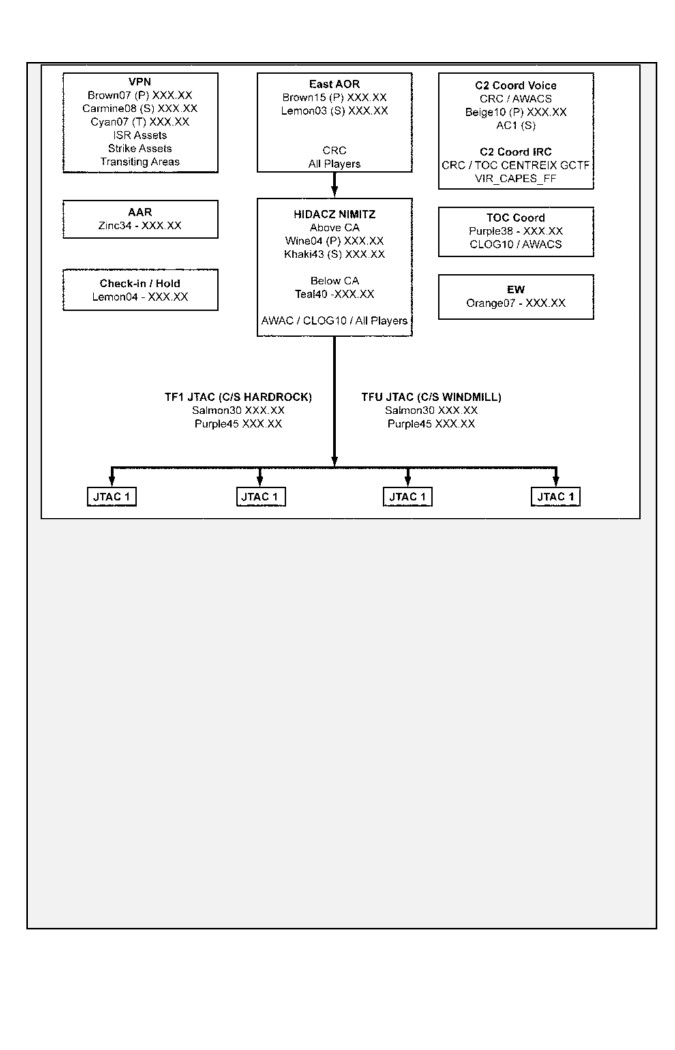
Figure 2. HIDACZ NIMITZ Comm Plan
4. Airspace Coordinating Measures
a. HIDACZ NIMITZ: The boundaries contain the following keypads: XXXXX,
XXXXX, and XXXX from GL - FL300. The HIDACZ commander is TOC
and the HIDACZ controllers will be AWACS or TOC. All aircrew will
monitor the HIDACZ primary control frequency while in the confines of
the HIDACZ.
b. BULLSEYE: The BULLSEYE will be used and is the center of the HIDACZ
- L/L. The BULLSEYE will be used as an expeditious way of giving SA to
aircraft with respect to other friendly air call signs. This minimizes
extraneous comms between air platforms and controlling call signs.
c. Hold Area: The primary hold area for all fixed-wing assets has been
established outside the confines of the HIDACZ at PEKO from FL180-
FL280. This will be controlled by either AWACS or CRC.
d. Air-to-Air Refueling (AAR): Refueling track, HAPPYHOUR, has been
established and is comprised of the following points XXXX. It is a N-S race
track and is from FL170 - FL280. The AAR consists of the following: IP
XXXX; CP XXXX. This will be controlled by either AWACS or CRC.
22 MAY 2009
FM 3-52.1 / AFTTP 3-2.78
75
e. Airway: Airway A123 between DRONE and WAVEY will be closed when
the HIDACZ is active. Additionally, the position of the HIDACZ will leave
V123 and A456 routes open and keep assets away from high traffic areas.
f. Coordinating Altitude: Due to varying terrain, the coordinating altitude
within the HIDACZ is 3,500 AGL to a maximum of FL 100 MSL. All aircraft
operating at, or above FL100, will remain 1013.2mb/29.92 in. This will
ensure that all fixed-wing assets are on the same pressure setting and
afford additional flight safety between formations. All aircraft operating
below the coordinating altitude will remain on the pressure setting that they
have been given and are flying with. ALL AIR ASSETS ARE
RESPONSIBLE FOR THEIR OWN TERRAIN AVOIDANCE.
g. AWACS Stationing: The AWACS station includes the following kill boxes
and keypads: XXAXX, and XXAXX from the coordinating altitude to FL320.
CONCEPT OF CONTROL/C2 COORDINATION
5. Airspace Hierarchy. The hierarchy of airspace control within the HIDACZ is
as follows:
a. Primary: AWACS
b. Secondary: TOC
6. HIDACZ Controller. The HIDACZ controller is responsible for managing the
airspace within the HIDACZ and allocating operating areas for ALL assets
that fly within the HIDACZ.
7. TOC Control.
a. The TOC will procedurally control the airspace below the coordinating
altitude within the HIDACZ and deconflict those assets from kinetics
(surface-to-surface/air-to-ground/air-drops) in coordination with the HIDACZ
controller.
b. The TOC maintains control of asset allocation and priority of fires/effects to
meet the ground commander intent. The TOC will communicate those
priorities to the HIDACZ controller for 3-dimensional integration in the
operations area.
76
FM 3-52.1 / AFTTP 3-2.78
22 MAY 2009
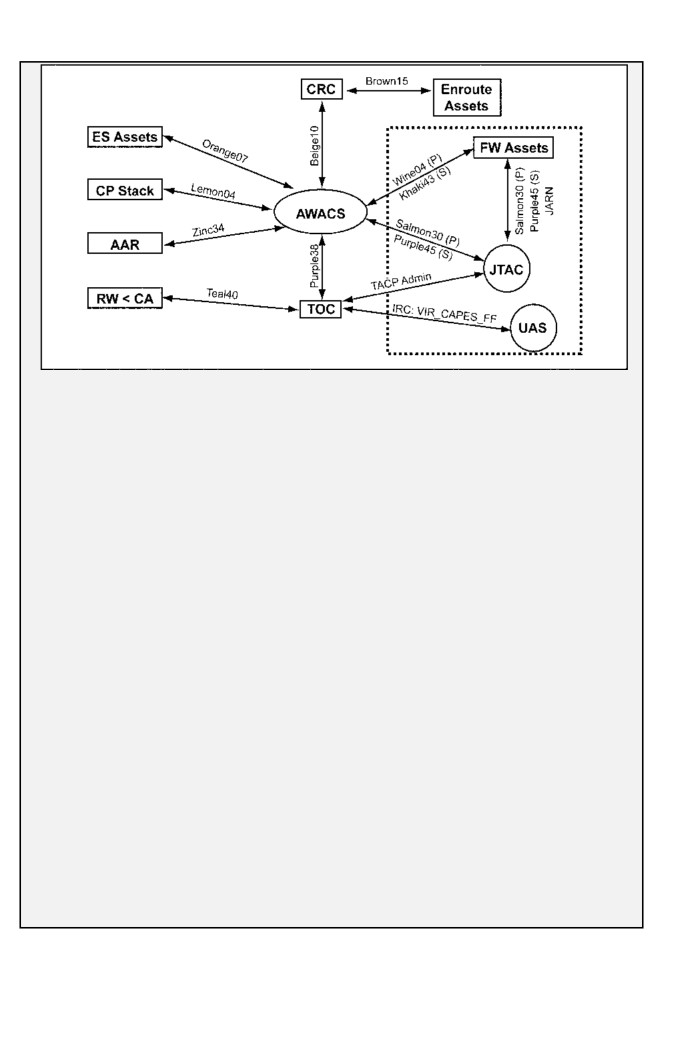
Figure 3. HIDACZ NIMITZ C2 Depiction w/AWACS
8. CGRS. CGRS keypads will be used to internally deconflict the airspace. In
addition to lateral deconfliction, assets will be deconflicted vertically by the
appropriate controller. Each type of aircraft has been assigned its own
altitude parameter. Additionally the Elb River, that runs north and south,
may be used as a visual reference for procedural deconfliction.
FUNCTIONAL ROLES
9. TOC:
a. Track ground commander’s priorities for air assets/friendly locations and
communicate those as necessary to the HIDACZ controller.
b. Set priority of fires (execute ground/CC intent for air support).
c. Track JTAC priorities with respect to fires.
d. Allocate air assets in coordination with/HIDACZ controller.
e. Control those assets below the established coordinating altitude within the
HIDACZ when AWACS is on station and controls all assets in the HIDACZ
when AWACS is not on station.
f. Establish a dedicated chat window for C2 coordination for this operation
named “VIR_CAPES_FF”.
22 MAY 2009
FM 3-52.1 / AFTTP 3-2.78
77

Figure 4. HIDACZ NIMITZ C2 Depiction w/TOC as Controller
10. AWACS:
a. Controls HIDACZ, hold area, and refueling area.
b. Sole responsibility for deconfliction of aircraft within the HIDACZ above
coordinating altitude.
c. Updates fuel priorities and coordinates with/ASOC, CRC, and CAOC.
d. Passes aircraft to JTAC when tasked by TOC.
e. Update TOC on status of a/c (inbound/hold stack).
f. Pass AO updates to aircraft as required.
g. Coordinates with/TOC for priority of fires (execute Ground/CC’s intent).
h. Primary airborne relay as required.
i. Gate keeper for HIDACZ, safety monitor.
j. Assist TOC with/SA of aircraft below the coordinating altitude as able.
11. CRC:
a. Controls hold area and AAR when AWACS not on station.
b. When AWACS not on station, controls flow into/out of HIDACZ as
requested by TOC.
c. When able, receives feedback/tracks airspace control/C2 issues for this OP
and passes to CAOC.
12. JTACs [Task Force T, SOF, Other Coalition Force (OCF)]
a. Must ensure they do not change assigned working area/altitude of aircraft
without coordinating through HIDACZ controller.
78
FM 3-52.1 / AFTTP 3-2.78
22 MAY 2009
b. Cannot clear or otherwise imply that an aircraft is clear to deviate their
assigned working area/altitude or depart the HIDACZ without approval from
the HIDACZ controller.
13. Aircrew
a. Must not enter the HIDACZ without approval from the HIDACZ controller.
(This is applicable to ALL aircraft flying in AO to include all SOF, OCF
assets.)
b. Monitor the HIDACZ primary control frequency at all times while in the
HIDACZ to allow for the rapid deconfliction of FIRES and aircraft.
c. Will obtain clearance out of assigned working block before exiting that block
and will check out with HIDACZ controller prior to RTB or AAR. (This is
especially critical when the TOC is procedurally controlling the HIDACZ.)
d. Required to read, understand, and comply with this airspace control plan,
SPINS, and all other applicable directive (CFACC ACP, AIP, etc) prior to
flying in this operation.
e. Understand that failure to strictly comply with procedures outlined in this
plan presents an unacceptable risk to assets and mission accomplishment.
f. Pass post mission feedback on issues with C2.
14. CAOC AWACS/CRC LNOs, CPD/COD Airspace
a. Responsible for monitoring implementation of this plan.
b. Focal point for any integration/coordinating any changes to this plan.
c. Focal point for consolidating feedback from all players.
d. Informing CAOC CCO/DCO of issues identified with airspace control in this
OP.
SEQUENCE OF EVENTS:
15. AWACS On Station (coordinating altitude and above)
a. Aircraft check in with CRC on takeoff/entry in JOA.
b. CRC reports check-in with AWACS; AWACS provides altitude for aircraft
handover and entry to hold area.
c. CRC controls aircraft in transit.
d. CRC directs aircraft to required hold altitude and transfers control to
AWACS PRIOR to aircraft entry of the hold area.
16. Aircraft control passed to AWACS on HIDACZ check-in frequency:
a. Pass AO updates and fighter to FAC brief info as required.
b. AWACS notifies TOC aircraft are on station.
c. Stack aircraft within the hold area as necessary.
d. As directed by TOC, pushes aircraft to JTAC.
e. AWACS controls aircraft from HIDACZ to AAR/hold area or coordinates with
CRC for return to base.
f. AWACS updates TOC status of aircraft within the HIDACZ, etc.
AWACS NOT ON STATION
17. TOC as HIDACZ Controller (coordinating altitude and above)
a. Aircraft checks in with CRC on take-off/entry in JOA.
b. CRC report checks in with TOC and request required altitude in HIDACZ.
22 MAY 2009
FM 3-52.1 / AFTTP 3-2.78
79
c. Aircraft remains with CRC for transit and hold area entry at required
altitude.
18. Aircraft passed to TOC at required altitude/location for entry into HIDACZ.
a. TOC controller controls the HIDACZ procedurally, establishes
stacks/working areas and pushes aircraft to JTAC as required.
b. TOC coordinates with CRC for aircraft exit of the HIDACZ.
c. TOC updates CRC on status of aircraft in HIDACZ, etc.
d. CRC controls aircraft outside HIDACZ to AAR/hold area or return to base.
19. JTAC Coordination
a. JTAC takes requests from ground/CC.
b. JTAC sends TOC request.
c. ALL JTAC requirements coordinated and prioritized through TOC.
d. TOC assigns priority and passes to HIDACZ controller for asset allocation.
e. For simultaneous TICs, TOC will prioritize in coordination with HIDACZ
controller.
f. JTAC releases aircraft back to HIDACZ controller for exit of the HIDACZ.
g. JTAC must not direct aircraft outside assigned working area and altitude
before coordination with the HIDACZ controller.
h. HIDACZ controller sends aircraft to another tasking within the HIDACZ or to
CRC to hold, tank, etc.
SPECIAL CONSIDERATIONS
a. Aircraft unable to make contact with AWACS or TOC are to inform CRC
immediately, remain outside of the HIDACZ and await further instructions.
CRC will inform TOC via internet chat and the C2 coordination frequency.
b. All rotary-wing aircraft that are unable to contact TOC/AWACS are to inform
their Task Force HQ and await further instructions. The HQ must contact
TOC immediately.
TERRAIN MANAGEMENT (TM)
20. Terrain Considerations. Task Force BG, Task Force T, and Task Force 3
are deploying in the CAPE HENRY area. As such, they will be given an
area each to operate in. All prior traces will cease to be valid. The area has
been divided into 3 OPS Boxes in order to facilitate initial C2.
21. OPS Boxes
a. TRUMAN. AA 12A AA 12345678, following E bank of Elb River to AA 12A
AA 12345678, AA 12A AA 12345678.
b. STENNIS. AA 12A AA 12345678, following mountain ridge to AA 12A AA
12345678, AA 12A AA 12345678, AA 12A AA 12345678.
c. MIDWAY. AA 12A AA 12345678, AA 12A AA 12345678, following E bank
of Elb River to AA 12A AA 12345678. Exclusion Zones: TBN
22. Fire Support Coordination Measures (FSCMs)
a. RFLs. All OPS Boxes boundaries are fixed and subject to cross boundary
fire restrictions.
80
FM 3-52.1 / AFTTP 3-2.78
22 MAY 2009
b. No Fly Area. Gun position locations will be posted as no fly areas on
internet chat throughout the duration of the operation.
23. Altitude Deconfliction. Aircraft operating in the HIDACZ will be stacked
vertically according to type; the HIDACZ controller, however, will
dynamically set altitude blocks.
24. Aviation.
a. All rotary wing are to contact TOC prior to entering the HIDACZ. Aviation
Task Forces are responsible for planning routes to/from the HIDACZ and
informing TOC. Additionally, all rotary wing are to contact TOC and
obtain clearance prior to entering keypad 12A34. If unable to contact
TOC due to line-of-sight problems, contact AWACS or any available unit
TOC and ensure clearance into the HIDACZ and keypad 12A34 prior to
entry.
b. Task Force T Insertion. An ingress and egress route will be established
for the initial insertion and extraction from the HIDACZ.
25. UAS. All UAS assets in support of Task Force T must ensure they check
into the HIDACZ with TOC in order to ensure their dynamic deconfliction.
a. MUAV. Will deconflict by JTAC, who is to inform TOC of all missions prior
to launch.
b. Predator. Check-in with AWACS, when on station, or TOC prior to entering
the HIDACZ. Aircraft may be forwarded to a JTAC for detailed tasking
control. Predator will maintain connectivity with AWACS and/or TOC on the
HIDACZ primary control frequency or the VIR_CAPES_FF internet chat
window.
c. TUAV. Check in with TOC prior to entering the HIDACZ. Aircraft may be
forwarded to a JTAC for detailed tasking control. Controllers should give
considerations to racetracks in the vicinity of likely tasking. Controllers
should be aware of all aviation entry/exit points and aviation holds as these
may be used to aid deconfliction. The VIR_CAPES_FF window on internet
chat will be the primary means of communication.
26. Guide Multiple Launch Rocket System (GMLRS). TOC will deconflict all
GMLRS fire missions within HIDACZ NIMITZ and is responsible for ensuring
that all other assets are outside of the ACM during firing. If the system is
required to fire outside of the HIDACZ, TOC will be responsible for clearing
the airspace up to the boundary of the HIDACZ and for coordinating the
clearing of the airspace beyond the boundary of the HIDACZ via AOC.
27. Point of Contacts. All questions, issues, feedback on this plan or its
execution should be routed to:
CAOC OPS Airspace
SIPR EMAIL
CENTRIX EMAIL
DSN
Internet chat
22 MAY 2009
FM 3-52.1 / AFTTP 3-2.78
81

NOTE: This example is notional and based on a USMC historical plan. It is
provided as an example to show the breadth and depth of detail required to
execute a complex HIDACZ operation and may reflect theater vice doctrinal
terms and procedures.
EXAMPLE TWO
2. HIDACZ MAMELUKE Airspace Control Plan Example
OPERATION TUN TAVERN SPINS dtd XX0422
1. General
a. Refer to ANNEX F to FRAGO ABC TUN TAVERN dated 22 Apr XX for
general airspace management instructions.
b. Airspace is allocated by means of the ACO in response to ACM REQs.
c. A comprehensive but simple airspace control plan is essential to maximize
operational effectiveness while mitigating the risk of fratricide. These
SPINS are to provide additional instructions and information to users of
HIDACZ MAMELUKE and participants of TUN TAVERN.
d. Indirect fire and air will be dynamically deconflicted by the controlling Direct Air
Support Center (DASC)/FSCC/JTACS and FSTs as required. HIDACZ
MAMELUKE will be established over the AO to facilitate the coordination of
air, aviation, ISR and joint fires. This airspace management plan will be in
effect from D-2 day until the end of the operation.
Figure 5. HIDACZ MAMELUKE Vertical Separation
82
FM 3-52.1 / AFTTP 3-2.78
22 MAY 2009
2. Coordinating Instructions
a. ASM
i. HIDACZ MAMELUKE will be established ISO OP TUN TAVERN. The
HIDACZ is shaped and built primarily around CGRS kill box keypads and
will extend from SFC to FL280. The HIDACZ TRP/KEYHOLE is centered
on the bridge of I-664 and I-64 north of Norfolk at AB 11X AB123456.
ii. HIDACZ MAMELUKE will be procedurally controlled by the DASC (C/S
DASC) who will be collocated with the MEU FSCC and FOB NASA BCP.
All aircraft ISO OP TUN TAVERN will be allocated by either MEU AO or by
TFH WIDOW TOC and in accordance with CDR’s intent. BLOODLUST will
control all a/c outside of HIDACZ MAMELUKE and will handover to the
DASC at an appropriate altitude for entry to the HIDACZ.
iii. HIDACZ MAMELUKE
(1) HIDACZ MAMELUKE Grids: AB 11X AB123456, AB 11X
AB123456, AB 11X AB123456, The latitude/longitude are: XXXXN/XXXXW,
XXXXN/XXXXW, and XXXXN/XXXXW. Figure X is a depiction of HIDACZ
MAMELUKE.
(2) Indirect fires will be coordinated by the controlling FSCC/FSTs.
(3) The ACMR for HIDACZ has been resubmitted by the MEU AO and
will be activated from D-2. All additional requests are to be passed via MEU
AO.
(4) When not required, HIDACZ MAMELUKE will be deactivated and
the space returned to normal procedures. Additional, ACMs may be
requested to support further OPS.
(5) Assets will be deconflicted both vertically and laterally using
keypads, kill boxes, and control points. Additionally, obvious physical
features may be used as visual references for procedural deconfliction.
(6) Existing ROZs ABLE and BAKER will be activated when HIDACZ
MAMELUKE is cold
(7) Entry to HIDACZ will be at the designated entry/exit points. Entry
will be at FL200 and exit will be at 14,000 ft AGL.
(8) An LZ control zone will be established on D-4 3 nm around FOB
NASA, from SFC to 1,500 ft AGL. The controlling agency is the Marine Air
Traffic Control Mobile Team 2 (MMT2). Their call sign is LAND 2 and
additional instructions are below.
(9) 105mm artillery is located at FOB NASA and 155mm artillery will be
located immediately east of FOB PIER. MGRS locations will be issued
SEPCOR and updates provided upon check-in with DASC.
(10) Transition Altitude (TA). The TA for the theater is 14,000 ft AGL.
Within the HIDACZ all aircraft operating at, or above, 14,000 ft AMSL will
remain on 1013.2 mb/29.92 inches.
(11) The vertical separation matrix is in figure 5.
IN ALL INSTANCES, AIR ASSETS ARE RESPONSIBLE FOR THEIR OWN
TERRAIN AVOIDANCE
22 MAY 2009
FM 3-52.1 / AFTTP 3-2.78
83

Figure 6. HIDACZ MAMELUKE Communications Diagram
iv. Fixed Wing CPs/IPs
(1) Keyhole.
(a) ECHO - Keyhole TRP (AB 11X AB123456).
(b) ALPHA/BRAVO/CHARLIE/DELTA. 10 nm each side of the
keyhole.
(2) CAS stack will be established between points C and D from FL170 -
220. CAS stack has been deconflicted vertically and laterally from artillery
GTLs.
(3) Entry/Exit CPs:
(a) TOYOTA, AB 11X ABXXXXXX
(b) DODGE, AB 11X AB1XXXXXX
(4) Additional CPs:
(a) FORD, AB 11X ABXXXXXXX
(b) FERRARI, AB 11X ABXXXXXXX
(c) LOTUS, AB 11X ABXXXXXXX
v. Rotary Wing BPs/HA. RW BPs are named and centered as follows:
(1) RW BP NEWT - AB 11X ABXXXXXXX
(2) RW BP EEL - AB 11X ABXXXXXXX
(3) RW BP RATTLER - AB 11X ABXXXXXXX
(4) RW BP SERPENT - AB 11X ABXXXXXXX
(5) RW HA WILMA - AB 11X ABXXXXXXX
84
FM 3-52.1 / AFTTP 3-2.78
22 MAY 2009
vi. RW Deconfliction. All aviation is to check in with the DASC who will provide
deconfliction, clear routing, and provide tasking.
vii. UAS. Prior to entry of HIDACZ MAMELUKE, the UA controller is to check
in with the DASC via fixed wing control frequencies listed in the
communications table 11 and/or IRC.
viii. Tanker Track STINK.
(1) Tanker track is separated laterally, entry altitude is FL210 and exit
altitude is FL230. Primary tanking altitude is FL220.
(2) Tanker frequency is (P) Lemon26, (S) Gray21.
(3) Tanker track coordinates are: AB 11X ABXXXXXXX, AB 11X
ABXXXXXXX, AB 11X ABXXXXXXX, AB 11X ABXXXXXXX.
ix. LZ Control Zone E-Sunbow ACMR, FOB NASA.
(1) The control agency is MMT2. C/S LAND 2:
(P) CHERRY44
(S) CRIMSON17
TACAN channel 92Y “MMT”
(2) Dimensions of the LZ control zone are 3 nm, SFC - 1,500 ft AGL with a
center grid AB 11X ABXXXXXXX. Tactical phraseology in accordance with
table 8.
(3) Sectors lettered counter clockwise from ENE, A - H.
(4) Left-handed pattern with a No Fly Area 45-135Deg magnetic due to
105mm gun line. Inbound altitude is 500 ft AGL and outbound is 300ft AGL.
The arm/dearm heading is 310Deg magnetic.
(5) Lost communication procedures: Overfly AM2 matting south to north at
500 ft, circle FOB counter clockwise for landing upon receipt of appropriate
signal. Refer to table 7.
Table 7. Lost Comm Visual Signals
Day Signal
(VS-17
Night Signal
A/C on Ground
Aircraft in Air
Panel)
Steady
Steady light
Cleared for
Cleared to land
orange
takeoff
Alt
Flashing light
Return for landing
Orange/cerise
Left to right
Left to right light
Stop
Give way,
orange
continue circling
Circle orange
Circle light
Airport unsafe, do
not land
22 MAY 2009
FM 3-52.1 / AFTTP 3-2.78
85
Table 8. Tactical Phraseology FOB NASA
Item
CALL WORD
5 mins out
On Deck
Request Fuel & Ordnance
Happy Hour
Taken Battle Damage
Tagged
Gun Line is Hot
Flames
Request Corpsman
Angel
x. ROZ WINDY, FOB DOG
(1) The control agency is Marine Air Traffic Control Team 1 (MMT1). C/S
LAND 1:
(P) ZINC18
(S) TAN17
TACAN channel 29Y “MMT”
(2) Dimensions of the ROZ are 5 nm, SFC - 14,000 ft AGL with a center
grid AB 11X ABXXXXXXX. Tactical phraseology in accordance with table 9.
(3) Sectors lettered counter clockwise from N to S, from A to D.
(4) Right-handed pattern with inbound altitude of 500 ft AGL and outbound
is 300 ft AGL. The assault landing zone is setup as a day/night AMP-3
runway.
(5) Lost communication procedures: Overfly runway east to west at 500 ft,
circle FOB clockwise for landing upon receipt of appropriate signal. Refer to
table 7.
Table 9. Tactical Phraseology FOB DOG
Item
CALL WORD
5 mins out
United
Request Fuel & Ordnance
Arsenal
Taken Battle Damage
Derby
Gun Line is Hot
Newcastle
Request Corpsman
Fulham
xi. Radio In/Out Sequence.
(1) FIXED-WING: ATC (TOWER) to CRC to DASC to FAC/JTAC
(2) AAR: ATC (TOWER) to CRC to DASC
(3) RW: ATC (TOWER) to CRC to TFH to DASC to JTAC
(4) Aircraft at NASA: MMT (LAND 2) to DASC to JTAC
xii: Radio In/Out (RIO) procedures.
(1) Fixed Wing
(a) Inbound. FL200, RIO prior to entry of HIDACZ MAMELUKE via
CPs Dodge or Toyota with C/S, mission #, number & type ac, position,
altitude, and status (i.e., up as fragged or with exceptions).
(b) Transiting. State C/S, location and intentions. DASC will provide
routing clearance to transit.
86
FM 3-52.1 / AFTTP 3-2.78
22 MAY 2009
(c) Outbound. 14,000 ft AGL, RIO prior to exiting HIDACZ @ CPs
Dodge or Toyota. Pass situation update, SALUTE and BHA.
(2) Rotary Wing
(a) Inbound. RIO prior to entry of HIDACZ MAMELUKE with C/S,
mission #, number & type ac, position, altitude, and status (i.e., up as
fragged or with exceptions). State position in reference to FOB NASA
wagon wheel.
(b) Transiting. State C/S, location and intentions. North and east
bound aircraft will be at odd altitudes and south and west bound aircraft will
be at even altitudes.
(c) Outbound. RIO prior to exiting HIDACZ and pass situation update,
SALUTE, BHAS (if applicable).
xiii. JTAC Procedures
(1) Deployed JTACs are to provide DASC with regular situation reports
(SITREPs) in order to maintain SA.
(2) JTACs are not to make changes to the ASM nor SPINS without prior
authorization (no bird-catching).
xiv. FSCMs. Aircrews are responsible for mission prep with latest FSCMs.
Real-time updates will be provided upon check-in with the DASC.
(1) All NFAs and RFAs will be promulgated SEPCOR and updates will be
provided by the DASC upon check in.
(2) Key routes, PLs and OPS boxes for the convoy move from LGL to ORF
can be found at Annex A - OP TUN TAVERN dtd 22 Apr XX.
(3) PLs can be found on the BM schematic at Appendix 1 to Annex F of the
FRAGO.
(4) A spotmap has been produced for usage by all assets taking part in OP
TUN TAVERN.
(5) No fire area locations within HIDACZ MAMELUKE are at App 2 to Annex
F of FRAGO. All users within the AO should be aware of the NSL.
xv. OPS Boxes. OPS boxes are located within HIDACZ MAMELUKE to
support the FPoL of MEU through the AO prior to their deployment to FOB
DOG. Additional OPS Boxes are depicted to support the C company
objective at OCEANA and both the B and C companies objective following
the air assault. Any call sign believing that they may have positive
identification of friendly forces within their OPS Box are to immediately pass
that information to the DASC and FSCC by the quickest means available.
xvi. Overlays/Schematic. Operational overlays and schematics will be
provided via SEPCOR.
b. C2.
i. Functional Roles.
(1) TOC
(a) Update the DASC on local air situation.
(b) Pass information from CRC/ASCC and other agencies.
(c) Coordinate HIDACZ activation requests and TIC support.
22 MAY 2009
FM 3-52.1 / AFTTP 3-2.78
87
(2) FSCC
(a) Track friendly locations and ground CDR’s priorities for air assets
and coordination with the DASC and TACPs for priority fires.
(b) Control, coordinate, and clear fires within the HIDACZ.
(3) DASC
(a) Process immediate air support requests.
(b) Manage terminal control assets.
(c) Integrate air/ aviation with other supporting arms.
(d) Procedurally control the HIDACZ.
(e) Ensure information flow between TOCs, MEU FSCC, and the MEU
Aviation Combat Element (ACE).
(4) CRC
(a) Control flow into/out of HIDACZ as requested by TOC.
(b) Control AAR and organize hold outside HIDACZ if required.
(5) Air/Aviation. To ensure the efficient coordination of airspace within
HIDACZ, all air/aviation:
(a) Must not enter the HIDACZ without approval from the DASC (this
applies to ALL aircraft including SOF assets).
(b) Are to monitor the DASC’s HIDACZ control frequency(ies) or the
assigned TACP at all times while in the HIDACZ, to allow rapid deconfliction
of fires and aircraft.
(c) Are to obtain clearance before changing level or routing and will
check out with DASC prior to RTB or AAR.
ii. Launch and divert authorities for MEU assets are in table 10 below.
Table 10. Delegation of Authority
MISSION TYPE
LAUNCH
DIVERT
OAS (RW)
DASC
DASC
OAS (FIXED-WING)
DASC
DASC
ASLT SPT
ACE COC
DASC
CAS EVAC
DASC
DASC
ISR
ACE COC
DASC
iii. Communications. The primary check in for OP TUN TAVERN is with the
MEU DASC on PLUM14, secondary check-in if no comm on primary is with
TOC on PLUM37. Following check-in with DASC/TOC aircraft will be
pushed to the relevant terminal control. The communications and aviation
C2 integration diagrams with JTAC callsigns and frequencies are in figure 6.
All communication will be primarily secure. If no communication, secure roll
clear as a last resort.
88
FM 3-52.1 / AFTTP 3-2.78
22 MAY 2009
Table 11. DASC and Terminal Control Communications
HIDACZ
C/S
Frequencies
Ops Box
DASC (HIDACZ Controller)
DASC
FW: (P) PLUM14
(S) CRIMSON37
RW: (P) CHERRY33
(S) CRIMSON37
MMT2
LAND 2
(P) CHERRY44
(S) CRIMSON17
MMT1
LAND 1
(P) ZINC18
(S) TAN17
2 SCOTS, JTAC
JTAC 51
MAUVE31
MEU AO, JTAC
JTAC 13
LEMON 32
MEU JTAC
JTAC 14
GRAPE 29
A COY(JTAC)
JTAC 11
ZINC 20
C COY (JTAC)
JTAC 12
KHAKI 19
RECON, MEU (JTAC)
JTAC 16
INDIGO 17
TF RAGIN, MEU
JTAC 17
INDIGO 17
22 MAY 2009
FM 3-52.1 / AFTTP 3-2.78
89
This page intentionally left blank.
90
FM 3-52.1 / AFTTP 3-2.78
22 MAY 2009
Appendix D
Example Airspace Control Checklists
The following examples of Airspace Control Checklists were gathered from
recent operations to present a schematic representation of an airspace control
process. The intent with the examples is not to present a specific solution to
airspace coordination but rather to show a step-by-step process that could be
modeled to clearly lay out to users the airspace control process needed to
support a given operations.
In the following examples, steps are identified in order (e.g., 1, 2, 3, etc.), the
node (i.e., organization), the cell (i.e., individual within the organization or a
separate sub-organization), followed by the input (i.e., trigger event), process to
be used, tools to be used in the process, and output. If more than, one
organization is involved in an individual step then that is highlighted in the
examples by adding decimals to the step number (e.g., 3.1, 3.2). If an individual
step of a specific organization has identified sub-steps that is highlighted in the
example by sub-dividing the steps (e.g., 2.1.a.1; 2.1.a.2, etc.). Figure 7
illustrates the step numbering sequence used in the examples.
Figure 7. Step-by-step Explanation
22 MAY 2009
FM 3-52.1 / AFTTP 3-2.78
91

Figure 8. Example of Army Fires Checklist
92
FM 3-52.1 / AFTTP 3-2.78
22 MAY 2009

Figure 9. Example of CAS Outside of Army Airspace Checklist
22 MAY 2009
FM 3-52.1 / AFTTP 3-2.78
93

Figure 10.
Example of Dynamic UA Retask Checklist
94
FM 3-52.1 / AFTTP 3-2.78
22 MAY 2009

Figure 11.
Example of Fires in Vicinity of Airfield Checklist
22 MAY 2009
FM 3-52.1 / AFTTP 3-2.78
95

Figure 12.
Example of Immediate ROZ Checklist
96
FM 3-52.1 / AFTTP 3-2.78
22 MAY 2009
REFERENCES
Joint Publications
CJCSI 3900.01C, Position (Point and Area) Reference Procedures, 30 Jun 07.
DOD 4500.54-G, Department of Defense Foreign Clearance Guide, 10 Jul 09.
JP 1-02, DOD Dictionary of Military and Associated Terms. 12 Apr 2001.
JP 3-0, Joint Operations.17 Sep 2006 .
JP 3-01,Countering Air and Missile Threats. 5 Feb 2007
JP 3-02, Joint Doctrine for Amphibious Operations. 19 Sep 2001
JP 3-09.3, Joint Tactics, Techniques, and Procedures for Close Air Support
(CAS). 3 Sep 2003.
JP 3-17, Joint Doctrine and Joint Tactics, Techniques, and Procedures for Air
Mobility Operations, 14 Aug 2002.
JP 3-50, Personnel Recovery, 5 Jan 2007.
JP 3-52, Joint Doctrine for Airspace Control in a Combat Zone, 30 Aug 2004.
JP 3-60, Joint Targeting. 13 Apr 2007
JP 5-0, Joint Operation Planning, 26 Dec 2006.
Multi-Service Publications
FM 1-02.1/MCRP 3-25B/NTTP 6-02.1/AFTTP(I) 3-2.5, Multi-Service Brevity
Codes. 30 Oct 2007
FM 3-60.2/MCRP 3-23C/NTTP 3-03.4.3/AFTTP(I) 3-2.72, Multi-Service Tactics,
Techniques, and Procedures for Strike Coordination and Reconnaissance.
26 Nov 2008.
Other
FAA JO 7610.4M, Special Military Operations (FOUO), 18 Jan 07.
22 MAY 2009
FM 3-52.1 / AFTTP 3-2.78
97
This page intentionally left blank
98
FM 3-52.1 / AFTTP 3-2.78
22 MAY 2009
GLOSSARY
ABBREVIATIONS AND ACRONYMS
A
AADC
area air defense commander
AADP
area air defense plan
AAGS
Army air-ground system
AAR
Air-to-air refueling
ABC
airborne command and control
AC2
airspace command and control
ACA
airspace control authority
ACCE
air component coordination element
ACE
aviation combat element
ACE
aviation combat element
ACM
airspace coordinating measure
ACO
airspace control order
ACP
airspace control plan
ACS
airspace control system
ADA
air defense artillery
ADAA
air defense action area
ADAM
air defense airspace management
ADIZ
air defense identification zone
ADP
air defense plan
ADVRTE
advisory route
ADZ
amphibious defense zone
AEW
airborne early warning
AFATDS
Advanced Field Artillery Tactical Data System
AFFOR
Air Force forces
AFI
Air Force Instruction
AFTTP
Air Force tactics, techniques, and procedures
AGL
above ground level
AI
air interdiction
AIC
air information center
AIP
aeronautical information publication
AIRCOR
air corridor
AIRRTE
air route
ALERTA
alert area
ALO
air liaison officer
ALSA
Air Land Sea Application Center
ALTRRV
altitude reservation
AO
area of operations
22 MAY 2009
FM 3-52.1 / AFTTP 3-2.78
99
AOA
amphibious objective area
AOC
air operations center
AOD
air operations directive
AOR
area of responsibility
APPCOR
approach corridor
ARFOR
Army forces
ARWY
airway
ASM
airspace management
ASOC
air support operations center
ATACMS
Army Tactical Missile System
ATC
air traffic control
ATO
air tasking order
ATS
air traffic system
ATSRTE
air traffic service route
AVN
aviation
AWACS
airborne warning and control system
B
BAE
brigade aviation element
BCD
battlefield coordination detachment
BCT
brigade combat team
BDZ
base defense zone
BNDRY
boundary
BULL
bullseye
BZ
buffer zone
C
C2
command and control
CADA
coordinated air defense area
CALCM
conventional air launched cruise missile
CAOC
combined air operations center
CAP
combat air patrol
CAS
close air support
CBA
cross-border area
CCA
close combat attack
CCZONE
carrier control zone
CDR
commander (JP 1-02); conditional routes (USMTF
usage)
CFACC
combined force air component commander
CFL
coordinated fire line
CGRS
common geographic reference system
CHOPS
chief of operations
CJCSI
Chairman of the Joint Chiefs of Staff instruction
CLSA
class A airspace
100
FM 3-52.1 / AFTTP 3-2.78
22 MAY 2009
CLSB
class B airspace
CLSC
class C airspace
CLSD
class D airspace
CLSE
class E airspace
CLSF
class F airspace
CLSG
class G airspace
COA
courses of action
COMAFFOR
Commander, Air Force forces
CONTZN
control zone
COP
common operational picture
COZ
crossover zone
CP
control point
CRC
control and reporting center
CSAR
combat search and rescue
CTA
control area
D
DA
danger area
DASC
direct air support center
DBSL
deep battle synchronization line
DCA
defensive counterair
DOD
Department of Defense
DZ
drop zone
E
EC
electronic combat
EG
entry/exit gate
ES
electronic warfare support
F
FAA
Federal Aviation Administration
FAAO
Federal Aviation Administration Order
FAC(A)
forward air controller (airborne)
FADIZ
fleet air defense identification zone
FARP
forward arming and refueling point
FEBA
forward edge of the battle area
FFA
free-fire area
FIR
flight information region
FLOT
forward line of own troops
FM
field manual
FOB
forward operating base
FOL
forward operating location
FRAD
falcon radial
FRAGORD
fragmentary order
FSCL
fire support coordination line
22 MAY 2009
FM 3-52.1 / AFTTP 3-2.78
101
FSCM
fire support coordination measures
FSCOORD
fire support coordinator
FSO
Fire Support Officer
ft
feet
FW
fixed wing
G
GARS
global area reference system
GCC
geographic combatant commander
H
HA
holding area
HIDACZ
high-density airspace control zone
HIMEZ
high-altitude missile engagement zone
HN
host nation
headquarters (JP 1-02); hand-over gate (USMTF
HQ
usage)
I
ICAO
International Civil Aviation Organization
IDN
initial distribution number
IFF
identification, friend or foe
IFFOFF
IFF switch off line
IFFON
IFF switch on line
IO
information operations
IRC
internet relay chat
ISP
identification safety point
intelligence, surveillance, and reconnaissance (JP 1-
ISR
02); identification safety range (USMTF usage)
J
JAAT
joint air attack team
JACE
joint air coordination element
JAOC
joint air operations center
JAOP
joint air operations plan
JEZ
joint engagement zone
JFACC
joint force air component commander
JFC
joint force commander
JFLCC
joint force land component commander
JFMCC
joint force maritime component commander
JICO
joint interface control officer
JOA
joint operations area
JP
joint publication
JSOA
joint special operations area
JSOAC
joint special operations air component
JSOACC
joint special operations air component commander
102
FM 3-52.1 / AFTTP 3-2.78
22 MAY 2009
JSTARS
Joint Surveillance Target Attack Radar System
JTAC
joint terminal attack controller
JTF
joint task force
L
LAT
latitude
LCC
land component commander
LMEZ
land missile engagement zone
LNO
liaison officer
LONG
longitude
LOMEZ
low-altitude missile engagement zone
LZ
landing zone
M
MBC
mortar ballistic computer
MFEZ
maritime fighter engagement zone
MG
marshalling gate
MISARC
missile arc
MLRS
multiple launch rocket system
MMEZ
maritime missile engagement zone
MOA
military operating area
MRR
minimum-risk route
MSL
mean sea level
MTTP
multi-Service tactics, techniques, and procedures
N
NAVRTE
area navigation route
NFA
no fire area
NGO
nongovernmental organization
NM
nautical mile
NOFLY
no fly area
NOTAM
notice to airmen
O
OCF
other coalition forces
OEF
Operation Enduring Freedom
OGA
other governmental agency
OIF
Operation Iraqi Freedom
OPORD
operations order
OPR
office of primary responsibility
OPS
operations
OPTASKLINK
operations task link
P
PROHIB
prohibited area
PZ
pickup zone
22 MAY 2009
FM 3-52.1 / AFTTP 3-2.78
103
R
RA
restricted area
RCA
reduced coordination area
RECCE
reconnaissance area
RFL
restricted fire line
ROA
restricted operations area
ROE
rules of engagement
ROZ
restricted operations zone
RTB
return to base
RTF
return to force
RW
rotary wing
S
S-2
battalion or brigade intelligence staff officer
S-3
battalion or brigade operations staff officer
SAAFR
standard use Army aircraft flight route
SACC
supporting arms coordination center
SAFE
safe area for evacuation
SAFES
safe sector
SAR
search and rescue
SARDOT
search and rescue point
SC
special corridor
SCARC
strike coordination and reconnaissance coordinator
SCZ
ship control zone
SEAD
suppression of enemy air defenses
SEMA
special electronic mission area
SIF
selective identification feature
SIPRNET
SECRET Internet Protocol Router Network
SITREP
situation report
SHORAD
short-range air defense engagement zone
SL
safe lane
SOCCE
special operations command and control element
SOF
special operations forces
SOLE
special operations liaison element
SPINS
special instruction
SSMS
surface-to-surface missile system
SUA
special use area
T
TACC
tactical air control center
TACOPDAT
tactical operational data
TACP
tactical air control party
TACS
theater air control system
TAGS
theater air ground system
104
FM 3-52.1 / AFTTP 3-2.78
22 MAY 2009
TAIS
Tactical Airspace Integration System
TAMD
theater air and missile defense
TBMCS
theater battle management core system
TBN
to be notified
TC
transit corridor
TCA
terminal control area
TDL
tactical data link
TIC
troops in contact
TL
traverse level
TLAM
Tomahawk Land Attack Missile
TM
terrain management
TMD
theater missile defense
TMRR
temporary minimum risk route
TOC
tactical operations center
TPFDD
time-phased force and deployment data
TRNA
training area
TR
transit route
TRADOC
US Army Training and Doctrine Command
TRSA
terminal radar service area
TSA
temporary segregated area
TTP
tactics, techniques, and procedures
U
UA
unmanned aircraft
UAS
unmanned aircraft system
UAV
unmanned aerial vehicle
US
United States
USA
US Army
USAF
US Air Force
USMC
US Marine Corps
USMTF
United States Message Text Format
W
WARN
warning area
22 MAY 2009
FM 3-52.1 / AFTTP 3-2.78
105
This page intentionally left blank
106
FM 3-52.1 / AFTTP 3-2.78
22 MAY 2009
FM 3-52.1
AFTTP 3-2.78
22 May 2009
By Order of the Secretary of the Army
Official:
GEORGE W. CASEY, JR.
General, United States Army
Chief of Staff
Administrative Assistant to the
Secretary of the Army
0917501
DISTRIBUTION:
Active Army, Army National Guard, and US Army Reserve: Distribute in
accordance with the initial distribution number (IDN) 116000, requirements for
FM 3-52.1.
By Order of the Secretary of the Air Force
STEPHEN J. MILLER
Major General, USAF
Commander
Curtis E. LeMay Center for Doctrine Development and Education
ACCESIBILITY:
Publications and forms are available on the e-Publishing website at www.e-
publishing .af.mil for downloading or ordering.
RELEASABILITY:
Distribution authorized to DOD and DOD contractors only to protect technical or
operational information from automatic dissemination under the International
Exchange Program or by other means. This protection applies to publications
required solely for official use and to those containing valuable technical or
operational information. This determination was made on 30 June 2008.
PIN: 085679-000
MARINE CORPS PCN:
DSCA
MULTI-SERVICE
TACTICS, TECHNIQUES,
AND PROCEDURES FOR
DEFENSE SUPPORT OF
CIVIL AUTHORITIES
(DSCA)
ATP 3-28.1
MCWP 3-36.2
NTTP 3-57.2
AFTTP 3-2.67
6(37
(0%(5 2015
DISTRIBUTION STATEMENT A: Approved for public release,
distribution is unlimited.
*Supersedes ATP 3-28.1/MCWP 3-36.2/NTTP 3-57.2/AFTTP 3-
2.67, dated 11 February 2013.

FOREWORD
This multi-Service tactics, techniques, and procedures (MTTP) publication is a project of
the Air Land Sea Application (ALSA) Center in accordance with the memorandum of
agreement between the Headquarters of the Army, Marine Corps, Navy, and Air Force
doctrine commanders directing ALSA to develop MTTP publications to meet the
immediate needs of the warfighter.
This MTTP publication has been prepared by ALSA under our direction for
implementation by our respective commands and for use by other commands as
appropriate.
WILLARD M. BURLESON III
R. B. TURNER JR
Brigadier General, US Army
Brigadier General (Sel), US Marine Corps
Director
Director
Mission Command Center of Excellence
Capabilities Development Directorate
S. A. STEARNEY
TIMOTHY J. LEAHY
Rear Admiral, US Navy
Major General, US Air Force
Commander
Commander
Navy Warfare Development Command
Curtis E. Lemay Center for Doctrine
Development and Education
This publication is available through the following websites:
ALSA (http://www.alsa.mil/);
US Marine Corps (https://www.doctrine.usmc.mil);
US Navy at Navy Doctrine Library System (https://ndls.nwdc.navy.mil);
US Air Force at Air Force E-Publishing System (http://www.e-publishing.af.mil/);
and Joint Electronic Library Plus (https://jdeis.js.mil/jdeis/index.jsp?pindex=0).
PREFACE
1. Purpose
This publication identifies multi-Service tactics, techniques, and procedures (MTTP) for
Defense Support of Civil Authorities (DSCA). At the tactical level, it assists military
planners, commanders, and individual Department of Defense (DOD) components
employing military resources and integrating with National Guard Civil Support activities
while responding to domestic emergencies in accordance with United States (US) law.
Note: For the Army, the term “command and control” was replaced with “mission
command.” Mission command now encompasses the Army’s philosophy of command
(still known as mission command) as well as the exercise of authority and direction to
accomplish missions (formerly known as command and control).
2. Scope
This publication provides procedures for actions taken by DOD components when
directed to support local, territorial, state, federal, or tribal agencies responding to
domestic emergencies. Support can be: expertise, equipment, personnel, plans,
organization, communication, training, or other resources.
3. Applicability
This publication establishes MTTP applicable to DOD components tasked with
supporting domestic incident response, including: natural or man-made disaster
response operations, national special security events (NSSEs), or support to law
enforcement. This MTTP enables DOD organizations to integrate their capabilities with
civil authorities into response operations. The focus of this MTTP is on those DOD
forces serving in a Title 10, United States Code (USC) role. National Guard Civil
Support in either a Title 32, USC or state active duty role are discussed, but are not
limited by the discussion within this MTTP.
4. Implementation Plan
Participating Service command offices of primary responsibility will review this
publication, validate the information; and, where appropriate, reference and incorporate
it in Service manuals, regulations, and curricula as follows:
Army. Upon approval and authentication, this publication incorporates the tactics,
techniques, and procedures contained herein into the US Army Doctrine and Training
Literature Program as directed by the Commander, US Army Training and Doctrine
Command (TRADOC). Distribution is in accordance with applicable directives listed on
the authentication page.
Marine Corps.1 The Marine Corps will incorporate the procedures in this publication
in US Marine Corps doctrine publications as directed by the Deputy Commandant,
Combat Development and Integration (DC, CD&I). Distribution is in accordance with the
Marine Corps Publication Distribution System.
Navy. The Navy will incorporate these procedures in US Navy training and doctrine
publications as directed by the Commander, Navy Warfare Development Command
1
Marine Corps PCN: 143 000170 00
6
(3 2015
ATP 3-28.1/MCWP 3-36.2/NTTP 3-57.2/AFTTP 3-2.67
i
(NWDC) [N5]. Distribution is in accordance with MILSTRIP/MILSTRAP Desk Guide,
Naval Supply Systems Command Publication 409.
Air Force. The Air Force will incorporate the procedures in this publication in
accordance with applicable governing directives. Distribution is in accordance with Air
Force Instruction 33-360, Publications and Forms Management.
5. User Information
a. US Army Combined Arms Center; Headquarters Marine Corps, DC, CD&I;
NWDC; Curtis E. LeMay Center for Doctrine Development and Education (LeMay
Center); and Air Land Sea Application (ALSA) Center developed this publication with
the joint participation of the approving Service commands. ALSA will review and
update this publication as necessary.
b. This publication reflects current joint and Service doctrine, command and control
organizations, facilities, personnel, responsibilities, and procedures. Changes in
Service protocol, appropriately reflected in joint and Service publications, will be
incorporated in revisions to this document.
c. We encourage recommended changes for improving this publication. Key your
comments to the specific page and paragraph and provide a rationale for each
recommendation. Send comments and recommendations directly to:
Army
Commander, US Army Combined Arms Center
ATTN: ATZL-MCK-D
Fort Leavenworth KS 66027-6900
DSN 552-4885 COMM (913) 684-4885
E-mail: usarmy.leavenworth.mccoe.mbx.cadd-org-mailbox@mail.mil
Marine Corps
Deputy Commandant for Combat Development and Integration
ATTN: C116
3300 Russell Road, Suite 204
Quantico VA 22134-5021
DSN 278-3616/6233 COMM (703) 784-3616/6233
E-mail: doctrine@usmc.mil
Navy
Commander, Navy Warfare Development Command
ATTN: N52
1528 Piersey St, Building O-27
Norfolk VA 23511-2723
DSN 341-4185 COMM (757) 341-4185
E-mail: NRFK_NWDC_DOCTRINE_AO@navy.mil
Air Force
Commander, Curtis E. LeMay Center for Doctrine Development and Education
ATTN: DDJ
401 Chennault Circle
Maxwell AFB AL 36112-6428
DSN 493-7864/1681 COMM (334) 953-7864/1681
E-mail: LeMayCtr.DDJ.wrkflw@us.af.mil
ii
ATP 3-28.1/MCWP 3-36.2/NTTP 3-57.2/AFTTP 3-2.67
6(3 2015
ALSA
Director, ALSA Center
114 Andrews Street
Joint Base Langley-Eustis VA 23665-2785
DSN 575-0902 COMM (757) 225-0902
E-mail: alsadirector@us.af.mil
6
(3 2015
ATP 3-28.1/MCWP 3-36.2/NTTP 3-57.2/AFTTP 3-2.67
iii
This page intentionally left blank.
iv
ATP 3-28.1/MCWP 3-36.2/NTTP 3-57.2/AFTTP 3-2.67
6(3 2015
SUMMARY OF CHANGES
ATP 3-28.1/MCWP 3-36.2/NTTP 3-57.2/AFTTP 3-2.67, Multi-Service Tactics,
Techniques, and Procedures for Defense Support of Civil Authorities (DSCA).
This revision provides an update and restructure of the February 2013 document. It:
Updates:
x And clarifies how the United States Coast Guard uses its normal statutory
authorities while responding to domestic operations and does not utilize
Department of Defense specific DSCA tactics, techniques, and procedures.
x And consolidates two previous chapters into chapter IV.
x Mission approval procedures and DSCA standing rules for the use of force
(chapter II).
Deletes:
x Appendix A.
Adds:
x A maritime forces section and moves content to chapter I.
x Dual-status commander command structure and procedures into chapter I.
x Incident awareness assessment and using unmanned aircraft systems to chapter
II.
x Explosive ordnance disposal and military working dogs sections to chapter IV.
x A cyberspace section to chapter V.
x New appendices A, B, and C.
6
(3 2015
ATP 3-28.1/MCWP 3-36.2/NTTP 3-57.2/AFTTP 3-2.67
v
This page intentionally left blank.
vi
ATP 3-28.1/MCWP 3-36.2/NTTP 3-57.2/AFTTP 3-2.67
6(3 2015
*ATP 3-28.1
MCWP 3-36.2
NTTP 3-57.2
AFTTP 3-2.67
ATP 3-28.1
US Army Training and Doctrine Command
Joint Base Langley-Eustis, Virginia
US Army Combined Arms Center
Fort Leavenworth, Kansas
MCWP 3-36.2
Headquarters, USMC, Deputy Commandant, CD&I
Quantico, Virginia
NTTP 3-57.2
Navy Warfare Development Command
Norfolk, Virginia
AFTTP 3-2.67
Curtis E. LeMay Center for Doctrine
Development and Education
Maxwell Air Force Base, Alabama
6(3 2015
DSCA
MULTI-SERVICE TACTICS, TECHNIQUES, AND PROCEDURES FOR
DEFENSE SUPPORT OF CIVIL AUTHORITIES (DSCA)
EXECUTIVE SUMMARY
xi
CHAPTER I THE HOMELAND AND DEFENSE SUPPORT OF CIVIL AUTHORITIES
(DSCA) OPERATING ENVIRONMENT
1
1. Background
1
2. Authorities Governing DSCA
2
3. Legal Landscape
3
4. Overview of the National Response Framework (NRF), National Incident
Management System (NIMS), and Incident Command System (ICS)
3
5. Overview of the Department of Homeland Security
4
6. Maritime Forces’ Capability
5
7. Tiered Response Overview
7
8. State and NG Responses
8
9. Federal DOD DSCA Response
8
10. Request for Assistance (RFA) and Mission Assignment Process
9
11. JFO
9
DISTRIBUTION STATEMENT A: Approved for public release, distribution is unlimited.
*Supersedes ATP 3-28.1/MCWP 3-36.2/NTTP 3-57.2/AFTTP 3-2.67, dated 11 February 2013.
6(3 2015
ATP 3-28.1/MCWP 3-36.2/NTTP 3-57.2/AFTTP 3-2.67
vii
12. Parallel Federal and State Military Command Structures
10
13. Dual-Status Commander (DSC) Structure
10
CHAPTER II LEGAL AND POLICY CONSIDERATIONS
13
1. Overview
13
2. Approval Authorities
14
3. IRA
15
4. Emergency Authority
16
5. DOD Support to Law Enforcement Agencies (LEA) and Civil Disturbance
Operations
17
6. Civil SAR
17
7. Operational Constraints and Exceptions to the PCA
18
8. Intelligence Oversight
20
9. RUF
21
CHAPTER III GENERAL OPERATIONAL PLANNING AND EXECUTION
29
1. Planning Considerations in the DSCA Environment
29
2. Mission Analysis
29
3. Facilities (Bases, Airports, Seaports, or Sea Basing)
31
4. Reception, Staging, Onward Movement, and Integration (RSOI)
33
5. Developing SA
34
6. Operational Concept and Initial Planning
35
7. Evacuation Considerations
35
8. Communications and Planning Factors
35
CHAPTER IV COMMANDER AND STAFF DEFENSE SUPPORT OF CIVIL
AUTHORITIES MISSION CONSIDERATIONS
37
1. Overview
37
2. Tactical Level Leadership
37
3. Personnel and Administration
38
4. Intelligence
40
5. Plans and Operations
42
6. Logistics and Resource Management
45
7. Communications
49
8. Civil Authority Information Support
51
9. PAO and PIO
52
10. SJA
54
11. Religious Support
55
viii
ATP 3-28.1/MCWP 3-36.2/NTTP 3-57.2/AFTTP 3-2.67
6(3 2015
12. Medical Officer, Surgeon, and Medical Teams
56
13. Aviation
61
14. EOD
62
15. Military Working Dogs (MWD)
64
CHAPTER V DOMESTIC ACTIVITIES AND SPECIAL EVENTS
65
1. Overview
65
2. Wildland Firefighting
65
3. Wind Storms (Tropical Cyclones, Hurricanes, Typhoons, and Tornadoes)
65
4. Earthquakes
67
5. Floods
68
6. Winter Storms
70
7. CBRN Incidents
71
8. Special Events
72
9. Cyberspace-Related Incident
73
APPENDIX A DEFENSE SUPPORT OF CIVIL AUTHORITIES (DSCA) MISSION
APPROVAL AUTHORITIES MATRIX
75
APPENDIX B INCIDENT AWARENESS AND ASSESSMENT (IAA) SUPPORT
REQUEST SAMPLE
79
APPENDIX C SUPPORTING TABLES AND FORMATS
81
1. Federal Emergency Support Functions (ESFs)
81
2. United States Marine Corps (USMC) and United States Navy (USN) Maritime
Capabilities
82
3. Airfield Planning Considerations
83
4. Seaport Survey
84
5. Task Support Assignments
85
6. Planning for a Military-Assisted Evacuation
86
7. Examples of Defense Support of Civil Authorities (DSCA) Information
Requirements
87
8. A Medical Situation Report (SITREP) Example
88
REFERENCES
89
GLOSSARY
93
List of Figures
Figure 1. DSCA and NGCS
2
Figure 2. ICS
4
Figure 3. FEMA Regions
4
Figure 4. USCG Districts
6
Figure 5. DCE
9
6
(3 2015
ATP 3-28.1/MCWP 3-36.2/NTTP 3-57.2/AFTTP 3-2.67
ix
Figure 6. JFO Structure
10
Figure 7. DSC Structure
11
Figure 8. Example Assignment List (ICS 204)
30
List of Tables
Table 1. A Commander’s SRUF Example for Title 10, USC Forces
23
Table 2. A SRUF Card Template Example for Title 10, USC Forces
24
Table 3. A RUF Card Template Example for Title 32, USC and SAD NG
26
Table 4. DSCA Missions Approval Authorities Matrix
75
Table 5. ESFs
81
Table 6. United States Marine Corps (USMC) and United States Navy (USN) Maritime
Capabilities
82
Table 7. Airfield Planning Survey Format
83
Table 8. Seaport Survey Format
84
Table 9. Task Support Assignments
85
Table 10. Sample Survey for a Military-Assisted Evacuation
86
Table 11. Examples of DSCA Information Requirements
87
Table 12. Medical SITREP Example
88
x
ATP 3-28.1/MCWP 3-36.2/NTTP 3-57.2/AFTTP 3-2.67
6(3 2015
EXECUTIVE SUMMARY
DSCA
Multi-Service Tactics, Techniques, and Procedures (MTTP) for Defense Support of Civil
Authorities (DSCA) describes Title 10, United States Code (USC), military involvement
as they operate unilaterally or along with state National Guard (NG) forces in DSCA
environments. Military (operating under all authorities) and civilian after-action reports
identify the need for expanded joint military and interagency procedures to enhance
military and civil interoperability. For effective DSCA operations, active, reserve, and NG
personnel operating under differing military authorities should understand the integration
of capabilities, duties, and legal limitations as they support state and federal civilian
agencies.
DSCA domestic emergencies or activities (including all hazard disaster response
operations) present unique challenges for the Department of Defense (DOD) because
personnel work under differing legal authorities and chains of command when
coordinating and working with non-DOD, state, local, and tribal agencies. This
publication enhances military understanding as Title 10, USC, and Title 32, USC, DOD
forces work side by side in typical DSCA force organizations and outlines some of the
challenges impacting DOD support operations.
Chapter I The Homeland and Defense Support of Civil Authorities (DSCA)
Operating Environment
Chapter I provides an overview of how operating in the homeland differs from overseas
areas of responsibility. It explains homeland security, homeland defense, and DSCA.
This chapter discusses the role of federal military forces and state NG forces. It
introduces authorities including: Title 10 and Title 32, USC, and state active duty. This
chapter summarizes the National Incident Management System and National Response
Framework. It includes a section on basic command and control and illustrates dual-
status and parallel command structures. Overall, it emphasizes unity of effort with or
without unity of command.
Chapter II Legal and Policy Considerations
Chapter II highlights the unique legal and policy considerations associated with DSCA
operations. It discusses approval authorities, immediate response authority, disaster
response under the Posse Comitatus Act and the Robert T. Stafford Disaster Relief and
Emergency Assistance Act (Stafford Act). Furthermore, it addresses rules for using
force and intelligence oversight, and using DOD imagery support.
Chapter III General Operational Planning and Execution
Chapter III highlights general planning and execution considerations in a DSCA
environment, such as facility availability, evacuation considerations, and
communications. This chapter focuses on factors unique to the DSCA mission.
Chapter IV Commander and Staff Defense Support of Civil Authorities (DSCA)
Mission Considerations
Chapter IV provides DSCA environment-specific planning and execution considerations
for military forces. This chapter describes and compares the overall responsibility of
6
(3 2015
ATP 3-28.1/MCWP 3-36.2/NTTP 3-57.2/AFTTP 3-2.67
xi
each key billet and its coordination with civilian counterparts. Additionally, it provides a
breakdown of anticipated requirements of a typical operation to a tactical-level staff by
phase of operation.
Chapter V Domestic Activities and Special Events
Chapter V provides an overview of the environment, impacts, and likely military
missions for specific DSCA events, including: wildfires; earthquakes; floods; winter
storms; chemical, biological, radiological, and nuclear events; special events; and
cyber-attacks.
Appendix A Defense Support of Civil Authorities (DSCA) Approval Authorities
Matrix
Appendix A provides approval authority and applicable guidance for unmanned aircraft
systems and intelligence community capabilities for multiple operations (e.g., DSCA,
civil disturbance operations, search and rescue, support of law enforcement agencies
and training).
Appendix B Sample 9-Line Incident Awareness and Assessment Approval
Request
Appendix B provides a list of information needed when submitting an incident,
awareness, and assessment request in support of DSCA operations.
Appendix C Supporting Tables and Formats
Appendix C organizes additional information requirements, surveys, and capabilities
into formats and tables.
xii
ATP 3-28.1/MCWP 3-36.2/NTTP 3-57.2/AFTTP 3-2.67
6(3 2015
PROGRAM PARTICIPANTS
The following commanders and agencies participated in creating this publication:
Joint
North American Aerospace Defense Command (NORAD) and US Northern Command
(USNORTHCOM) J5, Peterson AFB, Colorado
The Joint Staff J5, Plans Directorate of Joint Staff, Suffolk, Virginia
Joint Improvised Explosive Devices Defeat Organization, Reston, Virginia
Army
US Army Combined Arms Center, Fort Leavenworth, Kansas
US Army Training and Doctrine Command (TRADOC), Joint Base Langley-Eustis,
Virginia
US Army South, Fort Sam Houston, Texas
US Army Maneuver Support Center of Excellence, Fort Leonard Wood, Mississippi
US Army, Headquarters, Alexandria, Virginia
Marine Corps
US Marine Corps Forces North, New Orleans, Louisiana
Navy
Navy Warfare Development Command (NWDC), Norfolk, Virginia
US Fleet Forces Command, Norfolk, Virginia
Naval Expeditionary Command (NECC), Norfolk, Virginia
Air Force
Air Combat Command Future Operations, Joint Base Langley-Eustis, Virginia
Air Combat Command Judge Advocate General, Joint Base Langley-Eustis, Virginia
Coast Guard
US Coast Guard Headquarters, Washington, District of Columbia
US Coast Guard Force Readiness Command, Portsmouth, Virginia
National Guard
National Guard Bureau, Pentagon, Washington, District of Colombia
Army National Guard Office, Arlington, Virginia
Air National Guard Readiness Center, Joint Base Andrews, Maryland
6
(3 2015
ATP 3-28.1/MCWP 3-36.2/NTTP 3-57.2/AFTTP 3-2.67
xiii
This page intentionally left blank.
xiv
ATP 3-28.1/MCWP 3-36.2/NTTP 3-57.2/AFTTP 3-2.67
6(3 2015
Chapter I
THE HOMELAND AND DEFENSE SUPPORT OF CIVIL AUTHORITIES
(DSCA) OPERATING ENVIRONMENT
1.
Background
a. There are critical differences among homeland defense operations, DSCA, and
operations conducted outside the United States (US). Principally, these differences
are the roles of civilian organizations; the relationship of military forces to federal,
state, tribal, and local agencies; and the legal authorities under which military forces
operate. US military personnel must understand the domestic environment so they
can legally employ military capabilities efficiently and effectively.
b. The US exercises sovereignty of its land areas and 12 nautical miles out to sea
and has internationally recognized responsibilities extending 200 nautical miles from
the coast. Military forces may support civil authorities anywhere within this area, with
the proper approvals.
c. Homeland security and homeland defense are complementary components of the
National Security Strategy. Homeland defense is the protection of US sovereignty,
territory, domestic population, and critical defense infrastructure against external
threats and aggression, or other threats as directed by the President of the United
States (POTUS) according to joint publication (JP) 3-27, Homeland Defense.
Missions are defined as homeland defense if the nation is under a concerted attack.
The Department of Defense (DOD) leads homeland defense and is supported by the
other federal agencies. In turn, the DOD supports the nation's homeland security
effort, which is led by the Department of Homeland Security (DHS). Homeland
security is the concerted national effort to: prevent terrorist attacks within the US;
reduce America's vulnerability to terrorism, major disasters, and other emergencies;
and minimize damage and recover from attacks, major disasters, and other
emergencies described in JP 3-28, Defense Support of Civil Authorities. A review of
the relationship among homeland defense, homeland security, and DSCA is located
in JP 3-28. This publication principally focuses on aspects associated with homeland
security: DSCA and National Guard Civil Support (NGCS).
d. DSCA operations are vital aspects of the military’s service to the nation. DSCA is
support provided by the US federal military forces, DOD, component assets, and
National Guard (NG) forces in response to requests for assistance from civil
authorities for domestic emergencies, law enforcement support, and other domestic
activities, according to DOD directive (DODD) 3025.18, Defense Support of Civil
Authorities.
e. The National Guard Bureau (NGB) defines NGCS as support provided by the
National Guard (NG) of the states while in state active duty (SAD) status or Title 32,
United States Code (USC) duty status to civil authorities for domestic emergencies
and designated law enforcement and other activities. Figure 1 provides a
comparison of DSCA and NGCS.
6
(3 2015
ATP 3-28.1/MCWP 3-36.2/NTTP 3-57.2/AFTTP 3-2.67
1

Note: Laws and statutes determine whether NG forces are conducting NGCS, DSCA, or
both. NG authorities are under Title 32 or Title 10 USC. These authorities as well as
duty status (e.g., SAD) determine the restrictions under which NG forces operate and
are discussed further in chapter II.
Figure 1. DSCA and NGCS
f. When in support of civilian authorities, all military forces remain under the
operational control (OPCON) and administrative control (ADCON) of their federal or
state military chains of command. Federal military forces always remain under the
command of the POTUS through the Secretary of Defense (SecDef) and the
supported combatant commander (CCDR).
g. United States Coast Guard (USCG) forces integrate into the federal response
under Title 14, USC authority and remain under the OPCON and ADCON of their
USCG chain of command.
2.
Authorities Governing DSCA
a. The authorities for provision of DSCA are found in US law, DOD policy, Chairman
of the Joint Chiefs of Staff (CJCS) orders, and CCDR orders. The authorities for
DOD components to conduct DSCA operations are found in DODD 3025.18, and
standing CJCS, US Northern Command (USNORTHCOM), and US Pacific
Command (USPACOM) DSCA execute orders (EXORDs). JP 3-28 and Service-
specific implementation listed in the references section of this publication provide
additional guidance. Chapter II and appendix A discuss approval authority in more
detail.
b. Each state has laws specifying NG authority for providing DSCA. Agreements
among states for mutual aid under the emergency management assistance compact
(EMAC) and memoranda of agreement also fall under state laws. DODD 5105.77,
2
ATP 3-28.1/MCWP 3-36.2/NTTP 3-57.2/AFTTP 3-2.67
6(3 2015
National Guard Bureau, outlines the responsibilities of the NGB established in
federal law.
3. Legal Landscape
Operations conducted by the US military in the homeland and US territories are very
different from operations conducted overseas. These homeland operations are
conducted under the authority and within the limitations of federal, state, and local laws.
During these operations, Titles 10 and 32 USC forces support civil authorities as part of
federal or state-led responses. DSCA operations provide a unique legal landscape not
typical of the usual range of military operations trained for and conducted by the DOD.
Chapter II provides additional information regarding legal considerations.
4.
Overview of the National Response Framework (NRF), National Incident
Management System (NIMS), and Incident Command System (ICS)
a. The NRF presents the guiding principles preparing all response partners to
provide a unified national response to domestic disasters and emergencies. It
establishes a comprehensive, national, all-hazards approach to a domestic incident
response. The NRF defines the principles, roles, and structures to organize a
national response.
b. The Federal Government, and many states, use emergency support functions
(ESFs) as the primary mechanisms to organize and provide assistance. Under the
NRF, ESFs organize into 14 functional areas. Appendix C lists the federally
recognized ESFs. Many states have more than 14 ESFs.
c. The NIMS provides terminology and organizational processes establishing a
template for incident management. This system enables unity of effort among local,
tribal, state, and federal governments, as well as private sector and
nongovernmental organizations (NGOs), in disaster response operations. Five major
components make up this system’s approach: preparedness; communications and
information management; resource management; command and management; and
ongoing management, maintenance, and supporting technologies.
d. The ICS is a management system enabling effective, efficient, and flexible
incident management. ICS addresses incident command in terms of single incident,
area and unified command. Command and general staffs support the incident
commander (IC) with functions depicted in figure 2.
Note: ICS forms are part of the National Interagency Incident Management System.
6
(3 2015
ATP 3-28.1/MCWP 3-36.2/NTTP 3-57.2/AFTTP 3-2.67
3

Figure 2. ICS
Note: ICS concept of “command” is different from the military use of this term. Military
forces in a DSCA environment will remain under the OPCON and ADCON of the military
chain of command. DOD components are not directly under the command of the IC, but
instead, work in a supporting role by providing a capability or resource.
5. Overview of the Department of Homeland Security
a. DHS is a Presidential, cabinet-level organization with the responsibility of security
of the homeland, including response to national disasters at the federal level. The
Federal Emergency Management Agency (FEMA) and USCG are part of DHS.
b. FEMA is organized into ten regions, shown in figure 3. Each region serves as the
focal point for organizing and coordinating state and federal emergency
management for incidents within the region.
Figure 3. FEMA Regions
4
ATP 3-28.1/MCWP 3-36.2/NTTP 3-57.2/AFTTP 3-2.67
6(3 2015
6.
Maritime Forces’ Capability
a. The United States Navy (USN) and United States Marine Corps (USMC) have
forces that are useful for DSCA operations. Overseas combat contingencies are
their primary missions, but they can serve as dual-use forces for DSCA missions.
(1) USN.
(a) Navy Expeditionary Combat Command (NECC). NECC serves as the
single functional command and force provider for the Navy's expeditionary
forces.
(b) Coastal Riverine Forces. While primarily tasked with combat theater
operations, these small-boat units are useful for shallow water DSCA
operations.
(c) Mobile Diving and Salvage Units. Mobile diving and salvage units can
survey and clear harbors of navigational hazards, conduct underwater search
and recovery, and perform limited underwater repairs.
(d) Naval Construction Force. Navy engineer units, such as Navy mobile
construction battalions, construction battalion maintenance units, and
underwater construction teams, offer substantial capabilities for route
opening, collapsed structure search and rescue (SAR), and expedient
infrastructure repair.
(2)
USMC.
(a) Commander, Marine Corps Forces North and Commander, Marine Corps
Forces Pacific (as subordinate Service components) conduct coordination,
planning, and operations in support of DSCA; including maritime DSCA
operations.
(b) Naval response to a CCDR identified or anticipated requirement will drive
identification of available capabilities, planning, and execution timelines;
including marshalling, movement, and embarkation.
(c) To support DSCA operations, Marine units are organized into Marine Air-
Ground Task Forces scaled and tailored in accordance with the requirements
of each specific situation and mission.
(3)
Appendix C depicts dual-use capabilities resident with USN and USMC
Forces.
b.
The USCG is one of the US Armed Forces, as prescribed in Title 14, USC,
Section 1. The USCG executes a variety of missions, including SAR, maritime law
enforcement, and defense readiness. The USCG may have support teams assisting
the federal response during incidents. Figure 4 shows the USCG districts.
6
(3 2015
ATP 3-28.1/MCWP 3-36.2/NTTP 3-57.2/AFTTP 3-2.67
5

Figure 4. USCG Districts
(1) USCG bases span the US, and a major disaster response likely will involve
the USCG. The USCG does not require a declaration of the Robert T. Stafford
Disaster Relief and Emergency Assistance Act (Stafford Act) to engage in
emergency response activities because this authority is inherent in Title 14, USC,
federal laws, and DHS policies covering USCG activities. USCG forces involved
in a federal response may include:
(a) District and sector staffs.
(b) Marine safety units and detachments.
(c) Small boat stations.
(d) Air stations.
(e) Cutters.
(f) Strike teams and deployable specialized forces.
(g) Incident management assist teams.
(2) These assets normally are under the direction of the USCG sector
commander who also serves as the:
(a) USCG captain of the port (COTP).
(b) Federal on-scene commander.
(c) SAR mission controller.
(d) Officer in charge of marine inspection.
(e) Federal maritime security coordinator.
(f) Maritime IC for disaster response operations.
6
ATP 3-28.1/MCWP 3-36.2/NTTP 3-57.2/AFTTP 3-2.67
6(3 2015
(3) Deployable, specialized forces include strike teams providing hazardous
materials (HAZMAT) and chemical, biological, radiological, and nuclear (CBRN)
response, maritime safety and security teams, maritime security response teams,
and tactical law enforcement teams. Deployable specialized forces provide
expertise to law enforcement units and augment local forces with small-boat units
and personnel.
(4) Aids-to-navigation units provide emergency harbor surveys, in coordination
with National Oceanic and Atmospheric Administration (NOAA), to ensure ports
and waterways are navigable.
(5) Marine transportation system recovery units and incident management
assistance teams are specialized teams that augment local commanders,
reestablish port operations, and run large-scale incident responses.
(6) For more information on USCG support of DSCA operations, refer to USCG
Commandant Publication (COMDTPUB) P3120.17B, Incident Management
Handbook.
c. US Army watercraft and water terminal forces provide support for DCSA
operations. Their primary mission is bolstering overseas combat contingencies, but
they serve as dual-use forces for DSCA missions, often with USN, USMC, and
USCG maritime forces.
(1) US Army Forces Command serves as the single, force provider for the Army
Forces supporting DSCA operations.
(2) The Army employs watercraft capable of moving supplies, equipment and
personnel in shallow coastal waters, inland waterways, and rivers. Army
watercraft support logistics operations at sea ports, small terminals, and in
environments where shore-based facilities have been damaged or do not exist.
(3) Army terminal units conduct cargo operations in sea ports, water terminals,
and environments where shore-based facilities have been damaged or do not
exist. Army terminal forces include mobile communications systems and, ocean-
going and harbor tug boats and mobile cranes. Army engineer dive teams
operate closely with terminal units to conduct port clearance and salvage.
7.
Tiered Response Overview
a. The primary responsibility for responding to domestic disasters and emergencies
rests with the lowest level of government able to manage the response. If local and
state capabilities prove insufficient, state authorities may ask for assistance from
other states under existing agreements and compacts. States will normally exhaust
their resources and execute existing mutual aid agreements and EMAC before
requesting federal assistance. This is known as a tiered response to the disaster.
b. Although tiered response is a guiding principle, the stress of an actual disaster
response may overwhelm resources and capabilities almost simultaneously at all
response levels. NG forces may receive an alert order through state channels at the
same time federal military forces receive their alert and prepare-to-deploy orders
through DOD channels.
6
(3 2015
ATP 3-28.1/MCWP 3-36.2/NTTP 3-57.2/AFTTP 3-2.67
7
8.
State and NG Responses
a. The NG is the first line of military response to most state or local incidents within
a state or territory. When the governor of a state mobilizes the NG, the forces are
typically in SAD under command and control (C2) of the governor. SAD forces
conduct all missions in support of state requirements and within state guidelines and
statutes.
b. The Chief, National Guard Bureau (CNGB) is the principal advisor to the SecDef,
through the CJCS, on matters relating to the NG. The CNGB is also the principal
adviser to the Secretaries and Chiefs of Staff of the Army and Air Force on all NG
issues. The CNGB serves as the DOD’s official channel of communication with the
governors and adjutants general of the 54 National Guards (50 states and territories
of Puerto Rico, US Virgin Islands, Guam, and the District of Columbia). The CNGB
facilitates and coordinates among states and the DOD, integrating NG support in
domestic incidents.
c. Each state has a joint force headquarters-state (JFHQ-State) providing C2 of all
Army and Air NG forces. The JFHQ-State serves as the focal point for all NG
domestic operations within each state. JFHQ-States can serve as operational
headquarters when NG forces conduct domestic operations support in Title 32,
USC, or SAD.
d. Each joint task force state (JTF-State) may stand up one or more joint task forces
(JTFs) supporting internal and external missions. Typically, the JTF-State acts as
the tactical headquarters for all in-state NGCS missions.
e. In addition to the NG, some states authorize a state defense force as allowed by
Title 32, USC, Section 109. These forces augment the state NG and other civil
authorities in an emergency. State defense forces are state entities and are not part
of DOD. State defense force members wear the military uniform assigned by the
adjutant general (TAG) of the state.
f. EMAC is a congressionally ratified, mutual aid agreement between all states and
territories of the US, which provides form and structure to interstate mutual aid.
Through EMAC, a disaster-impacted state can request and receive assistance from
other member states quickly and efficiently, resolving two key issues up front: liability
and reimbursement.
9.
Federal DOD DSCA Response
a. The defense coordinating officer (DCO) is the DOD single point of contact for
domestic emergencies. The DCO is assigned to a joint field office to process
requirements for military support, forward mission assignments to the appropriate
military organizations, and assign military liaisons to activated emergency support
functions. The DCO has a defense coordinating element (DCE) consisting of staff
and military liaison officers coordinating and supporting activated ESFs. See figure 5
for a sample of an augmented DCE structure.
8
ATP 3-28.1/MCWP 3-36.2/NTTP 3-57.2/AFTTP 3-2.67
6(3 2015

Figure 5. DCE
b. Emergency preparedness liaison officers (EPLO) are senior reserve officers who
represent their Service at the appropriate joint field office conducting planning and
coordination responsibilities in support of civil authorities. The USCG, operating
under DHS, maintains EPLOs similar to DOD EPLOs but coordinates directly with
the FEMA regions.
c. Military units in a Title 10, USC status are under federal C2 and usually under the
OPCON of USNORTHCOM or USPACOM. In the EXORD or operation order
(OPORD) the CCDR will normally authorize direct liaison to designated military unit
commanders. As such, they should contact the joint force commander (JFC) or DCO
as soon as possible after receipt of DSCA deployment orders to obtain mission
specifics, process requests for information, and facilitate mission planning.
10. Request for Assistance (RFA) and Mission Assignment Process
FEMA coordinates the federal response to a disaster. The agency evaluates a RFA
within the joint field office (JFO) and issues a mission assignment to other federal
agencies. For more information on these processes, see JP 3-28.
11. JFO
a. The JFO is a temporary, multiagency coordination center established at the
incident site to provide a central location for coordination of federal, state, local,
tribal, nongovernmental, and private-sector organizations. These organizations have
primary responsibility for incident oversight, direction, or assistance to effectively
coordinate protection, prevention, preparedness, response, and recovery actions.
See figure 6 for a sample of the JFO structure.
6(3 2015
ATP 3-28.1/MCWP 3-36.2/NTTP 3-57.2/AFTTP 3-2.67
9

Figure 6. JFO Structure
b. Normally, the DCO validates and coordinates DSCA requests originating at the
JFO for SecDef approval. With FEMA state emergency manager, state NG, and
combatant command (CCMD) support, the DCO reviews DOD suitability to perform
a particular RFA and mission assignment.
12. Parallel Federal and State Military Command Structures
In many DSCA operations, federal and state military forces operate in overlapping areas
but under separate chains of command. Within a parallel command structure, there is
no single force commander. Federal and state military leaders retain separate C2 of
their assigned forces as they provide their individual support to the civil authority.
13. Dual-Status Commander (DSC) Structure
a. To unify the military response, federal law permits a DSC to command federal
military personnel in a Title 10, USC status and NG personnel in a Title 32, USC
status or on SAD. Simultaneously, the DSC holds two commissions: state and
federal. The commander then commands both Federal and state forces to
coordinate the military response and provide unity of effort.
b. In accordance with Title 32 USC § 325(a)(2), a NG DSC requires the approval of
the POTUS (this authority is currently delegated to SecDef) and the consent of the
officer’s governor to serve in both duty statuses. For an active duty commissioned
officer, pursuant to 32 USC § 315, the Secretaries of the Army or Air Force may
detail regular officers to duty with the NG, and with the permission of the POTUS.
The detailed officer may accept a commission in the NG without vacating his or her
regular appointment. The state or territory will commission the officer in its NG to
command its NG forces serving under state authority. State law will dictate the
10
ATP 3-28.1/MCWP 3-36.2/NTTP 3-57.2/AFTTP 3-2.67
6(3 2015

requirements and procedures for the appointment and, typically, require the
governor’s consent.
c. A DSC operates two chains of command simultaneously. The DSC exercises
command on behalf of, and receives separate orders from, a federal chain of
command and exercises command on behalf of, and receives separate orders from,
a state chain of command. As such, DSCs typically establishes their own
subordinate federal and state chains of command, having Title 10, USC and Title 32,
USC or SAD staffs. The subordinate officers and military forces operate in only one
status, either state or federal. See figure 7 for an augmented DSC chain of
command structure.
Figure 7. DSC Structure
6(3 2015
ATP 3-28.1/MCWP 3-36.2/NTTP 3-57.2/AFTTP 3-2.67
11
This page left intentionally blank.
12
ATP 3-28.1/MCWP 3-36.2/NTTP 3-57.2/AFTTP 3-2.67
6(3 2015
Chapter II
LEGAL AND POLICY CONSIDERATIONS
1.
Overview
a. This chapter provides a synopsis of legal principles in DSCA operations. DSCA
operations temporarily support US civilian agencies for domestic emergencies, law
enforcement support, and other domestic activities. DODD 3025.18 provides policy
guidance for executing and overseeing DSCA. Each Service and the NGB
augmented DODD 3025.18 with its own regulations, instructions, and doctrine.
b. DSCA operations involve unique legal and policy issues and approval authorities.
Typically, Title 10, USC, federal military forces are not first responders. In scope and
duration, federal law defines and limits the federal military’s role in DSCA operations.
Commanders and their staffs, especially planners and judge advocates, work
together closely to plan, monitor, and control DSCA operations to comply with
federal and state laws and DOD policies. Additionally, based upon the limitations on
the federal military’s role, military members (Title 10 and Title 32, USC and SAD)
should be aware of the legal considerations and the legal authority under which they
are operating.
c. Capability does not equal authority. Approval authorities vary depending on the
mission and assets. Planners must carefully navigate and apply the appropriate
guidance to ensure mission accomplishment, consistent with the law. For further
details, see appendix A.
d. Operational constraints vary, but include the Posse Comitatus Act (PCA) and
intelligence oversight (IO). Additionally there are detailed restrictions for operations
involving intelligence community capabilities (ICC). IO provides oversight
requirements and governs the collection, dissemination, and timelines for retention
of data.
e. A Stafford Act request moves from the state emergency operations center (EOC)
through the DCO to the SecDef for a decision. At each level, cost, appropriateness,
readiness, risk, legality, and lethality (CARRLL) factors determine if the DOD can
and should provide the requested support.
(1) Cost. Who will pay or reimburse DOD for the requested assistance? How
much will the assistance cost? How will it impact the installation’s budget?
(2) Appropriateness. Who normally provides, and is best suited to satisfy, the
requested assistance? Is it in DOD’s and the local community’s interest to
provide the assistance? Is it in DOD’s interest to provide the support? Have other
options, such as local businesses, been considered to meet the need?
(3) Readiness. Is there an adverse impact on the DOD’s ability to perform its
primary mission? Can a carefully tailored response provide the needed
assistance and maintain unit readiness at the same time?
(4) Risk. What are the potential health and safety hazards to federal military
forces? Are there ways to mitigate these hazards? Are there public relations or
political risks?
6
(3 2015
ATP 3-28.1/MCWP 3-36.2/NTTP 3-57.2/AFTTP 3-2.67
13
(5) Legality. Does the request comply with the law? Do any legal provisions
prohibit or restrict the DOD from providing the requested assistance? If
prohibited, are there any exceptions? Can an appropriate authority waive the
restriction?
(6) Lethality. Is there a potential for lethal force by or against federal forces?
2.
Approval Authorities
a. The SecDef, with limited exceptions or unless otherwise delegated, is the
approval authority for all types of DSCA requests submitted by a primary agency.
The immediate response authority (IRA) (see paragraph 3.a.) and emergency
authority are exceptions for local commanders’ responses to civil authorities’
requests for assistance. There are limitations on the use of certain types of DOD
assets which require SecDef approval, such as unmanned aircraft systems (UASs).
Normally, the Assistant Secretary of Defense or Principal Deputy Assistant
Secretary of Defense (Homeland Defense Integration and DSCA) has been
delegated to approve RFAs on behalf of the SecDef.
b. The SecDef has designated the Commander, United States Northern Command
(CDRUSNORTHCOM) and Commander, United States Pacific Command
(CDRUSPACOM), as supported commanders for conducting DSCA operations; as
such, they are principle planning agents for DSCA. SecDef approved RFAs are
tasked to the appropriate commander for execution. Incident awareness and
assessment (IAA), when requested and approved, may be used for:
(1) Situational awareness (SA).
(2) Damage assessment.
(3) Evacuation monitoring.
(4) SAR.
(5) CBRN survey following hazard prediction.
(6) Hydrographic survey.
(7) Dynamic ground coordination.
Note: The DSCA EXORD 071415 JUN 13, permits USNORTHCOM and USPACOM to
request traditional ICC resources to conduct DSCA missions. SecDef approval
authorizes using IAA capabilities for non-intelligence purposes. These missions must be
conducted in accordance with federal IO requirements, including DOD 5240.1-R,
Procedures Governing the Activities of DOD Intelligence Components that Affect United
States Persons.
c. DODD 3025.18 codifies the DOD policy for providing disaster assistance in
accordance with the Stafford Act, Public Law 93-28, and Public Law 100-707, the
primary statutory authorities for federal disaster assistance within the US and its
territories. The Stafford Act authorizes the POTUS to issue emergency or major
disaster declarations concerning catastrophes that overwhelm state governments.
Once a declaration is made, DOD and other federal assistance may be provided.
The Stafford Act is not an exception to the PCA. Federal military forces may only
provide indirect assistance following a disaster or emergency declaration.
14
ATP 3-28.1/MCWP 3-36.2/NTTP 3-57.2/AFTTP 3-2.67
6(3 2015
Note: The Economy Act of 1932 permits federal agencies to provide resources and
services to other federal agencies on a reimbursable basis. The Economy Act is also
the basis for the general rule the DOD will not compete with commercial businesses.
d. Presidential declarations of emergencies are situations in which federal
assistance is required to save lives, protect health and property, or mitigate or avert
a disaster. The POTUS may not declare an emergency, unless requested by the
affected governor, except when the incident primarily concerns federal functions,
property, or personnel. Generally, in terms of scope and time, emergency assistance
is not as extensive as major disaster declaration assistance.
e. Major disasters are any natural catastrophe (e.g., hurricane, tornado, earthquake,
or snowstorm) or, regardless of cause, any fire, flood, or explosion of sufficient
severity. Under the Stafford Act, the governor requesting disaster assistance from
the Federal Government must demonstrate the state’s lack of capacity or resources
to mount an effective response. Under the designation of a major disaster, the type
of assistance may include:
(1) Sharing information indicating the existence of a threat to life or property or
the violation of law incidentally collected during the normal course of military
training or operations. Specifically, this does not permit tasking units or personnel
to collect intelligence within the US.
(2) Using military equipment, spare parts, supplies, and facilities.
(3) Providing personnel for equipment maintenance and operation.
(4) Providing CBRN incident support.
(5) Distributing medicine, food, and consumables.
(6) Removing debris and clearing roads.
(7) Providing emergency medical care.
(8) Transporting supplies and persons.
(9) Restoring essential public services.
(10) Constructing temporary bridges, shelters, and other necessary structures.
(11) Demolishing unsafe structures.
(12) Disseminating public information on health and safety measures.
(13) Providing technical and advisory assistance to state and local officials.
(14) Conducting precautionary evacuations and recovery.
(15) Conducting SAR.
(16) Providing IAA.
3.
IRA
a. DSCA normally requires high levels of approval. Upon receiving a civilian
authority’s request, when time does not permit approval from higher authority, and
under imminent conditions, local commanders may exercise IRA to save lives,
prevent human suffering, or mitigate great property damage within the US. This
authority excludes using UAS or ICC. IRA is not an exception to the PCA. Local
commanders do not have complete discretion to support civil authorities under IRA;
6
(3 2015
ATP 3-28.1/MCWP 3-36.2/NTTP 3-57.2/AFTTP 3-2.67
15
CARRLL provisions must be met. Support provided under IRA will not be delayed or
denied based on the inability or unwillingness of the requester to make a
commitment to reimburse the DOD.
b. IRA is applicable during POTUS declared emergencies, major disaster
declarations, and non-declared incidents. Intent empowers commanders to act while
awaiting official approval, but higher authority must approve the continuation of the
IRA mission.
c. Through the chain of command, notify the National Joint Operations and
Intelligence Center (NJOIC) when forces deploy. The NJOIC will notify the
geographic CCDR. For Navy units, an Office of the Chief of Naval Operations
instruction (OPNAVINST) 3440.16D requires notification within two hours. USMC
commanders must report the decision immediately (via chain of command) to
Headquarters, Marine Corps per Marine Corps Order 3440.7B. Per DODD 3025.18:
Section 4, paragraph G(1) “The DoD official directing a response under immediate
response authority shall immediately notify the National Joint Operations and
Intelligence Center (NJOIC), through the chain of command, of the details of the
response. The NJOIC will inform appropriate DoD Components, including the
geographic Combatant Command”. NG forces in Title 32, USC status must report
IRA activities to the NGB as soon as practicable, in accordance with CNGB Notice
1401.
d. An immediate response shall end when the necessity giving rise to the response
is no longer present or when the initiating commander or a higher authority directs
an end to the response. The commander directing a response under IRA shall
reassess whether there remains a necessity for the DOD to respond under this
authority not later than 72 hours after the request for assistance was received.
e. Commanders providing the IRA support should seek reimbursement after it
terminates, with the exception of support provided under the National SAR Plan.
Reimbursement arrangements should not affect DOD support of the IRA request
and is not mandatory.
4.
Emergency Authority
Under emergency authority, federal military commanders can engage, temporarily, in
activities necessary to quell large-scale, unexpected civil disturbances. In these
instances prior authorization by the POTUS is not possible and duly constituted, local
authorities are unable to control the situation. Use an emergency authority when under
the following circumstances.
a. When such activities are necessary to prevent significant loss of life or wanton
destruction of property and are necessary to restore governmental functioning and
public order.
b. When duly constituted federal, state, or local authorities are unable to, or decline
to, provide adequate protection for federal property or Federal Governmental
functions. Federal action, including the use of federal military forces, is authorized
when necessary to protect federal property or functions.
16
ATP 3-28.1/MCWP 3-36.2/NTTP 3-57.2/AFTTP 3-2.67
6(3 2015
5.
DOD Support to Law Enforcement Agencies (LEA) and Civil Disturbance
Operations
a. For fear of military encroachment on civil authority and domestic governance, the
PCA and policy limit DOD support to LEA. Department of Defense instruction (DODI)
3025.21, Defense Support of Civilian Law Enforcement Agencies, provides guidance
on DOD support to LEA. Appendix A lists approval authorities and guidance for
employing UAS and ICC for DSCA missions.
b. US domestic civil disturbances include riots, acts of violence, insurrections,
unlawful obstructions and assemblages, and disorders prejudicial to public law and
order. The primary responsibility for protecting life and property and maintaining law
and order in the civilian community is vested in the state and local government.
Involvement of military forces will only be appropriate in extraordinary
circumstances. The authority for civil disturbance operations primarily derives from
the Insurrection Act, which vests decision-making authority in the POTUS. The
Insurrection Act permits the POTUS to use armed forces under a limited set of
specific circumstances and are subject to certain limitations. Responsibility for
managing the federal response rests with the Attorney General of the US. Although
the Attorney General will have primary responsibility for response to civil
disturbances, military forces shall remain under DOD C2 at all times. Use of the
military under the Insurrection Act to conduct law enforcement activities is a specific
exception to PCA.
c. DODI 3025.21 addresses DOD policy on civil disturbance operations. It states,
“the employment of federal military forces to control civil disturbances shall only
occur in a specified civil jurisdiction under specific circumstances as authorized by
the President, normally through issuance of an Executive Order or other Presidential
directive authorizing and directing the SecDef to provide for the restoration of law
and order in a specific state or locality”.
d. With higher headquarters coordination, commanders should prepare
recommended mission specific rules for the use of force (RUF).
e. Commanders should prepare to conduct operations against personnel,
equipment, and installations using non-lethal weapons capabilities.
6.
Civil SAR
a. It is DOD policy to support domestic civil authorities providing civil SAR to the
fullest extent practicable on a non-interference basis with military duties. Specifically,
the authorities in the National Search and Rescue Plan encourage DOD personnel
to provide domestic SAR support. Approval authorities for SAR will depend on the
asset used. At a minimum, DODI 3003.01 DOD Support to Civil SAR, DODD
3025.18, and the DSCA EXORD will apply.
b. DODI 3003.01 designates USNORTHCOM as the US Inland SAR Coordinator for
the search and rescue regions (SRR) for the 48 contiguous states and USPACOM
for mainland Alaska and Hawaii. The US Air Force provides funding, manpower, and
personnel services to operate fully functional rescue coordination centers (RCCs).
They promote efficient organization of SAR services and coordinate civil SAR
6
(3 2015
ATP 3-28.1/MCWP 3-36.2/NTTP 3-57.2/AFTTP 3-2.67
17
operations within the inland US SRRs. The Air Force rescue coordination center
(AFRCC) for the 48 contiguous states is located at Tyndall Air Force Base, Florida.
The Alaska rescue coordination center (AKRCC) is located at Joint Base Elmendorf-
Richardson. The AFRCC and AKRCC request units to provide SAR assistance;
neither can task them. AFRCC and AKRCC do not approve missions; they
coordinate them. The USCG is the supported Service for maritime SAR. The USCG
maintains RCCs at sector and district headquarters.
c. Frequently, when the AFRCC or AKRCC contacts a unit, the commander will
respond under IRA (depending upon the nature of the distress call). But, IRA is not
automatic; the DSCA CARRLL factors and IRA definition still apply. It is DOD policy
to support RCC requests for civil SAR, and DOD forces will fund their own activities
without allowing cost reimbursement to delay response to any person in danger or
distress. Additionally, despite a commander’s IRA, using UASs or ICC for SAR still
requires SecDef approval. Confer with the judge advocate for the most up-to-date
guidance with regard to UAS employment for SAR missions involving potential loss
of life.
7. Operational Constraints and Exceptions to the PCA
In addition to varying levels of approval authorities for DSCA, certain laws and policies
constrain the type of support DOD can provide. This section discusses the impact of the
PCA and IO policies on DSCA operations.
a. PCA. The PCA remains the primary federal statute restricting federal military
support to civilian LEAs. The PCA prohibits Title 10, USC forces from engaging in
any direct civil law enforcement activities unless constitutional guidance or an Act of
Congress exception applies (e.g., the Insurrection Act of 1807). Evidence of criminal
activity obtained by DOD personnel in violation of the PCA may be inadmissible in a
criminal trial thereby preventing a successful prosecution. Personnel who violate the
PCA also may be subject to criminal and civil penalties.
(1) Through federal law and applicable DODDs, the PCA applies to all members
of the federal military forces, as well as each of their reserve components serving
in a federal status. The USCG, when consisting of Title 14, USC, personnel is
authorized to conduct law enforcement activities as part of the USCG mission.
(2) Whether the PCA applies to Army or Air NG personnel depends upon the
legal authority under which the guardsmen are serving. It is imperative personnel
know the various legal restrictions associated with these authorities when
engaged in a DSCA operation. One of the following three statutory frameworks
order NG personnel to duty:
(a) SAD NG personnel are state funded and under state control. Typically,
this is the authority in which NG personnel perform duties when a governor
mobilizes the NG to respond to state emergencies, civil disturbances, or
disasters, or to perform other duties authorized by state law. The Federal
Government, pursuant to a Presidential major disaster or emergency
declaration, may reimburse the costs of a SAD response. NG personnel on
SAD authority do not fall under PCA restrictions and may perform those law
enforcement duties authorized by state law.
18
ATP 3-28.1/MCWP 3-36.2/NTTP 3-57.2/AFTTP 3-2.67
6(3 2015
(b) Title 32, USC, NG personnel are federally funded but remain under the
control of the state. Because they fall under state control, they do not fall
under PCA restrictions and may perform law enforcement duties authorized
by state law.
(c) Title 10, USC NG personnel are federally funded and under federal
control; consequently, they are subject to the PCA.
Note: Some states may have PCA-like legal restrictions that limit using NG personnel in
SAD or Title 32, USC duty status.
b. National Emergency Declaration. The POTUS has an inherent authority under
Articles II and IV of the Constitution to declare a national emergency. Further, the
National Emergency Act of 1976 permits the POTUS to declare an emergency to
preserve order and ensure public health and safety during time of war, insurrection,
or national crisis. If the POTUS declares a national emergency, the POTUS could
issue an executive order waiving PCA restrictions and permitting federalized military
forces to perform law enforcement functions to protect federal facilities, property,
and personnel.
c. Insurrection Act. First, the POTUS must issue a disperse and retire peaceably
proclamation ordering a cessation of unlawful behavior. If the unlawful behavior
continues, the Insurrection Act permits the POTUS to use the Armed Forces,
including the NG, in federal service (Title 10, USC) to perform law enforcement
functions, within a state, to restore law and order under the three following
circumstances:
(1) When there are unlawful obstructions or rebellions preventing enforcement of
the laws by the ordinary course of judicial proceedings, the POTUS may act
unilaterally without a request from state or local authorities. For example, the
POTUS used the authority under the Insurrection Act in April 1992 when he
ordered federal troops to restore order in Los Angeles during the riots after the
Rodney King verdict.
(2) There is an insurrection within a state, and the state legislature or governor, if
the legislature cannot be convened, requests assistance from the POTUS.
(3) An insurrection or domestic violence results in the deprivation of
constitutional rights and the states are unable or unwilling to protect those rights.
d. Emergency Situations Involving Weapons of Mass Destruction (WMD). Upon the
request of the US Attorney General, the SecDef may authorize DOD personnel to
arrest, search, seize, and conduct any other law enforcement activity to protect
persons and property from WMD. For this exception to apply, civilian law
enforcement must be unable to enforce the law.
e. USCG Law Enforcement Detachments (LEDETs). Under the Maritime Drug Law
Enforcement Act, several hundred USCG personnel serve on LEDETs authorized to
perform maritime drug interdiction. When engaged in maritime drug interdiction,
USCG LEDET personnel may perform traditional law enforcement functions, such as
searching vessels, seizing contraband, and arresting suspects upon probable cause.
Navy personnel working with the LEDETs are bound by the PCA. Therefore, Navy
6
(3 2015
ATP 3-28.1/MCWP 3-36.2/NTTP 3-57.2/AFTTP 3-2.67
19
personnel may not perform active, direct law enforcement functions and have a
limited supporting role. Indirectly, Navy personnel may assist a LEDET by:
(1) Providing force protection for a LEDET boarding party.
(2) Transporting a LEDET boarding party to a target vessel.
(3) Acting as interpreters.
(4) Supplying welding and cutting equipment assistance aboard the target
vessel.
(5) Recording the LEDET’s activities while aboard the target vessel.
(6) Recovering contraband jettisoned from the target vessel.
(7) Effecting damage control to keep the target vessel afloat.
(8) Billeting and maintaining persons apprehended from the target vessel.
f. Authorized and Restricted Activities in Support of LEA. DODI 3025.21 and Title 10
USC 371 authorize sharing information collected during military operations, using
military equipment and facilities, training with LEA, and funding and reporting
mechanisms for such support. Additionally, they authorize SAR, explosive ordnance
disposal (EOD), domestic terrorist incident support, and civil disturbance operations.
DODI 3025.21 addresses training with LEA in detail. DOD directives prohibit
interdicting vehicles, searches and seizures, arrest, and similar activities (e.g.,
apprehension, stop, and frisk). Furthermore, engaging in questioning potential
witnesses; using force or threats to do so, except in self-defense or defense of
others; collecting evidence; forensic testing; and surveillance or pursuit of individuals
or vehicles is prohibited.
g. Military Courtesy Patrol. A military courtesy patrol conducted in the local
community is not considered a PCA violation. To avoid violating the PCA, the
military courtesy patrol’s prescribed duties must fall short of law enforcement.
Military courtesy patrols are intended to preserve good order and discipline, and to
serve as liaisons with local law enforcement, not to actually enforce the law.
8.
Intelligence Oversight
a. DOD and NG intelligence personnel performing intelligence duties must adhere
to federal and DOD IO rules. These include Executive Order 12333, United States
Intelligence Activities; DODD 5240.01, DOD Intelligence Activities; and DOD 5240.1-
R. In addition, each Service and the NGB has regulations and policy guidance. IO
rules ensure intelligence personnel protect US persons’ constitutional rights and
privacy, collect essential authorized information by the least intrusive means, and
disseminate information only for lawful government purposes. Information may be
collected only if it is necessary for conducting a function assigned to the collecting
component and if it falls within certain criteria. These criteria include consensual,
openly available information; foreign intelligence; counterintelligence; international
terrorist activities; international narcotics activities; threats to safety; and overhead
and airborne reconnaissance.
b. DOD and NG intelligence personnel operating in a Title 10 or Title 32, USC,
status must comply with all federal and DOD IO rules, regulations, and directions
regarding requirements for authorized activities. Army NG personnel in SAD status
20
ATP 3-28.1/MCWP 3-36.2/NTTP 3-57.2/AFTTP 3-2.67
6(3 2015
are prohibited from using DOD intelligence resources (i.e., sensors, systems,
equipment, or information) because they are not considered to be operating in a
DOD capacity. Thus, Army NG military intelligence personnel (in SAD status) are not
authorized to perform any intelligence activities as part of the intelligence
community. Military intelligence personnel in SAD status may use state-owned
equipment to perform any missions assigned by the governor, within the guidelines
of state laws.
c. Contractors or non-intelligence personnel assisting in the performance of
intelligence or counterintelligence work on behalf of DOD or NG intelligence have
the same IO responsibilities and training requirements as US Government civilian
and military intelligence personnel.
d. IAA is using intelligence assets for non-intelligence. Within the context of IAA
support to DSCA operations, the DSCA EXORD authorizes the following IAA tasks:
SA, damage assessment, evacuation monitoring, SAR, CBRN assessment,
hydrological survey, and dynamic ground coordination. SecDef approval of the
DSCA EXORD may authorize traditional intelligence capabilities to conduct DSCA
missions for non-intelligence purposes. Use of assets designated to provide IAA for
other than the seven IAA missions requires SecDef approval on a case-by-case
basis. The DSCA EXORD states CCDRs are authorized to use manned aerial
imagery assets, within their area of responsibility (AOR), to obtain imagery of
geography (not to observe people or human activity). Questions on whether DOD
intelligence capabilities may be used in a DSCA operation should be referred to the
command judge advocate if the authorities, permissible parameters, and limitations
are unclear. All data collection, retention, and dissemination will be performed in
accordance with standing DOD intelligence oversight guidance, including any
requirement to obtain a proper use memorandum (PUM). Compliance with IO
policies will require training personnel and issuing a PUM for manned and
unmanned IAA platforms.
e. A PUM defines an organization’s request for a domestic imagery requirement and
its intended use. It is issued for a one-time event or on an annual basis. A PUM
acknowledges awareness of the legal and policy restrictions regarding domestic
imagery collection, retention, dissemination, and use. Depending on content, PUMs
can be classified or unclassified. The appropriate certifying official verifies and signs
the PUM and remains accountable for the accuracy of the domestic imagery
request. A legal advisor must conduct a legal sufficiency review of the PUM. The
PUM provides an auditable trail of authority and responsibility up to the appropriate
levels, while ensuring the protection of the rights of US citizens and organizations.
9.
RUF
a. In any situation, the standing rules for the use of force (SRUF) assist federal
military personnel in determining the application of the appropriate level of force.
SRUF are restrictive measures intended to allow only the minimum force necessary
to accomplish the mission. US constitutional and domestic law are the bases for
SRUF and provide guidance to DOD forces for using force against civilians within
6
(3 2015
ATP 3-28.1/MCWP 3-36.2/NTTP 3-57.2/AFTTP 3-2.67
21
US territory. See Chairman of the Joint Chiefs of Staff instruction (CJCSI) 3121.01B,
Standing Rules for the Use of Force for US Forces, for additional guidance.
b. Enclosures L through Q of CJCSI 3121.01B contain the SRUF for US forces.
These RUF do not apply to NG forces while on SAD or Title 32, USC status. NG
forces operate under the state’s RUF. The SRUF apply during all DSCA and routine
military department functions occurring within US territory and territorial seas.
Additionally, the SRUF applies to homeland defense missions occurring within US
territory and to DOD forces, civilians, and contractors performing law enforcement
duties at all DOD installations within or outside US territory.
c. A commander’s authority to modify the SRUF is limited to making the rules more,
not less, restrictive. Table 1 contains a template for a commander’s responsibilities
under the SRUF. Table 2 contains a SRUF template developed by US Army North.
These templates are general in nature and provided as examples only. In
coordination with the operational chain of command, commanders and judge
advocates must review the actual SRUF.
22
ATP 3-28.1/MCWP 3-36.2/NTTP 3-57.2/AFTTP 3-2.67
6(3 2015

Table 1. Example Commander’s RUF (Title 10 Forces)
Teach and Train. A commander must train personnel in the standing rules for the use of force (SRUF)
and implement them, when necessary. SRUF trainers must ensure the training does not introduce
procedures that effectively restrict the SRUF or introduce tactically dangerous or unsound practices.
Unit Self-Defense. A commander retains the inherent right and obligation of unit self-defense and
defense of other Department of Defense (DOD) forces in the vicinity, in response to a hostile act or
demonstrated hostile intent.
Individual Self-Defense. A commander may impose rules of proportionality on individual self-defense.
Normally, force is used only as a last resort and should be the minimum necessary. It must be
reasonable in intensity, duration, and magnitude to counter the threat ,based on the totality of the
circumstances. Lethal force is used only when all lesser means have failed or cannot be reasonably
employed.
Coordinate SRUF. A commander will coordinate the SRUF with civilian law enforcement agencies
(CLEAs) or security forces, when operating with them, to ensure a common understanding. Any RUF
issues, which cannot be resolved, will be forwarded to the Secretary of Defense (SecDef) through the
chain of command and the Chairman of the Joint Chiefs of Staff.
Imminent Threat. A commander will determine if a threat of death or serious bodily harm by an
individual or motor vehicle is imminent based on an assessment of all of the circumstances. If the
commander determines such a threat is imminent, lethal force is authorized to stop the threat.
Inherently Dangerous Property. A commander may designate DOD property, or property having a
DOD nexus, as inherently dangerous. This includes weapons, ammunition, explosives, portable
missiles, rockets, chemical agents, and special nuclear materials.
Pursue and Recover. A commander may not authorize forces to pursue and recover a stolen asset
vital to national security or inherently dangerous property unless delegated this authority by the
Commander, United States Northern Command (CDRUSNORTHCOM) and CLEAs, or when security
forces are not reasonably available. Any pursuit must be immediate and uninterrupted.
Changes To SRUF. A commander may augment the SRUF, as necessary, by submitting requests for
mission specific RUF to the Chairman of the Joint Chiefs of Staff for approval by the SecDef.
Violations. A commander will immediately report any suspected violation of or noncompliance with the
SRUF through the chain of command to CDRUSNORTHCOM.
6
(3 2015
ATP 3-28.1/MCWP 3-36.2/NTTP 3-57.2/AFTTP 3-2.67
23

Table 2. Example RUF Card Template (Title 10 Forces)
Unit Self-Defense. Commanders always retain the inherent right and obligation to exercise unit self-
defense in response to a hostile act or demonstrated hostile intent. This includes the defense of other
DOD forces in the vicinity.
Individual Self-Defense. Service members may exercise individual self-defense in response to a
hostile act or demonstrated hostile intent. A commander may impose rules of proportionality on
individual self-defense. Normally, force is used only as a last resort and should be the minimum
necessary. It must be reasonable in intensity, duration, and magnitude to counter the threat, based on
the totality of the circumstances. Lethal force is used only when all lesser means have failed or cannot
be reasonably employed. SRUF training must introduce procedures that effectively restrict tactically
dangerous or unsound practices.
De-escalation. When time and circumstances permit, Service members will give individuals a warning
and an opportunity to withdraw or stop the threatening actions before using force. Avoid confrontation
with individuals who pose no threat to the unit, non-DOD persons in the vicinity, or property secured by
DOD forces. If a confrontation appears likely, civilians are acting in a suspicious manner, or it is
immediately after a confrontation, notify civilian law enforcement agencies (CLEAs) or security agency
personnel as soon as practical.
Limitations on the Use of Force. Service members will use force of any kind only as a last resort. If
used, the force should be the minimum necessary to accomplish the mission. Any use of force must be
reasonable in intensity, duration, and magnitude to counter the threat based on all the circumstances.
Exercise due regard for the safety of innocent bystanders when using any type of force. Warning shots
are not authorized.
Use of Nonlethal Force. Service members may use nonlethal force to stop a threat, when it is
reasonable to:
x Control a situation and accomplish the mission.
x Provide protection for self and other DOD personnel.
x Defend non-DOD persons in the vicinity, if directly related to the assigned mission.
x Defend designated protected property.
Lethal Force in Self-Defense, Defense of Others, and Defense of Property. Service members may
use lethal force to stop a threat only when all lesser means have failed or cannot reasonably be
employed, and it appears necessary to:
x Protect DOD forces when a commander believes a person poses an imminent threat of death or
serious bodily harm.
x Protect non-DOD persons in the vicinity from the imminent threat of death or serious bodily
harm, if directly related to the assigned mission.
x Prevent the theft or sabotage of assets vital to national security, national critical infrastructure, or
inherently dangerous property.
Lethal Force is Not Authorized. Lethal force is not authorized to disperse a crowd, stop looting,
enforce a curfew, or protect nondesignated property.
24
ATP 3-28.1/MCWP 3-36.2/NTTP 3-57.2/AFTTP 3-2.67
6(3 2015
Table 2. Example RUF Card Template (Title 10 Forces) (cont’d)
Lethal Force Against a Serious Offense. Service members may use lethal force, if it is directly
related to the assigned mission and appears necessary to:
x Prevent a serious crime against any person, which involves imminent threat of death or serious
bodily harm.
x Prevent the escape of a prisoner where probable cause indicates the prisoner committed or
attempted to commit a serious offense and would pose an imminent threat of death or serious
bodily harm to DOD forces or others in the vicinity.
x Arrest or apprehend a person who, there is probable cause to believe, has committed a serious
offense that involved an imminent threat of death or serious bodily harm or sabotage of
designated protected property.
Lethal Force Against a Vehicular Threat. Service members may fire their weapons at a moving land
or water vehicle when they believe the vehicle poses an imminent threat of death or serious bodily
harm to DOD forces or to non-DOD persons in the vicinity, if doing so is related to the assigned
mission.
Inspection of Personnel Entering and Exiting an Area. Per command security guidance, Service
members may inspect individuals and property prior to granting persons or property entry inside a DOD
perimeter or secured area and upon leaving such an area. An individual or item of property, which does
not meet the command security requirements for entry may be denied access inside a DOD perimeter
or secured area.
Temporary Detention of Threatening Personnel. Service members may detain an individual
temporarily, if the individual:
x Gains unauthorized access inside DOD perimeters or other secured areas and refuses to depart
such an area after being denied further access.
x Otherwise threatens the safety and security of DOD forces, property secured by DOD forces, or
non-DOD persons in the vicinity, if related to the assigned mission.
Detained Individuals. Detained individuals, vehicles, and property may be searched as a protection
measure. Detained individuals and any secured property will be released to CLEA at the earliest
opportunity, consistent with mission accomplishment.
Pursuit and Recovery of Stolen Property. Forces are not authorized to pursue and recover a stolen
asset vital to national security or inherently dangerous property, unless delegated this authority by the
Commander, United States Northern Command and CLEA or security forces are not reasonably
available. Any pursuit must be immediate, continuous, and uninterrupted.
Report Violations of the SRUF. Immediately, Service members will report any violation of or non-
compliance with the SRUF concerning who, what, when, where, and why to the chain of command,
Inspector General, Judge Advocate, or any commissioned officer.
Legend:
USC—United States Code
6
(3 2015
ATP 3-28.1/MCWP 3-36.2/NTTP 3-57.2/AFTTP 3-2.67
25

d. The SRUF and RUF may differ for each state’s NG forces. State laws govern the
RUF of the NG serving in a state-controlled, Title 32, USC, or SAD status.
Additionally, the NG’s authority to perform law enforcement, law enforcement
support, or security operations varies in the laws of the various states. Depending on
the language of the state statutes involved, grants of, or limitations on, the NG’s
authority to act as police officers may apply to NG personnel in a Title 32, USC
status, SAD status, or both. Some states grant NG members (in a Title 32, USC
status, SAD status, or both) the authority of police officers, while others only
authorize those powers enjoyed by the population at large, such as citizen’s arrest.
Consequently, each of the states, territories, and the District of Columbia promulgate
separate RUF. While coordinating with state legal authorities, it is the duty of the NG
judge advocate to tailor the RUF to the particular mission and policies of the state.
The template in table 3 provides a planning aid for deploying forces. Prior to the
assumption of any DSCA mission, commanders in Title 32, USC, or SAD status
must ensure all personnel are briefed on the applicable state RUF.
Table 3. Example RUF Card Template (Title 32 and SAD NG Forces)
Minimum Force: Military personnel will use the minimum force required to accomplish the mission.
Self-Defense. Nothing in these rules for the use of force (RUF) shall limit a commander’s inherent
duty to safeguard the force or an individual‘s inherent right of self-defense. Proportional to the threat,
an individual is always authorized and expected to use necessary force in self-defense. A commander
may impose rules of proportionality on individual self-defense.
Lethal Force. Lethal force refers to physical force, which could reasonably result in death, whether or
not death is the intent. In all cases, discharging a firearm is considered lethal force. Before resorting to
lethal force, all of the following conditions must be met.
x All other means have been exhausted, are not appropriate, or are not reasonably available
(including restraining, detaining, and subduing).
x The use of lethal force does not increase the risk of death or serious bodily harm to innocent
bystanders.
Lethal force may be used for one or more of the following circumstances.
x Self-defense to avoid death or serious bodily harm. Threat of harm is not restricted to firearms.
It may include assault with large rocks, bricks, pipes, or other heavy missiles, incendiary and
explosive devices, or any other material, which could be expected to cause death or serious
bodily harm.
x Prevention of crime involving a substantial risk of death or very serious bodily harm, including
the defense of others.
x Detention or prevention of the escape of a person, who during detention, or in the act of
escape, threatens to kill or cause serious bodily harm to others. Attempt to escape does not
justify the use of lethal force. Use of lethal force is justified only when it is immediately
necessary to protect against death or serious bodily harm.
x Lethal force will be used to stop immediate threats, not to warn them. Warning shots and
blanks are not authorized.
26
ATP 3-28.1/MCWP 3-36.2/NTTP 3-57.2/AFTTP 3-2.67
6(3 2015

Table 3. Example RUF Card Template (Title 32 and SAD NG Forces) (cont’d)
Arming order. Local commanders determine the arming order based on mission requirements. Local
commanders may modify the arming order depending on mission, terrain, troop availability, and time
availability. Arming order considerations include the following.
x Deploying troops without weapons, in appropriate circumstances.
x Considering, arming orders are not necessarily sequential. Select the most appropriate posture
for the potential threat and observe the minimum necessary force principle.
When forces are fired upon, consider Arming Order-4 and Arming Order-5 and return aimed fire with
selected sharpshooters.
Arming Order
Rifle*
Pistol
Magazine
Chamber
Arming Order-2
Sling
In holster
In weapon
Empty
Arming Order-3
Port**
In holster
In pouch
Empty
Arming Order-4
Port**
In holster
In weapon
Empty
Arming Order-5
Port**
In holster
In weapon
Chambered
*Bayonet posture can be modified by local commanders based on mission, terrain, troops and time.
**Defined as having the rifle at the ready.
Weapon Limitations:
x Automatic firing is not authorized at any time.
x Personnel who are armed must be trained, qualified, and tested on the type of weapon issued,
according to current qualification standards.
x Arms and ammunition will be secured, at all times, according to appropriate regulations and
policies. Military weapons will not be secured in private dwellings or transported in privately
owned vehicles at any time.
x There will be no deployment of automatic weapons, shotguns, riot batons, or riot control
agents, except upon expressed order of the adjutant general (TAG).
x Rounds will be chambered only on order of the commander, senior officer, or senior
noncommissioned officer present.
x Only ball ammunition will be issued. Armor piercing rounds and blank ammunition will not be
issued or fired.
Aircraft and Vehicle Operations:
x Firing weapons from aircraft is not authorized.
x Firing weapons from moving vehicles is not authorized unless exigent circumstances exist,
such as self-defense or defense of others in a life-threatening situation.
6
(3 2015
ATP 3-28.1/MCWP 3-36.2/NTTP 3-57.2/AFTTP 3-2.67
27
Table 3. Example RUF Card Template (Title 32 and SAD NG Forces) (cont’d)
Changes to RUF. These RUF shall not be changed except upon order of TAG.
Acceptable Missions. Be prepared to conduct civil disturbance missions. Some examples are:
x Operating a traffic control post.
x Providing point and area security.
x Providing security and escort assistance for emergency personnel and equipment.
x Expressing a show of force.
x Transporting local law enforcement personnel.
x Dispersing crowds.
x Providing quick reaction and reserve forces.
x Protecting and escorting very important persons.
x Establishing a joint patrol.
x Accomplishing other missions mutually agreed upon with civil authorities.
Unacceptable Missions. Examples are:
x Hostage negotiation.
x Evidence searches.
x Barricaded suspect extraction.
x Criminal investigation.
Special Orders for Civil Disturbance Operations:
x Always present a neat military appearance and behave in a manner credible to the unit,
National Guard, and state.
x Civilian police make arrests. However, if it is necessary, military forces can take rioters, looters,
or other persons committing serious crimes into temporary custody. Deliver such persons to
the police or to designated military authorities as soon as possible.
x Avoid causing damage to private property unless it is necessary to perform the assignment.
x Adhere to the arming orders issued by the chain of command.
x Be courteous to civilians, to the maximum extent possible, under existing conditions (including
those in custody).
x Provide or arrange to deliver prompt medical attention to persons who are in need.
x Do not discuss the operation with others or otherwise violate operational security.
x Allow properly identified reporters and radio and television personnel to move freely throughout
the area, unless they interfere with the mission or create a substantial risk of harm to Service
members or others. Do not discuss the mission with members of the media in the absence of a
public affairs officer or the commander.
Legend:
USC—United States Code
28
ATP 3-28.1/MCWP 3-36.2/NTTP 3-57.2/AFTTP 3-2.67
6(3 2015
Chapter III
GENERAL OPERATIONAL PLANNING AND EXECUTION
1. Planning Considerations in the DSCA Environment
The joint operation planning process supports missions across the full range of military
operations. Chapter 3 of JP 5-0, Joint Operation Planning, describes the planning
process. Further planning information is provided in Joint Chiefs of Staff Manual
3130.03, Adaptive Planning and Execution (APEX) Planning Formats and Guidance.
For Service-specific processes, see:
a. Naval warfare publication (NWP) 5-01, Navy Planning.
b. Army doctrine reference publication (ADRP) 5-0, The Operations Process.
c. Marine Corps warfighting publication (MCWP) 5-1, Marine Corps Planning
Process.
d. Air Force Instruction (AFI) 10-401, Air Force Operations Planning and Execution.
e. Commandant of the Coast Guard instruction Manual (CIM), 3010.13B,
Contingency Preparedness Planning Manual, Volume III- Exercises.
2.
Mission Analysis
a. The key inputs to mission analysis are the higher headquarters planning
directive, strategic guidance, information about the incident and the affected
operational environment, and initial staff estimates. The primary products of mission
analysis are the mission statement, the commander’s initial intent statement, the
commander’s critical information requirements (CCIRs), and planning guidance. In
preparation for the mission analysis process, staff officers should develop a generic
list of requirements within their functional areas for particular types of missions.
During DSCA, the RFA process links missions and assignments. Mission analysis of
these assignments will result in fragmentary orders (FRAGORDs), passed down
from higher headquarters via the JTF. Within these FRAGORDs, the JTF and task
force commanders must translate civil authority requirements into an order
understood by supporting tactical commanders tasked with execution. These orders
are commonly in the form of an ICS Incident Action Plan or outlined in a state ICS
204 Form. Figure 8 shows a generic example of a state ICS 204 Form. If available,
include this form as an attachment or enclosure to the FRAGORD tasking the
subordinate tactical unit.
b. Coordinate and integrate federal agency support operations with state and local
government agencies. On-going military operations and homeland defense
requirements have priority over DSCA operations unless otherwise directed. The
severity and magnitude of the event and the requirements of DSCA operations
determine the duration and scope of DOD involvement.
6
(3 2015
ATP 3-28.1/MCWP 3-36.2/NTTP 3-57.2/AFTTP 3-2.67
29
1. Incident Name
2. Operational Period:
3.
Date From: MM/DD/YY Date To: MM/DD/YY
Time From: xxxx
Time To: xxxx
Branch:
4. Operations
Name
Contact Number(s)
Division:
Personnel:
Operations Section Chief:
XXX-XXX-XXXX
Group:
Branch Director:
XXX-XXX-XXXX
Staging
Division/Group
XXX-XXX-XXXX
Area:
Supervisor:
5. Resources Assigned:
Reporting Location, Special
Contact (e.g., phone, pager,
Equipmenttand Supplies, Remarks,
Resource Identifier
Leader
radio frequency, etc.)
Notes, Information
6. Work Ass
7. Special Instructions:
8. Communications (radio and/or phone contact numbers needed for this assignment):
Name
/Function Primary Contact: indicate cell, pager, or radio (frequency/system/channel)
/
/
/
/
9. Prepared by: Name:
Position/Title:
Signature:
ICS 204
IAP Page
Date/Time: Date
Figure 8. Example Assignment List (ICS 204)
30
ATP 3-28.1/MCWP 3-36.2/NTTP 3-57.2/AFTTP 3-2.67
6(3 2015
3.
Facilities (Bases, Airports, Seaports, or Sea Basing)
a. During the initial stages of disaster response, facilities may be completely or
partially dysfunctional. After conducting immediate lifesaving activities, restoring
airports, ports, and staging areas is one of the most essential tasks and a critical
response capability of the DOD. These facilities allow response forces and
specialized equipment access to the affected area.
b. Airport, harbor, and marine channel support operations may involve clearing or
salvaging ships, aircraft, piers, marine railways, bridges, or other damaged
structures blocking runways, air terminal access, harbors, and marine shipping
channels. Units tasked in these operations include mobile air traffic control units, the
US Air Force rapid engineer deployable heavy operational repair squadron, and
Navy salvage assets, such as mobile diving and salvage units and salvage ships.
c. To the maximum extent possible, DOD forces will use DOD facilities for real
estate needs. Units should not occupy private land or facilities without specific legal
authority. The General Services Administration, US Army Corps of Engineers
(USACE), Naval Facilities Engineering Command, or other Government agencies
provide real property support.
d.
Airports and Operations.
(1) Often, an airport requires a rapid, post-disaster assessment before declaring
it safe and open for emergency operations. Therefore, an early priority is a
disaster effects survey of existing airfields to determine if they are safe and
capable of conducting emergency operations. After being declared operational by
a civil authority, survey runways, taxiways, aprons, and navigational aids as soon
as possible. See appendix C for an airfield planning survey.
(2) Disaster response operations involve numerous aircraft, from military and
civilian organizations, flying into the affected area. Thus, it is essential to get
airfields partially operational as soon as possible. Local and wide-area air traffic
control procedures provide safe air traffic routing within the response area to and
from landing zones and airports.
(3) The JFC normally tasks the joint force air component commander (JFACC) to
function as the airspace control authority. The airspace control authority will
develop an airspace control plan, integrated with the Federal Aviation
Administration (FAA), to be executed via an airspace control order. The airspace
control order implements specific control procedures for established time periods.
Planners in the joint air tasking process will develop airspace control instructions
in sufficient detail to allow planning and execution of all air missions listed in the
air tasking order.
(4) Operation of UAS in a disaster area requires SecDef and FAA approval.
(5) Helicopter operations and response agency flight operations have priority for
air traffic control rules and routes in the affected area.
(6) Depending on equipment capabilities at airports, it may be necessary for
ship-borne systems to close within territorial waters to assist aircraft in collision
6
(3 2015
ATP 3-28.1/MCWP 3-36.2/NTTP 3-57.2/AFTTP 3-2.67
31
avoidance and navigation in bad weather. Land-sea interface and other terrain
factors may affect shipboard radars.
(7) The JTF commander shall establish an air terminal operations center (ATOC)
to manage the site’s air logistic support operations. The ATOC acts as an
interface among the advanced logistic support site and the battle force logistics
coordinator, US Air Force Air Mobility Command, and the naval air logistics office.
The ATOC receives, processes, and dispatches all information relating to air
logistics to each functional area at the advanced logistic support site.
(8) Flight operations consist of ground handling of aircraft, providing passenger
services, and unloading and loading cargo and mail. The ramp controller is the
primary interface between the flight line and the ATOC, ensuring all personnel
working on the ramp adhere to directions and ATOC guidance.
e.
Sea Ports and Sea Basing.
(1) Port opening is a joint operation coordinated through local officials and the
JTF port opening element, working to support the USCG COTP. These elements
coordinate port operations and prioritize vessel and terminal operations for critical
cargo needed for emergency operations and key industries.
(2) Natural and manmade events impact harbor navigation, aids to navigation,
and navigability due to sand bars, landslides, or debris. Normally, before the port
opens for emergency operations, the USCG, USACE, or civilian contractors
should perform a rapid post-disaster assessment. The USCG COTP determines
if the port is open for emergency operations. Operations include harbor and
marine channel clearance; salvage of ships, piers, marine railways, and bridges;
and other structural repairs affecting marine shipping channel operations.
Depending upon the type and scale of the situation, wrecks and debris at a
strategic access point could affect a substantial geographic area. The Navy has
additional survey and salvage capabilities, including the USN Supervisor of
Salvage and Diving, fleet survey teams, salvage ships, mobile diving and salvage
units, and associated commercial salvage contractors.
(3) Seaports must be surveyed to determine if they are safe and capable of
conducting emergency operations. Appendix C provides a sample seaport
survey.
(4) Navy Cargo-handling Battalions (NCHBs) augment and accomplish port
control, loading, and unloading. NCHBs have C2 for handling operations and
providing support personnel to discharge and load ships (either pier side or in-
stream) for all classes of cargo, including HAZMAT. They conduct port terminal
operations in developed or undeveloped ports, including discharging and loading
containers, cargo, and vehicles from ships. NCHBs perform heavy-lift crane
operations supporting maritime pre-positioning force squadrons, container ships,
fast sealift ships, fast logistics ships, and auxiliary crane ships.
(5) Army terminal battalions are employed in fixed ports, unimproved ports, and
bare-beach facilities to provide C2 and supervision to units employed in the water
terminal operations. Units assigned to terminal battalions include watercraft units,
harbormaster detachments, and seaport operations companies. Army watercraft
units provide vessels to support movement of cargo, equipment, and personnel in
32
ATP 3-28.1/MCWP 3-36.2/NTTP 3-57.2/AFTTP 3-2.67
6(3 2015
shallow coastal and inland waterways. Harbormaster detachments provide
mobile, joint, interoperable communications to support 24 hour operational
control for vessels conducting intra-theater lift, water terminal, inland waterway,
and joint amphibious and riverine operations. Army seaport operations
companies perform seaport terminal service operations to conduct shipboard and
pier-side discharge and loading of bulk cargo and vehicles.
(a) Mission Command. The transportation brigade (expeditionary) serves as
the mission command and planning headquarters for Army watercraft and
port terminal operations. The harbormaster C2 center provides theater-wide
communications and common operating picture capability.
(b) Landing Craft. The Army has several types of landing craft capable of
operations within the littorals and inland waterways and provides access to
small, austere ports, harbors, and beaches. Logistics support vessels and
landing crafts, utility are self-deployable assets capable of carrying tracked
and wheeled vehicles, containers, and oversized equipment.
(c) Terminal Operations. The Army can support the full range of capabilities
needed to run a small to medium-sized seaport. The Army has small and
large tug boats used for port maintenance, salvage, and routine husbandry
requirements. Additionally, the Army has organizations required to load and
unload strategic lift assets, stage and marshal cargo, and clear port facilities.
(6) Disasters impact shore facilities, transportation corridors, and ports requiring
sea basing to support response operations ashore. Ships and ship-based aircraft
provide essential C2, medical, survey, SAR, support, and response operations.
Sea basing is valuable for disasters in low-lying areas where road, rail, and
airports are underwater or inaccessible due to damage. Large naval amphibious
ships with rotary wing landing platforms are ideal for sea basing operations, as
they can support sustained operations independent of land facilities. Damaged or
nonexistent port facilities may require using specialized landing craft, utility and
landing craft, air cushion to conduct logistics missions.
(7) Military Sealift Command, the Maritime Administration, and the Army
maintain additional capabilities to conduct maritime support with a variety of large
and small vessels. One of these is the transportation of bulk materials, vehicles,
and fuel from large ships to the shore, independent of port facilities, using joint
logistics over-the-shore capabilities. These services bring a tremendous
capability to impacted areas, but take weeks to establish.
(8) In littoral environments, naval forces establish a sea base as close to the
operation as possible. They quickly arrive with critical mass, commence response
support and sustain operations indefinitely. Damaged or destroyed shore
infrastructure does not deter naval forces from providing C2, lift, and
reconnaissance. Sea lines of communication provide an important bridge until
other DOD, government, or civilian agencies can organize and establish
operations.
4.
Reception, Staging, Onward Movement, and Integration (RSOI)
Establish RSOI, as soon as practical, in the operational area to receive all forces. DSCA
operations require all operating forces to receive additional guidance and briefings. This
6
(3 2015
ATP 3-28.1/MCWP 3-36.2/NTTP 3-57.2/AFTTP 3-2.67
33
includes legal guidance on the constraints of the domestic environment, associated
RUF, commander’s communication strategy for potential contact with media, and safety
briefs. Safety considerations include hazard identification and individual protective
equipment (IPE) and personal protective equipment (PPE) requirements based on
specifics of the incident. Deconflict DOD RSOI with state EMAC RSOIs.
5.
Developing SA
a. Media reports, local DOD activities, and government agencies may provide easy
access to photographs and news reports. This may enable a hasty analysis of the
situation, enabling direct support by responding forces. Official websites (e.g.,
FEMA) contain policies, reference materials, and information about organizations
involved in the area along with contacts. Representative Service EPLOs can assist
in developing SA for their Service units, and can facilitate coordination with the
Service component headquarters, and other Service resources. Additionally, EPLOs
have a community-wide chat capability to leverage for exchanging information.
b. The commander’s estimate of the situation is an analysis and establishes the
appropriate course of action. In DSCA operations, the estimate further develops SA
critical in providing operational support. Areas of particular emphasis include:
(1) Identifying factors affecting area access, including supplying and re-supplying
material.
(2) Identifying environmental conditions (e.g., geography, meteorology, and other
factors) affecting operational planning, C2, and force employment.
(3) Determining communications capabilities and connectivity within the area of
operations.
(4) Identifying capabilities and limitations of federal, state, and other participants
regarding national policy, public affairs guidance, and legal restrictions.
(5) Identifying cultural and local language factors affecting the common
understanding of the situation.
(6) Determining the health status of the population and the remaining healthcare
infrastructure and capability.
(7) Determining the safety of navigation for water access.
(8) Obtaining an infrastructure assessment.
c. Understanding the perception of the DOD’s actions and the Federal
Government’s response by the local government and population is a key element in
the development of SA. Commanders need to align their communication strategy
with federal response leadership. They must remain engaged with all sources (e.g.,
media and local authorities) and make necessary changes to develop, promote, and
sustain unity of effort and public trust. This should correct misunderstandings or
unrealistic expectations regarding the military’s role in the operation. Timing of the
call-up is a key factor. At the outset, commanders must determine and communicate
the military’s role, termination and transfer criteria, and a transition plan.
Commanders must address expectations as the operation progresses. The correct
and standardized use of terms is critical in DSCA operations. Make every effort to
use commonly understood terminology that does not hamper coordination with state
34
ATP 3-28.1/MCWP 3-36.2/NTTP 3-57.2/AFTTP 3-2.67
6(3 2015
and local officials, NGOs, or international organizations. For example, avoid
incorrectly using the terms refugee, displaced person, and evacuee, which have
legal and unintended connotations.
d. Short duration DSCA operations focusing on minimizing human suffering and
stabilizing the situation are ideal, such as SAR and recovery efforts during the crisis
stage. Once the situation stabilizes, state and local governments assume the
functions performed by the federal interagency and NG responders. Identify these
transition plans and transfer points early.
6. Operational Concept and Initial Planning
During the initial response phase, local, tribal, state, private sector, and federal partners
and FEMA collaborate on mission assignments supplementing on-scene and civilian
capabilities. See appendix C for task force assignments during the initial response
phase.
7. Evacuation Considerations
Evacuation order authority rests with civilian agencies. DOD units provide critical
logistical and medical support for evacuation operations. DOD involvement in civilian
evacuations demands a clear understanding of the specific operational requirements
and legal ramifications. The appropriate agency coordinates evacuation areas and
collection points, proper medical care, food, water, and shelter. See appendix C for
planning considerations for a military assisted evacuation.
8.
Communications and Planning Factors
a. Communications support is critical to successful disaster assistance operations.
Often, disasters disable or destroy local communications systems, including cellular
capabilities. Expect military organizations to extend communication capability to non-
DOD disaster response task force partners.
b. DSCA operations demand timely action and interoperability of diverse groups
(e.g., military, federal, and civilian entities). The ICS requires unclassified
communications in clear text. Prioritize clarity over security when employing
traditional military communications, security paradigms, and jargon.
c. There are three main levels of voice communications planning: C2 nets’ satellite
communications/high frequency (SATCOM/HF), tactical C2 nets’ ultrahigh/very high
frequency (UHF/VHF), and tactical operational nets. Operation orders (OPORDs)
and special instructions provide frequency plans to support participants. To ensure
maximum interoperability, the airspace control plan assigns frequencies.
d. As an overarching goal, data communications planning should emphasize ease
of operability and availability of information to all participants. The goal of information
management for DSCA operations is the timely flow of critical information to
enhance a DSCA force commander’s SA. Also, these information networks must be
interoperable with NG forces executing DSCA.
e. C2 architecture planning considerations identify:
(1) Required reports and reporting frequency.
6
(3 2015
ATP 3-28.1/MCWP 3-36.2/NTTP 3-57.2/AFTTP 3-2.67
35