Military reference books and manuals (2009-2023, Volume 1) - page 25
UNCLASSIFIED//FOR OFFICIAL USE ONLY
(U) LIMITED DISTRIBUTION
(U) Marking Title:
LIMITED DISTRIBUTION
(U) Authorized Abbreviation:
LIMDIS
(U) Portion Marking:
(DS)
(U) Example Banner Line:
UNCLASSIFIED//LIMITED DISTRIBUTION
(U) Marking Sponsor/Policy Basis: NGA / 10 USC, Section 455
(U) Definition:
Marking used to identify unclassified geospatial products and data sets, which the
Secretary of Defense may withhold from public release.
(U) Further Guidance:
NGA GIPS, Chapter 2
(U) Notes:
LIMDIS data may not be disseminated outside DoD or DoD contractor control
without the express permission of a NGA Release Officer.
May only be used with UNCLASSIFIED.
(U) LIMDIS geospatial data must be marked with the following caveat:
LIMITED DISTRIBUTION
Distribution authorized to DoD, IAW 10 U.S.C. §§130 & 455. Release authorized to
U.S. DoD contractors IAW 48 C.F.R §252.245-7000. Refer other requests to:
Headquarters, NGA, ATTN: Release Officer, Mail Stop D-120, 4600 Sangamore
Road, Bethesda, MD 20816-5003. Destroy IAW DoD 5030.59. Removal of this
caveat is prohibited.
UNCLASSIFIED//FOR OFFICIAL USE ONLY
95
UNCLASSIFIED//FOR OFFICIAL USE ONLY
(U) Notional Example Page:
UNCLASSIFIED//LIMITED DISTRIBUTION
(U//DS) This is the portion marking for a portion that is UNCLASSIFIED LIMITED
DISTRIBUTION. This portion is marked for training purposes only.
(U) Distribution authorized to DoD, IAW 10 U.S.C. §§130 & 455. Release authorized
to U.S. DoD contractors IAW 48 C.F.R §252.245-7000. Refer other requests to:
Headquarters, NGA, ATTN: Release Officer, Mail Stop D-120, 4600 Sangamore
Road, Bethesda, MD 20816-5003. Destroy IAW DoD 5030.59. Removal of this
caveat is prohibited.
UNCLASSIFIED//LIMITED DISTRIBUTION
UNCLASSIFIED//FOR OFFICIAL USE ONLY
96
UNCLASSIFIED//FOR OFFICIAL USE ONLY
(U) EXCLUSIVE DISTRIBUTION
(U) Marking Title:
EXCLUSIVE DISTRIBUTION
(U) Authorized Abbreviation:
EXDIS
(U) Portion Marking:
(XD)
(U) Example Banner Line:
SECRET//EXCLUSIVE DISTRIBUTION
(U) Marking Sponsor/Policy Basis: DoS / 5 FAH-2 Sec. H-443
(U) Definition:
Information with exclusive distribution to officers with essential need-to-know. This
caption is used only for highly sensitive traffic between the White House, the Secretary,
Deputy, or Under Secretaries of State and Chiefs of Missions.
(U) Further Guidance:
None
(U) Notes:
Used with classified or administratively controlled information.
Documents bearing this special distribution caption shall be treated as NOFORN.
EXDIS and NODIS markings cannot be used together. Only one or the other
may be used on a document.
(U) Notional Example Page:
SECRET//EXDIS
(S//XD) This is the portion marking for a portion which is classified SECRET
EXCLUSIVE DISTRIBUTION. This portion is marked for training purposes only.
(U) Note: The classification authority block is required on all US classified
information. See the ISOO Marking Booklets and Section 2 of this Manual for more
information.
SECRET//EXDIS
UNCLASSIFIED//FOR OFFICIAL USE ONLY
97
UNCLASSIFIED//FOR OFFICIAL USE ONLY
(U) NO DISTRIBUTION
(U) Marking Title:
NO DISTRIBUTION
(U) Authorized Abbreviation:
NODIS
(U) Portion Marking:
(ND)
(U) Example Banner Line:
SECRET//NO DISTRIBUTION
(U) Marking Sponsor/Policy Basis:
DoS / 5 FAH-2 Sec. H-442.3
(U) Definition:
This caption is used only on messages of the highest sensitivity between the President,
the Secretary of State, and Chief of Mission. No distribution is allowed other than the
addressee without the approval of the Executive Secretary.
(U) Notes:
Used with classified or administratively controlled information.
Documents bearing this special distribution caption shall be treated as NOFORN.
NODIS and EXDIS markings cannot be used together. Only one or the other
may be used on a document.
NODIS has priority over EXDIS.
(U) Notional Example Page:
SECRET//NODIS
(S//ND) This is the portion marking for a portion which is classified SECRET NO
DISTRIBUTION. This portion is marked for training purposes only.
(U) Note: The classification authority block is required on all US classified
information. See the ISOO Marking Booklets and Section 2 of this Manual for more
information.
SECRET//NODIS
UNCLASSIFIED//FOR OFFICIAL USE ONLY
98
UNCLASSIFIED//FOR OFFICIAL USE ONLY
(U) SENSITIVE BUT UNCLASSIFIED
(U) Marking Title:
SENSITIVE BUT UNCLASSIFIED
(U) Authorized Abbreviation:
SBU
(U) Portion Marking:
(SBU)
UNCLASSIFIED//SENSITIVE BUT
(U) Example Banner Line:
UNCLASSIFIED
(U) Marking Sponsor/Policy Basis: DoS / 12 FAM, Sec. 540
(U) Definition:
Administrative information originated within the Department of State, which warrants a
degree of protection and administrative control and meets criteria for exemption from
mandatory public disclosure under the Freedom of Information Act
(U) Further Guidance:
None
(U) Notes:
May be used only with UNCLASSIFIED.
When a document contains both SBU and FOUO portions, FOUO takes
precedence in the banner line.
(U) Notional Example Page:
UNCLASSIFIED//SBU
(U//SBU) This is the portion marking for a portion that is SENSITIVE BUT
UNCLASSIFIED. This portion is marked for training purposes only.
UNCLASSIFIED//SBU
UNCLASSIFIED//FOR OFFICIAL USE ONLY
99
UNCLASSIFIED//FOR OFFICIAL USE ONLY
(U) SENSITIVE BUT UNCLASSIFIED NOFORN
(U) Marking Title:
SENSITIVE BUT UNCLASSIFIED NOFORN
(U) Authorized Abbreviation:
SBU NOFORN
(U) Portion Marking:
(SBU-NF)
(U) Example Banner Line:
UNCLASSIFIED//SBU NOFORN
(U) Marking Sponsor/Policy Basis: DoS / 12 FAM, Sec 540
(U) Definition:
Information originated within the Department of State that warrants a degree of
protection and administrative control, meets criteria for exemption from mandatory
public disclosure under the Freedom of Information Act, and is prohibited for
dissemination to non-US citizens.
(U) Further Guidance:
None
(U) Notes:
May be used only with UNCLASSIFIED.
REL TO is not authorized in the banner line if any portion contains SBU
NOFORN information
(U) Notional Example Page:
UNCLASSIFIED//SBU NOFORN
(U//SBU-NF) This is the portion marking for a portion that is SENSITIVE BUT
UNCLASSIFIED NOFORN. This portion is marked for training purposes only.
UNCLASSIFIED//SBU NOFORN
UNCLASSIFIED//FOR OFFICIAL USE ONLY
100

UNCLASSIFIED//FOR OFFICIAL USE ONLY
11. (U) Legacy Markings
(U) Banner Line and Portion Marking
(Table is UNCLASSIFIED//FOUO)
Authorized
Authorize
Replace
Rescinde
Handling
Marking Title
Abbreviatio
d Portion
d By
d By/Date
Instructions
n
Marking
Non-US Classification Markings
//NATO
None
(//NS-S)
None
MC101/11
SECRET-
(Final) 09
SAVATE
Dec 2005
//NATO
None
(//NS-A)
None
MC101/11
SECRET-
(Final) 09
AVICULA
Dec 2005
SCI Control System Markings
BYEMAN
BYE
(BYE)
TK
DCI
The BYEMAN control
memo/ 10
system was retired on
Jan 2005
20 May 2005. The
word BYEMAN is
unclassified. The
trigraph BYE is
unclassified. All
previous data
protected in the BYE
control system,
except BYE Special
Handling, will be
protected in the
TALENT-KEYHOLE
Control System. BYE
Special Handling is
now protected in
compartments in the
new NRO control
system “RESERVE.”
For more information
view
ent.ic.gov.
HUMINT
HCS
Upon
Previously the term
publication
"HUMINT" was
of Register
registered as the
UNCLASSIFIED//FOR OFFICIAL USE ONLY
101
UNCLASSIFIED//FOR OFFICIAL USE ONLY
Version 31
marking title for the
Oct 2006
HUMINT control
system. Since then,
there has been
confusion between
collateral “HUMINT”
and “HUMINT” in the
SCI category. When
creating new
documents, if
"HUMINT" is present
in the SCI category,
change to "HCS".
Dissemination Control Markings
LACONIC
None
(LAC)
New ECI
Non-Intelligence Community Dissemination Control Markings
SINGLE
SIOP-ESI
(SIOP)
NC2-ESI
CJCSI
Refer to CJCSI
INTEGRATED
3231.01B /
3231.01B, dated 21
OPERATIONA
1 Oct 06
Jun 06
L PLAN-
EXTREMELY
SENSITIVE
INFORMATIO
N
(U) Note: The Declassification Value has been eliminated from the Banner Line. Refer
to the Banner Syntax History section below for more details.
UNCLASSIFIED//FOR OFFICIAL USE ONLY
102

UNCLASSIFIED//FOR OFFICIAL USE ONLY
(U) Classification Authority Block
(Table is UNCLASSIFIED//FOUO)
Replaced
Handling
Marking
Abbreviation
Rescinded By/Date
By
Instructions
10 Year
X1 through
None
ISOO Dir. 1
Refer to ISOO DIR.1,
Exemption
X8
Sections. 2001.12(e)
ISOO Marking
and 2001.22(d) (2)(i)
Booklet, October
(Source documents
2007, and ISOO
cannot be dated on
Marking Booklet, May
or after 22 Sep
2005 for handling
2003)
instructions.
Originating
OADR
None
1.) ISOO Dir. 1
Refer to ISOO DIR.1,
Agency's
Sections.
ISOO Marking
Determination
2001.12(e),
Booklet, October
Required
2001.22(d)(i)
2007, and ISOO
(Source documents
Marking Booklet, May
cannot be dated
2005 for handling
after 14 Oct 1995)
instructions.
UNCLASSIFIED//FOR OFFICIAL USE ONLY
103
UNCLASSIFIED//FOR OFFICIAL USE ONLY
12. (U) Banner Syntax History
(U) The following changes to the banner line syntax have been made since inception of
the standard:
(Table is UNCLASSIFIED)
Effective Date
Change Description
Handling Instructions
October 2003
Moved the Special Access Required (SAR)
Remarking of legacy
marking from the Non-Intelligence
documents is not
Community Dissemination Control
required.
Markings category to a new category called
Special Access Program Markings. The
new category follows the existing SCI
Control Markings category.
July 2005
Changed the separators from commas to a
Remarking of legacy
single forward slash for multiple
documents is not
Dissemination Control Markings and the
required.
Non-Intelligence Community Dissemination
Control Markings categories. For the “REL
TO” marking, the lower case “and” was
eliminated as the indicator for the end of a
country code and/or tetragraph code list.
February 2008
Eliminated the Declassification Value
Remarking of legacy
category in the Banner Line per DD,
documents is not
CAPCO memo, dated 22 January 2008.
required.
This action:
Does not eliminate or
Made the Manual Review (MR)
rescind ISOO’s
marking obsolete - MR is no longer
requirement for a
a valid marking on classified
“Declassify On” value in
documents and was never an
the classification authority
authorized value for the
block on the first page of
classification authority block.
each classified
Eliminates the need to link a
document, regardless of
declassification value in the banner
media.
line to the “Declassify On” line in the
classification authority block as
required by ISOO Dir. 1.
Makes proper use of the “Declassify
On” line even more critical as this
value reflects applicable
declassification review and
exemption information.
UNCLASSIFIED//FOR OFFICIAL USE ONLY
104
UNCLASSIFIED//FOR OFFICIAL USE ONLY
13. (U) Miscellaneous Banner Line Marking Examples
(U) Basic Example:
CONFIDENTIAL
(U) Multiple SCI Examples:
TOP SECRET//COMINT-GAMMA/TALENT KEYHOLE//RISK
SENSITIVE/ORIGINATOR CONTROLLED
Or abbreviated as: TOP SECRET//SI-G/TK//RSEN/ORCON
(U) HCS Example:
TOP SECRET//HCS//NOFORN
(U) Multiple SCI and SAP Examples:
TOP SECRET//HCS/TALENT KEYHOLE//SPECIAL ACCESS REQUIRED-BUTTER
POPCORN//NOT RELEASABLE TO FOREIGN NATIONALS
Or abbreviated as: TOP SECRET//HCS/TK//SAR-BP//NOFORN
(U) ECI Examples:
TOP SECRET//SI-ECI XYZ//NOFORN
TOP SECRET//SI-ECI ABC//REL TO USA, AUS, GBR
TOP SECRET//SI-ECI LMN
TOP SECRET//SI-ECI QRS//REL TO USA, AUS, CAN, GBR, NZL
(U) Multiple ECI Example:
TOP SECRET//SI-ECI ABC-ECI EFG-ECI XYZ
(U) Multiple COMINT Sub-Control Systems Example:
TOP SECRET//SI-G-ECI ABC//ORCON
(U) Non-US Examples:
//COSMIC TOP SECRET-BOHEMIA
UNCLASSIFIED//FOR OFFICIAL USE ONLY
105
UNCLASSIFIED//FOR OFFICIAL USE ONLY
//DEU SECRET
(U) JOINT Classification Example:
//JOINT SECRET CAN GBR USA
(U) FGI Examples:
TOP SECRET//FGI DEU GBR
SECRET//TK//FGI//NOFORN
SECRET//FGI
(U) Notional Unpublished SCI control systems AUNPUB (ABC) and XUNPUB
(XYZ) along with SI and TK:
TOP SECRET//AUNPUB/XUNPUB/COMINT/TALENT KEYHOLE
Or abbreviated as: TOP SECRET//ABC/XYZ/SI/TK
(U) DEA Examples:
SECRET//NOFORN/DEA SENSITIVE
UNCLASSIFIED//DEA SENSITIVE
(U) RELIDO Examples:
SECRET//RELIDO
SECRET//REL TO USA, DEU/RELIDO
(U) REL TO Examples:
SECRET//REL TO USA, AUS, NZL
SECRET//RSEN/REL TO USA, AUS, GBR
UNCLASSIFIED//FOR OFFICIAL USE ONLY
106

CHAIRMAN OF THE JOINT
CHIEFS OF STAFF
MANUAL
J-2
CJCSM 3314.01A
DISTRIBUTION: A, B, C, S
17 September 2012
INTELLIGENCE PLANNING
References: See Enclosure M
1. Purpose. This manual provides guidance to Joint Staff, Service (including
Service intelligence centers and reserve components), Combatant Command
(CCMD), and Combat Support Agency (CSA) personnel for conducting
collaborative intelligence planning (IP) primarily in support of Combatant
Commander (CCDR) campaign plans, contingency plans, and orders. These
planning efforts are directed by reference p, reference h, and other planning
directives, such as those that may be published during Crisis Action Planning
(CAP). This manual describes the procedures to be applied in the development
of a variety of IP products, to include the production, coordination, approval,
and implementation of National Intelligence Support Plans (NISP).
2. IP Intent. As the intelligence component of the Adaptive Planning and
Execution (APEX) system, IP procedures are applied during deliberate planning
for campaign and contingency plans and crisis action planning. IP is a
methodology for coordinating and integrating all available Defense Intelligence
Enterprise capabilities to meet CCDR intelligence requirements. It ensures
that prioritized intelligence support is aligned with CCDR objectives for each
phase of the operation. The IP process also identifies Defense Intelligence
Enterprise knowledge gaps and intelligence capability shortfalls and develops
mitigation strategies where possible. Identified knowledge gaps and capability
shortfalls also inform a variety of processes and products within the Joint
Strategic Planning System (JSPS) and, in collaboration with the Office of the
Director of National Intelligence (ODNI), the development of Unifying
Intelligence Strategies (UIS).
3. Cancellation. CJCSM 3314.01 28 February 2008
CJCSM 3314.01A
17 September 2012
4. Applicability
a. This manual applies to the Joint Staff, Services, CCMDs, and Defense
Intelligence CSAs. It is distributed to other agencies for information.
b. This manual will be followed except when, in the judgment of the CCDR,
exceptional circumstances dictate otherwise. This manual will take precedence
if conflicts arise between it and Service publications.
c. Guidance contained in this manual does not preclude the Joint Staff,
CCMDs, Services, and Defense Intelligence CSAs from conducting collaborative
intelligence planning for CCDR plans or operations not tasked in reference p,
reference h or CAP directives.
5. Intelligence Planning (IP) Roles and Responsibilities
a. Office of the Under Secretary of Defense for Intelligence (OUSD(I)). The
USD(I) exercises the Secretary of Defense’s authority, direction, and control
over the Defense Agencies and DoD Field Activities that are Defense
intelligence, counterintelligence, or Components and exercises planning,
policy, and strategic oversight over all DoD intelligence, counterintelligence,
and security policy plans and programs.
(1) Provide policy guidance and oversight of the IP process.
(2) Participate in IP Steering Groups (IPSG) to determine the scope and
level of NISP support and collaborate in the management of NISP development,
staffing, and coordination when applicable. For a detailed discussion of the
IPSG, see page A-22.
(3) Participate in Joint Planning and Execution Community (JPEC)
review of CCMD campaign and contingency plans and applicable NISPs.
(4) Co-chair the quarterly IP Governance Board. For a detailed
discussion of the IP Governance Board, see page A-22.
(5) Support Office of the Secretary of Defense (OSD) Socializations and
In-progress Reviews (IPR) of Joint Strategic Capabilities Plan (JSCP)-tasked
plans and other plans as directed.
(6) Represent OSD intelligence equities in APEX forums to include the
Adaptive Planning Implementation Team (APIT) and its subordinate working
groups, the Adaptive Planning Senior Steering Group (AP SSG), and the
Adaptive Planning Executive Committee (AP EXCOM). Collaborate with JS J-2
to fully implement and integrate IP into the APEX system.
2
CJCSM 3314.01A
17 September 2012
b. Joint Staff, Director of Intelligence (J-2)
(1) Exercise DoD-level Functional Management of IP; oversee the
development of IP along the Doctrine, Organization, Training, Materiel,
Leadership, Personnel, Facilities, and Policy (DOTMLPF-P) spectrum of
capabilities.
(2) Represent Joint Staff intelligence equities in APEX forums, to
include the APIT and its subordinate working groups, the AP SSG, and the AP
EXCOM. Collaborate with OUSD(I) to fully implement and integrate IP into the
APEX system.
(3) In accordance with planning priorities and NISP guidance
established in reference h, provide CCMDs, CSAs, and Services supplemental
IP instructions and NISP development requirements through reference k
guidance IP Objectives Guidance and Tasks.
(4) Support Joint Staff Socializations and IPRs of JSCP-tasked plans
and other plans as directed.
(5) Support Joint Staff Joint Combat Capability Assessments (JCCA) for
JSCP-tasked plans.
(6) Coordinate, integrate, and synchronize the IP activities of CSAs,
Service intelligence centers, and other Defense Intelligence Enterprise
organizations. When appropriate, and in close coordination with the supported
CCMD, lead the development staffing and coordination of NISPs.
(8) Co-chair IPSGs which determine the scope and level of intelligence
planning support for each assigned top priority planning effort and manage
NISP production process when applicable.
(9) Coordinate targeting support from across the Intelligence
Community (IC) and operational centers/agencies/enterprises as required, and
produce Targeting Functional Support Plans (FSP).
(10) In coordination with JS J-5, facilitate review of NISPs during the
JPEC’s review of the supported plan. If NISP development lags behind that of
the supported plan facilitate its review through a separate Joint Staff Action
Process (JSAP), ensuring the supported basic plan and annexes B and C are
included in the review package.
(11) Lead the development of an annual Joint Intelligence Posture
Assessment (JIPA) in support of CCMD campaign plans and the JSPS.
3
CJCSM 3314.01A
17 September 2012
(12) Represent and advocate CCMD intelligence interests to the Joint
Staff, OSD, and the ODNI.
(13) Integrate IP with the UIS process.
(14) Consolidate IP-identified capability shortfalls to develop statements
of Defense Intelligence capability requirements as input to programs and
budget proposals.
(15) Coordinate Defense Intelligence Enterprise response to crises;
serve as IC manager for support to military operations.
(16) Co-chair the quarterly IP Governance Board.
c. Intelligence CSAs, Service Intelligence Centers, and other Defense
Intelligence Organizations
(1) Maintain sufficient capability to support multiple intelligence
planning efforts simultaneously.
(2) Produce FSPs in accordance with Figure 1.
(3) Provide annual supportability estimates and capability assessments
as required to meet CCMD stated intelligence requirements.
(4) Provide intelligence support to CCMDs in accordance with annual
supportability estimates, approved NISPs, and other requests generated during
the conduct of operations.
(5) Participate in JPEC review of CCMD campaign and contingency
plans as well as supporting NISPs.
(6) Participate in the JCCA process for select JSCP-tasked plans.
(7) Participate in APEX and IP governance forums and associated
working groups.
d. Combatant Commands
(1) Initiate the IP process to meet the requirements specified in
references h, k, and p; or as tasked by the Chairman through planning
directives issued subsequent to reference h; or as required to support CCDR-
directed plans and cross-CCMD planning coordination.
(2) Co-Chair the IPSG.
4
CJCSM 3314.01A
17 September 2012
(3) To the extent possible, identify and prioritize anticipated collection
and all-source intelligence production tasks for all phases of supported plan(s).
(4) Develop an intelligence annex (Annex B) appropriate to the level of
detail of the supported plan.
(4) Articulate specific personnel augmentation or operational support
required from external organizations, including additional required capabilities
to be included in Requests for Forces (RFF) messages.
(5) Provide an assessment of intelligence and counterintelligence
capabilities of assigned, allocated, and apportioned forces with the goal of
identifying knowledge gaps and capability shortfalls.
(6) Reference the Defense Intelligence Agency (DIA) Dynamic Threat
Assessment (DTA)/Theater Intelligence Assessment (TIA) used for plan
development/refinement per guidance in reference k.
(7) In accordance with reference k, the CCDR, via the CCMD J-2, will
request the development, staffing, and production of NISPs through the JS J-2.
6. Procedures. Specific guidance regarding IP procedures is provided in the
enclosures to this document.
7. Summary. This revision to CJCSM 3314.01:
a. Defines IP as the intelligence component of the APEX system that
provides a methodology for integrating Defense Intelligence Enterprise
capabilities to satisfy the intelligence requirements of the supported CCDR.
b. Outlines procedures for the conduct of IP in support of steady-state
campaign plans, contingency branch plans, crisis action planning, and
continued planning during execution.
c. Introduces the concept of two mutually supportive IP Lines of Effort:
Intelligence Support to Joint Operation Planning and Planning Intelligence
Operations.
d. Highlights the importance of an IP Team (IPT) composed of intelligence
planners, analysts, and collection managers who collaborate to develop
operationally-relevant intelligence plans and facilitate enhanced mission
management.
e. Clarifies the lexicon and hierarchy of intelligence requirements and their
association to anticipated collection and production requirements.
5
CJCSM 3314.01A
17 September 2012
Enclosures:
A - The Intelligence Planning Process
B - National Intelligence Support Plan Development Process
C - Intelligence Planning in Support of Campaign Plans
D - Intelligence Planning in Support of Crisis Action Planning
E - Federated Targeting Support
F - Capability Assessments
G - CCMD J-2 Staff Estimate Format
H - NISP Base Plan Format
I - Functional Support Plan Format
J - PRMx Format
K - CRMx Format
L - Requirements Examples
M - References
GL - Glossary
7
CJCSM 3314.01A
17 September 2012
(INTENTIONALLY BLANK)
8
CJCSM 3314.01A
17 September 2012
DISTRIBUTION
Distribution A, B, C, plus the following:
Copies
Secretary of State
2
Secretary of Defense
2
Director of National Intelligence
2
i
CJCSM 3314.01A
17 September 2012
(INTENTIONALLY BLANK)
ii
CJCSM 3314.01A
17 September 2012
TABLE OF CONTENTS
Page
ENCLOSURE A — THE INTELLIGENCE PLANNING PROCESS
A-1
Authority
A-1
IP Overview
A-1
IP Output
A-2
Linkage to APEX
A-7
The IP Process
A-10
Crisis Action Planning
A-21
IP Governance
A-22
ENCLOSURE B - NATIONAL INTELLIGENCE SUPPORT PLAN
DEVELOPMENT PROCESS
B-1
Purpose
B-1
NISP Components
B-1
NISP Initiation
B-2
Requirements Development
B-2
NISP Planning Conferences
B-3
NISP Development
B-4
NISP Production
B-5
NISP Completion
B-8
NISP Staffing and Approval
B-8
ENCLOSURE C - INTELLIGENCE PLANNING IN SUPPORT OF CAMPAIGN
PLANS
C-1
Purpose
C-1
Campaign Plan Overview
C-1
Resource Requirements and Intelligence Support
C-1
Annual Joint Intelligence Posture Statement
C-3
ENCLOSURE D - INTELLIGENCE PLANNING SUPPORT TO
CRISIS ACTION PLANNING
D-1
Purpose
D-1
Overview of Crisis Action Planning
D-1
IP Activities during CAP
D-2
ENCLOSURE E - FEDERATED TARGETING SUPPORT
E-1
Overview
E-1
Roles, Responsibilities, and Targeting FSPs
E-1
Tasking
E-3
Allied Participation
E-3
ENCLOSURE F - CAPABILITY ASSESSMENTS
F-1
Purpose
F-1
Phased Assessments
F-1
Assessment Procedures
F-2
Overall Capability Ratings
F-2
A&P Limitation Codes
F-3
C&E Limitation Codes
F-3
The IP Tool
F-4
iii
CJCSM 3314.01A
17 September 2012
ENCLOSURE G - COMBATANT COMMAND J-2 STAFF
ESTIMATE PROCESS
G-1
Purpose
G-1
Initial J-2 Staff Estimate
G-1
Revised J-2 Staff Estimate
G-1
Final J-2 Staff Estimate
G-1
Use of the J-2 Staff Estimate
G-2
Sample J-2 Staff Estimate Format
G-2
ENCLOSURE H -NISP BASE PLAN FORMAT
H-1
Administrative Instructions
H-1
ENCLOSURE I -FUNCTIONAL SUPPORT PLAN FORMAT
I-1
Administrative Instructions
I-1
ENCLOSURE J - PRMX FORMAT
J-1
Purpose
J-1
PRMx Sections
J-1
Hierarchy
J-3
A&P Tasks and Responsibilities
J-3
All-Source and Single Discipline A&P Capability Assessments
J-4
PRMx Maintenance
J-5
ENCLOSURE K - CRMX FORMAT
K-1
Purpose
K-1
CRM Format and Intent
K-1
CRM Sections
K-1
Hierarchy
K-3
SIRs and Collection Responsibilities
K-4
Collection Capability Assessments
K-4
CRMx Maintenance
K-6
ENCLOSURE L - REQUIREMENTS EXAMPLES
L-1
Purpose
L-1
Expectations
L-1
Examples
L-3
ENCLOSURE M - REFERENCES
M-1
ENCLOSURE GL - GLOSSARY
GL-1
Abbreviations and Acronyms
GL-1
Definitions
GL-5
iv
CJCSM 3314.01A
17 September 2012
FIGURE
Page
1.
Products by Plan Type
A-2
2.
Sample Task Hierarchy
A-5
3.
Concept of Collection Operations
A-6
4.
Joint Operation Planning Activities, Functions, and Products
A-8
5.
IP Lines of Effort
A-11
6.
Notional IPT and Related Functions
A-14
7.
JIPOE Support to Plan Assessment
A-19
8.
Notional TCP Framework
C-3
9.
PRMx Overview
J-2
10.
PRM Hierarchy
J-3
11.
A&P Tasks and Responsibilities
J-4
12.
All-Source A&P Capability Assessments
J-5
13.
Single Discipline A&P Capability Assessments
J-5
14.
CRMx Overview
K-2
15.
CRMx Hierarchy
K-3
16.
SIRs and Collection Responsibilities
K-4
17.
Theater Collection Capability Assessments
K-5
18.
DoD/National Collection Capability Assessments
K-5
19.
Strategic End State 1.0
L-4
20.
Strategic End State 2.0
L-5
21.
Strategic End State 3.0
L-6
v
CJCSM 3314.01A
17 September 2012
(INTENTIONALLY BLANK)
vi
CJCSM 3314.01A
17 September 2012
ENCLOSURE A
THE INTELLIGENCE PLANNING PROCESS
1. Authority. The requirement for the IP process in support of top priority
plans is established in reference p and amplified in reference h. Reference p
directs CCMDs to conduct IP to support top priority campaign and contingency
plans. The results of this planning will be formalized in intelligence annexes
(Annex B) to CCMD plans, Joint Intelligence Posture Assessments, and, when
applicable, National Intelligence Support Plans (NISP). Reference k specifies
NISP development requirements. For emerging problem sets not addressed in
the biennial JSCP, intelligence planning requirements may be incorporated into
subsequent planning directives such as CJCS Warning Orders (WARNORD)
and Planning Orders (PLANORD) issued during CAP.
2. IP Overview
a. IP Guiding Principles
(1) IP efforts are focused in support of CCMD plans as prioritized in
reference h, with supplemental instructions published in reference k, or other
planning directives issued subsequent to reference h.
(2) Intelligence requirements developed during IP are directly linked to
the objectives of the supported plan, prioritized, and narrowly defined to
support the CCDR’s decisions.
(3) IP levels of effort and required products mirror the level of detail and
purpose of the plan they support.
(4) The IP process is focused on meeting the supported CCDR’s
requirements.
(5) IP optimizes the employment of Defense Intelligence resources to
support plan development and to support the continuous execution and
assessment of activities and joint operations.
b. IP Levels of Effort and Products Required. Figure 1 depicts how the
intelligence planning level of effort varies to mirror the level of detail and
purpose of the supported plan. Contingency plans are developed to identify
potential responses to anticipated crises. Campaign plans are developed to
prevent crisis maturation, achieve GEF-directed end states, and inform steady-
state resource allocation decisions. IAW the NISP development requirements
A-1
Enclosure A

CJCSM 3314.01A
17 September 2012
specified in reference k, the IPSG will determine appropriate NISP development
levels of detail.
Level 1= Commander’s Estimate, 2 = Base Plan, 3= CONPLAN, 4= OPLAN
Figure 1. Products by Plan Type
3. IP Output
a. Major outputs of the IP process are listed below:
(1) Intelligence Estimates and Assessments
(a) DIA-produced intelligence assessments.
(b) CCMD-produced Intelligence Estimates.
(2) CCMD-developed Annex B
(a) CCMD-identified intelligence priorities.
(b) Production Requirements Matrix (PRMx).
(c) Collection Requirements Matrix (CRMx).
(d) Concept of Collection Operations.
A-2
Enclosure A
CJCSM 3314.01A
17 September 2012
(3) Defense Intelligence Enterprise supporting plans
(a) National Intelligence Support Plan.
(b) Functional Support Plans.
(4) Annual Joint Intelligence Posture Assessment
(a) Annual production supportability estimates.
(b) Annual collection supportability estimates.
b. Intelligence Estimates and Assessments
(1) Dynamic Threat Assessment. The DTA is a Defense Intelligence
strategic assessment developed by DIA’s Directorate for Analysis (DIA/DI) that
identifies the capabilities and intentions of adversaries for each JSCP-directed
top priority plan, except Theater Campaign Plans (TCPs). CCDRs and CCMD
planning staffs use the DTA to inform Mission Analysis during Strategic
Guidance. To support Plan Assessment, DIA analysts update DTAs periodically
or as changes to the strategic environment are identified. CCDRs will consider
the most likely and/or most dangerous enemy courses of action (COAs) from
the range of scenarios and associated confidence level reflected in the DTA.
The version of the DTA used will be cited in Annex B. CCDRs who deviate from
the DIA validated or produced baseline will brief departures during IPRs.
(2) Theater Intelligence Assessment. DIA/DI will produce a TIA for
each TCP. The TIA is a Defense Intelligence, theater-wide strategic assessment
scoped in accordance with the actors of concern as defined by reference p, with
particular emphasis on how these actors are affected by the strategic
environment. DIA/DI will coordinate with the Geographic CCMDs to
determine the specific content and production timeline to inform TCP revisions.
(3) Intelligence Estimate. In accordance with reference w, CCMD
analysts are responsible for performing Joint Intelligence Preparation of the
Operational Environment (JIPOE) to inform CCMD joint operation planning.
Results of the JIPOE process may be disseminated in a variety of tailored
products, culminating with the production of an intelligence estimate. An
intelligence estimate is the appraisal, expressed in writing or orally, of available
intelligence relating to a specific situation or condition with a view to
determining the COAs open to the enemy or adversary and the order of
probability of their adoption. It is generated as one of the functional staff
estimates used to inform the Commander’s Estimate.
c. Annex B. CCMD J-2s lead development of Annex B. Annex B is the
intelligence annex to a plan or order that includes the Intelligence Estimate,
A-3
Enclosure A
CJCSM 3314.01A
17 September 2012
establishes intelligence priorities, assigns intelligence tasks, requests support
from higher echelons, describes the concept of intelligence operations, and
specifies intelligence procedures. The format and guidance for Annex B is
contained in reference n. Although use of the formats in reference n is
mandatory, additional appendices can be added to Annex B if circumstances
warrant. (Upon approval and publication, the formats contained in reference n
will be superseded by those in reference x).
d. CCMD Identified Intelligence Priorities. IP efforts are intended to satisfy
the intelligence requirements prioritized by the CCDR. For campaign plans,
the relative priority of steady-state intelligence requirements is determined
following the evaluation of the intelligence requirements across all
simultaneous planning efforts and ongoing operations. For contingency plans,
anticipated prioritized intelligence requirements are further refined into either
production requirements or collection requirements. To facilitate planning for
the employment of available Defense Intelligence resources, anticipated
production and collection requirements are compiled and further prioritized on
a PRMx or CRMx, respectively. Appendix 1 to Annex B will identify intelligence
priorities by phase. Figure 2 depicts a sample task execution hierarchy, links
to operational objectives and assessment Measures of Effectiveness (MOE), and
their association to the PRMx and CRMx.
(1) The PRMx (identified in reference b as the Intelligence Task List) is
an analytic planning worksheet that identifies focused all-source analysis and
production requirements to support all phases of the plan. It is organized into
a two-tier hierarchy of prioritized analytic tasks and subtasks required to
satisfy the CCDR’s intelligence requirements. Tasks are derived from Essential
Elements of Information (EEI) and linked to assessment MOE. On the other
hand, analytic subtasks are the constituent elements of the task, which, when
taken together, define the tasks’ scope and content. Subtasks are based on the
need to evaluate the various indicators associated with EEIs and assessment
MOE. Although the PRMx can be used to manage the Joint Intelligence
Operations Center (JIOC) internal analytic efforts for plans not requiring NISPs,
the primary purpose of the PRMx is to facilitate the development of a federated
production plan through the NISP process. Based on the responsibilities
outlined in reference w, the resulting production plan should reflect the
appropriate division of labor between the analytic resources assigned to CCMD
JIOC and the broader Defense Intelligence Enterprise. The PRMx detailing the
CCMD’s analytic capabilities identified in the J-2 Staff Estimate is the starting
point for developing a federated production plan.
(2) The CRMx is a collection planning worksheet that is used to compile
anticipated collection requirements and capabilities. The CRMx links
intelligence requirements, (to include Priority Intelligence Requirements (PIR)),
their associated information requirements (to include EEI), related indicators,
and Specific Information Requirements (SIR), to the collection capabilities that
A-4
Enclosure A

CJCSM 3314.01A
17 September 2012
are best suited to satisfy the anticipated collection task. The CRMx is intended
to facilitate the development of integrated collection strategies against priority
collection targets and to optimize the employment of collection assets under
combatant command (command authority) (COCOM) and requested national-
level collection resources. The CRMx and CCMD collection capabilities
included on the J-2 Staff Estimate lay the initial foundation for integrated
collection plans. As the plan matures during follow-on Plan Assessment cycles,
supporting all-source production centers may contribute to the spiral
development and maintenance of the CRMx through the generation of
additional collection requirements.
Figure 2. Sample Task Hierarchy
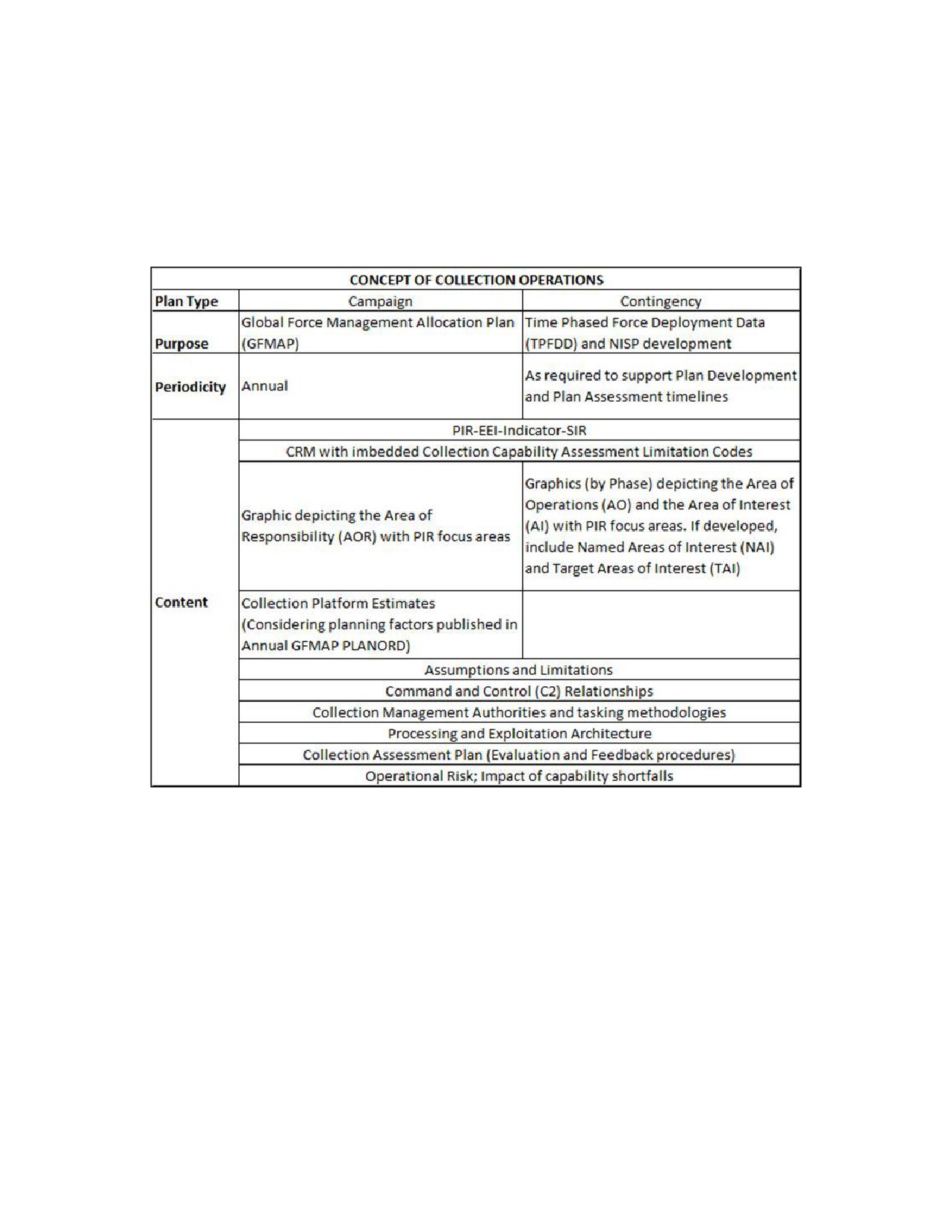
(3) Concept of Collection Operations. The Concept of Collection
Operations described in this manual is based on and inclusive of the ISR
CONOP outlined in reference b. While the ISR CONOP is typically associated
with allocable airborne ISR capabilities, the Concept of Collection Operations is
intended to capture collection activities to be conducted in all domains and
across all collection disciplines. It documents the synchronization, integration,
and employment of all collection capabilities in support of current and future
operations. A component of the Concept of Collection Operations is the CRMx,
which provides the means to identify and address collection capability
shortfalls relative to the CCDR’s PIRs. It outlines command and control
A-5
Enclosure A
CJCSM 3314.01A
17 September 2012
relationships and collection management authorities exercised at the CCMD,
DoD, and ODNI levels, and describes tasking and reporting channels. It is
used to justify requests for the allocation of additional collection capabilities
and the integration of national-level collection resources. Figure 3 compares
the purpose, periodicity, and content of Concepts of Collection Operations
developed for either campaign or contingency plans.
Figure 3. Concept of Collection Operations
e. NISP. The NISP is a Defense Intelligence Enterprise supporting plan to
a CCMD top priority contingency plan that details how the intelligence
capabilities of Combat Support Agencies, Services and other Defense
Intelligence organizations will be employed to meet the CCDR’s stated
intelligence requirements. NISPs may also contain information regarding
intelligence activities to be performed by organizations falling outside of the
Defense Intelligence Enterprise. Supported CCDRs use the NISP to integrate
theater and DoD national-level intelligence capabilities and coordinate
intelligence operations as described in Annex B to the supported plan. It
contains annexes, known as FSPs, from supporting Defense Intelligence
Enterprise agencies and organizations that detail their concept for functional
support. FSPs capture projected personnel augmentation requirements in
A-6
Enclosure A
CJCSM 3314.01A
17 September 2012
response to CCMD capability requests and identify knowledge gaps, capability
shortfalls, and mitigation strategies. A NISP consists of four primary
components: the NISP Basic Plan, prioritized requirements for production and
collection support (i.e., PRM and CRM), capability assessments performed
against these requirements, and FSPs. Refer to Enclosure B for NISP
development procedures, Enclosure I for the NISP format, and Enclosure J for
the FSP format.
f. Annual Joint Intelligence Posture Assessment. The Annual JIPA is a
summarized estimate of the collection and production support CSAs and
Services can provide CCDRs throughout a given year. It is developed in
response to CCDRs’ Annual Statement of Intelligence Priorities (“CCDR’s Top
10”) submitted through the Comprehensive Joint Assessment (CJA) Survey.
Ideally, the “CCDR’s Top 10” should relate to the near-term (0-2 years) and
mid-term (3-8 years) threats and security concerns also reported in the CJA to
inform the development of the Joint Intelligence Estimate. The JIPA contains
annexes from CSAs and Services that describe their steady-state posture to
address CCDR priorities based on the National Intelligence Priorities
Framework (NIPF) in effect at the time. JS J-2 will compile the Annual JIPA
and use it to inform a variety of CJCS resourcing recommendations generated
within the JSPS. CCMDs may use the Annual JIPA to inform follow-on year
planning efforts, Concepts of Collection Operations, and future intelligence
resource requests. Refer to Enclosure C for IP support to Campaign plans.
4. Linkage to APEX. IP is the intelligence component of APEX and is
synchronized with joint operation planning. Joint operation planning consists
of three operational activities: Situational Awareness, Planning, and
Execution. The Planning activity is further subdivided into four planning
functions: Strategic Guidance, Concept Development, Plan Development and
Plan Assessment. Figure 3 provides an overview of joint operation planning
activities, functions, and associated products.
A-7
Enclosure A

CJCSM 3314.01A
17 September 2012
Figure 4. Joint Operation Planning Activities, Functions, and Products
a. Operational Activities
(1) Situational Awareness. Situational awareness consists of the
continuous monitoring of the global situation and identifying current or
anticipated threats to national security. It facilitates the analysis of events and
revisions to relevant intelligence assessments and estimates used to support
deliberate or crisis action planning.
(2) Planning. Planning translates strategic guidance and direction into
campaign plans, contingency plans, and orders. Joint operation planning may
be based on tasks specified in references h and p; the need for a military
response to an unforeseen event, emergency, or time sensitive crisis; or as
directed by the CCDR.
(3) Execution. Execution begins when the President decides to use a
military option to resolve a crisis. Only the President or Secretary of Defense
can authorize the Chairman to issue an execute order (EXORD). The EXORD
directs the supported commander to initiate military operations, defines the
time to initiate operations, and conveys guidance not provided earlier. During
execution, the assessment process allows the CCDR to measure progress
A-8
Enclosure A
CJCSM 3314.01A
17 September 2012
towards the achievement of operational objectives and make decisions
regarding the allocation of resources or the conduct of operations to ensure the
mission remains focused on the end state.
b. Planning Functions. The four planning functions consist of Strategic
Guidance, Concept Development, Plan Development, and Plan Assessment.
During planning, commanders and staffs apply the Joint Operation Planning
Process (JOPP) as an orderly and tested methodology to analyze a mission;
develop, analyze, compare, and select COAs; and develop a plan or an order.
While joint operation planning includes four planning functions, the JOPP
follows seven planning steps. For the purposes of this manual, any mention of
JOPP Step 7, “Plan or Order Development,” will be limited to “Plan
Development.” For more information on the JOPP, refer to reference f.
(1) Strategic Guidance. This function is used to formulate politico-
military assessments at the strategic level; develop and evaluate military
strategy and objectives; apportion and allocate forces and other resources;
formulate concepts and strategic military options; and develop planning
guidance leading to the preparation of COAs. JS J-5 schedules milestones for
all JSCP-tasked plans. At the CCMD level, planning is initiated upon receipt of
strategic guidance. The CCDR in turn may publish a planning order containing
a planning timeline. Upon receipt of the mission, the CCMD J-5 may call for a
meeting of the Joint Planning Group or appropriate planning board, bureau,
cell, committee, or working group (B2C2WG) to alert the staff of the pending
planning effort. The staff prepares for mission analysis immediately upon
notification by gathering the tools required. These tools may include relevant
strategic guidance documents or planning directives, maps of the operational
area, and initial staff estimates. Following mission analysis, the Strategic
Guidance function ends with IPR-A (Strategic Guidance), which will focus on
amplifying guidance and validating assumptions. The CCDR will incorporate
the results of IPR-A into subsequent planning guidance.
(2) Concept Development. Upon receipt of the CCDR’s planning
guidance following IPR-A, the staff develops and analyzes a variety of friendly
options. The staff then compares them against the decision criteria established
by the CCDR and presents them for his approval. The CCDR develops a
Commander’s Estimate, which is a narrative statement with supporting
graphics that broadly outline how forces may be employed to accomplish the
mission. The Commander’s Estimate is the basis for IPR-C (Concept
Development), in which the CCDR reviews the enemy situation and presents
several COAs and options for SecDef approval and further development.
During IPR-C, interagency coordination, multinational involvement, and
capability requirements may also be discussed.
(3) Plan Development. During plan development, the CCMD completes
detailed planning and produces the base plan with required annexes. The
A-9
Enclosure A
CJCSM 3314.01A
17 September 2012
CCMD staff and subordinate commanders conduct deployment, employment,
force, support, and other functional planning; perform comprehensive
feasibility analyses; and perform other actions pursuant to guidance and
direction received during IPRs. Finally, the CCDR submits the plan summary,
basic plan, and required annexes to the Chairman for review by the JPEC.
Following JPEC review, the CCDR will present the plan to the Chairman in a
JCS Tank before briefing the Secretary of Defense in IPR-F (Plan Development).
The intended result of IPR-F is SecDef understanding of plan ends, ways,
means, and risk resulting in approval of the basic plan and required annexes,
the resolution of any remaining key issues, and approval to proceed with plan
execution and assessment (if applicable) with any amplifying guidance or
direction.
(4) Plan Assessment. During Plan Assessment, the CCDR refines the
complete plan while supporting and subordinate commands, Services, and
supporting agencies complete their plans for review and approval. All
commanders continue to develop and analyze branches and sequels as
required. The CCDR and the Joint Staff continue to evaluate the situation for
any changes that would trigger decisions to refine, adapt, terminate, or execute
(RATE) the plan. If required, the CCDR will brief the Secretary of Defense
during IPR-R (Plan Assessment). This plan assessment IPR will address
modifications and updates to the plan based on assessments of the situation
and the plan’s ability to achieve military end states. A key result of this IPR is
dialog with the Secretary of Defense regarding the direction of future planning,
and a RATE recommendation. Plan refinement continues on a regular basis as
circumstances related to the contingency change. Planners frequently adjust
the plan based on evolving commander’s guidance, results of force planning,
support planning, deployment planning, shortfall identification, or revisions to
intelligence assessments and estimates highlighting changes to the operational
environment or to adversary capabilities and intentions. Plan refinement
continues even after execution begins with changes typically transmitted in the
form of fragmentary orders (FRAGOs).
5. The IP Process
a. IP Lines of Effort. Joint and national intelligence activities help identify
and monitor threats to national security, which inform the development of
policy and the Department’s overall planning efforts. Through joint operation
planning, intelligence priorities are further refined to focus the employment of
limited Defense Intelligence resources. Thus, as the intelligence component of
APEX, IP activities are generally organized along two mutually supporting lines
of effort (LOE): providing intelligence support to joint operation planning; and
planning intelligence operations, as illustrated in Figure 5.
A-10
Enclosure A

CJCSM 3314.01A
17 September 2012
Figure 5. IP Lines of Effort
(1) IP LOE # 1: Providing Intelligence Support to Joint Operation
Planning. IP activities along this LOE include the production of intelligence
assessments and estimates of adversary intentions, capabilities, and COAs.
Specific outputs of this LOE are the DIA-produced DTA or TIA and the
development of tailored products from the CCMD’s JIPOE process, which
culminate in the production and maintenance of the CCMD’s Intelligence
Estimate. These finished intelligence products are disseminated to inform joint
operation planning and the development of the Commander’s Estimate,
through which CCDRs provide the Secretary of Defense with military options to
meet strategic objectives. Activities along this LOE are continuous and
typically conducted in parallel to, and in support of, the appropriate CCMD
joint operation planning and assessment B2C2WG.
(2) IP LOE # 2: Planning Intelligence Operations. IP activities along this
LOE include identifying information gaps, prioritizing intelligence
requirements, developing federated production and collection strategies as
required, and identifying intelligence capability shortfalls and mitigation
strategies. Specific outputs of this LOE are: the CCMD J-2 Staff Estimate,
which identifies all available intelligence capabilities under COCOM and their
A-11
Enclosure A
CJCSM 3314.01A
17 September 2012
anticipated shortfalls; CSA and Service Intelligence Center estimates as
requested or appropriate for federated support; the Annex B to a campaign or a
contingency plan; and, when appropriate, a NISP. Additional outputs of this
LOE may include intelligence resource demand signals articulated through the
CCDR’s Integrated Priority List (IPL), Concepts of Collection Operations, Force
Readiness Reporting, or RFF messages. Activities along this LOE are
continuous and typically conducted internal to the command as facilitated by
an IPT led by CCMD intelligence planners who participate directly in joint
operation planning and assessment B2C2WG. To effectively integrate national-
level intelligence support, activities along this LOE are performed ICW CSA and
Service component LNOs, DNI representatives, or the IPSG.
b. IP Activities During Strategic Guidance
(1) IP activities along IP LOE # 1: Intelligence Support to Joint
Operation Planning
(a) DIA will validate, update, or produce a DTA or a TIA.
(b) At the theater level and below, intelligence planners orchestrate
the command’s JIPOE effort to provide a baseline assessment of the operational
environment, adversary capabilities, centers of gravity, vulnerabilities, and
estimated adversary COAs. The analytical cell of the CCMD JIOC evaluates
relevant databases and intelligence holdings to identify gaps relevant to the
planning effort under consideration. This includes the status of targeting
information. The J-2 may form a JIPOE Coordination Cell to draw relevant
information from other staff elements, IC representatives, and partner nations,
as appropriate, as well as request tailored products from the Defense
Intelligence Enterprise. The JIPOE process culminates with the production of
an intelligence estimate which is incorporated into the plan as an appendix to
Annex B. For more information on JIPOE, refer to reference d.
(c) The Red Team should review products that result from the
CCMD’s JIPOE process as well as other externally generated intelligence
products in order to offer alternative assessments.
(d) As core members of the command’s planning and assessment
B2C2WG, theater-level and below intelligence planners contribute to the overall
plan design and nominate operational objectives, desired effects, and other
mission success criteria. In nominating mission success criteria, intelligence
planners also advocate for the adoption of measurable and achievable
objectives while considering how intelligence capabilities might be employed to
assess them.
A-12
Enclosure A
CJCSM 3314.01A
17 September 2012
(2) IP activities along IP LOE # 2: Planning Intelligence Operations
(a) CCMD intelligence planners assemble an IPT or similar
community of interest with all source analysts, target intelligence analysts, and
collection managers as its core members (Figure 6). Intelligence systems
architects, single source analysts, and representatives from CSAs, Service
components, and the Joint Reconnaissance Center (JRC) may also collaborate
with the IPT.
(b) The IPT develops an IP timeline that is synchronized with the
command’s planning timeline. This ensures tailored JIPOE products, the
initial Intelligence Estimate, and the initial J-2 Staff Estimate are developed to
meet the B2C2WG initial planning requirements.
(c) To generate the J-2 Staff Estimate, the IPT, ICW representatives
from Service component or subordinate Joint Force Commanders, identifies
and analyzes intelligence capabilities under COCOM authority available to
support the execution of the plan. For contingency plans, this may include
assigned and apportioned forces. For ongoing operations and steady-state
campaign plans this may include assigned and allocated forces. CSA LNOs
may also contribute to the CCMD’s J-2 Staff Estimate by providing their initial
supportability estimates for consideration early in the planning process.
Conducting this analysis for ongoing operations, steady-state campaigns, and
CAP may inform requests for additional forces.
(d) The IPT evaluates current theater collection and production
posture to identify available assets that may need to be redirected to support
the planning effort or the execution of the plan under consideration. In
collaboration with the CCMD’s collection strategists, J-2X, the JRC, and
representatives from USSTRATCOM’s Joint Functional Component Command
for Intelligence Surveillance and Reconnaissance (JFCC-ISR), the IPT conducts
a preliminary assessment of available collection assets and capabilities. In
collaboration with the CCMD production manager, and representatives from
the JIOC’s analytical cell, the IPT performs an initial assessment of available
analytic capabilities.
A-13
Enclosure A

CJCSM 3314.01A
17 September 2012
Figure 6. Notional IPT and Related Functions
(e) Based on the list of available intelligence capabilities, the IPT
drafts the initial J-2 Staff Estimate, which is submitted to the appropriate
B2C2WG to support the command’s overall force structure analysis. In
addition to listing available intelligence capabilities, the initial J-2’s Staff
Estimate identifies factors that may affect the employment of these capabilities.
Factors such as logistical supportability, basing rights, communications and
intelligence systems architecture, linguist availability, and legal restrictions
should be considered. Certain employment limitations can be mitigated during
COA Development ICW the appropriate B2C2WG. Other limitations however,
may require mitigation through friendly actions outside the control of the
command. In these instances, intelligence planners, in collaboration with the
appropriate B2C2WG, may nominate appropriate planning assumptions. To
validate these planning assumptions prior to COA Approval, they may
nominate initial Friendly Force Information Requirements (FFIR) to the J-5 for
presentation to the commander during planning prior to execution. If left
unanswered prior to completion of Plan Development, initial FFIR should be
submitted to the appropriate B2C2WG to the J-3 for presentation to the
commander as part of the final CCIR to be monitored during Plan Assessment
to inform RATE decisions.
A-14
Enclosure A
CJCSM 3314.01A
17 September 2012
(f) Considering the identified intelligence gaps relevant to the
planning effort and recognizing the uncertainties in analytical conclusions,
intelligence planners, in collaboration with the appropriate B2C2WG, may
nominate additional planning assumptions and initial PIR for validation during
the current planning cycle. Upon consolidation by the J-2 and approval by the
CCDR, initial PIRs are then passed to the IPT for action and coordination with
appropriate mission managers. If left unanswered prior to the completion of
Plan Development, initial PIR should be considered by the J-2 for update and
presentation to the commander as a part of the final CCIR to be monitored
during Plan Assessment to inform RATE decisions.
c. IP Activities During Concept Development
(1) IP activities along IP LOE # 1: Intelligence Support to Joint
Operation Planning
(a) CCMD intelligence planners evaluate JIPOE products to be
disseminated to the appropriate CCMD B2C2WG. The CCMD intelligence
planner or the analyst will present these products orally or submit them to the
appropriate B2C2WG lead in written form in accordance with the established
planning timeline.
(b) CCMD intelligence planners coordinate personnel to participate
in COA Analysis and Wargaming. The CCMD J-2 may employ multiple
representatives to support the appropriate B2C2WG during the wargame.
These may include:
1. Intelligence planner to develop and analyze the overall
intelligence support strategy.
2. Red Cell personnel to emulate the opposition force role of an
uncooperative adversary and Red Team personnel challenge planning
assumptions and provide alternative assessments.
3. Intelligence analyst to capture potential detectable signatures
from which to nominate indicators of progress or regression used in the
command’s assessment process.
4. Collection strategists to initiate the development of a
supporting collection plan.
5. Target intelligence analyst to help develop and analyze the
overall intelligence support strategy, capture potential target intelligence
requirements, initiate target development processes, and assist in PIR, EEI,
and SIR development and evaluating intelligence supportability.
A-15
Enclosure A
CJCSM 3314.01A
17 September 2012
(c) Theater-level and below intelligence planners will also
participate in COA Comparison by determining intelligence governing factors
and highlighting the advantages and disadvantages of each friendly option from
an intelligence supportability perspective.
(2) IP activities along IP LOE # 2: Planning Intelligence Operations
(a) During COA development, theater-level and below intelligence
planners coordinate with appropriate mission managers (to include collection
and production managers) to consider how theater-level and below intelligence
assets and national-level intelligence resources could be employed to support
execution of the plan.
(b) Based on potential adversary reactions (effects) evaluated during
COA Analysis and Wargaming, the CCMD intelligence planner and the
collection manager determine how the various collection disciplines could be
employed to monitor relevant indicators.
(c) The CCMD intelligence planner revises the J-2 Staff Estimate,
capturing additional factors unique to each of the proposed friendly COAs,
which may limit the employment of intelligence capabilities. Once identified,
the CCMD intelligence planner ensures these factors are considered during
COA Comparison.
(d) The CCMD intelligence planner consolidates final PIR
nominations from across the staff and drafts PIRs as required to support CCDR
decisions. During COA Approval, the CCMD intelligence planner recommends
PIR through the J-2 for CCDR approval.
(e) Following COA Approval, the intelligence planner, in
collaboration with the IPT, develops EEIs and associated indicators required to
satisfy the PIR. To maximize support to the commander’s operational
objectives, the IPT integrates and reconciles these requirements with MOEs
and associated indicators developed by the appropriate B2C2WG.
(f) If required, the IPT will use PIRs, EEIs, their associated
indicators, and anticipated SIRs to then generate a PRMx and a CRMx.
(g) The J-2 Staff Estimate process culminates with the CCMD’s
collection and production capability assessments performed against anticipated
requirements entered on the CRMx and PRMx, respectively, as appropriate.
(h) Based on the CCMD J-2 Staff Estimate and in accordance with
reference k, the CCMD J-2 will determine whether a NISP is required and will
request IP support from the JS J-2 to initiate NISP development. The JS J-2 is
responsible for publishing a message announcing the NISP effort and
A-16
Enclosure A
CJCSM 3314.01A
17 September 2012
requesting points of contact from the relevant communities of interest.
Collaboration between the CCMD, JS J-2, CSAs, and Service intelligence
centers is encouraged and can occur at any time during the planning process.
However, the NISP process begins in earnest after the CCMD’s initial draft PRM
and Concept of Collection Operations (with CRMx) are reviewed by the IPSG
and refined as required.
d. IP activities during Plan Development
(1) IP activities along IP LOE # 1: Intelligence Support to Joint
Operation Planning
(a) CCMD intelligence planners coordinate with analysts (including
the Red Team) to complete the Intelligence Estimate. Selected portions of the
Intelligence Estimate are used to complete the Enemy Situation paragraphs
throughout the plan. Reference x contains the revised Annex B format to
include a complete Intelligence Estimate format.
(b) The CCMD J-2 may also provide analytical support and input to
other portions of the plan, to include Annex H, Meteorological and
Oceanographic Operations (METOC), and other annexes as required.
(2) IP activities along IP LOE # 2: Planning Intelligence Operations
(a) The IPT’s lead intelligence planner develops the basic Annex B
that outlines the intelligence mission, concept of intelligence operations, PIRs,
and guidance for how collection, processing & exploitation, analysis &
production, dissemination & integration, and evaluation & feedback will be
performed during execution. The Annex B also details the communications
and intelligence systems architecture and specifies tasks to subordinate
intelligence organizations and requirements for external support.
(b) The appropriate B2C2WG evaluates whether targeting is
necessary to accomplish the operation. If so, the IPT facilitates the
development of Appendix 4 (Targeting) to Annex B.
(c) Intelligence planners collaborate with appropriate mission
managers to develop required functional appendices to Annex B (e.g., J-2X for
Appendix 3, Counterintelligence).
(d) To ensure the collection plan is fully integrated and
synchronized with the contemplated operation, the IPT lead intelligence
planner and collection managers contribute to other portions of the plan, such
as Appendix 8 (Reconnaissance) to Annex C (Operations), Annex S (Special
Technical Operations), and other annexes as required.
A-17
Enclosure A
CJCSM 3314.01A
17 September 2012
(e) If the plan will be supported by a NISP, the lead intelligence
planners from JS J-2 and the CCMD J-2 will co-chair the IPSG and lead the
NISP development, production, completion, staffing, and approval process. For
more information on NISP development, see Enclosure B.
e. IP activities during Plan Assessment
(1) IP activities along IP LOE # 1: Intelligence Support to Joint
Operation Planning
(a) The assessment process is continuous and linked to the CCIR
process by the commander’s need for timely information and recommendations
to make decisions. Intelligence support to plan assessment applies during
steady-state as well as to the execution of military operations. By assessing
the impacts of shaping activities the J-2 supports decisions to refine or adapt
the steady-state campaign plan or to refine, adapt, or terminate “living”
contingency plans. During execution, the J-2 continues to provide support to
assessments that informs FRAGO development reflecting decisions to refine,
adapt, or terminate ongoing military operations.
(b) Normally, the J-3 and the J-5, assisted by the J-2, are
responsible for coordinating assessment activities. Intelligence assessments of
the current situation provide the means for intelligence analysts (including Red
Teams) to draw conclusions of a potential future situation and estimate the
next series of adversary COAs. In so doing, CCMD intelligence planners
coordinate with analysts to revise and maintain a running Intelligence Estimate
to facilitate continuous planning across multiple horizons. These planning
horizons are tailored by the command to best suit the conduct of operations.
For the purpose of assessing steady-state campaign plans, the planning
horizons specified in the CJA are: near-term (0-2 years), mid-term (3-8 years),
and long-term (9-20 years). See Figure 7.
A-18
Enclosure A

CJCSM 3314.01A
17 September 2012
Figure 7. JIPOE Support to Plan Assessment
(c) To facilitate these assessments, CCMD intelligence planners
participate in assessment B2C2WG and coordinate with intelligence analysts to
apply MOEs aimed at determining changes to the operational environment,
system behavior, or adversary capabilities. Following the battle rhythm
established by the Chief of Staff, the J-2 assists the J-3 and J-5 in coordinating
assessment activities. Through these measures, the J-2 supports the
commander in timely decision making by determining if shaping activities
and/or military operations are producing desired or undesired effects, when
objectives have been achieved and when unforeseen opportunities can be
exploited or require a change in planned operations to respond to unforeseen
adversary actions.
(d) MOE assessment is implicit in steps 1, 2, and 3 of the JIPOE
process. By continuously performing JIPOE, intelligence analysts have the
ability to compare the baseline Intelligence Estimate used to inform the plan
with the current situation. MOE assessment is informed through the detection
of observable or collectable indicators which provide evidence that certain
conditions exist. Several indicators may make up an MOE, just like several
MOEs may assist in measuring progress toward achievement of an objective.
Indicators may be either favorable or unfavorable. While favorable indicators
A-19
Enclosure A
CJCSM 3314.01A
17 September 2012
reflect progress towards the achievement of an objective, unfavorable indicators
reflect regression and could provide warning of a potential crisis and the need
to execute a branch plan. For more information on the relationships between
the CCIR process and the assessment process and continuous planning during
execution, refer to reference f.
(e) National-level intelligence support to Plan Assessment prior to the
execution of military operations is primarily provided through the maintenance
and periodic publication of DTAs and TIAs. These products provide a national-
level perspective of the threat and inform RATE decisions for top priority
contingency plans and refinements to selected campaign plans. Additional
Defense Intelligence and National-level intelligence support to Plan Assessment
prior to execution is provided in response to CCMD collection and production
requests and by monitoring I&W and the reporting of critical intelligence.
(f) National-level intelligence support to plan assessment will also
inform the Joint Staff JCCA processes by determining the near-term likelihood
of plan execution. For more information on JCCA, refer to reference v.
(g) Plans for national-level collection and production support to Plan
Assessment during execution are based on the supported CCMD’s anticipated
requirements reflected in the CRM and PRM respectively. During execution,
preplanned collection and production requirements will likely change in
response to dynamic changes to the CCDR’s PIR. In these cases, time
sensitive, ad hoc Requests for Information (RFIs) are submitted in lieu of pre-
planned requirements.
(2) IP activities along IP LOE # 2: Planning Intelligence Operations
(a) When applicable, NISP development lags slightly behind the
development of the supported plan and can be finalized during Plan
Assessment if not completed prior to IPR -F.
(b) Upon completion of the NISP, the CCMD J-2 validates selected
preplanned collection and production requirements and enters them into the
appropriate requirements tasking system such as the Community Online
Intelligence System for End Users and Managers (COLISEUM) and the National
SIGINT Requirements Process (NSRP). Future IP Tool spiral development will
facilitate the dynamic modification and validation of preplanned requirements
for automated submission through appropriate tasking systems. Results of
these tasks are used to update a variety of intelligence products used to inform
RATE. For additional information on steady-state intelligence operations, refer
to Chapter III, reference b.
(c) CCMD Intelligence planners coordinate with analysts (including the
Red Team) as required to ensure their continuous JIPOE efforts are not only
A-20
Enclosure A
CJCSM 3314.01A
17 September 2012
assessing the current situation, but also producing estimates with threat
projections that are synchronized with the planning horizon they are intended
to support. See Figure 7.
(d) The CCMD JIOC will monitor the execution of Defense Intelligence
tasks assigned to supporting organizations and will coordinate with JS J-2 to
ensure satisfaction of requirements specified in the FSPs. CCMD intelligence
planners will maintain a running J-2 Staff Estimate and, if required, update
their capability assessments against new collection and production
requirements.
(e) If a NISP has been produced, the IPSG will coordinate periodic
assessment conferences and events as required. These venues provide the
opportunity for:
(1) Defense Intelligence analysts to provide updated intelligence
assessments with an eye towards gauging the impact of shaping activities.
(2) CCMDs to submit evaluation and feedback data to supporting
organizations and to review and prioritize future collection and production
requirements.
(3) CSAs and Service intelligence centers to provide updated
production and collection assessment matrices as required in response to new
requirements. Significant changes to requirements or supporting capabilities
may be cause to revise the NISP.
(f) The CCMD’s running J-2 Staff Estimate and National-level collection
and production capability assessments will also support JCCA processes and
should be used to inform CCMD risk, readiness posture, IPLs, and other
processes and products within the JSPS used to inform the acquisition and
development of joint capabilities. For additional information on the JSPS, refer
to reference g.
6. Crisis Action Planning. In general, IP activities during CAP will be tailored
to support the orders process based on whether a crisis situation is related to a
contingency plan supported by a NISP, a contingency plan not supported by a
NISP, or if military operations will be conducted in response to unforeseen
situations. For more information on IP support to CAP, refer to Enclosure D.
7. IP Governance
a. IP Governance Board. Referred to in reference k as an “O-6 NISP
Production Board,” IP governance will be achieved by a board of O-6/Planners
co-chaired by the JS J-2 and OUSD(I) and composed of representatives from
CCMDs, intelligence CSAs, and Service intelligence centers. The board will
A-21
Enclosure A
CJCSM 3314.01A
17 September 2012
convene quarterly to evaluate ongoing planning efforts, disseminate best
practices, discuss IP and APEX implementation, schedule new NISP efforts,
and synchronize NISP production and assessment with the IPR, JCCA plan
assessment process, and Joint and National exercise schedules for the
following 6 months. If required, it will address issues and adjust timelines and
Plans of Action & Milestones (POA&Ms). The IP Governance Board is
supported by the action officer level IP Synchronization Team, chaired by the
JS J-2, convened every other week and composed of representatives from
CCMDs, intelligence CSAs, and Service intelligence centers.
b. Intelligence Planning Steering Group. An AO-level IPSG will be formed
for each NISP effort. The IPSG consists of the lead intelligence planners from
the CCMD J-2, JS J-2, and OUSD(I). It is co-chaired by the CCMD and the JS
J-2 representatives. This group works together to guide the NISP production
process. The IPSG produces the POA&M for the NISP effort, coordinates
timelines, sets suspenses and conference dates, and monitors preparations for,
and progress between, conferences. The IPSG also establishes agendas;
conducts conferences, IPRs, and Secure Video Teleconferences (SVTCs); and
resolves issues as they arise. The IPSG oversees the review of NISPs and
makes recommendations for the adjudication of resulting comments. Internal
coordination, collaboration, and free exchange of information within the IPSG
are vital to the successful development of the NISP.
A-22
Enclosure A
CJCSM 3314.01A
17 September 2012
ENCLOSURE B
NATIONAL INTELLIGENCE SUPPORT PLAN DEVELOPMENT PROCESS
1. Purpose. This enclosure details the steps required to develop, staff, and
approve NISPs. It is based on best practices and is intended to serve as a guide
with options that allow the process to be tailored to meet specific CCMD
requirements and circumstances.
2. NISP Components. A NISP consists of a base plan (BPLAN) and a series of
annexes. The exact number and type of annexes will vary depending on the
nature of the supported plan and its requirements for intelligence support.
a. NISP BPLAN. The BPLAN plan provides overall guidance to integrate
and synchronize Defense Intelligence Enterprise support to the supported
CCMD’s plan. It supports the Annex B concept of intelligence operations,
assigns tasks and responsibilities, requests interagency support as required,
and identifies critical information gaps and capability shortfalls. The NISP
BPLAN also describes how the JS J-2 will manage Defense Intelligence tasks to
support the execution of operations. It can also convey information regarding
intelligence activities in support of the planned operation to be conducted by
organizations falling outside of the Defense Intelligence Enterprise.
b. NISP Annexes. See Enclosure I for a listing of common NISP annexes
and Enclosure J for FSP formats.
(1) Prioritized Requirements for Intelligence Support. See the
discussion of the PRMx and CRMx in Enclosure A. The PRMx and the CRMx
are included in Annex A to the NISP and can be included as Appendix 1 to
Annex B as determined by the CCMD J-2.
(2) Capabilities Assessments. Capability assessments represent the
culmination of the staff estimate process for a given planning cycle. They are
conducted by the CCMD JIOC and Defense Intelligence Enterprise, to include
the CSAs, Service intelligence centers, and the Defense CI and HUMINT
enterprises, to determine capability and capacity to satisfy production and
collection requirements entered into the PRMx and CRMx, respectively.
Capability assessments are displayed with, and incorporated into, the
supported PRMx or CRMx in Annex A of the NISP.
(3) Functional Support Plans. An FSP is an intelligence agency/
organization/enterprise’s annex to a NISP that describes the intelligence
capabilities and concept for their employment in support of the CCMD plan.
B-1
Enclosure B
CJCSM 3314.01A
17 September 2012
The FSP also identifies critical information gaps, intelligence capability
shortfalls, and mitigation strategies, in support of the CCMD mission.
3. NISP Initiation
a. Based on the CCMD J-2 Staff Estimate, and in accordance with
reference k guidance, the CCMD J-2 determines whether a NISP is required
and requests IP support from the JS J-2. In turn, the JS J-2 will coordinate
with the other members of the IPSG to determine which supporting agencies
will be required for the effort and then publishes a message initiating the NISP
effort.
b. Upon receipt of the JS J-2’s NISP initiation message, participating
organizations will review initial CSA/Service estimates provided to the CCMD
during Mission Analysis. These estimates will reflect their current posture and
capabilities relevant to steady state support of the CCMD plan. This includes a
review of current collection and production tasks to support the plan. These
estimates should also consider assumptions and factors affecting the
employment of Defense/National-level intelligence resources during execution
phases. In the case of an update to a plan with an existing NISP, the NISP and
its FSPs will serve as a point of departure.
4. Requirements Development
a. PRMx Development. Analysis and production (A&P) tasks to support the
CCMD’s plan are compiled in the PRMx. At this stage, the CCMD will divide
the initial PRMx into requirements that will be performed solely by the CCMD
and its components, and those that it will coordinate with the IPSG for
validation, refinement if required, and subsequent federated production
planning.
b. CRMx Development. Anticipated collection requirements, expressed as
SIRs, will be compiled into a CRMx and submitted to the IPSG for validation,
refinement if required, and subsequent integrated collection planning efforts.
The CRMx will be refined in subsequent planning cycles as supporting analytic
centers identify additional collection needs. Collection planning should be
focused on the indicators of anticipated activity along with associated SIR. To
the maximum extent possible, anticipated SIRs should be refined to a level that
that would allow them to be assigned to the appropriate collection discipline.
To that end, SIRs should yield collection target characteristics in terms of
observables or collectables.
c. Concept of Collection Operations. In addition to the CRMx, the CCMD
J-2 will generate and submit to the JS J-2 a Concept of Collection Operations
as described in Enclosure A.
B-2
Enclosure B
CJCSM 3314.01A
17 September 2012
5. NISP Planning Conferences
a. The IPSG will determine the number and type of NISP planning
conferences and SVTCs required for each planning effort and include them in
the POA&M. There is no fixed number of conferences required for NISP
development; the number will vary depending on the nature of the plan, the
location of the CCMD, time available, and other factors. The IPSG will
determine the duration, timing, location, participants, agenda, and desired
outcomes for each conference. It should be stressed that the majority of the
NISP development effort occurs offline and that NISP Planning conferences
(whether conducted in person or virtually) are not intended to serve as the
primary planning venues. NISP planning conferences should be scheduled on
the POA&M as a forum to present the results of planning activities conducted
in between conferences or to discuss issues that if not resolved would affect the
NISP development POA&M. Once details are finalized, the JS J-2 will publish a
message announcing the conference.
b. NISP Conference Participation. Representation from the following
organizations should be considered when planning a NISP conference.
(1) CCMD J-2, J-5, JIOC, and other staff elements. Joint Task Force J-
2 and/or Service component commands as appropriate.
(2) Joint Staff J-2 and OUSD(I).
(3) Intelligence Combat Support Agencies (CSA): DIA, National
Geospatial-Intelligence Agency (NGA), and National Security Agency (NSA).
(4) Service Intelligence Centers: National Ground Intelligence Center
(NGIC), Office of Naval Intelligence (ONI), Marine Corps Intelligence Activity
(MCIA), and National Air and Space Intelligence Center (NASIC).
(5) Other organizations, as appropriate: Supporting commands,
subordinate and sub-unified commands, and other supporting DoD elements
and non-DoD agencies. Partner nations can be included if the classification of
the plan and the material to be discussed permits.
c. Briefings and discussions during plenary sessions of the conferences
provide a baseline of knowledge and understanding of the issues. The
conferences also provide subject matter experts, with an opportunity to develop
or expand communities of interest. Participation by CCMD JIOC and Defense
Intelligence Enterprise analysts is critical during PRMx development and
capability/capacity assessments. Collaboration between CCMD and JS J-2
intelligence planners, CCMD and Defense collection managers, and
representatives from single discipline agency/organization is critical for the
refinement of collection requirements and the development of an integrated
B-3
Enclosure B
CJCSM 3314.01A
17 September 2012
collection plan. An executive outbrief to the CCMD J-2 or other seniors is often
conducted at the end of a conference.
d. Working Groups. In addition to plenary sessions at conferences,
working groups (WGs) may be established for particular issues such as the
development of an appropriate communications and intelligence systems
architecture, the refinement of the PRMx or the development of collection
requirements and associated strategies. These WGs can meet during or
between conferences or virtually (e.g. SVTC, Tandberg, or by e-mail) to form
electronic communities of interest.
e. After conferences or WG meetings, the JS J-2, in coordination with the
other members of IPSG, will issue a message summarizing the results,
capturing any tasking and providing an updated POA&M, if required.
6. NISP Development
a. NISP Development. Development of the NISP is based on the supported
CCMD’s intelligence requirements (to include CCDR-identified PIRs), their
associated information requirements (to include EEIs), concept of intelligence
operations, and the CCMD J-2 Staff Estimate of available capabilities to satisfy
the anticipated requirements entered on a draft PRM and CRM. The IPSG
establishes the POA&M for NISP production and deliverables. Coordination
may occur online, via SVTC, or via conference. Formal coordination occurs via
electronic message.
b. Initial Coordination. The IPSG will conduct initial coordination with
supporting agencies either through an initial NISP development conference or
via SVTC. The intent is to socialize the CCMD plan and its Annex B
requirements among Defense Intelligence Enterprise participants and begin
NISP development. The IPSG will establish the agenda as well as ensuring
conference outcomes/deliverables are developed and methodologies for
achieving the outcomes are defined. The JS J-2 publishes a message
announcing the initial conference to addressees expected to participate in NISP
development. Following the conference and the distribution of refinements to
the PRM and Concept of Collection Operations (w/CRM), JS J-2 will task
participating organizations and set suspenses in accordance with the agreed
POA&M via the JSAP process. The conference will include, but is not limited
to, the following information briefings:
(1) DIA/DI briefs the highlights of the applicable DTA.
(2) CCMD provides an overview of their Intelligence Estimate and the
status of their JIPOE effort to date.
B-4
Enclosure B
CJCSM 3314.01A
17 September 2012
(3) CCMD J-2 outlines their concept of intelligence operations,
capability assessments, and identified capability shortfalls resulting in requests
for support from the broader Defense Intelligence Enterprise and operational
risk determinations if capabilities gaps are not mitigated.
(4) The JS J-2 briefs the POA&M for NISP production which identifies
key milestones and deliverables.
7. NISP Production
a. PRMx and CRMx Refinement. During NISP production, the CCMD will
consider recommendations from Defense Intelligence Enterprise participants to
continue to refine their anticipated production and collection requirements.
b. Assignment of Analytic Responsibilities. The CCMD passes the draft
PRMx to the JS J-2 for coordination with the IPSG. The IPSG identifies
analysis and production responsibilities in accordance with the Defense
Intelligence Analysis Program (DIAP) and tentatively identifies collaborating
DoD and non-DoD agencies. DIA/DI will confirm these assignments and
adjudicate DIAP disputes. Based on best practices, the nomination of
Responsible Analytic Centers (RAC) and Collaborative Analytic Centers (CAC)
before a planning conference can accelerate and simplify the PRM process.
However, the CCMD and the Defense Intelligence Enterprise must have an
opportunity to review these recommendations and provide additional input.
A&P capability assessments are performed prior to the final assignment of
analytic responsibilities. A NISP Production Conference may be held to finalize
the PRM. Where DoD capability is minimal or lacking, the JS J-2 may identify
a non-DoD agency as a potential source; however, their participation is
voluntary. Participants can also propose adjustments to the PRMx. After these
issues are resolved, the IPSG will review and consolidate the various inputs
and post an updated PRMx.
c. Assignment of Collection Responsibilities. The lead CCMD intelligence
planner coordinates the draft Concept of Collection Operations (to include the
CRMx) with the IPSG. The IPSG, in coordination with CCMD and Defense-level
collection managers, ISR planners, and representatives from single discipline
intelligence entities, tentatively identify the collection capabilities that could be
employed to satisfy anticipated collection requirements by phase. Collection
capability assessments are performed prior to the assignment of primary and
alternate collection responsibilities. In some cases, tipping and cueing
responsibilities may also be considered to enable collection against designated
collection targets. Where DoD collection capabilities are minimal or lacking, a
non-DoD agency may be identified as a potential source; however, their
participation is strictly voluntary. An NISP Production Conference may be held
to finalize the CRMx.
B-5
Enclosure B
CJCSM 3314.01A
17 September 2012
d. The preferred means of PRMx and CRMx dissemination is the
automated IP Tool, which should be used as early as possible in the NISP
development process. The IP Tool facilitates collaboration and the recording of
capability assessments to be included in the NISP. Once the data is entered
into the IP Tool it is easily displayed and manipulated in various views and
formats. The IP Tool accommodates several prioritization schemes, including
priority banding and ordinal prioritization at the production task or subtask
level. Future spirals of the IP Tool will facilitate the prioritization of anticipated
collection requirements. Prioritization of collection and production
requirements entered into the IP Tool is essential to focus the collection and
production effort and to prevent the employment of available capabilities on
topics of limited or peripheral interest to the CCDR.
e. Capability Assessments
(1) General. Capability assessments are integral elements of the J-2
and CSA/Service staff estimate processes. As the planning process unfolds
and staff estimates are revised, so too are the capability assessments. The J-2
Staff Estimate process culminates for a given planning cycle with the CCMD’s
collection and production capability assessments performed against their
anticipated requirements. Likewise, the CSA and Service intelligence center
estimate process culminates following the completion of their respective
capability assessments. Once the CCMD enters their requirements into the IP
Tool, participating organizations can initiate their capability assessments. The
IPSG will determine the scope of these assessments based on the nature and
level of detail of the supported plan. To the extent possible, requirements for
contingency plans should be assessed for all phases of the operation. For
contingency plans developed without a phasing model, capabilities will be
assessed against requirements leading up to the established termination
criteria. Assessing capabilities required to support execution phases will
require tailoring the requirements to the appropriate phase. Additionally,
intelligence planners and analysts should agree on a series of assumptions to
forecast the situation at a particular phase of the operation and the availability
of relevant forces and associated intelligence capabilities at those phases. COA
Analysis and Wargaming results may provide the basis for making
assumptions related to the execution phases. Detailed capability assessment
procedures are described in Enclosure F.
(2) Collection and Exploitation (C&E) Capability Assessments. Effective
C&E capability assessments rely on the level of specificity of the anticipated
collection tasks to be satisfied. For this reason, anticipated SIRs should
include anticipated focus areas (typically expressed as Named Areas of Interest
or Target Areas of Interest) and should yield target characteristics (i.e.,
observables or collectables). The CCMD intelligence planner, in collaboration
with relevant members of the IPT, conducts initial C&E capability assessments
within the context of the J-2 Staff Estimate process. The CCMD’s initial C&E
B-6
Enclosure B
CJCSM 3314.01A
17 September 2012
capability assessments are refined as the Collection/ISR Working Group
develops an integrated collection and, if required, a federated exploitation plan
with an associated communications and intelligence systems architecture. The
CCMD can help focus C&E capability assessments by developing Concept of
Collection Operations including graphics depicting collection focus areas for
the various phases of the operation.
(3) A&P Assessments. Organizations with A&P responsibilities can
begin their capability assessments to support the PRMx in parallel with C&E
capability assessments. However, these assessments should be informed by
the C&E assessments which can be viewed as they are entered into the IP Tool.
The A&P and C&E capability assessments will be reviewed and reconciled by
the relevant RACs in coordination with the IPSG before NISP staffing.
f. Functional Support Plans. During NISP production, supporting
agencies/organizations draft their FSPs to describe their concept of intelligence
operations to meet CCMD intelligence requirements. Based on their
assessments of individual requirements, the agencies will identify significant
knowledge gaps and capability shortfalls. Where possible, the FSPs will also
identify mitigation strategies to address these gaps and shortfalls. Unmitigated
gaps and shortfalls will translate into risk to the supported plan. FSPs also
cover operational support issues such as augmentation, communications and
intelligence systems architecture, federated support arrangements, and
deployment of elements into the CCMD area of responsibility (AOR). The FSPs
should also address any major support requirements specifically identified in
the CCMD’s Annex B and its discipline-specific Appendices. Non-DoD
intelligence agencies or activities that participate in the capability assessment
process are not required to produce a FSP.
g. NISP Production Conference (NPC). If the CCMD in coordination with
the IPSG decides to hold a NISP Production Conference, the IPSG determines
the methodology for a conference or VTC announcement. The purpose of the
conference is to finalize the PRMx and CRMx, resolve remaining issues, and
synchronize the CCMD’s concept of intelligence operations and Defense
Intelligence Enterprise concepts of intelligence support. At a minimum, the
following briefings should be considered in the agenda:
(1) CCMD J-2 briefs changes or updates to the BPLAN or Annex B, and
discusses information gaps, capability shortfalls, mitigation strategies, and
operational risk determinations if critical capability shortfalls are not mitigated.
(2) CCMD J-2 and JS J-2 review the PRMx and CRMx and resolve any
remaining issues concerning the assignment of analytic or collection
responsibilities.
(3) Supporting agencies brief their concept of intelligence support.
B-7
Enclosure B
CJCSM 3314.01A
17 September 2012
8. NISP Completion
a. Finalize PRMx, CRMx, and Capability Assessments. The IPSG ensures
that the final requirements and capability assessment have been entered into
the IP Tool.
b. Complete the FSPs and NISP Base Plan (BPLAN). The IP participants
complete their FSPs. The JS J-2 completes the NISP BPLAN with emphasis on
identifying significant gaps and shortfalls as well as mitigation strategies and
risks. The CCMD J-2 then reviews the draft NISP basic plan, PRMx, CRMx,
and FSPs to ensure they are synchronized with Annex B and support the
CCDR’s decision requirements and the assessment of progress towards the
accomplishment of objectives. The JS J-2 will work with the supported CCMD
to determine the best avenue to engage other non-DoD organizations that may
be able to assist filling the remaining gaps and determine the risk associated if
no mitigation strategy exists. DIA Directorate for Information Management
(DS) draws on the CCMD J-2-developed Communications and Intelligence
Systems Architecture and, in coordination with supporting agencies, finalizes
the Communications and Intelligence Systems Architecture FSP.
c. NISP Completion Conference/SVTC(s). If conducted, a final NISP
Conference or SVTC(s) will provide a venue to review the complete NISP and
brief its content to the CCMD J-2 or a designated representative. Briefings
should highlight critical information gaps, capability shortfalls, and mitigations
strategies.
9. NISP Staffing and Approval. If possible, the completed NISP with all
Annexes (Requirements, Capability Assessments, and FSPs) will be submitted
for JPEC review ICW the staffing of the supported plan prior to IPR-F. If
concurrent staffing is not feasible, JS J-2 will formally staff the NISP using the
JSAP process in accordance with reference y. JS J-2 will ensure the review
package includes the NISP BPLAN, Annexes to the NISP, and the supported
plan’s BPLAN, Annex B, and Annex C. NISPs should be evaluated following the
JPEC review criteria outlined in references f and l. The purpose of this staffing
is to ensure that the NISP supports the CCDR’s requirements and that it is
complete, operationally and technically feasible, and supportable.
a. Step 1: Action Officer (AO) Review. The JS J-2 will conduct an informal
AO review of the final draft NISP BPLAN, Requirements, Capability
Assessments, and FSPs with the supported CCMD and supporting intelligence
organizations via e-mail. The intent is to identify and resolve substantive
issues as well as correct administrative and format errors. AO-level review can
occur in conjunction with the NISP Completion Conference/SVTC.
b. Step 2: Planner (0-6) Review. The JS J-2 will formally staff the NISP
with Annexes using the JSAP system in accordance with reference y. All
B-8
Enclosure B
CJCSM 3314.01A
17 September 2012
critical comments require endorsement by a GO/FO or SES. Depending on the
quantity and level of the comments received during the initial staffing, a second
planner review may be required as coordinated with and determined by the
IPSG.
c. Step 3: Adjudication. The JS J-2 will lead the IPSG’s adjudication of
comments and, following IPSG concurrence, submit a consolidated comment
resolution matrix with recommended adjudications to the appropriate JS J-2
division chief or designated O-6/GG-15 level representative for approval.
Attempts to resolve critical comments will first take place at the O-6/GG-15
level and, if required, be elevated to the JS J-2 or designated GO/FO/SES for
resolution. When adjudication is complete, the JS J-2 will disseminate the
approved comment resolution matrix and post the revised NISP.
d. Step 4: CCDR Approval. After adjudication is complete, the Joint Staff
will forward the NISP with annexes to the CCMD, requesting approval by the
CCDR or his designated GO/FO/SES representative. The Joint Staff
transmittal memo will state that the NISP was developed in close coordination
with the CCMD J-2 staff, has undergone a formal review, that all comments
have been adjudicated, and that remaining issues for this planning cycle have
been resolved. CCMD concurrence and approval is documented with an
approval memo. Once the CCDR or his designated GO/FO/SES signs the
approval memo, the NISP process is complete. The NISP is posted to the JS J-2
portal and electronically disseminated.
e. Step 5: Post-approval processing. Once complete, JS J-25 forwards the
NISP packet, including the CCMD’s memorandum of approval, to the FSP
producers to secure agency director signatures on the FSPs. As these are
received, the signed copies are posted to JS J-25 portal.
B-9
Enclosure B
CJCSM 3314.01A
17 September 2012
(INTENTIONALLY BLANK)
B-10
Enclosure B
CJCSM 3314.01A
17 September 2012
ENCLOSURE C
INTELLIGENCE PLANNING IN SUPPORT OF CAMPAIGN PLANS
1. Purpose. IAW reference k guidance, NISPs in support of CCDR campaign
plans are no longer required. Beginning in FY 2013, one annual JIPA will be
generated in lieu of these NISPs. This enclosure outlines procedures for the
identification and prioritization of steady-state intelligence requirements and
the development of the annual JIPA.
2. Campaign Plan Overview. CCDRs are tasked to operationalize their
strategies through the development and execution of campaign plans that
integrate, synchronize, and prioritize daily activities, including security
cooperation and Phase 0 actions, to achieve reference p’s prioritized end states.
Campaign plans also serve as the vehicle for conducting comprehensive
assessments of how the conduct of these activities are contributing to the
achievement of IMOs and GEF strategic end states.
3. Resource Requirements and Intelligence Support
a. CCDRs use their campaign plans to articulate resource requirements in
a comprehensive manner instead of on an incremental basis. To that end, IP
support to campaign plans provides the means for CCDRs to: prioritize
intelligence requirements across all ongoing operations and contingency
planning efforts; generate requests for allocable intelligence resources; and
determine the level of intelligence support required from CSAs and Service
intelligence centers.
b. Figure 8, derived from JSCP Figure E1, illustrates the relationships
between a CCMD TCP, its Subordinate Campaign Plans (SCP), ongoing
operations, JSCP-tasked contingency plans, CCDR-directed contingency plans,
and other AOR security concerns for which no plans have been developed.
When viewed in the aggregate, the intelligence support these problem sets
require exceeds available collection and production capacity. To more
effectively inform resource allocation decisions and to optimize the steady-state
employment of available Defense Intelligence Enterprise resources, CCMDs will
evaluate intelligence requirements and forecast near-term, steady-state
intelligence priorities annually through the CJA survey.
c. When identifying and nominating steady-state intelligence priorities,
CCMD intelligence planners evaluate the relative priority of intelligence
requirements across all plans, and operation orders and fragmentary orders in
execution, and other threats or security concerns for which no contingency
plans have been developed. In so doing, they may consider: the likelihood of a
C-1
Enclosure C
CJCSM 3314.01A
17 September 2012
threat event occurring or the security concern materializing; the impact of the
forecasted event or security concern, to include the likelihood of triggering
other CCMD contingency plans; the criticality of the supported decision; and
the confidence levels required to inform said decisions. Generally speaking,
steady-state intelligence requirements include the following:
(1) Intelligence requirements developed to support theater and global
assessments and gauge the impact of shaping activities consistent with IMOs.
These intelligence requirements support Plan Assessment and inform decisions
to refine or adapt campaign plans.
(2) Intelligence requirements developed to support the assessment of
SCPs. These intelligence requirements should be aligned with those of Global
Campaign Plans (GCPs) and are designed to assess progress towards the
achievement of GCP IMOs and their associated end states.
(3) Intelligence requirements developed to drive collection and
production efforts to ensure “living” contingency plans remain current and
viable for execution at any time. These intelligence requirements support Plan
Assessment and inform decisions to refine, adapt, or terminate a given
contingency plan.
(4) Intelligence requirements developed to maintain situational
awareness on evolving trends, or other anticipated threat events or security
concerns reported in the CJA, for which no contingency plans have been
developed.
(5) Intelligence requirements that monitor indicators and provide
warning of potential crises. These intelligence requirements are designed to
monitor “triggers” that support Plan Assessment and inform decisions to
execute a given contingency plan.
(6) Intelligence requirements to support ongoing execution of military
and stability operations. These intelligence requirements support Plan
Assessment and inform critical decisions typically published in FRAGOs.
C-2
Enclosure C

CJCSM 3314.01A
17 September 2012
Figure 8. Notional TCP Framework
4. Annual Joint Intelligence Posture Assessment
a. Purpose. The intent of annual JIPA is twofold: inform CCDRs steady-
state planning by describing the ability of intelligence CSAs and Service
intelligence centers to provide intelligence support and to inform CJCS
recommendations for the annual allocation of Defense Intelligence resources.
b. Articulation of Forecasted Intelligence Priorities
(1) The CJA survey will serve as the means for CCMDs to articulate
annually-forecasted, steady-state intelligence priorities. Once the relative
priority of intelligence requirements across all plans, operations, and security
concerns has been determined, CCMDs will submit their “CCDR’s Top Ten”
intelligence priorities to the JS J-2 via the CJA survey tool. The degree of
specificity or refinement of each of the “CCDR’s Top 10” intelligence priorities
will typically be limited to the association of an NIPF topic with a NIPF actor
that will be used as points of departure for more focused collection and
production requirements to be submitted throughout the course of the fiscal
year.
(For more information regarding topic definitions, refer to the NIPF
Intelligence Topic Information Needs).
(2) The CCDR’s Top 10 does not prevent CCMDs from submitting
collection and production requirements to CSAs and Service intelligence
centers in support of other topics of lesser priority, nor does it prevent CCDRs
from updating their priorities throughout the course of the year as dynamic
changes occur in the strategic environment. The purpose of identifying all
C-3
Enclosure C
CJCSM 3314.01A
17 September 2012
CCDRs’ intelligence priorities simultaneously is to evaluate them against the
NIPF in effect at the time, determine the annual, baseline assessment of the
Defense Intelligence Enterprise to satisfy them, and to inform follow-on year
force requests and allocation decisions with the goal of optimizing the
employment of theater assets and national-level resources.
c. Development of the JIPA
(1) No later than 15 days following the receipt of annual CJA Survey
data, the JS J-2 will disseminate a consolidated list of CCDRs’ “Top 10” to
intelligence CSAs and Service intelligence centers. To enhance situational
awareness and to advocate on behalf of CCDRs, the JS J-2 will disseminate
these intelligence priorities to other Defense Intelligence Enterprise
organizations and the ODNI. Intelligence CSAs and Service intelligence centers
will evaluate the consolidated list of CCDRs’
“Top 10” against their steady-
state posture and provide brief descriptions in response to each of the CCDRs’
stated priorities based on the NIPF in effect at the time. In evaluating CCDR
priorities, single discipline intelligence entities consider existing collection
programs and capabilities with access to potential collection targets and/or the
ability to acquire raw data and process it into useable information related to
CCDRs’ intelligence needs. All-source and single-source analytic centers
consider factors such as levels of effort associated with CCDR priority topics,
annual production plans if developed, or production that might be scheduled
as a part of relevant UIS.
(2) No later than 60 days following receipt of the consolidated list of
CCDRs’ “Top 10,” intelligence CSAs and Service intelligence centers will submit
to JS J-2 their respective supportability estimates in the form of an Information
Memorandum with command-specific enclosures. Enclosures will provide brief
descriptions of their ability to address each of the CCDR’s priorities. Brief
descriptions should not exceed one paragraph in length and should include
supporting organizations’ analyses of the CCDR’s topic against the NIPF in
effect, current collection programs and capabilities, analytic levels of effort and
scheduled production. Given the relationships between TCPs and GCPs, it is
likely that CCDRs’ intelligence priorities may overlap. In these cases,
supporting organizations may use the same description for multiple CCMDs. If
a particular CCDR intelligence priority is not related to the mission of a
supporting organization, they will state so by entering “N/A” in the appropriate
subparagraph. If a supporting organization has capabilities that are limited to
the extent that a description is not practical, “NSTR” should be used.
(3) Upon receipt of CSA and Service intelligence center supportability
estimates, JS J-2 will consolidate inputs and publish a summary
memorandum assessing the ability of the Defense Intelligence Enterprise to
satisfy CCDR’s top intelligence priorities.
C-4
Enclosure C
CJCSM 3314.01A
17 September 2012
d. Utilization of the JIPA. The JIPA is developed to inform CCDRs of the
ability of the Defense Intelligence Enterprise to satisfy the steady-state
intelligence priorities identified across all ongoing operations and planning
efforts and to facilitate risk determinations. To that end, the CCMD JIOC
leadership may use the annual JIPA to inform: readiness assessments and
reports; IPLs; follow-on year Concepts of Collection Operations prepared in
response to the annual GFMAP PLANORD; and the effective steady state
management of the JIOC and the theater intelligence enterprise. The JS J-2
will integrate the JIPA into a variety of Joint Strategic Planning System
processes to inform the Chairman’s recommendations for the allocation of
resources or the development of required joint intelligence capabilities and as
an input to the ODNI’s Global Coverage Study/Decision Aid Framework.
C-5
Enclosure C
CJCSM 3314.01A
17 September 2012
(INTENTIONALLY BLANK)
C-6
Enclosure C
CJCSM 3314.01A
17 September 2012
ENCLOSURE D
INTELLIGENCE PLANNING IN SUPPORT OF CRISIS ACTION PLANNING
1. Purpose. This enclosure describes the intelligence activities required to
support CAP. A crisis is defined as an incident or situation involving a threat
to the United States, its citizens, military forces, or vital interests that develops
rapidly and creates a condition of such diplomatic, economic, or military
importance that commitment of military forces and resources is contemplated
to achieve national objectives. CAP is defined as the APEX system process
involving the time-sensitive development of joint operation plans and operation
orders for the deployment, employment, and sustainment of assigned and
allocated forces and resources in response to an imminent crisis. CAP
procedures are employed when a contingency response is anticipated to be
executed in 12 months or less.
2. Overview of Crisis Action Planning
a. Relationship to Deliberate Planning. Deliberate planning supports CAP
by anticipating potential crises and operations and developing contingency
plans that facilitate transition to execution planning. Deliberate planning
prepares for hypothetical situations and is heavily dependent on assumptions
regarding the threat and the availability of friendly forces. On the other hand,
during CAP, some planning assumptions are replaced with facts and the actual
conditions that exist at the time. Deliberate planning results in the
development and maintenance of “living” plans. Conversely, CAP can result in
the development and issuance of orders, or revert to a “living” plan status.
b. CAP Activities and Functions. CAP follows the same operational
activities and functions that apply to deliberate planning (see Figure 4).
However, depending on the time available some steps may be compressed or
eliminated altogether.
(1) Situational Awareness. As with Deliberate Planning, Situational
Awareness provides the means for CCMDs to continuously monitor their
respective AORs and to identify indicators of incidents that could develop into a
crisis. Once an event has occurred, the CCDR issues an operational report
(OPREP-3) PINNACLE to advise the chain of command. Upon receipt of the
OPREP, the Chairman provides an assessment of the situation from the
military point of view to the President and the Secretary of Defense. The
supported CCMD continues to monitor the situation and provide updates as
required. Depending on the urgency of the situation, the CCDR’s assessment
may include a recommended COA(s). At this point, options for action include:
continued monitoring, increased reporting, gathering additional information,
D-1
Enclosure D
CJCSM 3314.01A
17 September 2012
publishing a CJCS WARNORD to initiate more detailed planning, or return to
pre-crisis situation monitoring.
(2) Planning. The Planning activity normally begins with the issuance
of a CJCS WARNORD, PLANORD, or Alert Order (ALERTORD) indicating that a
threat to national security exists or a response is warranted. Planning consists
of two parts: COA Development and Detailed Plan Development.
(a) Under CAP procedures, COA Development begins with mission
analysis, the issuance of CCDR’s planning guidance, and the development of
staff estimates. COA Development ends with the preparation of a
Commander’s Estimate with COA recommendations for the Chairman,
Secretary of Defense, and President to consider.
(b) The Chairman may issue a PLANORD to direct the initiation of
detailed planning pending COA approval by the President or Secretary of
Defense. Upon COA approval, the Chairman issues an ALERTORD conveying
the Presidential or SecDef decision. Following the receipt of a PLANORD or
ALERTORD, the supported CCDR expands the approved COA into a detailed
Operation Order (OPORD) and sourced time-phased force deployment data
(TPFDD). To facilitate detailed OPORD development, the supported CCDR may
modify an existing OPLAN or expand an existing CONPLAN. In the event of an
unforeseen crisis situation, the supported CCDR develops an OPORD from
scratch without the benefit of an existing OPLAN.
(3) Execution. Execution begins when the President or the Secretary of
Defense decides to execute a military option in response to a crisis. The
Chairman issues an EXORD conveying the decision and to direct the
deployment and employment of forces. The CJCS EXORD also defines the
timing for the initiation of operations and conveys guidance not provided
earlier. In turn, the supported CCDR issues an EXORD to supporting and
subordinate commanders and directors of CSAs. Supporting and subordinate
commanders and directors of CSAs execute their respective OPORDs and
conduct operations to accomplish assigned missions. The Chairman monitors
the deployment and employment of forces, acts to resolve shortfalls, and
directs actions as needed to ensure successful completion of military
operations. If the crisis is prolonged, the CAP process may be repeated
continuously as circumstances and missions change. For additional
information on CAP, refer to Enclosure E, reference n.
3. IP Activities During CAP
a. Potential Crisis Scenarios. In general, IP activities during CAP will be
tailored to support the orders process based on whether a crisis situation is
related to a contingency plan that is supported by a NISP, a contingency plan
D-2
Enclosure D
CJCSM 3314.01A
17 September 2012
that is not supported by a NISP, or if military operations will be conducted in
response to unforeseen situations.
(1) Crisis Situation with a Contingency Plan Supported by a NISP. If
the crisis is related to the scenario of a contingency plan that is supported by a
NISP, the NISP and the CCMD Annex B will serve as the basis for Defense
Intelligence Enterprise’s response and continued planning during the execution
of military operations. Upon the issuance of a CJCS PLANORD or ALERTORD,
the CCMD J-2 will determine which portions of the Annex B require
modifications to support the approved COA. The CCMD J-2 will coordinate
with the JS J-2 to determine which portions of the NISP may require changes.
Paragraph 3 (Execution) of the basic NISP will detail how the JS J-2 will
manage intelligence support to the CCMD during the execution of military
operations. The IP Tool will enable virtual, real-time collaboration between the
supported CCMD J-2, the JS J-2, and supporting organizations for the purpose
of modifying the pre-existing federated production plan and, if developed, an
integrated collection plan. The IP Tool will also enable the CCMD J-2 to submit
and the JS J-2 to manage crisis-related RFIs related to pre-planned production
requirements.
(2) Crisis Situation with a Contingency Plan without a NISP. If the
crisis is related to the scenario of a contingency plan that is not currently
supported by a NISP, the updated Annex B will serve as the basis for Defense
Intelligence Enterprise’s initial response, and continued planning during
execution. In this situation, the CCMD J-2 will determine which steps of the IP
process offer immediate benefit and can be executed in the time available. The
IP Tool will enable virtual, real-time collaboration among the supported CCMD
J-2, the JS J-2, and supporting commands and organizations for the purpose
of developing a federated production plan and an integrated collection plan for
high priority collection targets.
(3) Unforeseen Crisis Situation. If an unforeseen crisis emerges for
which no contingency plan exists, CCMD J-2s will follow CJCS and CCDR
planning guidance and will coordinate requests for external support through
the JS J-2 as required. The CCMD J-2 will determine which steps of the IP
process can be executed in the time available. When the urgency of the
situation does not allow for the development of an Annex B and/or supporting
OPORDs from directors of intelligence CSAs, the IP Tool will enable virtual,
real-time collaboration among the supported CCMD J-2, the JS J-2, and
supporting organizations for the purpose of developing a crisis federation.
b. IP Lines of Effort (LOE). The IP activities organized along the two IP
LOEs discussed in Enclosure A also apply to CAP. Depending on the situation,
these activities may be performed on an accelerated basis (i.e., “Fast Track”)
and under some circumstances certain steps of the IP process may be omitted.
D-3
Enclosure D
CJCSM 3314.01A
17 September 2012
The following paragraphs offer exceptions to the IP activities previously
discussed in Enclosure A.
(1) IP LOE # 1: Intelligence Support to Joint Operation Planning
(a) DIA will update an existing DTA or produce appropriate strategic
level intelligence assessments tailored to the crisis, such as an Intelligence
Summary, that will be used to inform CJCS and CCMD-level CAP procedures.
(b) CCMD intelligence planners will coordinate with JIOC analysts
to accelerate the JIPOE effort, identify critical information gaps relevant to the
crisis, facilitate the development of threat-related planning assumptions, and
to produce an Intelligence Estimate to support the development of the
Commander’s Estimate generated during CAP.
(2) IP LOE # 2: Planning Intelligence Operations
(a) CCMD intelligence planners and relevant JIOC mission
managers may assemble a crisis IPT. The functions of the crisis IPT performed
on behalf of the CCMD J-2 include, but are not limited to, the following:
1. ICW the appropriate CCMD B2C2WG, nominating changes to
PIRs and submitting recommended changes through the CCMD J-2 to the
CCDR for approval.
2. Updating the running J-2 Staff Estimate by identifying the
current readiness status, posture, and disposition of intelligence assets
assigned or allocated to the CCMD.
3. Evaluating available collection/ISR and processing,
exploitation and dissemination (PED) capacity, assessing the risks of
redirecting the employment of available collection/ISR and PED assets to
support the crisis, and modifying collection plans as required to monitor the
situation as the crisis unfolds.
4. Identifying requirements for additional collection/ISR and
PED resources not already included in the TPFDD, coordinating national-level
collection support, and/or generating and submitting RFFs for collection/ISR
and PED resources as required.
5. Evaluating available analytic capacity, assessing the risks of
redirecting the employment of available analytic capabilities to support the
crisis, identifying analytic capacity shortfalls, and either reviewing existing
crisis federation plans included in NISPs or developing a crisis federation
CONOPs for further coordination with the JS J-2.
D-4
Enclosure D
CJCSM 3314.01A
17 September 2012
6. Identifying requirements for additional personnel, generating
and submitting RFFs for augmentation as required, and coordinating with JS
J-2 to reconcile RFFs with pre-planned augmentation captured in relevant
NISPs.
7. ICW the JS J-2 and intelligence CSAs, developing plans for
the deployment of individual augmentation not already entered in the TPFDD
and coordinating plans for their Reception Staging Onward Movement and
Integration (RSO&I) and sustainment.
8. Developing a communications and intelligence system
architecture tailored to support the crisis, identifying the need to deploy
additional communications capabilities (such as those of a National Intelligence
Support Team), and coordinating through JS J-2 to address shortfalls.
9. Recommending the task organization of available intelligence
assets to support the approved COA.
10. Modifying or drafting the Annex B as required to support
final OPORD development.
11. Reviewing draft CJCS WARNORDs and PLANORDs and
recommending to the CCMD J-2 modifications as required, to request
accelerated NISP development.
(b) If accelerated NISP development is tasked in a CJCS WARNORD
or PLANORD, the JS J-2 will convene the IPSG to coordinate the level of detail
required to mirror the supported plan and develop a POA&M.
(c) Accelerated NISP development during CAP will rely on virtual
collaboration via the IP Tool or other means to coordinate anticipated
production requirements to be performed in support of the execution of military
operations and to codify federated all source production responsibilities.
Future IP Tool spiral developments will enable the deconfliction of collection
responsibilities against CCMD-identified priority collection targets, the
integration of National-level collection resources, and the synchronized
deployment and employment of theater-level and below collection/ISR and PED
capabilities. NISPs may also identify requirements for individual augmentation
from throughout the Defense Intelligence Enterprise.
(d) Crisis responses from intelligence CSAs are generated within the
context of established CAP procedures and tailored to suit the needs of the
CCMD within the time available. To that end, NISP development may take
various forms. It may be limited to the NISP BPLAN, NISP BPLAN with Annex A
(to include the PRMx and CRMx), or it may include FSPs with abbreviated
content. In developing the PRMx and CRMx for inclusion in Annex A to the
D-5
Enclosure D
CJCSM 3314.01A
17 September 2012
NISP, emphasis should be placed on the assignment of production and
collection responsibilities. During CAP, detailed capability assessments are not
required.
(e) Following the issuance of a CJCS WARNORD, PLANORD, or
ALERTORD, the JS J-2 may declare an intelligence crisis and establish
appropriate crisis management structures with augmentation from DIA as
required. Depending on the scope and potential duration of the crisis, the JS
J-2 may also establish an Intelligence Crisis Management Team, Intelligence
Crisis Management Element, or an Expanded Intelligence Task Force. In
general, these structures will provide direct intelligence support to the
Chairman, facilitate the timely management of and responses to the supported
CCDR’s crisis-related RFIs, and coordinate overall intelligence support to the
supported CCMD to enable continued planning during execution.
D-6
Enclosure D
CJCSM 3314.01A
17 September 2012
ENCLOSURE E
FEDERATED TARGETING SUPPORT
1. Overview
a. Federated targeting intelligence involves establishing partnerships to
share responsibilities and leverage appropriate expertise. Intelligence
federation is defined in reference b and serves as the foundation for target
intelligence federations. Federation can result in a more effective and efficient
division of labor and use of resources. It involves both intelligence analysis
and production. Federated targeting strives to leverage the responsibilities and
capabilities of Defense and National intelligence agencies and other
governmental organizations to support CCMD or Joint Task Force target
development, target vetting, and Battle Damage Assessment (BDA) processes.
b. Federated targeting may include, but is not limited to:
(1) Target System Analysis.
(2) Producing Electronic Target Folders (ETFs), which include:
(a) Associated target graphics.
(b) Core and supplemental target graphics and mensurated
aimpoints graphics, etc.
(c) Intelligence to support the target vetting process.
(d) Joint Desired Points of Impact.
(e) Weaponeering solutions and Collateral Damage Estimates.
(f) Other federated ETF as outlined in Appendix B to Enclosure E to
reference s.
(3) Battle Damage Assessment.
2. Roles, Responsibilities, and Targeting FSPs
a. Joint Staff Targeting (JS J-26) is the responsible office for coordinating
CCMD target development support with national-level organizations,
supporting CCMDs, and Service elements, upon CCMD request. It establishes
the most productive and efficient federation partnerships based on available
E-1
Enclosure E
CJCSM 3314.01A
17 September 2012
resources and capabilities. J-26 also assists the CCMD J-2 in integrating
cyberspace operations and special technical operations by coordinating with
national-level organizations, supporting CCMD and Service elements to bridge
white and black targeting programs.
b. The CCMD J-2 is responsible for generating Appendix 4 (Targeting) to
OPLAN/CONPLAN Annex B (Intelligence), as required. In addition, the CCMD
J-2 assesses organic capabilities to support CCMD selected COAs, develop
target intelligence shortfalls, and identify and develop related production tasks
and subtasks to address these shortfalls.
(1) Targeting FSP. Specific procedures for federated targeting will be
documented in the Targeting FSP to NISPs IAW command requirements and
responsibilities established by intelligence planning. JS J-26 acts on behalf of
the supported CCMD to leverage prospective allied and non-IC federated
partners. Targeting FSPs will be developed when the supported plan requires a
NISP and the supported plan will include an Appendix 4 (Targeting) to Annex
B.
(a) Target intelligence is intelligence that portrays and locates the
components of a target or target complex and indicates its vulnerability and
relative importance to the adversary. This all-source intelligence underpins the
target development process. It supports both the analysis of system- and
entity-level targets. All federated target intelligence production must meet the
minimum standards outlined in reference s.
(b) Target Materials (TM). TM production is primarily the
responsibility of CCMD JIOC with federated support provided as needed.
CCMDs determine whether existing theater TM production resources are
capable of meeting operational requirements and may request federated
assistance IAW procedures.
(c) Battle Damage Assessment. Phase I assessment is conducted in
theater. For Phase II, the following two procedures may apply:
1) the
organization responsible for data base management for a particular target set
may conduct BDA; or 2) the CCMD may direct its components and/or JIOC to
address designated target sets IAW Tactics, Techniques, and Procedures. For
target systems assessments, DIA is responsible for producing Phase III reports
(with inputs from other collaborators on specific targets as required). JS
Targeting may be tasked to coordinate national level support. Federated BDA
production will be conducted IAW references t and u, the PRM, targeting FSPs,
and Appendix 4 of Annex B of the supported plan.
E-2
Enclosure E
CJCSM 3314.01A
17 September 2012
3. Tasking
a. Adaptive Planning and Execution. Preliminary and/or finished target
intelligence support may be required to support CCMD adaptive planning
requirements. CSAs and Service intelligence centers have a role in producing
target intelligence in response to CCMD requirements. National Agencies,
Service intelligence centers, and the supported CCMD JIOC may be tasked to
produce specific target intelligence and/or materials. All federated targeting
intelligence tasks should be documented in the PRM. Targeting related tasks
in the PRM that require Defense Intelligence Enterprise support should be
tasked directly to the supporting RAC and reflected in the NISP.
b. Ad hoc Support to Current Operations. All requests for ad hoc and/or
current operations targeting support should be directed to JS J-26 for review
and coordination. J-26 will coordinate with JS J-2 and ensure these
requirements are aligned with suitable federated partners. JS J-26 will assist
the supported CCMD J-2 and other customers by clarifying and validating all
target-related analytic tasks, and in concert with DIA/DI, ensure production
requirements (PRs) are forwarded to the appropriate RACs.
4. Allied Participation. Allied intelligence centers may be requested to support
federated targeting IAW DIAP agreements and relationships established under
the Military Target Intelligence Management System and command bi-lateral
agreements. Memorandums of Agreement shall govern tasking for allied
partners. Per guidance above, tasking for U.S. agency participation will be
coordinated and directed as part of the normal intelligence planning process.
E-3
Enclosure E
CJCSM 3314.01A
17 September 2012
(INTENTIONALLY BLANK)
E-4
Enclosure E
CJCSM 3314.01A
17 September 2012
ENCLOSURE F
CAPABILITY ASSESSMENTS
1. Purpose. This enclosure provides guidance for the conduct of intelligence
capability assessments. An assessment of CCMD and Defense Intelligence
Enterprise capabilities is critical to the IP process. Capability assessments
represent the culmination of the Staff Estimate process required to effectively
plan intelligence operations. These assessments address the ability to collect
single-source data, perform processing and exploitation, conduct all-source
analysis and production, and disseminate the required finished intelligence.
Capability assessments should not be considered to represent the
organization’s overall readiness to perform mission essential tasks, but rather
the ability to satisfy particular intelligence requirements identified within the
supported plan. Through these capability assessments, the IP process provides
an input to the overall operational and strategic risk assessments associated
with plan execution. To that end they inform plan IPRs and the Joint Combat
Capability Assessment-Plan Assessment (JCCA-PA) process as described
reference v. Capability shortfalls identified through these assessments also
inform the development of a variety of possible mitigations strategies. Brief
assessments of capabilities to satisfy these requirements are recorded in the IP
Tool.
2. Phased Assessments
a. Phase 0/Steady-State. The assessment of Phase 0/Steady State
intelligence requirements is based on current capabilities and existing
priorities. Capability assessments performed against these requirements
should consider the current posture of intelligence CSAs based on the NIPF in
effect, forces currently assigned to the CCMD and those allocated via the
annual GFMAP.
b. Phases I - V. Capability assessments for the execution phases should
not be conducted based on the current situation. Instead, they should be
based on a set of common assumptions about the situation that might exist at
the time/phase of execution and the relative priority of the supported
intelligence requirement and supporting collection and production
requirements. Factors to consider include: apportioned forces, anticipated
changes to the NIPF; the total collection and production requirements of
associated plans likely to be executed in conjunction with the plan under
consideration; changes in collection capability as a result of the deployment of
additional ISR assets and partner nation capabilities in the Joint Operations
Area; reallocation of agency assets to surge in response to the crisis; changes to
F-1
Enclosure F
CJCSM 3314.01A
17 September 2012
the collection environment due to the granting of authorities for the conduct of
intrusive ISR; and possible adversary activity such as area denial or
degradation of collection capabilities to include National Technical Means.
3. Assessment Procedures
a. General. Capability assessments are made on a five-level scale and are
required prior to the final assignment of responsibilities. Capability
assessments are conducted virtually and collaboratively using the IP Tool or
automated spreadsheets. Future spiral development of the IP Tool will
facilitate all capability assessments and the identification and analysis of
systemic capability shortfalls affecting multiple plans. CCMD J-2 and Defense
Intelligence Enterprise will apply the overall capability ratings listed in
paragraph 4. Capability limitation digraph codes are used to explain the
overall rating. Remarks sections can be used to provide additional details.
b. Analysis and Production. The principal causes of A&P capability
shortfalls are annotated using the digraph codes listed in paragraph 5 below.
List all limitations that drive the overall rating. In cases where one of the major
limitations driving the overall rating is lack of relevant, timely information from
collection resources, analytic centers should use the “PI - Information
Limitation” code but leave the detailed collection capability assessment of the
SIR to the CCMD-level collection strategists, ISR planners, and representatives
from single-source collection agencies.
C. Collection and Exploitation. The principal causes of C&E capability
shortfalls are annotated using the digraph codes listed in paragraph 6 below.
List all limitations that drive the overall rating. To the extent possible,
anticipated collection requirements, expressed as SIR, should be developed for
all phases of the plan. If collection managers are not provided SIRs upon
which to base collection capability assessments, they should refer to analysts
to provide the indicators of activity that would satisfy the EEI so that SIRs can
then be developed. Collection capability assessments and limitation codes will
be applied against the SIR following the analysis of key element sets.
4. Overall Capability Ratings. CCMDs, CSAs, and Service Intelligence Centers
will rate their overall ability to satisfy the requirement according to the
following five-level scale. The IP Tool will reflect the numerical rating and color
in the box:
a.
0/Red = Unable to produce the required intelligence or incapable of
collecting and processing the required information.
b.
1/Orange = Marginally capable of producing the required intelligence or
collecting and processing the required information (< 1/4).
F-2
Enclosure F
CJCSM 3314.01A
17 September 2012
c.
2/Yellow = Somewhat capable of producing the required intelligence or
collecting and processing the required information (< 1/2).
d.
3/Light Green = Mostly capable of producing the required intelligence or
collecting and processing the required information (< 3/4).
e.
4/Green = Excellent capability for producing the required intelligence or
collecting the required information (> 3/4).
5. A&P Limitation Codes. The nature of the capability limitation(s) driving the
overall ratings will be identified using the following codes:
a. PM - Mission Limitation: Not a mission area for this organization, or the
topic of the requirement does not fall under the organization’s DIAP
responsibility.
b. PA - Analytic Resource Limitation: Inadequate analytic manpower will
be dedicated to support the task based on current or anticipated priorities and
competing requirements.
c. PE - Expertise Limitation: Lack of specific analytic, subject matter
expertise, analytic tools or cultural/linguist expertise to support a task.
d. PI - Information Limitation: Lack of sufficient relevant, timely all-source
information to support analysis and production to the required confidence
levels.
e. PD - Dissemination Limitation: Lack of communications and
intelligence system architecture required to support the timely dissemination of
finished intelligence.
6. C&E Limitation Codes. The nature of the capability limitation(s) driving the
overall ratings will be identified using the following codes:
a. ID - Discipline Limitation: Information required cannot be obtained
through the employment of this collection discipline.
b. IA - Access Limitation: Available platforms lack access to the
anticipated collection target or access poses too great of a risk to either the
platform or the sensor.
c. IS - Source Limitation: Lack of source validation or vetting.
d. IP - Processing Limitation: Collected data cannot be adequately
transmitted, processed, stored, or retrieved.
F-3
Enclosure F
CJCSM 3314.01A
17 September 2012
e. IE - Exploitation Limitation: Lack of single-source analysts or linguists
to conduct timely exploitation.
f. IL - Legal or Policy Limitation: Lack of authority to collect on certain
targets or to operate in specific geographic regions or domains.
g. IQ - Tipping and Cueing Capability Limitation: Collectors require a tip-
off from another source in order to focus collection on relevant targets.
h. IT - Technical Capability Limitation: Lack of technical capability to
collect relevant information on a target (including an inability of available
sensors to detect required signals, signatures or yield the required levels of
fidelity).
i. IC - Coverage Resource/Limitation: Lack of capacity to maintain
persistent surveillance or required periodicity for collection.
j. IR -Priority Limitation: Collection is constrained by completion from
higher priority efforts.
7. The IP Tool. The IP Tool will be used to conduct capability assessments
directly into the PRMx and the CRMx. In addition to allowing virtual
collaboration, the IP Tool offers considerable flexibility in customizing
assessment displays and formats. The IP Tool is accessible at the following
links:
a. JWICS -
b. SIPRNET -
F-4
Enclosure F
CJCSM 3314.01A
17 September 2012
ENCLOSURE G
COMBATANT COMMAND J-2 STAFF ESTIMATE FORMAT
1. Purpose. In general, the purpose of the J-2 Staff Estimate process is to
identify and maintain situational awareness of all intelligence capabilities
assigned, apportioned, or allocated to the CCMD which may be employed in
support of the CCDR’s mission. As a continuous process the resulting product
is a living document; that is, a “running” staff estimate, not unlike other
functional staff estimates. The J-2 Staff Estimate is referenced in reference f
and defined in reference b as an assessment of intelligence and
counterintelligence (CI) capabilities available to support the operation. It
identifies and addresses known or anticipated factors pertaining to CI or
intelligence collection, processing and exploitation, analysis and production,
and dissemination and integration that may limit the intelligence staff
function's ability to support proposed friendly COAs. In the absence of
guidance provided in relevant doctrinal publications, this enclosure provides
guidance for the development and maintenance of the J-2 Staff Estimate,
which can be tailored to suit the needs of the CCMD.
2. Initial J-2 Staff Estimate. The initial J-2 Staff Estimate is generated to
identify available intelligence capabilities as part of the command’s overall force
structure analysis conducted during Mission Analysis. To facilitate the
development of a comprehensive list of available intelligence capabilities,
CCMD intelligence planners may consult with representatives from within the
CCMD J-2 staff, J-3 force managers, and liaison officers from Service
component commands and intelligence CSAs. To support deliberate planning
for the development of a contingency plan, assigned and apportioned forces are
considered. If the J-2 Staff Estimate is being developed to support steady-state
activities, current operations, or CAP, the latest operational status of assigned
and allocated capabilities should be determined.
3. Revised J-2 Staff Estimate. During Concept Development, the J-2 Staff
Estimate is revised as required to inform each subsequent step of the JOPP.
Critical to the J-2 Staff Estimate process is the evaluation of each of the
proposed friendly COAs from an intelligence supportability perspective. To
facilitate this evaluation, CCMD intelligence planners, ICW the IPT, consider
the operational objectives, desired effects, and potential decision requirements
associated with each of the proposed friendly COAs.
4. Final J-2 Staff Estimate. Although the J-2 Staff Estimate is a living
document, it is finalized for a particular planning cycle to support Plan
Development. Based on PIRs approved during COA Approval, the intelligence
G-1
Enclosure G
CJCSM 3314.01A
17 September 2012
staff then develops a series of EEIs and their associated indicators for all
phases of the plan. From these anticipated requirements, the IPT then
identifies and prioritizes potential A&P tasks and subtasks and anticipated
collection requirements described in terms of SIR. Capability assessments
performed IAW Enclosure F represent the culmination of the J-2 Staff Estimate
process.
5. Use of the J-2 Staff Estimate. Portions of the J-2 Staff Estimate may be
used to inform the development of the Commander’s Estimate by highlighting
anticipated intelligence capability shortfalls. The most immediate use of the J-
2 Staff Estimate is to inform the development of paragraphs 2 (Mission) and 3
(Execution) of Annex B. The Concept of Operations and Tasks subparagraphs
are based in large part on available intelligence capabilities that are identified
and assessed through the J-2 Staff Estimate process. The J-2 Staff Estimate
may also serve to inform requests for additional ISR capabilities and individual
augmentation through GFM and the integration of DoD/National-level
capabilities through the NISP process, when applicable.
6. Sample J-2 Staff Estimate Format. An abbreviated J-2 Staff Estimate
format is provided below. It follows the sample Staff Estimate format outlined
in reference f, with slight modifications to support the intelligence staff
function. It may be tailored as required to meet the requirements of the
supported CCMD.
G-2
Enclosure G
CJCSM 3314.01A
17 September 2012
J-2 STAFF ESTIMATE
1. Mission
a. Mission Analysis.
[Determine specified, implied, and essential tasks
related to the intelligence staff function. These may be used to inform the
development of Paragraph 3 (Execution) of Annex B.]
b. Mission Statement. [Express the intelligence mission in terms of who,
what, when, where, and why. This may be used to inform the development of
Paragraph 2 (Mission) of Annex B.]
2. Situation and Courses of Action
a. Situation.
[Refer to the higher headquarters planning guidance,
Dynamic Threat Assessment, or Intelligence Estimate to provide a brief
overview of the broader geostrategic context. Include additional subparagraphs
as required. This information may be used to inform Paragraph 1 (Situation) of
Annex B.]
b. Situation Analysis.
[Provide analyses of how the current situation may
affect the conduct of intelligence operations. Consider all factors that may
affect the employment of friendly intelligence collection, exploitation, analysis
and production, and dissemination capabilities. These may include, but are
not limited to: logistical requirements, basing rights, and legal authorities.
Include additional subparagraphs as required to address operational
limitations, relevant assumptions, and conclusions.]
c. Course of Action Development and Analysis. [Provide analyses of each
friendly COA from an intelligence supportability perspective. Consider
operational objectives, desired effects, assessments, and potential decision
requirements. Include risk assessments of redirecting available intelligence
capabilities to support each of the proposed friendly COAs. A detailed list of all
available intelligence capabilities may be included in subparagraphs or
submitted as an appendix to the J-2 Staff Estimate. The detailed list of
available intelligence capabilities may be developed along functional lines (i.e.,
C&E by discipline and A&P), following the Task Organization of subordinate
commands, or a combination of the two.]
3. Analysis of Adversary Capabilities and Intentions.
[Provide analyses of each
of the estimated adversary COAs with an eye towards determining how they
may affect the employment of friendly intelligence capabilities. Assess the
capabilities of available intelligence assets to confirm or reject adversary COAs.
CCMDs may opt to apply capability assessment procedures described in
Enclosure F for all plans irrespective of NISP requirements and include detailed
capability assessment matrices as appendices to the J-2 Staff Estimate.]
G-3
Enclosure G
CJCSM 3314.01A
17 September 2012
4. Comparison of Friendly Courses of Action. [Provide a brief evaluation of the
advantages and disadvantages of each friendly COA from an intelligence
supportability perspective.]
5. Recommendation. [Provide the J-2’s assessment of which friendly COAs are
supportable, an analysis of the intelligence-related risks associated with each,
and a concise statement of the recommended COA from an intelligence staff
functional perspective.]
G-4
Enclosure G
CJCSM 3314.01A
17 September 2012
ENCLOSURE H
NISP BASE PLAN FORMAT
1. Administrative Instructions. This enclosure consists of the properly
indented paragraph and subparagraph headings for the NISP and explains the
intended content. All five major paragraphs (e.g. “3. Execution”) and the first
level of subparagraphs (e.g. “a. Concept of Intelligence Operations”) are
required. If one of these paragraphs is inappropriate for a particular plan,
annotate the heading as “not applicable” or “N/A.” Further subdivisions (e.g.
“(1) Limitations”) can be deleted if not needed and additional subparagraphs
added if necessary for clarity.
2. During time sensitive situations or CAP, a NISP can be developed under an
accelerated timeline (i.e., “Fast Track”) to meet the planning requirements of
the supported CCDR. In these cases, NISP development may be limited to: the
NISP BPLAN; the NISP BPLAN and select annexes; or the NISP BPLAN with
FSPs containing abbreviated content. The IPSG will coordinate the level of
detail required to mirror that of the supported plan and a POA&M to meet the
supported CCDR’s timeline.
H-1
Enclosure H
CJCSM 3314.01A
17 September 2012
DIRECTOR FOR INTELLIGENCE J-2
2000 JOINT STAFF PENTAGON
WASHINGTON, DC
20318-2000
[DATE]
NATIONAL INTELLIGENCE SUPPORT PLAN (NISP) TO [OPLAN/CONPLAN
XXXX-XX TITLE OF PLAN] (U)
(U) References.
[List all documents essential to this NISP, e.g.]
a.
(U) CJCSI 3110.01H, 10 Jun 2011, “Joint Strategic Capabilities Plan
(JSCP) FY 2010”
b.
(U) DoD Directive 5105.21, 18 March 2008, “Defense Intelligence Agency
(DIA)”
c.
(U) Joint Pub 2-01, 5 January 2012, “Joint and National Intelligence
Support to Military Operations”
d.
(U) etc.
1.
(U) Situation
a.
(U) Enemy. [Reference and, if appropriate, provide links to the primary
threat assessments used in the development of the supported CCMD plan.
These usually include the CCMD intelligence estimate (Appendix 11 to Annex
B) or paragraph 1b of Annex B. If desired, a short summary of key findings
and conclusions relevant to the NISP can be included.]
b.
(U) Friendly
(1)
(U) Mission of Supported Plan
(2)
(U) Key Assumptions. [List any assumptions from Annex B to the
supported plan, related to intelligence and intelligence support that have a
direct impact on the NISP and any additional assumptions specific to the
NISP.]
c.
(U) Limitations.
[Considering paragraph 4a of Annex B, list and describe
significant federated intelligence support limitations characterized as either
restraints or constraints.]
H-2
Enclosure H
CJCSM 3314.01A
17 September 2012
(1)
(U) Restraints.
[Restraints are restrictions imposed by higher
headquarters that limit the subordinate’s freedom of action.]
(2)
(U) Constraints.
[Constraints are actions required by a higher
headquarters that requires specific action in a given situation.]
(3)
(U) Legal Considerations.
[Identify any significant legal
considerations that will impact DoD/national intelligence support to this plan.]
2.
(U) Mission.
[State the mission/purpose of this NISP. The mission
statement should address the who, what, when, where, and why. How is
addressed in paragraph 3.]
3.
(U) Execution
a.
(U) Concept of Operations. [Outline the concept of DoD and national
intelligence support to the CCMD plan. One method is to state the
DoD/national intelligence emphasis by phase for those phases where the
concept is sufficiently developed. Describe JS J-2 procedures for managing the
execution of the NISP during all phases.]
(1)
(U) Phase 0 / Steady State
(2)
(U) Phase 1, Deter
(3)
(U) etc.
b.
(U) Prioritized List of Intelligence Requirements.
[Explain the
prioritization scheme of intelligence requirements of Annex B of the supported
plan, to include those designated as PIR by the CCDR. Reference Annex A of
the NISP for the complete, prioritized list by phase. When applicable, provide a
link to PRMx and CRMx files on the IP Tool.]
c.
(U) Collection.
[Provide any general collection guidance not covered by
published instructions, regulations, manuals, etc., for the management or
federation of DoD collection activities in support of the plan.]
(1)
(U) CRMx and Integrated Collection. [Describe the composition and
prioritization scheme of the CRM and its relation to collection disciplines.]
(2)
(U) CRMx Activation and Management. [Provide guidance on the
mechanics of how relevant collection requirements will be submitted into the
appropriate requirements tasking system of record. Describe how planned
collection requirements will be dynamically managed during crisis and plan
execution. Potential topics include tailoring the CRM to meet evolving phase
H-3
Enclosure H
CJCSM 3314.01A
17 September 2012
requirements, changing priorities, the role of JS J-2 for the management of
execution phase, and the roles of relevant collection management boards.]
d.
(U) Processing and Exploitation.
[Provide any general guidance not
covered by published instructions, regulations, manuals etc., on converting
information into a usable form. Outline concepts for federated exploitation if
required.]
e.
(U) Analysis and Production
(1)
(U) PRMx and Federated Production. [Provide any general guidance
not covered by published instructions, regulations, manuals etc., on all-source
fusion and the production of finished intelligence. Describe the composition
and prioritization scheme of the PRMx and its relation to DIAP responsibilities.]
(2)
(U) PRMx Task Activation and Management. [Provide guidance on
the mechanics of how relevant production tasks will be submitted into
COLISEUM or other requirements tasking system of record. Describe how
anticipated production tasks will be dynamically managed during crisis and
plan execution. Potential topics include tailoring of PRMx task language to
meet evolving phase requirements, changing priorities, and the use of the IP
Tool for CCMD submission and JS J-2 management of execution phase, crisis-
related RFIs.]
(3)
(U) Responsible Analytic Center Responsibilities.
[Provide summary
guidance on the responsibilities of the RAC and details of any specific guidance
unique to this plan.]
(4)
(U) Collaborative Analytic Center Responsibilities.
[Provide
summary guidance on the responsibilities of CACs and details of any specific
guidance unique to this plan.]
f.
(U) Dissemination and Integration. [Provide specific guidance on
conveying single-source information and finished all-source intelligence to
appropriate operational levels, to include partner nations. If applicable,
describe how dissemination will change during crisis and plan execution.
Identify primary and secondary means of dissemination.]
g.
(U) Evaluation and Feedback. [Provide a brief overview of procedures to
assess Defense Intelligence tasks performed in response to the supported
CCMD’s requirements. Potential topics include the discussion of venues such
as NISP assessments conferences whereby the supported CCMD J-2 can
submit periodic evaluation and feedback data on individual or an aggregate of
products. Discuss the use of the IP Tool to identify individual or aggregate task
satisfaction. As required, refer the reader to paragraph 4.c. Reviews and
H-4
Enclosure H
CJCSM 3314.01A
17 September 2012
Updates as a means to highlight the relationships between and importance of
evaluation and feedback, NISP assessments, and JCCA-PA.]
h.
(U) Tasks to Supporting Defense Intelligence Enterprise Elements. [List
tasks for each Defense Intelligence Enterprise agency or activity supporting the
plan in a separate subparagraph. Of note, specific requests to these agencies
contained in Annex B to the supported CCMD plan should be captured here as
tasks to those organizations. Direct updating of FSPs as a specified task under
the agency or in Coordinating Instructions. All agencies will not necessarily
prepare a FSP for every plan.]
(1)
(U) Defense Intelligence Agency (DIA)
(a)
(U) Directorate for Analysis (DI)
(b)
(U) Defense Counterintelligence and HUMINT Center (DX)
(c)
(U) Directorate for Information Management (DS)
(d)
(U) National MASINT Management Office (NM)
(e)
(U) Directorate for Mission Services (DA)
(2)
(U) National Geospatial-Intelligence Agency (NGA)
(3)
(U) National Security Agency (NSA)
(4)
(U) Service Intelligence Centers.
[Separate subparagraphs can be
added as needed to address specific tasks to each of the four Service
Intelligence Centers.]
i.
(U) Requests to Cooperating Agencies. [List requests for support from
other DoD organizations that are not within the Defense Intelligence Enterprise
or requests to non-DoD organizations.]
j.
(U) Coordinating Instructions.
[List instructions applicable to the entire
Defense Intelligence Enterprise or for two or more agencies that are not
included under their individual agency paragraphs in 3.h. Tasks to Supporting
Defense Intelligence Enterprise Elements.]
4.
(U) Administration and Logistics
a.
(U) National Intelligence Augmentation.
[Identify planned national
intelligence augmentation to support execution of the plan including National
Intelligence Support Teams, Quick Reaction Teams, or individuals with unique
skills not available from the Services. This could take the form of a summary
H-5
Enclosure H
CJCSM 3314.01A
17 September 2012
statement and a reference to the portion of Annex B to the supported plan that
addresses these requirements. If additional augmentation requirements were
identified during NISP development cite them here. Reference relevant portions
of functional support plans (FSP) or include an augmentation matrix as an
appendix to Annex N (NISP Basic Plan Supplement). Specify their time phased
deployment and associated procedures (i.e., integration w/TPFDD or self-
deployment). Describe the manner in which JS J-2 will manage crisis
augmentation requests and reconcile these with relevant GFM procedures.]
b.
(U) Gaps and Shortfalls
(1)
(U) Knowledge Gaps and Potential Mitigation Strategies. [List key
intelligence and information gaps that pose significant operational and
strategic risks to the execution of the plan. These include elaborations on
those addressed in paragraph 4a of the Annex B and other critical gaps not
previously considered. This is not intended to be a comprehensive list of every
requirement not rated green. Rather, focus on a small number of critical gaps
and describe efforts to be undertaken by JS J-2 to oversee the development
and implementation of mitigation strategies to address them.]
(2)
(U) Capability Shortfalls and Potential Mitigation Strategies.
[Based
on an analysis of common issues and trends identified in the capability
assessments (included in the PRMx and CRMx), and input from the FSPs, list
significant intelligence capability shortfalls that pose operational and strategic
risks to the execution of the plan. Potential areas include, but are not limited
to, collection, exploitation, analysis, and information technology shortfalls. List
mitigation strategies that have been developed to address these shortfalls and
describe efforts to be undertaken by JS J-2 to oversee the implementation of
mitigation strategies to address them.]
c.
(U) Reviews and Updates. [Provide guidance on the procedures for
updating the NISP and its FSPs in conjunction with JCCA-PA and Plan
Assessment (RATE) cycles. Provide general guidance on the extent of change
that will require major revision, formal staffing, and approval of the NISP basic
plan and/or the FSPs.]
d.
(U) Foreign Disclosure.
[As appropriate, provide guidance to facilitate
disclosure to allied and partner nations. At a minimum, include statements
regarding “write for release” and “responsibility to share.” Refer to foreign
disclosure requirements identified in the supported plan.]
5.
(U) Command and Control
a.
(U) Command Relationships. [Describe any unique command
relationships for intelligence operations and highlight any command
relationships that are critical to intelligence support.]
H-6
Enclosure H
CJCSM 3314.01A
17 September 2012
b.
(U) Communications and Intelligence Systems Architecture. [Highlight
any unique aspects of the intelligence architecture. As needed, reference
relevant sections of the supported plan, relevant portions of FSPs, and Annex
M (Communications and Intelligence Systems Architecture FSP).]
c.
(U) IP Tool.
[Provide guidance on the use of the IP Tool in tracking,
updating, and executing this NISP.]
d.
(U) Systems of Record. [Emphasize that CCMD production and
collection requirements identified in the NISP must be submitted during
steady-state through the appropriate systems of record. If these systems of
record such as COLISEUM, NSRP, GIMS, etc., are not covered elsewhere in the
NISP basic plan, they can be enumerated here.]
//Signed//
Rank
Director, JS J-2
Annexes: [If an Annex listed below is not included during coordination or in
the final NISP, annotate that listing with the appropriate parenthetical
explanation (Not Used or TBP - To Be Published.) Once the Tabs to Annex A are
produced in the IP Tool, a hyperlink can be provided next to the listing. The
IPSG will determine which annexes are required for a NISP. See below for a
sample of possible annexes.]
A - (U) Prioritized List of Intelligence Requirements
Appendix 1 - (U) CRMx and Collection and Exploitation Capability
Assessments
Appendix 2 - (U) PRMx and Analysis and Production Capability Assessments
B - (U) Cryptologic Functional Support Plan (SIGINT/IA) - NSA
C - (U) Counterintelligence (CI) FSP - DIA DCHC
D - (U) Federated Targeting FSP - JS J-2
E - (U) Human Intelligence (HUMINT) FSP - DIA DCHC
F - (U) Geospatial Intelligence (GEOINT) FSP - NGA
G - (U) Measurement and Signature Intelligence (MASINT) FSP - DIA DT
H- (U) Analysis and Production (A&P) FSP - DIA DI
I - (U) Air and Space A&P FSP - NASIC
J - (U) Expeditionary A&P FSP - MCIA
K - (U) Ground A&P FSP - NGIC
L - (U) Naval Intelligence FSP - ONI
M - (U) Communications and Intelligence Systems Architecture FSP - DIA DS
N - (U) NISP Base Plan Supplement - JS J-2
Appendix 1 - (U) Augmentation Matrix
H-7
Enclosure H
CJCSM 3314.01A
17 September 2012
(INTENTIONALLY BLANK)
H-8
Enclosure H
CJCSM 3314.01A
17 September 2012
ENCLOSURE I
FUNCTIONAL SUPPORT PLAN FORMAT
1. Administrative Instructions. This enclosure consists of a sample format for
an FSP and [bracketed] explanations of the intended content. While FSP
content and level of detail may vary, the top two levels of paragraph headings
(e.g., 1. Situation, a. Enemy) will be included to ensure consistency across
FSPs. If any of these paragraphs are not needed simply annotate as “not
applicable” or “N/A.” Further subdivisions can be deleted and others added as
needed.
2. An FSP is an intelligence agency annex that details the agency’s concept for
providing intelligence discipline/functional support to meet the CCDR’s
intelligence requirements. In the context of this enclosure, the word “agency”
connotes the CSAs, Service intelligence centers, and, in some cases, a
federation of intelligence organizations.
3. During time sensitive situations or CAP, a NISP can be developed under an
accelerated timeline to meet the planning requirements of the supported
CCDR. In these cases, supporting agency FSPs may include abbreviated
content or be limited to entering their functional responsibilities and capability
assessments into appendices to Annex A of the NISP. The remarks fields in the
PRMx and CRMx on the IP Tool allow supporting agencies to provide additional
information on capabilities as well as gaps and shortfalls to supplement the
limitation codes outlined in Enclosure F.
I-1
Enclosure I
CJCSM 3314.01A
17 September 2012
Agency Title
Directorate [If Appropriate]
City, State, Zip Code
Date
ANNEX X [TITLE] TO NATIONAL INTELLIGENCE SUPPORT PLAN (NISP) IN
SUPPORT OF XX COMBATANT COMMAND OPLAN/CONPLAN XXXX-XX(U)
References
[List all documents that are essential to this FSP, e.g.]
a. CJCSI 3110.01G, 1 March 2008, “Joint Strategic Capabilities Plan
[JSCP] FY 2008”
b. DoD Directive 5105.21, 18 March 2008, “Defense Intelligence Agency
[DIA]”
c. Joint Pub 2-0, Joint Intelligence 22 June 2007
d. Etc.
1.
(U) Situation
a.
(U) Enemy. [Reference and, if appropriate, provide links to the primary
threat assessments used in the development of the supported CCMD plan.
These usually include the CCMD intelligence estimate (Appendix 11 to Annex
B) or paragraph 1b of Annex B to the supported plan. If desired, a short
summary of key findings and conclusions relevant to the FSP can be included.]
b.
(U) Friendly
(1)
(U) Mission of Supported Plan
(2)
(U) Key Facts and Assumptions. [List all relevant facts and
planning assumptions upon which the FSP is based. In listing relevant facts,
consider the facts and assumptions of the supported plan’s Annex B or any
other facts bearing on the FSP. In listing assumptions, include only those
specific to the agency authoring the FSP.]
c.
(U) Limitations.
[As appropriate, list and describe significant agency
limitations characterized as either restraints or constraints; consider those
identified in paragraph 4a of Annex B to the supported plan.]
I-2
Enclosure I
CJCSM 3314.01A
17 September 2012
(1)
(U) Restraints.
[Restraints are restrictions imposed by higher
headquarters that limit a subordinate’s freedom of action.]
(2)
(U) Constraints.
[Constraints are actions required by a higher
headquarters that require specific action in a given situation.]
(3)
(U) Legal Considerations.
[As appropriate, list and describe any
significant legal considerations that will impact execution of the FSP in support
of this plan; consider those identified in paragraph 1d of Annex B to the
supported plan.]
2.
(U) Mission.
[State the mission/purpose of this FSP.]
3.
(U) Execution
a.
(U) Concept of Intelligence Operations.
[Outline the concept of agency or
functional community of interest support to this plan. If phases are used, one
method is to state agency emphasis by phase for those phases where the
concept is sufficiently developed, e.g.]
(1)
(U) Phase 0, Steady State
(2)
(U) Phase 1, Crisis
(3)
(U) Etc.
b.
(U) Assignment of Intelligence Tasks.
[The assignment of collection and
production responsibilities is recorded in the IP Tool on the CRMx and PRMx,
as are agency assessments of their ability to satisfy the CCMD’s requirements.
Agencies will use the remarks blocks after the limitation codes to provide
amplifying information such as identification of relevant capabilities,
description of gaps and shortfalls, and designation of internal offices or primary
responsibility at the task and subtask level. While all this information is
resident in the IP Tool, agencies can produce a custom report that displays
only the task hierarchy, task assignment, assessments, and remarks from their
agency applying data. These custom CRMx and PRMx extracts can be included
as appendices to the FSP. Alternatively, agencies may choose to describe their
support in terms of internal functional components intelligence platform types
by which information is obtained. The description must provide the CCMD
with a comprehensive understanding of the agency’s approach and
commitment to effective support of the CCMD’s operational objectives.]
c.
(U) Orders to Subordinate and Supporting Units. [As appropriate, list
specific functions of subordinate organizations supporting the CCMD.]
I-3
Enclosure I
CJCSM 3314.01A
17 September 2012
d.
(U) Requests to Cooperating Organizations. [If applicable, list external
organizations from which intelligence support is requested, including allied or
coalition partners.]
e.
(U) Coordinating Instructions. List the instructions applicable to agency
or two or more elements of the agency that are necessary for proper
coordination of the operation.
4.
(U) Administration and Logistics.
[Describe administrative and logistics
requirements for the conduct of intelligence operations.]
a.
(U) Agency Augmentation. [Describe agency existing steady state
presence at CCMD facilities. Describe the agency’s general augmentation
policies, to include the deployment of personnel and equipment. Detail any
planned intelligence augmentation support to the CCMD for execution of the
supported plan. Reference the section of the CCMD’s Annex B or NISP that
requests this augmentation. If the planned augmentation is significant, a table
could be included as an appendix to the FSP. Describe procedures coordinated
with the supported CCMD for the RSO&I and sustainment of agency personnel
and equipment.]
b.
(U) Gaps and Shortfalls
(1)
(U) Knowledge Gaps and Potential Mitigation Strategies. [List key
intelligence and information gaps that pose significant operational and
strategic risks to the execution of the plan. Elaborate on those addressed in
paragraph 4b of the NISP and other critical gaps not previously considered.
This is not intended to be a comprehensive list of every requirement not rated
green. Rather, focus on a small number of critical gaps and describe efforts to
be undertaken by the agency to oversee the development and implementation
of mitigation strategies to address them.]
(2)
(U) Capability Shortfalls and Potential Mitigation Strategies.
[Based
on an analysis of common issues and trends identified in the agency’s
capability assessments (included Appendix A to the NISP), list significant
intelligence capability shortfalls that pose operational and strategic risks to the
execution of the plan. Potential areas include, but are not limited to,
collection, exploitation, analysis, and information technology shortfalls. List
mitigation strategies that have been developed to address these shortfalls and
describe efforts to be undertaken by the agency to oversee the implementation
of mitigation strategies to address them.]
c.
(U) Logistics.
[As required, describe the logistical arrangements, policies,
and procedures used during execution of the FSP.]
I-4
Enclosure I
CJCSM 3314.01A
17 September 2012
d.
(U) Foreign Disclosure.
[Provide a general discussion of agency issues
regarding release of intelligence to potential international partners.]
e.
(U) Miscellaneous Instructions.
[Provide as necessary.]
5.
(U) Command and Control. [Briefly describe any command and control
issues specific to the agency.]
a.
(U) Communications and Intelligence Systems Architecture. [Provide an
overview of agency intelligence architecture interface with the supported and
supporting commands. Potential topics might include tasking, reporting, and
dissemination. If developed, include a graphic depicting the flow of information
as an appendix to the FSP or reference Annex M. Identify any limitations that
might impact CCMD support.]
b.
(U) Relevant MOUs. [By exception, discuss any issues with existing
MOUs between the agency and supported CCMD or non-DoD organizations
that could have significant impact on support to CCMD.
c.
(U) Agency Contact Information. [Provide agency contact information
that pertains to execution of the FSP, e.g.]
(1) HQ addresses.
(2) Plain Language Address.
(3) Monitored e-mail addresses.
(4) Watch center(s) phone numbers.
//Signed//
Rank/Title
Director, Specific Agency
Appendices:
I-5
Enclosure I
CJCSM 3314.01A
17 September 2012
(INTENTIONALLY BLANK)
I-6
Enclosure I
CJCSM 3314.01A
17 September 2012
ENCLOSURE J
PRMX FORMAT
1. Purpose. This enclosure provides guidance for the development and
maintenance of the PRMx. The PRMx is a production planning worksheet that
identifies and prioritizes focused all-source analysis and production
requirements to support all phases of the plan. It integrates the A&P capability
assessment matrix with the anticipated all-source analysis and production
tasks and subtasks previously included in what is identified in reference b as
the Intelligence Task List (ITL). When completed, the PRMx reflects the
essential elements of a federated production plan that is intended to optimize
the employment of all available Defense Intelligence Enterprise analytic
resources (to include those of the supported CCMD JIOC). The IP Tool enables
virtual collaboration for the development and maintenance of the PRMx. It
facilitates dynamic updates to the priorities or substance of the supported
CCMD’s intelligence requirements during steady-state and plan execution. The
IP Tool also facilitates the submission and holistic management of crisis-related
RFIs.
2. PRMx Sections. The PRMx is a complex matrix that highlights the priorities
and the relevance of intelligence requirements to the supported plan, the
analytic efforts (in terms of PRMx tasks and subtasks) required to satisfy these
intelligence requirements, the assignment of analytic responsibilities, and the
capabilities of tasked organizations. Figure 9 shows that it is difficult to clearly
illustrate the entirety of a notional PRMx on one page. Tailored reports from
the IP Tool can be generated to show portions or the totality of the PRMx. Not
all data sets resident on the IP Tool are described in the paragraphs below.
What follows is a brief, conceptual explanation of each of the PRMx’s major
sections with a supporting graphic. The PRMx is divided into sections depicted
in Figure 9.
J-1
Enclosure J

CJCSM 3314.01A
17 September 2012
Hierarchy:
See Paragraph 3
A&P Tasks:
See Paragraph 4
All-Source Capability
Assessments:
See Paragraph 5
Single Discipline
Capability Assessments:
See Paragraph 5
Figure 9. PRMx Overview
J-2
Enclosure J

CJCSM 3314.01A
17 September 2012
3. Hierarchy. This section of the PRMx captures the relationships between
prioritized intelligence requirements and the elements of operational design
and phasing construct used in the supported plan. Typically, the elements of
operational design and phasing construct are listed to the upper left of the
matrix as a way to nest and synchronize the intelligence requirements with the
supported plan. This nesting highlights the operational relevance of the
requested intelligence and which phase of the operation these requirements
might be active. See Figure 10.
a. The IP Tool allows the CCMD
user to develop tailored hierarchies
that are applicable to the supported
plan. In addition to the phasing
construct, the elements of operational
design that are frequently used
include: end states, lines of
operation, operational objectives,
intermediate military objectives,
desired effects, and decision points.
b. The IP Tool allows the CCMD
user to list and prioritize all
intelligence requirements and identify
those designated by the CCDR as PIR.
The IP Tool also allows the user to list
related information requirements and
designate those that would answer a
PIR as EEIs.
4. A&P Tasks and Responsibilities.
This section of the PRMx captures the
association of the CCMD’s intelligence
requirements (including the PIRs) to
all-source A&P Tasks and Subtasks.
Figure 10. PRM Hierarchy
It also depicts how A&P tasks may be
further prioritized and assigned to organizations designated as either RAC or
CAC. Enclosure A provides a description of the PRMx and Figure 2 provides a
sample task hierarchy to guide the supported CCMD in the development of
A&P tasks and subtasks. (See Enclosure N for examples). See Figure 11.
J-3
Enclosure J