Military reference books and manuals (2009-2023, Volume 1) - page 26

CJCSM 3314.01A
17 September 2012
Figure 11. A&P Tasks and Responsibilities
5. All-Source and Single Discipline A&P Capability Assessments. These
sections of the PRMx are dedicated to recording the results of A&P capabilities
assessments conducted following the procedures contained in Enclosure F.
Typically, only all-source A&P centers, to include the supported CCMD JIOC,
are designated as RACs. Either all-source or single-source agencies are eligible
for designation as CACs. In addition to the limitation codes, analytic centers
are expected to provide amplifying information regarding their respective
capabilities and limitations. The Remarks sections depicted in Figures 12 and
13 are for illustration purposes. The IP Tool provides the capability for RACs
and CACs to include expanded remarks for identified shortfalls. Analytic
centers may also use these fields to further define internal responsibilities.
During NISP development under an accelerated timeline, analytic centers may
rely on the Remarks sections in the IP Tool to describe internal tasks in lieu of
developing complete FSPs.
J-4
Enclosure J

CJCSM 3314.01A
17 September 2012
Figure 12. All-Source A&P Capability Assessments
Figure 13. Single Discipline A&P Capability Assessments
6. PRMx Maintenance. The PRMx is intended to be a living document and
maintained accordingly. The IP Tool will allow users to enter and maintain
their organization’s respective A&P capabilities as a part of the running staff
estimate process. As intelligence requirements are satisfied or are no longer
relevant, they are removed from the active portion of the PRMx on the IP Tool.
New A&P tasks and subtasks are developed as new intelligence and
information requirements are generated. Although users can update their
capability status at any time via the IP Tool, NISP assessments conferences
provide a venue for the supported CCMD to provide evaluation and feedback
data on a periodic basis, generate new A&P tasks, and for all users to
J-5
Enclosure J
CJCSM 3314.01A
17 September 2012
synchronize their updates to the PRMx to inform Joint Combat Capability
Assessments.
J-6
Enclosure J
CJCSM 3314.01A
17 September 2012
ENCLOSURE K
CRMX FORMAT
1. Purpose. This enclosure provides guidance for the development and
maintenance of the CRMx. The CRMx is a worksheet that compiles CCMD-
generated collection requirements to inform initial integrated collection
planning efforts. As the plan matures during follow-on Plan Assessment
cycles, supporting all-source production centers may also contribute to the
spiral development and maintenance of the CRMx. The CRMx is also used to
record assessed collection capabilities against anticipated requirements. The
CRMx is a component of the Concept of Collection Operations described in
Enclosure A.
2. CRM Format and Intent. The notional CRMx format is based on a
combination of worksheets found in existing doctrinal publications. These
include the Intelligence Synchronization Matrix found in reference d (JIPOE) as
well as the Sample Collection Plan and Collection Tasking Worksheet found in
reference b (Joint and National Intelligence Support to Military Operations).
The intent of the CRMx is to identify anticipated collection requirements
(described in terms of SIRs) for all phases of the plan and to correlate these
with the collection capabilities that are best suited to satisfy the anticipated
collection task. Primary and alternate collection responsibilities should be
identified. In some instances, tipping and cueing responsibilities may also be
assigned. When completed, the CRMx reflects the core elements of an
integrated collection plan that is synchronized with the phases of the
supported plan. It is intended to optimize the employment of all available
Defense Intelligence Enterprise collection and ISR resources (to include
collection assets of the supported CCMD). The IP Tool will enable virtual
collaboration for the development and maintenance of the CRMx. It will
facilitate dynamic updates to the priorities or substance of the supported
CCMD’s intelligence requirements during steady-state and contingency plan
execution.
3. CRM Sections. The CRMx is a complex matrix that highlights the priorities
and the relevance of intelligence requirements to the supported plan, the
collection of information required to satisfy these intelligence requirements, the
assignment of responsibilities, and the collection capabilities of tasked
organizations. Figure 14 shows that it is difficult to clearly display the entirety
of a notional CRMx on one page. The IP Tool will enable users to generate
tailored reports to show portions or the totality of the CRMx. Not all data sets
resident on the IP Tool are described in the paragraphs below. What follows is
a brief, conceptual explanation of each of the sections with a supporting
K-1
Enclosure K

CJCSM 3314.01A
17 September 2012
graphic. The CRMx is divided into four major sections, as illustrated in Figure
14.
Hierarchy:
See Paragraph 4
SIRs and Collection
Responsibilities:
See Paragraph 5
Theater Collection
Capability Assessments:
See Paragraph 6
DOD/National
Collection Capability
Assessments:
See Paragraph 6
Figure 14. CRMx Overview
K-2
Enclosure K

CJCSM 3314.01A
17 September 2012
4. Hierarchy. Refer to Paragraph 3, Enclosure J, for an explanation of the
relationships between the prioritized intelligence requirements, phasing
construct, and elements of operational design. The main difference between
the Hierarchy section of the PRMx and the Hierarchy section of the CRMx is
that the CRMx introduces the need to identify indicators as the basis for the
development of SIR. All information requirements (to include EEIs) are
concerned with identifying the specific indicators that could fill a gap in the
command’s knowledge and understanding of adversary activities and other
relevant aspects of the operational environment. Indicators are defined in
intelligence usage as an item of information which reflects the intention or
capability of an adversary to adopt or reject a COA. Many indicators are
developed through the JIPOE process and can be detected through CI,
GEOINT, HUMINT, MASINT, OSINT, SIGINT, and friendly unit reports such as
spot reports, situation reports, and mission reports, as well as by other means.
Refer to Paragraph 4.e, Enclosure A, for additional information regarding the
use of indicators within the context of plan assessments.
Figure 15. CRMx Hierarchy
K-3
Enclosure K

CJCSM 3314.01A
17 September 2012
5. SIRs and Collection Responsibilities. This section of the CRMx is intended
to capture the relationship of indicators to SIRs, the relative priority of these
SIR, and the assignment of organizations with primary, alternate, and if
required, tipping responsibilities. Based on indicators, SIRs are then developed
to focus the employment of available collection capabilities in a manner that is
synchronized with the supported plan.
Figure 16. SIRs and Collection Responsibilities
6. Collection Capability Assessments. These sections of the CRMx are
dedicated to recording the results of C&E capability assessments conducted
following the procedures contained in Enclosure F. The assignment of
collection responsibilities generally results from these capability assessments.
To facilitate the optimal employment of available theater collection assets and
the integration of DoD/national-level collection resources, initial collection
capability assessments performed by CCMD collection managers and ISR
planners through the J-2 Staff Estimate process may be discussed with the
C&E working group during NISP development. Remarks sections included in
K-4
Enclosure K

CJCSM 3314.01A
17 September 2012
Figures 17 and 18 are for illustration purposes. The IP Tool will provide the
capability for discipline-specific managers to further describe capability
shortfalls within their functional areas in Remarks fields. Expanded remarks
could also be used to further define internal responsibilities during deliberate
planning or during CAP as part of a “Fast Track” NISP.
Figure 17. Theater Collection Capability Assessments
Figure 18. DoD/National Collection Capability Assessments
K-5
Enclosure K
CJCSM 3314.01A
17 September 2012
7. CRMx Maintenance. The CRMx is intended to be a living document and
maintained accordingly. The IP Tool will allow users to enter and maintain
their organization’s respective collection capabilities by discipline as a part of
the running Staff Estimate process. As SIRs are satisfied or are no longer
relevant, they are removed from the active portion of the CRMx on the IP Tool.
As new SIRs are generated, the IP Tool will allow the user to search collection
requirements databases to identify standing collection requirements that, if
satisfied, would answer the SIR. Upon the identification of a gap in existing
collection requirements databases, users can generate and submit new
collection requirements through the appropriate tasking system of record.
Although users can update their organization’s capability status at any time via
the IP Tool, NISP assessments conferences provide a venue for the supported
CCMD to provide evaluation and feedback data on a periodic basis, generate
and validate new SIRs, and for all users to synchronize their updates to the
CRMx to inform Joint Combat Capability Assessments.
K-6
Enclosure K
CJCSM 3314.01A
17 September 2012
ENCLOSURE L
REQUIREMENTS EXAMPLES
1. Purpose. This enclosure provides examples of intelligence requirements,
their supporting information requirements, associated indicators, and Specific
Information Requirements through which the characteristics of collection
targets in terms of observables and collectables should be identified. These
examples also show how intelligence requirements could link to termination
and assessment criteria as a way to highlight their operational relevance. They
are intended to be used as a guide to facilitate collection and production
planning through appropriate capability assessments and the assignment of
responsibilities.
2. Expectations. In leading the development of intelligence requirements and
nominating PIRs, intelligence planners should consider and continuously apply
four principles of joint intelligence: Prioritization, Prediction, Synchronization,
and Unity of Effort.
a. Prioritization. The effective management of the intelligence mission
relies on the prioritization of the intelligence requirements against which
available intelligence capabilities may be employed. For this reason, the
manner in which intelligence requirements are written and prioritized should
be determined by the ability of the resulting intelligence to inform the staff and
support CCDRs’ decisions. Considerations that affect the prioritization of
intelligence requirements include, but are not limited to: Decision Criticality
and Specificity.
(1) Decision Criticality. The relative priority a particular intelligence
requirement may be assigned should reflect the criticality of the decision it is
intended to support. Simply put, some decisions are more critical than others.
For instance, a CCDR’s decision to commit forces to hostile action might be
considered inherently riskier and more critical than a decision to revise a
multi-year campaign strategy. Therefore, the level of intelligence effort required
to inform these decisions should follow suit. A CCDR’s retention or delegation
of certain decision authorities might indicate decision criticality and could be
used as a tool to inform the prioritization of intelligence requirements.
Ultimately, a thorough understanding of the Commander’s Intent, knowledge of
the supported plan, and anticipated decisions included therein should guide
PIR nominations for CCDR approval.
(2) Specificity. To facilitate prioritization, intelligence requirements
should be narrowly-defined. Due to the many topics they address, broadly
L-1
Enclosure L
CJCSM 3314.01A
17 September 2012
posed questions are not only difficult to answer, but also difficult to parse. In
turn, the difficulties associated with dividing an intelligence requirement into
its component parts makes it difficult to prioritize the entirety of the collection
and production workload associated with them. Because of their scope,
broadly crafted questions oftentimes include low priority topics. Broadly
crafted intelligence requirements may reflect an incomplete JIPOE effort or a
lack of knowledge of the information that might already be available in existing
intelligence holdings or databases. For this reason, intelligence planners
should routinely collaborate with analysts to identify what intelligence is
already known, what intelligence is not known (and therefore assumed in the
planning process), and what new information and intelligence must be
produced to inform CCDR decisions during planning or to guide the conduct of
operations. To that end, the use of “Intelligence Objectives” is not
recommended, as they have been shown to address broad topics. Ideally, each
of the supporting production requirements entered on the PRMx should
prescribe only one verb (i.e., the analytic task to be performed) and one object
to be analyzed. Similarly, use of concepts such as “ISR Objectives” is
discouraged as they introduce a parallel requirements structure that may not
be aligned with the intelligence requirements designated by the CCDR as PIR.
Likewise, the use of concepts such as “ISR Effects” is also discouraged as they
introduce additional elements in the intelligence requirement hierarchy that
can be satisfied through the proper application of EEIs and associated
indicators. To that end, each of the supporting collection requirements to be
entered on the CRMx should prescribe SIRs that address a limited number of
anticipated collection targets.
b. Prediction. Ideally, questions should be posed in such a manner that
their answers create a decision “advantage.” That is, they should be crafted to
allow CCDRs’ to direct action before it is too late. Complicating the ability of
the intelligence planner to craft intelligence requirements — the answers to
which would create a decision advantage — are the complexities of the
operational environment that affect decision making at the CCMD level. These
complexities are difficult to anticipate during the JOPP. In these instances, a
decision “advantage” is enabled by a command climate of continuous learning
and adaptation to an ever-changing situation. To enable continuous planning
during the execution of operations and to enhance the agility of the command
to adapt to new circumstances, staffs typically maintain running estimates
relevant to their functional area. The continuous gathering of information
within the context of the CCIR and assessment processes allows staffs to
maintain their respective running staff estimates. By collecting and analyzing
information regarding changes to the operational environment, changes to
system behavior, or changes to adversary capabilities, analysts have the ability
to draw conclusions related to the next series of adversary COAs and to provide
early warning. The continuous nature of the JIPOE process resulting in
periodic updates to the intelligence estimate informs the command’s continued
planning effort. (See Enclosure A, Figure 7). Crafting intelligence requirements
L-2
Enclosure L
CJCSM 3314.01A
17 September 2012
that are directly linked to and inform assessments facilitates prediction and
thus creates a decision advantage. For more information on the relationships
between the CCIR process, the assessment process, collection planning, and
JIPOE, refer to reference f.
c. Synchronization. To be relevant to the decision maker, intelligence
products need to be disseminated in time to affect the supported decision.
Thus, to effectively plan intelligence operations to support all phases of a
contemplated operation, intelligence planners should craft and recommend the
prioritization of tailored intelligence requirements aimed at focusing the
employment of available intelligence capabilities in a manner that is aligned
with phasing construct of the supported plan. Intelligence requirements that
remain constant for all phases of an operation may not provide sufficient focus
to synchronize intelligence operations with the supported plan. Additionally,
some JSCP-tasked plans developed to the concept or lesser level of detail may
be completed without undergoing a thorough COA Analysis and Wargaming
effort. In these cases, a detailed Decision Support Matrix or Decision Support
Template showing anticipated decision points in time and space might not be
developed. Absent devices such as these, intelligence planners can still craft
and recommend the prioritization of intelligence requirements for all phases of
the plan by examining the operational objectives and desired effects that are
unique to each phase. Developing intelligence requirements linked to and in
support of the assessment process supports CCDR’s decisions when decision
points have not been predetermined through Wargaming. Instead, decisions
may be informed when situational trends reach certain thresholds. Trend
analysis is performed through continuous JIPOE efforts and the analyst’s use
of MOE. The detection of collectable or observable indicators informs MOE
analysis and is the basis for synchronizing ISR with the supported plan.
d. Unity of Effort. Effective coordination with lateral headquarters and
supporting agencies is essential to effective intelligence operations. It optimizes
the employment of available intelligence capabilities by reducing redundancy
and duplication in intelligence collection and production. Unity of effort is
facilitated by centralized planning and direction and decentralized execution.
Several JSCP-directed plans include intelligence topics that are of interest to
multiple CCMDs. The IP process allows for the identification of similar or
related intelligence requirements across CCMDs and facilitates the
identification of gaps, seams, and mitigation strategies.
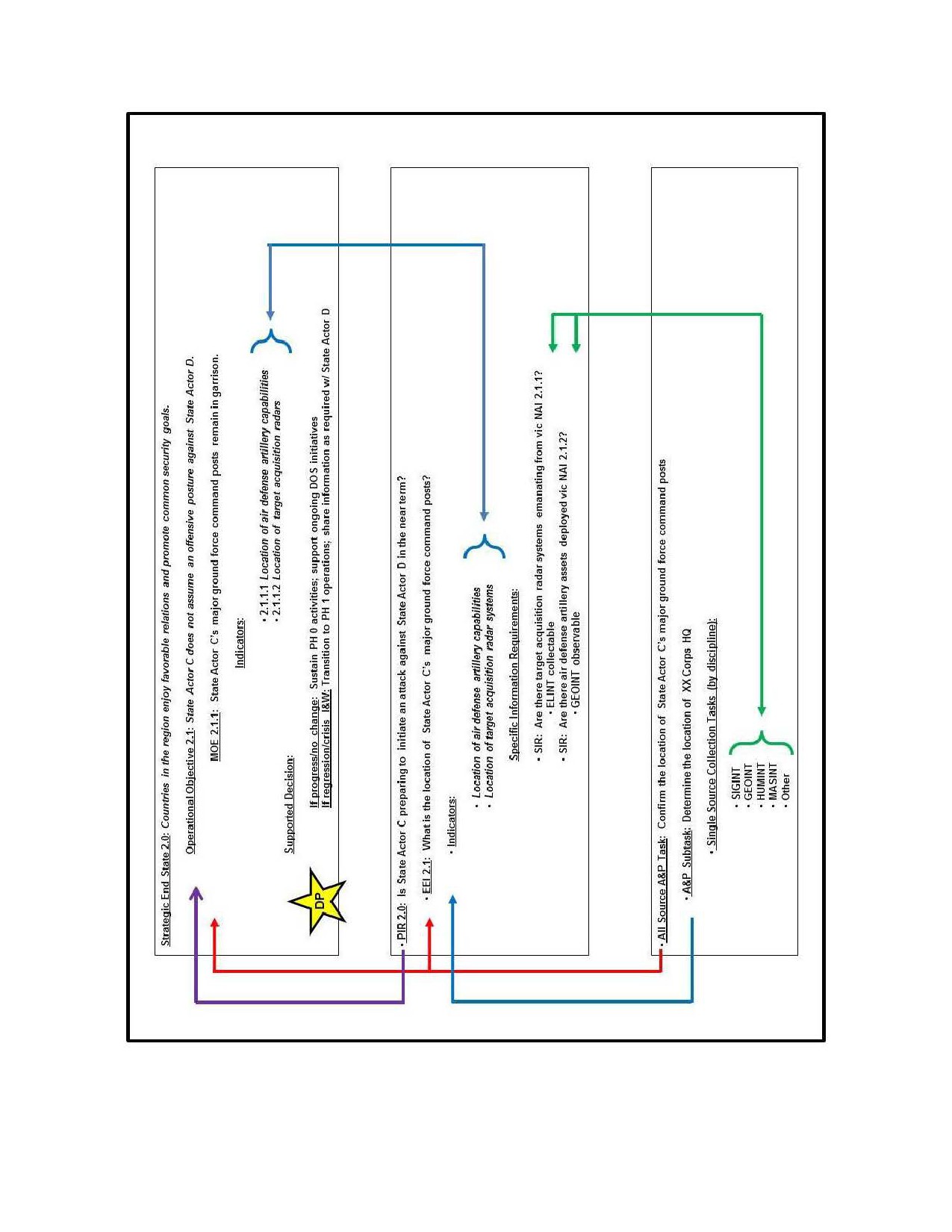
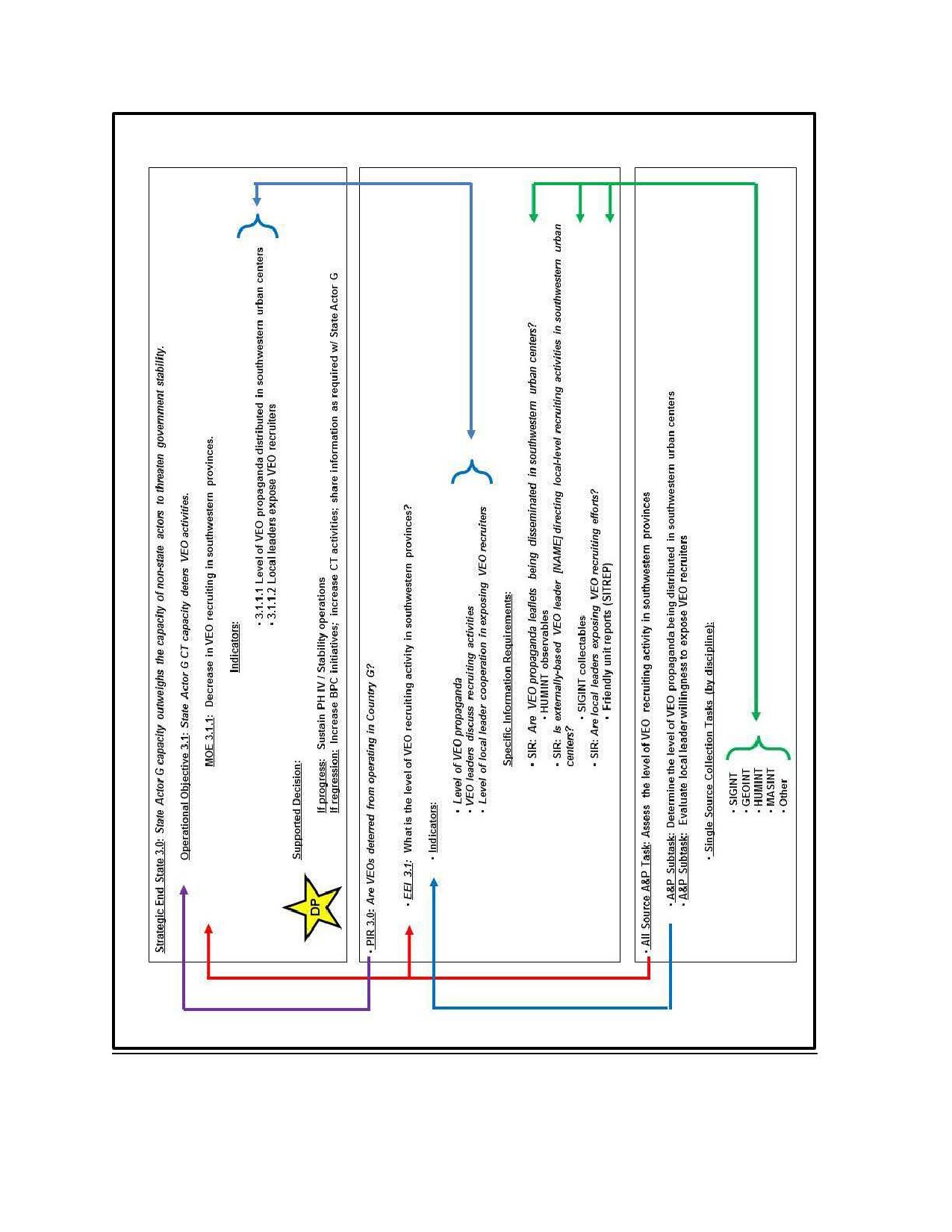
3. Examples. Below are a series of figures reflecting sample intelligence needs
of a CCDR. Each table is structured to show how focused intelligence
requirements might be crafted to support the assessment of operational
objectives along with anticipated decisions. They include A&P Tasks and
Subtasks as well as SIRs leading to potential collection tasks by discipline.
L-3
Enclosure L
CJCSM 3314.01A
17 September 2012
Figure 19
L-4
Enclosure L
CJCSM 3314.01A
17 September 2012
Figure 20
L-5
Enclosure L
CJCSM 3314.01A
17 September 2012
Figure 21
L-6
Enclosure L
CJCSM 3314.01A
17 September 2012
ENCLOSURE M
REFERENCES
a. Joint Publication 2-0, 22 June 2007, “Joint Intelligence”
b. Joint Publication 2-01, 5 January 2012, “Joint and National Support to
Military Operations”
c. Joint Publication 2-01.2, March 2011, “Counterintelligence and Human
Intelligence in Joint Operations”
d. Joint Publication 2-01.3, June 2009, “Joint Intelligence Preparation of the
Operational Environment”
e. Joint Publication 3-0, August 2011, “Joint Operations”
f. Joint Publication 5-0, August 2011, “Joint Operation Planning”
g. CJCSI 3100.01 series, “Joint Strategic Planning System”
h. CJCSI 3110.01 series, “Joint Strategic Capabilities Plan (JSCP)”
i. Adaptive Planning Roadmap II, 5 March 2008
j. Adaptive Planning and Execution System Implementation Plan 2012
k. CJCSI 3110.02 series, “Intelligence Planning Guidance, Objectives, and
Tasks”
l. CJCSI 3141.01 series, “Management and Review of Joint Strategic
Capabilities Plan (JSCP)-Tasked Plans”
m. DoD Directive 3000.06, 10 July 2007, Change 1, 15 April 2010, “Combat
Support Agencies”
n. CJCSM 3122.03 series, “Joint Operation Planning and Execution System
(JOPES) Volume II Planning Formats and Guidance”
o. Joint Intelligence Operations Center (JIOC) Execute Order (EXORD), MOD 3
p. Guidance for Employment of the Force (GEF), series
M-1
Enclosure M
CJCSM 3314.01A
17 September 2012
q. DoD Directive 5105-21, 18 March 2008 “Defense Intelligence Agency (DIA)”
r. CJCS message DTG 040001ZOCT 11, Subject: Joint Intelligence Operation
Center (JIOC) Execute Order (EXORD) Modification 3
s. CJCSI 3370.01 series, “Target Development Standards”
t. DI-2820-4-03, Battle Damage Assessment (BDA) Quick Guide February
2003 (updated on 3 January 2006)
u. DI-2820-2-03, Battle Damage Assessment (BDA) Reference Handbook
March 2003 (updated on 3 January 2006)
v. CJCSI 3401.01 series, “Joint Combat Capability Assessment”
w. Defense Intelligence Analysis Program (DIAP) Management Guide, August
2011
x. CJCSM 3130.03 series, “Planning Formats and Guidance”
y. CJCSI 5711.01 series, “Policy on Action Processing”
M-2
Enclosure M
CJCSM 3314.01A
17 September 2012
GLOSSARY
PART I - ABBREVIATIONS AND ACRONYMS
A&P
Analysis and Production
APEX
Adaptive Planning and Execution
CAC
Collaborating Analytic Center
CAP
Crisis Action Planning
CCDR
Combatant Commander
CCIR
Commander’s Critical Information Requirement
CI
Counterintelligence
CCMD
Combatant Command
COCOM
Combatant Command (Command Authority)
COLISEUM
Community On-Line Intelligence System for End Users
and Managers
CONPLAN
Concept Plan
CRMx
Collection Requirements Matrix
CSA
Combat Support Agency
DIA
Defense Intelligence Agency
DIAP
Defense Intelligence Analysis Program
DoD
Department of Defense
DTA
Dynamic Threat Assessment
DUSD(JCWS)
Defense Under Secretary of Defense for Joint & Coalition
Warfighter Support
EEI
Essential Element of Information
FFIR
Friendly Force Information Requirement
FSP
Functional Support Plan
GEF
Guidance for Employment of the Force
GEOINT
Geospatial Intelligence
HUMINT
Human Intelligence
I&W
Indications and Warning
IC
Intelligence Community
IMINT
Imagery Intelligence
IMO
Intermediate Military Objective
IO
Information Operations
IP
Intelligence Planning
IPSG
Intelligence Planning Steering Group
GL-1
Glossary
CJCSM 3314.01A
17 September 2012
ISR
Intelligence, Surveillance, and Reconnaissance
ITL
Intelligence Task List
JCCA
Joint Combat Capability Assessment
JFCC-ISR
Joint Functional Component Command - Intelligence
Surveillance Reconnaissance
JIOC
Joint Intelligence Operations Center
JIPA
Joint Intelligence Posture Assessment
JIPOE
Joint Intelligence Preparation of the Operational
Environment
JPEC
Joint Planning and Execution Community
JSAP
Joint Staff Action Process
JSCP
Joint Strategic Capabilities Plan
JSPS
Joint Strategic Planning System
JWICS
Joint Worldwide Intelligence Communications System
MASINT
Measurement and Signature Intelligence
MCIA
Marine Corps Intelligence Activity
MOE
Measure of Effectiveness
MOP
Measure of Performance
MSO
Military Strategic Objective
NASIC
National Air and Space Intelligence Center
NGA
National Geospatial-Intelligence Agency
NGIC
National Ground Intelligence Center
NIPF
National Intelligence Priorities Framework
NISP
National Intelligence Support Plan
NIST
National Intelligence Support Team
NSA
National Security Agency
NSRP
National SIGINT Requirements Process
ODNI
Office of the Director of National Intelligence
ONI
Office of Naval Intelligence
OPLAN
Operation Plan
OSINT
Open Source Intelligence
PIR
Priority Intelligence Requirement
POA&M
Plan of Actions and Milestones
PR
Production Requirement
PRMx
Production Requirements Matrix
RAC
Responsible Analytic Center
RFI
Request for Information
RSC
Regional Support Center
GL-2
Glossary
CJCSM 3314.01A
17 September 2012
SIGINT
Signals Intelligence
SIPRNET
Secure Internet Protocol Routing Network
SIR
Specific Information Requirement
SME
Subject Matter Expert
SVTC
Secure Video Teleconference
TCPED
Tasking, Collection, Processing, Exploitation,
Dissemination
TPFDDL
Time-Phased Force and
Deployment Data List
TIA
Theater Intelligence Assessment
UIS
Unifying Intelligence Strategy
USD(I)
Under Secretary of Defense for Intelligence
GL-3
Glossary
CJCSM 3314.01A
17 September 2012
(INTENTIONALLY BLANK)
GL-4
Glossary
CJCSM 3314.01A
17 September 2012
PART II - DEFINITIONS
Adaptive Planning and Execution (APEX) system. A Department of Defense
system of joint policies, processes, procedures, and reporting structures,
supported by communications and information technology that is used by the
Joint Planning and Execution Community to monitor, plan, and execute
mobilization, deployment, employment, sustainment, redeployment, and
demobilization activities associated with joint operations.
(JP 5-0)
All-Source Intelligence.
1. Intelligence products and/or organizations and
activities that incorporate all sources of information, most frequently including
human resources intelligence, imagery intelligence, measurement and
signature intelligence, signals intelligence, and open source data, in the
production of finished intelligence.
2. In intelligence collection, a phrase that
indicates that, in the satisfaction of intelligence requirements, all collection,
processing, exploitation, and reporting systems and resources are identified for
possible use and those most capable are tasked. (JP 1-02)
Analysis and Production (A&P) Task (formerly ITL Task). Tasks are all-source
analysis and production requirements designed to satisfy the intelligence
requirements (to include Priority Intelligence Requirements) of the supported
Combatant Command plan. (IP-specific term)
Analysis and Production (A&P) Subtask (formerly ITL Subtask). Subtasks are
the constituent elements of an A&P task which, when taken together, define
the task’s scope and content. (IP-specific term)
Annex B. Annex B is the intelligence annex to a plan or order that provides
detailed information on the adversary situation, establishes priorities, assigns
intelligence tasks, identifies required intelligence products, requests support
from higher echelons, describes the concept of intelligence operations, and
specifies intelligence procedures. Combatant Command J-2s lead development
of Annex B. (JP 2-01)
Assumption. A supposition on the current situation or a presupposition on the
future course of events, either or both assumed to be true in the absence of
positive proof, necessary to enable the commander in the process of planning
to complete an estimate of the situation and make a decision on the course of
action.
(JP 1-02, JP 5-0)
Collaborating Analytic Center (CAC). An intelligence organization that has
responsibility to support and assist a Responsible Analytic Center produce an
intelligence product to answer a specific Combatant Command Analysis and
GL-5
Glossary
CJCSM 3314.01A
17 September 2012
Production sub task. CACs may provide all-source analysis, application of
analysis, or single-source analysis. This term was developed for use in
Intelligence Planning and is derivative of the COLISEUM phrase “contributing
centers or elements.”
(IP-specific term)
Collectables. The unique descriptive features associated with emanations from
the target. Collectables are associated with SIGINT and MASINT. (JP 2-01,
Joint Tactical Exploitation of National Systems (JTENS) Manual)
Collection. In intelligence usage, the acquisition of information and the
provision of this information to processing elements.
(JP 2-0, JP 2-01)
Collection Management. In intelligence usage, the process of converting
intelligence requirements into collection requirements, establishing priorities,
tasking or coordinating with appropriate collection sources or agencies,
monitoring results, and retasking, as required. (JP 2-01, JP 2-0)
Collection Requirement. An established intelligence need considered in the
allocation of intelligence resources to fulfill the essential elements of
information and other intelligence needs of a commander or an agency.
(JP 1-02)
Collection Requirements Matrix (CRM). A worksheet that compiles Combatant
Command-generated collection requirements to inform the initial integrated
collection planning efforts. This collection planning worksheet links Priority
Intelligence Requirements, their associated Essential Elements of Information,
and related indicators to supporting Specific Information Requirements, and all
Combatant Command collection capabilities available to support the execution
of a given plan. The CRM is intended to facilitate the development of integrated
collection strategies against priority collection targets during the National
Intelligence Support Plan process and to optimize the employment of theater
assets and national-level collection resources.
(IP-specific term)
Commander’s Critical Information Requirement (CCIR). An information
requirement identified by the commander as being critical to facilitating timely
decision making. (JP 3-0)
Concept of Intelligence Operations. A verbal or graphic statement, in broad
outline, of an Intelligence Directorate’s assumptions or intent regarding
intelligence support of an operation or series of operations. The concept of
intelligence operations, which complements the commander’s concept of
operations, is contained in the intelligence annex (Annex B) of operation plans.
The concept of intelligence operations is designed to give an overall picture of
GL-6
Glossary
CJCSM 3314.01A
17 September 2012
intelligence support for joint operations. It is included primarily for additional
clarity of purpose.
(JP 1-02, JP 2-0)
Constraint. In the context of joint operation planning, a requirement placed on
the command by a higher command that dictates an action, thus restricting
freedom of action. (JP 1-02, JP 5-0)
Defense Intelligence Analysis Program (DIAP). The DIAP integrates all general
military intelligence and scientific/technical intelligence analysis conducted at
DIA, the Service intelligence centers, and the Combatant Command intelligence
centers. DIAP ensures efficiency and effectiveness of defense intelligence all-
source analysis by assigning analytic responsibilities based on capabilities,
workforce characteristics, and command, Service, or DIA mission
requirements. (DIAI 3115.300)
Defense Intelligence Enterprise. The organizations, infrastructure, and
measures, to include policies, processes, procedures, and products of the
intelligence, counterintelligence (CI), and security components of the Joint
Staff, Combatant Commands, Military Departments, and other Department
elements that perform National Intelligence, Defense Intelligence, Intelligence-
related, CI, and security functions, as well as those organizations under the
authority, direction, and control of the USD(I).
(IP-specific term pending
approval in revisions to DoDD 5143.01)
Dynamic Threat Assessment (DTA). The DTA is a defense strategic intelligence
assessment developed by DIA’s Directorate for Analysis which identifies the
capabilities and intentions of adversaries for each Joint Strategic Capabilities
Plan-directed top priority plan, except Theater Campaign Plans. The DTA is
used by the Combatant Commander and Combatant Command planning staff
to conduct Mission Analysis during Step 1 (Strategic Guidance) of the Adaptive
Planning and Execution (APEX) Process. DIA produces and continuously
updates DTAs as strategic factors of the operational environment change and
provides the Combatant Commands an updated DTA to support RATE (Refine,
Adapt, Terminate or Execute) decisions under APEX Step 4 (Plan Assessment).
Effect.
1. The physical or behavioral state of a system that results from an
action, a set of actions, or another effect.
2. The result, outcome, or
consequence of an action. 3. A change to a condition, behavior, or degree of
freedom. (JP 3-0)
End state. The set of required conditions that defines achievement of the
commander's objectives. (JP 3-0)
GL-7
Glossary
CJCSM 3314.01A
17 September 2012
Essential Elements of Information (EEI). The most critical information
requirements regarding the adversary and the environment needed by the
commander by a particular time to relate with other available information and
intelligence in order to assist in reaching a logical decision.
(JP 1-02, JP 2-0)
Friendly Force Information Requirement. Information the commander and staff
need to understand the status of friendly force and supporting capabilities. (JP
3-0)
Functional Support Plan (FSP). An FSP is an intelligence agency enterprise/
annex to a National Intelligence Support Plan in support of a Combatant
Command top priority plan. It details the agency/enterprise concept for
providing discipline/functional support to meet the Combatant Command’s
intelligence requirements. It assesses agency/enterprise capabilities across all
phases of the plan and identifies significant knowledge gaps and capability
shortfalls as well as potential mitigation strategies where appropriate.
(IP-
specific term)
Indications and Warning (I&W). Those intelligence activities intended to detect
and report time-sensitive intelligence information on foreign developments that
could involve a threat to the United States or allied and/or coalition military,
political, or economic interests or to U.S. citizens abroad. It includes
forewarning of enemy actions or intentions; the imminence of hostilities;
insurgency; and nuclear/non-nuclear attack on the United States, its overseas
forces, or allied and/or coalition nations.
(JP 2-0)
Indicator. In intelligence usage, an item of information which reflects the
intention or capability of an adversary to adopt or reject a course of action.
(JP
1-02, JP 2-0)
Information Requirement. In intelligence usage, those items of information
regarding the adversary and other relevant aspects of the operational
environment that need to be collected and processed in order to meet the
intelligence requirements of a commander. (JP 1-02, JP 2-0)
Intelligence.
1. The product resulting from the collection, processing,
integration, analysis, evaluation, and interpretation of available information
concerning foreign countries or areas.
2. Information and knowledge about an
adversary obtained through observation, investigation, analysis, or
understanding. (JP 1-02, JP 2-0)
Intelligence Estimate. The appraisal, expressed in writing or orally, of available
intelligence relating to a specific situation or condition with a view to determine
the courses of action open to the enemy or adversary and the order of
probability of their adoption.
(JP 1-02, JP 2-0).
GL-8
Glossary
CJCSM 3314.01A
17 September 2012
Intelligence Federation. A formal agreement in which a Combatant Command
Joint Intelligence Operations Center receives preplanned intelligence support
from other joint intelligence operations centers, Service intelligence
organizations, Reserve organizations, and national agencies during crisis or
contingency operations. (JP 1-02, JP 2-0)
Intelligence Operations. The variety of intelligence and counterintelligence
tasks that are carried out by various intelligence organizations and activities
within the intelligence process. Intelligence operations include planning and
direction, collection, processing and exploitation, analysis and production,
dissemination and integration, and evaluation and feedback. (JP 2-0)
Intelligence Planning (IP). The intelligence component of the Adaptive Planning
and Execution system. IP is a methodology for coordinating and integrating all
available Defense Intelligence Enterprise capabilities to meet Combatant
Commander intelligence requirements. It ensures that prioritized intelligence
support is aligned with Combatant Commander objectives for each phase of the
operation. The IP process identifies DoD knowledge gaps and intelligence
capability shortfalls and develops mitigation strategies where possible.
Identified knowledge gaps and capability shortfalls also inform a variety of
Joint Strategic Planning System processes and products and the development
of Unifying Intelligence Strategies.
(CJCSI 3110.02G)
Intelligence Requirement.
1. Any subject, general or specific, upon which
there is a need for the collection of information, or the production of
intelligence.
2. A requirement for intelligence to fill a gap in the command’s
knowledge or understanding of the operational environment. (JP 1-02, JP 2-0)
Intelligence, Surveillance, and Reconnaissance (ISR). An integrated operations-
intelligence activity that synchronizes and integrates the planning and
operation of sensors, assets, and the processing, exploitation, and
dissemination systems in direct support of current and future operations. This
is an integrated intelligence and operations function.
(JP 2-0)
Intelligence Task List (ITL). See Production Requirements Matrix (PRMx).
Intermediate Military Objective. A measureable objective that directly
contributes to the achievement of an end state. It reflects objectives achievable
by the Combatant Command within the 5-year timeframe of a campaign plan.
(CJCSI 3110.01H)
ITL Task. See A&P Task.
ITL Subtask. See A&P Subtask.
GL-9
Glossary
CJCSM 3314.01A
17 September 2012
J-2 Staff Estimate. An assessment of intelligence and counterintelligence (CI)
capabilities available to support the operation. It identifies and addresses
known or anticipated factors pertaining to CI or intelligence collection,
processing and exploitation, analysis and production, and dissemination and
integration that may limit the intelligence staff function's ability to support
proposed friendly courses of action.
(JP 2-01)
Joint Intelligence Operations Center (JIOC). An interdependent, operational
intelligence organization at the Combatant Command or joint task force (if
established) level, that is integrated with national intelligence centers, and
capable of accessing all sources of intelligence impacting military operations,
planning, execution, and assessment. (JP 2-0)
Joint Intelligence Posture Assessment (JIPA). An estimate of the collection and
production support the Defense Intelligence Enterprise may be able to provide
Combatant Commanders throughout a given year. It contains annexes from
Combat Support Agencies and Services that describe their steady-state posture
to address Combatant Commander priorities based on the National Intelligence
Priorities Framework in effect at the time.
(IP-specific term)
Joint Intelligence Preparation of the Operational Environment (JIPOE). The
analytical process used by joint intelligence organizations to produce
intelligence assessments, estimates, and other intelligence products in support
of the joint force commander’s decision-making process. It is a continuous
process that includes defining the operational environment; describing the
effects of the operational environment; evaluating the adversary; and describing
adversary potential courses of action.
(JP 1-02, JP 2-0)
Joint Strategic Planning System (JSPS). The primary means by which the
Chairman of the Joint Chiefs of Staff carries out statutory responsibilities
assigned in titles 6, 10, 22 and 50 of the United States Code. The primary roles
are to: 1) conduct independent assessments; 2) provide independent advice to
the President, Secretary of Defense, National Security Council, and Homeland
Security Council; and 3) assist the President and Secretary of Defense in
providing unified strategic direction to the Armed Forces. The JSPS is a system
that enables the Chairman to effectively assess, advise, direct, and execute in
fulfillment of these statutory responsibilities.
(CJCSI 3110.01B)
Measure of Effectiveness (MOE). A criterion used to assess changes in system
behavior, capability, or operational environment that is tied to measuring the
attainment of an end state, achievement of an objective, or creation of an effect.
(JP 3-0)
GL-10
Glossary
CJCSM 3314.01A
17 September 2012
Measure of Performance (MOP). A criterion used to assess friendly actions that
is tied to measuring task accomplishment. (JP 3-0)
National Intelligence Priorities Framework (NIPF).
1. A dynamic process that
reflects the enduring and current national and homeland security challenges
and opportunities. 2. The Director of National Intelligence (DNI) sole
mechanism for establishing national intelligence priorities. Intelligence topics
reviewed by the National Security Council Principles Committee and approved
by the President semiannually shall form the basis of NIPF and the detailed
procedures established by the DNI. (National Security Presidential Directive
(NSPD) 26, Intelligence Community Directive (ICD) 204)
National Intelligence. All intelligence, regardless of the source from which
derived and including information gathered within or outside the United States,
that pertains, as consistent with any guidance issued by the President, to more
than one United States Government Agency, and that involves threats to the
United States, its people, property, or interests; the development, proliferation,
or use of weapons of mass destruction; or any other matter bearing on United
States national or homeland security. (JP 1-02, JP 2-0)
National Intelligence Support Plan (NISP). The NISP is a supporting plan to a
Combatant Command top priority plan that details how the intelligence
capabilities of Combat Support Agencies, Services and other Defense
Intelligence Enterprise organizations will be employed to meet the Combatant
Commander’s stated intelligence requirements. It contains annexes from
applicable components of the Defense Intelligence Enterprise agencies /
organizations that detail their concepts for functional support and identify and
prioritize knowledge gaps, capability shortfalls, and mitigation strategies.
(CJCSI 3110.02G)
National Intelligence Support Team (NIST). A nationally sourced team
composed of intelligence and communications experts from Defense
Intelligence Agency, Central Intelligence Agency, National Geospatial-
Intelligence Agency, National Security Agency, or other intelligence community
agencies as required.
(JP 1-02, JP 2-0)
Objective.
1. The clearly defined, decisive, and attainable goal toward which
every operation is directed.
2. The specific target of the action taken which is
essential to the commander's plan. (JP 5-0)
Observables. The unique descriptive features associated with the visible
description of the target, whether it is specific units, equipment, or facilities.
Observables are associated with GEOINT, HUMINT/CI, and MASINT. (JP 2-01,
Joint Tactical Exploitation of National Systems (JTENS) Manual)
GL-11
Glossary
CJCSM 3314.01A
17 September 2012
Operational Environment. A composite of the conditions, circumstances, and
influences that affect the employment of capabilities and bear on the decisions
of the commander. (JP 1-02, JP 3-0)
Priority Intelligence Requirement (PIR). An intelligence requirement, stated as
a priority for intelligence support, that the commander and staff need to
understand the adversary or operational environment. (JP 1-02, JP 2-0)
Production Requirements Matrix (PRMx). Formerly ITL. The PRMx is a
compilation of prioritized Combatant Command all-source analysis and
production requirements that support all phases of the plan and are organized
in a two tier hierarchy of tasks and subtasks. (IP-specific term)
Red Team. An organizational element comprised of trained and educated
members that provide an independent capability to fully explore alternatives in
plans and operations in the context of the operational environment and from
the perspective of adversaries and others.
(JP 1-02, JP 2-0)
Responsible Analytic Center (RAC). The Intelligence organization that has
primary responsibility for integrated all-source analysis, or the application of
analysis, to produce an intelligence product to answer a Combatant Command
analysis and production task or subtask. This term was developed for use in
Intelligence Planning and is similar to the COLISEUM term “Responsible
Intelligence Analysis Center.” (IP-specific term)
Restraint. In the context of joint operations, a requirement placed on the
command by a higher command that prohibits an action, thus restricting
freedom of action. (JP 1-02, JP 5-0)
Specific Information Requirement (SIR). A basic question that must be
answered to satisfy a collection request.
(JP 2.01, Joint Tactical Exploitation of
National Systems (JTENS) Manual)
Supported Commander. 1. The commander having primary responsibility for
all aspects of a task assigned by the Joint Strategic Capabilities Plan or other
joint operation planning authority. In the context of joint operation planning,
this term refers to the commander who prepares operation plans or operation
orders in response to requirements of the Chairman of the Joint Chiefs of Staff.
2. In the context of a support command relationship, the commander who
receives assistance from another commander’s force or capabilities, and who is
responsible for ensuring that the supporting commander understands the
assistance required.
(JP 1-02)
Supporting Commander. 1. A commander who provides augmentation forces
or other support to a supported commander or who develops a supporting
GL-12
Glossary
CJCSM 3314.01A
17 September 2012
plan. Includes the designated Combatant Commands and Defense agencies as
appropriate.
2. In the context of a support command relationship, the
commander who aids, protects, complements, or sustains another
commander’s force, and who is responsible for providing the assistance
required by the supported commander. (JP 2-01)
Synchronization. In the intelligence context, application of intelligence sources
and methods in concert with the operation plan to ensure intelligence
requirements are answered in time to influence the decisions they support.
(JP1-02, JP 2-0)
Theater Intelligence Assessment (TIA). The TIA is a theater-wide Defense
strategic intelligence assessment developed by DIA Directorate for Analysis that
identifies the capability and intentions of Actors of Concern listed in the
Guidance for the Employment of the Force, with particular emphasis on how
these actors are affected by the strategic environment.
(CJCSI 3110.02G).
Targeting. The process of selecting and prioritizing targets and matching the
appropriate response to them, taking account of operational requirements and
capabilities.
(JP 1-02)
Unifying Intelligence Strategy (UIS). Provide the Office of the Director of
National Intelligence staff and the Intelligence Community (IC) mission
partners with the organizing principles, focus, and direction to respond to
national security issues. Developed by National Intelligence Managers in
partnership with National Intelligence Officers, National Intelligence Collection
Officers, and National Counterintelligence Officers and other IC elements, these
strategies orient and guide the IC’s analytic and collection activities to satisfy
customer information needs. (http://intellipedia.intelink.ic.gov/wiki/Unifying
Intelligence Strategy and http://intellipedia.intelink.ic.gov/wiki/National
Intelligence Manager .)
Validation. A process associated with the collection and production of
intelligence that confirms that an intelligence collection or production
requirement is sufficiently important to justify the dedication of intelligence
resources, does not duplicate an existing requirement, and has not been
previously satisfied.
(JP 1-02, JP 2-0)
GL-13
Glossary
CJCSM 3314.01A
17 September 2012
(INTENTIONALLY BLANK)
GL-14
Glossary
AIRSPACE CONTROL
MULTI-SERVICE
TACTICS,
TECHNIQUES, AND
PROCEDURES FOR
AIRSPACE CONTROL
FM 3-52.1
AFTTP 3-2.78
MAY 2009
US Army Training and Doctrine
Command
Curtis E. LeMay Center for
Doctrine and Education
DISTRIBUTION RESTRICTION: Distribution
authorized to U.S. Government Agencies and their
contractors only to protect technical or operational
information from automatic dissemination under the
international Exchange Program or by other
means. This determination was made on 30 June
2008. Other requests will be referred to: HQ
TRADOC, ATTN: ATFC-EJ, Ft Monroe, VA 23651-
1067 or LeMay Center, ATTN: DDJ, Maxwell AFB,
AL 36112-6112.
DESTRUCTION NOTICE: Destroy by any method
that must prevent disclosure of contents or
reconstruction of the document.
FOREWORD
This publication has been prepared under our direction for use by our respective
commands and other commands as appropriate.
JOSEPH E. MARTZ
STEPHEN J. MILLER
Brigadier General, US Army
Major General, US Air Force
Deputy Director/Chief of Staff,
Commander
Army Capabilities Integration
Curtis E. LeMay Center for Doctrine
Center
Development and Education
This publication is available through the Army at Army Knowledge Online
Force at the Air Force Publishing Web site
PREFACE
1. Purpose
This multi-Service tactics, techniques, and procedures (MTTP) publication
facilitates multi-Service coordination, integration, and regulation of airspace
during exercises and operations where more than one Service shares airspace
for operational use.
2. Scope
This MTTP publication is a tactical-level document to synchronize and integrate
airspace command and control functions and serves as a single source reference
for planners and commanders at all levels. It synchronizes airspace control roles
and responsibilities within the campaign plan while unifying individual Service
doctrine and TTP for airspace control planning and execution. In addition, it
provides planning, assignment, execution, and transition procedures to address
specific complex and unique airspace coordinating measures. This publication
also outlines enabling information and communications interfaces necessary to
establish integrated airspace control.
3. Applicability
This MTTP publication applies to the operating forces of the Army and Air Force.
The focus of the publication is at the tactical level, but it has application for
warfighters at all levels. The target audience for this publication includes
commanders, staffs, warfighters, and agencies at all levels within the joint force.
4. Implementation Plan
Participating Service command offices of primary responsibility (OPRs) will
review this publication, validate the information and, where appropriate,
reference and incorporate it in Service manuals, regulations, and curricula as
follows:
Army. Upon approval and authentication, this publication incorporates the
procedures contained herein into the United States (US) Army Doctrine and
Training Literature Program as directed by the Commander, US Army Training
and Doctrine Command (TRADOC). Distribution is in accordance with applicable
directives and the Initial Distribution Number (IDN) listed on the authentication
page.
Air Force. The Air Force will incorporate the procedures in this publication in
accordance with applicable governing directives. Distribution is in accordance
with Air Force Instruction (AFI) 33-360.
22 MAY 2009
FM 3-52.1 / AFTTP 3-2.78
i
5. User Information
a. TRADOC and the Curtis E. Lemay Center for Doctrine Development and
Education (LeMay Center) developed this publication with the joint participation
of the approving Service commands. TRADOC and the LeMay Center will
review and update this publication as necessary.
b. This publication reflects current joint and Service doctrine, command and
control (C2) organizations, facilities, personnel, responsibilities, and procedures.
Changes in Service protocol appropriately reflected in joint and Service
publications will likewise be incorporated in revisions to this document.
c. We encourage recommended changes for improving this publication. Key
your comments to the specific page and paragraph and provide a rationale for
each recommendation. Send comments and recommendations directly to—
Army
Commander, US Army Training and Doctrine Command
ATTN: ATFC-EJ
Fort Monroe VA 23651-1067
DSN 680-3951 COMM (757) 788-3951
E-mail: doctrine.monroe@us.army.mil
Air Force
Commander, LeMay Center for Doctrine Development and Education
ATTN: DDJ
115 North Twining Street
Maxwell AFB AL 36112-6112
DSN 493-2640/2256 COMM (334)953-2640/2256
E-mail: lemayctr.ddj.workflow@maxwell.af.mil
ii
FM 3-52.1 / AFTTP 3-2.78
22 MAY 2009
FM 3-52.1
AFTTP 3-2.78
FM 3-52.1
US Army Training and Doctrine Command
Fort Monroe, Virginia
AFTTP 3-2.78
Curtis E. Lemay Center for Doctrine
Development and Education
Maxwell Air Force Base, Alabama
22 May 2009
AIRSPACE CONTROL
MULTI-SERVICE TACTICS, TECHNIQUES, AND
PROCEDURES FOR
AIRSPACE CONTROL
EXECUTIVE SUMMARY
vi
CHAPTER I AIRSPACE OVERVIEW
1
1. Introduction
1
2. Establishing Airspace Control
1
3. Command Relationships for Airspace Control
2
4. Summary
4
CHAPTER II AIRSPACE AUTHORITIES
5
1. Geographic Combatant Commanders (GCCs)
5
2. Joint Force Air Component Commander (JFACC)
6
3. Airspace Control Authority (ACA)
7
4. Area Air Defense Commander (AADC)
8
5. Commander, Air Force Forces (COMAFFOR)
9
6. Air Operations Center (AOC)
9
7. Control and Reporting Center (CRC)/Airborne Warning and Control
System (AWACS)
10
DISTRIBUTION RESTRICTION: Distribution authorized to DOD and DOD contractors only to protect
technical or operational information from automatic dissemination under the International Exchange Program
or by other means. This protection applies to publications required solely for official use and to those
containing valuable technical or operational information. This determination was made on30 June 2008.
Other requests will be referred to:
HQ TRADOC, ATTN: ATFC-EJ, Ft Monroe, VA 23651-1067,
or LeMay Center, ATTN: DDJ, Maxwell AFB, 36112-6112.
DESTRUCTION NOTICE: Destroy by any method that must prevent disclosure of contents or reconstruction
of the document.
22 MAY 2009
FM 3-52.1 / AFTTP 3-2.78
iii
8. Air Support Operations Center (ASOC) / Joint Surveillance Target Attack
Radar System (JSTARS)
10
9. Tactical Air Control Party (TACP)
11
10. Joint Force Land Component Commander (JFLCC)
11
11. Army Forces (ARFOR) Commander
11
12. Corps/Division Airspace Command and Control (AC2) Element
12
13. Brigade Combat Team (BCT)
12
14. Component Liaisons
13
CHAPTER III PLANNING CONSIDERATIONS
15
1. Planning, Implementation, and Execution
15
2. Phase 0 - Shape
15
3. Phase I - Deter
16
4. Phase II - Seize Initiative Planning Considerations
19
5. Phase III - Dominate Planning Considerations
21
6. Phase IV - Stabilize Planning Considerations
22
7. Phase V - Enable Civil Authority Planning Considerations
23
8. Post Hostility Airspace Control
23
CHAPTER IV REAL-TIME COORDINATION OF AIRSPACE
25
1. Airspace Users
25
2. Fires Coordination Between Airspace Users
27
CHAPTER V COMPLEX AIRSPACE
31
1. Introduction
31
2. High-Density Airspace Control Zone (HIDACZ)
32
3. Joint Special Operations Area (JSOA)
36
4. Restricted Operations Areas (ROA)
36
APPENDIX A RISK AND THE OPERATIONAL ENVIRONMENT
39
APPENDIX B ACM & FIRE SYSTEMS COORDINATION
43
1. ACM and Fires System Interoperability
43
2. ACM and Fires Protection
45
APPENDIX C HIDACZ PLAN EXAMPLES
73
1. HIDACZ NIMITZ Airspace Control Plan Example
73
2. HIDACZ MAMELUKE Airspace Control Plan Example
82
APPENDIX D EXAMPLE AIRSPACE CONTROL CHECKLISTS
91
REFERENCES
97
GLOSSARY
99
iv
FM 3-52.1 / AFTTP 3-2.78
22 MAY 2009
List of Figures
Figure 1.
HIDACZ NIMITZ Vertical Separation
73
Figure 2.
HIDACZ NIMITZ Comm Plan
75
Figure 3.
HIDACZ NIMITZ C2 Depiction w/AWACS
77
Figure 4.
HIDACZ NIMITZ C2 Depiction w/TOC as Controller
78
Figure 5.
HIDACZ MAMELUKE Vertical Separation
82
Figure 6.
HIDACZ MAMELUKE Communications Diagram
84
Figure 7.
Step-by-step Explanation
91
Figure 8.
Example of Army Fires Checklist
92
Figure 9.
Example of CAS Outside of Army Airspace Checklist
93
Figure 10.
Example of Dynamic UA Retask Checklist
94
Figure 11.
Example of Fires in Vicinity of Airfield Checklist
95
Figure 12.
Example of Immediate ROZ Checklist
96
List of Tables
Table 1. Example of Land Component Request for HIDACZ
34
Table 2. Example Strategic/Operational Risk Level
39
Table 3. Example JFC Established Baseline Airspace Risk
40
Table 4. Example BCT Baseline Airspace Risk
41
Table 5. Airspace Control System Shapes
44
Table 6. ACMs and FSCMs
47
Table 7. Lost Comm Visual Signals
85
Table 8. Tactical Phraseology FOB NASA
86
Table 9. Tactical Phraseology FOB DOG
86
Table 10. Delegation of Authority
88
Table 11. DASC and Terminal Control Communications
89
22 MAY 2009
FM 3-52.1 / AFTTP 3-2.78
v
EXECUTIVE SUMMARY
AIRSPACE CONTROL
Multi-Service Tactics, Techniques, and Procedures for Airspace Control
This publication establishes tactics, techniques, and procedures for the tactical
synchronization and integration of airspace necessary for combat operations
within the operational environment. With the proliferation and concentration of
airspace users, this publication outlines airspace control authorities, establishes
airspace planning considerations, outlines the steps for the immediate execution
of airspace in support of operations, and defines airspace measures necessary
for a specific, finite period to support a specific military objective.
Chapter I Airspace Overview
Chapter I provides the tactical imperative, which shifts the focus of airspace
operations from the deconfliction of airspace to integration and synchronization of
airspace users that is established by the joint force commander. Additionally,
this chapter lists the doctrinal command relationship necessary for airspace
integration to support all joint components.
Chapter II Authorities
Chapter II provides the key airspace authorities within each component and the
critical documents used to exercise airspace integration among the operational
commanders.
Chapter III Planning Considerations
Chapter III provides airspace planning considerations throughout the military
operational phases from shaping through enabling civil authorities.
Chapter IV Real-time Coordination of Airspace
Chapter IV provides the “who” of the Service components and the “how” for real-
time coordination of airspace and fires during joint operations.
Chapter V Complex Airspace
Chapter V provides for the coordination and operation of complex airspace
necessary to support specific military objectives.
Appendices
The appendices discuss risk in the operational environment, airspace
coordinating measures, fires coordination, examples of complex airspace, and
examples of airspace control checklists, which could be used as models for
tactical units during military operations.
vi
FM 3-52.1 / AFTTP 3-2.78
22 MAY 2009
PROGRAM PARTICIPANTS
The following commanders and agencies participated in the development of this
publication:
Joint
Joint Airspace Command and Control Joint Test, Ft Bliss, TX
Joint Unmanned Air Systems Center of Excellence, Creech AFB, NV
Multi-National Corps Iraq, Camp Victory, Al Faw Palace Baghdad, Iraq
Army
US Army Training and Doctrine Command, Army Capabilities Integration Center,
Fort Monroe, VA
US Army Field Artillery School, Ft Sill, OK
US Army Air Defense Artillery School, Ft Bliss, TX
US Army Aviation Warfighting Center of Excellence, Ft Rucker, AL
US Army Combined Arms Center, Ft Leavenworth, KS
US Army Joint Support Team, Hurlburt AFB, FL
Air Force
Headquarters, Air Force, Washington, DC
Headquarters, Air Combat Command, Langley AFB, VA
LeMay Center for Doctrine Development and Education, Maxwell AFB, AL
Headquarters, Air Force Special Operations Command, Hurlburt AFB, FL
505th Command and Control Wing, Hurlburt AFB, FL
623th Air Operations Center, Hurlburt AFB, FL
728th Air Control Squadron, Eglin AFB, FL
US Air Force Flight Standards Agency, Andrews AFB, MD
22 MAY 2009
FM 3-52.1 / AFTTP 3-2.78
vii
This page intentionally left blank.
viii
FM 3-52.1 / AFTTP 3-2.78
22 MAY 2009
Chapter I
Airspace Overview
1. Introduction
a. Combat operations require effective airspace control in the combat zone.
The proliferation of unmanned aircraft systems (UASs) and the fielding of
indirect fire platforms capable of higher altitudes and greater ranges create
additional demands and complexities on the airspace control process. In
addition to military airspace users, current and future operational environments
may include civilian airliners, nongovernmental organizations (NGOs), and relief
agencies, especially during stability operations. These increased user demands
require an integrated airspace control system to enable mission
accomplishment and minimize risk.
b. Integration and synchronization of all airspace users is required to establish
the unity of effort necessary for effective combat operations. Historically, the
primary method of airspace control and deconfliction has been to reserve
airspace for each user and then ensure they remained within their assigned
airspace. This method is time consuming and not responsive enough to support
current dynamic operations, forcing commanders to accept risk for airspace
users, operations, or both. With the proliferation of airspace users in a
congested space, there may not be enough airspace to effectively divide,
separate, or partition areas for deconflicted operations.
2. Establishing Airspace Control
a. Joint Publication (JP) 3-52, Joint Doctrine for Airspace Control in a Combat
Zone, defines airspace control in the combat zone as “a process used to
increase combat effectiveness by promoting the safe, efficient, and flexible use
of airspace. Airspace control is provided to reduce the risk of friendly fire,
enhance air defense operations, and permit greater flexibility of operations.”
b. Airspace control procedures within the joint operations area (JOA) are
approved by the joint force commander (JFC) and are derived entirely from the
JFC’s authority. Commanders should adhere to JFC guidance on airspace
coordinating measures (ACMs) so as not to exceed the JFC’s acceptable level
of risk. Effective airspace control should maximize combat effectiveness
without unduly restricting combat operations. In accordance with the JFC’s
guidance (i.e., airspace control plan [ACP]), airspace control agencies direct
the maneuver of aircraft and integrate fires for the best use of assigned air-
space. “Airspace control does not infringe on the authority vested in com-
manders to approve, disapprove, or deny combat operations.” (JP 3-52)
c. Airspace is inherently joint. Any action taken by an airspace user may
impact other airspace users. The airspace control authority (ACA) delegates
authority to control airspace to elements of the theater air ground system
(TAGS). The ACA establishes an airspace control system (ACS) responsive to
22 MAY 2009
FM 3-52.1 / AFTTP 3-2.78
1
the needs of the JFC and integrated with the host nation (HN). “The ACS is an
arrangement of those organizations, personnel, policies, procedures, and facil-
ities required to perform airspace control functions. Airspace control should be
executed through a responsive theater/tactical air control system capable of real
time control that includes surface and airborne assets, as necessary (e.g., CRC
and AWACS). The ACS requires timely exchange of information through reli-
able, secure, and interoperable communications networks. Elements of the ACS
may have dual-roles as DCA assets (e.g., a CRC can be a SADC).” (JP 3-01)
d. The definition of coordinating altitude in JP 3-52 is “a procedural airspace
control method to separate fixed- and rotary-wing aircraft by determining an
altitude below which fixed-wing aircraft will normally not fly and above which
rotary-wing aircraft normally will not fly.” Current Operation Iraqi Freedom
(OIF)/Operation Enduring Freedom (OEF) operations use the term
“coordinating altitude” as the vertical limit between airspace controlling
agencies [i.e., the top of Army controlled airspace and the bottom of control
and reporting center (CRC) controlled airspace]. The current theater usage is
outside the JP 3-52 doctrinal definition.
e. The use of ACMs (e.g., high-density airspace control zone [HIDACZ],
restricted operations zone [ROZ] usages or sectors) to employ lateral,
horizontal, and vertical limits between airspace controlling agencies should be
the preferred method of assigning airspace control responsibilities.
3. Command Relationships for Airspace Control
a. The JFC may designate a joint force air component commander (JFACC),
an ACA, and an area air defense commander (AADC). The responsibilities of
the JFACC, ACA, and AADC are interrelated and are normally assigned to one
individual to unite joint air operations with joint airspace control and joint air de-
fense in support of the JFC’s campaign. They may be assigned to two or more
individuals when the situation dictates. If the JFC decides not to assign the
JFACC, ACA, and AADC to one individual, then close coordination between all
three positions is essential for mission accomplishment. Designating one
component commander as JFACC, AADC, and ACA often simplifies the coord-
ination required to develop and execute fully integrated joint air operations.
b. Joint doctrine establishes priority of airspace use to the supported
commander, in accordance with JFC priorities. Often, the priority of airspace
use is blurred when multiple supported commanders require access to the
same airspace for different missions. The area of operations (AO) commander
is normally the supported commander for operations in his assigned AO;
however, the JFACC is normally the supported commander for counterair,
which includes defensive counterair (DCA) over the land component AO. Other
commanders (i.e., special operations) frequently have JFC priority for
operations without respect to the boundaries of an AO. These conflicting
priorities and requirements often lead to confusion that is not an airspace
control specific problem but rather a joint C2 problem.
2
FM 3-52.1 / AFTTP 3-2.78
22 MAY 2009
c. The JFACC/ACA/AADC uses the air operations center (AOC) to publish
airspace control procedures and requirements. The primary products for
airspace control are the ACP, air tasking order (ATO) and its associated special
instructions (SPINS), airspace control order (ACO), air defense plan (ADP), and
air operations directive (AOD). When these documents are created and
modified, Army forces (ARFOR) must participate in the process to ensure Army
priorities are addressed in all of these products. In most cases, the ARFOR
commander’s liaison to the AOC is the battlefield coordination detachment
(BCD). After the AOC develops the ACP, it is approved by the JFC and
becomes directive. Army echelons incorporate ACP guidance and integrate the
ACO, ADP, SPINS, AOD, and ATO via operations orders (OPORDs) and
associated annexes.
d. Effective airspace control in the combat zone requires interoperable
equipment and an understanding of Service and joint doctrine. Familiarity with
procedures through joint exercises and training can enhance airspace control
operations within the JOA. Standardized airspace procedures rely upon an
effective mix of identification and control measures. A common airspace control
structure facilitates accurate and timely coordination of airspace operations
between friendly forces. Identification requirements for airspace control should
be integrated with those for air defense. Procedures and terminology need to
be compatible, mutually supporting, and interoperable to ensure commonality of
procedures for airspace users and control agencies.
e. Airspace control agencies should work out procedural agreements and
establish required communication links with each other to ensure effective
coordination. Airspace control can be achieved through both procedural and
positive control methods. Procedural control is a method that relies on a
combination of previously agreed procedures and orders, while positive control
relies on positive identification, tracking, and direction of a user by an agency.
Procedural control provides the basic design for an airspace control
system while positive control employs greater technological capabilities
to increase the efficiency, safety, and effectiveness of airspace control.
Airspace control procedures provide maximum flexibility through an effective
mix of positive and procedural control measures.
f. Procedural control relies on common procedures, designated airspace, and
instructions promulgated by a control agency to deconflict and activate
airspace. Procedural control uses a common area reference system, points,
routes, and standard procedures that are promulgated via an ACO or
aeronautical document to deconflict air operations. Procedural control is
employed in airspace by defined volume and time using ACMs or weapons
control status. For example, procedural control can be executed by defining a
corridor with a specified altitude and/or time for an aircraft to pass each
waypoint along a course. The procedures deconflict the corridor and aircraft
from other airspace users. When appropriate communications exist, an
22 MAY 2009
FM 3-52.1 / AFTTP 3-2.78
3
airspace control agency can provide procedural control instructions in real time
to increase operational flexibility for airspace users.
g. Positive control relies on surveillance, accurate identification, and effective
communications between a designated airspace control agency and the
airspace user. It is normally conducted by agencies equipped with radar;
identification, friend or foe (IFF) interrogators and receivers; beacons; track
processing computers; digital data links; and communications equipment. The
minimum requirements for surveillance, identification, and communications
equipment will vary in each theater, but are likely to be driven by a combination
of military and civil aviation regulations and the level of fidelity or risk the JFC is
willing to accept. Positive control requires the means to locate and identify
airspace users in real time and the ability to maintain continuous
communications with them for required control instructions. Positive control
procedures must include instructions on transition to procedural control if
positive control systems are degraded or become unavailable and take into
account differences between civil and military communications and surveillance
systems.
h. There is a continuum of efficiency, risk, and level of effort (resources
required) between procedural and positive control. Uncontrolled airspace
exerts a small drain on resources, but may increase risk. Standing airspace
procedures, such as a restricted operations zone (ROZ) incrementally increase
control and resources required while reducing risk. As the density of aircraft and
fires involved in combat operations increases, commanders can decrease risk
and increase the safety and effectiveness of airspace control by assigning
control of the airspace [e.g., a high-density airspace control zone (HIDACZ)]
under a control agency/element. This airspace control can be positive,
procedural, or a combination of both.
i. The ACS should provide situational awareness and the capability to respond
to evolving enemy situations and friendly air operations. Timely integration of
sensor data and networked inputs between airspace control agencies and C2
nodes to develop a common operational picture (COP) provides crucial
situational awareness for airspace agencies, users, and command decision
authorities.
4. Summary
Airspace management and control procedures enhance effective and efficient
airspace operations in support of JFC objectives. All joint force components
have legitimate mission requirements for airspace that should be integrated
and/or coordinated within the airspace control system. Airspace control is
required to prevent friendly force fratricide, enhance air defense operations,
facilitate fire support, and maximize the effectiveness of operations conducted
from and through the air to accomplish JFC mission objectives. When planning
joint air operations, planners must consider integrating airspace requirements
from the outset.
4
FM 3-52.1 / AFTTP 3-2.78
22 MAY 2009
Chapter II
Airspace Authorities
1. Geographic Combatant Commanders (GCCs)
a. Combatant commanders and other JFCs exercise sufficient airspace
authority to conduct joint operations, achieve military objectives, and to employ
combat forces effectively. The ACA must design an ACS that is responsive to
the needs of the joint force, and integrates airspace with HN, coalition partners,
and OGA requirements. Airspace may be granted by sovereign nations via
international agreements or seized by force from enemy nations during combat
operations. If a GCC establishes a subordinate joint task force, he/she may
delegate ACA, within that area of responsibility (AOR), to the subordinate JFC
or retain it at the theater level. This should be clearly specified in the
establishing directive. Unless clearly stated otherwise, this publication assumes
that JFCs have authority to control airspace within their AORs.
Airspace Control Document
b. Airspace Control Plan. The ACP is developed by the ACA, in conjunction
with other components, to detail the broad policies and procedures for airspace
control within the JOA. The ACP should include transitions between phases or
the ACP should be updated as phase transitions occur. The ACP is signed by
the JFC and becomes the JFC’s airspace policies and procedures. Some of the
major components of the ACP include:
(1) Description of the operational area within which airspace applies.
(2) List of current existing capabilities within the AOR/JOA to provide airspace
control.
(3) Description and duties of the ACA, each airspace user (to include
requirements for liaisons to and coordination with the ACA), and elements
used in airspace control system.
(4) Description of the interface between ACA, AADC, and fires elements with
procedures for deconflicting air defense and operational requirements.
(5) Description of interface with the Federal Aviation Administration (FAA), HN
air traffic control (ATC) system and / or International Civil Aviation
Organization (ICAO).
(6) Description of the interface between US and multinational forces to
coordinate and deconflict airspace requirements.
(7) Plans to provide for continuity of airspace control operations under
degraded conditions.
(8) Description of the airspace control procedures for the joint force including
requesting, approving, modifying, and promulgating procedures.
(9) Description of IFF/ selective identification feature (SIF) procedures.
22 MAY 2009
FM 3-52.1 / AFTTP 3-2.78
5
2. Joint Force Air Component Commander (JFACC)
a. The JFACC is a functional component commander, designated by the JFC.
The JFACC exercises tactical control of air forces made available for tasking in
accordance with the JFC’s direction. The JFACC is normally designated as the
ACA and AADC.
Airspace Control Documents
b. Joint Air Operations Plan (JAOP). The JAOP is the JFACC’s plan for
integrating and coordinating joint air operations that include tasked forces,
message format, suspense for planning and execution phases, and rules of
engagement (ROE). The JAOP translates JFACC tasking from the JFC into an
air strategy and establishes the JFACC’s objectives. The JAOP accomplishes
the following:
(1) Integrates the efforts of joint air and space capabilities and forces.
(2) Identifies desired end state objectives and tasks to be achieved through
air operations.
(3) Identifies measures or indicators of success, used to determine whether
air operations are meeting assigned objectives.
(4) Accounts for current and potential adversary offensive and defensive
courses of action.
(5) Incorporates space capabilities into the JAOP.
(6) Synchronizes the phasing of air and space operations with the JFC's
operation or campaign plan:
(a) The first phase normally will involve counter-air operations to attain and
maintain the required degree of air superiority to accomplish other joint
actions.
(b) Offensive air operations may begin in conjunction with the initial
counterair operations or be delayed until the requisite air superiority is
achieved to reduce losses and attain greater freedom of action.
(7) Specifies what capabilities and forces are required to achieve joint air
objectives.
c. Air Operations Directive (AOD). The AOD is an air component document
similar to a fragmentary order (FRAGORD). The daily AOD gives planners the
priority of effort, operational constraints, and any other specific guidance
governing the planning / execution of air and space operations during a
particular ATO period. Airspace personnel should review the AOD to gain an
overall view of what airspace requirements the ATO development created and
to understand daily priorities for airspace deconfliction. In addition, the AOD
may have specific guidance references for the airspace (i.e., plan for high value
airborne asset retrograde procedures due to threat). The AOD translates the
JFACC’S JAOP into guidance for the planning and execution of a specific ATO.
6
FM 3-52.1 / AFTTP 3-2.78
22 MAY 2009
The AOD is developed within the AOC’s Strategy Division by the strategy
guidance team and is distributed via theater battle management core system
(TBMCS) and on the air component network, typically SECRET Internet
Protocol Router Network (SIPRNET). The AOD, while not authoritative for
Army forces, should be read and understood by AC2 personnel to understand
the JFACC airspace priorities and guidance.
d. Air Tasking Order (ATO). The ATO is the “operation order” or mission
assignment for all aircraft missions available for JFACC tasking. Other
component air missions that appear on the ATO are not under control of the
JFACC, but their presence on the ATO provides visibility to assist overall
coordination and deconfliction. This daily document shows all missions
operating in theater and aircrews must ensure they are on this daily mission
tasking prior to flight.
e. Special Instructions (SPINS). In some theaters, numerous airspace
procedures and airspace usages are published in the SPINS. The SPINS carry
a section that lists the airspace procedures. Other SPINS sections such as
tanker procedures or cruise missile procedures also address airspace
procedures within those particular sections. The SPINS may include ROE and
combat identification criteria for air defense along with any additional
guidance/directives/information that weapons system operators and/or aircrews
will require such as: HN restrictions, base defense zone (BDZ) procedures, and
special weapons systems control procedures (e.g., unmanned aircraft (UA) or
cruise missiles). SPINS are published as baseline SPINS, weekly SPINS, and
daily SPINS.
f. Operations Task Link (OPTASKLINK). The OPTASKLINK details specifics of
the data link architecture. The joint interface control officer (JICO) monitors the
data link nets to ensure transfer and display of critical air defense information.
When directed, the JICO will transmit, via data link, engagement commands
and air defense warning changes to linked agencies. The JICO coordinates the
development of the OPTASKLINK message and manages all tactical data link
(TDL) interfaces to create a consolidated air picture.
g. Tactical Operational Data (TACOPDAT). The TACOPDAT lays down the
tasking for air defense assets to include locations and C2 alignments of USAF
and USA air and ground based air defense systems. The JICO coordinates the
development of the TACOPDAT message and manages all TDL interfaces to
create a consolidated air picture.
3. Airspace Control Authority (ACA)
a. The component commander designated as the ACA assumes overall
responsibility for the operation of the airspace control system in the JOA. The
ACA develops broad policies and procedures for airspace control and the
coordination required among units within the operational area. When approved
by the JFC, these policies and procedures are promulgated via the JFC’s ACP.
22 MAY 2009
FM 3-52.1 / AFTTP 3-2.78
7
b. A key responsibility of the ACA is to provide an effective and adaptive
airspace control system to meet contingency situations and to necessitate the
rapid employment of forces in support of the JFC mission. Matters on which the
ACA is unable to obtain agreement are referred to the JFC for resolution. A
summary of the key ACA responsibilities is provided below:
(1) Identify and coordinate airspace access required for the JFC’s mission.
(2) Provide effective and timely integration of the airspace control system with
that of the HN, coordinating and deconflicting airspace user requirements
to include conduct of operations in support of normal air commerce
operators as governed by HN and ICAO guidance.
(3) Delegate control of specific airspace for a commander to accomplish a
specified mission or facilitate decentralized execution in accordance with
the ACP (e.g., amphibious objective area [AOA] or air defense sector).
Airspace Control Document
c. Airspace Control Order (ACO). The ACO is developed after component
commanders consolidate, deconflict, and forward their airspace requests to the
ACA for further consolidation with other theater-wide inputs. Typically, the
combat plans division of the AOC develops and promulgates the ACO. The
ACO implements specific ACMs for specific time periods. The ACO activates
and deactivates procedural control measures, and updates positive control
procedures. The ACO is normally published as a stand-alone document, but it
may be published as part of the ATO SPINS.
4. Area Air Defense Commander (AADC)
a. The AADC is responsible for DCA, which doctrinally includes both air and
missile threats. The AADC must identify those volumes of airspace and control
measures, airspace management systems, and procedures that support DCA
operations, and ensure they are incorporated into the theater air ground system
(TAGS). The AADC may also designate regional or sector air defense
commanders to allow for ease of C2 in airspace based on the size and scope of
the mission/operation.
Airspace Control Document
b. Area Air Defense Plan (AADP). This plan implements JOA wide DCA
priorities, authorities, procedures, and tasks. Defensive counterair forces
execute the AADP to protect assets on the defended asset list, other critical
assets, friendly forces, and civilian population centers in accordance with JFC
guidance. Some of the major components of the AADP include:
(1) A layered and/or overlapping defense to allow for multiple engagement
opportunities.
(2) Information operations (IO) strategies for counterair.
(3) Detailed weapons control and engagement procedures and authorities
integral to a joint counterair operation.
8
FM 3-52.1 / AFTTP 3-2.78
22 MAY 2009
(4) Specific ACMs required to accomplish the mission.
(5) All surface-to-air capabilities assigned, attached, and supporting.
(6) Provisions for protection of high value airborne assets.
(7) Guidance on electronic warfare to disrupt or destroy guidance systems.
The integration of air defense in the ACP is critical. The location of specific
types of air defense operations and specific procedures for the identification of
aircraft are critical to a viable ACP. The AADP needs to be written with detailed
engagement procedures that are consistent with the ACP and operations in the
combat zone. Drafters of the AADP must be cognizant of the capabilities and
limitations of fielded equipment employed by the joint/combined forces.
Airspace control and area air defense operations need to be capable of
functioning in a degraded C2 environment.
5. Commander, Air Force Forces (COMAFFOR)
a. The COMAFFOR normally exercises operational control over Air Force
forces assigned or attached to a JTF. The USAF theater air control system
(TACS) is an organic Air Force system used to conduct C2 of Air Force forces
(AFFOR). The senior node of the USAF TACS is the AOC. If the JFC decides
not to organize functionally, the COMAFFOR may still be designated as the
ACA, AADC, or both. If the JFC does not organize functionally, Service
components should still consider exchanging liaison elements at the appropriate
command level.
b. If the COMAFFOR is designated as the JFACC, the AOC will become a joint
or combined AOC (JAOC or CAOC) and the USAF TACS with the airspace
control elements of other Services will combine to form the TAGS in accordance
with JFC direction.
6. Air Operations Center (AOC)
a. The Air Force air and space operations center is the senior element of the
TACS and is where centralized planning, direction, control, and coordination of
air and space operations occur. If the COMAFFOR is designated as the
JFACC, other components and coalition partners provide personnel to the AOC
for coordinating and deconflicting the operations of their forces. In this case,
the Air Force air and space operations center becomes a joint or combined
AOC (JAOC or CAOC.)
b. The AOC has five divisions (strategy; combat plans; combat operations;
intelligence, surveillance, and reconnaissance (ISR); and air mobility), as well
as multiple support/specialty teams. Each division integrates numerous
disciplines in a cross-functional team approach for planning and execution. The
combat plans division is primarily responsible for developing the daily ACO
leveraging airspace control expertise, which may be resident in all divisions.
The operations division is responsible for immediate changes during execution,
unless delegated to another TACS/TAGS element.
22 MAY 2009
FM 3-52.1 / AFTTP 3-2.78
9
7. Control and Reporting Center (CRC)/Airborne Warning and Control
System (AWACS)
a. The CRC and airborne elements (Joint Surveillance Target Attack Radar
System [JSTARS] and AWACS aircraft) of the TACS provide air battle
management and airspace control to joint air forces and airspace users
throughout their sectors. Although the capabilities of these systems are
different, they are generally able to locate, identify, and communicate among
aircraft within their areas. The CRC is deployable but fixed, while the AWACS
has mobility and longer range, which allows flexibility in assignment. These
systems are not certified to provide ATC services, but typically coordinate
closely with ATC facilities, which share the airspace in their sectors.
b. Some airspace control responsibilities may be delegated to the
CRC/AWACS, for example: the authority to establish a restricted operations
area (ROA) in response to immediate requests and the authority to coordinate
directly with airspace users (e.g., brigade combat teams (BCTs) or divisions) to
make real-time airspace changes. Other airspace control authorities may be
retained at the AOC level.
c. In general, delegation of airspace control to the lowest appropriate level
produces the most responsive execution of the ACP. The ACA, when
developing the ACP, will consider a variety of factors when determining what
authorities to delegate to lower levels. These include the workload of the
CRC/AWACS, the density of air traffic within a given sector, and the JFC’s
acceptable level of risk. For example, in a highly dense area of air traffic where
the JFC’s tolerance for risk is very low (e.g., near a civil airfield), the ACA might
seek to limit the number of real-time change requests and may require changes
to be coordinated via the Army division and AOC. Conversely, if the JFC
requires a highly responsive airspace control system in a certain area, airspace
control should be delegated to a lower level (e.g., BCT and CRC) to reduce the
response time and the ACA may need to adjust the configuration of the TACS
to support the JFC’s requirements.
8. Air Support Operations Center (ASOC) / Joint Surveillance Target Attack
Radar System (JSTARS)
a. Air Support Operations Center (ASOC). The ASOC is the principal Air Force
C2 node for integrating air power into Army land operations. As a subordinate
element of the JAOC, the ASOC is responsible for the direction and control of
air operations directly supporting the Army land operation. It processes and
coordinates air missions requiring integration with other supporting arms and
ground forces. The ASOC is usually collocated with the senior Army tactical
echelon, and coordinates operations with the permanently aligned tactical air
control party (TACP), Army fires cell airspace C2 element, and the JAOC. The
ASOC has five primary functions:
(1) Manages CAS assets within the supported ground commander’s AO
10
FM 3-52.1 / AFTTP 3-2.78
22 MAY 2009
(2) Processes CAS air support requests and controls the flow of CAS aircraft
(3) Deconflicts airspace coordinating measures and fire support coordination
measures with aircraft
(4) Assigns and directs attack aircraft, when authorized, to the joint terminal
attack controllers (JTACs)
(5) Manages the Air Force air request net with its specific tactical air direction
net frequencies. Additionally, the ASOC may also coordinate in other
mission areas, to include air interdiction (AI), ISR, suppression of enemy
air defenses (SEAD), and personnel recovery operations (PRO).
b. The E-8 JSTARS aircraft is an airborne battle management and C2 platform
that supports targeting by conducting ground surveillance to develop enemy
location for rapid interdiction and retargeting of enemy ground forces. The
JSTARS can also function in a limited capacity as a backup ASOC to assign or
divert sorties onto more lucrative targets while coordinating with TACP, Army
C2 centers, and the AOC. JSTARS normally utilizes procedural control for
close coordination with AWACS and CRC to ensure appropriate coordination of
airspace.
9. Tactical Air Control Party (TACP)
A TACP is the principal Air Force liaison element aligned with Army maneuver
units from battalion through corps. For airspace management, TACPs integrate
with fires cells and the Army airspace command and control (AC2) cells. TACPs
assist ground maneuver units in the planning and coordinating of fire support
coordination measures (FSCMs) and ACMs needed to integrate air and ground
operations. TACPs assist the ASOC and joint terminal attack controllers (JTAC)
for tactical control of CAS and forward air controller (airborne) (FAC [A]) aircraft
transiting from the ASOC contact point to the JTAC contact point.
10. Joint Force Land Component Commander (JFLCC)
The JFLCC is the functional land force commander, designated by the JFC.
Within the Army, the JFLCC headquarters (HQ) can be at the theater, corps, or
division level.
11. Army Forces (ARFOR) Commander
The ARFOR commander is the component commander of Army forces provided
to the JFC and JFLCC. The ARFOR HQ could be designated at the theater,
corps, or division level. The theater Army’s AC2 element is responsible for
integrating Army airspace requirements into the theater’s deliberate and
contingency plans. The ARFOR’s AC2 element provides Army input into the
ACO, as well as the SPINS. The ARFOR also ensures that JFC’s guidance for
airspace use and risk is integrated into the Army AC2 annexes. This should be
done in collaboration with the JFACC’s development of the AOD to ensure that
airspace personnel from both functional components receive coordinated
22 MAY 2009
FM 3-52.1 / AFTTP 3-2.78
11
guidance. The interface between the JFACC and the ARFOR is accomplished
through the BCD.
12. Corps/Division Airspace Command and Control (AC2) Element
Note: For simplicity, the term division applies to corps or division and the term
BCT applies to BCT or multifunctional brigade.
a. The corps or division AC2 element can perform all AC2 tasks required for a
tactical or operational headquarters. The division AC2 element can operate
under a higher Army HQ or function as the ARFOR airspace staff. The division
AC2 element can perform all functions of a joint force land component or joint
task force (JTF) airspace element and has the digital compatibility to interface
with USMC and coalition automation systems. The AC2 element does not have
the capability to function as an ACA. If the division is a JTF or JFLCC HQ, the
division AC2 element will work directly with the BCD to interface with the
JFACC/ACA. Corps/division AC2 responsibilities include:
(1) Division AC2 remains responsible for AC2 over the entire division AO,
regardless of whether the AO has been further subdivided into BCT AOs.
(2) When a division divides part of its AO to a BCT some AC2 responsibilities
may be delegated to the BCT.
(3) Division AC2 is responsible for portions of the division’s AO unassigned to
BCTs.
(4) Division AC2 is also responsible for integrating joint, multinational, and
non-military airspace users over the entire division AO both in planning
and in execution.
(5) If the division has an unusually large AO, or if the division AO is non-
contiguous, the division can delegate AC2 responsibilities to the BCTs, but
this may require augmentation of additional AC2 personnel to the BCT.
Airspace Control Document
b. Operations Order (OPORD). Division airspace control information is
contained within the division AC2 annex of the OPORD. This document
contains not only Army specific AC2 information but should contain airspace
control information from the ACP, ACO, SPINS, and any relevant AOD
information to ensure unity of effort in airspace control operations throughout
the theater.
13. Brigade Combat Team (BCT)
All of the multifunctional BCT/brigades (except sustainment) have an organic air
defense airspace management (ADAM)/brigade aviation element (BAE). This
staff element is composed of air defense artillery (ADA) and aviation personnel
and performs the AC2 integration function for the brigade in addition to its air and
missile defense and aviation functions. While other members of the brigade staff
are key AC2 members (fires cell, air liaison officer (ALO)/TACP, UA operators),
12
FM 3-52.1 / AFTTP 3-2.78
22 MAY 2009
the ADAM/BAE is the AC2 integrator for the S-3, Operations. BCT AC2
responsibilities include:
(1) The authority that a BCT controlling an AO has over Army airspace users
is the same as the BCT’s authority over ground units transiting its AO.
(2) BCTs have authority over all Army airspace users in their AO, as well as
CAS aircraft in support of BCT operations.
(3) All Army airspace users transiting a BCT AO are expected to coordinate
with the BCT responsible for the AO they are transiting.
(4) Division will only integrate Army airspace use between BCTs if
adjudication between BCTs is necessary.
(5) For certain situations, it may be necessary to request approval for a BCT
to control a volume of airspace such as a HIDACZ. However, if a BCT is to
control airspace for an extended period, the ADAM/BAE should be
augmented with additional air control assets from the combat aviation
brigade air traffic service company.
(6) Several multifunctional brigades do not routinely control AOs but conduct
operations throughout the division AO (fires brigade, combat aviation
brigade, battlefield surveillance brigade). These brigades will normally
coordinate their airspace use with the BCTs whose AO they will transit (or
with division AC2 for portions of the division AO unassigned to a BCT).
(7) When these brigades are tasked by division to execute a mission (e.g.
interdiction attack, strike, ISR,) that affects airspace use by other brigades,
the brigade conducting the operation is the lead AC2 planner. The
division AC2 element provides planning and airspace integration support
to the brigade ADAM ensuring that the division airspace plan is adjusted to
take into account the brigade commander’s priorities and concept of the
operation.
14. Component Liaisons
a. Battlefield Coordination Detachment. The BCD is the ARFOR component
liaison to the AOC; the BCD is neither an operational commander nor a staff.
The BCD responsibilities include:
(1) Coordinate Army requests for air support and JFACC requests for support
from ground units.
(2) Coordinate air defense, theater missile defense (TMD), and airspace
requirements with the AOC and the land force air defense headquarters.
(3) Provide information on friendly and enemy ground order of battle and
assist in interpreting this information.
(4) Coordinate all changes that affect the current ATO and changes in the
land forces' current operations, objectives, priorities, nominated targets,
and FSCMs.
22 MAY 2009
FM 3-52.1 / AFTTP 3-2.78
13
(5) Provide the AOC with the Army commander's intent, guidance, objectives,
priorities for air support, FSCMs, and planned concept of operations.
b. Air Component Coordination Element (ACCE). The ACCE is the JFACC’s
component liaison to the JFC/JTF commander or component commander
headquarters. The ACCE’s responsibilities include:
(1) Facilitate interaction between the respective component staffs. Normally,
has no authority to direct or execute operations.
(2) ACCE may include plans, operations, intelligence, airspace management,
logistics, space, and air mobility expertise.
(3) If JFC authorizes, ACCE may represent the JFACC to the HN during
enabling civil authority phase of military operations as the direct JFACC
liaison on air operations.
14
FM 3-52.1 / AFTTP 3-2.78
22 MAY 2009
Chapter III
Planning Considerations
1. Planning, Implementation, and Execution
a. Successful planning, implementation, and execution of airspace control
requires the JFC, JFACC, ACA, AADC, and component commanders to
accomplish specific actions. Airspace control is not static, and airspace control
planning will change with each phase as identified in JP 5-0, Joint Operation
Planning. Components must be involved in initial ACP planning and remain
involved as conditions change during each phase of the conflict. Regulation of
the airspace control function should be decentralized to the maximum extent
possible.
b. Joint airspace control must accomplish the following:
(1) Maximize combat capability of friendly forces.
(2) Minimize restrictions on friendly combat operations, both surface and air.
(3) Maximize commonality while retaining individual component protocol.
(4) Minimize fratricide.
c. The following paragraphs list the planning actions, which should occur during
each joint phase of an operation. This publication recognizes that operations
can be in more than one joint phase at any point in time and that operations
may not start or remain sequential.
2. Phase 0 - Shape
a. Coordination with the HN, regional authorities, and ICAO.
(1) The HN retains airspace control authority and the joint forces primarily use
existing international or HN aeronautical information publications for
airspace procedures or guidelines. Airspace and navigation services are
the sovereign right and responsibility of the HN.
(2) Although the JFC may choose not to designate a standing ACA during this
phase, the JFC should appoint an executive agent, normally the JFACC,
for airspace management, ATC, and issues with navigation aids in the
JOA. The joint force maritime component commander (JFMCC) normally
retains authority for airspace procedures applicable to fleet air operations
over international waters within the operational area and advises the JFC’s
executive agent as appropriate. In the absence of an ACA, the JFC’s
executive agent may be delegated the authority for developing joint force
airspace requirements in coordination with the other Service components,
DOD, interagency, international, and HN authorities as appropriate.
b. Normal / Routine Military Airspace Considerations.
(1) In addition to ensuring continuation of routine DOD flight operations during
the shaping phase, joint force airspace planners establish effective
22 MAY 2009
FM 3-52.1 / AFTTP 3-2.78
15
relationships with key regional airspace authorities, develop specific
airspace control plans in preparation for future operations, and build
airspace planning expertise. Regular DOD or joint force interaction with
HN authorities and participation in regional airspace conferences help
establish relationships with the HN for quick resolution of issues and
effective coordination of airspace requirements.
(2) Development of ACPs should be as thorough as possible and include
airspace control considerations from peacetime to combat operations,
which allow for rapid and flexible transitions into follow-on phases for a
variety of possible contingencies. Additionally the ACP should integrate
civil air traffic, airspace, and air defense capabilities. Primary planning
considerations include identification of airspace required for joint force
operations and a proposed coordination process for obtaining that
airspace. Joint operational planning should consider procedures to
transfer airspace control authority from the HN to the ACA; rerouting of
airways; ACA responsibilities to continuity of civil aviation operations; and
HN notification for ACA areas of control through notices to airmen
(NOTAMs) or aeronautical information publication (AIP) entries.
3. Phase I - Deter
a. General Considerations.
(1) ATC/airspace elements or their liaisons must be involved from the outset
in planning and executing ATC and airspace management. They ensure
that airspace requirements are coordinated and approved by the proper
agencies.
(2) Planning should consider the establishment of an ATC cell to liaise with
the current HN infrastructure. Establishing relationships with key HN and
neighboring nation’s ATC and establishing an aircraft diplomatic clearance
process (e.g., for US Embassy personnel) should be accomplished as
early as possible during the planning process. Critical issues to be
covered during planning include:
(a) Identify key personnel and obtain their contact information.
(b) Identify existing agreements (e.g., AIPs, site surveys).
(c) Identify rules/regulations and existing international, multilateral, or
bilateral agreements/arrangements that govern operations (i.e., ICAO,
FAA, regional organization, or HNs). For planning purposes, this type
of information may be located in the DOD 4500.54-G, Department of
Defense Foreign Clearance Guide (https://www.fcg.pentagon.mil).
(d) Establish requirements to integrate liaison officers (LNOs), equipment,
processes, and functions.
16
FM 3-52.1 / AFTTP 3-2.78
22 MAY 2009
(e) Establish a process to terminate peacetime flying/ATC and begin
combat operations/combat airspace. Ensure that relationships are
established with the air attaché or AFFOR ATC/airspace manager.
(f) Identify critical airfields capable of supporting wartime and sustainment
operations.
b. Considerations for Combined Civil-military Operations.
(1) Determine current infrastructure that supports both civil and military
combat operations.
(2) Determine the ACA (i.e., JFACC, HN, or a combination). If airspace
control authority is retained by civil authorities, determine who is
coordinating military efforts.
(3) Planning should recognize the requirement to sustain and support civil
aviation as soon as possible.
(4) The integration plan must consider the following:
(a) Available personnel and equipment, including those of coalition
partners.
(b) Certification standards for controllers and equipment.
(c) Protection of airspace, including FSCMs, airways, terminals, and inter-
theater / intra-theater procedures.
(d) Information flow to all airspace users.
(e) Ability to continue combat operations as necessary.
(f) Notification of airspace use to outside agencies.
(g) Working with the HN to produce AIPs.
(h) Existing rules, regulations, and agreements/arrangements that govern
operations.
c. JFACC/AADC/ACA Planning and Products. The plans, orders, and
directives must be continually updated as conditions change in the JOA (e.g.,
initially combat operations may be limited to military airspace users, however, in
later phases civil, HN, and NGO airspace users would be allowed into the JOA).
• ADP
• ACP
• ACO
• AOD
• Army OPORD AC2 Annexes
• ATO/SPINS
d. Airspace Control Planning for Transition from Peace to War:
(1) Identification of all airspace users.
22 MAY 2009
FM 3-52.1 / AFTTP 3-2.78
17
(2) Airspace control for conventional support of special operations forces
(SOF).
(3) Joint and component UAS planning.
(4) Airspace control for sequential operations.
(5) Airspace control for simultaneous operations.
(6) Joint/coalition agreements on TACS/Army air-ground system (AAGS)
construct/architecture in preparation for Phase II. These agreements may
affect time-phased force and deployment data (TPFDD) priorities/flow in
the initial stages of the operations.
(7) Planning for ground based TACS/AAGS end state in Phase III/IV. Ensure
the logistical planning for follow on TACS/AAGS system architecture is
accomplished to enable the necessary sequencing of assets.
(8) Types of control to be used (positive, procedural, combination of both).
(9) Common theater wide reference systems to be used (e.g., GARS, CGRS).
(10) ASOC/joint air coordination element (JACE) movement sequencing and
placement during follow-on phases.
(11) CRC movement sequencing and placement during follow-on phases.
(12) Integration and location of Army sensors (includes ADA and ATC radars)
to include self reporting systems during each phase.
(13) Theater-wide communications architecture.
(14) Communication procedures
(15) Data Networks
(16) C2 / internet tactical chat procedures.
(17) Identify the complex airspace areas which may require a higher level of
control and integration due to airspace/fires density (may require real
time procedural or positive control).
(18) Airspace control integration with JOA-wide fires.
(19) Plan for deconfliction of ACMs with fires in phase (fires in critical ACMs,
such as tanker tracks and JSTARS orbits, should be deconflicted in initial
planning to the maximum extent possible).
(20) Agreement on theater-wide FSCMs (e.g., kill box, fire support
coordination line [FSCL] placement).
e. Airspace Control Planning for Transition from War to Peace.
(1) Infrastructure Availability. Determine what airways, HN navigational aids,
airfields, certified ATC personnel, and ATC facilities are available.
(2) Rules and Regulations. Determine what rules and regulations (i.e.,
ICAO/FAA, HN) will be used to certify and authorize air traffic controllers to
work air traffic in the HN and what standards apply.
18
FM 3-52.1 / AFTTP 3-2.78
22 MAY 2009
(3) End State. Consider the JFC’s goals and end state during the transition.
(a) Coordinate with the HN Ministry of Transportation or equivalent.
(b) Determine requirements to establish an end state.
(c) Establish processes, groups, and structures to fulfill requirements. In
OIF, a combined airspace planning group (including HN, FAA, ICAO,
and DOD members) was chartered to do this function.
(d) Strategically place ATC/airspace LNOs within HN
aviation/ATC/airspace organizations.
(e) Ensure that letters of procedure, AIPs, flight information publications,
and terminal instrument procedures are established, updated, and
coordinated with sovereign nation(s) as required. Further, ensure that
this information is provided to US Embassy personnel in affected HNs
and to the promulgators of DOD 4500.54-G, Department of Defense
Foreign Clearance Guide, at https://fcg@pentagon.af.mil.
4. Phase II - Seize Initiative Planning Considerations
a. Determine the airspace control arrangement when the JFACC is the
supported commander for strategic attack, counterair, suppression of enemy air
defenses (SEAD), and AI.
b. Determine the integration of joint fires when the trajectories fall outside or
cross airspace control boundaries.
(1) Tomahawk Land Attack Missile (TLAM).
(2) Army fires to include:
(a) Army Tactical Missile System (ATACMS).
(b) Multiple Launch Rocket System (MLRS).
(c) Cannons.
(d) Mortars.
(3) Conventional air launched cruise missiles (CALCMs).
(4) SOF AC2.
(5) UAS.
(6) Other joint forces.
(7) SOF.
(8) Other governmental agencies (OGAs).
c. Operations with and without ASOC/JACE including transitions.
d. Operations with and without CRC including transitions.
e. Integration of AADC and theater air and missile defense (TAMD).
f. Integrate post hostility planning.
22 MAY 2009
FM 3-52.1 / AFTTP 3-2.78
19
g. Authorities for real time execution in the following mission areas:
(1) DCA.
(2) Time sensitive targets.
(3) High-payoff targets.
(4) Combat search and rescue (CSAR).
(5) Personnel recovery.
(6) Troops in contact.
(7) AI.
(8) Counterfire.
h. AOD priorities for pre and post air superiority:
(1) Airborne early warning mission priorities.
(2) CRC mission priorities.
(3) ISR mission priorities.
i. Transition plan between control agencies when JFLCC becomes supported
commander.
(1) JFLCC requirements included in the ACP.
(2) Integration of fixed/rotary/UA.
(3) Integration of SOF air in JFLCC AO.
(4) Placement of ASOC/CRC/JACE.
(5) Use of airborne C2 [AWACS/JSTARS, FAC(A)] for real time control.
(6) Integration of brigade combat team ADAM/BAE.
j. JFLCC post hostility airspace control planning and potential utilization of
captured equipment and personnel in post hostilities.
k. TACS changes to support a moving JFLCC. Initial movement of ground
based TACS.
l. Authorities and procedures for real time execution in JFLCC AO:
(1) DCA.
(2) Time sensitive targets.
(3) High-payoff targets.
(4) CSAR.
(5) Personnel recovery.
(6) Troops in contact.
(7) AI.
20
FM 3-52.1 / AFTTP 3-2.78
22 MAY 2009
m. ACP/ACO integration/deconfliction for:
(1) Fires
(2) CAS
(3) UAS
(4) Joint air attack team (JAAT)
(5) ISR
(6) AI
n. Determine if there will be a coordinating altitude. Will the coordination be for
fixed-wing/rotary-wing safety, fires, or both?
o. Integration of ASOC with fires cell.
p. Airspace control nodes and authorities for special missions:
(1) Joint pickup zone (PZ)/ landing zone (LZ) operations.
(2) Airbase opening.
(3) Joint airborne and air assault operations.
q. Risk.
r. Theater-wide communications architecture:
(1) Communications.
(2) Data networks.
(3) C2/internet chat procedures.
5. Phase III - Dominate Planning Considerations
a. Determine if any unassigned airspace areas are within the JFLCC AO.
b. Procedures and ATC considerations for forward operating bases
(FOB)/airfields.
c. ATC functions at captured airfields.
d. ADA integration behind the forward line of own troops (FLOT).
e. UAS integration.
f. Update authorities in ACP.
g. Update integration of airborne C2 elements with ASOC.
h. Integration of airspace control element and fires cell with ASOC.
i. Placement of CRC/ADA radar coverage.
j. Creation of airspace control for complex areas (e.g., HIDACZ, airport traffic
areas).
k. AO-wide communications for airspace users.
l.
Integration of AADC and TAMD.
22 MAY 2009
FM 3-52.1 / AFTTP 3-2.78
21
m. Post hostility airspace control actions.
n. AOD priorities for post air superiority. Airborne C2/CRC level of effort
transition from JFACC to JFLCC support during campaign phasing.
o. Termination/modification of interdiction ROE and/or transition to theater-
wide CAS procedures.
p. Update FAC(A) and strike coordination and reconnaissance coordinator
(SCARC) procedures.
q. Airspace control elements/airspace and authorities for special missions.
(1) Joint PZ/LZ operations.
(2) Airbase opening.
(3) Joint airborne and air assault operations.
r. DCA requirements.
s. HIDACZ/sector requirements.
t. Theater-wide communications architecture.
(1) Communications.
(2) Data networks.
(3) C2/internet chat procedures.
6. Phase IV - Stabilize Planning Considerations
a. Establish airspace control requirements. The JFACC could be required to
perform roles traditionally associated with a HN aviation authority which may
include the development of aeronautical information (e.g., instrument
procedures, publications, NOTAMs), civil flight planning procedures,
certification of procedures, aviation safety investigation, training of
HN/contract personnel, or operation of airspace infrastructure systems.
b. Determine the area and method of airspace control requirements (e.g.,
positive control, procedural control).
c. Sectors/HIDACZ/coordinating altitude/routes.
d. Define authorities in ACP.
e. JFACC/ACA updates ACP/AOD if required.
f. Locations of TACS/AAGS elements.
g. CRC/ASOC/JACE/ATC locations.
h. Location of ATC elements.
(1) HN capabilities.
(2) Neighboring country considerations.
(3) Communications.
(4) Radar coverage.
22
FM 3-52.1 / AFTTP 3-2.78
22 MAY 2009
(5) Airfields and FOBs.
(6) Navigational aids and airfield approach procedures.
i. Integrate with AOC.
j. Integrate with ground commander command elements.
k. ACA transitions from airborne to ground-based TACS/AAGS.
l. Coordinate fires in the presence of civil air.
m. Integrate UAS in the presence of ICAO/civil air.
n. DCA requirements.
o. Establish AOR wide distribution of joint airspace control information.
p. Determine requirements and plan for Coalition, HN, contract, and civil users’.
ACA creates procedures to integrate military and civil airspace.
q. Re-establish HN airspace control capability.
7. Phase V - Enable Civil Authority Planning Considerations
a. Complete transition of ATC to HN:
(1) Determine if the joint force continues to maintain portions of airspace
control system/airspace in support of combat operations during this
transition.
(2) Access the availability of infrastructure (e.g., available airways, HN
operational navigational aids, airfields, certified ATC personnel, and ATC
facilities).
(3) Determine rules and regulations (i.e., ICAO/FAA, HN, military) that will be
used to certify and authorize air traffic controllers to work air traffic in the
HN.
(4) Provide ATC/airspace LNOs with HN aviation/ATC/airspace authorities.
(5) Ensure that letters of procedure, aviation/flight information publications,
and terminal instrument procedures are established, updated, and
coordinated with HN.
b. Dual or combined CRCs.
c. Coalition considerations.
8. Post Hostility Airspace Control
a. Build an integrated/joint/coalition/interagency plan across all phases to
create an HN airspace control capability.
b. Identify the HN air/ground system in place post hostility.
(1) Location, bases, places.
(2) Identify who operates the system (i.e., civilian system, civilian/military
system, or military system).
22 MAY 2009
FM 3-52.1 / AFTTP 3-2.78
23
c. US/coalition/HN:
(1) Determine who will train HN ATC personnel.
(2) Determine who will train and certify HN technicians.
(3) Determine the source and funding for HN equipment.
(4) Identify the phase when HN ATC will be operational.
(5) Identify the portions of the former enemy airspace control system that can
be used.
(6) Identify the former enemy personnel, units, and groups that can be trusted
to participate in airspace structure development.
(7) Determine the critical airspace control infrastructure that should be
safeguarded during phases II/III/IV.
(8) Determine the transition date for when the HN is capable of its own
airspace control operation.
(9) Determine the units/organizations tasks that must be complete during
each phase to enable HN success.
24
FM 3-52.1 / AFTTP 3-2.78
22 MAY 2009
Chapter IV
Real-time Coordination of Airspace
1. Airspace Users
Regardless of the success of advanced airspace planning, there will always
remain a requirement for immediate, real-time coordination of airspace to support
the evolving tactical battle. The following list identifies the facilities and the
systems required to support real-time coordination of airspace within the US
Army and US Air Force.
a. Army - Field Artillery / Rotary-wing Aircraft / Army UAS
(1) Coordination Facilities
(a) BCD
(b) AC2 (Division or higher)
(c) ADAM/BAE Cell (BCT)
(d) Fires Cell
(2) Coordination Systems
(a) Advanced Field Artillery Tactical Data Systems (AFATDS)
(b) Tactical Airspace Integration System (TAIS)
b. Army - Mortars
(1) Coordination Facilities
(a) Fire Support Officer (FSO)
(b) Battalion HQ
(c) Individual Company HQ
(2) Coordination Systems
(a) Mortar Ballistic Computer (MBC). The MBC is a handheld, lightweight,
battery-powered computer that is used for automated computations,
digital communications, and display of mortar-related information,
which is then relayed to the gun line.
(b) AFATDS. While some infantry units have AFATDS for coordinating
mortars, AFATDS will NOT check mortar trajectory.
c. Naval Surface Fire Support/Tomahawk Land Attack Missile
(1) Coordination Facilities
(a) Supporting Arms Coordination Center (SACC)
(b) Tactical Air Control Center (TACC)
22 MAY 2009
FM 3-52.1 / AFTTP 3-2.78
25
(2) Coordination Systems
(a) AFATDS
(b) TBMCS
d. Air Force - Fixed-wing / Rotary-wing Aircraft / Air Force UAS.
(1) Coordination Facilities
(a) AOC
(b) CRC / AWACS
(c) ASOC / JSTARS
(d) TACP
(e) ATC
(2) Coordination Systems
(a) Tactical internet chat
(b) TBMCS
(c) TACP
e. SOF - Fixed-wing / Rotary-wing Aircraft / UAS
(1) Coordination Facilities
(a) Joint special operations air component (JSOAC)
(b) Special operations command and control element (SOCCE)
(c) Special operations liaison element (SOLE)
(d) JACE
(2) Coordination Systems
(a) AFATDS
(b) TBMCS
(c) Tactical internet chat
f. Host Nation / Civilian / NGO / OGA - Civil Air / Rotary-wing Aircraft / UAS
(1) Coordination Facilities
(a) ATC (i.e., FAA / ICAO)
(2) Coordination Systems
(a) Air traffic system
(b) ICAO
26
FM 3-52.1 / AFTTP 3-2.78
22 MAY 2009
2. Fires Coordination Between Airspace Users.
a. Coordination of mortars and aircraft.
(1) Mortars are by their nature decentralized from traditional fires coordination
and used as an infantry weapon that fills the immediate need for their
commanders. Consequently, not all mortars will be coordinated using
AFATDS.
(2) Infantry officers are trained and practice basic deconfliction vice
integration of mortars with aircraft. If the infantry commander is aware that
aircraft are in the area, he will hold his mortar fire until those aircraft are
clear.
b. Coordination of Army rotary-wing aircraft and fires.
(1) AC2 personnel will enter the required airspace coordination area - FSCM
data into the TAIS.
(2) The airspace coordination area data will be sent electronically to the fire
support coordinator (FSCOORD) and automatically entered into AFATDS.
(3) When fire missions are planned or requested, AFATDS will automatically
check the trajectory of the rounds against active ACMs. If the trajectory
intersects, AFATDS will alert the operator before firing the mission. The
operator may choose a different attack option; one that does not violate
any airspace measures.
Note: AFATDS will check the trajectories of rounds for conflicts with ACMs, but
only for:
ACO
z
ACMs built using a corridor shape
or the following ACMs entered directly into AFATDS
z
airspace coordination area
air corridors
minimum risk routes (MRRs)
z
standard use Army flight routes (SAAFRs)
Appendix B lists all the ACMs that are compatible with AFATDS, TAIS, and
TBMCS
c. Coordination of Army UAS with fires.
The UAS section will inform the ADAM/BAE cell of the launch and intended
search location of the UA.
(1) When fire missions are planned or requested, the FSO will coordinate with
the ADAM/BAE to ensure that the UA is not in conflict with the fires
trajectory.
22 MAY 2009
FM 3-52.1 / AFTTP 3-2.78
27
(2) When a conflict is identified, the fires cell and ADAM/BAE will resolve it by
delaying the fire mission or moving the UA. If the mission is urgent, the
chief of operations (CHOPS) may accept the risk.
d. Coordination of aircraft with fires outside Army controlled airspace.
(1) In the normal planning process:
(a) The BCD or ASOC will provide ACO information to the corps / division
fires cell for input into AFATDS.
(b) AFATDS will distribute airspace information throughout the fire support
system.
(2) In dynamic situations:
(a) The TACP will provide airspace coordination area information to the
fires cell and ADAM/BAE cell.
(b) If time permits, the airspace coordination area information will be
entered into AFATDS.
(3) When fire missions are planned or requested, AFATDS will automatically
check the trajectory of the rounds against active ACMs. If the trajectory
intersects, AFATDS will alert the operator before firing the mission. The
operator may choose a different attack option; one that does not violate
any airspace measures.
(a) When time does not permit, the ADAM/BAE, fires cell, and TACP will
deconflict operations by time, lateral, or altitude separation.
(b) Coordinate with CRC or ATC as required.
Note: AFATDS will check the trajectories of rounds for conflicts with ACMs, but
only for:
ACO
z
ACMs built using a corridor shape
or the following ACMs entered directly into AFATDS
z
airspace coordination area
air corridors
minimum risk routes (MRRs)
z
standard use Army flight routes (SAAFRs)
Appendix B lists all the ACMs that are compatible with AFATDS, TAIS, and
TBMCS
e. CAS coordination.
(1) Outside Army controlled airspace.
(a) After take-off, CRC activates airspace for the CAS mission. CRC will
push aircraft to the ASOC / TACP / JTAC.
28
FM 3-52.1 / AFTTP 3-2.78
22 MAY 2009
(b) CAS complete, JTAC pushes aircraft back to ASOC or CRC. CRC
deactivates airspace and coordinates return to base (RTB).
(2) Inside Army controlled airspace.
(a) After take-off, CRC activates airspace for the CAS mission. CRC will
push aircraft to TACP / JTAC.
(b) JTAC coordinates airspace with Army fires cell and ADAM/BAE.
(c) CAS complete, JTAC pushes aircraft back to ASOC or CRC. CRC
deactivates airspace and coordinates return to base.
f. Close combat attack (CCA). Army rotary-wing inside Army-controlled
airspace.
(a) Prior to departure, helicopter checks in with BCT aviation operations
(Avn Ops).
(b) BCT Avn Ops provides airspace clearance and instructions to the
aircraft.
(c) BCT Avn Ops provides mission updates to ADAM/BAE.
(d) ADAM/BAE provides mission information to division AC2 element.
(e) ADAM/BAE deconflicts airspace with fires cell for fires and S-2 for
UAS.
g. SOF Operations.
(a) JSOAC contacts CRC / AWACS and identifies required airspace to
activate SOF ROZ and the participating aircraft for the SOF ROZ.
(b) CRC / AWACS clears all non-participating aircraft from SOF ROZ.
(c) Non-participating aircraft may gain entry with SOF permission through
the CRC / AWACS.
(d) JSOAC notifies division AC2 cell of SOF ROZ.
(e) Division AC2 clears SOF ROZ of Army aircraft inside Army controlled
airspace.
22 MAY 2009
FM 3-52.1 / AFTTP 3-2.78
29
This page intentionally left blank.
30
FM 3-52.1 / AFTTP 3-2.78
22 MAY 2009
Chapter V
Complex Airspace
1. Introduction
a. General.
(1) To achieve a specific tactical objective, there will be occasions that require
synchronization of multiple airspace users from more than one Service or
functional component in a dense and constrained operational area. If the
airspace synchronization requires a near constant coordination among
users, for a finite period, this operation may require focused airspace
measures to accomplish the mission.
(2) For the purposes of this publication, complex airspace can be described
as airspace simultaneously used by two or more components, requiring
near constant coordination among airspace users to synchronize force
employment for a common objective. Complex airspace normally is
extraordinary in nature for a specific, finite period of time and space.
b. Common Reference System. A common reference system among airspace
users is a fundamental requirement for airspace control. For emergent and
immediate execution, this common reference system must be simple, widely
distributed, and integrated within the various platforms and weapons systems. A
common reference system is also an operational level means to “digitize” the
operational environment and provide a two-dimensional construct from which
three-dimensional control and coordination measures can be constructed.
(1) Description. Normally a reference system involves dividing the AOR into
grids. The grid cell that results from this division is further subdivided into
sub-sections called keypads similar to a telephone keypad, and/or
quadrants. How the reference system subdivides is dependent on the
system and may be confusing since reference systems use common
terms (e.g., keypads and quadrants).
(2) Types. Reference systems use a grid origin and intersections of latitude
and longitude to produce grids of approximately 30min by 30min. This
grid system is a simple, universal identifier recognizable by each
component and their associated C2 and attack assets. Latitude and
longitude coordinate references easily define cells since they are common
and exist on most military operational graphs and charts.
(a) Global Area Reference System (GARS). GARS is the standardized
area reference system across Department of Defense. It is based on
lines of longitude (LONG) and latitude (LAT), to provide an integrated
common frame of reference for joint force situational awareness to
facilitate air-to-ground coordination, deconfliction, integration, and
synchronization. This area reference system provides a common
22 MAY 2009
FM 3-52.1 / AFTTP 3-2.78
31
language between the components and simplifies communications.
The point of origin for this system is 90 degrees south and 180
degrees east/west. The areas described by GARS are coincident with
even numbered WGS-84 degree and minute lines. GARS airspace is
divided into cells, further divided into quadrants, and subdivided into
keypads.
(b) Common Geographic Reference System (CGRS). The CGRS system
predates GARS and may still be in use. CGRS uses a theater
determined origin/starting point vice the global point that GARS uses.
CGRS airspace is divided into cells, further divided into nine keypads,
and may be subdivided into quadrants.
(3) Considerations.
(a) Since GARS and CGRS use common terms (i.e., keypads and
quadrants), there is a risk of confusion since these common terms
have different meanings in the individual reference systems. As an
example, a CGRS cell (~30nm x 30nm) is divided into keypads (~10nm
x 10nm), which may be further subdivided into quadrants (~5nm x
5nm), while a GARS cell (~30nm x 30nm) is divided first into quadrants
(~15nm x 15nm) then into keypads (~5nm x 5nm). The risk in
confusion is that a GARS keypad is ~5nm x 5nm while a CGRS
keypad is ~10nm x 10nm.
(b) The ACP should define the theater-specific area reference system in
use, as well as procedures for definition and activation of airspace
dimensions. Even using the global system of GARS, procedures and
authority for activating GARS airspace will vary from theater to theater,
based on the needs and intent of the JFC. The type of system used is
less important than ensuring all components use the same reference
system and procedures.
2. High-Density Airspace Control Zone (HIDACZ)
a. Description. HIDACZ is an area in which there is a concentrated employment
of numerous and varied weapons or airspace users. A HIDACZ has defined
dimensions that usually coincide with geographical features or navigational
aids. Access to or air defense weapons status within a HIDACZ is normally
approved by the appropriate commander.
b. Uses. HIDACZ allows ground / Marine air-ground task force commanders to
regulate a volume of airspace separate from users not involved with ongoing
operations. It regulates use of the airspace because of the large volume and
density of fires supporting the operations within the described geographic area.
c. Considerations. The volume of air traffic demands careful coordination to
limit the potential conflict among aircraft needed for mission essential
32
FM 3-52.1 / AFTTP 3-2.78
22 MAY 2009
operations within the HIDACZ and other airspace users. When establishing a
HIDACZ, consider the following:
(1) Procedures for expeditious movement of aircraft into and out of the
HIDACZ.
(2) Coordination of fire support, as well as air defense weapons control orders
or status within and in the vicinity of the HIDACZ.
(3) Location of enemy forces inside and within close proximity to the HIDACZ.
(4) Establishment of MRRs into and out of the HIDACZ and to the target area.
(5) Air traffic advisory as required. Procedures and systems also must be
considered for ATC service during instrument meteorological conditions.
d. Establishment. The operational commander nominates the HIDACZ in
accordance with the procedures established within the ACP.
e. Basic requirements.
(1) A single command authority.
(2) Command authority is integrated with the AADC.
(3) Command authority has communications with all users (inability to
communicate with command authority prevents entry into HIDACZ).
(4) Command authority has command and control over all airspace users to
include fires using positive, procedural, or a combination of control.
(5) HIDACZ must be defined in time (e.g., established from 0001Z, 18 Dec to
2359Z, 18 Jan) with adequate user space.
(6) HIDACZ must be published in the ACO.
f. Planning.
(1) Requirements and HIDACZ coordination/request procedures/ approval
procedures will be published in the ACP. See table 1 for an example of
request procedures for a HIDACZ.
(2) All HIDACZs will be published in the ACO to ensure dissemination.
(3) Indirect fires will be planned and coordinated with the fire cells.
(4) HIDACZ airspace will be returned to the ACA when not required to support
ground operations.
(5) Airspace users (manned, unmanned, and fires) may be deconflicted
procedurally, both laterally and vertically, using keypads of the theater
reference system within the HIDACZ.
(6) HIDACZ entry/exit procedures will include entry and exit points at
established altitudes.
22 MAY 2009
FM 3-52.1 / AFTTP 3-2.78
33
Table 1. Example of Land Component Request for HIDACZ
A.
Name of HIDACZ
B.
HIDACZ Commander
C.
HIDACZ Control Agency
Pri:
(Ex: AWACS)
Sec:
(Ex: Div TOC)
D.
Frequencies
(UHF/VHF/FM, include coord freq of
other tasked orgs as req’d, e.g.,
ASOC.)
E.
Internet Chat Procedures
(Identify method of CHAT, i.e. rooms,
authentication, procedures to allow
access.)
F.
Time HIDACZ Window
G.
Geographical Description
(If fixed wing air is supporting,
recommend min 20 x 20 nm area.)
H.
Vertical Description
(MSL and AGL)
I.
Entry & Exit Procedures
J.
Reference System
(Grid/lat-long/GARS/CGRS/Urban
Area Ref System)
K.
Reference Points
(Cont Pts, entry/exit pts, hold pts,
bullseye, BPs, RPs, HAs, FARPs,
FOBs, LZs, Phase lines)
L.
Helo Altitudes
34
FM 3-52.1 / AFTTP 3-2.78
22 MAY 2009
Table 1. Example of Land Component Request for HIDACZ
M.
Control Type
(Procedural, positive, or both)
N.
FW A/C Hold Alts
(May limit # of FW aircraft in the
HIDACZ due to maneuver airspace.)
O.
Planned Max Altitude of Fires
P.
LZ/PZ Control Zones
(Freqs/call signs/procedures, if reqd.)
Q.
Radio Out Procedures FW/RW
(e.g., lost link UA)
R.
JTAC Procedures
(Freq/call sign/procedures by
exception.)
S.
Air Defense Procedures
(DCA procedures within HIDACZ.)
T.
FSCMs
U.
ACMs
V.
Adjacent Coordination
Agencies
(Coord w/ adjacent units, e.g.,
ATS/NGO/civil/coalition.)
W.
SOF Coordination
(As req for integration w/in HIDACZ.)
Notes: Component commanders may open a HIDACZ to provide real time control of a
volume of high-density airspace. At a minimum, the commander will provide the
information listed in this table to the ACA a minimum of 48 hours prior to the operation to
enable joint and Army aircrews and C2 elements time to become familiar with the
procedures and deconflict non-participating operations.
22 MAY 2009
FM 3-52.1 / AFTTP 3-2.78
35
Example of HIDACZ during Operation Iraqi Freedom - Spring 2008
The BCT ADAM/BAE cell controlled a HIDACZ up to the coordinating altitude
with the assistance of the division Air Information Center (AIC), the division
AC2 cell, and the CRC. The BCT, Division AC2 Cell, and division AIC all
shared the same common air picture. This allowed the AIC to control all
airspace users not specifically supporting the ongoing operations. Standard
air routes were established through the HIDACZ to allow routine traffic (lift,
resupply, etc.) to continue support to BCT units and FOBs. The AIC
controlled this traffic in accordance with BCT priorities, allowing the BCT
ADAM/BAE to focus strictly on aircraft in direct support of current operations.
The remainder of the HIDACZ was controlled by the BCT ADAM/BAE to
allow complete freedom of maneuver for Air Weapons Teams, UAS, and
other direct support air assets. In order to control airspace above the
HIDACZ, the CRC established a ROZ and controlled entry, exit, and
positioning of aircraft based on constant real time coordination with the
supported BCT. The Division AC2 Cell assisted the BCT ADAM/BAE by
acting as an intermediary with the CRC, the AIC, and the Division
FSCOORD. The BCT established priorities and required positioning of
aircraft. This information was passed to the AIC and to the CRC through the
Division AC2 Cell. From this information, the CRC and AIC controlled all
airspace users in the HIDACZ and ROZ in accordance with BCT priorities.
Although the true HIDACZ only occurred below the coordinating altitude, this
innovative integration of different ACMs proved effective in very high density
airspace.
3. Joint Special Operations Area (JSOA)
a. Definition. A restricted area of land, sea, and airspace assigned by a joint
force commander to the commander of a joint special operations force to
conduct special operations activities. (JP 3-0)
b. Uses. The scope and duration of the special operations forces' mission,
friendly and hostile situation, and politico-military considerations all influence the
number, composition, and sequencing of SOF deployed into a JSOA. It may be
limited in size to accommodate a discrete direct action mission or may be
extensive enough to allow a continuing broad range of unconventional warfare
operations.
c. Considerations. JSOAs are normally exclusive to special operations and are
not integrated with other airspace users. JSOAs are normally used to separate
operational forces and actions.
4. Restricted Operations Areas (ROA)
a. Definition. A ROA is airspace of defined dimensions designated by the
airspace control authority, in response to specific operational situations/
36
FM 3-52.1 / AFTTP 3-2.78
22 MAY 2009
requirements within which the operation of one or more airspace users is
restricted (JP 3-52).
Note: The terms ROZ and ROA have become synonymous for defining a volume
of airspace set aside for specific operational missions or requirements. These
zones/areas restrict some or all airspace users until termination of the mission.
b. Uses.
(1) Preplanned ROZ/ROA. A ROZ or ROA is the prescribed ACM for
airspace planners to facilitate operations. A ROZ or ROA is used for
artillery, mortar, naval surface fire support, UA operating areas, aerial
refueling, concentrated interdiction areas, areas of CSAR, SOF operating
areas, and areas that the AADC has declared “weapons free.” Commonly
used for drop zones, landing zones, search and rescue (SAR) areas, UA
launch and recovery sites, UA mission areas, surface-to-surface missile
launch sites, missile flight paths (if necessary), and predicted missile
munitions impact locations, and special electronics mission aircraft orbits.
ROA can adversely affect air defense operations; therefore, air defense
missions generally have priority over ROAs.
(2) Immediate ROZ/ROA.
(a) Ideally, all ROAs would be preplanned and included in the published
ACO. However, during high intensity operations, there is often a
requirement to establish immediate measures that restrict the use of
airspace. The pace of operations could preclude the established
procedures for requesting and/or establishing an ROA for an
immediate operation. In these instances, the ACP and SPINS must
establish pre-planned procedures for establishing immediate
ROZ/ROA.
(b) One example of an immediate ROA/ROZ procedure is that followed in
OIF/OEF and categorized as troops in contact (TIC) ROZ. This
process proved to be highly effective and efficient in the rapid
employment of kinetic weapons against enemy indirect fire systems
during OIF operations in Sadr City. Before the implementation of the
TIC ROZ, CAS, or fires in support of TIC were often delayed until the
CRC could clear airspace needed for the mission. TIC ROZ
procedures as delineated in the ACP and the AC2 Annex to the Corps
OPORD significantly decreased CAS response times.
(c) Immediately upon identification of a TIC circumstance, the JTAC
requests CAS and sends the TIC ROZ request via tactical chat to all
affected agencies (Division ALO, AC2, FSCOORD, CRC, RAPCON,
ATC/Tower, etc) as identified in the ACP. Each airspace controlling
agency then cleared the affected airspace using specified altitudes and
a radius from the TIC location. The published procedures establish
standard dimensions for the TIC ROZ, negating the requirement to
22 MAY 2009
FM 3-52.1 / AFTTP 3-2.78
37
pass large amounts of unique data each occurrence. Aircraft below
the coordinating altitude are cleared by the ADAM/BAE or division AC2
cell, while aircraft above the coordinating altitude are cleared by CRC.
When the TIC ROZ overlaps other controlling agencies’ airspace,
these agencies clear airspace users from the airspace within the ROZ.
Once all aircraft are cleared, each agency responds back via tactical
chat that the area is cleared.
(3) SOF ROZ/ROA. While SOF ROZs can be preplanned, they are normally
activated with minimum prior notice and typically have priority over
surrounding operations due to daily AOD priority list. Planning for SOF
ROZ will occur via SOF channels and submitted to AOC. Upon
implementation, a SOF ROZ is coordinated with CRC / AWACS and
surrounding airspace control/ATC agencies and typically controlled by a
JTAC. A SOF ROZ technique for ease of use is to standardize the ROZ
dimension, as an example the lower level, surface-2,999 ft AGL in a 2 nm
radius, and an upper level 3,000 ft - 14,000 ft AGL in a 3 nm radius. ROZ
dimensions are minimum required to encompass operations while
minimizing impact on non-users.
c. Considerations. A ROZ and ROA are not recognized volumes of airspace
that restrict the application of fires. Automated ground fire computations (e.g.,
AFATDS) do not recognize these volumes of airspace as conflicts to fire
solutions. If the airspace planner desires automated ground fire computations
to restrict fires, planners must build an airspace coordination area with the same
dimensional data as the ROZ, within the automated ground fire systems to
restrict the use of fires within these airspace volumes.
38
FM 3-52.1 / AFTTP 3-2.78
22 MAY 2009
Appendix A
Risk and the Operational Environment
Commanders at every echelon must consciously assess risk of conflicts between
airspace users, the consequences of these conflicts, and which consequences or
conflicts are acceptable based on the operational environment. Each
commander must determine what risks are unacceptable and include this in
orders issued to subordinate units. The criteria for risk tolerance will differ at
operational and tactical levels, as will the level of detail. This appendix is
designed to identify a framework for commanders to issue risk guidance to
subordinate organizations and does not attempt to identify all risks, situations,
and mitigation techniques that commanders must consider. Once the
commanders have agreed to the acceptable risk, this guidance should be
published in the ACP and promulgated in the ACO/division orders AC2 annex to
ensure widest dissemination. The acceptable risk guidance should be
readdressed as the military operations progress through the operational planning
phases.
At the strategic and operational level, the conflicts assessed could be as simple
as identifying the risk to civilian aircraft posed by military operations. One
possible conclusion is that no risk to civilian aviation is acceptable due to
potential repercussions in international relations. Some of the potential conflicts
that should be addressed at the strategic/operational level include civilian
aviation, high value assets, and United Nations operations. See table 2.
Note: Numerical values and approval authorities are notional and are
provided for illustration; actual values and approval authorities should be
identified based on the operational environment.
Table 2. Example Strategic/Operational Risk Level
Affected Element
Acceptable Risk
When Risk can be
Accepted
Civil Aviation
Not acceptable
None
High Value Assets
Extremely Low
Only to prevent
(JSTARS/AWACS/Rivet
CATASTROPHIC
Joint, etc.)
consequences.
(mass civilian casualties,
nuclear event, etc.)
These conflict types/risks will become more specific at each echelon and will
include considerations for operational phasing. Each commander must identify
their non-negotiable risks and the conditions under which the risk becomes
acceptable.
22 MAY 2009
FM 3-52.1 / AFTTP 3-2.78
39
In addition to non-negotiable risks, (i.e., unacceptable) the JFC must establish
baseline risk criteria for airspace users. The criteria should be specific enough to
minimize uncertainty and enable execution nodes to make decisions in support of
JFC criteria. Some areas for consideration are listed in table 3.
Note: Numerical values and approval authorities are notional and are
provided for illustration; actual values and approval authorities should be
identified based on the operational environment.
Table 3. Example JFC Established Baseline Airspace Risk
Risk to
Risk from
Acceptable
When to accept risk
Risk
Civil
Any Military
None
On approval from JFC.
Aviation
System
Manned
Indirect Fires
Trajectory no
1. Immediate fires in
Aviation
closer than
support of troops in
1,000 ft of rotary-
contact.
wing and 1 nm of
AND
fixed-wing.
2. Division commander
approval.
Manned
UA
1 nm lateral and
1. Immediate air support
Aviation
1,000 ft vertical
to troops in contact.
separation.
AND
2. Manned aircraft pilot
accepts responsibility for
separation.
AND
3. Division commander
approval.
UA
Indirect Fires
Trajectory no
BCT commander or
closer than 1/2
above for component
nm to UA.
asset.
OR
Division commander or
above for joint assets.
At the tactical levels, commanders must examine each potential conflict and
provide additional details specific to his unit. Whereas conflicts between artillery
and UA might not be an operational level concern, tactical commanders must
assess the criticality of both the UA and the artillery to the mission, how likely a
conflict is, and under what conditions this level of risk is acceptable. If individual
platforms are low density and extremely critical to the mission (communications
relay), the commander may be less likely to assume risk to this asset. However,
if the artillery mission is in support of a unit in danger of being over-run, the
40
FM 3-52.1 / AFTTP 3-2.78
22 MAY 2009
commander may place a higher priority on the fire mission and assume the risk
to the UA. While not inclusive, an example of one potential method for
examining these risks and issuing guidance is shown in table 4.
Note: Numerical values and approval authorities are notional and are
provided for illustration; actual values and approval authorities should be
identified based on the operational environment.
Table 4. Example BCT Baseline Airspace Risk
Risk to
Risk from
Acceptable
When to accept risk
Risk
Civil
Any Military
None
On approval from JFC.
Aviation
System
Manned
Indirect Fires
Trajectory no
1. Immediate fires in
Aviation
closer than
support of troops in
1,000 ft of
contact.
rotary-wing and
AND
1 nm of fixed-
2. BCT CDR approval.
wing.
WITH
3. Aircraft warning to
ensure friendly fire is
not inadvertently viewed
as hostile.
Manned
UAS
1 nm lateral and
1. Immediate air support
Aviation
1,000 ft vertical
to troops in contact.
separation.
AND
2. Manned aircraft pilot
accepts responsibility
for separation.
AND
3. BCT CDR approval.
UAS
Indirect Fires
Trajectory no
1. Immediate fires in
closer than 1/2
support to troops in
nm to organic
contact
UA
AND
2. BCT commander or
above for component
asset.
22 MAY 2009
FM 3-52.1 / AFTTP 3-2.78
41
Additional airspace risks that should be considered at the tactical level are:
1. Indirect Fire to:
• UA
• Fighter/Attack Fixed Wing
• Manned Rotary Wing
• Tanker/Airlift/Civilian
2. UA flight operations to:
• UA
• Fighter/Attack Fixed Wing
• Manned Rotary Wing
• Tanker/Airlift/Civilian
3. Fighter/Attack Fixed Wing operations to:
• UA
• Fighter/Attack Fixed Wing
• Manned Rotary Wing
• Tanker/Airlift/Civilian
4. Manned Rotary Wing operations to:
• UA
• Fighter/Attack Fixed Wing
• Manned Rotary Wing
5. Tanker / Airlift / Civilian operations to:
• UA
• Fighter/Attack Fixed Wing
• Manned Rotary Wing
• Tanker/Airlift/Civilian
42
FM 3-52.1 / AFTTP 3-2.78
22 MAY 2009
Appendix B
ACM & Fire Systems Coordination
1. ACM and Fires System Interoperability
a. ACMs are measures employed to facilitate the efficient use of airspace to
accomplish missions and simultaneously provide safeguards for friendly forces.
(JP 3-52) While ACMs are described in JP 3-52 and other doctrinal / joint
standards documents, the implementation of these ACMs using current digital
airspace control systems (i.e., machine-to-machine exchange) is defined by the
United States Message Text Format (USMTF) 2000 or 2004 standard. USMTF
is a set of character-oriented message text formats used in command and
control systems for the exchange of information.
b. The difference between the standards has caused confusion at times. In
some cases, the name of the ACM differs between joint doctrine and USMTF.
An example is the ACM Coordinating Altitude defined in joint doctrine, which is
called Coordinating Level in USMTF. In other cases the nature of the control
measure changes. For example in JP 1-02 a ROZ is an airspace coordinating
measure similar to a ROA. In USMTF 2000/2004, a ROZ is a category (TYPE)
with many associated coordinating measures (USAGES) one of which is a
ROA. The same situation exists for Special Use Airspace (SUA), which in
USMTF is a TYPE, not an ACM. In summary, it cannot be overstated the
critical importance of clarity in the discussion of ACMs.
c. Since the language between the various Service C2 systems is USMTF,
airspace personnel need to understand how their automation systems use and
exchange airspace control measures. Airspace personnel will often have to
convert non digital airspace requests using doctrinal definitions which may not
be USMTF 2000/20004 terms (such as coordinating altitude or ROZ) into the
appropriate digital format. In addition, since some digital systems do not
process the entire USMTF set of coordinating measures, airspace personnel
must understand the effects of Type, Usage, and Shape selection when
translating text to digital measure to ensure that the ACM yields the desired
outcome in the operational environment.
d. USMTF 2000/2004 organizes ACMs into a set of broad categories called
TYPES. Each type includes a subset of control measures call USAGES. The
USMTF TYPES (with abbreviations and number of associated Usages) are:
•
Air Defense Area (ADAREA) (12 Usages). An area and the airspace
above it within which procedures are established to minimize mutual
interference between Air Force and ground based/Army air defense and
other operations.
•
Air Defense Operations Area (ADOA) (17 Usages). An area and
airspace above it within which procedures are established to minimize
mutual interference between maritime and amphibious air defense and
other operations.
22 MAY 2009
FM 3-52.1 / AFTTP 3-2.78
43
•
Air Traffic Control Airspace (ATC) (24 Usages). Airspace of defined
dimension within which air traffic control service is provided to IFR and
VFR flights in accordance with civil air traffic control regulations.
•
Air Corridor/Route (CORRTE) (9 Usages). A bi-directional or directional
or restricted air route of travel specified for use by aircraft.
•
Procedural (PROC) (16 Usages). An airspace coordinating measures
that defines airspace dimensions for enabling other systems (e.g., fire
support systems) to discriminate: friendly coordination measures from
enemy, employ fires across boundaries, coordinate joint engagement of
targets for a particular operation, or to delineate an airspace boundary.
•
Reference Point (REFPT) (8 Usages). A point or set of coordinates
generally used for control purposes or to indicate a reference position.
•
Restrictive Operations Zone (ROZ) (15 Usages). Airspace reserved for
specific activities in which the operation of one or more airspace uses is
restricted.
•
Special Use Airspace (SUA) (10 Usages). Airspace defined for a
specific purpose; or to designate airspace in which no flight activity is
organized.
e. Shapes. The shape tool used in the creation of an ACM, is a critical aspect
on whether the ACM can be processed among the C2 systems. TBMCS has 9
shape choices while TAIS only has 8 shape choices. Table 5 lists the shape
choices available to the C2 systems.
Table 5. Airspace Control System Shapes
TBMCS
TAIS
Remarks
Circle
Cylinder
A cylinder is a circle with
three dimensions
Corridor
Route
Route is the same shape
as a Corridor
Orbit
Orbit Fan
Fan and Cake are
Rad-Arc
Cake
complex Rad-Arcs
Poly-Arc
Polyarc
Polygon
Polygon
Track
Track
Line
Line
TAIS does not have a
point shape, rather TAIS
Point
uses its Airspace Control
Point tool for entering
point data
44
FM 3-52.1 / AFTTP 3-2.78
22 MAY 2009
f. Usages. The USMTF Usages are listed in table 6. ACMs are specific usages
associated with a specific shape, name, time, and location attributes.
g. Airspace Control Systems. The primary airspace management tools of the
Services (TBMCS WEB AD and TAIS) will parse, display, and run conflict
checks against all USMTF 2000 compatible ACMs. While TAIS can run conflict
checks on all USTMF 2000/2004 ACMs, however the default setting for many
ACMs is set to not check for conflicts (“conflict check” off - the operator can
change the default setting based on SOP or orders). TAIS default settings for
ACM conflict checks are noted in the table 6.
NOTE: ACMs with a default setting to not perform a conflict check are marked
with an *.
h. Fire Control Systems. AFATDS is the primary fire control system used by
ground forces. AFATDS will parse and convert any USMTF 2000/2004 ACM
built using a corridor (route for TAIS) shape into corridor geometry. AFATDS
will display the converted ACM and run conflict checks with those geometries.
AFATDS will not parse ACMs built using a shape other than corridor
(route for TAIS) nor will it parse shapes built using serial waypoints as a
geo reference. In addition, the AFATDS database only retains the last
effective time for an ACM within an ACO. If the ACO contains an ACM with
multiple start and stop times, AFATDS will only retain the last active period for
the ACM.
2. ACM and Fires Protection.
a. If protection from fires is not required then any shape can be selected to
build the ACM. Many ACMs are not relevant for fires and there is no
requirement for AFATDS to process these ACMs. An example would be an air
defense action area (ADAA). However, some ACMs are established to provide
the airspace user protection from fires (e.g., airspace coordination area). If
protection from fires is a significant consideration then a corridor shape should
be used to ensure the automated deconfliction process is accomplished.
b. AFATDS will alert the operator, when an ACM is constructed using a
corridor shape, to develop alternative firing solutions if there is a conflict
between the initial firing solution and the ACM. If no alternative firing
solution is available, AFATDS will generate a “request coordination” message
putting an authorized decision maker in the loop. At this point, the decision to
fire or not fire will be a command decision.
c. If the airspace planner requires protection from fires but does not wish to use
a corridor (route for TAIS) shape when building a particular ACM (i.e., the shape
may not be possible or practical for that ACM), then the airspace planner could
build the ACM using any shape and place a second ACM, an airspace
coordination area using a corridor shape, over the top of those volumes of
airspace that require protection from fires. However, the easiest method is to
enter the ACA directly into AFATDS operated by the BCD or the fires cell since
22 MAY 2009
FM 3-52.1 / AFTTP 3-2.78
45
AFATDS will check the trajectories of rounds for conflicts with ACMs entered
directly into AFATDS, or ACMs exchanged from other C2 systems built using a
corridor shape.
d. The following ACM table (table 6) lists doctrinal terms with their USMTF
equivalent, where different. The title line contains the name, abbreviation, the
USMTF 2000/2004 type, usage, name, and abbreviation (if different from the
common abbreviation). If the title line does not contain Type and Usage
information, then the ACM is not USMTF 2000 compatible.
46
FM 3-52.1 / AFTTP 3-2.78
22 MAY 2009
Table 6. ACMs and FSCMs
Advisory Route (ADVRTE)
TYPE: ATC
AFATDS
TBMCS
TAIS
Definition / Description
Planning Considerations
A designated route along which air
NO
YES
YES
traffic advisory service is available. (JP
Only checks
Checks for
Checks for
3-52)
for conflict
conflict
conflict
and displays
Default On
if built using
a corridor
shape
Aerial Air Refueling Area (AAR) (USMTF Air-to-Air Refueling Area)
TYPE: ROZ
AFATDS
TBMCS
TAIS
Definition / Description
Planning Considerations
Airspace of defined dimensions set
AAR tracks are typically set up in a
NO
YES
YES
aside for aerial refueling operations,
race track configuration.
Only
Checks for
Checks for
excluding SOF aerial air refueling
checks for
conflict
conflict
missions. (JP 3-52)
conflict and
Default On
displays if
built using a
corridor
shape
Airborne Command and Control Area (ABC)
TYPE: ROZ
AFATDS
TBMCS
TAIS
Definition / Description
Planning Considerations
Airspace of defined dimensions
NO
YES
YES
established specifically for airborne
Only checks
Checks for
Checks for
platforms conducting battlefield
for conflict
conflict
conflict
command and control. Generally, it is
and displays
designed for aircraft such as the
Default On
if built using
Airborne and Warning Control System
a corridor
(AWACS) or the Joint Surveillance
shape
Target Attack System (JSTARS). (JP 3-
52)
Airborne Early Warning Area (AEW) (USMTF: Airborne Early Warning )
TYPE: ROZ
AFATDS
TBMCS
TAIS
Definition / Description
Planning Considerations
Airspace of defined dimensions
NO
YES
YES
established specifically for airborne
Only checks
Checks for
Checks for
platforms conducting airborne early
for conflict
conflict
conflict
warning. Generally, it is designed for
and displays
aircraft such as the Airborne Warning
Default On
if built using
and Control System, E-2C, and E-3. (JP
a corridor
3-52)
shape
Air Control Point (ACP)
TYPE: REFPT
AFATDS
TBMCS
TAIS
Definition / Description
Planning Considerations
A point defined by latitude and longitude
Unmanned aerial vehicle (UAV) routing
NO
YES
YES*
used for navigation, command and
is normally accomplished through
Only checks
Checks for
Checks for
control, and communication. A series or
existing air control points.
for conflict
conflict
conflict
matrices of points may be used to
and displays
designate a route structure such as
*Default Off
if built using
spider routes (search and rescue
a corridor
routes) or minimum-risk routes. (JP 3-
shape
52)
22 MAY 2009
FM 3-52.1 / AFTTP 3-2.78
47
Table 6. ACMs and FSCMs
Air Corridor (AIRCOR)
TYPE: CORRTE
AFATDS
TBMCS
TAIS
Definition / Description
Planning Considerations
A restricted air route of travel specified
Air corridor procedures are used to
NO
YES
YES
for use by friendly aircraft and
route aviation combat elements
Only checks
Checks for
Checks for
established for the purpose of
between such areas as forward arming
for conflict
conflict
conflict
preventing friendly aircraft from being
and refueling points, holding areas,
and displays
fired on by friendly forces. (JP 3-52)
and battle positions. Altitudes of an air
Default On
if built using
corridor do not exceed the coordinating
a corridor
altitude, if established. If a coordinating
shape
altitude has been established, an air
corridor is implemented by the using
authority. If a coordinating altitude has
not been established, an air corridor is
established by the airspace control
authority at the request of the
appropriate ground commander.
Air Defense Action Area (ADAA)
TYPE: ADOA
AFATDS
TBMCS
TAIS
Definition / Description
Planning Considerations
An area and the airspace above it within
An ADAA is used for preference of a
NO
YES
YES*
which friendly aircraft or surface-to-air
specific weapon system over another
Only checks
Checks for
Checks for
weapons are normally given
without excluding the other from use
for conflict
conflict
conflict
precedence in operations except under
under certain operational conditions.
and displays
specified conditions. (JP 3-52)
From an airspace control perspective,
*Default Off
if built using
it provides airspace users with the
a corridor
location of air defense areas for
shape
mission planning purposes.
Air Defense Identification Zone (ADIZ) TYPE : ADAREA
AFATDS
TBMCS
TAIS
Definition / Description
Planning Considerations
Airspace of defined dimensions within
Associated with nations or areas of
NO
YES
YES*
which the ready identification, location,
operation, the ADIZ is normally the
Only checks
Checks for
Checks for
and control of airborne vehicles are
transition between procedural control
for conflict
conflict
conflict
required. (JP 3-52)
areas (outside) and the positive control
and displays
areas (inside). Typically, ADIZ is used
*Default Off
if built using
for sovereign national boundaries, or in
a corridor
the case of areas of operations, for
shape
identification in the rear areas. See
flight information publications/
International Civil Aviation Organization
for theater-specific ADIZ and
associated procedures and limitations.
Airspace Control Area (ASCA)
TYPE: SUA
AFATDS
TBMCS
TAIS
Definition / Description
Planning Considerations
NO
YES
YES*
Airspace that is laterally defined by the
Airspace control areas are a means of
boundaries of the operational area, and
planning or dividing responsibility.
Only checks
Checks for
Checks for
may be subdivided into airspace control
Geographically defined, an airspace
for conflict
conflict
conflict
sectors. (JP 3-01)
control area may include political
and displays
*Default Off
boundaries.
if built using
a corridor
shape
48
FM 3-52.1 / AFTTP 3-2.78
22 MAY 2009
Table 6. ACMs and FSCMs
Air Route (AIRRTE)
TYPE: CORRTE
AFATDS
TBMCS
TAIS
Definition / Description
Planning Considerations
NO
YES
YES
The navigable airspace between two
points, identified to the extent
Only checks
Checks for
Checks for
necessary for the application of flight
for conflict
conflict
conflict
rules. (JP 1-02)
and displays
Default On
if built using
a corridor
shape
Airspace Control Sector (ACSS) (USMTF: Airspace Control Subarea/Sector) TYPE: SUA
AFATDS
TBMCS
TAIS
Definition / Description
Planning Considerations
NO
YES
YES*
A sub-element of the airspace control
An airspace control sector provides
area, established to facilitate the control
airspace control of an area by a
Only checks
Checks for
Checks for
of the overall area. Airspace control
component or other airspace control-
for conflict
conflict
conflict
sector boundaries normally coincide
capable entity best able to provide
and displays
*Default Off
with air defense organization
control in that geographic area. An
if built using
subdivision boundaries. Airspace
airspace control sector interface with
a corridor
control sectors are designated in
the airspace control system needs to
shape
accordance with procedures and
be developed. Airspace control sectors
guidance contained in the airspace
are designated by the ACA in
control plan in consideration of Service
consideration of joint force component,
component, host nation, and
host nation, and multinational airspace
multinational airspace control
control capabilities and requirements.
capabilities and requirements. See also
airspace control area. (JP 3-52)
Airspace Coordination Area
TYPE: PROC
AFATDS
TBMCS
TAIS
Definition / Description
Planning Considerations
NO
YES
YES*
A three-dimensional block of airspace in
An airspace coordination area is used
a target area, established by the
primarily in close air support situations
Only checks
Checks for
Checks for
appropriate ground commander, in
for high-volume fire. Friendly aircraft
for conflict
conflict
conflict
which friendly aircraft are reasonably
are reasonably free from friendly
and displays
*Default Off
safe from friendly surface fires. The
surface fires, with artillery, helicopters,
if built using
airspace coordination area may be
and fixed winged aircraft given specific
a corridor
formal or informal. (JP 3-09.3)
lateral or vertical airspace within which
shape
to operate. Timely implementation of
the area is dependent on the ground
situation. Burden of deconfliction rests
with the ground commander. It is
established by the appropriate ground
commander.
Air Traffic Service Route (ATSRTE)
TYPE: ATC
AFATDS
TBMCS
TAIS
Definition / Description
Planning Considerations
NO
YES
YES
A specified route for channeling the flow
of traffic as necessary for the provision
Only checks
Checks for
Checks for
of air traffic services. (JP 3-52)
for conflict
conflict
conflict
and displays
Default On
if built using
a corridor
shape
22 MAY 2009
FM 3-52.1 / AFTTP 3-2.78
49
Table 6. ACMs and FSCMs
Airway (ARWY)
TYPE: ATC
AFATDS
TBMCS
TAIS
Definition / Description
Planning Considerations
NO
YES
YES
A control area or portion thereof
established in the form of a corridor
Only checks
Checks for
Checks for
marked with radio navigational aids.
for conflict
conflict
conflict
(JP 3-52)
and displays
Default On
if built using
a corridor
shape
Alert Area (ALERTA)
TYPE: SUA
AFATDS
TBMCS
TAIS
Definition / Description
Planning Considerations
NO
YES
YES
Airspace which may contain a high
volume of pilot training activities or an
Only checks
Checks for
Checks for
unusual type of aerial activity, neither of
for conflict
conflict
conflict
which is hazardous to aircraft. (JP 3-52)
and displays
Default On
if built using
a corridor
shape
Altitude Reservations (ALTRV)
TYPE: PROC
AFATDS
TBMCS
TAIS
Definition / Description
Planning Considerations
NO
YES
YES*
A block of altitude reserved for aircraft
to transit or loiter. (JP 3-52)
Only checks
Checks for
Checks for
for conflict
conflict
conflict
and displays
*Default Off
if built using
a corridor
shape
Amphibious Defense Zone (ADZ)
TYPE: ADOA
AFATDS
TBMCS
TAIS
Definition / Description
Planning Considerations
NO
YES
YES*
An area encompassing the amphibious
An ADZ provides an anti-air warfare
objective area and adjoining airspace
area for protection of the amphibious
Only checks
Checks for
Checks for
as required for the accompanying naval
task force. If an amphibious defense
for conflict
conflict
conflict
force for the purpose of air defense. (JP
zone overlaps other land-based air
and displays
*Default Off
3-52)
defense areas, appropriate
if built using
coordination for responsibilities and
a corridor
boundaries must be conducted.
shape
Amphibious Objective Area (AOA)
TYPE: ADOA
AFATDS
TBMCS
TAIS
Definition / Description
Planning Considerations
NO
YES
YES*
A geographical area (delineated for
It allows the Commander, Amphibious
command and control purposes in the
Task Force, freedom of air operations
Only checks
Checks for
Checks for
order initiating the amphibious
within the AOA. Coordination with
for conflict
conflict
conflict
operation) within which is located the
nonorganic aircraft for entry into and
and displays
*Default Off
objective(s) to be secured by the
exit from the AOA and deconfliction
if built using
amphibious force. This area must be of
within the AOA with operations just
a corridor
sufficient size to ensure
outside the AOA normally requires the
shape
accomplishment of the amphibious
continuous, active involvement of the
force's mission and must provide
affected commanders and staffs.
sufficient area for conducting necessary
sea, air, and land operations. (JP 3-02)
50
FM 3-52.1 / AFTTP 3-2.78
22 MAY 2009
Table 6. ACMs and FSCMs
Approach Corridor (APPCOR)
TYPE: ADOA
AFATDS
TBMCS
TAIS
Definition / Description
Planning Considerations
NO
YES
YES
Airspace established for the safe
passage of land-based aircraft joining or
Only checks
Checks for
Checks for
departing a maritime force. (JP 3-52)
for conflict
conflict
conflict
and displays
Default On
if built using
a corridor
shape
Area Navigation Route (NAVRTE)
TYPE: ATC
AFATDS
TBMCS
TAIS
Definition / Description
Planning Considerations
NO
YES
YES
An air traffic services route established
for the use of aircraft capable of
Only checks
Checks for
Checks for
employing area navigation. (JP 3-52)
for conflict
conflict
conflict
and displays
Default On
if built using
a corridor
shape
Base Defense Zone (BDZ)
TYPE: ADAREA
AFATDS
TBMCS
TAIS
Definition / Description
Planning Considerations
NO
YES
YES
An air defense zone established around
A BDZ provides airspace users with
an air base and limited to the
location of the engagement zone for
Only checks
Checks for
Checks for
engagement envelope of short-range air
the air defense systems defending a
for conflict
conflict
conflict
defense weapons systems defending
base for mission planning purposes.
and displays
Default On
that base. Base defense zones have
if built using
specific entry, exit, and identification,
a corridor
friend or foe procedures established.
shape
(JP 3-52)
Boundary (BNDRY) (USMTF Only)
TYPE: PROC
AFATDS
TBMCS
TAIS
Definition / Description
Planning Considerations
NO
YES
YES*
A line by which AORs between adjacent
units and/or formations are defined. For
Only checks
Checks for
Checks for
further US implementation guidance,
for conflict
conflict
conflict
see JIEO circular 9152, item 35.
and displays
*Default Off
if built using
a corridor
shape
Buffer Zone (BZ)
TYPE: ADAREA
AFATDS
TBMCS
TAIS
Definition / Description
Planning Considerations
NO
YES
YES*
Airspace designed specifically to
provide separation between various
Only checks
Checks for
Checks for
airspace coordinating measures. (JP 3-
for conflict
conflict
conflict
52)
and displays
*Default Off
if built using
a corridor
shape
22 MAY 2009
FM 3-52.1 / AFTTP 3-2.78
51
Table 6. ACMs and FSCMs
Bullseye (BULL) (USMTF: Bulls-Eye) TYPE: REFPT
AFATDS
TBMCS
TAIS
Definition / Description
Planning Considerations
NO
YES
YES*
An established reference point from
which the position of an object can be
Only checks
Checks for
Checks for
referenced. (JP 3-60)
for conflict
conflict
conflict
and displays
*Default Off
if built using
a corridor
shape
Carrier Control Zone (CCZONE)
TYPE: ADOA
AFATDS
TBMCS
TAIS
Definition / Description
Planning Considerations
NO
YES
YES
An area activated around a ship
operating aircraft, which is not to be
Only checks
Checks for
Checks for
entered by friendly aircraft without
for conflict
conflict
conflict
permission. (JP 3-52)
and displays
Default On
if built using
a corridor
shape
Class-A Airspace (CLSA)
TYPE: ATC
AFATDS
TBMCS
TAIS
Definition / Description
Planning Considerations
NO
YES
YES
Generally, airspace from 18,000 feet
mean sea level (MSL) up to and
Only checks
Checks for
Checks for
including flight level 600, including
for conflict
conflict
conflict
airspace overlying the waters within 12
and displays
Default On
nautical miles of the contiguous states
if built using
and Alaska. VFR operations are not
a corridor
permitted in Class A airspace. (JP 3-52)
shape
Class-B Airspace (CLSB)
TYPE: ATC
AFATDS
TBMCS
TAIS
Definition / Description
Planning Considerations
NO
YES
YES
Generally, airspace from the surface to
10,000 feet MSL surrounding the
Only checks
Checks for
Checks for
nation's busiest airports in terms of
for conflict
conflict
conflict
airport operations or passenger
and displays
Default On
enplanements. ATC provides
if built using
separation between all aircraft inside
a corridor
Class B airspace. (JP 3-52)
shape
Class-C Airspace (CLSC)
TYPE: ATC
AFATDS
TBMCS
TAIS
Definition / Description
Planning Considerations
NO
YES
YES
Generally, airspace from the surface to
4,000 feet above the airport elevation
Only checks
Checks for
Checks for
(MSL) surrounding those airports that
for conflict
conflict
conflict
have an operational control tower are
and displays
Default On
serviced by radar approach control, and
if built using
that have a certain number of
a corridor
instrument flight rules (IFR) operations
shape
or passenger enplanements. ATC
provides separation between VFR and
IFR inside Class C airspace. (JP 3-52)
52
FM 3-52.1 / AFTTP 3-2.78
22 MAY 2009
Table 6. ACMs and FSCMs
Class-D Airspace (CLSD)
TYPE: ATC
AFATDS
TBMCS
TAIS
Definition / Description
Planning Considerations
NO
YES
YES
Generally, airspace from the surface to
2,500 feet above the airport elevation
Only checks
Checks for
Checks for
(charted in MSL) surrounding those
for conflict
conflict
conflict
airports that have an operational control
and displays
Default On
tower. The configuration of each Class
if built using
D airspace is individually tailored and
a corridor
when instrument procedures are
shape
published, the airspace will normally be
designed to contain the procedures.
Prior to entering Class D airspace, two-
way radio communication must be
established and maintained with the
ATC facility providing air traffic service.
(JP 3-52)
Class-E Airspace (CLSE)
TYPE: ATC
AFATDS
TBMCS
TAIS
Definition / Description
Planning Considerations
NO
YES
YES
Generally, if the airspace is not class A,
B, C, or D and it is controlled airspace,
Only checks
Checks for
Checks for
it is class E airspace. Also includes
for conflict
conflict
conflict
federal airways.
(JP 3-52)
and displays
Default On
if built using
a corridor
shape
Class F Airspace (CLSF)
TYPE: ATC
AFATDS
TBMCS
TAIS
Definition / Description
Planning Considerations
NO
YES
YES
An airspace in which instrument flight
rule and visual flight rule flights are
Only checks
Checks for
Checks for
permitted; all participating instrument
for conflict
conflict
conflict
flight rule flights receive an air traffic
and displays
Default On
advisory service and all flights receive
if built using
flight information service if requested.
a corridor
(JP 3-52)
shape
Class G Airspace (CLSG)
TYPE: ATC
AFATDS
TBMCS
TAIS
Definition / Description
Planning Considerations
NO
YES
Y Checks for
An airspace in which instrument flight
conflict ES
rule and visual flight rule flights are
Only checks
Checks for
permitted; all flights receive flight
for conflict
conflict
Checks for
information service if requested. Other
and displays
conflict
nations may use ICAO or their own
if built using
Default On
definition of Class-G airspace. (JP 3-52)
a corridor
shape
22 MAY 2009
FM 3-52.1 / AFTTP 3-2.78
53
Table 6. ACMs and FSCMs
Close Air Support Holding Area (CAS) [USMTF: Close Air Support (CAS)]
TYPE: ROZ
AFATDS
TBMCS
TAIS
Definition / Description
Planning Considerations
NO
YES
YES
Airspace designed for holding orbits
and used by rotary- and fixed-wing
Only checks
Checks for
Checks for
aircraft which are in close proximity to
for conflict
conflict
conflict
friendly forces. (JP 3-52)
and displays
Default On
if built using
a corridor
shape
Combat Air Patrol (CAP)
TYPE: ROZ
AFATDS
TBMCS
TAIS
Definition / Description
Planning Considerations
NO
YES
YES
An anti-air warfare activity conducted in
support of air operations. (JP 3-52)
Only checks
Checks for
Checks for
for conflict
conflict
conflict
and displays
Default On
if built using
a corridor
shape
Conditional Routes (CDR)(USMTF: Conditional Route) TYPE: ATC
AFATDS
TBMCS
TAIS
Definition / Description
Planning Considerations
NO
YES
YES
A non-permanent air traffic service
route or portion thereof, which can be
Only checks
Checks for
Checks for
planned and used only under certain
for conflict
conflict
conflict
conditions.
(JP 3-52)
and displays
Default On
if built using
a corridor
shape
Contact Point (CP)
TYPE: REFPT
AFATDS
TBMCS
TAIS
Definition / Description
Planning Considerations
NO
YES
YES*
In air operations, the position at which a
mission leader makes radio contact with
Only checks
Checks for
Checks for
an air control agency. (JP 3-50)
for conflict
conflict
conflict
and displays
*Default Off
if built using
a corridor
shape
Control Area (CTA)
TYPE: ATC
AFATDS
TBMCS
TAIS
Definition / Description
Planning Considerations
NO
YES
YES
A controlled airspace extending
upwards from a specified limit above
Only checks
Checks for
Checks for
the earth. (JP 3-52)
for conflict
conflict
conflict
and displays
Default On
if built using
a corridor
shape
54
FM 3-52.1 / AFTTP 3-2.78
22 MAY 2009
Table 6. ACMs and FSCMs
Control Zone (CONTZN)
TYPE: ATC
AFATDS
TBMCS
TAIS
Definition / Description
Planning Considerations
NO
YES
YES
A controlled airspace extending
upwards from the surface of the Earth
Only checks
Checks for
Checks for
to a specified upper limit. (JP 3-52)
for conflict
conflict
conflict
and displays
Default On
if built using
a corridor
shape
Coordinated Air Defense Area (CADA) TYPE: ADOA
AFATDS
TBMCS
TAIS
Definition / Description
Planning Considerations
NO
YES
YES
A mutually defined block of airspace
between a land-based air commander
Only checks
Checks for
Checks for
and a naval commander when their
for conflict
conflict
conflict
forces are operating in close proximity
and displays
Default On
to one another. (JP 3-52)
if built using
a corridor
shape
Coordinated Fire Line (CFL)
TYPE: PROC
FSCM
AFATDS
TBMCS
TAIS
Definition / Description
Planning Considerations
Displayed
Displayed
A line beyond which conventional or
YES
only.
only.
improved conventional indirect fire
Checks for
means, such as mortars, field artillery,
This is an
This is an
conflict but
and naval surface fire may fire without
FSCM not
FSCM not an
does not
additional coordination. For further US
an ACM.
ACM.
import from
implementation guidance, see JIEO
the ACO
circular 9152, item 35
Coordinating Altitude (USMTF: Coordination Level [CL]) TYPE: PROC
AFATDS
TBMCS
TAIS
Definition / Description
Planning Considerations
NO
YES
YES*
A procedural airspace control method to
separate fixed- and rotary-wing aircraft
Only checks
Checks for
Checks for
by determining an altitude below which
for conflict
conflict
conflict
fixed-wing aircraft will normally not fly
and displays
*Default Off
and above which rotary-wing aircraft
if built using
normally will not fly. (JP 3-52)
a corridor
shape
Cross-Border Area (CBA) (USMTF Only) TYPE: ATC
AFATDS
TBMCS
TAIS
Definition / Description
Planning Considerations
NO
YES
YES
A temporary segregated area
established over international
Only checks
Checks for
Checks for
boundaries for specific operational
for conflict
conflict
conflict
requirements.
and displays
Default On
if built using
a corridor
shape
22 MAY 2009
FM 3-52.1 / AFTTP 3-2.78
55
Table 6. ACMs and FSCMs
Crossover Zone (COZ)
TYPE: ADOA & ATC
AFATDS
TBMCS
TAIS
Definition / Description
Planning Considerations
NO
YES
YES*
Airspace beyond the missile
engagement zone into which fighters
Checks for
Checks for
Only checks
may pursue targets to complete
conflict
conflict
for conflict
interception. (JP 3-52)
and displays
*Default Off
if built using
a corridor
shape
Danger Area (DA)
TYPE: ATC
AFATDS
TBMCS
TAIS
Definition / Description
Planning Considerations
NO
YES
YES
An airspace of defined dimensions
within which activities dangerous to the
Checks for
Checks for
Only checks
flight of aircraft may exist at specified
conflict
conflict
for conflict
times.
and displays
Default On
(JP 1-02)
if built using
a corridor
shape
Deep Battle Synchronization Line (DBSL) TYPE: PROC
AFATDS
TBMCS
TAIS
Definition / Description
Planning Considerations
NO
YES
YES*
The forward boundary of the land
DBSL is not an approved joint (JP 1-
component commanders (LCC) area of
02), Army (FM 1-02) or USAF (AFDD
Checks for
Checks for
Only checks
operation. The DBSL defines the
1-2) doctrinal control measure. DBSL
conflict
conflict
for conflict
geographic areas of responsibility of the
was developed to meet theater specific
and displays
*Default Off
LCC and air component commander.
requirements.
if built using
a corridor
shape
Drop Zone (DZ)
TYPE: ROZ
AFATDS
TBMCS
TAIS
Definition / Description
Planning Considerations
NO
YES
YES
A specific area upon which airborne
troops, equipment, or supplies are
Only checks
Checks for
Checks for
airdropped. (JP 3-17)
for conflict
conflict
conflict
and displays
Default On
if built using
a corridor
shape
Electronic Combat (EC)
TYPE: ROZ
AFATDS
TBMCS
TAIS
Definition / Description
Planning Considerations
NO
YES
YES
Airspace of defined dimensions
established specifically for airborne
Only checks
Checks for
Checks for
platforms engaging in electronic combat.
for conflict
conflict
conflict
and displays
Default On
if built using
a corridor
shape
56
FM 3-52.1 / AFTTP 3-2.78
22 MAY 2009
Table 6. ACMs and FSCMs
Entry/Exit Gate (EG)
TYPE: REFPT
AFATDS
TBMCS
TAIS
Definition / Description
Planning Considerations
NO
YES
YES*
The point to which an aircraft will be
directed to commence the transit
Only checks
Checks for
Checks for
inbound/outbound from an airfield or
for conflict
conflict
conflict
force at sea. (JP 3-52)
and displays
*Default Off
if built using
a corridor
shape
Falcon Radials (FRAD)
TYPE: ADOA
AFATDS
TBMCS
TAIS
Definition / Description
Planning Considerations
NO
YES
YES*
Planned magnetic bearings along which
Falcon radials provide tracking, control,
aircraft depart or return to aviation-
and assistance to friendly aircraft within
Only checks
Checks for
Checks for
capable ships. (JP 3-52)
the anti-air warfare surveillance area of
for conflict
conflict
conflict
the battle group.
and displays
*Default Off
if built using
a corridor
shape
Forward Arming and Refueling Point (FARP) TYPE: SUA
AFATDS
TBMCS
TAIS
Definition / Description
Planning Considerations
NO
YES
YES
A point designated by a deployed
aviation commander that permits
Only checks
Checks for
Checks for
combat aircraft to rapidly refuel and
for conflict
conflict
conflict
rearm simultaneously. For further US
and displays
Default On
implementation guidance, see JIEO
if built using
circular 9152, item 56
a corridor
shape
Forward Edge of the Battle Area (FEBA) TYPE: PROC
FSCM
AFATDS
TBMCS
TAIS
Definition / Description
Planning Considerations
Displayed
Displayed
The foremost limits of a series of areas
YES
only.
only.
in which ground combat units are
Checks for
deployed, excluding the areas in which
This is an
This is an
conflict but
the covering or screening forces are
FSCM not
FSCM not an
does not
operating, designated to coordinate fire
an ACM.
ACM.
import from
support, the positioning of forces, or the
the ACO
maneuver of units. For further US
implementation guidance, see JIEO
circular 9152, item 56.
22 MAY 2009
FM 3-52.1 / AFTTP 3-2.78
57
Table 6. ACMs and FSCMs
Fighter Engagement Zone (FEZ) (Not incorporated in USMTF) TYPE: ADAREA
AFATDS
TBMCS
TAIS
Definition / Description
Planning Considerations
That airspace of defined dimensions
These operations usually take place in
within which the responsibility for
airspace above and beyond the
engagement of air threats normally
engagement ranges of surface based
rests with fighter aircraft. (JP 3-52)
(land and sea), short-range air defense
systems, and are an alternative type of
engagement operation if the detailed
control aspects of joint engagement
operations cannot be met. A FEZ
normally is used when fighter aircraft
have the clear operational advantage
over surface-based systems. These
advantages could include range,
NO
NO
NO
density of fire, rules of engagement, or
coordination requirements. From an
airspace control perspective, it
provides airspace users with location of
the engagement zone for fighter
aircraft for mission planning purposes.
Coordination and flexibility within the
combat airspace control system may
be a limiting factor. Under FEZ
operations, surface-to-air missile
systems will not be allowed to fire
weapons unless targets are positively
identified as hostile and assigned by
higher authority, or unless they are
firing in self defense.
Fire Support Coordination Line (FSCL) TYPE: PROC
FSCM
AFATDS
TBMCS
TAIS
Description
Planning Considerations
Boundary used to coordinate fires of air,
YES
ground, or sea weapon systems against
Displayed
Displayed
Checks for
surface targets. For further US
only.
only.
conflict but
implementation guidance, see JIEO
does not
This is an
This is an
circular 9152, item 35.
import from
FSCM not
FSCM not an
the ACO
an ACM.
ACM.
Fire Umbrella (FIRUB)
TYPE: ADOA
AFATDS
TBMCS
TAIS
Definition / Description
Planning Considerations
The airspace over a naval force at sea
NO
YES
YES
within which the fire of ships' anti-
Only checks
Checks for
Checks for
aircraft weapons can endanger aircraft,
for conflict
conflict
conflict
and within which special procedures are
and displays
established for identification and
Default On
if built using
operation of friendly aircraft.
(JP 3-52)
a corridor
shape
58
FM 3-52.1 / AFTTP 3-2.78
22 MAY 2009
Table 6. ACMs and FSCMs
Fleet Air Defense Identification Zone (FADIZ) (USMTF: Positive Identification Radar Advisory Zone)
TYPE:ADOA
AFATDS
TBMCS
TAIS
Definition / Description
Planning Considerations
YES*
An area within which Navy ships
A FADIZ provides tracking, control, and
NO
YES
distinguish friendly from hostile aircraft.
assistance to friendly aircraft within the
Checks for
Only checks
Checks for
(JP 3-52)
anti-air warfare surveillance area of the
conflict
for conflict
conflict
battle group
and displays
*Default Off
if built using
a corridor
shape
Flight Information Region (FIR)
TYPE: ATC
AFATDS
TBMCS
TAIS
Definition / Description
Planning Considerations
NO
YES
YES*
An airspace of defined dimensions
within which flight information service
Only checks
Checks for
Checks for
and alerting service are provided. (JP 1-
for conflict
conflict
conflict
02)
and displays
*Default Off
if built using
a corridor
shape
Force Air Coordination Area (FACA) TYPE: SUA
AFATDS
TBMCS
TAIS
Definition / Description
Planning Considerations
NO
YES
YES*
An area surrounding a force within
which air coordination measures are
Only checks
Checks for
Checks for
required to prevent mutual interference
for conflict
conflict
conflict
between all friendly surface and air
and displays
*Default Off
units and their weapon systems. (JP 3-
if built using
52)
a corridor
shape
Forward Line of Own Troops (FLOT) TYPE: PROC
FSCM
AFATDS
TBMCS
TAIS
Definition / Description
Planning Considerations
Displayed
Displayed
A line that indicates the most forward
The FLOT may be at, beyond, or short
YES
only.
only.
positions of friendly forces in any kind of
of the FEBA. An enemy forward line of
Checks for
military operation at a specific time. The
own troops indicates the forward-most
This is an
This is an
conflict but
FLOT normally identifies the forward
position of hostile forces.
FSCM not
FSCM not an
does not
location of covering and screening
an ACM.
ACM.
import from
forces. For further US implementation
the ACO
guidance, see JIEO circular 9152, item
56
22 MAY 2009
FM 3-52.1 / AFTTP 3-2.78
59