Military reference books and manuals (2009-2023, Volume 1) - page 19
LAS VEGAS METROPOLITAN POLICE DEPARTMENT
FORCE INVESTIGATION TEAM REPORT
CONTINUATION
Event: 171001-3519
LVMPD officers inside the Las Vegas Village recognized the sounds were coming from the
southwest. Part of the crowd started to move towards the exits. Shortly after hearing the initial
gunfire, LVMPD officers heard the first long burst of what they described as automatic gunfire.
Once officers recognized the sound to be gunfire, they immediately searched for the gunman.
Security personnel along with LVMPD officers were in the security office of Mandalay Bay with
two females being detained for trespass. They became aware via the radio of an active shooter
call. Security Manager Oelke headed towards the Luxor side of the property when another call
came over the radio that a security officer14 had been shot with a pellet gun in the tower of the
Mandalay Bay.
Security Manager Oelke ran to the Center Core guest elevators of the Mandalay Bay and met
with Security Managers Sottile, Umstott and LVMPD Officers Hendrex and Varsin. As they
arrived at the elevators, Engineering Supervisor Shannon Alsbury was holding the elevator door
open. Engineer Alsbury was using a key to lock out the elevator and keep it from being stopped
by guests trying to get on. There was conflicting information on the exact location of the
shooter(s) whether it was on the 31st, 32nd, or the 33rd floors. While on the elevator they decided
to check all three floors.
As the door opened on the 31st floor, Security Managers Oelke and Umstott and LVMPD Officers
Hendrex and Varsin exited and walked up the 100 wing upon hearing gunshots coming from an
unknown direction. Security Manager Sottile and Engineer Alsbury continued to the 32nd floor
on the elevator.
At the Las Vegas Village, LMVPD officers observed the crowd move away from the southwest
portion of the venue. They believed an active shooter was in that area. As officers moved toward
the stage they heard several more bursts of gunfire. Officers directed citizens to get on the
ground as they looked for a gunman. As officers moved through the crowd, they observed
several citizens wounded and deceased. Officer Polion advised LVMPD Dispatch of shots fired
and multiple casualties. The radio traffic was accidently broadcast on SEAC radio channel.
Officers assigned to the venue near Reno Avenue and Las Vegas Boulevard began to move
south along the Boulevard. They believed the gunfire was coming from the south end of Las
Vegas Village. As they moved southbound, officers directed civilians away from the area. The
officers received direct gunfire and took cover behind a wall as bullets impacted around them.
Between bursts of gunfire, officers continued to assist evacuating civilians and administering first
aid to the wounded.
Officers assigned to the venue near Mandalay Bay Drive and Las Vegas Boulevard heard the
initial gunshots followed by a long burst of gunfire. Detective Balonek, who was on Mandalay
Bay Drive east of Las Vegas Boulevard, believed the gunfire was coming from inside the Las
Vegas Village, or from an elevated position. He retrieved his binoculars from his vehicle and
scanned the north facing tower of Mandalay Bay. Approximately three-quarters of the way up
the tower on the north end, Detective Balonek observed a silhouette of a male standing in a
shooting position several feet back from a window. Detective Balonek could see the smoke from
the male shooting, however, no muzzle flashes were observed. Detective Balonek could not get
14 Security Officer Campos
LVMPD Internal Oversight & Constitutional Policing
Page 26 of 81
Force Investigation Team
LAS VEGAS METROPOLITAN POLICE DEPARTMENT
FORCE INVESTIGATION TEAM REPORT
CONTINUATION
Event: 171001-3519
on the radio so he switched to the Northeast Area Command channel and broadcasted the
shooters location.
At the same time inside Mandalay Bay, Engineer Schuck was in room 62-207 working on a leak
when he was directed by his radio dispatcher and supervisor to respond to the 32nd floor stairwell
in the 100 wing to remove the “L” bracket that Security Officer Campos had called and reported.
Engineer Schuck utilized the 200 wing service elevator to go down to the 32nd floor. He gathered
his drill and other small tools needed to remove the bracket and walked through the Center Core
from the 200 wing to the 100 wing. Engineer Schuck walked approximately one third of the way
up the hallway when he observed Security Officer Campos poke his head into the hallway from
a space between two rooms on Engineer Schuck’s right hand side.
Engineer Schuck heard the sound of rapid gunfire coming from the end of the hallway. Security
Officer Campos looked out from his position and yelled for Engineer Schuck to take cover.
Engineer Schuck immediately took a step to his left into the alcove between two rooms. Gunfire
erupted down the hallway towards his direction. Engineer Schuck felt the concussion of the
rounds pass by where he was taking cover. An unknown object struck him in his back without
causing serious injuries other than a small bruise. Engineer Schuck also stated he could see
blood coming from Security Officer Campos’ calf area.
Below on the 31st floor, LVMPD Officers Varsin and Hendrex along with Security Managers
Oelke and Umstott walked up the 100 wing when they heard gunfire coming from the 32nd floor.
They moved to the stairwell at the end of the hall. As they got closer to the stairwell, the gunfire
continued and they smelled gunpowder. They entered the 100 wing stairwell and proceeded up
to the door of the 32nd floor. They posted up to block any possible escape by the shooter.
Detective Clarkson, assigned to the event in uniform, was on Las Vegas Boulevard north of
Mandalay Bay Drive when he heard the initial shots and radio traffic advising of multiple
casualties inside of the Las Vegas Village. Detective Clarkson and other officers took cover and
began searching for the shooter believing the shots were coming from the west. As patrol cars
and a prisoner transport van arrived at the intersection, Detective Clarkson and other officers
moved towards the vehicles for cover with the intention to move to Mandalay Bay.
CCAC patrol officers responded to the scene to assist. Officers Cook and Haynes arrived near
Las Vegas Boulevard and Mandalay Bay Drive and parked their patrol vehicle. Officers Cook
and Haynes moved towards the group that Detective Clarkson was with.
As the officers moved behind the patrol vehicles, they started receiving direct gunfire which
impacted the ground and patrol vehicles around them. Detective Clarkson received a gunshot
wound to the neck while taking cover behind a patrol vehicle. Officer Cook was struck by a bullet
in his right bicep that continued into his chest.
While behind the vehicles, the officers realized the gunfire was coming from an elevated position
and was directed at the patrol vehicles. During breaks in the gunfire, officers moved in teams of
two from the patrol vehicle to a block wall for better cover. Detective Clarkson and Officer Cook
were both transported to the hospitals by separate LVMPD vehicles.
LVMPD Internal Oversight & Constitutional Policing
Page 27 of 81
Force Investigation Team
LAS VEGAS METROPOLITAN POLICE DEPARTMENT
FORCE INVESTIGATION TEAM REPORT
CONTINUATION
Event: 171001-3519
As the gunfire continued, officers inside the event moved through the Las Vegas Village and
provided direction for people trying to exit. This included the actions of Officer Hartfield who was
attending the concert in an off-duty capacity and was mortally wounded while taking police
action. Officers located wounded persons and began first aid measures and coordinated medical
efforts with off-duty medical personnel who were attending the concert.
Officers also directed people to the exits and towards positions of cover and concealment.
Exterior officers on the east side of the Las Vegas Village were swarmed by people as they fled
the gunfire. Officers directed them to continue east and north as they recognized the gunfire was
coming from Mandalay Bay. As officers began to encounter wounded civilians, casualty
collection points were set up and first aid was rendered. Officers assisted in getting the wounded
to hospitals via ambulances, private vehicles and patrol cars.
Exterior officers on the west side of the Las Vegas Village along Las Vegas Boulevard
encountered people as they fled the venue. Officers knew the gunfire was coming from Mandalay
Bay and directed people to stay behind cover and move to the north, away from gunfire. Officers
encountered several wounded people and provided first aid until they could be taken to medical
personnel. As officers moved south they formed Strike Teams and moved towards Mandalay
Bay.
Sergeants Richmond, Riddle, and Van Nest each formed Strike Teams from overtime officers
and patrol officers responding to the venue. The Strike Teams moved west across Las Vegas
Boulevard and into the parking lot of the Luxor Hotel, then south onto the Mandalay Bay property.
Upon entering Mandalay Bay, Strike Teams coordinated efforts with other LVMPD officers and
security personnel already inside the casino.
As Strike Teams entered the hotel through the main valet, they met hotel security and were
directed to the Center Core guest elevators. Each group was given information the shooter was
possibly on the 29th or 31st floors and taken there by elevator. After each group of officers were
taken to the upper floors, they instructed the hotel security guards to lock out the elevators. A
Strike Team, which included two SWAT officers, was taken to the Foundation Room located on
the top floor. Once inside the bar, officers began to move occupants to a safe location and clear
the bar.
On the 32nd floor, Security Officer Campos and Engineer Schuck were still pinned down in the
hallway. Engineer Schuck heard another round of rapid gunfire and believed it was being fired
towards the outside of the building. During a small break in the gunfire, Engineer Schuck and
Security Officer Campos ran from their position back towards the Center Core. Engineer Schuck
was checked for injuries by Engineer Alsbury who arrived on the 32nd floor with armed Mandalay
Bay Security Officers. Engineer Schuck stated the gunfire continued for several more long rapid
fire volleys with short breaks between volleys. He described the breaks in fire lasting only 5-6
seconds before the gunfire would continue.
As LVMPD officers arrived on the 32nd Floor, they proceeded up the 300 wing, officers made
entry into rooms and searched for occupants. Engineer Schuck redirected the officers to the 100
wing where the shooting had been coming from. The sound of gunfire had ceased so the officers
conducted slow and methodical evacuations as they moved up the hallway.
LVMPD Internal Oversight & Constitutional Policing
Page 28 of 81
Force Investigation Team
LAS VEGAS METROPOLITAN POLICE DEPARTMENT
FORCE INVESTIGATION TEAM REPORT
CONTINUATION
Event: 171001-3519
After hearing the update of the shooters location, SWAT Officer O’Donnell and two patrol officers
left the group clearing the Foundation Room and responded to the 32nd floor. Upon exiting the
elevator, they encountered several officers already on the floor. The officers were moving up the
hallway towards the suspect’s room.
Engineer Shuck locked out the elevators to keep guests from ascending the tower.
Police personnel on the 32nd floor included a sergeant, SWAT officer, and patrol officers from
the Las Vegas Village and responding officers from various area commands. As occupants were
evacuated from their rooms, they were moved to the elevator bank and down the tower. Officers
discovered a small infant alone in one of the rooms. As evacuations continued, the nanny for
the infant was located in a room across the hall and reunited with the child. The officers stopped
evacuations approximately two thirds of the way up the hall.
At the Las Vegas Village, people who were hiding in multiple locations were evacuated. Officers
located several people hiding underneath the concert stage and inside tour buses located next
to the stage. Additional teams of officers arrived and swept the remaining areas of the Las Vegas
Village. Once evacuations were completed, the scene was secured around the Las Vegas
Village.
SWAT Officer Hancock, along with K9 Sergeant Bitsko and K9 Officer Newton went to the 31st
floor and came up the stairs to the 32nd floor. At the door, they met with LVMPD Officers Hendrex
and Varsin and Mandalay Bay security personnel. Officer Hancock attempted to open the first
of two doors to enter the hallway but could not due to the “L” bracket described earlier.
After the Strike Team arrived in the stairwell, SWAT Officer Hancock and K9 Sergeant Bitsko
manually breached the inner door leading to the foyer of the 32nd floor. From the foyer, the door
was cracked open enough to see the doors to rooms 32-135 and 32-134. Both doors were closed
and a room service cart was located in front of room 32-134. A white table cloth was draped over
the service cart with various items on top of the table cloth. Officers observed wires leading from
the service cart to room 32-134 and believed the suspect may have set some type of improvised
explosive device.
A decision was made to enter room 32-135 utilizing an explosive breach. Officers in the stairwell
notified the officers in the hallway that an explosive breach would be utilized. Over the radio they
became aware of the extent of injuries inside the Las Vegas Village. No gunfire had been heard
from the suspect’s room for approximately 40 minutes. It was decided entry was necessary to
the room to determine if the suspect was still inside and to stop any further shooting from the
room. SWAT Lieutenant Huddler was advised by SWAT Officer Hancock that the door to room
32-135 was going to be breached using explosives. K9 Officer Newton stepped into the hallway
and utilized a ballistic shield to provide cover for SWAT Officer Hancock as he set the breach on
the door while K9 Sergeant Bitsko covered the door to 32-134. K9 Sergeant Bitsko observed a
camera on the food cart in the hallway. He covered the camera, and turned it away from the
doorway while Officer Hancock hung the explosive on the door to room 32-135. Once the charge
was hung on the door, the officers returned to the stairwell.
LVMPD Internal Oversight & Constitutional Policing
Page 29 of 81
Force Investigation Team
LAS VEGAS METROPOLITAN POLICE DEPARTMENT
FORCE INVESTIGATION TEAM REPORT
CONTINUATION
Event: 171001-3519
The approval for the breach was given by SWAT Lieutenant Huddler. The officers were notified
over the radio, the door to room 32-135 was going to be breached and to take cover. K9 Sergeant
Bitsko utilized the ballistic shield to keep the door from the foyer to the hallway open in case the
explosion damaged it. SWAT Officer Hancock observed approximately 12 officers now in the
stairwell behind him. He designated those that would be making entry into the suspect’s room
and others would be the downed officer rescue unit if needed.
The entry team consisted of K9 Sergeant Bitsko, K9 Officer Newton, SWAT Officer Hancock,
Officers Donaldson, Trzpis and Walford. Officers Burns and Thiel were assigned to post at the
door upon the team’s entry to guard the hallway. The explosive breach was made into room 32-
135 and broadcasted over the radio. The officers opened the stairwell door enough to see the
doorway to 32-135 and observed the breach was successful and the door was open into the
room. Inside the room, they observed a rifle with a scope and bipod on the floor just inside the
door. The officers waited for approximately 30 seconds before leaving the stairwell to see if there
was any reaction from Paddock.
Moving slowly and methodically, K9 Officer Newton entered first into the hallway with the shield
followed by the officers from stairwell. SWAT Officer O’Donnell and Officer Magsaysay joined
the Strike Team as they entered Paddock’s room.
From behind the shield, the Strike Team made entry into room 32-135. The team split into 2
teams as they entered. Team 1 went left into a bedroom and cleared it. Team 2 went to the right
and yelled Paddock was down. After clearing the bedroom, Team 1 held at the doorway into the
main living area of the room.
Team 2 encountered Paddock lying on the floor on his back. A small frame revolver was
observed on the ground above Paddock’s head. Apparent blood was located on the revolver
and a pool of blood had formed around Paddocks head. The officers believed Paddock had a
self-inflicted gunshot wound. The large window at Paddock’s feet was broken out and the curtain
was blowing into the room. On the floor next to the Paddock’s feet was a small sledge hammer
and Paddock was laying on top of a rifle. The officers also observed several more rifles, spent
ammunition throughout the living area, and several loaded magazines.
Team 2 continued through the living area to the right and encountered a closed, locked
connecting door leading to the adjoining room 32-134. Team 1 moved through the living space
up to Team 2 near the closed connector door. SWAT Officer Hancock and Officer Walford
attempted to kick the door open but determined it was a solid wood door inside a metal frame.
It was decided a second explosive breach was needed to gain entry into the adjoining room.
SWAT Officer Hancock breached the door. Immediately following the explosive breach, SWAT
Officer O’Donnell, had one negligent discharge of a three round burst from his rifle. Officers in
the hallway heard the shots fired and broadcasted shots had been fired inside the room. Officers
flooded into room 32-134 through the breached adjoining connector door.
As room 32-134 was cleared, several rifles were found inside the room. A small hallway
separated the main area of the room from the bathroom and main door. Another food service
cart draped in a white table cloth was in this hallway. On the cart was a laptop computer which
LVMPD Internal Oversight & Constitutional Policing
Page 30 of 81
Force Investigation Team
LAS VEGAS METROPOLITAN POLICE DEPARTMENT
FORCE INVESTIGATION TEAM REPORT
CONTINUATION
Event: 171001-3519
was on and the monitor showed a live feed of the hallway where the officers had come from.
Inside the room, one of the large windows was also broken out.
A complete recheck of the rooms was made to ensure a person was not hiding under any
furniture. Several suitcases were observed throughout the rooms. Many of the suitcases
contained several loaded magazines. Officers also observed a camera attached to the peephole
on the main door of room 32-135. Once the recheck was completed, the SWAT and K9 officers
left the room due to reports of other shootings at other locations.
Sergeant Matchko was in the hallway and entered the rooms once they were cleared. Along with
officers still in the room, Sergeant Matchko secured the crime scene. Sergeant Matchko was
contacted by the command post and advised to attempt to locate any information reference
Paddock. Sergeant Matchko directed officers to look throughout the room in an attempt to locate
any cell phones or identification for Paddock. Identification and cellular phones were located, as
well as several room keys and player cards with Paddock and Danley’s name on it. Pictures of
the items were taken and sent to the command post as ordered. The officers also rolled Paddock
onto his side to check for identification but found none. After the search for identification was
completed, the officers exited and secured the room.
As officers cleared the Las Vegas Village, multiple reports of active shooters along Las Vegas
Boulevard at various hotel properties were broadcasted. Several officers from the exterior Las
Vegas Village posts joined Strike Teams and left to address those reports. As the active shooter
reports were cleared and determined to be unfounded, officers assigned to the Las Vegas Village
responded back to the command post for reassignment.
Officers assigned to the Las Vegas Village remained on post until they were relieved the next
morning. Officers maintained the security of the Las Vegas Village and the 32nd floor of the
Mandalay Bay crime scene as detectives and Crime Scene Analysts responded and began the
investigation.
VI.
SCENE DESCRIPTIONS
Route 91 Venue
Responsibility for documenting the venue scene was transferred from the LVMPD Homicide
Section to the FBI Evidence Recovery Team on October 2, 2017 at approximately 1445 hours.
The following scene description of the Las Vegas Village venue was authored by the LVMPD
Homicide Section.
The Route 91 Harvest Festival was an open air music event held at the Las Vegas Village. The
festival was dimly lit with street lights, variable stage lighting and lights from temporary light
stands on the perimeter. There was a chain link fence, with dark netting surrounding the entire
venue. On the west perimeter of the venue there was a decorative concrete block wall between
Las Vegas Boulevard South and the chain link fencing. This wall ran nearly the entire length of
the west side of the venue, from East Mandalay Bay Road to East Reno Avenue.
LVMPD Internal Oversight & Constitutional Policing
Page 31 of 81
Force Investigation Team
LAS VEGAS METROPOLITAN POLICE DEPARTMENT
FORCE INVESTIGATION TEAM REPORT
CONTINUATION
Event: 171001-3519
The surface of the venue consisted of black asphalt, with defined seating areas covered with
artificial grass on both the northwest and south ends of the venue and vendors throughout. The
northwest artificial grass area was used for lawn chair seating. The large artificial grass areas
on the southern end was surrounded by seating, food vendors and portable bathrooms. A large
seating area with elevated bleachers and a covered VIP area was oriented near the southwest
corner of the venue. Four (4) pedestrian gates ran along the west side of the venue.
The Coca-Cola suites, additional seating areas, vendors, the medical tent and three (3)
pedestrian gates were located on the east side of the venue. The event’s Command Post (CP),
a television broadcast tent and one (1) pedestrian gate were oriented on the north end of the
venue.
The main stage was oriented on the south side of the venue. The main stage was covered by
green roofing and the sides were covered with black mesh. The main stage viewing area was
located in the southern portion of the venue, north of the main stage and was divided into two
(2) seating areas by metal pedestrian fencing. The fencing ran from a production tent, located in
the center of the viewing area, and eventually encompassed the main stage. In addition to the
fencing separating the east and west side grass areas, the production tent and vendors, helped
to define the two (2) areas. Production vehicles, concert buses, and trailers were oriented south
of the main stage.
Location and Description of the Bodies
A total of thirty one (31) bodies were located, documented, and eventually recovered from the
inside of the venue and on the exterior perimeter. Clark County Coroner Investigators responded
and assisted the LVMPD Homicide Detectives and Crime Scene Analysts conduct the
preliminary death investigations. Each victim was given an individual Clark County Coroner’s
Case and Seal Number. The time of death was determined to be 0545 hours for those recovered
from the venue and exterior perimeter. Davis Funeral Home responded and transported the
deceased to the CCOCME for a complete examination.
LVMPD Internal Oversight & Constitutional Policing
Page 32 of 81
Force Investigation Team

LAS VEGAS METROPOLITAN POLICE DEPARTMENT
FORCE INVESTIGATION TEAM REPORT
CONTINUATION
Event: 171001-3519
1. Jack Reginald Beaton
2. Christopher Louis Roybal
3. Lisa Marie Patterson
4. Adrian Allan Murfitt
5. Hannah Lassette Ahlers
6. Austin William Davis
7. Stephen Richard Berger
8. Stacee Ann Etcheber
9. Christiana Duarte
10. Lisa Romero-Muniz
11. Heather Lorraine Alvarado
12. Denise Cohen
13. Kurt Allen Von Tillow
14. Brennan Lee Stewart
15. Derrick Dean Taylor
16. Kelsey Breanne Meadows
17. Jennifer Topaz Irvine
18. William W. Wolfe Jr.
19. Carly Anne Kreibaum
20. Laura Anne Shipp
LVMPD Internal Oversight & Constitutional Policing
Page 33 of 81
Force Investigation Team

LAS VEGAS METROPOLITAN POLICE DEPARTMENT
FORCE INVESTIGATION TEAM REPORT
CONTINUATION
Event: 171001-3519
Four (4) bodies were located and recovered near the medical tent in the northeast portion of the
venue.
21. Carrie Rae Barnette
22. Jordyn Nicole Rivera
23. Victor Loyd Link
24. Candice Ryan Bowers
Seven additional victims were located and recovered from the exterior perimeter. Their body
positions and locations suggested they had been placed at these locations. The descriptions of
their injuries were obtained from the Clark County Coroner Investigator and the photographs
taken by an LVMPD Crime Scene Analyst.
25. Jordon Alan McIldoon
26. Keri Lynn Galvan
27. Dorene Anderson
28. Neysa C. Tonks
29. Melissa V. Ramirez
30. Brian Scott Fraser
31. Tara Ann Roe
LVMPD Internal Oversight & Constitutional Policing
Page 34 of 81
Force Investigation Team
LAS VEGAS METROPOLITAN POLICE DEPARTMENT
FORCE INVESTIGATION TEAM REPORT
CONTINUATION
Event: 171001-3519
The remaining victims were transported to various hospitals throughout the greater Las Vegas
valley and pronounced deceased at their respective locations. Clark County Coroner
Investigators responded and assisted the LVMPD Crime Scene Analyst with documentation of
the decedents’ injuries. Each victim was given an individual Clark County Coroner’s Case and
Seal Number. The time of death was determined by the treating physicians. Davis and Hites
Funeral Home Services transported all victims from the hospital to the CCOCME for a complete
examination. The descriptions of their injuries were obtained from photographs taken by LVMPD
Crime Scene Analyst.
DESERT SPRINGS HOSPITAL
32. Bailey Schweitzer
33. Patricia Mestas
34. Jennifer Parks
35. Angela Gomez
SPRING VALLEY HOSPITAL
36. Denise Burditus
37. Cameron Robinson
38. James Melton
VALLEY HOSPITAL
39. Quinton Robbins
SUNRISE HOSPITAL
40. Charleston Hartfield
41. Erick Silva
42. Teresa Nicol Kimura
43. Susan Smith
44. Dana Leann Gardner
45. Thomas Day Jr.
46. John Joseph Phippen
47. Rachel Kathleen Parker
48. Sandra Casey
49. Jessica Klymchuk
50. Andrea Lee Anna Castilla
51. Carolyn Lee Parsons
52. Michelle Vo
53. Rocio Guillen
54. Christopher Hazencomb
55. Brett Schwanbeck
LVMPD Internal Oversight & Constitutional Policing
Page 35 of 81
Force Investigation Team

LAS VEGAS METROPOLITAN POLICE DEPARTMENT
FORCE INVESTIGATION TEAM REPORT
CONTINUATION
Event: 171001-3519
UMC HOSPITAL
56. Rhonda M. LeRocque
57. Austin Cooper Meyer
58. Calla-Marie Medig
Mandalay Bay 32nd Floor
Scene
The scene was located in the 100-wing of the 32nd floor of the Mandalay Bay. The 100-wing
consisted of a north-south oriented hallway with even numbered rooms on the east side and odd
numbered rooms on the west side. The rooms ranged in number from 32-101 to 32-135. Room
32-135 was at the far north end of the 100-wing with south facing double entry doors. Room 32-
134 was at the north end of the 100-wing and was a connecting room to 32-135. Room 32-134
was east of the entry to 32-135, with a single entry door that faced west. A door leading to a
foyer room which led to the stairs was at the north end of the hallway, west of the entry to 32-
135, with a single entry door that faced east.
LVMPD Internal Oversight & Constitutional Policing
Page 36 of 81
Force Investigation Team
LAS VEGAS METROPOLITAN POLICE DEPARTMENT
FORCE INVESTIGATION TEAM REPORT
CONTINUATION
Event: 171001-3519
100-Wing Hallway
The hallway consisted of alcoves containing access to four rooms, two rooms on the east side
of the hallway and two rooms on the west side of the hallway, with a segment of the hallway
between each alcove. Each alcove had a ceiling mounted light with two light shades, an exterior
blue shade and an interior white shade, as well as a light sconce on the walls between the doors.
Decorative molding was mounted to the walls the entire length of the hallway. There were
numerous bullet fragments throughout the hallway floor, from the north side of the alcove of
rooms 32-101 through 32-104 to the alcove of 32-133 through 32-135.
A room service cart containing numerous plates, food items, and silverware was on the east side
of the hallway, in front of room 32-134. A black "Logitech" camera with connected wires was on
top of the cart, at the south end. The camera was positioned in a south direction (down the
hallway) and taped to a plate. A white camera with connected wires was attached to the lower
portion of the cart, at the north end. The camera was positioned in a south direction (down the
hallway). Wires from both of the above described cameras went under the door and into room
32-134.
Room 32-135
Room 32-135 was a hotel suite located at the far north end of the hallway with south facing
double entry doors. The east door had two bullet holes above the door handle. The bullets
traveled north to south, entering the interior side of the door and exiting the exterior (hallway). A
camera was taped to the interior side of the east door inserted into the peephole. A hole was
partially drilled into the bottom of the south wall, east of the entry doors. The west door was
damaged (occurred during the explosive breach) and unattached to the door frame. The door
was lying on the floor inside of the suite. There were bullet holes in the west door, with the bullets
traveling north to south, entering the interior side and exiting the exterior (hallway).
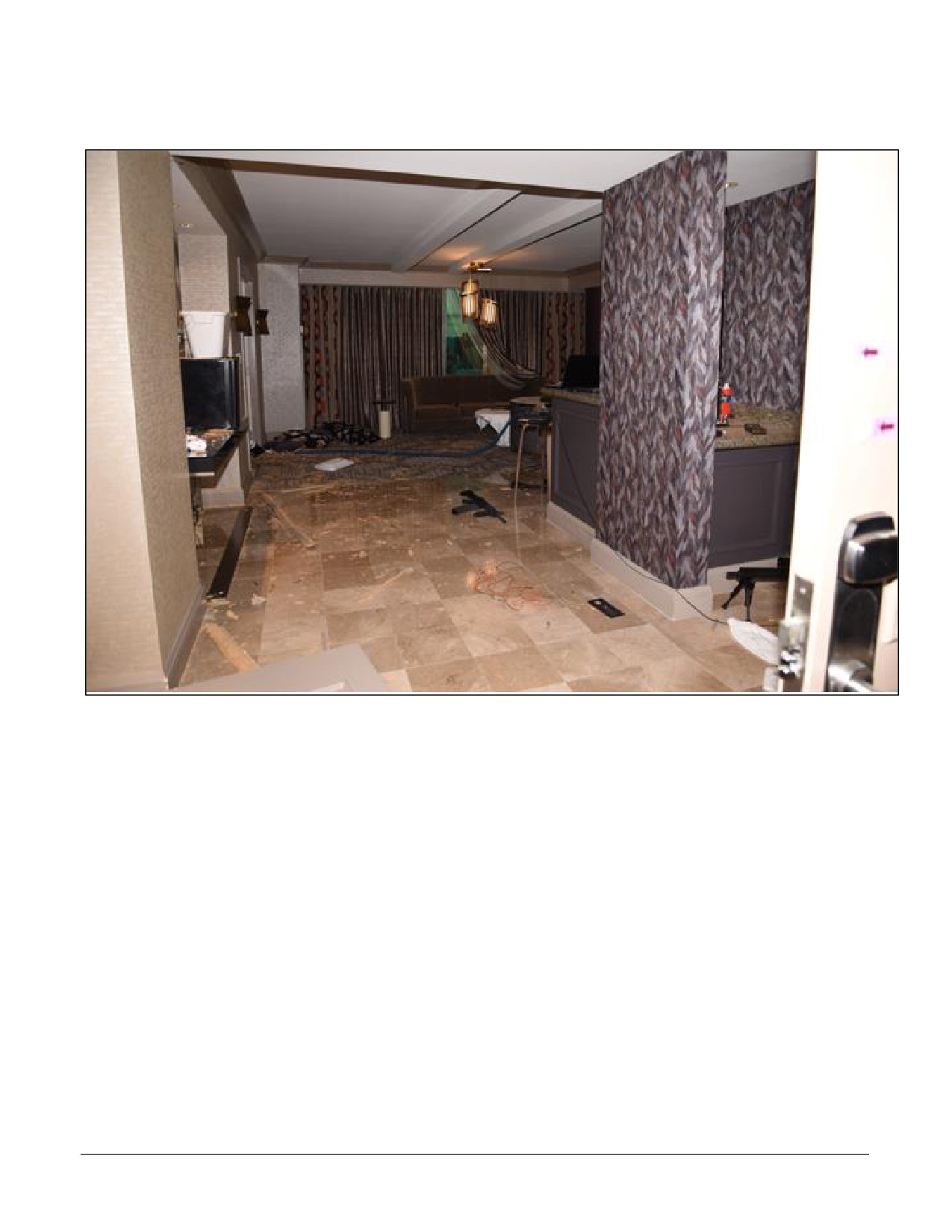
The suite consisted of a south foyer room, a west bedroom (master bedroom) with attached
bathroom, a north sitting area, a central bar/kitchenette, and a second bathroom east of the
central bar/kitchenette. A southeast living room which contained a couch, chairs, an
entertainment center/cabinet and a wall mounted TV. A connecting door which led to room 32-
134 was located southeast of the living room on the south wall. The entire north end of the suite
consisted of floor to ceiling windows.
Foyer Inside Room 32-135
The foyer had a table along the west wall. There was a white "Babysense" camera pointed in
the direction of the front entry doors at the south end of the table, and a black mini refrigerator
at the north end with a white styrofoam cooler on top. There were casings scattered on the floor
of the foyer, and on the table along the west wall. A black rifle with the muzzle pointed south,
was at the northeast portion of the foyer on the floor.
LVMPD Internal Oversight & Constitutional Policing
Page 37 of 81
Force Investigation Team
LAS VEGAS METROPOLITAN POLICE DEPARTMENT
FORCE INVESTIGATION TEAM REPORT
CONTINUATION
Event: 171001-3519
An east-west hallway extended from the east side of the foyer. A black rifle on a bipod with the
muzzle pointed west, and a drill bit partially covered by a white towel were at the west end of the
hallway on the floor.
West Bedroom (Master Bedroom)
The bedroom was located west of the sitting area. There were east facing double entry doors
located northwest of the foyer in the west wall of the sitting area. The room had a desk with a
chair along the north wall, just inside the entry doors. There were tools on the desk and the chair.
A trashcan was on the floor east of the desk that had numerous empty ammunition boxes inside.
There was also a white bag on the floor that had empty ammunition boxes inside as well as a
broken Dell laptop computer. Two boxes containing empty ammunition boxes were on the floor
behind the entry doors.
A pillar was west of the desk. An empty red gym bag and an "Anran" home security system box
were on the floor west of the pillar. A chaise lounge was along the south wall with an open
suitcase containing clothing inside and a drill on top. There were chargers plugged into the south
wall, west of the chaise lounge.
The bed was along the south wall with nightstands on either side. The following items were
located on the bed: a Dell laptop computer, a passport in the name of "Stephen Paddock", four
Home Depot gift cards, a checkbook, and a cash out voucher for the Palms Casino dated
8/28/17. There were three suitcases west of the bed: two of which were empty and one had
clothing inside. A television was on a dresser to the north of the bed. There were drill bits and
tools on the top of the dresser. Eight empty rifle magazines were on the floor below the west end
of the dresser. An open suitcase with a tool box inside was east of the dresser. A closet was in
the wall east of the bed with a single shirt and a white bathrobe hanging inside.
The attached southeast bathroom had a tub along the north wall with two glass vacuum suction
holders on top of the tub ledge, a sink counter along the south wall with toiletries to include a
prescription for "Diazepam 10 MG" in the name of "Steve Paddock", and two inhalers. The toilet
room was to the east with a pair of boxers and a pair of shoes on the floor.
Sitting Area
The sitting area was north of the foyer. Floor to ceiling windows covered by curtains extended
along the length of the north end of the suite. There was a couch along the north side of the
room, a coffee table south of the couch, and two chairs pushed together (facing one another)
south of the coffee table. Pillars were located along the north wall near the northwest corner and
along the north wall near the northeast corner of the sitting area, at the northwest corner of the
living room.
A rifle magazine was between the west and central couch cushions of the north couch. The
coffee table was covered by white towels. A rifle and an empty rifle magazine were on the coffee
table. There were four rifles sitting on the pushed together chairs and a rifle magazine on the
north arm of the east chair. One rifle was on the floor east of the chairs. There were two suitcases
LVMPD Internal Oversight & Constitutional Policing
Page 38 of 81
Force Investigation Team
LAS VEGAS METROPOLITAN POLICE DEPARTMENT
FORCE INVESTIGATION TEAM REPORT
CONTINUATION
Event: 171001-3519
on the floor east of the coffee table containing numerous loaded rifle magazines. An empty rifle
magazine was on the floor, east of the suitcases.
There was a stack of 14 loaded rifle magazines on the west side of the northeast pillar. A blue
plastic tube with a snorkel mouthpiece attached with green tape to the east end and a black
funnel with a fan inside at the west end extended from the east side of the suitcases, across the
coffee table, to the west side of the room, adjacent to the doors of the west bedroom.
A chair facing south, with a side table to the east, were at the west end along the northeast bank
of windows. The window located immediately east of the northwest pillar was shattered with
glass on the floor below it. Numerous casings were on the floor at the base of the window, south
into the room, and on the seat of the chair. A blue and yellow "Estwing" hammer was on the floor
at the east side of the northeast pillar, south of the broken window. The head of the hammer had
tape wrapped around it. The curtains in place over the broken window were damaged. Two rifles
with bipods were on the floor south of the chair.
A high top table was centrally located along the northeast bank of windows with a loaded rifle
magazine on the southeast end of the table. An open suitcase was on the floor south of the table
with numerous loaded rifle magazines inside. A rifle with a bipod was on the floor southeast of
the table. There were casings on the floor surrounding the table.
Decedent Stephen Paddock
Paddock was on the floor south of the chair and side table. He was wearing black pants, a long
sleeve brown shirt, black gloves, and grey shoes. Paddock was on his back with his head to the
south, feet to the north, and arms at his sides. There was apparent blood surrounding his nose
and mouth, and on the floor under his head. There was also apparent blood on the front of his
shirt. A rifle was on the floor under his legs. A grey box cutter was on the floor between his feet.
There were casings on the floor surrounding him. A silver/black colored "Smith & Wesson"
revolver with apparent blood on it was on the floor south of Paddock's head.
Bar/Kitchenette
The central bar/kitchenette was south of the sitting area east of the foyer and north of the east-
west hallway. There was a north bar counter (east-west orientation) with three chairs on the
north side of the counter. There were three rifles on the floor north of the west end of the counter
with a backpack under them. One rifle was on the seat of the westernmost chair; one rifle was
on the seat of the easternmost chair; and one rifle was located on the west end of the bar counter.
An empty silver colored rolling case was on the floor north of the counter, at the east end. A
Luxor sticker and a "29" sticker were on the back of the case.
At the west end of the bar counter was an "Anran" monitor with a video feed to the previously
described camera on the lower portion of the room service cart in the hallway, a laptop computer,
which provided a live feed to the camera attached to the peephole of the door, and a Samsung
cell phone in a black case.
LVMPD Internal Oversight & Constitutional Policing
Page 39 of 81
Force Investigation Team
LAS VEGAS METROPOLITAN POLICE DEPARTMENT
FORCE INVESTIGATION TEAM REPORT
CONTINUATION
Event: 171001-3519
Centrally located on the bar counter were bank cards and other cards in the name of "Stephen
Paddock" and room key card packets. At the east end of the bar counter was a black holster, a
black glove, binoculars, blue hat, brown wallet, tape roll, credit cards and a Nevada ID in the
name of "Stephen Paddock", a Player's card in the name of "Marilou Danley", valet ticket, a
notepad with "unplug phones" written on it, and a white handheld monitor, as well as a black
ZTE cell phone with the front and back cameras covered with tape and a Samsung Galaxy S6
active in a black case.
At the southwest corner of the bar was a sink. There were two loaded rifle magazines and a
"Tundra” fire extinguisher on the sink counter.
Living Room
The southeast living room was east of the bar/kitchenette at the east end of the east-west
hallway. There was a television mounted on the south wall with an entertainment center/cabinet
below, a couch to the north and east, and an orange chair to the west. The couch cushions were
off of the east couch and piled on the north couch and on the floor. A table was along the north
side of the north couch with four chairs.
A side table was west of the north couch. A "Meade" spotting scope was on the floor north of the
side table. A pink piece of paper with written measurements on one side was on the floor west
of the east couch.15
An open black suitcase containing soft rifle cases inside was on the floor north of the cabinet.
There were three casings on the floor west of the side table and at the east end of the east-west
hallway.16
There was a bullet hole through the east arm of the orange chair; two bullet holes into the cabinet
along the south wall; and one bullet hole into the south wall, between the entertainment
center/cabinet and the connecting door to 32-134.17
There were two suitcases along the west wall. A blue large bag with numerous towels, soft rifle
cases, and scope covers inside were also along the west wall.
Room 32-134
Room 32-134 was a single connecting hotel room, south of 32-135. The connecting door was
located at the south end of room 32-135 in the southwest corner of the southeast living room.
There was damage to the south adjoining door frame18and the damaged door was on the floor
inside room 32-134. The main entry door to the room was west facing, accessing the hallway. A
room service cart with an open laptop computer on the east end was in the entry hallway, east
15 This was the same note originally located on the table near Paddock’s body. The wind blew it off of the
table to this location.
16 These casings came from the SWAT Officer’s rifle.
17 These bullet holes came from the SWAT Officer’s rifle.
18 Occurred during the second explosive breach
LVMPD Internal Oversight & Constitutional Policing
Page 40 of 81
Force Investigation Team
LAS VEGAS METROPOLITAN POLICE DEPARTMENT
FORCE INVESTIGATION TEAM REPORT
CONTINUATION
Event: 171001-3519
of the entry door. There were wires connected from the laptop that ran under the entry door.
There was a video feed visible on the laptop of the hallway looking south from the previously
described black "Logitech" camera attached to the hallway room service cart.
The room was furnished with two beds with a nightstand in between along the south wall, a desk,
dresser, and chair along the north wall, a television mounted on the north wall, and floor to ceiling
windows on the east. The southernmost window was shattered with glass on the floor below it.
There were nine loaded rifle magazines on top of the dresser. The dresser drawers were open
and the bottom was broken. There were three rifles with bipods on the east bed and several
casings. One cartridge case was on the floor west of the east bed. There were two rifles on the
west bed, one of which was a bolt action. A pair of black gloves was on the west side of the west
bed. A pair of tan sandals were on the floor north of the west bed. A bullet hole was in the north
wall corresponding with a hole in the south wall of the living room, and one bullet hole was in the
comforter at the north end of the east bed.
There were two closets along the west wall with the door to the attached southwest bathroom.
The bathroom had a sink counter along the south side and tub to the north. Clothing was on the
floor under the sink counter along with a trashcan. There was a snorkel tube located inside the
trashcan.
VII.
EVIDENCE RECOVERY
Physical Evidence
During the course of the investigation, several items of evidentiary value were located and
impounded by LVMPD Crime Scene Analysts and FBI Evidence Recovery Team. The following
is a summary of key pieces of evidence located during searches of multiple locations.
Picture numbers listed below correspond with pictures attached in Appendix A of this report.
Mandalay Bay Location
32nd Floor - 100 Wing - Stairwell Foyer Room (Picture 1)
Metal “L” bracket with three screws securing it to the interior door/frame.
32nd Floor - 100 Wing Hallway (Pictures 2-4)
Two surveillance cameras from room service cart outside room 32-134.
Bullet fragments
32nd Floor - Room 32-135 - Main Room (Pictures 5-17)
Make
Model
Serial Number
Description
Colt
M4 Carbine
LE451984
AR-15 .223/5.56 with a bump stock,
vertical fore grip and
100 round
magazine. Front sight only.
Noveske
N4
B15993
AR-15 .223/5.56 with a bump stock,
vertical fore grip and
40 round
magazine. EOTech optic.
LVMPD Internal Oversight & Constitutional Policing
Page 41 of 81
Force Investigation Team

LAS VEGAS METROPOLITAN POLICE DEPARTMENT
FORCE INVESTIGATION TEAM REPORT
CONTINUATION
Event: 171001-3519
LWRC
M61C
24-18648
AR-15 .223/5.56 with a bump stock,
vertical fore grip and
100 round
magazine. No sights or optics.
POF USA
P-308
UA-1600204
AR-10 .308/7.62 with a bipod, scope and
25 round magazine.
Christensen
CA-15
CA04625
AR-15 .223 Wylde with a bump stock,
Arms
vertical fore grip and
100 round
magazine. No sights or optics.
POF USA
P-15
PE-1600179
AR-15 .223/5.56 with a bump stock,
vertical fore grip and
100 round
magazine. No sights or optics.
Colt
Competition
CCR014544
AR-15 .223/5.56 with a bump stock,
vertical fore grip and
100 round
magazine. No sights or optics.
Smith
342 AirLite Ti
CDZ7618
.38 caliber revolver with 4 cartridges, 1
& Wesson
expended cartridge case.
LWRC
M61C
5P03902
AR-15 .223/5.56 with a bump stock,
vertical fore grip and
100 round
magazine. EOTech optic.
FNH
FM15
FND000905
AR-10 .308/7.62 with a bipod, scope and
25 round magazine.
Daniel
DD5V1
DD5007426
AR-10 .308/7.62 with a bipod, scope and
Defense
25 round magazine.
FNH
FN15
FNB024293
AR-15 .223/5.56 with a bump stock,
vertical fore grip and
100 round
magazine. EOTech optic.
POF USA
P15
03E-1603178
AR-15 .223/5.56 with a bump stock,
vertical fore grip and
100 round
magazine. EOTech optic.
Colt
M4 Carbine
LE564124
AR-15 .223/5.56 with a bump stock,
vertical fore grip and
100 round
magazine.
Daniel
M4A1
DDM4123629
AR-15 .223/5.56 with a bump stock,
Defense
vertical fore grip and
100 round
magazine. EOTech optic.
LMT
Def. 2000
LMT81745
AR-15 .223/5.56 with a bump stock,
vertical fore grip and
100 round
magazine. No sights or optics.
Daniel
DDM4V11
DDM4078072
AR-15 .223/5.56 with a bump stock,
Defense
vertical fore grip. No magazine. EOTech
optic.
Sig Sauer
SIG716
23D020868
AR-10 .308/7.62 with a bipod, red dot
optic and 25 round magazine.
Daniel
DD5V1
DD5008362
AR-10 .308/7.62 with a bipod and scope.
Defense
No magazine.
Blue plastic hose with funnel, fan and SCUBA mouthpiece attached.
LVMPD Internal Oversight & Constitutional Policing
Page 42 of 81
Force Investigation Team
LAS VEGAS METROPOLITAN POLICE DEPARTMENT
FORCE INVESTIGATION TEAM REPORT
CONTINUATION
Event: 171001-3519
Surveillance camera mounted to room door peephole.
Baby monitor camera (not mounted).
Surveillance camera mounted to room door peephole.
Small sledge hammer.
Laptop computer.
Surveillance camera monitor.
Spotting scope.
Binoculars.
Expended .223/5.56 cartridge casings (approximately 1,050).
Cellular phones.
Nevada Driver’s License - Stephen Paddock.
Mlife players card - Marilou Danley.
Polymer 40 round AR-15 magazines (loaded).
Steel 100 round AR-15 magazines (loaded).
Polymer 25 round AR-10 magazines (loaded).
Live Ammunition (approximately 5,280).
Handwritten note with distance/bullet drop calculations.
Suitcases, duffel bags, soft rifle cases, towels.
32nd Floor - Room 32-135 - Bedroom Suite (Picture 18)
Laptop computer (on bed).
Disassembled laptop computer missing hard drive (on floor).
Power hand drills.
Empty ammunition boxes and plastic bags.
Scuba mask.
Loose ammunition.
Miscellaneous hand tools and drill bits.
Miscellaneous screws and mounting brackets.
Suitcases, towels.
Empty rifle magazines
32nd Floor - Room 32-134 - Hotel Room (Pictures 19-21)
Make
Model
Serial Number
Description
FNH
FN15
FNCR000383
AR-15 .223/5.56
with
a
bump
stock,
vertical fore grip and
100
round
magazine. No sights or optics.
Ruger
American
695-93877
.308 caliber bolt action rifle with scope.
LMT
LM308MWS
LMS18321
AR-10 .308/7.62 with a bipod and red
dot scope. No magazine.
Ruger
SR0762
562-13026
AR-10 .308/7.62 with a bipod, scope and
25 round magazine.
LMT
LM308MWS
LMS18300
AR-10 with a bipod, scope and 25 round
magazine.
Laptop computer connected to hallway surveillance cameras.
Polymer 25 round AR-10 magazines (loaded).
Expended .308/7.62 cartridge casings (8).
LVMPD Internal Oversight & Constitutional Policing
Page 43 of 81
Force Investigation Team
LAS VEGAS METROPOLITAN POLICE DEPARTMENT
FORCE INVESTIGATION TEAM REPORT
CONTINUATION
Event: 171001-3519
Mandalay Bay - East Valet - Space 317 (Paddock’s Vehicle. Pictures 22-24)
2017 Chrysler Pacifica, Nevada/74D401 towed to FBI garage.
20x2 pound containers of exploding targets.
10x1 pound containers of exploding targets.
2x20 pound bags of explosive precursors.
Polymer 25 round AR-10 .308/7.62 magazines (loaded).
Polymer 40 round AR-15 .223/5.56 magazines (loaded).
Boxed ammunition.
Suitcases, towels.
McCarran Airport - Fuel Tanks - East Mandalay Bay Road/Haven Street (Pictures 25-27)
Bullet fragments
1372 Babbling Brook Court Mesquite, Nevada (Paddock’s House)
Make
Model
Serial Number
Description
Smith
SW99
SAB5974
9mm semi-automatic pistol.
& Wesson
Smith
M&P9
HDU4086
9mm semi-automatic pistol.
& Wesson
Glock
17
BCGM344
9mm semi-automatic pistol.
Mossberg
500
V0397109
12 gauge pump action shotgun.
Sig Sauer
516
20J036999
AR-15 .223/5.56 rifle with a bipod and
scope.
Arma-Lite
SPRM001
M-10-13530
AR-15 .223/5.56 rifle with a bipod and
scope.
Mossberg
590
V0433557
12 gauge pump action shotgun.
LWRC
M61C-IC-A5
24-19038
AR-15 .223/5.56 rifle with a bipod and
scope.
Mossberg
590
V0348193
12 gauge pump action shotgun.
Mossberg
930
AF0001141
12 semi-automatic gauge shotgun.
Arma-Lite
SPRM001
M-10-12006
AR-15 .223/5.56 rifle with a bipod and
scope.
Sig Sauer
516
20K046207
AR-15 .223/5.56 rifle, with a bipod. No
sights or optics.
Lantac
LA-R15 Raven
LT-0297
AR-15 .223 Wylde rifle with a bipod and
scope.
Mossberg
590
P833785
12 gauge pump action shotgun.
Arsenal
Saiga 12
H09423015L
AK-47 style semi-automatic 12 gauge
shotgun.
Arsenal
Saiga 12
H07420684
AK-47 style semi-automatic 12 gauge
shotgun.
Beretta
92F
C856302
9mm semi-automatic pistol.
FN
5.7
386215450
5.7mm semi-automatic pistol.
Handgun, shotgun, rifle ammunition.
Exploding targets.
Computer related items.
LVMPD Internal Oversight & Constitutional Policing
Page 44 of 81
Force Investigation Team

LAS VEGAS METROPOLITAN POLICE DEPARTMENT
FORCE INVESTIGATION TEAM REPORT
CONTINUATION
Event: 171001-3519
Soft body armor.
1735 Del Webb Parkway, Reno, Nevada (Paddock’s House)
Make
Model
Serial Number
Description
Smith
340
DCA2099
.357 caliber revolver.
& Wesson
Beretta
92A1
A098515Z
9mm semi-automatic pistol.
Pietro
Remington
870 Tactical
RS90036Z
12 gauge pump action shotgun.
Arms
Mossberg
590
V0187184
12 gauge pump action shotgun.
Glock
17 Gen4
BBVN828
9mm semi-automatic pistol.
Smith
M&P9
HHA9534
9mm semi-automatic pistol.
& Wesson
Smith
M&P9
HDL4053
9mm semi-automatic pistol.
& Wesson
Firearm ammunition.
Rifle magazines.
Computer related items.
Ammunition
Several types of ammunition were located within rooms 32-135 and 32-134 loaded into rifle
magazines for both the AR-15 and AR-10 style rifles. The AR-15 .223/5.56 rifle magazines were
loaded with hollow point and polymer tipped hollow point ammunition. The AR-10 .308/7.62 rifle
magazines and the bolt action rifle were loaded with Tracer, Frangible Incendiary, Armor
Piercing and Armor Piercing Incendiary ammunition.
A complete breakdown of the ammunition types loaded in the firearms, rifle magazines and
expended cartridge casings will be documented in the final report.
DNA
Several items of evidentiary value were collected for DNA analysis. At the time of this report the
DNA evidence collected has not yielded any significant results or indication that anyone else
was in the room.
Digital
There were approximately 1,965 leads investigated. There were approximately 21,560 hours of
video and 251,099 images obtained by investigators of the LVMPD and the FBI. Analysis found
529 sightings of Paddock.
Four laptop computers and three cellphones were located in 32-135 and 32-134. All laptop
computers and cellphones were given the FBI to be forensically analyzed. The forensic analysis
on all electronics located in 32-134 and 32-135 has been completed and the results of the
analysis is listed below.
LVMPD Internal Oversight & Constitutional Policing
Page 45 of 81
Force Investigation Team
LAS VEGAS METROPOLITAN POLICE DEPARTMENT
FORCE INVESTIGATION TEAM REPORT
CONTINUATION
Event: 171001-3519
Evidence Item HP Laptop Computer Recovered in Room 32-134
Browser Artifacts
The HP laptop computer contained internet artifacts from the following cloud storage services:
Dropbox.com, Box.com, and Microsoft One Drive. Dropbox and Microsoft One Drive
were
installed on the laptop. Box.com was accessed through a web browser.
Google Maps
On 05-18-17 Google Map searches were performed for Venice Beach and Fenway Park.
The following queries were also made with Google Maps:
Royal Rooters’ Club, Boston, MA
Blandford Street. Station, United States
Boston University Questrom School of Business
Boston Hotel Buckminster, Beacon Street, Boston, MA
Boston Arts Academy
Official Red Sox Team Store
Official Red Sox Team Store, 19 Yawkey Way, Boston, MA
Venice Ale House
Fairmont Miramar Hotel, Santa Monica, CA
The Bungalow, 101 Wilshire Boulevard, Santa Monica, CA
Google Search Queries
On 05-18-17, searches were performed for "summer concerts 2017," "grant park functions,"
"biggest bear," "La Jolla Beach," "open air concert venues," "biggest open air concert venues
in USA," and "how crowded does Santa Monica Beach get."
On 09-04-17, searches were performed for "Las Vegas rentals," "Las Vegas condo rentals,"
"Las Vegas high rise condos rent," and "Las Vegas Ogden for rent."
On 09-05-17, searches were performed for "life is beautiful expected attendance," "life is
beautiful single day tickets," and "life is beautiful Vegas lineup."
On 09-15-17, searches were performed for "swat weapons," "ballistics chart 308," "SWAT
Las Vegas," "ballistic," and "do police use explosives."
Bing Search Queries
On 09-05-17, searches were performed for "Mandalay Bay Las Vegas," "Route 91 harvest
festival 2017 attendance," and "Route 91 harvest festival 2017."
LVMPD Internal Oversight & Constitutional Policing
Page 46 of 81
Force Investigation Team
LAS VEGAS METROPOLITAN POLICE DEPARTMENT
FORCE INVESTIGATION TEAM REPORT
CONTINUATION
Event: 171001-3519
The following websites were accessed using an IE private browser:
gws_rd=ssl#q=how+crowded+does+santa+monica+beach+get&spf=149508223676
1
The following websites were accessed using Internet Explorer:
www.grantparkmusicfestival.com/ 05-18-17 0419 hours
www.ticketmaster.com/ 05-18-17 at 0427 hours
ticketmaster.com/ 05-18-17 at 0431 hours
www.sandiego.org/ 05-18-17 at 0505 hours
sandiego.org/ 05-18-17 at 0505 hours
www.vividseats.com/ 05-18-17 at 0540 hours
www.lasvegascondoexperts.com/ 09-04-17 at 2212 hours
lasvegashighrisetour.com/ 09-04-17 at 2213 hours
www.thehighrisegroup.com/ 09-04-17 at 2214 hours
Evidence Item Dell Laptop Computer Recovered in Room 32-135
Computer forensic analysis of a Dell laptop Model E5570 revealed numerous internet searches
for open air venues. Additionally, several hundred images of child pornography were located on
the computer’s hard drive. The investigation into the source of these images is ongoing. The
following internet searches from this laptop are indicated below:
Google Search Queries
How tall is Mandalay Bay/ Unknown date
NV gun shows/ 09-02-17 & 09-30-17
Life is Beautiful 2017/ 09-20-2017
Excalibur Hotel & Casino/ 09-23-17
Las Vegas Academy of the Arts Performing Arts Center/ 09-23-17
Fremont Hotel & Casino/ 09-23-17
El Cortez Hotel & Casino/ 09-23-17
Family Courts & Services Center/ 09-23-17
Gary Reese Freedom Park/ 09-23-17
LVMPD Internal Oversight & Constitutional Policing
Page 47 of 81
Force Investigation Team
LAS VEGAS METROPOLITAN POLICE DEPARTMENT
FORCE INVESTIGATION TEAM REPORT
CONTINUATION
Event: 171001-3519
Cashman Center/ 09-23-17
Cashman Field/ 09-23-17
Neon Museum/ 09-23-17
The Mob Museum/ 09-23-17
Discovery Children’s Museum/ 09-23-17 & 09-26-17
Arizona Charlie’s Decatur/ 09-23-17
Where is hard drive located on e5570/ 09-28-17
NHRA schedule 2017/ 09-30-17
VIII. SUSPECT AUTOPSY
On 10-06-17, at approximately 1625 hours, under CCOCME case 17-10064 and FBI incident
number 4-LV-2215061 an autopsy was performed on the body of Paddock at the CCOCME by
Doctor Lisa Gavin.
Decedent
Name:
Paddock, Stephen
Date of birth:
04-09-53
Gender:
Male
Ethnicity:
Caucasian
Height:
73 inches
Weight:
224 lbs
Hair:
Gray
Eyes:
Brown
Body bag seal #541486 removed at 1625 hours.
Specific Photography:
Body bag seal
Clothed body
Pre-cleaned unclothed body
Post-cleaned unclothed body
Injuries
X-Rays
The following persons were in attendance:
1)
Clark County Coroner Fudenberg
2)
Forensic Pathologist Doctor Gavin
3)
Detective Alsup
4)
Detective Colon
5)
SCSA Fletcher
6)
FBI ERT Agents (2)
7)
Forensic Technician Rosales
LVMPD Internal Oversight & Constitutional Policing
Page 48 of 81
Force Investigation Team
LAS VEGAS METROPOLITAN POLICE DEPARTMENT
FORCE INVESTIGATION TEAM REPORT
CONTINUATION
Event: 171001-3519
The following items of evidence were retained by the FBI’s Evidence Recovery Team:
1)
One brown long sleeved shirt.
2)
One pair of black pants.
3)
One pair of white socks.
4)
One pair of black slip-on shoes.
5)
One pair of blue underwear.
6)
Paper tissue from the decedent’s ears.
7)
Print exemplars.
8)
One projectile recovered from the decedent’s head.
Synopsis
On October 6, 2017, detectives from the LVMPD along with a LVMPD Crime Scene Analyst,
attended the autopsy of Stephen Paddock at the CCOCME. Also present were members of the
FBI Evidence Recovery Team who retained all collected evidence.
The exam room was secured by Clark County Coroner, John Fudenberg. Forensic Pathologist
Doctor Lisa Gavin performed the autopsy with one assistant.
The decedent was x-rayed, photographed and cleaned prior to Doctor Gavin’s exam.
Preliminarily, the injuries noted were on the posterior of both calves and a gunshot wound to the
upper palette inside the decedent’s mouth with obvious damage to the upper teeth.
The cause of Paddock’s death was an interoral gunshot wound and the manner of death was
ruled a suicide.
IX.
INVESTIGATION
Mandalay Bay Hotel Room
LVMPD officers located several documents, to include photographs, identifying Paddock as the
suspect who was lying on the floor with an apparent gunshot wound to the head. Also located
inside the room investigators found documentation related to Danley who was later identified as
the longtime girlfriend of Paddock.
Located throughout the 100-wing hallway from the double doors of room 32-135 to the alcove
wall of room 32-105 were over 200 bullet strikes. The bullet strikes consisted of actual impacts
and holes. These strikes were caused by approximately 35 rounds fired down the 100-wing from
inside of room 32-135.
Law Enforcement and the CCOCME took custody of Paddock’s body. The body was
photographed and transported to the CCOCME where an autopsy was conducted.
The room was secured for evidence recovery. The FBI Evidence Recovery Team responded
and took the lead role on documentation and recovery of all evidence inside the hotel rooms and
hallway.
LVMPD Internal Oversight & Constitutional Policing
Page 49 of 81
Force Investigation Team
LAS VEGAS METROPOLITAN POLICE DEPARTMENT
FORCE INVESTIGATION TEAM REPORT
CONTINUATION
Event: 171001-3519
Located inside the master bedroom of suite
32-135 were hand drills, drill bits, several
miscellaneous tools, and equipment Paddock used to drill holes, run wires, and set up
surveillance cameras that showed the 100 wing hallway. Inside the bedroom were several empty
ammunition boxes, live rounds, loaded rifle magazines, duffle bags, suitcases, two laptop
computers (one of which was broken and missing the hard drive), snorkeling kit bag, diving
mask, circular glass cutter with suction cup and miscellaneous personal items.
Located throughout the main living area of the suite were 18 rifles, one handgun, rifle casings,
and loaded magazines. A blue plastic tube, was fashioned with a fan on one end and snorkel
mouthpiece on the other end. A spotting scope on a tripod was on the floor near Paddocks body
and a slip of paper was on a small table with hand written distances on it. Several suitcases and
bags were throughout the main room containing personal items and loaded rifle magazines. A
laptop computer was located on the bar and connected to a live feed camera attached to the
peephole of the main door to suite 32-135.
Room 32-134 was an adjoining room to suite 32-135 used by Paddock. Located inside the room
were five rifles, casings, live ammunition and several loaded magazines. A pair of gloves were
located on one of the beds and sandals were located on the floor near the bed. Inside the
bathroom, a snorkel tube was located in the trash. A room service receipt and a cardboard box
with mailing labels was also located in the bathroom. In the walkway leading to the door to the
main hallway was a food service cart. A laptop computer was located on the food service cart.
It was connected to two live feed cameras and a battery pack with wires connecting it to the
cameras on the food service cart in the 100 wing hallway.
All evidence located and recovered inside suite 32-135 and room 32-134 indicated Paddock was
capable of watching people in the hallway. There was no suicide note or manifesto located inside
either room.
Paddock's Vehicle
Paddock’s vehicle was located in Mandalay Bay East Valet, 2nd floor, space 317 by investigators.
The vehicle a 2017 Chrysler Pacific bearing Nevada plate 79D401 had been backed into space
317 and was locked. The key for the vehicle was obtained from valet.
A search warrant was obtained and at 0325 hours, detectives with the LVMPD All-Hazard
Regional Multi agency Operations and Response Section (ARMOR) broke a window to the
vehicle, to allow an explosive detection dog access to the scent from inside the vehicle. A U.S.
Marshall explosive detection K9 moved around the vehicle and gave an alert to the presence of
explosive precursors.
Detectives secured the area on the belief there were explosive precursors within the vehicle.
ARMOR detectives requested LVMPD dispatch notify the Las Vegas Fire and Rescue Chemical,
Biological, Radiological, Nuclear and Explosive Task Force (CBRNE) respond. Las Vegas Fire
Rescue responded with their CBRNE vehicle along with FBI bomb technicians. Located inside
the vehicle were five bags which were x-rayed and removed by the FBI.
LVMPD Internal Oversight & Constitutional Policing
Page 50 of 81
Force Investigation Team
LAS VEGAS METROPOLITAN POLICE DEPARTMENT
FORCE INVESTIGATION TEAM REPORT
CONTINUATION
Event: 171001-3519
Upon rendering the vehicle safe, the vehicle and all items located inside were photographed. All
items removed from the vehicle were placed back inside and the vehicle was sealed. The vehicle
was subsequently towed from the Mandalay Bay Hotel to a secure FBI facility for a thorough
search and evidence collection.
Evidence collected from inside Paddock's vehicle included loaded rifle magazines for both AR-
15 and AR-10 style rifles. Also collected were 20 two pound containers of exploding targets, 10
one pound containers of exploding targets and 2 twenty pound bags of explosive precursors.
Paddock's Mesquite Residence
LVMPD detectives responded to Paddock's residence in Mesquite, Nevada. The residence was
located at 1372 Babbling Brook Court. Detectives obtained and served a search warrant at this
location. Inside the residence, seven shotguns, five handguns, six rifles, exploding targets,
firearm ammunition, rifle magazines and computer related items were recovered. These items
were impounded and turned over to the FBI for processing.
Paddock's Reno Residence
FBI Agents responded to Paddock's residence in Reno, Nevada. The residence was located at
1735 Del Webb Parkway, Reno, Nevada. Agents obtained and served a search warrant at this
location. Inside of the residence were two shotguns, five handguns, firearm ammunition, rifle
magazines and computer related items. The items were recovered by the FBI for processing.
Search Warrants and Legal Notices
The investigative process required information to be obtained from numerous sources and
venues to include but not limited to:
Hotels and Casinos
Firearms related businesses
Residences of Stephen Paddock
Vehicles of Stephen Paddock
Internet providers
Telephone companies
Online retail businesses
Email companies
During the course of the investigation law enforcement authored approximately 1,062 legal
notices. These legal notices were to obtain information or items from venues related to the
investigation. These legal documents included but are not limited to:
Administrative Subpoenas
Court Orders
Search Warrants
Grand Jury Subpoenas
LVMPD Internal Oversight & Constitutional Policing
Page 51 of 81
Force Investigation Team
LAS VEGAS METROPOLITAN POLICE DEPARTMENT
FORCE INVESTIGATION TEAM REPORT
CONTINUATION
Event: 171001-3519
Law Enforcement Tips and Leads
All tips or items that needed to be investigated or followed up were coordinated by the FBI and
the LVMPD. These leads were tracked using the Operational Response and Investigative Online
Network or ORION system through the FBI.
Investigators conducted interviews with 43 people directly associated with Paddock. These
included 24 gambling associates, 11 acquaintances and 8 blood relatives.
X.
PRELIMINARY FINDINGS FROM THE 1 OCTOBER INVESTIGATION
Investigators determined key findings as a result of this investigation:
Paddock acted alone. Thousands of hours of digital media were reviewed and after all
the interviews conducted, no evidence exists to indicate Paddock conspired with or acted
in collusion with anybody else. This includes video surveillance, recovered DNA19and
analysis of cellular phones and computers belonging to Paddock.
No suicide note or manifesto was found. Of all the evidence collected from rooms 32-135
and 32-134, there was no note or manifesto stating Paddock’s intentions. The only
handwritten documentation found in either room was the small note indicating
measurements and distances related to the use of rifles.
There was no evidence of radicalization or ideology to support any theory that Paddock
supported or followed any hate groups or any domestic or foreign terrorist organizations.
Despite numerous interviews with Paddock’s family, acquaintances and gambling
contacts, investigators could not link Paddock to any specific ideology.
Paddock committed no crimes leading up to the October 1st mass shooting. All the
weapons he purchased to include all the ammunition, were purchased legally. This
includes all the purchases Paddock made at gun stores as well as online purchases.
Paddock did not commit a crime until he fired the first round into the crowd at the Las
Vegas Village.
Reference the 1,965 investigated leads, 21,560 hours of video, 251,099 images obtained
and 746 legal notices filed or sent, nothing was found to indicate motive on the part of
Paddock or that he acted with anyone else.
Security Officer Campos was not shot with a BB gun but rather sustained a gunshot
wound from one of the rounds fired by Paddock down the hallway of the 100 wing on the
32nd floor. Security Officer Campos did in fact have a pre-planned vacation to Mexico to
go visit his father and Security Officer Campos asked law enforcement for permission to
make this trip.
19 Deoxyribonucleic Acid
LVMPD Internal Oversight & Constitutional Policing
Page 52 of 81
Force Investigation Team
LAS VEGAS METROPOLITAN POLICE DEPARTMENT
FORCE INVESTIGATION TEAM REPORT
CONTINUATION
Event: 171001-3519
One aspect of the investigation focused on Paddock’s financials. The investigation proved
Paddock was self-funded through his gambling and past real estate transactions. He was
indebted to no one and in fact paid all his gambling debts off prior to the shooting.
The investigation revealed several indicators of intent on the part of Paddock. Those
indicators are as follows:
1.
Paddock had a reservation for a hotel during the Lollapalooza music festival held
at Grant Park in Chicago, Illinois during the month of August. Like Route 91, the
Lollapalooza festival was held in an open air venue. Paddock specifically
requested a room overlooking the venue when he made the reservation. The
reservation was cancelled two days prior to the check-in date.
2.
Paddock made lodging reservations during the Life is Beautiful music festival held
in Downtown Las Vegas, Nevada. The festival was also an open air music venue
attended by thousands of people. Paddock requested units overlooking the venue.
Paddock reserved three different units during the period and all faced the venue.
Paddock was observed in video surveillance transporting several suitcases from
his vehicle to the units he reserved. Paddock was alone for the trip and was never
accompanied by anyone for more than a casual conversation. Investigators have
been unable to determine if Paddock intended an attack during this festival or if he
used it as a means to plan a future attack.
3.
Paddock conducted several internet searches while planning his actions. Search
terms included open air concert venues, Las Vegas SWAT tactics, weapons and
explosives. Paddock also searched for various gun stores.
4.
The purchasing of over 55 firearms, which were mostly rifles in various calibers,
from October 2016 - September 2017. He also bought over 100 firearm related
items through various retailers during that period.
5.
During a stay in early September 2017, Paddock requested specific rooms that
overlooked the Las Vegas Village. According to Danley, Paddock spent time
looking at the Las Vegas Village venue from different angles and windows while
inside the room.
LVMPD Internal Oversight & Constitutional Policing
Page 53 of 81
Force Investigation Team

LAS VEGAS METROPOLITAN POLICE DEPARTMENT
FORCE INVESTIGATION TEAM REPORT
CONTINUATION
Event: 171001-3519
Appendix A
Picture 1
(Door leading to the stairwell secured by “L” bracket)
LVMPD Internal Oversight & Constitutional Policing
Page 54 of 81
Force Investigation Team

LAS VEGAS METROPOLITAN POLICE DEPARTMENT
FORCE INVESTIGATION TEAM REPORT
CONTINUATION
Event: 171001-3519
Picture 2
(View from 100 hallway towards room 32-135)
LVMPD Internal Oversight & Constitutional Policing
Page 55 of 81
Force Investigation Team

LAS VEGAS METROPOLITAN POLICE DEPARTMENT
FORCE INVESTIGATION TEAM REPORT
CONTINUATION
Event: 171001-3519
Picture 3
(Food Service Cart in hallway with camera)
LVMPD Internal Oversight & Constitutional Policing
Page 56 of 81
Force Investigation Team

LAS VEGAS METROPOLITAN POLICE DEPARTMENT
FORCE INVESTIGATION TEAM REPORT
CONTINUATION
Event: 171001-3519
Picture 4
(Food Service Cart in hallway with camera)
LVMPD Internal Oversight & Constitutional Policing
Page 57 of 81
Force Investigation Team
LAS VEGAS METROPOLITAN POLICE DEPARTMENT
FORCE INVESTIGATION TEAM REPORT
CONTINUATION
Event: 171001-3519
Picture 5
(View from entry of 32-135 towards the sitting area)
LVMPD Internal Oversight & Constitutional Policing
Page 58 of 81
Force Investigation Team

LAS VEGAS METROPOLITAN POLICE DEPARTMENT
FORCE INVESTIGATION TEAM REPORT
CONTINUATION
Event: 171001-3519
Picture 6
(View from foyer of room 32-135 towards the sitting area)
LVMPD Internal Oversight & Constitutional Policing
Page 59 of 81
Force Investigation Team

LAS VEGAS METROPOLITAN POLICE DEPARTMENT
FORCE INVESTIGATION TEAM REPORT
CONTINUATION
Event: 171001-3519
Picture 7
(View from sitting area towards the living room)
LVMPD Internal Oversight & Constitutional Policing
Page 60 of 81
Force Investigation Team

LAS VEGAS METROPOLITAN POLICE DEPARTMENT
FORCE INVESTIGATION TEAM REPORT
CONTINUATION
Event: 171001-3519
Picture 8
(View from sitting area towards the bar / kitchenette)
LVMPD Internal Oversight & Constitutional Policing
Page 61 of 81
Force Investigation Team

LAS VEGAS METROPOLITAN POLICE DEPARTMENT
FORCE INVESTIGATION TEAM REPORT
CONTINUATION
Event: 171001-3519
Picture 9
(View from sitting area towards the bar / kitchenette)
LVMPD Internal Oversight & Constitutional Policing
Page 62 of 81
Force Investigation Team
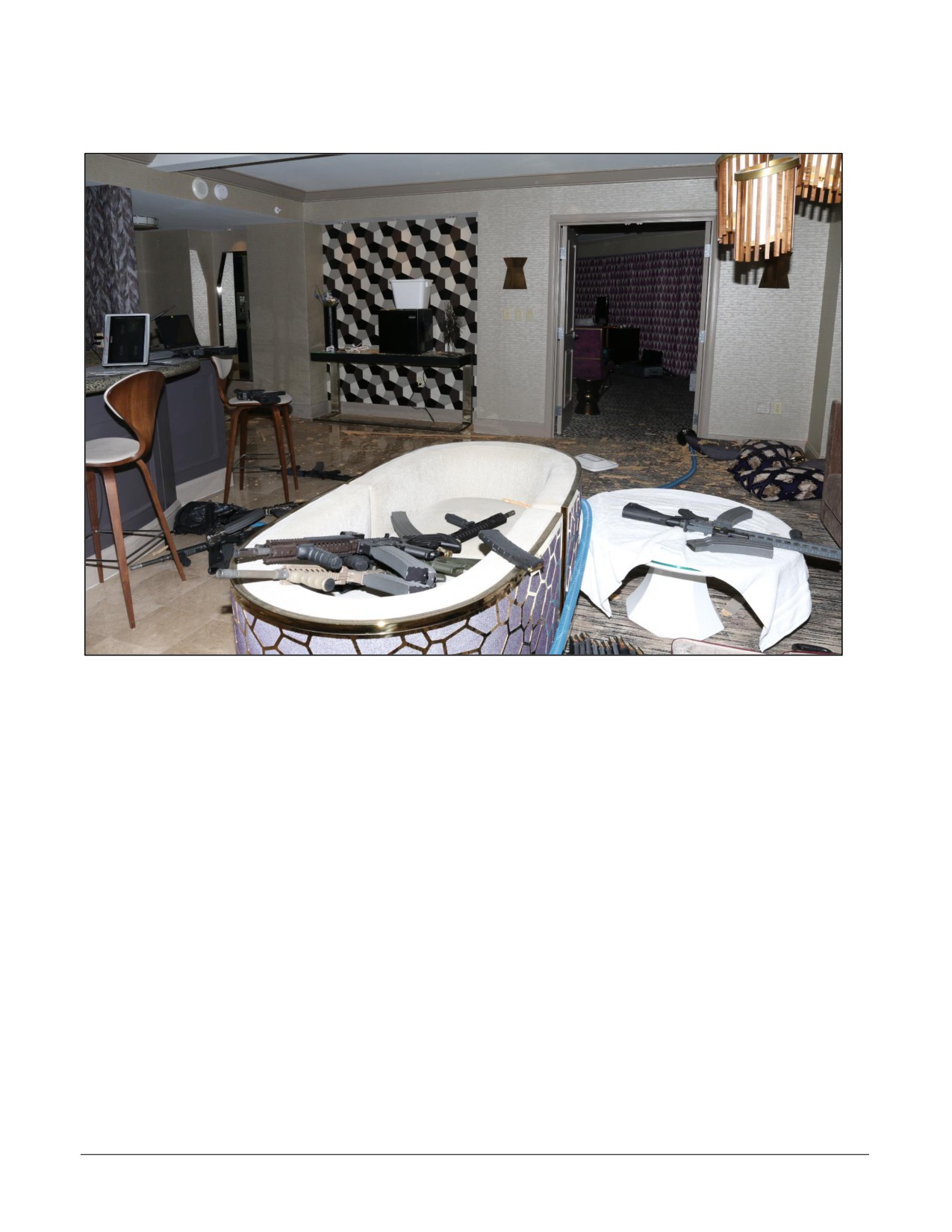
LAS VEGAS METROPOLITAN POLICE DEPARTMENT
FORCE INVESTIGATION TEAM REPORT
CONTINUATION
Event: 171001-3519
Picture 10
(View from sitting area towards master bedroom)
LVMPD Internal Oversight & Constitutional Policing
Page 63 of 81
Force Investigation Team

LAS VEGAS METROPOLITAN POLICE DEPARTMENT
FORCE INVESTIGATION TEAM REPORT
CONTINUATION
Event: 171001-3519
Picture 11
(View of connecting doors between room 32-135 and 32-134)
LVMPD Internal Oversight & Constitutional Policing
Page 64 of 81
Force Investigation Team

LAS VEGAS METROPOLITAN POLICE DEPARTMENT
FORCE INVESTIGATION TEAM REPORT
CONTINUATION
Event: 171001-3519
Picture 12
(Blue plastic hose with snorkel mouthpiece attached)
LVMPD Internal Oversight & Constitutional Policing
Page 65 of 81
Force Investigation Team

LAS VEGAS METROPOLITAN POLICE DEPARTMENT
FORCE INVESTIGATION TEAM REPORT
CONTINUATION
Event: 171001-3519
Picture 13
(Surveillance camera mounted to room door peephole)
LVMPD Internal Oversight & Constitutional Policing
Page 66 of 81
Force Investigation Team
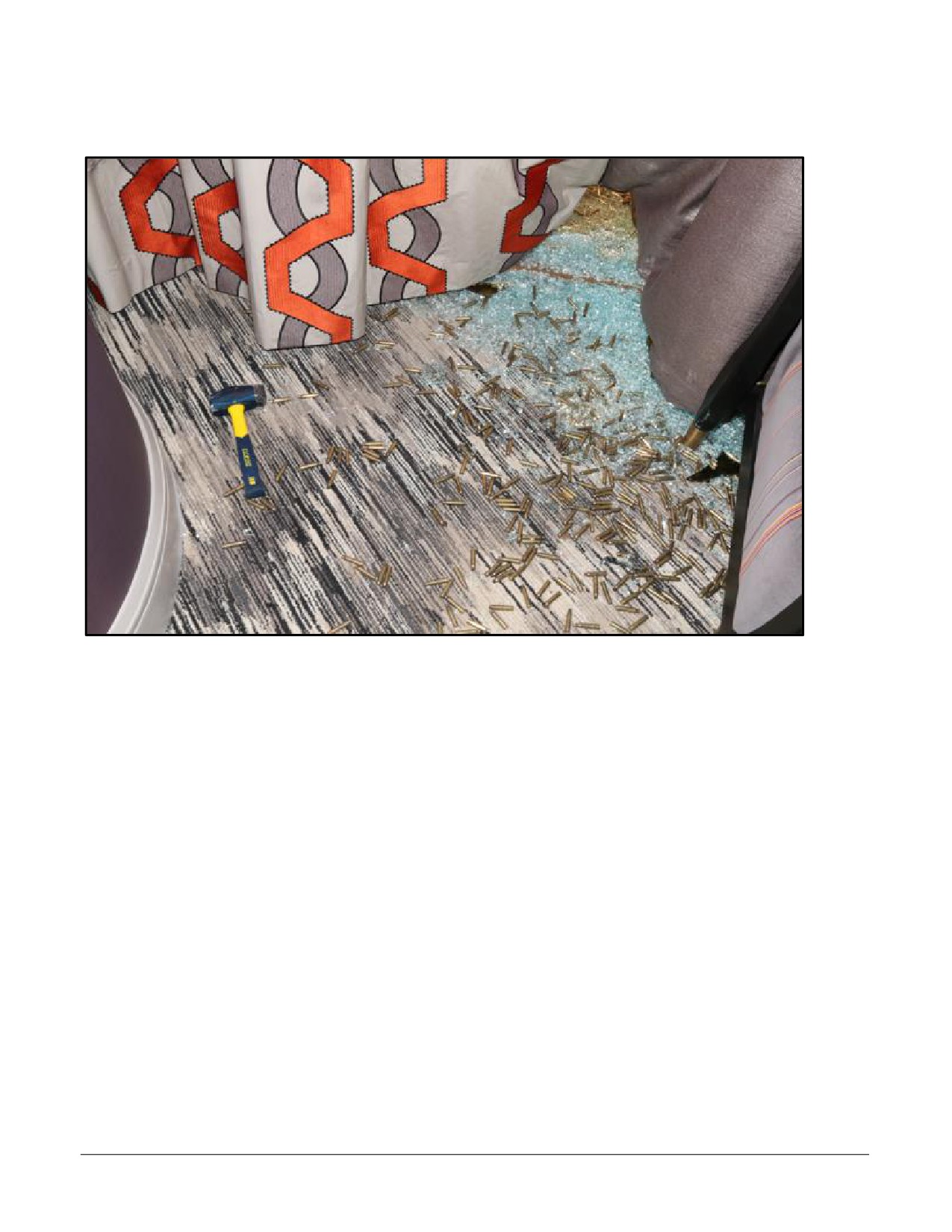
LAS VEGAS METROPOLITAN POLICE DEPARTMENT
FORCE INVESTIGATION TEAM REPORT
CONTINUATION
Event: 171001-3519
Picture 14
(Small sledge hammer)
LVMPD Internal Oversight & Constitutional Policing
Page 67 of 81
Force Investigation Team
LAS VEGAS METROPOLITAN POLICE DEPARTMENT
FORCE INVESTIGATION TEAM REPORT
CONTINUATION
Event: 171001-3519
Picture 15
(Handwritten note with distance/bullet drop calculations)
LVMPD Internal Oversight & Constitutional Policing
Page 68 of 81
Force Investigation Team

LAS VEGAS METROPOLITAN POLICE DEPARTMENT
FORCE INVESTIGATION TEAM REPORT
CONTINUATION
Event: 171001-3519
Picture 16
(Damage to entry door of room 32-135)
LVMPD Internal Oversight & Constitutional Policing
Page 69 of 81
Force Investigation Team

LAS VEGAS METROPOLITAN POLICE DEPARTMENT
FORCE INVESTIGATION TEAM REPORT
CONTINUATION
Event: 171001-3519
Picture 17
(Damage to entry door of room 32-135)
LVMPD Internal Oversight & Constitutional Policing
Page 70 of 81
Force Investigation Team

LAS VEGAS METROPOLITAN POLICE DEPARTMENT
FORCE INVESTIGATION TEAM REPORT
CONTINUATION
Event: 171001-3519
Picture 18
(Desk in master bedroom of 32-135 with SCUBA mask and power hand drill)
LVMPD Internal Oversight & Constitutional Policing
Page 71 of 81
Force Investigation Team

LAS VEGAS METROPOLITAN POLICE DEPARTMENT
FORCE INVESTIGATION TEAM REPORT
CONTINUATION
Event: 171001-3519
Picture 19
(Interior of room 32-134 from connecting doors)
LVMPD Internal Oversight & Constitutional Policing
Page 72 of 81
Force Investigation Team
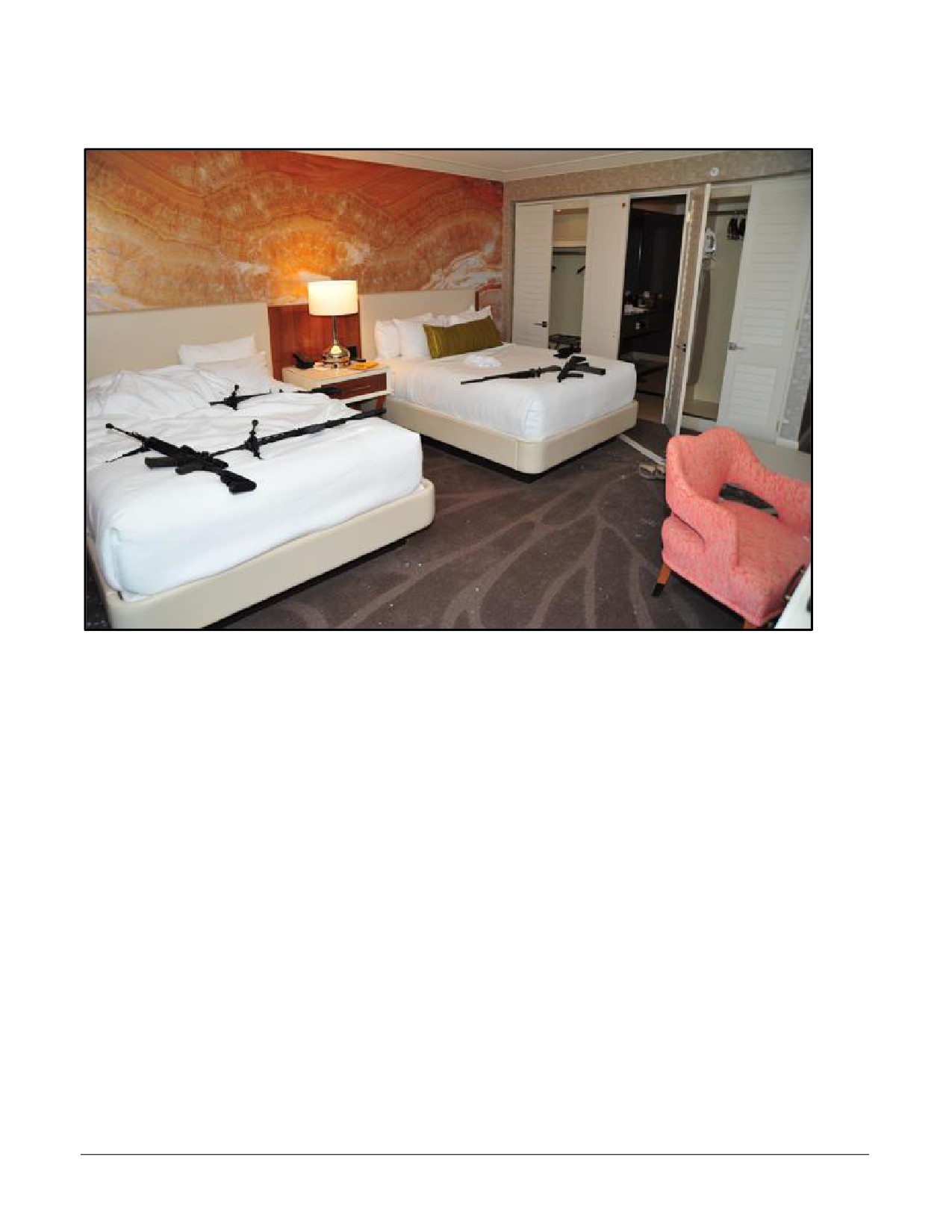
LAS VEGAS METROPOLITAN POLICE DEPARTMENT
FORCE INVESTIGATION TEAM REPORT
CONTINUATION
Event: 171001-3519
Picture 20
(Interior of room 32-134 towards bathroom)
LVMPD Internal Oversight & Constitutional Policing
Page 73 of 81
Force Investigation Team

LAS VEGAS METROPOLITAN POLICE DEPARTMENT
FORCE INVESTIGATION TEAM REPORT
CONTINUATION
Event: 171001-3519
Picture 21
(Hallway of room 32-134 with food service cart and laptop connected to cameras in 100
hallway)
LVMPD Internal Oversight & Constitutional Policing
Page 74 of 81
Force Investigation Team

LAS VEGAS METROPOLITAN POLICE DEPARTMENT
FORCE INVESTIGATION TEAM REPORT
CONTINUATION
Event: 171001-3519
Picture 22
(Paddock’s vehicle)
LVMPD Internal Oversight & Constitutional Policing
Page 75 of 81
Force Investigation Team
LAS VEGAS METROPOLITAN POLICE DEPARTMENT
FORCE INVESTIGATION TEAM REPORT
CONTINUATION
Event: 171001-3519
Picture 23
()
(Explosive precursors found in Paddock’s vehicle)
LVMPD Internal Oversight & Constitutional Policing
Page 76 of 81
Force Investigation Team
LAS VEGAS METROPOLITAN POLICE DEPARTMENT
FORCE INVESTIGATION TEAM REPORT
CONTINUATION
Event: 171001-3519
Picture 24
(Exploding targets found in Paddock’s vehicle)
LVMPD Internal Oversight & Constitutional Policing
Page 77 of 81
Force Investigation Team
LAS VEGAS METROPOLITAN POLICE DEPARTMENT
FORCE INVESTIGATION TEAM REPORT
CONTINUATION
Event: 171001-3519
Picture 25
(McCarran International Airport fuel tank with bullet strikes)
LVMPD Internal Oversight & Constitutional Policing
Page 78 of 81
Force Investigation Team

LAS VEGAS METROPOLITAN POLICE DEPARTMENT
FORCE INVESTIGATION TEAM REPORT
CONTINUATION
Event: 171001-3519
Picture 26
(Upper bullet strike)
Picture 27
LVMPD Internal Oversight & Constitutional Policing
Page 79 of 81
Force Investigation Team

LAS VEGAS METROPOLITAN POLICE DEPARTMENT
FORCE INVESTIGATION TEAM REPORT
CONTINUATION
Event: 171001-3519
(Lower bullet strike)
Picture 28
LVMPD Internal Oversight & Constitutional Policing
Page 80 of 81
Force Investigation Team

LAS VEGAS METROPOLITAN POLICE DEPARTMENT
FORCE INVESTIGATION TEAM REPORT
CONTINUATION
Event: 171001-3519
(View of the Las Vegas Village from room 32-135)
LVMPD Internal Oversight & Constitutional Policing
Page 81 of 81
Force Investigation Team
Federal Property and Equipment Manual
Federal Sources of Personal Property
for Law Enforcement
Revised July 2002
NCJ 172872
The National Law Enforcement and Corrections Technology Center is supported by Cooperative Agree-
ment #96-MU-MU-K011 awarded by the U.S. Department of Justice, Office of Justice Programs,
National Institute of Justice. Analyses of test results do not represent product approval or endorsement
by the National Institute of Justice, U.S. Department of Justice; the National Institute of Standards and
Technology, U.S. Department of Commerce; or Aspen Systems Corporation. Points of view or opinions
contained within this document are those of the authors and do not necessarily represent the official
position of the U.S. Department of Justice.
The National Institute of Justice is a component of the Office of Justice Programs, which also
includes the Bureau of Justice Assistance, Bureau of Justice Statistics, Office of Juvenile Justice and
Delinquency Prevention, and Office for Victims of Crime.
FEDERAL PROPERTY AND EQUIPMENT MANUAL
Preface
In 1995, the National Institute of Justice (NIJ) began the Surplus Property Program in order to
find ways to make the U.S. Department of Defense (DoD) excess property program—the 1208
Program (now the 1033 Program)—better known and more accessible to State and local law
enforcement agencies. This is a continuing effort. NIJ is now the Attorney General’s point of
contact on excess DoD personal property matters and maintains constant liaison with DoD and
other interested agencies and offices in this regard. NIJ’s study of the excess property program
was expanded into a survey of other sources of Federal property that could be acquired by
police and sheriffs’ agencies for law enforcement and corrections activities. Information is col-
lected through the cooperation of DoD, the Department of the Army, the Defense Logistics
Agency and its Law Enforcement Support Office, the General Services Administration, and the
Defense Reutilization and Marketing Service, and from State coordinators for the 1033 Program
and State points of contact for the 1122 Program. The National Association of State Agencies
for Surplus Property is also helpful in providing up-to-date information on the donation pro-
gram. The collected information has been distilled into this manual and the corresponding online
publication on the JUSTNET (Justice Technology Information Network) World Wide Web site
William E. LeGro, whose efforts have contributed to the success of the Surplus Property Pro-
gram and this manual.
This manual will be updated frequently and kept current on developments in the excess, sur-
plus, and property purchasing programs that benefit law enforcement and corrections and will
be posted on JUSTNET. This is the fourth edition of this manual. It reflects changes that have
occurred since the last printing. NIJ welcomes comments and suggestions, which should be
addressed to:
National Institute of Justice
Office of Science and Technology
Surplus Property Program
810 Seventh Street N.W.
Washington, DC 20531
Attn: James Williams
Program Manager
(202) 305-9078
Fax: (202) 307-9907
iii
FEDERAL PROPERTY AND EQUIPMENT MANUAL
Table of Contents
Preface
iii
Introduction
1
Chapter One: The 1033 Program
3
1. The Transition From 1208 to 1033
3
2. Demand Reduction
3
3. Corrections
3
4. Operation of the Program
4
5. Policies and Restrictions
6
6. Procedures
7
7. The Process for Entry Into the Program
7
8. The Process for Screening, Requisitioning, and Receiving
8
9. Alternative Screening Method
10
10. Vehicles
10
11. Aircraft Transfer Policy
11
12. Weapons and Ammunition
12
13. Excess Computer Equipment
13
14. Armored Vehicles
13
15. LESO Web Site
13
16. The National Law Enforcement Support Association
14
Chapter Two: Surplus Property Donation Program
15
1. Background and Operation of the State Agencies for Surplus Property
15
2. Public Safety and Corrections
15
3. Rules of Property Utilization
16
4. Controls and Audits
16
5. Addresses and Examples of Donations
16
6. Firearms
17
7. Other Police Equipment
17
Chapter Three: Purchasing Property Through the 1122 Program
19
1. Introduction
19
2. Sources of Supply
19
3. Examples of What Is Available From Army Stocks
20
4. Examples of What Is Available From DLA Stocks
20
5. How LEAs Use the 1122 Program
21
6. First Responder Equipment Purchase Program
21
v
FEDERAL PROPERTY AND EQUIPMENT MANUAL
Chapter Four: Equipment Loans, Leases, and Other Support
23
1. Introduction
23
2. Law Enforcement Night Vision Loan Program
23
3. Army Equipment Leases
23
4. National Guard Counterdrug Program
24
Appendixes
Appendix A:
Memorandum of Agreement Between the
Defense Logistics Agency and the States, 1033 Program
A-1
Appendix B:
State Compliance Reviews, 1033 Program
B-1
Appendix C:
Defense Reutilization and Marketing Offices
C-1
Appendix D:
Example of a Letter Requesting Participation in the
1033 Program by a Law Enforcement Agency
D-1
Appendix E:
Law Enforcement Agency Data Sheet, 1033 Program
E-1
Appendix F:
Form 103, 1033 Program
F-1
Appendix G:
Form 1348-1A, Issue Release/Receipt Document,
1033 Program
G-1
Appendix H:
Practical Guidance for Screeners
H-1
Appendix I:
NLECTC Points of Contact for Screening Assistance
I-1
Appendix J:
Examples of Property Donated for Public Safety
and Corrections, Federal Donation Program
J-1
Appendix K:
Donation of Firearms to State and Local Law Enforcement
Activities
K-1
Appendix L:
Section 1122, Public Law 103-160, Title 10, Chapter 18,
Section 381, U.S. Code
L-1
Appendix M:
Items Available on General Services Administration
Schedules, 1122 Program
M-1
Appendix N:
Army Leases, DA Form 4881-6-R
N-1
Appendix O:
National Guard Counterdrug Coordinators
O-1
vi
FEDERAL PROPERTY AND EQUIPMENT MANUAL
Introduction
For a number of years, Congress has recognized that State and local law enforcement could
benefit from access to excess and surplus personal Federal property and has passed legislation
to make this property and equipment available. The largest generator of this property has been
the U.S. Department of Defense (DoD). Although this source of property has passed its peak
and the amount and variety of excess property will continue to decline over time, law enforce-
ment agencies can still obtain high-quality, high-value property at little or no cost.
Among the Federal programs for the transfer of property to law enforcement, the Section 1208
Program enjoyed the greatest prominence because of the volume of property transferred and
because the transfers were made without charge. The program began in 1989 when Congress
amended the National Defense Authorization Act to permit the Secretary of Defense to transfer,
without charge, excess DoD personal property (supplies and equipment) suitable for employ-
ment in counterdrug activities to Federal and State agencies (see box for extract). County and
municipal agencies participated as State agencies.
Under Section 1208, the Secretary of Defense transferred to Federal and State law enforcement
agencies, without charge, a wide variety of equipment, vehicles, and aircraft suitable for use in
counterdrug activities. He assigned the administration of the program to the Deputy Assistant
Secretary of Defense for Drug Enforcement Policy and Support (DEP&S). DEP&S established
four Regional Logistics Support Offices (RLSOs), and each State appointed a State coordinator
Sec. 1208. TRANSFER OF EXCESS PERSONAL PROPERTY
(a) TRANSFER AUTHORIZED. (1) Notwithstanding any other provision of law and subject to subsection
(b) the Secretary of Defense may transfer to Federal and State agencies personal property of the Department of
Defense, including small arms and ammunition, that the Secretary determines is:
(A) suitable for use by such agencies in counterdrug activities; and
(B) excess to the needs of the Department of Defense.
(2) Personal property transferred under this section may be transferred without cost to the recipient agency.
(3) The Secretary shall carry out this section in consultation with the Attorney General and the Director of
National Drug Control Policy.
(b) Conditions for Transfer. The Secretary may transfer personal property under this section only if:
(1) the property is drawn from existing stocks of the Department of Defense; and
(2) the transfer is made without the expenditure of any funds available to the Department of Defense for the
procurement of Defense equipment.
(c) APPLICATION. The authority of the Secretary to transfer personal property under this section shall expire
on September 30, 1992.
[The Congress extended the program to September 30, 1997.]
[Extract from the original]
1
FEDERAL PROPERTY AND EQUIPMENT MANUAL
whose function was to approve or disapprove requests for excess DoD property. In 18 States
and Territories the coordinators are also State Agents for Surplus Property; in 8 States they are
in the National Guard; and in the other 28 States and Territories they are in offices connected to
law enforcement, such as emergency management, State narcotics enforcement, criminal jus-
tice, or State police. A list of State coordinators can be found on the Law Enforcement Support
and the Defense Reutilization and Marketing Offices, which controlled the property.
The 1033 Program superseded the 1208 Program in 1996 and permits the Secretary of Defense
to transfer excess DoD personal property for law enforcement activities. The requirement that
the property be for counterdrug activities was removed from the program.
The 1208 Program and the 1033 Program are discussed in chapter one.
Another source of surplus Federal personal property for State and local governments that has
existed for more than 50 years is the General Services Administration (GSA) donation program,
which is administered by State Agencies for Surplus Property. This resource is available to law
enforcement and corrections agencies and is discussed in chapter two.
The third source of Federal personal property is discussed in chapter three. This is the 1122
Program, through which law enforcement agencies can purchase supplies and equipment suit-
able for counternarcotics activities from DoD and GSA suppliers.
Chapter four covers equipment loans from the Armed Services and support for law enforcement
activities provided by the National Guard.
2
FEDERAL PROPERTY AND EQUIPMENT MANUAL
Chapter One
The 1033 Program
1. The Transition From 1208 to 1033
The authority granted to the Secretary of Defense to transfer excess property to State and local
law enforcement and corrections agencies began as the “1208 Program.” In 1996, Congress
replaced Section 1208 of the National Defense Authorization Act with Section 1033, made the
program permanent, made all law enforcement activities eligible for the receipt of property, and
specified that preference be given to counterdrug and counterterrorism activities. Like Section
1208, Section 1033 instructs the Secretary of Defense to consult with the Attorney General and
the Director of National Drug Control Policy on the administration of the program.
The Secretary of Defense administered the 1208 Program through four Regional Logistics Sup-
port Offices (RLSOs). In 1995, the program was transferred to the Defense Logistics Agency
(DLA), and RLSOs were eliminated and replaced by the Law Enforcement Support Office
(LESO) at Fort Belvoir, Virginia, with an office in El Segundo, California, for western opera-
tions. The California office has been closed and all LESO activity is at Fort Belvoir.
2. Demand Reduction
Soon after the 1208 Program began, the Secretary of Defense agreed that State and local “demand
reduction activities” were “counterdrug activities” within the meaning of Section 1208 and there-
fore qualified for inclusion in the program. Because State and local agencies administering these
activities generally came under the purview of State public health authorities, Federal supervision
of this aspect of the 1208 Program was assumed by the U.S. Department of Health and Human
Services. Each State was invited to participate in the program and to name its chief administrator
of drug abuse programs as the State official responsible for its administration.
3. Corrections
When the Secretary of Defense transferred the administration of the program from the office of
the Deputy Assistant Secretary of Defense for Drug Enforcement Policy and Support to the
Defense Logistics Agency, DLA removed demand reduction activities from participation in the
program. This decision is consistent with the changes Congress made in the program with the
enactment of Section 1033. Jails and prisons that previously had been able to acquire excess
supplies and equipment for drug “demand reduction activities” could no longer obtain such
property for these purposes. For an agency to participate in the program, DLA ruled that it must
be a government agency whose primary function is the enforcement of laws and whose officers
are compensated and have the powers of arrest and apprehension.
3
FEDERAL PROPERTY AND EQUIPMENT MANUAL
Accordingly, DLA has determined that excess Department of Defense (DoD) property cannot be
transferred for use by correctional institutions in the general support of the prison population, for
routine prison activities, or for the rehabilitation or treatment of drug offenders. On the other hand,
DLA generally will approve property transfers under the 1033 Program for use by teams, squads,
or individuals whose mission is to enforce laws within the jurisdiction of prison officials. Exam-
ples of qualifying units would be a “special reaction team” whose mission is to quell disturbances
within the prison jurisdiction or a team or individual officer charged with apprehending escapees.
Parole and probation agencies generally qualify as well. In each case, however, it must be shown
that the officers have arrest, apprehension, or revocation authority within their jurisdictions.
Sheriffs, correctional administrators, and parole/probation authorities should discuss their
respective situations with their State 1033 coordinators to determine which officers or activities
within their agencies qualify for participation in the program. When agreement is reached that
certain correctional activities qualify, the agency’s senior official makes written application to
participate, in accordance with the guidelines furnished by the coordinator.
4. Operation of the Program
During the first year of its operation, the 1208 Program transferred more than $1 million in excess
Defense property to State and local drug law enforcement agencies (DLEAs). By the end of fiscal
year 1995, this annual figure had increased to more than $324 million. The acquisition value of the
54,555 line items transferred during fiscal year 1996 was $336 million. The program had outgrown
the management resources assigned to it, so the Secretary of Defense transferred the responsibility
to DLA, which conducted a study of the operation and developed a plan designed to:
● Improve the efficiency and fairness of the program.
● Institute controls that would reduce waste, fraud, and abuse in the system.
● Make optimum use of the military officers and noncommissioned officers assigned to RLSOs.
This plan required two major initiatives:
● A Memorandum of Agreement (MOA) between DLA and the State(s) as a condition for
participation in the program.
● A phased deactivation of RLSOs until administration of the system could be concentrated in
the Counterdrug Support Office (CDSO) at DLA Headquarters in Fort Belvoir, Virginia, and
in a western office in California. (The name was later changed from CDSO to LESO, for
Law Enforcement Support Office.)
As might be expected in a nationwide program of this size and scope, a few law enforcement
agencies (LEAs) abused the system, causing some critics to argue for the repeal of the program.
(It is important that all participating activities adhere carefully to the rules and be alert to appear-
ances of abuse.) Congress, however, recognized the value of the 1208 Program to counterdrug law
4
FEDERAL PROPERTY AND EQUIPMENT MANUAL
enforcement and expanded the program to include all law enforcement activities. Section 1033
amended the National Defense Authorization Act and became effective on October 1, 1996. Section
1033 grants the Secretary of Defense permanent authority to make property transfers for all law
enforcement activities and removes the requirement that the property be suitable for counterdrug
activity. The change from “counterdrug” to “law enforcement activities” had another—possibly
unintended—effect: It made “demand reduction activities” ineligible under the 1033 Program. An
extract from the text of Section 1033 follows.
[Title X—General Provisions]
Sec. 1033. TRANSFER OF EXCESS PERSONAL PROPERTY TO
SUPPORT LAW ENFORCEMENT ACTIVITIES
(a) TRANSFER AUTHORITY. (1) Chapter 153 of title 10, United States Code, is amended by inserting after
section 2576 the following new section:
§ 2576a. Excess personal property: sale or donation for law enforcement activities
(a) TRANSFER AUTHORIZED. (1) Notwithstanding any other provision of law and subject to subsection
(b), the Secretary of Defense may transfer to Federal and State agencies personal property of the Department of
Defense, including small arms and ammunition, that the Secretary determines is:
(A) suitable for use by the agencies in law enforcement activities, including counterdrug and counterter-
rorism activities; and
(B) excess to the needs of the Department of Defense.
(2) The Secretary shall carry out this section in consultation with the Attorney General and the Director of
National Drug Control Policy.
(b) CONDITIONS FOR TRANSFER. The Secretary of Defense may transfer personal property under this
section only if:
(1) the property is drawn from existing stocks of the Department of Defense;
(2) the recipient accepts the property on an as-is, where-is basis;
(3) the transfer is made without the expenditure of any funds available to the Department of Defense for
the procurement of defense equipment; and
(4) all costs incurred subsequent to the transfer of property are borne or reimbursed by the recipient.
(c) CONSIDERATION. Subject to subsection (b)(4), the Secretary may transfer personal property under this
section without charge to the recipient agency.
(d) PREFERENCE FOR CERTAIN TRANSFERS. In considering applicants for the transfer of personal
property under this section, the Secretary shall give a preference to those applications indicating that the trans-
ferred property will be used in the counterdrug or counterterrorism activities of the recipient agency.
(2) The table of sections at the beginning of such chapter is amended by inserting after the item relating to
section 2576 the following new item: “2576a. Excess personal property; sale or donation for law enforcement
activities.”
(b) CONFORMING AMENDMENTS. Section 1208 of the National Defense Authorization Act for Fiscal
Year 1991 (Public Law 101-510; 104 Stat. 1630) is amended by striking out “section 1208 of the National
Defense Authorization Act for Fiscal Years 1990 and 1991 (10 U.S.C. 372 note) and section 372” and inserting
in lieu thereof “sections 372 and 2576a.”
[Extract from the original]
5
FEDERAL PROPERTY AND EQUIPMENT MANUAL
5. Policies and Restrictions
DLA, acting for the Secretary of Defense, exercises the authority to determine the regulations,
restrictions, and procedures for the transfer of excess property to law enforcement agencies and
to determine the type, quantity, and location of excess personal property that will be transferred.
Accordingly, DLA requires each State to agree to a MOA, which sets forth the rules for partici-
pation. The text of the MOA (January 2001) is in appendix A; its key provisions are summa-
rized below:
● Each State must submit to DLA for review a plan of operation conforming with State law and
the provisions of the MOA. This plan will contain a description of the State coordinator’s
authority, staff, and facilities as well as the procedures the State has established for determin-
ing eligibility and allocation and for overseeing compliance, reutilization, accountability, and
disposal.
● Preference shall be given to requests for property for counterdrug and counterterrorism re-
quirements, and “All requests . . . must be based on bona fide law enforcement requirements.
In determining whether property is suitable for use by agencies in law enforcement activities,
DLA defines law enforcement activities as activities performed by government agencies whose
primary function is the enforcement of applicable Federal, State, and local laws and whose
compensated law enforcement officers have powers of arrest and apprehension.” [Emphasis
added.] (Certain corrections activities also qualify, as discussed in section 3, above.)
●
“. . . [P]roperty may not be obtained for the purpose of sale, lease, rent, exchange, barter, to
secure a loan, or to otherwise supplement normal law enforcement agency (LEA) budgets.”
Property must be placed in use within 1 year of receipt, and serviceable equipment may not
be requisitioned for parts. Property must be used for at least 1 year (if still serviceable) and
can then be disposed of, if no longer needed for law enforcement, according to State and
local laws. The stockpiling of equipment for possible future use is prohibited.
● The receiving agency is responsible for all costs associated with the property after it is
transferred, as well as for all shipping or Federal repossession costs.
● Equipment requiring demilitarization (includes weapons, ammunition, gas masks, helmets,
body armor, and night vision devices) must be returned to the nearest Defense Reutilization
and Marketing Office (DRMO) that is equipped to receive it when it is no longer needed for
law enforcement activities. All turn-ins are coordinated with LESO.
● Special rules apply to helicopters and airplanes: They need not be returned when no longer
needed for law enforcement activities but may be retained permanently, provided that evi-
dence of proper maintenance over a 5-year period is presented. Furthermore, LEAs may
exchange aircraft and parts with other authorized agencies provided that appropriate main-
tenance and repair guidelines are followed. They also may stock reasonable quantities of
aircraft components.
6
FEDERAL PROPERTY AND EQUIPMENT MANUAL
●
Special rules also apply to Munitions List/Commerce Control List Items and Flight Safety
Critical Aircraft Parts.
● LESO has announced a program of compliance visits to the States. The goal is to visit
each State once every 2 years. State coordinators are advised in advance of each visit and
informed concerning the scope of the compliance review. (See appendix B.)
6. Procedures
●
All property in DRMOs is transferred on a first-come, first-served basis. DRMOs follow
instructions regarding the issuance of property; they do not influence the approval or cancel-
lation process. As a general rule, excess property received by a DRMO is available for screen-
ing by participants in the 1033 Program for 14 days, which is the period set aside for internal
DoD screening; this period is followed by a 21-day period during which the property is avail-
able for screening by Federal agencies and State Agencies for Surplus Property (SASPs).
● There is no stated or implied warranty on any item transferred or any assurance that it will
perform as expected in a law enforcement application.
● Although the property is transferred by DoD at no charge, some States—specifically, those
States in which the State coordinator is also the State Agent for Surplus Property—charge a
fee to transfer the property to law enforcement agencies. DoD exercises no influence over this
practice.
● There are four participants in the routine process for the transfer of DoD equipment under the
1033 Program. (Aircraft, weapons, and armored vehicles are treated differently, as explained in
Sections 11 and 12.) The four participants are listed below:
✦ State or local agency requesting the property.
✦ State coordinator.
✦ LESO.
✦ DRMO where the requested item is located. (See list in appendix C.)
7. The Process for Entry Into the Program
● A State or local law enforcement or corrections official begins the process by writing a letter
to the State coordinator, requesting that the agency be accepted for participation in the pro-
gram. The format for this letter is in accordance with the State plan. An example of such a
letter is in appendix D.
● Upon approval of the request, the State coordinator prepares a “Law Enforcement Agency
Data Sheet” (see appendix E), has it signed by the chief of the LEA, and sends it to LESO,
7
FEDERAL PROPERTY AND EQUIPMENT MANUAL
where the data are entered into a database. A new datasheet must be submitted whenever a
change in screening or responsible personnel occurs at the agency.
● LESO responds to the receipt of the datasheet by sending a letter to the agency through the
State coordinator authorizing designated LEA officers to screen and receive property at all
DRMOs.
● Indian police agencies serving federally recognized tribes whose officers possess arrest
and apprehension authority are eligible to participate in the 1033 Program, subject to the
approval of the State coordinator of the State in which they exercise jurisdiction on tribal
lands. Tribal police departments that are admitted into the program are subject to the same
rules, regulations, procedures, and oversight by the State coordinator as are State, county,
and municipal police agencies in the State.
● Some States have elected to perform all screening and acquisition of property at the State
level. The State coordinator appoints a limited number of State or regional officials (typically
two or three) to screen and remove property from DRMOs on behalf of State and local agen-
cies. The screening is performed in response to specific law enforcement and corrections
agency requests; property is transported to a State distribution center pending transfer to the
requesting agency. DLA does not approve the acquisition of large quantities of property in
anticipation of requests. State distribution centers are for short-term storage of items acquired
against requests by State and local agencies.
8. The Process for Screening, Requisitioning, and Receiving
There are two methods of screening. Until recently, the most common method was physically
visiting DRMOs and looking over the excess property displayed. Excess property is available
for screening only by persons identified in the letters of authorization described in the previous
section, and not by other State or local agencies not entered into the 1033 Program. Property is
available for screening by law enforcement during the 14-day internal screening period, after
which it enters the 21-day “XcessXpress” cycle and is available to Federal agencies and SASPs.
In other words, State and local agencies in the 1033 Program, along with DoD agencies and
departments, have first crack at the property. The following is a description of the physical
screening and acquisition process:
● The law enforcement or corrections agency’s first step, after receiving its letter of authoriza-
tion, is to contact a DRMO reutilization specialist at the chosen DRMO. The specialist will
schedule a screening appointment for the designated LEA officers.
● On the first visit, the screening officers bring the agency’s letter of authorization. Typically,
only two officers designated on the authorization letter will be admitted to a DRMO at one
time. Screening documents and procedures are explained by the DRMO reutilization specialist.
● The reutilization specialist provides the screening officers with a barcode reader or a “Screen-
er’s Tally Sheet.” The form, titled “SCREENERS TALLY REQUEST TO FREEZE EXCESS/
8
FEDERAL PROPERTY AND EQUIPMENT MANUAL
SURPLUS U.S. PROPERTY, DRMS FORM 103,” effectively removes from circulation items
identified as needed by an agency screener. An example of this form is in appendix F. Most
DRMOs use barcode readers that record the essential data from the barcode located on the
property and transfers the data to a Form 103 in the DRMO office.
● The screener enters the DRMO section designated by the reutilization specialist as containing
property available for screening. Screeners should not enter any area not designated as open
to them by the reutilization specialist. Each item in the screening area will have a Department
of Defense Form 1348-1A or a barcode attached to it. An example of Form 1348-1A is in
appendix G.
● When a desired item is located, the screener records the data on the barcode reader or copies
data from the Form 1348-1A onto the Form 103 tally sheet. (Any questions about how to fill
out the form can be answered by the reutilization specialist.) There is no limit to the number
of items that can be screened, but a screener should not request more property than can be
put to use by the agency within the year. The screener gives one copy of the Form 103 to the
reutilization specialist and sends one to the State coordinator, usually by fax. If the barcode
reader is used, the reutilization specialist prints the Form 103 for the screener. If any of the
requested property requires a letter of justification, the letter should be sent with the Form
103. Some States require justification letters for all items explaining how the property will
be used in a law enforcement, counterdrug, or counterterrorism activity. (See appendix H,
“Practical Guidance for Screeners.”)
● Upon receipt of the copy of the Form 103, the State coordinator examines the request for
validity and legibility. If the request is approved, the Form 103 is faxed to LESO with the
following endorsement:
I CERTIFY THAT THE ABOVE LISTED ITEMS ARE JUSTIFIED FOR USE IN SUPPORT
OF LAW ENFORCEMENT ACTIVITIES FOR THE REQUESTING LAW ENFORCEMENT
AGENCY. THIS PROPERTY WILL BE USED IN ACCORDANCE WITH 10 U.S.C. 2576a
SECTION 1033. I RECOMMEND LESO APPROVAL OF THIS REQUEST.
All requests submitted by the coordinator must have the name of the original requesting office.
● LESO reviews the State-approved request and—if LESO approves the transfers—prepares a
requisition/transfer document for each approved item on the Form 103. This document is a
DD Form 1348-1A (appendix G, mentioned earlier.) These completed, approved forms are
then sent (via fax) to the State coordinator.
● Upon receipt of the approved DD Forms 1348-1A, the State coordinator sends them, usually
via fax, to the agency. If no 1348s are received within 5 days or so after the Form 103 was
sent to the State coordinator, the agency should call the State coordinator and inquire about
the status of the request. In some cases, the screening officer may remain at DRMO until
approval is received, but more commonly the officer returns to the agency to await approval.
For same-day transfer, an agency must inform the State coordinator, and LESO must be given
9
FEDERAL PROPERTY AND EQUIPMENT MANUAL
72 hours advance notice. In any event, the requisitioned property must be removed from
DRMO within 14 days of approval or the right to acquire the property is forfeited.
● In the final step, the authorized officer accepts the property from DRMO and transports it to
the agency. (In States where screening is centralized, pickup is performed by agents of the
State coordinator.) The agency in possession of the property is then responsible for maintain-
ing accurate records of location, use, and condition. These records are subject to audit by
State and Federal officials.
● The State coordinator or LESO may deny a request for property or cancel one that is already
processed. (DRMOs have no role in this activity.) All questions or appeals regarding denials or
cancellations should be referred to the State coordinator or LESO (through the coordinator).
9. Alternative Screening Method
Screening on the Internet: The Defense Reutilization and Marketing Service (DRMS), in
cooperation with LESO, has made it possible with new software for State coordinators and law
enforcement users of the 1033 Program to submit requests more quickly and to receive rapid
responses to their requests. The new software enables users to reserve equipment, State coordi-
nators to approve or reject requests, and LESO to approve or reject the requests in a paperless,
automated, electronic system. Using this system, the LEA (or the coordinator) searches for
equipment by Federal supply class or National Item Identification Number, full or partial name,
region, date the item entered the inventory, and/or the condition code. The user must run a Web
browser on the PC, such as Microsoft® Internet Explorer or Netscape® Navigator, and have some
experience in using the Windows® operating system. LESO has provided system training to State
coordinators and has published training guides for them and for LEAs.
and passwords to the coordinators; LEAs obtain user names and passwords from their coordina-
tors. Coordinators seeking more information should contact LESO; LEAs should contact their
State coordinators.
Screening Assistance Offered by NLECTC: The National Institute of Justice has established
a nationwide network of National Law Enforcement and Corrections Technology Centers
(NLECTC). Several of these centers assist coordinators and LEAs in locating and screening
excess property. A list of these centers is in appendix I.
10. Vehicles
Many agencies have acquired wheeled vehicles through the program. The popular vehicles are
the M-1008, 4X4 Chevy pickup; the M-1009, 4X4 Chevy Blazer; the M-1010, 4X4 Chevy
ambulance; and the 6X6, 21/2-ton and 5-ton cargo trucks.
10
FEDERAL PROPERTY AND EQUIPMENT MANUAL
11. Aircraft Transfer Policy
Excess aircraft are available to qualified law enforcement agencies through the 1033 Program.
Because of their high value, limited numbers, and the high costs associated with modifying,
maintaining, and operating military aircraft in law enforcement roles while complying with
Federal Aviation Administration (FAA) rules and regulations, DoD has kept a tight rein on the
transfer of excess aircraft. The procedures for screening and acquisition described in the forego-
ing sections do not apply to aircraft. DLA requires that the following procedures be followed
when a law enforcement agency requests an excess military aircraft:
● The agency requesting an excess aircraft begins the process by writing a letter to LESO,
through its State coordinator. The State coordinator determines intrastate priorities for aircraft
and forwards approved requests to LESO. The letter should include the following information
and assertions:
✦ The name, address, and phone and fax numbers of the agency and the name of the agency’s
chief executive. The names and phone numbers of points of contact in the aviation unit
should be included.
✦ The type and number of aircraft requested, with an explanation of the intended missions
for the aircraft and the expected impact on the crime situation in the local and surrounding
jurisdictions.
✦ The area covered by the jurisdiction and its population.
✦ Assurance that the agency chief executive understands the aircraft transfer conditions
contained in the MOA; this should be a reiteration of the conditions DLA imposes on
the transfer of aircraft as stated in the MOA.
✦ A description of the agency’s plan to maintain, finance, and operate the aircraft being
requested. (A copy of the agency’s aviation plan would be helpful in this regard.)
✦ A statement to the effect that the agency chief executive is familiar with FAA regulations
governing the operation of the aircraft. This statement should include citations to the
applicable Federal Aviation Regulations and FAA Advisory Circular 00.1-1 Public Air-
craft Operations.
✦ A statement concerning aircraft received (if any) from the Federal Government by the
requesting agency prior to this request: when, how many, what type.
● Nearly all excess aircraft come from the Army. The U.S. Army Aviation and Missile Com-
mand prepares transfer documents and coordinates directly with the State coordinator and the
receiving LEA for pickup of the aircraft.
11
FEDERAL PROPERTY AND EQUIPMENT MANUAL
●
If the agency agrees to accept the helicopter, it must arrange to fly the helicopter (or transport
it otherwise, if it is not flyable) from wherever it is located. Some avionics may be removed
by the Army before the helicopter is transferred; if the helicopter is flown away, the agency
signs a receipt for the avionics and returns them after the flight.
12. Weapons and Ammunition
Currently, law enforcement and corrections agencies may obtain M-16 rifles (5.56mm), M-14
semiautomatic rifles, .45-caliber pistols, and .38-caliber revolvers (2-inch and 4-inch barrels);
12-gauge shotguns are available in limited quantities. M-21 sniper rifles (7.62mm) and M-79
grenade launchers are no longer available. Although the law permits transfer of excess ammuni-
tion, DoD currently transfers no ammunition under the program. The U.S. Army Rock Island
Arsenal ships the weapons to the receiving agencies after receiving the authorization from
LESO and a check to cover packing and shipping costs. The arsenal records the weapons in the
Small Arms Serialization Program. The receiving agency must register the weapons with the
Bureau of Alcohol, Tobacco and Firearms (BATF). If the agency has no further use for a
weapon received under this program, it has three choices for disposal: (1) Turn it over to BATF;
(2) destroy and submit a destruction certificate to BATF; or (3) coordinate with LESO for trans-
fer to another authorized agency. Weapons request procedures begin with a letter signed by the
chief LEA official to the State coordinator, which contains the following paragraphs:
● LEA name, address, and phone and fax numbers, plus the name of the chief official and any
other points of contact. The numbers of full-time sworn officers, counternarcotics officers,
and counterterrorism officers assigned to a tactical team also are included.
● Assurance that the chief official understands the terms of weapons transfers as stated in the
MOA.
● A statement that the agency has the ability to maintain, store, and employ the requested
weapons.
● A statement that the chief official is familiar with BATF regulations governing weapons
registration.
● The numbers and types of weapons requested, their intended use, and how they will affect
law enforcement activity in local and adjacent jurisdictions.
● The size and population of the requesting LEA’s jurisdiction.
Another source of weapons, excess to the needs of Federal law enforcement agencies, is
becoming available to State and local LEAs. See chapter two, section 6.
12
FEDERAL PROPERTY AND EQUIPMENT MANUAL
13. Excess Computer Equipment
Computer equipment that could be put to good use by law enforcement and corrections agencies
occasionally shows up at DRMOs. Unfortunately, much—if not most—of this equipment has
been roughly handled in its journey and could not be placed in service without expensive repairs.
Consequently, most of it is disposed of as surplus and salvaged for parts. A better means exists
for the acquisition of excess computers through the 1033 Program. Through the Defense Infor-
mation Technology Management System (DITMS), the computers and computer components are
obtained directly from the DoD activity that has declared them excess. The Defense Automation
Resources Management Program (DARMP) maintains an excess catalog that State coordinators
can access. The Information Technology (IT) Excess Catalog is located on the Web at http://www.
disa.mil/cio/darmp/excess.html. To participate in this program, a law enforcement or corrections
agency—or a State coordinator—searches the DARMP IT Excess Catalog and finds the desired
computer equipment. After the desired equipment has been identified, each LEA must have a
reservation placed on the equipment by the State coordinator. In order to reserve equipment, the
tration procedures are clearly explained; LEAs may not register. An LEA representative, or the
coordinator, then coordinates with the DoD agency for shipping. If shipping is required, the LEA
pays for it. If an agency finds nothing on the DARMP IT Excess Catalog, the LEA submits a
requirement listing to the State coordinator, who places a requirement on DITMS. Once the
requirement has been met, a listing is sent electronically to the coordinator with all the appro-
priate information necessary to complete the reservation and the DD-1149.
14. Armored Vehicles
A number of armored cars—specifically the “Peacekeeper,” a light, 4X4 armored car on a truck
chassis—have been transferred to law enforcement agencies. The supply of these vehicles has
been virtually exhausted; however, some M-113 armored personnel carriers are available for
transfer upon presentation of sufficient justification. The M-113 is a full-track vehicle and is
generally considered suitable only for off-road use because of the damage its treads may inflict
on paved surfaces.
15. LESO Web Site
LESO maintains a Web site and encourages all program participants to view it for current
information. It is called CMIS—Counterdrug Management Information System. The address
13
FEDERAL PROPERTY AND EQUIPMENT MANUAL
16. The National Law Enforcement Support Association
The National Law Enforcement Support Association (NLESA) is a professional organization
whose members are State 1033 coordinators and 1122 Program State points of contact (SPOCs).
SPOCs, and law enforcement officials using these programs. NLESA’s purpose and objectives
are as follows:
● NLESA is organized for the purpose of improving efficiency in the management and opera-
tion of—
✦ The 1033 Program, through which excess DoD personal property is transferred to State
and local agencies for law enforcement activities and for qualifying corrections activities.
✦ The 1122 Program, through which State and local governments may purchase supplies and
equipment suitable for counterdrug activities from Federal sources.
● NLESA will—
✦
Speak with one voice to promote, enhance, and defend the 1033 and 1122 Programs.
✦
Promote interstate cooperation and networking among State 1033 coordinators and 1122
SPOCs, sharing expertise and developing professionalism.
✦
Develop the most efficient and economical systems for the operation and management of
the programs at the State level.
✦
Develop policies and procedures to eliminate fraud and abuse.
✦
Inform members of changes and developments in the programs.
✦
Represent its members in discussions with DoD, the Department of the Army, the Depart-
ment of Justice, the General Services Administration, DLA, DRMS, DITMS, Congress,
and the media.
✦
Hold seminars and workshops.
✦ Publish a newsletter and other professional correspondence and stationery.
✦
Establish a cordial, professional relationship with the management of the programs.
✦
Establish liaison with members and committees of Congress that have cognizance over
legislation affecting the programs.
✦
Conduct annual conferences of its members.
✦
Promote associate membership in NLESA of 1122 Program vendors and associations of
law enforcement professionals and State, county, and municipal officials.
14
FEDERAL PROPERTY AND EQUIPMENT MANUAL
Chapter Two
Surplus Property Donation Program
1. Background and Operation of the State Agencies for Surplus Property
Each State and territory has a State Agency for Surplus Property (SASP). These agencies were
established to receive Federal surplus personal property and to donate it to public agencies and
certain nonprofit, tax-exempt agencies. Most SASP operations are funded by the surcharges they
receive for their services. The authority is found in Public Law 94-519 (1976), which amended
the Federal Property and Administrative Services Act of 1949 to improve the process for donating
Federal surplus property to States and local organizations. The General Services Administration
(GSA) has the responsibility to administer this program and has issued regulations for its imple-
mentation. Law enforcement agencies (LEAs) that are enrolled in the 1033 Program are among
the governmental agencies eligible to obtain property from their SASP. They should become
acquainted with the SASP as a resource and should be aware of four important differences
between the two programs:
● SASPs have access to personal property from all Federal sources, while the 1033 Program
handles exclusively Department of Defense (DoD) personal property.
● The 1033 Program authorizes transfers of excess personal property, that is, personal property
that is excess to the needs of DoD and that is made available to other Federal agencies—and
to law enforcement. Only property that survives excess screening becomes available to
SASPs as surplus personal property.
● The SASP usually charges the recipient agency a service charge, or “administrative fee,” based
upon the original acquisition cost of the surplus property, its condition, and other factors.
● Except in the few States that perform screening and acquisition at the State coordinator level,
LEAs must screen and pick up property at Defense Reutilization and Marketing Offices
(DRMOs)—not a truly cost-free process—and the property is acquired as is. On the other
hand, some SASPs perform the screening and transportation functions for their customers
and often will repair or refurbish property. Also, because of their networking, staff, and trans-
portation resources, SASPs can draw from DRMOs worldwide.
2. Public Safety and Corrections
Sheriffs’ and police agencies that may be denied certain excess personal property under the
1033 Program—because their requests are not within the law enforcement parameters as deter-
mined by the Law Enforcement Support Office (LESO)—may find what they are looking for
at the SASP. The SASP resource may be especially useful to jailers, wardens, and operators of
drug treatment activities, none of whom now have full access to the 1033 Program.
15
FEDERAL PROPERTY AND EQUIPMENT MANUAL
Likewise, fire, rescue, and emergency medical activities, which cannot be supported by the
1033 Program, should look to the SASP for their needs. (Recent legislation, when implemented,
will provide some excess DoD property to fire and emergency medical services.)
3. Rules of Property Utilization
The rules that apply to property donated by SASPs parallel those contained in the 1033 Program
Memorandum of Agreement (MOA). In fact, the SASP/GSA rules were the model for the MOA:
● Property requested must be needed and usable by the requesting agency and must not be for
personal use.
● Property is offered as is (although it may have been repaired or refurbished by the SASP) and
is transferred without warranty.
● Property must be placed in use within 12 months of its acquisition and used for at least
12 months.
● Property with an original acquisition cost of $5,000 or more will have additional periods of
restricted use, as will vehicles, aircraft, and vessels.
4. Controls and Audits
SASPs have been in business for many years. Their professional organization, the National
Association of State Agencies for Surplus Property (NASASP), was founded in 1947, and
SASPs have developed a store of experience and procedures that enhance efficiencies and
protect against fraud and abuse. Their operations must follow State property laws as well as
requirements imposed by the Federal Government. The “Single Audit Act” is a Federal law
(P.L. 98-502) that requires reports from all recipients of Federal financial aid. Donated Federal
property (as well as property transferred under 1033) qualifies as financial aid. State audit agen-
cies submit reports for qualifying property donated (or transferred) to the State. Officials in
GSA regional offices and SASPs routinely perform reviews to ensure compliance with regula-
tions. Instances of fraud or theft are referred to the GSA Inspector General or to the Federal
Bureau of Investigation (FBI), whereas lesser problems are corrected administratively.
5. Addresses and Examples of Donations
donated for corrections institutions and public safety are in appendix J.
16
FEDERAL PROPERTY AND EQUIPMENT MANUAL
6. Firearms
A program is available through which excess firearms may be transferred from Federal agencies
to the States for use by State and local LEAs. GSA issued an amendment to the Federal Property
Management Regulations that enables certain usable firearms acquired for Federal law enforce-
ment purposes to continue serving a law enforcement role. GSA’s Rocky Mountain Region,
located in Denver, Colorado, coordinates firearms transfers. Federal agencies report excess
firearms to GSA and the transfers to the State and local LEAs are handled by SASPs. LEAs
interested in taking advantage of this source of firearms should contact their SASP.
Only handguns, rifles, shotguns, individual light automatic weapons, and rifle and shoulder-fired
grenade launchers may be offered for donation. SASPs may donate weapons to State and local
LEAs for law enforcement purposes only. Qualifying LEAs are those whose primary function is
the enforcement of laws and whose compensated officers have powers of arrest and apprehension.
Each request for weapons submitted to GSA must be accompanied by a conditional transfer docu-
ment signed by both the SASP and the intended recipient of the weapons, accepting the terms,
conditions, and restrictions prescribed by GSA. Surplus firearms approved for donation will be
shipped directly from the holding Federal agency to the receiving LEA and may not be stored
by the SASP. Alternatively, the SASP may arrange for the LEA to pick up the weapons at the
holding Federal agency. LEAs can expect the SASP to charge a small fee for processing the
transfer of these weapons. Instructions and forms for this program are in appendix K.
7. Other Police Equipment
Expended cartridge cases are currently authorized for donation through SASPs to State and local
governments to be reloaded and used for law enforcement purposes. Some SASPs participate in
GSA’s fixed-price vehicle program on behalf of LEAs. They facilitate the purchase, at negotiated
fixed prices, of low-mileage, late-model, police-package vehicles that would otherwise go to
public sale. Many of these vehicles have been used in national parks, have been carefully main-
tained, and have not had the punishing use that characterizes usual law enforcement service.
17
FEDERAL PROPERTY AND EQUIPMENT MANUAL
Chapter Three
Purchasing Property Through the 1122 Program
1. Introduction
The National Defense Authorization Act for fiscal year 1994 contained Section 1122, which
allows State and local governments to purchase new law enforcement equipment for counter-
drug activities through the Federal Government. For the purposes of this counterdrug program,
the Act defines the eligible “units of local government” as “any city, county, township, town,
borough, parish, village, or other general purpose political subdivision of a State; an Indian tribe
which performs law enforcement functions as determined by the Secretary of the Interior
”
The discounts the Federal Government enjoys because of its large-volume purchases are passed
on to State and local law enforcement agencies (LEAs). The program was introduced in Decem-
ber 1994 at a conference hosted by the U.S. Department of Justice, Bureau of Justice Assistance
(BJA), in which the General Services Administration (GSA) and the U.S. Department of Defense
(DoD) participated. Three States—California, North Carolina, and West Virginia—were selected
to participate in a pilot program to test the concept and were offered BJA grants to get started.
The governors were asked to appoint State points of contact (SPOCs) to administer the State
programs, and the Secretary of the Army was appointed as executive agent for DoD. Each pilot
State was given the latitude to organize its 1122 SPOC offices according to its own State prefer-
ences and procedures. Each pilot State soon found it most efficient to combine the 1033 (then
1208) program coordinator functions with those of the 1122 SPOC; many States that have since
joined the program have followed this example. The text of Section 1122 is in appendix L.
In 1998 five more States—Colorado, Idaho, Ohio, Virginia, and Washington—received grants
to fund 1122 Program SPOC offices. As of July 2002, 45 States have appointed SPOCs. Each
SPOC has been assigned a GSA regional customer service director who is available for training
and advice. Advice on how to operate the program at the State level is available from the
National Law Enforcement Support Association. This association has a Web site at
SPOCs, many of which are willing to share their knowledge and experience.
2. Sources of Supply
Three sources of supply are available to law enforcement agencies through their SPOCs. The
first two are the Department of the Army (DA) and the Defense Logistics Agency (DLA). DA
and DLA maintain stocks of available items; descriptions of a representative sampling of items
are contained in the Law Enforcement Equipment and Supply Catalog. Each SPOC is furnished
19
FEDERAL PROPERTY AND EQUIPMENT MANUAL
a supply of these catalogs. DA and DLA have established inventory control points that will pro-
vide more information about specific items, provide status on orders, and resolve discrepancies
involving shortages, damages, and any other problems associated with orders for their items.
The third source is contractor-supplied items. The sources can be found in the various Federal
Supply Schedules published by GSA. These Schedules are listings of contractors that identify the
types of products they provide. There is a Federal Supply Schedule for “Law Enforcement &
Security Equipment,” for example, that gives the names and addresses of suppliers of police
equipment belts, holsters, batons, handcuffs, and pepper spray; accessories for police cruisers;
alcohol detection kits; bomb disposal and detection equipment; and forensic and criminal investi-
gation equipment. GSA also will facilitate the purchase of motor vehicles for law enforcement
agencies under this program. GSA charges a 1-percent fee for handling vehicle purchases. The
savings to the purchaser are usually substantial. For listings of items available from GSA Sched-
ules, see appendix M.
3. Examples of What Is Available From Army Stocks
The following items are available from Army stocks:
● Aircraft support items and spare parts.
● Field clothing, boots, field rations, generators, watercraft, tents, and sleeping bags.
● Weapons and ammunition.
● Communications, electronic and surveillance equipment, laser rangefinders, electro-optics,
and night vision devices.
4. Examples of What Is Available From DLA Stocks
The following items are available from DLA stocks:
● Into-plane aircraft fuel; greases and oils.
● Chain, rope (wire and fibrous), tie-down straps, roof bar mounts, and safety harnesses.
● Locks and seals, and telephone and power cable.
● Cameras, accessories, and film; binoculars; dry batteries; compasses; stopwatches; scales;
flashlights and spotlights; and light wands.
● Ready-to-eat meals, flameless heaters, first-aid kits (general and individual), water storage
bags and canteens, cots and netting, and tarpaulins.
20