Military reference books and manuals (2009-2023, Volume 1) - page 4
UNCLASSIFIED//FOR OFFICIAL USE ONLY
Annex 1: Air Force Reserve Component Units
960th Cyber Operations Group Units
These locations were selected based on the existence of infrastructure for these part-time
positions and the availability of SCIF space.
960th Cyber Operations Group (Texas). Mission: C2 of subordinate squadrons. 42
authorized personnel;
860th Network Operations Squadron (NOS) (Virginia) and 960th Network Operations
Squadron (Colorado). Mission: Defend Air Force networks and uphold Air Force and
DoD standards to ensure network availability. 62 authorized personnel (860th NOS); 72
authorized personnel (960th NOS).
854th Cyberspace Operations Squadron (Texas). Mission: Full-spectrum cyber
operations and capabilities in support of Air Force and Joint requirements. 101
authorized personnel;
426th Network Warfare Squadron (Texas). Mission: To produce effects for the Air Force
and CCMDs in, through and from cyberspace by employing synchronized network
defense operations to detect, respond, and prevent network intrusions. 157 authorized
personnel;
960th Network Warfare Flight (NWF) (Nebraska) and 860th Network Warfare Flight
(Texas). Mission: Provide personnel to monitor Air Force communications computer
systems for adversary value. 35 authorized personnel (960th NWF); 39 authorized
personnel (860th NWF)
Air National Guard Units
102nd Network Warfare Squadron (Rhode Island). Mission: Air Force Computer
Emergency Response Team support and forensics;
229th Information Operations Squadron (Vermont). Mission: Cyber training for the Air
Force and Army;
166th Network Warfare Squadron (Delaware) and 175th Network Warfare Squadron
(Maryland). Mission: Force Application;
273rd Information Operation Squadron (Texas). Mission: 24th Air Force support;
262nd Network Warfare Squadron (Washington). Mission: Interceptor/hunter, Industrial
Control System/Supervisory Control and Data Acquisition missions and AFCYBER
support;
143rd Information Operations Squadron (Washington) and 261st Network Warfare
Squadron (California). Mission: Interceptor/hunter missions; and
177th Information Aggressor Squadron (Kansas). Mission: Red teaming assessments.
37
UNCLASSIFIED//FOR OFFICIAL USE ONLY
UNCLASSIFIED//FOR OFFICIAL USE ONLY
Annex 2: Reserve Component Infrastructure
Army Reserve Components
The USAR is using existing infrastructure to support cyber missions such as: the ARIOC
consisting of 308 personnel, headquartered in Adelphi, Maryland with five battalions distributed
nationwide; the USCYBERCOM-U.S. Army Reserve Element (ARE), which has capacity for 23
personnel located at Fort Meade, Maryland; and the DISA ARE with 111 total personnel (57
personnel at Ft Meade, 18 personnel at Redstone Arsenal, Alabama, 18 personnel at Fort
Carson, Colorado, and 18 personnel at Scott AFB, Missouri). As discussed earlier, the ARNG is
leveraging the following infrastructure to perform cyber missions: the Virginia DPU with its 174
personnel in Manassas, Virginia, the ARNG Title 10 team in Laurel, Maryland with capacity and
connectivity for 43 personnel. This is in addition to forces possessed by each State and territory
such as JFHQ-DOIMs consisting of 1,160 total personnel and State Cyber Network Defense-
Teams with a total strength of 432 personnel. The USAR and ARNG are also assessing their
additional infrastructure assets for future use by the RC’s CMF. The USAR plans to locate their
CPTs within the facilities currently used by the ARIOC. The ARIOC has subordinate
infrastructure located in: Adelphi, Maryland; Pittsburgh, Pennsylvania; Devens, Massachusetts;
Fort Sam Houston, Texas; and Camp Parks, California. Each of these facilities can
accommodate and provide connectivity for 59 personnel. This presents a potential requirement
to increase capacity or connectivity at each location to account for future CPT capacity.
Air Force Reserves
Air Force Reserve cyber personnel work in the same infrastructure space as their active-duty
counterparts greatly reducing, and in many cases eliminating, infrastructure needs.
Navy Reserves
Reserve units work in the CMF leveraging access to command assets whenever possible. For
those personnel and units not collocated with a gaining command, the Navy relies on the JRICs
to provide the necessary infrastructure.
Marine Corps Reserves
The Marine Corps Reserve personnel augment existing forces utilizing existing infrastructure
within those commands.
38
UNCLASSIFIED//FOR OFFICIAL USE ONLY
UNCLASSIFIED//FOR OFFICIAL USE ONLY
Annex 3: Acronym list
AAS - Associate in Applied Science
AC - Active Component
AFCYBER - Air Force Cyber Command
ARCOG - U.S. Army Reserves Army Cyber Operations Group
ARCYBER - Army Cyber Command
ARIOC - Army Reserve Information Operations Command
ARE - Army Reserve Element
ARNG - Army National Guard
ANG - Air National Guard
ASI - Additional Skill Identifier
ASVAB - Armed Services Vocational Aptitude Battery
C2 - Command and Control
C10F - Commander 10th Fleet
CCMD - Combatant Command
CFCOE - Cyberspace Forces Concept of Operations and Employment
CIMB - Cyber Investment Management Board
CJCS - Chairman of the Joint Chiefs of Staff
CMF - Cyber Mission Force
CMT - Combat Mission Team
CNDSP - Computer Network Defense-Service Provider
CND-T - Computer Network Defense Teams
CNO - Chief of Naval Operations
CoE - Center of Excellence
CoG - Council of Governors
COMINT - Communications Intelligence
C/TAA - Coordinate, Train, Advise, and Assist
CPT - Cyber Protection Team
CS/IA - Cyber Security / Information Assurance
CST - Combat Support Team
CTN - Cryptologic Technician Networks
CVA - Cyber Vulnerability Assessment
CWE - Cyber Warfare Engineer
CyOG - Cyber Operations Group
CyTAC - Cyber Training Advisory Council
DCO - Defensive Cyber Operations
DHS - Department of Homeland Security
DIB - Defense Industrial Base
DISA - Defense Information Systems Agency
DoD - Department of Defense
DoDIN - Department of Defense Information Networks
DoJ - Department of Justice
DSCA - Defense Support of Civil Authorities
DSOC - 2011 Department of Defense Strategy for Operating in Cyberspace
39
UNCLASSIFIED//FOR OFFICIAL USE ONLY
UNCLASSIFIED//FOR OFFICIAL USE ONLY
ECS - Enhanced Cybersecurity Services
FCC/C10F - Fleet Cyber Command/Commander 10th Fleet
HRC - Human Resources Command
HQ - Headquarters
IASP - Information Assurance Scholarship Program
IC - Intelligence Community
IMA - Individual Mobilization Augmentees
IAS - Information Aggressor Squadron
IDC - Information Dominance Corps
IOS - Information Operations Support
IOSC - Information Operations Support Command
ISR - Intelligence, Surveillance, and Reconnaissance
IT - Information Systems Technician
ITEB - Individual Training Equivalency Board
ITP - Individual Training Pipeline
JCAC - Joint Cyber Analysis Course
JCRE - Joint Cyber Reserve Element
JCT&TS - Joint Cyberspace Training and Certification Standard
JFHQ-C - Joint Force Headquarters-Cyber
JFHQ-DOIM - Joint Force Headquarters-Directorates of Information Management
JIE - Joint Information Environment
JRIC - Joint Reserve Intelligence Centers
KIFC - Kansas Intelligence Fusion Center
KSA - Knowledge, Skills, and Ability
MOS - Military Occupational Specialty
NDAA - National Defense Authorization Act
NG - National Guard
NGB - National Guard Bureau
NICE - National Initiative for Cybersecurity Education Workforce
NMT - National Mission Team
NOS - Network Operations Squadron
NPS - Naval Postgraduate School
NRO - National Reconnaissance Office
NSA - National Security Agency
NST - National Support Team
NVCC ASI - Northern Virginia Community College Advanced Standing Initiative
NWF - Network Warfare Flight
NWS - Network Warfare Squadrons
OPM/NSF - Office of Personnel Management/National Science Foundation
OPNAVO - Office of the Chief of Naval Operations
OSD - Office of the Secretary of Defense
PCA - Principal Cyber Advisor
POM - Program Objective Memorandum
RC - Reserve Component
ROTC - Reserve Officer Training Corps
40
UNCLASSIFIED//FOR OFFICIAL USE ONLY
UNCLASSIFIED//FOR OFFICIAL USE ONLY
SCIF - Sensitive Compartmented Information Facilities
SEB - Selective Reenlistment Bonuses
SME - Subject Matter Expert
SPP - State Partnership Program
STEM - Science, Technology, Engineering, and Mathematics
T&R - Training and Readiness
TRADOC - Training and Doctrine Command
UCP - Unified Command Plan
USAFR - United States Air Force Reserve
USAR - US Army Reserve
USCYBERCOM - United States Cyber Command
USSTRATCOM - United States Strategic Command
USMA - United States Military Academy
UTC - Unit Type Code
VA DPU - Virginia Data Processing Unit
41
UNCLASSIFIED//FOR OFFICIAL USE ONLY
UNCLASSIFIED//FOR OFFICIAL USE ONLY
Annex 4: Section 933 Reporting Requirement
Reporting Requirement
Section 933 of H.R. 3304, the National Defense Authorization Act for Fiscal Year 2014
(Public Law 113-66)
SEC. 933. MISSION ANALYSIS FOR CYBER OPERATIONS OF DEPARTMENT OF
DEFENSE.
(a) MISSION ANALYSIS REQU IR ED.—Not later than 180 days after the date of the
enactment of this Act, the Secretary of Defense shall conduct a mission analysis of the cyber
operations of the Department of Defense.
(b) ELEMENTS.—The mission analysis under subsection (a) shall include the following:
(1) The concept of operations and concept of employment for cyber operations forces.
(2) An assessment of the manpower needs for cyber operations forces, including
military requirements for both active and reserve components and civilian requirements.
(3) An assessment of the mechanisms for improving recruitment, retention, and
management of cyber operations forces, including through focused recruiting; educational,
training, or certification scholarships; bonuses; or the use of short-term or virtual
deployments without the need for permanent relocation.
(4) A description of the alignment of the organization and reporting chains of the
Department, the military departments, and the combatant commands.
(5) An assessment of the current, as of the date of the analysis, and projected equipping
needs of cyber operations forces.
(6) An analysis of how the Secretary, for purposes of cyber operations, depends upon
organizations outside of the Department, including industry and international partners.
(7) Methods for ensuring resilience, mission assurance, and continuity of operations
for cyber operations.
(8) An evaluation of the potential roles of the reserve components in the concept of
operations and concept of employment for cyber operations forces required under paragraph
(1), including—
(A) in consultation with the Secretaries of the military departments and the
Commander of the United States Cyber Command, an identification of the Department
of Defense cyber mission requirements that could be discharged by members of the
reserve components;
42
UNCLASSIFIED//FOR OFFICIAL USE ONLY
UNCLASSIFIED//FOR OFFICIAL USE ONLY
(B) in consultation with the Secretary of Homeland Security, consideration of
ways to ensure that the Governors of the several States, through the Council of
Governors, as appropriate, have an opportunity to provide the Secretary of Defense and
the Secretary of Homeland Security an independent evaluation of State cyber
capabilities, and State cyber needs that cannot be fulfilled through the private sector;
(C) an identification of the existing capabilities, facilities, and plans for cyber
activities of the reserve components, including—
(i) an identification of current positions in the reserve components serving
Department cyber missions;
(ii) an inventory of the existing cyber skills of reserve component personnel,
including the skills of units and elements of the reserve components that are
transitioning to cyber missions;
(iii) an inventory of the existing infrastructure of the reserve components that
contributes to the cyber missions of the United States Cyber Command, including
the infrastructure available to units and elements of the reserve components that
are transitioning to such missions; and
(iv) an assessment of the manner in which the military departments plan to
use the reserve components to meet total force resource requirements, and the
effect of such plans on the potential ability of members of the reserve components
to support the cyber missions of the United States Cyber Command;
(D) an assessment of whether the National Guard, when activated in a State status
(either State Active Duty or in a duty status under title 32, United States Code) can
operate under unique and useful authorities to support domestic cyber missions and
requirements of the Department or the United States Cyber Command;
(E) an assessment of the appropriateness of hiring on a part-time basis non-dual
status technicians who possess appropriate cyber security expertise for purposes of
assisting the National Guard in protecting critical infrastructure and carrying out cyber
missions;
(F) an assessment of the current and potential ability of the reserve components
to—
(i) attract and retain personnel with substantial, relevant cyber technical
expertise who use those skills in the private sector;
(ii) organize such personnel into units at the State, regional, or national level
under appropriate command and control arrangements for Department cyber
missions;
43
UNCLASSIFIED//FOR OFFICIAL USE ONLY
UNCLASSIFIED//FOR OFFICIAL USE ONLY
(iii) meet and sustain the training standards of the United States Cyber
Command; and
(iv) establish and manage career paths for such personnel;
(G) a determination of how the reserve components could contribute to total force
solutions to cyber operations requirements of the United States Cyber Command; and
(H) development of an estimate of the personnel, infrastructure, and training
required, and the costs that would be incurred, in connection with implementing a
strategy for integrating the reserve components into the total force for support of the
cyber missions of the Department and United States Cyber Command, including by
taking into account the potential savings under the strategy through use of personnel
referred to in subparagraph (C)(i), provided that for specific cyber units that exist or
are transitioning to a cyber mission, the estimate shall examine whether there are
misalignments in existing plans between unit missions and facility readiness to support
such missions.
(c) LIMITATIONS ON CER TAIN AC TIONS.—
(1) REDUCTION IN PERSONNEL OF AIR NATIONAL GUARD CYBER
UNITS.—No reduction in personnel of a cyber unit of the Air National Guard of the United
States may be implemented or carried out in fiscal year 2014 before the submittal of the
report required by subsection (d).
(2) REDUCTION IN PERSONNEL AND CAPACITY OF AIR NATIONAL GUARD
RED TEAMS.—No reduction in the personnel or capacity of a Red Team of the Air
National Guard of the United States may be implemented or carried out unless the report
required by subsection (d) includes a certification that the personnel or capacity to be
reduced is directly related to Red Team capabilities that are no longer required.
(d) REPOR T REQUIRED .—Not later than 30 days after the completion of the mission
analysis under subsection (a), the Secretary shall submit to the congressional defense committees
a report containing—
(1) the results of the mission analysis;
(2) recommendations for improving or changing the roles, organization, missions,
concept of operations, or authorities related to the cyber operations of the Department; and
(3) any other matters concerning the mission analysis that the Secretary considers
appropriate.
(e) NATIONAL GUAR D ASSESSMENT.—Not later than 30 days after the date on which the
Secretary submits the report required under subsection (d), the Chief of the National Guard
44
UNCLASSIFIED//FOR OFFICIAL USE ONLY
UNCLASSIFIED//FOR OFFICIAL USE ONLY
Bureau shall submit to the congressional defense committees an assessment of the role of the
National Guard in supporting the cyber operations mission of the Department of Defense as such
mission is described in such report.
(f) FOR M.—The report under subsection (d) shall be submitted in unclassified form, but may
include a classified annex.
45
UNCLASSIFIED//FOR OFFICIAL USE ONLY

HBGary Federal, LLC.
3604 Fair Oaks Blvd. Suite 250, Sac ramento, C A. 95864
Pho ne: (916) 459-4727 Fax: (916) 481-1460
VOLUME I TECHNICAL MANAGEMENT PROPOSAL
Prepared for DARPA
CYBER GENOME PROGRAM
STRATEGIC TECHNOLOGY OFFICE
DARPA-BAA-10-36
March 21, 2010
This proposal includes data that shall not be disclosed outside the Government and shall not be duplicated,
used, or disclosed-in whole or in part-for any purpose other than to evaluate this proposal. If, however, a
contract is awarded to this proposer as a result of, or in connection with, the submission of this data, the
Government shall have the right to duplicate, use, or disclose the data to the extent provided in the
resulting contract. This restriction does not limit the Government's right to use information contained in
this data if it is ob tained from another source without restriction. The data subject to this restriction are
contained in marked sheets.
Table of Contents
Section I. Administrative
3
A. Proposal Cover Sheet
3
DARPA-BAA-10-36
3
Cyber Genome Program
3
B. Official transmittal letter
5
Section II. Summary of Proposal
6
II.A Innovative Claims for the Proposed Research
6
II.B
Deliverables, Plans, and Capability for technology transition and Commercialization
7
II.B.1 Deliverables
7
II.B.2 Plans and Capability to Achieve Commercialization and Technology Transition
7
II.B.3 Data Rights and Intellectual Property
8
II.C
Cost, Schedule and Measurable Milestones
9
II.D
Technical Rationale, Technical Approach, and Constructive Plan
11
II.D.1 Technical Rationale
11
II.D.2 Technical Approach and Constructive Plan
12
II.E
Detailed Management, Staffing, Organization Chart, and Key Personnel:
14
II.E.1 Management
14
II.E.2 Teaming and Staffing
14
II.E.3 Organizational Chart
15
II.E.4 Key Personnel
15
II.F
Summary Slides
19
Section III. Detailed Proposal Information
23
III.A
Statement of Work (SOW)
23
III.A.1
Program Management
23
III.A.2
SOW Tasks
23
III.B
Description of the Results
30
III.C
Detailed Technical Rationale
30
III.D
Detailed Technical Approach
31
III.D.1 Specimen Collection and Pre-Processing
31
III.D.2 Specimen Repository
32
III.D.3 Specimen Analysis and Visualization Interface (SAVI)
33
III.D.4 Traits Library
35
III.D.5 Genomes Library
36
III.D.6 Static Memory Analysis and Runtime Tracing (SMART)
37
III.D.7 Belief Reasoning and Inference Node (BRaIN)
38
III.E
Comparison with Other Research
40
III.F
Previous Accomplishments
41
III.G
Place of Performance, Facilities, and Locations
45
III.H
Detailed Support (Including Teaming Agreements)
46
III.I
Cost, Schedules and Measurable Milestones
46
III.J
Data Description
48
Section IV. Additional Information
48
HB Gar y Fe deral, LLC.
3604 Fa ir Oa ks Blvd Bldg B STE 250 Sacra mento, CA 95684
Use or disclosure of data contained on this sheet is subject to the
Page - ii
restriction on the title page of this proposal.
2

Section I. Administrative
A.
Proposal Cover Sheet
Broad Agency
DARPA-BAA-10-36
1
Announce ment
Cyber Genome Program
2
Prime Orga nizat ion
HBGary Federal, LLC.
3
Proposal Title
Cyber Genome Program, Cyber Physiology
□ Large Business
□ Small Disadvantaged
□ Historically-Black Colleges
Type of Business (Check
Business
□ Minority Institut ion (MI)
4
one)
X Other Small Business
□ Other Educational
□ Government Laboratory
□ Other Nonprofit
or FFRDC
Contractor’s Reference
5
Number
Contractor and
6
Government Entity
5U1U6
(CAGE) Code
Dun and Bradstreet
7
832950831
(DUN) Number
North Ame rican
Industrial Classification
8
541512
System (NAICS)
Number
Taxpayer Identification
9
27-1485507
Number (TIN)
Mr. Aaron Barr, CEO, HBGary Federal
Technical Point of
10
3604 Fair Oaks Blvd B STE 250
Contact
Sacramento, CA 95864
Mr. Ted Vera, President, HBGary Federal
Administrative Point of
11
3604 Fair Oaks Blvd B STE 250
Contact
Sacramento, CA 95864
Mr. Aaron Barr, CEO, HBGary Federal
12
Security Point of Contact
3604 Fair Oaks Blvd B STE 250
Sacramento, CA 95864
HB Gar y Fe deral, LLC.
3604 Fa ir Oa ks Blvd Bldg B STE 250 Sacra mento, CA 95684
Use or disclosure of data contained on this sheet is subject to the
Page - iii
restriction on the title page of this proposal.
3

Technical POC salutation, last name,
Pikewerks, Other Small
first name, street address, city, state,
Other Team Membe rs (if
SecureDecisions, Other
13
zip code, telephone, fax (if available),
applicable)
Small
electronic mail (if available), CAGE
Code
Base Effort Cost
Base Effort:
(Phas e 1)
Base Options Cost: (list all)
Option Effort Cost
Option Effort:
Funds Requested From
14
(Phas e 2)
DARPA
Phase II Options Cost: (list all)
Total Proposed Cost
Total
(Including Options)
Amount of Cost Share
Amount of cost share (if any)
Xcost-plus- fixed-fee
□grant
□cost-contract- no-fee
□agreement
Award Instrument
15
□cost sharing contract-no fee
□other award instrument:
Requested
□other procurement
__________
contract:______________
Propos ers Cognizant
Name, mailing address, telephone number and Point of Contact of
16
Government
the Proposers cognizant government administration office (i.e.,
Administration Office
Defense Contract Management Agency (DCMA))
Propos er’s Cogn izant
Defense Contract Audit
Name, mailing address, telephone number, and Point of Contact if
17
Agency (DCAA) audit
known
Office
Any Forward Pricing Rate Agreement, other such Approved Rate
18
Other
Information, or such other documentation that may assist in
expediting negotiations (if available)
19
Date Propos al Prepared
Mar. 29, 2010
Proposal Expiration
20
July 30, 2010
Date
Location where the proposed work will be performed and dates of
Place(s) and Period(s) of
21
proposed performance
Performance
□ Technical Area 1 - Cyber Genetics
Technical Area
□ Technical Area 2 - Cyber Anthropology and Sociology
22
(check one)
X Technica l Area 3 - Cyber Physiology
□ Technical Area 4 - Other
HB Gar y Fe deral, LLC.
3604 Fa ir Oa ks Blvd Bldg B STE 250 Sacra mento, CA 95684
Use or disclosure of data contained on this sheet is subject to the
Page - iv
restriction on the title page of this proposal.
4
B.
Official transmittal letter.
HBGary Federal, LLC.
3604 Fair Oaks Blvd. Suite 250, Sac ramento, C A. 95864
Pho ne: (916) 459-4727 Fax: (916) 481-1460
March 29, 2010
Attn: Dr. M ichael VanPutte
Defense Advanced Research Projects Agency
Subject: DARPA Cybe r Genome Program
HBGary Federal is pleased to present this proposal to DARPA in response to DARPA BAA-10-36 Cyber
Genome Program Technical Area III: Cyber Physiology. This proposal assumes a CPFF type contract and is
valid through July 30, 2010.
Cost
Fixed Fee
Total CPFF
Organizational Conflict of Interest
HBGary Federal, LLC. does not provide scientific, engineering and technical assistance (SETA) or similar
support to any DARPA technical office(s) through active contracts or subcontracts. We therefore do not have
any organizational conflicts of interest that require affirmation.
Sincerely yours,
Aaron D. Barr
CEO
HBGary Federal, LLC.
HB Gar y Fe deral, LLC.
3604 Fa ir Oa ks Blvd Bldg B STE 250 Sacra mento, CA 95684
Use or disclosure of data contained on this sheet is subject to the
Page - v
restriction on the title page of this proposal.
5

Section II. Summary of Proposal
II.A Innovative Claims for the Proposed Research
Our HBGary Federal Team comprises some of the most capable companies and research organizations in the
field of malware analysis and visualization. Together, we offer a revolutionary approach to addressing
Technical Area Three, Cyber Physiology that builds on our depth and breadth of experience. From research to
product to operations, we all are documented leaders in our fields, with demonstrated capabilities to provide
cyber defense and investigatory technologies in support of defense, law enforcement, and intelligence and
counter intelligence
In our proposed Cybe r Physiology system, malware objects are pre-processed to remove obfuscation and anti-
analysis capabilities, then stored in the specimen repository and flagged for execution and analysis. A
combination of memor y and runtime analys is is perfor med using the de velop ed traits and patterns libraries and
data flow tracing used to collect near full execution of all code and low- level data and stored back into the
repository, a physiology profile is developed that mathematically and descriptively represents the malware
aggregate functions, behaviors, and intent. A Physiology Profile report can be generated through our
visualization interface, which shows a variety of graphical representations of the malware object and allows an
analyst to interact with the mode ls to better understand. Once mature data sets exist there will be a capability to
process the low level data outputs from the memory and runtime analysis through a reasoning engine that can
make probability decisions on malware functions and behaviors even for previously undefined traits and
patterns.
Table 1. Innovative Claims for the Proposed Research
Research Area
Innovati ve Clai m
State-of-the-Art
Specimen Collection
The most advanced binary unpacking and
Current de-obfuscation techniques are not
and Pre-Processing
automated de-obfuscation system. Self-evaluation
fully automated, and cannot resolve APIs
metrics will allow it to iteratively detect and
automatically, nor reliably auto-discover the
recover fro m binary unpacking proble ms and
original entry point. They cannot deal with
avoid anti-reverse engineering countermeasures
block encryption or code segmentation.
It will incorporate snapshot-stitching techniques
Current binary unpacking systems are tuned
to deal with multi-stage packers and block
toward static disassembly and analysis.
encryption. We will research and develop
These systems yield a disassembled
automated ways to recognize obfuscated code and
approximation of the binary that does not
identify the obfuscation steps employed to hinder
support logic and data flow extraction
automated analysis, then systematically de-
through the informed execution of malware.
obfuscate to restore the binary to an equivalent but
un-obfuscated form.
HB Gar y Fe deral, LLC.
3604 Fa ir Oa ks Blvd Bldg B STE 250 Sacra mento, CA 95684
Use or disclosure of data contained on this sheet is subject to the
Page - vi
restriction on the title page of this proposal.
6

Specimen Analysis
Visual representations of ma lwa re, through
A few capabilities that show loop and
and Visualization
analyst views and the Cyber Physiology Profile,
branch and function view of ma lwa re, but
that allow for easy understanding of the malware
they only view, without any functional
behaviors, functions, and intent.
context or purpose.
Traits Library
A comprehensive data set that describes the
Limited capabilities/tools that describe some
discrete functions and behaviors of ma lware
subset of discrete functions and behaviors of
through mathematical representations, rule sets,
ma lware but not in a standardized,
and descriptions.
comprehensive manner that can be
mathe matica lly calculated and automated.
Genomes Library
A library that codifies comple x patterns within
Some theory and research papers exist that
ma lware that indicates aggregate functions and
discuss the potential benefits of codifying
behaviors. This is the heart of what is missing
complex patterns of functions and behaviors
today.
of malware
Static Malware
An integrated and automated approach to
Most capabilities still exist in manual
Analysis and Runtime
capturing nearly 100% of code coverage of an
dissasemblers and interactive debuggers.
Tracing
analyzed malware object using memory and
No e xisting automated capability to
runtime analysis.
combine memory and runtime data for full
code path resolution.
Be lie f Reasoning and
Using reasoning models, deliver a co mp letely
No e xisting capability to define unknown
Inference Net work
automated capability to analyze malware and
characteristics of malware. Research that
discern behaviors and functions for previously
describes the potential benefits of using
unidentified traits and genomes.
mach ine lea rning and reasoning engines for
ma lware analysis.
II.B Deliverables, Plans, and Capability for technology transition and Commercialization
II.B.1 Deliverables
In the course of this Cyber Genome Project the HBGary Federal team will make regularly scheduled deliveries
to the Government including but not limited to the following:
• Monthly reports detailing current research to include
o Written use cases and investigation plans
o Software architectural diagrams and algorithms
o Source code and executable machine code of prototypes developed
• On a less frequent basis and at DARPA’s direction the team will deliver detailed presentations of work
progress and conduct software prototype demonstrations.
• Research Papers for each of the research areas
• Data and Libraries for Traits and Genomes
• Prototypes for malware object pre-processor, visualization interface, memory and runtime tracing, and
reasoning engine
II.B.2 Plans and Capability to Achieve Commercialization and Technology Transition
HBGary and Pikewerks have track records of commercialization success. They have successfully transitioned
their cyber security software products to the operational environment, as evidenced by hundreds of active
customers. These were developed in part via the Small Business Innovative Research program. If awarded the
contract, we anticipate that promising technologies will emerge from our research that will be desired by bo th
Government and private sector organizations. Where appropriate, we will offer the technologies to the
Department of Defense (DoD), the Intelligence Community (IC) and civilian agencies for further development
and transition to ope rations. But we will not rely on the Government for technology transition. We ant icipate
making signi ficant add itional IRAD investment to convert the results of this contract into commercial grade
software.
HB Gar y Fe deral, LLC.
3604 Fa ir Oa ks Blvd Bldg B STE 250 Sacra mento, CA 95684
Use or disclosure of data contained on this sheet is subject to the
Page - vii
restriction on the title page of this proposal.
7
II.B.3 Data Rights and Intellectual Property
HBGary has developed two patented technologies that it brings to the table for possible use to fulfill this
requirement -- Digital DNA Sequence and Fuzzy Hash Algorithm. We propose these technologies for possible
use to fulfill this requirement; although it is possible these technologies may end up playing no role in
developing the methodology that DARPA seeks. At the very least, the team will leverage the tremendo us
expe rience gained in de veloping these two technologies. If and to the extent that these two technologies
become deliverables in the resulting contract, HBGary will deliver them with Limited Rights.
(See table
below). To the extent that any mod ifications to these two existing, proprietary technologies need to be made,
HBGary will perform such modifications under pre-existing administrative codes billed to HBGary indirect
accounts, and they will not be charged under the contract.
Table 2: Existing Intellectual Property Table
Assertion of Technic al Data Rights in acc or dance wi th DFARS 252.227-7018
Asserted Rights
Basis for Assertion
Na me of Person Asserting Restrictions
Technical Data Computer Software
Category
To be Furnished With Restrictions
Developed at Private
Bob Slapnik, Vice President HBGary,
Dig ital DNA Sequence
Limited Rights
Expense
Inc.
Developed at Private
Bob Slapnik, Vice President HBGary,
Fuzzy Hash Algorithm
Limited Rights
Expense
Inc.
HBGary Digital DNA™
Developed at Private
Bob Slapnik, Vice President HBGary,
Limited Rights
commercial software (1)
Expense
Inc.
Developed at Private
HBGary Responder™ Professional
Bob Slapnik, Vice President HBGary,
Expense and SBIR,
Limited Rights
commercial software (1)
Inc.
non-severable
Developed at Private
HBGary REcon™ commercial
Bob Slapnik, Vice President HBGary,
Expense and SBIR,
Limited Rights
software (1)
Inc.
non-severable
Developed with mixed
Govern ment Pu rpose
Eure ka
SRI
funding
Rights
(1) Data involved in and related to commercial software products listed above will not be delivered nor do they
need to be delivered to fulfill the requirements of this BAA contract, if awarded, but will be discussed in the
proposal.
Digital DNA Sequence
The digital DNA sequencing engine is a system or method to evaluate any data object received via any device,
network or physical memory ba sed upo n a set of rules (“genome”). The inve ntion evaluates the contents of the
digital object and generates a digital DNA sequence, which permits the data object to be classified into an
object type. A trait has a rule, weight, trait-code, and description. A DDNA sequence is formed by at least one
expressed trait with reference to a particular data object that has been evaluated by the DDNA engine.
Typically, a DDNA sequence is formed by a set of expressed traits with reference to a particular data object that
has been evaluated by the DDN A engine. When a rule fires, then that means that the trait code (or trait) for that
rule has been expressed. In an embodiment of the invention, the traits can be concatenated together as a single
digital file (or string) that the user can easily access.
• Patent application number: 12/386,970
• Inventor name(s): Michael Gregor y Hoglund
HB Gar y Fe deral, LLC.
3604 Fa ir Oa ks Blvd Bldg B STE 250 Sacra mento, CA 95684
Use or disclosure of data contained on this sheet is subject to the
Page - viii
restriction on the title page of this proposal.
8
• Assigne e names: HBGary, Inc.
• Filing date: April 24, 2009
• Filing da te of any related provisional app lication: not applicable
• Summary of the patent title: Digital DNA Sequence
HBGary's ownership of the invention is indicated in Reel/Frame 023009/0815 in the Assignment Division of
the US Patent and Trademark O ffice.
Fuzzy Hash Algorithm
An embod iment of the invent ion provide s an algorithm that will generate a fuzzy hash value to ide ntify contents
of a data object and to classify a data object. A digital DNA sequencing engine may be used to execute the
fuzzy hash algorithm. A fuzzy hash value is a calculated sequence of bytes (e.g., hexade cimal bytes). A data
stream is data content of a data ob ject. The algorithm will place meta-tags (i.e., metadata tags) in a buffer,
where a meta-tag corresponds to a value in the data stream. The fuzzy hash value can be calculated against
varied data streams and can then be used to determine the percentage of match between those data streams.
• Patent application number: 12/459,203
• Inventor name(s): Michael Gregor y Hoglund
• Assignee names: HBGary, Inc.
• Filing da te: June 26, 2009
• Filing da te of any related provisional application: not applicable
• Summary of the patent title: Fuzzy Hash Algorithm
HBGary's ownership of the invent ion is indicated in Reel/Frame 023441/0496 in the Assignment Division of
the US Patent and Trademark O ffice.
II.C
Cost, Schedule and Measurable Milestones
for the proposed research, including estimates of cost for each task in each year of the effort delineated by
the prime and major subcontractors, total cost and company cost share, if app licable. Note: Measurable
milestones should capture key development points in tas ks and should be clearly a rticulated and
defined in time relative to start of effort. These milestones should enable and support a decision for the
next part of the effort.
Add itional interim non-critical management milestones are also highly encouraged at
a regular interval.
*Recommend metrics that we strive to achieve in phase 1 and phase 2 in order to demonstrate technological
progress. C ite quantitative and q ualitative success criteria that the propo sed technology will achieve by the time
of each phases program metric measurement, as well as explain how the proposed effort will achieve those
criteria.
Table 3. Program Costs by Company and Year
Company
Phase 1a
Phase 1 b
Phase 2a
Phase 2 b
Total
HBGary Federal
$500,000
$500,000
$500,000
$500,000
$2,000,000
HBGary
$300,000
$400,000
$400,000
$400,000
$1,500,000
Pikewe rks
$516,168
$532,654
$548,070
$386,862
$1983,753
SRI
$499,997
$499,925
$0
$0
$999,922
Secure Dec isions
$435,937
$465,727
$0
$0
$801,664
General Dyna mics
$176,971
$188,470
$166,180
$170,920
$702,541
Total
$2,429,073.00
$2,586,776.00
$1,614,250.00
$1,457,782.00
$7,987,880.00
HB Gar y Fe deral, LLC.
3604 Fa ir Oa ks Blvd Bldg B STE 250 Sacra mento, CA 95684
Use or disclosure of data contained on this sheet is subject to the
Page - ix
restriction on the title page of this proposal.
9

Table 4. Task Costs by Company and Year
Task
Contr actor
Year
Cost
Success Criteria
Task1
SRI
1
$499,997
developed techniques for automating unpacking, de-obfuscating, and
mitigating anti-analysis techniques achieved through research.
Pikewe rks
$326,083
Working prototypes and techniques for collecting Linux-based malware in
the wild.
$826,080
SRI
2
499,925
Developed prototypes that successfully unpack/de-obfuscate, and mit igate
anti-analysis techniques on over 50% of malware employing such techniques
Pikewe rks
229,100
Mature and robust capabilities for collecting Linux-based malware
$729,025
Pikewe rks
3
$119,227
Enhanced collection methods for Linu x-based malware
Pikewe rks
4
$89505
Enhanced collection methods for Linu x-based malware
Total Task 1
$1,763,837
Task 2
HBGary Federal
1
$50,000
Developed database architecture with appropriate schema for storing all
related ma lwa re specimen data, includ ing; object, traits, genomes, analysis
and tracing meta-data, and physiology profile
Total Task 2
$50,000
Task 3
Secure Dec isions
1
$435,937
Proof-of-concept visualizations of ma lwa re behavior, function, and structure
that enhance understanding and identification of malware characteristics
GDAIS
$26,119
Provide re levant use cases that aid in the development of visualizat ions of
ma lware
$462056
Secure Dec isions
2
$465,727
Enhanced prototype visualizations of ma lware overall behavior and
functions as well as more detailed views of tra its and patterns that enhance
manual analysis and overall understanding of malware behavior, function,
and intent.
GDAIS
$26789
Provide re levant use cases that aid in the development of visualizat ions of
ma lware
492,516
Total Task 3
$954,572
Task 4
HBGary Federal
2
$
Proof-of-concept foundational Windows-based genomes library that can be
applied during malware analysis to identify trait patterns unique to malware
HBGary
Support the successful development of ma lware geno mes (comp le x tra it
patterns: sequences, clusters, conditional)
Pikewe rks
$52,346
Proof-of-concept foundational Linu x-based genomes libra ry that can be
applied during malware analysis to identify trait patterns unique to malware
$0
HBGary Federal
3
HBGary
Pikewe rks
$119,227
$0
HBGary Federal
4
HBGary
$0
Pikewe rks
$0
Total Task 4
$0
Task 5
HBGary Federal
1
$350,000
Proof-of-concept foundational traits library that can be applied during
ma lware analysis to identify and qualify tra its that represent discrete
functions and behaviors in malware
HBGary
$250,000
Support the successful development of ma lware tra its
Pikewe rks
$118,369
Proof-of-concept foundational Linu x-based traits library that can be applied
during malware analysis to identify and qualify traits that represent discrete
functions and behaviors in malware
HB Gar y Fe deral, LLC.
3604 Fa ir Oa ks Blvd Bldg B STE 250 Sacra mento, CA 95684
Use or disclosure of data contained on this sheet is subject to the
Page - x
restriction on the title page of this proposal.
10
General
$80,366
Support the successful development of ma lware tra its
Dynamics
$0
HBGary Federal
2
Prototype malware t raits library that successfully identifies malware d iscrete
behaviors and functions based on trait matches.
HBGary
Support the successful development of ma lware tra its
Pikewe rks
$52,346
Prototype malware Linu x-based traits library that successfully identifies
ma lware d iscrete behaviors and functions based on trait matches.
General
$82,428
Support the successful development of ma lware tra its
Dynamics
$0
HBGary Federal
3
Mature malware traits library to decrease false positives and increase
accuracy of identification of malware discrete behaviors and functions
HBGary
Support the successful development of ma lware tra its
Pikewe rks
$119.227
Mature malware Linux-based traits library to decrease false positives and
increase accuracy of identification of ma lware d iscrete behaviors and
functions
General
$84,795
Support the successful development of ma lware tra its
Dynamics
$0
HBGary Federal
4
Mature malware traits library to decrease false positives and increase
accuracy of identification of malware discrete behaviors and functions
HBGary
Support the successful development of ma lware tra its
Pikewe rks
$122,804
Mature malware Linux-based traits library to decrease false positives and
increase accuracy of identification of ma lware d iscrete behaviors and
functions
General
$87,235
Support the successful development of ma lware tra its
Dynamics
$0
Total Task 5
$0
Task 6
HBGary
2
Pikewe rks
$129,224
$0
HBGary
3
Pikewe rks
$119,227
$0
HBGary
4
Pikewe rks
$122,804
$0
$0
Task 7
HBGary Federal
3
HBGary Federal
4
$0
II.D
Technical Rationale, Technical Approach, and Constructive Plan
II.D.1
Technical Rationale
While it is a challenging undertaking, we plan to research and develop a fully automated malware analysis
framework that will produce results comparable with the best reverse engineering experts, and complete the
analysis in a fast, scalable system without human interaction. In the completed mature system, the only hum an
involvement will be the consumption of repor ts and visualizations of malware profiles.
Our app roach is a major shift from common binary and malware analysis toda y, requiring manual labor by
HB Gar y Fe deral, LLC.
3604 Fa ir Oa ks Blvd Bldg B STE 250 Sacra mento, CA 95684
Use or disclosure of data contained on this sheet is subject to the
Page - xi
restriction on the title page of this proposal.
11
highly skilled and well-paid engineers. Results are slow, unpredictable, expensive and don’t scale. Engineers
are required to be proficient with low- level assembly code and operating system internals. Results depend upon
the ir ability to interpret and mode l complex program logic and ever-changing computer states. The mos t
common too ls are disassemblers for static analysis and interactive debuggers for dynamic analys is. The best
engineers have an ad-hoc collection of non-standard homegrown or Internet-collected plug- ins. Complex
malware protection mechanisms, such as packing, obfuscation, encryption and anti-debugging techniques,
present further challenges that slow down and thwart traditional reverse engineering technique.
We start with the realization that malware is just software in binary form without source code. Like any
software, malware must execute to do what it does. To execute it must reside in physical memory (RAM) and
be operated on by the CPU. The CPU has two requirements: 1) the ope rating instructions of the binary must be
in clear text, and 2) the CPU does only one thing at a time. A binary that is packed or encrypted must unpack or
unencrypt itself; otherwise the CPU will not operate on it.
We will solve the prob lems with traditional reverse engi neering by runni ng the binary in a controlled,
instrumented and automated run trace system that will harvest everything the CPU does, one operation at a time
in sequential fashion. All instructions and d ata will be collected and stored in the exactly the same sequence as
the y occur. Replaying the execution will reprod uce the binary’s behaviors, along with contextual infor mation
about interactions with other digital ob jects. Physical memory can be imaged and automatically reconstructed,
revealing all digital objects in memory at that point in time. The binary can be extracted from the memory
image - typically unpacked and unencrypted - and analyzed statically, along with the context ual infor mation
cont ained within the memory image. From the automated run tracing and memory reconstruction we will have
harvested and collected vast amounts of low-leve l da ta abo ut the binary under test.
We make the assumption that there is a finite set of possible functions and behaviors that software and malware
can have, although it can be a large set as software evolves over time. For example, there are only so many
ways to commun icate over the network, to survive reboot or to write to a file. We will create a set of traits and
genomes that predefine observable functions and behaviors of software and malware. Using a set of rules to
operate on the vast low level data collected from the binary run trace and memory reconstruction, the system
will automatically determine which traits and genomes exist in each binary sample. Over time, this approach
will also be able to determine evolutionary changes in the traits and genomes.
Even though the automated analysis has moved from granular technical data to the higher levels of traits and
genomes, this level of information is insufficient to completely describe the functions, be haviors and intent of
the binary sample. The observed traits and genomes will be fed into the Belief Reasoning engine that uses prior
knowledge to make probabilistic decisions about the binary. The user will be presented with visual
representations of malware physiology profiles.
II.D.2 Technical Approach and Constructive Plan
Fig. 1 illustrates our malware analysis framework, which will allow users to quickly comprehend malware
functions, behaviors and intent in a fully automated system. The system will automatically recognize traits
and genomes to classify and categorize binaries and malware. During the initial phase, traits and genomes will
be developed manua lly, b ut ultimately the mature system will create traits and genomes automatically d uring
later phases based on prior knowledge of malware. The mature system will rely on manua l development of
traits and genomes only as an exception. The low- level data generation will occur using a n iterative static
memory and runtime tracing approach. The three data sets - the Malware Specimen Repos itory, Traits and
Genomes Libraries - will be continually updated with data through the analysis process, to include a resulting
HB Gar y Fe deral, LLC.
3604 Fa ir Oa ks Blvd Bldg B STE 250 Sacra mento, CA 95684
Use or disclosure of data contained on this sheet is subject to the
Page - xii
restriction on the title page of this proposal.
12

malware physiology profile. The physiology profile will contain mathematical and visual representations of the
malware, as well as a human readable summary of the malware's overall and more detailed behaviors, functions,
and p urpo se.
Fig.1: Cyber Physiology Analysis Frame work
Cybe r Physiology Analysis Frame work:
1. Specimen Collection and Pre-Processing - Subscriptions to malware feeds for updated malware objects.
We also propose to research methods for identifying and collecting emergent malware specimens that are
less common than the traditional Window s binary malware. For Pre-processing, we will research automated
and comprehensive methods for static binary preparation, external analysis, and instrumentation, including:
unpacking, de-obfuscating, reconstructing, removing anti-analysis mechanisms, and discovering
environmental triggers. The goal of this phase is to normalize and prepare malware specimens for
automated memory analysis and runtime tracing.
2. Specimens Repo sitory - The central repos itory for specimen objects, as well as analytical information
collected during pre-processing and the analysis process, with all of the memory data related to the
specimen, low- level data collected during runtime tracing, and the final phys iology profiles. The goa l of
this phase is to create a single malware repos itory that contains sufficient data, organized to improve
malware analysis and incident respo nse capabilities as well as integrate easily with malware lineage
capabilities. HBGary brings an existing malware repository, approximately 500GB of unique malware
samples to start the effort. We will conduct research for data format normalization and standardization for
malware analysis results. Information maintained will include: specimen raw files, hard artifacts, associated
traits and genomes, all low level data recorded through static and runt ime analysis, and a full malware
physiology profile.
3. Specimen Analysis & Visualization Interface (SAVI) - Methodology for streamlined analysis to assist in
identifying new traits and genomes, as well as present malware physiology profiles. Research will focus on
visual representations of malware data to aid in analysis and understanding of malware's functions and
HB Gar y Fe deral, LLC.
3604 Fa ir Oa ks Blvd Bldg B STE 250 Sacra mento, CA 95684
Use or disclosure of data contained on this sheet is subject to the
Page - xiii
restriction on the title page of this proposal.
13
behaviors and purpose. When there are function and be havior traits or genome sequences that are not fully
understood by the automated system, those are flagged in the malware physiology profile stored in the
specimen repository and scheduled for manual analysis.
4. Traits (Gene) Library - A repository of developed trait rules that represent discrete functions, behaviors, and
intent of software. To best understand the aggregate functions, behaviors, and purpose of malware, we
propose to first identify and understand the discrete expressed parts of malware at their lowest level and
build up, q ualifying t hem in a way that can be classified and mathematically calculated.
5. Genomes Library - A repos itory of identified trait patterns and sequences that express an aggr egated
functionality or behavior. These algorithms and patterns will be used to develop the visual and
mathematical graphs that highlight the malware’s overall function, purpose, severity. The sequences,
ordering, and clustering of traits will suppo rt de velop ment of be havior and function cor relation engi nes and
visual representations based on exhibited traits, including external and environmental artifacts, space and
temporal artifact relationships, and sequencing.
6. Static Memory Analysis and Runtime Tracer (SMART) - Uses a combination of static memory analysis and
runt ime tracing techniques to collect and record as much of the malware internals as pos sible, includ ing
exercising as much of the full execution tree as possible. Our research will foc us on full branch execut ion,
as well as automated analysis and tracing. HBGary and Pikewerks have existing semi-automated
technologies that we can leverage for the research and development in this task.
7. Belief Reasoning Analysis and Inference Node (BRAIN) - We should be able to instrument a Belief
Reasoning Engine to automatically identify mutations within the genomes and classify those mutations to
some degree without any manual analysis. Our research will focus on building the malware behavior and
function inference models to do the automated analysis of malware.
II.E
Detailed Management, Staffing, Organization Chart, and Key Personnel:
As a small business, HBGary Federal has a very simple and streamlined approach to program management,
defining a framework for the research and development with well-defined responsibilities and interfaces for
collaboration, and exchange of information. This includes a detailed research and development schedule. The
program quantitative and qualitative success criteria will be included in the schedule, milestones, and
deliverables, with progress updated regularly in weekly management and technical discussions. The Principle
Investigator is responsible for the overall technical direction of the effort and quality of the technical
deliverables, and as such will lead the technical approach, make decisions on redirection based on research
results measured against the quantitative and qualitative success criteria. The Program Manager is responsible
for the cost and schedule of the effort and works closely with the Principle Investigator to ensure the team is
meeting the technical, quantitative and qualitative goals of the effort within the cost and schedule proposed.
Each of the subcontractor provides an individual respo nsible for leading their areas of respo nsibility within the
project (listed b elow as Key Personnel).
II.E.1 Management
HBGary Federal will manage all project deliverables through a ll execution p hases of this contract and will hold
weekly Technical and Management meetings with the research leads (key personnel) or representative of each
the team members to ensure we are managing cost, schedule and milestones in meeting quantitative and
qualitative success criteria.
II.E.2 Teaming and Staffing
HBGary Federal’s teaming strategy focuses on addressing the hard problems associated with automated
analysis of malwares behavior, function, and intent. Our team offers the companies with the most significant
capabilities to research, develop, and deliver tangible, quantitative and qualitative solutions. This requires
HB Gar y Fe deral, LLC.
3604 Fa ir Oa ks Blvd Bldg B STE 250 Sacra mento, CA 95684
Use or disclosure of data contained on this sheet is subject to the
Page - xiv
restriction on the title page of this proposal.
14

organizations with extens ive expe rience in malware research, b inary instrumentation, c yber security ope rations
and investigations, computer security productizing, malware analysis products and services, visualization, data
management, and Windows and Linux malware analysis. We are very proud of our team, which we believe
offer the greatest depth and breadth of experience in each of these essential areas of focus.
II.E.3 Organizational Chart
Fig 2. Organizational Chart
II.E.4 Key Personnel
Greg Hoglund, Chief Executive Officer
Proposed Role:
Principal Investigator
Company
HBGary Inc.
Proposed Level of Support:
15%
Location:
Sacramento, California
Greg Hoglund is a world renowned cyber security and Windows internals expert. He architected HBGa ry’s co mmerc ial
cyber security software products Digital DNA, Responder and REcon. He pioneered new technologies to automatically
reverse engineer software binaries fro m with in co mputer me mory and technologies to automatically harvest ma lware
behaviors during its execution. Greg has published many significant works in the cyber security field, including:
Rootk its: Subverting the Windows Kernel; Exploiting Soft ware: How to Break Code; E xploiting Online
Games;Hack ing World of Warcraft: An Exercise in Advanced Rootk it Design; VICE - Catch the
Hook ers!;Runtime Dec ompilation; Exploiting Parsing Vulnerabilities;Application Testing Through Fault Injection
Techniques;Kernel Mode Rootk its; Advanc ed Buffer Overflow Techniques; A *REAL* N T Rootk it, patching the NT
Kernel.
HB Gar y Fe deral, LLC.
3604 Fa ir Oa ks Blvd Bldg B STE 250 Sacra mento, CA 95684
Use or disclosure of data contained on this sheet is subject to the
Page - xv
restriction on the title page of this proposal.
15

He created and documented the first Windows kernel rootkit, owns the rootkit foru m (http://www.rootkit.co m) and created
a popular training program “Offensive Aspects of Rootkit Technology.” Greg has mastery in software design and
development, software reverse engineering, network protocols, network programming, and packet parsing. He is fluent and
highly e xperience with developing Windows device drivers, debuggers and disassemblers. Prior to founding HBGa ry,
Greg was founder and CTO o f Cenzic where he developed Ha ilstorm, a software fau lt in jection test tool.
Aaron Barr, Chief Executive Officer
Proposed Role:
Program Manager
Company
HBGary Federal, LLC.
Proposed Level of Support:
20%
Education:
M.S. Computer Science
Location:
Washington, DC
Aaron Barr has seven years of program management experience at increasing levels of responsibility. Most recently he
was responsible for developing and imp le menting Northrop Gru mman ’s Cyber and SIGINT Systems Business Unit
technical strategy and ensuring quality technical execution on programs. He provided input to key targets and technical
approaches to the LRSP a
A O P of a $700M organization. His responsibilities included managing a $20M R&D
program across Cyber, SIGINT, Airborne, and Special Access Programs.
Aaron was also the Chief Engineer for Northrop Grumman Corporations cyber security Integration Group, developing the
technical cyber security strategy for the company.
Tom O’Connor, Principle Investigator
Proposed Role:
Research Lead
Company
Pikewerks
Proposed Level of Support:
100%
Education:
B.S. Physics & Computer Science
Location:
Washington, DC
Tom O’Connor has over ten years experience in software development on multiple platforms. Tom has contributed to the
development of software security products in both the government funded research and commercial sectors. After
graduating from Willia m & Ma ry in 1997, he jo ined the research team at Cig ital (formerly Reliable Soft ware
Technologies). At Cigital, he focused on developing source-based software security tools for both C and Java. Results of
Tom's research into using fault injection to identify software security flaws were presented at the 1998 IEEE Symposium
on Security & Privacy. Tom was also involved with Cigital's early Java Security efforts, helping to co-author an appendix
on Java code signing for the 1999 McGraw and Felten “Security Java” book. Prior to joining Pikewerks, Tom spent two
years at Cyveillance working on open source intelligence applications. A main focus for Tom at Cyveillance was scanning
the Internet for compromised credit card and social security numbers on web sites, FTP drop sites used by malware, and
IRC channels used for the sale and exchange of stolen credentials. To m also assisted in operating Cyveillance's monthly
web crawl and inde x of over 100 million doma ins, helping to increase automation and predictability.
Tom's skill set includes development on Microsoft Windows and Linux platforms, in multiple languages such as C, C++,
Java, and Python, and for mu ltiple re lational database systems such as Microsoft SQLServer, MySQL, and IBM DB2.
Kenneth Prole, Project Engineer at AVI/Secure Decisions Inc.
Proposed Role:
Research Lead
Co mpany:
AVI-Secure Dec isions
Proposed Level of Support
25%
Ken Pro le is a Pro ject Engineer at the Secure Dec isions Division of Applied Vis ions, Inc. with e xtensive e xperience in
visualizat ion and informat ion assurance applications. He has over twelve years of e xperience developing visualization
solutions for both government and commercial clients. He is currently leading a DARPA funded SBIR project called
MeerCAT, which visualizes wireless transmitters. This project is being transitioned into use by the DoD through DISA
funding and was selected as a DARPA success story. Ken is also leading the visualization develop ment for the DA RPA
HB Gar y Fe deral, LLC.
3604 Fa ir Oa ks Blvd Bldg B STE 250 Sacra mento, CA 95684
Use or disclosure of data contained on this sheet is subject to the
Page - xv i
restriction on the title page of this proposal.
16

sponsored National Cyber Range program. Prior to leading the these projects, Ken led large scale government research
projects for DA RPA and the Depart ment of Ho meland Security, applying his e xtensive knowledge in security visualizat ion
and information assurance to help protect the Department of Defense from cyber attacks. Mr. Prole holds a Master’s
degree from Long Island University, C.W. Post and a Bachelor’s degree from Marist College, both in Information
Systems. Ken holds a TS c learance and has a Patent Pending for Multilayer Wireless Network Flow Graph.
Coauthored selected Publications include: “Advances in Topological Vu lnerability Analysis,” in Proceedings of the
Cybersecurity Applications & Technology Conference for Homeland Security 2009; “Wireless Cyber Assets
Discovery Visualization,” in VizSec 2008; and, “A Graph-Theoretic Visualizat ion Approach to Network Risk
Analysis,” VizSec 2008.
Phillip Porras, Program Director of Systems Security Research
Proposed Role:
Research Area Lead
Company
SRI International
Proposed Level of Support:
25%
Education:
M.S. Computer Science
Location:
Menlo Park, California
Phillip Porras is a Progra m Director of systems security research in the Computer Science Laboratory at SRI International,
and has been a Principal Investigator for many research projects sponsored by DARPA, DoD, NSF, NSA, and others. He is
currently a Principal Investigator in a multi-organization NSF research project, entitled “Logic and Data Flow Extraction
for Live and Informed Ma lwa re Execution.” He leads a research project studying malware pandemics on next generation
networks for the Office of Naval Research. He is also the Principal Investigator of a large ARO-sponsored research
program entitled Cyber-TA, which is developing new techniques to gather and analyze large-scale ma lware threat
intelligence across the Internet. Phillip’s most recent research prototype technologies include BotHunter
(http://www.bothunter.net), BLA DE (ww.b lade-defender.org), Highly Predictive Blacklists (http://www.cyber-
ta.org/releases/HPB/), and the Eureka malware unpacking system (eureka.cyber-ta.org). He has been an active researcher,
publishing and conducting technology development in intrusion detection, alarm correlation, malware analysis, active
networks, and wireless security. Previously, he was a manager in the Trusted Computer Systems Department of the
Aerospace Corporation, where he was also an experienced trusted product evaluator for NSA (which includes security
testing, risk assessment, and penetration testing of systems and networks). Phillip has participated on numerous program
committees and editorial boards, and on multiple commercial company technical advisory boards. He holds eight U.S.
patents, and has been awarded Best Paper honors in 1995, 1999, and 2008.
Jason Upchurch, Senior Technical Lead for Intrusions Forensics
Proposed Role:
Research Area Lead
Company
GDAIS
Proposed Level of Support:
25%
Education:
B.S. Computer Science, Regis University, 2007
Location:
Centennial, Colorado
Jason Upchurch has extensive experience as a technical manager and subject matter e xpert in ma lwa re analysis and
intrusion forensics. He is currently a senior technical lead for GDA IS Cyber Systems. He is responsible for leading
incident response and forensics relating to computer intrusions and reports to the Director of Cyber Systems. In addition,
he provides mentoring/coaching to other cyber systems personnel, develops automation techniques for digital forensics,
and provides training both internally and externally on Malware Analysis and Large Dataset Forensics. He has presented at
conferences at the national and international level.
Jason was the technical lead and contract manager for both the Defense Computer Forensics Laboratory (DCFL) Intrusion
Section, to include the ma lwa re analysis unit, and the contract personnel in the Nat ional Cyber Investigative Joint Task
Force (NCIJTF) and the Defense Collaborative Investigative Environment (DCISE). He lead the effort for ma lware
analysis development at the DoD Cyber Crime Center and was the center’s first malware analyst. In these roles he was
instrumental in guiding the process for ma lwa re analysis and cyber intelligence within the DoD LE/ CI co mmun ity. Jason
HB Gar y Fe deral, LLC.
3604 Fa ir Oa ks Blvd Bldg B STE 250 Sacra mento, CA 95684
Use or disclosure of data contained on this sheet is subject to the
Page - xv ii
restriction on the title page of this proposal.
17
has been conducting computer forensics professionally since 1999.
HB Gar y Fe deral, LLC.
3604 Fa ir Oa ks Blvd Bldg B STE 250 Sacra mento, CA 95684
Use or disclosure of data contained on this sheet is subject to the
Page - xv iii
restriction on the title page of this proposal.
18

II.F
Summary Slides
HB Gar y Fe deral, LLC.
3604 Fa ir Oa ks Blvd Bldg B STE 250 Sacra mento, CA 95684
Use or disclosure of data contained on this sheet is subject to the
Page - xix
restriction on the title page of this proposal.
19

HB Gar y Fe deral, LLC.
3604 Fa ir Oa ks Blvd Bldg B STE 250 Sacra mento, CA 95684
Use or disclosure of data contained on this sheet is subject to the
Page - xx
restriction on the title page of this proposal.
20

HB Gar y Fe deral, LLC.
3604 Fa ir Oa ks Blvd Bldg B STE 250 Sacra mento, CA 95684
Use or disclosure of data contained on this sheet is subject to the
Page - xxi
restriction on the title page of this proposal.
21

HB Gar y Fe deral, LLC.
3604 Fa ir Oa ks Blvd Bldg B STE 250 Sacra mento, CA 95684
Use or disclosure of data contained on this sheet is subject to the
Page - xxii
restriction on the title page of this proposal.
22

Section III. Detailed Proposal Information
III.A Statement of Work (SOW)
The HBGary Federal Team will execute the Statement of Work in accordance with the Work Breakdown
Structure (WBS) de velope d for the DARPA Cyber Genome (DCG) Program, consisting of the following seven
major Tasks: Task 1 - Specimen Feeds and Pre-processor; Task 2 - Specimen Repos itory; Task 3 - Specimen
Analysis & Visualization Interface; Task 4 - Genomes Library; Task 5 - Traits Library; Task 6 - Static Memory
Analysis and Runtime Tracing; Task 7 - Belief Reasoning and Inference Network.
III.A.1 Program Management
The HBGary Federal Team will use suitable program and subcontract management practices to attain the
technical, cost and schedule goals of the DCG program. We conduct internal technical interchange meetings to
facilitate perfor mance on our programs, with quarterly program reviews and a final review with DARPA at the
conclusion of each phase. Q uarterly reviews will be held at different contractor locations, or with DARPA’s
concurrence, at other facilities to pe rmit demonstrations of incremental system capabilities. The HBGary
Federal team will divide the work according to our strongest competencies and adjust work share appropriately
as the research progresses.
Date
Description
Type
Monthly
Financia l Reports
Document
NLT 30 days
Technical and Financial Plan/Report
Document
EOP
NLT EOP
Software Docu mentation (Design, Instructions, Use)
Document
NLT 3 days EOP
Annual Review
Presentation
EOP
Final Report
Document
III.A.2 SOW Tasks
III.A.2.1
Task 1: Specimen Feeds & Pre-Processor: SRI Lead
Team Member SRI shall provide research and development of techniques for unpacking and de-ob fuscating
malware, as well as identification and remediation of malware trigger and anti-analysis techniques. This
includes developing and refining research papers and prototypes for each of these capabilities.
Team Member Pikewerks shall provide research and de velopment of Linux malware capture capabilities
inc luding ne xt generation honeynets, client-side malware, email-borne malware, and malware embedded in p2p
networks. This will include support for the development of novel and scalable automated unpacking/de-
obfuscation techniques for captured malware.
HB Gar y Fe deral, LLC.
3604 Fa ir Oa ks Blvd Bldg B STE 250 Sacra mento, CA 95684
Use or disclosure of data contained on this sheet is subject to the
Page - xxiii
restriction on the title page of this proposal.
23

Table 1. Task 1 - Detailed Task Description and Duration
Date
Effort
Performer
Months 1-12
Establish basis of research for automated unpacking/de-obfuscation of ma lwa re.
SRI
Months 1-12
Establish basis of research for identify ing malic ious logic and anti-analysis
SRI
techniques in malware
Months 12-24
Develop a prototype for automated unpacking/de-obfuscation of a subset of
SRI
packing/obfuscation techniques.
Months 12-24
Research methodologies for automated re mediation of malic ious logic and anti-
SRI
analysis techniques.
Months 24-36
Refine techniques and prototype for automated unpacking/de-obfuscation.
SRI
Months 24-36
Develop a prototype of automated remed iation of ma licious logic and anti-ana lysis
SRI
techniques
Months 36-48
Refine automated re med iation of malic ious logic and anti-analysis prototype
SRI
Months 1-6
Establish basis of research, proof of concept and methodologies for acquiring Linu x-
Pikewe rks
based malware with an emphasis on current specimens.
Months 6-12
Develop prototype(s) for acquiring Linu x-based ma lwa re
Pikewe rks
Months 1-12
Provide support in research and development of automated unpacking/de-obfuscation
Pikewe rks
techniques for Linux-based malware
Months 12-24
Provide support in research and development of automated unpacking/de-obfuscation
Pikewe rks
techniques for Linux-based malware
Months 12-24
Mature prototype capabilities to acquire Linux-based malware in the wild.
Pikewe rks
Months 24-36
Maintain acquisition capability of new Linux-based malware through development of
Pikewe rks
new techniques (honeypots, clients, etc).
Months 36-48
Maintain acquisition capability of new Linux-based malware through development of
Pikewe rks
new techniques (honeypots, clients, etc).
Table 2. Task 1 - WBS Milestones, Completion Criteria and Deliverables
Performer
Planned Date
Milestones, Completion Criteria and Deliverables
Month 12
Deliver research paper and proof of concept for automated unpacking/de-obfuscation
SRI
of binaries and code not mapped to process me mory
Month 12
Deliver a research paper on ma licious logic and anti-analysis techniques.
SRI
Month 24
Deliver updated research paper on refined unpacking/de-obfuscation techniques and
SRI
deliver prototype to cover a subset of high priority/high volume packing/obfuscation
technologies.
Month 24
Deliver a proof of concept and research paper on removal of ma lic ious logic and anti-
SRI
analysis techniques
Month 36
Deliver an enhanced prototype for automated de-obfuscation/unpacking of a la rger
SRI
subset of malware packing/obfuscation techniques
HB Gar y Fe deral, LLC.
3604 Fa ir Oa ks Blvd Bldg B STE 250 Sacra mento, CA 95684
Use or disclosure of data contained on this sheet is subject to the
Page - xxiv
restriction on the title page of this proposal.
24
Month 36
Deliver a full-features prototype and demonstration on malic ious logic and anti-
SRI
analysis techniques with updated research paper.
Month 48
Deliver a fully automated prototype for re moval of ma licious logic and anti-analysis
SRI
techniques with updated research paper.
Month 2
Deliver Linu x-based malware feeds or specimens necessary for the project.
Pikewe rks
Month 6
Deliver research paper and proof of concept for methods to acquire current Linu x-
Pikewe rks
based malware specimens (i.e. honeynets, client capture, email, document, or p2p
embedded.
Month 12
Pikewe rks
Month 24
Pikewe rks
Task 1 Dependencies
Task 1 activities are not dependant on other DCG Tasks..
III.A.2.2
Task 2: Specimen Repository: HBGary Federal Lead
HBGary Federal will develop a specimen repos itory, which will be used to store live malware samples and their
associated metadata.
Table 3. Task 2 - Detailed Task Description and Duration
Date
Effort
Performer
Months 1-3
Develop database schema for storing malware samples and their associated metadata.
HBGary Federal
Design architecture to host the Specimen Repository,
Months 3-4
Imple ment Specimen Repository Database and configure architecture.
HBGary Federal
Months 4-12
Refine database schema to incorporate new knowledge gained through research on
HBGary Federal
other DCG tasks.
Table 4. Task 2 - Milestones, Completion Criteria and Deliverables
Performer
Planned Date
Milestones, Completion Criteria and Deliverables
Month 3
Deliver database design document for Specimen Repository.
HBGary Federal
Month 4
Deliver Specimen Repository software architecture.
HBGary Federal
Month 12
Deliver refined Specimen Repository software architecture.
HBGary Federal
Task 2 Dependencies
Task 2 activities are dependant upo n ob taining sample of malware specimens collected d uring Task 1.
III.A.2.3
Task 3: Specimen Analysis & Visualization Interface: AVI/Secure Decisions Lead
Team MemberAVI/Secure Decisions, supported by GDAIS, will develop visual tools to support the visual
representations of malware traits, sequences, and physiology profiles. These will aid analysts in the
HB Gar y Fe deral, LLC.
3604 Fa ir Oa ks Blvd Bldg B STE 250 Sacra mento, CA 95684
Use or disclosure of data contained on this sheet is subject to the
Page - xxv
restriction on the title page of this proposal.
25
identification of new traits, genomes, and aggregate malware types and unique compositions, and assist in the
understanding of malware’s overall function, behavior and intent through these visual cues.
Table 5. Task 3 - Detailed Task Description and Duration
Date
Effort
Performer
Months 1-6
Define visualization require ments for the analysis of malware functionality and
AVI/Secure
behaviors.
Decisions
Months 7-8
Describe and document an architecture that visualizes ma lwa re functionality and
AVI/Secure
behaviors
Decisions
Months 9-12
Develop visualization prototypes to assist in the analysis of ma lwa re functionality
AVI/Secure
and behaviors.
Decisions
Months 12-24
Integrate and demonstrate progressively mo re co mplete visualizat ion prototypes
AVI/Secure
Decisions
Months 19-21
Define require ments for the visualization of aggregate malware functionality and
AVI/Secure
behaviors (fingerprinting and auto-discovery of characteristics through visual cues.
Decisions
Months 22-23
Describe and document an architecture that visualizes aggregate ma lware
AVI/Secure
functionality and behaviors (fingerprinting and auto-discovery of characteristics
Decisions
through visual cues.
Months 1-12
Provide ma lwa re analysis e xpertise and operational re levance to the developed
GD AIS
analysis interfaces and products developed in phase 1a
Months 12-24
Provide ma lwa re analysis e xpertise and operational re levance to the developed
GD AIS
analysis interfaces and products developed in phase 1b
Table 6. Task 3 - Milestones, Completion Criteria and Deliverables
Performer
Planned Date
Milestones, Completion Criteria and Deliverables
Month 6
Deliver research paper on visualizat ion for analysis of ma lwa re behavior and
AVI/Secure
functions.
Decisions
Month 8
Deliver research paper on visualizat ion architecture and proof of concept for malware
AVI/Secure
functions and behaviors.
Decisions
Month 12
Deliver prototype capability for the visualization of ma lware functionality and
AVI/Secure
behaviors
Decisions
Month 24
Deliver enhanced prototype with fully functional capability to visualize ma lwa re
AVI/Secure
functionality and behaviors.
Decisions
Month 21
Deliver a research paper on the visualization of aggregate ma lwa re functionality and
AVI/Secure
behaviors, including the ability to identify and classify malware based on its visual
Decisions
cues.
Month 23
Deliver research paper on visualizat ion architecture and proof of concept of ma lware
AVI/Secure
aggregate functionality and behaviors.
Decisions
Task 3 Dependancies
Task 3 activities are dependant upon the outputs of Tasks 4,5, and 6.
HB Gar y Fe deral, LLC.
3604 Fa ir Oa ks Blvd Bldg B STE 250 Sacra mento, CA 95684
Use or disclosure of data contained on this sheet is subject to the
Page - xxv i
restriction on the title page of this proposal.
26

III.A.2.4
Task 4: Genomes Library: HBGary Federal Lead
HBGary Fede ral will provide research and development of complex, clustered, or sequenced functions and
behaviors (genomes) to fully enumerate and qualify overall malware functions, behavior, and intent.
Table 7. Task 4 - Detailed Task Description and Duration
Date
Effor t
Per for mer
Months 12-24
Establish basis of research for identification and mathemat ical representation of
HBGary
Windows-based malware comp le x, c lustered, or sequenced functions (genomes).
Federal
Months 24-36
Research and develop Windows base genome datasets of linear e xecution space.
HBGary
Federal
Months 36-48
Research and develop more sophisticated Windows genome datasets in linear e xecution
HBGary
space.
Federal
Months 12-48
Provide support to Windows based Genome datasets.
HBGary
Months 12-24
Establish basis of research for identification and mathemat ical representation of linu x-
Pikewe rks
based malware complex, clustered, or sequenced functions (genomes).
Months 24-36
Research and develop base genome datasets of linear e xecution space.
Pikewe rks
Months 36-48
Research and develop more sophisticated genome datasets in linear e xecution space.
Pikewe rks
Table 8. Task 4 - Milestones, Completion Criteria and Deliverables
Planned
Per for mer
Milestone
Date
Month 24
Deliver research paper and proof of concept for enumerating higher level co mple x
HBGary
behaviors and functions (genomes) of Windows-based malware, including techniques and
Federal
mathe matica l mode ls used.
Month 36
Deliver W indows genomes library
HBGary
Federal
Month 48
Deliver a more e xtensive Windows genomes library
HBGary
Federal
Month 24
Deliver research paper and proof of concept for enumerating higher level co mple x
Pikewe rks
behaviors and functions (genomes) of linux-based malware, including techniques and
mathe matica l mode ls used.
Month 36
Deliver geno mes lib rary
Pikewe rks
Month 48
Deliver a more e xtensive genomes libra ry
Pikewe rks
Task 4 Dependencies
Task 4 Genome Library activities are dependant upon Task 5 Traits Library and the output of Task 6.
III.A.2.5
Task 5: Traits Library: HBGary Federal Lead
HBGary Fede ral will conduct research and de velop a malware traits library for the purpo ses of identifying and
qualifying malware discrete functions and be haviors that will be used as the building blocks for evaluating
malware function, behavior, and intent. This will include research and development of toolmarks and latent
artifacts within linux executables that can reveal information about the environment when developed and
compiled.
HB Gar y Fe deral, LLC.
3604 Fa ir Oa ks Blvd Bldg B STE 250 Sacra mento, CA 95684
Use or disclosure of data contained on this sheet is subject to the
Page - xxv ii
restriction on the title page of this proposal.
27

Table 9. Task 5 - Detailed Task Description and Duration
Date
Effort
Performer
Months 1-12
Establish basis of research for identification and mathematical representation of
HBGary
Windows-based malware behavior and function (traits).
Federal
Months 12-24
Research and develop simple traits datasets of Windows linear execution space.
HBGary
Federal
Months 24-36
Research and develop complex traits datasets of Windows linear execution space.
HBGary
Federal
Months 1-36
Provide support to Windows based Trait development.
HBGary, Inc.
Months 1-12
Establish basis of research for identification and mathematical representation of
Pikewerks
linux-based malware behavior and function (traits).
Months 12-24
Research and develop simple traits datasets of linear execution space.
Pikewerks
Months 24-36
Research and develop complex traits datasets of linear execution space.
Pikewerks
Months 1-48
Provide 400 hours of support to HBGary Federal in the development of malware
GD AIS
traits.
Table 10. Task 5 - Milestones, Completion Criteria and Deliverables
Planned
Performer
Milestones, Completion Criteria and Deliverables
Date
Month 12
Deliver research paper on methodology for Windows-malware function
HBGary
enumeration including mathematical language and models used to qualify traits
Federal
Month 24
Deliver foundational Windows traits library
HBGary
Federal
Month 36
Deliver complex Windows traits library
HBGary
Federal
Month 12
Deliver research paper on methodology for Linux-malware function enumeration
Pikewerks
including mathematical language and models used to qualify traits
Month 24
Deliver foundational traits library
Pikewerks
Month 36
Deliver complex traits library
Pikewerks
Task 5 Dependencies
Task 5 activities are dependant upon Task 6.
III.A.2.6
Task 6: Static Memory Analysis & Runtime Tracing: HBGary Inc. Lead
HBGary will conduct research and develop automated methods to exercising Linux-based malware full
execution paths for the purposes of providing a complete analysis of malware behavior, functionality, and
intent.
HB Gar y Fe deral, LLC.
3604 Fa ir Oa ks Blvd Bldg B STE 250 Sacra mento, CA 95684
Use or disclosure of data contained on this sheet is subject to the
Page - xxv iii
restriction on the title page of this proposal.
28

Table 11. Task 6 - Detailed Task Description and Duration
Date
Effort
Performer
Months 12-24
Establish basis of Windows research and methodology for using static and dynamic
HBGary
analysis to discern variables required for greater function tree execution
Months 24-36
Develop a Windows proof-of-concept capability to automatica lly identify and e xe rcise
HBGary
variables to achieve greater branch execution coverage
Months 36-48
Develop an enhanced prototype capability to automatically identify and e xe rcise variab les
HBGary
to achieve greater branch execution coverage
Months 12-24
Establish basis of Linu x research and methodology for using static and dynamic ana lysis
Pikewe rks
to discern variables required for greater function tree execution
Months 24-36
Develop a Linu x proof-of-concept capability to automatica lly identify and e xe rcise
Pikewe rks
variables to achieve greater branch execution coverage
Months 36-48
Develop an enhanced prototype capability to automatically identify and e xe rcise variab les
Pikewe rks
to achieve greater branch execution coverage
Table 12. Task 6 - Milestones, Completion Criteria and Deliverables
Planned
Per for mer
Milestones, Completi on Criteria and Deli ver ables
Date
Month 24
Deliver research paper and Windows proof of concept for using static and dynamic
HBGary
analysis to discern variables required for greater function tree execution.
Month 36
Deliver a Windows prototype capability to automatically identify and e xerc ise variab les to
HBGary
achieve greater branch execution coverage
Month 48
HBGary
Month 24
Deliver research paper and Linu x proof of concept for using static and dynamic analysis
Pikewe rks
to discern variables required for greater function tree execution.
Month 36
Deliver a Linu x prototype capability to automat ically identify and e xerc ise variables to
Pikewe rks
achieve greater branch execution coverage
Month 48
Pikewe rks
Task 6 Dependencies
Task 6 activities are not dependant on other DCG Tasks.
III.A.2.7
Task 7: Bayesian Reasoning & Inference Network: HBGary Federal Lead
HBGary Federal will conduct research and develop a belief network mode l that can be trained and used to
classify a malware ob ject into categories. This will require processing a large set of known malware and a large
set of known “clean” app lications and code so that the mode l can reliably judge the intent of a give n binary. A
stochastic approach, such as a Belief inference model, can be matched with the probabilities learned and
weights given to individual traits and be haviors.
HB Gar y Fe deral, LLC.
3604 Fa ir Oa ks Blvd Bldg B STE 250 Sacra mento, CA 95684
Use or disclosure of data contained on this sheet is subject to the
Page - xxi x
restriction on the title page of this proposal.
29

Table 13. Task 7 - Detailed Task Description and Duration
Date
Effor t
Per for mer
Months 24-36
Perform research, design and proof of concept development.
HBGary
Federal
Months 36-48
Develop proof-of-concept of belief reasoning capability.
HBGary
Federal
Table 14. Task 7 - Milestones, Completion Criteria and Deliverables
Planned
Per for mer
Milestones, Completi on Criteria and Deli ver ables
Date
Month 36
Deliver research paper, design document and proof of concept demonstration.
HBGary
Federal
Month 48
Deliver de monstration of proof of concept belief reasoning capability.
HBGary
Federal
Task 7 Dependancies
Task 7 activities are dependant upon Task 4, 5, and 6.
III.B Description of the Results
A successful cyberdefense tool must not only offer the needed technical capabilities to identify and isolate
malware, b ut also o ffer the integration, utility and suppor t users expect from commercial tools. HBGary and
Pikewerks have track records of commercialization success. We know the difficulties in technology transition
and commercialization. Software won’t transition very far in government or to the public if it is not of
commercial grade. O ur team knows from experience that it costs considerably more money and effort to
develop commercial grade, production software than R&D prototypes. Q uality software that meets customer
needs do esn’t ensure success alone. Senior marketing a nd sales personnel with proven track records are needed
to take new prod ucts to market. Effective marketing requires messaging that resonates with paying customers,
sales collateral tools, full feature website, trade show presence, conference speaking, case studies, press
releases, press interviews, and strategic alliances. After the sale customers need training classes and ongoing
software maintenance and tech support. Furthermore, strategic commercialization alliances with larger
companies are critical to success. Our team has already begun to discuss eventually co- licensing and reselling
technologies developed as part of this Cyber Genome Program.
III.C Detailed Technical Rationale
The HBGary Federal Team has tremendous experience with leading malware analysis methods, techniques,
and capabilities to draw from to develop successful approaches to the challenges of the cyber genome project.
We will make advances in several state-of-the-art capabilities to create an automated malware system that will
discern good from bad behavior, classify the myriad of possible functions in software, and determine a
specimen’s overall capabilities and purpose.
The first challenge to be addressed is the best method for reliably extracting content from a given specimen for
analys is. There are a few approaches:
• Static Binary Analysis. This is the traditional method of analyzing malware. It relies upon too ls like IDA
Pro and a strong library of specialized tools to unpack/de-obfuscate code to get to analyzable data. One of
the largest negatives for this method is that code packers/obfuscators are usually a step ahead of the
unpackers/de-obfuscators. Another negative is that self- modifying code can be very difficult to analyze.
• Static Memor y Analysis. Image physical memory followed by automated reconstruction of the image
HB Gar y Fe deral, LLC.
3604 Fa ir Oa ks Blvd Bldg B STE 250 Sacra mento, CA 95684
Use or disclosure of data contained on this sheet is subject to the
Page - xxx
restriction on the title page of this proposal.
30
including the operating system, all running programs and overall state of the computer. It is possible that
malware could detect memory imaging is occurring then giving back false information to hide its existence
(but we have seen no evidence of any malware doing this). Once memory is successfully imaged, there is
no t hwarting memory analys is.
• Runtime Analys is. Involves execut ing the spe cimen in a controlled, instrumented, typically virtual
environment, and recording all of the API calls, registry entries, etc. This requires a system that avoids
detection by the binary (anti-debugging tricks). Runt ime analysis is limited to recording behaviors that a
binary exhibits in a small window of time. A large negative is that many potential behaviors are never
called or executed in a binary until specifically requested by an attacker. A negative is that complete
discovery of all code paths may be an intractable problem, either requiring too much processing power or
too much memory/space to solve in a reasonable time frame. A pos itive is that we do n’t have to worry
about packers and obfuscation, but we do have to prevent the binary from detecting that it is in a controlled
environment. Add itionally, this app roach allows for integrating different tools to probe or test malware,
making the overall system more extendable.
We assert the best specimen recording approach involves a combination of all three methods, mixi ng the
information gained from static file and memory analysis with a run-time execution system. This approach will
allow us to identify and mitigate anti-analysis and security techniques, get a true representation of the program
while executing, and recover a more significant amount of code paths.
We have selected a trait (gene) and pattern (genome) approach to discern malware functionality and behavior
because we believe this gives us maximum flexibility in evolving the system as well as the highest level of
fidelity of the compo nents of the specimen. In many cases the traits themselves will likely be neutral, however
the patterns and context exhibited will display malicious or benign behaviors. This approach allows us to
evolve the traits and patterns independently and to more dynamically mature trait and pattern libraries. This
approach should also provide benefit to evolution and lineage. We have experience and capability using this
approach to satisfy more simplified goals of malware detection that are very successful.
Lastly to reach the goa l of true automation you need a system that can learn from existing mode ls and de termine
functionality and behavior of future unidentified malware and its traits and patterns. Fitting within the overall
approach, we believe a Belief Reasoning Engine, like Dempster-Shafer, to be the most appropriate solution to
be developed for this area.
III.D Detailed Technical Approach
We believe the best approach is to start by researching the detailed mechanisms of software and develop a
language and ruleset that accurately qualifies discrete software functions and behaviors, followed by an
aggregate analysis of discrete functions to discern patterns; sequences and clusters of these traits that connote a
higher order of software functionality and behaviors. Part of our research will focus on best methods to
exercise software in an analysis environment to expand our visibility into variable dependent branches in code.
The research will be tied together through a reasoning engine that can make automatic probability decisions on
the behavior and functionality of malware based on historical inference models. The final goal will be to
submit an unknown malware specimen with previously undocumented functions and behaviors and
automatically generate a cyber physiology profile that characterizes the new traits and discerns and describes
the overall function, behavior, and intent of the malware with an easily d igestible visual format. This format we
are calling the Cyber Physiology Profile that will represent bo th the mathematical, visual, and descriptive
characterizations of the specimen.
III.D.1 Specimen Collection and Pre-Processing
Collection methods need to be addressed to ensure we are developing capabilities using the most recent and
HB Gar y Fe deral, LLC.
3604 Fa ir Oa ks Blvd Bldg B STE 250 Sacra mento, CA 95684
Use or disclosure of data contained on this sheet is subject to the
Page - xxxi
restriction on the title page of this proposal.
31
challenging malware specimens available. There are feeds for malware to which we have existing subscriptions
and will research to ensure we have the most relevant data available. In addition we will conduct research and
develop malware harvesters and honeynets to collect malware in the wild not contained in feeds. The challenge
here is in finding or attracting malware that has propagated under the radar enough so as not to have been
detected and collected by one of the feed providers. Variations of honeypo ts have been in existence for many
years on both windows and Linux platforms. Where our research differs is in an integrated approach between
collection and analysis that trains our sensors how to be have in order to maximize new collections.
We propose to research and develop a passive and active collection capability for Linux and Windows-based
malware using virtualized clients and webhosts configured with variations of operating systems, patches, and
services. The passive systems will emulate persistent, commercial web services, while the active systems will
emulate client systems that will browse websites, conduct p2p file transfers, ope n email attachments, and
perform numerous other high-risk activities. The personas of the passive and active systems will receive
periodic updates through scripts that pull from the malware repository ensuring maximum exposure to new
collections.
Increasingly malware employs sophisticated anti-detection and analysis techniques such as; obfuscation,
packing, encryption, and modularization. While conducting malware analysis on running programs alleviates
some of the complexity since binaries to run typically need to be complete, unpacked, and unencrypted, their
are exceptions and there are techniques used by malware authors to try and protect malware from analysis. The
goal of the research in this phase is to investigate methods used to protect malware from detection and analysis
and de velop capabilities that allow automated analysis to continue.
We propose to research and de velop binary evaluation metrics for the pur pos e of assessing the quality of the
unpacked code. The po st unpacking analysis capability will be delivered as an add-on to the Eureka
framework to enable further analysis and classification of malware and will integrate SRI's speculative API
resolution algor ithm to automatically resolve call sites. We will develop additional criteria that determine the
optimal moment for taking a memory snapshot of the running process and recovering the original entry po int.
We will also investigate novel ways of hiding Eureka from being detected by the running binary to avoid
triggering suicide logic and explore snapshot-stitching techniques for dealing with multi-stage packers and
block e ncryption.
As the origin entry po int of windo ws based malware binary is usually not known at the point of unpacking, we
will explore and implement novel strategies to uncover the O EP in the captured memory image of the process.
We will then automatically rewrite the binary's header to set the OEP, rebuild import tables and research
automated techniques for informed reconstruction of malware binaries to enable execution in a manner that
bypasses environment checks and suicide logic. The output from static analysis of malware samples will enable
guided executions of unpacked binaries.
Lastly, we will research and develop automated ways to recognize obfuscated code, identify various obfuscation
steps employed to hinder automated analysis, and systematically employ de-ob fuscation to restore the binary to
an equivalent but un-ob fuscated form. This will inspire new research and de velop ment of advanced and
automated binary rewriting techniques.
III.D.2 Specimen Repository
Each of the phases within the cyber physiology analysis framework collects, analyzes, and outputs some form
of data. It is the data output from each of these phases that interconnects within the rest of the framework. This
being the case the Specimen Repository, while not an advanced area of research, plays a critical role within the
overall effort. The various types of data that will need to be stored include; raw malware objects, specimen
HB Gar y Fe deral, LLC.
3604 Fa ir Oa ks Blvd Bldg B STE 250 Sacra mento, CA 95684
Use or disclosure of data contained on this sheet is subject to the
Page - xxxii
restriction on the title page of this proposal.
32
externals metadata, memory snapshot metadata, runt ime data, cyber physiology profile data. We will develop
mechanisms to check for duplications as well as upda tes to p reviously archived specimen.
Our database implementation will utilize both the database as a central repository for the data collected from the
varying applications and the file system for storing compressed versions of the specimens. We will also
normalize the data stored within the database to provide a system that will eliminate duplicate data, provide
faster access to the available data, as well as provide a means for comparisons and versioning to calculate
possible updates to specimens within the repo sitory.
III.D.3 Specimen Analysis and Visualization Interface (SAVI)
Even in an automated malware analysis system there needs to be a human interface to aid in training the system,
verifying data, and viewing results. Toda y most malware analysis is still a slow and tedious process that
requires highly trained and frequently unavailable reverse engineers and malware analysts to do the work. Even
too ls such as those develope d by the HBGary Federal team that expedite the reverse engineering process and
display information in far more digestible forms stop short of displaying more simplified visual representations
of malware that show at a glance the characteristics of a malware specimen.
We propose to research and develop a Specimen Analysis and Visualization Interface (SAVI), investigating
various representations of malware that can provide information at a glance to the analysts, and allow the
analyst to visualize malware in different ways from an aggregate view drilling down to a more interactive
detailed view. The displays will be interactive in the sense that the analyst will be able to flag code segments,
functions within the graphical view and pull up a more traditional analyst view for further inspection, make
modifications, then revert to the graphical view to see how the changes affected the overall specimen
representation.
Malware analysis based on multiple dimensions, and collection methods can lead to copious amounts of data
that needs to be presented to the operator. We propose to visually represent this copious data using multiple
coordinated views, starting out with a high level overview, and then providing details-on-demand. Figure
#, is an example of a Secure Decision’s developed visualization tool to represent running code. In our approach
we will provide the user with an interface that gui des the analyst’s analysis and d iscovery of traits and pa tterns.
HB Gar y Fe deral, LLC.
3604 Fa ir Oa ks Blvd Bldg B STE 250 Sacra mento, CA 95684
Use or disclosure of data contained on this sheet is subject to the
Page - xxxiii
restriction on the title page of this proposal.
33
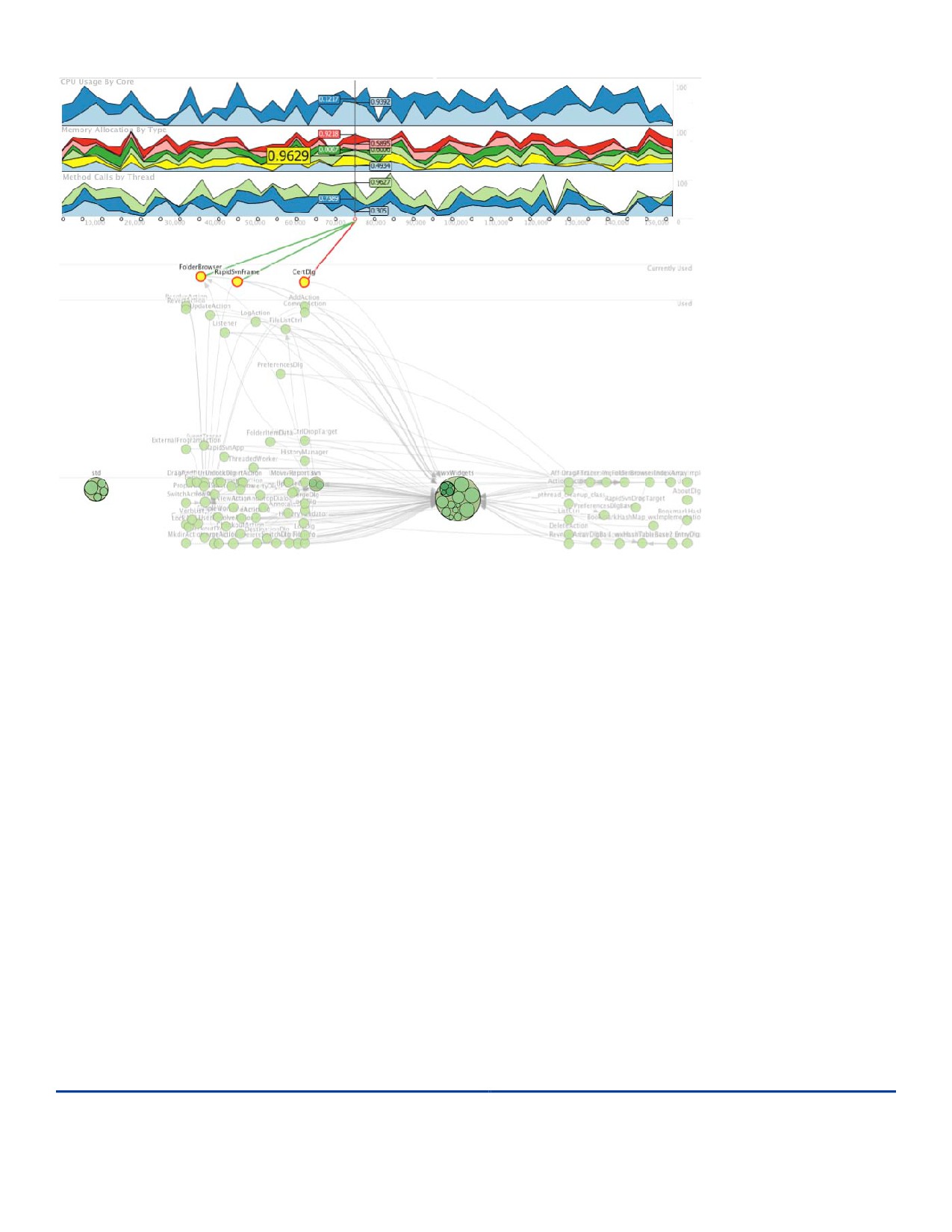
Figure #. Screenshot showing the contextual information of a running code (top) lined with the software
structure information (bottom)
We will develop prototype visualizations based on factors such as exhibited traits, external and environmental
artifacts, space and temporal artifact relationships, sequencing. This will support the identification and
understanding of functions and behaviors to aid malware analysts in developing new traits and patterns of
significance. They will also de velop visual representations of a Malware’s Physiology Profile to provide visual
fingerprinting capabilities to malware analysts and to provide graphical cues for physiology reports. Figure #, is
an example of a Secure Decisions developed visualization showing class dependencies in software.
HB Gar y Fe deral, LLC.
3604 Fa ir Oa ks Blvd Bldg B STE 250 Sacra mento, CA 95684
Use or disclosure of data contained on this sheet is subject to the
Page - xxxiv
restriction on the title page of this proposal.
34
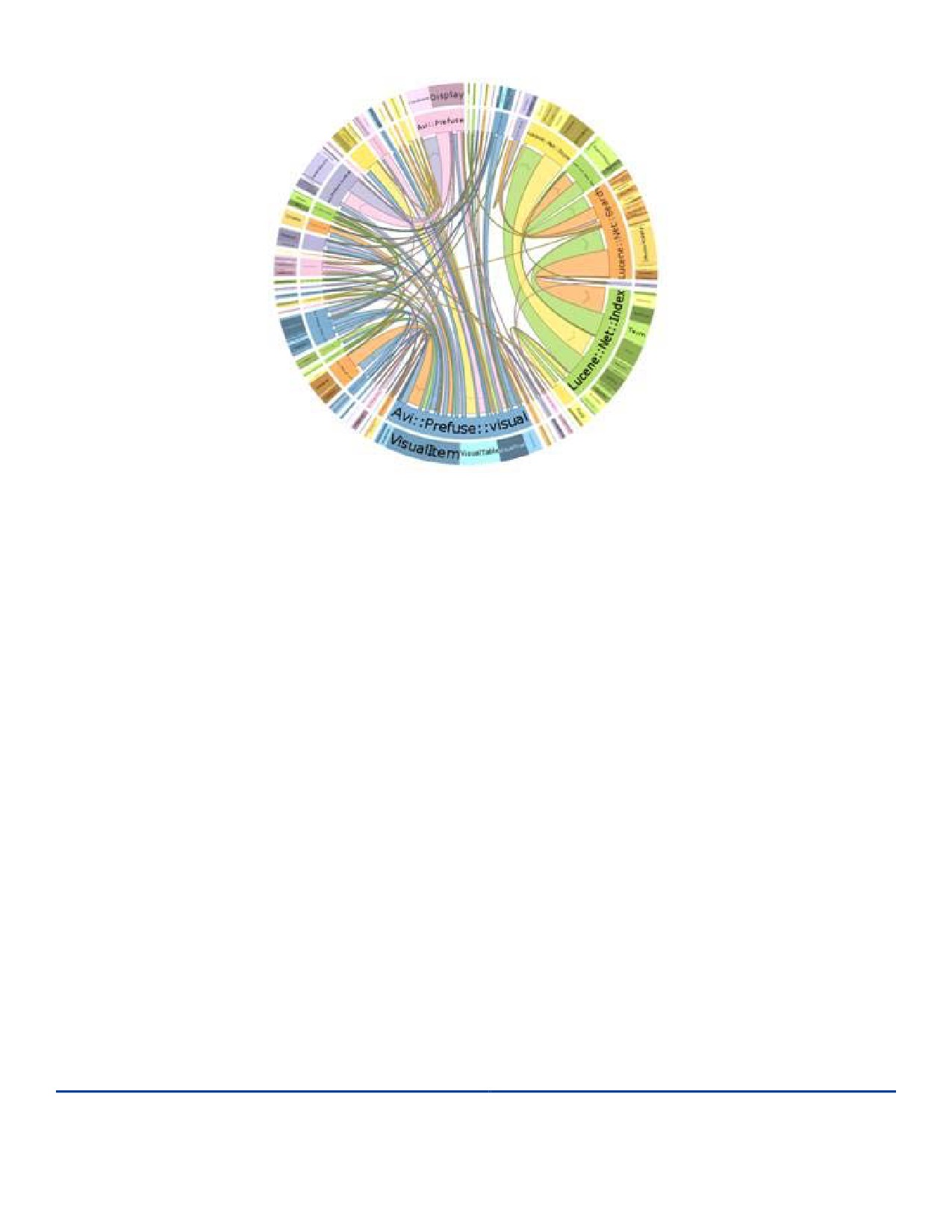
Figure #. iTVO screenshot showing dependencies between classes
This type of representation of traits, pa tterns, and other internal artifacts would b ring efficiency to the malware
analysis process. Secure Decisions has an extensive visualization too lkit that can be leveraged to create novel
visualization for malware analysis. O ur tools and skills have been used to prototype and field a variety of
visualizations for government and commercial cyber defense experts.
III.D.4 Traits Library
At its most fundamental level malware ob jects are a compilation o f discrete functions that do work. In order to
build a capability to automatically analyze malware for aggregate function and behavior we believe you must
first accurately qualify all of its discrete parts. We propose to build a body of knowledge about code (aka,
Traits), for example:
1. Ident ify Usage of API or system calls (WriteFile, RegOpenKey, InternetConnect, libc functions in Linux,
etc.)
2. Identify algorithms in code logic (copy loop, decrypt block, parse string, etc)
3. Identify typical coding structures such as (if/else blocks, do/while loops, class structures, etc)
We propose to research and develop a trait coding system, an example of which is HBGary's existing trait
coding system used to detect the presence of malware, as shown in Fig. #. The existing trait system is
compr ised of the rules, an expression language, and a fuzzy matching system. We will use the existing system
as a basis of research to determine the best methodology for developing a more complete trait coding system for
the purposes of enumerating the low level and high level functions and behaviors for a more sophisticated
analysis of the malware specimen.
HB Gar y Fe deral, LLC.
3604 Fa ir Oa ks Blvd Bldg B STE 250 Sacra mento, CA 95684
Use or disclosure of data contained on this sheet is subject to the
Page - xxxv
restriction on the title page of this proposal.
35

Figure x: HBGary's Trait Cod ing System for Detecting Malware
III.D.5 Genomes Library
Using t he traits library we will research and develop a patterns or ge nomes library. While some traits alone can
aid in the detection or identification of potentially malicious activity in code, such as specimen uses a packer,
the traits alone are not enough to determine automatically the aggregate functions and behaviors of a specimen.
For example, some malware might try to elevate privileges, or open up a file and directly after open a network
connection, or try to use obfuscation techniques. In each of these cases there are legitimate programs, even
secur ity programs, which would employ these functions or exhibit this type of behavior. So with traits alone the
best you might be able to develop is a probability based on an aggregate of traits exhibited.
To truly develop a comprehensive view of malware behavior and function takes some analysis of the traits and
the patterns they exhibit in malware. As an example, noticing the following traits in a code sequence:
URLDownloadToF ile(somefile.exe) followed by CreateProcess(somefile.exe). This could be labeled as a
“Download and execute” pattern, and the intent could be identified as “Suspicious”, or the behavior as “Risky”
or “Dangerous”. We propose to research and develop patterns of traits, such as sequencing or clustering, of
good and bad software, to develop strong indicators that can be relied upon during automated analysis. In the
case of sequence patterns, all of the traits need to fall into a particular sequence to flag as true, whereas with a
cluster or grouping patterns they just have to occur in total or occur within certain proximity of each other. A
third example would be patterns that occur within the presence of certain variables.
One model might be to apply the use of the patterns within specific genomes. So the first genome applied
might be a classifier genome. The system would use weight values to de termine if a program is malware. Once
something has been determined as malware, it should be fed into a second genome. The second genome has
trait-codes for all the code idioms used to develop software functions. For example, it would contain traits for
all the ways a developer might code a TCP/IP recv loop. It would also contain all the trait patterns for
malicious behaviors; such as all the ways a develop er might sniff keystrokes. We could call this the lineage
genome.
Finally, using the results from the lineage genome, analysts can develop archetypes, building statistical tools
HB Gar y Fe deral, LLC.
3604 Fa ir Oa ks Blvd Bldg B STE 250 Sacra mento, CA 95684
Use or disclosure of data contained on this sheet is subject to the
Page - xxxvi
restriction on the title page of this proposal.
36
and visualization so that 'colonies' of largely similar malware can be grouped. When a new colony starts to
form in the data-set, we can construct a new archetype to represent it. The archetype will contain the traits from
the lineage genome that are common to most of the colony. Once the archetype has been created, malware can
be automatically classified into the archetype as it comes in. The archetypes are not a genome, b ut a secondary
layer of sorting over the lineage genome. This system should be able to predict upcoming attacks. When new
samples are collected from the wild, they will automatically be classified into an archetype. A sudde n growth
of a new colony would represent a new malware variant that needs to be addressed. Any such outbreak would
soon find a way into DoD and customer networks, so this offers a predictive capability for defense.
Finally, using the results from the lineage genome, analysts can develop archetypes, building statistical too ls
and visualization so that 'colonies' of largely similar malware can be grouped. When a new colony starts to
form in the data-set, we can construct a new archetype to represent it. The archetype will contain the traits from
the lineage genome that are common to most of the colony. O nce the archetype has been created, malware can
be automatically classified into the archetype as it comes in. The archetypes are not a genome, b ut a secondary
layer of sor ting over the lineage genome. This system should be able to predict upcoming attacks. When new
samples are collected from the wild, they will automatically be classified into an archetype. A sudde n growth
of a new colony would represent a new malware variant that needs to be addressed. Any such outbreak would
soon find a way into DoD and customer networks, so this offers a predictive capability for defense.
III.D.6 Static Memory Analysis and Runtime Tracing (SMART)
The SMART system will provide a nearly complete picture of the execution of any piece of software by
combining the data acquired from three primary technologies:
·
Runtime tracer
·
Physical memory imaging and reconstruction
·
Dataflow tracer
Runtime Trace r
The Runtime Tracer is a software tracing system and instrumented data collector capable of sampling and
capturing data while tracing every process and every thread, both usermode and kernel mode, system wide and
in real time. It will capture control and data flow at a single step resolution. Data sampling captures the
contents of registers, the stack, and target buffers of de-referenceable pointers. Symbo ls are resolved for all
known API calls, and when combined with argument sampling, will drastically reduce the time required to gain
program understanding.
The Runtime Tracer’s post-execution debugging is a paradigm shift from traditional interactive live debugging.
While traditional interactive debugging is useful for software development, it is cumbersome when used for
tracing program behavior. Traditional debugging tools are designed for control of software execution, as
opposed to observation only. The reverse engi neer only needs to observe the binary’s behavior and data. The
software under test is recorded during runtime. The analysis takes place later. Unlike traditional debuggers, the
Runtime Tracer can follow multiple processes and trace parent/child process execution. It can also follow a
process injecting a DLL into another process.
The Runtime Tracer operates at a very low level within the system, layering itself directly above the Hardware
Abstraction Layer (HAL) and underneath the Windows kernel to provide complete control over the operating
environment while at the same time maintaining performance levels to trace software in real time. It will not be
bound by dependency on the Windows userland Debugging API and therefore will not be thwarted by malware
anti-debugging tricks. The target software is not modified in any way. No breakpoints are injected. No thread
context is changed. No debugger is attached. Tracing is performed completely external to the process
HB Gar y Fe deral, LLC.
3604 Fa ir Oa ks Blvd Bldg B STE 250 Sacra mento, CA 95684
Use or disclosure of data contained on this sheet is subject to the
Page - xxxvii
restriction on the title page of this proposal.
37
operating environment.
Physical Memory Imaging and Reconstruction
Once the Runtime Tracer completes its runtime data collection, additional low level data can be harvested from
physical memory. SMART will image physical memory (including RAM and pagefile) and reconstruct the
operating system to recover all digital ob jects present in memory at the time of the image snaps hot. Low level
data collected will include executables, processes, drivers, modules, strings, symbols, network sockets, open
files and data buffers. Any digital ob ject can extracted, disassembled and examined down to its hexadecimal
representation in memory. Because all objects and data are recovered they can also be inspected in relation to
each other for contextual information.
Dataflow Tracer
To more fully understand a binary’s functions and behaviors a skilled reverse engineer will “follow the data” to
understand what code blocks operate on it and how. The engineer must emulate or mode l a computer system in
his mind and keep painstakingly detailed and exhaustive notes of ever changing buffer values and data states.
This work can take days or weeks depending on the program’s size and how deeply he seeks to understand its
behaviors.
We propose to develop an automated Dataflow Tracer to reveal complex relationships between code blocks and
data which will take us far beyond low level data collection from runtime tracing and physical memory
reconstruction. Dataflow tracing will associate different code blocks with each other by cross referencing
common data and data derivatives used by code. Suppose code section A uses some data in memory and at a
later time code section B uses the same data. It is very common that code blocks A and B can exist in different
modules or threads while not appearing to be related in the code logic, but the fact that they operate on the same
data establishes a relationship. Let’s look a t a simple example. Suppos e a binary reads in an encrypted
configuration file then later on other code decrypts it to reveal an IP address, which is copied and moved to
another location in memor y and then used to attempt a connection for command and control. By following the
data we can identify the code blocks that touch and operate on it even if the data is in its nth generation and
morphed multiple times. Dataflow tracing follow and record many data mutations and data movements. Tying
the data together gives a more complete picture.
III.D.7 Belief Reasoning and Inference Node (BRaIN)
So we have an input layer that consists of nodes that are the traits of software. The output layer would consist
of nodes that represent what the software is, i.e. malware, spyware, virus, trojan, safe software, etc.
The DS Dempster-schaffer network would be able to show unknowns by having all of the input nodes having a
high value for unknown. Viewing the internal structure of the belief network will reveal where the logic breaks
down in trying to identify the unknown. For example, if the input layer shows that there is no significant traits
that are discernible then this would indicate that there is a lack of information on this type of software. There
could also be a mid level indicator that would show there is a lack of information on who created this software,
which in turn would fail to identify this as safe software. Basically, the network itself is a too l in preforming
analys is on the da ta. Another approach is to use data mining to correlate the unknowns to potentially knowns.
Research and develop an expert or AI mode l that can be trained and used to classify a malware ob ject into
categories. This will require processing a large set of known malware and a large set of known “clean”
app lications and code so that the mode l can reliably judge the intent of a give n binary. A stochastic approach,
such as a Belief inference model, can be matched with the probabilities learned and weights given to individual
traits and be haviors.
HB Gar y Fe deral, LLC.
3604 Fa ir Oa ks Blvd Bldg B STE 250 Sacra mento, CA 95684
Use or disclosure of data contained on this sheet is subject to the
Page - xxxviii
restriction on the title page of this proposal.
38
Belief analysis is better thought of as probability theory. It is a model that can use the probability of events to
calculate the probability of a more complex probability. The simplest examples are usually given as a deck of
cards. The probability of drawing a spade from a normal deck of cards is 13 in 52 or 1 in 4. The probability o f
drawing a second spade is 12 in 51, or 4 in 17 times the probability of drawing the first, 1/4*4/17= 1/17
(0.0588235…). In Belief terms, the unconditional probability of the event (a card being a spade), with no
additional knowledge or events, is 1 in 4. The conditional probability of an event (drawing a second spade),
requires some additional evidence to compute (that we previously drew a spade). Belief probabilities are either
computed analytically, or sampled empirically. Every possible event and potential evidence increases the
complexity of Belief calculations, but is also likely to increase the accuracy and improve the understanding of
the relationship between events and evidence. For our system, we will likely be using empirically sampled
traits and behaviors and conditional probabilities between them to determine the probability of a binary being
malicious or not malicious.
[that was a very simplistic explanation of Belief reasoning, there is a lot more that
could be explained, such as negative information, avoiding circular reasoning, joint probabilities, belief
networks, etc]
Bayes' theorem shows the relation between one conditional proba bility and its inve rse; for example, the
probability of a hypothesis given observed evidence and the probability of that evidence given the hypothesis.
The key idea is that the probability of event A given event B depends not only on the relationship between A
and B but on the absolute probability of A independent of B, and the absolute probability of B independent of
A.
Although Belief networks are often used to represent causal relationships, this need not be the case. A causal
network is a Belief network with an explicit requirement that the relationships be causal. The additional
semantics of the causal networks specify that if a node X is actively caused to be in a given state x, then the
proba bility de nsity function changes to the one of the network obt ained by cutting the links from X's parents to
X, and setting X to the caused value x. Using these semantics, one can predict the impact of external
interventions from data ob tained prior to intervention.
Because a Belief network is a complete model for the variables and their relationships, it can be used to answer
probabilistic queries about them. For example, the network can be used to find out updated knowledge of the
state of a subset of variables when other variables are observed. This process of computing the posterior
sufficient statistic Bayes' theorem to complex problems. The posterior gives a universal for detection
applications, when one wants to choose values for the variable subset, which minimize some expected loss
function, for instance the probability of decision error. A Belief network can thus be considered a mechanism
for automatically app lying Bayes' theorem to complex prob lems.
The most common exact inference method s are: variable elimination, which eliminates the non-observed non-
query variables one by one by distributing the sum over the product; clique tree propagation, which caches the
computation so that many variables can be queried at one time and new evidence can be propagated quickly;
and recursive conditioning, which allows for a space-time tradeoff and matches the efficiency of variable
elimination when enough space is used. All of these method s have complexity that is expo nential in the
network' s treewidth.
The purpos e of the Belief Reasoning Engine is to encode our prior knowledge about traits and genomes and to
provide a mechanism to reason over that prior knowledge when new evidence is collected. The model
construction process involves: identifying the evidence with discriminatory value, collecting that evidence, and
constructing the model. Models for different malware will have some common elements and some unique
elements. The goal for the mode l design is to maximize accuracy and generality. Generality is impor tant so that
each type of malware does not require a unique model, which would increase the effort to build the mode ls and
HB Gar y Fe deral, LLC.
3604 Fa ir Oa ks Blvd Bldg B STE 250 Sacra mento, CA 95684
Use or disclosure of data contained on this sheet is subject to the
Page - xxxix
restriction on the title page of this proposal.
39
reduces the chances of detecting malware variants.
Demps ter-Shafer theory is a generalization of the Bayesian theory of subjective prob ability; whereas the latter
requires probabilities for each question of interest, Bayesian functions base degrees of belief for one question on
the probabilities for a related question. These degrees of belief may or may not have the mathematical
properties of probabilities; how much they differ depends on how closely the two questions are related. Put
another way, it is a way of representing epistemic plausibility but it can yield answers which contradict those
arrived at using probability theory.
Demps ter-Shafer theory is based on two ideas: obtaining degrees of belief for one question from subj ective
probabilities for a related question, and Dempster's rule for combining such degrees of belief when they are
based on independent items of evidence. In essence, the degree of belief in a proposition depends primarily
upo n the numbe r of answers containing the proposition, and the subjective probability of each answer. Also
contributing are the rules of combination that reflect general assumptions about the data.
In this formalism a degree of belief is represented as a belief function rather than a Belief prob ability
distribution. Probability values are assigned to sets of pos sibilities rather than single events. Beliefs
corresponding to independent pieces of information are combined using Dempster's rule of combination, which
is a generalization of the special case of Bayes' theorem where events are independent. The probability masses
from propositions that contradict each other can also be used to obtain a measure of how much conflict there is
in a system. This measure has been used as a criterion for clustering multiple pieces of seemingly conflicting
evidence around competing hypotheses. One of the computational advantages of the Dempster-Shafer
framework is that priors and conditionals need not be specified, unlike Belief methods, which often use a
symmetry argument to assign prior probabilities to random variables. However, any information contained in
the missing priors and conditionals is not used in the Dempster-Shafer framework unless it can be obtained
indirectly. Demps ter-Shafer theory allows one to specify a degree of ignorance in this situation instead of
being forced to supply prior probabilities, which add to unity.
III.E Comparison with Other Research
While there are many specific challenges related to automated malware analysis there are three main areas of
research that are at the heart of this challenge:
• Trait based analysis of malware
• Increased execution of code paths
• Automated analysis of malware
The majority of trait based analysis capabilities, which are few, focus on providing textual information to the
user on highlighted behaviors identified in an analyzed specimen. UCBerkley’s Anubis Sunbelt Security’s
CWSandbox are probably the best examples of working capabilities in this area. In research there have been
hypothesis made that suggest mathematical models for analyzing behaviors of malware, such as the MIST
model presented in [Trinius, 2009] which describes a high level categorization of malware exhibited behaviors
such as; thread, virtual memory, Winsock and some associated arguments. While this method could be
successful at identifying gross functionality the model lacks a level of detail to be highly capable of determining
to a level of detail malware function, behaviors, and intent. Our approach starts by developing a library of very
detailed, mathematically calculable and human readable traits that describe discrete functions and behaviors of
malware, not in the order of tens of traits but in the order of thousands of traits. The traits library combined
with a patterns library to discern relationships between traits will give us a much higher fidelity capability. The
challenge is the level of detail and understanding required to b uild the libraries is much more significant.
HB Gar y Fe deral, LLC.
3604 Fa ir Oa ks Blvd Bldg B STE 250 Sacra mento, CA 95684
Use or disclosure of data contained on this sheet is subject to the
Page - xl
restriction on the title page of this proposal.
40
Increased execution of code paths has traditionally been accomplished through a combination of static binary
analysis of branch points and brute force attempts using interactive debuggers. There is no existing technology
that exercises branch points effectively. There does exist promising research in taint analysis [Yin, 2009], which
involves instrumenting the system to monitor data flows of known variables as they flow through an executed
binary.
Lastly, completely automated analysis of malware is something that has been research and for which many
whitepapers are written with varying levels of specificity
indicating advantages and disadvantages of the proposed effort.
III.F Previous Accomplishments
The HBGary Federal Team brings signi ficant experience and capabilities directly related to the objectives of the
Cyber Genome Program with many successfully executed contracts in related areas for the Federal Government
and Department of Defense (DoD). To demonstrate our ability to successfully execute a contract under
DARPA’s Cyber Genome Program we have selected one past performance citation from each of the team
members.
III.F.1 HBGary Past Performance
Offeror Name: HBGary and HBGary
Customer Organization: DHS Science and Technology Directorate
Federal
Program Manager:
Address: 1120 Vermont Ave NW 8th Floor, Washington, DC 20528
Douglas Maughan
Phone Number: 202-254-6145
Contracting Officer:
Address: P.O. Box 12924, Fort Huachuca, AZ 85670
Doreen Vera-Cross
Phone Number: 520-533-8993
Contract Type: SBIR Phase II
Contract Value: $975,000
Dec 2007 - Nov 2010
Description of Worked Performed
While most researc hers approach the botnet problem by examining net work traffic, HBGary chose host based
examination bec ause the bot (malware) must reside on the host in memory to execute. Our research focused
on physical mem ory forensics including imaging memory, reconstructing memory and analyzing the recovered
digital objects. Bayesian Reasoning Networks were explored to aut omate and scale the reasoning of security
subject matter experts. Funding was added to research tools for autom ated Windows registry forensics and to
provide training to law enforcement agencies to aid technology transition
Relevance to DCG Technical Area 1
The automated physical memory forensics and Bayesian Reasoning Net works modeling from this contract will
be directly applicable to new research proposed for the Cyber Genome Program.
III.F.2 Pikewerks Past Performance
Offeror Name: Pikewerks
Customer Organization: Air Force Research Laboratory
Program Manager:
Address: 2310 Eighth Street, Bldg 167, Wright-Patterson AFB, OH 45433
Dr. David Kapp
Phone Number: 937-320-9068 x130
Contracting Officer:
Address: 2310 Eighth Street, Bldg 167, Wright-Patterson AFB, OH 45433
Erika Lindsey
Phone Number: 937-255-3379
Contract Type: CPFF
Contract Value: $750,000
PoP: Aug 2008 - Aug 2010
HB Gar y Fe deral, LLC.
3604 Fa ir Oa ks Blvd Bldg B STE 250 Sacra mento, CA 95684
Use or disclosure of data contained on this sheet is subject to the
Page - xli
restriction on the title page of this proposal.
41

Description of Worked Performed
Anti-Forensics is the art and practice of obscuring data storage, transmission, and execution in such a way that
it remains hidden from even a professional, dedicated examiner. Traditionally, hackers have used anti-forensic
methods as a means of hiding their tools, techniques, and identities from forensic investigators. However, anti-
forensic methodologies can also be adopted for defensive purposes. In particular, Anti-Forensic techniques
have the ability to greatly increase the level of effort required to reverse-engineer malicious code. This is
especially useful when the attacker has full access to the memory, disk, and possibly even the processor of a
computer system running the protection software.
For this effort, Pikewerks has identified a number of anti-forensic research areas that would significantly
enhance the confidentiality and integrity of executable code, data, and cryptographic materials through all
stages of operation: at rest, in transit, and during execution. These areas include novel out-of-band storage and
transmission techniques within Commercial Off The Shelf (COTS) computers, which go beyond the highest
level of access available to an attacker and thus dramatically increase the level of effort required to fully
identify, understand, or reverse-engineer the underlying code. The end goal of this development effort is a
diverse suite of innovative anti-forensic capabilities that can be easily integrated into, and deployed with,
technologies where stealth is critical.
Relevance to DCG Technical Area 1
This effort has resulted in the identification of anti-forensic capabilities that could be employed by
sophisticated malware analysis authors, like the kind the Cyber GNOME Project is expected to engage. This
effort is particularly useful to the DCG effort as it demonstrates the advanced research and development
ongoing within Pikewerks Corporation. For the DCG effort revolutionary methods and techniques must be
employed to analyze sophisticated malware that will in the future likely employ many of the techniques being
studied by Pikewerks. Utilizing this research will assist in developing methods for identifying, analyzing, and
relating sophisticated anti-forensic techniques within malware. The approaches developed include anti-forensic
file system storage techniques, indirect function hooking, memory protection techniques using processor debug
registers, and BIOS-based anti-forensic strategies. As part of the development of these techniques, Pikewerks
has written several kernel modules and custom analysis capabilities for Windows and Linux that both
characterize and detect sophisticated anti-forensic techniques.
III.F.3 GDAIS Past Performance
Offeror Name: GDAIS
Customer Organization: Defense Cyber Crime Center (DC3)
Program Manager:
Address: 911 Elkridge Landing Road, Linthicum, MD 21090
Mike Buratowski
Phone Number: 410-981-0117
Contracting Officer:
Address: 2100 Crystal Drive, Suite 300, Arlington, VA 22202
Jim Hayes
Phone Number: 703-605-3600
Contract Type: T&M
Contract Value: $98M
PoP: Oct 2001 - Feb 2012
Description of Worked Performed
Department of Defense Cyber Crime Center (DC3) is a $126M multi-year T&M contract in support of the Air
Force Office of Special Investigations (AFOSI). Since 2001, the GD Team has been the prime contractor for
the Department of Defense Computer Forensics Laboratory (DCFL). In this capacity, the GD Team has
conducted extensive network intrusion examinations and generated detailed reports documenting the intrusions.
The DCFL, and DoD Cyber Crime Institute (DCCI) all fall under this contract.
Business Relationships & Customer Satisfaction: The GD management team provided the leadership that
organized, planned, and managed the resources for the contract’s major projects. Since careers and legal
convictions are dependent upon our findings, we insist on the highest standards of quality and cross-check. The
HB Gar y Fe deral, LLC.
3604 Fa ir Oa ks Blvd Bldg B STE 250 Sacra mento, CA 95684
Use or disclosure of data contained on this sheet is subject to the
Page - xlii
restriction on the title page of this proposal.
42
GD Team is tightly integrated with the DC3 workforce of Government and Military personnel and work as
equals in all facets of forensic support. The GD Team provides onsite program management at the DC3 for all
contractor and subcontractor work. The Program Manager manages a staff of 140 personnel consisting of
General Dynamics engineers, technicians, support personnel, and subcontractors. In March 2007, General
Dynamics was awarded a new, 1-year (plus four option years) contract to provide Computer Forensic
Examination support as well as Research, Development, Testing and Evaluation for computer forensic
hardware and software.
Cost, Schedule & Timeliness: The GD Team has exceeded Government expectations by completing over 2,500
examinations, providing expert testimony in over 100 court proceedings (both CONUS and OCONUS), and
serving as the DoD authority on electronic media forensics. DC3 Incident Response Support has experience
with responses involving single system through large networks with enormous data storage capabilities. In its
role, the GD Team has created a Virtual Analysis Environment where various system configurations including
installed software packages and patch levels are already saved as Virtual Machines. The examiner can execute
the known malicious logic within a system that is configured exactly how the compromised system would have
been at the time of an intrusion.
Key Personnel: The GD Team accounts for over 80 percent of the personnel that perform data recovery,
imaging and extraction, and forensic examinations in support of criminal, fraud, counterintelligence, data
recovery, terrorism, and safety investigations in DC3. The team currently consists of 19 Cyber Intelligence
Analysts, 13 Forensic Technicians, 48 Forensic Examiners, 15 Software Developers, and 5 Forensic Managers
that perform casework for DC3.
Relevance to DCG Technical Area 1
This program has provided GDAIS with the operational knowledge and expertise of the latest intrusions and
cyber threats seeing in DoD and Defense Industrial Base networks. In turn, it has provided GDAIS with the
capabilities and knowledge to detect these cyber threats and their artifacts by using many of the forensics and
reverse engineering capabilities within our analysis and R&D team. Since the number of intrusion cases has
increase exponentially at DC3, we had the need to start performing automated behavior analysis and correlation
between malware binaries. Within the DCFL/Intrusions Section, our engineers and computer scientist are
developing a capability to automatically correlate these malicious binaries against malware found in previous
intrusion cases. This is done with the use of IDA Pro and various fuzzy hashing techniques to disassemble the
malicious binaries into individual function and perform correlation against the malware obtained through the
many different intrusion cases. By using open source, freeware, and government sponsored tools they have also
developed a capability to submit malicious binaries to perform automated behavioral analysis. This is the type
of capabilities that together with our vast knowledge of the latest intrusions, GDAIS could leverage and
enhanced for the DARPA Cyber Genome program. From the DCFL/NCIJTF perspective, our intelligence
analysts use the analysis report generated by our DCFL\IA examiners to perform additional correlation against
various events and data. Once this is done, reports and signatures (intrusion indicators) are distributed to the
community. The DCCI R&D team is constantly collaborating with different DoD, academia, and industry
organization to learn about their effort and share tools for addition into our DC3 operations. Many of these
tools are tested and validated by our DCCI T&E team to verify that the results are accurate and reliable.
For technical area one of the DARPA Cyber Genome program, GDAIS, together with their partners, will
employ revolutionary techniques to exploits our collective knowledge and expertise to automatically ingest
these malicious binaries and provide correlation, lineage, and provenance in order to gain a better
understanding of software evolution, detect zero-day malware, and when possible determine attribution.
III.F.4 SRI International
Offeror Name: SRI International
Customer Organization: Army Research Office
Program Manager:
Address: 4300 S. Miami Blvd, Durham, NC 27703
HB Gar y Fe deral, LLC.
3604 Fa ir Oa ks Blvd Bldg B STE 250 Sacra mento, CA 95684
Use or disclosure of data contained on this sheet is subject to the
Page - xliii
restriction on the title page of this proposal.
43
Cliff Wang
Phone Number: 919-549-4207
Contracting Officer:
Address: P.O. Box 12211, Research Triangle, NC 27709
Kathy Terry
Phone Number: 919-549-4337
Contract Type: Grant
Contract Value: $13.4M
PoP: Jun 2006 - Jul 2010
Description of Worked Performed
Phillip Porras is the Principal Investigator of the Army Research Office sponsored Cyber-TA Project. Cyber-
TA is an ongoing 5-year research project to develop the next-generation of real-time national-scale Internet-
threat analysis technologies. Our team has developed many new sophisticated antimalware and malware
tracking technologies, produced over 50 publications in scientific peer reviewed venues, and has deployed its
technologies widely across DoD and the U.S. Government. The Cyber-TA research project has brought
together many of the world’s most established researchers across the fields of data privacy, cryptography,
malware and intrusion detection research, as well as operational experts in Internet-scale sensor management,
to develop leading edge solutions to the evolving threat of increasingly virulent and wide-spread self-
propagating malicious software. Examples of Cyber-TA research technologies include:
• Eureka - A binary unpacking and decompilation system designed to overcome a broad spectrum of
malware binary logic protection services: http://eureka.cyber-ta.org
• BLADE - A system to immunize Windows platforms from malicious drive-by malware exploits:
• Highly Predictive Blacklists - A link-analysis-based IP blacklist production system for producing high-
quality network blacklists: http://www.cyber-ta.org/releases/HPB/
• Malware Threat Center - A portal for tracking Internet malware threats across the Internet:
• Malware Cluster Lab - An example of SRI’s experience in appling malware forensic clustering to
detect malware binary lineage is available at http://cgi.mtc.sri.com/Cluster-Lab/ , and an example of our
ability to conduct a quantifiable comparison of pair-wise binary logic within two malware binary
samples that employ multi-layered packing is available at
http://mtc.sri.com/Conficker/addendumC/HMA_Compare_ConfB2_ConfC/.
A Cyber-TA project overview description is available at: http://www.cyber-ta.org/pubs/IEEE-SnP-Magazine-
Relevance to DCG Technical Area 1
Cyber-TA has provided an ongoing resource for SRI’s Computer Science Laboratory to conduct both breadth
and depth research in understanding and combating the modern Internet crimeware epidemic. Of particular
relevance to DCG is the extensive Cyber-TA research that our team has produced in the area of binary
unpacking, disassembly, decompilation, and deobfuscation. We have demonstrated our advanced deobfuscation
techniques in work such as (http://mtc.sri.com/Conficker/P2P/index.html ), which is to our knowledge the only
published description of the multi-layered obfuscated code base of the Conficker P2P subsystem. An example
of our ability to handle mobile malware binary reverse engineering on non-x86 binaries is available at
http://mtc.sri.com/iPhone/.
III.F.5 AVI/Secure Decisions
Offeror Name: AVI-Secure Decisions
Customer Organization: AFRL / IARPA / NSA
Program Manager:
Address: 525 Brooks Road, Rome, NY 13441
HB Gar y Fe deral, LLC.
3604 Fa ir Oa ks Blvd Bldg B STE 250 Sacra mento, CA 95684
Use or disclosure of data contained on this sheet is subject to the
Page - xliv
restriction on the title page of this proposal.
44
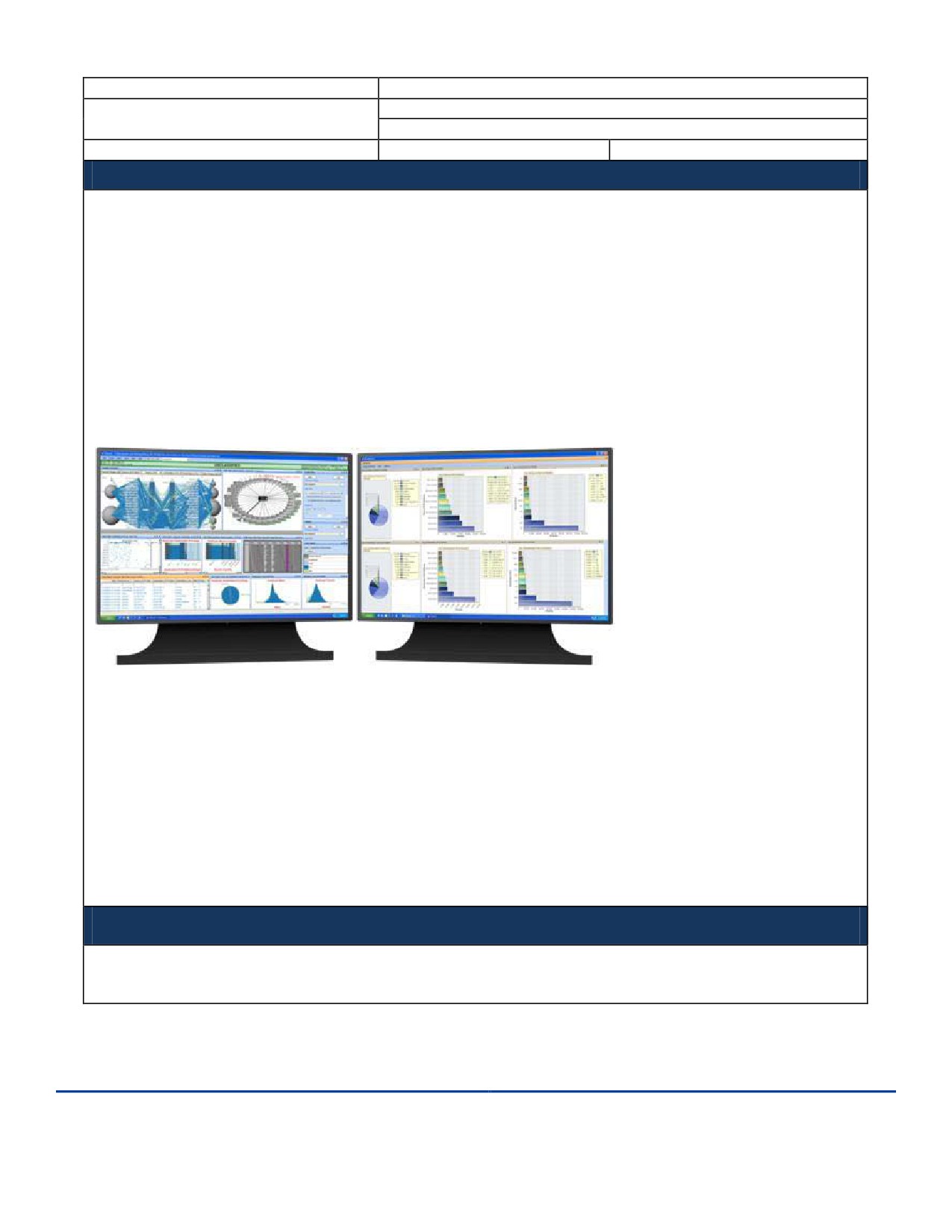
Walter Tirenin
Phone Number: 315-330-1871
Contracting Officer:
Address: 26 Electronics Parkway, Rome, NY 13441
Rebecca Willsey
Phone Number: 315-330-4710
Contract Type: BAA
Contract Value: $2.3M
PoP: Sep 2005 - Dec 2008
Description of Worked Performed
VIAassist is a visualization framework used by computer security specialists to ensure the security of computer
networks. It was developed to visualize NetFlow data, and is currently used for classified applications by the IC
and being modified for adoption by DHS in US-CERT. In addition to NetFlow data, VIAssist can visualize
intrusion detection and other data sources. VIAssist converts network data into a collection of graphical
representations to make it easier to see patterns and trends. This technique takes advantage of the innate ability
of humans to perceive patterns in pictures that they might otherwise miss when looking at raw data. It provides
IC analysts and cyberdefense personnel with the following capabilities that have enhanced the overall mission,
meeting the performance, cost and schedule criteria.
• Provide workflow continuity & collaboration. Analysts record observations, and shared annotations
allow users to collaborate with colleagues about their findings.
• Provide effective reporting. Through the use of the Report Designer and pre-defined report templates,
VIAssist streamlines report
building for analysts.
• Provide global & detailed
situational awareness. Dual
monitor displays provide a
global, summarized view of
trends, as well as a focused view
of specific incidents.
• Provide multiple views of
the same data. Multiple
coordinated views of the data are
provided to make it easier to
identify anomalies, relationships
and interdependencies between data points.
• Correlate multiple data sources. Using an intermediary data store, integrates with and visualizes
multiple disparate data sources, such as firewall logs, IDS data and NetFlow data.
• Aggregate data. Through the use of Smart Aggregation technology, effectively displays voluminous data
by visually aggregating data into meaningful visualizations with drill-down capability and in so doing,
reduce load on system and response time. .
• Filter data. Through the use of an advanced Expression Builder, filters data based upon various pre-
defined or complex user-defined criteria, allowing analysts to focus on specific data, to the exclusion of
the mass of “noise” that can often obscure security risks.
Relevance to DCG Technical Area 1
Specific technologies developed for VIAssist that support smart data aggregation may be leveraged to assist in
providing compelling and scalable visualizations to support malware analysis.
III.G Place of Performance, Facilities, and Locations
The HBGary Federal team will perform work at their individual office locations. We propos e no classified
work, but will be able to support classified discussions, meetings and briefings at government facilities. Each
HB Gar y Fe deral, LLC.
3604 Fa ir Oa ks Blvd Bldg B STE 250 Sacra mento, CA 95684
Use or disclosure of data contained on this sheet is subject to the
Page - xlv
restriction on the title page of this proposal.
45

team member has a primary location and may have a secondary location in which they will perform research
and development. A summary listing is provided in Table #.
Company
Location
HBGary Federal
Sacra mento, CA
HBGary
Sacra mento, CA
Pikewe rks
Ale xandria , VA
SRI International
Menlo Park, CA
Secure Dec isions
Northport, NY
General Dyna mics
Centennial, Co
Table #. Description of Facilities
III.H Detailed Support (Including Teaming Agreements)
HBGary Federal has fully executed teaming agreements with following companies for the purposes of preparing
a written proposal for DARPA-BAA-10-36_C yber_Genome and for the execut ion of said contract upo n award
(cop ies of teaming agreements available upon request): HBGary, Inc.; Pikewerks; General Dynamics AIS; SRI
International; and AVI/SecureDecisions.
III.I
Cost, Schedules and Measurable Milestones
including estimates of cost for each task in each year of the effort delineated by the primes and major
subcontractors, total cost, and any company cost share. Note: Measurable milestones should capture key
deve lopment poi nts in tas ks and should be clearly articulated and defined in time relative to start of
effort. These milestones should enable and suppo rt a decision for the next part of the effort. Add itional interim
non-critical management milestones are also highly encouraged at regular intervals.
Where the effort consists of multiple portions that could reasonably be partitioned for purposes of funding,
these should be identified as options with separate cost estimates for each. Additionally, proposals should
clearly explain the technical approach(es) that will be employed to meet or exceed each program metric and
provide ample justification as to why the approach(es) is/are feasible. Note: Tas k descriptions related to the
technical approach and associated technical elements need to be complete and clearly related to satisfying
the prog ram metrics as stated in Section 1.2.1.
Task
Contr actor
Year
Cost
Success Criteria
Task1
SRI
1
$499,997
Pikewe rks
$326,083
HBGary Federal
$0
$0
SRI
2
499,925
Pikewe rks
229,100
HBGary Federal
$0
$0
SRI
3
$543,018
Pikewe rks
$119,227
HBGary Federal
$0
$0
SRI
4
$557,007
Pikewe rks
$89505
HBGary Federal
$0
$0
Total Task 1
$0
HB Gar y Fe deral, LLC.
3604 Fa ir Oa ks Blvd Bldg B STE 250 Sacra mento, CA 95684
Use or disclosure of data contained on this sheet is subject to the
Page - xlv i
restriction on the title page of this proposal.
46
Task 2
HBGary Federal
1
HBGary Federal
2
HBGary Federal
3
HBGary Federal
4
Total Task 2
$0
Task 3
Secure Dec isions
1
$435,937
GDAIS
$26,119
$462056
Secure Dec isions
2
$465,727
GDAIS
$26789
492,516
Total Task 3
$954,572
Task 4
HBGary Federal
2
HBGary
Pikewe rks
$52,346
$0
HBGary Federal
3
HBGary
Pikewe rks
$119,227
$0
HBGary Federal
4
HBGary
$0
Pikewe rks
$0
Total Task 4
$0
Task 5
HBGary Federal
1
HBGary
Pikewe rks
$118,369
General
$80,366
Dynamics
$0
HBGary Federal
2
HBGary
Pikewe rks
$52,346
General
$82,428
Dynamics
$0
HBGary Fedreal
3
HBGary
Pikewe rks
$119.227
General
$84,795
Dynamics
$0
HBGary Federal
4
HBGary
Pikewe rks
$122,804
General
$87,235
Dynamics
$0
Total Task 5
$0
Task 6
HBGary
2
Pikewe rks
$129,224
$0
HBGary
3
HB Gar y Fe deral, LLC.
3604 Fa ir Oa ks Blvd Bldg B STE 250 Sacra mento, CA 95684
Use or disclosure of data contained on this sheet is subject to the
Page - xlv ii
restriction on the title page of this proposal.
47

Pikewe rks
$119,227
$0
HBGary
4
Pikewe rks
$122,804
$0
$0
Task 7
HBGary Federal
3
HBGary Federal
4
$0
III.J
Data Description
HBGary Federal subscribes to commercial malware feeds and has an existing 500GB unique sample malware
repository that will be used for this effort. We will also acquire new feeds and develop malware harvesters to
find and capture new malware that is not available in the feeds. Collection of new malware will be through
seemingly normal web-based activities. The malware objects are binaries, PDF, documents that are or contain
malware. We will ensure the feeds we subscribe to acquire malware through legal, non- intrusive means.
Section IV. Additional Information
A brief bibliography of relevant technical papers and research notes (published and unpublished) that document
the technical ideas upon which the proposal is based. Copies of not more than three (3) relevant papers can be
included in the submission.
HB Gar y Fe deral, LLC.
3604 Fa ir Oa ks Blvd Bldg B STE 250 Sacra mento, CA 95684
Use or disclosure of data contained on this sheet is subject to the
Page - xlv iii
restriction on the title page of this proposal.
48
BREVITY
MULTI-SERVICE BREVITY
CODES
FM 3-54.10(FM 3-97.18)
MCRP 3-25B
NTTP 6-02.1
AFTTP(I) 3-2.5
JUNE 2003
DISTRIBUTION RESTRICTION: Distribution authorized to DOD and
DOD contractors to protect operational information from automatic
dissemination under the International Exchange Program or by other
means. This determination was made on 7 January 2003. Other
requests will be referred to HQ TRADOC, ATTN: ATDO-A, Ft
Monroe, VA 23651-5000; HQ MCCDC, ATTN: C42, Quantico, VA
22134-5021; NWDC, ATTN: Code N5, Newport, RI 02841-1207; or
HQ AFDC, ATTN: DJ, Langley AFB VA 23665-2722.
DESTRUCTION NOTICE: Destroy by any method that will prevent
disclosure of contents or reconstruction of the document.
FOREWORD
This publication has been prepared under our direction for use by our respective
commands and other commands as appropriate.
MICHAEL A. VANE
EDWARD HANLON, JR.
Brigadier General, U.S. Army
Lieutenant General, USMC
Deputy Chief of Staff for
Commanding General
Doctrine, Concepts and Strategy
Marine Corps Combat
U.S. Army Training and Doctrine
Development Command
Command
R. A. ROUTE
DAVID F. MacGHEE, JR.
Rear Admiral, USN
Major General, USAF
Commander
Commander
Navy Warfare Development
Headquarters Air Force
Command
Doctrine Center
This publication is available at Army
Knowledge Online (www.us.army.mil)
and the General Dennis J. Reimer
Training and Doctrine Digital Library
at (www.adtdl.army.mil).
PREFACE
1. Purpose
This publication will ease coordination and improve understanding during multi-
Service operations. A Brevity code is a code which provides no security but which has
as its sole purpose the shortening of messages rather than the concealment of their
content (Joint Publication 1-02).
2. Scope
This publication standardizes air-to-air, air-to-surface, surface-to-air, and surface-to-
surface brevity codes. The scope is limited to those [voice] brevity codes used in multi-
Service operations and does not include words unique to single-service operations. While
not authoritative in nature, all services agree to these brevity code meanings. The
brevity codes have been forwarded for inclusion or modification of current North
Atlantic Treaty Organization (NATO) joint brevity words.
3. Applicability
This publication is intended for air and ground operations personnel at the tactical
level.
4. Implementation Plan
Participating service command offices of primary responsibility (OPRs) will review
this publication, validate the information, and reference and incorporate it in service
and command manuals, regulations, and curricula as follows:
Army The Army will incorporate the TTP in this publication in U.S. Army training
and doctrine publications as directed by the Commander, U.S. Army Training and
Doctrine Command (TRADOC). Distribution is in accordance with initial distribution
number (IDN) XXXXXXX.
Marine Corps. The Marine Corps will incorporate the procedures in this
publication in U.S. Marine Corps training and doctrine publications as directed by the
Commanding General, U.S. Marine Corps Combat Development Command (MCCDC).
Distribution is in accordance with the Marine Corps Publication Distribution System
(MCPDS).
Navy. The Navy will incorporate these procedures in U.S. Navy training and
doctrine publications as directed by the Commander, Navy Warfare Development
Command (NWDC)[I5]. Distribution is in accordance with Military Standard
Requisition and Issue Procedure Desk Guide (MILSTRIP Desk Guide) and Navy
Standing Operating Procedure Publication 409 (NAV SOP Pub 409).
Air Force. The Air Force will validate and incorporate appropriate portions of this
publication’s multi-Service tactics, techniques, and procedures (MTTP) into Air Force
doctrine documents as directed by the Commander, Air Force Doctrine Center (AFDC).
Distribution is in accordance with Air Force Instruction (AFI) 33-360.
Marine Corps PCN: 144 000015 00
i
5. User Information
a. TRADOC, MCCDC, NWDC, Headquarters AFDC, and the Air Land Sea
Application (ALSA) Center developed this publication with the joint participation of the
approving Service commands. ALSA will review and update this publication as
necessary.
b. This publication reflects current joint and Service doctrine, command and control
organizations, facilities, personnel, responsibilities, and procedures. Changes in Service
protocol, appropriately reflected in joint and Service publications, will likewise be
incorporated in revisions to this document.
ii
c. We encourage recommended changes for improving this publication. Key your
comments to the specific page and paragraph and provide a rationale for each
recommendation. Send comments and recommendations directly to—
Army
U.S. Army Training and Doctrine Command
ATTN: ATDO-A
Fort Monroe, VA 23651-5000
DSN 680-3951 COMM (757) 788-3951
E-mail: doctrine@monroe.army.mil
Marine Corps
Commanding General
U.S. Marine Corps Combat Development Command
ATTN: C42
3300 Russell Road, Suite 318A
Quantico, VA 22134-5021
DSN 278-6233/6234 COMM (703) 784-6234
E-mail: deputydirectordoctrine@mccdc.usmc.mil
Navy
Commander
Navy Warfare Development Command
ATTN: N5
686 Cushing Road
Newport, RI 02841-1207
DSN 948-1164/4189 COMM (401) 841-1164/4189
E-mail: alsapubs@nwdc.navy.mil
Air Force
HQ AFDC/DJ
204 Dodd Blvd, Suite 301
Langley AFB, VA 23665-2788
DSN 574-8091 COMM (757) 764-8091
E-mail: afdc.dj@langley.af.mil
ALSA
ALSA Center
ATTN: Director
114 Andrews Street
Langley AFB, VA 23665-2785
DSN 575-0902 COMM (757) 225-0902
E-mail: alsa.director@langley.af.mil
iii
*FM 3-54.10 (FM 3-97.18)
*MCRP 3-25B
*NTTP 6-02.1
*AFTTP(I) 3-2.5
FM 3-54.10 (FM 3-97.18)
U.S. Army Training and Doctrine Command
Fort Monroe, Virginia
MCRP 2-25B
Marine Corps Combat Development Command
Quantico, Virginia
NTTP 6-02.1
Navy Warfare Development Command
Newport, Rhode Island
AFTTP(I) 3-25
Air Force Doctrine Center
Maxwell Air Force Base, Alabama
June 2003
BREVITY
Multi-Service Brevity Codes
TABLE OF CONTENTS
Page
CHAPTER I SUMMARY OF CHANGES
I-1
NEW TERMS
I-1
DELETED TERMS
I-2
CHANGED DEFINITIONS TO TERMS
I-2
CHAPTER II MULTI-SERVICE BREVITY CODES
II-1
CHAPTER III CATAGORY SYNOPSIS
III-1
GENERAL AIR OPERATIONS
III-1
AIR-TO-AIR
III-3
AIR-TO-SURFACE
III-5
CLOSE AIR SUPPORT
III-5
COMBAT SEARCH AND RESCUE
III-6
LASERS
III-6
BASIC NVD/IR/ILLUMINATION
III-6
DATA LINKS
III-7
JSTARS
III-7
MARITIME AIR OPERATIONS
III-7
BASIC SEAD/SIGINT/EW INTEGRATION
III-8
SURFACE-TO-AIR
III-9
SURFACE-TO-SURFACE
III-9
NATO-SPECIFIC TERMS
III-9
Glossary
Glossary-1
TABLES
Table II-1 KEY
II-1
*This publication supercedes FM 3-97.18, MCRP 3-25B, NTTP 6-02.1 and AFTTP(I) 3-2.5, 1 Feb 2002.
v
Chapter I
SUMMARY OF CHANGES
1. NEW TERMS
ANYFACE
FLAVOR
POPCORN
ASLEEP
FREEZE BURN
PULSE
ATTACK COMPLETE
FUEL STATE
QUAIL
AWAKE
GADABOUT
RACKET
BAY
GINGERBREAD
RED LIGHT
BEARING
GLOWWORM
REFERENCE
BEANSTALK
GOODWILL
RENO
BLOTTER
GOPHER
RENT
BUDDY LASE/GUIDE
GRIDIRON
REPEAT
BULLRING
HEADBUTT
RUMBA
BUMP
HOOK (descriptor)
SAME
BUTTON
HOUNDOG
SCAN
CAV-OKAY
HUFFDUFF
SEARCHER
CHANNEL
INTRUDER
SET
CHARLIE
KOBOLD
SINGLE
CHECKPRINT
LAME DUCK
SLIPPING
CINDER
LEVEL
SNEAKER
CLAM
LINER
SNOOPER
CLEARED TO ENGAGE
LONG RIFLE
SPOOFER
CLOWN
LOOKING
STARE
CRUISE
MARKPOINT
STOP (abort code)
DANCE
MIKEDUFF
TACTICAL
DANGER CLOSE
MOVE BURN
TIME CHECK
DELTA
NEGATIVE LASER
TRACK NUMBER
DIAMONDS
(system) OKAY
TRACKING
DIRTY
OILFIELD
TRAVEL
DOWN
ORBIT
TROUT
DUFFER
PACMAN
VECTOR
FAKER
PANCAKE
WEAPONS
FAN TACK
PEDRO
WOOF
FEELER
PINNACLE
FERRET
POINT
FLARE
POLAR BEAR
2. DELETED TERMS
AJAX
BIRDDOG
SHORT SKATE
SORT TIDS/TADS
TARGET TIDS/TADS
VERY HIGH
(system) WELL
WINGS LEVEL
I-1
3. CHANGED DEFINITIONS TO TERMS
ARM
GENIE
SHIFT
ATTACKING
HEAVY
SHOTGUN
AZIMUTH
HIGH
SIDE-SIDE
(system) BENT
HOSTILE
SILENT
BOX
HOT
SLOW
BULLSEYE
LADDER
SNAP
CEASE (activity)
MARK
SNAPLOCK (BRAA)
CEASE ENGAGEMENT
MEDIUM
SOUR
CHAMPAGNE
MILLER TIME
STACK
COLOR
MONITOR(ING)
STINGER
CONTINUE DRY
MUD
STOP
DATA
NAILS
SWEET
DEADEYE
NEAR-FAR
TARGET
DEEP
PIGS AWAY
TIMBER
DEFENSIVE
PLAYTIME
VERY FAST
DUCK
POP UP
VIC
ECHELON
PRESS
WALL
ENGAGED
RANGE
WEAPONS
FAST
RETROGRADE
WEIGHTED
2nd FOX THREE
SCRAM
WHAT STATE
FOX 3 (X)-SHIP
SCRUB
WIDE
I-2
Chapter II
MULTI-SERVICE BREVITY CODES
Table II-1 KEY
Meaning may differ with NATO brevity word
**
Not a NATO brevity word
[NATO]
NATO brevity word not used by US forces but
may be encountered in combined operations.
TERM
New brevity code
text of
Change to brevity code definition
definition
(A/A)
Brevity code definition applies to air-to-air
(A/A) operations
(A/S)
Brevity code definition applies to air-to-
surface (A/S) operations
(S/A)
Brevity code definition applies to surface-to-
air (S/A) operations
(S/S)
Brevity code definition applies to surface-to-
surface (S/S) operations
(EW)
Brevity code definition applies to electronic
warfare (EW) operations
(AIR-MAR)
Brevity code definition applies to maritime air
(AIR-MAR) operations
Note: All brevity codes pertain to general air operations unless indicated
otherwise. NATO definitions derived from APP/MPP-7B, Change 0.
II-1
ABORT
Directive call to cease action/attack/event/mission.
ACTION
Directive call to initiate a briefed attack sequence or
maneuver.
(system)ACTIVE
(EW) Referenced emitter is radiating at the stated location
(location/ direction)
or along the stated bearing.
ADD (system/
(EW) Directive call to add a specific (system) or (EOB
category)**
category) to search responsibilities.
ALARM
Directive/informative call indicating the termination of
EMCON procedures. Opposite of SNOOZE.
ALFA CHECK
Request for/confirmation of bearing and range from
requesting aircraft to described point.
ALLIGATOR
Link-11/ TADIL A.
ANCHOR(ED)
1. Informative call to indicate a turning engagement at the
(location)
specified location.
2. Directive call to orbit about a specific point.
3. Refueling track flown by tanker.
ANGELS
Height of friendly aircraft in thousands of feet from mean
sea level (MSL). (NOTE: NATO definition does not specify
MSL or AGL)
ANYFACE*
Friendly GCI/AEW command and control agency when
callsign is not known.
ARIZONA
No anti-radiation missile (ARM) ordnance remaining.
ARM**
CONTACT(s) resulting from target maneuvers exceeding
GROUP criteria.
ASLEEP **
Enemy air defense system is not operating and is not
expected to engage friendly aircraft. Opposite of AWAKE.
AS FRAGGED
Unit or element will be performing exactly as stated by the
air tasking order (ATO).
ATTACK(ING)
(A/S) Directive/(informative) call indicating aircraft are
committed to air-to-surface delivery on a specific ground
target. Direction/bearing from which the weapon will be
coming may be given.
ATTACK COMPLETE**
(A/S) Mandatory call from the attack aircraft to the Joint
Terminal Attack Controller (JTAC) during Type III control
indicating completion of ordnance release. (See also
CLEARED TO ENGAGE)
AUTHENTICATE
To request or provide a response to a coded challenge.
AUTOCAT
Any communications relay using automatic
retransmissions.
II-2
(weapon) AWAY
Release/launch of specified weapon (e.g. BIRDS AWAY,
PIGS AWAY, LONG RIFLE AWAY, etc.) NOTE: Include
launch location in bullseye format and weapons track
direction for PIGS and LONG RIFLE.
AWAKE**
Enemy Air Defense system is operating and may engage
friendly aircraft. Opposite of ASLEEP.
AZIMUTH*
1.
(A/A) A picture label describing two GROUPs separated
laterally.
*GROUP names will be referenced by cardinal
directions. (e.g. NORTH GROUP, SOUTH GROUP, or
EAST GROUP, WEST GROUP) (NOTE: NATO definition
includes two or more GROUPS).
2*.
(S/A) Direction to the threat.
BANDIT
An aircraft identified as an enemy in accordance with (IAW)
theater ID criteria. The term does not necessarily imply
direction or authority to engage.
BANZAI
Informative/directive call to execute launch and decide
tactics.
BASE
Reference number used to indicate such information as
(+/- number)
headings, altitude, fuels, etc.
BAY
[NATO] (EW) Carry out deception plan indicated or in
accordance with previous orders.
BEAD WINDOW
Last transmission potentially disclosed unauthorized
information.
BEAM (w/cardinal
CONTACT stabilized within 70 to 110 degrees of aspect.
direction)*
(NOTE: NATO = 60-120 degrees aspect)
BEANSTALK
[NATO] Information call advising datalink users to check
equipment for spurious tracks.
BEARING (w/sub-
Inner GROUP formation with the trailer displaced
cardinal direction)**
approximately 45 degrees behind the leader.
(system) BENT
System indicated is inoperative. Cancelled by OKAY.
BINGO
Fuel state needed for recovery.
BIRD
Friendly surface-to-air missile (SAM).
BIRD(S) AFFIRM
(S/A) Surface-to-Air informative call indicating a FRIENDLY
unit is able and prepared to engage a specified target with
SAMs. Opposite of BIRD(S) NEGAT.
BIRD(S) NEGAT
(S/A) Surface-to-Air informative call indicating a FRIENDLY
unit is unable to engage a specified target with SAMs.
Opposite of BIRD(S) AFFIRM.
BITTERSWEET**
Notification of possible blue-on-blue (fratricide) or blue-on-
neutral situation relative to a designated track or
FRIENDLY aircraft.
II-3
BLIND
No visual contact with FRIENDLY aircraft/ground position.
Opposite of VISUAL.
BLOTTER
[NATO] (EW) ECM receiver.
BLOW THROUGH
Directive/informative call that aircraft will continue straight
ahead at the merge and not become ANCHORED with
target(s).
BOGEY
A radar or visual air CONTACT whose identity is unknown.
BOGEY DOPE
Request for target information as requested or for closest
GROUP in BRAA (with appropriate fill ins)
BOX
Picture label with GROUPs in a square or offset square
(See CHAMPAGNE and VIC for GROUP names).
BRAA
1. Following information is in a tactical control format
providing target bearing, range, altitude, and aspect,
relative to the specified friendly aircraft.
2.* Request/directive call to switch to tactical BRAA control
format.
BRACKET (direction)
Directive call to maneuver to a position on opposite sides,
either laterally or vertically from the target.
BREAK (direction)
Directive call to perform an immediate maximum
performance 180-degree turn (or as directed) in the
indicated direction.
BREAK AWAY
Tanker or receiver call indicating immediate vertical and
nose/tail separation between tanker and receiver is
required.
BREVITY**
Directive call indicating the radio frequency is becoming
saturated, degraded or jammed and briefer transmissions
must follow. (NOTE: See NATO term ZIPLIP)
BROADCAST
Request/directive call to switch to broadcast control format.
BROKE LOCK
Advisory call regarding loss of radar/IR lock-on.
BRUISER
Friendly air launched anti-ship missile.
BUDDY
(A/S) Request or informative communications to have
(LASE/GUIDE)**
guidance of a weapon from a source other than delivering
aircraft.
BUDDY LOCK
Radar locked to a known friendly aircraft. Normally a
response to a SPIKED or BUDDY SPIKE calls.
BUDDY SPIKE
Friendly aircraft radar lock-on indication on radar warning
(position /heading/alt)
receiver (RWR).
BUGOUT (direction)
Separation from that particular engagement / attack /
operation with no intent to reengage/return.
BULLDOG
(S/S) Friendly surface/submarine launched anti-ship
missile.
II-4
BULLRING
(AIR-MAR) Maritime aircraft patrol zone.
BULLSEYE
An established reference point from which the position of
an object can be referenced by bearing (Magnetic) and
range (NM) from this point.
BUMP/BUMP-UP
(A/S) A climb to acquire line of sight (LOS) to the target or
laser designation.
BURN**
(A/S) Informative call that Gated Laser Illuminator (GLINT)
is being used to provide illumination. Typically employed
by AC-130 to illuminate surface points of interest.
BUSTER
Directive call to fly at maximum continuous speed (military
power).
BUTTON
Radio channel setting.
BUZZER**
Electronic communications jamming. (NOTE: same as
NATO term, CHATTER)
CANDYGRAM**
(EW) Informative call to aircraft that electronic warfare
targeting information is available on a briefed secure net.
CAP/CAPPING
1. Directive call to establish a combat air patrol (CAP) at a
(location)
specified location.
2. Descriptive term for aircraft in a CAP.
CAPTURED
(A/S) Aircrew has acquired and is able to track a specified
surface target with an on-board sensor.
CAV-OK
Cloud and Visibility Okay (pronounced kav-okay). ICAO
term meaning no significant clouds below 5,000 feet,
visibility at least six miles, no precipitation or storms.
CEASE (activity)
Directive to discontinue stated activity; e.g. CEASE
BUZZER, CEASE LASER, etc.
CEASE ENGAGEMENT
(S/A) A fire control order used to direct air defense units to
stop tactical action against a specified target. Guided
missiles already in flight will continue to intercept.
CEASE FIRE
(S/A) Discontinue firing/do not open fire. Missiles in flight
are allowed to continue to intercept; continue to track.
CHAMPAGNE
A picture label of three distinct GROUPs with two in front
and one behind. *GROUP names should be NORTH LEAD
GROUP and SOUTH LEAD GROUP or WEST LEAD
GROUP and EAST LEAD GROUP and TRAIL
GROUP.(MAJOR CHANGE-USN/USMC)
CHANNEL**
Stacked net within a Link 16 Network.
II-5
CHARLIE
1.* (AIR-MAR) The expected landing time on the ship.
2. (AIR-MAR) Directive to land aircraft on ship.
3.* (time in minutes) (AIR-MAR) An advisory call
modifying/delaying the briefed recovery time (e.g.,
CHARLIE TEN).
CHATTERMARK
Directive call to begin using briefed radio procedures to
counter communications jamming.
CHEAPSHOT**
AIM-120 missile data link terminated between high and
medium PRF active.
CHECK (number,
Turn (number) degrees left or right and maintain new
LEFT/RIGHT)
heading.
CHECK FIRING**
(S/S) Directive call to cease firing immediately.
CHECKPRINT (track
1. Request by an Air Defense Commander for unit(s) to
#)**
provide amplifying information on a specified track.
2. Reply/informative to Air Defense Commander followed
by positive track information using format specified in
applicable OPTASK document.
CHERUBS**
Height of a friendly aircraft in hundreds of feet AGL.
(NOTE: NATO definition, when adopted, will not specify
AGL or MSL)
CHICKS
Friendly aircraft.
CLAM
[NATO] (EW) Cease all or indicated electromagnetic
and/or acoustic emissions in accordance with national
instructions and exercise orders. Potential intelligence
collector(s) in area (estimated duration of CLAM hours).
CLEAN
1. No sensor information on non-friendly group of interest.
2. No visible battle damage.
3. Aircraft not carrying external stores.
CLEARED
Response to requested action is authorized. No
engaged/support roles are assumed
CLEARED HOT
Ordnance release is authorized.
CLEARED TO
(A/S) JTAC Type III control clearance. Attack aircraft flight
ENGAGE**
leaders may initiate attacks within the parameters imposed
by the JTAC. Attack platform will provide ATTACK
COMPLETE call to JTAC, indicating completion of
ordnance release.
CLOAK
Directive/informative call to switch from normal/overt
external lighting to covert night vision device (NVD) only
compatible lighting.
CLOSING**
Decreasing in separation.
CLOWN
[NATO] (EW) Deception jammer.
II-6
COLD
1. A descriptive/directive call to initiate a turn in the CAP
away from the anticipated threats.
2. Defined area is not expected to receive fire (enemy or
friendly).
3. Intercept geometry will result in a pass or roll out behind
the target.
COLOR (system/
(EW) Request for information on a type (system) at stated
position)**
location; implies a request for ambiguity resolution. May be
used with datalink data message- COLOR, DATA.
COMEBACK
Directive call to reverse course.
(direction)
COMEOFF (direction)
1. (A/A) Directive call to maneuver as indicated to either
regain mutual support or to deconflict flight paths. Implies
both VISUAL and TALLY.
2.* (A/S) Directive call to maneuver or execute a specific
instruction (e.g., COMEOFF DRY).
COMMIT
Directive call to intercept a GROUP of interest.
COMPOSITION**
Request for number of contacts within a GROUP.
CONFETTI
Chaff lane or corridor.
CONS/CONNING
Descriptive term for nonfriendly aircraft leaving contrails.
CONTACT
1. Sensor contact at the stated position.
2. Acknowledges sighting of a specified reference point.
3.* Individual radar return within a GROUP or ARM.
CONTAINER**
Inner GROUP formation with four CONTACTs oriented in a
square or offset square.
CONTINUE
Continue present maneuver, does not imply a change in
clearance to engage or expend ordnance.
CONTINUE DRY
Continue present maneuver, ordnance release not
authorized. Training use only.
COVER*
Directive/Informative call to assign S/A weapons or
establish an A/A posture that will allow engagement of a
specified track or threat if required.
CRANK (direction)
F-Pole maneuver in the direction indicated; *implies
illuminating target at/near radar GIMBAL limits.
CROSSING**
Descriptive term for when two GROUPs initially separated
in azimuth decrease azimuth separation to pass each
other.
CRUISE
[NATO] Informative or directive call to return to cruise
speed (after BUSTER or GATE).
II-7
CUTOFF
Requests for, or directive to, intercept using cutoff
geometry.
CYCLOPS
Any UAV.
DANCE (column
[NATO] (EW) Shift all lines to COMPLAN (__).
codeword/ designator)
DANGER CLOSE**
(A/S, S/S) Informative call that friendly troops are within
close proximity of the target (determined by the
weapon/munition delivered/fired). NOTE: Specific
DANGER CLOSE distances, assumptions, and procedures
are contained in J-Fire guide.
DASH (#)
Aircraft position within a flight. Use if specific callsign is
unknown.
DATA (object,
Standby for data link message concerning object at stated
position)**
location.
DEADEYE
Informative call by a laser designator indicating the laser
system is inoperative.
DECLARE
Inquiry as to the identification of a specified track(s),
target(s), or correlated GROUP.
DEEP**
Descriptive term used to indicate separation between the
nearest and farthest GROUPs in range in a relative
formation of three or more groups, used to describe a
LADDER, VIC, CHAMPAGNE, BOX.
DEFENSIVE*
Aircraft is under attack, maneuvering defensively, and
unable to ensure deconfliction or mutual support.
DEFENDING
Aircraft is in a defensive position and maneuvering with
(direction)
reference to a surface-to-air threat.
DELOUSE**
Directive call to detect, identify, and engage (if required)
unknown aircraft trailing friendly aircraft.
DELTA(__)(__)
(AIR-MAR) Hold and conserve fuel at altitude and position
indicated during shipboard operations.
DEPLOY
Directive call for the element to maneuver to briefed
positioning.
DETAILS**
Request for modified J-FIRE 9-Line Brief from Joint
Surveillance Target Attack Radar System (Joint STARS).
DIAMONDS
An IR event location
(w/position)** .
DIRTY
Link is not encrypted.
DIVERT
Proceed to alternate base/*mission.
DOLLY
Link-4A/TADIL C.
II-8
(system) DOWN
(EW) Referenced emitter has stopped radiating at the
(location/ direction) **
stated location or along the stated bearing. (NOTE:
DOWN does not mean system destroyed)
DRAG (cardinal
Contact aspect stabilized at 0-60 degrees angle from tail or
direction)
120-180 degrees angle from nose.
DROP(PING)
1. Directive/informative call to stop monitoring a specified
emitter/target and resume search responsibilities.
2. Informative call that fighter has discontinued tracking
responsibility.
3. (TRACK___) Remove the emitter/target from tactical
picture/track stores.
4.*
(EW) Directive call to remove a specific system or EOB
category from search responsibilities.
DUCK
[NATO] Informative/directive call to descend and increase
speed.
DUFFER
(EW) DF equipped unit.
ECHELON (sub-
Fill-in to a picture label describing GROUPs aligned behind
cardinal direction)*
and to the side of the closest GROUP.
ECHO
Positive System M/Mode X (or comparable system) reply.
EMPTY**
(EW) No emitters of interest detected. (NOTE: equivalent to
NATO term, BLANK)
ENGAGE
A fire control order used to direct or authorize units and/or
weapon systems to fire on a designated target.
ENGAGED*
Informative inter-flight call from a fighter maneuvering in the
visual arena (NOTE: NATO definition is, “Descriptive call
indicating maneuvering with intent to kill”)
ESTIMATE
Estimate of the size, range, height, or other parameter of a
specified contact; implies degradation.
EXTEND(ING)
Short-term maneuver to gain energy, distance, or
(direction)
separation, normally with the intent of reengaging.
EYEBALL
1. Fighter with primary visual identification responsibility.
2. EO/IR acquisition of an aircraft. Normally followed by
number of aircraft observed.
FADED
Radar contact is lost on nonfriendly air/surface contact and
any positional information given is estimated.
FAKER
[NATO] A FRIENDLY track acting as a HOSTILE for
exercise purposes.
FAN __ TACK __
[NATO] (EW) Left and right hand edges of jammed sector
are___and___.
FAST*
Target speed is estimated to be 600 - 900 knots /Mach 1 -
1.5 (Note: NATO = 400 knots to 600 knots/Mach 1)
II-9
FATHER
(AIR-MAR) Shipboard TACAN station.
FEELER
[NATO] (EW) Shipborne fire control radar.
FEET WET/DRY
Flying over water/land.
FENCE (IN/OUT)
Set cockpit switches as appropriate before entering/exiting
the combat area.
FERRET
[NATO] (EW) Airborne electronic reconnaissance activity
or aircraft.
FLANK (direction)
CONTACT aspect stabilized at 120 to 150 degrees angle
from tail or 30 to 60 degrees angle from nose.
FLARE(S)
Directive to deploy flares.
FLASH (system)
Temporarily activate specified system for identification
purposes (IFF/afterburner/flare/chaff/etc.).
FLASHLIGHT**
Directive term for helicopter to turn on IR floodlight (pointed
at ground to aid visual acquisition by escort aircraft).
FLAVOR
Visually identified nationality of a contact.
FLOAT
Directive/informative call to expand the formation laterally
within visual limits to maintain radar contact or prepare for
a defensive response.
FLOW (direction)**
Directive call to fly stated heading.
FOX (number)
Simulated/actual launch of A/A weapons. ONE -
Semiactive radar-guided missile. TWO - IR-guided missile.
THREE - Active radar-guided missile.
2nd FOX THREE**
Simulated or actual launch of multiple active radar-guided
missiles on the same target.
FOX THREE (X) SHIP**
Valid missile shot against (x) separate targets (assumes 1
missile per target).
FOX MIKE
VHF/FM radio.
FREEZE BURN**
Directive call to AC-130 to freeze the GLINT position in the
present location.
FRIENDLY
A positively identified friendly aircraft, *ship, or *ground
position.
FUEL STATE (time)**
(AIR-MAR) A helicopter's fuel quantity, expressed in hours
and minutes before having to make a controlled emergency
landing.
FURBALL*
Descriptive/informative call indicating known non-friendly
aircraft and friendly aircraft are in close proximity to each
other. Can be response to a DECLARE request.
(NOTE:
NATO equivalent term is MIX-UP. NATO definition of
FURBALL is,: “A turning fight involving multiple aircraft”)
II-10
GADABOUT (#)
[NATO] Informative call indicating the upper limit of height
sanctuary for fighters in the MEZ. (“GADABOUT 25” means
the upper limit of the height sanctuary is 25,000 feet;
“Gadabout 16 to 24” means the height sanctuary is
between 16,000 to 24,000 feet).
GADGET
Radar or emitter equipment.
GATE
Directive/informative call to fly as quickly as possible, using
after-burner/max power.
GENIE**
(EW) Emitter is employing electronic protection measures.
GIMBAL
Radar target is approaching azimuth or elevation tracking
limits.
GINGERBREAD
Voice imitative deception is suspected on this net.
GLOWWORM
[NATO] Flare dropping aircraft.
GO ACTIVE
Go to briefed frequency agile net.
GO CLEAR
Use unencrypted voice communications.
GO SECURE
Activate encrypted voice communications.
GOGGLE/
Directive call to put on/take off NVDs.
DEGOGGLE**
GOGGLES ON/OFF**
Informative call that NVDs are on/off.
GOODWILL
Informative call indicating the boundary of an active friendly
MEZ.
GOPHER**
A BOGEY that has not conformed to safe passage routing,
airspeed, or altitude procedures. Will only be used when
safe passage or minimum risk routing procedures are part
of an ID matrix.
GORILLA
Large force of indeterminate numbers and formation.
GRANDSLAM
All HOSTILE aircraft of a designated track (or against
which a mission was tasked) are shot down.
GREEN (direction)
Direction determined to be clearest of enemy air-to-air
activity.
GREYHOUND**
Friendly ground attack cruise missile (e.g., TLAM).
GRIDIRON
[NATO] (EW) Jamming signal appears on my PPI scope or
jamming signal prevents determination of range and
bearing_____% of time.
GROUP*
Any number of air contacts within 3 NM in azimuth and
range of each other. (NOTE: NATO definition includes an
altitude discrimination of within 20,000 feet)
GUNS
Reference to A/A or A/S gun engagement.
HANDSHAKE**
Link 16 Air Control NPG initiation between air control unit
and controlled aircraft.
II-11
HARD (direction)
High-G, energy sustaining 180-degree turn (or as directed)
in the indicated direction.
HEADBUTT**
Directive term to fighters /interceptors to immediately divert
a track of interest clear of a restricted or prohibited area.
HEADS UP
Alert of an activity of interest.
HEAVY*
A GROUP known to contain three or more individual
entities. (NOTE: NATO definition: The largest GROUP of
factor BOGEYS/ BANDITS)
HIGH*
CONTACT is greater than 40,000 ft MSL. (NOTE: NATO is
25,000 to 50,000 ft MSL)
HIT(S)
1. Momentary radar return(s).
2. (altitude) (A/A) Indicates approximate target altitude
(e.g., GROUP BULLSEYE 360/10, HITS 15 THOUSAND).
3.
(A/S) Weapons impact within lethal distance.
HOLD DOWN
Directive to key transmitter for DF steer.
HOLD FIRE
(S/A) An emergency fire control order to stop firing on a
designated target, to include destruction of any missiles in-
flight.
HOLDING HANDS
Aircraft in visual formation.
HOLLOW**
Any data link message not received.
HOME PLATE
Home airfield or ship.
HOOK
1. (direction) Directive call to perform an in-place 180-
degree turn.
2. (descriptor)** Datalink directive call to cue sensors to
described A/S point (point of interest, SAM, markpoint, TN,
etc.)
HOSTILE*
A contact identified as enemy upon which clearance to fire
is authorized in accordance with theater rules of
engagement.
NOTE: the above use of hostile is used as a brevity term
for air-to-air, and air-to-surface engagements and should
not be confused with the same term in TADIL and ROE.
NOTE: NATO “HOSTILE” brevity term does not necessarily
constitute authorization to fire. Theater Commander
should specify in ATO SPINS the exact definition of
HOSTILE brevity term for combined operations.
II-12
HOT
1. A descriptive/directive call to initiate a turn in the CAP
toward the anticipated threats.
2. *Defined area is expected to receive fire (enemy or
friendly).
3. (A/S) Ordnance employment intended or completed.
4. CONTACT aspect stabilized at 160-180 degrees angle
from tail or 0 - 20 degrees angle from nose.
5. Intercept geometry will result in passing in front of the
target.
HOTDOG (color)**
Informative/directive call that a friendly aircraft is
approaching or is at a specified standoff distance from the
sovereign airspace of a nation (as defined by national
boundaries or territorial sea and airspace). (Color may
indicate additional standoff distance.) Follow briefed
procedures.
HOTEL FOX
HF radio.
HOUNDOG
[NATO] (A/A) Call made by free fighter indicating that he is
in a position to employ weapons.
HUFFDUFF
[NATO] (EW) HFDF equipment or unit fitted with HFDF
equipment.
HUSKY
Informative call that the AIM-120 is at HPRF active range.
ID
1. Directive call to identify the target.
2. Informative call that identification is accomplished,
followed by type.
IDLE**
Joint STARS call indicating surface vehicles are stationary.
IN (direction)
1. Informative call indicating a turn toward a known threat.
Opposite of OUT.
2.*
(A/S) Entering terminal phase of an air-to-ground
attack. Opposite of OFF.
IN PLACE (direction)**
Perform indicated maneuver simultaneously.
INDIA
Mode IV.
INTERROGATE
Interrogate the designated contact of the IFF mode
indicated.
INTRUDER
An individual, unit or weapon system in or near an
operational or exercise area, which represents the threat of
intelligence gathering or disruptive activity.
JACKAL
Surveillance network participating group (NPG) of Link
16/TADIL J.
JINK
Directive call to perform an unpredictable maneuver to
negate a tracking solution.
II-13
JOKER
Fuel state above BINGO at which separation/bugout/event
termination should begin.
JUDY
(A/A) Aircrew has radar or visual contact on the correct
target, has taken control of the intercept and only requires
situation awareness information; Controller will minimize
radio transmissions.
KILL
1.* Directive call to fire on designated target. (NOTE:
NATO term is ENGAGE)
2. (A/A) In training, an informative call by a fighter to
indicate kill criteria has been fulfilled.
KNOCK IT OFF
In training, a directive call to cease all air combat
maneuvers/attacks/ activities/exercises.
KOBOLD
[NATO] Informative call indicating that a specific friendly
MEZ is not active. (Opposite of OILFIELD).
LADDER
Picture label with three or more groups on the same
azimuth but separated by range. *Group names should be
LEAD GROUP, MIDDLE GROUP, TRAIL GROUP
LAME DUCK
An aircraft in a minor state of emergency.
LASER ON
Directive/informative call to start/acknowledge laser
designation.
LASING**
Informative call indicating that the speaker is firing the
laser.
LAST**
Command and control (C2) term that provides the last
contact altitude from a high fidelity source (fighter radar,
etc.).
LEAD-TRAIL*
Inner GROUP formation of two contacts separated in
range.
LEAKER(S)
Airborne threat has passed through a defensive layer. Call
should include amplifying information.
LEAN (direction)**
Directive/informative call to maneuver in a direction to
avoid the threat. (NOTE: equivalent NATO term is KICK)
LEVEL
(A/A) Inter-flight informative call that contact is co-altitude.
LIGHTS ON/OFF
Directive to turn on/off all exterior lights.
LIGHTBULB**
Directive call for flight to turn all position lights to bright.
LINE ABREAST
Inner GROUP formation of two or more contacts separated
in azimuth.
LINER
[NATO] Fly at speed giving maximum cruising range.
LOCKED
1.
(w/GROUP label) Radar lock-on; SORT is not
assumed.
2.
(w/position) Radar lock-on; correct targeting is not
assumed.
II-14
LONG RIFLE**
(A/S) Friendly, long range A/S missile launch (e.g. AGM-
130, SLAM- ER). See (weapon) AWAY.
LOOKING
Aircrew does not have the ground object, reference point,
or target in sight (opposite of CONTACT).
LOW*
Contact altitude below 10,000 ft MSL. (NOTE: NATO = 500
to 5,000 feet AGL)
LOWDOWN**
A request to provide tactical ground information pertinent to
the mission in a digital bullseye format.
MADDOG
Visual AIM-120 / AIM-54 launch.
MAGNUM (system/
(A/S) Launch of friendly antiradiation missile.
location)
MANEUVER (AZIMUTH
Informative call that specified GROUP is maneuvering in
/RANGE/ ALTITUDE)**
azimuth, range, and/or altitude.
MAPPING
(A/S) Multifunction radar in an A/G mode.
MARK**
1. Used when aircraft passes over pickup zone/landing
zone (PZ/LZ) team.
2. Directive term to record the location of a ground point of
interest.
3.
(S/S) Spotting round (normally white phosphorus [WP]
or illumination on the deck to indicate targets to aircraft,
ground troops, or fire support.
MARKING**
Informative call indicating friendly aircraft is leaving
contrails. (NOTE: NATO term is CONNING)
MARKPOINT**
Datalink non-designated geographic point of interest.
MARSHAL(ING)
Establish(ed) at a specific point.
MEDIUM*
Contact altitude between 10,000 ft MSL and 40,000 ft MSL.
(NOTE: NATO: 5,000’ AGL to 25,000’ MSL)
MERGE(D)
1. Information that friendlies and targets have arrived in the
same visual arena.
2. Informative call indicating radar returns have come
together.
MICKEY
HAVE QUICK time-of-day (TOD) signal.
MIDNIGHT
Informative call advising that C2 radar functions are
unavailable due to degradation. Advisory information is still
available. Opposite of SUNRISE.
MIKEDUFF
[NATO] (EW) MFDF equipment or unit fitted with MFDF
equipment.
MILLER TIME**
(A/S) Informative call indicating completion of air-to-ground
ordnance delivery. Generally used by the last striker in
conjunction with a pre-coordinated egress plan.
II-15