Military reference books and manuals (2009-2023, Volume 1) - page 2
Title: Control of Portable and
Doc No: AZSPU-HSSE-DOC-00153-2
Transportable Equipment
Rev No: C4
Page 11 of 25
Guideline
Dated: December, 2010
Originating Dept: ENG
Supply Voltage and Frequency
Portable hand held tools shall be connected to the normal site small power supply of
centre tapped 110volts, 50 Hz. Battery powered tools may be used where 110V tools
are impracticable following a risk assessment.
Welding sets or other large equipment, where 110v supply is impracticable, shall be
supplied by a suitable 3-phase welding socket [table 1, appendix A]. The length of
the supply cable shall be limited and precautions taken to ensure that the likelihood
of damage to the cable is minimised, by suitable routing and/or additional mechanical
protection.
Any other portable equipment that is not suitable for a
110V supply, such as
specialist test gear, shall be used only after a formal risk assessment involving the
REP.
Battery Powered Equipment
Portable battery powered equipment (including flashlights) shall not be used out on
site or in a hazardous area unless this use has been risk assessed, and where
required, is controlled by a permit to work.
Note: the risk assessment should involve the site REP.
Mobile Telephones
When switched on, normal mobile telephones transmit a signal at all times which
may be capable of igniting a flammable atmosphere. They are not permitted to be
used or carried in a hazardous area. Each site will have procedures in place to
control the carrying and use of mobile phones.
Note: sites may approve the use of EEXi telephones on site however their use will be
controlled by site procedures
Earthing
Electrical equipment will be electrically earthed unless double insulated.
Note: Double insulated tools need not be earthed however particular care is required when
double insulated tools are used as part of a larger assembly that is not double insulated, for
example drills with magnetic stand bases. In such cases the metalwork shall be earthed,
including those parts of the double insulated item.
Within the Bounds of the operating site any equipment requiring earthing will be
earthed to the site earthing system via suitably sized cabling.
Note: Onshore this will be the site earth bars, offshore this will be a welded stud onto the main
metal structure
This excludes off site construction projects under the control of projects. In this
instance the construction team is required to install and maintain suitable earthing
facilities which may include the installation and testing of temporary earth rods.
Note: Onshore this will be the site earth bars, offshore this will be a welded stud onto the main
metal structure
Note: BS2754 gives general advice on earthing arrangements
Control Tier:
<<2>>
Revision Date: <<December 15, 2010>>
Document Number: << AZSPU-HSSE-DOC-00153-2>>
Print Date: 2/1/2011
PAPER COPIES ARE UNCONTROLLED. THIS COPY VALID ONLY AT THE TIME OF PRINTING. THE
CONTROLLED VERSION OF THIS DOCUMENT CAN BE FOUND AT
Title: Control of Portable and
Doc No: AZSPU-HSSE-DOC-00153-2
Transportable Equipment
Rev No: C4
Page 12 of 25
Guideline
Dated: December, 2010
Originating Dept: ENG
Integral Cords / Leads
Integral power cords or leads on portable hand held equipment need not be
protected by a metallic screen or armour, but shall be double insulated with a robust
outer insulated surface protecting the insulated conductors. Non-armoured
/
screened integral cords shall be limited to a maximum length of 2 metres and care
shall be taken to avoid mechanical damage. Repairs to integral cords are not
permitted and damaged cords shall be replaced.
Extension Leads
Extension leads are to be limited to 20 meters maximum length and normally no
more than two may be connected together. If a longer supply is required, this is
classified as a temporary installation and the Responsible Electrical Person (REP)
shall approve the design. Trailing cables may also give rise to a trip hazard and
measures shall be taken to minimise this, for example by temporarily securing the
cables to suitable supporting steelwork. Extension leads shall be flexible with an
earthed armour or braiding for resistance to cutting and fault protection.
Extension leads on drums shall be fully unwound before being used due to the risk of
overheating. Extension leads should not be routed through doors but where this is
unavoidable; the door shall be secured such that it is prevented from closing onto the
cable.
Note: When approving the design of temporary installations of this nature the earth loop
impedance and voltage drop will require consideration to ensure the circuit protection is able
to operate and disconnect the equipment in the event of an earth fault.
Note: Where a supply for portable equipment is from a pressurised to non-pressurised area
consideration should be given to the use of a cable transit to prevent loss of pressurisation.
Hazardous Areas
Hazardous areas are defined on the area classification drawings, but for simplicity it
can be assumed that all production plant areas are hazardous. Where practicable
portable equipment for use in hazardous areas shall be approved for use in Zone 1
hazardous areas, as even if initially intended for a Zone
2 area that portable
equipment can readily be repositioned. The use of equipment not certified for use in
a Zone 1 area is only permitted to be used in any hazardous area following
completion of a risk assessment and work will be covered by a suitable work permit
and continuous gas test.
Interruption to Work
Electrical portable equipment (including extension leads) shall be disconnected from
the supply when not in use. This applies to portable equipment but does not apply to
normally fixed equipment i.e. kettles, computers, photocopiers, lights etc.
Non-certified portable electrical equipment used in hazardous areas may not be left
unattended while energised.
Plugs and Sockets
The socket outlets used in the Caspian region are detailed in appendix A. Equipment
supplied to each site shall have the correct plug type supplied with it for that site.
Control Tier:
<<2>>
Revision Date: <<December 15, 2010>>
Document Number: << AZSPU-HSSE-DOC-00153-2>>
Print Date: 2/1/2011
PAPER COPIES ARE UNCONTROLLED. THIS COPY VALID ONLY AT THE TIME OF PRINTING. THE
CONTROLLED VERSION OF THIS DOCUMENT CAN BE FOUND AT
Title: Control of Portable and
Doc No: AZSPU-HSSE-DOC-00153-2
Transportable Equipment
Rev No: C4
Page 13 of 25
Guideline
Dated: December, 2010
Originating Dept: ENG
Sockets are only to be used to supply power and plugs may only be used to receive
power.
Note: The design is to be such that when disconnected a plug is not energized (example:
leads should not have two plugs on either end as this means that one plug is supplying
power. The risk being that due to design, plugs have exposed conductors when unplugged -
if this plug is being used to supply power then you have exposed live conductors)
5.2 WORKSHOPS, STORES AND OFFICES
Transportable Workshops, Stores and Offices must be tested and inspected as lifting
gear, and suitable test/inspection plates shall be attached, or documentation supplied
to confirm certification.
Any electrical equipment provided in temporary workshops, stores and offices shall
comply with the requirements detailed in the preceding electrical section above. The
use of items not certified for Zone
1 hazardous areas should be avoided in
workshops and stores out on plant, unless the areas of use are protected by positive
pressurisation.
(The requirement for zone 1 certified equipment is to prevent non
certified equipment being used in an uncontrolled manner in hazardous areas that it
may not be suited too. If the location of the temporary workshop office or store is
sufficiently remote from hazardous areas and the boundary between the hazardous
and non hazardous area is clearly identified then the use of hazardous area certified
equipment is not required.)
Positive pressure can be provided by mechanically ventilating the space to provide
an internal pressure of 65 Pa above the ambient. The ventilation fan shall be suitable
for operation in a Zone 1 hazardous area and the supply to the internal non-certified
equipment is automatically isolated in the event of either a platform initiated
shutdown to the area or loss of pressurisation in the unit.
In exceptional circumstances, the Responsible Electrical Person (REP) may approve
the use of normal commercial electrical equipment for temporary installations,
provided that the supply is provided with a suitable shutdown scheme to isolate the
equipment automatically in the event of an incident and a suitable risk assessment
has been completed.
Connection to the site fire and gas system may not be generally required for
temporary workshop and stores. Whether offices are to be connected to the facilities
fire and gas system will be advised when the technical details are approved.
5.3 DIESEL ENGINES
Diesel Engines will not normally be located within or close to hazardous areas.
Where this is unavoidable then the engine will be certified for use within a hazardous
area as per BS EN 1834 1 2000 and GS134-8 or equivalent.
Control Tier:
<<2>>
Revision Date: <<December 15, 2010>>
Document Number: << AZSPU-HSSE-DOC-00153-2>>
Print Date: 2/1/2011
PAPER COPIES ARE UNCONTROLLED. THIS COPY VALID ONLY AT THE TIME OF PRINTING. THE
CONTROLLED VERSION OF THIS DOCUMENT CAN BE FOUND AT
Title: Control of Portable and
Doc No: AZSPU-HSSE-DOC-00153-2
Transportable Equipment
Rev No: C4
Page 14 of 25
Guideline
Dated: December, 2010
Originating Dept: ENG
To allow remote shutdown in the event of an incident, diesel engines for use offshore
in the Caspian region shall be fitted with:
A fuel solenoid valve, to shut down the engine when the solenoid is de-
energised. The solenoid shall be suitable for connection to the local site 110v
electrical supplies via a suitable cable and plug arrangement.
or
Volt free tripping contacts
Diesel engines intended for use offshore remote to hazardous areas will meet as a
minimum a zone2 standard as per BS EN 1834 2000 any exemptions will be risk
assessed and be subject to the approval of the OIM and the area authority.
Diesel engines intended for use onshore remote to hazardous areas will be in a
sound and safe condition and will as a minimum have an emergency stop button.
Note for full guidance for diesel engines in hazardous areas see BS EN 1834 1 2000
Reciprocating internal combustion engines - Safety requirements for design and construction
of engines for use in potentially explosive atmospheres - Part 1: Group II engines for use in
flammable gas and vapour atmospheres
Note: Additional guidance can also be found in “Electrical Safety Guidelines” document
number AZSPU-HSSE-DOC-00288-2
5.4 PNEUMATICALLY OPERATED MANRIDING WINCHES
Minimum Supply Criteria
Overload protective device
Emergency stop on air supply
Integral emergency lowering device (in event of power failure)
10mm diameter multistrand wire rope galvanised with steel core construction
(factor of safety = 10-1)
Assisting spooling device
Upper and lower travel limit switches
Slack wire detection system
Failsafe control lever
Derail protection on rope drum
Drum guard
Air exhaust silencer
Supply air regulator filter/lubricator
Dual braking facility (1 automatic and 1 manual)
Marine paint specification
Materials certification to DIN 50049 3.1.b
CE compliant/type approved
Specifications
Rated line pull capacity = 150kg max
Operating air supply pressure (nominal) = 6.1bar
Standard air consumption (nominal) = 54cfm
Rope drum storage = 115m
Rated line speed = 30m/minute
Control Tier:
<<2>>
Revision Date: <<December 15, 2010>>
Document Number: << AZSPU-HSSE-DOC-00153-2>>
Print Date: 2/1/2011
PAPER COPIES ARE UNCONTROLLED. THIS COPY VALID ONLY AT THE TIME OF PRINTING. THE
CONTROLLED VERSION OF THIS DOCUMENT CAN BE FOUND AT
Title: Control of Portable and
Doc No: AZSPU-HSSE-DOC-00153-2
Transportable Equipment
Rev No: C4
Page 15 of 25
Guideline
Dated: December, 2010
Originating Dept: ENG
Note: This section has been extracted from UKCS-SOP-005 addendum 6
5.5 PORTABLE LIFTING EQUIPMENT
Portable lifting equipment is defined as moveable lifting appliances and accessories
for general use on the site,
All lifting equipment is tested, maintained and controlled by the provisions laid down
in the AzBu SSOW - Lifting& Rigging document UNIF-HSE-PRO-109.
6 REFERENCES
UNIF-ENG-STG-004
Caspian Lifting and Rigging Strategy
AZSPU-HSSE-DOC-00048
Electrical Safety Guidelines
BS EN60079-17
Inspection and Maintenance in electrical
installations in hazardous areas
BS 2754:1976
Classification of electrical and electronic
equipment with regard to protection against
electric shock.
BS 7671
The Institution of Electrical Engineers
“Recommendations for the electrical and
electronic equipment of mobile and fixed offshore
installations”.
BS EN 1834-1:2000
Reciprocating internal combustion engines. Safety
requirements for design and construction of
engines for use in potentially explosive
atmospheres.
Health & Safety at Work Regulations, 1974
LOLER (1998)
Lifting Operations and Lifting Equipment
Regulations
SI 1994 No.2063
The Supply of Machinery (Safety) Regulations
SI 1996 No. 913
The Offshore Installation and Wells Design &
Construction Regulations (DCR)
SI 1997 No.743
Prevention of Fire, Explosion & Emergency
Response Regulations (PFEER)
SI 1998 No. 2306
Provision and Use of Work Equipment
Regulations (PUWER)
GS 134-8
Requirements for the protection of diesel engines
operating in zone 2 hazardous areas
7 APPLICABLE TO
All sites / Installations
Control Tier:
<<2>>
Revision Date: <<December 15, 2010>>
Document Number: << AZSPU-HSSE-DOC-00153-2>>
Print Date: 2/1/2011
PAPER COPIES ARE UNCONTROLLED. THIS COPY VALID ONLY AT THE TIME OF PRINTING. THE
CONTROLLED VERSION OF THIS DOCUMENT CAN BE FOUND AT

Title: Control of Portable and
Doc No: AZSPU-HSSE-DOC-00153-2
Transportable Equipment
Rev No: C4
Page 16 of 25
Guideline
Dated: December, 2010
Originating Dept: ENG
Revision Date
Authority
Custodian
Revision Details
<<August 30th, 2008>>
<< Central Engineering
<<Electrical Technical
<< Initial Issue >>
Senior Authority,
Authority, Houghton,
Hepburn, Yvonne >>
Chris >>
<<February 09th, 2009>>
<< Central Engineering
<< Electrical Technical
<<Changing Flame
Senior Authority
Authority
arrestor to Spark
Chris Houghton >>
Yvonne Hepburn >>
arrestor on the 2nd
check sheet
>>
March 11, 2010
<< Central Engineering
<< Electrical Technical
Specific requirement
Senior Authority
Authority
to check for potential
Chris Houghton >>
Yvonne Hepburn >>
flammable materials
on portable
equipment where
heat is generated and
may ignite flammable
material to be
included in AzSPU
procedure for
portable and
transportable
equipment check
lists; Appendix C-
Equipment Inspection
Check Sheet,
Appendix D -
Transportable and
Portable Equipment
User Inspection,
APPENDIX E -
Inspection Check
Sheet for Diesel
Engines.
December 15, 2010
<< Central Engineering
<< Electrical Technical
Requirement for
Senior Authority
Authority
portable equipment to
Chris Houghton >>
Yvonne Hepburn >>
be used in excess of
500kG on a platform
to have an MoC so
that structural checks
can be made
Reference to 106
documents removed
and updated. Web
site for ordering
portable equipment
labels added
Updated equipment
check sheets for
diesel engines and
Control Tier:
<<2>>
Revision Date: <<December 15, 2010>>
Document Number: << AZSPU-HSSE-DOC-00153-2>>
Print Date: 2/1/2011
PAPER COPIES ARE UNCONTROLLED. THIS COPY VALID ONLY AT THE TIME OF PRINTING. THE
CONTROLLED VERSION OF THIS DOCUMENT CAN BE FOUND AT

Title: Control of Portable and
Doc No: AZSPU-HSSE-DOC-00153-2
Transportable Equipment
Rev No: C4
Page 17 of 25
Guideline
Dated: December, 2010
Originating Dept: ENG
equipment to more
clearly capture the
requirement of the
procedure
Updated the process
map for clarity
And the requirements
on the supplier and
the equipment
inspectors
8
Control Tier:
<<2>>
Revision Date: <<December 15, 2010>>
Document Number: << AZSPU-HSSE-DOC-00153-2>>
Print Date: 2/1/2011
PAPER COPIES ARE UNCONTROLLED. THIS COPY VALID ONLY AT THE TIME OF PRINTING. THE
CONTROLLED VERSION OF THIS DOCUMENT CAN BE FOUND AT

Title: Control of Portable and
Doc No: AZSPU-HSSE-DOC-00153-2
Transportable Equipment
Rev No: C4
Page 18 of 25
Guideline
Dated: December, 2010
Originating Dept: ENG
Appendices
8.1 APPENDIX A- PORTABLE POWER OUTLET INFORMATION
Location
Duty
Voltage
Manufacturer
Socket Type
Plug Type
Sangachal
110v
110v / 50Hz / 1 phase /
CEAG
GHG511 4304
GHG 511 7304 R0001
Terminal
16A
Sangachal
220v
220v / 50Hz / 1 phase
Crouse Hinds
CPS 152-301-SA
CPP516 or CPP512
Terminal (EOP)
Sangachal
380v
380V / 50Hz / 3ph + E
Crouse Hinds
SRD6424D
SP6463D or SP6465D
Terminal (EOP)
Sangachal
Welding
660v / 50Hz / 3 phase +
CEAG
GHG514 4405
GHG 514 7405 R0001
Terminal
Feeder
earth / 63A
Shah
Deniz
110v
110v / 50Hz / 1 phase /
CEAG
GHG511 4304
GHG 511 7304 R0001
Platform
16A
Shah
Deniz
Welding
400v / 50Hz / 3 phase +
CEAG
GHG514 4506
GHG 514 7506 R0001
Platform
Feeder
earth / 63A
ACG Platforms
110v
110v / 50Hz / 1 phase /
CEAG
GHG511 4304
GHG 511 7304 R0001
16A
ACG Platforms
230v
230v / 50Hz / 1 phase /
CEAG
GHG511 4306
GHG 511 7306 R0001
16A
ACG Platforms
Welding
400V / 50Hz 3Ph + N +
CEAG
GHG514 4506
GHG 514 7506 R0001
Feeder
earth / 63A
Chirag
110v
110V / 50Hz / 1 phase
Lewden
PM16/520
PM16/500
Chirag
220v
220v / 50Hz / 1 phase
Crouse Hinds
CPS 152-301-SA
CPP516 or CPP512
Chirag
Welding
380V / 50Hz / 3ph + E
Crouse Hinds
SRD6424D
SP6463D or SP6465D
Feeder
BTC
240V
240v / 50Hz / 1 phase
Stahl
BTC
Welding
400V /50Hz 3Ph + N
Stahl
8146/5093
Feeder
SCP
110v
TBA
SCP
Welding
TBA
Feeder
WREP
110v
110v/16A/1Ph+N+E
Mennekes/Lewden
BS4343
PM16/500
WREP
230v
230v/32A/1Ph+N+E
Mennekes/Lewden
BS4343
PM32/501
230v/16A/1Ph+N+E
Mennekes/Lewden
BS4343
PM16/501
WREP
Welding
400v/ 63A 3Ph+N+E
CEAG
GHG
534
0002
GHG 534 2506 V0 6h
Feeder
R0716
NREP
110v
110v / 16A
CEAG
GHG511 4304
GHG 511 7304 R0001
NREP
240v
240v / 16A
CEAG
GHG543 4306
GHG543 2306 VO
NREP
Welding
380v / 3Ph+E
ABB
GHG534 1406 VO
(Shirvanovka and
Feeder
Siyazan)
NREP (Sumgayit)
Welding
415v / 3Ph+N+E
Stahl
8578/11-506
Feeder
NREP
(additional
240v
240v/ 16A
Legrand
Hypra
(Legrand
at
Shirvanovka
052026)
CCR)
NREP
(additional
Welding
380v / 3Ph+E
Legrand
Hypra
(Legrand
at
Shirvanovka
Feeder
053827)
CCR)
Supsa Terminal
110v
110v / 16A
CEAG
GHG511 4304
GHG 511 7304 R0001
Supsa Terminal
Welding
380V/ 63A
CEAG
ABB GHG
534
Feeder
1506
CEAG GHG 534
GHG 534 2506 V0 6h
0002
CEAG GHG 631
4606
Supsa Terminal
24V
10h / 24v 16A
Legrand
ATX PC
16X-
IP66
Control Tier:
<<2>>
Revision Date: <<December 15, 2010>>
Document Number: << AZSPU-HSSE-DOC-00153-2>>
Print Date: 2/1/2011
PAPER COPIES ARE UNCONTROLLED. THIS COPY VALID ONLY AT THE TIME OF PRINTING. THE
CONTROLLED VERSION OF THIS DOCUMENT CAN BE FOUND AT

Title: Control of Portable and
Doc No: AZSPU-HSSE-DOC-00153-2
Transportable Equipment
Rev No: C4
Page 19 of 25
Guideline
Dated: December, 2010
Originating Dept: ENG
8.2 APPENDIX B- PORTABLE APPLIANCE TEST LABELS SAMPLE
Available using the online reprographics request form. ( web site )
Portable
EQUIPMENT
PORTABLE EQUIPMENT TAG
TEST DATE
NEXT TEST DUE
TESTED BY
Control Tier:
<<2>>
Revision Date: <<December 15, 2010>>
Document Number: << AZSPU-HSSE-DOC-00153-2>>
Print Date: 2/1/2011
PAPER COPIES ARE UNCONTROLLED. THIS COPY VALID ONLY AT THE TIME OF PRINTING. THE
CONTROLLED VERSION OF THIS DOCUMENT CAN BE FOUND AT

Title: Control of Portable and
Doc No: AZSPU-HSSE-DOC-00153-2
Transportable Equipment
Rev No: C4
Page 20 of 25
Guideline
Dated: December, 2010
Originating Dept: ENG
8.3 APPENDIX C- EQUIPMENT INSPECTION CHECK SHEET
*Owner / suppler:
*Equipment serial number:
*Equipment description:
*Equipment Hazardous Area Zone Classification:
*Materials used with the equipment (i.e. fuel used etc)
Propose Location
Proposed location Hazardous Area Classification
BP portable equipment tag number
Re-Inspection Period:
Date on site:
Date off site:
On Site Manifest no:
Off Site Manifest no:
CARRY OUT THE FOLLOWING CHECKS:
YES
NO
NA
Associated documentation (supplier)
*1
Are maintenance records available and up to date?
*2
Are operating and maintenance instruction/drawings supplied, applicable and legible?
*3
Are calibration certificates supplied, applicable and in date?
*4
Is the weight of the equipment identified
*5
Is equipment certified for lifting and are certificates/ drawings/ method statements available, applicable and in date?
*6
Are hazardous area equipment certificates supplied and applicable?
*7
Are pressurised containers/vessels/PSV‟s certified and are certificates available, applicable and in date?
*8
Is unit fitted with safety shutdown systems and if so are test certificates available?
*9
Have the material data sheets been supplied with the associated COSHH assessment (ie fuels, ect)
General Inspection (Supplier)
*10
Is unit fitted with spark arrestors?
*11
Are all belts and guards correctly fitted?
*12
Are there any signs of modifications to the equipment that could affect its mechanical integrity or its lifting
capabilities?
*13
Is equipment in good all round condition, (i.e. No oil leaks, diesel leaks, frayed belts, damaged hoses or fittings etc)
and fully functional.
*14
Is unit electrically protected and if so are settings correct?
*15
Is all associated electrical equipment in good condition and correctly installed? (BS7671) (IEC60079 17)
Location / equipment selection considerations
16
Is portable equipment a new safety critical element (SCE)?
17
Does location of portable equipment impacting existing safety critical element (SCE)?
18
Is associated equipment certified for use in the proposed hazardous area (ie equipment and intakes and exhausts
are correctly sited)
19
Does the sited equipment effect any of the SCE (ie evacuation, escape routes, ventilation, weigh control)
20
Does the equipment have adequate electrical bonding to the site earthing system?
Function Test
21
Is unit tied into platform shutdown system and been tested?
22
Do all interlock systems work correctly
23
Is unit fitted with over speed/rig saver protection and if so does it work correctly?
24
Have safety shutdown systems been tested? (ie shutdowns, trips, etc)
25
Has electrical equipment with plugs been pat tested
26
Confirm that no miscellaneous flammable material stored in the machine
Comments
*Supplier
Electrical
Mechanical
Instrument/
Telecomms
Area
F&G
Authority
Name
Signature
Date
Note 1: If the equipment if replace due to breakdown before completion of task, the assessment must be completed again for replacement equipment
Note 2: On completion of inspection, this form together with an certification should be return to the portable equipment site coordinator for entering
portable equipment into the portable equipment register
Note 3: Where indicated with a * the supplier should complete this certificate before dispatch and send it with the equipment document pack
Control Tier:
<<2>>
Revision Date: <<December 15, 2010>>
Document Number: << AZSPU-HSSE-DOC-00153-2>>
Print Date: 2/1/2011
PAPER COPIES ARE UNCONTROLLED. THIS COPY VALID ONLY AT THE TIME OF PRINTING. THE
CONTROLLED VERSION OF THIS DOCUMENT CAN BE FOUND AT

Title: Control of Portable and
Doc No: AZSPU-HSSE-DOC-00153-2
Transportable Equipment
Rev No: C4
Page 21 of 25
Guideline
Dated: December, 2010
Originating Dept: ENG
8.4 APPENDIX D - TRANSPORTABLE AND PORTABLE EQUIPMENT USER INSPECTION
CHECK SHEET
OWNER / SUPPLER:
EQUIPMENT NUMBER:
EQUIPMENT DESCRIPTION:
DATA OF INSPECTION
Inspection
YES
NO
Comment
Is there any obvious damage to the
equipment or supplying cable
Is the plug damaged, for example is the
casing cracked or pins bent
Are there inadequate joints, including taped
joints in the cable
Is the outer sheath of the cable secured
effectively when it enters the plug or the
equipment
Has the equipment been subjected to
conditions for which it is not suitable
Is there any damage to the external casing
of the equipment of are there any loose
parts or screws
Is there any evidence of over heating (burn
marks or discoloration)?
Confirm that no miscellaneous flammable
material stored in the machined
If the answer to any of these questions is
„yes‟ the equipment should be isolated and
reported immediately
Control Tier:
<<2>>
Revision Date: <<December 15, 2010>>
Document Number: << AZSPU-HSSE-DOC-00153-2>>
Print Date: 2/1/2011
PAPER COPIES ARE UNCONTROLLED. THIS COPY VALID ONLY AT THE TIME OF PRINTING. THE
CONTROLLED VERSION OF THIS DOCUMENT CAN BE FOUND AT

Title: Control of Portable and
Doc No: AZSPU-HSSE-DOC-00153-2
Transportable Equipment
Rev No: C4
Page 23 of 25
Guideline
Dated: December, 2008
Originating Dept: ENG
8.5
APPENDIX E - INSPECTION CHECK SHEET FOR DIESEL ENGINES
Supplier:
Unit No.
INSPECTION OF DIESEL ENGINES
Unit Description:
Location:
Page No:
Periodic Function Check every 4 weeks ( 28 days)
Inspection at
Post Arrival
Parameter
Suppliers works
Checks
4 weeks
8 weeks
12 weeks
16 weeks
20 weeks
Coolant Temperature Trip Operates at oC
Low Lube Oil Pressure Trip
Operates at barg
Engine Vibration Trip
High Exhaust Temperature Trip Operates at oC
Over speed Trip
Operates at RPM
Exhaust Gas Temperature at Exit to Atmosphere oC
Manual Emergency Stop Operation
Does the engine meet the requirements of BS EN
1834 1 2000 and is it suitable for hazardous areas
110v Fuel solenoid shutdown valve or volt free
tripping contacts fitted
Confirm that no miscellaneous flammable material
stored in the machined
Normal Stop Operation
Lifting Certification Renewal
Name of Owner representative in attendance
Date of Inspection
Site Inspector
Location of Unit
NB - Completion of hatched areas is optional
Control Tier:
<<2>>
Revision Date: <<March 11, 2010>>
Document Number: << AZSPU-HSSE-DOC-00153-2>>
Print Date: 2/1/2011
PAPER COPIES ARE UNCONTROLLED. THIS COPY VALID ONLY AT THE TIME OF PRINTING. THE CONTROLLED VERSION OF THIS DOCUMENT CAN BE FOUND AT

Title: Control of Portable and
Doc No: AZSPU-HSSE-DOC-00153-2
Transportable Equipment
Rev No: C4
Page 24 of 25
Guideline
Dated: December, 2010
Originating Dept: ENG
8.6 APPENDIX F - AUDIT PROTOCOL
Audit Protocol
Audit Title:
Control of Portable and Transportable
Location:
AZSPU HSSE
HSSE-DOC-
Equipment
Ref:
Auditor Name and
Date:
Position:
Item
Standard
Findings
Evidence
Remedial Actions Required
Are procurers aware of
1
their responsibilities as
per the document
Have personnel been
nominated for
2
controlling hired and
transportable equipment
at site?
Are these personnel
aware of their
responsibilities as per
3
this document; is there
evidence of
implementation of the
procedure?
Is there evidence on site
4
that the procedure is
being followed
Control Tier:
<<2>>
Revision Date: <<December 15, 2010->>
Document Number: << AZSPU-HSSE-DOC-00153-2>>
Print Date: 2/1/2011
PAPER COPIES ARE UNCONTROLLED. THIS COPY VALID ONLY AT THE TIME OF PRINTING. THE CONTROLLED VERSION OF THIS DOCUMENT CAN BE FOUND AT

Title: Control of Portable and
Doc No: AZSPU-HSSE-DOC-00153-2
Transportable Equipment
Rev No: C4
Page 25 of 25
Guideline
Dated: December, 2010
Originating Dept: ENG
Audit Protocol
Audit Title:
Control of Portable and Transportable
Location:
AZSPU HSSE
HSSE-DOC-
Equipment
Ref:
Auditor Name and
Date:
Position:
Item
Standard
Findings
Evidence
Remedial Actions Required
How effective do you
5
consider this audit
procedure to be?
Does this document
6
need to be amended?
Are there any
outstanding actions
7
incomplete from the
previous audit?
Control Tier:
<<2>>
Revision Date: <<December 15, 2010->>
Document Number: << AZSPU-HSSE-DOC-00153-2>>
Print Date: 2/1/2011
PAPER COPIES ARE UNCONTROLLED. THIS COPY VALID ONLY AT THE TIME OF PRINTING. THE CONTROLLED VERSION OF THIS DOCUMENT CAN BE FOUND AT

Department of Defense
MANUAL
NUMBER O-5205.13
April 26, 2012
DoD CIO
SUBJECT: Defense Industrial Base (DIB) Cyber Security and Information Assurance (CS/IA)
Program Security Classification Manual (SCM)
References: See Enclosure 1
1. PURPOSE. In accordance with the authority in DoD Directive (DoDD) 5144.1 (Reference (a));
Executive Order (E.O.) 13526 (Reference (b)); E.O. 12829 (Reference (c)); and part 2001 of title 32,
Code of Federal Regulations (also known as “Information Security Oversight Office (ISOO)
Directive No. 1”) (Reference (d)) and the guidance in DoD Manual 5200.01-V1 (Reference (e)), this
SCM:
a. Establishes security classification guidance and identifies the original classification
authority (OCA) for DIB information developed during the implementation of DoD Instruction
(DoDI) 5205.13 (Reference (f)) in order to mitigate risks to critical DoD unclassified information
supporting present and future DoD warfighting capabilities and residing on, or transiting, DIB
unclassified private networks.
b. Identifies the level of protection required for information and materials produced under
the DIB CS/IA program, including information within the DIB CS/IA cyber intrusion damage
assessment process, between the DoD and DIB companies participating in the DIB CS/IA
Program (hereinafter referred to as “DIB participants”), and as described in the DoD-DIB
Framework for Cyber Security Information Sharing (Reference (g)) (hereinafter referred to as the
“Framework Agreement”).
c. Provides uniform criteria for the classification of aggregated DIB information and
information related to cyber intrusion damage assessments to protect it from unauthorized
disclosure. This SCM is the primary source of derivative classification guidance for reports and
assessments developed within the DIB CS/IA program.
d. Incorporates and cancels the DoD DIB CS/IA Interim Security Classification Guidance (Reference (h)).
2. APPLICABILITY
This document contains information exempt from mandatory disclosure under the Freedom of
Information Act. Exemption (b)(2) high applies.
FOR OFFICIAL USE ONLY
DoDM O-5205.13, April 26, 2012
a. This SCM applies to:
(1) OSD, the Military Departments, the Office of the Chairman of the Joint Chiefs of
Staff and the Joint Staff, the Combatant Commands, the Office of the Inspector General of the
DoD, the Defense Agencies, the DoD Field Activities, and all other organizational entities within
the DoD (hereinafter referred to collectively as the “DoD Components”).
(2) Information developed and disseminated in direct support of the DIB CS/IA program.
Information originating from another DoD program or intelligence source is governed by the
appropriate program security classification guidance.
(3) Companies and programs participating in the DIB CS/IA program in accordance with
the Framework Agreement and contracts that contain DIB cyber security requirements for
safeguarding DoD classified and unclassified information. DIB participants shall handle
classified and sensitive unclassified information, such as controlled unclassified information
(CUI) (which includes For Official Use Only (FOUO) information), Critical Program
Information (CPI) (as described in DoDI 5200.39, (Reference (i)), as required by law and
regulation, the Framework Agreement, contracts, or this SCM.
b. This SCM does not address threat or intelligence information and materials generated
outside the DIB CS/IA program. Threat or intelligence information is classified by the agency
that generated the information.
3. DEFINITIONS. See Glossary.
4. POLICY. It is DoD policy that:
a. In accordance with Reference (b), information shall not be considered for
classification unless its unauthorized disclosure could reasonably be expected to cause
identifiable or describable damage to the United States’ national security, and it pertains
to one or more of the following:
(1) Military plans, weapons systems, or operations;
(2) Foreign government information;
(3) Intelligence activities (including covert action), intelligence sources or methods, or cryptology;
(4) Foreign relations or foreign activities of the U.S., including confidential sources;
(5) Scientific, technological, or economic matters relating to the national security;
(6) U.S. Government programs for safeguarding nuclear materials or facilities;
2
DoDM O-5205.13, April 26, 2012
(7) Vulnerabilities or capabilities of systems, installations, infrastructures, projects,
plans, or protection services relating to the national security; or
(8) The development, production, or use of weapons of mass destruction.
b. In accordance with Reference (b), Reference (c), Reference (e), DoD 5220.22-M (Reference
(j)), classified transmissions will adhere to Government regulations and procedures for the transmission
of classified information (e.g., SIPRNet, DIBNet-Secret, secure FAX, Secure Terminal Equipment).
c. In accordance with the Framework Agreement and DoD Instruction 8520.02 (Reference
(k)), unclassified transmissions of unclassified cyber threat information products from the DoD
to a DIB participant, and exchanges of information from the DIB participant to the DoD, will use
DoD-approved Public Key Infrastructure (PKI) certificates.
d. Information provided by a DIB participant is inherently unclassified since the DIB does
not have original classification authority (Reference (e)). Information provided by the U.S.
Government must be properly classified in accordance with the appropriate program security
classification guide or manual.
5. RESPONSIBILITIES
a. DoD Chief Information Officer (DoD CIO). The DoD CIO shall:
(1) Oversee and monitor DoD compliance with this SCM.
(2) Exercise Original Classification Authority (OCA) for information and materials
produced under the DIB CS/IA program in accordance with References (a), (j), and (e).
(3) Oversee review of this SCM every 2 years and update it at least every 5 years.
b. Assistant Secretary of Defense for Global Strategic Affairs (ASD(GSA)). The
ASD(GSA) shall, through the Deputy Assistant Secretary of Defense (DASD) for Cyber Policy,
and under the authority, direction, and control of the Under Secretary of Defense for Policy
(USD(P)), coordinate with DoD CIO on security classification decisions, integrating DIB CS/IA
cyber threat information sharing, and enhancing DoD and DIB cyber situational awareness in
accordance with Reference (e).
c. Heads of the DoD Components. The Heads of the DoD Components shall oversee
Component compliance with this SCM in accordance with Reference (e).
6. PROCEDURES
a. This SCM shall be cited as the authority for classification, changes in classification, and
declassification of all DIB CS/IA-related information and materials under DoD cognizance and
control. Changes in classification guidance required for operational necessity will be made upon
3
DoDM O-5205.13, April 26, 2012
notification and concurrence of the OCA.
b. The OCA shall retain classification authority for information and materials produced
under the DIB CS/IA program. Users shall adhere to this Manual and shall cite authority derived
from this Manual when classification and markings are applied.
c. All inquiries concerning the content and interpretation of this guidance, as well as any
recommendations for changes, should be addressed to the Office of Primary Responsibility (OPR) at:
DIB CS/IA Program Office
DoD CIO
6000 Defense Pentagon
Washington DC 20301-6000
E-mail: DIB.CS/IA.Reg@osd.mil
d. Authorized recipients of this SCM may, as necessary, reproduce, extract, and disseminate
the contents of this SCM consistent with References (e), (g), (j), or contract requirements.
e. Detailed procedures are contained in Enclosure 2.
7. RELEASABILITY. RESTRICTED. This SCM is approved for restricted release. It is
available to users with Common Access Card authorization on the Internet from the DoD
Issuances Website at http://www.dtic.mil/whs/directives.
8. EFFECTIVE DATE.
a. This SCM is effective upon its publication to the DoD Issuances Website.
b. If this SCM is not otherwise reissued or cancelled in accordance with DoD Instruction
5025.01 (Reference (l)), it will expire effective April 26, 2022 and be removed from the DoD
Issuances Website.
Teresa M. Takai
DoD Chief Information Officer
Enclosures
1. References
2. Procedures
3. Classification Tables
Glossary
4
DoDM O-5205.13, April 26, 2012
TABLE OF CONTENTS
ENCLOSURE 1: REFERENCES
6
ENCLOSURE 2: CLASSIFICATION PROCEDURES
8
GENERAL
8
REASONS AND LENGTH OF CLASSIFICATION
8
CLASSIFICATION STANDARDS
8
CLASSIFICATION BY COMPILATION
9
EXCEPTIONAL CIRCUMSTANCES
10
CHALLENGES TO CLASSIFICATION
10
MARKING REQUIREMENT
11
FOREIGN GOVERNMENT INFORMATION
11
RELEASE OF INFORMATION
12
ENCLOSURE 3: CLASSIFICATION TABLES
14
GLOSSARY
31
PART I. ABBREVIATIONS AND ACRONYMS
31
PART II. DEFINITIONS
32
TABLES
1. Terms
15
2. General Information
15
3. Associations
19
4. Threats
20
5. Incident Reporting And Cyber Intrusion Damage Assessment
23
6. Vulnerabilities
30
FIGURES
1. Classification Explanations
10
2. Derivative Classification Markings
11
3. Derivative Classification Markings (Multiple Sources)
11
4. Distribution Statements
13
5
CONTENTS
DoDM O-5205.13, April 26, 2012
ENCLOSURE 1
REFERENCES
(a)
DoD Directive 5144.1, “Assistant Secretary of Defense for Networks and Information
Integration/DoD Chief Information Officer (ASD(NII)/DoD CIO),” May 2, 2005
(b)
Executive Order 13526, “Classified National Security Information,” December 29, 2009
(c)
Executive Order 12829, “National Industrial Security Program,” January 6, 1993, as
amended
(d)
Part 2001 of title 32, Code of Federal Regulations (also known as Information Security
Oversight Office (ISOO) Directive No. 1, “Classified National Security Information; Final
Rule,” June 28, 2010)
(e)
DoD Manual 5200.01-V1, “DoD Information Security Program: Overview, Classification, and
Declassification,” February 24, 2012
(f)
DoD Instruction 5205.13, “Defense Industrial Base (DIB) Cyber Security/Information
Assurance (CS/IA) Activities,” January 29, 2010
(g)
DoD-DIB Framework for Cyber Security Information Sharing (also known as the
“Framework Agreement”)1
(h)
DoD Defense Industrial Base (DIB) Cyber Security/Information Assurance (DIB CS/IA)
Interim Security Classification Guidance, November 20, 2009 (hereby cancelled)2
(i)
DoD Instruction 5200.39, “Critical Program Information (CPI) Protection Within the
Department of Defense,” July 16, 2008
(j)
DoD 5220.22-M, “National Industrial Security Program Operating Manual,”
February 28, 2006
(k)
DoD Instruction 8520.02, “Public Key Infrastructure (PKI) and Public Key (PK) Enabling,”
May 24, 2011
(l)
DoD Instruction 5025.01, “DoD Directives Program,” October 28, 2007
(m) DoD Manual 5200.01-V2, “DoD Information Security Program: Marking of Classified
Information,” February 24, 2012
(n) DoD Directive 5230.24, “Distribution Statements on Technical Documents,”
March 18, 1987
(o) U.S. Security Authority for NATO Affairs Instruction 1-07, “North Atlantic Treaty
Organization (NATO) Security,” April 5, 20073
(p) DoD Directive 5230.09, “Clearance of DoD Information for Public Release,”
August 22, 2008
(q) DoD Directive 5230.25, “Withholding of Unclassified Technical Data From Public
Disclosure,” November 6, 1984
(r) DoD Instruction 5230.29, “Security and Policy Review of DoD Information for Public
Release,” January 8, 2009
(s) DoD 5400.7-R, “DoD Freedom of Information Act Program,” September 4, 1998
1 Reference may be obtained from the DIB CS/IA Program Office, DoD CIO, 6000 Defense Pentagon, Washington
DC 20301-6000, E-mail: DIB.CS/IA.Reg@osd.mil
2 Reference may be obtained from the DIB CS/IA Program Office, DoD CIO, 6000 Defense Pentagon, Washington
DC 20301-6000, E-mail: DIB.CS/IA.Reg@osd.mil
3 Reference may be obtained from the Central U.S. Registry (https://secureweb.hqda.pentagon.mil/cusr/)
6
ENCLOSURE 1
DoDM O-5205.13, April 26, 2012
(t)
DoD Directive 5400.07, “DoD Freedom of Information Act (FOIA) Program,”
January 2, 2008
(u) DoD 5205.02-M, “DoD Operations Security (OPSEC) Program Manual,”
November 3, 2008
(v) National Disclosure Policy (NDP-1), "National Policy and Procedures for the Disclosure of
Classified Military Information to Foreign Governments and International Organizations,"
(short title: National Disclosure Policy (NDP-1)), October 1, 1988
(w) DoD Directive 5230.11, “Disclosure of Classified Military Information to Foreign
Governments and International Organizations,” June 16, 1992
(x) DoD Directive 5530.3, “International Agreements,” June 11, 1987
(y) Executive Order 13556, “Controlled Unclassified Information,” November 4, 2010
(z) Joint Publication 1-02, “Department of Defense Dictionary of Military and Associated
Terms,” current edition
7
ENCLOSURE 1
DoDM O-5205.13, April 26, 2012
ENCLOSURE 2
CLASSIFICATION PROCEDURES
1. GENERAL
a. This enclosure provides guidance on the level and duration of classification for each
specific topic covered by this SCM, as determined by the OCA. References (b) and (e) provide
further guidance on the level and duration of classification and describe all classification
duration options available to the OCA.
b. DIB CS/IA is the DoD program to protect critical DoD unclassified program, technology,
and operational information residing on, or transiting, DIB unclassified networks. DoD
Components and industry participants collaborate to protect DoD information through the
development, implementation, and execution of DoD and DIB processes and procedures.
c. Classification of specific system capabilities is generally addressed in individual DoD
Component program, system, or operations planning security classification guides or manuals.
For security classification guidance on threat, intelligence information, or information related to
other DoD programs that may be included in information and materials produced under the DIB
CS/IA program, refer to the appropriate published security classification guide or manual or the
agency that originated the information in question.
d. DoD Components are responsible for validating compliance with this SCM for their
specific contractor or industry support.
2. REASONS AND LENGTH OF CLASSIFICATION
a. Classification is reserved for specific categories of information, or the compilation of
related information, meeting the standards and criteria for classification as defined in Reference
(e) and DoD Manual 5200.01-V2 (Reference (m)).
b. References (b) and (e) provide guidance on the duration of classification.
3. CLASSIFICATION STANDARDS
a. Information and materials produced under the DIB CS/IA program must meet the
standards for classification as cited in Reference (b) and implemented by Reference (e). When
determining classification of information produced under the DIB CS/IA program, the OCA
must determine whether:
(1) Information and materials produced under the DIB CS/IA program is owned by,
produced by or for, or is under the control of the U.S. Government. In this context “control”
8
ENCLOSURE 2
DoDM O-5205.13, April 26, 2012
means the authority of the agency that originates the information, or its successor in function, to
regulate access to the information.
(2) Information and materials produced under the DIB CS/IA program falls within one or
more of the categories of information listed in References (b) and (e).
(3) Unauthorized disclosure of the information and materials produced under the DIB
CS/IA program could reasonably be expected to result in damage to U.S. national security,
which includes defense against transnational terrorism, and the OCA is able to identify or
describe the damage.
b. Organizations that only reproduce, extract, or summarize classified information, or who
apply classification markings derived from source material or as directed by a security
classification guide or manual, need not possess original classification authority.
4. CLASSIFICATION BY COMPILATION
a. . A compilation of unclassified information is normally not classified. Information
originating from contractors is unclassified. However, in certain circumstances, a compilation of
unclassified information could become classified. If the compiled information infers an
additional association or relationship that meets the standards for classification in Reference (e),
then it could be classified because of the association revealed. When the OCA determines that
classification by compilation is necessary, the OCA must provide an explicit explanation as to
what elements of the compilation, when combined, require classification and the reason for
classification and the proposed level of classification.
b. A compilation of classified information should be classified at the same level as the
highest classification level of any item of information contained therein until the OCA can render
a judgment on the classification of the compilation. Under certain conditions a compilation of
multiple items of information, all of which are classified at one level (e.g., CONFIDENTIAL),
can be classified at a higher level (e.g., SECRET) if the total damage caused by the unauthorized
release of all of these items of information meets the criteria for a higher classification.
c. In accordance with References (e) and (m), when a document is classified by compilation,
the overall classification must be marked conspicuously at the top and bottom of each page. An
explanation for classification by compilation must be placed on the face of the document or in
the text. If portions standing alone are unclassified, but the document is classified by
compilation or association, mark the portions “U” and the document and pages with the
classification of the compilation. The statements in Figure 1 must be used to explain the
classification.
9
ENCLOSURE 2
DoDM O-5205.13, April 26, 2012
Figure 1. Classification Explanations
Classified by: DoD CIO or other OCA
Reason: (Insert justification)
Declassify on: (Enter appropriate date)*
* 5 years for CONFIDENTIAL; 10 years for SECRET; 25 for TOP
SECRET
5. EXCEPTIONAL CIRCUMSTANCES
a. A situation may arise where a holder of U.S. Government information has reason to
believe:
(1) Information should be classified but it is not covered by this SCM;
(2) A compilation of unclassified information should be classified; or
(3) Information should be classified, and thus handled and safeguarded, at a higher level
of classification.
b. Under such circumstances the information shall be marked with the anticipated level of
classification and the notation “Pending Classification Review” and transmitted to the OCA for a
classification determination.
6. CHALLENGES TO CLASSIFICATION
a. If holders of information have substantial reason to believe that the information is
improperly or unnecessarily classified, they shall communicate those reasons to their security
manager or the classifier of the information.
b. If any of the security classification guidance contained in this SCM is challenged, the
items of information involved shall be protected at the higher level until the OCA renders a final
decision on the challenge. Address classification challenges to the OCA, through the DIB CS/IA
Program, via the activity security manager and the originator of the classified information.
c. If a conflict occurs between the classification guidance in this SCM and that associated
with other specific capabilities, programs, or guidance, promptly notify the OCAs of all
concerned programs to adjudicate the differences. Until resolved, the more stringent guidance
shall be followed.
10
ENCLOSURE 2
DoDM O-5205.13, April 26, 2012
d. Organizations wishing to classify DIB CS/IA-produced data (e.g., reports or threat
products) at levels higher than the prescribed minimums listed in this SCM must submit to the
OCA a letter detailing the justification for the increased level of classification. Include with the
submission a means by which this data can be displayed and used at the prescribed level, and an
assessment of whether all holders of the information can be notified of the change in
classification. The OCA will review the submitted request and issue a formal adjudication
within 60 days of receipt. If the decision is to upgrade the classification, the OCA shall notify all
holders of the change in classification.
7. MARKING REQUIREMENT
a. Documents and other products covered by this SCM will be marked in accordance with
References (b), (e), (m), and DoDD 5230.24 (Reference (n)).
b. When information is derivatively classified:
(1) Using this SCM as the source, markings should reflect the information in Figure 2.
Figure 2. Derivative Classification Markings
Classified by: (Use name and title or personal identifier of
document author)
Derived From: DoDM 5205.13, date
Declassify On: (Use the date or event stated in the declass
column of the appropriate topic in tables 1 through 6 of
Enclosure 3 of DoDM 5205.13
(2) On the basis of more than one source document or classification guide, the marking
should reflect the information in Figure 3. If “Multiple Sources” are used for a derivatively
classified document, the derivative classifier shall include a listing of the source materials on, or
attached to, the derivatively classified document.
Figure 3. Derivative Classification Markings (Multiple Sources)
Derived From: Multiple Sources
Declassify On: (Use the most restrictive declassification
guidance from all the source documents)
8. FOREIGN GOVERNMENT INFORMATION
a. The U.S. Government affords protection to information provided by foreign governments.
Classification designations for foreign government information in many cases do not parallel
U.S. classification designations. Many foreign governments and international organizations have
a fourth level of classification “Restricted”, and a category of unclassified information that is
11
ENCLOSURE 2
DoDM O-5205.13, April 26, 2012
protected by the originating country and must be treated “in confidence”. The portions of the
document that contain the foreign government information shall be marked to indicate the
government and classification level, using accepted country code standards. If information
produced under the DIB CS/IA program contains foreign government information, follow the
proper safeguarding, marking, and handling of foreign government information as directed in
Reference (e).
b. NATO classified information shall be safeguarded in compliance with U.S. Security
Authority for NATO Affairs Instruction 1-07 (Reference (o)).
9. RELEASE OF INFORMATION
a. Public Release
(1) Government unclassified information is not releasable to the public without review.
DoD information requested or proposed for release shall be processed in accordance with DoDD
5230.09 (Reference (p)), DoDD 5230.25 (Reference (q)), DoDI 5230.29 (Reference (r)), DoD
5400.7-R (Reference (s)), DoDD 5400.07 (Reference (t)), and DoD 5205.02-M (Reference (u)).
(2) DoD shall take reasonable steps, by controlled access and need-to-know procedures,
to protect against public release of DIB participant information. Full use of the exemptions of
the DoD Freedom of Information Act (FOIA) Program (Reference (t)) shall be used to protect
against disclosure of DIB participant information to unauthorized persons.
b. Release to U.S. Government Agencies and Contractors
(1) Classified DoD information will be released to U.S. Government agencies and
contractors in accordance with References (e), (g), and (j).
(2) Based on this SCM, sensitive unclassified information, critical program information,
proprietary information, or attribution information may be provided to other DoD Components,
other U.S. Government agencies, and U.S. contractors only in accordance with the signed
Framework Agreement and upon determination by the holder of the information that the
requester has the proper level of security clearance and has a valid “need-to-know.” DIB
attribution or proprietary information will be protected and distribution limited in accordance
with the Framework Agreement, if applicable, and Federal statutes.
(3) Pursuant to this SCM, authority is delegated to the Heads of the Defense Criminal
Investigative Organizations (DCIOs) to release information and materials produced under the
DIB CS/IA program marked FOUO, to local U.S. law enforcement counterparts, when the
release is required in the timely performance of law enforcement activities, and when
accomplished in accordance with applicable law and regulations.
(4) Defense Cyber Crime Center (DC3) products for the DIB CS/IA program, incident
reports, and cyber intrusion damage assessment documents prepared by DoD shall use
12
ENCLOSURE 2
DoDM O-5205.13, April 26, 2012
DISTRIBUTION STATEMENT F in Reference (n) as shown in Figure 4, as appropriate.
Documents that are export controlled must have the required export controlled warning statement
applied. In addition, the documents will be labeled with the appropriate FOIA exemption, in
accordance with Reference (t).
Figure 4. Distribution Statements
Further distribution only as directed by DoD CIO in the DoD-DIB Framework for Cyber
Security Information Sharing or higher DoD authority; [date].
c. Foreign Disclosure
(1) Classified information is a national security asset that shall be protected and shall be
shared with foreign governments only when there is a clearly defined benefit to the U.S.
Government. Disclosure to foreign officials of information classified by this SCM shall be in
accordance with the procedures set forth in the National Disclosure Policy (Reference (v))as
implemented in Reference (b), Reference (j), DoDD 5230.11 (Reference (w)), DoDD 5530.3
(Reference (x)), and in other established agreements.
(2) Release or disclosure to foreign officials of information and materials produced
under the DIB CS/IA program is authorized only in accordance with this SCM or with DIB
CS/IA policy or program guidance, including the Framework Agreement and must follow
disclosure procedures in References (b), (e), (w), and (x). For law enforcement purposes only,
after appropriate foreign disclosure review, DCIOs are authorized to release information and
materials produced under the DIB CS/IA program marked FOUO to foreign law enforcement
counterparts in accordance with applicable law and regulations.
d. CUI
(1) There are certain types of unclassified information that do not meet the standards and
criteria for classification established in Reference (b), but for which Executive Branch agencies
require application of controls and protective measures for a variety of reasons. This information
is referred to collectively as CUI (see Glossary). E.O. 13556 (Reference (y)), establishes the
National Archives and Records Administration as the Executive Agent for establishing a
program for managing CUI. Upon establishment of the executive branch CUI program, CUI
categories and subcategories shall serve as exclusive designations for identifying unclassified
information throughout the executive branch that requires safeguarding or dissemination
controls, pursuant to and consistent with applicable law, regulations, and Government-wide
policies.
(2) FOUO is a designation applied to unclassified information (Reference (e)) that may
be exempt from mandatory release to the public under the FOIA (Reference (t)). The FOIA
specifies nine exemptions that may qualify certain information to be withheld from release to the
public if, by its disclosure, a foreseeable harm would occur. See Reference (s) for guidance on
the FOIA exemptions. Once the CUI program is established, FOUO in this security
classification manual shall be replaced with the appropriate CUI designation.
13
ENCLOSURE 2
DoDM O-5205.13, April 26, 2012
ENCLOSURE 3
CLASSIFICATION TABLES
1. Tables 1 through 6 provide security classification guidance for information and materials
produced under the DIB CS/IA program. In each table:
a. Column 1 provides the specific element, item, or category of information to be protected.
b. Column 2 provides the minimum classification for those items listed in Column 1.
c. Columns 3 and 4 provide the reason for classification and the declassification
specification in accordance with Reference (e).
d. Column 5 provides special marking and handling guidance and remarks.
2. If information is designated FOUO, a determination of which FOIA exemption applies must
be made when the information is requested under the FOIA. For information and materials
produced under the DIB CS/IA program, exemptions 2, 4, or 7 commonly apply.
3. The markings and classifications listed are the minimum to be applied. Data associated with
a specific DoD classification level (e.g., SECRET) will be handled in accordance with
References (b), (e), (g), (j), and (w). Network and information security requirements will be
included in contracts via Federal Acquisition Regulations, Defense Federal Acquisition
Regulations, the DD-254 “DoD Department of Defense Contract Security Classification
Specification”, and the “Addendum to DD Form 254 (Block 10j) FOR OFFICIAL USE ONLY.”
4. When intelligence or information from another DoD program is involved, always refer to the
originating intelligence or DoD program source, document, or security classification guidance
for the proper (derivative) classification.
14
ENCLOSURE 3

DoDM O-5205.13, April 26, 2012
Table 1. Terms
TOPIC (Element, Item, Category
CLASSIFICATION
REASON
DECLASS
REMARKS
of Information)
(Reference (b))
The term and/or definition of “DIB CS/IA.”
UNCLASSIFIED
N/A
N/A
The term and/or definition of “Advanced Persistent
UNCLASSIFIED
N/A
N/A
Threat.”
The term and/or definition of “Passive network
UNCLASSIFIED
N/A
N/A
security measure.”
The term and/or definition of “DIB CS/IA Incident
UNCLASSIFIED
N/A
N/A
Report” or “Intrusion Event.”
The term and/or definition of “DIB Cyber Intrusion
UNCLASSIFIED
N/A
N/A
Damage Assessment Report.”
The term and/or definition of “Damage
UNCLASSIFIED
N/A
N/A
Assessment.”
Table 2. General Information
TOPIC (Element, Item, Category
CLASSIFICATION
REASON
DECLASS
REMARKS
of Information)
(Reference (b))
DIB created network mapping or other collected
UNCLASSIFIED
N/A
N/A
• Mark and handle as FOUO. Use
network data on a DIB participant unclassified
FOIA exemption (b)(4)
network provided to DoD.
Classification and special handling
restrictions may be required and shall
be applied if warranted by program,
system, or operations planning
classification guidance. General and
specific Government provided
information will be classified and
handled in accordance with
appropriate security classification
guidance and other appropriate
guidance. Consult appropriate
classification guides.
15
ENCLOSURE 3
DoDM O-5205.13, April 26, 2012
Table 2. General Information, Continued
TOPIC (Element, Item, Category
CLASSIFICATION
REASON
DECLASS
REMARKS
of Information)
(Reference (b))
•
Proprietary information collected
during collaboration with a DIB
participant will be protected at a
minimum as FOUO and handled in
accordance with the Framework
Agreement and the non-disclosure
agreement (NDA), as applicable, with
the respective DIB participant. Mark
document with distribution statement
as required by section 9 of Enclosure
2.
General budget information on DIB CS/IA activities
UNCLASSIFIED
N/A
N/A
•
Mark and handle as FOUO. Use
(pre-decisional or pre-Program Objective
FOIA exemption (b)(5).
Memorandum).
•
Pre-decisional documents shall be
marked “Unauthorized release of this
document is prohibited.”
•
NDA must be on file for non-
Government access to specific
planning, programming, budgeting,
and execution data.
Specific budget information on DIB CS/IA
UNCLASSIFIED
N/A
N/A
•
Mark and handle as FOUO. Use
activities (pre-decisional or pre-Program Objective
FOIA exemption (b)(5).
Memorandum).
•
Pre-decisional documents shall be
marked “Unauthorized release of this
document is prohibited.”
•
NDA must be on file for non-
Government access to specific
planning, programming, budgeting,
and execution data.
16
ENCLOSURE 3
DoDM O-5205.13, April 26, 2012
Table 2. General Information, Continued
TOPIC (Element, Item, Category
CLASSIFICATION
REASON
DECLASS
REMARKS
of Information)
(Reference (b))
An Advanced Persistent Threat (APT) cover name
UNCLASSIFIED
N/A
N/A
•
Mark and handle as FOUO. Use
by itself or an abbreviation of a cover name.
FOIA exemption high (b)(2).
•
Cover names are not generally used in
unclassified channels because
information becomes classified when
the cover name is associated with
many types of information. A cover
name abbreviation should be treated in
the same way as the cover name itself.
The broad concepts and general discussions
UNCLASSIFIED
N/A
N/A
•
Mark and handle as FOUO if
associated with the DIB CS/IA activity.
identifying a specific DIB participant
unless the DIB participant has self-
disclosed its identity. Use FOIA
exemption (b)(4).
The fact that the DoD participates with the DIB to
UNCLASSIFIED
N/A
N/A
•
Mark and handle as FOUO if
assist with improving the protection of its
identifying a specific DIB participant
unclassified networks containing critical DoD
unless the DIB participant has self-
unclassified information and network defense
disclosed its identity. Use FOIA
activities.
exemption (b)(4).
•
DoD declines to provide the names of
participating companies; it is the
prerogative of individual companies if
they choose to self-disclose their
participation. Mark document with
distribution statement as required by
section 9 of Enclosure.
The fact that DC3 is involved and leverages,
UNCLASSIFIED
N/A
N/A
•
Information will be cleared for public
integrates, generates, disseminates and analyzes
release in accordance with References
cyber threat information products, processes, and
(p) and (r).
systems.
17
ENCLOSURE 3
DoDM O-5205.13, April 26, 2012
Table 2. General Information, Continued
TOPIC (Element, Item, Category
CLASSIFICATION
REASON
DECLASS
REMARKS
of Information)
(Reference (b))
The fact that DoD is evaluating, formulating polices
UNCLASSIFIED
N/A
N/A
•
Information will be cleared for public
for, and developing capabilities associated with DIB
release in accordance with References
cyber security.
(p) and (r).
The fact that the Damage Assessment Management
UNCLASSIFIED
N/A
N/A
•
Information will be cleared for public
Office (DAMO) Case Management System tool is
release in accordance with References
used to analyze files and data. (DAMO is located in
(p) and (r).
the Office of the Under Secretary of Defense for
Acquisition, Technology, and Logistics.)
Information on or a description of the cyber
UNCLASSIFIED
N/A
N/A
•
Information will be cleared for public
intrusion damage assessment process that would be
release in accordance with References
found in flowcharts, project schedules, written
(p) and (r).
descriptions, concepts of operations, and standard
operating procedures.
The general fact that the DC3 Defense Computer
UNCLASSIFIED
N/A
N/A
•
Information will be cleared for public
Forensics Laboratory is analyzing a specific
release in accordance with References
intrusion or doing digital forensics work.
(p) and (r).
Information revealing specifics of a DoD-led
CONFIDENTIAL
1.4(c)
5 years
•
Intelligence information will be
counterintelligence investigation of a DIB intrusion.
classified in accordance with the
appropriate intelligence classification
guidance.
Information revealing specifics of a DoD led law
UNCLASSIFIED
N/A
N/A
•
Mark and handle as FOUO. Use
enforcement investigation of a DIB intrusion.
FOIA exemption (b)(7).
18
ENCLOSURE 3

DoDM O-5205.13, April 26, 2012
Table 3. Associations
TOPIC (Element, Item, Category
CLASSIFICATION
REASON
DECLASS
REMARKS
of Information)
(Reference (b))
DIB participant provided information associating
UNCLASSIFIED
N/A
N/A
•
Mark and handle as FOUO. Use
domain name of attack source with IP address of
FOIA exemption (b)(6).
attack source.
•
General and specific Government
provided information will be classified
and handled in accordance with
appropriate classification guidance.
Associating name of DIB participant or attribution
SEE REMARKS
SEE REMARKS
SEE
•
Intelligence information will be
information with a named APT.
REMARKS
classified in accordance with the
appropriate intelligence classification
guidance.
•
Mark and handle as FOUO if
identifying a specific DIB participant.
Use FOIA exemption (b)(4).
•
DoD declines to provide the names of
participating companies; it is the
prerogative of individual companies if
they choose to self-disclose their
participation. Mark document with
distribution statement as required by
section 9 of Enclosure 2.
Associating name of DIB participant(s) with a
UNCLASSIFIED
N/A
N/A
•
Mark and handle as FOUO if
specific cyber intrusion damage assessment case
identifying a specific DIB participant.
number.
Use FOIA exemption (b)(4).
•
DoD declines to provide the names of
participating companies; it is the
prerogative of individual companies if
they choose to self-disclose their
participation. Mark document with
distribution statement as required by
section 9 of Enclosure 2.
19
ENCLOSURE 3

DoDM O-5205.13, April 26, 2012
Table 4. Threats
TOPIC (Element, Item, Category
CLASSIFICATION
REASON
DECLASS
REMARKS
of Information)
(Reference (b))
Information revealing Foreign Intelligence Entity
SECRET
1.4(c)
10 years
•
Intelligence information will be
attribution or tools, tradecraft, or procedures, when
classified in accordance with the
derived from classified information, including
appropriate intelligence classification
classification resulting from the compilation of
guidance.
unclassified DoD information.
General information regarding a DIB CS/IA
UNCLASSIFIED
N/A
N/A
•
Mark and handle as FOUO. Use
incident.
FOIA exemption (b)(4).
General information about the transmittal of
UNCLASSIFIED
N/A
N/A
•
Mark and handle as FOUO. Use
classified or unclassified cyber threat information
FOIA exemption (b)(2).
products.
Cyber threat information products.
SEE REMARKS
SEE REMARKS
SEE
•
Intelligence information will be
REMARKS
classified in accordance with the
appropriate intelligence classification
guidance.
•
Mark and handle in accordance with
Reference (j) and the guidance within
the cyber threat information product; if
unclassified, mark and handle as
FOUO. Use FOIA exemption high
(b)(2).
•
Sharing of cyber threat information
products data, classified or
unclassified, is restricted in
accordance with the Framework
Agreement.
The fact that an unnamed DIB participant has been
UNCLASSIFIED
N/A
N/A
•
Information will be cleared for public
exploited.
release in accordance with References
(p) and (r).
20
ENCLOSURE 3

DoDM O-5205.13, April 26, 2012
Table 4. Threats, Continued
TOPIC (Element, Item, Category
CLASSIFICATION
REASON
DECLASS
REMARKS
of Information)
(Reference (b))
The fact that a named DIB participant has been
UNCLASSIFIED
N/A
N/A
•
Mark and handle as FOUO. Use
exploited.
FOIA exemption (b)(4).
•
Strict “need to know” basis.
•
Intelligence information will be
classified in accordance with the
appropriate intelligence classification
guidance.
•
DoD declines to provide the names of
participating companies; it is the
prerogative of individual companies if
they choose to highlight their
participation. Mark document with
distribution statement as required by
section 9 of Enclosure 2.
The fact that a DIB participant has been exploited
UNCLASSIFIED
N/A
N/A
•
Mark and handle as FOUO. Use
and the tactics, techniques, and procedures (TTPs)
FOIA exemption (b)(4).
identified:
•
Strict “need to know” basis. Limited
- Are not attributed to a specific adversary; or
distribution in accordance with the
- When the TTPs are known via unclassified
Framework Agreement.
collection methods.
•
Intelligence information will be
classified in accordance with the
appropriate intelligence classification
guidance.
•
DoD declines to provide the names of
participating companies; it is the
prerogative of individual companies if
they choose to highlight their
participation. Mark document with
distribution statement as required by
section 9 of Enclosure 2.
21
ENCLOSURE 3

DoDM O-5205.13, April 26, 2012
Table 4. Threats, Continued
TOPIC (Element, Item, Category
CLASSIFICATION
REASON
DECLASS
REMARKS
of Information)
(Reference (b))
The fact a DIB participant has been exploited and
SECRET
1.4(c)
10 years
•
Intelligence information will be
the TTPs identified:
classified in accordance with the
- Are attributed to a specific adversary; or
appropriate intelligence classification
- When the TTPs are known via classified
guidance.
collection methods.
•
General and specific Government
provided information will be classified
and handled in accordance with
appropriate security classification
guidance.
•
DoD declines to provide the names of
participating companies; it is the
prerogative of individual companies if
they choose to highlight their
participation. Mark document with
distribution statement as required by
section 9 of Enclosure 2.
22
ENCLOSURE 3
DoDM O-5205.13, April 26, 2012
Table 5. Incident Reporting and Cyber Intrusion Damage Assessment (FOUO)
TOPIC (Element, Item, Category
CLASSIFICATION
REASON
DECLASS
REMARKS
of Information)
(Reference (b))
Information revealing Foreign Intelligence Entity
SECRET
1.4(c)
10 years
•
Intelligence information will be
attribution or TTPs, when derived from classified
classified in accordance with the
information, including classification resulting from
appropriate intelligence classification
the compilation of unclassified DoD information.
guidance.
The title or existence of an intrusion event report, an
UNCLASSIFIED
N/A
N/A
•
Mark and handle as FOUO. Use
interim compromise assessment, or a cyber
FOIA exemption (b)(4).
intrusion damage assessment report (if the title does
•
Classification may be required if there
not reveal the status or conduct of the report in
is content or compilation of data as
association with a DIB participant, intrusion, or
identified in this or other classification
exfiltration).
guides.
DIB participant generated report information about
UNCLASSIFIED
N/A
N/A
•
Mark and handle as FOUO. Mark
specific threat methodology.
document with distribution statement
as required by section 9 of Enclosure
2. Use FOIA exemption (b)(4).
Information on intrusion event reported by DIB
UNCLASSIFIED
N/A
N/A
•
Mark and handle as FOUO. Mark
participant, to include:
document with distribution statement
- Date(s)/time incident occurred or was
as required by section 9 of Enclosure
discovered
2. Use FOIA exemption (b)(4).
- Type of incident
•
Dissemination of incident reports (e.g.,
- Security category
Incident Collection Forms,
- Classification of information affected
Consolidated Report Forms) will be in
- Critical infrastructure affected
accordance with law and regulations,
- Description of attack
and the Framework Agreement.
- Method of detection
- IP address of attacker(s)
- Domain name of attacker(s)
- Destination port(s) and protocol(s)
23
ENCLOSURE 3
This document contains information exempt from mandatory disclosure under the FOIA. Exemption (b)(2) high applies.
FOR OFFICIAL USE ONLY
DoDM O-5205.13, April 26, 2012
Table 5. Incident Reporting and Cyber Intrusion Damage Assessment, Continued (FOUO)
TOPIC (Element, Item, Category
CLASSIFICATION
REASON
DECLASS
REMARKS
of Information)
(Reference (b))
- Suspected method of intrusion or attack
•
DIB participant generated information
- Suspected perpetrators or possible motivations
reporting is transmitted via signed and
- Name of Trojan(s) or malicious code(s)
encrypted email using DoD-approved
- Evidence of spoofing
PKI certificates in accordance with the
- Security structure in place
Framework Agreement. If DoD-
- Number of machines affected
approved PKI is not available,
- IP address of affected machine(s)
transmission will be via landlines or
- Domain name of affected machine(s)
other DoD-approved method.
- Operating system(s) of affected machine(s)
•
Classification and special handling
- Time of last patch of affected machine(s)
restrictions may be required and shall
- Functions of affected machine(s)
be applied if warranted by program,
- Application software affected
system, or operations planning
- Damage to machine(s) if applicable
classification guidance. Consult
appropriate classification guides.
•
Intelligence information will be
classified in accordance with the
appropriate intelligence classification
guidance. This includes methods of
information collection employed in the
intrusion. More information on this
issue can be provided by DC3.
•
Any report of an intrusion involving
classified information or systems must
be reported to Defense Security
Service (DSS) via procedures set forth
in Reference (j).
24
ENCLOSURE 3
This document contains information exempt from mandatory disclosure under the FOIA. Exemption (b)(2) high applies.
FOR OFFICIAL USE ONLY

DoDM O-5205.13, April 26, 2012
Table 5. Incident Reporting and Cyber Intrusion Damage Assessment, Continued (FOUO)
TOPIC (Element, Item, Category
CLASSIFICATION
REASON
DECLASS
REMARKS
of Information)
(Reference (b))
Information associating a DIB participant with an
UNCLASSIFIED
N/A
N/A
•
Mark and handle as FOUO. Use FOIA
intrusion event, interim compromise assessment
exemption (b)(4).
reports, or with unclassified elements of a cyber
•
Strict “need to know” basis. Limited
intrusion damage assessment report that does not
distribution in accordance with the
identify threat actors.
Framework Agreement.
•
Sharing of DIB participant attribution
or proprietary information is protected
in accordance with law and
regulations, and the Framework
Agreement. Mark document with
distribution statement as required by
section 9 of Enclosure 2.
Identification of potentially impacted DoD
UNCLASSIFIED
N/A
N/A
•
Mark and handle as FOUO. Use
programs resulting from an unauthorized intrusion
FOIA exemption (b)(4).
or compromise.
•
Strict “need to know” basis. Limited
distribution in accordance with the
Framework Agreement.
•
Classification and special handling
restrictions may be required and shall
be applied if warranted by program,
system, or operations planning
classification guidance. Consult
appropriate classification guides.
•
Mark document with distribution
statement as required by section 9 of
Enclosure 2.
25
ENCLOSURE 3
This document contains information exempt from mandatory disclosure under the FOIA. Exemption (b)(2) high applies.
FOR OFFICIAL USE ONLY
DoDM O-5205.13, April 26, 2012
Table 5. Incident Reporting and Cyber Intrusion Damage Assessment, Continued (FOUO)
TOPIC (Element, Item, Category
CLASSIFICATION
REASON
DECLASS
REMARKS
of Information)
(Reference (b))
Disk images of computers in support of incident
UNCLASSIFIED
N/A
N/A
•
Mark and handle as FOUO. Use
investigations.
FOIA exemption (b)(4).
•
Classify in accordance with the
classification of the system or if
required by other criteria such as if
possession of disk images reveals
classified associations, or if disks
contain classified data.
•
Pursuant to Reference (j), DSS is
responsible for incident investigation
if the system is classified or if the
disks contain classified information
(other than coincidentally by
compilation of unclassified
information).
The fact that a cyber intrusion damage assessment
UNCLASSIFIED
N/A
N/A
•
Mark and handle as FOUO. Use
was done, is ongoing, or will be conducted to
FOIA exemption high (b)(2).
determine damage impact to DoD programs.
Cyber Intrusion Damage assessment report,
SECRET
1.4(g)
10 years
•
Classification and special handling
preliminary or final.
restrictions may be required and shall
be applied if warranted by program,
system, or operations planning
classification guidance. Consult
appropriate classification guides.
•
Mark document with distribution
statement as required by section 9 of
Enclosure 2.
•
Intelligence information will be
classified in accordance with the
appropriate intelligence classification
guidance.
26
ENCLOSURE 3
This document contains information exempt from mandatory disclosure under the FOIA. Exemption (b)(2) high applies.
FOR OFFICIAL USE ONLY

DoDM O-5205.13, April 26, 2012
Table 5. Incident Reporting and Cyber Intrusion Damage Assessment, Continued (FOUO)
TOPIC (Element, Item, Category
CLASSIFICATION
REASON
DECLASS
REMARKS
of Information)
(Reference (b))
•
Consider compilation of data when
classifying and, if applicable, use
appropriate justification marking.
Details of the assessed loss or effects or impacts of
SECRET
1.4(g)
10 years
•
Classification and special handling
the compromise to DoD program(s) or systems in
restrictions may be required and shall
the cyber intrusion damage assessment report,
be applied if warranted by program,
compromise impact assessment, or any other
system, or operations planning
document or briefing.
classification guidance. Consult
appropriate classification guides.
•
Mark document with distribution
statement as required by section 9 of
Enclosure 2. Intelligence information
will be classified in accordance with
the appropriate intelligence
classification guidance.
Details of loss or effects or impacts to the DIB
UNCLASSIFIED
N/A
N/A
•
Mark and handle as FOUO. Use
participant infrastructure or information protection
FOIA exemption (b)(4).
capability when such infrastructure or information
•
Strict “need to know” basis. Limited
protection capabilities do not involve information
distribution in accordance with the
systems or networks that may impact or are used by
Framework Agreement. Mark
DoD Components.
document with distribution statement
as required by section 9 of Enclosure
2.
27
ENCLOSURE 3
This document contains information exempt from mandatory disclosure under the FOIA. Exemption (b)(2) high applies.
FOR OFFICIAL USE ONLY

DoDM O-5205.13, April 26, 2012
Table 5. Incident Reporting and Cyber Intrusion Damage Assessment, Continued (FOUO)
TOPIC (Element, Item, Category
CLASSIFICATION
REASON
DECLASS
REMARKS
of Information)
(Reference (b))
Metrics or statistical facts that do NOT reveal
UNCLASSIFIED
N/A
N/A
•
Mark and handle as FOUO. Use
details of loss or impact (e.g., amount of data
FOIA exemption low (b)(2).
analyzed, types of files, number of files, number of
•
Mark document with distribution
programs affected).
statement as required by section 9 of
Enclosure 2.
DIB participant IP Address.
UNCLASSIFIED
N/A
N/A
•
Mark and handle as FOUO. Use
FOIA exemption (b)(4).
DIB participant IP address paired with a
UNCLASSIFIED
N/A
N/A
•
Mark and handle as FOUO. Use
vulnerability.
FOIA exemption (b)(4).
•
Strict “need to know” basis. Mark
document with distribution statement
as required by section 9 of Enclosure
2.
Metrics or statistical facts that reveal details of loss
SECRET
1.4(g)
10 years
•
Classification and special handling
of information or impact.
restrictions may be required and shall
be applied if warranted by program,
system, or operations planning
classification guidance. Consult
appropriate classification guides.
•
Mark document with distribution
statement as required by section 9 of
Enclosure 2.
•
Intelligence information will be
classified in accordance with the
appropriate intelligence classification
guidance.
28
ENCLOSURE 3
This document contains information exempt from mandatory disclosure under the FOIA. Exemption (b)(2) high applies.
FOR OFFICIAL USE ONLY

DoDM O-5205.13, April 26, 2012
Table 5. Incident Reporting and Cyber Intrusion Damage Assessment, Continued (FOUO)
TOPIC (Element, Item, Category
CLASSIFICATION
REASON
DECLASS
REMARKS
of Information)
(Reference (b))
Periodic DIB participant status updates providing
UNCLASSIFIED
N/A
N/A
• Mark and handle as FOUO. Use
projected schedules, timelines, participants, general
FOIA exemption (b)(4).
information, and assessment progress without
• Mark document with distribution
revealing preliminary results.
statement as required by section 9 of
Enclosure 2.
Forensic assessment analysis reports.
SEE REMARKS
SEE REMARKS
SEE
• Marking and handling instructions are
REMARKS
as required by OCA.
• Classify in accordance with applicable
security classification guide.
The triage report or analysis revealing specific
UNCLASSIFIED
N/A
N/A
• Mark and handle as FOUO. Use
programs or DIB participants.
FOIA exemption (b)(4).
• Classification and special handling
restrictions may be required and shall
be applied if warranted by program,
system, or operations planning
classification guidance. Consult
appropriate classification guides.
• Mark document with distribution
statement as required by section 9 of
Enclosure 2.
• Intelligence information will be
classified in accordance with the
appropriate intelligence classification
guidance.
29
ENCLOSURE 3
This document contains information exempt from mandatory disclosure under the FOIA. Exemption (b)(2) high applies.
FOR OFFICIAL USE ONLY

DoDM O-5205.13, April 26, 2012
Table 6. Vulnerabilities
TOPIC (Element, Item, Category
CLASSIFICATION
REASON
DECLASS
REMARKS
of Information)
(Reference (b))
Information on vulnerabilities for commercial off-
UNCLASSIFIED
N/A
N/A
the-shelf (COTS) systems or components
(hardware, firmware, or software) for which the
vulnerability information is available within the
public domain and there is no value-added analysis
by a DoD Component.
Information on vulnerabilities for COTS systems or
SECRET
1.4(g)
10 years
•
Classification and special handling
components (hardware, firmware, or software) for
restrictions may be required and shall
which the vulnerability information is not available
be applied if warranted by program,
within the public domain and there is value-added
system, or operations planning
analysis by a DoD Component.
classification guidance. Consult
appropriate classification guides.
Information on unpatched vulnerabilities of DIB
UNCLASSIFIED
N/A
N/A
•
Mark and handle as FOUO. Use
participant unclassified information systems or
FOIA exemption (b)(4).
networks (including analysis or assessment).
•
Classification and special handling
restrictions may be required and shall
be applied if warranted by program,
system, or operations planning
classification guidance. Consult
appropriate classification guides.
•
Mark document with distribution
statement as required by section 9 of
Enclosure 2.
ENCLOSURE 3
30
DoDM O-5205.13, April 26, 2012
GLOSSARY
PART I. ACRONYMS AND ABBREVIATIONS
APT
Advanced Persistent Threat
COTS
commercial off-the-shelf
CPI
Critical Program Information
CUI
controlled unclassified information
DAMO
Damage Assessment Management Office
DC3
DoD Cyber Crime Center
DCIP
Defense Critical Infrastructure Program
DCIO
Defense Criminal Investigative Organization
DIB
Defense Industrial Base
DIB CS/IA
Defense Industrial Base Cyber Security/Information Assurance
DoDD
DoD Directive
FOIA
Freedom of Information Act
FOUO
For Official Use Only
IA
information assurance
LES
Law Enforcement Sensitive
NDA
non-disclosure agreement
OCA
original classification authority
PKI
Public Key Infrastructure
RDA
research, development and acquisition
TTP
tactics, techniques and procedures
31
GLOSSARY
DoDM O-5205.13, April 26, 2012
PART II. DEFINITIONS
Unless otherwise noted, these terms and their definitions are for the purpose of this SCM.
adversary. A party acknowledged as potentially hostile to a friendly party and against which the
use of force may be envisaged.
APT. An extremely proficient, patient, determined, and capable adversary, including such
adversaries working together.
attribution information (regarding a DIB participant). Information that identifies a company or
its programs, whether directly or indirectly by the grouping of information that can be traced
back to the company (e.g., program description, facility locations, number of personnel).
compilation. An arrangement of preexisting materials (e.g., facts and statistics) gathered from
multiple sources into one document or other single repository, such as a database or data
management system.
Critical Program Information. Elements or components of an RDA program that, if
compromised, could cause significant degradation in mission effectiveness; shorten the expected
combat-effective life of the system; reduce technological advantage; significantly alter program
direction; or enable an adversary to defeat, counter, copy, or reverse engineer the technology or
capability. CPI includes information about applications, capabilities, processes, and end items;
elements or components critical to a military system or network mission effectiveness; or
technology that would reduce the U.S. technological advantage if it came under foreign control.
CUI. The designation “CUI” identifies information that does not meet the standards for national
security classification consistent with Reference (b), but is pertinent to the national interest of the
U.S. or to the important interests of entities outside the U.S. Government, and under law or
policy requires protection from unauthorized access or disclosure, special handling safeguards,
or prescribed limits on exchange or dissemination. CUI includes information labeled “FOUO,”
“Sensitive But Unclassified (SBU),” “Drug Enforcement Agency Sensitive,” and “Law
Enforcement Sensitive (LES).” Mark and handle CUI, including FOUO and other sensitive
information, in accordance with current DoD policy. See Reference (j) for further information.
cyber security. Includes preventing damage to, unauthorized use of, or exploitation of electronic
information and communications systems and the information contained therein to ensure
confidentiality, integrity, and availability; also includes restoring electronic information and
communications systems in the event of a terrorist attack or natural disaster.
DIB. See Joint Publication 1-02 (Reference (z)).
DIB participant. Commercial company signatory of the Framework Agreement.
32
GLOSSARY
The author(s) shown below used Federal funds provided by the U.S.
Department of Justice and prepared the following final report:
Document Title:
Body Cavity Screening: Technology
Assessment (Version 1.1)
Author(s):
Lars Ericson, Ph.D.
Document No.:
246709
Date Received:
May 2014
Award Number:
2010-IJ-CX-K024
This report has not been published by the U.S. Department of Justice.
To provide better customer service, NCJRS has made this Federally-
funded grant report available electronically.
Opinions or points of view expressed are those
of the author(s) and do not necessarily reflect
the official position or policies of the U.S.
Department of Justice.

Body Cavity Screening:
Technology Assessment
(Version 1.1)
DOJ Office of Justice Programs
National Institute of Justice
Sensor, Surveillance, and Biometric Technologies (SSBT)
Center of Excellence (CoE)
April 10, 2014
Prepared by
ManTech Advanced Systems International
1000 Technology Drive, Suite 3310
Fairmont, West Virginia 26554
Telephone: (304) 368-4120
Fax: (304) 366-8096
Dr. Lars Ericson, Director
UNCLASSIFIED
This project was supported by Award No. 2010-IJ-CX-K024, awarded by the National
Institute of Justice, Office of Justice Programs, U.S. Department of Justice. The opinions,
findings, and conclusions or recommendations expressed in this publication are those of the
author(s) and do not necessarily reflect those of the Department of Justice.
This document is a research report submitted to the U.S. Department of Justice. This report has not
been published by the Department. Opinions or points of view expressed are those of the author(s)
and do not necessarily reflect the official position or policies of the U.S. Department of Justice.
Body Cavity Screening: Tech Assessment
April 2014
NIJ SSBT CoE
TABLE OF CONTENTS
LIST OF FIGURES
iii
LIST OF TABLES
iii
1.0 EXECUTIVE SUMMARY
1
2.0 INTRODUCTION
3
2.1 About the SSBT CoE
3
3.0 QM BODY CAVITY SCREENING PROTOTYPE SUMMARY
4
4.0 ASSESSMENT QUESTIONS
6
4.1 Programmatic
6
4.2 Technical
9
4.3 Practitioner Engagement
10
4.4 Operational Use
11
5.0 CRIMINAL JUSTICE TECHNOLOGY NEED
12
5.1 Sensors & Surveillance Technology Needs: Priorities
12
5.2 Body Cavity Screening System Requirements
15
5.3 BCS Applications in Criminal Justice
16
5.4 Feasibility of BCS Technology Limitations
17
5.4.1 Detection of Metal Objects
17
5.4.2 Enclosed System for Scanning
18
5.4.3 Scan Time
18
5.4.4 Audio-Visual Alert
19
5.4.5 Torso Scanning
19
5.5 Image Testing of Other Materials
20
5.6 Minimum Detection Rates
21
6.0 ANALYSIS & DISCUSSION
22
6.1 QM System Technology Maturity
22
6.2 NIJ QM Project Status
23
6.3 Criminal Justice Technology Need
23
6.4 EFT vs. Other Technology Approaches
25
7.0 RECOMMENDATIONS
26
APPENDIX A: CRIMINAL JUSTICE PRACTITIONER QUESTIONNAIRE - SENSORS &
SURVEILLANCE TECHNOLOGY NEEDS PRIORITIES
A-1
APPENDIX B: ACRONYMS, ABBREVIATIONS, AND REFERENCES
B-1
B.1 Acronyms and Abbreviations
B-2
B.2 References
B-3
UNCLASSIFIED
ii
This document is a research report submitted to the U.S. Department of Justice. This report has not
been published by the Department. Opinions or points of view expressed are those of the author(s)
and do not necessarily reflect the official position or policies of the U.S. Department of Justice.
Body Cavity Screening: Tech Assessment
April 2014
NIJ SSBT CoE
LIST OF FIGURES
Figure 1: QM BCS System
5
Figure 2: Human Subject Inside BCS Device
6
Figure 3: BCS System Interior
7
Figure 4: Sensors & Surveillance Technology Needs Priorities
14
Figure 5: BCS Requirements Survey Results
15
Figure 6: Detection of Metallic Objects: Value
17
Figure 7: Detection of Metallic Objects: Priority Change
17
Figure 8: Enclosed System for Scanning: Value
18
Figure 9: Scan Time: Value
18
Figure 10: Scan Time: Priority Change
18
Figure 11: Audio-Visual Alert: Value
19
Figure 12: Audio-Visual Alert: Priority Change
19
Figure 13: Torso Scanning: Value
19
Figure 14: Torso Scanning: Priority Change
20
Figure 15: Material Type vs. Minimum Detection Rate
21
LIST OF TABLES
Table 1: QM Body Cavity Screening Prototype Summary
4
Table 2: Sensors & Surveillance Technology Needs Priorities
13
Table 3: Detection of Metallic Objects: Revised Rating
17
Table 4: Scan Time: Revised Rating
18
Table 5: Audio-Visual Alert: Revised Rating
19
Table 6: Torso Scanning: Revised Rating
20
Table 7: Image Testing of Other Materials
20
UNCLASSIFIED
iii
This document is a research report submitted to the U.S. Department of Justice. This report has not
been published by the Department. Opinions or points of view expressed are those of the author(s)
and do not necessarily reflect the official position or policies of the U.S. Department of Justice.
Body Cavity Screening: Tech Assessment
April 2014
NIJ SSBT CoE
1.0 EXECUTIVE SUMMARY
The National Institute of Justice (NIJ) Sensor, Surveillance, and Biometric Technologies (SSBT)
Center of Excellence (CoE) has conducted a technology assessment of a Body Cavity Screening
(BCS) system being developed by Quantum Magnetics
(QM, a component of Morpho
Detection).[1,2] The research and development (R&D) is funded by NIJ (under Awards 2007-DE-
BX-K001 and
2011-IJ-CX-K001) to address the need of criminal justice personnel at
correctional facilities to screen persons for metallic and non-metallic contraband concealed in
body cavities. The QM system utilizes electric field tomography (EFT) as a new method of
detecting concealed contraband on or in a person. This report combines information gathered
from a site visit to QM and a survey of criminal justice practitioners to provide an independent
assessment of the project and technology to determine commercial maturity, current and
projected capabilities, overall value to the criminal justice community, and to assist NIJ in its
decision-making and research strategy.
The QM BCS system uses EFT on a human subject to detect the presence of non-metallic objects
on or in a person. The system has antenna positioned along the interior perimeter of a large 4’
diameter aluminum cylinder for transmitting and receiving low power radio waves. Wire mesh
is used as shielding around the lower third of a person and a metal plate is secured as a roof to
add additional environmental shielding. The system uses a custom-built multi-channel
spectrometer to transmit/receive radio waves. The backend software model subtracts the
theoretical signal from a human body, consisting of multiple basic organic materials (e.g., bone,
muscle) to reveal the rough presence of foreign objects. The system has only been tested with a
large plastic object and has not undergone parametric test and evaluation (T&E) or human
subject testing.
QM System Technology Maturity - The current laboratory prototype is at a Technology
Readiness Level
(TRL) 2-3
(i.e., Technology concept and/or application formulated OR
Analytical and experimental critical function and/or characteristics proof of concept).[3]
QM Project Status - The project has suffered from schedule and work efficiency issues due to
organizational laboratory moves and the loss of key personnel. Based on information gathered
during the site visit, the SSBT CoE estimates that completing the project will require:
Cost Estimate (includes burdens): $1.2 - 2M (basic research); $0.9 - 1.3M (prototype)
Schedule Estimate ~2 yrs (basic research); 1 - 2 yrs (prototype)
Criminal Justice Technology Need - Based on the survey results from the limited Technology
Working Group (TWG) practitioner group, there continues to be a Medium-High priority
criminal justice technology need for Contraband Detection that is able to detect both metallic and
non-metallic objects concealed on or in a person in an affordable manner.
UNCLASSIFIED
1
This document is a research report submitted to the U.S. Department of Justice. This report has not
been published by the Department. Opinions or points of view expressed are those of the author(s)
and do not necessarily reflect the official position or policies of the U.S. Department of Justice.
Body Cavity Screening: Tech Assessment
April 2014
NIJ SSBT CoE
SSBT CoE Recommendations - Based on the technology assessment of body cavity screening
technologies, the SSBT CoE provides the following three recommendations to NIJ:
1. NIJ should continue to pursue R&D of body cavity screening technologies capable
of detecting non-metallic objects. Based on the limited TWG survey, the technology
need remains at a Medium-High priority. There are few commercial options for meeting
this technology need. Therefore, this topic should remain a key priority for future NIJ
R&D funding. However, the topic should be left agnostic to the technology approach
used to deliver the practitioner capability.
2. NIJ should investigate regulation and policy issues regarding the use of low dose
transmission x-ray technologies in criminal justice contraband screening. This
technology is known to be able to detect non-metallic objects concealed in body cavities.
Changes in regulations at the state and federal levels could allow for the technology need
to be met by a low-cost technology that is already well established. Studies on the topic
from a technical and policy perspective could help educate criminal justice agencies and
legislatures.
3. There does not exist a compelling case to continue funding the current prototype
system and QM team. Although the QM project has made progress in tackling
fundamental technical challenges, there remain many technical, programmatic, and
operational challenges in the follow-on stages. For this technical topic, NIJ should return
to a competitive solicitation to allow alternative performers and technologies.
UNCLASSIFIED
2
This document is a research report submitted to the U.S. Department of Justice. This report has not
been published by the Department. Opinions or points of view expressed are those of the author(s)
and do not necessarily reflect the official position or policies of the U.S. Department of Justice.
Body Cavity Screening: Tech Assessment
April 2014
NIJ SSBT CoE
2.0 INTRODUCTION
The NIJ SSBT CoE has conducted a technology assessment of a Body Cavity Screening (BCS)
system being developed by Quantum Magnetics (a component of Morpho Detection). The R&D
is funded by NIJ to address the need of criminal justice personnel at correctional facilities to
screen persons for metallic and non-metallic contraband concealed in body cavities. The QM
system utilizes electric field tomography
(EFT) as a new method of detecting concealed
contraband on or in a person. This report combines information gathered from a site visit to QM
and a survey of criminal justice practitioners to provide an independent assessment of the project
and technology to determine commercial maturity, current and projected capabilities, overall
value to the criminal justice community, and to assist NIJ in its decision-making and research
strategy.
2.1 About the SSBT CoE
The NIJ SSBT CoE is a center within the National Law Enforcement and Corrections
Technology Center (NLECTC) System. The Center provides scientific and technical support to
NIJ’s R&D efforts. The Center also provides technology assistance, information, and support to
criminal justice agencies. The Center supports the sensor and surveillance portfolio and
biometrics portfolio. The Centers of Excellence are the authoritative resource within the
NLECTC System for both practitioners and developers in their technology area(s) of focus. The
primary role of the Centers of Excellence is to assist in the transition of law enforcement
technology from the laboratory into practice by first adopters.
UNCLASSIFIED
3
This document is a research report submitted to the U.S. Department of Justice. This report has not
been published by the Department. Opinions or points of view expressed are those of the author(s)
and do not necessarily reflect the official position or policies of the U.S. Department of Justice.
Body Cavity Screening: Tech Assessment
April 2014
NIJ SSBT CoE
3.0 QM BODY CAVITY SCREENING PROTOTYPE SUMMARY
The QM BCS system uses EFT on a human subject to detect the presence of non-metallic objects
on or in a person. The system has antenna positioned along the interior perimeter of a large 4’
diameter aluminum cylinder for transmitting and receiving low power radio waves. Wire mesh
is used as shielding around the lower third of a person and a metal plate is secured as a roof to
add additional environmental shielding. The system uses a custom-built multi-channel
spectrometer to transmit/receive radio waves. The backend software model subtracts the
theoretical signal from a human body, consisting of multiple basic organic materials (e.g., bone,
muscle) to reveal the rough presence of foreign objects. The system has only been tested with a
large plastic object and has not undergone parametric T&E or human subject testing.
Table 1: QM Body Cavity Screening Prototype Summary
Characteristic
Details
Company
Morpho Detection
Model and Name
NIJ Body Cavity Screening System
Technology
Electric Field Tomography
Size Class
Fixed
Dimensions
7’ x 5’ x 5’ (approximate)
Weight
Unspecified
Detect Metals
Theoretically yes, but unconfirmed
Detect Non-Metals
Yes - Plastic
Detect Cavity Concealed
Yes
Which Cavities
Unconfirmed, but theoretically all torso/abdomen cavities
Large cylinder (4" diameter x 12" height), theoretical minimum is
Size of Detected Objects
“finger” size
Scan Rate
5 minutes
Inspection Time
Undetermined
Penetration Depth
Undetermined
Spatial Resolution
Undetermined
Info View
Cross section plane with amorphous objects
Image Visualization
Color view with backg0round subtracted
Power
5 VAC, Power Unspecified
Regulatory & Compliance Safety
IEEE
Warranty
N/A
MSRP
N/A
Other
Early stage laboratory prototype
UNCLASSIFIED
4
This document is a research report submitted to the U.S. Department of Justice. This report has not
been published by the Department. Opinions or points of view expressed are those of the author(s)
and do not necessarily reflect the official position or policies of the U.S. Department of Justice.

Body Cavity Screening: Tech Assessment
April 2014
NIJ SSBT CoE
Figure 1: QM BCS System
Photo by NIJ SSBT CoE
UNCLASSIFIED
5
This document is a research report submitted to the U.S. Department of Justice. This report has not
been published by the Department. Opinions or points of view expressed are those of the author(s)
and do not necessarily reflect the official position or policies of the U.S. Department of Justice.
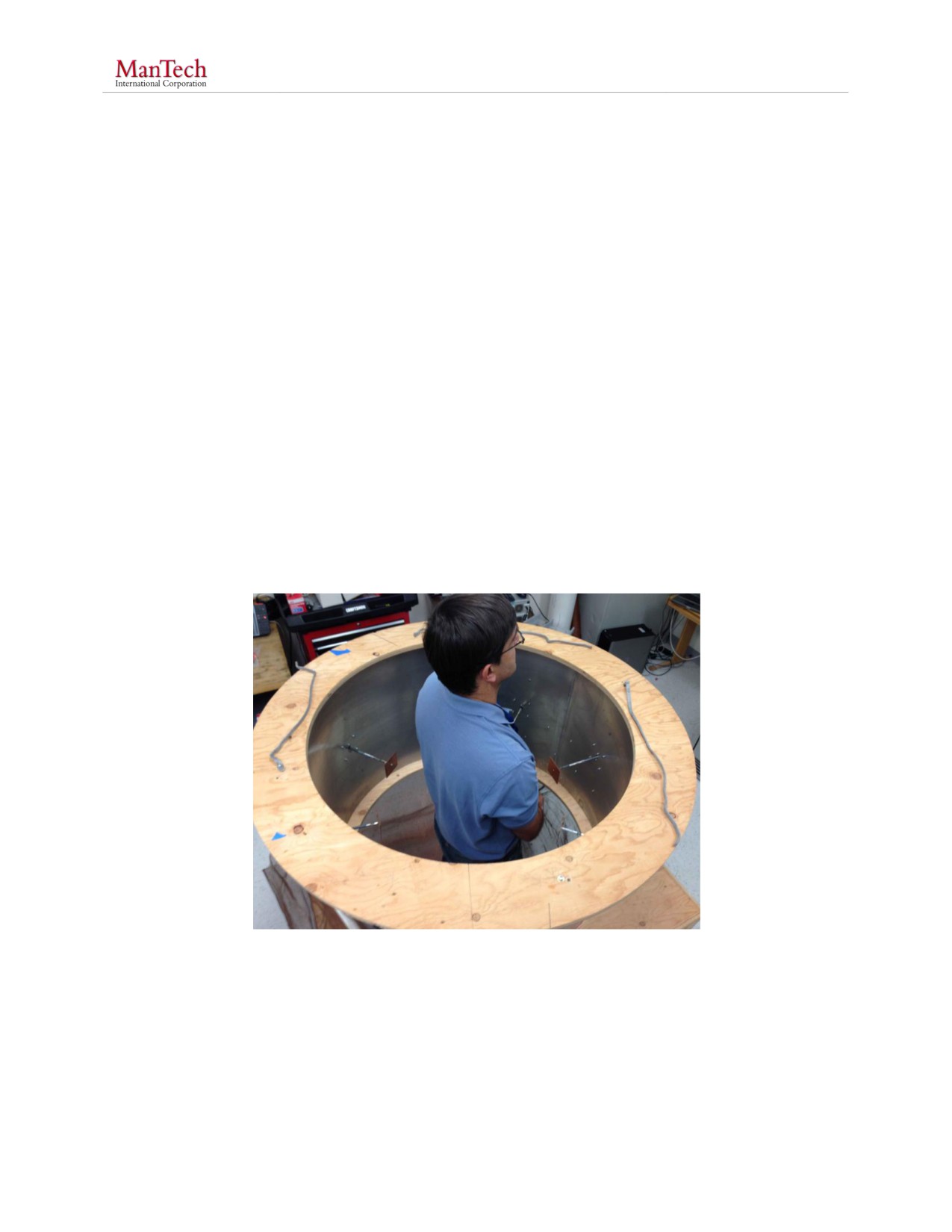
Body Cavity Screening: Tech Assessment
April 2014
NIJ SSBT CoE
4.0 ASSESSMENT QUESTIONS
A set of questions were prepared by the CoE to ascertain the technical, programmatic, and
operational details of the QM BCS system. These questions were used as a guide to establish the
R&D history, current status, and future plans of the technology and project. SSBT CoE staff
conducted a site visit to the QM research facilities (Santa Ana, CA; December 17, 2013), where
a detailed discussion was held with QM research staff. These questions were either posed
explicitly, or the information gathered from organic conversations about the research project.
4.1 Programmatic
What is the timeline for wrapping up the grant?
QM plans to perform limited human subject research (HSR) in January 2014, with a final report
on the project to be delivered to NIJ at the end of January. All project activities are expected to
conclude at that time. The period of performance of the grant extends through March, but there
will likely be insufficient funding to support work past January.
Describe the human subject testing - process, objectives, data, and subjects
The plan is to focus on collecting images from ~5 people to investigate differences in resulting
signals and coefficients. The gathered data from imaging will be used to map out conductivity
coefficient variations to explore the validity of the current backg0round subtraction
approach/model. No foreign objects will be included in the testing.
Figure 2: Human Subject Inside BCS Device
A person stands inside the QM BCS system to demonstrate the method of scanning and
relative dimensions of the system.
Program narratives describe an internal QM Commercialization Report to determine
commercial feasibility. What were the high level conclusions and recommendations of that
report? Can a copy be shared with NIJ and/or the CoE?
The QM project staff was unaware of the existence of such a report and had never seen it.
UNCLASSIFIED
6
This document is a research report submitted to the U.S. Department of Justice. This report has not
been published by the Department. Opinions or points of view expressed are those of the author(s)
and do not necessarily reflect the official position or policies of the U.S. Department of Justice.
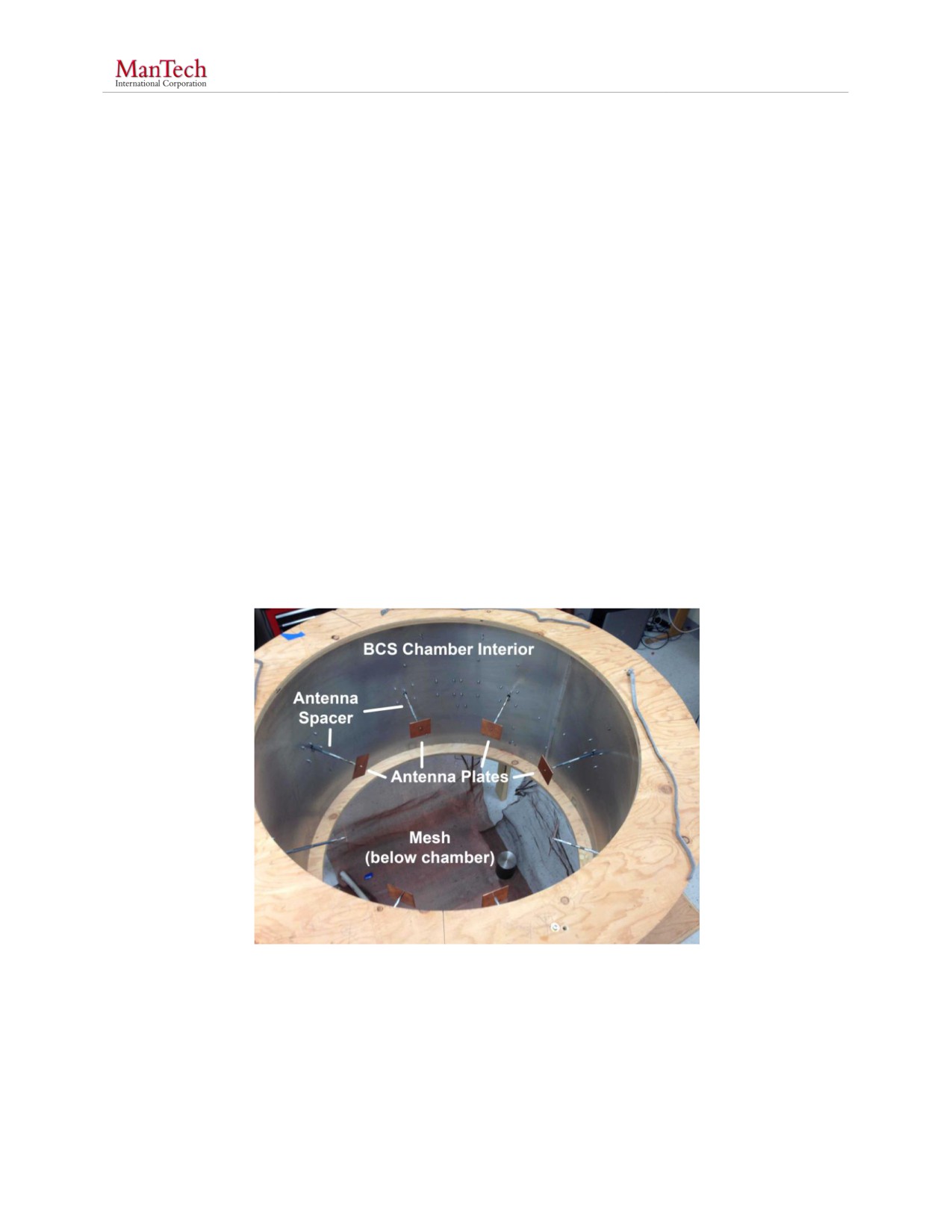
Body Cavity Screening: Tech Assessment
April 2014
NIJ SSBT CoE
What are the remaining R&D stages that need to be conducted?
The QM team identified several action items and steps that would be needed during follow-on
work to complete basic research and move on to prototype development. SSBT CoE has
amended the estimate to include testing needed prior to hand-off to NIJ or a third party for
operational evaluations.
Obtain a new spectrometer with 8 channels - The current system is hardware limited in its
imaging. The spectrometer has 4 channels, which limits the active receivers to three. The scan
uses one set and then changes the set of receivers before changing the transmitter. The ideal
system would have a separate dedicated channel for each transmitter/receiver. This affects the
scan time and the phase resolution. As of December, the scan time was improved to 5 minutes,
down from 25 minutes, but that time is primarily due to the time needed to switch relays between
Tx/Rx sets and transfer the data; the transmission for a given antenna is only active for ~5
milliseconds. During follow-on work, the QM team would want to have a new custom
spectrometer built, or perhaps modify a high-end commercial one.
Redesign the device chamber to be realistic to operations - When the device was designed, the
QM machine shop mistakenly took the diameter to mean the radius, so the cylinder scanner
region is four times as large as it should be. As a result, the antennas stick out from the inner
walls more than designed (they should have just been an inch from the wall). This introduces
interference from the rods that hold the square antenna, affecting the gain and phase.
Figure 3: BCS System Interior
In addition, the current laboratory prototype uses a solid cylinder to image targets and subjects.
For operational use, the system will need to be redesigned from a physical perspective to
accommodate subject processing, ergonomics, and operational workflows. QM staff has
tentatively identified several possible configurations - a horseshoe with an open gap, a lowered
UNCLASSIFIED
7
This document is a research report submitted to the U.S. Department of Justice. This report has not
been published by the Department. Opinions or points of view expressed are those of the author(s)
and do not necessarily reflect the official position or policies of the U.S. Department of Justice.
Body Cavity Screening: Tech Assessment
April 2014
NIJ SSBT CoE
ring, or a closet.
However, all of these designs introduce possible deviations and/or
complications to the transmission and receipt of image scans, requiring further R&D and testing.
Finally, proper shielded will need to be incorporated into the final system design to cover the full
perimeter of the scanning region. Background noise was found by QM to be problematic, but
shielding below, around, and above the subject scanner was sufficient to mitigate the effects.
However, the laboratory setup for the shielding is inadequate for an operational prototype and
would need to be a conscious component of the final redesign.
Revisit simulations to account for three dimensions and underlying modeling theory - The
modeling currently used by the QM scanner uses electric field lines and assumes the phase
changes along those lines. The QM lead believes this is oversimplified and that a more accurate
model needs to be developed using simulations. Another area of improved modeling would take
advantage of a more accurate and complex human body model with respect to dielectric and
conductivity properties. A model and its supporting data are available for purchase, called
ANSYS.
Collect data on various target scans (material composition and size) - As of December 2013, the
QM team had only ever conducted tests using a large plastic cylinder. This is far from the target
detection goals, both with respect to target size and material composition. Extensive R&D
remains to be performed where laboratory data is collected on these targets and the resulting
modeling and detection is investigated.
Conduct human subject research data collection using targets - No imaging has been performed
with a human subject concealing an object on their person. Extensive data collection, testing,
and analysis are needed during the advanced prototype development stage to determine the
operational limitations, feasibility, and performance of the system.
How long for each stage, how much estimated money?
QM provided a rough cost and schedule estimate for the remaining work to develop the system
to an advanced prototype suitable for field testing by a third party. The SSBT CoE then revised
that estimate based on its observations of the project and RDT&E experience:
Cost Estimate (includes burdens): $1.2 - 2M (basic research); $0.9 - 1.3M (prototype)
o New Spectrometer Board: $500k - 1M
o Modeling: $200k - 300k
o Imaging R&D: $300k - 400k
o Electronics R&D: $200k - 300k
o Physical Construction: $200k - 300k
o Installing Prototype Electronics: $400k - 600k
o Internal HSR T&E: $300k - 400k
Schedule Estimate ~2 yrs (basic research); 1 - 2 yrs (prototype)
o Addressing basic technical issues (e.g., imaging, modeling): ~2 yrs
o Building an advanced prototype: 1 - 2 yrs
UNCLASSIFIED
8
This document is a research report submitted to the U.S. Department of Justice. This report has not
been published by the Department. Opinions or points of view expressed are those of the author(s)
and do not necessarily reflect the official position or policies of the U.S. Department of Justice.
Body Cavity Screening: Tech Assessment
April 2014
NIJ SSBT CoE
If NIJ does not continue funding, what are QM's plans for the technology with respect to
R&D and commercialization?
Morpho Detection has had some interest in adopting the technology to detect bombs in bodies.
However, currently (i.e., December 2013) there are no plans to continue working past the NIJ
grant. Morpho may reach out to the Transportation Security Administration to see if they are
interested. The QM team was open to pursuing a future open NIJ solicitation relevant to this
work, but the team would need the right skill set by bringing on additional personnel.
4.2 Technical
What are the primary technical challenges standing between advanced prototype and
commercialization?
Much of the technical challenges are addressed in the remaining stages discussion (see Section
4.1 Programmatic). Overall, QM reports that the primary challenge is imaging resolution;
throughput and noise have been found to be manageable. Resolution of the system could be
improved by revising the conductivity models to be more accurate, upgrading the spectrometer,
and redesigning the system. From the SSBT CoE perspective, it is difficult to fully outline the
technical challenges because almost all of the data collection on different target objects with and
without human subjects has not yet been performed. Lack of relevant data is the primary
limitation and challenge for the project. Until that is addressed through additional R&D is
difficult to identify or speculate on the real roadblocks to developing the system.
What Technology Readiness Level (TRL) does QM place it at?
The current laboratory prototype is at TRL 2-3 (i.e., Technology concept and/or application
formulated OR Analytical and experimental critical function and/or characteristics proof of
concept).[3]
Do they plan to deliver a lab prototype to NIJ at end of the grant? If not, why?
QM does not plan to deliver a laboratory prototype to NIJ at the end of the project. The system
is still in a laboratory stage and not fully integrated to allow for third-party use. In addition, no
manual has been prepared to instruct users. QM is willing to deliver the system if NIJ requires
it; this will include the table, custom spectrometer, and software.
The Year-3 program narrative described issues with the IRE partnership, and planned to
explore non-EFT methods of detection (inductive coupling, multiple freq). Did that
happen, or focused on EFT?
No alternative methods of detection were explored in the program, only EFT imaging.
Has the System Requirements Definition (SRD) document evolved over the life of the
project?
No, the SRD has not been revisited or revised since its creation at the beginning of the project.
Have interactions with other material types been explored? QM only discussed plastic in
the reports.
Only plastic targets have been used during R&D and testing.
UNCLASSIFIED
9
This document is a research report submitted to the U.S. Department of Justice. This report has not
been published by the Department. Opinions or points of view expressed are those of the author(s)
and do not necessarily reflect the official position or policies of the U.S. Department of Justice.
Body Cavity Screening: Tech Assessment
April 2014
NIJ SSBT CoE
How does this support or align with detecting plastic objects on someone's person but not
in a body cavity?
QM has not considered operational procedures or contraband strategies, nor has any testing been
performed using plastic objects on a person.
What size plastic object can be reliably detected in its current design? Any reason to
expect this will improve?
QM has not conducted tests to determine the detection limit; only a single large plastic cylinder
has been imaged (4" diameter x 12" height).
Does the detection theory support detecting and resolving the size requirements spelled out
in the SRD?
Theoretical modeling has been performed based on field line simulations. According to QM,
detecting the small plastic target goal requires phase stability of approximately 10
- 100
microradians, which is within the noise of the system. Based on these simulations, a target the
size of a finger should be detectable. However, the QM lead had some questions about the
accuracy of the modeling approach, and would like to see simulations revisited using alternate
frameworks.
Apply all the market survey categories to the current prototype:
See Section 3.0 QM BODY CAVITY SCREENING PROTOTYPE SUMMARY
4.3 Practitioner Engagement
Describe the process of practitioner engagement during planning (2008 and beyond)
During the first year of the project in 2007-2008, QM engaged corrections practitioners to assist
in developing performance specifications.[1,4] Specifically, the team sought to answer:
1. What sorts of contraband are to be detected?
2. What is the smallest example of each type to be detected?
3. Should the EFT implementation be found infeasible, is an EIT implementation acceptable
(electrode-coupled contacting)?
Three regional corrections product assessment group meetings were attended and the technology
and project presented. From those meetings, an SRD document and set of performance goals
was established:
1. Detection Goals
a. Nonferrous metal the size of a .22 caliber bullet
b. Ferrous metal the size of a single razor blade
c. Plastic the size of a plastic toothbrush handle (i.e., cylinder 8 mm in diameter by
10 cm long)
2. Scanning does not require contact with the subject’s skin
3. Accommodate subjects up to the 95th percentile in girth
4. Device is stowable when not in use
5. Easy to use and provide intuitively understandable results
6. Cost similar to the $6,000 now paid for metal detection portals
7. Scan times of several tens of seconds per subject
UNCLASSIFIED
10
This document is a research report submitted to the U.S. Department of Justice. This report has not
been published by the Department. Opinions or points of view expressed are those of the author(s)
and do not necessarily reflect the official position or policies of the U.S. Department of Justice.
Body Cavity Screening: Tech Assessment
April 2014
NIJ SSBT CoE
No additional practitioner engagement has been performed since the SRD document was initially
established.
Who has the team been collaborating with throughout R&D to double check direction and
requirements and get feedback?
No additional practitioner engagement has been performed since the SRD document was initially
established.
Corrections CoE involvement? Institutional Corrections TWG feedback?
No additional practitioner engagement.
4.4 Operational Use
How does the prototype function now and how is it intended to be used in an operational
setting (details on workflow, information provided, technical limitations)?
The QM has been focused on basic R&D and has not considered the operational use of the
system.
How does it fit within the current technology market? How does it align and compliment
metal detectors?
The current QM system is being developed to detect concealed plastic contraband. No tests have
been performed with metal targets. The developers envision the system to be used in
conjunction with traditional metal detectors.
Safety of frequencies at power levels used?
The scanner operates at low voltages and power (± 5V) and at common frequencies rated as
being safe for humans (1 - 20 MHz). The system is entirely safe for human use.
What regulations/compliance would this device fall under before being used in the field?
QM is working against IEEE standards related to EFT (specific standards not provided).
However, because of the low voltages and frequencies, the system is not subject to any specific
regulations.
Is the Concept of Operations to provide a binary flag of suspicious activity to warrant body
cavity search or to provide visual mapping to determine what the object is?
The system will provide an alert when an anomaly is detected, but will not provide visual
mapping or any spatially resolved object images.
UNCLASSIFIED
11
This document is a research report submitted to the U.S. Department of Justice. This report has not
been published by the Department. Opinions or points of view expressed are those of the author(s)
and do not necessarily reflect the official position or policies of the U.S. Department of Justice.
Body Cavity Screening: Tech Assessment
April 2014
NIJ SSBT CoE
5.0 CRIMINAL JUSTICE TECHNOLOGY NEED
To determine the technology need and operational requirements of a body cavity screening
system, nine (9) criminal justice practitioners were surveyed. The Sensors & Surveillance
Technology Working Group was solicited, as were the TWGs of the Corrections CoE. The
practitioners who volunteered were provided an identical set of questions. The backg0rounds of
the respondents were as follows:
Corrections (State/Local) - 3
Corrections (Federal) - 1
Law Enforcement (State/Local) - 3
Forensics - 1
Courts - 1
In the following subsections, the questions from the surveys are provided verbatim in italics
followed by the aggregated responses and any necessary explanations or clarifications.
5.1 Sensors & Surveillance Technology Needs: Priorities
Question 1: Below is the current list of Sensors & Surveillance Tech Needs from 2011. They are
included here to put Body Cavity Screening into context among the other technology needs.
Please rate them each as High, Medium, or Low priority; if a Tech Need has been adequately
addressed in the community and/or marketplace, please rate it for Retirement. If you are unsure
as to the state of the technology, assume it is an unfulfilled need and rate accordingly.
The respondents were asked to rate the technology need priority of all existing technology needs
currently captured in the Sensors & Surveillance TWG Technology Needs document. This
account of priority needs was last revised during the 2011 Spring TWG Meeting.[5] The
individual technology needs were listed in alphabetical order and no indication of the existing
priority rate was provided, so as to elicit unbiased assessments. Respondents were also given a
choice of completely retiring a technology need, indicating that NIJ should no longer pursue
R&D investments in this area.
Table 2 lists the technology needs and the previous and revised priorities based on the responses
of the pool of practitioners. An average rating has also been calculated based on a simple
scheme of High = 3, Medium = 2, Low = 1, and Retire = 0. Figure 4 depicts the technology
needs in a bar chart format. Based on the distribution of ratings, an interim threshold was set for
High/Medium/Low of 2.49/1.99/1.49 respectively. Although the first inclination might be to use
2.49/1.49/0.49, this does not differentiate the topics sufficiently to be useful to decision makers.
The Contraband Detection technology need is the one that the body cavity screening technology
falls under. Based on these survey results, it is tied for the fourth highest technology need and
would likely be considered a Medium-High priority. As a side note, the Detection of Hazardous
Conditions for First Responders and Body-Worn Cameras possessed the largest deviation
between 2011 and these revised priorities.
UNCLASSIFIED
12
This document is a research report submitted to the U.S. Department of Justice. This report has not
been published by the Department. Opinions or points of view expressed are those of the author(s)
and do not necessarily reflect the official position or policies of the U.S. Department of Justice.

Body Cavity Screening: Tech Assessment
April 2014
NIJ SSBT CoE
Table 2: Sensors & Surveillance Technology Needs Priorities
Tech Need
Description
Priority
Priority
Priority
(2011)
(Revised)
Rating
Detection of Hazardous
Determine whether a first responder has
Conditions
for
First
arrived at a scene that contains hazardous
Low
High
2.67
Responders
chemical conditions
Improved
Tactical
Determine the location of suspects or other
High
High
2.67
Situational Awareness
persons of interest in buildings behind walls
Early
Warning
and
Identify
contraband and unauthorized
Detection of Threats
individuals prior to entering a school or public
Medium
High
2.56
building
Cell Phone Management
Acquire and manage access to a specific
High
Medium
2.44
(Law Enforcement)
telephone in a tactical situation.
Contraband Detection
Detect contraband, both metallic and non-
metallic, concealed on or in a person in an
High
Medium
2.44
affordable manner
Cell Phone Management
Detect or manage the use of cell phones in
High
Medium
2.33
(Corrections)
correctional institutions
Improved Video Analytics
Automated, real-time event detection and
Medium
Medium
2.33
monitoring from video surveillance
Digital
Multi-Media
Extract full streams of DME while
Evidence
(DME) Output
maintaining the integrity of metadata; DME
High
Medium
2.22
Technical
interoperability recommendations
Recommendations
Community
Video
Recommendations (technical and deployment)
Technical
for the use of surveillance cameras in
Medium
Medium
2.11
Recommendations
commercial businesses to improve their
usability in investigations and courts
Surveillance
Video
Improved compression and storage methods
Low
Medium
2.11
Enhancements
for surveillance video data
Interview Room Standards
Standards for the collection, processing, and
editing of interview room digital multi-media
High
Medium
2.00
evidence
Deception Detection
Detect deceptive or lying behavior from a
person encountered in the field or at an
Low
Low
1.89
interview location
Detection of Disposed Items
Locate discarded items at the conclusion of
Low
Low
1.89
During Officer Pursuit
foot pursuits in a broad range of environments
Gun Shot Residue
(GSR)
Process clothing or objects for GSR in the
Low
Low
1.89
Detection
field in a reliable, real-time manner
Trace Blood Detection
Detect trace chemicals and blood at crime
Medium
Low
1.89
scenes quickly and safely
Body-Worn Cameras
Technical recommendations for the use of
High
Low
1.67
body-worn cameras
Detection of Buried Bodies
Effective tools to assist in locating bodies or
Low
Low
1.67
or Evidence
other evidence hidden underground
Forensic
Photography
Improved training and guidelines for nurses
Low
Low
1.56
Training and Guidelines
capturing photographic forensic evidence
UNCLASSIFIED
13
This document is a research report submitted to the U.S. Department of Justice. This report has not
been published by the Department. Opinions or points of view expressed are those of the author(s)
and do not necessarily reflect the official position or policies of the U.S. Department of Justice.

Body Cavity Screening: Tech Assessment
April 2014
NIJ SSBT CoE
Sensors & Surveillance Tech Need Priorities
3.00
2.50
2.00
1.50
1.00
0.50
0.00
Figure 4: Sensors & Surveillance Technology Needs Priorities
UNCLASSIFIED
14
This document is a research report submitted to the U.S. Department of Justice. This report has not
been published by the Department. Opinions or points of view expressed are those of the author(s)
and do not necessarily reflect the official position or policies of the U.S. Department of Justice.

Body Cavity Screening: Tech Assessment
April 2014
NIJ SSBT CoE
5.2 Body Cavity Screening System Requirements
Question 2: A working set of operational requirements for Body Cavity Screening technologies is
listed below:
Detection Goals:
o Nonferrous metal the size of a .22 caliber bullet
o Ferrous metal the size of a single razor blade
o Plastic the size of a plastic toothbrush handle (i.e., cylinder 1/4 inch diameter by
4 inches long)
Scanning does not require contact with the subject’s skin
Accommodate subjects up to the 95th percentile in girth
Device is stowable when not in use
Easy to use and provide intuitively understandable results
Cost similar to the $6,000 now paid for metal detection portals
Scan times of several tens of seconds per subject
Figure 5: BCS Requirements Survey Results
Question 2b: If you answered YES to either question, please provide feedback on what should be
revised to better reflect operational needs. Note that loosening the requirements is also an
important option to better facilitate R&D options.
Responses (provided unedited):
1. Respondent #1 - The ability to located smaller ferrous, non-ferrous, plastic, and ceramic
items, such as plastic bags containing drugs, Sim cards, plastic chargers, ceramic blades,
etc. Low dosage x-ray will safely accomplish this mission and the technology already
exists. Many states have existing laws in place, written for the medical diagnostic
community years ago, requiring an x-ray technician certification when using any type of
x-ray device on humans.
This requirement virtually eliminates law
enforcement/detention use since it is not practical to send officers to a two year x-ray
technician course design for medical applications. If we focus on re-writing the laws to
accept low dosage x-ray for security screening (actually less radiation than experienced
by a three hour flight at 30,000 feet in a commercial airliner for example) we will have a
solution. It works very well and is in use in several states already
UNCLASSIFIED
15
This document is a research report submitted to the U.S. Department of Justice. This report has not
been published by the Department. Opinions or points of view expressed are those of the author(s)
and do not necessarily reflect the official position or policies of the U.S. Department of Justice.
Body Cavity Screening: Tech Assessment
April 2014
NIJ SSBT CoE
2. Respondent #2 - what about smaller plastic containers e.g. condoms that contain liquids,
powders, and/or pills
3. Respondent #3 - The goals speak to a portable device with the requirement for it to be
stowable. While portability can be beneficial, pass through devices similar to metal
detectors should not be ruled out or excluded.
4. Respondent #4 - Must not be harmful to human subjects after repeated exposure (i.e., no
x-rays). User interface display must provide appropriate masking of genitalia to
accommodate privacy concerns.
5.3 BCS Applications in Criminal Justice
Question 3: How would a body cavity screening device (that meets the full requirements in
Question 2) be used in criminal justice operations? Please list specific applications and/or
scenarios.
Responses (provided unedited):
1.
Respondent #1 - To screen defendants before they come to court and after they leave
court. Courts have less security than the jail. Easier to obtain metal and other weapons.
2.
Respondent #2 - Entry into a correctional setting (contracted worker, visitor, corrections
officer), Airport, Entry into a secure area near a VIP (close proximity presidential events)
3.
Respondent #3 - Inmate/detainee applications to detect contraband/drugs/weapons.
Most common intercept scenarios: book-in/admissions, return from work details, return
from court, intelligence follow up, inmate transfer, locating evidence, etc. Additional
applications: managing intensive probationers/parolees, screening of informants prior to
drug purchases, etc.
4.
Respondent #4 - Screening a subject in the field, student at a school or institution, or
screening at a booking/holding facility.
5.
Respondent #5 - search incident to custodial arrest
6.
Respondent #6 - For a correctional institution they could be used to scan offenders,
visitors, and staff for contraband as they move in, out, and through a facility. The ability
to quickly scan for objects on a person would reduce the number of physical pat searches
and possibly the number of unclothed body searches. Both time intensive and potentially
dangerous for correctional staff.
7.
Respondent #7 - Intake processing of detainees/inmates in correctional facilities.
Investigatory processing of persons suspected of concealing contraband on their person in
correctional facilities. Unobtrusive processing/screening of visitors/staff in correctional
facilities. May also be useful for TSA airport screening if the throughput time was
acceptable.
8.
Respondent #8 - Screen during the booking process, screen entering court house lock-
ups, screen when returning from court or medical appointments, screen when returning
from visiting/attorney room, screen during cell searches, screen when reasonable cause
exists
UNCLASSIFIED
16
This document is a research report submitted to the U.S. Department of Justice. This report has not
been published by the Department. Opinions or points of view expressed are those of the author(s)
and do not necessarily reflect the official position or policies of the U.S. Department of Justice.

Body Cavity Screening: Tech Assessment
April 2014
NIJ SSBT CoE
5.4 Feasibility of BCS Technology Limitations
Based on the known functionality and limitations of the QM BCS system, a set of questions was
posed in the survey to determine if proceeding with such a device to an advanced prototype or
commercial maturity state was a worthwhile endeavor. If an inherent limitation of the QM
system was found to be unacceptable, then it is important to determine that as early as possible
so as to either revise R&D activities or reallocate NIJ strategic funding. These questions were
born out of discussions with QM staff during the site visit by CoE staff. This section covers
Questions 4 - 8 of the survey.
5.4.1 Detection of Metal Objects
Figure 6: Detection of Metallic Objects: Value
Figure 7: Detection of Metallic Objects: Priority Change
Table 3: Detection of Metallic Objects: Revised Rating
Tech Need
Priority
Rating
Avg Rating
Avg Priority
(2011)
(Base)
(Revised)
(Revised)
Contraband Detection
High
2.44
2.22
Medium
UNCLASSIFIED
17
This document is a research report submitted to the U.S. Department of Justice. This report has not
been published by the Department. Opinions or points of view expressed are those of the author(s)
and do not necessarily reflect the official position or policies of the U.S. Department of Justice.

Body Cavity Screening: Tech Assessment
April 2014
NIJ SSBT CoE
5.4.2 Enclosed System for Scanning
Figure 8: Enclosed System for Scanning: Value
5.4.3 Scan Time
Figure 9: Scan Time: Value
Figure 10: Scan Time: Priority Change
Table 4: Scan Time: Revised Rating
Tech Need
Priority
Rating
Avg Rating
Avg Priority
(2011)
(Base)
(Revised)
(Revised)
Contraband Detection
High
2.44
2.00
Medium-Low
UNCLASSIFIED
18
This document is a research report submitted to the U.S. Department of Justice. This report has not
been published by the Department. Opinions or points of view expressed are those of the author(s)
and do not necessarily reflect the official position or policies of the U.S. Department of Justice.

Body Cavity Screening: Tech Assessment
April 2014
NIJ SSBT CoE
5.4.4 Audio-Visual Alert
Figure 11: Audio-Visual Alert: Value
Figure 12: Audio-Visual Alert: Priority Change
Table 5: Audio-Visual Alert: Revised Rating
Tech Need
Priority
Rating
Avg Rating
Avg Priority
(2011)
(Base)
(Revised)
(Revised)
Contraband Detection
High
2.44
2.33
Medium
5.4.5 Torso Scanning
Figure 13: Torso Scanning: Value
UNCLASSIFIED
19
This document is a research report submitted to the U.S. Department of Justice. This report has not
been published by the Department. Opinions or points of view expressed are those of the author(s)
and do not necessarily reflect the official position or policies of the U.S. Department of Justice.

Body Cavity Screening: Tech Assessment
April 2014
NIJ SSBT CoE
Figure 14: Torso Scanning: Priority Change
Table 6: Torso Scanning: Revised Rating
Tech Need
Priority
Rating
Avg Rating
Avg Priority
(2011)
(Base)
(Revised)
(Revised)
Contraband Detection
High
2.44
2.11
Medium-Low
5.5 Image Testing of Other Materials
Question 9: The current requirements (see Question 2) address the detection of plastic, but do
not explicitly list various other non-metallic materials as contraband targets to be detected. Note
that this does not mean the system is unable to detect these materials; in theory any foreign
materials above a certain size threshold should be detected. For the materials below, indicate
whether they should be explicitly incorporated into laboratory and field testing to document the
system’s ability to detect those types of contraband. A NO response means that testing for plastic
and metals is sufficient. Note that this will add additional R&D burdens to the developer and
third party testing.
Table 7: Image Testing of Other Materials
Material
Positive Response For
Inclusion in RDT&E
Explosives
89%
Baggies or packets of powders (e.g., drugs)
78%
Containers of liquid or gels
67%
Ceramic
56%
Bundles or rolls of paper (e.g., currency)
56%
Wood
44%
UNCLASSIFIED
20
This document is a research report submitted to the U.S. Department of Justice. This report has not
been published by the Department. Opinions or points of view expressed are those of the author(s)
and do not necessarily reflect the official position or policies of the U.S. Department of Justice.

Body Cavity Screening: Tech Assessment
April 2014
NIJ SSBT CoE
5.6 Minimum Detection Rates
Question
10: What would constitute an acceptable minimum detection rate for a device
attempting to image the following types of contraband concealed in body cavities?
Material Type vs. Detection Rate
100%
Answer Options
98%
in Survey for
Detection Rate
96%
99% 95%
94%
90% 85%
80% 75%
92%
70% 60%
50% 40%
90%
30% 20%
10% 5%
88%
86%
Nonferrous
Nonferrous
Ferrous metal,Ferrous metal,
Plastic, small
Plastic, large
metal, small
metal, large
small (e.g.,
large (e.g.,
(e.g.,
(e.g. plastic
(e.g., .22
(e.g., cell
single razor
knife/shank) toothbrush
knife
caliber bullet)
phone)
blade)
handle)
Figure 15: Material Type vs. Minimum Detection Rate
The options offered to the respondents when answering this question are on the right.
UNCLASSIFIED
21
This document is a research report submitted to the U.S. Department of Justice. This report has not
been published by the Department. Opinions or points of view expressed are those of the author(s)
and do not necessarily reflect the official position or policies of the U.S. Department of Justice.
Body Cavity Screening: Tech Assessment
April 2014
NIJ SSBT CoE
6.0 ANALYSIS & DISCUSSION
6.1 QM System Technology Maturity
The current laboratory prototype is at TRL 2-3 (i.e., Technology concept and/or application
formulated OR Analytical and experimental critical function and/or characteristics proof of
concept).
The remaining technical challenges are addressed in detail in Section
4.1
Programmatic and listed here for reference:
1. Obtain a new spectrometer with 8 channels
2. Redesign the device chamber to be realistic to operations
3. Revisit simulations to account for three dimensions and underlying modeling theory
4. Collect data on various target scans (material composition and size)
5. Conduct human subject research data collection using targets
In addition to these technical challenges, there are operational aspects of the technology that QM
has mostly ignored. Beyond the initial 2008 requirements gathering efforts to determine an SRD
document, there has been no engagement with the criminal justice community during the
execution of the R&D program, including decision points where engineering decisions have been
made that affect the system’s operational us (e.g., scan time, ignoring metallic targets to focus
exclusively on non-metallic objects). These engineering choices may have been the right ones,
but without practitioner input they could focus the R&D in the wrong direction or place too
greater or little an emphasis on a certain operating specification.
From the SSBT CoE perspective, it is difficult to fully outline the technical challenges because
almost all of the data collection on different target objects with and without human subjects has
not yet been performed. Lack of relevant data is the primary limitation and challenge for the
project. Until that is addressed through additional R&D is difficult to identify or speculate on
the real roadblocks to developing the system.
The QM project established a set of requirements for the finished advanced prototype at the
beginning of the project. Comments below discuss whether this BCS system is on track to meet
these requirements.
Detection Goals:
o Nonferrous metal the size of a .22 caliber bullet - UNKNOWN; The system
has not undergone significant R&D or testing with metal targets.
o Ferrous metal the size of a single razor blade - UNKNOWN; The system has
not undergone significant R&D or testing with metal targets.
o Plastic the size of a plastic toothbrush handle (i.e., cylinder 1/4 inch diameter
by 4 inches long) - YES; Initial imaging results indicate that objects of this size
should be able to be detected.
Scanning does not require contact with the subject’s skin - YES (see Figure 2)
Accommodate subjects up to the 95th percentile in girth - NO; In its current design
the system cannot accommodate those subjects. Future R&D stages would involve a
redesign, but the tentative plan was to have a new system with a 2’ inner diameter, which
would be inadequate.
UNCLASSIFIED
22
This document is a research report submitted to the U.S. Department of Justice. This report has not
been published by the Department. Opinions or points of view expressed are those of the author(s)
and do not necessarily reflect the official position or policies of the U.S. Department of Justice.
Body Cavity Screening: Tech Assessment
April 2014
NIJ SSBT CoE
Device is stowable when not in use - NO
Easy to use and provide intuitively understandable results - UNKNOWN; The user
interface for the system has not been developed yet.
Cost similar to the $6,000 now paid for metal detection portals - NO; It is highly
unlikely that a system that requires advanced multi-channel spectrometers would be able
to be sold at this price point.
Scan times of several tens of seconds per subject - NO; The current scan time would
need to be improved by a factor of 10.
6.2 NIJ QM Project Status
The QM project has suffered from schedule and work efficiency issues due to organizational
laboratory moves and the loss of key personnel. The project moved from the QM offices in San
Diego to Morpho Detection offices in Santa Ana, CA. In addition, the previous principal
investigator left the company and the project around the same time. Much of the technical and
programmatic understanding of the project left with the PI. As a result, the QM has worked to
replace staff and resume the work when it was possible, but there was undoubtedly a loss in
efficiency due to the R&D learning curve and lack of momentum.
QM provided a rough cost and schedule estimate for the remaining work to develop the system
to an advanced prototype suitable for field testing by a third party. The SSBT CoE, then revised
that estimate based on its observations of the project and RDT&E experience (additional details
can be found in Section 4.1 Programmatic):
Cost Estimate (includes burdens): $1.2 - 2M (basic research); $0.9 - 1.3M (prototype)
Schedule Estimate ~2 yrs (basic research); 1 - 2 yrs (prototype)
6.3 Criminal Justice Technology Need
Based on the survey results from the limited TWG practitioner group, there continues to be a
Medium-High priority criminal justice technology need for Contraband Detection that is able to
detect both metallic and non-metallic objects concealed on or in a person in an affordable
manner. This technology need was tied for the fourth highest rated need out of 18 different ones.
A companion report prepared by the SSBT CoE details contraband screening systems currently
on the market with the ability to detect non-metallic contraband and contraband concealed in
body cavities.[6] Of the fifteen different systems covered in that report, only one has the ability
to detect both non-metallic and body cavity contraband. Therefore, there still remains a need for
additional investments by NIJ (although other efforts beyond R&D would be beneficial, see
Section 6.4 EFT vs. Other Technology Approaches).
UNCLASSIFIED
23
This document is a research report submitted to the U.S. Department of Justice. This report has not
been published by the Department. Opinions or points of view expressed are those of the author(s)
and do not necessarily reflect the official position or policies of the U.S. Department of Justice.
Body Cavity Screening: Tech Assessment
April 2014
NIJ SSBT CoE
The QM team developed a working set of operational requirements at the start of their project.
Detection Goals:
o Nonferrous metal the size of a .22 caliber bullet
o Ferrous metal the size of a single razor blade
o Plastic the size of a plastic toothbrush handle (i.e., cylinder 1/4 inch diameter by
4 inches long)
Scanning does not require contact with the subject’s skin
Accommodate subjects up to the 95th percentile in girth
Device is stowable when not in use
Easy to use and provide intuitively understandable results
Cost similar to the $6,000 now paid for metal detection portals
Scan times of several tens of seconds per subject
Based on the survey results, future projects should consider modifying the requirements as
follows (red = more requirements, green = less):
Reduce the size of the detection goals for both metal and non-metal objects, such as
condoms containing powders or pills or cell phone SIM cards.
Lessen the requirement on portability to allow for fixed walk-through portal scanners.
Include a privacy requirement for the image output.
Lessen the requirement that a system must detect both metallic and non-metallic objects
within body cavities.
Lessen the requirement that a system must scan the entire body and allow for systems
that scan only the mid-lower torso of a person.
Include the following materials as explicit targets to be detected:
o Explosives
o Baggies or packets of powders (e.g., drugs)
Include a minimum detect rate requirement for targets:
o Plastic - 93%
o Ferrous Metals - 96%
o Nonferrous Metals - 91%
Taking into account these revised requirements, the QM BCS system’s future viability becomes
more uncertain. Lessening the requirement for the device to be stowable and be able to detect
metallic objects improves the system’s status, but the other requirement changes would introduce
significant additional R&D and T&E to determine its viability. The QM system has not
undergone even basic quantitative performance testing with plastic objects of the original
threshold (i.e., toothbrush handle), let alone smaller objects like those proposed in the revised set
above. In addition, explosives and powder testing has not been considered. While the system
might eventually meet these requirements, extensive testing remains, the duration of which
would probably extended the proposed follow-on schedule an additional 6 - 12 months.
UNCLASSIFIED
24
This document is a research report submitted to the U.S. Department of Justice. This report has not
been published by the Department. Opinions or points of view expressed are those of the author(s)
and do not necessarily reflect the official position or policies of the U.S. Department of Justice.
Body Cavity Screening: Tech Assessment
April 2014
NIJ SSBT CoE
6.4 EFT vs. Other Technology Approaches
To date, the only known technologies for body cavity screening of non-metallic contraband, with
the potential for criminal justice applications, are EFT and low dose transmission x-ray imaging.
EFT has potential, as demonstrated by QM in this project, but there are still many fundamental
technical questions and challenges that need to be addressed before it is suitable for operational
use. It is important that NIJ and the criminal justice community couch R&D investments and
technology needs in terms of the desired operational capability/benefit and not explicitly
specifying the technical method of arriving at those capabilities.
One area that warrants further investigation by NIJ is low dose transmission x-ray technologies.
In transmission x-ray scanning, materials of different composition and density absorb or reflect
X-rays differently. Bones and metal objects are better able to block X-rays than soft tissue. This
difference shows up on an image produced by x-rays passing through the subject to a detector.
The image produced is then examined for contraband. Since transmission devices use X-rays that
pass completely through the body, metallic and non-metallic contraband material concealed
either on or inside the body have the potential of being detected.
Because of the ubiquity of x-ray technologies in the medical field, the engineering and safety
issues involved are well documented and understood. In addition, the technology is cost
effective because of those pre-existing markets. The exposure from a transmission x-ray scan for
cavity contraband is the roughly the equivalent of one hour of backg0round radiation at ground
level, or 10 minutes at cruising altitude in an airplane.[7] Airplane crews deal with this level of
exposure their entire careers. According to one criminal justice practitioner involved in the
survey, the problem is that many state medical laws were written decades ago and classify any
type of human x-ray device as a medical device that must be operated by a certified x-ray
technician.[8] As a result, the adoption of x-ray technologies in other screening applications has
been restricted. It would be beneficial to the criminal justice community if NIJ examined this
technology field and the viability of adopting low dose transmission x-ray technologies in a more
wide-spread contraband screening application from an engineering and safety perspective as well
as a regulation and policy perspective.
UNCLASSIFIED
25
This document is a research report submitted to the U.S. Department of Justice. This report has not
been published by the Department. Opinions or points of view expressed are those of the author(s)
and do not necessarily reflect the official position or policies of the U.S. Department of Justice.
Body Cavity Screening: Tech Assessment
April 2014
NIJ SSBT CoE
7.0 RECOMMENDATIONS
Based on the technology assessment of body cavity screening technologies, the SSBT CoE
provides the following three recommendations to NIJ:
4. NIJ should continue to pursue R&D of body cavity screening technologies capable
of detecting non-metallic objects. Based on the limited TWG survey, the technology
need remains at a Medium-High priority. There are few commercial options for meeting
this technology need. Therefore, this topic should remain a key priority for future NIJ
R&D funding. However, the topic should be left agnostic to the technology approach
used to deliver the practitioner capability.
5. NIJ should investigate regulation and policy issues regarding the use of low dose
transmission x-ray technologies in criminal justice contraband screening. This
technology is known to be able to detect non-metallic objects concealed in body cavities.
Changes in regulations at the state and federal levels could allow for the technology need
to be met by a low-cost technology that is already well established. Studies on the topic
from a technical and policy perspective could help educate criminal justice agencies and
legislatures.
6. There does not exist a compelling case to continue funding the current prototype
system and QM team. Although the QM project has made progress in tackling
fundamental technical challenges, there remain many technical, programmatic, and
operational challenges in the follow-on stages. For this technical topic, NIJ should return
to a competitive solicitation to allow alternative performers and technologies.
UNCLASSIFIED
26
This document is a research report submitted to the U.S. Department of Justice. This report has not
been published by the Department. Opinions or points of view expressed are those of the author(s)
and do not necessarily reflect the official position or policies of the U.S. Department of Justice.
Body Cavity Screening: Tech Assessment
April 2014
NIJ SSBT CoE
APPENDIX A: CRIMINAL JUSTICE PRACTITIONER QUESTIONNAIRE - SENSORS
& SURVEILLANCE TECHNOLOGY NEEDS PRIORITIES
UNCLASSIFIED
A-1
This document is a research report submitted to the U.S. Department of Justice. This report has not
been published by the Department. Opinions or points of view expressed are those of the author(s)
and do not necessarily reflect the official position or policies of the U.S. Department of Justice.

Body Cavity Screening: Tech Assessment
April 2014
NIJ SSBT CoE
UNCLASSIFIED
A-1
This document is a research report submitted to the U.S. Department of Justice. This report has not
been published by the Department. Opinions or points of view expressed are those of the author(s)
and do not necessarily reflect the official position or policies of the U.S. Department of Justice.

Body Cavity Screening: Tech Assessment
April 2014
NIJ SSBT CoE
UNCLASSIFIED
A-2
This document is a research report submitted to the U.S. Department of Justice. This report has not
been published by the Department. Opinions or points of view expressed are those of the author(s)
and do not necessarily reflect the official position or policies of the U.S. Department of Justice.