Military reference books and manuals (2009-2023, Volume 1) - page 3

Body Cavity Screening: Tech Assessment
April 2014
NIJ SSBT CoE
UNCLASSIFIED
A-3
This document is a research report submitted to the U.S. Department of Justice. This report has not
been published by the Department. Opinions or points of view expressed are those of the author(s)
and do not necessarily reflect the official position or policies of the U.S. Department of Justice.

Body Cavity Screening: Tech Assessment
April 2014
NIJ SSBT CoE
UNCLASSIFIED
A-4
This document is a research report submitted to the U.S. Department of Justice. This report has not
been published by the Department. Opinions or points of view expressed are those of the author(s)
and do not necessarily reflect the official position or policies of the U.S. Department of Justice.
Body Cavity Screening: Tech Assessment
April 2014
NIJ SSBT CoE
APPENDIX B: ACRONYMS, ABBREVIATIONS, AND REFERENCES
UNCLASSIFIED
B-1
This document is a research report submitted to the U.S. Department of Justice. This report has not
been published by the Department. Opinions or points of view expressed are those of the author(s)
and do not necessarily reflect the official position or policies of the U.S. Department of Justice.

Body Cavity Screening: Tech Assessment
April 2014
NIJ SSBT CoE
B.1 Acronyms and Abbreviations
ACRONYM
DESCRIPTION
BCS
Body Cavity Screening
CoE
Center of Excellence
DOJ
Department of Justice
EFT
Electric Field Tomography
HSR
Human Subject Research
NIJ
National Institute of Justice
NLECTC
National Law Enforcement and Corrections Technology Center
QM
Quantum Magnetics
R&D
Research and Development
Rx
Receiver
SRD
System Requirements Definition
SSBT
Sensor, Surveillance, and Biometric Technologies
T&E
Test and Evaluation
TRL
Technology Readiness Level
TWG
Technology Working Group
Tx
Transmitter
UNCLASSIFIED
B-2
This document is a research report submitted to the U.S. Department of Justice. This report has not
been published by the Department. Opinions or points of view expressed are those of the author(s)
and do not necessarily reflect the official position or policies of the U.S. Department of Justice.
Body Cavity Screening: Tech Assessment
April 2014
NIJ SSBT CoE
B.2 References
1 Erik Magnuson, Morpho Detection; Compact, Low-Cost Body Cavity Screening Device; Final
Report for NIJ Award 2007-DE-BX-K001,
2 Erik Magnuson, Morpho Detection; Compact, Low-Cost Body Cavity Screening Device; Final
Report for NIJ Award 2011-IJ-CX-K001 (Pending Release).
3 Department of Defense, Technology Readiness Assessment (TRA) Guidance,
4 Peter, Czipott, Quantum Magnetics; Compact, Low-Cost Body Cavity Screening Device;
Proposal for NIJ Solicitation SL000757, Cooperative Agreement #2007-DE-BX-K001 (July
3, 2008).
5 SCRA, Sensors and Surveillance TWG Meeting Minutes (April 2011).
6 ManTech International Corporation, Body Cavity Scanners for Criminal Justice: Market Survey
(April 2014).
7 European Scientific Committee on Consumer Safety, X-Ray Full-Body Scanners for Airport
Security,
(April 2012).
8 Buzz Benson, Gwinnett County (GA) Sheriff’s Office; RE: TWG Volunteers Needed For
Contraband Screening Survey; Personal Email to Lars Ericson (February 24, 2014).
UNCLASSIFIED
B-3
This document is a research report submitted to the U.S. Department of Justice. This report has not
been published by the Department. Opinions or points of view expressed are those of the author(s)
and do not necessarily reflect the official position or policies of the U.S. Department of Justice.
Analyst’s
Desktop Binder
Department of Homeland Security
National Operations Center
2011
Media Monitoring Capability
Desktop Reference Binder
1
Analyst’s Desktop Binder
2011
Contents
1
Media Monitoring Capability Mission & Reporting Parameters:
4
1.1
MMC Mission
4
1.1.1
Leverage Operationally Relevant Data
4
1.1.2
Support NOC in Identifying Relevant Operational Media
4
1.1.3
Increase Situational Awareness of the DHS Secretary
5
1.2
Critical Information Requirements
5
1.3
Item of Interest Categorization
5
1.4
Department of Homeland Security (DHS) Component Agencies
7
1.5
DHS National Operations Center (NOC) Phases of Reporting
8
1.5.1
NOC Notes
8
1.5.2
Steady States
8
1.5.3
National and International Situation Summary Updates
8
1.5.4
Events of High Media Interest of International Significance
9
1.5.5
NOC Numbered Items
9
2
Items of Interest (IOI):
10
2.1
Incidents that Warrant an IOI
10
2.2
IOI Severity Chart
10
2.3
Notification of MMC Management
11
2.4
Critical Information Requirements
12
2.5
IOI Categorization
12
2.6
Credible Sources for Corroboration
14
2.7
Sourcing IOIs
15
2.8
IOI Distribution Lists
15
2.9
Creating IOIs (Traditional Media Application)
15
2.10 Creating IOIs (Social Media Application)
17
2.11 Outlook Back-Up Procedure
18
2.12 Correction Notices
19
2.13 Key Words & Search Terms
20
3
Personally Identifiable Information (PII) Guidance:
24
3.1
Effective: January 7, 2011
25
4
Operational Summary Guidance:
26
2
Analyst’s Desktop Binder
2011
1.1.1.
Operational Summary (OPSUM) Format:
26
5
Retrieving NOC Priorities from Homeland Security Information Network (HSIN):
29
1.1.2.
NOC Priorities (HSIN Retrieval)
29
6
Audio Video System:
33
6.1
Direct TV Full Channel List
33
6.2
Direct TV Account Information
33
6.3
Online Audio-Video Switch
33
(b) (7)(E)
7
HSIN
Connection Instructions:
35
8
Usernames, Passwords & Contact Information:
38
8.1
Passwords
38
MMC Wifi Network:
38
MMC Telephones:
38
Desktops & Apple Mac Mini:
38
Shared Drives:
38
MMC DHS Email (Back Up)
38
Video Switch:
38
Twitter/ Tweet Deck:
38
8.2
TSI Senior Reviewers
39
The SWO/KMO:
39
HSIN Help Desk:
39
TSI Senior Reviewers:
39
3
Analyst’s Desktop Binder
2011
1 Media Monitoring Capability Mission & Reporting Parameters:
1.1 MMC Mission
The MMC has three primary missions:
First - to continually update existing National Situation Summaries (NSS) and International
Situation Summaries (ISS) with the most recent, relevant, and actionable open source media
information
Second - to constantly monitor all available open source information with the goal of
expeditiously alerting the NOC Watch Team and other key Department personnel of emergent
situations
Third - to receive, process, and distribute media captured by DHS Situational Awareness Teams
(DSAT) or other streaming media available to the NOC such as Northern Command’s
(NORTHCOM) Full Motion Video (FMV) and via open sources
These three missions are accomplished by employing various tools, services, and procedures that
are described in detail in this document. Expanded upon, these primary missions have three key
components:
1.1.1 Leverage Operationally Relevant Data
Leveraging news stories, media reports and postings on social media sites concerning Homeland
Security, Emergency Management, and National Health for operationally relevant data,
information, analysis, and imagery is the first mission component. The traditional and social
media teams review a story or posting from every direction and interest, utilizing thousands of
reporters, sources, still/video cameramen, analysts, bloggers and ordinary individuals on scene.
Traditional Media outlets provide unmatched insight into the depth and breadth of the situation,
worsening issues, federal preparations, response activities, and critical timelines. At the same
time, Social Media outlets provide instant feedback and alert capabilities to rapidly changing or
newly occurring situations. The MMC works to summarize the extensive information from these
resources to provide a well rounded operational picture for the Department of Homeland
Security.
1.1.2 Support NOC in Identifying Relevant Operational Media
Supporting the NOC by ensuring they have a timely appreciation for evolving Homeland
Security news stories and media reports of interest to the public and DHS/other federal agencies
involved in preparations and response activities is the second key component. DHS and other
federal agencies conducting joint operations may be affected by other evolving situations in that
area. These situations may be related; have a cause and effect relationship; or be unrelated but
have a detrimental effect. Through coordination with the NOC Duty Director (NDD), Senior
Watch Officer (SWO) the MMC works to ensure the NOC Watch Team is aware of such stories
and news events and has time to analyze any effect on operations.
Timely reporting of current information is an integral element in maintaining complete
operational awareness by Homeland Security Personnel. The MMC understand it is vital that
4
Analyst’s Desktop Binder
2011
critical information is relayed to key Department decision makers in as expeditious a manner as
possible.
1.1.3 Increase Situational Awareness of the DHS Secretary
Mitigating the likelihood that the Secretary and DHS Executive staffs are unaware of a breaking
Homeland Security news story or media report is the third component. The Secretary and executive staff
members are subject to press questions regarding domestic and international events and may or may not
be informed of the most current media coverage. The MMC understands critical information
requirements and monitors news coverage with the perspective of how the breaking story may be related
to current and other important ongoing situations and DHS activities.
The on-duty MMC analyst alerts DHS personnel and related federal agencies of updated news stories
through distributed Items of Interest (see section 3.9.6). Recognizing that local media coverage is
potentially sensationalizing an incident, the MMC strives to comprehend the media’s message and
identify sensitive situations that must be brought to the attention of the Secretary.
1.2 Critical Information Requirements
The attribution of IOIs by CIR allows the MMC to catalog articles into five specific categories depending
on the potential impact or type of article that is being distributed. These CIRs include:
1) Potential Threat to DHS, other federal, and state/ local response units, facilities,
and resources.
2) Potential impact on DHS capability to accomplish the HSPD-5 mission
3) Identifying events with operational value…corroborating critical information
4) Identifying media reports that reflect adversely on DHS and response activities
5) Standing HSC planning scenarios
1.3 Item of Interest Categorization
The categorization of IOIs in the daily log allows analysts to track the types of articles that are
distributed as they relate to 14 characterizations. These include:
1) Terrorism: Includes media reports on the activities of terrorist organizations
both in the United States as well as abroad. This category will also cover media
articles that report on the threats, media releases by al Qaeda and other
organizations, killing, capture, and identification of terror leaders and/or cells.
2) Weather/Natural Disasters/Emergency Management: Includes media reports
on emergency and disaster management related issues. Reports include
hurricanes, tornadoes, flooding, earthquakes, winter weather, etc. (all hazards).
Reports will outline the tracking of weather systems, reports on response and
recovery operations, as well as the damage, costs, and effects associated with
emergencies and disasters by area. Will also include articles regarding requests
for resources, disaster proclamations, and requests for assistance at the local,
state, and federal levels.
3) Fire: Includes reports on the ignition, spread, response, and containment of
wildfires/industrial fires/explosions regardless of source.
4) Trafficking/Border Control Issues: Includes reports on the trafficking of
narcotics, people, weapons, and goods into and out of the United States of an
5
Analyst’s Desktop Binder
2011
exceptional level. Reports will also include articles outlining the strategy changes
by Agencies involved in the interdiction of the items outlined above.
5)
Immigration: Includes reports on the apprehension of illegal immigrants, policy
changes with regard to immigration in the United States, and border control
issues.
6)
HAZMAT: Includes reports on the discharge of chemical, biological, and
radiological hazardous materials as well as security and procedural incidents at
nuclear facilities around the world, and potential threats toward nuclear facilities
in the United States. Also included under this category will be reports and
response to suspicious powder and chemical or biological agents.
7)
Nuclear: To include reports on international nuclear developments, attempts to
obtain nuclear materials by terrorist organizations, and stateside occurrences such
as melt downs, the mismanagement of nuclear weapons, releases of radioactive
materials, illegal transport of nuclear materials, obtaining of weapons by terrorist
organizations, and breaches in nuclear security protocol.
8)
Transportation Security: To include reports on security breaches, airport
procedures, and other transportation related issues, and any of the above issues
that affect transportation. Reports will include threats toward and incidents
involving rail, air, road, and water transit in the United States.
9)
Infrastructure: Reports on national infrastructure including key assets and
technical structures. Reports will include articles related to failures or attacks on
transportation networks, telecommunications/ internet networks, energy grids,
utilities, finance, domestic food and agriculture, government facilities, and public
health, as well as those listed above.
10) National/International Security: Includes reports on threats or actions taken
against United States national interests both at home and abroad. Reports would
include articles related to threats against American citizens, political figures,
military installations, embassies, consulates, as well as efforts taken by local,
state, and federal agencies to secure the homeland. Articles involving intelligence
will also be included in this category.
11) Health Concerns, National/International: Includes articles on national and
international outbreaks of infectious diseases and recalls of food or other items
deemed dangerous to the public health.
12) Public Safety: Includes reports on public safety incidents, building lockdowns,
bomb threats, mass shootings, and building evacuations.
13) Reports on DHS, Components, and other Federal Agencies: Includes both
positive and negative reports on FEMA, CIS, CBP, ICE, etc. as well as
organizations outside of DHS.
14) Cyber Security: Reports on cyber security matters that could have a national
impact on other CIR Categories; internet trends affecting DHS missions such as
cyber attacks, computer viruses; computer tools and techniques that could thwart
local, state and federal law enforcement; use of IT and the internet for terrorism,
crime or drug-trafficking; and Emergency Management use of social media
strategies and tools that aid or affect communications and management of crises.
6
Analyst’s Desktop Binder
2011
1.4 Department of Homeland Security (DHS) Component Agencies
The Directorate for National Protection and Programs works to advance the Department's
risk-reduction mission. Reducing risk requires an integrated approach that encompasses both
physical and virtual threats and their associated human elements.
The Directorate for Science and Technology is the primary research and development arm of
the Department. It provides federal, state and local officials with the technology and capabilities
to protect the homeland.
The Directorate for Management is responsible for Department budgets and appropriations,
expenditure of funds, accounting and finance, procurement; human resources, information
technology systems, facilities and equipment, and the identification and tracking of performance
measurements.
The Office of Policy is the primary policy formulation and coordination component for the
Department of Homeland Security. It provides a centralized, coordinated focus to the
development of Department-wide, long-range planning to protect the United States.
The Office of Health Affairs coordinates all medical activities of the Department of Homeland
Security to ensure appropriate preparation for and response to incidents having medical
significance.
The Office of Intelligence and Analysis is responsible for using information and intelligence
from multiple sources to identify and assess current and future threats to the United States.
The Office of Operations Coordination and Planning is responsible for monitoring the
security of the United States on a daily basis and coordinating activities within the Department
and with governors, Homeland Security Advisors, law enforcement partners, and critical
infrastructure operators in all 50 states and more than 50 major urban areas nationwide.
The Federal Law Enforcement Training Center provides career-long training to law
enforcement professionals to help them fulfill their responsibilities safely and proficiently.
The Domestic Nuclear Detection Office works to enhance the nuclear detection efforts of
federal, state, territorial, tribal, and local governments, and the private sector and to ensure a
coordinated response to such threats.
The Transportation Security Administration (TSA) protects the nation's transportation
systems to ensure freedom of movement for people and commerce.
United States Customs and Border Protection (CBP) is one of the Department of Homeland
Security’s largest and most complex components, with a priority mission of keeping terrorists
and their weapons out of the U.S. It also has a responsibility for securing and facilitating trade
and travel while enforcing hundreds of U.S. regulations, including immigration and drug laws.
7
Analyst’s Desktop Binder
2011
United States Citizenship and Immigration Services secures America’s promise as a nation of
immigrants by providing accurate and useful information to our customers, granting immigration
and citizenship benefits, promoting an awareness and understanding of citizenship, and ensuring
the integrity of our immigration system.
United States Immigration and Customs Enforcement (ICE), promotes homeland security
and public safety through the criminal and civil enforcement of federal laws governing border
control, customs, trade, and immigration.
The United States Coast Guard is one of the five armed forces of the United States and the
only military organization within the Department of Homeland Security. The Coast Guard
protects the maritime economy and the environment, defends our maritime borders, and saves
those in peril.
The Federal Emergency Management Agency (FEMA) supports our citizens and first
responders to ensure that as a nation we work together to build, sustain, and improve our
capability to prepare for, protect against, respond to, recover from, and mitigate all hazards.
The United States Secret Service (USSS) safeguards the nation's financial infrastructure and
payment systems to preserve the integrity of the economy, and protects national leaders, visiting
heads of state and government, designated sites, and National Special Security Events.
1.5 DHS National Operations Center (NOC) Phases of Reporting
1.5.1 NOC Notes
NOC Notes are produced by the NOC whenever there is a situation that could potentially require
federal assets such as personnel, equipment, or funding. In such cases, this would be an ongoing
event and NOC-assigned number will be used for labeling and monitoring the situation (MMC
will get notice via blast call, email, or pager). These IOIs have higher precedence over regular
IOIs, but could either develop into a Steady State or become resolved rather quickly. These do
not get added to the COP (only NSSs/ISSs), but the MMC will continue to publish IOIs on the
event until the NOC determines that the situation has been resolved.
1.5.2 Steady States
Steady States are IOI’s that have a higher precedence over general IOIs or NOC Notes (many
Steady States are produced as a result of a NOC Note), but are not quite as relevant as NSSs or
ISSs. Each of these covers a singular event continuously and could upgrade to an NSS or ISS
item over a period of time depending on the situation. These do not get added to the COP, but
the NOC and the MMC will continue to monitor such IOIs until the event has been resolved.
1.5.3 National and International Situation Summary Updates
Distributed National Situation Summary (NSS) Updates or International Situation Summary
(ISS) updates are formatted in the same manner as all other types of IOIs, but are utilized to
provide supplemental information for COP updates to active NSS/ISSs. These reports provide
8
Analyst’s Desktop Binder
2011
the NOC Watch Team with a summary of media reports on a particular NSS/ISS and to increase
the overall situational awareness of the NOC. The NSS/ISS updates include a brief synopsis of
the incident’s latest developments, an overview of broadcast television media coverage, and a
summary of print news media coverage.
For loading NSS/ISS updates to the COP, please refer to COP posting information beginning in
Section 4.1.2, Media Monitoring User Page. Figure 7 is an example of the format for NSS/ISS
updates.
1.5.4 Events of High Media Interest of International Significance
Periodically, there are events that the NOC constantly monitors - both national and international
- and are listed on the NOC Priorities and Monitoring Report (Section 3.9.23, National
Operations Center Priorities and Monitoring Report). The MMC will monitor such events to see
if an IOI is warranted. Usually these events will be included in the OPSUM even though they
may not seem to be a high priority for the NOC, and in this case, would simply be used to
enhance situational awareness. Some of these events may be issued an NOC-assigned number
and in this case, the MMC will publish IOIs in the same manner as it would for NOC Notes,
Steady States, or NSSs/ISSs. These do not get added to the COP unless the NOC directs the
MMC to do so.
1.5.5 NOC Numbered Items
On occasion, the NDD/SWO will determine that an incident is worth tracking; however it may
not be substantial enough to warrant the generation of a higher level report, such as a NOC Note,
Steady State or Phase Report.
NOC Numbers may be utilized for any type of incident, and usually follow the [NOC #0000-00:
Incident Title] format. However, if an incident falls under the Public Safety or Suspicious
Activity category, the NOC may issue an item in the [NOC #0000-00-000: Incident Title]
format. In those cases, incidents will be issued one of the following NOC Numbers, with the
addition of a 3-digit tracking number at the end:
NOC #0012-11: Suspicious Activity - Chemical, Biological, Radiological, Nuclear or
Explosive (CBRNE): covering any suspicious incident which may involve a CBRNE or
CBRNE threat.
NOC #0013-11: Suspicious Activity: Covers any suspicious incident which does not
involve a CBRNE
NOC #0014-11: Public Safety/Unusual Activity: Covers any incident that is not
suspicious in nature, but needs further information or tracking
Example: NOC 0012-11-295 [Suspicious Powder, Anchorage, AK]
If included on the NOC Priorities list for the day, these incidents will be summarized in the
OPSUM.
9
Analyst’s Desktop Binder
2011
2 Items of Interest (IOI):
MMC coverage focuses primarily on providing information on incidents of national significance,
which are usually defined as catastrophic events that result in wide-scale damage or disruption to
the nation’s critical infrastructure, key assets, or the Nation’s health; and require a coordinated
and effective response by Federal, State, and Local entities. For the most part, coverage of
international incidents is limited to that of terrorist activities and infectious diseases that impact a
wide population of humans or animal stock, such as mad cow disease or H5N1, and catastrophic
weather events around the globe (Category 5 Hurricanes, Tsunami, and Large Magnitude
Earthquakes). An Item of Interest (IOI) is generated whenever an MMC search or alert produces
information about an emergent incident that should be brought to the attention of the NOC.
Note - Reports that pertain to DHS and sub agencies - especially those that have a negative spin
on DHS/Component preparation, planning, and response activities should be reported to
management before being sent to the distribution list. Senior TSI personnel will decide whether
the information should be reported through normal channels. If there are ANY questions about
whether an incident or other reported item is a valid IOI article check with management.
2.1 Incidents that Warrant an IOI
Terrorist incidents (including foreign countries)
Major natural disasters (e.g., floods, tornadoes, earthquakes)
Transportation incidents where major bottlenecks may occur or chemical/explosive
hazards exist
Incidents that could result in injury to a local population (e.g., fire at a chemical
production facility releasing toxic fumes)
Incidents that result in damage to critical infrastructure
Safety issues (e.g., aircraft emergency)
Certain crimes (e.g., snipers, mall/school shootings, major drug busts, illegal
immigrant busts, etc).
Policy directives, debates, and implementations related to DHS
2.2 IOI Severity Chart
The Item of Interest (IOI) Severity Chart is a tool that provides MMC analysts with a process to
assess the severity of a news story and the urgency in which the corresponding IOI should be
distributed. Determining the severity of an IOI allows analysts to triage news stories and send
out time-sensitive pieces first, followed by less acute stories. The IOI Severity Chart is broken
down into five categories, from “Urgent” to “Validate.” Each category explains the threat
assessment, when distribution should occur, and the probable source. So, for example, if an
analyst has two stories that are fit to distribute, the analyst will use the Severity Chart to
determine the order of distribution and follow-ups. Let’s say the analyst has one story on an
explosion at a subway stop in New York City and another story on a policy change to passport
purchases. According to the IOI Severity Chart, the explosion falls into Category 2, “Critical,”
and requires immediate distribution. The change in passport purchase policy falls into Category
4, “Routine,” and has a more lax distribution protocol. In this instance, the analyst would
immediate distribute the story on the explosion at a subway stop in New York City. Only after
10
Analyst’s Desktop Binder
2011
The initial IOI worthy report and the corroborating report are not from the source list we
typically use
The IOI worthy report reflects negatively on DHS or some other federal agency
It appears the IOI worthy report will require numerous updates and potentially be an
enduring topic
You are not sure if an event has already been reported during a previous watch
You feel a correction must be issued
You are experiencing system problems - even if you have addressed them
Whenever you have had to employ your backup
You are simply not sure about a particular report and want a second opinion
You have been given special instructions from DHS-related personnel such as the NOC
SWO
2.4 Critical Information Requirements
The attribution of IOIs by CIR allows the MMC to catalog articles into five specific categories
depending on the potential impact or type of article that is being distributed. These CIRs include:
1) Potential Threat to DHS, other federal, and state/ local response units, facilities, and
resources.
2) Potential impact on DHS capability to accomplish the HSPD-5 mission
3) Identifying events with operational value…corroborating critical information
4) Identifying media reports that reflect adversely on DHS and response activities
5) Standing HSC planning scenarios
2.5 IOI Categorization
1) Terrorism: Includes media reports on the activities of terrorist organizations
both in the United States as well as abroad. This category will also cover media
articles that report on the threats, media releases by al Qaeda and other
organizations, killing, capture, and identification of terror leaders and/or cells.
2) Weather/Natural Disasters/Emergency Management: Includes media reports
on emergency and disaster management related issues. Reports include
hurricanes, tornadoes, flooding, earthquakes, winter weather, etc. (all hazards).
Reports will outline the tracking of weather systems, reports on response and
recovery operations, as well as the damage, costs, and effects associated with
emergencies and disasters by area. Will also include articles regarding requests
for resources, disaster proclamations, and requests for assistance at the local,
state, and federal levels.
3) Fire: Includes reports on the ignition, spread, response, and containment of
wildfires/industrial fires/explosions regardless of source.
4) Trafficking/Border Control Issues: Includes reports on the trafficking of
narcotics, people, weapons, and goods into and out of the United States of an
exceptional level. Reports will also include articles outlining the strategy changes
by Agencies involved in the interdiction of the items outlined above.
12
Analyst’s Desktop Binder
2011
5)
Immigration: Includes reports on the apprehension of illegal immigrants, policy
changes with regard to immigration in the United States, and border control
issues.
6)
HAZMAT: Includes reports on the discharge of chemical, biological, and
radiological hazardous materials as well as security and procedural incidents at
nuclear facilities around the world, and potential threats toward nuclear facilities
in the United States. Also included under this category will be reports and
response to suspicious powder and chemical or biological agents.
7)
Nuclear: To include reports on international nuclear developments, attempts to
obtain nuclear materials by terrorist organizations, and stateside occurrences such
as melt downs, the mismanagement of nuclear weapons, releases of radioactive
materials, illegal transport of nuclear materials, obtaining of weapons by terrorist
organizations, and breaches in nuclear security protocol.
8)
Transportation Security: To include reports on security breaches, airport
procedures, and other transportation related issues, and any of the above issues
that affect transportation. Reports will include threats toward and incidents
involving rail, air, road, and water transit in the United States.
9)
Infrastructure: Reports on national infrastructure including key assets and
technical structures. Reports will include articles related to failures or attacks on
transportation networks, telecommunications/ internet networks, energy grids,
utilities, finance, domestic food and agriculture, government facilities, and public
health, as well as those listed above.
10) National/International Security: Includes reports on threats or actions taken
against United States national interests both at home and abroad. Reports would
include articles related to threats against American citizens, political figures,
military installations, embassies, consulates, as well as efforts taken by local,
state, and federal agencies to secure the homeland. Articles involving intelligence
will also be included in this category.
11) Health Concerns, National/International: Includes articles on national and
international outbreaks of infectious diseases and recalls of food or other items
deemed dangerous to the public health.
12) Public Safety: Includes reports on public safety incidents, building lockdowns,
bomb threats, mass shootings, and building evacuations.
13) Reports on DHS, Components, and other Federal Agencies: Includes both
positive and negative reports on FEMA, CIS, CBP, ICE, etc. as well as
organizations outside of DHS.
14) Cyber Security: Reports on cyber security matters that could have a national
impact on other CIR Categories; internet trends affecting DHS missions such as
cyber attacks, computer viruses; computer tools and techniques that could thwart
local, state and federal law enforcement; use of IT and the internet for terrorism,
crime or drug-trafficking; and Emergency Management use of social media
strategies and tools that aid or affect communications and management of crises.
13
Analyst’s Desktop Binder
2011
2.6 Credible Sources for Corroboration
First Tier - A first tier source is one that does not typically need additional corroboration prior
to release. Sources that construct the first tier platform include major news networks, such as
CNN and Fox; major newspapers, such as USA Today and The Washington Post; and
international news, such as the BBC and The International Herald Tribune. These sources do not
typically need additional corroboration prior to release
o Major news networks (Television and Internet)
CNN, FOX, ABC, NBC, CBS, MSNBC, Associated Press, Reuters (local
affiliates of these major networks can be considered Tier 1 sources)
Local affiliates of major networks, preferably sourced by the wire services
like AP or Reuters
o Major newspapers
Washington Post, LA Times, USA Today, US News and World Report, Wall
Street Journal, Chicago Tribune, Houston Chronicle, Boston Globe, Arizona
Republic, San Francisco Chronicle, Detroit Free Press, Miami Herald
Some major local/state newspapers are appropriate as well (New York Daily
News, Chicago Sun Times, Minneapolis Star Tribune, Seattle Times, etc.)
o International News
BBC, Sky News, UPI (United Press International), IHT (International Herald
Tribune), AFP (Agence France-Presse), Asian Times Online, Al Jazeera English,
Prensa Latina (Latin American News Agency), The Guardian, Le Monde
(France), The Economist, Kyodo News (Japan), The Australian News, German
News, Canada Free Press, Agenzia Italia, United News of India, EFE (Spain),
ARI (Russian Information Agency),
Second Tier - Should ideally be verified by a First Tier source prior to release.
o Government or specialized sites with a specific focus. Often includes .org’s, .net’s,
and .co’s.
AllAfrica.com, Emergency and Disaster Management Service,
GlobalSecurity.org, etc.
o Obviously partisan or agenda-driven sites
MoveOn.org, Amnesty International, etc.
Third Tier - Must be verified by a First Tier source prior to release.
o Tabloids (national and international)
The Sun (UK), National Enquirer, Star, etc.
o Blogs, even if they are of a serious, political nature
o Popular magazines
People Weekly, Washingtonian, etc.
Fourth Tier - Must be verified by a First Tier source prior to release
o News collection/ compilation sites
NationalTerrorAlert.com, Drudge Report.com, DisasterNews.net,
Opensourceintelligence.org, Homelandsecurityleader.com,
HomelandSecurityToday.com.
14
Analyst’s Desktop Binder
2011
2.7 Sourcing IOIs
1) Credible Source: The item of interest was distributed following information
provide by a credible source, such as a twitter posting by a media outlet
2) Credible Evidence: Information is provided by social media sources, but is being
redistributed by other users or media outlets, lending credibility
3) Corroborating “Hits” Indicating a Trend: The item of interest was produced
from multiple social media different sources providing an overall picture of the
event
4) Official Alert: A notification posted by an official government or private sector
source
2.8 IOI Distribution Lists
There are different types of distribution lists that the MMC uses. Each one addresses a particular group,
depending on the severity of the event. The following is a listing of the different lists and the purpose of
each. In rare cases, one or more lists will be allowed for use.
1) Default - this is a full distribution (FULLDIS) list that (more than just NOC personnel
listed) is primarily used for IOIs pertaining to terror attacks/terrorism stories,
border/immigration issues, natural disasters, wildfires, floods, drugs/drug violence, mass
killings/shootings, domestic oil spills, health concerns, etc.
2) LIMDIS - this is a Limited Distribution List that consists primarily to certain DHS,
NOC, and TSI Leadership. IOIs that are sent utilizing the LIMDIS list are major traffic
disruptions, suspicious package/powder incidents, hazmat, and school lockdowns.
3) SN-Only - this is reserved for the SN team and includes specific members of the DHS
Privacy office.
4) SPECDIS - also known as Special Distribution List, is determined by Management and
is used in rare cases, unusual events, or for certain individuals.
5) TSI Test - used for training and test purposes.
Note: For a current copy of any of the above IOI distribution lists, please refer to management and
request that distribution list be sent to you.
2.9 Creating IOIs (Traditional Media Application)
The MMC team utilizes the App as its regular method for distributing IOIs. The App is a
worksheet like function that requires the analyst to input data into specific fields, resulting in a
correctly formatted IOI once published. The App automatically databases each item that is
distributed, which results in an automated numbering of distributions. This means that when
creating an IOI, the new report will be sequentially numbered, building on previous distributions.
When analysts are generating an update for an IOI, they only have to make sure that they are
updating the correct string (incident) and the App will automatically ensure that it is correctly
numbered.
15

Analyst’s Desktop Binder
2011
2.12 Correction Notices
Correction notices are issued in the event incorrect information is distributed in an IOI. The
magnitude of misinformation can range from a misspelled word to a missing link. Whenever
the analyst finds a mistake in a distribution after the item is sent, the first step the analyst will
take is to contact management and inform management of the mistake.
Management will review the severity of the mistake and determine whether a correction
notice will be issued. Under no circumstance will the analyst send out a correction notice
without managerial approval. If an IOI is numbered wrong, a correction notice usually is not
issued. Update the log with the correct IOI number and ensure the succeeding IOI is
correctly numbered.
It should be noted that although MMC strives to send high quality work, mistakes at times do
occur. Taking time to thoroughly review an IOI prior to distribution and maintaining a high
degree of attention to detail will keep mistakes to a minimum. When a correction notice is
required, the analyst will draft a brief summary detailing the error and providing corrected
information. This summary will be bold and placed at the top of the IOI, before the rest of the
report. The word CORRECTION: will also be placed at the beginning of the IOIs subject
line.
Sample Subject Line: CORRECTION: U.S. Army Soldier Reportedly Among 3 Cartel
Hitmen Arrested In Ciudad Juarez - Chihuahua, Mexico—MMC IOI #6836-11
Sample Correction Summary: CORRECTION: The location of the news station KTSM
was incorrectly reported as “El Paso, NM” and should have read “El Paso, TX”. The
correction has been made in this distribution.
19

Domestic Security
Assassination
Emergency management
Gangs
Attack
Emergency response
National security
Domestic security
First responder
State of emergency
Drill
Homeland security
Security
Exercise
Maritime domain awareness
Breach
Cops
(MDA)
Threat
Law enforcement
National preparedness
Standoff
Authorities
initiative
SWAT
Disaster assistance
Militia
Screening
Disaster management
Shooting
Lockdown
DNDO (Domestic Nuclear
Shots fired
Bomb (squad or threat)
Detection Office)
Evacuation
Crash
National preparedness
Deaths
Looting
Mitigation
Hostage
Riot
Prevention
Explosion (explosive)
Emergency Landing
Response
Police
Pipe bomb
Recovery
Disaster medical assistance
Incident
Dirty bomb
team (DMAT)
Facility
Domestic nuclear detection
Organized crime
HAZMAT & Nuclear
Hazmat
Leak
Gas
Nuclear
Biological infection (or
Spillover
Chemical spill
event)
Anthrax
Suspicious package/device
Chemical
Blister agent
Toxic
Chemical burn
Chemical agent
National laboratory
Biological
Exposure
Nuclear facility
Epidemic
Burn
Nuclear threat
Hazardous
Nerve agent
Cloud
Hazardous material incident
Ricin
Plume
Industrial spill
Sarin
Radiation
Infection
North Korea
Radioactive
Powder (white)
Health Concern + H1N1
Outbreak
Salmonella
Agriculture
Contamination
Small Pox
Listeria
Exposure
Plague
Symptoms
Virus
Human to human
Mutation
Evacuation
Human to Animal
Resistant
Bacteria
Influenza
Antiviral
Recall
Center for Disease Control
Wave
Ebola
(CDC)
Pandemic
Food Poisoning
Drug Administration (FDA)
Infection
Foot and Mouth (FMD)
Public Health
Water/air borne
H5N1
Toxic
Sick
Avian
Agro Terror
Swine
Flu
Tuberculosis (TB)
Pork
21
Analyst’s Desktop Binder
2011
Strain
Tamiflu
World Health Organization
Quarantine
Norvo Virus
(WHO) (and components)
H1N1
Epidemic
Viral Hemorrhagic Fever
Vaccine
E. Coli
Infrastructure Security
Infrastructure security
Airplane (and derivatives)
Airport
Chemical fire
CIKR (Critical Infrastructure
Subway
Electric
& Key Resources)
BART
Failure or outage
AMTRAK
MARTA
Black out
Collapse
Port Authority
Brown out
Computer infrastructure
NBIC (National
Port
Communications
Biosurveillance Integration
Dock
infrastructure
Center)
Bridge
Telecommunications
Transportation security
Cancelled
Critical infrastructure
Grid
Delays
National infrastructure
Power
Service disruption
Metro
Smart
Power lines
WMATA
Body scanner
Southwest Border Violence
Drug cartel
Fort Hancock
Gunfight
Violence
San Diego
Trafficking
Gang
Ciudad Juarez
Kidnap
Drug
Nogales
Calderon
Narcotics
Sonora
Reyosa
Cocaine
Colombia
Bust
Marijuana
Mara salvatrucha
Tamaulipas
Heroin
MS13 or MS-13
Meth Lab
Border
Drug war
Drug trade
Mexico
Mexican army
Illegal immigrants
Cartel
Methamphetamine
Smuggling (smugglers)
Southwest
Cartel de Golfo
Matamoros
Juarez
Gulf Cartel
Michoacana
Sinaloa
La Familia
Guzman
Tijuana
Reynosa
Arellano-Felix
Torreon
Nuevo Leon
Beltran-Leyva
Yuma
Narcos
Barrio Azteca
Tucson
Narco banners (Spanish
Artistic Assassins
Decapitated
equivalents)
Mexicles
U.S. Consulate
Los Zetas
New Federation
Consular
Shootout
El Paso
Execution
22
Analyst’s Desktop Binder
2011
Terrorism
Terrorism
IED (Improvised Explosive
Suspicious substance
Al Qaeda (all spellings)
Device)
AQAP (AL Qaeda Arabian
Terror
Abu Sayyaf
Peninsula)
Attack
Hamas
AQIM (Al Qaeda in the
Iraq
FARC (Armed Revolutionary
Islamic Maghreb)
Afghanistan
Forces Colombia)
TTP (Tehrik-i-Taliban
Iran
IRA (Irish Republican Army)
Pakistan)
Pakistan
ETA (Euskadi ta Askatasuna)
Yemen
Agro
Basque Separatists
Pirates
Environmental terrorist
Hezbollah
Extremism
Eco terrorism
Tamil Tigers
Somalia
Conventional weapon
PLF (Palestine Liberation
Nigeria
Target
Front)
Radicals
Weapons grade
PLO (Palestine Liberation
Al-Shabaab
Dirty bomb
Organization
Home grown
Enriched
Car bomb
Plot
Nuclear
Jihad
Nationalist
Chemical weapon
Taliban
Recruitment
Biological weapon
Weapons cache
Fundamentalism
Ammonium nitrate
Suicide bomber
Islamist
Improvised explosive device
Suicide attack
Weather/Disaster/Emergency
Emergency
Ice
Mud slide or Mudslide
Hurricane
Stranded/Stuck
Erosion
Tornado
Help
Power outage
Twister
Hail
Brown out
Tsunami
Wildfire
Warning
Earthquake
Tsunami Warning Center
Watch
Tremor
Magnitude
Lightening
Flood
Avalanche
Aid
Storm
Typhoon
Relief
Crest
Shelter-in-place
Closure
Temblor
Disaster
Interstate
Extreme weather
Snow
Burst
Forest fire
Blizzard
Emergency Broadcast System
Brush fire
Sleet
Cyber Security
Cyber security
2600
Hacker
Botnet
Spammer
China
DDOS (dedicated denial of
Phishing
Conficker
service)
Rootkit
Worm
Denial of service
Phreaking
Scammers
Malware
Cain and abel
Social media
Virus
Brute forcing
Trojan
Mysql injection
Keylogger
Cyber attack
Cyber Command
Cyber terror
23
Analyst’s Desktop Binder
2011
3 Personally Identifiable Information (PII) Guidance:
PII refers to information that can be used to uniquely identify, contact, or locate a single person
or can be used with other sources to uniquely identify a single individual. Before sending out
ANY reports, including IOIs, ]\al33l analysts must ensure that if there is any PII included in a
media article, that information must be removed, due to privacy issues! (Figure 6, IOI Example
)
Generally, both MMC and SN must never send out any IOIs with PII included except in
“extremis situations”. An extremis situation occurs when there is an imminent threat of loss of
life, serious bodily harm, or damage/destruction to critical facilities or equipment (in these
circumstances, the appropriate DHS OPS authority must approve PII, in which case, TSI
management would need to be made aware of the situation). Note: The DHS OPS authority
includes OPS Senior Executive leadership and the SWO.
The following are cases in which PII must be removed from all MMC reports:
1) Names, positions, or other information that would enable someone to determine the
identity of a particular person
a. The Privacy Impact Assessment (PIA) allows for certain exemptions in which PII
may be included to identify spokesmen, government officials and reporters. Note:
Refer to section 3.1 and the current PIA for more information
2) Names of known or suspected terrorists, DTO leaders, or other individuals who are a
threat to homeland security, regardless of whether a U.S. citizen or non-U.S. citizen
3) Links to the actual articles or postings referenced provided the links themselves do not
contain PII. In this case the analyst would use “No Link Due To PII” instead of the
actual link.
4) Addresses that would reveal where a person lives. In this case the analyst would either
delete the street address completely generalize it to the street block. Example: instead of
using “1345 John Doe Avenue”, the analyst could use “the 1300 block of John Doe
Avenue”.
Note: The MMC watch may provide the name, position, or other information considered to be
PII to the NOC over the telephone when approved by the appropriate DHS OPS authority. But
that information must not be stored in a database that could be searched by an individual’s PII.
24
Analyst’s Desktop Binder
2011
3.1 Effective: January 7, 2011
OPS conducted an update to the Privacy Impact Assessment (PIA) allowing the Media
Monitoring Capability to now collect and disseminate PII for certain narrowly tailored
categories. Furthermore, PII on the following categories of individuals may be collected when it
lends credibility to the report or facilitates coordination with federal, state, local, tribal,
territorial, foreign, or international government partners:
1) U.S. and foreign individuals in extremis situations involving potential life or death
circumstances; (this is no change)
2) Senior U.S. and foreign government officials who make public statements or provide
public updates;
3) U.S. and foreign government spokespersons who make public statements or provide
public updates;
4) U.S. and foreign private sector officials and spokespersons who make public statements
or provide public updates;
5) Names of anchors, newscasters, or on-scene reporters who are known or identified as
reporters in their post or article or who use traditional and/or social media in real time to
keep their audience situationally aware and informed;
6) Current and former public officials who are victims of incidents or activities related to
Homeland Security; and
7) Terrorists, drug cartel leaders or other persons known to have been involved in major
crimes of Homeland Security interest, (e.g., mass shooters such as those at Virginia Tech
or Ft. Hood) who are killed or found dead.
NOTE: PII on these individuals may include: 1) full name; 2) affiliation; 3) position or title; and
3) publicly-available user ID. Analysts are trained to use only approved PII that is easily
identifiable and to ignore and exclude any non-authorized PII. Practical implementation: the
PII must add value, i.e. we can now say Sheriff or Fire Chief, but if the name is not important
(and it usually isn’t) don’t include the name, just the title, especially for lower level officials.
Should PII come into the NOC’s possession, apart from these categories, the NOC shall redact it
prior to further dissemination of any collected information. (Current PII retraction procedures do
not change)
What was NOT Approved:
- We will not report on Individuals suspected or accused of committing crimes of National or
Homeland Security interest, if captured, (see # 7 above for the exception if they are killed or
found dead)
- We will not report on Private citizens no matter if they are witnesses, victims, observers or
some other way connected to an event
- We will not report on high profile people such as celebrities, sports figures or media members
who are victims. (see # 6 above for the exception if they are current or former public officials)
25

Analyst’s Desktop Binder
2011
o To distinguish between Traditional and Social Media items, all Social Media
input will be italicized. Social Media analysts will also include (Social Media)
at the end of each bullet as an additional designator.
Sources will be included with the bullets for items of high interest or particularly
controversial summaries. SN analysts will include links to translated articles if using
foreign language sources.
NOC MEDIA MONITORING OPERATIONAL SUMMARY (OPSUM)
24 Hour Summary, August 16, 2011
TODAY’S OPSUM COVERS THE FOLLOWING NOC PRIORITIES
NOC Priority Items with new information
Hyper Links Take Reader To Relevant
o Southwest Border Violence
Sections
Other Significant Items
o Severe Weather - KY/IN
o Al Qaeda Urges Attacks Against U.S.
o Continued Violence in Syria
NOC Priority Items (Nothing Significant To Report (NSTR))
Items Identified on NOC Priorities
but not reported By MMC/SN
o Commercial Aviation Cargo Threats/Incidents in the U.S. and Overseas
o Indications of Mass Migration in the Caribbean
o CBRNE Threats/Incidents in the U.S. and its Territories
NOC 0003-11: Southwest Border Violence - U.S./Mexico Border
Killings (non U.S. persons)
(Social Media)
The Mexican Army captured the suspected leader of a Beltran Leyva drug cartel who allegedly controlled
designates
drug trafficking in the Costa Grande region of Guerrero state and orchestrated a number of killings Fox
contributions from SN
News Latino
Sources. NOT BOLD
o The suspect had taken over the Beltran Leyva cartel’s operations in the city of Zihuatanejo,
Sources
Guerrara, after t arrest of one of his bosses, unleashing a wave of executions of rival group
Included for
members
Bullets
Including
Killings (non U.S. persons) (Social Media)
Significant
Three separate grenade attacks in Mexican cities over the weekend have resulted in 1 death and 7 injuries
Value or
Milenio News [Translated by Google]
Controversial
o The attacks occurred at a prison in Apodaca, Nuevo Leon; on a busy tourist boulevard in
lnformation
Veracruz; and at a movie theater in Reynosa
The director of the Ixtlahuacán del Río Police was executed on Saturday night in an ambulance in the
municipality of Cuquio Guerra Contra El Narco [Translated by Google]
o Medical staff confirmed that the vehicle was intercepted by an unknown number of individuals on
the Río-Cuquio Ixtlahuacán highway at San Juan del Monte
o The murderers beat emergency medical technicians after the execution and fled
Other Impacts of Southwest Border Violence (SWBV)
As part of the Central American Law Enforcement Exchange, law enforcement officers from Latin America
are training with local police in Los Angeles on combating international gang crimes, especially narcotics
trafficking, kidnapping and human trafficking
o The Exchange features a week-long training class made up of about 30 officers from the U.S., El
Salvador, Panama, Costa Rica, Honduras and other countries.
o FBI Officials said Los Angeles stands to benefit from the collaboration because there are up to 500
gangs in the area ranging between 5,000 and 7,000 members.
[Back to top]

Analyst’s Desktop Binder
2011
OTHER SIGNIFICANT EVENTS:
Severe Weather—Kentucky / Indiana (Social Media) Twitter [WAVE 3 News]
As of 3:00 a.m. [16 Aug] local time, LG & E's outage map was reporting less than 12,000 customers
without power in Jefferson County, down from a peak of over 128,000 Saturday night
o LG & E hopes to have a majority of customers back up and running Monday and Tuesday, and the
remaining by Wednesday
o The Jefferson County Public School system cancelled all classes on Monday due to power outages
in the area
Double
Duke Energy reports 1,516 outages remaining across 5 Indiana counties
Space
Between
New Al Qaeda Leader Urges Attacks on the U.S. Fox News (AP)
Sections
In a video posted on militant websites Sunday, Al Qaeda’s new leader called on followers to avenge the
killing of Osama bin Laden and to continue the Islamist jihad against America
o The leader also stated that uprisings in Egypt and Tunisia have presented Al Qaeda with
opportunities to spread its message throughout the Arab world
o Al Qaeda has tried to forge a role for itself in the recent uprisings though it has little in common
with the mainly youth activists behind the protests…. most uprising leaders say they seek greater
freedoms, not Islamic states
Continued Violence in Syria Reuters
Syrian forces shelled residential districts in Latakia on Monday, the third day of an assault on Sunni
neighborhoods of the port city
o Approximately 35 people, and possibly more, have been killed in the city since the assault on
Latakia began on Saturday, activists and witnesses say (Social Media)
More than 5,000 Palestinian refugees have fled a camp in Latakia (Social Media)
o It was not immediately clear where the refugees were seeking shelter (Social Media)
o A UN spokesman reports that "there were 10,000 refugees in the camp" prior to the attack (Social
Media)
Separately, troops conducted raids and arrests in the village of Houla
UN authorities cite reports that Syrian security forces have opened fire on defectors within their own ranks
and executed troops that refused orders to kill civilians (Social Media)
o "There are indications that more than 300 security forces or army personnel have died, in
circumstances that remain to be elucidated, but could include clashes with armed opposition as
well as internal executions of defecting soldiers," officials said (Social Media)
Link takes reader back to
[Back to top]
top of report
(Social Media) designates
contributions from SN Sources.
NOT BOLD
Analyst’s Name
Operations Analyst
DHS NOC Media Monitoring
Phon
(b) (6)
Cell:
28
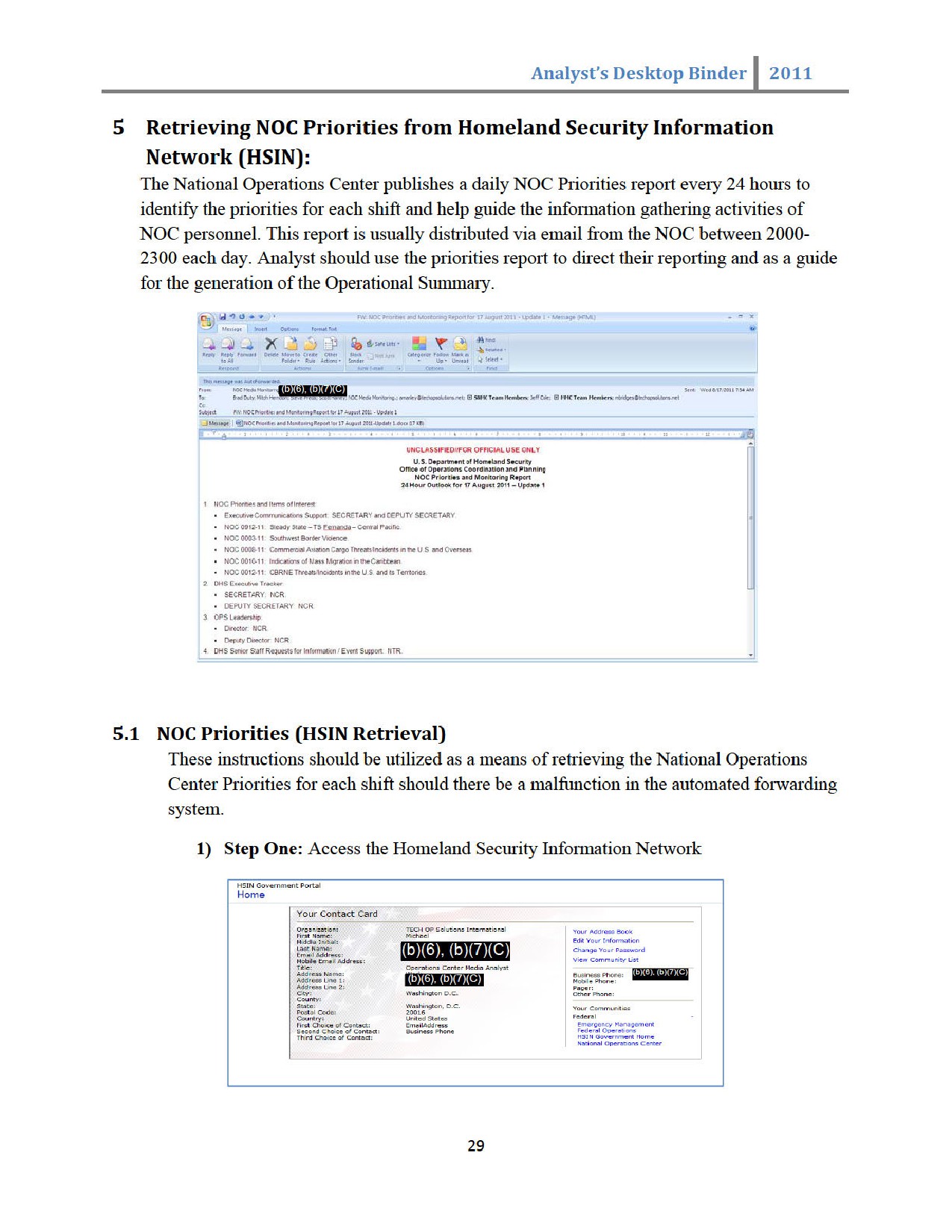


Analyst’s Desktop Binder
2011
the “Submit” button at the bottom of the page. Outputs 1 through 4 correspond to the TVs left to
right, from top row to bottom row:
ONE
TWO
THREE
FOUR
Output 5 allows you to assign the audio of any input to the overall room speakers.
Stored Configurations
To make common configurations easily and quickly available, we have set up some presets. By
selecting the number from the drop-down menu under “Stored Configurations” and clicking
“Load”, you can call up these stored presets. These settings can be changed if we find specific
presets that are preferred.
1) MMC Extended Desktop HSIN (1), CNN (2), FOX News (3) MSNBC (4).
2) MMC Extended Desktop HSIN (2), CNN (1), FOX News (3) MSNBC (4).
3) MMC Extended Desktop HSIN (3), CNN (2), FOX News (1) MSNBC (4).
4) MMC Extended Desktop HSIN (4), CNN (2), FOX News (1) MSNBC (3).
5) SN Extended Desktop HSIN (1), CNN (2), FOX News (3) MSNBC (4).
6) SN Extended Desktop HSIN (2), CNN (1), FOX News (3) MSNBC (4).
7) SN MAC Desktop HSIN (2), CNN (1), FOX News (3) MSNBC (4).
8) SN MAC Desktop (3), CNN (1), FOX News (2) MSNBC (4).
34

Analyst’s Desktop Binder
2011
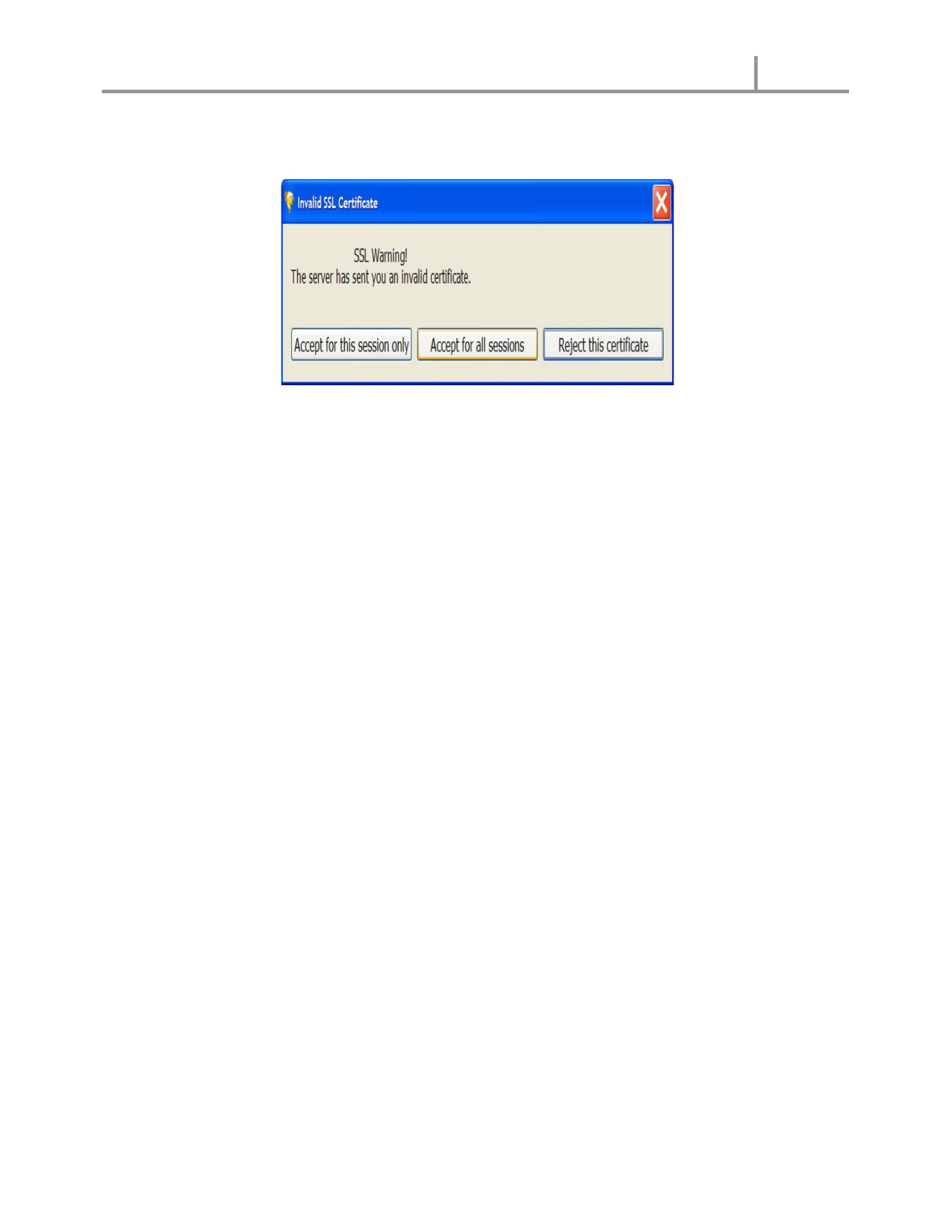
After clicking on next, the following screen will appear and you must select “Accept for
all sessions”
37


UNCLASSIFIED//FOR OFFICIAL USE ONLY
Cyber Mission Analysis
Mission Analysis for Cyber Operations of
Department of Defense
Submitted in compliance with the reporting requirement
contained in the Fiscal Year 2014 National Defense Authorization Act
section 933(d), Public Law 113-66
Preparation of this study/report cost the Department of Defense
approximately $587,000 for the 2014 Fiscal Year.
This includes $15,000 in expenses and $572,000 in DoD labor
Generated on 2014 August 21
RefID: E-0CD45F6
1
UNCLASSIFIED//FOR OFFICIAL USE ONLY
UNCLASSIFIED//FOR OFFICIAL USE ONLY
Table of Contents
I.
Executive Summary
4
II.
Current State
6
Threat Landscape
6
Policies, Oversight, and Relationships
6
Cyber Missions
8
Operational Command & Control (C2)
10
Resilience, Mission Assurance, and Continuity of Operations
10
Recruitment, Retention, Management, Equipping, and Training the Force
10
III. Current Reserve and National Guard Units
18
Manpower and Total Force Requirements
18
Recruitment, Retention and Career Paths for Skilled Reserve Component Personnel..
21
Skills and Training
22
Reserve Component Infrastructure
24
IV. Way Forward
25
CMF requirements that may be filled by the Reserve and Guard
25
Current RC support to USCYBERCOM Headquarters
25
Services’ Total Force plans for the CMF
25
The Army
26
The Air Force
27
The Navy and Marine Corps
28
V. Department’s Assessment
28
Assessment
29
Cost Assessment
35
Conclusion
35
Annex 1: Air Force Reserve Component Units
37
960th Cyber Operations Group Units
37
Air National Guard Units
37
Annex 2: Reserve Component Infrastructure
38
Army Reserve Components
38
2
UNCLASSIFIED//FOR OFFICIAL USE ONLY
UNCLASSIFIED//FOR OFFICIAL USE ONLY
Air Force Reserves
38
Navy Reserves
38
Marine Corps Reserves
38
Annex 3: Acronym list
39
Annex 4: Section 933 Reporting Requirement
42
Annex 5: Classified Annex………………………………………………………………………46
3
UNCLASSIFIED//FOR OFFICIAL USE ONLY
UNCLASSIFIED//FOR OFFICIAL USE ONLY
I.
Executive Summary
This report fulfills the requirement contained in the National Defense Authorization Act
(NDAA) for Fiscal Year 2014, Section 933 “Mission Analysis for Cyber Operations of the
Department of Defense (DoD).” The Department undertook an accelerated but deliberate
process to conduct the analysis, the outcomes of which are contained in this report. The analysis
addressed each sub-section of the statute and was fully vetted across the Department. The results
of this analysis reflect the Department’s current view of its requirements for successful conduct
of cyberspace operations, leveraging a Total Force solution. As cyberspace capabilities, force
structure, and command and control (C2) constructs evolve, the Department will conduct
periodic reviews of its cyberspace requirements and adjust them as necessary.
To complete this comprehensive analysis, the Office of the Secretary of Defense (OSD)
conducted a number of consultations with key stakeholders to ensure a transparent process. OSD
Cyber Policy solicited input from the Reserve Forces Policy Board, the State Adjutants General,
the National Guard Bureau (NGB), the Guard Senior Leadership Council, the Department of
Homeland Security (DHS), and States, through the Council of Governors (CoG). Through these
engagements, the Services, OSD, the Joint Staff, the National Guard Bureau, U.S. Cyber
Command (USCYBERCOM), DHS, and the States provided the data and analysis that form the
backbone of this report. This report reflects the Department’s current view, and is expected to
change as circumstances require. The findings reflect the assessment done to date.
First, the Department assesses there can be advantages to using reserve component (RC)
resources for Cyber Mission Force (CMF) missions, such as providing load sharing with active
duty forces, providing available surge capacity if authorized to activate, and maintain DoD-
trained forces to defend national critical infrastructure, if authorized. Several factors should be
considered when determining the CMF force structure and the mix within the Total Force. These
factors include whether the position is military essential, peacetime and wartime demands,
deployment frequency and duration, speed of response, unit readiness for specific mission sets,
and costs.
To that end, there are five key recommended ways forward for the Department as it considers the
future of DoD cyber operations, discussed in detail in the “Department’s Assessment” section.
1. National Guard personnel could focus on coordinate, train, advise, and assist (C/TAA)
support roles when directed by their Governor or Adjutant General if in State active duty
status or, if authorized by DoD, in Title 32, U.S. Code, status.
2. The Services’ proposed plans to integrate approximately 2,000 RC personnel into the
cyber force structure adequately addresses the opportunity for surge support and
additional Service Cyber Protection Team (CPT) support in the near-term.
3. Cyber forces require consideration of a persistent training environment.
4. Because there is no command and control over National Guard cyber forces in Title 32 or
State active duty status, policies and processes must be clarified to ensure unity of effort
by DoD forces and State National Guard forces.
5. The Military Departments/Services may require additional flexibility in civilian hiring
authorities.
4
UNCLASSIFIED//FOR OFFICIAL USE ONLY
UNCLASSIFIED//FOR OFFICIAL USE ONLY
Although the Department assesses these are the right steps to date, it recognizes that additional
analysis is necessary, and will reassess and adjust in Fiscal Year 2016 and in other future budget
submissions, once the CMF is well on its way to being fully manned, trained, and equipped to
ensure that we have the most effective workforce to conduct DoD cyber operations.
Cyber is a dynamic domain, and, therefore, additional research needs to be completed to
determine a number of elements directed in the reporting requirements, including better
understanding civilian requirements, understanding the exact equipping needs of the CMF, and
the appropriateness of hiring on a temporary basis part-time, non-dual status technicians. It is
expected the Department’s assessment will mature, and the approach will adapt as this
operational domain matures, our forces become operational, and the threat landscape evolves.
5
UNCLASSIFIED//FOR OFFICIAL USE ONLY
UNCLASSIFIED//FOR OFFICIAL USE ONLY
II.
Current State
Threat Landscape
In 2014, the Director of National Intelligence identified cyber threats first among the strategic
threat to the United States, surpassing terrorism. Hostile actors use cyberspace as an asymmetric
capability to strike the U.S. homeland and U.S. interests, directly and indirectly. Globally
important critical infrastructure is vulnerable to cyber attacks and malicious cyber activity,
placing military missions and economic systems at risk. Hostile actors engage in espionage in
cyberspace by stealing defense-related intellectual property and trade secrets.
Some nations target U.S. partners with the intent to attack networks and to manipulate command
and control and logistics data, which could adversely affect the U.S. military’s ability to mobilize
its forces in the event of a contingency, and then could amplify the effects through propaganda
and information control. They also steal information unrelated to national security, such as
proprietary economic and commercial information, which is then provided to competing
companies in their countries.
The Department of Defense (DoD) is developing cyber forces to ensure and enhance military
capabilities in all domains, provide cyber options for the President, and to defend the nation
against cyber attacks and cyber adversaries.
Policies, Oversight, and Relationships
Policy & Doctrine: Since establishing U.S. Cyber Command (USCYBERCOM) in 2010, the
Department has developed policy and doctrine to determine how to operate in cyberspace,
including Joint Publication 3-12, “Cyberspace Operations,” and the 2011 Department of Defense
Strategy for Operating in Cyberspace (DSOC).
In 2012, the Secretary of Defense approved the Cyber Mission Force (CMF) concept, dedicating
resources to establish cyber teams in support of defending DoD networks, degrading adversary
cyber capabilities, and supporting defense of national critical infrastructure. Since then, the
Department has developed the “Cyber Force Concept of Operations and Employment”
(CFCOE), a comprehensive, evolving, document defining CMF teams’ roles, functions, and
operational processes. The knowledge, skills, and abilities required for each cyber mission force
work role (i.e., position) were defined in the “Joint Cyberspace Training and Certification
Standards” (JCT&CS). The ability to assess individual and team readiness using a common set
of joint tasks, conditions, and standards for all cyber mission team positions were defined in the
“Cyber Mission Force Joint Training and Readiness Manual” (T&R Manual). To improve the
quality, sufficiency, and efficiency of training, the Cyber Training Advisory Council (CyTAC)
was established. Tri-chaired by representatives from USCYBERCOM, the Office of the Under
Secretary of Defense for Personnel and Readiness (OUSD(P&R)), and the DoD Chief
Information Officer (CIO), and in coordination with the Military Departments/Services, the
CyTAC identifies, reviews, and assesses training requirements and standards for evaluation. It
also addresses gaps between current and future cyberspace training capabilities. In addition, the
DoD Enterprise Cyber Range Environment (DECRE) is a governance structure construct that
6
UNCLASSIFIED//FOR OFFICIAL USE ONLY
UNCLASSIFIED//FOR OFFICIAL USE ONLY
synchronizes efforts to promote effective and efficient utilization of security, operationally
realistic and technical representative replications of the cyberspace domain.
In response to Section 932 of the National Defense Authorization Act (NDSS) for Fiscal Year
2014, the Secretary of Defense designated the Assistant Secretary of Defense for Global
Strategic Affairs as the principal cyber advisor (PCA). In coordination with the Chairman of the
Joint Chiefs of Staff (CJCS), the Combatant Commanders, and USCYBERCOM, the PCA will
serve as the principal advisor to the Secretary on policies related to the CMF. In response to the
Fiscal Year 2011 NDAA, Section 933, the Department established the Cyber Investment
Management Board to facilitate alignment of Department cyber activities across science and
technology (S&T), requirements, acquisition, development, test and evaluation (T&E), and
sustainment. As an advisory board to key senior level Department decision-making bodies, the
CIMB serves to ensure cyber investments are effectively planned, executed, and coordinated
across the Department. The CIMB has met twelve times since its inception and has provided
senior DoD leaders with an in-depth understanding of the Department’s existing requiremetns
baseline and current and planned investments in capabilities for cyberspace operations. To
inform this process further, the Department recently established the DoD Cyber Operational
Capabilities Board (COCB) to provide Combatant Commanders a forum to inject operational
requirements into the acquisition process.
Federal Cybersecurity Partnerships: DoD is one component of the Federal cybersecurity
team that addresses cyber threats to the United States. The Federal cybersecurity team includes:
Department of Homeland Security (DHS) : protects against, mitigates, investigates,
and recovers from domestic cybersecurity incidents;
Department of Justice (DoJ): investigates, attributes, disrupts, and prosecutes
cybercrimes and domestic national security incidents; and
Department of Defense (DoD): defends the nation from attack, secures national
security and military systems, and protects information on Defense Industrial Base (DIB)
systems.
State-Federal Partnerships: The Council of Governors (CoG), a bipartisan body of ten
governors, was established by the President in 2010 for the purpose of further strengthening the
partnership between the Federal and State governments to protect the United States and its
people and property. The CoG exchanges views, information, and provides advice to the
Secretary of Defense, Secretary of Homeland Security, and other senior Federal officials on
matters regarding the National Guard, homeland defense, civil support, and synchronization and
integration of State and Federal military activities within the United States. In February 2013,
the CoG, on behalf of State Governors, and the Department approved the “State-Federal
Consultative Process for Programming and Budgetary Proposals Affecting the National Guard,”
which established a sustained process to meet, confer, and exchange views and information in
advance of the DoD determining programming and budgetary requirement priorities. This
Consultative Process provides ways for Governors, through the Council of Governors and the
Chief of the National Guard Bureau, to provide the States’ assessments and requirements to
DoD. The process also enables DoD to understand States’ requirements more fully and to
include these requirements for consideration in DoD’s Planning, Programming, Budgeting, and
7
UNCLASSIFIED//FOR OFFICIAL USE ONLY
UNCLASSIFIED//FOR OFFICIAL USE ONLY
Execution process. In July 2014, the CoG, DHS, and DoD approved the “Joint Action Plan for
State-Federal Unity of Effort on Cybersecurity.” This Joint Action Plan is a commitment by the
States, DHS, and DoD to work together to improve the nation’s cybersecurity posture. It
establishes a framework to guide State-Federal discussions in areas such as information sharing,
operational coordination, and incident response. Similarly, the National Guard (NG) continues to
play an important role bridging the gap between State and Federal governments as an established
and trusted ally of both communities.
The strength of the NG derives from its roots in local communities. National Guard personnel
are often community leaders who have direct connections with local industries and government
officials and serve as the face of the DoD to our citizens. They are trusted members of
communities who put on the uniform in times of natural disaster, as well as answering the call to
duty for wartime missions. These community ties contribute to DoD integrating best practices
from the business, public, and private sectors into defense training and operations, and through
its cybersecurity partnerships, Federal training, and operations. Integration of the National
Guard is a critical enabler that has allowed the U.S. Government to ensure our Nation can rapidly
respond to any threat, foreign or domestic, and achieve the goals set forth by our Federal and
State leaders. The National Guard’s community presence and engagement of National Guard
members in their civilian capacities in public and private sector organizations that are critical to
continuity of operations at all levels of government and key private sector organizations make
the National Guard uniquely able to contribute to a “whole of Government” and “whole of
Nation” approach to securing U.S. cyberspace.
Allies and Partners: As directed by the President's International Strategy for Cyberspace in
2011, the Department works with allies and partners to expand situational awareness and shared
warning systems, enhance cooperation in times of peace and crisis, and enable self-defense in
cyberspace. Such partnerships bolster collective deterrence capabilities and strengthen the
ability to defend the United States against cyber actors.
Private Sector Partnerships: The Department relies on the private sector to protect sensitive
data related to DoD military operations across all domains (i.e., air, land, sea, space, and
cyberspace). In collaboration with DHS, DoD fosters mutually beneficial partnerships with
Defense Industrial Base companies through the DIB Cyber Security / Information Assurance
(CS/IA) Program. This voluntary program helps protect DoD information residing on, or
passing through, DIB company systems by facilitating information sharing between participating
companies and DoD, as well as among fellow participants. As an optional component to the DIB
CS/IA program, DoD developed the DIB Enhanced Cybersecurity Services (ECS), which
furnishes classified cyber threat and technical information either to a DIB company or to the
company's commercial service provider to counter malicious cyber activity in order to improve
industry’s ability to protect sensitive information related to DoD military operations.
Cyber Missions
DoD needs the ability to maintain our advantage in cyberspace, and thus, across the other four
domains, by conducting cyberspace operations and supporting military operations worldwide,
supporting Combatant Commanders as they plan and execute military missions, and countering
8
UNCLASSIFIED//FOR OFFICIAL USE ONLY
UNCLASSIFIED//FOR OFFICIAL USE ONLY
cyber attacks and malicious cyber activity against the United States. Therefore,
USCYBERCOM was created to centralize new and expanded cyberspace forces and capabilities
under one command.
U.S. Strategic Command (USSTRATCOM): Defense against cyber threats requires the
Department to strengthen its understanding of the complexities (capability and intent) of
adversaries and risks to our systems to build resilience into our national critical infrastructure.
The Unified Command Plan (UCP) assigns USSTRATCOM responsibility for synchronizing
planning for cyberspace operations, in coordination with other combatant commands, the
Services, and, as directed, other appropriate U.S. Government departments and agencies. These
roles, however, have been delegated to its sub-unified command, USCYBERCOM.
U.S. Cyber Command (USCYBERCOM): USCYBERCOM has three primary missions. These
missions are carried out, in part, by the Cyber Mission Force (CMF):
1.
Secure, operate, and defend DoD networks;
2.
Defend the Nation in cyberspace; and
3.
Support Combatant Command (CCMD) full spectrum operations in cyberspace.
In December 2012, the Department approved a plan to establish a new cyber force resourced
from all of the Services and NSA aligned to these three missions. Implementation of the
approved CMF plan is underway with progress measured and reported on a quarterly basis.
Cyber Mission Force: The CMF is composed of three sets of forces aligned to achieve
USCYBERCOM’s three primary missions. Those sets are the Cyber National Mission Force,
Cyber Combat Mission Force, and Cyber Protection Force. Once fully manned, trained, and
equipped in FY 2018, these 133 teams comprising the CMF will execute the three primary
missions with approximately 6,200 military and civilian personnel (see Figures 1, 2, and 3 in the
classified annex).
Cyber National Mission Force: The National Mission Force consists of 13 National
Mission Teams (NMTs), supplemented by 8 National Support Teams (NSTs) (also called
Direct Support Teams), which are designed to defend the Nation against strategic cyber
attacks on U.S. interests. The NMTs are a counter-cyber force to stop cyber attacks and
malicious cyber activity of significant consequence against the Nation.
Combat Mission Force: The Combat Mission Force consists of 27 Combat Mission
Teams (CMTs) focused on individual CCMDs requirements with the support of 17
Combat Support Teams (CSTs). The CMTs are designed to support CCMDs in carrying
out approved operational plans and contingency operations with integrated cyber effects.
Cyber Protection Force: The Cyber Protection Force consists of 68 Cyber Protection
Teams (CPTs). The CPTs are further divided into four mission areas: National, DoD
Information Networks (DoDIN), Combatant Command (CCMD) support, and Service
support. All CPT units are focused on actions internal to the defended network, which
primarily is within the DoDIN unless they are separately authorized to defend non-DoD
networks. The core capabilities of these teams are mission protection, discover and
9
UNCLASSIFIED//FOR OFFICIAL USE ONLY
UNCLASSIFIED//FOR OFFICIAL USE ONLY
counter infiltration, cyber threat emulation, cyber readiness, and cyber support. These
teams integrate and synchronize cybersecurity functions such as assessments of network
vulnerabilities, penetration testing, remediation of vulnerabilities, and hunting on
networks for adversary activity. CPTs will protect the most critical Service, CCMD, and
national security networks (when authorized), as well as the Department of Defense
Information Networks (DoDIN), supplementing their defenses. Additionally, CPTs will
share malicious signatures and other indicators with interagency partners and appropriate
critical infrastructure entities. There will be 18 national CPTs - six CPTs assigned to
protect and defend the DoDIN, 24 CPTs for Service networks, and 20 CPTs for CCMD
networks. The 18 national CPTs will work closely with the NMTs to understand specific
adversary tactics, techniques, and procedures and capabilities to develop mitigation
techniques (see Figure 2 in classified annex for detailed graphic).
Operational Command & Control (C2)
In June 2013, the Secretary of Defense approved a new cyberspace C2 model. The Department
selected the “Direct Support” model given the early stages of implementation of the CMF and
continued maturation/integration of cyberspace expertise and planning at the CCMDs. Under
this model, USCYBERCOM provides direct support to CCMDs through four Service-specific
Joint Force Headquarters-Cyber (JFHQ-C). Implementation of the Direct Support C2 model is
underway simultaneously as the CMF build continues (see classified annex for detailed
description of the “Direct Support” C2 model).
Resilience, Mission Assurance, and Continuity of Operations
To ensure resilience, mission assurance, and continuity of cyberspace operations, DoD is
migrating the DoDIN to a more defensible network architecture, the Joint Information
Environment (JIE). This architecture will maintain systems and capabilities that automatically
and immediately failover to designed alternate capabilities, allowing operations to continue
uninterrupted in degraded and denied environments. USCYBERCOM will lead the operation
and defense of the JIE against attacks. As the JIE comes online, DoD is also taking steps to
ensure that DoD asset owners and DIB partners meet the cybersecurity standards necessary to
protect DoD’s data and assure DoD missions.
DoD must defend its own networks against attack. As USCYBERCOM improves its force
readiness, and the Services man, train, and equip the CMF (especially the Cyber Protection
Teams) to joint standards, DoD must take steps to mitigate cyber risks and assure its most
important missions are being met. To this end, DoD components will align their Cyber
Protection Forces and other capabilities to prepare to defend their cyber key terrain, which is
composed of networks and systems designated as mission-critical, Defense Critical Assets, and
Task Critical Assets. Finally, DoD is working to strengthen the cyberspace aspects of its
continuity of operations plans.
Recruitment, Retention, Management, Equipping, and Training of the Force
The effectiveness of the CMF depends on the right people (military and civilian personnel) being
recruited, trained, and then appropriately equipped to accomplish assigned missions. Overall,
10
UNCLASSIFIED//FOR OFFICIAL USE ONLY
UNCLASSIFIED//FOR OFFICIAL USE ONLY
DoD has made significant progress in adapting traditional recruiting, training, and retention
methods for cyberspace-oriented military career fields. The Military Services use assessments,
including the Armed Services Vocational Aptitude Battery (ASVAB), to determine individuals’
aptitude for the cyber field. In addition, the Air Force, Navy, and Army are developing a joint
computer-based “Cyber Test” to assess military applicants’ propensity in a variety of computer
and networking skillsets. The Services are also increasing their identification and recruitment of
applicants with Science, Technology, Engineering, and Mathematics (STEM) backg0rounds and
working with their Service academies to identify and train potential cyberspace officers.
The Military Departments/Services’ proposed plans (outlined in Section IV., “Way Forward”)
incorporating the Reserve Component (RC) into the cyber force, trained and certified to the same
standards as active duty personnel, allows members of the military who wish to pursue civilian
careers the opportunity to continue to serve their country. Although some Service members may
receive higher pay in civilian cybersecurity jobs, the military cyberspace mission offers a distinct
experience and unique opportunities for Service members to continue to serve in the RC as they
train and execute military cyberspace missions not executed in the private sector. The RC
provides an opportunity for members to continue to serve and leverage DoD’s training
investment to benefit both the private sector and DoD. Additionally, the RC provides an avenue
for skilled civilian cyber personnel to enter the military, maintain their civilian job, and provide
DoD with state of the art civilian knowledge.
Cyberspace forces need to be trained and equipped. The Joint Staff, USSTRATCOM, and
USCYBERCOM have conducted several gap analyses to identify the capabilities required for
cyberspace operations, and most recently, what the CMF teams need to conduct assigned
missions. Additional requirements analysis is ongoing to identify requirements for next
generation capabilities for cyberspace operations. The Military Departments have begun to
equip these teams to USCYBERCOM joint cyberspace standards. USCYBERCOM’s CMF
Quarterly Readiness Report tracks the progress that the CMF has made toward equipping the
Force. Specifically, it tracks network access and equipment status of all hardware, software,
target access, and infrastructure resources required by CMF units.
USCYBERCOM is also working to decrease its reliance on the Intelligence Community (IC)
infrastructure built to support foreign intelligence missions and develop independent access to
global networks to conduct military operations. This infrastructure has different attributes than
those required by the Intelligence Community, including the ability to scale rapidly, be
disposable, cause minimal collateral damage to other capabilities if discovered by adversaries,
and consistent with other warfighting domains, enable attribution of certain cyberspace
capabilities and effects to the United States to deter adversaries from future aggression as
required. Most importantly, this infrastructure will be available to the CMF to carry out its
military operations against military-relevant targets. Access to independent infrastructure is not
only important from a readiness perspective; it also prevents military actions from inadvertently
exposing IC missions.
DoD’s ability to maintain continuity and accomplish its mission has historically required a Total
Force comprising of military and civilian personnel. Although the immediate, short-term effort
to start and gain momentum building the CMF focuses on manning, training, and equipping
11
UNCLASSIFIED//FOR OFFICIAL USE ONLY
UNCLASSIFIED//FOR OFFICIAL USE ONLY
military personnel (active and reserve components), the Department is keenly aware of the need
for a long-term strategy to integrate its existing and future civilian workforce into a cohesive
Total Force construct. As discussed in Section IV., “Way Forward,” deliberate actions are
planned to examine the feasibility and options for various incentives to recruit and retain the best
qualified civilian workforce. The results of those analyses will be integrated into the force
structure as data becomes available.
USCYBERCOM Training Standards: The CMF method of employment directly informs the
training criteria and standards established for individual team members and unit requirements.
USCYBERCOM, in coordination with the Joint Staff, the Combatant Commands, the Military
Departments/Services, and the National Security Agency (NSA), established joint training
standards. These standards for individual and collective training are captured in the Joint
Cyberspace Training and Certification Standard (JCT&CS), the CMF Individual Training
Pipeline (ITP), and the CMF Training and Readiness (T&R) Manual.
The JCT&CS is based on the National Initiative for Cybersecurity Education (NICE) framework
and is currently being updated, identifies the knowledge, skills, and abilities (KSA) required for
each role on a CMF team. The JCT&CS is also designed to assist in shaping other DoD
workforce initiatives such as the future DoD Cyberspace Workforce Framework.
The ITP identifies each individual’s path to acquire the specific skills needed to satisfy the
required JCT&CS standards. The development of these skills will assist the Services with
identifying common joint training standards and solutions for other Service personnel working in
the cyber domain.
The CMF T&R Manual provides tasks, conditions, and standards required to demonstrate
individual and collective proficiency for CMF teams. Services, in coordination with its Service
Components will supplement the standards with Service-specific requirements in order to
exercise the collective capabilities of its cyber personnel.
USCYBERCOM is currently assisting the Service Components in meeting the joint training
standards to accelerate the CMF build. The USCYBERCOM Individual Training Equivalency
Board (ITEB) was developed in August 2013 to allow evaluation of awareness of suitable
training that meets the skills required to perform CMF missions. The ITEB process provides the
Service Components an opportunity to accelerate the development of personnel who are
currently providing operational support to USCYBERCOM. It can also be used as a model for
the Military Departments/Services and other DoD Components to identify personnel within the
cyberspace community who have prior experience and training that may be applied to specific
cyberspace positions in the CMF or supporting positions at joint force headquarters elements or
combatant commands described in the Direct Support C2 construct.
The following highlights progress made by each Military Department/Service in developing a
trained and equipped cyberspace workforce composed of military and civilian personnel. The
Services’ current and planned ways forward include integration of reserve forces to augment
active-duty personnel and provide surge capacity to USCYBERCOM for emergencies and crisis
actions. Progress made regarding active-duty forces is explained first and is followed by
discussion of Reserve Component (including National Guard) alignment.
12
UNCLASSIFIED//FOR OFFICIAL USE ONLY
UNCLASSIFIED//FOR OFFICIAL USE ONLY
Army Active Duty Progress: In the past year, the Army has made tremendous progress in the
recruitment, retention, management, and training of their Active Force personnel. The creation
of a Cyber Protection Brigade and a new Military Occupational Series to identify the elite group
of cyber personnel are just two indications of the fundamental transformations taking place.
As part of these changes, the Army is evaluating existing and proposed personnel policies to
ensure that it has the necessary tools to recruit, educate, train, retain, and lifecycle manage its
cyber force. The Army’s accession efforts, aimed at attracting world-class cyber talent, are
being informed by the Army’s experiences with the Special Forces in terms of eligibility and
suitability. The Army has started to implement a plan to identify personnel with the requisite
cyberspace aptitude. The Army is also leveraging the Army Cyber Assessment to measure the
technical skills of current soldiers who are candidates for the CPTs.
An Army CPT recruiting website is in development to market interesting and unique CPT
opportunities to skilled candidates. The Army has also expanded its targeting of applicants with
STEM degrees to improve production of officers with the needed technical skills. For example,
the Army is working with the U.S. Military Academy (USMA) to identify past graduates whose
field of study indicates that they may be candidates for entry into the cyber field. The Army is
also working with U.S. Army Cadet Command to interview potential cyber candidates at 2014
Reserve Officer Training Corps (ROTC) summer camp. For the long term, the Army’s Training
and Doctrine Command (TRADOC) is developing an enduring program to standardize the
recruitment, development, and training of USMA and ROTC STEM candidates.
The Army is also carefully assessing its training requirements. In accordance with the
USCYBERCOM CMF implementation plan, the Army is following a phased build-out of its
CMF teams. The Army derives individual CMF training requirements through the Joint
Cyberspace Training & Certification Standards (JCT&CS) and the USCYBERCOM Joint Force
Development training pipeline. To streamline training timelines for CMF personnel, the Army
has maximized the reuse of the USCYBERCOM Individual Training Equivalency Board (ITEB)
to waive specific required training requirements based on prior training and experience. Further,
the Army is aggressively posturing to assume CMF individual training responsibilities from
USCYBERCOM starting in FY 2017, and has modified its course offerings to meet
USCYBERCOM standards. Ultimately, this streamlining effort will reduce the training burden
on the Army to fulfill its CMF training requirements, while accelerating the operational readiness
of CMF personnel. The Army’s Cyber Center of Excellence (CoE) is undergoing a process to
modify curriculum to meet USCYBERCOM requirements and reduce redundancy with Service
requirements. For example, to be designated as an Army Cryptologic Network Warfare
Specialist, a soldier must pass the 24-week, USCYBERCOM-approved, Joint Cyber Analysis
Course (JCAC). The CoE has modified the requirements for the Army’s Cyberspace Defense
Technician to meet USCYBERCOM standards. In a similar effort, the CoE is currently
modifying the Network Defense Specialist curriculum, and is conducting two pilot courses for
this new Army Military Occupational Specialty (MOS). Army Cyber Command (ARCYBER) is
developing a Cyber Training and Exercise Program that will leverage Combatant Command and
Network Command exercises to address the Army’s collective training requirements aligned to
USCYBERCOM’s joint standards where appropriate.
13
UNCLASSIFIED//FOR OFFICIAL USE ONLY
UNCLASSIFIED//FOR OFFICIAL USE ONLY
With all of these changes, the Army recognized potential personnel management efficiencies to
be gained through the consolidation and management of its cyber population under one career
field. The Army’s Training and Doctrine Command is developing a cyber career management
field, the 17-Series, which is currently projected for establishment by October 2015, if approved.
Until the 17-series is approved, the Army Human Resources Command (HRC) will provide
career management of cyber personnel through the recently established Cyber Electromagnetic
(CEM) branch. HRC’s CEM branch will provide appropriate career management to CMF-
assigned personnel ensuring the Army’s highly skilled talent remains within Army’s cyberspace
operations workforce for an amount of time commensurate with the Army’s investment in them.
To facilitate HRC CEM’s cyber talent management efforts, the Army recently established the
E4, a new Additional Skill Identifier (ASI) based on skills, experience, assigned role, and unit of
assignment that all CMF soldiers will receive. The objective of HRC’s CEM branch is to
provide interim career management for cyber-related MOS and functional areas for all Army
cyber personnel identified for possible 17-Series conversion. The Army is preparing a separate
officer skill identifier for cyber expertise or training received prior to commissioning and
creating a retention plan for soldiers with this identifier.
To ensure that the Army continues utilizing the training and skills of its cyberspace workforce,
soldiers serving on CMF teams will rotate to other CMF teams or other cyber units upon
completion of their assignments. The E4 ASI designation will enable the Army to identify and
track these skilled and experienced soldiers, and assignments to non-cyber units will be done
only with the approval of the Commander of ARCYBER.
Civilians provide valuable skills and continuity to the cyber workforce, and the Army is actively
recruiting and retaining skilled civilians. The Army distributes marketing materials to
organizations with high densities of skilled candidates and employs a strategic communications
effort to market the Army’s efforts on the CMF to relevant publications. The Army seeks to hire
skilled civilians from the ranks of former military personnel, colleges, and the private sector.
The Army offers its current civilians professional development opportunities through existing
NSA and Office of Personnel Management/National Science Foundation (OPM/NSF) programs
such as NSA’s Advanced Studies Program, OPM/NSF’s Cybercorps Scholarship for Service
Program, and NSA’s Centers of Academic Excellence accreditation program.
In addition to monetary incentives, the Army offers education programs to develop soldiers
further and act as retention incentives. For example, the Army offers Training with Industry
programs and civilian graduate education and inter-Service education programs such as study at
the Air Force Institute of Technology and Naval Postgraduate School.
Air Force Active Force Progress: The Air Force has made steady progress transforming its
forces to meet the cyber threat, including establishing Air Force Cyber Command (AFCYBER)
in 2009 and developing comprehensive programs to address recruiting, retention, management,
and training of its cyber forces. The Air Force places special emphasis on recruiting and
preparing its future airmen for cyber careers through national advertising campaigns highlighting
STEM requirements and supporting cyber training and education programs for high school and
college students nationwide. For example, the Air Force Institute of Technology’s Center for
14
UNCLASSIFIED//FOR OFFICIAL USE ONLY
UNCLASSIFIED//FOR OFFICIAL USE ONLY
Cyberspace Research hosts the Advanced Cyber Education summer program for ROTC cadets
from all Services who are studying computer science, computer engineering, or electrical
engineering.
Like other Services, the Air Force screens potential service members based on test scores and
educational achievement. For officers, a combination of type of degree and Air Force Officer
Qualification Test scores are used to qualify for the cyberspace career field.
Once service members are in the Air Force, training programs are designed to develop Total
Force professionals from numerous career fields with core training, including courses such as:
Undergraduate Cyberspace Training, Cyberspace Defense Operations, and Intermediate Network
Warfare Training. The Air Force also has developed an Intelligence Cyber Analyst course to
train digital network analysts. This analyst training is complemented by the 24-week, follow-on
JCAC. Additionally, cyber personnel can attend joint cyberspace courses based upon positional
requirements and work roles. Finally, graduate level cyber curriculum and continuing
professional education classes are offered at the Air Force Institute of Technology.
The Air Force carefully manages cyberspace airmen to balance practical and educational
experiences in their fields. In addition to their continuing professional cyberspace education to
maintain and build their expertise, the Air Force seeks to provide both breadth and depth to their
airmen. For example, certain specialties will serve consecutive operations tours in cyberspace
positions at different locations building depth as they progress through their career. This
experience is coupled with continuing professional cyberspace education to build cyberspace
expertise. Active duty service commitments ensure a return on training investments.
The Air Force has several tools to promote retention of qualified cyberspace airmen. To address
manpower shortfalls in specific specialty codes, the Air Force has increased the minimum
enlistment period from four to six years and increased the ability of community managers to
control careers of skilled cyber enlisted and officers by prolonging cyber assignments.
Furthermore, selective reenlistment bonuses (SRBs) are one of the Air Force's most flexible and
effective methods of retention. They provide monetary incentives to retain existing members in
critical skills that have low retention or low manning, as well as entice airmen from less critical
skills to retrain into critical career fields.
For Air Force civilians, there are a range of hiring authorities and incentives to attract cyberspace
personnel, including the Communication and Information Palace Acquire program, a three-year
internship for recent college graduates with an interest in cyberspace. The program includes
cyber training and benefits such as eligibility for student loan repayment.
Navy Active Duty Progress: The Navy has made progress toward full integration of cyber
into its workforce including developing innovative programs such as the Cyber Warfare
Engineer (CWE) program. In response to USCYBERCOM requirements for cyber systems
developers, software engineers, and Research & Development (R&D) engineers (collectively
referred to as “tool developers”), this highly competitive program recruits and commissions
qualified enlisted sailors and civilians who hold specific cyber-related degrees. After five years
of service as a CWE, participants are encouraged to either transfer into the Navy Information
Warfare or Information Professional communities, or transition to the civilian DoD workforce.
15
UNCLASSIFIED//FOR OFFICIAL USE ONLY
UNCLASSIFIED//FOR OFFICIAL USE ONLY
The Navy is also seeking to create civilian positions to provide longevity and continuity within
the cyber tool development mission force.
The Chief of Naval Operations (CNO) has placed a high priority on aggressive implementation
of plans to manage discrete cyber career fields and within the CMF. Like other Services, the
Navy uses multiple methods to recruit qualified candidates to the Navy’s cyber workforce,
including the ASVAB and Cyber Test, which are used to identify cyber aptitude.
The two primary enlisted cyberspace occupational fields, Cryptologic Technician Networks
(CTNs) and Information Systems Technicians (ITs) are considered highly skilled, technical
ratings and require significant training prior to their initial operational assignments. The JCAC
serves as the Navy’s feeder training course for the CTN rating, and is the foundational cyber
training for all CTNs, including those filling highly specialized roles. The 19-week Network and
Telecommunications Architecture and Information Assurance Course serves as the Navy’s
feeder training for the IT rating. A subset of IT personnel also attend the 18-week System
Administration course. Additionally, all ITs are required to meet DoD Information Assurance
certification requirements for privileged users.
CTNs and ITs have opportunities for advanced education at the Naval Postgraduate School,
which offers a Master of Science in Applied Cyber Operations open to all Services. The Navy
graduates of this program receive a specialty code and are detailed to select billets, including an
opportunity to serve in the CMF. Navy increasingly offers cyber education opportunities to its
officer corps, including mandatory cyber classes for Naval Academy Midshipmen. Starting in
2016, the Naval Academy will offer a Cyber Operations major. NROTC annually offers five
“Cyber Option” scholarships to students that place highly in cyber. In addition to adding cyber
areas of specialization to existing majors, such as Electrical Engineering, the Naval Postgraduate
School (NPS) has developed the Network Operations and Technology program to understand
more fully what is required to fight wars in the modern networked environment. NPS also offers
a course to prepare officers to deploy cyber assets appropriately in the DoD cyber infrastructure.
Furthermore, officers are able to obtain a Master’s degree in cyberspace operations through the
Navy’s Information Dominance Cyber Program at Rensselaer Polytechnic Institute.
Based on the Navy’s need to have a sustainable pool of personnel to support both Joint and Fleet
requirements, enlisted and officer community managers monitor and adjust the number of
personnel in each cyber rating. As requirements are identified in a rating, community managers
fill them using a variety of methods including through recruiting, lateral transfers or conversions
from other specialties, or commissioning qualified enlisted personnel into cyber-related officer
designators. The Cyber Warrant Officer program is another important means of identifying,
developing, and commissioning technically proficient sailors to contribute to and direct on-net
cyber operations.
The Navy recruits and maintains a sufficient number of cyber personnel and ensures appropriate
distribution across pay grades. Community managers and technical advisors provide
recommendations for accession quotas each fiscal year, review requests for low-density/high-
demand, community management requests, and provide recommendations for advancement
quotas. The IT and CTN ratings use the standard Navy advancement quota management process
for pay grade advancement. The ECM for each rating measures rating requirements and sets
16
UNCLASSIFIED//FOR OFFICIAL USE ONLY
UNCLASSIFIED//FOR OFFICIAL USE ONLY
quotas before each promotion cycle. CTNs and ITs have traditionally been very competitive
ratings for promotion, allowing the Navy to promote very talented professionals. Similarly,
officer community managers conduct community health assessments aligning billets, personnel,
authorizations, and promotions. They also work with officer detailers to ensure officer
promotion paths and community-valued billets guide officer assignments.
To retain qualified cyber sailors, the Navy uses monetary incentives, bonuses, and promotions.
Qualified CTNs may be eligible for automatic advancement to the grade of E4 with a six-year
enlistment contract as a part of the Advanced Technical Rate Program.. The Navy also offers
significant retention bonuses for qualified CTNs. Rating conversion bonuses are also available
for qualified sailors.
Marine Corps Active Duty Progress: As the smallest Service with a still growing cyber
requirement, the Marine Corps has placed careful attention on ensuring that it meets its recruiting
goals, particularly in the cyberspace workforce. The Marine Corps uses existing recruiting and
retention tools to grow and maintain cyberspace operations forces and continues to meet its
recruiting targets. As an initial assessment, the Marine Corps uses the ASVAB to screen
qualified personnel for all entry-level occupations and every MOS. However, the more highly
skilled occupations, such as cyber operations, are not considered entry-level professions and are
sourced by moving qualified candidates from other feeder occupations.
In an effort to attract the most qualified Marines, the Marine Corps has expanded the feeder
occupations to increase the pool of available candidates while also focusing on Marines whose
current skills translate well into cyberspace operations. Additionally, incentive pay remains
critical to this effort. SRBs allow the Marine Corps to shape the career force by targeting critical
cyber MOSs and supporting lateral movement of Marines into them.
To train the Marine Corps’ cyberspace workforce, the Marine Corps uses a combination of
Marine, Joint, other DoD, and other Service schools. Two specific programs of study currently
in place for the Marine Corps cyber security personnel are the Information Assurance
Scholarship Program (IASP) and the Northern Virginia Community College Advanced Standing
Initiative (NVCC ASI). The IASP provides the Marine Corps the ability to develop a skilled
cyber security workforce through participation in a graduate education program. The program
has placed more than 600 graduates into Cyber Security/Information Assurance positions DoD-
wide. The NVCC ASI allows the Marine Corps to transfer 22 Marine Corps formal school
courses into college credits toward an Associate in Applied Science (AAS) in cyber security
degree from NVCC. In addition, the partnership between the Marine Corps and NVCC takes
advantage of the NVCC and University of Maryland 2+2 program, which allows all of the credits
earned for the AAS degree to transfer to the University of Maryland toward a Bachelor of
Science in cyber security. This program incentivizes Marine Corps personnel, trained in Marine
Corps formal schools, to further their personal and professional education.
The Marine Corps manages its cyberspace operations workforce in the same manner as the rest
of its workforce by utilizing the Marine Corps Total Force System to track training and
specialized skills. This allows the Marine Corps visibility into manpower allocations across both
the active and reserve components. The Marine Corps’ promotion system ensures that all
17
UNCLASSIFIED//FOR OFFICIAL USE ONLY
UNCLASSIFIED//FOR OFFICIAL USE ONLY
eligible Marines receive full and equitable opportunity to compete for promotion against other
Marines of the same MOS. The Marine Corps will continue to promote Marines to maintain the
required end-strength in each grade and MOS, as well as identifying and providing guidance to
promotion boards for critical MOSs requiring special consideration. If necessary, the Marine
Corps has a variety of tools that can be employed to retain qualified Marines, including
continuing education programs. In particular, the IASP described above is a longstanding
retention tool that is available to all DoD Components.
The Services have been able to recruit, train, and retain their cyber Active Force well in order to
meet USCYBERCOM’s requirements. As the CMF comes online, these forces will continue to
be equipped and have the appropriate infrastructure to fulfill CMF missions.
III. Current Reserve and National Guard Units
Manpower and RC Requirements
The Services are working closely with their Reserve Components to develop Total Force
solutions to their cyber workforce plans, tailored to the responsibilities and requirements of each
Service. The Services are collectively pursuing growth strategies that ensure the optimal force
mix to deliver an effective and efficient Total Force solution to our nation’s growing cyber
threat. Each Service has developed Reserve Component integration strategies that embrace
Active Component capabilities in the cyberspace domain, and leverages the Reserve and
National Guard strengths from the private sector and corporate knowledge from a long-standing
force in the cyber domain that is critical to our operations in all domains. These strategies will
ensure that DoD embraces cyber expertise from all sources integrating diversity of thought, rapid
innovation, and best practices. This mix of strengths from a Total Force approach is essential to
keep DoD in the forefront of innovation. This approach ensures the availability of cyber
capabilities on the global stage as well as for defense of the homeland, where National Guard
and Reserve forces reside.
Army Reserve Components: The Army Reserve Components are the U.S. Army Reserve
(USAR) and the Army National Guard (ARNG). The USAR is generally aligned into unit
structures but does have some individual augmentees throughout the cyber portfolio. Today, the
Army’s RC supports Army cyberspace operations with a variety of skills and units, using
soldiers with civilian acquired skills to fill critical positions, mostly in the classic Computer
Network Defense-Service Provider (CNDSP) role. The USAR currently has approximately 620
cyber positions across its force structure that conduct Defensive Cyberspace Operations (DCO)
and DoDIN operations on computer networks and systems operated by DoD, including
vulnerability assessments, forensic analysis, information assurance, and incident handling. The
RC provides direct support to USCYBERCOM, the National Security Agency, and Defense
Information Systems Agency (DISA) for planning and collective training, intelligence targeting
and protection, and defense of applications of the DoDIN, thereby ensuring its availability and
survivability.
18
UNCLASSIFIED//FOR OFFICIAL USE ONLY
UNCLASSIFIED//FOR OFFICIAL USE ONLY
USAR: The Information Operations Command (ARIOC) is authorized 308 billets, and functions
as the center of all support to cyber capabilities in the USAR. It has five battalions stationed
across the country, and conducts CNDSP missions in support of Army networks and provides
DoDIN operations and CNDSP support to the Southwest Asia Cyber Center. DISA and
USCYBERCOM missions are augmented by support from individuals assigned to USAR at
DISA and USCYBERCOM Army Reserve elements.
The ARNG has authorizations for personnel with cyber expertise that varies depending on their
position. They provide operational support, including through Joint Force Headquarters
Computer Network Defense Teams (CND-T), and ensure critical cyber capabilities are available
to support civil authorities. Many States increased CND-T slots beyond the authorized 8 in
anticipation of the Cyber Force build up.
The Virginia ARNG Data Processing Unit (VA DPU), conducts full-spectrum cyber operations
in support of USCYBERCOM and others when activated. An associated eight-person
Information Operations Support Command (IOSC) provides ARCYBER with C2 support.
The bulk of the ARNG’s cyber capabilities are found in 54 standing CND-Ts and Joint Force
Headquarters-Directorates of Information Management (JFHQ-DOIM) located in the 54States,
territories, and the District of Columbia. Authorized eight positions per team, they conduct DCO
and information assurance missions to protect the ARNG networks in each of the States and
territories where they interface with the DoDIN.
As the Army implements its plans for a Total Force approach to cyberspace operations, it will
continue to assess and analyze missions and manpower to refine those requirements for both the
Active and Reserve Components.
Air Force Reserve Component: The Air Force Reserve Components are the U.S. Air Force
Reserve (USAFR) and the Air National Guard (ANG).
The USAFR supports Department cyber missions across the gamut of cyber skillsets, utilizing
all statuses in both full- and part-time alignments. The USAFR presents forces by leveraging
both the Classic Associate unit construct and individual mobilization augmentees (IMAs). The
entirety of the USAFR cyber portfolio, including support operations at Air Force bases, currently
totals 3,853 military personnel and is aligned to support Air Force Cyber Command
(AFCYBER) in its CNDSP role across every CCMD and major command. To do this, the Air
Force uses IMAs, traditional reservists, air reserve technicians, active-duty, and Active Guard
Reserve personnel. Additionally, 223 civilian positions throughout the reserve portfolio provide
steady-state continuity of cyber operations.
Direct cyber capabilities conducting DCO and DoDIN Operations support are consolidated
within the reserve 960th Cyber Operations Group (960th CyOG) located at Lackland Air Force
Base in Texas. The 960th CyOG provides capabilities to AFCYBER, including operational-level
cyber command and control, network and vulnerability management, defense analysis, and
network extension.
19
UNCLASSIFIED//FOR OFFICIAL USE ONLY
UNCLASSIFIED//FOR OFFICIAL USE ONLY
The 960th CyOG currently has 140 full-time and 752 part-time positions, as well as eight
squadrons and two flights spread across the United States, including four combat
communications squadrons. The 960th CyOG’s 378 combat communications personnel build
and maintain communications networks and physical cybersecurity infrastructure for DoD. Its
four squadrons are located in California, Georgia, New Jersey, and Oklahoma (an inventory of
the 960th CyOG facilities and equipment is in Annex 1).
The ANG has 590 personnel who serve in eight States and provide full-spectrum cyberspace
operations support through nine units organized into four Network Warfare Squadrons (NWS),
four Information Operation Squadrons (IOS), and one Information Aggressor Squadron (IAS).
Although some of these units are organizationally aligned to the CNDSP role, they are also
available to their respective Governors when not performing their DoD functions (an inventory
of ANG squadrons and equipment is in Annex 1).
Additionally the ANG has five cyber Intelligence, Surveillance, and Reconnaissance (ISR) units
with 435 total personnel in three States aligned under the Active Component’s 659th ISR Group.
The ANG ISR cyber units, 218th ISR Group (Tennessee), 223rd Intelligence Flight (Kentucky),
124nd Intelligence Squadron (Ohio), and 256th Intelligence Squadron (Washington), and a
Maryland ANG squadron yet to be determined, are air components of the Director of National
Intelligence.
Navy Reserve: Unlike the Army and the Air Force, the Navy has no dedicated cyber Reserve
unit based structure; for the most part, individual reserve cyber personnel augment Active
Component teams or provide overall mission support. Current reserve personnel augment
headquarters functions on the cyber plans and targeting and fires efforts and one reserve unit
supports the headquarters functions of USCYBERCOM. Navy Reservists also fill significant
and varied roles in FLEET CYBER COMMAND/COMMANDER 10th FLEET (FCC/C10F)
efforts to build and deploy its CMF structure. FCC/C10F’s Reserve personnel develop strategic
planning for CMF team-specific concepts of operations, and plan and formalize the design for
the Active Component’s Navy CMF team build, which is currently under review by FCC/C10F.
In addition, reserve personnel continue to work with the active component to develop a coherent
reserve strategy to support the CMF. Navy Reserve elements are working with their active
counterparts to provide a roadmap to integrate reserve cyber assets into the Active Component’s
CMF missions from FY 2015-FY 2018. A small number of reservists are assigned to support the
Navy Joint Force HQ-Cyber element as IMAs.
The Navy is conducting ongoing mission analysis to develop a Total Force implementation
strategy outlining the alignment of reserve cyber-coded billets. This will allow the Reserves to
support the full spectrum of the Navy’s cyber mission areas, including the administration,
command and control, training, and operations of its cyber mission forces. In addition,
FCC/C10F is conducting a review of all RC forces assigned to the Commander 10th Fleet (C10F)
based on skill set and work role to determine who should fill the Navy-sourced CMF teams.
The Navy resources its cyber domain requirements from the Information Dominance Corps
(IDC) composed primarily of Information Warfare and Cryptology personnel. Intelligence and
Information Professional personnel are also added as needed. Of the approximately 6,700 IDC
20
UNCLASSIFIED//FOR OFFICIAL USE ONLY
UNCLASSIFIED//FOR OFFICIAL USE ONLY
reserve personnel, more than 1,500 are dedicated to supporting C10F, the NSA, and the National
Reconnaissance Office (NRO). These 1,500 are divided between 34 Reserve Component units.
Navy reservists currently support Active Component cyber exercises and can provide immediate,
trained, and experienced operators to augment the active force when needed.
Navy Reserve Forces has realigned 305 FY 2015-FY 2018 billets to enhance support of cyber
missions. These personnel will align across the 34 dedicated units and, in addition to supporting
C10F, NSA, and NRO, will be accessible for cyber missions to USCYBERCOM as required.
Marine Corps Reserve: The Marine Corps Reserve cyberspace operations workforce consists
of traditional Selected Marine Corps Reserve and IMA detachments currently augmenting
Marine Forces Cyberspace Command. The vast majority of these personnel are cyber network
operations personnel within traditional communications elements, as well as a small number of
cyber security technicians and signals intelligence analysts.
The Marine Corps uses its reserve forces to augment Active Component needs and ensure the
best resourcing of Marine Corps requirements. With the exception of a dedicated IMA
detachment at Marine Forces Cyber headquarters, the Marine Corps does not initially intend to
use the Reserves to fill CMF requirements. Currently, reserve support for all cyber requirements
will be focused on areas within cyberspace that are less time sensitive than the anticipated
requirements of the CMF. Although the Marine Corps does not intend to use reserve personnel
for the CMF build at this time, it recognizes the criticality of this mission and understands that
this is an area of evolving needs that will require continuing study and evaluation.
Recruitment, Retention and Career Paths for Skilled Reserve Component
Personnel
Army Reserve Components: The Army’s objective is to ensure that its Total Force has the
necessary tools at each stage to recruit, educate, train, retain, and manage a first rate cyber force.
The USAR and ARNG are well-positioned to allow skilled individuals to continue serving their
country while pursuing civilian job opportunities. Talented individuals are encouraged to join
the USAR or the ARNG to conduct cyber activities which are sanctioned only through military
authorities. Talented individuals are also eligible for a progressive grade structure that allows
soldiers to achieve an accelerated military career progression. Soldiers with critical skills who
plan to leave the Active Component are encouraged to affiliate with the RC through incentive
programs, such as student loan repayment programs. Partnerships with private and public
organizations also provide a valued source of skilled Service members.
The Army HRC provides centralized personnel management for all USAR soldiers in accordance
with Army regulations and is responsible for career management, sustainment, distribution, and
transition of USAR personnel optimizing leader development, and for enabling readiness and a
balanced and versatile force. The ARNG performs commensurate personnel management
functions for ARNG soldiers with guidance from the National Guard Bureau. The RCs, like the
Active Component, are subject to the creation of the provisional Army Cyber Branch in March
2014. Upon Headquarters’ approval of the 17-Series concept, this provisional Cyber Branch will
transition to provide career management for all USAR 17-Series soldiers. Similarly, the
21
UNCLASSIFIED//FOR OFFICIAL USE ONLY
UNCLASSIFIED//FOR OFFICIAL USE ONLY
National Guard Bureau (NGB) will determine the most appropriate method to manage ARNG
17-Series soldiers.
Air Force Reserve Components: The USAFR and ANG will continue to leverage existing
accession tactics, particularly in proven recruitment areas such as the San Antonio region, where
the majority of existing USAFR cyber resources are located. The USAFR and ANG will
continue to employ selected cyber skill incentive programs, both for initial entry and retention,
for those with highly competitive cyber skills.
The USAFR and ANG also focus heavily on retention of highly skilled personnel from the
Active Component. This retention allows them to provide manpower at a lower overall training
cost than the active component. Additionally, Reserve and Guard members are able to leverage
their civilian experience and traditionally turn over at a lower rate leading to a significantly more
robust experience base. Longevity in position gives depth to ANG forces, additionally, more
experience for ANG personnel by leveraging military and civilian expertise and training. These
strengths allow the Air Force and ANG to present a lower life-cycle cost for increased
warfighting capacity and capability.
All components use annual performance reviews to identify and highlight top performing
airmen, aligning these high performing officers and enlisted personnel toward command, joint,
and key cyber positions. Specific career milestones are consistent across components to ensure
that cyber airmen may move between cyber mission opportunities, regardless of component.
Navy Reserve: The Navy Reserve has multiple paths of entry into the cyber profession for both
officers and enlisted personnel. This includes directly entering, laterally transferring, or
converting into cyber specialties. Qualified enlisted members are also encouraged to apply to
commissioning programs.
The Navy continues to take a holistic Total Force approach to building and maintaining its
highly skilled cyber forces. The management of discrete, critical cyber career fields remains a
high priority for the Chief of Naval Operations and the Navy using the IDC to manage its well
established cyber career path, including its reserve cyber components. The IDC community
managers will continue to ensure that the CTN and IT rates are properly aligned and integrated
within the Navy’s Total Force to support both the Joint and Fleet requirements for cyberspace
operations.
Marine Corps Reserves: The Marine Corps is committed to treating the cyber skills as it does
other skills in the Reserve Component and is working closely with force planners, trainers, and
recruiters to tailor and target its recruitment of critical cyber skills to meet its cyber requirements.
Skills and Training
In order to conduct DoD missions, RC personnel are required to meet the same training standards
as Active Component (AC) personnel. USCYBERCOM currently provides the Services joint
training for CMF personnel with the intent the Services will establish and implement long-term
plans to train CMF personnel starting in FY 2017. However, each Service is responsible for
22
UNCLASSIFIED//FOR OFFICIAL USE ONLY
UNCLASSIFIED//FOR OFFICIAL USE ONLY
training its CNDSPs, which takes approximately 24--weeks. These Service members are then
required to meet each Service’s standard for specific cyber missions.
The CFCOE identifies all of the cyber roles and the associated KSAs an individual should
possess to perform on a cyber mission team in each of the five basic team roles: Analyst,
Enabler, Manager, Operator, and Planner. The KSAs are in the areas of Computer Science,
Cryptology, Cyber Security, Network Exploitation, Technology Operations, Oversight and
Compliance, Reporting, Information Research, Communications Intelligence Signals Analysis,
and Analytic Tools. These KSAs apply to both AC and RC teams. Due to the experience and
skills the Reserve Cyber Components often bring to the total force, DoD will use the existing
ITEB to look for opportunities to gain efficiencies from experience outside the standard training
models within the Services. The ITEB is a panel of subject-matter experts from
USCYBERCOM, the NSA, and the Service Components who evaluate an individual’s training,
education, and experience (skill level) to determine if the individual should be granted relief
from classes in the training pipeline, as identified in the CMF T&R Manual. This allows the
Services to recruit, assign, and retain Reserve and National Guard personnel based on the same
model used for AC personnel. USCYBERCOM’s T&R Manual contains the individual, sub-
element, and collective training requirements required for all CMF teams, regardless of whether
a position is filled by AC, RC, or civilian personnel. This allows DoD to oversee a robust
sustainment program that ensures continued proficiency and attrition offset to enable continuity
of the Total Force and the ability to complete the mission.
Army Reserve Component: The Army RC contains personnel with varying levels of cyber
skills. Both individual and team skills have been acquired through industry, academia,
government and military training.
In the near-term, the Army is exploring options for training of RC personnel. Potential options
include streamlining the training pipeline and course structure to fit more closely the consecutive
Reserve Component Institutional Training model, and allocating sufficient funding and training
resources to institute and sustain a robust training plan. The Army is posturing to assume CMF
individual training responsibilities from USCYBERCOM no later than FY 2017 for both the
Active and Reserve Components of the Army and is continuously working with
USCYBERCOM to certify its cyber MOS schools. Contingent on the availability of resources
and completion of the Active Component CMF build in FY 2017, RC CPT soldiers should begin
training in an MOS required for CPT work roles (Cyber Network Defender, Information
Protection, and Cryptologic Network Warfare) starting in FY 2017.
Air Force Reserve Component: RC and AC personnel receive the same training for the same
mission sets. Just as active-duty cyber airmen attend undergraduate cyberspace training,
Cyberspace Defense Operations Training, and Intermediate Network Warfare Training, so do
Reserve and Guard counterparts. Although the Reserve and Guard are able to provide an Airman
initial skills training and Network Warfare Training, the length of training is extensive.
Capturing transitioning AC cyber skills is critical to Air Force Reserve and Air National Guard
success. Since Air Force Reserve and Air National Guard personnel are embedded in all cyber
missions, every transitional AC member will have existing skills that will be beneficial in the Air
23
UNCLASSIFIED//FOR OFFICIAL USE ONLY
UNCLASSIFIED//FOR OFFICIAL USE ONLY
Force Reserves and Air National Guard. Additionally, capturing civilian acquired skills in the
Air Force Reserves and Air National Guard is critical as well.
The cyber mission skills are complex and leveraging the skills that part-time Airmen gain in their
civilian capacity can be helpful to DoD. It is often the case that the skills required to defend
civilian networks are similar to those required to defend the Air Force Network. Currently,
cyber defensive skills are the most critical due to an extremely small number of AC Airmen
transitioning to the Air Force Reserves due to the relatively new active career field and service
commitments.
Navy Reserve: The Navy recently realigned 305 FY 2015- FY 2018 billets to support cyber
missions. These billets will be phased in over the next four fiscal years, with approximately 13
percent established in each of the first three years and the remaining 60 percent in FY 2018. The
Navy is conducting a mission analysis to determine how to employ these and other existing
C10F RC forces most effectively across the Navy's assigned Joint and Fleet cyber mission areas.
Throughout this billet review, Navy Reserve personnel continue to collaborate with
USCYBERCOM, the Office of the Chief of Naval Operations (OPNAV), and FCC/C10F Active
Component stakeholders to implement a holistic employment strategy and structure.
Marine Corps Reserves: The Marine Corps has standardized cyber training requirements that
must be met by both AC and RC personnel. These standards are institutionalized in Marine
Corps training and readiness manuals.
Reserve Component Infrastructure
Joint Infrastructure: The Services’ cyber forces have the ability to access, if needed, any of
the 27 Joint Reserve Intelligence Centers (JRIC). The purpose of these sites has been to provide
joint intelligence production and training activity that use information networks to link members
of the RC with the Combatant Commands, Military Departments, and Combat Support Agencies
(CSA) through joint intelligence production and training. Although the traditional focus of these
sites has been to support the IC as a whole, the connectivity and capacity of the sites allow them
to support the needs of the Reserve cyber force as well; an un-forecasted requirement, however,
may affect current missions and stress existing capacity. As USCYBERCOM presence grows in
the JRICS, their requirements will be included in site capacity and utilization considerations so
as not to present unnecessary negative impacts on current missions or stress existing capacity.
The current JRIC structure consists of 27 sites, with more than 388,000 square feet of classified
workspace connected through the IC’s IT infrastructure. Individual JRICs are hosted by the
Services and National Guard providing reciprocal access to sister services and other national
level agencies. Presently more than 300 RC units, including National Guard assets, leverage
JRICs (Service-specific Reserve Component infrastructure is in Annex 2).
Cyber Reserve Components may also have access to sensitive compartmented information
facilities (SCIFs) sponsored by other organizations, primarily active-duty bases, providing an
opportunity for RC members to integrate and collaborate regularly with their AC partners.
Finally, the ANG has 51 accredited SCIFs and an additional 17 under construction. The ARNG
has 37 accredited SCIFs.
24
UNCLASSIFIED//FOR OFFICIAL USE ONLY
UNCLASSIFIED//FOR OFFICIAL USE ONLY
IV. Way Forward
In the near term, adequately manning, training, and equipping the CMF remains the
Department’s top cyber priority. There is a significant role for the RCs to support the
Department’s cyber missions. To provide that support most effectively, however, force structure
and infrastructure should be developed in the RCs as requirements arise. The extent of the RC
role in supporting future cyber missions is not yet determined, and will be better understood over
time. As noted in the opening section of this report, the conclusions and way ahead articulated
below represent the Department’s informed assessment today. Cyberspace is a dynamic domain,
and the Department’s approach will adapt as this operational domain matures, our forces become
operational, and the threat landscape evolves.
CMF requirements that may be filled by the Reserve and Guard
The CMF workroles defined in the CFCOE do not articulate how the Services should fill CMF
positions. The Services may elect to fill their CMF positions with AC or full-time equivalent RC
personnel as long as those personnel are trained to USCYBERCOM joint standards as prescribed
by Secretary of Defense guidance and joint standards, and equipped to the same standards to
accomplish the mission. Although there are qualified RC personnel to perform NMT and CMT
tasks, for the most part RC personnel align most closely with the CPT mission, which is the most
similar to their professional civilian roles.
Current RC support to USCYBERCOM Headquarters
The Services’ RCs already provide Headquarters support to USCYBERCOM. Currently,
USCYBERCOM has 74 reservists from each of the four Services providing part-time support to
USCYBERCOM’s J-series directorates through the Joint Cyber Reserve Element (JCRE). The
personnel are a mix of IMAs and unit-based personnel. The Services retain responsibilities for
manning, training, and equipping assigned members, while the JCRE facilitates mission tasking,
exercise augmentation, and joint administrative duties.
Services’ RC plans for the CMF
In addition to filling limited Reserve billets at USCYBERCOM Headquarters, the Services are
required to present forces for the 133 CMF teams. To fulfill their requirements, the Services
propose to use their RC forces to fill or augment these teams. The Army, Navy, Air Force, and
Marine Corps have several options for integrating their RC personnel into the CMF as potential
future surge capacity.
In total, the Army’s proposed plan would field one full-time ARNG CPT, and 10 part-time
ARNG CPTs and 10 part-time USAR CPTs. These Army RC Forces would consist of additional
ARNG personnel and USAR personnel above the Army’s current CMF requirement to fill
critical Service needs. The Air Force’s proposed plan would field two CMF-required CPTs
filled by 12 ANG squadrons, and the cyber operations portion of one CMF required NMT will be
filled by three squadrons on a rotational basis and by the equivalent of one full-time CPT,
distributed across three CMF-required CPTs, consisting of three Reserve units made up of 127
USAFR airmen. And lastly, IMAs from the Navy and Marine Corps to ensure that teams are
25
UNCLASSIFIED//FOR OFFICIAL USE ONLY
UNCLASSIFIED//FOR OFFICIAL USE ONLY
always fully manned. In sum, approximately 2,000 RC personnel, all trained and equipped to the
same joint standard, would be available as CMF surge capacity.
There will be advantages to using RC resources for CMF missions, such as providing load
sharing with active duty forces, providing available surge capacity if authorized to mobilize, and
offering DoD trained forces to aid in the defense of national critical infrastructure if requested
and authorized. Several factors should be considered when determining the CMF force structure
and the mix within the Total Force. These factors include whether the position is military
essential, deployment frequency and duration, speed of response, unit readiness for specific
mission sets, and costs.
The Army
The Army’s proposal is pre-decisional and has not yet completed the Program and Budget
Review cycle. Its proposed RC integration plan to provide 20 part-time CPTs and one full-time
CPT will be over and above their current CMF requirement. The Army plans to train and equip
all 21 teams to the same joint standard creating surge capacity to ARCYBER and
USCYBERCOM.
The Army National Guard: ARNG CPTs would conduct defensive cyberspace operations for
under-resourced cyber requirements, and if available, could support DoD Defense Support of
Civil Authorities (DSCA) or homeland defense missions in Title 10 or Title 32 status, if
authorized, and support other appropriate State missions determined by the Governor in State
active duty status. The Army plans on creating ARNG structure with personnel resourced
through Total Army Analysis 2016-2020. The ARNG’s proposed part-time CPTs would likely
be located at existing ARNG secure facilities. However the Army continues to assess available
infrastructure and would identify final stationing locations that leverage earlier investments.
Stationing decisions are expected to be finalized in FY 2015.
The Army Reserve: The Army plans to transition the 308 personnel in the Army Reserve
Information Operations Command (ARIOC) to the Army Reserve Cyber Operations Group
(ARCOG), which would consist of 469 personnel. The USAR would build 10 part-time CPTs to
conduct defensive cyberspace operations for under-resourced cyber requirements, and would
support the C2 structure associated with the USAR cyber force.
The USAR would locate future units at existing secure facilities and infrastructure in Adelphi,
MD, Pittsburgh, PA, Devens, MA, Fort Sam Houston, TX, and Camp Parks, CA. Although the
Army plans to leverage existing equipment and infrastructure to the maximum extent, some
additional infrastructure may be required at select locations.
The Army’s proposed establishment of 21 new RC teams and associated C2, intelligence, and
training support will introduce new costs to the Army budget that are not yet resourced and have
not yet been through the Program and Budget Review process. Therefore, these plans are subject
to change. The Army assesses that there would be manpower, equipment and infrastructure,
maintenance, travel and support, and training costs starting in FY 2017. The equipment costs
primarily would be for each CPT to have its own deployable CPT kit, each estimated to cost
$115K. The Army is currently developing these deployable tool kits for fielding to its CPTs.
26
UNCLASSIFIED//FOR OFFICIAL USE ONLY
UNCLASSIFIED//FOR OFFICIAL USE ONLY
These deployable tool kits enable on-site responses to cyber incidents. The Army is currently
conducting financial analysis to determine the cost to man, train, and equip these CPTs and plans
to request resources to support these costs in the future Program and Budget and Review cycles.
The Air Force
The Air Force’s proposed plan would use the USAFR and ANG to support steady-state and
surge capacity for the CMF build. The plan calls for realigning approximately 600 ANG
personnel to generate two full-time, CMF-required CPTs and the cyber operations component of
one CMF-required NMT. Additionally, they will realign 127 USAFR personnel to fill one-third
of three CPTs. This plan is contingent upon available resourcing through FY 2016.
The Air National Guard: The Air Force plans to use the ANG to staff two CPTs with
leadership, operational, and maintenance support generated from 12 ANG squadrons. The 12
squadrons would rotate between active and dwell status to provide two continuous full-time
CPTs to support USCYBERCOM’s mission to defend DoD networks. These two continuous
full-time CPTs would be generated from three existing NWS (the 261st NWS from California,
the 143rd NWS from Washington, and the 262nd NWS from Washington); four repurposed units
(the 132nd Communications Flight from Iowa and, one Maryland, one Pennsylvania, and one
New Jersey ANG unit to be determined); and five units to be identified.
Additionally, the Air Force plans to use the ANG to generate the cyber operations component of
one NMT co-located at NSA Washington. The cyber operations component of an NMT consists
of 22 cyber operators and is organized as a Unit Type Code (UTC). The NMT UTC would be
generated from three squadrons: the 166th NWS from Delaware; the 175th NWS from Maryland;
and one Maryland ANG squadron yet to be identified.
In total, 12 part-time CPTs generated from 12 ANG squadrons and the cyber operations
component of one NMT from three existing ANG squadrons provide a total of 15 ANG
squadrons fulfilling two full-time CPTs and a portion of one full-time NMT as part of the Air
Force CMF requirement. The ANG would contribute approximately 600 personnel to generate
the two CPTs and the cyber operations component of the NMT. Some of these authorizations
would be taken from other ANG missions to augment the cyber mission. These CPTs and the
cyber operations component of the NMT would be trained to the same joint standard. The 10
teams in dwell status not being used for the CMF would be available as surge capacity.
The Air Force Reserve: The Air Force plans to use USAFR forces for three part-time CPTs.
The three USAFR CPTs working in a Classic Associate Unit partnership provide equivalent
capacity of approximately one full-time CPT. The USAFR would provide three UTCs for each
of the five teams within a CPT. The construct is advantageous to the Air Force and
USCYBERCOM because it creates a surge CPT capability, in addition to load-sharing the
steady-state responsibility. If authorized to mobilize, this construct would allow the Air Force to
build out three full-time CPTs to conduct around-the-clock operations.
In total, the USAFR would have 39 full-time positions, consisting of eight Active Guard Reserve
Officers and 31 Active Guard Reserve Enlisted personnel, and 88 part-time positions, consisting
of 13 Traditional Reserve Officers and 77 Traditional Reserve enlisted personnel. These 127
27
UNCLASSIFIED//FOR OFFICIAL USE ONLY
UNCLASSIFIED//FOR OFFICIAL USE ONLY
reservists would fill positions with qualified personnel currently serving in cyber positions.
However, the USAFR would not re-mission any squadron to meet the demand. In addition to the
CPT plan, the USAFR plans to provide 15 IMA positions in FY 2016 to 24th Air Force for use in
its role as JFHQ-C Texas.
The Air Force’s proposed plan to establish these CMF and surge teams would introduce new
costs to the Air Force budget that are not yet resourced. Though not yet approved, the Air Force
submitted a request for funding in its FY 2016 Program and Budget Review Cycles. The
equipment cost primarily would be for each of the 12 ANG units and the two active-duty CPTs
to buy and sustain their own Cyber Vulnerability Assessment (CVA) system to conduct their
hunt missions. The three part-time USAFR CPTs would use the AC’s CVA system and,
therefore, would not have an initial equipping cost.
The Navy and Marine Corps
The Navy is working to provide a seamless integration of RC assets in support of AC cyber
mission requirements. Fleet Cyber Command has determined that there is not currently a need to
establish cyber units as a part of its reserve component units, but will develop individual billets
to support cyberspace operations headquarters units as needed. The Navy realigned 305 Reserve
billets for FY 2015-FY 2018 to support cyber missions.
Similarly, the Marine Corps will use, wherever possible, individual billets within its individual
augmentation units to support cyberspace operations headquarters units as needed. Since the
immediate use of reserve personnel for the CMF is not intended, the Marine Corps will therefore
continue to study and evaluate the potential use of Reserves for this mission.
The plan to leverage reservists as augmentees when necessary will help ensure that the Navy and
Marine Corps teams are always fully manned. Therefore, these personnel will be trained to the
same joint standard. Although minimal training resources will be necessary, there is no expected
cost in the next two fiscal years for either plan. Once a final cost concept is approved as part of
Reserve Force integration strategies, final training requirements will be defined and funding
requested. Funding is not associated with initial skills training, but instead will be specific to
operational training required to perform augmentation duties.
V. Department’s ssessment
DoD is in the early stages of developing the CMF, and the Services’ proposed plans for RC
integration are subject to significant changes as the CMF evolves to meet the cyber threat
environment. Today, the Department’s assessment is that the CMF model and size are
appropriate to address the current threat. However, when the CMF was established and
approved, it did not account for surge capacity or for unique missions outside the scope of those
the CMF is responsible for conducting. Therefore, although it will require additional evaluation
and study, it is DoD’s assessment that additional capability may be needed for both surge
capacity for the CMF and to provide unique and specialized capabilities that can contribute to a
“Whole-of-Government” and “Whole-of-Nation” approach to securing U.S. cyberspace.
28
UNCLASSIFIED//FOR OFFICIAL USE ONLY
UNCLASSIFIED//FOR OFFICIAL USE ONLY
Many factors go into the force development and force mix, and, therefore, it is too early to
prescribe the appropriate mix. In the near-term, however, the Department assesses that the
Services’ proposed plans are a good first start, and those plans will be reevaluated on a periodic
basis.
Assessment
The Office of the Secretary of Defense (OSD) conducted a number of consultations with key
stakeholders to ensure a transparent process and provide a comprehensive analysis. OSD Cyber
Policy solicited input from the Reserve Force Policy Board, State Adjutants Generals, the
National Guard Bureau, the Guard Senior Leadership Council, the Department of Homeland
Security (DHS), and the States, through the Council of Governors. Through these engagements,
the Services, OSD, the Joint Staff, the National Guard Bureau, USCYBERCOM, DHS, and the
States provided the data and analysis that form the backbone of this report. This report reflects
the Department’s current view, and is expected to change as circumstances require. The findings
and proposed ways forward below reflect the assessment done to date.
Finding: The Reserve and Guard can offer load-sharing and surge capacity for the
CMF
In the search for a reasonable solution for the right mix of the Total Force in the CMF, the
Department assesses that the Services’ proposed plans of approximately 37 RC teams, and
hundreds of individual augmentees, would adequately support DoD cyberspace needs through
FY 2018. USCYBERCOM has maintained that the most effective way to build the CMF is a
build-assess-build model. As these RC teams are fully manned, trained, and equipped, continued
assessment should occur to evaluate the developing role of RC personnel.
RC augmentation of the CMF will provide a more flexible workforce, by allowing for load
sharing with active-duty forces and surge capacity with mobilization. The ability to plug in
individuals from the RC as augmentees where needed, or to employ an RC-sourced team as a full
CPT, allows DoD to leverage highly skilled industry personnel in the Reserve and Guard for the
CMF. Continuing to build the RC forces inherently creates a surge capacity for the Department.
It is possible these teams would look to support other cyberspace areas not solely focused on the
CMF. These areas might not require “full time” engagement, but they may have the potential for
aiding in maintaining situational awareness. Under this construct, the CMF would always be
manned and trained to full capacity, and will continue to employ the world’s most elite
cyberspace operators.
Way Forward: To take full advantage of the surge capacity created under this construct
and to build additional Service capability, DoD should ensure that all cyberspace
personnel, both Active and Reserve Component, are trained to the same joint standard.
This will require a more flexible training pipeline. The Cyber Training Advisory Council
(CyTAC), co-led by OUSD(P&R) and USCYBERCOM, must evaluate current training
programs available in the Military Departments, the laboratories, our interagency partners
(including DHS and DOJ), and private industry to offer equivalency training events for
RC personnel that would meet the same standard as those offered through the current
29
UNCLASSIFIED//FOR OFFICIAL USE ONLY
UNCLASSIFIED//FOR OFFICIAL USE ONLY
USCYBERCOM pipeline. Where possible, such training should be planned to be cost
effective and support remote access to reduce travel expenses.
Finding: The National Guard can offer support to “Whole of Government” and
“Whole of Nation” cyber requirements
Currently, the National Guard contributes to their respective CNDSP cyber missions that are not
directly tied to the three CMF missions. These activities, however, are critical enablers for the
CMF to conduct its missions. There are other activities that are critical CMF enablers as well.
The ability of the National Guard to fuse national capabilities with local partnerships is necessary
for a whole-of-Government and whole-of-Nation cybersecurity approach. A leading example of
this is the partnership between the Kansas Adjutant General and the State Attorney General at
the Kansas Intelligence Fusion Center (KIFC), a State organization that partners with a wide
variety of local law enforcement, emergency response, and critical infrastructure stakeholders.
Joint Force Headquarters-Kansas, staffed by Air and Army National Guard units, provides
national-level assets and analysis in a Kansas State-funded SCIF at the Fusion Center. This
arrangement has paid significant dividends, as appropriately cleared critical infrastructure
personnel are able to leverage national intelligence community expertise and data to identify
threats to their networks in a manner that does not impact privacy or civil liberties. The KIFC
has provided substantial cybersecurity benefits for Kansas critical infrastructure while also
generating local intelligence with national significance. As a result, KIFC intelligence reporting
has received more requests for information from the Intelligence Community than any other
fusion center - largely driven by its cyber reporting.
Finding: National Guard personnel, under State command and control, can
support State missions
As discussed, previously, the NG will support the CMF and USCYBERCOM’s three missions.
Additionally, however, the National Guard is well-positioned to offer its expertise and support to
the States in traditional missions like natural disasters as well as less traditional missions in
cyberspace. The National Guard is an important institution within the DoD’s cyber enterprise,
and National Guard personnel can support three important cyber missions. Similar to U.S. Code
provisions that permit DoD forces to support domestic missions related to supporting law
enforcement, homeland defense, and DSCA-related cyber activities, National Guard personnel
also could be used to perform these cyber missions in Title 10 or Title 32 status. State National
Guard personnel could be used in State active duty status to perform related State cyber missions
in support of civil authorities (including law enforcement authorities) if authorized by State and
Federal law. Governors also have the ability to employ National Guard personnel independently
in State active duty status to perform C/TAA functions in compliance with Federal and State law.
While under State command and control (i.e., State active-duty or Title 32 status), National
Guard personnel operate at the direction, and under the command, of the Governor concerned,
but use of National Guard personnel in a Title 32 status to perform these activities requires
Secretary of Defense approval.
In addition to legal considerations, there are policy implications to consider. When assessing the
appropriateness of using NG for State cyber activities, DoD considers four policy criteria: 1) is it
30
UNCLASSIFIED//FOR OFFICIAL USE ONLY
UNCLASSIFIED//FOR OFFICIAL USE ONLY
necessary and appropriate, particularly if it requires DoD resources; 2) is the infrastructure or
asset critical to national security; 3) is the threat real and credible; and, 4) is there an adverse
impact on readiness if NG personnel are supporting other activities.
If permitted by State and Federal law, when the Secretary of Defense determines that it is
appropriate to employ National Guard personnel in Title 32 status, the Secretary of Defense may
authorize, with the concurrence of the Governors of the affected States, National Guard
personnel may be used to provide support to law enforcement, homeland defense, and DSCA
activities. NG personnel (NG military in full-time and part-time status, military technician, or
non-dual status technicians) could emphasize a coordinate, train, advise, and assist (C/TAA) role
with State or local agencies, or private industry entities, depending on what is authorized by the
Governor and the Secretary of Defense. While in this status, coordination and communication
with Federal authorities are critical to enabling a whole of Government response. These C/TAA
functions may include, but are not limited to, assisting such entities in cybersecurity planning,
and providing subject-matter expertise in network defense and network security, cyber forensics,
and response to cyber incidents without directly operating on private-sector networks. In so
doing, the National Guard contributes to the defense and security of domestic critical
infrastructure.
Law Enforcement Support for cyber: When operating in Title 32 status, National Guard
personnel would not violate Section 1385 of Title 18, U.S. Code (the “Posse Comitatus Act”).
The Posse Comitatus Act prohibits direct civilian law enforcement support by Army and Air
Force personnel unless otherwise authorized by law (DoD policy has extended this prohibition to
Navy and Marine Corps personnel). The law permits DoD personnel to provide certain kinds of
civilian law enforcement support, including providing information collected during military
operations or training to civilian law enforcement personnel; training and advising civilian law
enforcement personnel; maintenance and operation of equipment for civilian law enforcement
personnel; and support to the Attorney General related to weapons of mass destruction. NG
personnel also may support DOJ, DHS, other Federal agencies, State agencies, or local agencies
with law enforcement responsibilities at the request of the Governor, if appropriate and permitted
by State and Federal Law. As demonstrated at the CYBER GUARD 14-1 exercise, sponsored by
USCYBERCOM, there may be a role for NG personnel to play in supporting these law
enforcement activities, including providing support to Federal, State, and local law enforcement
agencies leading an investigation.
Under limited circumstances, it would be appropriate for DoD to work with civilian law
enforcement agencies after cyber incidents, specifically in cases of terrorism or nation state
attacks on national critical infrastructure, in DoD’s role leading the military defense of the
United States. Such attacks would directly affect national security, and may ultimately require
DoD response, or, at least, awareness.
Homeland Defense for cyber: DoD relies on the Total Force to provide for the defense
domains of the homeland. The National Guard is a vital element of the Total Force, and can be
called upon to execute homeland defense missions in a Title 10 or 32, Section 902 duty status.
Although this provision of law has not yet been used, it is possible that the Secretary may
31
UNCLASSIFIED//FOR OFFICIAL USE ONLY
UNCLASSIFIED//FOR OFFICIAL USE ONLY
determine that Total Force sourcing protection of national critical infrastructure or other assets is
most appropriately conducted by National Guard units under State command and control.
National Guard personnel also could perform homeland defense missions in a title 10 status
supporting a Combatant Commander.
Civil Support and Defense Support of Civil Authorities (DSCA) for cyber: The
Department of Defense defines DSCA as defense support to lead Federal agencies, consistent
with the National Response Framework and the Presidential Preparedness Goal. Defense
support comes from Total Force sourcing and could be executed by National Guard units or
personnel operating in a Title 10 or 32 duty status.
Finding: Greater clarity is needed regarding Command and Control versus
Coordination and Communication
As discussed in the “Current Status” section of this report, DoD has clearly defined Command
and Control (C2) for the CMF and AC cyber units. However, work is required to determine
what the best communication and coordination is for cyber teams when not operating in Title 10
status. Additionally, CYBER GUARD 14-1 demonstrated that there are communication and
coordination challenges among DoD, other Federal, and State departments and agencies, and
with the private sector when supporting whole-of-Government and whole-of-Nation cyber
responses and activities.
Well-established coordination and communication with interagency partners, and clear lines of
authority to the appropriate Combatant Commander, are critical for the RC to be able to
contribute to the national mission. Although the exact placement of each RC team operating in a
Title 10 status in the C2 structure depends on the mission assigned to the individual team, RC
teams operating in State active duty or Title 32 status do not fall within the DoD C2 structure at
all, and there is no unity of command because the Guard units would fall under State control.
The Joint Staff, working with USCYBERCOM, USNORTHCOM, USPACOM,
USSTRATCOM, the Services, and the National Guard Bureau, will propose the appropriate
coordination and communication lines of efforts for NG teams operating under State control and
report to the Department when required during the planned reassessment of the direct support
model in FY 2015.
Finding: Additional flexibility in hiring highly-technical civilian cyber
professionals is likely required
Since cyber is a highly technical domain, recruiting and retaining the most highly skilled
technical personnel continue to be top priorities for the Department. Although the Military
Departments/Services established plans to recruit highly skilled military personnel, a new corps
of civilian employees with technical cyber skills is vital to the establishment of an elite
cyberspace workforce capable of responding to threats in cyberspace.
DoD needs to hire full-time highly-technical civilian employees as engineers,
systems/technology developers, researchers, and systems/technology implementers. Therefore,
32
UNCLASSIFIED//FOR OFFICIAL USE ONLY
UNCLASSIFIED//FOR OFFICIAL USE ONLY
we assess, in the near term, that DoD needs to develop a long-term solution to recruit, retain, and
grow a highly skilled technical civilian workforce and have flexible human resources
management authorities to govern these individuals. Since military personnel serve in military
billets on a temporary basis, these full-time civilians employees would become the backbone of
continuity for the DoD cyber technical workforce. This would directly contribute to CMF
readiness and support DoD’s ability to prepare for, plan, and execute its missions.
DoD requires a long-term solution to ensuring that its force comprises the best and brightest
technical experts. Special hiring authorities may be necessary to entice such individuals from
outside of government to support USCYBERCOM and the Military Departments/Services as
subject-matter experts to support engineering, development, implementation, integration, and
conduct of cyberspace operations.
Way Forward: DoD would benefit from special hiring authorities for DoD civilians.
The Air Force, as the executive agent of USCYBERCOM, and the other Military
Departments/Services all contribute technical personnel to the CMF and therefore may
benefit from special hiring authorities. Considerations for such authorities include:
o
Special Pay: DoD would review civilian cyber skillsets to identify and prioritize
the occupational specialties to be targeted for special pay. One key group of
civilian employees on which to focus are those with responsibilities to integrate
technological solutions across the entire DoD enterprise. For these and others in
the most critical occupational specialties who qualify for these jobs, salaries and
incentives should be commensurate with their colleagues in the private sector,
including bonuses, tuition payback, and relocation expenses. Additionally,
Congress should consider a special cyber salary rate table to affect compensation
across a wider subset of civilian employees in cyber-related fields.
Implementation of any special incentives should include an objective way to
realign the existing civilian workforce into high-priority workroles to ensure that
the best qualified employees are retained. Special pay should be based on the
mission required, not necessarily by an individuals’ occupational series.
o
Flexible assignment policies: DoD would explore establishing regular
opportunities for civilian employees to move between organizations with cyber-
enabling national security employment opportunities. Home organizations should
have the authority and be incentivized to permit rotation of their civilian
employees with other parts of the national cyber enterprise, including the IC,
DHS, and DOJ. These rotations would provide DoD technical subject matter
experts with a variety of professional development and interagency experience.
Once implemented, these policies also could be useful retention tools to keep
highly-motivated civilians within the U.S. Government.
o
Security clearances: Security clearances remain an essential aspect of vetting
government employees to fill critical national security positions. Although there
is no substitute for a thorough review of a potential employee’s backg0round, those
applicants applying for jobs in critical specialties should have their reviews
33
UNCLASSIFIED//FOR OFFICIAL USE ONLY
UNCLASSIFIED//FOR OFFICIAL USE ONLY
prioritized. Lengthy backg0round checks create uncertainty for Federal applicants
and can deter those with competing employment offers from completing a Federal
application - a process which can take more than 12 months.
Finding: Training and equipping the cyber Total Force may require additional
capability
USCYBERCOM’s has relied historically on the IC for training and on platforms used to conduct
operations for the IC, but the Department has chosen to invest in an independent training pipeline
and diverse platforms to conduct USCYBERCOM’s three missions. These investments will
ensure that the CMF has the infrastructure it needs to carry out its missions and will result in a
variety of diverse, highly scalable, easily deployable, and disposable platforms capable of
information sharing across cyberspace military operations.
Training: DoD cyber forces require an accessible, persistent cyber training environment with
sufficient capacity to ensure that geographically dispersed teams are fully prepared for future
scenarios involving cyberspace operations. Teams, including civilian and RC personnel, must
routinely practice assigned or anticipated missions on designated training networks that simulate
or replicate select contingency scenarios. A persistent cyber training environment requires
designated space and equipment, with access to operationally realistic cyber capabilities and
training networks. Such an environment would be conceptually similar, only in a virtual sense,
to a “range” on which traditional military units train and exercise military tasks in a controlled
environment, and assess performance. The persistent training environment should be remotely
accessible, quickly programmable/reprogrammable, capable of simulating an adversary’s, or
other, computer network environment, and should emulate cyber attacks on DoD networks,
critical infrastructure, or other computer systems. This persistent cyber training environment
would teach specific skills and use of systems as part of individual and team qualification to
execute core cyber competencies through execution, examination, and evaluation similar to how
an aviator develops skills in a flight simulator or an Army infantry unit trains at the Joint
Readiness Training Center.
The requirement for a persistent cyber training environment is not limited to active-duty forces.
On the contrary, although many RC personnel possess sophisticated technical expertise in
computer networks, they require routine access to specialized training required to perform their
military duties. For example, many Reserve and National Guard participants at the 2014
CYBER GUARD exercise stated that it had been several months since they had employed the
tools used in the exercise. To address this challenge, RC cyber units require remote and/or
virtual access to the same persistent cyber training environment used by AC forces. RC units
could use existing facilities and network infrastructure on or near their home station to access
remotely and virtually the training environment and underlying cyber training ranges that
emulate cyber attacks on simulated networks.
Way Forward: DoD will examine and articulate the requirements for a persistent
training environment while leveraging existing ranges and resources to the maximum
extent practicable. If additional resources are needed, the Department will examine them
in its program and budget review process.
34
UNCLASSIFIED//FOR OFFICIAL USE ONLY
UNCLASSIFIED//FOR OFFICIAL USE ONLY
End-to-end, integrated architecture plan: DoD currently has multiple ongoing
requirements definition efforts, material solutions analysis, and programs to support the
equipping of cyber forces, including joint cyber situational awareness, interagency data and
information sharing, C2 for cyberspace operations, and platforms to conduct operations.
Although DoD is investing in all of these components, a joint solution is necessary.
Way forward: DoD will develop a capability roadmap and implement an architecture
plan leveraging expertise from the private sector, both from technical subject matter
experts and implementers, and to the maximum extent possible existing commercial
technical solutions.
Cost Assessment
Although there is an upfront accepted cost to the Army and Air Force to implement their plans to
provide CMF surge capacity, to hire and train personnel for unique non-CMF missions, and,
when authorized, to provide support to protecting national critical infrastructure, these
investments may yield savings in the long term. Each of these mission areas must be
continuously examined on a case-by-case basis to maintain the appropriate force mix as
cyberspace operations mature. As discussed earlier in this report, cost is only one factor to
consider when determining the appropriate force structure and force mix.
One example of how the Department should consider all factors on a case-by-case basis is by
examining the potential difference in duty rotation among the Active and Reserve Components.
In some cases, the average AC rotation schedule is approximately three years, while the average
RC recurring training costs are extrapolated over approximately nine years. Accordingly, and
conceptually similar to DoD civilians, some RC personnel with cyber expertise from their
civilian professions may be able to perform in the same work roles in their DoD capacity for
nearly three times as long as their AC counterparts. In this example, taking advantage of
longevity may decrease the cost of training over the years and increases the level of proven
expertise and continuity of knowledge across the Total Force.
Other situations might call for different factors to be considered. Although RC personnel could
be helpful to the Department during cyber crises, they might be more helpful to the Nation by
remaining at their civilian jobs if the companies they work for are part of the crisis. For
example, if Microsoft has been attacked, a Guardsman or Reservist who works for Microsoft
might be better suited to help Microsoft fix the situation as part of his or her civilian professional
capacity rather than leaving Microsoft to perform a related DoD mission, such as supporting
DHS efforts in assisting Microsoft.
Examples like the ones above illustrate the complexity of the factors that will need to be
considered by the Department in the future.
Conclusion
The readiness of the CMF remains DoD’s top cyber priority. The Department recognizes the
need to incorporate the strengths, skills, and authorities afforded to the Reserve Components into
35
UNCLASSIFIED//FOR OFFICIAL USE ONLY
UNCLASSIFIED//FOR OFFICIAL USE ONLY
the overall cyber force structure. USCYBERCOM and the Military Departments/Services have
made significant progress over the past 18 months. However, they must continue to develop an
integrated military and civilian Total Force response to achieve USCYBERCOM’s three
missions, and, when necessary, to support DoD’s Federal partners, as informed by State cyber
mission needs. Although initial analysis has been conducted, additional assessment will occur in
FY 2016 and beyond once the CMF is well on its way to being fully manned, trained, and
equipped.
36
UNCLASSIFIED//FOR OFFICIAL USE ONLY