Kia Rio / Rio Hatchback (2022 year). Manual in english - page 20
Maintenance
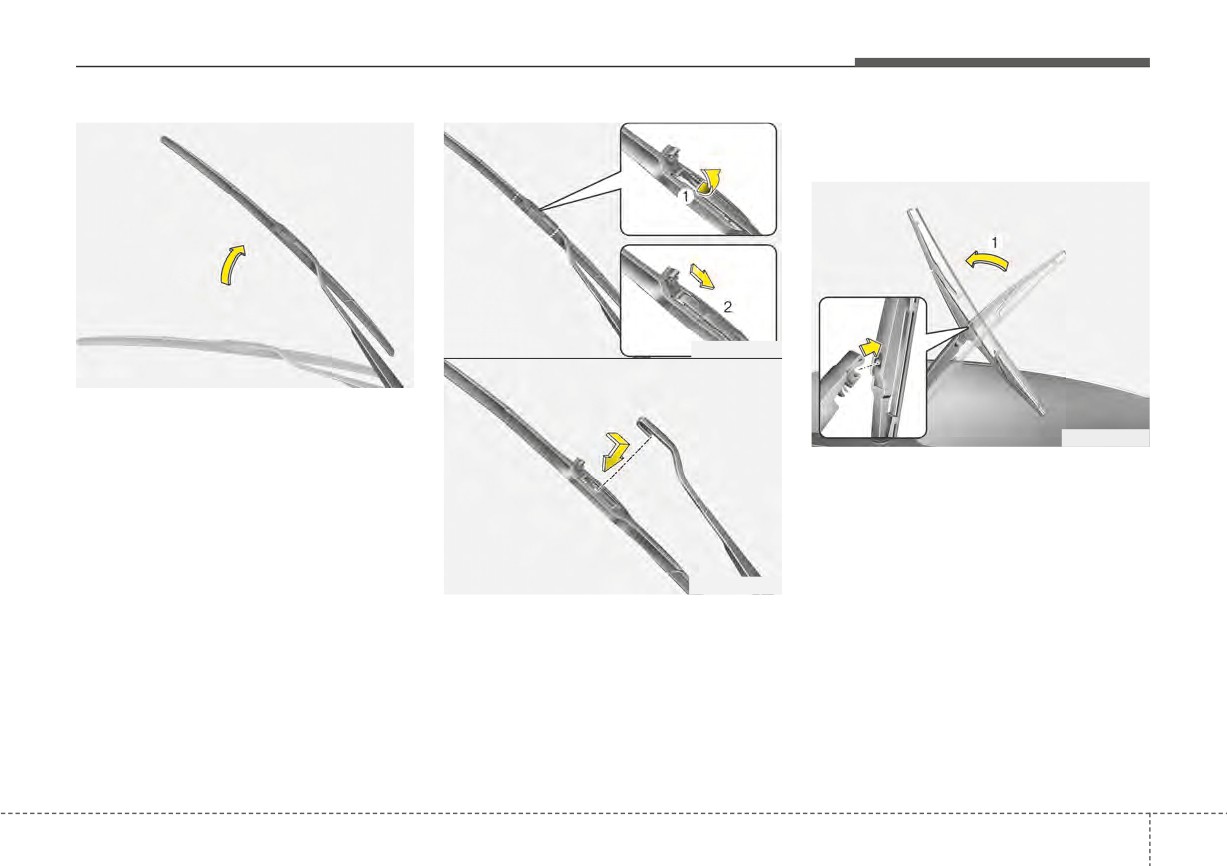
Rear window wiper blade
(for 5 door)
OHM078060
OHM078059
Type B
1. Raise the wiper arm.
OHM078062
1. Raise the wiper arm and pull out
the wiper blade assembly.
OHM078061
2. Lift up the wiper blade clip. Then
pull down the blade assembly and
remove it.
3. Install the new blade assembly in
the reverse order of removal.
7
37
Maintenance
OHM078063
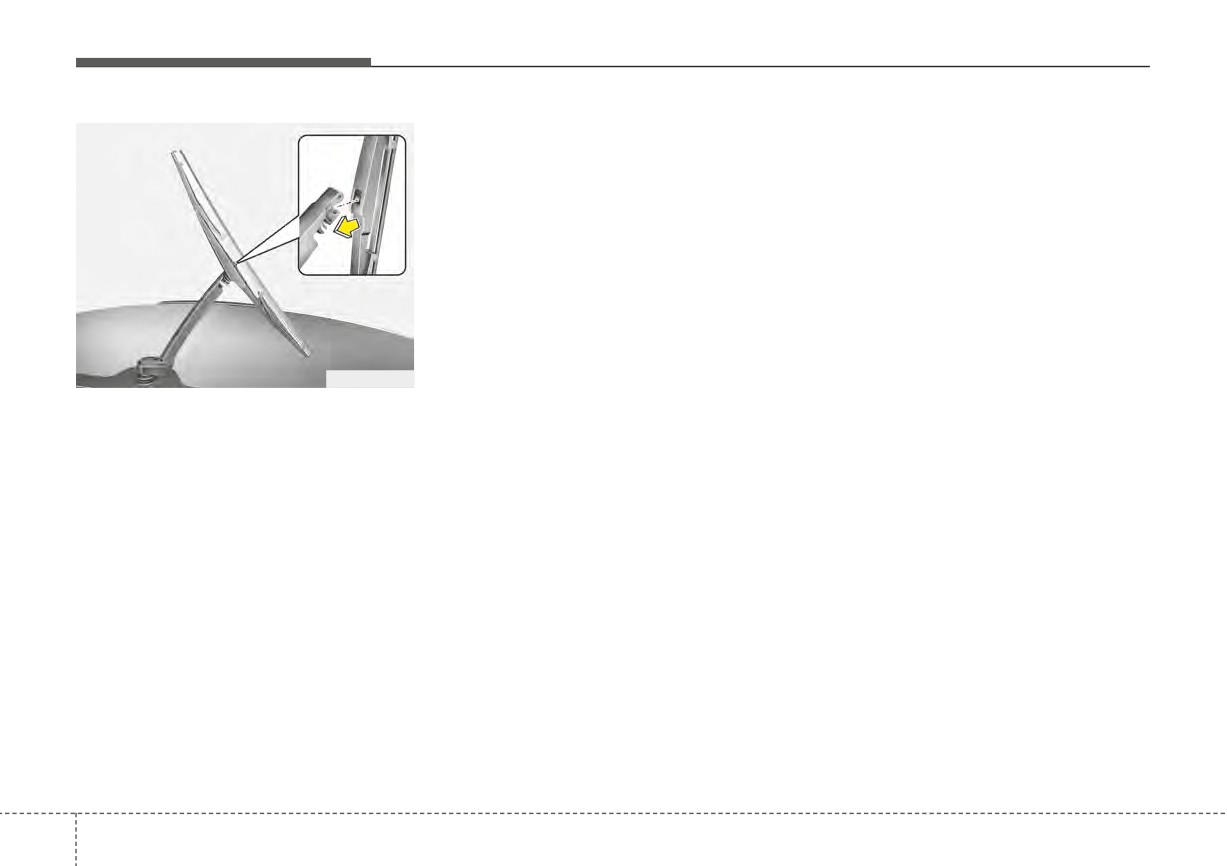
2. Install the new blade assembly by
inserting the center part into the
slot in the wiper arm until it clicks
into place.
3. Make sure the blade assembly is
installed firmly by trying to pull it
slightly.
To prevent damage to the wiper arms
or other components, have an
authorized Kia dealer replace the
wiper blade.
7
38
Maintenance
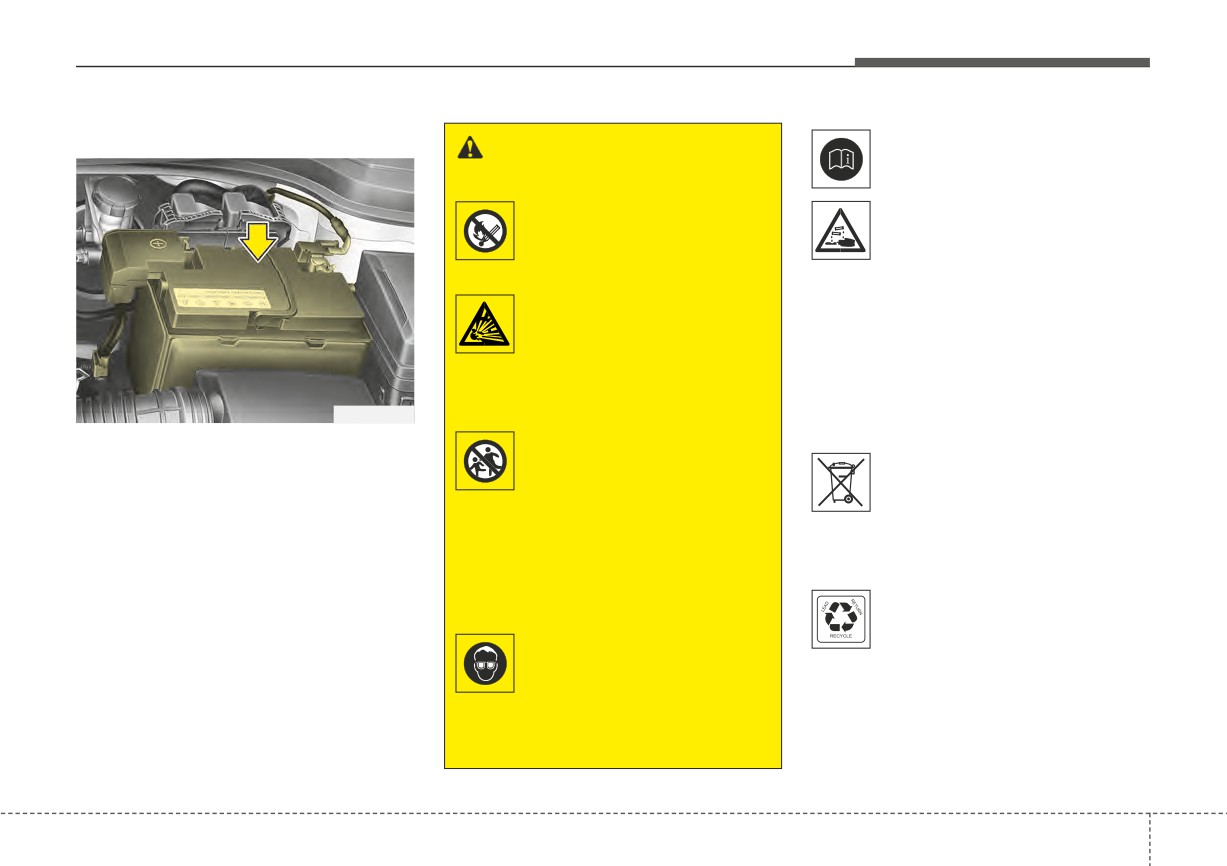
BATTERY
For best battery service
Always read the following
WARNING - Risk of
instructions carefully when
explosion
handling a battery.
Keep lit cigarettes and
If any electrolyte gets into
all other flames or
your eyes, flush your eyes
sparks away from the
with clean water for at least
battery.
15 minutes and get immedi-
ate medical attention.
The battery contains
hydrogen
-- a highly
If electrolyte gets on your
combustible gas which
skin, thoroughly wash the
will explode if it comes
contacted area. If you feel
in contact with a flame or
pain or a burning sensation,
spark.
get medical attention imme-
OYB076025
diately.
Keep batteries out of the
•
Keep the battery securely mount-
reach
of
children
An inappropriately disposed
ed.
because batteries con-
battery can be harmful to the
•
Keep the battery top clean and dry.
tain highly corrosive
environment and human
•
Keep the terminals and connec-
SULFURIC ACID and
health. Dispose of the battery
tions clean, tight, and coated with
electrolytes. Do not
according to your local law(s)
petroleum jelly or terminal grease.
allow battery acid to
or regulation.
contact your skin, eyes,
•
Rinse any spilled electrolyte from
The battery contains lead. Do
clothing or paint finish.
the battery immediately with a
not dispose of it after use.
solution of water and baking soda.
Wear eye protection
Please return the battery to
when charging or work-
an authorized Kia dealer to
•
If the vehicle is not going to be
ing near a battery.
be recycled.
used for an extended time, discon-
Always provide ventila-
Never attempt to recharge the bat-
nect the battery cables.
tion when working in an
tery when the battery cables are con-
enclosed space.
nected.
7
39
Maintenance
Recharging the battery
WARNING - Risk of elec-
WARNING - Battery lead
Your vehicle has a maintenance-free,
trocution
compound
calcium-based battery.
Never touch the electrical igni-
Battery posts, terminals, and
• If the battery becomes discharged
tion system while the vehicle is
related accessories contain
in a short time (because, for exam-
running. This system works
lead and lead compounds.
ple, the headlamps or interior
with high voltage which can
Wash hands after handling.
lamps were left on while the vehi-
shock you.
cle was not in use), recharge it by
✽ NOTICE
slow charging (trickle) for 10 hours.
If you connect unauthorized elec-
• If the battery gradually discharges
WARNING - Recharging
because of high electric load while
tronic devices to the battery, the bat-
Battery
tery may be discharged. Never use
the vehicle is being used, recharge
Never attempt to recharge the
it at 20-30A for two hours.
unauthorized devices.
battery when the battery cables
are connected.
7
40
Maintenance
When recharging the battery,
• Before performing maintenance or
Reset items
observe the following precautions:
recharging the battery, turn off all
The following items should be reset
accessories and stop the engine.
•
The battery must be removed from
after the battery has been dis-
the vehicle and placed in an area
• The negative battery cable must be
charged or the battery has been dis-
with good ventilation.
removed first and installed last
connected.
when the battery is disconnected.
•
Do not allow cigarettes, sparks, or
•
Auto up/down window
flame near the battery.
•
Sunroof
CAUTION - AGM battery
•
Watch the battery during charging,
•
Trip computer
and stop or reduce the charging
• Absorbent Glass Mat (AGM)
•
Climate control system
rate if the battery cells begin
batteries are maintenance free
gassing (boiling) violently or if the
and have the AGM battery
temperature of the electrolyte of
serviced by a professional
any cell exceeds 120°F (49°C).
workshop. Kia recommends to
visit an authorized Kia dealer.
•
Wear eye protection when check-
ing the battery during charging.
For charging your AGM battery,
use only fully automatic battery
•
Disconnect the battery charger in
chargers that are specially
the following order.
developed for AGM batteries.
1. Turn off the battery charger main
• When replacing the AGM bat-
switch.
tery, use parts for replacement
2. Unhook the negative clamp from
from a professional workshop.
the negative battery terminal.
Kia recommends to visit an
3. Unhook the positive clamp from
authorized Kia dealer.
the positive battery terminal.
• Do not open or remove the cap
on top of the battery. This may
cause leaks of internal elec-
trolyte that could result in
severe injury.
7
41
Maintenance
TIRES AND WHEELS
Tire care
WARNING
For proper maintenance, safety, and
- Checking the tire inflation
maximum fuel economy, you must
pressure
always maintain recommended tire
inflation pressures and stay within
Inflate your tires consistent with
the load limits and weight distribution
the instructions provided in this
recommended for your vehicle.
manual.
Regularly check the tire infla-
tion pressure, and correct it as
Recommended cold tire infla-
needed: at least twice a month
tion pressures
and before a long trip.
All tire pressures
(including the
OUB071018
If you fail to observe this pre-
spare) should be checked when the
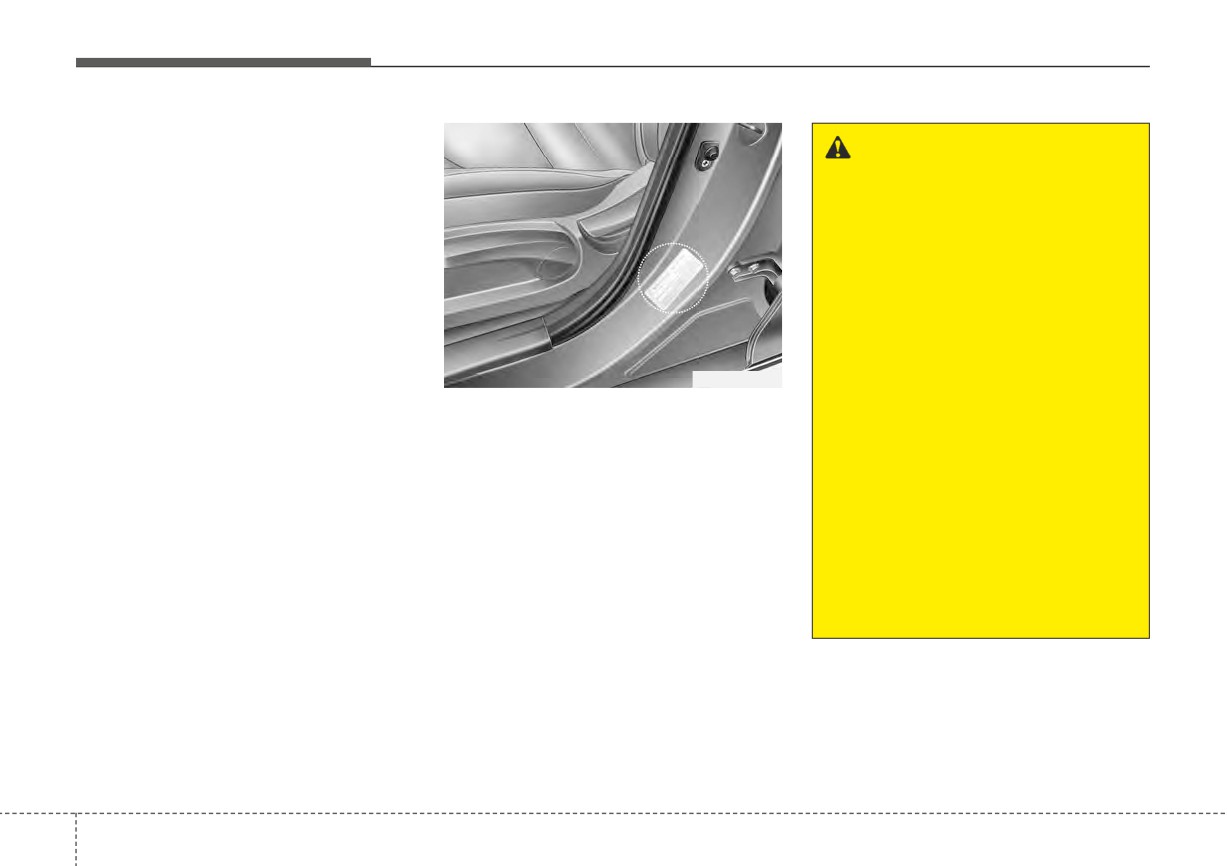
All specifications
(sizes and pres-
caution, you may be driving on
tires are cold. “Cold Tires” means the
sures) can be found on a label
tires with incorrect tire pres-
vehicle has not been driven for at
attached to the driver’s side center
sures, a condition that may not
least three hours or driven less than
pillar.
only compromise your vehicle's
1 mile (1.6 km).
driving stability, but also lead to
Recommended pressures must be
tire damage and the risk of an
maintained for the best ride, top vehi-
accident.
cle handling, and minimum tire wear.
This risk is much higher on hot
For recommended inflation pressure
days and when driving for long
refer to “Tire and wheels” in chapter 8.
periods at high speeds.
7 42
Maintenance
•
Underinflation also results in
Tire pressure
Checking tire inflation pres-
excessive wear, poor handling and
sure
Always observe the following:
reduced fuel economy. Wheel
Check your tires once a month or
deformation also is possible. Keep
• Check tire pressure when the tires
are cold. (After vehicle has been
more.
your tire pressures at the proper
levels. If a tire frequently needs
parked for at least three hours or
Also, check the tire pressure of the
hasn't been driven more than 1
spare tire.
refilling, have it checked by an
authorized Kia dealer.
mile (1.6 km) since startup.)
• Check the pressure of your spare
•
Overinflation produces a harsh
How to check
tire each time you check the pres-
ride, excessive wear at the center
Use a good quality gauge to check
sure of other tires.
of the tire tread, and a greater pos-
tire pressure. You cannot tell if your
sibility of damage from road haz-
• Never overload your vehicle. Be
tires are properly inflated simply by
ards.
careful not to overload a vehicle
looking at them. Radial tires may
luggage rack if your vehicle is
•
Warm tires normally exceed rec-
look properly inflated even when
ommended cold tire pressures by 4
equipped with one.
they're underinflated.
to
6 psi (28 to 41 kPa). Do not
Check the tire's inflation pressure
release air from warm tires to
when the tires are cold.
- "Cold"
WARNING - Tire Inflation
adjust the pressure or the tires will
means your vehicle has been sitting
be underinflated.
Overinflation or underinflation
for at least three hours or driven no
can reduce tire life, adversely
•
Be sure to reinstall the tire inflation
more than 1 mile (1.6 km).
affect vehicle handling, and
valve caps. Without the valve cap,
lead to sudden tire failure. This
dirt or moisture could get into the
could result in loss of vehicle
valve core and cause air leakage. If
control and potential injury.
a valve cap is missing, install a
new one as soon as possible.
7
43
Maintenance
Remove the valve cap from the tire
•
Inspect your tires frequently for
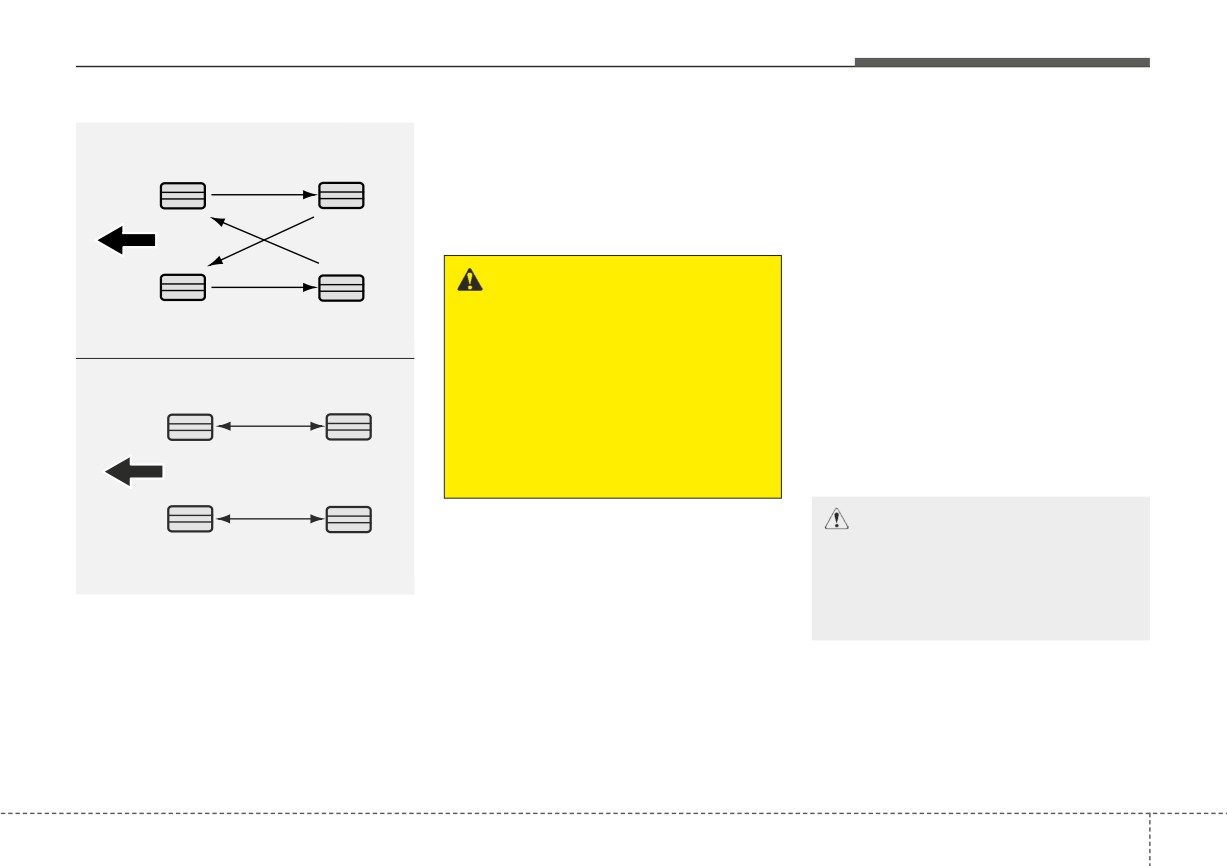
Tire rotation
valve stem. Press the tire gauge firm-
proper inflation as well as wear and
To equalize tread wear, it is recom-
ly onto the valve to get a pressure
damage. Always use a tire pres-
mended that the tires be rotated
measurement. If the cold tire inflation
sure gauge.
every 8,000 miles
(13,000 km) or
pressure matches the recommended
•
Tires with too much or too little
sooner if irregular wear develops.
pressure on the tire and loading
pressure can cause tires to wear
During rotation, check the tires for
information label, no further adjust-
unevenly, causing poor handling,
ment is necessary. If the pressure is
correct balance.
loss of vehicle control, and sudden
low, add air until you reach the rec-
When rotating tires, check for uneven
tire failure leading to accidents,
ommended amount.
wear and damage. Abnormal wear is
injuries, and even death. The rec-
usually caused by incorrect tire pres-
If you overfill the tire, release air by
ommended cold tire pressure for
sure, improper wheel alignment, out-
pushing on the metal stem in the
your vehicle can be found in this
of-balance wheels, severe braking or
center of the tire valve. Recheck the
manual and on the tire label locat-
severe cornering. Look for bumps or
tire pressure with the tire gauge. Be
ed on the driver's side center pillar.
bulges in the tread or side of the tire.
sure to put the valve caps back on
•
Remember to check the pressure
Replace the tire if you find either of
the valve stems. They help prevent
of your spare tire. Kia recommends
these conditions. Replace the tire if
leaks by keeping out dirt and mois-
that you check the spare every
fabric or cord is visible. After rotation,
ture.
time you check the pressure of the
be sure to bring the front and rear tire
other tires on your vehicle.
pressures to specification and check
lug nut tightness.
Refer to “Tire and wheels” in chapter
8.
7
44
Maintenance
Without a spare tire
Disc brake pads should be inspected
Wheel alignment and tire bal-
for wear whenever tires are rotated.
ance
Rotate radial tires that have an
The wheels on your vehicle were
asymmetric tread pattern only from
aligned and balanced carefully at the
front to rear and not from right to left.
factory to give you the longest tire life
and best overall performance.
WARNING - Mixing tires
In most cases, you will not need to
have your wheels aligned again.
• Do not use the compact spare
However, if you notice unusual tire
tire (if equipped) for tire rota-
S2BLA790A
wear or your vehicle pulling one way
tion.
Directional tires (if equipped)
or the other, the alignment may need
• Do not mix bias ply and radial
to be reset.
ply tires under any circum-
If you notice your vehicle vibrating
stances. This may cause
when driving on a smooth road, your
unusual handling characteris-
wheels may need to be rebalanced.
tics.
CAUTION - Wheel weight
Improper wheel weights can
damage your vehicle's alu-
CBGQ0707A
minum wheels. Use only
approved wheel weights.
7
45
Maintenance
Tire replacement
The ABS works by comparing the
Compact spare tire replacement
speed of the wheels. The tire size
A compact spare tire has a shorter
affects wheel speed. When replacing
tread life than a regular size tire.
tires, all 4 tires must use the same
Replace it when you can see the
size originally supplied with the vehi-
tread wear indicator bars on the tire.
cle. Using tires of a different size can
The replacement compact spare tire
cause the ABS
(Anti-lock Brake
should be the same size and design
System) and ESC
(Electronic
tire as the one provided with your
Stability Control) to work irregularly.
new vehicle and should be mounted
on the same compact spare tire
wheel. The compact spare tire is not
✽ NOTICE
designed to be mounted on a regular
• We recommend that when replac-
size wheel, and the compact spare
OUM076204L
ing tires, use the same which were
tire wheel is not designed for mount-
originally supplied with the vehi-
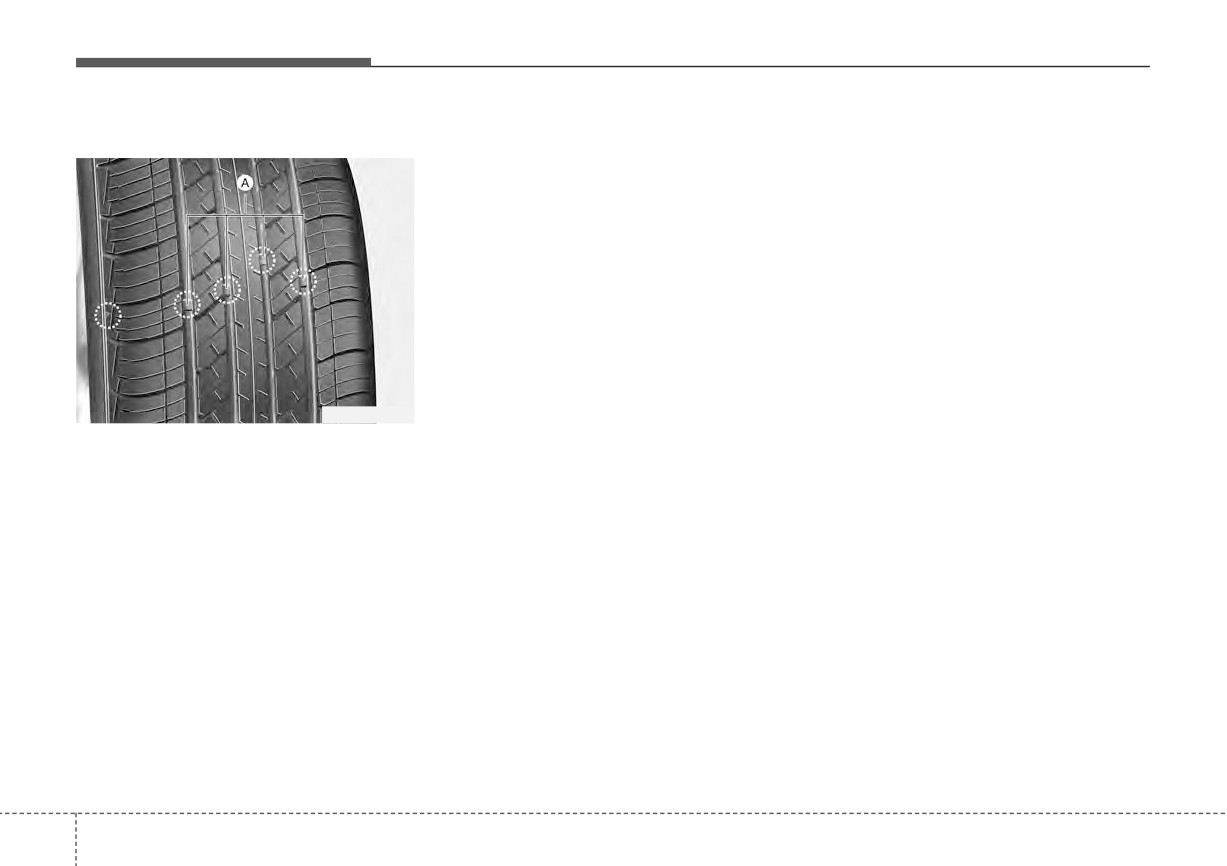
If the tire is worn evenly, a tread wear
ing a regular size tire.
cle. If not, driving performance
Indicator (A) will appear as a solid
could be altered.
band across the tread. This shows
• It is best to replace all four tires at
there is less than 1/16 inch (1.6 mm)
the same time. If that is not possi-
of tread left on the tire. Replace the
ble, or necessary, then replace the
tire when this happens.
two front or two rear tires as a pair.
Do not wait for the band to appear
Replacing just one tire can serious-
across the entire tread before replac-
ly affect your vehicle's handling.
ing the tire.
7
46
Maintenance
Wheel replacement
Tire traction
Tire sidewall labeling
When replacing the metal wheels for
Tire traction can be reduced if you
any reason, make sure the new
drive on worn tires, tires that are
wheels are equivalent to the original
improperly inflated or on slippery
factory units in diameter, rim width
road surfaces. Tires should be
and offset.
replaced when tread wear indicators
appear. Slow down whenever there
A wheel that is not the correct size
is rain, snow or ice on the road, to
may adversely affect wheel and
reduce the possibility of losing con-
bearing life, braking and stopping
trol of the vehicle.
abilities, handling characteristics,
ground clearance, body-to-tire clear-
ance, snow chain clearance,
Tire maintenance
speedometer and odometer calibra-
OJF085008L
tion, headlight aim and bumper
In addition to proper inflation, correct
height.
wheel alignment helps to decrease
This information identifies and
tire wear. If you find a tire is worn
describes the fundamental charac-
unevenly, have your dealer check the
teristics of the tire and also provides
CAUTION
- Wheel
wheel alignment.
the tire identification number
(TIN)
Wheels that do not meet Kia's
for safety standard certification. The
When you have new tires installed,
TIN can be used to identify the tire in
specifications may fit poorly
make sure they are balanced. This
and result in damage to the
case of a recall.
will increase vehicle ride comfort and
vehicle or unusual handling and
tire life. Additionally, a tire should
poor vehicle control.
always be rebalanced if it is removed
1. Manufacturer or brand name
from the wheel.
Manufacturer or Brand name is
shown.
7
47
Maintenance
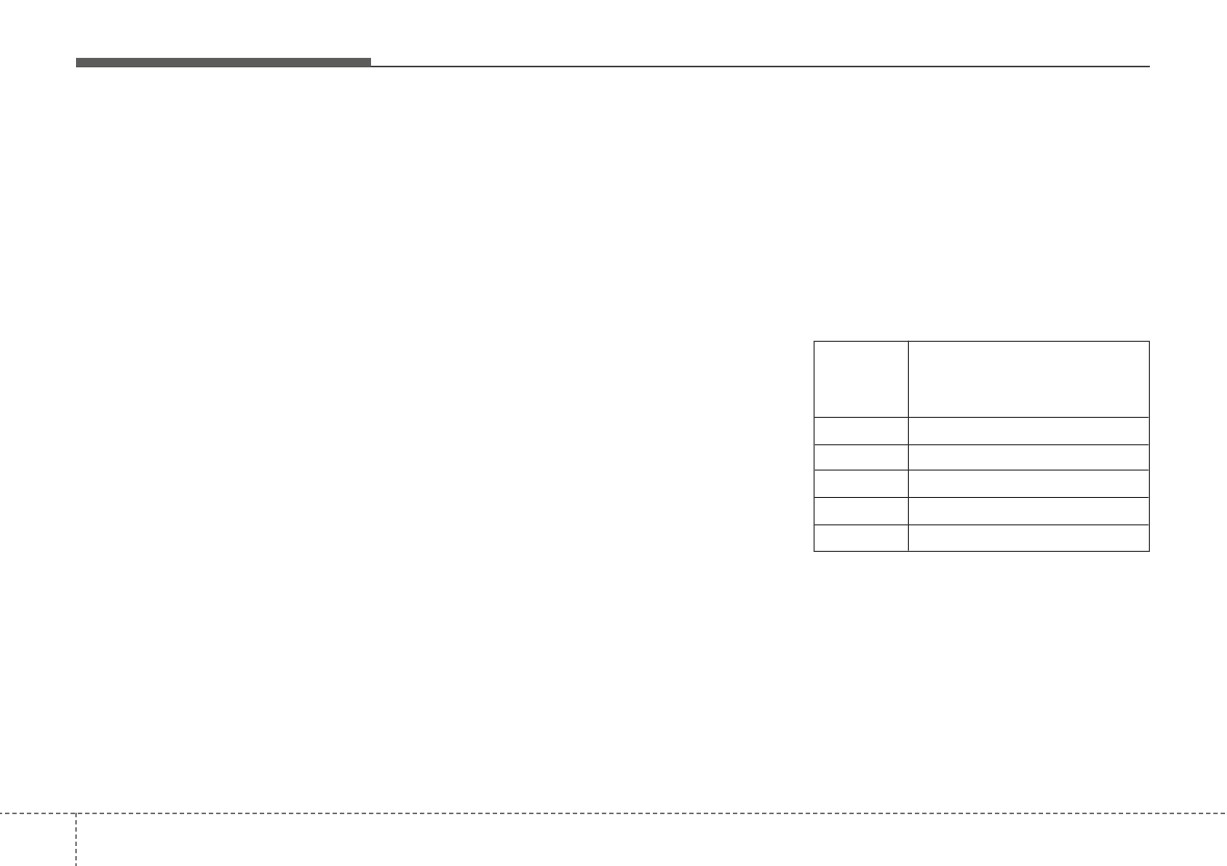
2. Tire size designation
89 - Load Index, a numerical code
Tire speed ratings
associated with the maximum
A tire’s sidewall is marked with a tire
The chart below lists many of the dif-
size designation. You will need this
load the tire can carry.
ferent speed ratings currently being
information when selecting replace-
H - Speed Rating Symbol. See the
used for passenger vehicles. The
ment tires for your car. The following
speed rating chart in this section
speed rating is part of the tire size
explains what the letters and num-
for additional information.
designation on the sidewall of the
bers in the tire size designation
tire. This symbol corresponds to that
mean.
tire's designed maximum safe oper-
Wheel size designation
ating speed.
Example tire size designation:
Wheels are also marked with impor-
(These numbers are provided as an
tant information that you need if you
Speed
example only; your tire size designa-
ever have to replace one. The follow-
Rating
Maximum Speed
tor could vary depending on your
ing explains what the letters and
Symbol
vehicle.)
numbers in the wheel size designa-
S
112 mph (180 km/h)
P205/55R16 89H
tion mean.
T
118 mph (190 km/h)
P - Applicable vehicle type
(tires
H
130 mph (210 km/h)
marked with the prefix “P’’ are
Example wheel size designation:
V
149 mph (240 km/h)
intended for use on passenger
6.0JX16
vehicles or light trucks; however,
Z
Above 149 mph (240 km/h)
not all tires have this marking).
6.0 - Rim width in inches.
205 - Tire width in millimeters.
J - Rim contour designation.
55 - Aspect ratio. The tire’s section
16 - Rim diameter in inches.
height as a percentage of its
width.
R - Tire construction code (Radial).
16 - Rim diameter in inches.
7
48
Maintenance
3. Checking tire life (TIN : Tire
5. Maximum permissible inflation
Identification Number)
WARNING - Tire age
pressure
Any tires that are over 6 years old,
Replace tires within the recom-
This number is the greatest amount of
based on the manufacturing date,
mended time frame. Failure to
air pressure that should be put in the
(including the spare tire) should be
replace tires as recommended
tire. Do not exceed the maximum per-
replaced by new ones. You can find
can result in sudden tire failure,
missible inflation pressure. Refer to
the manufacturing date on the tire
which could lead to a loss of
the Tire and Loading Information label
sidewall (possibly on the inside of the
control and an accident.
for recommended inflation pressure.
wheel), displaying the DOT Code.
The DOT Code is a series of num-
6. Maximum load rating
bers on a tire consisting of numbers
4. Tire ply composition and mate-
and English letters. The manufactur-
rial
This number indicates the maximum
ing date is designated by the last four
load in kilograms and pounds that can
The number of layers or plies of rub-
digits (characters) of the DOT code.
be carried by the tire. When replacing
ber-coated fabric in the tire. Tire
the tires on the vehicle, always use a
manufacturers also must indicate the
tire that has the same load rating as
DOT : XXXX XXXX OOOO
materials in the tire, which include
the factory installed tire.
steel, nylon, polyester, and others.
The front part of the DOT means a
The letter "R" means radial ply con-
plant code number, tire size and
struction; the letter "D" means diago-
7. Uniform Tire Quality Grading
tread pattern and the last four num-
nal or bias ply construction; and the
bers indicate week and year manu-
Quality grades can be found where
letter "B" means belted-bias ply con-
factured.
applicable on the tire sidewall
struction.
For example:
between tread shoulder and maxi-
mum section width.
DOT XXXX XXXX 1621 represents
that the tire was produced in the 16th
For example:
week of 2021.
Treadwear 200
Traction AA
Temperature A
7
49
Maintenance
Tread wear
Tires degrade over time, even when
Traction - AA, A, B & C
they are not being used. Regardless
The tread wear grade is a compara-
The traction grades, from highest to
tive rating based on the wear rate of
of the remaining tread, we recom-
lowest, are AA, A, B and C. Those
mend that tires be replaced after
the tire when tested under controlled
grades represent the tires ability to
conditions on a specified govern-
approximately six (6) years of normal
stop on wet pavement as measured
service. Heat caused by hot climates
ment test course. For example, a tire
under controlled conditions on spec-
graded 150 would wear one-and-a-
or frequent high loading conditions
ified government test surfaces of
can accelerate the aging process.
half times (1½) as well on the gov-
asphalt and concrete. A tire marked
ernment course as a tire graded 100.
These grades are molded on the
C may have poor traction perform-
side-walls of passenger vehicle tires.
ance.
The relative performance of tires
depends upon the actual conditions
The tires available as standard or
The traction grade assigned to this
optional equipment on your vehicles
of their use, however, and may
tire is based on straight-ahead brak-
depart significantly from the norm
may vary with respect to grade.
ing traction tests, and does not
due to variations in driving habits,
include acceleration, cornering,
service practices and differences in
hydroplaning, or peak traction char-
road characteristics and climate.
acteristics.
7
50
Maintenance
Temperature -A, B & C
Tire terminology and definitions
Cold Tire Pressure: The amount of
air pressure in a tire, measured in
The temperature grades are A (the
Air Pressure: The amount of air
kilopascals
(kPa) or pounds per
highest), B and C representing the
inside the tire pressing outward on
square inch (psi) before a tire has
tire’s resistance to the generation of
the tire. Air pressure is expressed in
heat and its ability to dissipate heat
kilopascal
(kPa) or pounds per
built up heat from driving.
when tested under controlled condi-
square inch (psi).
Curb Weight: This means the weight
tions on a specified indoor laboratory
of a motor vehicle with standard and
Accessory Weight: This means the
test wheel.
optional equipment including the
combined weight of optional acces-
Sustained high temperature can
sories. Some examples of optional
maximum capacity of fuel, oil and
coolant, but without passengers and
cause the material of the tire to
accessories are, intelligent variable
degenerate and reduce tire life, and
transmission, power seats, and air
cargo.
excessive temperature can lead to
conditioning.
DOT Markings: A code molded into
sudden tire failure. The grade C cor-
the sidewall of a tire signifying that
Aspect Ratio: The relationship of a
responds to a level of performance
the tire is in compliance with the U.S.
tire's height to its width.
which all passenger car tires must
Department of Transportation motor
Belt: A rubber coated layer of cords
meet under the Federal Motor
vehicle safety standards. The DOT
that is located between the plies and
Vehicle Safety Standard No.
109.
code includes the Tire Identification
the tread. Cords may be made from
Grades B and A represent higher
Number (TIN), an alphanumeric des-
steel or other reinforcing materials.
levels of performance on the labora-
ignator which can also identify the
tory test wheel than the minimum
Bead: The tire bead contains steel
tire manufacturer, production plant,
required by law.
wires wrapped by steel cords that
brand and date of production.
hold the tire onto the rim.
Bias Ply Tire: A pneumatic tire in
which the plies are laid at alternate
angles less than 90 degrees to the
centerline of the tread.
7
51
Maintenance
GVWR: Gross Vehicle Weight Rating
Maximum Inflation Pressure: The
Occupant Distribution: Designated
maximum air pressure to which a
seating positions.
GAWR FRT: Gross Axle Weight
Rating for the Front Axle.
cold tire may be inflated. The maxi-
Outward Facing Sidewall: The side
mum air pressure is molded onto the
of a asymmetrical tire that has a par-
GAWR RR: Gross Axle Weight
sidewall.
ticular side that faces outward when
Rating for the Rear axle.
Maximum Load Rating: The load
mounted on a vehicle. The outward
Intended Outboard Sidewall: The
rating for a tire at the maximum per-
facing sidewall bears white lettering
side of an asymmetrical tire, that
missible inflation pressure for that
or bears manufacturer, brand, and/or
must always face outward when
tire.
model name molding that is higher or
mounted on a vehicle.
deeper than the same moldings on
Maximum Loaded Vehicle Weight:
Kilopascal (kPa): The metric unit for
the inner facing sidewall.
The sum of curb weight; accessory
air pressure.
weight; vehicle capacity weight; and
Passenger (P-Metric) Tire: A tire
Light truck(LT) tire: A tire designat-
production options weight.
used on passenger cars and some
ed by its manufacturer as primarily
light duty trucks and multipurpose
Normal Occupant Weight: The
intended for use on lightweight trucks
vehicles.
number of occupants a vehicle is
or multipurpose passenger vehicles.
designed to seat multiplied by 150
Ply: A layer of rubber-coated parallel
Load Index: An assigned number
lbs. (68kg).
cords
ranging from 1 to 279 that corre-
Pneumatic tire: A mechanical
sponds to the load carrying capacity
device made of rubber, chemicals,
of a tire.
fabric and steel or other materials,
Load ratings: The maximum load
that, when mounted on an automo-
that a tire is rated to carry for a given
tive wheel, provides the traction and
inflation pressure.
contains the gas or fluid that sustains
the load.
7
52
Maintenance
Production options weight: The
Speed Rating: An alphanumeric
Vehicle Maximum Load on the
combined weight of installed regular
code assigned to a tire indicating the
Tire: Load on an individual tire due
production options weighing over 5
maximum speed at which a tire can
to curb and accessory weight plus
lb.(2.3 kg) in excess of the standard
operate.
maximum occupant and cargo
items which they replace, not previ-
weight.
Traction: The friction between the
ously considered in curb weight or
tire and the road surface. The
Vehicle Normal Load on the Tire:
accessory weight, including heavy
amount of grip provided.
Load on an individual tire that is
duty brakes, ride levelers, roof rack,
determined by distributing to each
Tread: The portion of a tire that
heavy duty battery, and special trim.
axle its share of the curb weight,
comes into contact with the road.
Recommended Inflation Pressure:
accessory weight, and normal occu-
Treadwear Indicators: Narrow
Vehicle manufacturer's recommend-
pant weight and dividing by 2.
bands, sometimes called "wear
ed tire inflation pressure as shown
Vehicle Placard: A label permanent-
bars," that show across the tread of a
on the tire placard.
ly attached to a vehicle showing the
tire when only
1/16 inch of tread
Radial Ply Tire: A pneumatic tire in
original equipment tire size and rec-
remains.
which the ply cords that extend to the
ommended inflation pressure.
UTQGS: Uniform Tire Quality
beads are laid at 90 degrees to the
Grading Standards, a tire information
centerline of the tread.
system that provides consumers with
Rim: A metal support for a tire and
ratings for a tire's traction, tempera-
upon which the tire beads are seat-
ture and treadwear. Ratings are
ed.
determined by tire manufacturers
Sidewall: The portion of a tire
using government testing proce-
between the tread and the bead.
dures. The ratings are molded into
the sidewall of the tire.
Vehicle Capacity Weight: The num-
ber of designated seating positions
multiplied by 150 lbs. (68kg) plus the
rated cargo and luggage load.
7
53
Maintenance
All season tires
Snow tires
WARNING
Kia specifies all season tires on
If you equip your car with snow tires,
Do not use summer tires at tem-
some models to provide good per-
they should be the same size and
formance for use all year round,
peratures below 45°F (7°C) or
have the same load capacity as the
when driving on snow or ice. At
including snowy and icy road condi-
original tires. Snow tires should be
tions. All season tires are identified
temperatures below 45°F (7°C),
installed on all four wheels; other-
summer tires can lose elastici-
by ALL SEASON and/or M+S (Mud
wise, poor handling may result.
and Snow) on the tire sidewall. Snow
ty, and therefore traction and
Snow tires should carry 4 psi (28
braking power as well. Change
tires have better snow traction than
kPa) more air pressure than the
all season tires and may be more
the tires on your vehicle to win-
pressure recommended for the stan-
ter or all-weather tires of the
appropriate in some areas.
dard tires on the tire label on the dri-
same size as the standard tires
ver's side of the center pillar, or up to
of the vehicle. Both types of
the maximum pressure shown on the
Summer tires
tires are identified by the M+S
tire sidewall, whichever is less.
(Mud and Snow) marking. Using
Kia specifies summer tires on some
Do not drive faster than 75 mph (120
summer tires at very cold tem-
models to provide superior perform-
peratures could cause cracks to
km/h) when your vehicle is equipped
ance on dry roads. Summer tire per-
with snow tires.
form, thereby damaging the
formance is substantially reduced in
tires permanently.
snow and ice. Summer tires do not
have the tire traction rating M+S
(Mud and Snow) on the tire side wall.
If you plan to operate your vehicle in
snowy or icy conditions, Kia recom-
mends the use of snow tires or all
season tires on all four wheels.
7
54
Maintenance
Tire chains
Radial-ply tires
Longer wearing tires can be more
susceptible to irregular tread wear. It
Tire chains, if necessary, should be
Radial-ply tires provide improved
is very important to follow the tire
installed on the front wheels.
tread life, road hazard resistance and
rotation interval shown in this section
smoother high speed ride. The radi-
Be sure that the chains are installed
to achieve the tread life potential of
al-ply tires used on this vehicle are
in accordance with the manufactur-
these tires. Cuts and punctures in
of belted construction and are select-
er's instructions.
radial-ply tires are repairable only in
ed to complement the ride and han-
To minimize tire and chain wear, do
the tread area, because of sidewall
dling characteristics of your vehicle.
not continue to use tire chains when
flexing. Consult your tire dealer
for
they are no longer needed.
Radial-ply tires have the same load
radial-ply tire repairs.
carrying capacity as bias-ply or bias
•
When driving on roads covered
belted tires of the same size and use
with snow or ice, drive at less than
the same recommended inflation
20 mph (30 km/h).
pressure. Mixing of radial-ply tires
•
Use the SAE “S” class or wire
with bias-ply or bias belted tires is
chains.
not recommended. Any combina-
•
If you hear noise caused by chains
tions of radial-ply and bias-ply or bias
contacting the body, retighten the
belted tires when used on the same
chain to avoid contact with the
vehicle will seriously deteriorate
vehicle body.
vehicle handling. The best rule to fol-
low is: identical radial-ply tires should
•
To prevent body damage, retighten
always be used as a set of four.
the chains after driving
0.3~0.6
miles (0.5~1.0 km).
•
Do not use tire chains on vehicles
equipped with aluminum wheels.
In unavoidable circumstances, use
a wire type chain.
•
Use wire chains less than 0.59 in
(15 mm) in width to prevent dam-
age to the chain’s connection.
7 55
Maintenance
Low aspect ratio tire
•
It is not easy to recognize the tire
(if equipped)
CAUTION
damage with your own eyes. In the
Because the sidewall of a low
event that the tire is impacted, have
Low aspect ratio tires, whose aspect
aspect ratio tire is shorter than
the tire checked or replaced
ratio is lower than 50, are provided
normal, the wheel and tire of a
because the tire damage may
for sporty looks.
low aspect ratio tire is more eas-
cause air leakage from the tire.
Because the low aspect ratio tires
ily damaged. Therefore, follow
•
If the tire is damaged by driving on
are optimized for handling and brak-
the instructions below.
a rough road, off road, pothole,
ing, they may be more uncomfortable
•
When driving on a rough road
manhole, or curb stone, the dam-
to ride in and more noisy when com-
or off road, drive cautiously
age will not be covered by the war-
pared with normal tires.
because the tires and wheels
ranty.
may become damaged. And
•
You can find out tire information on
after driving, inspect the tires
the tire sidewall.
and wheels.
•
When passing over a pothole,
speed bump, manhole, or curb
stone, drive slowly so that the
tires and wheels are not dam-
aged.
•
If the tire is impacted, we rec-
ommend that you inspect the
tire condition or contact an
authorized Kia dealer.
•
To prevent damage to the tire,
inspect the tire condition and
pressure every
1,900 miles
(3,000 km).
7
56
Maintenance
FUSES
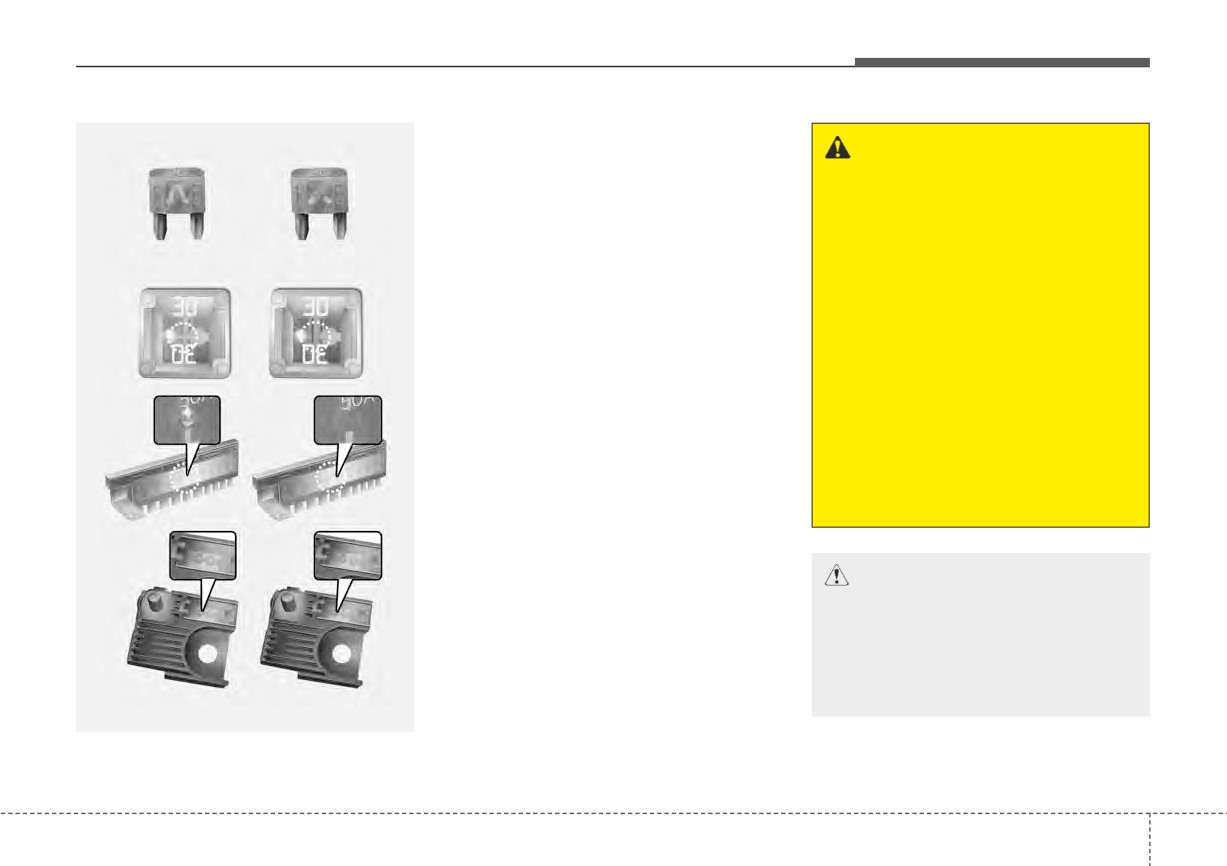
■ Blade type
A vehicle’s electrical system is pro-
tected from electrical overload dam-
WARNING - Fuse replace-
age by fuses.
ment
This vehicle has 2 (or 3) fuse panels,
•
Never replace a fuse with any-
one located in the driver’s side panel
thing but another fuse of the
bolster, the other in the engine com-
same rating.
■ Cartridge type
partment near the battery.
•
A higher capacity fuse could
If any of your vehicle’s lights, acces-
cause damage and possibly a
sories, or controls do not work, check
fire.
the appropriate circuit fuse. If a fuse
•
Never install a wire or alu-
has blown, the element inside the
minum foil instead of the
fuse will melt.
proper fuse - even as a tem-
■ Multi fuse
If the electrical system does not
porary repair. It may cause
work, first check the driver’s side
extensive wiring damage and
fuse panel.
a possible fire.
Always replace a blown fuse with
•
Do not modify or add-on elec-
one of the same rating.
tric wiring to the vehicle.
If the replacement fuse blows, this
■ BFT
indicates an electrical problem. Avoid
using the system involved and imme-
CAUTION
diately consult an authorized Kia
Do not use a screwdriver or any
dealer.
other metal object to remove
Three kinds of fuses are used: blade
fuses because it may cause a
type for lower amperage rating, car-
short circuit and damage the
tridge type, and multi fuse for higher
system.
amperage ratings.
OJF075021
❈ Left side : Normal , Right side : Blown
7
57
Maintenance
✽ NOTICE
CAUTION
CAUTION
• When replacing fuse, turn the
•
When replacing a blown fuse
•
Do not input any other objects
ignition
“OFF” and turn off
or relay, make sure the new
except fuses or relays into
switches of all electrical devices
fuse or relay fits tightly into
fuse/relay terminals such as a
then remove battery (-) terminal.
the clips. Failure to tightly
screwdriver or wiring. It may
• The actual fuse/relay panel label
install the fuse or relay may
cause contact failure and sys-
may differ from equipped items.
cause damage to the wiring
tem malfunction.
and electric systems.
•
Do not plug in screwdrivers or
WARNING - Electrical Fire
•
Do not remove fuses, relays
aftermarket wiring into the ter-
and terminals fastened with
minal originally designed for
Always ensure replacements
bolts or nuts. The fuses, relays
fuse and relays only. The elec-
fuses and relays are securely
and terminals may not be fas-
trical system and wiring of the
fastened when installed. Failure
tened correctly which may
vehicle interior may be dam-
to do so can result in a vehicle
cause vehicle damage.
aged or burned due to contact
fire.
failure.
•
If you directly connect the
wire on the taillight or replace
the bulb which is over the reg-
ulated capacity to install trail-
ers etc., the inner junction
block can get burned.
7
58