Amtrak. Service Standards Manual for Train Service and On-Board Service Employees (Version 6, 2011) - page 15
Vendor. The Catering Vendor will dispose all
bagged and tagged items after all other post
trip work has been completed, and the LSA
and Chef have left the catering facility.
• The OBS employees must verify and ensure
the Catering Vendor properly documents the
correct quantity for stock returned at the end
of the trip. The Catering Vendor employee must
sign the “Chef/LSA Enroute Condemnation
Report” (NRPC 3143) on the bottom right
corner of the form in green ink.
5.
Catering Vendor
a) The Catering Vendor must inventory the on-board
stock at the end of the trip and record all items
returned to the commissary on the “Transfer Out
Form” (896) in the “Return to Stock” column.
b) The quantity documented will include re-usable
and condemned items that are returned at the end
of the trip by the LSA or Chef. The total should
match the quantity in the “On Hand/End of
Trip” column of the “Transfer Out Form” (896).
c) Any item(s) the Catering Vendor considers
condemnation (spoiled and/or can not be reissued
to another train) will be counted after the
LSA/Chef leaves the catering facility and such
items will be documented in the “ARAMARK
CNDM” column on the “Transfer Out Form” (896).
d) If the Catering Vendor would like a copy of the
“Chef/LSA Enroute Condemnation Report”
(NRPC 3143), they will need to make a photo-copy
from the Chef and LSA copies.
6.
Auto Train
a) All on-board condemnation on the Auto Train will
be documented by the LSA/Chef in the “Transfer
Out Form” (896) “OBS CNDM” column and
should not be included in the “On Hand End of
Trip” column.
b) All re-useable items will be documented in the
“Return to Stock Column “of the “Transfer Out
Form” (896).
8-178
On-Board Service Accounting Procedures
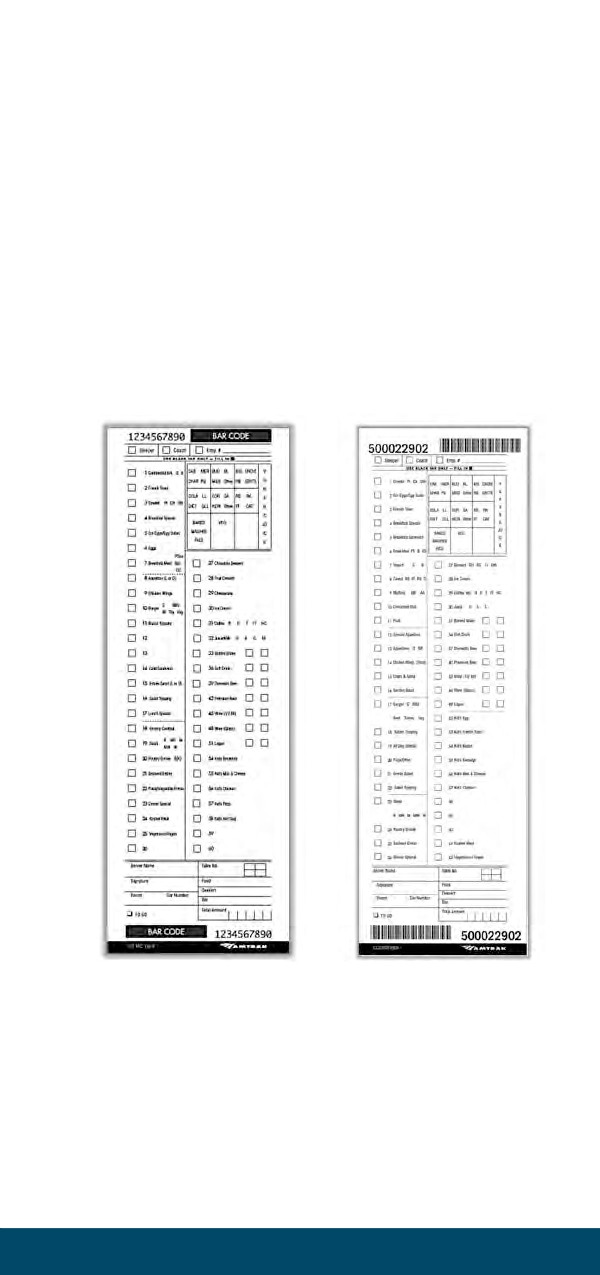
G. Meal Checks
All Amtrak Dining Cars (except Cross Country Cafe
and Auto Train) will use the Universal Meal Check
for placing food orders and beverage selections during
Breakfast, Lunch and Dinner (Refer to Figure 8-87).
The Cross Country Cafe will use the meal check
designated by the letters CCCMC in the lower left
corner. (Refer to Figure 8-88)
1. Meal Checks Consist of Three Parts
• Top - LSA’s copy.
• Middle - Customer’s record of transaction.
• Bottom - Chef’s copy.
Figure 8-87- Universal Meal Check
Figure 8-88 - Cross Country Meal Check
2. Meal Check Instructions
a) General Instructions
• When completing the check always use black ink.
• Fill in selected boxes with a circle •, not an X.
• Only one entrée can be selected per meal check.
• Up to 3 beverages may be selected per meal
check.
Service Standards Manual No. 6
8-179
•
Type of service must be selected (Sleeper,
Coach or Employee).
•
Meal Checks can be used for any meal period.
•
Employees using a meal check to obtain meals
must include their SAP number and signature.
•
The LSA or SA must ensure that the meal
check is received in the kitchen. Superliner -
drop the check down the chute. Single Level: -
walk the check to the pantry area.
•
Sleeping Car meal checks must be signed by
the passenger and include the room and car
number.
•
All meal checks will be placed face down when
positioned on the table.
•
Never fold, roll, staple or mutilate Meal Checks.
•
Meal Checks must be used to document all
Dining Car orders. It is unacceptable to
instruct or allow an employee to use any
document other than the correct meal check.
•
Unused partial packets of meal checks can be
retained by the employees for use on future
trips or can be returned to the Crew Base.
b) LSA Responsibilities
• The LSA must secure an adequate supply of
meal checks from the Crew Base based upon
the following criteria: load levels, weather
related delays, known service disruptions, etc.
• The LSA can obtain additional meal checks at
turnaround and enroute Crew Base locations.
• The LSA is required to keep meal checks
secure at all times.
• The LSA may issue each SA one book of 25 meal
checks during the meal periods, replenishing as
necessary.
• LSA can issue TA (Sleeper and Coach) one
book of 25 meal checks for use with “To Go”
orders for their assigned cars, replenishing as
necessary.
• When the customer (Sleeper, Coach or
Employee) has finished and is ready to leave,
the LSA will total the amount for Food,
Dessert and Bar purchases entering the Grand
8-180
On-Board Service Accounting Procedures
Total in the Total Amount section located at
the bottom of the meal check.
•
All customers (Sleeper, Coach and Employee)
are to be provided with the middle copy of the
meal check.
•
When separating the top and middle copies of
the universal meal check, remove the perforated
paper tab at the bottom before separating.
(Do not pull the two copies apart leaving the
bottom paper tab attached.)
•
Maintain all top copies of meal checks used.
•
Prepare an abstract sheet (Refer to Figure 8-89),
at the end of the meal period to compare the
inventory used against the copies of submitted
meal checks.
•
Every effort must be made to locate any missing
meal checks.
•
If a meal check is lost, document the missing
meal check in the Comments section of the
“Transfer Out Form” (896) using the information
from the Chef copy of the meal check.
•
Unused partial meal check books are not to be
destroyed and can either be retained by the
LSA for future use or returned to Crew Base
for re-issuing to other employees.
•
At turnaround points, it is not necessary to
turn in unused meal checks to the Crew Base.
•
Bundle meal checks by type (Sleeper, Coach,
Employee, and Void), together with a rubber
band and submit with the LSA Abstract Sheet
in the Trip Packet. (Meal checks do not need
to be put into sequential order.)
•
LSA’s working trains whose Food Service is
categorized as “Diner/Lounge Combination” will
use meal checks to take meal orders. The meal
check must be placed in the “Diner/Lounge
Combination, Food & Beverage Sales Reports”
(NRPC 3255) envelope to provide a record of
the trip for comparison against inventory used
during the trip.
Service Standards Manual No. 6
8-181
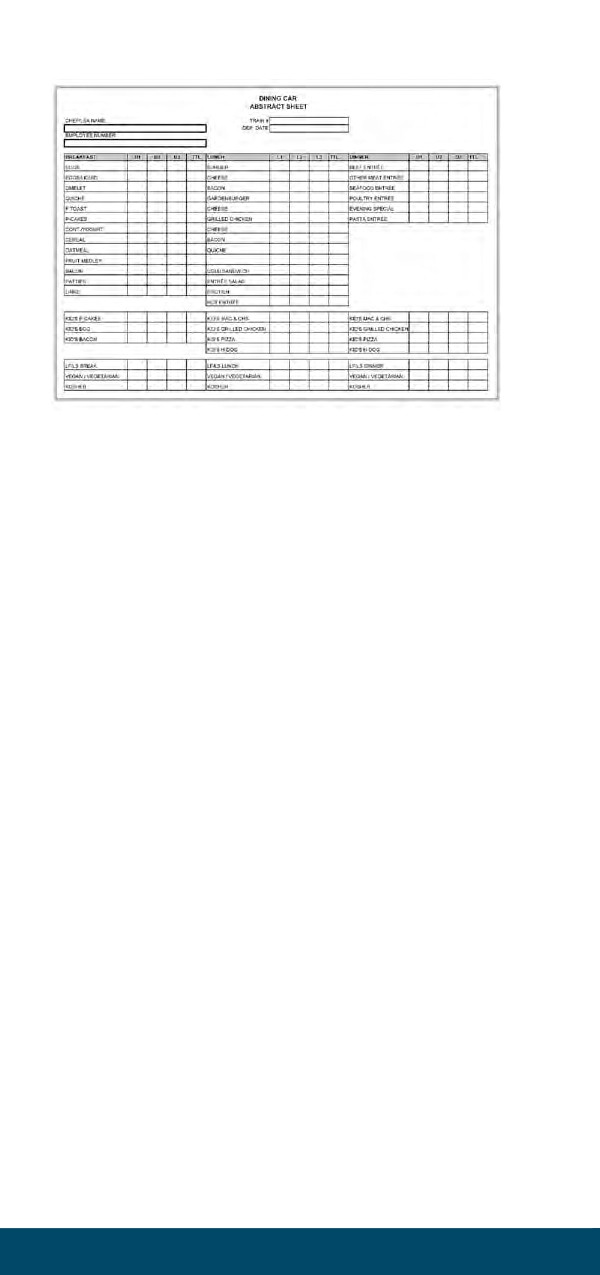
Figure 8-89 - Dining Car Abstract Sheet
c)
SA Responsibilities
• Responsible for accurately filling out the
meal checks including “Server Name”.
• Must adhere to all meal check procedures.
• Takes customer’s order using meal check.
• Ensure meal check is delivered to kitchen.
• Picks up the order, ensuring that it matches the
meal check, and is exactly what the customer
ordered.
• Responsible for noting additional revenue
beverages and desserts on the meal check.
d) Chef Responsibilities
• Ensure that only items ordered from the meal
check are served to the customer.
• Responsible for the retail value of all items
used from inventory under his/her control.
• Remove and retain bottom copy of meal check
ensuring not to remove the perforated paper
tab which holds the top two copies together.
• Top and middle meal check copies will accom-
pany the meal back to the table.
• Prepare an abstract sheet, at the end of the
meal period to compare the inventory used
against the copies of submitted meal checks.
• Every effort must be made to locate any missing
meal checks.
• If a meal check is lost, document the missing
meal check in the Comments section of the
“Transfer Out Form” (896) using the information
from the LSA copy of the meal check.
8-182
On-Board Service Accounting Procedures
• Bundle meal checks together with a rubber
band and submit with the Chef Abstract Sheet
(Refer to Figure 8-89) in the “Dining Car
Report” (NRPC 131) (meal checks do not
need to be put into sequential order).
e) TA (Sleeper and Coach) Responsibilities
• Responsible for accurately filling out the
meal checks including server name.
• Must adhere to all meal check procedures.
3.
Meal Check - Sleeping Car Guidelines
a)
Only customers who have paid for Sleeping Car
accommodations are to receive a meal by marking
the Sleeper box on the meal check. (BT
accommodations are excluded from complimentary
meals.)
b) Amtrak employees traveling on a personal pass
and properly ticketed with a Sleeping Car
accommodation are granted the same benefits as
other Sleeping Car passengers. (BT accommodations
are excluded from complimentary meals.)
c)
The LSA must ensure that all required passenger
information has been provided on the meal
check. This information must include the
accommodation, car number and signature. A
missing signature results in a debit to the LSA.
d) Meals consist of the following:
All items selected by the passenger will be record-
ed on the meal check.
• Breakfast consist of one (1) Breakfast entrée
and one (1) Breakfast meat along with coffee,
tea and a choice of juice. (One or more non-
alcoholic revenue beverages - soda or bottled
water may be provided to the passenger upon
request during the meal period only.)
• Lunch and Dinner consist of one (1) entrée
with two (2) sides, one (1) dessert and one (1)
non-alcoholic beverage per meal period. (A
second non-alcoholic revenue beverage - soda or
bottled water may be provided to the passenger
upon request during the meal period.)
• Multiple Revenue Beverages - There are extra
boxes to the right of the beverage listed on
the meal check to account for up to 3 revenue
beverages.
• Additional Servings of an Entrée or Dessert
(other than a la mode) - If an additional serving
of an Entree or Dessert (other than a la mode)
Service Standards Manual No. 6
8-183
is requested, it must be at the full retail price.
An additional coach meal check (not a sleeping
car meal check) is required for the additional item.
e)
Dessert a la Mode
• If a passenger requests dessert a la mode
(meaning ice cream in addition to another
dessert), check the appropriate dessert box and
the ice cream box on the meal check.
• Passengers are entitled to ice cream on a
dessert. A separate meal check is NOT
required for a la mode. A separate meal check
is only required if a first class passenger
requests (for example) two (2) servings of ice
cream, in which case the second serving
requires a separate meal check.
f)
Children should be offered meals from the
children’s menu; however, if the passenger
requests the adult menu for the child, no additional
cost is to be assessed.
g)
Sleeping Car meal accommodations are as follows:
• Dining Car meals will apply to all passengers
who have been ticketed into a Sleeping Car
accom- modation. If an employee is occupying
BT space, they are not entitled to the meal
amenity.
• In some cases, a passenger may have a ticket
for a Sleeping Car that reads “OPEN” - with no
specific car or accommodation number. This
situation may arise when individuals are traveling
together and sharing the room, and there is
some sort of unique situation such as the
passengers did not pick up their tickets at the
same time or a passenger is riding with a pass
rider or the city pairs are not the same. As long
as passengers have a ticket indicating Sleeping
Car accommodations, they are to be provided
complimentary meals. (Refer to Chapter 8
“Accounting”, Section 1 “Train Service
Accounting Procedures”)
4.
Meal Check - Coach Guidelines
a) The Coach box on the meal check is used for
any passenger other than those who have paid
for Sleeping Car accommodations. All items
selected by the passenger must be recorded on
the meal check.
8-184
On-Board Service Accounting Procedures
b) Coach Car Passenger ordering dessert a la mode
must pay for both desserts.
c)
The Coach designation is also to be used for any
of the following:
• Amtrak employees traveling on company
business.
• Engineers and Engineer trainees who are
working or deadheading (must pay full price
for all food and beverage purchases).
• Amtrak employees in deadhead (compensated)
status.
• Authorized On-Board Guides.
• Foreign railroad employees.
• Any relative or friend of an Amtrak employee
ticketed but not in a sleeping car accommodation.
• Employees traveling on business or personal
reasons in BT space.
d) Consistent with the United Transportation
Union’s off-corridor agreement with Amtrak
regarding the provision of meal allowances to train
service employees while on-duty, the following will
govern:
• Conductors and/or Assistant Conductors
must pay the full price for the purchase of any
on-train meal.
• The LSA must ensure collection of the full
payment from the Conductor or Assistant
Conductor.
• The LSA is not to use an Employee Meal
Check for Conductors and/or Assistant
Conductors.
e)
On-Board Guides are to receive a complimentary
meal when Dining Car service is available. The
meals must be appropriate to the time of day.
• The LSA is to provide each Guide with a meal
check designated as Coach.
• It is mandatory that the Guide sign the meal
check including the Guide’s ID number and
indicate the affiliation (National Park Service -
Trails & Rails Program, California State
Railroad Museum, Train Host Association,
Native American Guides) on the bottom of the
Coach meal check
• Meals consist of the following:
All items selected will be recorded on the
meal check.
Service Standards Manual No. 6
8-185
- Breakfast consist of one (1) Breakfast entrée
and one (1) Breakfast meat along with coffee,
tea and a choice of juice. (One or more non-
alcoholic revenue beverages - soda or bottled
water may be provided to the passenger upon
request during the meal period only.)
- Lunch and Dinner consist of one (1) entrée
with two (2) sides, one (1) dessert and one (1)
non-alcoholic beverage per meal period. (A
second non-alcoholic revenue beverage - soda
or bottled water may be provided to the pas-
senger upon request during the meal period.)
f)
Coach Meal Checks require signatures when
complimentary service has been given. (Refer to
Section E1, "Complimentary Service Accounting”
(NRPC 3157) in this chapter.)
• The LSA must indicate if the entire meal or a
single item on the check is to be complimentary
service.
• The passenger must sign the front of the meal
check. A missing passenger signature results in
a debit charge to the LSA.
• There must also be an explanation for the
complimentary service written on the
“Complimentary Service Accounting (NRPC
3157)” form.
• If either the signature or explanation is missing,
the LSA is debited for the amount of the check.
g)
Management employees and other employees
traveling on company business are to be designated
as a Coach meal check (not Sleeper or Employee)
and pay full value of the meal check total using
cash or credit card.
5.
Meal Check - Employee Guidelines
a) Those authorized to use Employee Meal Checks are:
• OBS employees listed on the crew roster as
working.
• Any Operations Support Supervisor assigned
to work the train as part of the OBS crew.
8-186
On-Board Service Accounting Procedures
b) Employees are eligible for a meal after being on
duty for three (3) or more hours consisting of the
following:
All items selected will be recorded on the meal check.
- Breakfast consist of one (1) breakfast entrée and
one (1) breakfast meat along with coffee, tea and
a choice of juice. (One (1) non-alcoholic revenue
beverage - soda or bottled water may be provided
to the employee upon request during the meal
period only.)
- Lunch and Dinner consist of one (1) entrée
with two (2) sides and one (1) dessert along
with coffee, tea or a choice of juice. (One (1)
non-alcoholic revenue beverage - soda or
bottled water may be provided to the employee
upon request during the meal period only.)
- Employees ordering dessert a la mode will
receive the least expensive dessert item as part
of their employee meal. The more expensive
dessert must be paid for by the employee.
This is essential so that the Meal Checks can be
abstracted and accounted for correctly on the
“Transfer Out Form” (896).
c)
Employees are not permitted to obtain meals from
the Lounge Car or use meal checks for Lounge
Car food items due to contractual agreements.
d) Employees working on trains, which split, are
compensated for meals through the payroll system.
Therefore, employees must pay for any meal
taken once the train no longer has the Dining Car.
e)
Management or non-management employees
traveling on company/personal business or using
BT accommodations are not permitted to use a
Meal Check marked as Employee (must be a
Coach Meal Check).
f)
Amtrak employees commuting (to or from work)
must only use Coach Meal Checks - distinctive
from deadheading as it is not compensated service.
g)
The employee must clearly sign their name, and
provide his/her employee ID number.
Service Standards Manual No. 6
8-187
h) OBS employees are provided meals in conjunction
with their collective bargaining agreement. As
with any benefit, it cannot be sold, bartered or
traded.
6.
Passengers Involuntary Downgrade from
Sleeping Car to Coach
(Refer to section G4e “Coach Meal Checks require
signatures when complimentary service has been
given” for additional instructions.)
If passengers are involuntarily downgraded from
Sleeping Car to Coach en route, the passengers are
to receive the meal amenity as if the downgrade had
not occurred.
a)
The Conductor will notify the LSA of passengers
who have been downgraded from Sleeping Car
accommodations to Coach.
b) The LSA will mark the Sleeper box on the universal
meal check. If a Sleeping Car and room had been
assigned, this information should be included on
the universal meal check.
c)
Meals will be designated as First Class (Sleeping
Car) and are not to be classified as complimentary.
Passengers will not be charged for meals; however,
payment requirements for wine, mixed drinks,
etc. will apply.
d) Passengers who were notified of the downgrade
before boarding and exchanged their tickets for a
refund are not entitled to Sleeping Car meal
amenities.
e)
Passengers who were notified of the downgrade
before boarding, but did not exchange their tickets
will be downgraded on-board and receive a
“Service Adjustment” (NRPT 27) for the Sleeping
Car accommodation. Passengers in this situation
are entitled to Sleeping Car meal amenities.
8-188
On-Board Service Accounting Procedures
H.
Cash Register Procedures
1.
Beginning of Trip
a) Verify that the register is clear at the beginning of
the trip.
• Turn key to "Z" mode.
• Enter the number 5 then 8, press the “Amount
Tender” key, and wait for “End Trip” report to
print.
• Press the "Amount Tender" key and wait for
“Sales” report to print.
• Enter the number 2, press the “Amount
Tender” key, and wait for “Hourly” report to
print.
b) All three reports must be included in the
“Café/Lounge, Food & Beverage Sales Reports”
(NRPC 695) envelope.
2.
Sales
a) All transaction must be entered in the cash register
at the time of purchase. Transactions must not be
accumulated.
b) A pull chain has been installed to provide assurances
that if the cash register drawer jams, the pull chain
can be used to open the cash register drawer.
c) The “Transfer Out Form” (896) is the governing
document for inventory accounting.
3.
Manual Price Entry for Cash Register
When working a food service car cash register that
does not reflect the correct menu prices, it is the
responsibility of the employee to manually enter
the correct prices using following steps: Having the
wrong prices is not an acceptable reason for not using
the cash register.
a) Use the numeric keypad and enter the new price
(do not use the decimal point).
b) Touch the item key (right keypad) that you are
selling.
c) Touch the subtotal key.
d) Collect the money from the passenger.
Service Standards Manual No. 6
8-189
e) Enter the amount received from the passenger using
the numeric keypad (do not use the decimal point).
f) Touch the amount tendered key to complete the
transaction.
g) Provide the passenger with a sales receipt and
any monies due.
4.
Receipts
a) All customers must be provided with a receipt.
b) If a receipt will not print for any reason, the LSA
will use the “Passenger Receipt Book” (NRPC
3076) to issue the customer a receipt.
c) The carbon receipt must be included in the
“Café/Lounge, Food & Beverage Sales Reports”
(NRPC 695) envelope.
5.
Voided Sales
If an item error is made, void the complete transaction.
a)
Cash register procedures prior to pressing the
“Amount Tender” key.
• Press “Total” key (located above “Subtotal” key).
• Press “Void “ key.
• Transaction has been voided.
• Place the void receipt in the drawer to be
submitted with the End Trip paperwork.
b) Cash register procedures if the “Amount Tender”
key has already been pressed go to step number 6
“Refunds”.
c)
If a sale is voided after a receipt is generated, the
LSA should retain the receipt and complete these
steps.
• Write VOID across the front of the receipt.
• Indicate the reason.
• Sign the front side of the receipt.
d) All voided receipt must be included in the
“Café/Lounge, Food & Beverage Sales Reports”
(NRPC 695) envelope.
e)
If the receipt is voided after the transaction was
complete, the item must be refunded in the cash
register by following the refund instructions.
Otherwise the cash amount due and the sales report
will be inaccurate. The refund receipt must be
attached to the original receipt that is marked "void".
8-190
On-Board Service Accounting Procedures
6.
Refunds
a)
Cash register procedures for a refund.
• Press the “RF” key, and then the “Item” key,
before each item to be refunded.
• Press the “Subtotal” key.
• Verify items/amount are equal to original receipt.
• Press the “Amount Tender” key.
• Combine original receipt and refund slip
together and place in drawer to be submitted
with the End Trip paperwork.
b) The original receipt must accompany all refund
requests.
c)
Any refund either full or partial must be
processed as a full refund.
d) Any items for which the customer does not
request a refund must be re-entered as a new sale
and the new receipt provided to the customer.
e)
All items on the original receipt are entered in
the cash register accordingly.
f)
The passenger must sign the front side of the
refund receipt.
g)
The original receipt is to be attached to the
refund receipt and must be included in the
“Café/Lounge, Food & Beverage Sales Reports”
(NRPC 695) envelope.
h) If the customer is unable to provide the original
receipt, the refund must be processed in the cash
register with the customer signing the front side
of the receipt generated for the refund.
7.
First Class Sales
a) The passenger must sign the front side of the
receipt if the sale is a Sleeping Car/First Class
transaction.
b) Process transaction on the Cash Register as 1st
Class.
c) The receipt must be included in the “Café/
Lounge, Food & Beverage Sales Reports” (NRPC
695) envelope.
Service Standards Manual No. 6
8-191
8.
Complimentary Service
a) Cash register procedures for Complimentary
Service.
• Press the item key for each item to be
Complimentary.
• Press “Total” key (located above “Subtotal” key).
• Press the “Comp” key.
• Press the “Amount Tender” key.
b) The LSA must document the reason for granting
complimentary service by completion of
“Complimentary Service Accounting” (NRPC 3157).
The receipt and completed “Complimentary Service
Accounting” (NRPC 3157) must be included in the
“Café/Lounge, Food & Beverage Sales Reports”
(NRPC 695) envelope. (Refer to section E.
Complimentary Service.)
9.
En Route Cash Purchases
a) Cash register procedures for an En Route Cash
Purchase.
• Enter the amount spent on cash purchases.
• Press the “Cash Purchase” key.
b) The original receipt provided by the vendor for
items purchased must be attached to the receipt
generated from the cash register.
c) Both receipts must be included in the
“Café/Lounge, Food & Beverage Sales Reports”
(NRPC 695) envelope.
10.
End of Trip Cash Register Sales Reports
a) To generate the “End of Trip Reports” follow
these steps.
• Turn key to "Z" mode.
• Enter the number 5 then 8, press the “Amount
Tender” key, and wait for “End Trip” report to
print.
• Press the "Amount Tender" key and wait for
“Sales” report to print.
• Enter the number 2, press the “Amount Tender”
key, and wait for “Hourly” report to print.
8-192
On-Board Service Accounting Procedures
b) All three reports must be included in the
“Café/Lounge, Food & Beverage Sales Reports”
(NRPC 695) envelope.
c) All Cash Register Sales Reports generated must
be included in the “Café/Lounge, Food &
Beverage Sales Reports” (NRPC 695) envelope.
I.
Point-of-Sale (POS) Accounting
1.
Beginning of Trip
Before completing any sales, the LSA must ensure
that the machine is completely clear of any previous
data. If pervious sales data is discovered, upload this
data before using the POS machine.
a) The LSA must ensure the screen is in "Server"
mode not "Stand-Alone" mode before downloading
sales data.
b) If, during the downloading process the POS
machine the following message is displayed,
"There is a current trip on this machine would you
like to cancel the assignment and upload the trip",
press "yes".
c) Once the prior trip data has been uploaded,
proceed with the download from the server.
2.
Sales
All transactions must be entered on the POS
machine at the time of the transaction, do not
delay entry.
3.
Receipts
a) All customers must be provided a receipt.
b) Receipts generated from complimentary sales
must be signed by the customer on the reverse
side. The receipt must be retained by the LSA
and turned in with the “POS Trains, Food &
Beverage Sales Reports” (NRPC 3276) envelope.
c) The LSA must document the reason for granting
complimentary service.
d) The LSA using the POS machine is to make
his/her remittance from the NET SALES total
obtained from the checkout report.
Service Standards Manual No. 6
8-193
e) Any inventory variances between the Catering
Vendor’s and the LSA’s inventory report must be
adjusted in the sales screen before ending the trip
and uploading your POS unit on the server.
J.
Forms of Payment
(Listed in alphabetical order)
1.
Canadian Currency
Refer to Chapter 8 “Accounting”, Section 1 “Train
Service Accounting Procedures”, Subsection Q. “Forms
of Payment”, Number 1. “Canadian Currency.”
2.
Cash
Amtrak accepts US currency on all trains.
3.
Payment Cards (Credit Cards and Debit Cards)
a) Credit cards and debit cards that carry a clearly
displayed valid logo of one of the following
brands are the only payment cards accepted by
Amtrak on-board trains:
• MasterCard
• Visa
• American Express
• Discover
b) Security
• Every Amtrak employee who has access to
payment card information must make every
effort to protect that information at all times.
• Payment card information includes the cards
themselves, the account numbers and the
machines used to accept payments.
c)
The signature panel on the back of the payment
card has the following fraud-prevention features:
• The word “VOID” will appear in the signature
panel if an attempt is made to erase the original
signature. Do not accept these cards.
• The signature panel must contain the passengers’
signature or the wording “See ID.” (When “See
ID” appears, ask the passenger for a valid photo
ID for the purpose of matching the name on ID
to name on card.)
• It is not required that the signed name match
the name embossed or printed on the front of
the card (e.g. business/corporate cards or
spouse/parent cards).
8-194
On-Board Service Accounting Procedures
d) Use the OBS Payment Card Device to accept a
payment card.
•
When prompted for the “Train Origin Date”,
enter the same date that is written on the
“Food and Beverage Sales Reports Envelope”.
•
When working on a train that travels over
multiple days, enter the same date that is written
on the “Food and Beverage Sales Report
Envelope” regardless of the current date.
•
When prompted for the “New Train Number”,
enter the same train number that is written on the
“Food and Beverage Sales Reports Envelope”.
•
When working on a set of equipment that
changes train numbers, but only has one “Food
and Beverage Sales Reports Envelope”, use the
train number that is on the “Food and Beverage
Sales Reports Envelope”.
•
The “End of Day Settlement” must be completed
at the end of each train trip, whether any
payment card transactions were made or not,
or once every 24 hours, whichever comes first.
• Run “Settlement”.
• A screen message will appear stating: “Will
Upload Transactions to Amtrak”
• Do not turn off device until the following
message appears: “End of Day Complete.
Pls Turn Off The Terminal” [Press the
Button]. Two small reports (Transaction
Report and Amtrak Upload Report) will
print from the device when the settlement
has been successful.
• Both reports should indicate SETTLEMENT
(GOOD BATCH).
•
The Transaction Report and Amtrak Upload
Report printed from the device are to be
placed the in the “Food and Beverage Sales
Reports Envelope”.
e)
Accepting Payment Cards
• If the device returns a DECLINE message,
the passenger must provide another form of
payment such as cash or another valid payment
card.
• Every payment card transaction must be
submitted using the device.
• Payment cards may not be used to obtain
cash from Amtrak.
Service Standards Manual No. 6
8-195
• Payment cards can only be used for the exact
value of the item purchased.
• There is no minimum amount required for
payment card purchases.
• Transactions requiring the cardholder to enter
a PIN number are not accepted on-board the
train.
f)
Payment Card Receipt and Signature Instructions
• A receipt must always be offered to the
customer, regardless of the sales amount.
• If the customer does not want a receipt, the
receipt should not be printed.
• Cardholders have the option of adding a tip to
the transactions.
• For sales of $25.00 or more, the customer’s
signature is required on the merchant receipt.
• For sales of $24.99 or less, neither a merchant
receipt nor a signature is required unless the
customer adds a tip.
EXAMPLE:
The total on the bill is $23.00. However, with a tip
of $4.00 the total becomes $27.00. The customer’s
signature is now required on the merchant receipt.
• When a merchant receipt is printed but not
signed, it need not be submitted in the “Food
& Beverage Sales Reports Envelopes” (NRPC
695, 3275 or 3276) or the “Dining Car Report
Envelope” (NRPC 131) with the other finan-
cial paperwork.
• When the customer signs a merchant receipt, it
must be submitted in the “Food & Beverage
Sales Reports Envelopes” (NRPC 695, 3275 or
3276) or the “Dining Car Report Envelope”
(NRPC 131) with the other financial paperwork.
4.
Personal Checks
Personal checks will not be accepted as a form of
payment in any Food Service Cars (Cafe, Lounge or
Dining Car) or food carts - except from groups
(booked and ticketed in a group PNR).
5.
“Transfer Out Form” (896) Reporting
Total payment card sales must be properly reported on
the “Transfer Out Form” (896) to receive proper credit.
8-196
On-Board Service Accounting Procedures
a) The LSA must create a new entry in the
“Remittances” section of the “Transfer Out
Form” (896) by writing the words “Payment
Cards”.
b) The Batch Settlement ID number(s) must be
documented under the Remittance Section of the
Accounting Portion of the “Transfer Out Form”
(896).
c) The value of total payment card sales, submitted
under the new “Payment Cards” entry on the
“Transfer Out Form” (896), is the same as the
“Total” as reported on the “Amtrak Upload Report”.
6.
Un-accepted Forms of Payment
a) Non-US Currency (unless otherwise noted)
b) Cashier’s Checks
c) Money Orders
d) Travel Vouchers
e) Personal Checks (except from groups booked
and ticketed in a group PNR).
f) Travelers Checks
g) Payment Cards with brand logos other than the
brands listed in section J.3. “Payment Cards
(Credit Cards and Debit Cards)”.
h) Payment Cards requiring a PIN
K.
Completing the Trip
1.
Onboard Stock
All members of the On-Board Dining Car crew are
to assist in counting and organizing stock for the
preparation of turning the stock over to the catering
vendor or removing from the train. If stock is to
remain on-board, the departing LSA and Chef
must ensure that the remaining stock is secured.
2.
“Transfer Out Form” (896) (End of Trip)
a) Units sold column - The LSA must complete the
Units Sold column for all entrees sold.
b) On-Hand End of Trip - The LSA and/or Chef
must ensure that the On-Hand End of Trip (OH
EOT) portion is completed on all pages of the
paperwork.
c) Equipment Turnaround - In the event of equipment
turnaround, the LSA and Chef must copy all
figures from the OH EOT column and duplicate
them in the start issue column of the duplicate
Service Standards Manual No. 6
8-197
“Transfer Out Form” (896) issued at the beginning
of the trip.
• A copy of the old “Transfer Out Form” (896)
must also be left with the new “Transfer Out
Form” (896) and submitted by the new
employee in the proper “Food & Beverage
Sales Report” envelope. Any variances in stock
figures must be noted in the Notes section.
• An employee who is transferring stock to
another employee en route is responsible for
picking up the original “Transfer Out Form”
(896) along with a blank “Transfer Out Form”
(896) from their original terminal.
• The originating employee is to complete and
sign his or her on hand end-of-trip (OHEOT)
portion of the “Transfer Out Form” (896) and
transfer OHEOT numbers to the blank
“Transfer Out Form” (896) and present it along
with a copy of their original “Transfer Out
Form” (896) to the relieving employees.
d) Return to Stock - The LSA is not to fill in the
Return to Stock (RTS) - only the catering vendor
is to complete this column.
e)
Condemned (ARAMARK) - The LSA is not to
fill in the Condemned (ARAMARK) columns of
the “Transfer Out Form” (896). Only the Catering
Vendor is to complete this column.
f)
On Board Condemned - The LSA/Chef is
responsible for the completion of the On-Board
Condemned column on his/her set of paperwork.
3.
Verification of Inventory
a) Where the operation permits, the LSA and the
Chef (as applicable) are to accompany the stock
from train side to the Catering Vendor’s facility.
b) Where stock cannot be accompanied, every effort
should be made to secure the stock before transport
to the Catering Vendor or inventoried at train
side. If stock is inventoried at train side, the
LSA/Chef must be present to verify the Catering
Vendor’s count.
c) The LSA and the Chef must observe and monitor
the Catering Vendor inventory process.
d) After the Catering Vendor completes its check of
the RTS column, both the Catering Vendor
8-198
On-Board Service Accounting Procedures
employee and LSA and Chef, must sign to verify
the return to stock inventory.
e) A copy of the completed “Transfer Out Form”
(896) is to be left with the Catering Vendor’s facility
and the remainder included in the proper “Food &
Beverage Sales Report” envelope taken to the Crew
Base or location designated by Crew Base.
f) A copy of the completed “Transfer Out Form”
(896) should be kept by the LSA/Chef as a
record of their trip.
4.
Unattended Stock
a) If the on-board stock is unattended by an LSA
or Chef when the Catering Vendor employee
arrives to strip the Food Service Car and the
LSA’s “Transfer Out Form” (896) is not available,
the Catering Vendor employee will use a blank
“Transfer Out Form” (896) to document the
inventory of each item returned.
b) The blank “Transfer Out Form” (896) will be
used to document stock removed from a Food
Service Car and will be the document of record, not
the LSA’s copy of the “Transfer Out Form” (896).
c) An appropriate Amtrak Manager (Crew Base,
On-Board Service or Food & Beverage) will be
informed by the Catering Vendor of this process.
In such cases, where there is a discrepancy noted,
there will be no changes made on the “Transfer
Out Form” (896) that was created by the Catering
Vendor. It will be the responsibility of the LSA to
dispute the error with his/her supervisor.
L.
Remittances
1.
Making a Remittance
a) The LSA must have all inventory and monetary
calculations completed and all totals written in
the accounting portion of the “Transfer Out
Form” (896). This provides a check and balance
for the clerical accounting staff.
b) The LSA must remit the full amount. The LSA is
not permitted to under remit because he/she is
filing a protest.
c) Co-mingling of funds is prohibited. This means
that it is unacceptable for an employee to substitute
his/her personal funds, credit card, check, etc. for
company funds received from customers. The
Service Standards Manual No. 6
8-199
employee is to remit only those funds received
from the customers.
d) Employees must remit his/her working fund at
the conclusion of each trip, at those locations
where it is required.
e) The LSA will be subject to discipline or
administrative action if all company funds are
not remitted before departing Amtrak property.
2.
Making an En Route Remittance
a) Whenever cash on-hand exceeds $2,000.00, a
remittance must be made at the next staffed station
stop where the dwell time exceeds 20 minutes.
b) Notify the Conductor if you are leaving the train for
any reason, including making a remittance.
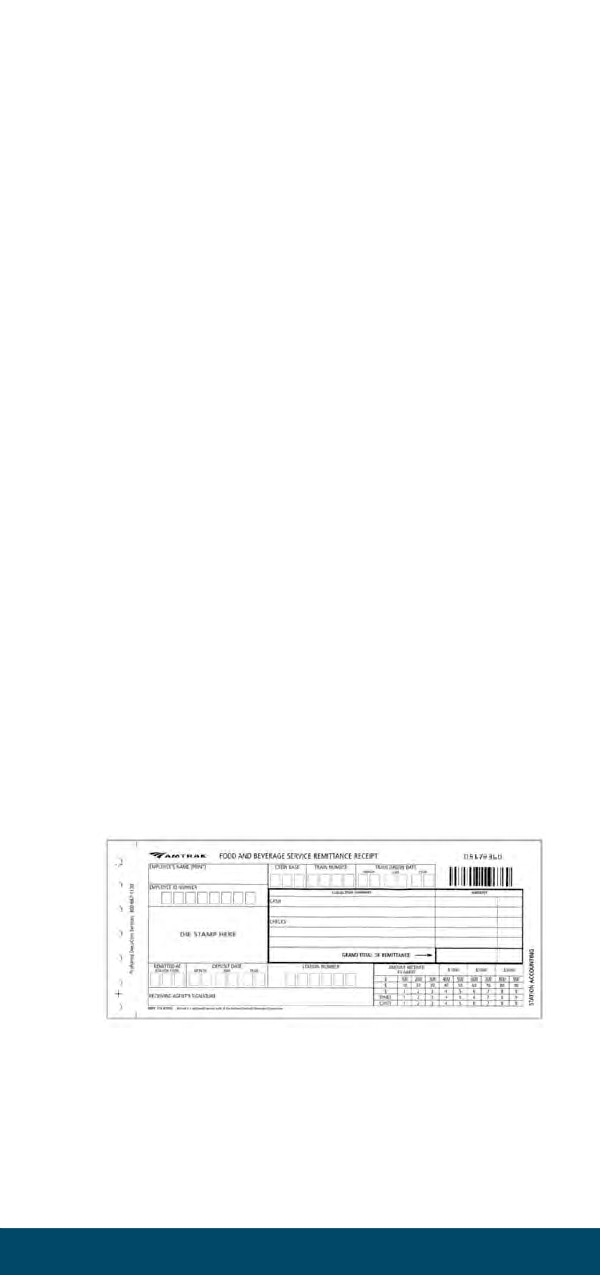
3.
Completing the “Food and Beverage Service
Remittance Receipt” (NRPC 124)
(Refer to Figure 8-90.)
a)
The LSA is to complete the following required
sections of the “Food and Beverage Service
Remittance Receipt” (NRPC 124) for all food and
beverage remittances.
•
Employee’s Name (Print): Neatly print first
and last name
•
Employee ID Number: Enter eight digit SAP
number (including zeros)
•
Crew Base: Enter three-letter code for
“Home” Crew Base
•
Train Number: Enter train number used at
point of origin
•
Train Origin Date: Enter train origination date
using the month/day/year (04/30/07) format
•
Collection Summary - Cash: Total of cash
monies being remitted
•
Collection Summary - Checks: Total of checks
from groups that are booked and ticketed in a
group PNR (Personal checks are no longer
accepted for the purchase of food & beverage.)
•
Collection Summary - Manual CC NRPC 621-C:
This section is no longer applicable because
manual credit card transactions are not permitted
(Electronic credit card transactions from Exadigm
devices must NOT be listed in the Food and
Beverage Service Remittance Receipt (NRPC 124).)
8-200
On-Board Service Accounting Procedures
• Amout: Neatly enter the correct amount for
each Collection Summary entry
• Grand Total of Remittance: Enter the total of
all the Collection Summary Amounts
b) If the remitting employee has inaccurately totaled
any amount in the Collection Summary or Grand
Total of Remittance section, the Station
Agent/Ticket Receiver will void the “Food and
Beverage Service Remittance Receipt” (NRPC 124).
The remitting employee will need to complete a
new “Food and Beverage Service Remittance
Receipt” (NRPC 124) with the correct amounts;
the Station Agent/Ticket Receiver is NOT to
complete the remitting employee’s sections.
c)
After the Station Agent/Ticket Receiver has
completed their sections of the “Food and Beverage
Service Remittance Receipt” (NRPC 124) they
will retain the “Station Accounting” (white) and
the “Station Agent” (yellow) copies returning the
“Audit - Forward with Trip Report” (pink) and
“Lead Service Attendant” (blue) copies to the
remitting employee.
d) The LSA will place the “Audit - Forward with
Trip Report” (pink) copy into the “Food &
Beverage Sales Reports Envelopes” (NRPC 695,
3255, 3275 or 3276) or the “Dining Car Report
Envelope” (NRPC 131) before submitting to the
Crew Base. The “Lead Service Attendant” (blue)
copy will be retained by the LSA for a period of
two years and are subject to audits by management
at any time during that period.
Figure 8-90 - Food and Beverage Service
Remittance Receipt (NRPC 124)
4. Crew Base
a) The LSA and Chef are responsible for ensuring
that all paperwork and reports are complete and
Service Standards Manual No. 6
8-201
accurate before submitting to the crew base in
the proper report envelope.
b) When reporting to the crew base, the LSA and
Chef must be courteous and wait for instructions
from the crew base supervision or clerical staff.
c) The LSA or Chef is to remain in the crew base
until released by the crew base staff.
d) All company funds received from sales of revenue
items must be remitted prior to departing Amtrak
property.
e) In situations where the crew base is closed upon
train arrival, the completed report envelope must
be deposited in the location designated by the
crew base.
5.
Food and Beverage Sales Reports Envelopes
The LSA and Chef must submit the following, if
applicable, in the appropriate Food and Beverage
Sales Reports envelope.
•
“Transfer Out Form” (896) - completed with all
signatures.
•
Meal Checks - totaled and properly bundled by
Sleeper, Coach and Employee.
•
“Change In On Train Inventory” (NRPC 125) -
signed by Catering Vendor representative and
LSA/Chef.
•
Discrepancy Short Sheet - signed by Catering
Vendor representative and LSA/Chef.
•
Start Issue Credit - signed by the Catering
Vendor representative and LSA/Chef.
•
“Chef/LSA Enroute Condemnation Report”
(NRPC 3143).
•
“LSA Temperature Monitoring Report”
(NRPC 3220).
•
“Complimentary Service Accounting”
(NRPC 3157).
•
“Non-Meal Check First Class Revenue Item
Accounting” (NRPC 3269).
•
“Business Class Service Accounting”
(NRPC 3236).
•
“Food and Beverage Service Remittance Receipt”
(NRPC 124).
•
Abstract Sheet.
•
Checks from groups that are booked and ticketed
in a group PNR.
•
Cash Receipts.
8-202
On-Board Service Accounting Procedures
• Credit Card Slips.
• Coupons.
• Vouchers.
• Red Star Receipts.
• Cash Register Reports.
• Any other forms or paperwork.
M. Notices
1.
Credit Notice Procedures
a) Food and Beverage credits result when the LSA
remits a dollar amount that is greater than the
dollar amount required to balance the paperwork
for the trip.
b) The Crew Base Manager or authorized represen-
tative is responsible for issuing a “Credit Notice -
Food and Beverage Service” (NRPC 127C). This
can be done immediately upon determining that
an employee has over remitted.
2.
Debit Notice Procedures
a)
“Food & Beverage Shortage Notice - Debit”
(NRPC 127D) is a formal notification from
Amtrak that an insufficient amount of money
was remitted by a LSA (debit issued to LSA) or
a variance occurred in the Chef inventory (debit
issued to Chef), at the end of a trip. The amount
is defined by an audit of the trip documents and
related accounting records.
b) The “Food & Beverage Shortage Notice - Debit”
(NRPC 127D) is the only official Debit notification
document. When an employee receives a debit,
they have a maximum of nine calendar (9) days to
settle the amount or file a protest. The protest must
be filed on a “Debit Notice Protest” (NRPC 2740).
(Refer to Figure 8-91)
c)
If a protest is filed, it must be submitted to the
appropriate authority as required by the employee’s
home Crew Base procedures. In such cases
protests submitted after the deadline will not be
considered and the debit is immediately due and
payable. (Refer to Item 3, "Procedures for
Protest", in this section.)
d) Any employee failing to settle the debit within the
prescribed time is not only required to immediately
pay the debit, but shall also be subject to
administrative action. Management reserves the
Service Standards Manual No. 6
8-203
right to use all internal and external resources to
recover the amount of the debit permissible by law.
e)
Payment of a debit must occur at the Ticket
Office or Ticket Receiver’s office in the city
where the “Food & Beverage Shortage Notice -
Debit” (NRPC 127D) was issued. The pink audit
copy of “Food & Beverage Shortage Notice -
Debit” (NRPC 127D) must be returned to the
crew base. Employees can make settlement in the
form of cash, personal check or credit card.
f)
Employee’s debits will be considered excessive if
he/she has five (5) or more debits or any single
debit that exceeds $100.00 in a calendar month.
Employees who establish a record of excessive
debit activity may be subject to disqualification or
disciplinary action through the appropriate
administrative processes.
g)
If there is a management decision
(Superintendent Passenger Services or above)
to allow payroll deduction, the employee will be
required to pay a $25.00 fee for processing. This
amount plus the payback amount will be withdrawn
from the first paycheck impacted. The full amount of
the debit must be paid within 30 days. This option
is to be used in cases involving extenuating
circumstances and is limited to a maximum of
two (2) per calendar year.
h) The employee is required to keep the blue
employee’s copy of “Food & Beverage Shortage
Notice - Debit” (NRPC 127D) for a period of
two years.
8-204
On-Board Service Accounting Procedures
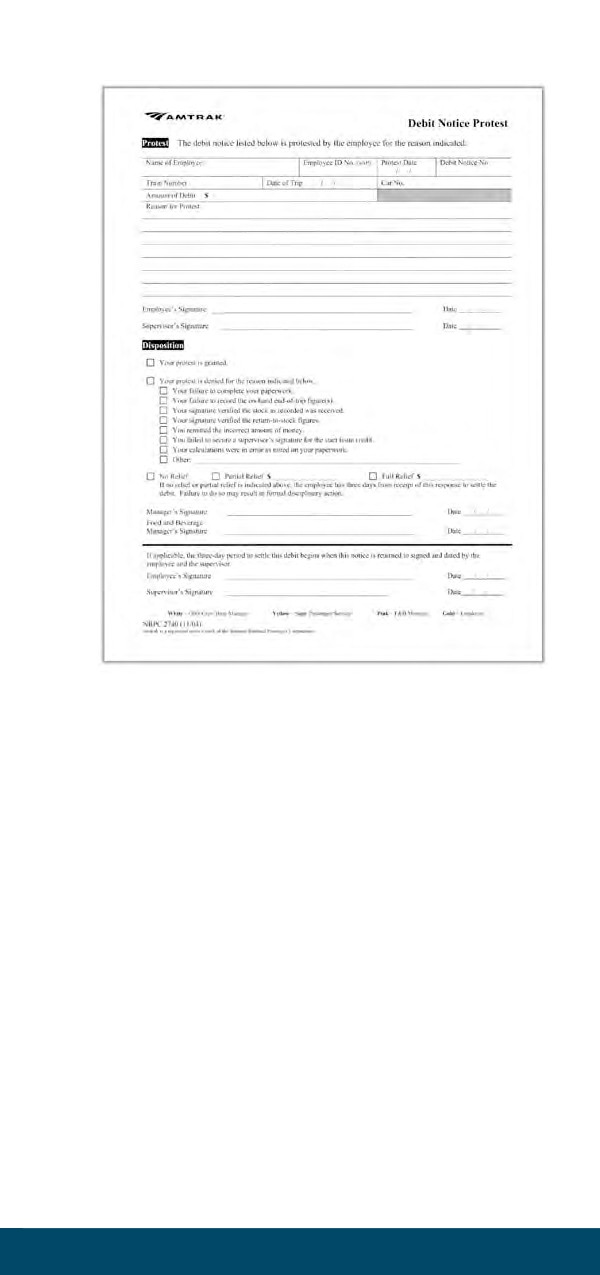
Figure 8-91 - Debit Notice Protest (NRPC 2740)
3.
Procedures for Protest
a) If an employee wishes to protest a debit, the
protest must be in writing on “Debit Notice
Protest” (NRPC 2740) and must include a copy of
the “Food and Beverage Shortage Notice - Debit”
(NRPC 127D).
b) Management designated to perform the review
will evaluate the protest and responds within ten
(10) calendar days to the employee.
c) If the results of the review are a denial of the
protest, the employee will have a maximum of six
(6) calendar days to pay the debit back after they
have been notified. If the review determines that
the protest is valid and grants full or partial relief,
the employee will be notified.
d) If partial relief is granted, the employee is
responsible for paying the balance within six (6)
calendar days of notification.
Service Standards Manual No. 6
8-205
e)
If an employee leaves service prior to paying a
debit, “Personnel Action Request” (NRPC 2000)
is filed to sever the employee from active service.
A note in the "Remarks" section that the unpaid
debit(s) amount must be deducted from the final
check is to be made. If this is not possible, the
crew base manager will send a certified letter to
the employee requesting payment of the unpaid
funds by a specific date. If the person fails to
respond, the crew base manager would then
forward copies of all correspondence of the
unpaid debit to the Senior Officer Revenue
Remittance requesting that further collection
efforts be made. Any unpaid funds sent for
collection may be reported to the Credit Bureau.
f)
If an employee is out on medical or is granted an
approved Leave of Absence (LOA), it is the
employees responsibility prior to their LOA to
remit all monies due Amtrak. The LOA does not
postpone or extend the time limits described in
this policy.
8-206
On-Board Service Accounting Procedures
Chapter 9
Service Recovery
Introduction
Service Recovery is the umbrella term used to describe
the various techniques, services, polices and procedures
used by Amtrak to mitigate the negative impact of
service failures on passengers. Complimentary Food
and Beverage Service, Service Recovery Kits,
Emergency Meal Packages, Service Upgrades or
Credits and Service Adjustments are all available to
assist in recovering from a service failure.
Each of the techniques, tools, procedures or policies is
designed to provide the guidance necessary to deliver
consistent service recovery corporate-wide and
demonstrate to the passenger that we regret and
apologize for a service failure. The need to use Service
Recovery indicates that there has been some element of
service which has not met the passenger’s expectations.
The ability to use one of the Service Recovery options
provides us with the opportunity to turn the failure
into a success. Service Recovery is not a substitute for
excellent service, however, when used correctly it can:
• Turn a dissatisfied passenger into a satisfied passenger.
• Provide the opportunity to regain the respect of the
dissatisfied passenger.
• Save the lifetime value of a satisfied passenger at
little cost.
• Create loyal passengers who will travel again and
encourage other to do the same.
• Provide a system that employee can use when
situations or events happen that are beyond the
control of the crew.
Not every passenger needs the same level of Service
Recovery, even in a similar situation. Our responsibility
is to find the Service Recovery option that works best
for each passenger.
A satisfied passenger is a repeat passenger. If we
improve our retention rate by just 1% - that translates
into additional revenue totaling over one millions dollars
annually.
A. Types of Service Failures
There are five types of service failures, which drive
the need to initiate on-board Service Recovery:
Service Standards Manual No. 6
9-1
1.
Operational Failures
Late train departure from initial terminals; en
route delays and delays due to “Hours of Service”
requirements.
2.
Equipment Failures
Locomotive malfunctions/failures including loss of
Head-End-Power (HEP), heat or A/C malfunction,
toilet malfunction or an individual accommodation
failure.
3.
Natural Disasters
Flood, fire, hurricane, land/rock slide, avalanche or a
bridge washout and any other act of God.
4.
Safety and Security Issues
Search of train, search of train with evacuation of
all passengers, removal of a passenger because of
behavior, trespasser strikes, grade crossing accidents
and similar situations.
5.
Employee Failures
Employees who are rude, unhelpful, inefficient or
incompetent.
B.
L.A.S.T. (Listen, Apologize, Solve
and Thank)
More often than not, the passenger wants someone
to listen to their problem, acknowledge that there
is a problem by apologizing, offer some options or
solutions and then thank them for their patience and
willingness to give the corporation the opportunity
to “make it right”. L.A.S.T. is the most powerful
service recovery technique available to employees.
a) Listen to passengers to understand their
expectations.
• Express empathy.
• Make sure you have an accurate understanding
of their problem—do not jump to conclusions.
b) Apologize to the passenger who is experiencing an
inconvenience, even when the problem is not your
fault. It is very important to do the following.
• Ask yourself, “What does this person need and
how can I provide it?”
• Double check the facts or get more information.
9-2
Service Recovery
c) Solve the problem.
• Work to develop a fair resolution to the situation.
• Follow up to make sure the passenger is satisfied
with the solution.
d) Thank the passenger for their understanding and
patronage, and invite them to travel with us again.
C.
Complimentary Food and Beverage
Service
The Complimentary Food and Beverage Service
described in this section is not to be confused with
any Complimentary Services offered as an amenity
to First Class and/or Sleeping Car passengers (e.g.
wine tasting, etc.). Complimentary Food & Beverage
Service is provided specifically as a service recovery
tool because one or more of the five Types of Service
Failures previously discussed has occurred. (Refer to
Section A “Types of Service Failures” in this chapter)
1.
General
a)
Complimentary Food and Beverage Service is
an important component of the Service Recovery
process. Offering complimentary food and
beverages is one of the principle tools we have
to demonstrate to a passenger that we recognize
their expectations have not been met and that we
want to make amends.
b) Amtrak is often criticized by passengers for
inconsistent handling of Complimentary Food and
Beverage Service when operational or service
failures occur. Employees must be consistent in
providing complimentary service to our passengers.
c)
The circumstances, which trigger Complimentary
Food and Beverage Service, will vary by train,
day and situation. Generally, the Conductor is the
first person able to accurately assess the situation
and is to consider the following when making
recommendations.
• The length of the delay.
• The availability of HEP - internal conditions.
• The tardiness of the train.
• Whether the train is moving or standing.
• The location (at station platform or in remote
area).
• The number of passengers on-board.
• External atmospheric conditions (temperature
and weather).
Service Standards Manual No. 6
9-3
• The safety of the equipment.
• The availability of food and beverage supplies
on-board.
• The availability of food and beverage supplies
from external sources.
d) Complimentary Food and Beverage Service may
be offered to an entire train, a segment of the
train’s population or an individual or family. The
Conductor has latitude, but is expected to apply
the principles outlined in this chapter, when
recommending actions to be taken for Service
Recovery. The Manager On-Board Service,
CETC, CNOC Customer Service Desk and the
Conductor will determine the best course of
action for each situation.
e)
Sealed Service Recovery Kits and the Emergency
Meal Packages are only to be opened when
Complimentary Food and Beverage Service has
been authorized.
f)
There are three principle Complimentary Food
and Beverage options, which can be used as part
of a service recovery process.
• Service Recovery Kits (contains 60 Snack
Packs and 60 individual bottles of water).
• Emergency Meal Packages (bulk items).
• Individual meals/beverages.
2.
Catering Vendor Responsibility
a) PAR management of the Service Recovery Kits
and the Emergency Meal Packages is the
responsibility of the Catering Vendor.
b) Service Recovery Kits are a standard issue on
all trains.
c) Service Recovery Kits and the Emergency Meal
Packages will be delivery to every train with the
rest of the stock.
3.
Acela Express and Northeast Regional Trains
(Includes Boston - Newport News Service)
a) Service Recovery Kits
• Acela - The Service Recovery Kits will be loaded
into a cart and boarded with the rest of the stock.
• Northeast Regional - A container will be used to
load the Kits into the Café Car.
b) Triggers to Use the Service Recovery Kits
• Train standing in one location for first 30
9-4
Service Recovery
minutes with non-operational HEP.
• Train standing in one location for a minimum
of 90 minutes with operational HEP.
c)
Conductor Responsibilities
•
The Conductor must notify CETC of the train’s
situation (e.g. operational failures, equipment
failures, natural disasters or safety and security
issues). (If CETC is contacted, CETC will
contact CNOC and CNOC will contact the
Manager, On-Board Service.)
•
The recommendation to activate the
Complimentary Food and Beverage Service
must be made by the Conductor working in
conjunction with the LSA and Manager, On
Board Service for that train.
•
The Conductor must provide the LSA with an
accurate count of the passengers on-board and
identify any passenger(s) who will need special
assistance.
•
The Conductor will receive the final approval
from the Manager, On-Board Service and/or
the CETC/CNOC Customer Service Desk to
provide Complimentary Food and Beverage
Service to the passengers.
•
The Conductor is to delay making an
announcement regarding any complimentary
service until the LSA has had time to retrieve
and position the Service Recovery Kits for
distribution.
•
Only when the LSA is ready to distribute the
Service Recovery Kits may the Conductor make
an announcement notifying passengers about
the complimentary service and the distribution
method. (Refer to Chapter 10 “On-Board
Announcements and Signage”)
•
The Conductor is to monitor the distribution
to ensure each passenger receives only one
“Snack Pack” and one bottle of water.
d) LSA Responsibilities
• The LSA is to ensure that the Service
Recovery Kits have been issued to the train.
• The LSA will record the number of “Snack
Packs” issued on the “Transfer Out Form” (896)
in the Start Issue column.
• The LSA is responsible for the retrieval of the
Service Recovery Kits from the storage location
Service Standards Manual No. 6
9-5
and then determine the number of “Snack
Packs” that will be needed for the passengers
on-board.
•
The LSA is to organize the complimentary
“Snack Packs” in the Café Car.
•
In the event that the Service Recovery Kits
stock becomes depleted, the LSA is authorized
to use the remaining revenue stock in the car,
only after notification has be made to
Manager, On-Board Service and/or CNOC
Customer Service Desk that this has become
necessary.
•
The LSA is to keep track of any revenue
stock used and complete the appropriate
portions of the “Transfer Out Form” (896)
and any additional required forms.
•
The number of used “Snack Packs” is to be
recorded in the Total Sold column of the
“Transfer Out Form” (896). Record “Snack
Packs” returning to stock in the Return to
Stock column of the “Transfer Out Form” (896).
(Refer to Chapter 8 “Accounting”, Section 2
“On-Board Service Accounting Procedures”
for details.)
4.
Downeaster
The Downeaster is supported by the Northern New
England Passenger Authority. The food service is
provided by a private company. The Northern New
England Passenger Authority determines and publishes
the triggers for Service Recovery.
5.
Amtrak Cascades, Heartland Flyer, Ethan Allen,
Vermonter, Pennsylvanian, Niagara Falls Trains,
Midwest and Pacific Surfliner Corridors
a) Service Recovery Kits
The Catering Vendor is responsible for PAR
management and delivery of the Kits on board
the following trains: Amtrak Cascades, Heartland
Flyer, and the Midwest and Pacific Surfliner
Corridors. These trains will be provisioned as
storage space permits using station locations
along the route for restocking.
b) Triggers to Use the Service Recovery Kits
• Train standing in one location for minimum of
1 hour with non-operational HEP.
9-6
Service Recovery
• Train moving with intermittent HEP over a
minimum of a 3 hour period.
• Train standing in one location for a minimum
of 3 hours with operational HEP.
• Train is moving with operational HEP but is 3
hours late.
c)
Conductor Responsibilities
•
The recommendation to activate the
Complimentary Food & Beverage Service
must be made by the Conductor working in
conjunction with the (LSA), CNOC Customer
Service Desk and the Manager, On-Board
Service for that train.
•
The Conductor will contact the CNOC
Customer Service Desk, which will contact the
Manager, On-Board Service for that train or
corridor.
•
The Conductor will receive the final decision
from the CNOC Customer Service Desk
and/or the Manager, On-Board Service to
provide Complimentary Food and Beverage
Service to the passengers.
•
The Conductor is to delay making an
announcement regarding any complimentary
service until the LSA has had time to retrieve
and position the Service Recovery Kits for
distribution.
•
Only when the LSA is ready to distribute the
Service Recovery Kits may the Conductor
make an announcement notifying passengers
about the complimentary service and the
distribution method (Refer to Chapter 10
“On-Board Announcements and Signage”)
•
The Conductor is to monitor the distribution
to ensure each passenger receives only one
“Snack Pack” and one bottle of water.
d) LSA Responsibilities
• The LSA is to ensure that the Service
Recovery Kits have been issued to the train.
• The LSA will record the number of “Snack
Packs” issued on the “Transfer Out Form” (896)
in the Start Issue column.
• The LSA is responsible for the retrieval of the
Service Recovery Kits from the storage location
and then determine the number of “Snack
Service Standards Manual No. 6
9-7
Packs” that will be needed for the passengers
on-board.
•
The LSA is to organize the complimentary
“Snack Packs” in the Café Car.
•
In the event that the Service Recovery Kits
stock becomes depleted, the LSA is authorized
to use the remaining revenue stock in the car,
only after notification has be made to
Manager, On-Board Service and/or CNOC
Customer Service Desk that this has become
necessary.
•
The LSA is to keep track of any revenue stock
used and complete the appropriate portions of the
“Transfer Out Form” (896) and any additional
required forms.
•
The number of used “Snack Packs” is to be
recorded in the Total Sold column of the
“Transfer Out Form” (896). Record “Snack
Packs” returning to stock in the Return to
Stock column of the “Transfer Out Form” (896).
(Refer to Chapter 8 “Accounting” Section 2
“On-Board Service Accounting Procedures”
for details.)
6.
Capitol Corridor
Capitol Corridor trains use Train Delay Vouchers in
the event of a delay because of agreements with
state and local agencies.
a) Triggers to Use the Train Delay Vouchers
If the train is at least 30 minutes late, secure
authorization to use the Train Delay Voucher
from the Manager On-Board Service.
b) Service Recovery Train Delay Vouchers
• Capitol Corridor vouchers are Green in color
and have a value of $3.00 when used to purchase
a minimum of $5.00 of food or non-alcoholic
beverages in the Food Service Car.
• Vouchers are available at the Oakland Crew
Base.
• Vouchers are an accountable item.
• The name of the authorizing manager must be
entered on the back of the first voucher used.
• The transaction must be recorded in the POS
unit and the passenger’s name, signature and
PNR number recorded (ticket or pass number
may be substituted) on the voucher.
9-8
Service Recovery
• The voucher is valid immediately upon
disbursement and must be used by the passenger
within sixty days of the date of issuance. (Refer
to Chapter 8 “Accounting” Section 2 “On-Board
Service Accounting Procedures” for details.)
7.
San Joaquin
a)
Service Recovery Kits
The Catering Vendor is responsible for PAR
management and delivery of the Kits.
b) Triggers to Use the Service Recovery Kits
Train delay surpasses 90 minutes.
c)
Conductors Responsibilities
• The Conductor is to delay making an
announcement regarding any complimentary
service until the LSA has had time to retrieve
and position the Service Recovery Kits for
distribution.
• Only when the LSA is ready to distribute the
Service Recovery Kits may the Conductor
make an announcement notifying passengers
about the complimentary service and the
distribution method (Refer to Chapter 10
“On-Board Announcements and Signage”)
• The Conductor is to monitor the distribution
to ensure each passenger receives only one
“Snack Pack” and one bottle of water.
d) LSA Responsibilities
• The LSA is to ensure that the Service
Recovery Kits have been issued to the train.
• The LSA is responsible for the retrieval of the
Service Recovery Kits from the storage location
and then determine the number of “Snack
Packs” that will be needed for the passengers
on-board.
• The LSA is to organize the complimentary
“Snack Packs” in the Café Car.
e)
Recording Used Snack Packs in POS System
• Touch San Joaquin Snack Packs on the POS
Screen.
• Enter the quantity of Snack Packs and press
enter.
• Highlight the item.
• Touch Service Recovery Payment Screen.
Service Standards Manual No. 6
9-9
• Enter Reason.
• Press the tender even button.
• Include the Receipt with your trip packet.
8.
Service Recovery Kits for Long Distance Trains
Traveling in Excess of 500 Miles (Excludes
Boston to Newport News Service)
Long distance train operations often produce a unique
and challenging set of circumstances. The type and
length of the delay determines if a Complimentary
Food and Beverage Service will be provided and if
so, to what extent. All long distance trains with food
service operations will be provisioned with Service
Recovery Kits as well as Emergency Meal Packages.
The storage of the additional Complimentary Food
and Beverage Service supplies is a major challenge
on all types of equipment but is particularly acute on
single level cars. The challenge of storing supplies
intensifies during the summer and holiday travel
periods when regular stock levels are at their highest.
When storage space becomes limited on specific
routes, restocking locations will be utilized. Each LSA
must be familiar with his/her division’s established
restocking locations and procedures.
a) Service Recovery Kits - General Guidelines
• The Catering Vendor will load the Service
Recovery Kits onto Café/Lounge Cars.
• The “Snack Pack” and bottled water will be
served at the passenger’s seat or in their
accommodation.
• Passengers are never to be told to come to
the Dining or Lounge Car to pick up the
“Snack Pack”.
• If there is a cart on-board the train, this may
be used to distribute complimentary items to
the passengers.
b) Triggers to use the Service Recovery Kits
These triggers are guidelines only. Specific situations
may warrant additional actions.
• Train standing in one location for a minimum
of 90 minutes with non-operating HEP.
• Train is moving but is over 90 minutes late
with non-operating HEP.
9-10
Service Recovery