Amtrak. Service Standards Manual for Train Service and On-Board Service Employees (Version 6, 2011) - page 13
8.
Coupon Distribution
a)
Coupon A (Passage Coupon) (Refer to Figure 8-54)
always placed in the “Train Earnings Reports
Envelope” (NRPC 158) except when Coupon A
is used for a one-way return ticket (part of a
round-trip request), then the customer gets
Coupon A.
b) Coupon B (Passenger Receipt) (Refer to Figure
8-55) is given to the passenger as their receipt
except in OFF passenger removal situations.
c)
Coupon C (Auditor’s Coupon) (Refer to Figure
8-55) always remitted to Station Ticket
Agent/Ticket Receiver along with the
“Conductor/Asst. Conductor Sales Report”
(NRPC 193).
d) Coupon D (Billing Coupon) (Refer to Figure
8-55) always remitted to Station Ticket
Agent/Ticket Receiver along with the
“Conductor/Asst. Conductor Sales Report”
(NRPC 193).
e)
If the Conductor or Assistant Conductor has
voided COTS, all four (4) coupons of the COTS
form must be remitted.
Service Standards Manual No. 6
8-97
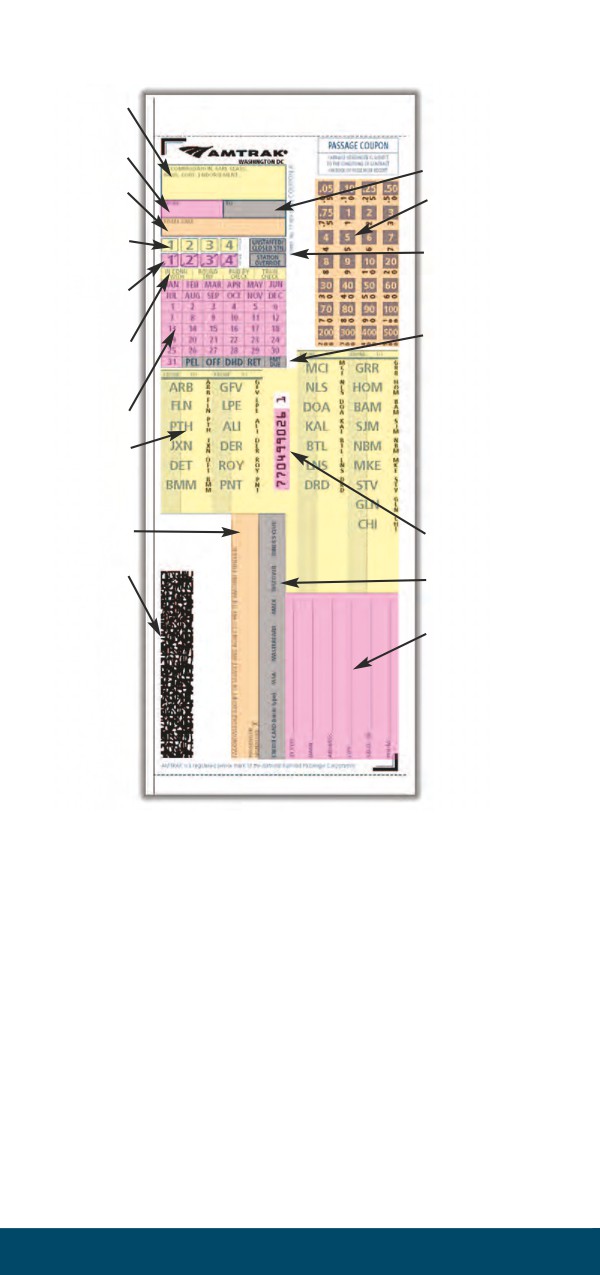
Endorsement
Box
Origin
Destination
Handwritten
Amount
Amount Boxes
Number of
Station
Full Fares
Unstaffed,
Closed and
Number of
Override
Half Fares
Special Ticketing
PEL (Prior
Situation and
Erroneous Lift)
“Paid by Check”
OFF (Passenger
Removal)
DHD
Calendar
(Deadhead)
RET (Return
FROM (origin)
Carry-By)
Station and
PMT DUE
TO (destination)
(Payment Due)
Station
Passenger
9-Digit Ticket
Signature Line
Number
Credit Card
Credit Card
Imprint Area
Types
Passenger
Information
Figure 8-54 - COTS Coupon A
8-98
Train Service Accounting Procedures

Coupon B
Coupon C
Coupon D
Figure 8-55 - Example of COTS
P.
Using COTS for Upgrades
1.
Upgrade from Acela Express Business Class to Acela
Express First Class
The Conductor or Assistant Conductor must take the
following steps to upgrade a passenger from Acela
Express Business Class to Acela Express First Class:
a) Check the manifest for available space.
b) If space is available, call (800) 205-0711 (the
phone number is also on the manifest) or use the
on-board telephone in the Conductor’s office
(recall/23/send) to hold the space.
c) Complete a COTS for the First Class seat charge.
d) Passenger-type discounts (child, senior, military,
etc.) are never applied to accommodation charges.
2.
Upgrade from Coach to Business Class
The Conductor or Assistant Conductor must take
the following steps to upgrade a passenger from
Coach to Business Class.
a) Check the manifest for available space.
b) If space is available, call (800) 205-0711 (the
phone number is also on the manifest) to hold
the space.
c) Complete a COTS for the Business Class seat
charge.
d) Passenger-type discounts (child, senior, military,
etc.) are never applied to accommodation charges.
3.
Upgrade from Coach to Sleeping Car
The Conductor or Assistant Conductor must take
the following steps to upgrade a passenger from
Coach to Sleeping Car accommodation.
Service Standards Manual No. 6
8-99
a) Check the manifest for available space.
b) If space is available, call (800) 205-0711 (the phone
number is also on the manifest) to hold the space.
c)
When a passenger occupies a Sleeping Car for only
a portion of travel between two points where a
through fare is published, charge the applicable
accommodation charge between those points
where such accommodations are actually occupied.
d) Collect the D-level accommodation charge, as
listed in the Conductor’s Memorandum Tariff for
the class of Sleeping Car accommodation being
sold (e.g., ED accommodation fare for a
Superliner Roomette).
e)
For Amtrak pass riders upgrading from Coach
on-board, take the D-level accommodation charge
for the class of Sleeping Car accommodation being
sold and apply it to the 20% discount table.
• Charge the resulting amount.
• Upgrades made by pass riders on the train are
not refundable even if the Sleeping Car does
not sell out.
• To be eligible for a refund, a pass rider PNR
that includes the room must have been made
before boarding the train, and the full fare
(80% of the D-level rail fare plus 80% of the
accommodation charge, determined by the
room inventory class booked) must be paid to
the Conductor if the pass rider does not
already have a ticket.
f)
Other Railroads Employee 50% Discount for
Sleeping Car Accommodation Charges
• Sleeping Car accommodation charges for
employees of other railroads who are eligible
for 50% discount on accommodations, who have
obtained their rail passage tickets at ticket offices
by presenting their Rail Travel Privilege Cards
(RTPC), reduced rate orders, or other pass
documents will be one-half the one-way
accommodations charge.
• Use the 50% column in the Discount Tables for
On-Board Sales to establish the correct charge.
• This discount level applies only to passengers
designated (on their rail ticket) by Type "R"
or "D".
• No other pass riders are eligible for this level
of discount.
g)
Passengers Upgrading Using Guest Rewards
For passengers upgrading a ticket obtained using
8-100
Train Service Accounting Procedures
Guest Rewards points, use the same calculations
as if the passenger had a revenue ticket.
h) Passengers Upgrading on Auto Train
(Refer to Section P.6. “Upgrade to Sleeping Car
Accommodations on Auto Train” for this procedure.)
4.
Upgrade from Coach to Accessible Bedroom
The Conductor or Assistant Conductor must take
the following steps to upgrade a passenger from
Coach to Accessible Bedroom.
a) Check the manifest for available space.
b) If space is available, call (800) 205-0711 (the phone
number is also on the manifest) to hold the space.
c) For mobility-impaired passengers upgrading
on-board from Coach to Accessible Sleeping
Car space. Apply the applicable Roomette price
to the 15% discount column, then follow the
instructions for normal on-board Sleeping Car
sales as outlined in the back of the Discount
Tables for On-Board Sales book.
d) For non-mobility-impaired passengers upgrading
on-board from Coach to Accessible Bedroom
Follow the instructions for normal on-board
Sleeping Car sales as outlined in the back of the
Discount Tables for On-Board Sales book.
• H rooms have their own charges in the
Conductor’s Memorandum Tariff
• M rooms—use the D charges
e) Passengers Upgrading on Auto Train
(Refer to Section P.6. “Upgrade to Sleeping Car
Accommodations on Auto Train” for this procedure.)
5.
Upgrade from Sleeping Car to Sleeping Car
The Conductor or Assistant Conductor must take
the following steps to upgrade a passenger from
Sleeping Car to Sleeping Car.
a) Check the manifest for available space.
b) If space is available, call (800) 205-0711 (the phone
number is also on the manifest) to hold the space.
c) Upgrade of Room Type for Entire Trip
• Determine the price the passenger paid for the
accommodation from their ticket.
• In the Conductor’s Memorandum Tariff, go to the
page for fares specific to the train and city pairs.
• Using the D-Level accommodation charge for
the appropriate city pair and accommodation
type, determine the charge; then subtract the
accommodation charge that the passenger
already paid from that amount on their ticket.
Service Standards Manual No. 6
8-101
• The difference is the amount to charge the
passenger for the upgrade.
• If this difference is under $50.00, charge
$50.00; it always costs a minimum of $50.00 to
upgrade to a higher room type.
• For Amtrak pass riders, apply both accommo-
dation charges to the 20% discount table.
• The minimum upgrade charge for an Amtrak
pass rider is still $50.00.
d) Upgrade of Room Type between Select City Pairs
•
Determine the inventory class (S, A, B, C or D)
of the accommodation that was paid by the
passenger. This inventory class appears next to
the passenger’s name on the manifest and is on
the passenger’s ticket or ticket receipt.
•
In the Conductor’s Memorandum Tariff, go to
the page for fares between the city pair for
which the passenger wants to upgrade.
•
Determine the D-level accommodation charge
of the higher priced room type between that
city pair.
•
Using the D-level accommodation charge,
determine the charge for the lower priced
room type between that city pair - use the
accommodation charge that corresponds to the
inventory class originally paid by the passenger.
•
Subtract the accommodation charge of the
lower room type from the higher priced.
•
The difference is the amount to charge the
passenger for the upgrade.
•
If this difference is under $50.00, charge
$50.00; it always costs a minimum of $50.00 to
upgrade to a higher room type.
•
For Amtrak pass riders, apply both accommo-
dation charges to the 20% discount table.
•
The minimum upgrade charge for an Amtrak
pass riders is still $50.00.
EXAMPLE:
A passenger has a ticket from Chicago to Seattle
showing the through “EB” roomette charge. At
Stanley, North Dakota, the passenger wants to
upgrade to an available unsold bedroom.
(Amounts shown are for the example only and
may not be accurate.)
• DD accommodation charge STN-SEA: $355.00.
• EB accommodation charge STN-SEA: $303.00.
• The charge to upgrade is $52.00.
8-102
Train Service Accounting Procedures
If the passenger had paid the “EA” roomette charge:
• DD accommodation charge STN-SEA: $355.00.
• EA accommodation charge STN-SEA: $399.00.
• The difference is: ($44.00) (a negative number,
in this case).
• The difference is lower than the $50.00 minimum,
so the charge to upgrade would be $50.00.
e)
Transfer to Like Accommodations
• Passengers may want to transfer en route to
other available accommodations of the same
value as those occupied, to be nearer the center
of the car, or for other reasons.
• Passengers may make such transfers, to the same
destination on the same train, or in through cars
on the same route, without additional charge.
f)
Passengers Upgrading Using Guest Rewards
For passengers upgrading a ticket obtained using
Guest Rewards points, use the same calculations
as if the passenger had a revenue ticket.
g)
Passengers Upgrading on Auto Train
(Refer to Section P.6. “Upgrade to Sleeping
Car Accommodations on Auto Train” for this
procedure.)
6.
Upgrade to Sleeping Car Accommodations on
Auto Train
a) Auto Train does not take part in the en route
Sleeping Car upgrade program.
b) All passengers check-in at the ticket counter, at
which time they are offered the opportunity to
upgrade to Sleeping Car accommodations, paying
whatever fare applies at that time to the inventory
class (S, A, B, C or D) of the accommodation that
is available.
c) Tickets are also lifted at that time - they are not
lifted on the train.
d) Before the train departs, the Operations
Supervisor is given the inventory class of the
accommodations that remain unsold.
e) If a passenger changes his or her mind en route
and wants to upgrade, he or she pays whatever
the inventory class calls for - not automatically
the D-level as on other trains.
• Therefore, the price to upgrade at the ticket
counter and the price to upgrade on the train
is the same.
• Waiting to upgrade on-board may actually cause
the price to increase, since another passenger
Service Standards Manual No. 6
8-103
may have purchased the last room that was
selling from a lower inventory class.
Q. Forms of Payment
(Listed in alphabetical order)
1.
Canadian Currency
a) Canadian paper bills (no coins) are the only foreign
currency accepted on trains that cross the US -
Canada border.
b) Ask passengers to pay with US currency first.
c) Canadian currency can be properly adjusted
using the latest Canadian/US Currency
Conversion Table.
• The current Canadian/US Currency
Conversion Table is distributed using an
“Operations Service Advisory” (OSA) and is
available at Crew Bases with trains crossing
the US/Canadian border.
• The current Canadian/US Currency
Conversion Table is also available on Amtrak’s
Intranet at http://intranet.nrpc > Library >
Service Standards > Resources or on the
Internet at http:// customerservice.amtrak.com
> Resources.
• An example of the Canadian/US Currency
Conversion Table can be seen in Figure 8-56.
d) The US equivalent of Canadian currency is taken
as the value toward payment.
e) When making change for Canadian paper bills,
use Canadian currency first before using US
currency (bills and coins).
f) The preferred method is to take the smallest
amount in Canadian paper bills that will cover
the sale.
8-104
Train Service Accounting Procedures
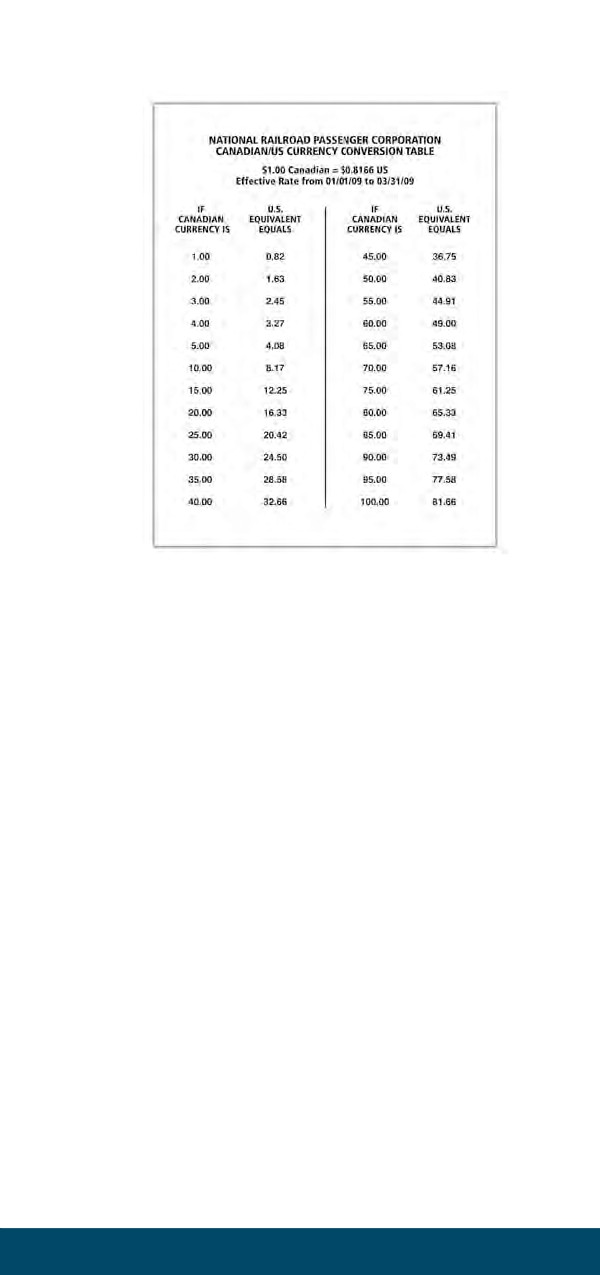
Figure 8-56- Example of Canadian/US Currency Conversion Table
2.
Cash
Amtrak accepts US currency on all trains.
3.
Payment Cards (Credit Cards and Debit Cards)
a) Credit cards and debit cards that carry a clearly
displayed valid logo of one of the following
brands are the only payment cards accepted by
Amtrak on-board trains:
• MasterCard
• Visa
• American Express
• Discover
b) Security
• Every Amtrak employee who has access to
payment card information must make every
effort to protect that information at all times.
• Payment card information includes the cards
themselves, the account numbers and the
machines used to accept payments.
c) The signature panel on the back of the payment
card has the following fraud-prevention features:
• The word “VOID” will appear in the signature
panel if an attempt is made to erase the original
signature. Do not accept these cards.
Service Standards Manual No. 6
8-105
• The signature panel must contain the passengers’
signature or the wording “See ID.” (When “See
ID” appears, ask the passenger for a valid photo
ID for the purpose of matching the name on ID
to name on card.)
• It is not required that the signed name match
the name embossed or printed on the front of
the card (e.g. business/corporate cards or
spouse/parent cards).
d) Use the Conductor Payment Card Device to
accept a payment card.
•
Detailed instructions for use of the Conductor
Payment Card Device are provided on the
Quick Reference Card issued with each Device.
•
It is each crew member’s responsibility to
ensure that the device is in proper working
order with a charged battery and adequate
paper when starting each shift.
• In order for a crew member to receive proper
credit for payment card sales, the log-in
sequence must be followed accurately.
•
The last four (4) digits of the COTS number
(excluding the final control digit that is separated
by a space from the COTS number) must be
keyed into the device for every train ticket sold.
•
The magnetic stripe from each payment card
must be read by the machine; no key-entered
transactions are permitted on-board.
•
If End-of-Trip has not been processed, a
transaction may be voided.
•
If End-of-Trip has been processed, a supervisor or
Ticket Receiver must be notified of a transaction
that requires a change.
•
When the communications signal is poor, the
Conductor or Assistant Conductor may elect
to put the device into Store & Forward (S&F)
mode to improve the speed of transactions.
•
When there are a large number of passengers
waiting to purchase tickets in a short period of
time, the Conductor or Assistant Conductor
may elect to put the device into S&F mode to
improve the speed of transactions.
•
The Conductor or Assistant Conductor will not
be held responsible for transactions that are
declined in S&F mode unless it is found that
this process has been abused.
8-106
Train Service Accounting Procedures
• The End-of-Trip process must be completed at
the end of each trip or, at a minimum, at the
end of each 24-hour period.
e) Accepting Payment Cards.
• If the device returns a DECLINE message,
the passenger must provide another form
of payment such as cash or another valid
payment card.
• Every payment card transaction must be
submitted using the device; no manually
written transactions will be permitted.
• Payment cards may not be used to obtain cash
from Amtrak.
• Payment cards can only be used for the exact
value of the item purchased.
• Passenger signatures are required on payment
receipts for transactions greater than $24.99.
• Transactions requiring the card holder to enter a
PIN number are not accepted on-board the train.
4.
Payment Due
(Refer to R.3. “Payment Due (PYMT DUE)”)
5.
Un-accepted Forms of Payment
a) Non-U.S. Currency (unless otherwise noted)
b) Cashier’s Checks
c) Money Orders
d) Travel Vouchers
e) Personal Checks
f) Travelers Checks
g) Payment Cards with brand logos other than the
brands listed in Q.3. “Payment Cards (Credit
Cards and Debit Cards)”.
h) Payment Cards requiring a PIN
R.
COTS as Other Documentation
1.
Deadhead (DHD)
a) Under no circumstances are non-Amtrak dead-
heading train crew members allowed to travel
without a completed COTS unless they have a
ticket or an original (not photocopy) “Railroad
Request for Employee Transportation” (form 620).
b) Without a “Railroad Request for Employee
Transportation” (form 620), Amtrak will not be
compensated.
Service Standards Manual No. 6
8-107
c) The COTS must have the “DHD” and “Payment
Due” blocks punched.
d) Coupon A (Passage Coupon) goes in the “Train
Earnings Reports Envelope” (NRPC 158).
e) Coupon B (Passenger Receipt) is given to the
deadheading employee(s).
f) Coupon C (Auditor’s Coupon) and Coupon D
(Billing Coupon) must be remitted to the Station
Ticket Agent or Ticket Receiver cashier along with
the “Conductor/Asst. Conductor Sales Report”
(NRPC 193).
2.
Passenger Removal (OFF)
a) When a passenger understands that they must
pay, can pay, yet still refuse to sign the COTS
form, they must be removed in accordance with
Amtrak policies.
b) Complete the COTS for Amtrak’s records.
c) Note any pertinent information (e.g., Police
Officer Jones, Philadelphia, removed intoxicated
passenger for non-payment of fare).
d) The “OFF” block must be punched on the COTS.
e) No dollar value must be punched.
f) Coupon A (Passage Coupon) and Coupon B
(Passenger Receipt) are to go into the “Train
Earnings Reports Envelope” (NRPC 158).
g) Coupon C (Auditor’s Coupon) and Coupon D
(Billing Coupon) must be remitted to the Station
Ticket Agent or Ticket Receiver cashier along
with the “Conductor/Asst. Conductor Sales
Report” (NRPC 193).
h) Punch all pertinent blocks.
i) Write N/A for the dollar value.
3.
Payment Due (PYMT DUE)
a) The transportation collection/examination can
include a “payment due” direct bill situation.
• In this case, the passenger is allowed to ride.
• By signing the COTS, they promise to pay later.
b) If a passenger does not have a ticket, cash or
credit card and the train has left the station, the
Conductor or Assistant Conductor can, after the
passenger signs the “Payment Due” portion of a
COTS, either allow the passenger to ride to their
destination or to a station before their destination.
8-108
Train Service Accounting Procedures
c)
Criteria in making a decision to allow the passenger
to ride to their destination or to a station before
their destination:
• whether it is simply an attempt to avoid paying
• the distance of the journey
d) If it is clearly not an attempt to avoid paying but
the trip is a long one, make a decision after
trying to contact someone who the passenger
suggests can come to a station and either pay or
convince a Passenger Services representative that
payment will be made.
• The Conductor or Assistant Conductor must
call CNOC at (800) 205-0711 to help in these
matters.
• If this scenario will take more time than the
Conductor or Assistant Conductor has before
being relieved, they must fully brief the relieving
train crew.
• The passenger must also be introduced to the
Conductor of the relieving train crew.
e)
If the passenger wants to detrain as soon as possible
and return to their origin, prepare a Payment
Due COTS for that trip and prepare one for the
return trip.
• The COTS must have a notation in the “Credit
Card Number” block that describes the exact
train for which that COTS is valid.
• Take into account the amount of waiting time
for the return journey.
• Employees must explain the return trip schedule
to the passenger.
• If the passenger wants to detrain and not
return to their origin, they still must be billed
for the journey that is taken.
f)
Stations that have a Passenger Service
representative have the authority to decide
hardship cases.
• Conductor or Assistant Conductor must consider
using a Passenger Service representative when
deciding which station they will carry a
“Payment Due” passenger to.
• If the decision is to carry a passenger to a station
with a Passenger Service representative, the
Conductor or Assistant Conductor can give
that station some assistance by telephoning the
details to that station in advance.
Service Standards Manual No. 6
8-109
g) The Conductor or Assistant Conductor does not
have the authority to carry a passenger without
a “Payment Due” document in the form of a
properly completed COTS.
h) The dollar value of the length of the passenger’s
journey must be written and punched on the COTS.
i) The Conductor or Assistant Conductor must
legibly print the passenger’s name, address, city,
state, zip code and telephone number, ensuring
that the passenger’s information has printed onto
all coupons of the COTS.
j) The type of identification and identification number
displayed by the passenger must be recorded on
the COTS.
k) Only fares that are permissible for on-board sales
may be used.
l) The Conductor or Assistant Conductor must tell
the passenger to forward the payment within 10
days to the address on the back of Passenger
Receipt Coupon B advising them that they will
not receive a bill, and that this coupon is the bill.
m) Once a Payment Due COTS has been signed, the
passenger must be given the same respect afforded
to any other Amtrak passenger.
n) If a Passenger Services representative has received
payment, a pre-paid ticket must be brought out to
the train for the passenger’s journey.
o) If a passenger refuses to pay a higher fare than
they feel is correct or refuses to pay for a "step
up" in service because of information provided
by an Amtrak agent, Amtrak does not consider
this an attempt to avoid paying.
p) The Conductor or Assistant Conductor must
politely explain Amtrak’s policies and fare rules
using the Conductor’s Memorandum Tariff book,
this Service Standards Manual or any other official
document.
• A firm, confident, non-argumentative
approach is necessary.
• If possible, allow the passenger time to digest
this information.
• If the dispute cannot be settled in a calm,
friendly, and professional manner, complete a
Payment Due COTS for the proper amount
and ask the passenger to sign it.
q) If the passenger still will not pay the disputed
8-110
Train Service Accounting Procedures
amount, advise them to call the Customer Service
Center (800) USA-RAIL.
• The passenger must NOT be removed from
the train if they simply refuse to sign for the
additional amount.
• The passenger must still be offered Coupon B
(Passenger Receipt) in case they change their
mind and accept the charge later.
r)
The Conductor or Assistant Conductor must
remit the COTS writing "Refused to sign" on the
passenger’s signature line, and a short explanation
in the credit card imprint area for situations
where a ticket or payment is received that does
not cover the total amount due.
s)
Removal is appropriate if the passenger refuses
to surrender some type of payment or a ticket,
acknowledges that they understand they are
obliged to pay, yet still refuse to pay or sign a
Payment Due COTS.
t)
If a passenger is able to pay a significant portion
of the fare but can not pay the entire fare, it is
appropriate to accept what ever payment is
available, then use the COTS for the remaining
balance. Or, if the “significant portion” of the fare
is paid with two forms of payment (i.e. cash, credit
card) then two COTS must be used.
• Write in the “Credit Card” area “Partial
Payment,” the amount paid, and the document
type and number on which the fare was paid
(such as a cash ticket).
• Do not remove this passenger.
• Coupon A must be placed in “Train Earnings
Reports Envelope” (NRPC 158).
• Remove Coupon B and give it to the passenger
as their invoice.
• Coupons C and D must always accompany the
“Conductor/Asst. Conductor Sales Report”
(NRPC 193) to the ticket office or to the
Ticket Receiver’s Office for remittance.
u) It is preferable to handle difficult situations away
from other passengers.
v)
Every effort must be made to keep unpleasant
and/or embarrassing transactions private.
4.
Prior Erroneous Lift (PEL)
a) A Conductor or Assistant Conductor can sometimes
Service Standards Manual No. 6
8-111
tell, or strongly suspect, that a passenger’s ticket
was lifted in error.
EXAMPLE:
With a book type ticket, it is often possible to
determine an erroneous lift with some degree of
certainty because the receipt is punched with every
ticket lift and the coupons that are left can be counted.
b) If a prior erroneous lift occurs, the passenger
must be taken to their destination.
c)
If the prior erroneous lift can be determined, or if it
is in the Conductor’s or Assistant Conductor’s
best judgment, a COTS must be prepared with
“PEL” in the method of payment area.
d) Do not indicate a dollar value (write “N/A”).
e)
A signature is not necessary.
f)
Punch the “PEL” block.
g)
A short explanation is necessary including the
ticket number.
h) Coupon A (Passage Coupon) goes in the “Train
Earnings Reports Envelope” (NRPC 158).
i)
Coupon B (Passenger Receipt) is given to the
passenger.
j)
Coupon C (Auditor’s Coupon) and Coupon D
(Billing Coupon) must be remitted to the Station
Ticket Agent or Ticket receiver cashier along
with the “Conductor/Asst. Conductor Sales
Report” (NRPC 193).
5.
Return Carry-By (RET)
a) When a passenger is inadvertently “carried-by”
their destination, the Conductor or Assistant
Conductor must authorize the return journey,
free of charge.
b) Use the COTS to document and describe the
“Carry-Back.”
c) The “RET” block must be punched.
d) Do not indicate a dollar value, write “N/A” in the
fare blocks.
e) The “FROM” and “TO” must read in the direction
of the return journey.
f) Punch the COTS for the next available train, and
inform the passenger that this train will get them
back to their intended destination.
8-112
Train Service Accounting Procedures
g) Courtesy must be used in handling these situations
at all times.
h) Give the passenger Coupon A (Passage Coupon)
and Coupon B (Passenger Receipt) explaining
that Coupon A is for the return trip and that
Coupon B is the passenger receipt.
i) Coupon C (Auditor’s Coupon) and Coupon D
(Billing Coupon) must be remitted to the Station
Ticket Agent or Ticket Receiver cashier along
with the “Conductor/Asst. Conductor Sales
Report” (NRPC 193).
j) Using seat checks, bar napkins, or any other
material to write a “return to” note to the train
crew on the returning train is not acceptable.
k) A “Passenger Incident Report” (NRPC 3200)
must be complete by the Conductor.
6.
Train Check
A train check situation occurs when a passenger
wants to purchase a ticket to a destination involving
a change of trains, and therefore needs a ticket for
the second train. These steps must be taken when
cutting a COTS.
a) Indicate the origin and destination as if the
passenger was only traveling between the stop-off
point and the final destination.
b) Charge the fare from the original boarding station
to the final destination.
c) Punch the “Train Check” box and write the original
boarding station in the spot carbon area.
d) Complete and punch the COTS as in any other
situation.
e) The passenger receives Coupon A (passage ticket)
and Coupon B (receipt).
f) Tell the passenger to present both coupons to the
Conductor or Assistant Conductor on the next
train, and that the crew will retain Coupon A as
the ticket.
g) Enter this COTS on the “Record of Tickets Honored
But Not Lifted” (NRPC 157) since Coupon A will
be used as the ticket on the next train.
EXAMPLE:
A passenger boards a train in Princeton, IL and
wants to travel to Milwaukee, WI. This would
require a change of trains in Chicago.
Service Standards Manual No. 6
8-113
• Complete the COTS “From” CHI (Chicago, the
transfer station) “To” MKE (Milwaukee, the
final destination).
• Charge the fare from PCT (Princeton) to MKE
(Milwaukee).
• Punch “Train Check.”
• Write PCT (the original boarding station) on
the spot carbon.
• Give the passenger Coupon A (the “ticket” for
the Chicago to Milwaukee train) and Coupon B
(their receipt).
S.
Other En Route Revenue Situations
(Listed in alphabetical order)
1.
Charter Trains
a)
Special Train Operations
The Conductor and the sponsor’s Trip
Coordinator-in-Charge must jointly review the
Transportation Notice before leaving the origin
station to make sure that the Trip Coordinator
understands all specifics of the train’s operation.
b) Evidence of Special Train Sales Price Paid
• The Trip Coordinator on special trains must
keep the block of tickets in their possession at
all times, it serves as evidence of charges paid.
• The ticket is good for the special train, route
and date(s) indicated, and is subject to any other
conditions shown, within the limits stated on the
block ticket or as governed by the Tariff.
• The Trip Coordinator must surrender block
tickets to the Conductor or Assistant
Conductor when requested.
• A “Train Earnings Reports Envelope” (NRPC
158) must be prepared for this one ticket, with
“Special Train” written in the train number
blocks.
c)
Adjustments to the Special Train Sales Price
Any deviation from service contracted must be
documented on the block ticket and endorsed by
the Conductor or Assistant Conductor with their
employee identification number, date and location.
2.
Death of a Passenger En Route
a) The unused portion of any type of ticket held by
a passenger who dies en route, or at destination
of a round-trip ticket, will be accepted for trans-
portation of remains via Amtrak Express Service
via the route and between points covered by the
8-114
Train Service Accounting Procedures
unused portion of the ticket, provided that these
points are authorized express stations that handle
human remains as listed in the current Amtrak
Express Service Tariff.
b) No additional charge will be collected, unless a
vehicle transfer is required.
c) Baggage/Express Agents will honor such unused
portion of ticket for issuance of an “Express
Waybill” (NRPC 147) upon request of recognized
authority or appropriate representative of the
deceased passenger.
3.
Fare/Payment Dispute
a) In the event of dispute between passengers and
Conductor concerning applicable fares, passenger
must be requested to pay proper fare as determined
by Conductor.
b) The passenger must take the receipt and submit
it with a claim for a refund from Amtrak.
c) Such claims can be filed with any Amtrak agent
or mailed to:
Amtrak Customer Refunds-East
30th Street Station Box 70
2955 Market Street
Philadelphia, PA, 19104-2898
4.
Groups
a) Discounted group fare tickets are sold for
passengers traveling together.
b) Separate travel is not permitted.
c) Tickets must be issued prior to boarding the train
since group tickets are not sold on-board.
d) A group fare requires a minimum of 20 fares to
be collected, even if there is less than 20 people
in the group.
e) Under certain circumstances, a free tour escort
ticket may be allowed - one per 20 fare-paying
passengers.
f) Tickets sold at a group fare and endorsed
“GROUPS” are valid for travel in Sleeping Cars
providing the accommodation charge has been paid.
5.
Members of Congress Frequent Passenger
Identification Card
a) Members of Congress may be issued a Frequent
Passenger Identification Card by the Government
Affairs department. (Refer to Figure 8-63 and 8-64)
Service Standards Manual No. 6
8-115
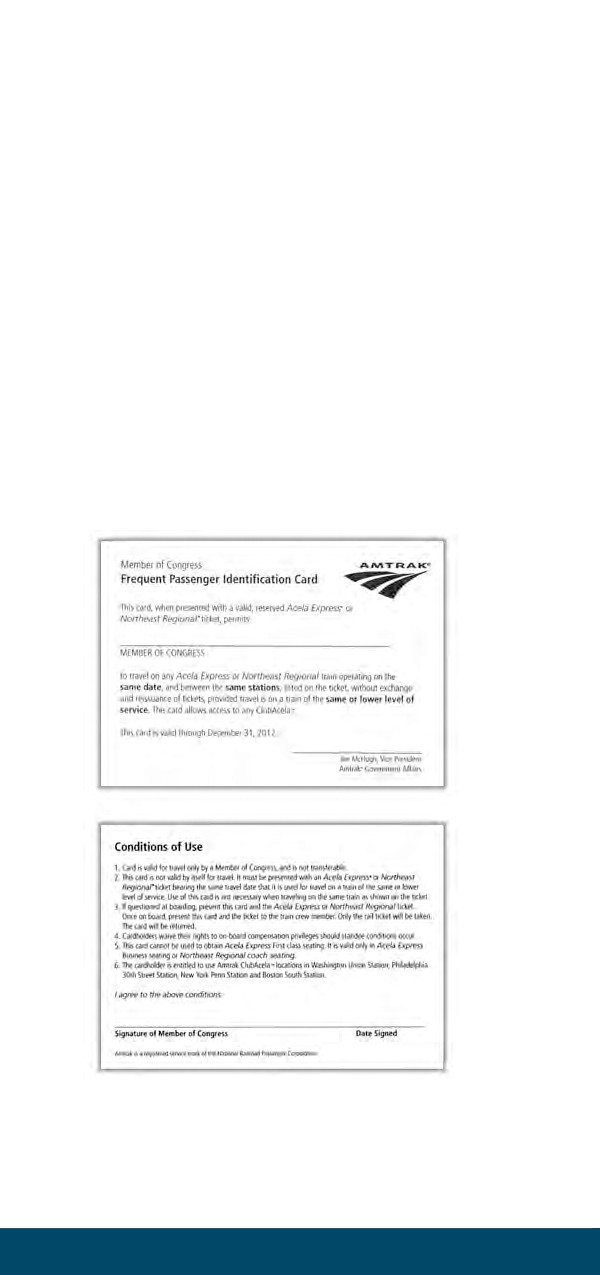
b) This card is not a “flash pass” and is not valid by
itself for travel. Use of this card is not necessary
when traveling on the same train as shown on the
ticket. This card should not be collected by the
Conductor.
c) This card allows the ticketholder of any Acela
Express or Northeast Regional ticket to travel on a
train of the same or lower level of service between
the same stations on the same travel date that is
listed on their original ticket, without the need to
exchange that ticket prior to boarding.
d) This card cannot be used to obtain Acela Express
first class seating. It is valid only in Acela Express
business seating or Northeast Regional coach
seating.
e) The use of this card does not guarantee the
cardholder a seat in those cases when it is used
for travel on a train other than the one shown on
the face of the ticket, and the train is sold out.
Figure 8-63 - Front of “Frequent Passenger Identification Card”
Figure 8-64 - Back of “Frequent Passenger Identification Card”
8-116
Train Service Accounting Procedures
6.
Musical Instruments
Musical instruments will be accepted on-board trains
to occupy a seat at the applicable rail fare of the
accompanying paying passenger, provided the
instrument does not present a safety hazard.
7.
Private Car Passenger Record (NRPC 3160)
a)
All privately owned railroad cars moving on
Amtrak trains must meet minimum Amtrak and
AAR (American Association of Railroads)
interchange standards.
• Every privately owned railroad car must move
under proper movement and billing authority.
(For equipment not owned or leased by Amtrak
and/or railroad-owned business cars; refer to
section titled “Railroad-Owned Business Cars”
in this chapter for specifics on movement of
railroad-owned business cars.)
• This authority is a Transportation Notice,
which is usually part of the train manifest.
b) Any deviations, whether voluntary or involuntary,
from prepaid services must be documented with a
refund form or a Payment Due COTS.
c)
Movement of private cars occupied by no more
than 20 passengers and two attendants is considered
“LIVE” and must be noted in the Transportation
Notice (TN).
• Each passenger in excess of 20 per car and
each attendant in excess of two per car will be
charged the one-way adult regular rail fare
between points of travel.
• The only discount applicable is half-fare for
children between the ages of 2 and 16.
d) Private cars are considered isolated when they
are positioned behind a Superliner, Talgo, or
Baggage Car that does not allow access through the
car, or are located between a locomotive and the
above mentioned cars. The following provisions will
govern when a Conductor is handling occupied pri-
vately owned railroad cars, which are not directly
accessible by the train crew during movement.
• The person-in-charge of the private car must
be identified on the private car movement
request form when it is submitted to CNOC
and their name indicated on the Passenger
Name Record (PNR).
Service Standards Manual No. 6
8-117
•
The Conductor must meet with the person-in-
charge at the originating point of their trip and
must discuss the emergency plan, evacuation
plan and method of communication for the
private car they are traveling on in the event
of an emergency.
•
A “Private Car Passenger Record” (NRPC
3160) that identifies all passengers that will be
on-board the private car must be completed by
the person-in-charge of the private car. (Refer
to Figure 8-65)
•
The person-in-charge will give the completed
form(s) to the Conductor, who will place these
documents in the “Train Earnings Reports
Envelope” (NRPC 158).
•
If the “Private Car Passenger Record” (NRPC
3160) is unavailable, “On-Board Passenger
Record” (NRPC 3085) may be substituted.
•
The person-in-charge of the private car must
not be under the influence of alcohol or drugs
throughout the trip.
•
In the event that a private car owner cannot
meet these requirements, Amtrak will provide
an additional train crew member to accompany
the car at the owners’ expense.
•
These instructions do not apply to deadhead-
private cars that are not occupied.
•
A person-in-charge will be identified for all
private car moves, even those moves that are
not isolated.
•
The Conductor must still meet with that
individual at the originating point of their trip
and they must discuss the emergency and
evacuation plan for the private car and a
“Private Car Passenger Record” (NRPC 3160)
must be completed and placed in the “Train
Earnings Reports Envelope” (NRPC 158).
8-118
Train Service Accounting Procedures
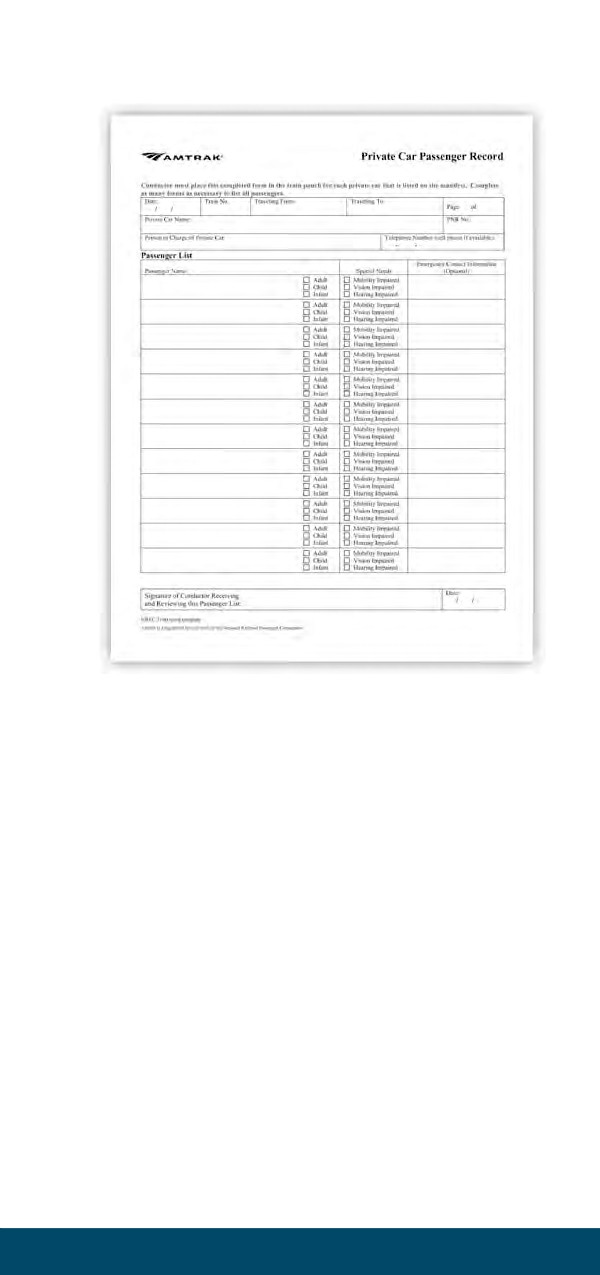
Figure 8-65 - “Private Car Passenger Record” (NRPC 3160)
8.
Railroad-Owned Business Cars
Non-Amtrak, railroad-owned business cars must
have the authority of a Transportation Notice. The
following provisions govern transportation of
passengers in non-Amtrak, railroad-owned business
cars that move on Amtrak trains over lines owned
by another railroad:
a) Employees of Owning Railroad
All employees of the owning railroad, whether
passengers or members of the business-car crew,
are considered railroad officials and administrative
personnel and are carried without charge.
b) Non-Employees of Owning Railroad
Anyone who is not an employee of the owning
railroad or who is not traveling on free or
reduced-rate transportation issued under Amtrak’s
Pass Policy must pay the one-way rail fare in each
direction, between points transported.
Service Standards Manual No. 6
8-119
c) Half Price Fare
• Half-price fares for children and other
discounts that apply to regular rail fares will
also apply.
• Non-Amtrak owned business cars traveling over
a road not owned by that railroad are treated as
if they are privately owned cars. (Refer to
section titled “Privately Owned Railroad Cars”
in this chapter.)
• Amtrak business cars traveling on Amtrak
trains will only need the authority of a
Transportation Notice.
9.
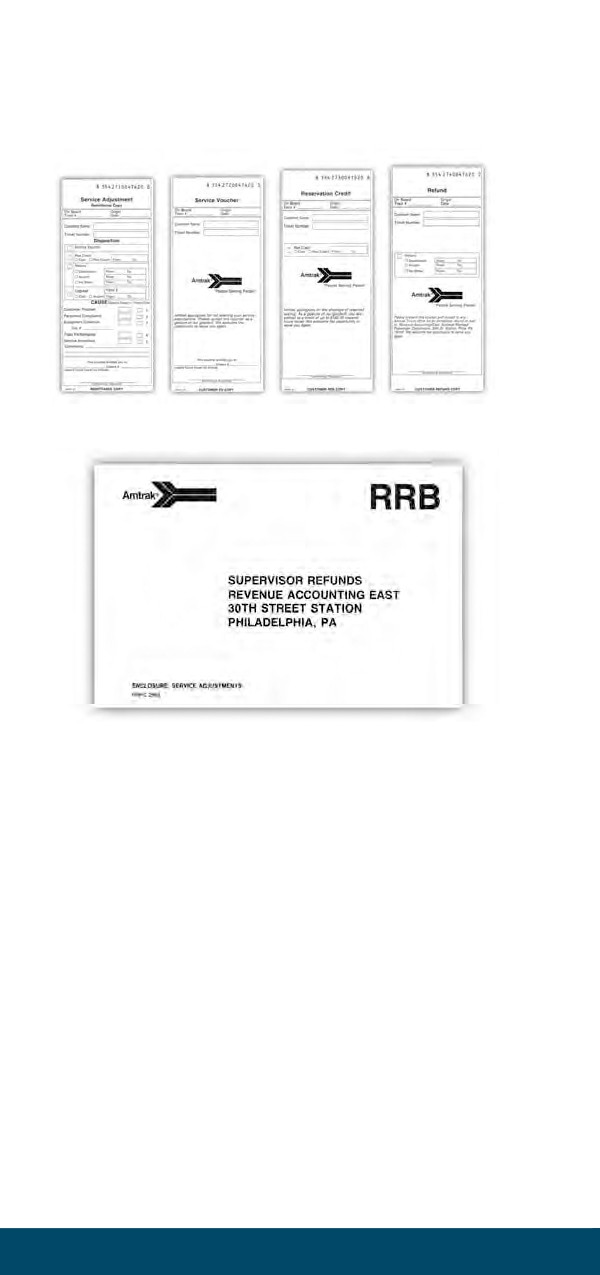
Service Adjustment (NRPT 27)
(Refer to Figure 8-66)
a)
Conductors and Assistant Conductors are
empowered to make service adjustments as a
service recovery tool.
• Service adjustments are made when there is a
problem with passengers, such as no seats being
available on all-reserved trains, equipment
malfunctions or service disruptions.
• Conductors and Assistant Conductors are
required to carry a minimum of two pads of
“Service Adjustment” (NRPT 27).
• Instructions for completing the “Service
Adjustment” (NRPT 27) are printed on the
cover of each book of 25 forms.
• The “Service Adjustment” (NRPT 27) are
chargeable stock, and they must be reported
on the proper form.
• The top remittance copy must always be
completed and remitted in the “RRB Service
Voucher Envelope” (NRPC 2953).
• The stock opening and closing numbers must
be shown on the “Conductor/Asst. Conductor
Sales Report” (NRPC 193).
b) When encountering passengers displaced from
the accommodations which they have a ticket as
a result of changes in equipment, duplicate sales,
or selling errors involving wrong car, train or
accommodation type, it is Amtrak’s policy to
protect the displaced passengers in equal or
superior accommodations without additional fare
collection regardless of higher accommodation
charges or greater minimum ticket requirements.
8-120
Train Service Accounting Procedures
•
When known in advance by the Consolidated
National Operations Center (CNOC), a
Re-Accommodation Notice and Conductor’s
Boarding Advisory will be sent to the station
passenger agent who will provide notification
to the Conductor and Train Attendant, who
will re-accommodate the passenger as advised.
•
When this condition occurs without warning,
due to a bad order or oversold condition, the
Conductor will carry out the policy.
•
The Conductor, utilizing equal or better
accommodations when available, must
re-accommodate the passenger according to
policy.
•
A report of the re-accommodation must be made
by calling (800) 205-0711 as soon as practicable,
designating the old and new train/car/
accommodation, and the reason for the change.
•
No additional fare collection must be made for
these involuntary adjustments.
•
Authorization is automatic, the filing of the
report by the Conductor to CNOC provides
after-the-fact authorization.
c)
Service Adjustment Page of the “Service
Adjustment” (NRPT 27).
• An upgrade in travel accommodation must be
recorded on the top coupon of the “Service
Adjustment” (NRPT 27).
• The top copy must be signed and punched
through all coupons in the Disposition target
block in the center of the form.
• Remit all four coupons, and put them in an
“RRB Service Voucher Envelope” (NRPC
2953) (Refer to Figure 8-67) that in turn goes
in the “Train Earnings Reports Envelope”
(NRPC 158).
d) Service Voucher Page of the “Service
Adjustment” (NRPT 27).
• All authorized methods must be used to
appease a dissatisfied customer before a
Service Voucher is issued.
• A Conductor or Assistant Conductor may
authorize complimentary food and/or beverage
in this attempt.
• Failing in other means, the Conductor or
Assistant Conductor is authorized to give the
Service Standards Manual No. 6
8-121
customer a Service Voucher for a certain
amount against future trip, up to $50.00. (Refer
to the cover of the “Service Adjustment” (NRPT
27) for recommended amounts and categories.)
•
The service voucher is to be completed when a
service issue, in the opinion of the Conductor
or Assistant Conductor, warrants an adjustment.
•
If issuing a Service Voucher is appropriate, the
Conductor or Assistant Conductor must sign
the second coupon and fill in the information
required.
•
The punch target in front of the words
“Service Voucher” must be punched through
all coupons.
•
The second coupon is given to the passenger.
•
The “Conditions of Use” must be shown to the
customer on the reverse side.
•
The first and the last two coupons of the “Service
Adjustment” (NRPT 27) must be placed in a
“RRB Service Voucher Envelope” (NRPC 2953)
which in turn must be placed into the “Train
Earnings Reports Envelope” (NRPC 158).
e)
Reservation Credit Page of the “Service
Adjustment” (NRPT 27).
•
The reservation credit copy is to be used for
standees holding tickets for reserved seating.
This may also apply to a passenger who has been
displaced from Business or First Class service.
•
The Reservation Credit is worth up to $150
toward future travel on Amtrak.
•
Passengers affected by the disruption must be
directed to call (800) USA-RAIL and ask for
Customer Relations.
•
Make every effort to find a seat for these
passengers, including asking pass riders and
non-paying employees to stand, informing
parents of young children traveling free to
put their children in their laps and informing
passengers they must move their belongings
off seats.
•
The target block in front of the words “Res
Credit” must be punched through all four
coupons.
•
The information next to this “Res Credit” on
8-122
Train Service Accounting Procedures
the top coupon must be completed.
• The Reservation Credit, third copy on the
“Service Adjustment” (NRPT 27) must be
completed, signed and given to the passenger.
• Employees must show the passenger the
“Terms and Conditions” of this Reservation
Credit, which are on the reverse side.
• Place the top two and the bottom coupons in a
“RRB Service Voucher Envelope” (NRPC
2953) and forward in the “Train Earnings
Reports Envelope” (NRPC 158).
f)
Refund Page of the “Service Adjustment”
(NRPT 27).
•
The refund page is to be used to document a
situation which the Conductor or Assistant
Conductor warrants consideration for a
refund.
•
Issuing the refund form provides the necessary
information verifying that the passenger did
not receive the service that was paid for so that
the refund request can be considered but does
not guarantee that the passenger will receive a
refund.
•
Never quote the amount of the refund that
the passenger will receive. The refund will be
calculated by a Ticket Agent or by Customer
Service - Refunds.
•
Some common reasons for refunds include:
• riding short of the ticket station pair
• fewer passengers traveling than ticketed
• unavailable accommodations
• involuntary downgrade from Sleeping Car
accommodation to Coach
• involuntary downgrade from Business Class
to Coach
• involuntary downgrade from Acela Express
First Class to Acela Express Business Class
• passenger having to detrain prior to planned
destination due to illness or personal
emergency
•
The Conductor or Assistant Conductor must
punch through all four coupons in the punch
target located in front of the word “Refund.”
•
The information on the top coupon below this
(but in the same block) must be completed.
Service Standards Manual No. 6
8-123
• The fourth copy, the Refund copy, must be
signed and given to the passenger with their
original ticket receipt.
• Put the top three coupons in a “RRB Service
Voucher Envelope” (NRPC 2953), and place
the envelope in the “Train Earnings Reports
Envelope” (NRPC 158).
• Double and triple punching ticket receipts for
service adjustments including refunds is no
longer an acceptable procedure. Ticket offices
or Customer Relations will not honor punched
receipts.
g)
If a passenger has received an Exchange Voucher
from a ticket office after changing or refunding
tickets, that Voucher may only be used to purchase
tickets at an Amtrak ticket office and cannot be
used to purchase a ticket on-board the train.
h) Ticket Honored for Less than Full Value.
When a ticket is honored in a lower cost type of
service, for fewer persons than noted, or from an
intermediate starting point, or for a child traveling
on an adult ticket, “Service Adjustment” (NRPT 27)
will be issued to the passenger.
i)
Involuntary Downgrade from Sleeping Car to Coach.
•
Passengers who were notified of the downgrade
before boarding and exchanged their tickets
for a refund are not entitled to Sleeping Car
meal amenities.
•
Passengers who were notified of the downgrade
before boarding, but did not exchange their
tickets will be downgraded on-board and
receive a “Service Adjustment” (NRPT 27) for
the Sleeping Car accommodation. Passengers
in this situation are entitled to Sleeping Car
meal amenities.
•
If en route Sleeping Car passengers are
involuntarily downgraded to Coach due to
equipment failure or other cause, the passengers
will still receive the meal amenity portion of
the Sleeping Car accommodation.
•
A “Service Adjustment” (NRPT 27) will be
issued to refund the difference in price between
Sleeping Car and Coach accommodations.
•
The Conductor will notify the LSA - Diner of
the downgrade, and identify the passengers.
•
When an en route failure involves an entire
8-124
Train Service Accounting Procedures
Sleeping Car, and the Conductor or Assistant
Conductor cannot issue each Sleeping Car
passenger a “Service Adjustment” (NRPT 27),
call (800) 205-0711 and request a notation in
ARROW to issue a “Block Refund” for all
downgraded passengers. Passengers affected by
the disruption must be directed to call (800)
USA-RAIL and ask for Customer Relations.
j)
Voluntary Downgrade of Accommodation.
Passengers who downgrade voluntary from
Sleeping Cars, Business Class or Acela First Class
accommodations do not receive any adjustments
or refunds after the trains departure, since the
passenger is already enroute.
k) When an Acela Express train operates with
non-Acela Express equipment, the Conductor or
Assistant Conductor is to make the “Acela
Express Equipment Substitution” announcement
in all cars as outlined in Chapter 10, “On-Board
Announcements and Signage”.
• If the Conductor or Assistant Conductor is
approached by a passenger that has an issue
with the substitute equipment, the Conductor
or Assistant Conductor is to inform the
individual to call (800) USA-RAIL and ask
for the Customer Relations.
• At no time is the Conductor or Assistant
Conductor to make an announcement implying
passengers will receive a refund.
• Do not issue an “Service Adjustment” (NRPT 27)
• There are to be NO refunds, when a Acela
Express Business Class ticket is presented on a
non-premium Coach train.
l)
In situations where a significant number of
passengers are affected, such as the blanking of
a feature car, etc. The Conductor must adhere to
the following procedure:
• Call (800) 205-0711 and report the following
to CNOC:
• Train number and its location when events
occurred.
• Circumstances or events that necessitated
the service adjustments.
• Make the “Significant Service Failure”
announcement from Chapter 10, “On-Board
Announcements and Signage”.
Service Standards Manual No. 6
8-125
• Passengers affected by the disruption must be
directed to call (800) USA-RAIL and ask for
Customer Relations.
Figure 8-66 - “Service Adjustment” (NRPT 27)
Figure 8-67 - “RRB Service Voucher Envelope” (NRPC 2953)
10. Standee Conditions/No Shows
a) A "standee condition" exists only if every seat
in a particular class of service is occupied and
passengers in that class remain standing. (Class
of service is defined as: Coach, Business Class,
First Class, etc.).
• Passengers who choose not to sit because of
vacant seat's location (e.g., the empty seat at a
table on Acela Express; seats facing backward,
and/or seats in the Quiet Car) are not to be
counted as standees.
• In such cases, the passenger has made their
decision because of their preference, not
because a seat is unavailable.
• Conductors are required to report “standee
conditions” on both reserved and unreserved
trains to CNOC at (800) 205-0711.
8-126
Train Service Accounting Procedures
b) In order to ensure that continuing or return space
held by no-show passengers is made available for
future sale, the Conductor must call CNOC at
(800) 205-0711 to release the space.
c) For the purpose of this rule, no-show Sleeping
Car space is defined as space not occupied within
two hours or within one stop from the boarding
point indicated on the manifest, whichever is longer.
11.
Stopover
A stopover allows passengers to travel part of their
journey and finish the rest later. There are certain
procedures to make sure the passenger has no
difficulty re-boarding and continuing the journey
and to ensure that both parts of the journey will be
recorded in each “Train Earnings Reports Envelope”
(NRPC 158) correctly.
a)
Allowed on Some Tickets
• Stopovers (breaks in a journey for more than
23 hours and 30 minutes) are allowed on
regular full fare tickets such as YOFC, KOAE,
UOF1, etc.
• No stopovers are allowed unless specifically
allowed in the fare rules.
• Check individual fare plan rules in the back of
the Conductor’s Memorandum Tariffs.
b) Not Allowed on Accommodation Charges
• Stopovers are not allowed on published
Sleeping Car accommodation or First Class
seat charges.
• These charges are for continuous passage on
the same car or train.
• Passengers must pay separate accommodation
charges to and from each point of a stopover or
transfer between trains (except where through
cars are operated via connecting trains and
through accommodation charges are published).
c)
Notification
• Passengers desiring to stopover or transfer en
route must inform the Ticket Agent, who will
provide separate tickets to and from each
point of change.
• Passengers desiring to make stopovers or
transfers for which separate tickets have not
been provided must notify the Conductor or
Assistant Conductor prior to arriving at the
Service Standards Manual No. 6
8-127
stopover point so that they can endorse the
ticket accordingly and enter the required
information on the “Record of Tickets
Honored But Not Lifted” (NRPC 157).
•
The Conductor or Assistant Conductor will
draw a tight circle around this original punch
on the face of the ticket.
•
Near this circle write: “OFF AT” followed
by the station name or three-letter city code,
the train number, the date and crew member
signature.
•
Return the ticket to the passenger and enter
the information on the “Record of Tickets
Honored But Not Lifted” (NRPC 157).
•
Passenger must be informed that they are
required to make a reservation before boarding
any reserved train to continue their journey.
•
If a passenger chooses to stopover from an
all-reserved train, the Conductor or Assistant
Conductor must call (800) 205-0711 to release
the vacated space back into inventory for sale.
•
There is no limit on the number of stopovers
or transfers that may be made along the route
as long as they are within the validity period of
the ticket.
•
When the passenger continues the journey
after a stopover, the next Conductor or
Assistant Conductor must cancel the ticket
again, next to the circled first cancellation.
d) Reverse Direction
When a stopover ticket is being honored in the
opposite direction to which it reads, a reverse
direction punch must be cut to ensure that the
Conductor or Assistant Conductor on the
remaining portion of the journey understands
what the passenger is entitled to.
EXAMPLE:
A passenger traveling on a 100-mile journey uses
the ticket in reverse direction, and detrains after
10 miles. They are due the remaining 90 miles.
Without the reverse direction punch, it would
appear that only 10 miles of travel was still due
the passenger.
8-128
Train Service Accounting Procedures
e)
Point Beyond
• If a passenger gives a Conductor or Assistant
Conductor a ticket for a point beyond the run of
the train, the ticket must be examined closely.
• If it is a valid ticket, use the same stopover
procedure.
• An alternative method is to lift the ticket and
issue a COTS with no dollar value cut, and a
new origin and destination.
• In this case, the “IN CONN WITH” block must
be punched as well as the “TRAIN CHECK”
block (if one is available).
f)
Exceptional Stopover Authority
For the time necessary, stopovers will be authorized
on accommodations tickets, and those types of
passage tickets where stopovers are not otherwise
permitted, when the stopover is necessitated by
illness, injury or quarantine resulting in continued
travel being impossible or dangerous to passengers
or members of their party (verified by physician’s
letter) or interruption of train crew.
g)
Extension of Limit
An extension of the time limit of tickets, and
stopover privileges, will be granted without
additional charge under any of the following
conditions:
• Illness or Injury - In case of illness or injury
which makes traveling dangerous, and when
such illness or injury is authenticated by written
certificate of the attending licensed physician
or when other satisfactory evidence is given.
This will also apply, if necessary, to one or
more accompanying members of the family of
the holder of tickets.
• Quarantine - To holders of tickets who become
subject to an established quarantine and present
proper certification thereto by the quarantining
physician or other authorized public health
officer.
• Unforeseen Delays - If, due to washouts,
obstructions of tracks, operating delays, inability
to provide transportation, floods, work interrup-
tions, acts of God, etc., a passenger is delayed
so that the limit of such passenger’s ticket has
expired or has elapsed to such an extent as to
Service Standards Manual No. 6
8-129
curtail their stopover privileges, the delay will
be certified by endorsement on ticket by the
Conductor, Assistant Conductor, or other
Amtrak representative.
• Time limits will be extended for the same
number of days as illness, injury, quarantine,
or washouts, etc. are certified as delaying the
passenger.
• Time limits will not be extended to passengers
purchasing tickets between two points with a
stop over point for the purpose of taking a
medical examination, a course of treatment,
undergoing an operation, or seeking a more
healthful climate.
12.
Train Fare Penalty Waiver (NRPC 2429)
a)
The OBF (On-Board Fare) will be waived at all
unstaffed/closed stations.
b) The OBF may also be waived at a boarding station
when the reservations and ticketing system has
failed and, in the judgment of station personnel,
passengers may miss their departing train. In
those cases, the station personnel will follow
established procedures and issue a “Train Fare
Penalty Waiver” (NRPC 2429) to the Conductor
to waive the fare. (Refer to Figure 8-68)
c)
At stations where bus connections are running
late, if there is not adequate time for the sale of
tickets, a waiver will be given to those passengers
off the late bus so that they do not miss the train
connection.
d) When the OBF is waived, the Conductor or
Assistant Conductor will punch one of the
following codes on the COTS:
• UNSTF - When OBF is waived because of an
un-staffed or closed station.
• STNWV - When station personnel have issued
a “Train Fare Penalty Waiver” (NRPC 2429).
8-130
Train Service Accounting Procedures
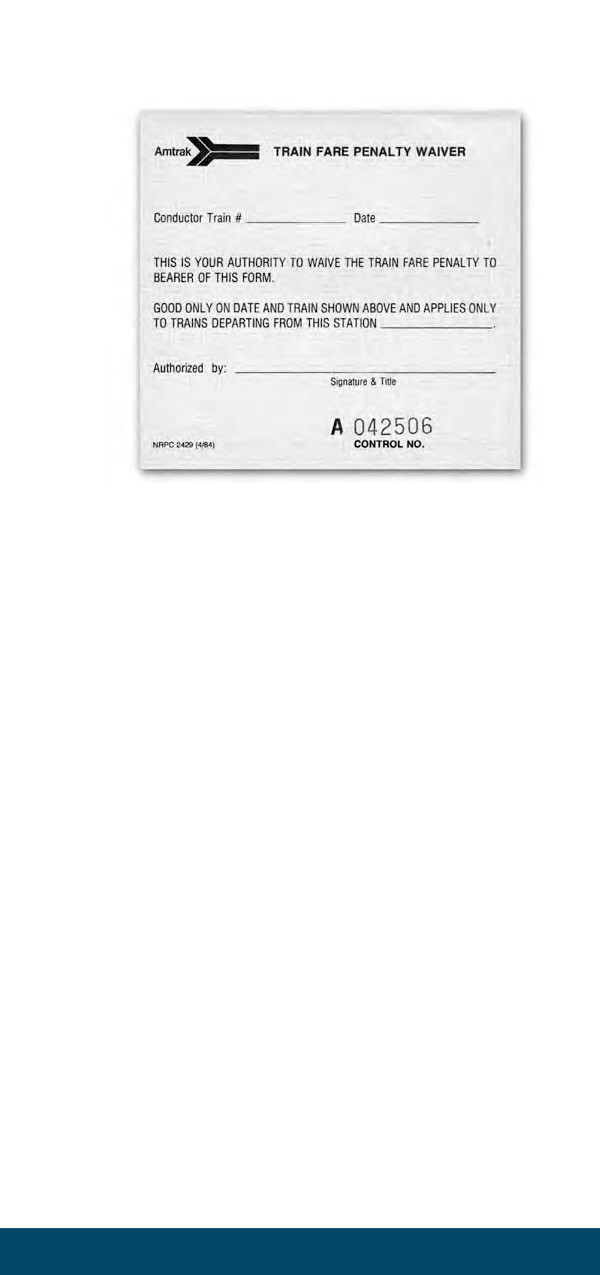
Figure 8-68 - “Train Fare Penalty Waiver” (NRPC 2429)
13.
Transfer
a) A passenger who missed an established connection
at a point of transfer from one train to another
due to a late Amtrak train arrival will be furnished
accommodations of the type called for on the ticket,
if available; or accommodations of the nearest type
available, on the next train, without additional
fare collection for higher accommodation charges
or greater minimum ticket requirements. This
guarantee does not apply to connections from
Amtrak to any other carrier, except dedicated
Thruway Service connections.
b) Passengers traveling at discounted fares, which do
not allow stopovers, must board connecting service
within 23 hours and 30 minutes of their arrival at the
transfer point. Through fares are valid via points of
stopover or transfer as authorized above, provided
travel continues in the same direction.
14.
Uncollected Fare Report (NRPC 3008)
a) If, for any reason, transportation collection and
examination is not completed and passengers
detrain, an “Uncollected Fare Report” (NRPC
3008), must be completed. (Refer to Figure 8-69)
b) The Conductor or Assistant Conductor(s) must
complete the form as follows.
Service Standards Manual No. 6
8-131
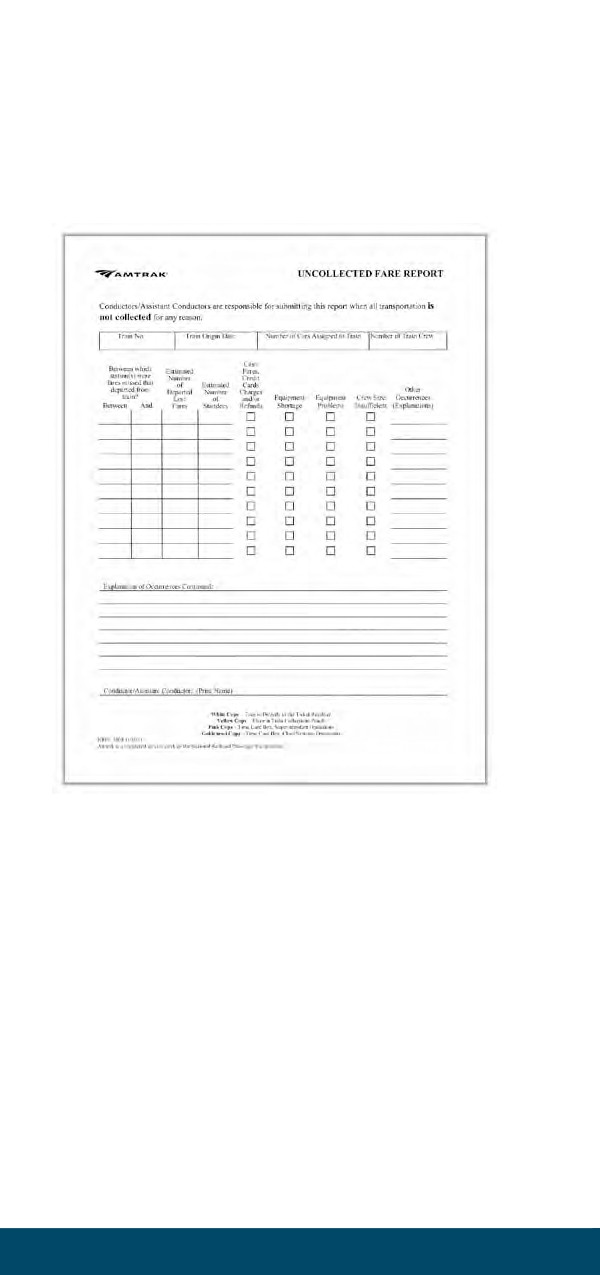
• The white copy goes to the Ticket Receiver’s
station office.
• Place the canary copy in the “Train Earnings
Reports Envelope” (NRPC 158).
• The pink and goldenrod copies can be discarded.
Figure 8-69 - “Uncollected Fare Report” (NRPC 3008)
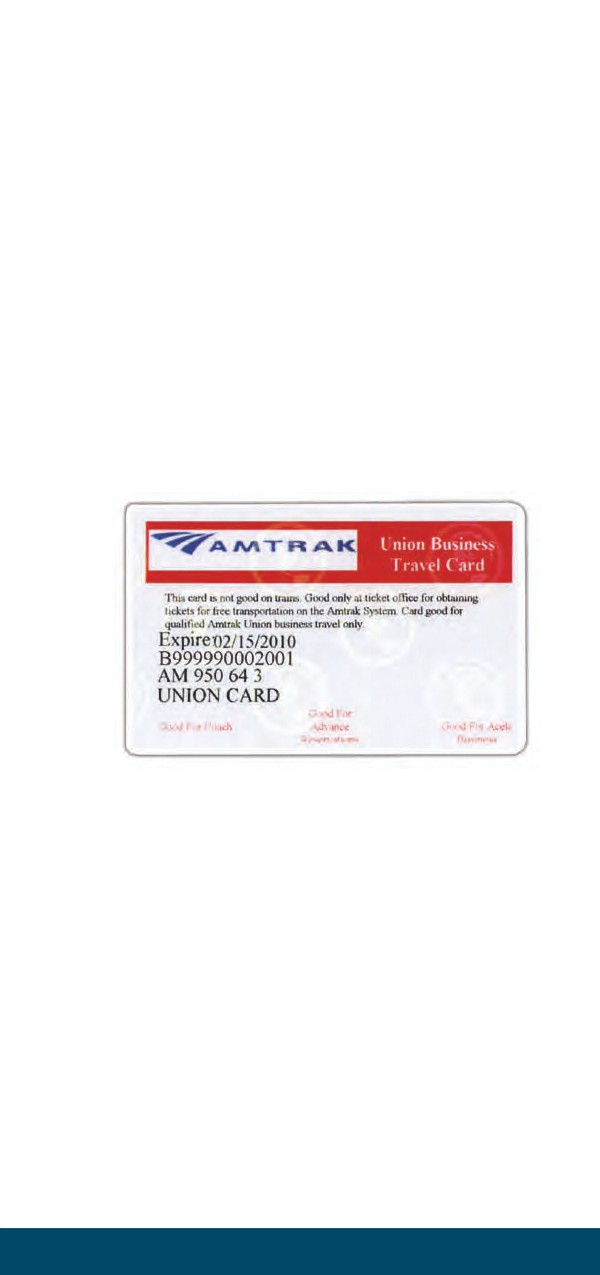
15. Union Business Travel Card
a) The Union Business Travel Card has a red stripe
at the top of the cards and contains the words
"Union Business Travel Card" within the stripe.
(Refer to Figure 8-70)
b) Union Business Travel Cards are issued to senior
officers of labor organizations.
c) Dummy social security numbers are used (999 99
0002 001, etc.) not the officer's own social security
number.
d) The Union Business Travel Card is not a "flash
pass" and is not good on trains.
8-132
Train Service Accounting Procedures
e) The Union Business Travel Card can only be
used to obtain tickets for transportation on the
Amtrak system.
• A reservation and a ticket are always required.
• Reservations may be made through the call
center or ticket office.
• The tickets must be issued at a ticket office.
Quik-Trak self-serve ticketing kiosk can not be
used for tickets issued under this Union
Business Travel Card.
f) Union Business Travel Cards are good for
reserved coach, unreserved coach and Acela
Express business class only.
g) Union Business Travel Cards cannot be used for
Sleeping Cars (including BT), regular train Business
Class, Auto Train, or 7000-8000 series thruway
services.
Figure 8-70 - Example of Union Business Travel Card
T. Train Earnings Reports Envelopes
(NRPC 158)
The “Train Earnings Reports Envelope” (NRPC 158)
is a large white envelope with a blue border and
string closure. (Refer to Figure 8-71) This envelope is
the depository of lifted tickets and related ridership
and revenue documents. The envelope’s flap contains
instructions for packing tickets and other documents.
All information must be written in ink on the envelope.
1. Originating Conductor
a) The first Conductor is responsible for securing
and identifying the “Train Earnings Reports
Envelope” (NRPC 158) by recording the train
Service Standards Manual No. 6
8-133
number, scheduled departure date, random ID
check digit, train origin and destination on the
front of the envelope.
b) The first and each succeeding Conductor will
record their name, employee identification number,
the date they are scheduled to begin the run and
the work assignment origin and destination.
c)
Conductor and Assistant Conductor(s) are
responsible for ensuring that all passengers who
had previously boarded have valid and properly
cancelled ticket receipts by performing a train
sweep, check seat checks or by verifying cancelled
tickets in the “Train Earnings Report Envelope”
(NRPC 158).
d) On trains that begin as one train and separate
into two or more trains along the route, the
originating Conductor will secure and identify a
“Train Earnings Report Envelope” (NRPC 158)
for each route.
e)
On trains that remain as one train but having
special accounting needs where collections need
to be separate, the origin Conductor is responsible
for securing and identifying each separate “Train
Earnings Report Envelope” (NRPC 158).
f)
At the station where a relieving train crew takes
over, it is the responsibility of the two
Conductors to exchange the “Train Earnings
Report Envelope” (NRPC 158). The first
Conductor must inform the relieving Conductor
of any important situations.
g)
While the Conductor is responsible for the “Train
Earnings Reports Envelope” (NRPC 158), they
must also brief other train crew members on the
location of the envelope.
h) “Train Earnings Reports Envelope” (NRPC 158)
must be kept in a place that provides protection
from heat, water, or impact damage in the event
of a train emergency.
2.
Content
The general rule is that if it does not record revenue or
ridership, it does not belong in the “Train Earnings
Reports Envelope” (NRPC 158). There must be
sufficient evidence inside, or written on the outside of,
the “Train Earnings Reports Envelope” (NRPC 158)
8-134
Train Service Accounting Procedures
for all passengers carried. With this information,
Amtrak can accurately determine the train’s earnings
and how many cars and train crew members are
appropriate. Given that an accident could happen
at anytime, this accounting must take place as soon
as possible following the ticket lift after departing
from each station.
a)
The following documents are to be placed in the
“Train Earnings Reports Envelope” (NRPC 158).
•
Arrow and ARC tickets rubber banded together,
all facing upward in the same direction - no
staples.
•
Arrow commuter tickets bundled separately.
•
Book tickets, COTS, and “On-Board Passenger
Record” (NRPC 3085) clipped together - no
staples.
•
Tickets that have not been lifted on a train on
which the passenger has already traveled, with
a note stating, “Not From This Train” and, if
possible, the previous train number and date of
travel.
•
The “RRB Service Voucher Envelope” (NRPC
2953) containing the vouchers.
•
Copy of “Tickets Honored But Not Lifted”
(NRPC 157), if used.
•
The last page of the train manifest, only if it
contains long gun case tracking information.
•
Yellow copy of the “Pass Abuse Incident
Report” (NRPC 1502), if used.
•
A copy of the Transportation Notice whenever
a private car is in the consist.
•
A “Private Car Passenger Record” (NRPC 3160),
if available, for each private car in the consist.
If not available, an “On-Board Passenger
Record” (NRPC 3085) must be included for
each passenger on the private car(s).
b) Operating documents are not to be included in
the “Train Earnings Reports Envelope” (NRPC
158). Such documents are, but not limited to:
• Wheel reports.
• Time reports.
• Accident reports.
• Matrix reports.
• Delay reports.
• Found items.
• Ticket Purchase Record.
Service Standards Manual No. 6
8-135
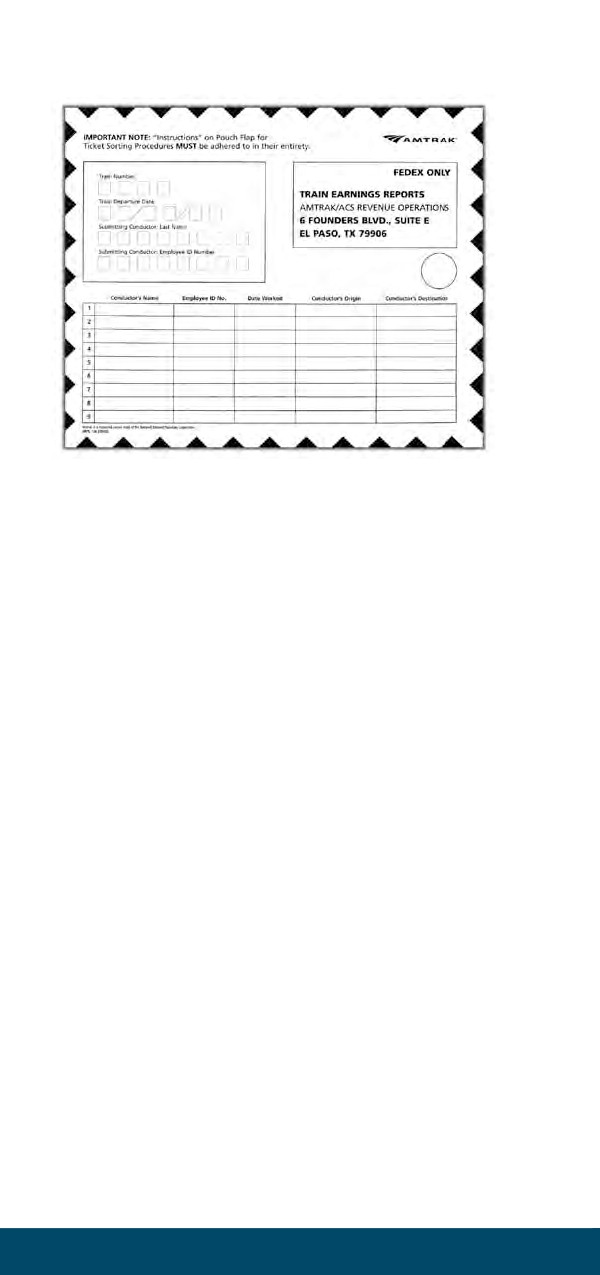
Figure 8-71 - “Train Earnings Reports Envelope” (NRPC 158)
3.
Disabled Trains
a) When a train becomes disabled and a transfer of
passengers takes place, the “Train Earnings
Reports Envelope” (NRPC 158) must be given to
the Conductor of the relief train.
b) The Conductor of the disabled train will seal the
“Train Earnings Reports Envelope” (NRPC 158)
and write “Disabled Train” on the front cover before
turning over to the Conductor of the relief train.
c) The Conductor of the relief train will use their
“Train Earnings Reports Envelope” (NRPC 158) for
all tickets received from this point forward including
tickets that were intended for the disabled train.
d) Once the “Train Earnings Reports Envelope”
(NRPC 158) has been sealed from the disabled
train, no additional tickets will be added.
e) The Conductor of the relief train will now be
responsible for submitting both the disabled train
and their “Train Earnings Reports Envelope”
(NRPC 158) upon the completion of the trip.
4.
Disposition
a) At final destination the Conductor must submit
the “Train Earnings Reports Envelope” (NRPC
158) to the proper depository location immediately
after the passengers have detrained.
8-136
Train Service Accounting Procedures