Amtrak. Service Standards Manual for Train Service and On-Board Service Employees (Version 6, 2011) - page 11
• Issue COTS for a full one-way fare including
the on-board fare.
• The Amtrak police or local law enforcement
authorities must then be summoned to take
appropriate action with the presenter at a station
stop prior to his/her ticketed destination.
• If Amtrak police or local law enforcement
authorities do not meet the train, the
Conductor, at their earliest convenience,
must file a report with the Amtrak police.
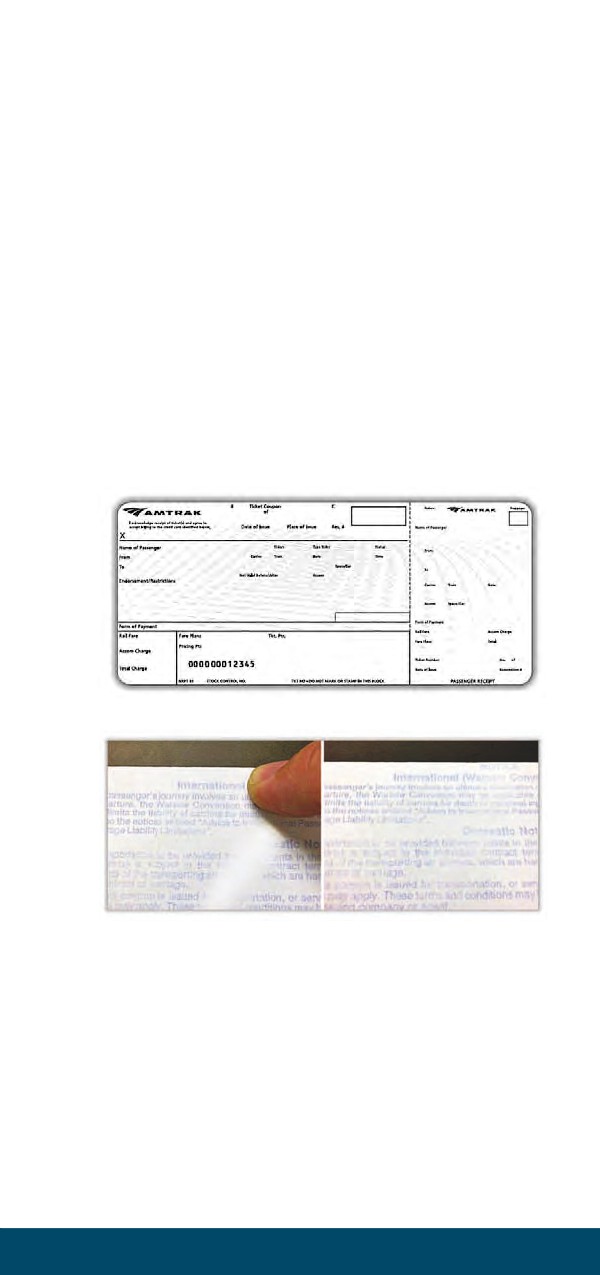
f) Fraud enhancement features for white Arrow
tickets.
• Watermark located on the front of the ticket
resists photocopying. (Refer to Figure 8-3A)
• Thermo-chromatic ink on the back of ticket that
when rubbed makes the printing momentarily
disappear before reappearing again. (Refer to
Figure 8-3B)
Figure 8-3A - Example of Watermark on Front of White Arrow Ticket
Figure 8-3B - Example of Thermo-Chromatic Ink on Back of White Arrow Ticket
4. Validity Period
a) One-way and round-trip tickets sold at regular
fares (including employee business travel tickets)
have a one-year limit from date of sale.
b) Special and Discounted Fare ticket limits vary
according to the corresponding fare code rule.
c) Employee tickets issued for personal (not business)
travel are valid for 30 days.
d) To calculate the validity period for any type of
fare, always count the date of sale for unreserved
Service Standards Manual No. 6
8-17
or open tickets, or first date of travel for reserved
tickets, as the first day of validity.
e) Ticket limit terminates at 11:59 p.m. of the last
day of the period of validity of a ticket.
f) Honoring Tickets After Expiration Date.
• When a train scheduled to depart at 11:59 p.m.
or earlier is delayed and actually departs after
midnight, tickets that expired at 11:59 p.m. are
to be honored.
• Tickets are to be honored for continuous passage
without stopover, but including necessary
transfers, to final destination of ticket, when such
passage has started before midnight on the last
date of validity but continues after midnight.
5.
Sign Here is Required
a)
It is the responsibility of the Conductor and
Assistant Conductor(s) to make sure that every
Arrow, Book, Ticket-by-Mail, and Quik-Trak ticket
purchased with a credit card is signed in the
upper-left corner on the signature line above the
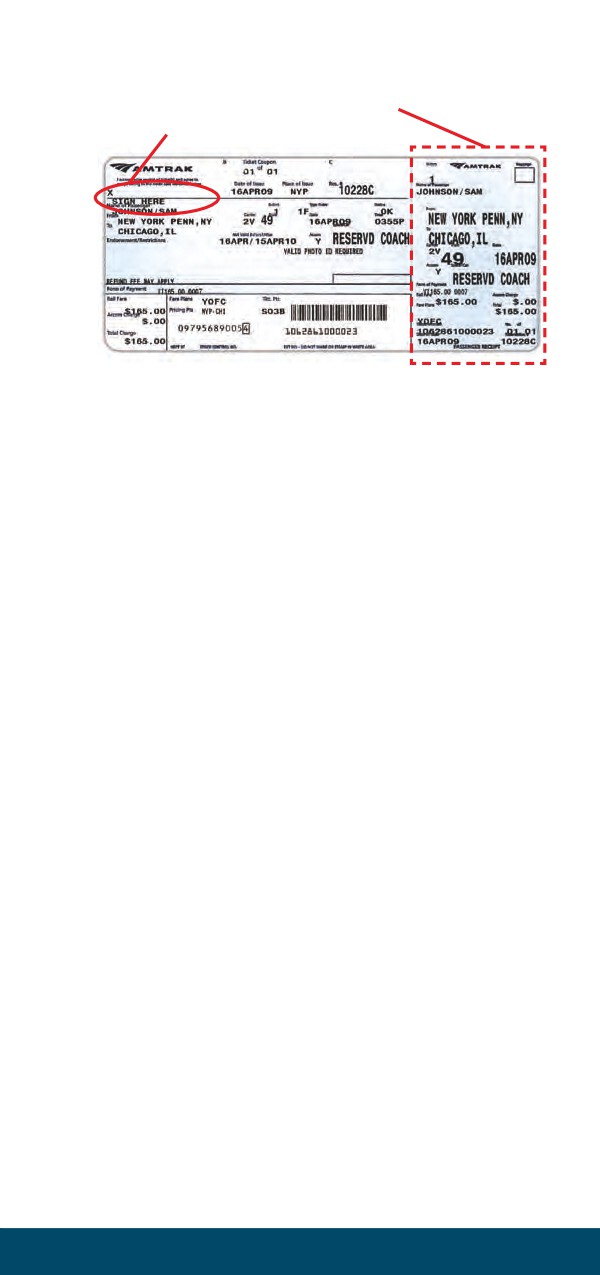
printed “SIGN HERE.” (Refer to the red circled
area in Figure 8-4)
• If the passenger has not done this, they must
sign in the presence of the Conductor or
Assistant Conductor.
• It does not matter if the ticket is a special,
discounted or full fare.
b) If there is doubt concerning the passenger’s
signature, have the passenger sign the ticket again.
c)
The objective of this policy is to be able to
substantiate the credit card charge if it is disputed
by the passenger.
• The customer’s signature is required to avoid a
charge-back from the credit card company.
• The signature line for these types of tickets is
located on the upper left hand of the ticket.
• Right below this line is the notation “Sign
Here” which will appear on every ticket
requiring the passenger’s signature.
d) All employee tickets require a signature in the
upper-left corner for verification. These tickets
are usually marked “Special” and may not
indicate “Sign Here.”
8-18
Train Service Accounting Procedures
Receipt
Portion
Sign Here
of Ticket
Figure 8-4 - Example of “Sign Here” Arrow Ticket
G.
Ticket Types and Other Permissible Forms of
Transportation Documentation
(Listed in alphabetical order)
1.
Advanced Paid (AP)
a)
General
•
A reservation is categorized as Advance Pay
(AP) when a passenger has paid for the travel
using a credit card over the telephone or
internet in advance of travel.
•
The ticket may be paid for by a person other
than the traveler.
•
The AP process is a convenience for passengers
who want the security of a confirmed reservation.
The AP process also eliminates the necessity of
a special trip to the station preceding the day
of travel.
•
The passenger must convert that AP reservation
into a ticket using a Quik-Trak self-serve
ticketing kiosk or Ticket Agent before the
train’s departure.
•
If the passenger does not convert the AP
reservation into a ticket before the train’s
departure or the first train in a multiple
segmented itinerary, the reservation will
automatically be cancelled.
•
If the passenger has not converted the AP
reservation into a ticket and boards the train,
the train crew must collect a fare from the
passenger.
Service Standards Manual No. 6
8-19
• In order to secure a refund (credit), the passenger
must go to the Ticket Agent. If the station is
un-staffed, the passenger must contact Amtrak
Refunds.
• On-board, the passenger using the AP ticket
will be asked to sign the ticket, even if they are
not the credit card holder, in the upper left
hand corner above the “Sign Here” designation.
• If the passenger is not the credit card holder
and questions why they need to sign the ticket,
explain that the signature allows Amtrak to
identify the passenger if the cardholder asks.
b) Advance Pay Reservation at Open and Staffed
Stations
•
The passenger must convert the AP reservation
to a ticket before boarding the train whether
the station is staffed with both an Ticket Agent
and Quik-Trak self-serve ticketing kiosk or has
only an Ticket Agent or only a Quik-Trak
self-serve ticketing kiosk.
•
The passenger must have a ticket to present
to the Conductor on-board the train. If the
boarding passenger does not have a ticket, the
Conductor must collect either the On-Board
Fare or Regular Fare.
• On-Board Fare is to be charged when a
passenger by-passes an open ticket office and
boards the train without obtaining a ticket.
• Regular Fare is to be charged if the passenger
boards the train and there was either no
Ticket Agent on duty or the Quik-Trak
self-serve ticketing kiosk was not working
correctly.
•
The Conductor will collect the fare (whether
On Board or Regular) for the initial segment
of travel. The passenger must obtain the rest
of the ticket(s) from the nearest Amtrak ticket
office.
•
The passenger must be advised that some or
all of the reservation may have been cancelled,
as this automatically occurs once the train has
left the station.
•
Advise the passenger that they can obtain an
adjustment at the ticket office or through the
mail via Amtrak refunds.
8-20
Train Service Accounting Procedures
• Conductors and Assistant Conductors are
not to call a downline station asking for a
passenger’s tickets to be issued. Once the train
departs from the station the reservation is
cancelled. To create the ticket, a Ticket Agent
must go back into Arrow and try to reconstruct
the reservation with the same fare structure
(which may not be possible). One person stations
do not have the time to do this work.
c)
Advance Pay Options for Un-staffed Stations
without Quik Trak (Conductor Ticket Delivery
System)
If a station does not have a Ticket Agent or
Quik-Trak self-serve ticketing kiosk, passengers
will not be able to make a reservation using the
Advance Pay option. A system called the
Conductor Ticket Delivery System has been
developed to offer the Advance Pay option to
passengers at these same locations.
•
The AP tickets for downline stations are
generated at designated stations and given to
the Conductor.
•
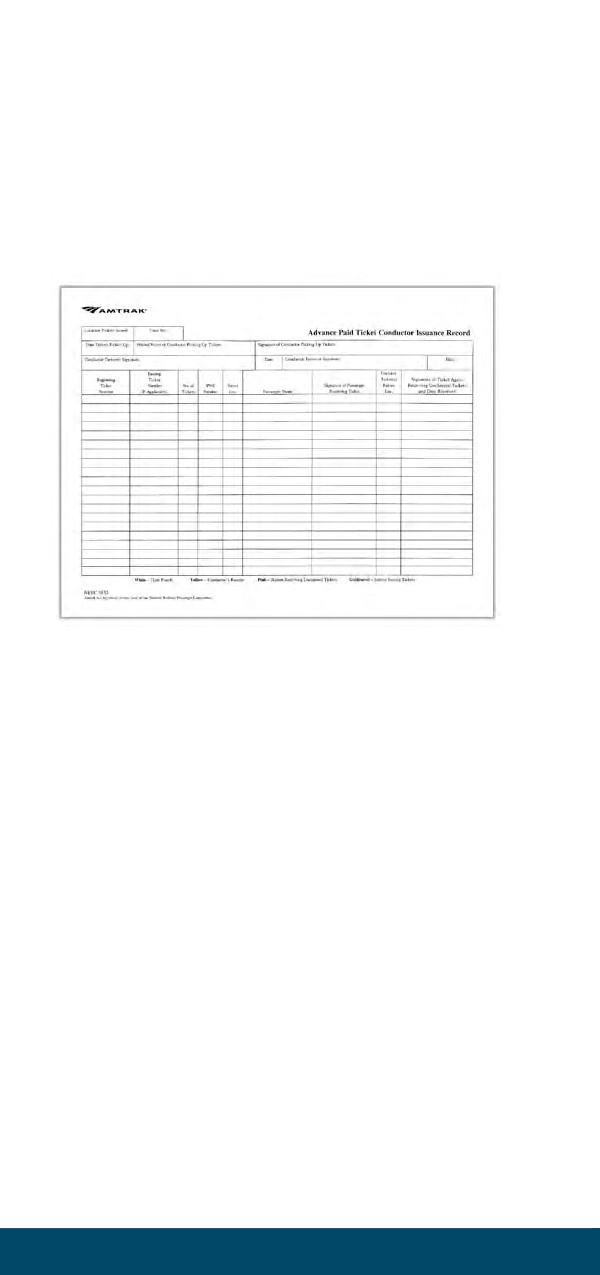
The Conductor signs the “Advance Paid Ticket
Conductor Issuance Record” (NRPC 3152) to
accept responsibility for the tickets from issuing
station. (Refer to Figure 8-5)
•
The tickets must be secured.
•
Greet passengers boarding at un-staffed stations,
asking for their name(s).
•
Request identification from the passenger.
•
Give the passenger their Advance Paid tickets.
•
Make sure the passenger has received all tickets
held in their name, including those for connecting
or future travel.
•
Have the passenger sign each ticket.
•
Have the passenger sign the “Advance Paid
Ticket Conductor Issuance Record” (NRPC
3152) for the tickets received.
•
Collect the ticket(s) from the passenger for
this segment of the trip.
•
Place the white copy of “Advance Paid Ticket
Conductor Issuance Record” (NRPC 3152)
into the “Train Earning Reports Envelope”
(NRPC 158).
•
Unclaimed tickets must be returned to the next
Service Standards Manual No. 6
8-21
staffed station (where time permits) or train
crew change point, which are beyond where the
passenger was to have boarded the train.
• Unclaimed tickets must be submitted with the
“Advance Paid Ticket Conductor Issuance
Record” (NRPC 3152) because the transaction
must be reversed in order for the passenger to
receive a refund (credit).
Figure 8-5 - “Advance Paid Ticket Conductor Issuance Record” (NRPC 3152)
d) Turning Tickets Over to Relief Conductor -
Conductor Ticket Delivery System
The originating Conductor turns over AP tickets
to a relieving Conductor for passengers boarding
at un-staffed stations (This would happen if a
train crew change took place between the station
that produced the tickets and the station that
receives any unclaimed tickets.)
• Give the “Advance Paid Ticket Conductor
Issuance Record” (NRPC 3152) and all
remaining tickets to the relieving Conductor.
• Have the relieving Conductor sign and date the
first open “Conductor Turnover Signature” space.
• Remove the yellow “Conductor’s Receipt” of
the “Advance Paid Ticket Conductor Issuance
Record” (NRPC 3152) as a record of having
turned the tickets over to the relieving Conductor.
• Follow the steps in letter c) “Advance Pay
Options for Un-staffed Stations without Quik
Trak (Conductor Ticket Delivery System)” of
this section, for distributing tickets to passengers.
8-22
Train Service Accounting Procedures
• When turning in unclaimed tickets, have a
photocopy made of the “Advance Paid Ticket
Conductor Issuance Record” (NRPC 3152) for
your records.
2.
Airline
Continental Airlines is the only airline that has an
agreement with Amtrak to accept their tickets under
certain circumstances.
a)
Involuntarily rerouted Continental Airlines
passengers originating in BOS, PVD, EWR, PHL,
BWI or WAS destined for any point Amtrak
serves between Washington and Boston, including
New York to Albany and New Haven to
Springfield, may use their Continental Airlines
ticket for passage on Northeast Regional trains
without making a reservation.
b) Amtrak will only be reimbursed for collecting
Continental tickets, not boarding passes or
confirmation notices. Continental passengers
boarding without Continental tickets must
purchase a ticket on-board.
c)
Continental Airlines tickets are not honored on
Acela Express.
d) Conductors and Assistant Conductors will
only accept Continental Airlines tickets with the
following handwritten endorsements on the front
of the ticket (Refer to the Figures 8-6 and 8-7):
• INVOL REROUTE
• INVOL REROUTE TO AMTRAK
• INVOL REROUTE TO 2V
The endorsement may also include the Amtrak
reservation number and/or Amtrak train number.
e)
The Conductor must lift the Continental Airlines
tickets, verify a valid form of ID, cancel and write
the train number for which the ticket was honored
written on the face of the ticket. Then place the
ticket into the “Train Earnings Reports
Envelope” (NRPC 158).
f)
Transportation will be provided to the Amtrak
station nearest the designation shown on the
Continental Airlines ticket.
g)
On an exception basis, Amtrak may accept airline
ticket from other carriers. However, these tickets
must not be accepted unless notified by your
supervisor.
Service Standards Manual No. 6
8-23
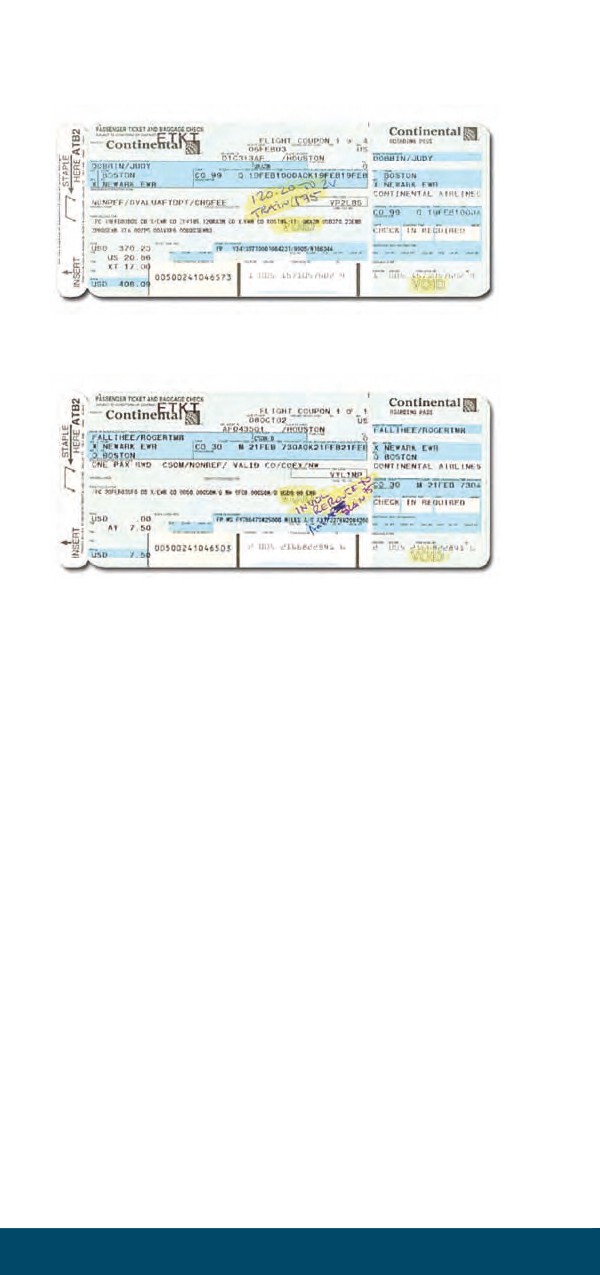
Figure 8-6 - Example of Prescribed Handwritten Endorsement for
Continental Airlines Ticket
Figure 8-7 - Example of Prescribed Handwritten Endorsement,
“INVOL REROUTE,” for Continental Airlines Ticket
3.
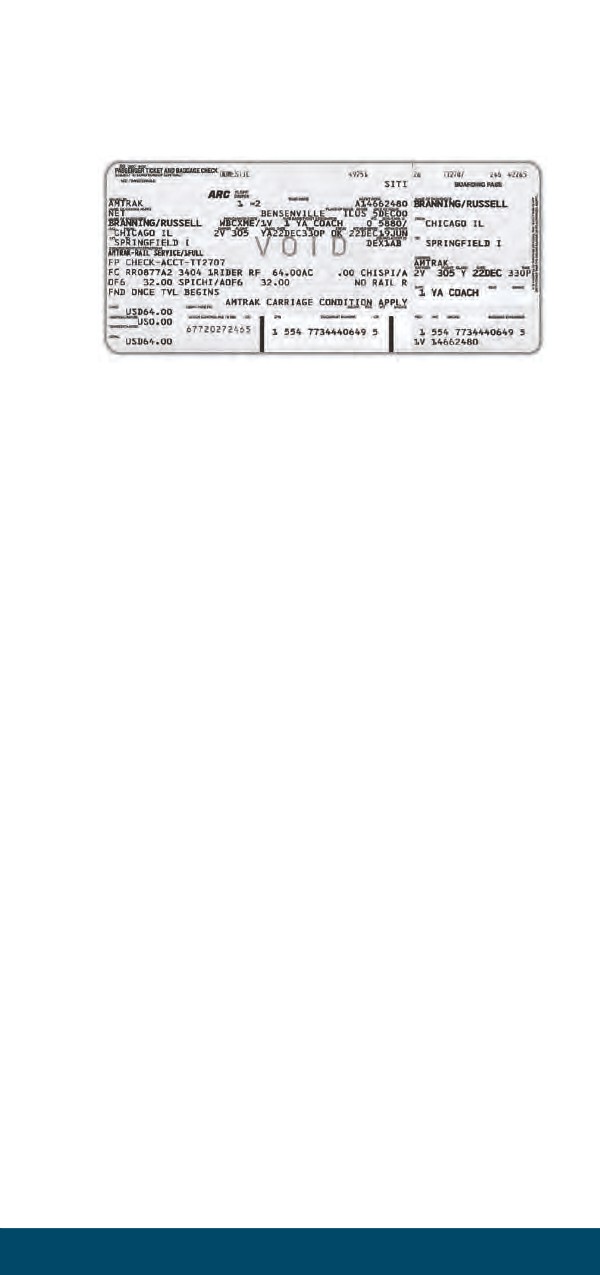
ARC/Travel Agent
a)
ARC stands for Airline Reporting Corporation.
ARC tickets are thin cardboard, computer gener-
ated tickets used by airlines and travel agencies.
b) The passenger’s receipt is the portion to the right
of the perforations, similar to Arrow tickets.
(Refer to Figure 8-8)
c)
There are other railroads and government
transportation systems offering service with their
own tickets. There are ARC tickets that are good
for airline travel (which look very much like
ARC tickets good for Amtrak service).
d) In some emergency situations, Amtrak has honored
non-Amtrak tickets during an emergency period
of time. Train crews must only honor tickets that
they are certain are good for Amtrak service.
Do not honor tickets for other companies or
government transportation services that have not
been approved by Amtrak for use on Amtrak or
Amtrak-operated services. This authorization
typically comes from the Conductor’s
Memorandum Tariff, a Division notice,
8-24
Train Service Accounting Procedures
Operations Standards Update or “Conductors
Carry Authorization” (NRPC 2983).
Figure 8-8 - Example of an ARC Ticket
4.
Arrow
a) The documents generated by Arrow are machine-
generated on thin cardboard stock that is either
blue or white.
b) These documents are only generated at Amtrak
ticket offices or Quik-Trak self-serve ticketing
kiosks.
c) This is the document that is used for almost all
Amtrak ticket issuances.
d) Documents must not be folded or mutilated
because this will adversely impact the machine
scanning process.
e) The passenger’s receipt is the portion on the right
of the perforation. (Refer to the red dashed area
of Figure 8-4)
5.
Authority to Board and Ride Amtrak Locomotives
and Trains
(Refer to chapter 7 “Policies and Procedures”)
6.
Book
a) Book tickets are carbon-treated paper tickets
printed either by hand or machine.
b) Amtrak, travel agencies or airlines can prepare
book tickets.
c) The passenger’s receipt is the last page of a book.
(Refer to Figure 8-9)
d) Book tickets are generally used by Amtrak only
when there is a system-wide outage of Arrow.
Service Standards Manual No. 6
8-25
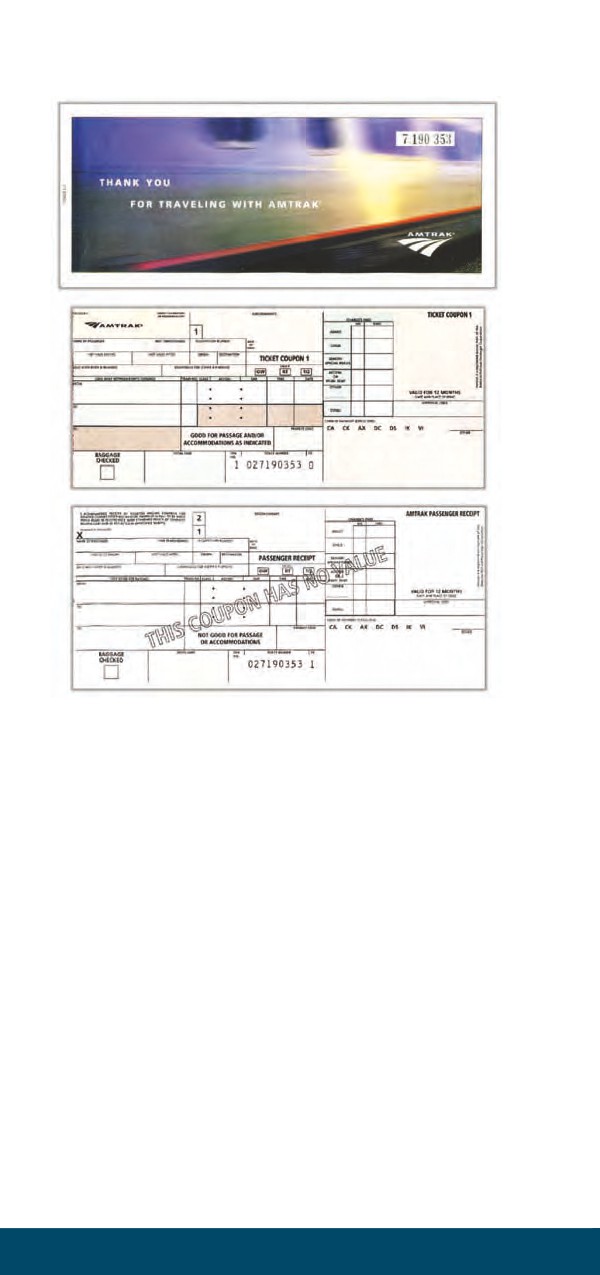
Figure 8-9 - Example of a Book Ticket (three pages)
7.
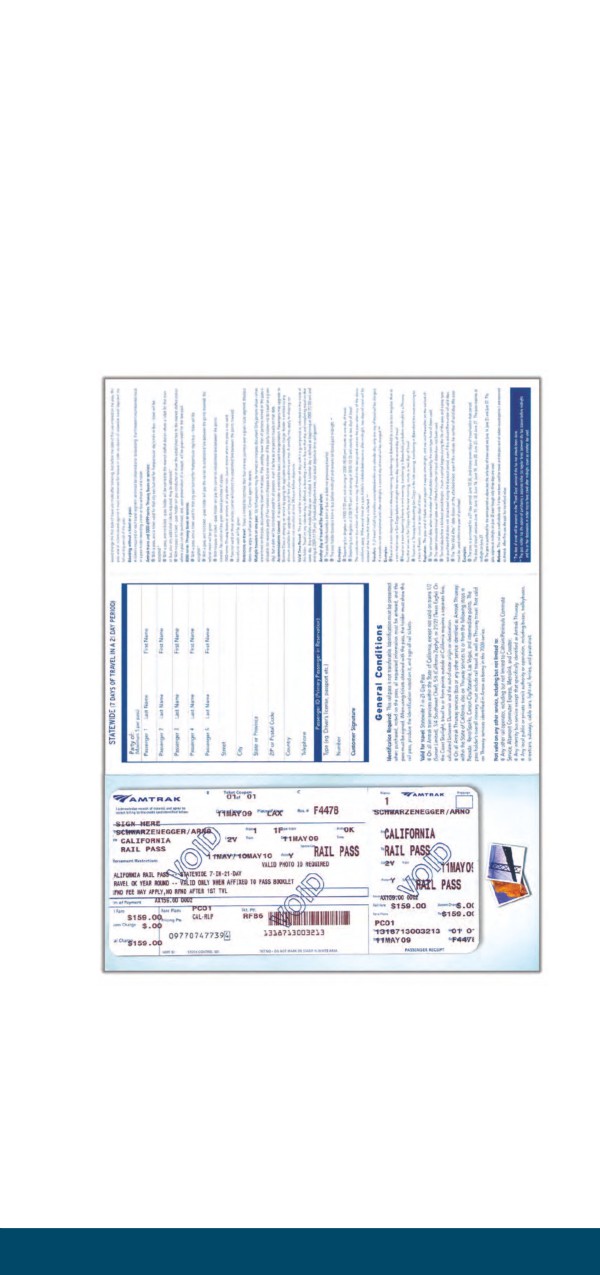
California Rail Pass
a) The California Rail Pass is valid for travel
throughout California on the three state-supported
corridors: (Refer to Figures 8-10 and 8-11)
• San Joaquin
• Capitol Corridor
• Pacific Surfliner
The California Rail Pass is also honored on the
Coast Starlight and most Thruway services.
b) The pass is available to both U.S. and foreign
citizens.
c) The pass must be used within one year of purchase.
d) The pass is attached to a folder that details the
terms and conditions, name/address/ID of the
passenger, valid dates of travel and a state map of
valid routes.
e) The pass is valid for seven (7) calendar days of
travel within a 21-consecutive-day period.
8-26
Train Service Accounting Procedures
f) The pass must be accompanied by a valid ticket
for the train on which it will be used.
g) The pass is limited to not more than four (4)
one-way trips over any route. The pass is not valid
on the Sunset Limited, the Texas Eagle portion
of the Sunset Limited, the Southwest Chief, the
California Zephyr, and, but not limited to, Caltrain,
Altamont Commuter Express, Metrolink, Coaster,
any intercity bus service that is not specifically
sold in Arrow as Amtrak Thruway, any local
public or private transit authorities or operations.
Figure 8-10 - Example of California Rail Pass Attached to Folder.
Service Standards Manual No. 6
8-27

Figure 8-11 - Example of California Rail Pass Ticket
8.
Commuter Agency
a)
Commuter agency tickets are flash or punch style
tickets for passengers who often travel to and
from the same stations.
b) Commuter agency tickets that are good on specific
Amtrak trains are not valid beyond the stations
listed. Consult separate rules on commuter
agency tickets and details listed in the Conductor’s
Memorandum Tariff and authorized notices.
c)
Commuter agency tickets are often printed on
Amtrak’s ticket stock and can look very similar
to Amtrak train tickets. Care must be taken to
fully examine tickets to determine Commuter
tickets vs. Amtrak tickets.
d) Conductors and Assistant Conductors are expected
to know the rules governing commuter service.
e)
With Amtrak-operated commuter services,
management at Amtrak Passenger Services may
decide to honor commuter tickets on Amtrak trains.
One possible reason is that Amtrak could be at
fault for a specific delay affecting the commuter
agency’s train. In honoring the commuter service
passengers on Amtrak trains, Amtrak is effectively
fulfilling the terms of the operating contract.
Sometimes, maintaining a favorable relationship
with the government agency responsible for the
service will be the reason. For whatever reason,
a passenger service management employee must
give the Conductor written authorization using a
“Conductor Carry Authorization” (NRPC 2983).
(Refer to Figure 8-37)
8-28
Train Service Accounting Procedures
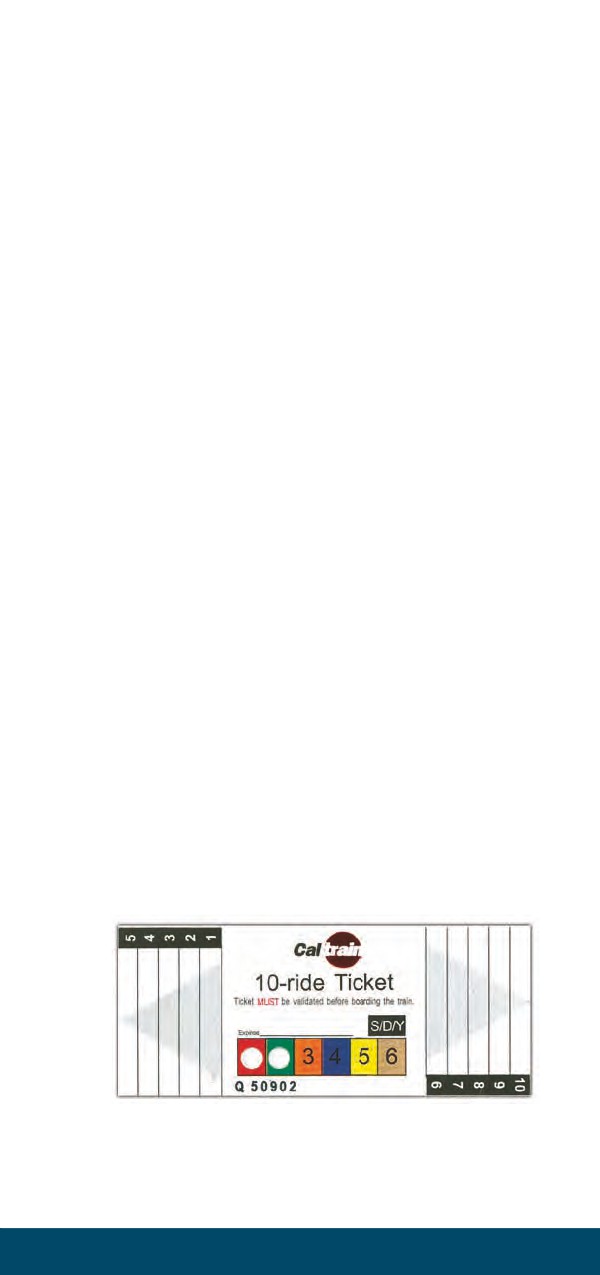
9.
Commuter Agency - Caltrain
Amtrak operates Caltrain that uses a proof-of-
payment fare collection system. (Refer to Figures
8-12 through 8-14)
a)
Tickets are not collected and are retained by the
passengers with random spot checks being made
to verify that the ticket is valid.
b) One Way tickets are only good for a total of 4 hours.
c)
Single ride tickets MUST be validated with a ticket
vending machine or a ticket validating machine that
is located at the station that prints the current valid
date on the ticket.
d) Monthly and 10-ride commuter tickets are good
for the period of time printed on the ticket.
e)
Passengers need to be at their destination prior
to the ticket expiring.
f)
Tickets sold by ticket agents are stamped with the
time and date that the ticket will expire.
g)
Day pass tickets are also stamped, but the ticket
is good up until 12:00 Midnight.
h) Tickets sold through the ticket vending machine
have the date and time the ticket was bought
stamped on the front of the ticket.
i)
10-Ride tickets have the numbers printed along
the sides of the ticket and are to be validated
prior to boarding the train.
j)
There are no advanced ticket sales for one way or
day pass tickets.
k) If a passenger does not have a proper ticket, a
summons is issued. This summons is similar to a
parking or speeding ticket and is paid to a local or
State government agency. Tickets are verified by a
Fare Inspector. Fines for fare evasion are in the
$200-$500 range.
Figure 8-12 - Example of Caltrain 10-ride ticket
Service Standards Manual No. 6
8-29
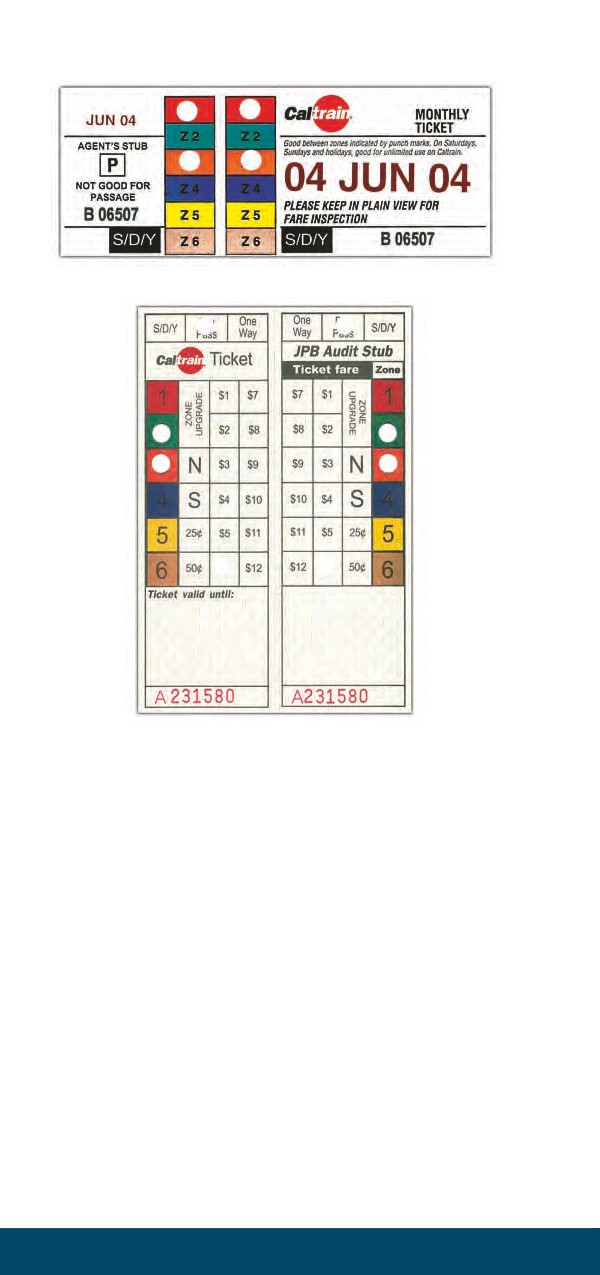
Figure 8-13 - Example of Caltrain monthly ticket
Figure 8-14 - Example of Caltrain JPB Audit Stub
10. Commuter Agency - MARC (Maryland Rail Commuter
Service)
MARC passengers can use weekly tickets, monthly
tickets or a MARC Transit Link Card (TLC) on
Amtrak trains shown in the current MARC
timetable. (The TLC is an enhanced MARC monthly
ticket that allows the use of most WMATA services,
(Washington Metrorail and Metrobus systems)
a) Travel is restricted to the points indicated by the
footnotes in the timetable.
b) Only tickets in Figures 8-15 through 8-21 will be
honored.
c) MARC monthly, weekly and TLC ticket holders
may ride select Amtrak Reserved Northeast
Regional trains that operate Monday through
Friday on days that MARC runs service (this is
inclusive of holidays).
8-30
Train Service Accounting Procedures
d) No additional step up fee is required.
e) On weekends, monthly, weekly and TLC tickets
are good on certain Amtrak reserved Northeast
Regional trains for no additional charge.
f) Monthly, weekly and TLC tickets are NOT valid
on any premium service (Acela Express), certain
reserved Northeast Regional trains or any long
distance trains.
g) One-way ticket are NOT ACCEPTED on regular
(non-commuter) Amtrak trains.
h) Every Amtrak ticket that is not lifted must be
entered on the “Record of Tickets Honored But
Not Lifted” (NRPC 157).
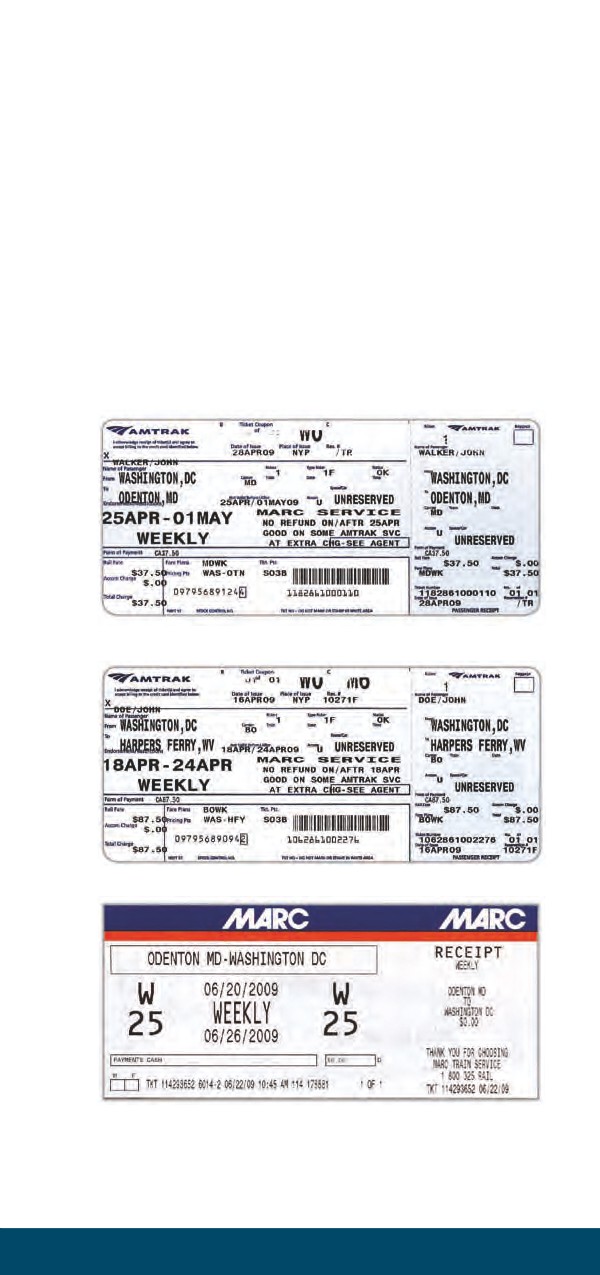
Figure 8-15 - Example of Weekly MARC via Amtrak-Amtrak
Figure 8-16 - Example of Weekly MARC ticket via CSX-Amtrak
Figure 8-17 - Example of CSX issued MARC weekly
Service Standards Manual No. 6
8-31
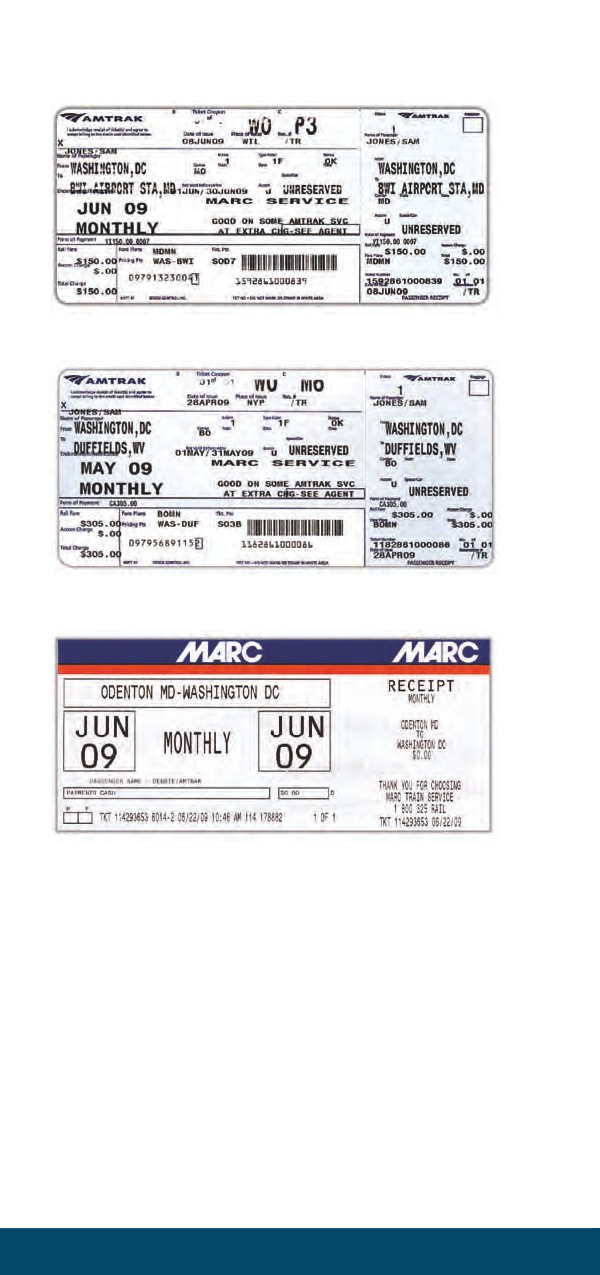
Figure 8-18 - Example of Monthly MARC ticket via Amtrak-Amtrak
Figure 8-19 - Example of Monthly MARC Ticket via CSX-Amtrak
Figure 8-20 - Example of Monthly MARC Ticket
8-32
Train Service Accounting Procedures
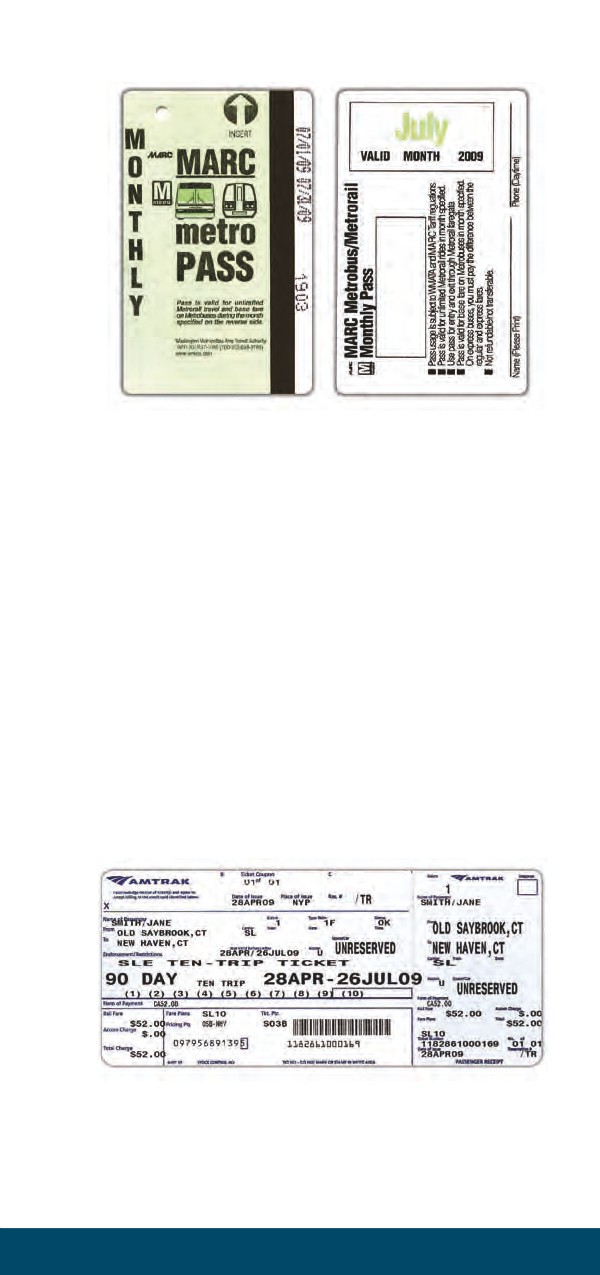
Figure 8-21 - Example of Monthly MARC Transit Link Card (TLC)
11. Commuter Agency - Shore Line East
The Connecticut Department of Transportation
sponsors daily commuter service between New
Haven and Old Saybrook, Connecticut. (Refer to
Figures 8-22 and 8-23)
a) Shore Line East 10-ride and monthly tickets,
including “Unirail” Shore Line East/Metro-North
tickets, are accepted on the following Amtrak
trains 83, 93, 94, 95, 165, 176, 178, 2151 between
New Haven and New London. (Refer to Figures
8-24 and 8-25)
b) Travel must be within the limits of the multi-ride
ticket.
c) Every Amtrak ticket that is not lifted must be
entered on the “Record of Tickets Honored But
Not Lifted” (NRPC 157).
Figure 8-22 - Example of Ten Trip Shore Line East Connecticut D.O.T.
Service Standards Manual No. 6
8-33
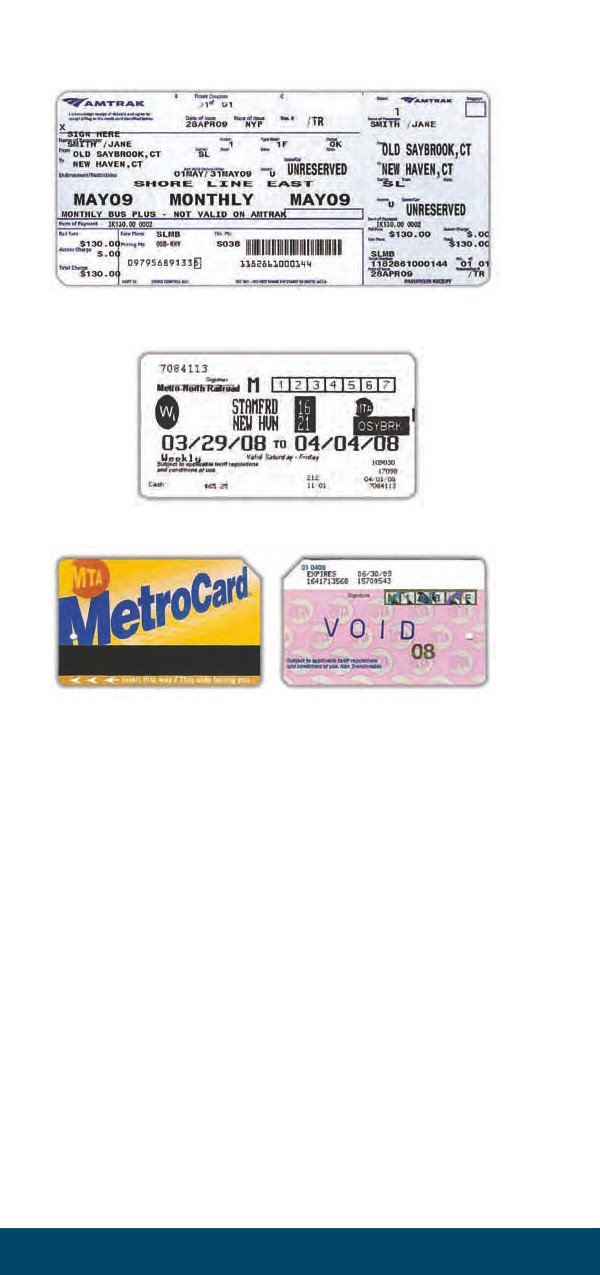
Figure 8-23 - Example of Monthly Shore Line East - Connecticut D.O.T.
Figure 8-24 - Example of Weekly UniRail Ticket
Figure 8-25 - Example of Monthly UniRail Ticket (Front & Back)
Color changes monthly
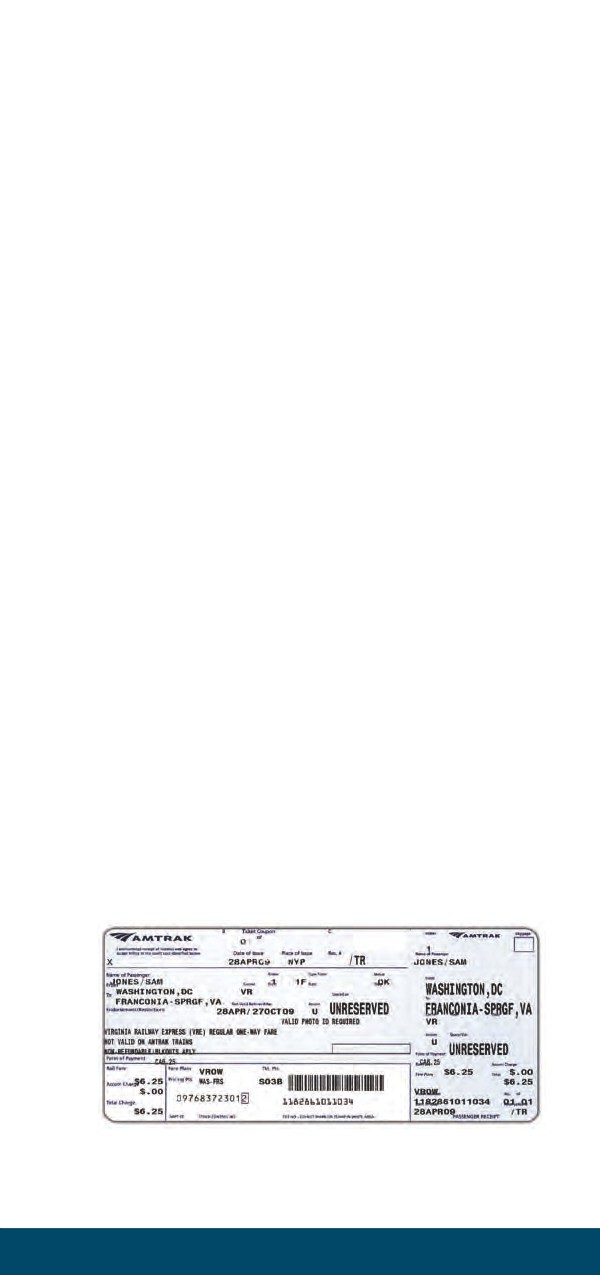
12. Commuter Agency - VRE (Virginia Railway Express)
Amtrak operates Virginia Railway Express (VRE)
commuter services that uses a proof-of-payment fare
collection system. (Refer to Figures 8-26 through 8-30)
a) Monthly and 10-ride commuter tickets are good
for the period of time printed on the ticket.
b) Single ride tickets MUST be validated with a
ticket vending macine or a ticket validating
machine, that is located at the station that prints
the current valid date on the ticket.
c) Tickets are not collected.
d) If a passenger does not have a proper ticket, a
summons is issued. This summons is similar to a
parking or speeding ticket and is paid to a local or
state government agency.
e) Tickets are verified by the Conductor or Assistant
8-34
Train Service Accounting Procedures
Conductor. Fines for fare evasion are in the
$200-$500 range.
f)
VRE 5-day tickets only require a “one-time”
validation which is good for five (5) consecutive
business day roundtrips with a "valid through"
date and time printed on the front of the ticket.
EXAMPLE:
If a passenger purchased a five-day ticket on
Monday July 16, and does not validate the ticket
until the morning of Wednesday July 18; the ticket
is valid until Tuesday evening July 24.
g)
Only VRE monthly, five-day and 10-ride tickets
are honored on certain Amtrak trains; other
honor system tickets are not.
h) All commuter tickets will be checked.
i)
Each passenger must buy a $10.00 step-up ticket
from a VRE ticket vending machine and validate
it prior to boarding an Amtrak train.
j)
VRE 5-day and 10-ride tickets must be validated
prior to boarding.
k) Tickets are honored Mondays through Fridays
only, not weekends.
l)
No single ride VRE tickets will be honored on
Amtrak trains.
m) One child six or under may accompany the VRE
passenger free; additional children pay Amtrak’s
“H” fare.
n) Only qualified Conductors and Assistant Conductors
in VRE Service are allowed to write citations.
o) Every Amtrak ticket that is not lifted must be
entered on the “Record of Tickets Honored But
Not Lifted” (NRPC 157).
Figure 8-26 - Example of VRE Single Ride (Amtrak issued)
Service Standards Manual No. 6
8-35
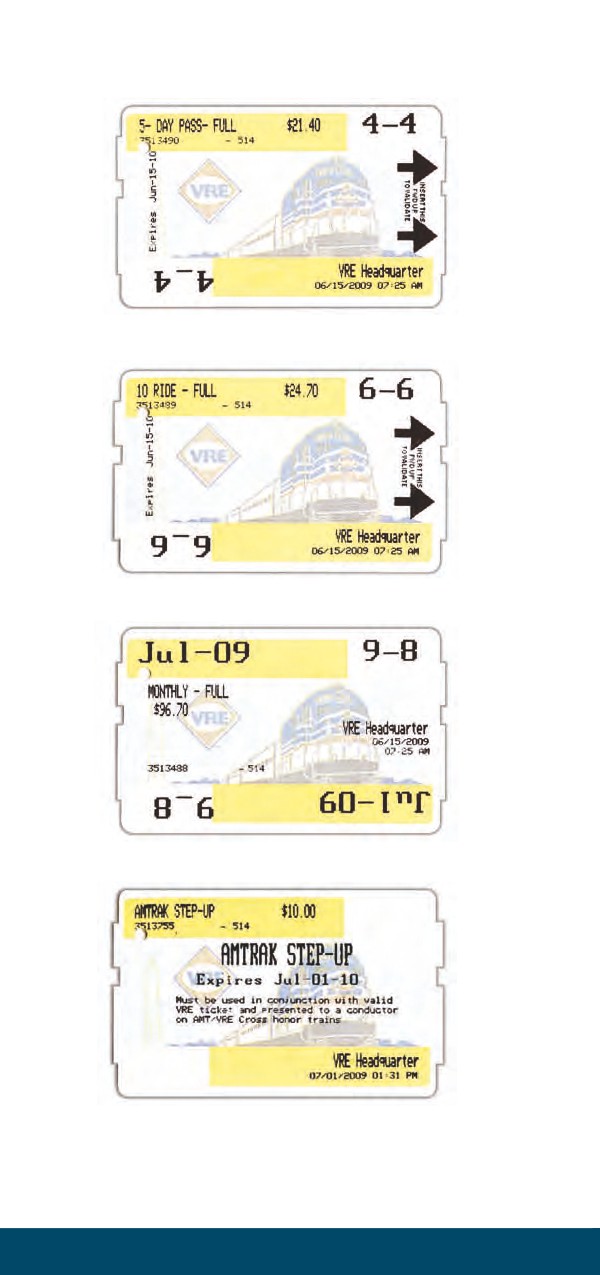
Figure 8-27 - Example of VRE 5-Day Pass
Figure 8-28 - Example of VRE 10-Ride Ticket
Figure 8-29 - Example of VRE Monthly Ticket
Figure 8-30 - Example of VRE Step-Up Ticket
8-36
Train Service Accounting Procedures
13. Conductor and Assistant Conductor’s On-Board Stock
(COTS)
COTS are tickets sold on-board by Conductors and
Assistant Conductors. These tickets can be for a
passenger’s journey within or beyond a train run, for a
return journey, for a business class seat, for a sleeping
accommodation or for a non-transportation collection.
(Refer to section “N. Conductor On-Board Ticket
Stock (COTS)”in this chapter for detailed instruction)
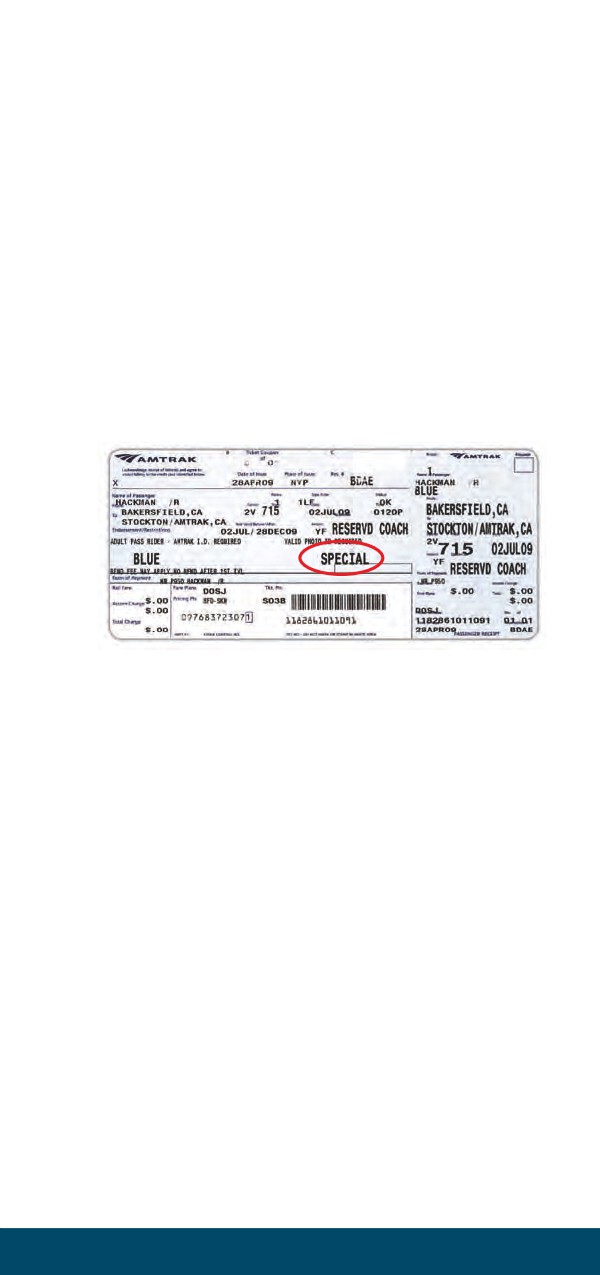
14. Employee
Employee tickets marked “special” require ID and a
signature on the train for verification. (Refer to
Figure 8-31)
Figure 8-31 - Example of Employee Ticket
15.
Lower-Level (Superliner)
a) Lower-level seating in Superliner Coaches IS BY
RESERVATION ONLY.
• Passengers seated in this area must have one of
three endorsements on the face of their tickets:
“LOWR”, “ACCESS” or “WCHR.”
• A passenger presenting a ticket with the
endorsement, “LOWR” may occupy one
of the ten (10) non-accessible seats in the
lower-level.
• A ticket with the endorsement, “ACCESS”
permits the passenger to occupy one of the two
(2) accessible (wheelchair transfer) seats in the
lower-level.
• A passenger holding a ticket with the
endorsement, “WCHR” is entitled to secure
their wheelchair in the designated parking
space, and to occupy one of the accessible
Service Standards Manual No. 6
8-37
(wheelchair transfer) seats in the lower-level,
unless the accessible (wheelchair transfer)
seats have been reserved by a passenger with
an “ACCESS” ticket.
b) It is not appropriate for any on-train employee
to arbitrarily assign seating in the lower-levels of
Superliner Coaches on the basis of passenger
appearance or request.
c)
Conductors, Assistant Conductors and Train
Attendants must have a copy of the current
manifest in their possession that lists the names
of those customers who have made reservations
to sit in the lower-level of the car.
d) Passengers with non-endorsed tickets may occupy
lower-level seats upon request, only if the manifest
indicates that such seating is available for the
entire length of their trip, at the discretion of
the Conductor.
e)
Passengers occupying lower-level seating without
properly endorsed tickets or permission from
the Conductor must be politely directed to the
upper-level seating area, with assistance offered
and provided in locating open seats and/or
handling luggage.
f)
Passengers must be encouraged to make lower-level
seating requests when reserving or purchasing
future tickets for travel on Superliner Coaches.
16.
Monthly (Flash)
a) Flash Tickets are time sensitive tickets that must
not be collected unless it is the last day or last
possible ride. (Refer to Figure 2-32)
b) Flash tickets can be a commuter agency weekly or
monthly ticket, or an Amtrak monthly or multi-trip
ticket. The following procedures are guidelines for
canceling monthly and multi-trip tickets:
• Ask passenger to provide a valid photo ID
when presenting ticket for the first time.
• When a passenger presents their ticket for the
first time, place punch cut at the top center of
the ticket for a male passenger or place a
punch cut at the bottom center for a female
passenger.
c) If there is reasonable cause to believe that more
than one passenger is using a flash ticket, ask that
8-38
Train Service Accounting Procedures
passenger to sign the ticket on the back (a later
signature will not match).
• If it is certain that more than one passenger is
using a flash ticket, charge the second passenger
the fare.
• If the purchaser of the ticket can be determined,
tell them the terms of the fare, have them sign
the back, and return the ticket.
• If the ownership of the ticket cannot be
determined, the ticket must be kept, a brief
note written on it, signed by the Conductor
or Assistant Conductor, and it must be placed
into the “Train Earnings Reports Envelope”
(NRPC 158).
Figure 8-32 - Example of a Monthly (Flash) Ticket
17.
Multi-Ride
a) Amtrak multi-ride tickets will be valid for a specified
number of rides over a specified number of days.
• The number of rides to be allowed will be
indicated by the number of available punch
targets remaining un-punched on the ticket.
• The number of travel days to be allowed will be
indicated by the date range printed on the ticket.
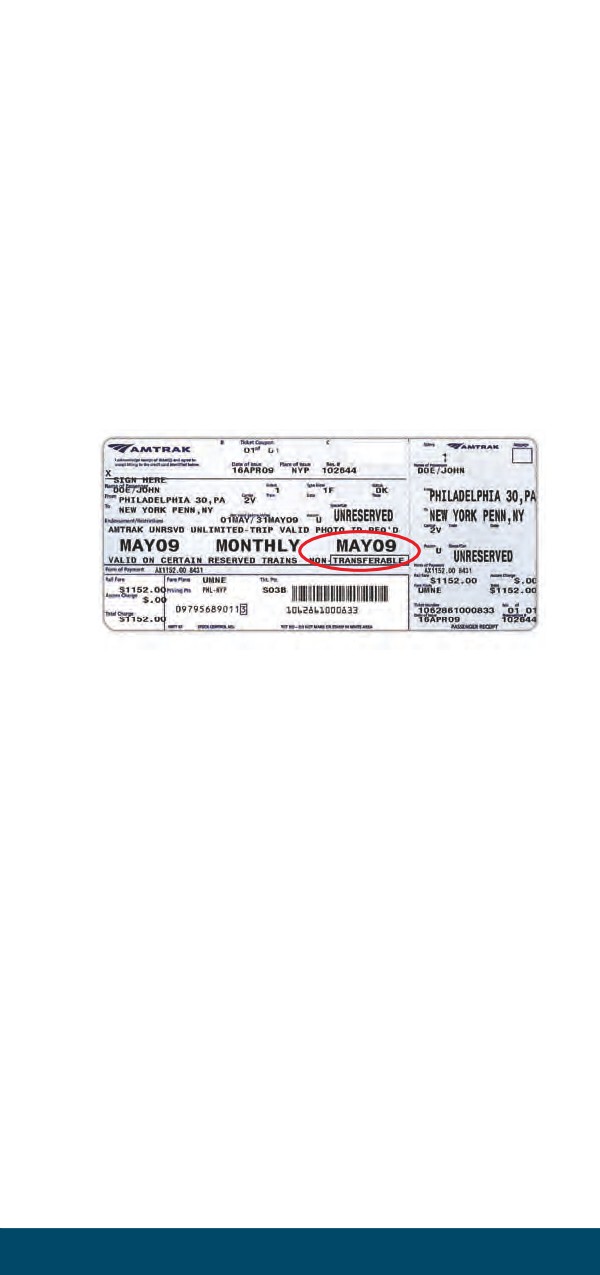
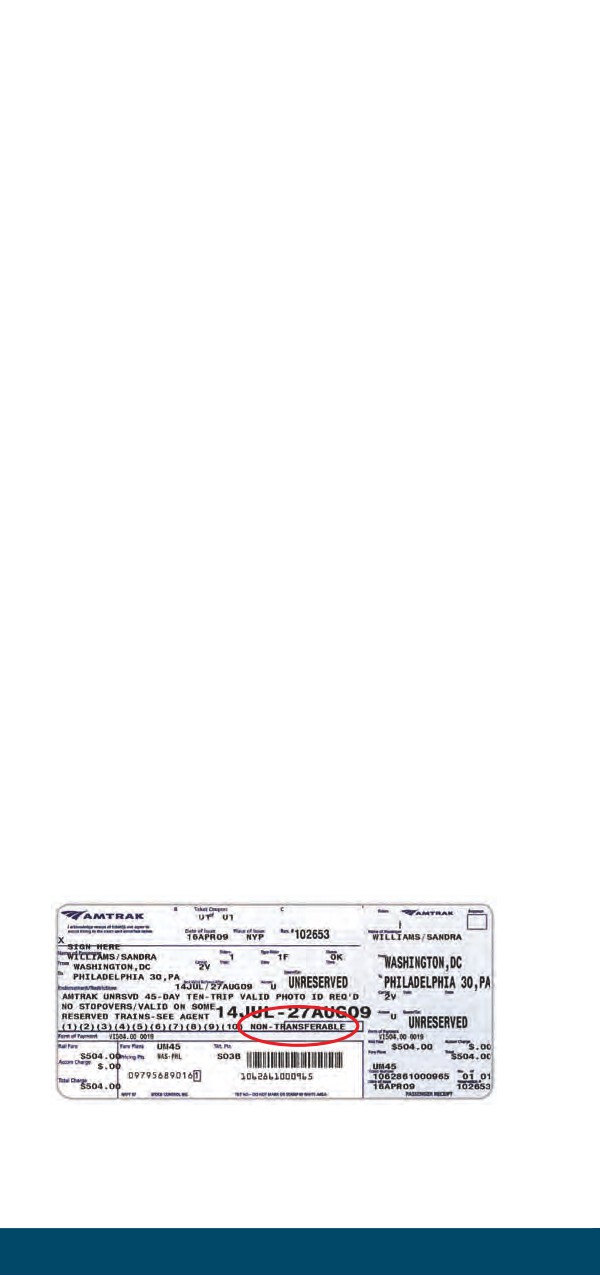
b) Amtrak multi-ride tickets can be non-transferable
or transferable.
• Non-transferable tickets will be marked “non-
transferable” in the endorsement box (Refer
to Figure 8-33), and such tickets are to be
honored only for the individual whose signature
is on the ticket.
• If no reference to “non-transferable” appears
in the ticket endorsement box the ticket will be
considered transferable (Refer to Figure 8-34),
meaning that the ticket may be used by different
people on different trips and/or by multiple
Service Standards Manual No. 6
8-39
persons on one trip (punch once for each
person, regardless of passenger age).
• If the passenger travels less than the full distance
between the city-pair indicated on the ticket, a
punch is still required; the ticket is never valid
beyond the city-pair indicated on it. Other
allowances and restrictions may apply.
• Consult the appropriate Conductor
Memorandum Tariff for all fare rules for the
fare plan referenced on the ticket.
c)
Multi-ride tickets with connections have fares
published between a number of city pairs where
a connection is sometimes or always required.
EXAMPLE:
• PAO-NYP - thru train or connection at PHL.
• SNA-FNO - train SNA-LAX, bus LAX-BFD,
train BFD-FNO.
For valid multi-ride tickets with a fixed number
of rides (usually 10) the Conductor must use the
follow procedure so that only one ride is cancelled
for the entire trip.
• First Train: The Conductor must punch the
multi-ride ticket, and then issues a zero-value
COTS for the second train; punching the "in
connection with" and "train check" boxes.
The 10-ride ticket number is then written in
the endorsement block. After completing
these steps, the passage coupon is given to
the passenger.
• Second Train: The passenger uses the zero-value
ticket issued by the first train’s Conductor.
Figure 8-33 - Example of UM45 Ticket
8-40
Train Service Accounting Procedures
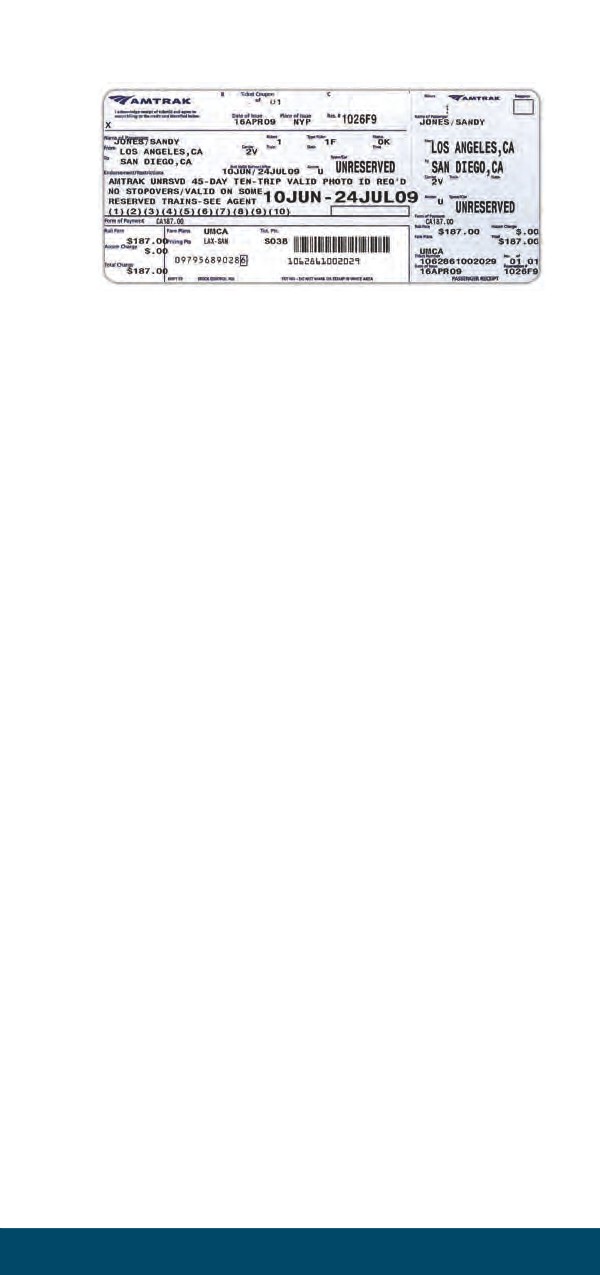
Figure 8-34 - Example of UMCA Ticket
d) Multi-ride tickets become invalid when either:
• all punch targets have been punched, or
• when the “Not Valid After” date has been
exceeded.
• An Amtrak multiple-ride ticket is presented
beyond the validity dates, it must not be
confiscated.
• The Conductor or Assistant Conductor is to
circle and initial with ballpoint pen the “Not
Valid After” (Refer to Figures 8-33 and 8-34)
date imprinted on the multi-ride ticket and
issue a COTS single-ride ticket for each
passenger(s).
• If the passenger(s) boarded at a station where
the ticket office was open at departure time,
the On-Board Fare (OBF) must be charged.
e)
Upgrading of multi-ride tickets:
• In certain cases, multi-ride tickets may be
upgraded to business class upon payment of
the accommodation charge.
• The following fare plans allow upgrading to
business class:
• UMCA
• UM60
• UMNC
• UMMN
• When upgrading a passenger to business class
that is traveling on a multi-ride ticket, punch
the ticket and collect the accommodation
charge using a COTS.
• Multi-ride tickets are not accepted on Acela
Express.
18.
On-Board Passenger Record (NRPC 3085)
The Conductor or Assistant Conductor must receive
a completed “On-Board Passenger Record” (NRPC
3085) for any passenger or employee who has no
associated transportation to lift or does not appear on
Service Standards Manual No. 6
8-41
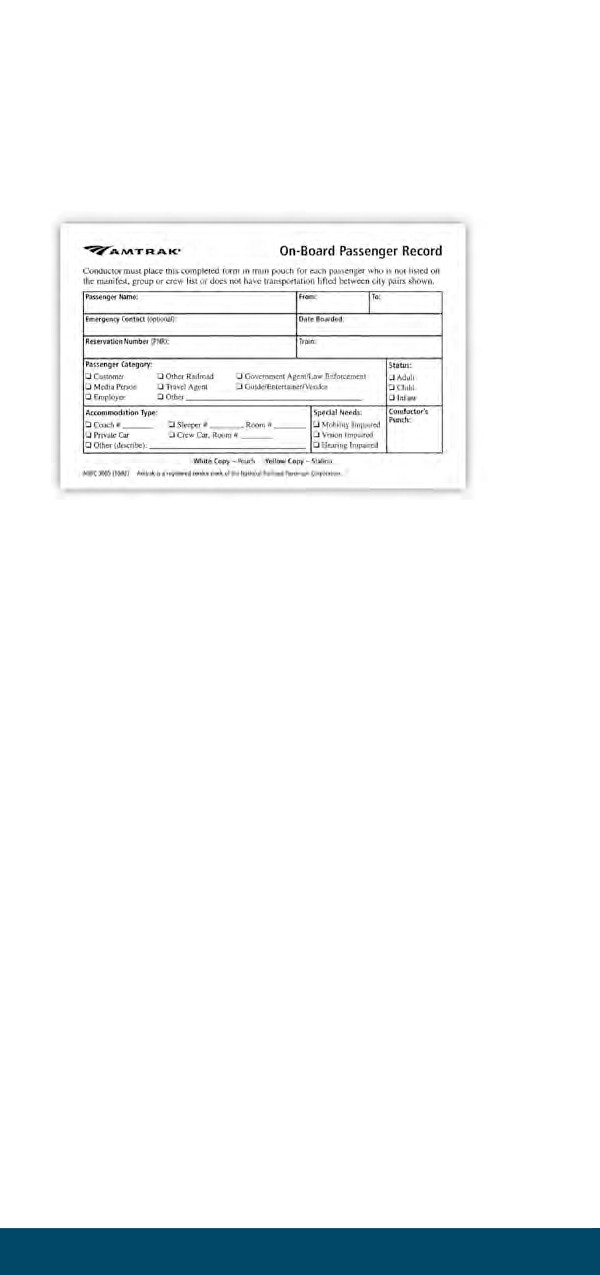
the manifest, including passengers purchasing their
tickets on-board the train and passengers traveling
in a group whose name does not appear on the
manifest. The “On-Board Passenger Record” (NRPC
3085) is available in both a single or two-part version.
(Refer to Figure 8-35)
Figure 8-35 - “On-Board Passenger Record” (NRPC 3085)
a)
The “On-Board Passenger Record” (NRPC 3085)
is to be used on all reserved trains.
b) The Conductor will ensure all Assistant Conductors
have an ample supply of “On-Board Passenger
Records” (NRPC 3085). (Refer to Figure 8-35)
c)
Supplies of these forms are available at all crew
base locations.
d) Some individuals may board with a completed
“On-Board Passenger Record” (NRPC 3085).
e)
If individuals board without an “On-Board
Passenger Record” (NRPC 3085), the Conductor
or Assistant Conductor will provide a blank
“On-Board Passenger Record” (NRPC 3085) for
the individual to complete and return back to the
train crew.
f)
The Conductor or Assistant Conductor must
ensure that all of the required information is
provided on the form, and must punch the form
upon completion in the lower right hand corner
to certify the record.
g)
The Conductor is to place all completed “On-Board
Passenger Records” (NRPC 3085) in the “Train
Earnings Reports Envelope” (NRPC 158).
h) When the two-part version of an “On-Board
Passenger Record” (NRPC 3085) is used, the
yellow copy is not to be submitted to the station
and may be discarded or returned to the passenger.
i)
The following persons may not be ticketed or listed
8-42
Train Service Accounting Procedures
on the manifest’s passenger name list:
• Infants and small children
• Passengers purchasing tickets on-board
• Railroad officials
• Government officials
• Medical personnel
• Vendors and/or contractors
• Host railroad employees
• Amtrak police officer in uniform or plain
clothes
• Amtrak employee using a “Head-End/Train
Authorization Permit”
• Amtrak employee using a “Train Inspection
Permit”
• Amtrak employee using an Amtrak
“Temporary Train Authorization Permit”
(NRPC 2889)
• Individual working for a Municipal, State or
Federal Regulatory Agency
j)
All Amtrak employees on business, deadheading
(to or from work) or personal travel must have a
ticket or must complete an “On-Board Passenger
Record” (NRPC 3085). For those employees
boarding at stations that are closed, the Conductor
or Assistant Conductor must receive a completed
“On-Board Passenger Record” (NRPC 3085)
from the employee.
k) All Amtrak employees and pass riders must
provide valid Amtrak photo identification.
l)
All private car owners are required to have an
“On-Board Passenger Record” (NRPC 3085)
completed for each person traveling if a “Private
Car Passenger Record” (NRPC 3160) is not
available. Also, each person traveling must
provide a valid photo identification.
m) An “On-Board Passenger Record” (NRPC 3085)
must be completed for each individual providing
commentary on-board the train. Those guides
currently authorized include:
• National Park Service (through Trails and Rails)
• California State Railroad Museum
• Train Host Association
• Native American
All guides must present a valid form of photo
identification, valid identification for the
organization they are representing, and give
the signed “On-Board Passenger Record”
(NRPC 3085) to either the Conductor or
Assistant Conductor at the time of boarding. If
Service Standards Manual No. 6
8-43
the on-board guide does not have an “On-Board
Passenger Record” (NRPC 3085) the Conductor
or Assistant Conductor must provide one and
ensure that it is properly filled out and signed.
19.
Pre-Paid Internet Ticketing Printout
When a passenger makes a reservation on the
Internet at Amtrak.com, the resulting printout is
not a ticket. The passenger must use the reservation
number on the printout to obtain a ticket at a ticket
office or Quik-Trak self-serve ticketing kiosk prior to
boarding the train.
20.
Quik-Trak
Many stations are equipped with Quik-Trak self-
serve ticketing kiosks that generate Arrow tickets.
a) When a previously made reservation is ticketed at
a Quik-Trak kiosk, the name on the reservation is
printed on the ticket, regardless of whose credit
card was used to pay for it.
b) When a ticket is obtained at a Quik-Trak kiosk
without making a prior reservation (a “walk-up
sale”), the name on the ticket will be the name
on the credit card that was used to access the
kiosk and pay for the ticket. In this case, the
name on the ticket may not correspond with the
passenger’s ID if someone else paid for the ticket.
In order to avoid this situation, a reservation
should be made at 800-USA-RAIL or
Amtrak.com and then ticketed at a Quik-Trak
kiosk. By doing this, Quik-Trak will print a ticket
with the name that is on the reservation (Refer to
previous bullet).
c) If the name on the ticket does not match the
name on the ID, and the passenger explains that
someone else paid for the ticket at a Quik-Trak
kiosk, the Conductor or Assistant Conductor
should lift the ticket. The Conductor or Assistant
Conductor should use tact and courtesy when
they explain that this situation can be avoided
in the future by making a reservation prior to
purchasing the ticket at a Quik-Trak kiosk
(Refer to previous bullets).
d) Passengers and employees must sign Quik-Trak
tickets in the upper left corner.
e) Quik-Trak tickets are Arrow tickets and must be
placed with the Arrow tickets in the “Train
Earnings Reports Envelope” (NRPC 158).
f) Ticket Purchase Records must not be collected
by Conductors or Assistant Conductors. Return
them to the passenger.
8-44
Train Service Accounting Procedures
21.
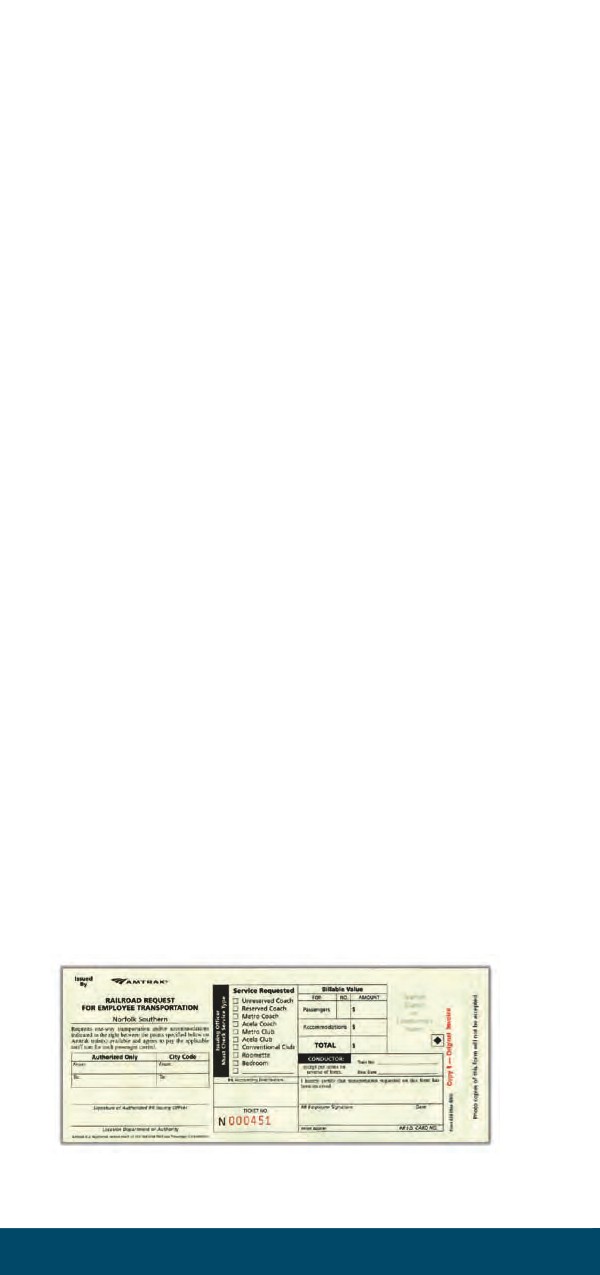
Railroad Request for Employee Transportation (Form
620)
Amtrak has historically provided a billing arrangement
to certain freight railroads for the purchase of
transportation for their employees traveling on
company business. The “Railroad Request for
Employee Transportation” (form 620) is the only
official document utilized for this billing arrangement.
(Refer to Figure 8-36.)
a)
Amtrak is required to submit a properly signed
“Railroad Request for Employee Transportation”
(form 620) to the freight railroad, to authorize
payment from the freight railroad for transporting
their employee(s).
b) The back of the COTS provides guidance in the
handling incorrect fares shown on the “Railroad
Request for Employee Transportation”
(form 620) or if no “Railroad Request for Employee
Transportation” (form 620) is presented.
c)
Instructions for completing the “Railroad
Request for Employee Transportation” (form 620)
are as follows:
•
A properly completed original (not photocopy)
“Railroad Request for Employee
Transportation” (form 620) must be accepted
as transportation for railroad employees when
boarding at either an un-staffed station location,
or a station that is closed at the time of boarding.
•
In order to be transported, the railroad
employee must have a ticket or a properly
completed “Railroad Request for Employee
Transportation” (form 620).
•
The fare block on the “Railroad Request for
Employee Transportation” (form 620) must be
blank when the freight railroad employee
presents it. Calculate the applicable "One Way
Full Fare" for each employee and write the
total in the fare block.
•
If the freight railroad employee has completed
the fare block, check to see if the amount is
correct. It must be the "One Way Full Fare"
multiplied by the number of freight railroad
employees. If the fare is insufficient, issue a
direct bill COTS for the difference, following
the procedures for "Payment Due" as outlined
on the back of the COTS. If the fare is to high,
honor the “Railroad Request for Employee
Transportation” (form 620) for transportation.
Service Standards Manual No. 6
8-45
d) In the event there is no ticket or “Railroad
Request for Employee Transportation” (form
620), or the fare shown on the “Railroad Request
for Employee Transportation” (form 620) is
incorrect, calculate the applicable "One Way Full
Fare" for each of the railroad employees. Follow
the procedures for "Payment Due" as outlined
on the back of the COTS, Instructions For Use 5.
Payment Due Summary.
•
Punch the "Payment Due." For a partial payment
(e.g., the fare is $100, but the “Railroad Request
for Employee Transportation” (form 620)
shows $80.00) then also punch the "In Conn
With" box.
•
Write the name of the railroad on the "Name"
line.
•
Write the names of the freight railroad
employees in the address, and phone fields.
•
Determine the fare due and show in the
"Amount" field. It is essential that the fare be
calculated and shown — under no circumstances
can this be left blank.
•
In the "Endorsement" box at the top of the
COTS, list the “Railroad Request for Employee
Transportation” (form 620) serial number. If no
“Railroad Request for Employee Transportation”
(form 620) is presented, indicate there is none.
•
Have one of the railroad employee’s sign the
COTS on the "Passenger Signature" line if
payment is due. This validates that the employees
were carried.
•
For distribution of the COTS coupons, refer to
Instructions For Use 7 on the back of the
COTS. Coupon distribution instructions for
“Railroad Request for Employee Transportation”
(form 620) are identified on each page of the
“Railroad Request for Transportation” (form
620) set.
Figure 8-36 - “Railroad Request for Employee Transportation” (form 620)
8-46
Train Service Accounting Procedures
22.
Station Authorization to Carry
Station personnel can issue passengers a “Conductor
Carry Authorization” (NRPC 2983) for travel. (Refer
to Figure 8-37)
a)
The “Conductor Carry Authorization” (NRPC
2983) is a multi-part form printed with black and
red ink.
b) The “Conductor Carry Authorization” (NRPC
2983) identifies who authorized the form and the
reason.
c)
If there is any question about whether the form is
valid, ask the passenger to show some form of
identification.
d) The Conductor or Assistant Conductor must ask
the passenger if they have a ticket.
• If the station employee kept the ticket, the
“Conductor Carry Authorization” (NRPC 2983)
will be lifted as the transportation document
and placed in the “Train Earnings Reports
Envelope” (NRPC 158).
• If the passenger still has the ticket, the ticket
and the “Conductor Carry Authorization”
(NRPC 2983) will be lifted, punched, clipped
together, and placed in the “Train Earnings
Reports Envelope” (NRPC 158).
e)
In some instances, an authorized employee may
not have time to prepare a “Conductor Carry
Authorization” (NRPC 2983) and must place a
passenger on-board a train without the proper
documentation.
• The authorized employee will be responsible
for providing the Conductor with a total count
of such passengers. Authorized employees may
be Crew Base Management, a Station Supervisor
or a Ticket Agent in a small stations.
• The following are examples of legitimate
instances:
• Service disruptions
• Late train connections
• Holding trains
• As with any un-ticketed situation, a COTS
must be completed and coupon distributed as
per the guidelines.
Service Standards Manual No. 6
8-47
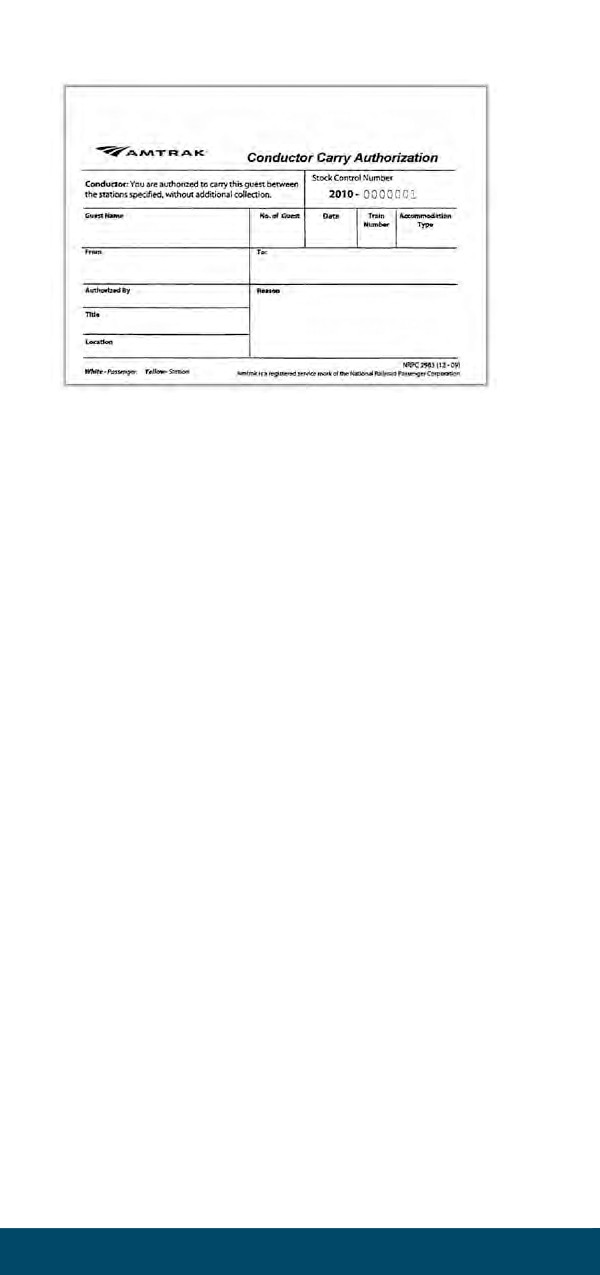
Figure 8-37 - “Conductor Carry Authorization” (NRPC 2983)
23.
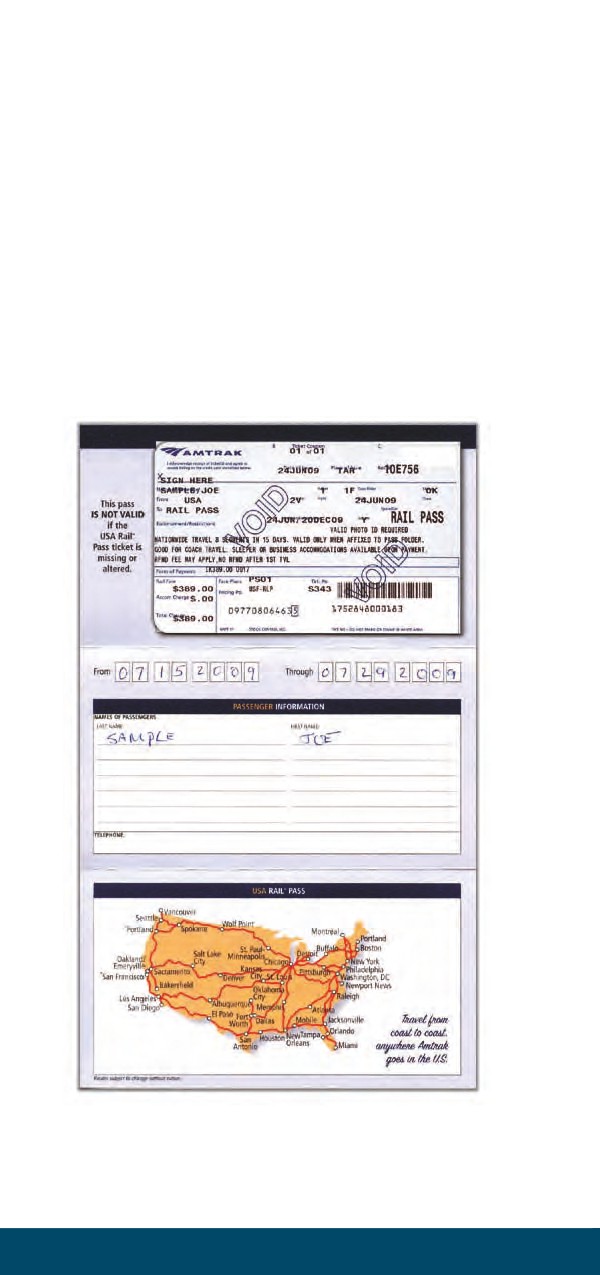
USA Rail Pass
Amtrak’s USA Rail Pass provides a defined number
of segments of Coach travel within a specified number
of days between all points on the Amtrak system
(including Amtrak served points in Canada, except
cities between the border and Toronto on the VIA
Rail Canada portion of the Maple Leaf). (Refer to
Figure 8-38)
a)
Eligibility
The USA Rail Pass is available to any person
regardless of their nationality or residency.
Identification will still be required as per
Amtrak’s ID requirements. (Refer to section
“Acceptable Forms of Identification (ID)” in this
chapter)
b) Pass Types
•
8 segments of travel over a 15 day period.
•
12 segments of travel over a 30 day period.
•
18 segments of travel over a 45 day period.
c)
Pass Validity
• Each USA Rail Pass entitles its purchaser to a
defined number of segments of Coach travel
(does not include Sleeping Car or Business
Class accommodation charges) between all
points on the Amtrak system (including
Amtrak served points in Canada, except cities
between the border and Toronto on the VIA
Rail Canada portion of the Maple Leaf).
• The pass will not be valid unless it is attached
to a USA Rail Pass folder.
8-48
Train Service Accounting Procedures
• The USA Rail Pass is good only for the personal
use of the passenger named on the Rail Pass.
• Rail Pass cards and tickets may not be honored
before or after the validity period, as entered
by the ticket agent in the boxes on the front of
the passenger’s USA Rail Pass folder.
• The validity period must commence within 180
days from the date of Rail Pass issuance, and is
from:
• the “START DATE” is the first day the Rail
Pass may be used, through…
• the “END DATE” is the last day of travel
for which the Rail Pass may be used. This
date is the expiration of the validity period,
which is in addition to the date of the first use.
• All travel must be completed by 11:59 p.m. on
the last day of validity.
d) USA Rail Passes are Not Valid on
• Acela Express.
• Auto Train.
• VIA Rail Canada portions of the trains operat-
ed jointly by Amtrak and VIA Rail Canada.
This includes the Maple Leaf between Niagara
Falls, Ontario and Toronto, Ontario and inter-
mediate stations.
• Non-Amtrak connecting interline services.
e)
Pass Valid with Supplemental Charges
Conductor or Assistant Conductor may upgrade
tickets on-board using the following supplemental
charges:
• Sleeping Car - use the Sleeping Car
accommodation charge.
• Business Class - use the Business Class seat
charge.
f)
Ticket Validity
For the purpose of meeting minimum ticket
requirements, tickets issued to USA Rail Pass
holders will be considered as equivalent in value
to one regular rail passage fare. The Conductor
will require passenger to present tickets endorsed
with the USA Rail Pass. USA Rail Pass tickets may
be on Arrow stock or a Book ticket if the Arrow
system is down at time of issuance. (Refer to
Figure 8-39)
• The Conductor or Assistant Conductor will
request the passenger to present a valid form
Service Standards Manual No. 6
8-49
of identification with the name matching that
of the Rail Pass and travel ticket.
• The Conductor or Assistant Conductor will not
honor USA Rail Pass cards without tickets.
• Rail Pass holders must obtain tickets before
boarding trains.
• If the passenger does not have the Rail Pass in
their possession, the full fare must be collected.
The unsupported ticket must be lifted, canceled
and put in the “Train Earnings Reports
Envelope” (NRPC 158) attached to the COTS
Passage Coupon A (with a brief explanation
written on the face of the ticket).
Figure 8-38 - Example of USA Rail Pass folder with Pass attached
8-50
Train Service Accounting Procedures
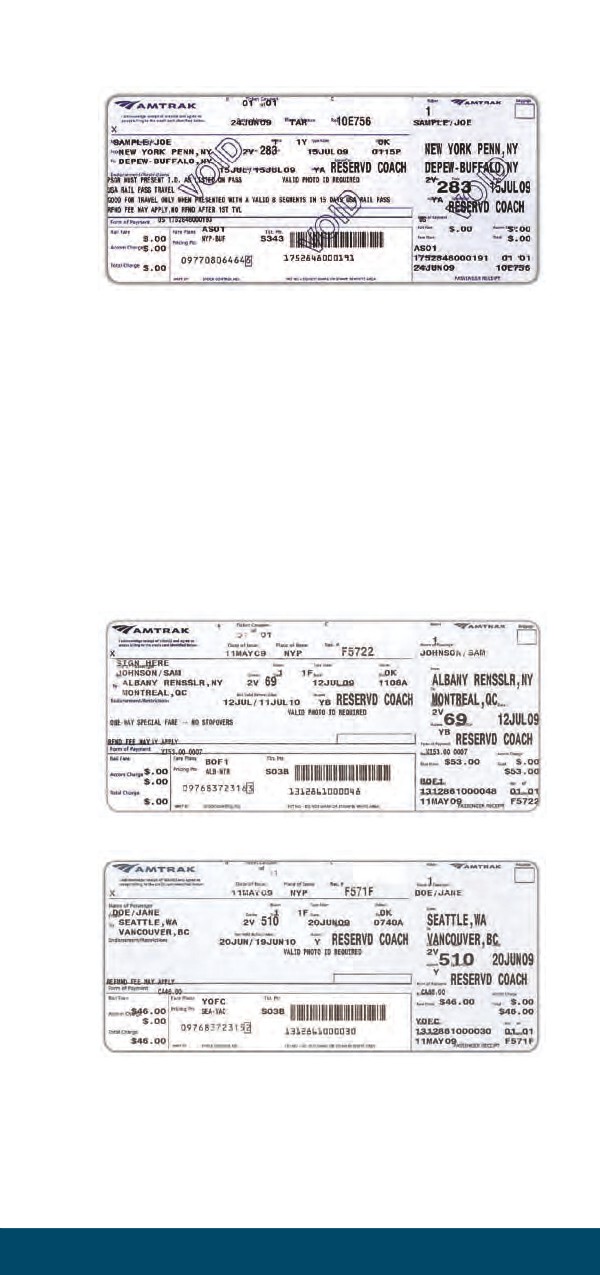
Figure 8-39 - Example of USA Rail Pass Ticket
24. VIA Rail Canada
Three Amtrak routes cross the U.S./Canadian border:
New York to Montreal, New York to Toronto and
Seattle to Vancouver.
a) On the New York to Montreal and the Seattle to
Vancouver routes, only one ticket in each direction
will be issued since this is Amtrak service.
Depending on where the tickets were issued,
they may be on Amtrak Arrow ticket stock or on
VIA Rail Canada ticket stock. (Refer to Figures
8-40 and 8-41)
Figure 8-40 - Example of Amtrak Ticket - Albany/Rensselaer, NY to Montreal, QC
Figure 8-41 - Example of Amtrak Ticket - Seattle, WA to Vancouver, BC
b) On the New York to Toronto route, two tickets
will be issued in each direction since this is joint
Amtrak/VIA Rail Canada service. One ticket will
Service Standards Manual No. 6
8-51
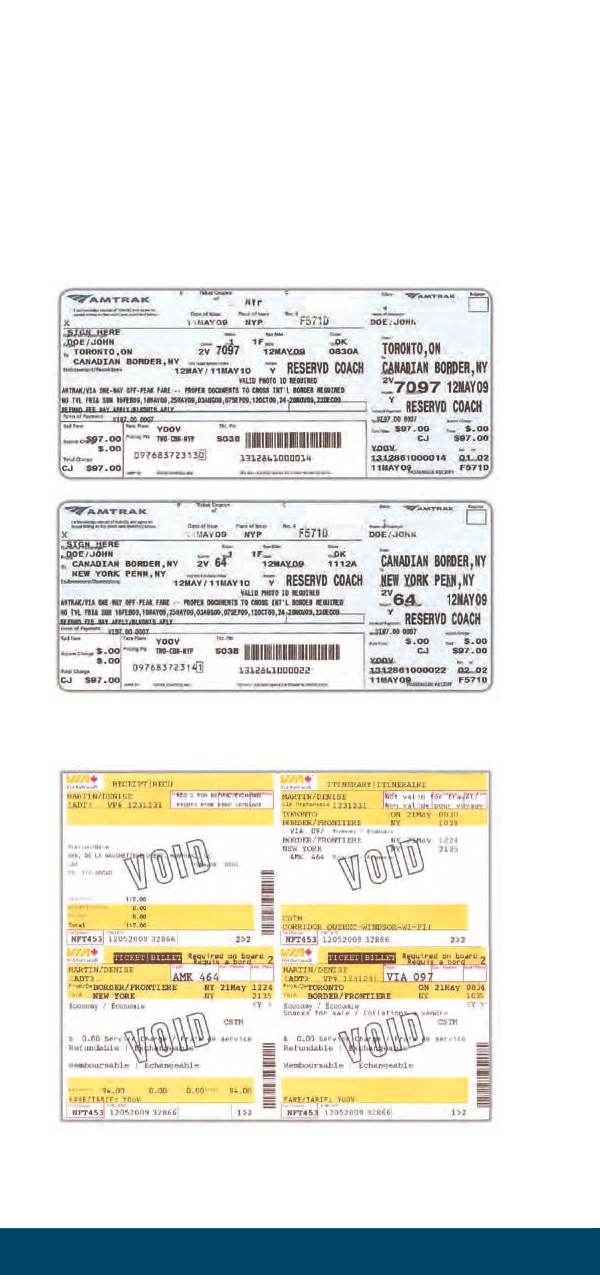
be issued between New York (NYP) and the U.S./
Canadian border (CBN) and is to be lifted by the
Amtrak crew. The other ticket will be issued between
the border (CBN) and Canadian destination and
is to be lifted by the VIA crew. Depending on
where the tickets were issued, they may be on
Amtrak Arrow ticket stock or on VIA Rail
Canada ticket stock. (Refer to Figures 8-42 and 8-43)
Figure 8-42 - Example of Amtrak Tickets - Toronto, ON to Canadian Border,
NY and Canadian Border, NY to New York, NY
Figure 8-43 - Example of VIA Rail Canada Ticket - Toronto, ON to Canadian
Border, NY and Canadian Border, NY to New York, NY
8-52
Train Service Accounting Procedures
H.
Revenue Structure
1.
Yield Management
a)
Yield Management is a process that allocates
seats and accommodations to certain fare levels,
also known as fare buckets.
b) By monitoring, anticipating and reacting to how
space is being reserved on every train, a fare level
can be assigned to each individual seat and room
in order to maximize revenue.
EXAMPLE:
If a train is showing low reservations for three
weeks in February, more seats and rooms may be
assigned to lower fare levels in order to stimulate
sales and prevent the space from running vacant.
If, however, a train is in high demand in July and
August, a higher fare will be assigned to its seats
and rooms in order to generate the highest revenue.
c)
The location of a seat or accommodation on the
train has no bearing on Yield Management. The
process is driven by how the train is selling and
the percentage of space at each fare level.
2.
Fare Structure
a) Fares shown in Conductor’s Memorandum
Tariffs apply via direct routes.
b) All routes shown in Amtrak tariffs apply to all
types of fares, including discounted fares, unless
otherwise restricted by the Fare Code Rules in
Conductor’s Memorandum Tariffs.
3.
Fare Codes and Rules
a) Each fare offered by Amtrak is assigned a unique
Fare Code.
b) The Fare Code Rules contain the definitions and
rules associated with each individual Fare Plan.
c) The Fare Code Rules include information such as:
• Validity
• Class of service
• Blackout dates
• Ticketing restrictions
• Reservation requirements
• Stopovers
• Ticket endorsements
• Special conditions
Service Standards Manual No. 6
8-53
4.
Accommodation Charges
a) A minimum of one rail fare ticket per
accommodation is required for all types of
accommodations.
b) In addition to the basic rail fares, there are
various one-way charges for the actual occupied
accommodations (Sleeping Car rooms, First Class
and Business Class seating).
c) Accommodation charges are shown along with
the rail fares in Amtrak tariffs and must be added
to regular rail fares, that are valid for travel in
these accommodations.
d) In First Class and Business Class seating,
each passenger two years of age and over must
pay one applicable accommodation charge.
e) If one or two children under two years of age
exclusively occupy one First Class or Business Class
seat, one accommodation charge must be paid.
f) No reduction is granted to children on Sleeping
Car charges, First Class or Business Class seat
charges.
I.
Passenger Type and Discount
1.
Adult
An adult is a passenger between the ages of 16 to 61
inclusive, that is required to pay a full fare.
a) Discounts that are available to adult passengers
include:
• Disability and Companion
• Mobility impaired and Companion
• Military Furlough
• Student Advantage (Not sold on-board)
• AAA (Not sold on-board)
• NARP (Not sold on-board)
• Veterans Advantage (Not sold on-board)
b) If a passengers boards at an un-staffed station with
a valid reservation at the membership discount
for one of the associations not sold on-board,
issue a COTS at the best available regular fare.
• Advise the passenger that they can have the
ticket adjusted at a staffed Amtrak ticket
office, or by contacting Amtrak Customer
Refunds.
• If the passenger boards without a reservation
or without a ticket at a staffed station, the
8-54
Train Service Accounting Procedures
discount is not applicable, nor will the discount
be granted retroactively.
2.
Child
a)
Minors 16 years of age and over will be charged
adult fares.
b) Children 2 to 15 inclusive
• Up to two children aged 2 though 15, may
travel at approximately one-half the adult fare
for each person in the party paying the adult
fare. (Unaccompanied minor tickets, issued at
adult rate, do not qualify as adult tickets for
this purpose.)
• Additional children beyond the two-per-adult
fare maximum will be charged adult fare.
• To determine the child’s fare, apply the adult
fare to the “50% Discount” column in the
Discount Tables For On-Board Sales publication.
c)
Children under 2
•
One child under two not occupying a separate
seat may travel free with each passenger
paying an adult fare.
•
Children under two in excess of this number
will be charged the fare for children 2-15,
subject to the two-per-adult fare maximum.
•
Nothing in this rule is intended to prevent a
child under two years of age traveling free
from occupying a vacant seat aboard trains
until it is needed for a paying passenger. The
seat must then be vacated promptly for the
paying passenger.
•
Children under two occupying space that would
otherwise be taken by a paying passenger,
will be charged the fare for children age 2-15,
subject to the two-per-adult fare maximum.
•
Children under 2 traveling free must be
recorded on an “On-Board Passenger Record”
(NRPC 3085) that the Conductor will retain
in the “Train Earnings Reports Envelope”
(NRPC 158).
•
Children under two traveling free under these
rules may share a Sleeping Car, Business Class
seat or First Class accommodation with fare-
paying passengers without charge.
•
The above rules apply to all Amtrak reserved
and unreserved trains, including Acela Express.
Service Standards Manual No. 6
8-55
3.
Disability and Companion
a)
Eligibility
• Such passengers are defined as persons who
have a physical or mental impairment that
substantially limits one or more major life
activities.
• Anyone who has a mental or physical impairment
that limits their access to the use of Amtrak’s
passenger services is qualified to receive the
benefits of the reduced fare policy.
• They must, however, show identification
indicating they are disabled to take advantage
of a discount.
b) Identification
Identification can take various forms:
• Identification card issued by a local or regional
transit system.
• Membership card for a disability organization
(e.g., Foundation for the Blind).
• Letter from a doctor.
• Disabled parking placard issued by a State
Department of Motor Vehicles (a photocopy
of a disabled parking placard would also be
acceptable to permit the individual to leave the
original placard in the car and park in a blue
space).
• In cases where the identification used does
not have a photograph, another piece of
identification must also be requested which
has a photograph or signature to match.
• While Amtrak can require identification for
disability discounts, employees may not
request identification when a passenger
requests assistance or an accommodation
such as a meet and assist.
c)
Service Animals
(Refer to Chapter 11 “Assisting Passengers with
Disabilities”)
d) Discounted Adult Fares
The discount for persons with disabilities is 15%
off the lowest fare available for the customer’s
itinerary and applies to:
• regular full fares.
• special one-way fares.
• Acela Express fares.
• group fares.
8-56
Train Service Accounting Procedures