Lexus NX350h (2024 year). Manual in english - page 1


  Index      Manuals     Lexus NX350h (2024 year). Manual in english


Search            copyright infringement  


Content      ..      1       2         ..


Lexus NX350h (2024 year). Manual in english - page 1


1

Before driving

1-1. Using the dedicated floor mats

Using the dedicated floor

mats correctly ...........................

24

1-2. Important points for the hybrid

system

Hybrid system features ............

26

Hybrid system precautions ....

32

Hybrid electric vehicle driv-

ing tips..........................................

35

1-3. Vehicle load limits

Vehicle load limits.......................

37

1-4. For safe driving with children on

board

Riding with children...................

38

Child restraint system................

41

Child restraint system in-

stallation method .....................

42

Installing a child restraint

system to the front pas-
senger's seat
...............................

51

1-5. Entering/exiting the vehicle

Key types........................................

52

Smart access system with

push-button start .....................

56

Digital Key......................................

61

Opening/closing the doors....

63

Locking/unlocking the

doors.............................................

67

Theft deterrent system .............

73

Opening and closing the

windows.......................................

76

1-6. Loading luggage

Loading the vehicle with

luggage........................................

79

Trailer towing (vehicles with

towing package)....................

103

Trailer towing (vehicles

without towing package).....

114

Dinghy towing.............................

115

1-7. Obtaining the correct driving

posture

Adjusting the seats....................

116

Adjusting the rear seats.........

120

Using the seat belts ..................

121

Adjusting the position of the

steering wheel and mir-
rors 
..............................................

125

23

1

Befor

e driving

Using the dedicated floor mats

Using the dedicated floor mats correctly

Use only floor mats designed specifically for vehicles of the same model and model
year as your vehicle. Fix them securely in place onto the carpet.

WARNING

When installing a driver's side floor mat, do not use floor mats designed for other
models or different model year vehicles, even if they are Lexus Genuine floor mats.

Only use floor mats designed for the driver’s seat.

Do not use two or more floor mats on top of each other.

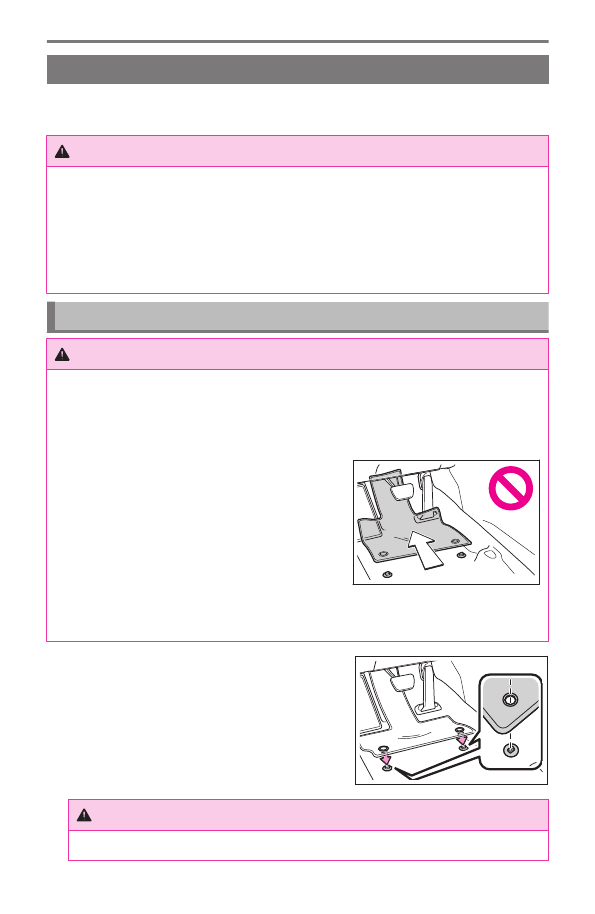
Do not place the floor mat bottomside up or upside-down.

Securing the floor mats

WARNING

Check the following before driving.

Check that the floor mat is securely fixed in the correct place with all the provided
retaining hooks (clips). Be especially careful to perform this check after cleaning the
floor.

With the hybrid system stopped and the shift position in P, fully depress each pedal to
the floor to make sure it does not interfere with the floor mat.

1

Insert the retaining hooks (clips) into the floor
mat eyelets.

WARNING

Always install the floor mat securely using the retaining hooks (clips) provided.

1-1. Using the dedicated floor mats

24

2

Turn the upper knob of each retaining hook
(clip) to secure the floor mats in place.

Always align the 

 marks 

 .

The shape of the retaining hooks (clips) may differ
from that shown in the illustration.

1-1. Using the dedicated floor mats

25

1

Befor

e driving

Important points for the hybrid system

Hybrid system features

Your vehicle is a hybrid electric vehicle. It has characteristics different from con-
ventional vehicles. Be sure you are closely familiar with the characteristics of your
vehicle, and operate it with care. The hybrid system combines the use of a gasoline
engine and an electric motor (traction motor) according to driving conditions,
improving fuel efficiency and reducing exhaust emissions.

WARNING

The driver should pay extra attention to pedestrians when the vehicle is powered only
by the electric motor (traction motor). As there is no engine noise, the pedestrians may
misjudge the vehicle's movement. Even though the vehicle is equipped with the acoustic
vehicle alerting system, drive with care as pedestrians in the vicinity may still not notice
the vehicle if the surrounding area is noisy.

When stopped/during start off

The gasoline engine stops

*1

 when the vehicle is stopped.

During start off, the electric motor (traction motor) drives the vehicle.
At slow speeds or when traveling down a gentle slope, the engine is stopped 

*1

 and

the electric motor (traction motor) is used.
When the shift position is in N, the hybrid battery (traction battery) is not being
charged.

During normal driving

The gasoline engine is predominantly used.
The electric motor (traction motor) charges the hybrid battery (traction battery) as
necessary.

INFORMATION

Conditions in which the gasoline engine may not stop

The gasoline engine starts and stops automatically.

*2

During gasoline engine warm-up

During hybrid battery (traction battery) charging

When the temperature of the hybrid battery (traction battery) is high or low

When the heater is switched on

*1 : 

When the hybrid battery (traction battery) requires charging or the engine is warming

up, etc., the gasoline engine will not automatically stop.

*2 : 

Depending on the circumstances, the gasoline engine may also not stop automatical-

ly in other situations.

1-2. Important points for the hybrid system

26

When accelerating sharply

When the accelerator pedal is depressed heavily, the power of the hybrid battery
(traction battery) is added to that of the gasoline engine via the electric motor
(traction motor).

When braking (regenerative braking)

The electric motor (traction motor) charges the hybrid battery (traction battery).

INFORMATION

Regenerative braking

In the following situations, kinetic energy is converted to electric energy and decelera-
tion force can be obtained in conjunction with the recharging of the hybrid battery
(traction battery).

The accelerator pedal is released while driving with the shift position in D or S.

The brake pedal is depressed while driving with the shift position in D or S.

EV indicator

The EV indicator comes on when the vehicle is driven using only the electric motor
(traction motor) or the gasoline engine is stopped.
Through a customization setting, the on/off operation of the EV indicator can be
changed.

Sounds and vibrations specific to a hybrid electric vehicle

Because there is no engine sound or vibration, it is easy to mistake the hybrid electric
vehicle for being off when it is actually still running, as indicated by the "READY"
indicator being illuminated. For safety, make sure to always shift the shift position to P and
apply the parking brake when parked.
The following sounds or vibrations may occur when the hybrid system is operating and
are not a malfunction:

Motor sounds may be heard from the engine compartment.

Sounds may be heard from the hybrid battery (traction battery) behind the rear seats
when the hybrid system starts or stops.

1-2. Important points for the hybrid system

27

1

Befor

e driving

Click or clunk sounds that may be heard from under of the floor or the rear when the
hybrid system is started or stopped, which are sounds of high voltage relay

Sounds from the hybrid system may be heard when the back door is open.

Sounds may be heard from the transmission when the gasoline engine starts or stops,
when driving at low speeds, or during idling.

Engine sounds may be heard when accelerating sharply.

Sounds may be heard due to regenerative braking when the brake pedal is depressed
or as the accelerator pedal is released.

Vibration may be felt when the gasoline engine starts or stops.

Cooling fan sounds may be heard from the air intake vents under the rear seats.

Maintenance, repair, recycling, and disposal

Contact your Lexus dealer regarding maintenance, repair, recycling and disposal. Do not
dispose of the vehicle yourself.

System components

WARNING

Check the following regarding handling of the hybrid battery (traction battery).

Never resell, hand over or modify the hybrid battery. To prevent accidents, hybrid
batteries that have been removed from a disposed vehicle are collected through Lexus
dealers. Do not dispose of the battery yourself.
If the hybrid battery (traction battery) is not properly collected, the following may
occur.

The hybrid battery may be illegally disposed of or dumped, and it is hazardous to
the environment or someone may touch a high voltage part, resulting in an electric
shock.

The hybrid battery is intended to be used exclusively with your hybrid electric
vehicle. If the hybrid battery is used outside of your vehicle or modified in any way,
accidents such as electric shock, heat generation, smoke generation, an explosion
and electrolyte leakage may occur.
When reselling or handing over your vehicle, the possibility of an accident is
extremely high because the person receiving the vehicle may not be aware of these
dangers.

In the event that your vehicle must be disposed of, the hybrid battery must be disposed
of by your Lexus dealer or a qualified service shop. If your vehicle is disposed of
without the hybrid battery having been removed, there is a danger of serious electric
shock if high voltage parts, cables and their connectors are touched.
If the hybrid battery is not disposed of properly, it may lead to electric shock.

1-2. Important points for the hybrid system

28

NOTICE

Do not carry large amounts of water such as water cooler bottles in the vehicle.
If water spills onto the hybrid battery (traction battery), the battery may be damaged.
Have the vehicle inspected by your Lexus dealer.

The illustration is an example for explanation and may differ from the actual item.

A

Gasoline engine

B

Warning label

C

High voltage cables (orange)

D

Hybrid battery (traction battery)

E

Rear electric motor (traction motor)

F

Service plug

G

Front electric motor (traction motor)

H

Power control unit

I

Air conditioning compressor

INFORMATION

Charging the hybrid battery (traction battery)

As the gasoline engine charges the hybrid battery (traction battery), the battery does not
need to be charged from an outside source. However, if the vehicle is left parked for a
long time the hybrid battery (traction battery) will slowly discharge. For this reason, be
sure to drive the vehicle at least once every few months for at least 30 minutes or 10
miles (16 km).
If the hybrid battery (traction battery) becomes fully discharged and you are unable to
start the hybrid system, contact your Lexus dealer.

1-2. Important points for the hybrid system

29

1

Befor

e driving

After the 12-volt battery has discharged or when the terminal has been removed
and installed during exchange, etc.

The gasoline engine may not stop even if the vehicle is being driven by the hybrid battery
(traction battery).
If this continues for a few days, contact your Lexus dealer.

Hybrid battery (traction battery) lifespan

The hybrid battery (traction battery) has a limited service life. The lifespan of the hybrid
battery (traction battery) can change in accordance with driving style and driving condi-
tions.

Starting the hybrid system in an extremely cold environment

When the hybrid battery (traction battery) is extremely cold (below approximately -22°F
[-30°C]) under the influence of the outside temperature, it may not be possible to start
the hybrid system. In this case, try to start the hybrid system again after the temperature
of the hybrid battery increases due to the outside temperature increase etc.

Acoustic vehicle alerting system

When driving with the gasoline engine stopped, a sound, which changes in ac-
cordance with the driving speed, will be played in order to warn people nearby
of the vehicle’s approach. The sound will stop when the vehicle speed exceeds
approximately 22 mph (35 km/h).

INFORMATION

Acoustic vehicle alerting system operating sounds

In the following cases, the acoustic vehicle alerting system may be difficult for surround-
ing people to hear.

In very noisy areas

In the wind or the rain

Predictive efficient drive

*3*4

This system operates based on the driving situation and traffic information to
enhance fuel economy. For details about Predictive efficient drive, refer to "
MULTIMEDIA OWNER'S MANUAL".

*3 : 

This function can only be used in the mainland U.S.A. It cannot be used in other states

and territories, including Alaska and Hawaii.

*4 : 

Vehicles with navigation system

1-2. Important points for the hybrid system

30

Predictive deceleration support

When the vehicle approaches to predictive deceleration support points registered
in the navigation system, the engine braking force will be increased according
to the driving conditions to more efficiently charge the hybrid battery (traction
battery) after the accelerator pedal is released.

Predictive SOC

*5

 control

The following types of control are performed based on data such as road and
traffic information during route guidance by the navigation system to help ensure
that the vehicle efficiently uses electricity.

When there is a long downhill slope along the route, the system reduces the
hybrid battery (traction battery) level before reaching the slope to help ensure
charging capacity for regenerative braking while traveling downhill.

When traffic congestion is predicted along the route, the system helps ensure a
certain battery level before reaching congested roads to reduce the frequency
of starting the engine to charge the hybrid battery (traction battery) due to low
battery levels.

*5 : 

SOC means state of charge

1-2. Important points for the hybrid system

31

1

Befor

e driving

Hybrid system precautions

Take care when handling the hybrid system, as it is a high voltage system (about
650 V at maximum) as well as contains parts that become extremely hot when the
hybrid system is operating. Obey the warning labels attached to the vehicle.

WARNING

High voltage precautions

This vehicle has high voltage DC and AC systems as well as a 12-volt system.
Observe the following, otherwise you may suffer burns or electric shock.

Never touch, disassemble, remove or replace the high voltage parts, cables or their
connectors.

The hybrid system will become hot after starting as the system uses high voltage.
Be careful of both the high voltage and the high temperature, and always obey the
warning labels attached to the vehicle.

Never try to open the service plug access hole lo-
cated underneath the rear seats. The service plug
is used only when the vehicle is serviced and is
subject to high voltage.

If the vehicle is involved in a collision

Observe the following.

Stop the vehicle in a safe place to prevent subsequent accidents. While depressing the
brake pedal, apply the parking brake and shift the shift position to P to stop the hybrid
system. Then, slowly release the brake pedal.

Do not touch the high voltage parts, cables and connectors.

Never touch exposed electric wires. If electric wires are exposed inside or outside
your vehicle, an electric shock may occur.

Do not touch fluid, if attached to or leaking, as the fluid may be electrolyte of the hybrid
battery (traction battery), which is organic electrolyte mainly consisting of carbonate
ester.
If the electrolyte of the hybrid battery (traction battery), which is organic electrolyte
mainly consisting of carbonate ester, comes into contact with your eyes or skin, it may
cause blindness or injury to the skin. If it comes into contact with your eyes or skin,
wash it off immediately with a large amount of water, and seek immediate medical
attention.

1-2. Important points for the hybrid system

32

WARNING

If electrolyte is leaking from the hybrid battery (traction battery), do not approach the
vehicle.
Even in the unlikely event that the hybrid battery (traction battery) is damaged, the
internal construction of the battery will prevent a large amount of electrolyte from
leaking out. However, any electrolyte that does leak out will give off a vapor. This vapor
is an irritant to skin and eyes and could cause acute poisoning if inhaled.

Do not bring burning or high-temperature items close to the electrolyte.
The electrolyte may ignite and cause a fire.

If a fire occurs in the hybrid electric vehicle, leave the vehicle as soon as possible.
Never use a fire extinguisher that is not meant for electric fires. Using even a small
amount of water may be dangerous.

If your vehicle needs to be towed, do so with four wheels raised.
If the wheels connected to the electric motor (traction motor) are on the ground when
towing, the motor may continue to generate electricity. This may cause a fire.

Check the ground under the vehicle. If a liquid other than water from the air condition-
ing system is found, the fuel system may have been damaged.
Do not start the hybrid system. If it is started as is, the leaked fuel may ignite.
Leave the vehicle as soon as possible, and contact your Lexus dealer.

INFORMATION

Electromagnetic waves

High voltage parts and cables on hybrid electric vehicles incorporate electromagnetic
shielding, and therefore emit approximately the same amount of electromagnetic
waves as conventional gasoline powered vehicles or home electronic appliances.

Your vehicle may cause sound interference in some third party-produced radio parts.

Hybrid battery (traction battery) air intake vent

There is an air intake vent under the right side
of the rear seat with the purpose of cooling the
hybrid battery (traction battery). If the vents are
blocked, it may interfere with the cooling of the
hybrid battery (traction battery).

If input/output of the hybrid battery (traction battery)
becomes limited and the distance that the vehicle can
be driven using the electric motor (traction motor) is
reduced, the fuel economy may be reduced.

1-2. Important points for the hybrid system

33

1

Befor

e driving

NOTICE

Observe the following precautions regarding the hybrid battery (traction battery) air
intake vent.

Make sure not to block the air intake vent with anything, such as a seat cover, plastic
cover, or luggage.
The input/output of the hybrid battery (traction battery) may be restricted, leading to a
reduction in hybrid battery (traction battery) output and a malfunction.

Periodically clean the air intake vents to prevent them from clogging.

Do not get water or foreign materials in the air intake vents as this may cause a short
circuit and damage the hybrid battery (traction battery).

 Related Links 

Cleaning the air intake vent(P. 543)

1-2. Important points for the hybrid system

34

Hybrid electric vehicle driving tips

For economical and ecological driving, pay attention to the following points:

Using Eco mode

When using Eco mode, the torque corresponding to the accelerator pedal depres-
sion amount can be generated more smoothly than it is in normal conditions. In
addition, the operation of the air conditioning system (heating/cooling) will be
minimized, improving the fuel economy.

Use of Hybrid System Indicator

The Eco-friendly driving is possible by keeping the indicate of Hybrid System
Indicator within Eco area.

Changing the shift position

Shift the shift position to D when stopped at a traffic light, or driving in heavy traffic
etc. Shift the shift position to P when parking. When using the N position, there
is no positive effect on fuel consumption. In the N position, the gasoline engine
operates but electricity cannot be generated. Also, when using the air conditioning
system, etc., the hybrid battery (traction battery) power is consumed.

Accelerator pedal/brake pedal operation

Drive your vehicle smoothly. Avoid abrupt acceleration and deceleration. Grad-
ual acceleration and deceleration will make more effective use of the electric
motor (traction motor) without having to use gasoline engine power.

Avoid repeated acceleration. Repeated acceleration consumes hybrid battery
(traction battery) power, resulting in poor fuel consumption. Battery power can
be restored by driving with the accelerator pedal slightly released.

When braking

Make sure to operate the brakes gently and in a timely manner.
A greater amount of electrical energy can be regenerated when slowing down.

Delays

Repeated acceleration and deceleration, as well as long waits at traffic lights, will
lead to bad fuel economy. Check traffic reports before leaving and avoid delays as
much as possible. When driving in a traffic jam, gently release the brake pedal to
allow the vehicle to move forward slightly while avoiding overuse of the accelerator
pedal. Doing so can help control excessive gasoline consumption.

Highway driving

Control and maintain the vehicle at a constant speed. Before stopping at a toll
booth or similar, allow plenty of time to release the accelerator and gently apply the

1-2. Important points for the hybrid system

35

1

Befor

e driving

brakes. A greater amount of electrical energy can be regenerated when slowing
down.

Air conditioning

Use the air conditioning only when necessary. Doing so can help reduce excessive
gasoline consumption.
In summer: When the ambient temperature is high, use the recirculated air mode.
Doing so will help to reduce the burden on the air conditioning system and reduce
fuel consumption as well.
In winter: Because the gasoline engine will not automatically cut out until it and the
interior of the vehicle are warm, it will consume fuel. Also, fuel consumption can be
improved by avoiding overuse of the heater.

Checking tire inflation pressure

Make sure to check the tire inflation pressure frequently. Improper tire inflation
pressure can cause poor fuel economy.
Also, as snow tires can cause large amounts of friction, their use on dry roads can
lead to poor fuel economy. Use tires that are appropriate for the season.

Luggage

Carrying heavy luggage will lead to poor fuel economy. Avoid carrying unnecessa-
ry luggage. Installing a large roof rack will also cause poor fuel economy.

Warming up before driving

Since the gasoline engine starts up and cuts out automatically when cold, warming
up the engine is unnecessary.
Moreover, frequently driving short distances will cause the engine to repeatedly
warm up, which can lead to excess fuel consumption.

1-2. Important points for the hybrid system

36

Vehicle load limits

Vehicle load limits

Vehicle load limits include total load capacity, seating capacity, towing capacity and
cargo capacity.

Vehicle load limit terminology and definitions

WARNING

Do not overload the vehicle. It may not only cause damage to the tires, but also degrade
steering and braking ability, resulting in an accident.

Total load capacity (vehicle capacity weight)

Total load capacity means the combined weight of occupants, cargo and luggage.

Seating capacity

Seating capacity means the maximum number of occupants whose estimated
average weight is 150 lb. (68 kg) per person.

TWR (Trailer Weight Rating) (vehicles with towing package)

TWR means the maximum gross trailer weight (trailer weight plus its cargo weight)
that your vehicle is able to tow.

TWR (Trailer Weight Rating) (vehicles without towing package)

Lexus does not recommend towing a trailer with your vehicle.

Cargo capacity

Cargo capacity may increase or decrease depending on the weight and the
number of occupants.

INFORMATION

Total load capacity and seating capacity

These details are also described on the tire and loading information label.

 Related Links 

Dimensions and weight(P. 728)
Seating capacity(P. 728)

1-3. Vehicle load limits

37

1

Befor

e driving

For safe driving with children on board

Riding with children

If a child which is not large enough to correctly wear a seat belt intended for adults
is to ride in the vehicle, use a child restraint system. Child restraint systems are
designed to keep children safe.
To ensure safety, observe the following when children are in the vehicle.

Make sure that children always wear a seat belt.
If a child is not wearing a seat belt, in a collision, they may collide with a window,
other passenger, or the interior of the vehicle. Also, if a child is riding on the
lap of another passenger, in a collision, they may collide with a window, other
passenger, or the interior of the vehicle.

Seat children in the rear seats.
It is recommended that children sit in the rear seats to avoid accidental contact
with the driver's controls.

Do not allow children to operate equipment such as the doors, windows, etc.
Do not let children operate equipment such as the doors, power windows, seats,
etc. as a part of their body may become pinched.
To prevent children from opening and closing the doors and power windows, use
the child-protector locks and window lock switch.

WARNING

Never leave children unattended in the vehicle, and never allow children to have or
use the key.
Children may be able to start the vehicle or shift the vehicle into neutral.

Do not leave children unattended in the vehicle.
Children may accidentally cause the vehicle to move, leading to an accident, or start a
fire.

Do not leave people or animals in the vehicle.
The temperature inside the vehicle can become extremely high during the daytime,
possibly leading to heat stroke or death.

Do not allow children to ride on the lap of a passenger.
If a child is riding on the lap of another passenger, in a collision, they may collide with a
window, another passenger, or the interior of the vehicle. Make sure that children wear
a seat belt or use a child restraint system.

Use a child restraint system for small children.

1-4. For safe driving with children on board

38

WARNING

If a child which is not large enough to correctly wear a seat belt is to ride in the vehicle,
use a child restraint system.

Use child restraint systems correctly.
Child restraint systems are designed to protect children in a collision or sudden stop.
Make sure to securely install child restraint systems and use them correctly.

Replace child restraint systems which have been involved in a collision.
If the vehicle has been involved in a collision, it is possible that an installed child
restraint system has been damaged and will not be able to deliver the same level of
impact absorption performance, even if the outside of it looks normal.

When a child restraint system is not in use, secure it so that it does not interfere with
driving.
When removing a child restraint system, store it outside of the vehicle or securely in
the luggage compartment.

Seating positions for children

It is recommended that children sit in the rear seats to avoid accidental contact
with the driver’s controls. In the event of an accident, the force of deployment of the
SRS front passenger airbag can cause death or serious injury to a child seated on
the front passenger’s seat. Do not allow a child to ride on the front passenger’s seat
unless it is unavoidable.

WARNING

When installing a child restraint system to the front passenger’s seat is unavoidable,
move the seat as far back as possible, and install the child restraint system so that it
faces forward. If the child restraint system is not installed correctly, in the event of an
accident, the force of deployment of the SRS front passenger airbag can cause death
or serious injury.

Never install a rear-facing child restraint system on the front passenger seat even if the
"AIR BAG OFF" indicator light is illuminated. In the event of an accident, the force of
the rapid inflation of the front passenger airbag can cause death or serious injury to
the child if the rear-facing child restraint system is installed on the front passenger seat.

A forward-facing child restraint system may be installed on the front passenger seat
only when it is unavoidable. A child restraint system that requires a top tether strap
should not be used in the front passenger seat since there is no top tether strap anchor
for the front passenger seat.

A forward-facing child restraint system may be installed on the front passenger seat
only when it is unavoidable. When installing a forward-facing child restraint system on

1-4. For safe driving with children on board

39

1

Befor

e driving

WARNING

the front passenger seat, move the seat as far back as possible, and raise the seat to
the upper most position, even if the "AIR BAG OFF" indicator light is illuminated. If
the head restraint interferes with the child restraint system installation and the head
restraint can be removed, remove the head restraint.

Do not allow children to lean against the doors, roof side rails, or pillars. In the event
of an accident, the force of deployment of an SRS airbag can cause death or serious
injury to a child.

When adjusting the driver’s seat, if it contacts a child or child restraint system, install
the child restraint system to the rear seat behind the front passenger’s seat.

Adjust the front passenger seat so that it does not interfere with the child or child
restraint system.

If a child which is over 3.3 ft. (100 cm) tall is to ride in the vehicle, use a booster seat.
When using a booster seat, make sure that the seat belt is worn correctly.

Preventing the rear doors from being opened from the inside of the
vehicle (child-protector lock)

The door cannot be opened from inside the vehicle when the lock is set.


1

Unlock

2

Lock

These locks can be set to prevent children from
opening the rear doors. Push down on each
rear door switch to lock both rear doors.

INFORMATION

Door opening method when using a child-protector lock

Unlock the door and pull the exterior door handle to open the door. If it is necessary to
open the door from inside the vehicle, open the rear door window and pull the exterior
door handle.

1-4. For safe driving with children on board

40

Child restraint system

Points to remember

The laws of all 50 states of the U.S.A. as well as Canada now require the use of
child restraint systems.

Prioritize and observe the warnings, as well as the laws and regulations for child
restraint systems.

Use a child restraint system until the child becomes large enough to properly
wear the vehicle’s seat belt.

Choose a child restraint system that suits your vehicle and is appropriate to the
age and size of the child.

WARNING

When a child is riding

Observe the following precautions. Failure to do so may result in death or serious injury.

For effective protection in automobile accidents and sudden stops, a child must be
properly restrained, using a seat belt or child restraint system which is correctly
installed. For installation details, refer to the operation manual enclosed with the child
restraint system. General installation instruction is provided in this manual.

Lexus strongly urges the use of a proper child restraint system that conforms to the
weight and size of the child, installed on the rear seat. According to accident statistics,
the child is safer when properly restrained in the rear seat than in the front seat.

Holding a child in your or someone else’s arms is not a substitute for a child restraint
system. In an accident, the child can be crushed against the windshield or between the
holder and the interior of the vehicle.

Handling the child restraint system

If the child restraint system is not properly fixed in place, the child or other passengers
may be seriously injured or even killed in the event of sudden braking, sudden swerving,
or an accident.

If the vehicle were to receive a strong impact from an accident, etc., it is possible that
the child restraint system has damage that is not readily visible. In such cases, do not
reuse the restraint system.

Make sure you have complied with all installation instructions provided with the child
restraint system manufacturer and that the system is properly secured.

Keep the child restraint system properly secured on the seat even if it is not in use. Do
not store the child restraint system unsecured in the passenger compartment.

If it is necessary to detach the child restraint system, remove it from the vehicle.

1-4. For safe driving with children on board

41

1

Befor

e driving

Child restraint system installation method

Child restraint system fixed with a child restraint LATCH anchor

WARNING

When installing a child restraint system

Observe the following precautions. Failure to do so may result in death or serious injury.

When using LATCH anchors, make sure that the area around the anchors is free of
objects and that the seat belt will not be caught behind the child restraint system.

Follow all installation instructions provided by the child restraint system manufacturer.

Never attach two child restraint system attachments to the same anchor. In a collision,
one anchor may not be strong enough to hold two child restraint system attachments
and may break. If the LATCH anchors are already in use, use the seat belt to install a
child restraint system in the center seat.

When securing some types of child restraint systems in rear seats, it may not be
possible to properly use the seat belts in positions next to the child restraint without
interfering with it or affecting seat belt effectiveness. Be sure your seat belt fits snugly
across your shoulder and low on your hips. If it does not, or if it interferes with the child
restraint, move to a different position. Failure to do so may result in death or serious
injury.

If the seat is adjusted, reconfirm the security of the child restraint system.

Laws and regulations pertaining to anchors

The LATCH system conforms to FMVSS225 or CMVSS210.2.
Child restraint systems conforming to FMVSS213 or CMVSS213 specifications
can be used.
This vehicle is designed to conform to SAE J1819.

With rigid lower attachments

LATCH anchors are provided for the each rear seat. (Buttons displaying the
location of the anchors are attached to the seats.)

1-4. For safe driving with children on board

42

A

LATCH anchor

A

Canada only

1

Latch the buckles onto the LATCH anchors.

For owners in Canada:
The symbol on a child restraint system indicates the presence of a lower connector
system.

2

If the child restraint has a top tether strap, follow the child restraint manufactur-
er’s operation manual regarding the installation, using the top tether strap to
latch onto the top tether strap anchor.

3

After installing the child restraint system, rock it back and forth to ensure that it
is installed securely.

1-4. For safe driving with children on board

43

1

Befor

e driving

With flexible lower attachments

LATCH anchors are provided for the each rear seat. (Buttons displaying the
location of the anchors are attached to the seats.)

A

LATCH anchor

A

Canada only

1

Latch the hooks onto the LATCH anchors.

For owners in Canada:
The symbol on a child restraint system indicates the presence of a lower connector
system.

2

If the child restraint has a top tether strap, follow the child restraint manufactur-
er’s operation manual regarding the installation, using the top tether strap to
latch onto the top tether strap anchor.

1-4. For safe driving with children on board

44

3

After installing the child restraint system, rock it back and forth to ensure that it
is installed securely.

Using an anchor bracket (for top tether strap)

WARNING

When installing a child restraint system

Observe the following precautions. Failure to do so may result in death or serious injury.

Firmly attach the top tether strap and make sure that the belt is not twisted.

Do not attach the top tether strap to anything other than the anchor bracket.

After securing a child restraint system, never adjust the seat.

Follow all installation instructions provided by the child restraint system manufacturer.

Outboard rear seats: When installing the child restraint system with the head restraint
being raised, after the head restraint has been raised and then the anchor bracket has
been fixed, do not lower the head restraint.

Rear center seat: When installing the child restraint system with the head restraint
being lowered, be sure to have the top tether strap pass over the top of the head
restraint. If the belt passes below the head restraint, it is possible that the child restraint
system may not be securely fixed.

Laws and regulations pertaining to anchors

The LATCH system conforms to FMVSS225 or CMVSS210.2.
Child restraint systems conforming to FMVSS213 or CMVSS213 specifications
can be used.
This vehicle is designed to conform to SAE J1819.

Fixing the top tether strap to the anchor bracket

Anchor brackets are provided for each rear seat.
Use anchor brackets when fixing the top tether strap.
Install the child restraint system in accordance to the operation manual enclosed
with the child restraint system.
Latch the hook onto the anchor bracket and tighten the top tether strap.
Make sure the top tether strap is securely latched.

1-4. For safe driving with children on board

45

1

Befor

e driving


A

Anchor brackets

B

Top tether strap

C

Hook

Child restraint system fixed with a seat belt

WARNING

When installing a child restraint system

Observe the following precautions. Failure to do so may result in death or serious injury.

Do not allow children to play with the seat belt. If the seat belt becomes twisted around
a child’s neck, it may lead to choking or other serious injuries that could result in death.
If this occurs and the buckle cannot be unfastened, scissors should be used to cut the
belt.

Ensure that the belt and plate are securely locked and the seat belt is not twisted.

Shake the child restraint system left and right, and forward and backward to ensure
that it has been securely installed.

After securing a child restraint system, never adjust the seat.

Follow all installation instructions provided by the child restraint system manufacturer.

When securing some types of child restraint systems in rear seats, it may not be
possible to properly use the seat belts in positions next to the child restraint without
interfering with it or affecting seat belt effectiveness. Be sure your seat belt fits snugly
across your shoulder and low on your hips. If it does not, or if it interferes with the child
restraint, move to a different position. Failure to do so may result in death or serious
injury.

When installing a child restraint system in the rear center seat, adjust both seatbacks
at the same angle. Otherwise, the child restraint system cannot be securely restrained
and this may cause death or serious injuries in the event of sudden braking, sudden
swerving or an accident.

Do not use a seat belt extender

If a seat belt extender is used when installing a child restraint system, the seat belt will
not securely hold the child restraint system, which could cause death or serious injury
to the child or other passengers in the event of sudden braking, sudden swerving or an
accident.

1-4. For safe driving with children on board

46

Installing child restraint system using a seat belt (child restraint lock function
belt)

A child restraint system for a small child or baby must itself be properly restrained
on the seat with the lap portion of the lap/shoulder belt.
Install the child restraint system in accordance to the operation manual enclosed
with the child restraint system.

Rear-facing - Infant seat/convertible

1

Adjust the rear seat

If there is a gap between the child seat and the seatback, adjust the seatback until good
contact is achieved.

2

Place the child restraint system on the rear
seat facing the rear of the vehicle.

3

Run the seat belt through the child restraint
system and insert the plate into the buckle.
Make sure that the belt is not twisted.

4

Fully extend the shoulder belt and allow it to
retract to put it in lock mode. In lock mode,
the belt cannot be extended.

1-4. For safe driving with children on board

47

1

Befor

e driving

5

While pushing the child restraint system
down into the rear seat, allow the shoulder
belt to retract until the child restraint system is
securely in place.

After the shoulder belt has retracted to a point
where there is no slack in the belt, pull the belt to
check that it cannot be extended.

6

After installing the child restraint system, rock it back and forth to ensure that it
is installed securely.

Forward-facing - Convertible

1

Adjust the seat

When using the front passenger seat
If installing the child restraint system to the front passenger seat is unavoidable, refer
to 

 P.51

.

When using the rear seat
If there is a gap between the child seat and the seatback, adjust the seatback angle
until good contact is achieved.

2

If the head restraint interferes with the child restraint system installation and the
head restraint can be removed, remove the head restraint. Otherwise, put the
head restraint in the upper most position.

3

Place the child restraint system on the seat
facing the front of the vehicle.

4

Run the seat belt through the child restraint
system and insert the plate into the buckle.
Make sure that the belt is not twisted.

1-4. For safe driving with children on board

48

5

Fully extend the shoulder belt and allow it to
retract to put it in lock mode. In lock mode,
the belt cannot be extended.

6

While pushing the child restraint system into
the rear seat, allow the shoulder belt to re-
tract until the child restraint system is securely
in place.

After the shoulder belt has retracted to a point
where there is no slack in the belt, pull the belt to
check that it cannot be extended.

7

If the child restraint has a top tether strap, follow the child restraint manufactur-
er’s operation manual regarding the installation, using the top tether strap to
latch onto the top tether strap anchor.

8

After installing the child restraint system, rock it back and forth to ensure that it
is installed securely.

Booster seat

1

If installing the child restraint system to the front passenger seat is unavoidable,
refer to 

 P.51

.

2

High back type: If the head restraint interferes with your child restraint system,
and the head restraint can be removed, remove the head restraint. Otherwise,
put the head restraint in the upper most position.

3

Place the child restraint system on the seat facing the front of the vehicle.

Booster type

1-4. For safe driving with children on board

49

1

Befor

e driving

High back type

4

Sit the child in the child restraint system. Fit
the seat belt to the child restraint system
according to the manufacturer’s instructions
and insert the plate into the buckle. Make
sure that the belt is not twisted.

Check that the shoulder belt is correctly posi-
tioned over the child’s shoulder and that the lap
belt is as low as possible.

WARNING

When installing a child restraint system

Observe the following precautions. Failure to do so may result in death or serious
injury.
When a booster seat is installed, always ensure that the shoulder belt is positioned
across the center of the child’s shoulder. The belt should be kept away from the child’s
neck, but not so that it could fall off the child’s shoulder.

When installing a booster seat

To prevent the belt from going into ALR lock mode, do not fully extend the shoulder
belt. ALR mode causes the belt to tighten only. This could cause injury or discomfort
to the child.

Removing a child restraint system

Press the buckle release button and fully re-
tract the seat belt.

When releasing the buckle, the child restraint sys-
tem may spring up due to the rebound of the seat
cushion. Release the buckle while holding down the
child restraint system.
Since the seat belt automatically reels itself, slowly
return it to the stowing position.

1-4. For safe driving with children on board

50

Installing a child restraint system to the front passenger's seat

Do not install a child restraint system to the front passenger's seat unless it is
unavoidable. In the event of an accident, the force of deployment of an SRS airbag
can cause death or serious injury to a child.
If installation of a child restraint system to the front passenger's seat is unavoidable,
adjust the front passenger's seat as follows:

Move the seat to the rearmost position

Move the seat to the uppermost position

Adjust the seatback angle to the most upright position.
Adjust the seatback angle of the front passenger's seat until good contact is
achieved.

Remove the head restraint
If the head restraint cannot be removed, move it to the uppermost position.

WARNING

When installing a child restraint system to the front passenger's seat, move the seat as
far back as possible. In the event of an accident, the force of deployment of an SRS
airbag can cause death or serious injury to a child.

Make sure that the child's body will not contact the doors, roof side rails, or pillars. In
the event of an accident, the force of deployment of an SRS airbag can cause death or
serious injury to a child.

When using a booster seat, make sure that the seat belt is worn correctly.

Choose a child restraint system appropriate to the age and size of the child.

Installing a child restraint system to the front passenger's seat

Make sure to appropriately adjust the front passenger's seat before installing the
child restraint system.

Install the child restraint system according to the user's manual included with it.

1-4. For safe driving with children on board

51

1

Befor

e driving

Entering/exiting the vehicle

Key types

The following keys are provided with the vehicle.


A

Electronic keys

Operating the smart access system with
push-button start

Operating the wireless remote control
function

B

Mechanical keys

C

Key number plate

D

Card key (electronic key)

*

Operating the smart access system with push-
button start

NOTICE

To prevent key damage

Observe the following precautions

Do not drop the keys, subject them to strong shocks or bend them.

Do not expose the keys to high temperatures for long periods of time.

Do not get the keys wet or wash them in an ultrasonic washer, etc.

Do not attach metallic or magnetic materials to the keys or place the keys close to
such materials.

Do not disassemble the keys.

Do not attach a sticker or anything else to the surface of the electronic key.

Do not place the keys near objects that produce magnetic fields, such as TVs, audio
systems and induction cookers.

Do not place the keys near medical electrical equipment such as low-frequency
therapy equipment or microwave therapy equipment, and do not receive medical
attention with the keys on your person.

Carrying the electronic key on your person

Carry the electronic key 3.9 in. (10 cm) or more away from electric appliances that are
turned on. Radio waves emitted from electric appliances within 3.9 in. (10 cm) of the
electronic key may interfere with the key, causing the key to not function properly.

Handling the card key

If the battery or card key terminals get wet, the battery may corrode and the card key
may stop working.If the key is dropped into water, or if drinking water, etc., is spilled on

* : 

If equipped

1-5. Entering/exiting the vehicle

52

NOTICE

the key, immediately remove the battery cover and wipe the battery and terminals. (To
remove the battery cover, lightly grasp and pull it.) If the battery is corroded, have your
Lexus dealer replace the battery.

Do not crush the battery cover or use a screwdriver to remove the battery cover.
Forcibly removing the battery cover may bend or damage the key.

If the battery cover is frequently removed, the battery cover may become loose.

When installing the battery, make sure to check the direction of the battery.Installing
the battery in the wrong direction may cause the battery to deplete rapidly.

The surface of the card key may be damaged, or its coating may peel off in the
following situations:

The card key is carried together with hard objects, such as coins and keys.

The card key is scraped with a sharp object, such as the tip of a mechanical pencil.

The surface of the card key is wiped with thinner or benzene.

INFORMATION

Handling the card key

The mechanical key that is stored inside the card key should be used only if a problem
arises, such as when the card key does not operate properly.

If the battery cover is not installed and the battery
falls out or if the battery was removed because the
key got wet, reinstall the battery with the positive
terminal facing the Lexus emblem.

The card key is not waterproof.

When riding in an aircraft

When bringing an electronic key onto an aircraft, make sure you do not press any buttons
on the electronic key while inside the aircraft cabin. If you are carrying an electronic key
in your bag, etc., ensure that the buttons are not likely to be pressed accidentally. Pressing
a button may cause the electronic key to emit radio waves that could interfere with the
operation of the aircraft.

Electronic key battery depletion

The standard battery life is 1 to 2 years (The card key battery life is about 1 year.).

1-5. Entering/exiting the vehicle

53

1

Befor

e driving

If the battery becomes low, an alarm will sound in the cabin when the hybrid system
stops.

As the electronic key always receives radio waves, the battery will become depleted
even if the electronic key is not used. The following symptoms indicate that the
electronic key battery may be depleted. Replace the battery when necessary.

The smart access system with push-button start or the wireless remote control does
not operate.

The detection area becomes smaller.

The LED indicator on the key surface does not turn on.

You can replace the battery by yourself. However, as there is a danger that the
electronic key may be damaged, it is recommended that replacement is carried out by
your Lexus dealer.

To avoid serious deterioration, do not leave the electronic key within 3 ft. (1 m) of the
following electrical appliances that produce a magnetic field:

TVs

Personal computers

Cellular phones, cordless phones and battery chargers

Table lamps

Induction cookers

Battery-saving function

The battery-saving function will be activated in order to prevent the electronic key
battery and the 12-volt battery from being discharged while the vehicle is not in operation
for a long time.

In the following situations, the smart access system with push-button start may take
some time to unlock the doors. Also the illuminated entry system may not operate
properly.

The electronic key has been left in an area of approximately 11 ft. (3.5 m) of the
outside of the vehicle for 40 seconds or longer.

The smart access system with push-button start has not been used for 5 days or
longer.

If the smart access system with push-button start has not been used for 14 days or
longer, the doors cannot be unlocked at any doors except the driver’s door. In this
case, take hold of the driver’s door handle, or use the wireless remote control or the
mechanical key, to unlock the doors.

Electronic key battery-saving mode

When battery-saving mode is set, battery depletion is minimized by stopping the
electronic key from receiving radio waves.

1-5. Entering/exiting the vehicle

54


Content      ..      1       2         ..


//////////////////////////////////////////