Lexus RZ (2023 year). Manual in english - page 1


  Index      Manuals     Lexus RZ (2023 year). Manual in english


Search            copyright infringement  


Content      ..      1       2         ..


Lexus RZ (2023 year). Manual in english - page 1


1

25

1

Be

fore
 dri
ving

Before driving

.

1-1. Using the dedicated floor mats

Using the dedicated floor mats 

correctly.........................................

26

1-2. Important points for the EV sys-

tem

Electric vehicle system features

............................................................

27

Electric Vehicle system precau-

tions.................................................

30

Battery Electric Vehicle driving 

tips ....................................................

34

Driving range.................................

36

1-3. Charging with the EV system

Charging equipment..................

38

Locking and unlocking AC charg-

ing connector...............................

42

Charging methods .......................

44

Charging tips ..................................

46

Things to know before charging

............................................................

47

How to use AC charging..........

50

How to use DC charging..........

55

Using the charging schedule func-

tion...................................................

59

Using My Room Mode...............

64

1-4. For safe driving with children on 

board

Riding with children ....................

66

Child restraint systems ...............

67

Airbag manual on-off system

...........................................................

82

1-5. Entering/exiting the vehicle

Key types..........................................

84

Smart entry & start system........

87

Opening/closing the doors.....

90

Locking/unlocking the doors

...........................................................

93

Immobilizer system......................

95

Double locking system...............

96

Alarm .................................................

97

Trailer towing (vehicles with tow-

ing package) ..............................

101

Trailer towing (vehicles without 

towing package) .....................

107

Opening and closing the windows

........................................................

108

1-6. Loading luggage

Loading the vehicle with luggage

...........................................................

111

1-7. Obtaining the correct driving 

posture

Adjusting the seats.....................

129

Using the seat belts...................

133

Adjusting the position of the 

steering wheel and mirrors

........................................................

135
26

1-1. Using the dedicated floor mats

1-1.Using the dedicated floor mats

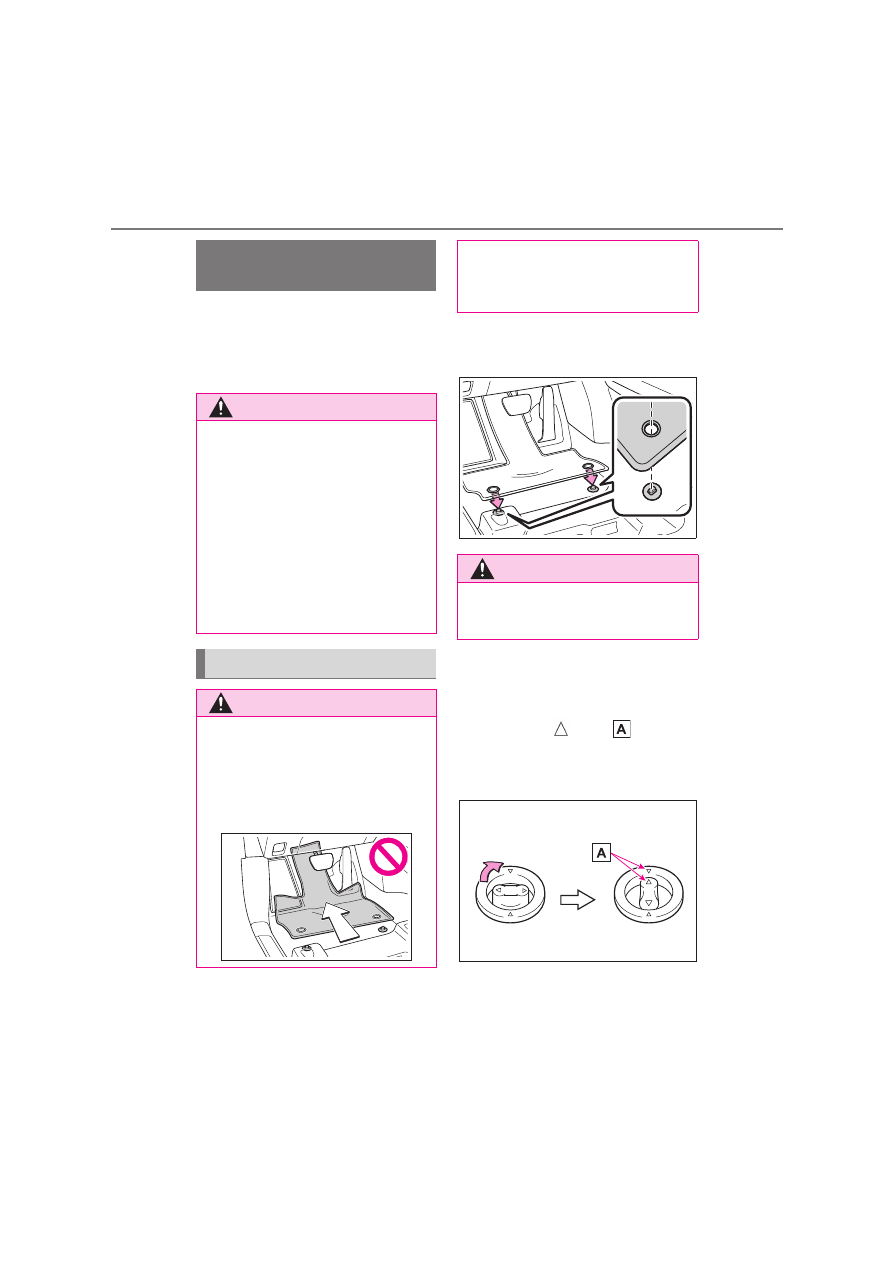
Use only floor mats designed specifi-
cally for vehicles of the same model 
and model year as your vehicle. Fix 
them securely in place onto the carpet.

1

Insert the retaining hooks (clips) 
into the floor mat eyelets.

2

Turn the upper knob of each retain-
ing hook (clip) to secure the floor 
mats in place.

Always align the 

 marks 

.

The shape of the retaining hooks (clips) 

may differ from that shown in the illustra-

tion.

Using the dedicated floor 
mats correctly

WARNING

When installing a driver's side floor 

mat, do not use floor mats designed for 

other models or different model year 

vehicles, even if they are Lexus Genu-

ine floor mats.

Only use floor mats designed for the 

driver’s seat.

Do not use two or more floor mats on 

top of each other.

Do not place the floor mat bot-

tom-side up or upside-down.

Securing the floor mats

WARNING

Check the following before driving.

Check that the floor mat is securely 

fixed in the correct place with all the 

provided retaining hooks (clips). Be 

especially careful to perform this 

check after cleaning the floor.

With the EV system stopped and the 

shift position in P, fully depress each 

pedal to the floor to make sure it does 

not interfere with the floor mat.

WARNING

Always install the floor mat securely 

using the retaining hooks (clips) pro-

vided.

27

1

1-2. Important points for the EV system

Be

fore
 driving

1-2.Important points for the EV system

The illustration is an example for explanation and may differ from the actual item.

Onboard traction battery charger
Electric motor (traction motor)/Inverter (front/rear)
Traction battery

Provides electricity to the electric motor.

Charging port
12-volt battery

Provides electricity to various vehicle systems such as the SRS airbags, headlights, wipers, 
etc.

Electric vehicle system features

Battery electric vehicles are considerably different from conventional vehi-
cles.

They use electricity charged in a traction battery, to drive the electric motor. 
Since battery electric vehicles are driven using electricity, they do not emit 
any emissions such as CO

2

 (Carbon Dioxide) and NOx (Nitrogen Oxides). 

Battery electric vehicles are environmentally friendly vehicles.

System components

A
B
C

D

E

28

1-2. Important points for the EV system

ESU: Electricity Supply Unit (built in /DC-DC converter)

When braking (regenerative brak-
ing)

The electric motor (traction motor) 
charges the traction battery.
The driving range can be extended by 
actively using this regenerative braking 
to store electricity in the traction bat-
tery.

The battery electric vehicle is driven 
using electricity, which is received from 
an external power source and stored in 
the traction battery. Not only public 
charging stations, but also household 
sockets can be used for charging. Pro-
cedures are different from refueling a 
conventional vehicle. Therefore, make 
sure to read the following thoroughly.

Charging equipment (

P.38)

Things to know before charging 
(

P.47)

How to charge your vehicle 
(

P.50, 55)

When charging cannot be per-
formed normally (

P.564, 566)

Regenerative braking

In the following situations, kinetic energy is 

converted to electric energy and decelera-

tion force can be obtained in conjunction 

with the recharging of the traction battery.

The accelerator pedal is released while 

driving with the shift position in D.

The brake pedal is depressed while driv-

ing with the shift position in D.

Charging the 12-volt battery

The 12-volt battery is charged from the trac-

tion battery when the EV system is oper-

ated or while the traction battery is being 

charged.
If the vehicle has not been used for a long 

time, the 12-volt battery may become low 

due to self-discharge. If this occurs, follow 

the correct procedures. (

P.555)

When not using the vehicle for an 

extended period of time

When the vehicle will not be used for an 

extended period of time, charge the trac-

tion battery once a month. 

This protects the traction battery from 

extreme voltage decline due to self dis-

charging.

When the vehicle will not be used for an 

extended period of time, the 12-volt bat-

tery will be charged from the traction bat-

tery to reduce the risk of the 12-volt 

battery discharged. In this case, the cool-

ing fan may operate, however it is not a 

malfunction.

To prevent the 12-volt battery from being 

discharged, do not leave the charging 

port lid open or the charging cable con-

nected to the vehicle.

Charging the traction battery

Be sure to maintain the traction battery 

charge level suitable for your driving needs.
If the traction battery fully discharges, the 

vehicle cannot be driven at all. When the 

battery becomes low, charge it as soon as 

possible.

If the traction battery becomes low

If the traction battery becomes low, the 

traction battery charge warning light 

comes on or flashes and a message will 

be displayed on the multi-information dis-

play. (

P.501)

If the traction battery is completely dis-

charged, the EV system cannot be 

started and driving will not be possible. 

When the traction battery becomes low, 

F

Charging

29

1

1-2. Important points for the EV system

Be

fore
 driving

charge it as soon as possible.

Sounds and vibrations specific to an 

electric vehicle

Because there is no engine sound or vibra-

tion, it is easy to mistake the electric vehicle 

for being off when it is actually still running, 

as indicated by the “READY” indicator 

being illuminated. For safety, make sure to 

always shift the shift position to P and apply 

the parking brake when parked.
Before and after the EV system is started, 

the following sounds and vibrations may 

occur. However, these sounds and/or vibra-

tions are not signs of malfunctions:

The brake system operation sound may 

be heard from the front of the vehicle 

when the driver’s door is opened.

Motor sounds may be heard from the 

motor compartment or luggage com-

partment.

Electrical relay sounds may be heard 

from the motor compartment when the 

EV system starts or stops.

Relay operating sounds such as a snap or 

soft clank will be emitted from the trac-

tion battery in the following situations:

• When the EV system is started or 

stopped

• When charging starts or completes

• When the vehicle is driven the first time 

after the traction battery has been 

charged using DC charging

Sounds may be heard due to regenera-

tive braking when the brake pedal is 

depressed or as the accelerator pedal is 

released.

Cooling fan operating sounds from the 

radiator.

The operation sound of the air condition-

ing system (air conditioning compressor, 

blower motor).

Maintenance, repair, recycling, and dis-

posal

Contact any authorized Lexus retailer or 

Lexus authorized repairer, or any reliable 

repairer regarding maintenance, repair, 

recycling and disposal. Do not dispose of 

the vehicle yourself.

A sound which changes in accordance 
with the driving speed, will be played in 
order to warn people nearby of the 
vehicle’s approach. This sound may be 
heard inside the vehicle. The sound will 
stop when the vehicle speed exceeds 
approximately 25km/h (15 mph).

Acoustic Vehicle Alerting System

In the following cases, the Acoustic Vehicle 

Alerting System may be difficult for sur-

rounding people to hear.

In very noisy areas

In the wind or the rain

Acoustic Vehicle Alerting Sys-
tem

30

1-2. Important points for the EV system

The illustration is an example for explanation and may differ from the actual item.

Warning label
Warning label (Turkey only)
High voltage cables (orange)
Onboard traction battery charger
Service plug
AC charging inlet
DC charging inlet
Traction battery

Electric Vehicle system precautions

Be careful of the high voltage components (nominal voltage at 355.2 V), such 
as the traction battery, electricity supply unit, orange colored high voltage 
cables, and electric motor, as well as high temperature components such as 
the cooling radiator, which are provided on the battery electric vehicle. For the 
high voltage components, warning labels are provided on them. Read them 
when they need to be handled.

System components

A
B
C
D

E
F

G

H

31

1

1-2. Important points for the EV system

Be

fore
 driving

Electric motor (traction motor)/Inverter (front/rear)
Air conditioning compressor
ESU: Electricity Supply Unit (built in DC-DC converter)

Electromagnetic waves

High-voltage parts and cables on the bat-

tery electric vehicles incorporate elec-

tro-magnetic shielding, and therefore 

emit approximately the same amount of 

electromagnetic waves as conventional 

gasoline-powered vehicles or home elec-

tronic appliances.

Your vehicle may cause sound interfer-

ence in some third party-produced radio 

parts.

Traction battery (Lithium-ion battery)

The traction battery has a limited service 

life.
The traction battery capacity (the ability to 

store energy) reduces with time and use in 

the same way as other rechargeable batter-

ies. The extent at which capacity reduces 

changes drastically depending on the envi-

ronment (outside temperature, etc.) and 

usage conditions, such as how the vehicle is 

driven and how the traction battery is 

charged.
This is a natural characteristic of lithium-ion 

batteries, and is not a malfunction. Also, 

even though the driving range decreases 

when the traction battery capacity reduces, 

vehicle performance does not significantly 

become worse. In order to reduce the pos-

sibility of the capacity reducing, follow the 

directions listed on P.49, “Capacity reduc-

tion of the traction battery”.

Starting the EV system in an extremely 

cold environment

When the traction battery is extremely cold 

(below approximately -30°C [-22°F]) due 

to the temperature outside of the vehicle, it 

may not be possible to start the EV system. 

In this case, try to start the EV system again 

after the temperature of the traction battery 

increases due to the outside temperature 

increasing, etc.

Declaration of conformity

This model conforms to hydrogen emis-

sions according to regulation ECE100 

(Battery electric vehicle safety).

I

J

K

WARNING

High-voltage precautions

The vehicle has high voltage DC and AC 

systems as well as a 12-volt system.

DC and AC high voltage systems are 

very dangerous and can cause severe 

burns and electric shock that may result 

in death or serious injury.

Never touch, disassemble, remove, or 

replace the high voltage parts, cables 

(orange) or their connectors.

The EV system will become hot after 

starting as the system uses high volt-

age. Be careful of both the high volt-

age and the high temperature, and 

always obey the warning labels 

attached to the vehicle.

Never try to open the service plug 

access hole located under the floor. 

The service plug is used only when the 

vehicle is being serviced and is subject 

to high voltage.

Road accident cautions

Observe the following precautions to 

reduce the risk of death or serious injury:

32

1-2. Important points for the EV system

WARNING

Stop the vehicle in a safe place to pre-

vent subsequent accidents. While 

depressing the brake pedal, apply the 

parking brake and shift the shift posi-

tion to P to stop the EV system. Then, 

slowly release the brake pedal.

Do not touch the high voltage parts, 

cables (orange) and connectors.

If electric wires are exposed inside or 

outside your vehicle, an electric shock 

may occur. Never touch exposed elec-

tric wires.

Do not touch the traction battery if liq-

uid is leaking from or adhered to it. If 

electrolyte (Organic Car-

bonate-based electrolyte) from the 

traction battery comes into contact 

with the eyes or skin, it could cause 

blindness or skin wounds. In the 

unlikely event that it comes into con-

tact with the eyes or skin, wash it off 

immediately with a large amount of 

water, and seek immediate medical 

attention.

If electrolyte is leaking from the trac-

tion battery, do not approach the vehi-

cle. 

Even in the unlikely event that the trac-

tion battery has been damaged, the 

internal construction of the battery will 

prevent a large amount of electrolyte 

from leaking out. However, if electro-

lyte leaks, vapors will be emitted. 

These vapors are an irritant to skin and 

eyes and could cause acute poisoning 

if inhaled.

Do not bring burning or high-temper-

ature items close to the electrolyte. 

The electrolyte may ignite and cause a 

fire.

If a fire occurs in the battery electric 

vehicle, leave the vehicle as soon as 

possible. Never use a fire extinguisher 

that is not meant for electrical fires. 

Using even a small amount of water 

may be dangerous.

If your vehicle needs to be towed, be 

sure to transport the vehicle with the 

four wheels raised. If the vehicle is 

towed with the wheels which are con-

nected to the electric motor (traction 

motor) contacting the ground, elec-

tricity generated by the operation of 

the motor may cause a fire to occur 

depending on the nature of the dam-

age or malfunction. (

P.576)

Carefully inspect the ground under the 

vehicle. If leaked liquid (other than 

water from the air conditioning) is 

found on the ground, the traction bat-

tery may have been damaged. Leave 

the vehicle as soon as possible.

In addition, contact any authorized Lexus 

retailer or Lexus authorized repairer, or 

any reliable repairer with regard to the 

leakage found on the ground.

Even in the event of a minor accident, the 

traction battery and surrounding parts 

may be damaged. In case of an accident, 

have the traction battery inspected at any 

authorized Lexus retailer or Lexus 

authorized repairer, or any reliable 

repairer.

Traction battery

Your vehicle contains a sealed lith-

ium-ion battery.

Never resell, hand over or modify the 

traction battery. To prevent accidents, 

traction batteries that have been 

removed from a disposed vehicle are 

collected through any authorized 

Lexus retailer or Lexus authorized 

repairer, or any reliable repairer. Do 

not dispose of the battery yourself. 

Unless the battery is properly col-

lected, the following may occur, result-

ing in death or serious injury:

33

1

1-2. Important points for the EV system

Be

fore
 driving

P.499

A message is automatically displayed 

WARNING

• Do not illegally dispose of or dump the 

traction battery, and it is hazardous to 

the environment or someone may 

touch a high voltage part, resulting in 

an electric shock.

• The traction battery is intended to be 

used exclusively with your battery 

electric vehicle. If the traction battery 

is used outside of your vehicle or mod-

ified in any way, accidents such as 

electric shock, heat generation, smoke 

generation, an explosion and electro-

lyte leakage may occur. When resell-

ing or handing over your vehicle, the 

possibility of an accident is extremely 

high because the person receiving the 

vehicle may not be aware of the dan-

gers from these modifications.

If your vehicle is disposed of without 

the traction battery having been 

removed, there is a danger of serious 

electric shock if high voltage parts, 

cables and their connectors are 

touched. In the event that your vehicle 

must be disposed of, the traction bat-

tery must be disposed of by your Lexus 

dealer or a qualified service shop. If 

the traction battery is not disposed of 

properly, it may cause electric shock 

that can result in death or serious 

injury.

For information about traction battery 

collection locations, contact informa-

tion, or the recycling process, contact 

any authorized Lexus retailer or Lexus 

authorized repairer, or any reliable 

repairer.

Caution while driving

Pay special attention to the area 

around the vehicle. Because there is 

no engine noise, pedestrians, people 

riding bicycles or other people and 

vehicles in the area may not be aware 

of the vehicle starting off or approach-

ing them, so take extra care while driv-

ing. Therefore, take extra care while 

driving even if the Acoustic Vehicle 

Alerting System is active.

If the vehicle under floor area receives 

strong shock or impact while driving, 

stop the vehicle in a safe place and 

check around the bottom of the vehi-

cle. If there is damage to the traction 

battery or liquid leakage, it may lead to 

a vehicle fire, etc. Do not touch the 

vehicle and immediately contact any 

authorized Lexus retailer or Lexus 

authorized repairer, or any reliable 

repairer.

Even if no damage can be seen under 

the floor, the traction battery may be 

damaged. If the vehicle received an 

impact under the floor, have the trac-

tion battery inspected at any author-

ized Lexus retailer or Lexus authorized 

repairer, or any reliable repairer.

Modifications

Do not make modifications that lower the 

height of the vehicle. The traction battery 

in the under floor area may come into 

contact with the ground when the height 

of vehicle is lowered. If the traction bat-

tery is damaged, a vehicle fire may occur, 

possibly resulting in death or serious 

injury.

Emergency shut off system

Warning message

34

1-2. Important points for the EV system

when a malfunction occurs in the EV 
system or an improper operation is 
attempted.

If a warning message is shown on the 
multi-information display, read the 
message and follow the instructions. 
(

P.510)

If a warning light comes on, a warning 

message is displayed, or the 12-volt bat-

tery is disconnected

The EV system may not start.
In that case, try to start the system again. If 

the “READY” indicator does not come on, 

contact any authorized Lexus retailer or 

Lexus authorized repairer, or any reliable 

repairer.

When the traction battery is completely 

discharged

When the EV system cannot be started due 

to the traction battery being completely dis-

charged, restart the system after AC charg-

ing or DC charging. When charging, it is 

recommended to charge the traction bat-

tery until the traction battery charge warn-

ing light turns off in order to ensure 

sufficient driving distance.

Shift the shift position to D when 
stopped at a traffic light, or driving in 
heavy traffic, etc. Shift the shift position 
to P when parking. When shifting the 
shift position to N while driving, there is 
no positive effect on electricity con-
sumption. In the N, the traction battery 
cannot be charged. Also, when using 
the air conditioning system, etc., the 
traction battery electricity is con-
sumed. (

P.156)

Battery Electric Vehicle driv-
ing tips

Unlike the conventional vehicles, 
the electricity consumption effi-
ciency of battery electric vehicles 
will decline if they continue driving 
on highways (or freeways) or at 
high average speeds, causing the 
possible driving distance to reduce. 
Therefore, if the remaining charge 
of the traction battery is low, avoid 
relying on the displayed possible 
driving distance too much as well as 
driving on highways (or freeways). 
Driving the vehicle at moderate 
speeds, the traction battery’s elec-
tricity consumption can be con-
trolled.

The following driving tips will con-
tribute to reduction in the battery 
consumption and increase in the 
driving range.

Shift position operation

35

1

1-2. Important points for the EV system

Be

fore
 driving

Eco drive mode

When using Eco drive mode, torque 
generation is slower when stepping on 
the accelerator pedal, air conditioning 
operations (heating/cooling) are 
restrained, and driving becomes suited 
for improved electricity consump-
tion.(

P.198)

Range mode

When using range mode, the driving 
controls is changed to those for 
improved electric consumption, in 
terms of the vehicle speed limits, the 
maximum driving force limits, the opti-
mized front-rear allocation of the driv-
ing force, etc., along with turning off of 
the air conditioning system (heat-
ing/cooling). In this mode, the driving 
distance will be maximized. (

P.198)

Repeated acceleration and decelera-
tion due to traffic congestion, long 
waits at traffic lights, and driving on 
steep inclines will lead to poor electric-
ity consumption. In order to avoid 
those situations as much as possible, 
check traffic reports before leaving. If 
the vehicle is driven in traffic conges-
tion, gently release the brake pedal to 
allow the vehicle to move forward 
slightly, avoid overuse of the accelera-
tor pedal. Doing so can help minimize 
unnecessary electricity consumption.

Make sure to operate the brakes gently 
and a timely manner. A greater amount 
of electrical energy can be regener-
ated when slowing down.

Control and maintain the vehicle at a 
constant speed. Before stopping at a 
toll booth or similar, allow plenty of 
time to release the accelerator and 
gently apply the brakes. A greater 
amount of electrical energy can be 
regenerated when slowing down.

Use the air conditioning only when 
necessary. Doing so can help 
reduce excessive electricity con-
sumption.

In summer: When the ambient tempera-
ture is high, use the recirculated air mode. 
Doing so will help to reduce the burden on 
the air conditioning system and reduce 
electricity consumption as well.
In winter: Excessive or unnecessary heat-
ing should be avoided. Also, electricity 
consumption can be improved by avoiding 
overuse of the heater.

Lexus Climate Concierge allows 
automatic air conditioning control 
to maintain a comfortable condition, 
helping minimize unnecessary elec-
tricity consumption. (

P.208)

Using Eco drive mode/Range 
mode

Delays

When braking

Highway (or freeways) driving

Air conditioning

36

1-2. Important points for the EV system

Make sure to check the tire inflation 
pressure frequently. Improper tire infla-
tion pressure can cause poor electric-
ity consumption.
Also, as snow tires can cause large 
amounts of friction, their use on dry 
roads will lead to poor electricity con-
sumption. Use tires that are appropri-
ate for the season.

Carrying heavy luggage will lead to 
poor electricity consumption. Avoid 
carrying unnecessary luggage.

The value that sufficient driving perfor-
mance is provided, estimated from the 
remaining charge of the traction bat-
tery, the state of the traction battery, 
and the outside temperature, is dis-
played on the meter. (

P.247)

When the outside temperature is low, 
the traction battery output may be 
decreased, causing the possible driv-
ing distance to be shorter. However, 
this is not a malfunction. Charge the 
traction battery earlier than usual.

Possible driving distance varies signifi-
cantly depending on how the vehicle is 
driven, road conditions, the weather, 
the outside temperature, usage condi-
tions of electrical components and the 
number of occupants.
Possible driving distance could be 
extended if the followings are per-
formed:

Maintain a safe distance from the 
vehicle in front and avoid unneces-

Checking tire inflation pressure

Luggage

Driving range

The driving range displayed on the 
meter, etc., shows the reference 
distance that driving is possible, 
and the actual distance that can be 
driven may differ from that dis-
played.

Displayed value

Tips for extending the driving 
range

37

1

1-2. Important points for the EV system

Be

fore
 driving

sary acceleration and deceleration

Accelerate and decelerate the vehi-
cle as smoothly as possible

Drive at moderate speeds as much 
as possible and maintain a constant 
speed

Set the air conditioning system to a 
moderate temperature and avoid 
using the heating and cooling func-
tions excessively.

Use tires of the specified size and 
maintain the specified tire pressure

Do not add unnecessary weight to 
the vehicle

The followings indicate that charging 
has been carried out properly.

The charging indicator turns off

“Charging complete” is displayed 
on the multi-information display 
when a door is opened while the 
power switch is off. (

P.46)

Regardless of the type of power source 
or whether the charging schedule 
function is used, charging is completed 
if the above can be confirmed.
Charging-related messages:

P.516

Display when charging is com-
pleted

38

1-3. Charging with the EV system

1-3.Charging with the EV system

AC charging inlet
Charging indicator (

P.41)

Charging inlet light
DC charging inlet
Charging port lid (

P.40)

Caution label/identification label

AC charging cable

*

Charging port

*

: It is an example for explanation and may differ from the actual item. The AC charging 

cable can be purchased at any authorized Lexus retailer or Lexus authorized repairer, or 
any reliable repairer.

AC charging cable types

The following charging modes are categorized according to the availability of a charging 

control device, which detects malfunctions such as electrical leakages, and its location 

(whether it is attached to the charger or AC charging cable). The type of AC charging cable 

that can be used differs according to the charging mode.

Charging equipment

Charging equipment and names

A
B
C
D

E
F

G

H

39

1

1-3. Charging with the EV system

Be

fore
 driving

For proper handling and precautions for the AC charging cable, refer to the owner’s manual 

that comes with it.

Identification label

Identification labels are attached to the vehicle, charging cable and charger to inform the 

user of which device they should use.
The meaning of the each identification label is as follows:

Charging mode

Outline

Mode 1

A charging method which does not use charging control to detect 
electrical leakages between an external power source and the 
vehicle. Does not apply to this vehicle.

Mode 2

A charging method which connects the vehicle to an external 
power source through a AC charging cable equipped with a CCID 
(Charging Circuit Interrupting Device).
Applies to charging through most household sockets.

Mode 3

A charging method which charges from a charger (such as at a 
public charging station) equipped with charging control to detect 
electrical leakages. Control to detect electrical leakages is imple-
mented on the charger side. Therefore, a CCID (Charging Circuit 
Interrupting Device) is not equipped to the AC charging cable.
Not all chargers are equipped with AC charging cables. If there is 
no AC charging cable available, use the Mode 3 AC charging 
cable.

Identification 

label

Sup-

ply 

type

Standard

Configuration Type of accessory Voltage range

AC EN 62196-2

TYPE 2

Charging port 
lid

Charging con-
nector

 480V RMS

AC EN 62196-2

TYPE 2

Charging plug

Charger

 480V RMS

40

1-3. Charging with the EV system

Open

Unlock the charging port lid by unlock-
ing the doors. (

P.90)

Slightly open the charging port lid by 
pressing the rear edge of it (the posi-
tion shown in the illustration)
Fully open the charging port lid by 
hand.

Close

Move the charging port lid to the 
slightly open position and then press 
the rear edge (the position shown in 
the illustration) to close it.

Charging port lid also locks when the 
doors are locked.

DC EN 62196-3

FF

Charging port 
lid

Charging con-
nector

50V to 500V

DC EN 62196-3

AA

Charging port 
lid

Charging con-
nector

50V to 500V

Identification 

label

Sup-

ply 

type

Standard

Configuration Type of accessory Voltage range

Opening/closing the charging 
port lid

41

1

1-3. Charging with the EV system

Be

fore
 driving

The charging port lid will be locked 

when

In the following cases, the charging port 

lid will be locked.

• The doors are locked with the wireless 

remote control

• The doors are locked with the smart entry 

& start system

• The doors are locked with the mechani-

cal key

The charging port lid will automatically 

be locked if the security feature locks the 

doors when the charging port lid is 

closed. (

P.97)

If the charging port lid is closed after the 

doors are locked, the charging port lid 

will not be locked. In that case, after 

unlocking the doors once, the charging 

port lid can be locked by locking the 

doors.

Lid lifter

The charging lid is not closed if the lifter is 

pushing in before closing the charging lid. In 

that case, while unlocking the door, push 

again and release the lid lifter, and close the 

charging lid again.

Charging port lid open/close detection 

switch

When the charging port lid is open, do not 

touch the charging port lid open/close 

detection switch (Position shown in the fig-

ure).
If you touch it by mistake, the vehicle may 

incorrectly display the opened/closed sta-

tus of the charging port lid, or the charging 

connector may not be able to lock/unlock 

normally.

When the charging port lid cannot be 

opened

P.563

The illumination/flashing pattern 
changes to inform the user of the 
charging status in the following ways.

Charging indicator

42

1-3. Charging with the EV system

*1

: The indicator will turn off when charg-

ing stops or is complete.

*2

: Flashes for a certain period of time, and 

then turns off.

Charging indicator of the charging port

When a system malfunction occurs while 

charging, the charging indicator rapidly 

flashes for a certain period of time, and then 

turns off.
If this occurs, when a door is opened with 

the power switch off, a message is displayed 

on the multi-information display. When a 

message is displayed, follow the instructions 

displayed on the screen.

Locking the charging connector

The AC charging connector will be 
automatically locked when inserting it 
into the AC charging inlet.

Unlocking the charging connector

The AC charging connector will be 
unlocked when the doors are unlocked 
using the smart entry & start system or 
wireless remote control.
The AC charging connector locks 
when connected and unlocks when the 
door is unlocked, so locking/unlocking 
the AC charging connector does not 
necessarily correspond to lock-
ing/unlocking the door.
If the door is unlocked and the AC 
charging connector is locked, you can 
unlock it by doing the following:
• When using the smart entry & start 

system, lock the door once and then 
unlock it again. (

P.93)

• When using the wireless remote 

control, press the unlock button to 
unlock the door. (

P.94)

Illumina-

tion/flash-

ing pattern

Vehicle condition

Illuminated

Charging is in progress

*1

Traction battery heater 
(

P.44) is operating

Flashes 
normally

*2

When charging schedule is 
registered (

P.59) and AC 

charging cable is connected 
to vehicle

Flashes 
rapidly

*2

When charging cannot be 
carried out due to malfunc-
tion in a power source or the 
vehicle, etc. (

P.565)

Locking and unlocking AC 
charging connector

The AC charging connector will be 
locked when it is connected to the 
AC charging inlet, preventing the 
AC charging cable from being dis-
connected while charging.

Locking and unlocking the AC 
charging connector

43

1

1-3. Charging with the EV system

Be

fore
 driving

AC charging connector lock function

If the AC charging connector is 

locked/unlocked repeatedly, it may not 

work temporarily due to protect the sys-

tem by AC charging system. In this case, 

wait for a while before connecting the 

AC charging connector to AC charging 

inlet again.

The AC charging connector lock func-

tion does not guarantee that theft of the 

AC charging cable will be prevented, and 

is not necessarily effective for all mis-

chiefs.

Security function for unlocking

If the AC charging connector is not 

removed within approximately 30 seconds 

after the vehicle is unlocked, the security 

function automatically locks the connector 

again.

Unlocking the AC charging connector 

during charging

If the AC charging connector is unlocked 

during charging, charging will be stopped.
Once the security function works, charging 

may not restart automatically.
In this case, remove the AC charging con-
nector

*

 and insert it again.

*

: When the AC charging connector is 

removed, the charging schedule will be 
updated.

When the AC charging connector can-

not be inserted into the AC charging 

inlet

Check that the connector lock pin is not 

extended.
If the connector lock pin is extended, the 
connector lock is operating. Perform door 
unlock operation to unlock the AC charg-
ing connector lock and check that the con-
nector lock pin is not extended.

If the AC charging connector cannot be 

unlocked

P.570

NOTICE

When locking the AC charging con-

nector

Observe the following precautions. Fail-

ure to do so may cause a malfunction in 

the charging connector locking system.

Check that the AC charging connec-

tor is compatible with this vehicle.

A charging connector of the different 

type or a charging connector with 

damaged or deformed insertion part 

may not be locked.

Do not apply excessive force to the 

AC charging connector when the AC 

charging connector is locked.

When removing the AC charging con-

nector, make sure to unlock the AC 

charging connector.

44

1-3. Charging with the EV system

AC charging (

P.50)

This is a charging method used when 
charging from an AC socket with the 
AC charging cable or charging that 
uses AC charger.

By setting charging schedule, it is also pos-
sible to charge at the desired date and 
time. (

P.59)

DC charging (

P.55)

This charging method uses a DC 
charger that complies with IEC 61851 
and IEC 62196. The traction battery 
can be charged in a shorter time than 
AC charging.
IEC is an abbreviation for an interna-
tional standard established by the 
International Electrotechnical Com-
mission.

This vehicle is equipped with several 
functions that are linked with charging.

My Room Mode (

P.64)

When the charging cable is connected 
to the vehicle, electrical components 
such as the air conditioning system and 
audio system can be used by the power 
supply from an external power source

*

.

*

: Depending on the situation, electricity of 

the traction battery may be consumed.

Traction battery heater

When the outside temperature is low 
and the charging cable is connected to 
the vehicle, this function automatically 
warms the traction battery until it 
reaches or exceeds a certain tempera-
ture.

The operation of this function is 
stopped automatically when the 
charging cable is disconnected or if 
the charging cable is left connected 
to the vehicle for approximately 3 
days.

When the charging schedule is used 
(

P.59), this function will operate 

according to the schedule settings.

Traction battery cooler

When the traction battery is hot and 
the AC charging cable is connected to 
the vehicle, this function cools the trac-
tion battery to protect it.

The function may operate when 
continuously driving at high speeds 
such as driving on highways or free-
ways, or during DC charging.

For AC charging: Traction battery 
cooler will operate when the “Bat-
tery cooling” of the “Charging” on 
the center display is on. (

P.618)

When selecting to off, the traction battery 
output may be restricted depending on the 
driving situation.

Charging methods

The following methods can be used 
to charge the traction battery.

Types of charging methods

Charging-linked functions

45

1

1-3. Charging with the EV system

Be

fore
 driving

Using My Room Mode during DC 

charging

P.65

AC charging

AC charging requires less load on the trac-

tion battery than DC charging, leading to 

longer traction battery life.

Traction battery heater

Traction battery heater may operate 

when charging is not being performed.

When Traction battery heater is operat-

ing, the charging indicator will illuminate.

When Traction battery heater is operat-

ing during charging, the charging may 

take longer than normal.

The remaining charge of the traction bat-

tery declines when the traction battery 

heater operates, it might be necessary to 

recharge the traction battery again in 

order to supplement the remaining 

charge.

Traction battery cooler

The charging indicator will illuminate 

when the traction battery cooler is on 

standby or operating.

When the charge level of the traction 

battery is low, the traction battery cooler 

may not operate, even if the temperature 

of the traction battery is high.

When the following conditions are met 

while the traction battery cooler is oper-

ating, the cooling operation will stop.

• The hood is opened

• The power switch is turned to ACC or 

ON.

• The shift position is changed to any posi-

tion other than P

• The remaining charge of the traction bat-

tery drops below a certain amount

The traction battery cooler operates 

using power supplied by the traction bat-

tery and an external power source.

• While the traction battery cooler is oper-

ating, the charge of the traction battery 

will increase and decrease within a cer-

tain range, and will not increase as during 

AC charging.

• When the traction battery cooler oper-

ates, charger will recognize it as the bat-

tery being charged. If this function 

operates while a charger which charges a 

charging fee is connected to the vehicle, 

AC charging fees will apply.

46

1-3. Charging with the EV system

To enable the use of battery electric 
vehicle, we recommend systematically 
charging the vehicle.

Before leaving home

In order to use the battery electric 
vehicle, charge the traction battery at 
home before leaving.

On the way to the destination or at 
the destination

When the remaining charge of the 
traction battery gets low, recharge the 
battery at the nearest charging station.

After returning home

In order to drive the next time, charge 
the traction battery.

Settings the charging schedule allows you 
to charge the traction battery at the 
desired time such as late at night or early in 
the morning. Furthermore, the charging 
schedule can be set to automatically 
charge the traction battery every day or at 
the same time on certain days. (

P.59)

Information related to charging is dis-
played and can be checked on the 

multi-information display.

*

*

: Various information related to charging 

can also be checked remotely.

While charging

When any door is opened during 
charging with the power switch off, the 
current charging condition and 
approximate time remaining until 
charging is complete are displayed for 
a certain period of time.
The actual charging time may differ 
depending on conditions such as the 
remaining capacity of the traction bat-
tery, outside temperature, and specifi-
cations of the AC/DC charger.
The time until charging completed may 
not be displayed if the charging current 
to the traction battery becomes 
smaller and the charging time 
becomes longer.

After charging is complete

When any door is opened with the 
power switch off after charging is com-
plete, a message detailing the results of 
the charging is displayed for a while.
Also, a message is displayed if an oper-
ation that stops charging is performed 
or a situation where charging cannot 

Charging tips

This section explains methods for 
using the charging function for this 
vehicle and checking information 
related to charging.

Systematically charging

Checking information related to 
charging

47

1

1-3. Charging with the EV system

Be

fore
 driving

be performed occurs.
When a message is displayed, follow 
the instructions displayed on the 
screen. (

P.510)

Safety functions

The EV system will not start while the 

charging cable is attached to the vehicle, 

even if the power switch is operated.

If the charging cable is connected while 

the “READY” indicator is illuminated, the 

EV system will stop automatically and 

driving will not be possible.

Things to know before 
charging

Make sure to read the following 
precautions before charging the 
traction battery.

WARNING

Caution when charging

People with implantable cardiac pace-

makers or cardiac resynchronization 

therapy-pacemakers should not carry 

out the charging procedure. Ask some-

one else to do it.

Do not approach the charger and 

charging cable while charging. 

Charging procedure may affect the 

operation of such devices.

Do not remain in the vehicle during 

charging. 

Charging procedure may affect the 

operation of such devices.

Do not enter the vehicle even to take 

something out of the luggage com-

partment. 

Charging procedure may affect the 

operation of such devices.

When the charging cable is con-

nected to the vehicle

Do not change the shift position from P.

48

1-3. Charging with the EV system

Before charging, always check the fol-
lowing items.

The parking brake is applied. 
(

P.165)

The power switch is turned to OFF. 
(

P.151)

Lights such as the headlights, emer-
gency flashers and interior lights, 
etc. are turned off.

If these light switches are turned on, then 
these features will consume electricity, and 
charging time will increase.

Before charging, make sure that each 
part of the AC charging cable is in 
good condition.

During charging

The charging starting time may differ 

depending on the state of the vehicle, but 

this does not indicate a malfunction.

During charging, sounds may be heard 

from near the traction battery in accord-

ance with the operation of the air condi-

tioning system or traction battery cooler.

During and after charging, the motor 

compartment and its surrounding area in 

which the onboard traction battery 

charger is installed may get warm.

Depending on radio wave conditions, 

interference may be heard on the radio.

When charging using a public charging 

facility

When charging using a public charging 

facility, check the setting of the charging 

schedule function.

When the charging schedule is regis-

tered, temporarily turn off the function or 

turn “Charge Now” on. (

P.62, 63)

When the charging schedule is set to on, 

charging will not start even if the AC 

WARNING

In the unlikely event that the charging 

cable has been damaged, the shift posi-

tion may change from P to another posi-

tion and the vehicle could move, possibly 

leading to an accident.

Charging precautions

This vehicle has been designed to allow 

charging from an external power source 

using an AC charging cable for exclusive 

use with standard household AC sock-

ets.

However, the vehicle differs greatly from 

standard household electrical goods in 

the following ways, and incorrect usage 

could cause fire or electric shock, possi-

bly leading to death or serious injury.

When charging, a large amount of cur-

rent will flow for a long time.

Charging can be conducted outdoors.

NOTICE

Charging precautions

To charge properly, follow the procedure 

after reading the explanation below. 

Charging is intended to be carried out by 

licensed drivers only who properly 

understand the charging procedure.

Do not allow people who is not used to 

charging, such as children, to perform 

charging without supervision.

Also, keep the AC charging cable out 

of reach of infants.

When charging with a charger, follow 

the procedures for using each charger.

Confirm the following before 
charging

Inspecting the AC charging 
cable

49

1

1-3. Charging with the EV system

Be

fore
 driving

charging cable is connected. Also, charg-

ing fee may occur due to connection of 

the AC charging cable.

Capacity reduction of the traction bat-

tery

The capacity of the traction battery will 

decline gradually when the traction battery 

is in use. The rate at which it declines will dif-

fer in accordance with environmental con-

ditions and the way in which the vehicle is 

used. Observing the following can help 

suppress the decline in the traction battery 

capacity.

Avoid parking the vehicle in high temper-

ature areas, under direct sunlight when 

the traction battery is fully charged.

Avoid accelerating and decelerating fre-

quently and suddenly.

Avoid frequent driving at high speed.

Use the charging schedule function as 

much as possible in order to fully charged 

the traction battery before starting off. 

(

P.59)

Avoid frequent DC charging

Also, if the capacity of the traction battery 
capacity reduces, the distance that can be 
driven decreases. However, vehicle per-
formance does not significantly become 
worse.

When the remaining charge of the trac-

tion battery is low after charging

In the following situations, the remaining 

charge of the traction battery after charging 

completes may be less than normal in order 

to protect the traction battery (the driving 

range after the battery is fully charged may 
be shorter).

*

Charging is performed when the outside 

temperature is low or high

Charging is performed immediately after 

high-load driving or in extreme heat

In any other situation, if the remaining 
charge of the traction battery is signifi-
cantly lower than normal after charging 
completes, have the vehicle inspected by 

any authorized Lexus retailer or Lexus 
authorized repairer, or any reliable 
repairer.

*

: When this occurs, even if the remaining 

charge display of the traction battery 
shows that it is fully charged, the remain-
ing charge rapidly decreases faster than 
normal.

The charging amount sent to the trac-

tion battery or the remaining charge 

amount of the traction battery may 

decrease when

When the operation of the battery heater, 

etc. reduces the charging power sent to the 

traction battery, the charging amount sent 

to the traction battery or the remaining 

charge amount of the traction battery may 

decrease.

Charging time may increase

In the following situations, charging time 

may become longer than normal:

In very hot or very cold temperatures.

When the traction battery becomes hot, 

such as immediately after high-load driv-

ing.

The vehicle is consuming a lot of electric-

ity, for example, when the headlights are 

on, etc.

When using My Room Mode. (

P.64)

There is a power outage during charging.

When adjusting the power supply with 

the charger.

There is an interruption in the electrical 

supply.

There is a drop in the voltage of external 

power source.

The charge in the 12-volt battery is low, 

for example due to the vehicle being left 

unused for a long period of time.

When the upper limit of charging current 

is changed in the charging current setting 

of the vehicle (

P.52)

When the battery heater operates. 

(

P.44)

50

1-3. Charging with the EV system

When the traction battery cooler is oper-

ated before charging. (

P.44)

When the plug generates heat due to a 

loose socket connection, etc.

When frequently and repeatedly using 

DC charging.

When selecting “DC charging power” 

setting other than “Max”. (

P.57)

When the temperature of charg-

ing-related parts is high.

When the vehicle restricts the flow of 

electricity to be charged due to the con-

ditions of the connected external power 

source.

AC charging power

AC charging of up to approximately 11 kW 

can be performed on this vehicle.
However, depending on the used charger 

or AC charging cable, charging power may 

be limited.

When performing charging in 

extremely cold conditions

When the outside temperature is extremely 

low, it may take longer than usual to charge 

the vehicle.
Before starting charging, it is recom-

mended to remove snow or ice that covers 

the hood, front grille, and front bumper and 

install a car cover, etc.

P.48

How to use AC charging

This section explains the procedure 
for charging the traction battery 
with an AC charging cable.

When using an AC charger, make 
sure to check the operation 
instructions of the AC charger.

When the charging schedule is reg-
istered, make sure “Charge Now” 
is turned on before charging. 
(

P.63, 63)

NOTICE

When using the AC charging related 

parts

To prevent damage to the AC charging 

related parts, observe the following pre-

cautions.

When removing the AC charging 

cable, check that the charging con-

nector is unlocked.

Do not apply a vibration to the charg-

ing connector while charging. Charg-

ing may be stopped.

Do not insert anything but the charg-

ing connector into the AC charging 

inlet.

AC charging inlet

Do not disassemble, repair or modify the 

AC charging inlet. When the AC charg-

ing inlet needs to be repaired, consult 

any authorized Lexus retailer or Lexus 

authorized repairer, or any reliable 

repairer.

Charging precautions

51

1

1-3. Charging with the EV system

Be

fore
 driving

1

Prepare the AC charging cable.

2

Insert the plug of the AC charging 
cable into the socket of the external 
power source.

Make sure to hold the body of the plug and 

insert it firmly into the socket.
If there is a switch that can switch the 

power supply to the socket, turn it on.

3

Open the charging port lid. 
(

P.40)

The charging inlet light will illuminate.

4

Make sure to hold the body of the 
charging connector and insert it 
firmly and fully into the AC charg-
ing inlet.

When connecting the charging connector 

into the AC charging inlet, make sure that 

the identification symbols are the same.
When the charging connector is inserted 

straight as far as possible, it will automati-

cally lock. (

P.42)

Check that the charging indicator illumi-

nates. If the charging indicator does not 

illuminate, the charging connector is not 
locked.

*

*

: If the charging connector is not firmly 

inserted, locking operation will be per-

formed several times.

5

Confirm that the charging indicator 
of the charging port is illuminated.

Charging will not start if the charging indi-

cator does not illuminate when the charg-

ing connector is inserted. (

P.564)

If the charging indicator is flashing, the 

charging schedule is registered.
Charging will not start if the charging con-

nector is not locked. However, depending 

on the type of the charger of the public 

charging station, the charging connector 

will not be locked if the operation to start 

the charging is not performed.
The charging indicator will turn off when 

charging is completed.
The charging indicator will also turn off 

when charging is interrupted. In this case, 

When charging

52

1-3. Charging with the EV system

refer to P.564

When connecting the AC charging con-

nector

If the door is opened or the power switch is 

turned to ON with the AC charging con-

nector connected, the charging cable indi-

cator turns on to notify that the AC 

charging connector is connected.

If the charging indicator of the charging 

port flashes after connecting the AC 

charging cable

The charging schedule (

P.59) is regis-

tered and charging cannot be performed. 

To cancel charging using the charging 

schedule and start charging, perform any of 

the following procedures.

Turn “Charge Now” on (

P.63, 63)

While the charging indicator is flashing, 

remove and reconnect the charging con-

nector immediately

When the charging connector cannot 

be inserted into the AC charging inlet

P.43

Safety function

Charging will not start when the charging 

connector is not locked. If the charging indi-

cator does not illuminate even when the 

charging connector is inserted, remove and 

reinsert the connector, and then check that 

the charging indicator of the charging port 

illuminates.

Charging time may increase

P.49

Charging at a public charging station 

with authentication function

When a door is unlocked during charging, 

the charging connector is unlocked and 

charging will be stopped. In this case, the 

charging station authentication is canceled 

and charging may not be able to restart. 

Reconnect the charging connector and 

perform authentication for the charging 

station.

When your circuit breaker trips during 

charging

The upper limit of the charging current can 

be changed on the center display as fol-
lows.

*1, 2, 3

 (

P.618)

Max

16A

8A

The maximum charging current is limited to 
less than or equal to the selected current.

*4

If the breaker still trips while charging, even 

after changing the upper limit of the charg-

ing current, check if the connected power 

source meets the specified charging condi-

tions.

*1

: The maximum charging current cannot 

be changed when the power switch is in 
ACC.

*2

: If the power supply of the AC charging 

stand being used has been adjusted or 
depending on the AC charging cable 
being used, the supplied current may be 
lower than the set maximum charging 
current.

*3

: When in three-phase charging, the 

selected amount of current flow is pro-
vided per phase.

53

1

1-3. Charging with the EV system

Be

fore
 driving

*4

: Restricting the charging current will 

lengthen the charging time.

Changing the “Charging Limit” settings

The upper limit of the charge capacity can 

be changed on the center display as fol-
lows.

*

 (

P.618)

Full

90%

80%

70%

60%

50%

The selected upper limit value is common to 

AC charging and DC charging.
If the setting is changed during DC charg-

ing, charging may stop due to the operation 

of the DC charger timer and the traction 

battery cannot be fully charged.

*

: The charging limit settings cannot be 

changed when the power switch is in 
ACC.

Protection function of AC charging inlet 

overheating

By installing a temperature sensor to the 

AC charging inlet, prevents parts from 

melting when the temperature rises due to 

foreign matter entering the charging con-

nector.
When a certain temperature increase is 

detected, charging is stopped immediately.
After this, when a door is opened while the 

power switch is off, a message will be dis-

played on the multi-information display 

(

P.510)

When charging

If charging cable installed on another vehi-

cle is used, charging may be stopped.

WARNING

When charging

Observe the following precautions.

Failure to do so may cause an unex-

pected accident, resulting in death or 

serious injury.

Before charging, check that the AC 

charging inlet is not deformed, dam-

aged or corroded, and check that the 

inlet is free of foreign matter such as 

dirt, snow and ice.

If there is dirt or dust in these areas, 

remove completely before inserting 

the charging connector.

Do not get the terminals of the AC 

charging inlet wet.

Do not touch the terminals of the 

charging connector and AC charging 

inlet with a sharp metal objects (nee-

dles, etc.,) or hands, or short them with 

foreign objects.

In order to stop charging at the charg-

ing station, follow the instructions of 

the charger.

If any heat, smoke, odors, noise or 

other abnormalities are noticed during 

charging, stop charging immediately.

Do not charge the vehicle during a 

lightning storm.

Prevent the AC charging cable from 

being caught in the door or back door.

Close the hood before using the 

charging system.

The cooling fan may start operating 

suddenly. Touching or getting close to 

rotating parts such as the fan may 

cause your hands or clothes (espe-

cially a necktie or scarf) to become 

caught and result in a serious injury.

54

1-3. Charging with the EV system

1

Unlock the doors to unlock the 
charging connector. (

P.42)

The charging connector will be unlocked 

and the charging inlet light will illuminate 

when the doors are unlocked.
If the AC charging connector is unlocked 

during charging, charging will be stopped.

2

Make sure to hold the body of the 
charging connector and pull it 
towards you.

3

Close the charging port lid.

WARNING

Onboard traction battery charger

The onboard traction battery charger is 

located in the motor compartment. 

Make sure to observe the following pre-

cautions regarding the onboard traction 

battery charger. Failure to observe these 

precautions may result in death or seri-

ous injury such as burns and electric 

shocks.

The onboard traction battery charger 

is hot during charging. Do not touch 

the onboard traction battery charger, 

as doing so may result in burns.

Do not disassemble, repair or modify 

the onboard traction battery charger. 

When the onboard traction battery 

charger needs to be repaired, consult 

any authorized Lexus retailer or Lexus 

authorized repairer, or any reliable 

repairer.

NOTICE

When charging

Do not insert the plug into the AC charg-

ing inlet.

The AC charging inlet may be damaged.

Using private power generator

Do not use private power generators as a 

power source for charging.

Doing so may make charging unstable, 

the voltage may be insufficient, and the 

charging operation may stop.

Usable temperature range

Do not charge if the outside tempera-

ture is -30°C (-22°F) or below, as it is 

likely that charging will take longer.

Do not leave the vehicle in areas 

where the outside temperature is 

lower than -40°C (-40°F).

Charging station

Due to the environment in which the 

power equipment is located, charging 

may be unstable due to noise, the voltage 

may be insufficient, and the charging 

operation may stop.

After charging

55

1

1-3. Charging with the EV system

Be

fore
 driving

When the outside temperature is low or 

high

The level shown on the SOC (State of 

Charge) gauge (

P.247) may drop slightly 

when the power switch is turned to ON, 

even if charging has been completed and 

the traction battery is fully charged. How-

ever, this does not indicate a malfunction.

When removing the charging connec-

tor

Unlock the doors using the smart entry & 

start system or wireless remote control to 

unlock the charging connector, check that 

the lock is released, and then pull the charg-

ing connector towards you.

If the charging connector cannot be 

unlocked

P.570

P.48

1

Open the charging port lid. 
(

P.40)

The charging inlet light will illuminate.

NOTICE

After charging

After disconnecting the charging con-

nector from the AC charging inlet, make 

sure to close the charging port lid.

If the charging port lid is left open, water 

or foreign objects may enter the AC 

charging inlet, which could lead to vehi-

cle damage.

How to use DC charging

This section explains the DC charg-
ing procedure for the traction bat-
tery.

When using a DC charger, make 
sure to check the operation 
instructions of the DC charger.

WARNING

When using a DC charger

Observe the following precautions.

Failure to do so may cause an unex-

pected accident, resulting in death or 

serious injury.

Use a DC charger that complies with 

IEC 61815 and IEC 62196.

Do not use the charging cable longer 

than 30 meters.

Confirm the following before 
charging

When charging

56

1-3. Charging with the EV system

2

Open the DC charging inlet cap.

3

Insert DC charging connector 
firmly and fully into the charging 
inlet

Insert the DC charging connector and it 

will lock automatically.
When inserting the DC charging connec-

tor into the charging inlet, make sure that 

the identification symbols are the same.
The DC charging connector shape and 

treatment will differ depending on the type 

of DC charger. Perform the operations in 

accordance to handling procedures of the 

DC charger.

4

Operate the DC charger and start 
the charging.

Follow the handling procedures of the DC 

charger to start charging.
Charging starts after a system check is 

done.
Stop the charging in accordance to the 

handling procedures of the DC charger 

when it is desired to interrupt the DC 

charging.

When connecting the DC charging 

connector

If the door is opened or the power switch is 

turned to ON with the DC charging con-

nector connected, the charging cable indi-

cator turns on to notify that the DC 

charging connector is connected.

Charging time may increase when

P.49

When the DC charging connector can-

not be inserted into the DC charging 

inlet

P.43

If a message indicating vehicle error on 

the DC charger side is displayed

Even if a message indicating vehicle error 

on the DC charger side (ex. vehicle error 

found, vehicle error occurred, etc.) is dis-

played, there is no vehicle fault but possibly 

a communication error between the DC 

charger and vehicle. In this case, there may 

be terminal damage (bad contact) in the 

DC charging connector. If there is no error 

with the vehicle, contact the facility man-

ager of the DC charger.


Content      ..      1       2         ..


//////////////////////////////////////////