Lexus RX350 L (2023 year). Manual in english - page 10
 

  Index      Manuals     Lexus RX350 L (2023 year). Manual in english


Search            copyright infringement  


Content      ..     8      9      10      11     ..


Lexus RX350 L (2023 year). Manual in english - page 10


311

4-5. Using the driving support systems

4

Driving

F SPORT models

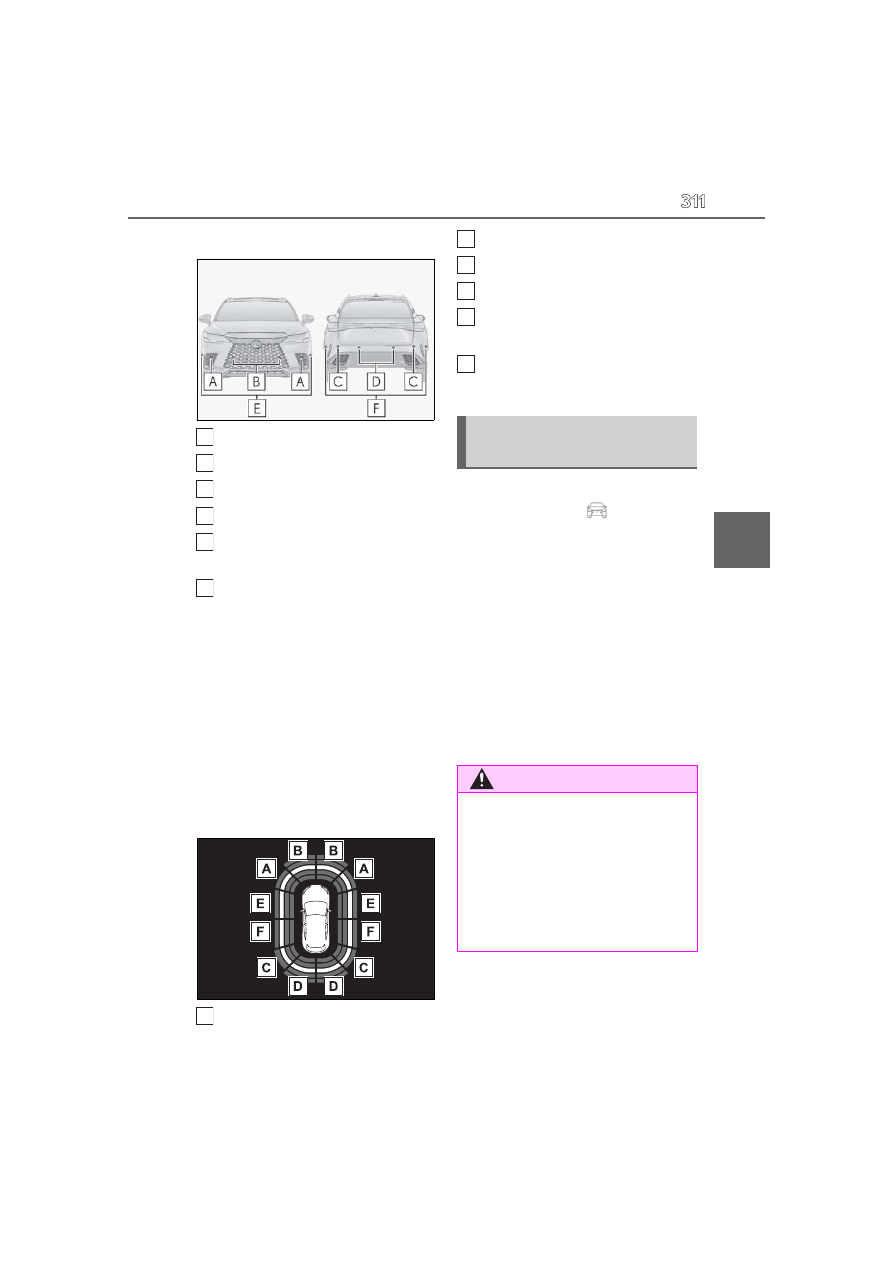
Front corner sensors
Front center sensors
Rear corner sensors
Rear center sensors
Front side sensors (vehicles with 
Advanced Park)
Rear side sensors (vehicles with 
Advanced Park)

Display

When the sensors detect an object, 
such as a wall, a graphic is shown on 
the center display depending on the 
position and distance to the object.
For details regarding the center dis-
play, refer to the “MULTIMEDIA 
OWNER’S MANUAL”.
Display example:

Front corner sensor detection

Front center sensor detection
Rear corner sensor detection
Rear center sensor detection
Front side sensor detection (vehi-
cles with Advanced Park)
Rear side sensor detection (vehi-
cles with Advanced Park)

The intuitive parking assist can be 
enabled/disabled on 

 of the center 

display. (

P.543)

When the intuitive parking assist function is 
disabled, the intuitive parking assist OFF 
indicator (

P.76) illuminates.

When turned off, the intuitive parking 
assist will be disabled and will not be 
enabled until the setting is changed to 
on again in center display.
If disabled using this method, the sys-
tem will not be re-enabled by turning 
the engine switch off and then to ON.

A

B

C

D

E

F

A

Turning intuitive parking assist 
on/off

WARNING

Cautions regarding the use of the sys-

tem

There is a limit to the degree of recogni-

tion accuracy and control performance 

that this system can provide, do not 

overly rely on this system. The driver is 

always responsible for paying attention 

to the vehicle’ surroundings and driving 

safely.

B

C

D

E

F

312

4-5. Using the driving support systems

The system can be operated when

The engine switch is ON.

Intuitive parking assist function is on.

The vehicle speed is less than about 6 

mph (10 km/h).

A shift position other than P is selected.

If “Parking Assist Unavailable Sensor 

Blocked” is displayed on the multi-infor-

mation display

A sensor may be covered with water drops, 

ice, snow, dirt, etc.

Remove the water drops, ice, snow, dirt, 

etc., from the sensor to return the system to 

normal.
If a sensor is dirty, the position of the dirty 

sensor will be shown on the display.
Also, due to ice forming on a sensor at low 

temperatures, a warning message may be 

displayed or the sensor may not be able to 

detect an object. Once the ice melts, the 

system will return to normal.
If a warning message is displayed even if the 

sensor is clean, there may be a sensor mal-

function. Have the vehicle inspected by 

your Lexus dealer.

Sensor detection information

The sensor’s detection areas are limited 

to the areas around the vehicle’ front and 

rear bumpers.

The following situations may occur 

during use.

• Depending on the shape of the object 

and other factors, the detection distance 

may shorten, or detection may be impos-

sible.

• Detection may be impossible if static 

objects draw too close to the sensor.

WARNING

To ensure the system can operate 

properly

Observe the following precautions. 

Failing to do so may result in the vehicle 

being unable to be driven safely and pos-

sibly cause an accident.

Do not damage the sensors, and 

always keep them clean.

Do not attach a sticker or install an 

electronic component, such as a back-

lit license plate (especially fluorescent 

type), fog lights, fender pole or wire-

less antenna near a radar sensor.

Do not subject the surrounding area of 

the sensor to a strong impact. If sub-

jected to an impact, have the vehicle 

inspected by your Lexus dealer. If the 

front or rear bumper needs to be 

removed/installed or replaced, con-

tact your Lexus dealer.

Do not modify, disassemble or paint 

the sensors.

Do not attach a license plate cover.

Keep your tires properly inflated.

When to disable the function

In the following situations, disable the 

function as it may operate even though 

there is no possibility of a collision.

Failing to observe the warnings above.

A non-genuine Lexus suspension 

(lowered suspension, etc.) is installed.

Notes when washing the vehicle

Do not apply intensive bursts of water or 

steam to the sensor area.

Doing so may result in the sensor mal-

functioning.

When using a high pressure washer to 

wash the vehicle, do not spray the sen-

sors directly, as doing so may cause a 

sensor to malfunction.

When using steam to clean the vehicle, 

do not direct steam too close to the 

sensors as doing so may cause a sen-

sor to malfunction.

313

4-5. Using the driving support systems

4

Driving

• There will be a short delay between static 

object detection and display (warning 

buzzer sounds). Even at low speeds, 

there is a possibility that the object will 

come within 1.0 ft. (30 cm) before the 

display is shown and the warning buzzer 

sounds.

• It might be difficult to hear the buzzer due 

to the volume of the audio system or air 

flow noise of the air conditioning system.

• It may be difficult to hear the sound of this 

system due to the buzzers of other sys-

tems.

Objects which the system may not be 

properly detected

The shape of the object may prevent the 

sensor from detecting it. Pay particular 

attention to the following objects:

Wires, fences, ropes, etc.

Cotton, snow and other materials that 

absorb sound waves

Sharply-angled objects

Low objects

Tall objects with upper sections project-

ing outwards in the direction of your vehi-

cle

People may not be detected if they are 

wearing certain types of clothing.

Situations in which the system may not 

operate properly

Certain vehicle conditions and the sur-

rounding environment may affect the ability 

of a sensor to correctly detect objects. Par-

ticular instances where this may occur are 

listed below.

There is dirt, snow, water drops or ice on 

a sensor. (Cleaning the sensors will 

resolve this problem.)

A sensor is frozen. (Thawing the area will 

resolve this problem.) 

In especially cold weather, if a sensor is 

frozen the sensor display may be dis-

played abnormally, or objects, such as a 

wall, may not be detected.

When a sensor or the area around a sen-

sor is extremely hot or cold.

On an extremely bumpy road, on an 

incline, on gravel, or on grass.

When vehicle horns, vehicle detectors, 

motorcycle engines, air brakes of large 

vehicles, the clearance sonar of other 

vehicles or other devices which produce 

ultrasonic waves are near the vehicle

A sensor is coated with a sheet of spray 

or heavy rain.

If objects draw too close to the sensor.

When a pedestrian is wearing clothing 

that does not reflect ultrasonic waves (ex. 

skirts with gathers or frills).

When objects that are not perpendicular 

to the ground, not perpendicular to the 

vehicle traveling direction, uneven, or 

waving are in the detection range.

Strong wind is blowing

When driving in inclement weather such 

as fog, snow or a sandstorm

When an object that cannot be detected 

is between the vehicle and a detected 

object

If an object such as a vehicle, motorcycle, 

bicycle or pedestrian cuts in front of the 

vehicle or runs out from the side of the 

vehicle

If the orientation of a sensor has been 

changed due to a collision or other 

impact

When equipment that may obstruct a 

sensor is installed, such as a towing eye-

let, bumper protector (an additional trim 

strip, etc.), bicycle carrier, or snow plow

If the front of the vehicle is raised or low-

ered due to the carried load

If the vehicle cannot be driven in a stable 

manner, such as when the vehicle has 

been in an accident or is malfunctioning

314

4-5. Using the driving support systems

When a tire chains or compact spare tire 

is used

Situations in which the system may 

operate even if there is no possibility of a 

collision

In some situations, such as the following, the 

system may operate even though there is no 

possibility of a collision.

When driving on a narrow road

When driving toward a banner, flag, 

low-hanging branch or boom barrier 

(such as those used at railroad crossings, 

toll gates and parking lots)

When there is a rut or hole in the surface 

of the road

When driving on a metal cover (grating), 

such as those used for drainage ditches

When driving up or down a steep slope

If a sensor is hit by a large amount of 

water, such as when driving on a flooded 

road

There is dirt, snow, water drops or ice on 

a sensor. (Cleaning the sensors will 

resolve this problem.)

A sensor is coated with a sheet of spray 

or heavy rain

When driving in inclement weather such 

as fog, snow or a sandstorm

When strong winds are blowing

When vehicle horns, vehicle detectors, 

motorcycle engines, air brakes of large 

vehicles, the clearance sonar of other 

vehicles or other devices which produce 

ultrasonic waves are near the vehicle

If the front of the vehicle is raised or low-

ered due to the carried load

When towing a trailer

If the orientation of a sensor has been 

changed due to a collision or other 

impact

The vehicle is approaching a tall or 

curved curb

Driving close to columns (H-shaped steel 

beams, etc.) in multi-story parking 

garages, construction sites, etc.

If the vehicle cannot be driven in a stable 

manner, such as when the vehicle has 

been in an accident or is malfunctioning

On an extremely bumpy road, on an 

incline, on gravel, or on grass

When a tire chains or compact spare tire 

is used

315

4-5. Using the driving support systems

4

Driving

Detection range of the sensors 
(vehicles without Advanced Park)

Approximately 3.3 ft. (100 cm)
Approximately 4.9 ft. (150 cm)
Approximately 2.0 ft. (60 cm)

The diagram shows the detection range of 
the sensors. Note that the sensors cannot 
detect objects that are extremely close to 
the vehicle.

The range of the sensors may change 
depending on the shape of the object, etc.

Detection range of the sensors 
(vehicles with Advanced Park)

Approximately 6.6 ft (200 cm)

The diagram shows the detection range of 
the sensors. Note that the sensors cannot 
detect objects that are extremely close to 
the vehicle.
The range of the sensors may change 
depending on the shape of the object, etc.

The distance and buzzer (vehicles without Advanced Park)

*

: Automatic buzzer mute function is enabled. (

P.316)

System detection range

A
B
C

A

Approximate distance to obstacle

Buzzer

Front sensor: 3.3 ft. to 2.0 ft. (100 cm to 60 
cm)

*

Rear sensor: 4.9 ft. to 2.0 ft. (150 cm to 60 
cm)

*

Slow

2.0 ft. to 1.5 ft. (60 cm to 45 cm)

*

Medium

1.5 ft. to 1.0 ft. (45 cm to 30 cm)

*

Fast

Less than 1.0 ft. (30 cm),
Less than 0.5 ft. (15 cm)

*

Continuous

316

4-5. Using the driving support systems

The distance and buzzer (vehicles with Advanced Park)

*

: Automatic buzzer mute function is enabled. (

P.316)

Buzzer operation and distance to 
an object

A buzzer sounds when the sensors are 
operating.

The buzzer beeps faster as the vehi-
cle approaches an object.

When the vehicle comes within 
approximately 1.0 ft (30 cm)  of the 
object, the buzzer sounds continu-
ously.

When 2 or more sensors simultane-
ously detect a static object, the 
buzzer sounds for the nearest 
object.

Even when the sensors are operat-
ing, the buzzer will be muted in 
some situations. (automatic buzzer 
mute function)

Adjusting the buzzer volume

The buzzer volume can be adjusted on 

 of the center display. (

P.543)

Muting a buzzer

A mute button will be displayed on the 
center display when an object is 
detected. To mute the buzzer, select a 
mute button.
The buzzers for the intuitive parking 

Approximate distance to obstacle

Buzzer

Front center sensor: 6.6 ft. to 3.3 ft. (200 
cm to 100 cm)
Rear center sensor: 6.6 ft. to 4.9 ft. (200 cm 
to 150 cm)
Side sensor: 6.6 ft. to 4.1 ft. (200 cm to 125 
cm)
Corner sensor: 6.6 ft. to 2.0 ft (200 cm to 
60 cm)

Does not sound (Display only)

Front center sensor: 3.3 ft. to 2.0 ft. (100 cm 
to 60cm)

*

Rear center sensor: 4.9 ft. to 2.0 ft. (150 cm 
to 60 cm)

*

Side sensor: 4.1 ft. to 2.0 ft. (125 cm to 60 
cm)

*

Slow

2.0 ft. to 1.5 ft. (60 cm to 45 cm)

*

Medium

1.5 ft. to 1.0 ft. (45 cm to 30 cm)

*

Fast

Less than 1.0 ft. (30 cm),
Less than 0.5 ft. (15 cm)

*

Continuous

317

4-5. Using the driving support systems

4

Driving

assist, RCTA and RCD (if equipped) 
function will be muted simultaneously.
Mute will be canceled automatically in 
the following situations:

When the shift position is shifted.

When the vehicle speed exceeds a 
certain speed.

When there is malfunction in a sen-
sor or the system is temporarily 
unavailable.

When the operating function is dis-
abled manually.

When the engine switch is turned 
off.

The object warning function informs 
the driver of the existence of objects 
along the side of the vehicle, using a 
display and buzzer, if the objects are 
within the estimated path of the vehicle.

Object
Calculated vehicle route

When the vehicle is moving, the side sensors or side cameras can detect objects. 
While the vehicle is moving, if a detected object can no longer be detected by the 
side sensors or side cameras, the location of the object relative to the vehicle is 
estimated. If the object is determined to be in the estimated path of the vehicle, the 
object warning function will operate.

Object detected by side sensors or side cameras

1

The vehicle is stopped and objects along the sides of the vehicle are not 
detected.

2

Objects are detected as the vehicle is moving.

Object warning function (vehicles with Advanced Park)

A
B

A

318

4-5. Using the driving support systems

3

Even though the objects are outside of the detection area of the side sensors or 
side cameras, a warning is displayed and a buzzer sounds.

Object warning function operating con-

ditions

The object warning function is operational 

when the intuitive parking assist OFF indi-

cator is not illuminated or flashing and any 

of the following conditions is met:

The Advanced Park is operating.

The vehicle moves approximately 23.0 ft. 

(7 m) after the engine is started.

The R shift position is selected.

After the D shift position has been 

selected, the vehicle has moved 23.0 ft. 

(7 m) or less.

Camera switch has been pressed and the 

center display is displayed.

The front or rear sensor detects a station-

ary object.

Detection of objects along the sides of 

the vehicle

Objects along the sides of the vehicle are 

not instantaneously detected. The loca-

tion of objects in relation to the vehicle is 

estimated after they are first detected by 

the front or rear side sensors, or side 

cameras. Therefore, after the engine 

switch is changed to ON, even if an 

object is along the side of the vehicle, it 

may not be detected until the vehicle has 

been driven a small amount and the side 

sensors or side cameras completely scan 

the areas along the sides of the vehicle.

If a vehicle, person, animal, etc. is 

detected by a side sensor or side camera, 

but then leaves the detection area of the 

side sensor or side camera, the system 

will assume the object has not moved.

WARNING

Object warning function

In situations such as the following, the 

function may not operate correctly, pos-

sibly leading to an accident. Proceed 

carefully.

When starting off shortly after the 

engine switch is turned to ON and a 

small vehicle or other object which 

cannot be detected by a front side sen-

sor is next to the vehicle.

In the situation shown in the following 
illustration, even if the vehicle starts off, as 
the vehicle on the left will not be 
detected and the object warning function 
will not operate.

When an object or person is in a posi-

tion which cannot be detected by the 

side sensors or side cameras.

When, after the side sensors or side 

cameras have completed scanning the 

areas along the sides of the vehicle, a 

vehicle, person, or other object 

approaches the side of the vehicle and 

cannot be detected.

When the outside rear view mirror is 

closed, the side sensors or side cam-

eras cannot detect objects.

If the 12-volt battery was discharged or 

has been removed and installed, fold 

and extend the outside rear view mir-

rors.

319

4-5. Using the driving support systems

4

Driving

Center display

Turning the RCTA function on/off in center 

display. If a vehicle approaching from the 
right or left at the rear of the vehicle is 
detected, the RCTA icon (

P.320) for the 

detected side will be displayed on the cen-
ter display. This illustration

*

 shows an 

example of a vehicle approaching from 
both sides of the vehicle.

*

: Depending on the vehicle grade and 

equipped options, the actual screen may 
be different from this illustration.

Outside rear view mirror indicators

If a vehicle is detected as approaching 
from the left or right behind the vehicle, 
both outside rear view mirror indicators 
will blink and a buzzer will sound.

Driving assist information indicator

Illuminates when the RCTA is turned off. At 
this time, “Rear Cross Traffic Alert OFF” 
will be displayed on the multi-information 
display.

The RCTA can be enabled/disabled on 

 of the center display. (

P.543)

When the RCTA function is off, the 
driving assist information indicator 
(

P.76) will illuminate. At this time, 

“Rear Cross Traffic Alert OFF” will be 
displayed on the multi-information dis-
play. Each time the engine switch is 
turned to ON, the RCTA function is 
enabled.

Outside rear view mirror indicator visi-

bility

In strong sunlight, the outside rear view mir-

ror indicator may be difficult to see.

RCTA (Rear cross traffic 
alert) function

The RCTA function uses the BSM 
rear side radar sensors installed 
behind the rear bumper. This func-
tion is intended to assist the driver 
in checking areas that are not easily 
visible when backing up.

WARNING

Cautions regarding the use of the sys-

tem

The driver is solely responsible for safe 

driving. Always drive safely, taking care 

to observe your surroundings. The RCTA 

function is only a supplementary function 

which alerts the driver that a vehicle is 

approaching from the right or left at the 

rear of the vehicle. As the RCTA function 

may not function correctly under certain 

conditions, the driver’s own visual confir-

mation of safety is necessary. Over reli-

ance on this function may lead to an 

accident resulting death or serious injury.

To ensure the system can operate 

properly

P.302

System components

A

Turning the RCTA function 
on/off

B

C

320

4-5. Using the driving support systems

Hearing the RCTA buzzer

The RCTA buzzer may be difficult to hear 

over loud noises, such as if the audio system 

volume is high.

Rear side radar sensors

P.302

Operation of the RCTA function

The RCTA function uses rear side radar sensors to detect vehicles approaching 
from the right or left at the rear of the vehicle and alerts the driver of the presence 
of such vehicles by flashing the outside rear view mirror indicators and sounding a 
buzzer.

Approaching vehicles
Detection areas of approaching vehicles

RCTA icon display

When a vehicle approaching from the 
right or left at the rear of the vehicle is 
detected, the following will be dis-
played on the center display.

Example (Panoramic view monitor) 
(if equipped): Vehicles are 
approaching from both sides of the 
vehicle

RCTA function detection areas

The areas that vehicles can be detected in are outlined below.

 RCTA function

A
B

321

4-5. Using the driving support systems

4

Driving

The buzzer can alert the driver of 
faster vehicles approaching from far-
ther away.
Example:

The RCTA function is operational when

The RCTA function operates when all of the 

following conditions are met:

The engine switch is ON.

The RCTA function is on.

The shift position is in R.

The vehicle speed is less than approxi-

mately 9 mph (15 km/h).

The approaching vehicle speed is 

between approximately 5 mph (8 km/h) 

and 34 mph (56 km/h).

Setting the buzzer volume

The buzzer volume of the RCTA, intuitive 

parking assist (if equipped) and RCD (if 

equipped) can be adjusted all together on 

 of the center display. (

P.543)

Muting a buzzer temporarily

When an object is detected, the temporary 

mute switch is displayed on the center dis-

play. Select the switch to mute the buzzer of 

the intuitive parking assist (if equipped), 

RCTA, and RCD (if equipped) all together.
Mute will be canceled automatically in the 

following situations:

When the shift position is shifted.

When the vehicle speed exceeds a cer-

tain speed.

When there is a malfunction in a sensor 

or the system is temporarily unavailable.

When the operating function is disabled 

manually.

When the engine switch is turned off.

Conditions under which the system will 

not detect a vehicle

The RCTA function is not designed to 

detect the following types of vehicles and/or 

objects:

Vehicles approaching from directly 

behind

Vehicles backing up in a parking space 

next to your vehicle

Vehicles that the sensors cannot detect 

due to obstructions

Guardrails, walls, signs, parked vehicles 
and similar stationary objects

*

Small motorcycles, bicycles, pedestrians, 
etc.

*

Vehicles moving away from your vehicle

Approaching vehi-

cle speed

 Approximate 

alert distance

34 mph (56 km/h) 

(fast)

131 ft. (40 m)

5 mph (8 km/h) 

(slow)

18 ft. (5.5 m)

A

322

4-5. Using the driving support systems

Vehicles approaching from the parking 
spaces next to your vehicle

*

The distance between the sensor and 

approaching vehicle gets too close

*

: Depending on the conditions, detection 

of a vehicle and/or object may occur.

Situations in which the system may not 

operate properly

The RCTA function may not detect vehicles 

correctly in the following situations:

When the sensor is misaligned due to a 

strong impact to the sensor or its sur-

rounding area

When mud, snow, ice, a sticker, etc., is 

covering the sensor or surrounding area 

on the position above the rear bumper

When driving on a road surface that is 

wet with standing water during bad 

weather, such as heavy rain, snow, or fog

When multiple vehicles are approaching 

with only a small gap between each vehi-

cle

When a vehicle is approaching at high 

speed

When equipment that may obstruct a 

sensor is installed, such as a towing eye-

let, bumper protector (an additional trim 

strip, etc.), bicycle carrier, or snow plow

When backing up on a slope with a sharp 

change in grade

When backing out of a sharp angle park-

ing spot

Immediately after the RCTA function is 

turned on

Immediately after the engine is started 

with the RCTA function on

When the sensors cannot detect a vehi-

cle due to obstructions

When towing a trailer

When there is a significant difference in 

height between your vehicle and the 

vehicle that enters the detection area

When a sensor or the area around a sen-

sor is extremely hot or cold

If the suspension has been modified or 

tires of a size other than specified are 

installed

If the front of the vehicle is raised or low-

ered due to the carried load

When turning while backing up

When a vehicle turns into the detection 

area

323

4-5. Using the driving support systems

4

Driving

Situations in which the system may 

operate even if there is no possibility of a 

collision

Instances of the RCTA function unneces-

sary detecting a vehicle and/or object may 

increase in the following situations:

When the parking space faces a street 

and vehicles are being driven on the 

street

When the distance between your vehicle 

and metal objects, such as a guardrail, 

wall, sigh, or parked vehicle, which may 

reflect electrical waves toward the rear of 

the vehicle, is short

When equipment that may obstruct a 

sensor is installed, such as a towing eye-

let, bumper protector (an additional trim 

strip, etc.), bicycle carrier, or snow plow

When a vehicle passes by the side of your 

vehicle

When a detected vehicle turns while 

approaching the vehicle

When there are spinning objects near 

your vehicle such as the fan of an air con-

ditioning unit

When water is splashed or sprayed 

toward the rear bumper, such as from a 

sprinkler

Moving objects (flags, exhaust fumes, 

large rain droplets or snowflakes, rain 

water on the road surface, etc.)

When the distance between your vehicle 

and a guardrail, wall, etc., that enters the 

detection area is short

Gratings and gutters

When a sensor or the area around a sen-

sor is extremely hot or cold

If the suspension has been modified or 

tires of a size other than specified are 

installed

If the front of the vehicle is raised or low-

ered due to the carried load

324

4-5. Using the driving support systems

*

: If equipped

Pedestrian detection icon

Displayed automatically when a pedestrian 
is detected.

The RCD can be enabled/disabled on 

 of the center display. (

P.543)

When the RCD function is off, the driv-
ing assist information indicator 
(

P.76) will illuminate. At this time, the 

message will be displayed on the 
multi-information display.

RCD (Rear Camera Detec-
tion) function

*

When the vehicle is backing up, the 
rear camera detection function can 
detect pedestrians in the detection 
area behind the vehicle. If a pedes-
trian is detected, a buzzer will 
sound and an icon will be displayed 
on the center display to inform the 
driver of the pedestrian.

WARNING

Cautions regarding the use of the sys-

tem

The recognition and control capabilities 

for this system are limited.

The driver should always drive safely by 

always being responsible without over 

relying on the system and have a under-

standing of the surrounding situations.

To ensure the system can operate 

properly

Observe the following, otherwise there is 

the danger that could lead to an acci-

dent.

Always clean the camera with damag-

ing it.

Do not install market electronic parts 

(such as illuminated license plate, fog 

lamps, etc.) in the camera vicinity.

Do not subject the camera vicinity to 

strong impacts. If the vicinity is sub-

jected to a strong impact, have the 

vehicle inspected at your Lexus dealer.

Do not disassemble, remodel or paint 

the camera.

Do not attach accessories or stickers 

to the camera.

Do not install market protection parts 

(bumper trim, etc.) to the rear bumper.

Maintain suitable tire air pressure.

Make sure the back door is completely 

closed.

RCD function is turned off

In the following situations the system 

turns off. The RCD function may not 

operate properly and thus there is the 

danger that an accident may occur.

The contents mentioned above are not 

observed.

Suspensions other than genuine parts 

are installed.

RCD display

Turning the RCD function on/off

A

325

4-5. Using the driving support systems

4

Driving

Each time the engine switch is turned 
to ON, the RCD function is enabled.

If the rear camera detection function 
detects a pedestrian in the detection 
area, the buzzer and pedestrian detec-
tion will operate as follows:

If a pedestrian is detected in area 

Buzzer: Sounds repeatedly
Pedestrian detection icon: Blinks
If a pedestrian is detected in area 

Buzzer (When the vehicle is sta-
tionary): Sounds 3 times
Buzzer (When the vehicle is back-
ing up, when a pedestrian 
approaches the rear of the vehicle): 
Sounds repeatedly
Pedestrian detection icon: Blinks
If the system determines that your 
vehicle may collide with a pedes-
trian in area 
Buzzer: Sounds repeatedly

Pedestrian detection icon: Blinks

The rear camera detection function is 

operational when

The engine switch is in ON.

RCD function is on.

The shift position is in R.

Advanced Park (if equipped) is not oper-

ating

Setting the buzzer volume

The buzzer volume can be adjusted on the 

center display.
The buzzer volume of the intuitive parking 

assist (if equipped), RCTA and RCD can be 
adjusted all together on 

 of the center 

display. (

P.543)

Muting a buzzer temporarily

When an object is detected, the temporary 
mute (

) switch is displayed on the cen-

ter display. Select the switch to mute the 

buzzer of the intuitive parking assist (if 

equipped), RCTA, and RCD all together.
The buzzers for the intuitive parking assist, 

RCTA and RCD function will be muted 

simultaneously.
Mute will be canceled automatically in the 

following situations:

When the shift position is shifted.

When the vehicle speed exceeds a cer-

tain speed.

When there is a malfunction in a sensor 

or the system is temporarily unavailable.

When the operating function is disabled 

manually.

When the engine switch is turned off.

Situations in which the system may not 

operate properly

Some pedestrians, such as the following, 

may not be detected by the rear camera 

detection function, preventing the func-

tion from operating properly:

• Pedestrians who are bending forward or 

squatting

• Pedestrians who are lying down

• Pedestrians who are running

When a pedestrian is detected

A

A

B

B

C

C

326

4-5. Using the driving support systems

• Pedestrians who suddenly enter the 

detection area

• People riding a bicycle, skateboard, or 

other light vehicle

• Pedestrians wearing oversized clothing 

such as a rain coat, long skirt, etc., making 

their silhouette obscure

• Pedestrians whose body is partially hid-

den by an object, such as a cart or 

umbrella

• Pedestrians which are obscured by dark-

ness, such as at night

In some situations, such as the following, 

pedestrians may not be detected by the 

rear camera detection function, prevent-

ing the function from operating properly:

• When backing up in inclement weather 

(rain, snow, fog, etc.)

• When the rear camera is obscured (dirt, 

snow, ice, etc. are attached) or scratched

• When a very bright light, such as the sun, 

or the headlights of another vehicle, 

shines directly into the rear camera

• When backing up in a place where the 

surrounding brightness changes sud-

denly, such as at the entrance or exit of a 

garage or underground parking lot

• When backing up in a dim environment 

such as during dusk or in an underground 

parking lot

• When the camera position and direction 

are deviated

• When a towing hook is attached

• When towing with the vehicle

• When water droplets are flowing on the 

camera lens

• When the vehicle height is extremely 

changed (nose up, nose down)

• When a tire chains, compact spare tire or 

an emergency tire puncture repair kit is 

used

• If the suspension has been modified or 

tires of a size other than specified are 

installed

• When install market electronic parts 

(such as Illuminated license plate, fog 

lamps, etc.) in the camera vicinity

• If a bumper protector, such as an addi-

tional trim strip, is installed to the rear 

bumper

Situations in which the system may 

operate unexpectedly

Even though there are no pedestrians in 

the detection area, some objects, such as 

the following, may be detected, possibly 

causing the rear camera detection func-

tion to operate.

• Three dimensional objects, such as a 

pole, traffic cone, fence, or parked vehi-

cle

• Moving objects, such as a car or motor-

cycle

• Objects moving toward your vehicle 

when backing up, such as flags or pud-

dles (or airborne matter, such as smoke, 

steam, rain, or snow)

• Cobblestone or gravel roads, tram rails, 

road repairs, white lines, pedestrian 

crossings or fallen leaves on the road

• Metal covers (gratings), such as those 

used for drainage ditches

• Objects reflected in a puddle or on a wet 

road surface

• Shadows  on  the  road

In some situations, such as the following, 

the rear camera detection function may 

operate even though there are no pedes-

trians in the detection area.

• When backing up toward the roadside or 

a bump on the road

• When backing up toward an 

incline/decline

• If the rear of the vehicle is raised or low-

ered due to the carried load

• When install market electronic parts 

(such as Illuminated license plate, fog 

lamps, etc.) in the camera vicinity

• If a bumper protector, such as an addi-

tional trim strip, is installed to the rear 

bumper

• If the orientation of the rear camera has 

been changed

• If a towing eyelet is installed to the rear of 

the vehicle

• When towing with the vehicle

• When water is flowing over the rear cam-

era lens

• When the rear camera is obscured (dirt, 

snow, ice, etc. are attached) or scratched

• If there is a flashing light in the detection 

area, such as the emergency flashers of 

another vehicle

• When a tire chains or an emergency tire 

puncture repair kit is used

Situations in which the rear camera 

detection function may be difficult to 

327

4-5. Using the driving support systems

4

Driving

notice

• The buzzer may be difficult to hear if the 

surrounding area is noisy, the volume of 

the audio system volume is high, the air 

conditioning system is being used, etc.

• If the temperature in the cabin is 

extremely high or low, the audio system 

screen may not operate correctly.

*

: If equipped

The system can detect the following as 
detectable objects. (Detectable 
objects differ depending on the func-
tion.)

Static Objects Front and Rear of the 
vehicle (

P.331)

Moving Vehicles Rear of the Vehicle 
(

P.334)

Pedestrians Rear of the Vehicle 
(

P.335)

Static Objects Around the vehicle 
(vehicles with Advanced Park) 
(

P.336)

PKSB (Parking Support 
Brake)

*

The PKSB (Parking Support Brake) 
system consists of the following 
functions that operate when driving 
at a low speed or backing up, such 
as when parking. When the system 
determines that a collision with a 
detected object or pedestrian is 
high, a warning operates to urge 
the driver to take evasive action. If 
the system determines that the pos-
sibility of a collision with a detected 
object or pedestrian is extremely 
high, the brakes are automatically 
applied to help avoid the collision or 
help reduce the impact of the colli-
sion.

PKSB (Parking Support Brake) 
system

328

4-5. Using the driving support systems

The PKSB (Parking Support Brake) 
can be enabled/disabled on 

 of the 

center display. (

P.543)

WARNING

Cautions regarding the use of the sys-

tem

Do not overly rely on the system, as 

doing so may lead to an accident. Always 

drive while checking the safety of the sur-

roundings of the vehicle.

Depending on the vehicle and road con-

ditions, weather, etc., the system may not 

operate.

The detection capabilities of sensors, 

radars and camera are limited. Always 

drive while checking the safety of the sur-

roundings of the vehicle.

The driver is solely responsible for safe 

driving. Always drive carefully, taking 

care to observe your surroundings. 

The PKSB (Parking Support Brake) 

system is designed to provide support 

to lessen the severity of collisions. 

However, it may not operate in some 

situations.

The PKSB (Parking Support Brake) 

system is not designed to stop the 

vehicle completely. Additionally, even 

if the system has stopped the vehicle, it 

is necessary to depress the brake 

pedal immediately as brake control will 

be canceled after approximately 2 

seconds.

It is extremely dangerous to check the 

system operations by intentionally 

driving the vehicle into the direction of 

a wall, etc. Never attempt such actions.

When to disable the PKSB (Parking 

Support Brake) system

In the following situations, disable the 

PKSB (Parking Support Brake) as the 

system may operate even though there is 

no possibility of a collision.

When inspecting the vehicle using a 

chassis roller, chassis dynamo or free 

roller

When loading the vehicle onto a boat, 

truck or other transport vessel

If the suspension has been modified or 

tires of a size other than specified are 

installed

If the front of the vehicle is raised or 

lowered due to the carried load

When equipment that may obstruct a 

sensor is installed, such as a towing 

eyelet, bumper protector (an addi-

tional trim strip, etc.), bicycle carrier, or 

snow plow

When using automatic car washing 

devices

If the vehicle cannot be driven in a sta-

ble manner, such as when the vehicle 

has been in an accident or is malfunc-

tioning

When the vehicle is driven in a sporty 

manner or off-road

When the tires are not properly 

inflated

When the tires are very worn

When a tire chains or compact spare 

tire is used

When your vehicle is towing a trailer 

or during emergency towing

Precautions for the suspension

Do not modify the suspension of the 

vehicle. If the height or tilt of the vehicle is 

changed, the sensors may not be able to 

detect detectable objects and the system 

may not operate correctly, possibly lead-

ing to an accident.

Enabling/Disabling the PKSB 
(Parking Support Brake)

329

4-5. Using the driving support systems

4

Driving

When the PKSB (Parking Support 
Brake) function is off, the driving assist 
information indicator (

P.76) will illu-

minate and a message will be displayed 
on the multi-information display.

When turned OFF (disabled), the PKSB 
(Parking Support Brake) will be disabled 
and will not be enabled until the setting is 
changed to ON again in center display. 
(The function will not be reenabled by 
operating the engine switch.)

If the engine output restriction control or 
brake control operates, a buzzer will sound 
and a message will be displayed on the 
multi-information display and center dis-
play to alert the driver.
Depending on the situation, engine output 
restriction control will operate to either 
limit acceleration or restrict output as 
much as possible.

Engine output restriction control is 
operating (acceleration restriction)

Acceleration greater than a certain 
amount is restricted by the system.
Center display: No warning displayed
Multi-information display: “Object 
Detected Acceleration Reduced”
Driving assist information indicator: Not 
illuminated
Buzzer: Does not sound

Engine output restriction control is 
operating (output restricted as 
much as possible)

The system has determined that stron-
ger-than-normal brake operation is neces-
sary.
Center display/multi-information display: 
A display urging to operate the brakes
Driving assist information indicator: Not 
illuminated
Buzzer: Short beep

Brake control is operating

The system determined that emergency 
braking is necessary.
Center display/multi-information display: 
A display urging to operate the brakes
Driving assist information indicator: Not 
illuminated
Buzzer: Short beep

Vehicle stopped by system opera-
tion

The vehicle has been stopped by brake 
control operation.
Center display: “Press Brake Pedal”
Multi-information display: “Switch to 
Brake” (If the accelerator pedal is not 
depressed, “Press Brake Pedal” will be dis-
played.)
Driving assist information indicator: Illumi-
nated
Buzzer: Sounds repeatedly

If the PKSB (Parking Support Brake) determines that a collision with a detected 
object or pedestrian is possible, the engine output will be restricted to restrain any 
increase in the vehicle speed. (Engine output restriction control: See figure 2.)

PKSB (Parking Support Brake) 
displays and buzzers

System overview

330

4-5. Using the driving support systems

Additionally, if the accelerator pedal continues to be depressed, the brakes will be 
applied automatically to reduce the vehicle speed. (Brake control: See figure 3.)

Figure 1 When the PKSB (Parking Support Brake) is not operating

Engine output
Braking force
Time

Figure 2 When engine output restriction control operates

Engine output
Braking force
Time
Engine output restriction control begins operating (System determines that 
possibility of collision with detected object is high)

A
B
C

A
B
C
D

331

4-5. Using the driving support systems

4

Driving

Figure 3 When brake control operates

Engine output
Braking force
Time
Engine output restriction control begins operating (System determines that 
possibility of collision with detected object is high)
Brake control begins operating (System determines that possibility of collision 
with detected object is extremely high)

If the PKSB (Parking Support Brake) has 

operated

If the vehicle is stopped due to operation of 

the PKSB (Parking Support Brake), the 

PKSB (Parking Support Brake) will be dis-

abled and the driving assist infomation indi-

cator will illuminate. If the PKSB (Parking 

Support Brake) operates unnecessarily, 

brake control can be canceled by depress-

ing the brake pedal or waiting for approxi-

mately 2 seconds for it to automatically be 

canceled. Then, the vehicle can be oper-

ated by depressing the accelerator pedal.

Re-enabling the PKSB (Parking Support 

Brake) system

To re-enable the PKSB (Parking Support 

Brake) when it has been disabled due to 

operation of the PKSB (Parking Support 

Brake), either enable the system again 

(

P.328), or turn the engine switch off and 

then back to ON.
Additionally, if any of the following condi-

tions are met, the system will be re-enabled 

automatically and the driving assist infoma-

tion indicator will turn off:

The P shift position is selected

The object is no longer detected in the 

traveling direction of the vehicle

The traveling direction of the vehicle 

changes

If the sensors detect a static object, such as a wall, in the travelling direction of the 

A
B
C
D

E

Static Objects Front and Rear of the vehicle

332

4-5. Using the driving support systems

vehicle and the system determines that a collision may occur due to the vehicle 
suddenly moving forward due to an accidental accelerator pedal operation, the 
vehicle moving the unintended direction due to the wrong shift position, or while 
parking or traveling at low speeds, the system will operate to lessen the impact with 
the detected static object and reduce the resulting damage.
The system operates in the following situations when a static object is detected in 
the traveling direction of the vehicle.

When traveling at a low speed and the brake pedal is not depressed, or is 
depressed late

When the accelerator pedal is depressed excessively

333

4-5. Using the driving support systems

4

Driving

When the vehicle moves in the unintended direction due to the wrong shift 
position

Types of sensors

P.310

The system will operate when

The function will operate when the driving 

assist infomation indicator is not illuminated 

(

P.75, 485) and all of the following con-

ditions are met:

Engine output restriction control

• PKSB (Parking Support Brake) system is 

enabled.

• The vehicle speed is approximately 9 

mph (15 km/h) or less.

• There is a static object in the traveling 

direction of the vehicle and approxi-

mately 6 to 13 ft. (2 to 4 m) away.

• The PKSB (Parking Support Brake) 

determines that a stronger-than-normal 

brake operation is necessary to avoid a 

collision.

Brake control

• Engine output restriction control is oper-

ating.

• The PKSB (Parking Support Brake) 

determines that an immediate brake 

operation is necessary to avoid a colli-

sion.

The system will stop operating when

The function will stop operating if any of the 

following conditions are met:

Engine output restriction control

• PKSB (Parking Support Brake) system is 

disabled.

• The system determines that the collision 

has become avoidable with normal brake 

operation.

• The static object is no longer approxi-

mately 6 to 13 ft. (2 to 4 m) away from the 

vehicle or in the traveling direction of the 

vehicle.

Brake control

• PKSB (Parking Support Brake) system is 

disabled.

• Approximately 2 seconds have elapsed 

since the vehicle was stopped by brake 

control.

• The brake pedal is depressed after the 

vehicle is stopped by brake control.

WARNING

To ensure the system can operate 

properly

P.311

If the system operates unnecessarily, 

such as at a railroad crossing

P.331

Notes when washing the vehicle

P.311

334

4-5. Using the driving support systems

• The static object is no longer approxi-

mately 6 to 13 ft. (2 to 4 m) away from the 

vehicle or in the traveling direction of the 

vehicle.

Situations in which the system may not 

operate properly

P.313

Situations in which the system may 

operate even if there is no possibility of a 

collision

P.314

If a rear radar sensor detects a vehicle approaching from the right or left at the rear 
of the vehicle and the system determines that the possibility of a collision is high, 
this function will perform brake control to reduce the likelihood of an impact with 
the approaching vehicle.
This function will operate in situations such as the following if a vehicle is detected 
in the traveling direction of the vehicle.

When reversing, a vehicle is approaching and the brake pedal is not 
depressed, or is depressed late

Types of sensors

P.302

The system will operate when

The function will operate when the driving 

assist infomation indicator is not illuminated 

(

P.75, 485) and all of the following con-

ditions are met:

Engine output restriction control

• PKSB (Parking Support Brake) system is 

enabled.

• The vehicle speed is approximately 9 

mph (15 km/h) or less.

• Vehicles which are approaching from the 

Moving Vehicles Rear of the Vehicle

WARNING

To ensure the system can operate 

properly

P.302

335

4-5. Using the driving support systems

4

Driving

right or left at the rear of the vehicle at a 

traveling speed of approximately 5 mph 

(8 km/h) or more.

• The shift position is in R.

• The PKSB (Parking Support Brake) 

determines that a stronger than normal 

brake operation is necessary to avoid a 

collision.

Brake control

• Engine output restriction control is oper-

ating.

• The PKSB (Parking Support Brake) 

determines that an emergency brake 

operation is necessary to avoid a collision 

with an approaching vehicle.

The system will stop operating when

The function will stop operating if any of the 

following conditions are met:

Engine output restriction control

• PKSB (Parking Support Brake) system is 

disabled.

• The collision becomes avoidable with 

normal brake operation.

• A vehicle is no longer approaching from 

the right or left at the rear of the vehicle.

Brake control

• PKSB (Parking Support Brake) system is 

disabled.

• Approximately 2 seconds have elapsed 

since the vehicle was stopped by brake 

control.

• The brake pedal is depressed after the 

vehicle is stopped by brake control.

Situations in which the system may not 

operate properly

P.322

Situations in which the system may 

operate even if there is no possibility of a 

collision

P.323

If the rear camera sensor detects a pedestrian behind the vehicle while backing up 
and the system determines that the possibility of colliding with the detected pedes-
trian is high, a buzzer will sound. If the system determines that the possibility of col-
liding with the detected pedestrian is extremely high, the brakes will be applied 
automatically to help reduce the impact of the collision.
When a pedestrian is detected behind the vehicle while backing up, the brake 
pedal is not depressed or is depressed late.

Pedestrians Rear of the Vehicle

336

4-5. Using the driving support systems

Center display

Displays a message to urge the driver 
to take evasive action when a pedes-
trian is detected in the detection area 
behind the vehicle.

Pedestrian detection icon
Brake reminder

The system will operate when

The function will operate when the driving 

assist infomation indicator is not illuminated 

(

P.75, P.485) and all of the following 

conditions are met:

Engine output restriction control

• PKSB (Parking Support Brake) system is 

enabled.

• The vehicle speed is 9 mph (15 km/h) or 

less.

• The shift position is in R.

• A pedestrian is behind the vehicle.

• The system determines that a slightly 

stronger brake operation than usual is 

needed to avoid a collision.

Brake control

• Engine output restriction control is oper-

ating.

• The PKSB (Parking Support Brake) 

determines that an emergency brake 

operation is necessary to avoid a collision 

with a pedestrians.

The system will stop operating when

The function will stop operating if any of the 

following conditions are met:

Engine output restriction control

• PKSB (Parking Support Brake) system is 

disabled.

• The collision becomes avoidable with 

normal brake operation.

• The pedestrian is no longer detected 

behind your vehicle.

Brake control

• PKSB (Parking Support Brake) system is 

disabled.

• Approximately 2 seconds have elapsed 

since the vehicle was stopped by brake 

control.

• The brake pedal is depressed after the 

vehicle is stopped by brake control.

Re-enabling the system

P.331

Situations in which the system may not 

operate properly

P.325

Situations in which the system may 

operate unexpectedly

P.326

While parking, if a sensor detects a surrounding stationary object, such as a 
wall,with which a collision is likely, the system will operate to help avoid a collision 
orreduce the impact of the collision.

WARNING

If the system operates unnecessarily

Depress the brake pedal immediately 

after the system operates. (Operation of 

the function is canceled by depressing 

the brake pedal.)

Correct use of the system

P.324

A

B

Static Objects Around the vehicle (vehicles with Advanced Park)

337

4-5. Using the driving support systems

4

Driving

The system will operate in the following situations when a stationary object isde-
tected in the surrounding area.

When moving forward and a collision with a stationary object on the inner 
side of a turn is likely

When reversing and a collision with a stationary object on the outer side of a 
turn is likely

Operating conditions

This function is operable when any of the 

following conditions are met in addition to 

the operating conditions for stationary 

objects in around the vehicle.

After the engine has been started, the 

vehicle has moved approximately 23.0 ft 

(7 m) or less

The R shift position is selected

After the shift position has been shifted 

from R to D, the vehicle has moved 

approximately 23.0 ft. (7 m) or less

The system will stop operating when

P.333

338

4-5. Using the driving support systems

Objects which the sensor may not be 

properly detected

P.313

Intuitive parking assist buzzer

Regardless of whether the intuitive parking 

assist buzzer is enabled or not (

P.311), i

the PKSB (Parking Support Brake) system 

is enabled (

P.328), the front or rear sen-

sors detect an object and brake control is 

performed, the intuitive parking assist 

buzzer will sound to notify the driver of the 

approximate distance to the object.

Situations in which the system may not 

operate properly

P.313

Object warning function (vehicles with 

Advanced Park)

P.317

Situations in which the system may 

operate even though there is no possi-

bility of a collision

In addition to the situations in which station-

ary objects around the vehicle (

P.314) 

may not be detected, objects may not be 

detected by the sensors when your vehicle 

is moving sideways, such as when parallel 

parking.

Detection of objects along the sides of 

the vehicle

P.318

*

: If equipped

The Advanced Park is a system which 
assists in a safe and smooth parking or 
exiting from a parking space by dis-
playing the blind spots around the vehi-
cle and the target parking spot through 
a bird’s eye view, delivering operation 
guidance through displays and buzzer 
operation, and changing the shift posi-
tion, operating the steering wheel, 
accelerator pedal, and brake pedal.
Additionally, the panoramic view moni-
tor

*

 can display the area in front, 

behind, and from above the vehicle, 
helping confirm the condition of the 
area around the vehicle.
The turn signal lights will blink automat-
ically when the parking assistance 
starts until the vehicle reaches the tar-
get parking spot, to notify people 
around the vehicle that parking is being 
performed.

Depending on the condition of the road 
surface or the vehicle, the distance 
between the vehicle and a parking space, 
etc., it may not be possible to assist in park-
ing in the target space.

*

: For details on the panoramic view moni-

tor refer to the “MULTIMEDIA 
OWNER’S MANUAL”.

Lexus Teammate Advanced 
Park

*

Function description

339

4-5. Using the driving support systems

4

Driving

Perpendicular parking (for-
ward/reverse) function

Assistance is provided from the posi-
tion the vehicle is stopped near the tar-
get parking space until the vehicle is in 
the parking space. (

P.345)

Perpendicular exiting (for-
ward/reverse) function

Assistance is provided from the parked 
position until the vehicle is in a position 
where you can easily exit from the 
parking space. (

P.348)

Parallel parking function

Assistance is provided from the posi-
tion the vehicle is stopped near the tar-
get parking space until the vehicle is in 
the parking space. (

P.350)

Parallel exiting function

Assistance is provided from the parked 
position until the vehicle is in a position 
where you can easily exit from the 
parking space. (

P.353)

Memory function

Assistance is provided until the vehicle 
is guided into a previously registered 
parking space. (

P.355)

Functions

WARNING

Cautions regarding the use of the sys-

tem

The recognition and control capabilities 

for this system are limited. The driver 

should always drive safety by always 

being responsible without over relying 

on the system and have a understanding 

of the surrounding situations.

As with a normal vehicle, take care to 

observe your surroundings while the 

vehicle is moving.

Always pay attention to the vehicle’s 

surroundings while the system is oper-

ating and depress the brake pedal as 

necessary to slow or stop the vehicle.

When parking, make sure that the 

vehicle can be parked in the target 

parking space before beginning oper-

ation.

Depending on the condition of the 

road surface or the vehicle, the dis-

tance between the vehicle and a park-

ing space, etc., it may not be possible 

to detect a parking space or the sys-

tem may not be able to provide assis-

tance to the point the vehicle is fully 

parked.

This system will guide the vehicle to 

appropriate positions for changing the 

direction of travel, however, if you feel 

that the vehicle is approaching too 

close to an adjacent parked vehicle at 

any time, depress the brake pedal and 

shift the shift position. However, if this 

is performed, the number of times the 

vehicle changes direction may 

increase, and the vehicle may be 

parked at an angle.

As following objects may not be 

detected, make sure to check the 

safety of the area around your vehicle 

and depress the brake pedal to stop 

the vehicle if it may collide with an 

object.

• Wires, fences, ropes, etc.

• Cotton, snow and other materials that 

absorb sound waves

• Sharply-angled objects

• Low objects (curb stones, parking 

blocks, etc.)

• Tall objects with upper sections pro-

jecting outwards in the direction of 

your vehicle

340

4-5. Using the driving support systems

WARNING

Even if there is an object in the target 

parking space, it may not be detected 

and assistance may be performed.

While the system is operating, if it is 

likely that your vehicle will collide with 

a nearby vehicle, parking block, object, 

or person, depress the brake pedal to 

stop the vehicle and press the 

Advanced Park main switch to disable 

the system.

Never use only the center display to 

view the area behind the vehicle. The 

image displayed may differ than the 

actual situation. Using only the screen 

when backing up may lead to an acci-

dent, such as a collision with another 

vehicle. When backing up, make sure 

to look directly or use the mirrors to 

check the safety of the area around 

your vehicle, especially behind the 

vehicle.

When the ambient temperature is 

extremely low, the screen may appear 

dark or the displayed image may 

become unclear. Also, as moving 

objects may appear distorted or may 

not be able to be seen on the screen, 

make sure to directly check the safety 

of the area around your vehicle.

In the following situations, while the 

vehicle is stopped and held by 

Advanced Park, it may be canceled 

and the vehicle may start moving. 

Immediately depress the brake pedal. 

Failure to do so may lead to an acci-

dent.

• When the driver’s door is opened

• When operations instructed by the 

system are not performed within a cer-

tain amount of time

• When the brake pedal is depressed 

and the vehicle is stopped for a certain 

amount of time

• When the system malfunctions

As the steering wheel will turn while 

this system is operating, pay attention 

to the following.

• Be careful so that a necktie, scarf, or 

arm does not get caught. Keep your 

upper body away from the steering 

wheel. Also, keep children away from 

the steering wheel.

• Long fingernails may be caught and 

when the steering wheel is rotating, 

leading to injury.

• In an emergency, depress the brake 

pedal to stop the vehicle, and then 

press the Advanced Park main switch 

to disable the system.

Do not allow anyone to put their hands 

outside of a window while this system is 

operating.

To ensure correct operation of the 

Advanced Park

Observe the following precautions. Fail-

ing to do so may result in the vehicle 

being unable to be driven safely and pos-

sibly cause an accident.

Do not use this system in situations 

such as the following:

• When in areas other than common 

parking spaces

• When the surface of the parking space 

is sand or gravel and is not clearly 

defined with parking space lines

• When the parking space is not level, 

such as when on a slope or has differ-

ences in height

• Mechanical parking system

• Parking lot with a device which raises 

to contact the bottom of the vehicle

• When the road surface is frozen, slick, 

or covered with snow

• When it is extremely hot and the 

asphalt is melting

341

4-5. Using the driving support systems

4

Driving

Cameras and sensors are used to 
detect parked vehicles, making it eas-
ier to identify parking spaces.

WARNING

• When there are objects around the 

vehicle

• When there is an object between your 

vehicle and the target parking spot or 

within the target parking spot (within 

the displayed blue box)

• When there is a gutter between your 

vehicle and the target parking space 

or within the target parking spot 

(within the displayed blue box)

• When there is a hole or gutter in the 

exit direction

• When in high pedestrian or vehicle 

traffic areas

• When the parking space is in a loca-

tion that is difficult to park in (too nar-

row for your vehicle, etc.)

• When images are unclear due to dirt 

or snow attached to the camera lens, 

light being shined into the camera or 

shadows

• When tire chains or a compact spare 

tire is installed to the vehicle

• When the doors or back door are not 

completely closed

• When an arm is held outside of a win-

dow

• In inclement weather such as heavy 

rain or snow

Make sure to use only standard sized 

tires, such as those that were installed 

to the vehicle when it was shipped 

from the factory. Otherwise, 

Advanced Park may not operate prop-

erly. Also, when the tires have been 

replaced, the displayed position of the 

lines or box displayed on the screen 

may become incorrect. When replac-

ing the tires, contact your Lexus dealer.

In situations such as the following, it 

may not be possible for the system to 

provide assistance to a registered 

parking spot:

• When the tires are extremely worn or 

the tire inflation pressure is low

• When carrying a heavy load

• When the vehicle is tilted due to the 

carried load

• When a heater is installed in the sur-

face of the parking space (road sur-

face freeze prevention heater)

• When the wheels are misaligned, such 

after a wheel has been subjected to a 

strong impact

• When a pedestrian or passing vehicle 

is detected during assistance

• When something is incorrectly 

detected as a parking line (light, reflec-

tions from a building, difference in 

height on the parking surface, a gutter, 

painted road lines, redrawn lines, etc.)

If the vehicle deviates greatly from the set 

parking space in any situation other than 

the above, have the vehicle inspected by 

your Lexus dealer.

NOTICE

Precautions for use Advanced Park

If the battery was discharged or has been 

removed and installed, fold and extend 

the outside rear view mirrors.

Types of cameras and sensors 
used for the Advanced Park

342

4-5. Using the driving support systems

Front camera

Side cameras

Rear camera

Sensors

P.310

Camera images

As special cameras are used, the colors in 

displayed images may differ from the actual 

color.

Precautions for use

For details on the following, refer to “Pan-

oramic view monitor (Vehicles equipped 

with Lexus Teammate Advanced Park)” of 

“Peripheral monitoring system” in the 

“MULTIMEDIA OWNER’S MANUAL”.

Displayable range of the screens

Cameras

Differences between displayed images 

and the actual road

Differences between displayed images 

and the actual objects

Detection range of the cameras and 

sensors

If a parked vehicle is behind the target 

parking space and the distance between 

it and the vehicle becomes far, it may no 

longer be able to be detected. Depend-

ing on shape or condition of a parked 

vehicle, the detection range may become 

short or the vehicle may not be detected.

Objects other than parked vehicles, such 

as columns, walls, etc., may not be 

detected. Also, if they are detected, they 

may cause the target parking space to be 

misaligned.

Situations in which parking space lines 

may not be recognized properly

In situations such as the following, park-

ing space lines on the road surface may 

not be detected:

• When the parking space does not use 

lines (parking space boundaries are 

marked with rope, blocks, etc.)

• When the parking space lines are faded 

or dirty, making them unclear

• When the road surface is bright, such as 

concrete, and the contrast between it and 

the white parking space lines is small

• When the parking space lines are any 

color other than yellow or white

• When the area surrounding the parking 

space is dark, such as at night, in an 

underground parking lot, parking garage, 

etc.

• When it is raining or has rained and the 

road surface is wet and reflective or there 

are puddles

• When the sun is shining directly into a 

camera, such as in the early morning or 

evening

• When the parking space is covered with 

snow or de-icing agent

• When there marks from repairs or other 

marks on the road surface, or there is a 


Content      ..     8      9      10      11     ..