Lexus RX (2023 year). Manual in english - page 8
 

  Index      Manuals     Lexus RX (2023 year). Manual in english


Search            copyright infringement  


Content      ..     6      7      8      9     ..


Lexus RX (2023 year). Manual in english - page 8


253

4

4-3. Operating the lights and wipers

Driving

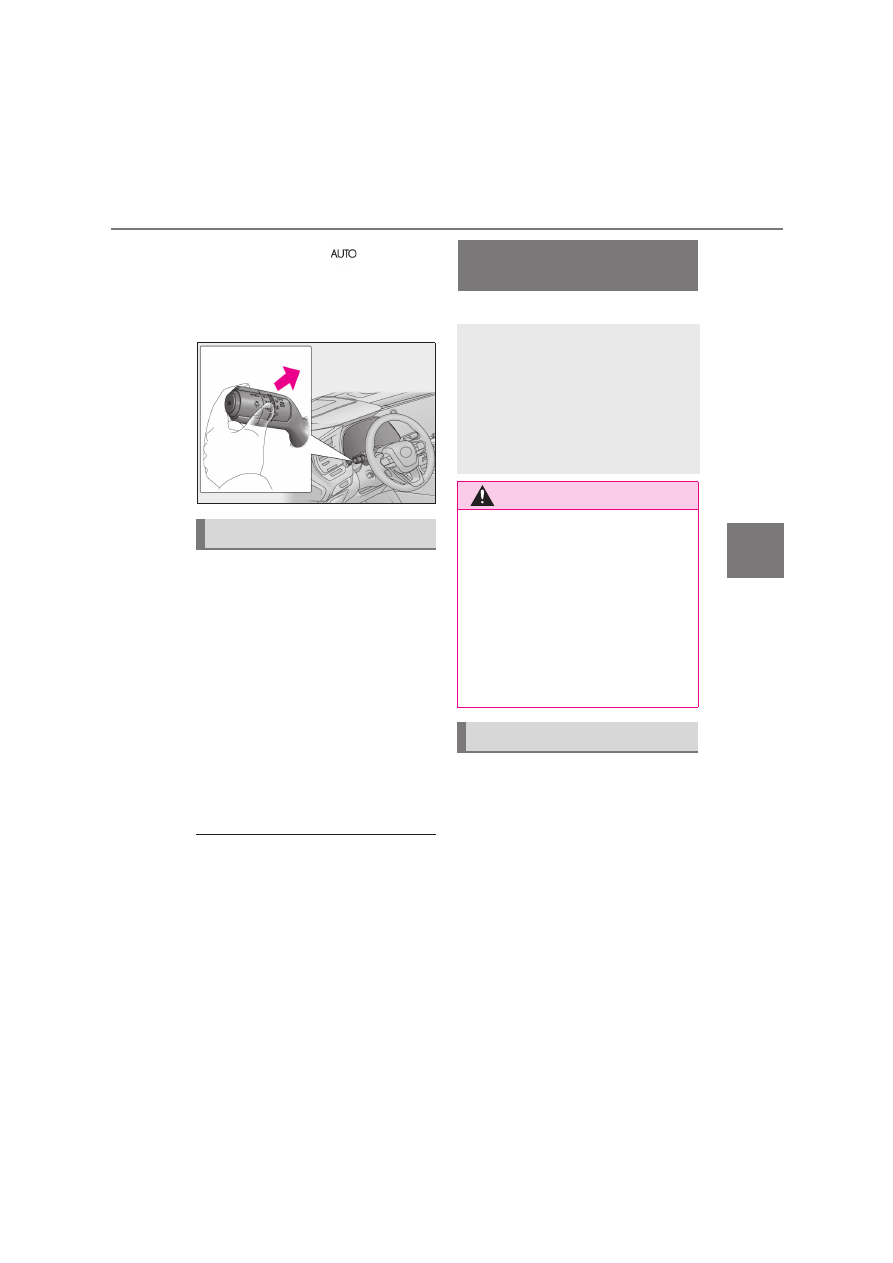
with the light switch in 

 after turn-

ing the power switch off.

Pull the lever toward you and release it 
again to turn off the lights.

When any of the following conditions is 
met, while the headlights (low beam) 
are on, the cornering lights will addi-
tionally turn on and light up the direc-
tion of movement for the vehicle. This is 
to ensure excellent visibility when 
either driving at intersections or park-
ing at night.

The steering wheel is operated

The turn signal lever is operated

The shift position is in R (both left 
and right side cornering lights)

Cornering light control

When vehicle speed is approximately 35 

km/h (22 mph) or higher, the cornering 

lights will not turn on.

After the lights remain illuminated for 30 

minutes, they automatically turn off.

*

: If equipped

According to the vehicle speed, the 
brightness and illuminated area of 
the high beams are adjusted.

When driving around a curve, the 
system uses the high beams to 
brightly illuminate the direction of 
travel of the vehicle.

The high beams are illuminated so 
that the area around a vehicle ahead 
is shaded. (Shaded high beam)

The shaded high beam helps ensure for-
ward visibility while reducing the dazzling 
effect on the drivers of vehicles ahead.

Cornering lights (if equipped)

AHS (Adaptive High-beam 
System)

*

The Adaptive High-beam System 
uses a front camera located on the 
upper portion of the windshield to 
detect the brightness of the lights of 
vehicles ahead, streetlights, etc., 
and automatically controls the light 
distribution of the headlights.

WARNING

For safe use

Do not overly rely on the Adaptive 

High-beam System. Always drive safely, 

taking care to observe your surroundings 

and turning the high beams on or off 

manually if necessary.

To prevent unintentional operation of 

the Adaptive High-beam System

When it is necessary to disable the sys-

tem: 

P.270

System controls

254

4-3. Operating the lights and wipers

Area illuminated by the high beams
Area illuminated by the low beams

According to the distance to a 
preceding vehicle, the illuminated 
area of the low beams is adjusted.

1

Press the Adaptive High-beam Sys-
tem switch.

2

Turn the headlight switch to the 

 or 

 position.

When the headlight switch lever is in the 

low beam position, the AHS will be ena-

bled and the AHS indicator will illuminate.

System operating conditions

When all of the following conditions are 

met, the high beams will illuminate and 

the system will operate:

• The vehicle speed is approximately 15 

km/h (9 mph) or more

*

.

• The area ahead of the vehicle is dark.

*

: When driving around a curve at a vehi-

cle speed of approximately 30 km/h (19 
mph) or more, the direction of travel of 
the vehicle will be brightly illuminated.

When all of the following conditions are 

met, the headlights will change to the 

shaded high beams according to the 

position of vehicles ahead:

• The vehicle speed is approximately 15 

km/h (9 mph) or more.

• The area ahead of the vehicle is dark.

• There is a vehicle ahead with lights on.

• There are few streetlights or other lights 

on the road ahead.

If any of the following conditions are met, 

the system will change to the low beams:

• The vehicle speed is approximately 12 

km/h (7.5 mph) or lower.

• The area ahead of the vehicle is not dark.

• There are many vehicles ahead.

• There are many streetlights or other 

lights on the road ahead.

Front camera detection

In the following situations, the high beams 

may not be automatically changed to the 

shaded high beams:

• When a vehicle cuts in front of your vehi-

cle

Using the Adaptive High-beam 
System

A
B

255

4

4-3. Operating the lights and wipers

Driving

• When another vehicle crosses in front of 

the vehicle

• When vehicles ahead are repeatedly 

detected and then hidden due to 

repeated curves, road dividers or road-

side trees

• When a vehicle ahead approaches from 

a far lane

• When a vehicle ahead is far away

• When a vehicle ahead has no lights

• When the lights of a vehicle ahead are 

dim

• When a vehicle ahead is reflecting strong 

light, such as the headlights of your vehi-

cle

• Situations in which the sensors may not 

operate properly: 

P.275

The high beams may change to the 

shaded high beams if a vehicle ahead that 

is using fog lights without its headlights 

turned on is detected.

House lights, street lights, traffic signals, 

and illuminated billboards or signs and 

other reflective objects may cause the 

high beams to change to the shaded high 

beams, cause the high beams not to 

change to the shaded high beams, or 

change the area that is not illuminated.

The following may change the speed at 

which the shaded areas change or the 

timing at which the headlights change to 

the low beams:

• The brightness of lights of vehicles ahead

• The movement and direction of vehicles 

ahead

• The distance between the vehicle and a 

vehicle ahead

• When a vehicle ahead only has lights illu-

minated on one side

• When a vehicle ahead is a two-wheeled 

vehicle

• The condition of the road (gradient, 

curve, condition of the road surface, etc.)

• The number of passengers and amount of 

luggage

The light distribution control of the head-

lights may not match the driver’s expecta-

tions

Bicycles and other small vehicles may not 

be detected.

In the following situations, the system may 

not be able to correctly detect the bright-

ness of the surroundings. This may cause 

the low beams to remain on or the high 

beams to flash or dazzle pedestrians or 

vehicles ahead. In such a case, it is neces-

sary to manually change between the 

high beams and low beams.

• When there are lights similar to head-

lights or tail lights in the surrounding area

• When headlights or tail lights of vehicles 

ahead are turned off, dirty, changing 

color, or not aimed properly

• When the headlights are repeatedly 

changing between the high beams and 

low beams.

• When use of the high beams is inappro-

priate or when the high beams may be 

flashing or dazzling pedestrians or other 

drivers.

• When the vehicle is used in an area in 

which vehicles travel on the opposite side 

of the road of the country for which the 

vehicle was designed, for example using 

a vehicle designed for right-hand traffic in 

a left-hand traffic area, or vice versa

• When it is necessary to disable the sys-

tem: 

P.270

• Situations in which the sensors may not 

operate properly: 

P.275

Customization

The settings of some functions can be 

changed. (

P.623)

Changing to the high beams

1

Push the lever forward.

The AHS indicator will turn off and the high 

beam indicator will turn on.
Pull the lever to its original position to ena-

Turning the high beams on/off 
manually

256

4-3. Operating the lights and wipers

ble the Adaptive High-beam System again.

Changing to the low beams

1

Press the Adaptive High-beam Sys-
tem switch.

The AHS indicator will turn off.
Press the switch to enable the Adaptive 

High-beam System again.

It is recommended to switch to the low 
beams when use of the high beams is 
inappropriate or when the high beams 
may cause problems or distress to 
other drivers or pedestrians nearby.

1

Pull the lever rearward and then 
return it to its original position.

The high beams will illuminate while the 

lever is pulled, however, after the lever is 

returned to its original position, the low 

beams will remain on for a certain amount 

of time. After this, the Adaptive High-beam 

System will operate.

Temporarily changing to the low 
beams

257

4

4-3. Operating the lights and wipers

Driving

*

: If  equipped

1

Press the Automatic High Beam 
switch.

2

Turn the headlight switch to the 

 or 

 position.

When the headlight switch lever is in the 

low beam position, the AHB system will be 

enabled and the AHB indicator will illumi-

nate.

Automatic operating conditions of the 

high beams

When all of the following conditions are 

met, the high beams will illuminate auto-

matically:

• The vehicle speed is approximately 30 

km/h (19 mph) or more.

• The area ahead of the vehicle is dark.

• There are no vehicles ahead with lights 

on.

• There are few streetlights or other lights 

on the road ahead.

If any of the following conditions are met, 

the headlights will change to the low 

beams:

• Vehicle speed drops below approxi-

mately 25 km/h (16 mph).

• The area ahead of the vehicle is not dark.

• There is a vehicle ahead with lights on.

• There are many streetlights or other 

lights on the road ahead.

Front camera detection

In the following situations, the high beams 

may not be automatically changed to the 

low beams:

• When a vehicle cuts in front of your vehi-

cle

• When another vehicle crosses in front of 

the vehicle

• When vehicles ahead are repeatedly 

AHB (Automatic High 
Beam)

*

The Automatic High Beam uses a 
front camera located on the upper 
portion of the windshield to detect 
the brightness of the lights of vehi-
cles ahead, streetlights, etc., and 
automatically changes the head 
lights between the high beams and 
low beams.

WARNING

For safe use

Do not overly rely on the Automatic High 

Beam. Always drive safely, taking care to 

observe your surroundings and turning 

the high beams on or off manually if nec-

essary.

To prevent unintentional operation of 

the Automatic High Beam System

When it is necessary to disable the sys-

tem: 

P.270

Using the Automatic High Beam 
system

258

4-3. Operating the lights and wipers

detected and then hidden due to 

repeated curves, road dividers or road-

side trees

• When a vehicle ahead approaches from 

a far lane

• When a vehicle ahead is far away

• When a vehicle ahead has no lights

• When the lights of a vehicle ahead are 

dim

• When a vehicle ahead is reflecting strong 

light, such as own headlights

• Situations in which the sensors may not 

operate properly: 

P.275

The headlights may change to the low 

beams if a vehicle ahead that is using fog 

lights without its headlights turned on is 

detected.

House lights, street lights, traffic signals, 

and illuminated billboards or signs may 

cause the high beams to change to the 

low beams, or the low beams to remain 

on.

The following may change the timing at 

which the headlights change to the low 

beams:

• The brightness of lights of vehicles ahead

• The movement and direction of vehicles 

ahead

• The distance between the vehicle and a 

vehicle ahead

• When a vehicle ahead only has lights illu-

minated on one side

• When a vehicle ahead is a two-wheeled 

vehicle

• The condition of the road (gradient, 

curve, condition of the road surface, etc.)

• The number of passengers and amount of 

luggage

The headlights may change between the 

high beams and low beams unexpectedly.

Bicycles and other small vehicles may not 

be detected.

In the following situations, the system may 

not be able to correctly detect the bright-

ness of the surroundings. This may cause 

the low beams to remain on or the high 

beams to flash or dazzle pedestrians or 

vehicles ahead. In such a case, it is neces-

sary to manually change between the 

high beams and low beams.

• When there are lights similar to head-

lights or tail lights in the surrounding area

• When headlights or tail lights of vehicles 

ahead are turned off, dirty, changing 

color, or not aimed properly

• When the headlights are repeatedly 

changing between the high beams and 

low beams.

• When use of the high beams is inappro-

priate or when the high beams may be 

flashing or dazzling pedestrians or other 

drivers.

• When the vehicle is used in an area in 

which vehicles travel on the opposite side 

of the road of the country for which the 

vehicle was designed, for example using 

a vehicle designed for right-hand traffic in 

a left-hand traffic area, or vice versa

• When it is necessary to disable the sys-

tem: 

P.270

• Situations in which the sensors may not 

operate properly: 

P.275

Changing to the high beams

1

Push the lever forward.

The AHB indicator will turn off and the 

high beam indicator will turn on.
Pull the lever to its original position to ena-

ble the Automatic High Beam system 

again.

Changing to the low beams

1

Press the Automatic High Beam 
switch.

Turning the high beams on/off 
manually

259

4

4-3. Operating the lights and wipers

Driving

The AHB indicator will turn off.
Press the switch to enable the Automatic 

High Beam system again.

It is recommended to switch to the low 
beams when use of the high beams is 
inappropriate or when the high beams 
may cause problems or distress to 
other drivers or pedestrians nearby.

1

Pull the lever rearward and then 
return it to its original position.

The high beams will illuminate while the 

lever is pulled, however, after the lever is 

returned to its original position, the low 

beams will remain on for a certain amount 

of time. After this, the Automatic High 

Beam system will operate.

1

 Turns the front and rear fog 

lights off

2

 Turns the front fog lights on

3

 Turns both front and rear fog 

lights on

Releasing the switch ring returns it to 

.

Operating the switch ring again turns only 
the rear fog lights off.

Temporarily changing to the low 
beams

Fog light switch

When in difficult driving condi-
tions, such as in rain and fog, turn on 
the front fog lights to secure front 
visibility and turn on the rear fog 
lights to notify following vehicles 
the existence of your vehicle.

Operating instructions

260

4-3. Operating the lights and wipers

Fog lights can be used when

Front fog lights: The headlights or front 

position lights are turned on.
Rear fog lights: The front fog lights are 

turned on.

Operating the 

 lever operates 

the wipers or washer as follows:

When 

 is selected, the wipers will 

operate automatically when the sen-
sor detects falling rain. The system 
automatically adjusts wiper timing in 
accordance with rain volume and vehi-
cle speed.

Windshield wipers and 
washer

Operating the lever can switch 
between automatic operation and 
manual operation, or can use the 
washer.

NOTICE

When the windshield is dry

Do not use the wipers, as they may dam-

age the windshield.

Operating the wiper lever

261

4

4-3. Operating the lights and wipers

Driving

1

 Off

2

 Rain-sensing operation

3

 Low speed operation

4

 High speed operation

5

 Temporary operation

When is 

 selected, the sensor sen-

sitivity can be adjusted by turning the 
switch ring.

6

Increases the sensitivity

7

Decreases the sensitivity

8

 Washer/wiper dual opera-

tion

Pulling the lever operates the wipers and 
washer.
(After operating several times, the wipers 
operate once more time after a short delay 
to prevent dripping. However, the dripping 
prevention does not operate while the 
vehicle is moving.)
Vehicles with headlight cleaners:
When the power switch is in ON and the 
headlights are on, if the lever is pulled, the 
headlight cleaners will operate once. After 
this, the headlight cleaners will operate 
every 5th time the lever is pulled.

The windshield wipers and washer can 

be operated when

The power switch is in ON.

Operating the windshield wipers and 
washer using the voice control system

*

*

: If equipped

The following operation can be performed 

using the voice control system.

Operating the windshield wipers only 

once

Operating the windshield washer (it can 

be performed only when the vehicle is 

stopped)

For details regarding the voice control sys-

tem, refer to the “MULTIMEDIA 

OWNER’S MANUAL”.

262

4-3. Operating the lights and wipers

Effects of vehicle speed on wiper opera-

tion

With low speed windshield wiper operation 

selected, wiper operation will be switched 

from low speed to intermittent wiper opera-

tion when the vehicle is stationary. (How-

ever, when the sensor sensitivity is adjusted 

to the highest level, the mode will not 

switch.)

Raindrop sensor

The raindrop sensor judges the amount 

of raindrops.

An optical sensor is adopted. It may not 

operate properly when sunlight from the 

rising or setting of the sun intermittently 

strikes the windshield, or if bugs, etc. are 

present on the windshield.

If the wiper switch is turned to the 


position while the power switch is in ON, 

the wipers will operate once to show that 

AUTO mode is activated.

When the sensor sensitivity ring is turned 
toward high while in 

 position, the 

wipers will operate once to indicate that 

the sensor sensitivity is enhanced.

If the temperature of the raindrop sensor 

is 85°C (185°F) or higher, or -15°C 

(5°F) or lower, automatic operation may 

not occur. In this case, operate the wipers 

in any mode other than AUTO mode.

If no windshield washer fluid sprays

Check that the washer nozzles are not 

blocked, if there is washer fluid in the 

washer fluid tank.

Front door opening linked windshield 

wiper stop function

When 

 is selected and the windshield 

wipers are operating, if a front door is 

opened, the operation of the windshield 

wipers will be stopped to prevent anyone 

near the vehicle from being sprayed by 

water from the wipers, provided the vehicle 

is stopped with the parking brake applied or 

the shift position in P. When the front door is 

closed, wiper operation will resume.

WARNING

Caution regarding the use of wind-

shield wipers in AUTO mode

The windshield wipers may operate 

unexpectedly if the sensor is touched or 

the windshield is subject to vibration in 

AUTO mode. Take care that your fingers, 

etc. do not become caught in the wind-

shield wipers.

Caution regarding the use of washer 

fluid

When it is cold, do not use the washer 

fluid until the windshield becomes warm. 

The fluid may freeze on the windshield 

and cause low visibility. This may lead to 

an accident, resulting in death or serious 

injury.

NOTICE

When the washer fluid tank is empty

Do not operate the switch continually as 

the washer fluid pump may overheat.

263

4

4-3. Operating the lights and wipers

Driving

When the windshield wipers are not 
being used, they retract to below the 
hood. To enable the windshield wipers 
to be lifted when parking in cold condi-
tions or when replacing a windshield 
wiper insert, change the rest position of 
the windshield wipers to the service 
position using the wiper lever.

Raising the wipers to the service 
position

Within approximately 45 seconds of 
turning the power switch off, move the 

wiper lever to the 

 position and 

hold it for approximately 2 seconds or 
more.

The wipers will move to the service posi-
tion.

Lifting the windshield wipers

While holding the hook portion of the 
wiper arm, lift the windshield wiper 
from the windshield.

Hook portion

Lowering the windshield wipers to the 

retracted position

With the windshield wipers placed on the 

windshield, turn the power switch to ON 

and then move the wiper lever to an operat-

ing position. When the wiper switch is 

turned off, the windshield wipers will stop at 

the retracted position.

NOTICE

When a nozzle becomes blocked

In this case, contact any authorized 

Lexus retailer or Lexus authorized 

repairer, or any reliable repairer.

Do not try to clear it with a pin or other 

object. The nozzle will be damaged.

To prevent 12-volt battery discharge

Do not leave the wipers on longer than 

necessary when the hybrid system is off.

Changing the windshield wiper 
rest position/Lifting the wind-
shield wipers

A

264

4-3. Operating the lights and wipers

Operating the windshield wipers and 
washer using the voice control system

*

*

: If  equipped

The windshield wipers can be moved to the 

service position using the voice control sys-

tem. (Operation is possible only when the 

vehicle is stopped with the wiper switch in 

.)

For details regarding the voice control sys-

tem, refer to the “MULTIMEDIA 

OWNER’S MANUAL”.

Operating the 

 switch operates 

the rear wiper as follows:

1

 Off

2

Intermittent operation

3

Normal operation

NOTICE

When lifting the windshield wipers

Do not lift the windshield wipers when 

they are in the retracted position 

below the hood. Otherwise, they may 

contact the hood, possibly resulting in 

damage to a windshield wiper and/or 

the hood.

Do not lift a windshield wiper by the 

wiper blade. Otherwise, the wiper 

blade may be deformed.

Do not operate the wiper lever when 

the windshield wipers are lifted. Oth-

erwise, the windshield wipers may 

contact the hood, possibly resulting in 

damage to the windshield wipers 

and/or hood.

Rear window wiper and 
washer

NOTICE

When the rear window is dry

Do not use the wiper, as it may damage 

the rear window.

Operating the wiper lever

265

4

4-3. Operating the lights and wipers

Driving

4

Washer/wiper dual opera-

tion

Pushing the lever operates the wiper and 
washer.
The wiper will automatically operate a cou-
ple of times after the washer squirts.
Vehicles with camera cleaning washer: The 
washer will automatically operate and 
clean the rear camera.

*

*

: Refer to “MULTIMEDIA OWNER’S 

MANUAL”.

The rear window wiper and washer can 

be operated when

The power switch is in ON.

Operating the rear window wiper and-
washer using the voice control system

*

*

: If  equipped

The following operation can be performed 

using the voice control system.

Operating the rear window wiper only 

once

Operating the rear window washer (it 

can be performed only when the vehicle 

is stopped)

For details regarding the voice control sys-

tem, refer to the “MULTIMEDIA 

OWNER’S MANUAL”.

If no washer fluid sprays

Check that the washer nozzle is not 

blocked if there is washer fluid in the washer 

fluid tank.

Reverse-linked rear window wiper func-

tion

When the shift position is shifted to R when 

the front wipers are operating, the rear win-

dow wiper will operate once.

Back door opening linked rear window 

wiper stop function

When the rear window wiper is operating, if 

the back door is opened while the vehicle is 

stopped, operation of the rear window 

wiper will be stopped to prevent anyone 

near the vehicle from being sprayed by 

water from the wiper. When the back door 

is closed, wiper operation will resume.

NOTICE

When the washer fluid tank is empty

Do not operate the switch continually as 

the washer fluid pump may overheat.

When a nozzle becomes blocked

In this case, contact any authorized 

Lexus retailer or Lexus authorized 

repairer, or any reliable repairer.

Do not try to clear it with a pin or other 

object. The nozzle will be damaged.

To prevent 12-volt battery discharge

Do not leave the wiper on longer than 

necessary when the hybrid system is off.

266

4-4. Refueling

4-4.Refueling

Close all the doors and windows, 
and turn the power switch off.

Confirm the type of fuel.

Fuel types

P.622

Fuel tank opening for unleaded gasoline

To help prevent incorrect fueling, your vehi-

cle has a fuel tank opening that only accom-

modates the special nozzle on unleaded 

fuel pumps.

Opening the fuel tank cap

Perform the following steps to open 
the fuel tank cap:

Before refueling the vehicle

WARNING

When refueling the vehicle

Observe the following precautions while 

refueling the vehicle. Failure to do so may 

result in death or serious injury.

After exiting the vehicle and before 

opening the fuel door, touch an 

unpainted metal surface to discharge 

any static electricity. It is important to 

discharge static electricity before 

refueling because sparks resulting 

from static electricity can cause fuel 

vapors to ignite while refueling.

Always hold the grips on the fuel tank 

cap and turn it slowly to remove it.

A whooshing sound may be heard 

when the fuel tank cap is loosened. 

Wait until the sound cannot be heard 

before fully removing the cap. In hot 

weather, pressurized fuel may spray 

out of the filler neck and cause injury.

Do not allow anyone that has not dis-

charged static electricity from their 

body to come close to an open fuel 

tank.

Do not inhale vaporized fuel.

Fuel contains substances that are 

harmful if inhaled.

Do not smoke while refueling the vehi-

cle.

Doing so may cause the fuel to ignite 

and cause a fire.

Do not return to the vehicle or touch 

any person or object that is statically 

charged.

This may cause static electricity to 

build up, resulting in a possible ignition 

hazard.

When refueling

Observe the following precautions to 

prevent fuel overflowing from the fuel 

tank:

Securely insert the fuel nozzle into the 

fuel filler neck.

Stop filling the tank after the fuel noz-

zle automatically clicks off.

Do not top off the fuel tank.

NOTICE

Refueling

Do not spill fuel during refueling.

Doing so may damage the vehicle, such 

as causing the emission control system to 

operate abnormally or damaging fuel 

system components or the vehicle’s 

painted surface.

267

4

4-4. Refueling

Driving

1

Press the switch to open the fuel 
filler door.

2

Turn the fuel tank cap slowly and 
remove it, then put it into the holder 
on the fuel filler door.

If the fuel filler door cannot be opened

Consult any authorized Lexus retailer or 

Lexus authorized repairer, or any reliable 

repairer.

After refueling, turn the fuel tank cap 
until you hear a click. Once the cap is 
released, it will turn slightly in the oppo-
site direction.

Opening the fuel tank cap

Closing the fuel tank cap

WARNING

When replacing the fuel tank cap

Do not use anything but a genuine Lexus 

fuel tank cap designed for your vehicle. 

Doing so may cause a fire or other inci-

dent which may result in death or serious 

injury.

268

4-5. Using the driving support systems

4-5.Using the driving support systems

This Owner’s Manual contains infor-
mation for Ver. 2. For the latest infor-
mation about the controls, use, 
warnings/precautions, etc. of each 
function of Lexus Safety System +, 
refer to the Digital Owner’s Manual at 
the Owner’s Manual website.
If the software of this system has been 
updated after initial purchase of the 
vehicle, before using this system, be 
sure to read the Owner’s Manual 
which corresponds to the software ver-
sion of the system.

Precautions for use

Be aware that some functions may tem-

porarily be disabled if a legal or safety 

related issue occurs.

If a connected services contract has not 

been entered or has expired, software 

updates will not be able to be performed 

wirelessly.

If the software of this system has been 
updated after initial purchase of the 
vehicle, to access the appropriate 
Owner’s Manual, it is necessary to 
check the software version of the sys-
tem and then visit the Owner’s Manual 
website.

The current software version can be 
checked from the driving assist func-
tion update notification.

1

Access the following URL using a 
computer or smartphone:

https://www.lexus.eu/

manual?parameter=

om48k82e.rx.2210.hev.vh

Lexus Safety System + soft-
ware update

It is necessary to enter a connected 
services contract, provided by 
Lexus, to use these functions. For 
details, contact your Lexus dealer.

WARNING

For safe use

When the Lexus Safety System + soft-

ware is updated, the operating methods 

of functions may change. Using this sys-

tem without knowing the correct operat-

ing methods may lead to an accident 

resulting in death or serious injury.

Make sure to read the Digital Owner’s 

Manual which corresponds to the soft-

ware version of the system, available at 

the Owner’s Manual website, before 

using this system.

Content of the Lexus Safety Sys-
tem + Owner’s Manual

Checking your vehicle’s Lexus 
Safety System + version

Checking the current software 
version on the center display

Using your vehicle’s Lexus Safety 
System + version

269

4

4-5. Using the driving support systems

Driving

2

Select the file which includes the 
previously checked system version.

If a software update is available, a noti-
fication will be displayed on the center 
display. Follow the instructions dis-
played on the screen.
When the software is updated, the way 
functions are used may change and 
functions may be added.
For details about changes or additions, 
check the Owner’s Manual website.

Software update precautions

After a software update has been per-

formed, it will not be possible to revert to 

a previous version.

Depending on the communication envi-

ronment and the content of an update, a 

software update may take several hours. 

Although an update will be suspended 

when the power switch is turned off, it will 

resume when the power switch is 

changed back to ON.

Lexus Safety System + can still be used 

while a software update is being per-

formed.

In the following situations, a software 

update may be performed automatically:

• When a possible system issue or other 

safety related issue is corrected

*

• When a legal issue is corrected

*

• When small corrections which do not 

affect system operation or performance 

are made

*

: All available updates may be installed 

and the software updated to the most 
current version.

Checking the driving assist function 

update notification

The following items can be checked or per-

formed.

Software version, update details, precau-

tions, use methods, etc.

A link to display the software update his-

tory

Software update

Updating the software

270

4-5. Using the driving support systems

Lexus Safety System +

The Lexus Safety System + consists 
of the driving assist systems and 
contributes to a safe and comforta-
ble driving experience:

WARNING

Lexus Safety System +

The Lexus Safety System + operates 

under the assumption that the driver will 

drive safely, and is designed to help 

reduce the impact to the occupants in a 

collision and assist the driver under nor-

mal driving conditions.

As there is a limit to the degree of recog-

nition accuracy and control performance 

that this system can provide, do not 

overly rely on this system. The driver is 

solely responsible for paying attention to 

the vehicle’s surroundings and driving 

safely.

For safe use

Do not overly rely on this system. The 

driver is solely responsible for paying 

attention to the vehicle’s surroundings 

and driving safely. This system may not 

operate in all situations and provided 

assistance is limited. Over-reliance on 

this system to drive the vehicle safely 

may lead to an accident resulting in 

death or serious injury.

Do not attempt to test the operation of 

the system, as it may not operate prop-

erly, possibly leading to an accident.

If attention is necessary while perform-

ing driving operations or a system mal-

function occurs, a warning message or 

warning buzzer will be operated. If a 

warning message is displayed on the 

display, follow the instructions dis-

played.

Depending on external noise, the vol-

ume of the audio system, etc. it may be 

difficult to hear the warning buzzer. 

Also, depending on the road condi-

tions, it may be difficult to recognize 

the operation of the system.

When it is necessary to disable the 

system

In the following situations, make sure to 

disable the system.

Failure to do so may lead to the system 

not operating properly, possibly leading 

to an accident resulting in death or seri-

ous injury.

When the vehicle is tilted due to being 

overloaded or having a flat tire

When driving at extremely high 

speeds

When towing another vehicle

When the vehicle is being transported 

by a truck, ship, train, etc.

When the vehicle is raised on a lift and 

the tires are allowed to rotate freely

When inspecting the vehicle using a 

drum tester such as a chassis 

dynamometer or speedometer tester, 

or when using an on vehicle wheel bal-

ancer

When the vehicle is driven in a sporty 

manner or off-road

When using an automatic car wash

When a sensor is misaligned or 

deformed due to a strong impact 

being applied to the sensor or the area 

around the sensor

When accessories which obstruct a 

sensor or light are temporarily 

installed to the vehicle

271

4

4-5. Using the driving support systems

Driving

AHS (Adaptive High-beam Sys-
tem)

*

P.253

*

: If  equipped

AHB (Automatic High Beam)

*

P.257

*

: If  equipped

PCS (Pre-Collision System)

P.279

LTA (Lane Tracing Assist)

P.292

LDA (Lane Departure Alert)

P.301

LCA (Lane Change Assist)

*

P.297

*

: If  equipped

FCTA (Front Crossing Traffic 
Alert)

*

P.311

*

: If equipped

PDA (Proactive Driving Assist)

*

P.306

*

: If equipped

RSA (Road Sign Assist)

*

P.314

*

: If equipped

Dynamic radar cruise control

P.317

Cruise control

P.331

Speed limitter

*

P.336

*

: If equipped

Emergency Driving Stop System

*

P.341

*

: If equipped

Driver monitor

*

P.278

*

: If equipped

Various sensors are used to obtain the 
necessary information for system 
operation.

WARNING

When a compact spare tire or tire 

chains are installed to the vehicle or an 

emergency tire puncture repair kit has 

been used

When the tires are excessively worn or 

the inflation pressure of the tires is low

When tires other than the manufac-

turer specified size are installed

When the vehicle cannot be driven 

stably, due to a collision, malfunction, 

etc.

Driving assist systems

Sensors used by Lexus Safety 
System +

272

4-5. Using the driving support systems

Sensors which detect the sur-
rounding conditions

Front radar sensor
Front camera

Front side radar sensors

*

Rear side radar sensors

*

*

: If  equipped

Sensors which detect the driver 
condition

Driver monitor camera

*

*

: If  equipped

WARNING

To prevent malfunction of the radar 

sensors

Observe the following precautions.

Failure to do so may lead to a radar sen-

sor not operating properly, possibly lead-

ing to an accident resulting in death or 

serious injury.

A
B
C
D

A

Keep the radar sensors and radar sen-

sor covers clean at all times.

Clean the front of a radar sensor or the 

front or back of a radar sensor cover if it 

is dirty or covered with water droplets, 

snow, etc.
When cleaning the radar sensor and 

radar sensor cover, use a soft cloth to 

remove dirt so as to not damage them.

Radar sensor
Radar sensor cover

Radar sensor
Radar sensor cover

Vehicles with front side radar sensors: 

Keep the surrounding area of the front 

side radar sensors on the front bumper 

clean at all times.

Do not attach accessories, stickers 

(including transparent stickers), alumi-

num tape, etc. to a radar sensor or 

radar sensor cover and their surround-

ing area.

A
B

A
B

273

4

4-5. Using the driving support systems

Driving

WARNING

Do not subject a radar sensor or its 

surrounding area to impact.

If a radar sensor, the front grille, or 

front bumper has been subjected to a 

impact, have the vehicle inspected by 

any authorized Lexus retailer or Lexus 

authorized repairer, or any reliable 

repairer.

Do not disassemble the radar sensors.

Do not modify or paint the radar sen-

sors or radar sensor cover, or replace 

them with anything other than Lexus 

genuine parts.

In the following situations, recalibra-

tion of the radar sensors will be neces-

sary. For details, contact any 

authorized Lexus retailer or Lexus 

authorized repairer, or any reliable 

repairer.

• When a radar sensor is removed and 

installed, or replaced

• When the front bumper or the front 

grille has been replaced

Radar sensor cover with a heater (if 

equipped)

When the system determines that snow 

may pile up over the radar sensor cover, 

the heater will operate automatically. If 

the area around the radar sensor cover is 

to be touched, such as during cleaning, 

make sure that the radar sensor cover is 

cool enough to prevent burns.

To prevent malfunction of the front 

camera

Observe the following precautions.

Failure to do so may lead to the front 

camera not operating properly, possibly 

leading to an accident resulting in death 

or serious injury.

Always keep the windshield clean.

• If the windshield is dirty or covered 

with an oily film, water droplets, snow, 

etc., clean the windshield.

• Even if a glass coating agent is applied 

to the windshield, it will still be neces-

sary to use the windshield wipers to 

remove water droplets, etc. from the 

area of the windshield in front of the 

front camera.

• If the inner side of the windshield 

where the front camera is installed is 

dirty, contact any authorized Lexus 

retailer or Lexus authorized repairer, 

or any reliable repairer.

Do not attach stickers (including trans-

parent stickers) or other items to the 

area of the windshield in front of the 

front camera (shaded area in the illus-

tration).

Approximately 4 cm (1.6 in.)

If the part of the windshield in front of 

the front camera is fogged up or cov-

ered with condensation or ice, use the 

windshield defogger to remove the 

fog, condensation, or ice.

If water droplets cannot be properly 

removed from the area of the wind-

shield in front of the front camera by 

the windshield wipers, replace the 

wiper insert or wiper blade.

Do not attach window tint to the wind-

shield.

A
B

274

4-5. Using the driving support systems

WARNING

Replace the windshield if it is damaged 

or cracked.

If the windshield has been replaced, 

recalibration of the front camera will 

be necessary. For details, contact any 

authorized Lexus retailer or Lexus 

authorized repairer, or any reliable 

repairer for details.

Do not allow liquids to contact the 

front camera.

Do not allow bright lights to shine into 

the front camera.

Do not damage the lens of the front 

camera or allow it to become dirty.

When cleaning the inside of the wind-

shield, do not allow glass cleaner to 

contact the lens of the front camera. 

Do not touch the lens of the front cam-

era.

If the lens of the front camera is dirty or 

damaged, contact any authorized 

Lexus retailer or Lexus authorized 

repairer, or any reliable repairer.

Do not subject the front camera to a 

strong impact.

Do not change the position or orienta-

tion of the front camera or remove it.

Do not disassemble the front camera.

Do not modify any parts around the 

front camera, such as the inside rear 

view mirror or ceiling.

Do not attach accessories which may 

obstruct the front camera to the hood, 

front grille, or front bumper. For details, 

contact any authorized Lexus retailer 

or Lexus authorized repairer, or any 

reliable repairer for details.

If a surfboard or other long object is to 

be mounted on the roof, make sure 

that it will not obstruct the front cam-

era.

Do not modify or change the head-

lights and other lights.

Front camera installation area on the 

windshield

If the system determines that the wind-

shield may be fogged up, it will automati-

cally operate the heater to defog the part 

of the windshield around the front cam-

era. When cleaning, etc., be careful not 

to touch the area around the front cam-

era until the windshield has cooled suffi-

ciently, as touching it may cause burns.

Precautions for the driver monitor 

camera (if equipped)

Observe the following precautions.

Failure to do so may lead to malfunction 

of the driver monitor camera and the sys-

tems not operating properly, possibly 

leading to an accident resulting in death 

or serious injury.

Do not subject the driver monitor 

camera or its surrounding area to 

strong impact.

If subjected to a strong impact, the 

driver monitor camera may move out 

of alignment and the driver may no 

longer be detected correctly. In this 

case, have the vehicle inspected by 

any authorized Lexus retailer or Lexus 

authorized repairer, or any reliable 

repairer for details.

Do not disassemble or modify the 

driver monitor camera.

Do not attach accessories, stickers 

(including transparent stickers), etc. to 

the driver monitor camera or its sur-

rounding area.

Do not allow the driver monitor cam-

era or its surrounding area to get wet.

Do not cover the driver monitor cam-

era or place anything in front of it.

275

4

4-5. Using the driving support systems

Driving

Precautions for use

Vehicles with a 9 inch or 14 inch display 

audio: It is necessary to enter a connected 

services contract, provided by Lexus, to use 

these functions. For details, contact your 

Lexus dealer.

LCA (Lane Change Assist) (if equipped)

P.297

Radar Cruise Control: Extended resume 

time

P.317

Situations in which the sensors may not 

operate properly

When the height or inclination of the 

vehicle has been changed due to modifi-

cations

When the windshield is dirty, fogged up, 

cracked or damaged

When the ambient temperature is high or 

low

When mud, water, snow, dead insects, 

foreign matter, etc., is attached to the 

front of the sensor

When in inclement weather such as 

heavy rain, fog, snow, or a sandstorm

When water, snow, dust, etc. is thrown up 

in front of the vehicle, or when driving 

through mist or smoke

When the headlights are not illuminated 

while driving in the dark, such as at night 

or when in a tunnel

When the lens of a headlight is dirty and 

illumination is weak

When the headlights are misaligned

When a headlight is malfunctioning

When the headlights of another vehicle, 

sunlight, or reflected light shines directly 

into the front camera

When the brightness of the surrounding 

area changes suddenly

When driving near a TV tower, broad-

casting station, electric power plant, 

radar equipped vehicles, etc., or other 

location where strong radio waves or 

electrical noise may be present

When a wiper blade is blocking the front 

camera

When in a location or near objects which 

strongly reflect radio waves, such as the 

following:

• Tunnels

• Truss bridges

• Gravel  roads

• Rutted, snow-covered roads

• Walls

• Large  trucks

• Manhole covers

• Guardrail

• Metal  plates

When near a step or protrusion

When a detectable vehicle is narrow, 

such as a small mobility vehicle

When a detectable vehicle has a small 

front or rear end, such as an unloaded 

truck

When a detectable vehicle has a low 

front or rear end, such as a low bed trailer

When a detectable vehicle has extremely 

WARNING

Keep the lens of the driver monitor 

camera free from damage.

Do not touch the lens of the driver 

monitor camera or allow it to become 

dirty.

When there is dirt or fingerprints on the 

camera lens, clean it with a dry, soft cloth 

so as to not mark or damage it.

When cleaning the lens, do not use 

detergents or organic solvents that 

may damage plastic.

276

4-5. Using the driving support systems

high ground clearance

When a detectable vehicle is carrying a 

load which protrudes from its cargo area

When a detectable vehicle has little 

exposed metal, such as a vehicle which is 

partially covered with cloth, etc.

When a detectable vehicle is irregularly 

shaped, such as a tractor, sidecar, etc.

When the distance between the vehicle 

and a detectable vehicle has become 

extremely short

When a detectable vehicle is at an angle

When snow, mud, etc. is attached to a 

detectable vehicle

When driving on the following kinds of 

roads:

• Roads with sharp curves or winding 

roads

• Roads with changes in grade, such as 

sudden inclines or declines

• Roads which is sloped to the left or right

• Roads with deep ruts

• Roads which are rough and unmain-

tained

• Roads which frequently undulate or are 

bumpy

When the steering wheel is being oper-

ated frequently or suddenly

When the vehicle is not in a constant 

position within a lane

When parts related to this system, the 

brakes, etc. are cold or extremely hot, 

wet, etc.

When the wheels are misaligned

When driving on slick road surfaces, such 

as when it is covered with ice, snow, 

gravel, etc.

When the course of the vehicle differs 

from the shape of a curve

When the vehicle speed is excessively 

high when entering a curve

When entering/exiting a parking lot, 

garage, car elevator, etc.

When driving in a parking lot

When driving through an area where 

there are obstructions which may contact 

your vehicle, such as tall grass, tree 

branches, a curtain, etc.

When driving in strong wind

Situations in which the lane may not be 

detected

When the lane is extremely wide or nar-

row

Immediately after changing lanes or 

passing through an intersection

When driving in a temporary lane or lane 

regulated by construction

When there are structures, patterns, 

shadows which are similar to lane lines in 

the surrounding

When there are multiple white lines for a 

lane line

When the lane lines are not clear or driv-

ing on a wet road surface

When a lane line is on a curb

When driving on a bright, reflective road 

surface, such as concrete

Situations in which some or all of the 

functions of the system cannot operate

When a malfunction is detected in this 

system or a related system, such as the 

brakes, steering, etc.

When the VSC, TRC, or other safety 

related system is operating

When the VSC, TRC, or other safety 

related system is off

Changes in brake operation sound and 

pedal response

When the brakes have been operated, 

brake operation sounds may be heard 

and the brake pedal response may 

change, but this does not indicate a mal-

277

4

4-5. Using the driving support systems

Driving

function.

When the system is operating, the brake 

pedal may feel stiffer than expected or 

sink. In either situation the brake pedal 

can be depressed further. Further 

depress the brake pedal as necessary.

Situations in which the driver monitor 

may not operate properly (if equipped)

In situations such as the following, the driver 

monitor camera may not be able to detect 

the driver’s face, and the function may not 

operate properly.

When the inside of the vehicle is hot, such 

as after the vehicle has been parked in 

the sun

When a very bright light, such as the sun 

or the headlights of following vehicle, 

shines onto the driver monitor camera

When the brightness inside the vehicle 

changes frequently due to the shadows of 

surrounding structures, etc.

When a very bright light, such as the sun 

or the headlights of an oncoming vehicle, 

is shining onto the driver’s face

When light, either inside or outside of the 

vehicle, is being reflected from the lenses 

of eyeglasses or sunglasses

When there are multiple faces in the 

detection range of the driver monitor 

camera, such as when a front or rear pas-

senger is leaning toward the driver’s seat

When the driver’s face is outside of the 

detection range of the driver monitor 

camera, such as when leaned forward or 

when their head is outside of the window

When the driver monitor camera is being 

blocked by the steering wheel, a hand 

holding the steering wheel, an arm, etc.

When the driver is wearing a hat

When the driver is wearing an eyepatch

When the driver is wearing eyeglasses or 

sunglasses that do not easily transmit 

infrared rays

When the driver is wearing contact 

lenses

When the driver is wearing a face mask

When the driver is laughing or their eyes 

are only slightly open

When the driver’s eyes, nose, mouth, or 

shape of their face is blocked

When the driver is wearing makeup 

which makes it difficult to detect their 

eyes, nose, mouth, or shape of their face

When the driver’s eyes are blocked by 

the frame of eyeglasses, sunglasses, hair, 

etc.

When there is a device inside the vehicle 

that radiates near infrared rays, such as a 

non-genuine driver monitoring system.

278

4-5. Using the driving support systems

*

: If  equipped

During controlled driving, the driver 
monitor camera detects the position 
and direction the driver is facing, and 
whether their eyes are opened or 
closed. Through this, the system deter-
mines if the driver is checking their 
surroundings and if the driver can per-
form driving operations.

Warning function

In situations such as the following, a 
buzzer will sound and a message will 
be displayed to warn the driver.

When the system determines that 
the driver is not paying attention to 
the road or their eyes are closed

When the driver’s face cannot be 
detected or the system determines 
that the driver has poor driving pos-
ture

Face identification

The driver monitor is used as a device 
to identify faces in order to identify an 
individual.

For information about how to use the 
face identification function, priorities 
among other devices of individual 
identification, and linked vehicle set-
tings, see “My Settings”. (

P.206)

Warning function

These functions may not operate when the 

vehicle speed is low.

Face identification

Face identification starts when the door is 

opened then closed.
In face identification, facial traits are digi-

tized and stored in a built-in computer, to be 

used for identification in My Settings.

Face image or video are not stored. Voice 

is not stored either.

Digitized face information is not used for 

any purpose other than identification in 

My Settings. Additionally, face informa-

tion cannot be decoded and will not be 

disclosed or provided to a third party.

Face information stored in the vehicle 

computer cannot be decoded or moved 

to another media. Therefore, it is neces-

sary to register face information again 

once it is deleted or relevant parts are 

replaced.

Face information can be deleted by your-

self.

Driver monitor

*

Basic functions

WARNING

For safe use

The driver monitor is not designed to 

prevent the driver from driving care-

lessly or having a poor driving posture. 

Pay careful attention to the surround-

ing conditions in order to ensure safe 

driving.

The driver monitor cannot reduce 

drowsiness. If you feel unable to con-

centrate or drowsy, take a break and 

sleep as necessary in order to ensure 

safe driving.

279

4

4-5. Using the driving support systems

Driving

Once deleted, face information cannot 

be restored. It is necessary to register 

face information again.

Situations where face identification may 

not be performed correctly

This system is designed for use to identify 

facial traits. In the following situations, face 

information may not be able to be regis-

tered or identified correctly:

When a part of the driver’s face (eye-

brows, eyes, nose, or mouth) is not visible

When the driver is wearing glasses/sun 

glasses, a face mask, muffler, etc.

When the driver is not facing front

When part of driver’s face is covered with 

hair, beard, a hand, clothes, jewelry, etc.

When the driver is closing eyes

When a non-registered driver is a twin, 

etc. with a registered driver, whose face 

looks quite alike with each other

Situations in which the driver monitor 

may not operate properly

P.277

The settings of Driver monitor can be 
changed through customize settings. 
(

P.623)

Changing Driver monitor set-
tings

PCS (Pre-Collision System)

The pre-collision system uses sen-
sors to detect objects (

P.280) in 

the path of the vehicle. When the 
system determines that the possi-
bility of a frontal collision with a 
detectable object is high, a warning 
operates to urge the driver to take 
evasive action and the potential 
brake pressure is increased to help 
the driver avoid the collision. If the 
system determines that the possi-
bility of a collision is extremely high, 
the brakes are automatically 
applied to help avoid the collision or 
help reduce the impact of the colli-
sion.

The pre-collision system can be dis-
abled/enabled and the warning tim-
ing can be changed. (

P.291)

Available functions differ depend-
ing on the country/area. For details, 
check the detectable objects and 
functions list.

WARNING

For safe use

Driving safely is solely the responsibil-

ity of the driver. Pay careful attention to 

the surrounding conditions in order to 

ensure safe driving.

Never use the pre-collision system in 

place of normal braking operations. This 

system cannot help avoid or reduce the 

impact of a collision in every situation. 

Over-reliance on this system to drive the 

vehicle safely may lead to an accident 

resulting in death or serious injury.

280

4-5. Using the driving support systems

The system can detect the following as detectable objects. (Detectable objects dif-
fer depending on the function.)

WARNING

Although the pre-collision system is 

designed to help avoid or help reduce 

the impact of a collision, its effective-

ness may change according to various 

conditions. Therefore, it may not 

always be able to achieve the same 

level of performance.

Read the following items carefully. Do 

not overly rely on this system and 

always drive carefully.

For safe use: 

P.270

When to disable the pre-collision sys-

tem

When it is necessary to disable the sys-

tem: 

P.270

Detectable objects and available functions

281

4

4-5. Using the driving support systems

Driving

*

: Detected as a detectable object only when being ridden.

The countries and areas for each region listed in the table are current as of Octo-
ber 2022. However, depending on when the vehicle was sold, the countries and 
areas of each region may be different. Contact your Lexus dealer for details.

PCS version

Detectable 

objects

Function availability

Countries/areas

1

Vehicles

Bicycles

*

Pedestrians

Motorcycles

*

Walls

The pre-collision warning, 
pre-collision brake assist, 
pre-collision braking, emer-
gency steering assist, intersec-
tion collision avoidance support, 
low speed sudden acceleration 
suppression function, suspen-
sion control

Iceland, Ireland, 
Andorra, 
United Kingdom, 
Italy, Ukraine, Estonia, 
Austria, Holland, 
Kazakhstan, Cyprus, 
Greece, Croatia, 
Switzerland, Sweden, 
Spain, Slovakia, 
Slovenia, Czech, 
Denmark, Germany, 
Norway, Hungary, 
Finland, France, 
Bulgaria, Byelarus, 
Belgium, Poland, 
Portugal, Monaco, 
Moldova, Latvia, 
Lithuania, Romania, 
Luxembourg, 
Russian (West), 
Azerbaijan, Georgia, 
Kyrgyzstan, Armenia, 
Israel, Turkey, 
Canary Is, Reunion

2

Vehicles

Bicycles

*

Pedestrians

Motorcycles

*

The pre-collision warning, 
pre-collision brake assist, 
pre-collision braking, suspen-
sion control

3

Vehicles

The pre-collision warning, 
pre-collision brake assist, 
pre-collision braking, suspen-
sion control

India

282

4-5. Using the driving support systems

Pre-collision warning

When the system determines that the 
possibility of a collision is high, a buzzer 
will sound and an icon and warning 
message will be displayed on the 
multi-information display to urge the 
driver to take evasive action.
If the detectable object is a vehicle, 
moderate braking will be performed 
with the warning.

If the system determines that the accel-
erator pedal is strongly depressed, the 
following icon and message will be dis-
played on the multi-information dis-
play.

Pre-collision brake assist

If the system determines that the possi-
bility of a collision is high and the brake 

operation by the driver is insufficient, 
the braking power will be increased.

Pre-collision brake control

If the system determines that the possi-
bility of a collision is extremely high, the 
brakes are automatically applied to 
help avoid the collision or reduce the 
impact of the collision.

Emergency steering assist

If the system determines that the fol-
lowing conditions are met, assistance 
will be provided to help enhance vehi-
cle stability and prevent lane depar-
ture. During assistance, in addition to 
the pre-collision warning, the following 
icon will be displayed on the 
multi-information display.

The possibility of a collision is high

There is sufficient space within the 
lane to perform evasive steering 
maneuvers

The driver is operating the steering 
wheel

Vehicles with active steering function: 
The brakes and steering are controlled 
to help avoid a collision or reduce the 
impact of a collision, regardless of the 
evasive steering maneuvers performed 
by the driver.
During assistance, the pre-collision 
warning will operate and a message 
will be displayed to warn the driver.

System functions

283

4

4-5. Using the driving support systems

Driving

Intersection collision avoidance 
support (left/right turn)

In situations such as the following, if the 
system determines that the possibility 
of a collision is high, the pre-collision 
warning and pre-collision braking will 
operate.
Depending on the intersection, assis-
tance may not operate correctly.

When turning left/right at an inter-
section and crossing the path of an 
oncoming vehicle

When turning left/right and a 
pedestrian or bicycle is detected

Intersection collision avoidance 
support (crossing vehicles)

At an intersection, etc., if the system 
determines that the possibility of a col-
lision with an approaching vehicle or 
motorcycle is high, the pre-collision 
warning and pre-collision braking will 
operate.
Depending on the intersection, assis-
tance may not operate correctly.

Acceleration Suppression at Low 
Speed

When driving at a low speed, if the 
accelerator pedal is strongly 
depressed and the system determines 
that there is a possibility of a collision, 
hybrid system output will be restrained 
or the brakes will be applied weakly to 
restrict acceleration. During operation, 
a buzzer will sound and a warning indi-
cator and message will be displayed on 

284

4-5. Using the driving support systems

the multi-information display.

Suspension control (if equipped)

When the system determines that the 
possibility of a collision is high, the 
Adaptive Variable Suspension system 
(

P.427) controls the damping force 

of the shock absorbers to help maintain 
an appropriate vehicle posture.

WARNING

Pre-collision braking

When the pre-collision braking func-

tion is operating, a large amount of 

braking force will be applied.

The pre-collision braking function is 

not designed to hold the vehicle 

stopped. If the vehicle is stopped by 

pre-collision brake control, the driver 

should operate the brakes immedi-

ately as necessary.

The pre-collision braking function may 

not operate if certain operations are 

performed by the driver. If the acceler-

ator pedal is being depressed strongly 

or the steering wheel is being turned, 

the system may determine that the 

driver is taking evasive action and pos-

sibly prevent the pre-collision braking 

function from operating.

If the brake pedal is being depressed, 

the system may determine that the 

driver is taking evasive action and pos-

sibly delay the operation timing of the 

pre-collision brake control.

Acceleration Suppression at Low 

Speed

If the steering wheel is being turned, the 

system may determine that the driver is 

taking evasive action and possibly pre-

vent the Acceleration Suppression at 

Low Speed function from operating or 

possibly causing its operation to be 

canceled.

Emergency steering assist

The emergency steering assist will be 

canceled when the system determines 

that lane departure prevention control 

has completed.

Depending on operations performed 

by the driver, emergency steering 

assist may not operate or operation 

may be canceled.

• If the accelerator pedal is depressed 

strongly, the steering wheel is turned 

heavily, the brake pedal is depressed, 

or the turn signal lever is operated, the 

system may determine that the driver 

is taking evasive action and the emer-

gency steering assist may not operate.

• While the emergency steering assist is 

operating, if the accelerator pedal is 

depressed strongly, the steering wheel 

is turned heavily, or the brake pedal is 

depressed, the system may determine 

that the driver is taking evasive action 

and emergency steering assist opera-

tion may be canceled.

• While the emergency steering assist is 

operating, if the steering wheel is held 

or turned in the opposite direction of 

system operation, emergency steer-

ing assist operation will be canceled.


Content      ..     6      7      8      9     ..