Lexus GX460 (2023 year). Manual in english - page 7
 

  Index      Manuals     Lexus GX460 (2023 year). Manual in english


Search            copyright infringement  


Content      ..     5      6      7      8     ..


Lexus GX460 (2023 year). Manual in english - page 7


GX460_OM_OM60R43U_(U)

217

4-3. Operating the lights and wipers

4

Dr

iving

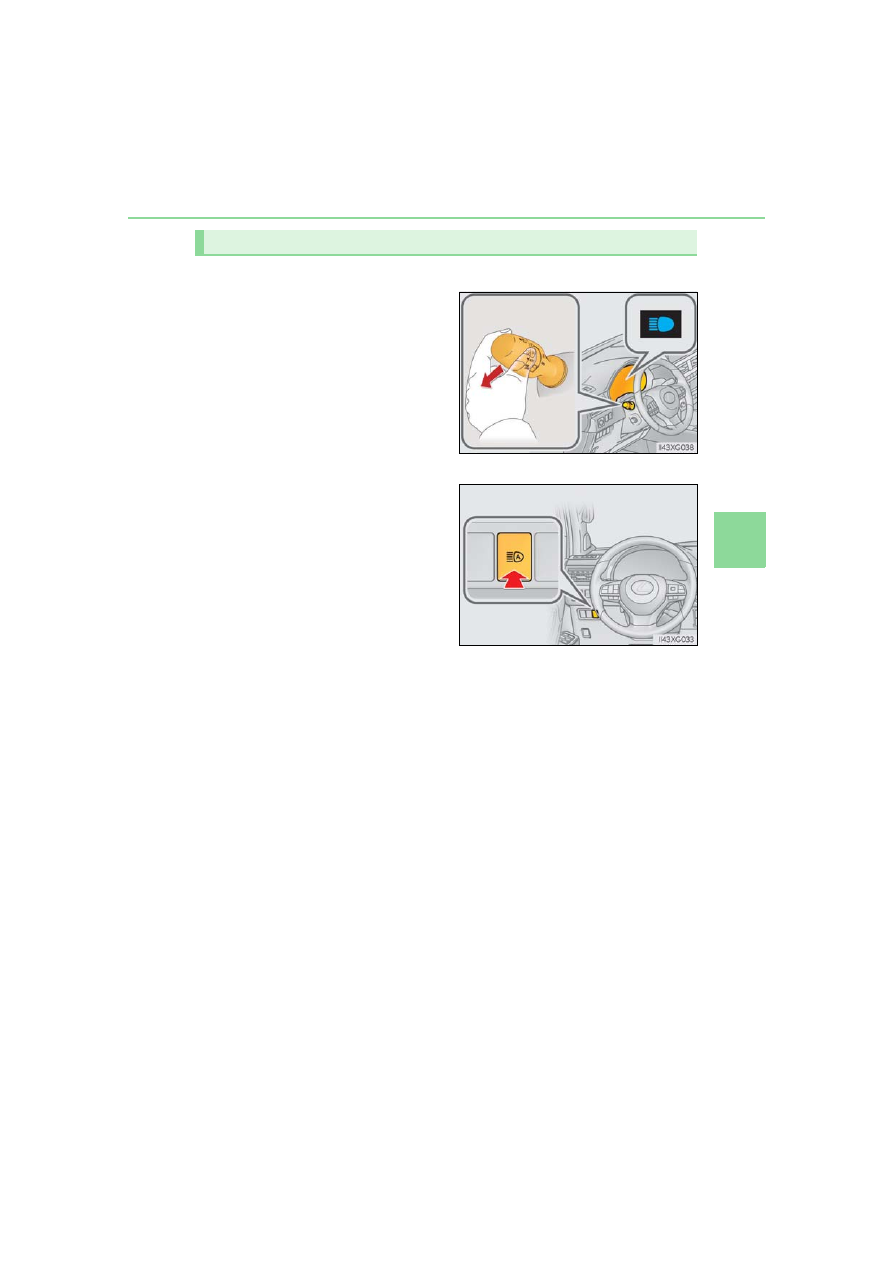
Switching to the high beam

Push the lever away from you.

The Automatic High Beam indicator

will turn off and the high beam indi-

cator will turn on.
Pull the lever to its original position to

activate the Automatic High Beam

system again.

Switching to the low beam

Press the Automatic High Beam
switch.

The Automatic High Beam indicator

will turn off.
Press the switch to activate the Auto-

matic High Beam system again.

Temporarily switching to the low beams

Pull the lever toward you and then return it to its original position.

The high beams are on while the lever is pulled toward you, however, after the lever

is returned to its original position, the low beams remain on for a certain amount of

time. Afterwards, the Automatic High Beam will be activated again.

Turning the high beam on/off manually

218

GX460_OM_OM60R43U_(U)

4-3. Operating the lights and wipers

High beam automatic turning on or off conditions

When all of the following conditions are fulfilled, the high beam will be automatically

turned on (after approximately 1 second):
• Vehicle speed is above approximately 21 mph (34 km/h).

• The area ahead of the vehicle is dark.

• There are no vehicles ahead with headlights or tail lights turned on.

• There are few streetlights on the road ahead.

If any of the following conditions are fulfilled, the high beam will be automatically turned

off:
• Vehicle speed drops below approximately 17 mph (27 km/h).

• The area ahead of the vehicle is not dark.

• Vehicles ahead have headlights or tail lights turned on.

• There are many streetlights on the road ahead.

Camera sensor detection information

The high beam may not be automatically turned off in the following situations:
• When oncoming vehicles suddenly appear from a curve

• When the vehicle is cut in front of by another vehicle

• When vehicles ahead are hidden from sight due to repeated curves, road dividers or

roadside trees

• When vehicles ahead appear from the faraway lane on wide road

• When vehicles ahead have no lights

The high beam may be turned off if a vehicle ahead that is using fog lights without using

the headlights is detected.

House lights, street lights, traffic signals, and illuminated billboards or signs may cause

the high beam to switch to the low beams, or the low beams to remain on.

The following factors may affect the amount of time taken to turn the high beam on or

off:
• The brightness of headlights, fog lights, and tail lights of vehicles ahead

• The movement and direction of vehicles ahead

• When a vehicle ahead only has operational lights on one side

• When a vehicle ahead is a two-wheeled vehicle

• The condition of the road (gradient, curve, condition of the road surface etc.)

• The number of passengers and amount of luggage

The high beam may be turned on or off when the driver does not expect it.

Bicycles or similar objects may not be detected.

GX460_OM_OM60R43U_(U)

219

4-3. Operating the lights and wipers

4

Dr

iving

In the situations shown below, the system may not be able to accurately detect sur-

rounding brightness levels. This may cause the low beams to remain on or the high

beams to cause problems for pedestrians, vehicles ahead or other parties. In these

cases, manually switch between the high and low beams.
• In bad weather (rain, snow, fog, sandstorms etc.)

• The windshield is obscured by fog, mist, ice, dirt etc.

• The windshield is cracked or damaged.

• The camera sensor is deformed or dirty.

• The camera sensor temperature is extremely high.

• Surrounding brightness levels are equal to those of headlights, tail lights or fog lights.

• Vehicles ahead have headlights that are either switched off, dirty, are changing color,

or are not aimed properly.

• When driving through an area of intermittently changing brightness and darkness.

• When frequently and repeatedly driving ascending/descending roads, or roads with

rough, bumpy or uneven surfaces (such as stone-paved roads, gravel tracks etc.).

• When frequently and repeatedly taking curves or driving on a winding road.

• There is a highly reflective object ahead of the vehicle, such as a sign or a mirror.

• The back of a vehicle ahead is highly reflective, such as a container on a truck.

• The vehicle’s headlights are damaged or dirty.

• The vehicle is listing or tilting, due to a flat tire, a trailer being towed etc.

• The high beam and low beam are repeatedly being switched between in an abnor-

mal manner.

• The driver believes that the high beam may be causing problems or distress to other

drivers or pedestrians nearby.

Temporarily lowering sensor sensitivity

The sensitivity of the sensor can be temporarily lowered.

Turn the engine switch off while the following conditions are met.
• The headlight switch is in 

 or 

.

• The headlight switch lever is in the original position.

• Automatic High Beam switch is on.
Turn the engine switch to IGNITION ON mode.
Within 60 seconds after step  , repeat pushing the headlight switch lever to the high

beam position then pulling it to the original position quickly 10 times, then leave the

lever in the original position.
If the sensitivity is changed, the Automatic High Beam indicator turns on and off 3

times.

Temporarily switching to the low beams

It is recommended to switch to the low beams when the high beam may cause problems

or distress to other drivers or pedestrians nearby.

1

2
3

2

4

220

GX460_OM_OM60R43U_(U)

4-3. Operating the lights and wipers

Fog light switch

*

1

or  

*

2

Turns the fog lights off

Turns the fog lights on

*

1

: For the U.S.A.

*

2

: For Canada

Fog lights can be used when

The headlights are on in low beam.

: If equipped

The fog lights secure excellent visibility in difficult driving conditions, such as
in rain and fog. 

1

2

NOTICE

To prevent battery discharge

Do not leave the lights on longer than necessary when the engine is not running.

221

GX460_OM_OM60R43U_(U)

4-3. Operating the lights and wipers

4

Dr

iving

Windshield wipers and washer

Operating the 

 lever operates the wipers or washer as follows.

Intermittent windshield wipers with interval adjuster

 Off

 Intermittent operation

 Low speed operation

 High speed operation

 Temporary operation

Wiper intervals can be adjusted when intermittent operation is selected.

Increases the intermittent windshield
wiper frequency
Decreases the intermittent wind-
shield wiper frequency

Operating the wiper lever

1

2

3

4

5

6

7

222

GX460_OM_OM60R43U_(U)

4-3. Operating the lights and wipers

Washer/wiper dual opera-
tion

Pulling the lever operates the wipers

and washer.
The wipers will automatically operate a

couple of times after the washer squirts.
Vehicles with headlight cleaners: If the

headlights are on, the headlight cleaners

will operate once.

Rain-sensing windshield wipers

*

1

 or 

*

Off

 Rain-sensing operation

*

1

 or 

*

Low speed operation

*

1

 or 

*

High speed operation

*

1

 or 

*

High speed operation

*

1

: For the U.S.A.

*

2

: For  Canada

When “AUTO” is selected, the wipers will operate automatically when the sensor

detects falling rain. The system automatically adjusts wiper timing in accordance with

rain volume and vehicle speed.

8

1

2

3

4

5

GX460_OM_OM60R43U_(U)

223

4-3. Operating the lights and wipers

4

Dr

iving

The sensor sensitivity can be adjusted when “AUTO” is selected.

Increases the sensitivity
Decreases the sensitivity

Washer/wiper dual opera-
tion

Pulling the lever operates the wipers

and washer.
The wipers operate automatically. (After

operating several times, the wipers

operate one more time after a short

delay to prevent dripping.)

Vehicles with headlight cleaners: If the

headlights are on, the headlight cleaners

will operate once.

The windshield wiper and washer can be operated when

The engine switch is in IGNITION ON mode.

Raindrop sensor (vehicles with rain-sensing windshield wipers)

If the wiper switch is turned to the “AUTO” position while the engine switch is in

IGNITION ON mode, the wipers will operate once to show that “AUTO” mode is acti-

vated.

When the sensor sensitivity ring is turned toward high while in “AUTO” mode, the wip-

ers will operate once to indicate that the sensor sensitivity is enhanced.

If the temperature of the rain drop sensor is 194

F (90

C) or higher, or 5

F (-15

C) or

lower, the automatic operation may not occur. In this case, operate the wipers in any

mode other than “AUTO”.

6
7

8

The raindrop sensor judges the amount of

raindrops.
An optical sensor is adopted. It may not oper-

ate properly when sunlight from the rising or

setting of the sun intermittently strikes the

windshield, or if bugs etc. are present on the

windshield.

224

GX460_OM_OM60R43U_(U)

4-3. Operating the lights and wipers

Effects of vehicle speed on wiper operation (vehicles with rain-sensing windshield wip-

ers)

With the settings other than “AUTO” also, the time until drip prevention wiper sweep

occurs is changed depending on vehicle speed.

With the low speed wiper operation selected, wiper operation will be switched from low

speed to intermittent wiper operation only when the vehicle is stationary. (However,

when the sensor sensitivity is adjusted to the highest level, the mode cannot be switched.)

If no windshield washer fluid sprays

Check that the washer nozzles are not blocked if there is washer fluid in the windshield

washer fluid reservoir.

WARNING

Caution regarding the use of windshield wipers in “AUTO” mode (vehicles with rain-

sensing windshield wipers)

The windshield wipers may operate unexpectedly if the sensor is touched or the wind-

shield is subject to vibration in “AUTO” mode. Take care that your fingers etc. anything

else does not become caught in the windshield wipers.

Caution regarding the use of washer fluid

When it is cold, do not use the washer fluid until the windshield becomes warm. The

fluid may freeze on the windshield and cause low visibility. This may lead to an accident,

resulting in death or serious injury.

NOTICE

When the windshield is dry

Do not use the wipers, as they may damage the windshield.

When the washer fluid tank is empty

Do not operate the switch continually as the washer fluid pump may overheat.

When there is no washer fluid spray from the nozzle

Damage to the washer fluid pump may be caused if the lever is pulled toward you and

held continually.

When a nozzle becomes blocked

In this case, contact your Lexus dealer. 

Do not try to clear it with a pin or other object. The nozzle will be damaged.

225

GX460_OM_OM60R43U_(U)

4-3. Operating the lights and wipers

4

Dr

iving

Rear window wiper and washer

Operating the 

 switch operates the rear wiper as follows.

*

1

 or 

*

2

 Off

*

1

 or 

*

2


Intermittent operation

*

1

 or 

*

2

Normal operation

*

1

: For the U.S.A.

*

2

: For  Canada

Washer/wiper dual opera-
tion

Pushing the lever operates the wiper

and washer.
The wipers will automatically operate a

couple of times after the washer squirts.

The rear window wiper and washer can be operated when

The engine switch is in IGNITION ON mode.

The glass hatch is closed.

If no windshield washer fluid sprays

Check that the washer nozzles are not blocked if there is washer fluid in the windshield

washer fluid reservoir.

1

2

3

4

226

GX460_OM_OM60R43U_(U)

4-3. Operating the lights and wipers

NOTICE

When the rear window is dry

Do not use the wiper, as it may damage the rear window.

When the washer fluid tank is empty

Do not operate the switch continually as the washer fluid pump may overheat.

227

GX460_OM_OM60R43U_(U)

4-3. Operating the lights and wipers

4

Dr

iving

Headlight cleaner switch

Press the switch to clean the headlights.

The headlight cleaners can be operated when

The engine switch is in IGNITION ON mode and the headlight switch is turned on.

Windshield washer linked operation

When the windshield washer is operated with the engine switch in IGNITION ON mode

and the headlights on, the headlight cleaners will operate once. (

P. 221)

: If equipped

Washer fluid can be sprayed on the headlights.

NOTICE

When the washer fluid tank is empty

Do not press the switch continually as the washer fluid pump may overheat.

228

GX460_OM_OM60R43U_(U)

4-4. Refueling

Opening the fuel tank cap

Turn the engine switch off and ensure that all the doors and windows are
closed.

Confirm the type of fuel.

Fuel types

P. 590

Fuel tank opening for unleaded gasoline

To help prevent incorrect fueling, your Lexus has a fuel tank opening that only accommo-

dates the special nozzle on unleaded fuel pumps.

If the malfunction indicator lamp illuminates

The malfunction indicator lamp may illuminate erroneously if refueling is performed

repeatedly when the fuel tank is nearly full.

Perform the following steps to open the fuel tank cap.

Before refueling the vehicle

GX460_OM_OM60R43U_(U)

229

4-4. Refueling

4

Dr

iving

WARNING

When refueling the vehicle

Observe the following precautions while refueling the vehicle. Failure to do so may

result in death or serious injury.

After exiting the vehicle and before opening the fuel door, touch an unpainted metal

surface to discharge any static electricity. It is important to discharge static electricity

before refueling because sparks resulting from static electricity can cause fuel vapors

to ignite while refueling.

Always hold the grips on the fuel tank cap and turn it slowly to remove it. 

A whooshing sound may be heard when the fuel tank cap is loosened. Wait until the

sound cannot be heard before fully removing the cap. In hot weather, pressurized fuel

may spray out of the filler neck and cause injury.

Do not allow anyone that has not discharged static electricity from their body to come

close to an open fuel tank.

Do not inhale vaporized fuel.

Fuel contains substances that are harmful if inhaled.

Do not smoke while refueling the vehicle.

Doing so may cause the fuel to ignite and cause a fire.

Do not return to the vehicle or touch any person or object that is statically charged.

This may cause static electricity to build up, resulting in a possible ignition hazard.

When refueling

Observe the following precautions to prevent fuel overflowing from the fuel tank:

Securely insert the fuel nozzle into the fuel filler neck.

Stop filling the tank after the fuel nozzle automatically clicks off.

Do not top off the fuel tank.

NOTICE

Refueling

Do not spill fuel during refueling.

Doing so may damage the vehicle, such as causing the emission control systems to

operate abnormally or damaging fuel system components or the vehicle’s painted sur-

face.

230

GX460_OM_OM60R43U_(U)

4-4. Refueling

Press the opener to open the fuel
filler door.

Turn the fuel tank cap slowly to open,
and hang the fuel tank cap on the
back of the fuel filler door.

Opening the fuel tank cap

1

2

GX460_OM_OM60R43U_(U)

231

4-4. Refueling

4

Dr

iving

When the fuel filler door cannot be opened by pressing the inside switch

After refueling, turn the fuel tank cap
until you hear a click. Once the cap is
released, it will turn slightly in the oppo-
site direction.

Remove the cover inside the luggage compart-

ment and pull the lever.

Closing the fuel tank cap

WARNING

When replacing the fuel tank cap

Do not use anything but a genuine Lexus fuel tank cap designed for your vehicle. Doing

so may cause a fire or other incident which may result in death or serious injury.

232

GX460_OM_OM60R43U_(U)

4-5. Using the driving support systems

Lexus Safety System +

PCS (Pre-Collision System)

P. 237

LDA (Lane Departure Alert)

P. 247

AHB (Automatic High Beam)

P. 216

Dynamic radar cruise control

P. 255

The Lexus Safety System + consists of the following drive assist systems and
contributes to a safe and comfortable driving experience:

Driving assist system

WARNING

Lexus Safety System +

The Lexus Safety System + is designed to operate under the assumption that the driver

will drive safely, and is designed to help reduce the impact to the occupants and the

vehicle in the case of a collision or assist the driver in normal driving conditions.
As there is a limit to the degree of recognition accuracy and control performance that

this system can provide, do not overly rely on this system. The driver is always responsi-

ble for paying attention to the vehicle’s surroundings and driving safely.

GX460_OM_OM60R43U_(U)

233

4-5. Using the driving support systems

4

Dr

iving

Two types of sensors, located behind the front grille and windshield, detect infor-
mation necessary to operate the drive assist systems.

Radar sensor
Front camera

Sensors

1

2

WARNING

To avoid malfunction of the radar sensor

Observe the following precautions.
Otherwise, the radar sensor may not operate properly, possibly leading to an accident

resulting in death or serious injury.

Keep the radar sensor and the radar sensor cover clean at all times.

Do not attach accessories, stickers (including transparent stickers) or other items to

the radar sensor, radar sensor cover or surrounding area.

Do not subject the radar sensor or its surrounding area to a strong impact. 

If the radar sensor, front grille, or front bumper has been subjected to a strong impact,

have the vehicle inspected by your Lexus dealer.

Do not disassemble the radar sensor.

Do not modify or paint the radar sensor or radar sensor cover.

In the following cases, the radar sensor must be recalibrated. Contact your Lexus

dealer for details.
• When the radar sensor or front grille are removed and installed, or replaced

• When the front bumper is replaced

Radar sensor
Radar sensor cover

If the front of the radar sensor or the front or

back of the radar sensor cover is dirty or

covered with water droplets, snow, etc., clean

it. 

Clean the radar sensor and radar sensor

cover with a soft cloth to avoid damaging

them.

1

2

234

GX460_OM_OM60R43U_(U)

4-5. Using the driving support systems

WARNING

To avoid malfunction of the front camera

Observe the following precautions.
Otherwise, the front camera may not operate properly, possibly leading to an accident

resulting in death or serious injury.

Keep the windshield clean at all times. 
• If the windshield is dirty or covered with an oily film, water droplets, snow, etc.,

clean the windshield. 

• If a glass coating agent is applied to the windshield, it will still be necessary to use

the windshield wipers to remove water droplets, etc. from the area of the wind-

shield in front of the front camera.

• If the inner side of the windshield where the front camera is installed is dirty, con-

tact your Lexus dealer.

If the part of the windshield in front of the front camera is fogged up or covered with

condensation or ice, use the windshield defogger to remove the fog, condensation or

ice. (

P. 408)

If water droplets cannot be properly removed from the area of the windshield in front

of the front camera by the windshield wipers, replace the wiper insert or wiper blade.

Do not attach window tint to the windshield.

Replace the windshield if it is damaged or cracked. 

After replacing the windshield, the front camera must be recalibrated. Contact your

Lexus dealer for details.

Do not allow liquids to contact the front camera.

Do not allow bright lights to shine into the front camera.

Do not dirty or damage the front camera. 

When cleaning the inside of the windshield, do not allow glass cleaner to contact the

lens of the front camera. Also, do not touch the lens. 

If the lens is dirty or damaged, contact your Lexus dealer.

Do not subject the front camera to a strong impact.

Do not change the installation position or direction of the front camera or remove it.

Do not disassemble the front camera.

Do not attach objects, such as stickers, trans-

parent stickers, etc., to the outer side of the

windshield in front of the front camera

(shaded area in the illustration).
A: From the top of the windshield to approxi-

mately 0.4 in. (1 cm) below the bottom of the

front camera
B: Approximately 7.9 in. (20 cm) (Approxi-

mately 4.0 in. [10 cm] to the right and left

from the center of the front camera)

GX460_OM_OM60R43U_(U)

235

4-5. Using the driving support systems

4

Dr

iving

WARNING

Do not modify any components of the vehicle around the front camera (inside rear

view mirror, etc.) or ceiling.

Do not attach any accessories to the hood, front grille or front bumper that may

obstruct the front camera. Contact your Lexus dealer for details.

If a surfboard or other long object is to be mounted on the roof, make sure that it will

not obstruct the front camera.

Do not modify the headlights or other lights.

236

GX460_OM_OM60R43U_(U)

4-5. Using the driving support systems

If a warning message is displayed on the multi-information display

A system may be temporarily unavailable or there may be a malfunction in the system

In the following situations, perform the actions specified in the table. When the normal

operating conditions are detected, the message will disappear and the system will

become operational. 

If the message does not disappear, contact your Lexus dealer.

In the following situations, if the situation has changed (or the vehicle has been driven

for some time) and the normal operating conditions are detected, the message will dis-

appear and the system will become operational. 

If the message does not disappear, contact your Lexus dealer.
• When the temperature around the radar sensor is outside of the operational range,

such as when the vehicle is in the sun or in an extremely cold environment

• When the front camera cannot detect objects in front of the vehicle, such as when

driving in the dark, snow, or fog, or when bright lights are shining into the front cam-

era

• Depending on the conditions in the vicinity of the vehicle, the radar may judge the

surrounding environment can not be properly recognized. In that case, “Pre-Colli-

sion System Unavailable” is displayed.

Situation

Actions

When the area around a camera is

covered with dirt, moisture (fogged

up, covered with condensation, ice,

etc.), or other foreign matter

Using the wiper and A/C function, remove the

dirt and other attached matter. (

P. 408)

When the temperature around the

front camera is outside of the opera-

tional range, such as when the vehi-

cle is in the sun or in an extremely

cold environment

If the front camera is hot, such as after the vehi-

cle had been parked in the sun, use the air con-

ditioning system to decrease the temperature

around the front camera. 

If a sunshade was used when the vehicle was

parked, depending on its type, the sunlight

reflected from the surface of the sunshade

may cause the temperature of the front cam-

era to become excessively high.

If the front camera is cold, such after the vehicle

is parked in an extremely cold environment, use

the air conditioning system to increase the tem-

perature around the front camera. 

The area in front of the front camera

is obstructed, such as when the

hood is open or a sticker is attached

to the part of the windshield in front

of the front camera.

Close the hood, remove the sticker, etc. to

clear the obstruction.

When “Pre-Collision System

Unavailable” is displayed.

Check whether there is attached materials on

the radar sensor and radar sensor cover, and if

there is, remove it.

237

GX460_OM_OM60R43U_(U)

4-5. Using the driving support systems

4

Dr

iving

PCS (Pre-Collision System)

Pre-collision warning

When the system determines that
the possibility of a frontal collision is
high, a buzzer will sound and a warn-
ing message will be displayed on the
multi-information display to urge the
driver to take evasive action.

Pre-collision brake assist

When the system determines that the possibility of a frontal collision is high,
the system applies greater braking force in relation to how strongly the brake
pedal is depressed.

The pre-collision system uses a radar sensor and front camera to detect vehi-
cles and pedestrians in front of your vehicle. When the system determines
that the possibility of a frontal collision with a vehicle or pedestrian is high, a
warning operates to urge the driver to take evasive action and the potential
brake pressure is increased to help the driver avoid the collision. If the system
determines that the possibility of a frontal collision with a vehicle or pedes-
trian is extremely high, the brakes are automatically applied to help avoid the
collision or help reduce the impact of the collision.

The pre-collision system can be disabled/enabled and the warning timing can
be changed. (

P. 240)

238

GX460_OM_OM60R43U_(U)

4-5. Using the driving support systems

Pre-collision braking

When the system determines that the possibility of a frontal collision is high,
the system warns the driver. If the system determines that the possibility of a
frontal collision is extremely high, the brakes are automatically applied to help
avoid the collision or reduce the collision speed.

Suspension control (if equipped)

When the system determines that the possibility of a frontal collision is high,
the Adaptive Variable Suspension System (

P. 356) will control the damping

force of the shock absorbers to help maintain an appropriate vehicle posture.

WARNING

Limitations of the pre-collision system

The driver is solely responsible for safe driving. Always drive safely, taking care to

observe your surroundings. 

Do not use the pre-collision system instead of normal braking operations under any

circumstances. This system will not prevent collisions or lessen collision damage or

injury in every situation. Do not overly rely on this system. Failure to do so may lead to

an accident, resulting in death or serious injury.

Although this system is designed to help avoid a collision or help reduce the impact of

the collision, its effectiveness may change according to various conditions, therefore

the system may not always be able to achieve the same level of performance. 

Read the following conditions carefully. Do not overly rely on this system and always

drive carefully.
• Conditions under which the system may operate even if there is no possibility of a

collision: 

P. 242

• Conditions under which the system may not operate properly: 

P. 244

Do not attempt to test the operation of the pre-collision system yourself. 

Depending on the objects used for testing (dummies, cardboard objects imitating

detectable objects, etc.), the system may not operate properly, possibly leading to an

accident.

GX460_OM_OM60R43U_(U)

239

4-5. Using the driving support systems

4

Dr

iving

WARNING

Pre-collision braking

When the pre-collision braking function is operating, a large amount of braking force

will be applied.

If the vehicle is stopped by the operation of the pre-collision braking function, the

pre-collision braking function operation will be canceled after approximately 2 sec-

onds. Depress the brake pedal as necessary.

The pre-collision braking function may not operate if certain operations are per-

formed by the driver. If the accelerator pedal is being depressed strongly or the steer-

ing wheel is being turned, the system may determine that the driver is taking evasive

action and possibly prevent the pre-collision braking function from operating.

In some situations, while the pre-collision braking function is operating, operation of

the function may be canceled if the accelerator pedal is depressed strongly or the

steering wheel is turned and the system determines that the driver is taking evasive

action.

If the brake pedal is being depressed, the system may determine that the driver is tak-

ing evasive action and possibly delay the operation timing of the pre-collision braking

function.

When to disable the pre-collision system

In the following situations, disable the system, as it may not operate properly, possibly

leading to an accident resulting in death or serious injury:

When the vehicle is being towed

When your vehicle is towing another vehicle

When transporting the vehicle via truck, boat, train or similar means of transportation

When the vehicle is raised on a lift with the engine running and the tires are allowed to

rotate freely

When inspecting the vehicle using a drum tester such as a chassis dynamometer or

speedometer tester, or when using an on vehicle wheel balancer

When a strong impact is applied to the front bumper or front grille, due to an accident

or other reasons

If the vehicle cannot be driven in a stable manner, such as when the vehicle has been

in an accident or is malfunctioning

When the vehicle is driven in a sporty manner or off-road

When the tires are not properly inflated

When the tires are very worn

When tires of a size other than specified are installed

When tire chains are installed

When a compact spare tire or an emergency tire puncture repair kit is used

If equipment (snow plow, etc.) that may obstruct the radar sensor or front camera is

temporarily installed to the vehicle

240

GX460_OM_OM60R43U_(U)

4-5. Using the driving support systems

Enabling/disabling the pre-collision system

The pre-collision system can be enabled/disabled on 

 (

P. 91) of the

multi-information display.

The system is automatically enabled each time the engine switch is turned to IGNI-

TION ON mode.

If the system is disabled, the PCS
warning light will turn on and a mes-
sage will be displayed on the multi-
information display.

Changing the pre-collision warning timing

The pre-collision warning timing can be changed on 

 (

P. 91) of the

multi-information display.

The operation timing setting is retained when the engine switch is turned off.

Far

The warning will begin to operate

earlier than with the default timing.

Middle

This is the default setting.

Near

The warning will begin to operate

later than with the default timing.

Changing settings of the pre-collision system

1

2

3

GX460_OM_OM60R43U_(U)

241

4-5. Using the driving support systems

4

Dr

iving

Operational conditions

The pre-collision system is enabled and the system determines that the possibility of a

frontal collision with a vehicle or pedestrian is high.
Each function is operational at the following speeds:

Pre-collision warning:
• Vehicle speed is between approximately 7 and 110 mph (10 and 180 km/h). (For

detecting a pedestrian, vehicle speed is between approximately 7 and 50 mph [10

and 80 km/h].)

• The relative speed between your vehicle and the vehicle or pedestrian ahead is

approximately 7 mph (10 km/h) or more.

Pre-collision brake assist: 
• Vehicle speed is between approximately 20 and 110 mph (30 and 180 km/h). (For

detecting a pedestrian, vehicle speed is between approximately 20 and 50 mph

[30 and 80 km/h].)

• The relative speed between your vehicle and the vehicle or pedestrian ahead is

approximately 20 mph (30 km/h) or more.

Pre-collision braking:
• Vehicle speed is between approximately 7 and 110 mph (10 and 180 km/h). (For

detecting a pedestrian, vehicle speed is between approximately 7 and 50 mph [10

and 80 km/h].)

• The relative speed between your vehicle and the vehicle or pedestrian ahead is

approximately 7 mph (10 km/h) or more.

The system may not operate in the following situations:

If a battery terminal has been disconnected and reconnected and then the vehicle has

not been driven for a certain amount of time

If the shift lever is in R

If VSC is disabled (only the pre-collision warning function will be operational)

If the low speed four-wheel drive indicator is illuminated (only the pre-collision warning

function will be operational)

242

GX460_OM_OM60R43U_(U)

4-5. Using the driving support systems

Pedestrian detection function

Cancelation of the pre-collision braking

If either of the following occur while the pre-collision braking function is operating, it will

be canceled:

The accelerator pedal is depressed strongly.

The steering wheel is turned sharply or abruptly.

Conditions under which the system may operate even if there is no possibility of a colli-

sion

In some situations such as the following, the system may determine that there is a possi-

bility of a frontal collision and operate.
• When passing a vehicle or pedestrian

• When changing lanes while overtaking a preceding vehicle

• When overtaking a preceding vehicle that is changing lanes

• When rapidly closing on a vehicle ahead

The pre-collision system detects pedestrians

based on the size, profile, and motion of a

detected object. However, a pedestrian may not

be detected depending on the surrounding

brightness and the motion, posture, and angle of

the detected object, preventing the system from

operating properly. (

P. 246)

• When overtaking a preceding vehicle that

is making a left/right turn

• When passing a vehicle in an oncoming

lane that is stopped to make a right/left turn

• When driving on a road where relative

location to vehicle ahead in an adjacent

lane may change, such as on a winding

road

GX460_OM_OM60R43U_(U)

243

4-5. Using the driving support systems

4

Dr

iving

• If the front of the vehicle is raised or lowered, such as when the road surface is

uneven or undulating

• When approaching objects on the roadside, such as guardrails, utility poles, trees, or

walls

• When driving on a narrow path surrounded by a structure, such as in a tunnel or on

an iron bridge

• When there is a metal object (manhole cover, steel plate, etc.), steps, or a protrusion

on the road surface or roadside

• When rapidly closing on an electric toll gate barrier, parking area barrier, or other

barrier that opens and closes

• When using an automatic car wash

• When there is a vehicle, pedestrian, or

object by the roadside at the entrance of a

curve

• When a crossing pedestrian approaches

very close to the vehicle

• When passing through a place with a low

structure above the road (low ceiling, traffic

sign, etc.)

• When passing under an object (billboard,

etc.) at the top of an uphill road

244

GX460_OM_OM60R43U_(U)

4-5. Using the driving support systems

• When the vehicle is hit by water, snow, dust, etc. from a vehicle ahead

• When driving through steam or smoke

• When there are patterns or paint on the road or a wall that may be mistaken for a

vehicle or pedestrian

• When driving near an object that reflects radio waves, such as a large truck or

guardrail

• When driving near a TV tower, broadcasting station, electric power plant, or other

location where strong radio waves or electrical noise may be present

Situations in which the system may not operate properly

In some situations such as the following, a vehicle may not be detected by the radar

sensor and front camera, preventing the system from operating properly:
• If an oncoming vehicle is approaching your vehicle

• If a vehicle ahead is a motorcycle or bicycle

• When approaching the side or front of a vehicle

• If a preceding vehicle has a small rear end, such as an unloaded truck

• If a vehicle ahead is carrying a load which protrudes past its rear bumper

• If a vehicle ahead is irregularly shaped, such as a tractor or side car

• If the sun or other light is shining directly on a vehicle ahead

• If a vehicle cuts in front of your vehicle or emerges from beside a vehicle

• If a vehicle ahead makes an abrupt maneuver (such as sudden swerving, accelera-

tion or deceleration)

• When suddenly cutting behind a preceding vehicle

• When driving through or under objects

that may contact the vehicle, such as thick

grass, tree branches, or a banner

• If a preceding vehicle has a low rear end,

such as a low bed trailer

• If a vehicle ahead has extremely high

ground clearance

GX460_OM_OM60R43U_(U)

245

4-5. Using the driving support systems

4

Dr

iving

• When driving in inclement weather such as heavy rain, fog, snow or a sandstorm

• When the vehicle is hit by water, snow, dust, etc. from a vehicle ahead

• When driving through steam or smoke

• When driving in a place where the surrounding brightness changes suddenly, such

as at the entrance or exit of a tunnel

• When a very bright light, such as the sun or the headlights of oncoming traffic, shines

directly into the front camera

• When the surrounding area is dim, such as at dawn or dusk, or while at night or in a

tunnel

• After the engine has started the vehicle has not been driven for a certain amount of

time

• While making a left/right turn and for a few seconds after making a left/right turn

• While driving on a curve and for a few seconds after driving on a curve

• If your vehicle is skidding

• If the wheels are misaligned

• If a wiper blade is blocking the front camera

• The vehicle is wobbling.

• The vehicle is being driven at extremely high speeds.

• When driving on a hill 

• If the radar sensor or front camera is misaligned

In some situations such as the following, sufficient braking force may not be obtained,

preventing the system from performing properly:
• If the braking functions cannot operate to their full extent, such as when the brake

parts are extremely cold, extremely hot, or wet

• If the vehicle is not properly maintained (brakes or tires are excessively worn,

improper tire inflation pressure, etc.)

• When the vehicle is being driven on a gravel road or other slippery surface

• When a vehicle ahead is not directly in front

of your vehicle

• If the front of the vehicle is raised or low-

ered

246

GX460_OM_OM60R43U_(U)

4-5. Using the driving support systems

Some pedestrians such as the following may not be detected by the radar sensor and

front camera, preventing the system from operating properly:
• Pedestrians shorter than approximately 3.2 ft. (1 m) or taller than approximately

6.5 ft. (2 m)

• Pedestrians wearing oversized clothing (a rain coat, long skirt, etc.), making their sil-

houette obscure

• Pedestrians who are carrying large baggage, holding an umbrella, etc., hiding part

of their body

• Pedestrians who are bending forward or squatting

• Pedestrians who are pushing a stroller, wheelchair, bicycle or other vehicle

• Groups of pedestrians which are close together

• Pedestrians who are wearing white and look extremely bright

• Pedestrians in the dark, such as at night or while in a tunnel

• Pedestrians whose clothing appears to be nearly the same color or brightness as

their surroundings

• Pedestrians near walls, fences, guardrails, or large objects

• Pedestrians who are on a metal object (manhole cover, steel plate, etc.) on the road

• Pedestrians who are walking fast

• Pedestrians who are changing speed abruptly

• Pedestrians running out from behind a vehicle or a large object

• Pedestrians who are extremely close to the side of the vehicle (outside rear view

mirror, etc.)

If VSC is disabled

If VSC is disabled (

P. 370), the pre-collision brake assist and pre-collision braking

functions are also disabled.

The PCS warning light will turn on and “VSC Turned Off Pre-Collision Brake System

Unavailable” will be displayed on the multi-information display.

247

GX460_OM_OM60R43U_(U)

4-5. Using the driving support systems

4

Dr

iving

LDA (Lane Departure Alert)

When driving on roads with white (yellow) lines, this function alerts the driver
when the vehicle might depart from its lane.
The LDA system recognizes visible
white (yellow) lines with the camera
sensor on the upper portion of the front
windshield.

Lane departure alert function

When the system determines that
the vehicle might depart from its
lane, a warning is displayed on the
multi-information display, and either
the warning buzzer sounds or the
steering wheel vibrates to alert the
driver.

When the warning buzzer sounds or

the steering wheel vibrates, check

the surrounding road situation and

carefully operate the steering wheel

to move the vehicle back to the cen-

ter of the lane.

Summary of functions

Functions included in LDA system

248

GX460_OM_OM60R43U_(U)

4-5. Using the driving support systems

Vehicle sway warning function

When the vehicle is swaying or
appears as if it may depart from its
lane multiple times, the warning
buzzer sounds and a message is dis-
played on the multi-information dis-
play to alert the driver.

WARNING

Before using LDA system

Do not rely solely upon the LDA system. The LDA system does not automatically drive

the vehicle or reduce the amount of attention that must be paid to the area in front of

the vehicle. The driver must always assume full responsibility for driving safely by pay-

ing careful attention to the surrounding conditions and operating the steering wheel to

correct the path of the vehicle. Also, the driver must take adequate breaks when

fatigued, such as from driving for a long period of time.

Failure to perform appropriate driving operations and pay careful attention may lead to

an accident, resulting in death or serious injury.

To avoid operating LDA system by mistake

When not using the LDA system, use the LDA switch to turn the system off.


Content      ..     5      6      7      8     ..