Lexus RX300 (MCU15). Service manual - part 54
CH
BO
CHASSIS — BRAKES
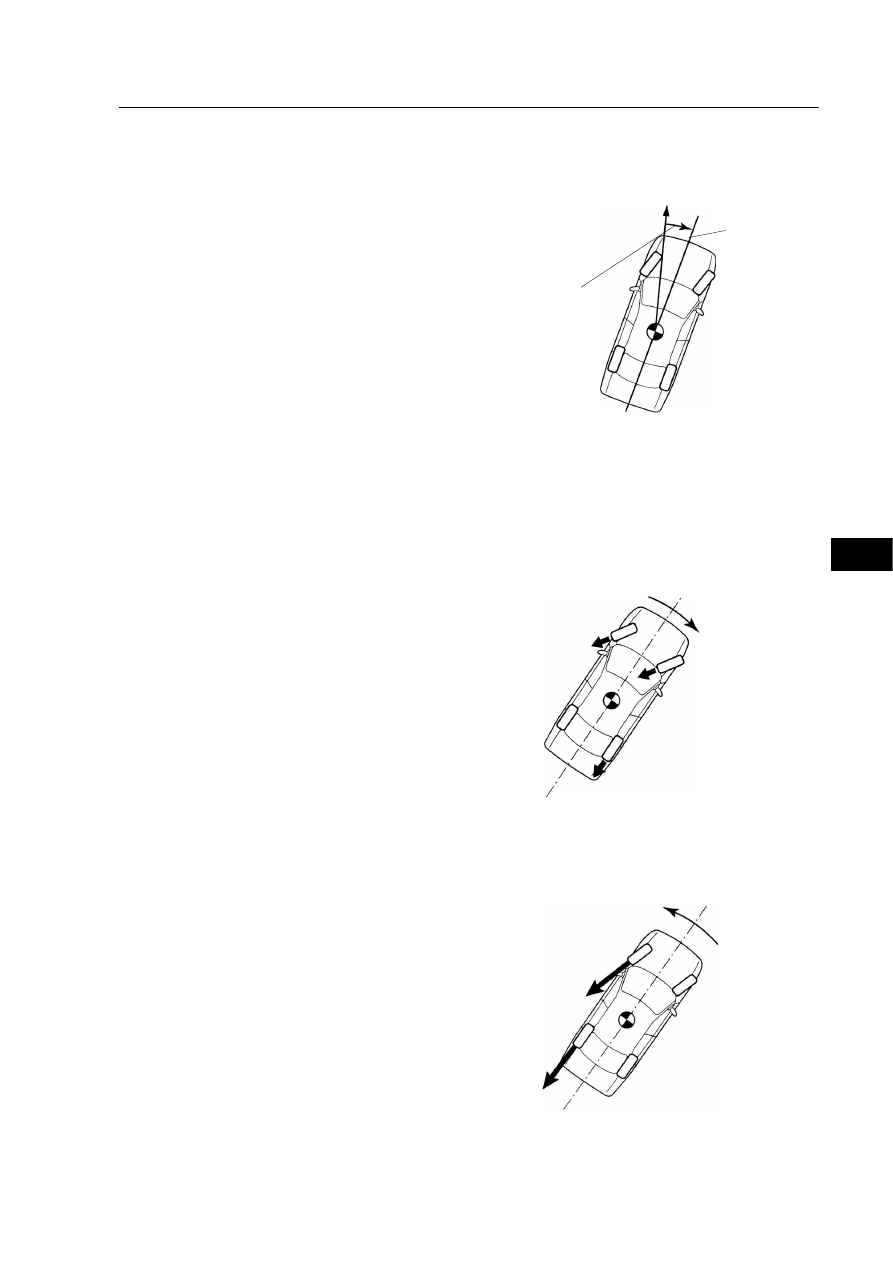
Direction of Travel of the Vehicle’s
Center of Gravity
Slip Angle
Movement
of Vehicle
151CH18
Making a Right Turn
Braking
Force
Understeering
Control Moment
Braking Force
161ES30
Braking Force
Making a Right Turn
Braking
Force
Oversteering
Control Moment
170CH07
89
2) Determining Oversteer
Whether or not the vehicle is in the state of over-
steer is determined by the values of the vehicle’s
slip angle and the vehicle’s slip angular velocity
(time-dependent changes in the vehicle’s slip
angle). When the vehicle’s slip angle is large, and
the slip angular velocity is also large, the ECU
determines that the vehicle has a large oversteer
tendency.
Method of VSC Operation
When the skid control ECU determines that the vehicle exhibits a tendency to understeer or oversteer,
it decreases the engine output and applies the brake of a front or rear wheel to control the vehicle’s yaw
moment.
1) Dampening a Strong Understeer
When the skid control ECU determines that the
vehicle exhibits a strong tendency to understeer,
depending on the extent of that tendency, it con-
trols the engine output and applies the brakes of
the front wheels and inside rear wheel, thus pro-
viding the vehicle with an understeer control mo-
ment, which helps dampen its tendency to under-
steer. Also, depending on whether the brakes are
ON or OFF and the condition of the vehicle, there
are circumstances in which the brakes might not
be applied to the wheels even if those wheels are
targeted for braking.
2) Dampening a Strong Oversteer
When the skid control ECU determines that the
vehicle exhibits a strong tendency to oversteer,
depending on the extent of that tendency, it con-
trols the engine output and applies the brakes of
the front and rear wheels of the outside of the
turn, thus generating an inertial moment in the
vehicle’s outward direction, which helps dampen
its tendency to oversteer.