Honda Insight (2019 year). Manual - part 34
 

  Index      Honda     Honda Insight - service manual 2019 year in english


Search            copyright infringement  


Content   ..  32  33  34  35   ..


Honda Insight (2019 year). Manual - part 34


527

uu

Honda Sensing®

u

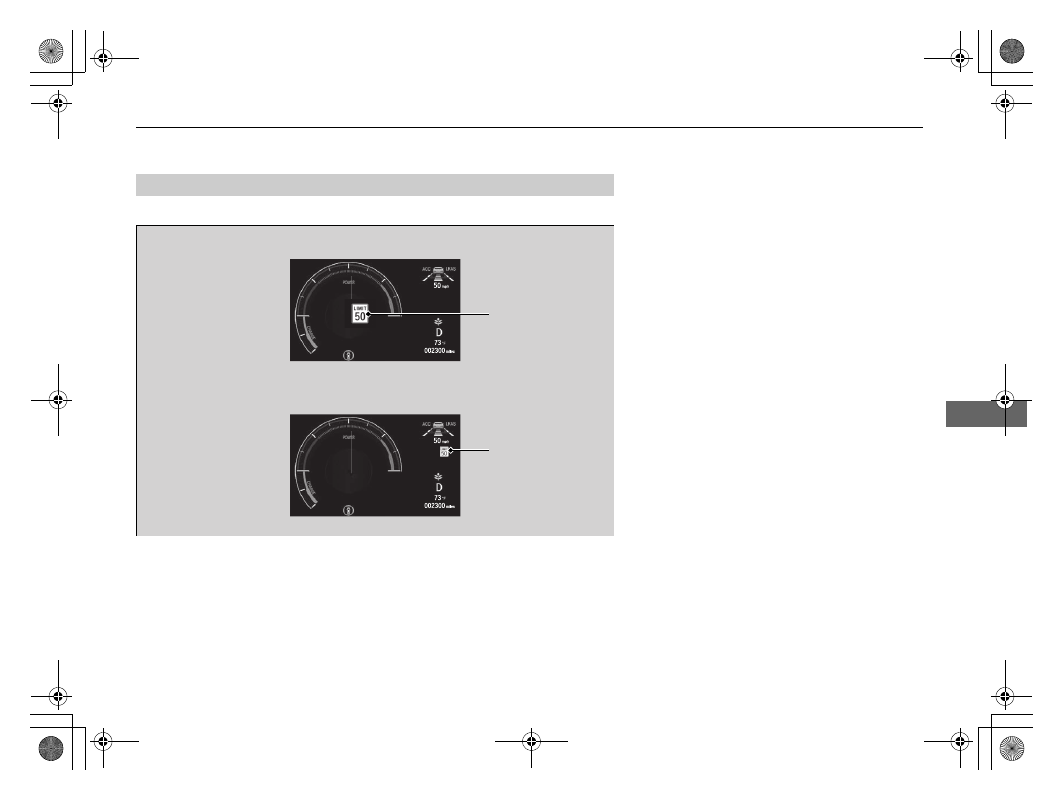
Traffic Sign Recognition System

Driving

The speed limit sign icon is displayed on the right half of the screen.

Selecting to display traffic signs when main mode is off

You can continue displaying reduced-size traffic sign icon on the driver information 
interface even while the main mode is not selected.

Customized Features P. 153, 359, 366

Signs Displayed on the Driver information interface

When main mode is selected

When main mode is not selected

Speed Limit Sign

Speed Limit Sign

528

uu

Honda Sensing®

u

Front Sensor Camera

Driving

Front Sensor Camera

The camera, used in systems such as LKAS, RDM, ACC with LSF, CMBS

TM

 and traffic 

sign recognition system, is designed to detect an object that triggers any of the 
systems to operate its functions.

This camera is located behind the rearview 
mirror.

To help reduce the likelihood that high interior 
temperatures will cause the camera’s sensing 
system to shut off, when parking, find a shady 
area or face the front of the vehicle away from 
the sun. If you use a reflective sun shade, do 
not allow it to cover the camera housing. 
Covering the camera can concentrate heat on 
it.

Camera Location and Handling Tips

1

Front Sensor Camera

Never apply a film or attach any objects to the 
windshield, the hood, or the front grille that could 
obstruct the camera’s field of vision and cause the 
system to operate abnormally.
Scratches, nicks, and other damage to the windshield 
within the camera’s field of vision can cause the 
system to operate abnormally. If this occurs, we 
recommend that you replace the windshield with a 
genuine Honda replacement windshield. Making 
even minor repairs within the camera’s field of vision 
or installing an aftermarket replacement windshield 
may also cause the system to operate abnormally.
After replacing the windshield, have a dealer 
recalibrate the camera. Proper calibration of the 
camera is necessary for the system to operate 
properly.

Do not place an object on the top of the instrument 
panel. It may reflect onto the windshield and prevent 
the system from detecting lane lines properly.

Front Sensor 
Camera

529

uu

Honda Sensing®

u

Front Sensor Camera

Driving

1

Front Sensor Camera

If the Some Driver Assist Systems Cannot 
Operate: Camera Temperature Too High
 message 
appears:

Use the climate control system to cool down the 
interior and, if necessary, also use defroster mode 
with the airflow directed towards the camera.

Start driving the vehicle to lower the windshield 
temperature, which cools down the area around 
the camera.

If the Some Driver Assist Systems Cannot 
Operate: Clean Front Windshield
 message 
appears:

Park your vehicle in a safe place, and clean the 
windshield. If the message does not disappear after 
you have cleaned the windshield and driven for a 
while, have your vehicle checked by a dealer.

530

uu

Honda Sensing®

u

Radar Sensor

Driving

Radar Sensor

The radar sensor is at the lower part of the 
front bumper.

1

Radar Sensor

Avoid strong impacts to the radar sensor cover.

For the CMBS

TM

 to work properly:

Always keep the radar sensor cover clean.

Never use chemical solvents or polishing powder for 
cleaning the sensor cover. Clean it with water or a 
mild detergent.

Do not put a sticker on the radar sensor cover or 
replace the radar sensor cover.

If you need the radar sensor to be repaired, or 
removed, or the radar sensor cover is strongly 
impacted, turn off the system by using the safety 
support switch and take your vehicle to a dealer.

CMBS

TM

 On and Off P. 486

If the vehicle is involved in any of the following 
situations, the radar sensor may not work properly. 
Have your vehicle checked by a dealer:

Your vehicle is involved in a frontal collision

Your vehicle drives through deep water or is 
submerged in deep water

Your vehicle strongly strikes a bump, curb, chock, 
or embankment that could jar the radar sensor

Radar 
Sensor

The radar sensor is 
at the lower part of 
the front bumper.

531

Continued

Driving

Braking

Brake System

Use the parking brake to keep the vehicle stationary when parked. When the 
parking brake is applied, you can manually or automatically release it.

To apply

The electric parking brake can be applied any 
time the vehicle has battery, no matter which 
position the power mode is in.

Pull the electric parking brake switch up gently 
and securely.

u

The indicator in the switch comes on.

u

The parking brake indicator (red) comes 
on.

Parking Brake

1

Braking

When you depress the brake pedal, you may hear a 
whirring sound from the engine compartment. This is 
because the brake system is in operation, and it is 
normal.

1

Parking Brake

You may hear the electric parking brake system 
motor operating from the rear wheel area when you 
apply or release the parking brake. This is normal.

The brake pedal may slightly move due to the electric 
parking brake system operation when you apply or 
release the parking brake. This is normal.

You cannot apply or release the parking brake if the 
12-volt battery goes dead.

Jump Starting P. 628

If you pull up and hold the electric parking brake 
switch while driving, the brakes on all four 
wheels are applied by the electric servo brake 
system until the vehicle comes to a stop. The 
electric parking brake then applies, and the 
switch should be released.

Electric Parking Brake Switch

uu

Braking

u

Brake System

532

Driving

To release

The power mode must be in ON in order to 
release the electric parking brake.
1. Depress the brake pedal.
2. Press the electric parking brake switch.

u

The indicator in the switch goes off.

u

The parking brake indicator (red) goes 
off.

Manually releasing the parking brake using 
the switch helps your vehicle start slowly and 
smoothly when facing down hill on steep hills.

1

Parking Brake

In the following situations, the parking brake 
automatically operates.

When the vehicle stops more than 10 minutes 
while ACC with LSF is activated.

When the driver’s seat belt is unfastened while 
your vehicle is stopped automatically by ACC with 
LSF.

When the power system is turned off while ACC 
with LSF is activated.

When the vehicle stops with the automatic brake 
hold system activated for more than 10 minutes.

When the driver’s seat belt is unfastened while 
your vehicle is stopped and the automatic brake 
hold is applied.

When the power system is turned off while the 
automatic brake hold is applied.

When there is a problem with the automatic brake 
hold system while brake hold is applied.

Electric Parking Brake Switch

Continued

533

uu

Braking

u

Brake System

Driving

Automatic parking brake feature operation

If the automatic parking brake feature has been activated:
• The parking brake is applied automatically when you set the power mode to 

VEHICLE OFF.

• To confirm that the parking brake is applied, check if the parking brake indicator 

(red) is on.

Activating and deactivating the automatic parking brake feature P. 534

To release automatically

Depressing the accelerator pedal releases the parking brake.
Use the accelerator pedal to release the parking brake when you are starting the 
vehicle facing uphill, or in a traffic jam.

Gently depress the accelerator pedal.
When on a hill, it may require more 
accelerator input to release.

u

The indicator in the switch goes off.

u

The parking brake indicator (red) goes 
off.

You can release the parking brake automatically when:
• You are wearing the driver’s seat belt.
• The power system is on.
• The transmission is not in 

(

P or 

(

N.

1

Parking Brake

If the parking brake cannot be released 
automatically, release it manually.

When the vehicle is traveling uphill, the accelerator 
pedal may need to be pressed farther to 
automatically release the electric parking brake.

The parking brake cannot be released automatically 
while the following indicators are on:

Malfunction indicator lamp

Transmission system indicator

The parking brake may not be released automatically 
while the following indicators are on:

Brake system indicator

VSA® system indicator

ABS indicator

Supplemental restraint system indicator

Accelerator Pedal

uu

Braking

u

Brake System

534

Driving

Activating and deactivating the automatic parking brake feature

With the power mode is in ON, carry out the following steps to either activate or 
deactivate the automatic parking brake feature.
1. Put the transmission into 

(

P.

2. Without depressing the brake pedal, pull up and release the parking brake switch.

u

Check that the parking brake indicator (red) has come on.

3. Pull up and hold the parking brake switch. When you hear a beeping sound, 

release the switch and within 3 seconds pull up and hold the switch again.

4. When you hear a sound indicating that the procedure is completed, release the 

switch.

u

Two beeps indicates that the feature has been activated.

u

One beep indicates that the feature has been deactivated.

u

When you have completed activating the feature, the parking brake will 
remain applied after you turn off the engine.

u

To confirm that the parking brake is applied, check if the parking brake 
indicator (red) is on.

If you need to temporarily deactivate the feature for when putting your vehicle 
through a conveyor type car wash, you can follow the procedure explained below.
1. Depress the brake pedal and bring the vehicle to a stop.
2. Set the power mode to VEHICLE OFF and then within 2 seconds push down the 

parking brake switch.

u

Activation and deactivation settings for the feature will not be affected.

u

Before temporarily deactivating the feature, make sure to first turn off both 
ACC with LSF and the automatic brake hold system.

u

To confirm that the parking brake is applied, check if the parking brake 
indicator (red) is on.

1

Parking Brake

In cold climates, the parking brake may freeze in 
place if applied.

When parking the vehicle, chock the wheels and 
make sure the automatic parking brake feature is 
deactivated.

Also, when putting your vehicle through a conveyor-
type car wash or when having your vehicle towed, 
deactivate the automatic parking brake feature and 
leave the parking brake released.

Continued

535

uu

Braking

u

Brake System

Driving

Your vehicle is equipped with disc brakes at all four wheels. The brake assist system 
increases the stopping force when you depress the brake pedal hard in an 
emergency situation. The anti-lock brake system (ABS) helps you retain steering 
control when braking very hard.

Brake Assist System P. 540
Anti-lock Brake System (ABS) P. 539

Foot Brake

1

Foot Brake

Check the brakes after driving through deep water, 
or if there is a buildup of road surface water. If 
necessary, dry the brakes by lightly depressing the 
pedal several times.

If you hear a continuous metallic friction sound when 
applying the brakes, this is caused by the brake wear 
indicator rubbing on the brake rotor and indicates 
that the brake pads need to be replaced. Have the 
vehicle checked by a dealer. If you hear only an 
occasional squeak or squeal when you initially apply 
the brake pedal, this may be normal and caused by 
high frequency vibration of the brake pads against 
the rotating brake disc.

Applying constant pressure to the brakes while going 
down a long hill can cause the brakes to heat up, 
resulting in a loss of stopping power. Therefore, 
when descending a long hill, release the accelerator 
pedal and allow regenerative braking to slow the 
vehicle down. To adjust the rate of deceleration, use 
the deceleration paddle selector.

POWER/CHARGE Gauge P. 130
High Voltage Battery Charge Level Gauge 

P. 129

Deceleration Paddle Selector P. 464

Do not rest your foot on the brake pedal while 
driving, as it will lightly apply the brakes and cause 
them to lose effectiveness over time and reduce pad 
life. It will also confuse drivers behind you.

uu

Braking

u

Brake System

536

Driving

Keeps the brake applied after releasing the brake pedal until the accelerator pedal is 
pressed. You can use this system while the vehicle is temporarily stopped, like at 
traffic lights and in heavy traffic.

Automatic Brake Hold

1

Automatic Brake Hold

3

WARNING

Activating the automatic brake hold system 
on steep hills or slippery roads may still 
allow the vehicle to move if you remove 
your foot from the brake pedal.

If a vehicle unexpectedly moves, it may 
cause a crash resulting in serious injury or 
death.

Never activate the automatic brake hold 
system or rely on it to keep a vehicle from 
moving when stopped on a steep hill or 
slippery roads.

3

WARNING

Using the automatic brake hold system to 
park the vehicle may result in the vehicle 
unexpectedly moving.

If a vehicle moves unexpectedly, it may 
cause a crash, resulting in serious injury or 
death.

Never leave the vehicle when braking is 
temporarily kept by automatic brake hold 
and always park the vehicle by putting the 
transmission in 

(

P

 and applying the parking 

brake.

Turning on the system

Fasten your seat belt 
properly, then start the 
power system. Press the 
automatic brake hold 
button.

The automatic brake 
hold system indicator 
comes on. The system 
is turned on.

Activating the system

Depress the brake pedal 
to come to a complete 
stop. The transmission 
must be in 

(

D or 

(

N.

The automatic brake 
hold indicator comes 
on. Braking is kept for 
up to 10 minutes.

Release the brake pedal 
after the automatic 
brake hold indicator 
comes on.

Canceling the system

Depress the accelerator 
pedal while the 
transmission must be in 

(

D. The system is 

canceled and the vehicle 
starts to move.

The automatic brake 
hold indicator goes 
off. The system 
continues to be on.

Accelerator Pedal

Brake Pedal

Automatic Brake 
Hold Button

Goes 
Off

U.S.

Canada

On

On

Comes 
On

Comes 
On

Comes 
On

Continued

537

uu

Braking

u

Brake System

Driving

The system automatically cancels when:

• You engage the parking brake.
• You depress the brake pedal and put the transmission into 

(

P or 

(

R.

The system automatically cancels and the parking brake is applied when:

• Braking is kept for more than 10 minutes.
• The driver’s seat belt is unfastened.
• The power system is turned off.
• Brake Hold System Problem. Apply Brake When Stopped. See Your 

Dealer. appears on the driver information interface.

• There is a problem with automatic brake hold system.

1

Automatic Brake Hold

While the system is activated, you can turn off the 
power system or park the vehicle through the same 
procedure as you normally do.

When Stopped P. 541

Whether the system is on, or the system is activated, 
the automatic brake hold turns off once the power 
system is off.

uu

Braking

u

Brake System

538

Driving

Turning off the automatic brake hold system

While the system is on, press the automatic 
brake hold button again.

u

The automatic brake hold system 
indicator goes off.

If you want to turn off automatic brake hold 
while the system is in operation, press the 
automatic brake hold button with the brake 
pedal depressed.

1

Turning off the automatic brake hold system

Make sure to turn off the automatic brake hold 
system before using an automated car wash.

You may hear an operating noise if the vehicle moves 
while the automatic brake hold system is in 
operation.

Automatic Brake 
Hold Button

Goes 
Off

539

uu

Braking

u

Anti-lock Brake System (ABS)

Driving

Anti-lock Brake System (ABS)

Helps prevent the wheels from locking up, and helps you retain steering control by 
pumping the brakes rapidly, much faster than you.

The electronic brake distribution (EBD) system, which is part of the ABS, also 
balances the front-to-rear braking distribution according to vehicle loading.

You should never pump the brake pedal. Let the ABS work for you by always 
keeping firm, steady pressure on the brake pedal. This is sometimes referred to as 
“stomp and steer.”

ABS operation

You may hear an operating noise when the ABS is working. Depress the brake pedal 
and keep holding the pedal firmly down. On dry pavement, you will need to press 
on the brake pedal very hard before the ABS activates. However, you may feel the 
ABS activate immediately if you are trying to stop on snow or ice.

ABS may activate when you depress the brake pedal when driving on:
• Wet or snow covered roads.
• Roads paved with stone.
• Roads with uneven surfaces, such as potholes, cracks, manholes, etc.

When the vehicle speed goes under 6 mph (10 km/h), the ABS stops.

ABS

1

Anti-lock Brake System (ABS)

NOTICE

The ABS may not function correctly if you use a tire of 
the wrong size or type.

If the ABS indicator comes on while driving, there 
may be a problem with the system. While normal 
braking will not be affected, there is a possibility that 
the ABS will not be operating. Have your vehicle 
checked by a dealer immediately.

The ABS is not designed for the purpose of reducing 
the time or distance it takes for a vehicle to stop: It is 
designed to limit brake lockup which can lead to 
skidding and loss of steering control.

In the following cases, your vehicle may need more 
distance to stop than a vehicle without the ABS:

You are driving on rough or uneven road surfaces, 
such as gravel or snow.

The tires are equipped with tire chains.

The following may be observed with the ABS system:

Motor sounds coming from the engine 
compartment when the brakes are applied, or 
when system checks are being performed after the 
power system has been turned on and while the 
vehicle accelerates.

Brake pedal and/or the vehicle body vibration when 
ABS activates.

These vibrations and sounds are normal to ABS 
systems and are no cause for concern.

540

uu

Braking

u

Brake Assist System

Driving

Brake Assist System

Designed to assist the driver by generating greater braking force when you depress 
the brake pedal hard during emergency braking.

Brake assist system operation

Press the brake pedal firmly for more powerful braking.

When brake assist operates, the pedal may wiggle slightly and an operating noise 
may be heard. This is normal. Keep holding the brake pedal firmly down.

541

Continued

Driving

Parking Your Vehicle

When Stopped

1. Depress the brake pedal firmly.
2. With the brake pedal depressed, pull up the electric parking brake switch slowly, 

but fully.

3. Change the shift position to 

(

P.

4. Turn off the power system.

Always confirm the electric parking brake is set, in particular if you are parked on an 
incline.

1

Parking Your Vehicle

Do not park your vehicle near flammable objects, 
such as dry grass, oil, or timber.
Heat from the exhaust can cause a fire.

1

When Stopped

NOTICE

The following can damage the driveline:

Depressing the accelerator and brake pedals 
simultaneously.

Changing to 

(

P before the vehicle stops 

completely.

When facing uphill, do not hold the vehicle by 
depressing the accelerator pedal.
Doing so may cause the power system to overheat 
and fail.

3

WARNING

The vehicle can roll away if left unattended 
without confirming that Park is engaged.

A vehicle that rolls away could cause a crash 
resulting in serious injury or death.

Always keep your foot on the brake pedal 
until you have confirmed that 

(

P

 is shown 

on the shift position indicator.

uu

Parking Your Vehicle

u

When Stopped

542

Driving

1

When Stopped

In extremely cold temperatures, the parking brake 
may freeze up if applied. If such temperatures are 
expected, do not apply the parking brake but, if 
parking on a slope, either turn the front wheels so 
they will contact the curb if the vehicle rolls down the 
slope or block the wheels to keep the vehicle from 
moving. If you do not take either precaution, the 
vehicle may roll unexpectedly, leading to a crash. 


Content   ..  32  33  34  35   ..