Honda Insight (2019 year). Manual - part 1
 

  Index      Honda     Honda Insight - service manual 2019 year in english


Search            copyright infringement  


Content   ..    1  2   ..


Honda Insight (2019 year). Manual - part 1


4

Quick

 Referenc

e Guide

Quick Reference Guide

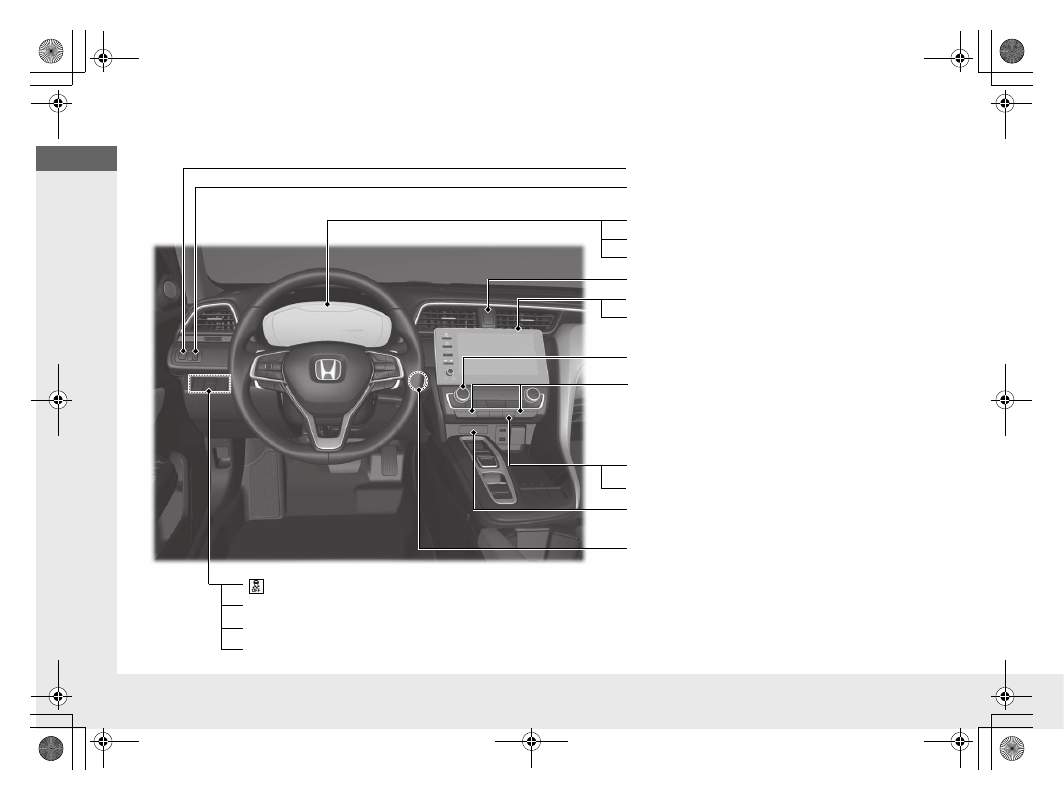
Visual Index

 (Vehicle Stability Assist® (VSA®) System OFF) Button 

(P 470)

Safety Support Switch 

(P 486, 519)

Acoustic Vehicle Alerting System OFF Button

*


(P 468)

TRIP Button 

(P 133)

System Indicators 

(P 80)

Gauges 

(P 128)

Driver Information Interface 

(P 131)

Brightness Control 

(P 203)

POWER Button 

(P 190)

Climate Control System 

(P 225)

Rear Defogger 

(P 202)

Heated Door Mirror Button 

(P 202)

Hazard Warning Button

Audio System 

(P 234)

Navigation System

*


() See the Navigation System Manual

Passenger Front Airbag Off Indicator 

(P 62)

Front Seat Heater Buttons

*


(P 223)

Fuel Fill Door Release Button 

(P 547)

5

Quick

 Referenc

e Guide

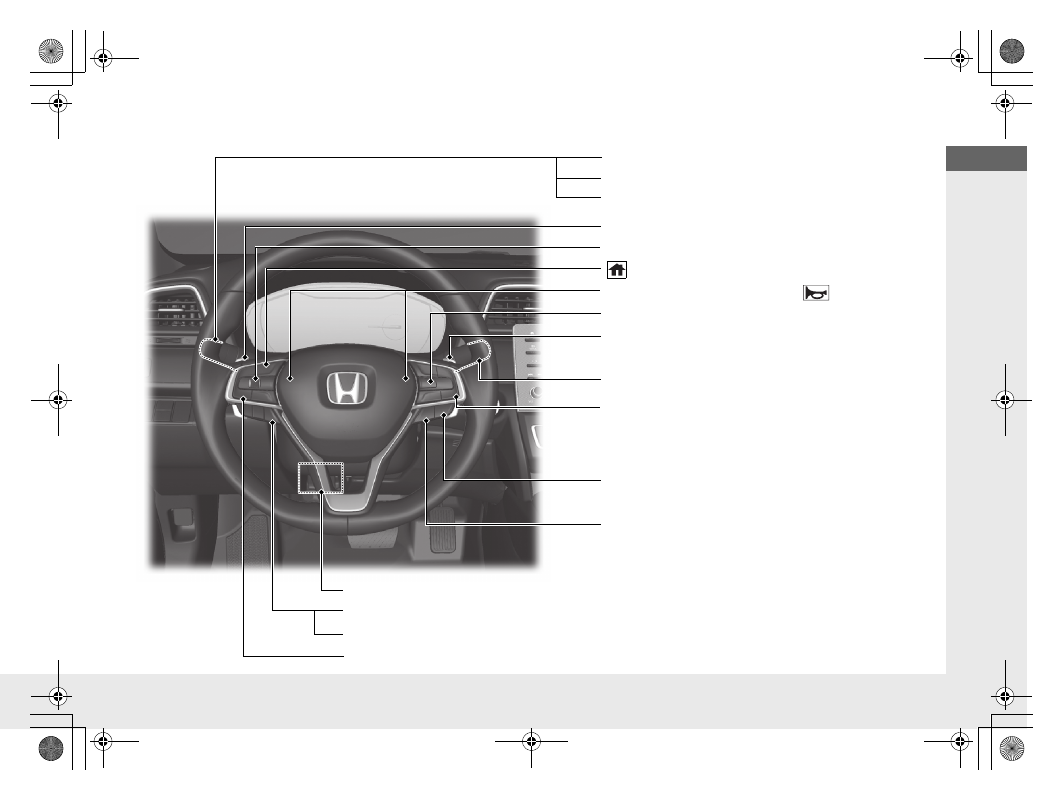
Headlights/Turn Signals 

(P 193)

Fog Lights

*


(P 196)

LaneWatch

TM*


(P 478)

Lane Keeping Assist System (LKAS) Button 

(P 511)

Interval Button 

(P 502)

Steering Wheel Adjustments 

(P 204)

Bluetooth® HandsFreeLink® System Voice Control Buttons 

(P 389, 414)

Audio Remote Controls 

(P 237)

Voice Control Buttons

*


(P 287)

Selector (−) 

(P 464)

Left Selector Wheel 

(P 132)

 (home) Button 

(P 132)

MAIN Button 

(P 493)

Adaptive Cruise Control (ACC) with Low 
Speed Follow (LSF) Buttons 

(P 501)

Wipers/Washers 

(P 200)

Selector (+) 

(P 464)

Horn (Press an area around 

.)

* Not available on all models

Visual Index

6

Quick

 Referenc

e Guide

Power Window Switches 

(P 186)

Master Door Lock Switch 

(P 178)

Door Mirror Controls 

(P 206)

Trunk Opener 

(P 180)

Interior Fuse Box 

(P 646)

Hood Release Handle 

(P 563)

Driver’s Front Airbag 

(P 54)

Rearview Mirror 

(P 205)

HomeLink® Buttons

*


(P 387)

Accessory Power Socket 

(P 221)

Passenger’s Front Airbag 

(P 54)

USB Port(s) 

(P 235)

Glove Box 

(P 217)

ECON Button 

(P 467)

SPORT Button 

(P 463)

EV Button 

(P 12)

Shift Button
Electronic Gear Selector 

(P 457)

Rear Seat Heater Buttons

*


(P 224)

Automatic Brake Hold Button 

(P 536)

Electric Parking Brake Switch 

(P 531)

7

Quick

 Referenc

e Guide

Side Curtain Airbags 

(P 60)

Interior Light 

(P 215)

Grab Handle

Coat Hook 

(P 222)

Side Airbags 

(P 58)

Seat Belt (Installing a Child Seat) 

(P 71)

Seat Belt to Secure a Child Seat 

(P 73)

LATCH to Secure a Child Seat 

(P 69)

Rear Seats 

(P 210)

Seat Belts 

(P 44)

Coat Hooks 

(P 222)

Sun Visors

Vanity Mirrors

Front Seat 

(P 207)

Map Lights 

(P 216)

Moonroof Switch

*


(P 189)

* Not available on all models

Visual Index

8

Quick

 Referenc

e Guide

Maintenance Under the Hood 

(P 562)

Windshield Wipers 

(P 200, 579)

Door Lock/Unlock Control 

(P 169)

Power Door Mirrors 

(P 206)

Headlights 

(P 193, 575)

High-Mount Brake Light 

(P 578)

Emergency Trunk Opener 

(P 182)

Opening/Closing the Trunk 

(P 180)

Parking/Daytime Running Lights 

(P 193, 196, 575)

Fog Lights

*


(P 196, 575)

Trunk Release Button

*


(P 181)

Brake Lights 

(P 576)

Rear Side Marker Lights/Taillights 

(P 576)

Rear Turn Signal Lights 

(P 576)

Back-Up Lights 

(P 577)

How to Refuel 

(P 547)

Tires 

(P 582, 605, 611)

Taillights 

(P 577)

Multi-View Rear Camera 

(P 543)

Rear License Plate Light 

(P 578)

Front Turn Signal Lights 

(P 193, 575)

Front Side Marker Lights 

(P 193, 575)

Side Turn Signal Lights

*


(P 193, 575)

9

Quick

 Referenc

e Guide

SPORT HYBRID i-MMD (intelligent Multi Mode 
Drive)

Your SPORT HYBRID i-MMD vehicle uses both an electric motor and a gasoline engine as propulsion sources, with the electric motor 
receiving electricity from an internal High Voltage battery or internal generator. The High Voltage battery can be charged from the 
generator driven by the engine or regenerative braking.

When driving, your vehicle is propelled exclusively by the electric motor, exclusively by the gasoline engine, or by a combination of the two. 
The system selects which propulsion source is most appropriate and automatically switches to it. Under certain circumstances, pressing the 
EV button can manually enable EV (driven only on electricity) mode.

● Energy efficiency
As with a gasoline-powered vehicle, hybrid vehicle fuel efficiency and driving range is most impacted by your driving style. Aggressive 
acceleration and high-speed driving can easily trigger the system to switch the propulsion source to the gasoline-powered engine.
In addition, heavy climate control system use negatively affects vehicle range and efficiency. Either of these use patterns will more quickly 
reduce the High Voltage battery's state of charge.

● Battery types
There are two types of batteries used in this vehicle; a standard 12-volt battery that powers the airbags, the interior and exterior lights, and 
other standard 12-volt systems; and a high voltage battery that is used to power the propulsion motor and recharge the 12-volt battery.

* Not available on all models

10

Quick

 Referenc

e Guide

SPORT HYBRID i-MMD SYSTEM MAIN COMPONENTS

Gasoline Engine

– Provides propulsion to drive the wheels 

under certain driving conditions, and turns the generator.

Generator

– Starts the engine and generates electric power 

when driven by the gasoline engine to supply electricity to 
power the electric motor and/or to charge the High Voltage 
battery.

Electric Motor

– Provides propulsion to drive the wheels in 

conjunction with the gasoline engine in certain conditions, and 
provides electricity to the High Voltage battery through 
regenerative braking.

High Voltage Battery

– Provides electrical storage and serves 

as a power source for the electric motor.
Learning about the High Voltage battery’s characteristics will 
help you get the best handling and maximize the range of your 
electric vehicle. 

(P477)

High Voltage Battery Charge Level Indicator

– Displays 

battery state of charge.
When the indicator:

Displays two or less segments, EV mode is no longer available.

Displays ten segments, battery charge level is full.

High Voltage Battery

Generator & Electric Motor

Gasoline Engine

11

Quick

 Referenc

e Guide

Operating 

mode

Electric Vehicle (EV)

Hybrid (HV)

Engine (Direct Drive)

Regeneration

Driving 

Speed

Stopped or driven at low speeds:

Only the electric motor 
provides propulsion to the 
wheels.

Driven in high-load conditions 
(e.g., when accelerating, going 
uphill):

The Electric Motor provides 
propulsion to the wheels.

The gasoline engine drives the 
generator, supplying 
electricity to the electric 
motor for added propulsion 
or to the High Voltage battery 
for charging.

Driven in high-speed, low-load 
conditions:

The gasoline engine provides 
propulsion to the wheels.

The High Voltage battery 
supplies electricity to the 
electric motor for added 
propulsion.

The electric motor provides 
electricity to the High Voltage 
battery through regenerative 
braking.

The accelerator pedal is released 
and the vehicle is decelerating.

The electric motor provides 
electricity to the High Voltage 
battery through regenerative 
braking.

Power Flow 

Monitor

Electric motor

Stopped/Running

Running

Generating/Running

Regenerating

Generator

Stopped

Generating

No Output

Stopped/No Output

Engine

Stopped

Running

Running

Stopped/No Output

High Voltage 

battery

Discharge

Charging/Discharge

Charging/Discharge

Charging

Vehicle 
Speed

Time

12

Quick

 Referenc

e Guide

EV Button

EV mode is enabled by pressing the EV button near the shift 
button.

The EV mode indicator comes on in the instrument panel when EV 
mode is enabled.

Press the EV button again to switch back to HV mode.

Some conditions, such as a low High Voltage battery level and a 
high vehicle speed, may keep the system from manually switching 
into EV mode. The beeper sounds and a message appears on the 
driver information interface with the button pressed when EV 
mode is disabled.

Shifts in vehicle, driving or road conditions may automatically 
cancel EV mode and switch back to HV mode.

A message will appear on the driver information interface and EV mode may be canceled automatically when:
● The High Voltage battery charge level is low.

● Your vehicle speed is too high.

● Your vehicle speed is above 25 mph (40 km/h) while the engine is in warming-up operation.

● You fully depress the accelerator pedal.

● You are driving on hilly road.

Driver Information Interface Warning and Information Messages (P102)

In EV mode, the acoustic vehicle alerting system is on. 

Acoustic Vehicle Alerting System (P468)

Press

Canadian models

13

Quick

 Referenc

e Guide

● Regenerative Energy and Regenerative Braking

When the vehicle is decelerating or descending a hill, the electric motor acts as a generator that 
recovers a portion of the energy that was used to accelerate the vehicle.
The regenerative force that the electric motor applies to the wheels when it is in regenerative 
mode helps to slow the vehicle down in a manner similar to engine braking which is used on 
conventional vehicles. If you want to slow the vehicle down at a faster rate without using the 
brakes, you can use the deceleration paddle selector to increase the resistive force.

When regenerative braking is in 
operation

Motor

High 
Voltage 
Battery

14

Quick

 Referenc

e Guide

● Auto Engine Stop/Start
Your vehicle's gasoline engine automatically stops running during vehicle operation or restarts while the vehicle is stationary when it is 
appropriate.
In the following cases, however, auto engine stop may not activate.

The vehicle momentarily needs additional power for aggressive acceleration, or driving uphill or at high speed.

The climate control system is in heavy use.

The High Voltage battery temperature is high or low.

● Sounds Unique to the SPORT HYBRID i-MMD System
When you first start driving this vehicle, you will likely hear some unfamiliar sounds, particularly when you turn on the power system, or 
while you are driving or accelerating from a stop. Some of these sounds are unique to this vehicle’s powertrain, fuel, and climate control 
systems; others are similar to sounds generated by conventional automobiles that typically are masked by louder noises absent from a 
vehicle of this design. These sounds are not a cause for concern, and you will soon recognize them as normal and thus be able to detect any 
new or unusual noise should one develop.

After shutting off the engine, you may hear certain noises coming from the vehicle. Here’s the lowdown:

Noise from Under Vehicle: This noise is caused by the vacuum pump inside the fuel evaporation leakage check module (ELCM). 
Depending on conditions, the pump will come on for about 15 minutes about 5 to 10 hours after engine shutoff. This noise is just normal 
vehicle operation and don’t indicate a vehicle problem.


Content   ..    1  2   ..