Harley Davidson 1986-2003 XL/XLH Sportster. Service Manual - page 3
home mechanic. Always use the correct tools for the job at
hand. Keep tools organized and clean. Store them in a tool
chest with related tools organized together.
Quality tools are essential. The best are constructed of
high-strength alloy steel. These tools are light, easy to use
and resistant to wear. Their working surface is devoid of
sharp edges and the tool is carefully polished. They have an
easy-to-clean finish and are comfortable to use. Quality
tools are a good investment.
When purchasing tools to perform the procedures cov-
ered in this manual, consider the tool’s potential frequency
of use. If starting a new tool kit, consider purchasing a basic
tool set from a quality tool supplier. These sets are available
in many tool combinations and offer substantial savings
when compared to individually purchased tools. As work
experience grows and tasks become more complicated,
specialized tools can be added.
Some of the procedures in this manual specify special
tools. Refer to Table 12. In most cases, the tool is illustrated
in use. Well-equipped mechanics may be able to substitute
similar tools or fabricate a suitable replacement. However,
in some cases, the specialized equipment or expertise may
make it impractical for the home mechanic to attempt the
procedure. When necessary, such operations are identified
in the text with the recommendation to have a dealership or
specialist perform the task. It may be less expensive to have
a professional perform these jobs, especially when consid-
ering the cost of the equipment.
The manufacturer’s part number is provided for many of
the tools mentioned in this manual. These part numbers are
correct at the time of original publication. The publisher
cannot guarantee the part number or the tools in this manual
will be available in the future.
Screwdrivers
Screwdrivers of various lengths and types are mandatory
for the simplest tool kit. The two basic types are the slotted
tip (flat blade) and the Phillips tip. These are available in
sets that often include an assortment of tip sizes and shaft
lengths.
As with all tools, use a screwdriver designed for the job.
Make sure the size of the tip conforms to the size and shape
of the fastener. Use them only for driving screws. Never use
a screwdriver for prying or chiseling metal. Repair or re-
place worn or damaged screwdrivers. A worn tip may dam-
age the fastener, making it difficult to remove.
Wrenches
Open-end, box-end and combination wrenches (Figure
11) are available in a variety of types and sizes.
The number stamped on the wrench refers to the distance
between the work areas. This size must match the size of the
fastener head.
The box-end wrench is an excellent tool because it grips
the fastener on all sides. This reduces the chance of the tool
slipping. The box-end wrench is designed with either a 6-
or 12-point opening. For stubborn or damaged fasteners,
the 6-point provides superior holding ability by contacting
the fastener across a wider area at all six edges. For general
use, the 12-point works well. It allows the wrench to be re-
moved and reinstalled without moving the handle over such
a wide arc.
An open-end wrench is fast and works best in areas with
limited overhead access. It contacts the fastener at only two
points, and is subject to slipping under heavy force, or if the
tool or fastener is worn. A box-end wrench is preferred in
most instances, especially when breaking loose and apply-
ing the final tightness to a fastener.
The combination wrench has a box-end on one end, and
an open-end on the other. This combination makes it a very
convenient tool.
Adjustable Wrenches
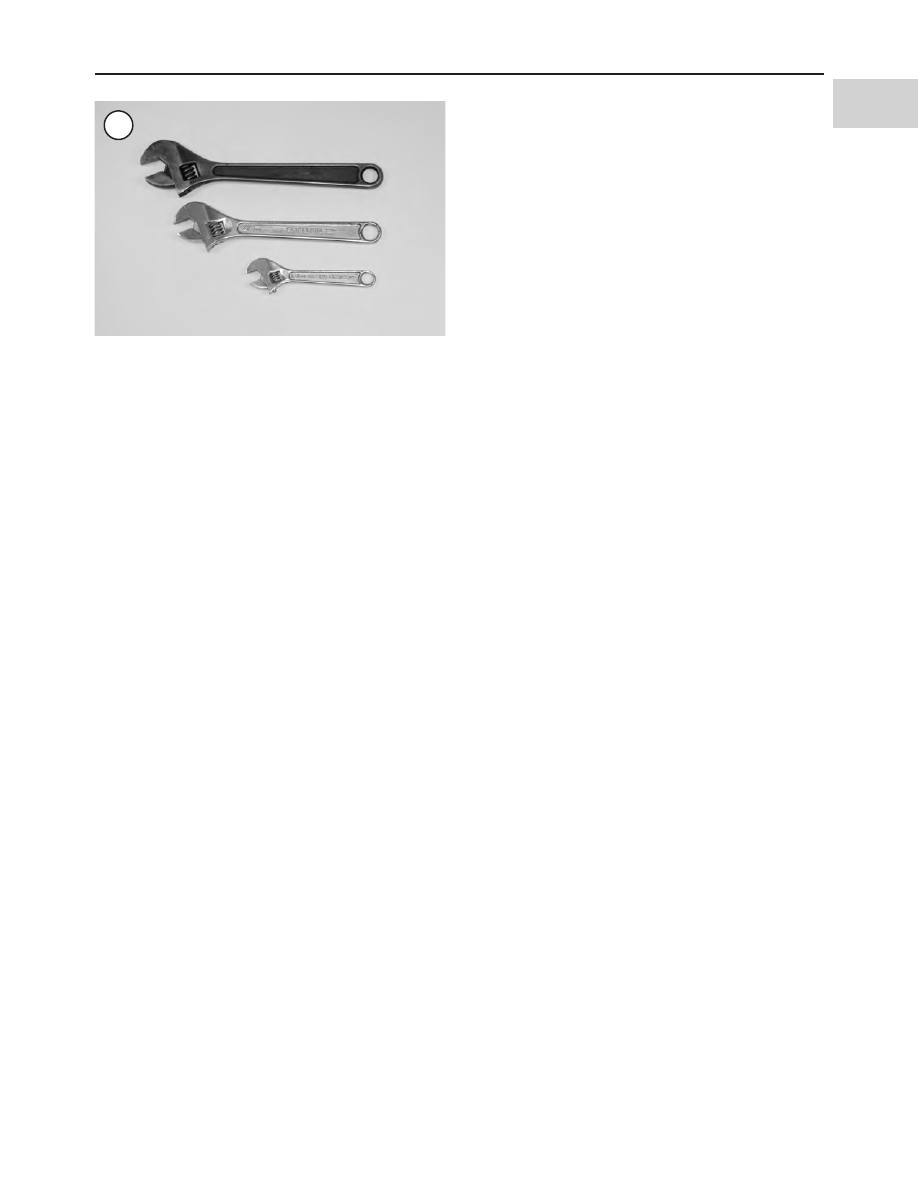
An adjustable wrench, or Crescent wrench (Figure 12),
can fit nearly any nut or bolt head that has clear access
around its entire perimeter. Adjustable wrenches are best
used as a backup wrench to keep a large nut or bolt from
turning while the other end is being loosened or tightened
with a box-end or socket wrench.
Adjustable wrenches contact the fastener at only two
points, which makes them more subject to slipping off the
fastener. The fact that one jaw is adjustable and may loosen
only aggravates this shortcoming. Make certain the solid
jaw is the one transmitting the force.
Socket Wrenches, Ratchets and Handles
WARNING
Do not use hand sockets with air or impact
tools, as they may shatter and cause injury.
Always wear eye protection when using im-
pact or air tools.
GENERAL INFORMATION
9
1
12