Harley Davidson 1986-2003 XL/XLH Sportster. Service Manual - page 2
NOTE
To ensure that the fastener threads are not
mismatched or cross-threaded, start all fas-
teners by hand. If a fastener is hard to start or
turn, determine the cause before tightening
with a wrench.
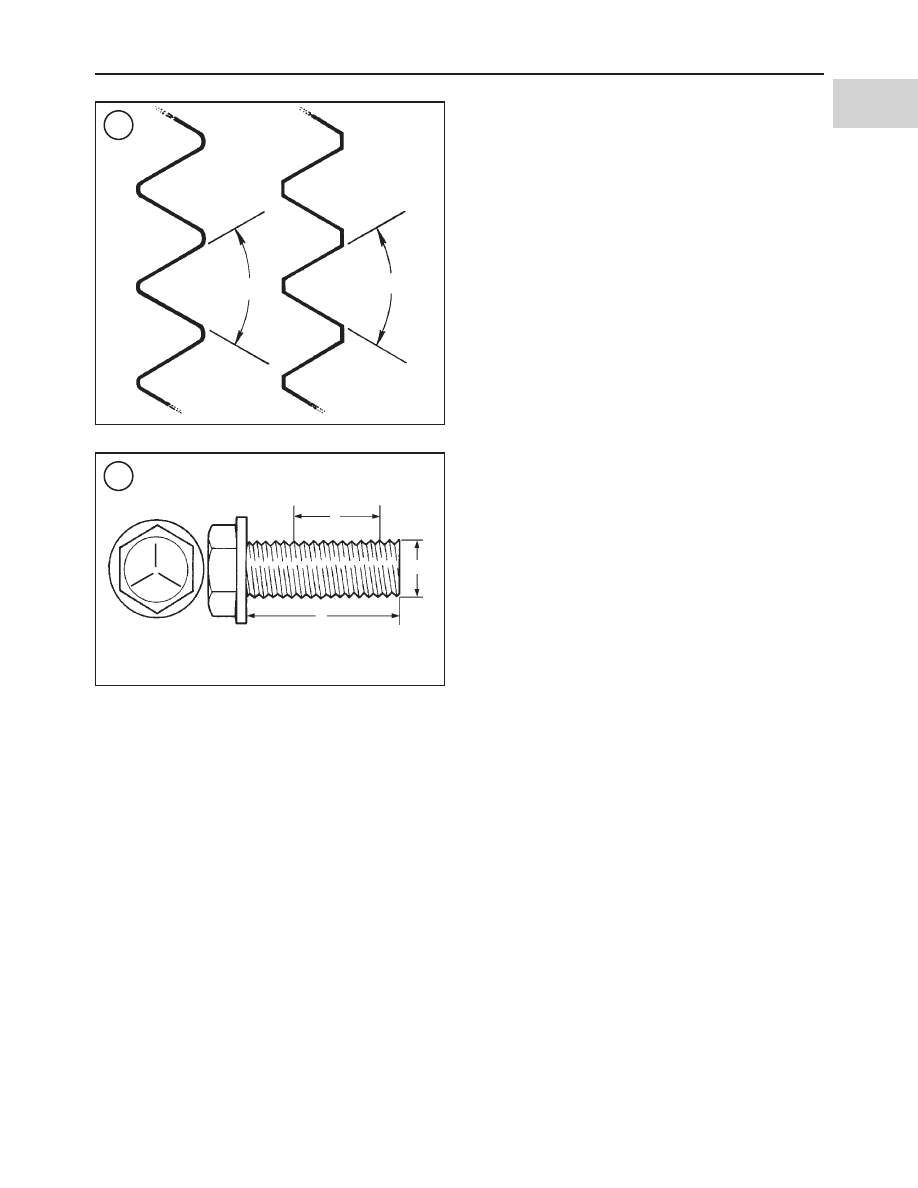
The length (L,
Figure 6
), diameter (D) and number of
threads per inch (TPI) (T) classify U.S. Standard screws
and bolts. A typical bolt may be identified by the numbers
1/4–20×1-1/2. This indicates the bolt has a 1/4-inch diame-
ter, 20 threads per inch and the length is 1-1/2 inches.
Sometimes thread count is noted as either course or fine.
Always measure bolt length as shown in L,
Figure 6
to
avoid purchasing replacements of the wrong length.
Markings on top of the fastener (
Figure 6
) indicate the
strength of U.S. Standard screws and bolts. The greater the
number of head markings, the stronger the fastener. Un-
marked fasteners are the weakest.
Many screws, bolts and studs are combined with nuts to
secure particular components. To indicate the size of a nut,
manufacturers specify the internal diameter and the TPI.
The measurement across two flats on a nut or bolt indi-
cates the wrench size.
Torque Specifications
The materials used in the manufacture of the motorcycle
may be subjected to uneven stresses if the fasteners of the
various subassemblies are not installed and tightened cor-
rectly. Fasteners that are improperly installed or work loose
can cause extensive damage. It is essential to use an accu-
rate torque wrench, as described in this chapter, with the
torque specifications in this manual.
Specifications for torque are provided in foot-pounds
(ft.-lb.), inch-pounds (in.-lb.) and Newton-meters (N•m).
Refer to
Table 6
for general torque specifications. To use
Table 6
, first determine the size of the fastener as described
in this section. Torque specifications for specific compo-
nents are at the end of the appropriate chapters. Torque
wrenches are covered in this chapter.
Self-Locking Fasteners
Several types of bolts, screws and nuts incorporate a sys-
tem that creates interference between the two fasteners. In-
terference is achieved in various ways. The most common
types are the nylon insert nut and a dry adhesive coating on
the threads of a bolt.
Self-locking fasteners offer greater holding strength than
standard fasteners, which improves their resistance to vi-
bration. Self-locking fasteners cannot be reused. The mate-
rial used to form the lock becomes distorted after the initial
installation and removal. Discard and replace self-locking
fasteners after their removal. Do not replace self-locking
fasteners with standard fasteners.
Washers
There are two basic types of washers: flat washers and
lockwashers. Flat washers are simple discs with a hole to fit
a screw or bolt. Lockwashers are used to prevent a fastener
from working loose. Washers can be used as spacers and
seals, or to help distribute fastener load and to prevent the
fastener from damaging the component.
As with fasteners, when replacing washers make sure the
replacement washers are of the same design and quality.
Cotter Pins
A cotter pin is a split metal pin inserted into a hole or slot
to prevent a fastener from loosening. In certain applica-
tions, such as the rear axle on a motorcycle, the fastener
must be secured in this way. For these applications, a cotter
pin and castellated (slotted) nut are used.
To use a cotter pin, first make sure the diameter is correct
for the hole in the fastener. After correctly tightening the
GENERAL INFORMATION
5
1
U.S. Standard
Metric
60°
60°
5
6
Grade marking
T
L
D