Ford Orion. Manual - part 18
Inner shield
14 Remove the timing belt, its tensioner
components and the camshaft toothed
pulleys (see Sections 10 and 11).
15 The shield is secured to the cylinder head
by two bolts at the top, and by two studs
lower down; unscrew these and withdraw the
shield (see illustration).
16 Refitting is the reverse of the removal
procedure; note the torque wrench settings
specified for the various fasteners.
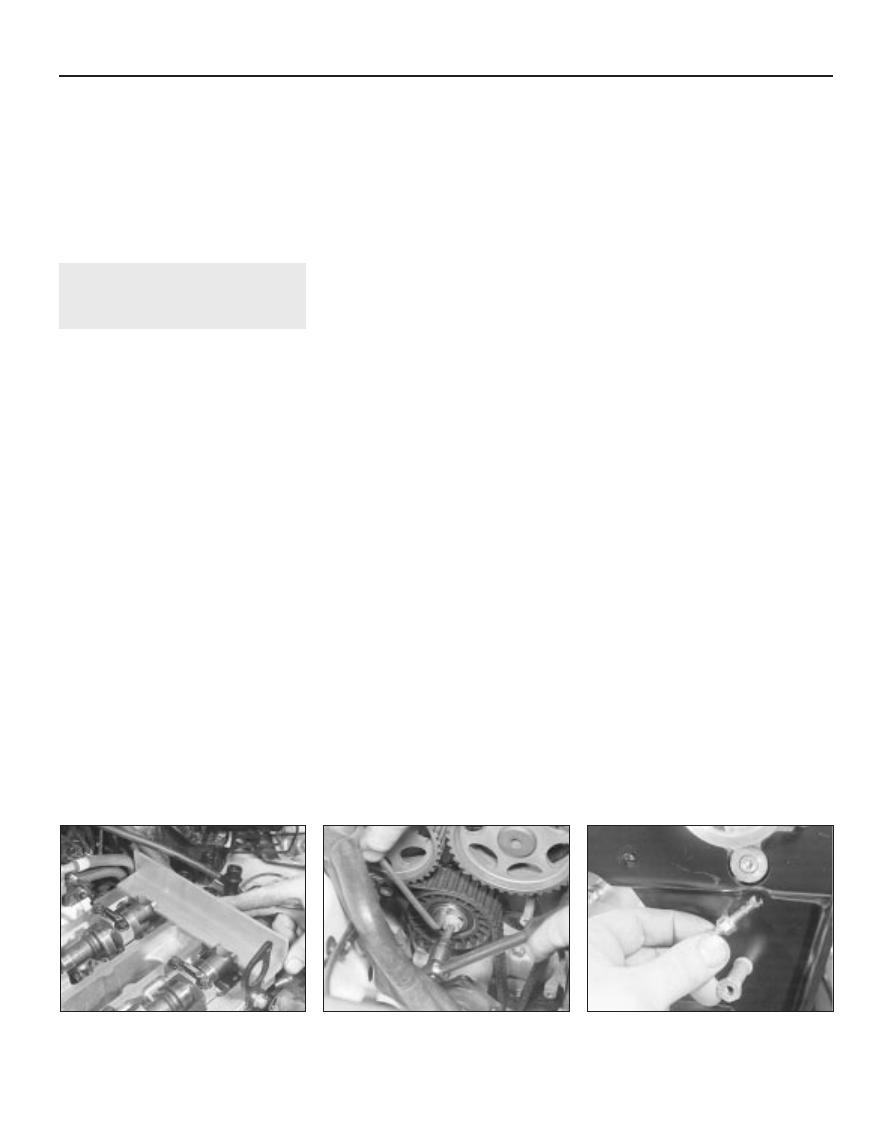
10 Timing belt - removal, refitting
and adjustment
4
Note: To carry out this operation, a new timing
belt (where applicable), a new cylinder head
cover gasket, and some special tools (see text)
will be required. If the timing belt is being
removed for the first time since the vehicle left
the factory, a tensioner spring and retaining
pin must be obtained for fitting on reassembly.
1 With the vehicle parked on firm level
ground, open the bonnet and disconnect the
battery negative (earth) lead - see Chapter 5,
Section 1.
2 Slacken the water pump pulley bolts.
3 Remove the cylinder head cover (see
Section 5).
4 Remove the spark plugs, covering their
holes with clean rag, to prevent dirt or other
foreign bodies from dropping in (see Chap-
ter 1).
5 Remove the auxiliary drivebelt (see Chap-
ter 1).
6 Rotate the crankshaft clockwise until the
second pair of notches in the pulley rim align
with the edge of the sump mark, so that Nos 1
and 4 cylinders are at TDC (see Section 4).
7 Unbolt and remove the water pump pulley
and the auxiliary drivebelt idler pulley.
8 Obtain Ford service tool 21-162, or
fabricate a substitute from a strip of metal
5 mm thick (while the strip’s thickness is
critical, its length and width are not, but
should be approximately 180 to 230 mm by
20 to 30 mm). Check that Nos 1 and 4
cylinders are at Top Dead Centre (TDC) - No 1
on the compression stroke - by resting this
tool on the cylinder head mating surface, and
sliding it into the slot in the left-hand end of
both camshafts (see illustration). The tool
should slip snugly into both slots while resting
on the cylinder head mating surface; if one
camshaft is only slightly out of alignment, it is
permissible to use an open-ended spanner to
rotate the camshaft gently and carefully until
the tool will fit.
9 If both camshaft slots (they are machined
significantly off-centre) are below the level of
the cylinder head mating surface, rotate the
crankshaft through one full turn clockwise and
fit the tool again; it should now fit as
described in the previous paragraph.
10 With the camshaft aligning tool remaining
in place, remove the crankshaft pulley. Do not
use the locked camshafts to prevent the
crankshaft from rotating - use only the locking
method described in Section 8.
11 Remove the timing belt lower and middle
covers (see Section 9).
12 With the camshaft-aligning tool still in
place, slacken the tensioner bolt, and use an
Allen key inserted into its centre to rotate the
tensioner clockwise as far as possible away
from the belt; retighten the bolt to secure the
tensioner clear of the timing belt (see
illustration).
13 If the timing belt is to be re-used, use
white paint or similar to mark its direction of
rotation, and note from the manufacturer’s
markings which way round it is fitted.
Withdraw the belt. Do not
rotate the
crankshaft until the timing belt is refitted.
14 If the belt is being removed for reasons
other than routine renewal, check it carefully
for any signs of uneven wear, splitting, cracks
(especially at the roots of the belt teeth) or
contamination with oil or coolant. Renew the
belt if there is the slightest doubt about its
condition. As a safety measure, the belt must
be renewed as a matter of course at the
intervals given in Chapter 1; if its history is
unknown, the belt should be renewed
irrespective of its apparent condition
whenever the engine is overhauled. Similarly,
check the tensioner spring (where fitted),
renewing it if there is any doubt about its
condition. Check also the toothed pulleys for
signs of wear or damage, and ensure that the
tensioner and guide pulleys rotate smoothly
on their bearings; renew any worn or
damaged components. If signs of oil or
coolant contamination are found, trace the
source of the leak and rectify it, then wash
down the engine timing belt area and related
components, to remove all traces of oil or
coolant.
15 On reassembly, temporarily refit the
crankshaft pulley, to check that the pulley
notches and sump rib are aligned as
described in paragraph 6 above, then ensure
that both camshafts are aligned at TDC by the
special tool (paragraph 8). If the engine is
being reassembled after major dismantling,
both camshaft toothed pulleys should be free
to rotate on their respective camshafts; if the
timing belt alone is being renewed, both
pulleys should still be securely fastened.
16 A holding tool will be required to prevent
the camshaft toothed pulleys from rotating
while their bolts are slackened and
retightened; either obtain Ford service tool
15-030A, or fabricate a substitute as follows.
Find two lengths of steel strip, one
approximately 600 mm long and the other
about 200 mm, and three bolts with nuts and
washers; one nut and bolt forming the pivot of
a forked tool, with the remaining nuts and
bolts at the tips of the “forks”, to engage with
the pulley spokes as shown in the
accompanying illustrations. Note: Do not use
the camshaft-aligning tool (whether genuine
Ford or not) to prevent rotation while the
camshaft toothed pulley bolts are slackened
or tightened; the risk of damage to the
camshaft concerned and to the cylinder head
is far too great. Use only a forked holding tool
applied directly to the pulleys, as described.
17 If it is being fitted for the first time, screw
the timing belt tensioner spring retaining pin
into the cylinder head, tightening it to the
specified torque wrench setting. Unbolt the
tensioner, hook the spring on to the pin and
the tensioner backplate, then refit the
tensioner, engaging its backplate on the
locating peg (see illustrations).
18 In all cases, slacken the tensioner bolt (if
2C•10 Zetec engine – in-car engine repair procedures
10.17A Fitting tensioner spring retaining
pin
10.12 Slacken tensioner bolt, and use
Allen key to rotate tensioner away from
timing belt
10.8 Fit camshaft-aligning tool to ensure
engine is locked with Nos 1 and 4 cylinders
at TDC