Ford Contour (1999 year). Manual - part 26
 

  Index      Ford     Ford Contour - service manual 1999 year in english


Search            


Content   ..  24  25  26  27   ..


Ford Contour (1999 year). Manual - part 26


Seating and safety restraints

102

8. Allow the safety belt to retract to
remove any slack in the belt.

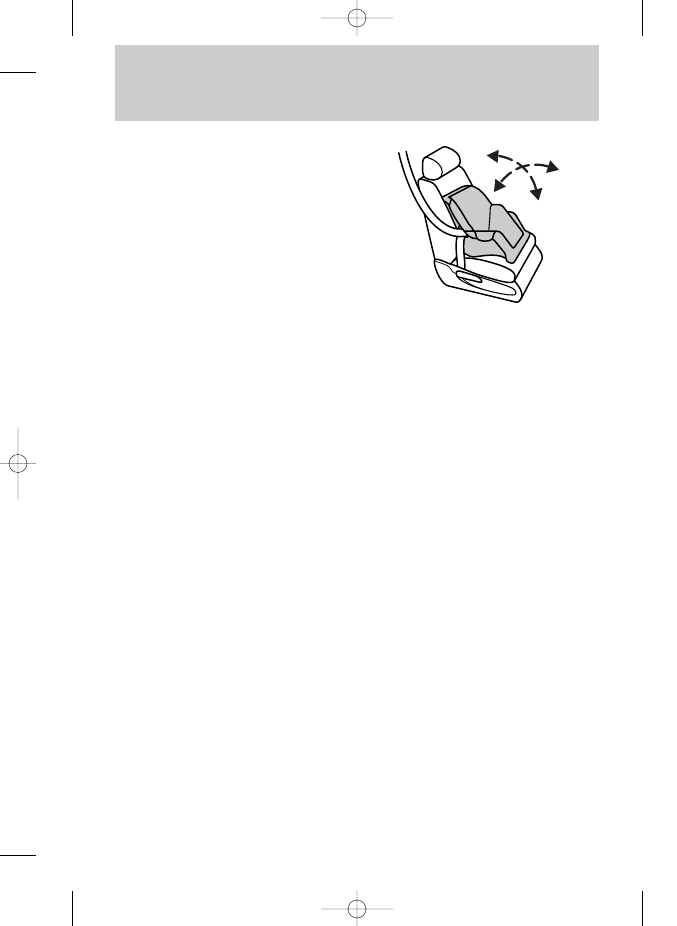
9. Before placing the child in the
seat, forcibly tilt the seat forward
and back to make sure the seat is
securely held in place.

10. Try to pull the belt out of the
retractor to make sure the
retractor is in automatic locking
mode (you should not be able to
pull more belt out). If the retractor
is not locked, unbuckle the belt and
repeat steps two through nine.

Check to make sure the child seat
is properly secured before each
use.

Attaching safety seats with
tether straps

Some manufacturers make safety
seats that include a tether strap
that goes over the back of the
vehicle seat and attaches to an
anchoring point. Other
manufacturers offer their tether
strap as an accessory. Contact the
manufacturer of your child safety
seat for information about ordering
a tether strap.

14CSSen  3/25/99  1:59 PM  Page 102

Seating and safety restraints

103

To install a tether from a child
safety seat in the front seat, route
the tether strap under the vehicle
seat head restraint and hook the
tether hook into the hole in the
tongue of the center rear lap belt.
After the hook is in the hole, pull
on the loose end of the lap belt
webbing to shorten the belt and
tighten the tether strap.

To install a tethered child safety
seat in the rear seat, you will need
tether anchor hardware.

Tether anchor hardware

Tether anchor hardware kits (part
number 613D74), including
instructions, may be obtained at no
charge from any Ford or Lincoln-
Mercury dealer. All vehicles built
for sale in Canada include a tether
anchor hardware kit.

Tighten the anchor
according to specifications.

Otherwise, the safety seat may not
be properly secured and the child
may be injured in a sudden stop or
collision.

14CSSen  3/25/99  1:59 PM  Page 103

Starting

104

Extended idling at high
engine speeds can produce

very high temperatures in the
engine and exhaust system,
creating the risk of fire or other
damage.

IMPORTANT SAFETY
PRECAUTIONS

A computer system controls the
engine’s idle revolutions per minute
(rpm). When the engine starts, the
idle rpm runs faster to warm the
engine. If the engine idle speed
does not slow down automatically,
have the vehicle checked by your
dealer or a qualified service
technician. Do not allow the vehicle
to idle for more than ten minutes.

Do not park, idle, or drive
your vehicle in dry grass or

other dry ground cover. The
emission system heats up the
engine compartment and exhaust
system, which can start a fire.

21CSten  3/25/99  3:27 PM  Page 104

Starting

105

IMPORTANT VENTILATION
INFORMATION

If the engine is idling while the
vehicle is stopped in an open area
for long periods of time, open the
windows at least 2.5 cm (1 inch).

OFF

PNL/FLR

PANEL

A/C

FLOOR

DEF

FLR 

       DEF

MAX

A/C

/

Adjust the heating or air
conditioning to bring in fresh air.

Do not start your vehicle in a
closed garage or in other

enclosed areas. Exhaust fumes
can be toxic. Always open the
garage door before you start the
engine. See Guarding against
exhaust fumes 
in this chapter for
more instructions.

21CSten  3/25/99  3:27 PM  Page 105


Content   ..  24  25  26  27   ..