Citroen C4 (2023 year). Manual in english - page 12
6-1. Using the air conditioning system and defogger
447
WARNING
■ To prevent the windshield from fogging up
●Do not use
during cool air operation in extremely humid weather. The
difference between the temperature of the outside air and that of the wind-
shield can cause the outer surface of the windshield to fog up, blocking
your vision.
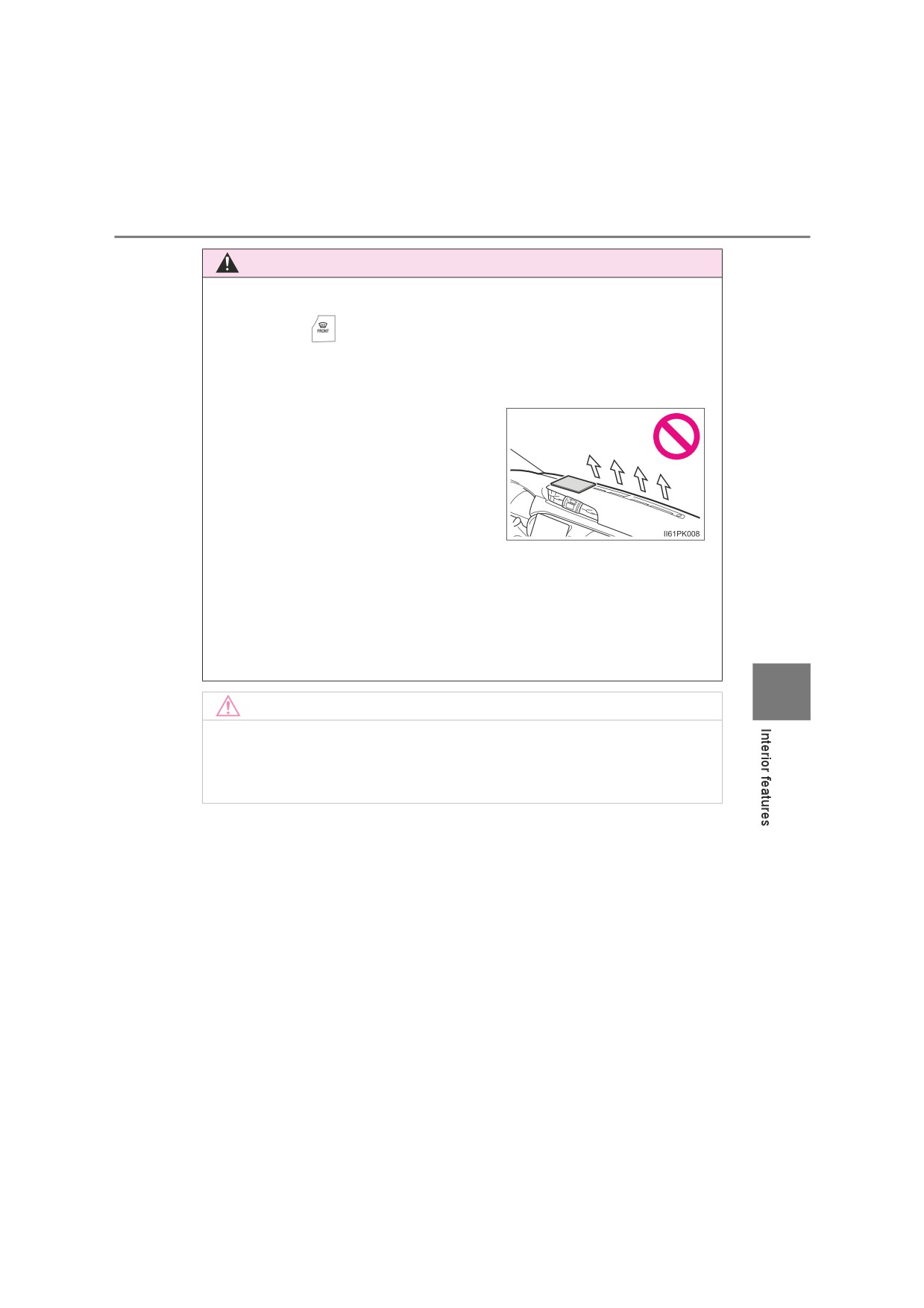
●Do not place anything on the instrument
panel which may cover the air outlets.
Otherwise, air flow may be obstructed,
preventing the windshield defoggers
from defogging.
■ To prevent burns
● Vehicles with outside rear view
mirror defoggers: Do not touch the rear
view mirror surfaces
when the outside rear view mirror defoggers are on.
● Vehicles with windshield wiper de-icer: Do not touch the glass at lower part
of the windshield or the side of the front pillars when the windshield wiper
de-icer is on.
6
NOTICE
■ To prevent battery discharge
Do not leave the air conditioning system on longer than necessary when the
engine is not running.
448
6-1. Using the air conditioning system and defogger
Heated steering wheel/seat heaters
Heated steering wheel and seat heaters heat the side grips of the
steering wheel and seats, respectively.
WARNING
●Care should be taken to prevent injury if anyone in the following categories
comes in contact with the steering wheel and seats when the heater is on:
• Babies, small children, the elderly, the sick and the physically chal-
lenged
• Persons with sensitive skin
• Persons who are fatigued
• Persons who have taken alcohol or drugs that induce sleep (sleeping
drugs, cold remedies, etc.)
●Observe the following precautions to prevent minor burns or overheating:
• Do not cover the seat with a blanket or cushion when using the seat
heater.
• Do not use seat heater more than necessary.
NOTICE
●Do not put heavy objects that have an uneven surface on the seat and do
not stick sharp objects (needles, nails, etc.) into the seat.
● To prevent battery discharge, do not use the functions when the engine is
not running.
: If equipped
6-1. Using the air conditioning system and defogger
449
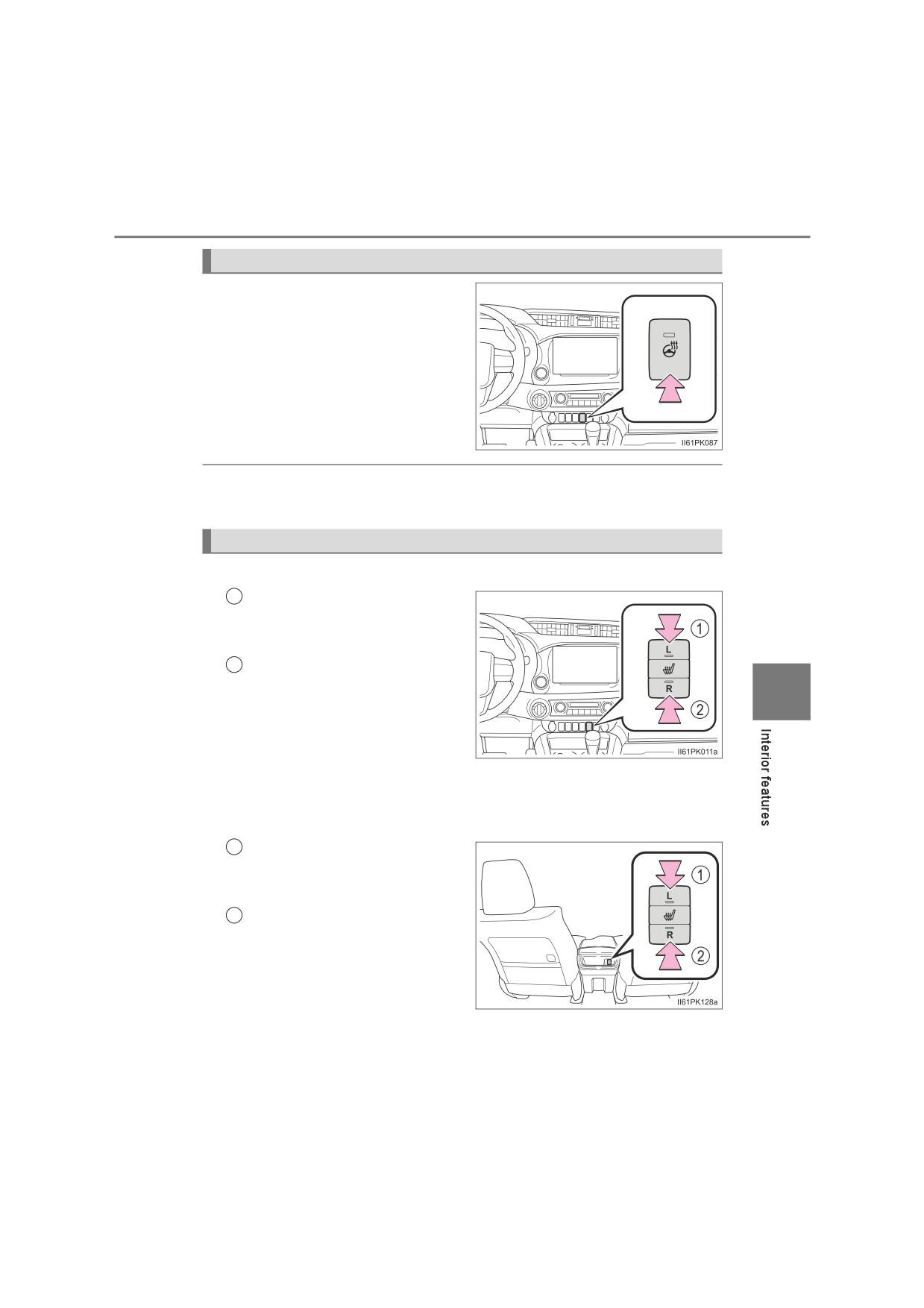
Heated steering wheel
Turns the steering wheel heater
on/off
The indicator light comes on when
the heater is operating.
The heated steering wheel can be used when the engine switch is in the “ON”
position (vehicles without smart entry & start system) or IGNITION ON mode
(vehicles with smart entry & start system).
Seat heaters
■ Front seats
1
Turns on the front left seat
heater
The indicator light comes on.
2
Turns on the front right seat
heater
6
The indicator light comes on.
This illustration is for a left-hand drive vehicle. The switch posi-
tion differs for right-hand drive vehicles.
■ Rear seats (if equipped)
1
Turns on the rear left seat
heater
The indicator light comes on.
2
Turns on the rear right seat
heater
The indicator light comes on.
450
6-1. Using the air conditioning system and defogger
● The seat heaters can be used when the engine switch is in the “ON” position
(vehicles without smart entry & start system) or IGNITION ON mode (vehi-
cles with smart entry & start system).
● When not in use, press the seat heater switch to turn the seat heater off.
The indicator light turns off.
6-2. Using the interior lights
451
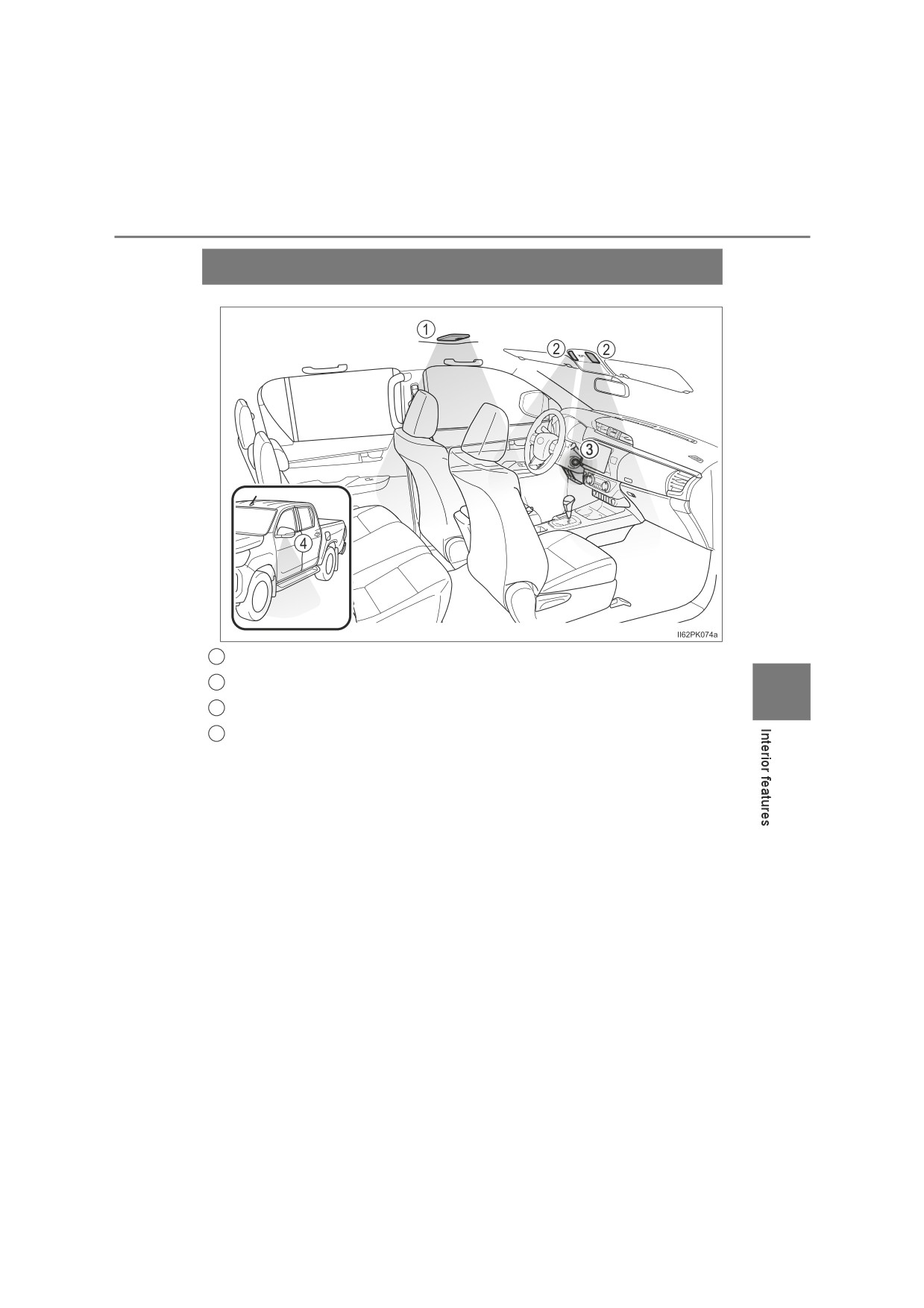
Interior lights list
1
Interior light (if equipped) (P. 452)
2
Personal/interior lights (P. 452)
6
3
Engine switch light
4
Outer foot lights (if equipped)
452
6-2. Using the interior lights
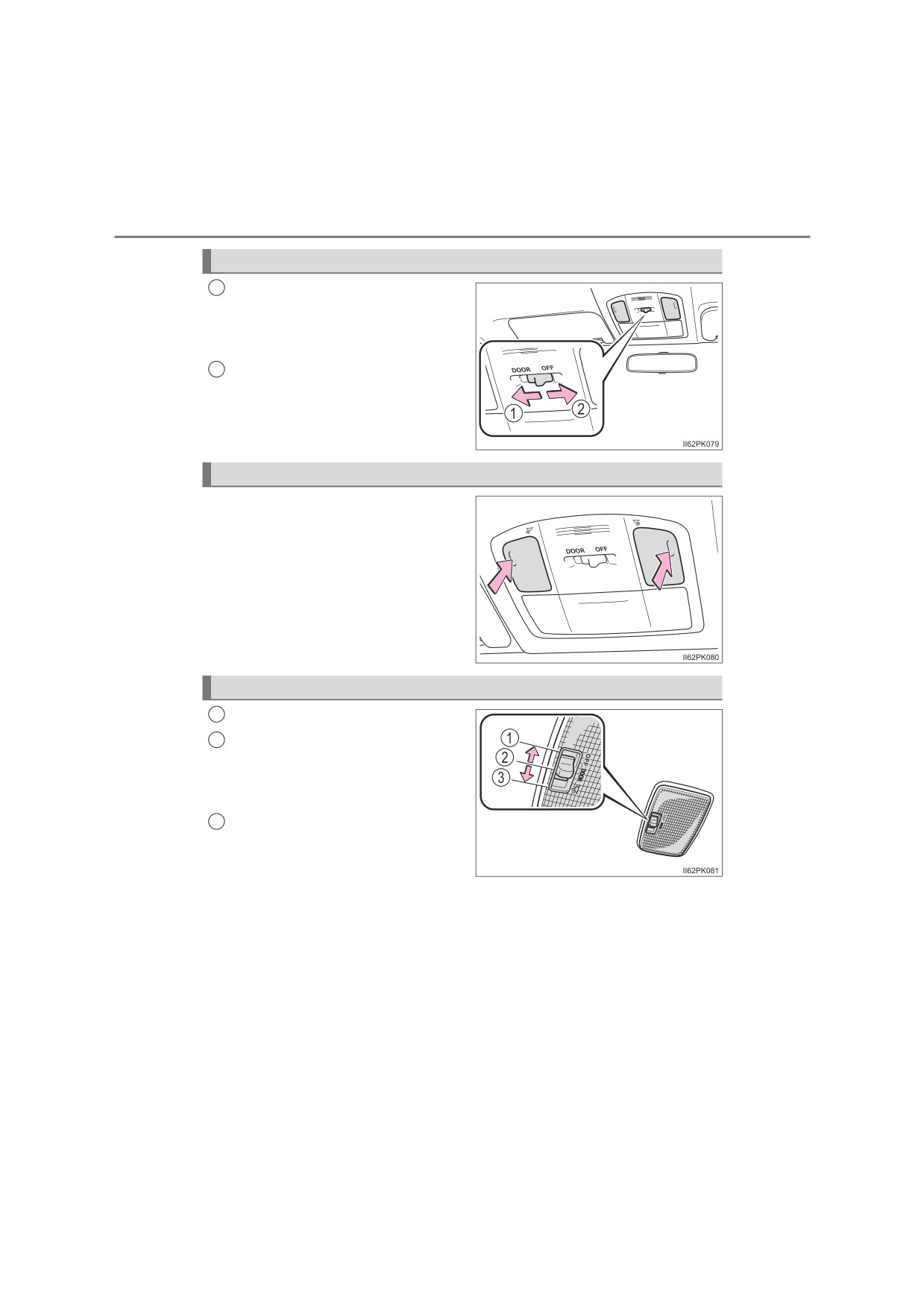
Personal/interior light main switch
1
Door position
The personal/interior lights come
on when a door is opened. They
turn off when the doors are closed.
2
Off
The personal/interior lights can be
individually turned on or off.
Personal/interior lights
On/off
Interior light (if equipped)
1
Off
2
Door position
The interior light comes on when a
door is opened. It turns off when
the doors are closed.
3
On
6-2. Using the interior lights
453
●Illuminated entry system:
Vehicles without smart entry & start system
The lights automatically turn on/off according to the engine switch position,
whether the doors are locked/unlocked, and whether the doors are opened/
closed.
Vehicles with smart entry & start system
The lights automatically turn on/off according to engine switch mode,
whether the doors are locked/unlocked, and whether the doors are opened/
closed.
●If the following lights remain on when the engine switch is turned to the
“LOCK” position (vehicles without smart entry & start system) or off (vehicles
with smart entry & start system), the lights will go off automatically after 20
minutes:
• Personal/interior light
• Interior light (if equipped)
• Engine switch light
NOTICE
To prevent battery discharge, do not leave the lights on longer than neces-
sary when the engine is not running.
6
454
6-3. Using the storage features
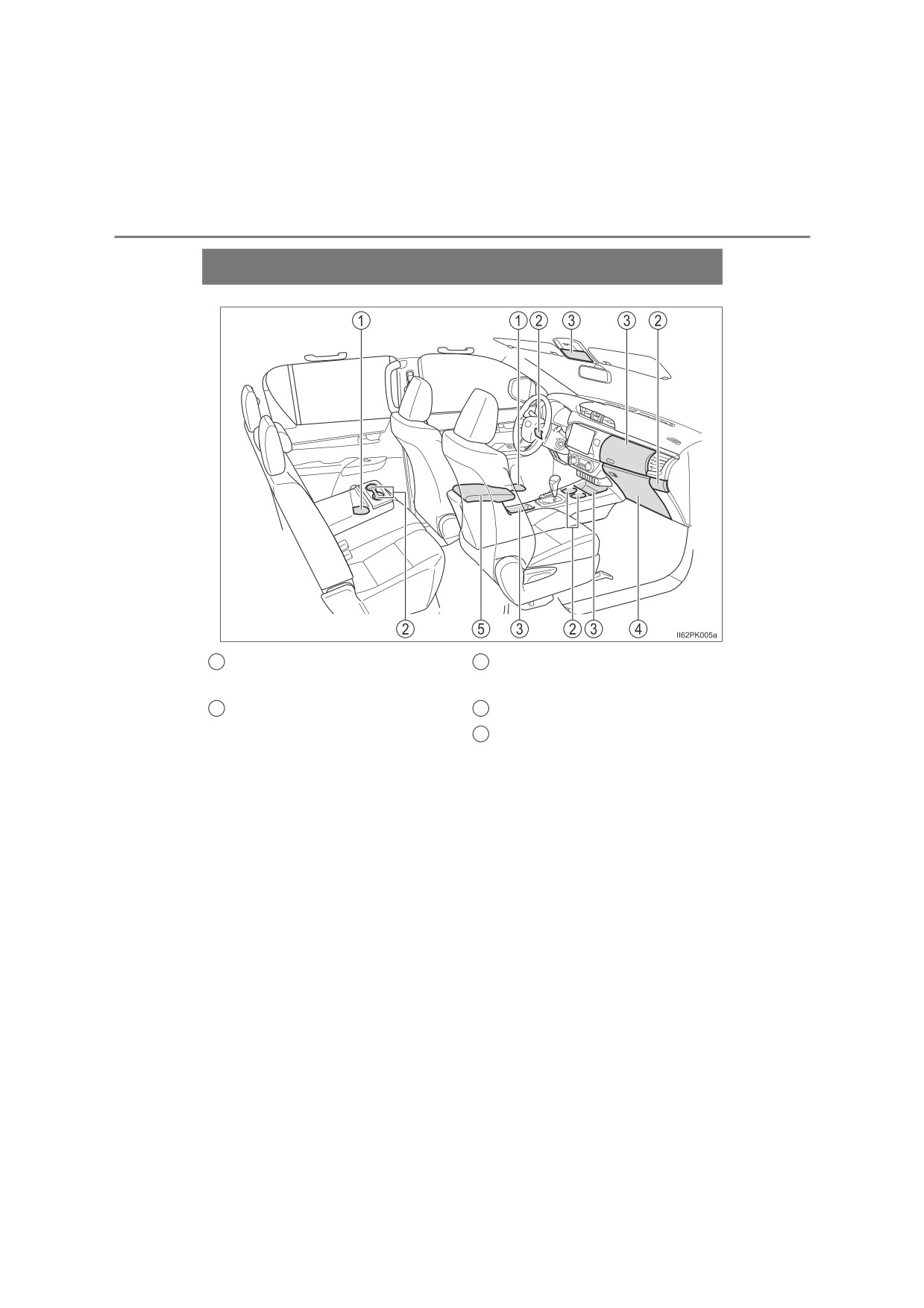
List of storage features
1
Bottle holders (if equipped)
3
Auxiliary boxes (if equipped)
(P. 457)
(P. 458)
2
Cup holders (if equipped)
4
Glove box
(P. 455)
(P. 456)
5
Console box (if equipped)
(P. 455)
6-3. Using the storage features
455
WARNING
●Do not leave glasses, lighters or spray cans in the storage spaces, as this
may cause the following when cabin temperature becomes high:
• Glasses may be deformed by heat or cracked if they come into contact
with other stored items.
• Lighters or spray cans may explode. If they come into contact with other
stored items, the lighter may catch fire or the spray can may release
gas, causing a fire hazard.
●When driving or when the glove box and the console box are not in use,
keep it closed.
In the event of sudden braking or sudden swerving, an accident may occur
due to an occupant being struck by an open lid or the items stored inside.
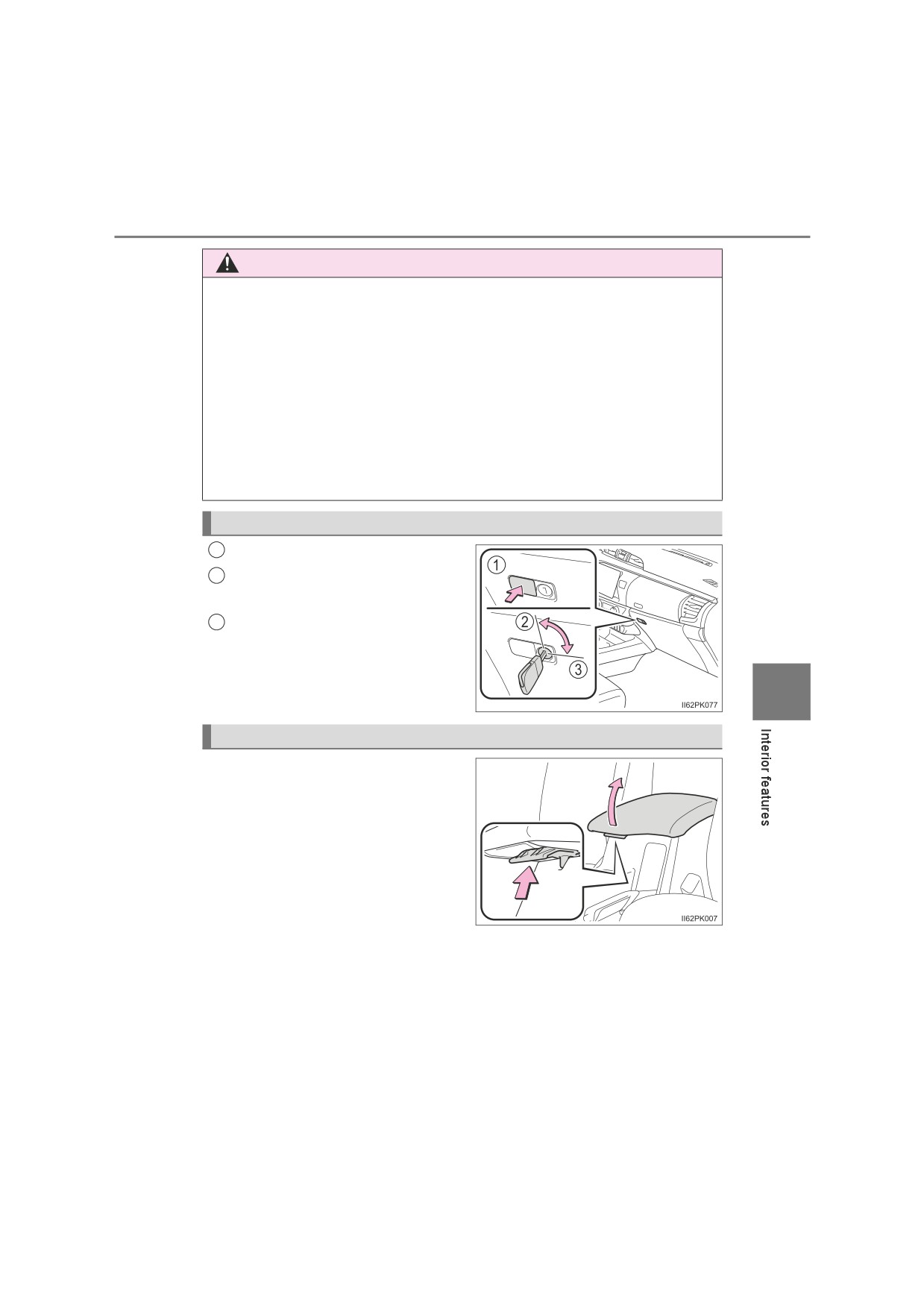
Glove box
1
Open (push button)
2
Unlock with the master key or
the mechanical key
3
Lock with the master key or the
mechanical key
6
Console box (if equipped)
Lift the lid while pulling up the
knob to release the lock.
456
6-3. Using the storage features
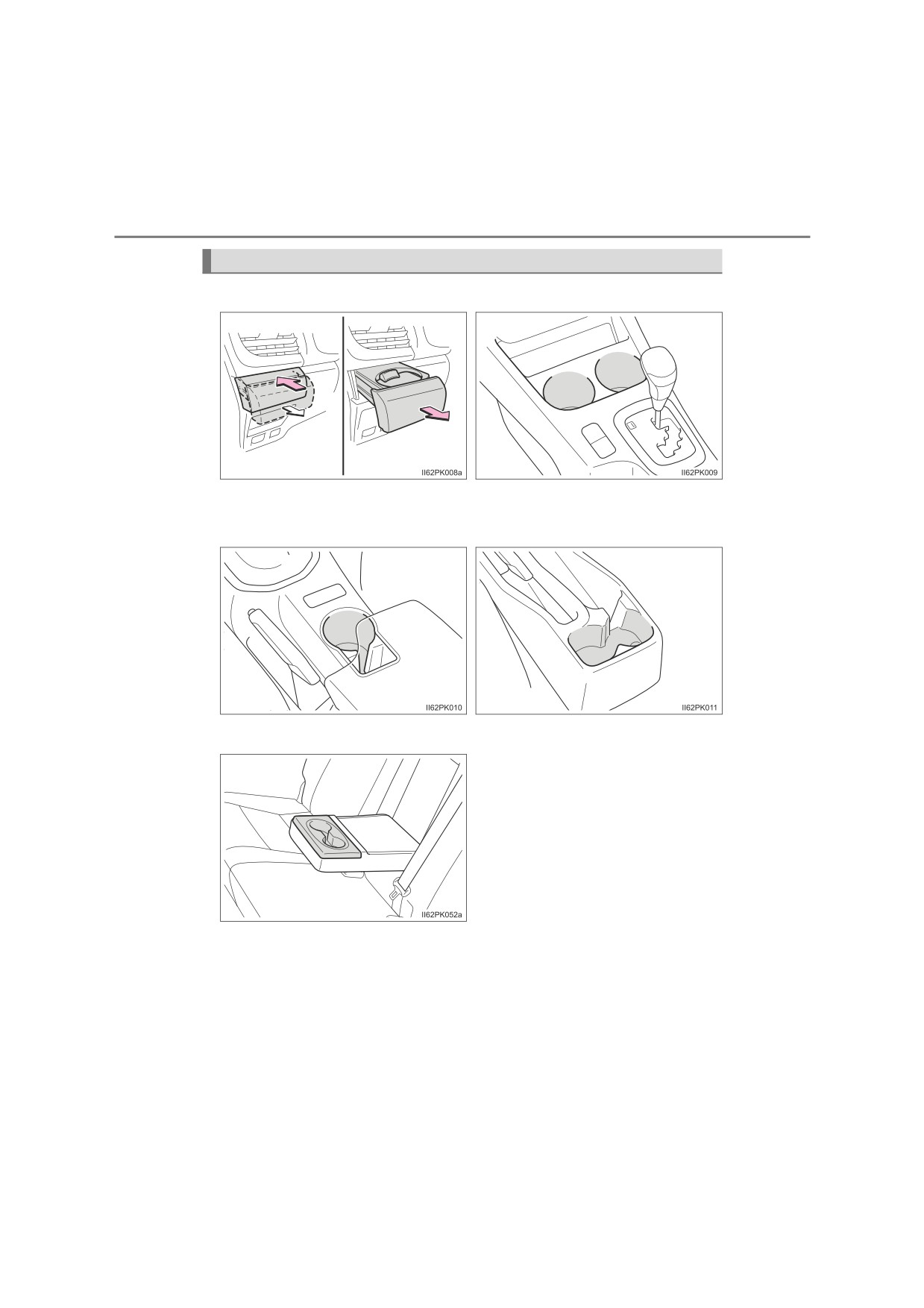
Cup holders
Type A
Type B (if equipped)
Press in and pull the cup holder.
Type C (if equipped)
Type D (if equipped)
Type E (if equipped)
Pull the armrest down.
6-3. Using the storage features
457
WARNING
Do not place anything other than cups or beverage cans in the cup holders.
Even when the lid is closed, items must not be stored in the cup holders.
Other items may be thrown out of the holders in the event of sudden brak-
ing, sudden swerving or an accident, cause injury. If possible, cover hot
drinks to prevent burns.
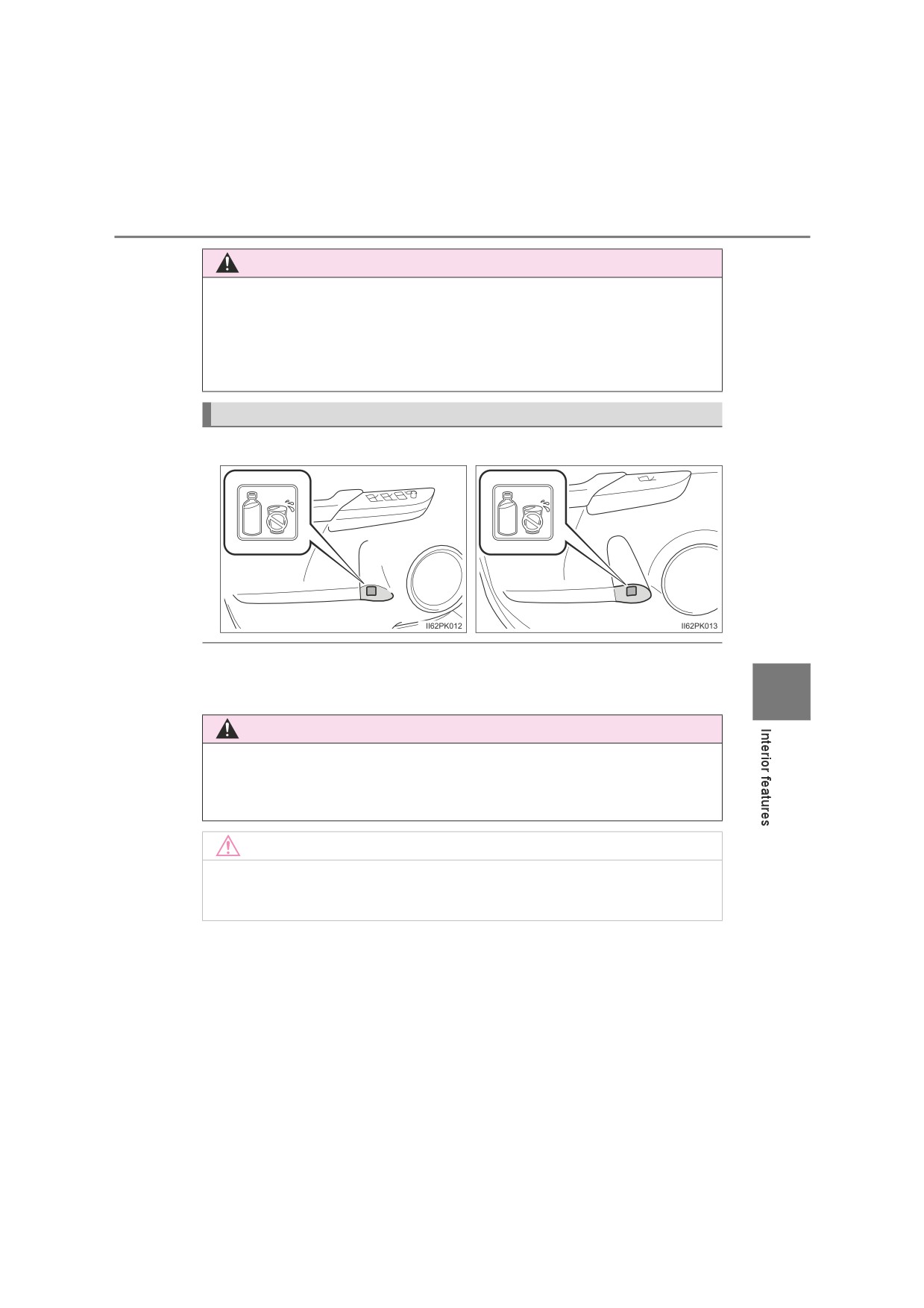
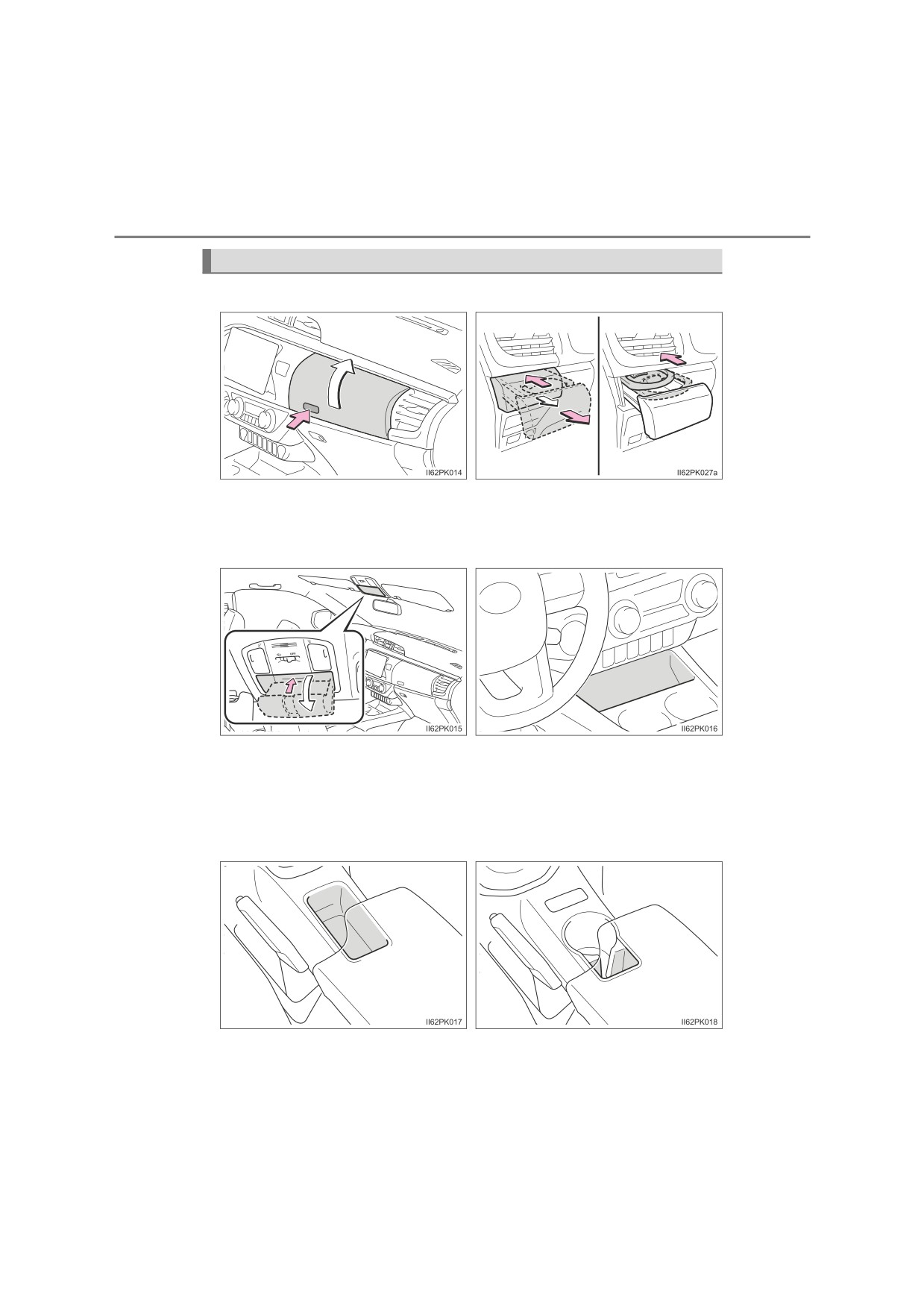
Bottle holders
For front seats
For rear seats (if equipped)
● When using the holder as a bottle holder:
• When storing a bottle, close the cap.
6
• The bottle may not be stored depending on its size or shape.
WARNING
Do not place anything other than a bottle in the bottle holders.
Other items may be thrown out of the holders in the event of an accident or
sudden braking and cause injury.
NOTICE
Do not place open bottles or glass and paper cups containing liquid in the
bottle holders. The contents may spill and glasses may break.
458
6-3. Using the storage features
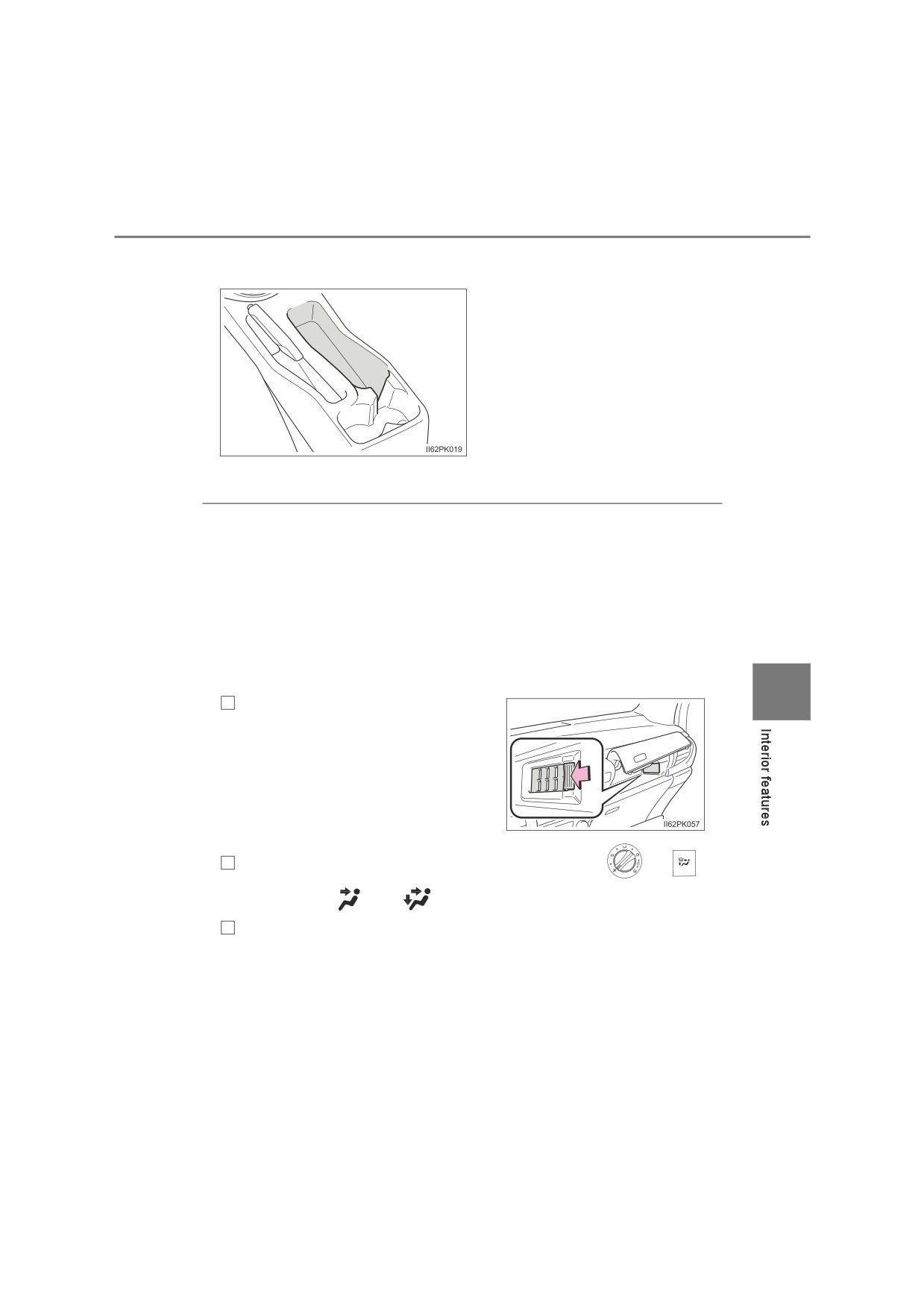
Auxiliary boxes
Type A
Type B
Press the button.
Press in and pull the cup holder,
and push the cup tray.
Type C
Type D*
Press in
the lid.
The auxiliary box is useful for tem-
porarily storing sunglasses and
similar small items.
Type E (if equipped)
Type F (if equipped)
6-3. Using the storage features
459
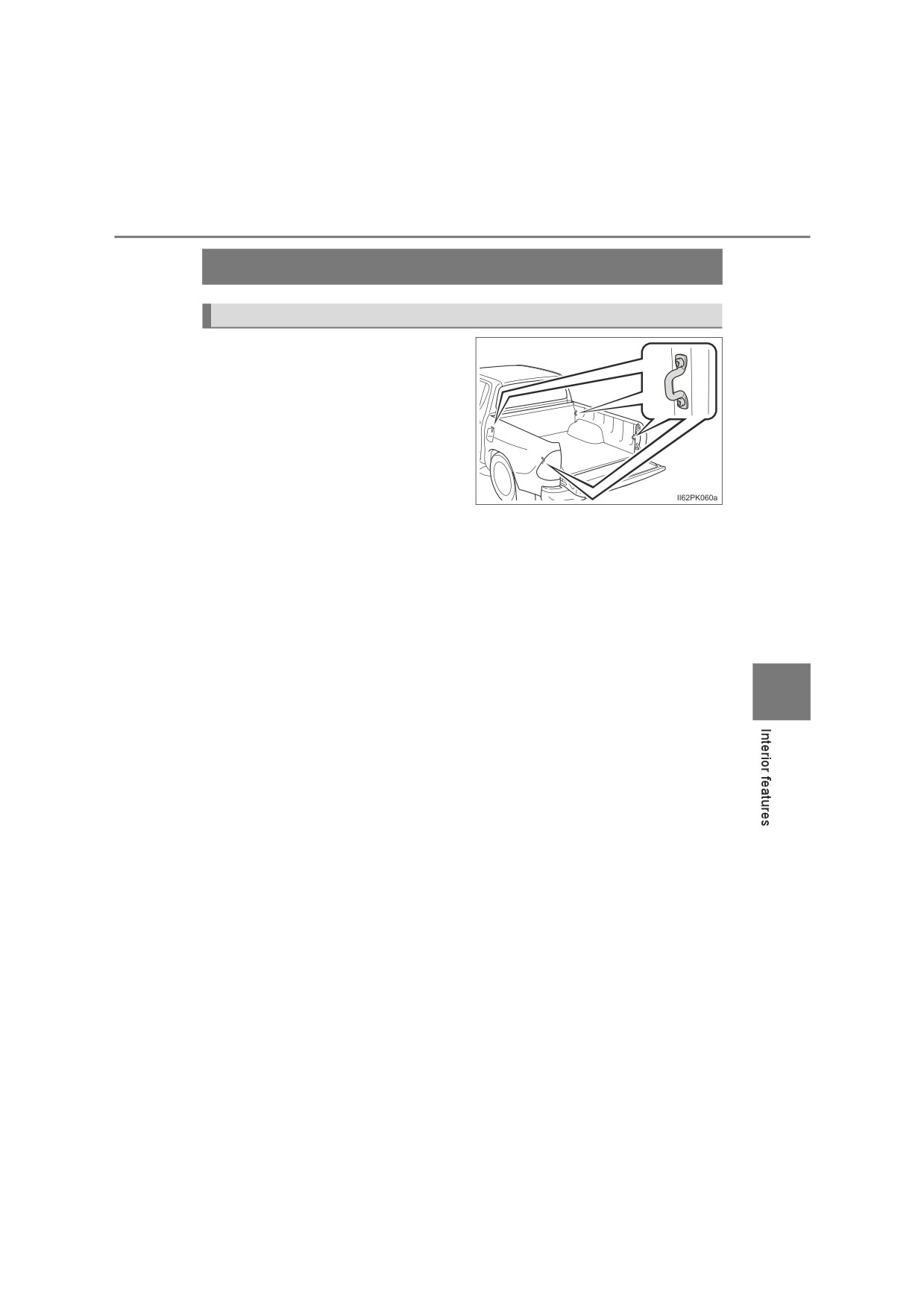
Type G
(if equipped)
*: The shape of the auxiliary box may differ depending on the grade, etc.
● Air conditioning-linked temperature regulation function
(type A)
(if
equipped):
By introducing air from the air conditioning system into the auxiliary box,
canned drinks etc. can be kept hot or cold. However, as the temperature
inside the auxiliary box will become the same as the temperature of the air
flowing from the air conditioning system, extreme heating and cooling are
not possible. In high humidity condition, be careful of objects inside the aux-
iliary box, as condensation may form.
●Using the air conditioning-linked temperature regulation function (type A) (if
equipped):
6
1
Open the air intake lid inside the aux-
iliary box.
To blow a large amount of air into the
auxiliary box, close the passenger
side vent. (P. 435, 443)
2
Allow the air conditioning system to operate, and use
or
to
select either
or
. (P. 432, 440)
3
Adjust the temperature. (P. 432, 439)
460
6-3. Using the storage features
● Normal use (type A) (if equipped):
Close the air intake lid inside the auxiliary box.
● Items unsuitable for the auxiliary box (type A) (if equipped):
• Drinks in unsealed container
• Fragile items, perishables or anything with strong odor
WARNING
●Do not store items heavier than 0.2 kg (0.4 lb.).
Doing so may cause the auxiliary box to open and the items inside may fall
out, resulting in an accident. (type C)
● Keep the auxiliary boxes closed. In the event of sudden braking, an acci-
dent may occur due to an occupant being struck by an open auxiliary box
or the items stored inside. (type A, B and C)
● When using the auxiliary boxes, do not use the cup tray.
If a cup, aluminum can or bottle is placed in the auxiliary box, it may be
thrown out of the box in the event of an accident or sudden braking, result-
ing in injury. (type B)
6-3. Using the storage features
461
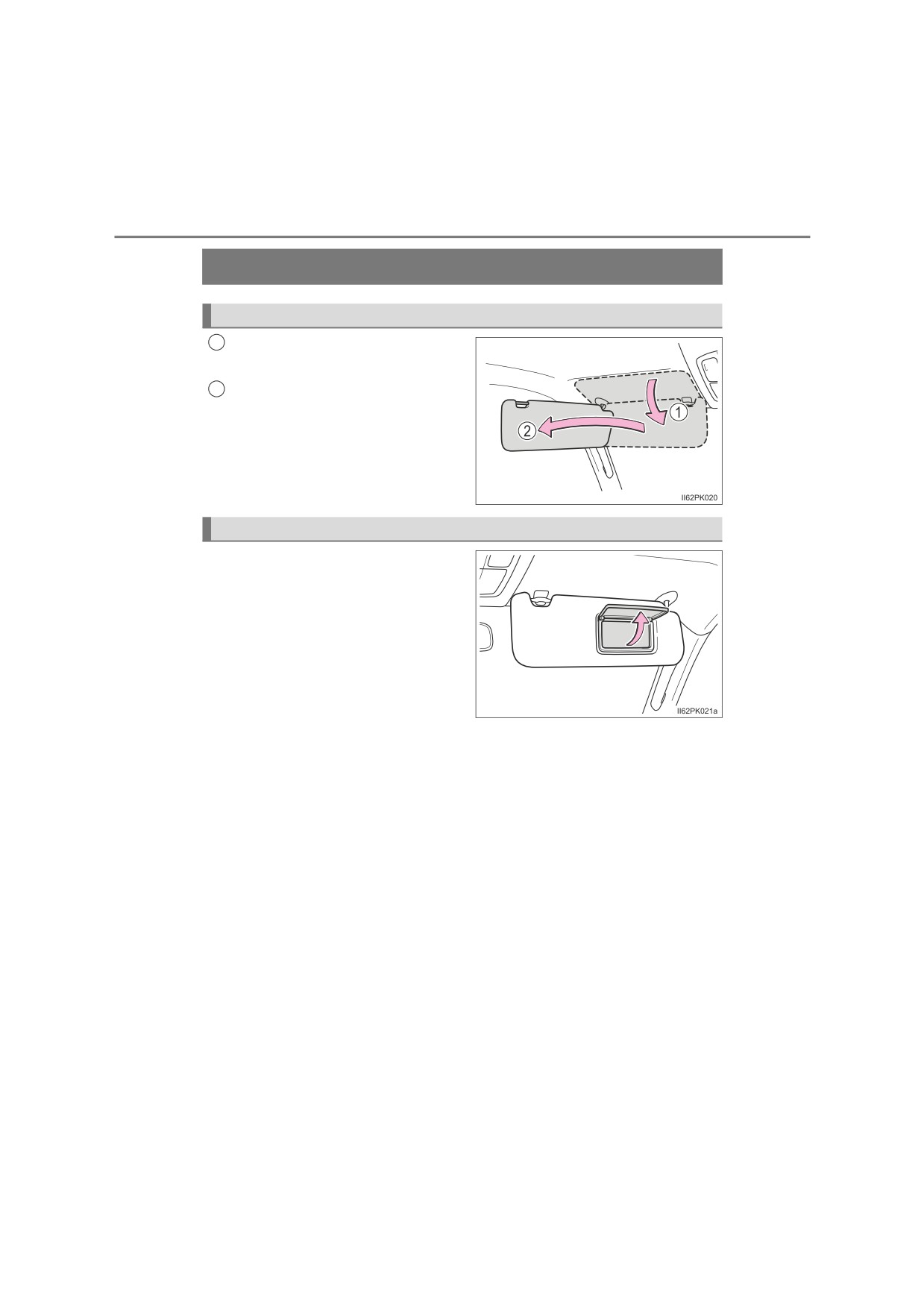
Luggage compartment features
Deck hooks (if equipped)
Deck hooks are provided for
securing loose items.
6
462
6-4. Using the other interior features
Other interior features
Sun visors
To set the visor in the forward
1
position, flip it down.
To set the visor in the side posi-
2
tion, flip down, unhook, and
swing it to the side.
Vanity mirror (if equipped)
Open the cover to use.
6-4. Using the other interior features
463
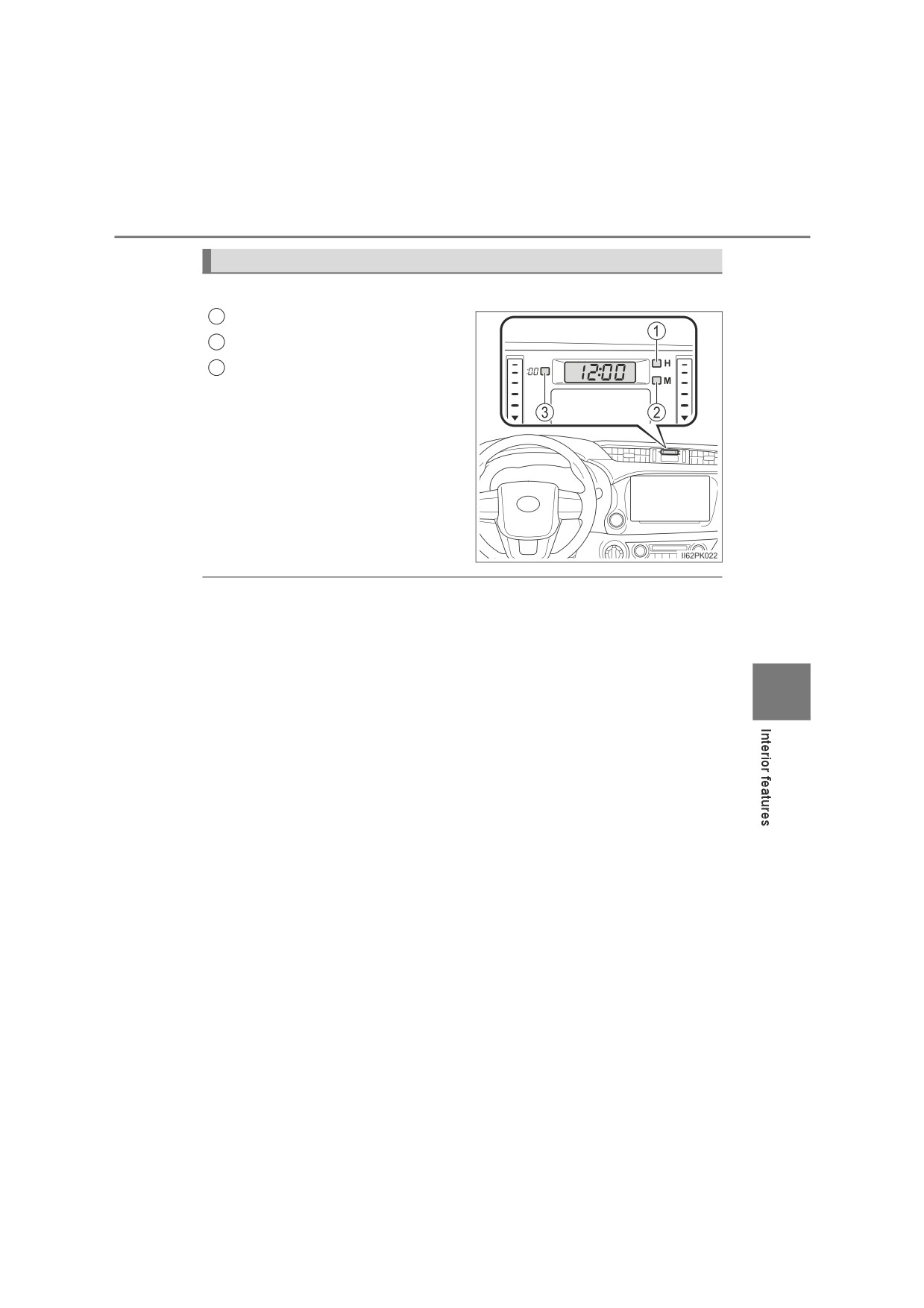
Clock
The clock can be adjusted by pressing the buttons.
1
Adjusts the hours
2
Adjusts the minutes
3
Rounds to the nearest hour*
*: e.g. 1:00 to 1:29 1:00
1:30 to 1:59 2:00
●The clock is displayed when:
Vehicles without smart entry & start system
The engine switch is in the “ACC” or “ON” position.
Vehicles with smart entry & start system
The engine switch is in ACCESSORY or IGNITION ON mode.
6
● When disconnecting and reconnecting battery terminals:
The time display will automatically be set to 1:00.
464
6-4. Using the other interior features
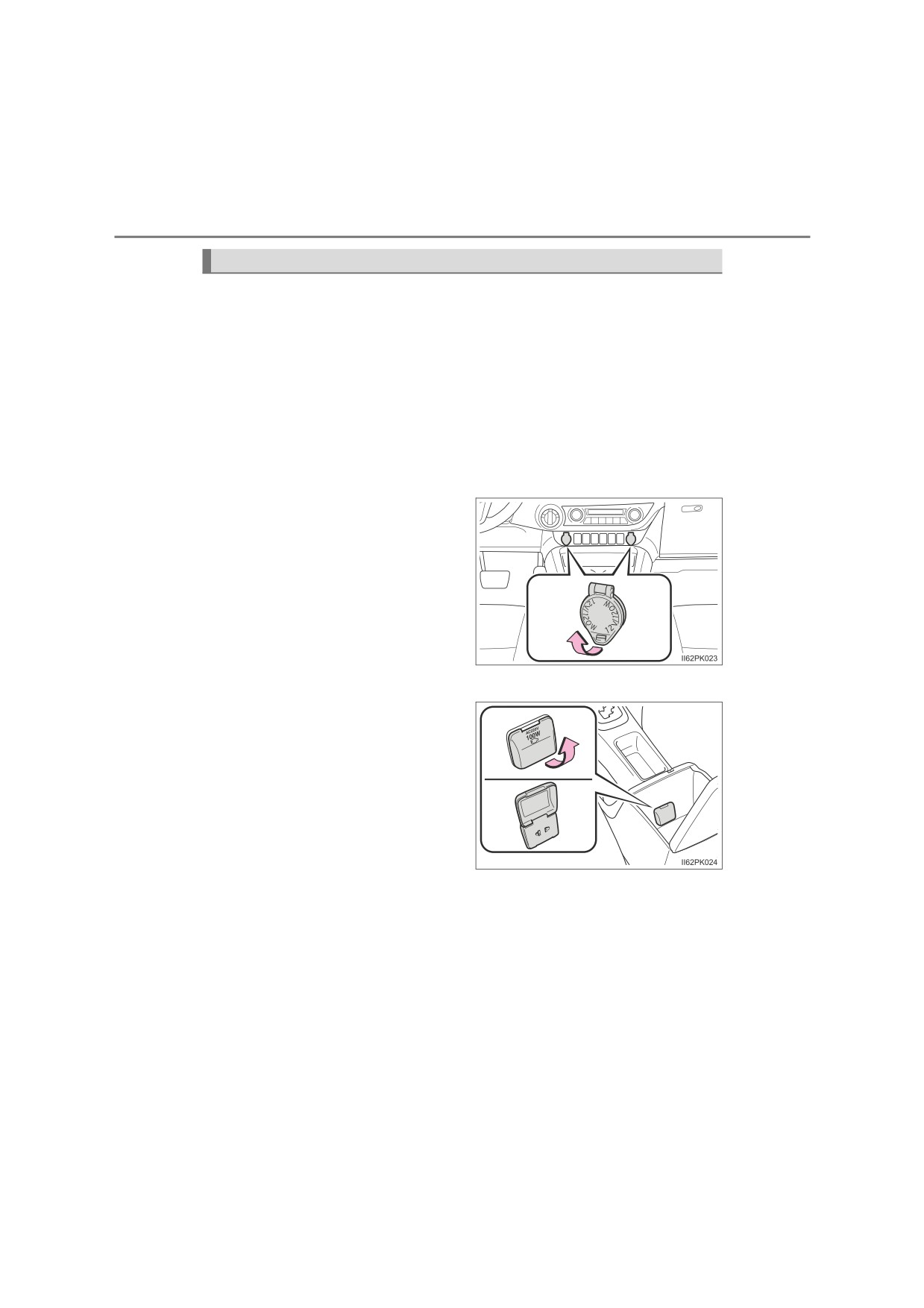
Power outlets (if equipped)
The power outlet can be used for the following components:
12 V DC:
Please use as a power supply for electronic goods that use less than
12 V DC / 10 A (power consumption of 120 W).
When using electronic goods, make sure that the power consumption
of all the connected power outlets is less than 120 W.
220 V AC:
Accessories that use less than 100 W.
■ 12 V DC
Open the cover.
■ 220 V AC
Open the cover.
6-4. Using the other interior features
465
● The power outlet can be used when:
Vehicles without smart entry & start system
12 V DC: The engine switch is in the “ACC” or “ON” position.
220 V AC: The engine switch is in the “ON” position.
Vehicles with smart entry & start system
12 V DC: The engine switch is in ACCESSORY or IGNITION ON mode.
220 V AC: The engine switch is in IGNITION ON mode.
● When turning the engine switch off:
Disconnect electrical devices with charging functions, such as mobile bat-
tery packs.
If such devices are left connected, the engine switch may not be turned off
normally.
● Vehicles with Stop & Start system: When the engine restarts after having
been stopped by the Stop & Start system, the power outlet may be tempo-
rarily unusable, but this is not a malfunction.
NOTICE
● To avoid damaging the power outlets, close the power outlet lid when the
power outlet is not in use.
Foreign objects or liquids that enter the power outlet may cause a short
circuit.
6
● To prevent blown fuse:
12 V DC
Do not use an accessory that uses more than 12 V 10 A.
220 V AC
Do not use a 220 V AC appliance that requires more than 100 W.
If a 220 V AC appliance that consumes more than 100 W is used, the pro-
tection circuit will cut the power supply.
● To prevent battery discharge, do not use the power outlet longer than nec-
essary when the engine is not running.
●The following 220 V AC appliances may not operate properly even if their
power consumption is under 100 W:
• Appliances with high initial peak wattage
• Measuring devices that process precise data
• Other appliances that require an extremely stable power supply
466
6-4. Using the other interior features
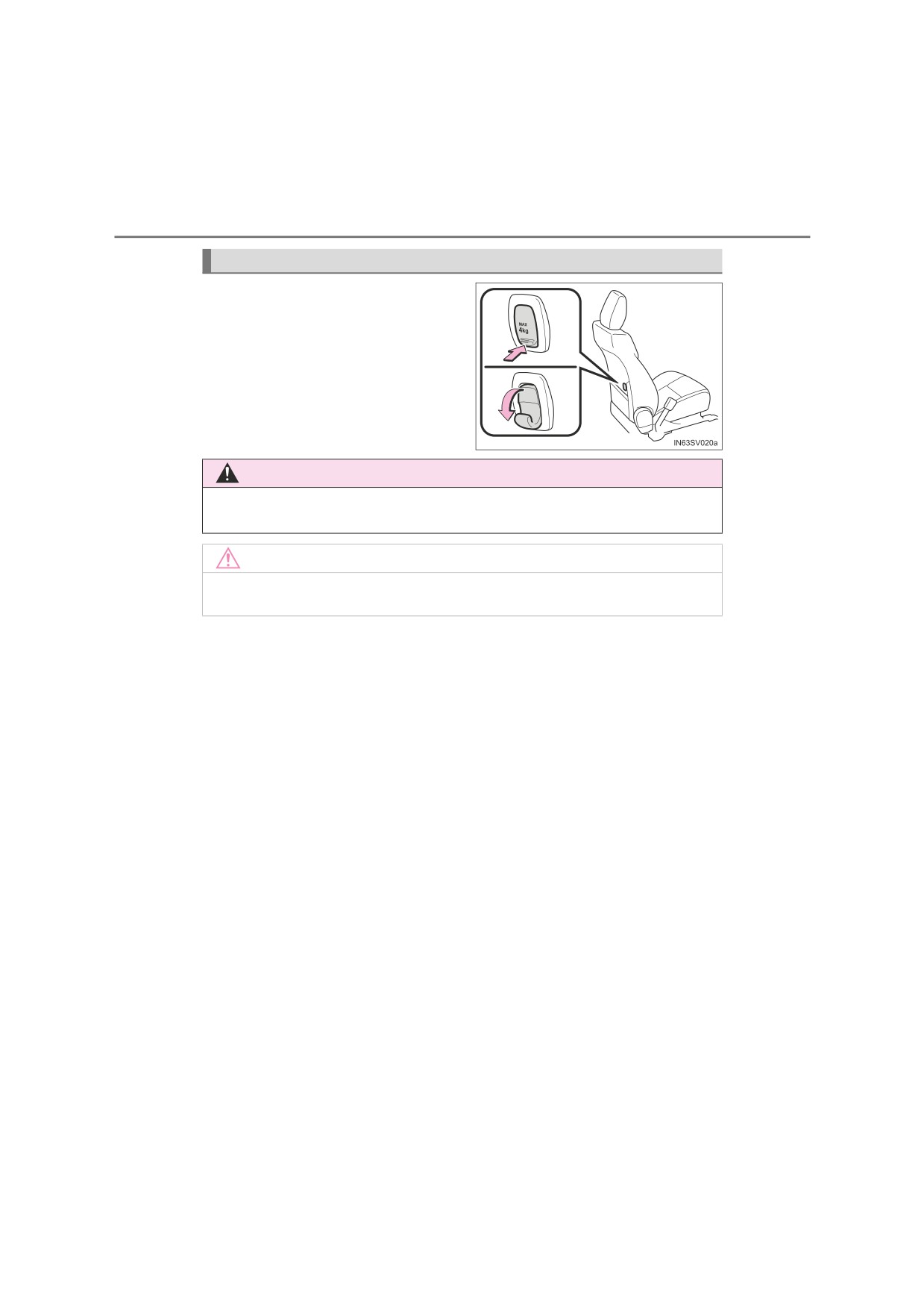
Grocery bag hooks (if equipped)
WARNING
Keep the hooks returned in place when not in use.
NOTICE
Do not hang any object heavier than 4 kg (8.8 lb.).
6-4. Using the other interior features
467
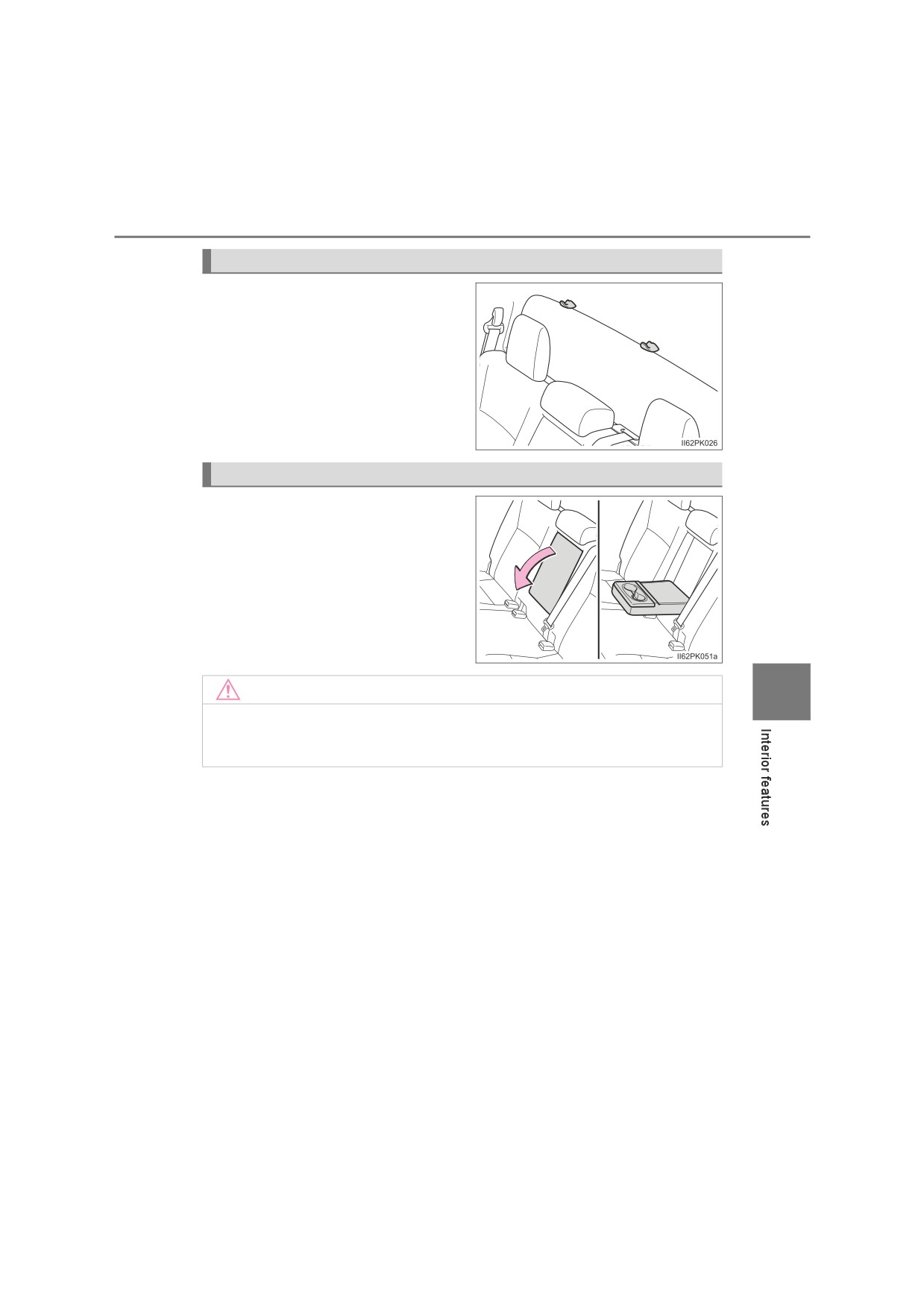
Coat hooks (if equipped)
The coat hooks are provided
above the back window.
Armrest (if equipped)
Fold down the armrest for use.
NOTICE
6
To prevent damage to the armrest, do not apply too much load on the arm-
rest.
468
6-4. Using the other interior features
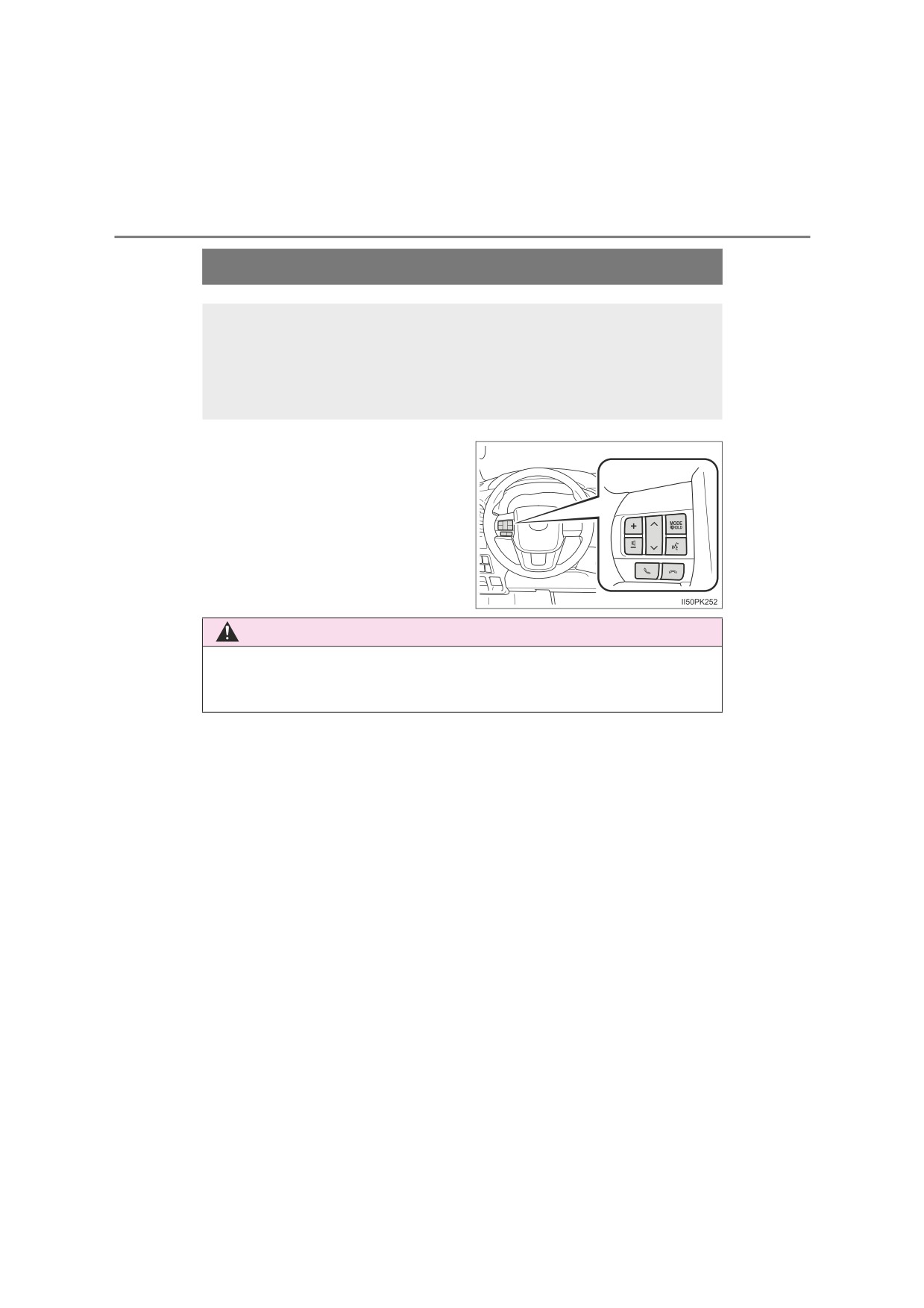
Using the steering wheel audio switches
Some audio features (audio volume control, radio, CD player
etc.) can be controlled using the switches on the steering wheel.
Operation may differ depending on the type of audio system or
navigation system. For details, refer to the manual provided with
the audio system or navigation system.
WARNING
■ To reduce the risk of an accident
Exercise care when operating the audio switches on the steering wheel.
: If equipped
469
Maintenance and care
7
7-1. Maintenance and care
Cleaning and protecting
the vehicle exterior
470
Cleaning and protecting
the vehicle interior
474
7-2. Maintenance
Maintenance
requirements
477
7-3. Do-it-yourself maintenance
Do-it-yourself service
precautions
480
Hood
482
Engine compartment
484
Tires
505
Tire inflation pressure
508
Wheels
510
Air conditioning filter
512
Wireless remote control/
electronic key battery
514
Checking and
replacing fuses
518
Light bulbs
523
470
7-1. Maintenance and care
Cleaning and protecting the vehicle
exterior
Perform the following to protect the vehicle and maintain it in
prime condition:
● Working from top to bottom, liberally apply water to the vehicle
body, wheel wells and underside of the vehicle to remove any dirt
and dust.
● Wash the vehicle body using a sponge or soft cloth, such as a
chamois.
● For hard-to-remove marks, use car wash soap and rinse thoroughly
with water.
● Wipe away any water.
● Wax the vehicle when the waterproof coating deteriorates.
If water does not bead on a clean surface, apply wax when the vehicle
body is cool.
■ Automatic car washes
● Fold the mirrors and remove the antenna (vehicles with short pole antenna)
before washing the vehicle. Start washing from the front of the vehicle.
Make sure to re-install the antenna and extend the mirrors before driving.
● Brushes used in automatic car washes may scratch the vehicle surface,
parts (wheel, etc.) and harm your vehicle’s paint.
■ High pressure car washes
As water may enter the cabin, do not bring the nozzle tip near the gaps
around the doors or perimeter of the windows, or spray these areas continu-
ously.
7-1. Maintenance and care
471
■ Wheels and wheel ornaments
● Remove any dirt immediately by using a neutral detergent.
● Wash detergent off with water immediately after use.
● To protect the paint from damage, make sure to observe the following pre-
cautions.
• Do not use acidic, alkaline or abrasive detergent
• Do not use hard brushes
• Do not use detergent on the wheels when they are hot, such as after driv-
ing or parking in hot weather
■ Brake pads and calipers
Rust may form if the vehicle is parked with wet brake pads or disc rotors,
causing them to stick, or causing noises or vibrations. Before parking the
vehicle after it is washed, drive slowly and apply the brakes several times to
dry the parts.
■ Bumpers
Do not scrub with abrasive cleaners.
■ Plated portions
If dirt cannot be removed, clean the parts as follows:
● Use a soft cloth dampened with an approximately 5% solution of neutral
detergent and water to clean the dirt off.
● Wipe the surface with a dry, soft cloth to remove any remaining moisture.
● To remove oily deposits, use alcohol wet wipes or a similar product.
■ Painted brake calipers (if equipped)
● When using detergent, please use neutral detergent.
Do not use abrasive detergent or hard brushes, as they will damage the
paint.
7
● Do not use detergent when the brake caliper is hot.
● Wash detergent off with water immediately after use.
WARNING
■ When washing the vehicle
Do not apply water to the inside of the engine compartment. Doing so may
cause the electrical components etc. to catch fire.
■ Precautions regarding the exhaust pipe
Exhaust gases cause the exhaust pipe to become quite hot.
When washing the vehicle, be careful not to touch the pipe until it has
cooled sufficiently, as touching a hot exhaust pipe can cause burns.
472
7-1. Maintenance and care
NOTICE
■ To prevent paint deterioration and corrosion on the body and compo-
nents (aluminum wheels etc.)
● Wash the vehicle immediately in the following cases:
• After driving near the sea coast
• After driving on salted roads
• If coal tar or tree sap is present on the paint surface
• If dead insects, insect droppings or bird droppings are present on the
paint surface
• After driving in an area contaminated with soot, oily smoke, mine dust,
iron powder or chemical substances
• If the vehicle becomes heavily soiled with dust or mud
• If liquids such as benzene and gasoline are spilled on the paint surface
● If the paint is chipped or scratched, have it repaired immediately.
● To prevent the wheels from corroding, remove any dirt and store in a place
with low humidity when storing the wheels.
■ Cleaning the exterior lights
● Wash carefully. Do not use organic substances or scrub with a hard brush.
This may damage the surfaces of the lights.
●Do not apply wax to the surfaces of the lights.
Wax may cause damage to the lenses.
■ Antenna installation and removal precautions (vehicles with short pole
antenna)
● Before driving, ensure that the antenna is installed.
●When the antenna is removed, such as before entering an automatic car
wash, make sure to store it in a suitable place so as not to lose it. Also,
before driving, make sure to reinstall the antenna in its original position.
7-1. Maintenance and care
473
NOTICE
■ When using a high pressure car wash
● Vehicles with Toyota Safety Sense:
Do not spray water directly on the radar which is equipped behind the
emblem. Otherwise it may cause the device to be damaged.
●Do not bring the nozzle tip close to boots (rubber or resin manufactured
cover), connectors or the following parts. The parts may be damaged if
they come into contact with high-pressure water.
• Traction related parts
• Steering parts
• Suspension parts
• Brake parts
● Keep the cleaning nozzle at least 30 cm (11.9 in.) away from the vehicle
body. Otherwise resin section, such as moldings and bumpers, may be
deformed and damaged. Also, do not continuously hold the nozzle in the
same place.
●Do not spray the lower part of the windshield continuously.
If water enters the air conditioning system intake located near the lower
part of the windshield, the air conditioning system may not operate cor-
rectly.
●Do not wash the underside of the vehicle using a high pressure car
washer.
7
474
7-1. Maintenance and care
Cleaning and protecting the vehicle
interior
The following procedures will help protect your vehicle’s interior
and keep it in top condition:
Protecting the vehicle interior
● Remove dirt and dust using a vacuum cleaner. Wipe dirty surfaces
with a cloth dampened with lukewarm water.
● If dirt cannot be removed, wipe it off with a soft cloth dampened with
neutral detergent diluted to approximately 1%.
● Wring out any excess water from the cloth and thoroughly wipe off
remaining traces of detergent and water.
Cleaning the leather areas
● Remove dirt and dust using a vacuum cleaner.
● Wipe off any excess dirt and dust with a soft cloth dampened with
diluted detergent.
Use a diluted water solution of approximately 5% neutral wool detergent.
● Wring out any excess water from the cloth and thoroughly wipe off
all remaining traces of detergent.
● Wipe the surface with a dry, soft cloth to remove any remaining
moisture. Allow the leather to dry in a shaded and ventilated area.
Cleaning the synthetic leather areas
● Remove dirt and dust using a vacuum cleaner.
● Wipe it off with a soft cloth dampened with neutral detergent diluted
to approximately 1%.
● Wring out any excess water from the cloth and thoroughly wipe off
remaining traces of detergent and water.
7-1. Maintenance and care
475
■ Caring for leather areas
Toyota recommends cleaning the interior of the vehicle at least twice a year to
maintain the quality of the vehicle’s interior.
■ Shampooing the carpets
There are several commercial foaming-type cleaners available. Use a sponge
or brush to apply the foam. Rub in overlapping circles. Do not use water.
Wipe dirty surfaces and let them dry. Excellent results are obtained by keep-
ing the carpet as dry as possible.
■ Seat belts
Clean with mild soap and lukewarm water using a cloth or sponge. Also
check the belts periodically for excessive wear, fraying or cuts.
WARNING
■ Water in the vehicle
●Do not splash or spill liquid in the vehicle.
Doing so may cause electrical components etc. to malfunction or catch
fire.
●Do not get any of the SRS components or wiring in the vehicle interior wet.
(P. 46)
An electrical malfunction may cause the airbags to deploy or not function
properly, resulting in death or serious injury.
■ Cleaning the interior (especially instrument panel)
Do not use polish wax or polish cleaner. The instrument panel may reflect
off the windshield, obstructing the driver’s view and leading to an accident,
resulting in death or serious injury.
7
476
7-1. Maintenance and care
NOTICE
■ Cleaning detergents
●Do not use the following types of detergent, as they may discolor the vehi-
cle interior or cause streaks or damage to painted surfaces:
• Non-seat portions: Organic substances such as benzene or gasoline,
alkaline or acidic solutions, dye, and bleach
• Seats: Alkaline or acidic solutions, such as thinner, benzene, and alco-
hol
●Do not use polish wax or polish cleaner. The instrument panel’s or other
interior part’s painted surface may be damaged.
■ Preventing damage to leather surfaces
Observe the following precautions to avoid damage to and deterioration of
leather surfaces:
●Remove any dust or dirt from leather surfaces immediately.
●Do not expose the vehicle to direct sunlight for extended periods of time.
Park the vehicle in the shade, especially during summer.
●Do not place items made of vinyl, plastic, or containing wax on the uphol-
stery, as they may stick to the leather surface if the vehicle interior heats
up significantly.
■ Water on the floor
Do not wash the vehicle floor with water.
Vehicle systems such as the audio system may be damaged if water comes
into contact with electrical components such as the audio system above or
under the floor of the vehicle. Water may also cause the body to rust.
■ When cleaning the inside of the windshield (vehicles with Toyota
Safety Sense)
Do not allow glass cleaner to contact the lens. Also, do not touch the lens.
(P. 265)
■ Cleaning the inside of the rear window (vehicles with rear window
defogger)
●Do not use glass cleaner to clean the rear window, as this may cause
damage to the rear window defogger heater wires. Use a cloth dampened
with lukewarm water to gently wipe the window clean. Wipe the window in
strokes running parallel to the heater wires.
● Be careful not to scratch or damage the heater wires.
7-2. Maintenance
477
Maintenance requirements
To ensure safe and economical driving, day-to-day care and reg-
ular maintenance are essential. Toyota recommends the follow-
ing maintenance:
Scheduled maintenance
Scheduled maintenance should be performed at specified intervals
according to the maintenance schedule.
For full details of your maintenance schedule, refer to the “Toyota Service
Booklet” or “Toyota Warranty Booklet”.
Do-it-yourself maintenance
What about do-it-yourself maintenance?
Many maintenance items are easy to do yourself if you have a little
mechanical ability and a few basic automotive tools.
Note, however, that some maintenance tasks require special tools and
skills. These are best performed by qualified technicians. Even if you’re an
experienced do-it-yourself mechanic, we recommend that repairs and
maintenance be conducted by any authorized Toyota retailer or Toyota
authorized repairer, or any reliable repairer. Any authorized Toyota retailer
or repairer will keep a record of maintenance, which could be useful should
you ever require Warranty Service. Should you choose to select a qualified
and equipped professional other than an authorized Toyota repairer to ser-
7
vice or maintain your vehicle, we recommend that you request that a
record of maintenance be kept.
478
7-2. Maintenance
■ Where to go for maintenance service?
In order to maintain your vehicle in the best possible condition, Toyota recom-
mends that maintenance service operations as well as other inspections and
repairs be carried out by authorized Toyota retailers or Toyota authorized
repairers, or any reliable repairers. For repairs and services covered by your
warranty, please visit an authorized Toyota retailer or repairer, who will use
genuine Toyota parts in repairing any difficulties you may encounter. There
can also be advantages in utilizing authorized Toyota retailers or repairers for
non-warranty repairs and services, as members of the Toyota network will be
able to expertly assist you with any difficulties you may encounter.
Your Toyota retailer or Toyota authorized repairer, or any reliable repairer will
perform all of the scheduled maintenance on your vehicle reliably and eco-
nomically due to their experience with Toyota vehicles.
■ Does your vehicle need repairs?
Be on the alert for changes in performance and sounds, and visual tip-offs
that indicate service is needed. Some important clues are:
●Engine missing, stumbling or pinging
●Appreciable loss of power
● Strange engine noises
● A fluid leak under the vehicle (However, water dripping from the air condi-
tioning system after use is normal.)
● Change in exhaust sound (This may indicate a dangerous carbon monoxide
leak. Drive with the windows open and have the exhaust system checked
immediately.)
●Flat-looking tires, excessive tire squeal when cornering, uneven tire wear
● Vehicle pulls to one side when driven straight on a level road
● Strange noises related to suspension movement
●Loss of brake effectiveness, spongy feeling brake pedal or clutch pedal,
pedal almost touches the floor, vehicle pulls to one side when braking
● Engine coolant temperature continually higher than normal
If you notice any of these clues, take your vehicle to any authorized Toyota
retailer or Toyota authorized repairer, or any reliable repairer as soon as pos-
sible. Your vehicle may need adjustment or repair.
7-2. Maintenance
479
WARNING
■ If your vehicle is not properly maintained
Improper maintenance could result in serious damage to the vehicle and
possible serious injury or death.
■ Handling of the battery
Battery posts, terminals and related accessories contain lead and lead com-
pounds which are known to cause brain damage. Wash your hands after
handling. (P. 492)
7
480
7-3. Do-it-yourself maintenance
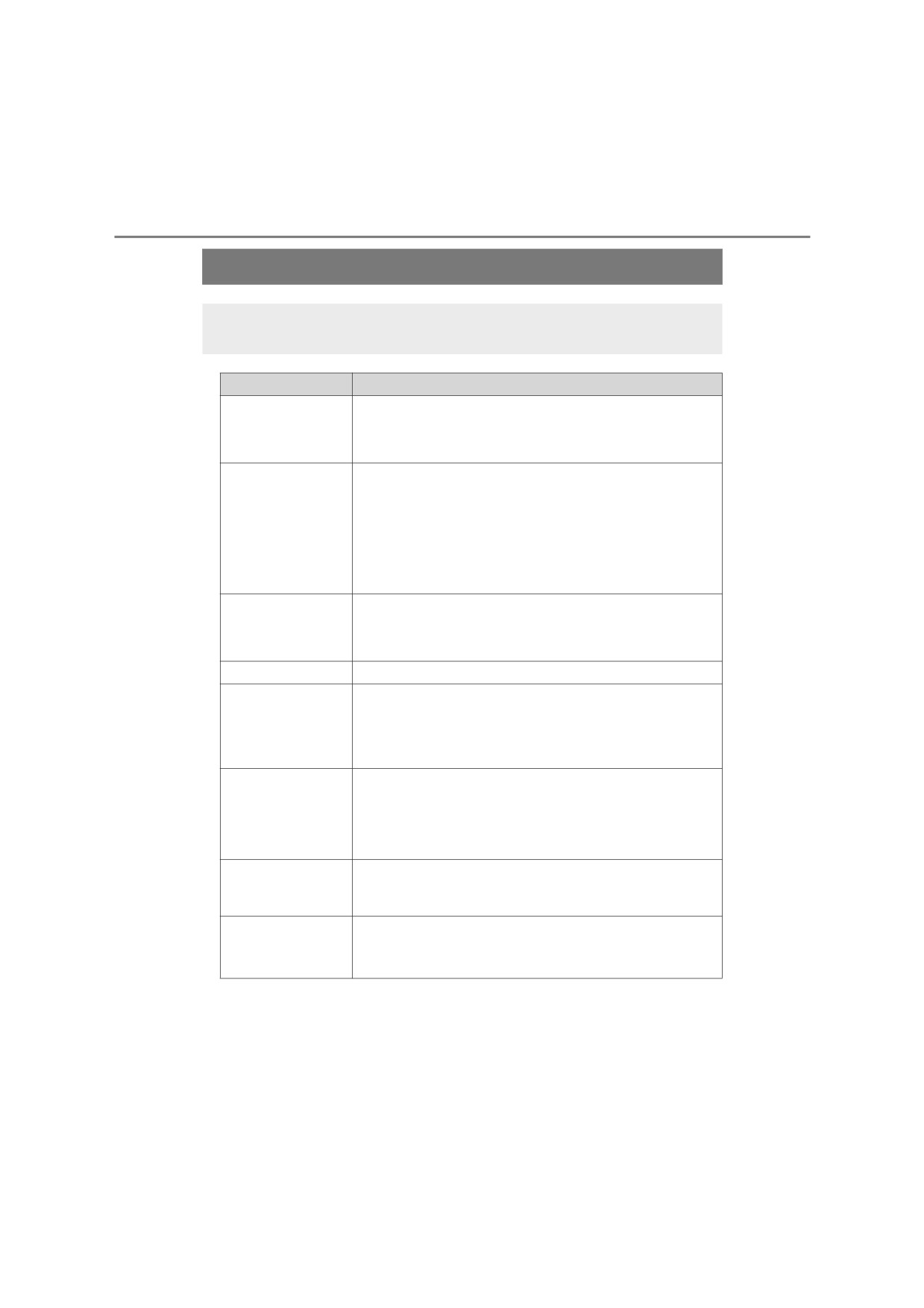
Do-it-yourself service precautions
If you perform maintenance by yourself, be sure to follow the
correct procedure as given in these sections.
Items
Parts and tools
•
Warm water
• Baking soda
• Grease
Battery condition
•
Conventional wrench (for terminal clamp bolts)
(P. 492)
•
Distilled water
•
“Toyota Super Long Life Coolant” or a similar high
Engine coolant/
quality ethylene glycol-based non-silicate, non-
intercooler
amine, non-nitrite and non-borate coolant with long-
coolant
life hybrid organic acid technology
(if equipped) level
“Toyota Super Long Life Coolant” is pre-mixed with
(P. 490)
50% coolant and 50% deionized water.
•
Funnel (used only for adding coolant)
•
“Toyota Genuine Motor Oil” or equivalent
Engine oil level
•
Rag or paper towel
(P. 487)
•
Funnel (used only for adding engine oil)
Fuses (P. 518)
•
Fuse with same amperage rating as original
•
Bulb with same number and wattage rating as origi-
nal
Light bulbs
(P. 523)
•
Phillips-head screwdriver
•
Flathead screwdriver
• Wrench
Radiator,
condenser and
intercooler
(if equipped)
(P. 491)
Tire inflation
pressure
•
Tire pressure gauge
• Compressed air source
(P. 508)
•
Water or washer fluid containing antifreeze (for win-
Washer fluid
ter use)
(P. 496)
•
Funnel (used only for adding water or washer fluid)
7-3. Do-it-yourself maintenance
481
WARNING
The engine compartment contains many mechanisms and fluids that may
move suddenly, become hot, or become electrically energized. To avoid death
or serious injury, observe the following precautions.
■ When working on the engine compartment
● Keep hands, clothing and tools away from the moving fan and engine
drive belt.
● Be careful not to touch the engine, radiator, exhaust manifold, etc. right
after driving as they may be hot. Oil and other fluids may also be hot.
●Do not leave anything that may burn easily, such as paper and rags, in the
engine compartment.
●Do not smoke, cause sparks or expose an open flame to fuel or the bat-
tery. Fuel and battery fumes are flammable.
● Be extremely cautious when working on the battery. It contains poisonous
and corrosive sulfuric acid.
● Take care because brake fluid can harm your hands or eyes and damage
painted surfaces. If fluid gets on your hands or in your eyes, flush the
affected area with clean water immediately.
If you still experience discomfort, consult a doctor.
■ Safety glasses
Wear safety glasses to prevent flying or falling material, fluid spray, etc.
from getting in your eyes.
NOTICE
7
■ If you remove the air cleaner filter
Driving with the air cleaner filter removed may cause excessive engine wear
due to dirt in the air.
■ If the fluid level is low or high
It is normal for the brake fluid level to go down slightly as the brake pads
wear or when the fluid level in the accumulator is high.
If the reservoir needs frequent refilling, it may indicate a serious problem.
482
7-3. Do-it-yourself maintenance
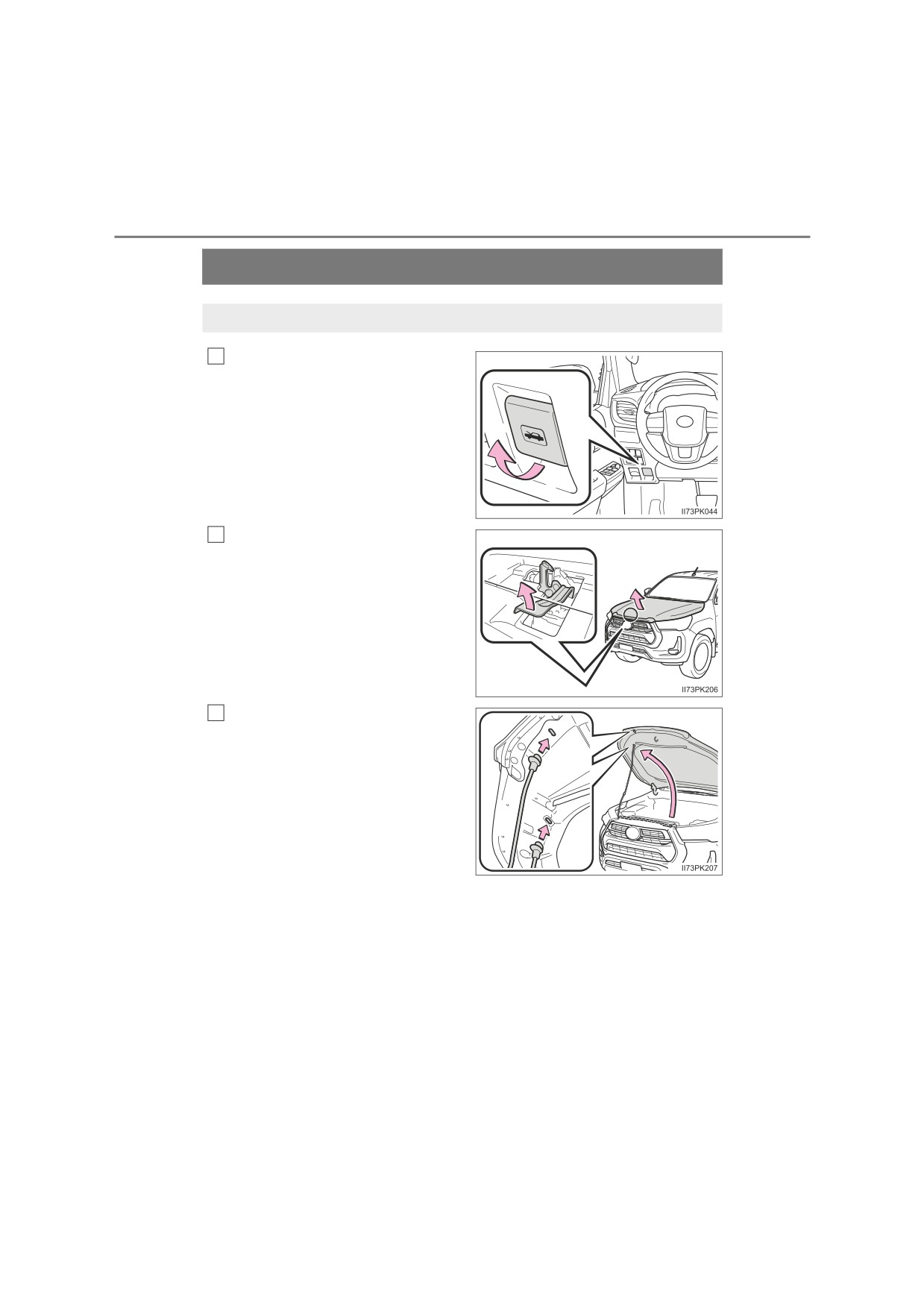
Hood
Release the lock from the inside of the vehicle to open the hood.
1
Pull the hood lock release lever.
The hood will pop up slightly.
2
Pull up the auxiliary catch lever
and lift the hood.
Hold the hood open by inserting
3
the supporting rod into either of
the slots.
Use the upper slots to open the
hood normally, or use the lower
slots when the hood needs to be
opened wide.
7-3. Do-it-yourself maintenance
483
WARNING
■ Pre-driving check
Check that the hood is fully closed and locked.
If the hood is not locked properly, it may open while the vehicle is in motion
and cause an accident, which may result in death or serious injury.
■ After installing the support rod into the slot
Make sure the rod supports the hood securely from falling down on to your
head or body.
NOTICE
■ When closing the hood
Be sure to return the support rod to its clip before closing the hood. Closing
the hood with the support rod up could cause the hood to bend.
7
484
7-3. Do-it-yourself maintenance
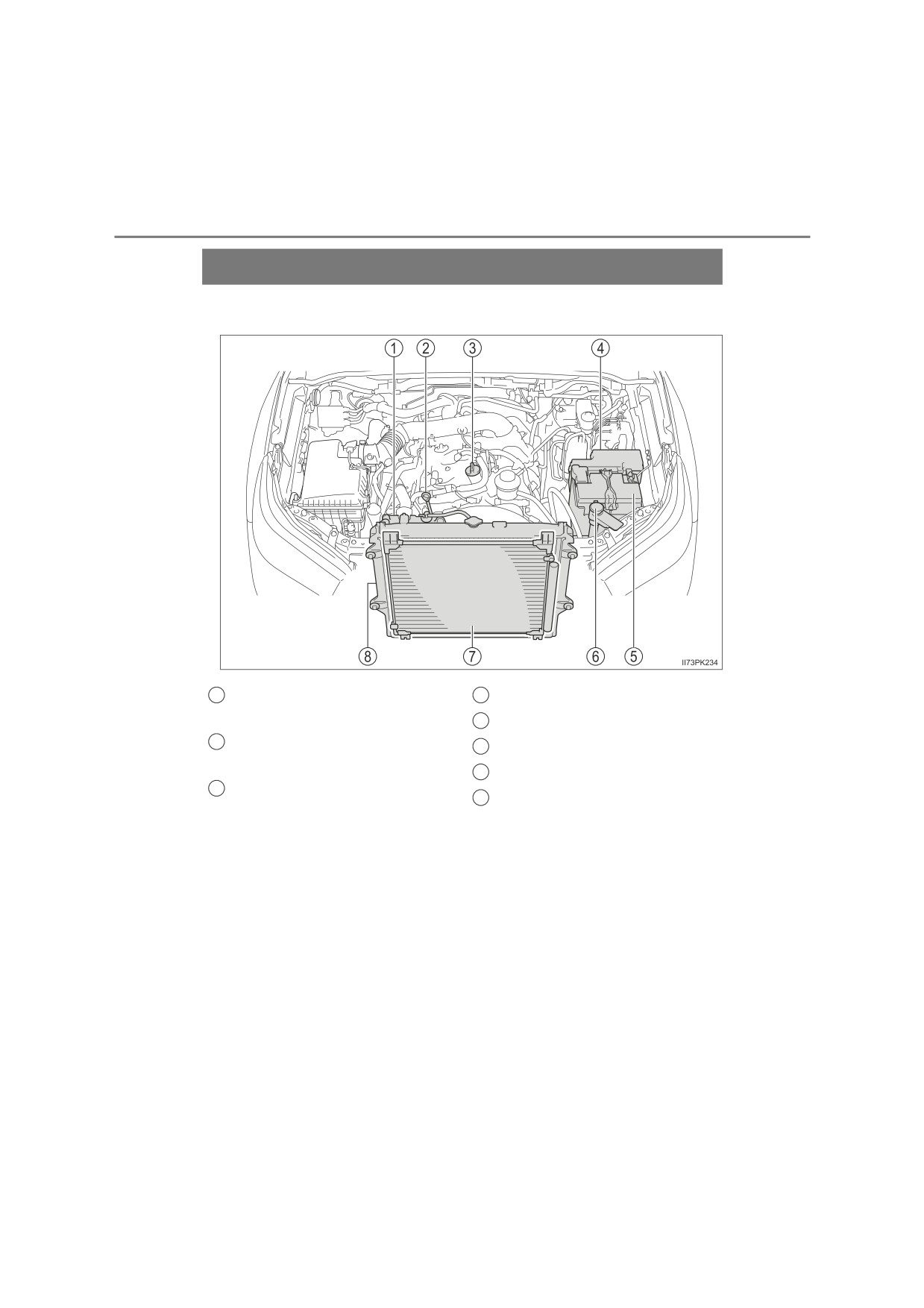
Engine compartment
Gasoline engine
1
Engine coolant reservoir
4
Fuse box
(P. 518)
(P. 490)
5
Battery
(P. 492)
2
Engine oil level dipstick
6
Washer fluid tank
(P. 496)
(P. 487)
7
Condenser
(P. 491)
3
Engine oil filler cap (P. 488)
8
Radiator
(P. 491)
7-3. Do-it-yourself maintenance
485
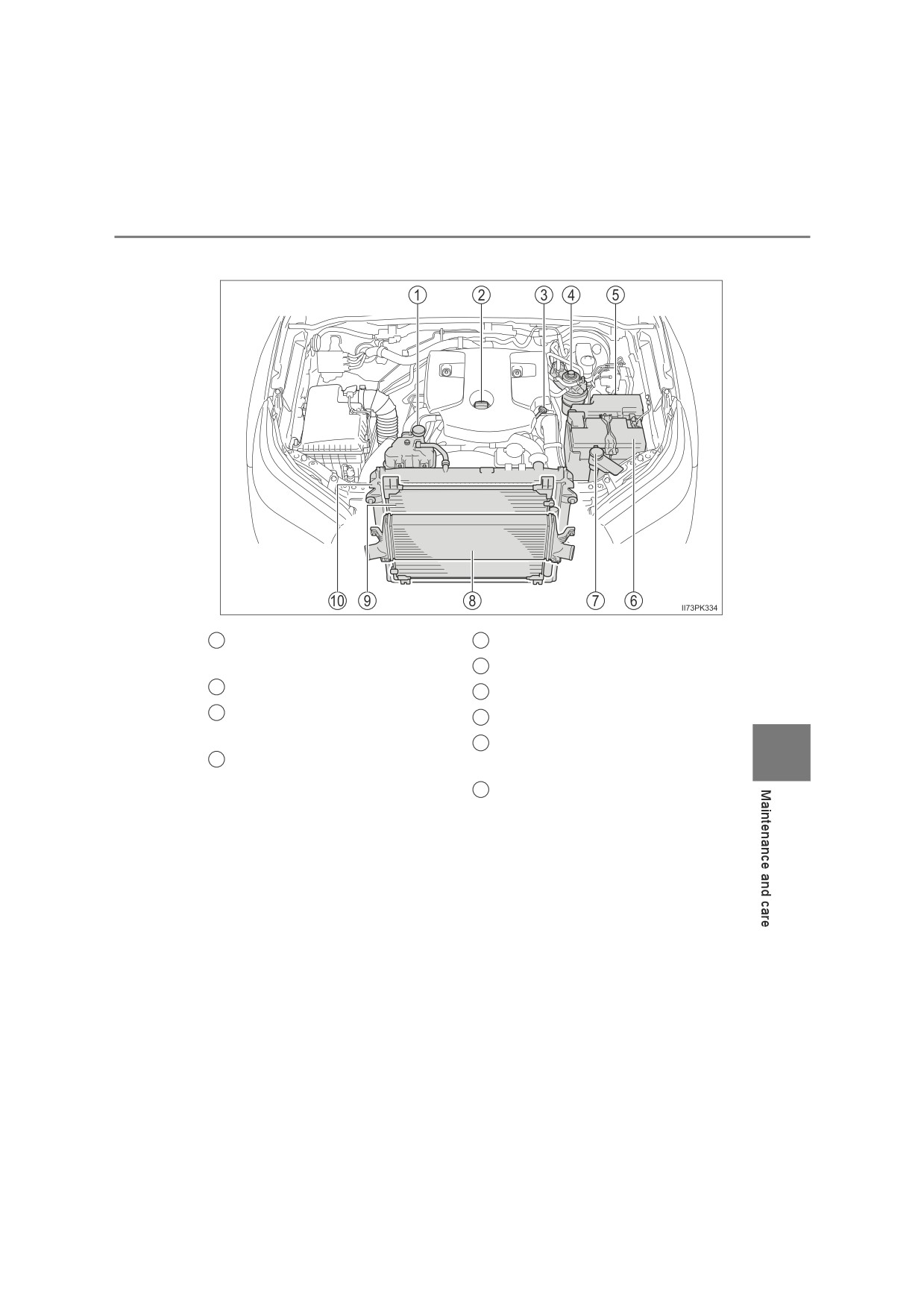
Diesel engine (vehicles without water-cooled intercooler)
1
Engine coolant reservoir
5
Fuse box
(P. 518)
(P. 490)
6
Battery
(P. 492)
2
Engine oil filler cap (P. 488)
7
Washer fluid tank
(P. 496)
3
Engine oil level dipstick
8
Intercooler
(P. 491)
(P. 487)
9
Condenser (if equipped)
7
4
Fuel filter
(P. 497, 612)
(P. 491)
10
Radiator
(P. 491)
486
7-3. Do-it-yourself maintenance
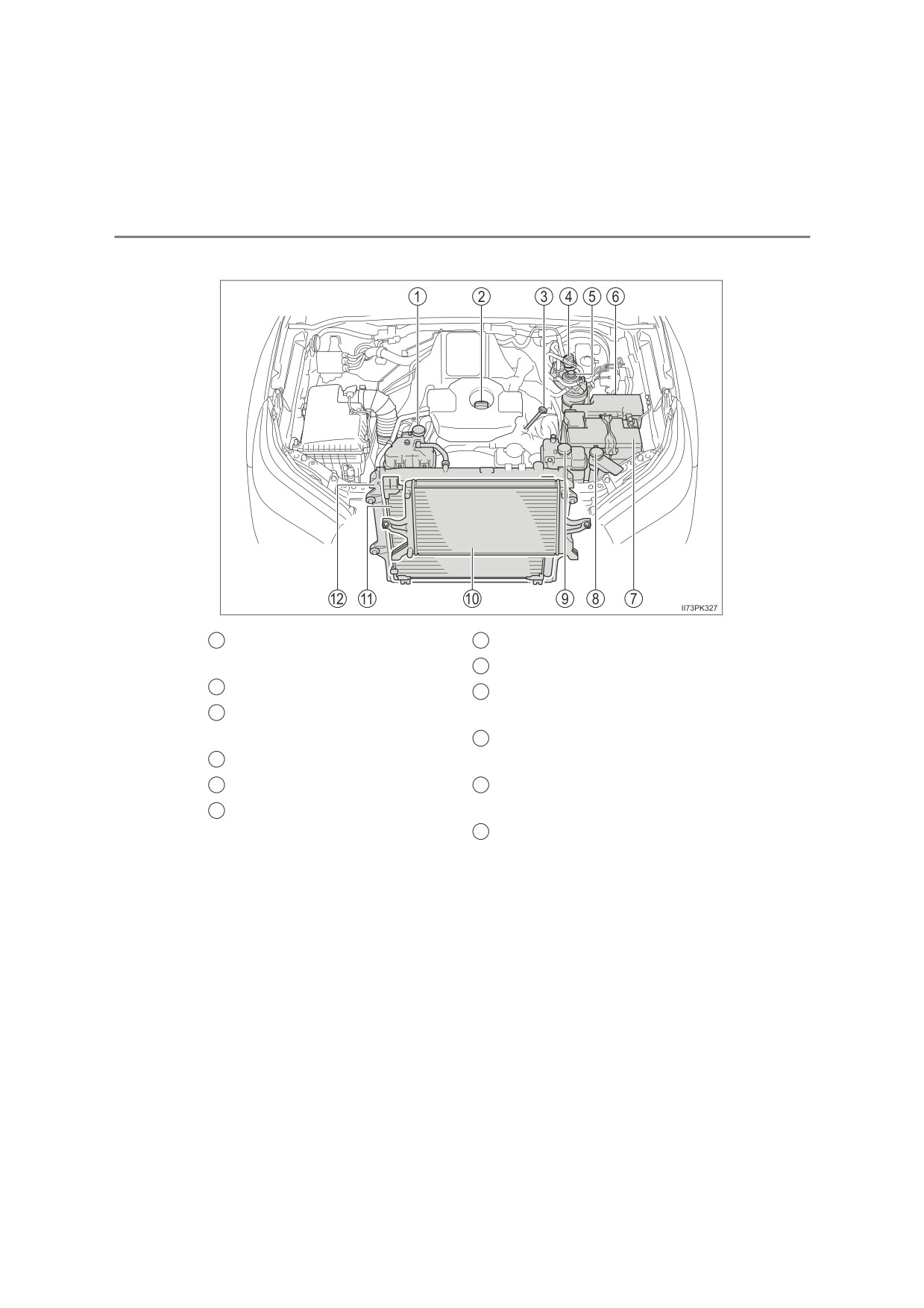
Diesel engine (vehicles with water-cooled intercooler)
1
Engine coolant reservoir
7
Battery
(P. 492)
(P. 490)
8
Washer fluid tank
(P. 496)
2
Engine oil filler cap (P. 488)
9
Intercooler coolant reservoir
3
Engine oil level dipstick
(P. 490)
(P. 487)
10
Intercooler cooling radiator
4
AdBlue™ tank cap (P. 498)
(P. 491)
5
Fuel filter
(P. 497, 612)
11
Condenser (if equipped)
6
Fuse box
(P. 518)
(P. 491)
12
Radiator
(P. 491)