Citroen DS5 Hybrid4 (2016 year). Manual - part 23
 

  Index      Citroen     Citroen DS5 Hybrid4 - service manual 2016 year in english


Search            


Content   ..  21  22  23  24   ..


Citroen DS5 Hybrid4 (2016 year). Manual - part 23


27

Hybrid4 system

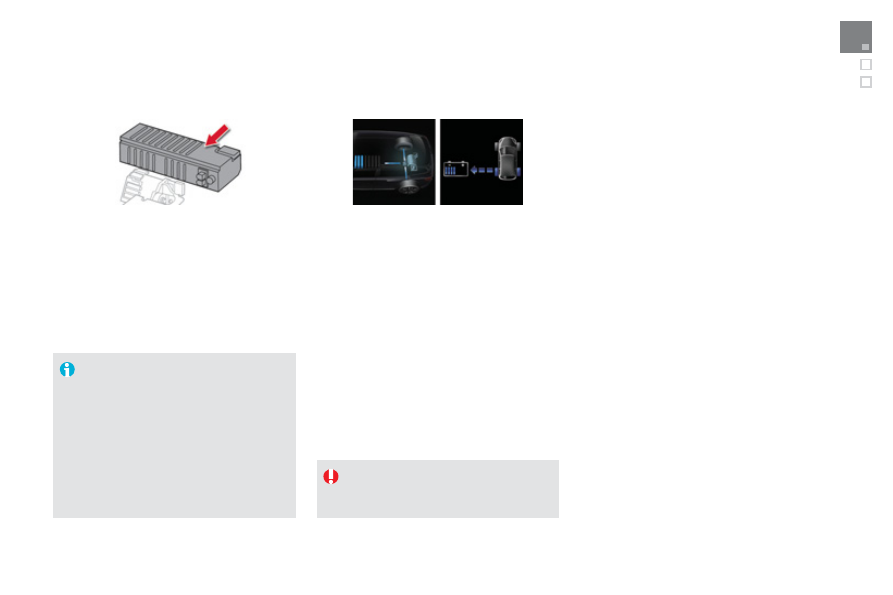
            200 V high voltage battery 

  The Ni-Mh (Nickel-Metal Hydride) technology 
used for the high voltage battery is suited to 
the frequent partial charging and discharging 
cycles related to the operation of a hybrid 
vehicle. 
 The battery is installed close to the electric 
motor, below the boot trim, behind the storage 
well.  

  Charging 

  The battery recharges automatically while 
travelling. 
 The battery is charged when the vehicle 
decelerates and when going downhill, the 
electric motor then becomes a generator and 
converts kinetic energy into electrical energy 
(except if the speed of the vehicle is above 
70 mph (120 km/h)). 
 This recovery allows the use of "free" energy. 
 The battery may also be partially charged up 
to a level of 4 to 5 bars, using the alternator-
starter motor (Stop & Start) of the HDi Diesel 
engine.  

  The average state of charge is 4 to 5 bars, so 
preserving a margin for energy recovery when 
deceleration or going downhill (free energy).  

  To preserve the service life of the 
battery, the level of charge never 
falls below 20%, even if no bars are 
displayed on the gauge after  ZEV  
running. 
 Where the battery is close to maximum, 
vehicle deceleration with your foot off 
the accelerator pedal will be at a lower 
level.  

  The battery charging time is very short. 
 Once it is discharged, following  ZEV  running 
or high load, the battery will reach its optimum 
level of charge after around 10 minutes.  

  The battery is not recharged from a 
mains power supply.   

            Safety warnings related to high voltage 

  The voltage used for the operation of 
the electric motor is in the range 150 to 
270 Volts. 
 Do not handle the components of the high 
voltage system (identified by the orange 
colour): risk of electrocution and burns!  

  High voltage cables are routed under the 
vehicle (sills); take care not to damage them 
when the vehicle is used for off-road activity 
(such as covering rough ground).  

  Before doing any 
work on the vehicle, 
switch off the ignition 
READY  lamp off).    

  Take care to position lifting equipment 
(jack, hoist, ...) at the locations provided to 
avoid damaging the cables.   

  Never touch, dismantle, remove or 
replace the high voltage parts, orange 
cables or connectors, even in the event of 
an accident.  

  To avoid any risk to the environment, 
the high voltage battery must be 
recycled in an appropriate manner. 
 Contact a CITROËN dealer or a 
qualified workshop.   

  Be sure to take account of the warning 
labels present on the vehicle. 
 Battery electrolyte is very corrosive: risk of 
burns. 
 No sparks or naked flames. 
 Do not burn or heat. 
 Keep out of reach of children. 
 Do not spray or pour fluids: risk of damage 
to the battery.  

  Emergency cut-off 

 In the event of an accident, a safety 
system automatically cuts-off the high 
voltage system and the fuel supply. 
 The Hybrid4 system can no longer be 
started. 
 You must then contact a CITROËN 
dealer or a qualified workshop.  

  Operations on the 

battery 

  The high voltage battery must not in 
any circumstances be charged from an 
external power supply and must only 
be handled by a qualified technician 
at a CITROËN dealer or a qualified 
workshop. 
 Incorrect handling may lead to serious 
burns, as well as electric arcs that could 
cause serious injury or even death.  

29

Hybrid4 system

 This ventilation system does not operate at 
the same speed at all times: it is continuously 
adjusted to suit the cooling requirements of the 
battery. 
 The noise of its operation can be heard, 
particularly at the rear, after the Hybrid4 system 
is switched off (post-ventilation). 

          Ventilation of the high voltage battery 

  Safety recommendations 

 Do not obstruct the air intake with 
objects such as clothes or bags, in 
order to avoid any risk of the battery 
overheating, which could cause a loss 
of performance of the Hybrid4 system, 
even damage to the battery. 
 Do not spill fluids, as this may damage 
the battery and cause a short-circuit.   

       The high voltage battery has an air cooling 
system. 
 This comprises an air intake (located on 
the side of the left hand rear seat) and a fan 
(located behind the left hand boot trim panel).   

            Access to the underbonnet 

 The alternator-starter motor of your Hybrid4 
vehicle is also supplied at high voltage. 
 If the vehicle ignition has not been switched off, 
there is a risk of the engine restarting at any 
time.  

  Always ensure that the 
ignition is switched off 
READY  lamp off) before 
opening the bonnet. 

  Before doing anything under the 
bonnet, you must switch off the ignition 
and verify that the  READY  lamp in the 
instrument panel is off - risk of serious 
injury!   

  Recommendations 

31

Comfort

                        Boot fi ttings 

    1.    Rear parcel shelf    
 

It can be removed to allow large objects 
to be carried. 

  2.    Bag hooks  
  3.    Retaining straps    
 

These are provided to stow a warning 
triangle. 

  4.    Removable boot floor    
 

Lift the floor using its grip and follow 
the guides.   

  When immobilising the vehicle, with the 
Hybrid4 system active, you must place 
the gear selector in neutral  N . 
 Before carrying out any work in the 
engine compartment, check that the 
gear selector is in position  N , that the 
parking brake is applied and that the 
 READY  lamp is off before switching off 
the Hybrid4 system.   

  Six-speed electronic gearbox which offers a 
choice between two operating modes: 
   -  

 automated  mode for automatic control of 
the gears by the gearbox, 

  -  

 manual  mode for sequential gear changing 
by the driver.  

 In automated mode, it is possible to change 
gear manually by using the steering mounted 
control paddles as desired, when overtaking, 
for example. 

                  Electronic gearbox (ETG6) 

   R.    Reverse 
   )   With your foot on the brake, lift the selector 

and move it forwards.  

  N.    Neutral. 
   )   With your foot on the brake, select this 

position to start.  

  A.    Automated mode. 
   )   Move the selector backwards to select 

this mode.  

  M.   Manual mode with sequential gear changing. 
   )   Lift the selector, then move it backwards 

to select this mode, then use the steering 
mounted control paddles to change gear.   

  Gear selector 

   +.    Change up paddle to the right of the 

steering wheel. 

   )   Press the back of the  "+"  steering mounted 

paddle to change up a gear.  

  -.    Change down paddle to the left of the 

steering wheel. 

   )   Press the back of the  "-"  steering mounted 

paddle to change down a gear.  

  Steering mounted control paddles 

  Engagement of reverse gear is 
accompanied by an audible signal.   

 The steering mounted paddles cannot 
be used to select neutral or to engage 
or disengage reverse gear.   

33

Driving

   N    Neutral 
  R    Reverse 
  1, 2, 3, 4, 5, 6    Gears in manual mode 
  A    This comes on when automated mode is 

selected. It goes off on changing to manual 
mode.  

  Displays in the instrument panel 

  Moving off 

    )   To start the engine, place the 

gear selector in position  N . 

    )   Release the parking brake by pulling the 

control lever, if automatic operation has 
been deactivated. 

  )   Progressively release the brake pedal. 

  Before leaving the vehicle, place the 
gear selector in position  N  and then 
you must stop the Hybrid4 system by 
switching off the ignition ( READY  lamp 
off).   

    )   Place your  foot on the brake  

when a message appears in the 
instrument panel screen.   

  )   Press the brake pedal down fully. 
  )   Start the Hybrid4 system.   

  If the Hybrid4 system does not activate: 
   -  If 


N  is flashing in the instrument 

panel, move the gear selector to 
position  A  then to position  N . 

  -  

If the message "Foot on brake" is 
displayed, press the brake pedal 
firmly.   

    )   Select a drive mode (position  A  or  M ) or 

reverse (position  R ).  

  For optimum acceleration, for example 
when overtaking another vehicle, press 
the accelerator pedal firmly past the 
point of resistance.  

    )   After starting the vehicle, select position  A  

for enter automated mode.   

  Automated mode 

   A  appears in the instrument panel 
screen.  

  The gearbox is then operating in auto-active 
mode, without any action on the part of the 
driver. It continuously selects the most suitable 
gear, depending on the: 
   -  

style of driving, 

  -  

profile of the road.   

  A  or  M1  or  R  appears in the 
instrument panel screen.  

  )   If the parking brake is released, the vehicle 

moves off.  


If the parking brake is applied and 
automatic mode is activated, accelerate 
progressively.    

  On sharp acceleration in manual mode, 
the gearbox will not change up unless 
the driver acts on the gear lever or the 
steering mounted paddles. 
 Never select neutral  N  while the vehicle 
is moving.    

  At very low speed, if reverse gear 
is requested, this will only be taken 
into account when the vehicle is 
immobilised. A warning lamp appears 
in the instrument panel screen. 
 Only engage reverse gear  R  when the 
vehicle is immobilised with the brake 
pedal pressed.  

 This selective gear change mode enables you 
to overtake, for example, while still remaining in 
automated mode. 
   )   Operate the  +  or  -  steering mounted control 

paddle.  

 The gearbox engages the gear requested if the 
engine speed permits.  A  is still displayed in the 
instrument panel. 

  Manual mode 

    )   When the vehicle has moved off, select 

position  M  to change to manual mode. 

  )   Operate the  +  or  -  steering mounted control 

paddles.   

  The gear change commands are only carried 
out if the engine speed permits. The internal 
combustion engine is still running. 
 It is not necessary to release the accelerator 
during gear changes. 
 When braking or slowing down, the gearbox 
changes down automatically to permit 
acceleration in the correct gear.  

  Manual gear changing 

   A  disappears and the 
gears engaged  M1...M6  
appear successively in the 
instrument panel screen.  

 After a few moments without any action on 
the controls, the gearbox resumes automatic 
control of the gears.   

35

Driving

  Stopping the vehicle 

  Operating fault 

  Before leaving the vehicle, check that 
the parking brake lamps are on (not 
flashing) in the instrument panel and in 
the control lever.  

  To immobilise the vehicle without 
applying the parking brake, before 
switching off the ignition, place the gear 
selector in position  A  or  R . 
 If the battery is flat, it is essential 
to place a chock against one of the 
wheels to immobilise the vehicle.   

  Before switching off the Hybrid4 system, place 
the gear selector in position  N.  
 When switching off the Hybrid4 system, the 
electric parking brake is applied automatically. 
 If the automatic function is deactivated, apply 
the parking brake manually to immobilise the 
vehicle.  

  Never leave children unsupervised in 
the vehicle with the Hybrid4 system 
active.   

  For your safety, this function will only 
be activated if you press the brake 
pedal when engaging forward drive or 
reverse. 
 This function is deactivated if the 
driver's door is opened. To reactivate 
it, close the door and then press the 
brake or accelerator pedal.  

  Creep function 

 This function facilitates manoeuvring of the 
vehicle at low speed (when parking, in traffic 
jams, …). 
 With the Hybrid4 hybrid system active, the 
vehicle stationary and the parking brake 
released: 
   )   press the brake pedal, 
  )   place the gear selector in position  A ,  R  or 

 M , 

  )   gradually release the brake pedal.  
 The vehicle moves off immediately and 
gradually reaches a speed of approximately 
6 mph (10 km/h), with pressing the accelerator 
pedal.  

  With the ignition on, the 
flashing of this warning lamp, 
accompanied by an audible 
signal and a message 

in the instrument panel screen, indicates a 
malfunction of the gearbox. 
 Have it checked by a CITROËN dealer or a 
qualified workshop.   

                  Car washing machine or tunnel 

  Some car washing machines or tunnels (where the vehicle is moved forwards on a travelling track) require that the parking brake be "released" during 
the wash. 

 With the Hybrid4 system active,  READY  lamp on, parking brake 
released: 
   )   Place the gear selector at position  N . 
  )   Switch off the Hybrid4 system (press the  START/STOP  

button). The  READY  lamp goes off in the instrument panel 
and the parking brake is applied automatically. 

  )   Switch on the ignition again (press the  START/STOP  button) 

without your foot on the brake pedal. The  READY  lamp 
remains off. 

  )   Release the parking brake using the manual control on the 

centre console, while keeping your foot on the brake pedal. 

  )   Switch off the ignition (press the  START/STOP  button without 

your foot on the brake pedal) after having checked that the 
parking brake remains released.     

  If the HDi Diesel engine was on standby, it then restarts. 
 If the HDi Diesel engine is running, its operation is maintained 
without time limit.   

 With the Hybrid4 system active,  READY  lamp on, parking brake 
released: 
   )   Place the gear selector at position  N  ( AUTO  mode). 
  )   Press the brake pedal then the " ECO OFF " button.   

  Car washing machines or tunnels in which the HDi 

Diesel engine must be switched off. 

  Car washing machines or tunnels in which the HDi 

Diesel engine must not be switched off. 

  If possible on your vehicle, deactivate the automatic operation of the electric parking brake in the vehicle systems configuration menu.    

37

Practical information

           Temporary puncture repair kit 

  This kit comprises a compressor and a sealant cartridge. 
 It allows you to carry out a  temporary repair  to a tyre. 
 This makes it possible to continue to the nearest garage. 

  It can be used for for repairing most 
punctures on the tread or shoulder of 
the tyre. 
 The compressor can be used to check 
and adjust a tyre pressure.  

  For more information on the use of this 
temporary puncture repair kit, refer 
to the corresponding section in the 
handbook for the vehicle.   

  All of these tools are specific to your 
vehicle. 
 Do not use them for other purposes.   

  Access to the kit 

              List of tools 

   1.   12 V compressor.  
 

Contains a sealant cartridge for the 
temporary repair of a tyre and can also be 
used for adjusting tyre pressures. 

  2.  Chock. 


For blocking the wheels of the vehicle. 

  3.   Wheel bolt cover remover.  
 

For removing the wheel bolt head 
protectors on alloy wheels. 

  4.   Wheel trim remover.  
 

For removing the wheel bolt finishers on 
alloy wheels. 

  5.   Removable towing eye.   

 This kit is installed in the storage box, under the 
boot floor.  

         Recovery of the vehicle on a fl at-bed  

  Never recover the vehicle by towing it with two or four wheels on the ground, as there is a risk of 
damage to the transmission. 
 However, if necessary because access to the vehicle is difficult, the vehicle can be moved a few 
dozen metres, at a speed of less than 6 mph (10 km/h).  

  Use the towing eye  only  to pull the vehicle out 
or to lash it for recovery on a flat-bed lorry or 
trailer.   

  Before doing any work, with the ignition on, press the brake pedal and place the gear selector at 
position  N , then switch off the Hybrid4 system ( READY  lamp off). 
 Always call on professionals for recovery of the vehicle on a flat-bed lorry or trailer.  

         Snow chains 

  Recommendations 

  The use of snow chains is only authorised on 
the front wheels. 
 The mode selector must be in the 
 4WD  position.  

  For information on the sizes 
compatible with the tyres on your 
vehicle and advice on use, refer to the 
corresponding section in the handbook 
for the vehicle.   

39

Technical data

  Electric motor  

   -   

 Technology  

 Synchronous with permanent magnets  

 Max. power: EU standard (kW) *  

  27  

 Max. power speed (rpm) 

  2 000 to 7 500  

 Max. torque: EU standard (Nm) 

  200  

 Max. torque speed (rpm) 

  800 to 1 290  

 Efficiency (%) 

  80 to 90  

  High voltage battery  

   Ni-MH    

(Nickel Metal Hydride)  

 Voltage (V~) 

  200  

 Energy capacity (kWh / Ah) 

  1.1 / 5.5  

 Range (miles (km)) 

  1.2 (2) (approximately)  

                  Electric motor and battery  

  Range varies according to the ambient climatic conditions, the driving style and conditions, the use of vehicle systems and ageing of the battery.   

  *   The maximum power corresponds to the value type approved on a test bed, under conditions defined by European legislation (directive 1999/99/EC).  

              Diesel engine and gearbox   

  Diesel engine  

   HDi 160   

  Gearbox  

   ETG6 electronic    

  (6-speed)   

 Cubic capacity (cc) 

  1 997  

 Bore x stroke (mm) 

  85 x 88  

 Max power: EU standard (kW) *  

  120  

 Max power engine speed (rpm) 

  3 850  

 Max torque: EU standard (Nm) 

  300  

 Max torque engine speed (rpm) 

  1 750  

 Fuel 

  Diesel  

 Catalytic converter 

  Yes  

 Particle filter 

  Yes  

 Engine oil capacity with filter replacement 
(in litres) 

  5.0  

  *    The maximum power corresponds to the type approved value on a test bed, under conditions defined by European legislation 

(directive 1999/99/EC).  

41

Technical data

              Weights and towed loads (in kg)   

  *    The kerb weight is equal to the unladen weight + driver (75 kg).  
  **    The weight of the braked trailer can be increased, within the GTW limit, if the GVW of the towing vehicle is reduced by an equal amount; warning, 

towing using a lightly loaded towing vehicle may have an adverse effect on its road holding.  

To make use of the 300 kg load transfer, the driver must be alone in the vehicle with no luggage in the vehicle.  

  Version  

   Diesel   Hybrid 4x4   

  Gearbox  

   ETG6 electronic    

  (6-speed)   

  Model code :  KF ... 

   RHCM/1PS  

RHCM/PS   

   -  Unladen 

weight 


  1 660  

   -  Kerb 

weight 

*   

  1 735  

   -  

Gross vehicle weight (GVW)  

  2 265  

   -  

Gross train weight (GTW)   


on a 12% gradient  

  2 765  

   -  

Braked trailer (within GTW limit)  


on a 10% or 12% gradient  

  500  

   -  Braked 

trailer 

**  (with load transfer with the 

GTW limit)  

  800  

   -  Unbraked 

trailer 


  500  

   -  

Recommended nose weight  

  75  

  The GTW and towed load values indicated are valid up to a maximum altitude of 1 000 metres; the towed load mentioned must be reduced by 10 % for 
each additional 1 000 metres of altitude. 
 The maximum authorised speed is reduced when towing (comply with the legislation in force in your country). 
 High ambient temperatures may result in a reduction in the performance of the vehicle to protect the engine; if the ambient temperature is above 37 °C, 
limit the towed load.   

 Frequently asked questions 

  100% electric mode (zero emissions)  

   Question   

   Answer   

 Why is it not always possible for me to select  ZEV  
(Zero Emissions Vehicle) mode even though the battery 
seems well charged? 

 This situation is temporary. 
 Certain conditions will occasionally prevent the change to ZEV mode, even if the battery 
has sufficient charge, such as, for example, very cold conditions, altitude, demisting, high 
demand for heating or air conditioning, regeneration of the particle filter (FAP). 

 Why do I sometimes see an alert message " Electric 
mode not available: FAP regeneration in progress
" ? 

 This is a message which indicates that regeneration of the particle filter (FAP) is in progress. 
This is a completely normal process that takes place every 240 or 300 miles (400 or 500 km) 
(or more frequently in prolonged urban use), as on a conventional HDi Diesel vehicle. 
 In the case of a conventional HDi Diesel vehicle, this process is not generally noticed by the 
driver. 
 On the other hand, in the case of Hybrid4 this phenomenon may be noticeable (in urban use) 
as temporarily the HDi engine will not stop and this message will be displayed at intervals 
while regeneration is in progress. 

 Why is it not possible for me to put the vehicle into  ZEV  
mode, even though I had just been running electrically 
in  AUTO  mode? 

 The management of ZEV is different from  AUTO  mode. 
 Changing to  ZEV  mode is only possible with a battery charge of at least 4 bars, in order to 
assure sufficient range. 
 In  AUTO  mode, the system alone manages the conditions for changing temporarily to 
electric mode, for shorter periods and with a lower state of charge of the battery. 

 Why is the range in  ZEV  mode lower when going uphill?   The vehicle needs more energy when going uphill than when running on the level. 

 So it is better to stay in  AUTO  mode, which will favour operation of the HDi Diesel engine. 

 Why is it that the system makes me come out of  ZEV  
mode; it does not return to  ZEV  mode automatically 
when the conditions allow? 

 It is not intended to give preference to  ZEV  running at any cost, as it is not always the 
most economical mode. 
 So the system returns automatically to  AUTO  mode. 


Content   ..  21  22  23  24   ..