Citroen C-Elysee (2017 year). Manual - part 8
 

  Index      Citroen     Citroen C-Elysee - service manual 2017 year in english


Search            


Content   ..  6  7  8  9   ..


Citroen C-Elysee (2017 year). Manual - part 8


111

7

Safety

C-elysee_en_Chap07_securite_ed01-2016

Deactivation

When the ignition is on, this warning 
lamp comes on in the instrument 
panel while the airbag is deactivated.

To assure your child's safety, you 
must deactivate the passenger's front 
airbag when you install a rearward 
facing child seat on the front passenger 
seat. Otherwise, the child risks being 
seriously injured or killed if the airbag is 
deployed.

Reactivation

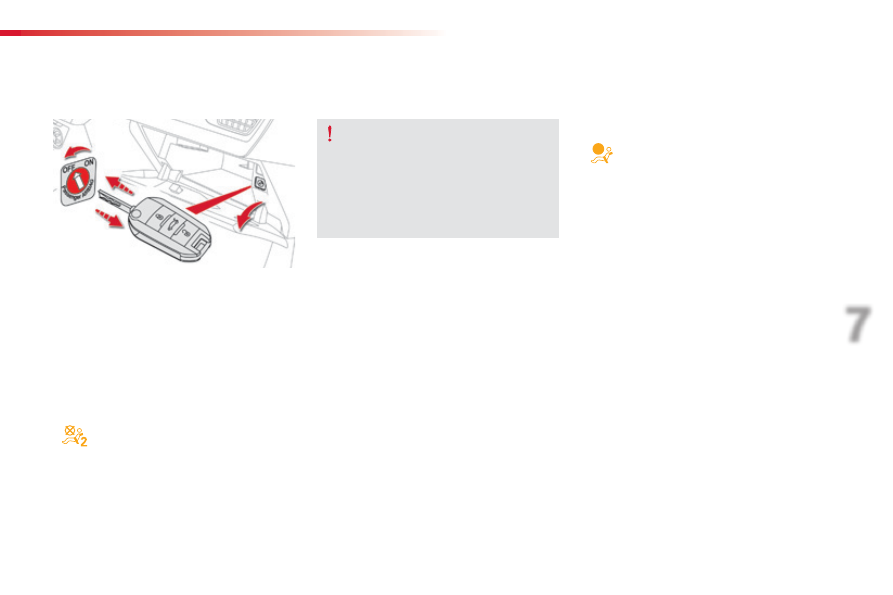
Only the passenger's front airbag can be 
deactivated.

With the ignition off, insert the key into 

the passenger airbag deactivation switch.

F  Turn it to the "OFF" position,
F

  Remove the key keeping the switch in the 

new position.

When you remove the rearward facing child 
seat, 

with the ignition on, turn the switch to 

the "ON"

 position to reactivate the airbag and 

so assure the safety of your front passenger in 
the event of an impact.

Operating fault

If this warning lamp comes on in the 
instrument panel, you must contact 
a CITROËN dealer or a qualified 
workshop without delay to have the 
system checked. The airbags may no 
longer be deployed in the event of a 
serious impact.

112

Safety

C-elysee_en_Chap07_securite_ed01-2016

Lateral airbags

Deployment

The lateral airbags are deployed unilaterally in the event 
of a serious side impact applied to all or part of the side 
impact zone 

B, perpendicular to the longitudinal centreline 

of the vehicle on a horizontal plane and directed from the 
outside towards the inside of the vehicle.
The lateral airbag contributes towards the protection of the 
front occupant of the vehicle, between the lower thorax 
and the head.

System that contributes towards improving the 
protection of the driver and front passenger in 
the event of a serious side impact, in order to 
limit the risk of injury to the chest, between the 
hip and the shoulder.
Each lateral airbag is fitted in the seat backrest 
frame, door side.

Impact detection zones

A.

  Front impact zone.

B.  Side impact zone.

If this warning lamp comes on in the 
instrument panel, you must contact 
a CITROËN dealer or a qualified 
workshop to have the system 
checked. The airbags may no longer 
be deployed in the event of a serious 
impact.

Operating fault

In the event of a minor impact or bump 
on the side of the vehicle or if the 
vehicle rolls over, the airbag may not be 
deployed.
In the event of a rear or front collision, 
the airbag is not deployed.

113

7

Safety

C-elysee_en_Chap07_securite_ed01-2016

Sit in a normal upright position.
Wear a correctly adjusted seat belt.
Do not leave anything between the 
occupants and the airbags (a child, pet, 
object...), nor fix or attach anything close to 
the inflation trajectory of the airbags; this 
could cause injuries during their deployment.
Never modify the original definition of your 
vehicle, particularly in the area directly 
around the airbags.
After an accident or if the vehicle has been 
stolen or broken into, have the airbag 
systems checked.
All work on the airbag system must be 
carried out by a CITROËN dealer or a 
qualified workshop.
Even if all of the precautions mentioned 
are observed, a risk of injury or of minor 
burns to the head, chest or arms when an 
airbag is deployed cannot be ruled out. The 
bag inflates almost instantly (within a few 
milliseconds) then deflates within the same 
time discharging the hot gas via openings 
provided for this purpose.

Lateral airbags

Use only approved covers on the seats, 
compatible with the deployment the lateral 
airbags. For information on the range of seat 
covers suitable for your vehicle, you can 
contact a CITROËN dealer.
For more information on accessories, refer 
to the corresponding section.
Do not fix or attach anything to the seat 
backs (clothing...). This could cause injury 
to the chest or arms if the lateral airbag is 
deployed.
Do not sit with the upper part of the body any 
nearer to the door than necessary.

Front airbags

Do not drive holding the steering wheel by its 
spokes or resting your hands on the centre 
part of the wheel.
Passengers must not place their feet on the 
dashboard.
Do not smoke as deployment of the airbags 
can cause burns or the risk of injury from a 
cigarette or pipe.
Never remove or pierce the steering wheel or 
hit it violently.
Do not fit or attach anything to the steering 
wheel or dashboard, this could cause 
injuries with deployment of the airbags.

Advice

For the airbags to be fully effective, observe the safety recommendations below:

114

Child safety

C-elysee_en_Chap08_securite-enfants_ed01-2016

General points relating to child seats

For maximum safety, please observe the 
following recommendations:
-  in accordance with European regulations, 

all children under the age of 12 or less 

than one and a half metres tall must 

travel in approved child seats suited to 

their weight, on seats fitted with a seat 

belt or ISOFIX mountings*,

statistically, the safest seats in your 

vehicle for carrying children are the 

rear seats,

a child weighing less than 9 kg must 

travel in the rearward facing position 

both in the front and in the rear.

CITROËN recommends that children 

should travel in the 

outer rear seats of 

your vehicle:

rearward facing up to the age of 3,

forward facing over the age of 3.

Although one of CITROËN main criteria when designing your vehicle, the safety of your children 
also depends on you.

*  The regulations on carrying children are 

specific to each country. Refer to the 
legislation in force in your country.

115

8

Child safety

C-elysee_en_Chap08_securite-enfants_ed01-2016

Child seat at the rear

Rearward facing

When a rearward facing child seat is installed 

on a rear passenger seat, move the vehicle's 

front seat forwards and straighten the backrest 
so that the rearward facing child seat does not 
touch the vehicle's front seat.

Forward facing

When a forward facing child seat is installed 

on a rear passenger seat, move the vehicle's 

front seat forwards and straighten the backrest 
so that the legs of the child in the forward 
facing child seat do not touch the vehicle's 
front seat.

Ensure that the seat belt is correctly 
tightened. For child seats with a support 
leg, ensure that the support leg is in 
stable contact with the floor.

116

Child safety

C-elysee_en_Chap08_securite-enfants_ed01-2016

Child seat in the front*

Rearward facing

Forward facing

Passenger seat adjusted to the intermediate 

longitudinal position.

Ensure that the seat belt is correctly 
tensioned.
For child seats with a support leg, 
ensure that the support leg is in stable 
contact with the floor. If necessary, 
adjust the passenger seat.

When a rearward facing child seat is installed 
on the 

front passenger seat, adjust the seat to 

the intermediate longitudinal position, with the 
backrest straightened.
The passenger's front airbag must be 
deactivated. Otherwise, 

the child would 

risk being seriously injured or killed if the 

airbag were to inflate.

When a forward facing child seat is installed on 
the 

front passenger seat, adjust the vehicle's 

seat to the intermediate longitudinal position 
with seat backrest straightened and leave the 
passenger's front airbag activated.

*  Refer to the current legislation in your country 

before installing your child on the front seat.

117

8

Child safety

C-elysee_en_Chap08_securite-enfants_ed01-2016

Passenger airbag OFF

Deactivating the passenger's front airbag

Never install a rearward facing child 
restraint system on a seat protected by 
an active front airbag. This could cause 
the death of the child or serious injury.

For information on deactivating the 
passenger's front airbag, refer to the 
"Airbags" section.

The warning label present on both sides of the 
passenger's sun visor repeats this advice. In 
line with current legislation, the following tables 
contain this warning in all of the languages 
required.

This label is located on the middle door pillar, 
passenger side.

118

AR

BG НИКОГА НЕ инсталирайте детско столче на седалка с АКТИВИРАНА предна ВЪЗДУШНА ВЪЗГЛАВНИЦА. Това може да причини 

СМЪРТ или СЕРИОЗНО НАРАНЯВАНЕ на детето.

CS

NIKDY neumisťujte dětské zádržné zařízení orientované směrem dozadu na sedadlo chráněné AKTIVOVANÝM čelním AIRBAGEM. Hrozí 

nebezpečí SMRTI DÍTĚTE nebo VÁŽNÉHO ZRANĚNÍ.

DA

Brug ALDRIG  en bagudvendt barnestol på et sæde, der er beskyttet af en AKTIV AIRBAG. BARNET risikerer at blive ALVORLIGT 

KVÆSTET eller DRÆBT.

DE Montieren Sie auf einem Sitz mit AKTIVIERTEM Front-Airbag NIEMALS einen Kindersitz oder eine Babyschale entgegen der Fahrtrichtung, 

das Kind könnte schwere oder sogar tödliche Verletzungen erleiden.

EL Μη χρησιμοποιείτε ΠΟΤΕ παιδικό κάθισμα με την πλάτη του προς το εμπρός μέρος του αυτοκινήτου, σε μια θέση που προστατεύεται από 

ΜΕΤΩΠΙΚΟ αερόσακο που είναι ΕΝΕΡΓΟΣ. Αυτό μπορεί να έχει σαν συνέπεια το ΘΑΝΑΤΟ ή το ΣΟΒΑΡΟ ΤΡΑΥΜΑΤΙΣΜΟ του ΠΑΙΔΙΟΥ

EN NEVER use a rearward facing child restraint on a seat protected by an ACTIVE AIRBAG in front of it, DEATH or SERIOUS INJURY to the 

CHILD can occur

ES NO INSTALAR NUNCA un sistema de retención para niños de espaldas al sentido de la marcha en un asiento protegido mediante un 

AIRBAG frontal ACTIVADO, ya que podría causar lesiones GRAVES o incluso la MUERTE del niño.

ET Ärge MITTE KUNAGI paigaldage “seljaga sõidusuunas“ lapseistet juhi kõrvalistmele, mille ESITURVAPADI on AKTIVEERITUD. Turvapadja 

avanemine võib last TÕSISELT või ELUOHTLIKULT vigastada.

FI

ÄLÄ KOSKAAN aseta lapsen turvaistuinta selkä ajosuuntaan istuimelle, jonka edessä suojana on käyttöön aktivoitu TURVATYYNY. Sen 

laukeaminen voi aiheuttaa LAPSEN KUOLEMAN tai VAKAVAN LOUKKAANTUMISEN.

FR

NE JAMAIS installer de système de retenue pour enfants faisant face vers l’arrière sur un siège protégé par un COUSSIN GONFLABLE 

frontal ACTIVÉ.

Cela peut provoquer la MORT de l’ENFANT ou le BLESSER GRAVEMENT

HR

NIKADA ne postavljati dječju sjedalicu leđima u smjeru vožnje na sjedalo zaštićeno UKLJUČENIM prednjim ZRAČNIM JASTUKOM. To bi 

moglo uzrokovati SMRT ili TEŠKU OZLJEDU djeteta.

HU

SOHA ne használjon menetiránynak háttal beszerelt gyermekülést AKTIVÁLT (BEKAPCSOLT) FRONTLÉGZSÁKKAL védett ülésen. Ez a 

gyermek HALÁLÁT vagy SÚLYOS SÉRÜLÉSÉT okozhatja.

IT

NON installare MAI seggiolini per bambini posizionati in senso contrario a quello di marcia su un sedile protetto da un AIRBAG frontale 

ATTIVATO. Ciò potrebbe provocare la MORTE o FERITE GRAVI al bambino.

LT NIEKADA neįrenkite vaiko prilaikymo priemonės su atgal atgręžtu vaiku ant sėdynės, kuri saugoma VEIKIANČIOS priekinės ORO 

PAGALVĖS. Išsiskleidus oro pagalvei vaikas gali būti MIRTINAI arba SUNKIAI TRAUMUOTAS.

LV NEKAD NEuzstādiet uz aizmuguri vērstu bērnu sēdeklīti priekšējā pasažiera sēdvietā, kurā ir AKTIVIZĒTS priekšējais DROŠĪBAS GAISA 

SPILVENS.

Tas var izraisīt BĒRNA NĀVI vai radīt NOPIETNUS IEVAINOJUMUS.

Child safety

C-elysee_en_Chap08_securite-enfants_ed01-2016

119

8

MT

Qatt m’ghandek thalli tifel/tifla marbut f’siggu dahru lejn l-Airbag attiva, ghaliex tista’ tikkawza korriment serju jew anke mewt lit-tifel/tifla

NL Plaats NOOIT een kinderzitje met de rug in de rijrichting op een zitplaats waarvan de AIRBAG is INGESCHAKELD. Bij het afgaan van de 

airbag kan het KIND LEVENSGEVAARLIJK GEWOND RAKEN

NO

Installer ALDRI et barnesete med ryggen mot kjøreretningen i et sete som er beskyttet med en frontal AKTIVERT KOLLISJONSPUTE, 

BARNET risikerer å bli DREPT eller HARDT SKADET.

PL NIGDY nie instalować fotelika dziecięcego w pozycji "tyłem do kierunku jazdy" na siedzeniu wyposażonym w CZOŁOWĄ PODUSZKĘ 

POWIETRZNĄ w stanie AKTYWNYM. Może to doprowadzić do ŚMIERCI DZIECKA lub spowodować u niego POWAŻNE OBRAŻENIA 

CIAŁA.

PT

NUNCA instale um sistema de retenção para crianças de costas para a estrada num banco protegido por um AIRBAG frontal ACTIVADO.

Esta instalação poderá provocar FERIMENTOS GRAVES ou a MORTE da CRIANÇA.

RO

Nu instalati NICIODATA un sistem de retinere pentru copii, dispus cu spatele in directia de mers, pe un loc din vehicul protejat cu AIRBAG 

frontal ACTIVAT. Aceasta ar putea provoca MOARTEA COPILULUI sau RANIREA lui GRAVA.

RU

ВО ВСЕХ СЛУЧАЯХ ЗАПРЕЩАЕТСЯ использовать обращенное назад детское удерживающее устройство на сиденье, 

защищенном ФУНКЦИОНИРУЮЩЕЙ ПОДУШКОЙ БЕЗОПАСНОСТИ, установленной перед этим сиденьем. 

Это может привести к ГИБЕЛИ РЕБЕНКА или НАНЕСЕНИЮ ЕМУ СЕРЬЕЗНЫХ ТЕЛЕСНЫХ ПОВРЕЖДЕНИЙ

SK

NIKDY neinštalujte detské zádržné zariadenie orientované smerom dozadu na sedadlo chránené AKTIVOVANÝM čelným AIRBAGOM. 

Mohlo by dôjsť k SMRTEĽNÉMU alebo VÁŽNEMU PORANENIU DIEŤAŤA.

SL NIKOLI ne nameščajte otroškega sedeža s hrbtom v smeri vožnje, če je VARNOSTNA BLAZINA pred sprednjim sopotnikovim sedežem 

AKTIVIRANA. Takšna namestitev lahko povzroči SMRT OTROKA ali HUDE POŠKODBE.

SR

NIKADA ne koristite dečje sedište koje se okreće unazad na sedištu zaštićenim AKTIVNIM VAZDUŠNIM JASTUKOM ispred njega, jer 

mogu nastupiti SMRT ili OZBILJNA POVREDA DETETA.

SV

Passagerarkrockkudden fram MÅSTE vara avaktiverad om en bakåtvänd bilbarnstol installeras på denna plats. Annars riskerar barnet att 

DÖDAS eller SKADAS ALLVARLIGT.

TR

KESİNLKLE HAVA YASTIĞI AKTİF olan ön koltuğa yüzü arkaya dönük bir çocuk koltuğu yerleştirmeyiniz. Bu ÇOCUĞUN ÖLMESİNE veya 

ÇOK AĞIR YARALANMASINA sebep olabilir.

Child safety

C-elysee_en_Chap08_securite-enfants_ed01-2016

120

Child safety

C-elysee_en_Chap08_securite-enfants_ed01-2016

Child seats recommended by CITROËN

Group 0+: from birth to 13 kg

L1 

"RÖMER Baby-Safe Plus" 

Installed in the rearward facing position.

Groups 2 and 3: from 15 to 36 kg

L4 

"KLIPPAN Optima"

From 22 kg (approximately 6 years), the booster is used on its own.

L5 

"RÖMER KIDFIX"

Can be fitted to the vehicle's ISOFIX mountings.

The child is restrained by the seat belt.

CITROËN offers a range of recommended child seats which are secured using a 

three point seat 

belt.

121

8

Child safety

C-elysee_en_Chap08_securite-enfants_ed01-2016

Installing a child seat using the seat belt

Weight of the child and indicative age

Seat

Under 13 kg 

(groups 0 

(b) and 0+)

Up to approx 1 year

From 9 to 18 kg 

(group 1)

1 to 3 years approx

From 15 to 25 kg 

(group 2)

3 to 6 years approx

From 22 to 36 kg 

(group 3)

6 to 10 years approx

Front passenger seat without 
height adjuster 

(c) (e)

U

U

U

U

Outer rear seats 

(d)

U

U

U

U

Centre rear seat

X

X

X

X

(a)  Universal child seat: child seat that can be installed in all vehicles using a seat belt.

(b)  Group 0: from birth to 10 kg. Shells seats and baby carriers cannot be installed in the front 

passenger seat.

(c)  Consult the legislation in force in your country before installing your child on this seat.

(d)  To install a child seat at the rear, rearward or forward facing, move the seat in front forward, 

then straighten the backrest to allow enough space for the child seat and the child's legs.

(e)  When a rearward facing child seat is installed on the front passenger seat, the passenger's 

airbag must be deactivated. Otherwise, 

the child would risk being seriously injured or 

killed if the airbag were deployed. When a forward facing child seat is installed on the front 

passenger seat, the passenger's airbag must remain activate.

In accordance with European regulations, this table indicates the options for installing child seats secured using a seat belt and universally approved 

(a) 

in accordance with the weight of the child and the seat in the vehicle.

Remove and stow the head restraint 
before installing a child seat with a 
backrest on a passenger seat. Refit the 
head restraint once the child seat has 
been removed.

U

:  Seat suitable for the installation of a 

child seat secured using a seat belt and 
universally approved, rearward facing and/
or forward facing.

X:  Seat not suitable for the installation of a 

child seat of the weight group indicated.

122

Child safety

C-elysee_en_Chap08_securite-enfants_ed01-2016

The incorrect installation of a child seat in a 
vehicle compromises the child's protection in 
the event of an accident.
Ensure that there is no seat belt or seat belt 
buckle under the child seat, as this could 
destabilise it.
Remember to fasten the seat belts or the 
child seat harnesses keeping the slack 
relative to the child's body to a minimum, 
even for short journeys.
When installing a child seat using the seat 
belt, ensure that the seat belt is tightened 
correctly on the child seat and that it secures 
the child seat firmly on the seat of your 
vehicle. If your passenger seat is adjustable, 
move it forwards if necessary.
At rear seating positions, always leave 
sufficient space between the front seat and:
-  a rearward facing child seat,
-  the child's feet for a child seat fitted 

forward facing.

To do this, move the front seat forwards 
and, if necessary, move its backrest into the 
upright position.

Advice

As a safety precaution, do not leave:
-  a child or children alone and 

unsupervised in a vehicle,

-  a child or an animal in a vehicle which 

is exposed to the sun, with the windows 
closed,

-  the keys within reach of children inside 

the vehicle.

To prevent accidental opening of the doors 
and rear windows, use the child lock.
Take care not to open the rear windows by 
more than one third.
To protect young children from the rays of 
the sun, fit side blinds on the rear windows.

For optimum installation of the forward facing 
child seat, ensure that the back of the child 
seat is as close as possible to the backrest 
of the vehicle's seat , in contact if possible.
You must remove the head restraint before 
installing a child seat with backrest to a 
passenger seat.
Ensure that the head restraint is stored or 
attached securely to prevent it from being 
thrown around the vehicle in the event of 
sharp braking. Refit the head restraint when 
the child seat is removed.

Children at the front

The legislation on carrying children on the 
front passenger seat is specific to each 
country. Refer to the legislation in force in 
your country.
Deactivate the passenger's front airbag 
when a rearward facing child seat is installed 
on the front passenger seat.
Otherwise, the child risks being seriously 
injured or killed if the airbag is deployed.

Installing a booster seat

The chest part of the seat belt must be 
positioned on the child's shoulder without 
touching the neck.
Ensure that the lap part of the seat belt 
passes correctly over the child's thighs.
CITROËN recommends the use of a booster 
seat which has a back, fitted with a seat belt 
guide at shoulder level.

123

8

Child safety

C-elysee_en_Chap08_securite-enfants_ed01-2016

Your vehicle has been approved in accordance 
with the 

latest ISOFIX regulations.

The seats, represented below, are fitted with 
regulation ISOFIX mountings:

"ISOFIX" mountings

-  two rings A, located between the vehicle 

seat back and cushion, indicated by a 
marking,

To secure the child seat to the TOP TETHER:
-  pass the child seat strap over the centre of 

the vehicle's seat backrest,

-  raise the TOP TETHER,
-  secure the upper strap fixing to the ring 

B,

-  tighten the upper strap.

Observe strictly the fitting instructions 
provided with the child seat.

For information on the possibilities for fitting 
ISOFIX child seats to your vehicle, refer to the 
table of seating positions.

-  a ring 

B, located under a cover on the back 

of the top of the seat backrest, referred to as 
the 

TOP TETHER for fixing the upper strap.


Its position is indicated by a marking.

The ISOFIX mountings are three rings for each seat:

The TOP TETHER is used to secure the upper 
strap of child seats that have one. This device 
limits forward tipping of the child seat, in the 
event of a front impact.

This ISOFIX mounting system ensures fast, 
reliable and safe fitting of the child seat in your 
vehicle.
The 

ISOFIX child seats are fitted with 

two latches which are secured easily on the 
two rings A.
Some also have an 

upper strap (or top tether) 

which is attached to ring 

B.

When installing an ISOFIX child seat on the 
right hand rear seat, before securing the seat, 
first move the centre rear seat belt towards the 
middle of the vehicle, so as to not interfere with 
the operation of the seat belt.

The incorrect installation of a child seat 
in a vehicle compromises the child's 
protection in the event of an accident.

124

Child safety

C-elysee_en_Chap08_securite-enfants_ed01-2016

ISOFIX child seats recommended by CITROËN and approved 

for your vehicle

Follow the instructions for fitting child seats contained in their manufacturer's installation guide.

"RÖMER Baby-Safe Plus and its Baby-Safe Plus ISOFIX base" (size category: E)

Group 0+: from birth to 13 kg

Installed rearward facing using an ISOFIX base which is attached to the rings A.

The base has a support leg, adjustable for height, which sits on the vehicle's floor.

This child seat can also be secured with a seat belt. In this case, only the shell is used  

and attached to the vehicle's seat by the three-point seat belt.

125

8

Child safety

C-elysee_en_Chap08_securite-enfants_ed01-2016

"RÖMER Duo Plus ISOFIX" (size category B1)

Group 1: from 9 to 18 kg

Is installed only in the forward facing position.

Is attached to the anchorage rings A and the upper anchorage ring 

B,  

referred to as the Top Tether, using an upper strap.

Three seat body angles: sitting, reclining, lying down.

This seat can be used on seats not equipped with ISOFIX mountings.
In this case, it must be attached to the vehicle's seat using the three-point seat belt.
Adjust the front seat of the vehicle so that the child's feet do not touch the backrest.

Follow the instructions for fitting child seats contained in the seat manufacturer's installation guide.

126

Child safety

C-elysee_en_Chap08_securite-enfants_ed01-2016

"

Baby P2C Midi" and its ISOFIX base (size categories: D, C, A, B, B1)

Group 1: from 9 to 18 kg

Installed rearward facing using an ISOFIX base which is attached to the anchorage rings A.

The base has a support leg, adjustable for height, which sits on the vehicle's floor.

This child seat can also be used forward facing.

This seat can 

not be secured with a seat belt.

We recommend that you use the seat in the rearward facing position up to the age of 3 years.

Follow the instructions for fitting child seats contained in the seat manufacturer's installation guide.

FAIR G 0/1 S

 and its 

RWF A and FWF A ISOFIX bases  

(size category 

C for the rearward facing version, size category A for the forward facing version)

Group 0+ and 1: from birth to 18 kg

Installed in the rearward facing position for children under 18 kg and forward facing for children 

between 13 and 18 kg, using its ISOFIX base, which is attached to the rings A.

Use the rearward facing (RWF) type A ISOFIX base or the forward facing (FWF) type A ISOFIX base.

6 positions of inclination of the shell.

This child seat can also be used in a forward facing position on seating  

positions not equipped with ISOFIX mountings.

In this case the shell of the child seat must be attached to  

the vehicle seat using the three-point seat belt.


Content   ..  6  7  8  9   ..