Citroen C4 Dag (2013 year). Manual - part 11
 

  Index      Citroen     Citroen C4 Dag - service manual 2013 year in english


Search            


Content   ..  9  10  11  12   ..


Citroen C4 Dag (2013 year). Manual - part 11


9

D R I V I N G

159 

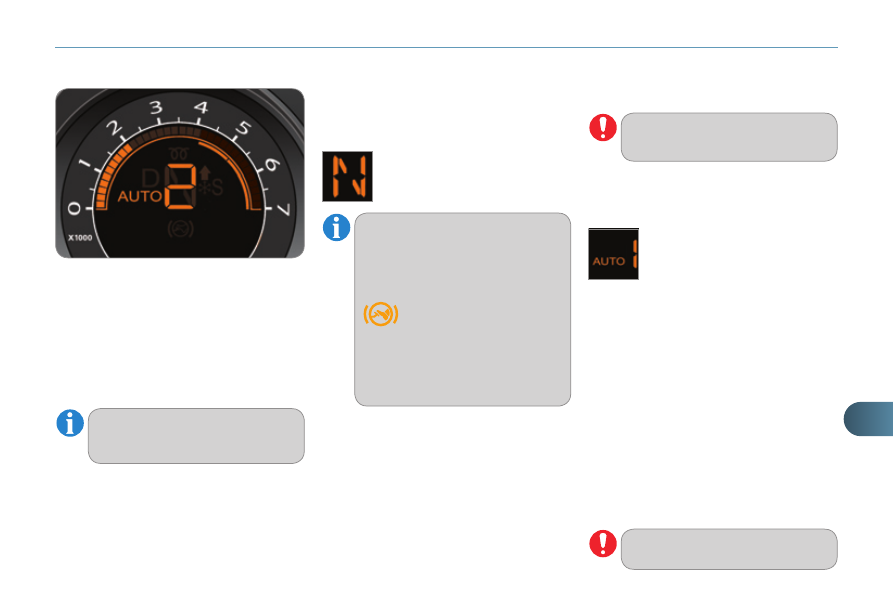
  Displays in the instrument panel 

  Gear lever positions 
  N.  Neutral 
  R.  Reverse 
  1, 2, 3, 4, 5, 6.   Gears in sequential 

mode. 

  AUTO.    This comes on when the automated 

mode is selected. It switches off on 

changing to sequential mode.   

  You must press the brake pedal 

when starting the engine.   

      Select position  N . 
     Press the brake pedal down fully. 
     Start the engine.  

  Moving off 

      Select automated mode (position  A ) 

or sequential mode (position  M ) or 

reverse (position  R ). 

     Release the parking brake unless it 

is programmed to automatic mode. 

     Progressively take your foot off the 

brake pedal. 

    Accelerate away. 


  Automated mode 

      Select position  A .  

  For optimum acceleration, for example 

when overtaking another vehicle, press 

the accelerator pedal fi rmly past the 

point of resistance.  

  Engagement of reverse gear is ac-

companied by an audible signal.  

   N  fl ashes in the instrument panel, 

accompanied by an audible sig-

nal and a message in the multi-

function screen, if the gear lever 

is not in position  N  on starting. 

  AUTO  and  1 ,  1  or  R  appear in the in-

strument panel screen. 

 The gearbox operates in auto-active 

mode, without any action on the part 

of the driver. It continuously selects the 

most suitable gear for: 
   -  

optimisation of fuel consumption, 

  -  

the style of driving, 

  -  the 

profi le of the road. 

  -  

the vehicle load.  

  N  appears in the instrument 

panel screen. 

 The  

Foot on brake  

warning lamp comes on 

the instrument panel, 

accompanied by an au-

dible signal and a message in 

the screen, if the brake pedal is 

not pressed on starting the en-

gine.  

  Never select neutral  

N  when 

driving.  

  AUTO  and the gear engaged 

appear in the instrument pan-

el screen. 

9

D R I V I N G

160 

  You can change mode at any 

time by moving the gear lever 

from  

A  to  

M  or the other way 

round.  

  At low high speed, if reverse gear is 

requested, the  N  indicator fl ashes  and 

the gearbox goes into neutral automati-

cally. To engage reverse, put the gear 

lever in position  N , then position  R .   

  When immobilising the vehicle, 

with the engine running, you 

must place the gear lever in neu-

tral  N . 
 Before carrying out any work in 

the engine compartment, ensure 

that the gear lever is in neutral  N  

and that the parking brake is ap-

plied. 
 Whatever the circumstances, 

you must manually apply the 

parking brake when parking, 

unless the parking brake is pro-

grammed in automatic mode.   

  Reverse 

 To engage reverse gear  R , the vehicle 

must be immobilised with your foot on 

the brake pedal. 
      Select position  R .  

  Operating fault 

 With the ignition on, the fl ashing  of 

 AUTO , accompanied by an audible sig-

nal and a message in the screen, indi-

cates a malfunction of the gearbox. 
 Have it checked by a CITROËN dealer 

or a qualifi ed workshop.  

  Manual mode 

      Select position  M .  

 The gears engaged appear in 

succession in the instrument 

panel screen. 

 The gear change requests are only act-

ed on if the engine speed permits. 
 It is not necessary to release the accel-

erator during gear changes. 
 When braking or slowing down, the 

gearbox changes down automatically 

to allow the vehicle to accelerate in the 

correct gear. 
 On sharp acceleration, the gearbox will 

not change up unless the driver acts on 

the gear lever or the steering mounted 

paddles. 

  Temporary control of gear changing 
 You can temporarily take over control 

of gear changing using the  "+"  and  "-"  

steering mounted paddles: if the engine 

speed allows, the request to change 

gear is acted on. 
 This function allows you to anticipate 

certain situations such as overtaking a 

vehicle or the approach to a corner. 
 After a few moments without any action 

on the control paddles, the gearbox re-

sumes automatic control of the gears.   

  Never select neutral  N  while the 

vehicle is moving.   

  Stopping the vehicle 

 Before switching off the engine, you 

can: 
   -   move to position  N  to engage neutral,  
 or 
  -   leave the gear engaged; in this 

case, it will not be possible to move 

the vehicle.  

 In both cases,  

you must apply the 

parking brake  to immobilise the vehicle. 

9

D R I V I N G

161 

               AUTOMATIC GEARBOX 

 Six speed automatic gearbox which of-

fers a choice between the comfort of 

fully automatic operation, enhanced by 

sport and snow programmes, or manu-

al gear changing. 
 Four driving modes are offered: 
   -  

 automatic  operation for electronic 

management of the gears by the 

gearbox, 

  -  

 sport  programme for a more dy-

namic style of driving, 

  -  

 snow  programme to improve driving 

when traction is poor, 

  -  

 manual  operation for sequential 

changing of the gears by the driver.  

  Gear selection gate 

   1.  Gear lever. 
  2.  Button  

"S"   (sport) . 

  3.  Button " 

 "  (snow) .   

  P.  Park. 
   -   Immobilisation of the vehicle, park-

ing brake on or off. 

  -  

Starting the engine.  

  R.  Reverse. 
   -  

Reversing manoeuvres, vehicle sta-

tionary, engine at idle.  

  N.  Neutral. 
   -   Immobilisation of the vehicle, parking 

brake on. 

  -  

Starting the engine.  

  D.  Automatic operation. 
  M +/- .  Manual operation with sequential 

changing of the six gears. 

     Press forwards to change up 

through the gears.  

  or 
     Press rearwards to change down 

through the gears.   

  Gear lever 

 When you move the lever in the gate 

to select a position, the corresponding 

indicator is displayed in the instrument 

panel. 
  P.  Park 
  R.  Reverse 
  N.  Neutral 
  D.  Drive (Automatic driving) 
  S.   Sport  programme 
   .  Snow  programme 
  1 to 6.   Gear engaged during manual 

operation 

  -.  Invalid value during manual operation  

  Displays in the instrument panel 

9

D R I V I N G

162 

  Moving off 

      With your foot on the brake, select 

position  P  or  N . 

     Start the engine.  
 If this procedure is not followed, there 

is an audible signal, accompanied by a 

message in the multifunction screen. 
      With the engine running, press the 

brake pedal. 

     Release the parking brake, unless it 

is programmed to automatic mode. 

     Select position  R ,  D  or  M , 
     Gradually release the brake pedal.  
 The vehicle moves off immediately. 

  If position  

N  is engaged inad-

vertently while driving, allow the 

engine to return to idle then en-

gage position  D  to accelerate.  

  When the engine is running at 

idle, with the brakes released, 

if position  R ,  D  or  M  is selected, 

the vehicle moves even without 

the accelerator being pressed. 
 When the engine is running, 

never leave children in the ve-

hicle without supervision. 
 When carrying out maintenance 

with the engine running, apply 

the parking brake and select po-

sition  P .   

  Automatic operation 

     Select position  

D  for  

automatic  

changing of the six gears.  

 The gearbox then operates in auto-

adaptive mode, without any intervention 

on the part of the driver. It continuously 

selects the most suitable gear accord-

ing to the style of driving, the profi le of 

the road and the load in the vehicle. 
 For maximum acceleration without 

touching the lever, press the accelera-

tor pedal down fully (kick down). The 

gearbox changes down automatically 

or maintains the gear selected until the 

maximum engine speed is reached. 
 On braking, the gearbox changes down 

automatically to provide effi cient engine 

braking. 
 If you release the accelerator sharply, 

the gearbox will not change to a higher 

gear for safety reasons. 

  Never select position  N  while the 

vehicle is moving. 
 Never select positions  

P  or  

R  

unless the vehicle is completely 

stationary.   

  Sport and snow programmes 

 These two special programmes supple-

ment the automatic operation in very 

specifi c conditions of use. 

  Sport programme "S" 
      Press button  "S" , after starting the 

engine.  

 The gearbox automatically favours a 

dynamic style of driving. 

  S  appears in the instrument panel.  

  Snow programme "  " 
      Press button "  ", after starting the 

engine.  

 The gearbox adapts to driving on slip-

pery roads. 
 This programme improves starting and 

drive when traction is poor. 

    appears in the instrument 

panel.   

  Return to automatic operation 

      At any time, press the button select-

ed again to quit the programme en-

gaged and return to auto-adaptive 

mode.   

9

D R I V I N G

163 

  Manual operation 

     Select position  

M  for  

sequential  

changing of the six gears. 

     Push the lever towards the  +  sign to 

change up a gear. 

     Pull the lever towards the  -  sign to 

change down a gear.  

 It is only possible to change from one 

gear to another if the vehicle speed and 

engine speed permit; otherwise, the 

gearbox will operate temporarily in au-

tomatic mode. 

  D  disappears and the gears 

engaged appear in succes-

sion in the instrument panel. 
 If the engine speed is too low 

or too high, the gear selected 

fl ashes for a few seconds, then the ac-

tual gear engaged is displayed. 
 It is possible to change from position  D  

(automatic) to position  

M  (manual) at 

any time. 
 When the vehicle is stationary or mov-

ing very slowly, the gearbox selects 

gear  M1  automatically. 
 The sport and snow programmes do 

not operate in manual mode. 

  Invalid value during manual 

operation 

 This symbol is displayed if a 

gear is not engaged correctly 

(selector between two posi-

tions).   

  Stopping the vehicle 

 Before switching off the engine, you 

can engage position  P  or  N  to place the 

gearbox in neutral. 
 In both cases, apply the parking brake 

to immobilise the vehicle, unless it is 

programmed to automatic mode. 

  If the lever is not in position  P , 

when the driver's door is opened 

or approximately 45 seconds 

after the ignition is switched off, 

there is an audible signal and a 

message appears. 
      Return the lever to position  P ; 

the audible signal stops and 

the message disappears.    

  You risk damaging the gearbox: 
   -   if you press the accelera-

tor and brake pedals at the 

same time, 

  -   if you force the lever from 

position  P  to another position 

when the battery is fl at.  

 When the ignition is on, 

the lighting of this warning 

lamp, accompanied by an 

audible signal and a message in the 

multifunction screen, indicates a gear-

box malfunction. 
 In this case, the gearbox switches to 

back-up mode and is locked in 3rd gear. 

You may feel a substantial knock when 

changing from  P  to  R  and from  N  to  R . 

This will not cause any damage to the 

gearbox. 
 Do not exceed 60 mph (100 km/h), lo-

cal speed restrictions permitting. 
 Have it checked by a CITROËN dealer 

or a qualifi ed workshop. 
 This warning lamp may also come on if 

a door is opened. 

  Operating fault 

 To reduce fuel consumption 

when stationary for long  periods 

with the engine running (traffi c 

jam...), position the gear  

lever 

at  N  and apply the parking brake, 

unless it is programmed in auto-

matic mode.   

9

D R I V I N G

164 

      HILL START ASSIST 

 System which keeps your vehicle im-

mobilised temporarily (approximately 

2 seconds) when starting on a gradi-

ent, the time it takes to move your foot 

from the brake pedal to the accelerator 

pedal. 
 This function is only active when: 
   -   the vehicle is completely stationary, 

with your foot on the brake pedal, 

  -   when certain conditions of gradient 

are met, 

  -  

with the driver’s door closed.  

 The hill start assist function cannot be 

deactivated. 

  On an ascending slope, with the ve-

hicle stationary, the vehicle is held 

for a brief moment when you release 

the brake pedal:  
   -  

if you are in fi rst gear or neutral with 

a manual gearbox, 

  -  

if you are in position  A  or  M  with an 

electronic gearbox. 

  -  

if you are in position  D  or  M  with an 

automatic gearbox.  

  Operation 

  Do not leave the vehicle while it 

is being held in the hill start as-

sist phase. 
 If you need to leave the vehi-

cle while the engine is running, 

apply the parking brake manu-

ally then ensure that the parking 

brake warning lamp is on (not 

fl ashing) in the instrument panel.   

  On a descending slope, with the ve-

hicle stationary and reverse gear en-

gaged, the vehicle is held for a brief 

moment when you release the brake 

pedal.    

  Operating fault  

 If a fault occurs with the system, these 

warning lamps come on. Contact a 

CITROËN dealer or a qualifi ed  work-

shop to have the system checked. 

9

D R I V I N G

165 

       GEAR SHIFT INDICATOR 

 System which reduces fuel consump-

tion by advising the driver to change up. 
 With an electronic gearbox, the system 

is only active in manual mode. 

  Operation 

 Depending on the driving situation and 

your vehicle's equipment, the system 

may advise you to skip one (or more) 

gear(s). You can follow this instruc-

tion without engaging the intermediate 

gears. 
 The gear engagement recommenda-

tions must not be considered compulso-

ry. In fact, the confi guration of the road, 

the amount of traffi c and safety remain 

determining factors when choosing the 

best gear. Therefore, the driver remains 

responsible for deciding whether or not 

to follow the advice given by the system. 
 This function cannot be deactivated.  

  -  

You press the accelerator pedal. 

  Example: 
   -  

You are in third gear. 

  -   The system may suggest that you 

engage a higher gear.  

  The information appears in the instru-

ment panel in the form of an arrow. 
 On vehicles with manual gearbox, the 

arrow can be accompanied by the rec-

ommended gear.  

  The system adapts its gear 

change recommendation ac-

cording to the driving conditions 

(slope, load, ...) and the de-

mands of the driver (power, ac-

celeration, braking, ...). 
 The system never suggests: 
   -  engaging 

fi rst gear, 

  -  

engaging reverse gear, 

  -  

engaging a lower gear.    

9

D R I V I N G

166 

         TYRE UNDER-INFLATION 

DETECTION 

  System which automatically checks the 

pressures of the tyres while driving. 
 The system continuously monitors the 

pressures of the four tyres, as soon as 

the vehicle is moving. 
 A pressure sensor is located in the 

valve of a each tyres (except the spare 

wheel). 
 The system triggers an alert if a drop 

in pressure is detected in one or more 

tyres. 
 The tyre under-infl ation detection sys-

tem is an aid to driving which does not 

replace the need for the driver to be 

vigilant or to drive responsibly. 

  This system does not avoid the 

need to check the tyre pressures 

regularly (including the spare 

wheel) and before a long jour-

ney. 
 Driving with under-infl ated  tyres 

adversely affects road holding, 

extends braking distances and 

causes premature tyre wear, 

particularly under arduous con-

ditions (vehicle loaded, high 

speed, long journey).  

  Driving with under-infl ated  tyres 

increases fuel consumption.  

  The tyre pressures for your vehi-

cle can be found on the tyre pres-

sure label (see the "Identifi cation 

markings" section). 
 The tyre pressures must be 

checked when the tyres cold 

(vehicle stopped for 1 hour or 

after driving for less then 6 miles 

(10 km) at moderate speed). 

Otherwise, add 0.3 bar to the val-

ues indicated on the label.   

9

D R I V I N G

167 

 The  fl ashing and then fi xed 

illumination of the under-infl a-

tion warning lamp accompa-

nied by the illumination of the 

"service" warning lamp indi-

cates a fault with the system. 

  Operating fault 

 The alert is given by the fi xed il-

lumination of this warning lamp, 

accompanied by an audible sig-

nal, and depending on equip-

ment, the display of a message. 

  Under-inflation alert 

  The alert is maintained until the 

tyre or tyres concerned is rein-

fl ated or repaired.  

  The loss of pressure detected 

does not always lead to visible 

deformation of the tyre. Do not 

rely on just a visual check.   

  This alert is also displayed when 

one or more wheels is not fi tted 

with a sensor.  

 In the event of a problem on one of 

the tyres, the symbol or the message 

appears, according to equipment, to 

identify it. 

      Reduce speed, avoid sudden steer-

ing movements or harsh brake ap-

plications. 

     Stop as soon as it is safe to do so. 
     In the event of a puncture, use the 

temporary puncture repair kit or the 

spare wheel (according to equip-

ment),  

 or 
     if you have a compressor, the one in 

the temporary puncture repair kit for 

example, check the four tyre pres-

sures when cold,  

 or 
     if it is not possible to check the tyre 

pressures at the time, drive care-

fully at reduced speed.  

 In this case, monitoring of the tyre pres-

sures is not assured. 
 Have the system checked by a 

CITROËN dealer or a qualifi ed  work-

shop.  

9

D R I V I N G

168 

            STOP & START 

 The Stop & Start system puts the en-

gine temporarily into standby - STOP 

mode - during stops in the traffi c  (red 

lights, traffi c jams, or other...). The en-

gine restarts automatically - START 

mode - as soon as you want to move 

off. The restart takes place instantly, 

quickly and silently. 
 Perfect for urban use, the Stop & Start 

system reduces fuel consumption and 

exhaust emissions as well as the noise 

level when stationary. 

  Operation 

  Going into engine STOP mode 

 The  "ECO"  warning lamp comes on 

in the instrument panel and the en-

gine goes into standby automatically: 

   -  

 with a manual gearbox , at speeds 

below 12 mph (20 km/h), when you 

put the gear lever into neutral and 

release the clutch pedal, 

 If your vehicle is fi tted  with 

the system, a time coun-

ter calculates the sum of 

the periods in STOP mode 

d uring a journey. It resets itself to zero 

every time the ignition is switched on 

with the key. 

  -  

 with an electronic gearbox , at a 

speed below 5 mph (8 km/h), when 

you press the brake pedal or put the 

gear lever into position  N .  

 With an electronic gearbox, for 

your comfort during parking 

maoeuvres, STOP mode is not 

available for a few seconds after 

coming out of reverse gear. 
 STOP mode does not affect the 

functionality of the vehicle, such 

as braking, power steering, for 

example. 

  Special cases: STOP mode 

unavailable 
 STOP mode is not invoked when: 
   -  

the driver's door is open, 

  -  

the driver's seat belt is not fastened, 

  -  

the vehicle has not exceeded 6 mph 

(10 km/h) since the last engine start 

using the key, 

  -  

the electric parking brake is applied 

or being applied, 

  -   the engine is needed to maintain a 

comfortable temperature in the pas-

senger compartment, 

  -  

demisting is active, 

  -   some special conditions (battery 

charge, engine temperature, brak-

ing assistance, ambient tempera-

ture...) where the engine is needed 

to assure control of a system.  

 In this case, the  "ECO"  warn-

ing lamp fl ashes for a few sec-

onds, then goes off. 

 Never refuel with the engine in 

STOP mode; you must switch off 

the ignition with the key.  

  This operation is perfectly normal.   

9

D R I V I N G

169 

  Deactivation 

  Going into engine START mode 

 At any time, press the  

"ECO OFF"  

switch to deactivate the system. 
 This is confi rmed by the switch warning 

lamp coming on accompanied by the 

display of a message. 

  Special cases: START invoked 

automatically 

 If the system has been deacti-

vated in STOP mode, the engine 

restarts immediately.  

 The  "ECO"  warning lamp goes 

off and the engine starts auto-

matically: 

   -  

 with a manual gearbox , when you 

 fully  depress the clutch pedal, 

  -  

 with an electronic gearbox : 

   ●   gear lever in position  A  or  M , when 

you release the brake pedal, 

  ●   or gear lever in position  N  and the 

brake pedal released, when you 

move the gear lever to position  A  

or  M , 

  ●  or when you engage reverse 

gear.    

 For safety reasons or to ensure smooth 

operation, START mode is invoked au-

tomatically when: 
   -  

you open the driver's door, 

  -  

you unfasten the driver's seat belt, 

  -   the speed of the vehicle exceeds 

15 mph (25 km/h) with a manual 

gearbox or 7 mph (11 km/h) with an 

electronic gearbox, 

  -   the electric parking brake is being 

applied, 

  -   some special conditions (battery 

charge, engine temperature, brak-

ing assistance, ambient tempera-

ture...) where the engine is needed 

to assure control of a system.  

 In this case the  "ECO"  warning 

lamp  fl ashes for few seconds, 

then goes off. 

 With a manual gearbox in STOP 

mode, if a gear is engaged with-

out fully depressing the clutch 

pedal, a warning lamp comes 

on or an alert message is dis-

played asking you to depress 

the clutch pedal to restart the 

engine.   

  Reactivation 

 Press the  "ECO OFF"  switch again. 
 The system is active again; this is con-

fi rmed by the switch warning lamp go-

ing off and the display of a message. 

 The system is reactivated auto-

matically at every new start us-

ing the key.  

  This operation is perfectly normal.  

9

D R I V I N G

170 

  Maintenance 

 In the event of a malfunction with the sys-

tem, the  "ECO OFF"  switch warning lamp 

fl ashes, then comes on continuously. 
 Have it checked by a CITROËN dealer or 

a qualifi ed workshop. 

  Operating fault 

 Before doing anything under the 

bonnet, deactivate the Stop & 

Start system to avoid any risk of 

injury resulting from automatic 

operation of START mode. 

 This system requires a specifi c battery 

with a special specifi cation and technol-

ogy (reference numbers available from 

a CITROËN dealer or a qualifi ed work-

shop). 
 Fitting a battery not listed by 

CITROËN introduces the risk of mal-

function of the system. 

 The Stop & Start system makes 

use of advanced technology. All 

work on this type of battery must 

be done only by a CITROËN 

dealer or a qualifi ed workshop.  

  In the event of a fault in STOP 

mode, the vehicle may stall. All 

of the instrument panel warning 

lamps come on. 
 Depending on version, an alert 

message may also be displayed 

asking you to put the gear lever 

into position  N  and put your foot 

on the brake pedal. 
 It is then necessary to switch off 

the ignition, then restart the en-

gine using the key.   

9

D R I V I N G

171 

      LANE DEPARTURE WARNING 

SYSTEM 

 The lane departure warning sys-

tem cannot, in any circumstances, 

replace the need for vigilance and 

responsibility on the part of the 

driver. 

  Activation 

      Press this button, the indicator lamp 

comes on.   

  Deactivation 

      Press this button again, the indicator 

lamp goes off.  

 The status of the system remains in the 

memory when the ignition is switched off.  

  Detection 

 You are warned by the vibration of the 

driver's seat cushion: 
   -   on the right-hand side, if the mark-

ing on the ground has been crossed 

on the right, 

  -   on the left-hand side, if the marking 

on the ground has been crossed on 

the left.  

 No warning is transmitted while the 

direction indicator is active and for ap-

proximately 20 seconds after the direc-

tion indicator is switched off. 
 A warning may be transmitted if a direc-

tion marking (e.g. arrow) or non-standard 

marking (e.g. graffi ti) is crossed.  

  Operating fault 

  The detection may be impeded: 
   -  

if the sensors are dirty (mud, 

snow...), 

  -  

if the markings on the ground 

are worn, 

  -   if there is little contrast be-

tween the markings on the 

ground and the road surface.    

 System which detects the involuntary 

crossing of longitudinal traffi c lane mark-

ings on the ground (solid or broken line). 
 Sensors, fi tted below the front bumper, 

trigger a warning if the vehicle drifts 

over a lane marking (speed higher than 

50 mph (80 km/h)). 
 This system is particularly useful on 

motorways and main roads. 

 In the event of a malfunction, 

the service warning lamp 

comes on, accompanied by 

an audible signal and a message in the 

screen. 
 Contact a CITROËN dealer or a qualifi ed 

workshop. 

9

D R I V I N G

172 

         BLIND SPOT SENSORS 

  This driving assistance system warns 

the driver of the presence of another 

vehicle in the blind spot angle of their 

vehicle (areas masked from the driver's 

fi eld of vision), as soon as this presents 

a potential danger. 

  Operation 

       On switching on the ignition, or en-

gine running, press this button to 

activate the function; the warning 

lamp comes on.  

  This system is designed to im-

prove safety when driving and is 

in no circumstances a substitute 

for the use of the interior rear 

view mirror and door mirrors. It 

is the driver's responsibility to 

constantly check the traffi c,  to 

asses the distances and relative 

speeds of other vehicles and to 

predict their movements before 

deciding whether to change 

lane. 
 The blind spot sensor system 

can never replace the vigilance 

and responsibility of the driver.   

 Sensors fi tted in the front and rear bum-

pers monitor the blind spots. 

 A warning lamp appears in the door 

mirror on the side in question: 
   -  

immediately, when being overtaken, 

  -   after a delay of about one second, 

when overtaking a vehicle slowly.  

9

D R I V I N G

173 

  No alert will be given in the following 

situations: 
   -  

in the presence of stationary objects 

(parked vehicles, barriers, street 

lamps, road signs...), 

  -  

with vehicles moving in the opposite 

direction, 

  -  

driving on a sinuous road or a sharp 

corner, 

 The alert is given by a warning lamp 

which comes on in the door mirror on 

the side in question as soon as a ve-

hicle - car, lorry, cycle - is detected and 

the following conditions are fulfi lled: 
   -   all the vehicles must be moving in 

the same direction, 

  -  

the speed of your vehicle is between 

7 and 75 mph (12 and 140 km/h), 

  -   the difference in speed between 

your vehicle and the other vehicles 

must be less than 6 mph (10 km/h), 

  -  the 

traffi c must be fl owing normally, 

  -   in the case of an overtaking ma-

noeuvre, if this is prolonged and the 

vehicle being overtaken remains in 

the blind spot, 

  -   you are driving on a straight or 

slightly curved road, 

  -  

your vehicle is not pulling a trailer, a 

caravan...   

  -   when overtaking (or being over-

taken by) a very long vehicle (lorry, 

coach...) which is at the same time 

detected at the rear in the blind spot 

angle and present in the driver's for-

ward fi eld of vision, 

  -   in very heavy traffi c: vehicles detect-

ed in front and behind are  confused 

with a lorry or a stationary object, 

  -  

when overtaking quickly.   

9

D R I V I N G

174 

  The system may suffer tem-

porary interference in certain 

weather conditions (rain, hail...). 
 In particular, driving on a wet sur-

face or moving from a dry area to 

a wet area can cause false alerts 

(for example, the presence of a 

fog of water droplets in the blind 

spot angle is interpreted as a ve-

hicle). 
 In bad or wintry weather, ensure 

that the sensors are not covered 

by mud, ice or snow. 
 Take care not to cover the warn-

ing zone in the door mirrors or 

the detection zones on the front 

and rear bumpers with adhesive 

labels or other objects; they may 

hamper the correct operation of 

the system.   

      To deactivate the system, press 

this button again; the warning lamp 

goes off.  

 The state of the system remains in 

memory on switching off the ignition. 

  Operating fault 

 In the event of a fault, the warning lamp 

in the button fl ashes then goes off. 
 Have it checked by a CITROËN dealer 

or a qualifi ed workshop. 

 The system is automatically de-

activated when towing with a 

towbar approved by CITROËN.   


Content   ..  9  10  11  12   ..