Citroen Jumpy Multispace Dag (2008 year). Manual - part 10
 

  Index      Citroen     Citroen Jumpy Multispace Dag - service manual 2008 year in english


Search            


Content   ..  8  9  10  11   ..


Citroen Jumpy Multispace Dag (2008 year). Manual - part 10


 1

4

3

   Air bags   

S

A

F

E

T

Y

5

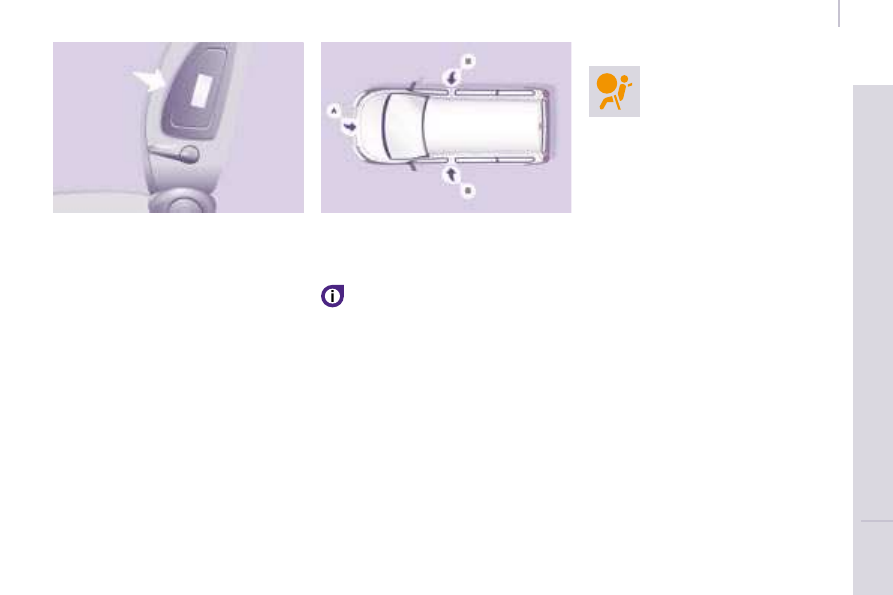
  Side air bags 

 If fitted on your vehicle, this is a   system 
which protects the driver and front 
passenger in the event of a serious side 
impact in order to limit the risk of injury to 
the chest. 

 Each side air bag is incorporated in the front 
seat back frame, on the door side. 

  Impact detection zones 

   A.   Front impact zone. 

  B.   Side impact zone.  

 If this warning light comes 
on on the instrument panel, 
accompanied by an audible signal 
and a message on the display, 

contact a  CITROËN  dealer to have the 
system checked.   The air bags may no longer 
be triggered in the event of a serious impact.   

  Activation 

 It is triggered   unilaterally in the event of a 
serious side impact applied to all or part 
of the side impact zone  B , perpendicular 
to the longitudinal centreline of the vehicle 
on a horizontal plane and directed from the 
outside towards the inside of the vehicle. 

 The side air bag inflates between the 
front occupant of the vehicle and the 
corresponding door trim pad.  

  Curtain air bags 

 This is a system which protects the driver 
and passengers (with the exception of the 
centre seats of rows 2 and 3) in the event of 
a serious side impact in order to limit the risk 
of head injuries. 

 Each curtain air bag is incorporated in the 
pillars and the upper part of the passenger 
compartment. 

  Activation 

 It is triggered at the same time as the 
corresponding side air bag in the event of 
a serious side impact applied to all or part 
of the side impact zone  B , perpendicular 
to the longitudinal centreline of the vehicle 
on a horizontal plane and directed from the 
outside towards the inside of the vehicle. 

 The curtain air bag inflates between the 
front or rear occupant of the vehicle and the 
windows.   

   In the event of a minor impact or bump 
on the side of the vehicle or if the 

vehicle rolls over, the air bag may not be 
triggered. 

 The air bag is not triggered in the event of a 
rear or front collision.  

  Operating fault 

 1

4

5

   Child safety   

S

A

F

E

T

Y

5

CHILD SAFETY    

 GENERAL POINTS RELATING TO 
CHILD SEATS 

 Although one of  CITROËN  main criteria 
when designing your vehicle, the safety of 
your children also depends on you. 

 For maximum safety, please follow these 
precautions: 

   -  

all children under the age of 12 or less 
than one metre fifty tall must travel in 
approved child seats suited to their 
weight, on seats fitted with a seat belt or 
ISOFIX mountings. 

  -  

statistically, the safest seats in your 
vehicle for the transportation of children 
are the rear seats, 

  -  

a child weighing less than 9 kg must 
travel in the "rearwards-facing" position 
both in the front and in the rear.  

  "Rearwards-facing" 

 When a "rearwards-facing" child seat is 
installed on the front passenger seat, it 
is essential that the passenger air bag is 
disarmed. Otherwise, the child would risk 
being seriously injured or killed if the air bag 
were to inflate.  

  "Forwards-facing" 

 When a "forwards-facing" child seat is 
installed on the front passenger seat, leave 
the passenger air bag armed.  

 INSTALLING A CHILD SEAT USING A THREE POINT SEAT BELT 

  The rules for transporting children are 
specific to each country. Consult the current 
legislation in your country. 

 Please consult the list of seats approved 
in your country. The isofix mountings, the 
rear seats, the passenger air bag and the 
disarming of this air bag depend on the 
version sold.  

  CITROËN  recommends that children should 
travel in the rear seats of your vehicle  : 

   -  

"rearwards-facing" up to the age of 2, 

  -  

"forwards-facing" over the age of 2.  

1

4

6

   Child safety   

 Chapter 5, "Air bags" section. 

 "ISOFIX" MOUNTINGS 

 The mountings comprise three rings for each seat: 

   -  

two front rings, located between the 
vehicle seat back and cushion, indicated 
by a label, 

  -  

a rear ring, for securing the upper 
strap referred to as the TOP TETHER, 
indicated by another label.  

   The child seats function and the 
passenger air bag disarming function 

are shared by the entire  CITROËN  range. 

 The front bench is fixed and has no 
longitudinal adjustment. 

 The passenger must not travel with a child 
on his lap. 

 In the absence of the disarming of the 
passenger air bag, the installation of a 
"rear-facing" child seat on the front seats is 
strictly prohibited. 

 Your vehicle has been approved in 
accordance with the new ISOFIX regulation. 

 If fitted on your vehicle, the regulation 
ISOFIX mountings are located by labels. 

 This ISOFIX mounting system guarantees 
you fast, reliable and safe fitting of the child 
seat in your vehicle. 

 The ISOFIX child seats are fitted with two 
locks which are secured easily on the two 
front rings. 

 Some also have an upper strap which is 
attached to the rear ring. 

 To attach this strap, raise the vehicle seat's 
head restraint then pass the hook between 
its rods. Then fix the hook on the rear ring 
and tighten the upper strap. 

 The incorrect installation of a child seat in a 
vehicle compromises the child's protection in 
the event of an accident. 

 For information regarding the ISOFIX child 
seats which can be installed in your vehicle, 
consult the summary table for the location of 
the ISOFIX child seats. 

1

4

6

   Child safety   

 Chapter 5, "Air bags" section. 

 "ISOFIX" MOUNTINGS 

 The mountings comprise three rings for each seat: 

   -  

two front rings, located between the 
vehicle seat back and cushion, indicated 
by a label, 

  -  

a rear ring, for securing the upper 
strap referred to as the TOP TETHER, 
indicated by another label.  

   The child seats function and the 
passenger air bag disarming function 

are shared by the entire  CITROËN  range. 

 The front bench is fixed and has no 
longitudinal adjustment. 

 The passenger must not travel with a child 
on his lap. 

 In the absence of the disarming of the 
passenger air bag, the installation of a 
"rear-facing" child seat on the front seats is 
strictly prohibited. 

 Your vehicle has been approved in 
accordance with the new ISOFIX regulation. 

 If fitted on your vehicle, the regulation 
ISOFIX mountings are located by labels. 

 This ISOFIX mounting system guarantees 
you fast, reliable and safe fitting of the child 
seat in your vehicle. 

 The ISOFIX child seats are fitted with two 
locks which are secured easily on the two 
front rings. 

 Some also have an upper strap which is 
attached to the rear ring. 

 To attach this strap, raise the vehicle seat's 
head restraint then pass the hook between 
its rods. Then fix the hook on the rear ring 
and tighten the upper strap. 

 The incorrect installation of a child seat in a 
vehicle compromises the child's protection in 
the event of an accident. 

 For information regarding the ISOFIX child 
seats which can be installed in your vehicle, 
consult the summary table for the location of 
the ISOFIX child seats. 

   Child safety   

S

A

F

E

T

Y

5

   ISOFIX RÖMER Duo Plus  (size category  B1 )  

   Group 1: from 9 to 18 kg   


  Installed in the forward facing position.  

 Fitted with an upper strap to be secured on the ISOFIX upper ring,   

referred to as the TOP TETHER.  

Three seat body angles: sitting, reclining, lying.  

 This child seat can also be used on seats which are not fitted with ISOFIX mountings. 

 In this case, it must be attached to the vehicle seat using the three point seat belt. 

  Follow the instructions for fitting the child seat given in the seat manufacturer's installation guide.    

1

4

8

   Child safety   

  IUF:   Seat suitable for the installation of 

an ISOFIX child seat of the universal 
category. "Forward facing" ISOFIX child 
seat fitted with an upper strap secured 
to the upper ring of the vehicle seats 
equipped with ISOFIX mountings. 

 SUMMARY TABLE FOR THE INSTALLATION OF ISOFIX CHILD SEATS 

 In accordance with the European regulation (ECE 16), this table indicates the options for the installation of ISOFIX child seats on the vehicle 
seats fitted with ISOFIX mountings. 

 In the case of the universal and semi-universal ISOFIX child seats, the child seat's ISOFIX size category, determined by a letter from  A  to  G , 
is indicated on the child seat next to the ISOFIX logo. 

  IL-SU:   Seat suitable for the installation 

of a semi-universal ISOFIX child 
seat. "Forward facing" ISOFIX child 
seat fitted with a stay. "Rear facing" 
ISOFIX child seat or infant car seat, 
fitted with an upper strap or a stay. 

  X:  No restraining system for children. 

   Weight of the child /indicative age  

   Less than 

10 kg  

(group 0)   

Up to 6 months 

approx  

   Less than 10 kg  

(group 0)  

Less than 13 kg 

(group 0+)   

 Up to 1 year approx  

   From 9 to 18 kg  

(group 1)   

From 1 to 3 years approx  

  Type of ISOFIX child seat  

   Infant car seat   

   "rear facing"   

   "rear facing"   

   "forward facing"   

  ISOFIX size category  

  F  

  G  

  C  

  D  

  E  

  C  

  D  

  A  

  B  

  B1  

  Row 2 rear side seats

with individual seats in Row 1  

   IL-SU   

   IL-SU   

   IL-SU   

   IUF, IL-SU   

  Row 2 rear side seats

with 2-seat bench in Row 1  

   IL-SU   

  X  

  IL-SU  

  X  

  IL-SU  

   IUF, IL-SU   

  Rear seats in Row 3  

   IL-SU   

  X  

  IL-SU  

  X  

  IL-SU  

   IUF, IL-SU   

  Infant car seat:  this is fixed to the lower 
rings of a seat equipped with ISOFIX 
mountings and occupies two rear seats. 

 1

4

9

   Child safety   

S

A

F

E

T

Y

5

  CHILD SEATS RECOMMENDED BY  CITROËN  

  CITROËN  offers a complete range of recommended child seats which are  secured using a three point seat belt : 

   Group 0: from birth to 10 kg  

Group 0+: from birth to 13 kg   


   L1    

"ROMER Baby-Safe Plus"  

Installed in the rear-facing position 


   Groups 1, 2 and 3: from 9 to 36 kg   


   L2     

"KIDDY Life"  

For the safety of young children (from 9 to 18 kg),

 CITROËN  recommends use of the restraining cushion.  

   Groups 2 and 3: from 15 to 36 kg   


   L3    

"RECARO Start''  


   L4     

"KLIPPAN Optima"  

From the age of 6 years 

(approximately 22 kg),

the booster is used on its own.  

1

5

0

   Child safety   

 Row 2 

  Side seats  

   U   

   U   

   U   

   U   

  Centre seat  

   U   

   U   

   U   

   U   

 Row 3 

  Side seats  

   U   

   U   

   U   

   U   

  Centre seat  

   U   

   U   

   U   

   U   

 a: Group 0: from birth to 10 kg. 

 b: consult the legislation in force in your country before installing your child on this seat. 

 U: seat suitable for the installation of a child seat secured using a seat belt and universally approved, "rear facing" and/or "forward facing". 

 INSTALLING CHILD SEATS ATTACHED USING THE SEAT BELT 

 This table indicates the options for installing child seats secured using a seat belt and universally approved in accordance with the weight of 
the child and the seat in the vehicle. 

   Seat   

   Weight of the child and indicative age   

   Under 13 kg    

 (groups 0  (a) 

and 0+)  

Up to 

≈ 1 year  

   From 9 to 18 kg    

(group 1)  

1 to 

≈ 3 years  

   From 15 to 25 kg    

(group 2)  

3 to 

≈ 6 years  

   From 22 to 36 kg    

(group 3)  

6 to 

≈ 10 years   

  Row 1  (b)   

  Individual seat  

   U   

   U   

   U   

   U   

  Bench, side

seat  

   U   

   U   

   U   

   U   

  Bench, centre 

seat  

   L1   

   L2   

   L2, L3, L4   

   L2, L3, L4   

 1

5

1

   Child safety   

S

A

F

E

T

Y

5

 Disarm the passenger air bag when a "rear 
facing" child seat is installed on the front 
seat. 

 Otherwise, the child would risk being 
seriously injured or killed if the air bag were 
to inflate. 

 To protect young children from the rays of 
the sun, fit side blinds to the rear windows.  

 ADVICE ON CHILD SEATS 

 The incorrect installation of a child seat in a 
vehicle compromises the child's protection in 
the event of an accident. 

 Remember to fasten the seat belts or the 
child seat harnesses  keeping the slack  in 
relation to the child's body  to a minimum , 
even for short journeys. 

 For optimum installation of the "forward 
facing" child seat, ensure that the back of 
the child seat is in contact with the back of 
the vehicle's seat and that the head restraint 
does not cause any discomfort. 

 If the head restraint has to be removed, 
ensure that it is stored or attached securely 
to prevent it from being thrown around the 
vehicle in the event of sharp braking. 

 Children under the age of 10 must not travel 
in the "forward facing" position on the front 
passenger seat, unless the rear seats are 
already occupied by other children, cannot 
be used or are absent. 

  Installing a booster seat 

 The chest part of the seat belt must be 
positioned on the child's shoulder without 
touching the neck. 

 Ensure that the lap part of the seat belt 
passes correctly over the child's thighs. 

  CITROËN  recommends the use of a booster 
seat which has a back, fitted with a seat belt 
guide at shoulder level. 

 As a safety precaution, do not leave: 
   -  

 one or more children alone and 
unsupervised in a vehicle,  

  -  

 a child or an animal in a vehicle which 
is exposed to the sun, with the windows 
closed,  

  -  

 the keys within reach of children inside 
the vehicle.   

 To prevent accidental opening of the doors, 
use the "Child Lock". 

 Take care not to open the rear windows by 
more than one third. 

1

5

2

   Towing a trailer   

 For more information about weights, 
refer to the administrative documents 

(V5 registration document, ...) or to the 
"Weights" section of chapter 9. 

 TOWING A TRAILER, CARAVAN, BOAT, ETC... 

  Distribution of loads  

 Distribute the load in the trailer so that the 
heaviest objects are as close as possible 
to the axle and the nose weight is close to 
the maximum authorised without, however, 
exceeding it. 

  Cooling  

 Towing a trailer on a slope increases the 
coolant temperature. 

 As the fan is electrically controlled, its 
cooling capacity is not dependent on the 
engine speed. 

 On the contrary, use a high gear to lower the 
engine speed and reduce your speed. 

 A towed vehicle must free wheel: gearbox in 
neutral. 

 1

5

3

   Towing a trailer   

A

C

C

E

S

S

O

R

IE

S

6

 In all cases, pay attention to the coolant 
temperature.  

 Tyres: check the tyre pressures of the 
towing vehicle (see the "Identification 

features" section of chapter 9) and of 
the trailer, observing the recommended 
pressure. 

  Towbar 

   We recommend the use of original 
 CITROËN  towbars and their harnesses, 
which have been tested and approved from 
the design stage of your vehicle, and that 
you entrust the fitting of this equipment to a 
 CITROËN  dealer. 

 If this equipment is not fitted by a  CITROËN  
dealer, it is imperative that it is fitted using 
the electrical pre-equipment installed at the 
rear of the vehicle and in accordance with 
the manufacturer's instructions. 

 In accordance with the general instructions 
a reminder of which has been given above, 
we draw your attention to the risk linked with 
fitting a towbar or electrical accessory not 
recommended by  CITROËN . 

Fitting such equipment could result in 
the failure of your vehicle's electronic 
system. Please contact a  CITROËN  dealer 
for information before fitting this type of 
equipment.  

 If the coolant temperature warning 
light comes on, stop the vehicle 
and switch off the engine as soon 
as possible.

  Good Practice 

 In certain cases of particularly arduous 
use (towing the maximum load up a steep 
slope in high temperatures), the engine 
automatically limits its power. In this 
case, the automatic cutting off of the air 
conditioning allows the engine power to be 
recovered. 

See the "Levels" section of chapter 7. 

  Brakes  

 Towing increases the braking distance.

Drive at a moderate speed, change down 
early and brake gradually. 

  Side wind  

 Sensitivity to side wind is increased.

Drive smoothly and at a moderate speed. 

  ABS/ESP  

 The ABS or ESP systems only control the 
vehicle, not the trailer or caravan. 

  Rear parking assistance  

 The assistance does not function while the 
vehicle is towing.  

1

5

4

 Equipment 

 OTHER ACCESSORIES 

 These accessories and parts, having been 
tested and approved for reliability and 
safety, are all adapted to your vehicle. A 
wide range of recommended products and 
original parts are offered. 

  Another range is also available, structured 
around comfort, leisure and maintenance: 

 Anti-theft alarm, window engraving, first aid 
kit, high visibility safety jacket, rear parking 
assistance, warning triangle, ... 

 Front seat covers compatible with air bags, 
benches, rubber mats, carpet mats, boot 
tray, roof bars, side blinds, snow chains. 

 The  CITROËN  Network will inform you of the 
specifications (frequency band, maximum 
output power, aerial position, specific 
installation conditions) of the transmitters 
which can be fitted, in accordance with the 
Motor Vehicle Electromagnetic Compatibility 
Directive (2004/104/CE). 

 Trims, front mud flaps, rear mud flaps, 
spoilers, sill, ... 

 Screenwash, interior and exterior cleaning 
and maintenance products, replacement 
bulbs, ... 

  Installation of radiocommunication 
transmitters
  

 Before installing accessory 
radiocommunication transmitters with an 
external aerial on your vehicle, you are 
advised to contact a representative of the 
 CITROËN  marque. 

 To prevent the mat from becoming caught 
under the pedals: 

   -  

ensure that the mat and its fixings are 
positioned correctly, 

  -  

never fit one mat on top of another.  

 Audio equipment, hands-free kit, speakers, 
CD changer, navigation, ... 

 Regardless of the audio and telematic 
equipment offered on the market, the technical 
constraints linked with the fi tting of equipment of 
these families of products mean that the special 
features of the equipment and its compatibility 
with the capacities of your vehicle's standard 
equipment must be taken into account. 

Please contact a  CITROËN  dealer for 
information before fi tting such equipment. 

 The fitting of electrical equipment 
or accessories which are not 

recommended by  CITROËN  may result in a 
failure of your vehicle's electronic system. 
Please note this specific warning. You 
are advised to contact a representative 
of the Marque to be shown the range of 
recommended equipment and accessories. 

 Depending on the country in which the 
vehicle is sold or operated, it is compulsory 
to have a high visibility safety jacket, 
warning triangle and replacement bulbs 
available in the vehicle.  

 1

5

5

   Opening the bonnet   

C

H

E

C

K

S

7

 OPENING THE BONNET 

  From inside:  

   -  

lift the cover located at the left foot of 
the driver's seat. 

  -  

pull the control upwards.  

  To close 

 Lower the bonnet and release it at the end of its 
travel. Check that the bonnet is properly locked.  

  From outside:  partially open the bonnet, lift 
the catch and raise the bonnet. 

  Bonnet strut 

 Secure the strut in one of the two notches, 
according to the height required, to hold the 
bonnet open. 

 Before closing the bonnet, replace the strut 
in its housing. 

  "Bonnet open" warning 

 This warning is linked to the  alarm 
option
  only. 

 With the engine running or the 
vehicle moving, a warning light 
and a diagram on the display, 
accompanied by an audible 

signal, warn you that the bonnet is not 
properly closed.   

1

5

6

   Under the bonnet   

 DIESEL ENGINES 

  8 -  Power steering reservoir. 

  9 -  Removable towing eye. 

  10 -   Repriming pump ( a:  1.6 litre HDi;

 b:  2 litre HDi). 

  11 -  Engine oil filling funnel (2 litre HDi). 

 UNDER THE BONNET  

  1 -   Windscreen/headlamp wash reservoir. 

  2 -   Fuse box. 

  3 -   Coolant reservoir. 

  4 -   Brake and clutch fluid reservoir. 

  5 -   Air filter. 

  6 -   Dipstick. 

  7 -   Engine oil filler cap. 

  7.1 -  Engine oil filler cap. 

 If your vehicle is fitted with this oil filler tube, 
proceed as follows: 

  A -  Remove the oil filler cap. 

  B -  Remove the filler tube from its location. 

  C -   Place the filler tube in the filler opening 

as shown on the illustration. 

  D -   Turn it a 1/4 of a turn to the left to lock it 

then top up the oil. 

 To refit, proceed in the reverse order without 
forgetting to retighten the cap  A  correctly.  

 1

5

7

   Under the bonnet   

C

H

E

C

K

S

7

 PETROL ENGINE 

  4.   Brake and clutch fluid reservoir. 

  5.   Air filter. 

  6.   Dipstick. 

   1.   Windscreen/headlamp wash reservoir. 

  2.   Fuse box. 

  3.   Coolant reservoir. 

  7.   Engine oil filler cap. 

  8.   Power steering reservoir. 

  9.   Removable towing eye.  

1

5

8

 Levels 

 LEVELS 

control systems, the use of additives in 
engine oil is prohibited.   

  Changing the brake fluid 

 The brake fluid must be changed at 
the intervals stated, according to the 
manufacturer's servicing schedule. 

 Use fluids recommended by the 
manufacturer, which fulfil DOT4 standards. 

 The level must be between the MIN and 
MAX marks on the reservoir. 

 If fluid has to be added frequently, this 
indicates a failure which must be checked by 
a  CITROËN  dealer as soon as possible.  

 These regular maintenance operations 
will keep your vehicle in good running 

order. Consult the instructions at  CITROËN  
dealerships or in the servicing booklet 
enclosed in the handbook pack. 

 If you have to remove/refit the engine 
style cover, handle it with care to avoid 

damaging the fixing clips. 

 Check the level regularly and top up 
between changes. The maximum 
consumption is 0.5 litre per 600 miles 
(1 000 km). 

 Check the level with the vehicle level, 
engine cold, using the dipstick. 

  Dipstick 

 There are two marks on the 
dipstick: 

  A  = maximum 

 If you fill past this mark, 
contact a  CITROËN  dealer. 

  B  = minimum 

 Never allow the level to fall 
below this mark. 

 To maintain the reliability 
of engines and emission 

  Oil change 

 It is imperative that this is carried out at the 
intervals specified and the viscosity grade of 
the oil selected must fulfil the requirements 
in accordance with the manufacturer's 
servicing schedule. Consult the instructions 
at  CITROËN  dealerships. 

 Remove the dipstick before filling. 

 For the 2 litre HDi engine, use the funnel 
supplied when filling via the sump opening. 

 Check the level after filling (never exceed 
the max mark). 

 Screw the cap back onto the sump before 
closing the bonnet. 

  Viscosity selection 

 In all cases, the oil selected must meet the 
manufacturer's requirements.   

  Warning lights 

 Checking by means of the warning 
lights on the instrument panel 

is described in chapter 2, refer to the 
"Instruments and controls" section.  


Content   ..  8  9  10  11   ..