Citroen Jumpy Multispace Dag (2008 year). Manual - part 9
 

  Index      Citroen     Citroen Jumpy Multispace Dag - service manual 2008 year in english


Search            


Content   ..  7  8  9  10   ..


Citroen Jumpy Multispace Dag (2008 year). Manual - part 9


1

2

3

3

2

3

3

2

3

3

2

3

3

2

3

3

1

2

3

3

2

3

3

1

2

3

3

1

2

2

2

2

2

2

1

2

2

2

2

2

2

2

2

1

2

2

1

2

3

2

3

08

A

2

3

3

2

3

3

1

2

7

  RADIO-CD 

  REV WIPE ACT 

  active  

  inactive   

  LANGUAGES 

  FRANCAIS  

  ITALIANO  

  NEDERLANDS  

  PORTUGUES  

  PORTUGUES-BRASIL  

  DEUTSCH  

  ENGLISH  

  ESPANOL   

  PARKING ASSIST 

  active  

  inactive    

  OPTIONS 

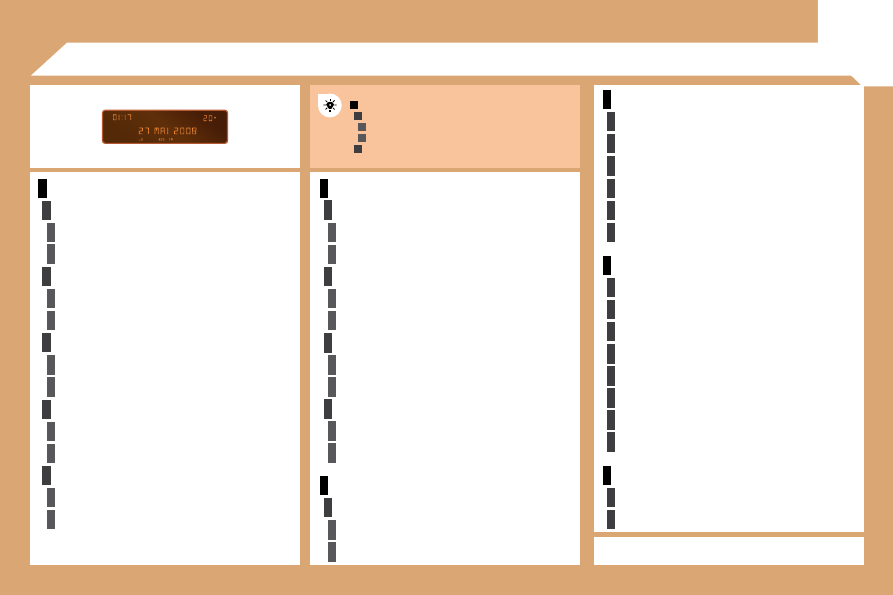
     DISPLAY FLOW CHART monochrome A 

  MAIN FUNCTION 

  *   The parameters vary according to vehicle.  

  REG MODE 

  active  

  inactive   

  RDS SEARCH 

  active  

  inactive   

  CHOICE A 

  Choice A1  

  Choice A2   

  CHOICE B...   

  INTROSCAN 

  active  

  inactive   

  CD REPEAT 

  active  

  inactive   

  AUTO LIGHTS 

  active  

  inactive   

  GUIDE LAMPS 

  active  

  inactive   

  VEHICLE CONFIG *  

  RANDOM PLAY 

  active  

  inactive    

  ABANDON/CONSULT LIST OF FAULTS 

  functions activated (or not)  

  warning messages    

  DISPLAY ADJUST 

  YEAR  

  MONTH  

  DAY  

  HOUR  

  MINUTES  

  12 H/24 H MODE   

  UNITS 

  TEMPERATURE: °CELSIUS/°FAHRENHEIT  

  FUEL CONSUMPTION: KM/L - L/100 - MPG   

128

1

1

2

3

4

3

4

3

4

2

3

4

3

4

2

3

4

2

4

4

3

4

4

4

3

4

4

1

2

3

2

3

3

2

2

1

2

3

3

3

4

4

4

2

3

4

3

4

3

4

2

3

3

3

4

08

  PERSONALISATION-CONFIGURATION 

  AUDIO FUNCTIONS 

 DISPLAY C FLOW CHART 

  *    The parameters vary according to vehicle.  

  **   According to compatibility of Bluetooth telephone 

and service contract.  

  TELEPHONE 

  STATUS OF FUNCTIONS *  

  functions activated or deactivated    

  TRIP COMPUTER 

  FM BAND PREFERENCES 

  alternative frequencies (RDS)  

 activate/deactivate 

  regional mode (REG)  

 activate/deactivate 

  radio-text information (RDTXT)  

 activate/deactivate  

  AUDIO CD PREFERENCES 

CD

 changer repeat (RPT)  

 activate/deactivate 

  track random play (RDM)  

 activate/deactivate   

  ENTER DISTANCE TO DESTINATION 

  distance: x km   

  WARNING LOG 

  diagnostics   

  DEFINE THE VEHICLE PARAMETERS *   

  DISPLAY CONFIGURATION 

  video brightness adjustment  

 normal video 

 inverse video 

 brightness (- +) adjustment 

  date and time adjustment  

 day/month/year adjustment 

 hour/minute adjustment 

 choice of 12 h/24 h mode 

  choice of units  

 l/100 km - mpg - km/l 

 °Celsius/°Fahrenheit  

  CHOICE OF LANGUAGE   

  CONSULTING DIRECTORIES **  

  telephone directory  

  call log  

  services directory  

 customer contact centre 

 breakdown call 

 emergency call  

  CONFIGURATION 

  deletion of a match  

 list of matches 

  consulting matches  

 list of matches 

  choice of a mobile to connect  

 list of mobiles  

  MANAGEMENT OF A COMMUNICATION 

  switch  

  terminate the current call  

  secret mode  

 activate/deactivate   

 1

3

1

  Rear suspension  

IN

-C

A

R

 T

E

C

H

N

O

L

O

G

Y

4

  Metal suspension 

 This equipment adopts long movement limiters 
which make it possible to guarantee stable 
behaviour both when loaded and when empty. 
No action on your part  is required except to 
ensure that maintenance is carried out and that 
the authorised loads are complied with.  

irrespective of the weight of the load, within 
the limit of the authorised values. On board, 
the increasing or lightening of the load on 
the vehicle's platform is detected by two 
height sensors. When all of the doors are 
closed, the sensors trigger the automatic 
compensation and determine the optimum 
height of the sill for the vehicle's driving 
conditions. 

  Deactivation of the automatic correction 

 The control which permits deactivation of the 
automatic control is located on the right-hand 
side, at the rear of the vehicle. 

 REAR SUSPENSION 

 Two types of suspension are offered. 

 You must deactivate the automatic 
correction manually in the following 
situations: 

   -  

when working underneath the vehicle, 

  -  

when changing a wheel, 

  -  

when the vehicle is being transported by 
lorry, train, ferry, boat, ...   

  Rear suspension with pneumatic 
compensation 

 If fitted on your vehicle, this type of 
suspension regulates the variations in the 
height of the rear platform of your vehicle 

  Two functions 

   1.   Automatic 

correction 

  2.   Manual

correction    

  1 -  Automatic correction of the 

height of the rear sill 

 The pneumatic suspension automatically 
regulates the variations in the height of the 
rear platform of your vehicle.

 The automatic compensation is temporarily 
inactive: 

   -  

if a door/the tailgate is open, 

  -  

when braking or when stopped at a red 
light (brake pedal pressed).  

 With the vehicle stationary: 

   -  

press and hold, 

  -  

release the control.  

 Deactivation is confirmed by 

the diode which is lit. It remains lit for 
approximately 30 seconds. 

  Return to automatic correction 

 With the vehicle stationary: 

   -  

press and hold, 

  -  

release the control.  

 Return to automatic correction is 

confirmed by the diode which is switched off. 

 According to the configurations, a bleep may 
be heard during these operations.   

A red warning light on your 
instrument panel fl ashes if the 
height is not at its optimum level and 
requires correction, drive slowly until 
this warning light is switched off. 

1

3

2

  Rear suspension  

  2 -  Manual correction of the height 

of the rear sill 

 If your vehicle is fitted with this adjustment, 
the control is located on the right-hand side 
at the rear of the vehicle. 

 This manual adjustment permits "lowering" 
or "raising" of the height of the sill of the rear 
platform to facilitate operations in a parking 
area. 

 This adjustment of the height of the sill is 
restricted by a lower limit and an upper limit. 

  First use 

 To initialise the function, press the control 
for approximately 2 seconds.  

  Operating faults 

 If the load sill is not adjusted when the 
control is pressed, "3 bleeps" indicate a 
malfunction for the following reasons: 

   -  

foot on the brake pedal with the key in 
the ignition, 

  -  

excessive use of the manual correction, 

  -  

low battery charge, 

  -  

failure of the system.  

 If the audible signal persists, contact a 
 CITROËN  dealer.  

 Carry out these operations with the vehicle 
still stationary and: 

   -  

with the front and side doors closed, 

  -  

with the handbrake applied, 

  -  

do not leave your foot on the brake 
pedal.  

  Lower: downwards adjustment 
of the platform sill 

 Press the control downwards 
continuously. 

 Release the button to stop the movement, 
"3 bleeps" indicate that you have reached 
the maximum limit, the movement stops 
automatically.  

  Raise: upwards adjustment of 
the platform sill 

 Press the control upwards 
continuously. 

 Release the button to stop the movement, 
"3 bleeps" indicate that you have reached 
the maximum limit, the movement stops 
automatically.  

  Return to the optimum sill height 

 Press the control up or down twice in 
succession, the opposite of the position of 
the load sill.  

 1

3

3

  Rear suspension  

IN

-C

A

R

 T

E

C

H

N

O

L

O

G

Y

4

  Deactivation of the manual correction 

  Good practice 

 When stationary and with the ignition key 
removed, excessive use of the system 
consumes battery charge. 

  Parking for a long duration 

 Avoid parking for a long duration on ground 
which could present a potential obstacle as 
your vehicle could lower. 

 Following a long period out of use, the 
height of the platform may change due to the 
automatic compensation on unlocking or on 
opening one of your vehicle's doors.  

 With the vehicle stationary: 

   -   press and hold, 

  -   release the control.  

 Deactivation is confirmed by 

the diode which is lit. It remains lit for 
approximately 30 seconds.  

  Return to manual correction 

 You must deactivate the manual 
correction in the following situations: 

   -  

when working underneath the vehicle, 

  -  

when changing a wheel, 

  -  

when the vehicle is being transported by 
lorry, train, ferry, boat, ...    

 Driving with the height of the rear platform: 

   -  

too low, risks damaging the technical 
components underneath the vehicle, 

  -  

too high, risks unstable driving.  

 If you start and the warning light flashes, to 
switch it off: 

   -  

correct the position of the manual 
control which is still at the lower or 
upper limit, 

  -  

or drive slowly at above 6 mph (10 km/h), 
until the compensation returns to automatic 
mode.  

  Warning light 

 Refer to the "Instruments and controls" 
section of chapter 2.   

 With the vehicle stationary: 

   -   press and hold, 

  -   release the control.  

 Return to manual correction is 

confirmed by the diode which is switched off. 

 According to the configurations, a bleep may 
be heard during these operations. 

1

3

4

   Parking assistance   

 The audible and/or visual rear parking 
assistance consists of four proximity 
sensors, installed in the rear bumper. The 
sensors detect any obstacle which enters 
the field: person, vehicle, tree, fence, behind 
the vehicle during the manoeuvre. 

 Certain objects detected at the beginning of 
the manoeuvre will no longer be detected 
at the end of the manoeuvre due to the 
blind spots between and below the sensors. 
Examples: stake, roadworks cone or 
pavement post. 

  Engage reverse gear 

 An audible signal confirms the activation of 
the system by engaging reverse gear.

The proximity information is indicated by an 
audible signal which becomes more rapid as 
the vehicle approaches the obstacle.   When 
the distance between the rear of the vehicle 
and the obstacle is less than approximately 
thirty centimetres, the audible signal 
becomes continuous. 

  Activation/Deactivation 

 REAR PARKING ASSISTANCE 

  Display on the screen   

 You can activate or deactivate the 
system by pressing this button. 

  The activation or deactivation of 
the system is stored when the 
vehicle stops.  

  Operating fault 

 In the event of an operating fault, when 
reverse gear is engaged the diode on the 
button comes on, accompanied by an 
audible signal and a message on the display. 
 Consult a CITROËN dealer.   

Good practice

In bad weather or in winter, ensure that the 
sensors are not covered with mud, ice or 
snow.

The system will be deactivated automatically 
if a trailer is being towed or if a bicycle 
carrier is fitted (vehicle fitted with a 
towbar or bicycle carrier recommended by 
CITROËN).

The parking assistance cannot, in any 
circumstances, take the place of the 
vigilance and responsibility of the driver.

  Stop the assistance 

 Change to neutral.  

 1

3

5

   Seat belts   

S

A

F

E

T

Y

5

 HANDBRAKE 

 When parking on a slope, direct your wheels 
towards the pavement and pull the handbrake. 

 There is no advantage in engaging a gear 
after parking the vehicle, particularly if the 
vehicle is loaded.  

 HAZARD WARNING LIGHTS 

 Press this button, the direction indicators 
flash. 

 They can operate with the ignition off. 

 The hazard warning lights should only be 
used in dangerous situations, when stopping 
in an emergency or when driving in unusual 
conditions. 

 DRIVING SAFETY 

  Applying 

 Pull the handbrake to immobilise your 
vehicle. 

 Check that the handbrake is applied firmly 
before leaving the vehicle. 

 If the handbrake is still on or has 
not been released properly, this is 
indicated by this warning light which 
comes on on the instrument panel. 

  Releasing 

 Pull the handle and press the button to lower 
the handbrake.  

ABS

ABS

   Seat belts   

 HORN 

 Press the centre of the steering wheel. 

 ANTI-LOCK BRAKING SYSTEM 
(ABS - EBFD) 

 The ABS and EBFD (electronic brake force 
distribution) systems improve the stability 
and manoeuvrability of your vehicle on 
braking, in particular on poor or slippery 
surfaces. 

 The ABS prevents locking of the wheels, 
the EBFD provides control of the braking 
pressure wheel by wheel. 

  Good practice 

 The anti-lock braking system comes into 
operation automatically when there is a risk 
of wheel lock. It does not reduce the braking 
distance. 

 On very slippery surfaces (ice, oil, etc...) 
the ABS may increase the braking distance. 
When braking in an emergency, do not 
hesitate to press the brake pedal firmly, 
without releasing the pressure, even on a 
slippery surface, you will then be able to 
continue to manoeuvre the vehicle to avoid 
an obstacle. 

 Normal operation of the ABS may be felt by 
slight vibration of the brake pedal. 

 When changing wheels (tyres and rims), 
ensure that these are recommended by 
 CITROËN . 

 If this warning light comes on, 
together with the brake and STOP 
warning lights, accompanied by 
an audible signal and a message 

on the display, it indicates a malfunction of 
the electronic brake force distribution which 
could result in a loss of control of the vehicle 
on braking. 

  Stop immediately.  

 EMERGENCY BRAKING 
ASSISTANCE SYSTEM (EBA) 

 In an emergency, this system enables the 
optimum braking pressure to be reached 
more quickly, press the pedal firmly without 
releasing it.   It is triggered by the speed at 
which the brake pedal is activated. 

This alters the resistance of the brake pedal 
under your foot. 

 If this warning light comes on, 
accompanied by an audible signal 
and a message on the display, it 
indicates a malfunction of the ABS 

which could result in a loss of control of the 
vehicle on braking. 

   In both cases, contact a  CITROËN  dealer.  

 To prolong the operation of the emergency 
braking assistance system: keep your foot 
on the brake pedal.   

ESP

 1

3

7

   Seat belts   

S

A

F

E

T

Y

5

 TRACTION CONTROL (ASR) AND 
DYNAMIC STABILITY CONTROL 
(ESP) 

 These systems are linked and complement 
the ABS. 

 The ASR system is very useful for 
maintaining optimum drive and avoiding 
losses of control of the vehicle on 
acceleration. 

 The system optimises drive to prevent the 
wheels skidding, by acting on the brakes of 
the drive wheels and on the engine. It also 
allows the directional stability of the vehicle 
to be improved on acceleration. 

acts on the engine and the brake of one 
or more wheels, in order to put the vehicle 
back on course. 

  Disarming the ASR/ESP systems 

 In certain exceptional conditions (starting 
the vehicle when stuck in mud or snow, or 
on loose ground...), it could prove useful to 
disarm the ASR and ESP systems to make 
the wheels spin and regain grip. 

   -  

Press the button, located on the centre 
console. 

  -  

The indicator light comes on: the ASR 
and ESP systems no longer act.  

  Operating check 

  Good practice 

 The ASR/ESP systems offer increased 
safety during normal driving, but should not 
incite the driver to take risks or to drive at 
high speed. 

   The operation of these systems is ensured 
if the recommendations of the manufacturer 
regarding the wheels (tyres and rims), 
the braking components, the electronic 
components and the fitting and repair 
procedures within the  CITROËN  network are 
observed. 

   After an impact, have these systems 
checked by a  CITROËN  dealer.  

  Operation of the ASR and ESP 
systems 

 The luminous diode flashes when 
the ASR or ESP is triggered.  

  They engage again: 

   -  

automatically above 30 mph (50 km/h), 

  -  

manually by pressing the button again.   

 When a malfunction of the 
systems occurs, the indicator light 
comes on, accompanied by an 
audible signal and a message on 
the display. 

   Contact a  CITROËN  dealer to have the 
system checked. 

 The warning light may also come on if the 
tyres are under-inflated. Check the pressure 
of each tyre.   

 Use the ESP to hold your course without 
attempting to countersteer. 

 If there is a variation between the trajectory 
followed by the vehicle and that required 
by the driver, the ESP system automatically 

1

3

8

   Seat belts   

  Height adjustment 

 Squeeze the control with the return and slide 
the assembly on the driver's seat side and 
on the individual passenger seat side. 

 If your vehicle is fitted with a front bench, 
the height of the seat belt associated with 
the centre seat cannot be adjusted.  

  Unfastening 

 Press the red button. 

 SEAT BELTS 

  CORRECT USE OF THE SEAT BELTS 

 The driver must ensure that passengers use 
the seat belts correctly and that they are all 
strapped in securely before moving off. 

 Wherever you are seated in the vehicle, 
always fasten your seat belt, even for short 
journeys. 

 The seat belts are fitted with an inertia reel 
which automatically adjusts the length of the 
strap to your size. The seat belt is rolled up 
automatically when not in use. 

 Ensure that the seat belt is rolled up 
correctly after use. 

 After folding or moving a seat or a rear 
bench seat, ensure that the seat belt is 
rolled up correctly and that the buckle is 
ready to accommodate the tongue. 

  Fastening 

 Pull the strap, then insert the tongue into the 
buckle. 

 Check that the seat belt is fastened correctly 
by pulling the strap.  

  Driver's seat belt not fastened 
warning light 

 When the vehicle is started, this 
warning light comes on if the 
driver has not fastened his seat 
belt.  

  Passenger seat belt not 
fastened warning light 

 If your vehicle is fitted with a front 
passenger seat, when the vehicle 
is started, this warning light 

comes on if the passenger has not fastened 
his seat belt.   

 Depending on the nature and seriousness 
of any impact, the pretensioning device may 
be triggered before and independently of 
inflation of the air bags. It instantly tightens 
the seat belts against the body of the 
occupants.

Triggering of the pretensioners is accompanied 
by a slight discharge of harmless smoke and a 
noise, due to the activation of the pyrotechnic 
cartridge incorporated in the system. 

 1

3

9

   Seat belts   

S

A

F

E

T

Y

5

 The force limiter reduces the pressure of the 
seat belt against the body of the occupants. 

   The pretensioning seat belts are active 
when the ignition is switched on. 

 The inertia reels are fitted with a device 
which automatically locks the strap in the 
event of a collision or emergency braking or 
if the vehicle rolls over. 

 You can unfasten the seat belt by pressing 
the red button on the buckle. Guide the seat 
belt after unfastening. 

   The air bag warning light comes on if the 
pretensioners are triggered. 

Consult a CITROËN dealer.

  Recommendations for children: 

   -  

use a suitable child seat if the 
passenger is less than 12 years old or 
shorter than one metre fifty, 

  -  

never allow a child to travel on your lap, 
even with the seat belt fastened.  

 FRONT SEAT BELTS 

 REAR SEAT BELTS 

 If your vehicle is fitted with an individual seat 
and a 2-seat bench, the 3 seats are fitted 
with three-point seat belts and inertia reels. 

 The centre seat has its seat belt guide and 
inertia reel integrated with the seat back. 

  For further information regarding child 
seats, refer to the "Children on board" 

section of chapter 5. 

   In accordance with current safety 
regulations, your CITROËN dealer 
guarantees all work or any checks, from 
testing to maintenance, on your seat belt 
equipment. 

   Have the seat belts checked regularly 
(even after a minor impact) by a CITROËN 
dealer: they must not show any signs of 
wear, cutting or fraying and they must not be 
transformed or modified. 

    Clean the seat belt straps with soapy 
water or a textile cleaning product, sold 
by CITROËN dealers.   

 In order to be effective, a seat belt must: 

   -  

restrain one person only, 

  -  

must not be twisted, check by pulling in 
front of you with an even movement, 

  -  

be tightened as close to the body as 
possible.  

 The upper part of the seat belt should be 
positioned in the hollow of the shoulder. 

 The lap part should be placed as low as 
possible on the pelvis. 

 Do not invert the seat belt buckles as they 
will not fulfil their role completely. If the 
seats are fitted with armrests, the lap part of 
the seat belt should always pass under the 
armrest. 

 Check that the seat belt is fastened correctly 
by pulling the strap firmly. 

 The front seats are fitted with pretensioners 
and force limiters.  

  Without front air bag 

 If your vehicle is fitted with a front bench 
without front air bag, the centre passenger's 
seat belt does not have a pretensioner.  

 In rows 2 and 3, take care to fasten the 
correct seat belt in the correct buckle. Do not 
invert the seat belt or the buckle of the side 
seats with the buckle or the seat belt of the 
centre seat. 

 1

4

1

   Air bags   

S

A

F

E

T

Y

5

 The air bags have been designed to 
maximise the safety of the occupants (with 
the exception of the centre seats of rows 
2 and 3) in the event of a serious collision; 
they work in conjunction with the force 
limiting seat belts. 

 In the event of a serious collision, the 
electronic detectors record and analyse the 
front and side impacts suffered in the impact 
detection zones: 

   -  

in the event of a serious impact, the air 
bags inflate instantly and protect the 
occupants of the vehicle.  

 Immediately after the impact, the air bags 
deflate rapidly, so that they do not hinder the 
visibility of the occupants nor their possible 
exit from the vehicle. 

   -  

in the event of a minor or rear impact 
and in certain roll-over conditions, 
the air bags will not be deployed; the 
seat belt alone is sufficient to provide 
maximum protection in these situations.  

 The seriousness of the collision depends on 
the nature of the obstacle and the speed of 
the vehicle at the moment of impact.  

 It is imperative that the passenger 
air bag is disarmed if a child seat is 

installed facing rearwards. Refer to the 
"Children on board" section of chapter 5.   

  Air bags only operate when the 
ignition is switched on. 

 This equipment only operates once. If a 
second impact occurs (during the same or 
a subsequent accident), the air bag will not 
operate. 

 The triggering of an air bag or air bags 
is accompanied by a slight discharge of 
harmless smoke and a noise, due to the 
activation of the pyrotechnic cartridge 
incorporated in the system. 

 This smoke is not harmful, but sensitive 
individuals may experience some irritation. 

 The noise of the detonation may result in a 
slight loss of hearing for a short time. 

 AIR BAGS 

1

4

2

      Air bags      

  Good practice 

 Sit in a normal upright position. 

 Wear a correctly adjusted seat belt. 

 Do not leave anything between the 
occupants and the air bags (a child, pet, 
object...). This could hamper the operation 
of the air bags or injure the occupants. 

 After an accident or if the vehicle has been 
stolen or broken into, have the air bag 
systems checked. 

 All work on the air bag system is strictly 
forbidden unless it is carried out by qualified 
personnel of the  CITROËN  network. 

  Side air bags 

 Only put recommended covers on the seats. 
These will not hinder inflation of the side air 
bags.  Consult a CITROËN dealer.  

 Do not fix or glue anything to the seat backs. 
This could cause injury to the chest or arms 
when the side air bag inflates. 

 Do not sit with the upper part of the body 
any nearer to the door than necessary.  

  Front air bags 

 Do not drive holding the steering wheel 
by its spokes or resting your hands on the 
centre part of the wheel. 

 Do not allow passengers to place their feet 
on the fascia, they risk serious injury if the 
air bag is triggered. 

 Smoke as little as possible as deployment of 
the air bags can cause burns or the risk of 
injury from a cigarette or pipe. 

 Never remove or pierce the steering wheel 
or hit it violently.   

 Even if all of the precautions mentioned are 
observed, a risk of injury or of minor burns 
to the head, chest or arms when an air bag 
is triggered cannot be ruled out. In fact, the 
bag inflates almost instantly (within a few 
milliseconds) then deflates within the same 
time discharging the hot gas via openings 
provided for this purpose. 

   Curtain air bags 

 Do not fix or glue anything to the roof. This 
could cause injury to the head when the 
curtain air bag inflates. 

 Do not remove the grab handles installed 
on the roof, they play a part in securing the 
curtain air bags.   

1

4

4

      Air bags      

 Disarming 

 The passenger's front air bag alone can be 
disarmed: 

   -  

 With the ignition switched off,  insert 
the key into the passenger air bag 
disarming switch, 

  -  

turn it to the  "OFF"  position, 

  -  

then remove the key keeping the slot in 
this position.  

  Front air bags 

 The front air bags are incorporated in the 
centre of the steering wheel for the driver 
and in the fascia for the front passenger. 

  Reactivation 

 In the  "OFF"  position, the passenger air 
bag will not be triggered in the event of an 
impact. 

 As soon as the child seat is removed, turn the 
air bag slot to the  "ON"  position to re-activate 
the air bag and thus ensure the safety of your 
passenger in the event of an impact.  

 To ensure the safety of your child, it 
is essential to disarm the passenger 

air bag when you install a rear-facing child 
seat on the front passenger seat. Otherwise, 
the child would risk being killed or seriously 
injured if the air bag were to inflate.  

 The air bag warning light on the 
instrument panel is lit throughout 
the period of disarming. 

  Activation 

 They are deployed simultaneously, unless 
the passenger's front air bag has been 
disarmed, in the event of a serious front 
impact applied to all or part of the front 
impact zone  A  in the longitudinal centreline 
of the vehicle on a horizontal plane directed 
from the front towards the rear of the vehicle. 

 The front air bag inflates between the front 
occupant of the vehicle and the fascia to 
cushion his forward movement.   

  Front air bag fault 

  If this warning light comes on, 
accompanied by an audible signal 
and a message on the display, 
contact a  CITROËN  dealer to 
have the system checked. 

 If the two air bag warning lights are lit 
continuously, do not install a rear-facing 

child seat.  Consult a CITROËN dealer.    

 1

4

1

   Air bags   

S

A

F

E

T

Y

5

 The air bags have been designed to 
maximise the safety of the occupants (with 
the exception of the centre seats of rows 
2 and 3) in the event of a serious collision; 
they work in conjunction with the force 
limiting seat belts. 

 In the event of a serious collision, the 
electronic detectors record and analyse the 
front and side impacts suffered in the impact 
detection zones: 

   -  

in the event of a serious impact, the air 
bags inflate instantly and protect the 
occupants of the vehicle.  

 Immediately after the impact, the air bags 
deflate rapidly, so that they do not hinder the 
visibility of the occupants nor their possible 
exit from the vehicle. 

   -  

in the event of a minor or rear impact 
and in certain roll-over conditions, 
the air bags will not be deployed; the 
seat belt alone is sufficient to provide 
maximum protection in these situations.  

 The seriousness of the collision depends on 
the nature of the obstacle and the speed of 
the vehicle at the moment of impact.  

 It is imperative that the passenger 
air bag is disarmed if a child seat is 

installed facing rearwards. Refer to the 
"Children on board" section of chapter 5.   

  Air bags only operate when the 
ignition is switched on. 

 This equipment only operates once. If a 
second impact occurs (during the same or 
a subsequent accident), the air bag will not 
operate. 

 The triggering of an air bag or air bags 
is accompanied by a slight discharge of 
harmless smoke and a noise, due to the 
activation of the pyrotechnic cartridge 
incorporated in the system. 

 This smoke is not harmful, but sensitive 
individuals may experience some irritation. 

 The noise of the detonation may result in a 
slight loss of hearing for a short time. 

 AIR BAGS 

1

4

2

      Air bags      

  Good practice 

 Sit in a normal upright position. 

 Wear a correctly adjusted seat belt. 

 Do not leave anything between the 
occupants and the air bags (a child, pet, 
object...). This could hamper the operation 
of the air bags or injure the occupants. 

 After an accident or if the vehicle has been 
stolen or broken into, have the air bag 
systems checked. 

 All work on the air bag system is strictly 
forbidden unless it is carried out by qualified 
personnel of the  CITROËN  network. 

  Side air bags 

 Only put recommended covers on the seats. 
These will not hinder inflation of the side air 
bags.  Consult a CITROËN dealer.  

 Do not fix or glue anything to the seat backs. 
This could cause injury to the chest or arms 
when the side air bag inflates. 

 Do not sit with the upper part of the body 
any nearer to the door than necessary.  

  Front air bags 

 Do not drive holding the steering wheel 
by its spokes or resting your hands on the 
centre part of the wheel. 

 Do not allow passengers to place their feet 
on the fascia, they risk serious injury if the 
air bag is triggered. 

 Smoke as little as possible as deployment of 
the air bags can cause burns or the risk of 
injury from a cigarette or pipe. 

 Never remove or pierce the steering wheel 
or hit it violently.   

 Even if all of the precautions mentioned are 
observed, a risk of injury or of minor burns 
to the head, chest or arms when an air bag 
is triggered cannot be ruled out. In fact, the 
bag inflates almost instantly (within a few 
milliseconds) then deflates within the same 
time discharging the hot gas via openings 
provided for this purpose. 

   Curtain air bags 

 Do not fix or glue anything to the roof. This 
could cause injury to the head when the 
curtain air bag inflates. 

 Do not remove the grab handles installed 
on the roof, they play a part in securing the 
curtain air bags.   


Content   ..  7  8  9  10   ..