CLAAS DOMINATOR 150 / 140 / 130. Operator’s Manual - page 3
3 Safety
3.1 General Information
67079
• Attachment of non-approved additional equipment
• Use of non-original CLAAS spare parts
• Use in a stationary position
• Use to harvest goods that are not classified as
grain
• Use as a carrier vehicle for units not approved by
the manufacturer
• Use as a general towing vehicle / carrier vehicle
• Use for compacting goods and subsurfaces
• People transport
• Goods transport
2413
3.1.5 Safety and accident prevention
regulations
•
In addition to the instructions contained in this
operator's manual, also observe the general
safety and accident preventive regulations.
•
Always check the operating and road safety of the
machine before using it.
•
Always comply with local traffic regulations when
driving on public roads.
•
Before starting work, familiarise yourself with all
the controls and instruments and their functions.
During work or road travel it is too late!
•
Before starting the diesel engine ensure that all
guards are installed and in their correct position.
•
Start the diesel engine only from the operator's
seat. Never attempt to start the diesel engine by
shortening across the starting motor terminals as
the machine may immediately start to move.
•
Before starting the diesel engine and before start-
ing up the machine:
- Ensure that there are no persons / children or
objects in the hazard area.
- Keep an eye on children!
- Sound the horn!
•
Before driving off:
- Ensure that there are no persons / children or
objects in the hazard area.
- Ensure adequate visibility!
- Check if persons / children are present near the
machine!
- Keep an eye on children!
- Sound the horn!
•
Never run the diesel engine in a closed building!
•
Clothing worn by the operator must be close-fit-
ting. Avoid wearing loose jackets, shirts or ties.
•
Handle fuel with care. - It is highly flammable.
Never refuel the machine in the vicinity of naked
flames or sparks. Do not smoke during refuelling.
•
Always stop the diesel engine and remove the
ignition key before refuelling. Fill the fuel tank out-
doors. Clean up any spilled fuel immediately!
36
3 Safety
3.1 General Information
67079
• Prevent fires by keeping the machine clean!
• Take care when handling brake fluid and
electrolytes.
Toxic and corrosive!
• Ensure an adequate safety distance from low-ele-
vation power lines. Be careful not to damage any
broadcast or radio antennas.
• The warning and instruction signs placed on the
cutterbar provide important recommendations for
safe operating.
These instructions involve your safety - observe
them at all times.
Replace any damaged and illegible safety decals
immediately.
When parts with safety decals are replaced,
ensure that the suitable safety decals are fitted to
the new parts.
• Do not stay in the engine compartment while the
diesel engine is running.
• Ensure that the access ladder, the platform and
other access areas of the machine are always free
from oil and grease.
36687
3.1.6 General safety and accident prevention
regulations for combine harvesters
• Never stand inside the range of rotation of the
unloading auger tube while the engine is running.
Do not allow any other persons to stand there as
well!
2414
3.1.7 Prior to operation, general
• Observe the maximum permissible axle loads and
total weights.
• Before starting to drive and operate the forage
harvester, adjust the mirrors to give full vision of
the road and of the operating area behind.
• Before driving the forage harvester always check
brakes for correct function and regularly check the
level of the brake fluid. Only use the specified type
of brake fluid and change the brake fluid at the
recommended intervals.
Take care when handling brake fluid.
Toxic and corrosive!
- Dispose of used brake fluid in a way that is
harmless to the environment and in accordance
with existing anti-pollution regulations.
• The left and right brake pedals must be locked
together for transport and road travel so that both
front wheel brakes will be applied simultaneously.
• Projecting parts must be removed or adjusted to
within the normal width of the machine before driv-
ing on public roads and lanes.
• Before driving off, always check the front and rear
wheels for the correct tyre pressures!
37
3 Safety
3.1 General Information
67079
2415
3.1.8 Additional weights
Some front attachments must not be used without fit-
ting the corresponding number of additional weights to
the machine. Please take the correct number of addi-
tional weights from this Operator's Manual.
2416
3.1.9 Transporting passengers
• Only such persons may be transported on the
instructor's seat who provide instructions regard-
ing the machine.
• The carrying of passengers is otherwise not
permitted.
2417
3.1.10 General driving operations
•
For road travel with a raised front attachment the
safety switch must be switched off.
•
Never leave the operator's platform when driving.
•
The grain tank / hopper must be empty when driv-
ing on public roads and lanes.
•
When driving on public roads and lanes, the finger
bars, crop lifters or divider points of front attach-
ments must be covered.
•
Be particularly careful when crossing level cross-
ings. Always stop in front of the St. Andrew's cross
when crossing the level crossing quickly and with-
out stopping is not possible due to traffic or an
obstacle. Otherwise cross the level crossing with-
out stopping and waiting.
•
The handling of the machine is influenced e.g. by
the road surface and the attachments. Therefore,
the handling of the machine must be adapted to
existing terrain and ground conditions. Take par-
ticular care when operating or turning on a slope
and with a full grain tank / hopper. - Never take
the transmission out of gear when driving on a
slope!
•
When the diesel engine is not running or in case
of power steering failure, much more effort is
required to steer the machine.
•
In case of failures of the steering system and
brake system, stop the machine immediately.
Have the problems right away rectified!
3701
3.1.11 Automotive operation of combine
harvester
• When travelling on public roads swing in the grain
tank unloading tube all the way.
• When travelling on public roads close the grain
tank cover.
• Existing traffic regulations must be observed.
38
3 Safety
3.1 General Information
67079
59180
3.1.12 Driving operations on slopes
• When travelling downhill with a slope of more than
7%, always shift one gear down (braking effect of
diesel engine)!
• When travelling downhill in general, never exceed
the allowed max. ground speed of 20 (25) km/h.
2419
3.1.13 Leaving the machine
• When leaving the machine, ensure that it will not
roll away (apply parking brake, wheel chocks).
Shut off the engine. Remove the ignition key and
lock the operator's cab.
• When the machine is shut down for an extended
period, turn off the battery isolating switch.
• Never leave the machine unattended as long as
the engine is still running!
• Lower the front attachments to the ground before
leaving the machine!
2420
3.1.14 Front attachments and trailers
•
Support raised front attachments securely before
doing any work underneath the units.
•
Take particular care when mounting front attach-
ments to the basic machine and when attaching a
trailer.
•
Owing to their function, front attachments and
feeder mechanisms such as belts, rollers, chains,
worm gears, reels and the like cannot be com-
pletely protected by design measures; for this
reason, an adequate safety distance must be
maintained from these moving elements during
operation. These instructions also apply to all
other accessories operated on the machine.
•
No person must ever be allowed between the
machine and the front attachment unless the park-
ing brake is applied and/or the wheels are
chocked so that the vehicle can not start to move
on its own.
•
Front attachments and trailers must only be
attached to the coupling devices provided for that
purpose. Observe the maximum permissible load
capacity of the trailer hitch.
•
Hitch the trailer correctly to the forage harvester.
Be alert when connecting a trailer to the forage
harvester.
•
Before disconnecting a front attachment always
make sure that it is stable and securely parked.
•
When attaching front attachments always make
sure that the load on the existing rear axle is suffi-
cient to maintain the forage harvester's steering
and braking capabilities.
39
3 Safety
3.1 General Information
67079
36726
3.1.15 Crop receptacle / straw receptacle
• Under the guards of the chopping unit dangerous,
revolving cutting mechanisms are operating which
may run on after the drive has been disengaged.
Therefore, always stay a safe distance away from
the chopping unit until the unit has come to a com-
plete standstill.
36728
3.1.16 Grain delivery
• The augers located inside the grain tank
cannot be shielded completely against accidental
contact due to their function.
• Before mounting or entering the grain tank, make
sure that no other person can restart the engine.
• Enter the grain tank only through the opening pro-
vided for this purpose.
2422
3.1.17 Air conditioner
• The air conditioning system is filled with
CFC refrigerant. CFC refrigerants must not be
allowed to escape into the atmosphere.
- Therefore, please take appropriate precautions
when working on the air conditioner.
• Maintenance and repair work may only be carried
out by specialised air conditioning system service
workshops. Refrigerant must always be sucked
out and disposed of for recycling.
37000
3.1.18 Adjustment and maintenance work
The drives on the machine will not be automatically
secured from moving after the engine has been
switched off.
Moreover, when it comes to adjustments, it may be
necessary to turn the drives.
For these reasons the following precautions should be
observed:
• Before adjustment, cleaning and maintenance
operations and before correcting malfunctions:
- Switch off the threshing mechanism.
- Switch off the front attachment.
- Switch off the grain tank unloading mechanism.
- Stop the engine.
- Disconnect the battery isolating switch.
• Before adjustment, cleaning and maintenance
operations and before correcting malfunctions at
the hydraulic system, lower the front attachment
and/or feeder unit all the way.
• Always turn off the battery isolating switch before
carrying out any electrical repairs on the machine.
40
3 Safety
3.1 General Information
67079
•
Once the threshing unit has been switched off, the
drives will continue turning for a short period of
time. One must wait until all the drives have
stopped before carrying out any work.
•
Please ensure that it is not possible for anyone to
accidentally start the machine or turn any of the
drives whilst work is being carried out.
•
Escaping fluid (fuel or hydraulic oil) under high
pressure can penetrate the skin and cause seri-
ous injury. If any fluid is injected into the skin,
consult a doctor immediately as otherwise serious
infections may result.
•
Repair work on the hydraulic system may only be
carried out by specialist workshops.
•
Be careful when opening the radiator cap. The
radiator is under pressure when the engine is hot.
•
Do not attempt to mount a tyre unless you have
the proper equipment and experience to perform
the job safely.
•
Dispose of oil, fuel and filters in a way that is
harmless to the environment and in accordance
with existing anti-pollution regulations!
•
Retighten the wheel nuts and wheel bolts
regularly!
2424
3.1.19 Accumulators
Be especially careful when working on hydraulic sys-
tems equipped with accumulators. Hydraulic systems
with accumulators are under high pressure!
Only have qualified workshops carry out repair work on
the hydraulic system.
2425
3.1.20 Antifreeze
Antifreeze is easily inflammable!
Keep antifreeze away from children!
Vapours may cause sleepiness and a dazed feeling.
Repeated contact may cause chapped or rough skin.
The following problems may arise:
• Irritation of the eyes
• Irritation of the respiratory tract
• Headache
• Giddiness
Effects on the central nervous system in case of high
doses:
• Difficulty in breathing
• Unconsciousness
Swallowing:
• Sickness
• Vomiting
• Liver damage
41
3 Safety
3.1 General Information
67079
Antifreeze must not come in contact with the
environment.
- Collect antifreeze in a suitable container!
- Dispose of antifreeze in a way that is harmless to
the environment and in accordance with existing
anti-pollution regulations.
2427
3.1.21 First aid measures
Inhaling:
- Make the person inhale fresh air and consult a
doctor, depending on the symptoms.
- Remove the person from the hazard area.
Eye contact:
- Thoroughly flush with water for several minutes. If
necessary, consult a doctor.
Skin contact:
- Thoroughly clean with plenty of water and soap
and remove polluted and soaked clothing immedi-
ately, consult a doctor if skin is irritated (redness
etc.).
Swallowing:
- Do not cause vomiting, consult a doctor
immediately.
107360
3.1.22 Decommissioning and disposal
When the machine (or its components) reaches the
end of its useful life and is surrendered as scrap, the
components must be disposed of in the correct man-
ner. The regulations of the local authorities responsible
must be observed.
The operating materials in the machine require special
disposal and must not be released into the environ-
ment. More information on disposal can be obtained
from the local authorities responsible, your CLAAS
dealer or the CLAAS service department.
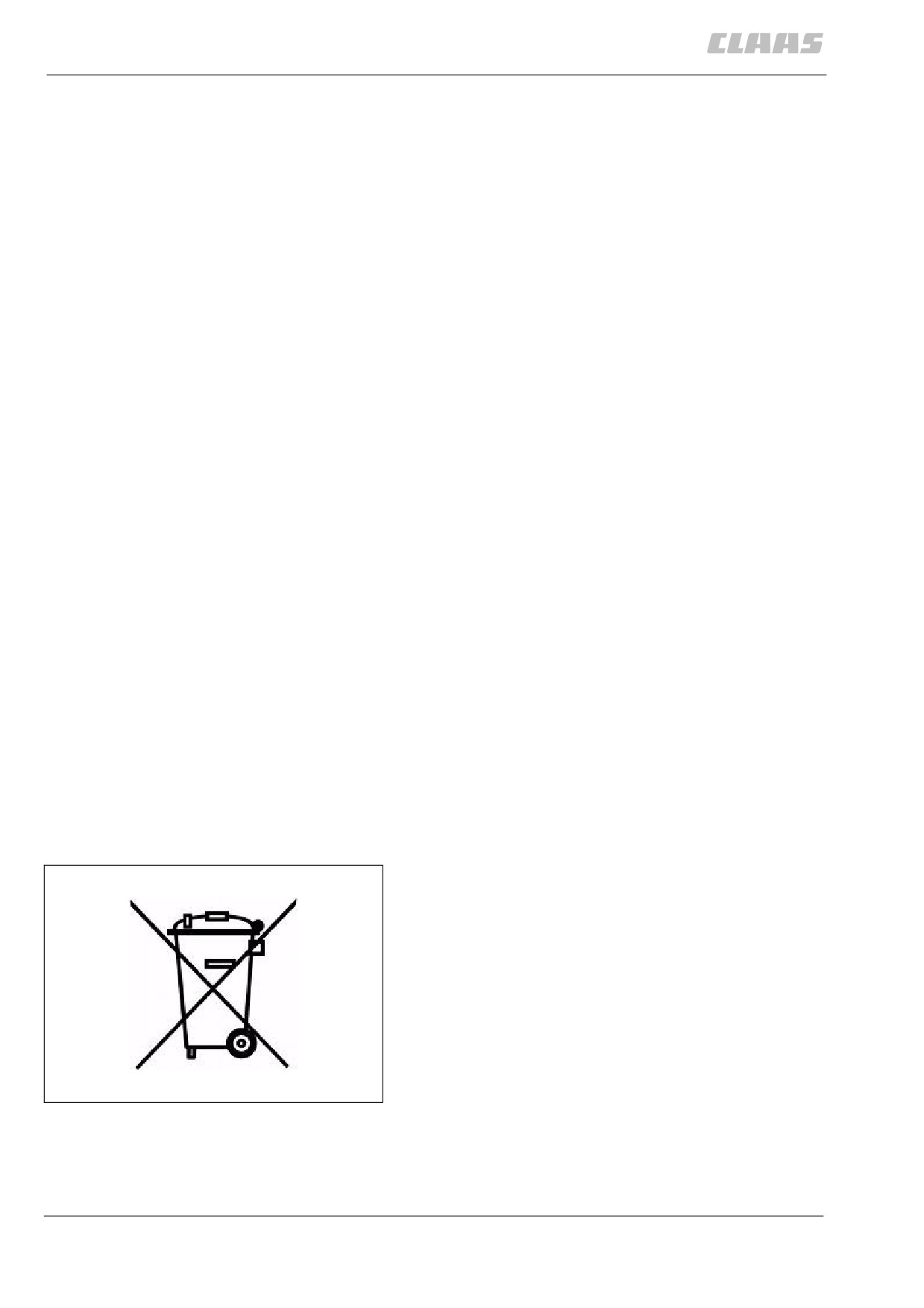
- Do not dispose of products marked with the
symbol (1) in your domestic waste at the end of
their service life.
1
39207
42
3 Safety
3.1 General Information
67079
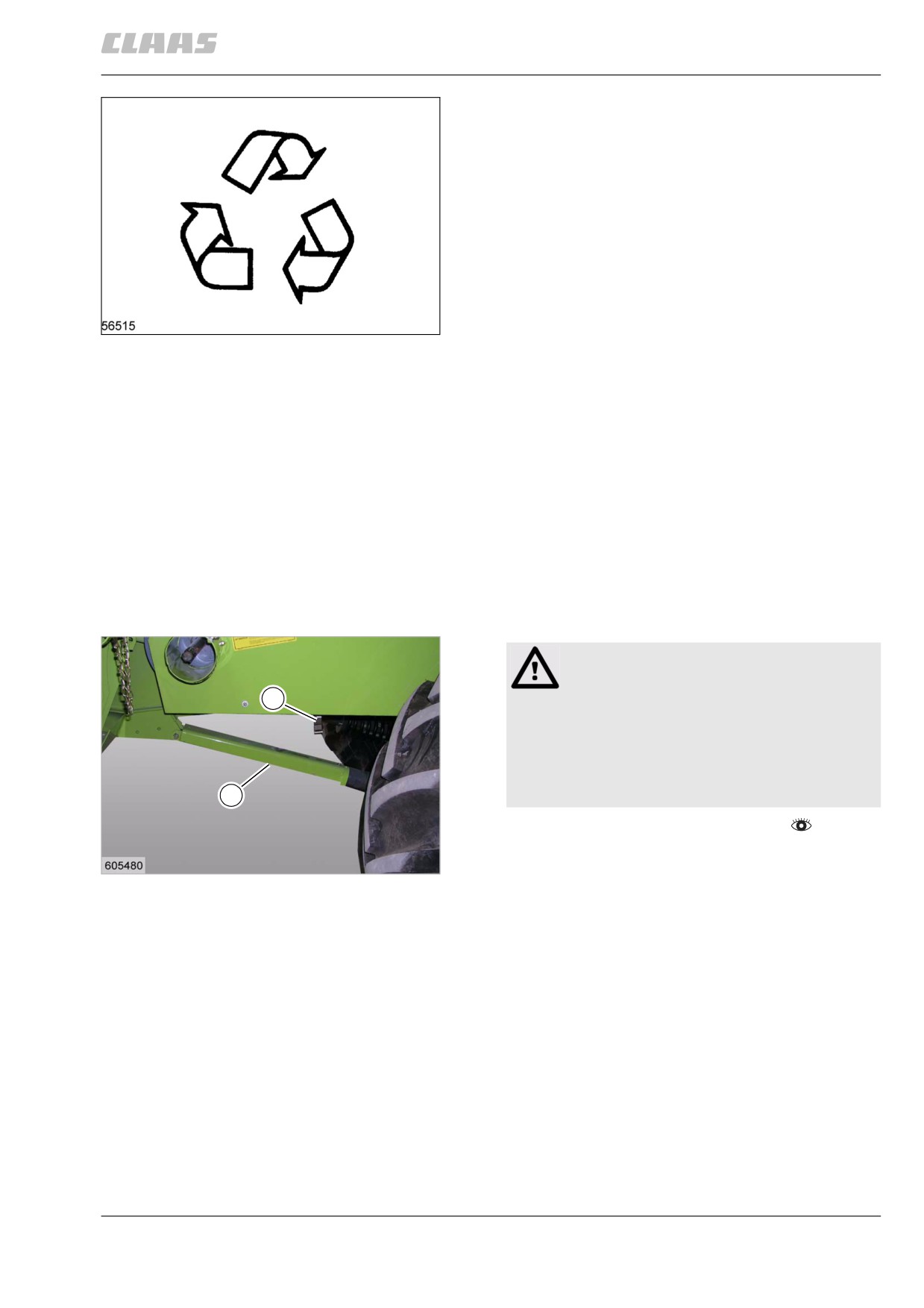
- Recycle used materials marked with the
symbol (2) in accordance with their labelling.
- Recycle packaging material, do not dispose of it in
domestic waste.
- Recycle plastics that are labelled with material
information, e.g. PP TV 20, do not dispose of
them in domestic waste.
- Used batteries contain hazardous substances and
must be taken back by the distributor, disposed of
correctly or delivered to a collection point. Do not
dispose of used batteries in domestic waste.
- Operating materials, such as oils, hydraulic fluids,
2
7761
brake fluids or fuels, must be treated as hazard-
ous waste and disposed of correctly.
- Have refrigerants disposed of only by specialist
companies with experienced personnel and the
necessary technical equipment. Refrigerants must
never be released into the atmosphere. Have
refrigerants disposed of by your CLAAS dealer.
Observe country-specific regulations.
- Follow the regulations of the local authorities
responsible.
71723
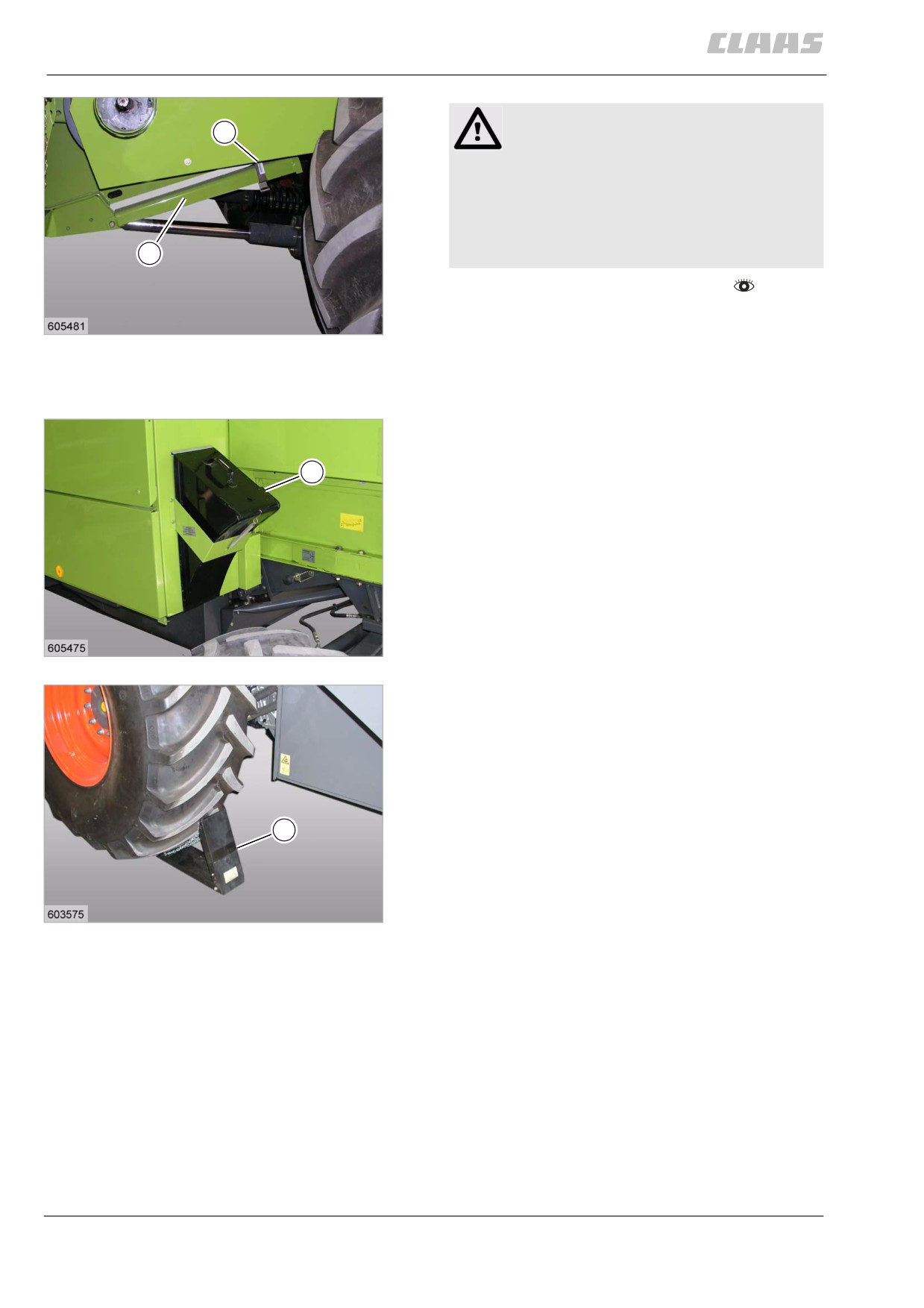
3.1.23 Applying the feeder housing safety lock
The engaged safety lock prevents an uncontrolled
drop of the feed rake conveyor and the mounted front
attachment.
Danger!
Front attachment, reel and feeder unit may
2
drop in an uncontrolled way.
Death or serious injury.
- Fit the safety locks.
- Keep a safe distance from the hazard
1
area.
- Completely raise the feeder housing.
- Release safety lock (1) at latch (2) and fold onto
3
the hydraulic ram.
14528
- Then lower the feed rake conveyor onto the
engaged safety lock.
71724
3.1.24 Moving out the feed rake conveyor
safety lock
While the combine-harvester is in operation, the cutter-
bar cylinder safety lock (1) must be moved up and
arrested by locking pin (2).
43
3 Safety
3.1 General Information
67079
Danger!
2
Front attachment, reel and feeder unit may
drop in an uncontrolled way.
Death or serious injury.
- Fit the safety locks.
- Keep a safe distance from the hazard
1
area.
- Completely raise the feeder housing.
- Move cutterbar cylinder safety lock (1) up and
4
attach it to locking pin (2).
14529
71740
3.1.25 Secure the machine with wheel chocks
so it will not roll away
One wheel chock (1) is provided on the machine.
1
5
14533
- Place the wheel chock (1) in front of or behind the
front wheel, depending on the slope.
- Place the wheel chocks (1) close to the drive
wheels.
Now the machine is protected against rolling away.
1
6
2732
44
3 Safety
3.1 General Information
67079
41076
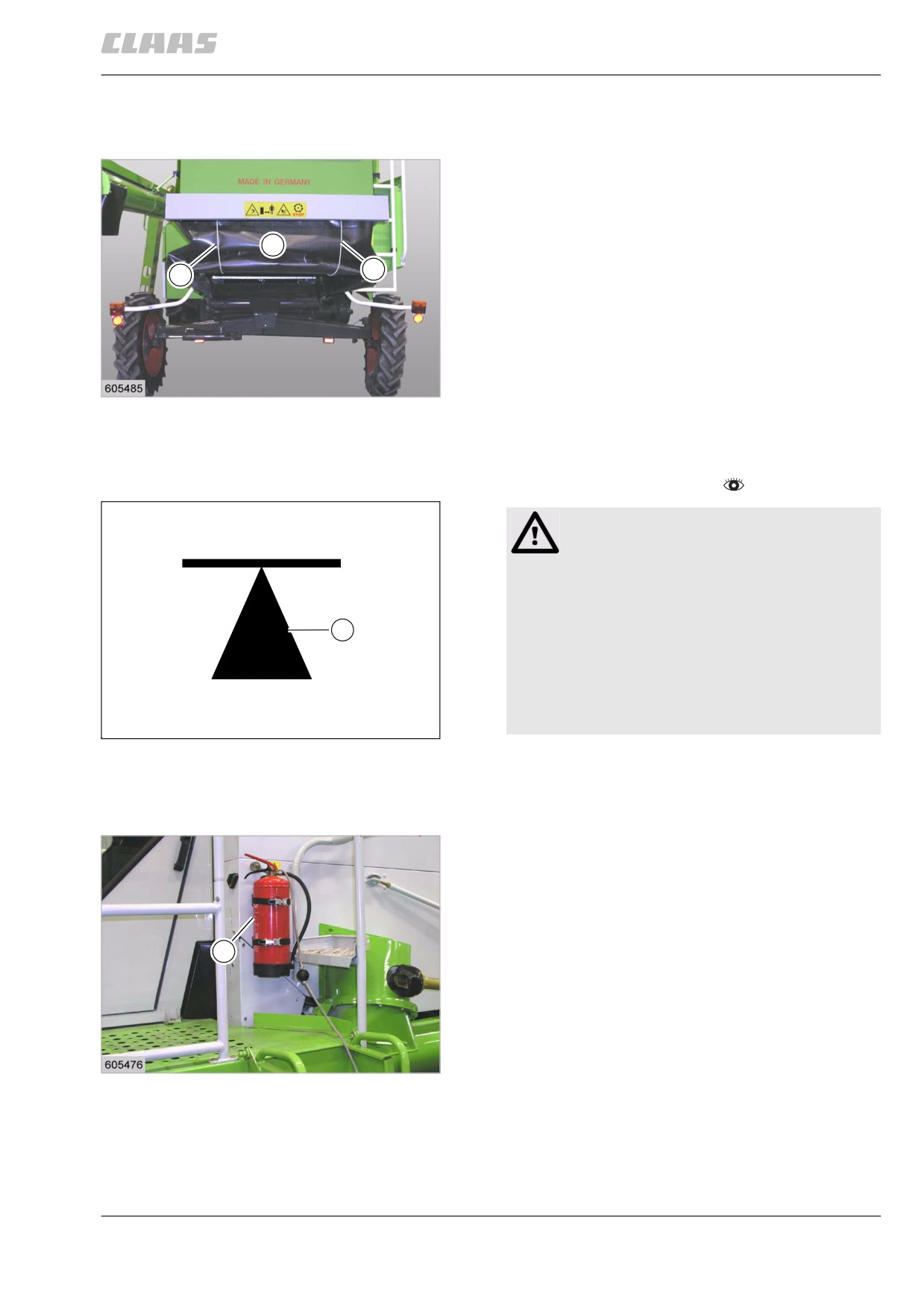
3.1.26 Securing the straw guide apron in
raised position
Whenever moving the combine on public roads, raise
the straw guide apron (1) which is mounted on the rear
hood. Secure the apron in the raised position with
ropes (2). This way all taillights and reflectors will be
visible for all road users.
1
2
- Secure straw guide apron (1) in raised position
2
with ropes (2) every time before travelling on pub-
lic roads.
7
14532
37012
3.1.27 Jack up the machine
- Observe the general warnings at the beginning of
the "Maintenance" chapter.
Danger!
Jacking up the machine.
Death or serious injury.
- Use jack / jack stand with sufficient
capacity.
1
– Use reliable jack / jack stand.
- Use jack / jack stand on solid and level
ground.
- Apply the jack / jack stand at the position
of the machine intended for this purpose.
614659
8
5298
The jacking points / supporting points are marked by
symbol (1) on the axles.
71772
3.1.28 Fire extinguisher
The machine is delivered ex works with one fire extin-
guisher (1).
- Before operating the machine, mount the fire
extinguisher (1) at the position on the machine
provided for this purpose.
F
The functionality of the fire extinguisher (s) must be
checked every two years. The date of manufacture or
the date last checked is shown on the extinguisher.
The testing intervals may differ in other countries. In
this case, the information on the fire extinguisher is
valid for the respective countries.
9
14530
Country variant for Sweden: The machine is delivered
ex works with a second fire extinguisher (1).
- Before commissioning the machine, mount the
second fire extinguisher (1) at position on the
machine provided for this purpose.
45
3 Safety
3.1 General Information
67079
- Observe the regulations in force in the respective
countries.
71774
3.1.29 Battery isolating switch
The battery isolating switch (1) switches the power
supply of the machine on and off.
B
Switch the battery isolating switch (1) off every day
after machine use is finished and in case of
emergency.
Do not switch off the battery isolating switch (1) while
the engine is running!
A
1
Position
Designation
A
Power supply is OFF (by turning
10
anti-clockwise).
14531
B
Power supply is ON (by turning
clockwise).
36998
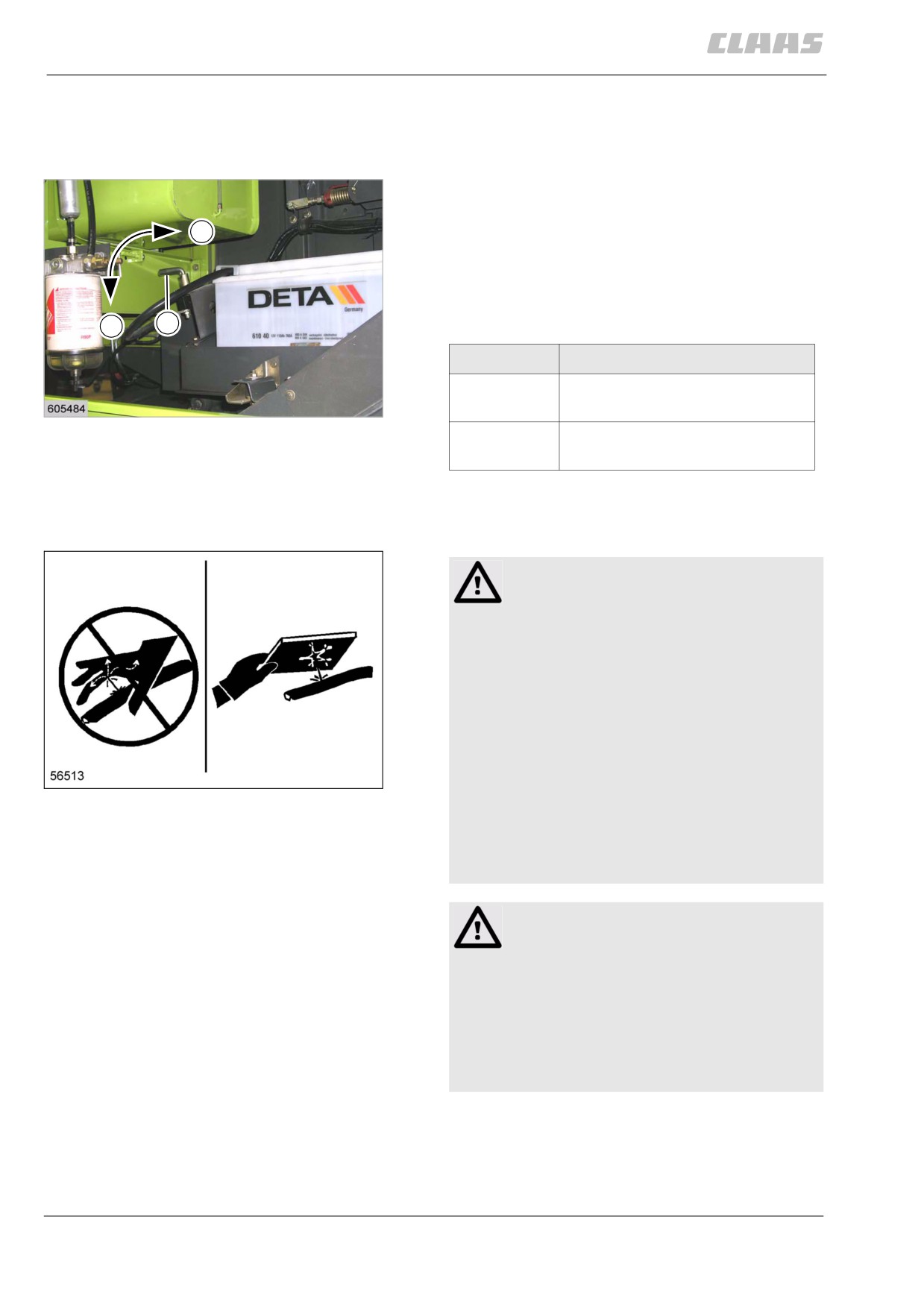
3.1.30 Danger of injury due to escaping
hydraulic liquid
Danger!
Liquids under high pressure.
Liquids penetrate the skin and cause serious
injury.
- Only have authorised and qualified work-
shops carry out work on the hydraulic
system.
- Check hose lines at regular intervals.
Search for leaks using a piece of wood or
cardboard.
11
Ensure that the oil jet will not be directed
740
towards your body.
- Replace any damaged hose lines.
- Replace hose lines 6 years after the date
of manufacture at the latest.
Danger!
Dealing incorrectly with injuries due to hydrau-
lic fluids.
Death or serious injury.
Even a pinhole can result in severe injuries.
- If hydraulic fluid gets in the skin or eyes,
have the injury treated by a medical spe-
cialist immediately.
46
3 Safety
3.1 General Information
67079
71802
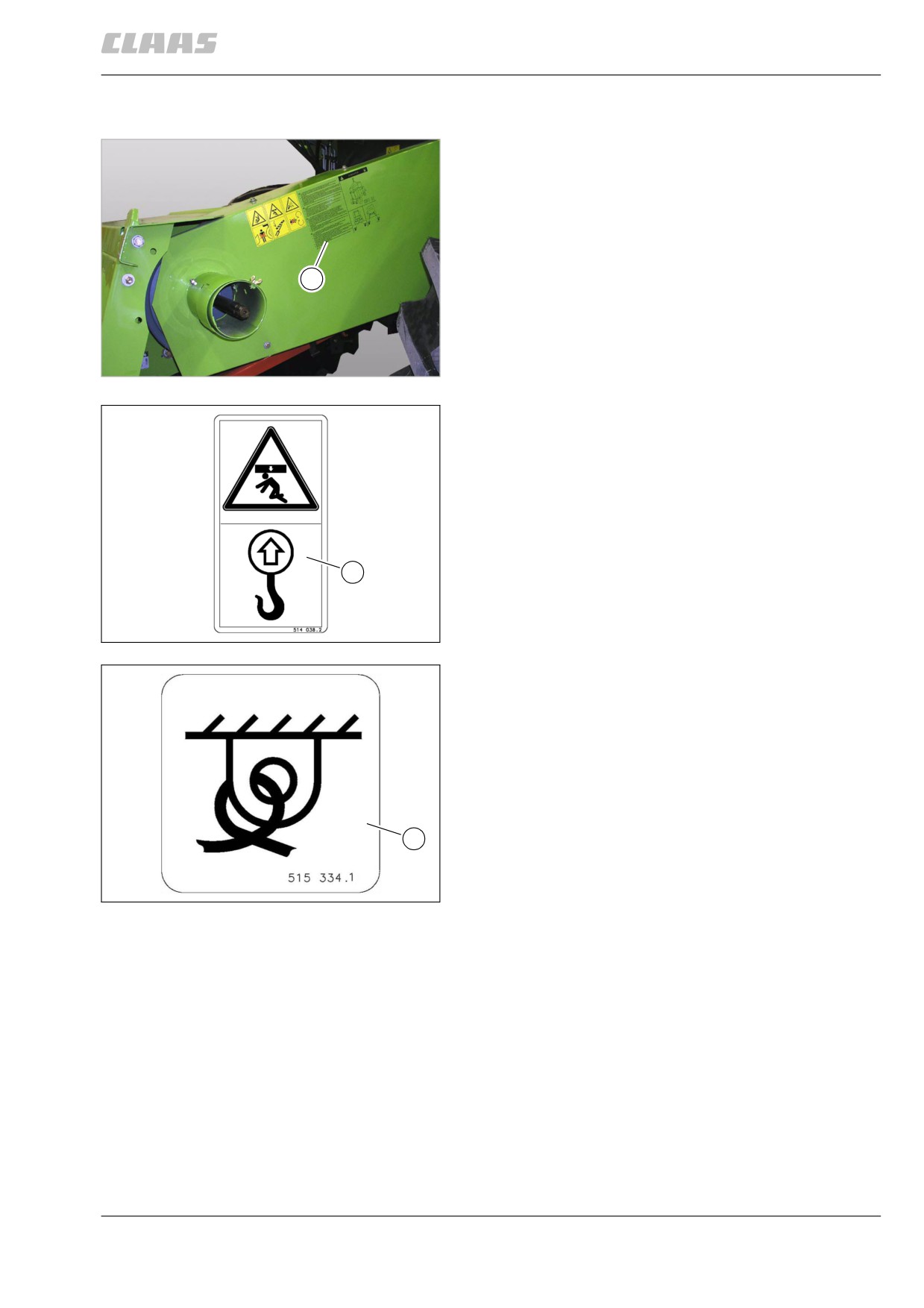
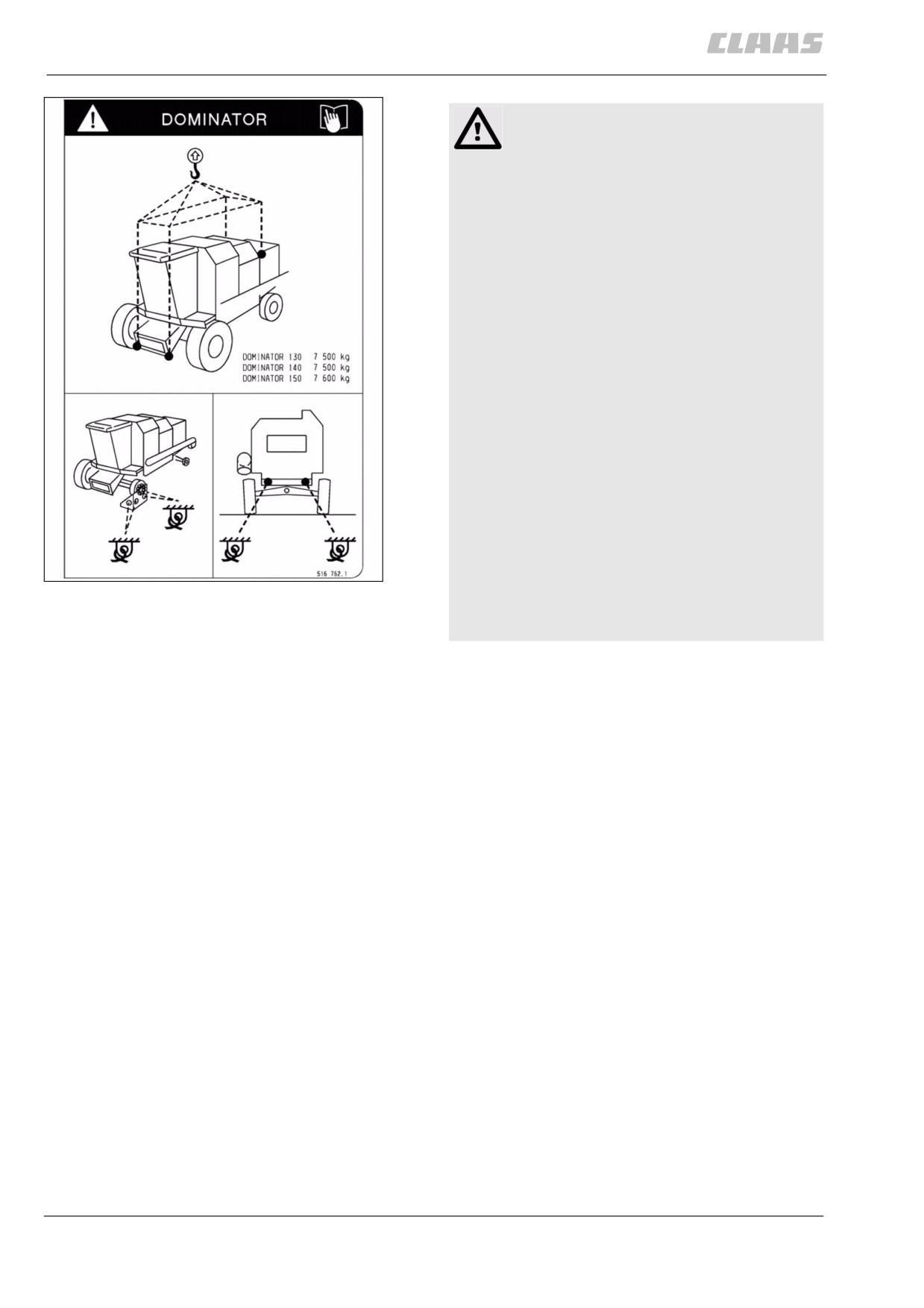
3.1.31 Loading and tying down the machine
The safety decal (1) shows all permitted tie-down
points on the machine.
1
12
24611
- Suspend the machine into the devices intended
for this purpose and marked with hazard warning
signs (1).
1
13
65
- Tie down the machine with the devices intended
for this purpose and marked with safety
decals (1).
1
14
9602
47
3 Safety
3.1 General Information
67079
Danger!
Lifting of heavy components.
Death or serious injuries!
- Never stand in the hazard area beneath a
suspended load.
- Use only the marked slinging points and
tie-down points.
- Improper lifting or tying down may result
in machine displacement and cause injury
or damage.
- Before slinging or tying down the
machine, apply the parking brake.
- The feed rake conveyor must be fully
raised before slinging the machine.
Before persons are allowed beneath the
feed rake conveyor, its support fitted on
the lift cylinders must be applied.
- Use lift eyes and/or a carrier beam for lift-
ing the machine at the front. If no lift eyes
and/or carrier beam is available, please
contact your CLAAS dealer.
- Use only flawless and sufficiently dimen-
15
sioned lifting devices for lifting the
30867
machine.
- Protect your lifting devices against sharp
corners and edges, e.g. by protectors.
48
3 Safety
3.1 General Information
67079
79364
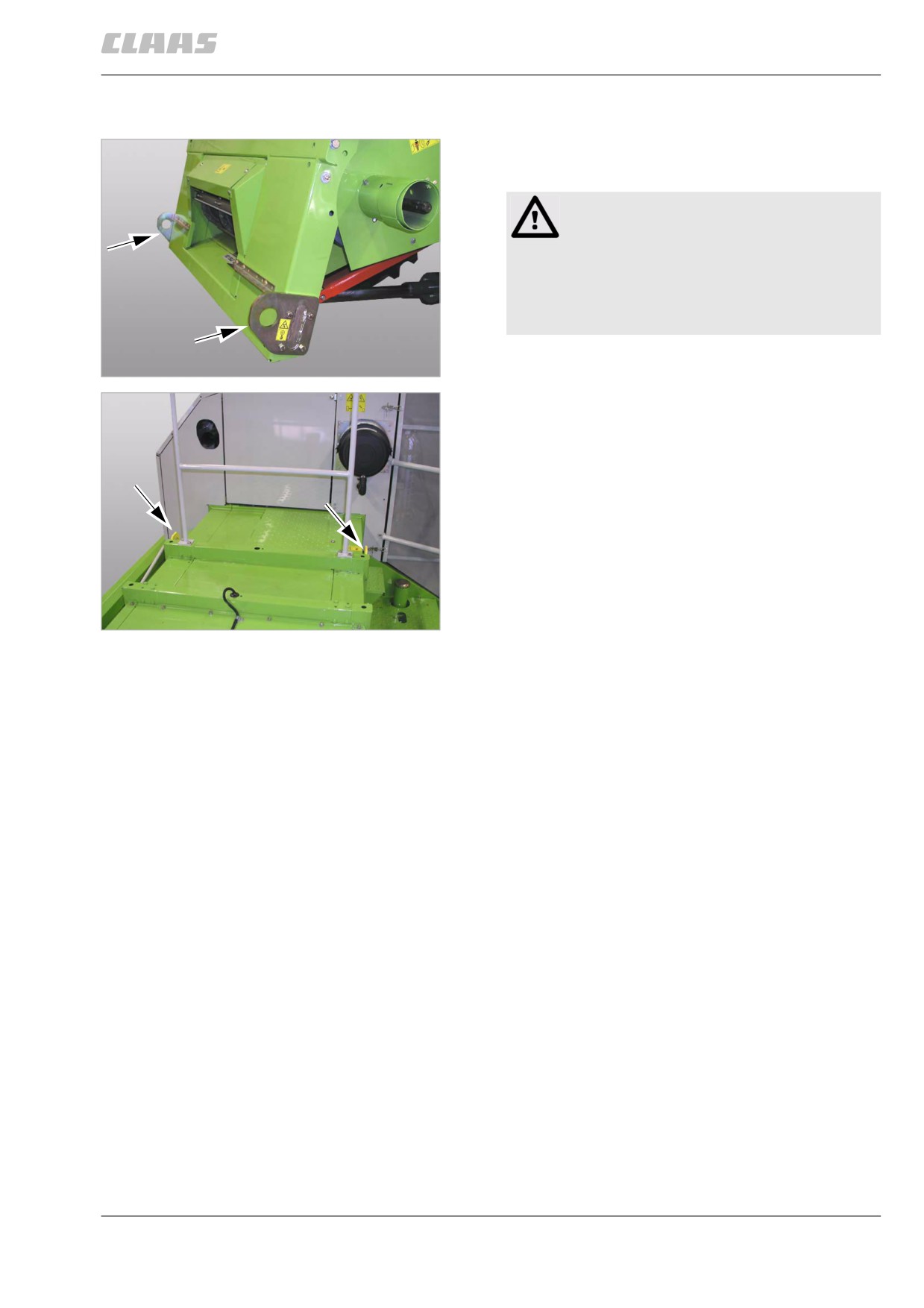
3.1.32 Removing the lift eyes
- Remove the lift eyes and keep them for future
transport.
WARNING:
Improper transport!
Material damage to the machine.
- Lift eyes removed during the initial
machine delivery must be kept for future
transport.
16
24680
17
27269
49
3 Safety
3.2 Safety rules
67079
3.2 Safety rules
Before putting the machine into operation, read and
follow the Operator's manual and the safety
instructions!
76
3.2.1 Identification of warning and danger
signs
All parts of this operator's manual having to do with
your safety or the safe operation of the front attach-
ment or the machine are marked with the following
signs. Please pass on all safety precautions to any
other users of the machine as well.
Danger!
Nature and source of danger
Consequences: death or serious injury
- Countermeasures
Warning!
Nature and source of danger
Consequences: injuries
- Countermeasures
Caution!
Nature and source of danger
Consequences: material damage
- Countermeasures
Note!
Nature and source of information
Consequences: enhanced machine economy
or easy assembly
- Measures
Environment!
Nature and source of danger
Consequences: damage to the environment
- Countermeasures
50
3 Safety
3.3 Safety decals
67079
3.3 Safety decals
859
3.3.1 General information on safety decals
The danger zones on the machine or on the front
attachment which cannot be eliminated by design or
protective measures, are identified by safety decals.
These safety decals help to alert persons to hazards
which can cause personal injury.
The safety decals consist of two components:
- Part 1 shows the risk of injury in a warning
triangle.
- Part 2 shows how injury and accidents can be pre-
vented by appropriate actions.
The pictures on the safety decals consist of generally
understandable pictograms. As far as possible, the
safety decals must be located in close proximity to the
hazardous area.
The original CLAAS safety decals are equipped with
the CLAAS part number and the date of manufacture.
The positioning and meanings of the safety decals are
explained below:
- When ordering, please use the 10-digit CLAAS
part number given ahead of every safety decal,
- the safety decal number given in ( ) shows the
correct position of the safety decals in the associ-
ated picture,
- followed by an explanation of the safety decal
graphics in text form.
Danger!
Hazard points on the machine.
Death or serious injury!
- Hazard warning signs / safety decals that
are damaged or unrecognisable must be
replaced immediately by new ones.
- When parts that have hazard warning
signs / safety decals are replaced, always
make sure to attach the relevant new haz-
ard warning signs / safety decals to
each new part.
51