CANADA. LAND OPERATIONS (ENGLISH, 2008) - page 3
Land Operations
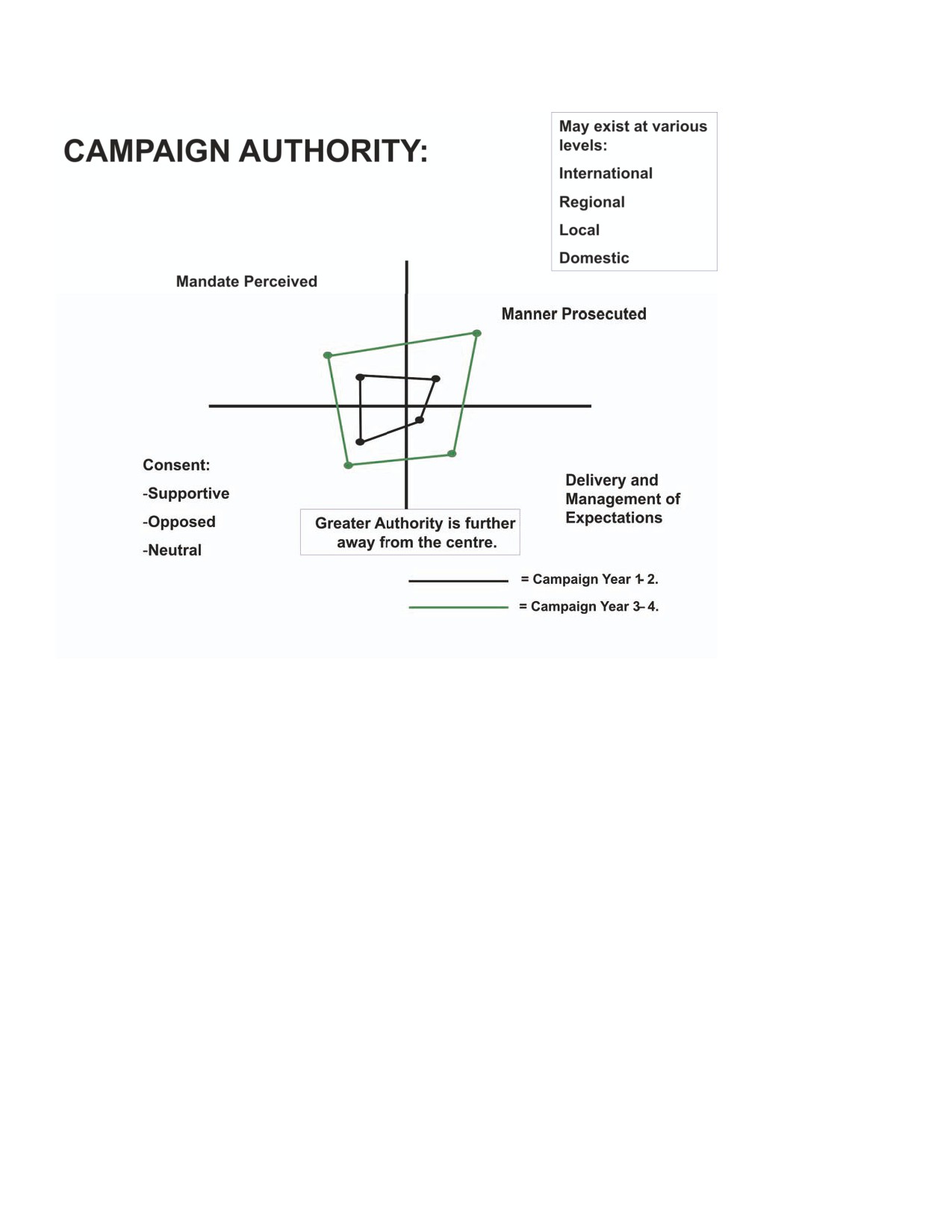
Figure 6-1: Illustration of Campaign Authority Indicating Changes over Time
4.
During any campaign, and particularly those in which the support of population groups is
vital for success, commanders must strive to build and maintain campaign authority. This is not
meant to highlight or advertise the campaign and its own goals for its own sake. Rather, it is
done to build the legitimacy of the campaign in the eyes of those who are affected by it, and
most importantly, whose support is required for successful conclusion.
5.
Not all of the criteria need be satisfied in order to hold significant campaign authority.
For example, if a humanitarian crisis demands intervention, an intervening military force that
immediately relieves suffering and prevents a further deterioration of the situation will likely be
viewed as having legitimacy and thus campaign authority, even though no international
mandate may have been issued by an international forum.
6.
Apart from building campaign authority through the actual conduct of the campaign and
the achievement of success, campaign authority may be built and maintained through influence
activities, such as psychological operations (PSYOPS), civil-military cooperation (CIMIC) and
public affairs (PA). This will provide both information and evidence of campaign progress and
the resolution of sources of conflict. In many cases, these will be defensive information
operations (info ops) that seek to protect campaign legitimacy from adversary propaganda.
Influence activities, such as PSYOPS and PA, should not be conducted in such a manner that
they will be perceived to be propaganda. They must simply highlight the aim and objectives of
the campaign, its benefit for indigenous populations, and its moral justification.
6-2
B-GL-300-001/FP-001
The Conduct of Land Operations
7.
In the end, a campaign that is not seen to be legitimate or conducted in a legitimate
manner will likely fail as a result of a loss of popular support. This is particularly true for those
campaign themes that require popular support to succeed, that is, peace support and counter-
insurgency (COIN) campaigns.
SECTION 2
OPERATIONAL ART, OPERATIONAL
DESIGN, AND CAMPAIGN PLANNING
603. GENERAL
1.
Operational art is defined as: “the skill of employing military forces to attain strategic
objectives in a theatre of war or theatre of operations through the design, organization and
conduct of campaigns and major operations.” 126 Operational design, including campaign
planning, is realized through the application of operational art.
2.
Operational art is the skilful employment of military forces to attain objectives through the
design, organization, integration, planning and conduct of theatre strategies, campaigns, major
operations and battles. It applies to all aspects of operational design including campaign
planning. It is not dependent upon the size of the committed forces.
3.
It requires a clear understanding of the consequences of operational level decisions, and
their impact at both the tactical and strategic levels. Commanders must have broad vision, the
ability to anticipate, and an understanding of the relationship between end states, their
supporting objectives, and the activities and effects needed to realize them.
4.
Using operational art, commanders at all levels apply intellect and intuition to the
situation to establish and verbalize, in the form of a commander’s intent, their vision of what is
required to achieve the end state. This should include a unifying theme to which all agencies in
the campaign could work.
5.
Operational design is the process of expressing operational art. It examines the whole
situation and constituent elements of an environment, along with the nature of the problem at
hand, in order to conceive a framework that can be used to meet the desired strategic and
operational end states. It consists of: an operational estimate including mission analysis; a
series of concepts for articulating the campaign plan; and the campaign plan itself including
supporting operation plans and orders. It is the manner and process in which the campaign
plan is developed. Note that an effects-based approach is used to conduct operational design.
126 B-GL-300-003/FP-000 Command in Land Operations. NATO Allied Administrative Publication 39
(AAP-39) NATO Glossary of Tactical and Logistical Land Operations Terms and Expressions, defines
operational art in similar terms: “the employment of military forces to attain strategic and/or operational
objectives through the design, organization, integration, and conduct of strategies, campaigns, major
operations, and battles. Operational art translates the joint force commander's strategy into operational
design, and, ultimately, tactical action, by integrating the key activities at all levels of war.”
B-GL-300-001/FP-001
6-3
Land Operations
6.
A campaign is defined as: “a set of military operations planned and conducted to
achieve a strategic objective within a given time and geographical area, which normally involve
maritime, land and air forces.”127
7.
A campaign plan is defined as: “a plan for a series of related military operations aimed
at accomplishing a strategic or operational objective within a given time and space.”128 The
campaign plan should focus on the operational end state, operational objectives, and supporting
effects or decisive points to reaching the operational objectives. It should not focus on detailed
activities.
8.
Campaign planning is part of operational design and applies established procedures and
a commander’s intuition to solve the problem. In general, “design” is problem setting while
“planning” is problem solving.
9.
Operational design provides a means to gain understanding of a complex problem and
environment, along with insights towards achieving a workable solution. Although design
should precede planning, design is continuous throughout the operation, constantly testing and
refining to ensure the relevance of military action to the problem. In this sense, design guides
and informs planning, preparation, execution, and assessment. It allows for adjustments to be
continually made to the campaign plan as required.
10.
Campaign planning focuses on the operational objectives and on the physical and
intellectual activities intended to have a direct effect on the threat or environment. A
commander is typically assigned a mission and a set of resources, and required to devise a plan
to use those resources to accomplish that mission or achieve the desired objective.
604. PLANNING LEVELS ACROSS CAMPAIGN THEMES
1.
Campaigning forces have traditionally planned at a level reflective of their level of
command and employment. Thus, tactical level formations have been limited to the conduct of
tactical level planning and subsequent activities. In planning processes, units have conducted
the estimate process while formations have performed the formal staff-assisted operational
planning process. Elements of campaign planning have rested solely at the operational and
strategic levels. Furthermore, combat support elements rested mainly at the higher tactical and
formation levels, and joint resources have been normally controlled at the higher formation and
operational levels. Finally, integration with other agencies has traditionally been conducted only
at the highest levels and has been limited in scope.
2.
Much of this paradigm will remain extant during campaigns of major combat. However,
many campaigns, such as a peace support or COIN, will have particular characteristics such as:
the involvement of other elements of power to achieve success; the requirement to deal with
environmental elements and actors in addition to an adversary; the limited involvement from
alliance or coalition members, such as the commitment of units or brigades only; forces working
in expansive areas of operations (AO); and, the use of joint enablers at tactical levels.
127 NATO Allied Administrative Publication 6 (AAP-6) NATO Glossary of Terms and Definitions.
128 NATO Allied Administrative Publication 39 (AAP-39) NATO Glossary of Tactical and Logistical Land
Operations Terms and Expressions.
6-4
B-GL-300-001/FP-001
The Conduct of Land Operations
3.
In such situations, there will be a compression of this paradigm that will see tactical
level commanders undertaking responsibilities and processes associated with higher tactical
and operational level headquarters (HQ). Thus, units and lower level formations will work
closely at all levels with other agencies, they will deal with a wide array of actors and influences
within the environment in addition to adversary forces, they will undertake long-term operational
planning, they will be responsible for the conduct or coordination of all aspects of the alliance’s
campaign within their large AOs, they will be responsible to implement their own national
campaigns, they will work on multiple lines of operation, they will be allocated a wide array of
combat support enablers (e.g., PSYOPS detachments at battle group level), and their tactical
level activities will be directly linked to operational objectives and end states.
4.
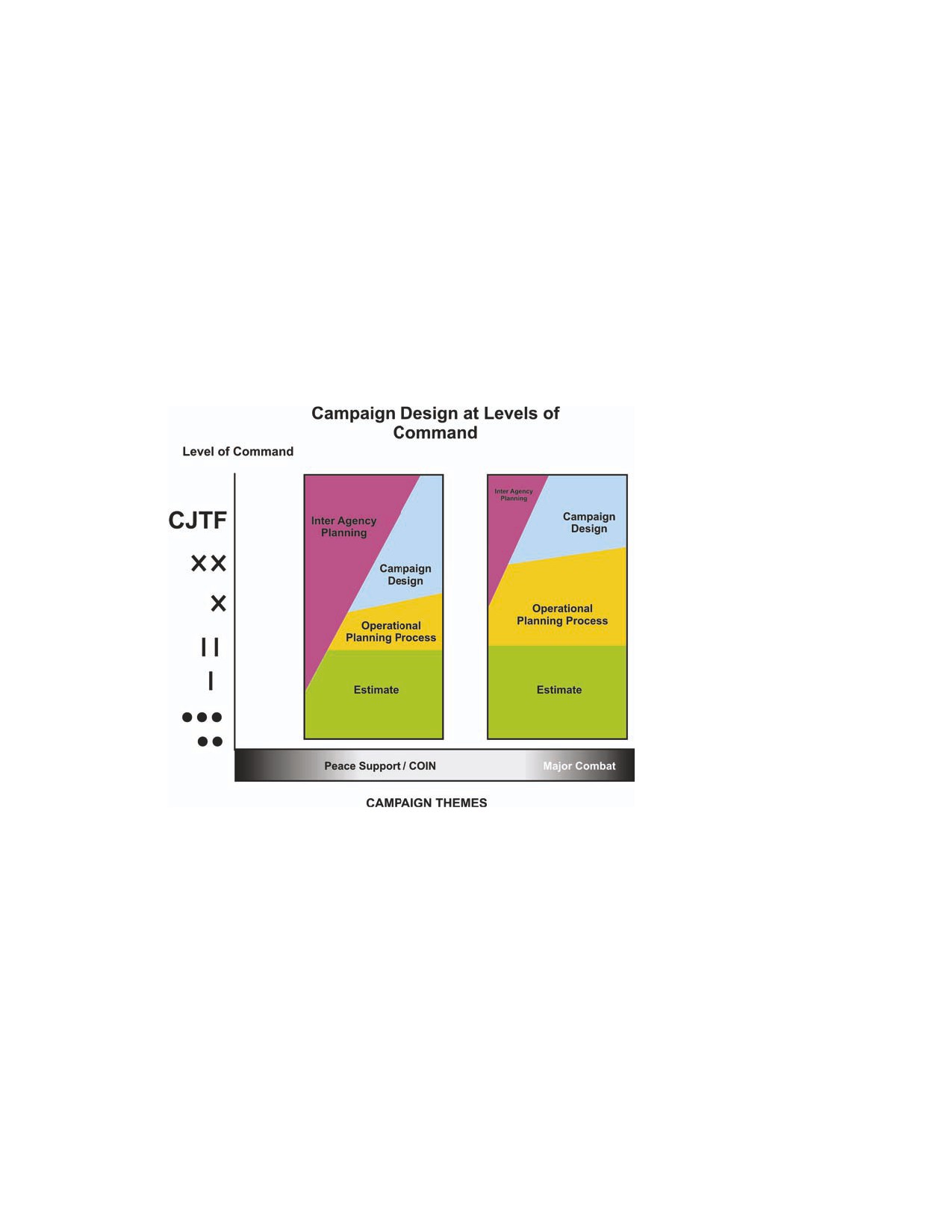
As a result of this compression, elements of campaign planning, operational planning
and interagency operations are forced down to the tactical levels where they are incorporated,
or at the very least, must be understood and factored into tactical planning. This is illustrated in
Figure 6-2.
Figure 6-2: Compression of Planning Levels By Campaign Theme
5.
The level, to which a tactical commander is planning in terms of incorporating elements
of campaign and operational planning, will depend upon the type of campaign being conducted.
Major combat operations will be relatively straightforward with a focus on a likely conventional
adversary. Peace support and COIN campaigns will demand much more complicated planning
considerations at lower levels. This compression in certain campaigns of operational planning
down to tactical levels stems from certain environmental characteristics and campaign
demands, which may include some or all of the following:
a.
The environment and nature of the campaign requires a multi-agency,
comprehensive approach to the campaign to reach enduring outcomes. This
will see lower tactical levels planning and working with other agencies to restore
or create civil structures and institutions. Thus, the military tactical level forces
will share lines of operation and objectives with non-military agencies.
B-GL-300-001/FP-001
6-5
Land Operations
b.
Operational objectives are planned so that there is a direct and intimate link
between them and tactical level activities. For example, tactical level forces
may assume tasks to maintain civil order in a specific area, assist in the
stabilization through the creation of civil structures, and train local security
forces.
c.
There is a need for tactical level commanders to understand the direct
relationship between their tactical level activities, the effects, both desired and
undesired, created by their activities, and the resulting impact on the
achievement of operational objectives.
d.
Tactical commanders must understand the influence that their activities will have
on the various actors and groups within the environment, and plan for this
accordingly.
e.
Tactical level commanders may be allocated joint capabilities, such as CIMIC or
PSYOPS detachments, that normally reside at higher echelons of command.
f.
The complexity of the campaign lines of operation requires harmonization of the
actions of other agencies and elements at the lowest levels. For example,
tactical level commanders will have to coordinate their activities and effects with
other non-military agencies.
g.
Some alliance member commitments will only occur at the tactical level and
therefore their understanding of, and influence in, the allied campaign will come
from the tactical level.
SECTION 3
THE ELEMENTS OF OPERATIONAL DESIGN
605.
GENERAL
1.
The purpose of operational design is to map out the framework for the campaign plan
and its detailed development. Operational design expresses operational art and consists of the
operational estimate, the operational concepts for articulating the campaign plan, and the
campaign plan itself. Operational design provides the guidance for the planning of major
operations or campaigns, based upon an analysis of the nature of the problem and desired end
state. It results in the commander’s visualization of the campaign’s conduct, and thus, leads to
operational campaign planning, including the continual issue of orders and directives.
2.
Operational design relies upon a number of operational concepts to support campaign
planning.
3.
While strategic and operational objectives remain consistent throughout the joint
operating area (JOA), the capabilities, activities and effects used to accomplish them can vary
significantly from one AO to another.
6-6
B-GL-300-001/FP-001
The Conduct of Land Operations
606. OPERATIONAL ESTIMATE AND MISSION ANALYSIS
1.
The operational estimate will produce the campaign plan, followed by the operation plan
(OPLAN) and operation order (OPORD) needed to initiate the campaign plan. Sequence:
a.
The operational estimate begins with an assessment of the environment and the
issues that led to the crisis or decision to undertake a campaign and intervene
with military forces. It is here that all elements and systems of the
environment—political, military, economic, social (including culture and religion),
information and infrastructure (PMESII)—are identified and assessed. Here,
thought can be given to other elements of power and agencies that are best
suited to deal with these systems.
b.
Mission analysis is the logical process for extracting and deducing from a
superior’s order the requirements necessary to fulfil a mission. At the
operational level, it places in context what objective and supporting effects are
to be achieved by the campaign:
(1)
The commander conducts a mission analysis of the strategic and
operational direction issued to him, which should include a strategic end
state and objectives, including the military strategic objective. From this
he identifies the military operational objectives that must be fulfilled in
order to support the end state. In doing so, he must focus on the
strategic objectives as the guiding elements of operational design.
(2)
During mission analysis, the commander must analyze and discuss the
strategic directive with senior military or governmental leaders to ensure
that the policy goals are clear, and that the national level authorities are
made fully aware of the consequences of committing military forces to a
campaign.
(3)
Planning in a crisis will be an iterative process with political and
diplomatic activity occurring in parallel. Even in domestic operations, the
ideal content of a strategic directive is unlikely to be available at an early
stage. In some cases, it must be acknowledged that contingency
planning and some preparations may begin without a politically approved
mission. If a clearly enunciated strategic directive is not forthcoming, the
commander should prepare options for approval.
(4)
The mission analysis should consider what other instruments of the JIMP
framework will be used to achieve the overall objective or be available for
coordination in the field.
2.
The operational commander’s mission analysis allows him to provide planning guidance
to his staff. It should clearly state the key operational objectives to be achieved and the key
supporting effects and activities in their realization. At this point, the commander should be able
to vocalize his visualization of the campaign through a unifying theme in the form of his
commander’s intent. Together, the commander and his staff develop the campaign plan.
B-GL-300-001/FP-001
6-7
Land Operations
3.
Once the campaign plan is developed, the initiating OPLANs and OPORDs are
conceived. Based upon the commander’s direction, a number of courses of action will be
developed, validated and compared.
4.
The commander will select the preferred course of action and resulting plan. These will
be refined and issued as OPLANs and OPORDs. As the campaign progresses, the OPLANS
will be continually modified and issued to reflect progress and developments in the campaign
and environment.
5.
Flexibility and adaptability in operational design and planning are essential as each new
campaign or development during a campaign brings unforeseen complexities and opportunities
for which there may be no pre-planned solutions. Commanders must anticipate developments,
plan for them, and act in parallel with JIMP activity. This will ensure the effective application of
combat power.
607. THE CONCEPTUAL ELEMENTS OF OPERATIONAL DESIGN AND CAMPAIGN
PLANNING
1.
The elements of operational design provide a framework for analysis of the mission.
They help commanders visualize the operation and shape their intent. The elements of
operational design are as follows:
a.
end state and military battlespace conditions to be achieved;
b.
centre(s) of gravity;
c.
objectives;
d.
decisive points;
e.
lines of operation;
f.
culminating point;
g.
operational reach, approach and pauses;
h.
simultaneous and sequential operations;
i.
linear and non-linear operations; and
j.
tempo.
608. END STATE
1.
The strategic end state is the situation the government/higher authority wants to exist
when operations conclude, both military operations, as well as those in which the military is in
support of other instruments of power. It is the desired situation derived from national policy
direction. It is realized by the achievement of strategic objectives. A strategic objective is a
constituent of the desired strategic end state. The strategic end state and supporting objectives
are used to determine the military operational end state and objectives.
6-8
B-GL-300-001/FP-001
The Conduct of Land Operations
2.
At the operational level, the operational end state is the desired military situation derived
from strategic direction, taking into account the end state and objectives of the other instruments
of power. At the operational and tactical levels, it is the set of conditions that when achieved
accomplish the assigned mission and meet the desired objectives that support the end state. It
may be reached before the overall strategic end state. Upon achieving it, the military
involvement in a campaign may cease or be reduced substantially.
3.
An operational objective is a constituent of the desired operational end state and is
achieved through the aggregation of one or a number of operational effects, created through
one or more activities. The operational objectives are the military goals needed to produce the
desired operational end state. Determining the operational end state and supporting operational
objectives, by use of mission analysis, are the critical first steps in operational design using an
effects-based approach.
4.
Joint Task Force (JTF) commanders determine the operational end state for campaigns
or joint major operations, and set the operational objectives necessary to accomplish them.
Operations at the theatre level focus on achieving the operational objectives necessary to
achieve the commander’s end state. They are used to develop campaign lines of operation that
link decisive points or effects leading to the fulfilment of those objectives. These campaign lines
of operation should focus and harmonize military activities with those of the other JIMP
elements, particularly the other agencies. Measures of effectiveness (MOE) are identified at the
outset in order to ascertain the effectiveness of activities in meeting the desired effects and
objectives in the ultimate fulfilment of the end state.
609. CENTRE OF GRAVITY
1.
A centre of gravity (CoG) is a source of strength or power. It has been defined as:
“characteristics, capabilities or localities from which a nation, an alliance, a military force or
other grouping derives its freedom of action, physical strength or will to fight.”129 Centres of
gravity exist at all levels of command for any military force. They are strengths that create
effects; therefore, they are better defined in terms of people—individuals or groups—that can
create effects. They may benefit from characteristics or certain localities but are tangible. They
may be a moral leader, such as a political or religious leader, or a group, such as an operational
armour reserve, or a particular tribe supporting an insurgency.
2.
An alternative, more accurate definition for a CoG is: “a dynamic and powerful physical
or moral agent of action or influence that possess certain characteristics and capabilities, and
benefits from a given location or terrain.”130
3.
A CoG is an agent from which an adversary or force will gain his strength, either moral
or physical, or both. A CoG will exist at each level of command, and an adversary may have
more than a single CoG. A CoG will exist wherever forces are most concentrated and where
there is significant cohesion. It may be a centre of power and influence and/or a collection of
physical capabilities.
129 NATO AAP-6.
130
“What Clausewitz (Really) Meant by Center of Gravity,” by Dr. J. Strange, USMC War College and
Colonel R. Iron, UK Army, 2006. Much of this section is taken from this source. The NATO AAP-6
definition has been derived from an interpretation of the original concept proposed by the military theorist
Clausewitz. Instead of capabilities or locations, a centre of gravity is a strength that can create an effect.
B-GL-300-001/FP-001
6-9
Land Operations
4.
In short, a CoG is a main centre of strength, be it physical, moral or both. A CoG can
deliver a significant effect, again be it physical or moral. Thus, a CoG exists because of the
effect that it can have on an adversary or situation (from the striking of a blow), not because of
its inherent capabilities. Certainly, a CoG needs certain capabilities, characteristics and
locations to achieve the effect, but it is the effect this is key in determining a CoG. CoGs may
change over time.
5.
CoGs are people, groups or individuals, which create a physical or moral/psychological
effect. A CoG may be a military force or a key component of a military force, such an elite,
highly trained manoeuvre force. Physical CoGs function as active agents that endeavour to
destroy the adversary’s capability and will to resist. Moral CoGs function as active agents that
influence or control physical CoGs. It may be a leader, a key ruling element, or a population
segment capable of creating a motivational effect.
6.
A CoG is a key strength of an adversary or military force. It is important only in terms of
its relationship to another military force, normally its adversary, and the effect that it can create.
A powerful military formation may only be a CoG if it is suitably capable, by virtue of its relative
strength and location, to strike the blow and create the significant effect against its adversary. If
for example, the adversary’s armour reserve is an operational CoG, but it cannot manoeuvre to
be effective because all bridges have been destroyed, then it is no longer a CoG. Hence, CoGs
are determined and identified based upon their relationship to the adversary and the potential to
create significant effects against him.
CENTRES OF GRAVITY IN RELATION TO THE ADVERSARY
In the American Civil War, the Army of Northern Virginia was a centre of gravity not because its
soldiers were particularly key, but because of the threat it posed to Washington DC and its ability
to block the Union Army of the Potomac’s march on Richmond, the Confederate capital. This
was a combination of capabilities, location and time.
In 1991 the Iraqi Republican Guard was a centre of gravity because of what it could
potentially do to VII Corps, not just because it was well trained with capable armour. In
2003 the Republican Guard was once again identified as an Iraqi centre of gravity, key
to the defence of “Fortress Baghdad”. In retrospect, the Saddam Fedayeen turned out to
be the more worrisome threat, at least for a short while, because of their ability to
maintain Saddam’s grip on numerous cities along the Coalition’s supply lines running
back to Kuwait. Yet the Kurdish peshmerga, would likely have relished fighting the
Fedayeen on their terms. For the Kurds it was the Republican Guard with their superior
firepower, mobility, and protection that was a much more potent centre of gravity. This is
a graphic example of how centres of gravity are formed out of the relationships between
the two adversaries. The Iraqi operational centre of gravity may have been the
Republican Guard against the Kurds; but was likely to have been the asymmetric forces
of the Fedayeen against the Coalition, against which the Republican Guard could not
survive in open combat.
Source: “What Clausewitz (Really) Meant by Center of Gravity,” by Dr. J. Strange,
USMC War College and Colonel R. Iron, UK Army, 2006.
7.
Moral centres of gravity will be focused upon people and their will. One can defeat an
opponent’s army, destroy the economy and occupy the land, but victory will unlikely be lasting if
the will to resist remains strong amongst the populace. In any campaign, the moral CoGs must
be identified. They are normally strategic. The two key elements of a moral CoG are the will
to fight and the ability to command the resources to fight.
6-10
B-GL-300-001/FP-001
The Conduct of Land Operations
8.
In order for a campaign to achieve a long lasting settlement such as self-sustaining
peace, one must undermine the adversary’s strategic CoGs, especially the moral CoGs. There
must be clear linkage between the campaign objectives at the operational level, and
undermining or defeating the moral CoG(s) (the adversary’s moral resistance) at the strategic
level. This will take more than just the military instrument to achieve—the total strategy should
embrace all the instruments of national power, military and non-military, along with other
agencies capable of creating the campaign objectives and attacking moral CoGs. In other
words, a comprehensive approach will be required to harmonize the activities of all elements of
power to attack and defeat the moral CoGs. Military operations should not stand-alone;
otherwise, it is unlikely that the defeat of an adversary’s physical operational CoG will lead to
undermining the strategic moral CoG(s), which may stem from standing grievances.
9.
In many cases, an individual moral CoG is difficult to destroy in only physical terms.
Someone else would likely replace him. It is better, albeit a more time consuming, to remove
the legitimacy or claim to legitimacy from the moral CoG. In many cases, this will involve
solving the reasons that led to the conflict in the first place.
10.
A moral CoG in many campaigns may be the will of the majority of a population, or the
will of a particular segment of the population. Such will be the case in a COIN campaign. The
key battle between the insurgent and the campaigning forces will be to win the enduring support
of the populace.
11.
Thus, a successful campaign plan must first appraise, as accurately as possible, the
moral and physical character of the opponent to include his moral and physical CoGs. There is
no alternative and there is no short cut or analytical model that can make up for an inaccurate
assessment of the adversary when deciding upon CoGs. It is a matter of careful assessment
and the art of command to accurately assess physical and moral CoGs.
MORAL CENTRES OF GRAVITY
The outcome of the 1991 Gulf War was a resounding military victory that achieved the
Coalition's limited objective, the liberation of Kuwait, by defeating Iraq's operational centre of
gravity, the Republican Guard. But Saddam Hussein, a strategic moral centre of gravity,
remained undefeated. Saddam held the position of a moral centre of gravity for his ability to
command both military forces and a large mass of the populace, and to control through fear
other elements of the populace.
In Operation Iraqi Freedom in 2003, Saddam was effectively neutralized early in the war, and
the information operations undermined the will of the population (another potential strategic
centre of gravity) to fight on his behalf. Thus, the enemy's moral centre(s) of gravity was
neutralized simultaneously with defeating his operational centers of gravity—the Republican
Guard and the Fedayeen. The Coalition was thus able to achieve its operational objectives:
the seizure of Baghdad; and, the toppling of the regime. However, neutralizing a strategic
centre(s) of gravity is not the same as defeating it, which is necessary for the much wider
strategic objective of achieving lasting peace. The failure to quickly achieve the support or
will of overwhelming majority of the populace to support/accept the Coalition strategic post-
war objectives fuelled the insurgency that erupted shortly after the major combat was
complete.
Source: “What Clausewitz (Really) Meant by Center of Gravity,” by Dr. J. Strange, USMC War
College and Colonel R. Iron, UK Army, 2006.
12.
Physical centres of gravity tend to be easy to visualize—armies or units, things that
resist an opponent. Moral CoGs are sometimes less obvious, and less easy to grasp. Yet, it is
essential to understand moral CoGs, for these are likely to be the most important ones at the
strategic level.
B-GL-300-001/FP-001
6-11
Land Operations
13.
A moral centre of gravity is linked to people, be they individuals or groups, for only
people can create and maintain moral will and resistance. This focus on people may be
classified as follows:
a.
An Individual. This is normally a leader, military or intellectual or both. A
strong-willed individual who has the will to develop, lead and sustain an
opposition to a potential adversary, along with the ability to exert his will through
an armed force and/or people. Such an individual might be Saddam Hussein in
1990-91 and Winston Churchill in 1940-41.
b.
The Ruling Elite. Ruling elite is normally a closed group, within which the real
power of the state or entity resides. This group will direct policy and wield
control over the armed forces and/or people. The group may be ideologically
focused or claim a special, exclusive inheritance within the society, and thus
seek their legitimacy through their key role in spreading this ideology or claiming
a special social status. An example would be the clerical elite of the 1979
Iranian Revolution.
c.
A Strong-willed Population. The moral CoG may rest within a large group of
people who share a common belief that is held strongly enough to engage in
conflict with an adversary. Examples include both the Palestinians and Israelis
in the Arab-Israeli conflict.
14.
Ideas themselves do not form a CoG because they cannot create an effect on their own.
However, they may be the key characteristic or root of a CoG in terms of its motivation, authority
and legitimacy. The motivating ideas will be embodied and empowered by individuals who are
the proponents of the ideas and who wield influence over a populace and control over an armed
force. If successful, the ideas will be adopted by a large segment of a population, thus making
that segment of the populace a CoG. This is the aim, for example, of the narrative formed by
insurgent forces. The ability of an idea or ideology to motivate a population will differ with
culture, and any intelligence assessment of potential CoGs must take this cultural aspect into
consideration.
15.
In general, CoGs will be:
a.
Active, dynamic agents capable of creating an effect. They will be people, in
either units or formations, or individual leaders or groups with moral authority
and will.
b.
Obvious. This will be more so the case with physical CoGs, but intelligence
must work to identify both types.
c.
Powerful and capable of striking or directing significant blows.
16.
Within a campaign there will be both strategic and operational CoG. During an
insurgency, for example, a strategic CoG may be an individual or a segment of the populace
while an operational CoG will be their related armed element.
17.
An adversary will likely have a number of CoGs, some more critical than others. It may
be difficult to identify CoGs. In attempting to identify them, the commander will develop an
understanding of the complex interplay between all of the relevant entities and dynamics of the
6-12
B-GL-300-001/FP-001
The Conduct of Land Operations
particular environment, including those aspects of the situation that are imperfectly recognized
or understood. This will allow the identification of key vulnerabilities on both the physical and
psychological planes, along with key objectives to reaching the desired end state. As the
situation becomes better understood, one of these objectives may develop to be a CoG.
18.
Commanders must plan campaigns in such a manner that allows their forces and
actions to attack adversary CoGs, both physical and moral. Lines of operation that attack a
physical CoG will normally be fairly straightforward. The CoG need not be destroyed, but may
only be neutralized until it no longer possesses a capability or relative location from which to
strike a significant blow.
19.
Operations against moral CoGs will be much more difficult to plan and may take a
significant amount of time. Leaders or elites and their ideas may be attacked in a number of
ways. As individuals, they may be eliminated, but they will likely be replaced; indeed, their
elimination may only enhance the moral influence that is assumed by their successors. Their
physical means of communication and control may be destroyed, thus limiting their capabilities.
The legitimacy of the individuals and groups and their ideas may be attacked or alternative
ideas and leaders may be offered. In order to successfully defeat a moral CoG, a number of
measures on both the physical and psychological planes will likely be required. Long-term and
enduring solutions will come from the intellectual defeat of these CoGs, or at least their
neutralization, to the point that they become irrelevant. Much of this will be done through
influence activities that persuade individuals and groups to support the campaign.
20.
Destruction or neutralization of the adversary CoG(s) is the most direct path to achieving
the end state. The adversary will recognize this and shield his CoG(s), and commanders must
examine many approaches, direct and indirect, on both the physical and psychological planes.
Once the CoG(s) have been identified, they become a focus of the commander’s intent and
operational design.
21.
Commanders must not only consider the adversary CoG(s), but also identify and protect
their own CoG(s).
22.
Lines of operation group similar operational objectives and may be devised to attack or
neutralize the CoGs and reach those operational objectives. Although CoGs are vital
considerations in operational design, they are not the sole focus of activities and operations.
The lines of operation should work towards the desired end state, while defeating, neutralizing
and protecting the identified CoGs.
610. OBJECTIVES
1.
An objective is defined as “a clearly defined and attainable goal for a military operation,
for example seizing a terrain feature, neutralizing an enemy's force or capability or achieving
some other desired outcome that is essential to a commander's plan and towards which the
operation is directed.”131
2.
Objectives are the constituent elements, which when combined achieve the end state at
the strategic and operational levels as described above. They also apply at the tactical level,
but are realized in more immediate time frames and are often tied to geographic features.
131 NATO AAP-6.
B-GL-300-001/FP-001
6-13
Land Operations
3.
Objectives exist on the physical and psychological planes. In the former context, an
objective may be the destruction of an adversary force. In the latter context, an objective may
be to convince a hostile populace to accept a temporary military presence, or to stop supporting
an insurgency.
4.
An operational objective is a constituent of the desired operational end state realized
through the aggregation of one or a number of interrelated effects and circumstances.132 It may
be described as a decisive condition for the realization of the operational end state.
Operational objectives may be delivered by elements of power other than the military.
Operational objectives may be grouped into thematic lines of operation.
611. DECISIVE POINT
1.
A decisive point is defined as: “a point from which a hostile or friendly centre of gravity
can be threatened. This point may exist in time, space or the information environment.”133
2.
As with other taxonomy, the complications of many operating environments and an
effects-based approach to campaign planning require a broader conceptualization and
application of the concept of decisive points. Just as lines of operation have been expanded to
be thematic groups of operational objectives, the concept of decisive points must be viewed in
relation to the operational end state and objectives.
3.
Decisive points will exist on the psychological and physical planes, and may be
achievements or circumstances to be created on the path to an operational objective, vice a
point from which to attack a CoG. Although, they will likely be planned in consideration of
assessed centres of gravity.
4.
Decisive points are supporting effects to be created by the conduct of activities on the
path to an operational objective. For example, the achievement of an effective ministry of
defence, or an operational command and control (C2) system, may be decisive points or
supporting effects en route to reaching the objective of establishing a competent military force.
5.
Some decisive points are geographic, such as a port facility, a bridge crossing site, a
transportation network or node, or a base of operations. Other physical decisive points include
elements of an adversary force, such as units, command posts, fire support units capable of
delivering weapons of mass destruction (WMD), or important communications sites. Events,
such as the commitment of the threat operational reserve, may also be decisive points. Once
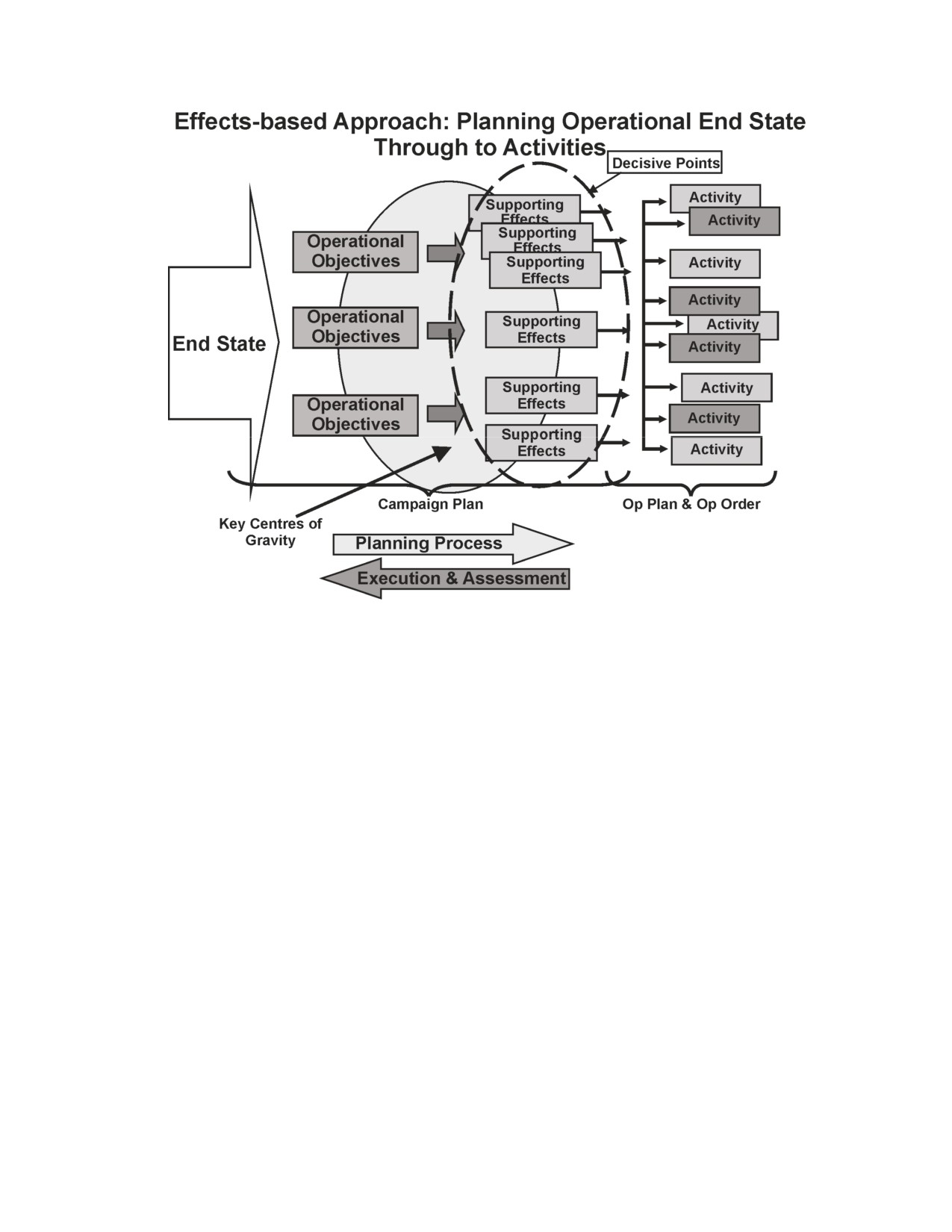
identified and selected for action, decisive points become an effect, groups of effects, or a set of
circumstances or conditions to be achieved. A decisive point may be a single effect to be
achieved, or a collection of related effects on the way to achieving an operational objective.
See Figure 6-3.
132 It should be noted that some effects would not be within the purview of the operational commander to
deliver, even if they may be necessary for the desired end state.
133 NATO AAP-6.
6-14
B-GL-300-001/FP-001
The Conduct of Land Operations
Figure 6-3: Decisive Points as Supporting Effects in the Campaign Plan
6.
Where decisive points exist on the psychological plane, they may be somewhat
intangible and the linkage between them harder to define. For example, to reach the objective
of wide spread domestic support for a campaign, a decisive point may be the establishment of
essential services to slum areas of a population centre.
7.
Normally, a situation presents more decisive points than the force can effect with
available resources. Operational art enables the commander to select decisive points that will
most quickly and efficiently overcome the threat CoG and/or reach the operational objectives.
Decisive points shape operational design and allow commanders to select those that are clearly
defined, decisive, and attainable. A good number of them will require the support of other
agencies.
8.
While strategic and operational objectives remain consistent throughout the JOA, the
decisive points may vary from AO to AO, particularly in campaigns that require all elements of
the JIMP framework for success.
9.
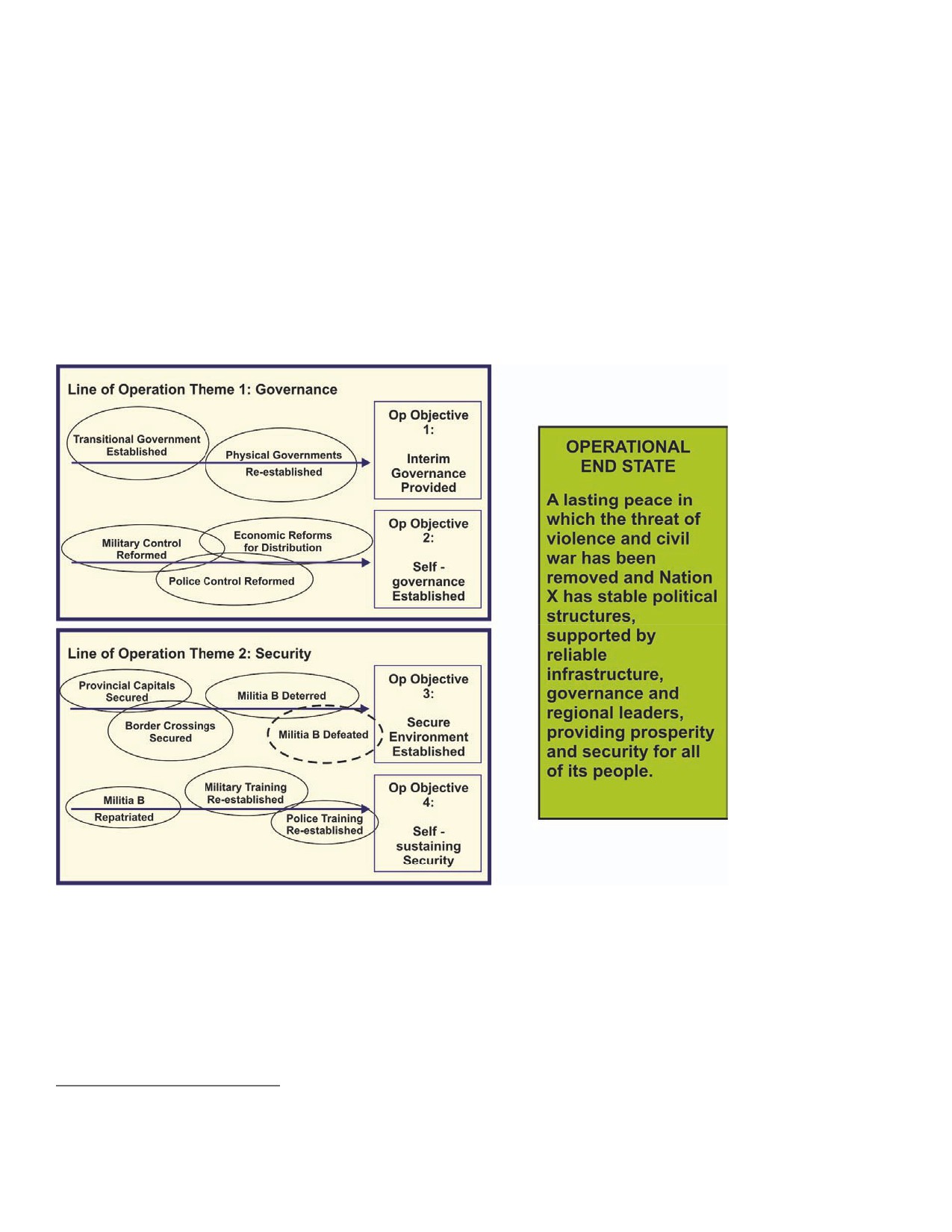
Once decisive points have been identified, they may be plotted logically and sequenced
accordingly in a path to create operational objectives. The groupings of similar operational
objectives and the path of decisive points leading to their realization may be termed lines of
operation. Some decisive points will be conducted sequentially or simultaneously depending
upon their nature, the available resources, and the logical sequence required for the building of
successful outcomes. See Figure 6-4.
B-GL-300-001/FP-001
6-15
Land Operations
612. LINES OF OPERATION
1.
A line of operation is defined as: “in a campaign or operation, a line linking decisive
points in time and space on the path to the centre of gravity.”134
2.
Operational objectives correspond to and are reached by lines of operation. Although
the traditional definition for a line of operation places it in context of moving to attack a CoG, the
complexities of the operating environment and an effects-based approach to operations have
expanded this concept, so that a line of operation will thematically group similar operational
objectives and lead, through decisive points or supporting effects, to the realization of the
operational objective and eventually the desired end state. They link decisive points and
provide a logical, sequenced progression of activities. See Figure 6-4.
Figure 6-4: An Example of Lines of Operation in a Campaign with
Decisive Points (Supporting Effects) Plotted
3.
Lines of operation dealing with conventional threats will be rather straightforward and
seek to defeat the adversary. Lines of operation that deal with operational objectives other than
the defeat of an adversary force, such as the creation of self-sustaining governance, will be
more difficult to conceive and will likely require the support of a variety of elements of power.
134 NATO AAP-6.
6-16
B-GL-300-001/FP-001
The Conduct of Land Operations
4.
A campaign may have single or multiple lines of operation. A single line of operations
concentrates forces and simplifies planning. Multiple lines of operations increase flexibility and
create several opportunities for success. The best approach may to use multiple lines, attaining
a multidimensional effort where several attacks converge upon and defeat the threat CoG.
Each potential option further complicates the adversary’s situation and stresses his C2 system.
The synchronization of multiple lines of operations can overload the adversary commander by
presenting him with several threats at the same time. The tactical agility of Land forces allows
for simultaneous operations along multiple lines of operations.
5.
Lines of operation that consider approaches on both the physical and psychological
planes are key in harmonizing the activities of the military with those of other elements within
the JIMP framework, and illustrating how each may complement and support the other. Note
that a line of operation may span both the physical and psychological planes and involve a
combination of fires and influence activities in order to achieve the successive decisive
points.
6.
When considering combat operations against a conventional threat, the lines of
operation that counter the adversary conventional forces may still be viewed as either interior or
exterior:
a.
A force operates on interior lines when its operations diverge from a central
point. With interior lines, friendly forces are closer to separate threat forces than
the threat forces are to each other. Interior lines allow a weaker force to mass
combat power against a portion of the threat force by shifting resources more
rapidly than the threat.
b.
A force operates on exterior lines when its operations converge on the threat.
Operations on exterior lines offer the opportunity to encircle and annihilate a
weaker or less mobile threat; however, they require stronger or more mobile
forces.
c.
The relevance of interior and exterior lines depends upon the relationship of
time and distance between the opposing forces.
d.
An adversary force may have interior lines with respect to the friendly force;
however, that advantage disappears if the friendly force is more agile and
operates at a higher tempo. Conversely, if a smaller friendly force manoeuvres
to a position between larger but less agile threat forces, the friendly force may
defeat them in detail before they can react effectively.
7.
Where the decisive points are physical, lines of operation can be defined in physical
terms. A military force can be manoeuvred from its base of operations to tactical and
operational objectives. In geographical terms, lines of operations connect a series of decisive
points that lead to the control of the objective or the defeat of the adversary force.
8.
Where decisive points exist on the psychological plane, lines of operation will likely
involve a mix of fires and influence activities, with the focus likely on the latter. The creation of a
decisive point on a governance line of operation, for example, will require the creation of an
institution supported by the education of its members and the populace at large.
B-GL-300-001/FP-001
6-17
Land Operations
9.
When assigned operational objectives, the commander must determine how to define
them, what decisive points or supporting effects will lead to them, and thus what activities must
be assigned to create those effects, the locations and targets where they must occur, and the
subordinates who will conduct them. This results in the development and issue of OPLANs and
OPORDs.
10.
Lines of operation that seek more than simply the destruction of an adversary force will
be complicated, will require careful visualization, and will involve a mixture of activities, both
fires and influence, and thus conducted on both the physical and psychological planes.
Decisive points may require the use of military forces alone, non-military agencies, or a
combination of the two. For example, a line of operation dealing with the security environment
of a region may include the following: military forces to provide the physical security framework
and neutralize belligerent forces; other agencies to create a domestic constabulary; and a
combination of military and non-military forces to create a national, indigenous security force
with a civilian department in charge.
613. CULMINATING POINT
1.
The culminating point is that point in an operation or campaign at which a force’s fighting
power is about to be exhausted and any further operations will risk tactical or even operational
failure. At the culminating point, the current situation can just be maintained, but not developed
to any greater advantage. Nor can the force react sufficiently to a new or unforeseen threat.
2.
A culminating point has both operational and tactical relevance. It may exist for a force
regardless of the campaign’s predominating theme. Culminating points exist on both the
physical and the psychological planes.
3.
In the offence, the culminating point is that point in time and space at which the
attacker’s effective fighting power no longer exceeds that of the defender, or the attacker’s
momentum is no longer sustainable, or both. Beyond their culminating point, attackers risk
counterattack and catastrophic defeat, and would continue the offence at great peril.
4.
Defending forces reach their culminating point when they can no longer defend
successfully, or they can no longer counterattack to restore the cohesion of the defence. The
defensive culminating point marks that instant when the defender must withdraw to preserve the
force.
5.
On the psychological plane, the culminating point may result from a lack of national will
(politically or amongst the national population), a decline in the support from the local populace,
a loss of legitimacy, or a lack of force protection leading to high casualties, and thus, a loss of
support and will. In some campaigns, the will of a national populace may be a strategic CoG.
The culminating point of this national will must be carefully monitored and measures taken to
avoid it.135
135 For a more detailed discussion of the role played by domestic populations, see B-GL-323-004/FP-003
Counter-insurgency Operations.
6-18
B-GL-300-001/FP-001
The Conduct of Land Operations
614. OPERATIONAL REACH, APPROACH AND PAUSE
1.
General. Good operational design balances operational reach, operational approach,
and operational pauses to ensure the force achieves its objectives without overextending its
fighting power. Commanders carefully assess the physical and psychological condition and
capabilities of friendly and adversary forces, anticipate culminating points, and plan operational
pauses if necessary. They commit the required forces and conduct operational risk
assessments. Commanders aim to extend operational reach while avoiding culminating points
and operational pauses.
2.
Operational Reach. Operational reach is the distance over which activities and effects
can be successfully achieved or conducted. It will vary depending upon the situation as fighting
power, sustainment capabilities, and the geography surrounding and separating friendly and
threat forces all influence it. Operational reach can be extended by: locating reserves, bases,
and support forward; increasing the range of weapons systems; echeloning and disciplining
supply; and improving lines of communications (LOC). A limit in operational reach will limit the
projection and effects of fighting power. The operational reach of a force will be an important
consideration in campaigns such COIN and the conduct of an “ink spot” technique to extend the
influence and presence of campaigning forces.136
3.
Operational Approach. Operational approach is the direct or indirect manner in which
a commander attacks the threat CoG. The direct approach applies combat power directly
against the threat CoG or the threat’s principal strength. The indirect approach attacks the
threat CoG by applying combat power against a series of decisive points that avoid threat
strengths. When possible, commanders choose an indirect approach where they manoeuvre to
avoid threat strengths and degrade threat capabilities, and refuse combat when the situation is
unfavourable or the outcome does not significantly affect the operation. An effective operational
approach, whether direct or indirect, focuses symmetric and asymmetric activities on the
objective. Direct and indirect approaches apply to activities undertaken on the psychological
plane. For example, reconstruction activities undertaken for a local population sees the key
effect of winning public support and legitimacy created indirectly by providing basic needs of the
populace. This, in turn, will undermine the legitimacy of the adversary and his claims to moral
superiority.
4.
Operational Pause. An operational pause is a deliberate halt taken to assist in
achieving operational objectives. It can be used to consolidate gains, reinforce influences,
extend operational reach, or prevent culmination. An operational pause may occur because the
force has culminated, because the character of the operation has changed (e.g., by the
intervention of another threat), or through a combination of other factors. If the situation
requires an operational pause, the commander should consider the designation a new main
effort. Land forces coordinate operational pauses with other components so that the joint force
is able maintain the initiative and momentum. If an operational pause is required for a particular
line of operation, activities on other lines of operation should continue. Ideally, the requirement
for operational pauses is foreseen and planned.
136 For a more detailed discussion of the role played by domestic populations, see B-GL-323-004/FP-003
Counter-insurgency Operations.
B-GL-300-001/FP-001
6-19
Land Operations
615. SIMULTANEOUS AND SEQUENTIAL OPERATIONS
1.
Operational objectives are not generally attainable through a single activity, so the
operational commander would normally design his campaign to comprise a number of related
phases. He must therefore have a clear understanding of the relationship between events in
terms of time, space, resources and purpose. Without this, he cannot establish which events
can be done simultaneously, which have to be done sequentially, and in what order.
2.
Simultaneous operations employ combat power against the entire adversary system and
its supporting systems by concurrently engaging as many decisive points as possible. On the
physical plane, simultaneity exploits depth and agility to overwhelm threat forces. It threatens
opponents with immediate consequences throughout the AO. The presence of multiple threats
overloads threat C2 systems. Adversary commanders confront many decisions within a very
short period. Secondary effects also occur on the psychological plane for such intensity also
undermines the threat’s confidence and overall moral cohesion.
3.
Simultaneous decisive and shaping operations should be planned so as to complement
one another. They may occur simultaneously on the physical and psychological planes. For
example, measures seeking to increase public security in a COIN campaign, or to dissuade
former belligerents from breaking peace agreements, should be explained to the local populace
as a shaping info ops campaign. This, in turn, helps maintain the legitimacy of the military
presence and operations.
4.
Simultaneous operations place a premium on information superiority and on the ability to
employ overwhelming combat power. In practical terms, the force size and force projection
constraints may limit the ability of Land forces to achieve simultaneity. Effective operational
designs employ complementary and reinforcing joint and service capabilities to achieve
maximum simultaneity.
5.
Sequencing is the arrangement of events within a campaign in the order most likely to
achieve the elimination of the threat's CoG. It can also be thought of as the staging of decisive
points along lines of operation leading to the threat CoG or to key objectives.
6.
The sequence of operations is closely related to the use of resources and capabilities,
and limits here will often force operations to be conducted sequentially. In this regard,
commanders must synchronize subordinate unit activities in time, space, and effects in order to
link the theatre strategy and design of joint major operations to tactical execution. Without this
linkage, operations deteriorate into haphazard battles and engagements that waste resources
without achieving decisive results or operational objectives.
7.
Operations may also be sequenced to ensure one decisive point or supporting effect is
realized before the next one is attempted in the logical sequence that leads toward the
operational objective.
8.
Sequential operations achieve the operational objective by phases. Commanders
concentrate combat power at successive points over time, achieving the mission in a controlled
series of steps. Often the scale and scope of the campaign or major operation, together with
the resiliency of the threat, compel commanders to destroy and disrupt the threat in stages,
exposing the CoG step by step. On the psychological plane, an effect may take time to create
and thus must be done in stages.
6-20
B-GL-300-001/FP-001
The Conduct of Land Operations
616. LINEAR AND NON-LINEAR OPERATIONS
1.
Linear operations are the traditional form of combat against a conventional opponent in
which there are clear front lines and manoeuvre units operate in contiguous AOs. Each force
directs and sustains combat power toward the adversary in concert with adjacent units. The
ratio of forces to space and the array of manoeuvre forces emphasize geographic positioning
and tends to create a continuous forward line of own troops (FLOT). This protects and
simplifies LOC. Protected LOC, in turn, increases the endurance and operational reach of land
forces and ensures freedom of action for extended periods. A linear battlefield organization
may be best for some operations or certain phases of an operation. Conditions that favour
linear operations include those in which land forces lack the information needed to conduct non-
linear operations or are severely outnumbered and thus must resort to sequential operations.
Linear operations are also appropriate against a deeply arrayed, echeloned adversary force, or
when the threat to LOC reduces friendly force freedom of action. In these circumstances, linear
operations allow commanders to more easily concentrate and synchronize combat power.
Coalition operations may also require a linear design.
2.
Non-linear operations are those in which manoeuvre units usually operate in non-
contiguous areas throughout the AO. Even when operating in contiguous AOs, manoeuvre
forces may orient on objectives without geographic reference to adjacent forces. They are the
norm in the many peace support and COIN campaigns, and must be considered in the various
aspects of operational design.
617. TEMPO
1.
Tempo is the rhythm and rate of activities in operations. Controlling or altering that
rhythm and rate is necessary to retain the initiative and avoid culmination. Land forces adjust
tempo to maximize friendly capabilities. Tempo has military significance only in relative terms.
When the sustained friendly tempo exceeds the threat’s ability to react, friendly forces can
maintain the initiative and have a marked advantage.
2.
Combat forces generally pay a price for rapid tempo through greater fatigue and
resource expenditure. Commanders judge the capacity of their forces to operate at high tempo
based upon resources and deteriorating performance. They design the campaign for various
tempos that take into account the endurance of the force.
3.
Commanders complement rapid tempo with three related concepts: firstly, through the
use of simultaneous operations rather than a deliberate sequence of operations; secondly, by
avoiding needless combat; and thirdly, by the use of mission command to allow initiative by
subordinate commanders.
SECTION 4
CAMPAIGN PLANNING AND AN EFFECTS-BASED APPROACH
618. GENERAL
1.
Campaign planning applies established procedures to solve the largely understood
problem developed through operational design. It establishes an operational end state and
details the operational objectives and supporting effects needed to realize the end state.
B-GL-300-001/FP-001
6-21
Land Operations
2.
Once this is done, the campaign plan is implemented through a series of OPLANs and
corresponding OPORDs. These allow the commander to map out the tactical activities
necessary to achieve the supporting effect, decisive points, and operational objectives. They
are developed through the operational planning process (OPP).137
3.
In the development of the campaign plan, a comprehensive approach is used, along with
an effects-based approach to planning. This will help incorporate all elements of power and
agencies needed to reach a successful conclusion to the campaign. Secondly, it will help
ensure that the tactical level activities eventually planned and conducted will directly support the
operational objectives. It will ideally preclude the conduct of tactical activities for their own sake,
or as a natural assumption on the part commanders, as to their view of the role of the military.
In incorporating an effects-based approach to the extent that operational outcomes can be
translated into coherent tactical activity, an effects-based approach is complementary to existing
procedures, terminology and practice at all levels of command. The significance of the
commander’s unifying theme provides the focus for the operational design and resulting
campaign plan.
4.
Despite the formal campaign planning process, operational art, intuition and command
will still have major parts to play, especially in uncertain conditions and in those situations where
there is a compelling need to act. In all circumstances, operational freedom of action will be
preserved. This is necessary for there will always be gaps in knowledge, and a commander’s
intuition will still be required. Indeed, regardless of the lengths to which commanders and staff
may go to anticipate all the actions and reactions of the systems in an environment, there
remain too many variables, not the least of which are individual personalities and motives, to
allow an accurate prediction of all cause-and-effect relationships. Thus, commander’s intuition
and responsiveness to the unforeseen will remain key to successful operations and campaigns.
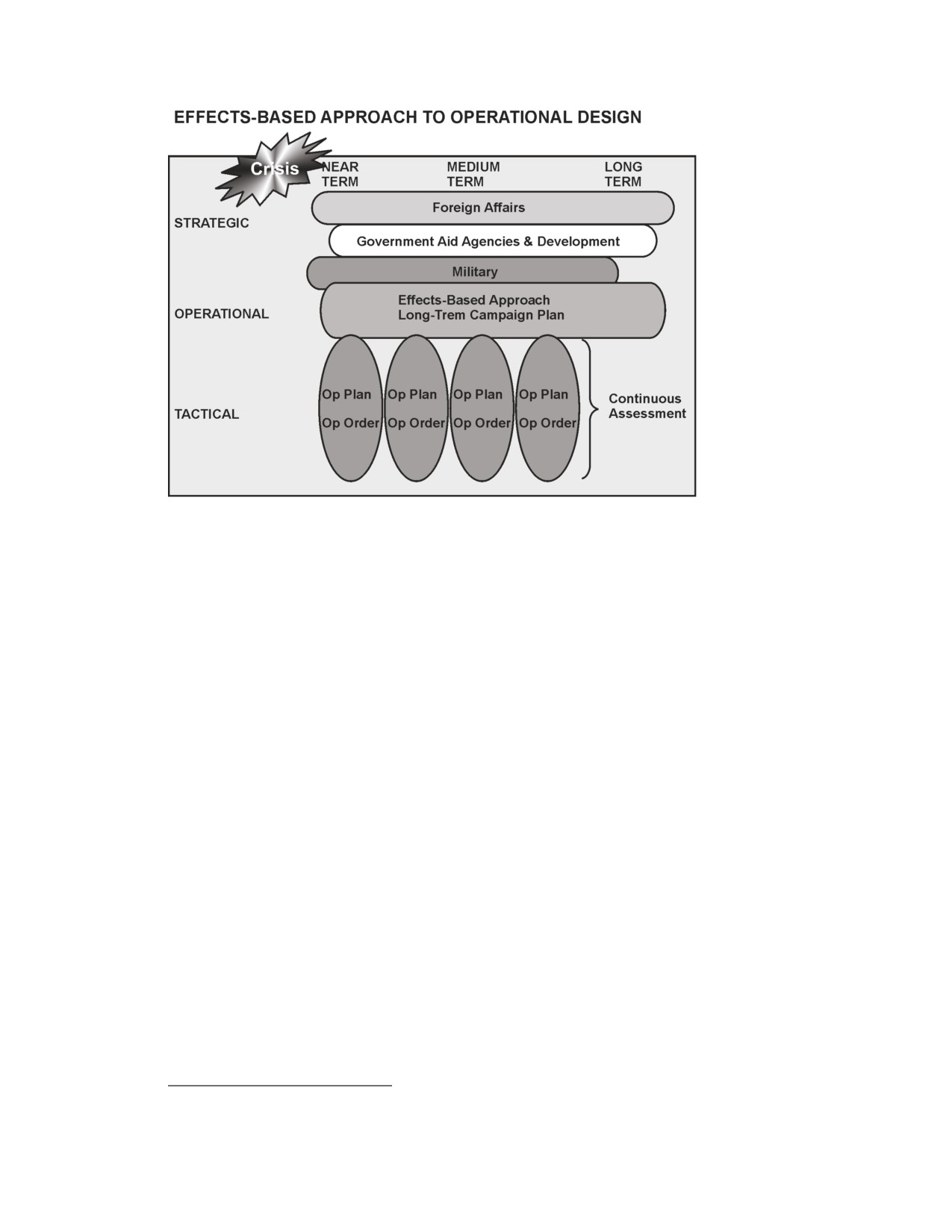
5.
The application of an effects-based approach is pervasive at all levels throughout the
planning and execution of operations, from the campaign plan downwards. While the strategic
direction gives the long-term perspective, the campaign plan will provide the medium-term
framework, focusing on an operational end state, constituent operational objectives, and the
supporting effects required to reach the operational objectives. The near to medium term
timeframe is covered through OPLANs and OPORDs that issue the activities that create the
desired effects. Assessment of the situation, the environment and the progress of the campaign
are continuous and inform subsequent iterations of the OPLAN. Each successive OPLAN
adjusts operations to reflect the progress made during the campaign. This is illustrated in
Figure 6-5.
137 It is important to recognize that the commander may not complete the mission or complete his
assigned tasks in the time that his unit or formation is deployed to a campaign. The operation plan that
the commander must develop to accomplish or further the accomplishment of his assigned mission
objectives does not replace the campaign plan, but is an adjunct to it, tailored specifically for the
commander’s assigned area and situation.
6-22
B-GL-300-001/FP-001
The Conduct of Land Operations
Figure 6-5: Campaign Plan Implemented Through Operation Plans and Orders
6.
An effects-based approach to campaigns and operations does not significantly alter the
process of operational design and planning, but it provides a better focus and a measurable
progress. An effects-based approach provides just enough structure and process to the
commander’s intuitive operational design and planning to ensure that tangible products are
produced, end states and objectives are considered before activities, and the eventual activities
link directly to desired objectives and end states.
7.
Terminology for campaign design will remain extant, but the application of it, on both the
physical and psychological planes, will have to be conceptually expanded. The steps involved
in an effects-based approach are the same as those in operational design and the OPP;
however, the scope of these planning processes will need to broadened to fully encompass all
the disparate, yet interconnected systems and players pertinent to the situation. In other words,
the planning will focus on enduring outcomes and operational objectives over the long term and
concerning all aspects of a society, vice short-term activities focused on an adversary’s military
capability.
619. EFFECTS-BASED APPROACH CONSTRUCT FOR CAMPAIGN PLANNING
1.
An effects-based approach will be used in the development of the campaign plan. The
effects-based approach is a planning philosophy combined with specific processes that enable,
firstly, the integration and effectiveness of the military contribution within a comprehensive
approach with other elements of power, and secondly, the realization of operational
objectives.138 In simple terms, it ensures that the military activities are integrated with those of
other agencies, and secondly, it ensures that military activities are directly linked to operational
objectives. That is, the results or effects of the activities directly contribute to operational
objectives.
138 Army Terminology Panel approved definition May 2007.
B-GL-300-001/FP-001
6-23
Land Operations
2.
An effects-based campaign plan follows a series of steps. However, the process is
flexible and allows for the exercise of intuition throughout. The steps produce a coherent, mid to
long-term outline, which guides the development of the OPLANs and OPORDs that put the
campaign plan into action.
620. STEP 1—ANALYSIS OF THE SITUATION
1.
Apart from studying the obvious problem at hand that has led to military deployment and
intervention, all elements of society must be examined to ascertain the role they play in the
situation and crisis, and in the achievement of a successful campaign outcome. The analysis
should view these elements from the environment’s cultural and historical perspective. The
following aspects of an environment should be examined in as much detail as possible from a
historical or background perspective, and in terms of the current situation:
a.
administration and governance;
b.
politics and diplomacy to include official power structures;
c.
economy, wealth distribution and commerce;
d.
humanitarian and health issues;
e.
social structures to include traditional tribal or informal power structures and
criminal elements;
f.
ethnicity and religion;
g.
information, including media control and pervasiveness of access; and
h.
military capability, including both conventional and irregular forces.
2.
The result of this step should provide the commander and his staff with an appreciation
of the human environment that has led to the current situation, and the root causes in the
society that have led to it or aggravated it. It should also indicate the various power structures
and leaders that exist within the society, including any potential moral CoGs. This will form the
broad knowledge base that will inform the remainder of the operational and tactical planning
processes.
621. STEP 2—IDENTIFICATION AND ANALYSIS OF THE PROBLEM OR CRISIS
1.
The second step is broken down into two parallel processes. The commander will
conduct a mission analysis to ascertain the mission and operational end state. Meanwhile, the
staff will review the various factors within the environment, and current situation in particular,
building from Step 1. The two processes are then brought together and further analyzed. This
will allow the commander to identify and select the major building blocks of the campaign plan
and issue initial campaign guidance. The steps:
6-24
B-GL-300-001/FP-001
The Conduct of Land Operations
a.
Step 2(a)—Mission Analysis:139
(1)
The mission analysis in terms of campaign planning must have a specific
focus on the desired operational end state. This will be a constituent of
the strategic end state. At this level, the questions and considerations in
mission analysis are somewhat broader:
(a)
Superior commander’s intent with respect to outcomes and end
state.
(b)
The outcomes that the campaign plan and the campaigning force
are to achieve (specific and implied) that will realize the superior
commander’s intent.
(c)
The freedoms, capabilities and authority to realize the specified
and implied outcomes. This will lead the commander to examine
the role of other agencies and the elements of power that may be
needed to ensure successful outcomes in certain areas or
systems in the environment.
(d)
Continuous monitoring of any environmental or situational
changes that may affect the overall intent or the plan.
(2)
This step allows the commander to begin framing initial campaign
guidance, a provisional operational end state, and some of the
operational objectives. It will also being to develop the commander’s
planning guidance, commander’s critical information requests (CCIRs),
requests for information (RFIs), constraints, clarifications and questions.
b.
Step 2(b)—Evaluation of the Factors:
(1)
The staff will conduct an evaluation of the factors, specifically those that
have led to the current situation and those that will play a role in its
resolution. This step should also seek to examine the situation in its
fullest sense, including but not limited to terrain, infrastructure,
meteorology and oceanography, and also population distribution,
economic and agricultural factors, religious and ethnic distribution, and
centres of cultural importance. Economic and logistical factors must also
be thoroughly comprehended, together with the factors most amenable to
change.
(2)
It includes a detailed study of own, opposing, aligned and neutral
elements that influence the conduct of operations and the final outcome.
This understanding can be developed through an analysis of the critical
capabilities, requirements and vulnerabilities of the various systems, in
order to better understand how to influence and change understanding
and will, or how to affect capability.
139 For a detailed discussion of the conduct of mission analysis, see B-GL-300-003/FP-000 Command in
Land Operations.
B-GL-300-001/FP-001
6-25
Land Operations
(3)
The aim here is to understand the physical and psychological
characteristics of all the actors, systems and attitudes within the
environment. The staff should back-brief their findings but should
distinguish between the factors that will have an enduring influence
through the campaign, and thus become a focus of the campaign plan,
and those that have immediate or near-term importance and therefore will
be addressed in the OPLAN and OPORD.
c.
Step 2(c)—Commander’s Analysis and Planning Guidance:
(1)
The commander and senior staff conduct analysis of the factors to
discern the major building blocks of the campaign plan.
(2)
They will select and analyze the CoG(s) that dominate the situation,
along with their critical requirements and vulnerabilities. Furthermore,
they will confirm the desired operational end state, and most importantly,
what is required to realize it. This must include consideration of the
various elements in the environment that hold influence over the CoG(s).
(3)
Based upon the key CoG(s) the commander and staff will determine the
operational objectives needed to achieve the end state. Analysis will
occur throughout in order to confirm the validity of the decisions.
Deductions from pervious analyses should be viewed in light of the
selected CoG(s) in order to confirm their validity and importance. This
may also lead to an adjustment of the CoG or selected operational
objectives.
(4)
The selected operational objectives should be viewed as the major
building blocks of the campaign. Once selected, they should be viewed
to confirm that they are coherent, focused on the operational end state,
focus on or address the identified CoG(s), and address all the issues
identified in the earlier analysis.
(5)
The commander will issue campaign guidance to his staff. The
requirement to incorporate other elements of power and agencies, if not
already begun, must be identified and articulated at this point. This
should include a unifying theme in his commander’s intent.
622.
STEP 3—FRAMING THE CAMPAIGN PLAN AND THE INITIAL OPERATION PLAN
1.
The analysis and outputs to this point will allow the commander and staff to develop the
campaign plan itself. This will lead to the development of the initial OPLAN that will implement
the campaign plan in the short to near-term:
a.
Step 3(a)—Developing the Campaign Plan:
(1)
The operational end state and building blocks—operational objectives—
are used to develop the campaign plan itself. Decisive points or
6-26
B-GL-300-001/FP-001
The Conduct of Land Operations
supporting effects,140 which build to each operational objective, are
identified in the process.
(2)
Operational objectives may be grouped thematically into lines of
operation, which would help with the visualization of the campaign, as
they illustrate the direction and progressive movement towards the
operational end state.
(3)
The lines of operation will indicate where the military has primacy and
where it supports other instruments of power. Note that all lines of
operation—regardless of the primary agency involved—move towards the
operational end state.
(4)
Once the framework has been established, the commander and staff
analyze the operational objectives to determine the supporting effects
required at each operational objective.
(5)
The measures of effectiveness (MOE) associated with each supporting
effect should be identified and recorded.
(6)
Careful judgement will be needed regarding the number of supporting
effects selected so that subordinate units and staff do not become
overwhelmed in trying to assume the required activities beyond their
capabilities.
(7)
Lines of operation in many campaigns in a complex operating
environment will incorporate a large array of objectives, effects and
activities. Together, the lines of operation will span diverse, but
interrelated aspects such as security, governance and development.
Some will be prosecuted by a single element of power while others, such
as governance, will be shared by several agencies, none of which may be
military.
(8)
A campaign directive should be issued at this point. Figures 6-6, 6-7 and
6-8 illustrate the thematic lines of operation that may exist for a campaign
plan, along with the supporting effects/decisive points illustrated
graphically and in a tabular format.
140 Decisive conditions may be viewed and termed as supporting effects. They will be the results of
activities that build to realize operational objectives.
B-GL-300-001/FP-001
6-27
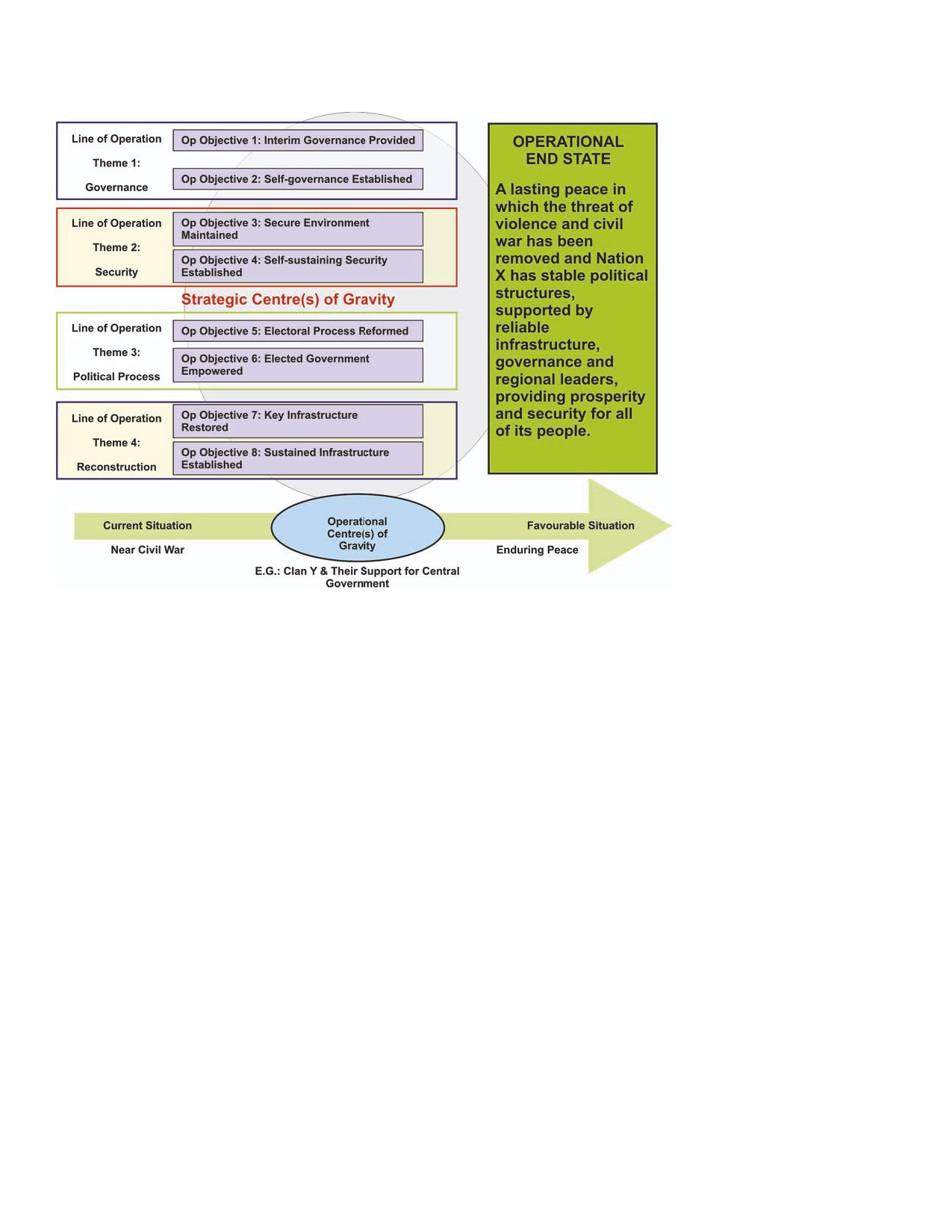
Land Operations
Figure 6-6: A Campaign Plan with Four Lines of Operation
6-28
B-GL-300-001/FP-001
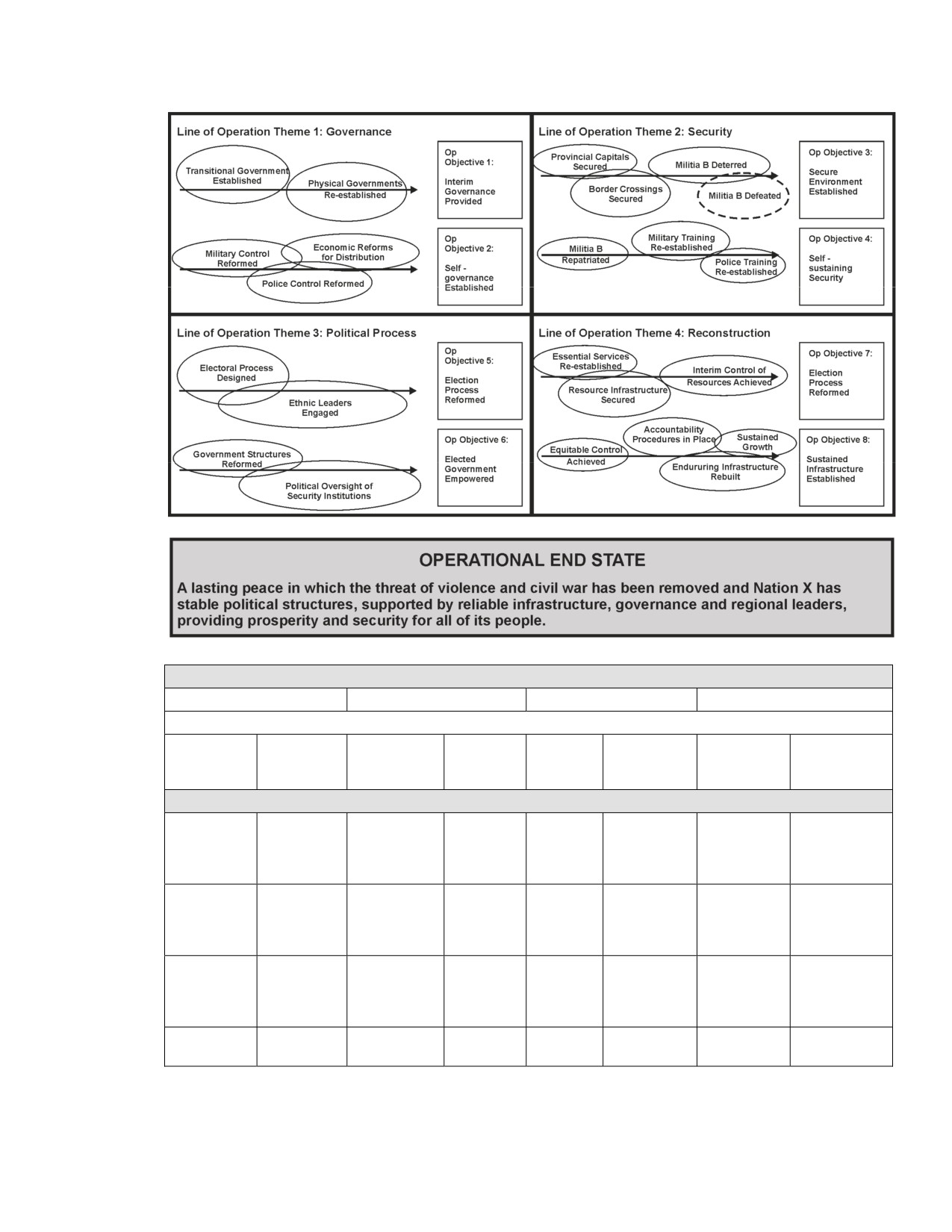
The Conduct of Land Operations
Figure 6-7: Lines of Operation with Supporting Effects Plotted
THEMATIC LINES OF OPERATION
Governance
Security
Political Process
Reconstruction
Operational Objectives
Interim
Self-
Secure
Self-
Electoral
Elected
Key
Sustained
Governance
governance
Environment
sustaining
Process
Government
Restoration
Infrastructure
Provided
Established
Maintained
Security
Reformed
Empowered
Established
DECISIVE POINTS/SUPPORTING EFFECTS
Transitional
Military
Provincial
Militia B
Electoral
Government
Essential
Equitable
government
control
capitals
repatriated
process
structures
services re-
control
is established
reformed
secured
designed
reformed
established in
achieved
all areas
Provincial
Police control
Border
Military
Ethnic
Political
Resource
Accountability
governments
reformed
crossings
training re-
leaders
oversight of
infrastructure
procedures in
re-
secured
established
engaged
security
secured
place
established
institutions
Economic
Militia B
Police
Interim
Enduring
reforms for
deterred
training re-
control of
infrastructure
distribution
established
resources
rebuilt
achieved
Militia B
Sustained
defeated
growth
Figure 6-8: Supporting Effects for Operational Objectives and Thematic Lines of Operations
B-GL-300-001/FP-001
6-29
Land Operations
(9)
There is no standard format for a campaign plan. The campaign plan
should be concise. It should describe (to subordinates and superiors
alike) the following:
(a)
The intent of the campaign.
(b)
The operational end state.
(c)
Operational objectives.
(d)
The overall concept and intent of the campaign.
(e)
The strategic and operational centre(s) of gravity.
(f)
Supporting effects (decisive points) needed to be created for each
operational objective.
(g)
Lines of operation that have thematically grouped the operational
objectives and their supporting effects.
(h)
Concept for the prosecution of the campaign including its initiation
and its development through successive OPLANs.
b.
Step 3(b)—Framing of the Initial Operation Plan:
(1)
While the campaign plan lays out the long-term plan, the initial OPLAN
and OPORD will address the short to medium term and will initiate the
campaign itself.
(2)
The staff will select the supporting effects most relevant to the immediate
situation that should be created first and are most likely achievable. This
will be based upon the analysis of the factors that occurred earlier.
(3)
Selection and prioritization of supporting effects will develop a number of
options for the design of the initial OPLAN. These will be presented to
the commander for a decision based upon his intuition and analysis.
(4)
The commander will select what he assesses is the best option in terms
of design of the initial OPLAN, specifically the supporting effects that are
to be developed first. He issues initial planning guidance including a
general scheme of manoeuvre. The manner in which the supporting
effects are to be created in terms of time and space may be represented
schematically in a number of ways.
2.
At the conclusion of this step, the commander and staff will have developed a campaign
plan and the means by which it will be initially implemented, that is, an OPLAN.
623. STEP 4—DEVELOPMENT OF THE OPERATION PLAN
1.
With the commander’s guidance and outline scheme of manoeuvre as to the initiation of
the campaign through the initial OPLAN and OPORD, staff may develop the OPLAN itself in
detail. The commander’s scheme of manoeuvre will have broadly described the implementation
of the campaign and initial supporting effects. It will not have described in detail how those
supporting effects will be created.
6-30
B-GL-300-001/FP-001
The Conduct of Land Operations
2.
The development of a detailed OPLAN will come to task subordinate components,
formations and units with specific missions and activities that will create or help to create the
initial supporting effects. This will follow an OPP:
a.
Step 4(a)—Development and Validation of Courses of Action:
(1)
The identification and sequencing of the activities required to create the
supporting effects will be considered along with the allocation to
formations and units of those activities. This will be developed through
detailed courses of action.
(2)
The prioritized supporting effects to be implemented through the initial
OPLAN are considered and analyzed by the staff, if possible in
conjunction with subordinate HQ or other elements of power and
agencies as applicable. This will determine what activities are needed to
create these supporting effects. They are guided by the commander’s
scheme of manoeuvre.
(3)
In accordance with the OPP, different possibilities for the implementation
of the plan will lead to the development of different possible courses of
action (COAs). A full concept of operations (CONOPS) will be developed
for each considered COA.
b.
Step 4(b)—Course of Action Evaluation:
(1)
The considered COAs are compared using a number of techniques or
options including comparison of each against the Principles of War and
through war gaming. The evaluation must assess each COA for
suitability, adequacy, feasibility, and the likelihood of creating the
supporting effects desired.
(2)
This evaluation process will provide feedback to the selection and
prioritization of supporting effects and may indicate that some supporting
effects are not feasible within the allocated resources and constraints.
They may therefore be moved to subsequent OPLANs.
c.
Step 4(c)—Commander’s Decision and Development of the Operation
Plan:
(1)
A decision brief regarding the various COAs will allow the commander to
select his preferred COA and to give direction for its refinement.
(2)
Direction is issued for further plan development and the creation of
products including the OPORD.
3.
With the campaign plan devised and the initial OPLAN and OPORD issued, the
campaign may commence. The environment and the achievement of supporting effects en
route to operational objectives are closely monitored, particularly through the application and
assessment of measures of effectiveness (MOE). As the campaign progresses, subsequent
OPLANs and OPORDs are issued and are adjusted to reflect the situation and the progress of
the campaign. This may be timed with a subsequent rotation of forces into theatre.
B-GL-300-001/FP-001
6-31
Land Operations
Commanders must realize that unless deployed indefinitely, they will not conduct the entire
campaign, but will only contribute to its incremental progress towards achieving operational
objectives and the end state. The progress that they create and the refinement of the campaign
should be briefed during the relief-in-place process.
4.
In the early stages of a campaign, the military may assume a role in each or at least
most lines of operation. As the security situation improves, the responsibilities for non-security
related lines of operation should be passed to those other agencies best suited to conduct them.
For example, initial reconstruction of infrastructure may fall to the military. However, as the
security situation improves and other governmental agencies and non-governmental
organizations (NGOs) arrive in theatre, such responsibilities should be assumed by them.
5.
Commanders may not necessarily have all the integral resources required to generate
the effects they envision. By leveraging and synchronizing the resources and capabilities
across the JIMP framework, they can produce the right combination of effects on the right lines
of operation to lead to the desired end state. This places particular emphasis on the
collaboration required at all levels with JIMP participants. Some lines of operation may be
conducted only by the military, while others will be the sole responsibility of other agencies, and
others may be shared between the military and others. In either case, a campaign seeking to
establish enduring solutions for conflicts in complex environments must accept a long-term view
and the requirement for a range of instruments of power to be employed.
We have seen that is only by a close combination of civil and military measures that
insurgency can be fought, so it is logical to expect soldiers whose business it is to know
how to fight, to know also how to use civil measures in this way. Not only should the
army officers know about the subject, they must also be prepared to pass on their
knowledge to politicians, civil servants, economists, members of the local government
and policemen where necessary.
General Sir Frank Kitson
6-32
B-GL-300-001/FP-001
The Conduct of Land Operations
THE IMPORTANCE OF COMPREHENSIVE CAMPAIGN PLANNING
“Peace enforcement (sic) is wearing everybody out…This is much harder [than combat].”
LtCol. Jeff Ingram, TF 2-70 AR
Substantial evidence exists indicating that much of the post-conventional military
operation conflict in Iraq could have been avoided if greater attention had been paid to
Phase IV (“post-hostility operations”) strategy during the campaign planning stage of
Operation Iraqi Freedom/Operation Telic in 2002. For numerous and primarily political
reasons serious attention was not given to post-combat stability operations during the
campaign plan construction prior to the invasion of Iraq despite the existence of a
voluminous US State Department study from 2002 dedicated to that very subject.
Without a serious plan to follow, US administrators made several grievous errors in the
immediate aftermath of the overthrow of Saddam Hussein’s regime. Most notably, the
political and administrative structure of the former government was dismantled and the
Iraqi army was disbanded. The latter error caused 400 000 military-age men to become
unemployed with no viable means of support for their families. With the stroke of a pen
the Coalition Provisional Authority dismantled a political-military landscape that had
existed for 30 years without providing a viable replacement. The resultant vacuum
sowed the seeds for the multi-faceted insurgency and sectarian conflict which now
afflicts Iraq. In the contemporary operating environment as much attention must be paid
to stability operations as warfighting operations. Failure to do so may induce serious
errors that produce a longer than desired campaign or outright failure.
Sources: Col. G. Fontenot, LtCol. E.J. Degen, LtCol. David Tohn, On Point: The US
Army in Operation Iraqi Freedom, Leavenworth Kansas: Combat Studies Institute Press,
2004; Maj. M.W. Shervington PARA, Small Wars and Counter-Insurgency Warfare:
Lessons From Iraq, MA Thesis, Cranfield University, UK, July 2005.
624. EMPLOYMENT OF SPECIAL FORCES
1.
Special forces are troops selected, trained, equipped and organized to conduct specific,
special operations in pursuit of strategic or other high-level operational objectives. They may
operate in support of conventional forces, or independently.
2.
The principal roles of special forces may include: special reconnaissance, including
information reporting and target acquisition; direct action, which includes direction of air, artillery
and naval gunfire, designation for precision guided munitions, and raids; work with specific
portions of indigenous populations; very important person (VIP) protection; combat search and
rescue; and, hostage rescue. Use of special forces outside of these roles is a waste of valuable
resources particularly when line units are available.
3.
Special forces extend the conflict in depth. The effects may be purely physical through
destruction, or they can achieve effects on the psychological plane by creating confusion,
uncertainty and surprise through unexpected actions and operating in threat rear areas. Their
influence will often be out of proportion to the size of forces involved. The mere existence of a
special forces threat can have a significant adverse impact on the threat’s morale and cause an
increase in the level of threat forces dedicated to rear area protection. Similarly, special force
support can significantly bolster moral and the physical efforts of friendly indigenous factions.
B-GL-300-001/FP-001
6-33
Land Operations
4.
Special forces should be employed on high value tasks, exploiting their potential while
limiting their vulnerability. They should be commanded at the highest appropriate level, and be
tasked using operational directives that allow maximum freedom of action for the conduct of
operations. Special forces operations, however, must be coordinated with tactical conventional
operations. They rely heavily upon surprise and must also have access to the highest level of
intelligence to conduct operations and facilitate precision targeting. Consequently, their
operations require tight security measures, as compromise may come with serious penalties.
Public information plans should normally neither confirm nor deny special force activity.
5.
Special forces must be employed in line with the campaign plan and in direct support of
the operational objectives and supporting effects. As with the application of any other capability,
their employment must be done in manner that seeks to avoid undesirable effects. For
example, there is likely little net value in special forces seizing a key adversary leader (who will
likely be quickly replaced) if the operation creates collateral damage and casualties that lead to
the alienation of campaign supporters or neutral parties.
625. PLANNING HORIZONS
1.
Formation commanders are faced with the decision of how far ahead to plan without
planning becoming irrelevant to preparation and execution. Planning too far into the future may
overwhelm staff capabilities, especially those of lower-echelon staffs. However, not planning far
enough ahead may result in losing the initiative and being unprepared.
2.
A planning horizon is a point in time that commanders use to focus the organization’s
planning efforts to shape future events. Planning horizons will be relative to the level of
command.
3.
The concept of time horizons can help commanders organize and resource their
planning efforts. Time horizons depend upon the type of operation being conducted; they can
range from hours to months. As a rule, the higher the echelon, the farther out the time horizon.
4.
A useful way to use time horizons is to associate general time periods (based upon the
situation) with the planning effort’s purpose. The planning efforts are long-range, mid-range,
and short-range. Refer to Figure 6-9.
6-34
B-GL-300-001/FP-001
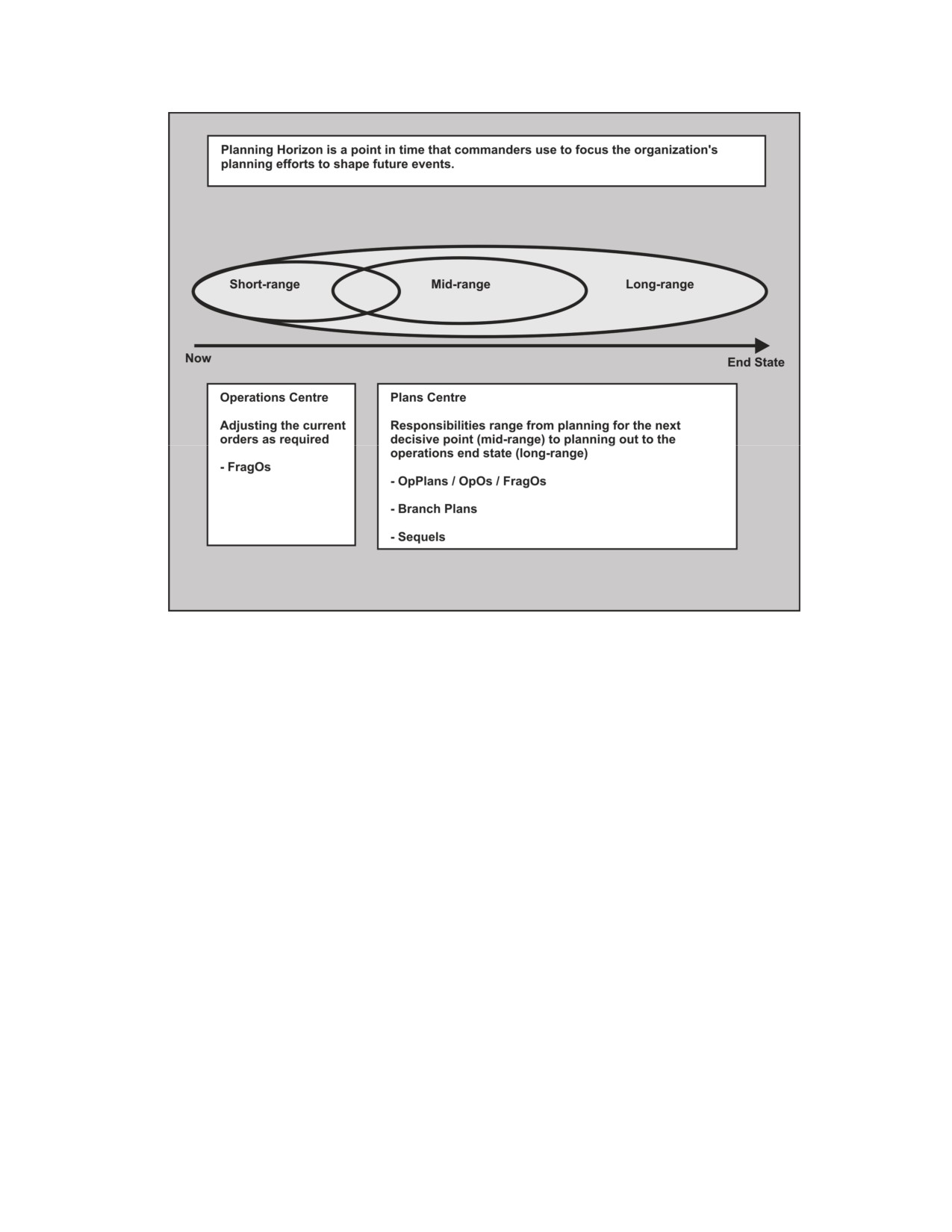
The Conduct of Land Operations
Figure 6-9: Planning Time Horizons
626. LONG-RANGE PLANNING HORIZON
1.
Long-range planning is the initial purview of the campaign plan for it looks out to the
operational end state. Short to medium-term plans are reflected in sequential OPLANs and
OPORDs.
2.
Formations and units will have relatively shorter planning horizons, particularly if they are
not deploying for the entire duration of the campaign. In such cases, the long-range planning at
these lower levels may consist of planning for an end state at the end of tour that represents
progress towards the operational objectives.
3.
These time horizons are common in limited intervention operations.
4.
Long-range planning occurs in the plans centre using the OPP, and at the higher levels,
operational design. The plans centre develops solutions to problems and passes them to the
operations centre if a fragmentary order (FRAGO) is needed. If a full OPORD is required, the
plans centre performs the OPP as time allows and issues the OPORD. Responsibility for
integrating the OPORD is transferred to current operations during preparation.
B-GL-300-001/FP-001
6-35
Land Operations
627. MID-RANGE PLANNING HORIZON
1.
Mid-range planning is focused at the next decisive point and may range from hours to
days and weeks. Mid-range planning includes branch planning and the refinement of products
from long-range planning, such as branches in concept form and OPLANs.
2.
The mid-range time horizon addresses planning for short-range operations not
anticipated in the long-range plan. These operations may last weeks or a few months. This
horizon includes major branches of ongoing operations. They are frequently separate, clearly
identifiable missions with a distinct mission statement, starting time and end state. They require
OPP to develop COAs and control mechanisms for the operation. Mid-range planning remains
the responsibility of the plans centre.
628. SHORT-RANGE PLANNING HORIZON
1.
Based upon changes to the situation and an assessment of the operation’s progress,
commanders perform short-range planning to modify the current OPORD. The focus of short-
range planning is on the immediate future. It may be represented in hours and days. The
resulting product of short-range planning is a FRAGO. Depending upon the complexity of the
problem and the time available to plan, short-range planning may involve representatives from
all operational functions, or include only selected staff members and the commander. It is
normally performed in the operations centre. Situations may dictate that it be performed in the
plans centre.
2.
Regardless of the problem being addressed in short-range planning, all plans and
activities must continue to support the operational objectives and their supporting effects.
3.
A common characteristic of short-range planning is that it is done rapidly in a time-
constrained environment. The staff may use the OPP modified for time-constrained conditions.
These include situations arising outside the normal decision or assessment cycles that demand
immediate action, such as opportunities and threats that commanders must exploit or counter.
Failure to recognize such situations and act without delay may result in lost opportunities or the
destruction of the force.
4.
Situations of this type constitute a particular challenge to commanders. They must
recognize that situations outside the normal decision or assessment cycle exist. Situational
awareness and forecasting in the staff estimates aid such recognition. Then, they must swiftly
organize resources within the HQ to address the problem and perform planning to implement
the decision for resolving it. The operations centre leads the short-range planning process,
although it may receive support from the plans centre.
629. CONTINGENCY PLANNING
1.
Options must be built into a campaign plan to anticipate opportunities (or reverses) and
preserve the commander’s freedom of action. Required changes can usually be reflected in
subsequent OPLANs and OPORDs.
2.
Despite the issue of OPORDs, contingency planning gives the lower level commanders
the flexibility to retain the initiative and to meet unexpected challenges or exploit opportunities.
The planned sequence of events to the desired end state is not immutable. Therefore, a
commander must be prepared to adjust the sequence, quicken or reduce the tempo, or develop
new options to seize unforeseen opportunities that unfold themselves.
6-36
B-GL-300-001/FP-001
The Conduct of Land Operations
3.
Contingency plans will most likely be applicable at the formation level and below. They
will be issued in the form of OPORDs, or possibly as FRAGOs if time is short and the need
immediate.
4.
Continuous contingency planning will keep a range of options available for commanders
to maintain agility and tempo. These options may be incorporated into the initial plan, enabling
a commander to adjust his lines of operation and vary his plans to offer or decline battle on his
own terms. Contingency planning should give the commander the freedom of action to maintain
the initiative, or to regain the initiative if a developing situation results in its loss. This can be
accomplished by developing branches and sequels.
5.
Branches are contingency options built into the basic plan for changing the disposition,
orientation, or direction of movement, and for accepting or declining battle. Sequels are
subsequent operations based upon the possible outcomes of the current operation. Sequels
should reflect the current situation and the progress to date in the campaign.
6.
Branch plans and sequels will support each line of operation within the overall campaign
plan. Sequels will have to reflect anticipated and actual transitions in campaign themes, with
the shifting balance between offensive, defensive and stability operations.
7.
As campaigns develop, their predominant themes will shift and ideally improve in terms
of the levels of violence and their relative place on the spectrum of conflict. The continuous
assessment should identify such shifts. The continual planning element of battle procedure,
supported by the assessment and direction of the commander, will allow the lines of operation
within the campaign to be adjusted to meet the shifting campaign theme and continue to meet
the desired objectives. This will cause a shift in the balance between the tactical activities of
offensive, defensive and stability operations.
SECTION 5
BATTLE PROCEDURE 141
630. GENERAL
1.
Battle procedure is defined as: “the entire military process by which a commander
receives his orders, makes his reconnaissance and plan, issues his orders, prepares and
deploys his troops and executes his mission.” 142
2.
Battle procedure has become entrenched in the lexicon and in the training and
operational activities of the Land Force. It is the procedure of decision-making that transcends
the levels of command, from the lower tactical levels that are characterized by commanders
who do not possess staff in support, to levels of command that employ staff to provide focus in
multi-dimensional planning for the commander in relation to the complexities of the operating
environment.
141 For complete details regarding the operations process, battle procedure and their constituent
elements, see the following publications: B-GL-300-003/FP-000 Command in Land Operations; B-GL-
331-001/FP-000 Command Support in Land Operations; and, B-GL-331-002/FP-000 Staff Duties for Land
Operations.
142 B-GL-300-003/FP-000 Command in Land Operations.
B-GL-300-001/FP-001
6-37
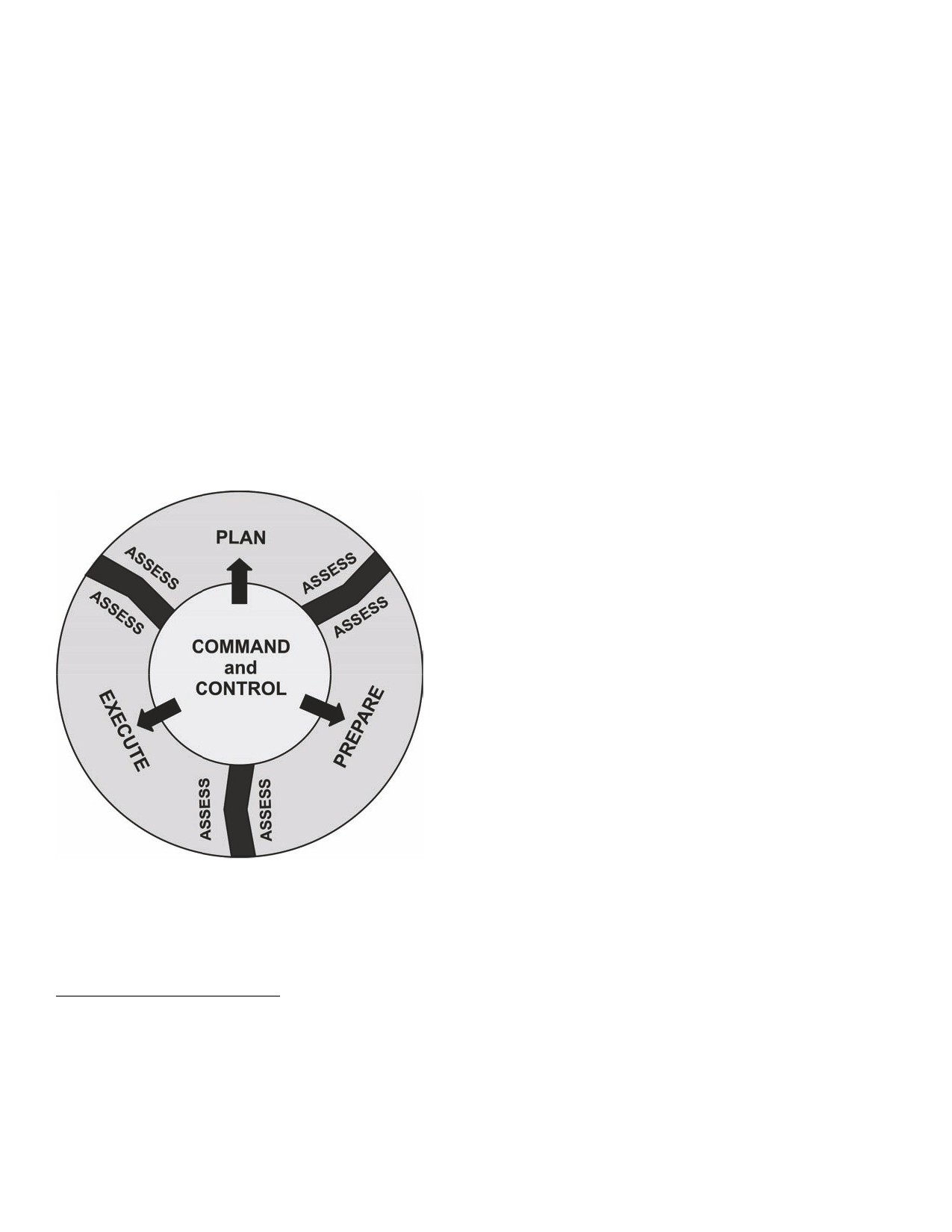
Land Operations
3.
At subunit level, battle procedure is usually a set drill. It ensures tactical commanders
consider and address all the pertinent issues required for the effective planning and conduct of
tactical activities.
4.
Higher echelons of command require the integration and synchronization of varied tools
and processes (e.g., planning and targeting) that, as greater emphasis is placed upon these
functions in the contemporary operating environment, need a battle procedure that provides a
clear model for understanding and incorporating them along with other command and HQ’s
responsibilities.
631. THE BATTLE PROCEDURE MODEL AND THE CONSTITUENT PARTS
1.
The overarching battle procedure model is a simple three-step process: plan; prepare;
and, execute. Throughout battle procedure, continuous assessment is conducted of the
situation and the interrelated influences of all the elements existing within the environment (i.e.,
PMESII). At the centre of the process is the commander, whose lucid direction guides every
element. Battle procedure is applied to the overall campaign or operation, and to each line of
operation therein.
Figure 6-10: Battle Procedure Model
2.
As depicted in Figure 6-10, battle procedure is a process of planning, preparing and
executing, with assessments conducted throughout. It is a command-centric143 procedure such
that it places the commander at the centre as the executive authority responsible for C2. The
143 Chief of Defence Staff, Concept of Operations: CF Strategic Command (NDHQ, 14 Nov 05) 2-3. The
CF command structure, shall “be command-centric with a clear and unambiguous chain of command
from the strategic to tactical level (sic), with commanders at all levels clearly understanding their assigned
authorities, responsibilities and accountabilities.” It “will be shaped by the doctrine of mission command
with commanders at every level possessing a comprehensive understanding of their commander’s explicit
and implicit intent and an overriding operational focus dedicated to the realization of this intent.”
6-38
B-GL-300-001/FP-001
The Conduct of Land Operations
commander is the focus of all command support activities. The commander directs and
influences each of the aspects of battle procedure. At the lower tactical levels, C2 resides
solely with the commander. At the higher echelons of command, the staff provides the
commander with the means to exercise control.
3.
Planning, preparing, and executing do not necessarily have distinct start and end points.
Planning is continuous. While preparing for or executing one mission, the unit/formation is
planning (at least refining) the branches and sequels to the current mission, or for the next
operation or mission. Preparation, by virtue of training and structuring, is also continuous
anytime a unit is not executing an operation.
4.
Within each of the constituent parts of battle procedure, there will be a number of
activities and subordinate processes that either enable decision-making (i.e., command support
activities) or result from it. See Figures 6-11, 6-12 and 6-13.
ASSESS
PLAN
PREPARE
EXECUTE
Estimate (for Commanders
Rehearsals
Assessing the current state
without Staff)
and forecasting progress of
Inspections
the operation
Operational Planning
Preliminary Movement
Process (for Commanders
Making execution and
Subordinate Planning and
with Staff)
adjustment decisions to
Preparation
account for unforeseen
ISTAR144 Activities
threat actions and to exploit
opportunities
Security
Directing actions to apply
Force Protection
combat power to accomplish
Revisions and Refinements to
the mission
the Plan
Training
Coordination, Liaison and Re-
grouping
Command and Information
Systems Preparation
ONGOING C2 ACTIVITIES
Battlespace Management
Information Operations Coordination
Fire Support Coordination
Force Protection Coordination
Combat Service Support Coordination
Information Management
Systems Management
Figure 6-11: Battle Procedure and its Constituent Activities
144 Intelligence, surveillance, target acquisition and reconnaissance.
B-GL-300-001/FP-001
6-39
Land Operations
ASSESS
PLAN
PREPARE
EXECUTE
Receive Warning
Coordinate Activities
Execute the
Order
and Requirements of
Mission
Subordinates
Conduct Quick Map
Study and Time
Supervise
Estimate
Deployment
Receipt of Orders
Conduct Mission
Analysis
Issue Initial Warning
Battle
Order
Procedure
Conduct
Drill
Make a Detailed Time
After
Estimate
Action
Review
Conduct Detailed Map
Study and Prepare an
Outline Plan
Prepare a Recce Plan
Conduct Recce
Complete the Estimate
Issue Supplementary
Warning Order
Prepare and Issue
Orders
Figure 6-12: Battle Procedure for Commanders Without Staff
6-40
B-GL-300-001/FP-001
The Conduct of Land Operations
ASSESS
PLAN
PREPARE
EXECUTE
Initiation
Plan Review
Operations Planning
Process
Orientation
Ref: B-GJ-005-500/FP-
Course of Action
000 CF Operational
Development
Planning Process
Plan Development
Decide
Detect
Deliver
Land Force Targeting
Track
Assess
Intelligence Cycle
Direction
Collection
Ref: B-GL-357-001/FP-
Processing
001 Intelligence Field
Dissemination
Manual
Draft Named Areas of
Information
Battle Damage
Interest (NAIs) / Target
Collection by
Assessment
ISTAR Process
Areas of Interest (TAIs)
Sensors
(as required)
Draft High Value Targets
Assessment of
Ref: B-GL-352-001/FP-
(HVTs) / High Payoff
Information
001 Intelligence,
Targets (HPTs)
Information
Surveillance, Target
Draft ISTAR Overlay
Disseminated
Acquisition and
Reconnaissance
Finalize ISTAR Overlay,
(ISTAR)
HVTs, HPTs
Complete ISTAR Matrix
Identify Threats
Supervise and
Risk Management
Review
Process
Assess Threats
Ref: B-GJ-005-502/FP-
Develop Controls and
000 Risk Management
Make Risk Decisions
for CF Operations
Implement Controls
Figure 6-13: Battle Procedure for Commanders With Staff
632. COMMAND AND CONTROL
1.
Fundamentally, a commander exercises C2 by planning for a mission or operation,
enabling preparation activities, and directing the execution of the mission or operation.
Throughout, the commander continually assesses activities against the ever-changing operating
environment in order to make the best decisions possible.
B-GL-300-001/FP-001
6-41
Land Operations
2.
Commanders exercise control over the force to achieve unity of effort using control
measures to synchronize activities. The following control measures are applied during battle
procedure:
a.
commander’s intent;
b.
commander’s planning guidance;
c.
commander’s critical information requests (CCIRs);
d.
allocation of main effort;
e.
delegation of authority;
f.
plans and orders, to include the assignment of missions and tasks, target lists
and supporting plans;
g.
graphic control measures;
h.
force and unit standing operating procedures (SOP);
i.
applicable laws and regulations.
633. ECHELONING AND SYNCHRONIZATION OF BATTLE PROCEDURE
1.
The elements and activities of battle procedure are closely synchronized and echeloned
with one another across different levels of formations and units. Agility and the initiative in
operations are achieved through the synchronization of activities. Concurrent activity between
and within echelons of command is imperative. Battle procedure facilitates this concurrent
activity through ongoing and concurrent activities conducted throughout the staff and the
subordinate echelons of command.
2.
Planning will include the issue of orders to subordinate formations and units, which is the
executive authority to begin planning and preparation. Warning orders will be issued before the
planning stage is completed, and hence subordinate elements will begin their own planning, and
even preparation stages, before those of their superior are completed.
3.
Likewise, the execution of some supporting plans, such as ISTAR activities, will
commence while planning and preparation for the decisive operations continues. Thus, those
units assigned such activities will be in the execution stage of battle procedure while their
superior echelons continue within planning and preparation stages. Those subordinate units
executing their respective operations must be allocated time and resources to permit their own
planning and preparation. The early execution of ISTAR activities will support the continuous
assessment function.
4.
A range of activities relating to battle procedure—plan, prepare and execute—occur
concurrently with the activities of higher and lower echelons of command and within their own
echelon of command. The tools that higher echelons of command use to direct and guide
concurrent activity are warning orders, orders and fragmentary orders, along with other control
measures.
6-42
B-GL-300-001/FP-001
Land Operations
CHAPTER 7
THE CONDUCT OF LAND OPERATIONS
Many years ago, as a cadet hoping some day to be an
officer, I was poring over the 'Principles of War,' listed in the
old Field Service Regulations, when the Sergeant-Major came
up to me. He surveyed me with kindly amusement. “Don't
bother your head about all them things, me lad,” he said.
“There's only one principle of war and that's this.
Hit the other fellow, as quick as you can, and as hard as
you can, where it hurts him most, when he ain't lookin'!”
Field Marshall Sir William Slim
SECTION 1
INTRODUCTION
701. GENERAL
1.
The implementation of the campaign plan will guide the conduct of the campaign
towards achievement of the desired objectives and end state. The overriding consideration in
conducting the campaign is an unwavering focus on the requirements of the strategic objectives
and end state. This is done by establishing operational objectives needed to accomplish the
strategic objectives, sequencing effects to achieve the operational objectives, and initiating
activities and applying resources to create and sustain those effects.
2.
Command at the operational level involves deciding when, where, for what purpose, and
under what conditions operations against the adversary are to be conducted. This includes
deciding when to give battle, when to decline engagement, when to engage with intellectual
activities, and when to use lethal or non-lethal force. The operational level governs the
deployment of forces, their commitment to or withdrawal from combat, and the sequencing of
successive tactical actions to achieve strategic objectives.
3.
This chapter contains a wide array of material that links the operational and tactical
levels of campaign implementation and execution. It discusses:
a.
the preparation, deployment, command and conduct of a campaign;
b.
the targeting process;
c.
offensive operations;
d.
defensive operations;
e.
stability operations;
f.
enabling operations; and
g.
concluding a campaign.
B-GL-300-001/FP-001
7-1
Land Operations
702. PREPARATION AND DEPLOYMENT
1.
The first stage of conducting the campaign, whether it is for domestic or overseas
operations, includes the preparation and deployment of the force. This entails establishing a
point of entry, securing a base of operations, building-up the force, and preparing to execute the
campaign.
2.
Coordination of movement and logistics support during deployment is essential.
Deployment is primarily a strategic responsibility. However, the flow into the theatre should be
monitored, and where facilities (e.g., airfields or ports) are limited, it should be coordinated by
the operational commander. All deployment planning should be based upon the commander's
intent so that the right equipment and personnel arrive at the proper time. The commander
must insist on the correct phasing and balance of the combat functions to develop operations in
line with the campaign plan. The force may be vulnerable in the early stages of a conflict, and
therefore, it must have satisfactory combat power, robust command and control, and
infrastructure elements to adapt to changes in the situation.
3.
Early in the campaign, and prior to deployment, the knowledge base of the operational
environment must be assessed and developed to the greatest extent using all available
resources. This knowledge base must extend well beyond an assessment of military
adversaries, and consider all the aspects of the operational environment that will influence
operations, affect stability of the area, and that will be affected by operations. Apart from real or
potential adversaries, the elements to be assessed include political aspects and power
structures, social and cultural structures, economic influences and practices, informational and
media systems, and the status of local infrastructure. These must be assessed not only in
terms of how they will affect the campaign, but also in terms of how they relate to one another
and how they will be affected by the campaign’s activities. This activity must continue
throughout the campaign.
4.
Information operations (info ops) may be started prior to arrival of campaign forces in the
theatre. They should seek to influence the local populace and potential adversaries regarding
the arrival of campaign forces and the aims of the campaign. Activities, such as the extension
of information networks, deception, electronic warfare (EW), operations security (OPSEC),
psychological operations (PSYOPS), and public affairs (PA) often take time to produce results.
They can be conducted with resources split, where the majority of resources are located in
Canada or another forward location and the remainder deployed to theatre only when required.
Info ops also give the commander flexibility to begin the conduct of operations without
committing irretrievably to a particular course of action.
5.
The conduct for the deployment of the force will differ, depending upon whether or not
the entry is opposed. If it is, then movement will be tactical with formed combat units leading. If
unopposed, movement may be administrative with units subdivided to make the most efficient
use of the available transport.
6.
Preparations for the campaign will also include preparing personnel for the mission
through realistic pre-deployment and in-theatre training. The operational commander must
provide direction to his subordinates to facilitate focused training in line with the commander's
intent. He must also train the senior commanders and staff, and get to know them personally.
This fosters trust and mutual understanding, and can rectify weaknesses and
misunderstandings.
7-2
B-GL-300-001/FP-001
The Conduct of Land Operations
7.
It is likely that the deployment will be part of a coalition operation. In such cases, pre-
deployment preparations should include early liaison with those other forces, particularly those
that will exercise operational control (OPCON) over our forces and those that will be under our
command and control. Operational objectives, standing operating procedures (SOP), area of
operations (AO) assignment, delegation of responsibilities, coordination of functions, and
communication infrastructure will all have to discussed and planned in the earliest stages.
Standing coalition agreements and procedures, such as NATO standardization agreements
(STANAGs) and the ABCA145 Coalition Operations Handbook should be used to assist in
planning and coordination.
SECTION 2
COMMAND OF LAND OPERATIONS
703. ESTABLISHING POSITIVE CONDITIONS
1.
The operational commander focuses his efforts on establishing positive conditions for
the achievement of the operational and strategic objectives and end states in accordance with
his campaign design. He does this by employing a number of tools to shape the battlefield and
will often allocate them to the tactical level commanders. These include, but are not limited to:
a.
the use of tactical and operational reserves;
b.
air interdiction;
c.
special forces;
d.
major airborne, airmobile and amphibious forces;
e.
theatre level intelligence assets, such as counter-intelligence (ci) detachments
and human intelligence (humint) teams;
f.
operational level info ops; and
g.
control over the allocation of theatre level logistics stocks.
2.
The operational commander must look beyond the immediate battlefield in both time and
space to make the best use of resources.
3.
The commander must plan and prepare for the reception and introduction of other
elements from the joint, interagency, multinational and public (JIMP) framework into the
campaign. This will apply to a wide range of elements, but his initial responsibility will likely
focus on the integration of other elements of governmental power from international
organizations (IOs), such as the United Nations (UN) or the Organization of American States
(OAS), and the domestic government. Furthermore, the commander must take the lead in
integrating those local agencies, such as local security forces, with the operations of his own
military forces and other resources. This may include local security forces, political institutions
and the civil service.
145 American, British, Canadian, Australian and New Zealand Armies’ Standardization Programme.
B-GL-300-001/FP-001
7-3
Land Operations
704. EARLY USE OF INTELLIGENCE
1.
The comprehensive intelligence picture and knowledge base146 developed during
preparation, which assessed all the environmental elements, systems and actors that will
influence and affect the campaign, will undoubtedly have been incomplete. Once the campaign
begins, the commander must ensure that an emphasis in placed on further development of the
comprehensive intelligence picture. This will confirm the make-up of the various interrelated
elements and systems within the environment (i.e., political, military, economic, social,
infrastructure, informational [PMESII]) that will affect the operational and tactical situations and
will be affected by the friendly force actions. With a more fully developed comprehensive
intelligence picture, the commander will be able to better understand the effects that his actions
will have across all these systems in relation to achieving the operational objectives.
2.
This appreciation for the broader aspects of the intelligence assessment, and the effects
of the interrelated systems of the environment, must be understood at the tactical level,
particularly in operations short of major combat that may involve a wide variety of conventional
and unconventional adversaries and systems. Actions at the tactical level will have an effect on
systems other than purely military ones, and thus commanders at this level must keep this in
mind when planning and conducting their tactical activities.
3.
As the campaign forms the framework for combat, the tactical activities and effects
shape the conduct of the campaign. The continuous comprehensive intelligence assessment
will help ensure that those tactical results support the campaign plan and its operational
objectives. At the operational level, the task is to exploit tactical effects to strategic advantage
and to minimize, nullify, or even reverse the strategic effect of tactical losses and undesirable
effects. The commander attempts to create the most favourable conditions possible for those
activities, both physical and intellectual, that he chooses to undertake. Tactical results will
impact on the progress of the campaign, so he must have the flexibility to react to any changes,
that is, to exploit or reinforce success or to ameliorate the influences of undesirable effects. He
seeks to anticipate the results of both physical and intellectual activities and to be prepared to
exploit them to the greatest operational and strategic advantage.
4.
In assisting the tactical level commanders to create desired effects that support
operational objectives, the commander must assess the need or desirability to allocate
operational level assets to support tactical level commanders. This may include assets such as
CI teams, EW detachments, funds or assets for reconstruction, and HUMINT specialist
detachments. While these assets will undoubtedly maintain priority commitment to the
commander’s critical information requests (CCIRs) and other requirements of the commander,
their allocation or at least co-location with the tactical level will potentially reap significant
benefits, to include:
a.
increased force protection, particularly through CI and EW detachments
supporting deliberate tactical activities;
b.
the ability to support the intelligence requirements of the tactical level
commanders, such as target identification and the development of named areas
of interest (NAIs) into target areas of interest (TAIs), particularly when dealing
with unconventional adversaries;
146 See Chapter 5, Section 2, Effects-based Approach to Operations, for a discussion of the knowledge
base formed prior to deployment and enhanced during the campaign.
7-4
B-GL-300-001/FP-001
The Conduct of Land Operations
c.
increased responsiveness to intelligence collection efforts at the tactical level by
troops in contact, and better direction and feedback to troops in contact; and
d.
enhanced info ops through low-level, but immediate reconstruction projects.
705. OBTAINING AND ALLOWING FREEDOM OF ACTION
1.
To allow freedom of action for subordinates, the operational commander must first obtain
maximum freedom of action for himself from the strategic authority. Military freedom of action is
ultimately built upon the trust of the public and therefore the government. It is enhanced
through the following:
a.
diplomatic, economic and informational efforts at the strategic level;
b.
sufficient logistic and personnel resources;
c.
reasonable and clear limitations;
d.
information technology; and
e.
operations security (OPSEC).
2.
An internal adversary to freedom of action is the capability, through information
technology, to exert minute-to-minute control of tactical operations from the operational and
strategic level, especially when they have a high media profile. This tendency must be avoided
to allow subordinate commanders to maintain an appropriate degree of authority and the
flexibility to respond quickly to changing circumstances.
3.
Operational and tactical freedom of action, within the logical and legal constraints
anticipated at the outset of any campaign, is necessary for the successful conduct of the
campaign. Tactical commanders cannot normally sit idle while awaiting strategic level approval
for activities that should be logically expected for the prosecution of the campaign. Fleeting
targets that are characteristic of unconventional adversaries can only be engaged if tactical level
commanders are afforded freedom of action. Likewise, the opportunity to assist other elements
within the JIMP framework, such as local security forces, will be missed if commanders are not
allowed the executive authority to provide such support within the framework of the mission.
Furthermore, the credibility of the force in the eyes of other JIMP members, and in particular
other military forces, will be undermined without suitable freedom of action for a commander.
4.
Once the degree of freedom of action has been obtained at the operational level, the
commander must decide how much freedom of action that subordinates can be allowed at
various stages of the operation. In doing so, the commander must likewise find the correct
balance between centralization and decentralization.
SECTION 3
FUNDAMENTALS IN THE CONDUCT OF LAND OPERATIONS
706. INTRODUCTION
1.
The conduct of land operations includes a good number of vital facets that come
together to build towards the successful conclusion of a campaign. A number of these facets
B-GL-300-001/FP-001
7-5
Land Operations
stem from the campaign planning process and must continue throughout the prosecution of the
campaign itself. The commander and his subordinates must keep these key fundamentals at
the forefront of their minds throughout the campaign for action on both the physical and moral
planes, through both physical and intellectual activities.
707. SEIZING AND MAINTAINING THE INITIATIVE
1.
The key to success at both the operational and tactical levels, whatever a theatre or
campaign theme, is the early seizure of the initiative, and keeping it, so that the adversary and
other elements of the environment are compelled or convinced to comply with the commander's
will. This must be done on both the physical and moral planes, against the adversary, the
potential adversary, and neutral audiences.
2.
At any level, the commander that has the initiative will be able to pursue his desired
course of action. He will be able to foil the adversary's plans and ideally force him to conform to
his own campaign plan. This will lead to a rapidly deteriorating situation for the adversary as the
adversary is forced to react to the commander’s actions and be unable to determine when and
where tactical battles and engagements will occur. Therefore, it is a fundamental concern of the
commander to seize the initiative, maintain it, and regain it if it is lost. Only by doing so could he
dominate and begin to impose his will on the adversary.
3.
The initiative can be seized by a combination of fixing upon the adversary’s strengths
and striking the adversary’s weakness on both the moral and physical planes of conflict. A
campaign may be designed to fix the adversary initially by denying him his objectives, robbing
him of his freedom of action, undermining his ability to influence a populace, and shaping events
in preparation for subsequent action. Consequently, commanders should plan to strike the
adversary through pre-emption in order to seize and exploit the initiative, then to defeat the
adversary at successive decisive points, and move toward the achievement of the operational
objectives.
4.
At all levels, commanders attempt to: ascertain the adversary's intentions; identify his
main effort; isolate and target elements critical to his cohesion; manipulate his perceptions;
delay adversary reinforcements by interdiction; and, degrade critical adversary functions such
as command and control, air support or logistics.
5.
In dealing with unconventional adversaries, efforts must be made to understand the
power structures and influences that exist between various systems within the environment. In
taking the initiative, the commander must identify the desired effects on the adversary and other
environmental systems that will support the operational objectives, and then assign the tactical
activities that will create these effects.
6.
Commanders conduct these activities in coordinated defensive, offensive and stability
operations, all of which aim to create the desired effects in support of achieving operational
objectives. Activities related to the functional framework are planned to occur simultaneously,
or in sequence, throughout the battlefield framework, thus overloading and putting the adversary
commander off balance. All three types of tactical operations—offensive, defensive and
stability—must be planned and conducted in a harmonized fashion exploiting where possible all
elements of the JIMP framework. The three operations will complement and reinforce each
other. For example, in many campaigns offensive operations will likely occur from a defended
base, and successful engagements will likely be reinforced with control over civilian populaces,
emergency humanitarian aid where necessary, and long term reconstruction to ensure
continued support and stability.
7-6
B-GL-300-001/FP-001
The Conduct of Land Operations
708. FULL-SPECTRUM OPERATIONS
1.
Full-spectrum operations (FSO) are defined as: “the simultaneous conduct of operations
by a force across the spectrum of conflict.”147 As described in Chapter 3, a commander must
plan for, and be prepared and able to conduct a wide range of tactical activities, simultaneously
at various points along the spectrum of conflict.
2.
In accordance with the continuum of operations model, a military force will likely be
conducting offensive, defensive and stability operations simultaneously. By their own nature
and in line with the overall campaign theme, these tactical level activities will occur at different
points along the spectrum of conflict, that is, they will involve different levels of violence and will
require different levels of force from the tactical elements.
3.
A commander at any level must be able to use offensive, defensive and stability
operations in combination, conduct them simultaneously and sequentially at various levels, and
flow seamlessly from one to the other. For example, he may use economy of effort through
defensive action in one sector to allow for a concentration of force for offensive action in another
sector. An operational level defensive may incorporate tactical level offensive actions and vice
versa. Stability operations will likely occur in harmony with the other operations in order to
secure gains, infrastructure and local populations. In essence, the three operations are each
part of the same continuum and have a common purpose—to defeat the adversary by
shattering his moral and physical cohesion and capabilities. The commander must find the
balance across these activities. He must always be ready to take action to seize the initiative,
maintain it, and regain it if lost.
4.
The importance of, and emphasis placed upon, each type of operation will shift during
the campaign and between campaign themes. In certain campaign themes, the decisive
operations may be stability operations that, contrary to the physical destruction of an adversary
force, establish viable local institutions, reliable infrastructure, capable security forces, and
responsible government that over the long course undermine the influences of the adversary
forces, dislocate their power, and dispel their claims to legitimacy. Offensive and defensive
operations will still be required and will continue to occur, but they will unlikely be the main effort
or decisive operation. Indeed, too much emphasis on offensive and/or defensive operations
may undermine the long-term goals of the campaign.
709. TEMPO
1.
A faster relative tempo will allow the commander to seize the initiative and dictate the
conduct of operations. Tempo incorporates the capacity of the force to transition from one
operational posture to another. By increasing and varying the tempo, or rhythm of operations,
the commander seeks to impose his will to which the adversary is increasingly unable to react.
It is focused on completing the decision-action cycle faster than the adversary such that his
responses are made increasingly inappropriate. The operational tempo will reflect the force’s
ability to conduct FSO, either simultaneously or consecutively, or both as appropriate.
2.
The tempo will be affected by the need to balance offensive, defensive and stability
operations. Slowing the operational and tactical tempos may support long-term successes to
147 Army Terminology Panel approved…
B-GL-300-001/FP-001
7-7
Land Operations
secure seized areas, protect populations, or gain the trust of neutral elements in the
environment. Long-term objectives, not the desire for short-term tactical success, must
dictate tempo.
710. MAIN EFFORT
1.
The purpose of designating a main effort is to achieve unity of effort and maximize
combat power through the integration of the combat functions, and ideally, across all elements
in the JIMP framework. The use of the term “main effort” must therefore be understood and
applied in an appropriate way at all levels of command. Once the commander has established
his main effort as that crucial activity that is essential to the success of his mission, and he has
ensured that his subordinates know it, it is their duty to do their utmost to support that main
effort.
2.
Initially, the main effort may be to fix the adversary at his point of strength, prior to
shifting the main effort to striking him at a point of relative weakness. However, the commander
will not plan to shift his main effort lightly, and can only do so if he has the means available and
the time required to affect the shift. Repeatedly shifting the main effort may cause confusion
and have the undesired effect of dissipating combat power instead of achieving concentration.
On the other hand, a failure to shift the main effort at the appropriate time will result in an
inflexible plan, incapable of adjusting to the chaos and uncertainty of operations.
3.
Within the contemporary operating environment (COE), the main effort in many
campaigns is unlikely to be combat related, at least for extended periods of time. The main
effort may focus on stability operations at the tactical level, such as reconstruction and security
in public areas, and a combination of physical and intellectual activities for all elements in the
JIMP framework in order to effect a change in the social and political structure of a campaign
theatre.
711. SYNCHRONIZATION WITHIN THE OPERATIONAL FRAMEWORK AND
BATTLEFIELD FRAMEWORK
1.
A key role of commanders is to oversee the effective synchronization of operations and
activities across the operational framework, in terms of purpose (shaping, decisive, sustaining),
in terms of time and space (deep, close and rear), by means (physical and intellectual), and in
terms of the plane (physical and/or moral). Operations and activities should be planned to occur
simultaneously to the greatest extent, or in rapid succession; should be complementary and
reinforcing to one another; and, should appear to the adversary as one continuous operation
against him. This all requires continuous coordination of a variety of assets, across and
between all levels.
2.
Many operations will set the conditions or shape for decisive operations. However, an
adversary is best fought if he is engaged simultaneously in various locations, deep and close,
physically and intellectually. With respect to major combat operations, attacking adversary
formations in depth disrupts, dislocates, or reduces adversary combat capabilities, degrades
cohesion and hastens adversary defeat. These operations enable friendly forces to choose the
time, place, and method of conducting close operations. In other operations, an adversary force
may have to be engaged physically, while other elements of the environment that may support
an adversary force are engaged with other means. Whatever the campaign or operation, all
7-8
B-GL-300-001/FP-001
The Conduct of Land Operations
activities must be planned such that their effects are complementary and come together to
achieve a common operational objective.
3.
The synergy achieved by integrating and synchronizing friendly manoeuvre and air
interdiction produces significant advantages, especially at the operational level. Potential
responses to synchronized manoeuvre and air interdiction can create a dilemma for the
adversary. If he attempts to concentrate his forces against the manoeuvre, he can be exposed
to unacceptable losses from air interdiction. If the adversary disperses to reduce air interdiction
losses, his forces may not be able to respond to the manoeuvre.
4.
The synchronization of operations is a complex undertaking that must be balanced with
the requirements of a command philosophy that emphasizes decentralization. It requires a
clear understanding of the commander's intent and main effort throughout the force, stimulating
both command and staff initiative. Continuous synchronization is neither possible nor desirable
and the emphasis should be on using synchronization to produce maximum combat power at
the decisive time and place.
SECTION 4
THE TARGETING PROCESS
712. INTRODUCTION
1.
Targeting is a vital component of the conduct of operations. Within the COE it is vital
that the concept of what constitutes a target and the ensuing targeting process be broad enough
to include and consider targeting through physical and intellectual activities on both the physical
and moral planes.
713. DEFINITIONS
1.
Target. A target is an area, structure, object, person, organization, mindset, thought
process, attitude or behavioural pattern that can be suitably and effectively influenced by a
capability.148 They can be physically or mentally altered.
2.
Targeting. The targeting process involves more than the application of fires. It is the
process of selecting, prioritizing and creating effects. This is achieved through the execution of
the appropriate activity to create that effect and assessing the result. In doing so, it accounts for
the operational environment and force capabilities. Targeting has utility across the spectrum of
conflict, on both the physical and moral planes, utilizing lethal and non-lethal activities. The
targeting function links targets with effects throughout the battlespace and provides a logical
process that ensures consistency with the commander’s intent. This process supports
commanders in decision-making.
714. FUNDAMENTALS OF TARGETING
1.
The fundamentals of targeting are:
148 NATO Allied Joint Publication 3.9 (AJP-3.9) Allied Joint Targeting.
B-GL-300-001/FP-001
7-9
Land Operations
a.
Focused. The process is focused on achieving the commander’s objectives.
b.
Economy of Effort. Effects are designed to be achieved with the minimum
expenditure of resources.
c.
Risk Management. Targeting must be conducted within the limits of acceptable
risk as detailed in the commander’s intent or planning guidance. Targeting and
the resulting effects should be achieved with minimum risk to friendly forces and
to others elements in the JIMP framework and civilian populace.
d.
Interdisciplinary. The targeting effort relies upon the coordinated activities of
the elements of the JIMP framework.
e.
Systematic. Targeting is a rational and iterative process that seeks to manage
effects in a systematic manner.
715. THE LAND FORCE TARGETING CYCLE
1.
Targeting and Effects. Effective targeting is distinguished by the ability to identify lethal
and non-lethal targeting options to achieve the desired effect. Targeting decisions lead to
activities on either the physical or moral planes that subsequently create effects that in turn
realize defined objectives. These effects have been defined as follows:
a.
Direct Effects. Direct effects are the consequence of activities (e.g., weapons
employment results, populace informed through leaflets, etc.), unaltered by
intervening events or mechanisms. They are usually immediate and easily
recognizable. Direct effects occur within the same system or group targeted.
b.
Indirect Effects. Indirect effects are the consequences of an activity that occur
as a result of the application of a direct effect that is removed in time or purpose
from the initial point of application. Indirect effects are often difficult to recognize
due to subtle changes in adversary behaviour that may hide their extent.
c.
Intended and Unintended Effects. Intended effects are those that are planned
in relation to the activities conducted and support the desired objective. They
may be direct or indirect. Unintended effects are those that were not foreseen
by the related activities. They may be direct or indirect and will likely undermine
the attainment of the desired objective.
d.
Second, Third and Subsequent Order Effects. These are the effects that
relate to consequences of a direct effect. As an example, dropping leaflets has
the direct effect of causing adversary soldiers to desert. The intended second
order effect is that their unit becomes ineffective, and a third order effect is that
a particular area becomes undefended.
2.
The Targeting Cycle. Targeting focuses capability to create specific effects in order to
achieve the commander’s intent. The targeting cycle provides a systematic approach to enable
the generation of the right activities at the right times against the right targets to create
the desired effects. It is a dynamic process that allows activities to be rapidly adjusted to meet
changing situations when required. Targeting is based upon the commander and his targeting
board performing a continuous cycle of steps: Decide, Detect, Track, Deliver and Assess. Staff
7-10
B-GL-300-001/FP-001
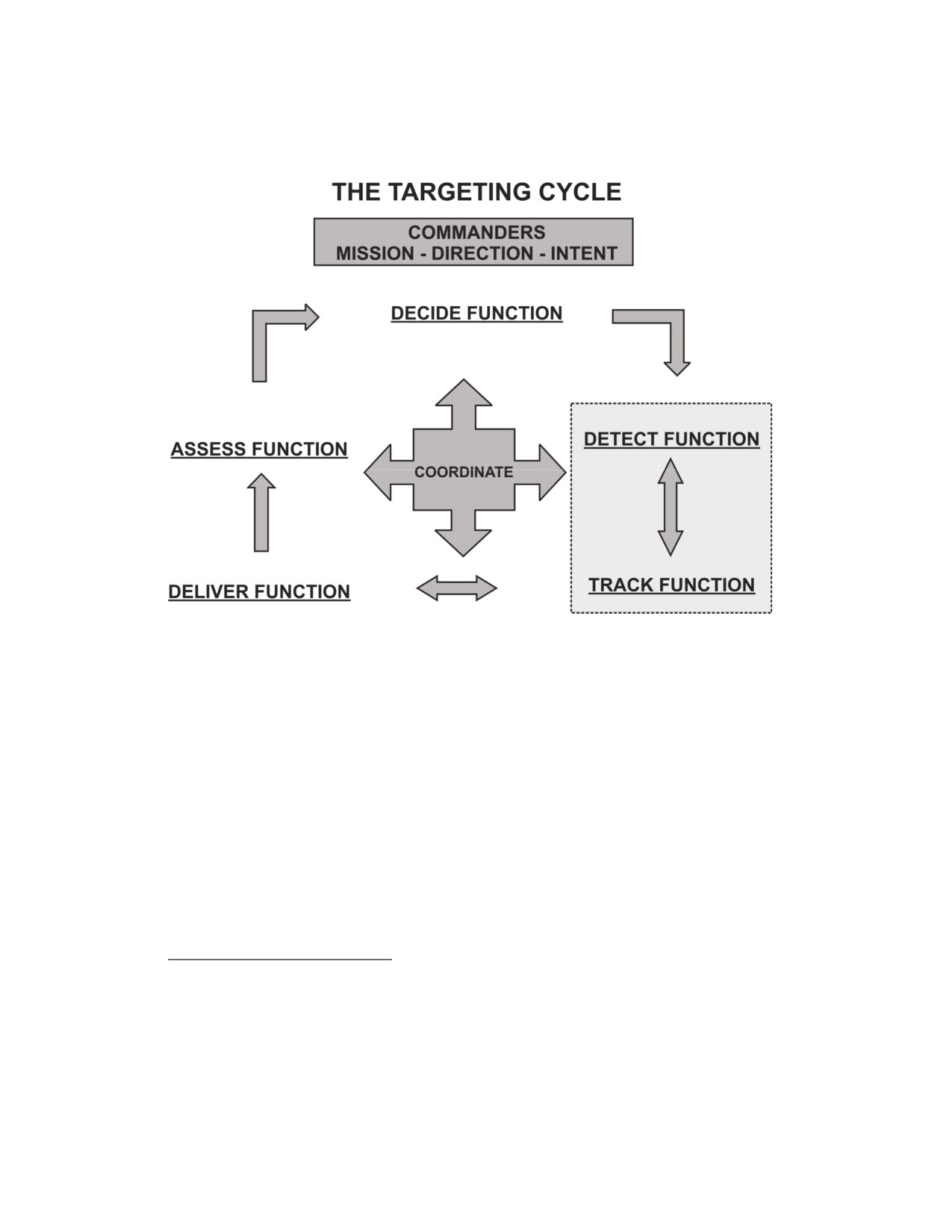
The Conduct of Land Operations
officers whose functions are to harmonize and synchronize planning and targeting on both the
physical and moral planes support the targeting cycle and the entire planning process.149 See
Figure 7-1.
Figure 7-1: The Land Force Targeting Cycle
3.
Analysis of Targets. Within the targeting cycle, at each step the targets are continually
analyzed against the operational environment within a given geographical area to ensure
currency and applicability. This allows for the prosecution of targets as opportunities arise. The
process is supported by the knowledge base, enhanced by the products of intelligence
preparation of the battlespace (IPB) (e.g., NAIs and TAIs), and utilizes a comprehensive
approach through the JIMP framework.150
4.
The Decide Function. The Decide function is the initial most involved step in the cycle
and will take the greatest staff effort. Based upon his vision and analysis, it is initiated by the
commander who makes preliminary decisions with respect to the targets and the desired
effects. It continues as part of the planning process and the intelligence collection effort (i.e.,
IPB), and sets priorities for intelligence collection. It is key to establishing the CCIRs, the
priority intelligence requirements (PIRs), along with essential elements of friendly
information (EEFI), etc. This function will:
149 These staff officers will be allocated to J5 Targeting Coordination cell. Three such officers will conduct
this function within a Brigade HQ Plans cell. One will oversee the entire targeting process, one will focus
and coordinate targeting for fires, and one will coordinate targeting with non-fires means, such as civil-
military cooperation (CIMIC), PSYOPS, and public affairs.
150 The knowledge base that identifies and assesses all the interrelated systems and actors within an
environment is a key component to an effects-based approach to operations. For more details regarding
the IPB process, see B-GL-357-001/FP-001 Intelligence Field Manual.
B-GL-300-001/FP-001
7-11
Land Operations
a.
Identify Target Types. Target types and categories will depend upon the
nature of the operation and the range of effects desired (e.g., armoured reserve
on the physical plane, and hostility towards the government on the moral plane).
Target lists are developed as targets are identified and will be further refined
through intelligence collection and the need to manage the dynamic nature of
the commander’s operational requirements.
b.
Identify Target Areas. This considers the AO and identifies areas of targeting
interest that are not identified in the IPB process. All dimensions of the
battlespace environment should be considered and limitations, such as
protected areas, taken into account. This will focus engagement efforts on both
the moral and physical planes (e.g., routes for the armoured reserve on the
physical plane, and a disenfranchised ethnic group on the moral plane). This
will augment the intelligence collection process.
c.
Establish Target Accuracy. The required accuracy to effectively engage the
target will dictate the sense and delivery capabilities tasked. This considers
technical and procedural limits of the capability in order to establish engagement
parameters. This aids in the allocation of specific capabilities to targets.
d.
Input to Intelligence Collection Plan. Targeting input to the intelligence
collection plan provides a focus for the management of detection systems. The
input will identify priority targets, how they may be detected, and whether target
tracking is required.
e.
Develop Criteria for Measures of Performance and Measures of
Effectiveness. Criteria for a successful engagement must be decided early in
the process and consist of measures of performance (MOP) and measures of
effectiveness (MOE) as defined. This will include recommendation of the sensor
capabilities required to measure these criteria. On the physical plane, battle
damage assessment (BDA) provides an objective measure, and on the moral
plane, the assessment will be primarily subjective measure.
f.
Develop Attack Guidance Matrix. The attack guidance matrix (AGM) provides
a consolidated, tabulated support tool for targeting decisions and is the
culmination of the Decide phase of the cycle. The matrix is intended to act, as
far as practical, as an executive document allowing rapid engagement decisions
to be made during current operations. The AGM should be developed for each
phase of an operation and for different operations.
5.
Decide Function Products. The result of the Decide function should be a focused
targeting effort supported by the following products:
a.
High Value Target List. High value targets (HVTs) are those, the alteration of
which will significantly damage the opponent's capability and/or will to achieve
his intentions. The HVT list (HVTL) is derived from consideration of the mission,
the opponents’ intentions and vulnerabilities, and the direction provided by the
formation/manoeuvre commander arising from the formation planning process.
The intelligence staff normally generates the HVTL.
7-12
B-GL-300-001/FP-001
The Conduct of Land Operations
b.
High Payoff Target List. The high payoff target list (HPTL) identifies those
HVTs whose alteration will significantly contribute to the success of the friendly
commander’s mission. The HPTL may change according to the phase and
nature of operations, and may be used to focus the intelligence collection effort.
The HPTL is a command decision and should be disseminated accordingly.
c.
Target Selection Standards. Target selection standards (TSS) are pre-
established criteria that are applied to targets to determine what degree of
accuracy and timeliness is required from detection systems to enable the
selected means of delivery to achieve a successful engagement. If there is a
change to the TSS, the target may still be valid; however re-assessment will be
required prior to engagement.
d.
Measures of Performance and Measures of Effectiveness Criteria Issued
and Means of Collection. Criteria and allocated assets for the application of
the MOP and MOE are applied following an engagement. This product should
be able to illustrate the MOP, and particularly the MOE, in a readily
understandable fashion that will clearly indicate where success is being met.
e.
Attack Guidance Matrix. The AGM provides detail on specific HPTs, when
and how they should be engaged and any restrictions. It allocates assets to
targets and facilitates future planning. The AGM may also identify target-
tracking requirements.
6.
The Detect Function. During detection, the ISTAR151 coordination cell supervises and
coordinates the efforts of assets to execute the intelligence collection plan. Some assets can
identify targets, while others produce information that must be processed to identify targets.
The targeting priorities developed during the Decide function are used to expedite the
processing of target information. The information collected and processed is used to update
and amend the HPTL and AGM as necessary. The practical application of this function is the
execution of the intelligence collection plan. Targeting staff should be active in this process in
order to maintain the dynamic nature of the targeting cycle.
7.
The Track Function. Target tracking supplements the Detect function, but is distinct
from it since target tracking requires specific asset management decisions. Many of these
tracking decisions will have been agreed in the Decide function and will be articulated in the
AGM. Once detected, HPTs that cannot be immediately engaged, which are planned for
engagement during a later phase, or which require validation, must be tracked to ensure that
they are not lost and to maintain a current target location. Targeting staff must bear in mind that
systems used for tracking will generally be unavailable for other target detection. On the moral
plane, this may consist of surveys to track public attitude and perception. Targeting staff should
be active in the execution of the intelligence collection plan (e.g., ISTAR matrix) in order to:
maintain the dynamic nature of the targeting cycle; to ensure that targets are not lost prior to
engagement; and to ensure that sensor handoff is accomplished.
151 Intelligence, surveillance, target acquisition and reconnaissance.
B-GL-300-001/FP-001
7-13
Land Operations
8.
The Deliver Function. The primary activity during the Deliver function of the targeting
cycle is the engagement of targets to generate the desired effects in accordance with the AGM.
Important targets may appear outside the Decide function. These targets are processed in the
same manner as planned HPTs. Targets, not on the HPTL, are first evaluated to determine
when and if they should be attacked. The decision to engage opportunity targets is based upon
a number of factors, such as the activity of the target and the potential target payoff compared
to other targets being processed for engagement and systems available. The final decision is to
confirm the selection of an appropriate capability for engaging each target in line with the AGM.
For planned targets, this decision will have been made as part of the Decide function.
Nevertheless, a check has to be made to ensure that the selected capabilities are available and
can conduct the engagement as planned. If not, the targeting board must determine the best
available means for the engagement. In some cases, more than one asset may be used to
engage the same target.
9.
The Assess Function. Assessment is the concluding step in the targeting cycle and is
the determination of the effectiveness of the engagement. Assessment will be a dynamic
process and will be a constant feature of the staff effort.152 It consists of measures of
performance (MOP) and measures of effectiveness (MOE):
a.
Measures of Performance. A MOP is defined as: “a criterion used to evaluate
the accomplishment of a task.”153 A MOP is the timely and accurate
assessment of an activity (Did we do things right?) and is conducted as a matter
of course. For specific HPTs, the criteria for MOPs are determined as part of
the Decide function and the requirements are recorded on the AGM. These
should be replicated in the intelligence collection plan. As part of the targeting
cycle, MOP help determine if further engagements on selected targets are
necessary. Commanders use this information to allocate, or redirect,
engagement systems to make best use of available combat power.
b.
Measures of Effectiveness. A MOE is defined as: “a criterion used to evaluate
how a task has affected selected system behaviour or capabilities over time.”154
They are used to evaluate how activities have affected target behaviour or
capabilities (Are we doing the right things to create the desired effect?). If the
MOP were met (things were done right), but the MOE were not, there will be a
requirement to a change to the activities or the manner in which they are
conducted. Note that on the moral plane, MOE are mainly subjective and it may
take a significant amount of time to determine effectiveness. Hence, these MOE
must be assessed routinely and an attempt made to recognize changes and
trends. The commander exercises judgement as to when an adjustment or
change to an activity against that target must be made. It must be noted that
on the moral plane, the time required to complete the cycle can be
significantly longer.
152 Combat assessment, which comprises battle damage assessment (BDA), munitions effectiveness
analysis (MEA), and re-attack recommendations.
153 Army Terminology Panel approved May 2006.
154 Army Terminology Panel approved May 2006.
7-14
B-GL-300-001/FP-001
The Conduct of Land Operations
10.
Command, Control and Coordination. Targeting is a command responsibility that
requires the personal time, energy and attention of the commander. The commander has to
give clear direction for the aims, priorities and degree of effort to be accorded to targeting. The
targeting board will require a detailed understanding of how effects are created in order to
determine the required activities and their synchronization. The commander delegates the
detailed control of targeting to the chairman of the targeting board. The composition of the
targeting board is multidisciplinary in order to provide the required expertise for activities on both
the physical and moral planes.155 The appropriate headquarters (HQ) coordination centres and
the G5 targeting coordination staff (e.g., the fire support coordination centre [FSCC], or the
targeting coordination cell) conducts the detailed coordination of the targeting activities.
11.
Allocation of Targets. Targets may be allocated by higher formations. These targets
must be included in the targeting decisions of the targeting board. They will have a direct
impact on the detection, tracking and engagement assets available. Conversely, activities
beyond the capability of the formation are passed to and coordinated with the higher formation.
12.
Legal Considerations. Targeting at all levels will always be governed by the
parameters set by the laws of armed conflict (LOAC) and rules of engagement (ROE). In
addition, there must be consideration of the distinction between military and civilian targets, as
well as between civilians and combatants. For these reasons, there is a requirement for legal
advice throughout the targeting cycle.
13.
Implications from Laws of Armed Conflict. The concepts of LOAC that have
particular relevance to targeting are:
a.
Military Necessity. This means that belligerents are justified in applying force
to that extent which will ensure the submission of the adversary at the earliest
possible moment, with the least possible cost and using methods and means of
warfare that are not prescribed by international law in attacking a military
objective.
b.
Unnecessary Suffering. This relates to the means of warfare and methods of
combat whose foreseeable harm would be clearly excessive in relation to the
military advantage to be gained. In relation to a civilian population, it means
whether the risk of incidental injury to the civilian population caused is so
indiscriminate as to constitute a direct attack on the civilian population.
c.
Proportionality. The commander should have an expectation that a military
action will make a relevant and proportional contribution to military objectives.
In relation to civilians, this concept means that incidental civilian casualties and
damage to civilian property cannot be excessive in relation to the military
advantage to be gained.
14.
ROE will define when, where and how force may be applied. All commanders must
instruct their forces carefully on the ROE. It is essential that the targeting board know the ROE
and are able to apply them correctly.
155 Detailed composition of the targeting board, its responsibilities and its procedures may be found in B-
GL-331-002/FP-000 Staff Duties in the Field.
B-GL-300-001/FP-001
7-15
Land Operations
716. INTELLIGENCE LED OPERATIONS
1.
Intelligence and targeting processes should guide all tactical level operations. Indeed,
the tempo of a campaign or particular operation may have to be reduced to ensure the thorough
development of intelligence sources and information. At times, however, particularly in those
campaigns that are short of major combat, operations can become routine when conducted over
a lengthy period of time or conducted without a great deal of detailed, specific intelligence.
Such is often the case with stability operations activities with its common application of
framework patrolling.
2.
Whenever possible, specific and detailed intelligence should be cultivated in order to
give these routine operations focus and purpose. Standing PIRs should provide a backdrop for
all such activities, and specific IRs for particular activities and regions within an AO will help
focus routine activities, with a view to turning NAIs into point TAIs for prosecution by deliberate
operations. This may take an extended period of time, particularly when adversaries are
concealed in local populations and operate below the normal detection thresholds.
INTELLIGENCE LED OPERATIONS
On 20 August 2006, units of 1st Bn, The RCR and the Afghan National Army used timely
and actionable intelligence to decisively defeat a Taliban attack. On 19 August a
sizeable force of insurgents occupied dwellings Southeast of Panjwai village. The
insurgent’s intent was to attack government offices and interdict traffic on Highway 1, a
main MSR [main supply route]. Coalition forces were postured to counter the planned
insurgent attack based on the intelligence and recognized patterns of behaviour that the
insurgents had followed in past actions. Coalition elements were arrayed against enemy
weaknesses to disrupt the enemy ability to manoeuvre or bring accurate fire against
friendly elements.
The detailed intelligence-driven planning helped to inflict a significant defeat on the
attacking insurgent force. Caught unawares and drawn into a pitched battle against
superior forces, the insurgents lost approximately seventy of their number.
There are several lessons to be gleaned from this action. First, intelligence driven
operations allow the battlespace to be shaped. Conditions can be set in order to shape
the battlespace, thus facilitating the decisive tactical activity of striking the enemy force.
Second, intelligence driven operations can, as in this instance, enable allied forces to
operate inside the decision-making cycle of the enemy to disrupt his operations. Thirdly,
they facilitate measures of effectiveness. In this case, the intelligence that enabled this
operation came from a local villager and thus indicates some degree of support for the
central government and the coalition forces.
Source: Graeme Smith, “Canadians hammer Taliban,” The Globe and Mail, 21 August
2006, p. A1, A11 and interview with CO 1 RCR.
During Op HALO in Haiti, 2004, I Coy, 2 RCR framework patrols were tasked to develop
named areas of interest into point targets for execution. Soon after deployment, patrols
learned from locals that a local gang member, Ti Paille, had been responsible for much
of the murder and attacks against police and weapon smuggling in the area. This was
confirmed with higher sources and through CI and HUMINT sources.
7-16
B-GL-300-001/FP-001
The Conduct of Land Operations
Patrols were tasked within this area of over 20,000 civilians to locate the gang leader’s
exact location and possible weapons caches, effectively creating a point target for
prosecution. It took three weeks for patrols to locate, through local contacts, an
unmarked brothel associated with the gang in question. A cordon and search operation
did not result in an immediate seizure of weapons or individuals, but did bring forth more
intelligence. A HUMINT source was able to provide a report from within the buildings
just prior to execution along with a sketch of the layout.
Exploitation of CI [counter-intelligence] and HUMINT sources over the next three weeks
indicated the gang leader’s temporary residence. A cordon and search operation in
conjunction with Haitian police forces resulted in the arrest of the gang leader and his
eventual prosecution.
This operation concluded successfully not through happenstance nor a single
intelligence source, but through directed and planned intelligence gathering by a number
of complementary sources (HUMINT, CI and framework patrols) that allowed a large NAI
to be developed into a point target for prosecution. The long term effects were an
improvement in security levels and enhanced legitimacy to both coalition forces and
local police.
Source: I Coy, 2 RCR post-deployment AAR.
SECTION 5
OFFENSIVE OPERATIONS
717. TACTICAL LEVEL OPERATIONS—GENERAL
1.
Tactical level operations may be classified as offensive, defensive, stability, or enabling.
Every campaign is conducted through a balanced combination of these tactical operations and
their constituent activities, tasks and effects, as dictated in the continuum of operations
construct.156 The resources and emphasis placed on each type of operation will depend upon a
number of situational factors and will reflect the nature of the campaign.
2.
Offensive operations will be key to defeating an adversary. It must be remembered,
though, that long-term operational and strategic objectives and ultimate success may actually
depend more upon the conduct of stability operations and their effects on the psychological
plane.
718. PURPOSE OF OFFENSIVE OPERATIONS
1.
The purpose of offensive operations is to defeat the adversary through the use of
violence. Offensive action, on both the moral and physical planes, through a combination of
physical and intellectual activities, is the decisive operation of war and ultimate success is
achieved through it.
156 See Chapter 3, Section 4.
B-GL-300-001/FP-001
7-17
Land Operations
2.
Offensive operations defeat the adversary either by breaking his cohesion, by physical
destruction or both. The real damage to the adversary's will is caused by destroying the
coherence of his operations and fragmenting and isolating his combat power, and its moral,
conceptual and physical components. By so doing, the adversary's capability to resist is
destroyed.
3.
Other subsidiary purposes and effects of offensive operations include:
a.
Gaining information through reconnaissance in force activities.
b.
Depriving the adversary of resources.
c.
Pre-empting the adversary in order to gain the initiative.
d.
Disrupting the adversary’s offensive action and other activities such as
command and control (C2) systems (through offensive information operations).
e.
Dislocating the adversary’s forces through decisive engagement or deception.
f.
Seizure of ground.
g.
Fixing the adversary as an economy of force activity.
h.
Influencing or changing the perceptions of commanders and other, possibly
neutral or hostile, target audiences. This may be done through physical or
intellectual activities.
719. PRINCIPLES OF WAR IN OFFENSIVE OPERATIONS
1.
General. In offensive operations, the key to success is seizing and retaining the
initiative. In doing so, a commander maintains momentum, keeps the adversary off-balance,
and prevents him from blocking penetrations, mounting counterattacks, and reforming his
reserves. Selecting the location, target, time and direction of offensive operations seizes the
initiative.
2.
Principles of War. The following principles of war are important considerations during
the planning and conduct of offensive operations:
a.
Offensive Action. Offensive action aims at defeating the adversary’s will to
resist. This implies manoeuvre, speed and aggressiveness. By wresting the
initiative from the adversary, one acquires freedom of action and a distinct
psychological advantage. Exploiting success and taking advantage of
adversary’s weakness must be foremost in the minds of all commanders. This
requirement for offensive action also applies, through info ops, to both physical
and intellectual activities on the moral plane. Consequently, there is a need to
develop a proactive info ops plan that seeks to positively influence targets in
support of the operational objectives.
b.
Concentration of Force. A commander must strive to concentrate combat
power superior to that of the adversary at a decisive time and place.
Concentration not only implies massing of forces but also massing of firepower.
The ability to concentrate is dependent upon movement, flexibility and
communications.
7-18
B-GL-300-001/FP-001
The Conduct of Land Operations
c.
Surprise. Surprise can create success out of proportion to the size of the force
used. Its elements are secrecy, concealment, deception, originality, audacity
and speed. Surprise must be exploited.
d.
Security. Security is a condition that gives a commander sufficient freedom of
action to fulfil his aim. Security is manifested in the offence by having a firm
base for the assembly, preparation and launching of operations. It includes
securing the line of departure (LD), the flanks of an attacking force, and the lines
of communications (LOC). During counter-insurgency (COIN) operations and
certain peace support operations, forces will require a secure base from which
to operate. Once the desired effects have been created in these base areas,
the campaign can be extended, like oil spreading in water, to less secure areas.
e.
Flexibility. Offensive operations demand a high degree of flexibility in order to
enable plans to be altered to meet changing situations, unexpected
developments, and to exploit fleeting opportunities, particularly against
unconventional enemies. Its elements are flexibility of mind and rapidity of
decision-making on the part of a commander and his subordinates, to ensure
that time and opportunities are never lost. It is achieved through simplicity of
plans, unity of effort, and maintenance of balance. Implicit in this requirement is
freedom of action for the commander.
720.
FUNDAMENTALS OF OFFENSIVE OPERATIONS
1.
In addition to the principles of war that merit special consideration in offensive
operations, there are several fundamentals that must be applied:
a.
Information Gathering. Offensive operations, particularly at operational level,
must be supported by a broad knowledge base that assesses the interrelated
systems within an environment and anticipates the effects that will be created
from offensive actions, to ensure that operational objectives are met. A great
deal of information gathering at all levels is required to support this knowledge
based. At the tactical level, both desired effects and undesired effects must be
understood. Information gathering at this level will support the knowledge base,
although the fundamental element of information gathering at this level has a
more specific aim. Knowledge of the adversary’s dispositions, strengths and
intentions is vital to success in the offence. As well, commanders at all levels
need detailed information on the terrain over which their troops will fight.
b.
Simplicity. Plans must be kept simple. Complex manoeuvres and intricate
arrangements lead to confusion and misunderstanding. A clear concept of
operations supported by a simple plan gives subordinate commanders an
opportunity to apply their own judgement and initiative in response to changes in
the local situation. Simplicity enhances agility and allows better control of
tempo. For info ops, messages to the target audience should be kept simple
and straightforward with obvious links in logic and links to operational objectives.
Simplicity of plans and linkages to desired objectives will also make assessment
through MOE easier.
B-GL-300-001/FP-001
7-19
Land Operations
c.
Shock Action. Shock action is achieved by the bold handling of combat forces,
be they armour, mechanized infantry, or rapidly moving light forces to break into
the adversary’s defences and drive deep into his area. Fire support is essential
and is used during all stages of the operation to reinforce the shock action.
d.
Depth. Depth is required both in the organization of offensive forces and in the
selection of objectives. Organizing in depth contributes to shock action and
allows continual operations to occur. It permits a commander to maintain
constant pressure on the adversary and to exploit penetration. The securing of
objectives in depth breaks the framework of the adversary’s defence.
e.
Balance. A balanced force is one that is grouped in such a way that a
commander can concentrate combat power to take advantage of a sudden
opportunity or to react to the adversary’s action at the decisive moment. In
reaching operational objectives, a balance may have to be created between
activities on the physical and moral planes in order to create complementary
effects. The initial grouping of forces and allocation of activities must ensure
that:
(1)
The covering force can cover the frontage of the area of influence if the
battlespace is organized in this manner, or may cover key NAIs.
(2)
Leading tactical elements have a suitable force mix to deal with likely
opposition.
(3)
Forward observation officers (FOOs) and forward air controllers (FACs)
are well forward to provide continuous fire support.
(4)
Requirements for engineer support are anticipated and resources are
readily available, with engineer reconnaissance parties well forward.
(5)
Reserves are constituted, maintained and normally deployed beyond the
range of most adversary artillery, so that they can be committed rapidly to
battle. In campaigns and operations short of major combat, reserves are
still required and are adjusted to the adversary and possible,
unanticipated requirements. They are often termed as a quick reaction
force (QRF).
f.
Reserves. Reserves are required to meet the unexpected. They may be
committed to influence the battle, to exploit success, or to respond to
countermoves. Reserves provide a commander with flexibility and balance.
Once he has committed his reserves, the commander must reconstitute it as
soon as possible. Operations that lack a detailed intelligence picture, or that
may meet unanticipated situations, should hold significant forces in reserve if
possible.
721.
TYPES OF OFFENSIVE ACTIVITIES
1.
There are a number of different types of offensive activities with specific purposes. They
are closely related and often lead from one to another. The types of offensive activities are as
follows:
7-20
B-GL-300-001/FP-001
The Conduct of Land Operations
a.
attack;
b.
raid;
c.
reconnaissance in force;
d.
exploitation;
e.
pursuit;
f.
ambush;
g.
breakout of encircled forces; and
h.
feint and demonstration.
722. ATTACK
1.
To attack is to take offensive action against a specified objective. The primary purpose
of an attack is to destroy the adversary's capability to resist. An attack may be a separate
operation or may be carried out in conjunction with other types of operations. A commander
undertaking an attack possesses the initiative, in that he decides the location, time, direction
and weight of combat power to be concentrated. Once the attack is launched, flexibility and
speed in the employment of combat power are paramount. The attack must be executed
vigorously, exploiting any favourable developments and reallocating resources to areas where
there appears to be an opportunity for success. Momentum must be maintained in order to
keep the adversary off balance, and the attack must not be delayed in order to align units or
adhere rigidly to a plan. Indeed, few attacks will develop as planned and commanders must
actively seek to turn unexpected successes to their advantage and to cope rapidly to reverses.
To be able to do this they must be well informed.
2.
The requirement for flexibility demands simple plans, adjustable fire support, engineers
well positioned, reserves uncommitted and close at hand, and sustainment options flexible
enough to be adjusted to support the offensive operation. Each discrete attack should not be
viewed as its own entity, but as part of the continuous process to break the adversary's
cohesion. Commanders should be planning to exploit success well before they have achieved
it.
3.
An attack is often preceded by an advance to contact and seeks to seize and maintain
the initiative. Additionally, a hasty attack may occur as a result of a meeting engagement.
Counterattacks are also employed by a defending force to exploit opportunities to strike the
adversary at a decisive time and place in order to defeat him. Assuming that the attack has
been successful, the force will consolidate, and if possible, exploit success through continued
offensive action. Types of attack:
a.
Hasty Attack. A hasty attack is an attack in which preparation time is traded for
speed in order to exploit an opportunity. It seeks to take advantage of the
adversary's lack of preparedness, and involves boldness, surprise and speed in
order to achieve success before the adversary has had time to improve his
defensive posture. In order to maintain momentum or retain the initiative,
minimum time is devoted to preparation, and the forces used for the attack are
those that are readily available. There will be little time for reconnaissance and
none for rehearsal. The element of surprise created by a speedy action will act
B-GL-300-001/FP-001
7-21
Land Operations
as a force multiplier. Such attacks must, wherever possible, be mounted from
an unexpected direction and supported by the concentrated fire of every
available weapon. Commanders should issue brief orders and then position
themselves well forward to react rapidly to the development of the attack. If
momentum is lost, a deliberate attack may be necessary. Properly performed
IPB may identify areas for a hasty attack from the advance, thereby allowing
some more detailed planning before the advance.
b.
Deliberate Attack. A deliberate attack is a type of offensive action
characterized by planned and coordinated employment of firepower and
manoeuvre to close with and destroy or capture the adversary. When a well-
prepared adversary defence must be defeated, a deliberate attack may be
required. The emphasis is on preparation at the expense of speed and time;
therefore, methods other than speed will be required in order to achieve
surprise.
c.
Counterattack and Spoiling Attack
(1)
Counterattack. The purpose of a counterattack is to defeat an adversary
that becomes vulnerable by his own offensive action, by revealing his
main effort or creating an assailable flank. It is likely to be conducted as
part of a defensive operation by a reserve or lightly committed forward
elements, and it affords the defender the opportunity to create favourable
conditions for the commitment of combat power and a switch to offensive
action.
(2)
Spoiling Attack. The spoiling attack is similarly directed at adversary
offensive operations but with the limited aim of disruption. It attempts to
strike the adversary while he is most vulnerable or while he is on the
move prior to crossing his LD. A spoiling attack is pre-emptive in nature,
as it attacks the adversary's plans, and hence, his cohesion. When the
situation permits, however, commanders can exploit a spoiling attack like
any other attack.
d.
Attack by Fire. To attack by fire is an action to engage an adversary with direct
fires, supported by indirect fires, without closing with him.157 Attack by fire
excludes assaulting or occupying the objective. Although it is a form of an
attack, as a tactical activity, it is often used as a tactical task in support of a
larger tactical activity. It may be given as a “be prepared to” task against a
possible adversary, such as the approach of a mobile reserve.
723.
RAID
1.
A raid is defined as: “an operation, usually small scale, involving a swift penetration of
hostile territory to secure information, confuse the enemy, or destroy his installations. It ends
with a planned withdrawal upon completion of the assigned mission.”158 The wider purpose of a
157 B-GL-331-002/FP-000 Staff Duties in the Field.
158 NATO Allied Administrative Publication 6 (AAP-6) NATO Glossary of Terms and Definitions.
7-22
B-GL-300-001/FP-001
The Conduct of Land Operations
raid is to disrupt the adversary usually through destruction, or the capture of a vital asset or
capability. It is based upon detailed intelligence, generally involves swift movement into hostile
territory, and ends with a planned withdrawal. Because raids will often be carried out over a
short distance and time period, only a limited amount of supplies need be carried and
maintenance will be confined to minor crew repairs. Fire support systems are required to
support the raiding force so as to reduce the adversary's ability to react. Armoured
reconnaissance, airmobile, airborne and amphibious forces, and dismounted infantry,
particularly if supported by aviation fire support, are well suited to this type of attack.
724. RECONNAISSANCE IN FORCE
1.
Reconnaissance in force is defined as: “an offensive operation designed to discover
and/or test the enemy's strength or to obtain other information.”159 The purpose of a
reconnaissance in force is to compel the adversary to disclose the location, size, strength,
disposition or intention of his force by making him respond to offensive action. The adversary's
reaction may reveal weaknesses in his defensive system that can be attacked or strengths that
should be avoided. Commanders may conduct reconnaissance in force as a means of keeping
pressure on the defender by seizing key terrain and uncovering adversary weaknesses. They
must also be prepared to seize any opportunity to exploit tactical success.
2.
A formation or unit may conduct its own reconnaissance in force, or do so at the
direction of a higher HQ. It must be conducted in enough strength to force the adversary to
react, though it may be necessary to place restrictions on commanders to avoid actions that
may precipitate a decisive engagement. If the force is still engaged once the actual
reconnaissance is completed, it may be tasked to fix the adversary, attack, or withdraw as
directed.
725. EXPLOITATION
1.
Exploitation is defined as: “an offensive operation that usually follows a successful attack
and is designed to disorganize the enemy in depth.”160 As a tactical task, a rapid advance
against lessening resistance characterizes exploitation. The purpose is both physical and
moral. Physically, the aim is to retain the initiative by preventing the adversary from
reorganizing his defence or conducting an orderly withdrawal. The moral effect of exploitation is
to create confusion and apprehension throughout the adversary command, reducing his
capability to react and lowering his morale. This may be decisive in itself.
726. PURSUIT
1.
A pursuit is defined as: “an offensive operation designed to catch or cut off a hostile
force attempting to escape, with the aim of destroying it.”161 It may commence when the
adversary force is demoralized and its units are beginning to disintegrate under pressure.
Alternatively, it may originate in an operation in which the adversary loses his ability to operate
effectively and attempts to disengage.
159 Ibid.
160 Ibid.
161 Ibid.
B-GL-300-001/FP-001
7-23
Land Operations
727. AMBUSH
1.
An ambush is an operation aimed at destroying or capturing by surprise an enemy
element in movement. The purpose of an ambush is to inflict damage on the adversary while
denying him an opportunity to counterattack, principally through surprise. It is often conducted
in the same manner as a raid and often within territory controlled by the adversary. Normally,
the ambushing force lies in wait for the adversary force.
728. BREAKOUT OF ENCIRCLED FORCES
1.
In a breakout operation, an encircled force takes offensive action to link up with a main
force. The breakout should attempt to surprise the adversary, and is more likely to be
successful if it is conducted at the earliest opportunity. Other forces attempting to fix the
encircling adversary may support the breakout operation.
729. FEINT AND DEMONSTRATION
1.
A feint and demonstration are offensive info ops162 in that they conduct physical activities
with the aim of distracting and possibly deceiving the adversary. Thus, their initial effects occur
on the moral plane, while their secondary effects will occur on the physical plane, in that they
will persuade the adversary to react in a desired fashion (e.g., move a reserve). Both may seek
to fix an adversary force and may be supported by other deceptive info ops:
a.
Feint. A feint seeks to distract the attention and action of an adversary force by
seeking combat with it. Its intent is often to support the development of the main
effort elsewhere on the battlefield, normally by fixing an element of the
adversary. Feints must be of sufficient strength and composition to cause the
desired adversary reaction. It is most effective when it supports the adversary's
expectations, when it appears as a definite adversary to the adversary, or when
there are several feasible courses of action open to the attacker.
b.
Demonstration. A demonstration seeks to distract the adversary’s attention
without seeking combat. It may be part of a broader deception plan.
Demonstration forces use firepower, manoeuvre and C2 warfare. It should also
be aimed at a vital sector of the adversary's defences if he is to be successfully
misled.
730. OFFENSIVE (PHYSICAL) INFORMATION OPERATIONS
1.
In addition to the operations described above, offensive info ops are conducted to
physically destroy, attrite, disrupt or deny the use of the electromagnetic spectrum and its
supporting infrastructure. These may stem from a physical attack as described above (e.g.,
raid, attack) against a C2 system, or from an attack via the electromagnetic spectrum. The aim
is to contribute to the defeat of opposing forces by rendering them unable to accurately perceive
situations, make decisions, or direct actions in a timely manner to carry out their intentions.
162 Feint and demonstration are extant doctrine, but the concept of them as information operations is a
new addition. They use physical activities to create effects on the moral plane (e.g., deception) and thus
secondary effects on the physical plane (e.g., movement of forces, etc.).
7-24
B-GL-300-001/FP-001
The Conduct of Land Operations
SECTION 6
FORMS OF MANOEUVRE
731. GENERAL
1.
Offensive operations may be directed against the front, flank or rear of the adversary
and may be conducted from the land, air or sea. Any combination of these is possible.
Normally, the point of main effort is placed where the adversary is weakest or where the terrain
offers possibilities of breaking deep into his defensive area. This is done through the
manoeuvre of forces. Manoeuvre is defined as: “employment of forces on the battlefield
through movement in combination with fire, or fire potential, to achieve a position of advantage
in respect to the enemy in order to accomplish the mission.”163
2.
The forms of manoeuvre are frontal, penetration, envelopment (which includes flank
attacks and attacks against the adversary’s rear), and turning movement. To manoeuvre is to
gain a position of advantage relative to the adversary. It often requires physical movement.
Movement against an adversary’s flanks and rear may have an impact on his morale, and
thereby, his will. It may assist in the achievement of surprise and shock if conducted at high
tempo; that is, before the adversary can react effectively. Some forms of manoeuvre, such as
single and double envelopment or a turning movement may disrupt and dislocate the defence.
The envelopment may have a more direct aim: to gain a position of advantage, which is the
desired objective. Many, if not all, of the forms of manoeuvre can apply at all levels. In general,
though, at brigade level and below the most common forms of manoeuvre are the frontal attack
and the flank attack.
732. FRONTAL
1.
In this form of manoeuvre, the main effort is directed against the front of an adversary’s
position. It can be effective against a weak, disorganized adversary, or it may be used to
overrun and destroy him or to fix him. A frontal form of manoeuvre is often required to support a
penetration or envelopment. Unless supported by a heavy weight of fire, it may not be
successful, but if successful, it may result in an unnecessarily high number of casualties. A
commander must, therefore, consider these factors carefully before executing a frontal attack.
733. PENETRATION
1.
Penetration is a form of offensive manoeuvre that seeks to break through the
adversary’s defence and disrupt the defensive system. Penetration seeks to reach the depths
of an adversary’s position on one or a number of narrow sectors. It will destroy the continuity of
a defensive position. The main effort is made on a relatively narrow front or on a number of
narrow fronts.
2.
Successful penetration requires the concentration of superior combat power at the point
selected for breaking into the adversary’s defences. Such points include gaps in his defences
and boundary locations. The concentration must be such that the force can break through
quickly, widen and secure the breach, and maintain momentum while seizing the deep
objectives. It is a suitable manoeuvre when strong combat forces are available and the
adversary is over-extended or if his flanks are firmly secured.
163 NATO AAP-6.
B-GL-300-001/FP-001
7-25
Land Operations
3.
It has two principal variants—deep and multiple penetrations. Both may be employed
in the same operation. The fundamental tactic is to seek the depth of an adversary’s position as
rapidly as possible, preferably without fighting. This requires adversary forces to be bypassed
by design. That creates a risk that the penetrating force may itself be attacked in its developing
flanks. The fear that this might happen may cause forces to move cautiously when boldness is
required. Personal example and determination will be required of commanders. The protection
of the flanks of the penetrating element is critical to success, although at times protection can be
afforded by the sheer speed of the penetrating force. Types of penetration:
a.
Deep Penetration. Deep penetration aims either to seize features or to destroy
specific objectives deep in the adversary’s rear. In doing so, it perforates the
adversary’s positions, introduces a force behind the adversary, and thereby
causes fear and uncertainty. It may of itself persuade an adversary commander
that he has lost, particularly if the objective is critical to him. Such objectives
may include river crossings behind his position.
b.
Multiple Penetrations. Multiple penetration aims to disrupt and dislocate the
cohesion of a defensive position. In doing so, it achieves simultaneity,
presenting the defender with a number of adversaries. It creates multiple
opportunities for surprise and shock. However, it risks dispersion of forces for
little overall effect if it is not generally successful and reinforced quickly.
c.
Combination of Multiple and Deep Penetration. Multiple and deep
penetrations may be combined to produce dramatic effects against the
adversary on both the physical and moral planes.
On the Sinai front in 1967, a total of eleven Israeli brigades, operating on up to six
separate axes, routed a force of about seven Egyptian divisions in less than four days.
The Israelis repeatedly achieved shock and surprise; they reconnoitred aggressively;
and they achieved and exploited control of the air from the opening minutes of the
campaign. The destruction of command posts and offensive electronic warfare also
contributed to the Egyptians’ panic and collapse.
From UK Army Doctrine Publication ‘Land Operations’ AC 71819
4.
Each penetrating force will normally require at least two elements. The leading element
is tasked to penetrate to the objective or the limit of exploitation as rapidly as possible,
bypassing any opposition. The second element is tasked to follow the first in order protect its
flanks and rear. Subsequent elements are reserve or echelon forces. They are tasked to
destroy bypassed adversaries, take over the lead of the advance, or exploit beyond the
immediate objective. Penetration is unlikely to succeed against an adversary who is more agile;
that is, more mobile and flexible. Conversely, it has often succeeded against a more numerous
but less agile adversary. See Figure 7-2.
7-26
B-GL-300-001/FP-001
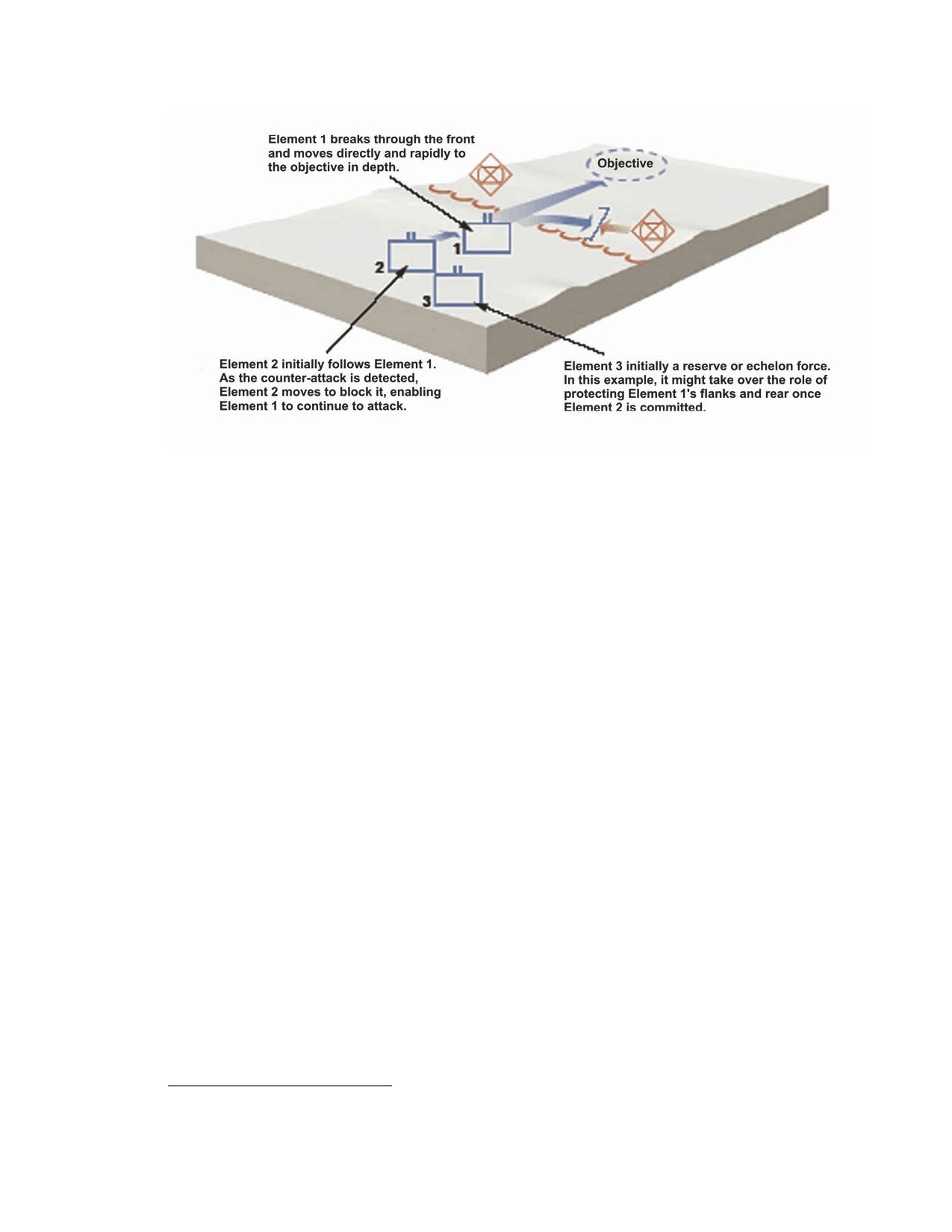
The Conduct of Land Operations
Figure 7-2: Elements of a Penetration Manoeuvre
734. ENVELOPMENT
1.
An envelopment is defined as: “an offensive manoeuvre in which the main attacking
force passes around or over the enemy’s principal defensive positions to secure objectives to
the enemy’s rear.”164 Envelopment is a basic form of manoeuvre designed to apply force
against an adversary’s weakness, and will normally require diversionary attacks against the
adversary’s main defensive front. The main effort during envelopment is made against the
adversary’s rear or flank. Its aim is to seize objectives in the adversary’s rear, making his main
defensive position untenable. Avoiding the adversary’s strength en route to the objective, the
main attack is conducted by striking him from an unexpected direction. The forces conducting
the envelopment must have good mobility, be deployed in depth, and have secure flanks. See
Figure 7-3.
2.
Considerable speed of movement and the identification of weak points is required if the
enveloping force is to be able to reach its objectives in depth. The envelopment may cause the
adversary to redeploy or to withdraw. It may cause disruption to his C2 or logistical systems, or
open the way to objectives that he was trying to defend. It may be undertaken in order to
outflank or trap adversary forces, possibly against a geographical feature. Airmobile or airborne
forces may be employed as part of an enveloping force. This is known as a vertical
envelopment.
3.
An envelopment manoeuvre will take one of the following forms:
a.
Flank Attack. This type of envelopment occurs when the main effort is directed
at the adversary’s flank; the attack seeks to strike at a more vulnerable point of
the adversary’s position where his concentrated firepower can be avoided.
Flanking attacks aim at surprising the adversary and should be the preferred
attack at brigade level and below.
164 NATO AAP-6.
B-GL-300-001/FP-001
7-27
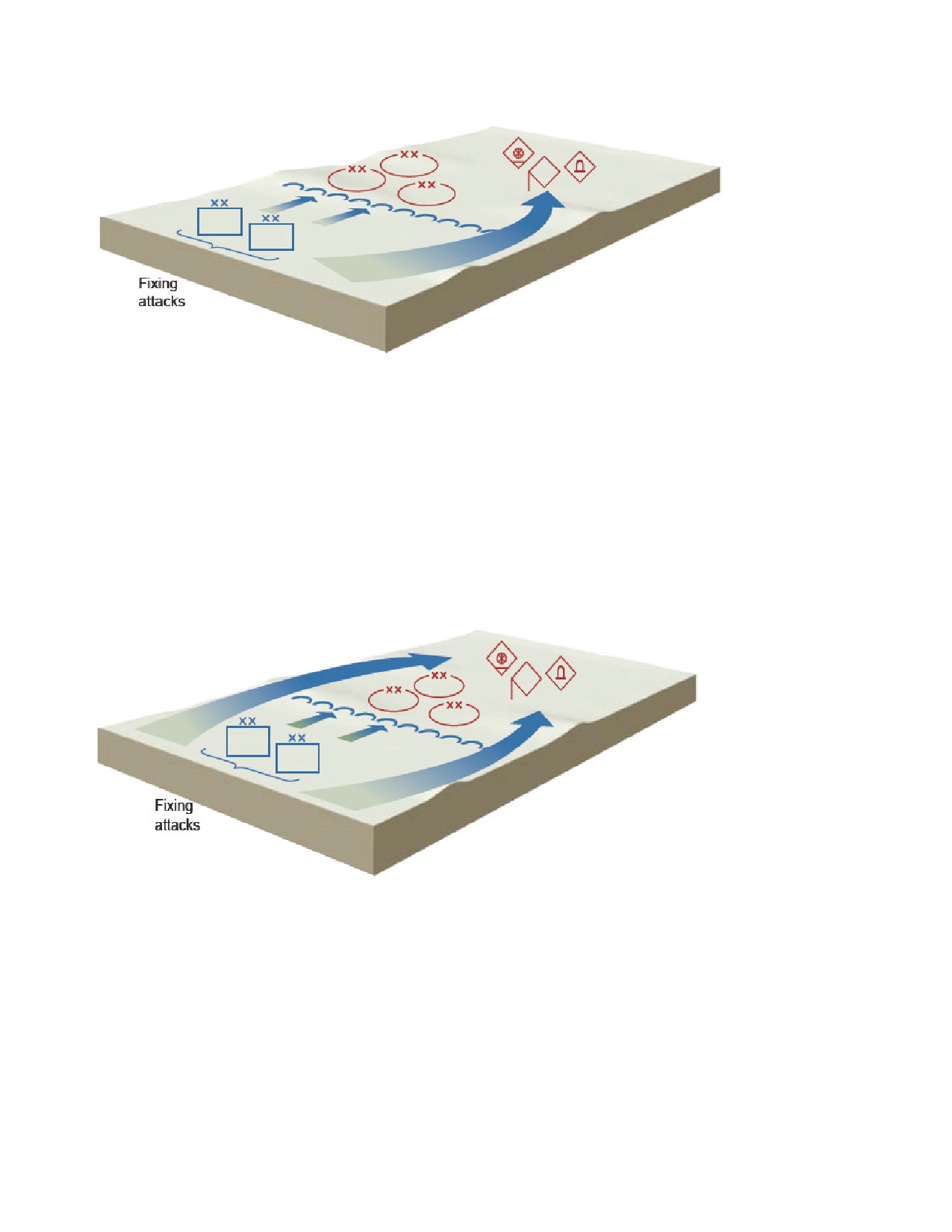
Land Operations
Figure 7-3: Envelopment
b.
Rear Attack. When the main effort is directed at the adversary’s rear, forces
are passed around one side, both sides (double envelopment) or over (vertical
envelopment) the adversary’s main defensive position with the aim of securing
key terrain within direct fire range of his rear. This action leads to his
destruction or makes his position untenable.
c.
Double Envelopment. Double envelopment is an envelopment operation
mounted on two axes that is designed to outflank an adversary from both sides
with a view to forcing him to abandon of his intentions or withdraw, or as a
prelude to encirclement and destruction of the trapped forces. See Figure 7-4.
Figure 7-4: Double Envelopment
d.
Encirclement. If the arms of a double envelopment are strong enough to meet
after trapping a force and to prevent it from breaking out, large forces may be
neutralized or destroyed with all their equipment. Large encirclements may be
costly operations in terms both of troops and the time taken to reduce the
trapped forces. Encircled forces will likely be capable of resupply only by air.
Unless an early decision to relieve them by breakout or break-in is made, then
resources may be inadequate to force a breakout or fight their way back to
rejoin the main body.
7-28
B-GL-300-001/FP-001
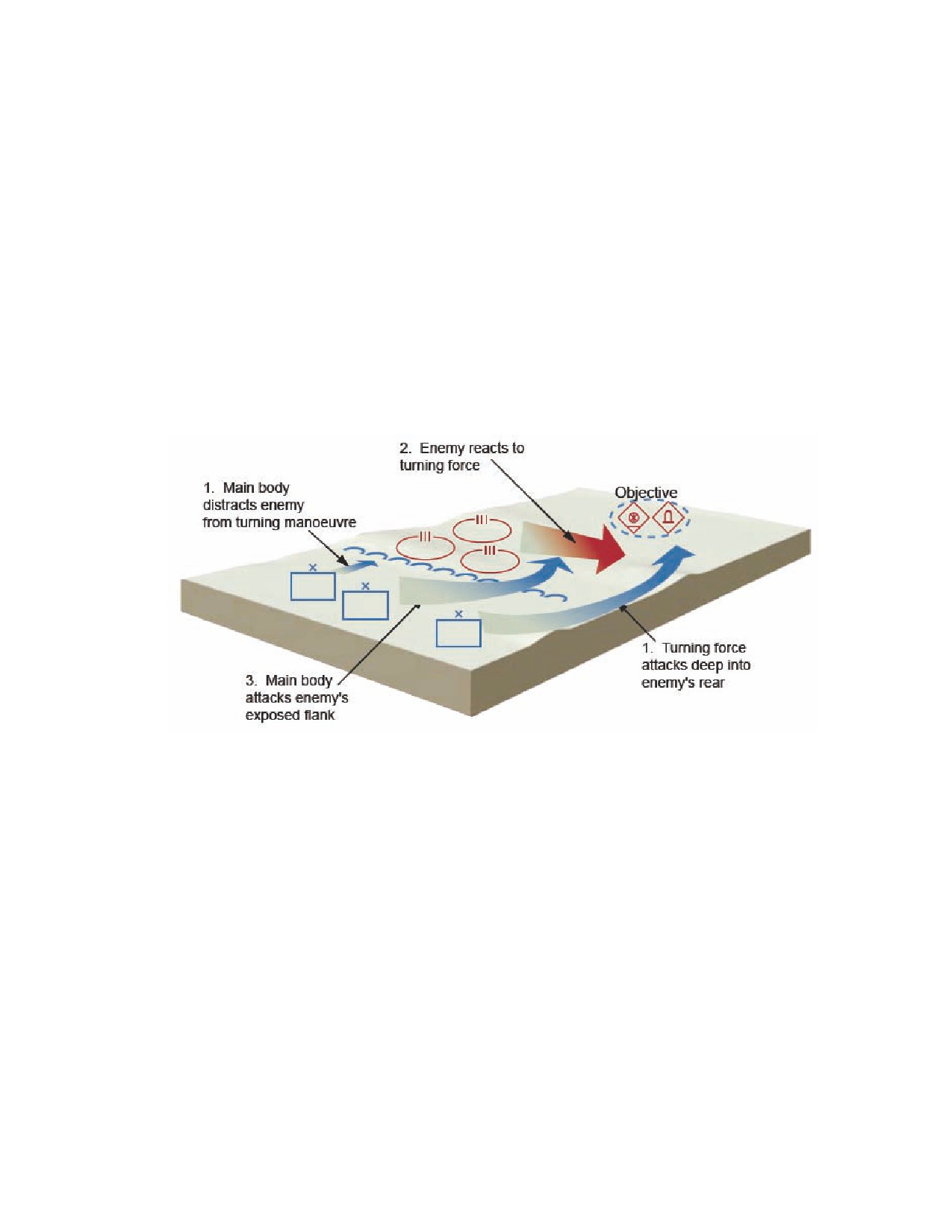
The Conduct of Land Operations
735. TURNING MOVEMENT
1.
In this form of manoeuvre, a force passes around or over the adversary’s main defensive
positions to secure objectives deep in his rear beyond the range of his direct fire weapons.
The aim of this manoeuvre is to compel him to abandon his position or divert major forces to
meet the adversary. A turning movement should make those forces more vulnerable to attack,
and may allow the use of an approach dominated by the abandoned positions. The force
attempts to avoid contact with the adversary en route to its objective.
2.
The attacking force is organized into a turning force, a main body and a reserve. The
turning force’s manoeuvre causes the adversary to leave his positions. The main body may
initially distract the adversary from the turning manoeuvre. It should subsequently exploit the
success of the turning force. The turning force is normally smaller than the main body and
should be able to operate independently, beyond the supporting range of the main body. Either
the turning force or the main body may conduct the decisive operation. See Figure 7-5.
Figure 7-5: Turning Movement
736. INFILTRATION
1.
Infiltration is penetration based upon stealth. It may be used to occupy an objective in
depth, or as a precursor to an attack mounted on an objective in depth. It may be single or
multiple. It is not the sole preserve of veteran troops: on the night of 9-10 July 1944 the Argyll
and Sutherland Highlanders of Canada, a militia battalion, occupied Hill 195, a key feature on
the approaches to Falaise, through infiltration on its first night in battle.
737. INTEGRATING FORMS OF MANOEUVRE
1.
Although individual operations or forms of manoeuvre may lead directly to the
achievement of the mission, it may be necessary to integrate them into a larger scheme of
manoeuvre. Similarly, forms of manoeuvre will often need to be divided into separate tactical
tasks. For example, encirclement will typically require at least two penetrations, exploitation into
the adversary’s depth, and a link-up operation. A defence of the outer flanks, and either an
attack or defence on the internal flanks, may follow the encirclement. Physical manoeuvre
B-GL-300-001/FP-001
7-29
Land Operations
allows the manipulation of both the adversary and the use of force. Operations against the
flanks or the rear to bypass or to penetrate allow the creation of shock and surprise at several
levels, and hence the possibility of command paralysis and collapse. Any penetration is an
opportunity for aggressive exploitation. Manoeuvre is not limited to offensive operations—the
most skilful counterattacks have often, in effect, been turning movements. Such movements
compel an attacker to desist from his attack, and create an adversary to the rear of his forces.
738. STAGES OF THE ATTACK
1.
An attack can be divided into a number of distinct, but closely related stages, which will
tend to merge into one another. Indeed, to the participants, the stages are unlikely to be clear-
cut, especially if they are involved in other actions in support of the offence. These stages are:
a.
Mounting. During the mounting stage, which occurs prior to H-hour,
preparations are completed. Activities may include intelligence gathering,
rehearsing, ammunition dumping, route improving, preparing for the crossing
and breaching of obstacles, moving to assembly areas, grouping, replenishing,
firing preparatory fire, deploying, and possibly, conducting a forward passage of
lines. Concurrently, commanders complete their battle procedure. The force
may also carry out infiltration.
b.
Assault. In this stage, the assaulting element crosses the LD, breaks into the
adversary’s defensive position, and fights through the objective to destroy the
adversary or cause his surrender.
c.
Consolidation. Following an assault, a force must consolidate quickly so that it
is prepared to meet adversary counterattacks or undertake a new task.
Consolidation is normally done forward or to the flanks of the former adversary
position. It may be followed by exploitation.
2.
Mounting. Attack forces should be held well back, as long as possible, to complete the
battle procedure and to assist in maintaining security. Some preliminary grouping may take
place. During mounting, a number of activities will take place, to possibly include:
a.
Information Collection. Information is collected in accordance with the
intelligence collection plan. This activity is initiated early and continues
throughout the operation, primarily by reconnaissance forces. Active counter-
reconnaissance will also take place in order to secure friendly movement,
preparations and activities, and to achieve surprise. This input to the knowledge
base should consider not only adversary forces, but also the other elements or
systems that will be affected by this tactical offensive activity. This should lead
to risk assessment and the assessment for the possible creation of undesired
effects through such things as collateral damage.
b.
Route Maintenance. There may be a requirement for route maintenance for
the move to assembly areas and for deployment. Security may preclude work
forward of the assembly areas early in the mounting stage, however, work may
be possible in the rear area. If so, engineers must be amongst the first troops to
move forward.
7-30
B-GL-300-001/FP-001
The Conduct of Land Operations
c.
Selection of Assembly Areas. Assembly areas are selected with regard for
concealment, grouping and tasks, and the location of the LD. Assembly areas,
attack positions, and lines of departure should be secured by protective
elements prior to their occupation by assault forces.
d.
Move to Assembly Areas. The move to assembly areas is planned as a
tactical road move. Preferably, it should be conducted under radio silence
during periods of reduced visibility. This move should be planned to take place
as late as possible in the mounting stage to assist in maintaining security.
e.
Obstacle Crossing and Breaching. Preparations for crossing or breaching are
completed.
f.
Preparatory Fire. Preparatory fire may involve heavy ammunition expenditure.
Insufficient fire may jeopardize surprise, while neutralizing the adversary for only
a short time. It may be better to concentrate resources on covering fire or to
carry out brief, but intense, preparatory fire on selected targets. If a large
expenditure of ammunition is planned, a dumping programme may be required.
g.
Infiltration. A commander must plan to move his infiltration force by stealth
from its assembly area to their attack positions in the adversary area. Infiltration
forces may be required to conduct an assault and hold their positions until a link-
up can be affected or they may be directed to assault and subsequently
disperse.
h.
Rehearsals. If security and time permit, commanders at all levels should
reconnoitre the ground over which they will attack and conduct rehearsals,
preferably with all the elements of the force.
i.
Deployment. Planning for deployment ensures that assault forces move from
assembly areas, deploy into formation on the move and cross the LD at H-hour.
If a deployment on the move is not possible, assault troops should pause only
briefly in the attack position to shakeout. When a forward passage of lines is
involved, the LD is usually the forward line of own troops (FLOT). The formation
adopted when crossing the LD depends upon the ground, distance to the
adversary, expected adversary resistance, and the effectiveness of the
suppression of the adversary. A short approach to the objective over open
terrain with considerable fire support, including smoke, against a relatively weak
adversary favours adopting an assault formation when crossing the LD.
Otherwise, it is adopted in an assault position just prior to closing with the
adversary.
j.
Security. During the approach to the LD, flank security/protection and a
covering force/guard will likely have to be established. The LD should be
secured prior to the arrival of the main assault force. This can be a task for
reconnaissance forces.
3.
Assault. The assault is conducted as follows:
a.
Lead elements cross the lines of departure at H-hour. Tanks and infantry move
together or on different axes. The lead may change during the approach and
B-GL-300-001/FP-001
7-31
Land Operations
final assault depending on the ground. The infantry dismount short of, on, or
beyond the objective depending on the ground, the disposition and strength of
the adversary, the number of anti-armour weapons, the extent and nature of
obstacles, and the degree of surprise achieved. The aim is to retain momentum
and protection until the infantry are required to fight through the position on foot.
b.
At the same time, fire support resources suppress the adversary on the
objective and in depth, mask his observation, and neutralize or destroy the
adversary from deploying counter-move forces. As assaulting troops close with
the adversary, the major fire support effort is directed at the break-in points.
c.
In order to break-in, assaulting troops should concentrate only when they come
into close contact with the adversary. Preferably supported by tanks, infantry
and engineers breach the last of the adversary forward obstacles and break into
his defensive system. At this point, close fire support shifts to the depth of the
objective and then to targets on the flanks and objectives in depth. Throughout
the break-in, momentum must be maintained so the adversary is unable to
react.
d.
Once the break-in is made, it is vital to maintain the pressure of the attack; not
only when assaulting the adversary position to seize initial objectives, but also
when fighting through to take the objectives in depth. Sometimes, determined
action by troops in the initial assault can clear a position, thus avoiding the use
of a much larger force later on when the adversary has had a chance to recover.
Attacking forces must move as rapidly as possible between areas of adversary
resistance, particularly in a nuclear environment. When fighting through
objectives, support weapons and command posts are priority targets.
Demolition teams destroy adversary bunkers. Tanks that are not accompanying
the assault forces manoeuvre to cut-off positions to prevent the adversary from
withdrawing or being reinforced. Frequently, smoke is employed to the rear of
an objective to hamper supporting fire adjusted by the adversary’s reserve or
depth forces.
e.
Throughout the assault, a commander seeks to reinforce success, exploit
favourable situations, and achieve maximum penetration into the adversary’s
defences. He does this primarily by committing his reserves and shifting
supporting fire. His decision to commit his reserves must be made quickly but
judiciously, as once they are committed it is difficult, if not impossible, to
disengage them or direct them to a new task. Once the reserve is irrevocably
committed, a commander must reconstitute or obtain a new reserve as quickly
as possible; otherwise he loses his major capability to influence the battle.
4.
Consolidation. Consolidation begins immediately after the adversary has been
defeated and/or the objective has been taken. This includes: deploying protective elements and
possibly laying protective minefields; digging in, normally forward and to the flanks of the former
adversary position; bringing forward additional support weapons; altering or completing the
defensive fire plan; replenishing combat supplies, particularly ammunition; and evacuating
casualties and prisoners.
7-32
B-GL-300-001/FP-001
The Conduct of Land Operations
5.
Exploitation. An attack frequently creates short-term opportunities to maintain pressure
on the adversary. Exploitation may prevent him from mounting counterattacks, reorganizing his
defence, or conducting an orderly withdrawal. A commander should plan for exploitation and be
prepared to adjust his plan as the situation develops. If exploitation is possible, it must be
carried out quickly so as not to give respite to the adversary. It may even begin simultaneously
with consolidation to ensure that momentum is maintained and the adversary is kept under
pressure. A commander must decide whether to commit depth forces earmarked previously for
exploitation, or direct main attack forces to exploit. He bases this decision primarily on the
condition of the main attack forces, strength of the adversary, and the difficulty of moving depth
forces forward.
739. CONTROL MEASURES
1.
General. The organization for combat should provide for coverage of the area of the
attack from well behind the LD to the objective and beyond, and should include the designation
of any measures necessary to control the attack. These will depend on how the attack is to be
mounted, and on how the commander wishes to control his forces, and may include the use of
the following control measures. Control measures should include appropriate link-up drills and
the combat identification (CID) measures deemed appropriate.
2.
Battlespace Management Including Airspace Control Measures. Battlespace
management is the means and measures that enable the dynamic synchronization, prioritization
and de-confliction of activity across all dimensions of an assigned area of operations within the
battlespace. Note: It comprises dimensions of land, sea, air and space, electromagnetic
spectrum, information and time. Proper battlespace management will ensure the appropriate
allocation of three-dimensional space and the electromagnetic spectrum to the various
competing users. Allocations will be made on a priority basis, but it must harmonize the
requirements in a complementary and mutually supporting fashion that will avoid conflict,
confusion and fratricide. Exploitation of the airspace over the AO must take account of all
potential users—offensive air support, helicopters, air defence (AD), unmanned aerial vehicles
(UAV), and artillery. Requirements for flight routes and areas of restricted/specialized air
operations must be coordinated, usually through the combined air operations centre.
3.
Assault Line. A control measure used to coordinate the movement of a unit or subunit
out of the assault position and into the final stage of an attack.
4.
Assembly Areas and Approach Routes. If time permits, forces which are to be
brought together or moved up for an attack use an assembly area where they should remain
only for as long as required for their administrative preparation or regrouping. These areas
should be out of range of most of the adversary artillery and located so that the approach march
from them to the LD can be affected smoothly, quickly and using concealed routes.
5.
Attack Position. The attack position is the last position held by the assaulting force
before crossing the LD. It is an area to which troops deploy immediately before an attack and in
which they may adopt their assault formations. It is occupied for as short a time as possible,
although final orders or briefings may be given or orientation carried out. It must be
reconnoitred and secured before the assaulting force moves in. The area chosen should be
easily recognizable, not under direct fire or observation and not a known or likely adversary
artillery target.
B-GL-300-001/FP-001
7-33
Land Operations
6.
Axes and Routes. Axes and routes are used to indicate the course of the movement to
be followed and the degree of freedom of manoeuvre permitted en route to the objective(s).
Axes establish only the general direction of movement. The subordinate commander is
permitted to manoeuvre freely between assigned unit boundaries. Designation of a “route”
establishes the specific direction or course which movement will follow.
7.
Boundaries. A boundary between adjacent units will always be given in order to
facilitate coordination between the units and to establish responsibility for movement, fire,
reconnaissance and security.
8.
Consolidation. In offensive operations, in preparation for further offensive operations,
or to repel a possible counterattack, the process of regrouping and adjusting takes place upon
the capture of an objective. A consolidation area is a zone in which consolidation takes place.
9.
Fire Base. A fire base is in an attack, a support element that, from an assigned position,
engages the target by direct fire in support of the assault group’s advance and assault.
10.
Killing Zone. An area in which the adversary is forced to concentrate by use of natural
and/or artificial obstacles and adequate concentration of resources, so as to create the most
suitable conditions for his destruction.
11.
Limit of Exploitation. In offensive operations, a line beyond which subordinate
commanders may not exploit the success of earlier stages of an attack.
12.
Line of Departure. The LD serves to coordinate the movement of the attacking forces
at the start of the attack.
13.
Objectives. Objectives are the physical object of the action taken, for example, a
definite tactical feature, the seizure and holding of which is essential to the commander's plan.
14.
Objective Area. A defined geographical area within which is located an objective to be
captured or reached by the military forces. A competent authority defines this area for the
purposes of command and control.
SECTION 7
FORCES AND TASKS IN OFFENSIVE OPERATIONS
740. GENERAL
1.
In order to conduct offensive activities a commander will assign various roles,
responsibilities and tactical tasks to subordinate elements. The offensive activity is conducted
by a series of mutually supporting tactical tasks, such as “support by fire,” “block,” and “seize,”
all linked together with a purpose or desired effect.165
741. ASSAULT FORCE
1.
The strength and type of combat forces that are available to strike the adversary will be
a decisive factor in determining the task, the objectives and the task organization to be adopted
165 See NATO STANAG 2287 for a complete listing of tactical tasks.
7-34
B-GL-300-001/FP-001
The Conduct of Land Operations
for the operation. An assault force should include depth in order to reinforce local success or
maintain the overall momentum. It should include the appropriate balance between infantry and
direct fire support, be it armoured forces, integral fighting vehicles and other direct fire support
systems. The composition of the assault force will be determined in part by the adversary’s
make-up and the terrain involved:
a.
Armoured Forces. Armoured forces are particularly suitable for wide-ranging
attacks, or quick, powerful counterattacks. They are capable of thrusting deep
into adversary positions particularly in rolling, lightly covered terrain. Tanks or
armoured/mechanized infantry may lead an attack depending upon the strength
and position of the adversary and the terrain. Infantry and armour will likely be
grouped together and operate in intimate support of one another, particularly in
terrain with limited fields of vision or during periods of poor visibility. In close
terrain, such as urban areas, infantry may dismount and provide local security to
the armoured vehicles that are providing intimate support. If possible, light
armour or light forces should be reinforced with armoured elements to give them
covering fire and to neutralize adversary armour. It may be necessary to adjust
the organization of the attacking force as the attack progresses.
b.
Light Armour and Light Forces. Non-armoured forces are used most
effectively where the terrain is heavily broken or covered, although, when faced
by a similar, non-armoured adversary, they are capable of operating
successfully in more open terrain. Their value is also dependent upon the type
of operation in which they are employed. If the opportunity arises they could be
used to infiltrate through gaps in the adversary lines to engage him in the flank
or rear. They may also be employed to create conditions suitable for an attack
by armoured troops.
c.
Armed Helicopters. By attacking the adversary and immediately exploiting any
gains, armed and attack helicopters (AH) in a manoeuvre role (air manoeuvre)
can conduct close, deep and rear operations in support of the commander's
scheme of manoeuvre. Helicopters can create favourable conditions for the
advance of ground manoeuvre forces by controlling the ground ahead through
domination by direct and indirect fire. Helicopters can be allocated their own
AO. They can be given manoeuvre missions in their own right or in concert with
ground forces. Helicopters can attack static or mobile adversary forces and are
particularly effective in exploiting gains during a pursuit operation. Helicopters
can also be given missions such as flank protection, guard force, or route and
area clearance.
d.
Airmobile Forces. Airmobile forces can be employed to get past obstacles, to
take an important objective by surprise, or they may constitute a reserve that
can be deployed at great speed. Air mobility provides an additional dimension
for ground force manoeuvre (air manoeuvre) and may also be conducted as part
of an amphibious operation.
e.
Airborne Forces. Airborne forces are specifically organized, equipped and
trained for delivery by airdrop or air landing into an area to seize objectives or
conduct special operations. They may, for example, be delivered ahead of an
attacking force to seize and hold an important objective, such as a piece of key
terrain, until either reinforced or relieved by other forces. In offensive activities,
they can also be used to conduct an attack on the rear of the adversary
B-GL-300-001/FP-001
7-35
Land Operations
positions to cut off his reserves in combination with offensive action by other
ground forces, cover a flank, or to create a sense of insecurity in the adversary's
rear areas.
f.
Amphibious Forces. Amphibious forces are employed in operations launched
from the sea by naval and landing forces against a hostile or potentially hostile
shore. They may be combined with an air manoeuvre, airmobile or airborne
operation.
742. FLANK SECURITY AND PROTECTION
1.
Forces must be allocated to security and protection tasks that may include flank
protection and the covering of gaps between units. These elements may also be required to
provide firepower, to deal with bypassed adversary forces, or to provide protection from
adversary ground attack against support and sustainment units, particularly when areas to the
rear of attacking echelons have not been cleared.
2.
Forces allocated security tasks are usually light or light armoured forces; hence, they
can alert the main body of an adversary threat but will be unlikely to destroy it. In order to be
allocated a protection task, forces must have enough protection and firepower to destroy,
neutralize, or at least suppress a threat until the protection force can be reinforced.
743. ECHELONED FORCE OR RESERVE
1.
Forces must be held in reserve to deal with the unexpected and to maintain the
momentum of the attack by exploiting success when the opportunity is presented. A
commander may also need to increase the size of an assaulting force to allow it to constitute a
reserve. Once the original reserve has been committed, another one must be constituted, even
if this means a change in the task organization. Reserves should be located so that they can be
deployed swiftly in any direction, but are able to avoid becoming engaged prematurely. They
are held out of contact from the adversary until committed. An airmobile reserve may also be
maintained to provide flexibility in the exploitation and pursuit as well as for flank protection.
Care, however, must be taken to distinguish between these forces and forces specifically
designated for any subsequent phase or phases. These echelon forces can be used to prevent
the adversary from penetrating the attacking force, to secure terrain gained by the assault
forces, to protect LOC, to destroy bypassed resistance and to block adversary reinforcements
into the area of the assaulting force. Their most common use is for exploitation and pursuit.
Where there are insufficient forces to permit the commander to retain an uncommitted reserve
then some form of double earmarking may be required.
744. EMPLOYMENT OF COMBAT SUPPORT FORCES
1.
Fire Support. The success of the attack depends upon the close coordination of the fire
support from all the weapons available to the attacking forces, and the overall commander must
ensure constant coordination of fire support across the whole attack front. The weight of fire is
switched, as necessary, and concentrated in accordance with the commander's plan. The
following considerations should be borne in mind:
7-36
B-GL-300-001/FP-001
The Conduct of Land Operations
a.
If the attack is to use surprise, fire support may be withheld until adversary
resistance is encountered, unless it forms part of the deception plan.
b.
Some adversary positions may be neutralized or masked by smoke in
accordance with the attack plan.
c.
If the adversary position is particularly strong, preparatory fire may be
necessary. The purpose of this will be to destroy as much of the adversary
force as possible before the start of the attack.
d.
Interdiction fire may be used to prevent movement from or into the immediate
battlespace.
2.
Artillery. The correct use of artillery and the other elements of fire support are key to
the success of the attack. Artillery may be deployed forward during preparations for the break-
in battle, and once the attack commences, will follow the combat troops in such a way that there
is no break in the supporting fire. It is vital that the whole ISTAR system is coordinated and
directed towards the acquisition of critical targets and linked to the fire support systems able to
strike them as soon as they are located. Only by destroying key battlefield functions in the
adversary’s deployment will friendly forces be able to launch an attack with a reasonable
chance of success. During the attack, the artillery may be required to carry out a number of
specific tasks including:
a.
Preparatory Fire. Preparatory fire may be used to:
(1)
neutralize or destroy adversary artillery;
(2)
mask adversary observation;
(3)
suppress adversary AD; and
(4)
illuminate the battlefield.
b.
Covering Fire. Covering fire may be used to:
(1)
isolate the close battle;
(2)
neutralize the adversary at the point of breaking-in;
(3)
give fire support to combat troops as they fight through the adversary in
depth;
(4)
destruction of adversary armour; and
(5)
be on call during consolidation.
c.
Defensive Fire. Defensive fire will seek the following effects:
(1)
neutralize threats from the flanks;
(2)
engage adversary counter attack forces; and
B-GL-300-001/FP-001
7-37
Land Operations
(3)
block through the use of scatterable mines.
3.
Naval Gunfire Tasks. If available, naval gunfire can contribute extensively to the
overall fire support of the operation, performing the same tasks as land based artillery.
4.
Air. Air support is a vital component in the conduct of offensive operations. It is capable
of providing a favourable air situation for deployment and movement, and can identify, disrupt
and destroy adversary forces at long range. It achieves this through the following activities:
a.
Air Intelligence Surveillance and Reconnaissance Operations. Before the
attack takes place, air intelligence, surveillance and reconnaissance (Air ISR)
operations should provide intelligence on the adversary, and during the attack, it
should allow the early detection of adversary countermeasures.
b.
Counter Air Operations. Local air superiority will be essential for large-scale
offensive operations. All counter air resources should be integrated to achieve
this local superiority.
c.
Air Interdiction. Air interdiction (AI) will support land force offensive operations
by preventing the adversary from reinforcing and strengthening his defence. AI
is defined as: “air operations conducted to destroy, neutralize, or delay the
enemy’s military potential before it can be brought to bear effectively against
friendly forces at such distance from friendly forces that detailed integration of
each air mission with the fire and movement of friendly forces is not required.”166
d.
Close Air Support. Close air support (CAS) is an important fire support asset
for ground forces. CAS is defined as: “air action against hostile targets which
are in close proximity to friendly forces and which require detailed integration of
each air mission with the fire and movement of those forces.”167
5.
Aviation. Helicopters may support offensive activities through air mobility to exploit
opportunities by seizing key terrain ahead of attacking forces. They may also be used for the
following:
a.
command and control missions;
b.
reconnaissance and surveillance of flanks and gaps;
c.
logistic support, including casualty evacuation;
d.
insertion and extraction of patrols and observation detachments; and
e.
fire support from armed and attack aviation (close combat attack).
6.
Air Defence. During the preparation stage of an attack, AD cover will be given to
assembly areas, the approach routes and assets critical to deep operations. During the attack,
the priority shifts to protecting the attacking force; however, as the attack progresses the
protection of reserves and LOC may take on increasing importance.
166 NATO AAP-6.
167 Ibid.
7-38
B-GL-300-001/FP-001
The Conduct of Land Operations
7.
Engineers. In offensive activities, engineer support will be required to maintain the
momentum of attack. Mobility support is therefore paramount. Counter-mobility tasks,
particularly the protection of flanks and rapid protection against counterattacks, are also
important. Other engineering support:
a.
Engineers will be required to support attacking forces by any or all of the
following actions:
(1)
Breaching or opening own minefields.
(2)
Marking and breaching adversary minefields.
(3)
Providing the means of crossing dry and wet gaps (e.g., rivers) and other
obstacles.
(4)
Securing the flanks by means of minefields, demolitions and other
obstacles. These also help to shape and structure the battlespace, and
may allow commanders to use economy of force measures for force
protection.
(5)
Preparing and maintaining routes for follow-up echelons.
(6)
Supporting the consolidation on the objective with the construction of field
fortifications, laying minefields and creating obstacles.
b.
The achievement of these functions depends upon adequate reconnaissance,
timely provision of the necessary equipment and stores, and the proper
grouping and control of engineer elements, particularly minefield breaching and
gap crossing armoured vehicles.
8.
Electronic Warfare. In offensive activities, EW provides the commander with a means
to acquire information to prepare his estimates and plans, and a weapon to delay the
adversary's response to the attack. EW operations may be used for the following:
a.
the detection, location and disruption of adversary surveillance and target
acquisition systems, in particular ad, counter-battery and counter-mortar radars;
b.
the detection and location of the reserve and counterattack elements;
c.
electronic isolation of selected adversary units or formations by disruption of
communications with their flank units, higher formations and reserves;
d.
detection and location of adversary electronic countermeasures elements so
they may be eliminated by physical attack; and
e.
deception, either alone or in conjunction with feints and demonstrations.
B-GL-300-001/FP-001
7-39
Land Operations
SECTION 8
PLANNING AND PREPARATION
745. PLANNING
1.
Planning Process. Once a commander has received his mission and analyzed it, he
will make a full estimate, consider the following factors in particular, and take account of
time/space. At the unit level, the commander assisted by his operations staff will conduct the
estimate. At command levels with staff, an extensive operational planning process (OPP) will
likely occur based upon the commander’s initial direction. In periods of severely limited time,
the commander will give more detailed direction in terms of course of action development and
the process will be shortened.
2.
Consideration of Factors. Apart from the assigned and implied tasks, the estimate
process will consider the following factors that influence the situation:
a.
Adversary. The layout of his defence, his capabilities and likely intentions.
b.
Environmental Factors:
(1)
In planning for offensive activities and operations, terrain has to be
analyzed by considering cover and concealment, observation, fire
positions, obstacles, dominating ground and avenues of approach.
(2)
The place to attack is the location that offers the greatest likelihood of
success. Terrain chosen for the main effort should allow for rapid
movement into the adversary rear, although occasionally, an attack on
less suitable terrain may be necessary to achieve surprise. The effect of
terrain on the forward movement of combat support and combat service
support (CSS) elements must also be considered.
(3)
Weather must be considered in terms of its influence on mobility, visibility,
air support, troops and equipment, and the effects of chemical, biological,
radiological and nuclear (CBRN) weapons.
c.
Friendly Forces. The commander must consider the strength, type and
condition of available troops, the tasks required to be fulfilled by his available
troops, and any additional forces required. Implicit is a need to examine the
force ratios including combat effectiveness to ensure that they are favourable.
An examination of friendly forces also includes consideration of the CSS
requirements for the operation, and the restraints that may be imposed by a lack
of such resources.
d.
Security. The commander must consider how he may make best use of
deception and OPSEC in order to achieve surprise and to protect both his plans
and troops. In offensive activities and operations, it is particularly important to
conceal his intentions so that the main force can manoeuvre into a position from
which to strike the adversary.
7-40
B-GL-300-001/FP-001
The Conduct of Land Operations
e.
Time. Offensive activities become harder when the defender has more time to
organize and reinforce his defence. The attacker must, however, take sufficient
time to concentrate his force in order to generate all available combat power for
the attack. Once an attack is under way, time remains critical, as the attack is
only likely to succeed if the objectives are achieved before the adversary
recovers his balance and reacts against it.
3.
Development of Courses of Action. Consideration of the factors will have identified
tasks that must be fulfilled in order to conduct a successful offensive activity. These will include
assault, fire support, blocking, flank protection, security, depth, reserves, etc. These may be put
together in varying forms and combinations to produce a number of possible schemes of
manoeuvre or plans, known as courses of action (COAs).
4.
Consideration of Courses of Action. The COAs are compared to one another and the
most favourable course is chosen or formulated as the decision. From this decision, the
concept of operations (CONOPS) and the detailed operation plan (OPLAN) are developed.
5.
Plan. The plan may contain or provide for:
a.
Task Organization. The organization of forces for the conduct of the offensive
operations.
b.
A Concept of Operations. The CONOPS will outline the plan and include the
commander’s intent, a scheme of manoeuvre, a desired end state, and the
designation of the main effort.
c.
Tasks. The allocation of missions and constituent tasks to subordinate
commanders.
d.
Phasing and Control. This details the sequence the attack will follow with
particular attention to coordination.
e.
Timings. Timings will assist the commander to control the phasing and
coordination with flanking formations.
f.
Manoeuvre Plan. Details of the movement and manoeuvre plan may be
required for coordination and will include a bypassing policy.
g.
Fire Support. This will include indirect fire support, aviation fire support, and
close air support.
h.
Electronic Warfare Support.
i.
Reserves. The possible tasks for reserves will be designated in order of
priority.
j.
Reconnaissance. It is important that the reconnaissance effort should be
continued throughout the operation so that adversary reaction and movement
can be identified and evaluated.
k.
Tactical Security and Protection:
B-GL-300-001/FP-001
7-41
Land Operations
(1)
Specific measures for camouflage and concealment, deception and
electronic counter-countermeasures must be laid down.
(2)
The line of departure (LD) must be secure.
(3)
Flank protection should be provided forward of the LD.
l.
Consolidation. Plans must detail the action once the objective has been
seized. The area must be secured against adversary counterattack and the
force reorganized for the next operation or phase.
m.
Exploitation. The commander’s intentions for exploitation must be stated.
n.
Combat Service Support. Details for CSS priorities and activities should
include:
(1)
Action to be taken before the attack.
(2)
Provision for continuous support of the operation.
(3)
Provision for collecting, consolidating and controlling prisoners of war
(PWs) and refugees.
o.
CBRN Defence. The commander must specify which CBRN dress category is
to be worn for an attack, balancing the degradation in performance that will be
caused by wearing CBRN protection against the disruption that will occur if
troops have to take protective action during the course of the assault. If the
terrain is contaminated it may slow down or even stop an attack. CBRN
reconnaissance teams should, therefore, be deployed forward to give warning of
any contamination. The reorganization plan must take into account the possible
use of NBC weapons against the objective once it has gained, and when this is
possible, must include early deployment of detectors and alarms.
746.
PREPARATION
1.
Preparation will occur during the mounting stage of any attack or other offensive activity.
The extent of preparations will depend upon the time available and the requirements calculated
during the estimate. The time required for the essential preparations is often a factor to be
considered in deciding the time of an attack. Subordinate commanders should be told as soon
as possible, normally by a warning order, how much time they have to make their own
preparations. Preparations include:
a.
Preliminary Movement. Preliminary movement is a controlled move that
positions the forces in or near the assembly areas depending upon the timings.
b.
Preliminary Deployment. Preliminary deployment involves the elements of the
various combat and combat support forces coming together in the task
organization for battle. To ensure they are fully combat ready, they also receive
logistic replenishment at this stage. Moreover, any CSS elements that are to
move with the attacking force join their designated formation or unit at this
stage.
7-42
B-GL-300-001/FP-001
The Conduct of Land Operations
c.
Infiltration. Infiltration can be used, under favourable conditions, for
reconnaissance, attacks in depth, the capture of specific terrain features, or the
disruption of communications. Infiltration, however, requires accurate
intelligence and is time consuming.
d.
Preparatory Fire. If the commander has decided to use fire support prior to H-
hour, then a plan for preparatory fire will be implemented.
747. COMMAND AND CONTROL OF OFFENSIVE ACTIVITIES
1.
General. The commander must be kept informed of the progress of the attack,
adversary reactions, and the situation confronting subordinate units. During the attack, he may
increasingly decentralize control to subordinate commanders to permit them to react more
rapidly to changes in the situation. At critical times, he may place himself at the point of the
main effort. Through the knowledge of their commander’s concept and the changing situation,
subordinate commanders implement the plan and modify it as necessary.
2.
Orders. The following orders are issued:
a.
Warning orders should be issued to ensure maximum use of the time available
for preparation and concurrent activity. Written operation orders (OPORDs)
may cover in detail only the initial phase of a deliberate attack. For subsequent
stages, a commander may be able to provide only broad instructions. Orders
are written within the philosophy of mission command. Subordinates should be
told what effects and end state they are to achieve, all synchronized in a
CONOPS and its scheme of manoeuvre. The commander will make his
CONOPS clear, but leave the execution to subordinate commanders. Key will
be a clear intent for the operation to achieve.
b.
As the situation develops, he will supplement and amend his original order with
fragmentary orders (FRAGOs). The success of the operation will depend
increasingly upon the initiative of subordinate commanders, especially in the
exploitation and pursuit.
3.
Location of Commander. A commander will decide for himself where he is best
located at any time. Often the range and reliability of communications enable him to see the
whole picture at his principle HQ, where he has the support of his full staff and his specialist
arms and services advisers. At some crucial moments, however, he will be required forward at
critical points in order to assess the full, immediate situation and in order to spot opportunities
that will allow him to exploit the situation faster than the adversary commander. In short, it will
allow him to impose his will at the critical time and to personally influence the immediate battle.
4.
Positioning of Headquarters. The moves of HQ must be arranged to meet the
requirements of the commander and planned in advance so that early reconnaissance can be
made and communications sites selected as far as practical. Normally, a formation HQ will
establish itself forward immediately before the attack. This makes communications easier when
the attack starts and ensures that the commander and his staff are near the assembly area at
the critical period. As the attack progresses, the command elements also move forward to
enable the commander to exercise control.
B-GL-300-001/FP-001
7-43
Land Operations
5.
Communications. Communications security (COMSEC) is of the greatest importance
prior to the attack. The implications of any restrictions on the use should be considered in
advance. Radio communications will be essential for effective C2 during the attack. Provision
for alternative communications should be made in case communications become unavailable or
lost for any reason.
748. COMBAT SERVICE SUPPORT
1.
General. Continuity of sustaining operations is vital to the success of offensive activities
and operations. Indeed, success in pursuit and exploitation may hinge upon the ability of CSS
elements to react quickly and flexibly. The commander and his staff must, therefore, carefully
consider the availability of supplies and the capability of the CSS support elements to deliver the
supplies and to provide other necessary support to units.
2.
Specific Considerations. While all aspects of CSS must be considered in planning an
operation, the availability of ammunition, fuel and maintenance support must be given the most
emphasis:
a.
Forward Positioning. To offset the strain on the transportation system, the
commander must consider pre-positioning supplies and support facilities well
forward. Where possible, these should be kept mobile so that they can be
deployed forward as the attack progresses.
b.
Ammunition/Fuel Supply. Due to the large volume that must be moved and
the often-limited transportation resources available, adequate planning is
necessary to ensure an uninterrupted flow of ammunition/fuel to the front.
c.
Maintenance. To effectively maintain the force, repairs must be carried out as
far forward as tactically feasible. This reduces the demands on the evacuation
facilities, and permits the return of combat equipment to the battle in the shortest
possible time. The forward positioning of major assemblies will greatly assist in
the battlefield repair of combat vehicles. In the main, vehicle maintenance will
consist of the replacement of complete assemblies rather than repair. There will
need to be a well-practised system in place capable of restocking the system
with assemblies.
d.
Medical Support. When planning the medical support for an offensive
operation, the following important factors must be considered:
(1)
Medical units must be employed as far forward as the tactical situation
allows.
(2)
Plans must be flexible, since medical units are normally not held in
reserve.
e.
Traffic Control. Control on routes will be important to ensure that the approach
march, replenishment of committed forces, evacuation of casualties, and the
deployment of reserves is not impeded. This will be particularly important at the
crossing points for breached obstacles.
7-44
B-GL-300-001/FP-001
The Conduct of Land Operations
SECTION 9
DEFENSIVE OPERATIONS
749. PURPOSE
1.
The purpose of defensive operations is to defeat or deter an adversary’s offensive
actions, and to hold ground. They are generally intended to provide the right conditions for
offensive action. Defensive operations alone generally do not achieve a decisive conclusion to
a campaign, which often requires offensive operations. However, defensive battles have on
occasions been decisive to the conduct of a campaign. Defensive operations include delay
operations.
2.
Defensive operations are normally undertaken when the adversary has the initiative, to
prevent him from seizing terrain or breaking through into a defended area. In countering
manoeuvre forces, they aim to break the adversary attack, destroy his forces and stop him from
accomplishing his aim, and in so doing, to establish the conditions for maintaining the initiative
through offensive action.
3.
While a classic defence in unlikely in the COE, the application of the fundamentals will
ensure a solid defence is undertaken when required in a fluid situation or as part of a campaign
short of major combat. Indeed, the fundamentals and considerations of a defence apply to
many other activities, such as the requirement for local security at a roadblock and check point.
750. CONCEPT OF THE DEFENCE
1.
Offensive action is fundamental to the defence. The defence should be creative, with
every opportunity being taken to grasp the initiative and so disrupt the adversary’s cohesion.
For example, by holding terrain, or undermining the adversary’s efforts and resources in one
area, a commander may be able to establish the conditions for decisive action in another. The
object will be to force the adversary into action that narrows his options, reduces his fighting
power and exposes him to a decisive offensive action. An effective defence is therefore rarely
passive, and it is desirable to incorporate aggressive offensive action to pre-empt, dislocate or
disrupt the adversary whenever possible. This may be done by fixing the adversary by
deception and encouraging him to make inappropriate plans, luring him into situations where
one can exploit surprise, denying him information, and striking at his cohesion. Deep operations
may be conducted to fix the adversary by denying him freedom of action, and striking in order to
dislocate his potential for offensive manoeuvre, and disrupt his ability to pass orders.
2.
Defensive operations should not be merely reactive. They aim to create the right
conditions for achieving desired effects and objectives. A key aim will generally be to limit the
adversary’s freedom of action and to develop the conditions for future offensive operations.
3.
A defensive operation may be required to:
a.
Destroy the adversary's offensive capability and cause his attack to fail.
b.
Fix the adversary in order to allow friendly forces to strike elsewhere.
c.
Gain time in order to complete the preparation for other operations including a
counter-offensive.
B-GL-300-001/FP-001
7-45
Land Operations
d.
Retain terrain and prevent the adversary from breaking through.
4.
An attacker normally determines the time and location of his attack and can mass his
forces whenever he wishes. He will normally seek out centres of gravity, attempting to disrupt
the tempo of current operations and the planning and preparation of future ones.
5.
Defensive operations will play a major role in many campaigns that do not involve a
great deal of major combat. Initial footholds and firm bases during a COIN or peace support
operation all have to be secured, and depending upon the adversary, vital points such as key
civilian infrastructure may have to be secured. The principles of the defence will still apply.
751. PRINCIPLES OF WAR IN DEFENSIVE OPERATIONS
1.
General. A commander must consider many principles and fundamentals when
planning and conducting a defence. They are frequently in conflict with one another, and
consequently, the commander must determine the degree to which each will be stressed.
2.
Principles of War. The following principles of war require emphasis during the planning
and conduct of defensive operations:
a.
Concentration of Force. The commander must be able to concentrate his
force at the adversary’s point of main effort. Concentration not only implies
massing of forces but also massing of firepower. It includes such elements as
movement, flexibility, and communications. At the lowest levels, concentration
includes siting weapons and creating fire plans to mass fire effects on the
attacker. Concentration cannot be achieved by being strong everywhere.
Trading ground for time, or economy of force elsewhere, may be necessary to
obtain an advantage at a decisive point. The defender uses deception,
concealment, counter-battery fire, screening forces, and AD in order to minimize
the risks of vulnerability through concentration of force.
b.
Offensive Action. Commanders must maintain the offensive spirit in the
defence. This implies manoeuvre, speed, and aggressiveness, the particular
characteristics of armour. Patrolling and counterattacking are also elements of
offensive action.
c.
Security. Security is the ability to meet an attack from any direction. It is
achieved by the employment of covering forces, coordination and mutual
support at all levels, maintenance of surveillance, and the ability to concentrate
forces.
d.
Flexibility. The defender will strive to avoid or counter the adversary’s attacks,
while preparing to seize the initiative and turn defensive operations to his
advantage. This requires an ability to develop new plans rapidly, a willingness
to shift the main effort, and a readiness to move swiftly to the offensive without
loss of tempo.
7-46
B-GL-300-001/FP-001
The Conduct of Land Operations
752. FUNDAMENTALS IN DEFENSIVE OPERATIONS
1.
In addition to the principles there are several fundamental elements of defensive
operations that must be given specific attention:
a.
Information Gathering. Information about the adversary is vital to the conduct
of defensive operations. It must be obtained prior to and during the battle to
give commanders the ability to judiciously concentrate their forces and firepower
at the correct place and time. Information is gathered from four sources in
defensive operations:
(1)
covering forces;
(2)
ISTAR elements, including target acquisition systems;
(3)
patrols; and
(4)
troops in contact.
b.
Use of Terrain. The strength of a defence depends to a large extent on the
selection and use of terrain. A commander’s ability to analyze the terrain,
determine the approaches, select vital ground and key terrain, and deploy his
forces quickly determines the outcome of an operation. The selected terrain
should allow the approaches to be covered by fire. It should also offer the
defender concealment, protection and movement, while restricting the
adversary’s observation and deployment capability. Preferably, a defence area
contains natural and/or man-made barriers that can be incorporated into the
plan and reinforced by man-made obstacles. Terrain is classified as:
(1)
Open Terrain. Open terrain is relatively flat and unencumbered by
forests, built-up areas, waterways, and other natural barriers. It is
covered easily by surveillance and can be dominated by fire. Such terrain
requires the construction of barriers to restrict the movement of adversary
forces. Armoured forces and elements equipped with long-range direct
fire weapons defend these areas best.
(2)
Close Terrain. Close terrain may have considerable relief and may be
broken by extensive forests. It will include jungle and built-up areas. This
terrain restricts an attacker’s movement and provides good concealment
and protection for the defender. Natural obstacles can be improved to
further delay the attacker and canalize his movement. Forces strong in
infantry defend these areas best.
B-GL-300-001/FP-001
7-47
Land Operations
(3)
Key Terrain and Vital Ground. Vital ground is defined as: “ground of
such importance that it must be retained or controlled for the success of
the mission.”168 Key terrain is defined as: “any locality, or area, the
seizure or retention of which affords a marked advantage to either
combatant.”169 A commander must designate his vital ground, that is, that
ground which, if lost, makes the defence untenable. He then identifies
the main approaches to his vital ground and the key terrain that
dominates or blocks those approaches. Key terrain is ground that offers
the holder a marked advantage. From this assessment, he identifies the
key terrain that is to be held. He then groups and tasks his force
accordingly. This process is repeated at each lower level of formation
and leads to coordinated dispositions that fit the overall plan. Normally,
vital ground is relative to the level of command but once identified, it
remains constant for all subordinate levels of command. For example, a
brigade commander’s vital ground may only be key terrain from the
perspective of the division commander; however, in situations where the
corps vital ground is in a brigade area, the same ground is vital to both
the brigade and to the division. Regardless, if the defence within a
specified sector is to continue, the vital ground must be held, or if lost,
recaptured. A commander selects his vital ground, key terrain, and killing
zones by:
(a)
identifying obstacles in various locations, including the forward
edge of battle area (FEBA) and likely avenues of approach;
(b)
determining approaches, assessing them, and ranking them in
terms of likelihood of use;
(c)
anticipating the adversary’s objectives; and
(d)
identifying obstacles in the main defence area (MDA).
c.
Disruption. The adversary’s offensive operations should be disrupted
throughout its conduct, so that the adversary is frustrated in his attempts to
manoeuvre and concentrate his combat power. This should be done throughout
the depth of his force. Disruption can be achieved by: defeating or blinding his
reconnaissance; attacking his cohesion and slowing his tempo through fixed
defences and aggressive counterattacks; and, destroying critical assets through
deep attack.
d.
Coordination. All aspects of the defence require coordination, including
passage of lines by covering and counterattack forces, boundaries, liaison,
barrier plan, fire support, AD, airspace control, and CSS. Reserve forces must
conduct extensive coordination, including rehearsals, once allocated the task.
This must consider likely reinforcement options and focus on ways to avoid
fratricide. Coordination takes place during planning and throughout the conduct
168 Ibid.
169 Ibid.
7-48
B-GL-300-001/FP-001
The Conduct of Land Operations
of an operation. It is a never-ending task to which a commander and his staff
must devote considerable effort. Coordination is particularly important during
multinational operations. Often, the adversary seeks to attack along boundaries
that may be shared by different nations. A commander achieves and maintains
coordination by:
(1)
Understanding the superior commander’s concept of operations
(CONOPS).
(2)
Understanding the tactics, methods and procedures of JIMP partners.
This is aided across military forces by using common doctrinal manuals,
such as the ABCA Coalition Operations Handbook and NATO
publications.
(3)
Selecting boundaries and lines of operation so that they do not intensify
any coordination difficulties.
(4)
Selecting coordinating points along boundaries or lines of operation.
(5)
Exchanging planning information and liaison detachments, and planning
mutual support.
(6)
Rehearsals, particularly for reserve forces.
(7)
Any other means that the commander deems appropriate and prudent for
the situation.
e.
Mutual Support. Mutual support in the defence is achieved when the gaps
between defended positions are covered by fire, preferably direct fire, so that
the attacker cannot assault one position without being subjected to fire from at
least one other. The degree of mutual support achieved depends upon the
terrain, visibility and range of weapons. Ideally, the frontages that units must
defend are related to their ability to provide mutual support. A commander must
balance the need for mutual support with the requirements of depth, dispersion
and mobility. Mutual support increases the strength of the defence and
therefore influences the selection of boundaries and the location of battle
positions. It also gives another advantage to the defender, since an attacker
must disperse his covering fire to neutralize the supporting positions.
f.
Depth. Defence in depth causes an attacker to execute successive stages of
his operation without detailed reconnaissance. It also helps to surprise an
attacker and draw him into committing his next echelon or reserve. It absorbs
the attacker’s momentum and thus prevents a breakthrough. It also localizes
penetration and facilitates blocking. Finally, it allows a defender time to
determine the attacker’s main thrust and to counter it. The depth of the defence
area should be proportional to the strength, mobility and firepower of the
attacker and the frontage to be defended. Depth is obtained by:
(1)
Employing protective elements well forward to cover approaches and
likely adversary areas.
B-GL-300-001/FP-001
7-49
Land Operations
(2)
Employing long-range resources, including EW elements and tactical air
support, to engage deep in the area of influence, targets which are
important to the continuity, momentum and C2 of the attacker.
(3)
Siting battle positions and obstacles in depth throughout the area.
(4)
Positioning and moving reserves, fire support elements and CSS
elements.
g.
Manoeuvre. Manoeuvre may be a decisive element of a defence. By
combining movement with fire, the defender can make the best use of terrain to
inflict losses on the attacker. Manoeuvre enables a commander to concentrate
sufficient combat power to achieve superiority over the adversary.
h.
Firepower. The effectiveness of the defence is based primarily on the planned
and mutually supporting fire of all weapons. The fire of manoeuvre units,
indirect fire support, aviation, and tactical air and naval elements must be
complementary, coordinated, and applied at the right time and place. Firepower
also assists or enables a commander to concentrate sufficient combat power to
achieve superiority over the adversary.
i.
Use of Reserves. Reserves are uncommitted forces that a commander
requires to maintain freedom of action to deal with anticipated and unexpected
developments. They provide flexibility and balance. Their main functions are to
reinforce, block, counterattack, replace other units, and protect flanks and rear
areas. Once the reserve has been committed, a new one must be constituted or
obtained. It may be necessary to reconstitute a reserve from troops in areas
least threatened, or from depth forces that are not in contact with the adversary.
Although this entails risk, it must be weighed against the requirement to retain
the ability to concentrate decisive combat power.
2.
It must be remembered that these fundaments apply not only to defensive positions
against manoeuvre forces, but equally to the defensive aspects of other activities. For example,
coordination will be vital for the effective defence of a forward operating base during a COIN
campaign, and depth by an over-watch position will be vital for the local defence of a vehicle
checkpoint position.
753. TYPES OF DEFENSIVE ACTION
1.
There are two principle types of defensive operation:
a.
Defence. The purpose of defence may be to defeat an adversary force or to
hold ground. Generally, both will require a fixed element that denies the
adversary freedom of manoeuvre, and a moving element to counterattack the
adversary. The balance between these two forces depends upon the mission
and the relative capabilities of the attacker and defender.
b.
Delay. Delaying operations are those in which a force being pressed by an
adversary trades time for space, reducing its opponent’s momentum and
inflicting damage without itself becoming decisively committed. Delay may be
conducted to slow an adversary’s advance, reduce his fighting power, gather
7-50
B-GL-300-001/FP-001
The Conduct of Land Operations
information about adversary intentions, or protect friendly deployments.
Delaying operations also allow the commander to shape the battlefield, and to
create the conditions for a counterattack. A delay operation is usually closely
associated with a corresponding defensive position that is being prepared while
the delay is being fought. It is best fought with well-protected, mobile forces that
can engage the adversary at range from mutually supporting battle positions
and then withdraw quickly before becoming decisively engaged.
754. DEFENCE ON THE PSYCHOLOGICAL PLANE
1.
The commander must also consider defence on the psychological plane. He must
guard his force’s sense of purpose, cohesion and morale. Although the moral component of a
force’s combat power will be established before (even years before) actual deployment,
commanders must take active measures throughout a campaign in order to ensure that this
element of his combat power is protected.
2.
Furthermore, the commander must defend his force’s image amongst a civilian populace
and amongst the JIMP environment, and defend how others perceive the commander and his
forces. Adversary forces, particularly those involved in an insurgency, will go to great lengths to
undermine support for the campaign and to turn the public’s perception against the campaigning
forces and their justification for being involved. Part of this defence will consist of ensuring
commanders and soldiers, even down to the lowest levels, understand the need to be seen as
legitimate, effective and positive by local forces and populations. The poor conduct of a single
soldier at a vehicle checkpoint, for example, can due great harm to public support.
3.
Many of the defensive measures taken to defend both a force’s moral component and its
image amongst the local populace and JIMP environment will be in the form of information
operations, that is, defensive influence activities, in order to reinforce the legitimacy of the
campaign, to defend against adversary propaganda, and to advertise the benefits of the
campaign to a local populace. To this end, the commander will wish to integrate his force with
other JIMP partners and clearly harmonize his force’s actions with their lines of operation.
SECTION 10
FORMS OF THE DEFENCE
755. GENERAL
1.
There are two forms that are used in the conduct of defensive operations: area defence
and mobile defence.
756. AREA DEFENCE
1.
The purpose of an area defence is to hold ground or deny it to an adversary. It focuses
on the retention of terrain by absorbing the adversary into an interlocked series of positions from
which he can largely be destroyed by fire.
2.
Unlike mobile defence, a force committed to area defence does not seek the destruction
of the attacking force. Instead, it relies upon a separate but coordinated attack by other forces
to deliver tactical success. In area defence, commanders employ their forces in a framework of
B-GL-300-001/FP-001
7-51
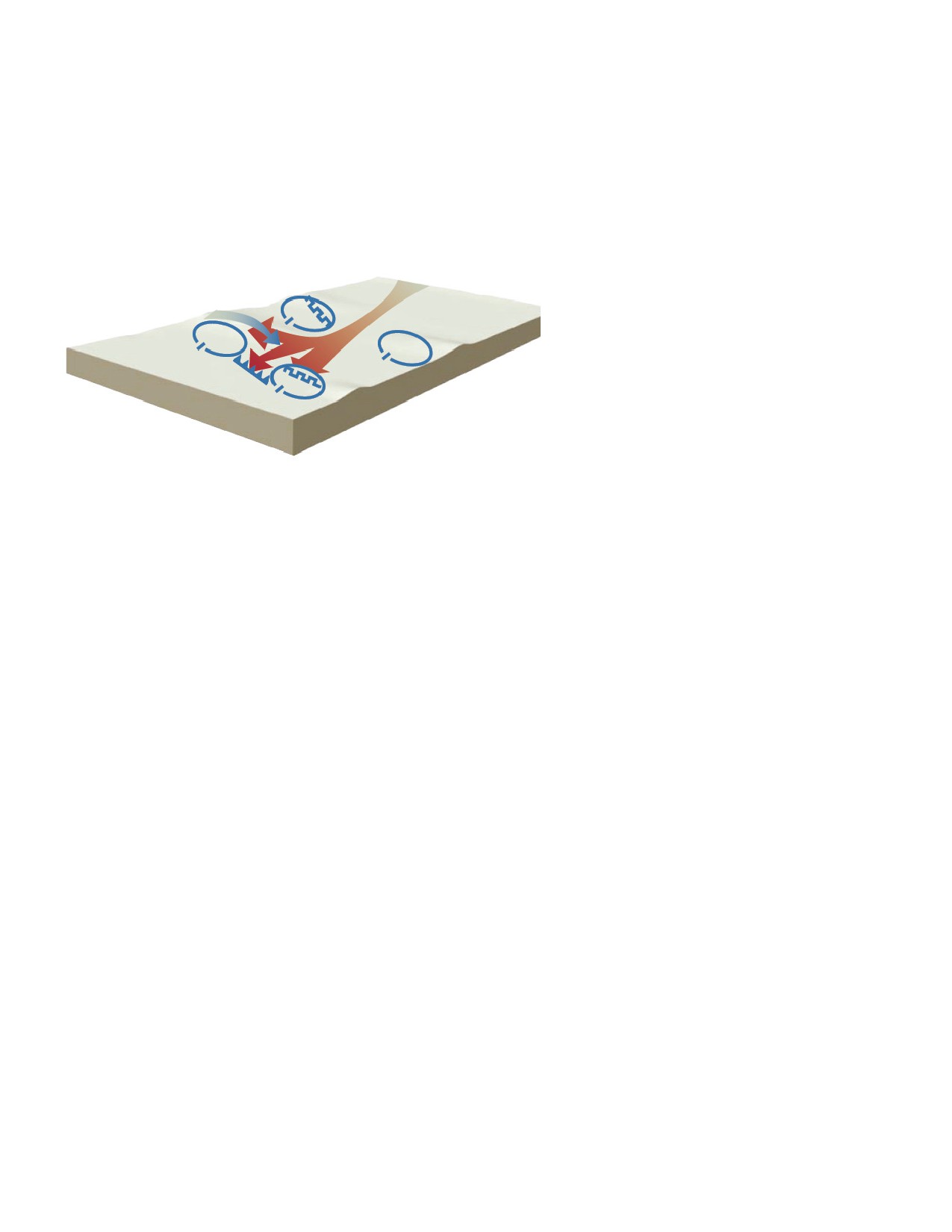
Land Operations
static and mutually supporting positions, supported by counterattacks at all available levels.
The balance between static and counterattack elements is largely dictated by terrain. The
closer the terrain, the greater the proportion of counterattacking forces and the lower the level at
which they should be employed.
3.
Area defence may be conducted in varying depth depending upon the mission, the
forces available and the nature of the terrain. See Figure 7-6.
Figure 7-6: Area Defence
757. MOBILE DEFENCE
1.
In a mobile defence a fixing force denies the adversary his freedom of action while a
striking force manoeuvres in order to defeat him. Commanders conducting a mobile defence
use terrain, obstacles, depth and deception, together with fire and manoeuvre, to encourage an
adversary to focus on the wrong objective. This renders the adversary vulnerable to attack.
Therefore, depth, time and the ability to manoeuvre are particularly important factors in the
conduct of mobile defence. Successful mobile defence requires rapidly switching between
activities, and a readiness to concede ground where appropriate.
2.
Mobile defence focuses on the destruction of the attacking force by permitting it to
advance to a position that exposes it to counterattack and envelopment. The emphasis is on
defeating the adversary rather than retaining or retaking ground. Mobile defences employ a
combination of offensive, defensive and delaying action necessitating the forward deployment of
relatively small forces, and the use of manoeuvre supported by fire and obstacles, to wrest the
initiative from the attacker after he has entered the defended area. Consequently, the
defending force must have mobility equal to or greater than the adversary's and the ability to
form a large reserve that will conduct the decisive counterattack. See Figure 7-7.
7-52
B-GL-300-001/FP-001

The Conduct of Land Operations
Figure 7-7: Mobile Defence
758. DEFENCE BY AN ENCIRCLED FORCE
1.
An encircled force may breakout, exfiltrate towards friendly forces, attack deeper into the
adversary, or defend itself. The purpose of defending an encircled force may be to retain
ground or draw away adversary forces as part of a larger manoeuvre, or to preserve the combat
power of forces unexpectedly encircled and unable to breakout or exfiltrate. An encircled force
may conduct either an area defence, or a mobile defence if it has sufficient fuel. The key
consideration in organizing the defence of an encircled force is to anticipate how the adversary
will attempt to split the force and reduce it piecemeal.
SECTION 11
THE PLANNING AND CONDUCT OF THE DEFENCE
759. GENERAL
1.
The planning and preparation for defensive operations will take considerable time.
Commanders ideally site positions two echelons below them. Hence, a battle group (BG)
commander will site platoon positions. However, time may not exist for such detailed planning
and preparation. Commanders should then focus on describing the effects that defensive
positions must create at subordinate levels in order to achieve the tactical objective of the
defensive operation. Subordinates will then use the available time to site their positions so that
the desired effects are created.
2.
During the early stages of a defensive operation, the defender will usually have the
advantage of fighting from positions of his choosing. Preparation includes positioning forces in
depth, using and improving ground, conducting reconnaissance and security operations,
developing plans for counterattacks, and initiating deception measures. These should conceal
dispositions and intentions, and misdirect the adversary’s efforts.
3.
Detailed coordination will be of utmost importance during the planning of the defensive
operation and will consume considerable time. It should include back-briefs by subordinates to
their commanders to ensure that the sited positions will create the desired effects.
B-GL-300-001/FP-001
7-53
Land Operations
760. STAGES OF THE DEFENCE
1.
The defence is a single battle, fought in two stages leading to an offensive operation.
These stages are:
a.
covering force battle; and
b.
main defence battle, including countermoves (reinforcing, blocking and
counterattacking).
761. LAYOUT OF THE DEFENSIVE AREA
1.
The covering force area and the defence area are separated by the forward edge of the
battle area (FEBA). However, the responsibility for the conduct of operations will often change
forward of the FEBA, at the handover line.
2.
The covering force area is the area extending forward from the FEBA as far as forces
are deployed to observe, engage, intercept, delay, disorganize and deceive the adversary
during his advance to the FEBA. It is within this area that the covering force must conduct its
tasks and responsibilities. In doing so, it may use delay tactics. The main defensive force must
be able to engage forward of the FEBA in order to help the covering force break clean from any
adversary forces pursuing the covering force’s rearward passage of lines.
3.
The defence area extends rearwards from the FEBA; it is that area in which it is planned
to fight the decisive defensive battle.
4.
The rear areas extend from the rear boundaries of formation/unit areas to their
subordinate formation/unit rear boundaries. It is here that the reserve forces of the
formation/unit are normally located. In addition, some long-range fire support units, organic and
attached combat support, and CSS units will often be found in this area. In the allocation of
deployment areas, consideration must be given to the areas needed for the overall concept of
defence as well as areas required for CSS troops and installations. See Figure 7-8.
7-54
B-GL-300-001/FP-001
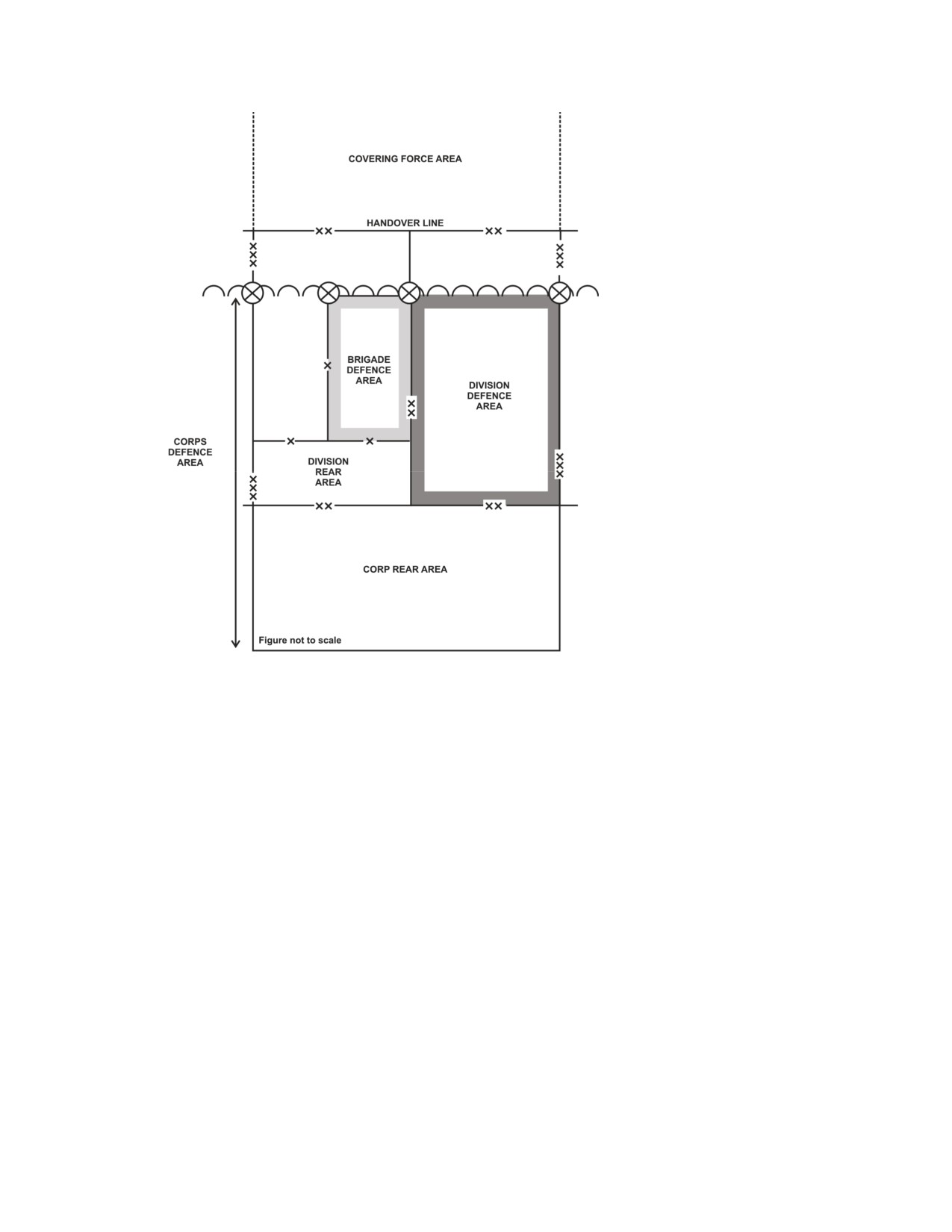
The Conduct of Land Operations
Figure 7-8: Corps Defence Area of Operations (with the Covering Force under Corps Control)
Note: This diagram illustrates a corps defence area of operations in very basic outline. It should
be remembered that within a non-linear and/or non-contiguous battlespace the lines will not
always be straight and there may be large gaps between one corps or division area and
another.
762. COVERING FORCE BATTLE
1.
General. A covering force fights a battle of movement and there will seldom be time to
prepare battle positions. Maximum destruction is inflicted on the adversary so that he arrives at
the main defence area (MDA) disrupted and disorganized. Although the task of the covering
force is very demanding, casualties and delay can be imposed on the adversary out of all
proportion to the size of the covering force if it is handled skilfully and makes use of favourable
ground. In so doing, the covering force can deceive the adversary as to the location of the MDA
and even lead him to give away his intentions.
2.
Planning Considerations. A formation, even down to brigade level, may have to
provide its own covering force. It may alternatively be part of a higher formation’s defence plan
acting as the covering force itself, or as part of the main defence force with another formation or
unit acting in this role. Similarly, a brigade can act as the covering force for a division or a
corps. In any case, there will be only one designated covering force beyond the handover line
as this negates the need for multiple handovers between successive levels. This, however, still
B-GL-300-001/FP-001
7-55
Land Operations
provides a commander the option of employing his own “covering force” in the main defensive
area up to the handover line with his superior formation. When a formation is responsible for
the covering force battle, it must understand how it is related to the main defence battle and the
impact that the conduct may have on the higher commander's intent and CONOPS in the main
defence area. Planning must incorporate contingencies to account for unexpected results or
difficulties of the covering force battle.
3.
Tasks. The commander will normally establish a covering force to form the first echelon
of a defence in depth. A commander avoids assigning conflicting tasks to a covering force. The
primary tasks may be:
a.
gaining information on the location, direction and weight of the adversary attack
(its main effort);
b.
gaining time;
c.
attrition—inflicting casualties on the adversary;
d.
providing security;
e.
counter-reconnaissance; and
f.
disruption—causing damage to the adversary's cohesion.
4.
Size and Composition. The size and composition of the covering force will depend
upon the mission, adversary, terrain and available forces. Wherever possible, the forces used
as a covering force should not be required immediately in the MDA. The covering force should
be an all-arms grouping that is self-contained in all respects. These factors take on added
significance and complexity depending upon the course of action chosen by the adversary, the
depth and width of the area available for the covering force battle, and the time required to
prepare the positions in the MDA. It must have enough mobility and firepower that it can avoid
decisive engagement and break contact from the adversary using its integral resources. The
conduct of the covering force battle will depend upon the assigned tasks. If it must gain time to
support the completion of the MDA, then it may be conducted as a delay battle.
5.
Battle Handover. Forces in the MDA assume responsibility for the battle at the
handover line. In planning and conducting the handover of a battle, a number of issues must be
considered:
a.
As the covering force approaches the handover line, it may become necessary
to increase the intensity of the fire support from the defence area to allow the
covering force to disengage. Both direct and indirect fire assets from the main
defence force will provide support to cover the redeployment of the covering
force and to cover lanes in the obstacle barriers. This rearward passage of lines
through the forward positions in the MDA must be carefully planned and
coordinated, particularly if the covering force is to break clean and if friendly fire
incidents are to be avoided.
b.
The covering force passes through the MDA forces as quickly as possible to
minimize their vulnerability to adversary fire. Combat support and CSS
resources of the covering force should move to the rear as early as possible to
avoid hampering the movement of the combat forces.
7-56
B-GL-300-001/FP-001
The Conduct of Land Operations
c.
In non-contiguous AOs, commanders must consider the partial redeployment of
the covering force. Ground should only be yielded under pressure, and the
requirement for information may dictate that elements of the covering force
remain forward of the MDA.
763. MAIN DEFENSIVE BATTLE
1.
General. The main defensive battle is fought in the MDA. Here, the effects of deep
operations and covering forces, coupled with the efforts of rear operations, are combined with
those of the main defence force to defeat the adversary. The aim of the main defence battle is
to stop the adversary’s advance by a combination of firmly held battle positions within the MDA,
together with the use of obstacles and reserves. Tactics in the MDA will vary and there can be
no set course of action. Much of what occurs will depend upon a flexible plan incorporating the
principles of mobile and/or area defence.
2.
Counter-reconnaissance. Common to all defensive operations is the requirement to
destroy or neutralize (e.g., by deception and the use of EW) adversary reconnaissance. Plans
must be made for its early destruction in all sectors of the battlefield, but these plans must not
result in the premature disclosure of key elements of the defence. Success against adversary
reconnaissance will help maintain the security of reserves, achieve surprise in offensive action,
and retain the integrity of fire support systems and command and logistic infrastructures.
Measures that can be taken against adversary reconnaissance include:
a.
Use of the covering force to destroy or neutralize it as early as possible so that
the dispositions in the MDA are not disclosed. This requires the coordination of
surveillance and target acquisition systems with direct and indirect weapon
systems.
b.
Protection of friendly dispositions through camouflage, concealment and
defensive C2 warfare in order to deny information to the adversary. This is
particularly important once adversary reconnaissance has penetrated the
covering force. Adversary reconnaissance should be engaged within a
framework of patrols and ambushes, forward of and between battle positions.
c.
The use of aviation may be considered if sufficient assets are available,
although targets are likely to be dispersed and exposed only for short periods.
d.
Indirect fire can be effective in terms of neutralization and destruction, but it is
more likely to be committed to larger and higher priority targets. Assets are
likely to be limited and “unmasking” will jeopardize security. Special care needs
to be taken to protect the security of reserves and high value targets (HVTs).
Camouflage and deception measures should be employed, but critical reserves
may require forces assigned to them specifically for protection against adversary
reconnaissance.
e.
In the rear areas, there is a requirement to be diligent in seeking out and
destroying reconnaissance elements. Reconnaissance and reserves may be
used if they are not committed to other tasks.
f.
When adversary reconnaissance forces adopt unconventional tactics and blend
with local populations, measures must be taken to counter this adversary.
B-GL-300-001/FP-001
7-57
Land Operations
Troops conducting static defence or framework patrols must watch for
suspicious activities, monitor those with cellular telephones and conduct shadow
patrols. Suspected individuals should be stopped and investigated, keeping in
mind the need to avoid alienation of the local populace.
3.
Battle Handover. Gaps or lanes in barriers that have been left for the redeployment of
the covering force must be guarded and arrangements must be made to close them. Once the
covering force has completed its handover of the battle to the main defence force, the
commander must consider the subsequent employment of the covering force. He may decide
to employ it immediately as his reserve, which will allow him to release his initial reserve for
other tasks. It may be some time, however, before the covering force is ready for commitment.
A more likely option, therefore, is to designate it as the formation reserve once it has been
reconstituted. Much will depend upon how the main defence battle is progressing.
4.
Initial Actions. Once the adversary has reached the MDA, he will try to find weak
points and attempt to force a passage, possibly by a series of small-scale attacks. As the
adversary attack begins to develop, the forward units will engage the adversary. As the battle
progresses, the adversary advance may be slowed and he may become concentrated by the
barriers and the battle positions, thus presenting good targets for defensive fire and offensive air
support. The maximum weight of fire must be brought to bear at this stage of the battle.
5.
Conduct of the Battle. The battle will be fought by the formation's subordinate units
using direct fire, indirect fire and manoeuvre against the assaulting adversary forces. The
commitment of reserves must be controlled. The conduct of deep operations against echeloned
adversary forces must be coordinated. The employment of engineers and of sustainment
resources must be clearly defined.
6.
Penetration. Undefended areas may be unavoidable between battle positions, but they
must not be left where the probable main adversary effort is expected. They must be kept
under surveillance, covered by fire, or where possible, blocked by barriers. These
responsibilities must be clearly defined. If the adversary succeeds in penetrating the MDA, the
defender must block the penetration immediately and destroy this adversary force as soon as
possible, hence the need for reserves with battlefield mobility. Action may be extended in depth
in order to counter adversary penetrations that cannot be stopped further forward. In a mobile
defence the commander may allow penetration in a selected area in order to launch his striking
force at the appropriate time and place. Any decision to redeploy must take into account the
situation prevailing in adjacent defence areas.
764. EMPLOYMENT OF RESERVES
1.
General. Commanders must earmark mobile forces as reserves for offensive tasks,
which are an integral part of the defence concept. If it becomes apparent in the course of the
battle that the cohesion of the defence cannot be maintained, the next higher commander may
assign additional reinforcing, blocking or counterattack forces from his own resources. Once a
reserve force is committed, it must be reconstituted from other forces not in contact. The
movement of reserves will be a priority target for the adversary and thus protection will be vital.
Where the adversary air threat is particularly high, there will be a requirement for AD assets to
be assigned to the security of reserves.
7-58
B-GL-300-001/FP-001
The Conduct of Land Operations
2.
Purpose. The primary purpose of a reserve is to preserve the commander's freedom of
action. The reserve is an uncommitted force, at least initially. It may have a series of
contingencies, although a commander will not commit his reserve until he has a reasonable
understanding of the adversary’s intentions. If the commander must commit his reserve in order
to counter an unexpected adversary action, then he must advise his superior commander who
must than reconsider the employment of his reserve and the impact this will have on his
superior commander's intent. Reserves are commonly used for:
a.
Counter-moves:
(1)
Reinforcement. Forces that are engaged in combat are provided with
additional combat power from the designated reserve unit or formation, or
from any uncommitted forces.
(2)
Blocking. Blocking is the deployment of forces to stop the attacking
force that has broken through the forward positions. The timing of the
deployment of a blocking force will depend upon the way the adversary
action develops, with particular regard to his strength, speed and direction
of advance. This must be analyzed and related to the location and size of
the blocking force available, its reaction time, and the time available to
prepare blocking positions. Often, it is only by blocking that the adversary
can be halted in preparation for a counterattack. Airmobile forces are
often particularly suited to this role allowing an armoured reserve to be
retained for the counterattack.
(3)
Counterattack. The counterattack exploits opportunities to strike the
adversary at a decisive time and place in order to defeat him. The
opportunity to launch a counterattack will be fleeting and therefore a
commander and his forces must be mentally and physically prepared for
the task. Its planning is a basic and essential part of the defence and it
must be updated as the situation develops. Possible options in a
counterattack include the cutting off or destruction of adversary units,
recovery of lost ground, or any other action that seeks to restore a
situation. Once the commander has decided that a counterattack can be
mounted, he will launch it with the full force of all available resources
necessary to ensure success.
b.
Spoiling Attacks. A reserve may be employed in carrying out a spoiling attack
with the intention of preventing or delaying adversary attacks. They are
normally launched against adversary forces that are forming or assembling for
an attack. Spoiling attacks are usually conducted against opportunity targets
with the objective of destroying adversary personnel and equipment, not to
secure terrain. The following basic considerations affect the use of the spoiling
attack:
(1)
The commander should designate the size of the force to be employed
and the acceptable risks.
(2)
Spoiling attacks should not be conducted if the loss or destruction of the
force jeopardizes the ability of the reserve to accomplish its primary
mission.
B-GL-300-001/FP-001
7-59