CANADA. LAND OPERATIONS (ENGLISH, 2008) - page 1
B-GL-300-001/FP-001
LAND OPERATIONS
(ENGLISH)
Supersedes B-GL-300-001/FP-000 dated 1998-07-01 and B-GL-300-002/FP-001 dated
1997-05-16.
WARNING
ALTHOUGH NOT CLASSIFIED, THIS PUBLICATION, OR ANY PART OF IT, MAY BE EXEMPT FROM
DISCLOSURE TO THE PUBLIC UNDER THE ACCESS TO INFORMATION ACT. ALL ELEMENTS OF
INFORMATION CONTAINED HEREIN MUST BE CLOSELY SCRUTINIZED TO ASCERTAIN WHETHER OR
NOT THE PUBLICATION OR ANY PART OF IT MAY BE RELEASED.
This publication is issued on the authority of the Chief of Land Staff.
B-GL-300-001/FP-001
LAND OPERATIONS
(ENGLISH)
Supersedes B-GL-300-001/FP-000 dated 1998-07-01 and B-GL-300-002/FP-001 dated
1997-05-16.
WARNING
ALTHOUGH NOT CLASSIFIED, THIS PUBLICATION, OR ANY PART OF IT, MAY BE EXEMPT FROM
DISCLOSURE TO THE PUBLIC UNDER THE ACCESS TO INFORMATION ACT. ALL ELEMENTS OF
INFORMATION CONTAINED HEREIN MUST BE CLOSELY SCRUTINIZED TO ASCERTAIN WHETHER OR
NOT THE PUBLICATION OR ANY PART OF IT MAY BE RELEASED.
This publication is issued on the authority of the Chief of Land Staff.
Director of Army Doctrine
2008-01-01
Land Operations
PREFACE
AIM
1.
The purpose of this publication is to present capstone doctrine for the conduct of land
operations. It combines and supersedes two former publications, Conduct of Land Operation—
Operational Level Doctrine for the Canadian Army (B-GL-300-001/FP-000) and Land Force
Tactical Doctrine (B-GL-300-002/FP-000). This combination reflects the intrinsic link between
activities and effects across these two levels of command.
APPLICABILITY
1.
This publication is applicable at the operational and tactical levels and relevant to
strategic level planners and commanders.
SCOPE
1.
This publication is written to be in line with and to reflect the long-standing, proven and
extant philosophies and principles for the creation and application of a military force’s fighting
power. It describes the Canadian approach to operations.
2.
The doctrine within publication recognizes that in order to reach enduring operational
and strategic end states, the root causes of a conflict must be addressed in light of the given
environment and its influencing elements and systems. To this end, land forces do not simply
undertake physical activities and effects against adversarial forces. Land forces apply their
capabilities to complete a combination of physical activities and influence activities that create
effects on the physical and psychological planes. In doing so, a wide range of targets is
engaged. This range will certainly include adversaries, but also other groups, systems, and
individuals within the battlespace and environment that play a role in reaching the operational
and campaign objectives and end states. In this comprehensive application of combat power
the military does not act alone, for many enduring solutions to a conflict requires the support of
other agencies and elements of power. Thus, this publication does not view military operations
in isolation, but places them in the context of a joint, inter-agency, multinational, and public
framework.
3.
Although the publication introduces some new terminology and expands upon certain
concepts, the roles, missions, and tasks in which Land Force units have traditionally participated
have not changed. The doctrinal concepts are not necessarily new, but they only articulated in
more detail.
4.
The publication addresses the following subject areas:
a.
The place of the land force with strategic and operational hierarchy.
b.
Characteristics of an operating environment.
c.
The conceptual employment of land forces.
d.
The generation of fighting power and its application through conceptual
frameworks.
iii
B-GL-300-001/FP-001
e.
The application of fighting power.
f.
The planning of land operations.
g.
The conduct of land operations.
h.
An introduction to specific operations and specific environments.
RELATIONSHIPS TO ALLIED DOCTRINE
1.
This publication is consistent with the doctrine of Canada’s key allies and partners,
particularly those in the American, British, Canadian, Australian and New Zealand Armies’
Standardization Programme (ABCA). Major concepts are also in-line with current North
American Treaty Organization (NATO) doctrine and Standardization Agreements (STANAGs).
This publication is, in essence, the implementation of NATO Allied Joint Publication 3.2
(AJP-3.2) Joint Allied Doctrine for Land Operations and Allied Tactical Publication 3.2.1
(ATP 3.2.1) Allied Land Tactics.
2.
Vignettes used in this publication illustrate the application of doctrine or present lessons
learned. Unless otherwise noted, all formal definitions and abbreviations given herein have
been taken from NATO Allied Administrative Publication 6 (AAP-6) Glossary of Terms and
Definitions, or NATO AAP-15 Glossary of Abbreviations used in NATO Documents and
Publications. It is vital from a point of common understanding and academic rigour that
discussions about doctrinal concepts utilize formally adopted terminology. Questions or
comments regarding the content of this publication shall be directed to the Directorate of Army
Doctrine.
iv
Land Operations
TABLE OF CONTENTS
FOREWORD
i
PREFACE
iii
CHAPTER 1 THE ROLE OF CANADIAN LAND FORCES
SECTION 1 INTRODUCTION
1-1
101.
General
1-1
102.
Strategic Context for the Canadian Forces
1-1
103.
Command and Control—Supporting and Supported Elements
1-3
SECTION 2 THE LAND COMPONENT: ROLE AND COMPOSITION
1-3
104.
Role and Employment of Land Forces
1-3
105.
Land Force Elements and Types
1-4
106.
Organization of Land Forces
1-6
107.
Modularity and Scalability
1-8
CHAPTER 2 DEFINING THE OPERATING ENVIRONMENT AND THE NATURE
OF LAND COMBAT
SECTION 1 INTRODUCTION
2-1
201.
General
2-1
SECTION 2 ELEMENTS OF THE OPERATING ENVIRONMENT
2-1
202.
Introduction
2-1
203.
Main Elements
2-1
204.
A Complex Environment
2-4
205.
Interrelated Systems and Entities
2-4
206.
Strategic End State
2-5
207.
The Physical Environment
2-6
208.
The Local Populace
2-7
SECTION 3 THE NATURE OF ADVERSARIES AND HAZARDS
2-9
209.
Adversaries
2-9
210.
Conventional Adversary
2-9
211.
Irregular Adversary
2-10
212.
Hazards
2-13
213.
A Joint, Inter-agency, Multinational and Public (JIMP) Framework
2-14
SECTION 4 THE NATURE OF LAND COMBAT
2-17
214.
Enduring Characteristics
2-17
215.
Complexity
2-19
v
B-GL-300-001/FP-001
216.
Unpredictability
2-20
ANNEX A OF CHAPTER 2 THE IRREGULAR ADVERSARY
2A-1
SECTION 1 INTRODUCTION
2A-1
2A01. General
2A-1
2A02. Qualities of Irregular Adversaries
2A-1
2A03. Strategy and Operations
2A-2
2A04. Irregular Adversary Operational Requirements
2A-5
2A05. Adversary Battlespace Organization
2A-6
2A06. Adversary Tactics, Techniques, and Procedures
2A-8
CHAPTER 3 THE EMPLOYMENT OF LAND FORCES
SECTION 1 INTRODUCTION
3-1
301.
General
3-1
302.
Doctrine for the Employment of Land Forces
3-1
303.
The Levels of Warfare
3-2
304.
Applying the Principles of War
3-5
SECTION 2 THE CONTINUUM OF OPERATIONS
3-8
305.
General
3-8
306.
Spectrum of Conflict
3-9
307.
Predominant Campaign Themes
3-9
SECTION 3 CAMPAIGN THEME CHARACTERISTICS
3-14
308.
General
3-14
309.
Major Combat
3-14
310.
Counter-insurgency
3-15
311.
Peace Support
3-16
312.
Peacetime Military Engagement
3-17
313.
Limited Intervention
3-17
314.
Full-Spectrum Operations: Land Tactical Operations of Offensive,
Defensive, Stability, and Enabling
3-18
315.
Tactical Activities
3-20
316.
Tactical Tasks and Effects
3-22
317.
Transition in Campaigns
3-24
318.
Domestic Operations
3-25
CHAPTER 4 THE GENERATION OF FIGHTING POWER AND ORGANIZATIONAL
FRAMEWORKS
SECTION 1 INTRODUCTION
4-1
vi
Land Operations
401.
General
4-1
402.
The Generation of Fighting Power
4-1
403.
Frameworks for the Organization and Application of Fighting Power
4-4
SECTION 2 THE BATTLESPACE FRAMEWORK
4-8
404.
Battlespace
4-8
405.
Area of Interest
4-10
406.
Area of Operations
4-11
407.
Area of Responsibility
4-11
408.
Areas Unassigned
4-16
409.
Area of Influence
4-16
410.
Deep, Close, and Rear—Operations in Space and Time
4-17
SECTION 3 THE FUNCTIONAL FRAMEWORK: OPERATIONAL FUNCTIONS AND
CORE FUNCTIONS
4-19
411.
General
4-19
412.
The Operational Functions
4-19
413.
Command
4-19
414.
Sense
4-20
415.
Act
4-20
416.
Shield
4-21
417.
Sustain
4-21
418.
The Shared Functional Aspect
4-21
419.
The Core Functions—Find, Fix, and Strike
4-22
420.
Find
4-23
421.
Fix
4-23
422.
Strike
4-24
423.
Exploitation
4-25
424.
Combining the Core Functions at All Levels and Across Agencies
4-26
SECTION 4 THE EFFECTS FRAMEWORK: SHAPING, DECISIVE, AND
SUSTAINING OPERATIONS
4-26
425.
General
4-26
426.
Decisive, Shaping, and Sustaining Operations
4-27
SECTION 5 INTEGRATION OF THE ORGANIZATIONAL FRAMEWORKS:
BATTLESPACE, FUNCTIONAL, AND EFFECTS FRAMEWORKS
4-28
427.
General
4-28
SECTION 6 THE ELEMENTS OF INTEGRATION OF THE FRAMEWORKS
4-29
428.
General
4-29
vii
B-GL-300-001/FP-001
429.
Main Effort
4-29
430.
Synchronization
4-30
431.
Tempo
4-31
432.
Summary
4-33
CHAPTER 5 THE APPLICATION OF COMBAT POWER
SECTION 1 INTRODUCTION
5-1
501.
General
5-1
SECTION 2 PHYSICAL ACTIVITIES (FIRES), INFLUENCE ACTIVITIES,
AND EFFECTS ON THE PHYSICAL AND PSYCHOLOGICAL PLANES
5-2
502.
General
5-2
503.
The Physical Plane
5-2
504.
The Psychological Plane
5-3
505.
Physical Activities—Fires
5-4
506.
Influence Activities
5-5
507.
The Interaction and Balance of Activities on the Two Planes:
Comprehensive Operations
5-9
508.
Defining Success Through the Application of Combat Power
5-12
SECTION 3 THE COMPREHENSIVE APPROACH TO OPERATIONS
5-14
509.
General
5-14
510.
Comprehensive Approach to Campaigns and Operations
5-14
SECTION 4 AN EFFECTS-BASED APPROACH TO OPERATIONS
5-19
511.
General
5-19
512.
Philosophy and Purpose
5-20
513.
Principles
5-23
514.
Key Elements of an Effects-based Approach to Operations
5-23
515.
Understanding Effects
5-25
SECTION 5 APPLYING AN EFFECTS-BASED APPROACH
5-28
516.
General
5-28
517.
Tactical Level Application of an Effects-based Approach
5-28
518.
Operational Level Application of the Effects-based Approach
5-30
SECTION 6 EFFECTS-BASED APPROACH AS PART OF OPERATIONAL DESIGN
AND CAMPAIGN PLANNING
5-33
519.
General
5-33
SECTION 7 ASSESSMENT—MEASURES OF PERFORMANCE AND MEASURES
OF EFFECTIVENESS
5-34
520.
General
5-34
viii
Land Operations
521.
Measures of Performance and Their Selection
5-36
522.
Measures of Effectiveness and Their Selection
5-37
SECTION 8 THE KNOWLEDGE BASE AND THE SPECTRUM OF
RELATIVE INTEREST
5-39
523.
General
5-39
SECTION 9 INFORMATION OPERATIONS
5-43
524.
Introduction
5-43
525.
Core Activity Areas
5-44
526.
Key Activities Within Information Operations
5-45
527.
Targets for Information Operations
5-49
528.
Influence Activity
5-50
529.
Information Operations Philosophy
5-53
530.
Offensive and Defensive Information Operations
5-54
531.
Principles in the Application of Information Operations
5-55
532.
Target Audience Filters and Innate Perceptions: External Influences
and Internal Perceptions
5-57
533.
The Messages and Messengers
5-59
534.
Assessment—Measures of Performance and Effectiveness
5-61
SECTION 10 MANOEUVRE WARFARE
5-64
535.
Manoeuvre Doctrine and Its Application
5-64
SECTION 11 APPROACHES TO ATTACKING WILL AND COHESION
5-67
536.
General
5-67
537.
Pre-emption
5-68
538.
Dislocation
5-68
539.
Disruption
5-69
540.
Application of Manoeuvre Doctrine: Maintaining Cohesion and Attacking
the Adversary’s Cohesion
5-70
541.
Enablers for the Manoeuvrist Approach
5-72
542.
Principles of Manoeuvre Warfare
5-73
SECTION 12 MISSION COMMAND
5-75
543.
Definition and Tenets
5-75
544.
Creating a Mission Command Atmosphere
5-75
545.
Unity of Effort and Common Intent
5-76
546.
Summary
5-77
CHAPTER 6 THE PLANNING OF LAND OPERATIONS
SECTION 1 INTRODUCTION
6-1
ix
B-GL-300-001/FP-001
601.
General
6-1
602.
Campaign Authority
6-1
SECTION 2 OPERATIONAL ART, OPERATIONAL DESIGN,
AND CAMPAIGN PLANNING
6-3
603.
General
6-3
604.
Planning Levels Across Campaign Themes
6-4
SECTION 3 THE ELEMENTS OF OPERATIONAL DESIGN
6-6
605.
General
6-6
606.
Operational Estimate and Mission Analysis
6-6
607.
The Conceptual Elements of Operational Design and Campaign Planning
6-8
608.
End State
6-8
609.
Centre of Gravity
6-9
610.
Objectives
6-14
611.
Decisive Point
6-15
612.
Lines of Operation
6-17
613.
Culminating Point
6-19
614.
Operational Reach, Approach and Pause
6-20
615.
Simultaneous and Sequential Operations
6-21
616.
Linear and Non-linear Operations
6-22
617.
Tempo
6-22
SECTION 4 CAMPAIGN PLANNING AND AN EFFECTS-BASED APPROACH
6-22
618.
General
6-22
619.
Effects-based Approach Construct for Campaign Planning
6-24
620.
Step 1—Analysis of the Situation
6-25
621.
Step 2—Identification and Analysis of the Problem or Crisis
6-26
622.
Step 3—Framing the Campaign Plan and the Initial Operation Plan
6-28
623.
Step 4—Development of the Operation Plan
6-32
624.
Employment of Special Forces
6-34
625.
Planning Horizons
6-35
626.
Long-range Planning Horizon
6-36
627.
Mid-range Planning Horizon
6-37
628.
Short-range Planning Horizon
6-37
629.
Contingency Planning
6-37
SECTION 5 BATTLE PROCEDURE
6-38
630.
General
6-38
x
Land Operations
631.
The Battle Procedure Model and the Constituent Parts
6-39
632.
Command and Control
6-43
633.
Echeloning and Synchronization of Battle Procedure
6-44
CHAPTER 7 THE CONDUCT OF LAND OPERATIONS
SECTION 1 INTRODUCTION
7-1
701.
General
7-1
702.
Preparation and Deployment
7-2
SECTION 2 COMMAND OF LAND OPERATIONS
7-3
703.
Establishing Positive Conditions
7-3
704.
Early Use of Intelligence
7-4
705.
Obtaining and Allowing Freedom of Action
7-5
SECTION 3 FUNDAMENTALS IN THE CONDUCT OF LAND OPERATIONS
7-6
706.
Introduction
7-6
707.
Seizing and Maintaining the Initiative
7-6
708.
Full-spectrum Operations
7-7
709.
Tempo
7-8
710.
Main Effort
7-8
711.
Synchronization Within the Operational Framework and
Battlefield Framework
7-8
SECTION 4 THE TARGETING PROCESS
7-9
712.
Introduction
7-9
713.
Definitions
7-9
714.
Fundamentals of Targeting
7-10
715.
The Land Force Targeting Cycle
7-10
716.
Intelligence Led Operations
7-16
SECTION 5 OFFENSIVE OPERATIONS
7-17
717.
Tactical Level Operations—General
7-17
718.
Purpose of Offensive Operations
7-18
719.
Principles of War in Offensive Operations
7-18
720.
Fundamentals of Offensive Operations
7-19
721.
Types of Offensive Activities
7-21
722.
Attack
7-21
723.
Raid
7-23
724.
Reconnaissance in Force
7-23
725.
Exploitation
7-24
xi
B-GL-300-001/FP-001
726.
Pursuit
7-24
727.
Ambush
7-24
728.
Breakout of Encircled Forces
7-24
729.
Feint and Demonstration
7-25
730.
Offensive (Physical) Information Operations
7-25
SECTION 6 FORMS OF MANOEUVRE
7-25
731.
General
7-25
732.
Frontal
7-26
733.
Penetration
7-26
734.
Envelopment
7-28
735.
Turning Movement
7-29
736.
Infiltration
7-30
737.
Integrating Forms of Manoeuvre
7-30
738.
Stages of the Attack
7-30
739.
Control Measures
7-33
SECTION 7 FORCES AND TASKS IN OFFENSIVE OPERATIONS
7-35
740.
General
7-35
741.
Assault Force
7-35
742.
Flank Security and Protection
7-36
743.
Echeloned Force or Reserve
7-37
744.
Employment of Combat Support Forces
7-37
SECTION 8 PLANNING AND PREPARATION
7-40
745.
Planning
7-40
746.
Preparation
7-43
747.
Command and Control of Offensive Activities
7-43
748.
Combat Service Support
7-44
SECTION 9 DEFENSIVE OPERATIONS
7-45
749.
Purpose
7-45
750.
Concept of the Defence
7-46
751.
Principles of War in Defensive Operations
7-46
752.
Fundamentals in Defensive Operations
7-47
753.
Types of Defensive Action
7-51
754.
Defence on the Psychological Plane
7-51
SECTION 10 FORMS OF THE DEFENCE
7-52
755.
General
7-52
xii
Land Operations
756.
Area Defence
7-52
757.
Mobile Defence
7-52
758.
Defence by an Encircled Force
7-53
SECTION 11 THE PLANNING AND CONDUCT OF THE DEFENCE
7-53
759.
General
7-53
760.
Stages of the Defence
7-54
761.
Layout of the Defensive Area
7-54
762.
Covering Force Battle
7-55
763.
Main Defensive Battle
7-57
764.
Employment of Reserves
7-58
765.
General Considerations for the Defensive Battle
7-60
SECTION 12 FORCES AND TASKS FOR THE DEFENCE
7-63
766.
General
7-63
767.
Armoured Forces
7-63
768.
Non-armoured Forces
7-64
769.
Armed Aviation
7-64
770.
Artillery
7-65
771.
Air Support
7-65
772.
Support Helicopters
7-66
773.
Air Defence
7-66
774.
Engineers
7-66
775.
Command and Control Measures in the Defence
7-69
SECTION 13 COMBAT SERVICE SUPPORT IN THE DEFENCE
7-70
776.
General
7-70
777.
Specific Considerations
7-70
778.
Summary
7-71
SECTION 14 THE PLANNING AND EXECUTION OF THE DELAY
7-71
779.
Purpose and Concept of the Delay
7-71
780.
Principles of War in the Delay
7-72
781.
Fundamentals of Delay Operations
7-72
782.
Concept of Operations for the Delay
7-73
783.
Organization of the Terrain
7-74
784.
Delay Tactics
7-75
SECTION 15 PLANNING AND PREPARATION FOR THE DELAY
7-75
785.
Planning
7-75
xiii
B-GL-300-001/FP-001
SECTION 16 FORCES AND TASKS
7-77
786.
General
7-77
787.
Employment of Manoeuvre Forces
7-77
788.
Employment of Combat Support Forces
7-78
789.
Command and Control Measures
7-80
790.
Execution of the Delay
7-81
791.
Combat Service Support in the Delay
7-83
792.
Summary
7-83
SECTION 17 STABILITY OPERATIONS
7-83
793.
Definition and Purpose
7-83
794.
Stability Operations—Tactical Activities
7-85
795.
Principles of War in Stability Operations
7-86
796.
Fundamentals for Stability Operations
7-87
797.
Tactical Tasks for Stability Operations
7-88
798.
Security and Control
7-90
799.
Support to Disarmament, Demobilization and Reintegration
7-91
7100.
Support to Security Sector Reform
7-91
SECTION 18 SUPPORT TO CIVILIAN INFRASTRUCTURE AND GOVERNANCE
7-92
7101.
General
7-92
7102.
Support to Infrastructure
7-93
7103.
Support to Governance
7-94
7104.
Planning and Implementation for Support to Infrastructure and Governance .. 7-95
7105.
Assistance to Other Agencies
7-96
7106.
Planning for Stability Operations as Part of Campaign Planning
7-96
SECTION 19 APPLICATION OF STABILITY OPERATIONS IN CAMPAIGNS
7-98
7107.
Major Combat Campaigns
7-98
7108.
Counter-insurgency Campaigns
7-99
7109.
Peace Support Campaigns
7-100
7110.
Peacetime Military Engagement
7-100
7111.
Limited Intervention
7-101
7112.
Force Employment for Stability Activities
7-101
SECTION 20 ALLOCATION OF MILITARY FORCES TO STABILITY ACTIVITIES
7-101
7113.
General
7-101
7114.
Force Employment in Stability Activities
7-102
7115.
Interagency Cooperation in Building Indigenous Capacity
7-105
xiv
Land Operations
SECTION 21 COMMAND AND CONTROL FOR STABILITY ACTIVITIES
7-105
7116.
General
7-105
7117.
Unified Command and Coordination
7-106
7118.
Measures of Effectiveness
7-106
7119.
Transition of Stability Operations
7-107
SECTION 22 ENABLING OPERATIONS
7-108
7120.
General
7-108
7121.
Reconnaissance
7-109
7122.
Security
7-109
SECTION 23 ADVANCE TO CONTACT
7-110
7123.
Purpose
7-110
7124.
Conduct
7-111
7125.
Combat Support in an Advance
7-114
7126.
Command and Control of an Advance
7-115
7127.
Combat Service Support in an Advance
7-115
7128.
Tactical Movement
7-116
SECTION 24 MEETING ENGAGEMENT
7-116
7129.
Purpose
7-116
7130.
Conduct
7-117
7131.
Combat Support in a Meeting Engagement
7-118
7132.
Command and Control of a Meeting Engagement
7-118
7133.
Combat Service Support in a Meeting Engagement
7-119
SECTION 25 LINK-UP
7-119
7134.
Purpose
7-119
7135.
Conduct
7-120
7136.
Direct and Indirect Fire Support During a Link-up
7-121
7137.
Engineers
7-121
7138.
Electronic Warfare
7-121
7139.
Command and Control of a Link-up
7-121
7140.
Combat Service Support during a Link-up
7-122
7141.
Link-up of a Moving Force with a Stationary Force
7-122
7142.
Link-up of Two Moving Units
7-123
SECTION 26 WITHDRAWAL
7-123
7143.
Purpose
7-123
7144.
Organization of the Withdrawal
7-124
xv
B-GL-300-001/FP-001
7145.
Planning
7-125
7146.
Conduct—Scheme of Manoeuvre and Sequence of Withdrawal
7-126
7147.
Combat Support in the Withdrawal
7-127
7148.
Command and Control of a Withdrawal
7-128
7149.
Combat Service Support in the Withdrawal
7-129
7150.
Retirement
7-129
SECTION 27 RELIEF
7-129
7151.
Purpose
7-129
7152.
Interoperability
7-130
7153.
General Planning for a Relief
7-131
7154.
Relief in Place
7-131
7155.
Relief of Encircled Forces
7-133
7156.
Extended Relief in Place
7-133
7157.
Forward Passage of Lines
7-134
7158.
Rearward Passage of Lines
7-136
7159.
Combat Support in a Relief Operation
7-139
SECTION 28 COMMAND AND CONTROL OF A RELIEF OPERATION
7-140
7160.
Responsibilities
7-140
7161.
Coordination
7-140
7162.
Communications
7-141
7163.
Combat Service Support in a Relief Operation
7-141
SECTION 29 CROSSING AND BREACHING OF OBSTACLES
7-141
7164.
Introduction
7-141
7165.
Types of Obstacles and Their Characteristics
7-142
7166.
Types of Crossing and Breaching
7-143
SECTION 30 GENERAL PLANNING CONCEPTS AND FACTORS
7-143
7167.
Concept
7-143
7168.
Planning Factors
7-144
SECTION 31 CONDUCT OF WATER CROSSING OPERATIONS
7-144
7169.
Planning Considerations
7-144
7170.
Execution
7-146
7171.
Water Crossings as Part of the Delay Battle
7-147
7172.
Combat Support in an Obstacle Crossing
7-148
7173.
Combat Service Support in an Obstacle Crossing
7-149
7174.
Command and Control of an Obstacle Crossing
7-149
xvi
Land Operations
7175.
Considerations for the Commander of the Obstacle Crossing
7-149
7176.
Direction
7-150
7177.
Controlling Headquarters
7-150
7178.
Engineer Commander Responsibilities
7-150
7179.
Crossing Site Commander and Headquarters
7-151
7180.
Crossing Formations and Units
7-151
7181.
Crossing Plan
7-151
SECTION 32 CONDUCT OF BREACHING OPERATIONS
7-153
7182.
General
7-153
7183.
Planning
7-153
7184.
Execution
7-153
7185.
Combat Service Support in Breaching Operations
7-154
7186.
Command and Control of Breaching Operations
7-154
7187.
Conduct of Other Obstacle Crossing
7-154
SECTION 33 CONCLUDING THE CAMPAIGN
7-154
7188.
General
7-154
7189.
Campaign Transition and Conclusion
7-154
7190.
Redeployment
7-156
ANNEX A TO CHAPTER 7
7A-1
ANNEX B TO CHAPTER 7
7B-1
CHAPTER 8 INTRODUCTION TO SPECIFIC OPERATIONS AND
SPECIFIC ENVIRONMENTS
SECTION 1 INTRODUCTION
8-1
801.
General
8-1
SECTION 2 SPECIFIC OPERATIONS
8-2
802.
Air and Sea Insertions—General
8-2
803.
Airmobile Operations—General
8-2
804.
Threat
8-2
805.
Organization and Capabilities
8-3
806.
Tasks
8-3
807.
Limitations
8-4
808.
Planning
8-4
SECTION 3 AIRBORNE OPERATIONS
8-5
809.
General
8-5
810.
Capabilities
8-6
xvii
B-GL-300-001/FP-001
811.
Types of Operation
8-6
812.
Tasks
8-7
813.
Limitations and Vulnerabilities
8-7
814.
Planning and Execution
8-7
SECTION 4 AMPHIBIOUS OPERATIONS
8-8
815.
General
8-8
816.
Capabilities and Types of Operation
8-9
817.
Planning and Conduct Sequence
8-10
818.
Termination
8-10
819.
Conclusion
8-11
SECTION 5 OPERATIONS BY ENCIRCLED FORCES
8-11
820.
General
8-11
821.
Defence
8-11
822.
Breakout Operations
8-12
SECTION 6 SPECIFIC ENVIRONMENTS CHEMICAL, BIOLOGICAL,
RADIOLOGICAL AND NUCLEAR DEFENCE
8-14
823.
General
8-14
824.
Fundamentals of CBRN Defence
8-14
825.
Factors for Planning
8-14
826.
Hazard Avoidance
8-15
827.
Protection
8-16
828.
Contamination Control
8-16
829.
Combat Service Support Considerations
8-17
830.
Medical Support
8-18
SECTION 7 URBAN OPERATIONS
8-18
831.
General
8-18
832.
Characteristics
8-18
833.
Planning
8-19
834.
Offensive Operations
8-20
835.
Defensive Operations
8-21
836.
Stability Operations
8-21
SECTION 8 OPERATIONS IN FORESTS
8-22
837.
General
8-22
838.
Characteristics
8-22
839.
Tactical Operations
8-23
xviii
Land Operations
SECTION 9 OPERATIONS IN MOUNTAINS
8-23
840.
General
8-23
841.
Characteristics
8-23
842.
Offensive Operations
8-24
843.
Defensive Operations
8-24
844.
Stability Operations
8-25
SECTION 10 OPERATIONS IN ARCTIC AND COLD WEATHER CONDITIONS
8-25
845.
General
8-25
846.
Characteristics
8-26
847.
Concepts for Planning and Execution
8-26
848.
Offensive Operations
8-27
849.
Defensive Operations
8-27
850.
Mobility and Counter-mobility
8-28
SECTION 11 OPERATIONS IN DESERT AND EXTREMELY HOT CONDITIONS
8-28
851.
General
8-28
852.
Characteristics
8-29
853.
Offensive Operations
8-30
854.
Defensive Operations
8-30
SECTION 12 MULTINATIONAL OPERATIONS
8-31
855.
General
8-31
856.
Unity of Effort and Cohesion
8-31
SECTION 13 CHALLENGES IN MULTINATIONAL OPERATIONS
8-32
857.
Cultural and Language Differences
8-32
858.
Standardization of Doctrine
8-32
859.
Equipment, Communications and Capabilities
8-32
860.
Intelligence
8-33
861.
Rules of Engagement
8-33
862.
Canadian Aspects of Multinational Campaign Design and Planning
8-33
863.
Command in Multinational Operations
8-33
864.
National Commands
8-34
865.
Liaison
8-35
866.
Conclusion
8-35
xix
PAGE INTENTIONALLY LEFT BLANK
Land Operations
LIST OF FIGURES
Figure 2A-1: Adversary Focus
2A-4
Figure 2A-2: Irregular Adversary Battlespace Organization
2A-8
Figure 3-1: The Links between the Levels of Warfare and the Land Component
Commander. JIMP refers to the framework of joint, inter-agency, and
multinational elements, within the public environment
3-4
Figure 3-2: The Spectrum of Conflict
3-9
Figure 3-3: Predominant Campaign Themes along the Spectrum of Conflict
3-11
Figure 3-4: Predominant Campaign Themes by Selected Criteria
3-13
Figure 3-5: Tactical Operations on the Continuum of Operations
3-20
Figure 3-6: Land Tactical Operations and Constituent Activities
3-21
Figure 3-7: Tactical Operations, Activities, and Tactical Tasks (Not inclusive)
3-23
Figure 3-8: Campaign Transition
3-24
Figure 4-1: Components of Fighting Power
4-3
Figure 4-2: The Generation and Application of Fighting power and its Effects
4-5
Figure 4-3: Battlespace Illustrated
4-10
Figure 4-4: Contiguous, Linear AO
4-13
Figure 4-5: Contiguous, Non-linear AO
4-13
Figure 4-6: Non-contiguous, Linear AO
4-14
Figure 4-7: Non-contiguous, Non-linear AO
4-14
Figure 4-8: Integration of the Organizational Framework
4-28
Figure 5-1: Simultaneous Conduct of Physical Activities (Fires) and Influence Activities
and Their Effects
5-10
Figure 5-2: Comprehensive Operations: Physical Activities and Influence Activities
Conducted Through Manoeuvre and Battlespace Management
5-11
Figure 5-3: Application of Capabilities to Create Effects on the Physical and
Psychological Planes
5-12
Figure 5-4: Comprehensive Operations Supporting a Comprehensive Approach
5-16
Figure 5-5: Basic Model for an Effects-based Approach to Operations
5-22
Figure 5-6: Application of an Effects-based Approach to Operations Across
Environmental Systems
5-22
Figure 5-7: Comprehensive Operations: Fires and Influence Activities Organised
Through Manoeuvre and Battlespace Management
5-29
Figure 5-8: The Effects-based Approach Applied to Operational Campaign Planning
5-32
Figure 5-9: An Effects-based Approach Applied to Operational Design and
Campaign Planning
5-35
Figure 5-10: Application of the Measures of Performance and Measures of Effectiveness
5-37
Figure 5-11: The Complexities of an Environment and Battlespace
5-42
Figure 5-12: The Spectrum of Relative Interest
5-43
Figure 5-13: Three Core Activity Areas for Information Operations
5-46
xxi
B-GL-300-001/FP-001
Figure 5-14: Key Info Ops Activities
5-50
Figure 5-15: Targets for Information Operations
5-51
Figure 5-16: Information Operations as Part of Comprehensive Operations
5-53
Figure 5-17: Constituent Activities of Influence Activities and Fires
5-54
Figure 5-18: Offensive and Defensive Information Operations
5-56
Figure 5-19: Information Filters for a Target: Individual and Collective
5-59
Figure 5-20: Manoeuvrist Approach Applied to Adversaries and Supporters on Physical
and Psychological Planes
5-67
Figure 6-1: Illustration of Campaign Authority Indicating Changes over Time
6-2
Figure 6-2: Compression of Planning Levels by Campaign Theme
6-5
Figure 6-3: Decisive Points as Supporting Effects in the Campaign Plan
6-15
Figure 6-4: An Example of Lines of Operation in a Campaign with Decisive Points
(Supporting Effects) Plotted
6-16
Figure 6-5: Campaign Plan Implemented Through Operation Plans and Orders
6-23
Figure 6-6: A Campaign Plan with Four Lines of Operation
6-28
Figure 6-7: Lines of Operation with Supporting Effects Plotted
6-29
Figure 6-8: Supporting Effects for Operational Objectives and Thematic Lines of
Operations
6-29
Figure 6-9: Planning Time Horizons
6-35
Figure 6-10: Battle Procedure Model
6-38
Figure 6-11: Battle Procedure and its Constituent Activities
6-39
Figure 6-12: Battle Procedure for Commanders Without Staff
6-40
Figure 6-13: Battle Procedure for Commanders With Staff
6-41
Figure 7-1: The Land Force Targeting Cycle
7-11
Figure 7-2: Elements of a Penetration Manoeuvre
7-27
Figure 7-3: Envelopment
7-28
Figure 7-4: Double Envelopment
7-28
Figure 7-5: Turning Movement
7-29
Figure 7-6: Area Defence
7-52
Figure 7-7: Mobile Defence
7-53
Figure 7-8: Corps Defence Area of Operations (with the Covering Force under Corps Control)55
Figure 7-9: Tactical Operations, Activities and Constituent Tasks and Effects
7-89
Figure 7-10: Tactical Tasks for Security and Control (Not an all-inclusive List)
7-91
Figure 7-11: Tactical Tasks for Support to DDR (Not an all-inclusive List)
7-91
Figure 7-12: Tactical Tasks for Support to SSR (Not an All-Inclusive List)
7-92
Figure 7-13: Tactical Tasks for Support to Infrastructure Restoration
(Not an all-inclusive List)
7-94
Figure 7-14: Transition of Stability Operations Between Campaign Themes
7-108
Figure 7-15: A Schematic Diagram of a Divisional Crossing Plan
7-152
xxii
Land Operations
CHAPTER 1
THE ROLE OF CANADIAN LAND FORCES
There can be no greater role, no more important obligation for a government,
than the protection and safety of its citizens.1
SECTION 1
INTRODUCTION
101. GENERAL
1.
Despite regular changes in the manner in which the Land Force (LF) prepares for,
mounts, and conducts operations, the role of land forces in meeting the tactical, operational,
and strategic aims of Canada remains extant. Indeed, there has become a heightened
relevance of tactical operations in meeting Canada’s strategic end states. Indeed, the link from
tactical activities to operational and strategic objectives has never been more acute. Thus, it is
essential that all Army personnel understand the operational and strategic context in which
LF units will conduct operations.
102. STRATEGIC CONTEXT FOR THE CANADIAN FORCES
1.
Canada’s International Policy Statement of 2005 outlines how national strategic
objectives will be achieved through a forward looking, fully integrated and unified approach, that
is, a comprehensive approach that intertwines diplomacy, defence, development, and
commerce in a harmonized, complementary fashion in the pursuit of enduring end states that
make a contribution to a safer world.2 Canada’s Defence Policy Statement notes that the
Canadian Forces (CF) will continue to perform the following three broad roles, emphasizing that
the defence of Canada and North America must be the first priority:
a.
Protect Canadians.
b.
Defend North America in cooperation with the United States (US).
c.
Contribute to international peace and security, including coalition operations in
conjunction with our allies.3
2.
To perform these roles, the CF must be effective, relevant, responsive, and remain
capable of carrying out a range of operations, including combat. Much of this combat,
particularly in terms of establishing enduring end states in various regions, will be focused on
the land force.
1 Canada. Securing an Open Society: Canada’s National Security Policy, (Ottawa: Queen’s Printer for
Canada, April 2004) viii.
2 Canada. Canada’s International Policy Statement: A Role of Pride and Influence in the World, (Ottawa:
Queen’s Printer for Canada, April 2005) 11.
3 Canada. Canada’s International Policy Statement: A Role of Pride and Influence in the World—
Defence, (Ottawa: Queen’s Printer for Canada, April 2005) 2.
B-GL-300-001/FP-001
1-1
Land Operations
3.
The threats to Canada’s national security are wide ranging. Furthermore there is moral
obligation, based on the relative position and status of Canada in relation to the majority of the
world, to undertake measures to ensure the spread of peace, stability and development. This in
turn will help secure Canada and her interests. Situations that may involve Canadian
intervention and application of military capability, in harmony with other capabilities, may include
the following:
a.
Failed and failing states that are unable to:
(1)
maintain political authority;
(2)
provide security and other basic services and needs; and
(3)
protect essential human rights.
b.
The spread of violence through political, economic, social or religious
motivations.
c.
Spread of weapons of mass destruction.
d.
Ongoing regional conflicts.
4.
Our national military policy and strategy are the products of the strategic role and
objectives assigned to the CF. These roles and objectives are:
a.
Defence of Canada and North America.
b.
Meeting threats to our security as far from our borders as possible, including:
(1)
Protecting people who cannot protect themselves.
(2)
Providing humanitarian assistance to those in desperate need.
(3)
Rebuilding shattered communities and societies.
5.
From these priorities the CF derives both domestic and international responsibilities in
either supported or supporting roles:
a.
Domestic responsibilities:
(1)
Defend Canada against all threats.
(2)
Protect the northern portion of our continent.
(3)
Preserve our sovereignty including that of the Arctic.
b.
Global responsibilities:
(1)
Halting or preventing conflict.
(2)
Improving human welfare around the world.
1-2
B-GL-300-001/FP-001
The Role of Canadian Land Forces
6.
Many of these priorities and undertakings will be realized through our standing alliances.
103. COMMAND AND CONTROL—SUPPORTING AND SUPPORTED ELEMENTS
1.
General. Force generation and force employment of military organizations for domestic,
continental, or international operations requires clearly designated supported and supporting
organizations. Specification of the command and support relationships between elements of the
supported and supporting commands is essential. While there is some variance in the
command relationship terminology used within the LF and the operational commands, it is
generally consistent with the NATO Allied Administrative Publication 6 (AAP-6), Glossary of
Terms and Definitions. Note that CF units deployed on domestic operations must also be
conversant with their unique legal and procedural responsibilities and rights as detailed by the
Federal Minister responsible for Public Safety and Emergency Preparedness Canada (PSEPC),
the Minister of National Defence (MND), the CDS, the Criminal Code of Canada, the
Emergencies Act, and the National Defence Act.
2.
Supported Command. The supported command has primary responsibility for all
aspects of a task assigned by the strategic or the operational command. In the context of joint
operation planning, the supported commander prepares operation plans or operation orders in
response to requirements of the CDS. In the context of a support command relationship, the
supported commander receives assistance or capabilities from another commander's force, and
is responsible for ensuring that the supporting commander understands the assistance required.
3.
Supporting Command. The supporting command provides forces or other support to a
supported command and develops a supporting plan. In the context of a support command
relationship, the supporting command, in accordance with a directive from either the strategic or
an operational command, aids, protects, complements, or sustains the supported command's
force, and is responsible for providing the assistance required by the supported commander.
SECTION 2
THE LAND COMPONENT: ROLE AND COMPOSITION
104. ROLE AND EMPLOYMENT OF LAND FORCES
1.
The mission of the LF is to generate and maintain combat capable, multi-purpose land
forces to meet Canada’s defence objectives. In order to fulfil its mission the LF must constantly
assess and align its structures and capabilities. The role of LF formations or units is to conduct
land operational and tactical operations.
2.
Land forces may be employed as part of a force under a national operational level
headquarters for domestic or continental based operations. As such, they must be prepared to
assist local, provincial, or federal authorities to undertake a wide variety of tasks under the
following legal frameworks: Public Welfare Emergencies (PWE); Public Order Emergencies
(POE); International Emergencies or War under the Emergencies Act; and, in accordance with
the National Defence Act (NDA).
3.
Land forces may also be employed under a national operational level headquarters as
part of an expeditionary force and may be the lead or main element in a Joint expeditionary
campaign. As such, they must be prepared to conduct rapid expeditionary operations normally
at great distances from their home garrisons and for extended periods. These may involve:
B-GL-300-001/FP-001
1-3
Land Operations
rapid deployment in response to or pre-emption of a crisis; deterrence or coercion of potential
belligerents from further escalation or confrontation; the conduct of high intensity combat to
disrupt or defeat a determined enemy, typically in conjunction with allies; or, participation in
other activities and campaigns across the continuum of operations aimed at stabilizing areas of
conflict or conducting limited military intervention (see Chapter 3). Many of these deployments
will be in the form of a multi-national coalition (combined) force. Allocated forces and doctrinally
accepted command and control relationships will be established on a bespoke basis for each
deployment or campaign.
4.
The LF’s ability to address these tasks requires a broad mix of military capabilities.
Many such capabilities have a wide utility across the defence missions and military tasks. Chief
among these is the ability to conduct combat operations. This provides core capabilities that
result in a land force trained, equipped, and mentally prepared to meet a wide range of
challenges. It also provides deterrence against hostile conventional forces.
105. LAND FORCE ELEMENTS AND TYPES
1.
General. A land force, or the land component at the operational level within a combined
joint task force (CJTF), comprises several different elements, such as combat and combat
support units. It may also contain troops of different types, such as ground and air manoeuvre
units. The force should be selected and assembled to form a cohesive and balanced whole that
can operate effectively and efficiently to achieve desired objectives and the assigned mission.
2.
Force Elements. Combat, combat support, combat service support, and command
support are the possible elements of a land force. The proportion of each element within a
specific land force will be task-tailored and therefore will vary for different operations:
a.
Combat Elements. Combat (cbt) elements consist of those elements that
engage the enemy directly. They fight and typically employ direct fire weapons
and manoeuvre, and include armour, infantry, and direct fire units. They are
considered ground manoeuvre forces.
b.
Combat Support Elements. Combat support (cbt sp) elements consist of
those elements that provide fire support, operational assistance, and enablers to
combat elements through designated command and control and fire support
relationships. Cbt sp elements include fire support, air defence,
reconnaissance, combat engineer, some electronic warfare elements, and some
aviation assets. They may be referred to as simply support elements.
c.
Combat Service Support Elements. Combat service support (CSS) elements
primarily provide administration and logistics support to Cbt or Cbt Sp elements.
CSS elements include log, HSS, LEM, and PSS. Force support engineers that
normally provide water, electrical power, infrastructure, and main supply route
(MSR) maintenance are classified as CSS elements.
d.
Command Support Elements. Command support (Comd Sp) elements assist
commanders in the exercise of command. It includes staff of all types,
communications, intelligence, information systems, and other elements
assigned to protect, sustain, and move the commander or the headquarters.
They include signals and headquarters organizations.
1-4
B-GL-300-001/FP-001
The Role of Canadian Land Forces
e.
Combat Arms. The term “combat arms” is a colloquial term that refers to a
slightly wider description of “combat elements.” It includes armour, infantry, field
engineers, and artillery.
3.
Reconnaissance Forces. Reconnaissance (recce) forces have the primary purpose of
gaining information. As such, they are normally classified as cbt sp forces. While they do not
generally fight for information, they may be assigned combat roles, typically as guard forces or
flank protection forces. A recce element that is primarily tasked with provision of battlespace
information has a cbt sp role. One with a more aggressive task, such as guarding a flank, has a
cbt role.
4.
Manoeuvre Forces. There are three types of ground manoeuvre forces: heavy,
medium, and light. They may be grouped together and operate in combination.
a.
Heavy Forces. Heavy forces exploit automotive power to deploy significant
firepower combined with protection and mobility. They deploy with armoured
fighting vehicles and fight either from their vehicles or with their vehicles in
direct, intimate support.4 They can apply concentrated firepower combined with
speed to achieve shock action, and manoeuvre rapidly to exploit it. Their utility
may be highly restricted, or even precluded in some close or dense terrain, and
their operational and strategic mobility is constrained by weight and logistical
requirements. During a coalition operation, heavy forces should expect to
operate along side medium and light forces.
b.
Medium Forces. Medium forces are strategically and operationally more
deployable than heavy forces, and may be among the first elements to deploy
into a theatre or operations. They have less firepower and protection than
heavy forces and are therefore less capable in certain circumstances.5 Given
their mobility, limited protection, and integral firepower, they are more capable
and robust than light forces.
c.
Light Forces. Light forces are defined as military forces rapidly deployable at
all levels of command and optimized for terrain and conditions not suited to
mechanized forces.6 They have significant strategic mobility, as they can be
transported to any theatre by aircraft. They may be the only forces that can
operate in complex environments characterized by close terrain. However, their
firepower is limited compared to heavy or medium forces and they are
vulnerable without the protection of dispersion, concealment, or fortification.
4 Armoured infantry and/or mechanized infantry as part of a heavy force may close with the enemy or
objective mounted in their vehicles, and like all infantry, fight dismounted. While dismounted, they
normally have the advantage of additional firepower from their integral vehicle.
5 These circumstances are not limited to heavy conventional enemies. Heavy forces have proven
capable when combating unconventional, insurgent groups in urban areas. The heavy forces provide
increased protection that allows the infantry to close with and destroy the enemy.
6 Definition proposed to Army Terminology Panel September 2007, to replace the extant definition: “forces
optimized for military operations in complex environments, rapidly deployable through a variety of means,
yet not tied to any one platform.”
B-GL-300-001/FP-001
1-5
Land Operations
5.
Air Manoeuvre Forces. Air manoeuvre forces exploit the mobility of aircraft to provide
reach and agility. They include attack, support, and reconnaissance helicopters, airmobile
forces and airborne forces, along with their close support (CS) and CSS elements. Normally,
light forces will be trained to operate as air manoeuvre forces. The operations of air manoeuvre
forces should be closely integrated with close air support (CAS), fire support, and other force
enablers that will help reduce the vulnerabilities of air manoeuvre forces.
6.
Amphibious Forces. Amphibious forces undertake littoral or riverine operations,
deployed and supported (at least initially) from ships. The land force component of an
amphibious force will normally consist of light, or a mix of light and medium forces.
7.
Combined Arms Groups. The concept of combined arms groups integrates the
application of several arms such as infantry, armour, aviation, artillery, and engineers in a
complementary fashion normally under a single command. Combined arms groups should be
used within a heavy, medium, light force, or air manoeuvre force wherever possible. Their
groupings are generally ad hoc and are created to meet a specific operational or tactical
situation. They may be combined for a specific mission and re-organized during that mission as
required. Properly employed, combined arms groups provide a complementary range of
capabilities and flexibilities that will overmatch a less balanced force.
106. ORGANIZATION OF LAND FORCES
1.
Land forces are structured hierarchically into formations, units, and subunits. Units are
termed regiments or battalions, subunits are termed squadrons, batteries or companies, and
sub-subunits are termed platoons or troops, depending upon the Arm or Service:
a.
Formation. A formation is a grouping of several units, together with dedicated
command and comd sp elements. They normally consist of units of several
Arms and Services and thus will consist of manoeuvre units, cbt sp, and CSS
elements. Given their level of command and comd sp, the size of the assigned
area of operations (AO), and the complexity of problems with which formations
are normally confronted, the operational planning process (OPP) is applied to
develop plans and orders. A brigade group is a formation level organization
task tailored for operations based upon comd sp (i.e., brigade headquarters), cbt
(manoeuvre) units, cbt sp, and integral CSS (i.e., service battalion or other
logistics unit).
b.
Unit. A unit is the smallest group capable of independent operations over long
periods. It contains integral comd sp and CSS elements, and the required
maturity and level of command. Integral or organic CSS normally provides “first
line” support only. A unit tasked to operate independently over an extended
period of time or distance (i.e., beyond 72 hrs) may have their integral support
echelon reinforced or be assigned integral “second line” CSS in the form of a
forward logistics group (FLG) or similar grouping.7
7 Lines of support refer to the following: In land operations, the echelon at which a combat service support
function is performed. "First line" is the support organic to a unit; "second line" is the support organic to a
brigade and division, "third line" is provided by corps or national in-theatre support elements, and "fourth
line" is the national base—level support. First line support at the sub-unit and unit level is often referred to
a A echelon, and second line support is referred to as B echelon support.
1-6
B-GL-300-001/FP-001
The Role of Canadian Land Forces
c.
Subunit. A subunit is a subdivision of a unit normally commanded by a field
grade office in the rank of Major. It consists of a number of platoons or troops.
A subunit is the smallest manoeuvre element of a land force that may contain
the integral combat power, command authority, and CSS to complete tactical
tasks independently for up to 72 hours. At the subunit level, full-spectrum
operations (FSO) will likely be conducted sequentially, vice simultaneously (see
Chapter 3).
d.
Below Subunit. Subunits consist of three sub-subunits, a command element,
and integral CSS. Platoon or troop level is normally the lowest organizational
structure where executive authority is exercised by commissioned officers.
Platoons and troops consist of sections, patrols, or vehicle crews.
2.
These structures are building blocks upon which required capabilities are grouped and
organized to conduct operations. While the LF may be organized under a force generation
model in garrison, the formation of integral force employment structures for operations ensures
an optimum mix of required capabilities and fosters cohesion and morale, particularly if force
employment is based upon historic, traditional units. Integral force employment structures
normally include capabilities across each of the five operational functions (Command, Sense,
Act, Shield, and Sustain).
3.
A modular approach supports re-grouping of units, sub-units or sub-sub-units for specific
operations or phases.
a.
Order of Battle. Although there are standing orders of battle for LF formations
and units, land forces deployed on an operation will have a specific list of forces,
known as the order of battle (ORBAT).
b.
Task Organization. The regrouping of forces for specific operations and
phases within operations is normally detailed in a task organization. Typically,
subunits are task organized to form combined arms battle groups (BGs) that
may include an appropriate balance of capabilities across the five operational
functions. They are based around an existing battalion or regimental
headquarters.
c.
Task Forces. A task force (TF) is a general term that refers to a temporary
grouping of units under one commander formed for the purpose of carrying out a
specific operation or mission. It is generally formed in a joint environment.
d.
Battle Group. A battle group (BG) is a combined arms tactical organization
task tailored for operations based upon a unit headquarters (usually an armour,
mounted recce, or infantry unit), consisting of manoeuvre subunits with integral
cbt sp and CSS, a cbt sp subunit and an integral CSS subunit, organized to
complete a specific mission or task.8
8 Normally a battle group will consist of an infantry or armour unit HQ with at least one integral subunit
and at least one subunit from the other arm.
B-GL-300-001/FP-001
1-7
Land Operations
107. MODULARITY AND SCALABILITY
1.
Modularity. LF contributions to force employment structures will be task tailored for a
specific mission, task, and operating environment. Forces will be modular and containing the
optimum balance of operational functions within the constraints, restraints, and limitations
imposed by the force employer. While task tailoring is a well-established practice, it must be
applied with careful consideration and with respect to long-standing command and control
relationships inherent to our standing units, particularly battalions and regiments.
2.
Scalability. No two operations are identical. Demands for offensive, defensive, and
stability operations vary by campaign. The LF is but one force generator that may be tasked to
provide complementary operational function capabilities to the force employment structure. In a
coalition, international partners may also contribute complementary capabilities to the force.
After considering the requirements of a specific operation or campaign and the assessment of
the force employer, including complementary capabilities that will be provided by other force
generators or coalition partners, the LF will generate a modular, scalable force that will be
assigned to a force employer.
1-8
B-GL-300-001/FP-001
Land Operations
CHAPTER 2
DEFINING THE OPERATING ENVIRONMENT AND THE NATURE OF LAND
COMBAT
Complex Environment: A battlespace with a mix of geographical,
environmental and human factors that collectively and significantly complicate
the conduct of operations.9
SECTION 1
INTRODUCTION
201. GENERAL
1.
Land forces will operate in an increasingly complex, interdependent environment in
which they must plan to conduct operations that will influence the physical and cognitive aspects
of the terrain, threats and hazards, the local populace and other systems, actors, and entities
within the environment. They must do so in a comprehensive approach, working within a joint,
inter-agency, multinational and public (JIMP) framework to achieve enduring success.
SECTION 2
ELEMENTS OF THE OPERATING ENVIRONMENT10
202. INTRODUCTION
1.
The operating environment is a consequence of the overall operational and tactical
circumstances in which the Land Force (LF) is expected to conduct operations. It exists on both
the physical and psychological planes. It is a complex mix of the geographical, environmental,
and human factors that collectively and significantly complicate the conduct of operations.
Success is dependent upon understanding the environment and its constituent elements and
systems.11
203. MAIN ELEMENTS
1.
A wide range of characteristics and elements that will differ within each campaign or
operation defines an operating environment. While some elements of the operating
environment will consist of those found in the physical theatre of operations, such as the
9 Definition developed by the Army Terminology Panel (ATP) and approved by Director General Land
Capability Development on 31 March 2005.
10 The operating environment may be described through its constituent characteristics. The concept of a
contemporary operating environment will defy description until the environment, and more specifically the
battlespace, is defined in temporal and spatial terms. Only after that, can the characteristics and systems
at play within that particular environment be identified and used to define the specific operating
environment.
11 Systems refer to the political, military, economic, social (including cultural and religious), infrastructure
and information (PMESII) constructs and characteristics within an environment.
B-GL-300-001/FP-001
2-1
Land Operations
populace and their culture, some will be imported, such as the information capabilities of a
collation force or the political interest or influence in a campaign. In general, the constituent
elements of an operating environment that will be encountered by land forces, which must be
understood by them and within which they must work, will fall under the following broad
headings:
a.
Physical Environment. The physical environment includes the physical terrain
or the ground on which the force will be operating and the physical climate. The
LF must be capable of operating in a wide variety of physical environments such
as arctic, mountainous, littoral, forest, open savannah, or urban. As campaigns
may cover vast areas, land forces may operate across various physical
environments. Soldiers must be physically and mentally prepared to deal with
the unique and arduous challenges imposed by this aspect of the operating
environment.
b.
Local Populace. As future military operations will likely take place amongst a
civilian population, and consequently long-term success will require the support
of that local populace, it is essential that commanders at all levels, but
specifically at the tactical level that will have daily contact with the local
community, consider the effects that operations will have on civilians and their
infrastructure. A solid knowledge and understanding of local culture and
customs, mitigation of danger to the population and civilian infrastructure, and
the planning of information operations in relation to the population, should be
applied to achieve the desired effects and avoid undesired effects.
OPERATING ENVIRONMENT: THE LOCAL POPULACE
Most contemporary operations will take place amongst local populations. Particularly
during [counter-insurgency] COIN operations, the support of the local peoples will be
crucial to achieving the desired end-state. Given this fact, certain risks in force
protection or tactical operations may have to be accepted in order to protect the civilian
populace in order that support for our adversaries is minimized. An insurgency lives or
dies largely on the support or at least acquiescence of local residents.
On 8 and 9 June 2006 Israeli forces employed artillery along the coast of the Gaza strip
near the town of Beit Lahiya in an effort to dissuade Palestinian militants from launching
Qassam rockets into Israeli territory. Indiscriminate harassing fire from Israeli artillery
killed seven members of one family, including both parents and five siblings.
As a result of the Israeli shelling, a surviving 18 year-old male member of the family
declared his support for the Palestinian Islamic militant group Hamas, even though the
family previously had shown no outward support for any militant group. Moreover,
Hamas itself declared an end to a 16-month cease-fire that had halted indiscriminate
suicide bombings by that group.
The use of indiscriminate force by the Israelis had a diametric result in that the harassing
fire failed to dissuade rocket attacks and new supporters for the adversary were created.
Source: Mark MacKinnon, The Globe and Mail 12 June 2006: A1 and A13.
2-2
B-GL-300-001/FP-001
Defining the Operating Environment and the Nature of Land Combat
c.
Adversary12 Threats—Conventional and Irregular. The adversary threats
that land forces will face may take a number of forms.
(1)
They may be a well organized and identifiable military force equipped with
modern weapons. In such cases they are considered and termed
conventional threats and will likely be in a recognisable form of
manoeuvre forces.
(2)
The threat may consist of irregular elements such as criminal
organizations or insurgent groups that may not be easily identifiable.
Such threats should be considered irregular threats. These groups will
have their own aims and methods of operating. Groups such as
insurgents will seek to undermine the existing government or expel
foreign forces through a combination of violence and subversion. Other
irregular threats such as organised criminal elements will seek to simply
undermine stability and good governance in order to exploit the situation
for their own ends and gain.
(3)
Often more than one irregular threat will exist in the battlespace and they
may come together to cooperate in order to further their own aims. The
usual links between insurgent groups and criminal groups is an example.
Other irregular threats will consist of radical sectarian groups seeking
dominance, private militias and their leadership.
(4)
In a peace support campaign, the adversary may consist of two or more
belligerent forces who pose no direct threat to campaign forces, but who
must be monitored and controlled.
(5)
Adversaries may take a number of forms and may alter over time, such
as irregular forces that may aid conventional forces, or a foreign-
sponsored insurgency that may follow the defeat of a conventional
military.
d.
Environmental Threat. Environmental threats are known as hazards, and take
forms other than that of an enemy or military force. Natural disasters, poverty,
starvation, disease, environmental degradation, unexploded mines and
ordnance, or other features of the terrain, may pose threats or risks for our
forces and undermine a campaign or operation. Land forces must be equipped,
trained, and prepared to deal with such environmental hazards and may be
called upon to provide relief to civilian populations who suffer from such threats.
e.
Involvement of Multiple Agencies and Forces. Campaigns and operations
will normally involve the LF working in concert with Canadian Forces (CF) air,
maritime, and special operations forces (SOF), as well as supporting, or being
supported by, other agencies. These other agencies may include military forces
from other nations as part of a coalition, local and national government
12 The term adversary is a noun, not an adjective, however, like the term enemy, it will be used in this
context for the sake of military concepts.
B-GL-300-001/FP-001
2-3
Land Operations
departments, constabularies, or security forces from the host nation or even
private and non-governmental international organizations. To achieve enduring
success in a campaign, all forces and agencies involved must reflect a
comprehensive approach to campaign planning and execution, linked ideally by
a unifying theme and manifested in a unity of effort, or as a minimum, a unity of
purpose.13 While there may be clear doctrine and procedures on the
responsibilities of other agencies, it may fall to our commanders to proactively
take a leading role to encourage a comprehensive, collaborative approach
across all agencies involved, working to a common purpose and end state.
204. A COMPLEX ENVIRONMENT
1.
A complex environment is defined as: a battlespace with a mix of geographical,
environmental and human factors that collectively and significantly complicate the conduct of
operations.14 Campaigns will likely occur in complex environments in which there are numerous
interdependent systems, entities, and actors all affecting the situation at hand. Their roles,
power structures, objectives, and the part they play in the current crisis or situation must all be
assessed in order to understand the environment and its constituent elements. Only in this
manner, will the most appropriate objectives and activities be assigned. Even at the lowest
tactical levels, commanders must appreciate and understand these complexities, their affect
upon one another, and their affect on tactical operations. They must understand that at times
expedient tactical success may have to be sacrificed for long-term operational and strategic
gain. The more tightly connected the strategic, operational and tactical levels of a campaign
are, the more complex and difficult the environment will be.
2.
If we could understand the various elements that combine to create and complicate an
operating environment, and through analysis and careful consideration, identify their
characteristics unique to the given environment, then we could better understand cause and
effect relationships and be more effective in applying our combat power to reach desired
objectives and end states.
205. INTERRELATED SYSTEMS AND ENTITIES
1.
Social environments consist of, and are complicated by, a number of interrelated
systems, actors and entities, closely tied to the local populace and culture. These systems,
entities, and elements will include a wide range of aspects to the environment:
a.
political;
b.
military;
13 The comprehensive approach to campaigns involves the holistic, integrated employment of multiple
agencies in concert with land forces to conduct operations in addressing all the sources of conflict, and
secondly a holistic assessment of the effects of our operations in a wide array of realms, including
political, military, economic, social, infrastructure, and information (PMESII).
14 Definition developed by the Army Terminology Panel (ATP) and approved by Director General Land
Capability Development on 31 March 2005.
2-4
B-GL-300-001/FP-001
Defining the Operating Environment and the Nature of Land Combat
c.
economic;
d.
social (including culture and religion);
e.
infrastructure; and
f.
information.
This list of an environment’s systems may be abbreviated to PMESII.
2.
A successful campaign will likely require a comprehensive approach incorporating
multiple agencies (e.g., diplomatic, defence, development, and commerce) working in a
complementary manner towards shared end states. This comprehensive approach must be
effectively applied against the environment’s PMESII systems with due consideration of their
interrelated nature. Such an approach will be necessary if the root causes that led to a crisis
requiring military deployment are to the addressed and enduring solutions created.
3.
It is vital that commanders understand the relationships within and between each of
these systems, particularly relationships that deal with power structures. Intelligence
preparation of the battlespace (IPB) and similar processes should define these elements and
systems, and assign priority intelligence requirements (PIRs) to define them to the greatest
detail possible. Additionally, continuous assessment and analysis is vital to ensuring activities
and resulting effects on these systems support operational objectives and end states.
4.
Despite detailed analysis of an environment’s systems, there exist too many factors and
complexities, some of which are individual human traits, to accurately and continuously predict
cause and effect relationships. Thus, the development of plans remains more of an art than a
science where commanders must predict actions, effects, and reactions as well as mitigating
undesired or unintentional effects.
206. STRATEGIC END STATE
1.
National strategy works towards the achievement of national aims and objectives.
Military strategy is an element of national strategy that involves the application of military
resources to the achievement of the goals of national strategy. It is concerned with the
determination of military strategic objectives and the desired operational end state, and is
implemented at the operational level of conflict. A campaign plan will identify the operational
end state, operational objectives, and their supporting effects required to realize them. In this
way, it will provide a key link between national strategy and tactical activities by formations and
units. The campaign plan must focus on the long-term outcomes, while constituent, sequential
operation plans (OPLANs) address the near to mid-term situation with a view to achieving the
overall campaign plan.
2.
Campaigns that simply seek the destruction of an enemy force or that seek to provide
basic, emergency humanitarian aid to a troubled state will be fairly straightforward. However,
campaigns that seek to stabilize a failing state besieged by numerous external and internal
problems and influence, such as corrupt government, failing economy, criminal gangs and
foreign insurgents, will be more complex in their nature and in their execution. Enduring
solutions will require a multi-agency approach to address all the sources of conflict and
instability, only one of which may be military related. In such environments, it is important to
recognize that different organizations and agencies within a multi-agency framework may have
B-GL-300-001/FP-001
2-5
Land Operations
different objectives and end states, therefore different campaign plans. This may be the
greatest challenge to commanders in achieving unity of effort or even unity of purpose. Ideally,
a comprehensive approach will be adopted that will see a single campaign plan designed with
agencies sharing as required the various lines of operation to reach operational objectives and a
common end state.
207. THE PHYSICAL ENVIRONMENT
1.
Many potential theatres of operation will involve a range of physical environments from
mountain, arid, jungle, littoral, urban, or a combination of two or more. Reflective of this
geography will be extremes in climate including seasonal extremes, such as a hot, dry season
followed by monsoon rain. Geographical and climatic extremes may also degrade the
performance of LF personnel and equipment, and result in additional hazards resulting from
unfamiliar health risks, including insect-borne diseases.
2.
Failed or failing states in which land forces may operate will vary in the level of
development of their infrastructure. Some may suffer from a lack of modern infrastructure or
mature institutions with urban areas dominated by crowded slums. Rural areas will be remote
and isolated. Lines of communication may be limited and in generally poor condition. Others
may be highly industrialized and developed with extensive electrical, sewer and communication
grids, as well as high-rise and subterranean structures creating a complicated three-dimensional
battlespace.
3.
The urbanization of many nations has increased the likelihood of tactical military
operations in urban areas where the military force may be surrounded by both friend and foe.
Although operations may occur in large urban areas, the geography should not be envisioned
as a single, monolithic entity. Each city, or “urban jungle,” may consist of a series of local areas
or neighbourhoods where citizens live, work, worship, and socialize. To plan effectively,
commanders and staff may have to delineate neighbourhoods, villages, and areas by their own
local power structures, dynamics, and issues.
4.
Whether in urban or rural areas, land forces will likely operate in areas characterized as
close terrain where the maximum or even optimum range of direct fire weapons cannot be
exploited. As a result, the advantages of technology and superior training may be limited and
significantly reduced.
5.
Operations in urban areas must be planned and conducted with close consideration for
collateral damage and unintended civilian casualties. While missions must always be planned
to avoid collateral damage and civilian casualties, risks may have to be taken to avoid undesired
effects and to achieve long-term tactical, operational, or strategic success.
6.
An area of operations (AO) for a formation or unit will likely be large, up to several
hundred kilometres, creating tactical and operational challenges in terms of time and space.
Depending on the campaign theme or type of operation or mission, planners will have to design
and employ a force that can effectively achieve its goals and objectives. While a small force
may be able to achieve success across a large AO during a peace support operations (PSO), a
counter-insurgency (COIN) operation in the same area may require a much larger force with
specific internal capabilities tailored to different sectors of that AO. Again, a keen understanding
of the environment is necessary.
2-6
B-GL-300-001/FP-001
Defining the Operating Environment and the Nature of Land Combat
208. THE LOCAL POPULACE
1.
Whether conducting operations in urban or rural areas, land forces will deploy and
operate amongst a nation or region’s population. The presence of civilians will be a key factor
that will influence all aspects of the campaign.
2.
Cultural training of land forces prior to and during a campaign will ensure an appreciation
and understanding of the local population. Cultural appreciation and understanding will include
many aspects of a specific culture such as ethnic heritage and religion. While cultural
appreciation will identify a culture’s visible landmarks, cultural understanding is a more in depth
knowledge of the power structures that are essential to develop operational or tactical level
plans. In many cultures or societies, those who outwardly represent the group may hold little
power, if any. Alternatively, they may hold some power over many, or a great deal of power
over just a few. An understanding of such aspects is vital to ensure that the correct activities
are undertaken to achieve desired effects. Cultural understanding may hold critical importance
in situations in which the local populace is a key factor, or even the centre of gravity. It is vital
that a comprehensive assessment of the demographic makeup of the AO be initiated from the
outset of the IPB and be continually developed through a dynamic and continually revised
collection plan. The success of most operations will ultimately depend upon the continued
support of the civilian population.
3.
Within a single region or AO there may be a number of distinct cultural groups with
different power structures and perspectives on the military objectives and end state.
Accordingly, plans must be developed and operations conducted across these often-conflicting
groups. Information operations activities may be tailored for specific groups or regions. Ideally,
know the power structures that may be exploited so that messages are delivered through a
group’s leadership. This will help ensure the majority accepts the message.
4.
In many campaigns, a population and its support for the campaign will be essential to
enduring success and outcomes. Thus, the campaign, its objectives and the manner in which it
is prosecuted must be seen as legitimate by the population.
5.
The prominence of the civilian populace in operations and ultimate campaign success
must be understood at all rank levels. Certain risks in force protection may have to be accepted
in order to protect the civilian populace, and certain tactical successes may have to be delayed
or sacrificed for the benefit of protecting, and keeping the support of, the local populace.
Support to this population for long-term campaign success may outweigh the need to gain a
short-term tactical success.
6.
The civilian populace may also provide an invaluable source of information contributing
to the intelligence picture at both the operational and tactical levels. Contact with the populace
may provide indications of enemy strategic and operational aims, or highlight popular support
for or against an adversary or friendly forces. At the lowest tactical level, the populace may
provide patrols and field human intelligence (HUMINT) teams (FHTs) with valuable intelligence
regarding the mood of the population, local concerns or dissension, enemy locations, intentions,
and capabilities. Thus, apart from intelligence, the local populace may be a means of
measuring effectiveness of activities and overall support for the campaign.
7.
When facing an irregular adversary that is seeking support and shelter from that
populace, land forces must establish and maintain contact with the civilian population. Gaining
and retaining the support of the populace will be vital for friendly forces to achieve success.
B-GL-300-001/FP-001
2-7
Land Operations
Continuous assessment of plans and popular support will be required to identify the levels of
success of operations, and prompt possible adjustments to the operational campaign plan and
tactical plans. Contact with the local populace will likely be best achieved by dismounted troops
and the establishment of bases, positions, or posts in proximity to, or amongst, concentrations
of civilians.
8.
In dealing with a local populace and their institutions, such as police and government,
commanders and staff must guard against a tendency to practise moral relativism.15 Although it is
vital to appreciate cultural differences and the unique mechanisms of some societies, campaigns
must seek to stabilize and improve societies and to remove root causes of instability. For example,
corrupt behaviour by the local constabulary cannot be chalked up to cultural eccentricity and ignored.
Indeed, such conduct may be one of the underlying causes of instability and public discontent. In this
instance, the raising of professional standards and expectations and the removal of the causes of
corruption (e.g., low pay) would be a key part to any security sector reform (SSR) mission and would
build to an overall increase in enduring stability.
CAMPAIGNING IN FOREIGN CULTURES
Our forces and strategic objectives may at times face a clash between Western and
regional cultural values during deployed operations. There may be a number of cultural
friction points: religious; governance; history; and the concept of time to name but four.
In order to understand how to mitigate friction points and how to achieve our intended
effects within the populace, we require cultural intelligence as part of the IPB process.
Commanders will need to incorporate more thorough cultural assessments into their
planning cycles, and their decision-making processes. The most important factor for
operations amongst foreign cultures may be the comprehension of the prevalent
religion’s central role in all aspects of the society, then accrediting this fact due respect
and priority.
A critical component of assisting the governance of a failed or failing state will be a
thorough understanding of the importance of its sectarian composition and then the
identification and tactful empowerment of key native leadership in pursuit of operational
objectives. Plans will have to incorporate not only the powerful sects of society but also
accommodate minorities in order to assist in the development of a self-sustaining
society. It will also be necessary to understand the domestic society’s difficulties in the
move towards democracy and to support the conditions for the gradual establishment
from within of their traditional civil society proposed by modernists and moderates.
Comprehension of the importance of the historic roots of past conflicts on the collective
social psyche of the region will assist the development of policies, including balanced
use of force, that will aim to avoid further inflammation of old grievances.
A deployed commander who is ignorant of or minimizes the importance of the domestic
culture will fortify his enemy, offend his allies, isolate his own forces, and jeopardize his
public support. Only through improved cultural intelligence will an operational level
commander and his tactical subordinates be able to prepare their forces, plan wisely and
execute successful operations.
Source: Adopted from the abstract of the paper, “To Clash or Not to Clash: Canadian and Islamic
Values on Canadian Forces’ Deployed Operations,” by Lieutenant-Colonel M.D. Makulowich, CD,
prepared for the Canadian Forces College Advanced Military Studies Course 8.
15 Relativism is the doctrine that knowledge, truth and morality exist in relation to culture, society or
historical context, and are not absolute. Concise Oxford Dictionary, 10th Ed, 2001
2-8
B-GL-300-001/FP-001
Defining the Operating Environment and the Nature of Land Combat
SECTION 3
THE NATURE OF ADVERSARIES AND HAZARDS
209. ADVERSARIES
1.
The potential adversaries that land forces may face in the operating environment may
take a number of forms. They will act on both the physical and cognitive planes in order to fulfil
their aims. They cannot be considered in isolation from the other elements of the operating
environment. For example, an insurgent group will likely be linked to wide spread criminal
activity and gain moral support from otherwise peaceable leaders in the society. In general,
adversaries will classified as:
a.
Conventional Adversary. The conventional adversary will have a definitive
structure and identifiable order of battle. It will likely be an extension of a
political government and have a recognizable, institutional doctrine, known rules
of engagement, and known intelligence assets. In other words, it will be a
recognizable military force.
b.
Irregular Adversary. The irregular adversary will not likely be tied to a
particular nation-state although it may have political aims. Understanding that it
will suffer defeat within the battlespace from a conventional force, it will utilize
asymmetric tactics that seek strategic effects and outcomes in pursuit of its
political aim. Some irregular adversary’s may not seek outright defeat or victory,
but simply wish to maintain an unstable environment for their own gain.
210. CONVENTIONAL ADVERSARY
1.
Most of the military forces in the world continue to operate in conventional ways, which
remain sufficient against other local and regional actors. Conventional forces will be identifiable
with a particular recognized government and normally a nation state. They will have a standard
order of battle and identifiable chain of command. They will likely adhere to some form of rules
of engagement (not necessarily based upon the Geneva Conventions) and will have
institutionalized doctrine.
2.
Notwithstanding these commonalities, conventional forces will be tailored in terms of
organization, resources, and doctrine to reflect their physical environments and the most serious
threats to their political entity or government. This will vary with each nation state and region.
Thus, while one nation with large open rural areas, sufficient national resources and comparable
neighbours, may focus on the creation of heavy manoeuvre forces, another nation that has
predominately close, mountainous terrain and an insurgent adversary, will focus on light forces
and paramilitary police.
3.
The physical capabilities of a conventional force, in terms of both people and equipment,
will reflect the economic means of their government. Thus, in many parts of the world,
conventional military forces will be based mainly on light forces. Conventional forces will be
manoeuvre-based and likely trained to counter other manoeuvre forces.
4.
Any assessment of a military force, particularly a conventional military force, will look at
the component elements through which any military will generate its combat power: the physical
component; the conceptual component; and, the moral component.
B-GL-300-001/FP-001
2-9
Land Operations
5.
Despite a relative lack of conventional technology, many lower grade conventional
forces maintain significant capabilities. They are generally experts in operating in their own
environments and understanding the weaknesses that foreign forces will have in operating in
that environment. Furthermore, although they may lack formal doctrine for information
operations, low-level conventional forces are often very skilled in psychological and media
operations.
6.
Many conventional forces will rely in part at least on conscript soldiers, particularly if they
have mobilized for an invasion or defensive campaign. Like most conscript soldiers, their skills
and professionalism will likely be lacking, and unless they are suitably motivated and committed,
they will make a suitable target for psychological operations that seek to undermine the moral
cohesion of the force.
7.
Despite the common characteristics of conventional forces, they may very well adapt
asymmetric and irregular characteristics when faced with superior forces. This transition may
see a change in tactics to more dispersed and networked operations. In an extreme case, the
transition may see a change in strategies and the adoption of irregular techniques and aims to
the point of becoming in insurgency, even one that resorts to terrorism to reach its political aims.
8.
The possibility of such a transition demands that commanders carefully monitor the
tactical and operational situation as they gain success over conventional enemy forces. Any
overt defeat of conventional forces must be carefully and quickly managed so that there is a
smooth and honourable transition from defeat to disarmament, demobilization, and reintegration
(DDR) and SSR. Note that DDR may not be necessary or immediately desirable. A great deal
of instability may be caused if large numbers of conscripts and soldiers are sent away from
military service without suitable resettlement, including employment.
9.
A transition of a conventional force to an irregular force will require a change in tactics
and operational objectives from a friendly force’s point of view. No longer will a manoeuvre
force have to be defeated on the field of battle. Instead, a new battle over the implementation
and support of a new authority, government, and social structure, may be required.
211. IRREGULAR ADVERSARY
1.
The irregular adversary will not likely be linked, at least directly or overtly, to an
identifiable nation state or legitimate government, although it may have a political wing. Hence,
it may be a non-state element with varying goals and aims that may range from forming its own
state to simply expelling foreign forces to gaining political concessions. Irregular adversaries
may include the following:
a.
Insurgents seeking to force political change through the use of, or threat of,
violence.
b.
Criminal elements and organisations that seek to create instability and exploit
violence for their own gain.
c.
Private militias that seek regional dominance and control and reject any central
or national authority.
d.
Sectarian elements that seek through violence and strife independence of some
sort along religious, cultural, ethnic and/or tribal lines.
2-10
B-GL-300-001/FP-001
Defining the Operating Environment and the Nature of Land Combat
2.
A number of irregular adversaries or potential adversaries may exist with a theatre of
operations. They will not act independently, but will often come together to cooperate in order to
further their own interests. It is common for criminal elements and insurgents to become
affiliated.
3.
An irregular adversary will be dynamic and random in the initiation and conduct of
operations, and will develop doctrine and capabilities in a non-linear fashion. An irregular
adversary will often blend with its surroundings for conceptual and tactical camouflage.
Foremost will be its willingness to hide amongst the civilian population. It may fight without
constraints or rules of engagement and will exploit its amorphous character for purposes of
intelligence gathering and attacking. A foremost example of an irregular adversary is an
insurgent force operating in primarily urban areas.
4.
An irregular adversary will exploit asymmetric tactics to attack and morally defeat a
physically superior force. The asymmetric approach is used to achieve success “by avoiding
strengths, exploiting weaknesses and employing unexpected or unusual techniques.”16 In
recent times, the emphasis, particularly by non-state or irregular adversaries, has been placed
on an asymmetric approach as a means to offset the military capabilities of a stronger enemy,
and to attack the will of the stronger force and that of its political supporters and population
base.
5.
This asymmetrical, irregular adversary operates on more than a single plane. On the
physical plane, tactics will be adaptive and cunning. They will involve the innovative
combination of advanced, commercially available technology with crude, simple and
unsophisticated weapons and tactics. For example, it may consist of a homemade mortar,
combined with a high-tech, remote firing device. They will conduct attacks against high value or
soft targets such as combat service support (CSS) echelon forces. It will exploit what it
considers to be moral or cultural weaknesses. It will take actions that given military rules of
engagement, laws of war, or higher operational objectives, will be difficult to counter. For
example, an asymmetric adversary will engage land forces from known safe areas (e.g.,
hospitals, schools, religious, or historic structures). It may utilize its own supporters as suicide
bombers, or may intentionally target civilians in order to embarrass the security forces. Thus,
an adversary employing an asymmetrical approach will have a distinct advantage over
conventional forces.
6.
On the cognitive plane, an irregular adversary will conduct a robust campaign to
influence target audiences in the local, regional and international forums. Propaganda will be
well developed and tailored for specific audiences in order to create desired cognitive effects.
While locals may be threatened and coerced to support the adversary, the international media
will be engaged to portray particular messages such as “victim-hood” at the hands of a foreign
aggressor.
7.
The desired objective of these activities, be they physical or cognitive, is not to defeat
the physically superior conventional forces, but to break their will and determination, and that of
their political and domestic populations.
16 Definition developed by the Army Terminology Board (later, the Army Terminology Panel) 22 January
2002.
B-GL-300-001/FP-001
2-11
Land Operations
8.
As a result of asymmetric tactics, intelligence, surveillance, target acquisition, and
reconnaissance (ISTAR) assets must be appropriately targeted to provide indications of
asymmetric tactics, their warning signs, and their sources. Combat situations will present
themselves in many different forms for the operational and tactical commanders. The onus
must be on the ability to quickly adapt to the unexpected and to take actions that will support the
long-term operational objectives and not simply short-term tactical success.
9.
The adversary will observe and learn over time and alter its doctrine, particularly tactics,
techniques and procedures (TTP), to avoid or counter our advantages. Given the likelihood of
our, or a coalition’s, technical and physical superiority, the adversary will avoid concentrating
forces and thus making them susceptible to destruction. He will seek to concentrate only when
and where there is a distinct advantage and in areas that reduce the effectiveness of our
advantages, or limit our ability to exploit technological superiority. Such areas will include those
with dense cover and with civilian infrastructure and populations.
10.
It is likely that the adversary will take the form of mixed forces and may well alter over
time. Irregular forces may appear in support of conventional forces early in the campaign. The
various elements of the adversary may not be linked by any common effort or single purpose.
They may utilize different tactics and seek different long-term aims, but at least in the face of a
common enemy (i.e., our forces), they will work together to a certain extent. Moreover, even
though their long-term goals may be different, some of the irregular threats will assume
international linkages and will appeal to other irregular threats for short-term support.
11.
As conventional forces are defeated or come to be frustrated in their operations, the
adversary may shift to a more asymmetrical model and will combine with irregular forces and
methods already present. Thus, there may be a period of blending of conventional and non-
conventional elements within the adversary force. Included in this mix may be an element of
foreign fighters motivated by a variety of reasons. Our forces will have to be prepared to
counter a combination of conventional and irregular threats.
12.
If irregular forces begin to see major success in combat directly against conventional
forces, and if their physical resources develop, they may adopt conventional tactics of
manoeuvre. This process may be expedited by the intervention, either overtly or covertly, of a
foreign power.
13.
Irregular adversaries will routinely be linked to other non-military or irregular activities.
They will likely be closely linked to or directly involved in crime. This will provide a source of
funding and another means of unhinging social stability. This criminal activity may include
kidnappings as a source of potential income, or as a means of instilling fear and undermining
the resolve of other forces and their support base.
14.
Furthermore, irregular forces may seek and obtain support externally from the region in
question. They may have sources of intelligence, moral and financial support from other
nations, including those providing troops to the friendly force coalition effort.
15.
The appearance of an irregular, asymmetric adversary, either on their own or in
combination with conventional tactics, will pose serious challenges to commanders.
2-12
B-GL-300-001/FP-001
Defining the Operating Environment and the Nature of Land Combat
THE NATURE OF IRREGULAR THREAT
The enemy of my enemy is my friend.
Arab Proverb
The irregular threats facing the CF today are unlikely to be state-based, that is, the
adversary is unlikely to be an official representative or branch of a government. Given
this fact, and keeping in mind that any type of insurgency or terrorist campaign requires
substantial fiscal resources to facilitate training, operations, arms, and munitions, it is not
uncommon for various groups to form temporary ad hoc alliances. These alliances may
be between groups with little obvious common interest. For example, the Provisional
Irish Republican Army (PIRA) was known to form temporary alliances with such
divergent groups as the Red Army Faction (Bader-Meinhof gang) in Germany, the
Libyan government of Moammar Khadafi, Irish-Americans, and various drug cartels in
South and Central America. These ties provided funds, arms, safe houses, and money
laundering that financed its 30-year campaign against Britain and Irish Loyalists.
Although the PIRA officially followed a socialist-communist ideology the reality was that it
would create ties with any group that could help facilitate its military and political
campaign. This is not a new development for these types of alliances are common
throughout history. A current example is the cooperation between the Hizb-I Islami
(HIG), Taliban, Islamic Movement of Uzbekistan (IMU), and al Qaeda with narcotics
producers and traffickers in Afghanistan and Central Asia.
Sources:
C.J.M. Drake, “The Provisional IRA: A Case Study,” Terrorism and Political Violence Summer
1991.
John Horgan and Max Taylor, “Playing the ‘Green Card’- Financing the Provisional IRA,”
Terrorism and Political Violence Summer 1999.
Svante E. Cornell, “The Interaction of Narcotics and Conflict,” Journal of Peace Research
November 2005.
212. HAZARDS
1.
Hazards are passive risks or dangers, that is, threats that exist in the environment.
Environmental hazards are defined as: “a source of danger existing within physical surroundings
and having the potential to negatively affect personnel, materiel, facilities or information.”17
They exist within the physical surroundings and have the potential to negatively affect
personnel, material, facilities, information, and activities. Environmental hazards are largely
dependent upon an element of chance and generally affect equally all parties present within the
AO. Environmental hazards include dangers arising from geography, weather, disease, flora
and fauna, toxic industrial materials, and unexploded ordnance and mines.
2.
Many nations to which forces will deploy are characterized by a wide variety of hazards.
These will include extremes in climate, indigenous diseases, and terrain to name only some.
Terrain will include urban areas that are poorly maintained, and have such threats as open
sewers and dangerous driving conditions. Many developing nations will have poor or non-
existent industrial and environmental standards, and a pervasive hazard may exist from
industrial toxic leakage.
17 Definition developed by Army Terminology Panel.
B-GL-300-001/FP-001
2-13
Land Operations
3.
Pre-deployment training and preparations must attempt to lesson the threat posed by
these hazards. Assessments will occur prior to deployment and must occur again following
initial deployment and any subsequent change to an AO.
213. A JOINT, INTER-AGENCY, MULTINATIONAL AND PUBLIC (JIMP) FRAMEWORK
1.
Within a specific theatre of operations, land forces will likely operate with and amongst
many different agencies with varying, even competing, interests. Given their scale, most
campaigns and major operations will be joint and likely conducted in a multinational coalition.
Most importantly, the complexity of the operating environment, the desire to achieve enduring
outcomes that solve root causes of crises, and national political and strategic objectives,
demand that a range of national instruments of power be applied.
2.
This is a collaborative endeavour that seeks to harmonize various elements of power—
diplomacy, defence, development and commerce—to meet desired, enduring end states. Much
of the work required in a successful campaign will require the involvement of a range of
agencies, such as local governments, other security forces, international organizations (IOs)
and non-governmental organizations (NGOs). In many cases, it is only non-military agencies
that can create enduring solutions to grievances that led to the crisis. Together, this
combination of joint, coalition, multi-governmental, and non-governmental agencies constitutes
a comprehensive approach that involves the holistic consideration of, and coordination with,
all these elements and agencies to reach enduring solutions in a campaign.18
3.
This incorporation is realized in a framework termed joint, inter-agency, multinational,
and public (JIMP). This is defined as follows: “Refers to a framework of joint, interagency and
multinational partners, in a public environment, who cooperate at all levels of command to
achieve shared objectives.” 19
4.
A reasonable expectation of cooperation and a unity of purpose towards the
desired end state differentiates the JIMP framework from other actors and elements within the
theatre of operations. Additionally, it must be remembered that the campaign will be conducted
in the public domain under the scrutiny of local, domestic, and international media and
audiences.
5.
The constituent elements of the JIMP framework include the following:
a.
Joint. Joint is defined as an adjective that denotes activities, operations and
organizations in which more than one service of the same nation participates.
The LF will work in close cooperation with air, maritime, and SOF. Integration of
joint capabilities may be pushed down to the tactical level.
18 The other two parts of a comprehensive approach include a commander’s unifying theme, which
should tie together the efforts of all the elements in the JIMP framework to craft the visualization and
intent, and a holistic consideration of the effects that military activities will have on the broad range of
systems, actors and influences in a theatre: Political, Military, Economic, Social, Infrastructure and
Information (PMESII).
19 Definition developed by Army Terminology Panel, May 2007.
2-14
B-GL-300-001/FP-001
Defining the Operating Environment and the Nature of Land Combat
b.
Inter-agency. Inter-agency is a broad generic term that describes the collective
elements or activities of the CF working in conjunction with other agencies, both
governmental and non-governmental. These other agencies may include: host
nation government departments including security forces; other government
departments (OGDs) and agencies from supporting nations; international
organisations (IOs) and governmental bodies, such as United Nations (UN)
agencies; NGOs; private volunteer organizations (PVOs); and private business
ventures including private security agencies. Many campaign situations and
conflicts involve complex root causes that the military will have difficulty
addressing to achieve enduring, stable end states. Thus, a military force must
work in concert with inter-agency organizations within a theatre of operations,
and strive to achieve common operational objectives and a shared end state.
This is a comprehensive approach and its inherent unity of effort and unity of
purpose will facilitate mission success by addressing, in a holistic fashion, the
root causes of violence and instability in an operating environment. The
following issues should be considered during planning and execution of
operations within this JIMP framework:
(1)
The inter-agency aspect of the JIMP framework incorporates as part of
the construct all the elements of power that may be applied in a campaign
design to reach enduring end states. The application of these elements
of power together in a campaign may be referred to as a whole of
government approach: diplomacy, defence, development¸ and commerce.
(2)
The inter-agency aspect includes not only the OGDs (whole of
government), but all other agencies, be they OGDs, IOs, NGOs, etc., in
what may be termed a comprehensive approach to campaign planning
and execution. This will allow the prosecution of campaign lines of
operation that address all facets of a society and its crisis and help create
enduring solutions.
(3)
Political advisors (POLADs) and other specialists must be available to
advise commanders on specific non-military facets of the environment
(economic, social, etc.). As such, these advisors should play a key role in
the planning, execution, and assessment of missions. Their direct advice
to commanders and staff will ensure that military activities are designed,
planned, and executed to achieve the desired effects, objectives and the
overarching political end state. Such advisors also provide insight to the
political nature and machinations of the theatre or region and power
structures in question. They may also assist in gaining cooperation from
other agencies not formally tasked to work with the military.
(4)
The efforts of all agencies, military and non-military, will have to be co-
ordinated so that at the very least a unity of purpose, and ideally, effort is
gained to meet the desired end state.
(5)
While military commanders may not be the designated lead in a multi-
agency or JIMP framework, it is essential that they assist greatly in
achieving inter-agency coordination and cooperation. Positive personal
relationships between military commanders and non-military agencies will
improve cooperation and reinforce unity of effort and purpose. This may
B-GL-300-001/FP-001
2-15
Land Operations
be difficult given a lack of information or pre-dispositions on the part of
some non-military agencies. In order to foster cooperation, the
personality of the commander will play an important role. Commanders
must avoid stereotypes and be seen to be acute in analysis, cooperative
in nature, and generous in understanding.
(6)
During the outset of a campaign, when the security situation is yet to be
stabilized, the military must be prepared to assume many of the
responsibilities that would best be undertaken by OGDs or elements.
Ideally, as the security situation improves, the military will be able to pass
such responsibilities to other agencies and departments better suited to
their long-term execution.
c.
Multinational. Multinational refers to military activities, organizations or
operations in which the CF participates with one or more allies or coalition
partners. Our forces will most often operate as part of a multinational coalition
at the operational or even tactical levels. Commanders, particularly those in
multinational command positions, must carefully consider the characteristics,
capabilities, and limitations (both technical and political) of each contributing
nation. At the tactical level, close coordination with the forces of other nations
will be a common occurrence. Operations will have to be preceded with well-
coordinated battle procedure to ensure common operating methods, effective
command, and the avoidance of fratricide.
d.
The public aspect of the JIMP framework reflects the fact that all campaigns will
occur in the public eye and forum: locally; regionally; internationally; and,
domestically (the latter referring to the home nations of contributing nations). It
also reflects the concept that campaign success may very well depend upon the
active support of the indigenous population, and likely those domestic
populations of coalition members. Therefore, the perceived legitimacy of a
campaign and the manner in which it is conducted must be established and
maintained in the eyes of public audiences. All operational plans and activities
must be considered and war-gamed from this viewpoint, with due consideration
as to how activities and effects will be viewed by each of those public audiences
through their respective cultural filters and biases. This should be a factor in
any operational planning process (OPP) and estimate process. Failure to
establish and maintain campaign legitimacy may very well lead to campaign
failure, certainly in a campaign in which public support is key.20
6.
The requirement and desire to coordinate activities and objectives within the JIMP
framework will have to be carefully considered and planned, and a great deal of effort and work
will be required to ensure that efforts are complementary and coordinated. Further, the
responsibilities of a military force with respect to the security and control of other agencies will
have to be considered and factored into planning. The legal and moral aspects of providing
protection and security to other agencies, and the relationship and laws governing private
security firms operating in a theatre of operations, will have to be considered fully.
20 For a counter-insurgency (COIN) campaign, the support of the populace is viewed as a key strategic
centre of gravity.
2-16
B-GL-300-001/FP-001
Defining the Operating Environment and the Nature of Land Combat
SECTION 4
THE NATURE OF LAND COMBAT
214. ENDURING CHARACTERISTICS
1.
General. Even in its most straightforward form, land combat is a complex and dynamic
undertaking. It is characterized by friction, uncertainty, ceaseless change, and violence.
Furthermore, it is a fundamentally human endeavour and is affected by a seemingly
innumerable number of factors and variables. The situation is worsened by the introduction of
irregular forces, civilian populations, and foreign cultures. The influence of these factors can be
understood and reduced, but only to a certain extent.
2.
Uncertainty and Chaos. Although intelligence and analysis can reduce some
uncertainty, commanders will still have to make decisions based upon incomplete, inaccurate or
contradictory information, and deal with the perpetual “fog of war.” Risk may be reduced as
information on the adversary and other factors is increased, but risk will still exist due to chance.
Chance, or luck, can lead to chaos, which can be good or bad depending upon the
commander’s reaction. Flexibility in command, a pervasive understanding of the commander’s
intent, and confidence in subordinates, will allow opportunities to be exploited to meet the
desired end state. Likewise, timely and effective decision-making, initiative, and freedom of
action are the keys to exploiting opportunities and uncertainty. The use of simple, flexible plans
and the anticipation of contingencies will help overcome uncertainty and take advantage of
chaos. Furthermore, given that not all results or effects of activities can be forecasted, plans
must be ready to mitigate undesired effects and outcomes.
B-GL-300-001/FP-001
2-17
Land Operations
AFGHAN PROVINCIAL RECONSTRUCTION TEAMS & THE JIMP FRAMEWORK
The US-led [Provincial Reconstruction Team] PRT in Zabul province is emblematic of both
the positive and negative commentary with regard to the PRT concept and highlights some
of the difficulties and friction facing operational commanders in the field working within the
JIMP framework. Formerly a Taliban stronghold, insurgent activity in Zabul province has
now waned to the point where representatives of the central government can travel in
relative security. The primary reason for this is the successful PRT operations that have met
the immediate needs of the local residents. The US-led PRT, enabled by flexible funding
regulations, has been able to improve the lives of local residents through the construction of
schools, roads, wells, trade skills workshops, and other projects. This has increased support
for both the coalition and central government. The fact that the US PRT commander controls
both the military force and a significant amount of money is said to suit Afghan culture, where
power is respected; a person possessing both coercive and economic power will command
greater respect than a person who has to defer to higher authority for permission to act. A
crucial component of COIN activities in the region, the Zabul PRT credits much of its success
to being able to satisfy needs rapidly, meaning that promises to improve lives were kept and
by creating infrastructure (primarily roads and bridges) that enabled more efficient coalition
military operations in the province.
Critics, however, have pointed out that the US model of PRT lacks an appreciation of long-
term end-state goals, and that the majority of projects only seek to increase immediate local
support for the coalition without consulting other elements of the JIMP framework such as
civilian governmental agencies, NGOs, or even the central Afghan government. For
example, buildings constructed may not meet building codes, the military commander may
not possess important planning skills, and support for various local strongmen may have
unforeseen undesirable long-term repercussions. The more appropriate alternative, these
critics contend, is for a slower, more considered development plan that incorporates greater
non-military participation, such as that envisioned within the Canadian/UK PRT model that
works within the JIMP framework, to produce projects in synch with Coalition, Canadian, and
Afghan government end-state goals.
What is the military commander to take from this? What is the best model for PRT
operations? A military-centric approach, as illustrated, will likely focus on short-term goals;
the Canadian approach firmly entrenched within the JIMP framework is slower but likely
harmonizes projects with long-term end-state goals more effectively. In the end, the best
method of operating will depend on the tactical environment: in areas where insurgent
activity is frequent and effective a military-centric PRT approach may be necessary to
undermine support or indifference to insurgent activity to achieve sufficient security for
development to take place. In more docile environments the Canadian approach is may be
more effective, conditional on a streamlined bureaucratic process that enables projects to be
undertaken and completed in a timely manner. Ultimately, the robust surge capacity of the
military will always be greater than that of civilian agencies, guaranteeing that the military will
play a central and probably leading role in PRT efforts. The key problem the military
commander must solve is discerning when tactical exigencies demand action on projects
crucial to winning over a population and when the slower JIMP framework method geared
toward unified efforts at achieving end-state goals is most appropriate.
Sources:
Robert Perito, “The US Experience with Provincial Reconstruction Teams in Afghanistan:
Lessons Identified,” Special Report 152, (United States Institute of Peace, October 2005).
Graeme Smith, “An Oasis of Relative Calm in a Sea of Violence,” The Globe and Mail 23 June
2006: A 17.
2-18
B-GL-300-001/FP-001
Defining the Operating Environment and the Nature of Land Combat
3.
Violence and Danger. Violence has been a pervasive and constant characteristic of
conflict. It results in destruction and human suffering, shock, surprise, and fear. Courage is the
strength to overcome fear and this courage will come from not only individual or internal
sources, but from external sources: a shared belief in a cause; moral cohesion of a group that
can only be truly fostered in long-standing, intimate, shared identities; and strong leadership.
Soldiers must be mentally robust to deal with the violence and fear.
4.
Friction. Friction opposes all action. It will make the simple seem difficult and the
difficult seem impossible. Friction may be mental, such as indecision over what to do next.
Alternatively, it may be physical, such as the effects of intense enemy fire, difficult terrain or bad
weather. It may be induced by a poor plan, misunderstanding between allies, or a clash of
personalities between commanders, or more likely, between commanders or heads of different
agencies. Determination is a primary means of overcoming friction, and experience is another.
High morale, sound organization, effective command systems, and well-practised drills all help a
force to overcome friction.
5.
Human Stress. The presence of violence and its affect on the individual remains a
constant. The effects of danger, fear, exhaustion, loneliness, and boredom, interspersed with
intense activity and privation, affect the willpower of all combatants. Therefore, the
determination of commanders and soldiers to fulfil their mission despite these circumstances is
the mainstay of a land force’s fighting effectiveness. Strong discipline, moral cohesion of
standing units, and the support of peers and commanders who have undergone similar
experiences and who know one another with a certain amount of intimacy, all help individuals
overcome the stress of battle.
215. COMPLEXITY
1.
The complexity of land combat stems from the large number of soldiers and weapons
platforms involved, and their interaction with the enemy, terrain, and each other. Land combat
is fundamentally different from naval and air combat, and the command and organization of land
forces are critically different from those in the other environments. Complexity in the land battle
stems in great part from the other actors involved, the enemy, other agencies, or a population.
The focus of land force capability development is on the human dimension, vice platforms and
equipment. The moral component of a land force’s combat power is vital to success (see
Chapter 3).
2.
The allocation of unique battlespace tasks amongst soldiers has been the initial source
of complexity in combat. The complexity has been increased with combined arms, joint
operations and the combined work with other agencies to meet the strategic and operational
outcomes. The presence of civilian populations, global media, and political influences has only
added to the complexity of the battlespace, even at the tactical levels. Added to this, in many
campaigns, is the complexity of social systems present in the battlespace and the complexities
and root causes of the conflict at hand.
3.
To achieve desired end states, commanders have the responsibility to think beyond the
singular application of their resources against an identifiable enemy, and strive to understand, to
the greatest extent possible, the interaction of the multiple factors in the complex battlespace.
B-GL-300-001/FP-001
2-19
Land Operations
216. UNPREDICTABILITY
1.
Due to the enduring characteristics and complexity of the battlespace, a certain measure
of unpredictability will exist for all commanders at all levels. Unpredictability can be reduced
and its effects can be mitigated through practise of the following guidelines:
a.
Abide by Principles, not Prescription. In land operations, there should be no
prescription, except for the most basic drills and procedures. Doctrine for land
combat is framed as guidance and principles aimed at gaining an
understanding, and not issued as dogmatic direction and rules.
b.
Understand and Overcome Complexity. Commanders should seek success
in a complex and seemingly chaotic environment in which activities do not lead
to intended effects with any absolute certainty. This factor affects both the
nature and art of land command and the business of soldiering. Complexity can
be reduced by adopting simple plans that concentrate on the essentials and that
move from one incremental objective or decisive point to another. It can also be
reduced through the establishment of a broad knowledge base analysing all
systems influencing an environment and through continuous assessment of
activities and their effects.
c.
Take Calculated Risks. Since friction and risk are inherent in land combat,
calculated risks should be taken once factors have been carefully weighed.
Risk can be reduced and should be managed. Although its consequences can
sometimes be predicted and accommodated, it can never be entirely avoided.
Strategic level commanders must understand this fact, and consequently, allow
their subordinate commanders at the operational and tactical level freedom of
action to accomplish their mission. Moral courage thus becomes a key factor in
calculated risks: the strategic and operational commanders must have the
courage to allow their subordinates freedom of decision and action; additionally,
commanders themselves must have the moral courage to take those calculated
risks, or to reject unsound plans that incorporate too much risk in light of the
potential benefits. If subordinate commanders cannot be trusted to assess and
balance risks within the purview of their executive authorities, then consideration
should be taken for their replacement. Risk applies to not only issues of force
protection, but to operational objectives and mission success as well.
d.
Act Pragmatically. The unpredictability of combat suggests that some courses
of action should work, but at times simply will not. Pragmatism, a function of
experience and good sense, is required to achieve practical results in complex
and unpredictable environments.
2-20
B-GL-300-001/FP-001
Land Operations
ANNEX A OF CHAPTER 2
THE IRREGULAR ADVERSARY
SECTION 1
INTRODUCTION
2A01. GENERAL
1.
Irregular adversaries will differ from conventional adversaries in that they will be much
harder to identify, template, and predict. In most cases, they will be non-state elements with a
number of varying aims that will range from forming their own state to simply expelling foreign
forces. They will have no fixed doctrine and will be highly adaptable. Although the qualities,
strategies, and tactics described below may well apply in some measure to conventional
adversaries, they are generally more pronounced in irregular adversaries. Irregular adversaries
may assume many forms with a wide range of aims. In general, they may be classified as
follows:
a.
Insurgents seeking to force political change through the use of, or threat of,
violence.
b.
Criminal elements and organisations that seek to create instability and exploit
violence for their own gain.
c.
Private militias that seek regional dominance and control and reject any central
or national authority.
d.
Sectarian elements that seek through violence and strife independence of some
sort along religious, cultural, ethnic and/or tribal lines.
2.
It is in the nature of irregular forces that they will often come together with other irregular
elements to cooperate for their own gain. Thus, insurgents will deal with criminal elements to
gain weapons, while criminals will use insurgents to maintain an environment of disorder and to
divert police resources.
2A02. QUALITIES OF IRREGULAR ADVERSARIES
1.
Although an irregular adversary may reflect a specific national, religious or ideological
grouping, certain qualities typify most irregular threats and transcend such delineations. These
qualities can broadly be defined as follows:
a.
Sense of Moral Superiority. The irregular adversary will often feel that they
are fighting for a justifiable cause and will go to extremes to present our forces
in a dark light. In terms of winning the support of a local populace, the
adversary forces may commit public atrocities, hoping to gain an overreaction
from our forces. Our information operations should be aimed at countering any
such public image or claim of moral superiority.
B-GL-300-001/FP-001
2A-1
Land Operations
b.
Use of Initiative based upon a Common Understanding of the Objective.
The adversary will likely operate in small, semi-autonomous cells and will
depend upon initiative at the lower level to attack our forces when they are
found to be vulnerable, or at time that will cause the greatest embarrassment.
Elements of the adversary force with differing objectives may come together
temporarily to attack our forces, seen as a common adversary. This is,
however, a double-edged sword as the use of semi-autonomous cells with a
weak central authority would mean that some cells would conduct operations
that could possibly harm or undermine their overall cause. For instance, a cell
of a particular movement may choose to conduct an operation that fails and
embarrasses the movement or succeeds, but is so outrageous that it
undermines public or international sympathy for their cause.
c.
Highly Mobile and Agile with a Strong Knowledge of the Battlespace. The
adversary force will likely be light and mobile and exploit this to attack our
forces. They will have a detailed knowledge of the environment, as in many
cases the adversary will have come from the local area, or will have operated
there for an extended period of time. Not only will they know the terrain, but
they will also know the populace, their leaders, and their collective desires and
grievances.
d.
Robust and Committed to the Cause. They will, in part through their sense of
moral superiority, see their cause worth personal and collective sacrifice.
Tactical losses will be accepted for strategic gain. They will understand that
they will be unlikely to confront our forces fielding conventional battle and will
attack in small groups at our weak or vulnerable points. They will be willing to
accept losses in order to inflict damage upon or embarrassment our forces.
They will continually recruit new members to their ranks, particularly from areas
that have been affected by the presence of our or other military forces (such as
areas seen to be under military occupation). They may resort to terrorist tactics
and will not be restricted to any set of rules of engagement.
e.
Flexible and Adaptive with Good Situational Awareness of our Activity.
The adversary force will be quick to identify and adopt new tactics and
procedures, particularly as they watch and learn from our forces. They will likely
be able to blend in with the local populace to conduct surveillance against our
forces. It must be assumed then that whenever our forces are operating
amongst a civilian populace they are under surveillance and that their activities
are being reported.
f.
Skilled in the Conduct of Small-scale Operations. They will quickly hone
their skills at the small unit level where they will attempt to achieve tactical and
operational successes, which will ideally have strategic results. The adversary
will quickly come to identify our vulnerable points for attack and will master their
ability to attack and quickly withdrawal. Their personal skill in terms of field craft
and weapons handling may be poor, but collectively they will quickly develop
good low-level tactics for attack. Anti-armour gunners will become proficient in
attacking fighting vehicles.
2A-2
B-GL-300-001/FP-001
Annex A
2A03. STRATEGY AND OPERATIONS
1.
The irregular adversary sees a direct and ideally immediate link between his tactical
activities and strategic effects. In many cases, there will be little possibility of the adversary
gaining an outright military victory. Instead, he will attempt to wear down his opponent so that
the latter is defeated in a piecemeal fashion, or the opponent’s will is undermined to the point
that the opponent withdraws from the campaign.
2.
The irregular adversary is expected to act offensively, attempt to unbalance our forces
and seize the initiative, and set the tempo by attacking at times and places of their choosing
against targets that are soft and represent a high pay-off. This could range from causing
embarrassment (e.g., significant casualties), to gaining material advantage (e.g., seizure of
arms and equipment by attacking police or other government facilities), through to denying
critical infrastructure (e.g., sabotage to power facilities, ports, pipelines etc.). They will attempt
to leverage the advantage of surprise using their knowledge of the area, mobility, intelligence
sources, low-level initiative, and decisive leadership. In an area where they have significant
support from the local population, adversary forces may have a high degree of situational
awareness of coalition activity, movement, routines, and vulnerabilities.
3.
The adversary is likely to take the approach that not losing at the strategic level is more
important than sacrificing resources at the tactical level. They will attempt to counter our
advantages with sufficient means and technology (both military and commercial) to inflict highly
visible and embarrassing losses and to make the campaign too costly. In short, they will shift
focus from concentrating on our forces to concentrating on our will, particularly at the strategic
and national levels. The irregular adversary in many campaigns does not have to win at the
tactical or operational levels, but only outlast the will of his opponent at the strategic level. This
is a particular aim when the irregular adversary is fighting a force from another nation or fighting
a coalition. See Figure 2A-1.
B-GL-300-001/FP-001
2A-3
Land Operations
Figure 2A-1: Adversary Focus
4.
At an operational level, the irregular adversary will:
a.
Conduct entry denial operations or at least harass our forces as they gain a
foothold at an airhead or beachhead. If in-place forces are attempting to expand
their control into new areas of a theatre, adversary forces may attempt to repel
or dissuade them. This will obviously be done on the physical plane, but on the
cognitive plane as well, as the adversary attempts to prevent the forces from
gaining support amongst a local populace.
b.
Seek to create sanctuaries in difficult, close (e.g. urban) or remote terrain. They
will attempt to create temporary operating bases and support bases amongst
sympathetic civilian populations.
c.
Conduct information operations in order to influence target audiences. Mistakes
or overreactions by our forces will be exploited to place our forces in a poor light
and undermine our legitimacy in the eyes of the local populace and in the eyes
of other nations. Activities will be undertaken to directly attack moral, local, and
international support for the campaign.
d.
Seek to control the tempo of operations. This will be made easier for them if our
forces maintain purely defensive postures in which the adversary will be able to
operate at time and locations of his choosing.
e.
Focus on asymmetric attacks in areas where our forces concentrate, particularly
in support areas, in order to maximize their tactical success and strategic profile,
and to cause our forces significant loss and thereby consume more resources
2A-4
B-GL-300-001/FP-001
Annex A
protecting vulnerable areas. In short, they will seek to make the campaign as
expensive and costly for our forces as possible. Furthermore, the adversary will
target local populations to demonstrate their freedom of action and our inability
to protect the populations. This will be done to undermine authority and
legitimacy.
f.
Take actions, such as public atrocities, in the hopes of causing our forces to
take irrational action, harsh punitive measures, or simply overreact. In turn, this
would cost our forces public support from the local populace.
g.
Attempt to neutralize the technical superiority of our forces. They will exploit
close terrain, particularly urban areas, in order to hide or mask their movement
and operations. They will blend with populations and use them to shield them,
knowing that our forces will strive to avoid civilian casualties. They will avoid
massing their own forces or any other action that will create a target signature.
Our attempt to exploit technology in such situations (often done to limit risk from
committing soldiers) will often result in tactical failure and cause needless
strategic intervention.
h.
Attempt to conduct activities designed to manipulate national will. They will
comprehend that they will not match our forces on an open field of battle, and
therefore, attempt to undermine our will. In simple terms, adversary forces will
try to convince our forces at the strategic level that the cost of continued
operations is too great to continue.
2A04.
IRREGULAR ADVERSARY OPERATIONAL REQUIREMENTS
1.
The irregular adversary’s requirements can be broken down into human and material.
Support for the adversary from portions of the local population will be the key to meeting most of
these requirements, as this support is not only real and material, but intangible, that is, moral
and intellectual. For those support requirements that cannot be met locally or in the immediate
area, the adversary will seek it externally from other states or non-state actors. In most cases,
the adversary will exploit local sources to gain recruits, supplies, shelter, intelligence, and
funding. In general terms, these requirements are as follows:
a.
Recruitment. To achieve success, the adversary will require a sufficient supply
of able, motivated fighters. Recruitment of these individuals will be a constant
concern for the adversary. An internal network and outside parties will be
required to ensure that these needs are met. For individuals with particular
special skills (e.g., demolitions, computer hacking, weapons training, etc.),
external sources may become especially important.
b.
Information Operations. The adversary will exploit media and other sources to
undermine the legitimacy of our forces, its mission and methods, regardless of
how reasonable and justified. Early in the campaign, these measures will likely
be rather simplistic. However, as time goes on and the adversary forces
develop or recruit information operation skills, the messages and means will
become more sophisticated. Such operations will require both technical and
intellectual support. A system will be required to develop and promote the
adversary’s message through various media, including internal and foreign
media and the Internet.
B-GL-300-001/FP-001
2A-5
Land Operations
c.
Intelligence. To be effective, it is essential for the adversary to understand the
nature, objectives, and capabilities of its opponents. This understanding
includes the size and composition of friendly forces, the strengths and
weaknesses of our leadership and strategy, and the level of the population’s
support for both the adversary and friendly forces. Often the adversary will have
better information on local conditions and local sympathies than any outside
forces. In any clandestine movement, members are also part-time intelligence
agents, operating amongst the population, gathering information, and conveying
it to higher authorities. The adversary will typically be able to draw from a large
network of informants and local sympathizers who can provide him with useful
information. In some situations, local officials including members of the local
security forces will be sources of intelligence for the adversary. The motivation
to supply information may simply stem from threats, or a financial need to feed
family members. Hence, our forces and staff must be cautious in sharing
operational information with local security forces.
d.
Organizational Aid. Key members will be required by the adversary to assist
with their organization. This need may be met by the recruitment of former
professional soldiers or the import of experts from other similar adversary
organizations from other countries. There may be a requirement for one
adversary organization to form a brief coalition with other adversary forces in
order to bring unity of effort to bear against the common opponent, that is, our
forces.
e.
Safe Haven. Safe havens are critical to any irregular type of adversary. They
allow for rest and recuperation between operations and act as a staging area for
future activity. If these safe havens are of sufficient size, they may also act as a
source of recruitment and mobilization, and may be a site of individual and
collective training. On the other hand, a safe haven may be a single house in an
urban area that they have occupied either with the support of the occupants, or
by force. Safe havens allow the adversary to gain or retain the initiative by
allowing him to set the tempo of operations and choose the time and place of
striking.
f.
Financial Support. Money has a powerful affect on insurgent manoeuvre and
capabilities. It can be used to buy weapons, bribe local officials, pay operatives,
write propaganda, buy information, provide a social network that builds a
popular base with support and influence, or otherwise fulfil a myriad of
purposes. The adversary will often be able to acquire some of what they need
via theft or from local supporters. The imposition of “revolutionary taxes” and the
profit through illegal activities are also ways for the adversary to generate
financial means. The latter source reinforces the potential linkage between the
irregular adversaries and criminal elements within the environment.
g.
Direct Military Support. Direct military assistance to an irregular adversary
(e.g., a state player aiding an insurgent force in another country) has a
tremendous impact on the fighting. This direct support may come from external
military forces or from non-state organizations. It may take the form of material
support, additional troops and advisors, or trainers. In most cases, this
assistance can fundamentally change the nature of the conflict. With this
assistance, the adversary is far more likely to be able to conduct large and
2A-6
B-GL-300-001/FP-001
Annex A
coordinated conventional operations, enabling them to occupy territory,
overmatch and out-manoeuvre rival forces, and otherwise conduct operations
that would be beyond their capabilities without the external support. In addition,
training is often required in the case of more specialized techniques, such as
terrorist tradecraft, small-unit tactics, and the use of more sophisticated
weapons, such as man-portable air defence systems and unmanned aerial
vehicles (UAVs).
h.
Arms. The adversary will use weapons captured from the army, bought on the
black market, or obtained through sophisticated bartering. They are also usually
able to acquire some of what they need through theft, raids on police,
paramilitary, and army outposts, from corrupt members of the security forces or
sympathizers within their ranks, or from adversaries who simply leave their
weapons behind after an attack.
2A05. ADVERSARY BATTLESPACE ORGANIZATION
1.
Adversary Battlespace Organization. Commanders must be able to visualize,
physically and intellectually, the adversary component of their battlespace. As a general
conceptual model, the irregular adversary’s battlespace organization can be understood as
having a support zone, a disruption zone, and a battle zone within the environment. See
Figure 2A-2.
2.
Support Zone. The adversary can be expected to work from a support zone. Within
these areas he will establish his command and control centres, medical stations, and logistic
centres. These are the sanctuaries or safe havens from which he can be expected to conduct
rest and prepare for future operations. Additionally, these areas serve as a location to conduct
recruitment, train, disseminate propaganda, and communicate with the outside world. The
successful establishment of support zones allows the adversary to dictate the pace of
operations, prevent friendly forces from following-up tactical victories, and otherwise help
adversary forces retain their initiative. Unlike conventional bases or defensive positions, the
adversary will abandon the area if compromised or if it has fulfilled its purpose for a particular
mission or task. Support zones may be remote areas well separated from the areas in which
the adversary conducts operations. They may be in another nation. On the other hand, they
may be located in dense population centres, in which the adversary will seek shelter and
security in their own numbers, or in a civilian populace, thus creating difficulty for our forces to
dislodge them. These populations in which the adversary seeks shelter may be culturally linked
to the adversary, or may be sympathetic to them for historic, political, or simply tribal reasons, or
may otherwise be intimidated by the adversary. The adversary may also seek shelter in areas
that are culturally sensitive, or in areas that will ensure massive collateral damage should our
forces attempt to dislodge them. In trying to separate an irregular adversary from a population,
it becomes important to intellectually and morally separate the adversary and undermine his
local support base, and thus begin to physically separate him from his support. This becomes a
major focus for the information operations campaign and its influence activities.
3.
Battle Zone. The adversary will conduct his major operations against friendly forces
within a battle zone that will be close to, or at least accessibility to, its support zone. The battle
zone will most likely be in a complex environment, including close terrain, where the adversary
is able to negate many of technical and stand-off advantages and where he has sufficient local
support to conduct operations with a good degree assistance, either active or passive, from the
local population.
B-GL-300-001/FP-001
2A-7
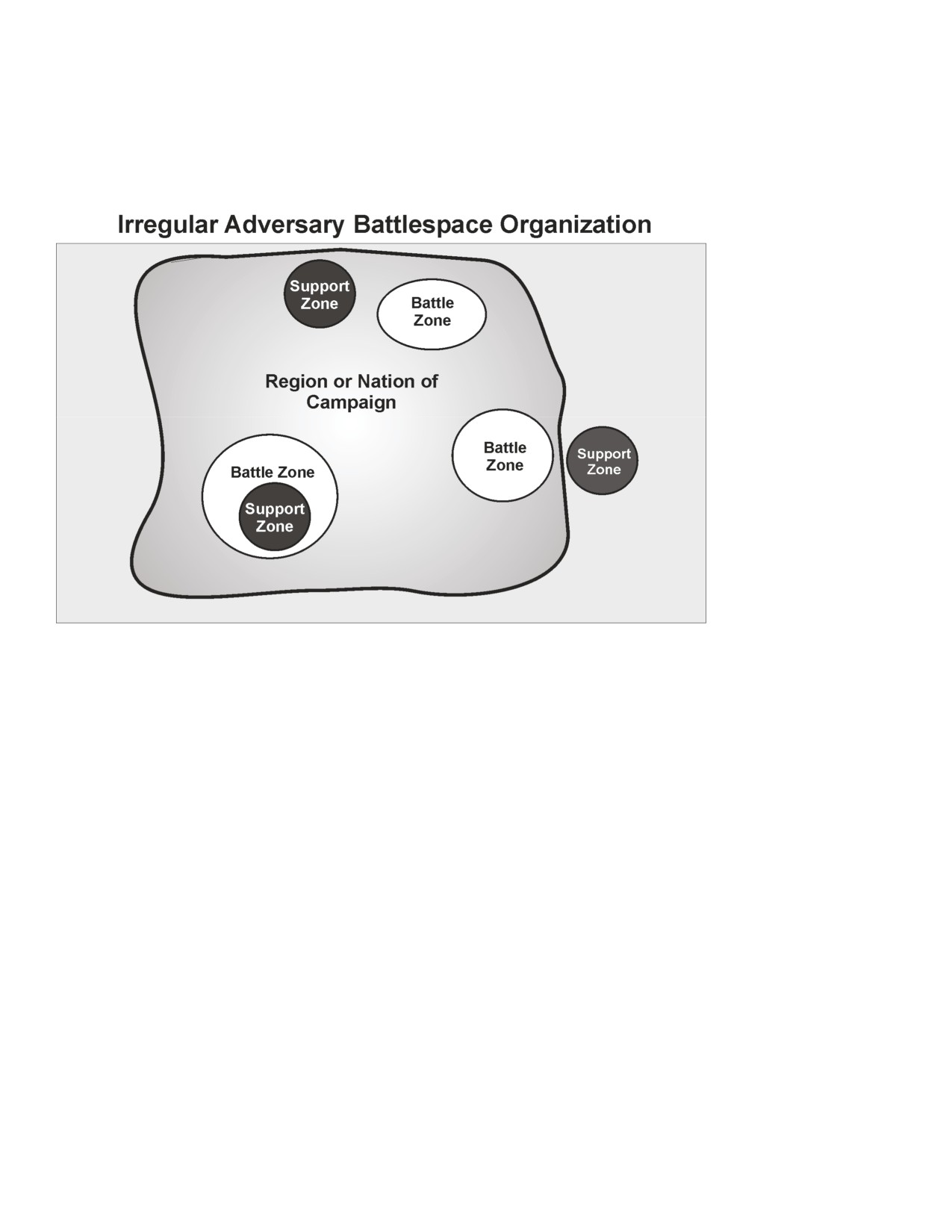
Land Operations
4.
Disruption Zone. Beyond the battle zone, the adversary can be expected to conduct
reduced operations in a disruption zone. These operations will be planned to interfere with the
friendly forces’ abilities to sustain operations, conduct reconnaissance (recce) and intelligence
collection, and to establish a secure environment throughout their area of operations (AO).
Figure 2A-2: Irregular Adversary Battlespace Organization
2A06. ADVERSARY TACTICS, TECHNIQUES, AND PROCEDURES
1.
At the tactical level, irregular adversary forces will likely be far more flexible, adaptive
and unpredictable in their approach than their conventional counterparts. They will use an
asymmetric approach on both the physical and psychological planes; hence, they will attack
physical weaknesses such as lines of communications, they will attack what they consider moral
weaknesses through their disregard for the law of armed conflict, and they will undermine
campaign legitimacy through an aggressive information operations plan. For example, they will
stage attacks from sensitive sites, use civilians to mask their operations and shield themselves,
and then distribute propaganda to the international media regarding disproportionate responses
and collateral damage, often falsified.
2.
It must be assumed that the adversary is highly dedicated and willing, at an individual
level, to sacrifice themselves for their cause. Generally, they will operate in small cells that
number from four to twenty individuals armed with a variety of weapons. In particular, urban
cells can be expected to work in sub-groups of approximately four or five, but will concentrate at
times to be platoon-sized groups for specific operations.
3.
One leader for larger scale operations could control several of these small groups. The
adversary will use a swarm or swamp technique by attacking one objective from different
directions with a number of small groups.
2A-8
B-GL-300-001/FP-001
Annex A
4.
Sub-groups will be expected to show initiative and work independently based upon a
commonly understood intent and established objectives. This ensures a high tempo and
volume of operations that is intended to wear down the opponent and undermine his will and
cohesion at all levels of command.
5.
Improvised explosive devices (IEDs) use various forms of explosives, including
discarded artillery munitions and the like. These will be used to target friendly forces and
government forces. The adversary forces will use IEDs in varying size, functioning methods,
containers and delivery means, and will draw on military and commercial sources for component
parts. The effects of these devices may be delivered in two ways: they may be emplaced and
subsequently detonated by timers, triggers or remotely; or they may directly delivered and
detonated by an individual on scene. The adversary will primarily aim attacks by IED at soft
targets and at convoys in particular. However, they may also be used to initiate ambushes
against patrols or other friendly forces. The emplacement of devices will often be done under
cover of darkness and it should be assumed that in many cases they are covered by
observation and are likely command detonated. The recording and dissemination of images of
successful attacks that demonstrate our vulnerability are a part of the adversary’s information
operations. If combined with blood-borne pathogens or radioactive material, these attacks have
an ability to create follow-on effects and a hazardous material problem for our forces and the
local populace.
6.
Adversary force tactics will generally be limited to high volume engagements with small
arms, rocket propelled grenades (RPGs), and mortars, followed by immediate attempts to break
contact. The offensive action of irregular forces will generally consist of driving commercial
vehicles, pick-up trucks, or automobiles to a drop-off point, disembarking the attack force,
engaging friendly forces, and breaking contact. They may use IEDs along the side of routes
and patrol routes. The adversary forces may combine IED attacks with an ambush. The fact
that such tactics will likely kill civilian bystanders will not usually deter the adversary forces, and
if civilian casualties do result, the adversary force’s information operations will lay the blame
upon our forces.
7.
Deception and luring actions meant to draw friendly forces into killing zones must be
kept in mind. For example, an IED may be followed by a second IED or ambush once
ambulances and other forces arrive on the scene.
8.
Some irregular adversaries will resort to the use of suicide bombers. This tactic normally
involves the bomber personally carrying or transporting the bomb into the target area and
personally initiating it, thus losing his life in the process. These operations range in
organizational sophistication and may be applied against vulnerable targets or against combat
forces. They may consist of a single individual operating alone or two or more assailants
attacking a single or series of targets. The use of suicide bombers may be a frequent tactic of
the adversary, or one that is used only on occasion against high value targets. These attacks
may rely solely on the bombing aspect, or they could be combined with other types of weapons
or attacks.
9.
The use of suicide bombing as a tactic offers the adversary certain operational
advantages. Not the least of these is that it affords the adversary a means of precision effects
capability, taking the explosive device directly to the target. The suicide bomber is a means of
covert or stealth delivery. The bomber is able to intelligently penetrate the opponent’s defensive
measures and arrive at his intended target. The means of delivery blends in with the
surroundings, and could be an individual in a crowd or a vehicle on a busy street. It is this
B-GL-300-001/FP-001
2A-9
Land Operations
characteristic that also gives suicide operations their psychological effects, as our forces
become suspicious of the local population (where anyone in the immediate area is a potential
adversary). In turn, this could undermine the operational and strategic situation and separate
our forces from the populace they are meant to secure. If our forces undertake overly harsh
precautions, such as the engagement of any remotely suspicious vehicle on roads, it will
undermine their legitimacy and authority with the local populace.21
10.
It must be remembered that lower level tactics, techniques and procedures (TTPs) will
change routinely in a theatre of operations. Notwithstanding that fact, certain TTPs generally
remain common to all irregular adversaries. Specific methods at the tactical level can generally
be anticipated as follows:
a.
Recce tactics:
(1)
Ground recce is the primary source of information.
(2)
Recce is primarily viewed as a mission not necessarily a force or unit.
(3)
Commanders will commit all necessary combat power to have
observation of critical targets.
(4)
Affiliated forces and civilians are key elements to the recce effort. Much
information may be gained from local authorities and security forces that
may be compelled to assist the adversary forces. It will be normal for
civilians to stand outside friendly force camps or base locations, to follow
dismounted patrols, and to report force activities. Our tactical
commanders and troops must be robust in approaching these suspected
civilians, question them, and inspect cellular telephone records and radio
devices in order to ascertain their intent.
b.
Infantry tactics:
(1)
Infantry tactics will not focus on mounted versus dismounted tactics.
Their means of transport, even if they operate some armoured vehicles,
will usually only support movement to and from the battle zone, and not
manoeuvre within it. Valuable resources such as armoured vehicles will
only mass for quick attacks and then disperse rapidly.
(2)
Infantry is viewed as the primary tank killer.
(3)
Infiltration and ambush are critical to operations.
(4)
A swarm technique will likely be used that will see a single objective
attacked simultaneously from different directions by a number of small
groups.
(5)
Infantry forces will routinely conduct or supplement recce missions.
21 It should be noted that the use of suicide bombers is not restricted to religious-based adversaries.
Such as the case of Tamil liberation movements, whereby suicide bombers have been used extensively
by organizations with purely political motivations and aims.
2A-10
B-GL-300-001/FP-001
Annex A
c.
Indirect fire tactics:
(1)
Indirect assets are trained and equipped to mass effects of fire without
massing systems. Thus, different systems will fire simultaneously on the
same target from different locations.
(2)
The threat may not hesitate to use irregular weapons such as IEDs mixed
with toxic or radioactive materials.
(3)
The adversary will focus the efforts of their indirect fire on the destruction
of key or high value systems such as command and control nodes,
logistics centres, and vulnerable troop concentrations.
(4)
The adversary will likely not expose its valuable assets for high volume
suppression missions or counter-fire against non-precision systems.
(5)
Maximum effort will be made to protect their indirect assets.
d.
Anti-armour tactics:
(1)
The adversary forces will likely be well equipped with light anti-armour
systems and will routinely use improvised capabilities. Improvised
explosive devices will be planted routinely as an effective method of
defeating armour without direct engagement. They will often be remotely
fired. Adversary forces will exploit their concealment amongst the
population and infiltrate into areas considered cleared or secure to plant
the devices.
(2)
Using light anti-armour or improvised explosives, the adversary’s infantry
will attempt to ambush and destroy our fighting and echelon vehicles
throughout the battlespace. They will not be deterred by the presence of
civilians and will likely use them to conceal and shield their attacks.
(3)
Adversary forces, heavily equipped with anti-tank weapons, will exploit
close terrain and choke points to attack our forces. This will be the
primary killer of our armoured fighting vehicles (AFVs). Attacks and
ambushes may see their anti-armour weapons fired in volleys to
maximize surprise, maximize the effects of light weapons, and allow for a
rapid withdrawal.
11.
In order to meet their intent at both the tactical and strategic levels, the adversary can be
expected to carry out a wide variety of tactical operations. Such operations may include:
a.
Attacks. Attacks on our forces, particularly against vulnerable forces and
elements, at the most opportune time and place. These will be done to create
attrition, but also to undermine the will and commitment of friendly forces.
b.
Armed Assault. Armed assault on infrastructure (e.g., banks, police stations,
military facilities).
c.
Raids or Infiltration. Raids or infiltrations to inflict casualties, demonstrate
abilities, and/or obtain vital equipment or other support. They may include the
short-term occupation of an objective area. They may also be conducted as a
form of punishment for a sector of the civilian populace deemed to be supporting
coalition forces.
B-GL-300-001/FP-001
2A-11
Land Operations
d.
Occupation. Temporary occupation of an area (without the need to raid it or
fight for it) in order to gain support, intimidate the populace, or collect
intelligence. This occupation may be overt or covert.
e.
Ambush. Ambush of our forces, other friendly forces, government forces, or
other agencies and public elements such as humanitarian NGOs.
f.
Information Operations. Information operations within the local populace to
undermine the legitimacy of government forces and coalition forces. Many
irregular groups, particularly insurgents, will target the will and support of the
domestic populations of nations contributing to a coalition.
g.
Encouragement of Civil Disobedience. An attempt will be made to incite work
stoppages or subvert peaceful public demonstrations to create riots and violent
disturbances in order to demonstrate a lack of control and security by
government forces.
h.
Encouragement of Desertion. Encouragement of desertion from domestic
security forces and attempts to dissuade enlistment. There will be an attempt to
undermine SSR activities through information operations, intimidation, and direct
attack.
i.
Liberation of Prisoners. There may be direct attacks against domestic
security forces and holding facilities in order to free prisoners. Prisoners may be
connected to the adversary forces, or they may simply be freed to destabilize
the civil society (as with the case in Iraq in 2003 and Haiti in 2004). This aim
may be achieved in part through bribery or the intimidation of local security
forces and the judiciary.
j.
Kidnappings and Executions. The adversary forces may kidnap and/or
execute those seen to be supporting the domestic government or foreign
friendly forces. The victims may be members of the established government,
members of security forces, or simply merchants or workers deemed to be
aiding our forces or the established authority. Additionally, kidnappings may
occur as a means of raising financial support.
k.
Sabotage. Adversary forces may conduct sabotage of utilities and other vital
points in order to demonstrate their capabilities, undermine the authority of the
local government, and undermine the support of the local populace for the
established government.
l.
Terrorism. Attacks against civilian populations and targets and other forms of
terrorism will be a tactic of some types of irregular adversaries. It will be used to
demonstrate commitment and capabilities, undermine the legitimacy of
established authorities and our forces, undermine the commitment of supporting
friendly forces and our forces, and to intimidate the local populace. Terrorism is
more likely to occur in the early stages of the development of an adversary
force, and as it attempts to gain wider recognition and legitimacy, it will likely
abandon or limit its use of terrorism.
m.
In addition to such tactics, it will be common for irregular adversaries to be
linked to criminal activities. This may be a means of fund raising, but will also
be reflective of a social link. Those individuals acting as adversaries may also
be socially linked to criminal elements.
2A-12
B-GL-300-001/FP-001
Land Operations
CHAPTER 3
THE EMPLOYMENT OF LAND FORCES
Tactics form the steps from which operational leaps are assembled; strategy
points out the path.
From A.A. Svechin: Strategiya, 1931
SECTION 1
INTRODUCTION
301. GENERAL
1.
The employment of land forces sees the application of the elements of land combat
power22 in a synchronized manner to realize strategic, operational, and tactical objectives.
Operations across the spectrum of conflict are closely linked and the application of land forces
at all levels is guided by sound doctrinal principles.
2.
The application of combat power is visualized through the continuum of operations that
relates tactical activities to operational campaign objectives in order to meet strategic ends.
302. DOCTRINE FOR THE EMPLOYMENT OF LAND FORCES
1.
Doctrinal concepts are built in a hierarchical fashion, to include a philosophy, supporting
principles, practices and procedures. There are a number of doctrinal concepts and
overarching philosophies that guide the application of combat power and the conduct of
campaigns, regardless of their nature or theme. These include the following:
a.
Adherence to the Principles of War.
b.
A comprehensive approach the uses military capabilities in conjunction with
other elements of power to create enduring outcomes to a campaign.
c.
A war-fighting ethos.
d.
An effects-based approach to operations that ensures tactical activities directly
support operational objectives.
e.
The manoeuvrist approach.
f.
The application of mission command.
g.
An ethical application of combat power.
22 Combat power is defined as: “the total means of destructive and/or disruptive force which a military
unit/formation can apply against the opponent at a given time.” (NATO Allied Administrative Publication 6
(AAP 6), Glossary of Terms and Definitions, 2006)
B-GL-300-001/FP-001
3-1
Land Operations
2.
The application of these philosophies and their constituent principles defines the
Canadian approach to land operations.23 Those in command must understand these
philosophies and their constituent principles and apply them in a judicious manner. They must
not be doctrinaire or dogmatic but rely upon their own judgement and initiative as appropriate.
Indeed, doctrine encourages this.
3.
Throughout the conduct of campaigns and operations, doctrine concepts will provide a
conceptual framework to guide the application of combat power and capabilities in order to
reach desired objectives and end-states.
303. THE LEVELS OF WARFARE
The first, the supreme, the most far-reaching act of judgment that the statesman and the
commander have to make is to establish the kind of war on which they are embarking;
neither mistaking it for, nor trying to make it into something that is alien to its nature.
This is the first of all strategic questions and the most comprehensive
Carl von Clausewitz
1.
General. Warfare is conducted at three levels beginning with a national or strategic
focus from which the other levels, operational and tactical, flow. The translation of national aims
and political goals into military action must be done in a manner that ensures clarity and unity of
effort throughout the military elements, and between the military and other agencies. The
complexity of the operating environment, the spread of global communications, and the
deployment of smaller contingents, has effectively compressed these levels of warfare and it
has thus become more difficult to delineate the three levels. Events and actions at the tactical
level may have significant consequences at the operational and even strategic levels. The
levels are defined as much by the outcomes and effects as by the size of the force or level of
command.
2.
The Strategic Level. The strategic level of war is the level at which a nation or group of
nations determines national or multinational security objectives and deploys national, including
military, resources to achieve them. It reflects the national political aim and seeks to fulfil it.
From a military point of view, it consists of two elements:
a.
National Strategy. The national strategy combines the diplomatic, economic
and military instruments of national power to achieve the long-term aims of the
nation, ideally within a single campaign plan. A comprehensive approach to
the campaign involving all elements of power along with international
organisations and agencies to reach campaign end states begins at this level.
Successful strategies must be integrated across the elements of national power
from the outset. They involve the coordination and cooperation of all relevant
government agencies in a unity of purpose and effort. National strategy is
based on four broad responsibilities:
(1)
To specify the strategic objectives for any intended military activities.
23 In terms of allies, the Canadian approach is most akin to the British approach to operations. This is for
reasons of culture, history and tradition.
3-2
B-GL-300-001/FP-001
The Employment of Land Forces
(2)
To stipulate any constraints and restraints to be imposed on military
activities, including the circumstances for military activity to conclude.
(3)
To make the required resources available.
(4)
To explain and empower the interaction of strategic military and non-
military agencies, and to describe how action across a multi-agency
construct is integrated to achieve overall national objectives.
b.
The Military Component of Strategy. The military component of strategy is
the application of military resources to help achieve the national strategic
objectives. It is the art and science of applying military force and involves
balancing military resources between different activities. The military
component of strategy determines operational level end state, objectives,
supporting effects, and the military activities required in broad terms. The
strategic authority allocates conceptual objectives, military resources, and
defines constraints and restraints. Military strategy will in turn influence and
affect the formulation of national strategy and will provide the basis for military
advice to the Government on the use of armed force and military resources.
3.
The Operational Level. The operational level of war is the level at which campaigns
and major operations are planned, conducted, and sustained to accomplish strategic objectives
within theatres or areas of operation (AO). It links the strategic and tactical levels. It prescribes
and directs the military activities necessary to realize the operational objectives and end state.
At this level, commanders use operational design to construct and plan joint campaigns and
major operations and direct them through operational orders. These campaign plans will reflect
a particular campaign theme, and in turn, drive force structures, postures, and tactical activities
in terms of scope and balance. Joint doctrine concentrates on the operational level, unifying
single-service tactical operations into a coherent coordinated campaign. The operational level
commander orders the activities of his forces through successive operational orders in pursuit of
his overarching campaign plan. Within a joint campaign, the land component commander
(LCC) will develop operational plans for the land forces that support the joint campaign plan to
achieve the operational objectives.
4.
The Tactical Level. The tactical level of war is the level at which battles and
engagements are planned and executed by tactical formations to create desired effects and to
achieve operational objectives. Tactical operations are specific activities undertaken by
formations, units, and subunits, and are realized through one or more assigned tactical tasks.
5.
Linkages Between the Levels. No level of warfare should be viewed in isolation.
Tactical success does not guarantee strategic success. Battles and engagements generally
shape the course of events at the operational level, but they become relevant only in the larger
context of the campaign plan. The campaign, in turn, only gains meaning in the context of the
strategy. For example, if the strategic aim is to defeat an insurgency, which by definition is only
partly a military issue, the campaign plan must focus on military resources combined with other
agencies, and the tactics must be weighted to protect a population, engender their support, and
allow the other agencies to operate. Physical destruction of the insurgents may be a secondary
concern and at times counter-productive to the overall effort. (See Figure 3-1.)
B-GL-300-001/FP-001
3-3
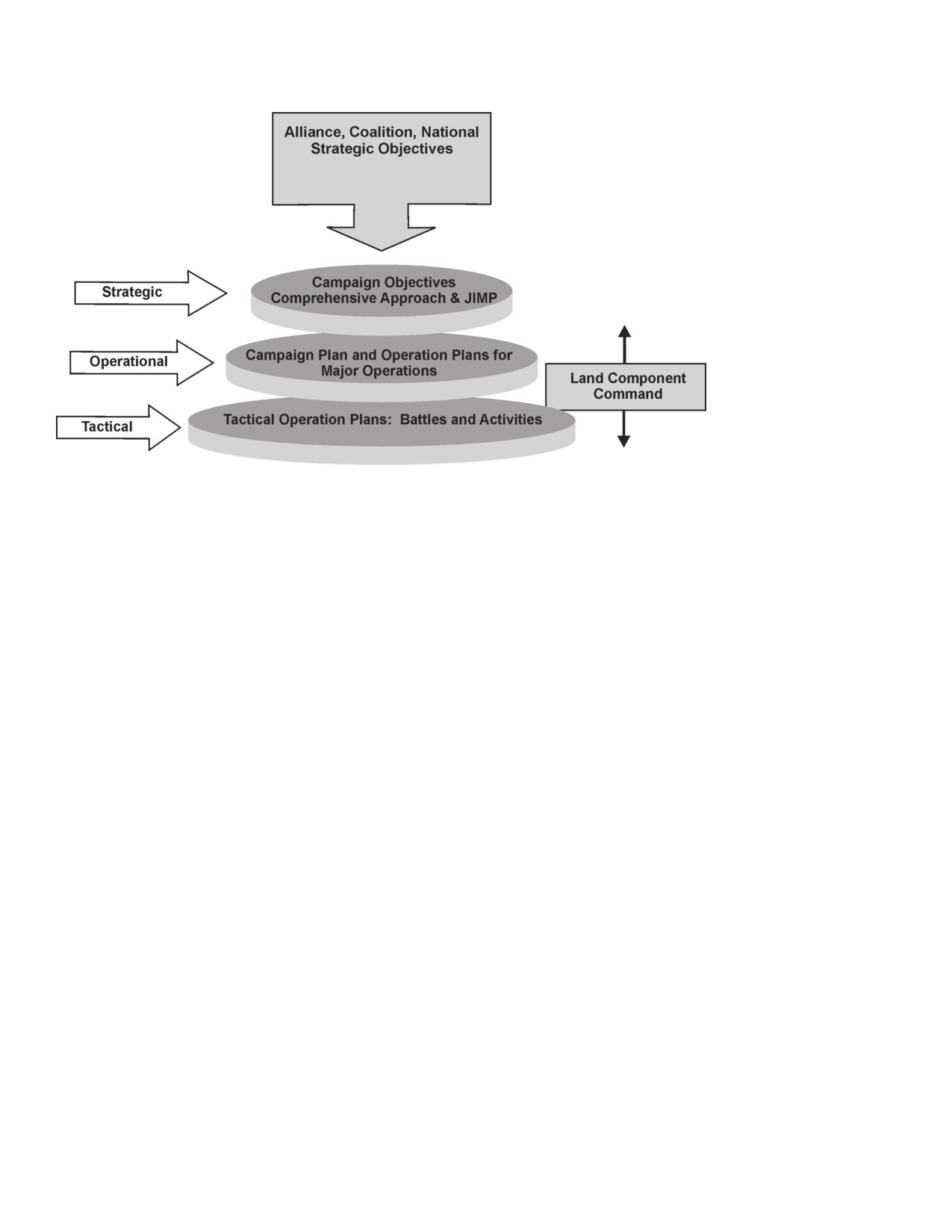
Land Operations
Figure 3-1: The Links between the Levels of Warfare and the Land Component Commander.
JIMP refers to the framework of joint, inter-agency, and multinational elements,
within the public environment
6.
Levels of Warfare and Command. The levels of warfare are not tied to the level of
command. A division, brigade, or battalion commander may operate at the operational or
tactical level depending upon the nature of the campaign and the situation at hand. In the
extreme, a tactical level commander may be required to conduct elements of campaign planning
in the translation of operational objectives into tactical operations. The nature of command
differs at each level of warfare and the level at which a commander is operating may change
during a campaign. Complicating the issue further, tactical activities, should they create
undesired results, may have significant operational or strategic impact, due in part to the
pervasive media and speed of communications.
7.
The Conduct of Operations in a Joint, Inter-agency, Multinational Environment.
Commanders must work to ensure that military operations are coordinated with those of other
agencies within the joint, inter-agency, multinational and public (JIMP) environmental
framework, and that they are guided by a unity of purpose and effort (see Chapter 2). The
design of a comprehensive, multi-agency approach should be replicated as required at all levels
of command so that tactical level commanders understand and appreciate the nature of the
campaign and requirement for complementary activities. The line between the operational and
tactical levels is often blurred, particularly when national contingents differ in size. The
employment of a force from another nation may have political implications even if it is only of
small tactical value. The significance of committing forces may vary between nations.
8.
The Contribution of Land Forces to the Joint Campaign. Land forces are the
principle instrument through which a nation or coalition forcibly imposes its will upon another.
Further to this however, land forces may be used to undertake a wide range of tasks, for they
may work amongst and influence directly a situation and the local populations through their
presence and activities. Thus, they have the ability to achieve decisive effects on both the
physical and cognitive planes. In doing so, they may undertake activities and create effects
along the following lines:
3-4
B-GL-300-001/FP-001
The Employment of Land Forces
a.
Defeat or Deter Land-based Adversaries. Land forces have the ability to
coerce, persuade and dissuade or comprehensively defeat any adversary. Air
and maritime forces may do great damage, particularly to massed forces, but an
adaptive adversary will find ways to survive their attacks and avoid defeat. To
achieve success, land forces must be used to physically close with the
adversary.
b.
Seize Terrain Objectives. Land forces can effectively seize physical
objectives. Fires are rarely capable of ejecting a determined adversary from the
terrain they occupy. Even if mass fires might be ultimately effective, the
resulting collateral damage may be unacceptable in terms of campaign and
strategic objectives.
c.
Secure Terrain Objectives. Physical occupation of terrain by ground forces is
the only certain means of achieving lasting security of an area. This applies to
security against conventional manoeuvre forces, and against unconventional
adversaries. To effectively combat and counter an insurgency, it is vital for
forces to be placed on the ground being contested and to live and work amongst
the population. Against an unconventional adversary, land forces as small as a
platoon may effectively secure a piece of terrain.
d.
Positive Influence on Populations. Influence, through daily human
interaction, pervasive security and confidence building activities, is key to long-
term stability. Well-trained and disciplined soldiers, deployed amongst a
population, can have a major impact and influence on a population and garner
their support for the campaign.
e.
Enable Other Agencies to Operate. Land forces provide the framework of
security and support that will allow other agencies, particularly civilian and
unarmed, to undertake their responsibilities. In any region, long-term stability
and prosperity will depend upon other governmental and non-governmental
agencies dealing with a wide variety of civil, political and social issues. These
agencies can only work in an environment in which land forces have achieved a
significant measure of security.
f.
Serve as a Symbol of Political Commitment. The commitment of a nation’s
land forces may be costly in both resources and lives. It represents
considerable political commitment and acceptance of risk on behalf of a
government and a domestic populace.
304.
APPLYING THE PRINCIPLES OF WAR
1.
General. Operations are planned and conducted based upon the application of the ten
principles of war. These principles are not immutable laws and will continue to develop over
time, and their measured application must be considered in light of operational circumstances.
These circumstances will dictate the relative weight and importance of each principle. The
commander must decide which principles will receive emphasis at any given moment, and
which will not. This is a balance the commander must identify, articulate, and continually
reassess. To completely disregard a principle involves great risk and the possibility of failure.
B-GL-300-001/FP-001
3-5
Land Operations
2.
The Ten Principles of War. The ten principles of war are applicable throughout the
spectrum of conflict, regardless of the campaign theme. Commanders at all levels, guided by
the desired objectives, must consider each principle and strike a balance between the
competing demands of the various principles. The ten principles of war are:
a.
Selection and Maintenance of the Aim. Every operation must have a single,
attainable and clearly defined aim that remains the focus of the operation and
towards which all efforts are directed. The linkage between the levels of war is
crucial for each battle; engagements or operations must be planned and
executed to accomplish the military objectives established by the commander.
Activities at the lower tactical levels must be planned and conducted in harmony
with the intent and operational objectives identified at the higher echelons of
command. The aim of any force, therefore, is always determined with a view to
furthering the aim of the higher commander. It is thus vital that commanders
clearly express their intent in a concise and clear manner.
b.
Maintenance of Morale. After leadership, morale is the most important
element on the moral plane of conflict. It is essential to ensuring cohesion and
the will to win. Morale is nurtured through discipline, self-respect, and
confidence of the soldier in his commanders and his equipment, and a sense of
purpose.
c.
Offensive Action. Only through offensive action can a military force assure the
defeat of the adversary. Commanders adopt the defensive only as a temporary
expedient and must seek every opportunity to seize and maintain the initiative
through offensive action. Initiative means setting or changing the terms of battle
by action. It implies an offensive spirit in the conduct of all operations. To seize
and then retain the initiative requires a constant effort to force the adversary to
conform to our operational purpose and tempo while retaining our freedom of
action. To achieve this, commanders must be prepared to act independently
within the framework of the higher commander's intent. Seizing the initiative,
therefore, requires audacity, and almost inevitably, the need to take risks. This
applies to both the physical and cognitive planes. In the case of the latter,
information operations must be conducted in an offensive manner in order to
influence target audiences and affect their behaviour in a desired manner.
d.
Surprise. Surprise makes a major contribution to the breaking of the
adversary's cohesion, and hence, defeat. Against a conventional adversary,
modern sensors may limit the chances and overall effects of surprise. However,
surprise may well serve to degrade an enemy’s ability to react. In facing an
unconventional adversary, the use of sympathizers and agents within local
populaces will provide adversary forces with early warning. Doing the
unexpected and thereby creating and exploiting opportunities will achieve
surprise. The effects of surprise are enhanced through the use of speed,
secrecy and deception, though ultimately it may rest on the adversary's
susceptibility, expectations and preparedness. The adversary need not be
taken completely by surprise, but only become aware too late to react
effectively. Surprise can be gained through changes in tempo, tactics and
methods of operation, force composition, direction or location of the main effort,
timing and deception. Deception consists of those measures designed to
mislead the adversary by manipulation, distortion, or falsification of evidence to
3-6
B-GL-300-001/FP-001
The Employment of Land Forces
influence or induce him to perceive the situation in a manner prejudicial to his
interests. It is a vital part of tactical operations serving to mask the real
objectives, and in particular, the main effort.
e.
Security. Security protects cohesion and assures freedom of action. It results
from measures taken by a commander to protect friendly forces while taking
necessary, calculated risks to defeat the adversary. In operations at the tactical
level, we must not associate security with timidity. Regardless of the operations
of war and the campaign theme undertaken, commanders must ensure active
security through reconnaissance, counter-reconnaissance, patrolling and
movement. It must be kept in mind that an over-emphasis on security, in
particular force protection, at the cost of undertaking offensive actions against
the adversary, will render the force ineffective and ultimately lead to defeat.
f.
Concentration of Force. It is essential to concentrate overwhelming force at a
decisive place and time. It does not necessarily imply a massing of forces, but
rather the massing of effects. This allows a numerically inferior force to achieve
decisive results. The principle of minimum force required should be followed,
whereby the application of force must be as precise as possible in order to
ensure that the engagement will result in the desired primary and subsequent
effects and avoid collateral damage.
g.
Economy of Effort. Economy of effort implies a balanced employment of
forces and a judicious expenditure of resources. Commanders must take risks
in some areas in order to achieve success in their main effort.
h.
Flexibility. Commanders must exercise judgement and be prepared to alter
plans to take advantage of opportunities as they present themselves on the
battlefield. Flexibility requires a common battlefield vision by all commanders
and a clear understanding of the superior commanders' intent. Essential to
flexibility are effective information gathering and dissemination, rapid decision-
making, and an agile force that can shift its focus quickly. Forces must also be
held in reserve to deal with the unexpected and to maintain the momentum of a
tactical operation by exploiting success when there is an opportunity.
Commanders at all levels must be prepared to shift rapidly between types of
tactical operations from across the spectrum of conflict.
i.
Cooperation. It is only through effective cooperation that the components of a
force can develop the full measure of their strength. It entails a common aim,
team spirit, interoperability, division of responsibility, and the coordination of all
the operational functions to achieve maximum synergy. Combat service support
integration is a manifestation of cooperation. This cooperation may be pushed
to the lowest tactical levels, particularly in a dispersed operating environment.
This principle of cooperation must be practised within the JIMP framework and
as a principle to the comprehensive approach of multiple agencies working in
the pursuit of a common end state. When working with non-military agencies,
commanders may take an informal lead in implementing this spirit of
cooperation.
B-GL-300-001/FP-001
3-7
Land Operations
j.
Administration. Successful administration is the ability to make the best and
most timely use of resources. Administration is the indispensable servant of
operations and is often the deciding factor in assessing the feasibility of an
operation or the practicality of an aim. A commander requires a clear
understanding of the administrative factors that may affect friendly activities.
Commanders must have a degree of control over the administrative plan
corresponding to the degree of operational responsibility. Situational
awareness, foresight and anticipation are hallmarks of sound administration.
SECTION 2
THE CONTINUUM OF OPERATIONS
305. GENERAL
1.
The raison d’être of the land force is the application of combat power. This ability to fight
also creates organizations capable of performing a wide variety of other activities. Throughout
history, land forces have been required to operate effectively across the spectrum of conflict,
that is, to undertake tasks ranging from building civil infrastructure through policing conflicts to
major combat. They must be able to conduct this variety of activities simultaneously and
sequentially, and transition quickly from one type of activity to another during rapidly evolving
conflicts. Commanders must not focus on a single activity or sequential progression. Rather,
they must be able to effectively visualize how a campaign or operation will evolve over time, in
the light of changing circumstances throughout their AO, and how the balance across different
types of activities will or should shift. Campaign success is likely to depend upon understanding
such simultaneity, how it evolves throughout the campaign, and how it affects the planning and
execution of operations. This concept is relevant to all levels of command and is referred to as
full-spectrum operations (FSO).
2.
The continuum of operations is a conceptual framework used to explain the
relationship between campaigns and the various types of tactical activities that constitute their
conduct. It aids in understanding the complexity of the operational environment while planning,
preparing for, conducting, and assessing operations. This model enables missions to be
visualized with a broader perspective that goes beyond military combat to an environment
where the level of violence is reduced. It allows for the visualization at the tactical level of
military input into campaign lines of operation in which the land forces have a lead or a
supporting role. Commanders must maintain a long-range vision of where a campaign is going
and consider the long-term effects of current operations. This framework should help
commanders think beyond the specifically assigned mission to what may come next.
3.
The continuum of operations places a specific mission into a wider context that includes
four major concepts:
a.
Spectrum of Conflict. The spectrum of conflict spans from high intensity
combat (great deal of violence) at one end to relative peace (a minimum of
violence) at the other end, and it provides the overall environment for the
continuum and campaigns. It reflects the intensity and level of violence
expected and found in a campaign, and success is reflected in a move to the
lower levels of violence on the spectrum. In short, the spectrum of conflict
provides an environment in which predominant campaign themes change over
time, indicating priorities allocated to multiple types of operations that may be
conducted simultaneously.
3-8
B-GL-300-001/FP-001
The Employment of Land Forces
b.
Predominant Campaign Themes. Predominant campaign themes reflect and
describe the general nature of a campaign and will change over time.
c.
Types of Operations. Campaign plans are realized at the tactical level through
three types of tactical operations: offensive; defensive; and, stability (tactical)
operations, in addition to enabling operations. Note that these operations are
classifications of tactical activities, such as attack, and the activities are normally
realized through a series of tactical tasks. Priorities and resources ebb and flow
between these tactical operations as required by the situation and campaign
theme, particularly as the campaign theme changes over time. The balance
between the types of operations will reflect the type of campaign and the
principles by which it should be conducted.24
d.
Simultaneity. Tactical operations and their constituent activities and tasks will
be conducted simultaneously. For example, one tactical unit or subunit may be
conducting an attack, while another is defending a vital point and a third may be
assisting with reconstruction or the delivery of humanitarian aid, all within the
same AO at the same time.
306. SPECTRUM OF CONFLICT
1.
The spectrum of conflict (see Figure 3-2) reflects the environment in which operations
occur. The principle discriminator is the prevalence, scale and intensity of violence. These vary
between absolute peace and absolute war. Land forces operate throughout this spectrum.
Figure 3-2: The Spectrum of Conflict
2.
No conflict will exist at just one point on the spectrum of conflict. Its intensity will vary in
time and place. At any one time there may be a humanitarian crisis in one location, a
requirement to conduct crowd confrontation in another, and intense fighting in a third. At any
one place, there may be tasks to conduct house-to-house fighting. A battle group may have to
complete all of these simultaneously. It is important to recognize that a campaign will consist of
simultaneous and sequential activities from various locations on the spectrum of conflict.
307. PREDOMINANT CAMPAIGN THEMES
1.
General. States of peace, tension, conflict and combat may be local or widespread, and
transient or prolonged. The character of any particular campaign may be difficult to define
precisely and is likely to change over time. It will probably consist of a wide and changing
variety of activities across the spectrum of conflict. It is nevertheless possible to describe
24 The balance between the types of tactical operations and activities will change with the campaign
theme. For example, there will be more offensive activities in a campaign involving major combat than in
peace support or counter-insurgency campaigns.
B-GL-300-001/FP-001
3-9
Land Operations
several predominant campaign themes within the continuum of operations. The character of the
campaign varies according to the theme, and major combat for example, is identifiably different
from counter-insurgency. They demand different approaches, are guided by specific principles
and require different force packages.
2.
Campaign Themes. Campaign themes within the continuum of operations can be
broadly divided into the following categories:
a.
Major Combat. Major combat campaign is the most demanding of military
campaigns and operations. It is characterized by combat that is frequent,
widespread and intense. It will usually be conducted against other formal,
conventional military forces.
b.
Counter-insurgency. Counter-insurgency (COIN) is defined as: those military,
paramilitary, political, economic, psychological and civic actions taken to defeat
insurgency.25 A COIN campaign is characterized by an insurgent based
adversary, the political nature of the crisis, a need to address multiple facets of
the environment and root causes of the crisis through a comprehensive
approach with the military in an overall supporting role, and a degree of combat
that is less than that experienced in a major combat campaign.
c.
Peace Support. A peace support campaign impartially makes use of
diplomatic, civil and military means, normally in pursuit of United Nations (UN)
Charter purposes and principles, to restore or maintain peace. Such operations
may include conflict prevention, peacemaking, peace enforcement,
peacekeeping, or peace building.
d.
Peacetime Military Engagement. Peacetime military engagement (PME) is
defined as: “military activity in peacetime that involves cooperation with other
nations or agencies, primarily intended to shape the security environment.” 26 It
includes initiatives to improve mutual understanding and interoperability. Such
operations may include aspects of security sector reform (SSR) in which
indigenous security forces are restructured and trained, and other security
apparatus and institutions are reformed or developed. It may include
programmes and exercises with other nations designed to improve mutual
understanding with other countries, improve interoperability, and improve the
standards and capabilities of other nations. Military involvement may be
complemented by activities conducted by other agencies seeking to improve
other aspects of the host nation government and society.
e.
Limited Intervention. Limited intervention consists of those operations that
have limited objectives and scope, such as the rescue of hostages, security
and/or evacuation of non-combatants, re-establishing of law and order, or
providing disaster relief. They are usually conducted with a specific, limited aim
and for a short duration, often a number of days. Due to their limited scope,
they are not true military campaigns. They may occur at point along the
spectrum of conflict and may occur while other operations are occurring in the
same area. Most domestic operations are classified as limited intervention.
25 NATO Allied Administrative Publication 6 (AAP-6), Glossary of Terms and Definitions (2005).
26 Definition developed by the Army Terminology Panel.
3-10
B-GL-300-001/FP-001
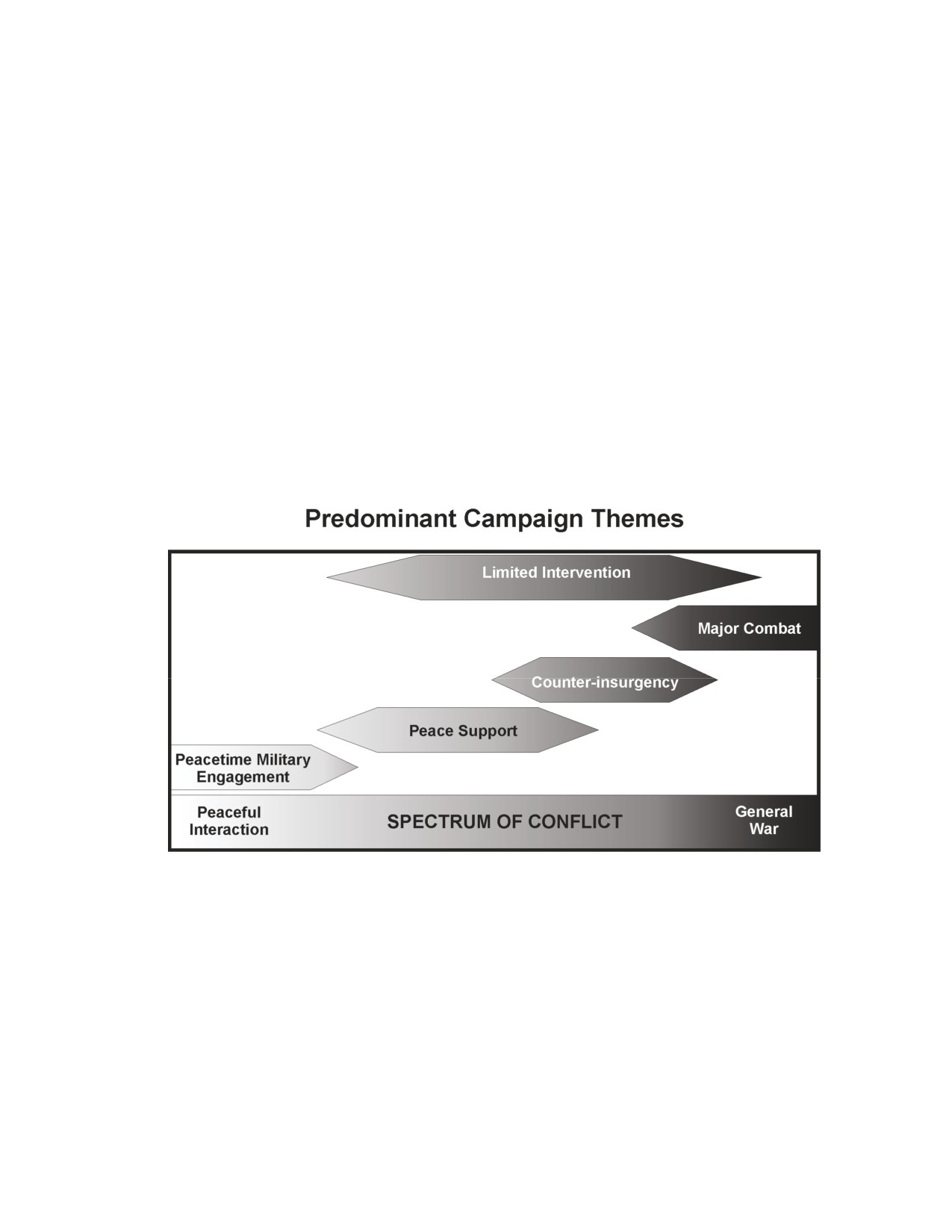
The Employment of Land Forces
3.
Understanding the Campaign Theme. It is vital that a commander be able to
recognize the characteristics and other environmental factors that will denote the particular type
of campaign in which he is operating. This will guide the manner in which the campaign is
designed, planned and conducted, even at the lowest tactical levels. Commanders must be
prepared to explain the nuances and demands of each type of campaign to their subordinates,
political leaders, and members of other agencies involved. Within a campaign theme, land
forces may conduct various operations or activities that may appear to contradict the overall
theme. For example, during a peace support campaign, land forces may conduct offensive
combat operations to create the conditions for lasting peace. However, it must be understood
that all campaigns involve a wide variety of tactical activities depending upon the situation at
any given time. It is the overall balance between the types of activities that must reflect the
campaign theme. Additionally, the manner in which tactical activities are conducted should not
violate the principles of the overall campaign theme. For example, a deliberate attack may be
necessary during a COIN campaign, but it will be planned and conducted using different factors
than that of an attack during a major combat campaign. The different factors and
considerations will be reflective of the principles and aims of a counter-insurgency campaign:
plans and evens risks will be taken to avoid collateral damage and thus avoid negative
influences on the local populace; local forces may be used vice coalition forces; and extra effort
may be made to convince the adversary to surrender.
Figure 3-3: Predominant Campaign Themes along the Spectrum of Conflict
4.
Link with the Spectrum of Conflict. As depicted in Figure 3-3, the campaign themes
can be arranged along the spectrum of conflict to reflect the general level of violence and
conflict expected. Major combat tends to occur when the environment is characterized by
extreme violence, while in PME the level of violence can be expected to be low. However,
within major combat there may be large areas within the theatre or AO that are comparatively
peaceful. Conversely, within peace support there may at times be extremely violent incidents.
Thus, it is useful to describe operations as taking place across the spectrum of conflict, where
the character of the conflict, and hence campaign theme, is only partly shaped by the varying
degrees of violence within that spectrum. Limited intervention can occur anywhere along the
continuum.
B-GL-300-001/FP-001
3-11
Land Operations
5.
Comparative Aspects of the Campaign Themes. Descriptions of campaign themes
are broad and tend to overlap, therefore, there will be common elements among them. The
campaigns will change over time for various reasons, such as: deliberate, pre-planned phases
(such as a shift from peace support to major combat); changes in the environment brought
about by adversary activity, neutral activity and changed political guidance; or, unexpected
opportunities or demands that arise during the campaign. As depicted in Figure 3-4, it is
possible to discriminate between campaigns by characterizing and comparing various aspects:
the level of political risk; the effect sought; the character of combat; and, the type of adversary
faced:
a.
Political Risk. The level of risk acceptable to the Government, including the
risk of casualties, is a measure of the political importance of the campaign. It is
proportionate to the threat to the nation or national interests. It is influenced by
the public appetite to continue the operation, given the public’s perception of the
threat, the level of risk, the inherent moral value and the elements or extent of
national interest.
b.
Effect Sought. The strategic effect (result) sought will often determine the
character of a campaign. For example, the defeat of a hostile state will demand
a different approach from the separation of warring factions.
c.
Character of Combat. Combat can be characterized by its prevalence, scale
and intensity:
(1)
Prevalence. Prevalence is a measure of its frequency.
(2)
Scale. Scale describes the level of combat, which can be measured by
the level at which forces integrate their activities in combat. For example,
in major combat, battles are often fought at formation level; however, in
COIN, they will be more usual at section, platoon, or company level.
(3)
Intensity. Intensity describes the degree of concentration of combat,
measurable by the rate of consumption of logistics and casualties.
d.
Type of Adversaries. The nature and number of adversaries will have a major
influence on the character of a campaign and conflict. They may range from
sophisticated conventional forces to primitive tribesman. It is important to
appreciate that adversaries are adaptive. For example, once a regular army has
been defeated, it may mutate into an irregular force with different aims, and thus
change the character of the conflict. Thus, the campaign theme will also alter.
3-12
B-GL-300-001/FP-001

The Employment of Land Forces
Spectrum of
Peacetime
Conflict
Peace
Counter-
Major
Limited
Military
Support
insurgency
Combat
Intervention
Engagement
Criteria
Victim: High
Less than risk
Political Risk1
Low
Med/Low
High
Allies: Med
of inaction
Defeat
hostile
Defeat
state
Uphold
insurgents
Varied, to
Shape security
international
Recover
include
Effect Sought2
environment
peace and
Break
territory
evacuations,
security
external
strikes, etc.
links
Change
adversary’s
behaviour
Localized,
Plan may
No combat
infrequent,
Localized,
Widespread,
Prevalence
involve or
foreseen
discrete
intermittent
continuous
avoid combat
incidents
Section,
Battalion and
Section and
Depends on
Scale3
Self defence
platoon and
higher
platoon
plan
company
echelons
Med/low,
Low;
long
Potentially
No combat
Intensity
occasionally
duration;
High
high; short
foreseen
high
occasionally
duration
high
Formed units
Formed units
Type of Threats4
None
and/or
Irregulars
Formed units
and/or
irregulars
irregulars
Note: All characterizations are generalizations. Exceptions may exist.
1 The level of acceptable risk, including risk of casualties, is a measure of the political importance of the campaign,
proportional to level of threat to the nation or national interests.
2 The strategic effect sought often determines the character of a campaign: removal of a hostile regime demands a
different approach than separation of warring factions.
3 This is the predominant level routinely engaged in combat. Levels may escalate occasionally.
4 Adversaries are adaptive and may move from one type of strategy or tactic, or even organization, to another as
conditions improve or deteriorate for them, and as their opponents adapt to their tactics. In addition, the arrival of
new types of forces (e.g., the Chinese in Korea or foreign Mujahadeen in Afghanistan against the Soviets) can
change the character of the campaign.
Figure 3-4: Predominant Campaign Themes by Selected Criteria
6.
Campaign Themes and Tactical Operations. Campaign themes should not be
confused with tactical operations, tasks or activities. Campaigns and their operational
objectives are realized through tactical operations, activities and tasks. These involve the
specific application of doctrine to solve specific tactical problems and are often used to assign
B-GL-300-001/FP-001
3-13
Land Operations
missions to subordinates. Campaign themes, as a rule, are too general to use in assigning
missions. Rather, they describe the broad general conditions that exist in an AO and provide
principles to guide planning and action as a campaign progresses.
7.
Avoidance of Operational and Tactical Contradictions. Although subordinate tactical
missions may require the consideration and employment of other tactical-level principles, care
must be taken not to contradict the logic and overarching principles appropriate for the given
campaign. For example, an offensive operation conducted during a COIN campaign will use the
tactical principles of the offence, but it should not contradict the broader COIN principles.
Tactical actions should always be focused, to facilitate moving to a lower level of conflict. Thus,
short-term tactical success must be balanced against long-term operational success. For
example, pursuit of a fleeing enemy may have to be declined in order to provide emergency
humanitarian aid to a civilian populace.
8.
Campaign Transition. Although some campaign transitions may be easy to identify,
such as a move to major combat against a conventional adversary, a campaign will often
change its character gradually over time. An adversary may grow increasingly effective over a
period, or there may be a gradual lessening of violence and an increase in peaceful political
activity. In such cases, it will often be difficult to identify a single moment of campaign transition.
Judgement will be required to determine the most suitable philosophical approach. Different
approaches may be required in different parts of the same theatre. For example, forces may
conduct predominantly offensive operations in some areas, while other forces stabilize and
secure other areas and undertake reconstruction to reinforce public support. Any actions
contemplated by commanders and soldiers should be done with the aim of moving the
campaign to the lower end of the spectrum of conflict.
SECTION 3
CAMPAIGN THEME CHARACTERISTICS
308. GENERAL
1.
Each campaign theme has specific characteristics. They reflect a relative position long
the spectrum of conflict, but the differences may not be strictly delineated. For example, it is
possible to have a low level COIN campaign with a lower level of violence than a difficult peace
support campaign. A limited intervention may occur at any point along the spectrum of conflict,
and indeed, may occur simultaneously with another campaign theme (e.g., a non-combatant
evacuation or humanitarian relief mission during a COIN campaign).
309. MAJOR COMBAT
1.
In a major combat campaign, operations take place in a state usually characterized as
war, in which combat is frequent, widespread and intense. They are the most demanding
military operations. When states or coalitions embark on a major combat campaign it is usually
because they are directly threatened or there is significant threat to their interests. They are
therefore normally prepared to take higher risks than in other kinds of campaigns. The goal of
major combat may be far-reaching, such as the toppling of a hostile government. Alternatively,
it may be more limited, such as the recovery of territory or the changing of an adversary’s
behaviour.
2.
Major Combat tends to be characterized by:
3-14
B-GL-300-001/FP-001
The Employment of Land Forces
a.
A series of battles and major operations at high levels of command and by high
rates of combat activity and logistic consumption. Danger, fear, and stress are
normally at their greatest.
b.
A normally high and sustained tempo of operations that demand the highest
levels of collective performance and training. Casualty rates tend to be at their
highest although overall totals may be higher during protracted, sporadic
violence.
3.
A major combat campaign is normally waged between the uniformed armed forces of
nation states. Where this is not always the case, the campaign tends to blur with other
campaign themes. For example, in Vietnam both sides deployed uniformed armed forces,
however, although there were major battles, much of the war can be characterized as a COIN
campaign. Similarly, during the Second World War, German forces conducted COIN operations
against partisans across occupied Europe.
4.
Major combat normally seeks to defeat an adversary’s armed forces and seize terrain.
Typical measures of effectiveness are the numbers of military units rendered ineffective or
irrelevant, the level of adversary resolve, and terrain objectives seized or secured. Major
combat is traditionally the type of campaign for which doctrine was originally developed,
including the principles of war. They are considered the norm while doctrinal principles for other
operations are variations.
310. COUNTER-INSURGENCY27
1.
An insurgency is an armed political struggle, the goals of which may be diverse, but are
generally political in nature. Some insurgencies aim to seize power through revolution. Others
attempt to break away from state control and establish an autonomous state within ethnic or
religious boundaries. In some cases, an insurgency has the more limited aim of achieving
political concessions unattainable without violence. Generally, an insurgent group attempts to
force political change by a mix of subversion, propaganda, political, and military pressure.
These aim to persuade or intimidate the broad mass of the people to support or accept the
desired change. Thus the situation and solution are political, but the military becomes involved
generally due to the level of violence and threat posed by the insurgents.
2.
Counter-insurgency (COIN) is defined as: “those military, paramilitary, political,
economic, psychological, and civic actions taken by a government to defeat insurgency.” The
objective sought is not primarily the destruction or capture of insurgents. Objectives should
focus on controlling the level of violence, reducing popular support for the insurgency, cutting its
external links and correcting the root causes and grievances of the insurgency. Thus, the
military will play a supporting role in a COIN campaign, and all of its efforts must be harmonized
in a comprehensive approach with those of other agencies to properly address the political,
social and economic root causes of an insurgency. The military main effort is to provide the
level of security that will allow these other organizations and elements of power to manoeuvre
and operate.
27 Further details may be found in B-GJ-323-004/FP-003 Counter-insurgency Operations.
B-GL-300-001/FP-001
3-15
Land Operations
3.
COIN is characterized by relatively infrequent combat, compared with a major combat
campaign. Combat is typically at section, platoon, and company rather than unit or formation
level. The rate of logistic consumption is also lower than in major combat although the
campaign as a whole is likely to last longer for its overarching objective is to win enduring
popular support for the government and remove social motivations for the insurgency.
The first thing that must be apparent when contemplating the sort of action which a
government facing insurgency should take, is that there can be no such thing as a purely
military solution because insurgency is not primarily a military activity. At the same time
there is no such thing as a wholly political solution either, short of surrender, because the
very fact that a state of insurgency exists implies that violence is involved which will have
to be countered to some extent at least by the use of force.
General Sir Frank Kitson
311. PEACE SUPPORT28
1.
A peace support campaign is defined as an campaign that impartially makes use of
diplomatic, civil and military means, normally in pursuit of UN Charter purposes and principles,
to restore or maintain peace. Such operations may include conflict prevention, peacemaking,
peace enforcement, peacekeeping, peace-building, and/or humanitarian operations. Their
intent is to uphold internationally accepted values, and where possible, act within a mandate is
implicit. Governments and military forces, either independently or as part of a coalition,
frequently support international responses to emergencies, ranging from humanitarian aid to the
use of military force.
2.
As in many campaigns, a comprehensive approach through a balance and
harmonization of military and non-military means is required for success. The role of land
forces in peace support is typically required to create the framework of a safe and secure
environment, to dissuade potential belligerents from resorting to violence, and to provide
specialist support to enable civil agencies to address the underlying causes of the conflict and
eventually generate a self-sustaining peace. Peace support campaigns are generally
long-lasting so perseverance is required from both civil and land forces to achieve long-term
objectives. The creation, enhancement and sustainment of a campaign plan with sufficient
resources are fundamental to success.
3.
Levels of political commitment to peace support tend to be lower than COIN, and lower
levels of risk tend to be sought. Most nations that send forces on operations to a peace support
campaign usually do not expect them to be committed to intense, sustained combat. The effect
sought is to uphold international peace and security by resolving conflicts through prevention,
conciliation, deterrence, containment and civil development.
4.
The campaign theme of peace support includes the following sub-categories of
campaigns:
a.
conflict prevention;
b.
peacemaking;
c.
peace building;
28 Further details may be found in B-GJ-005-307/FP-030 Peace Support Operations.
3-16
B-GL-300-001/FP-001
The Employment of Land Forces
d.
peacekeeping; and
e.
peace enforcement.
5.
Combat is usually rare in peacekeeping but may be intense in peace enforcement.
When combat occurs, it is usually at a low level. Rates of logistic consumption are also
generally low.
312. PEACETIME MILITARY ENGAGEMENT
1.
Peacetime military engagement (PME) is defined as military activities involving other
nations that are intended to shape the security environment in peacetime. It includes
programmes and exercises conducted on a bilateral or multilateral basis, and the provision of
advisers and specialist training teams. They will likely involve other agencies in addition to the
military.
2.
Activities within PME are normally long-term and have the lowest level of risk attached to
them. A major objective of PME may be security sector reform (SSR). They are aimed at
encouraging local or regional stability and maturity, and it is likely that land forces will work in
close harmony with other agencies in the JIMP framework. For example, land forces may be
involved in training developing armies while civilian police develop new constabularies, and
other government departments mentor new judiciaries, prison services and bureaucracies.
313. LIMITED INTERVENTION
1.
Limited intervention operations have limited objectives such as humanitarian assistance
or the security of non-combatants. They can be aggressive in nature, such as a strategic raid.
They are normally intended to be of short duration and specific in objective and scope. They
may be mandated by the UN Security Council or legitimized under international law, and
mounted unilaterally or as part of a multinational coalition.
2.
By their nature limited intervention operations do not generally warrant great political
risk. They are frequently the response of a government wishing to limit risk. They may be
planned to seek combat, or to avoid it. The key characteristic is that they are intended to take
place over a limited period and have a specific, limited objective. They should be conducted
according to the most appropriate principles, depending upon the type of operation.
3.
Non-combatant Evacuation Operations. Non-combatant evacuation operations
(NEO) are a form of limited intervention that seeks to quickly remove national citizens from a
threatening situation in a foreign country. National or coalition forces may be required either to
conduct or participate in operations to evacuate specified nationals from a conflict area. Certain
pre-conditions should ideally be present. They include: the agreement of the local government
to the evacuation; the provision of logistic facilities; the availability of suitable airfields or ports in
the host or neighbouring country; and the availability of reliable intelligence. The deploying
force should be prepared to provide security for the evacuees from their point of assembly to
their final departure from the area of conflict. Such operations are normally joint. They are
planned, commanded, and executed in the same way as other intervention operations. The
evacuation should plan to possibly include citizens from other allied nations as required.
B-GL-300-001/FP-001
3-17
Land Operations
4.
Other missions that are classified as limited intervention operations include humanitarian
and disaster relief. Most domestic operations may be classified as limited intervention
operations.
314. FULL-SPECTRUM OPERATIONS: LAND TACTICAL OPERATIONS OF OFFENSIVE,
DEFENSIVE, STABILITY, AND ENABLING
1.
Campaigns and operations are prosecuted through the conduct of tactical operations29
and activities. Land forces will undertake a wide range of tactical level activities in the
prosecution of an assigned operation and the overarching campaign. They may be
simultaneous or sequential depending upon the level of command. For example, a unit may be
conducting an attack in one location, defending a vital point in another location, and securing a
local populace and giving emergency aid in a third location.
2.
Tactical activities are divided into offensive, defensive, stability, 30 and enabling
operations (see Figure 3-5). Together, they describe all tactical military activities conducted
within a campaign.31
a.
Offensive Operations: Offensive operations are tactical activities in which
forces see out the enemy in order to attack him.32
b.
Defensive Operations: Defensive operations are tactical activities that resist
enemy offensive activities.33
c.
Stability Operations: Stability operations are tactical activities34 and are
defined as: “a tactical activity conducted by military and security forces, often in
conjunction with other agencies, to maintain, restore or establish a climate of
order.” 35 They allow for responsible government to function, development to
occur and progress to be achieved.
29 In order to avoid confusion over the term “operations,” NATO refers to tactical level operations as
“activities” only and does not use the overarching title of operations for each of the three tactical level sets
of activities. See AJP 3.2 Allied Joint Doctrine for Land Operation and ATP 3.2.1 Allied Land Tactics.
30 “Stability operation” is defined as “a tactical activity conducted by military and security forces, often in
conjunction with other agencies, to maintain, restore or establish a climate of order. (Approved by Army
Terminology Panel, May 2007).
31 These are tactical level activities, assigned to and conducted by tactical level units and subunits. Thus,
to state that a campaign will be a “stability operation” is a misnomer. The campaign will likely be peace
support or COIN, but many of the tactical level activities undertaken in support of the campaign will be
stability and defensive operations.
32 NATO Allied Joint Publication 3.2 Allied Joint Doctrine for Land Operations.
33 NATO Allied Joint Publication 3.2 Allied Joint Doctrine for Land Operations.
34 In the past the term “stability operations” have been used to describe operational level campaigns.
This has been a misnomer. In its proper sense, stability operations refer to tactical level activities and
tasks.
35 Army Terminology Panel approved May 2007. Stability activities are defined in NATO as: tactical
activities that seek to stabilise the situation and reduce the level of violence. They impose security and
control over an area while employing military capabilities to restore services and support civilian
agencies. (NATO AJP 3.2)
3-18
B-GL-300-001/FP-001
The Employment of Land Forces
d.
Enabling Operations: Enabling operations are tactical activities that link,
support or create the conditions for offensive, defensive and stability
operations.36
3.
Campaigns and operational plans are realized at the tactical level through the simultaneous
and sequential conduct of these tactical operations and their constituent activities and tasks. Priorities
and resources ebb and flow between these tactical operations as required by the situation and
campaign theme, particularly as the campaign theme changes over time. For example, a force should
begin to conduct more stability operations than offensive operations and be able to reduce defensive
operations as a security situation improves. This simultaneous conduct of enabling, offensive,
defensive and stability activities is termed full-spectrum operations (FSO).
4.
Full-spectrum operations are defined as: “The simultaneous conduct of operations by a
force across the spectrum of conflict.” 37
5.
Generally, all types of tactical operations and activities may be conducted
simultaneously, regardless of the campaign theme. For example, in peace support, which
consists mainly of stability activities, there may be a requirement at some point to attack a
recalcitrant adversary (offensive) or a constant requirement to defend a security base
(defensive). The balance between types of activities gives a campaign its predominant
character. Major combat may consist primarily of offensive and defensive activities, while COIN
may have a complex mix of all three types. Enabling operations are never conducted in
isolation for their purpose is to enable other operations.
6.
Even when activities are sequential, it is important to plan them simultaneously as linkages
between the different operations are important. If not coordinated, early actions may compromise
subsequent operations. Examples include the destruction of bridges required later in an operation and
offensive actions that in practice radicalize a civil population, whose support is required.
7.
This combination of simultaneous offensive, defensive and stability activities that reflects
a campaign’s predominant theme at any one time and place can be illustrated by the continuum
of operations model. This model also demonstrates how this combination will change over time.
(See Figure 3-5.)
8.
The balance between the three types of operations will be dictated by the type of
campaign, the principles by which the campaign is conducted, the situation at hand and the
commander’s intuition in terms of how to best support the operational objectives. As a
campaign moves to the lower end of the spectrum of conflict, more effort and resources will be
dedicated to stability operations, and less to offensive and defensive operations.
36 NATO Allied Joint Publication 3.2 Allied Joint Doctrine for Land Operations.
37 Developed by the Army Terminology Panel January 2005.
B-GL-300-001/FP-001
3-19
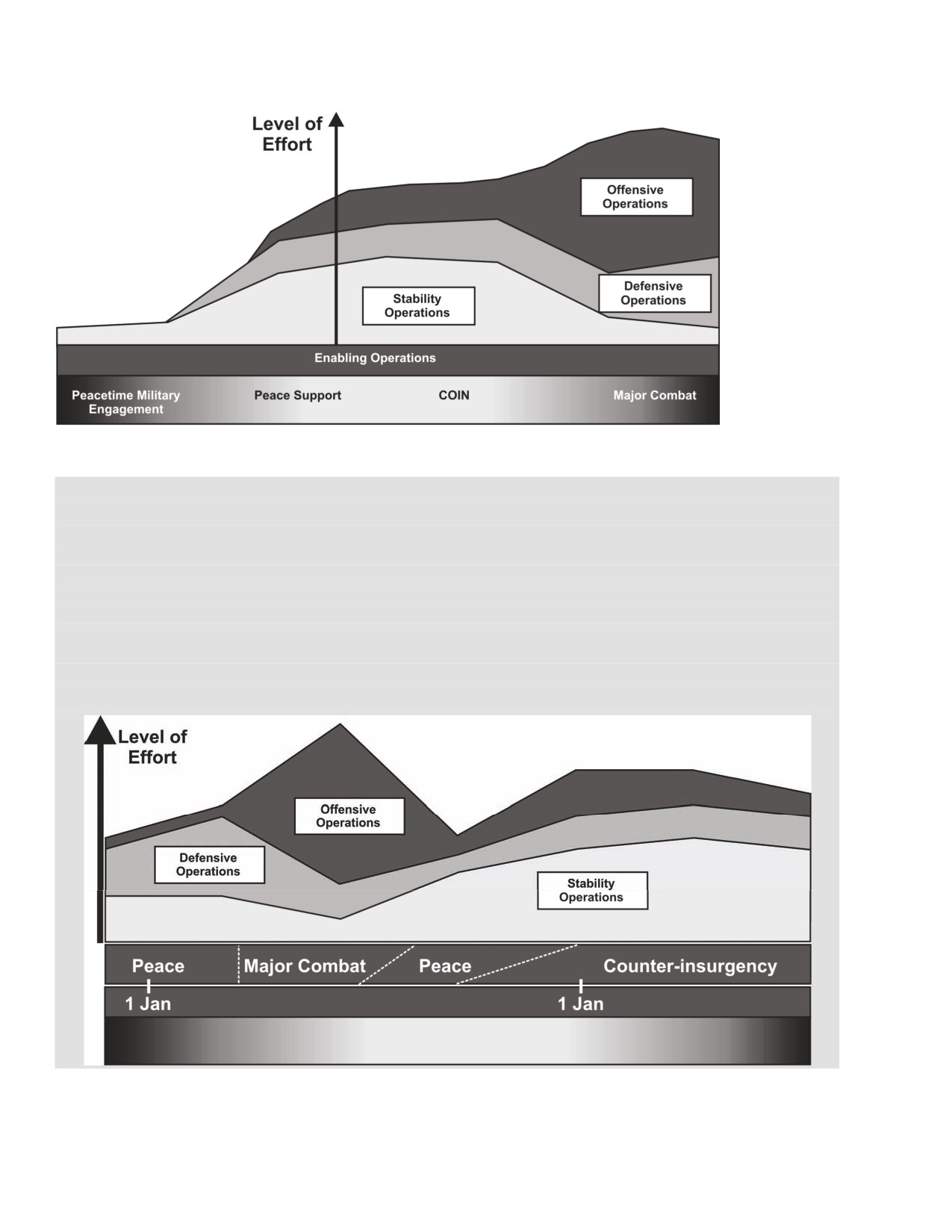
Land Operations
Figure 3-5: Tactical Operations on the Continuum of Operations
THE CONTINUUM OF OPERATIONS MODEL—IRAQ 2003 TO 2004
In southern Iraq in 2003 and 2004, the continuum of operations varied widely. In early 2003, before
the coalition attack on Iraq, coalition aircraft enforced the no-fly zone, which was effectively a peace
support campaign. In March 2003, the campaign theme changed to major combat as the coalition
initiated predominately offensive operations. These were declared complete by 1 May 2003. The
transition to a peace support campaign started when coalition forces first occupied towns in southern
Iraq and conducted stability and defensive operations. Initially, the environment was relatively
peaceful, with coalition forces engaged mostly in stability operations. Later in 2003, an insurgency
developed and the level of violence rose and the campaign changed its character to COIN. This
transition was difficult to identify accurately and occurred over several months.
THE CONTINUUM OF OPERATIONS—SOUTHERN IRAQ 2003 TO 2004:
3-20
B-GL-300-001/FP-001
The Employment of Land Forces
315. TACTICAL ACTIVITIES
1.
Offensive, defensive and stability operations, along with enabling operations, can be
sub-divided into activities such as the attack, defend, exploitation, and pursuit. Land tactical
activities are listed below in Figure 3-6. Each type of tactical operation has particular
characteristics and principles. Principles for the offence differ from those of the defence, and
they both differ from the principles of stability operations. In general, they are termed tactical
activities and are tangible undertakings meant to create desired effects (results) and they can
be assigned to units and subunits, usually through specific tactical tasks.
TACTICAL
OFFENSIVE
DEFENSIVE
STABILITY OPERATIONS
ENABLING
OPERATIONS
OPERATIONS
OPERATIONS
OPERATIONS
Tactical
Attack
Defence
Security and Control
Reconnaissance
Activities
Raid
Delay
Support to Demobilization,
Security
Disarmament and
Ambush
Advance to
Reintegration (DDR)
Contact
Exploitation
Support to Security Sector
Tactical
Pursuit
Reform (SSR)
movement
Support to Civilian
Break-out
Meeting
Infrastructure and
Feint and
Engagement
Governance
Demonstration
Link-up
Assistance to Other Agencies
Reconnaissance
Withdrawal
in Force
Retirement
Relief of Troops
in Combat and
Encircled
Forces
NOTES
1. Security and control refers to the establishment of a safe and secure environment, in which other non-military
agencies may operate and assist in the operational and strategic objectives.
2. Support to civilian infrastructure and governance will see military forces, at least initially, conducting tasks that
build/rebuild civilian infrastructure and conduct or assist with certain aspects of governance, such as provision of
health care, rule of enforcement, and humanitarian aid.
3. Assistance to other agencies refers to military assistance to specific agencies, helping them to reach
operational objectives. For example, military forces may be allocated to assist election organizers with security
and logistical support.
4. Enabling operations link or lead to other tactical operations and their effects. For example, an advance to
contact leads to an attack (and an eventual effects such as “seize”), and a withdrawal leads from one defence to
another.
5. Each of the tactical activities is realized through tactical tasks and effects that normally comprise of a mission
statement (see text on following pages). Enabling operations consist of activities, as given above, and these will
be issued in mission statements in terms of “conduct…”. In order to prosecute them, enabling activities will be
broken down into supporting or constituent tasks for subordinates. For example, security will be assigned as a
covering force or guard force and supporting tasks assigned. See
B-GL-331-002/FP-000 Staff Duties in the Field for further details.
Figure 3-6: Land Tactical Operations and Constituent Activities
B-GL-300-001/FP-001
3-21
Land Operations
2.
Note that defensive operations include both the defence and the delay. Although their
desired effects and aims may be different, the delay is conducted by the same principles and
many of the same techniques as a defensive operation. Thus, they have been grouped
together.
3.
Stability operations and activities involve both coercive and cooperative means, but in
the main, they seek to positively influence a target audience, such as the building of a school to
engender support from a populace and to increase civic capabilities. Stability activities may
occur before, during and after offensive and defensive activities, and may be the main effort of a
campaign. Stability activities contribute to creating an environment in which the other
instruments of power, that is, the diplomatic, civic and economic instruments, along with other
elements and agencies in the JIMP framework, can work and predominate in cooperation with a
lawful government.
316. TACTICAL TASKS AND EFFECTS
1.
Tactical activities are accomplished through the assignment of tactical tasks and effects.
Thus, an attack, for example, may be realized through units and subunits conducting assigned
tasks such as, fix, seize, neutralize, support by fire, etc., all brought together through a plan in a
complementary and synchronized fashion. This construct is well embedded into our format of
the tactical mission statement. For example, a mission statement may read: A Coy will attack to
(activity of attack is not always stated) seize Objective PAPER by 10:00 hrs in order to secure a
line of departure for B and C Coys. The tactical offensive activity of attack has been delegated
as a task of a first order effect to seize, while the purpose of the mission is to secure a line of
departure, which is a second order effect.
2.
Just as offensive and defensive tactical operations are accomplished through tactical
tasks and effects, such as destroy, seize, or block, stability operations will be accomplished
through a series of tactical tasks, such as vehicle check points, observation posts, presence
patrolling, cordon and searches, humanitarian aid, and reconstruction, to name only a few.
Some tactical tasks may be common to more than one tactical operation. For example, secure
may be part of an offensive operation, or it could be assigned as a task for defensive or delay
operations, or even for stability operations, such as secure a local market area from criminal
activity.
3.
Enabling operations and activities are normally assigned and conducted simply as
activities, such as withdrawal or relief-in-place, and are not assigned in terms of tactical tasks
and effects (although they will be conducted through a series of logical tactical tasks such as
“be prepared to support by fire”).
4.
Examples of the types of tactical tasks (often equating to mission task verbs) that
support their respective tactical operations are given in the table at Figure 3-7.
3-22
B-GL-300-001/FP-001
The Employment of Land Forces
TACTICAL
OFFENSIVE
DEFENSIVE
STABILITY
OPERATIONS
OPERATIONS
OPERATIONS
OPERATIONS
Attack
Defence
Security and Control
Operations consist
Raid Ambush
Delay
Support to Demobilization,
of tactical activities
Disarmament and
Exploitation
Reintegration (DDR)
Pursuit
Tactical Activities
Support to Security Sector
Break-out
Reform (SSR)
Feint
Support to Civilian
Infrastructure and
Demonstration
Governance
Reconnaissance in
Assistance to Other
Force
Agencies
Activities are
Destroy
Block
Cordon and Search
realized through the
Seize
Occupy
Observe/Monitor
assignment of tasks
& effects.
Secure
Counter-attack
Vehicle Check Point (VCP)
Support by Fire
Guard
Framework Patrols
Fix
Humanitarian Aid Delivery
Effects
Retain
Train Indigenous Security
(Not Inclusive List)
Forces
Crowd Confrontation
NOTES
1.
Mission statements will be written with both the activity and the task or immediate effect, further described
by the purpose, or secondary effect. The activity is not always stated in the mission statement, such as (Attack to)
seize (object) , in order to…
2.
Mission statements relating to stability activities and tasks will use the transient verb “conduct” to assign
the activity, such as, “...will conduct security and control in order to…”. This would then be allocated as tactical
tasks and effects to subordinates, such as VCPs, framework patrols, etc. At the lower tactical levels, only the
tactical tasks may appear in the mission statement, but again continue to use the verb “conduct,” such as, “…will
conduct framework patrols in order to…”, or “…will conduct humanitarian aid delivery in order to…”. In this
manner, they are similar to mission statements for enabling operations. See B-GL-331-002/FP-000 Staff Duties in
the Field for further details.
Figure 3-7: Tactical Operations, Activities, and Tactical Tasks (Not inclusive)
5.
Commanders must consider and potentially plan for the simultaneously conduct of each type
of tactical operation regardless of the nature or theme of the campaign they are undertaking. Even
during major combat, there will be a requirement to undertake or at least plan for some stability
operations. As campaigns move to the lower end of the spectrum of conflict, the opportunity for and
requirement for stability operations will increase.
6.
As noted previously, the simultaneous conduct of offensive, defensive and stability
operations is defined as full-spectrum operations (FSO). The higher levels of command
(normally battle group and above) must be able to plan for and conduct simultaneous operations
along the spectrum. Tactical level commanders and their subordinates must be mentally and
physically prepared to transition rapidly between these types of operations and tasks.
B-GL-300-001/FP-001
3-23
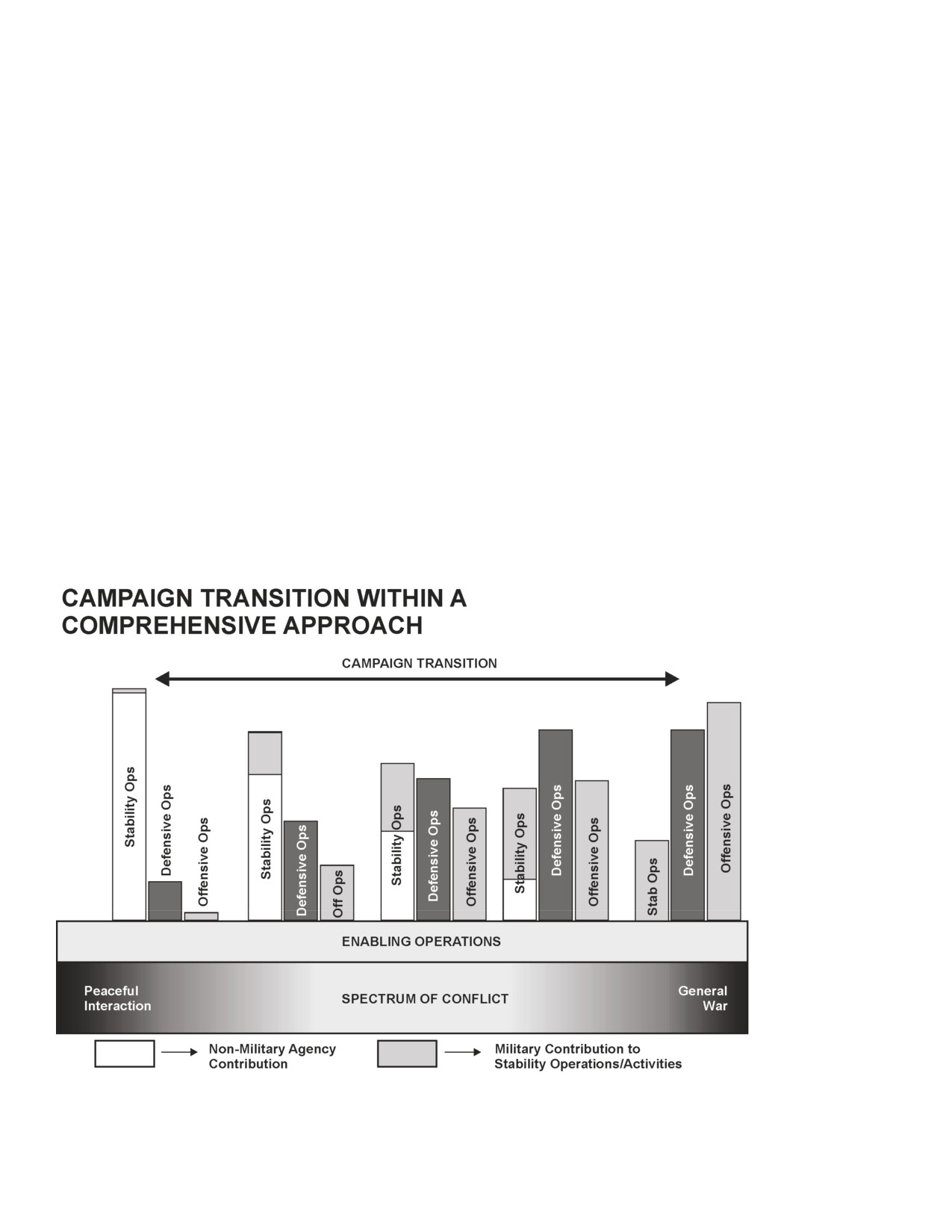
Land Operations
317. TRANSITION IN CAMPAIGNS
1.
Although some transitions in the campaign theme, such as the launch of a set of major
offensive operations and the development of enemy manoeuvre forces, may be easy to identify,
often a campaign will change its character slowly over time. An insurgent group may grow
increasingly effective or there may be a gradual lessening of violence. In these cases, it may be
difficult to identify precisely a single moment of campaign transition. However, changes in campaign
themes will almost, of necessity, be tied to phases and accompanying changes in task organization,
rules of engagement, etc.
2.
Recognizing the changing circumstances, or conditions that require a change to the major
theme of a campaign, is an intellectual challenge. This is part of the art of war. The intelligence
system must be attuned to and look for indicators of shifts, and commanders must be able to
interpret the key indicators that show a shift is taking place. They must act in a changing
environment, either to prevent an escalation of violence, or facilitate a shift to a lower level of violence
in a fashion manageable by the forces at hand.
3.
As a campaign transitions to the less violent end of the spectrum of conflict the requirement for
offensive and defensive activities should decrease and the need for and opportunity for stability activities
should increase. Furthermore, the proportion of stability activities being conducted by organisations and
agencies other than the military should increase. (See Figure 3-8.) The comprehensive approach to
campaigns will involve a wide variety of agencies other than the military to address the range of issues
with the environment and to create enduring solutions. Thus, as campaigns transition to reflect success,
the non-military component of the comprehensive approach increases.
Figure 3-8: Campaign Transition
3-24
B-GL-300-001/FP-001
The Employment of Land Forces
318. DOMESTIC OPERATIONS
1.
Domestic operations are those that are conducted within the confines of the military
force’s own nation. They will be classified under the same campaign themes as those given
above although they will be conducted under specific legal titles, protocols, and frameworks.
2.
An invasion of the nation by a conventional force will see the conduct of a major combat
campaign to expel the foreign invader. The rise of a domestic insurgency will result in the
conduct of counter-insurgency, undertaken in cooperation with a wide range of other security
forces and government agencies. In most cases, domestic operations will take the form of a
limited intervention, such as assistance in times of a natural disaster.
FULL-SPECTRUM OPERATIONS—1 RRF, IRAQ, MARCH 2003
In Iraq in March of 2003 during the advance to Basra, Z Company, 1st Bn, Royal
Regiment of Fusiliers conducted full-spectrum operations within a 48 hour period, 22 to
24 March 2003:
On the morning of 22 March, the battle group (BG) conducted a forward passage of lines
with US forces in the push to capture Basra City. Each combat team (cbt tm) in the
battle group (BG) was assigned the capture of a bridge leading to the City. Z Coy Cbt
Tm consisted of two armoured infantry rifle platoons and two troops of tanks.
Z Coy Cbt Tm began with an assault against an enemy position on the near side of the
bridge. (Offensive operation). Once secure, vehicles suppressed the adversary on the
far bank, while a platoon cleared an Iraqi army barracks on the flank. After nightfall,
another platoon attack was conducted to clear the far bank of the bridge. The cbt tm
then adopted a hasty defensive position for the night of 22/23 March. (Defensive
operations).
First light on 23 March brought a crowd of civilians attempting to flee Basra via the
bridges. The formation HQ ordered that no civilians be permitted to leave the area for
fear that enemy would attempt to ex-filtrate the area. Thus, the cbt tm was forced to
conduct crowd control operations in the midst of their defensive position. (Simultaneous
defensive and stability operations).
The hasty defensive position was maintained throughout the day and was harassed by
enemy mortar fire. The cbt team also faced and defeated an armoured counter-attack
consisting of three T-55s. (Defensive operations)
Later on the 23rd of March, the company, while maintaining the defensive position, used
one platoon and two tanks to conduct a penetration and raid into Basra, destroying five
T-55s and a number of infantry detachments en route (simultaneous defensive and
offensive operations). The cbt team maintained the defensive position throughout the
night of 23/24 March and then conducted a relief-in-place on the morning of 24 March.
(Defensive and enabling operations)
The cbt team was withdrawn to an area in the depth of the BG and conducted a wide
array of stability operations including: civilian route movement control; humanitarian aid
distribution; the fighting of oil fires; and the prevention of looting and other criminal
activities. (Stability operations).
While Z Coy Cbt Tm was conducting this combination of offensive, defensive and
stability operations, other subunits in the BG were doing similar activities. Thus, both the
1 RRF BG, and at times Z Coy Cbt Tm, conducted full-spectrum operations.
Source: Memoirs of OC Z Company, 1 RRF, Major Duncan McSporan, RRF.
B-GL-300-001/FP-001
3-25
PAGE INTENTIONALLY LEFT BLANK
Land Operations
CHAPTER 4
THE GENERATION OF FIGHTING POWER AND ORGANIZATIONAL
FRAMEWORKS
SECTION 1
INTRODUCTION
401. GENERAL
1.
Military operations are the application of a force’s fighting power in order to achieve
desired outcomes and end states. It exists at all three levels of command. Fighting power is
not simply generated or created through a total sum of its constituent components. Aspects of
fighting power take years, decades, and even centuries to develop. Fighting power is the total
sum of capability. In order to understand how to conduct military operations, commanders must
comprehend the fighting power that will be applied through those operations.
2.
Notwithstanding the ability of a military force to use fighting power to create destructive
or disruptive effects, it must be remembered that fighting power, that is, a military’s capabilities,
can be used to undertake tasks that create effects other than physical and destructive. A
military’s capability may be used to restore essential services, provide security for a local
populace, assist other agencies to do their work, and create influence and engender support
within a populace or other target audience.
402. THE GENERATION OF FIGHTING POWER
1.
Fighting power is defined as the ability to fight, consisting of three essential, inter-related
components: a physical component: a moral component and an intellectual component.
Fighting power is measured by assessment of operational capability.38 It is the ability to apply
its capabilities and to achieve success. The application of capabilities is not limited to fighting,
but includes the completion of all activities required for operational success.
2.
Combat power is defined as: “The total means of destructive and/or disruptive force
which a military unit/formation can apply against the opponent at a given time.”39 Combat power
is measured in physical terms and stems form the physical component of fighting power. In
discussing the application of capabilities and resources to a target, it may be described in terms
of applying combat power.
3.
Fighting power is based upon and is generated through its constituent components: the
moral component, which includes moral and cohesion and reflects the ability to have soldiers
fight; the physical component, which is the means to fight; and, the intellectual component,
which includes the conceptual elements of doctrine and education, and the perceptions for
situational understanding and decision making. (See Figure 4-1.) The appropriate development
and combination of these components provides the necessary basis for the generation of
fighting power:
38 Drawn from Allied Joint Publication 01(C) NATO Allied Joint Doctrine (Ratification Draft 2006), Allied
Joint Publication 3.2 Allied Joint Doctrine for Land Operations (Ratification Draft 2006), and UK ADP Land
Operations AC 71819.
39 NATO Allied Administrative Publication 6 (AAP 6), Glossary of Terms and Definitions (2006)
B-GL-300-001/FP-001
4-1
Land Operations
a.
The Physical Component. The physical component of fighting power consists
of the tangible elements of fighting power. It includes organizations, equipment,
systems, and training.
b.
The Moral Component. The moral component provides the ethical and cultural
base from which we derive morale, cohesion, esprit de corps, and fighting spirit.
It includes a cultural element that may be unique to a nationality, a service, a
land force and a regiment, and it is often the reason for different approaches
taken by different forces to the same situation despite similar structures and
doctrine. These elements of the moral component are largely intangible, yet
vital products of tradition, history, force preparation and generation. They may
take years to develop.
c.
The Intellectual Component. The intellectual component consists of the
conceptual elements of education and doctrine, and the perceptions and
understanding of the operating environment by the commander, his staff, the
subordinates and the force as a whole.
(1)
Doctrine40 and education consists of the knowledge of principle-based
concepts for land operations. It provides an institutional understanding of
the application of the other components of fighting power.
(2)
The perceptual element of the intellectual component is the
understanding and perception of the situation at hand, with respect to all
the elements of the environment. It consists of a situational understanding
and perception of the complex and perhaps chaotic environment in which
land operations occur. It guides how combat power will be applied at a
specific time and in a specific situation. It is the target of information
operations that seek to influence the understanding, perceptions and
ultimately the will and behaviour of the target. Decisions made by a force
based on wrong or manipulated information or on another perception of
the reality will lead to the ineffective use of combat power. Likewise, the
perception of unavoidable defeat will undermine the moral component of
fighting power and avoid attritional battle.
4.
Therefore, even if the will and the ability to fight are well developed, deficits in either
doctrine, education or perception will lead to ineffective or counterproductive application of
combat power.
40 Hierarchically, doctrine consists of philosophies, principles, practices, and procedures.
4-2
B-GL-300-001/FP-001
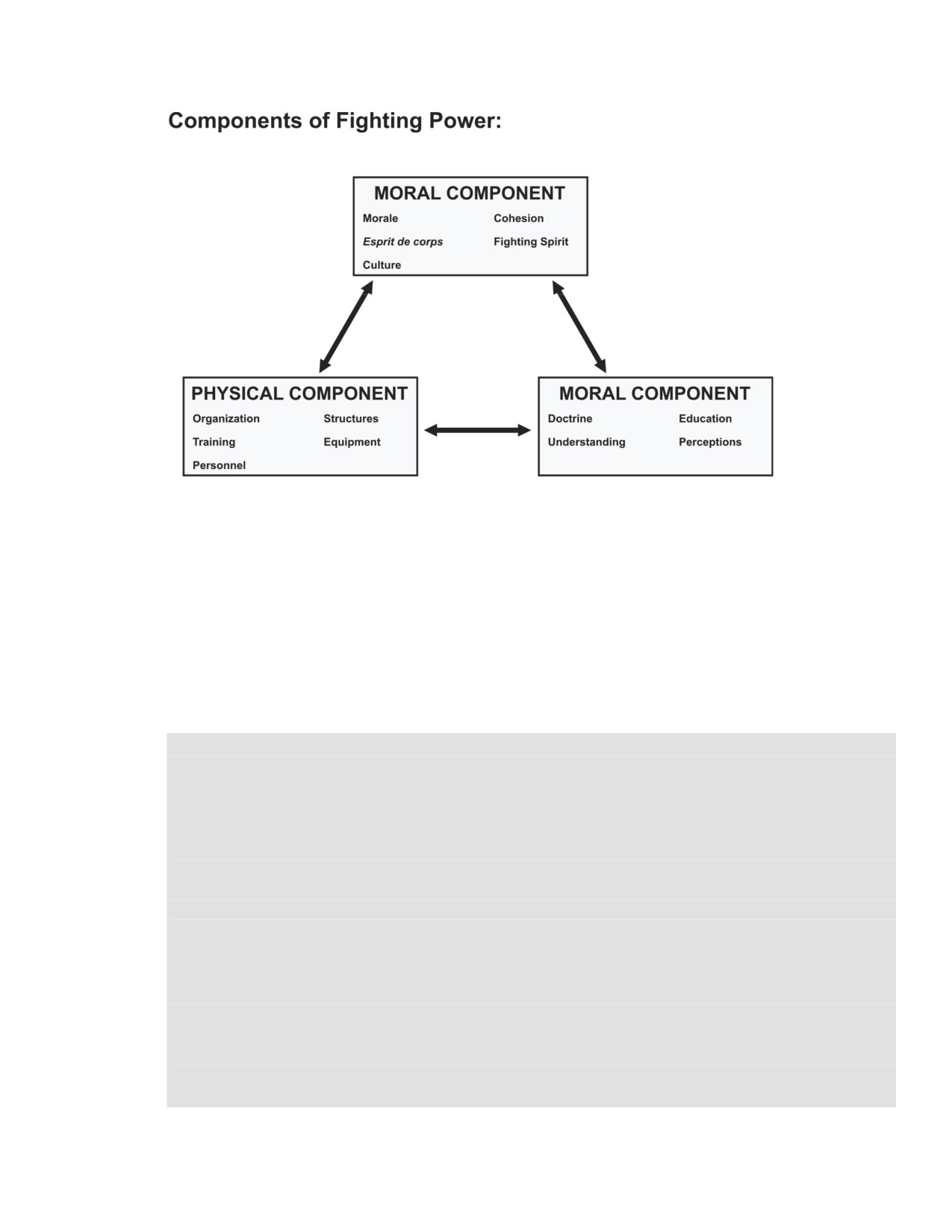
The Application of Combat Power
Figure 4-1: Components of Fighting Power
5.
Fighting power is the total sum of the capabilities of a military force. In short, the three
foundational components of fighting power must be considered in a holistic manner and
integrated with maximum synergy in order to attain effective and balanced fighting power.
Fighting power is generated by the integration of these three components.
6.
Fighting power is not built or changed through the mere arrangement of its components
and their constituent elements. If developed, organized, understood, and nourished properly,
the whole of a force’s fighting power will be greater than the sum of its parts. Any single change
to one element of fighting power will likely have a significant impact upon other components of
fighting power that may not be realized for some time after the fact.
CHANGES AND EFFECTS IN THE COMPONENTS OF FIGHTING POWER:
SOMALIA 1993
Prior to the late 1960s and early 1970s, infantry section commanders held the rank of
corporal, having worked their way to the rank from private and lance-corporal. Section
commanders are the only commanders in direct command of subordinates. Since this
time, section commanders have held the rank of sergeant, that is, they have been senior
NCOs and have thus been in a different mess than their subordinates and have lived
separately. As a result of this structural change, they became physically and intellectually
separated, loosing the “feel” for attitudes and emotions at the lowest levels. The end result
was a broken chain of intimacy between a section leader and subordinates and it made it
difficult to keep tabs on what was going on amongst the subordinates.
This was a structural change in organisation, that is, a change to the physical component
of fighting power. Although not evident necessarily at the time, it eventually led to
negative effects in the moral component of fighting power. Once the structure was placed
under the stressful conditions of the Somalia campaign of 1993 and combined with other
factors, it helped lead, in good measure, to a breakdown in discipline and standards.
Source: David Bercuson, Significant Incident: Canada’s Army, the Airborne, and the Murder in
Somalia (Toronto: McClelland and Stewart, 1996). Pg 63 and 79-80.
B-GL-300-001/FP-001
4-3
Land Operations
403. FRAMEWORKS FOR THE ORGANIZATION AND APPLICATION OF FIGHTING
POWER
1.
Once generated, fighting power is organized and applied through three frameworks:
a.
The elements of the physical component of fighting power, that is, the forces,
their activities and command structure, are organized in spatial and temporal
orientation within the environment. This is a battlespace framework.
b.
Fighting power is then applied through the synchronized integration and
execution of functional capabilities, which consist of the five operational
functions41 and the core functions of find, fix, and strike (and exploit). This
organization of activities in the environment is the functional framework and is
realized through the assignment of tactical activities, that is, a tactical plan. It is
a framework for manoeuvre.
c.
Fighting power is applied on the physical and psychological42 planes through
assigned activities in order to achieve desired effects, that is, results.43 These
effects are described as shaping, decisive, and sustaining. The arrangement
of effects in relation to one another, the target, and the environment, is known
as an effects framework.44 Many activities will be physical and have first order
effects on the physical plane against a target and thus affects the target’s
behaviour. Other activities will be intellectually or psychologically based, and
will seek to influence understanding, perception, will, and ultimately, behaviour;
that is, they will create first order effects on the psychological plane. These
influence activities will be planned to create desired effects amongst a target, be
it an adversary or a local populace. For example, to seize the enemy position
(decisive), psychological operations (PSYOPS) flyers may convince enemy
conscripts to flee (shaping) before a deliberate attack is launched. Likewise,
reconstruction of civil infrastructure will help stabilize a population and engender
support from them and other target audiences. (See Figure 4-2.)
41 The five operations functions are Command, Sense, Act, Shield and Sustain. They are discussed
further in Section 3 of this Chapter.
42 Throughout this publication, the term “psychological plane” is used to refer to that level of existence
commonly referred to as the “psychological plane.” The former term is used in order to be more
encompassing and include psychological recognition and emotions.
43 Throughout this publication, the term “effects” is synonymous with “results.”
44 The effects framework was formally known as the operational framework. The name has been
changed to better describe it and to avoid confusion with the operational functions outlined in the
functional framework.
4-4
B-GL-300-001/FP-001
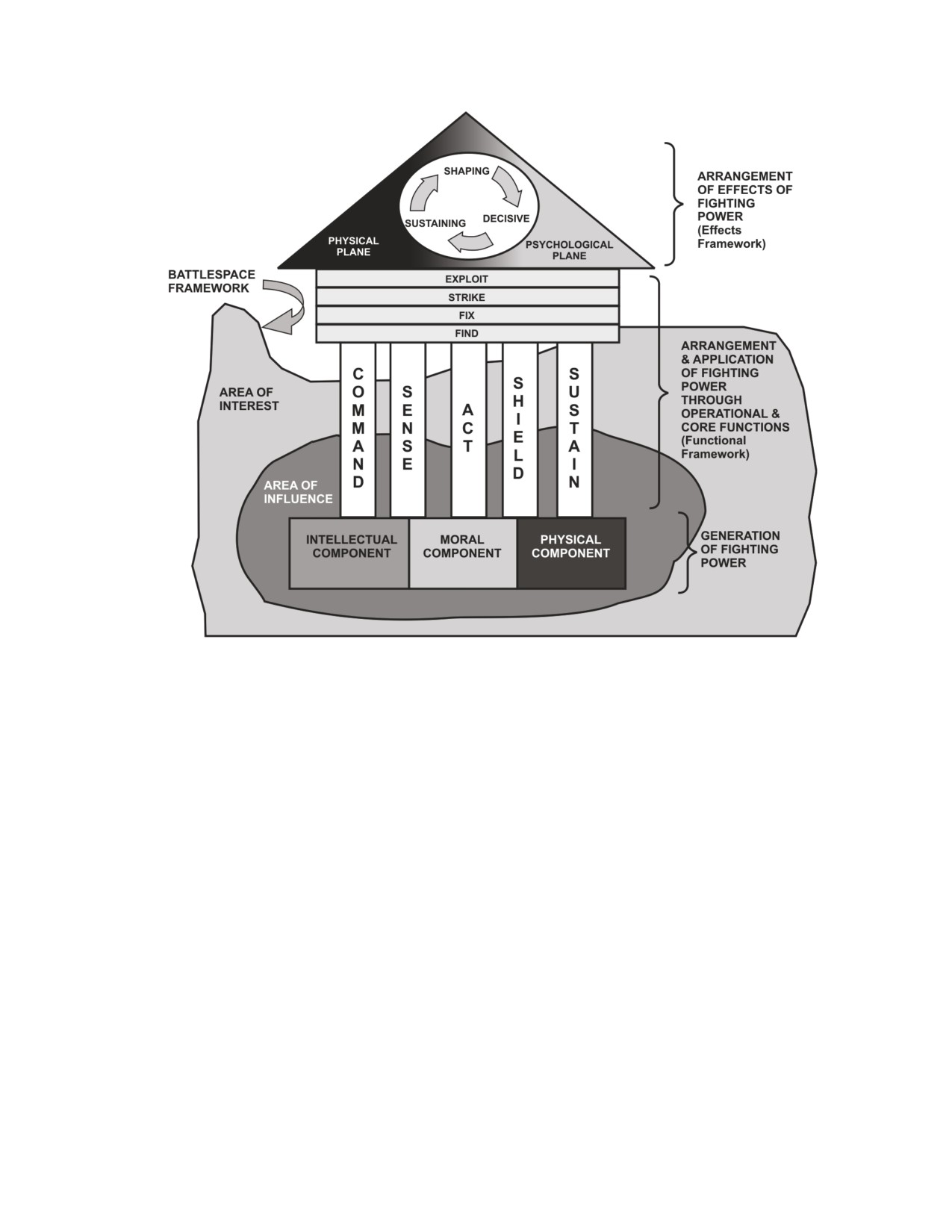
The Application of Combat Power
Figure 4-2: The Generation and Application of Fighting power and Its Effects
2.
Fighting power has traditionally been though of in terms of destructive force. However, it
can also be applied to campaign problems that require other solutions, such as the secure
delivery of humanitarian aid, or the reconstruction of essential services, in the fight to secure a
population and its support, that is, to affect perceptions and the will of a target audience. In
other words, fighting power is used to create effects on the physical plane and the psychological
plane.
3.
Details regarding the frameworks for application of fighting power are discussed in the
following sections.
B-GL-300-001/FP-001
4-5
Land Operations
THE IMPORTANCE OF THE MORAL COMPONENT OF FIGHTING POWER
By late 1944, some Canadian Army personnel had served overseas for five years, and
many in the combat arms had served on the frontlines in Italy for a year and a half. The
toll of constant combat, casualties, a lack of leave, and time overseas was heavy, a
palpable sense of disillusionment becoming obvious throughout the ranks. Heavy
casualties had decimated the ‘old guard’ of the regiments, weakening the regimental
ethos that traditionally served as a bulwark for the morale of those in the frontlines. In
addition, the Canadian government had failed to anticipate the heavy casualties that
resulted from combat in both Italy and Europe, leading to a shortage of trained
replacements. The primary cause of this shortage was the conscription policies of the
Canadian government of the time, which decreed that conscripted members of the
armed forces could decline service overseas.
The men in the frontlines derisively termed the large body of conscripts serving in
Canada “zombies.” The greater issue though was the effect the apparent lack of support
from the home front had on the morale of those who had suffered through the oft-brutal
combat in Italy and Europe. The effects on the morale of the men cannot be overstated;
veterans today continue to express bitterness over what was rightly considered a
betrayal by the Government of Canada. Several powerful passages written by Farley
Mowat, who served in the Hastings and Prince Edward Regiment, underscore not only
the effects on the morale of the men, but also the drain on military power, while
accentuating the critical role played by regimental ethos as a key moral component of
military power:
In Canada almost 100 000 Zombie conscripts lived a comfortable and pleasant life,
secure in the knowledge that they would never be asked to face the enemy. As the
days…drew on, awareness of the full scope of the betrayal on the home front wore
deeply into men’s souls. There was only one antidote for it. The infantry scrubbed their
khaki gaiters, pressed their worn uniforms, polished their cap badges and did what they
could to keep the Regiment—their Regiment, their only home—as a living focus for their
lives. It was the sole remaining source of strength for most of them and as it had not
failed them in the past, it did not fail them now.
The seeming betrayal of those on the home front—the very country for which the men on
the front lines risked and sacrificed their lives—undermined the moral basis of fighting
power, causing morale to plummet. For many, the prospect of survival based on the
shear odds of time in combat seemed so slim that a sense of hopelessness set in, some
breaking down completely. In the end, they turned to that which was most familiar and
trusted, that is, their pride and faith in their Regiment.
The moral component of military power is critical. Neither training, nor superb
equipment can substitute for a sense of purpose and a belief in one’s place and
importance in a greater organization, superior to immediate trends and challenges.
Sources:
Daniel Dancocks, The D-Day Dodgers: The Canadians in Italy, 1943-1945 (Toronto: McClelland
& Stewart, 1991).
Farley Mowat, The Regiment (Toronto: McClelland & Stewart, 1955).
4-6
B-GL-300-001/FP-001
The Application of Combat Power
THE IMPORTANCE OF THE PHYSICAL COMPONENT OF FIGHTING POWER
In the fall of 1944 the Canadian Army was facing a severe shortage of trained
infantrymen. Units fighting in the Scheldt estuary were under-strength, served by a
woefully inadequate replacement system hampered by uniquely Canadian political
problems, and constantly inaccurate casualty forecasts. A stopgap solution was
implemented: army personnel serving in non-infantry trades would be re-mustered into
the infantry to bolster front-line units.
Unfortunately the operational tempo at the time did not allow for anything more than
perfunctory introduction to infantry tactics and individual field craft skills for re-mustered
personnel. Consequentially, many of these replacements were lucky to survive more
than a day or two in the front lines. Lacking a solid foundation of individual and
collective training and equipment and weapon handling these men were of little use to
hard-pressed infantry regiments. (This situation was aggravated by the obvious lack of
moral cohesion that newly arrived soldiers experienced in their new units.)
Further drains on personnel were created by the need to set up echelons to provide a
crash-course on infantry warfare. The fighting power and thus effectiveness on the
battlefield for Canadian units was severely undermined by all of these factors.
The hurried echelon training implemented by one regimental commander, Denis
Whitaker of the RHLI, incorporated all three facets of fighting power to include basic
doctrine and field craft, equipment handling, regimental ethos (moral component) by
discussing the history and victories of the regiment.
Sources:
Denis & Shelagh Whitaker, Tug of War: The Allied Victory That Opened Antwerp (Toronto:
Stoddart, 2000).
Daniel Dancocks, The D-Day Dodgers: The Canadians in Italy, 1943-1945 (Toronto: McClelland
& Stewart, 1991).
B-GL-300-001/FP-001
4-7
Land Operations
THE IMPORTANCE OF THE INTELLECTUAL COMPONENT OF FIGHTING POWER
Two of the principal factors that led to the carnage at the Somme in July 1916 were poor
combined arms coordination between the infantry and artillery and ineffective Allied
counter-battery techniques. Lieutenant Colonel Andrew McNaughton, appalled by the
unprecedented casualty rates as well as the unscientific doctrine guiding the use of
artillery, became determined to develop doctrine suitable to positional warfare
operations. Appointed to the post of Counter-Battery Staff Officer at Canadian Corps
HQ in January 1917, McNaughton began overhauling existing artillery doctrine by
utilizing lessons learned, emergent technology, and knowledge gained by close liaison
with allies. McNaughton developed a comprehensive combined arms and counter-
battery doctrine that, for the first time, combined artillery fire and infantry movement in a
synchronous manner, enabling the infantry to achieve their objectives. McNaughton’s
complex doctrine took into account all possible variables, including environmental
conditions (temperature, barometric pressure, wind, etc.), gun calibration, munitions
supply, artillery manoeuvrability, wear and tear on equipment, human fatigue, and
intelligence. McNaughton also created standard terminology to eliminate confusion.
Moreover, McNaughton demanded improved intelligence gathering, analysis, and
coordination, because of the direct relationship between good intelligence, casualty
rates, and success. Finally, McNaughton constantly strived to improve his counter-
battery doctrine, analyzing each engagement for lessons to be learnt. McNaughton’s
efforts were fundamental to the Canadian Corps victories at, among others, Vimy Ridge,
Hill 70, Amiens, and Arras. The development of innovative and flexible doctrine
strengthened the conceptual component of fighting power of the Canadian Corps, and
provided a decisive edge on the battlefield.
Source: John Swettenham, McNaughton Vol.1 1887-1939 (Toronto: The Ryerson Press, 1968).
SECTION 2
THE BATTLESPACE FRAMEWORK
404. BATTLESPACE
1.
Battlespace45 is defined as: “the area of interest that includes both the physical46 and
moral planes and the electromagnetic spectrum.”47 A commander’s battlespace consists of his
area of operations (AO), the area of influence (A of I), and the area of interest (AI). Of the three
components of the battlespace, the AO is assigned to the commander by his superior and the
commander’s assessment will lead him to identify the other components.
45 Battlespace is defined within NATO AJP-3 (2003) as: “The environment, factors and conditions that
must be understood to successfully apply combat power, protect the force, or complete the mission. This
includes the air, land, sea, space environments, the include enemy and friendly forces, facilities, weather,
terrain, the electromagnetic spectrum and the information environment within the operational areas and
areas of interest.”
46 The physical plane is inclusive of the air, land, sea, space, and electromagnetic/cybernetic
environments.
47 Definition developed by Army Terminology Panel 23 Jan 01. Note that the moral plane is synonymous
with the psychological plane.
4-8
B-GL-300-001/FP-001
The Application of Combat Power
2.
The battlespace framework is the tool used to facilitate decentralization of execution by
identifying subordinate commanders and their AOs, and establishing command relationships for
each phase of a campaign or operation. It will describe AOs and from this, the area of influence
and area of interest will be identified. It is related to terrain and each AO is related to one or a
number of lines or groupings of operation within the campaign plan. The battlespace framework
is the arrangement of troops, resources and command and control in the environment.
3.
The battlespace framework will also determine the disposition of forces through the
descriptors of contiguous, non-contiguous, linear, and non-linear battlespaces. The layout of
the battlespace framework should flow from the campaign design and may be related to specific
lines of operation and activities.
4.
In order to effectively conduct operations and create effects that support assigned
objectives and ultimately achieve the desired end state, the commander must gain and maintain
an understanding of his battlespace and all the elements and actors within it. This will be
reflected in the knowledge base that will identify and assess all the interrelated systems,
entities, and actors within his battlespace.
5.
The battlespace must also be considered from a joint, inter-agency, multinational and
public (JIMPP) viewpoint. Aims and objectives amongst the elements within the JIMPP
framework will vary, and the onus may fall to the military commander to harmonize this myriad
of objectives and their constituent activities and effects. This is best accomplished with a
shared unifying purpose, and ideally, effort expressed as a unifying theme in the commander’s
statement of intent.48
6.
A military force will project its fighting power throughout its AO and has potential to do
the same throughout its area of influence. It may do so on both the physical and psychological
planes. In doing so, however, it may create desired and/or undesired effects in the larger area
of interest. For example, activities undertaken to engender campaign support from an ethnic
minority in an AO may create additional support from that same minority in another region or
country.
7.
Thus, activities and their effects are not limited to the physical dimensions of the
geographical area of influence. Activities that occur within an AO can have effects far removed
from the geographical AO or area of influence. Tactical incidents may even have wide-ranging
operational and strategic effects. For example, the accidental death of civilians from a particular
ethnic group may well cause public outcry, undermine support for the force and its mission,
affect the deployment of coalition forces from other nations, and engender negative reactions in
other countries, particularly those with sympathetic ethnic groups. These removed areas are
considered areas of interest. (See Figure 4-3.)
48 It is unlikely that non-military elements will come under military command in a campaign. However,
through cooperation, shared goals and understanding, fostered by the personal efforts of the commander,
military and non-military agencies may harmonize and even integrate their activities. Ideally, they will plan
the campaign together.
B-GL-300-001/FP-001
4-9
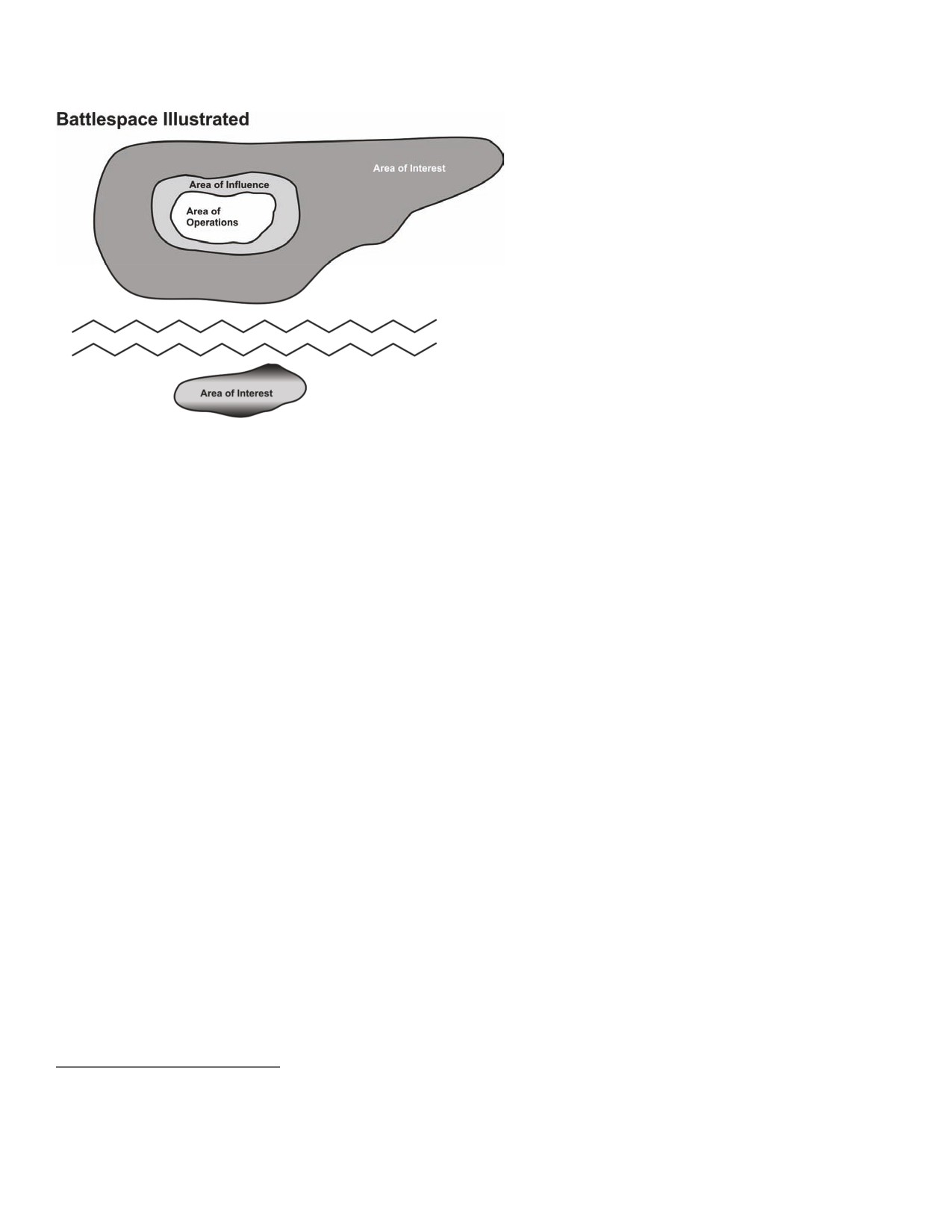
Land Operations
Figure 4-3: Battlespace Illustrated
405. AREA OF INTEREST
1.
The area of interest is defined as: “the area of concern to a commander relative to the
objectives of current or planned operations, including his areas of influence, operations and/or
responsibility, and areas adjacent thereto.”49 This area also includes areas occupied by the
adversary and interested neutrals, all of which could jeopardize or influence the accomplishment
of the mission.
2.
The understanding of an area of interest must be expanded beyond immediate
geographical and temporal concerns. Areas of interest may include areas and activities that are
affected by events in a commander’s AO, or conversely, may include external events and
influences that affect systems or individuals in the commander’s AO.
3.
Limited resources, time, and personnel will place limitations on the commander’s ability
to collect and process information from the entire area of interest and its scattered influences.
The commander must set priorities for monitoring the area of interest. Too narrow a view could
render the force reactive rather than proactive, and too wide a view could hinder the force with a
glut of irrelevant information. In assessing elements in the area of interest, links between those
elements and systems and those within the more immediate areas of the battlespace (AO and
area of influence) must be identified and analyzed.
4.
The area of interest has different connotations at the tactical, operational and strategic
levels, and commanders must understand the level or levels at which they are operating in order
to prioritize information collection:
a.
Tactical. At the tactical level, the area of interest includes JIMP activities both
within and adjacent to the AO.
49 NATO Allied Administrative Publication 6 (AAP-6), Glossary of Terms and Definitions (2006).
4-10
B-GL-300-001/FP-001
The Application of Combat Power
b.
Operational. At the operational level, the area of interest includes JIMP
activities within and adjacent to either the joint operations area.
c.
Strategic. At the strategic level, the area of interest includes global JIMP
activities. With the speed and reach of modern information technologies, this is
a vast concept. A policy announcement out of the United Nations Headquarter
in New York, a posting on an Internet website originating from another continent,
or a news story concerning an incident thousands of miles from the
commander’s assigned AO, can have near immediate influence upon
operations.
406. AREA OF OPERATIONS
1.
An area of operations is defined as: “an operational area defined by a joint commander
for land or maritime forces to conduct military activities.”50 Normally, an area of operations does
not encompass the entire joint operations area of the joint commander, but is sufficient in size
for the land joint force component commander to accomplish assigned missions and protect
forces.
2.
At the tactical level, a commander may be assigned an area of operation (AO). This
may be considered a geographical area, defined by lateral and rear boundaries, which is
assigned to a commander by a higher commander. Within these boundaries the commander
has authority to conduct operations in order to execute his mission.
407. AREA OF RESPONSIBILITY
1.
A higher, component commander assigns areas of responsibility (AOR) to his
subordinates. An AOR is defined as: “geographical area of ground, sea or air under the
command of a commander who has the necessary authority and power to exercise it. This
responsibility is normally extended to intelligence collection, conduct of operations, control of
movements and possibly the maintenance and protection of facilities, but it can also be limited
to a specific domain.”51 Although an AOR is assigned to a commander by his component
commander based on the latter’s assigned AO, the AOR of subordinate commanders are
commonly referred to as AOs as well.
2.
An AO/AOR is a permissive control measure that provides freedom of action within
defined boundaries and increases flexibility in unit operations. Commanders can, in turn,
partition their assigned AO/AOR and assign portions of it to subordinate formations, units and
subunits. The design of an AO/AOR will evolve over time as a result of the continuous
assessment process and changing circumstances.
3.
Within assigned an AO/AOR, unless directed otherwise, the commander is responsible
for the following:
50 Ibid.
51 Army Administration Publication (AAP) 39 (2007). Glossary of Land Military Terms and Definitions.
AAP-6 defines AOR as: “the geographical area assigned to each NATO strategic command and to each
regional command of Strategic Command Europe.”
B-GL-300-001/FP-001
4-11
//////////////////////////////////////////