Asylum Report 2023 - page 5
EUROPEAN UNION AGENCY FOR ASYLUM
was no lack of a legal basis for the application of an alternative measure to detention (see also
here). Therefore, it dismissed the appeal of the Centre for the Registration of Foreigners of the
State Border Guard Service under the Ministry of the Interior.
Following another court ruling initiated by the Human Rights Monitoring Institute together with
the professional association of lawyers ReLex as one of the strategic cases, the Supreme
Administrative Court in Lithuania stated that according to the Law on the Legal Status of
Aliens, alternative measures to detention cannot last longer than 18 months. With this decision,
the court changed the practice of the courts of first instance, which allowed alternative
detention measures to be applied for a longer period than the maximum detention period by
law of 18 months. The court stated that such a maximum term, which is established for
detention, applies to all alternative measures, regardless of whether they amount to de facto
detention.
The Federal Council in Switzerland announced that it will not create a legal basis for the
introduction of electronic bracelets as an alternative to administrative detention in the Foreign
Nationals and Integration Act (FNIA).757 However, it proposed to include a legal basis allowing
third-country nationals to be subject to an obligation of presence.
In Malta, NGOs continued to call for alternatives to immigration detention.758
200
ASYLUM REPORT 2023
Section 4.9.
Access
to information
Effective access to information is a primary
Persons seeking international
constituent of procedural fairness.
protection need information on their
Applicants have the right to be informed so
situation in order to be able to fully
that:
communicate their protection needs
and personal circumstances and, in
they understand the different stages of
turn, have them comprehensively and
the process;
fairly assessed.
they know their rights and obligations in
each of these stages, and the possible
To ensure effective access to the
consequences of not complying or
asylum procedure, the recast APD
cooperating;
and the recast RCD oblige Member
the timeframe for each stage of the
States to ensure that applicants have
procedure is clearly communicated; and
access to free legal and procedural
they are aware of the means available to
information, for example on where
them to exercise their rights and fulfil
and how applications for international
their duties.
protection may be lodged or what
their rights and obligations are in
For applicants with pending cases, it is
reception. Obligations also include
crucial to receive information, because a
the provision of information to
lack of clarity can be a contributing factor to
potential applicants who are in
absconding and secondary movements.
detention facilities and at border
crossing points.
201
EUROPEAN UNION AGENCY FOR ASYLUM
In 2022, EU+ countries continued to enhance the provision of information to asylum applicants
through digital innovations and improvements, such as new platforms and websites. In
addition to national authorities, civil society organisations continued to play an equally integral
role in facilitating access to information. Both national authorities and civil society
organisations increasingly made efforts to ensure applicants and beneficiaries of international
protection had access to information in a language that they understand. As such, content was
translated into several languages, with a special focus on having information available in
Ukrainian and Russian.
Specific groups of applicants may require tailored information for their situation and
circumstances. This continued to be the case for evacuees from Afghanistan and displaced
persons from Ukraine, which created a new information landscape. New information was also
developed for Russian nationals seeking protection.
4.9.1. Information on the asylum procedure
4.9.1.1. New initiatives by national authorities
Online resources
In 2022, national authorities continuously updated their websites to ensure
that asylum applicants had access to detailed and up-to-date information.
They re-designed already-existing information systems, while others relocated
websites, developed new websites and produced leaflets to make it easier
and faster for applicants to obtain information.
In Finland, the Finnish Immigration Service created a new homepage where
applicants have quick access to key information on the asylum procedure and trending
topics.759 In the Netherlands, the style and layout of the IND website underwent a complete
transformation to improve the user experience.760 Similarly, in Iceland, the Directorate of
Immigration moved its website to the public service portal in order to improve accessibility,
and the content of the site was reviewed and partially rewritten to enhance services for
website visitors. A new online chat feature was also developed to address inquiries about the
directorate’s services.761
In France, OFPRA launched a new website to improve access to information and provide
translations of the applicant area for asylum seekers in languages frequently spoken by
applicants and beneficiaries of international protection. A new section is dedicated to asylum
professionals who work with applicants for international protection. The website is currently
available in English and French.762
In Latvia, the Office of Citizenship and Migration Affairs developed new leaflets that explain
requesting asylum and receiving protection,763 what happens after applying for asylum,
including the outcome of the personal interview,764 and details on accommodation, detention
and family reunification.765
Additionally, steps were taken to ensure applicants were informed of the status of their
application. This is important for applicants with pending cases, since a lack of clarity may
result in absconding and secondary movements, not to mention having an emotional and
mental impact on the applicant. For applicants waiting on a decision on international
202
ASYLUM REPORT 2023
protection, the Office for Foreigners in Poland set up an SMS notification system.766 At five
stages in the procedure, information was provided on the following topics: registration of the
application and case number, the summons to the hearing along with the date and time of the
scheduled hearing, completion of the collection of evidence and the opportunity to comment
on the case and review of the case files before issuing a decision, issuing a decision in the
case, and transferring the case files to the Council for Refugees, in the event of an appeal.767
In-person and offline services
Projects in 2022 also focused on services and information provision through
offline environments and live platforms, which foster human interaction and
immediate replies to queries. For example, the Swedish Migration Agency
expanded its services in 11 new locations, where employees informed
applicants about procedures and regulations, and supported them in
navigating the agency’s website.768
To enhance the quality of information supplied and make migration services more convenient,
the Panevėžys branch of the Migration Department in Lithuania provided services to clients in
new facilities.769 The Office for Foreigners in Poland further organised information sessions on
Saturdays, including details on the procedure, how to view case files, deliver letters and
summons, and submit statements.770
Several countries set up hotlines to provide information on the asylum procedure in a practical
manner. The Office for Foreigners in Poland established a new hotline number for
applicants,771 the Office of Citizenship and Migration Affairs in Latvia piloted a hotline,772 and
the Spanish National Human Rights Institution (NHRI) established an on-call service, which is
accessible around the clock, to provide information and support on asylum matters.773
National authorities have an obligation to provide information to potential applicants in
detention facilities, at border crossing points and in reception facilities. During monitoring
visits by the European Network of NHRIs, the Polish NHRI was observed disseminating
multilingual pamphlets on international protection procedures at border guard stations,
guarded centres and during field interventions.774
The Dutch Research and Documentation Centre published a report on information provision
by COA at reception centres. Although initial information provided to applicants upon their
arrival at the facility received positive feedback, applicants found that the current automated
method does not foster interaction and they preferred group meetings to share information.
The report also revealed that it was difficult to understand the information by applicants who
do not speak English or have a low level of education.775 It recommended to tailor information
for certain groups, such as those who are illiterate. It also suggested to use digital tools, such
as social media channels and WhatsApp groups, to disseminate information, while staff
members should build rapport and trust with applicants.776
Assisted voluntary returns
Some national authorities launched new or continued with initiatives to inform
third-country nationals about the possibility of support for assisted voluntary
returns to the home country. In Austria and Cyprus, the campaigns were
targeted at Indian nationals through the homepages of the authorities.777
203
EUROPEAN UNION AGENCY FOR ASYLUM
Continuing from 2021, the Norwegian UDI provided grants to organisations to inform
individuals without a legal residence about assisted returns. The funding was available to non-
profit, voluntary organisations, individuals and businesses, and targeted people who were not
residing in reception centres.778
In Malta, the Voluntary Return Unit offered a free counselling session to third-country nationals
who may benefit from voluntary return assistance.779 In Poland, a newly-established hotline
provided information on assisted voluntary returns.780
4.9.1.2. New initiatives by civil society organisations
Civil society organisations continued to assist asylum applicants by
undertaking initiatives to inform them about the asylum procedure. For
example, Info Migrants created a list of the most important terms,
abbreviations and acronyms that asylum seekers and refugees should know
when applying for international protection in France, Greece and Italy.781 The
Refugee.Info team in Greece782 and Italy783 launched new websites that offer
crucial information on the asylum process.
The Swedish Network of Refugees Support (FARR) updated its handbook, Good Advice, and
translated the document into Arabic, Farsi and Russian. The publication details how to apply
for asylum in Sweden and what to expect after a decision, focusing on what applicants can do
to contribute to a fair process. Special sections cover how asylum is assessed for women,
children, LGBTIQ applicants, religious converts and people who have been subjected to
torture.784
4.9.1.3. Concerns raised on providing access to information
Despite progress, there were concerns raised about the quality and
accessibility of information on the asylum procedure, as has been the case in
previous years. NHRIs identified a trend of insufficient or poor-quality
information being provided to migrants by state authorities on their rights to
request international protection and to seek a remedy when rights have been
breached.785
In Cyprus, an overall concern was raised about the lack of information provided, both in terms
of the number of NGO providers, their availability and the information material available.786 In
Greece, it was underlined that access to information was problematic, bearing in mind the
need to provide information on an expanded set of obligations and penalties that can be
imposed on applicants in line with national law.787
In monitoring access to the asylum procedure, the Lithuanian Red Cross identified several
instances when applicants had not been given sufficient information about the applicable
asylum procedure, including information on their legal situation, the status of their application
and the possibility of being able to actively participate in the asylum procedure.788
Often the mode of providing information was not considered to be conducive to applicants to
fully understand the framework and their own particular circumstances. In the Italian hotspot of
Lampedusa, based on their visit, the ASGI raised an issue with information being provided
through a general paper brochure with no specific instructions and through monitors
204
ASYLUM REPORT 2023
displayed in the area where photo identifications are completed. The ASGI considered both of
these tools to be inadequate given the circumstances in which they were used.789
Moreover, several NHRIs drew attention to the inability of some national authorities to
overcome linguistic and cultural barriers that prevent asylum seekers from understanding their
rights and the complaint mechanisms that are available. The concerns raised included
insufficient or non-existent translation of crucial information on migrants’ rights, the availability
of interpreters and a lack of a commitment to ensure that the information is presented in a way
that the person can understand.790
In keeping with the above, the Justice of Peace of Syracuse highlighted the failure of Italian
authorities to translate the decree of rejection (entry ban/refoulement) into a language known
by the applicant, as neither the applicant’s language nor potential illiteracy had been
determined. The Italian authorities also did not provide any proof of having fulfilled the
obligation of informing the individual of their right to apply for asylum.
The High Court in Ireland found in another case that an applicant had not been provided with
adequate information on the family reunification procedure in a language that they
understood, which violated Article 22 of the recast QD.
4.9.2. Information for specific nationalities
Afghans
More than a year after the Taliban takeover of Afghanistan, many EU+ countries retained
information for Afghans on their websites, while the frequency of updates to these pages
slowed down. In most cases, the content was relocated from the homepage to subpages of
the authorities’ website. Information for Afghan applicants remained accessible on national
authorities’ websites in Denmark,791 Finland,792 Germany793, the Netherlands,794 Norway,795
Poland,796 Sweden797 and Switzerland.798
Ukrainians
By the end of 2022, all EU+ countries had developed websites or webpages to provide
information to displaced persons from Ukraine (see the EUAA’s Who is Who: Temporary
Protection to view the information tools developed by each country). These pages were
regularly updated to provide the most up-to-date and accurate information in a rapidly-
changing environment.
Since the activation of the Temporary Protection Directive on 4 March 2022, great efforts
were made by EU+ countries and civil society organisations to inform this target population
about their rights and the procedural steps to take to receive temporary protection. (Read
more about access to information on temporary protection in the EUAA’s comprehensive
report, Providing Temporary Protection to Displaced Persons from Ukraine: A Year in Review.)
As the report notes, all 30 EU+ countries created dedicated tools and websites to provide
information on access to relevant procedures and rights for displaced persons from Ukraine.
In addition, several EU+ countries provided channels for personalised information through the
creation of dedicated telephone lines and e-mail addresses. EU institutions and agencies,
NGOs and international organisations, such as UNHCR and the IOM, also developed
information material in various countries. Efforts also focused on producing more information
205
EUROPEAN UNION AGENCY FOR ASYLUM
material in Ukrainian and Russian. The European Commission launched information webpages
and tools to centralise information resources, and several EU agencies made additional
resources available in relation to their mandate.
Russians
Following President Putin’s announcement of a partial military mobilisation on 21 September
2022, Finland started to see an increase in the number of asylum applications lodged by
Russian nationals.799 Additionally, many Russian nationals started contacting the Norwegian
UDI with questions about claiming asylum in Norway.800 In response, the Finnish Immigration
Service801 and the Norwegian UDI802 updated their websites with specific information for
Russian nationals about claiming asylum. The webpages contained Frequently Asked
Questions and were accessible in Russian.
4.9.3. Information on everyday life, rights and
obligations
4.9.3.1. Information provided by national authorities
Both applicants and beneficiaries of international protection were provided
with information about daily life in the host country in several EU+ countries.
This included information about their rights, obligations and services that are
available to them.
In Luxemburg, the Ministry of Family, Integration and the Greater Region
launched an online platform, InfoLux, that provides information for newly-arrived migrants on
various aspects of life in Luxemburg to encourage integration.803
In France, OFPRA created new tools in 2022 to support protected persons. It developed a
welcome booklet for recognised refugees with information on their legal, economic and social
rights, as well as useful addresses where to attain those rights.804
In Czechia, the Refugee Facilities Administration of the Ministry of the Interior launched a
monthly newsletter for each of the Centres for Support of Integration of Foreigners (CPIC) to
share information on developments in integration and migration, including verified sources of
information and news from each region.805
The Finnish Institute for Health and Wellbeing created a multilingual video series entitled
“Mental Health for Immigrants”, which consisted of 23 videos on mental health aimed at
people who come to Finland as refugees.806
In Portugal, the Directorate-General for Health published five information leaflets to help
migrants better understand their health-related rights and how to access health care in
Portugal. The leaflets, which are available in ten languages, centre on various topics including
family planning, vaccinations, access to health care, mental health, pregnancy and useful
contacts.807
206
ASYLUM REPORT 2023
As part of a campaign to create and disseminate information tailored to the needs of migrants
and applicants of international protection, the Public Security Police and the High
Commissioner for Migration in Portugal disseminated leaflets in eight languages containing
advice on home security, street safety and violence.808
4.9.3.2. Information provided in reception centres
National authorities launched initiatives to inform applicants in reception
centres about everyday life and social services available. In Poland, the Office
for Foreigners provided orientation courses in centres for foreigners. The
courses were conducted in Polish, English and Russian and covered topics
such as social assistance, medical care, access to the labour market,
regulations, compulsory education, learning Polish and Polish culture and
history.809
The State Agency for Refugees in Bulgaria, in partnership with UNICEF, created a video that
introduces social services to unaccompanied minor applicants in reception centres. The
content was translated into Arabic, Bulgarian, Dari, English and Pashto.810 The videos aim to
promote specialised childcare facilities (ЦНСТ) which are licensed family-type children's
centres, where children should be accommodated after recognition but can be
accommodated during the asylum procedure. However, the majority of the children hesitate to
leave the familiar conditions of the reception centres. Therefore, the videos showcase other
children who have already been accommodated in the specialised facilities and share their
positive experience, thus assisting to mitigate the existing prejudice among the children in
reception centres and their anxiety of the unknown.
In the Netherlands, COA, in collaboration with the National Swimming Safety Board, launched
a new film “Nederland Waterland” to inform adult residents in reception centres about the
dangers of being in and near open water.811
4.9.3.3. Information provided by organisations and public authorities
Various organisations and public authorities continued to play an important
role in providing information on employment, education, health care, housing
and other aspects of everyday life. For example, Jobsplus and UNHCR Malta
collaborated to create an informational video series for refugees and asylum
seekers looking for employment in Malta. The videos have an English
voiceover with subtitles in Arabic, Bengali, French, Somali and Tigrinya.812
Hal Far Outreach and RIME Malta, in close cooperation with asylum seekers living in Malta,
produced an informational leaflet on a variety of topics, including basic information about
Malta, health services, education, housing opportunities, banking, transportation, employment,
government offices and local NGOs.813
Are You Syrious and BIRD published a handbook explaining access to health care for
beneficiates of international protection in Croatia.814 The Refugee.Info team in Greece and Italy
supplied up-to-date information on daily living, including housing, health care, employment,
education, social benefits and numerous other topics.815
With regard to urban asylum seekers and refugees living in the Sofia region of Bulgaria,
UNHCR funded an Information Centre, run by the Red Cross, along with an Information Bureau
207
EUROPEAN UNION AGENCY FOR ASYLUM
for Third-Country Nationals, co-funded by the Sofia municipality, both located in Sofia.
In 2022, altogether 992 asylum seekers and beneficiaries of international protection
(438 individuals at the Information Centre and 554 at the Information Bureau) were provided
1,494 consultations and different types of information (654 consultations at the Information
Centre and 842 consultations at the Information Bureau).
UNHCR Greece launched a new Facebook information page with advice and information on
everyday living in Greece, including services which are accessible to refugees and asylum
seekers, children's programmes and employment opportunities. Information is posted in
Arabic, English and Farsi, with plans to add other languages in the future.816 The organisation
also provided support in the development of information material in multiple languages to be
displayed in the quarantine areas of the CCACs and RICs on the islands and Evros, donated
audio-visual equipment, and continued to be engaged in the information provision of new
arrivals in CCACs and RICs.
RefugeeHelp launched a website with information on a range of topics for beneficiaries of
international protection in the Netherlands. The website was initially designed to provide
information to Ukrainian refugees, but it has since been updated for all refugees and asylum
seekers. The website is currently available in English, Dutch, Russian and Ukrainian but will
soon be available in Arabic, Dari, Farsi, French, Somali, Tigrinya and Turkish.817
The Foundation for Access to Rights, in partnership with the International Rescue Committee,
announced it will be part of an international network for accessible information for refugees in
Bulgaria. The aim will be to provide accurate information to asylum seekers and other
migrants on their rights and benefits, including legal aid, social assistance, health and
psychological support, education and long-term accommodation options.818 In addition, the
Bulgarian Helsinki Committee continued to provide information through audio material and
through the asylum.bg platform, funded by UNHCR.
Moreover, several NGOs developed tools and resources for people working with refugees
and refugee-led organisations. To showcase a few examples, Save the Children in Denmark
launched a new website providing information and material to volunteers and professionals
who welcome refuge children. Experts from the organisation offered their knowledge and
experiences through one-day training sessions, educational resources and guidance.819
The Cyprus Refugee Council, alongside aditus foundation in Malta, developed a training kit to
support refugee-led organisations in their efforts to enhance the human rights of refugees.
The toolkit aims to strengthen refugee inclusion by empowering refugees who want to play an
active role in their communities and at the EU level.820
208
ASYLUM REPORT 2023
Section 4.10.
Legal assistance
and representation
The provision of legal aid in the early stages
Legal assistance is fundamental to
of the asylum procedure increases the
inform applicants of their rights and
efficiency of the entire process by allowing
obligations during the asylum process.
A legal representative can ensure that
case officers to assess a complete and
accurate file, reducing the burden on
the applicant fully comprehends the
process and fully complies with the
decision-makers, reducing the rate of
appeals and safeguarding the right to non-
relevant obligations.
refoulement. EU legislation requires
Member States to make free legal
assistance and representation available
upon request and under certain conditions
during appeal procedures.821
209
EUROPEAN UNION AGENCY FOR ASYLUM
In 2022, some EU+ countries continued efforts to improve access to and the quality of legal
assistance in all stages of the asylum procedure. They launched new initiatives and projects,
for example contracting specialised lawyers working in asylum matters and offering additional
support to applicants with special needs. Professional development and new tools were made
available for legal practitioners, with the overall aim of improving the quality of services.
Significant efforts were also noted in the provision of legal aid services throughout the asylum
procedure through digitalisation and interconnectivity between determining authority portals
and court platforms.
However, as reported in previous years,822 the implementation of the recast APD remained an
issue of concern at the border, in detention facilities and in the appeals procedure due to
insufficient information and access to legal assistance and representation. In some cases, the
short time limits in the border procedure, in special procedures or the Dublin procedure
resulted in limited, poor quality or non-existent legal assistance.
Civil society and international organisations scrutinised legislative proposals and amendments
made in 2022 which could hamper access to legal aid at the border. For example, UNHCR
reiterated the need to ensure procedural safeguards, including access to free legal assistance
during a border procedure and while in detention.823
Box 4. Assistance to displaced persons from Ukraine
Once the Temporary Protection Directive was activated to provide protection to
displaced persons from Ukraine, the Council of Europe opened migration e-desks to
assist lawyers and legal professionals who were managing substantial caseloads.
The virtual Asylum/Migration HELP e-Desks are managed by tutors and legal experts
to support lawyers in countries neighbouring Ukraine, namely : Romania, Slovakia,
Hungary, Poland (with EU support) and Moldova. In addition to these portals, National
HELP eDesks were set up in Belgium, Bulgaria, Cyprus, Czechia, France, Germany,
Greece and Spain, while several others are in preparation (for example in Latvia,
Lithuania and Slovenia).
Similarly, the Legal Aid Coordination Centre in Poland mobilised efforts to provide
continuous legal assistance and information to displaced Ukrainians, either in person
or electronically (through its website and helpline). The centre is supported and
funded by the Norwegian Refugee Council since June 2022 and works with 14
Ukrainian lawyers.
210
ASYLUM REPORT 2023
4.10.1. Legal information and access to legal aid as
prerequisites for an effective asylum procedure
In 2022, EU+ countries and international and civil society organisations
mobilised resources to provide immediate support to displaced persons from
Ukraine, including legal information and assistance through new initiatives,
the active involvement of national bar associations and extended means of
communication.824
International organisations focused on providing recommendations and guidance on asylum
applicants’ effective access to information and legal counselling, emphasising the importance
of legal and procedural information. While civil society organisations pointed to areas of
concern in the provision of legal aid, for example during special procedures, courts ruled on
the formal requirements of free legal aid and safeguards for applicants with special needs.
The Council of Bars and Law Societies of Europe (CCBE) published “Recommendations on a
framework on legal aid in the field of migration and international protection”, which was based
on a survey that assessed the situation in different Member States.825 It found that the
increase in migrants in Europe, including asylum applicants and refugees, resulted in a higher
number of applications for legal aid. While the CCBE stated that all EU Member States provide
legal aid at least for some types of procedures and appeals, it found that practices varied
greatly across countries. The recommendations included adapting legal frameworks for easy
access and clear eligibility criteria; establishing a specialised legal aid system for asylum
applicants; and ensuring legal aid in specific procedures.826 UNHCR has underlined that these
practices enhance the quality and efficiency of the registration procedure.827 The CCBE also
highlighted that legal information should be provided in a child-friendly manner and by
electronic means for proper dissemination.
In Germany, with the entry into force of the Act on the Acceleration of Asylum Court
Proceedings and the Asylum Procedure on 1 January 2023, state-run counselling will be
replaced by a new system, combining the provision of information by BAMF and independent
counselling, financed by the federal government but carried out by welfare associations or
other civil society organisations. Throughout 2022, counselling for asylum seekers was done
by BAMF, which will continue until the new system is established. Civil society organisations
noted that the provisions on counselling have been reformed and it now encompasses advice
on legal remedies against asylum decisions, but falls short of covering legal representation at
first or second instances.828
Following the reform of the Swiss asylum system in 2019, UNHCR observed that the
registration and processing of applications is approached holistically, including by providing
applicants with information and legal assistance in federal reception centres.829 The
coordination among all actors involved in the procedure and the active involvement of legal
aid providers increased trust in and the efficiency of the first instance procedure.830 In 2022,
SEM decided that free legal advice should also apply to persons who file an asylum
application from detention, thus changing its long-term practice.831
However, in times of migratory pressure, the system may not be as efficient and additional
efforts would be needed. This was noted in the second half of 2022 when the number of new
asylum applications increased sharply. The Swiss Refugee Council reported challenges in
communication between legal representatives and applicants as a result of delays in the
211
EUROPEAN UNION AGENCY FOR ASYLUM
asylum procedure.832 Due to insufficient capacity in federal reception centres, where
applicants usually receive free legal aid, they were channelled earlier and temporarily to
accommodation in the cantons where certain services are generally not available.833 During
this time, SEM reported to have kept a constant dialogue with legal aid providers, allowing for
smooth communication between stakeholders and asylum applicants.
Faced with a high number of applicants in need of legal aid, organisations engaged through
online and remote means. In its publication, UNHCR highlighted that the Danish Refugee
Council provided timely access to information and legal counselling through a dedicated
platform and application.834 Also the Swedish Refugee Centre noted that the continuation of
remote counselling after the lifting of COVID-19-related restrictions allowed the organisation to
reach a wider group of asylum seekers.835
Several judgments were issued in the course of 2022, looking into various aspects of effective
access to legal aid and the scope of this right. In an appeal on points of law, the Spanish
Supreme Tribunal clarified that when legal aid is not mandatory in the procedure and the
applicant was duly informed of his rights at an early stage, failure to mark a box in the
information form is equivalent to waiving this right.
The Swedish Migration Court of Appeal ruled that, while the SMA may refuse to grant an
applicant the right to public assistance, it cannot appeal against an administrative court
decision which allows state-funded legal assistance on the basis of the Aliens Act.
In February 2022, the Regional Court of Zwolle in the Netherlands agreed with an asylum
seeker that, since their explicit request for legal assistance at the start of the application
procedure was not addressed, the Secretary of State had violated the principle of due care. In
its recommendations to the Swedish and Spanish Presidencies of the Council of the EU,
UNHCR recommended to facilitate access to information and legal support in the family
reunification procedure.836
In the case Darboe and Camara v Italy, the ECtHR ruled on procedural safeguards for
unaccompanied minors who were placed in adult reception centres. The court found
violations of Articles 3, 8 and 13 by the national authorities when failing to provide information
on the asylum procedure, appoint a legal guardian and ensure access to a lawyer. As a result,
the applicant was erroneously considered to be an adult and his right to procedural
safeguards in the age assessment procedure was not ensured in Italy.
In a report published on access to the asylum procedure and the application of the safe third
country concept, NOAS in Norway explained that legal aid in the inadmissibility procedure
remains purely theoretical.837 It stated that asylum seekers were not informed of these rights,
asylum cases were not considered to be a priority for legal aid under Article 11 of the Legal Aid
Act, and the decision-making process on applications for legal aid could take 6-8 weeks.
Against this background, an applicant subject to the inadmissibility procedure would be
deported by the time they were eligible for free legal aid. National authorities were reportedly
reluctant to proposals to abolish these impediments because in their view free legal aid would
undermine the effectiveness of the inadmissibility procedure.
With the increased number of asylum applications from third-country nationals who already
hold a residence permit on other grounds in Norway, the Ministry of Justice and Public
Security issued guidelines for the UDI on the weight to be given to this situation in the overall
212
ASYLUM REPORT 2023
assessment of the claim. It also clarified that free legal aid in such cases is not freely granted
but conditioned by a needs test.838
In Slovenia, the Public Advocate for the Principle of Equality assessed a provision in
Article 9(10) of the International Protection Act on refugee counsellors to be discriminatory.
The law allows a refugee counsellor to be dismissed if they do not disclose confidential
information about the applicant, which could affect the decision on the asylum claim, to the
determining authority. The advocate underlined that the provision creates a disadvantage for
asylum applicants who cannot afford the services of a private lawyer and apply for free legal
aid. Moreover, the advocate stressed that such provision infringes the right to an effective
remedy as enshrined in Article 47 of the EU Charter and the Slovenian Constitution.839 The
Ministry of the Interior explained that the recommendation was taken into consideration and
will be reflected in the next amendment of the International Protection Act.
4.10.2. The right of the representative to access files
and the premises
According to Article 23 of the recast APD, legal representatives, lawyers and
legal counsellors who assist or represent an applicant must have access to
the information in the file based on which a decision was or will be taken.
Some Member States are implementing digital solutions to allow for quick
access and to make the process more efficient. The CJEU provided
clarification on access to electronic files and the disclosure of
confidential/classified information.
Legal representatives and legal advisers also have the right to access closed facilities,
detention and transit zones to consult and communicate with an applicant. However, in
practice, they continued to face difficulties in 2022 in accessing premises due to additional
requirements which were imposed by national authorities.
The Swedish SMA developed an e-portal with a secure website to allow legal representatives
to submit relevant evidence and documents. They can also schedule appointments and online
meetings with case officers, in addition to viewing the status of the application.840
In December 2022, the CJEU ruled in BU, C-564/21, on electronic access to the case file and
the final administrative decision. The court stated that Articles 23(1), 46(1) and 46(3) of the
recast APD must be interpreted as allowing the administrative authority to provide access to
the electronic file in a format of a series of PDF files, displayed separately and without page
numbering, which is accessible with free software.
In September 2022, the CJEU ruled in GM, C-159/21, on the requirements to access classified
information by an applicant and the legal representative and on the decision to withdraw
international protection based on a non-reasoned opinion of a national security body about
the applicant being a danger to national security (see Section 2.6.). The CJEU stated that it is
contrary to EU law for national legislation not to allow an applicant or the legal representative
to access the substance of classified information, after obtaining a specific authorisation for
access, and to prohibit them to use this information in the defence before administrative or
judicial bodies deciding on international protection.
213
EUROPEAN UNION AGENCY FOR ASYLUM
By referring to the CJEU and ECtHR jurisprudence, ECRE and the Hungarian Helsinki
Committee mentioned that access to classified documents by legal representatives after
undergoing a security clearance must be complemented by effective communication between
the applicant and the legal representative.841 The right to a fair trial encompasses the right to
an effective remedy which can be exercised only when the person, alone or with the support
of a legal representative, can argue a case and present factual evidence.
The Dutch Court of the Hague annulled a negative decision for neglecting to inform the
applicant’s representative that a registration interview had been conducted and to allow the
lawyer to access the script of the interview to properly prepare the applicant for the second
interview.
Greek NGOs outlined that their lawyers encountered difficulties in accessing premises
managed by the Ministry of Migration and Asylum because they were asked for proof of
authorisation from the applicants and the registration of NGO staff at the ministry.
Consequently, the Greek Bar Association issued legal opinions shared with the Ministry of
Migration and Asylum to clarify a lawyer’s role and responsibilities, and their registration with
the Greek Bar Association as a sufficient prerequisite even if they work for a civil society
organisation.842
According to DRC Greece, lawyers and legal representatives had difficulties in accessing
reception and detention facilities in 2022 because of the new access control system
(YPERION), which is applicable to all persons entering and working in reception facilities in
Greece. The NGO mentioned that the rules and procedures on access to lawyers were not
made public, and consequently, they were not applied in a uniform manner across the
territory.843 Similarly, NGOs noted that in practice in a significant number of cases taken over
by lawyers on the mainland, the latter had no communication with the rejected applicants
before drafting the appeals and had to rely solely on the material already included in the file.
The appellants had no way of communicating to their appointed lawyer any new elements
related to their case or new significant documents. Moreover, some asylum applicants
reported communication issues with their state-registered lawyers and the short duration of
the preparation meeting. This happened despite the decision of the Central Asylum Service
on the provision of legal assistance through video-conferencing to the Regional Asylum
Services of Leros, Samos, Chios and Lesvos.
Similar difficulties were mentioned by the Lithuanian Red Cross about the difficult working
conditions in detention premises, a shortage of interpretation for rare languages and
insufficient information on access to legal aid for detained asylum applicants.844
4.10.3. Legal aid in the appeal procedure
Challenges were reported in the provision of legal aid in the appeals
procedure. One of the concerns raised in 2022 was the overall low number of
people receiving legal aid among all applicants for international protection, for
example in Poland,845 Greece and Cyprus. The AIDA report for Greece noted
that this strongly suggested difficulties faced by applicants in accessing and
securing state-funded, free legal aid in appeals procedure, as provided by law.
Asylex in Switzerland specified in its submission to the UN Human Rights Council that rejected
asylum applicants faced difficulties in finding a replacement lawyer within the short timelines
214
ASYLUM REPORT 2023
for an appeal, when the mandate of the initially-appointed legal representative ended and the
case was considered to lack prospects of success before the courts.846 The organisation also
extensively described shortcomings in the provision of legal assistance and representation in
the appeals procedure related to differences between regions, with French-speaking regions
having a higher rate of appeals against negative decisions. It also noted that lawyers were
paid by lump sum per case irrespective of the workload and it was at the lawyer’s discretion to
write an appeal for an applicant.
According to Asylex, only 53% of appeals were submitted by state-funded lawyers and
10% were submitted by a different lawyer after the end of the mandate of a state-paid lawyer.
In total, 37% of appeals were without legal representation.
Asylex also reported on a change in practice for rejected Afghan applicants who can now
submit a reconsideration/subsequent request for a provisional admission based on the
changed situation in the country.847 Because these situations are not covered under the
mandate of the state-funded legal representation, many Afghan applicants relied on other
legal representatives for information and counselling in order to submit a reconsideration
request.848
While the German Federal Administrative Court ruled on timelines for a second appeal, it
clarified that, when several representatives were appointed and they receive notification of
the judgment at different times, this did not justify an extension or restoration of the appeal
deadline because service to one representative was sufficient.
The Border Violence Monitoring Network reported that information on legal assistance in an
appeal procedure was not sufficiently provided to rejected asylum applicants in Greece, thus
their access to a judicial review was hampered due to a lack of knowledge and resources.
Based on statistics provided by the Ministry of Migration and Asylum for 2022, the same NGO
noted that only 3,872 applicants out of 8,302 negative cases applied for free legal assistance
through the registry of lawyers within the Asylum Service.849 According to the Network for
Children, some requests for legal aid for an appeal were rejected without justification.850
DRC Greece noted that a low rate of judicial reviews was submitted before the Administrative
Courts to contest a negative decision issued by the Appeals Committees. This was because
free legal aid is not provided in second or higher appeals. This issue was raised in a Joint Civil
Society Submission to the European Commission on the 2023 Rule of Law Report, along with
the difficulty for NGOs to offer legal assistance due to limited resources.851
In Lithuania, while reporting on the poor quality of services from state-funded legal
representatives in the appeals procedure, the Lithuanian Red Cross gave the example of
insufficient information being provided to asylum applicants and a lack of contact between
applicants and lawyers prior to an appeal submission.852 In addition, the NGO mentioned an
alleged interference of national authorities in the selection process of the legal aid provider
which led to a new procurement procedure for legal aid services.853
The Supreme Court of Cassation in Italy ruled on the inadmissibility of a cassation appeal due
to the power of attorney’s lack of certification. Based on Decision No 13/2022 of the
Constitutional Court which found that the legislative provision was compliant with the
Constitution and EU law,854 the Court of Cassation confirmed the inadmissibility decision
because the requirement for certification was compatible with CEAS. It reiterated that
215
EUROPEAN UNION AGENCY FOR ASYLUM
according to the recast APD Member States must provide at least one level of appeal for an
ex nunc examination in order to ensure the right to an effective remedy.
4.10.4. New projects in the provision of legal aid
Various new initiatives by Member States contributed to building capacity for
the provision of legal aid and the development of specialised legal aid
services for international protection applicants. At the same time, civil society
organisations contested some changes in the organisation of legal aid
services and their funding. For example, when the AMIF-funded project on the
provision of legal counselling in the asylum procedure ended in Czechia, the
Ministry of the Interior launched a public tender for the provision of legal assistance in
March 2022, inviting law firms and attorney offices to apply.855 OPU raised concern about this
new approach, especially that the awarded lawyers were not specialised in asylum matters,
risking to undermine the quality of services.856 The NGO mentioned that, although the Ministry
of the Interior intends to reopen the call for the provision of legal aid to NGOs, the lack of
funding in 2022 resulted in a shortage of experienced staff.
In Slovenia, the Legal-Informational Centre for NGOS (PIC) contested the way the new AMIF
call was organised. The call invited individual refugee counsels to apply, and NGOs were not
able to participate. The call was not public but was instead sent to a limited number of refugee
counsellors who were selected by the Ministry of the Interior; six were selected to provide aid
between April-November 2022. Under the scope of the call, vulnerable and detained asylum
seekers would be provided with free legal aid and representation to lodge an application,
while others could be provided with the services during the personal interview if they asked
for representation. PIC also raised concern with the low share of applicants provided with free
legal aid and representation under the scheme.857
The Legal Aid Board in Ireland established a specialised sub-panel of lawyers who will provide
legal aid in the international protection procedure as of 3 January 2023.858 Legal aid is
provided to those who have been granted it by the board in connection with their application
for international protection. The sub-panel is designed to be operational initially for 1 year with
the possibility of an extension, aiming to facilitate the organisation of services. Applicants will
continue to apply for legal aid in one of the three designated law centres (Smithfield in Dublin,
Seville House in Galway and Popes Quay in Cork), which are authorised to check eligibility
criteria and designate a lawyer from the sub-panel.859 This is with the aim to alleviate current
concerns raised by the Irish Refugee Council, which noted the general lack of capacity,
leading to applicants being told to complete the questionnaire by themselves and many
applicants waiting over 6 weeks to be assigned a representative by the Legal Aid Board.860
In Malta, aditus foundation welcomed the strengthened cooperation with the Migrant’s Advice
Unit in the Agency for the Welfare of Asylum Seekers (AWAS), which is staffed with welfare
officers who provide information on employment, housing, education, health and assisting
with integration into the community. Since June 2022, an informal referral system was put in
place for any beneficiaries of services residing in reception centres or in the community,
where MAU can call or send an email to aditus lawyers to inquire about a more complex issue
and refer the person appropriately.861
Convive Fondation Cepaim informed that bar associations in Spain were piloting their own
International Protection Legal Assistance Offices since 2022, in cooperation with UNHCR.862
216
ASYLUM REPORT 2023
The aim is to increase the knowledge and skills of legal practitioners providing assistance in
the asylum procedure.
In Croatia, the Ministry of the Interior signed a new contract with the Croatian Law Centre on
for the implementation of an AMIF-funded project, “Legal advice in the process of granting
international protection”.863 Information material on legal assistance in the international
protection procedure was prepared in various languages and distributed to asylum applicants,
including relevant versions for unaccompanied minors.864
In 2022, the Foundation for Access to Rights in Bulgaria continued to build its capacity to
provide effective legal assistance through a new cross-border project on legal assistance for
the family reunification procedure and the integration of beneficiaries of international
protection.865 The project continued existing initiatives on legal aid provision at every step of
the asylum procedure.866 In total, 80 applicants benefitted from legal aid through an AMIF-
funded project which targeted third-country nationals with special needs.867 The project
ended in October 2022.
In addition, the Bulgarian Helsinki Committee continued its legal aid project funded by UNHCR
and offered advice to 2,383 applicants throughout 2022. The efforts were undertaken in the
absence of state-provided legal aid for applicants in Bulgaria, apart from legal aid provided to
asylum-seeking and refugee children.868
IOM Bulgaria implemented a project “Providing legal advice and interpretation for third-
country nationals seeking protection” in 2022, targeting mainly vulnerable applicants. In total,
about 400 third-country nationals seeking asylum benefitted from legal assistance at all
stages of the procedure.
In Germany, a legislative proposal was adopted to include asylum procedure counselling
independent from authorities that also allows special legal aid for the LGBTIQ community and
applicants with special needs (it is part of the funding programme for independent
counselling).
In Slovenia, the pilot project for the provision of free legal assistance to vulnerable asylum
applicants ended in October 2022. Since then, with UNHCR funding, the civil society
organisation PIC has been providing free legal assistance to asylum applicants.
4.10.5. Quality assurance by investing in the work of
lawyers
The professional qualification of lawyers and legal practitioners in the area of
migration and asylum is key to providing services of high quality. In 2022,
developments were noticed in the area of training, organised either by
national authorities or civil society organisations.
In Bulgaria, training for lawyers869 focused primarily on applicants with special
needs and unaccompanied minors,870 temporary protection and trafficking in human beings.871
In Romania, similar training activities tackled the application of the international protection
procedure or temporary protection, evidence assessment, obstacles in communicating with
applicants and particularities of country-of-origin information.872
217
EUROPEAN UNION AGENCY FOR ASYLUM
The European Network on Statelessness (ENS) published a toolkit for legal practitioners on
strategic litigation on statelessness.873 The toolkit provides extensive overviews of key
legislation and jurisprudence, including within the framework of the asylum procedure.
With regard to the remuneration of lawyers, the CCBE noted that fees should be adapted to
the volume and complexity of each case.874 The Finnish Refugee Advice Centre raised
concerns about the availability and adequacy of financial support.875 For example, the
organisation mentioned that the demand for legal services for asylum applicants has
increased recently, to a total of 25,000 counselling sessions in 2022. The fees for legal aid
will be insufficient in 2023 and the hourly payment of EUR 100 has not change since 2014.
NOAS in Norway welcomed a recent legislative proposal which envisaged to provide a
uniform definition of a civil society organisation and a single platform to apply for public
funding, thus enabling an equitable distribution of funds.876 NOAS stated that a clear overview
of public funds that are available will help to plan legal aid services for asylum cases. The
organisation submitted comments to the justice committee on the state budget proposal
for 2023, underlying the need to extend access to legal assistance in the judicial review of
asylum decisions and to increase remuneration based on the number of hours worked for
each case. A project run by NOAS since 2015 revealed that 63% of cases litigated before
courts were successful.877
In Austria, legal advice and legal representation for asylum applicants is provided by a
governmental non-profit organisation, the BBU, which took over this responsibility in
January 2021.878 Despite positive evaluation reports for 2021,879 four asylum applicants who
received legal aid from the BBU complained880 before the Constitutional Court about a lack of
access to extraordinary appeals because the agency allegedly failed to inform them about the
outcome of the proceedings before the Federal Administrative Court or to follow up on their
willingness to submit a second appeal. The Constitutional Court initiated proceedings on the
legal basis for legal advice and legal representation within the BBU and if it was in line with
the Constitution.
In addition, the Constitutional Court raised concerns about the compatibility of the act
governing the functioning of the agency with Article 47 of the Charter of Fundamental Rights
of the European Union, the rule of law and effective judicial protection. The BBU mentioned
that, while the Constitutional Court was examining the constitutionality of provisions related to
the legal basis of the legal aid office, the agency would continue to provide legal aid services
as it has a legal obligation to do so.881 The decision of the Constitutional Court is not expected
before June 2023. If the court finds the legal basis unconstitutional, the state has at least
18 months to rectify the situation. The ruling was signalled also by the Ludwig Boltzman
Institute as being awaited in order to clarify whether the current organisation and mandate
were compliant with the right to a fair trial and effective remedy as enshrined in the
Constitution.882
In Poland, the Association for Legal Intervention opened a training school in 2023 for legal
practitioners to acquire relevant skills and knowledge to litigate before national courts and the
ECtHR on cases related to asylum seekers and third-country nationals placed in detention.883
The NGO believes that strategic litigation is a strong tool to change non-compliant legislation
and practices related to detention and procedural safeguards.
218
ASYLUM REPORT 2023
4.10.6. Legal aid provision at the border and in
detention
In 2022, pressure fuelled at the borders during the mass influx of migrants
and alleged pushbacks, with reports of asylum seekers being denied access
to legal information and legal aid and being processed rapidly in border
procedures.884 International and European human rights organisations called
for the increased accountability of national authorities and the establishment
of a robust and accessible legal aid system at the borders, while ensuring the
quality of legal aid, proper remuneration and access to border, detention and reception
facilities.885
ECRE886 and other civil society organisations887 commented on the Proposal for a
Regulation888 of the European Parliament and of the Council addressing situations of
instrumentalization in the field of migration and asylum. They underlined the risk that
applicants who were subject to the border procedure were not ensured all procedural
safeguards, including access to legal aid. The organisations called for an express mention of
the right to “professional and independent legal assistance and representation” as an
essential safeguard in the asylum procedure.
Based on its recent survey on legal aid in the asylum procedure, the CCBE found that most
EU+ countries did not have permanent offices for legal assistance at the borders. It
recommended to establish such information points not only at the border but also in
metropolitan areas, especially in situations of a massive influx of migrants. The CCBE noted,
however, that private lawyers and civil society organisations had set up some legal
information points at the borders.889
The European Network of NHRIs published a report on accountability at the border and
underlined that “the provision of legal assistance and representation must be a central
element of a human rights accountability system at borders”. The network mentioned good
communication between the lawyer and asylum applicant, qualified lawyers and access to
premises as being pre-conditions to ensure that the legal aid system is well-functioning,
accessible and with quality services.890
In Greece, civil society organisations reported that detained asylum seekers had limited or no
access to legal information and legal assistance (see Section 4.8).891 Likewise, CIRE suggested
that the reform of the Aliens Act should include that the principles and safeguards which are
enshrined for criminal detention (the Salduz law in Belgium) be applied to immigration
detention, including the detention of asylum seekers. The proposal was based on extensive
comparative analysis which found significant differences in procedural safeguards for people
detained in criminal proceedings compared to those subject to asylum- and migration-related
detention.892
The NGO ‘I have Rights’ in Greece mentioned that the planned restriction on the use of the
Internet in the CCAC in Samos would make it more difficult for applicants to access legal
aid.893
219
EUROPEAN UNION AGENCY FOR ASYLUM
4.10.6.1. Legislative amendments and proposals
UNHCR894 and the Council of Europe’s Commissioner for Human Rights895
raised concerns about the proposed legislative amendments to Article 910 of
the Estonian State Border Act.896 The amendments restrict access to
procedures in emergency situations, such as a mass influx of migrants, and in
the event of a threat to public order or national security (see Section 4.1).
Together with border restrictions, the absence of an automatic suspensive effect during an
appeal against an immediate return prevents access to effective remedies and legal aid.
UNHCR reiterated that the right to an effective remedy encompasses the right to legal aid as
an essential component. While the measures would be temporary and exceptional, the right to
seek asylum and adherence to the principle of non-refoulement cannot be derogated from.897
Amendments to the Finnish Border Guard Act entered into force on 15 July 2022 to reinforce
security at the border and allow the centralisation of applicants for international protection at
one or more border crossing points. According to the Ministry of the Interior, border access
restrictions will be applied during a serious threat to public security, national security or public
health due to a mass influx of migrants (see Section 4.1).
The Council of Europe’s Commissioner for Human Rights raised concerns about the
instrumentalisation of migration, the risk of refoulement and the lack of access to the
procedure and an individual assessment of each situation.898 While the commissioner urged to
adhere to the ECHR, the Geneva Convention and sufficient safeguards in the legislation, the
Finnish Refugee Advice Centre added that adequate access to legal information and
counselling is a procedural safeguard as well.899 The Ministry of the Interior submitted a letter
in reply and reiterated that the legislative amendment aims to strengthen border security and
Finland will continue to fully respect international human rights instruments.900
The Ministry of the Interior initiated preparations for legislative amendments of the Aliens Act
to introduce the border procedure in Finland.901 The objective is to implement a rapid, 4-week
decision-making process for manifestly-unfounded applications and applications that are
considered to be inadmissible when an application for international protection is submitted at
the border, transit zone or immediately after an apprehension in connection with an
unauthorised crossing of the external border. In addition, the Finnish Refugee Advice Centre
requested an explicit provision to be added on the provision of legal aid as a guarantee in the
border procedure.902 However, the parliament did not manage to consider the proposal by the
end of the electoral term (29 March 2023) and it was allowed to lapse. The next government
will decide if the changes will be proposed again.
4.10.6.2. Legal aid as a component of the right to an effective remedy
In 2022, national and European courts analysed the right to legal aid at the
border and in detention in a broader context of potential human rights
violations. Several organisations also commented on practices in
EU+ countries.
In submissions on pending cases against Greece903 and Poland,904 UNHCR
underlined that, while assessing procedural safeguards for asylum seekers at the border and
in detention, the EctHR should consider interconnected safeguards, such as access to and the
provision of legal aid. Civil society organisations raised similar issues following the legislative
amendments in Poland in 2021905 and stressed that insufficient procedural safeguards, a lack
220
ASYLUM REPORT 2023
of legal aid and a lack of a suspensive effect during an appeal against a return decision at the
border may lead to serious human rights violations.906 The NGOs specified that, while the
reduction of the no-entry zone near the Polish-Belarussian border from around 3 km to 200 m
from the border, which took place on 1 July 2022, made it easier for lawyers to provide legal
advice, it did not mean that there was full access to legal assistance. This was due to the lack
of opportunities for the legal representative to present their power of attorney in time, the
border guards sometimes questioning the authenticity of the power of attorney and cases of
migrants terminating the power of attorney, acting due to alleged influence of the border
guards.907
The Polish Commissioner for Human Rights published a report on the situation of foreigners in
guarded centres and presented recommendations to the national authorities, including the
need to address the issue of access to legal assistance for asylum applicants placed in
detention.908
The Polish District Court in Bielsk Podlaski ruled that the detention of returned applicants at
the Polish-Belarusian border was unlawful and found amongst other irregularities that they
were denied contact and communication with their lawyer.909
In the case of S.H. v Malta, the EctHR found violations of Article 3 jointly with Article 13 of the
European Convention due to the lack of an adequate assessment of an asylum application
lodged by a Bangladeshi national in Malta, the lack of legal assistance and lack of an effective
remedy. The court found that the applicant as deprived of procedural guarantees during his
detention and assessment of his application in an accelerated procedure. The Maltese
government made a referral to the Grand Chamber and stated that it strongly disagreed with
the conclusions of the court.
In recent submissions before the Committee of Ministers of the Council of Europe (CoE) on the
execution of judgments against Bulgaria and Croatia, civil society organisations reiterated the
standards on legal assistance for detained asylum seekers and returnees. The main
recommendations included access to the border and detention facilities in order to ensure
access to information, interpretation, legal assistance, including contact with lawyers and civil
society organisations, for a clear understanding of the asylum and return procedure.910 The
Croatian Ministry of the Interior reiterated the provisions of the law, which foresee that
applicants whose freedom of movement is restricted are informed about the right to legal aid
in a language they understand and they are given a list of lawyers from which the applicant
can choose. The decision is submitted to the competent court to evaluate the legality.
Agreements are in place with the Croatian Red Cross, UNHCR and the IOM, and they regularly
visit the reception centres for foreigners.
On a related point, in Ireland concerns were raised about the lack of transparency on
information and legal assistance provided to persons who were refused access to the
international protection procedure, particularly those at the frontiers of the state who are
refused leave to land.911 In Malta, concerns remained around consistent testimonies by
applicants arriving in 2022 who reported to UNHCR that they were pressured towards a
voluntary departure and told they would be placed in detention, all before they could access a
lawyer or apply for protection.912
221
EUROPEAN UNION AGENCY FOR ASYLUM
Section 4.11.
Interpretation
services
The support of interpreters is important not
Interpreters play a key role throughout
only during the personal interview but also
the asylum procedure to ensure that
in providing information at the first stage of
the exchange of information between
an asylum application and during daily life in
an applicant and the asylum authority
reception. While the recast APD sets out the
is accurate and understood by both
legislative provisions for interpretation, the
parties. They are pivotal in enabling
recast RCD calls for information on
applicants to tell their story in their own
reception conditions to be given in a
words. Thus, skilled interpreters can
language that the applicant understands or
reflect the nuances of a dialect and
is reasonably supposed to understand. It
address the specific needs of
does not, however, mention interpretation
applicants with vulnerabilities.
for other purposes.
Interpretation helps to reduce
misunderstandings and cultural biases
Some Member States have well-developed
and promotes mutual understanding
interpretation services with qualified and
and respect.
experienced interpreters, while others may
have limited resources or capacity to
provide these services. This can lead to
disparities in the quality of interpretation
services, which can have a significant impact
on the fairness of the asylum process and
the result of the final decision. Furthermore,
there may be issues related to the integrity
and impartiality of interpreters, which can
impact the accuracy of interpretation.
222
ASYLUM REPORT 2023
In 2022, legislative changes affecting interpretation in the asylum procedure were introduced
by some EU+ countries. Several initiatives to improve interpretation services were put forward,
especially in the context of health care services and preventing the trafficking of human
beings. Civil society organisations continued to raise concerns about interpretation at the
border.
4.11.1. Legislative and policy updates
Countries undertook various actions to facilitate the provision of
interpretation in the asylum procedure.
In terms of legislative changes, the Interpretation Act entered into force in
Norway in January 2022. It follows from the Interpretation Act that when a
public body is obligated to use an interpreter, a qualified interpreter must be
used. The act also stipulates the requirement of professional conduct, including the duty of
confidentiality, of interpreters.913 Public bodies must nominate one of the 2,000 qualified
interpreters who can suggest improvements to the system.914
In Iceland, a reform was put forward on administrative procedures, including asylum, in order
to provide professional interpretation to individuals who do not speak Icelandic.915
The new government in Sweden plans a reform to limit the right to a publicly-funded
interpreter, in line with the minimum standards set by EU law.
Most countries use external services to secure interpreters and issue tenders. In 2022, OFPRA
in France launched a tender procedure worth up to EUR 42 million for interpretation services,
which expired in early September 2022.916 A similar tender in Greece resulted in a change of
provider for interpretation at the national level, while due to contractual issues since
September 2022, interpretation services were provided in a limited fashion, which according
to ECRE led to delays in the registration of applications and interviews. As of February 2023,
the contract for interpretation was awarded to METAdrasi.917
Finland also launched a new tender with no major changes on the requirements. In addition, it
implemented a new reception model for beneficiaries of temporary protection which involves
municipalities in the provision of reception services, including interpretation.
Videoconferencing and other means of remote interpretation are commonly used to ensure
easier access and faster processing of cases. As of 2022, interpreters in Ireland are allowed
to use videoconferencing during the first instance procedure rather than provide
interpretation by telephone. Similarly, a new law on the acceleration of the appeal procedure
and the asylum procedure introduced the possibility for Germany to provide interpretation
through videoconferencing. The measure is intended to be particularly helpful for rare
languages and situations when there is a regional shortage of interpreters. Germany also
increased the pool of available interpreters.
The legislation on delegating interpretation to the Ministry of the Interior’s employees with
C1 or C2 knowledge of a relevant language was criticised by civil society organisations in
Bulgaria due to the lack of impartiality.918 This came against the general background of
concerns being raised by civil society organisations about interpretation being provided in
English, French and Arabic, and mainly in the reception centres in the capital Sofia.
223
EUROPEAN UNION AGENCY FOR ASYLUM
Interpreters from other key languages, such as Kurdish (Sorani or Pehlewani), Pashto, Urdu,
Tamil, Ethiopian and Swahili, were scarce and largely unavailable.919
To address the arrival of displaced persons from Ukraine, several EU+ countries920 needed to
increase the number of Ukrainianliv and Russian921 speaking interpreters and produce more
information material in those languages.
An area which is often unaddressed, interpretation for people with hearing impairments,922
was tackled in Austria, Bulgaria, Czechia, Hungary, Italy,923 Poland and Romania. They
established cooperation mechanisms between local communities and international
organisations. Both qualified and unqualified sign language interpreters were deployed to
provide support to displaced persons with hearing impairments in Ukrainian, Russian and
international sign languages during the first phases of reception to convey relevant
information related to the host country924 and to facilitate access to services.925
The efforts made by EU+ countries and institutions triggered some criticism by civil society
organisations, which reported a two-tier system for people fleeing Ukraine and applicants
from other countries. They noted the ad hoc support services926 and initiativeslv which were
quickly offered to Ukrainians927. However, the unprecedented situation, which further
emphasised the need for translated information during the international protection procedure,
could foster an opportunity for national authorities to harmonise the level of interpretation
services provided to all individuals seeking protection, irrespectively of the country of origin or
habitual residence.
Box 3. EUAA support to countries
As part of the operating plans, the EUAA provides a range of support services to Member
States, including training case officers and interpreters. The Agency provides general
guidance on the effective use of interpretation in the asylum procedure to ensure quality
and impartiality.
The EUAA also provides direct operational support when Member States are experiencing
disproportionate pressure on their asylum or reception systems, for example when the
demand for interpretation exceeds the capacity of existing services. The EUAA has
significantly expanded its presence in EU+ countries following the war in Ukraine. New
operating plans were signed in 2022 with Bulgaria, Netherlands, Czechia and Romania,
and other plans were amended to provide additional support on the implementation of
temporary protection. An average of 525 cultural mediators and interpreters were
deployed in 12 Member States to facilitate communication between national authorities
and applicants for international protection and beneficiaries of temporary protection (see
Table 4.1).
liv Belgium was in need of Ukrainian speaking interpreters to translate into French, Dutch or English for both
registration interviews at the Immigration Office and asylum interviews at the CGRS. Due to an increased demand
in Luxembourg, the ONA recruited independent interpreters on a temporary contract. Interpreters have been
deployed to labour offices in Czechia and Ireland in order to facilitate communication for applicants.
lv In Romania, the IOM deployed 24 Ukrainian-English/Romanian speakers to provide interpretation services and to
convey relevant information to Ukrainians and other third-country nationals fleeing the conflict in key locations
throughout the country, including border crossing points, transit areas and reception centres.
224
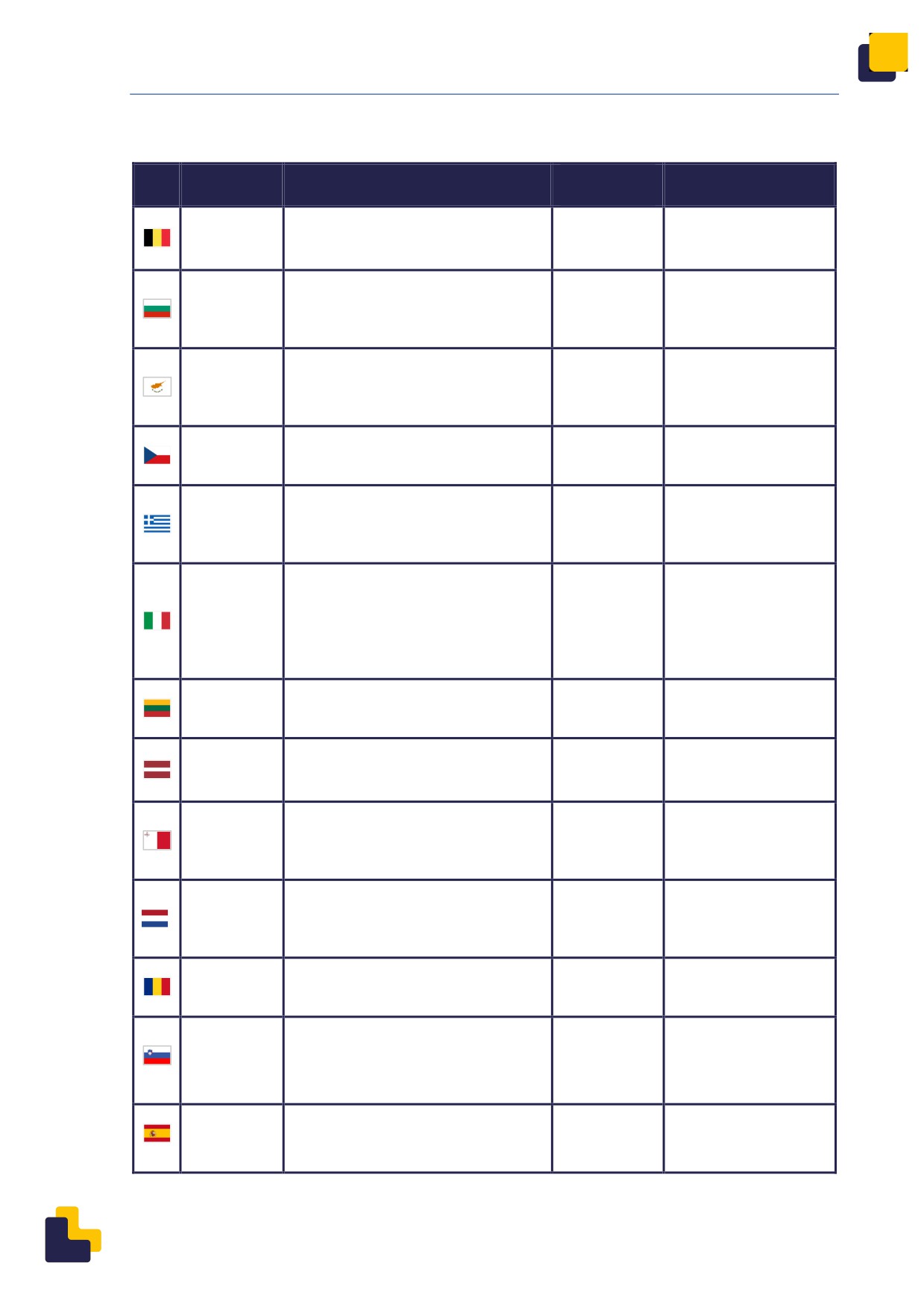
ASYLUM REPORT 2023
Table 4.1. EUAA assistance with interpretation through operating plans
Interpreters
Country
Step of procedure
Operating Plan
deployed
Operating Plan
Belgium
Reception
22
2022, agreed by
EUAA and Belgium
Operational Plan
2022 agreed by
Bulgaria
Temporary protection
N/A
the EUAA and
Bulgaria
Registration, information provision,
Operational Plan
procedures at first and second
2022-2024 agreed
Cyprus
87
instance, reception, vulnerability
by the EUAA and
assessment, relocation
Cyprus
Operational Plan
Temporary protection, registration,
Czechia
21
2022 agreed by the
information provision
EUAA and Czechia
Registration, information provision,
Operating Plan
procedures at first instance, Dublin
2022-2024 agreed
Greece
236
procedure, relocation, first and
by the EUAA and
second-line reception
Greece
Access to procedure, referral of
vulnerable applicants, second
Operating Plan
instance, voluntary relocations
Italy
49
2022-2024 agreed
procedures, information provision
by EASO and Italy
for international protection and
temporary protection
Reception (including information
Operating Plan 2022
Lithuania
provision and vulnerability
42
agreed by EASO and
identification)
Lithuania
Operating Plan
Latvia
First instance and reception
4
2022, agreed by
EASO and Latvia
Operational Plan
Access to procedure, first instance,
2022-2024 agreed
Malta
reception, identification, and
44
by the EUAA and
referral of vulnerable applicants
Malta
Operational Plan
Reception of beneficiaries of
The
2022-2023 agreed
temporary protection, reception
3
Netherlands
by the EUAA and the
and information provision
Netherlands
Operational Plan
Romania
Temporary protection
6
2023 agreed by the
EUAA and Romania
Operational Plan
2022 agreed by the
Slovenia
Procedures at first instance
4
EUAA and the
Republic of Slovenia
Operational Plan
Temporary protection and voluntary
Spain
7
2022-2023 agreed by
relocation procedure
the EUAA and Spain
225
EUROPEAN UNION AGENCY FOR ASYLUM
4.11.2. New initiatives
In 2022, EU+ countries implemented proactive measures to address the
needs of victims of human trafficking, including improving the provision of
interpretation. For example, the Ministry of Justice in Iceland published
information material on indicators of human trafficking in three languages
(Icelandic, English and Polish), with the aim of helping to identify potential
victims of human trafficking.928 In Luxembourg, new safeguards were
adopted by courts to provide interpretation to all victims of human trafficking.929
Countries developed more guidance and support material to interpreters throughout 2022.
On International Women’s Day, Belgium announced a series of training sessions for
interpreters on intercultural communication, with a focus on women and victims of human
trafficking.930
BAMF published a revised code of ethics for interpreters in asylum procedures, an updated
booklet with general information and recommendations for interpreters, a new webpage on
interpretation in asylum procedures, and bilingual terminology lists on asylum and SOGI
(sexual orientation and gender identity).931
In Finland, a multilingual glossary on housing and social security was developed to provide a
new working tool for interpreters.932
UNHCR updated its “Handbook for Interpreters in Asylum Proceedings” to reflect changes in
procedures and add specific sections on remote interpretation and interpretation for
groups.933 OFPRA in France also updated its charter for interpreters issued in 2018.934 A new
call for proposals from the Norwegian Fund was launched in Bulgaria, which aims to improve
specific services directed at asylum applicants, including translation and interpretation.935 The
IOM supported a total of 704 persons accommodated in the centres of the State Agency for
Refugees with interpretation to access different services.
There has been a growing trend of former applicants working as interpreters during the
asylum procedure. This was seen in 2022 in Ireland936 and Lithuania, where persons
registering for temporary protection were assisted by their fellow citizens in registration and
other procedures. This practice proved to be very effective as the Ukrainian interpreters had
experience with the migration patterns and the trauma associated with the war.937
4.11.3. Interpretation at the borders
NGOs have repeatedly reported inadequate efforts by national authorities at
the EU’s borders to overcome language and cultural barriers due to a lack of
interpretation services and poor translations of information. This often
prevents migrants from meaningfully understanding their rights.938
In addition, reports suggested that some individuals who were returned to the
border of Bulgaria were requested to sign untranslated papers and were not provided with
interpretation.939 Similarly, in Poland, individuals allegedly pushed back to Belarus by Border
Guards were not provided with information in a language they understood.940 While assessing
the need for an interpreter in a case of detention at the border, the Administrative Court of
226
ASYLUM REPORT 2023
Bialystok confirmed that digital translation tools used by the Border Guard in Poland may
suffice if correct information is conveyed. An Amnesty International report mentioned how, in
the framework of an informal cross-border expulsion policy, Lithuanian authorities disregarded
procedures and failed to provide adequate interpretation to asylum seekers.941
The importance of interpretation in the context of the border procedure was reiterated also by
UNHCR in its recommendation to the French and Czech EU Presidencies.942
A lack of interpreters at the borders for some languages spoken by minorities was highlighted
by NGOs in Spain. As a result, some interviews were conducted in a language other than the
one spoken by the applicant or in certain cases over the phone.943 To address some of the
gaps, UNHCR funded the setting up of an interpretation service specialised in African
languages, to support stakeholders involved in sea arrivals and help with interpretation in
reception centres, medical services and detention.
A new call for tender was launched by Frontex to provide reliable, flexible and high-quality
interpretation and cultural mediation services in support of its operational activities at the
EU’s borders. The contract provides for 112 interpreters and cultural mediators to provide in-
person and remote interpretation and a pool of 20 interpreters for rapid deployment who are
on 24/7 standby and can work remotely.944
In the context of Frontex operations, a group of interpreters deployed in Greece, Italy and the
Canary Islands launched a petition calling for better working conditions.945 Addressing the
issue, Frontex specified that the company which was contracted to provide interpretation
services is responsible to ensure its employees a remuneration in compliance with applicable
social and labour laws. In addition, the agency wrote a letter to the contractor expressing
concern, reminded them of the contractual obligations and contacted the signatories of the
petition to clarify the issue.946
4.11.4. Interpretation in the health care system
Interpretation in the context of health care was an area of focus in some
EU+ countries. For example, in 2022 France continued to reinforce
interpretation services for asylum applicants requiring health care,947 and the
Department for Civil Liberties and Immigration in Italy announced a national
project to define the training curriculum of the transcultural mediator in the
health sector.948
The Health Service Executive in Ireland launched a public procurement to offer standardised
translation/interpretation services in all health services in early 2022,949 while in Switzerland,
civil society organisations recommended that information be provided in a language
understood by the applicant when accessing health and social services.950
Hospitals in Greece faced critical shortages in interpreting services to ensure communication
with patients, especially for languages like Bangla, Tigrinya, Somali or other African dialects.951
UNHCR provided support with interpretation at hospitals.
In support of interpreters, Translators without Borders and Oxfam published a tip sheet to
address sociolinguistic barriers on sensitive topics and to support their mental health.952
227
EUROPEAN UNION AGENCY FOR ASYLUM
Section 4.12.
Country of origin
information
The recast QD, Article 4(3a) specifies that
Country of origin information (COI)
the assessment of an application for
refers to up-to-date, reliable
international protection must take account
information on countries of origin,
of all relevant facts about the applicant’s
habitual residence, and transit or
country of origin. Along the same lines, the
return countries which is used to
recast APD, Article 10(3b) stipulates that
assess an application for international
precise and timely information on the
protection.i COI reports can address
general situation in countries of origin of
various topics in a specific country, for
applicants and, where necessary, in
example the socio-economic, legal,
countries through which they have transited
political, human rights and
is to be obtained from various sources, such
humanitarian situation at a given time.
as the EUAA, UNHCR, the Council of Europe
and other relevant international
organisations.
228
ASYLUM REPORT 2023
Key developments in the production of COI in 2022 centred around improving methodologies,
investing in new technologies and researchers, improving collaboration with other researchers
based in Europe (for example in national COI units and civil society organisations working in
the country of origin), and producing information rapidly to address new crisis situations.
4.12.1. Enhancing capacity and improving
methodologies
In 2022, several methodological updates were implemented, without any
major institutional changes to national COI units.
With the increasing number of asylum applications in EU+ countries, there
were some challenges in the production of COI due to limited staff. Greece,
for example, noted that an increase in queries was difficult to address by the
current pool of staff. To address capacity issues, Ireland recruited two new COI researchers.
Acknowledging the importance of sound methodology in conducting COI research and
producing COI outputs, EU+ countries generally provide all newly-recruited experts with
advanced training on COI methodology. They often rely on the EUAA’s methodological
guidelines.
When the German COI unit recruited new staff, it used the opportunity to review internal
processes and streamline product portfolios. In addition, various working groups dealt with
specific methodological aspects, such as interviewing external experts, fact-finding missions
and OSINT.
Some countries, such as Norway, conduct quality surveys with the aim of gathering feedback
on Landinfos services. Norway also looked into the phenomenon of ‘confirmation bias’, which
is the tendency to interpret new evidence as confirmation of one’s existing beliefs or theories.
COI teams explored new ways of collecting and analysing data from open data sources to
produce actionable intelligence. For example, the COI team in Norway conducted seminars on
Open-Source Intelligence (OSINT), internet surveillance, IT tools and general awareness.
Likewise, Austria continued to develop its open-source information project. In Belgium,
CEDOCA created a working group on statistics to better understand methodologies and data
visualisations in reports.
Countries invested in new technological channels. For example, Austria introduced new
software, such as Content Management Systems and a reference management system. The
SMA in Sweden put efforts to renew and modernise its COI portal, Lifos. In Norway, podcasts
and tutorials were made available on www.landinfo.no. They address various countries and
topics, such as Iraq (the situation for LGBTIQ people), Yemen (the civil register, ID documents
and passports), Ukraine (population) and Lebanon (the economic situation).
Social media was also of key interest. The French COI unit improved work methods on social
media channels and developed a secure process for working with social networks. Germany
intensified the use of social media (ACLED953 and geolocation), while Austria included social
media as a separate part of COI research.
229
EUROPEAN UNION AGENCY FOR ASYLUM
4.12.2. Collaborating on producing accurate
information
Cooperation and information-exchange among COI researchers are essential
to produce accurate, reliable and up-to-date information on the situation in
countries of origins.
Various training sessions, seminars, briefs and study visits were organised in
2022 with COI units and immigration authorities to share best practices. For
example, Germany participated in COI briefings for EU Member States under migration
pressure, within the framework of the Bilateral Mentoring Scheme (BMS). The new qualification
tool, BMS, is supported by the EUAA and was launched on the initiative of national COI units. It
aims to improve cooperation between COI experts, foster personal development and
strengthen methodology. Experts from the COI units of France, Germany and Greece actively
participated in the BMS.
Switzerland focused on improving cooperation with countries outside of the EU and it
organised study visits for the Turkish PMM to the Swiss COI unit, in the framework of the
EUAA/PMM roadmap.954
Finally, strengthening cooperation with local organisations and local activists was an objective
for Austria, which, for instance, launched quantitative surveys to strengthen COI methodology,
such as assessing the socio-economic situation of urban populations in countries of origin and
quantitative surveys of residents of selected cities.
4.12.3. The focus of COI reports
COI units continued to focus on the most common countries of origin of
asylum applicants in Europe, namely Afghanistan, Syria, Iran and Iraq.955 In
addition, geopolitical instability in 2022 led COI units to research new
countries of origin of asylum applicants. For instance, Burundi was a new
country of interest for Slovenia and Switerland.
Examples of reports released in 2022 by COI national teams and by UNHCR:
the security and human rights situation in Afghanistan956
the security situation in Algeria957
the security situation in Ethiopia958
Internet and social media959 and criminal prosecution of Christian converts960 in Iran
honour crimes961 in Iraq and the situation in Mosul962
UNHCR published COI for case officers to assist in applying UNHCR guidance on
Iraq
UNCHR published position papers on returns to Mali,963 Ukraine,964 Ethiopia965 and
Gaza.966 A position paper on the conflict of North and South Kivu, Ituri and human
rights situation967 gave up-to-date information about the Democratic Republic of the
Congo
the situation of LGBTIQ individuals968 in Iran
230
ASYLUM REPORT 2023
health care services availability and accessibility in Damascus, Rural Damascus,
Tartous and Latakia969 and treatment upon return970
military service971 and security apparatus972 in Syria
human rights and a focus on the situation of women and girls and the de facto
state’s administration of justice973 in Afghanistan and the security situation following
the Taliban’s takeover in Afghanistan974
COI teams closely followed the evolving security situation in Türkiye and Ethiopia, in particular
in the Tigray region. They also collected information on Angola, Jordan, Lebanon, Somalia and
Sudan. For instance, Sweden released new COI reports on Tigrayans and their situation
outside of Tigray,975 Sudan,976 and South Sudan and the area of Abyei.977
EU+ countries followed the situation in Latin America, especially in Chile, Colombia, Peru and
Venezuela. For example, Sweden published a report on Chile in April 2022.978 For the first
time in many years, Germany conducted a fact-finding mission to Colombia together with the
Swiss COI unit.
India and Pakistan were also highlighted in various national COI publications.
Some COI units relied on desk research, while others, for example France and Norway,
organised fact-finding missions. Many countries, however, faced challenges in accessing
specific countries due to fewer flights. There was also a lack of experts to interview in
Afghanistan, Iran, Russia, Syria and Ukraine. Croatia reported difficulties in verifying specific
information with sources in certain countries.
Box 5. COI on Russia and Ukraine
Following the Russian invasion of Ukraine, COI units received many requests for
information on the security situation in Ukraine and Russia. In response, the
EUAA, national administrations and civil society organisations published daily
information, articles, fact sheets and analytical reports on these two countries.
The EUAA published a report on Medical Country of Origin Information (MedCOI): Russia979 in
September 2022, and two COI reports on military service980 and political opposition981 in
December 2022. These reports helped national case officers in individually assessing
applications for international protection lodged by Russian nationals.
The COI unit in Norway published a report on military service and mobilisation in Russia982
and the COI team in Sweden published different types of Ukrainian residence permits.983 The
Romanian National Council for Refugees released a report on the human rights situation in
Russia.984 The COI team in France produced a weekly watch on military mobilisation in Russia,
and regular, management-level reporting in Germany focused on recent developments in
Ukraine.
It became evident that the situation in Russia and Ukraine became a main area of focus at the
expense of other geographical regions. Norway noted that unsettled situations in several
countries will generate a need for information, such as projections of future outcomes, that
may be difficult to meet.
231
EUROPEAN UNION AGENCY FOR ASYLUM
Civil society organisations play a key role in producing COI from the ground. Their annual
reports often contribute to a better understanding of the situation in countries of origin. For
instance, the World Report 2023 by Human Rights Watch summarised human rights conditions
in over 100 countries worldwide in 2022.985 Amnesty International also publishes a yearly
report on the state of the world’s human rights. In 2022, COI publications from civil society
organisations also focused on the situation of LGBTIQ individuals in their country of origin, for
example the International Lesbian, Gay, Bisexual, Trans and Intersex Association (ILGA)’s
annual report on the human rights situation of LGBTIQ people.
The ACCORD department of the Austrian Red Cross manages a COI system, ECOI.net, with
information on political, humanitarian and human rights topics in countries of origin. As in
previous years, in 2022 they continued with a query service for asylum lawyers, refugee
counsels and officers deciding on claims for asylum.986 The organisation also publishes
reports, which in 2022 focused on Eritrea, Iran, Pakistan and Russia. They also produce Armed
Conflict Location and Event Data (ACLED) overviews, which highlighted Afghanistan, Iraq and
Somalia. Regular country briefings were also published on Afghanistan and Iran.
Asylos, an NGO working on increasing the accessibility and importance of high-quality COI in
the asylum procedure, started quarterly informal meetings in June 2022 with COI experts from
civil society organisations. The aim is to exchange information on best practices, challenges
and new publications, conduct peer reviews and explore opportunities for collaboration. The
group also offers commentaries on COI produced by governmental and intergovernmental
COI units, as well as by the EUAA. In line with its overall mission, Asylos implemented a project
which addressed gaps in COI on stateless people and produced a COI report on stateless
Palestinians. Under the initiative “Emergency COI Repositories”, Asylos created repositories
for Afghanistan, Iran, Pakistan, Türkiye and Ukraine.987
Civil society organisations continued to produce material on the Middle East region, in
particular on Afghanistan, Iraq and Syria. Asylos and Clifford Chance published monthly
COI on Afghanistan.988 The Afghanistan Research and Evaluation Unit (AREU) analysed the
situation of vulnerable groups since the transition of power in Afghanistan.989 The Norwegian
Refugee Council issued a report on the impact of housing, land and property rights on returns
to Sinjar in Iraq,990 and the International Crisis Group (ICG) published a paper on governance
and security in the Sinjar district.991
Many COI reports by civil society organisations concentrated on the African continent in 2022.
The Romanian National Council for Refugees (CNRR) depicted the human rights situation in
Cameroon.992 Political participation, rule of law, the stability of democratic institutions and
other fundamental rights in Sierra Leone were discussed in a Bertelsmann Stiftung
publication.993 The International Crisis Group continued its ongoing field research in Sudan
and the Tigray region in Ethiopia and published analytical reports and briefings on the
political, security and human rights situation, such as security-related developments in the
Tigray conflict.994
For the Asian region, reports were published by civil society organisations on Bangladesh,
India, Pakistan and Sri Lanka. For example, in May 2022 Amnesty International published a
report on the impact of the economic crisis on the Sri Lanka’s population and on their social
rights).995 In addition, Equal Ground and the Centre for International Human Rights of
Northwestern Pritzker School of Law submitted a report on the Violations by Sri Lanka of the
Civil and Political Rights of the Lesbian, Gay, Bisexual, Transgender, Intersex and
Questioning/Queer (LGBTIQ) at the 135th Session of the Human Rights Committee.996
232
ASYLUM REPORT 2023
A challenge that seems to persist, as highlighted by civil society organisations, relates to the
lack of accessibility and user-friendliness of COI databases and the lack of multilinguistic
information, as COI material is mostly available in English. In addition, there seems to be an
imbalance between countries of origin for which a high number of COI reports are available
and countries for which no or limited information exists.997 To mitigate this, UNHCR continued
sharing monthly COI bulletins in Spain.998
There also seems to be a lack of data on intersex applicants and their situation in countries of
origin.999 Concerns were raised by an NGO about whether authorities regularly use accurate
and up-to-date COI in the assessment of asylum applications,1000 and it alerted about the
possibility of bias in the use of COI by authorities.1001 In addition, civil society organisations
noted that applicants may be at times poorly informed about the importance of COI in the
assessment of their application and about their right to suggest further documents to support
their application.1002
Box 6. COI reports by the EUAA in 2022
Afghanistan: developments since the Taliban takeover on 15 August 2021 targeted
attacks,1003 the security situation1004 and key socio-economic indicators1005
Afghan refugees in Pakistan1006 was updated. It describes their legal status and provides
information on their socio-economic situation in Pakistan
Iraq: targeting and treatment of persons belonging to specific profiles1007 and the security
situation1008
Syria: the security situation1009 the targeting of certain profiles and groups in the
country1010 and the socio-economic context in Damascus city1011
Colombia1012
Medical Country of Origin Information (MedCOI): Nigeria1013 on the overall epidemiological
situation and challenges in accessing health care
Female Genital Mutilation (FGM/C) in Ethiopia1014 maps FGM/C practices and
trends at the national and regional levels
Female Genital Mutilation (FGM/C) in Mali1015
233
EUROPEAN UNION AGENCY FOR ASYLUM
Section 4.13.
Statelessness
in the context
of asylum
The 1954 UN Convention relating to the
Statelessness is a legal anomaly which
Status of Stateless Persons defines a
affects people who are not considered
stateless person as someone “who is not
a national by any state. Lacking any
considered as a national by any state under
state’s protection means stateless
the operation of its law”.1016 Nationality is the
persons may not be able to fully
legal bond between a person and a state,
exercise their fundamental rights,
and international law establishes the right of
including access to education, health
every person to a nationality. States are free
care, housing, employment, social
to regulate nationality, but this must be
welfare and documentation.
within the limits of international law, for
example by being non-discriminatory and
non-arbitrary, avoiding statelessness and
ensuring gender equality.
234
ASYLUM REPORT 2023
Nationality is generally acquired at birth by descent (jus sanguinis), place of birth (jus soli) or
later in life based on residence, marriage or adoption. A person may be born stateless if the
law in their country is discriminatory and does not grant nationality to certain ethnic groups or
allow women to pass on nationality to their children. Children born into migrant communities
may also be at risk of statelessness when the country they are born in does not grant
nationality based on the principle of jus soli and they are unable to obtain the nationality of
their parents. One reason for this may be that their parents are refugees who cannot
approach the embassy of their country of origin to request nationality for their children out of
fear of persecution. People may also lose their nationality later in life. This may be as a result
of discriminatory laws or challenges acquiring a new nationality after state secession.
To eliminate statelessness in the EU, it is important that Member States have procedures in
place to ensure that stateless persons are recognised and that a specific path exists for them
to become citizens of the country in which they reside.
While stateless persons and refugees are two distinct categories in international law, a
person can be both a refugee and stateless. In the context of asylum, statelessness may also
be relevant to the determination process for an asylum application as in many instances the
reasons why a person left their country are linked to reasons why they are stateless. It is
therefore important that both claims are assessed and both statuses addressed explicitly. In
instances where international protection is not granted on one ground, statelessness may
comprise another ground based on which the person may still necessitate international
protection.
4.13.1. Identifying stateless persons and their rights
Legislation, practices and policies vary across EU+ countries on the criteria
needed to be identified as a stateless person. In many cases, these
individuals may be registered under the nationality of their country of former
habitual residence or as having ‘unknown’ nationality. Thus, the data
available on statelessness may not be entirely representative of the reality
across EU+ countries.
Failing to properly identify statelessness during the asylum procedure can have a direct
impact on the outcome of the case. For example, statelessness in the country of origin may be
wholly or partially linked to a fear of being persecuted. If the applicant is not identified as
stateless, the need for protection may not be adequately addressed during the procedure.
In addition, the status which is recorded during the registration of an application (e.g. national,
stateless or unknown) has an impact on the nationality rights of the applicant’s children and
access to processes, such as family reunification and naturalisation. As such, identifying
potential cases of statelessness and referring the cases to a statelessness determination
process are of paramount importance.
235
EUROPEAN UNION AGENCY FOR ASYLUM
4.13.1.1. Stateless Palestinians
Recognising Palestinians as stateless persons varies across EU+ countries.
According to the European Network on Statelessness (ENS), several EU+
countries do not recognise Palestinians as stateless during the asylum
procedure. This has created additional obstacles for Palestinians trying to
access international protection, and it may impact the children of Palestinians
if they cannot access the nationality of the country in which they were
born.1017
The main reason for divergence in practices is because EU+ countries interpret Article 1(D) of
the 1951 Geneva Convention on the Status of Refugees (1951 Convention) differently.
According to the article, the 1951 Convention
“shall not apply to persons who are at present receiving from organs or agencies
of the United Nations other than the United Nations High Commissioner for
Refugees protection or assistance. When such protection or assistance has
ceased for any reason, without the position of such persons being definitively
settled in accordance with the relevant resolutions adopted by the General
Assembly of the United Nations, these persons shall ipso facto be entitled to the
benefits of this Convention”.1018
Given the current situation in Palestine, the ENS and several civil society and international
organisations have questioned the ability of the United Nations Relief and Works Agency for
Palestine Refugees in the Near East’s (UNRWA) to protect Palestinian nationals.1019 Moreover,
in March 2022, UNHCR emphasised the need to adequately assess the protection needs of
Palestinians from Gaza and encouraged countries not to forcibly return people to a dire
situation without access to support.1020
The ENS has also asserted that if UNRWA is not in a position to protect a Palestinian person,
then this person should not fall within the scope of Article 1(D) and the case should be
examined on the merits. In such cases, it is important to verify whether a person has another
nationality, as the ENS considers that all Palestinians who do not hold a second nationality
should be considered stateless.
Recent jurisprudence on the matter has centred around core issues with UNRWA’s ability to
fulfil its mandate and the circumstances in which an applicant is considered to be registered
with UNWRA.1021 In January 2022, the Dutch Council of State confirmed that Palestinian
applicants should only fall within the scope of Article 1(D) of the 1951 Convention if they were
actively supported by UNRWA prior to requesting international protection in the Netherlands.
The State Secretary for Justice and Security v Applicant concerned a Palestinian applicant
who was born in Iraq and later moved to Egypt, where he resided without a legal permit. The
Council of State noted that the applicant had never lived in an area supported by UNRWA but
the applicant’s father had been registered with UNRWA, meaning that he had a theoretical
right to UNRWA support. The Council of State concluded that the applicant could not be
reasonably expected to move to an area where he had never been in order to access support
and, thus, confirmed that Article 1(D) was not applicable.
Likewise, in March 2022, the Dutch Council of State concluded that an applicant from the
Gaza Strip did not fall within the scope of Article 1(D) as, prior to his arrival in Europe, he had
resided in Libya for 3 years.
236
ASYLUM REPORT 2023
Following a similar line of interpretation, in April 2022 the Belgian CALL confirmed that an
applicant of Palestinian origin must have been personally registered with UNRWA in order to
fall within the scope of Article 1(D). CALL further noted that applicants whose parents were
registered with UNRWA but did not receive UNRWA assistance themselves should be
examined under Article 1(2) of the 1951 Convention.
In March 2022, the CJEU ruled on the cessation of UNRWA protection in the case of N.B. and
A.B. v Secretary of State for the Home Department (UK). The applicant claimed that she could
not access appropriate education and medical assistance for her severely disabled son in the
Al Bass camp in Lebanon, where the family was registered with UNRWA. The Secretary of
State had rejected their claim for refugee status because they were registered with UNRWA
and had received, and were likely to continue to receive, support in Lebanon. While the
Secretary of State admitted that the child had been discriminated against on the basis of his
disability, this discrimination did not reach the level required to qualify as persecution. When
assessing whether UNRWA’s protection had ceased, the CJEU concluded that national
authorities should consider the applicant’s circumstances at the time when they left UNRWA’s
area of operation and at the time when their request was being examined. The CJEU added
that the burden of proof lies with the Member State to illustrate that the applicants would
receive UNRWA’s protection if they were to return. The CJEU also found that assistance
provided by civil society organisations may be considered if the organisation had a formal and
stable cooperation agreement with UNRWA.
While these court judgments help to form standard operating procedures in EU+ countries,
there is still a lot of unclarity surrounding stateless Palestinians and Article 1(D). To this end,
the ENS has issued a number of recommendations, including accession to the relevant
international conventions, facilitating access to naturalisation, ensuring access to resettlement,
and enacting and implementing fair and accessible procedures during a statelessness
determination with procedural safeguards for Palestinians.1022
4.13.1.2. Stateless children of asylum seekers and refugee parents
According to the ENS, only one-half of EU+ countries have sufficient legal
safeguards to prevent children from growing up without a nationality.1023 In
some countries, children born to stateless refugees inherit their parents’
stateless status. At times, parents cannot approach the embassy of their
country of origin to confirm their child’s nationality out of fear of
persecution.1024 In 2022, there were some positive advancements made by
national courts.
In Spain, the Provincial Court of Guipúzcoa granted citizenship to a child who was born to a
Cameroonian woman during her journey from Cameroon to Spain to seek international
protection. The court requested the Central Civil Registry to register the birth, after both the
Cameroonian and Moroccan embassies failed to register the child’s birth or grant her
nationality. The judge presiding over the case noted that “if I had taken the decision based
solely on the law and standard procedures, the result would have been unjust towards the girl,
because we would have failed to recognise one of her fundamental rights”.lvi, 1025 In an
interview with Radio Cordoba, the judge hoped the case would set a new precedent for other
stateless children arriving in Spain.1026
lvi Unofficial translation.
237
EUROPEAN UNION AGENCY FOR ASYLUM
In Ireland, the Supreme Court confirmed that a child who was granted Irish nationality on the
basis that his father was a recognised refugee at the time of his birth could not have his Irish
nationality revoked because his father’s status had been subsequently withdrawn.1027
While jurisprudence seems to have taken a protection-oriented approach for the right of
stateless persons, including in the context of asylum, additional safeguards are still needed in
many EU+ countries. The ENS has issued a number of recommendations to EU+ countries to
ensure that effective procedures are in place for statelessness determination and that the best
interests of children of refugees born in exile are taken into consideration.1028
The UNCRC made recommendations to Cyprus and the Netherlands in 2022. In June 2022,
the Committee recommended that Cyprus implements new safeguards to reduce
statelessness by “[e]stablish[ing] legal safeguards, including legislation and procedures,
including removal of fees for birth registration[…]”.1029 The Committee also urged Cyprus to
“[f]acilitate the acquisition of nationality for children who would otherwise be stateless,
regardless of their parents’ citizenship, residence, legal or marital status, with particular
attention given to children born to refugee, asylum-seeking, migrant or stateless parents, and
regardless of the existence of the family link before the departure from the country of
origin”.1030
In March 2022, the Committee stated their concern about the Dutch Nationality Act, which
requires stateless children applying for nationality to have 3 years of legal residency.1031 While
the Dutch parliament has since passed two new bills which still need to be adopted by the
senate in 2023, the ENS is concerned that the changes do not go far enough to guarantee
that stateless children born in the Netherlands will have access to the rights afforded by
international law.1032
4.13.2. Statelessness in the context of Russia’s invasion
of Ukraine
UNHCR has estimated that there were approximately 82,500 stateless
persons living in Ukraine in 2018, of which around 6,000 had legal residence.
This indicates that a high number of stateless people from Ukraine lack the
necessary documents to access temporary protection in the EU. Under the
Temporary Protection Directive, EU Member States are not required to
extend temporary protection to all categories of stateless persons. In fact,
stateless persons are only eligible for temporary protection if:
They were granted refugee status in Ukraine;
Their family members are Ukrainian nationals or recognised beneficiaries of
international protection in Ukraine; or
They held a permanent resident permit in Ukraine and are unable to return to their
country of former habitual residence.
Some countries have extended temporary protection to stateless persons, but in others, they
must apply for international protection.
238
ASYLUM REPORT 2023
Moreover, pre-existing administrative policies which require a form of identification to cross
the Ukrainian side of the border have created additional obstacles for stateless persons who
wish to flee Ukraine and seek protection EU+ countries.
For more information on this topic, please refer to the EUAA’s comprehensive
report, “Providing Temporary Protection to Displaced Persons from Ukraine:
A Year in Review”.
4.13.3. Changing legislation
With the number of applications for international protection significantly
growing in 2022, it is probable that more stateless asylum seekers have
arrived in the EU. Depending on national legislation, it can be challenging for
asylum seekers and beneficiaries of international protection to be officially
recognised as stateless. Indeed, results of an external evaluation carried out
by UNHCR suggested that the targets established under the Global Action
Plan to End Statelessness were unlikely to be met before the agreed target date of 2024.1033
Nonetheless, several positive changes occurred in 2022 which will help increase recognition
and ensure that the rights of stateless persons are protected. These developments often have
a direct impact on stateless persons who are or have been through the asylum process, as
well as their children.
On 23 March 2022, Austria amended the Citizenship Act to allow children born in Austria to
apply for nationality when they reach the age of majority within a period of 3 years under
facilitated requirements if they would otherwise be stateless.1034 The previous legislation
allowed them to apply within 2 years. This development is important for many groups of
children, including those who were born to applicants or beneficiaries of international
protection and were unable to inherit citizenship from their parents. UNHCR advocated that
foreign children should be able to acquire citizenship earlier, without having to wait until after
their 18th birthday.1035 The organisation also urged for the introduction of a specific
statelessness determination procedure.1036
In March 2022, Belgium pledged to introduce a new legal status for stateless persons which
would give them the right to legally reside in Belgium if they cannot return to their country of
habitual residence.1037 In December 2022, amendments to the Belgian Nationality Code
introduced important changes relating to stateless children (Article 10). It was legally
established that no recognition as a stateless person would be henceforth required to grant
Belgian nationality to a child bord in Belgium without a nationality. This was always the
intention of the legislator in the Belgian Nationality Code, but in practice the civil registrar
would sometimes ask for official recognition of statelessness status. The amended Article 10
also introduced the possibility for the civil registrar to seek advice from the Public Prosecutor
in the event of doubt about the lack of nationality of a child.
In Finland, the Ministry of the Interior proposed and submitted amendments to the Nationality
Act to the parliament in April 2022. The parliament did not manage to consider the proposal
by the end of the electoral term (29 March 2023) and it was allowed to lapse. The next
239
EUROPEAN UNION AGENCY FOR ASYLUM
government will decide if the changes will be proposed again. If approved, the definitions of a
stateless person will be updated to be in line with international treaties. Precisely, stateless
persons would no longer be divided into voluntarily stateless and involuntarily stateless.1038
This will make it easier for stateless asylum seekers to be recognised and ensure that all
stateless asylum seekers and beneficiaries of international protection are afforded the same
rights, regardless of the reason for which they became stateless.
In Portugal, the revised Nationality Regulation came into force in April 2022 which made it
easier for children born in Portugal to applicants or beneficiaries of international protection to
acquire citizenship. Under the revised regulation, a child born on the territory can be granted
nationality if one of the parents is a legal resident or one of the parents has been residing on
the territory for more than 1 year (irrespective of their residency status).lvii, 1039 The new
amendments also make it easier for children who were born to foreign parents, prior to the bill
coming into effect, to access naturalisation by removing the language and residency
requirements in the following cases:
At least one parent is a legal resident;
At least one parent has lived in Portugal for 5 years or more prior to the submission
of the naturalisation request (irrespective of the parent’s residency status); or
The child has completed at least 1 year of pre-school, primary or secondary
education in Portugal.1040
On 29 March 2022, Spain adopted a Royal Decree which guarantees stateless persons
access to the national reception system for the duration of the Stateless Determination
Procedure. This will ensure that children in the Stateless Determination Procedure have
access to education and other integration programmes.1041
In the Netherlands, where there are approximately 40,000 individuals registered as
‘nationality unknown’,1042 two bills on statelessness were passed by the parliament on 31 May
2022. The first bill is a step towards introducing a new stateless determination procedure
which will be judicial in nature. This will facilitate the recognition of stateless persons arriving
in the Netherlands and reduce the number of applicants being registered as having
‘nationality unknown’. The second bill amends the Dutch Nationality Act to allow stateless
children to apply for naturalisation after 5 years of habitual residence. Both bills will need to be
approved by the Senate in 2023.1043
While this is a positive change that will facilitate stateless children of asylum seekers and
beneficiaries of international protection to access nationality, the bills fall short of the
recommendations made by the UNCRC during the combined fifth and sixth periodic review of
the Netherlands. The recommendations which were published in March 2022 called on the
Netherlands to “[g]uarantee all stateless children born or present within the territory of the
State party the right to acquire nationality irrespective of residency status” and “[i]mplement
measures for ensuring that children with an unknown nationality, a status that leaves them
unable to be registered as stateless and obtain international protection, do not remain with
such a status for a prolonged period of time”.1044
lvii
Children of diplomats are excluded.
240
ASYLUM REPORT 2023
4.13.4. Improving the situation of stateless persons
In 2022, the ENS continued to organise the Stateless Journeys Campaign, an
initiative which has developed different tools to support people working with
stateless persons, such as guidelines to encourage frontline practitioners to
“recognise, record, refer and read up”. Guidelines are currently available on
several topics, including children’s right to a nationality, asylum registration
and screening, detention and return, family reunification and integration.1045 :
In Belgium, the NGO NANSEN produced several reports to inform stateless persons and their
legal representatives. The reports are available in French on their website and cover topics
such as: the treatment of Palestinians in Gaza and the need to grant them international
protection,1046 the right to Belgian nationality for children of Palestinian origin,1047 statelessness
among members of the Bidoun community in Kuwait and their need for protection,1048 and how
to prevent the children of Ukrainian refugees in Belgium from becoming stateless.1049
In Bulgaria, the Foundation for Access to Rights organised an online webinar entitled
“Palestinian Refugees Seeking Protection in Bulgaria: Practical issues and recent case law” in
September 2022. The organisation also produced a report on practical problems in the
international protection system in Bulgaria and the application of Article 1(D) of the
1951 Convention.1050
In the Netherlands, Asylos implemented a project to address information gaps for stateless
persons. The organisation also worked on the production of a COI report on the situation of
stateless Palestinians in Lebanon and a principles document for conducting COI research on
statelessness.1051
In France, OFPRA updated the welcome booklet in November 2022 aimed at newly-
recognised stateless persons.1052 In Malta, the aditus foundation published a document with a
number of proposals in view of the upcoming 2022 national elections. These included
recommendations for a new stateless determination procedure.1053
In March 2022, the UN Committee on Economic, Social and Cultural Rights issued concluding
observations on the third periodic report on Czechia. The committee expressed its concern
that, under the Aliens Act, the scope of the statelessness determination procedure is limited
and it does not provide sufficient legal security for stateless persons. It was also concerned
that such persons face difficulties in obtaining permanent residence, and under the
Citizenship Act, children who would otherwise be stateless would only acquire nationality if
both parents are stateless and at least one of them has a residence permit (Article 2(2)).1054
Following up on the committee’s recommendations, relevant legislative amendments were
prepared to the Aliens Act, which are expected to come into force in the second half of 2023.
In May 2022, the UN Committee on the Elimination of Racial Discrimination issued its
concluding observations on the combined eighteenth to twentieth periodic reports on
Luxembourg. The committee noted the absence of specific legislation on statelessness,
including on the statelessness determination procedure, and recommended that the
authorities adopt specific legislation.1055 The UNHRC issued its concluding observations on the
fourth periodic report on Luxembourg and encouraged the government to adopt legislation
regulating the procedure to determine the status of statelessness and that clearly guarantees
the right to stay for applicants with a statelessness status and that this right is automatically
granted after obtaining the stateless status.1056
241
EUROPEAN UNION AGENCY FOR ASYLUM
Section 4.14.
Content
of protection
Recognised refugees are granted
The recast QD outlines the content of
certain rights and obligations, as
international protection to harmonise what a
outlined by the Geneva Convention.
recognised beneficiary of international
protection can expect under national
policies. Its provisions shape the integration
of beneficiaries of international protection
through standards on residence permits,
employment, education, social welfare and
health care. Relevant articles of the directive
also outline the criteria for the cessation and
revocation of refugee status.
242
ASYLUM REPORT 2023
In 2022, integration policies were primarily geared at the rapid inclusion of persons in need of
temporary protection from Ukraine. National forms of protection were often applied to
displaced persons from Ukraine prior to the activation of the Temporary Protection Directive.
In parallel, some EU+ countries continued with initiatives which offered a right to stay to former
applicants who could not be returned and who had reached a certain level of integration.
The trend continued in 2022 to involve a range of stakeholders and improve collaboration for
the integration of beneficiaries of international protection. The urgent, large-scale need to
provide integration support for persons in need of temporary protection further catalysed this
process, and EU+ countries piloted some new, innovative ways of working together in the
integration of persons in need of protection.
The increase in asylum applications often impacted and caused delays in delivering residence
and travel documents to beneficiaries of international protection, which risked delaying their
access to other services and rights. As seen in previous years, courts retained an important
role in shaping the interpretation of grounds and procedures for reviewing or withdrawing
international protection.
4.14.1. Granting international protection: Recognition
rates
The recognition rate refers to the number of positive outcomes as a
percentage of the total number of decisions on applications for
international protection. For reporting in the Asylum Report, positive
decisions calculated in the recognition rate include EU-harmonised
statuses only (i.e. refugee and subsidiary protection). At times, the
recognition rate which includes national forms of protection may be
presented for countries where there is a considerable difference with
the recognition rate of EU-harmonised statuses.lviii
The recognition rate for specific nationalities of applicants can indicate
which citizenships are granted protection more or less frequently.
4.14.1.1. Recognition rates at first instance
The overall EU+ recognition rate for first instance decisions on asylum
applications was 39% in 2022. This means that out of 646,000 decisions
issued, 252,000 were positive, granting the applicant either refugee status or
subsidiary protection. The recognition rate went up by 5 percentage points
compared to last year and was the highest since 2017. The rise was mainly
due to more positive decisions being issued to Syrians (see Section 4.14.1.2.).
Most positive decisions at first instance granted refugee status (149,000 or 59% of all positive
decisions) and subsidiary protection was granted in the remaining 103,000 cases (41%). As a
lviii
Persons granted an authorisation to stay for humanitarian reasons are defined by Eurostat:
243
EUROPEAN UNION AGENCY FOR ASYLUM
result, the share of positive decisions granting refugee status declined for the second
consecutive year.
Аsylum applicants who were not eligible for international protection as defined in the
recast QD may be granted an authorisation to stay for humanitarian reasons under national
law. The EU+ recognition rate of 39% excludes authorisations to stay for humanitarian reasons.
If such authorisations were included, the recognition rate for 2022 would hike to 50%. This
considerable difference is largely due to humanitarian status granted to Afghans in Germany
and Venezuelans in Spain, which combined represented more than 7 in 10 humanitarian
permissions to stay in EU+ countries.
In 2022, more women and girls received positive decisions on their protection claims than a
year earlier (45% compared to 41% in 2021). Men and boys, in turn, were granted protection in
36% of all decisions issued on their applications. However, the data available do not indicate
which applications lodged by males or females were part of family groups.
Overall, 55% of first instance decisions issued protection to minors, which is considerably
higher than for applications lodged by the 18-34 age group (33%), 35-64 age group (31%) and
applicants aged 65 years or older (30%). Nevertheless, in 2022, recognition rates were higher
than in 2021 for asylum applicants of all age groups and especially for those between 35 and
64 years of age.
In many EU+ countries, first instance recognition rates vary over time, usually because of
changes in the volume or structure of caseloads. In 2022, overall recognition rates increased
notably in some countries (see Table 3).
Table 4.2. Recognition rates in EU+ countries with notable increases in 2022
2021 (%)
2022 (%)
Bulgaria
62
91
Estonia
60
96
Latvia
45
58
Lithuania
13
41
Netherlands
65
82
Poland
60
75
Portugal
60
78
Slovakia
23
40
Slovenia
9
59
While the recognition rate also climbed in Hungary, from 58% to 86%, the overall number of
decisions was very low (35 in 2022). This is due to the fact that since 2020, applicants are
required to submit a declaration of intent at a Hungarian embassy in a non-EU country before
they can enter the country and apply for international protection (see Section 4.1).
In contrast, recognition rates dropped substantially in Austria (62% to 42%),
Switzerland (60% to 47%) and - to a lesser extent - Italy (34% to 28%), Norway (81% to 78%)
and Romania (28% to 25%). They continued to decline in Cyprus (19% to 6%), Ireland
(56% to 34%) and Malta (22% to 15%). In all other EU+ countries, recognition rates in 2022
were higher than or similar to 2021.
244
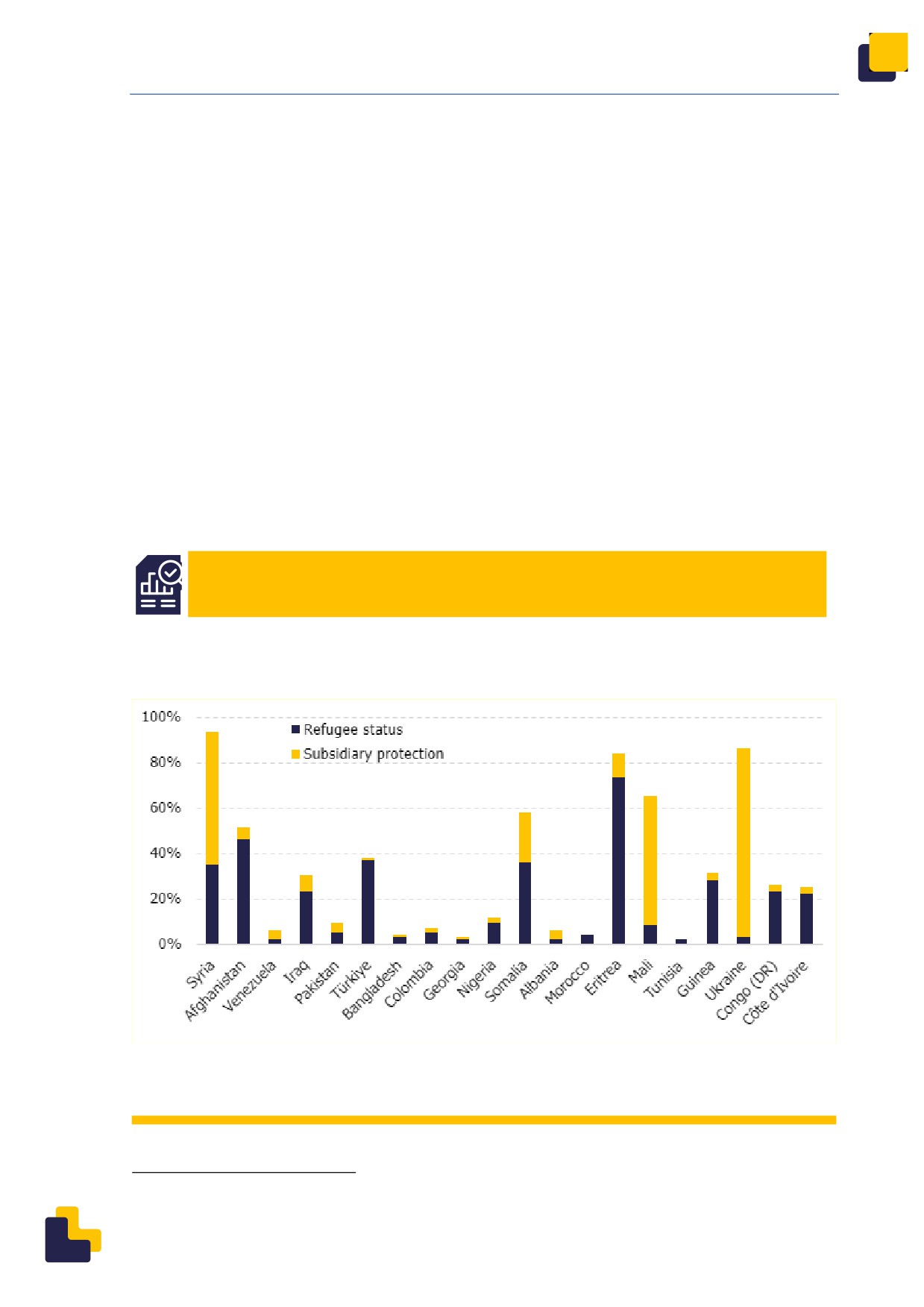
ASYLUM REPORT 2023
Recognition rates at first instance for specific nationalities
Among the 20 nationalities which received the most first instance decisions in 2022, Syrians
had the highest recognition rate at 93%. They were followed by Ukrainians (86%) and
Eritreans (84%) (see Figure 24). Other groups with relatively high recognition rates included
nationals of Mali (65%), Somalia (57%) and Afghanistan (51%).
At the other end of the spectrum, some countries in specific regions had especially low
recognition rates, such as Tunisians (2%) and Moroccans (5%) in northern Africa,
Venezuelans (4%) and Colombians (6%) in Latin America, Albanians (6%) in the Western
Balkans, as well as Bangladeshis (4%), Georgians (4%) and Pakistanis (9%).
Outside the Top 20 nationalities, recognition rates continued to be notably high for
Belarusians (85%), Yemenis (84%), Palestinians (63%), Chinese (60%) and stateless persons
(58%).lix However, low recognition rates were more common, particularly for citizens of
countries which are exempt from visa requirements to enter the EU. These comprised
applicants from the vicinity of the EU, including Bosnia and Herzegovina, Moldova,
North Macedonia and Serbia, as well as some Latin American countries, such as Argentina,
Chile and Peru.
Syrians, Ukrainians and Eritreans had the highest recognition
rates in 2022
Figure 24. First instance recognition rates for the Top 20 nationalities with the most
decisions issued in EU+ countries, by nationality and status granted, 2022
Note: These 20 nationalities received the highest number of first instance decisions in EU+ countries in 2022. They
are ordered (from the left to the right side) in terms of the number of decisions received.
Source: Eurostat [migr_asydcfsta] as of 13 April 2023.
lix Only nationalities with more than 1,000 decisions issued in 2022 were considered.
245
EUROPEAN UNION AGENCY FOR ASYLUM
Overall, the recognition rate increased the most for Ukrainians (+74 percentage points from
2021) and Syrians (+22 percentage points and the most since 2016). For Ukrainian asylum
applicants, this was caused by the Russian invasion of Ukraine. For Syrians - who have had a
relatively high recognition rate since 2012 - the rate had dropped considerably in 2021, due to
negative decisions issued on a high number of subsequent applications in Germany, which
were submitted after a CJEU ruling on refusing to perform military service in the Syrian army
as grounds for a well-founded fear of persecution.1057 In 2022, however, the recognition rate
for Syrians bounced to high levels again. In addition, the CGRS in Belgium, where recognition
rates for Syrians also increased significantly compared to 2021, prioritised certain files which
had a likely positive outcome, and many of these files belonged to Syrian applicants.
Afghan asylum applicants (especially in Germany) and Venezuelan applicants (especially in
Spain) were often granted humanitarian status, which permits applicants to remain in the
receiving country but is not counted towards positive decisions in the recognition rate. For
Venezuelans, 7 in every 10 decisions issued in EU+ countries granted humanitarian status,
whereas for Afghans, it was 3 in every 10 decisions. Afghans in Germany alone accounted for
almost two-fifths (27,000) of all cases in which humanitarian status was granted in 2022 in
EU+ countries, and Venezuelans in Spain for over one-quarter.
Variations in recognition rates at first instance in receiving countries
As in the past, large variations in national practices were seen in granting protection to
specific citizenships of applicants. For example, the recognition rate for Afghans was at least
44% in most countries that issued more than 200 decisions (in total 14 EU+ countries), but it
was only 16% in Switzerland, 27% in Germany and 30% in Romania (see Figure 25).
Conversely, the recognition rate for nationals of Venezuela was below 39%, except in
Iceland (93%) and Italy (73%). Similarly, the rate for Colombians did not exceed 4%, except in
Italy (28%) and France (18%). In fact, Italy continued to have recognition rates at the upper end
of the range for several citizenships, while countries with recognition rates at the lower end of
the range varied depending on the nationality.
Overall, discrepancies in recognition rates were most apparent for applicants from
Afghanistan, ranging from 16% in Switzerland to 100% in Portugal. Wide ranges also continued
for Turkish applicants (from 15% in France and Spain to 93% in Switzerland), as well as Iraqis
(from 3% in Poland to 77% in the Netherlands) and Venezuelans (from 8% in Germany to
93% in Iceland).
There are several reasons why the same nationality may have different recognition rates
across EU+ countries. For example, applicants with the same citizenship can have significantly
different profiles and protection needs or come from different regions of the same country.
Recognition rates may also differ between first-time and subsequent applications lodged by
the same nationality. Similarly, some applicants may have already received an EU protection
status in another Member State, but they submitted a new application. EU+ countries may
differ slightly in terms of their national policies and guidelines on asylum, in addition to the
interpretation of certain legal concepts. In particular, receiving countries can have different
lists of safe countries of origin and safe third countries or assess internal protection
alternatives and the level of indiscriminate violence differently, which can impact eligibility for
subsidiary protection.
246
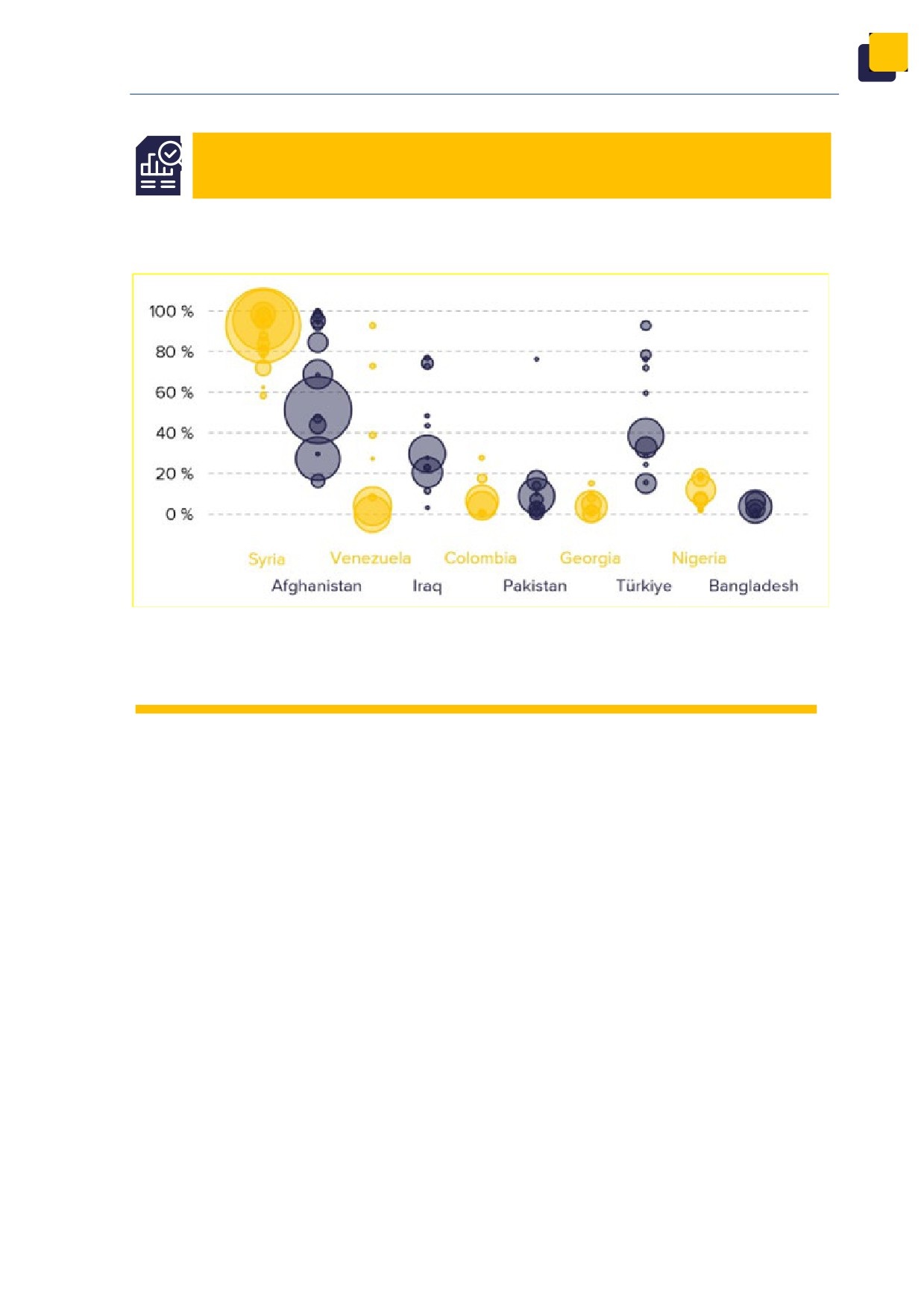
ASYLUM REPORT 2023
Discrepancies in recognition rates were the most apparent
for Afghan, Iraqi and Turkish applicants
Figure 25. Recognition rates for nationalities receiving the most decisions at first instance,
by receiving country, 2022
Note: Each bubble represents a different EU+ country issuing more than 200 first instance decisions in 2022 for
the selected nationality. The bubble size indicates the number of first instance decisions and the placement on the
vertical axis denotes the recognition rate. The 10 nationalities presented received the most first instance decisions
in 2022 and the order is in terms of overall decisions.
Source: Eurostat [migr_asydcfsta] as of 13 April 2023.
4.14.1.2. Recognition rates at second or higher instances
If an appeal is lodged against a decision at first instance, a decision
will be taken at second instance, and higher instances become
involved after another appeal. The procedures following an appeal can
vary: in some receiving countries, the case is reviewed entirely
(de novo in fact and law), while in other countries, only the legality of
the first instance decision is assessed.
The data available do not indicate the outcome of the first instance
decision that was appealed, as a positive decision can also be
appealed. For example, a positive decision that grants fewer rights
than refugee status (subsidiary protection or humanitarian status under
national law) might be appealed. For this reason, cumulative
recognition rates for all instances are not presented, and the outcomes
at second or higher instances need to be considered separately.
247
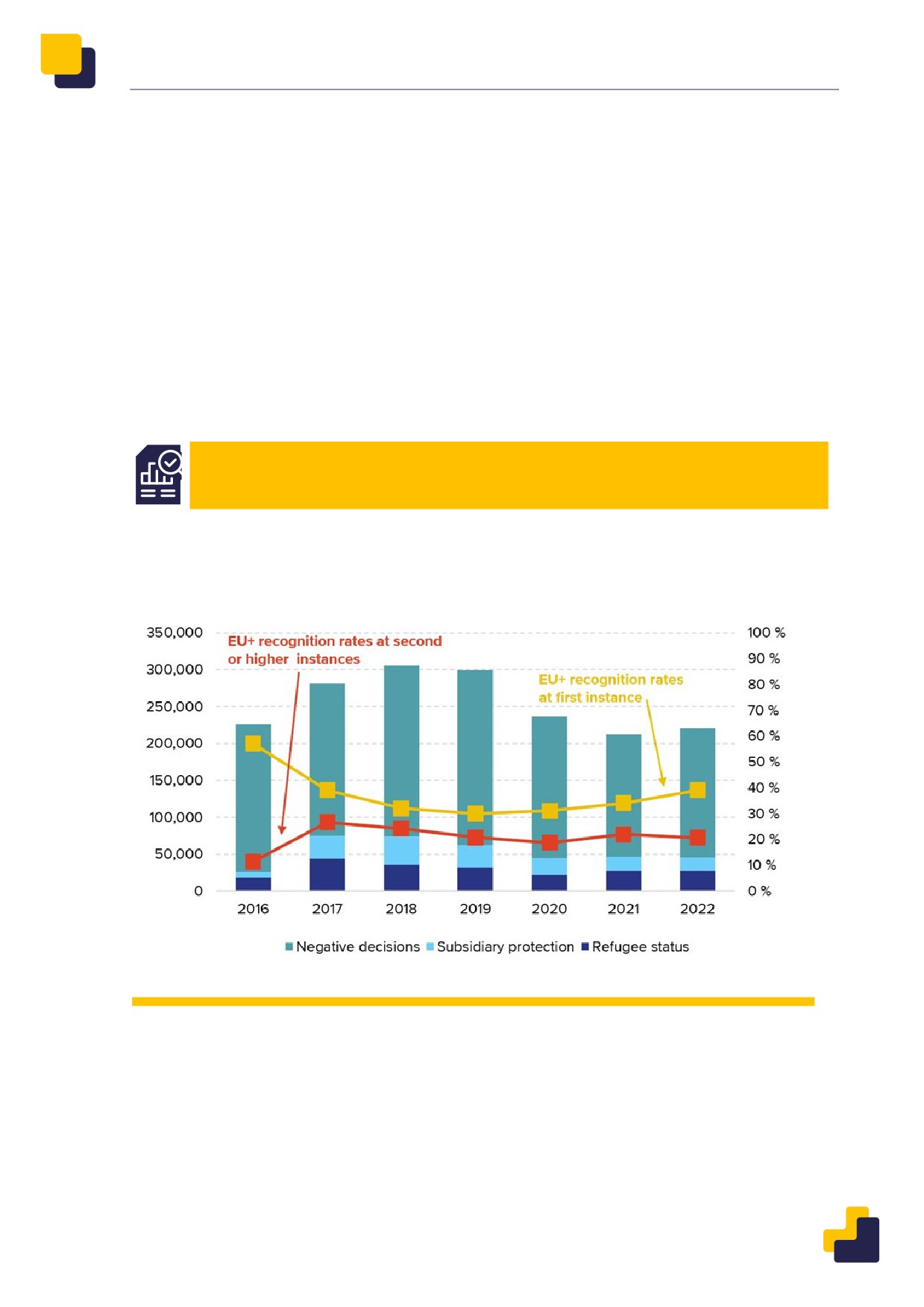
EUROPEAN UNION AGENCY FOR ASYLUM
In 2022, the recognition rate at second or higher instances was 21%, meaning that there
were 45,000 positive decisions within the total of 221,000 decisions at this level. This was
in line with the previous year (22%). In fact, in most EU+ countries, recognition rates at
second or higher instances remained more or less stable compared to 2021.
As in previous years, the overall EU+ recognition rate at higher instances was lower than at
first instance (39%). But the gap is growing. In 2022, the difference between the
EU+ recognition rate at first instance and in appeals was the largest since 2016 (see
Figure 26).
The EU+ recognition rate of 21% excludes authorisations to stay for humanitarian reasons. If
such authorisations were included, the recognition rate for 2022 at second or higher
instances would hike to 34% (still lower than the all-inclusive EU+ recognition rate at first
instance).
The difference between the EU+ recognition rate at first and
at second or higher instances was the largest since 2016
Figure 26. Outcomes of decisions on asylum applications at second or higher instances in
EU+ countries (bars), and recognition rates at first instance (yellow line) and recognition
rates at second or higher instances (red line), 2016-2022
Source: Eurostat [migr_asydcfsta] as of 13 April 2023.
Far fewer decisions at second or higher instances granted some type of EU-regulated
protection than at first instance (see Figure 27). However, two of the Top 20 nationalities
which received the most decisions in appeals (nationals of Bangladesh and Iran) received
more positive decisions at second or higher instances than at first instance.
Of the positive decisions at higher instances, three in five decisions granted refugee status
(27,000 or 60% of all positive decisions), with the remainder granting subsidiary protection
(18,000 cases or 40%). These proportions were in line with those at first instance.
248
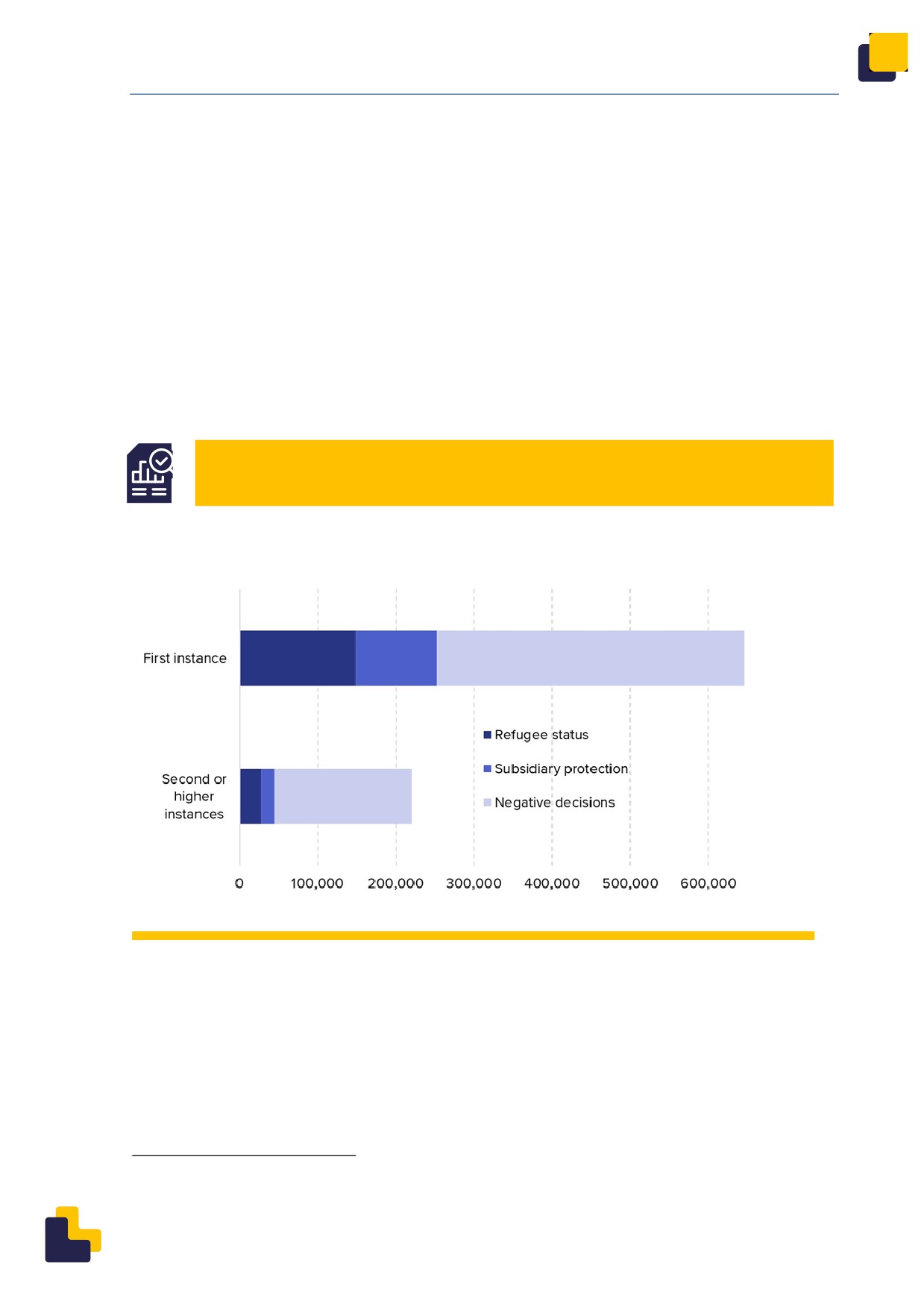
ASYLUM REPORT 2023
As in the past 5 years, female applicants continued to be somewhat more successful in their
appeals. The recognition rate at second or higher instances was 26% for applications by
women and girls (stable from 2021), compared to 18% for applications by men and boys
(slightly lower than in 2021 when it was 20%). The gap between the female and male
recognition rates was similar at first instance (45% and 36%, respectively). However, the data
available do not indicate which applications lodged by males or females were part of family
groups.
Unlike at first instance, recognition rates at second or higher instances did not differ so much
between age groups. Minors were still granted protection at the highest rate (almost one in
four decisions at second or higher instances), while for the remaining age groups, roughly one
in every five decisions granted either refugee status or subsidiary protection. This pattern was
similar in previous years.
Refugee status and subsidiary protection were less often
granted at second or higher instances than at first instance
Figure 27. Outcomes of decisions on asylum applications at first instance compared to second
or higher instances in EU+ countries, 2022
Source: Eurostat [migr_asydcfsta] as of 13 April 2023.
Among the countries which issued at least 1,000 decisions,lx the highest EU+ recognition rates
were in the Netherlands (57%) and Austria (52%), whereas they did not exceed 22% in others.
In fact, in two of the 13 EU+ countries with at least 1,000 decisions issued at second or higher
instances - Cyprus and Poland- the EU+ recognition rates were 0% in 2022 as very few
decisions in appeal granted refugee status (not more than 10 per country) and none granted
subsidiary protection. For both countries, this pattern was similar to that of most recent years.
Hungary was the only EU+ country which did not issue any decisions at second or higher
instances in 2022.
lx In total, 13 EU+ countries issued at least 1,000 decisions at second or higher instances in 2022: Austria, Belgium,
Cyprus, France, Germany, Greece, Ireland, Italy, the Netherland, Poland, Spain, Sweden and Switzerland.
249