FIRST AID. Field Manual (2002) - page 8
(c) Fold the free edges of the blanket over the second
pole and across the first pole.
(2)
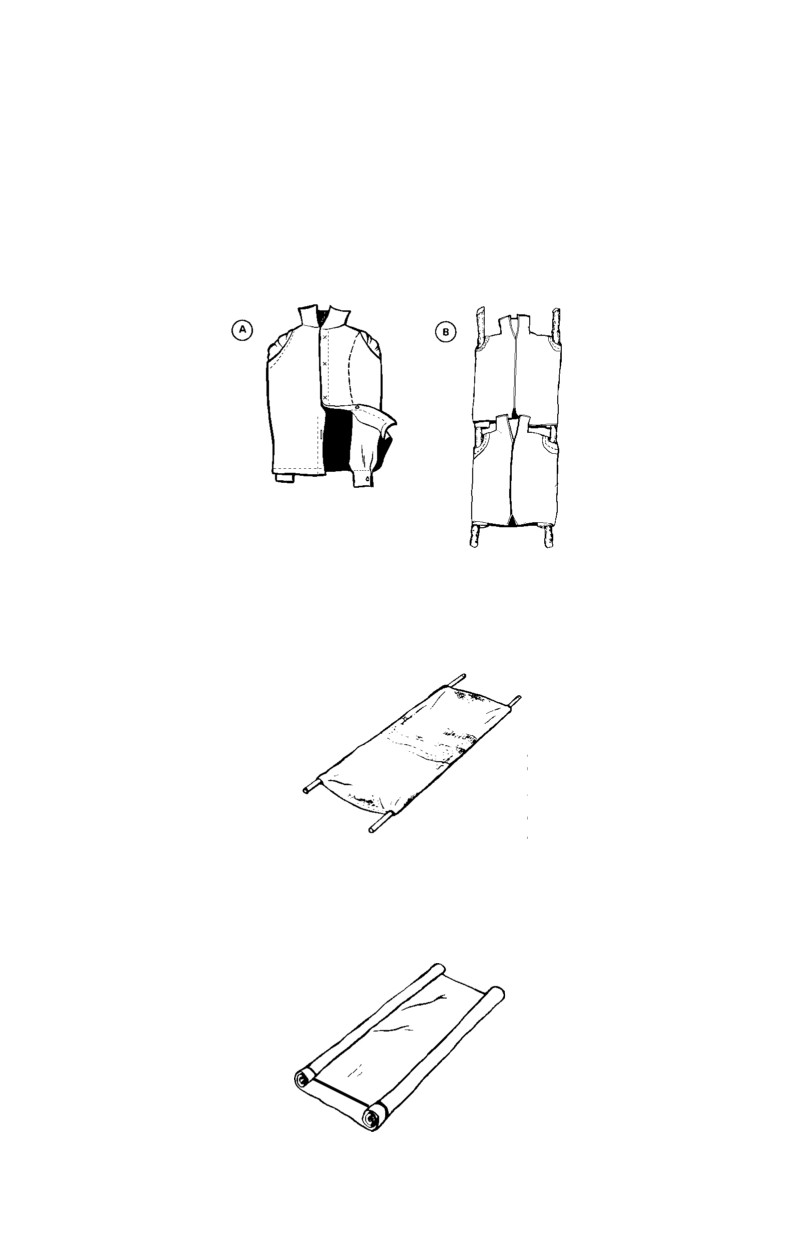
To improvise a litter using shirts or jackets (Figure B-
22), button the shirt or jacket and turn it inside out, leaving the sleeves
inside, (more than one shirt or jacket may be required), then pass the pole
through the sleeves.
Figure B-22. Litter improvised from jackets and poles (Illustrated A—B).
(3)
To improvise a litter from bed sacks and poles (Figure
B-23), rip open the corners of bed ticks, bags, or sacks; then pass the poles
through them.
Figure B-23. Litter improvised from bed sacks and poles.
(4)
If no poles are available, roll a blanket, shelter half,
tarpaulin, or similar item from both sides toward the center (Figure B-24).
Grip the rolls to carry the casualty.
Figure B-24. Rolled blanket used as a litter.
B-27
c.
Any of the appropriate carries may be used to place a casualty
on a litter. These carries are:
•
The one-man arms carry (Figure B-6).
•
The two-man arms carry (Figure B-17).
•
The two-man fore-and-aft carry (Figure B-18).
•
The two-hand seat carry (Figure B-20).
•
The four-hand seat carry (Figure B-19).
WARNING
Unless there is an immediate life-threatening situation
(such as fire, explosion), DO NOT move a casualty with
a suspected back or neck injury. Seek medical
personnel for guidance on how to transport.
d.
Either two or four service members (head/foot) may be used
to lift a litter. To lift the litter, follow the procedure below.
(1)
Raise the litter at the same time as the other carriers/
bearers.
(2)
Keep the casualty as level as possible.
NOTE
Use caution when transporting on a sloping incline/hill.
B-28
GLOSSARY
ACRONYMS, ABBREVIATIONS, AND
DEFINITIONS
AC hydrogen cyanide
AFMAN Air Force Manual
AOC area of concentration
AR Army regulation
ATM advanced trauma management
ATNAA Antidote Treatment, Nerve Agent, Autoinjector
attn attention
BDO battle dress overgarment
BDU battle dress uniform
BZ anticholinergic drugs
C Celsius
CANA Convulsant Antidote for Nerve Agent
CASEVAC casualty evacuation
cc cubic centimeter
CG phosgene
CHS combat health support
CK cyanogen chloride
Cl chlorine
CLS Combat Lifesaver
CNS central nervous system
CO2
carbon dioxide
COSR combat and operational stress reactions
CSR combat stress reaction
CTA common table of allowance
CX phosgene oxime
DA Department of the Army
DD Department of Defense
DM diphenylaminochloroarsine (adamsite)
DNBI disease and nonbattle injury
DOD Department of Defense
DP diphosgene
DS direct support
EMT emergency medical treatment
F Fahrenheit
FM field manual
H mustard
Glossary-1
HD mustard
HM Hospital Corpsman
HN nitrogen mustard
HSS health service support
IPE individual protective equipment
IV intravenous
JSLIST Joint Services Light Weight Integrated Suit Technology
L lewisite
lasers laser means Light Amplification by Stimulated Emission of Radiation
and sources include range finders, weapons/guidance, communication
systems, and weapons simulations such as MILES [Multiple Integrated
Laser Engagement System].
LBE load bearing equipment
LX lewisite and mustard
MCRP Marine Corps Reference Publication
MILES Multiple Integrated Laser Engagement System
ml milliliter
MOPP mission-oriented protective posture
MOS military occupational specialty
MTF medical treatment facility
NAPP Nerve Agent Pyridostigmine Pretreatment
NATO North Atlantic Treaty Organization
NBC nuclear, biological, and chemical
NCO noncommissioned officer
NTRP Navy Tactical Reference Publication
occlusive dressing air tight transparent dressing used to seal and cover
wounds
oz ounce
PAM pamphlet
PS chloropicrin
PTSD post-traumatic stress disorder
QSTAG Quadripartite Standardization Agreement
SOP standing operating procedure
STANAG standardization agreement
STP soldier training publication
Glossary-2
2 PAM Cl pralidoxime chloride
TB MED technical bulletin medical
TM technical manual
TSOP tactical standing operating procedure
US United States
WP white phosphorus
Glossary-3
REFERENCES
DOCUMENTS NEEDED
These documents must be available to the intended users of this publication.
NATO STANAGs
These agreements are available on request using DD Form 1425 from
Standardization Document Order Desk, 700 Robin Avenue, Building
4, Section D, Philadelphia, Pennsylvania
19111-5094.
2122. Medical Training in First Aid, Basic Hygiene and Emergency Care.
10 December 1975.
2126. First Aid Kits and Emergency Medical Care Kits.
27 September
1983.
2358. First Aid and Hygiene Training in NBC Operations.
3 March 1989.
2871. First Aid Material for Chemical Injuries.
10 March 1986.
ABCA QSTAGs
These agreements are available on request using DD Form 1425 from
Standardization Document Order Desk, 700 Robin Avenue, Building
4, Section D, Philadelphia, Pennsylvania
19111-5094.
535. Medical Training in First Aid, Basic Hygiene and Emergency Care.
12 November 1979.
Joint and Multiservice Publications
FM 21-10. Field Hygiene and Sanitation. MCRP 4-11.1D. 21 June 2000.
Army Publications
AR 350-41. Training In Units.
19 March 1993.
DA PAM 350-59. Army Correspondence Course Program Catalog.
26
October 2001.
FM 3-4. NBC Protection. FMFM 11-9.
29 May 1992
(Reprinted with
basic including Change 1, 28 October 1992; Change 2, 26 February
1996.)
FM 3-5. NBC Decontamination. MCWP 3-37.3.
28 July 2000.
(Change
1, 31 January 2002.)
References-1
FM 3-100. Chemical Operations Principles and Fundamentals. MCWP 3-
3.7.1.
8 May 1996.
FM 4-02.33 (8-33). Control of Communicable Diseases Manual (17th
Edition).
3 January 2000.
FM 8-10-6 (4-02.2). Medical Evacuation in a Theater of Operations—
Tactics, Techniques, and Procedures.
14 April 2000.
FM 4-02.7 (8-10-7). Health Service Support in a Nuclear, Biological, and
Chemical Environment.
1 October 2002.
FM 8-284 (4-02.284). Treatment of Biological Warfare Agent Casualties.
NAVMED P-5042; AFMAN (I) 44-156; MCRP 4-11.1C.
17 July
2000.
(Change 1, 8 July 2002.)
FM 8-285 (4-02.285). Treatment of Chemical Agent Casualties and
Conventional Military Chemical Injuries. NAVMED P-5041;
AFJMAN 44-149; FMFM 11-11. 22 December 1995.
FM 22-51 (4-02.22). Leaders’ Manual for Combat Stress Control.
29
September 1994.
CTA 8-100. Army Medical Department Expendable/Durable Items.
31
August 1994.
CTA 50-900. Clothing and Individual Equipment.
1 September 1994.
STP 21-1-SMCT. Soldier’s Manual of Common Tasks Skill Level I.
1
October 2001.
Department of Defense Forms
DD Form 1425. Specifications and Standards Requisition. March 1986.
READINGS RECOMMENDED
These readings contain relevant supplemental information.
Joint and Multiservice Publications
FM 8-9 (4-02.11). NATO Handbook on the Medical Aspects of NBC
Defensive Operations AMEDP-6 (B), Part I—Nuclear, Part II—
Biological, Part III—Chemical. NAVMED P-5059; AFJMAN 44-
151V1V2V3. 1 February 1996.
TB MED 81. Cold Injury. NAVMED P-5052-29; AFP 161-11.
30
September 1976.
TB MED 507. Occupational and Environmental Health Prevention,
Treatment and Control of Heat Injury. NAVMED P-5052-5; AFP
160-1.
25 July 1980.
References-2
Army Publications
AR 310-25. Dictionary of United States Army Terms (Short Title: AD).
15
October 1983.
(Reprinted with basic including Change 1, 21 May
1986.)
AR 310-50. Authorized Abbreviations and Brevity Codes.
15 November
1985.
TM 3-4230-216-10. Operator’s Manual for Decontaminating Kit, Skin:
M258A1
(NSN
4230-01-101-3984) and Training Aid, Skin
Decontaminating: M58A1 (6910-01-101-1768).
17 May 1985.
(Change 1, 22 January 1997.)
References-3
INDEX
References are to paragraph numbers except where specified otherwise.
abdominal thrust, 2-11c(1)
airway
defined, 1-3b
opening of, 2-4b, 2-6b, 2-10—11
arteries, 1-3c, 2-19—20
artificial respiration. See rescue breathing.
bandages
cravat, 3-10a(6), 3-10d, 3-10f, 3-11b, 3-12, 3-13b, 3-14, 3-15, A-5
tailed, Figure A-1, A-4b
triangular, 3-10a(5), 3-13, 3-16, A-5
bandaging of body parts
abdomen (stomach), 3-7
armpit, 3-11b
cheek, 3-10c
chest, 3-5
ear, 3-10d
elbow, 3-12
eyes, 3-10b
foot, 3-16
hand, 3-13
head, 3-10a
jaw, 3-10f
knee, 3-15
leg, 3-14
nose, 3-10e
shoulder, 3-11
battle fatigue. See psychological first aid.
bites
animal, 6-4b
human, 6-4a
insect, 6-6
sea animals, 6-5
snake, 6-3
spider, 6-6
bleeding, control of
digital pressure, 2-19
elevating the limb, 2-17b
manual pressure, 2-17a
pressure dressing, 2-18
tourniquet, 2-20
blister agent, 7-9
See also, toxic environment.
Index-1
blisters, 3-9d
blood
circulation, 1-3c
loss, 1-4b
vessels, 1-3c
breathing. See respiration.
burns
chemical, 3-8, 3-9a(3)
electrical, 3-8a(2)
incendiaries, 7-13
laser, 3-8, 3-9a(4)
thermal, 3-8, 3-9a(1)
types, 3-8
capillaries, 1-3c
carbon dioxide, 1-3b
carries, manual
one-man
arms carry, B-8a(4), Figure B-6
cradle drop drag, B-8a(12), Figure B-12
firemen carry, B-8a(1), Figure B-3
neck drag, B-8a(9), Figure B-11
pack-strap carry, B-8a(6), Figure B-8
pistol belt
carry, B-8a(7), Figure B-9
drag, B-8a(8), Figure B-10
saddleback carry, B-8a(5), Figure B-7
support carry, B-8a(3), Figure B-5
two-man
arms carry, B-8b(2), Figure B-17
fore-and-aft carry, B-8b(3), Figure B-18
four-hand seat carry, B-8b(4), Figure B-19
support carry, B-8b(2), Figure B-16
two-hand seat carry, B-8b(5), Figure B-20
chemical-biological agents
blister, 7-9
blood, 7-11
choking, 7-10
first aid for, 7-5
incapacitating, 7-12
nerve, 7-6—7
protection from
Nerve Agent Antidote Kit, Mark I, 7-2c
Nerve Agent Pyridostigmine Pretreatment, 7-2a
circulation, 1-3c
cold, conditions caused by, 5-3a
Index-2
combat lifesaver, 1-2
combat stress reaction. See psychological first aid.
contamination, 1-4d
contents of first aid case and kit, A-1
diaphragm, 1-3b
digital pressure, 2-19
dislocation, 4-2a
dressing
field first aid, 2-16, 3-5, 3-7, 3-9c, 3-10, 3-11a, A-1
wounds, 2-16, Chapter 3
elevation of lower extremities, 2-17b, 2-24b, Figure 2-37
emotional disability, 8-7
exhalation, 1-3b
eye injury, 3-10b
first aid
case, field, A-1
definition, 1-2, 2-19, 2-22
kit, A-1
decontaminating, 7-2
material for toxic environment, 7-2
foot
frostbite, 5-3d(3)
immersion, 5-3d(2)
trench, 5-3d(2)
fractures
closed, 4-2a, Figure 4-1(A)
open, 4-2b, Figure 4-1(B)
signs of, 4-3
splinting and immobilizing, 4-4
bandages for, 4-5
collarbone, 4-9b
jaw, 4-9a
lower extremities, 4-8
neck, 4-11
padding for, 4-5, 4-8
purpose for, 4-4
shoulder, 4-9c
slings, 4-6i
spinal column, 4-10
upper extremities, 4-7
frostbite, 5-3d(3)
germs, 1-4d
heart, defined, 1-3c
heartbeat, 1-3c(1)
heat, 5-2b
Index-3
heat (continued)
cramps, 5-2c(1), Table 5-1
exhaustion, 5-2c(2), Table 5-1
heatstroke, 5-2c(1), Table 5-1
Heimlich hug, 2-9c
immersion foot. See foot, immersion.
infection, prevention of, 1-4d
injector, nerve agent antidote, 7-2d
injuries
abdominal, 3-6
brain, 3-3e
burns, 3-8
cheek, 3-10c
chest, 3-4
ear, 3-10d
eye, 3-10b
facial, 3-2c
head, 3-2a, 3-10c
jaw, 3-10f
neck, 3-2b
nose, 3-10e
litter, improvised, B-9
mask, protective, conditions for use, 7-4
one-man carries. See carries, manual, one-man.
positioning injured soldier with/for
abdominal (stomach) wound, 3-7b
artificial respiration (rescue breathing), 2-7a
chest, sucking wound of, 3-5f
facial wound, 3-2c
fractures
neck, 4-11
spinal cord, 4-10
head injury, 3-10a(1)
neck injury, 4-6c(4)
shock prevention, 1-4c, 2-1, 2-17c, 2-20
snakebite, 6-3d
pressure points, 2-19
psychological first aid
basic guides, 8-1—3
combat stress reactions, 8-8
defined, 8-1
goals of, 8-5
importance of, 8-2
need for, 8-4
preventive measures, Table 8-3
Index-4
psychological first aid (continued)
combat operational stress reaction, 8-8
reaction to stress, 8-9
preventive measures, Table 8-3
respect for others, 8-6
pulse, 1-3c(2)
rescue breathing
mouth-to-mouth, 2-7
mouth-to-nose, 2-8
preliminary steps, 2-6
respiration
artificial. See rescue breathing.
defined, 1-3b
rib cage, 1-3b
scorpion sting, Table 6-6
shock
defined, 2-21
signs, 2-23
snakebite, 6-1, 6-3
snow blindness, 5-3d(4)
spider bite, 6-6, Table 6-1
splinting of fracture. See fractures, splinting.
sprains, 4-2a
sunstroke. See heat, heatstroke.
throat, foreign body in, 2-10
thrusts
abdominal, 2-11c(1)
chest, 2-11c(2)
jaw, 2-4b(1)
tourniquet
application of, 2-20
marking, 2-20c(7)
toxic environment
first aid for
blister agents, 7-9c
blood agents, 7-11c
choking agents, 7-10c
incapacitating agents, 7-12
incendiaries, 7-13
nerve agents, 7-2, 7-6, 7-8
protection from, 7-4
transporting the wounded soldier, B-7—10
trench foot. See foot, trench.
two-man carries. See carries, manual, two-man.
veins, 1-3c
Index-5
vital body functions, 1-3
wounds. See injuries.
Index-6