Takeuchi Hydraulic Excavator TB175 (No. 17512105~). Operator's Manual (2007) - page 2


  Index      Manuals     Takeuchi Hydraulic Excavator TB175 (No. 17512105~). Operator's Manual (2007)


Search            copyright infringement  


Content      ..      1      2      3      ..


Takeuchi Hydraulic Excavator TB175 (No. 17512105~). Operator's Manual (2007) - page 2


16

SAFETY

Operating Precautions

Check for safety in the
surrounding area before starting

¡

Understand the machine limitations.

¡

Use a signal person where clearances are
close or your vision is obstructed.

¡

Never allow anyone to enter the slewing
(swing) radius and machine path.

¡

Signal your intention to move by sounding
the horn.

¡

There are blind spots to the rear of the
machine.
If necessary, swing the cab around before
backing up to check that the area is safe
and clear.

Ensure good visibility

¡

When working in dark places, turn on the
machine’s working lights and headlights
and/or provide extra stationary lighting if
necessary.

¡

When visibility is poor due to severe
weather (fog, snow or rain), stop operating
the machine and wait until conditions
improves.

Do not permit riders on the
machine

¡

Do not allow anyone to ride on any part of
the machine at any time while traveling.

¡

Do not allow anyone to be on any part of
the machine while operating.
 

17

SAFETY

E4A040

Operating Precautions

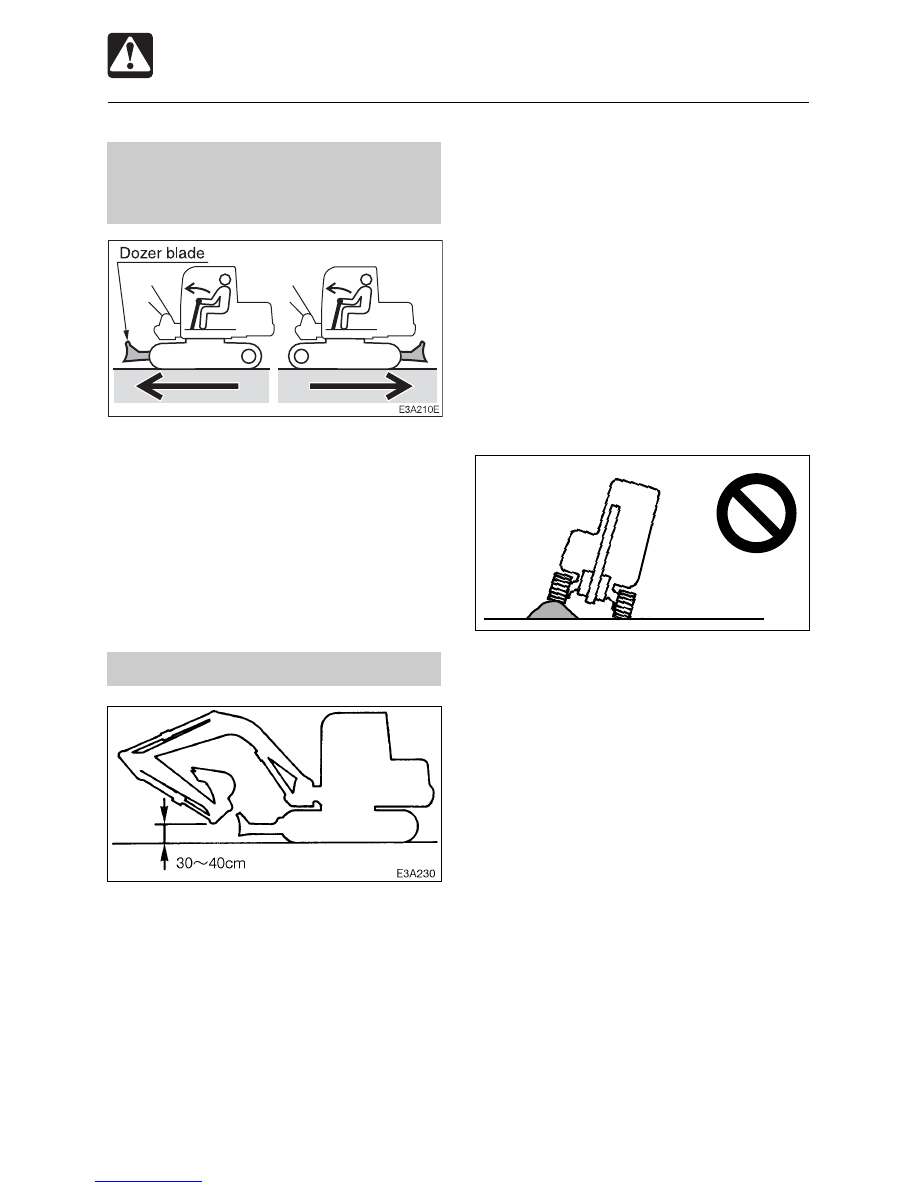
Check the position of the
undercarriage (tracks) before
traveling

Before operating the travel levers, check to
make sure that the dozer blade is to the front
of the operator’s seat. BE AWARE that when
the dozer blade is to the rear of the operator’s
seat, the travel levers operate in the opposite
direction to when the dozer blade is in the
front.

Travel safety

¡

Travel with the dozer blade up, the hoe
attachment folded as shown on the
diagram, and the bucket raised 30 to 40
cm (12 to 16 in.) from the ground.

¡

Note that when the bucket is operated
while making a right pivot turn (i.e., when
only the left crawler is turning), the speed
of the pivot turn may suddenly increase.

(12 to 16 in.)

¡

Do not slew (swing) while traveling. If you
must operate the hoe attachment while
traveling, operate at speeds slow enough
so you have complete control at all times.

¡

When a load greater than a set value is
applied during 2nd speed (high speed)
travel, the speed will automatically slow
down by switching to 1st speed (low
speed). Thereafter, when the load
becomes lighter, the speed will increase
by returning to 2nd speed (high speed).
Exercise due caution since the travel
speed changes automatically.

¡

Avoid crossing over obstacles whenever
possible. If you must do so, keep the hoe
attachment close to the ground and travel
slowly. Never cross obstacles if they will
seriously tilt the machine (to an angle of
10

°

 or greater).

¡

On uneven ground, travel at low speed
and avoid accelerating, stopping or
changing directions abruptly.

¡

When roading a machine, know and use
the signaling devices required on the
machine. Provide an escort for road travel
when required.


18

SAFETY

Operating Precautions

Cautions on traveling on slopes

When traveling on slopes or grades, be
careful that the machine does not tip (roll)
over or slide.

¡

Never exceed the machine’s stability
capabilities (maximum gradeability - 35

°

,

lateral tipping angle - 15

°

). Also note that

when actual working area conditions are
poor the machine’s stability capabilities
may be lower.

¡

When traveling on slopes or grades, lower
the bucket to a height of 20 to 30 cm (8 to
12 in.) off the ground. In emergencies,
lower the bucket to the ground and stop
the machine.

¡

When traveling on slopes or grades, move
slowly in first gear (low speed).

¡

Do not travel down slopes in reverse.

¡

On grass, dead leaves, wet metal or frozen
surfaces, the machine may slide sideways
even on very gentle slopes. Make sure
the machine never faces sideways with
respect to the slope.

¡

Do not change directions or cross  slopes
sideways. First return to a flat surface then
redirect the machine.

Operate on snow or ice with
extra care

¡

When traveling on snow or frozen
surfaces, keep the machine travel speed
down and avoid accelerating, stopping or
changing directions abruptly.

¡

Remember that the road shoulder, fences,
etc., may be buried in the snow and not
visible.

¡

Lower the dozer blade when parked on
unsure ground conditions.


19

SAFETY

Operating Precautions

¡

Maintain the maximum possible distance
from power lines and never violate the
minimum clearance.

¡

Always contact the nearest electric utility
and determine jointly what specific
precautions must be taken to insure safety.

¡

Consider all lines to be power lines and
treat all power lines as energized even
though it  is known or believed that the
power is shut off and the line is visibly
grounded.

¡

Use a signal person to observe the
approach of any part of the machine or
load to the power line.

¡

Caution all ground personnel to stand
clear of the machine and the load at all
times.

¡

If the machine should come in contact with
a live electrical source, do not leave the
operator’s seat. Do not allow anyone to
approach or touch the machine.

¡

Be especially careful of buried high voltage
power lines.

Insure driver safety before
loading trucks

Do not load a truck unless the driver is in a
safe place.

¡

Never swing or position the bucket over
personnel or truck cabs.

¡

Load the truck from the rear.

Keep a safe distance from
electrical power lines

Never approach power lines with any part of
the machine and its load unless all local and
national required safety precautions have
been taken. Electrocution and death can
result from arcing, touching or even being
close to a machine that is in contact with or
near an electrical source.


20

SAFETY

Operating Precautions

Watch out for hazardous working
conditions

¡

Never undercut a high bank. Be
particularly alert for the possibility of a
cave-in.

¡

Do not operate in places where there is a
danger of falling rocks.

¡

Keep machine well back from the edge of
an excavation. Avoid undercutting the
machine.

¡

Do not approach unstable surfaces (cliffs,
road shoulders, deep trenches, etc.). The
ground may give way under the machine’s
weight or vibrations, causing the machine
to tip over.

Fill

• The ground is weak after rain or

explosions.

• The ground is also unstable on banks

and near dugout trenches.

Operating on slopes is
dangerous

When operating on slopes or grades, slewing
(swinging) or operating working equipment
may cause the machine to lose stability and
tip over. Avoid operating on slopes whenever
possible.

¡

Level off the work area.

¡

Avoid swinging the loaded bucket in a
downhill direction. This will reduce the
stability of the machine.


21

SAFETY

Operating Precautions

Never slew (swing) sideways with
excessive weights

The machine can tip over more easily in the
lateral direction than in the longitudinal
direction.

¡

Do not slew (swing) sideways with
excessive weight at the front.
In particular do not slew sideways on
slopes.

¡

The front is heavier for machines equipped
with breakers, crushers or telescopic arms
than for machines equipped with the
standard bucket. Do not operate such
machines sideways especially with the
digging arm (boom) downhill.

Watch boom clearance

When operating under bridges, in tunnels,
near power lines or indoors, be careful not
to hit the boom or arm against overhead
objects.

Excavators are not designed for
lifting loads

The machine is specifically designed for
excavation work and has no safety devices
for crane operation. Extreme caution should
be used if the excavator is used for lifting.

¡

Never lift loads in excess of capacity.
Overload will cause the machine to roll and
can result in serious injury or death.

¡

All rated lift capacities are based on the
machine being level and on a firm
supporting surface. For safe working
loads, the user is expected to make due
allowance for the particular job conditions
such as soft or uneven ground, non-level
condition, side loads, dynamic or jerked
loads, hazardous conditions, experience
of personnel, etc. The operator and other
personnel should fully acquaint
themselves with the operator’s manual
before operating this machine, and rules
for safe operation of equipment shall be
adhered to at all times.

¡

Failure of the bucket linkage or slings
could result if chains or slings are
incorrectly attached, resulting in serious
injury or death.

¡

Do not attempt to pull stumps out of the
ground while using the machine as a
crane. The loads imposed on the machine
under this use are completely unknown.

¡

Never allow any personnel to stand on or
under lifted loads or even within the
maneuvering area.


22

SAFETY

Operating Precautions

Danger of flying objects

This machine is not equipped with protective
guards to protect the operator from flying
objects. Do not use the machine in places
where there are risks of the operator being
hit by flying objects.

Cautions on Towing

When towing, selecting the wrong wire rope,
inspecting improperly, or towing in the wrong
way could lead to accidents resulting in
serious injury or death.

¡

The wire rope breaking or coming
detached could be extremely dangerous.
Use a wire rope suited for the required
towing force.

¡

Do not use a wire rope that is kinked,
twisted or otherwise damaged.

¡

Do not apply strong loads abruptly to the
wire rope.

¡

Use safety gloves when handling the wire
rope.

¡

Make sure there is an operator on the
machine being towed as well as on the
machine that is towing.

¡

Never tow on slopes.

¡

Do not let anyone near the wire rope while
towing.

N0A006


23

SAFETY

Stopping Precautions

Park safely

¡

Park the machine on firm, level ground and
apply the parking device.

¡

When parking on streets, use barriers,
caution signs, lights, etc., so that the
machine can easily be seen even at night
to avoid collision with other vehicles.

¡

Before leaving the machine, do the
following:
1. Lower the bucket and dozer blade to

the ground.

2. Raise the safety lock lever to engage

the lock.

3. Stop the engine and remove the key.
4. Lock the cab and covers.

E3A4901


24

SAFETY

Transporting Precautions

Load and unload the machine
safely

The machine may roll or tip over or fall while
loading or unloading it. Take the following
precautions:

¡

Select a firm, level surface and keep
sufficient distance from road shoulders.

¡

Use loading ramps of adequate strength
and size. Maintain the slope of loading
ramps within 15 degrees.

¡

Secure the ramps to the truck bed.

¡

Keep the truck bed and loading ramps
clean of oil, clay, ice, snow, and other
materials which can become slippery.
Clean the tracks.

¡

Block the transport vehicle so it can not
move.

¡

Use a signal person when loading and
unloading the machine, and travel slowly
in first gear (low speed).

¡

Never change course on the ramp.

¡

Do not slew (swing) on ramps. The
machine may tip over.

¡

When slewing (swinging) on the truck bed,
do so slowly as the footing can be
unstable.

¡

Engage the slew (swing) lock after loading.

¡

Block both tracks and secure the machine
to the truck bed with load binders.

Hoist the machine safely

¡

Know and use correct crane signals.

¡

Inspect the hoisting equipment daily for
damaged or missing parts.

¡

When hoisting, use a wire rope with
sufficient strength with respect to the
machine’s weight.

¡

Do not hoist with the machine in a posture
other than the one described in the
procedure below. Doing so is dangerous
as it may result in the machine losing its
balance.
Refer to the section titled “Hoisting the
Machine” for further instructions.

¡

Do not hoist the machine with an operator
(s) on it.

¡

When hoisting, hoist slowly so that the
machine does not tip.

¡

Keep all other persons out of the area
when hoisting. Do not move the machine
over the heads of the persons.

Transport the machine safely

¡

Know and follow the safety rules, vehicle
code and traffic laws when transporting
the machine.

¡

Consider the length, width, height and
weight of the truck with the machine
loaded on it when determining the best
route.

Fasten to the suspension fitting

Ramp

15

°

 or less

Distance between ramps

Stopper

E4F001


25

SAFETY

Maintenance Precautions

Attach a “DO NOT OPERATE” tag

Severe injury could result if an unauthorized
person should start the engine or touch
controls during inspection or maintenance.

¡

Stop the engine and remove the key
before performing maintenance.

¡

Attach a “DO NOT OPERATE” tag to the
starter switch or control lever.

Use the correct tools

Do not use damaged or weakened tools or
tools designed for other purposes. Use tools
suited for the operation at hand.

Replace important safety parts
periodically

¡

Replace fuel hoses periodically. Fuel
hoses become weaker over time, even if
they appear to be in good shape.

¡

Replace important safety parts whenever
an irregularity is found, even if it is before
the normal time for replacement.
Refer to the section titled “Important  Parts”
for further details.

Anti-explosive lighting

Use anti-explosive electrical fixtures and
lights when inspecting fuel, oil, coolant,
battery fluid, etc. If lighting that is not anti-
explosive should break, the substance could
ignite, resulting in serious injury or death.

Do not allow unauthorized
personnel in the work area

Do not allow unauthorized personnel in the
work area. Chips or other debris can fly off
machine parts when grinding, welding or
using a hammer.


26

SAFETY

Maintenance Precautions

Prepare the work area

¡

Select a firm, level work area. Make sure
there is adequate light and, if indoors,
ventilation.

¡

Clear obstacles and dangerous objects.
Eliminate slippery areas.

Always clean the machine

¡

Clean the machine before performing
maintenance.

¡

Stop the engine and cover electrical parts
when washing the machine. Water on
electrical parts could cause short-circuits
or malfunctions.
Do not use water or steam to wash the
battery, sensors, connectors or the
operator’s compartment.

Stop the engine before
performing maintenance

¡

Avoid lubrication or mechanical
adjustments with the machine in motion
or with the engine running while stationary.

¡

If maintenance must be performed with
the engine running, always work as a two
person team with one person sitting in the
operator’s seat while the other works on
the machine.
• When performing maintenance, be sure

to keep your body and clothing away
from moving parts.

Stay clear of moving parts

¡

Stay clear of all rotating and moving parts.
Wrapping or entanglement may result in
serious injury or death.

¡

Keep hands, clothing and tools away from
the rotating fan and running fan belts.


27

SAFETY

Maintenance Precautions

Securely block the machine or
any component that may fall

¡

Before performing maintenance or repairs
under the machine, set all working
equipment against the ground or in the
lowermost position.

¡

Securely block the tracks.

¡

If you must work beneath the raised
machine or equipment, always use wood
blocks, jack-stands or other rigid and
stable supports. Never get under the
machine or working equipment if they are
not sufficiently supported. This procedure
is especially important when working on
hydraulic cylinders.

Securely block the working
equipment

To prevent unexpected movement, securely
block the working equipment when repairing
or replacing the cutting edges or bucket teeth.

Secure the engine hood or cover
when opened

Be sure to secure the engine hood or cover
when opening it. Do not open the engine
hood or cover on slopes or in strong wind.

Cautions on working on the
machine

¡

When performing maintenance on the
machine, clean up the foot area and strictly
observe the following so as not to fall:
• Do not spill oil or grease.
• Do not leave tools laying around.
• When walking, watch your step.

¡

Never jump off the machine. Use the steps
and handrails when climbing on and off
the machine, and always support your
body at three points with your hands and
feet.

¡

Use protective equipment as required by
job conditions.

Place heavy objects in a stable
position

When removing or installing the hoe
attachment, place it in a stable position so
that it does not tip over.

L3A005


28

SAFETY

Maintenance Precautions

Use caution when fueling

¡

Do not smoke or permit open flames while
fueling or near fueling operations.

¡

Never remove the fuel cap or refuel with
the engine running or hot. Never allow fuel
to spill on hot machine components.

¡

Maintain control of the fuel filler nozzle
when filling the tank.

¡

Do not fill the fuel tank to capacity. Allow
room for expansion.

¡

Clean up spilled fuel immediately.

¡

Tighten the fuel tank cap securely. Should
the fuel cap be lost, replace it only with
the original manufacturer’s approved cap.
Use of a non-approved cap without proper
venting may result in pressurization of the
tank.

¡

Never use fuel for cleaning purposes.

¡

Use the correct fuel grade for the operating
season.

Be careful with hot and
pressurized components

Stop the engine and allow the machine to
cool down before performing inspection and
maintenance.

¡

The engine, muffler, radiator, hydraulic
lines, sliding parts and many other parts
of the machine are hot directly after the
engine is stopped. Touching these parts
will cause burns.

¡

The engine coolant, oil and hydraulic fluid
are also hot and under high pressure.
Be careful when loosening caps and
plugs. Working on the machine under
these conditions could result in burns or
injuries due to the hot oil spurting out.

Handling of hoses

Fuel, oil or hydraulic fluid leaks can cause a
fire.

¡

Do not twist, bend or hit the hoses.

¡

Never use twisted, bent or cracked hoses,
tubes and pipes. They may burst.

¡

Retighten loose connections.

Be careful with hot cooling
systems

Do not remove the radiator cap or drain plugs
when the coolant is hot. Stop the engine, let
the engine and radiator cool and loosen the
radiator cap or drain plugs slowly.


29

SAFETY

Maintenance Precautions

Be careful with fluids under
pressure

Pressure can be maintained in the hydraulic
circuit long after the engine has been shut
down.

¡

Release all pressure before working on
the hydraulic system.

¡

Hydraulic fluid under pressure can
penetrate the skin or eyes and cause
injury, blindness or death. Fluid escaping
from a small hole can be almost invisible.
Wear a safety goggles and heavy gloves
and use a piece of cardboard or wood to
search for suspected leaks.
If fluid is injected into the skin, it must be
removed within a few hours by a doctor
familiar with this type of injury.

Release all pressure before
working on the hydraulic system

Oil may spurt out if caps or filters are removed
or pipes disconnected before releasing the
pressure in the hydraulic system.

¡

Gradually press the air breather button to
relieve tank pressure.

Handling of the Accumulator

High pressure nitrogen gas is enclosed in
the accumulator and incorrect handling could
possibly bring about serious personal injury
due to explosion. The following matters
should be strictly observed:

¡

Do not disassemble.

¡

Do not bring close to fire or throw into a
fire.

¡

Do not make hole, weld, or fuse.

¡

Do not subject to shock such as hitting or
rolling.

¡

At time of disposal, it will be necessary to
release the enclosed gas. Please contact
a Takeuchi sales or service outlet.

N0A0051

¡

Stop the engine and turn the starter switch
to the ON position and move all the control
levers and pedals several times in all
directions to release the pressure from the
working equipment circuitry.
(When equipped with accumulator)

¡

When removing plugs or screws or
disconnecting hoses, stand to the side and
loosen slowly to gradually release the
internal pressure before removing.


30

SAFETY

Maintenance Precautions

Disconnect the battery

Disconnect the battery before working on the
electrical system or doing any welding.
Remove the negative (–) battery cable first.
When reconnecting the battery, connect the
negative (–) battery cable last.

Avoid battery hazards

¡

Batteries contain sulfuric acid which will
damage eyes or skin on contact.
• If acid contacts eyes, flush immediately

with clean water and get prompt medical
attention.

• If acid is accidentally swallowed, drink

large quantities of water or milk and call
a physician immediately.

• If acid contacts skin or clothing, wash

off immediately with clean water.

¡

Wear safety glasses and gloves when
working with batteries.

¡

Batteries generate flammable and
explosive gases. Keep arcs, sparks,
flames and lighted tobacco away.

¡

Use a flashlight to check battery electrolyte
level.

¡

Stop the engine and shut off electrical
equipment while inspecting or handling the
battery.

¡

Do not short circuit the battery posts with
metal items.

¡

Always unfasten the negative (–) battery
cable first when disconnecting the battery
cable. Always connect the negative (–)
battery cable last when fastening the
battery cable.

¡

Loose battery terminals may result in
sparks. Be sure to fasten terminals tightly.

¡

Make sure the vent caps are tightened
securely.

¡

Do not charge a battery or jump-start the
engine if the battery is frozen. Warm to
15

°

C (60

°

F) or the battery may explode.

¡

Do not use the battery when the fluid level
is below the lower level. Doing so will
hasten the deterioration of the internal
portions of the battery and shorten the
battery life, and can also cause rupturing
(or an explosion).

¡

Do not fill the battery above the upper
level. Doing so could cause the fluid to
leak, contact and damage the skin, or
cause parts to corrode.


31

SAFETY

Maintenance Precautions

Have a Takeuchi service agent
repair welding cracks or other
damage

Ask a Takeuchi service agent to repair any
welding problems which are detected. If not
feasible, make sure the welding is done by a
qualified person in a properly equipped
workplace.

Vibrations to which the operator
is subjected

According to the results of the tests carried
out to determine the vibrations transmitted
to the operator by the machine, the upper
limbs are subjected to vibrations lower than
2.5 m (8.2 ft) / sq.sec. while the seated part
of the body is subjected to vibrations lower
than 0.5 m (1.64ft) / sq.sec.

Checks after maintenance

¡

Gradually raise the engine speed from a
low idle to maximum speed and check that
no oil or water is leaking from serviced
parts.

¡

Move the controls and check that the
machine is operating properly.

Disposing of wastes

¡

Funnel spent fluids from the machine into
containers. Disposing of fluids improperly
destroys the environment.

¡

Follow the prescribed regulations when
disposing of oil, fuel, engine coolant,
refrigerant, solvents, filters, batteries or
other harmful substances.


Content      ..      1      2      3      ..