Takeuchi Mini Excavator TB216 (No.216000002~, No.216100002~). Operator's Manual - page 1

Safety alert symbol
This symbol represents the safety alert.
Improper operation, inspection and
The message that follows the symbol
maintenance of this machine can cause
contains important information about
injury or death.
safety.
Read and understand this manual before
Read and understand the message to
performing any operation, inspection or
avoid personal injury or death.
maintenance on this machine.
It is the owner or employer’s responsibility
Always store this manual near at hand
to fully instruct each operator in the
preferably on the machine itself. If it should
proper and safe operation of all
be lost or damaged, immediately order a
equipment. All persons using this
new one from your Takeuchi dealer.
machine should thoroughly familiarize
When transferring ownership of this machine,
themselves with the contents of this
be sure to hand this manual to the next
manual.
owner.
All operators must be instructed on the
Takeuchi supplies machines complying with
proper functions of the excavator before
the local regulations and standards of the
running the machine.
country of export. If your machine has been
purchased in another country or from a
Learn and practice correct use of the
person or company of another country, it
machine controls in a safe, clear area
may not have the safety devices or safety
before operating this machine on a job
standards required for use in your country.
site.
Should you have any question about whether
your machine complies with the regulations
and standards of your country, contact a
Takeuchi dealer.
Signal words
IMPORTANT: The word IMPORTANT is
used to alert operators and maintenance
Safety messages appearing in this manual
personnel about situations which could
and on machine decals are identified by the
result in damage to the machine and its
words “DANGER”, “WARNING” and
components.
“CAUTION”. These signal words mean the
following:
It is impossible to foresee every possible
circumstance that might involve a potential
hazard. The warnings in this manual or on
the machine can not cover all possible
DANGER indicates a hazard with a high
contingencies. You must exercise all due
level of risk which, if not avoided, will
care and follow normal safety procedures
result in death or serious injury.
when operating the machine so as to ensure
that no damage occurs to the machine, its
operators or other persons.
WARNING indicates a hazard with a
medium level of risk which, if not avoided,
could result in death or serious injury.
CAUTION indicates a hazard with a low
level of risk which, if not avoided, could
result in minor moderate injury.
0-1
Introduction
Foreword
This manual describes operation, inspection
and maintenance of the machine, as well as
safety instructions to be heeded during these
operations.
If you have any questions about the
machine, please contact a Takeuchi sales or
service outlet.
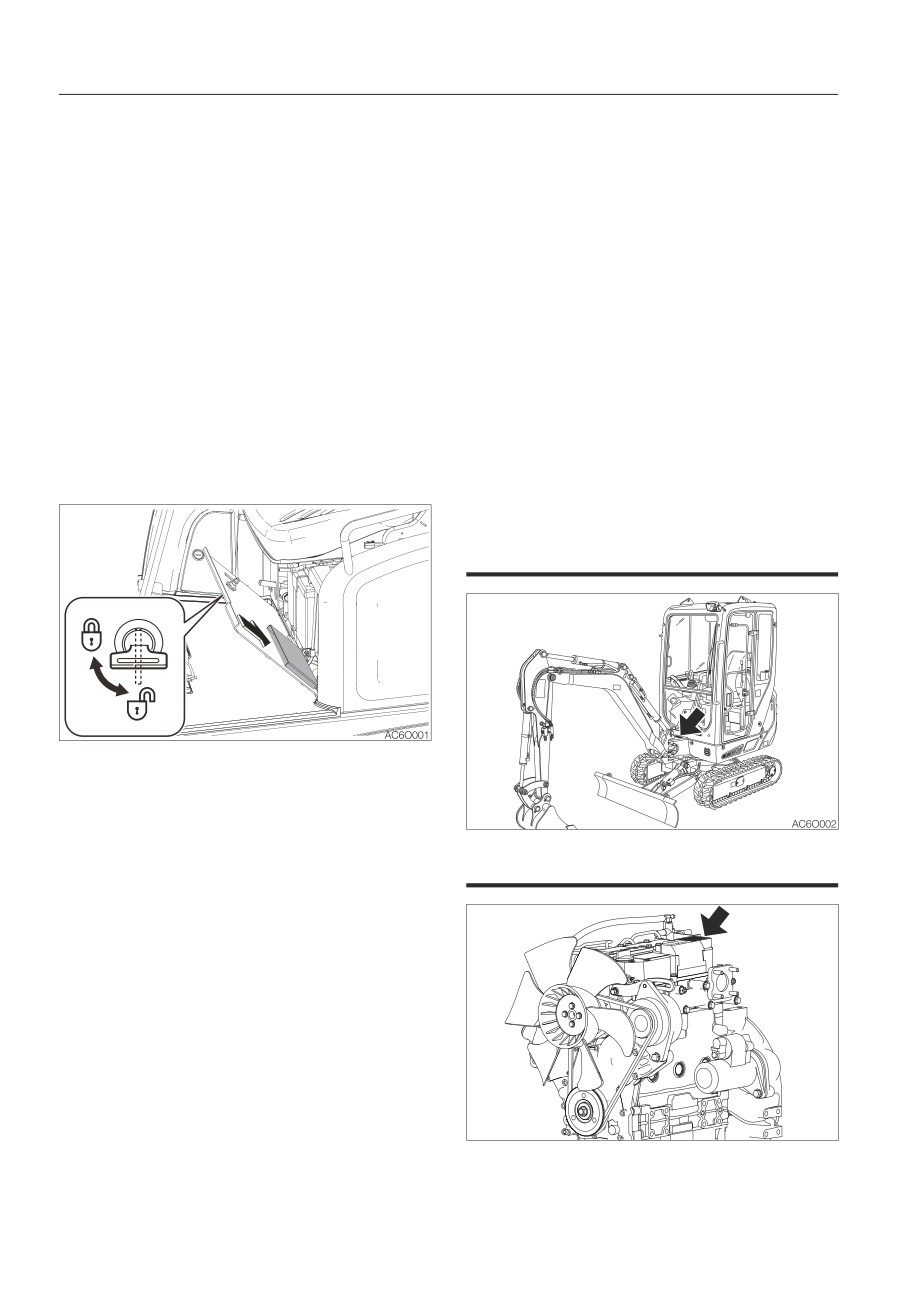
Manual storage compartment
Serial numbers
A compartment for storing this manual is
IMPORTANT: Do not remove the machine
provided at the position shown on the
name plate with the serial number.
diagram below.
Check the serial numbers of the machine
and engine and write them down in the
spaces below.
Machine number:
1. Insert the starter key and turn it
counterclockwise to open the cover under
the seat.
2. After using the manual, place it in the
plastic pouch and store it back in the
manual storage compartment.
Engine number:
AD6O003
0-2
Machine description
Front, rear, left and right
Features
• “Flexible machine width mechanism” for
crawler width
• Low engine noise and exhaust emissions
Break-in period
When the machine is new, operate the
machine for the first 100 hours (as indicated
on the hour meter) by following the
instructions below.
Using a new machine without a break-in
period will lead to quicker deterioration of
machine performance and may shorten the
machine’s service life.
• Sufficiently warm up the engine and
hydraulic oil.
• Avoid heavy loads and rapid operations.
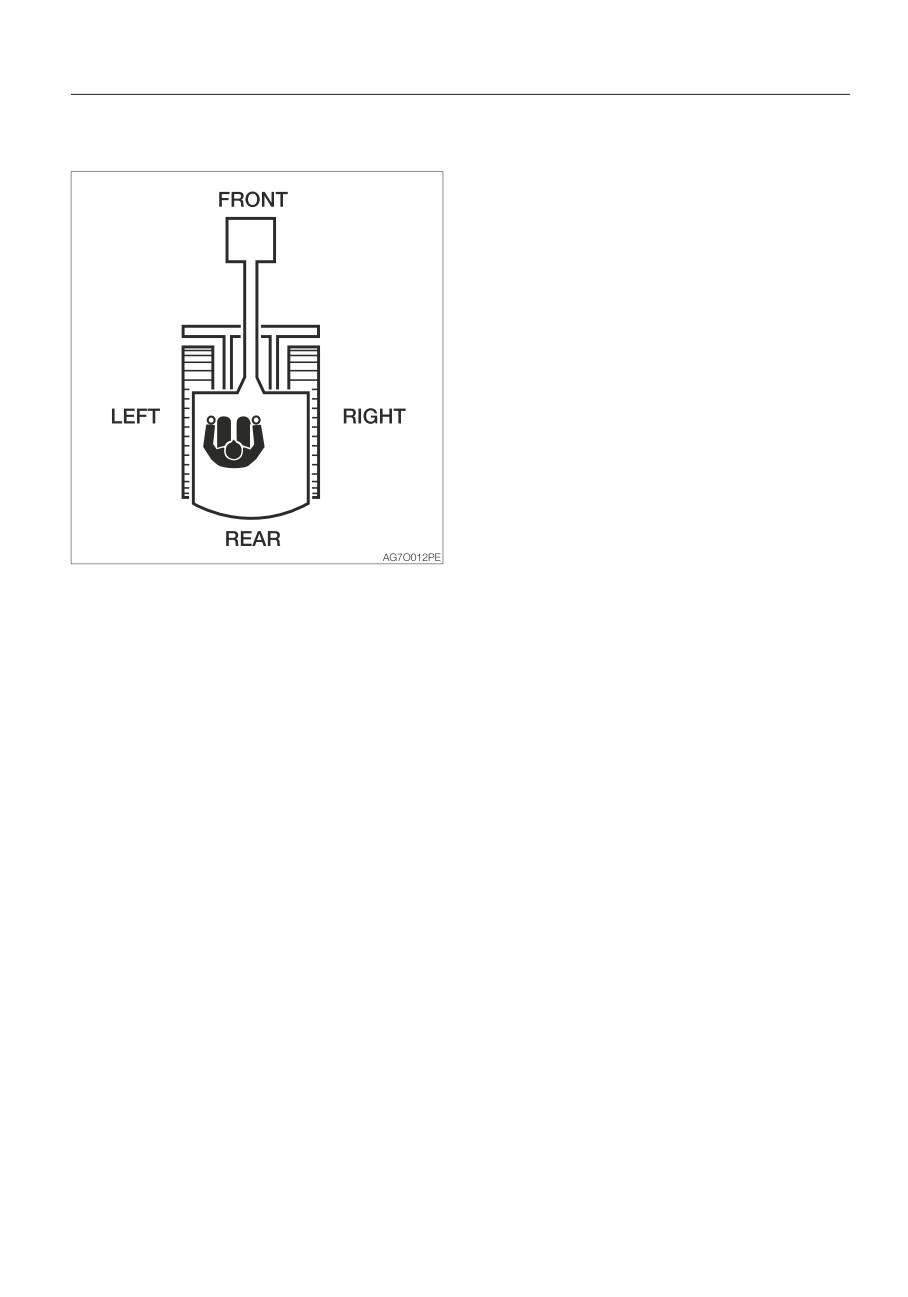
This manual refers the front, rear, left and
Operate with a load of about 80% the
right of the machine as seen when sitting in
maximum load.
the operator’s seat with the dozer blade
• Do not abruptly start up, accelerate,
visible to the front.
change directions, or stop unless
necessary.
Designated operations
Use this machine primarily for the following
operations:
• Excavation
• Digging ditches
• Digging side ditches
• Leveling
• Loading
0-3
Notes on reading this
manual
Please note that the descriptions and
diagrams included in this manual may not be
applicable to your machine.
The numbers used in the illustration are with
circles around them. The same numbers
appear between the parentheses in the text.
(Example:
(1))
Symbols used in this manual
The symbols used in this manual have the
following meanings.
...... Prohibition
............. Lock
............. Unlock
0-4
Contents
Third auxiliary hydraulic switch and
Introduction
0-2
button
2-27
Overload warning switch
Machine description
0-3
(If equipped)
2-28
Levers and Pedals
2-29
Safety
1-1
Safety lock lever
2-29
General precautions
1-2
Throttle lever
2-29
Precautions when preparing
1-8
Operating levers
2-30
Precautions when starting
1-12
Blade lever
2-30
Precautions when operating
1-14
Travel levers/pedals
2-31
Precautions when stopping
1-23
Boom swing pedal
2-31
Precautions when transporting
1-24
Auxiliary hydraulic pedal
2-32
Precautions on maintenance
1-26
Selector lever
2-32
Safety signs (decals)
1-35
Accessories
2-34
Heater
2-34
Controls
2-1
Cup holder
2-36
Names of components (Cab)
2-2
Interior light
2-36
Names of components (Canopy)
2-4
Inside rear view mirror (cab)
2-36
Covers
2-6
Power sockets
2-37
Starter key
2-6
Armrest
2-37
Maintenance cover
2-6
Radio (for cab)
2-38
Fuse box
2-7
Auxiliary hydraulic lines
2-42
Tool case
2-7
Accumulator (If equipped)
2-46
Grease gun holder
2-7
Operation
3-1
Fuel lid
2-8
Fuel filler port
2-8
Before starting operation
3-2
Side cover
2-9
Getting on or off the machine
3-2
Engine hood
2-9
Walk-around inspection
3-2
Cab
2-10
Daily inspection
3-2
Cab door
2-10
Starting and stopping the engine
3-3
Emergency exit
2-10
Before starting the engine
3-3
Front window
2-11
Starting the Engine
3-4
Lower front window
2-12
Warming up the engine
3-5
Side window
2-12
Stopping the engine
3-5
Emergency hammer (optional)
2-13
Operating the machine
3-6
Seat and seat belt
2-14
Lever pattern (ISO pattern)
3-6
Seat (If equipped)
2-14
Lever pattern (G pattern) If equipped
3-7
High-back seat (If equipped)
2-15
Warming up the machine (hydraulic oil).3-8
Seat belt
2-16
Inspection after warm-up
3-9
Instrument cluster
2-18
Crawler width switching
3-10
Warning lamps
2-18
Switching the blade width
3-11
Indicators
2-19
Operating the travel levers
3-12
Meters
2-19
Stopping travel
3-15
Multi-data display
2-20
Operating the working equipment
3-16
Switches
2-26
Operating procedures
3-18
Starter switch
2-26
Prohibited operations
3-18
Horn button
2-26
Cautions on operating
3-21
Travel speed switch
2-26
Cautions on traveling
3-21
Wiper switch
2-27
Cautions on traveling on slopes
3-22
Second auxiliary hydraulic switch
2-27
Getting out of mud
3-24
0-5
Operations possible with this
Lubricating the working equipment
5-23
machine
3-24
After the initial 50 hours
Parking the machine
3-26
(only for new machines)
5-24
Parking
3-26
Replacing the engine oil and the
Inspection and checks after stopping
oil filter
5-24
the engine
3-26
Inspecting and adjusting the fan belt.. 5-25
Handling in cold climates
3-27
Replacing the hydraulic oil return filter.5-26
Preparing for cold climates
3-27
Every 50 hours
5-28
Cautions after operations
3-27
Inspecting and adjusting the crawler
After the cold climate
3-27
tension
5-28
Handling rubber crawlers
3-28
Lubricating the slew bearing
5-30
Prohibitions
3-28
Lubricating the slew motor pinion
5-30
Cautions
3-29
Draining the water from the fuel tank.. 5-31
Preventing the rubber crawlers from
Inspecting the battery fluid level and
coming off
3-29
replenishing
5-32
Every 100 hours
5-34
Transport
4-1
Cleaning the water separator
5-34
Loading and unloading
4-2
Cleaning the fuel filter
5-34
Hoisting the machine
4-4
After the initial 250 hours
Securing the machine
4-6
(only for new machines)
5-35
Replacing the travel motor gear oil
5-35
Maintenance
5-1
Every 250 hours
5-36
General
5-2
Replacing the engine oil and the oil
Maintenance overview
5-2
filter
5-36
Cautions on maintenance
5-2
Inspecting and adjusting the fan belt.. 5-36
Service data
5-4
Cleaning the air cleaner
5-36
Fuel and lubricant table
5-4
Cleaning the radiator fins and oil
Regularly replace the hydraulic oil
5-8
cooler fins
5-38
List of consumables
5-9
Cleaning the air filters
5-39
List of tools
5-10
Every 500 hours
5-40
List of tightening torques
5-11
Replacing the hydraulic oil return filter.5-40
Safety-critical parts
5-12
Replacing the water separator filter
5-40
Maintenance list
5-14
Replacing the fuel filter
5-41
Walk-around inspection
5-16
Every 1000 hours
5-42
Inspecting by opening the engine hood
Replacing the travel motor gear oil
5-42
and covers
5-16
Cleaning the engine cooling system
5-42
Inspecting by walking around the
Replacing the air cleaner element
5-44
machine
5-17
Inspecting and adjusting the engine
Inspecting while sitting in the
valve clearance
5-45
operator’s seat
5-17
Retightening the engine cylinder
Daily inspection (every 10 hours)
5-18
head bolt
5-45
Inspecting and replenishing the
Every 1500 hours
5-46
coolant
5-18
Inspecting and cleaning the engine
Inspecting and replenishing the
fuel injectors
5-46
engine oil
5-19
Inspecting the crankcase breather
Inspecting the dust indicator
5-19
system
5-46
Inspecting the water separator
5-20
Every 2000 hours
5-47
Inspecting the fuel level
5-20
Lapping the engine valve seats
5-47
Inspecting the hydraulic oil tank level
Every 4000 hours
5-48
and replenishing
5-21
0-6
Replacing the hydraulic oil and
cleaning the suction strainer
5-48
When required
5-50
Replacing the bucket teeth
5-50
Replacing the bucket
5-52
Lubricating the levers
5-54
Inspecting the rubber crawlers
5-55
Replacing the rubber crawlers
5-56
Maintenance during extended storage
period
5-58
Troubleshooting
6-1
Symptoms that are not malfunctions
6-2
If the engine overheats
6-3
If the battery goes dead
6-4
If a fuse blows
6-6
Inspecting and replacing the fuse
6-6
Inspecting the fusible link
6-7
Restarting after adding fuel
6-8
Bleeding air from the fuel system
6-8
If a warning lamp flashes
6-9
Other symptoms
6-10
Lowering the boom to the ground
6-12
Towing
6-13
If the cab or canopy is damaged
6-14
Specifications
7-1
Basic Specifications
7-2
Machine dimensions
7-4
Operating ranges
7-8
Lifting Capacities
7-11
Options
8-1
General precautions
8-2
Safety precautions
8-2
Cautions when installing attachments... 8-2
Cautions when operating attachments. 8-3
Attachment combination table
8-4
Selecting a lever pattern
8-5
Switching the lever pattern
8-5
Hydraulic breaker
8-6
Replacing the hydraulic oil regularly
8-7
Load safety device
8-8
Emergency shut-off valve
8-8
Overload warning device
8-9
Travel alarm
8-10
Optional equipment mass
8-11
Biodegradable oil
8-12
Replacing the hydraulic oil with
biodegradable oil
8-12
0-7
Safety
General precautions
When a problem is found on the machine
General precautions
It is your responsibility to observe all
If any problem (noise, vibration, smell,
pertinent laws and regulations and to
disorder of instrument, smoke, oil leak,
follow the manufacture’s instructions on
wrong indication of alarm or unusual
machine operation, inspection and
indication in the instrument cluster, etc.) is
maintenance.
detected during the operation or inspection
and maintenance of the machine,
Virtually all accidents occur as the result of a
immediately inform your sales or service
failure to observe basic safety rules and
dealer and take proper actions. Do not
precautions.
operate the machine until the trouble is
Most accidents can be prevented by
cleared.
identifying the potentially hazardous
situations beforehand.
Read and understand all safety messages
Operating temperature range
which describe how to prevent accidents.
Do not operate the machine until you are
To maintain the performance of machine and
sure that you have gained a proper
to prevent it from early wear, observe the
understanding of its operation, inspection
following operating conditions.
and maintenance.
• Do not operate the machine if the ambient
temperature is higher than +45°C (+113°F)
or lower than -15°C (+5°F).
Observe all safety rules
· If operated at an ambient temperature of
higher than +45°C (+113°F), the engine
• Operation, inspection and maintenance of
may overheat and cause the engine oil to
this machine must be performed only by a
degrade. Also, the hydraulic oil may
trained and qualified person.
become very hot, causing damage to the
• All rules, regulations, precautions and
hydraulic equipment.
safety procedures must be understood and
· If operated at an ambient temperature of
followed when performing operation,
lower than -15°C (+5°F), the parts made
inspection and maintenance of this
of rubber such as gaskets may get
machine.
hardened to cause an early wear or
• Do not perform any operation, inspection
damage to the machine.
and maintenance of this machine when
· If the machine is to be used outside the
under the adverse influence of alcohol,
ambient temperature range described
drugs, medication, fatigue, or insufficient
above, consult your sales or a service
sleep.
dealer.
1-2
Safety
General precautions
Wear appropriate clothing and protective
Install a fire extinguisher and first aid kit
equipment
Be prepared for fire and accidents
• Do not wear loose clothing or any
• Install an extinguisher and a first aid kit,
accessory that can catch on controls or in
and learn how to use them.
moving parts.
• Lean how to fight a fire and how to deal
• Do not wear oily or fuel stained clothing
with accidents.
that can easily catch fire.
• Know how to contact emergency
• Wear a hard hat, safety shoes, safety
assistance and make a list of emergency
glasses, filter mask, heavy gloves, ear
contacts.
protection and other protective equipment
as required by job conditions. Wear
required appropriate equipment such as
Never remove safety equipment
safety glasses and filter mask when using
grinders, hammers or compressed air, as
metal fragments or other objects can fly
and cause serious injury.
• Use hearing protection when operating the
machine. Loud prolonged noise can cause
hearing impairments, even the total loss of
hearing.
• Make sure all protective guards, canopies
and doors are in place and secured. Repair
or replace damaged parts before operating
the machine.
• Know how to use the safety lock lever, seat
belt and other safety equipment and use
them properly.
• Never remove any safety equipment except
for servicing. Keep all safety equipment in
good operating condition.
1-3
Safety
General precautions
Use a signal person and a flag person
Cautions when standing up from or
leaving the operator’s seat
Learn how to use the hand signals required
for particular jobs and make sure who has
• Before standing up from the operator’s
the responsibility for signaling.
seat to open/close the window or remove/
• All personnel must fully understand all the
install the lower window, lower the working
signals.
equipment to the ground, raise the safety
• The operator must respond to signals only
lock levers to engage the lock and stop the
from the appointed signal person, but must
engine. If any controls should be
obey a stop signal at any time from
accidentally touched when the safety lock
anyone.
levers is lowered (unlocked), the machine
• The signal person must stand in a clearly
will suddenly move and cause serious
visible location when giving signals.
injury or death.
• Note that the dozer blade, boom swing
and auxiliary hydraulic controls cannot be
locked, even when the safety lock lever is
set to the locked position.
Do not carelessly touch these controls.
• Be careful not to touch the operating levers
when raising or lowering the safety lock
levers.
• Before leaving the operator’s seat, lower
the working equipment to the ground, raise
the safety lock levers to engage the lock
and stop the engine. Also, be sure to
remove the key, lock the door and covers,
take it with you and store it in a specified
place.
1-4
Safety
General precautions
Avoid fire and explosion hazards
• When handling the fuel, washing oil or
paint, open the door and windows to
ventilate thoroughly.
• Store all flammable fluids and materials in a
safe and well-ventilated place.
• The short circuit of the electric system may
cause the fire. Check for any loosened
connections or damage to the wires every
day. Retighten the loosened connector and
wire clamp. Fix or change the damaged
wire.
• Fire from the pipes:
Make sure that the clamps, guards and
Keep flames away from fuel, oil, grease and
cushions of the hoses and tubes are
antifreeze. Fuel is particularly flammable and
securely fixed. If not, hoses or tubes may
dangerous.
be damaged due to vibration or contact
• When handling these combustible
with other parts during operation. This can
materials, keep lit cigarettes, matches,
cause the high-pressure oil to spurt out,
lighters and other flames or sources of
resulting in the fire or injury.
flames away.
• Do not smoke or permit open flames while
handling fuel or working on the fuel system.
• Do not leave the location while refilling with
fuel or oil.
• Never remove the fuel cap or add fuel
when the engine is running or still hot. Also,
do not spill the fuel on the hot surface of
the machine or the component of the
electric system.
• Clean up spilled fuel or oil immediately.
• Check for fuel, oil leak. Stop all leaks and
clean the machine before operating.
• When operating with grinder or welding,
move inflammables to a safe place.
• Do not cut or weld on pipes or tubes that
contain flammable fluids. Clean thoroughly
with nonflammable solvent before cutting
or welding.
• Remove all trash or debris from the
machine. Make sure that oily rags or other
flammable material are not stored on the
machine.
• Handle all solvents and dry chemicals
(foam type fire extinguisher) according to
procedures identified on manufacturer’s
containers. Work in a well-ventilated area.
• Never use fuel for cleaning purposes.
Always use a nonflammable solvent.
1-5
Safety
General precautions
Exhaust fumes from the engine is
Be careful not to get crushed or cut
poisonous
Never put your hands, feet or other parts of
• Do not operate the engine in an enclosed
your body between the upperstructure and
area without adequate ventilation.
the undercarriage or tracks, between the
• If natural ventilation is not possible, install
machine body and working equipment, or
ventilators, fans, exhaust extension pipes
between a cylinder and moving part. The
or other venting devices.
sizes of these gaps change when the
machine moves, and a person can suffer
severe injury or death.
Handling asbestos dust
Inhaling asbestos dust can cause lung
cancer. When handling the materials which
may contain asbestos, take the following
precautions:
• Never use compressed air for cleaning.
• Avoid brushing or grinding parts containing
asbestos.
• For clean up, use a vacuum equipped with
a high efficiency particulate air filter (HEPA).
• Wear the stipulated respirator if there is no
other way to control the dust. When
working indoors, install a ventilation system
with a macromolecular filter.
• Do not allow unauthorized personnel in the
work area while working.
• Follow the rules and environmental
standard applicable to the work area.
1-6
Safety
General precautions
Using optional products
Never modify the machine
• Consult with Takeuchi before installing
Unauthorized modifications to this machine
optional attachments. Depending on the
can cause injury or death. Never make
type of attachments or the combination of
unauthorized modifications to any part of this
them, the attachment may come into
machine.
contact with the operator’s compartment
or the other parts of the machine. Make
sure that the optional attachment installed
is not contacted with other parts before
use.
• Do not use attachments that have not
been approved by Takeuchi. Doing so may
compromise safety or adversely affect the
machine’s operation or service life.
• Takeuchi will not be held responsible for
any injuries, accidents or damage to its
products caused by the use by a non-
approved attachment.
1-7
Safety
Precautions when preparing
Precautions when
preparing
Know the work area
Before starting operation, know the working
area condition to ensure a safety operation.
• Inspect the topography and ground
condition of the working area, or the
structure of the building when working
indoors, and take the safety precautions as
necessary.
• Be sure to avoid all hazards and
obstructions such as ditches, underground
lines, trees, cliffs, overhead electrical wires,
or places where there is a danger of falling
rocks or slides.
• Check with the administrator for the
locations of buried gas pipes, water pipes
and power cables. If necessary, determine
what specific precautions must be taken to
insure safety by consulting with the
administrator.
• When working on roads, be sure to
consider the safety of pedestrians and
vehicles.
· Use a flag person and/or a signal.
· Fence off the working area and keep off
unauthorized persons.
• When working in water or crossing shallow
streams or creeks, check the depth of the
water, the solidity of the ground and the
water flow speed beforehand.
Refer to “Cautions on operating” for further
instructions.
1-8
Safety
Precautions when preparing
Check the strength of the bridge
Always keep the machine clean
When traveling over a bridge or a structure,
check the permissible load. If the strength is
insufficient, reinforce the bridge or the
structure.
• Clean windows, mirrors and lights to
ensure good visibility.
Adjust the mirror to the best position for
the operator to see the rear view (blind
spot) from the operator’s seat.
• Wipe off any oil, grease, mud, snow or ice,
to prevent accidents due to slipping.
• Remove all loose objects and unnecessary
devices from the machine.
• Remove any dirt, oil or grease from the
engine area to prevent fires.
• Clean around the operator’s seat and
remove any unnecessary object from the
machine.
1-9
Safety
Precautions when preparing
Perform inspection and maintenance
Cautions in the operator’s compartment
every day
• Remove mud and grease from shoe soles
before entering the operator’s
compartment. Pedaling the machine with
the shoes with mud and grease will cause
a slip accident.
• Do not leave the parts or tools around the
operator’s seat.
• Do not leave any plastic bottles in the
operator’s compartment or attach any
suction cups on the window glass. The
plastic bottle or suction cup act as a lens
and can cause fire.
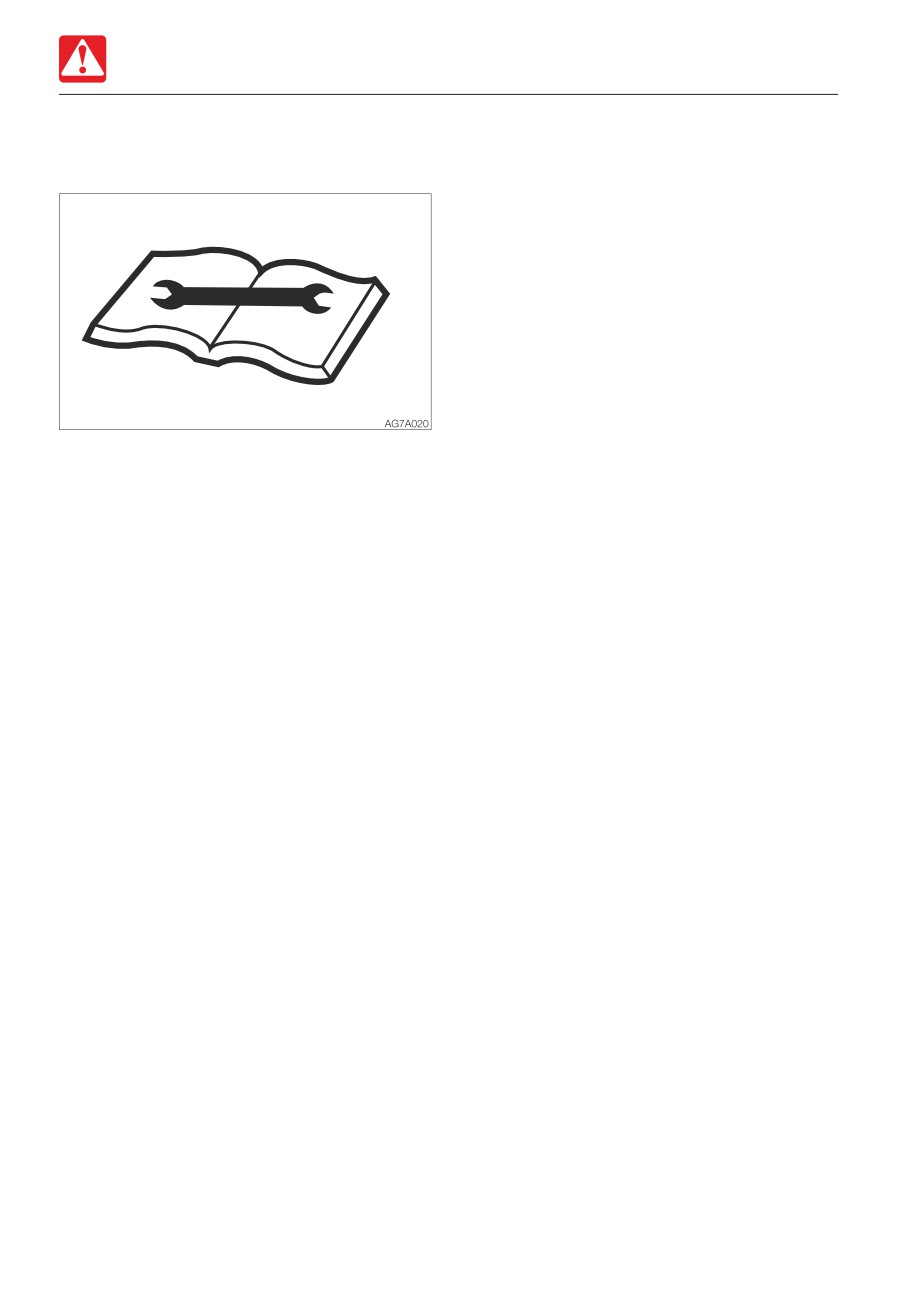
Failure to identify or repair the irregularities or
• Do not use the mobile phone during
damage on machine can lead to accidents.
traveling or working.
• Before operating, perform the specified
• Do not bring combustibles or explosives
inspection and make prompt repairs where
into the operator’s compartment.
necessary.
• Do not leave the cigarette lighter in the
• If a failure occurs and the operation
operator’s compartment. When the room
becomes impossible or the engine fails,
temperature rises, the lighter may explore.
immediately stop the machine by following
the shutdown procedure, and keep
machine securely parked until the
malfunction is corrected.
1-10
Safety
Precautions when preparing
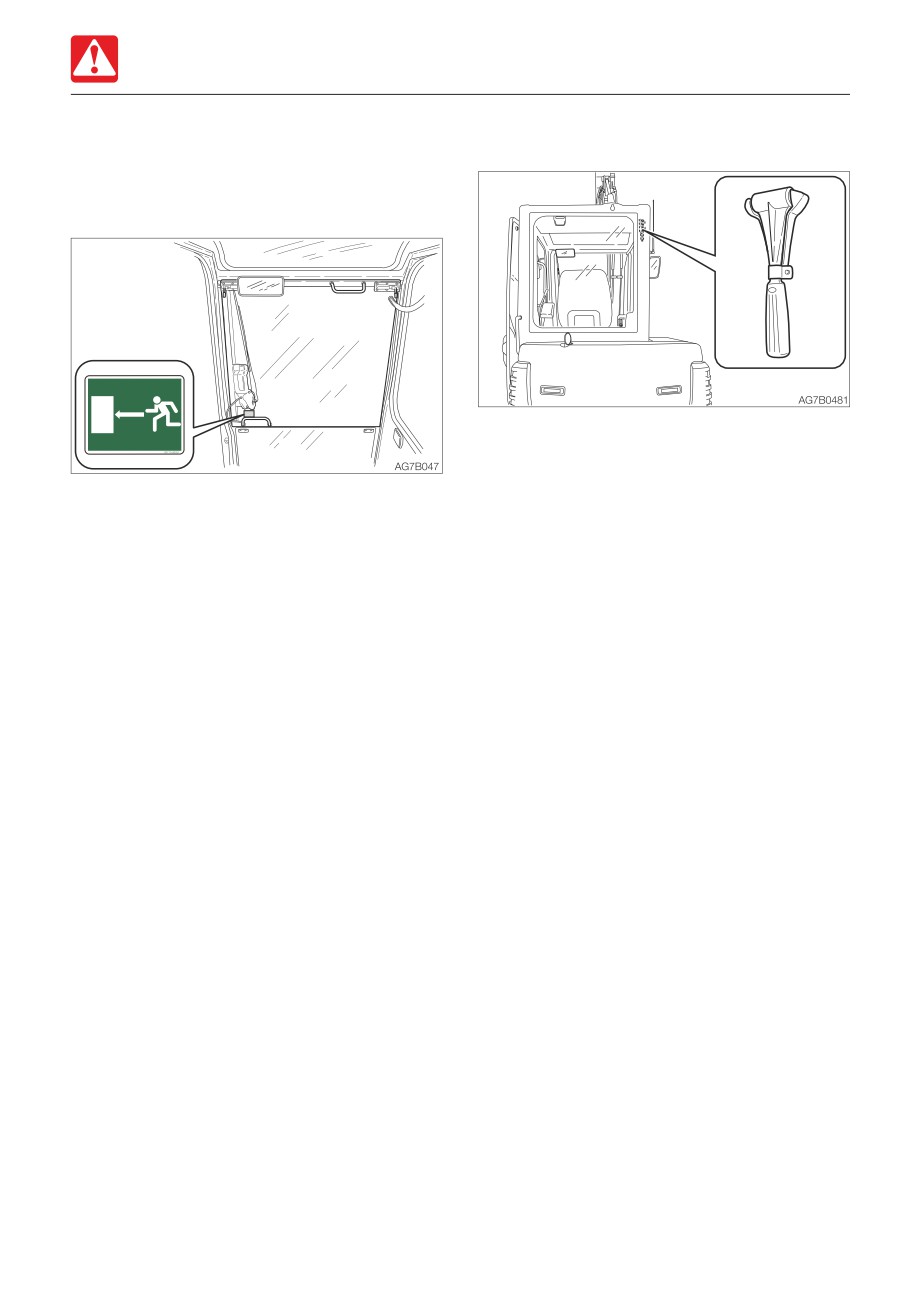
Emergency exit
Emergency hammer (optional)
Front window (excluding machines with a
front guard)
An emergency hammer is installed to be
used to escape from the cab in an
emergency. When escaping, break the
If you should become trapped inside the
windows with the hammer.
cab, open the front window to get out.
• When breaking the windowpane with a
hammer, take great care not to injure
yourself with the broken glass pieces.
• Remove the glass pieces from the window
sill so as not to cut yourself when
evacuating. Broken glass will fall from the
window, so be careful of your footing and
do not slip on the glass.
1-11
Safety
Precautions when starting
Precautions when
starting
Support your weight in a three point
secure stance when getting on/off the
machine
• Do not jump on or down from the machine.
Never attempt to get on or off the moving
machine.
• When getting on or off the cab, first fully
• Check if there is a “DO NOT OPERATE”
open the door to the locked position and
alert sign or similar sign is on the cab door,
check that it does not move (for machines
controls or starter switch. If there is one, do
with cab).
not start the engine or touch any levers.
• Sound the horn to warn people around the
machine.
Sit in the operator’s seat and start the
engine
• Adjust the seat to securely latch it.
• Climb up/down the steps facing the
machine and holding the handrail to
support your weight in a three point secure
stance (hand and feet).
• Never use the safety lock lever or control
levers as hand holds.
Before starting the machine, ask any
• Fasten the seat belt.
unauthorized personnel to leave the area
• Check if the parking brake is on and all
control levers and pedals are in the neutral
Do not start the engine until you are sure it is
position.
safe to start the machine by checking the
• Check if the safety lock lever is in the lock
following items.
position.
• Walk around the machine and warn the
• Make sure that no one is near the machine.
person who is servicing the machine or is
• Start and operate the machine only from
walking near the machine. Do not start the
the operator’s seat.
machine until you are certain that no one is
• Never attempt to start the engine by
around the machine.
shorting across the starter terminals.
1-12
Safety
Precautions when starting
Starting with jumper cables
In cold climates
Use jumper cables only in the recommended
• Be careful of slippery conditions on freezing
manner. Improper use of jumper cables can
ground, steps and hand holds.
result in battery explosion or unexpected
• In severe cold climates, do not touch any
machine motion.
metal parts of the machine with bare
Refer to “If the battery goes dead” for further
hands. The skin will freeze to the metal,
instructions.
resulting in severe injury.
• Do not use ether or starting fluid on this
engine. The starting fluids can cause
After starting the engine
explosion and serious injury or death.
• Warm up the engine and hydraulic oil. If the
After starting the engine, perform the
levers are operated without warming, the
operations and checks described below in a
machine will not react or move promptly or
safe place with no persons or obstacles in
properly, resulting in accident.
the area. If any malfunction is found, follow
the shutdown procedure and report the
malfunction.
• Warm up the engine and hydraulic oil.
• Check if all gauges and warning devices
are properly working.
• Check for any noises.
• Test the engine speed control.
• Operate each control to ensure they are
properly working.
1-13
Safety
Precautions when operating
Do not permit riders on the machine
Precautions when
operating
Operate the machine with the maximum
crawler width
Do not allow anyone to ride on any part of
the machine at any time while traveling or
operating.
AD6A001
• Always operate the machine with the
Check if the work area is safe and secure
crawler width extended to 1300 mm (51.2
before operation
in.) to maximize the machine stability. If the
machine is operated with the crawler width
narrowed (980 mm, 38.6 in.), the machine
may tip over due to its poor stability.
• If the machine must be operated with the
narrowed crawler width (980 mm, 38.6 in.),
traveling should be done after folding the
hoe attachment, lowering the boom to
lower the center of gravity and keeping the
machine facing forward.
Ensure good visibility
• Confirm the performance limits of the
machine.
• When working in dark places, turn on the
• Use a signal person at road shoulders,
machine’s working lights and headlights
narrow places or where your vision is
and additional lighting equipment installed,
obstructed.
as necessary.
• Never allow anyone to enter the machine’s
• When visibility is poor due to bad weather
slewing radius and path.
(fog, snow, rain or a cloud of dust), stop
• Signal your intention to move by sounding
operating the machine and wait until
the horn.
visibility improves.
• There is a blind spot in the rear of the
machine. Before traveling in reverse, check
that the area is safe and clear.
1-14
Safety
Precautions when operating
Check the position of the undercarriage
Travel safely
(tracks) before traveling
• Travel with the dozer blade raised, the hoe
Before operating the travel levers/pedals,
attachment folded as shown on the figure
make sure that the dozer blade is to the front
above, and the bucket raised 30 to 40 cm
of the operator’s seat. Remember that when
(12 to 16 in.) above the ground.
the dozer blade is to the rear of the
• Do not slew while traveling. If you must
operator’s seat, the travel levers/pedals must
operate the hoe attachment while traveling,
be operated in the reverse direction from
operate at speeds slow enough so you
when it is to the front.
have complete control at all times.
• Avoid crossing over obstacles whenever
possible. If you must do so, keep the hoe
attachment close to the ground level and
travel slowly. Never cross obstacles which
will tilt the machine to an angle of 10° or
greater.
• On uneven ground, maintain the low speed
and avoid starting, stopping or changing
directions abruptly. Otherwise, the working
equipment may come in contact with the
ground, causing the machine to lose its
balance and get damaged or to damage
the structures in the surrounding area.
1-15
Safety
Precautions when operating
Cautions on traveling on slopes
• When traveling on slopes or grades, drive
slowly in 1st (low) speed. When
When traveling on slopes or grades, be
descending a slope, slow down the engine
careful that the machine does not tip (roll)
speed.
over or slide.
• Do not descend slopes in reverse.
• Never travel on slopes that are too steep
for the machine to maintain its stability
(maximum gradeability: 30°, lateral tipping
angle: 10°). Note that in reality, the
machine’s stability becomes lower than the
above values depending on the working
condition.
• Do not change directions on slopes or
traverse slopes. First return to a flat
surface, and then take an alternative path.
• The machine may slip sideways even on a
slight slope if the ground is covered with
grass or dead leaves, or when traveling on
a wet metal plate or frozen surfaces. Make
sure the machine is never positioned
sideways on slopes.
• If the machine is stalled on the slope,
return each operating lever to the neutral
position before restarting the engine.
• When climbing a hill, keep the operator’s
seat facing the hillside. When descending a
hill, keep the operator’s seat facing the
downhill direction. In either case, travel
must be done while paying attention to the
ground in front of the machine.
• When traveling on slopes, lower the bucket
to a height of 20 to 30 cm (8 to 12 in.)
above the ground. When climbing a steep
slope, extend the hoe attachment to the
front. In emergencies, lower the bucket to
the ground and stop the machine.
1-16
Safety
Precautions when operating
Operate the machine on snow or ice with
Ensure driver’s safety when loading
extra care
• When traveling on snow or on frozen
surfaces, drive at a low speed and avoid
starting, stopping or changing directions
abruptly.
• In the snowy area, the road shoulder and
objects placed beside the road are buried
in the snow and cannot be seen. There is a
hazard of the machine tipping over or
hitting covered objects, so always carry out
operations carefully.
• If the machine enters deep snow, there is a
Do not load a truck unless the truck driver is
hazard that it may tip over or become
in a safe place.
buried in the snow.
• Never swing or position the bucket over a
Be careful not to drive beyond the road
person or the cab room.
shoulder or to get trapped in a snow drift.
• Load the truck from the rear.
• With frozen ground surfaces, the ground
becomes soft when the temperature rises,
and this may cause the machine to tip
over, resulting in an operator trapped inside
the machine.
• When parking the machine on an unstable
ground, lower the dozer blade.
Do not move the bucket over the heads of
people
Moving the bucket over the heads of people
entails the danger of the load spilling or the
sudden dropping of the bucket.
1-17
Safety
Precautions when operating
Keep a safe distance from the overhead
high-voltage cables
• Pay also careful attention to the high-
voltage electric cables buried underground.
Never bring any part of the machine or
loaded material to near to the high voltage
cables unless all safety precautions required
by the local and national authorities have
been installed. If a person comes near to the
machine that is discharging sparks or
located near to or in contact with the power
source, there is a hazard of electric shock
and death.
• Always maintain a safe distance between
the machine and the high-voltage electric
cable.
• Check with the local power company
about safe operating procedure before
starting operations.
• Consider all cables to be high-voltage
cables and treat all cables as energized
even though it is known or believed that
the power is shut off and the cables are
visibly grounded.
• Use a signal person to give warning if the
machine approaches too close to the
high-voltage electric cables.
• Caution all personnel in the work area not
to come close to the machine or the
loaded material.
1-18
Safety
Precautions when operating
Watch out for hazardous working
conditions
• Do not enter areas where there is soft
ground. Doing so could cause the machine
to tilt under its own weight, resulting in a
• Never undercut a high bank. Doing so is
machine tipping over or sinking into the
dangerous as it may cause ground
ground.
collapse.
• Do not operate in places where there is a
danger of falling rocks.
• Do not come close to unstable grounds
(cliffs, road shoulders, deep ditches). If the
ground should collapse under the weight
• Maintain a safe distance between the
or vibration of the machine, there is a
machine and the edge of the digging site.
hazard that the machine may fall or tip
Do not dig the ground under the front of
over.
the machine.
· Remember that the soil after heavy rain
• When working close to the cliffs or road
or blasting is weak.
shoulders, to make it easier to escape if
· The ground of top of the embankment
there is any problem, set the crawlers at
and of the circumferences of the
right angles to the cliff or road shoulder and
excavated ditches are also weak.
the dozer blade to the front when carrying
out operations.
1-19
Safety
Precautions when operating
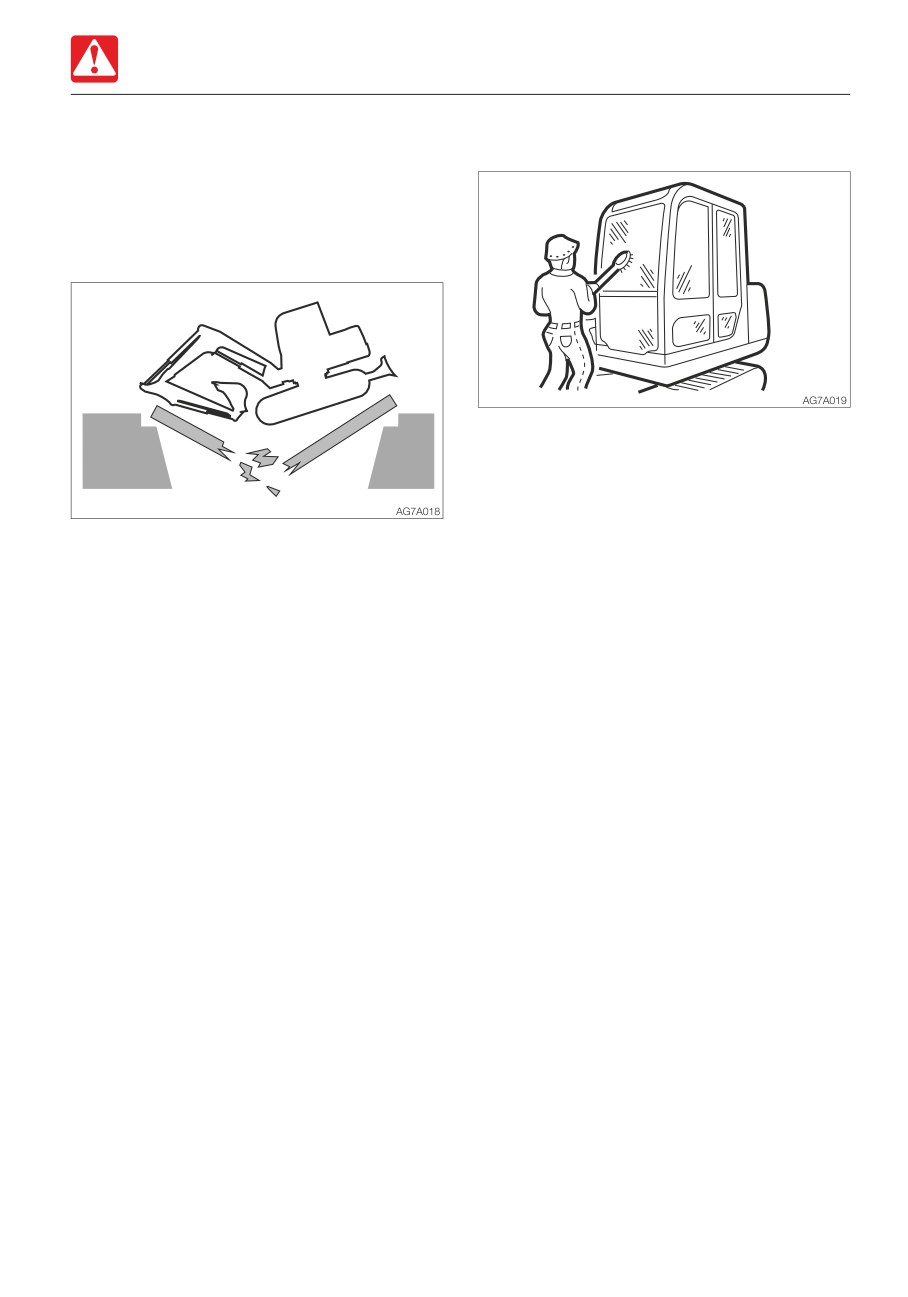
• Do not use the impact force of the hoe
attachment for breaking work. There is a
hazard of serious injury being caused by
flying pieces of broken materials and by the
damaged hoe attachment.
• Do not perform demolition work under the
machine. There is a hazard that the
machine may fall down, because the
ground becomes unstable.
• When working on or from the top of
buildings or other structures, check the
strength and the structure before starting
operations. If a building or structure
collapses, serious injury or damage will
result.
• When doing demolition work, do not
perform demolition above your head. There
is a hazard of broken parts falling or of the
building collapsing and causing serious
injury or damage.
1-20
Safety
Precautions when operating
Operating on slopes is dangerous
Never slew (swing) sideways with a heavy
load
When operating on slopes or grades, slewing
or operation of working equipment may
cause the machine to lose stability and tip
over. Avoid operating on slopes whenever
possible.
The machine can tip over more easily in the
lateral direction than in the longitudinal
direction.
• Do not slew (swing) sideways with a heavy
load at the tip of the hoe attachment. In
• Level off the work area.
particular, do not slew (swing) sideways on
slopes.
• The tip of the attachment is heavier for
machines equipped with breakers,
crushers or long arms than for machines
equipped with the standard bucket. For
such machines with heavier tips, do not
perform excavation with the digging arm
(boom) facing the downhill direction or
operate toward sideways.
Be careful with the overhead objects
• Avoid slewing to the downhill direction with
the bucket full of loaded material. This will
reduce the stability of the machine and
may result in tipping over.
When operating under bridges, in tunnels,
near electric cables or indoors, be careful not
to let the boom or arm hit overhead objects.
1-21
Safety
Precautions when operating
Excavators are not designed for lifting
Be careful with flying objects
loads
This machine is not equipped with protective
equipment to protect the operator from flying
objects. Do not use this machine in places
where there are risks of the operator being
hit by flying objects.
Cautions when towing
This machine is specifically designed for
excavation work. Therefore, it has no safety
equipment for crane operation. Extreme
caution should be paid if the excavator is
used for lifting.
• Never lift loads in excess of capacity.
Overload will cause the machine to roll and
can result in serious injury or death.
• All rated lift capacities are determined by
When towing, serious injury or death could
using a machine placed on a stable and flat
result, if performed incorrectly or the wire
ground. For a safe lifting work, the user is
rope being used is inappropriate or not
expected to make due allowance for the
properly inspected.
particular job conditions. They include, soft
• It becomes dangerous if the wire rope
or uneven ground, non-level condition, side
breaks or becomes disengaged. Use a
loads, dynamic or jerked loads, hazardous
wire rope appropriate for the required
conditions, and experience of personnel.
tractive force.
The operator and other personnel should
• Do not use a wire rope that is kinked,
fully acquaint themselves with the
twisted or otherwise damaged.
operator’s manual before operating this
• Do not apply heavy loads abruptly to the
machine, and rules for safe operation of
wire rope.
equipment shall be adhered to at all times.
• Wear safety gloves when handling the wire
• The bucket linkage or lifting device may fail
rope.
if chains or lifting device are incorrectly
• Make sure there is an operator on the
attached, resulting in serious injury or
machine being towed as well as on the
death.
machine that is towing.
• Do not attempt to pull stumps out of the
• Never tow on slopes.
ground when using the machine as a
• Do not let anyone come near to the wire
crane. The loads imposed on the machine
rope while towing.
under this use are completely unknown.
• Do not allow anyone to stand on or under
the lifted loads or come close to the work
area.
1-22
Safety
Precautions when stopping
• Before leaving the machine, do the
Precautions when
followings:
1. Lower the bucket and the dozer blade to
stopping
the ground.
Park safely
2. Raise the safety lock lever to the locked
position.
3. Stop the engine and remove the starter
key.
4. Lock the cab and covers and take the
key with you.
• Park the machine on a flat, rigid and safe
ground. Set the parking brake.
If you must park on a slope or incline, park
the machine securely and block the
movement of the machine.
• When parking on a street, use barriers,
caution signs, lights, etc., so that the
machine can easily be seen even at night
to avoid collision with other vehicles.
1-23
Safety
Precautions when transporting
• Chock the tracks and secure the machine
Precautions when
to the truck bed with wire rope or chain.
transporting
Load/unload the machine safely
The machine may roll or tip over or fall while
being loaded or unloaded. Take the following
precautions:
• Select a firm, level surface and keep
sufficient distance from road shoulders.
• Secure the ramps of adequate strength
and size to the truck bed. The slope of the
ramps must not exceed 15°. If the rumps
are bowed down too low, support them
with poles or blocks.
• Never use the working equipment to load
or unload the machine. Doing so may
result in tipping over or falling down of the
machine.
• Keep the truck bed and loading ramps
clean of oil, soil, ice, snow, and other
materials to prevent the machine from
sliding sideways. Clean the crawlers.
• Chock the transporter wheels to prevent
movement.
• When being loaded or unloaded, travel
slowly in 1st (low) gear by following the
signal from the signal person.
• Never change courses on the ramps.
• Do not slew/swing on the ramps. The
machine may tip over.
• When slewing/swinging on the truck bed,
do it slowly as the footing should be
unstable.
• Lock the cab door after being loaded, if
applicable. Otherwise, the door may open
during transport.
1-24
Safety
Precautions when transporting
Hoist the machine safely
Transport the machine safely
• Know and use correct crane signals.
• Know and follow the applicable safety
• Check the hoisting equipment for damaged
rules, vehicle code and traffic laws when
or missing parts on a daily basis and
transporting the machine.
replace as necessary.
• Select the best transport route by
• When hoisting, use a wire rope capable of
considering the length, width, height and
lifting the machine mass.
weight of the truck with the machine
• Hoist the machine in such a manner
loaded on it.
described in the procedure below. Do not
• Never abruptly start or stop or run at a high
do it in any other manner, as it may result in
speed at the sharp curves during transport.
the machine losing its balance.
Doing so will move or lose the balance of
Refer to “Hoisting the machine” for further
the loaded machine.
instructions.
• Do not hoist the machine with an operator
on it.
• When hoisting, hoist slowly so that the
machine does not tip.
• Keep everyone out of the area when
hoisting. Do not move the machine over
the heads of the persons.
1-25
Safety
Precautions on maintenance
Replace safety-critical parts periodically
Precautions on
• Replace fuel hoses periodically. Fuel hoses
maintenance
wear out over time, even if they do not
Display a “DO NOT OPERATE” alert sign
show any symptom of wear.
• Regardless of the replacement schedule,
Severe injury could result if an unauthorized
replace immediately if a symptom of wear
person should start the engine or touch
is found.
controls during inspection or maintenance.
Refer to “List of safety-critical parts” for
• Before performing maintenance, stop the
further details.
engine, remove the key and take it with
you.
Explosionproof lighting
• Display a “DO NOT OPERATE” alert sign
on easy-to-see locations such as on the
To prevent an ignition or explosion, use
starter switch or on control levers.
explosion-proof lights when inspecting fuel,
oil, coolant or battery fluid. Otherwise,
explosion could result causing serious injury
Use the correct tools
or death.
Do not use damaged or weakened tools or
tools designed for other purposes. Use tools
appropriate for the work involved.
1-26
Safety
Precautions on maintenance
Prohibit access by unauthorized persons
Always keep the machine clean
Do not allow unauthorized personnel in the
• Clean the machine before performing
work area while working. Be careful when
maintenance.
grinding, welding or using a hammer. You
• Stop the engine before washing the
could be injured by flying debris from the
machine. Cover the electrical parts so that
machine.
water cannot enter. Water on electrical
parts could cause short-circuits or
malfunctions. Do not use water or steam to
Prepare work area
wash the battery, electronic control
components, sensors, connectors or the
• Select a firm, level work area. Make sure
operator’s compartment.
there is adequate light and, if indoors,
ventilation.
• Clear obstacles and dangerous objects.
Stop the engine before performing
Eliminate slippery areas.
maintenance
• Avoid lubrication or mechanical
adjustments while the machine is moving
or while the engine is running when the
machine is not moving.
• If maintenance must be performed with the
engine running, always work as a two
person team communicating each other.
· One person must sit in the operator’s
seat so that he/she can immediately stop
the engine when necessary. He/she must
take care not to touch the lever or pedal
unless necessary.
· The one who performs maintenance
must make sure to keep his/her body or
clothing away from the moving part of the
machine.
1-27
Safety
Precautions on maintenance
Stay clear of the moving parts
Secure the working equipment
To prevent unexpected movement, firmly
secure the working equipment when
repairing or replacing the bucket teeth or
side cutter.
Secure the engine hood or cover when
opened
Be sure to secure the engine hood or cover
before working the inside. Do not keep the
• Stay clear of all rotating and moving parts.
hood or cover open on a windy day or if the
If a hand or tool becomes trapped in the
machine is parked on a slope.
rotating or moving part, serious injury or
death could result.
• If a tool or other objects is dropped or
Place heavy objects in a stable position
inserted in the fan or fan belt, it will be
flown or cut in pieces. Do not drop or insert
anything in the fan or fan belt.
Firmly secure the machine or any
component that may fall
When it is necessary to temporally place a
heavy object or an attachment on the ground
during removal or installation, be sure to
place it in a stable position. Keep off
unauthorized persons from the storage place
for such object.
• Before performing maintenance or repairs
under the machine, lower all moveable
working equipment to the ground or in the
lowermost position.
• Chock the tracks.
• If you must work beneath the raised
machine or equipment, always use wood
blocks, jack-stands or other rigid and
stable supports. Never get under the
machine or working equipment if they are
not sufficiently supported. This procedure
is especially important when working on
hydraulic cylinders.
1-28
Safety
Precautions on maintenance
Cautions when refueling
Be careful with hot and pressurized
components
• Do not smoke or permit open flames while
fueling or near fueling operations.
Stop the engine and allow the machine to
• Never remove the fuel cap or add fuel
cool down before performing maintenance.
when the engine is running or still hot. Do
• The engine, muffler, radiator, hydraulic
not spill fuel on the hot surface of the
lines, sliding parts and many other parts of
machine.
the machine are hot immediately after the
• Fill the fuel tank in a well ventilated place.
engine is stopped. Touching these parts
• Do not fill the fuel tank to capacity. Allow
will cause burns.
room for oil expansion.
• The engine coolant, hydraulic oil and other
• Clean up spilled fuel immediately.
oils are also hot and under high pressure.
• Securely tighten the fuel filler cap. If the fuel
Be careful not to touch the hydraulic oil
cap is lost, replace it only with the genuine
when loosening the cap or plug. Working
cap. Use of a non-approved cap without
on the machine under these conditions
proper venting may result in pressurization
could result in burns or injuries due to the
of the tank.
hot oil spurting out.
• Never use fuel for cleaning.
• Use the correct grade of fuel for the
operating season.
Handling of hoses
Oil leak or fuel leak can cause a fire.
• Do not twist, bend or hit the hoses.
• Never use twisted, bent or cracked pipes,
tubes or hoses; otherwise, they may burst.
• Retighten loose connection.
1-29
Safety
Precautions on maintenance
Be careful with hot cooling systems
Release pressure before working on the
hydraulic system
Oil may spurt out if caps or filters are
removed or pipes are disconnected before
releasing the pressure in the hydraulic
system.
• Gradually loosen the vent plug to relieve
tank pressure.
• When removing plugs or screws, or when
disconnecting hoses, stand to the side and
loosen them slowly to gradually release the
internal pressure before removing.
Do not remove the radiator cap or the drain
• Oil or plug may spurt out according to the
plug when the cooling water is hot. Stop the
pressure in the travel motor case. Loosen
engine and wait until the engine and the
the plug slowly and release the internal
cooling water cool. Then, slowly loosen the
pressure.
radiator cap to release the internal pressure
and remove it.
Be careful with debris when the hammer
Be careful with oil internal pressure
is being used
Pressure is maintained in the hydraulic circuit
When using a hammer, pins may fly out or
long after the engine has been shut down.
metal particles may be scattered. This may
• Completely relieve the internal pressure
lead to serious injury.
before performing maintenance work.
• If hard metal parts such as pins, bucket
teeth, side cutter or bearings are hit with a
hammer, wear protective gear such as
safety goggles and gloves.
• When hitting pins or bucket teeth, always
check that there is no one in the
surrounding area.
• The hydraulic oil is high enough pressure to
penetrate the skin or eyes and cause
serious injury, blindness or death.
Remember that the hydraulic oil escaping
from a small hole is almost invisible. When
checking for leaks, wear protective goggle
and thick gloves, and use a paperboard or
plywood to keep your skin from oil
spurting.
If oil penetrates the skin, it must be
surgically removed within a few hours by a
doctor familiar with this type of injury.
1-30
Safety
Precautions on maintenance
Be careful with the high-pressure grease
Handling of the accumulator
AG7A086
In the track adjuster, the grease has been
Be sure to handle the high-pressure nitrogen
injected under high pressure. If the tension is
gas enclosed in the accumulator with care. If
adjusted without following the prescribed
handled incorrectly, it could explode and
procedure, the grease discharge valve may
cause serious injury. Strictly observe the
fly off, resulting in injury.
following precautions:
• Never loosen the grease fitting.
• Do not disassemble.
• Loosen the grease discharge valve slowly.
• Do not allow flame near or throw it into a
Do not turn it more than one turn.
fire.
• Do not put your face, arms, legs or body in
• Do not drill, weld or fuse.
front of the grease discharge valve.
• Do not subject it to physical shock such as
• If grease does not come out when the
hitting, rolling or dropping.
grease discharge valve is loosened, the
• Before disposing of the unit, the sealed gas
valve is faulty. Ask a Takeuchi service agent
must be drained. Contact a Takeuchi
for repair.
service agent for help.
Never disassemble the track adjuster
There is a very strong spring contained in the
track adjuster. If the track adjuster is
accidentally disassembled, the spring can
pop out, resulting in serious injury Never
disassemble the track adjuster.
1-31
Safety
Precautions on maintenance
Disconnect the battery wiring
• Do not charge a battery or jump-start the
engine if the battery is frozen; otherwise it
may explode. Warm the frozen battery to
15°C (60°F) before use.
• Do not use the battery when the fluid level
is below the lower level limit. Doing so will
hasten the deterioration of the internal
portions of the battery and shorten the
battery life. It also can cause rupturing
(explosion).
• Do not add the distilled water above the
upper level limit. Doing so could cause the
fluid to leak. This fluid can cause skin
Disconnect the battery wiring before working
damage if contacted, or can cause the
on the electrical system or doing electric
machine components to corrode.
welding. Disconnect the negative (-) battery
• Use a dampened cloth to clean around the
cable first. When reconnecting, connect the
fluid level line and check the fluid level. Do
negative (-) battery cable last.
not clean with a dry cloth; otherwise it
could cause static electricity to build up,
resulting in ignition or explosion.
Use caution when handling batteries
• Batteries contain sulfuric acid which will
damage the eyes or skin in case of
contact.
· If eye contact occurs, flush immediately
with clean water and get prompt medical
attention.
· If accidentally swallowed, drink large
quantities of water or milk and call a
physician immediately.
· If acid contacts skin or clothing, wash off
immediately with a lot of water.
• Wear protective goggle and gloves when
working with batteries.
• Batteries generate flammable hydrogen
gas which may explode. Keep away from
flame, sparks, fire or lighted cigarettes.
• When checking the level of the battery
fluid, use a flashlight.
• Be sure to stop the engine by turning off
the starter switch before inspecting or
handling the battery.
• Be careful not to let metal tools or any
metal objects come into contact with the
battery terminals and cause a short circuit.
• Loose battery terminals may result in
sparks. Be sure to fasten terminals tightly.
• Make sure the battery caps are tightened
securely.
1-32
//////////////////////////////////////////