SANY Crawler Hydraulic Excavator SY215CLC (CUMMINS QSB6.7 engine). Shop Manual - page 4
 

  Index      Manuals     SANY Crawler Hydraulic Excavator SY215CLC (CUMMINS QSB6.7 engine). Shop Manual


Search            copyright infringement  


Content      ..     2      3      4      5     ..


SANY Crawler Hydraulic Excavator SY215CLC (CUMMINS QSB6.7 engine). Shop Manual - page 4


Introduction

SY215C

LC

1-34

1.7  

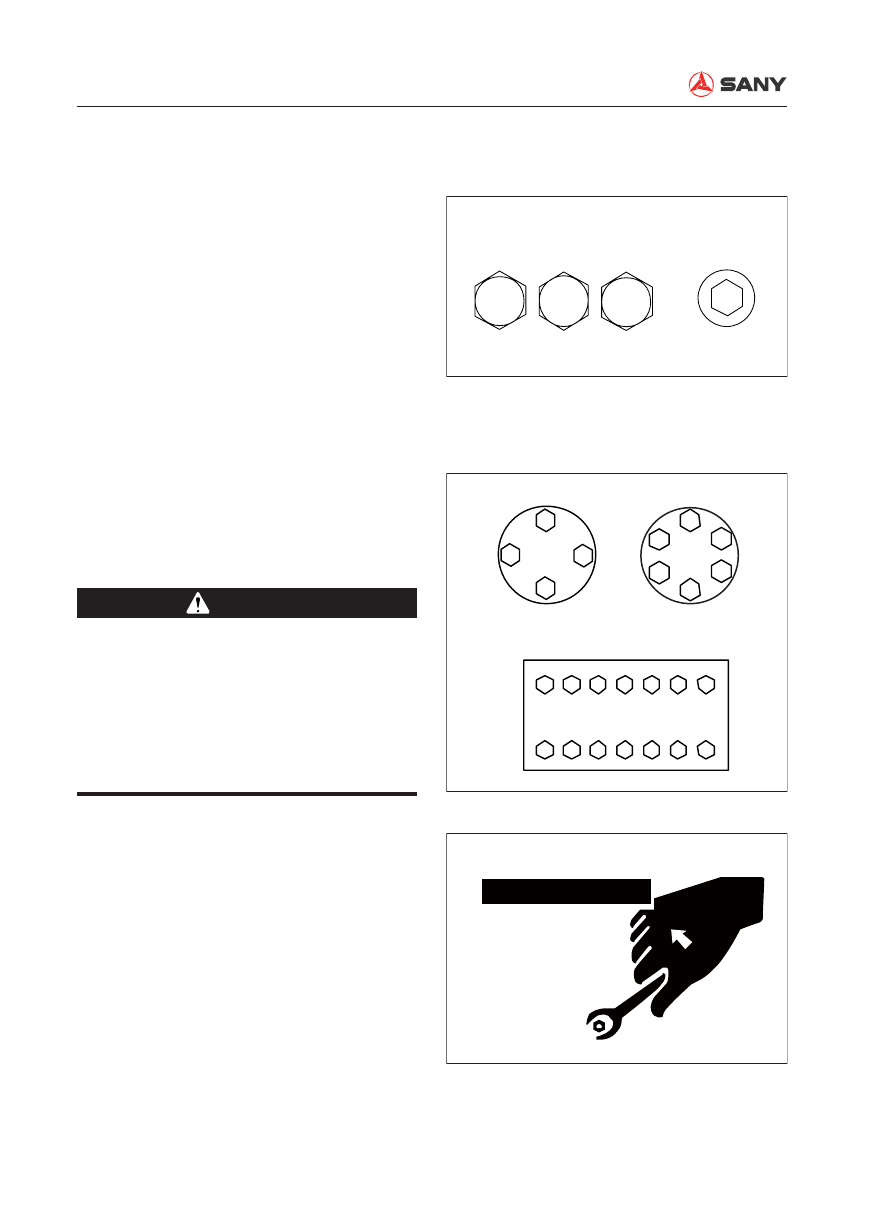
Type of Bolts

Tighten nuts and bolts properly to specified 
torque values. The type and grade of bolts are 
illustrated on the right.

Use correct bolts and tighten them properly 
when assembling machines or components. 

1.8  

Tightening Sequence

When two or more bolts are being tightened, 
follow the tightening sequence shown on the 
right to ensure even tightening.


Always use suitable tools for specific 
work. Use of improper tools and meth-
ods may cause a hazardous situation.


Use tools of correct sizes when loosen-
ing or tightening the nuts or bolts. Oth-
erwise, the tools may slide and cause 
personal injury.

ZX215-1000031

Hex bolt

Socket head hex bolt

10.9

12.9

8.8

ZX215-1000032

Cross tightening

Diagonal tightening

Central and diagonal tightening

1

2

3

4

5

6

1

2

3

4

5

6

7

8

9

10

11

12

13

14

1

2

3

4

ZX215-1000033

CAUTION

Introduction

SY215C

LC

1-35

1.9  

Maintenance of Half Flanges

1.  Clean the sealing surface of the 

fl

 ange and 

check it carefully. Scratches and coarse-
ness cause leaks or abrasion of seals. 
Uneven surface may squeeze the seal out. 
If these faults are not corrected properly, 
parts may have to be replaced. 

2.  Always use specified O-rings. Check that 

the O-rings are not damaged. Do not file 
the surface of the O-ring. Apply grease 
onto the O-ring to locate it. 

3.  Tighten the half flanges carefully. Locate 

the opening at the center so that it is 
perpendicular to the oil opening. Tighten 
the bolt manually to maintain the location 
of the components. 

1.9.1  Table of tightening torques for half fl ange bolts

Thread diameter of bolt

Width across fl ats

Tightening torque

mm

mm

Nm

kgm

10
12
16

14
17
22

59~74

98~123

235~285

6.0~7.5

10.0~12.5
23.5~29.5

ZX215-1000034

ZX215-1000035

Improper


Unless speci

fi

 ed otherwise, tighten the half 

fl

 ange bolts to the torques below.

Introduction

SY215C

LC

1-36

1.10  

Conversion Table

1.10.1  Method of using conversion table

The conversion table in this section is provided to enable simple conversion of 

fi

 gures. For details 

of the method of using the conversion table, see the example given below.

Example: 

Method of using the conversion table to convert from millimeters to inches

1.  Convert 55 mm into inches

1)  Locate the number 50 in the vertical column at the left side, take this as (A), and then draw 

a horizontal line from (A).

2)  Locate the number 5 in the row across the top, take this as (B), then draw a perpendicular 

line down from (B).

3)  Take the point where the two lines cross as (C). This point (C) gives the value when con-

verting from millimeters to inches. Therefore, 55 mm = 2.165 inches.

2.  Convert 550 mm into inches

1)  The number 550 does not appear in the table, so divide it by 10 (move the decimal point 

one place to the left) to convert it to 55 mm.

2)  Carry out the same procedure as above to convert 55 mm to 2.165 inches.

3)  The original value (550 mm) was divided by 10, so multiply 2.165 inches by 10 (move the 

decimal point one place to the right) to return to the original value. This gives 550 mm = 
21.65 inches.

Introduction

SY215C

LC

1-41

1.10.2 Temperature

Fahrenheit-Centigrade conversion: A simple 
way to convert a Fahrenheit temperature read-
ing into a Centigrade temperature reading or 
vice versa is to enter the accompanying table 
in the center (boldface column) of figures. 
These 

fi

 gures refer to the temperature in either 

Fahrenheit or Centigrade degrees.

If it is desired to convert from Fahrenheit to 
Centigrade degrees, consider the center col-
umn to be a table of Fahrenheit temperatures 
and read the corresponding Centigrade tem-
perature in the column at the left.

If it is desired to convert from Centigrade to 
Fahrenheit degrees, consider the center col-
umn to be a table of Centigrade values, and 
read the corresponding Fahrenheit tempera-
ture on the right.

Shop Safety

Shop Safety

SY215C

LC

2-1

2 Shop Safety

2.1 Hazard Alert Information .......................................................................................... 2-3

2.2  General Shop Safety ............................................................................................... 2-6

Shop Safety

SY215C

LC

2-3

2 SHOP SAFETY

2.1  

Hazard Alert Information

DANGER

WARNING

CAUTION

Most accidents are usually caused by the fail-
ure to follow fundamental repair procedures 
and safety rules for the system under repair. 
To avoid accidents it is important to read and 
understand all information outlined in this 
manual before performing repairs on the ma-
chine system.

The following (ANSI/ISO) signal words are 
used to inform you that there is a potentially 
hazardous situation that may lead to damage, 
personal injury or even death. In this manual, 
on the machine, part or component decals and 
different signal words are used to express the 
potential level of a hazard.

NOTICE

Indicates an imminent hazard which WILL 
result in serious injury or death if message 
is ignored.

Indicates a potentially hazardous situation 
which COULD result in serious injury or 
death if message is ignored.

Indicates a potentially hazardous situation 
which COULD RESULT IN MINOR OR MA-
JOR INJURY 
if message is ignored.

Indicates THE MACHINE MAY BE DAM-
AGED if improperly operated or main-
tained.

Shop Safety

SY215C

LC

2-4

SANY cannot predict every circumstance that 
might involve a potential hazard in a repair of 
the machine. Therefore the safety message in 
this manual and on the machine may not in-
clude all possible safety precautions.

If any procedures or actions not speci

fi

 ed, rec-

ommended or allowed in this manual are used, 
you must be sure that you and others can 
perform such procedures and actions safely 
and without damaging the machine. If you are 
unsure about the safety of some procedures, 
contact your SANY representative.

This is to alert the user of a hazard. It is 
usually used in a graphic.

This symbol is used in a graphic to alert 
the user to not do something.

Shop Safety

SY215C

LC

2-5

WARNING


Improper repair procedures on this ma-
chine can be hazardous and could re-
sult in serious injury or even death.


All personnel involved with the repair 
of this machine must read this manual 
thoroughly before performing any pro-
cedures on this equipment.


Some actions involved in the operation 
or repair of this machine could cause 
a serious accident if they are not per-
formed in the manner described in this 
manual.


All precautions outlined in this manual 
apply only to intended repair proce-
dures of the machine or system. If you 
perform any repairs not specifi cally pro-
hibited, you must be sure that it is safe 
for you and others. In no event should 
you or others engage in prohibited uses 
or actions as described in this manual.


SANY delivers machines that comply 
with all applicable regulations and 
standards of the country to which the 
machines have been shipped. If this 
machine has been purchased in another 
country or purchased from someone 
in another country, it may lack certain 
safety features and specifications that 
are necessary for use in your country. 
If there is any question about whether 
your product complies with the appli-
cable standards and regulations of your 
country, contact your SANY representa-
tive before performing repairs on this 
machine.

Shop Safety

SY215C

LC

2-6

2.2  General Shop Safety

It's important to establish good shop safety 
rules for everyone who enters or uses the 
shop area. Implementing shop safety rules 
will keep employees safe and provide the 
most productive environment for working or 
learning. Post rules where they can clearly be 
viewed at all times. If necessary, provide shop 
personnel with a written copy of the rules and 
discuss any questions or confusion with them.

Always keep in mind, shop safety is NOT 
something to be studied at the start of a proj-
ect and then forgotten; most accidents are 
caused by carelessness, being in a hurry or by 
simply disreguarding safety rules. Remember 
this, if you are DILIGENT and follow instruc-
tions outlined in this shop manual with care, 
repair operations can be safe and enjoyable. 
Safe work practices, should become a force of 
habit.

WARNING

Mistakes in operation are extremely haz-
ardous. Read the Safety, Operation & 
Maintenance Manual that came with the 
machine carefully before operating the 
machine. Failure to follow this alert could 
result in serious injury or death.

Shop Safety

SY215C

LC

2-7

2.2.1  Rules and shop behavior


Study all shop rules relating to the proce-
dure carefully and constantly apply them. 
When in doubt about any task, get help! 
DO NOT take chances.


Know your job. It is foolish, and often di-
sastrous, to make repairs to a machine 
without first receiving proper instructions. 
Always use the shop manual when per-
forming any repair tasks. Get additional 
help if you are NOT sure what must be 
done or how a task should be performed.


The shop is a place to work, not play. It is 
NOT a place for “horseplay”. A “joker” in a 
repair shop is a “walking hazard” to every-
one. Daydreaming or socializing on the job 
also increases your chances of injury.


If you must smoke, smoke only in the area 
provided for smoking. Never smoke while 
on the shop 

fl

 oor or work area.

2.2.2 Housekeeping


Oils, grease, fuel, antifreeze or any fluid 
spills should be mopped up immediately. 
These items pose a serious slip hazard. 
Regardless of who was responsible for the 
spill, it is your job as a shop employee to 
secure and clean up the spill area.


Keep the shop clean. Scrap or old parts 
should be disposed of properly. Never al-
low them to remain on the bench or shop 

fl

 oor.


All equipment and tools must be put back 
in their proper storage areas after each 
use. It's imperative that you do not let a 
shop become cluttered and disorganized in 
order to prevent accidents.


Always keep in mind, proper house clean-
ing is vital for a safe and pleasant work en-
vironment.

Shop Safety

SY215C

LC

2-8

2.2.3  Shop Liquids Storage


Liquids, cleaning solvents or machine flu-
ids should be properly stored in an area 
away from work locations. These storage 
areas should be ventilated to an outdoor 
location to avoid any vapor accumulation 
in a con

fi

 ned shop area. Follow all OSHA 

regulations regarding 

fl

 uid storage.


Never leave open containers of liquids sit-
ting around. These could spill or catch 

fi

 re. 

Always read the container label for infor-
mation on storage and handling of the liq-
uids.


Never store liquids in containers that are 
not properly labeled for that liquid. Confu-
sion could result in equipment damage, 

fi

 re 

or an unexpected explosion.


Never smoke or bring open 

fl

 ames around 

liquids, doing so could result in an unex-
pected 

fi

 re or explosion.


Never handle liquids without using person-
al protective equipment. Treat all liquids 
with caution.

2.2.4 Cleaning Parts

Never use gasoline, diesel fuel or similar 

fl

 am-

mable liquids to clean parts. Always use ap-
proved non-

fl

 ammable solvents to clean parts. 

Failure to do so could result in explosion or 

fi

 re.

Shop Safety

SY215C

LC

2-9

2.2.5  Jacking Up the Machine


If you will be working under the machine 
always use approved jack stands that will 
support the weight of the machine you are 
working on.


Never rely on the hydraulics of the ma-
chine or a hydraulic jack to support the 
machine during repairs.


Always lower the work equipment to the 
ground and check the stability of the ma-
chine before going under the machine.

2.2.6 Electrical Dangers


When testing electrical circuits, always be 
aware of what you will be checking in these 
systems. High voltage or high amp circuits 
could damage your equipment or cause a 
spark, explosion or possible 

fi

 re.


Before performing any repairs or testing on 
an electrical system be sure of the system 
voltage dangers. Always check the circuit 
to be sure it is off before performing any 
repairs.


When working around 

fl

 ammable liquids or 

explosive systems, use only approved anti-
explosion proof work lamps. Non-approved 
work lamps can cause an explosion or 

fi

 re.

Shop Safety

SY215C

LC

2-10

2.2.7 Removing Attachments


If you will be removing large heavy attach-
ments from the machine, always be sure to 
use the correct lifting equipment rated for 
the capacity of the load you will be lifting.


After the attachment or part has been 
removed, store it where it cannot fall or 
move. Always be sure what you are stor-
ing is sitting stable on a stable surface and 
clear of all walkways or 

fi

 re exits.

2.2.8  Cleaning the Machine


Always use high-pressure hot water and 
mild, nonflammable grease-cutting soaps 
or cleaning agents to clean the machine 
parts. Never use flammable or caustic 
cleaning agents.


Never use high-pressure steam cleaners 
to clean the machine. Steam cleaners will 
damage the paint, hoses or electrical sys-
tem.


Never pressure-wash or 

fl

 ood the inside of 

an operator cab. This will damage sensi-
tive electrical components.

Shop Safety

SY215C

LC

2-11

2.2.9  Using the Correct Tools


Always use the proper authorized tools for 
the job. Using tools that are not authorized, 
incorrect for the job, defective or damaged 
could cause serious injury.


Keep all tools in good condition, learn the 
correct way to use them.


Before starting the work, thoroughly check 
the tools, machine, forklift, crane, service 
car, etc.


Keep your tools clean, and when the job is 
complete, take inventory of the tools you 
were using to be sure no tools were left in 
the machine.


Always put shop tools back in there proper 
storage location when 

fi

 nished.


If welding repairs are needed, always have 
a trained, experienced or certified welder 
carry out the work.

2.2.10  Hoisting a Load

If you will be lifting parts or components that 
weigh more than 35 lbs (16 kg), it is important 
to follow some basic rules.


Always use the appropriate lifting equip-
ment such as hoist, crane, forklift etc. to 
handle a loads if possible.


Be sure the lifting equipment is in good 
condition and rated for the load you are 
about to lift.


If straps are to be used, ensure they are in 
good condition and rated for the load to be 
lifted with them.


If you must lift the load by hand, keep your 
back straight and parallel with the load, 
and lift the load using your leg muscles to 
avoid back injuries. Always ask for a lifting 
assistant.

Shop Safety

SY215C

LC

2-12

2.2.11 Appropriate Working Apparel

Improper or loose clothing, casual dress cloth-
ing, jewelry, incorrect shoes or long hair can 
result in possible injury.

Make a list of the types of clothing that are not 
allowed in the shop area. Go over the list with 
personnel before they start a job.

2.2.12 Safety Partners

No one should be allowed to perform work 
operations in any shop alone. It should be a 
general shop safety rule for a minimum of two 
people in the shop area at all times when work 
procedures are performed. A person alone in 
the shop might not be able to get emergency 
help in the event of a shop accident.

When working together always maintain clear 
contact with each other at all times to avoid 
the occurrence of unexpected incidents.

When carrying out any operation with two or 
more workers, always agree on the operating 
procedures and signals before starting.

Shop Safety

SY215C

LC

2-13

2.2.13  Two people when engine run-

ning

In order to prevent injury, do not perform the 
service while the engine is running. If the ser-
vice must be performed while the engine is 
running, operate only when two people are on 
the spot and follow the regulations below:


Always have one operator sit on the op-
eration seat and be ready to turn off the 
engine at any time. All the operators must 
keep in touch with each other.


Set the safety lock control lever to the lock 
position.


Do not touch any control lever. If some 
control lever must be operated, send signal 
to other people and warn them to transfer 
to safe place quickly.


Do not drop or insert the tools and other 
objects into the fan or fan belt, or the parts 
will be broken or thrown out.

2.2.14 Driving Pins

When using a hammer to drive pins, metal 
particles may 

fl

 y off. This may lead to serious 

eye injuries. Always do the following:


Always wear a face shield or goggles when 
striking a metal object with a metal ham-
mer.


Before performing any of these proce-
dures, be sure all personnel are clear of 
your work area.


If possible, avoid using a steel hammer to 
drive a component or pins in place. Dam-
age to the component may result. Always 
use a soft or non-ferrous hammer to drive 
a component or a pin.


Content      ..     2      3      4      5     ..