KOMATSU PC200-250001, PC220-65001. Manual - part 4
 

  Index      Manuals     KOMATSU PC200-250001, PC220-65001. Manual


Search            


Content   ..  2  3  4  5   ..


KOMATSU PC200-250001, PC220-65001. Manual - part 4


SAFETY

SAFETY INFORMATION

2-13

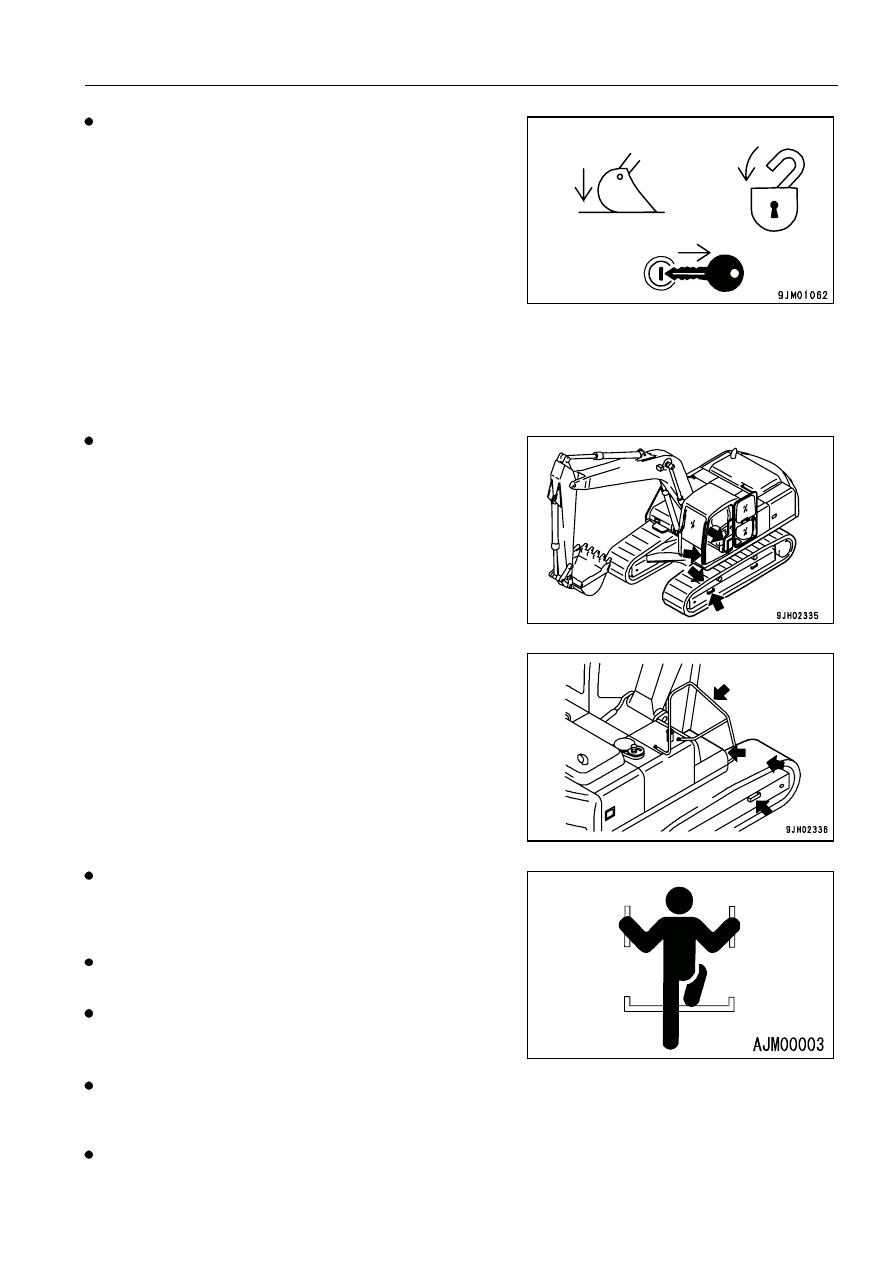
When leaving the machine, always lower the work equip-
ment completely to the ground, set lock lever (1) securely
to LOCK position (L), then stop the engine. Use the key to
lock all the equipment. Always remove the key, take it with
you, and keep it in the specified place.

HANDRAILS AND STEPS

To prevent personal injury caused by slipping or falling off the machine, always do as follows.

Use the handrails and steps marked by arrows in the dia-
gram on the right when getting on or off the machine.

To ensure safety, always face the machine and maintain
three-point contact (both feet and one hand, or both hands
and one foot) with the handrails and steps (including the
track shoe) to ensure that you support yourself.

Do not grip the control levers or lock lever when getting on
or off the machine.

Never climb on the engine hood or covers where there are
no non-slip pads.

Before getting on or off the machine, check the handrails and steps (including the track shoe). If there is any
oil, grease, or mud on the handrails or steps (including the track shoe), wipe it off immediately. Always keep
these parts clean. Repair any damage and tighten any loose bolts.

Do not get on or off the machine while holding tools in your hand.

SAFETY INFORMATION

SAFETY

2-14

MOUNTING AND DISMOUNTING

Never jump on or off the machine. Never get on or off a moving machine.

If the machine starts to move when there is no operator on the machine, do not jump on to the machine and try
to stop it.

NO PERSONS ON ATTACHMENTS

Never let anyone ride on the bucket, grapple, clamshell, or other attachments. There is a hazard of falling and suf-
fering serious injury.

BURN PREVENTION

Hot coolant

To prevent burns from hot water or steam spurting out
when checking or draining the coolant, wait for the water to
cool to a temperature where it is possible to touch the radi-
ator cap by hand before starting the operation. Even when
the coolant has cooled down, loosen the cap slowly to
relieve the pressure inside the radiator before removing the
cap.

Hot oil

To prevent burns from hot oil spurting out when checking or
draining the oil, wait for the oil to cool to at temperature
where it is possible to touch the cap or plug by hand before
starting the operation.  Even when the oil has cooled down,
loosen the cap or plug slowly to relieve the internal pres-
sure before removing the cap or plug.

SAFETY

SAFETY INFORMATION

2-15

FIRE PREVENTION AND EXPLOSION PREVENTION

Fire caused by fuel or oil

Fuel, oil, antifreeze, and window washer liquid are particu-
larly flammable and can be hazardous. To prevent fire,
always observe the following:

Do not smoke or use any flame near fuel or oil.

Stop the engine before refueling.

Do not leave the machine while adding fuel or oil.

Tighten all fuel and oil caps securely.

Do not spill fuel on overheated surfaces or on parts of
the electrical system.

Use well-ventilated areas for adding or storing oil and
fuel.

Keep oil and fuel in the determined place and do not
allow unauthorized persons to enter.

After adding fuel or oil, wipe up any spilled fuel or oil.

When carrying out grinding or welding work on the
chassis, move any flammable materials to a safe place
before starting.

When washing parts with oil, use a non-flammable oil. Diesel oil and gasoline may catch fire, so do not
use them.

Put greasy rags and other flammable materials into a safe container to maintain safety at the work place.

Do not weld or use a cutting torch to cut any pipes or tubes that contain flammable liquids.

Fire caused by accumulation of flammable material.

Remove any dry leaves, chips, pieces of paper, dust, or any other flammable materials accumulated or
affixed around the engine, exhaust manifold, muffler, or battery, or inside the undercovers.

Fire coming from electric wiring

Short circuits in the electrical system can cause fire.

Always keep electric wiring connections clean and securely tightened.

Check the wiring every day for looseness or damage. Tighten any loose connectors or wiring clamps.
Repair or replace any damaged wiring.

Fire coming from hydraulic line

Check that all the hose and tube clamps, guards, and cushions are securely fixed in position.

If they are loose, they may vibrate during operation and rub against other parts. This may lead to damage to
the hoses, and cause high-pressure oil to spurt out, leading to fire damage or serious injury.

Explosion caused by lighting equipment

When checking fuel, oil, battery electrolyte, window washer fluid, or coolant, always use lighting with anti-
explosion specifications. If such lighting equipment is not used, there is danger of explosion that may
cause serious injury.

When taking the electrical power for the lighting from the machine, follow the instructions in this manual.

ÍßÚÛÌÇ ×ÒÚÑÎÓßÌ×ÑÒ

ÍßÚÛÌÇ

îóïê

ßÝÌ×ÑÒ ×Ú Ú×ÎÛ ÑÝÝËÎÍ

If a fire occurs, escape from the machine as follows.

Turn the starting switch OFF and stop the engine.

Use the handrails and steps to get off the machine.

É×ÒÜÍØ×ÛÔÜ ÉßÍØÛÎ ÚÔË×Ü

Use an ethyl alcohol base washer liquid. Methyl alcohol base washer liquid may irritate your eyes, so do not use it.

ÚßÔÔ×ÒÙ ÑÞÖÛÝÌÍô ÚÔÇ×ÒÙ ÑÞÖÛÝÌÍ ßÒÜ ×ÒÌÎËÜ×ÒÙ ÑÞÖÛÝÌÍ
ÐÎÛÊÛÒÌ×ÑÒ

On jobsites where there is a hazard that falling objects, flying
objects, or intruding objects may hit or enter the operator's cab,
consider the operating conditions and install the necessary
guards to protect the operator.

The above recommendations assume that the conditions
are for standard operations, but it may be necessary to add
additional guards according to the operating conditions on
the jobsite.
Always contact your Komatsu distributor for advice.

ßÌÌßÝØÓÛÒÌ ×ÒÍÌßÔÔßÌ×ÑÒ

When installing optional parts or attachments, there may be problems with safety or legal restrictions, so
please contact your Komatsu distributor for advice.

Any injuries, accidents, or product failures resulting from the use of unauthorized attachments or parts will not
be the responsibility of Komatsu.

When installing and using optional attachments, read the instruction manual for the attachment, and the gen-
eral information related to attachments in this manual.

When carrying out demolition or breaker operations, install a
front guard and always keep all the windows closed when
operating. In addition, always check that there is no one except
the operator in the surrounding area. They may be hit by falling
objects or flying objects.
When operating on jobsites, such as mines or quarries, where
there is a hazard of falling rocks, install FOPS and a front guard,
and always keep all the windows and doors closed when
operating. In addition, always check that there is no one except
the operator in the surrounding area. They may be hit by falling
objects or flying objects.

SAFETY

SAFETY INFORMATION

2-17

ATTACHMENT COMBINATIONS

Depending on the type or combination of work equipment, there is a hazard that the work equipment may hit the
cab or other parts of the machine. Before using unfamiliar work equipment, check if there is any hazard of interfer-
ence, and operate with caution.

CAB WIDOW GLASSES

If the cab glass on the work equipment side is broken, there is a hazard that the work equipment may contact
the operator's body directly. Stop operation immediately and replace the glass.

The ceiling window is made of organic glass (polycarbonate), and as such it is apt to break easily when receiv-
ing damage on the surface, thereby deteriorating its protective characteristic. If there is a crack or damage
caused by a fallen rock, or when any sign of them is noticed, replace it with a new window.

UNAUTHORIZED MODIFICATIONS

Any modification mode without authorization from Komatsu can create hazards. Before making a modification,
consult your Komatsu distributor.

Komatsu will not be responsible for any injuries, accidents, or product failures resulting from modifications
made without authorization from Komatsu.

SAFETY AT JOBSITE

Before starting operations, thoroughly check the area for any unusual conditions that could be dangerous.

When carrying out operations near combustible materials such as thatched roofs, dry leaves or dry grass,
there is a hazard of fire, so be careful when operating.

Check the terrain and condition of the ground at the worksite, and determine the safest method of operation.
Do not carry out operations at places where there is a hazard of landslides or falling rocks.

If water lines, gas lines, or high-voltage electrical lines may
be buried under the worksite, contact each utility and iden-
tify their locations. Be careful not to sever or damage any
of these lines.

Take action to prevent unauthorized people from approach-
ing the jobsite.

When working on public roads, position flagmen and erect
barriers to ensure the safety of passing traffic and pedestri-
ans.

When traveling or operating in shallow water or on soft
ground, check the shape and condition of the bedrock, and
the depth and speed of flow of the water before starting
operations.

SAFETY INFORMATION

SAFETY

2-18

WORKING ON LOOSE GROUND

Avoid traveling or operating your machine too close to the edge of cliffs, overhangs, and deep ditches. The
ground may be weak in such areas. If the ground should collapse under the weight or vibration of the machine,
there is a hazard that the machine may fall or tip over. Remember that the soil after heavy rain or blasting or
after earthquakes is weak in these areas.

When working on embankments or near excavated ditches, there is a hazard that the weight and vibration of
the machine will cause the soil to collapse. Before starting operations, take steps to ensure that the ground is
safe and to prevent the machine from rolling over or falling.

DISTANCE TO HIGH VOLTAGE CABLES

Do not travel or operate the machine near electric cables.
There is a hazard of electric shock, which may cause serious
injury or property damage. On jobsites where the machine may
go close to electric cables, always do as follows.

Before starting work near electric cables, inform the local
power company of the work to be performed, and ask them
to take the necessary action.

Even going close to high-voltage cables can cause electric
shock, which may cause serious burns or even death.
Always maintain a safe distance (see the table on the right)
between the machine and the electric cable. Check with
the local power company about safe operating procedure
before starting operations.

To prepare for any possible emergencies, wear rubber
shoes and gloves. Lay a rubber sheet on top of the seat,
and be careful not to touch the chassis with any exposed
part of your body.

Use a signalman to give warning if the machine
approaches too close to the electric cables.

When carrying out operations near high voltage cables, do
not let anyone come close to the machine.

If the machine should come too close or touch the electric
cable, to prevent electric shock, the operator should not
leave the operator's compartment until it has been con-
firmed that the electricity has been shut off.
Also, do not let anyone come close to the machine.

ENSURE GOOD VISIBILITY

Check for any persons or obstacles in the area around the machine and check the conditions of the jobsite to
ensure that operations and travel can be carried out safely. Always do as follows.

When working in dark places, turn on the working lamp and front lamps installed to the machine, and set
up additional lighting in the work area if necessary.

Stop operations if the visibility is poor, such as in mist, snow, rain, or dust.

Voltage

Min. safety

distance

Low

voltage

100V 200V

2m

6,600V

2m

Very high

voltage

22,000V

3m

66,000V

4m

154,000V

5m

187,000V

6m

275,000V

7m

500,000V

11m

SAFETY

SAFETY INFORMATION

2-19

VENTILATION FOR ENCLOSED AREA

If it is necessary to start the engine within an enclosed area, or
when handling fuel, flushing oil, or paint, open the doors and
windows to ensure that adequate ventilation is provided to pre-
vent gas poisoning.

SIGNALMAN'S SIGNAL AND SIGNS

Set up signs to inform of road shoulders and soft ground. If the visibility is not good, position a signalman if
necessary. Operators should pay careful attention to the signs and follow the instructions from the signalman.

Only one signalman should give signals.

Make sure that all workers understand the meaning of all signals and signs before starting work.

EMERGENCY EXIT FROM OPERATOR'S CAB

If it should becomes impossible to open the cab door for any reason, open the rear window and use it as an
emergency escape.  For details, see "EMERGENCY EXIT FROM OPERATOR'S CAB (PAGE 3-31)" in this
manual.

ASBESTOS DUST HAZARD PREVENTION

Asbestos dust in the air can cause lung cancer if it is inhaled.
There is danger of inhaling asbestos when working on jobsites
handling demolition work or work handling industrial waste.
Always observe the following.

Spray water to keep down the dust when cleaning. Do not
use compressed air for cleaning.

If there is danger that there may be asbestos dust in the
air, always operate the machine from an upwind position.
All workers should use an approved respirator.

Do not allow other persons to approach during the operation.

Always observe the rules and regulations for the work site and environmental standards.

This machine does not use asbestos, but there is a danger that imitation parts may contain asbestos, so always
use genuine Komatsu parts.

SAFETY MACHINE OPERATION

SAFETY

2-20

SAFETY MACHINE OPERATION

STARTING ENGINE

If there is a warning tag hanging from the work equipment con-
trol lever, do not start the engine or touch the levers.

CHECKS BEFORE STARTING ENGINE

Carry out the following checks before starting the engine at the beginning of the day's work.

Remove all dirt from the surface of the window glass to ensure a good view.

Remove all dirt from the surface of the lens of the front lamps and working lamps, and check that they light up
correctly.

Check the coolant level, fuel level, and oil level in engine oil pan, check for clogging of the air cleaner, and
check for damage to the electric wiring.

Adjust the operator's seat to a position where it is easy to carry out operations, and check that there is no dam-
age or wear to the seat belt or mounting clamps.

Check the operation of the instruments and gauges, check the angle of the mirror, and check that the control
levers are all at the Neutral position.

Before starting the engine, check that lock lever (1) is in
LOCK position (L).

Adjust the mirrors so that the rear of the machine can be
seen clearly from the operator's seat.
W hen adjusting, see "ADJUSTMEN T OF MIRRORS
(PAGE 3-67)".

Check that there are no persons or obstacles above,
below, or in the area around the machine.


Content   ..  2  3  4  5   ..