CG935G Wheel Loader. Manual - part 11
 

  Index      loaders     SICHUAN CHENGDU CHENGGONG CG935G Wheel Loader - service manual


Search            


Content   ..  9  10  11  12   ..


CG935G Wheel Loader. Manual - part 11


- 48 - 

6.  Displacement of end joints. 


 Turning and work hydraulic systems use vane 

pumps. 

Instructions for use of vane pump: 

 Starting of vane pump: All control parts shall be 

placed at middle position to enable the pump start 

without load. Start engine and run it at idle speed. 

For its lower temperature, winter is the season when more troubles of vane pump occur. 

 Filter all hydraulic oil at least every 2-3 months to maintain clean of the oil. Replace new 

hydraulic oil for the old (after having been used for a long time, the hydraulic oil will 

deteriorate, which is perceivable by observing the color of oil) when necessary to safeguard 

life of hydraulic parts. 

 When starting, while making sure of a good condition of oil suction, it would be better to 

run it without load for a period of time of over 10 minutes. Run with load after the oil 

temperature has risen, which would avoid damages to pump core inflicted by bad suction of 

oil due to thickness of oil. 

Periodical maintenance of hydraulic steering system: 

1.  Check all fastening positions and replace working oil after the initial driving of 50 hours; 

2.  Check oil quantity in oil tank and check all fastening positions after driving for every 10 

hours; 

3.  Replenish grease at the front and rear supports of steering oil cylinder; 

4.  Check system pressure (system pressure: 16MPa) after driving for every 500 hours; 

5.  Replace working oil after driving for every 500 hours. 

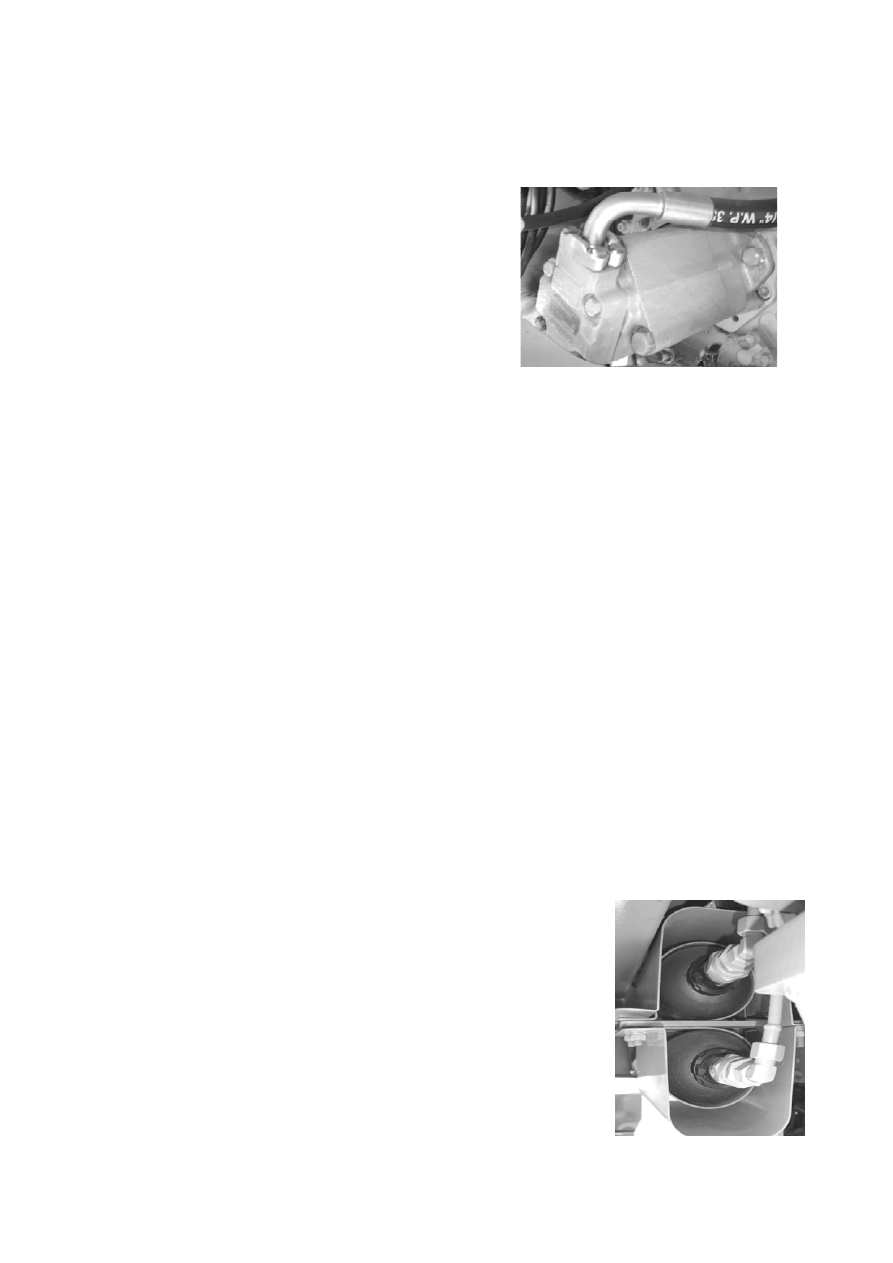
 The pair vane pump is used for the machine, with the model of 

3520VQ21A12-297AA20, from American Eaton. It can be 

bought at local or through the manufacturer. 

Accumulator 

   Do not weld or make any mechanical machining on the shell of 

accumulator. When completing connection of hydraulic pipes, 

- 49 - 

the pressure inside pipes must be completely released by bleed screw on the accumulator. 

Works on accumulator such as repair and pressured connection are only allowed when the 

oil pressure is released. 

8.11 Maintenance of Storage Battery 

Battery electrolyte contains sulphur, and batteries may produce hydrogen. As a result, 

misoperation on batteries may cause grievous bodily injury or fire. Therefore, the following 

cautions must be strictly observed: 

 Never approach lighting cigarrettes or open flame to storage battery. 

 When needing to contact storage battery in work, wear protective goggles and rubber 

gloves. 

 Immediately use large amount of water to wash in case on splash of electrolyte of storage 

battery on clothes or skin. 

 The splash of electrolyte inside storage batter into eyes may cause blindness. If electrolyte 

splashes into eyes, wash with large amount of water immediately and go to see doctor 

without delay. 

 If having drunk electrolyte by mistake, drink large amount of water, or milk, or raw eggs, 

or rapeseed oil, and call for emergency aid of doctor or firstaid center.   

 Before conducting works relevant with storage battery, turn off engine.   

 Avoid contact with metalic items (such as tools) to cause shortcircuit between the positive 

and negative poles of the storage battery. 

 When installing storage battery, connect the positive terminal first. When disassembling 

storage battery, disconnect the negative ternimal (at the side of ground line) first. 

 When disassembling or installing storage battery, firstly check which one is the positive 

terminal and which one is the negative and fasten firmly    the nuts. If battery electrolyte 

level is close to “lower level limit”, add distilled water but be careful not to exceed “upper 

level limit”. 

 When cleaning the top surface of storage battery, clean with cloth. Never use gasoline, 

solution, or any other organic solution or detergent. 

 Fasten firmly the top cover of storage battery. 

 If the electrolyte of storage battery has frozen, neither charge the storage battery nor start 

- 50 - 

engine by other power supplies. This is dangerous and may cause the storage battery catch 

fire. When charging the storage battery or starting engine by other power supplies, melt the 

electrolyte of storage battery before starting and check for leakages. 

 Remove the storage battery from machine before charging.   

 When repairing electric system or conducting electric welding on the machine, remove the 

negative pole of storage battery to prevent flow of electric current. 

8.12 Charge of Storage Battery 

If do not handle storage battery properly when charging it, the storage battery has a danger 

to explode. Therefore, please follow the charge procedures in handling rules and manual of 

storage battery, and abide by the following cautions: 

 Charge in a place of good ventilation. Take off the top cover of storage battery. This will 

enable hydrogen diffuse and prevent explosion.   

 Set the voltage of charge to the same as the voltage of storage battery to be charged. If the 

set of voltage is not correct, the charger may get overheated and catch fire, which may 

cause explosion.   

 Connect the positive (+) charge clip of charger to positive (+) terminal of storage battery, 

then connect the negative (-) charge clip to negative (-) terminal of storage battery. The two 

terminals must be fastened.   

 If the charge rate of storage battery is lower than 1/10, adopt rapid charge mode and set the 

value below the rated capacity of storage battery. If the charge current is too big, leakage or 

evaporation of electrolyte may be caused, which may in turn cause fire or explosion. 

8.13 Maintenance of Tires 

 Since an explosion of tire will push the components and parts such as tire, rim and driving 

axle to the a place about 500 meters or farther away from the machine, and the explosion 

and fragments will cause serious damages or a human casualty accidents, a normal pressure 

of the tire must be ensured without any overpressure. 

 When the vehicle is running, the heat produced by high speed running will increase tire’s 

pressure, which is normal and do not try to lower it. Speed down or stop to cool the tire 

down. Please note: if the vehicle continues to run at a high speed, overheat of tires will 

likely to result in their explosion. 

- 51 - 

 When adjusting the pressure, keep away from the tire as far as possible and must stand at 

back of the tread. 

 Combustible gas is forbidden to inflate. Dry nitrogen is recommended. Nitrogen can 

decrease potential explosion hazard, because it does not support combustion and can 

prevent rubber from oxidation or deterioration and tire rim from erosion. 

 In order to avoid over-inflation, proper tools for nitrogen inflation and related training on 

use of such tools are necessary. 

 Check of tires and rims shall be done every day. It is prohibited to operation under low 

pressure. Check for presence on the tires such phenomenon as cracks or blisters. 

 Checking whether any connecting bolt or nut of tire rim is missing and whether the twisting 

moment of connecting nut of the rim complies with the value recommended by 

manufacturer. 

 When checking tire, do not enter into places in front of or at back of the roll of tire and 

shall stand at the side of the tire. If a tire needs to be removed or disassembled, other tires 

must be fixed in place by wedges. 

 When welding operation is conducted near a tire, must be careful because an explosion of 

the tire is possible to occur. 

 Since repair of a tire or a rim is very dangerous, only trained professionals can undertake 

the repair, using specialized tools and following correct procedures. 

 When replacing a tire, the specification of new tire shall be that as specified so as to ensure 

the sizes and tread patterns of all tires are uniform. 

Whenever it is avoidable, do not enter into the range showed in the drawing below. 


Content   ..  9  10  11  12   ..