Perkins 402D, 403D, 404D Industrial Engine. Manual - part 2
 

  Index      Engines     Perkins 402D, 403D, 404D Industrial Engine - service manual


Search            


Content   ..   1  2  3   ..


Perkins 402D, 403D, 404D Industrial Engine. Manual - part 2


SEBU8311-01

7

Safety Section

General Hazard Information

i02328435

General Hazard Information


g00104545

Illustration 3

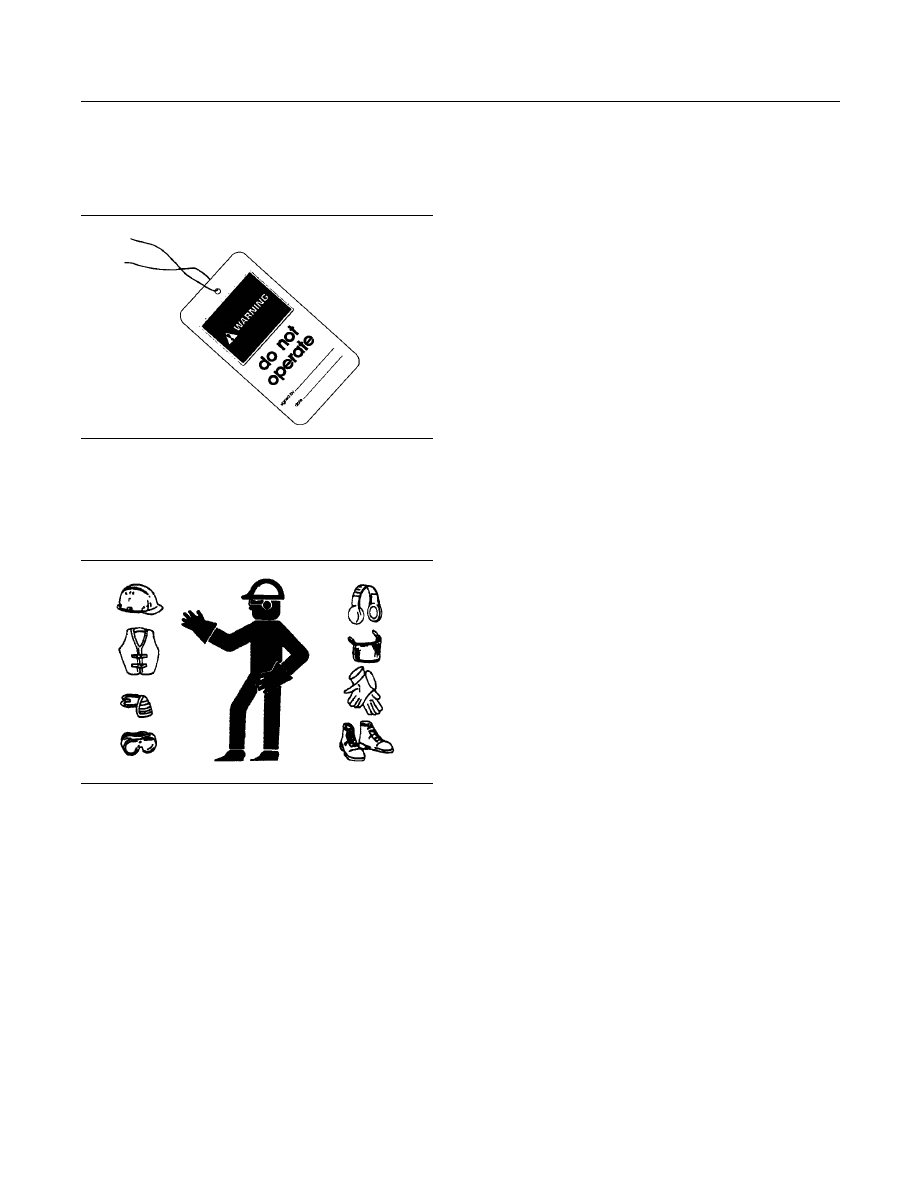
Attach a “Do Not Operate” warning tag or a similar

warning tag to the start switch or to the controls

before you service the equipment or before you

repair the equipment.

g00702020

Illustration 4

Wear a hard hat, protective glasses, and other

protective equipment, as required.

Do not wear loose clothing or jewelry that can snag

on controls or on other parts of the engine.

Make sure that all protective guards and all covers

are secured in place on the engine.

Keep the engine free from foreign material. Remove

debris, oil, tools, and other items from the deck, from

walkways, and from steps.

Never put maintenance fluids into glass containers.

Drain all liquids into a suitable container.

Obey all local regulations for the disposal of liquids.

Use all cleaning solutions with care.

Report all necessary repairs.

Do not allow unauthorized personnel on the

equipment.

Ensure that the power supply is disconnected before

you work on the bus bar or the glow plugs.

Perform maintenance on the engine with the

equipment in the servicing position. Refer to the

OEM information for the procedure for placing the

equipment in the servicing position.

Pressure Air and Water

Pressurized air and/or water can cause debris

and/or hot water to be blown out. This could result in

personal injury.

The direct application of pressurized air or

pressurized water to the body could result in personal

injury.

When pressurized air and/or water is used for

cleaning, wear protective clothing, protective shoes,

and eye protection. Eye protection includes goggles

or a protective face shield.

The maximum air pressure for cleaning purposes

must be below 205 kPa (30 psi). The maximum

water pressure for cleaning purposes must be below

275 kPa (40 psi).

Fluid Penetration

Pressure can be trapped in the hydraulic circuit long

after the engine has been stopped. The pressure can

cause hydraulic fluid or items such as pipe plugs to

escape rapidly if the pressure is not relieved correctly.

Do not remove any hydraulic components or parts

until pressure has been relieved or personal injury

may occur. Do not disassemble any hydraulic

components or parts until pressure has been relieved

or personal injury may occur. Refer to the OEM

information for any procedures that are required to

relieve the hydraulic pressure.

8

SEBU8311-01

Safety Section

Burn Prevention

g00687600

Illustration 5

Always use a board or cardboard when you check

for a leak. Leaking fluid that is under pressure can

penetrate body tissue. Fluid penetration can cause

serious injury and possible death. A pin hole leak can

cause severe injury. If fluid is injected into your skin,

you must get treatment immediately. Seek treatment

from a doctor that is familiar with this type of injury.

Containing Fluid Spillage

Care must be taken in order to ensure that fluids

are contained during performance of inspection,

maintenance, testing, adjusting and repair of the

engine. Make provision to collect the fluid with a

suitable container before any compartment is opened

or before any component is disassembled.

Only use the tools that are suitable for collecting

fluids and equipment that is suitable for collecting

fluids.

Only use the tools that are suitable for containing

fluids and equipment that is suitable for containing

fluids.

Obey all local regulations for the disposal of liquids.

i02143195

Burn Prevention


Do not touch any part of an operating engine.

Allow the engine to cool before any maintenance

is performed on the engine. Relieve all pressure

in the air system, in the hydraulic system, in the

lubrication system, in the fuel system, or in the

cooling system before any lines, fittings or related

items are disconnected.

Coolant

When the engine is at operating temperature, the

engine coolant is hot. The coolant is also under

pressure. The radiator and all lines to the heaters or

to the engine contain hot coolant.

Any contact with hot coolant or with steam can cause

severe burns. Allow cooling system components to

cool before the cooling system is drained.

Check the coolant level after the engine has stopped

and the engine has been allowed to cool.

Ensure that the filler cap is cool before removing the

filler cap. The filler cap must be cool enough to touch

with a bare hand. Remove the filler cap slowly in

order to relieve pressure.

Cooling system conditioner contains alkali. Alkali can

cause personal injury. Do not allow alkali to contact

the skin, the eyes, or the mouth.

Oils

Hot oil and hot lubricating components can cause

personal injury. Do not allow hot oil to contact the

skin. Also, do not allow hot components to contact

the skin.

Batteries

Electrolyte is an acid. Electrolyte can cause personal

injury. Do not allow electrolyte to contact the skin or

the eyes. Always wear protective glasses for servicing

batteries. Wash hands after touching the batteries

and connectors. Use of gloves is recommended.

i02813488

Fire Prevention and Explosion

Prevention


g00704000

Illustration 6

SEBU8311-01

9

Safety Section

Fire Prevention and Explosion Prevention

All fuels, most lubricants, and some coolant mixtures

are flammable.

Flammable fluids that are leaking or spilled onto hot

surfaces or onto electrical components can cause

a fire. Fire may cause personal injury and property

damage.

A flash fire may result if the covers for the engine

crankcase are removed within fifteen minutes after

an emergency shutdown.

Determine whether the engine will be operated in an

environment that allows combustible gases to be

drawn into the air inlet system. These gases could

cause the engine to overspeed. Personal injury,

property damage, or engine damage could result.

If the application involves the presence of combustible

gases, consult your Perkins dealer and/or your

Perkins distributor for additional information about

suitable protection devices.

Remove all flammable combustible materials or

conductive materials such as fuel, oil, and debris from

the engine. Do not allow any flammable combustible

materials or conductive materials to accumulate on

the engine.

Store fuels and lubricants in correctly marked

containers away from unauthorized persons. Store

oily rags and any flammable materials in protective

containers. Do not smoke in areas that are used for

storing flammable materials.

Do not expose the engine to any flame.

Exhaust shields (if equipped) protect hot exhaust

components from oil or fuel spray in case of a line,

a tube, or a seal failure. Exhaust shields must be

installed correctly.

Do not weld on lines or tanks that contain flammable

fluids. Do not flame cut lines or tanks that contain

flammable fluid. Clean any such lines or tanks

thoroughly with a nonflammable solvent prior to

welding or flame cutting.

Wiring must be kept in good condition. All electrical

wires must be correctly routed and securely attached.

Check all electrical wires daily. Repair any wires

that are loose or frayed before you operate the

engine. Clean all electrical connections and tighten

all electrical connections.

Eliminate all wiring that is unattached or unnecessary.

Do not use any wires or cables that are smaller than

the recommended gauge. Do not bypass any fuses

and/or circuit breakers.

Arcing or sparking could cause a fire. Secure

connections, recommended wiring, and correctly

maintained battery cables will help to prevent arcing

or sparking.

Inspect all lines and hoses for wear or for

deterioration. The hoses must be correctly routed.

The lines and hoses must have adequate support

and secure clamps. Tighten all connections to the

recommended torque. Leaks can cause fires.

Oil filters and fuel filters must be correctly installed.

The filter housings must be tightened to the correct

torque.

g00704059

Illustration 7

Use caution when you are refueling an engine. Do

not smoke while you are refueling an engine. Do not

refuel an engine near open flames or sparks. Always

stop the engine before refueling.

10

SEBU8311-01

Safety Section

Crushing Prevention and Cutting Prevention

g00704135

Illustration 8

Gases from a battery can explode. Keep any open

flames or sparks away from the top of a battery. Do

not smoke in battery charging areas.

Never check the battery charge by placing a metal

object across the terminal posts. Use a voltmeter or

a hydrometer.

Incorrect jumper cable connections can cause

an explosion that can result in injury. Refer to

the Operation Section of this manual for specific

instructions.

Do not charge a frozen battery. This may cause an

explosion.

The batteries must be kept clean. The covers

(if equipped) must be kept on the cells. Use the

recommended cables, connections, and battery box

covers when the engine is operated.

Fire Extinguisher

Make sure that a fire extinguisher is available. Be

familiar with the operation of the fire extinguisher.

Inspect the fire extinguisher and service the fire

extinguisher regularly. Obey the recommendations

on the instruction plate.

Lines, Tubes and Hoses

Do not bend high pressure lines. Do not strike high

pressure lines. Do not install any lines that are bent

or damaged. Do not clip any other items to the high

pressure lines.

Repair any lines that are loose or damaged. Leaks

can cause fires. Consult your Perkins dealer or your

Perkins distributor for repair or for replacement parts.

Check lines, tubes and hoses carefully. Do not use

your bare hand to check for leaks. Use a board or

cardboard to check for leaks. Tighten all connections

to the recommended torque.

Replace the parts if any of the following conditions

are present:

End fittings are damaged or leaking.

Outer coverings are chafed or cut.

Wires are exposed.

Outer coverings are ballooning.

Flexible part of the hoses are kinked.

Outer covers have embedded armoring.

End fittings are displaced.

Make sure that all clamps, guards, and heat shields

are installed correctly. During engine operation, this

will help to prevent vibration, rubbing against other

parts, and excessive heat.

i02143194

Crushing Prevention and

Cutting Prevention


Support the component correctly when work beneath

the component is performed.

Unless other maintenance instructions are provided,

never attempt adjustments while the engine is

running.

Stay clear of all rotating parts and of all moving

parts. Leave the guards in place until maintenance

is performed. After the maintenance is performed,

reinstall the guards.

Keep objects away from moving fan blades. The fan

blades will throw objects or cut objects.

When objects are struck, wear protective glasses in

order to avoid injury to the eyes.

Chips or other debris may fly off objects when objects

are struck. Before objects are struck, ensure that no

one will be injured by flying debris.


Content   ..   1  2  3   ..