Kawasaki Diesel MULE 4010 TRANS 4x4 (KAF950G9). Manual - part 1


  Index      Engines     Kawasaki Diesel MULE 4010 TRANS 4x4 (KAF950G9) - service manual


Search                


Content   ..  1  2  3   ..


Kawasaki Diesel MULE 4010 TRANS 4x4 (KAF950G9). Manual - part 1


MULE 4010 TRANS4×4

DIESEL

Utility Vehicle

Service Manual
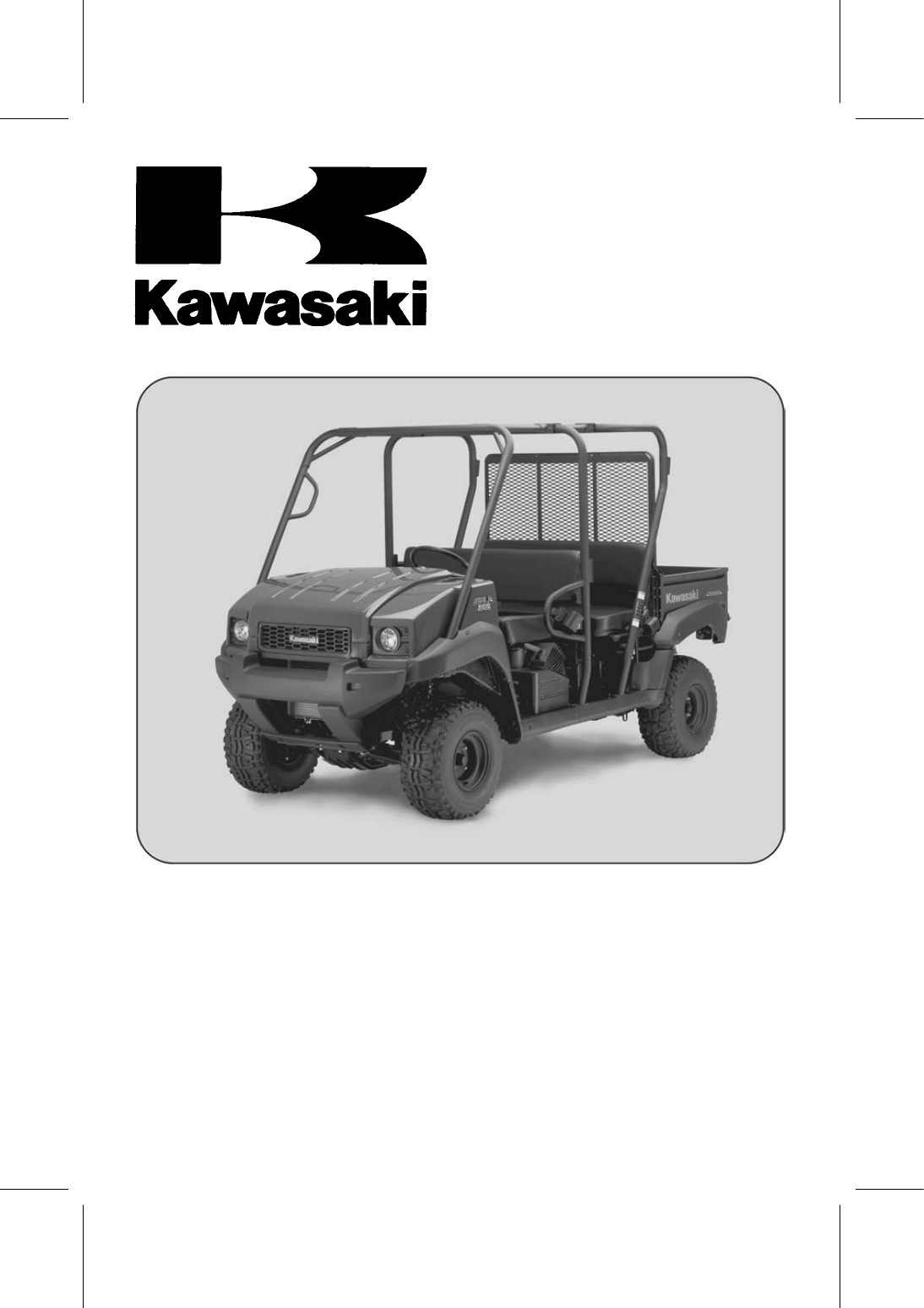
MULE 4010 TRANS4×4

DIESEL

Utility Vehicle

Service Manual

All rights reserved. No parts of this publication may be reproduced, stored in a retrieval system, or

transmitted in any form or by any means, electronic mechanical photocopying, recording or otherwise,
without the prior written permission of Quality Assurance Division/Motorcycle & Engine Company/Kawasaki
Heavy Industries, Ltd., Japan.

No liability can be accepted for any inaccuracies or omissions in this publication, although every possible

care has been taken to make it as complete and accurate as possible.

The right is reserved to make changes at any time without prior notice and without incurring an obligation

to make such changes to products manufactured previously. See your dealer for the latest information on
product improvements incorporated after this publication.

All information contained in this publication is based on the latest product information available at the time

of publication. Illustrations and photographs in this publication are intended for reference use only and may
not depict actual model component parts.

© 2008 Kawasaki Heavy Industries, Ltd.

5th Edition (1) : May 18, 2012

LIST OF ABBREVIATIONS

A

ampere(s)

lb

pounds(s)

ABDC

after bottom dead center

m

meter(s)

AC

alternating current

min

minute(s)

ATDC

after top dead center

N

newton(s)

BBDC

before bottom dead center

Pa

pascal(s)

BDC

bottom dead center

PS

horsepower

BTDC

before top dead center

psi

pound(s) per square inch

°C

degree(s) Celsius

r

revolution

DC

direct current

rpm

revolution(s) per minute

F

farad(s)

TDC

top dead center

°F

degree(s) Fahrenheit

TIR

total indicator reading

ft

foot, feet

V

volt(s)

g

gram(s)

W

watt(s)

h

hour(s)

ohm(s)

L

liter(s)

COUNTRY AND AREA CODES

EUR

Europe

US

United States

CA

Canada

EMISSION CONTROL INFORMATION

To protect the environment in which we all live, Kawasaki has incorporated crankcase emission

(1) and exhaust emission (2) control systems in compliance with applicable regulations of the
United States Environmental Protection Agency and California Air Resources Board.
1. Crankcase Emission Control System
A sealed-type crankcase emission control system is used to eliminate blow-by gases. The blow

-by gases are led to the breather chamber through the crankcase to the inlet manifold.

Oil is separated from the gases while passing through the inside of the breather chamber from

the crankcase, and then returned to the bottom of the crankcase.

2. Exhaust Emission Control System
The exhaust emission control system applied to this engine family is engine modifications that

consist of a modified injection pump and injection timing characteristics.
The fuel system has been calibrated to provide lean air/fuel mixture characteristics, with a suitable
air cleaner and exhaust system.

A maintenance free injection system provides the most appropriate injection timing and helps

maintain a thorough combustion process within the engine which contributes to a reduction of
exhaust pollutants entering the atmosphere.

The Clean Air Act, which is the Federal law covering motor vehicle pollution, contains what is

commonly referred to as the Act’s “tampering provisions”.

“Sec. 203(a) The following acts and the causing thereof are prohibited.

(3)(A) for any person to remove or render inoperative any device or element of design installed

on or in a motor vehicle or motor vehicle engine in compliance with regulations under this
title prior to its sale and delivery to the ultimate purchaser, or for any manufacturer or dealer
knowingly to remove or render inoperative any such device or element of design after such
sale and delivery to the ultimate purchaser.

(3)(B) for any person engaged in the business of repairing, servicing, selling, leasing, or trading

motor vehicles or motor vehicle engines, or who operates a fleet of motor vehicles know-
ingly to remove or render inoperative any device or element of design installed on or in a
motor vehicle or motor vehicle engine in compliance with regulations under this title follow-
ing its sale and delivery to the ultimate purchaser...”

NOTE

The phrase “remove or render inoperative any device or element of design” has been generally

interpreted as follows.

1. Tampering does not include the temporary removal or rendering inoperative of de-

vices or elements of design in order to perform maintenance.

2. Tampering could include.

a.Maladjustment of vehicle components such that the emission standards are ex-

ceeded.

b.Use of replacement parts or accessories which adversely affect the performance

or durability of the vehicle.

c.Addition of components or accessories that result in the vehicle exceeding the stan-

dards.

d.Permanently removing, disconnecting, or rendering inoperative any component or

element of design of the emission control systems.

WE RECOMMEND THAT ALL DEALERS OBSERVE THESE PROVISIONS OF FEDERAL

LAW, THE VIOLATION OF WHICH IS PUNISHABLE BY CIVIL PENALTIES NOT EXCEEDING
$10 000 PER VIOLATION.


Content   ..  1  2  3   ..