YANMAR Diesel Engine 1GM, 2GM, 3GMD, 3HM. Manual - part 8
 

  Index      Engines     YANMAR Diesel Engine 1GM, 2GM, 3GMD, 3HM - service manual


Search            


Content   ..  6  7  8  9   ..


YANMAR Diesel Engine 1GM, 2GM, 3GMD, 3HM. Manual - part 8


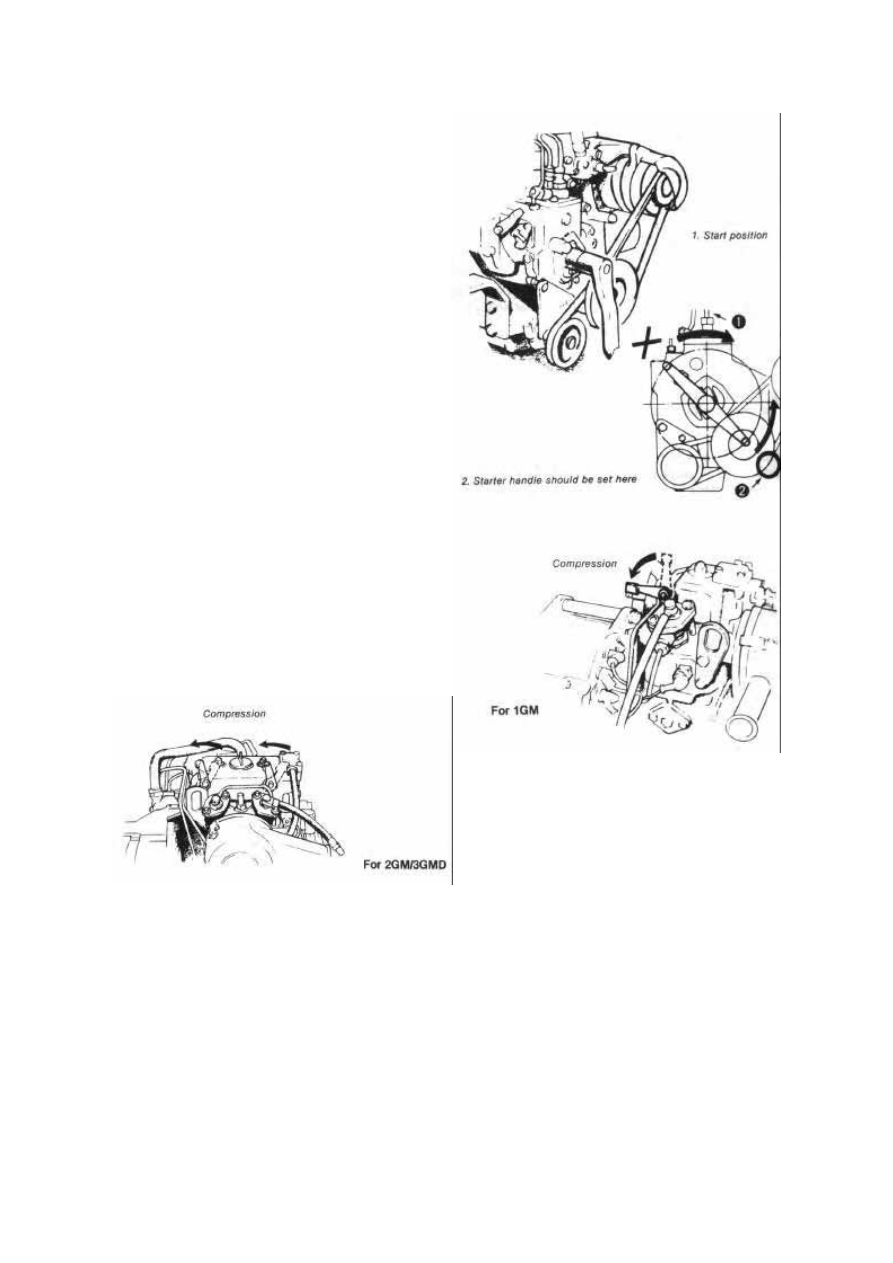
2-b)
Raise the decompression handle to the "NO
COMPRESSION" position.

2-c)
Attach the starter handle with priming shaft as
the angle shown in the figure and turn the
starting handle hard, 5-6 times, and if the
flywheel gains momentum...

2-d)
Pull the decompression lever down to the
compression position. Turn two or three times
without stopping, and the engine will start.

2-e)
After starting return control lever from "FULL SPEED" to "SLOW SPEED"

[7-2.] Cautions after starting the engine.

1) Warm up the engine for more than 5 minutes. Because lube oil does not reach all the
moving parts as soon as the engine is started.
Operate the engine at around 850-900 rpm for at least five minutes.

Important

1) When running the engine for the first time after launching, run it for
15-20 minutes at about 1000 rpm.

2) Be sure to break-in the new engine. When the engine is new engine

parts are tight. Therefore, engine life can be seriously shortened if too heavy load is placed on
the engine before it is break-in Keep the following in mind during the break-in period.

Do not run the engine hard for the first 5 hours after installation.
Be sure to operate below 3000 rpm.

With the control lever in "NEUTRAL" check the following. Be sure that water is coming out
of the cooling water outlet pipe after the engine starts up.

2) Check the instrument panel warning lamp.

Normal condition

Abnormal condition

Key switch ON (with the

Engine start (over 1000 rpm)

engine stopped)

Lube oil lamp

ON

OFF

ON (Pressure down)

Cooling water lamp

OFF

OFF

ON (Temp. rise)

Charge lamp

ON

OFF

ON (No-charge)

Warning buzzer

BUZZ

OFF

BUZZ (Above trouble Except no-charge

If any of the warning lamps do not go off above 1000 rpms, they are malfunctioning. Stop the
engine immediately and contact the nearest Yanmar dealer.

[7-3.] Cautions during operation.

The following should be checked once or twice a day.

1) Fuel
Check and refill the fuel oil if needed. If air is allowed to enter the fuel injection device, it
will cause the engine to stop, and also necessitate the bleeding of the fuel lines.

2) Lube oil
If the warning lamp is on while the engine is running, it is an indication that there is some
abnormality.
First of all, check the amount.

3) Cooling water
Make sure the cooling water is flowing from the outlet pipe and that the cooling temperature
lamp is out. In the event water comes out intermittently, or when the amount is small, check
the following.

3-a)
If air is being taken into the cooling water system.

3-b)
Damage of the cooling water pump.

3-c)
If dirt has plugged up the cooling water pipe or the kingston cock.

4) Charge
Make sure that the charge lamp is off. If the charge
lamp does not go off, even when the engine rpms
are raised to more than 850 charging is not taking
place because of some malfunction in the charge
system.
Consult a dealer.

5) Temperature of parts
Under full power, the surface temperature of each
engine part will be about 50-60°C, or slightly hot if
touched with the hand. If the temperature is too
high, there is some abnormality. These may include
a shortage of oil or improper alignment of the
propeller shaft. Consult your nearest dealer if the
temperature of the engine parts is too high.

6) Exhaust smoke
The emission of black exhaust smoke indicates that
the engine is being overworked. If so operated, the
life of the intake and exhaust valves, piston rings,
cylinder liners, and fuel injection valve will be
shortened.

1. C.W. Temp
2. Charge
3. L.O. Press

7) Water/oil leaks
Check for any water or oil leaks, gas leakage, loose bolts, abnormal sounds, excessive
generation of heat, and vibration. If there is anything wrong, consult your nearest Yanmar
dealer.

8) Engine resonance
A sudden, large vibration of the vessel may be caused when the vibrations (resonance) of the
engine and the vibrations of the hull occur at the same time.
When this happens you should either increase or decrease engine speed.

9) Clutch operation
Clutch operation must be performed at a low speed of less than 900 rpm.

Important
Clutch life will be significantly shortened if engaged suddenly at high speeds,
or if used in a partially engaged condition.

10) Abnormal sounds during operation
If abnormal sounds are detected, or the warning buzzer sounds during operation, you should
promptly stop the engine and consult the nearest dealer.

[7-4.] Stopping

1) Stopping procedure

1a) Place the clutch handle in the "neutral" position and
idle the engine for about 5 minutes.

Important
If the engine is stopped suddenly
while at a high temperature, the tem-
perature of various parts will increase.
This may result in engine trouble.

1-b)
After five minutes' idling, place the speed control lever
in the "full" position and raise the  rpms to about 3600 to
blow out any burnt gas in the cylinder.

1-c)
Set the engine to the lowest speed (about 850-900 rpm), cut the fuel, and stop the engine.

1. Engine stops if knob is pulled
2. Engine stop cable


Content   ..  6  7  8  9   ..