Duramax Diesel. Manual - part 27
 

  Index      Engines     Chevrolet / GMC Duramax Diesel - service manual 2017 year


Search            


Content   ..  25  26  27  28   ..


Duramax Diesel. Manual - part 27


Vehicle Care

107

{

Warning

Turning the surge tank pressure
cap when the engine and radiator
are hot can allow steam and
scalding liquids to blow out and
burn you badly. Never turn the
surge tank pressure cap — even a
little — when the engine and
radiator are hot.

The vehicle must be on a level
surface. When the engine is cold,
the coolant level should be at or
above the indicated mark.

Checking Coolant (Van Models)

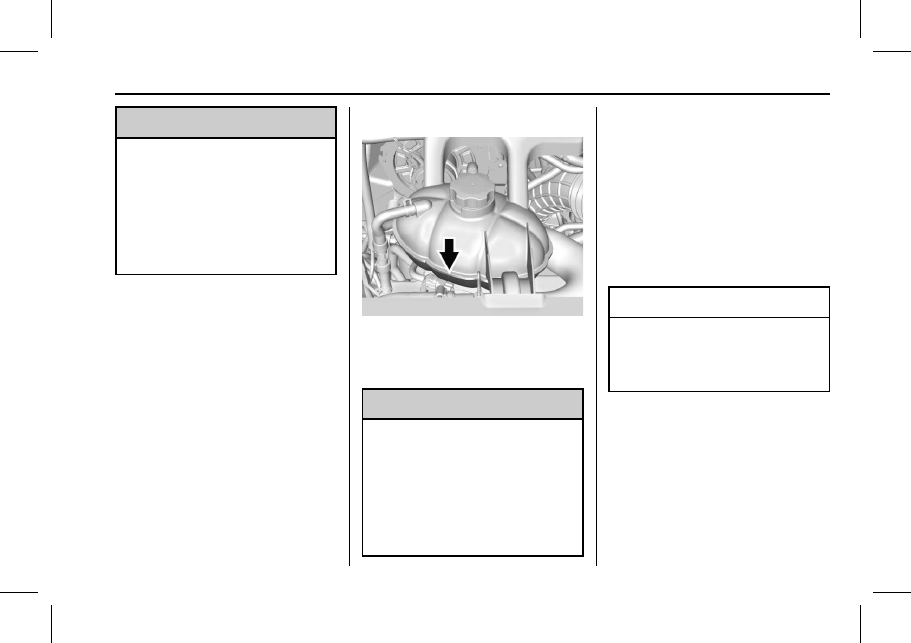
The coolant surge tank is near the
center of the engine compartment.
See Engine Compartment Overview
88 
for location.

{

Warning

Turning the surge tank pressure
cap when the engine and radiator
are hot can allow steam and
scalding liquids to blow out and
burn you badly. Never turn the
surge tank pressure cap — even a
little — when the engine and
radiator are hot.

The vehicle must be on a level
surface. When the engine is cold,
the coolant level should be at the
indicated mark.

Adding Coolant (4-Cylinder
Pickup)

See “Engine Coolant” in the owner
manual.

Adding Coolant (Vans and
8-Cylinder Pickups)

Caution

If coolant is changed or added,
always add enough to fill the
system completely or engine
damage may occur.

If more coolant is needed, add the
proper DEX-COOL coolant mixture
at the surge tank, but be careful not
to spill it.

108

Vehicle Care

{

Warning

You can be burned if you spill
coolant on hot engine parts.
Coolant contains ethylene glycol
and it will burn if the engine parts
are hot enough. Do not spill
coolant on a hot engine.

Caution

This vehicle has a specific
coolant fill procedure. Failure to
follow this procedure could cause
the engine to overheat and be
severely damaged.

{

Warning

Steam and scalding liquids from a
hot cooling system can blow out
and burn you badly. They are
under pressure, and if you turn
the coolant surge tank pressure

(Continued)

Warning (Continued)

cap — even a little — they can
come out at high speed. Never
turn the cap when the cooling
system, including the coolant
surge tank pressure cap, is hot.
Wait for the cooling system and
coolant surge tank pressure cap
to cool if you ever have to turn
the pressure cap.

If no coolant is visible in the surge
tank, add coolant as follows:

8-Cylinder

Pickup

Pressure Cap

Van

Pressure Cap

1. Remove the coolant surge tank

pressure cap when the cooling
system, including the coolant

surge tank pressure cap and
upper radiator hose, is no
longer hot.

For 8-cylinder pickups, turn the
pressure cap slowly clockwise
about one-half turn. If a hiss is
heard, wait for that to stop.
A hiss means there is still
some pressure left.

For vans, turn the pressure cap
slowly counterclockwise about
one full turn. If a hiss is heard,
wait for that to stop. A hiss
means there is still some
pressure left.

2. Keep turning the pressure cap

slowly, and remove it.

3. Slowly fill the coolant surge

tank. Do not let the coolant
level go above the indicated
mark in the tank until after the
engine comes to operating
temperature in Step 4.

4. With the coolant surge tank

pressure cap off, start the
engine and let it run until the

Vehicle Care

109

engine coolant temperature
gauge indicates approximately
90 °C (195 °F).

By this time, the coolant level
inside the coolant surge tank
may be lower. If the level is
lower, slowly add more of the
proper mixture to the coolant
surge tank until it reaches the
indicated mark.

5. Replace the pressure cap.

For 8-cylinder pickups, be sure
the pressure cap is locked.

For vans, be sure the pressure
cap is hand-tight and fully
seated.

6. Verify coolant level after the

engine is shut off and the
coolant is cold. If necessary,
repeat coolant fill procedure
Steps 1–6.

If the coolant level is still low after
having followed these steps twice,
have the coolant system checked by
a certified technician at the dealer
for a possible leak.

Caution

If the pressure cap is not tightly
installed, coolant loss and
possible engine damage may
occur. Be sure the cap is properly
and tightly secured.

Engine Overheating

There is an engine coolant
temperature gauge on the
instrument cluster. See the owner
manual.

If Steam Is Coming from the
Engine Compartment

{

Warning

Steam from an overheated engine
can burn you badly, even if you
just open the hood. Stay away
from the engine if you see or hear
steam coming from it. Just turn it
off and get everyone away from
the vehicle until it cools down.

(Continued)

Warning (Continued)

Wait until there is no sign of
steam or coolant before you open
the hood.

If you keep driving when the
engine is overheated, the liquids
in it can catch fire. You or others
could be badly burned. Stop the
engine if it overheats, and get out
of the vehicle until the engine
is cool.

Caution

Running the engine without
coolant may cause damage or a
fire. Vehicle damage would not be
covered by the vehicle warranty.

If No Steam Is Coming from
the Engine Compartment

A Driver Information Center (DIC)
message, along with a low coolant
condition, can indicate a serious
problem.

110

Vehicle Care

If there is an engine overheat
warning and the vehicle does not
have a low coolant condition, and
no steam is heard or seen, the
problem may not be too serious.
Sometimes the engine can get a
little too hot when the vehicle:
.

Climbs a long hill on a hot day.

.

Stops after high-speed driving.

.

Idles for long periods in traffic.

.

Tows a trailer. See “Driving on
Grades” under “Driving
Characteristics and Towing Tips”
in the owner manual.

If the DIC message comes on with
no sign of steam, try this for a
minute or so:

1. In heavy traffic, let the engine

idle in N (Neutral) while
stopped. If it is safe to do so,
pull off the road, shift to
P (Park) or N (Neutral), and let
the engine idle.

2. Turn on the heater to full hot at

the highest fan speed and
open the window as necessary.

If the vehicle no longer has the
overheat warning, the vehicle can
be driven. Just to be safe, drive
slower for about 10 minutes. If the
warning does not come back on,
drive normally and have the cooling
system checked for proper fill and
function.

If the warning continues, pull over,
stop, and park the vehicle
right away.

If there is still no sign of steam and
the vehicle is equipped with an
engine driven cooling fan, push
down the accelerator until the
engine speed is about twice as fast
as normal idle speed for at least
five minutes while the vehicle is
parked. If the warning is still there,
turn off the engine and get everyone
out of the vehicle until it cools down.

The decision may be made not to lift
the hood, but to get service help
right away.

Battery (4-Cylinder
Pickup Only)

Pickups with a 4-cylinder diesel
engine are equipped with an AGM
(Absorbing Glass Mat) 12-volt
battery. Installation of a standard
12-volt battery will result in reduced
cold cranking performance. When
using a battery charger on the AGM
battery, use the AGM setting on the
charger, if available, to limit charge
voltage to 14.8 volts. Follow the
charger manufacturer's instructions.
See “Battery - North America” in the
owner manual.


Content   ..  25  26  27  28   ..